

Submitted:
19 April 2026
Posted:
20 April 2026
You are already at the latest version
Abstract
The sustainable regeneration of industrial heritage in cold regions is constrained by severe winter climate, seasonal behavioral shifts, and declining spatial vitality. However, existing research has rarely explained how cold-climate conditions influence catalyst effects and regeneration performance in industrial heritage areas. This study proposes a digital twin-enabled framework for the sustainable regeneration of cold-region industrial heritage. Using industrial heritage sites in Harbin, China, as a case study, the research integrates multi-source data to construct a dynamic assessment system that links climate constraints, spatial structure, and human activity patterns. The results show that winter conditions significantly reduce the effectiveness of traditional catalyst mechanisms by weakening outdoor interaction, fragmenting movement continuity, and increasing reliance on indoor transitional spaces. Simulation results further demonstrate that climate-responsive interventions, such as indoor connectivity enhancement, mixed-use functional implantation, and seasonal activity optimization, can improve regeneration effectiveness and spatial resilience. By combining digital twin technology with sustainable urban regeneration theory, this study provides a replicable analytical framework and practical decision-support tool for industrial heritage revitalization in cold-region cities.
Keywords:
industrial heritage
; sustainable regeneration
; digital twin
; cold-region cities
; adaptive reuse
; urban catalyst
; spatial optimization
; climate adaptation
1. Introduction
Industrial heritage has become an important resource for sustainable urban revitalization because its adaptive reuse can preserve historical memory, reactivate underused land, and support new cultural and economic functions [1,2]. Recent studies further show that adaptive reuse can strengthen urban-regeneration value, social innovation, and local economic transformation [3,4,5,6]. However, compared with regeneration in temperate regions, the revitalization of industrial heritage in cold-climate cities faces much stronger environmental constraints. Long winters, extremely low temperatures, snow cover, frozen ground, and frequent wind exposure reduce outdoor activity, weaken pedestrian continuity, and interrupt the stable use of public space [15,19,21]. Under such conditions, conventional renewal approaches that rely mainly on open-space activation and static physical transformation often fail to sustain vitality throughout the year. The revitalization of cold-climate industrial heritage should therefore be understood as a climate-sensitive and dynamic process rather than a simple extension of ordinary urban renewal.
Existing studies have mainly focused on heritage value assessment, adaptive reuse strategies, and spatial transformation [7,8,9,10,11,12,13,14], while Urban Catalyst Theory provides a useful perspective for explaining how localized interventions may stimulate wider urban change [39,40]. Nevertheless, current research still has two clear limitations. First, many analyses remain essentially static and cannot adequately explain when catalyst effects emerge, how they evolve over time, or how far they diffuse across space under changing seasonal conditions. Second, climatic mediation is often insufficiently incorporated, because most prevailing models are developed for temperate or climate-neutral contexts and do not explicitly account for low temperature, snow accumulation, wind chill, frozen soil, or winter-specific behavioral adaptation. As a result, there is still a lack of an integrated framework capable of linking climate constraints, spatial structure, behavioral response, and catalyst dynamics in the sustainable revitalization of cold-climate industrial heritage [9,10,13,14].
Digital twin technology offers an effective way to address this gap. By integrating multi-source sensing, spatial modeling, behavioral simulation, and scenario analysis, digital twins can represent complex urban systems as dynamically updated and experimentally testable environments [27,28,29,30]. For industrial heritage revitalization, their value lies not only in visualization, but also in their capacity to reveal the interactions among space, climate, and human activity and to evaluate alternative intervention strategies before implementation. This potential is particularly important in cold-climate environments, where strong seasonal discontinuities make static planning insufficient for understanding long-term renewal performance. Yet current digital twin applications still focus largely on infrastructure monitoring, transportation simulation, and smart-city management, while their use in industrial heritage revitalization, especially in relation to spatiotemporal catalyst effects under severe winter conditions, remains limited [26,31,32,33,34,35,36,37,38].
To address these issues, this study develops a digital twin-driven framework to assess spatiotemporal catalyst effects in the sustainable revitalization of cold-climate industrial heritage, using the Youfang Street industrial heritage district in Harbin, China, as a case study. It explores how cold-climate factors regulate catalyst diffusion, how digital twins can capture catalyst dynamics under winter conditions, and which intervention strategies are most effective in improving revitalization performance. The results indicate that cold-climate conditions significantly suppress catalyst diffusion and spatial vitality, whereas collaborative strategies outperform single-path approaches. The overall research logic is shown in Figure 1.
2. Materials and Methods
This study establishes a climate-adaptive Materials and Methods framework for assessing spatiotemporal catalyst effects in the sustainable revitalization of cold-climate industrial heritage. To improve methodological transparency, the section is organized as a sequential workflow linking theoretical operationalization, case selection, multi-source data acquisition, model construction, and validation. Accordingly, the chapter integrates the cold-adaptive extension of Urban Catalyst Theory with a digital twin platform, environmental sensing, behavioral observation, agent-based simulation, time-series prediction, and multi-stage verification. Each subsection also clarifies how the outputs of one stage were used as the inputs for the next stage, so that the overall analytical chain can be more readily reproduced.
2.1. Theoretical Framework: Cold-Adaptive Urban Catalyst Theory (CA-UCT)
Conventional Urban Catalyst Theory (UCT) interprets small-scale spatial intervention as a trigger for cumulative urban regeneration through spatial diffusion, temporal accumulation, and social feedback [39,40]. However, its classic analytical assumptions are largely climate-neutral. Such assumptions become unstable in cold-climate heritage districts, where low temperature, snow cover, wind chill, frozen soil, and strong seasonal shifts substantially alter the probability of outdoor activity, route choice, dwelling behavior, and the effective radius of spatial interaction [15,16,17,18].
Accordingly, this study extends UCT into a Cold-Adaptive Urban Catalyst Theory (CA-UCT), in which climate is treated not as a background disturbance but as a core regulating condition. The theoretical revision focuses on three dimensions. First, climate inhibition is introduced to explain how low temperature and snow accumulation reduce the intensity and radius of catalyst diffusion. Second, corridor-oriented propagation is introduced to describe the seasonal transfer of activity from open outdoor space to indoor and semi-indoor networks. Third, seasonal pulse activation is used to explain the temporary resurgence of localized vitality during festivals, exhibitions, and concentrated operational events, even under severe winter conditions. Together, these dimensions provide the conceptual basis for subsequent variable selection and model design. Table 1 summarizes the boundary differences between conventional UCT and CA-UCT, while Figure 2 visualizes the change from climate-neutral diffusion to climate-regulated catalyst transmission.
Figure 2 emphasizes the conceptual shift from climate-neutral catalyst diffusion to a climate-regulated and corridor-oriented mechanism under cold-climate conditions, thereby providing the conceptual basis for subsequent variable definition and model formulation.
On this basis, the revised catalyst mechanism can be formally expressed through the following equations:
subject to the constraint
where is the climate-adjusted catalyst intensity, is the baseline catalyst intensity without climatic constraints, and is the climate correction coefficient. In severe winter conditions, is generally lower than 1, indicating a contraction of both diffusion intensity and diffusion radius. Based on this theoretical revision, three research hypotheses are formulated: H1, cold-climate conditions significantly reduce catalyst diffusion radius and winter vitality; H2, winter diffusion shifts from planar expansion to corridor-based propagation; and H3, a climate-calibrated digital twin model predicts catalyst evolution more accurately than a generic model.
2.2. Study Area and Climatic Context
The study area is the Youfang Street industrial heritage district in Harbin, China, whose location is shown in Figure 3 at the national, municipal, and site scales. Situated in one of China’s most representative severe-cold urban regions, the district provides a typical case for examining how industrial heritage revitalization is shaped by climatic constraints. Formed in the early twentieth century, the area retains a relatively complete industrial spatial structure and remains a representative cold-climate industrial heritage district in northeastern China. Its research value lies in the coexistence of preserved industrial buildings, recognizable factory-road morphology, large open plots, and a winter environment characterized by low temperatures, wind exposure, and seasonal interruption of outdoor activities.
These characteristics make the site particularly suitable for analyzing how climate conditions influence the intensity, continuity, and spatial diffusion of catalyst effects. In addition, the contrast between open industrial yards and existing enclosed or semi-enclosed spaces provides an appropriate spatial basis for investigating winter shifts in movement, stay behavior, and accessibility patterns. As shown in Figure 3, the study area can therefore be understood not only as a representative heritage district within Harbin, but also as a suitable empirical setting for testing climate-adaptive revitalization mechanisms in cold-climate industrial heritage contexts.
Figure 3 situates the study area within its broader geographical context and supports the case-based design of the empirical analysis. The district covers approximately 33.1 hm2 and contains historic factory buildings, warehouse structures, open industrial yards, and a relatively regular internal circulation system. This spatial configuration provides a suitable empirical setting for testing catalyst diffusion because the heritage texture remains legible, the industrial morphology is still clearly identifiable, and the contrast between open areas and indoor-support spaces is sufficiently pronounced. Such characteristics make it possible to observe how catalyst effects respond to differences in spatial enclosure, accessibility, and environmental exposure. Compared with fragmented industrial remains or sites that have undergone substantial redevelopment, the Youfang Street district retains stronger spatial integrity and clearer functional traces, and is therefore more appropriate for examining whether catalyst effects can still emerge, persist, and propagate under harsh climatic restrictions.
Harbin has a typical cold-climate profile, with an annual average temperature of about 4.5 °C, winter minima frequently below -25 °C, a heating season lasting approximately 5–6 months, seasonal frozen-soil depth of about 1.5–2.0 m, and a prevailing winter wind from the northwest at approximately 3–5 m/s. These climatic conditions impose strong constraints on routine outdoor activity and substantially reshape winter patterns of movement and stay behavior [19,20,21,22,23,24]. Under such conditions, open-air walking, spontaneous gathering, and prolonged outdoor staying are significantly reduced, while indoor cultural spaces, covered corridors, and event-based nodes become the principal supports for maintaining site vitality. In this sense, the winter environment affects not only the frequency of public activity, but also the pathways through which activity is redistributed across the site. This seasonal restructuring provides an empirical basis for the corridor-based diffusion and seasonal pulse mechanisms proposed in Section 2.1 and helps explain why climate adaptation must be treated as a core condition in the revitalization of cold-climate industrial heritage. The main climatic characteristics of the study area are summarized in Figure 4.
2.3. Multi-Source Data Acquisition and Preprocessing
Cold-region winter conditions reduce the efficiency of high-frequency field investigation and limit the continuity of conventional on-site observation. To address this limitation, this study adopted a multi-source acquisition strategy integrating satellite remote sensing, UAV thermal-infrared survey, and a ground-based sensing network. The resulting dataset captured environmental conditions from the sky, site, and behavioral layers and provided a more comprehensive empirical basis for model construction and calibration.
Satellite remote sensing was used to derive land-surface temperature, snow cover, and seasonal surface change from Landsat and Sentinel imagery, thereby supporting macro-scale environmental assessment of the study area. UAV thermal-infrared imagery was used to identify local winter heat patterns, thermal shelters, and cold hotspots at a finer spatial resolution. In parallel, an Internet of Things microclimate network recorded near-ground temperature, wind, humidity, and related thermal-comfort indicators at key nodes, enabling the capture of local environmental variability under winter conditions. Additional data included building footprints, industrial heritage typology, POI information, planning documents, behavioral observations, and survey-based activity preferences, which together supported the interpretation of spatial structure and activity demand.
All datasets were standardized before model input and integrated into a BIM-GIS-enabled digital base map, which provided the spatial basis for simulation. Through this process, heterogeneous observations from different sources were transformed into comparable and operationalized inputs for subsequent analysis. These processed datasets were then used as the direct inputs for the digital twin-driven quantification model described in Section 2.4 [25]. The integrated spatial configuration and the multi-source acquisition system are shown in Figure 5.
Figure 5 illustrates how spatial, environmental, and sensing data were integrated into a unified digital base map for subsequent model construction and model calibration.
To further improve data transparency and methodological traceability, the multi-source datasets were systematically organized according to data category, acquisition platform, spatial and temporal resolution, acquisition period, and preprocessing procedure. This step not only clarifies the empirical basis of the digital twin framework, but also demonstrates how heterogeneous observations from the sky, aerial, and ground layers were standardized into comparable and operational model inputs. The detailed composition of the dataset and the corresponding preprocessing procedures are summarized in Table 2.
On the basis of the multi-source dataset presented in Table 2, an adaptive evaluation framework was further developed to connect raw observations with the core analytical dimensions of the study. By integrating spatial form, environmental conditions, human activity, and perceptual feedback, the framework translates heterogeneous data into operational indicators for catalyst assessment, digital twin construction, and subsequent scenario simulation. Rather than treating the collected data as isolated empirical inputs, this framework reorganizes them into a coherent analytical structure in which spatial, climatic, behavioral, and perceptual evidence jointly support the assessment of catalyst-system suitability under cold-climate conditions. In this way, the framework provides an intermediate methodological layer between raw data acquisition and subsequent quantitative modeling. The overall structure of this evaluation framework is shown in Figure 6.
Based on this evaluation framework, the integrated multi-source dataset provides complementary support for model construction, calibration, and hypothesis testing.
2.4. Digital Twin-Driven Dynamic Quantification Model
The digital twin platform was not used merely for visualization. Rather, it served as an iterative experimental system coupling heterogeneous data, spatial structure, behavioral rules, and climatic constraints. The platform consisted of four layers: (1) a data acquisition layer for multi-source observation, (2) a model construction layer for BIM-GIS spatial mapping, (3) a simulation layer that integrated agent-based modeling (ABM), long short-term memory (LSTM) prediction, and spatial structure analysis, and (4) a decision-support layer for comparing intervention scenarios and optimizing catalyst strategies [28,29,30].
To ensure traceability between theory and computation, the core constructs of CA-UCT were explicitly mapped into model variables and rules. Climate inhibition was translated into an individual-level climate comfort factor,, and an area-level climate correction coefficient,., Corridor-oriented propagation was translated into winter route-choice rules that assign higher movement weights to indoor corridors, semi-indoor passages, and sheltered nodes. Seasonal pulse activation was translated into event-loading rules that temporarily enhance the spatial attractiveness of festival and exhibition nodes.
Within the ABM framework, each urban actor was represented as a bounded-rational agent whose activity selection was jointly influenced by spatial attractiveness, climate comfort, and spatial accessibility. The probability that an agent selects node i at time t is expressed as shown in Equation (3).
For model implementation, the node-selection probability was further operationalized as a weighted linear combination, as shown in Equation (4).
subject to the constraint
where denotes node-level spatial attractiveness, denotes climate comfort, denotes accessibility through roads and corridor systems, and , , and are calibrated weights. On this basis, the overall catalyst effect of the district at time t is defined as shown in Equation (6).
where denotes the overall catalyst effect of the district at time t; denotes the composite activation intensity of node i at time t; n is the total number of activity nodes; and represents the climate correction coefficient. Lower values of indicate stronger climatic suppression of catalyst diffusion.
2.5. Model Calibration, Validation, and Data Ethics
A multi-stage validation strategy was adopted to ensure the robustness, transparency, and reproducibility of the model. First, key parameters were jointly calibrated using questionnaire responses, GIS network analysis, meteorological records, and field behavior observations. Catalyst-attractiveness parameters were derived from observed node preferences and survey-based activity demand; accessibility parameters were derived from road-network and corridor-network structure; and climate-related parameters were constrained by meteorological and thermal-environment observations.
Second, historical back-testing was conducted using 2023-2024 monitoring data from the Youfang Street district. The purpose of back-testing was not only to verify predictive accuracy but also to examine whether the climate-sensitive catalyst effect exhibited recognizable temporal and spatial regularities. For the time-series component, the LSTM predictor was compared with a conventional ARIMA benchmark to assess the value of nonlinear prediction under seasonally interrupted vitality dynamics. Third, sensitivity analysis tested the influence of changes in the climate correction coefficient, spatial accessibility, and indoor-support intensity on catalyst diffusion outcomes.
All behavior observation, mobile-signaling, and crowd-activity data were anonymized, aggregated, and de-identified before analysis. The dataset was used only for statistical inference and model training, without individual identification or privacy tracking. The collection, processing, and use of data followed accepted academic-ethics principles and reasonable standards of data security and privacy protection.
Taken together, the integrated methodology allows the cold-climate industrial heritage system to be interpreted as a climate-mediated, behavior-sensitive, and dynamically evolving catalyst process, thereby establishing a coherent methodological bridge from theoretical refinement to scenario-based simulation and empirical verification.
3. Results
3.1. Spatiotemporal Characteristics of Catalyst Effects
3.1.1. Temporal Variation and Spatial Overlap During the Baseline Period
During the baseline monitoring period, the study area displayed pronounced temporal fluctuation and spatial clustering in winter. Winter crowd-density peaks were mainly concentrated between 14:00 and 16:00, whereas summer activity intensity was generally higher and lasted longer. Hourly meteorological observations show that the heating season remained within a low-temperature range and that wind speed above 3 m/s occurred frequently during the day. Spatial overlay analysis indicates a strong correspondence between high POI kernel-density zones and relatively comfortable thermal environments, with a spatial overlap ratio of 78%. Correlation tests further reveal a significant positive relationship between air temperature and the spatial vitality index (r = 0.64, p < 0.01) and a significant negative relationship between wind speed and vitality (r = -0.53, p < 0.05). These temporal and spatial patterns are illustrated in Figure 7.
Figure 7 shows that winter activity intensity is temporally concentrated and spatially associated with thermally favorable zones.
3.1.2. Temporal Evolution Pattern
The LSTM-based time-series analysis reveals a strong seasonal cycle in catalyst effects. The composite catalyst effect represented by the spatial vitality index reaches its annual minimum in winter (December-February), declining by 37.6% relative to the autumn peak (September-October; t = -4.21, p < 0.01). Different catalyst types show differentiated responses. Material-spatial catalysts exhibit the strongest winter decline, with the radiation radius shrinking from 1.2 km to 0.7 km (t = -3.76, p < 0.01). Cultural catalysts show event-driven fluctuation and short-term peaks during the Ice and Snow Festival. Smart-technology catalysts are relatively more stable, with a winter decrease of 18.3%.
These results indicate that catalyst performance in cold-climate industrial heritage districts is strongly shaped by seasonal climatic constraints and activity organization. The winter attenuation coefficient is significantly negatively correlated with the indoor accessibility rate of catalyst configurations (r = -0.82, p < 0.01), suggesting that improved indoor connectivity and sheltered circulation help buffer the decline of catalyst effects under winter conditions [17,18,27,30,32,33,34,35]. The seasonal variation of these effects is presented in Figure 8.
Figure 8 confirms the strong seasonal cyclicity of catalyst effects and reveals differentiated responses among catalyst types.
3.1.3. Spatial Diffusion Pattern
Kernel-density estimation and network analysis indicate a hierarchical diffusion structure composed of core, radiation, and influence zones. In summer, catalyst effects spread outward from the renewed core factory buildings, with a radiation zone of approximately 1.5 km and an influence range of 4.2 km. In winter, however, this range contracts significantly under low temperature, wind exposure, and reduced outdoor activity. Statistical results show that the winter radiation radius is 41.7% lower than in summer (t = -3.94, p < 0.01). Space-syntax analysis further indicates that a 0.1 decline in global integration reduces the catalyst radiation radius by an average of 230 m (p < 0.05), suggesting that spatial accessibility strongly affects catalyst transmission. Heat maps and three-dimensional activity profiles also show that winter hotspots concentrate around core renewal nodes and indoor corridor systems, forming a more linear diffusion pattern supported by continuous accessible networks. These spatial characteristics are shown in Figure 9.
Figure 9 shows that winter diffusion contracts spatially and becomes increasingly dependent on continuous indoor and semi-indoor accessibility networks.
3.2. Digital Twin Simulation and Predictive Performance
3.2.1. Accuracy Evaluation
Daily catalyst-effect data from November 2023 to October 2024 were used for training and testing, with a training-test split of 8:2. Compared with the benchmark model, the LSTM model achieved higher accuracy on both major error metrics: RMSE was reduced by 22.3% and MAE by 19.8%, with both differences significant at p < 0.01. During extreme cold-wave periods, the LSTM model also showed a stronger capacity to fit short-term nonlinear fluctuations and rapidly changing spatial vitality. The comparative accuracy results are summarized in Table 3.
3.3. Scenario Simulation Results
Two representative climatic scenarios were constructed on the digital twin platform: a warm-winter scenario (average temperature -8 °C) and an extreme-cold scenario (average temperature -22 °C). The simulations show marked differences in catalyst intensity under the two scenarios. In the warm-winter scenario, the average catalyst radiation radius reaches 0.96 km, which is 27.4% higher than in the extreme-cold scenario (t = 2.87, p < 0.05). Further comparison among intervention scenarios demonstrates that collaborative catalyst strategies outperform all single-path schemes. Scenario D achieves the highest winter vitality level, with a winter spatial vitality index of 0.71, representing a 31.2% increase over the baseline (t = 3.45, p < 0.01). The simulated performance of these scenarios is summarized in Table 4.
3.4. Strategy Optimization and Empirical Verification
3.4.1. Optimization of Catalyst Renewal Strategies
Based on the spatiotemporal characteristics identified in Section 3.1 and the scenario results in Section 3.3, a catalyst optimization pathway for cold-climate industrial heritage revitalization was developed. Centered on the digital twin platform, the pathway integrates catalyst identification, spatiotemporal analysis, and scenario comparison into a recognition-simulation-optimization workflow. Material-spatial, cultural, and smart-technology catalysts are first identified from BIM, GIS, POI, and behavior data; spatial syntax, kernel density, network analysis, and LSTM outputs are then used to quantify temporal evolution, spatial diffusion, and intervention response; and finally three categories of strategy are generated: winter-adaptive spatial design, smart-technology enhancement, and seasonal catalyst programming. The optimization pathway is shown in Figure 10.
Figure 10 synthesizes the pathway from catalyst identification to strategy optimization and provides the analytical basis for subsequent intervention design.
3.4.2. Spatial Implementation Outcomes
The intervention logic was further translated into a spatial implementation scheme. After optimization, the previously scattered industrial remains were reorganized into a multi-core, networked, and seasonally embedded catalyst structure. Rather than relying on isolated physical renovation, the scheme integrates spatial restructuring, functional implantation, and circulation enhancement into a unified revitalization strategy. In particular, it strengthens the connectivity between catalyst nodes, improves winter accessibility, and reinforces the role of indoor and semi-indoor transition spaces as continuous carriers of public activity. This spatial translation ensures that the proposed interventions are not only conceptually valid, but also applicable to the practical revitalization of key industrial heritage areas.
At the operational level, the implementation combines vitality core units, strengthened corridor systems, indoor and semi-indoor transition spaces, and open activity areas to improve both spatial continuity and functional adaptability. The resulting layout includes core catalyst nodes, cultural exhibition zones, commercial leisure areas, public activity spaces, and digital interaction spaces, thereby converting the theoretical optimization logic into a spatially operable renewal plan. More importantly, the scheme reorganizes the relationship between heritage resources, activity intensity, and seasonal climate constraints, allowing the renewal strategy to remain effective under winter conditions while also supporting event-based activation. The spatial implementation outcomes are presented in Figure 11.
3.4.3. Empirical Validation of Intervention Strategies
Comparative simulation shows that the strategy combining indoor corridors and improvements in building thermal environment raises the winter vitality index from 0.54 to 0.59 (+9.3%). A seasonal event strategy increases the index to 0.66 (+22.2%). The collaborative strategy further raises it to 0.71 (+31.2%). Comprehensive comparison also indicates that the collaborative strategy improves annual vitality and spatial diffusion simultaneously, increasing the annual comprehensive vitality index by 42.7% and expanding the catalyst radiation radius from 0.70 km to 0.93 km (+32.9%). It therefore yields the strongest combined gain among all intervention paths. The comparative effects of these intervention strategies are shown in Figure 12.
Figure 12 confirms that collaborative intervention strategies outperform single-path schemes in both winter vitality and overall catalyst performance.
3.5. Summary of Results
The results systematically demonstrate the temporal variation, spatial diffusion, model performance, and intervention response of catalyst effects in cold-climate industrial heritage. Winter attenuation is pronounced, different catalyst types show differentiated seasonal sensitivity, and spatial diffusion contracts into linear patterns supported by indoor continuous networks. The calibrated digital twin model reproduces these dynamics with high accuracy and provides a robust platform for comparing intervention schemes before implementation.
4. Discussion
4.1. Interpretation of Core Findings
First, catalyst effects in cold-climate industrial heritage are not stable throughout the year but instead display clear seasonal rupture. The observed 37.6% decline in winter vitality and 41.7% contraction in radiation radius confirm that climate is not a background condition but a major structuring force shaping catalyst range, continuity, and intensity. Second, diffusion paths are reorganized in winter: open-space outward spread is replaced by corridor-based propagation through indoor and semi-indoor networks. Third, different catalyst types have different seasonal sensitivities. Material-spatial catalysts are most vulnerable, cultural catalysts exhibit pulse-like fluctuations, and smart-technology catalysts remain relatively stable. Finally, collaborative interventions produce the strongest gains, indicating that spatial adaptation, technological support, and seasonal operation must function as an integrated system rather than as isolated measures.
4.2. Theoretical Contributions
The findings extend the applicability boundary of urban catalyst theory by demonstrating that catalyst effects cannot be transferred directly across climatic contexts. In cold regions, low temperature, snow cover, wind chill, and frozen soil jointly reshape behavior and diffusion media, weakening the core assumptions of climatic neutrality and continuous open-space transmission. By incorporating climate correction into the catalyst framework, the study shifts industrial heritage revitalization research from static description toward mechanism-oriented explanation. In addition, it broadens the application of digital twins in heritage and urban-regeneration studies by using digital twins not only for visualization but also as a mechanism-testing and intervention-comparison platform [11,12,13,14].
4.3. Practical and Planning Implications
From a planning perspective, cold-climate industrial heritage revitalization should prioritize climate-adaptive accessibility rather than simply expanding open space. Indoor public space, sheltered corridors, semi-indoor transitional areas, and thermally advantageous stopping nodes should be treated as core infrastructure of the catalyst system [17,18,23,24]. Seasonal activities should likewise be embedded as an intrinsic part of revitalization strategies instead of being added afterward [15,16,20]. At the implementation level, the digital twin framework allows intervention combinations to be pre-evaluated before construction, thereby reducing trial-and-error costs and supporting evidence-based decision making in climate-sensitive urban revitalization [27,28,29,30,31,32,33,34,35,36,37,38].
4.4. Research Limitations
This study has several limitations. First, the empirical analysis is based on a single case in Harbin, and local morphology, organizational patterns, and renewal conditions may influence catalyst dynamics. Second, although the dataset captures key seasonal differences, the monitoring period is still limited for identifying long-term adaptive behavior, repeated event effects, and slow feedback processes. Third, while low temperature and winter constraints are incorporated into the model, extreme events such as persistent heavy snowfall, sudden blizzards, and rapid freeze-thaw cycles are not yet fully represented.
4.5. Future Research Directions
Future work should expand the framework in three directions. First, multi-city comparative studies are needed to test the generalizability of CA-UCT across different cold-region urban contexts. Second, longer-term dynamic monitoring should be integrated into digital twin workflows to better capture repeated seasonal cycles, gradual adaptation, and lagged renewal effects. Third, future models should incorporate high-frequency climatic disturbance data, emergency behavioral responses, and real-time updating mechanisms so that catalyst dynamics under extreme winter shocks can be simulated more accurately.
5. Conclusions
Using the Youfang Street industrial heritage district in Harbin as a case, this study developed a digital twin-driven analytical framework for identifying and simulating catalyst effects in cold-climate industrial heritage revitalization. By integrating multi-source sensing data, a climate correction mechanism, agent-based simulation, and scenario comparison, the research systematically examined temporal evolution, spatial diffusion, and intervention response under severe winter conditions.
The empirical results show that cold-climate conditions exert a strong constraining effect on catalyst effects. Compared with the autumn peak, the winter vitality index decreases by 37.6% and the catalyst radiation radius contracts by 41.7%. Meanwhile, diffusion pathways shift from open outward spread to corridor-based propagation supported by indoor and semi-indoor networks. Cultural activities can generate local pulse activation, whereas smart-technology catalysts remain comparatively stable across seasons. Among all simulated intervention options, collaborative strategies perform best, increasing winter vitality by 31.2% and annual comprehensive vitality by 42.7%.
The key contribution of this study is not merely to state that winter weakens vitality, but to reveal how climate reshapes the urban catalyst mechanism and to translate that process into a quantifiable, simulatable, and planning-oriented analytical framework. The framework offers a methodological reference for industrial heritage revitalization in cold regions and a transferable pathway for broader climate-adaptive urban regeneration research.
Author Contributions
Conceptualization, S.Y. and M.S.; methodology, S.Y. and M.S.; software, Y.W.; validation, S.Y., M.S. and Y.W.; formal analysis, S.Y.; investigation, S.Y., Y.W. and K.Z.; resources, M.S.; data curation, Y.W. and M.L.; writing—original draft preparation, S.Y.; writing—review and editing, M.S., K.Z. and M.L.; visualization, Y.W. and K.Z.; supervision, M.S.; project administration, M.S. All authors have read and agreed to the published version of the manuscript.
Funding
This research was funded by the National College Student Innovation and Entrepreneurship Training Program, project number 530-41111204; the Fundamental Research Funds for the Central Universities, grant numbers 2572024DZ30 and 2572025AW56; and the Philosophy and Social Science Research Planning Project of Heilongjiang Province, grant numbers 22JLB146 and 25YSB010.
Data Availability Statement
The data supporting the reported results are available from the corresponding author upon reasonable request. Some datasets contain site-management and field-observation records and are therefore not publicly available for privacy and administrative reasons.
Acknowledgments
The authors gratefully acknowledge Northeast Forestry University for its support.
Conflicts of Interest
The authors declare no conflicts of interest.
Abbreviations
The following abbreviations are used in this manuscript:
| DT | Digital Twin |
| ABM | Agent-Based Model |
| CA-UCT | Cold-Adaptive Urban Catalyst Theory |
| UCT | Urban Catalyst Theory |
| BIM | Building Information Modeling |
| GIS | Geographic Information System |
| LSTM | Long Short-Term Memory |
References
- Vafaie, F.; Remøy, H.; Gruis, V. Adaptive reuse of heritage buildings: A systematic literature review of success factors. Habitat International 2023, 142, 102926. [Google Scholar] [CrossRef]
- Armstrong, G.; Soebarto, V.; Zuo, J. Vacancy Visual Analytics Method: Evaluating adaptive reuse as an urban regeneration strategy through understanding vacancy. Cities 2021, 115, 103220. [Google Scholar] [CrossRef]
- Meng, F.; Zhi, Y.; Pang, Y. Assessment of the Adaptive Reuse Potentiality of Industrial Heritage Based on Improved Entropy TOPSIS Method from the Perspective of Urban Regeneration. Sustainability 2023, 15, 7735. [Google Scholar] [CrossRef]
- De Gregorio, S.; De Vita, M.; De Berardinis, P.; Palmero, L.; Risdonne, A. Designing the Sustainable Adaptive Reuse of Industrial Heritage to Enhance the Local Context. Sustainability 2020, 12, 9059. [Google Scholar] [CrossRef]
- Martinović, A.; Ifko, S. Industrial heritage as a catalyst for urban regeneration in post-conflict cities: Case study of Mostar, Bosnia and Herzegovina. Cities 2018, 74, 259–268. [Google Scholar] [CrossRef]
- Sun, M.; Chen, C. Renovation of industrial heritage sites and sustainable urban regeneration in post-industrial Shanghai. Journal of Urban Affairs 2023, 45, 729–752. [Google Scholar] [CrossRef]
- Scaffidi, F. Average social and territorial innovation impacts of industrial heritage regeneration. Cities 2024, 148, 104907. [Google Scholar] [CrossRef]
- Bertacchini, E.; Frontuto, V. Economic valuation of industrial heritage: A choice experiment on the Shanghai Baosteel industrial site. Journal of Cultural Heritage 2024, 66, 215–228. [Google Scholar] [CrossRef]
- Song, J.; Chen, J.; Yang, X.; Zhu, Y. Research on Adaptive Reuse Strategy of Industrial Heritage Based on the Method of Social Network. Land 2024, 13, 383. [Google Scholar] [CrossRef]
- Ciampa, F.; De Medici, S.; Viola, S.; Pinto, M.R. Regeneration Criteria for Adaptive Reuse of the Waterfront Ecosystem: Learning from the U.S. Case Study to Improve European Approach. Sustainability 2021, 13, 4156. [Google Scholar] [CrossRef]
- Dell’Anna, F. What Advantages Do Adaptive Industrial Heritage Reuse Processes Provide? An Econometric Model for Estimating the Impact on the Surrounding Residential Housing Market. Heritage 2022, 5, 1572–1592. [Google Scholar] [CrossRef]
- Chen, J.; Judd, B.; Hawken, S. Adaptive reuse of industrial heritage for cultural purposes in Beijing, Shanghai and Chongqing. Structural Survey 2016, 34, 331–350. [Google Scholar] [CrossRef]
- Ma, Y.; Roosli, R.; Cao, Z.; Zhang, X.; Gai, Y.; Ma, Z. From isolation to integration: A methodological review of adaptive reuse in industrial heritage buildings. Energy and Buildings 2025, 348, 116474. [Google Scholar] [CrossRef]
- Han, R.; Yang, S. A Study on Industrial Heritage Renewal Strategy Based on Hybrid Bayesian Network. Sustainability 2023, 15, 10707. [Google Scholar] [CrossRef]
- Paukaeva, A.A.; Setoguchi, T.; Watanabe, N.; Luchkova, V.I. Temporary Design on Public Open Space for Improving the Pedestrian’s Perception Using Social Media Images in Winter Cities. Sustainability 2020, 12, 6062. [Google Scholar] [CrossRef]
- Paukaeva, A.A.; Setoguchi, T.; Luchkova, V.I.; Watanabe, N.; Sato, H. Impacts of the temporary urban design on the people’s behavior: The case study on the winter city Khabarovsk, Russia. Cities 2021, 117, 103303. [Google Scholar] [CrossRef]
- Krivorotko, M.; Setoguchi, T.; Watanabe, N. Efficient Public Underground Pedestrian Space in a Cold-Climate City: A Case Study of Sapporo, Japan. Sustainability 2024, 16, 9995. [Google Scholar] [CrossRef]
- Watanabe, N.; Setoguchi, T. A Study of the Relationship between Human Behavior and Urban Design during the Winter in a High-Snowfall Urban Area. Sustainability 2024, 16, 3983. [Google Scholar] [CrossRef]
- Mikaeili, M.; et al. Climate-Responsive Design Principles in Winter City Public Open Spaces. Sustainability 2025, 17, 8295. [Google Scholar] [CrossRef]
- Yu, P.; Zhang, Y. A Satisfaction Study of Waterfront Public Spaces in Winter Cities from a Demand Perspective: A KANO-IPA Model Analysis Based on Northeastern China. Land 2025, 14, 92. [Google Scholar] [CrossRef]
- Li, C.; Maruthaveeran, S.; Shahidan, M.F.; Li, C. Cold city outdoor space utilisation patterns and constraints: A systematic review of empirical evidence. Urban Forestry & Urban Greening 2024, 99, 128439. [Google Scholar] [CrossRef]
- Liu, M.; Yang, C.; Fan, Z.; Yuan, C. Prediction approach on pedestrian outdoor activity preference under factors of public open space integrated microclimate. Building and Environment 2023, 244, 110761. [Google Scholar] [CrossRef]
- Korobeinikova, A.; Danilina, N.; Teplova, I. Planning Public Space Climate Comfortability: A GIS-Based Algorithm for the Compact Cities of the Far North. Land 2024, 13, 1763. [Google Scholar] [CrossRef]
- Fan, L.; et al. The Impact of Vegetation Layouts on Thermal Comfort in Urban Main Streets: A Case Study of Youth Street in Shenyang. Sustainability 2025, 17, 1755. [Google Scholar] [CrossRef]
- Yang, C.; Yan, F.; Zhang, S.; Luo, Z. Investigating Seasonal Effects of Dominant Driving Factors on Spatial Distribution of Land Surface Temperature in Urban Areas: A Case Study of Chinese Megacities. Remote Sensing 2020, 12, 3006. [Google Scholar]
- Hosamo, H.; Mazzetto, S. Integrating Knowledge Graphs and Digital Twins for Heritage Building Conservation. Buildings 2025, 15, 16. [Google Scholar] [CrossRef]
- Liu, W.; Lv, Y.; Wang, Q.; Sun, B.; Han, D. A Systematic Review of the Digital Twin Technology in Buildings, Landscape and Urban Environment from 2018 to 2024. Buildings 2024, 14, 3475. [Google Scholar] [CrossRef]
- Zhang, Z.; Wei, Z.; Court, S.; Yang, L.; Wang, S.; Thirunavukarasu, A.; Zhao, Y. A Review of Digital Twin Technologies for Enhanced Sustainability in the Construction Industry. Buildings 2024, 14, 1113. [Google Scholar] [CrossRef]
- Mousavi, Y.; Gharineiat, Z.; Karimi, A.A.; McDougall, K.; Rossi, A.; Gonizzi Barsanti, S. Digital Twin Technology in Built Environment: A Review of Applications, Capabilities and Challenges. Smart Cities 2024, 7, 2594–2615. [Google Scholar] [CrossRef]
- Lauria, M.; Azzalin, M. Digital Twin Approach in Buildings: Future Challenges via a Critical Literature Review. Buildings 2024, 14, 376. [Google Scholar] [CrossRef]
- Mazzetto, S. Integrating Emerging Technologies with Digital Twins for Heritage Building Conservation: An Interdisciplinary Approach with Expert Insights and Bibliometric Analysis. Heritage 2024, 7, 6432–6479. [Google Scholar] [CrossRef]
- Chaves, E.; Aguilar, J.; Barontini, A.; Mendes, N.; Compán, V. Digital Tools for the Preventive Conservation of Built Heritage: The Church of Santa Ana in Seville. Heritage 2024, 7, 3470–3494. [Google Scholar] [CrossRef]
- Luo, S.; Wang, H. Digital Twin Research on Masonry–Timber Architectural Heritage Pathology Cracks Using 3D Laser Scanning and Deep Learning Model. Buildings 2024, 14, 1129. [Google Scholar] [CrossRef]
- Vuoto, A.; Funari, M.F.; Lourenço, P.B. Shaping Digital Twin Concept for Built Cultural Heritage Conservation: A Systematic Literature Review. International Journal of Architectural Heritage 2024, 18, 1–34. [Google Scholar] [CrossRef]
- Dembski, F.; Wössner, U.; Letzgus, M.; Ruddat, M.; Yamu, C. Urban Digital Twins for Smart Cities and Citizens: The Case Study of Herrenberg, Germany. Sustainability 2020, 12, 2307. [Google Scholar] [CrossRef]
- Boje, C.; Guerriero, A.; Kubicki, S.; Rezgui, Y. Towards a semantic Construction Digital Twin: Directions for future research. Automation in Construction 2020, 114, 103179. [Google Scholar] [CrossRef]
- Davila Delgado, J.M.; Oyedele, L. Digital Twins for the built environment: Learning from conceptual and process models in manufacturing. Advanced Engineering Informatics 2021, 49, 101332. [Google Scholar] [CrossRef]
- Wang, H.; Gan, V.J.L.; Hu, Y.; Liu, Y. Digital twin-enabled built environment sensing and monitoring through semantic enrichment of BIM with SensorML. Automation in Construction 2022, 144, 104625. [Google Scholar] [CrossRef]
- Attoe, W.; Logan, D. American Urban Architecture: Catalysts in the Design of Cities; University of California Press: Berkeley, CA, USA, 1989. [Google Scholar]
- Oswalt, P.; Overmeyer, K.; Misselwitz, P. (Eds.) Urban Catalyst: The Power of Temporary Use; DOM Publishers: Berlin, Germany, 2013. [Google Scholar]
Figure 1.
Technical framework of the study.
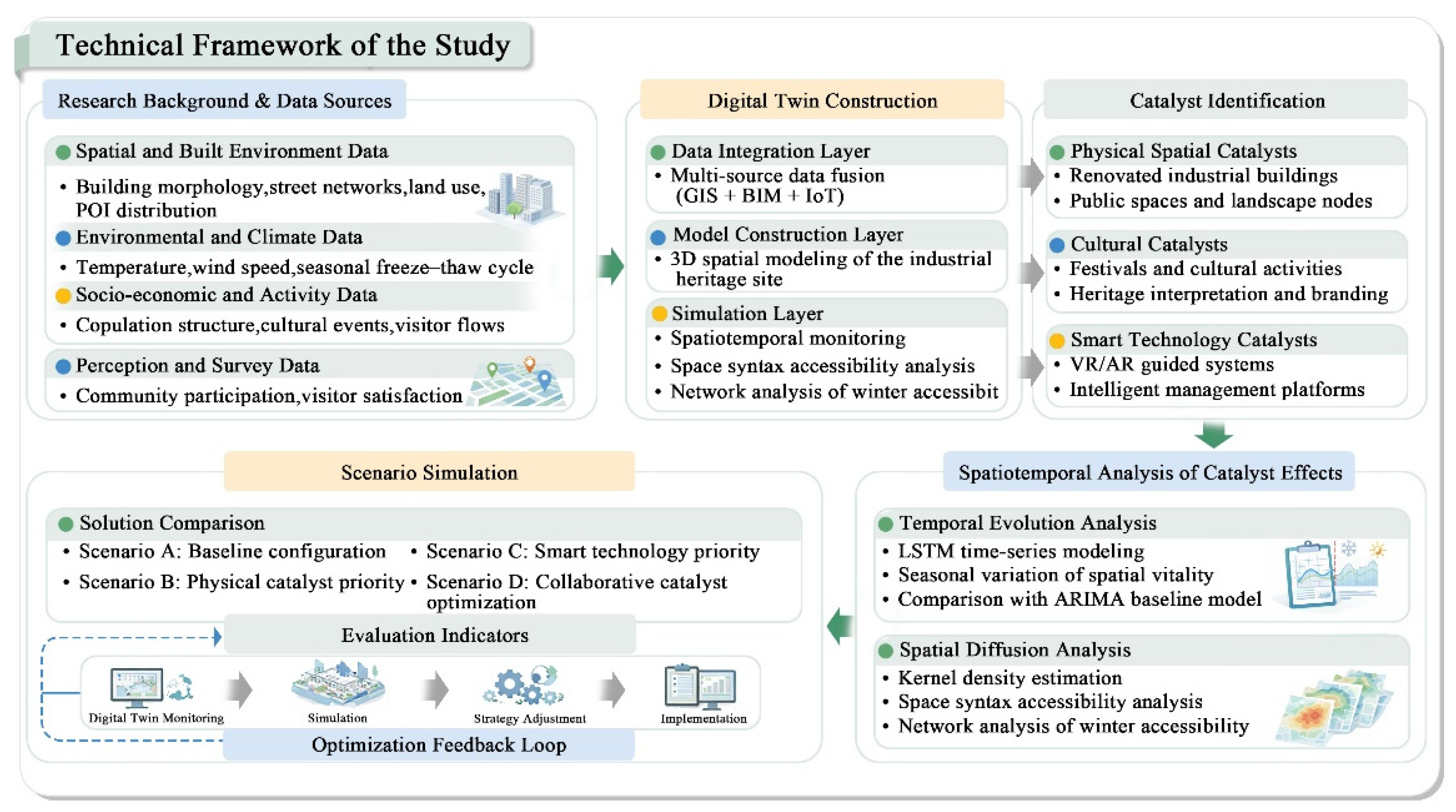
Figure 2.
Comparison between conventional UCT and CA-UCT.
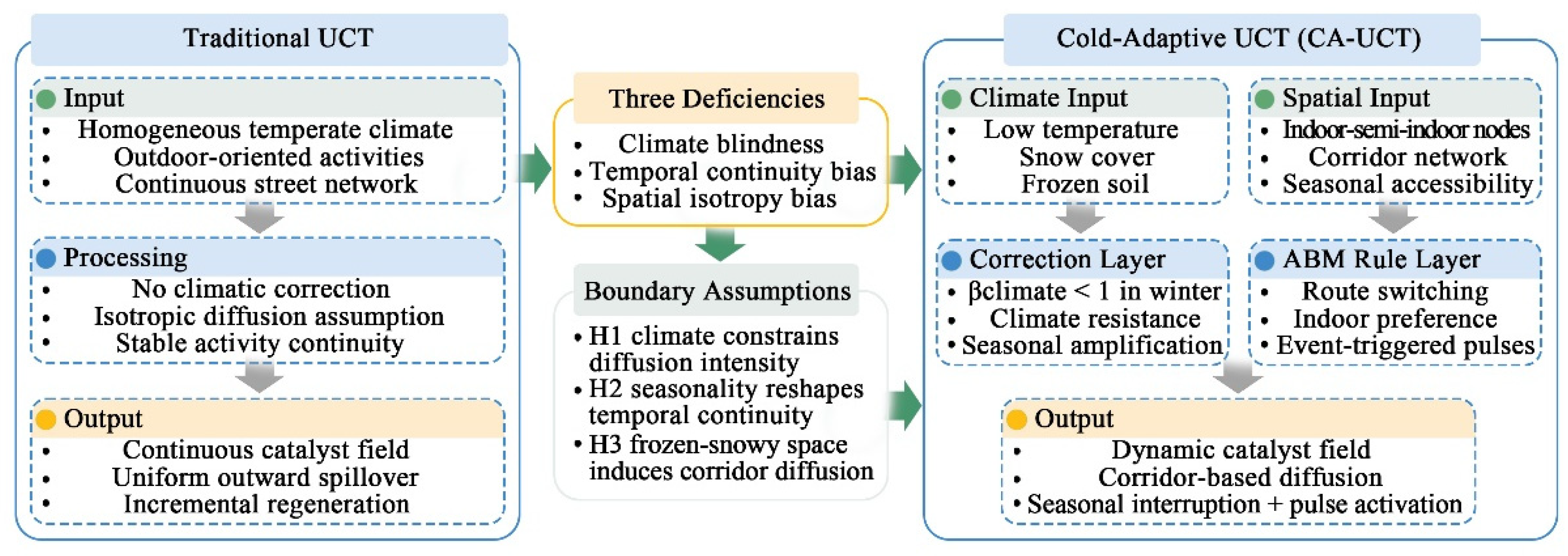
Figure 3.
Location of the Youfang Street industrial heritage district at the national, municipal, and site scales.
Figure 3.
Location of the Youfang Street industrial heritage district at the national, municipal, and site scales.
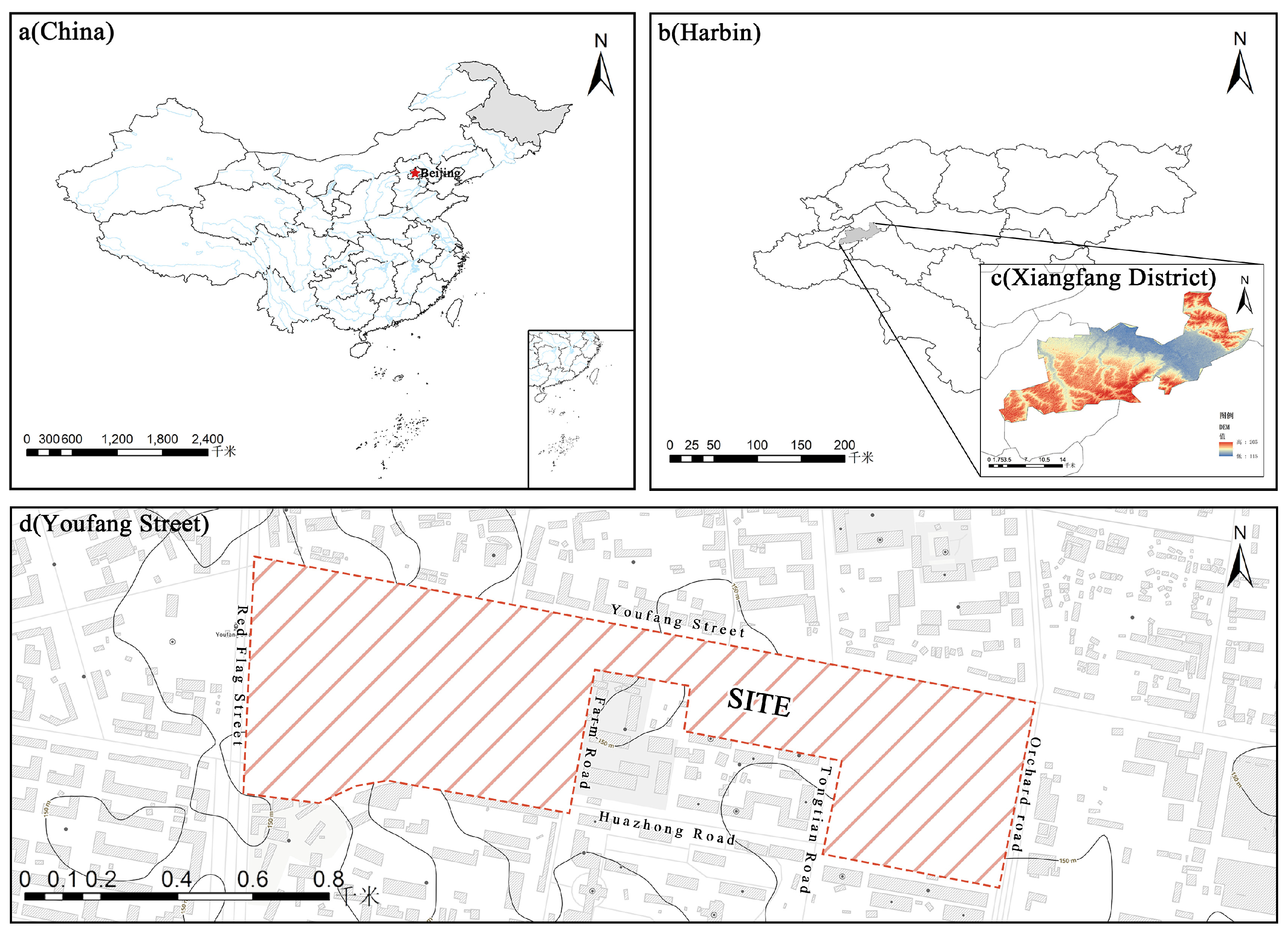
Figure 4.
Climatic characteristics of the Youfang Street industrial heritage district in Harbin based on 2014-2024 observations: (a) Average High and Low Temperature(b) Wind Direction in the Winter(c) Average Wind Speed in the Winter(d) Average Monthly Snowfall in the Winter.
Figure 4.
Climatic characteristics of the Youfang Street industrial heritage district in Harbin based on 2014-2024 observations: (a) Average High and Low Temperature(b) Wind Direction in the Winter(c) Average Wind Speed in the Winter(d) Average Monthly Snowfall in the Winter.
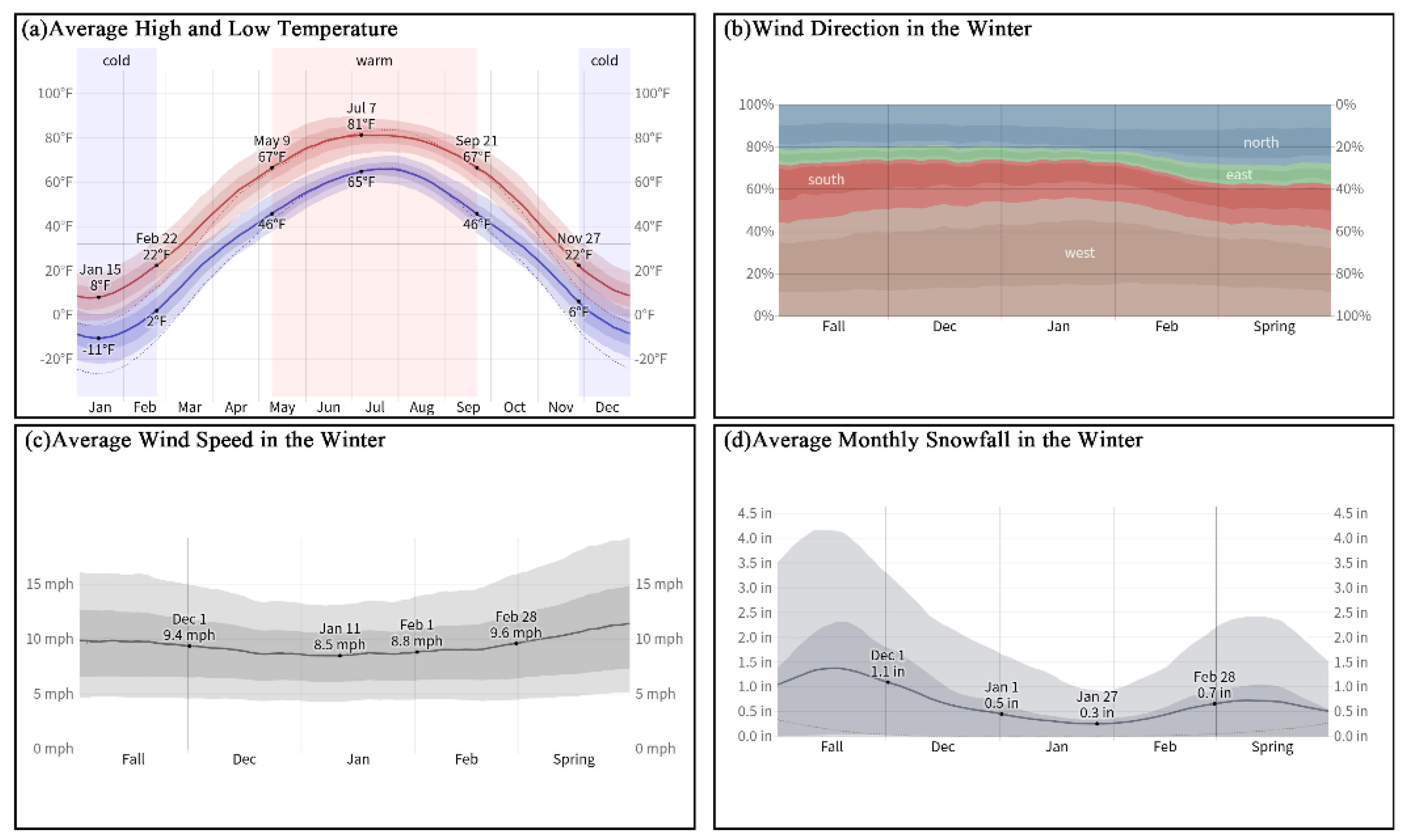
Figure 5.
Integrated map of the study area and the multi-source data acquisition system, including the sensing network, UAV survey paths, and key climatic layers.
Figure 5.
Integrated map of the study area and the multi-source data acquisition system, including the sensing network, UAV survey paths, and key climatic layers.
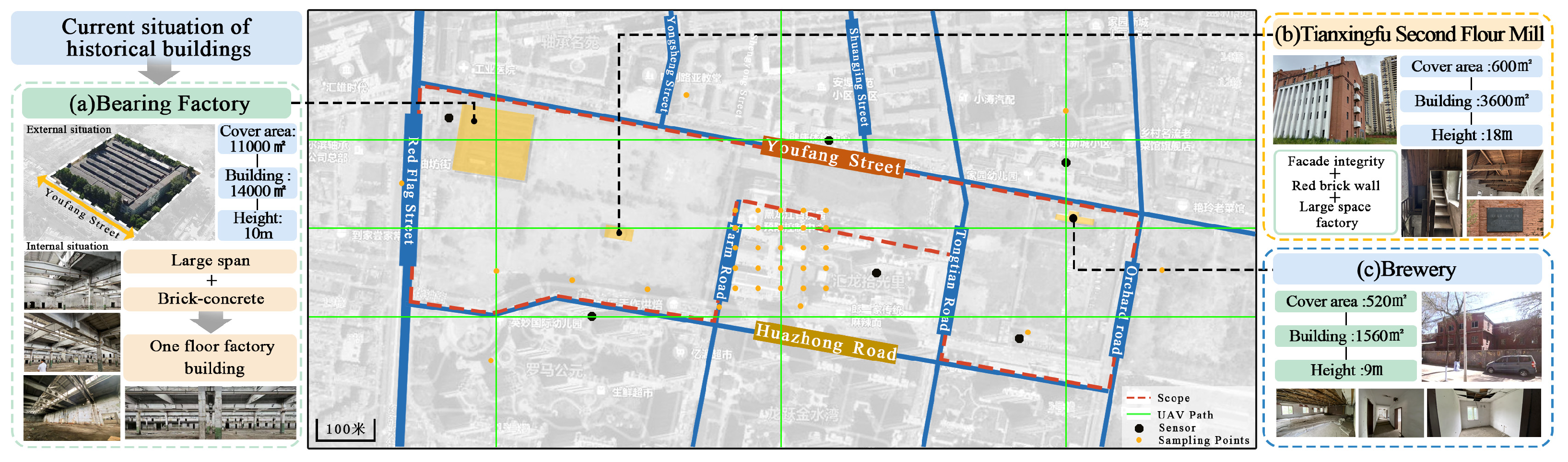
Figure 6.
Evaluation Framework for the Adaptive Catalyst System in Cold-Climate Industrial Heritage Revitalization.
Figure 6.
Evaluation Framework for the Adaptive Catalyst System in Cold-Climate Industrial Heritage Revitalization.
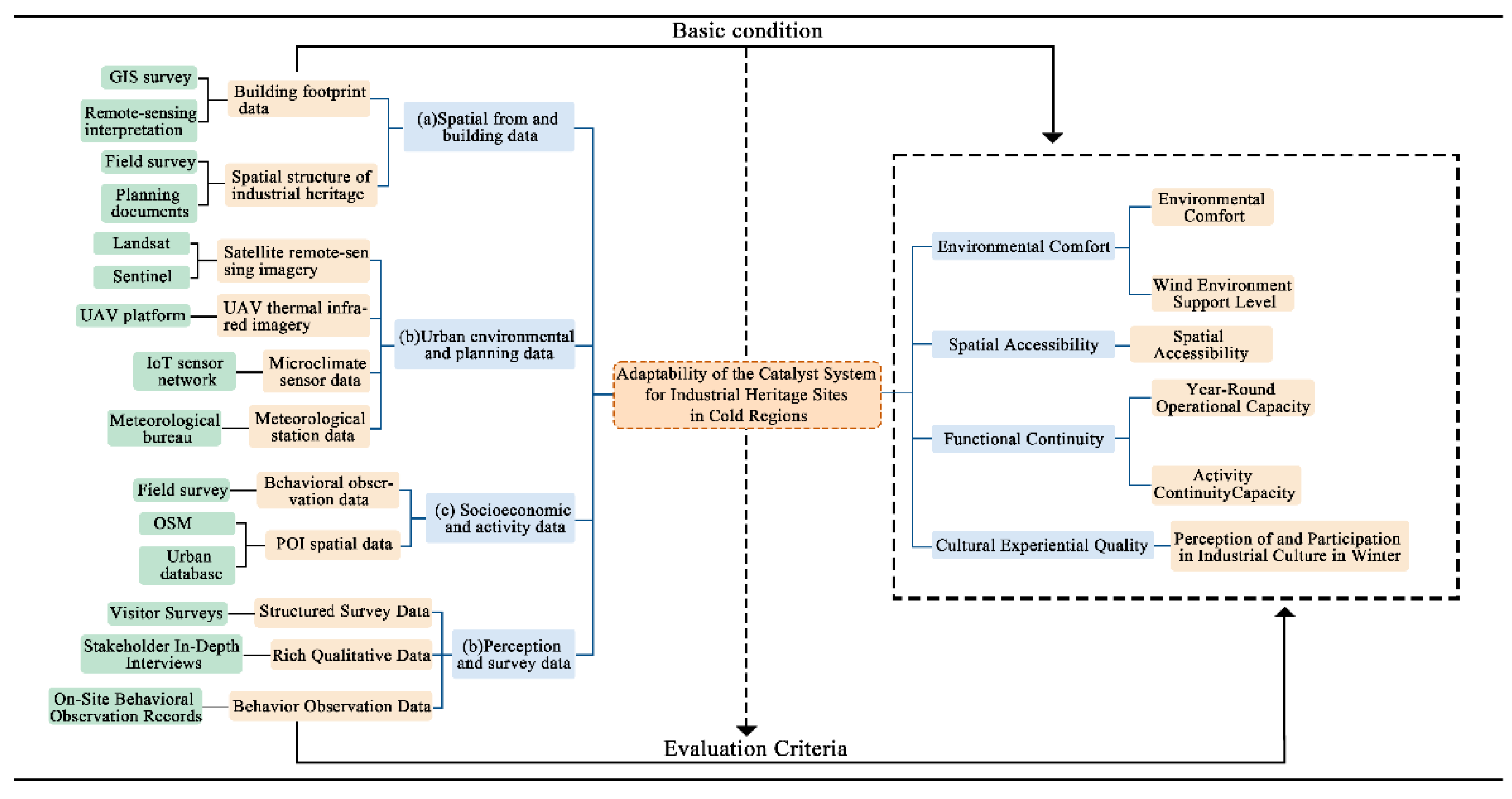
Figure 7.
Temporal variation of pedestrian flow and spatial overlap between POI kernel-density hotspots and thermally comfortable zones in the cold-climate industrial heritage district: (a) Comparison of Pedestrian Flow Density between Winter and Summer(b) Hourly Meteorological Curve during the Heating Period(c) Overlay Analysis of High POI Kernel Density Values and Thermally Comfortable Areas.
Figure 7.
Temporal variation of pedestrian flow and spatial overlap between POI kernel-density hotspots and thermally comfortable zones in the cold-climate industrial heritage district: (a) Comparison of Pedestrian Flow Density between Winter and Summer(b) Hourly Meteorological Curve during the Heating Period(c) Overlay Analysis of High POI Kernel Density Values and Thermally Comfortable Areas.
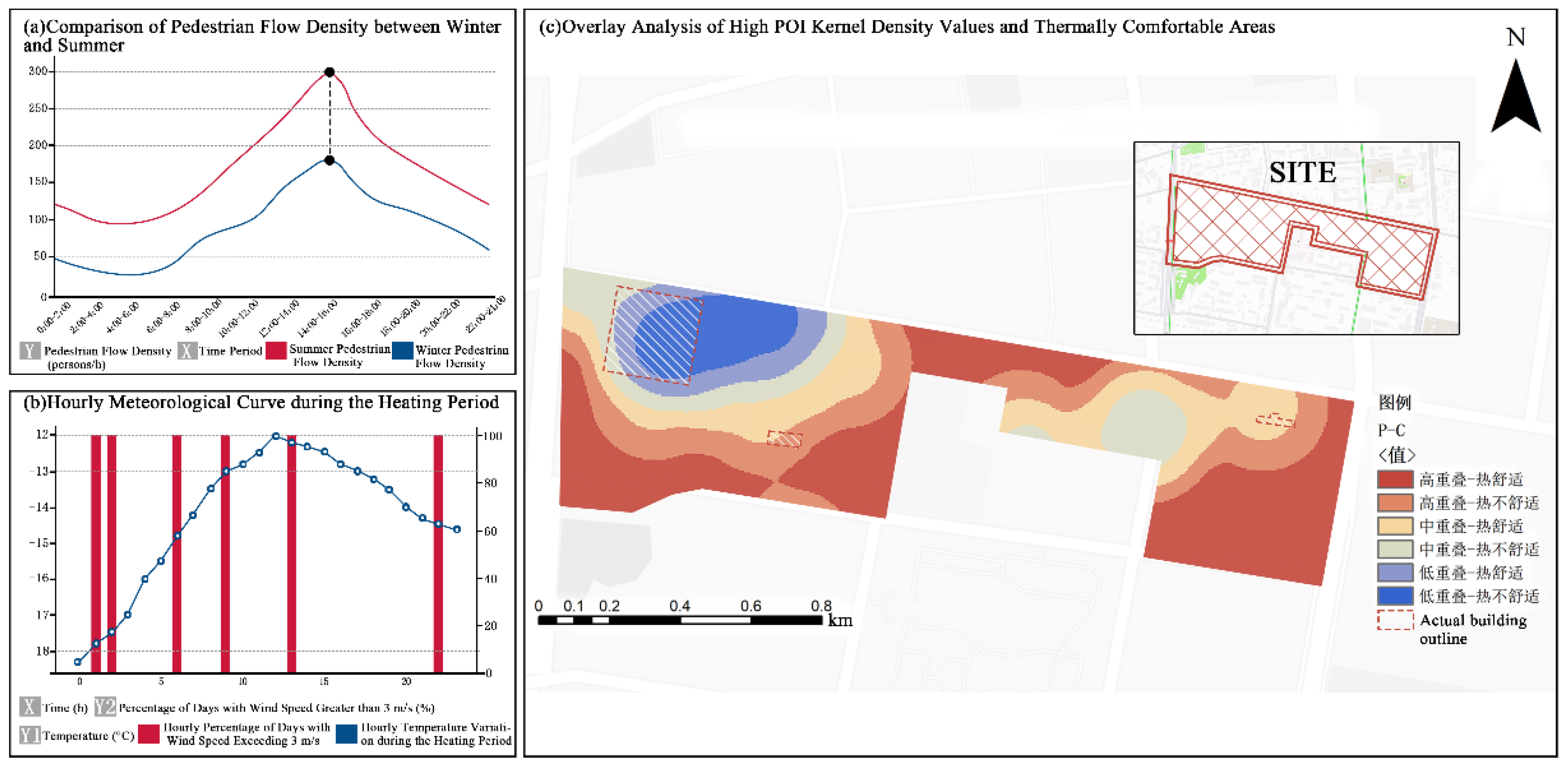
Figure 8.
Seasonal comparison of the catalyst-effect time series.
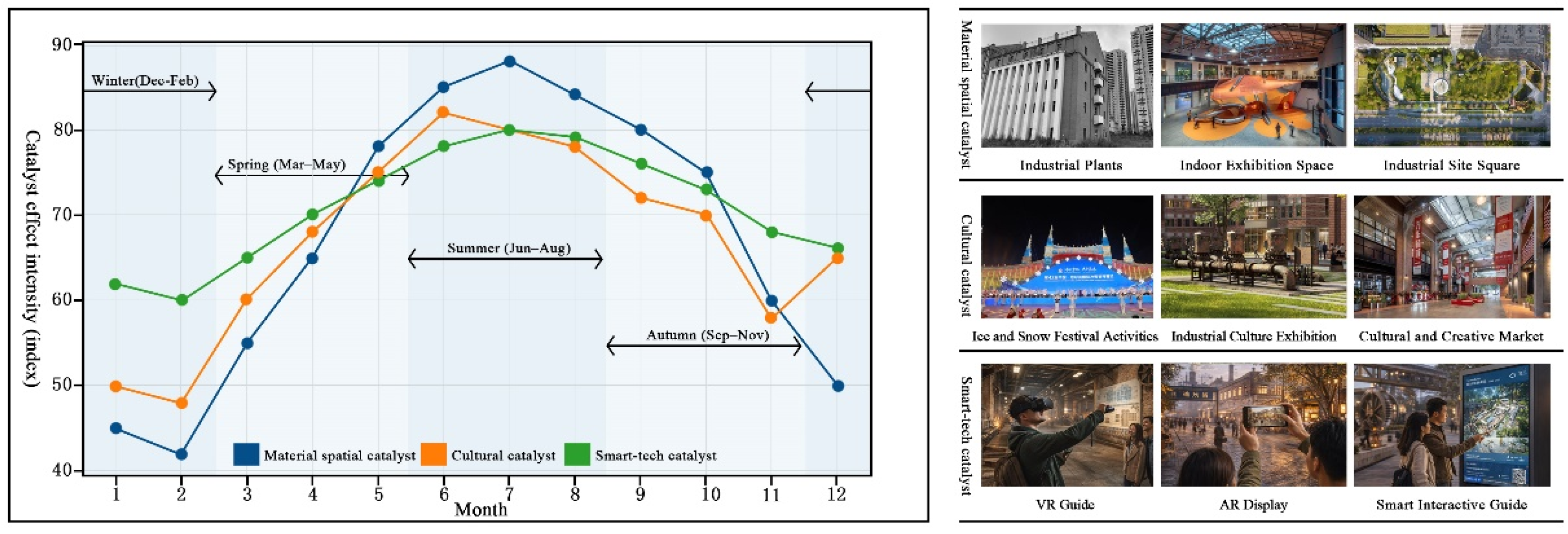
Figure 9.
Spatial diffusion heat map of catalyst effects and a three-dimensional profile of winter spatial activity intensity:(a) Catalyst Effect Intensity(b) Three-dimensional winter spatial activity profile.
Figure 9.
Spatial diffusion heat map of catalyst effects and a three-dimensional profile of winter spatial activity intensity:(a) Catalyst Effect Intensity(b) Three-dimensional winter spatial activity profile.
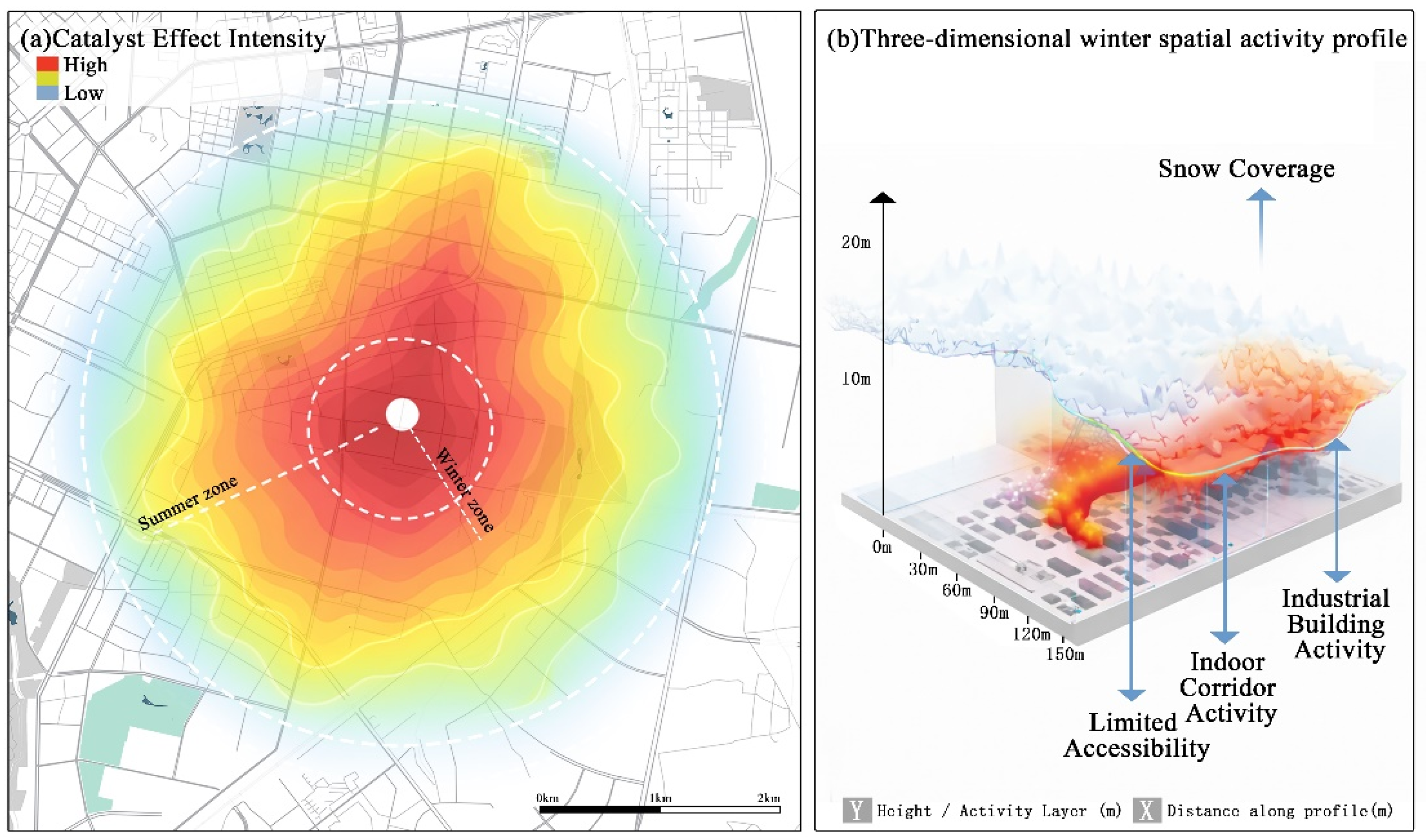
Figure 10.
Optimization framework for catalyst revitalization strategies in cold-climate industrial heritage.
Figure 10.
Optimization framework for catalyst revitalization strategies in cold-climate industrial heritage.
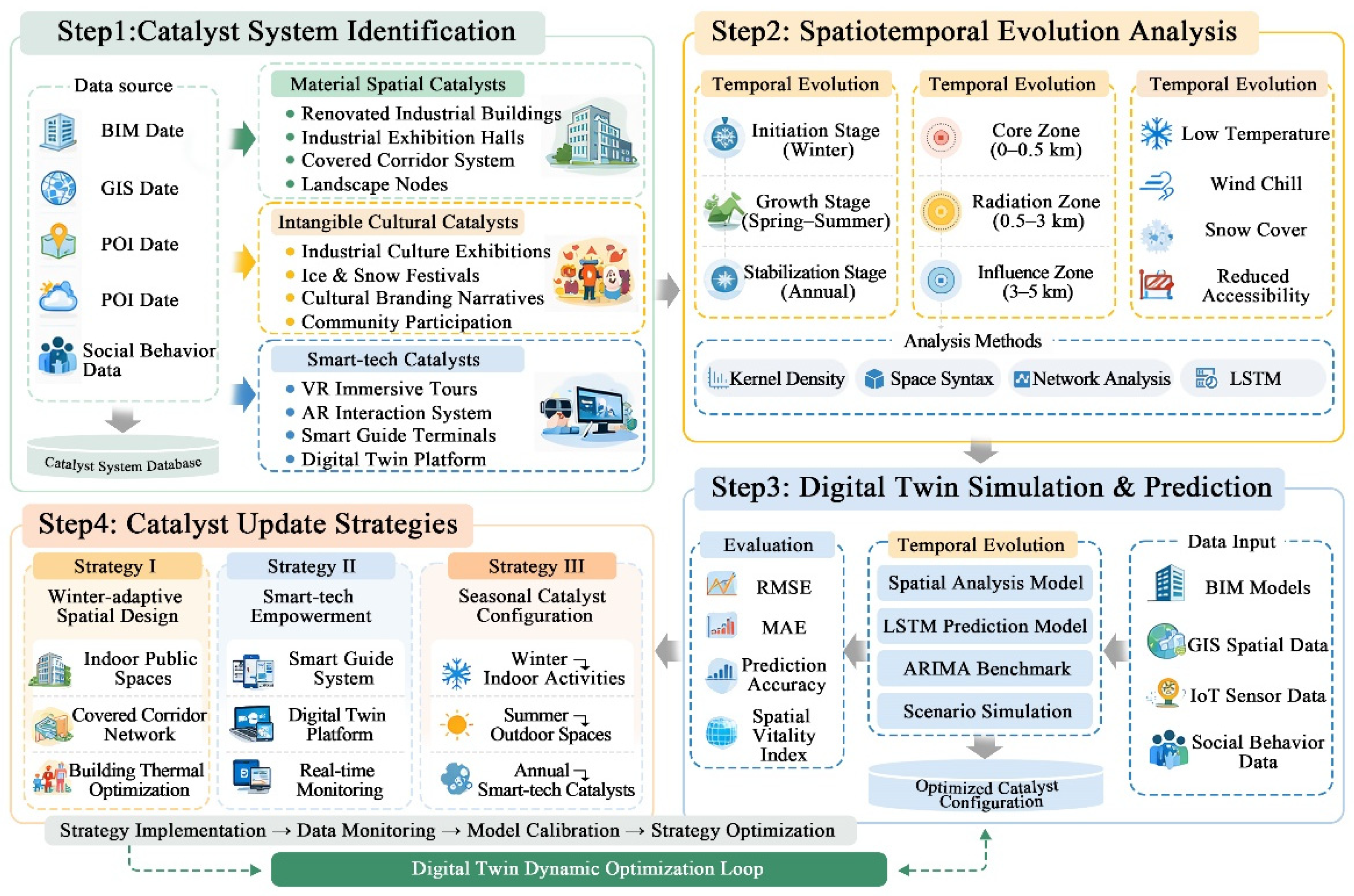
Figure 11.
Spatial implementation of catalyst renewal strategies in three key intervention areas. Figure 11 translates the optimization logic into a spatially operable implementation scheme across the key intervention areas.
Figure 11.
Spatial implementation of catalyst renewal strategies in three key intervention areas. Figure 11 translates the optimization logic into a spatially operable implementation scheme across the key intervention areas.
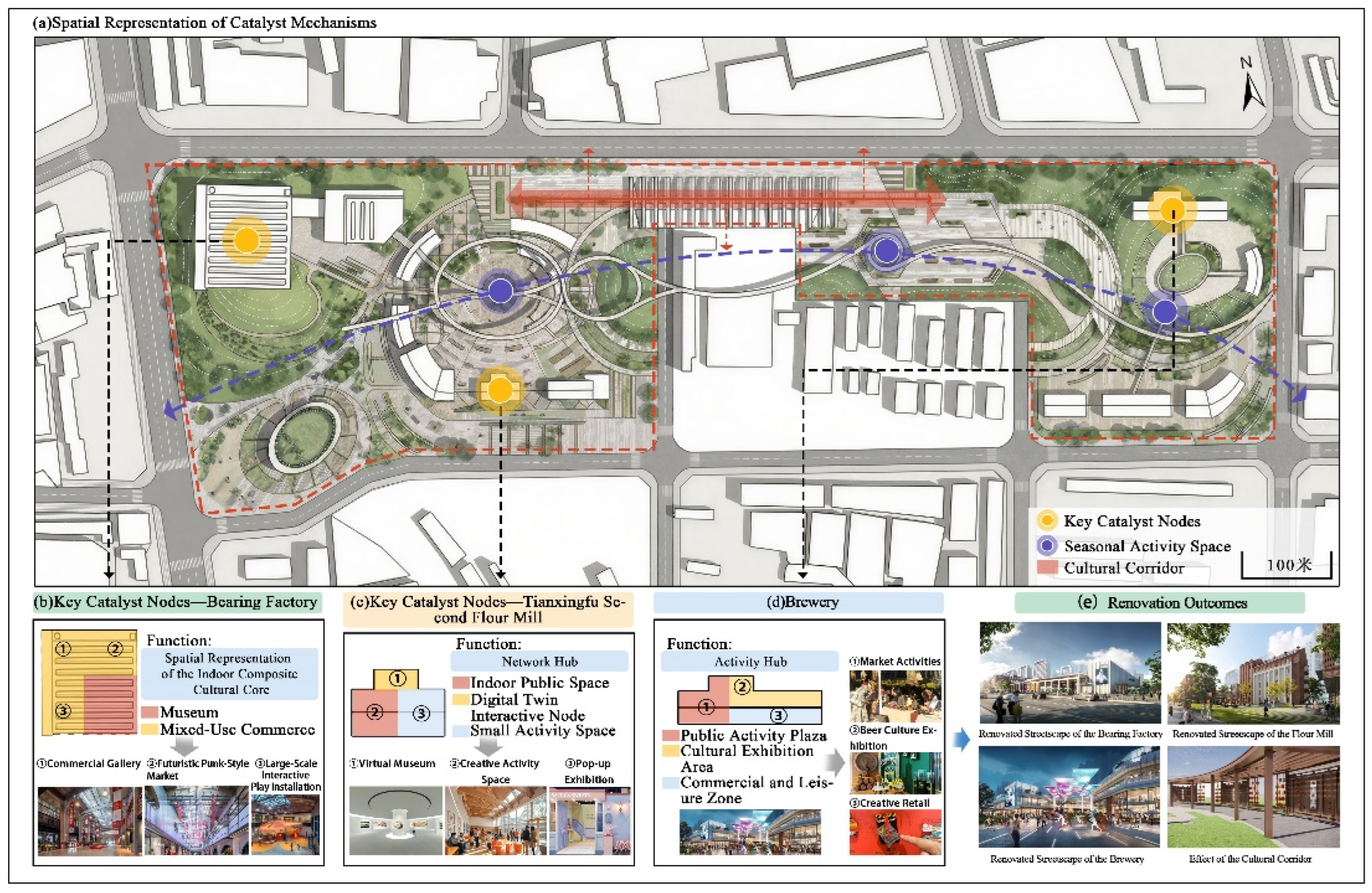
Figure 12.
Comparative effects of different intervention strategies: (a) Simulated winter vitality index across scenarios(b) Quantified gains under collaborative scenario.
Figure 12.
Comparative effects of different intervention strategies: (a) Simulated winter vitality index across scenarios(b) Quantified gains under collaborative scenario.
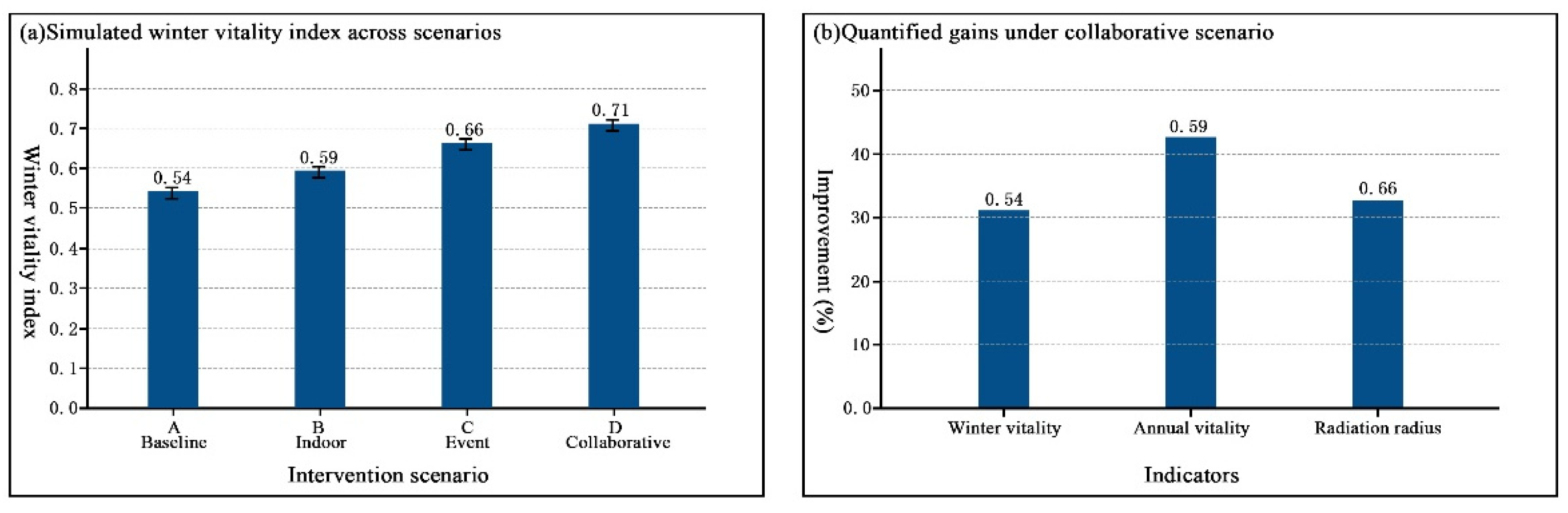

Table 1.
Boundary differences between conventional UCT and CA-UCT.
| Dimension | Conventional UCT | CA-UCT |
|---|---|---|
| Climate premise | Climate-neutral background | Climate-constrained diffusion environment |
| Temporal structure | Continuous accumulation | Coexistence of seasonal interruption and pulse activation |
| Spatial propagation | Planar and relatively homogeneous diffusion | Corridor-oriented and directional propagation |
| Primary activity carrier | Outdoor open public space | Indoor-semi-indoor continuous network |
| Key infrastructure | Streets and plazas | Covered corridors, indoor public space, and climate-shelter facilities |
| Typical outcome | Stable additive stimulation | Seasonally modulated diffusion with discontinuous intensity |
Table 2.
Multi-source data categories, acquisition platforms, and preprocessing methods used in this study.
Table 2.
Multi-source data categories, acquisition platforms, and preprocessing methods used in this study.
| Data Category | Data Type | Source/Device | Spatial Resolution | Temporal Resolution | Period | Preprocessing |
|---|---|---|---|---|---|---|
| (a) Spatial form and building data |
Building footprints | GIS survey / remote sensing | Building scale | Static | 2024 | Topology repair / vector cleaning |
| Heritage spatial structure | Field survey / planning documents | Site scale | Static | 2024 | Classification / annotation | |
| (b) Urban environmental and planning data |
Satellite imagery | Landsat / Sentinel | 10–30 m | Monthly | 2022–2024 | Radiometric / atmospheric correction |
| UAV thermal imagery | UAV platform | 5–10 cm | Flight cycle | Winter 2023–2024 | Orthorectification / mosaicking | |
| Microclimate sensors | IoT sensor network | Point-based | 10 min | Winter heating season | Noise filtering | |
| Meteorological data | Meteorological bureau | Station scale | Hourly / daily | Long-term series | Interpolation | |
| (c) Socioeconomic and activity data |
Behavioral observations | Field survey | Site scale | Hourly | Winter | Smoothing / outlier removal |
| POI data | OSM / urban database | Building scale | Static | 2024 | Recoding / spatial matching | |
| (d) Perception and survey data | Questionnaires, interviews, and observations | Questionnaire survey / interviews / field survey | Individual scale | Single-stage / phased | 2024 (winter) | Reliability test / invalid-response removal / Likert standardization |
Table 3.
Comparison of model predictive accuracy.
| Model | RMSE | MAE | Directional Accuracy |
|---|---|---|---|
| LSTM | 3.17 | 2.43 | 86.7% |
| ARIMA | 4.08 | 3.03 | 74.2% |
Table 4.
Simulation results of catalyst-configuration scenarios.
| Scenario | Winter Vitality Index | Change |
|---|---|---|
| A. Baseline | 0.54 | - |
| B. Physical | 0.59 | +9.3% |
| C. Smart | 0.66 | +22.2% |
| D. Collaborative | 0.71 | +31.2% |
Disclaimer/Publisher’s Note: The statements, opinions and data contained in all publications are solely those of the individual author(s) and contributor(s) and not of MDPI and/or the editor(s). MDPI and/or the editor(s) disclaim responsibility for any injury to people or property resulting from any ideas, methods, instructions or products referred to in the content. |
© 2026 by the authors. Licensee MDPI, Basel, Switzerland. This article is an open access article distributed under the terms and conditions of the Creative Commons Attribution (CC BY) license.
Copyright: This open access article is published under a Creative Commons CC BY 4.0 license, which permit the free download, distribution, and reuse, provided that the author and preprint are cited in any reuse.


