

Submitted:
17 April 2026
Posted:
20 April 2026
You are already at the latest version
Abstract
Background: Mitochondrial bioenergetic dysregulation disrupts immune-metabolic homeostasis and promotes pro-inflammatory microenvironments in osteoarthritis (OA) synovitis. Nevertheless, the mechanistic contributions of mitochondrial energy metabolism to synovitis pathogenesis in OA remain poorly defined. Methods: We analyzed mitochondrial energy metabolism-related genes (MEMRGs) in OA synovitis by integrating transcriptomic data from OA synovial tissues (GSE55235, GSE55457). LASSO regression and maximal clique centrality (MCC) algorithms were applied to identify hub genes, and single-cell RNA sequencing (GSE152805) was used to examine cell-type-specific expression patterns. Functional validation was performed in IRS2-knockdown THP-1 macrophages. Results: We identified 22 mitochondrial energy metabolism-related differentially expressed genes (MEMR-DEGs), which were enriched in AMPK signaling, glucagon signaling, and insulin signaling pathways. Four hub genes (FOXO3, FASN, PTGS2, IRS2) were identified and negatively correlated with synovial macrophage infiltration. Single-cell RNA sequencing revealed IRS2 was specifically upregulated in a synovial macrophage cluster. Functional studies in IRS2-knockdown THP-1 macrophages demonstrated that IRS2 deficiency impaired IL-4-induced M2 macrophage polarization and reduced mitochondrial membrane potential, mediated by suppression of AKT/FOXO1 signaling. Conclusions: Our study reveals the role of MEMRGs in OA synovium, and highlights the molecular mechanism by which IRS2 potentially coordinates mitochondrial energy metabolism via the AKT/FOXO1 signaling pathways to maintain synovial macrophage M2 polarization homeostasis. These findings provide novel molecular targets for targeting immune-metabolic pathways in OA therapy.
Keywords:
osteoarthritis
; synovium
; immune infiltration
; single-cell RNA-seq analysis
; mitochondrial energy metabolism
; macrophage polarization
1. Introduction
Osteoarthritis (OA) is a chronic degenerative disease characterized by key pathological features including articular cartilage degeneration, synovitis, and osteophyte formation, and is recognized by the World Health Organization as the seventh leading cause of disability in the global elderly population(1, 2). Epidemiological data reveal that over 528 million individuals globally (approximately 7% of the population) are afflicted by OA, which is clinically characterized by persistent joint pain and functional mobility impairment. These manifestations not only markedly diminish patients’ quality of life but also impose a substantial socioeconomic burden(3). Recent studies have demonstrated that synovial inflammation serves not only as an early pathological marker of OA but also as a critical driver of disease progression to advanced stages(4, 5). At the molecular level, inflammatory mediators such as IL-1β and PGE2 accelerate pathological degradation of the cartilage extracellular matrix by activating matrix metalloproteinase (MMP) pathways(6). Histopathological analyses reveal that macrophages and T lymphocytes dominate the synovial immune cell infiltrate in OA patients across all disease stages(7, 8). Notably, the substantial infiltration of macrophages and their polarization toward the pro-inflammatory M1 phenotype exacerbate synovial hyperplasia, cartilage degradation,and osteophyte formation via inflammatory cascades(9, 10). Therefore, elucidating the mechanisms governing the dynamic evolution of synovitis and targeting the polarization homeostasis of synovial macrophages may represent novel strategies for halting OA progression.
Emerging evidence suggests that macrophage polarization is fundamentally driven by metabolic reprogramming, with mitochondrial energy metabolism serving as a decisive molecular foundation for immune functional remodeling(11). Mitochondria, as cellular energy hubs, regulates energy metabolism through the tricarboxylic acid (TCA) cycle, oxidative phosphorylation (OXPHOS), and fatty acid β-oxidation (FAO), generating substantial ATP via ATP synthase (complex V)(12). Evidence demonstrates that energy metabolism plays a pivotal role in regulating inflammatory responses and immune cell functionality while dynamically modulating their biological activities(13). M1 macrophages exhibit enhanced glycolysis and lactate production to meet their bioenergetic demands(14, 15), whereas M2 macrophages depend predominantly on mitochondrial oxidative metabolism, encompassing FAO, TCA, and OXPHOS(16). Significantly, the natural compound songorine ameliorates cartilage damage and synovitis by inducing macrophage metabolic reprogramming, specifically suppressing glycolysis and promoting mitochondrial OXPHOS(17). These findings implicate mitochondrial metabolism-related genes (MEMRGs) as potential regulatory hubs in OA synovitis.
Insulin receptor substrate 2 (IRS2), a key mediator of insulin signaling, plays an essential role in mitochondrial DNA and protein synthesis, thereby enhancing mitochondrial oxidative capacity and ATP production(18, 19). In liver tissue of Irs1/Irs2 double-knockout mice, disrupted respiratory chain complexes (III and IV), reduced NAD+/NADH ratios, diminished ATP synthesis, and elevated FOXO1 expression have been observed(20). FOXO1, a pivotal downstream target of the AKT pathway, serves as a nuclear transcription factor regulating diverse cellular processes via phosphorylation-dependent mechanisms, including differentiation, metabolism, inflammation, and macrophage polarization(21).
Therefore, we designed this study to investigate the expression profiles of MEMRGs in OA synovial cell clusters and identify key MEMRGs regulating synovial macrophage polarization. By analyzing bulk RNA-seq datas, we characterized the expression landscape of hub MEMRGs in OA synovium and their potential interaction with immune cells. Subsequent scRNA-seq analysis linked hub MEMR-DEGs to specific cellular subpopulations. Notably, IRS2 was upregulated in OA synovial macrophages compared to other hub MEMR-DEGs. Mechanistically, we demonstrated that IRS2 potentially coordinates mitochondrial energy metabolism via the AKT/FOXO1 signaling pathways to maintain synovial macrophage M2 polarization homeostasis. This discovery not only highlights the pivotal role of IRS2 in synovial macrophage phenotypic regulation but also provides a potential molecular target for OA therapeutic strategies.
2. Materials and Methods
2.1. Clinical Samples
Synovial tissues were collected from 5 OA patients (3 females, 2 males; age 56–78 years; Kellgren-Lawrence [K-L] grade 3–4) undergoing total knee arthroplasty and 5 healthy controls (3 females, 2 males; age 36–44 years; K-L grade 0–1). Patients with rheumatoid arthritis, metabolic disorders, or infectious joint diseases were excluded. Tissue samples were immediately fixed in precooled 4% paraformaldehyde within 30 min post-surgery. The study was approved by the Ethics Committee of Renmin Hospital Affiliated to Wuhan University. All participants provided written informed consent.
2.2. Cell Culture and Transfection
THP-1 monocytes (Procell, China) were cultured in RPMI-1640 medium supplemented with 10% fetal bovine serum and 1% penicillin-streptomycin at 37 °C under 5% CO₂. For differentiation, cells were seeded at 1×10⁵ cells/well and treated with 100 ng/mL phorbol 12-myristate 13-acetate (PMA, 24 h) to generate M0 macrophages. Cells were transfected with IRS2 siRNA (50 pmol per well; see Table S1 for sequences) using CALNP™ RNAi reagent (D-Nano Therapeutics,China). Following transfection, cells were stimulated with IL-4 and IL-13 (20 ng/mL, 48 h) to induce M2 macrophage polarization. The siRNA sequences are provided in Supplementary Table S1.
2.3. Gene Expression Profiling Data Acquisition and Processing
Synovial bulk RNA-seq datasets GSE55235 (including 10 healthy control samples and 10 OA samples) and GSE55457 (including 10 healthy control samples and 10 OA samples) were downloaded from the Gene Expression Omnibus (GEO) database as the training set. Additionally, the GSE12021 dataset was downloaded as an independent external validation set. Raw CEL files from the GeneChip Human Genome U133 Array (GPL96) platform were processed in R version 4.3.1. Expression values were log2-transformed, and probes were reannotated using platform-specific annotation files (GPL96). For genes mapped to multiple probes, expression levels were averaged. Batch effects correction and data standardization were performed with the “SVA” package(22). Mitochondrial energy metabolism-related genes (MEMRGs) were derived from Zewei Zhang et al(23).
2.4. Differentially Expressed Gene Identification
Differentially expressed genes (DEGs) between OA and healthy controls were identified via the “limma” package(24). Significance thresholds were set at P value <0.05 and |llog2Fold change (log2FC)| >1. Volcano plots and hierarchical clustering heatmaps were generated using “ggplot2” package and “ComplexHeatmap” package, respectively. Overlapping DEGs and mitochondrial energy metabolism-related genes (MEMRGs) were analyzed with the “VennDiagram” package, identifying 22 hub intersecting genes (MEMRG-DEGs).
2.5. GO and KEGG Enrichment Analysis
Functional enrichment of MEMRG-DEGs was performed using the “clusterProfiler” package(25). Gene Ontology (GO)(26) terms, including Biological Process (BP), Cellular Component (CC), and Molecular Function (MF), along with Kyoto Encyclopedia of Genes and Genomes (KEGG)(27) pathways, were analyzed with a significance threshold of P values < 0.05. The top 10 significant terms, ranked by enrichment ratio, were visualized using “ggplot2” package.
2.6. Identification of Hub MEMRG-DEGs
A protein-protein interaction (PPI) network was constructed using the STRING database (http://string-db.org)(28). The network was then visualized and analyzed with Cytoscape software(29). Hub genes were ranked using the Maximal Clique Centrality (MCC) algorithm in the CytoHubba plugin(30). To reinforce feature selection robustness, a parallel Least Absolute Shrinkage and Selection Operator (LASSO) regression analysis was conducted using the “glmnet” package. Finally, integration of MCC rankings and LASSO regression outputs identified 4 hub MEMRG-DEGs.
2.7. Validation of Hub MEMRG-DEGs Expression and Evaluation of Diagnostic Efficacy
To evaluate the clinical diagnostic value of the four identified hub MEMRG-DEGs (FASN, FOXO3, IRS2, PTGS2), their expression levels were extracted and compared between OA patients and healthy controls in both the training set and the external validation dataset (GSE12021). Furthermore, Receiver Operating Characteristic (ROC) curves were generated to evaluate the diagnostic accuracy of each hub gene in distinguishing OA from healthy samples. The Area Under the Curve (AUC) was calculated using the “pROC” package in R, with an AUC value closer to 1 indicating superior predictive performance.
2.8. Single-Sample Gene Set Enrichment Analysis
Single-sample gene-set enrichment analysis (ssGSEA) was performed with the “GSVA” package(31) to quantify immune cell infiltration differences between the OA patients and healthy controls. Statistical correlations between hub genes and immune cell subsets were analyzed using the rcorr function with significance criteria set at P values < 0.05. Heatmaps visualized correlations between hub MEMRG-DEGs and immune cells, while boxplots compared immune cell enrichment scores between OA patients and healthy controls.
2.9. Single-Cell Transcriptomic Data Analysis
The single-cell RNA-seq data from the GSE152805 dataset was preprocessed using the “Seurat” package(32). Low-quality cells were filtered based on the following thresholds: genes detected < 200 or > 6,000; mitochondrial gene ratio > 20%. Data normalization and scaling were performed to identify the top 2,000 highly variable genes. Batch effects were mitigated using the “harmony” package(33) before performing principal component analysis (PCA) for dimensionality reduction and t-distributed stochastic neighbor embedding (t-SNE) for cluster visualization. Cluster-specific differentially expressed genes were identified with the Seurat::FindAllMarkers() function(min.pct = 0.25, logfc.threshold = 0.25). 8 Cell clusters were annotated based on acknowledged cell markers: synovial intimal fibroblasts (SIF)-PRG4, synovial subintimal fibroblasts (SSF)-WISP2, macrophages-CD68, smooth muscle cells (SMC)-RGS5, endothelial cells (EC)-TM4SF1, dendritic cells (DC)-FCER1A, mast cells-TPSAB1, and proliferative immune cells (ProIC)-BIRC5(34). Gene activity scores for each subpopulation were computed using the “AUCell” package(35).
2.10. Western Blot (WB)
Total proteins were extracted using RIPA lysis buffer containing PMSF and protease/phosphatase inhibitors, followed by concentration normalization via the Bicinchoninic Acid (BCA) method. Protein samples were denatured at 99 °C for 10 minutes and electrophoresed on 10% or 12% SDS–PAGE gels. Separated proteins were transferred to PVDF membranes (Bio-Rad, 1704273), which were then blocked with 5% nonfat dry milk for 2 hours at 25 °C. Membranes were incubated overnight at 4 °C with primary antibodies:IRS2 (Proteintech, 20702-1-AP), AKT(Proteintech, 10176-2-AP), phospho-Akt (Ser-473) (Proteintech, 28731-1-AP), FOXO1 (Affinity, AF6416), phospho-FoxO1 (Ser-256) (Affinity, AF3417), ARG1 (Proteintech, 16001-1-AP), and GAPDH (Proteintech, 10494-1-AP). After three washes with TBST, membranes were incubated with HRP-conjugated secondary antibodies for 1 hour. Protein bands were visualized using enhanced chemiluminescence (ECL) substrate (Epizyme, SQ202), and band intensities were quantified via ImageJ software, with GAPDH serving as the loading control for normalization.
2.11. Immunofluorescence (IF) Staining
Synovial tissues were fixed in 4% paraformaldehyde, paraffin-embedded, and sectioned into 5-μm slices using a microtome. Sections were deparaffinized with a xylene gradient and rehydrated through an ethanol gradient, followed by three 5-minute PBS washes. Heat-induced epitope retrieval was performed in preheated 0.01 M citrate buffer for 20 minutes. To eliminate endogenous peroxidase interference, sections were incubated with 3% H2O2 under light-shielded conditions for 25 minutes. Non-specific binding was blocked with 5% bovine serum albumin (BSA) in PBS for 1 hour at room temperature. Sections were then incubated overnight with anti-IRS2 (Abcam, 1:100, ab134101) and anti-CD206 (Abcam, 1:200, ab300621). After washing with PBS, fluorescence-conjugated secondary antibodies were applied for 1 hour at room temperature. Nuclei were counterstained with DAPI , and sections were mounted with antifade mounting medium. Imaging was performed using a fluorescence microscope .
2.12. Measurement of Mitochondrial Membrane Potential
Mitochondrial membrane potential (ΔΨm) was measured using the JC-1 MitoMP Detection Kit((Dojindo Molecular Technologies, Tokyo, Japan) ). THP-1 cells were washed with PBS, and then incubated with JC-1 working solution at 37 °C for 20 minutes in light-protected conditions. After two washes with JC-1 assay buffer, cells were imaged using an inverted fluorescence microscope. Red fluorescence indicates intact ΔΨm , whereas green fluorescence signified mitochondrial membrane depolarization.
2.13. Statistical Analysis
Experiments were conducted with three independent biological replicates per group. Analyses were performed in GraphPad Prism8.0. Normality and homogeneity of variance were verified for all datasets prior to statistical testing. Group differences were analyzed by Student t-test or one-way ANOVA. Significance levels were as P<0.05 (*), P<0.01 (**), and P<0.001 (***).
3. Results
3.1. Identification and Functional Enrichment of MEMRG-DEGs
The expression profiles of MEMRGs in OA synovial tissues were analyzed by integrating data from the GSE55235 and GSE55457 datasets. Differential expression gene (DEG) analysis revealed 297 upregulated genes and 264 downregulated genes in the OA patients compared to the healthy control group (Figure 1A). To identify MEMRGs among the DEGs, a Venn diagram was employed to identified MEMRG-DEGs (Figure 1B). The heatmap confirmed that MEMRG-DEGs effectively distinguished OA (n=20) samples from healthy controls (HC; n=20) (Figure 1C). GO and KEGG enrichment analyses were performed to elucidate the regulatory pathways and biological functions of MEMRG-DEGs. Through GO enrichment analysis, we identified that in BPs, MEMRG-DEGs were predominantly enriched in small-molecule metabolic processes, lipid metabolism regulation, and cellular ketone metabolic regulation. For CCs, MEMRG-DEGs clustered in the endoplasmic reticulum lumen, organelle outer membrane, and outer membrane. In MFs, MEMRG-DEGs were mainly enriched in cytokine activity and amide binding (Figure 1D). KEGG pathway analysis demonstrated significant enrichment of MEMRG-DEGs in the AMPK, glucagon, insulin, and FOXO signaling pathways (Figure 1E), which regulate macrophage polarization through mitochondrial energy metabolism modulation(11).
3.2. Protein-Protein Interaction Network and Hub Gene Screens
The PPI network of MEMRG-DEGs was constructed using Cytoscape, sorted by degree algorithm, and contained 17 nodes and 50 edges(Figure 2A).The top 10 hub genes were prioritized via the MCC algorithm in the CytoHubba plugin, including IL6, IL1B, APOE, PPARGC1A, FOXO3, FASN, PTGS2, EGR1, IRS2, and PFKFB3 (Figure 2B). To refine specificity, LASSO regression analysis was performed and 8 eigengenes were identified: FOXO3, FASN, IRS2, CALML4, KLF2, NDUFA4L2, WNT5B, and PTGS2 (Figure 2C). Intersection analysis between MCC algorithm-derived hub genes and LASSO-selected eigengenes (Figure 2D) revealed 4 hub mitochondrial metabolism-related hub genes: FOXO3, FASN, PTGS2, and IRS2.
3.3. scRNA-Seq Identified Localization of Hub MEMRG-DEGs
To determine the distribution of the four hub MEMRG-DEGs, the scRNA-seq dataset GSE152805 was analyzed using Seurat (resolution = 1.0). Cell clusters were annotated into eight populations based on canonical markers: synovial intimal fibroblasts (SIF), synovial subintimal fibroblasts (SSF), macrophages, smooth muscle cells (SMC), endothelial cells (EC), dendritic cells (DC), mast cells, and proliferative immune cells (ProIC) (Figure 3A, B).Given the core effector roles of fibroblasts and macrophages in OA pathogenesis, subsequent in-depth investigations were specifically focused on these two cellular subpopulations(36). Gene expression profiling revealed low abundance of PTGS2, FOXO3, IRS2, and FASN in fibroblast subsets (SSF and SIF). In macrophages, FOXO3 exhibited moderate expression levels, while IRS2 showed significantly higher expression. Conversely, PTGS2 and FASN remained at low baseline levels (Figure 3C).To quantify mitochondrial energy metabolism activity in OA patients, the “AUCell” package was employed to analyze functional activity based on the four hub MEMRG-DEGs. Cells with high AUC scores predominantly localized to macrophages and DCs (Figure 3D).
3.4. Expression Validation and Evaluation of Diagnostic Efficacy for Hub MEMRG-DEGs
We analyzed the expression levels and diagnostic value of four hub MEMRG-DEGs (FASN, FOXO3, IRS2, PTGS2) in the training set. The results revealed that, compared to healthy controls (HC), these four genes were significantly downregulated in OA samples (Figure 4A). ROC curve analysis demonstrated their remarkably high diagnostic accuracy for OA (all AUCs > 0.85): IRS2 (0.927), FOXO3 (0.915), PTGS2 (0.897), and FASN (0.863) (Figure 4B). Subsequently, we validated these findings in an external dataset (GSE12021). Consistent with the training set, these four genes also exhibited significantly lower expression in OA samples (Figure 4C) and maintained robust diagnostic efficacy, with AUC values of FOXO3 (0.856), IRS2 (0.844), FASN (0.833), and PTGS2 (0.789) (Figure 4D). In conclusion, FASN, FOXO3, IRS2, and PTGS2 are significantly downregulated in OA and possess excellent predictive value as potential diagnostic biomarkers.
3.5. IRS2 Demonstrated Significant Correlation with Macrophages
To explore the immune cell infiltration characteristics in OA patients, single-sample gene set enrichment analysis (ssGSEA) was performed to compare immune infiltration scores between healthy controls and OA patients. Immune cell population correlation analysis revealed that macrophages exhibited significant positive correlations with Type 1 T helper cell and regulatory T cells. In contrast, negative correlations were observed with Type 2 T helper cell (Figure 5A). ssGSEA profiling revealed significant alterations in activated CD8+ T cells, Th1/Th2 cells, macrophages, and eosinophils in OA patients (Figure 5B). Type 1 T helper cells and macrophages were associated with OA pathogenesis and may contribute to synovial inflammation(37, 38). Furthermore, correlation analysis demonstrated significant negative correlations between IRS2, FOXO3, FASN, and PTGS2 expression levels and the infiltration levels of Th1 cells and macrophages (Figure 5C). Among these genes, IRS2 demonstrated the strongest inverse correlation with macrophage infiltration.
3.6. IRS2 Was Downregulated in OA Synovium
To assess the association between IRS2 expression and OA, immunofluorescence staining was performed on synovial tissues from OA patients and healthy controls(HC). Quantitative analysis revealed a significant reduction of in IRS2 expression and M2 macrophage marker CD206 in OA tissues compared with HC (Figure 6A, B).Notably, IRS2 exhibited robust spatial co-localization with CD206 in healthy controls, indicating predominant IRS2 expression in physiological M2 macrophages. In contrast, this co-localization pattern was significantly attenuated in OA synovial tissues (Figure 6C). To our surprise, Western blot analysis demonstrated that IL-4 stimulation significantly upregulated IRS2 protein expression in THP-1-derived macrophages(Figure 6D).
3.7. Downregulation of IRS2 Impaired M2 Macrophage Polarization
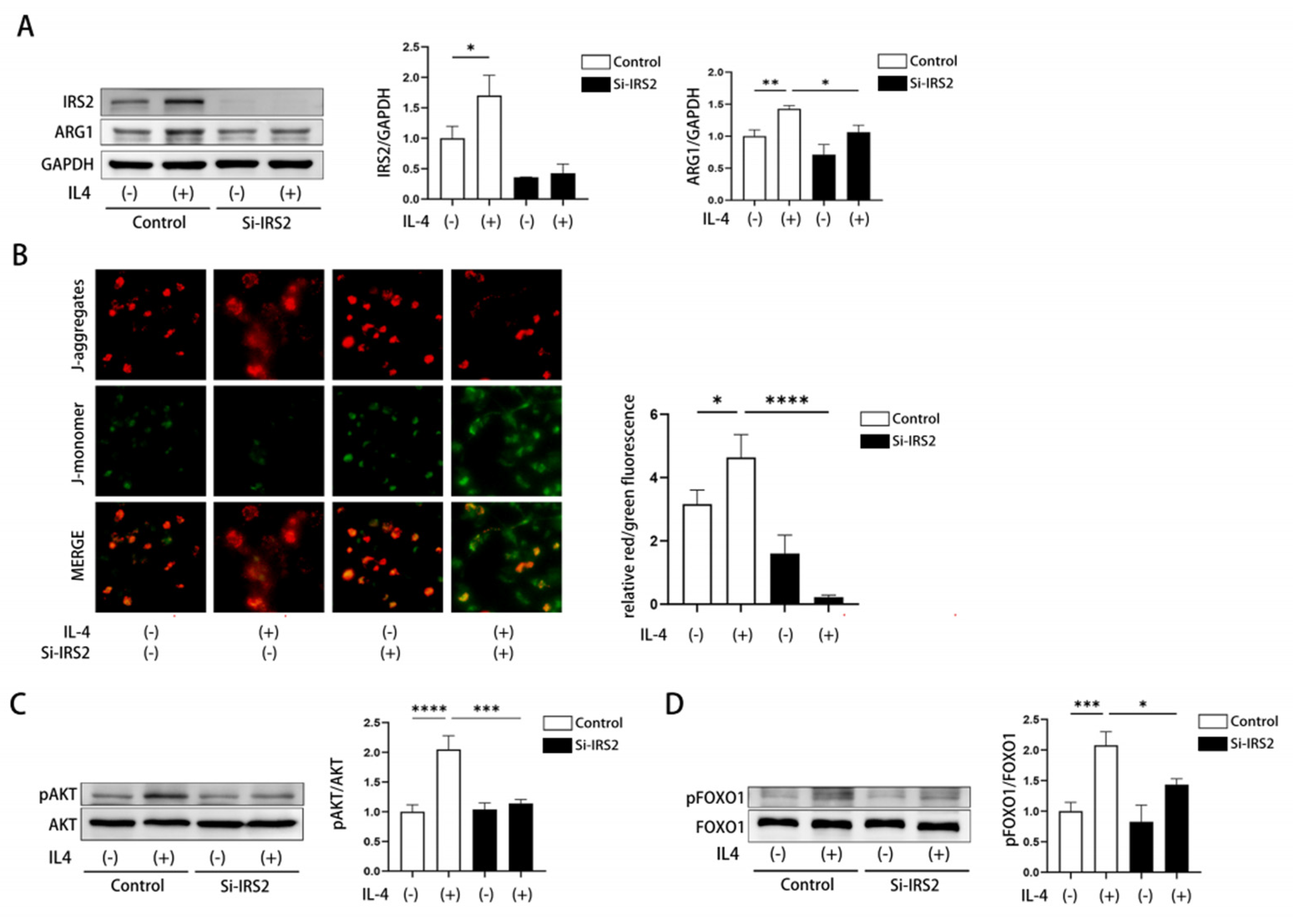
Finally, we elucidated a pivotal role of IRS2 in IL-4-induced M2 polarization of macrophages. IRS2 was knocked down via small interfering RNA (Figure S1 in Supplementary Files)). Western blot assay demonstrated IRS2 knockdown diminished IL-4-induced ARG1 activity (Figure 7A). We quantified the JC-1 fluorescence ratio to assess mitochondrial membrane potential (MMP). Compared with the control group, IL-4 stimulation slightly elevated MMP, evidenced by increased red fluorescence intensity. However, IRS2-knockdown macrophages (IL-4+si-IRS2) exhibited a significantly reduced red/green fluorescence ratio compared to the IL-4 control group, indicating a decrease in MMP and subsequent mitochondrial membrane depolarization (Figure 7B). These data implicate IRS2 as a critical regulator of M2-type macrophage polarization and mitochondrial functional homeostasis. Mechanistically, IRS2 knockdown suppressed phosphorylation of AKT phosphorylation at Ser473 and downstream transcription factor FOXO1 phosphorylation at Ser256 in response to IL-4 (Figure 7C,D).These findings demonstrated that IRS2 may regulate mitochondrial energy metabolism by activating the AKT/FOXO1 signaling pathway, which was required for M2 macrophage polarization. This molecular mechanism provided new insights into aberrant macrophage polarization in inflammatory diseases such as osteoarthritis.
4. Discussion
Synovitis, driven by the aberrant activation and phenotypic polarization of synovial macrophages, is recognized as a critical accelerator of OA progression(39). Emerging evidence highlights metabolic reprogramming as the fundamental steering wheel for this macrophage plasticity(11). Mitochondrial energy metabolism not only dictates cellular bioenergetics but also tightly orchestrates inflammatory cascades through ROS generation and metabolic shifts(40). In the OA microenvironment, this metabolic imbalance heavily favors M1 macrophage polarization, unleashing inflammatory mediators that exacerbate joint destruction(41, 42). In this study, we aimed to decode the regulatory network of MEMRGs in OA synovitis. By seamlessly integrating multi-omics datasets with in vitro functional validations, we identified IRS2 as a master regulator bridging mitochondrial energy metabolism and macrophage polarization—a discovery that unveils promising new therapeutic avenues for OA targeted therapy.
Through integrated analysis of RNA sequencing data from the GEO database, 22 MEMRG-DEGs were identified in this study. Functional enrichment analysis highlighted the regulation of small molecule metabolic processes and lipid metabolic processes as core enriched modules. Notably, these pathways are intrinsically linked to mitochondrial energy metabolism. Emerging evidence underscores that mitochondrial energy metabolism dysregulation plays a pivotal role in OA pathogenesis(43). Specifically, dysfunction of the mitochondrial electron transport chain reduces ATP synthesis, induces oxidative mtDNA damage, and promotes excessive ROS accumulation, forming a vicious cycle of mitochondrial dysfunction and oxidative stress(44). Further studies show that this disorder disrupts the balance between pro-inflammatory and anti-inflammatory factors in synovial tissue and significantly enhances the levels of chemokines (MCP-1,MIP-1α), thus amplifying inflammatory signaling and exacerbating OA joint inflammation(45, 46).
Next, the combined application of LASSO regression and MCC algorithms identified 4 hub genes from the 22 MEMRG-DEGs: FOXO3, FASN, PTGS2, and IRS2. Studies have reported that OA progression has been linked to heightened infiltration of immune cells, particularly macrophages and T cells(47). To assess their immunoregulatory roles, we conducted correlation analyses between these hub genes and immune cell infiltration scores. Quantitative analyses demonstrated significant associations between 4 hub MEMRG-DEGs and predominant infiltrating immune cell subpopulations, particularly macrophages. Functioning as pivotal regulatory elements within the synovial immune microenvironment, macrophages are found to manifest dysregulation not only in numerical abundance but also in phenotypic activation states. Pro-inflammatory M1 macrophages predominantly mediate inflammatory cascades and extracellular matrix degradation, while anti-inflammatory M2 macrophages facilitate tissue regeneration and immunoregulatory processes. Clinical evidence demonstrates that the M1/M2 macrophage ratio in synovial fluid and peripheral blood of OA patients is markedly elevated compared to healthy controls(48). Furthermore, this imbalance in synovial tissue exhibits a positive correlation with the degree of joint injury(39). Emerging studies posit macrophage polarization as a metabolic reprogramming-driven remodeling of immune function, the core of which lies in the dynamic regulation of mitochondrial energy metabolism(11).Under aerobic conditions, M1 macrophages predominantly rely on glycolysis for ATP production to meet the high bioenergetic demands of pro-inflammatory responses, whereas M2 macrophages utilize mitochondrial OXPHOS(49). Single-cell transcriptomic profiling confirmed transcriptional suppression of OXPHOS-related genes and marked mitochondrial dysfunction in synovial M1 macrophages from OA patients(50). Consequently, targeting mitochondrial energy metabolism dysregulation in macrophages is critical for OA therapeutic development.
Analysis of scRNA-seq data revealed significantly elevated AUCell enrichment scores of core genes in macrophages. Meanwhile, we observed that IRS2 protein was highly expressed in macrophages, which strongly suggests that IRS2 mainly plays a role in macrophages. Subsequent mechanistic investigations therefore focused on IRS2. Compelling evidence from Nicola M. Heller’s team demonstrated that type I IL-4R (IL-4Rα/γc) mediate macrophage target gene expression through specific activation of IRS2(51), Tetsuya Kubota et al further revealed the necessity of IL-4/IRS2/AKT signaling axis for M2a subtype macrophage differentiation, which worsened metabolic inflammation due to decreased IRS2 expression in a high-fat diet-induced obesity mouse model(21). Our experiments showed that IRS2 knockdown caused a significant decrease in mitochondrial membrane potential in macrophages and suppressed IL-4-induced ARG1 activity, indicating its regulatory role in macrophage polarization. Moreover, IRS2 knockdown impaired Akt (Ser-473) phosphorylation and FOXO1 (Ser-256) phosphorylation , aligning with prior studies(21). The inhibition of the AKT/FOXO1 signaling axis suggests that IRS2 may influence the anti-inflammatory function of macrophages by regulating mitochondrial energy metabolism(52). The mechanistic insight provides a novel therapeutic strategy for restoring immune microenvironment homeostasis through IRS2-targeted interventions.
While our study provides novel insights into the immune-metabolic mechanisms of OA, several limitations warrant consideration. First, the clinical validation cohort for our immunofluorescence analysis was relatively small (n=5) ; expanding the sample size in future multi-center studies is necessary to strengthen the statistical power and clinical generalizability of these findings. Second, our in vitro mechanistic investigations primarily relied on the THP-1 cell line. Although a robust and widely accepted model for macrophage biology, validating these AKT/FOXO1 signaling alterations in primary human peripheral blood monocyte-derived macrophages or bone marrow-derived macrophages (BMDMs) would better recapitulate the in vivo human synovial microenvironment. Finally, further in vivo studies utilizing macrophage-specific Irs2 conditional knockout mouse models are imperative to definitively elucidate how IRS2 deficiency drives synovial inflammation and cartilage degeneration in vivo.
5. Conclusions
In conclusion, our study delineates the functional contribution of mitochondrial energy metabolism-related genes in OA synovium and elucidates a molecular mechanism wherein IRS2 potentially coordinates mitochondrial energy metabolism via the AKT/FOXO1 signaling pathways to maintain synovial macrophage M2 polarization homeostasis. The finding provides new targets for OA diagnosis and treatment.
Supplementary Materials
The following supporting information can be downloaded at the website of this paper posted on Preprints.org, Figure S1: Western blot was used to verify the efficiency of knockdown of IRS2 expression by SiRNA; Table S1 Small interfering RNA sequence of IRS2.
Author Contributions
Conceptualization: YY and XL. Data curation:XL, EX. Software:YY, NZ. Methodology: YY, XL, NZ. Formal analysis, YY, NZ, YW. Writing- original draft: YY, XL, NZ. Writing—review & editing: YY, XL, NZ, EX. Project management: JZ. All authors contributed to the article and approved the submitted version.
Funding
This study was given financial support by the China Medicine Education Association (Grant No. 2024KTM024), the National Natural Science Foundation for Young Scientists of China (Grant No. 81301592), the National Natural Science Foundation of China (Grant No. 82272251) and the Foundation of National Center for Translational Medicine (Shanghai) SHU Branch (Grant No. SUITM-202408).
Institutional Review Board Statement
The studies involving human participants were approved by Renmin Hospital of Wuhan University (WDRY2025-K127) and were conducted in accordance with the Declaration of Helsinki. The patients/participants provided their written informed consent to participate in this study.
Data Availability Statement
Data derived from public domain resources: The data presented in this study are available in the Gene Expression Omnibus (GEO) database (https://www.ncbi.nlm.nih.gov/geo/). These data were derived from the following resources available in the public domain: GSE55235, https://www.ncbi.nlm.nih.gov/geo/query/acc.cgi?acc=GSE55235, GSE55457, https://www.ncbi.nlm.nih.gov/geo/query/acc.cgi?acc=GSE55457, GSE152805, https://www.ncbi.nlm.nih.gov/geo/query/acc.cgi?acc=GSE152805, GSE12021, https://www.ncbi.nlm.nih.gov/geo/query/acc.cgi?acc=GSE12021, (all the links were accessed on 31 October 2025).
Acknowledgments
We thank the National Natural Science Foundation of China for funding this research. We also extend gratitude to the Central Laboratory of Renmin Hospital, Wuhan University, for providing instrumental and technical resources.
Conflicts of Interest
The authors declare that the research was conducted in the absence of any commercial or financial relationships that could be construed as a potential conflict of interest.
References
- Loeser RF, Goldring SR, Scanzello CR, Goldring MB. Osteoarthritis: a disease of the joint as an organ. Arthritis Rheum. 2012;64(6):1697–707. [CrossRef]
- Courties A, Kouki I, Soliman N, Mathieu S, Sellam J. Osteoarthritis year in review 2024: epidemiology and therapy. Osteoarthr Cartil. 2024;32(11):1397–404. [CrossRef]
- Leifer VP, Katz JN, Losina E. The burden of OA-health services and economics. Osteoarthr Cartil. 2022;30(1):10–6. [CrossRef]
- Benito MJ, Veale DJ, Fitzgerald O, van den Berg WB, Bresnihan B. Synovial tissue inflammation in early and late osteoarthritis. Ann Rheum Dis. 2005;64(9):1263–7. [CrossRef]
- Atukorala I, Kwoh CK, Guermazi A, Roemer FW, Boudreau RM, Hannon MJ, et al. Synovitis in knee osteoarthritis: a precursor of disease? Ann Rheum Dis. 2016;75(2):390–5. [CrossRef]
- Leopoldino AO, Machado GC, Ferreira PH, Pinheiro MB, Day R, McLachlan AJ, et al. Paracetamol versus placebo for knee and hip osteoarthritis. Cochrane Database Syst Rev. 2019;(2). [CrossRef]
- Klein-Wieringa IR, de Lange-Brokaar BJE, Yusuf E, Andersen SN, Kwekkeboom JC, Kroon HM, et al. Inflammatory cells in patients with endstage knee osteoarthritis: a comparison between the synovium and the infrapatellar fat pad. J Rheumatol. 2016;43(4):771–8. [CrossRef]
- Klein-Wieringa IR, Kloppenburg M, Bastiaansen-Jenniskens YM, Yusuf E, Kwekkeboom JC, El-Bannoudi H, et al. The infrapatellar fat pad of patients with osteoarthritis has an inflammatory phenotype. Ann Rheum Dis. 2011;70(5):851–7. [CrossRef]
- Zhang HY, Lin CX, Zeng C, Wang ZY, Wang H, Lu JS, et al. Synovial macrophage M1 polarisation exacerbates experimental osteoarthritis partially through R-spondin-Ann Rheum Dis. 2018;77(10):1524–34. [CrossRef]
- Xue CC, Tian J, Cui ZP, Liu Y, Sun DW, Xiong MT, et al. Reactive oxygen species (ROS)-mediated M1 macrophage-dependent nanomedicine remodels inflammatory microenvironment for osteoarthritis recession. Bioact Mater. 2024;33:545–61. [CrossRef]
- Van den Bossche J, Baardman J, Otto NA, van der Velden S, Neele AE, van den Berg SM, et al. Mitochondrial dysfunction prevents repolarization of inflammatory macrophages. Cell Rep. 2016;17(3):684–96. [CrossRef]
- Protasoni M, Zeviani M. Mitochondrial structure and bioenergetics in normal and disease conditions. Int J Mol Sci. 2021;22(2). [CrossRef]
- Loftus RM, Finlay DK. Immunometabolism: cellular metabolism turns immune regulator. J Biol Chem. 2016;291(1):1–10. [CrossRef]
- Gauthier T, Yao C, Dowdy T, Jin WW, Lim YJ, Patino LC, et al. TGF-β uncouples glycolysis and inflammation in macrophages and controls survival during sepsis. Sci Signal. 2023;16(797). [CrossRef]
- Palmieri EM, Holewinski R, McGinity CL, Pierri CL, Maio N, Weiss JM, et al. Pyruvate dehydrogenase operates as an intramolecular nitroxyl generator during macrophage metabolic reprogramming. Nat Commun. 2023;14(1). [CrossRef]
- Peace CG, O’Carroll SM, O’Neill LAJ. Fumarate hydratase as a metabolic regulator of immunity. Trends Cell Biol. 2024;34(6):442–50. [CrossRef]
- He XX, Huang YJ, Hu CL, Xu QQ, Wei QJ. Songorine modulates macrophage polarization and metabolic reprogramming to alleviate inflammation in osteoarthritis. Front Immunol. 2024;15. [CrossRef]
- Stump CS, Short KR, Bigelow ML, Schimke JM, Nair KS. Effect of insulin on human skeletal muscle mitochondrial ATP production, protein synthesis, and mRNA transcripts. Proc Natl Acad Sci USA. 2003;100(13):7996–8001. [CrossRef]
- Yu TZ, Robotham JL, Yoon Y. Increased production of reactive oxygen species in hyperglycemic conditions requires dynamic change of mitochondrial morphology. Proc Natl Acad Sci USA. 2006;103(8):2653–8. [CrossRef]
- Cheng ZY, Tseng Y, White MF. Insulin signaling meets mitochondria in metabolism. Trends Endocrinol Metab. 2010;21(10):589–98. [CrossRef]
- Kubota T, Inoue M, Kubota N, Takamoto I, Mineyama T, Iwayama K, et al. Downregulation of macrophage Irs2 by hyperinsulinemia impairs IL-4-indeuced M2a-subtype macrophage activation in obesity. Nat Commun. 2018;9. [CrossRef]
- Leek JT, Johnson WE, Parker HS, Jaffe AE, Storey JD. The sva package for removing batch effects and other unwanted variation in high-throughput experiments. Bioinformatics. 2012;28(6):882–3. [CrossRef]
- Zhang ZW, Jin GW, Zhao J, Deng SQ, Chen F, Wuyun G, et al. Mitochondrial energy metabolism correlates with an immunosuppressive tumor microenvironment and poor prognosis in esophageal squamous cell carcinoma. Comput Struct Biotechnol J. 2023;21:4118–33. [CrossRef]
- Ritchie ME, Phipson B, Wu D, Hu YF, Law CW, Shi W, et al. limma powers differential expression analyses for RNA-sequencing and microarray studies. Nucleic Acids Res. 2015;43(7). [CrossRef]
- Yu GC, Wang LG, Han YY, He QY. clusterProfiler: an R package for comparing biological themes among gene clusters. OMICS. 2012;16(5):284–7. [CrossRef]
- Ashburner M, Ball CA, Blake JA, Botstein D, Butler H, Cherry JM, et al. Gene ontology: tool for the unification of biology. Nat Genet. 2000;25(1):25–9. [CrossRef]
- Kanehisa M, Goto S. KEGG: Kyoto Encyclopedia of Genes and Genomes. Nucleic Acids Res. 2000;28(1):27–30. [CrossRef]
- Szklarczyk D, Gable AL, Lyon D, Junge A, Wyder S, Huerta-Cepas J, et al. STRING v11: protein-protein association networks with increased coverage, supporting functional discovery in genome-wide experimental datasets. Nucleic Acids Res. 2019;47(D1):D607–13. [CrossRef]
- Shannon P, Markiel A, Ozier O, Baliga NS, Wang JT, Ramage D, et al. Cytoscape: a software environment for integrated models of biomolecular interaction networks. Genome Res. 2003;13(11):2498–504. [CrossRef]
- Chin CH, Chen SH, Wu HH, Ho CW, Ko MT, Lin CY. cytoHubba: identifying hub objects and sub-networks from complex interactome. BMC Syst Biol. 2014;8(Suppl 4):S11. [CrossRef]
- Hänzelmann S, Castelo R, Guinney J. GSVA: gene set variation analysis for microarray and RNA-seq data. BMC Bioinformatics. 2013;14:7. [CrossRef]
- Mangiola S, Doyle MA, Papenfuss AT. Interfacing Seurat with the R tidy universe. Bioinformatics. 2021;37(22):4100–7. [CrossRef]
- Korsunsky I, Millard N, Fan J, Slowikowski K, Zhang F, Wei K, et al. Fast, sensitive and accurate integration of single-cell data with Harmony. Nat Methods. 2019;16(12):1289–96. [CrossRef]
- Hu CX, Li TY, Xu YQ, Zhang XX, Li F, Bai J, et al. CellMarker 2.0: an updated database of manually curated cell markers in human/mouse and web tools based on scRNA-seq data. Nucleic Acids Res. 2023;51(D1):D870–6. [CrossRef]
- Aibar S, González-Blas CB, Moerman T, Van AHT, Imrichova H, Hulselmans G, et al. SCENIC: single-cell regulatory network inference and clustering. Nat Methods. 2017;14(11):1083–6. [CrossRef]
- Sellam J, Berenbaum F. The role of synovitis in pathophysiology and clinical symptoms of osteoarthritis. Nat Rev Rheumatol. 2010;6(11):625–35. [CrossRef]
- Li YS, Luo W, Zhu SA, Lei GH. T cells in osteoarthritis: alterations and beyond. Front Immunol. 2017;8:356. [CrossRef]
- Zhang H, Cai D, Bai X. Macrophages regulate the progression of osteoarthritis. Osteoarthr Cartil. 2020;28(5):555–61. [CrossRef]
- Zhao K, Ruan JQ, Nie LY, Ye XM, Li JB. Effects of synovial macrophages in osteoarthritis. Front Immunol. 2023;14:1164137. [CrossRef]
- Liu DD, Qin HW, Gao Y, Sun MY, Wang MN. Cardiovascular disease: mitochondrial dynamics and mitophagy crosstalk mechanisms with novel programmed cell death and macrophage polarisation. Pharmacol Res. 2024;206:107258. [CrossRef]
- Wang WY, Chu YR, Lu YK, Xu J, Zhao WX, Liang Z, et al. Skatole alleviates osteoarthritis by reprogramming macrophage polarization and protecting chondrocytes. Research. 2025;8:0604. [CrossRef]
- Xie JW, Huang ZY, Yu XJ, Zhou L, Pei FX. Clinical implications of macrophage dysfunction in the development of osteoarthritis of the knee. Cytokine Growth Factor Rev. 2019;46:36–44. [CrossRef]
- Qi ZH, Zhu JP, Cai WS, Lou CB, Li ZY. The role and intervention of mitochondrial metabolism in osteoarthritis. Mol Cell Biochem. 2024;479(6):1513–24. [CrossRef]
- Kumar P, Liu C, Hsu JW, Chacko S, Minard C, Jahoor F, et al. Glycine and N-acetylcysteine (GlyNAC) supplementation in older adults improves glutathione deficiency, oxidative stress, mitochondrial dysfunction, inflammation, insulin resistance, endothelial dysfunction, genotoxicity, muscle strength, and cognition: results of a pilot clinical trial. Clin Transl Med. 2021;11(3):e372. [CrossRef]
- Tan ZK, Liu QQ, Chen HJ, Zhang ZY, Wang Q, Mu YS, et al. Pectolinarigenin alleviated septic acute kidney injury via inhibiting JAK2/STAT3 signaling and mitochondria dysfunction. Biomed Pharmacother. 2023;159:114286. [CrossRef]
- Luo H, Li LF, Han S, Liu T. The role of monocyte/macrophage chemokines in pathogenesis of osteoarthritis: a review. Int J Immunogenet. 2024;51(3):130–42. [CrossRef]
- de Lange-Brokaar BJE, Ioan-Facsinay A, van Osch GJVM, Zuurmond AM, Schoones J, Toes REM, et al. Synovial inflammation, immune cells and their cytokines in osteoarthritis: a review. Osteoarthr Cartil. 2012;20(12):1484–99. [CrossRef]
- Liu BL, Zhang MQ, Zhao JM, Zheng M, Yang H. Imbalance of M1/M2 macrophages is linked to severity level of knee osteoarthritis. Exp Ther Med. 2018;16(6):5009–14. [CrossRef]
- Van den Bossche J, O’Neill LA, Menon D. Macrophage immunometabolism: where are we (going)? Trends Immunol. 2017;38(6):395–406. [CrossRef]
- Zhang L, Chen X, Cai PQ, Sun H, Shen SY, Guo BS, et al. Reprogramming mitochondrial metabolism in synovial macrophages of early osteoarthritis by a camouflaged meta-defensome. Adv Mater. 2022;34(30):e2202715. [CrossRef]
- Heller NM, Qi XL, Junttila IS, Shirey KA, Vogel SN, Paul WE, et al. Type I IL-4Rs selectively activate IRS-2 to induce target gene expression in macrophages. Sci Signal. 2008;1(51):ra17. [CrossRef]
Figure 1.
Identification and enrichment analysis of MEMRG-DEGs. (A) Volcano plot of DEGs between OA patients and healthy controls. Red and blue dots represented significantly upregulated or downregulated genes in OA synovium. (B) Venn diagram of overlaps between DEGs and MEMRGs. (C) Heatmap of 22 MEMRG-DEGs in OA synovium. Red and purple hues indicated high or low gene expression. (D) Gene Ontology enrichment analysis of MEMRG-DEGs. (E) KEGG pathway enrichment analysis of MEMRG-DEGs.
Figure 1.
Identification and enrichment analysis of MEMRG-DEGs. (A) Volcano plot of DEGs between OA patients and healthy controls. Red and blue dots represented significantly upregulated or downregulated genes in OA synovium. (B) Venn diagram of overlaps between DEGs and MEMRGs. (C) Heatmap of 22 MEMRG-DEGs in OA synovium. Red and purple hues indicated high or low gene expression. (D) Gene Ontology enrichment analysis of MEMRG-DEGs. (E) KEGG pathway enrichment analysis of MEMRG-DEGs.
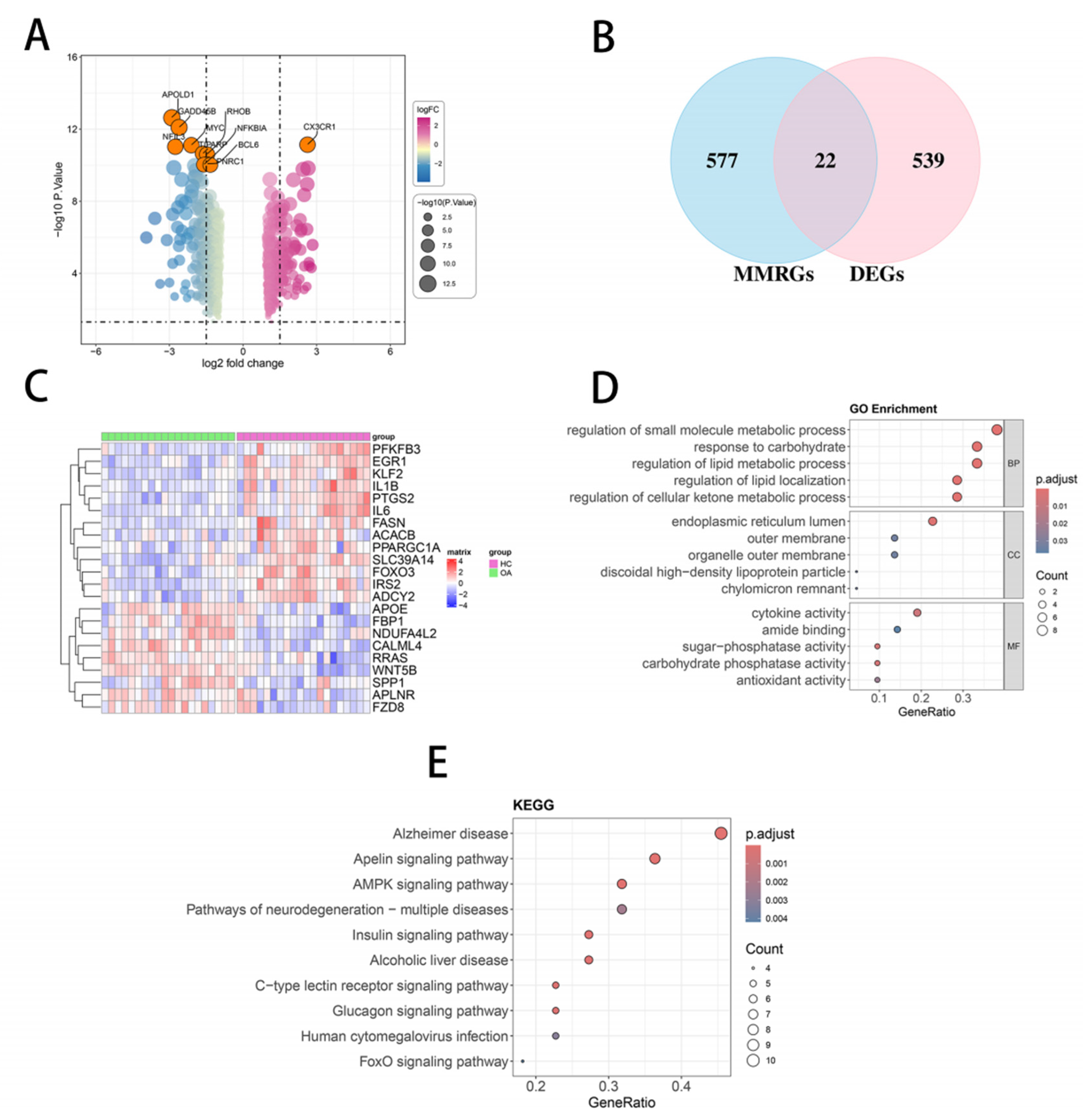
Figure 2.
Selection and analysis of hub MEMRG-DEGs. (A) The PPI network of the MEMRG-DEGs. Node color intensity correlated with degree values. (B) Top 10 hub genes were identified by CytoHubba-MCC. (C) 8 hub MEMRG-DEGs were screened by Lasso regression method. (D) Venn diagram showed overlapping hub genes from LASSO and MCC methods.
Figure 2.
Selection and analysis of hub MEMRG-DEGs. (A) The PPI network of the MEMRG-DEGs. Node color intensity correlated with degree values. (B) Top 10 hub genes were identified by CytoHubba-MCC. (C) 8 hub MEMRG-DEGs were screened by Lasso regression method. (D) Venn diagram showed overlapping hub genes from LASSO and MCC methods.
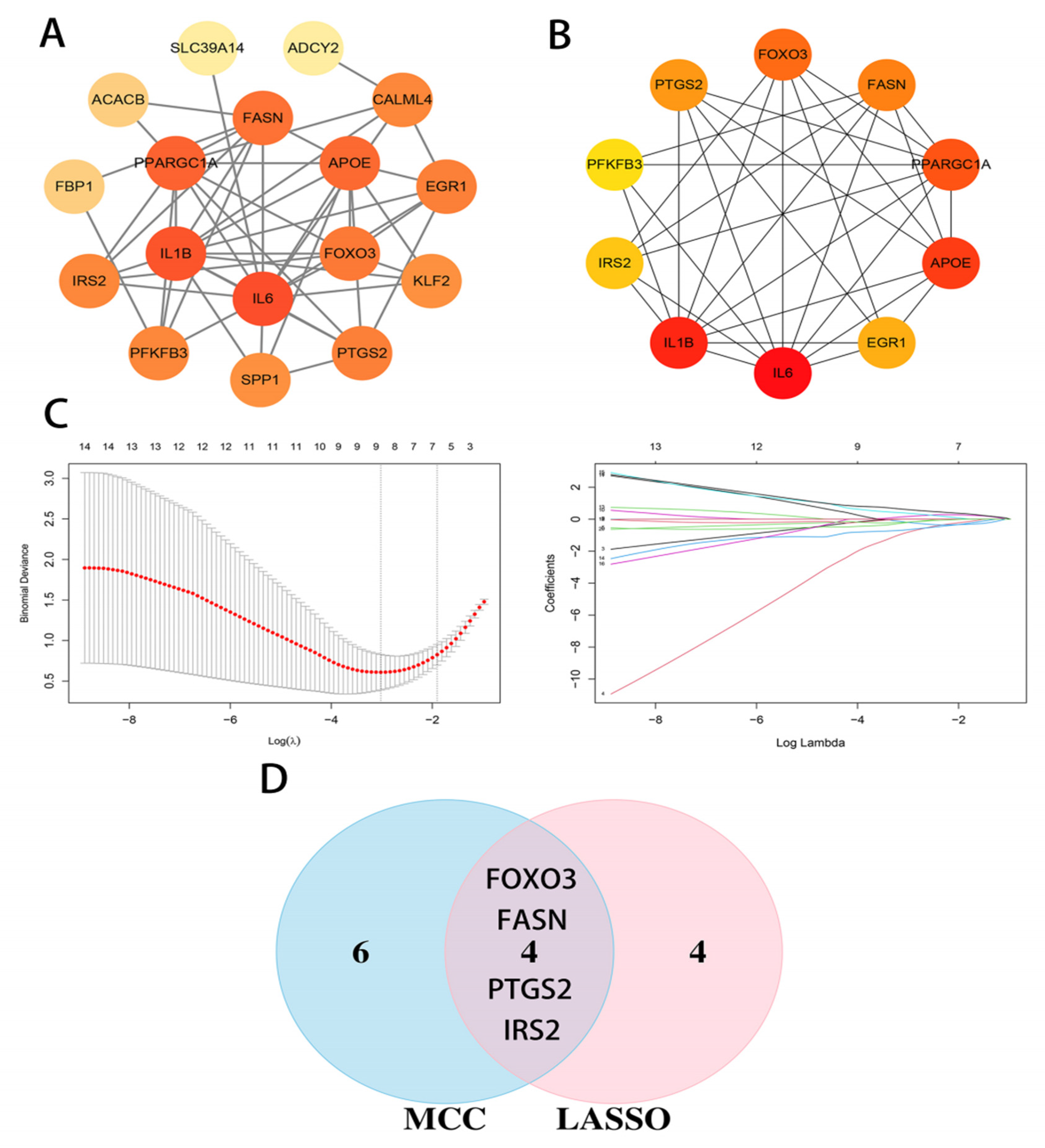
Figure 3.
scRNA-seq revealed the localization of hub MEMRG-DEGs. (A) 8 cell clusters were identified and visualized using a t-SNE plot. (B) Expression of representative marker genes of 8 cell clusters. (C) The heatmap displayed the expression of 4 hub MEMRG-DEGs for each cell cluster. (D) AUCell scores for 4 hub MEMRG-DEGs in each cell cluster.
Figure 3.
scRNA-seq revealed the localization of hub MEMRG-DEGs. (A) 8 cell clusters were identified and visualized using a t-SNE plot. (B) Expression of representative marker genes of 8 cell clusters. (C) The heatmap displayed the expression of 4 hub MEMRG-DEGs for each cell cluster. (D) AUCell scores for 4 hub MEMRG-DEGs in each cell cluster.
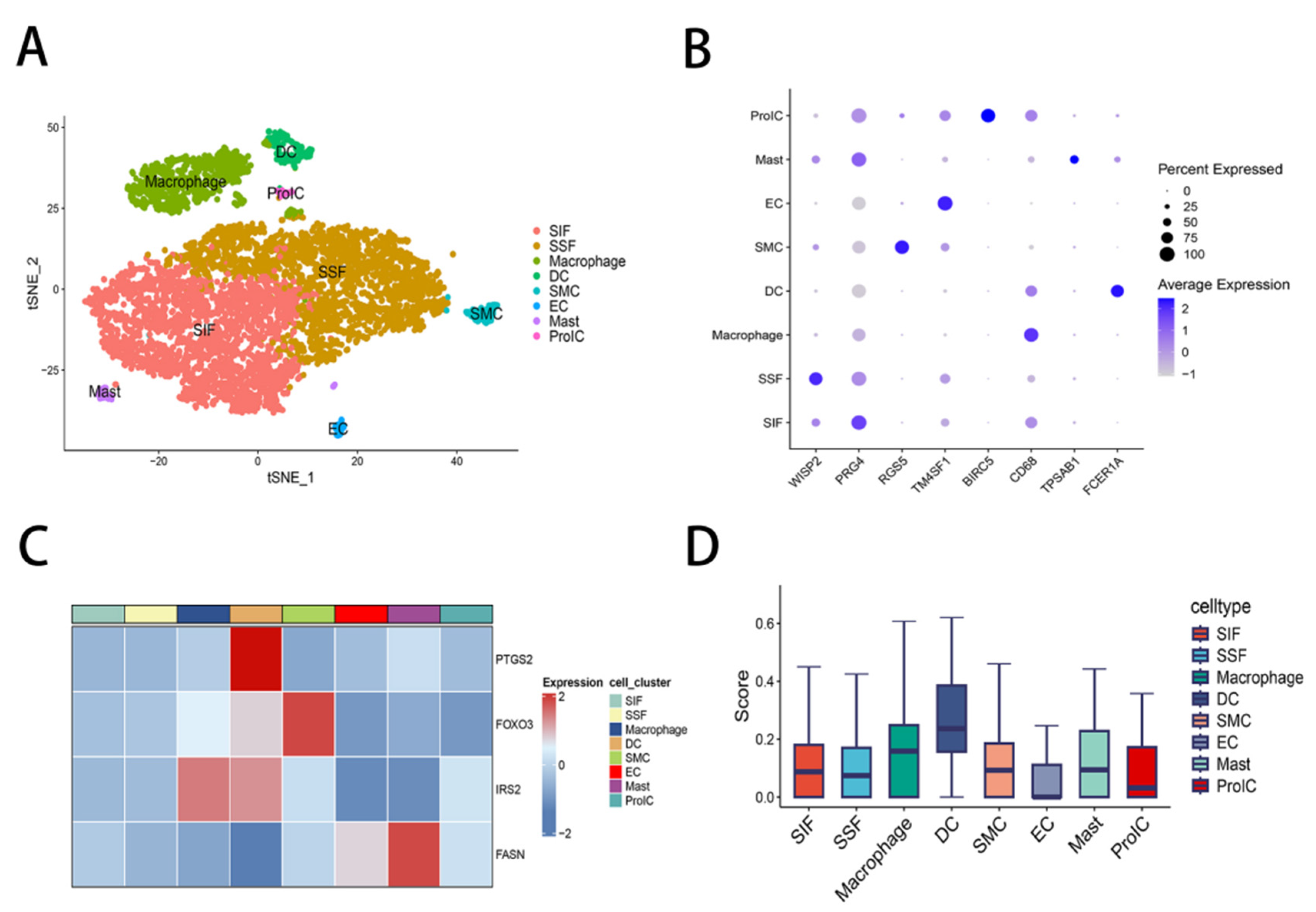
Figure 4.
Validation of expression levels and evaluation of diagnostic efficacy for the hub genes. (A) Box plots showing the differential expression levels of the four hub genes between the healthy control (HC) and OA groups in the training set. (B) ROC curves evaluating the diagnostic accuracy of the four hub genes in the training set. (C) Validation of the expression levels of the four hub genes between HC and OA samples in the external validation dataset (GSE12021). (D) ROC curves verifying the diagnostic efficacy of the four hub genes in the external validation dataset (GSE12021).
Figure 4.
Validation of expression levels and evaluation of diagnostic efficacy for the hub genes. (A) Box plots showing the differential expression levels of the four hub genes between the healthy control (HC) and OA groups in the training set. (B) ROC curves evaluating the diagnostic accuracy of the four hub genes in the training set. (C) Validation of the expression levels of the four hub genes between HC and OA samples in the external validation dataset (GSE12021). (D) ROC curves verifying the diagnostic efficacy of the four hub genes in the external validation dataset (GSE12021).
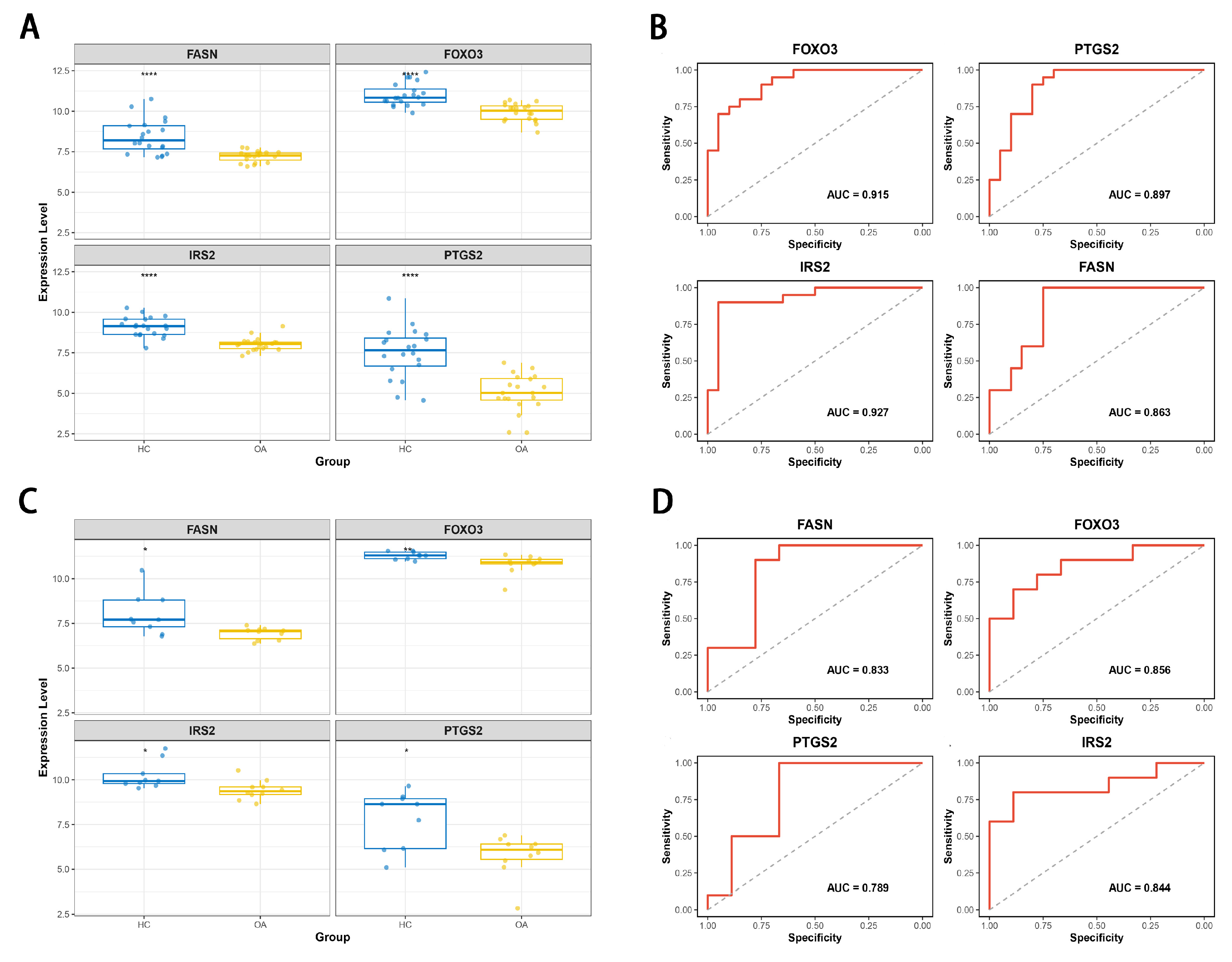
Figure 5.
Correlation between hub MEMRG-DEGs and immune infiltration in OA. (A) Correlation matrix of 28 immune cell types in OA synovium. (B) 28 types of immune cells between OA patients and healthy controls by ssGSEA. (C) The correlation between hub MEMRG-DEGs and immune cells.
Figure 5.
Correlation between hub MEMRG-DEGs and immune infiltration in OA. (A) Correlation matrix of 28 immune cell types in OA synovium. (B) 28 types of immune cells between OA patients and healthy controls by ssGSEA. (C) The correlation between hub MEMRG-DEGs and immune cells.
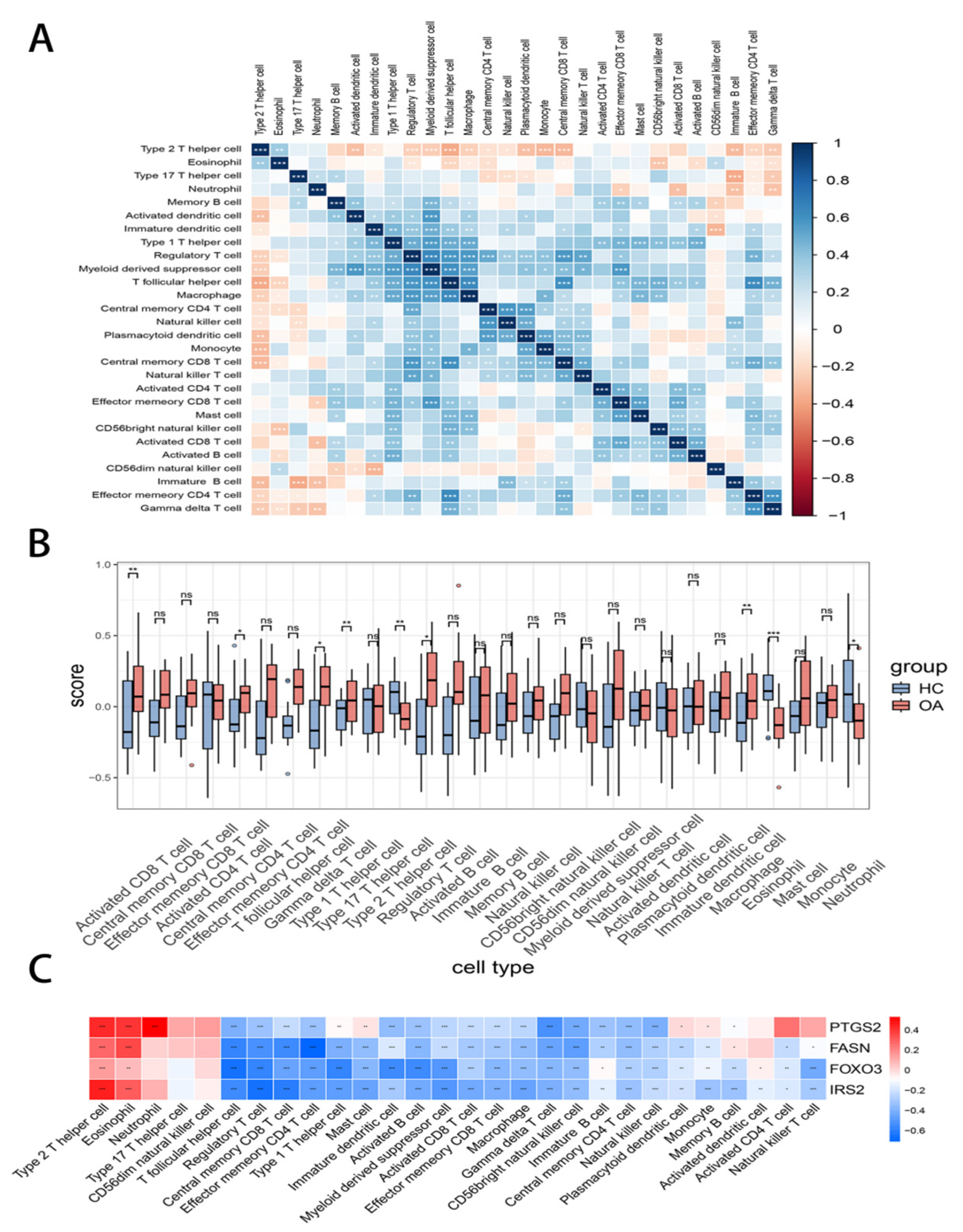
Figure 6.
IRS2 was downregulated in OA synovium. (A) Immunofluorescence (IF) staining of IRS2 in control and OA synovium. (B) Quantification of IRS2 fluorescence intensity. (C) Colocalization analysis of IRS2 and CD206 in M2-type macrophages. (D) Western blot analysis of IRS2 expression in IL-4-induced THP-1 macrophages.
Figure 6.
IRS2 was downregulated in OA synovium. (A) Immunofluorescence (IF) staining of IRS2 in control and OA synovium. (B) Quantification of IRS2 fluorescence intensity. (C) Colocalization analysis of IRS2 and CD206 in M2-type macrophages. (D) Western blot analysis of IRS2 expression in IL-4-induced THP-1 macrophages.
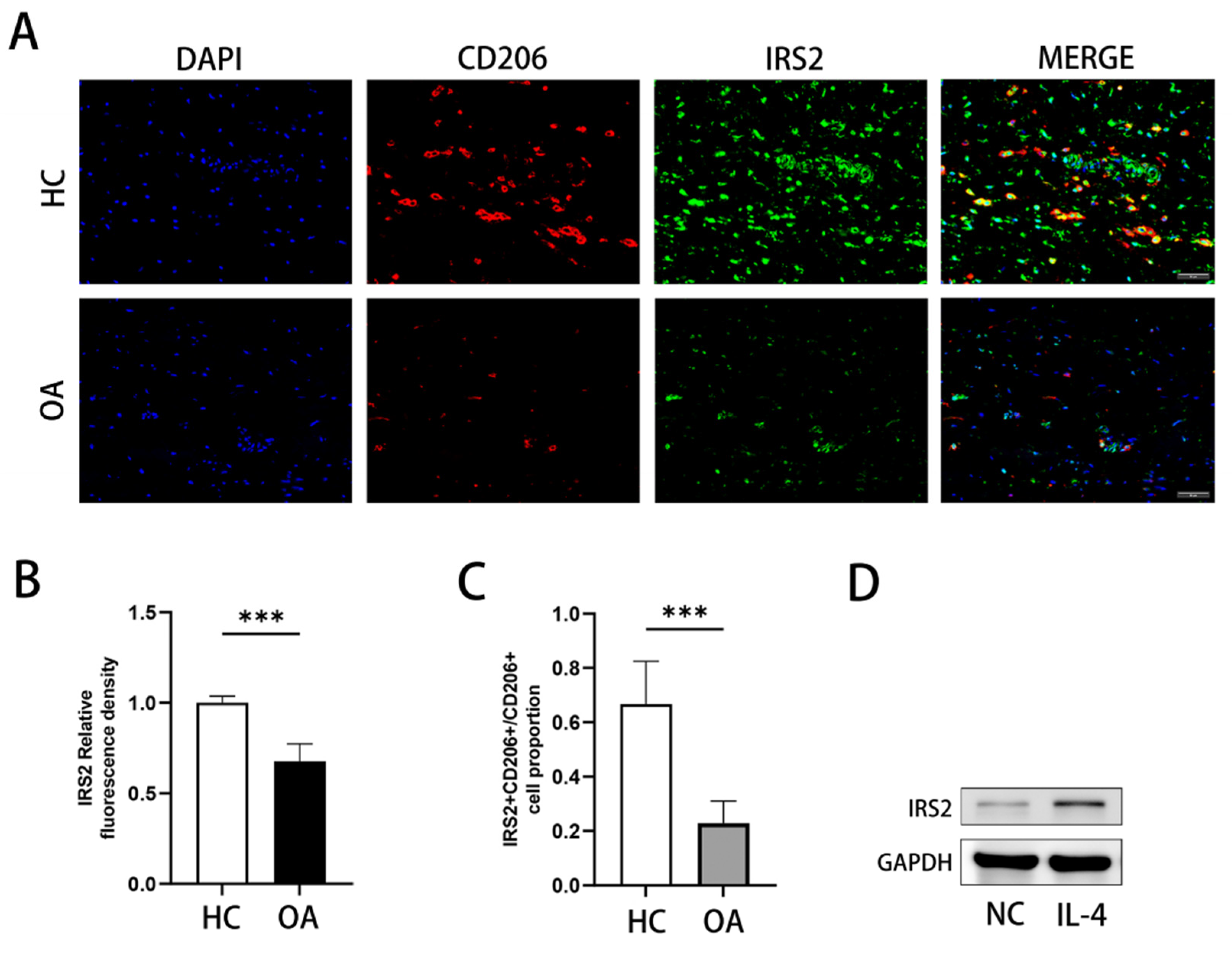
Figure 7.
IRS2 knockdown impaired M2 macrophage polarization and mitochondrial function via AKT/FOXO1 inhibition. (A) Expression of M2 macrophage marker ARG1 in IRS2-knockdown THP-1 macrophages. (B) JC-1 fluorescence ratios reflected mitochondrial membrane potential. (C) AKT phosphorylation and protein levels in the THP-1 macrophage of the control and si-IRS2 after IL-4 stimulation. (D) FOXO1 phosphorylation and protein levels in the THP-1 macrophage of the control and si-IRS2 after IL-4 stimulation.
Figure 7.
IRS2 knockdown impaired M2 macrophage polarization and mitochondrial function via AKT/FOXO1 inhibition. (A) Expression of M2 macrophage marker ARG1 in IRS2-knockdown THP-1 macrophages. (B) JC-1 fluorescence ratios reflected mitochondrial membrane potential. (C) AKT phosphorylation and protein levels in the THP-1 macrophage of the control and si-IRS2 after IL-4 stimulation. (D) FOXO1 phosphorylation and protein levels in the THP-1 macrophage of the control and si-IRS2 after IL-4 stimulation.
Disclaimer/Publisher’s Note: The statements, opinions and data contained in all publications are solely those of the individual author(s) and contributor(s) and not of MDPI and/or the editor(s). MDPI and/or the editor(s) disclaim responsibility for any injury to people or property resulting from any ideas, methods, instructions or products referred to in the content. |
© 2026 by the authors. Licensee MDPI, Basel, Switzerland. This article is an open access article distributed under the terms and conditions of the Creative Commons Attribution (CC BY) license (http://creativecommons.org/licenses/by/4.0/).
Copyright: This open access article is published under a Creative Commons CC BY 4.0 license, which permit the free download, distribution, and reuse, provided that the author and preprint are cited in any reuse.


