

Submitted:
18 April 2026
Posted:
20 April 2026
You are already at the latest version
Abstract
Time of day is often treated as a scheduling constraint rather than a true programming variable, yet training time is not neutral and can modulate both performance expression and the biological cost of exercise. This structured narrative review synthesizes evidence on morning versus afternoon/evening training in athletes and physically active adults, integrating performance outcomes with internal load, autonomic recovery, sleep interaction, and downstream physiological stress. Acute evidence generally supports superior late-afternoon or early-evening performance, particularly for neuromuscular tasks, whereas chronic training studies do not indicate a universal optimal training time. Instead, adaptation appears to depend on chronotype, habitual training time, wake-to-training interval, light exposure, nutritional timing, training-testing congruency, and competition-specific demands. Mechanistically, exercise timing likely interacts with BMAL1/CRY loops, AMPK-SIRT1-PGC-1alpha signaling, PGC-1alpha-driven mitochondrial remodeling, and redox-inflammatory pathways, although much of this evidence remains preclinical. Accordingly, this review advances a Performance-Biological Cost (PBC) framework in which training time is judged by the balance between output, recovery opportunity, and residual molecular cost rather than by acute performance alone. By integrating athlete-relevant human evidence with mechanistic insights and translating them into explicit decision tools and testable predictions, the review positions exercise timing as a context-dependent lever within periodized training design.
Keywords:
chronotype
; circadian rhythm
; skeletal muscle clock
; BMAL1
; exercise timing
; athletic performance
; training load
; heart rate variability
; mitochondrial dynamics
; redox biology
1. Introduction
Training time is not a neutral scheduling variable, but a context-dependent modulator of both performance output and biological cost. Circadian rhythms influence body temperature, autonomic tone, endocrine background, substrate availability, and several dimensions of neuromuscular readiness, while skeletal muscle itself contains an intrinsic molecular clock. Exercise timing therefore alters both the physiological state on which a session is imposed and the signaling environment through which that session is translated into adaptation [1,2,3,4,5].
Acute syntheses consistently report better late-afternoon or early-evening performance for maximal strength, power, sprint, repeated-sprint, and many endurance outcomes, although the average advantage is outcome- and protocol-dependent rather than universal [6,7,8,9]. Pooled effects appear to range from small for some endurance syntheses (effect size about 0.23) to moderate for time-to-exhaustion or total work outcomes (Hedges' g about 0.65), and are larger for Wingate power and jump height (effect sizes about 0.73 and 0.79, respectively) [6,7,8]. The applied question is therefore not simply whether afternoon exceeds morning, but whether the same session produces the same combination of output, internal load, recovery opportunity, and downstream biological cost at different circadian phases.
This distinction matters because training quality must be judged across the microcycle rather than within a single session. A time slot that modestly improves immediate output may still be suboptimal if it compresses sleep, delays autonomic recovery, or increases residual fatigue before the next key practice. Conversely, strategically protected morning work may be appropriate when athletes must rehearse early competition, accommodate unavoidable logistics, or preserve evening recovery [10,11,12,13,14]. The ecological cost of training therefore extends beyond same-session performance and must be interpreted across the wider 24-h recovery architecture.
The familiar morning-versus-evening comparison is only a proxy for a broader chrono-ecology. In practice, athletes perform within a phase relationship between internal circadian timing and external demands, shaped by light exposure, meal timing, ambient temperature, and proximity to sleep. This helps explain why apparently conflicting findings can coexist, and why the most appropriate training slot often depends on chronotype, habitual training time, wake-to-training interval, and competition-specific demands rather than on clock time alone [15,16,17,18].
Within this context, the present review integrates circadian regulation with redox homeostasis and metabolic signaling pathways relevant to exercise adaptation [19,20,21]. It advances a Performance-Biological Cost (PBC) model in which training time is judged by the balance between output, recovery opportunity, and residual molecular cost rather than by acute performance alone. Rather than searching for one universally optimal hour, this perspective treats exercise timing as a context-dependent programming variable whose practical value depends on how it shapes the ratio between performance output and biological cost across the wider recovery architecture.
Research Questions and Aims
To address these gaps, the present structured narrative review is guided by the following key questions:
- Q1.Does time of day consistently influence acute exercise performance across different physical capacities?
- Q2. To what extent does exercise timing modify internal load, perceived effort, and recovery processes, including sleep interaction?
- Q3. What is the current evidence supporting circadian modulation of molecular pathways involved in exercise adaptation, including metabolic and redox signaling?
- Q4. How do chronotype, habitual training time, and contextual factors (e.g., wake-to-training interval, light exposure, nutrition) shape observed phase-dependent effects?
- Q5. Can these multi-level effects be integrated into a coherent framework that explains how training time influences both performance and its associated biological cost?
By addressing these questions, the review aims to integrate athlete-relevant human evidence with mechanistic insights and to clarify how exercise timing may influence both performance expression and the biological cost of training.
2. Methodological and Conceptual Framework
2.1. Methodological Approach
This article is a structured narrative review designed to synthesize athlete-relevant human performance evidence together with mechanistic literature that can inform training-time decisions in athletes and physically active adults. Literature was searched iteratively in PubMed and Scopus from database inception to February 2026 using combinations of the terms time of day, circadian, chronotype, exercise, training, performance, strength, power, sprint, endurance, heart rate variability, sleep, skeletal muscle clock, mitochondria, redox, inflammation, light exposure, nutrition, and jet lag. Search strings were adapted iteratively across databases and, where appropriate, limited to human studies and English-language publications to maximize translational relevance. Reference lists of key reviews, meta-analyses, and eligible primary studies were also screened to identify seminal papers and recent updates.
The evidence base was organized around predefined translational themes corresponding to the research questions and to the main practical decision points faced in sport: acute performance output; internal load and perceived exertion; autonomic recovery, heart rate variability, and sleep interaction; chronotype, habitual training time, wake-to-training interval, and training-testing congruency; co-zeitgebers such as light, meals, and caffeine; travel-related circadian misalignment; and molecular mechanisms linking the skeletal muscle clock with metabolic, mitochondrial, endocrine, and redox-inflammatory signaling. For each study, emphasis was placed on study design, participant profile, exercise modality, timing comparison, contextual modifiers, and principal outcomes so that findings could be interpreted across levels of analysis rather than as isolated results.
Priority was given to meta-analyses, systematic reviews, randomized or crossover human trials, athlete field studies, and mechanistic human data. When multiple levels of evidence were available, athlete-based human studies were weighted most heavily, followed by mechanistic human studies, whereas preclinical studies were retained selectively to clarify biologically plausible pathways that remain difficult to isolate directly in sport settings. Studies in clinical or metabolically altered populations were included when they offered mechanistic insight into clock-sensitive pathways, metabolomic responses, or exercise-timing effects that remain difficult to characterize in trained athletes, but such evidence was interpreted as supportive rather than definitive for athletic prescription.
Study selection was guided by explicit relevance criteria rather than by formal systematic-review procedures. Preference was given to studies that: (1) examined exercise timing in relation to performance, internal load, recovery, sleep, or molecular responses; (2) reported sufficient contextual detail to permit interpretation of phase-dependent effects, such as chronotype, habitual training time, wake time or time since waking, feeding status, or proximity to sleep; and (3) offered direct or translational relevance to sport, training design, or structured physical activity. Studies with insufficient contextual description were interpreted cautiously and were not allowed to drive applied conclusions. Ecological validity was considered throughout, particularly where laboratory findings required translation to real training calendars, competition schedules, travel demands, or congested microcycles. In cases of conflicting findings, greater weight was assigned to studies with higher ecological validity, athlete populations, and more complete contextual reporting, rather than to isolated statistically significant results.
Because the purpose of the review was integrative explanation rather than exhaustive cataloguing or quantitative pooling, it was not conducted under a preregistered protocol and does not include a PRISMA flow diagram or formal risk-of-bias scoring. Conclusions are therefore framed according to the direction, consistency, ecological validity, and translational relevance of the available evidence rather than by numerical vote counting, with explicit separation between stronger human evidence and more provisional mechanistic inference. Evidence synthesis followed a thematic convergence approach, integrating findings across performance, recovery, and mechanistic domains to identify consistent patterns rather than relying on single-study outcomes. Particular caution was applied where the literature was male dominated, relied on non-athlete cohorts, or inferred athlete-relevant mechanisms primarily from animal and cellular models.
Inclusion criteria included: (1) human or translational relevance; (2) reporting of performance, recovery, or molecular outcomes; and (3) sufficient temporal and contextual detail to enable phase-dependent interpretation. Studies lacking such contextual information were excluded or interpreted with caution and not permitted to drive applied conclusions.
2.2. Conceptual Contribution
Several prior reviews have addressed circadian variation in sport performance, chronotype, time-specific training, the skeletal muscle clock, or the broader interaction between exercise timing and metabolic health [3,4,5,6,16,17,18,19,20,22,23,24]. The present review extends that literature in three ways. First, it formalizes a PBC model that evaluates exercise timing through an output-to-biological-cost lens rather than through acute performance alone, explicitly integrating internal load, autonomic recovery, sleep interaction, and residual molecular stress. Second, it links athlete-focused human evidence to the molecular clock, mitochondrial, endocrine, and redox-inflammatory literature while distinguishing between stronger human data and more provisional mechanistic inference. Third, it translates this synthesis into an applied decision matrix, integrative figures, and testable predictions intended to improve both practice and future chrono-exercise study design.
Figure 1 illustrates the Performance–Biological Cost (PBC) framework, which formalizes training-time effectiveness as the balance between performance output and its associated biological cost within a circadian-dependent system.
Despite the growing body of literature, a critical limitation remains the relative scarcity of athlete-specific molecular evidence directly linking exercise timing to adaptive signaling pathways. Much of the current mechanistic understanding is derived from preclinical models or clinical populations, which, although biologically informative, may not fully capture the physiological complexity, training load, and ecological constraints characteristic of athletic environments. As a result, the PBC model should be read as an integrative and explicitly testable framework rather than as a claim that one clock hour can already be prescribed universally on molecular grounds.
3. Circadian Architecture Relevant to Training Timing
3.1. Biological Rhythms and Acute Exercise Capacity
The circadian system coordinates daily oscillations in physiology through a central pacemaker in the suprachiasmatic nucleus (SCN) and a network of peripheral clocks distributed across tissues, including skeletal muscle and metabolic organs [2,5,21]. For exercise, this matters because variables with clear daily rhythms—core temperature, alertness, sympathetic activity, cortisol, and melatonin—also influence readiness to perform. The athlete therefore enters each session with a circadian state that can facilitate or constrain the imposed load.
One of the most robust practical observations is that body temperature usually rises from morning toward late afternoon. Higher temperature is associated with faster nerve conduction, lower passive stiffness, improved muscle contractile properties, and more favorable enzyme kinetics, all of which can contribute to better high-intensity performance. Importantly, a thorough warm-up can reduce part of the morning disadvantage, but it does not necessarily eliminate it fully, particularly for explosive tasks or when the athlete is sleep-restricted [1,25,26,27].
Endocrine rhythms add another layer of complexity. Cortisol is generally higher in the morning, whereas the broader late-day environment is characterized by different combinations of autonomic tone, perceived alertness, and metabolic readiness. These patterns should not be reduced to simplistic anabolic-versus-catabolic narratives; rather, they signal that the same external load may be processed differently depending on when it is applied [2,5,28].
3.2. Chronotype, Habitual Training Time, and Peripheral Clocks
Chronotype describes the individual preference for earlier or later sleep-wake timing and is one of the main reasons why the same clock hour does not feel biologically identical across athletes [4]. Morning-oriented individuals often tolerate early sessions better, whereas evening-oriented individuals may experience larger decrements in alertness, mood, and performance when required to train early. Chronotype is therefore not a lifestyle curiosity; it is an applied variable with direct implications for readiness and recovery.
Habitual training time also matters. Repeated exposure to training at a similar hour appears able to attenuate some time-of-day differences and improve performance at the trained time, probably through a combination of behavioral adaptation, anticipatory regulation, and repeated interaction with local peripheral clocks. In practice, this means that the athlete who always trains in the morning may express less of a morning penalty than a comparable athlete whose usual schedule is evening-based [3,10,29,30,31].
This adaptation is crucial for sport settings because training and competition are rarely scheduled for ideal biological times. School timetables, team logistics, travel, and broadcasting schedules create mismatches between chronotype and demanded performance windows. For that reason, research and practice should distinguish at least three layers: the athlete's inherent chronotype, the biological effects of a given clock hour, and the acclimation produced by repeated time-specific training [32,33].
3.3. Molecular Circadian Regulation of Skeletal Muscle and Exercise Signaling
Skeletal muscle contains an intrinsic molecular clock built around transcription-translation feedback loops. In the positive limb, BMAL1 and CLOCK bind E-box elements and promote rhythmic transcription of PER, CRY, REV-ERB, and ROR targets, whereas PER/CRY complexes repress BMAL1:CLOCK activity. This oscillator is not a decorative molecular feature. In muscle it regulates genes involved in glucose handling, substrate selection, myogenesis, contractile function, protein turnover, and mitochondrial homeostasis [19,20,21,28].
Genetic and tissue-specific models indicate that the muscle clock is functionally relevant for performance and metabolic health. Loss of BMAL1 or CLOCK signaling in muscle reduces specific force, disrupts sarcomeric organization, lowers mitochondrial volume and respiration, and impairs insulin-stimulated glucose uptake, partly through effects on GLUT4, TBC1D1, pyruvate dehydrogenase control, and SIRT1-linked pathways [34,35,36,37,38,39]. These data provide a mechanistic basis for why identical exercise can be biologically processed differently at different circadian phases.
Several exercise-responsive signaling hubs likely intersect directly with the clock, especially in experimental models and limited human work. AMPK can modify clock phase through effects on CRY stability, SIRT1 couples redox/energetic state to deacetylation of clock components, and PGC-1alpha co-regulates oxidative metabolism together with BMAL1:CLOCK and ROR-mediated transcription [19,20,28,37,40,41]. In practical terms, exercise timing is not merely superimposed on physiology; it likely interacts with the cellular machinery that interprets exercise.
Exercise is also a zeitgeber for peripheral tissues. Scheduled exercise can phase-shift skeletal muscle clocks even when the SCN is unchanged, and repeated training at a given hour can modify clock-gene expression around that trained window [36,42,43,44,45,46,47]. This helps explain why habitual training time and training-testing congruency alter performance and adaptation.
3.4. Additional Zeitgebers, Wake-to-Training Interval, and Circadian Ecology of Training
Clock time alone is an incomplete descriptor of training biology. Time since waking, prior light history, meal timing, caffeine use, and ambient temperature can each shift readiness or alter the apparent magnitude of a phase effect. Thus, two sessions scheduled at the same nominal hour are not necessarily biologically equivalent when one occurs shortly after waking in dim light and the other follows a longer wake-to-train interval with bright light exposure, breakfast, and a deliberate warm-up [17,48,49,50,51].
Light and feeding deserve particular attention because they are potent zeitgebers for central and peripheral oscillators. Bright-light exposure, melatonin suppression, meal timing, and the distribution of carbohydrate and protein across the day can alter circadian phase or create SCN-periphery mismatch, while mistimed light at night or late eating can disturb hormonal and metabolic rhythms [22,52,53,54,55,56]. For athletes, this means that part of the so-called morning penalty may sometimes reflect coexisting sleep inertia, incomplete fueling, low energy availability, or inappropriate light history rather than an immutable property of morning exercise [57]. Chrono-nutrition is therefore not an accessory concept but part of the biological context in which timed exercise is decoded.
Accordingly, training-time research should report wake time, time since waking, pre-exercise light exposure, and breakfast or caffeine timing whenever feasible. Practitioners can use these same variables as programming levers: protect the wake-to-train interval when possible, consider strategically timed light and carbohydrate intake, and avoid creating circadian confusion through repeated late-night light exposure followed by early-morning high-intensity work [17,49,52,53,54]. Objective phase markers may also add value because self-reported chronotype does not always capture internal circadian alignment in field settings, particularly in elite athletes exposed to travel, shift-like schedules, or irregular competition calendars [58].
4. Time-of-Day Effects on Performance Output
4.1. Neuromuscular and Team-Sport Performance
Meta-analytic and systematic-review evidence most consistently supports small but recurrent late-afternoon or early-evening advantages for tasks that depend heavily on neuromuscular expression, including maximal strength, jump performance, short sprinting, and repeated-sprint ability [6,8,9,59]. In the broader short-duration literature, peak performance is most often reported between about 16:00 and 20:00 h, with typical amplitudes in dynamic tasks ranging roughly from 1.7% to 17.5% rather than representing a universal all-day shift [8]. In team-sport athletes, even modest average gains can matter because sprint outcomes, duels, change-of-direction quality, and repeatability of high-intensity actions are often decided by narrow margins.
The mechanisms are probably multifactorial. Temperature-related improvements in muscle function interact with neural readiness, arousal state, perceived effort, and mechanical factors such as compliance and stiffness. Increasingly, mechanistic work also suggests that time-specific expression of clock-controlled metabolic and contractile pathways shapes how force and fatigue are generated, not only how warm or alert the athlete feels [21,34,42,43,44]. No single mechanism explains all studies, and not all athletes respond identically, but the overall pattern is sufficiently recurrent to justify considering late afternoon or early evening as a favorable window for high-expression speed-power work when schedules allow [1,2,27].
Recent sport-specific work supports this interpretation. In elite soccer players, morning and evening training produced different effects on both performance and well-being, with evening sessions associated with better mood profile and superior small-sided-game responses [60]. For applied sport science, this is important because technical-tactical quality is often inseparable from neuromuscular freshness and willingness to tolerate high intensity.
4.2. Endurance Performance
Endurance outcomes are more heterogeneous than explosive tasks, but recent syntheses still tend to show a later-day advantage in many acute settings [6,7]. The effect is usually smaller and more context-sensitive than for strength or sprint performance, with meaningful dependence on test duration, intensity domain, pacing strategy, thermal conditions, feeding status, and prior sleep.
This heterogeneity has an important practical implication. A seemingly circadian effect may partly reflect modifiable contextual variables. Morning testing is often accompanied by earlier waking, reduced sleep, lower body temperature, incomplete pre-exercise fueling, or a fasted state. Therefore, coaches should be careful not to interpret every morning decrement as a fixed biological destiny. Some of the observed disadvantage may be reduced by better sleep protection, earlier meal planning, and a more deliberate warm-up.
Even so, the applied goal is not to erase every diurnal difference. For sports contested in the morning, training must sometimes prepare athletes to express endurance performance under morning conditions. In that context, time-specific exposure becomes part of competition specificity rather than an error in programming.
4.3. Acute Responses versus Chronic Adaptation
A crucial distinction is that the hour of best acute performance is not necessarily the hour of best long-term adaptation. Several time-specific training studies suggest that repeated training at a given hour improves subsequent performance measured at that same hour, indicating a training-testing congruency effect rather than universal superiority of one time across all outcomes [10,29,30,31].
This point is reinforced by recent work showing limited evidence for large differential chronic adaptation when resistance training is performed in the morning versus the evening under controlled conditions [61]. At the same time, recent randomized trials and exercise-training studies indicate that morning and evening programs can diverge in glycaemic control, body-mass change, sleep, cardiometabolic markers, or hypertrophic/strength outcomes depending on phenotype, exercise mode, and the outcome selected [62,63,64,65,66,67,68]. In other words, the clock time that maximizes same-day output may not always determine the clock time that produces the greatest accumulated benefit across weeks.
For coaches, the implication is simple but profound: the best time to express performance today and the best time to place a session within a microcycle are related questions, but they are not identical. Timing decisions become stronger when they are judged against the total ecological cost of the session rather than by acute output alone.
4.4. Molecular Evidence Linking Clock Time to Acute Output and Adaptation
Mechanistic omics studies sharpen this picture, but at present they should be interpreted primarily as biological plausibility data rather than as direct evidence for a universally optimal training hour in athletes. Most of the highest-resolution clock-phase manipulations, transcriptomic findings, and causal pathway experiments remain preclinical, especially in mice. In these models, daily variance in exercise capacity depends partly on PER1/2 and is accompanied by phase-specific metabolic programs [42]. Timed exercise can also amplify HIF-1alpha and carbohydrate-use pathways or favor reparative versus stress-associated transcriptomic states depending on the phase studied [43,44]. These studies support circadian sensitivity of exercise signaling, but they should inform mechanism more than prescription.
Human evidence is emerging but remains much thinner than the animal literature. In men with type 2 diabetes, afternoon high-intensity training produced a distinct metabolomic and skeletal-muscle proteomic signature relative to morning training [45]. In men with insulin resistance, training modified Per1-3 and Roralpha expression preferentially around the trained time even when 24-h substrate rhythmicity was not fully restored [47]. Together, the available human data support time-sensitive biological processing of exercise, but they do not yet justify ranking training times on molecular grounds alone.
Despite these limitations, the available evidence converges toward a consistent biological principle: exercise performed at different circadian phases is not only expressed differently, but also processed with different signaling efficiency and recovery cost. This phase-dependent processing provides a mechanistic basis for the Performance-Biological Cost (PBC) framework proposed in this review [42,43,44,45,47].
4.5. Competition Scheduling, Ecological Validity, and Training-Testing Congruency
A recurrent problem in chrono-exercise interpretation is that laboratory peak time is too quickly equated with competition advantage. Yet real competition includes psychological activation, tactical context, travel, warm-up resources, environmental stress, and the degree of alignment between local time and the athlete's internal phase. Olympic-level field data confirm that time of day can meaningfully influence competitive outcomes, but they also show that ecological context determines whether the biological signal is amplified, dampened, or masked [69].
The concept of training-testing congruency is therefore central. Athletes improve not only because they train, but because they repeatedly rehearse the state in which performance must later be expressed. Chronotype, habitual training time, time since waking, and objective circadian phase each change the size and direction of diurnal performance effects [49,58,70,71,72,73]. Thus, a program made entirely of late-day high-quality work may build impressive afternoon output while leaving the athlete underprepared for morning heats, qualifiers, or travel-compressed starts.
This issue is especially relevant in team and professional sport, where circadian misalignment between local time, habitual schedule, and competition time can erode decision quality and physical output. Evidence from elite sport settings suggests that performance decrements are not merely theoretical when athletes are asked to operate at misaligned circadian phases [74,75,76,77]. Table 1 and Table 2 condense the main athlete-level modifiers, evidence domains, and practical implications discussed in this section.
5. Internal Load, Perceived Exertion, and Mood
External load describes what was prescribed; internal load reflects what it cost the athlete to complete it. Heart rate, blood lactate, session rating of perceived exertion, mood, and perceived recovery all belong to this internal side of the equation. Timing matters because the same external session can be experienced through different physiological and psychological states depending on the time of day [5,32,60].
From an applied standpoint, this point may be even more important than the modest average differences in acute output reported by meta-analyses. If a session performed at one hour produces similar total work but with lower perceived strain, better mood, or less disruption to subsequent recovery, that timing may be preferable over weeks of training. This is particularly relevant in team sports, where the quality of decision-making, communication, and technical execution can deteriorate before a large drop is visible in external metrics.
The study by Selmi and colleagues illustrates this logic well: evening training in elite soccer players was associated not only with better performance indicators but also with more favorable well-being responses [60]. Such findings encourage coaches to interpret timing through a broader lens. A successful session is not merely a session that hits the planned wattage or speed; it is also a session that fits the athlete's readiness profile and leaves an acceptable residue for the next training demand.
Morning training is not therefore a mistake. It can be strategically important for acclimation to morning competition, for facility availability, or for the organization of double-session days. The lesson is simply that when morning training is necessary, it should be supported with better sleep opportunity, a deliberate thermal preparation, and careful nutrition so that internal load is not inflated unnecessarily.
In skill-dominant and tactically dense environments, timing can also change the quality of learning that occurs within the session. Sleepiness, chronotype mismatch, and inadequate readiness may raise perceived effort before a major drop becomes visible in gross external metrics. For that reason, coaches should track not only the physical load completed, but also the technical and cognitive quality that the chosen time slot is able to support [60,69,70].
6. Autonomic Recovery, Heart Rate Variability, and Sleep
6.1. Session-to-Sleep Interval, Morning Sleep Compression, and Recovery Quality
Heart rate variability (HRV) is widely used as a non-invasive window into autonomic state and recovery, yet its relationship with time of day and chronotype remains underexplored relative to performance outcomes [32,33]. That gap matters because recent athlete- and sleep-focused reviews now make clear that performance cannot be separated from the broader sleep-circadian context in which training is placed [78,79,80,81,82,83]. Training decisions should therefore be based not only on what happens during exercise, but also on how quickly the athlete returns toward physiological stability afterward.
Available evidence suggests that chronotype and exercise timing can influence autonomic recovery. Acute work in athletes has shown that high-intensity exercise may disturb cardiac autonomic function differently according to chronotype, and older research indicates that post-exercise parasympathetic reactivation also varies across times of day and chronotype profiles [84,85]. These findings are not yet strong enough to support rigid rules, but they clearly argue against assuming that all athletes absorb an early or late session in the same way.
Timing must also be considered in relation to the sleep window. Early-morning training can reduce sleep duration severely in athletes who need to travel, wake early, or manage two-a-day schedules [12,14]. At the opposite end of the day, the evening-exercise literature no longer supports a simplistic prohibition: high-intensity or late sessions do not uniformly impair sleep, but their effects depend on dose, finish time, time-to-bed, chronotype, prior sleep debt, and the athlete's broader sleep behaviors [11,79,86,87,88,89,90]. Practically, the wake-to-training interval and the session-to-sleep interval may be more informative than the wall-clock label alone.
In athletes, this issue is amplified by travel, competition, sex-specific sleep vulnerability, and the quality of sleep behaviors around training. Recent systematic reviews and cohort studies show that sleep interventions can improve performance in some contexts, whereas disrupted sleep and circadian rhythms are associated with poorer recovery and mental-health outcomes, especially in female athlete cohorts [81,82,83,91,92]. Chrono-aware session placement should therefore be interpreted as part of sleep management, not as an isolated scheduling choice.
This creates a practical tension. The late afternoon or early evening may favor performance expression, but a poorly timed evening session can compromise recovery if it extends into the pre-sleep period. The best solution is therefore rarely ideological. For some athletes, a late-afternoon session may offer a strong compromise between high output and preserved sleep. For others-especially pronounced evening types, early-competition athletes, or those under dense schedules-the better option may be to blend strategic morning exposure with careful protection of sleep quantity and timing [13].
6.2. Travel, Jet Lag, and Circadian Misalignment
Travel and time-zone shifts transform a simple clock-time question into a phase-misalignment problem. Eastward travel, dense schedules, night arrivals, and altered meal timing can degrade sleep, autonomic stability, mood, and skill execution. Consensus guidance therefore emphasizes staged phase shifts, light management, melatonin where appropriate, and deliberate timing of meals and training after arrival [52,53,54,75,76,77]. Recent field work further suggests that objective melatonin timing can reveal circadian misalignment beyond self-reported chronotype in elite female footballers, highlighting the value of phase-aware monitoring when calendars become biologically hostile [58].
Importantly, training at competition clock time after travel is not always the first priority. In some cases the athlete first needs circadian stabilization and sleep protection before high-quality work is reintroduced. The biological logic is identical to the performance-to-cost framework developed in this review: a session that looks specific on the calendar may still be mistimed if it occurs at the wrong internal phase or after acute sleep debt [74,75,76,77]. This trade-off across the 24-h cycle is illustrated in Figure 2.
7. Redox-Inflammatory and Endocrine Responses
Training adaptation requires stress signaling, not an absence of stress. What matters is the amplitude, timing, tissue specificity, and recovery context of those signals. Circadian biology is relevant because redox state, immune trafficking, hormonal milieu, and mitochondrial behavior all vary across the day, meaning the same external load can arrive on a different molecular background [19,20,28,93]. However, the mechanistic resolution of this section is not uniform across evidence domains: the strongest athlete-relevant evidence remains human and performance-oriented, whereas many redox-inflammatory and clock-pathway insights still derive from preclinical models or clinical populations.
7.1. Molecular Clockwork, Energetic Sensing, and Mitochondrial Readiness
At the mechanistic level, BMAL1:CLOCK appears to interact with SIRT1, AMPK, and PGC-1alpha, linking the core clock to NAD+ availability, mitochondrial biogenesis, substrate oxidation, and transcriptional flexibility [19,20,28,37,40,94]. Framed more explicitly, a phase-dependent signaling hierarchy is plausible in which energetic stress (AMPK), redox/NAD+ sensing (SIRT1), anabolic restraint or permissiveness, and PGC-1alpha-driven mitochondrial remodeling are not merely activated by exercise, but activated on a different basal background depending on circadian phase [95,96,97,98,99]. Much of this evidence still comes from animal or cell-based work, so it is best viewed as mechanistic scaffolding rather than direct proof that one training time is superior in athletes [34,35,42,43,45,100,101].
Human and animal data together suggest that time-of-day differences are not limited to performance expression. Rhythmic transcriptomic and metabolic programs have now been described in human skeletal muscle, while disrupted or preserved clock oscillations appear to depend partly on metabolic phenotype [97,102,103,104,105,106]. In parallel, emerging training studies indicate that skeletal muscle BMAL1 participates in transcriptional adaptation to endurance training and that exercise can act as a meaningful peripheral clock resynchronizer [47,107,108]. These data strengthen the biological plausibility that identical exercise can generate different downstream signaling efficiency depending on circadian phase, even though athlete-specific causal evidence remains limited.
7.2. Redox-Inflammatory Timing and Recovery Cost
Redox signaling is likewise not time-neutral. Exercise-generated reactive oxygen species can serve as eustress signals that stimulate adaptation, but the downstream consequence of a given redox impulse likely depends on baseline antioxidant capacity, mitochondrial state, and clock-regulated defenses such as NRF2-linked programs [40,93,109]. This is relevant because circadian disruption and muscle clock dysfunction are associated with impaired oxidative defense, altered myokine release, fibrosis, and reduced tissue resilience [38,93].
Direct human evidence remains limited, yet studies are beginning to show differential molecular cost. Eccentric exercise performed at different times of day can yield different inflammatory, hormonal, and antioxidant responses [109]. In mouse muscle, timed exercise differentially activates repair-oriented versus stress/catabolic transcriptomic programs [44]. For applied sport science, this suggests that differential biological cost is plausible, but direct confirmation in athlete cohorts remains limited.
7.3. Endocrine Context, Sleep Window, and Sampling Design
Endocrine context adds another layer. Morning exercise is superimposed on high cortisol and a distinct autonomic background, whereas late-day exercise occurs in a different balance of sympathetic tone, temperature, and feeding history [2,5,28]. These conditions can modify insulin sensitivity, substrate partitioning, and perceived strain without implying that one clock time is inherently anabolic or catabolic in all settings [28,37,43].
Because endocrine and adaptive responses are conditioned by substrate availability, selected nutrition and supplement strategies cannot be separated completely from training time. In practice, the acute response to resistance or hypertrophy-oriented work is likely shaped by both clock phase and the composition/timing of peri-exercise nutrition, especially when energy availability is constrained or when protein distribution across the day is poorly aligned with the training stimulus [22,57,110].
A final methodological point is critical: molecular sampling must respect time. Immediate post-exercise samples capture signaling initiation; delayed samples capture downstream inflammatory, mitochondrial, endocrine, and epigenetic remodeling. Because several biomarkers themselves oscillate across the day, chrono-exercise studies need repeated post-exercise sampling, fixed wake times, controlled meals/light/caffeine, and next-day functional outcomes if they want to interpret biology rather than merely describe a snapshot [44,47,61,93,109,111,112,113,114]. This is especially important when investigators want to distinguish a beneficial adaptive signal from a high-cost state characterized by sleep loss, metabolic misalignment, or residual overload.
7.4. Sex-Specific Context and Female-Athlete Considerations
Chrono-exercise evidence remains male dominated, which limits external validity for female athletes. Available data suggest that morning-evening differences in neuromuscular function may not be identical across sexes, while broader circadian literature shows sex-related differences in sleep timing, waking cognition, thermoregulation, and endocrine signaling [115,116,117,118,119].
Interpretation therefore requires contextual reporting rather than generic extrapolation. Menstrual-cycle phase, hormonal-contraceptive use, symptom burden, sleep quality, and thermoregulatory strain can each alter readiness or recovery and may amplify or mask apparent timing effects [25,119,120,121]. When these variables are omitted, it becomes difficult to determine whether the observed difference is primarily circadian, endocrine-contextual, or both.
For practice, the safest conclusion is individualization. Coaches should avoid assuming that evidence derived mostly from male cohorts transfers unchanged to female athletes, particularly when interpreting fatigue, mood, thermoregulation, and sleep responses to early or late sessions.
8. From Chronobiology to Periodization: A Practical Sport Science Framework
The simplest applied synthesis is that session timing should be selected according to the objective of the session, the chronobiological profile of the athlete, and the recovery demands of the surrounding microcycle. A useful coaching heuristic is to seek the best output-to-cost ratio for the planned stimulus rather than the highest same-session output at any price. In this review, that logic is formalized as the Performance-Biological Cost (PBC) model: a systems-level framework in which training time functions as a dynamic control variable within the broader adaptation-recovery architecture. This framing is conceptually aligned with recent systems views of load oscillation, energy status, and recovery cost across the overload-recovery continuum [112,122,123,124].
For practical application, the Performance-Biological Cost (PBC) framework can be approximated as: PBC ≈ Performance Output / Biological Cost, where performance output reflects external work and task quality, while biological cost integrates internal load, autonomic disturbance, sleep disruption, and residual molecular stress.
When a session is designed to maximize speed, power, or high-quality repeated efforts, late afternoon or early evening is often an attractive default because it aligns with the time window in which neuromuscular performance is frequently highest [6,8,9]. However, if the sport competes regularly in the morning, then at least part of the preparation should deliberately expose athletes to morning high-quality work, otherwise the program may optimize for the wrong competitive reality [3,10].
Sessions with a potentially large autonomic or sleep cost should be placed with particular care. A high-intensity session completed too close to bedtime may offer good immediate output yet compromise nocturnal recovery, whereas a very early session may save the evening but compress sleep beforehand. Coaches should therefore judge session timing across the whole 24-h cycle, not only the training block itself [11,12].
Table 3 translates the review into a session-objective matrix. The purpose is not to rigidly assign one perfect hour, but to make explicit when late-day quality is desirable, when competition-specific morning exposure should dominate, and when biological cost should overrule acute output.
In practice, a circadian-aware periodization model can be summarized in six operational principles:
- Place high-expression speed-power or demanding small-sided-game sessions at a time of day that supports quality, commonly late afternoon or early evening when schedules permit.
- Use regular, purposeful morning exposures when competition, travel, or environmental realities require morning performance rather than assuming that a better afternoon response will transfer automatically.
- Avoid placing very intense or high-volume sessions unnecessarily close to bedtime when sleep disruption is likely, especially in athletes already carrying high allostatic load [11].
- Protect morning sessions with sufficient sleep opportunity, early nutritional planning, and an aggressive warm-up so that the session does not become artificially expensive.
- Where possible, individualize the wake-to-train interval and the session-to-sleep interval rather than relying only on the labels morning and evening.
These principles are deliberately modest. They do not require expensive molecular assays to become useful. Simple sport-science monitoring-training performance, session RPE, mood, sleep quantity, and next-day readiness-can already reveal whether a specific timing strategy is working for a given athlete or squad. Where morning quality work or aggressive recovery are priorities, timing decisions should also be coordinated with peri-exercise energy support rather than treated independently from the nutrition plan [56]. The molecular language of redox balance, inflammation, mitochondrial remodeling, and autonomic recovery strengthens the conceptual model, but the daily applied test remains practical: did the chosen timing improve training quality without imposing an unsustainable cost?
The conceptual principles outlined above can be operationalized into a structured decision-making framework that integrates performance objectives, athlete characteristics, contextual constraints, and recovery dynamics. In this approach, training time is treated as a dynamic control variable rather than a fixed scheduling choice, optimized through the balance between expected performance and associated biological cost. This logic is formalized in the applied PBC-based decision model presented in Figure 3.
Figure 3 conceptualizes training-time placement as an iterative control process rather than a static scheduling decision. By explicitly linking performance output to its associated biological cost, the framework allows practitioners to evaluate not only when performance is maximized, but also when it is most sustainable within the broader recovery architecture. In this sense, training time becomes a tunable variable within periodization, continuously adjusted based on monitored responses rather than predetermined by clock time alone.
In applied settings, PBC can be operationalized using combined monitoring variables such as external load metrics, session RPE, heart rate variability, sleep indices, and next-day readiness.
8.1. Testable Predictions Emerging from the Framework
Based on the integrative performance-to-biological-cost framework proposed in this review, several testable predictions can be formulated to guide future experimental and applied research:
P1. Output-cost dissociation across the day - for equivalent external load, late-afternoon or early-evening high-intensity exercise is expected to produce higher performance output but also a greater acute biological cost when scheduled too close to the sleep window, detectable via lower same-night HRV, higher nocturnal heart rate, longer sleep latency, or larger next-morning inflammatory/redox perturbation [11,84,85,86,87,88,109].
P2. Chronotype and wake-to-training interaction - the magnitude and direction of phase-dependent effects on performance and internal load will be strongly modulated by chronotype and wake-to-training interval, such that early sessions performed within the first few hours after waking in evening-type individuals will disproportionately increase internal load relative to performance output, sleepiness, and self-reported readiness [49,58,70,71,73].
P3. Time-specific adaptation and entrainment - repeated training at a fixed time of day will induce time-specific improvements in performance and associated molecular signaling, reflected in trained-time improvements, clock-gene remodeling, and phase-sensitive substrate or mitochondrial signatures, without necessarily conferring a universal performance advantage across all time points [45,47,97,102,107,108,125].
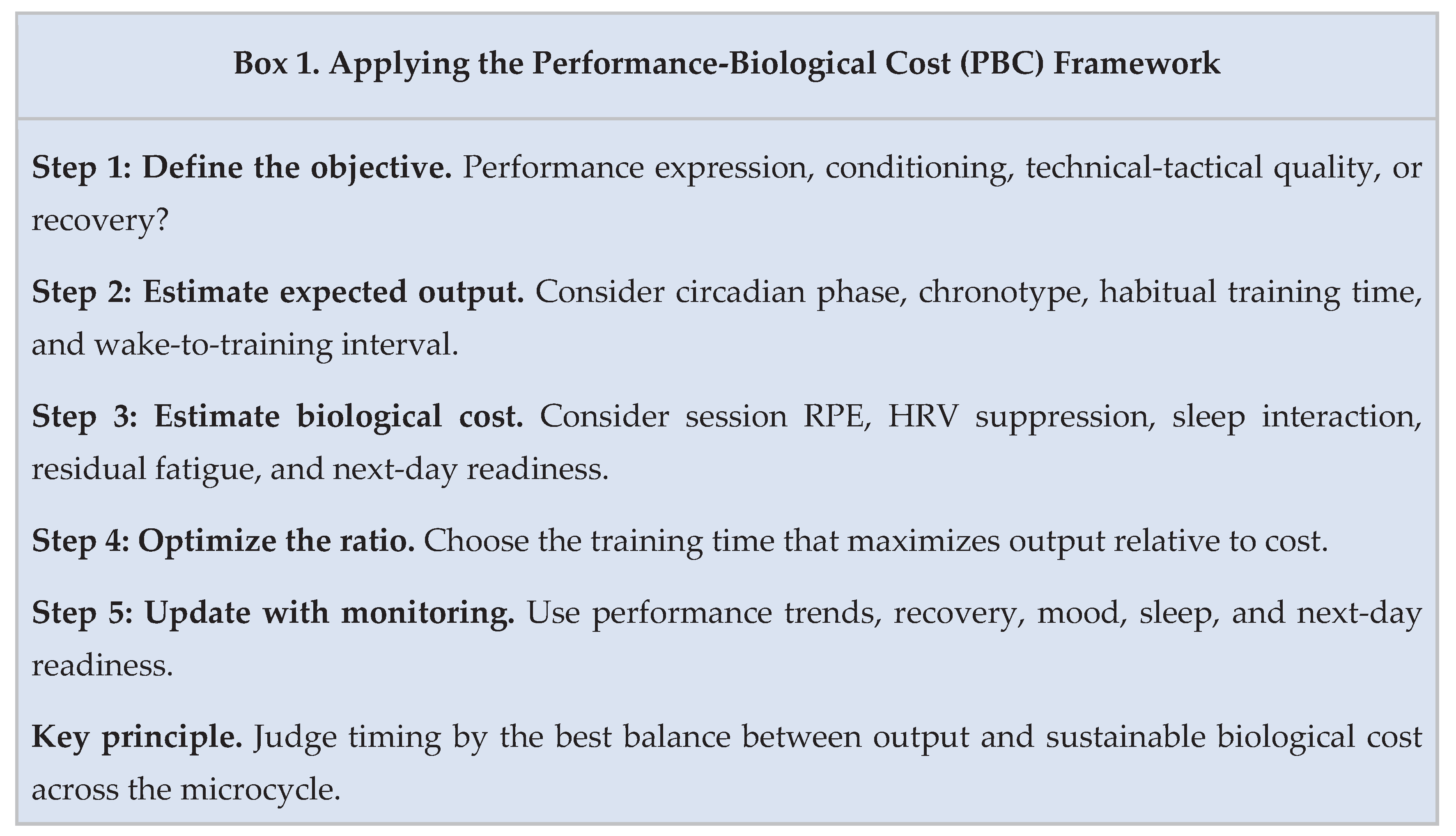
These predictions provide a basis for future studies integrating performance, recovery, and molecular outcomes, particularly in ecologically valid athletic settings characterized by high training loads and constrained recovery opportunities. A concise applied implementation sequence is summarized in Box 1.
9. Methodological Limitations and Future Directions
The chrono-exercise literature is informative but still limited by recurring methodological weaknesses. Many studies compare only two clock times without reporting chronotype, habitual training time, preceding sleep, meal timing, caffeine intake, light exposure, or wake-to-training interval. These omissions are not trivial. Each of these variables can shape both performance and the biological meaning of a session. Importantly, this limitation is not only quantitative but also translational, as much of the available mechanistic evidence has yet to be validated in ecologically valid, athlete-specific contexts characterized by high training loads and performance constraints.
In addition, a key limitation of the current evidence base is the relative scarcity of athlete-specific molecular data, with many mechanistic insights still derived from preclinical models or clinical populations rather than trained cohorts.
Another limitation is the frequent overemphasis on acute output without adequate recovery follow-up. A study that reports higher evening power but no information on night-time sleep, next-morning readiness, or subsequent training quality provides only part of the answer. Equally, single-point biomarker sampling may miss the very responses it aims to interpret. The field therefore needs designs that connect the session to the next day, not only to the minute after exercise.
Female athletes remain underrepresented, and menstrual-cycle-related considerations are still inconsistently addressed. Team-sport ecology is also insufficiently captured when laboratory tests are translated too quickly into practical advice. Real training calendars involve technical, tactical, academic, occupational, travel, and recovery constraints that alter the optimal placement of sessions.
Future work should move beyond simplistic clock-time comparisons. What matters in practice may be the interval between wake time and training, the interval between training and sleep, the interaction with chronotype, the muscle-clock phase, and the cumulative architecture of two-a-day or congested schedules. Studies that combine wearable-derived sleep and HRV data with field performance, repeated biomarker sampling, and selected molecular markers would be especially valuable because they would connect mechanism to real program design.
An immediate opportunity is to connect field wearables with repeated biological sampling. Actigraphy, nocturnal HRV, body temperature, ecological momentary ratings, continuous glucose monitoring, and selected blood or muscle markers could be integrated to determine whether a timing strategy truly improves the output-to-cost ratio [57,58,90,112]. This approach would help move the field beyond simple clock-time comparisons toward phase-aware models that incorporate wake timing, light history, meal timing, travel, sex-specific context, and interpretable decision support.
Rather than prescribing a formal reporting standard, the following checklist is intended as a pragmatic guide to improve interpretability, comparability, and ecological validity in future chrono-exercise research.
A critical next step for the field is to move from descriptive time-of-day comparisons toward integrative models that quantify the interaction between performance, recovery, and biological cost across the 24-h cycle.
Table 4 translates these recurring design issues into a practical checklist for future studies.
10. Conclusions
Time of day should no longer be treated as a peripheral scheduling detail in sport science, but as a meaningful programming variable that modulates both performance expression and the biological cost of training. The circadian-metabolic state in which exercise is performed shapes not only acute output, but also how that load is internally processed, recovered from, and translated into adaptation.
Current evidence indicates that while late-day training often favors neuromuscular performance, there is no universally optimal training time for long-term adaptation. Instead, identical external loads may carry different physiological and molecular costs depending on their temporal placement within the circadian cycle.
From a practical standpoint, training time should be recognized as a hidden load variable within periodization. A session performed at an unfavorable circadian phase may achieve the desired external output, but at a disproportionately high biological cost, contributing to accumulated fatigue, impaired recovery, and reduced adaptation efficiency.
Accordingly, the key question is not when performance is maximized, but when performance can be achieved at the lowest sustainable cost. Within this framework, exercise timing becomes a dynamic control variable, shaping not only how athletes perform, but how effectively they adapt.
Author Contributions
Conceptualization, D.C.M., M.S., M.L.R., C.C.D., I.R.M., M.N., C.O.M.; methodology, D.C.M., M.S., M.L.R., C.C.D., I.R.M., M.N., C.O.M.; software, D.C.M., M.S., M.L.R., C.C.D., I.R.M., M.N., C.O.M.; validation, D.C.M., M.S., M.L.R., C.C.D., I.R.M., M.N., C.O.M.; formal analysis, D.C.M., M.S., M.L.R., C.C.D., I.R.M., M.N., C.O.M.; investigation, D.C.M., M.S., M.L.R., C.C.D., I.R.M., M.N., C.O.M.; resources, D.C.M., M.S., M.L.R., C.C.D., I.R.M., M.N., C.O.M.; data curation, D.C.M., M.S., M.L.R., C.C.D., I.R.M., M.N., C.O.M.; writing—original draft preparation, D.C.M., M.S., M.L.R., C.C.D., I.R.M., M.N., C.O.M.; writing—review and editing, D.C.M., M.S., M.L.R., C.C.D., I.R.M., M.N., C.O.M.; visualization, D.C.M., M.S., M.L.R., C.C.D., I.R.M., M.N., C.O.M.; supervision, D.C.M., M.S., M.L.R., C.C.D., I.R.M., M.N., C.O.M.; project administration, D.C.M., M.S., M.L.R., C.C.D., I.R.M., M.N., C.O.M.; funding acquisition, D.C.M., M.S., M.L.R., C.C.D., I.R.M., M.N., C.O.M. All authors contributed equally to this work: M.S., M.L.R., C.C.D., I.R.M., M.N., C.O.M. made an equal contribution to the first author. All authors have read and agreed to the published version of the manuscript.
Funding
This research received no external funding.
Data Availability Statement
No new data were created or analyzed in this study. Data sharing is not applicable to this article.
Conflicts of Interest
The author declares no conflicts of interest.
Abbreviations
| AMPK | AMP-activated protein kinase |
| BMAL1 | brain and muscle ARNT-like 1 |
| CLOCK | circadian locomotor output cycles kaput |
| CRY | cryptochrome |
| HRV | heart rate variability |
| HIF-1alpha | hypoxia-inducible factor 1alpha |
| IJMS | International Journal of Molecular Sciences |
| MFN2 | mitofusin 2 |
| NAD+ | nicotinamide adenine dinucleotide |
| NRF2 | nuclear factor erythroid 2-related factor 2 |
| PER | period |
| PGC-1alpha | peroxisome proliferator-activated receptor gamma |
| ROS | reactive oxygen species |
| RPE | rating of perceived exertion |
| SCN | suprachiasmatic nucleus |
| SIRT1 | sirtuin 1 |
References
- Atkinson, G.; Reilly, T. Circadian variation in sports performance. Sports Med. 1996, 21, 292–312. [Google Scholar] [CrossRef] [PubMed]
- Drust, B.; Waterhouse, J.; Atkinson, G.; Edwards, B.; Reilly, T. Circadian rhythms in sports performance-An update. Chronobiol. Int. 2005, 22, 21–44. [Google Scholar] [CrossRef]
- Chtourou, H.; Souissi, N. The effect of training at a specific time of day: A review. J. Strength Cond. Res. 2012, 26, 1984–2005. [Google Scholar] [CrossRef]
- Vitale, J.A.; Weydahl, A. Chronotype, physical activity, and sport performance: A systematic review. Sports Med. 2017, 47, 1859–1868. [Google Scholar] [CrossRef] [PubMed]
- Augsburger, G.R.; Sobolewski, E.J.; Escalante, G.; Graybeal, A.J. Circadian regulation for optimizing sport and exercise performance. Clocks Sleep 2025, 7, 18. [Google Scholar] [CrossRef]
- Knaier, R.; Qian, J.; Roth, R.; Cajochen, C.; Wirz-Justice, A.; Scheer, F.A.J.L.; Klerman, E.B. Diurnal variation in maximum endurance and maximum strength performance: A systematic review and meta-analysis. Med. Sci. Sports Exerc. 2022, 54, 169–180. [Google Scholar] [CrossRef]
- Kang, J.; Ratamess, N.A.; Faigenbaum, A.D.; et al. Time-of-day effects of exercise on cardiorespiratory responses and endurance performance—A systematic review and meta-analysis. J. Strength Cond. Res. 2023, 37, 2080–2090. [Google Scholar] [CrossRef]
- Mirizio, G.G.; Nunes, R.S.M.; Vargas, D.A.; Foster, C.; Vieira, E. Time-of-day effects on short-duration maximal exercise performance: A systematic review and meta-analysis. Sci. Rep. 2020, 10, 9485. [Google Scholar] [CrossRef]
- Martin-López, J.; Pérez-López, A.; Varillas-Delgado, D.; López-Samanes, Á. Influence of time-of-day on neuromuscular performance in team sport athletes: A systematic review and meta-analysis. Front. Sports Act. Living 2025, 6, 1466050. [Google Scholar] [CrossRef] [PubMed]
- Sedliak, M.; Finni, T.; Peltonen, J.; Häkkinen, K. Effect of time-of-day-specific strength training on maximum strength and EMG activity of the leg extensors in men. J. Sports Sci. 2008, 26, 1005–1014. [Google Scholar] [CrossRef]
- Leota, J.; Presby, D.M.; Le, F.; et al. Dose-response relationship between evening exercise and sleep. Nat. Commun. 2025, 16, 3297. [Google Scholar] [CrossRef]
- Youngstedt, S.D. Delaying early morning workouts to protect sleep in two-a-day athletes. Front. Physiol. 2024, 15, 1346761. [Google Scholar] [CrossRef]
- Lastella, M.; Miller, D.J.; Quilelli, M.; Roberts, S.; Aisbett, B.; Condo, D. The impact of chronotype on the sleep and training responses of elite female Australian footballers. Clocks Sleep 2021, 3, 528–535. [Google Scholar] [CrossRef]
- Sargent, C.; Halson, S.; Roach, G.D. Sleep or swim? Early-morning training severely restricts the amount of sleep obtained by elite swimmers. Eur. J. Sport Sci. 2014, 14 (Suppl. 1), S310–S315. [Google Scholar] [CrossRef]
- Chtourou, H.; Ammar, A.; Nikolaidis, P.T.; Abdel Karim, O.; Souissi, N.; Chamari, K.; Chaouachi, A. Post-resistance training detraining: time-of-day effects on training and testing outcomes. Biol. Rhythm Res. 2015, 46, 897–907. [Google Scholar] [CrossRef]
- Nobari, H.; Azarian, S.; Saedmocheshi, S.; Valdés-Badilla, P.; García Calvo, T. Narrative review: The role of circadian rhythm on sports performance, hormonal regulation, immune system function, and injury prevention in athletes. Heliyon 2023, 9, e19636. [Google Scholar] [CrossRef] [PubMed]
- Wolff, C.A.; Esser, K.A. Exercise timing and circadian rhythms. Curr. Opin. Physiol. 2019, 10, 64–69. [Google Scholar] [CrossRef]
- Douglas, C.M.; Hesketh, S.J.; Esser, K.A. Time of day and muscle strength: A circadian output? Physiology 2021, 36, 44–51. [Google Scholar] [CrossRef] [PubMed]
- Mansingh, S.; Handschin, C. Time to Train: The involvement of the molecular clock in exercise adaptation of skeletal muscle. Front. Physiol. 2022, 13, 902031. [Google Scholar] [CrossRef]
- Martin, R.A.; Viggars, M.R.; Esser, K.A. Metabolism and exercise: the skeletal muscle clock takes centre stage. Nat. Rev. Endocrinol. 2023, 19, 272–284. [Google Scholar] [CrossRef] [PubMed]
- Harfmann, B.D.; Schroder, E.A.; Esser, K.A. Circadian rhythms, the molecular clock, and skeletal muscle. J. Biol. Rhythms 2015, 30, 84–94. [Google Scholar] [CrossRef] [PubMed]
- Negri, M.; et al. Effects of Chrono-Exercise and Chrono-Nutrition on Muscle Health: Understanding the Molecular Mechanisms Activated by Timed Exercise and Consumption of Proteins and Carbohydrates. Nutr. Rev. 2025, 83, 1571–1593. [Google Scholar] [CrossRef]
- Procopio, S.B.; Esser, K.A. Clockwork conditioning: Aligning the skeletal muscle clock with time-of-day exercise for cardiometabolic health. J. Mol. Cell. Cardiol. 2025, 198, 36–44. [Google Scholar] [CrossRef]
- Hesketh, S.J. Resetting Time: The Role of Exercise Timing in Circadian Reprogramming for Metabolic Health. Obesities 2025, 5, 59. [Google Scholar] [CrossRef]
- Deschenes, M.R.; Sharma, J.V.; Brittingham, K.T.; Casa, D.J.; Armstrong, L.E.; Maresh, C.M. Chronobiological effects on exercise performance and selected physiological responses. Eur. J. Appl. Physiol. Occup. Physiol. 1998, 77, 249–256. [Google Scholar] [CrossRef]
- Bernard, T.; Giacomoni, M.; Gavarry, O.; Seymat, M.; Falgairette, G. Time-of-day effects in maximal anaerobic leg exercise. Eur. J. Appl. Physiol. Occup. Physiol. 1998, 77, 133–138. [Google Scholar] [CrossRef]
- Edwards, B.J.; Pullinger, S.A.; Kerry, J.W.; Robinson, W.R.; Reilly, T.P.; Robertson, C.M. Does raising morning rectal temperature to evening levels offset the diurnal variation in muscle force production? Chronobiol. Int. 2013, 30, 486–501. [Google Scholar] [CrossRef]
- Gabriel, B.M.; Zierath, J.R. Circadian rhythms and exercise - re-setting the clock in metabolic disease. Nat. Rev. Endocrinol. 2019, 15, 197–206. [Google Scholar] [CrossRef]
- Sedliak, M.; Finni, T.; Cheng, S.; Lind, M.; Häkkinen, K. Effect of time-of-day-specific strength training on muscular hypertrophy in men. J. Strength Cond. Res. 2009, 23, 2451–2457. [Google Scholar] [CrossRef]
- Chtourou, H.; Driss, T.; Souissi, S.; Gam, A.; Chaouachi, A.; Souissi, N. The effect of strength training at the same time of the day on the diurnal fluctuations of muscular anaerobic performances. J. Strength Cond. Res. 2012, 26, 217–225. [Google Scholar] [CrossRef] [PubMed]
- Souissi, H.; Chtourou, H.; Chaouachi, A.; Dogui, M.; Chamari, K.; Souissi, N. The effect of training at a specific time of day on the diurnal variations of short-term exercise performances in 10- to 11-year-old boys. Pediatr. Exerc. Sci. 2012, 24, 84–99. [Google Scholar] [CrossRef]
- Vitale, J.A.; Bonato, M.; La Torre, A.; Banfi, G. Heart rate variability in sport performance: Do time of day and chronotype play a role? J. Clin. Med. 2019, 8, 723. [Google Scholar] [CrossRef] [PubMed]
- Honkalampi, K.; Järvelin-Pasanen, S.; Tarvainen, M.P.; et al. Heart rate variability and chronotype—A systematic review. Chronobiol. Int. 2021, 38, 1786–1796. [Google Scholar] [CrossRef] [PubMed]
- Andrews, J.L.; Zhang, X.; McCarthy, J.J.; McDearmon, E.L.; Hornberger, T.A.; Russell, B.; Campbell, K.S.; Arbogast, S.; Reid, M.B.; Walker, J.R.; et al. CLOCK and BMAL1 regulate MyoD and are necessary for maintenance of skeletal muscle phenotype and function. Proc. Natl. Acad. Sci. USA 2010, 107, 19090–19095. [Google Scholar] [CrossRef] [PubMed]
- Dyar, K.A.; Ciciliot, S.; Wright, L.E.; Bienso, R.S.; Tagliazucchi, G.M.; Patel, V.R.; Forcato, M.; Paz, M.I.; Gudiksen, A.; Solagna, F.; et al. Muscle insulin sensitivity and glucose metabolism are controlled by the intrinsic muscle clock. Mol. Metab. 2014, 3, 29–41. [Google Scholar] [CrossRef]
- Wolff, G.; Esser, K.A. Scheduled exercise phase shifts the circadian clock in skeletal muscle. Med. Sci. Sports Exerc. 2012, 44, 1663–1670. [Google Scholar] [CrossRef]
- Liu, J.; Zhou, B.; Yan, M.; Huang, R.; Wang, Y.; He, Z.; Yang, Y.; Dai, C.; Wang, Y.; Zhang, F.; Zhai, Q. CLOCK and BMAL1 regulate muscle insulin sensitivity via SIRT1 in male mice. Endocrinology 2016, 157, 2259–2269. [Google Scholar] [CrossRef]
- Schroder, E.A.; Harfmann, B.D.; Zhang, X.; Srikuea, R.; England, J.H.; Hodge, B.A.; Wen, Y.; Riley, L.A.; Yu, Q.; Christie, A.; et al. Intrinsic muscle clock is necessary for musculoskeletal health. J. Physiol. 2015, 593, 5387–5404. [Google Scholar] [CrossRef]
- Yin, H.; Pasut, A.; Soleimani, V.D.; Bentzinger, C.F.; Antoun, G.; Thorn, S.; Seale, P.; Fernando, P.; van IJcken, W.; Grosveld, F.; et al. Metabolic-sensing of the skeletal muscle clock coordinates fuel oxidation. FASEB J. 2020, 34, 6613–6627. [Google Scholar] [CrossRef]
- Xia, Y.; Wang, M.; Liu, J.; Tian, J.; Wang, D.; Zhu, H.; Wang, F.; Wang, Y. Clock genes regulate skeletal muscle energy metabolism through NAMPT/NAD+/SIRT1 following heavy-load exercise. Am. J. Physiol. Regul. Integr. Comp. Physiol. 2023, 325, R490–R503. [Google Scholar] [CrossRef]
- Xu, L.; Jia, J.; Miao, S.; Gong, L.; Wang, J.; He, S.; Zhang, Y. Aerobic exercise reduced the amount of CHRONO bound to BMAL1 and ameliorated glucose metabolic dysfunction in skeletal muscle of high-fat diet-fed mice. Life Sci. 2023, 324, 121696. [Google Scholar] [CrossRef]
- Ezagouri, S.; Zwighaft, Z.; Sobel, J.; Baillieul, S.; Doutreleau, S.; Ladeuix, B.; Golik, M.; Verges, S.; Asher, G. Physiological and molecular dissection of daily variance in exercise capacity. Cell Metab. 2019, 30, 78–91.e4. [Google Scholar] [CrossRef]
- Sato, S.; Basse, A.L.; Schonke, M.; Chen, S.; Samad, M.; Altufaili, M.; Ogawa, Y.; Nilsen, T.S.; Langin, D.; Hayashi, T.; et al. Time of exercise specifies the impact on muscle metabolic pathways and systemic energy homeostasis. Cell Metab. 2019, 30, 92–110.e4. [Google Scholar] [CrossRef] [PubMed]
- Maier, G.; Delezie, J.; Westermark, P.O.; Santos, G.; Ritz, D.; Handschin, C. Transcriptomic, proteomic and phosphoproteomic underpinnings of daily exercise performance and zeitgeber activity of training in mouse muscle. J. Physiol. 2022, 600, 769–796. [Google Scholar] [CrossRef] [PubMed]
- Savikj, M.; Gabriel, B.M.; Alm, P.S.; Smith, J.; Caidahl, K.; Bjornholm, M.; Fritz, T.; Krook, A.; Zierath, J.R.; Wallberg-Henriksson, H. Exercise timing influences multi-tissue metabolome and skeletal muscle proteome profiles in type 2 diabetic patients - A randomized crossover trial. Metabolism 2022, 135, 155268. [Google Scholar] [CrossRef]
- Erickson, M.L.; Zhang, H.; Mey, J.T.; Kirwan, J.P. Exercise training impacts skeletal muscle clock machinery in prediabetes. Med. Sci. Sports Exerc. 2020, 52, 2078–2085. [Google Scholar] [CrossRef]
- Harmsen, J.-F.; van Polanen, N.; Memelink, R.G.; Hansen, J.; Penders, J.; Schrauwen, P.; van Moorsel, D. Exercise training modifies skeletal muscle clock gene expression but not 24-hour rhythmicity in substrate metabolism of men with insulin resistance. J. Physiol. 2024, 602, 6417–6433. [Google Scholar] [CrossRef] [PubMed]
- Partch, C.L.; Green, C.B.; Takahashi, J.S. Molecular architecture of the mammalian circadian clock. Trends Cell Biol. 2014, 24, 90–99. [Google Scholar] [CrossRef]
- Bruggisser, F.; Knaier, R.; Roth, R.; Wang, W.; Qian, J.; Scheer, F.A.J.L. Best time of day for strength and endurance training to improve health and performance? A systematic review with meta-analysis. Sports Med. Open 2023, 9, 34. [Google Scholar] [CrossRef]
- Horne, J.A.; Ostberg, O. A Self-Assessment Questionnaire to Determine Morningness-Eveningness in Human Circadian Rhythms. Int. J. Chronobiol. 1976, 4, 97–110. [Google Scholar]
- Lack, L. Chronotype differences in circadian rhythms of temperature, melatonin, and sleepiness as measured in a modified constant routine protocol. Nat. Sci. Sleep 2009, 1, 1–8. [Google Scholar] [CrossRef]
- Arendt, J.; Aulinas, A. Physiology of the Pineal Gland and Melatonin. In Endotext; Feingold, K.R., Anawalt, B., Blackman, M.R., Boyce, A., Chrousos, G., Corpas, E., de Herder, W.W., Dhatariya, K., Dungan, K., Hofland, J., et al., Eds.; MDText.com, Inc.: South Dartmouth, MA, USA, 2000. [Google Scholar]
- Bonmati-Carrion, M.; Arguelles-Prieto, R.; Martinez-Madrid, M.; Reiter, R.; Hardeland, R.; Rol, M.; Madrid, J. Protecting the melatonin rhythm through circadian healthy light exposure. Int. J. Mol. Sci. 2014, 15, 23448–23500. [Google Scholar] [CrossRef]
- Zisapel, N. New perspectives on the role of melatonin in human sleep, circadian rhythms and their regulation. Br. J. Pharmacol. 2018, 175, 3190–3199. [Google Scholar] [CrossRef]
- Meléndez-Fernández, O.H.; Liu, J.A.; Nelson, R.J. Circadian rhythms disrupted by light at night and mistimed food intake alter hormonal rhythms and metabolism. Int. J. Mol. Sci. 2023, 24, 3392. [Google Scholar] [CrossRef] [PubMed]
- Stoian, M.; Mănescu, D.C. Training-Fuel Coupling (TFC): A Molecular Sports Nutrition Framework for Energy Availability, Chrono-Nutrition, and Performance Optimization. Nutrients 2026, 18, 693. [Google Scholar] [CrossRef] [PubMed]
- Suzuki, D.; Suzuki, Y. Identifying and Analyzing Low Energy Availability in Athletes: The Role of Biomarkers and Red Blood Cell Turnover. Nutrients 2024, 16, 2273. [Google Scholar] [CrossRef] [PubMed]
- Reis, C.; Tomás, R.; Cardoso, V.; et al. Field Assessment of Melatonin Timing Reveals Circadian Misalignment Beyond Chronotype in Elite Female Football Players. npj Biol. Timing Sleep 2026, 3, 13. [Google Scholar] [CrossRef]
- Pullinger, S.A.; Cocking, S.; Robertson, C.M.; Tod, D.; Doran, D.A.; Burniston, J.G.; Varamenti, E.; Edwards, B.J. Time-of-day variation on performance measures in repeated-sprint tests: A systematic review. Chronobiol. Int. 2020, 37, 451–468. [Google Scholar] [CrossRef]
- Selmi, O.; Rahmoune, M.A.; Bouassida, A.; Marsigliante, S.; Muscella, A. Comparative analysis of morning and evening training on performance and well-being in elite soccer players. Physiol. Rep. 2025, 13, e70510. [Google Scholar] [CrossRef]
- Dighriri, A.; Lithgow, H.; Gabriel, B.; Altuwrqi, M.; Dunning, E.; Johnston, L.; Boyle, J.G.; Logan, G.; Gray, S.R. The impact of the time of day on muscle and metabolic responses to resistance exercise in healthy adults: A randomised controlled trial. Exp. Physiol. 2026, 111, 1109–1119. [Google Scholar] [CrossRef]
- Shen, B.; Zheng, H.; Liu, H.; et al. Differential benefits of 12-week morning vs. evening aerobic exercise on sleep and cardiometabolic health: a randomized controlled trial. Sci. Rep. 2025, 15, 18298. [Google Scholar] [CrossRef] [PubMed]
- Moholdt, T.; Parr, E.B.; Devlin, B.L.; et al. The effect of morning vs evening exercise training on glycaemic control and serum metabolites in overweight/obese men: a randomised trial. Diabetologia 2021, 64, 2061–2076. [Google Scholar] [CrossRef]
- Morales-Palomo, F.; Moreno-Cabañas, A.; Alvarez-Jimenez, L.; et al. Efficacy of morning versus afternoon aerobic exercise training on reducing metabolic syndrome components: A randomized controlled trial. J. Physiol. 2024, 602, 6463–6477. [Google Scholar] [CrossRef]
- Schumacher, L.M.; Thomas, J.G.; Raynor, H.A.; et al. Consistent Morning Exercise May Be Beneficial for Individuals with Obesity. Exerc. Sport Sci. Rev. 2020, 48, 201–208. [Google Scholar] [CrossRef]
- Küüsmaa, M.; Schumann, M.; Sedliak, M.; et al. Effects of morning versus evening combined strength and endurance training on physical performance, muscle hypertrophy, and serum hormone concentrations. Appl. Physiol. Nutr. Metab. 2016, 41, 1285–1294. [Google Scholar] [CrossRef]
- Brooker, P.G.; Gomersall, S.R.; King, N.A.; Leveritt, M.D. The efficacy of morning versus evening exercise for weight loss: a randomized controlled trial. Obesity 2023, 31, 83–95. [Google Scholar] [CrossRef] [PubMed]
- Stein, M.J.; Weber, A.; Bamberg, F.; et al. Diurnal timing of physical activity in relation to obesity and diabetes in the German National Cohort (NAKO). Int. J. Obes. 2025, 49, 921–930. [Google Scholar] [CrossRef] [PubMed]
- Lok, R.; Zerbini, G.; Gordijn, M.C.M.; Beersma, D.G.M.; Hut, R.A. Gold, silver or bronze: Circadian variation strongly affects performance in Olympic athletes. Sci. Rep. 2020, 10, 16088. [Google Scholar] [CrossRef]
- Facer-Childs, E.; Brandstaetter, R. The impact of circadian phenotype and time since awakening on diurnal performance in athletes. Curr. Biol. 2015, 25, 518–522. [Google Scholar] [CrossRef]
- Rae, D.E.; Stephenson, K.J.; Rowe, L.C. Factors to consider when assessing diurnal variation in sports performance: The influence of chronotype and habitual training time-of-day. Eur. J. Appl. Physiol. 2015, 115, 1339–1349. [Google Scholar] [CrossRef]
- Roden, L.; Rudner, T.; Rae, D. Impact of chronotype on athletic performance: Current perspectives. ChronoPhysiol. Ther. 2017, 7, 1–6. [Google Scholar] [CrossRef]
- Forster, S.; Schwindling, S.; Abbiss, C.; et al. Influence of Chronotype on Cycling Performance in Simulated 20-km Time Trials-A Pilot Study. J. Sleep Res. 2025, e70268. [Google Scholar] [CrossRef]
- Smith, R.S.; Efron, B.; Mah, C.D.; Malhotra, A. The impact of circadian misalignment on athletic performance in professional football players. Sleep 2013, 36, 1999–2001. [Google Scholar] [CrossRef]
- Janse van Rensburg, D.C.; Jansen van Rensburg, A.; Fowler, P.M.; Bender, A.M.; Stevens, D.; Sullivan, K.O.; Fullagar, H.H.K.; Alonso, J.-M.; Biggins, M.; Claassen-Smithers, A.; et al. Managing travel fatigue and jet lag in athletes: A review and consensus statement. Sports Med. 2021, 51, 2029–2050. [Google Scholar] [CrossRef]
- Lee, A.; Galvez, J.C. Jet lag in athletes. Sports Health 2012, 4, 211–216. [Google Scholar] [CrossRef] [PubMed]
- James, S.M.; Honn, K.A.; Gaddameedhi, S.; van Dongen, H.P.A. Shift work: Disrupted circadian rhythms and sleep-Implications for health and well-being. Curr. Sleep Med. Rep. 2017, 3, 104–112. [Google Scholar] [CrossRef] [PubMed]
- Fink, A.M.; Kerulis, M. Circadian Rhythm and Sleep Disturbances in Young Adult Athletes: A Review About Risk Factors, Consequences, and Interventions. Brain Sci. 2026, 16, 212. [Google Scholar] [CrossRef]
- Kaczmarek, F.; Bartkowiak-Wieczorek, J.; Matecka, M.; et al. Sleep and Athletic Performance: A Multidimensional Review of Physiological and Molecular Mechanisms. J. Clin. Med. 2025, 14, 7606. [Google Scholar] [CrossRef]
- Korkutata, A.; Korkutata, M.; Lazarus, M. The impact of exercise on sleep and sleep disorders. npj Biol. Timing Sleep 2025, 2, 5. [Google Scholar] [CrossRef]
- Roberts, S.S.H.; Teo, W.P.; Warmington, S.A. Effects of training and competition on the sleep of elite athletes: A systematic review and meta-analysis. Br. J. Sports Med. 2019, 53, 513–522. [Google Scholar] [CrossRef]
- Bonnar, D.; Bartel, K.; Kakoschke, N.; Lang, C. Sleep Interventions Designed to Improve Athletic Performance and Recovery: A Systematic Review of Current Approaches. Sports Med. 2018, 48, 683–703. [Google Scholar] [CrossRef] [PubMed]
- Biggins, M.; Purtill, H.; Fowler, P.; et al. Sleep in elite multi-sport athletes. Physiother. Sport 2019, 39, 136–142. [Google Scholar] [CrossRef]
- Bonato, M.; Agnello, L.; Galasso, L.; et al. Acute modification of cardiac autonomic function induced by high-intensity interval training in collegiate male soccer players with different chronotype: A crossover study. J. Sports Sci. Med. 2017, 16, 286–294. [Google Scholar] [PubMed]
- Sugawara, J.; Hamada, Y.; Nishijima, T.; Matsuda, M. Diurnal variations of post-exercise parasympathetic nervous reactivation in different chronotypes. Jpn. Heart J. 2001, 42, 163–171. [Google Scholar] [CrossRef]
- Thomas, C.; Jones, H.; Whitworth-Turner, C.; et al. High-intensity exercise in the evening does not disrupt sleep in endurance runners. Eur. J. Appl. Physiol. 2020, 120, 359–368. [Google Scholar] [CrossRef]
- Stutz, J.; Eiholzer, R.; Spengler, C.M. Effects of Evening Exercise on Sleep in Healthy Participants: A Systematic Review and Meta-Analysis. Sports Med. 2019, 49, 269–287. [Google Scholar] [CrossRef]
- Youngstedt, S.D.; Ito, W.; Passos, G.S.; et al. Testing the sleep hygiene recommendation against nighttime exercise. Sleep Breath. 2021, 25, 2189–2196. [Google Scholar] [CrossRef]
- Rackard, G.; et al. Nutrition Strategies to Promote Sleep in Elite Athletes: A Scoping Review. Sports 2025, 13, 342. [Google Scholar] [CrossRef] [PubMed]
- Driller, M.W.; Mah, C.D.; Halson, S. The revised athlete sleep behavior questionnaire (ASBQ-2): Aligning with the latest in sleep science research. Int. J. Sports Sci. Coach. 2025, 20, 2681–2686. [Google Scholar] [CrossRef]
- Cunha, L.A.; Costa, J.A.; Marques, E.A.; et al. The Impact of Sleep Interventions on Athletic Performance: A Systematic Review. Sports Med. Open 2023, 9, 58. [Google Scholar] [CrossRef] [PubMed]
- Mascaro, L.; Leota, J.; Hoffman, D.; et al. Disruptions to sleep and circadian rhythms are associated with poorer athlete mental health in female, but not male, elite Australian Rules footballers. J. Sleep Res. 2024, 33, e14186. [Google Scholar] [CrossRef]
- Sutton, E.; Pekovic-Vaughan, V. Time to Reset: The interplay between circadian rhythms and redox homeostasis in skeletal muscle ageing and systemic health. Antioxidants 2025, 14, 1132. [Google Scholar] [CrossRef]
- Carriel-Nesvara, A.; Muñoz-Medina, C.; Deldicque, L.; Castro-Sepulveda, M. The role of the circadian clock in regulating mitochondrial dynamics and their impact on skeletal muscle function and metabolism. J. Physiol. 2025. [Google Scholar] [CrossRef]
- Mănescu, D.C.; Plăstoi, C.D.; Petre, R.L.; Mărgărit, I.R.; Mănescu, A.M.; Pîrvan, A. Metabolic Overdrive in Elite Sport: A Systems Model of AMPK-mTOR Oscillation, NAD+ Economy, and Epigenetic Drift. Int. J. Mol. Sci. 2026, 27, 1817. [Google Scholar] [CrossRef]
- Hargreaves, M.; Spriet, L.L. Skeletal muscle energy metabolism during exercise. Nat. Metab. 2020, 2, 817–828. [Google Scholar] [CrossRef]
- Gabriel, B.M.; Altıntaş, A.; Smith, J.A.B.; et al. Disrupted circadian oscillations in type 2 diabetes are linked to altered rhythmic mitochondrial metabolism in skeletal muscle. Sci. Adv. 2021, 7, eabi9654. [Google Scholar] [CrossRef]
- Wefers, J.; van Moorsel, D.; Hansen, J.; et al. Circadian misalignment induces fatty acid metabolism gene profiles and compromises insulin sensitivity in human skeletal muscle. Proc. Natl. Acad. Sci. USA 2018, 115, 7789–7794. [Google Scholar] [CrossRef] [PubMed]
- Cedernaes, J.; Schönke, M.; Orzechowski Westholm, J.; et al. Acute sleep loss results in tissue-specific alterations in genome-wide DNA methylation state and metabolic fuel utilization in humans. Sci. Adv. 2018, 4, eaar8590. [Google Scholar] [CrossRef] [PubMed]
- Khatri, S.; Das, S.; Singh, A.; Ahmad, S.; Kashiv, M.; Laxman, S.; Kolthur-Seetharam, U. Diurnal variation in skeletal muscle mitochondrial function dictates time-of-day-dependent exercise capacity. FASEB J. 2025, 39, e70365. [Google Scholar] [CrossRef] [PubMed]
- Pourabdi, R.; Shahidi, F.; Tabandeh, M.R.; Salehpour, M. Aerobic exercise timing affects mitochondrial dynamics and insulin resistance by regulating the circadian clock protein expression and NAD+-SIRT1-PPARalpha-MFN2 pathway in the skeletal muscle of high-fat-diet-induced diabetes mice. J. Physiol. Biochem. 2025, 81, 199–214. [Google Scholar] [CrossRef]
- Perrin, L.; Loizides-Mangold, U.; Chanon, S.; et al. Transcriptomic analyses reveal rhythmic and CLOCK-driven pathways in human skeletal muscle. eLife 2018, 7, e34114. [Google Scholar] [CrossRef]
- Dyar, K.A.; Hubert, M.J.; Mir, A.A.; et al. Transcriptional programming of lipid and amino acid metabolism by the skeletal muscle circadian clock. PLoS Biol. 2018, 16, e2005886. [Google Scholar] [CrossRef]
- Harfmann, B.D.; Schroder, E.A.; Kachman, M.T.; et al. Muscle-specific loss of Bmal1 leads to disrupted tissue glucose metabolism and systemic glucose homeostasis. Skelet. Muscle 2016, 6, 12. [Google Scholar] [CrossRef] [PubMed]
- Hansen, J.; Timmers, S.; Moonen-Kornips, E.; et al. Synchronized human skeletal myotubes of lean, obese and type 2 diabetic patients maintain circadian oscillation of clock genes. Sci. Rep. 2016, 6, 35047. [Google Scholar] [CrossRef] [PubMed]
- Gutierrez-Monreal, M.A.; Harmsen, J.-F.; Schrauwen, P.; Esser, K.A. Ticking for Metabolic Health: The Skeletal-Muscle Clocks. Obesity 2020, 28(S1), S46–S54. [Google Scholar] [CrossRef] [PubMed]
- Viggars, M.R.; Berko, H.E.; Hesketh, S.J.; et al. Skeletal muscle BMAL1 is necessary for transcriptional adaptation of local and peripheral tissues in response to endurance exercise training. Mol. Metab. 2024, 86, 101980. [Google Scholar] [CrossRef]
- de Alencar Silva, B.S.; Uzeloto, J.S.; Lira, F.S.; et al. Exercise as a Peripheral Circadian Clock Resynchronizer in Vascular and Skeletal Muscle Aging. Int. J. Environ. Res. Public Health 2021, 18, 12949. [Google Scholar] [CrossRef]
- Xu, B.; Guo, S. Daytime eccentric exercise and its impact on inflammatory markers and antioxidant defenses in physically active young men. Front. Immunol. 2025, 16, 1655034. [Google Scholar] [CrossRef]
- Mănescu, A.M.; Hangu, S.Ș; Mănescu, D.C. Nutritional Supplements for Muscle Hypertrophy: Mechanisms and Morphology-Focused Evidence. Nutrients 2025, 17, 3603. [Google Scholar] [CrossRef]
- Bescos, R.; Boden, M.J.; Jackson, M.L.; et al. Four days of simulated shift work reduces insulin sensitivity in humans. Acta Physiol. 2018, 223, e13039. [Google Scholar] [CrossRef]
- Coates, A.M.; Thompson, K.M.A.; Grigore, M.M.; et al. Altered carbohydrate oxidation during exercise in overreached endurance athletes is applicable to training monitoring with continuous glucose monitors. Scand. J. Med. Sci. Sports 2024, 34, e14551. [Google Scholar] [CrossRef]
- Jacobi, D.; Liu, S.; Burkewitz, K.; et al. Hepatic Bmal1 Regulates Rhythmic Mitochondrial Dynamics and Promotes Metabolic Fitness. Cell Metab. 2015, 22, 709–720. [Google Scholar] [CrossRef]
- Mănescu, D.C.; Voinea, A.; Plastoi, C.D.; Iacobini, A.R.; Vulpe, A.A.; Pîrvan, A.; Dinciu, C.C.; Vulpe, B.I.; Băltărețu, C.; Iacobini, A. Molecular Biomarkers of Training Responses: A Systems Framework for Exercise Adaptation and Athlete Monitoring. Int. J. Mol. Sci. 2026, 27, 3601. [Google Scholar] [CrossRef]
- Augsburger, G.R.; Soloveva, A.; Carr, J.C. Sex and limb comparisons of neuromuscular function in the morning versus the evening. Physiol. Rep. 2022, 10, e15260. [Google Scholar] [CrossRef]
- Model, Z.; Butler, M.P.; LeSauter, J.; Silver, R. Suprachiasmatic nucleus as the site of androgen action on circadian rhythms. Horm. Behav. 2015, 73, 1–7. [Google Scholar] [CrossRef]
- Sen, A.; Hoffmann, H.M. Role of core circadian clock genes in hormone release and target tissue sensitivity in the reproductive axis. Mol. Cell. Endocrinol. 2020, 501, 110655. [Google Scholar] [CrossRef]
- Gamble, K.L.; Berry, R.; Frank, S.J.; Young, M.E. Circadian clock control of endocrine factors. Nat. Rev. Endocrinol. 2014, 10, 466–475. [Google Scholar] [CrossRef] [PubMed]
- Santhi, N.; Lazar, A.S.; McCabe, P.J.; Lo, J.C.; Groeger, J.A.; Dijk, D.-J. Sex differences in the circadian regulation of sleep and waking cognition in humans. Proc. Natl. Acad. Sci. USA 2016, 113, E2730–E2739. [Google Scholar] [CrossRef]
- Gillies, G.E.; McArthur, S. Estrogen actions in the brain and the basis for differential action in men and women: A case for sex-specific medicines. Pharmacol. Rev. 2010, 62, 155–198. [Google Scholar] [CrossRef]
- Zouhal, H.; Saeidi, A.; Salhi, A.; Li, H.; Essop, M.F.; Laher, I.; Rhibi, F.; Amani-Shalamzari, S.; Ben Abderrahman, A. Exercise training and fasting: Current insights. Open Access J. Sports Med. 2020, 11, 1–28. [Google Scholar] [CrossRef]
- Mănescu, D.C. Training Load Oscillation and Epigenetic Plasticity: Molecular Pathways Connecting Energy Metabolism and Athletic Personality. Int. J. Mol. Sci. 2026, 27, 792. [Google Scholar] [CrossRef]
- Buchwald, R.L.; Buchwald, J.; Lehtonen, E.; et al. A Comprehensive Analysis of Overtraining Syndrome in Athletes and Recreational Exercisers. Int. J. Sports Med. 2025, 46, 898–907. [Google Scholar] [CrossRef] [PubMed]
- Mănescu, D.C.; Tudor, A.; Mănescu, A.M.; Mărgărit, I.R.; Mănescu, C.O.; Prisăcaru, C.; Păun, L.; Tudor, V. Antioxidants and Exercise: A Redox-Informed Framework for Training Adaptation, Performance, and Recovery. Antioxidants 2026, 15, 456. [Google Scholar] [CrossRef]
- Youngstedt, S.D.; Elliott, J.A.; Kripke, D.F. Human circadian phase-response curves for exercise. J. Physiol. 2019, 597, 2253–2268. [Google Scholar] [CrossRef] [PubMed]
Figure 1.
Performance–Biological Cost (PBC) framework for chrono-informed training design. Training outcomes emerge from the interaction between circadian and contextual inputs and the externally prescribed training load. A single session generates parallel responses across performance output, internal load, and biological cost. The PBC ratio conceptualizes training-time effectiveness as the balance between performance output and its associated recovery and molecular cost, embedded within a feedback loop driven by monitoring variables. The entire system operates within a circadian phase-dependent context [3,4,5,6,16,17,18,19,20,21,22,23,24].
Figure 1.
Performance–Biological Cost (PBC) framework for chrono-informed training design. Training outcomes emerge from the interaction between circadian and contextual inputs and the externally prescribed training load. A single session generates parallel responses across performance output, internal load, and biological cost. The PBC ratio conceptualizes training-time effectiveness as the balance between performance output and its associated recovery and molecular cost, embedded within a feedback loop driven by monitoring variables. The entire system operates within a circadian phase-dependent context [3,4,5,6,16,17,18,19,20,21,22,23,24].
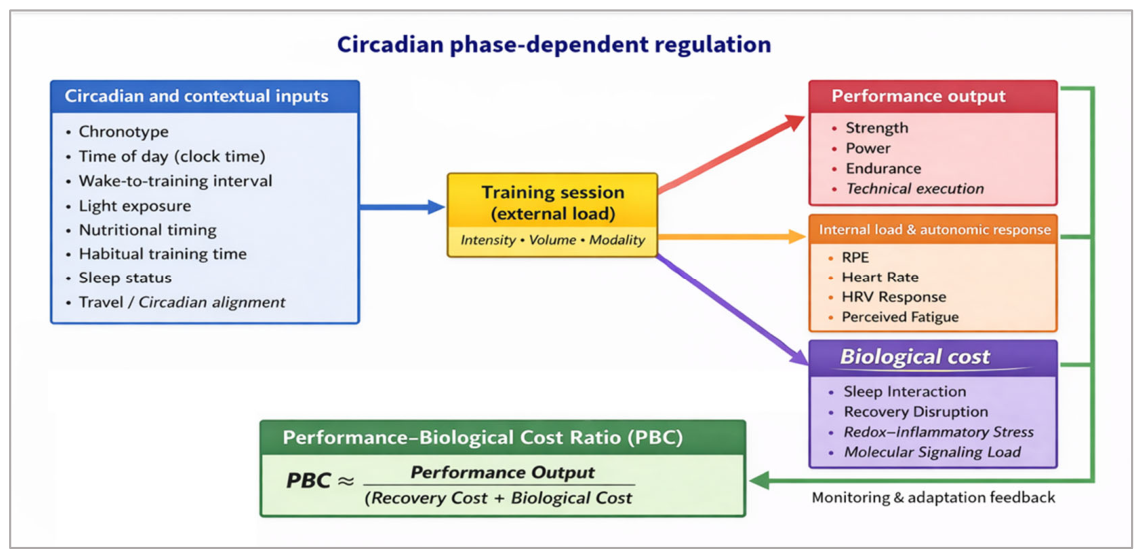
Figure 2.
Conceptual chrono-aware 24-h map for session placement. Performance opportunity usually rises from late morning to early evening, whereas biological cost increases when training compresses sleep before an early start or extends too close to bedtime. Chronotype, wake-to-training interval, and competition demands shift the practical position of each window [6,8,9,11,12,13,14,49,70,71,75,76,77,79,86,87,88,89,90].
Figure 2.
Conceptual chrono-aware 24-h map for session placement. Performance opportunity usually rises from late morning to early evening, whereas biological cost increases when training compresses sleep before an early start or extends too close to bedtime. Chronotype, wake-to-training interval, and competition demands shift the practical position of each window [6,8,9,11,12,13,14,49,70,71,75,76,77,79,86,87,88,89,90].
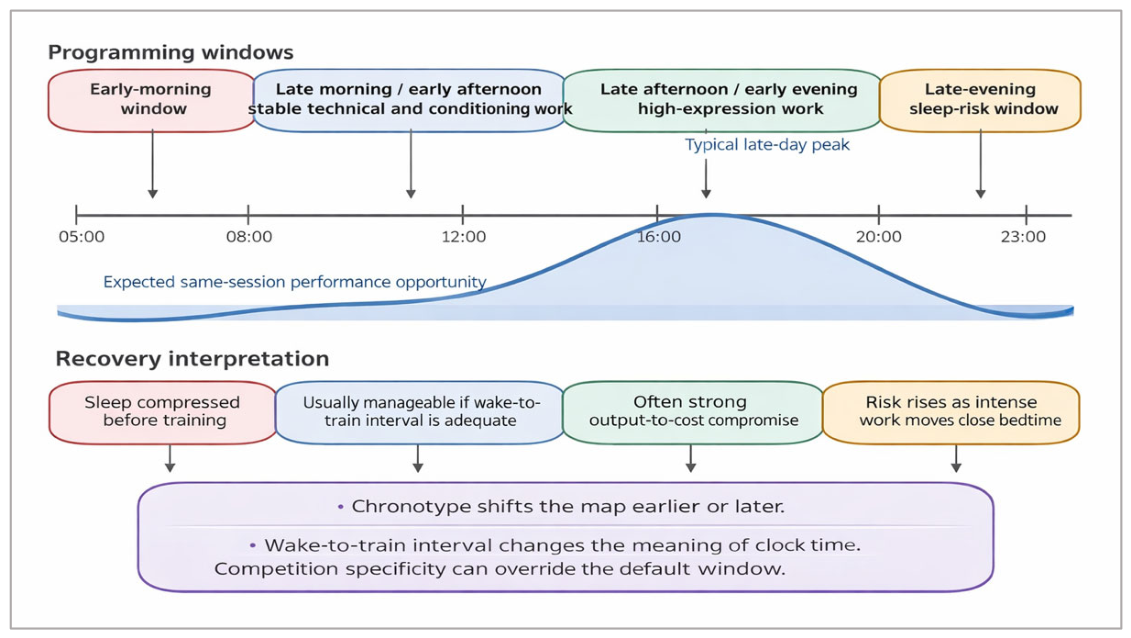
Figure 3.
Applied decision model for training-time selection based on the Performance–Biological Cost (PBC) framework. Circadian-informed decision framework integrating session objectives, athlete profile, contextual constraints, and recovery state to optimize training time based on the balance between performance and biological cost, with continuous feedback from monitoring variables (e.g., RPE, HRV, sleep, next-day readiness) [3,6,8,9,10,11,12,13,14,32,49,58,78,79,80,81,82,83,112,122,123,124].
Figure 3.
Applied decision model for training-time selection based on the Performance–Biological Cost (PBC) framework. Circadian-informed decision framework integrating session objectives, athlete profile, contextual constraints, and recovery state to optimize training time based on the balance between performance and biological cost, with continuous feedback from monitoring variables (e.g., RPE, HRV, sleep, next-day readiness) [3,6,8,9,10,11,12,13,14,32,49,58,78,79,80,81,82,83,112,122,123,124].
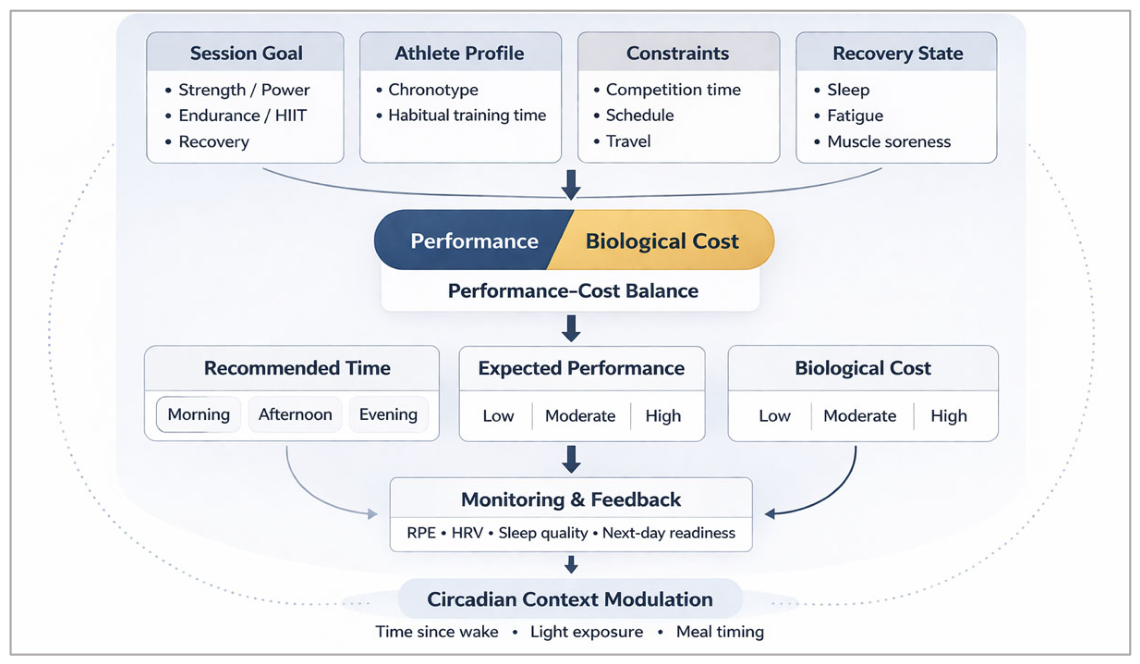

Table 1.
Athlete- and context-level modifiers of the apparent morning-evening effect.
| Athlete or context |
Likely source of altered response |
Programming implication |
Monitoring priority |
|---|---|---|---|
| Morning chronotype or habitual early trainer |
Smaller subjective and performance penalty in early sessions; faster alignment to morning competition. | Morning quality work is more tolerable, but still protect sleep and warm-up. | Sleep duration, wake-to-train interval, session RPE |
| Evening chronotype or habitual late trainer |
Greater early-day decrement in alertness, mood, and output; larger mismatch when forced to train early. | Retain some morning exposure for specificity, but do not overload the athlete with repeated high-cost AM quality sessions. | Mood, perceived readiness, next-day fatigue |
| Morning-competition athlete | The target event occurs when temperature, arousal, and wake history may not yet favor peak expression. | Use deliberate morning rehearsal blocks and protect the pre-competition sleep period. | Competition-specific output, sleep opportunity |
| School or work-constrained team-sport athlete |
External schedule may dominate over biological preference, inflating internal load or reducing technical quality. | Match the most cognitively and neuromuscularly demanding content to the best feasible window, not simply the only available slot. | Skill quality, mood, attendance, soreness |
| Double-session or congested microcycle |
A session that improves same-day output may still increase biological cost before the next key practice. | Judge timing across the whole 24-h cycle and preserve the highest-value session of the day. | HRV, sleep, morning readiness |
| Long-haul travel / jet lag |
Local clock time is decoupled from internal phase, sleep, and feeding rhythms. | Prioritize re-entrainment and sleep stabilization before demanding high-quality work. | Sleep timing, daytime sleepiness, perceived freshness |
| Female-athlete or sex-specific endocrine context |
Timing responses may be shaped by underreported endocrine, thermoregulatory, and sleep-related factors. | Avoid one-size-fits-all conclusions; interpret timing together with hormonal and symptom context when relevant. | Sleep, symptoms, performance trend, perceived exertion |
Notes: AM, morning; RPE, rating of perceived exertion. The table synthesizes evidence on chronotype and time-specific training [4,10,29,30,31,49,70,71,72,73], sleep/recovery constraints [11,12,13,14,32], athlete field context [9,13,58,60,69], and travel-related circadian misalignment [52,53,54,74,75,76,77]; entries are intended as decision aids rather than rigid rules.
Table 2.
Evidence domains, candidate pathways, and applied implications for training-time decisions in sport.
Table 2.
Evidence domains, candidate pathways, and applied implications for training-time decisions in sport.
| Evidence domain |
Typical finding | Key modifiers, mediators, and pathways |
Practical implication |
|---|---|---|---|
| Neuromuscular output |
Late-afternoon/evening advantages are frequent for maximal strength, jump, sprint, and repeated-sprint tasks. | Body temperature, neural readiness, chronotype, warm-up quality, habitual training time, and muscle-clock phase. | Use late afternoon/evening for high-expression speed-power work when schedules allow, but retain morning exposure when competition requires it. |
| Endurance tasks | Afternoon/evening advantages are common but smaller and less uniform than for explosive tasks. | Feeding status, prior sleep, pacing, thermal load, glycogen availability, and phase-sensitive metabolic signaling. | Do not treat morning performance as fixed; protect sleep, fueling, and warm-up before concluding inferiority. |
| Team-sport training quality |
Field data suggest session timing can influence mood, technical quality, and high-intensity actions. | Training content, athlete buy-in, decision load, chronotype mismatch, and recovery context. | Match demanding tactical or speed-based work to the window that best supports quality and engagement. |
| Autonomic recovery |
Evidence is limited, but post-exercise autonomic disturbance and parasympathetic reactivation may vary with timing and chronotype. | Exercise intensity, chronotype mismatch, sleep proximity, prior fatigue, and circadian-autonomic coupling. | Interpret output together with HRV, perceived recovery, and next-day readiness. |
| Sleep interaction |
Early sessions may reduce sleep opportunity, whereas late vigorous sessions can impair nocturnal recovery when too close to bedtime. | Wake time, travel, session-to-sleep interval, evening exercise dose, and thermoregulatory/endocrine context. | Theoretical performance gains should not repeatedly come at the cost of compromised sleep. |
| Chronic adaptation and molecular timing |
Time-specific training improves performance at the trained hour, but universal superiority of one clock time is not supported. | Training-testing congruency, muscle-clock entrainment, clock-gene remodeling, and AMPK-SIRT1-PGC-1alpha signaling. | Program timing according to season goals, competition schedule, and desired output-to-cost ratio. |
| Chronotype and wake-to-train interval |
The same wall-clock hour can be highly favorable in one athlete and strongly constraining in another, especially soon after waking. | Chronotype, sleep inertia, habitual wake time, prior light exposure, and time since waking. | Individualize morning exposure instead of assuming that all athletes experience the same morning penalty. |
| Travel and circadian misalignment |
Performance and recovery can deteriorate when local time, internal phase, and competition time are misaligned. | Direction of travel, light management, sleep debt, meal timing, and re-entrainment strategy. | After travel, prioritize circadian stabilization and sleep protection before demanding high-quality work. |
| Sex-specific context |
Evidence remains male dominated, and female-athlete responses may be shaped by endocrine and sleep-related context that is often underreported. | Menstrual-cycle phase, hormonal contraceptive use, sleep, thermoregulation, and sex differences in circadian organization. | Avoid assuming direct transfer of male-derived timing data to all female athletes; monitor individually. |
| Co-zeitgebers: light, meals, and caffeine |
Part of an apparent time-of-day effect may reflect pre-session light history, fueling status, caffeine timing, or late-night circadian disruption rather than clock time alone. | Bright light, melatonin suppression, breakfast timing, carbohydrate availability, and caffeine strategy. | Treat light and nutrition as controllable levers that can reduce unnecessary biological cost. |
Notes: HRV, heart rate variability; AMPK, AMP-activated protein kinase; SIRT1, sirtuin 1; PGC-1alpha, peroxisome proliferator-activated receptor gamma coactivator 1alpha. Practical implications reflect synthesis of evidence on acute performance [6,7,8,9,59], chronotype and timing congruency [10,29,30,31,32,33,49,69,70,71,72,73], molecular timing mechanisms [17,19,20,34,35,36,37,38,39,40,41,42,43,44,45,46,47], sleep/autonomic recovery [11,12,13,14,32,33], and circadian modifiers such as light, meals, and travel [22,52,53,54,55,56,57,58,74,75,76,77]; they indicate the default choice most often supported by the surrounding evidence, not a universal prescription.
Table 3.
Session-objective matrix for chrono-aware session placement across the microcycle.
| Session objective |
Usually favorable window |
Reasons to override the default |
Protective measures and key readouts |
|---|---|---|---|
| Max strength, power, sprint, repeated efforts | Late afternoon to early evening is often favorable for peak expression. | Morning competition, travel, or a need to rehearse early performance may outweigh raw output. | Warm-up quality; sleep protection; output plus session RPE and next-day readiness. |
| Aerobic base, tempo, moderate conditioning | Stable daytime is often a practical compromise between readiness and schedule. | Environmental heat, fuel availability, or double-session structure may justify earlier or later placement. | Fueling, hydration, thermal stress, and the effect on the following key session. |
| Threshold or HIIT with high recovery cost |
Place where output is acceptable without compressing sleep or compromising the next training day. | Very late completion near bedtime or very early starts after curtailed sleep should be avoided when possible. | Nocturnal sleep, morning HRV or perceived freshness, residual soreness. |
| Small-sided games or demanding tactical work |
Use the window that best supports combined neuromuscular freshness and cognitive engagement. | Facility logistics, academic constraints, and match-specific rehearsal may modify the choice. | Technical quality, decision speed, mood, and willingness to sustain intensity. |
| Competition-specific morning rehearsal | Strategic rather than constant use; rehearse the target competitive reality. | Not every quality session should be forced into the morning if the biological cost becomes excessive. | Wake-to-train interval, breakfast timing, warm-up, and day-level fatigue. |
| Recovery, re-entrainment, or post-travel day |
Default to the least disruptive slot that restores rhythm and sleep opportunity. | After major travel or late arrival, circadian stabilization may matter more than sport-specific clock time. | Sleep timing, daytime sleepiness, appetite rhythm, low-intensity tolerance. |
Notes: HIIT, high-intensity interval training; HRV, heart rate variability; RPE, rating of perceived exertion. The table synthesizes evidence on diurnal performance and time-specific training adaptation [3,6,8,9,10,29,30,31,59], sleep-autonomic recovery constraints [11,12,13,14,32,78,79,80,81,82,83,84,85,86,87,88,89,90], team-sport session quality [60], travel-related circadian misalignment [52,53,54,58,75,76,77], and systems views of training cost and recovery [112,122,123,124]. “Usually favorable window” denotes the option most often supported by the current evidence when no overriding competition or recovery constraint is present.
Table 4.
Methodological considerations for chrono-exercise research in athletes and physically active adults.
Table 4.
Methodological considerations for chrono-exercise research in athletes and physically active adults.
| Variable | Rationale | Recommended practice |
|---|---|---|
| Chronotype | The same clock hour is not biologically identical across athletes. | Report chronotype and explore whether responses differ between morning- and evening-oriented participants. |
| Habitual training time | Repeated exposure can attenuate diurnal performance differences and alter local clock-gene expression. | Report the usual training schedule and the degree of mismatch between habitual and experimental timing. |
| Wake-to-training interval | Clock time alone is incomplete; readiness also depends on time since waking and residual sleep inertia. | Report wake time and the interval between waking and session start. |
| Sleep opportunity and session-to-sleep interval | Early sessions may reduce sleep, whereas late sessions may impair the pre-sleep window. | Report bedtime, wake time, sleep duration, and the interval between session end and attempted sleep. |
| Meals, hydration, and caffeine | Morning deficits may partly reflect incomplete fueling, hydration status, or stimulant use rather than circadian biology alone. | Standardize pre-session meals, hydration, and caffeine timing across conditions. |
| Warm-up design | A stronger warm-up can reduce part of the morning disadvantage. | Describe and standardize warm-up duration, intensity, and thermal content. |
| Sex and hormonal context | Hormonal status may influence both performance and recovery, yet female athletes remain underrepresented. | Report sex clearly and, where relevant, describe menstrual-cycle or hormonal-contraceptive considerations. |
| Internal plus external load and next-day recovery |
Output alone does not describe the cost of the session. | Pair performance with RPE, heart rate, mood, soreness, HRV or sleep metrics, and next-day readiness where feasible. |
| Biomarker and omics sampling window | Immediate and delayed responses may tell different stories, especially after damaging exercise; light exposure should also be standardized when possible. | Use repeated post-exercise sampling for molecular outcomes and report light exposure or other zeitgebers when relevant. |
| Light exposure and other zeitgebers | Light history, screen exposure, and meal timing can shift circadian phase or modify acute readiness independent of exercise itself. | Report pre-session light exposure and any deliberate light, melatonin, or meal-timing intervention. |
| Travel, time zone, and local clock alignment | A session performed at local clock time may occur at a very different internal phase after travel. | Report recent travel, time-zone change, arrival time, and days since arrival. |
| Environmental temperature and thermal preparation | Some morning-evening differences are partly mediated by temperature and can be masked or exaggerated by heat or passive warming. | Report ambient conditions and any passive heating, cooling, or thermal-maintenance strategy. |
| Competition specificity and testing congruency | The trained hour and the tested hour should not be treated as interchangeable, especially in applied sport. | State explicitly whether the design evaluates acute peak output, competition-specific rehearsal, or chronic adaptation at a target clock time. |
Notes: HRV, heart rate variability; zeitgebers, external time cues such as light, meals, and exercise. The checklist synthesizes recurring design issues identified across the chrono-exercise literature, including chronotype, habitual timing, and competition congruency [3,4,10,29,30,31,49,50,51,69,70,71,72,73], sleep/recovery and session placement [11,12,13,14,32,78,79,80,81,82,83,84,85,86,87,88,89,90], mechanistic and sampling considerations [44,47,61,93,109,111,112,113,114], light/nutrition/travel context [17,22,52,53,54,55,56,57,58,75,76,77], warm-up and thermal context [25,26,27], sex-specific context [115,116,117,118,119,120,121], and phase-specific adaptation [125]. “Recommended minimum practice” refers to the minimum reporting standard judged necessary to interpret chrono-exercise studies, not an exhaustive methodological ceiling.
Disclaimer/Publisher’s Note: The statements, opinions and data contained in all publications are solely those of the individual author(s) and contributor(s) and not of MDPI and/or the editor(s). MDPI and/or the editor(s) disclaim responsibility for any injury to people or property resulting from any ideas, methods, instructions or products referred to in the content. |
© 2026 by the authors. Licensee MDPI, Basel, Switzerland. This article is an open access article distributed under the terms and conditions of the Creative Commons Attribution (CC BY) license (http://creativecommons.org/licenses/by/4.0/).
Copyright: This open access article is published under a Creative Commons CC BY 4.0 license, which permit the free download, distribution, and reuse, provided that the author and preprint are cited in any reuse.


