

Submitted:
17 April 2026
Posted:
20 April 2026
You are already at the latest version
Abstract
This study examines whether and how the perceived effectiveness of GenAI-assisted itinerary recommendations influences tourists’ environmentally responsible behavior in heritage tourism. Drawing on the Stimulus–Organism–Response framework, the study conceptualizes the perceived effectiveness of GenAI-assisted itinerary recommendations as the stimulus, cultural identity as the organism, and tourists’ environmentally responsible behavior as the response. Data were collected from 479 Chinese domestic tourists who had used GenAI tools for itinerary planning when visiting three UNESCO World Heritage sites in Henan Province, China. The data were analyzed using partial least squares structural equation modeling (PLS-SEM). The results show that the perceived effectiveness of GenAI-assisted itinerary recommendations significantly enhances cultural identity, and cultural identity, in turn, significantly promotes tourists’ environmentally responsible behavior. The indirect effect is also significant, confirming the mediating role of cultural identity. These findings suggest that the importance of GenAI-assisted itinerary recommendations in heritage tourism lies not only in improving trip planning, but also in shaping how tourists engage with the cultural meaning of the destination. This study extends GenAI tourism research beyond adoption-related outcomes, identifies cultural identity as a heritage-specific explanatory mechanism, and refines the application of the Stimulus–Organism–Response framework in AI-enabled heritage tourism contexts.
Keywords:
generative artificial intelligence
; itinerary recommendations
; cultural identity
; tourists’ environmentally responsible behavior
; heritage tourism
1. Introduction
Generative artificial intelligence (GenAI) is rapidly reshaping tourism by changing how tourists search for information, compare options, and organize trips. Compared with conventional search tools and rule-based recommendation systems, GenAI can better integrate travelers’ preferences, budgets, time constraints, and destination information into more adaptive and context-sensitive travel suggestions (Carvalho & Ivanov, 2024; Wong et al., 2023). This capability strengthens itinerary planning and decision support in travel contexts(Ilieva et al., 2024). As GenAI becomes increasingly embedded in travel platforms and smart tourism services, its role is no longer limited to information provision, but is beginning to shape tourists’ route choices, attraction priorities, and activity sequences.
This development is especially important in the context of itinerary recommendations. Recent tourism research has increasingly examined GenAI in relation to trust, perceived value, booking intention, continuance intention, and users’ intention to follow AI-assisted recommendations(Duong et al., n.d.; Foroughi et al., 2026; Kang et al., 2026; Seyfi et al., 2025; Tran et al., 2026). These studies have established the growing relevance of GenAI in travel planning and recommendation settings. However, the literature remains largely adoption-oriented. Most existing studies focus on whether tourists trust, accept, or continue using GenAI systems, while paying much less attention to how tourists evaluate the effectiveness of GenAI-assisted recommendations and whether such evaluations may influence their subsequent behavior at the destination. This gap is important because itinerary recommendations are not merely informational outputs. By organizing routes, activity sequences, and destination encounters in advance, they may shape not only planning efficiency but also tourists’ later actions in situ. Emerging evidence already suggests that AI-based decision aids may produce downstream effects beyond convenience alone.
The relevance of this issue is particularly clear in heritage tourism. At cultural heritage destinations, tourist behavior has direct implications for both environmental quality and heritage preservation. In such settings, tourists’ environmentally responsible behavior (ERB) has long been regarded as an important outcome in sustainable tourism research (He et al., 2018; Lee et al., 2013). More importantly, responsible behavior in heritage contexts involves not only general environmental care, but also compliance with protection rules, respect for conservation requirements, and support for site preservation(Cheng & Chen, 2022; L. Yang et al., 2023). Yet little is known about whether tourists’ perceived effectiveness of GenAI-assisted itinerary recommendations can encourage such behavior in heritage tourism.
A mechanism-based explanation is therefore needed. Heritage tourism is not only about visiting attractions, but also about interpreting symbols, narratives, and cultural meanings. For this reason, the influence of GenAI-assisted itinerary recommendations is unlikely to be explained by functional utility alone. What may matter more is whether tourists perceive these recommendations as effective in guiding them toward culturally meaningful sites, routes, and activities. When such recommendations are seen as effective, they may shape how tourists understand the destination and how strongly they identify with its cultural value. From this perspective, cultural identity provides a particularly relevant explanatory mechanism. In heritage settings, responsible behavior is often rooted less in convenience than in tourists’ recognition of and identification with the cultural significance of the site. Earlier studies likewise suggest that cultural and emotional processes are central to explaining heritage-related responsible behavior (Cheng & Chen, 2022; L. Yang et al., 2023).
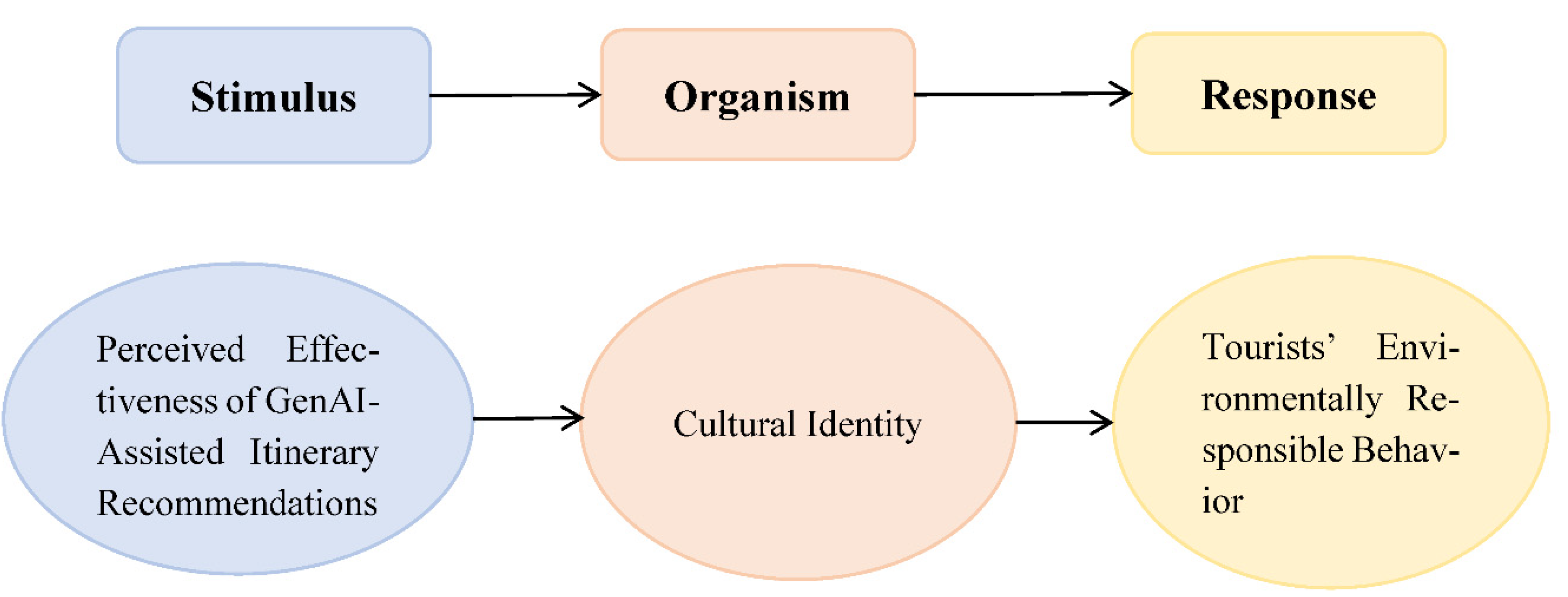
Drawing on the Stimulus–Organism–Response (SOR) framework (Mehrabian & Russell, 1974), this study conceptualizes the perceived effectiveness of GenAI-assisted itinerary recommendations as the stimulus, cultural identity as the organism, and tourists’ environmentally responsible behavior as the response. In the present context, perceived effectiveness refers to tourists’ overall evaluation of how well GenAI-generated heritage travel recommendations match their preferences and constraints, provide useful and reliable route guidance, and support culturally meaningful travel experiences. Against this background, this study investigates whether and how the perceived effectiveness of GenAI-assisted itinerary recommendations influences tourists’ environmentally responsible behavior in heritage tourism through the mediating role of cultural identity. In doing so, it extends GenAI tourism research beyond adoption-related outcomes, introduces a heritage-sensitive explanatory mechanism, and refines the application of the SOR framework by showing that AI-enabled itinerary guidance may influence behavior not only through functional evaluation but also through cultural meaning internalization.
2. Literature Review
2.1. Perceived Effectiveness of GenAI-Assisted Itinerary Recommendations in Tourism
Generative artificial intelligence (GenAI) is becoming increasingly visible in tourism through travel planning, information delivery, and recommendation support. Within this broader development, GenAI-assisted itinerary recommendations have emerged as an important application because they can translate users’ preferences, destination information, and situational constraints into personalized travel suggestions through natural language interaction (Ilieva et al., 2024). Recent studies further show that GenAI can support destination advice, itinerary building, and context-aware planning by helping users generate travel plans tailored to their needs and constraints(Pham et al., 2024; Tran et al., 2026).
Compared with conventional recommendation systems, GenAI-assisted itinerary recommendations do more than provide isolated suggestions. They are increasingly expected to organize fragmented travel information into coherent and feasible travel plans that reflect sequencing, personalization, and contextual relevance (Aribas & Daglarli, 2024; Franco et al., 2025). Existing technical and conceptual work likewise suggests that effective itinerary support depends not only on identifying relevant attractions, but also on arranging them into logically ordered schedules that account for route flow, time allocation, travel pace, and user-specific constraints (Rajput et al., 2025). In this sense, what matters is not only the presence of GenAI-assisted itinerary recommendations, but also tourists’ perceived effectiveness of such recommendations in supporting trip planning and guiding destination experiences.
Although this line of research has expanded rapidly, much of the literature remains adoption-oriented. In tourism and hospitality research, GenAI-assisted recommendations have been examined mainly in relation to perceived value, trust, perceived intrusiveness, satisfaction, and users’ intention to follow or continue using AI-assisted recommendations (Duong et al., n.d.; Foroughi et al., 2026; Seyfi et al., 2025; Tran et al., 2026). System-oriented studies, meanwhile, typically assess itinerary generators in terms of coherence, feasibility, personalization, constraint handling, and user satisfaction rather than tourists’ subsequent conduct at destinations (Franco et al., 2025; Rajput et al., 2025). As a result, existing research has provided limited insight into how tourists evaluate the effectiveness of GenAI-assisted itinerary recommendations and whether such evaluations may carry downstream behavioral consequences in actual tourism settings.
This issue is important because itinerary recommendations do more than support decision making. By organizing routes, attractions, and activity sequences in advance, they may also shape how tourists interpret and enact their trips. At the same time, recent studies suggest that the quality of GenAI-generated itineraries remains uneven. Although GenAI can quickly produce readable and customized travel plans, prior evaluations point to recurring weaknesses such as insufficient logistical detail, outdated information, hallucinated suggestions, and limited practical feasibility (Franco et al., 2025; Rajput et al., 2025). These limitations indicate that GenAI-assisted itinerary recommendations should not be treated simply as neutral technological outputs. Rather, their influence is likely to depend on whether tourists perceive them as effective, reliable, and practically useful planning cues in specific travel contexts.
2.2. Cultural Identity as a Heritage-Specific Psychological Mechanism
Cultural identity refers to tourists’ identification with the cultural meanings embodied in a heritage destination, including their sense of understanding, emotional connection, and psychological affiliation with the heritage culture they encounter (Fu & Luo, 2023; Tian et al., 2020). In heritage tourism, this construct is especially important because tourists engage with destinations not only as physical attractions, but also as carriers of historical narratives, symbolic values, and collective memories(Fu & Luo, 2023; H. Y. Park, 2010). For this reason, cultural identity represents a deeper heritage-specific psychological state than general post-use evaluations such as convenience, usefulness, or satisfaction.
Existing studies suggest that cultural identity is not formed through simple exposure to heritage resources, but through interpretive, emotional, and participatory processes that make heritage culturally meaningful to visitors. For example, heritage aesthetics and tourist involvement can strengthen cultural identity through mental experience (W. Yang et al., 2022). Similarly, in the museum tourism context, living cultural exhibitions and the historical significance of artifacts foster cultural identity through cultural engagement and emotional resonance(Zou et al., 2025). Related research further indicates that positive emotional experiences in heritage settings can deepen tourists’ psychological connection to cultural content and thereby strengthen cultural identity (Y. Yang et al., 2023). Taken together, these studies suggest that cultural identity is more likely to emerge when heritage experiences are perceived as meaningful and emotionally resonant rather than merely informative.
Cultural identity also has important behavioral implications. Once tourists develop a stronger sense of identification with the culture represented by the destination, they are more likely to engage in respectful, protective, and responsibility-oriented behavior. Cultural identity among heritage tourists is positively associated with travel experience and place attachment, highlighting its role as a deeper cultural-psychological mechanism(Fu & Luo, 2023). More directly, cultural identity positively influences heritage conservation behavior in the Dunhuang Mogao Grottoes context (Y. Yang et al., 2023), while cultural identity exerts a stronger positive effect on behavioral intention than perceived authenticity in cultural experiential tourism(Sun & Xuemei, 2025). These findings indicate that cultural identity is not only a reflection of cultural understanding, but also an important psychological basis for responsible behavior in heritage settings.
This perspective is particularly relevant to the present study. In heritage tourism, the perceived effectiveness of GenAI-assisted itinerary recommendations may matter not only because it improves trip planning, but also because effective recommendations can direct tourists toward culturally meaningful routes, attractions, narratives, and activities. When such recommendations are perceived as useful, reliable, and culturally relevant, they may help tourists move beyond functional planning and develop a stronger identification with the heritage culture of the destination. In this sense, cultural identity can be understood as a heritage-specific organismic state through which the perceived effectiveness of GenAI-assisted itinerary recommendations is translated into tourists’ environmentally responsible behavior.
2.3. Tourists’ Environmentally Responsible Behavior as the Focal Outcome
Tourists’ environmentally responsible behavior (TERB) refers to tourists’ voluntary actions that help reduce negative impacts on destinations and contribute to environmental protection during travel (Lee et al., 2013, 2015). In tourism research, TERB has become one of the most widely examined behavioral outcomes in responsible tourism and sustainability studies, and recent review work likewise identifies responsible tourist behavior as a central stream within this field (Schönherr, 2024). TERB therefore provides an important lens through which to understand how tourism experiences may translate into more sustainable forms of conduct.
Its relevance is even greater in heritage tourism. In this context, responsible behavior concerns not only the natural environment, but also the protection of culturally significant resources. Tourists are expected not only to avoid environmentally harmful actions, but also to respect site regulations, comply with conservation requirements, and support the preservation of heritage value. Prior heritage studies similarly suggest that responsible behavior is closely tied to destination conservation and long-term sustainability, and that heritage conservation behavior can be understood as a context-specific expression of broader responsible tourist conduct(Y. Yang et al., 2023). In heritage settings, TERB should thus be understood as a form of responsible behavior that includes site-protective and conservation-supportive actions.
Existing research further shows that TERB is not merely a situational reaction, but a behavioral outcome shaped by internal psychological processes. Prior studies have linked it to experiential factors, affective and relational mechanisms, and value-based orientations, including tourist experience, memorable tourism experience, place attachment, emotional bond, environmental attitude, and biospheric value(Q. Li et al., 2023, 2025; Obradović et al., 2022; Wu et al., 2022; Xu et al., 2018). These findings suggest that responsible tourist behavior is typically generated through internal evaluative, emotional, or relational processes rather than through external stimuli alone.
However, this outcome has rarely been examined in relation to AI-enabled travel planning. As discussed in Section 2.1, existing studies on GenAI-assisted itinerary recommendations have focused mainly on trust, perceived value, recommendation following, satisfaction, and continuance intention, with much less attention to whether tourists’ evaluations of such recommendations shape their actual conduct at destinations. This gap is especially important in heritage tourism, where the perceived effectiveness of GenAI-assisted itinerary recommendations may influence not only how tourists plan their visits, but also how they behave in culturally sensitive spaces. For this reason, the present study treats TERB as the focal behavioral outcome and examines whether the perceived effectiveness of GenAI-assisted itinerary recommendations may influence such behavior through the heritage-specific psychological mechanism of cultural identity.
2.4. Theoretical Foundation: Stimulus–Organism–Response (SOR) Framework
The Stimulus–Organism–Response (SOR) framework explains how external stimuli influence behavioral responses through individuals’ internal psychological states (Mehrabian & Russell, 1974). In tourism research, it has been widely used to explain how environmental cues, destination attributes, and tourism experiences shape tourists’ cognitive and emotional processes, which in turn influence subsequent behavior. Recent heritage tourism studies likewise show that external heritage-related stimuli can affect internal states such as mental experience and cultural identity, which then shape tourists’ responses to heritage destinations(W. Yang et al., 2022; Y. Yang et al., 2023). The framework is therefore well suited to contexts in which behavior is not an immediate reaction to external cues, but is mediated by deeper psychological interpretation.
This logic is particularly relevant to the present study. In heritage tourism, the perceived effectiveness of GenAI-assisted itinerary recommendations is unlikely to influence tourists’ environmentally responsible behavior in a purely direct or functional way. Unlike general information provision, itinerary recommendations pre-structure tourists’ contact with destinations by organizing routes, attractions, and activity sequences in advance. When such recommendations are perceived as effective, they do more than support efficient planning; they also shape which cultural content tourists encounter and how that encounter is organized. For this reason, they can be understood as meaning-structuring digital cues rather than merely neutral technical outputs.
Within this framework, the perceived effectiveness of GenAI-assisted itinerary recommendations is conceptualized as the stimulus, cultural identity as the organism, and tourists’ environmentally responsible behavior (TERB) as the response. This configuration is theoretically appropriate because cultural identity captures a heritage-specific internal state through which tourists interpret, internalize, and relate to the cultural meaning of the destination, whereas TERB represents the behavioral consequence of that process. In this sense, the present study applies SOR not simply to a technology-use context, but to a culturally sensitive tourism setting in which digital guidance may influence behavior through cultural meaning formation.
Accordingly, the SOR framework provides the theoretical basis for explaining how the perceived effectiveness of GenAI-assisted itinerary recommendations may influence tourists’ environmentally responsible behavior through cultural identity. More specifically, when such recommendations are perceived as effective, informative, and culturally meaningful, they may strengthen tourists’ identification with the heritage culture of the destination, which in turn may encourage more environmentally and culturally responsible behavior on site.
2.5. Research Framework
Drawing on the Stimulus–Organism–Response (SOR) framework, this study proposes a model to explain how the perceived effectiveness of GenAI-assisted itinerary recommendations may influence tourists’ environmentally responsible behavior (TERB) in heritage tourism. In this model, the perceived effectiveness of GenAI-assisted itinerary recommendations is conceptualized as the stimulus because it reflects tourists’ overall evaluation of how well AI-assisted itinerary guidance supports their heritage travel planning and shapes their encounters with heritage attractions, narratives, and activities. TERB is treated as the response, reflecting tourists’ environmentally and culturally responsible conduct at heritage destinations. Cultural identity is positioned as the organismic state linking the two. This configuration is theoretically appropriate because, in heritage tourism, the influence of GenAI-assisted itinerary recommendations is unlikely to depend on functional utility alone; rather, it is more likely to depend on whether effective digital guidance strengthens tourists’ identification with the cultural meaning of the destination. Accordingly, the proposed framework assumes that the perceived effectiveness of GenAI-assisted itinerary recommendations may affect TERB indirectly by fostering stronger cultural identity, which in turn encourages more responsible behavior on site.
Figure 1.
Research Framework.
2.6. Hypothesis Development
The perceived effectiveness of GenAI-assisted itinerary recommendations may strengthen tourists’ cultural identity because effective recommendations do more than provide functional trip support. In heritage tourism, cultural identity is more likely to develop when tourists are guided toward culturally meaningful routes, narratives, and activities that facilitate interpretation, involvement, and emotional connection. Prior research shows that heritage aesthetics, tourist involvement, and interpretation content can foster cultural identity through processes of meaning construction and symbolic engagement (Ruan et al., 2024; W. Yang et al., 2022; Zou et al., 2025). When GenAI-assisted itinerary recommendations are perceived as effective, they may help organize heritage encounters into more coherent, relevant, and culturally meaningful travel experiences, thereby strengthening tourists’ identification with the heritage culture of the destination. Accordingly, the following hypothesis is proposed:
H1: The perceived effectiveness of GenAI-assisted itinerary recommendations positively influences cultural identity.
Cultural identity is also expected to promote tourists’ environmentally responsible behavior in heritage tourism. In this context, responsible behavior depends not only on compliance, but also on whether tourists recognize and identify with the cultural significance of the destination. Prior studies show that cultural identity is positively associated with heritage conservation behavior and other responsibility-oriented responses in heritage settings(Fu & Luo, 2023; Ruan et al., 2024; Y. Yang et al., 2023). Tourists who more strongly identify with the cultural value of a heritage site are therefore more likely to behave in respectful and protective ways. Accordingly, the following hypothesis is proposed:
H2: Cultural identity positively influences tourists’ environmentally responsible behavior.
The above arguments further suggest that cultural identity mediates the relationship between the perceived effectiveness of GenAI-assisted itinerary recommendations and tourists’ environmentally responsible behavior. According to the Stimulus–Organism–Response framework, external stimuli influence behavior through internal psychological states. In heritage tourism, prior studies likewise show that external cultural cues are often translated into behavioral outcomes through meaning-making mechanisms such as cultural identity(Ruan et al., 2024; W. Yang et al., 2022; Y. Yang et al., 2023). Thus, cultural identity is expected to serve as the key mechanism through which the perceived effectiveness of GenAI-assisted itinerary recommendations promotes tourists’ environmentally responsible behavior. Accordingly, the following hypothesis is proposed:
H3: Cultural identity mediates the relationship between the perceived effectiveness of GenAI-assisted itinerary recommendations and tourists’ environmentally responsible behavior.
3. Methodology
3.1. Research Design
This study adopted a quantitative, cross-sectional survey design to examine the relationships among the perceived effectiveness of GenAI-assisted itinerary recommendations, cultural identity, and tourists’ environmentally responsible behavior (TERB) in heritage tourism. A quantitative design was appropriate because the study aimed to test a theory-driven model involving multiple latent constructs and mediating relationships within the Stimulus–Organism–Response framework (Creswell & Creswell, 2018; Hair et al., 2022). A cross-sectional approach was also suitable because the study focused on tourists’ reported GenAI-assisted trip-planning experience and its associated psychological and behavioral outcomes within a specific heritage tourism context.
The target population comprised Chinese domestic tourists who had visited selected cultural heritage destinations and had used GenAI tools to assist with itinerary planning for that trip. In the present study, GenAI tools refer to AI systems that generate personalized travel suggestions through natural language interaction for trip-planning purposes. To maintain consistency between the research context and the measurement model, only respondents with actual GenAI-assisted itinerary-planning experience were included. Screening questions were used to verify whether respondents had used such tools before or during the trip and whether the recommendations were relevant to their heritage travel planning.
The empirical setting included three UNESCO World Heritage sites in Henan Province, China: Longmen Grottoes, the Historic Monuments of Dengfeng in “The Centre of Heaven and Earth,” and Yin Xu. These sites were selected because they represent different forms of cultural heritage, including grotto art, ancient architectural heritage, and archaeological heritage, thereby providing a varied heritage context for examining the behavioral implications of GenAI-assisted itinerary planning.
Data were collected through a mixed-mode survey strategy combining on-site and online recruitment. The on-site survey made it possible to approach actual visitors shortly after their heritage experience, whereas the online survey helped reach eligible tourists who were less accessible through field distribution alone. The two survey modes used the same questionnaire, screening criteria, and inclusion standards. This approach helped improve sample coverage while maintaining consistency in respondent selection and measurement.
3.2. Measurement Instruments
All constructs were measured using multi-item scales adapted from established studies. All items were rated on seven-point Likert scales ranging from 1 (“strongly disagree”) to 7 (“strongly agree”). The questionnaire was contextualized to the Chinese heritage tourism setting while retaining the original meaning of the source scales.
The perceived effectiveness of GenAI-assisted itinerary recommendations was measured using eight items developed for the present study and informed by the emerging literature on GenAI-supported travel planning, travel recommendations, and AI-assisted travel services (J. E. Park et al., 2025; Pham et al., 2024; Wong et al., 2023). Rather than directly adopting a single established scale, the measure was designed to capture tourists’ overall evaluation of how effectively GenAI-assisted itinerary recommendations support heritage trip planning in a context where a widely established measurement instrument is not yet available. The initial item pool reflected key attributes of effective itinerary recommendations, including personalization, rationality, comprehensiveness, flexibility, precision, accuracy, timeliness, and planning efficiency. Together, these attributes capture the extent to which GenAI-assisted itinerary recommendations are perceived as useful, coherent, context-sensitive, and actionable in heritage tourism. The item wording was refined to fit the heritage tourism context and was further reviewed through translation, pilot testing, and subsequent measurement model assessment in the main survey.
Cultural identity was measured using eight items adapted from a prior study(Fu & Luo, 2023). To ensure conceptual fit with the present model, the scale was refined to retain items reflecting tourists’ cognitive understanding of and emotional identification with heritage culture, while excluding behavior-oriented items that might overlap conceptually with the dependent variable. This refinement helped preserve the distinction between cultural identity as an internal psychological state and tourists’ environmentally responsible behavior as the behavioral outcome.
Tourists’ environmentally responsible behavior (TERB) was measured using eight items, with contextual refinement informed by later tourism studies in heritage and responsible tourism settings(Huang et al., 2026; Lee et al., 2013). The scale was treated as a single reflective construct to capture tourists’ overall tendency to engage in environmentally and culturally responsible conduct in heritage tourism. The items covered both on-site protective actions and conservation-supportive behaviors, thereby reflecting the heritage-specific expression of responsible tourist behavior in the present study.
The original English questionnaire was translated into Chinese following a back-translation procedure(Brislin, 1970). The translated version was further reviewed for clarity, wording, and contextual appropriateness in the Chinese heritage tourism setting. A pilot test with 68 Chinese tourists indicated acceptable reliability for all constructs, with Cronbach’s alpha values exceeding 0.70. Minor wording adjustments were made based on the pilot results before the questionnaire was used in the main survey.
3.3. Data Collection and Sample
Data were collected from January to February 2026 at three UNESCO World Heritage sites in Henan Province, China: Longmen Grottoes, the Historic Monuments of Dengfeng in “The Centre of Heaven and Earth,” and Yin Xu. To improve sample coverage while retaining a consistent set of inclusion criteria, the study employed a mixed-mode survey strategy combining on-site and online data collection.
For the on-site survey, trained research assistants approached visitors near exit or rest areas after their site visit and invited them to complete the questionnaire by scanning a QR code. This procedure allowed the study to reach respondents shortly after their heritage tourism experience. To complement the field sample, online data were collected through Wenjuanxing and tourism-related online communities that were likely to include tourists with relevant heritage travel experience.
The same questionnaire, screening criteria, and inclusion standards were used in both survey modes. Screening questions were placed at the beginning of the questionnaire to verify that respondents were Chinese domestic tourists, had visited one of the selected heritage destinations, and had used a GenAI tool to assist with itinerary planning for that specific trip. Only responses meeting all of these criteria were retained for analysis.
A total of 650 responses were obtained. After data screening, 479 valid responses were retained, yielding a valid response rate of 73.7%. Responses were excluded because of incompleteness, straight-lining patterns, or failure to meet the screening criteria. The final sample size exceeded the minimum requirements for PLS-SEM analysis of a mediation model with multiple latent constructs and structural paths (Hair et al., 2022).
3.4. Data Analysis Method
Data were analyzed using partial least squares structural equation modeling (PLS-SEM) in SmartPLS 4.0. PLS-SEM was considered appropriate because the study aimed to test a theory-driven mediation model with reflective constructs and to explain variance in the endogenous variables within the Stimulus–Organism–Response framework.
The analysis proceeded in two main stages. First, the measurement model was assessed in terms of internal consistency reliability, convergent validity, and discriminant validity using Cronbach’s alpha, composite reliability, outer loadings, average variance extracted (AVE), the Fornell–Larcker criterion, cross-loadings, and the heterotrait–monotrait ratio (HTMT)(Hair et al., 2022; Henseler et al., 2015). Second, the structural model was evaluated by examining collinearity, direct and indirect path coefficients, coefficients of determination (R²), and effect sizes (f²). Variance inflation factor (VIF) values were used to assess collinearity, and bootstrapping with 5,000 resamples was conducted to test the significance of the hypothesized relationships and mediation effect.
Because the data were collected through a self-reported questionnaire, common method variance was also assessed before model evaluation. Following established practice, Harman’s single-factor test and full collinearity assessment were used for this purpose (Kock, 2015). This procedure helped ensure that the subsequent measurement and structural model results were not seriously affected by common method bias.
4. Data Analysis and Results
4.1. Respondent Profile
Table 1 presents the demographic profile of the 479 valid respondents. The sample was slightly female-dominated (54.9%). In terms of age, respondents were concentrated mainly in the 25–34 age group (32.2%), followed by those aged 18–24 (22.3%). Most respondents held a bachelor’s degree (44.3%) or a master’s degree (25.5%). With respect to occupation, company employees (34.2%) and students (23.2%) constituted the two largest groups. Overall, the sample was composed largely of relatively young and well-educated Chinese domestic tourists, which is consistent with the profile of tourists who are more likely to use GenAI tools for travel planning.
4.2. Descriptive Statistics
Table 2 presents the descriptive statistics for the study variables. The perceived effectiveness of GenAI-assisted itinerary recommendations(PEGAIR) had a mean of 4.7377 (SD = 0.68866), indicating a generally positive evaluation among respondents. Cultural identity (CI) recorded a mean of 5.2182 (SD = 0.69251), while tourists’ environmentally responsible behavior (TERB) had the highest mean score (M = 5.3920, SD = 0.65539). All construct means were above the scale midpoint, and the standard deviations suggest acceptable variability in the responses.
4.3. Common Method Bias Assessment
Because all data were collected from the same respondents using a self-reported questionnaire, common method bias was assessed before measurement and structural model evaluation. First, Harman’s single-factor test showed that the first unrotated factor accounted for 39.845% of the total variance, which was below the recommended threshold of 50%. Second, a full collinearity assessment was conducted(Kock, 2015). The resulting full collinearity VIF values were 1.736 for CI, 1.222 for GIR, and 1.712 for TERB, all of which were below the conservative threshold of 3.3. These results suggest that common method bias was unlikely to pose a serious threat to the findings.
4.4. Measurement Model Assessment
The reflective measurement model was assessed in terms of indicator reliability, internal consistency reliability, convergent validity, and discriminant validity. As shown in Table 3, all outer loadings ranged from 0.759 to 0.808, exceeding the recommended threshold of 0.70. Cronbach’s alpha values ranged from 0.907 to 0.915, and composite reliability values ranged from 0.910 to 0.916, both of which were above the recommended cutoff of 0.70. In addition, the average variance extracted (AVE) values ranged from 0.605 to 0.628, exceeding the threshold of 0.50. These results indicate satisfactory indicator reliability, internal consistency reliability, and convergent validity.
Discriminant validity was assessed primarily using the heterotrait–monotrait ratio (HTMT). As reported in Table 4, the HTMT values ranged from 0.413 to 0.687, all below the conservative threshold of 0.85, thereby supporting discriminant validity. In addition, the Fornell–Larcker criterion was satisfied, and all indicators loaded more strongly on their assigned constructs than on the other constructs. Taken together, these results support the empirical distinctiveness of the three constructs.
4.5. Structural Model Assessment
After establishing the adequacy of the measurement model, the structural model was assessed by examining collinearity, path significance, indirect effect, coefficient of determination (R²), and effect size (f²). Collinearity among the predictor constructs was first examined using inner VIF values. The VIF values for the structural paths were 1.000, indicating that collinearity was not a concern in the structural model. The significance of the hypothesized relationships was then assessed using bootstrapping. Figure 2 presents the structural model, and Table 5 reports the hypothesis testing results.
As shown in Table 5, the perceived effectiveness of GenAI-assisted itinerary recommendations had a significant positive effect on cultural identity (CI) (β = 0.393, t = 10.701, p < 0.001), supporting H1. Cultural identity, in turn, had a significant positive effect on tourists’ environmentally responsible behavior (TERB) (β = 0.629, t = 22.983, p < 0.001), supporting H2. The indirect effect of the perceived effectiveness of GenAI-assisted itinerary recommendations on TERB via CI was also significant (β = 0.247, t = 8.665, p < 0.001), supporting H3. These results indicate that cultural identity played an important mediating role in the proposed model.
With regard to explanatory power, Table 6 shows that the model explained 15.4% of the variance in cultural identity and 39.6% of the variance in tourists’ environmentally responsible behavior. This indicates modest explanatory power for CI and moderate explanatory power for TERB. The effect size results further showed that GIR had a moderate effect on CI (f² = 0.182), whereas CI exerted a strong effect on TERB (f² = 0.655). Taken together, these results provide empirical support for the proposed model and establish the basis for the following discussion.
5. Discussion
5.1. Main Findings
The results provide a coherent picture of how the perceived effectiveness of GenAI-assisted itinerary recommendations becomes behaviorally meaningful in heritage tourism. Although GenAI in tourism has so far been discussed mainly in relation to trust, perceived value, usage intention, and continuance intention, the present findings suggest that its relevance extends beyond adoption-related outcomes to tourists’ subsequent conduct at the destination. More specifically, the perceived effectiveness of GenAI-assisted itinerary recommendations significantly enhanced cultural identity, cultural identity significantly promoted tourists’ environmentally responsible behavior, and the indirect effect was also significant. Taken together, these findings suggest that the role of GenAI in heritage tourism is not limited to planning efficiency or recommendation convenience. Rather, its importance lies in whether tourists perceive such recommendations as effective in helping them engage with the cultural meaning of the destination, which may in turn support more responsible on-site behavior.
This pattern is theoretically important because it shifts the discussion of GenAI from system acceptance to behavioral consequence. Prior tourism studies have primarily treated GenAI-assisted recommendations as objects of evaluation, focusing on whether tourists trust them, find them useful, or intend to follow them (Duong et al., n.d.; Foroughi et al., 2026; Seyfi et al., 2025; Tran et al., 2026). The present results point to a different but equally important issue: when tourists perceive such recommendations as effective, these recommendations may shape not only how trips are organized, but also how destinations are interpreted and how tourists behave within them. In the heritage tourism context, where behavior has direct implications for both environmental quality and cultural preservation, this downstream consequence is especially meaningful.
5.2. The Perceived Effectiveness of GenAI-Assisted Itinerary Recommendations and Cultural Identity
The positive effect of the perceived effectiveness of GenAI-assisted itinerary recommendations on cultural identity suggests that AI-assisted itineraries can function as more than utilitarian planning aids. In heritage tourism, itinerary recommendations do not simply help tourists decide where to go. They may also pre-structure tourists’ contact with routes, attractions, narratives, and activities, thereby shaping how heritage is encountered and interpreted. This interpretation is consistent with earlier heritage studies showing that cultural identity is not produced by passive exposure alone, but is strengthened through meaningful interpretation, aesthetic appreciation, involvement, and emotionally resonant engagement with heritage content(Ruan et al., 2024; W. Yang et al., 2022; Y. Yang et al., 2023; Zou et al., 2025). From this perspective, what matters is whether tourists perceive GenAI-assisted itinerary recommendations as effective in organizing heritage experiences in ways that make cultural meaning more accessible and salient.
At the same time, this finding should not be overstated. The explanatory power for cultural identity was modest, suggesting that itinerary recommendations are only one antecedent of identity formation rather than a dominant one. This is theoretically plausible because cultural identity in heritage tourism is also shaped by on-site interpretation, emotional experience, involvement, authenticity perception, and broader experiential conditions during the visit(Fu & Luo, 2023; W. Yang et al., 2022; Y. Yang et al., 2023). This point is also important in light of more cautious GenAI research. Prior studies show that GenAI-generated tourism content may suffer from insufficient detail, outdated information, hallucinated suggestions, or limited practical feasibility (Franco et al., 2025; Rajitha & Sambasivudu, 2025), and AI-based decision aids may even distort expectations and reduce decision satisfaction under some conditions (Wang et al., 2026). The present finding therefore should not be interpreted as evidence that GenAI automatically fosters cultural identity. Rather, it suggests that GenAI-assisted itinerary recommendations can contribute to cultural identity when they are perceived as effective, coherent, and culturally meaningful.
This interpretation also helps explain how the present finding extends existing heritage literature. Earlier studies have mainly focused on on-site stimuli such as interpretation content, exhibitions, aesthetics, and visitor involvement as sources of cultural identity (Ruan et al., 2024; W. Yang et al., 2022; Zou et al., 2025). The present study suggests that this process may begin earlier, at the itinerary-planning stage. In this sense, the perceived effectiveness of GenAI-assisted itinerary recommendations may serve as a pre-visit or en-route meaning-structuring cue, indicating that cultural identity in heritage tourism can be shaped not only during the visit itself, but also through digitally mediated planning processes that influence what tourists are likely to encounter.
5.3. Cultural Identity and Tourists’ Environmentally Responsible Behavior
The strong positive effect of cultural identity on tourists’ environmentally responsible behavior suggests that responsible conduct in heritage destinations is rooted not only in regulation, compliance, or situational management, but also in cultural self-relevance. Once tourists recognize the cultural significance of a heritage site and feel psychologically connected to it, responsible behavior is more likely to become internally grounded. This interpretation is consistent with prior heritage studies showing that cultural identity and related cultural-emotional processes are positively associated with conservation- and protection-oriented responses (Fu & Luo, 2023; Ruan et al., 2024; Y. Yang et al., 2023). The present result therefore reinforces the view that identity-based mechanisms are central to explaining responsible behavior in culturally sensitive destinations.
This finding also helps clarify why cultural identity is especially important in heritage tourism. Unlike many other tourism settings, heritage destinations are experienced not only as physical spaces or leisure sites, but also as carriers of history, symbolism, and collective memory. Under such conditions, tourists are less likely to behave responsibly simply because rules exist or management is effective. Instead, responsible conduct becomes more likely when tourists perceive the site as culturally meaningful and feel that its value deserves recognition and protection. In this respect, the present finding extends broader TERB research by showing that, in heritage settings, cultural identification may be a more proximal driver of responsible conduct than general post-use evaluations such as convenience or satisfaction.
This result also helps differentiate heritage tourism from more technology-centered tourism research. In much of the GenAI tourism literature, trust, usefulness, and recommendation-following intention have been treated as the main post-adoption responses (Duong et al., n.d.; Foroughi et al., 2026; Seyfi et al., 2025). The present findings suggest that such variables may not be sufficient for explaining behavioral outcomes in heritage destinations. What matters more in this context is whether tourists internalize the cultural significance of the destination. This does not mean that functional evaluations are irrelevant, but it does suggest that they are less theoretically central when the outcome of interest is responsible conduct toward culturally valuable resources.
5.4. The Mediating Role of Cultural Identity
The significant indirect effect of the perceived effectiveness of GenAI-assisted itinerary recommendations on tourists’ environmentally responsible behavior through cultural identity provides strong support for the core logic of the Stimulus–Organism–Response framework. In the present model, the perceived effectiveness of GenAI-assisted itinerary recommendations functions as the stimulus, cultural identity as the organism, and environmentally responsible behavior as the response. The results suggest that AI-assisted itinerary guidance does not become behaviorally consequential simply because it is efficient or convenient. Its influence is realized when tourists perceive it as effective in shaping how they interpret the destination and how strongly they identify with its cultural meaning. In this sense, the pathway from digital planning support to responsible behavior is indirect and meaning-based rather than immediate and purely instrumental.
This mediation finding is important for two reasons. First, it helps explain why GenAI-assisted itinerary recommendations matter in heritage tourism even though existing research has focused mainly on trust, recommendation following, and continuance intention(Foroughi et al., 2026; Ilieva et al., 2024; J. Li et al., 2025; Tran et al., 2026). The present study shows that the consequences of GenAI use are not confined to adoption-stage responses. Instead, they may extend to downstream behavioral outcomes when tourists perceive such recommendations as effective and when this perception strengthens internal cultural-psychological processes. Second, the mediation result clarifies that technology alone does not directly generate responsible conduct in heritage settings. Rather, digital guidance becomes behaviorally meaningful when it is translated into cultural understanding and identification.
This interpretation is also consistent with prior heritage studies showing that external heritage-related stimuli are often translated into behavioral outcomes through internal meaning-making mechanisms. For example, cultural identity mediates the influence of heritage interpretation content on willingness to inherit culture, while internal psychological processes likewise link heritage stimuli to identity formation and heritage-related behavioral responses (Ruan et al., 2024; W. Yang et al., 2022; Y. Yang et al., 2023). The present study extends this line of work by showing that the perceived effectiveness of GenAI-assisted itinerary recommendations can enter the same mechanism. In other words, in heritage tourism, digital itinerary guidance may function not only as a technical support tool, but also as part of the broader process through which tourists construct cultural meaning and translate that meaning into responsible behavior.
At the same time, this mediation result should be interpreted with caution. Because the influence of GenAI operates through cultural identity rather than as a direct behavioral trigger, its effect is likely to depend on whether the recommendation content is culturally relevant, accurate, and context-sensitive. When GenAI-assisted recommendations are perceived as superficial, misleading, or poorly aligned with heritage value, the identity-building pathway proposed here may be weakened or may fail to emerge. The present findings therefore do not imply that any form of AI-supported itinerary guidance will promote responsible behavior. Rather, they suggest that such outcomes are more likely when tourists perceive digital planning support as effective in connecting them to the cultural significance of the destination.
5.5. Theoretical Implications
This study contributes theoretically by showing that, in AI-enabled heritage tourism, the behavioral relevance of the perceived effectiveness of GenAI-assisted itinerary recommendations is better understood as a process of digital cueing, cultural internalization, and responsible response rather than as a purely functional or adoption-related reaction. In doing so, it refines the application of the Stimulus–Organism–Response framework by suggesting that the organism component in heritage tourism may be better captured by a culturally embedded identity state than by general evaluative responses such as satisfaction, trust, or perceived value. The study also extends GenAI tourism research beyond its dominant focus on trust, usefulness, and continuance intention by showing that tourists’ evaluations of AI-assisted recommendations can carry downstream behavioral relevance in destination settings. More specifically, the perceived effectiveness of GenAI-assisted itinerary recommendations matters not only because it supports trip planning, but also because it may shape tourists’ encounters with heritage meaning in ways that later influence responsible conduct. At the same time, the findings indicate an important theoretical boundary: the perceived effectiveness of GenAI-assisted itinerary recommendations is only one antecedent of cultural identity, while identity formation in heritage tourism remains jointly shaped by broader interpretive, emotional, and experiential forces (Fu & Luo, 2023; Ruan et al., 2024; W. Yang et al., 2022; Y. Yang et al., 2023).
5.6. Practical Implications
This study also offers practical implications for heritage destination managers and tourism authorities, particularly in the Chinese heritage tourism context. The findings suggest that the perceived effectiveness of GenAI-assisted itinerary recommendations should not be understood merely in terms of route-planning convenience, but as part of heritage interpretation and visitor management. Because cultural identity was found to be the key mechanism linking such recommendations to tourists’ environmentally responsible behavior, the practical priority is not only to improve technical efficiency, but also to enhance the cultural relevance and conservation sensitivity of itinerary content. In practical terms, official scenic-area mini-programs, smart tourism platforms, and digital guide systems should incorporate culturally meaningful route design, concise heritage narratives, conservation reminders, and protection-sensitive routing, especially in fragile or high-pressure heritage spaces. More broadly, the results suggest that GenAI-assisted itinerary guidance can serve as a soft management tool that shapes tourist expectations and behavior earlier in the travel process, although its effect is likely to be stronger when digital itinerary support is coordinated with on-site interpretation, heritage education, and broader conservation communication.
6. Conclusions
This study examined whether and how the perceived effectiveness of GenAI-assisted itinerary recommendations influences tourists’ environmentally responsible behavior in heritage tourism. Drawing on the Stimulus–Organism–Response framework, the findings show that the perceived effectiveness of GenAI-assisted itinerary recommendations significantly enhances cultural identity, which in turn promotes tourists’ environmentally responsible behavior, with cultural identity serving as a significant mediating mechanism. These results suggest that the importance of GenAI-assisted itinerary recommendations in heritage tourism lies not only in improving trip planning, but also in shaping how tourists engage with the cultural meaning of the destination. More specifically, such recommendations become behaviorally meaningful when they are perceived as effective in helping tourists interpret heritage more meaningfully, strengthen their cultural identification with the site, and thereby encourage more responsible on-site conduct. In this respect, the study extends current GenAI tourism research beyond adoption-related outcomes and shows that, in culturally sensitive settings, digital planning support may influence behavior through cultural meaning internalization rather than through functional efficiency alone.
This study has several limitations that should be acknowledged. First, the cross-sectional design limits strong causal inference, and future research could adopt longitudinal or experimental approaches to examine how the effects of the perceived effectiveness of GenAI-assisted itinerary recommendations develop over time. Second, because the study focused on three UNESCO World Heritage sites in Henan Province, China, caution is needed when generalizing the findings to other heritage destinations or cultural contexts. Third, the study relied on self-reported data and employed a context-specific measure of the perceived effectiveness of GenAI-assisted itinerary recommendations, for which a widely established tourism scale is not yet available. Although the measurement results were acceptable, future research could further refine this construct and combine survey data with observational, behavioral, or digital trace evidence. Future studies may also examine additional mechanisms and boundary conditions, such as emotional engagement, heritage interpretation quality, perceived authenticity, or trust in GenAI, in order to develop a more comprehensive understanding of how AI-assisted itinerary guidance shapes tourist behavior in heritage settings.
Author Contributions
For research articles with several authors, a short paragraph specifying their individual contributions must be provided. The following statements should be used “Conceptualization, D.Y. and A.M.; methodology, D.Y. and A.M.; software, M.Z.; investigation, J.Y.,Y.Y.and Q.H; data curation, M.Z.; writing—original draft preparation, D.Y.; writing—review and editing, D.Y.; project administration, A.M. All authors have read and agreed to the published version of the manuscript.
Data Availability Statement
Data are contained within the article.
Conflicts of Interest
The authors declare no conflicts of interest.
Abbreviations
The following abbreviations are used in this manuscript:
| PEGAIR | Perceived Effectiveness of GenAI-Assisted Itinerary Recommendations |
| DOAJ | Directory of open access journals |
| CI | Cultural Identity |
| TERB | Tourists’ Environmentally Responsible Behavior |
| PLS-SEM | Partial Least Squares Structural Equation Modeling |
Appendix A
Appendix A.1

Table A1.
Measurement items and sources of constructs.
| Construct | Source | Code | Item |
| Perceived Effectiveness of GenAI-Assisted Itinerary Recommendations (PEGAIR) |
Developed for this study and informed by the emerging literature on GenAI-supported travel planning, recommendation design, and itinerary generation (e.g., Wong et al., 2023; Pham et al., 2024; Park et al., 2025). |
PEGAIR1 | The AI-recommended heritage itinerary matched my cultural interests, preferences, and budget well. |
| PEGAIR2 | The AI-recommended routes through heritage sites were logical and reasonable. | ||
| PEGAIR3 | The AI recommendation comprehensively covered my heritage tourism needs. | ||
| PEGAIR4 | The AI recommendation was flexible enough to accommodate changes in travel conditions. | ||
| PEGAIR5 | The AI recommendation matched my preferred depth of cultural exploration and travel style. | ||
| PEGAIR6 | The information provided by the AI was accurate and reliable. | ||
| PEGAIR7 | The AI recommendation incorporated useful real-time travel information related to the heritage sites. | ||
| PEGAIR8 | Using the AI recommendation saved me time in planning my heritage trip. | ||
| Cultural identity (CI) |
Adapted from Fu and Luo (2023) |
CI1 | I know the historical period of this heritage site. |
| CI2 | I know the cultural value of this heritage site. | ||
| CI3 | I understand the importance of this heritage site in Chinese culture. | ||
| CI4 | This heritage site makes me feel proud of Chinese culture. | ||
| CI5 | I like the culture represented by this heritage site. | ||
| CI6 | I feel emotionally connected to the culture of this heritage site. | ||
| CI7 | I feel a strong sense of identification with the culture of this heritage site. | ||
| CI8 | I am willing to spend time learning more about this heritage site. | ||
| Tourists’ environmentally responsible behavior (TERB) |
Adapted primarily from Lee et al. (2013), with contextual refinement informed by later studies on environmentally responsible behavior in tourism and heritage settings. |
TERB1 | During this visit, I complied with the rules and instructions designed to protect this heritage site and its environment. |
| TERB2 | During this visit, I stayed on designated routes and avoided entering restricted or protected areas. | ||
| TERB3 | During this visit, I did not touch, climb on, or damage historical structures, relics, exhibits, or vegetation. | ||
| TERB4 | During this visit, I disposed of waste properly and helped keep the heritage site clean. | ||
| TERB5 | During this visit, I made an effort to protect site facilities and the heritage environment from damage. | ||
| TERB6 | During this visit, I reminded my companions to avoid behaviors that could damage the heritage site or its environment. | ||
| TERB7 | I am willing to pay additional fees or make donations to support the conservation of this heritage site. | ||
| TERB8 | I am willing to choose products or services that contribute to the conservation of this heritage site and its local culture. |
References
- Aribas, E., & Daglarli, E. (2024). Transforming Personalized Travel Recommendations: Integrating Generative AI with Personality Models. Electronics, 13(23), 4751. [CrossRef]
- Brislin, R. W. (1970). Back-Translation for Cross-Cultural Research. Journal of Cross-Cultural Psychology, 1(3), 185–216. [CrossRef]
- Carvalho, I., & Ivanov, S. (2024). ChatGPT for tourism: Applications, benefits and risks. Tourism Review, 79(2), 290–303. [CrossRef]
- Cheng, Z., & Chen, X. (2022). The Effect of Tourism Experience on Tourists’ Environmentally Responsible Behavior at Cultural Heritage Sites: The Mediating Role of Cultural Attachment. Sustainability, 14(1), 565. [CrossRef]
- Creswell, J. W., & Creswell, J. D. (2018). Research design: Qualitative, quantitative, and mixed methods approaches (5th ed.). Sage.
- Duong, C. D., Nguyen, T. H., Ngo, T. V. N., Pham, T. T. P., Vu, A. T., & Dang, N. S. (n.d.). Using generative artificial intelligence (ChatGPT) for travel purposes: Parasocial interaction and tourists’ continuance intention.
- Foroughi, B., Vu, H. T. M., & Thaichon, P. (2026). Building trust for sustained generative AI travel adoption. Tourism Review, 81(2), 718–754. [CrossRef]
- Franco, M., Pavan, E., & Palazzi, C. E. (2025). Generative AI for Personalized Travel Itineraries: An iOS Application for Optimized City Exploration. Proceedings of the 2025 International Conference on Information Technology for Social Good, 428–436. [CrossRef]
- Fu, Y., & Luo, J. M. (2023). An empirical study on cultural identity measurement and its influence mechanism among heritage tourists. Frontiers in Psychology, 13, 1032672. [CrossRef]
- Hair, J. F., Jr., Hult, G. T. M., Ringle, C. M., Sarstedt, M., Danks, N. P., & Ray, S. (2022). A primer on partial least squares structural equation modeling (PLS-SEM) (3rd ed.). Sage.
- He, X., Hu, D., Swanson, S. R., Su, L., & Chen, X. (2018). Destination perceptions, relationship quality, and tourist environmentally responsible behavior. Tourism Management Perspectives, 28, 93–104. [CrossRef]
- Henseler, J., Ringle, C. M., & Sarstedt, M. (2015). A new criterion for assessing discriminant validity in variance-based structural equation modeling. Journal of the Academy of Marketing Science, 43(1), 115–135. [CrossRef]
- Huang, G. I., Xie, H., Du, J., & Zhang, C. (2026). When and How to Encourage Tourists to Be More Responsible: Essential Issues for Natural World Heritage Site Post-Disaster Restorations. Journal of Travel Research, 65(5), 1421–1445. [CrossRef]
- Ilieva, G., Yankova, T., & Klisarova-Belcheva, S. (2024). Effects of Generative AI in Tourism Industry. Information, 15(11), 671. [CrossRef]
- Kang, S.-E., Kim, M. J., Kim, J. S., & Olya, H. (2026). Can I Trust GenAI to Plan My Next Trip? A Multi-Method Approach to Optimizing Media Mix. Journal of Travel Research, 65(2), 335–353. [CrossRef]
- Kock, N. (2015). Common Method Bias in PLS-SEM: A Full Collinearity Assessment Approach. International Journal of e-Collaboration, 11(4), 1–10. [CrossRef]
- Lee, T. H., Jan, F.-H., & Huang, G. W. (2015). The influence of recreation experiences on environmentally responsible behavior: The case of Liuqiu Island, Taiwan. Journal of Sustainable Tourism, 23(6), 947–967. [CrossRef]
- Lee, T. H., Jan, F.-H., & Yang, C.-C. (2013). Conceptualizing and measuring environmentally responsible behaviors from the perspective of community-based tourists. Tourism Management, 36, 454–468. [CrossRef]
- Li, J., Peng, X., Liu, X., Tang, H., & Li, W. (2025). A study on shaping tourists’ conservational intentions towards cultural heritage in the digital era: Exploring the effects of authenticity, cultural experience, and place attachment. Journal of Asian Architecture and Building Engineering, 24(3), 1965–1984. [CrossRef]
- Li, Q., Li, X., Chen, W., Su, X., & Yu, R. (2023). Involvement, place attachment, and environmentally responsible behaviour connected with geographical indication products. Tourism Geographies, 25(1), 44–71. [CrossRef]
- Li, Q., Wang, Y., Shan, W., & Guan, J. (2025). Dual trust, emotional bond, and tourists’ on-site pro-environmental behavior at nature-based destinations: Extending norm-activation theory from the perspective of social dilemma. Journal of Outdoor Recreation and Tourism, 49, 100839. [CrossRef]
- Mehrabian, A., & Russell, J. A. (1974). An approach to environmental psychology. MIT Press.
- Obradović, S., Stojanović, V., Tešin, A., Šećerov, I., Pantelić, M., & Dolinaj, D. (2022). Memorable Tourist Experiences in National Parks: Impacts on Future Intentions and Environmentally Responsible Behavior. Sustainability, 15(1), 547. [CrossRef]
- Park, H. Y. (2010). HERITAGE TOURISM. Annals of Tourism Research, 37(1), 116–135. [CrossRef]
- Park, J. E., Fan, A., & So, K. K. F. (2025). Enhancing the Effectiveness of Generative AI Travel Recommendations: Balancing Source Credibility and Cognitive Load. Journal of Hospitality & Tourism Research, 10963480251401822. [CrossRef]
- Pham, H. C., Duong, C. D., & Nguyen, G. K. H. (2024). What drives tourists’ continuance intention to use ChatGPT for travel services? A stimulus-organism-response perspective. Journal of Retailing and Consumer Services, 78, 103758. [CrossRef]
- Rajitha, M., & Sambasivudu, D. M. (2025). Travel Iternary Planner—A Unique Generative AI Application For Tourism. 57(03).
- Rajput, H., Yadav, P., Tiwari, V., & Verma, P. (2025). Personalized Travel Itinerary Generation Using Large Language Models and Generative AI. 12(6).
- Ruan, W.-Q., Wang, M.-Y., Zhang, S.-N., Li, Y.-Q., & Su, X. (2024). Knowledge-based or affection-based? The influence mechanism of heritage tourism interpretation content on tourists’ willingness to inherit culture. Tourism Management, 102, 104876. [CrossRef]
- Schönherr, S. (2024). Tourism Actors’ Responsible Behavior: A Systematic Literature Review. Journal of Hospitality & Tourism Research, 48(4), 671–683. [CrossRef]
- Seyfi, S., Kim, M. J., Nazifi, A., Murdy, S., & Vo-Thanh, T. (2025). Understanding tourist barriers and personality influences in embracing generative AI for travel planning and decision-making. International Journal of Hospitality Management, 126, 104105. [CrossRef]
- Sun, J., & Xuemei, L. (2025). The interweaving role and culture: The impact mechanism of COSPLAY on tourists’ perception of authenticity and cultural identity. Current Issues in Tourism, 1–6. [CrossRef]
- Tian, D., Wang, Q., Law, R., & Zhang, M. (2020). Influence of Cultural Identity on Tourists’ Authenticity Perception, Tourist Satisfaction, and Traveler Loyalty. Sustainability, 12(16), 6344. [CrossRef]
- Tran, H. T. B., Nguyen, T. H., & Le, X. C. (2026). What Boosts Users’ Intention to Follow Generative Artificial Intelligence-Assisted Recommendations in Tourism. Tourism and Hospitality, 7(3), 64. [CrossRef]
- Wang, Y., Zhang, Z., Wang, C., Li, Z., Law, R., & Zhang, Z. (2026). Too concise to decide? The impact of AI-generated review summaries on tourist decision satisfaction. Tourism Management, 115, 105415. [CrossRef]
- Wong, I. A., Lian, Q. L., & Sun, D. (2023). Autonomous travel decision-making: An early glimpse into ChatGPT and generative AI. Journal of Hospitality and Tourism Management, 56, 253–263. [CrossRef]
- Wu, D., Li, K., Ma, J., Wang, E., & Zhu, Y. (2022). How Does Tourist Experience Affect Environmentally Responsible Behavior? Sustainability, 14(2), 924. [CrossRef]
- Xu, S., Kim, H. J., Liang, M., & Ryu, K. (2018). Interrelationships between tourist involvement, tourist experience, and environmentally responsible behavior: A case study of Nansha Wetland Park, China. Journal of Travel & Tourism Marketing, 35(7), 856–868. [CrossRef]
- Yang, L., Hu, X., Lee, H. M., & Zhang, Y. (2023). The Impacts of Ecotourists’ Perceived Authenticity and Perceived Values on Their Behaviors: Evidence from Huangshan World Natural and Cultural Heritage Site. Sustainability, 15(2), 1551. [CrossRef]
- Yang, W., Chen, Q., Huang, X., Xie, M., & Guo, Q. (2022). How do aesthetics and tourist involvement influence cultural identity in heritage tourism? The mediating role of mental experience. Frontiers in Psychology, 13, 990030. [CrossRef]
- Yang, Y., Wang, Z., Shen, H., & Jiang, N. (2023). The Impact of Emotional Experience on Tourists’ Cultural Identity and Behavior in the Cultural Heritage Tourism Context: An Empirical Study on Dunhuang Mogao Grottoes. Sustainability, 15(11), 8823. [CrossRef]
- Zou, Y., Zhang, J., Hao, F., Wu, H.-C., & Jin, D. (2025). Museums as living history: A journey to cultural identity formation. Asia Pacific Journal of Tourism Research, 1–22. [CrossRef]
Figure 2.
Structural model results.
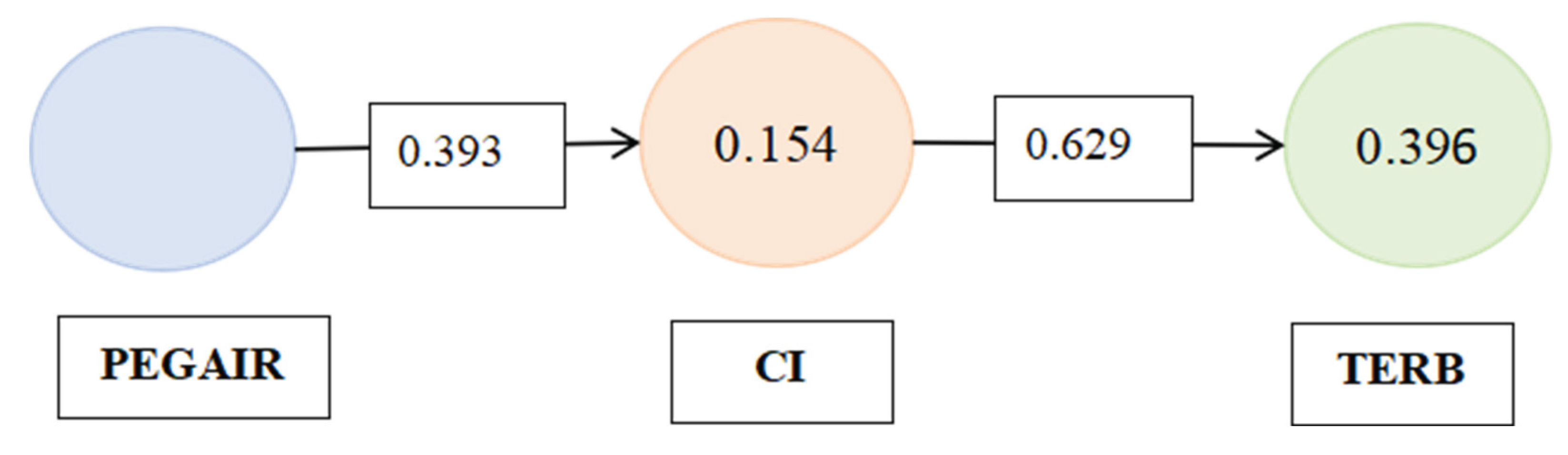
Table 1.
Respondents’ Profile (n=479).
| Variable | Category | Frequency | Percentage (%) |
| Gender | Male | 216 | 45.1 |
| Female | 263 | 54.9 | |
| Age | Under 18 years old | 22 | 4.6 |
| 18–24 years | 107 | 22.3 | |
| 25–34 years | 154 | 32.2 | |
| 35–44 years | 88 | 18.4 | |
| 45–54 years | 55 | 11.5 | |
| 55–64 years | 29 | 6.1 | |
| 65 years and above | 24 | 5.0 | |
| Education | High school or below | 54 | 11.3 |
| College diploma / Associate degree | 61 | 12.7 | |
| Bachelor’s degree | 212 | 44.3 | |
| Master’s degree | 122 | 25.5 | |
| Doctoral degree or above | 30 | 6.3 | |
| Occupation | Student | 111 | 23.2 |
| Government employee / Public institution staff | 75 | 15.7 | |
| Teacher / Research staff | 29 | 6.1 | |
| Company employee | 164 | 34.2 | |
| Freelancer / Self-employed | 48 | 10.0 | |
| Retired | 31 | 6.5 | |
| Other | 21 | 4.4 | |
| Monthly income (RMB) | Below RMB 3,000 | 69 | 14.4 |
| RMB 3,001–6,000 | 91 | 19.0 | |
| RMB 6,001–10,000 | 119 | 24.8 | |
| RMB 10,001–15,000 | 114 | 23.8 | |
| RMB 15,001–20,000 | 57 | 11.9 | |
| RMB 20,001 and above | 29 | 6.1 |
Table 2.
Descriptive statistics of the study variables.
| Variables | N | Minimum | Maximum | Mean | Std. Deviation |
| PEGAIR | 479 | 2.75 | 6.50 | 4.7377 | .68866 |
| CI | 479 | 3.25 | 7.00 | 5.2182 | .69251 |
| TERB | 479 | 3.50 | 7.00 | 5.3920 | .65539 |
Table 3.
Measurement Model Results.
| Construct | Item | Outer loading | Cronbach’s alpha | Composite reliability | AVE |
| Perceived Effectiveness of GenAI-Assisted Itinerary Recommendations (PEGAIR) | PEGAIR1 | 0.778 | 0.907 | 0.910 | 0.605 |
| PEGAIR2 | 0.773 | ||||
| PEGAIR3 | 0.797 | ||||
| PEGAIR4 | 0.808 | ||||
| PEGAIR5 | 0.764 | ||||
| PEGAIR6 | 0.763 | ||||
| PEGAIR7 | 0.771 | ||||
| PEGAIR8 | 0.765 | ||||
| Cultural identity (CI) | CI1 | 0.767 | 0.915 | 0.916 | 0.628 |
| CI2 | 0.804 | ||||
| CI3 | 0.807 | ||||
| CI4 | 0.768 | ||||
| CI5 | 0.807 | ||||
| CI6 | 0.797 | ||||
| CI7 | 0.805 | ||||
| CI8 | 0.784 | ||||
| Tourists’ environmentally responsible behavior (TERB) | TERB1 | 0.774 | 0.910 | 0.910 | 0.613 |
| TERB2 | 0.802 | ||||
| TERB3 | 0.759 | ||||
| TERB4 | 0.794 | ||||
| TERB5 | 0.801 | ||||
| TERB6 | 0.785 | ||||
| TERB7 | 0.771 | ||||
| TERB8 | 0.775 |
Table 4.
Discriminant validity assessment (HTMT).
| CI | PEGAIR | TERB | |
| CI | |||
| PEGAIR | 0.424 | ||
| TERB | 0.687 | 0.413 |
Table 5.
Structural model results and hypothesis testing.
| Hypothesis | Path | β | t-value | p-value | Result |
| PEGAIR | 479 | 2.75 | 6.50 | 4.7377 | .68866 |
| CI | 479 | 3.25 | 7.00 | 5.2182 | .69251 |
| TERB | 479 | 3.50 | 7.00 | 5.3920 | .65539 |
Table 6.
Coefficient of determination (R²) and effect size (f²).
| Type | Construct / Path | Value |
| R² | CI | 0.154 |
| R² | TERB | 0.396 |
| f² | PEGAIR → CI | 0.182 |
Disclaimer/Publisher’s Note: The statements, opinions and data contained in all publications are solely those of the individual author(s) and contributor(s) and not of MDPI and/or the editor(s). MDPI and/or the editor(s) disclaim responsibility for any injury to people or property resulting from any ideas, methods, instructions or products referred to in the content. |
© 2026 by the authors. Licensee MDPI, Basel, Switzerland. This article is an open access article distributed under the terms and conditions of the Creative Commons Attribution (CC BY) license (http://creativecommons.org/licenses/by/4.0/).
Copyright: This open access article is published under a Creative Commons CC BY 4.0 license, which permit the free download, distribution, and reuse, provided that the author and preprint are cited in any reuse.


