

Submitted:
16 April 2026
Posted:
20 April 2026
You are already at the latest version
Abstract
Based on their domain organisation, four proteins from the protist Dictyostelium discoideum have been assigned to the IQGAP family of scaffold proteins. Although these proteins are shorter than mammalian IQGAPs, their involvement in the regulation of the actin cytoskeleton in cell motility, macroendocytosis, cytokinesis, and adhesion appears to be broadly conserved between these evolutionarily distant organisms. In this article, we show that the predicted three-dimensional structure of Dictyostelium IQGAP-related proteins closely corresponds to the C-terminal half of human IQGAP1, thus supporting their common origin. IqgD is the largest IQGAP-related protein in Dictyostelium, with an overall domain organisation similar to human IQGAPs. IqgD is localised in the cell cortex, interacts with F-actin and Rac1 GTPases, and primarily supports cell adhesion to the underlying surface and the cell growth on bacterial lawns. DGAP1 and GAPA are truncated proteins that have retained a 700-residue-long C-terminal region of homology compared to their mammalian relatives. They play important, yet opposite, roles in regulating contractile cortical assemblies comprising F-actin, myosin II, and the actin-bundling proteins cortexillins, which are especially important for cytokinesis and epithelial morphogenesis. Finally, IqgC, although structurally resembling other IQGAPs, turns out to be more closely related to GAP1 proteins from fungi. This multifaceted protein carries RasGAP activity, interacts with several other small GTPases, and positively regulates macroendocytosis and cell-substratum adhesion.
Keywords:
IQGAP
; scaffold proteins
; Rac GTPases
; GAP1 protein family
; actin cytoskeleton
; cell migration
; cell adhesion
; macroendocytosis
; cell division
; Dictyostelium
1. Iqgap Family of Multidomain Scaffold Proteins
Proteins from the IQGAP family have become prominent as typical pleiotropic scaffold proteins [1,2,3]. Scaffold proteins are thought to function primarily as platforms that facilitate the co-localisation and interaction of multiple proteins, thereby participating in the spatial organisation of the cellular interactome [4,5]. IQGAPs are multidomain proteins that harbour seven well-established protein-binding domains, which interact with specific domains of other proteins but lack enzymatic activity [1]. Starting at the N-terminus, the domains are: calponin homology domain (CHD), coiled-coil repeat region (CC), tryptophan-containing proline-rich motif-binding region (WW), IQ domain containing several IQ motifs, GTPase-activating protein (GAP)-related domain (GRD), RasGAP C-terminal (RGCt) domain, and extreme C-terminal (CT) domain. The interactomes of human IQGAPs have been comprehensively described in recent review articles [6,7].
There is considerable inconsistency in the literature regarding the names and extents of the domains in the C-terminal halves of mammalian IQGAP proteins downstream from the GRD. Domain lengths and designations have mostly been assigned based on similarities in their linear sequences within the group and with related proteins, notably RasGAPs, as well as on the sizes of constructs used in interaction studies. While most papers consider amino acid residues 1025–1237 to constitute the primitive GRD [3,6,8,9], one group defines the GRD as contiguous with RGCt, covering residues 962–1344 [10]. There is even greater variability regarding the RGCt domain. The RGCt domain, located downstream of the GRD, is generally regarded as the C-terminal protein-interaction region of IQGAPs that mediates binding to Rho family GTPases, phosphoinositides, and adhesion and cytoskeletal proteins [1,11,12]. Some of the best-characterised RGCt binding partners, including E-cadherin [13], β-catenin [13], CLIP-170 [14], APC [15], Dia1 [16], PIP2 [17], Rac1, and Cdc42 [10], all interact with motifs in the extreme C-terminal approximately 150 amino acids, later interpreted as the RGCt domain. Despite this, RGCt is inconsistently cited, mostly as amino acid residues 1451–1583 [3,6,8,9]; some define it as almost everything downstream of the GRD (1276–1657) [1], or restrict its extent to the extreme C-terminus (1563–1657) [11]. One group defined RGCt as amino acid residues 1345–1563 and introduced the notion of a separate CT domain at the extreme C-terminus (1576–1657) [10,12].
Given this unsatisfactory situation, and because no experimental three-dimensional structure of full-length IQGAPs is currently available, we decided to use computational predictions of the 3D structures of IQGAP1 and related proteins from Dictyostelium as a basis for a working definition of domains in their C-terminal region. The results obtained using the biomolecular structure prediction tool AlphaFold 3 are shown in Figure 1. The predicted 3D structures are remarkably consistent among the five analysed proteins, despite significant dissimilarities in their linear amino acid sequences (21–30% identity between human IQGAP1 and Dictyostelium IQGAPs). For practical purposes, we define the domain boundaries as the margins of prominent three-dimensional features, such as single extended α-helices or compact clusters of α-helices and β-sheets, that are present in all analysed proteins (Table 1). These well-structured domains are mostly connected by unstructured hinges or loops.
As shown for IQGAP1 (Figure 1B), the GRD defined in this way corresponds to a large elongated, crescent-shaped, all-helical cluster containing thirteen α-helices, whereas CT corresponds to a smaller, compact cluster of four short α-helices and seven β-sheets. Both predicted structures closely match experimentally determined structures of GRD and CT (aPI) domains [18,19] and closely resemble the extent of these domains as defined by Nouri and coworkers [10]. The same applies to the RGCt domain; however, we find that this domain actually consists of two distinct structural features: a triplet of α-helices and a single extended α-helix, which we designate as H3 and HC, respectively. We also observed the consistent presence of another elongated α-helix corresponding to a segment positioned upstream from the GRD in the primary sequence and juxtaposed to HC in the 3D structure (Figure 1). We therefore designate this α-helix as HN. These two helices from distant regions of the primary sequence probably build a coiled-coil structure, as suggested by the high probability of heptad repeats occurring in both helices, predicted by the PCOILS algorithm (Figure S1) [20]. As far as we are aware, this is the first time this potential structural feature of IQGAP1 and related proteins has been described, and we suggest that it could have an important role in regulating the activity of these proteins.
Figure 1.
IQGAP-related proteins from Dictyostelium discoideum share structural features with human IQGAP1. (A) Predicted three-dimensional structures of full-length IQGAP1 (left) and IqgD (right) displayed at a reduced scale; (B) C-terminal part of IQGAP1 (amino acid residues 836–1657); (C) C-terminal part of IqgD (amino acid residues 561–1385); (D) full-length IqgC; (E) full-length DGAP1; (F) full-length GAPA. In B-F, two projections are shown side by side in the left and right columns. Individual structural features are coloured as follows: N-terminal helix (HN) in pink, GAP-related domain (GRD) in green, triplet of short helices within the RGCt domain (RGCt-H3) in orange, C-terminal helix within the RGCt domain (RGCt-HC) in yellow, and the C-terminal domain (CT) in cyan. The remainder of the protein is coloured beige. The intervals of amino acid residues corresponding to each domain are listed in Table 1. Predicted three-dimensional structures were obtained using the AlphaFold web server powered by the AlphaFold 3 model [21]. Visualisation was performed with UCSF ChimeraX [22]. The primary protein sequences were downloaded from the UniProt website [23].
Figure 1.
IQGAP-related proteins from Dictyostelium discoideum share structural features with human IQGAP1. (A) Predicted three-dimensional structures of full-length IQGAP1 (left) and IqgD (right) displayed at a reduced scale; (B) C-terminal part of IQGAP1 (amino acid residues 836–1657); (C) C-terminal part of IqgD (amino acid residues 561–1385); (D) full-length IqgC; (E) full-length DGAP1; (F) full-length GAPA. In B-F, two projections are shown side by side in the left and right columns. Individual structural features are coloured as follows: N-terminal helix (HN) in pink, GAP-related domain (GRD) in green, triplet of short helices within the RGCt domain (RGCt-H3) in orange, C-terminal helix within the RGCt domain (RGCt-HC) in yellow, and the C-terminal domain (CT) in cyan. The remainder of the protein is coloured beige. The intervals of amino acid residues corresponding to each domain are listed in Table 1. Predicted three-dimensional structures were obtained using the AlphaFold web server powered by the AlphaFold 3 model [21]. Visualisation was performed with UCSF ChimeraX [22]. The primary protein sequences were downloaded from the UniProt website [23].
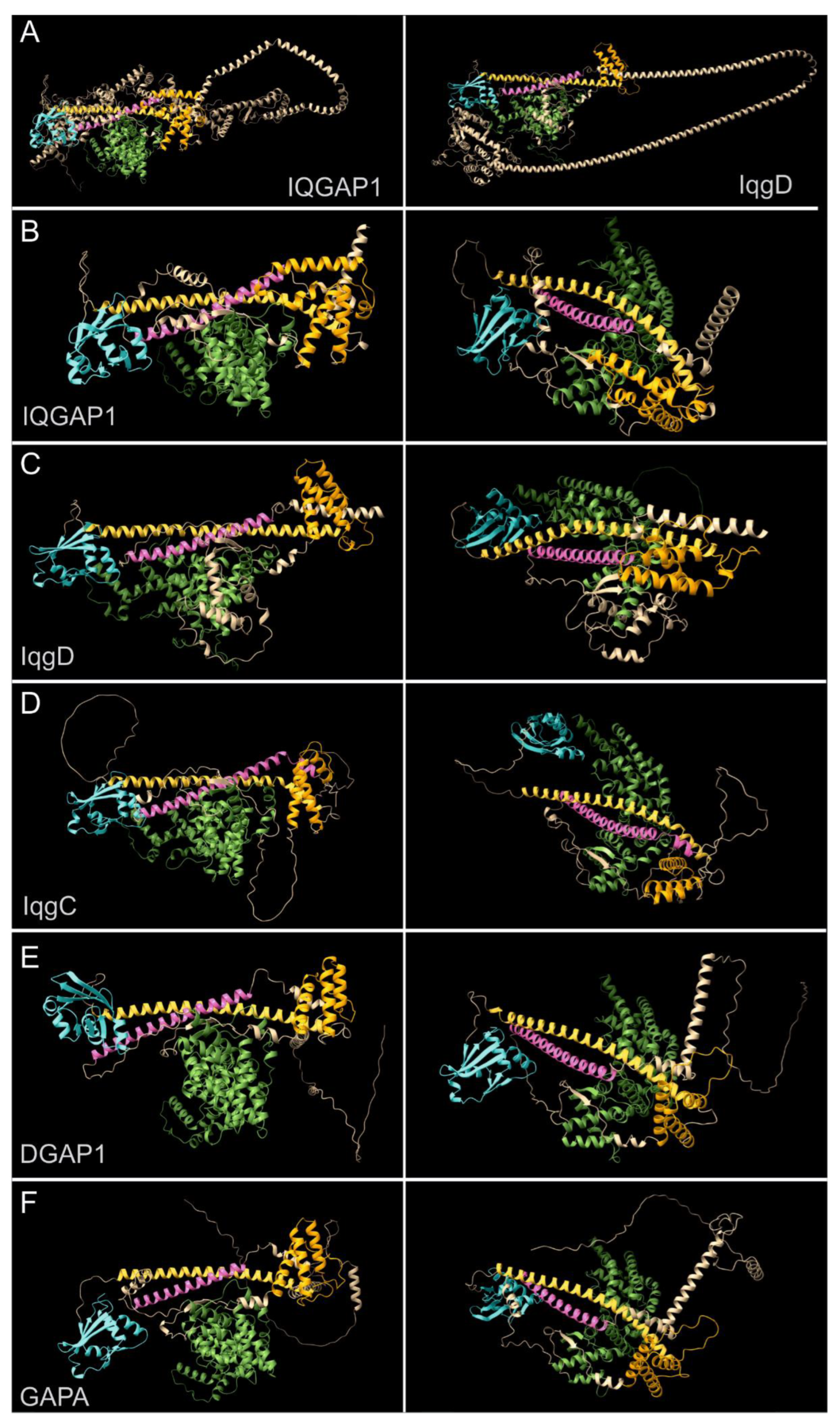
IQGAP representatives have been identified in animals, fungi, and protists [7,9], and are immediately recognisable by the characteristic domain composition of their C-terminus. Functional studies have shown that IQGAPs are primarily involved in regulating the actin cytoskeleton, but also in the regulation of other cellular functions [7,24]. Although the three IQGAP isoforms in humans share a similar domain architecture, their expression profiles are highly tissue-specific and their functions are to some extent diversified [6,7]. IQGAPs belong to the RasGAP domain-containing protein superfamily and comprise one of its five clusters, all of which were represented by an ancestral gene in the Last Eukaryotic Common Ancestor (LECA) [25]. Moreover, IQGAP-like RasGAPs and GAP1 RasGAPs from fungi share a common origin predating LECA. IQGAPs are unique within the RasGAP superfamily because their RasGAP domain has lost its activity due to mutations of critical residues and has thus been renamed the GAP-related domain [18,26]. IQGAP-related proteins have also been identified in protists, which diverged from the animal lineage more than a billion years ago. The first protist IQGAPs were identified in Dictyostelium discoideum. D. discoideum amoebae are highly motile cells with a complex actin cytoskeleton, and their lifestyle resembles that of mammalian leukocytes [27,28]. It is therefore of general interest to study how the highly divergent proteome of D. discoideum supports cellular traits similar to those of mammalian cells, which appears to be a prominent example of convergent evolution. In this review, we provide an overview of four IQGAP-related proteins in D. discoideum and compare their structure and function with those of mammalian IQGAPs.
2. Iqgap-Related Proteins in D. Discoideum
The first two IQGAP-related proteins from protists were identified in D. discoideum soon after the discovery of the first human IQGAP in 1994 [29,30,31]. The Dictyostelium genome sequencing project identified two additional candidate IQGAP genes [32,33]. Subsequent efforts to streamline the original nomenclature resulted in multiple names for the four proteins: DGAP1 (DdIQGAP1, IQGAP1, rasGAP1, RIP2), GAPA (DdIQGAP2, IQGAP2, rasGAP), IqgC (DdIQGAP3), and IqgD (DdIQGAP4). In this article, we will adhere to the original designations. Whereas mammalian IQGAPs contain seven established domain types, there are five domain types in yeast and only three in three Dictyostelium proteins, whereas IqgD has a CHD in addition. Whether these differences arose through the addition of new domains or the loss of those originally present in the common ancestor is currently unclear [25,34].
The sizes and sequence-based domain organisation of DGAP1, GAPA, IqgC, and the corresponding C-terminal part of IqgD are roughly comparable to the C-terminal half of human IQGAP1. Consistently, their tertiary structures, as predicted by AlphaFold 3, are remarkably similar (Figure 1). As in the 3D architecture of IQGAP1 described above, all five proteins feature an HN helix followed by a crescent-shaped GRD, an RGCt consisting of an H3 triad and an HC helix, and a CT domain. Analysis by PCOILS also reveals a high propensity for HN and HC to form a coiled-coil superhelix in all five proteins and in human IQGAP2 (Figure S1). An additional cluster of three α-helices and two β-sheets is found between GRD and RGCt in IqgD (Figure 1C), and an α-helix is present at the N-termini of DGAP1 and GAPA (Figure 1E-F). In other proteins, individual domains and motifs are connected by segments with no apparent secondary structure, and these segments vary in length between different proteins (Figure 2).
In addition to spatial domain organisation, two regulatory mechanisms characteristic of mammalian IQGAPs appear to be conserved in Dictyostelium proteins. The first involves a polybasic motif responsible for the interaction of IQGAP1 with PIP2 [17]. In IQGAP1, this motif encompasses a cluster of six lysine residues between Lys1546–Lys 1558, located on an exposed loop between the RGCt and CT domains. Such polybasic clusters are present in all Dictyostelium proteins, with the number of lysine residues ranging from three in IqgD to thirteen in IqgC. The second putative regulatory mechanism is based on the phosphorylation of serine residues within the RGCt-H3 subdomain in IQGAP1. It has been shown that phosphorylation of IQGAP1 at S1443 strongly modulates its binding to Cdc42 [35]. In Dictyostelium proteins, serine residues are also located within the RGCt-H3 on the exposed hinge regions between individual α-helices. Although the conservation of the polybasic motif and exposed serines in Dictyostelium proteins suggests that the corresponding regulatory mechanisms are also conserved in this organism, appropriate experimental tests of this hypothesis have not yet been performed. Taken together, the predicted three-dimensional structures obtained by AlphaFold 3 suggest that the IQGAP-related proteins from D. discoideum share overall tertiary structure and common regulatory motifs with mammalian IQGAPs. In the remainder, we turn to the specific functions of these proteins in the biology of D. discoideum.
3. Iqgaps Cut in Half: Dgap1 and Gapa
The phrase “nomen est omen” certainly does not apply to the first IQGAPs identified in D. discoideum, DGAP1 and GAPA. Not only do they lack GAP activity towards Ras GTPases, like mammalian IQGAPs, but they also do not contain the consensus IQ domain typical of the latter. Moreover, they lack the signature actin-binding CH domain present in animal and fungal IQGAPs, yet are nevertheless implicated almost exclusively in the regulation of the actin cytoskeleton. The sequences of DGAP1 and GAPA are 51% identical and 67% similar to each other, and they share most interacting partners, but play diversified, and sometimes even antagonistic, roles in cell physiology. Upon binding Rac1 GTPases in their active, GTP-loaded form, both DGAP1 and GAPA interact with actin-binding proteins cortexillins, thereby creating multicomponent complexes [36,37]. Other interaction partners of GAPA include filamin [37], myosin II [38], and α-catenin, which also interacts with DGAP1 [39].
It was initially established that dgap1- cells grow faster on bacterial lawns, whereas DGAP1-overexpressing cells grow more slowly [29]. This phenotype was later justified by the finding that cell motility is inversely correlated with the expression level of DGAP1 [40,41]. Consistently, the ratio between F- and G-actin is increased in dgap1- cells, leading to increased production of actin protrusions, whereas it is decreased in DGAP1 overexpressor [40]. It was therefore hypothesised that DGAP1 sequesters active Rac1 and thereby reduces Rac1-stimulated actin polymerisation via WASP/WAVE-Arp2/3 complexes and formins [42,43]. Indeed, it was shown that single dgap1- and gapA- mutants contain higher levels of active Rac1 compared to wild-type cells and that this effect is roughly additive in the double null mutant [44]. Surprisingly, however, the ratio between F- and G-actin is decreased in gapA- cells, whereas it is increased in GAPA overexpressor [37].
In wild-type cells, both DGAP1 and GAPA build quaternary complexes with the small GTPase Rac1 and a dimer of actin-bundling proteins, cortexillins, which are necessary for efficient cytokinesis in Dictyostelium [36]. Given the high sequence similarity between the two proteins, it was puzzling that gapA- cells displayed a strong cytokinesis defect, whereas dgap1- cells did not [30,40]. On the other hand, cytokinesis was disturbed in DGAP1-overexpressing cells, whereas the dgap1-/gapA- cells exhibited a severe cytokinesis defect resembling that of cortexillin I/II double-null (ctxA-/ctxB-) cells [36,40]. The differences between the apparent roles of DGAP1 and GAPA in cytokinesis have been interpreted within the model of mechanoresponsive contractile protein complexes that determine the mechanical properties of the cell cortex [38]. According to this conceptual framework, the main components of these “contractility kits” are the mechanoenzyme myosin II as the force-generating component, the actin-bundling protein cortexillin I as the force-bearing component, and GAPA as a positive regulator [45]. Multiple lines of evidence suggest that DGAP1 inhibits the mechanoresponsive accumulation of myosin II and cortexillin I by suppressing the incorporation of GAPA into contractility kits [46,47]. This model explains why cells lacking the positive regulator of contractility, GAPA, have a strong cytokinesis defect, whereas those lacking its suppressor, DGAP1, do not.
During the culmination stage of the D. discoideum developmental cycle, differentiated cells at the tip of the multicellular fruiting body form a polarised epithelium that surrounds the stalk tube [48]. As in metazoan tubular epithelia, the apical side of the stalk tube cells is constricted by actomyosin activity relative to the basal side, forming wedge-shaped cells that enclose the tube. Interestingly, DGAP1 plays a major role in the apical localisation of myosin II. α-catenin, which is localised on basolateral membranes, recruits the DGAP1/cortexillin complex, which prevents myosin II from binding at those sites, resulting in selective localisation of myosin II to the apical cortex. Knockout of DGAP1 or cortexillin I results in mislocalisation of myosin II to the basolateral cortex, leading to a disturbed morphology of the tip epithelium [49]. Thus, there is a clear analogy between the prohibitive role of DGAP1 in myosin II recruitment to specific domains of the cellular cortex during cytokinesis in the unicellular stage and during morphogenesis of the tip epithelium in the multicellular stage of the Dictyostelium life cycle.
It appears, therefore, that DGAP1 and GAPA function as a pair of antagonistic proteins that oppositely regulate the assembly of contractility kits in the cortical actin cytoskeleton in Dictyostelium. Given their high structural similarity, it is currently unknown which structural features determine these stark functional differences. Although their interactomes have not been systematically compared, the known and suspected binding partners of the two proteins largely overlap. It has been proposed that GAPA may be regulated by Ca2+ because it purportedly contains a partly conserved IQ motif that could mediate its binding to calmodulin [37]. Although the binding of GAPA to calmodulin has not been experimentally tested, we consider it unlikely, as the hypothetical IQ motif would be untypically located within the GRD domain. DGAP1 and GAPA contain GRD, RGCt, and CT homology regions also found in yeast and metazoan IQGAPs, but do not share their N-terminal actin-binding CH and coiled-coil domains, nor multiple IQ repeats. Since cortexillins contain CH and coiled-coil domains, it has been suggested that fungal and metazoan IQGAPs may correspond to fused versions of the complex between the truncated Dictyostelium IQGAPs, such as DGAP1 and GAPA, and cortexillins [50]. However, this hypothesis is not plausible because cortexillins harbour a CH1/CH2 tandem of the α-actinin/spectrin type, whereas IQGAPs contain a single CH3 domain [34,51,52,53]. On the other hand, it is possible that DGAP1 and GAPA arose from a full-length evolutionary predecessor with a domain organisation similar to mammalian IQGAPs through a domain loss mechanism. Whether the partial IQGAP orthologues from Dictyostelium resemble ancestors or descendants of ancient prototypes of mammalian IQGAPs remains to be determined.
4. Iqgc—A Gap Among the Iqgaps
IqgC is a RasGAP protein originally classified as a member of the IQGAP family. However, IqgC is more closely related to fungal GAP1 family proteins, which have a deceptively similar domain organisation (RasGAP-RGCt-CT) [54]. IqgC interacts with Ras, Rab, and Rap GTPases, but exhibits GAP activity only towards Ras. It localises to macropinocytic and phagocytic cups, reduces macropinosome size, and negatively regulates macroendocytosis by deactivating RasG [55,56]. IqgC supports cell-substratum adhesion by stabilising ventral adhesion foci [57]. Its RGCt domain is critical for recruitment to adhesion sites, while the RasGAP domain regulates the turnover of the adhesion foci. IqgC also positively influences directed migration by stabilising adhesion foci and coordinating Ras-mediated actin polymerisation. IqgC orthologues are conserved across six other dictyostelid species, highlighting its universal importance in amoeboid physiology [58]. Altogether, IqgC appears to play an important role in balancing feeding and migratory behaviours in D. discoideum. For more details about IqgC, we refer the reader to a recent review article [58].
5. Iqgd—A Truncated Iqgap Fused to Fimbrin?
IqgD is the largest D. discoideum IQGAP because, in addition to C-terminal homology regions, it contains an N-terminal extension carrying CH domains. Hence, IqgD, like mammalian IQGAPs, binds Rac1 and F-actin [59]. Notably, IqgD harbours two fimbrin-type CHDs, CHf1 and CHf2, which together form an actin-binding domain (ABD) [34]. This domain is related to the first fimbrin ABD and distinguishes IqgD from mammalian IQGAPs, which bind F-actin via a single type 3 CHD [52]. This chimeric domain organisation, comprising a duplex CHD typical of the fimbrin family and a GRD-RGCt-CT triad typical of the IQGAP family, suggests that IqgD evolved through the addition of a fimbrin to a typically truncated Dictyostelium IQGAP [34]. Accordingly, the unique fimbrin-related proteins of D. discoideum are thought to have resulted from extensive genomic reorganisations, possibly involving retroposition events [60]. Retrotransposons make up about 8% of the D. discoideum genome [61], which is less than in most animals but relatively high compared to other dictyostelids [62]. Furthermore, during the generation of iqgD- cells, we serendipitously uncovered a genomic locus that we named iqgDL2, which encodes an IqgD paralogue. The partial sequence of iqgDL2 is identical to the known iqgDL1, except that all three introns present in iqgDL1 are absent in iqgDL2. Transcription from iqgDL2 (iqgDL1- cells) was several hundred times lower than from iqgDL1 and iqgDL2 combined (wild-type cells), but still detectable [59]. We hypothesise that the iqgDL2 locus corresponds to a gene that has arisen by retroposition—a retrogene. In addition to the typical lack of introns, it has been suggested that many retrogenes, particularly young ones, tend to have lower transcription levels [63]. Another diagnostic feature of putative retrogenes is their chimeric architecture, originating from the fusion of exons from separate genes, which we speculate had already occurred with the original gene at the iqgDL1 locus.
IqgD binds three highly homologous D. discoideum Rac1 GTPases (Rac1A, Rac1B, and Rac1C) in their active forms and, based on observations with human Rac1—which shares more than 80% overall identity and a 100% identical effector domain with Dictyostelium Rac1s—maintains them in the active state, similar to mammalian IQGAPs [59,64,65,66]. Bimolecular fluorescence complementation experiments in live cells showed that the CT domain is essential, and the GRD significantly contributes to GTPase binding. Interestingly, IqgD, like DGAP1 and GAPA, also interacts with cortexillins I and II, and these interactions are mediated by both the GRD and CT domains of IqgD [59]. Consistent with this, IqgD bound to active Rac1A cannot simultaneously bind cortexillins. This suggests a different mode of regulation by Rac1 GTPases than that imposed on DGAP1 and GAPA.
IqgD is localised across the entire cell cortex, where it colocalises with F-actin, but is highly enriched in macropinocytic and phagocytic cups. However, IqgD deficiency does not affect fluid uptake or phagocytosis of bacteria in suspension. In contrast, IqgD-deficient cells display markedly reduced growth on bacterial lawns, as indicated by significantly smaller plaque diameters and reduced individual cell size. Moreover, IqgD-deficient cells phagocytose surface-attached microbeads less efficiently than wild-type cells. Additionally, mutant cells exhibit reduced cell-substrate adhesion. Interestingly, IqgD and active Rac1 localise to F-actin-rich rings that form around substrate-attached particles on the ventral side of the cell in contact with the substratum. A similar structure was recently described on the ventral side of macrophages around surface-attached particles at the cell-substrate interface [67]. This phagocytic adhesion ring (PAR) was shown to depend on integrin tension and Arp2/3-mediated actin polymerisation, and its role in detachment of surface-bound particles was demonstrated. Although the analogous ring structure identified in Dictyostelium awaits detailed characterisation, it is possible that IqgD plays a role in substrate-specific phagocytosis, which is important for both Dictyostelium feeding and the removal of pathogens from metazoan tissues. However, the precise role of IqgD in efficient growth on bacterial lawns remains to be determined.
6. Conclusions and Future Directions
Based on their structure and biochemical activity, DGAP1, GAPA, and IqgD represent three partial orthologues of IQGAPs from animals, whereas IqgC is the sole representative of the fungal GAP1 family RasGAPs in this organism. The crucial difference between IqgC and the other three proteins is that the “GRD” of IqgC is actually a fully functional RasGAP domain, whereas the typical GRDs of the other three proteins lack Ras binding and RasGAP activities, as in animal IQGAPs. It remains an open question whether these truncated IQGAPs from Dictyostelium evolved by domain loss, or whether mammalian IQGAP proteins evolved by domain gain, from a common ancestor. Phylogenetic analysis indicates that the common ancestor of fungi and animals (Opisthokonts) likely possessed a relatively simple RasGAP [25]. This ancestral protein likely consisted of the RasGAP-RGCt-CT triad and probably represents the common progenitor of all IQGAPs and fungal/protozoan GAP1 RasGAPs. In this scenario, fungal and protozoan GAP1s, such as IqgC, have largely maintained this ancestral, streamlined architecture. In contrast, mutations of crucial amino acid residues have led to the conversion of the RasGAP domain into GRD, giving rise to a proto-IQGAP whose domain architecture is largely preserved in DGAP1 and GAPA. Further domain gain events have resulted in the fusion of additional modules to the N-terminus of this ancestral IQGAP, with an apparent preference for actin-binding domains. In the progenitor of animal IQGAPs, a single type 3 CHD was appended, whereas a duplex CHD typical of fimbrins was appended in IqgD.
Conservation of regulatory motifs, such as the polybasic stretch of interspersed lysine residues between the RGCt-HC and CT domains and the exposed serine residues in the RGCt-H3 domain, suggests that binding to PIP2 and serine phosphorylation are conserved in Dictyostelium proteins. The possible functional consequences of these regulatory mechanisms need to be experimentally assessed, but they probably resemble similar mechanisms described in mammalian IQGAPs [17,35]. We also hypothesise that the hybridisation between the HN and HC α-helices contributes to the stability of a compact tertiary structure in the examined proteins, and its disruption may play a role in regulating their activity, for instance in the binding of Rho GTPases by the recently proposed two-step mechanism [10,12]. In addition, information about the role of IQGAP-related proteins, primarily IqgC and IqgD, in the multicellular stage of the Dictyostelium life cycle is scarce and awaits further investigation. Developmental expression profiles suggest that IqgD is upregulated in late development, and while all four proteins are specifically localised to prestalk cells in slugs, IqgD is predominantly expressed in terminally differentiated stalk cells, whereas IqgC is predominantly expressed in spore cells [68]. Also, IqgD is upregulated and IqgC downregulated during encystation [68]. These distinct expression patterns suggest that IqgC and IqgD may play specialized, non-overlapping roles in coordinating cell fate and tissue morphogenesis during the final stages of development.
Supplementary Materials
The following supporting information can be downloaded at the website of this paper posted on Preprints.org, Figure S1: Probability for the formation of coiled coil structures as determined by application of the PCOILS algorithm using default parameters.
Author Contributions
Conceptualization, V.F. and I.W.; writing—original draft preparation, V.F. and I.W.; writing—review and editing, V.F. and I.W.; visualization, V.F. and I.W.; supervision, I.W.; project administration, I.W.; funding acquisition, I.W. All authors have read and agreed to the published version of the manuscript.
Funding
This work was supported by the Croatian Science Foundation under the project number HRZZ-IP-2024-05-6331.
Conflicts of Interest
The authors declare no conflicts of interest. The funders had no role in the design of the study, in the writing of the manuscript, or in the decision to publish the results.
Abbreviations
The following abbreviations are used in this manuscript:
ABD actin-binding domain
CC coiled-coil repeat region
CHD calponin homology domain
CT extreme C-terminal domain
GRD GTPase-activating protein (GAP)-related domain
HN N-terminal helix
LECA Last Eukaryotic Common Ancestor
PAR phagocytic adhesion ring
RGCt RasGAP C-terminal domain
RGCt-H3 triplet of short helices within the RGCt domain
RGCt-HC C-terminal helix within the RGCt domain
WW tryptophan-containing proline-rich motif-binding region
References
- Abel, A.M.; Schuldt, K.M.; Rajasekaran, K.; Hwang, D.; Riese, M.J.; Rao, S.; Thakar, M.S.; Malarkannan, S. IQGAP1: Insights into the Function of a Molecular Puppeteer. Mol Immunol 2015, 65, 336–349. [CrossRef]
- DiRusso, C.J.; Dashtiahangar, M.; Gilmore, T.D. Scaffold Proteins as Dynamic Integrators of Biological Processes. J Biol Chem 2022, 298, 102628. [CrossRef]
- White, C.D.; Erdemir, H.H.; Sacks, D.B. IQGAP1 and Its Binding Proteins Control Diverse Biological Functions. Cell. Signal. 2012, 24, 826–834. [CrossRef]
- Good, M.C.; Zalatan, J.G.; Lim, W.A. Scaffold Proteins: Hubs for Controlling the Flow of Cellular Information. Science 2011, 332, 680–686. [CrossRef]
- Langeberg, L.K.; Scott, J.D. Signalling Scaffolds and Local Organization of Cellular Behaviour. Nat Rev Mol Cell Biol 2015, 16, 232–244. [CrossRef]
- Thines, L.; Roushar, F.J.; Hedman, A.C.; Sacks, D.B. The IQGAP Scaffolds: Critical Nodes Bridging Receptor Activation to Cellular Signaling. Journal of Cell Biology 2023, 222, e202205062. [CrossRef]
- Hedman, A.C.; Smith, J.M.; Sacks, D.B. The Biology of IQGAP Proteins: Beyond the Cytoskeleton. EMBO Rep. 2015, 16, 427–446. [CrossRef]
- Brown, M.D.; Sacks, D.B. IQGAP1 in Cellular Signaling: Bridging the GAP. Trends in Cell Biology 2006, 16, 242–249. [CrossRef]
- Shannon, K.B. IQGAP Family Members in Yeast, Dictyostelium, and Mammalian Cells. International Journal of Cell Biology 2012, 2012, 1–14. [CrossRef]
- Nouri, K.; Fansa, E.K.; Amin, E.; Dvorsky, R.; Gremer, L.; Willbold, D.; Schmitt, L.; Timson, D.J.; Ahmadian, M.R. IQGAP1 Interaction with RHO Family Proteins Revisited: Kinetic and Equilibrium Evidence for Multiple Distinct Binding Sites. J Biol Chem 2016, 291, 26364–26376. [CrossRef]
- Briggs, M.W.; Sacks, D.B. IQGAP Proteins Are Integral Components of Cytoskeletal Regulation. EMBO Rep. 2003, 4, 571–574. [CrossRef]
- Nouri, K.; Timson, D.J.; Ahmadian, M.R. New Model for the Interaction of IQGAP1 with CDC42 and RAC1. Small GTPases 2020, 11, 16–22. [CrossRef]
- Kuroda, S.; Fukata, M.; Nakagawa, M.; Fujii, K.; Nakamura, T.; Ookubo, T.; Izawa, I.; Nagase, T.; Nomura, N.; Tani, H.; et al. Role of IQGAP1, a Target of the Small GTPases Cdc42 and Rac1, in Regulation of E-Cadherin- Mediated Cell-Cell Adhesion. Science 1998, 281, 832–835. [CrossRef]
- Fukata, M.; Watanabe, T.; Noritake, J.; Nakagawa, M.; Yamaga, M.; Kuroda, S.; Matsuura, Y.; Iwamatsu, A.; Perez, F.; Kaibuchi, K. Rac1 and Cdc42 Capture Microtubules through IQGAP1 and CLIP-170. Cell 2002, 109, 873–885. [CrossRef]
- Watanabe, T.; Wang, S.; Noritake, J.; Sato, K.; Fukata, M.; Takefuji, M.; Nakagawa, M.; Izumi, N.; Akiyama, T.; Kaibuchi, K. Interaction with IQGAP1 Links APC to Rac1, Cdc42, and Actin Filaments during Cell Polarization and Migration. Dev Cell 2004, 7, 871–883. [CrossRef]
- Brandt, D.T.; Marion, S.; Griffiths, G.; Watanabe, T.; Kaibuchi, K.; Grosse, R. Dia1 and IQGAP1 Interact in Cell Migration and Phagocytic Cup Formation. J Cell Biol 2007, 178, 193–200. [CrossRef]
- Choi, S.; Thapa, N.; Hedman, A.C.; Li, Z.; Sacks, D.B.; Anderson, R.A. IQGAP1 Is a Novel Phosphatidylinositol 4,5 Bisphosphate Effector in Regulation of Directional Cell Migration. EMBO J. 2013, 32, 2617–2630. [CrossRef]
- Kurella, V.B.; Richard, J.M.; Parke, C.L.; LeCour, L.F.; Bellamy, H.D.; Worthylake, D.K. Crystal Structure of the GTPase-Activating Protein-Related Domain from IQGAP1. Journal of Biological Chemistry 2009, 284, 14857–14865.
- Dixon, M.J.; Gray, A.; Schenning, M.; Agacan, M.; Tempel, W.; Tong, Y.; Nedyalkova, L.; Park, H.-W.; Leslie, N.R.; van Aalten, D.M.F.; et al. IQGAP Proteins Reveal an Atypical Phosphoinositide (aPI) Binding Domain with a Pseudo C2 Domain Fold. J Biol Chem 2012, 287, 22483–22496. [CrossRef]
- Zimmermann, L.; Stephens, A.; Nam, S.-Z.; Rau, D.; Kübler, J.; Lozajic, M.; Gabler, F.; Söding, J.; Lupas, A.N.; Alva, V. A Completely Reimplemented MPI Bioinformatics Toolkit with a New HHpred Server at Its Core. Journal of Molecular Biology 2018, 430, 2237–2243. [CrossRef]
- Abramson, J.; Adler, J.; Dunger, J.; Evans, R.; Green, T.; Pritzel, A.; Ronneberger, O.; Willmore, L.; Ballard, A.J.; Bambrick, J.; et al. Accurate Structure Prediction of Biomolecular Interactions with AlphaFold 3. Nature 2024, 630, 493–500. [CrossRef]
- Goddard, T.D.; Huang, C.C.; Meng, E.C.; Pettersen, E.F.; Couch, G.S.; Morris, J.H.; Ferrin, T.E. UCSF ChimeraX: Meeting Modern Challenges in Visualization and Analysis. Protein Sci 2018, 27, 14–25. [CrossRef]
- The UniProt Consortium UniProt: The Universal Protein Knowledgebase in 2025. Nucleic Acids Res 2025, 53, D609–D617. [CrossRef]
- Watanabe, T.; Wang, S.; Kaibuchi, K. IQGAPs as Key Regulators of Actin-Cytoskeleton Dynamics. Cell Structure and Function 2015, 40, 69–77. [CrossRef]
- van Dam, T.J.P.; Bos, J.L.; Snel, B. Evolution of the Ras-like Small GTPases and Their Regulators. Small GTPases 2011, 2, 4–16. [CrossRef]
- Scheffzek, K.; Lautwein, A.; Scherer, A.; Franken, S.; Wittinghofer, A. Crystallization and Preliminary X-Ray Crystallographic Study of the Ras-GTPase-Activating Domain of Human p120GAP. Proteins 1997, 27, 315–318.
- Filić, V.; Mijanović, L.; Putar, D.; Talajić, A.; Ćetković, H.; Weber, I. Regulation of the Actin Cytoskeleton via Rho GTPase Signalling in Dictyostelium and Mammalian Cells: A Parallel Slalom. Cells 2021, 10, 1592. [CrossRef]
- Dunn, J.D.; Bosmani, C.; Barisch, C.; Raykov, L.; Lefrançois, L.H.; Cardenal-Muñoz, E.; López-Jiménez, A.T.; Soldati, T. Eat Prey, Live: Dictyostelium Discoideum As a Model for Cell-Autonomous Defenses. Front Immunol 2017, 8, 1906. [CrossRef]
- Faix, J.; Dittrich, W. DGAP1, a Homologue of rasGTPase Activating Proteins That Controls Growth, Cytokinesis, and Development in Dictyostelium Discoideum. FEBS Letters 1996, 394, 251–257. [CrossRef]
- Adachi, H.; Takahashi, Y.; Hasebe, T.; Shirouzu, M.; Yokoyama, S.; Sutoh, K. Dictyostelium IQGAP-Related Protein Specifically Involved in the Completion of Cytokinesis. J. Cell Biol. 1997, 137, 891–898.
- Weissbach, L.; Settleman, J.; Kalady, M.F.; Snijders, A.J.; Murthy, A.E.; Yan, Y.X.; Bernards, A. Identification of a Human rasGAP-Related Protein Containing Calmodulin-Binding Motifs. J. Biol. Chem. 1994, 269, 20517–20521.
- Eichinger, L.; Pachebat, J.A.; Glöckner, G.; Rajandream, M.-A.; Sucgang, R.; Berriman, M.; Song, J.; Olsen, R.; Szafranski, K.; Xu, Q.; et al. The Genome of the Social Amoeba Dictyostelium Discoideum. Nature 2005, 435, 43–57. [CrossRef]
- Vlahou, G.; Rivero, F. Rho GTPase Signaling in Dictyostelium Discoideum: Insights from the Genome. European Journal of Cell Biology 2006, 85, 947–959. [CrossRef]
- Friedberg, F.; Rivero, F. Single and Multiple CH (Calponin Homology) Domain Containing Multidomain Proteins in Dictyostelium Discoideum: An Inventory. Mol. Biol. Rep. 2010, 37, 2853–2862. [CrossRef]
- Grohmanova, K.; Schlaepfer, D.; Hess, D.; Gutierrez, P.; Beck, M.; Kroschewski, R. Phosphorylation of IQGAP1 Modulates Its Binding to Cdc42, Revealing a New Type of Rho-GTPase Regulator. J. Biol. Chem. 2004, 279, 48495–48504. [CrossRef]
- Faix, J.; Weber, I.; Mintert, U.; Köhler, J.; Lottspeich, F.; Marriott, G. Recruitment of Cortexillin into the Cleavage Furrow Is Controlled by Rac1 and IQGAP-Related Proteins. EMBO J. 2001, 20, 3705–3715. [CrossRef]
- Mondal, S.; Burgute, B.; Rieger, D.; Müller, R.; Rivero, F.; Faix, J.; Schleicher, M.; Noegel, A.A. Regulation of the Actin Cytoskeleton by an Interaction of IQGAP Related Protein GAPA with Filamin and Cortexillin I. PLoS One 2010, 5, e15440. [CrossRef]
- Kothari, P.; Srivastava, V.; Aggarwal, V.; Tchernyshyov, I.; Van Eyk, J.E.; Ha, T.; Robinson, D.N. Contractility Kits Promote Assembly of the Mechanoresponsive Cytoskeletal Network. J Cell Sci 2019, 132. [CrossRef]
- Dickinson, D.J.; Robinson, D.N.; Nelson, W.J.; Weis, W.I. α-Catenin and IQGAP Regulate Myosin Localization to Control Epithelial Tube Morphogenesis in Dictyostelium. Developmental Cell 2012, 23, 533–546. [CrossRef]
- Faix, J.; Clougherty, C.; Konzok, A.; Mintert, U.; Murphy, J.; Albrecht, R.; Mühlbauer, B.; Kuhlmann, J. The IQGAP-Related Protein DGAP1 Interacts with Rac and Is Involved in the Modulation of the F-Actin Cytoskeleton and Control of Cell Motility. J. Cell. Sci. 1998, 111 ( Pt 20), 3059–3071.
- Lee, S.; Shen, Z.; Robinson, D.N.; Briggs, S.; Firtel, R.A. Involvement of the Cytoskeleton in Controlling Leading-Edge Function during Chemotaxis. Mol. Biol. Cell 2010, 21, 1810–1824. [CrossRef]
- Filić, V.; Marinović, M.; Faix, J.; Weber, I. A Dual Role for Rac1 GTPases in the Regulation of Cell Motility. J. Cell. Sci. 2012, 125, 387–398. [CrossRef]
- Faix, J.; Weber, I. A Dual Role Model for Active Rac1 in Cell Migration. Small GTPases 2013, 4, 110–115. [CrossRef]
- Ramalingam, N.; Franke, C.; Jaschinski, E.; Winterhoff, M.; Lu, Y.; Brühmann, S.; Junemann, A.; Meier, H.; Noegel, A.A.; Weber, I.; et al. A Resilient Formin-Derived Cortical Actin Meshwork in the Rear Drives Actomyosin-Based Motility in 2D Confinement. Nat Commun 2015, 6, 8496. [CrossRef]
- Ren, Y.; Effler, J.C.; Norstrom, M.; Luo, T.; Firtel, R.A.; Iglesias, P.A.; Rock, R.S.; Robinson, D.N. Mechanosensing through Cooperative Interactions between Myosin II and the Actin Crosslinker Cortexillin I. Curr Biol 2009, 19, 1421–1428. [CrossRef]
- Kee, Y.-S.; Ren, Y.; Dorfman, D.; Iijima, M.; Firtel, R.; Iglesias, P.A.; Robinson, D.N. A Mechanosensory System Governs Myosin II Accumulation in Dividing Cells. Mol Biol Cell 2012, 23, 1510–1523. [CrossRef]
- Srivastava, V.; Robinson, D.N. Mechanical Stress and Network Structure Drive Protein Dynamics during Cytokinesis. Current Biology 2015, 25, 663–670. [CrossRef]
- Dickinson, D.J.; Nelson, W.J.; Weis, W.I. A Polarized Epithelium Organized by β- and α-Catenin Predates Cadherin and Metazoan Origins. Science 2011, 331, 1336–1339. [CrossRef]
- Dickinson, D.J.; Nelson, W.J.; Weis, W.I. An Epithelial Tissue in Dictyostelium Challenges the Traditional Origin of Metazoan Multicellularity. BioEssays 2012, 34, 833–840. [CrossRef]
- Weis, W.I.; Nelson, W.J.; Dickinson, D.J. Evolution and Cell Physiology. 3. Using Dictyostelium Discoideum to Investigate Mechanisms of Epithelial Polarity. American Journal of Physiology-Cell Physiology 2013, 305, C1091–C1095. [CrossRef]
- Stock, A.; Steinmetz, M.O.; Janmey, P.A.; Aebi, U.; Gerisch, G.; Kammerer, R.A.; Weber, I.; Faix, J. Domain Analysis of Cortexillin I: Actin-Bundling, PIP(2)-Binding and the Rescue of Cytokinesis. EMBO J 1999, 18, 5274–5284. [CrossRef]
- Korenbaum, E.; Rivero, F. Calponin Homology Domains at a Glance. Journal of Cell Science 2002, 115, 3543–3545. [CrossRef]
- Friedberg, F. Duplex (or Quadruplet) CH Domain Containing Human Multidomain Proteins: An Inventory. Mol Biol Rep 2010, 37, 1707–1716. [CrossRef]
- Bian, C.; Kusuya, Y.; Hagiwara, D.; Ban, S.; Lu, Y.; Nagayama, M.; Takahashi, H. Dysfunction of Ras-GAP Protein AfgapA Contributes to Hypoxia Fitness in Aspergillus Fumigatus. Curr Genet 2022, 68, 593–603. [CrossRef]
- Marinović, M.; Mijanović, L.; Šoštar, M.; Vizovišek, M.; Junemann, A.; Fonović, M.; Turk, B.; Weber, I.; Faix, J.; Filić, V. IQGAP-Related Protein IqgC Suppresses Ras Signaling during Large-Scale Endocytosis. Proc. Natl. Acad. Sci. U.S.A. 2019, 116, 1289–1298. [CrossRef]
- Putar, D.; Čizmar, A.; Chao, X.; Šimić, M.; Šoštar, M.; Ćutić, T.; Mijanović, L.; Smolko, A.; Tu, H.; Cosson, P.; et al. IqgC Is a Potent Regulator of Macropinocytosis in the Presence of NF1 and Its Loading to Macropinosomes Is Dependent on RasG. Open Biol 2024, 14, 230372. [CrossRef]
- Mijanović, L.; Putar, D.; Mimica, L.; Klajn, S.; Filić, V.; Weber, I. The IQGAP-Related RasGAP IqgC Regulates Cell-Substratum Adhesion in Dictyostelium Discoideum. Cell Mol Biol Lett 2025, 30, 4. [CrossRef]
- Filić, V.; Putar, D.; Mijanović, L.; Weber, I. Actin Dynamics Controlled by IqgC, a RasGAP at the Crossroads between the IQGAP and Fungal GAP1 Families. FEBS Open Bio 2026, 16, 268–278. [CrossRef]
- Čizmar, A.; Putar, D.; Šimić, M.; Scholz, J.; Marinović, M.; Horvat, L.; Matovina, M.; Weber, I.; Faix, J.; Filić, V. IqgD Is a Rac1-Interacting IQGAP Required for Efficient Growth of Dictyostelium Discoideum on Bacterial Lawns 2026, 2026.02.02.703220.
- Pikzack, C.; Prassler, J.; Furukawa, R.; Fechheimer, M.; Rivero, F. Role of Calcium-Dependent Actin-Bundling Proteins: Characterization of Dictyostelium Mutants Lacking Fimbrin and the 34-Kilodalton Protein. Cell Motil Cytoskeleton 2005, 62, 210–231. [CrossRef]
- Malicki, M.; Iliopoulou, M.; Hammann, C. Retrotransposon Domestication and Control in Dictyostelium Discoideum. Front Microbiol 2017, 8, 1869. [CrossRef]
- Heidel, A.J.; Lawal, H.M.; Felder, M.; Schilde, C.; Helps, N.R.; Tunggal, B.; Rivero, F.; John, U.; Schleicher, M.; Eichinger, L.; et al. Phylogeny-Wide Analysis of Social Amoeba Genomes Highlights Ancient Origins for Complex Intercellular Communication. Genome Res 2011, 21, 1882–1891. [CrossRef]
- Casola, C.; Betrán, E. The Genomic Impact of Gene Retrocopies: What Have We Learned from Comparative Genomics, Population Genomics, and Transcriptomic Analyses? Genome Biol Evol 2017, 9, 1351–1373. [CrossRef]
- Brill, S.; Li, S.; Lyman, C.W.; Church, D.M.; Wasmuth, J.J.; Weissbach, L.; Bernards, A.; Snijders, A.J. The Ras GTPase-Activating-Protein-Related Human Protein IQGAP2 Harbors a Potential Actin Binding Domain and Interacts with Calmodulin and Rho Family GTPases. Mol. Cell. Biol. 1996, 16, 4869–4878.
- Hart, M.J.; Callow, M.G.; Souza, B.; Polakis, P. IQGAP1, a Calmodulin-Binding Protein with a rasGAP-Related Domain, Is a Potential Effector for cdc42Hs. EMBO J. 1996, 15, 2997–3005.
- McCallum, S.J.; Wu, W.J.; Cerione, R.A. Identification of a Putative Effector for Cdc42Hs with High Sequence Similarity to the RasGAP-Related Protein IQGAP1 and a Cdc42Hs Binding Partner with Similarity to IQGAP2. J Biol Chem 1996, 271, 21732–21737. [CrossRef]
- Kundu, S.; Pal, K.; Pyne, A.; Wang, X. Force-Bearing Phagocytic Adhesion Rings Mediate the Phagocytosis of Surface-Bound Particles. Nat Commun 2025, 16, 984. [CrossRef]
- Forbes, G.; Schilde, C.; Lawal, H.; Kin, K.; Du, Q.; Chen, Z.-H.; Rivero, F.; Schaap, P. Interactome and Evolutionary Conservation of Dictyostelid Small GTPases and Their Direct Regulators. Small GTPases 2022, 13, 239–254. [CrossRef]
Figure 2.
Schematic domain organisation of DGAP1, GAPA, IqgC, and the C-terminal halves of IqgD and human IQGAP1. The domain boundaries correspond to the margins of prominent features in predicted three-dimensional protein structures. The colour code is the same as in Figure 1. The number of residues for each full-length protein is shown on the right-hand side.
Figure 2.
Schematic domain organisation of DGAP1, GAPA, IqgC, and the C-terminal halves of IqgD and human IQGAP1. The domain boundaries correspond to the margins of prominent features in predicted three-dimensional protein structures. The colour code is the same as in Figure 1. The number of residues for each full-length protein is shown on the right-hand side.
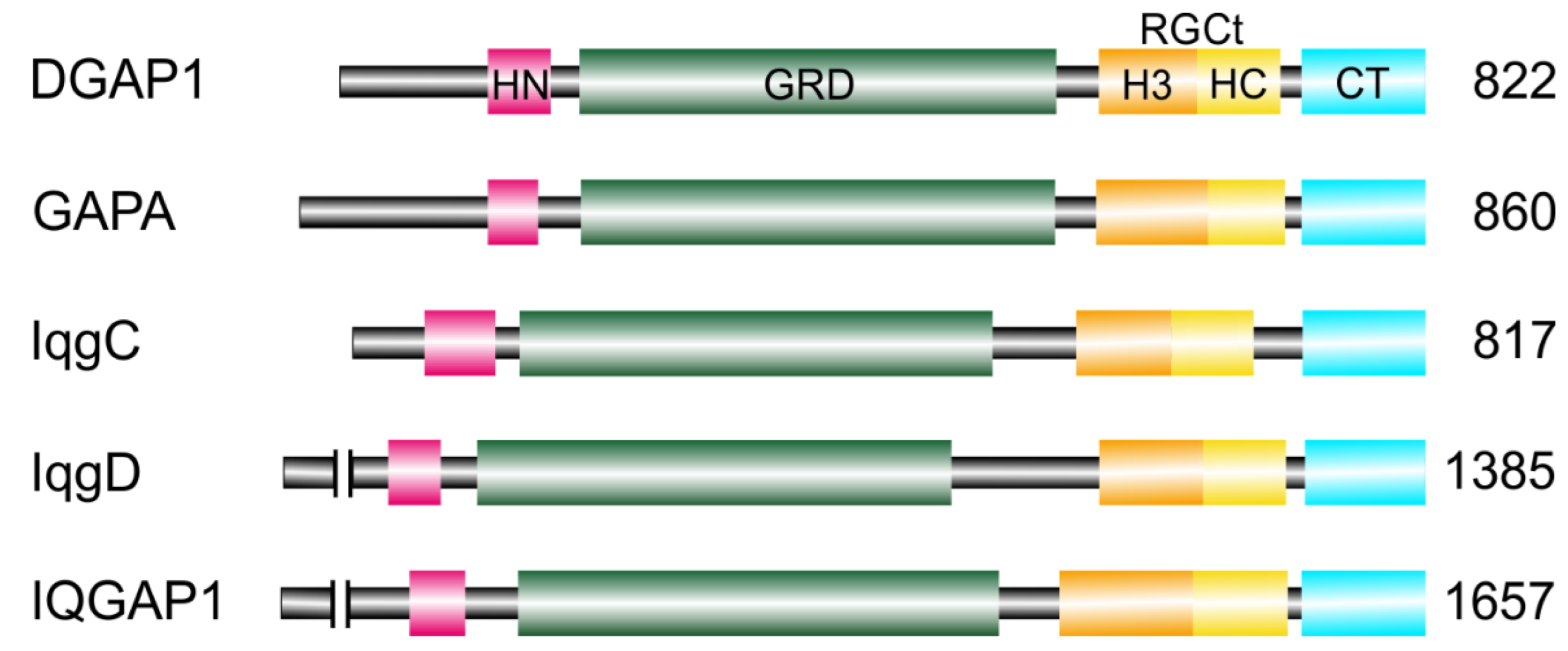

Table 1.
Amino acid stretches corresponding to the N-terminal helix (HN), GAP-related domain (GRD), triple helix in the RGCt domain (RGCt-H3), C-terminal helix in RGCt (RGCt-HC), and C-terminus (CT), as shown in Figure 1.
Table 1.
Amino acid stretches corresponding to the N-terminal helix (HN), GAP-related domain (GRD), triple helix in the RGCt domain (RGCt-H3), C-terminal helix in RGCt (RGCt-HC), and C-terminus (CT), as shown in Figure 1.
| HN | GRD | RGCt-H3 | RGCt-HC | CT | |
|---|---|---|---|---|---|
| DGAP1 | 110–157 | 180–544 | 576–651 | 652–715 | 730–822 |
| GAPA | 144–181 | 215–577 | 610–694 | 695–754 | 766–860 |
| IqgC | 53–106 | 126–487 | 552–625 | 626–687 | 725–817 |
| IqgD | 593–632 | 661–1016 | 1136–1214 | 1215–1279 | 1294–1385 |
| IQGAP1 | 880–922 | 963–1331 | 1377–1478 | 1479–1540 | 1561–1657 |
Disclaimer/Publisher’s Note: The statements, opinions and data contained in all publications are solely those of the individual author(s) and contributor(s) and not of MDPI and/or the editor(s). MDPI and/or the editor(s) disclaim responsibility for any injury to people or property resulting from any ideas, methods, instructions or products referred to in the content. |
© 2026 by the authors. Licensee MDPI, Basel, Switzerland. This article is an open access article distributed under the terms and conditions of the Creative Commons Attribution (CC BY) license (http://creativecommons.org/licenses/by/4.0/).
Copyright: This open access article is published under a Creative Commons CC BY 4.0 license, which permit the free download, distribution, and reuse, provided that the author and preprint are cited in any reuse.


