

Submitted:
16 April 2026
Posted:
17 April 2026
You are already at the latest version
Abstract
The availability of publicly available genetic data has the potential to accelerate medication repurposing efforts. In this study by integrating GWAS summary statistics for medication use with phenome data, Mendelian randomization and genetic correlation analyses were performed to find significant medication-trait associations. Genetic predisposition to paracetamol use was associated with a cluster of affective traits and alcohol intake. Examination of eQTL data revealed genes at 17q21 regions have pleiotropic effects on both paracetamol use and the identified traits. A second signal was identified between levothyroxine use and diabetes. Subjects that were genetically predisposed to use levothyroxine were at higher risk to develop diabetes. Conditional analysis indicates the use of levothyroxine will likely lower the risk of diabetes by lowering body weight. Findings from eQTL analysis identified several genes at HLA regions that exert pleiotropic effect on both traits.Our findings suggest that paracetamol warrants further investigation for the treatment of affective disorders and alcoholism, while levothyroxine may offer protective benefits against diabetes via weight modulation.
Keywords:
PheWAS
; GWAS
; medication repurposing
; paracetamol
; levothyroxine
; mechanism
Introduction
Drug repurposing offers a highly efficient strategy for accelerating therapeutic development by leveraging existing compounds with known safety, pharmacokinetic, and manufacturing profiles. This substantially reduces the time, cost, and risk associated with traditional de novo drug discovery. In this context, the availability of genetic data and computational resources have the potential to substantially accelerate these efforts. Previous studies have supported the role of genetic findings in drug discovery. It is estimated that drug targets supported by genetic results are more than twice as likely to be approved [1,2]. Genetic findings are robust to environmental confounding, this is because the distribution of SNP alleles from the parents to the offspring is a random process (unaffected by environmental factors); furthermore, genetic analyses can elucidate the molecular pathways through which a medication influences a disorder. Such insights have the potential to minimize the medication side effects and increase its efficacy.
In the current era, the availability of GWAS data for various traits including medication use and computational tools that can infer the relationship between two phenotypes by jointly analyzing their GWAS data has opened the possibility to find new applications for existing medications. Moving in this direction, the aim of this study is to search for new therapeutic applications for medications recorded in UK Biobank. For this purpose, we investigated the association of medications with phenome data by conducting Mendelian randomization and genetic correlation analysis. Next, for significant findings transcriptome-wide association studies were performed to investigate the potential molecular path through which a medication influences its phenotype target.
Methods
Figure 1 provides an overview of the analysis plan used in this study. Initially, genome-wide association summary statistics for medication use were obtained from Wu et al. [3] in which the authors obtained data for 1,809 medications from UK Biobank. Next they clumped the data into 23 categories based on Anatomical Therapeutic Chemical Classification System and subsequently conducted GWAS and provided public access to the GWAS summary statistics for 23 categories. After obtaining these data, initially I screened for medication use-phenotype pairs that share at least a SNP (P<5e-8). The list derived from this step was further pruned to keep medication use-phenotype pairs that are novel. For this purpose, the traditional application of medication was matched to its identified phenotype and pairs that deemed related were pruned out. Next, Mendelian randomization (MR) was used to test if genetic predisposition to the medication use influences the phenotype. MR analysis was performed using GSMR algorithm [4]. As compared to other methods for MR analysis, GSMR automatically detects and removes SNPs that have a pleiotropic effect on both exposure and outcome; in addition, it accounts for the sampling variance in beta estimates and the LD among SNPs; as such, it is statistically more powerful than other MR approaches [4]. The degree of linkage disequilibrium between SNPs were calculated using the genotype data from the 1000 genomes (n = 503 of European ancestry). To select a set of SNPs for MR analysis, the following criteria were applied.
- a)
- SNPs must be associated with exposure at GWAS significance level (P < 5e-8).
- b)
- The degree of linkage disequilibrium between SNPs must not exceed r2>0.05.
- c)
- SNPs must not show pleiotropic effect (i.e., Exposure ← SNP → Outcome). For this purpose, pleiotropic SNPs were excluded using HEIDI test (P<0.01) implemented in GSRM algorithm.
Significant findings (P<5e-8) from MR analysis were once more re-investigated by conducting genetic correlation analysis. Unlike Mendelian randomization that uses a specific set of SNPs to test if change in the exposure influences the outcome. Genetic correlation is a holistic approach; it uses information from all SNPs to calculate the degree of genetic similarity between the two traits. Genetic correlation test was conducted using the R package, HDL (version 1.4.0) [5] which is a likelihood-based method for estimating genetic correlation (rg) using GWAS summary statistics. The method takes into account the degree of linkage disequilibrium among SNPs as such it provides more precise estimate of rg. For the purpose of this study, we used the pre-computed UK Biobank imputed HapMap3 reference panel provided by the authors. Following genetic correlation analysis, medication use-phenotype pairs that showed significant effect were selected (P<5e-8). Furthermore, the findings were compared with MR findings and medication use-phenotype pairs that show concordant effects between the two sets of results were selected.
To investigate the molecular interface shared between a medication use and a phenotype, transcriptome-wide association study (TWAS) was performed. For this purpose, an initial search was conducted in eQTLGen database [6] to identify genes that share at least an eQTL (P<5e-8) with the medication use. Next, Mendelian randomization was used to test if change in expression of a gene influences the medication use. Significant findings were once more re-investigated using eQTL data from INTERVAL study [7]. Finally, the significant findings from this step were selected and their associations with the target phenotype were investigated.
Conditional analysis was also used to test if the influence of a medication on a disease is mediated by an intermediary phenotype (covariate). For this purpose, the GWAS summary statistic for the disease was adjusted for the effect of covariate using the mtCOJO algorithm [4], next, the degree of correlation between the medication use and the disease was re-computed. mtCOJO algorithm requires only the GWAS summary statistics to take into account the influence of a covariate and is known to be free of bias due to shared environmental or genetic effects.
Results
By following the analysis plan described in Figure 1, association signals were detected between anilides use and affective traits. Notable signals were also detected between thyroid preparations and diabetes (S1 Table). Given that in the initial study, Wu et al. [3] reported GWAS summary statistics for medication use by clumping medications into 23 major categories. Therefore, to pinpoint the specific medications that are responsible for the observed effects. GWAS summary statistics for medications were obtained from UK Biobank, next, Mendelian randomization and genetic correlation analysis were performed to identify medications that are responsible for the observed effects. I found the observed signals between anilides use and affective traits are attributed to paracetamol; while, the associations between thyroid preparations and diabetes are attributed to levothyroxine use. In the following sections, I detail the findings.
Paracetamol and Affective Traits
The outcome of Mendelian randomization analysis indicated subjects that are genetically predisposed to use paracetamol also are suceptible to a cluster of negative affective traits including depressed affect, worry feelings, mood swings, fed-up feelings, neuroticism, frequency of tenseness / restlessness, and alcohol intake. These positive associations were also confirmed by conducting genetic correlation analysis (Table 1).
Next, by integrating eQTL data from the eQTLGen study, TWAS analysis was conducted to identify genes that contribute to paracetamol use. The significant findings (P<5e-8) were further re-investigated using eQTL data from the INTERVAL study. A total of 6 genes were identified whose change in their expressions contributed to the use of paracetamol (Table 2). Two of these genes, CSNK2B and VARS2 were located on HLA region. An application of paracetamol is to reduce inflammation. Therefore, the observed association is plausible, as HLA region is the most important genomic region in managing inflammation and other immune responses. The remaining genes, CRHR1-IT1, KANSL1-AS1, LRRC37A2 and RP11-259G18.3 were all located at 17q21.32 region. Next, Mendelian randomization was used to test the impact of the identified genes on affective traits. The outcome of analyses underlined the association of genes at 17q21.32 region with psychological traits (Figure 2). Findings from both the discovery and validation steps, indicated higher expressions of CRHR1-IT1, KANSL1-AS1, LRRC37A2 and RP11-259G18.3 contribute to higher likelihood of depressed affect, worry feelings, mood swings, fed-up feelings, neuroticism, frequency of tenseness / restlessness, and alcohol intake (Figure 2).
Previous studies documented microdeletion at 17q21.32 region causes Koolen-De Vries Syndrome (KDVS) which is characterized by psychomotor developmental delay and mild to moderate intellectual disability [8]. Investigating the function of these genes indicated CRHR1-IT1, KANSL1-AS1, and LRRC37A2 have neural attributes. KANSL1-AS1 is the Antisense RNA 1 for KANSL1 gene which is considered to be the key gene in KDVS syndrome. CRHR1-IT1 is the long coding RNA transcribed from intron 1 of corticotropin-releasing hormone receptor 1 (CRHR1). LRRC37A2 is predicted to be involved in SNARE complex disassembly.
Levothyroxine and Cardiometabolic Traits
The outcome of MR analysis indicated subjects that are genetically predisposed to use levothyroxine are at higher risk of diabetes (B=0.15, P=1.1e-29, Figure 3). Findings from genetic-correlation analysis also indicated positive correlation between the two features (rg=0.16, P=2.2e-9). Conditional analysis indicated the connection between levothyroxine use and diabetes is possibly mediated by BMI. As adjusting diabetes data for the influence of BMI significantly attenuated the genetic correlation between levothyroxine use and diabetes (rg=0.09, P=5e-3).
By conducting TWAS analysis, we identified 37 genes contributing to levothyroxine use (S2 Table). 27 of these genes were located at HLA region highlighting the immune origin of hypothyroidism. By investigating the association of these genes with diabetes, we identified 8 genes within HLA region that also showed significant impact on diabetes. Higher expression of genes, ATF6B, HLA-DQB1-AS1, HLA-DQB1, HLA-DQB2 were contributing positively to the risk of diabetes and levothyroxine use, whereas higher expression of FLOT1, IER3, TNF, C4A were contributing negatively to the risk of diabetes and levothyroxine use (Figure 3). Among these genes, the influence of HLA-DQB1 on diabetes is well-known. It encodes the beta chain of the DQ receptor, a cell surface receptor that presents antigens to T-cells. Specific variations in this gene is contributing to autoimmune attack on insulin-producing beta cells [9]. TNF-alpha is a potent pro-inflammatory cytokine. It is implicated in the autoimmune destruction of beta cells; furthermore, it contributes to insulin resistance in Type 2 Diabetes (T2D) by interfering with insulin signaling [10]. The influence of C4A on diabetes has been underlined by previous studies. C4A influence on diabetes appears to be attributed to its autoimmune function. Genetic deficiency or reduced expression of C4A increases susceptibility to islet autoimmunity, while higher C4A levels appear protective for β-cell function early in disease [11].
Discussion
In this study by integrating publicly available GWAS data for medication use with phenome data, a series of analyses were performed to investigate potential applications of medications recorded in UK Biobank for novel purposes. I noted subjects that are genetically susceptible to use paracetamol are at higher risk for negative affective traits such as depressed affect, worry feelings, mood swings, fed-up feelings, neuroticism, frequency of tenseness / restlessness, and alcohol intake. The interpretation of these findings is that by compensating for biological deficiencies that contribute to negative states, the use of paracetamol is expected to have favorable mental effects. A substantial body of laboratory-based work suggests that paracetamol exerts effects on psychosocial traits including, reduced social pain and distress responses [12], blunting of emotional reactivity [13] and attenuation of empathy-related neural responses [14]. The possible influence of paracetamol use on reducing the frequency of alcohol intake has not been studied before. However, considering the existing evidence, paracetamol appears to be able to act as a substitute for alcohol, because both substances can influence affective states; furthermore, it has been documented that paracetamol converts into AM404 in the brain which acts on the vanilloid and endocannabinoid system [15]. Because the endocannabinoid system is heavily involved in the reward pathways of alcohol; therefore, paracetamol could potentially modify the alcohol use behavior.
By integrating eQTL data through a two-step discovery and validation, we identified genes at 17q21 likely mediate the influence of using paracetamol on the identified trait. In this regard, CRHR1-IT1 is notable, as it encodes an antisense RNA for Corticotropin-releasing hormone receptor 1 (CRHR1). The influence of CRH on moods has been well studied. CRH is a central orchestrator of the stress response, and its actions extend deeply into emotional regulation. Elevated CRH activity particularly within limbic regions has been consistently linked to heightened anxiety, altered emotional processing, and vulnerability to mood disorders. KANSL1-AS1 is also notable as it encodes an antisense RNA for KANSL1 gene which is reported to contribute to neural disorders such as Koolen-De Vries Syndrome and Adenylosuccinase deficiency.
Another notable signal was the association between levothyroxine use and risk of diabetes. Subjects that were genetically predisposed to use levothyroxine were at higher risk to develop diabetes. Therefore, by treating biological deficiencies that causes hypothyroidism, use of levothyroxine is expected to lower the risk of diabetes. The underlying mechanism remains to be investigated; however, it is known that levothyroxine use lowers body weight, primarily through the loss of excess water weight and improved lipid profiles [16,17] and this could be the underlying mechanism. The outcome of conditional analysis performed in this study also confirmed this effect. The magnitude of genetic correlation between levothyroxine use and diabetes significantly attenuated after adjusting the diabetes data for the effect of BMI. The outcome of TWAS analysis identified 27 genes at HLA region that contribute to the use of levothyroxine. This is in agreement with existing knowledge. Certain HLA alleles present thyroid antigens in a way that triggers an autoimmune response to thyroid tissue and this consequently leads to hypothyroidism and subsequent metabolic outcomes. Therefore, by restoring the levels of thyroid hormones, levothyroxine compensates for genetic deficiencies at HLA region.
In this study, by integrating eQTL data, we were able to investigate the molecular mechanisms whereby a medication influences a trait. Obtaining such insights are important for downstream applications such as minimizing medications side effects and improving efficacies. The current available eQTL data are mainly limited to blood. Although blood is a good proxy for other tissues; it is important to conduct TWAS by considering eQTL data from all tissues. This allows to better pinpoint the tissue and the mechanism responsible for the observed effect. Although GTEX has generated tissue specific eQTL data, its small sample size still limits its application to gene finding studies.
In summary, by integrating publicly available GWAS data, this study reported novel applications for paracetamol and levothyroxine use; furthermore, by leveraging eQTL data, the underlying molecular interfaces were investigated. Findings of this study call for conducting more GWAS studies of medication use and extending these efforts to less commonly prescribed medications as this could lead to new therapeutic prospects. Having access to tissue specific QTLs will also be valuable in understanding the molecular mechanism whereby a medication exerts its impact.
Supplementary Materials
The following supporting information can be downloaded at the website of this paper posted on Preprints.org.
References
- Nelson, M. R.; et al. The support of human genetic evidence for approved drug indications. Nat. Genet. 2015, 47, 856–860. [Google Scholar] [CrossRef] [PubMed]
- King, E. A.; Davis, J. W.; Degner, J. F. Are drug targets with genetic support twice as likely to be approved? Revised estimates of the impact of genetic support for drug mechanisms on the probability of drug approval. PLoS Genet. 2019, 15, e1008489. [Google Scholar] [CrossRef] [PubMed]
- Wu, Y.; et al. Genome-wide association study of medication-use and associated disease in the UK Biobank. Nat. Commun. 2019, 10, 1891. [Google Scholar] [CrossRef] [PubMed]
- Zhu, Z.; et al. Causal associations between risk factors and common diseases inferred from GWAS summary data. Nat. Commun. 2018, 9, 224. [Google Scholar] [CrossRef] [PubMed]
- Ning, Z.; Pawitan, Y.; Shen, X. High-definition likelihood inference of genetic correlations across human complex traits. Nat. Genet. 2020, 52, 859–864. [Google Scholar] [CrossRef] [PubMed]
- Võsa, U.; et al. Large-scale cis- and trans-eQTL analyses identify thousands of genetic loci and polygenic scores that regulate blood gene expression. Nat. Genet. 2021, 53, 1300–1310. [Google Scholar] [CrossRef] [PubMed]
- Xu, Y.; et al. An atlas of genetic scores to predict multi-omic traits. Nature 2023, 616, 123–131. [Google Scholar] [CrossRef] [PubMed]
- Koolen-de Vries syndrome: MedlinePlus Genetics. Available online: https://medlineplus.gov/genetics/condition/koolen-de-vries-syndrome/.
- Noble, J. A.; Erlich, H. A. Genetics of type 1 diabetes. Cold Spring Harb. Perspect. Med. 2012, 2, a007732. [Google Scholar] [CrossRef] [PubMed]
- Borst, S. E. The role of TNF-α in insulin resistance. Endocrine 2004, 23, 177–182. [Google Scholar] [CrossRef] [PubMed]
- Aydemir, O.; et al. Polymorphisms in intron 1 of HLA-DRA differentially associate with type 1 diabetes and celiac disease and implicate involvement of complement system genes C4A and C4B. eLife 2026, 12, RP89068. [Google Scholar] [CrossRef] [PubMed]
- DeWall, C. N.; et al. Acetaminophen reduces social pain: Behavioral and neural evidence. Psychol. Sci. 2010, 21, 931–937. [Google Scholar] [CrossRef] [PubMed]
- Durso, G. R. O.; Luttrell, A.; Way, B. M. Over-the-Counter Relief From Pains and Pleasures Alike: Acetaminophen Blunts Evaluation Sensitivity to Both Negative and Positive Stimuli. Psychol. Sci. 2015, 26, 750–758. [Google Scholar] [CrossRef] [PubMed]
- Mischkowski, D.; Crocker, J.; Way, B. M. A Social Analgesic? Acetaminophen (Paracetamol) Reduces Positive Empathy. Front. Psychol. 2019, 10, 538. [Google Scholar] [CrossRef] [PubMed]
- Mallet, C.; Desmeules, J.; Pegahi, R.; Eschalier, A. An Updated Review on the Metabolite (AM404)-Mediated Central Mechanism of Action of Paracetamol (Acetaminophen): Experimental Evidence and Potential Clinical Impact. J. Pain Res. 2023, 16, 1081–1094. [Google Scholar] [CrossRef] [PubMed]
- Pearce, E. N. Thyroid hormone and obesity. Curr. Opin. Endocrinol. Diabetes Obes. 2012, 19, 408. [Google Scholar] [CrossRef] [PubMed]
- Ostadrahimi, A.; et al. Effects of levothyroxine replacement therapy on insulin resistance in patients with untreated primary hypothyroidism. BMC Res. Notes 2023, 16, 237. [Google Scholar] [CrossRef] [PubMed]
Figure 1.
Overview of the analysis plan that was used in this study to identify novel applications for medications recorded in UK Biobank. Initially a search was performed to identify phenotypes that share at least a SNP (P<5e-8) with a medication, then Mendelian randomization was used to find medication-trait pairs that are causally associated. The retrieved list was further pruned by conducting genetic correlation analysis and removing medication-trait pairs that do not show significant correlation. Finally, TWAS analysis was performed to investigate molecular interface between the medication and the trait.
Figure 1.
Overview of the analysis plan that was used in this study to identify novel applications for medications recorded in UK Biobank. Initially a search was performed to identify phenotypes that share at least a SNP (P<5e-8) with a medication, then Mendelian randomization was used to find medication-trait pairs that are causally associated. The retrieved list was further pruned by conducting genetic correlation analysis and removing medication-trait pairs that do not show significant correlation. Finally, TWAS analysis was performed to investigate molecular interface between the medication and the trait.
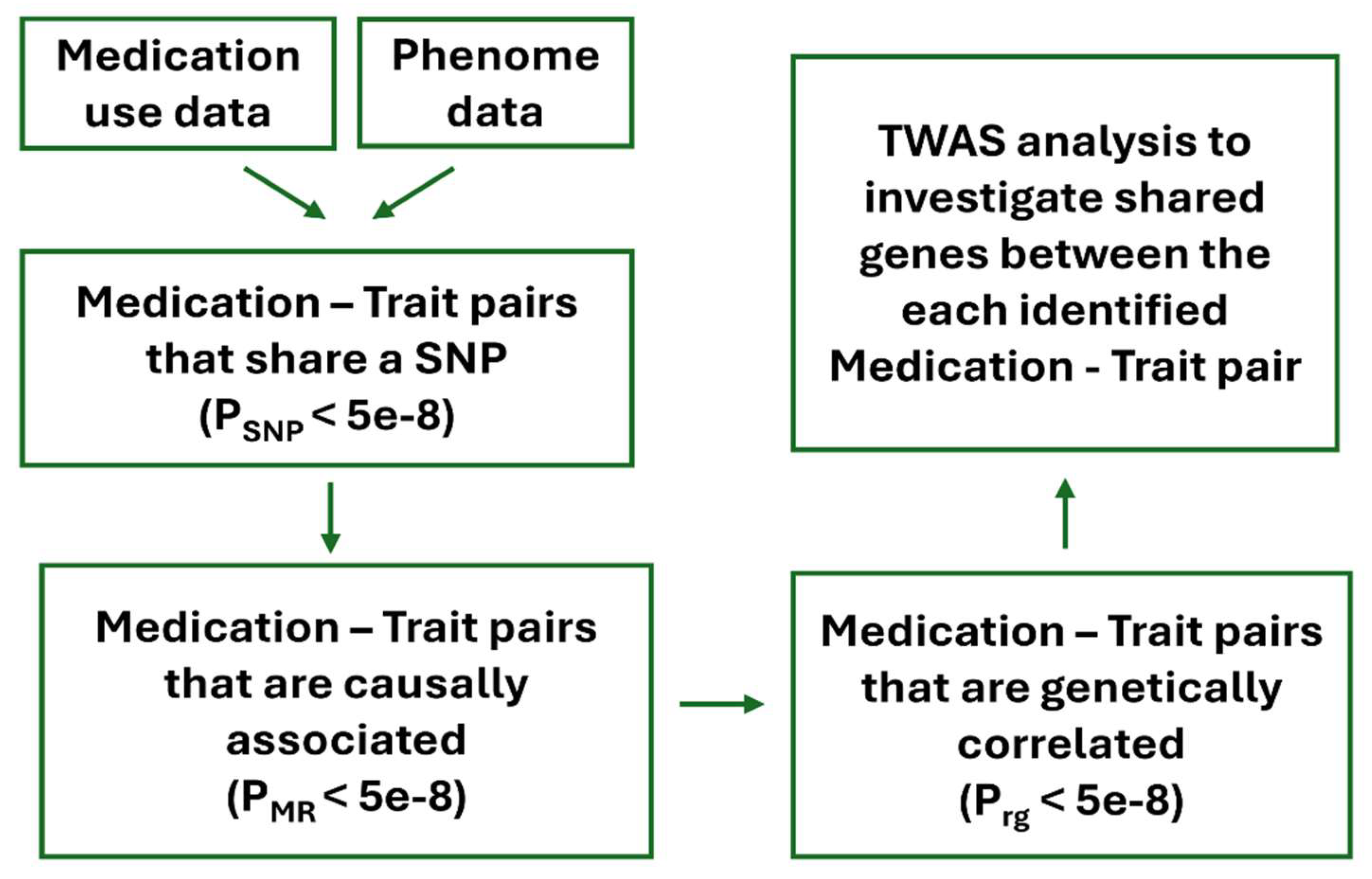
Figure 2.
The influence of genes identified at 17q21 on affective traits. Following TWAS analysis in the discovery and validation panels, four genes were identified whose change in expression influences both paracetamol use (Table 2) and affective traits. Bar plots indicate effect sizes (regression coefficients) derived from Mendelian randomizations and the error bars at the top indicate standard errors around effect sizes.
Figure 2.
The influence of genes identified at 17q21 on affective traits. Following TWAS analysis in the discovery and validation panels, four genes were identified whose change in expression influences both paracetamol use (Table 2) and affective traits. Bar plots indicate effect sizes (regression coefficients) derived from Mendelian randomizations and the error bars at the top indicate standard errors around effect sizes.
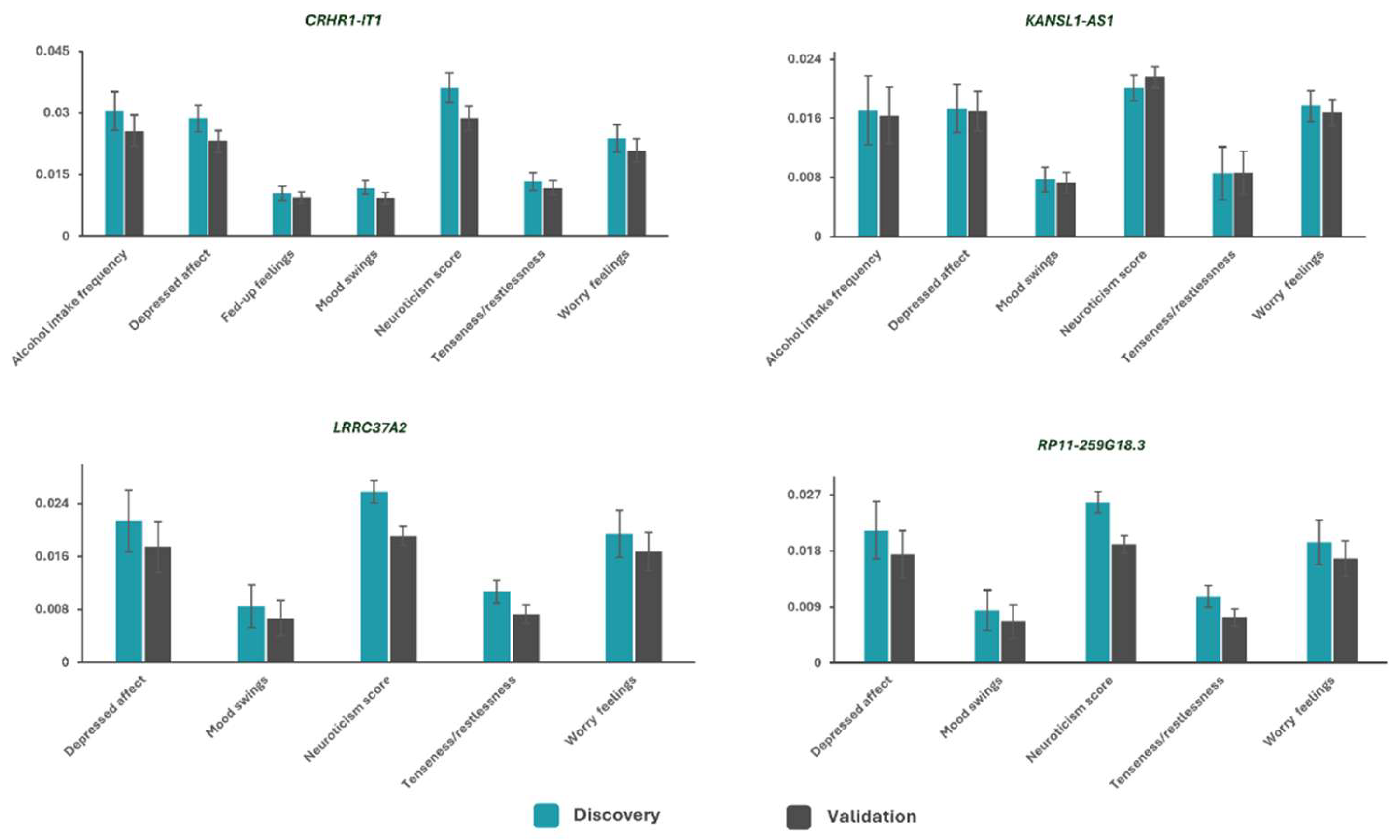
Figure 3.
The connection between levothyroxine and diabetes. a) The outcome of Mendelian randomization indicates subjects that are genetically predisposed to use levothyroxine are at higher risk for diabetes. Points on MR plots represent SNPs; the x-value of a SNP is its effect size (β) on the levothyroxine use, and the horizontal error bar indicates its standard error. Similarly, the y-value of the SNP indicates its effect size on the diabetes risk, and the vertical error bar indicates the standard error. The dashed line represents the line of best fit (a line with the intercept of 0 and the slope of β from the MR test). b) Following TWAS analysis 8 genes were identified whose change in expression influences both levothyroxine use (S2 Table) and diabetes. For each gene the statistics provided in the first row is from the discovery panel (eQTLGen) and the statistics provided in the second row is from the validation panel (INTERVAL).
Figure 3.
The connection between levothyroxine and diabetes. a) The outcome of Mendelian randomization indicates subjects that are genetically predisposed to use levothyroxine are at higher risk for diabetes. Points on MR plots represent SNPs; the x-value of a SNP is its effect size (β) on the levothyroxine use, and the horizontal error bar indicates its standard error. Similarly, the y-value of the SNP indicates its effect size on the diabetes risk, and the vertical error bar indicates the standard error. The dashed line represents the line of best fit (a line with the intercept of 0 and the slope of β from the MR test). b) Following TWAS analysis 8 genes were identified whose change in expression influences both levothyroxine use (S2 Table) and diabetes. For each gene the statistics provided in the first row is from the discovery panel (eQTLGen) and the statistics provided in the second row is from the validation panel (INTERVAL).
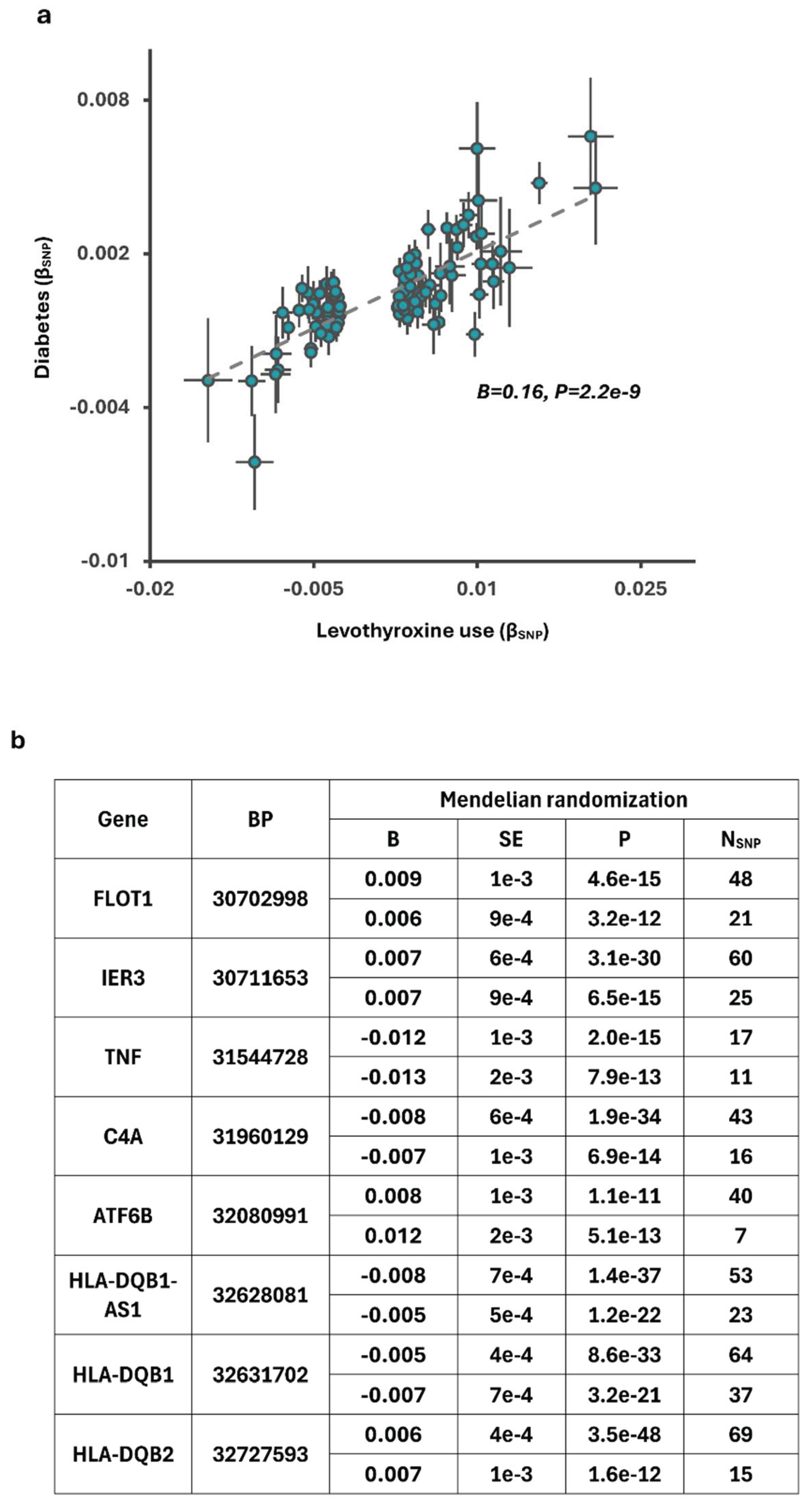

Table 1.
Psychological traits that show significant association with paracetamol use following Mendelian randomization and genetic correlation analysis.
Table 1.
Psychological traits that show significant association with paracetamol use following Mendelian randomization and genetic correlation analysis.
| Trait | Source | Mendelian randomization | Genetic correlation | |||||
| Beta | SE | P | NSNPs | rg | SE | P | ||
| Depressed affect | PMID: 29942085 | 1.0 | 0.1 | 1.2E-13 | 12 | 0.5 | 0.03 | 1.5E-82 |
| Worry feelings | PMID: 29942085 | 1.0 | 0.1 | 4.0E-20 | 15 | 0.3 | 0.02 | 1.2E-31 |
| Mood swings | UKBB | 0.7 | 0.1 | 6.9E-29 | 13 | 0.5 | 0.02 | 6.1E-100 |
| Fed-up feelings | UKBB | 0.6 | 0.1 | 1.8E-24 | 15 | 0.5 | 0.03 | 4.9E-87 |
| Neuroticism score | UKBB | 1.2 | 0.2 | 1.3E-14 | 11 | 0.4 | 0.02 | 1.4E-69 |
| Frequency of tenseness / restlessness in last 2 weeks | UKBB | 0.7 | 0.1 | 1.1E-20 | 14 | 0.4 | 0.03 | 1.1E-55 |
| Alcohol intake frequency | UKBB | 1.7 | 0.2 | 1.0E-22 | 14 | 0.3 | 0.02 | 1.8E-62 |
Table 2.
The outcome of TWAS, genes that significantly contributed to the use of paracetamol in both the discovery and the validation steps1.
Table 2.
The outcome of TWAS, genes that significantly contributed to the use of paracetamol in both the discovery and the validation steps1.
| Gene information | Mendelian randomization | |||||
| Chr | bp | Symbol | B | SE | P | NSNP |
| 6 | 30885127 | VARS2 | 0.011a | 0.002 | 2.5E-10 | 18 |
| 0.016b | 0.002 | 1.1E-11 | 21 | |||
| 6 | 31635566 | CSNK2B | -0.026 | 0.005 | 4.6E-08 | 5 |
| -0.038 | 0.007 | 2.8E-08 | 8 | |||
| 17 | 43711638 | CRHR1-IT1 | 0.007 | 0.001 | 2.9E-09 | 35 |
| 0.008 | 0.001 | 4.6E-09 | 31 | |||
| 17 | 44272515 | KANSL1-AS1 | 0.005 | 0.001 | 6.5E-10 | 27 |
| 0.004 | 0.001 | 1.8E-08 | 36 | |||
| 17 | 44337444 | RP11-259G18.3 | 0.009 | 0.002 | 4.2E-08 | 13 |
| 0.005 | 0.001 | 3.4E-09 | 35 | |||
| 17 | 44610946 | LRRC37A2 | 0.005 | 0.001 | 9.1E-10 | 26 |
| 0.005 | 0.001 | 4.1E-08 | 32 | |||
1 For each gene the statistics provide in the first row is from the discovery step and the statics provided in the second row is from the validation step.
Disclaimer/Publisher’s Note: The statements, opinions and data contained in all publications are solely those of the individual author(s) and contributor(s) and not of MDPI and/or the editor(s). MDPI and/or the editor(s) disclaim responsibility for any injury to people or property resulting from any ideas, methods, instructions or products referred to in the content. |
© 2026 by the authors. Licensee MDPI, Basel, Switzerland. This article is an open access article distributed under the terms and conditions of the Creative Commons Attribution (CC BY) license (http://creativecommons.org/licenses/by/4.0/).
Copyright: This open access article is published under a Creative Commons CC BY 4.0 license, which permit the free download, distribution, and reuse, provided that the author and preprint are cited in any reuse.


