

Submitted:
16 April 2026
Posted:
17 April 2026
You are already at the latest version
Abstract
The increasing reliance on digital infrastructures has made electronic records management systems (ERMS) essential for ensuring organisational governance, accountability, and effective service delivery. This study presents a structured qualitative literature review of ERMS implementation across developed and developing contexts, with the aim of identifying key determinants, recurring challenges, and contextual variations in adoption patterns. Drawing on studies published between 2010 and 2024, the review adopts a socio-technical analytical framework that categorises ERMS implementation determinants into organisational, technological, and environmental dimensions. The findings reveal that successful implementation depends on the alignment of governance and policy frameworks (environmental), technological infrastructure and system capabilities (technological), and human resource capacity and organisational culture (organisational). The analysis further demonstrates that these determinants are highly interdependent and vary across contexts. In developing environments, implementation is primarily constrained by infrastructural limitations, financial constraints, and shortages of technical expertise. In contrast, in more digitally mature contexts, challenges shift toward system interoperability, usability, and metadata standardisation. This study contributes to the literature by providing an integrated analytical framework that synthesises fragmented empirical findings and advances a more structured understanding of ERMS implementation as a sociotechnical process. The findings offer practical implications for policymakers and institutions seeking to strengthen digital records management and information governance. Future research should prioritise longitudinal and cross-national studies to further advance theoretical development in this field.
Keywords:
electronic records management systems
; ERMS implementation
; digital governance
; records management
; information governance
1. Introduction
The rapid expansion of digital technologies has significantly transformed how organisations generate, manage, and store information. In both the public and private sectors, digital records increasingly serve as primary evidence of institutional transactions, decisions, and administrative processes. Therefore, the effective management of these records is essential for ensuring transparency, accountability, regulatory compliance, and organisational continuity. Electronic record management systems (ERMS) have emerged as structured technological frameworks for managing records throughout their lifecycle, including creation, classification, storage, retrieval, and eventual disposition or destruction (Adam, 2007; Abernethy et al., 2022). Scholars have emphasised that ERMS should not be viewed merely as technical storage solutions; rather, they function as governance mechanisms that support organisational memory, regulatory compliance, and informed decision-making within institutions (Franks, 2013; Smallwood, 2014).
The importance of effective ERMS implementation has increased substantially with the expansion of digital service delivery models adopted by governments worldwide (Dehghan et al., 2026; Danso et al., 2024). As McDonald (2010) and White (2024) observed, the boundaries between traditional record management and broader data management practices are increasingly blurred. Consequently, digital recordkeeping now plays a strategic role in contemporary information governance frameworks. Despite the growing importance of ERMS, adoption and implementation patterns vary considerably across national contexts (Ngutshane & Molepo, 2025). Developed countries generally operate within mature digital ecosystems supported by established regulatory frameworks, advanced technological infrastructures, and strong institutional capacities (Hossain et al., 2025; Junaid et al., 2022). In contrast, developing countries often encounter significant challenges, including limited technological infrastructure, financial constraints, and shortages of skilled personnel, which complicate both adoption and long-term sustainability (Butt et al., 2021).
Empirical studies illustrate these contextual differences. For example, Butt et al. (2021) identified organisational and technological barriers affecting ERMS implementation in Pakistan. Conversely, research conducted in technologically advanced environments, such as Turkey, has primarily focused on improving system interoperability, usability, and long-term digital preservation rather than addressing fundamental infrastructure deficiencies (Dişli & Külcü, 2022; Öztemiz, 2019). These findings indicate that contextual technological, organisational, and institutional factors strongly shape ERMS implementation. Although research on ERMS implementation has expanded in recent years, the existing literature remains fragmented. Many studies have focused on individual institutions or sector-specific case studies, limiting opportunities for a structured review comparison. Touray (2021) observed that empirical findings in records management research are rarely synthesised to enable broader interregional analysis. Similarly, Yang et al. (2020) argued that greater conceptual consolidation is required to better understand the systemic mechanisms driving digital transformation in records management.
This study addresses this gap through a structured qualitative literature review of ERMS implementation research. The review synthesises empirical and conceptual studies to identify key determinants influencing ERMS implementation across institutional and national contexts. By applying thematic synthesis to the reviewed literature, this study seeks to provide an integrated analytical perspective on the determinants of ERMS implementation and their implications for digital governance and records management practices.
This study identified the dominant determinants of implementation, examined recurring challenges, and explored contextual variations across national environments. This study seeks to address the following research questions:
- What key themes and determinants have emerged in the ERMS implementation literature?
- How do implementation patterns differ between developed and developing contexts?
- What methodological and theoretical gaps exist in the current body of ERMS research?
This study adopts a structured analytical perspective by categorising ERMS implementation determinants into organisational, technological, and environmental dimensions, consistent with socio-technical and information systems research.
The remainder of this paper is structured as follows. Section 2 reviews the conceptual foundations of ERMS and summarises the key determinants identified in previous studies. Section 3 outlines the research methodology employed in the structured literature review. Section 4 presents the results of the thematic analysis. Section 5 discusses the implications of the findings for theory and practice, and Section 6 concludes the paper with recommendations for future research.
2. Literature Review
2.1. Conceptual Foundations of ERMS
Electronic record management systems (ERMS) are designed to manage digital records systematically throughout the record lifecycle while ensuring compliance with established governance standards and regulatory frameworks (Gelashvili, 2020). According to ISO 15489, record management encompasses processes for the creation, capture, classification, storage, retrieval, and disposition of records (Mukred et al., 2018; Mwogosi & Kibusi, 2024). These processes ensure that records remain authentic, reliable, and usable throughout their lifecycle. Beyond technical functionality, ERMS incorporate governance mechanisms, such as policy frameworks, metadata standards, access controls, and audit trails, to ensure the integrity and reliability of records over time (Franks, 2013; Saffady, 2014; Koyuncu Tunç, 2025). These features are essential for maintaining accountability and regulatory compliance in digital information environments.
The transition from paper-based recordkeeping to digital systems has significantly transformed records management practices. Early electronic systems primarily replicated storage functions, whereas contemporary ERMS integrate workflow automation, compliance monitoring, and interoperability capabilities (McDonald, 2010; Matlala & Ncube, 2024). As McLeod (2008) notes, effective digital recordkeeping requires alignment between information systems architecture and recordkeeping requirements because technological infrastructure influences how records are generated, maintained, and preserved. This transformation has repositioned records management as a strategic component of information governance rather than merely an administrative function (Abdulkadir et al., 2024). Consequently, ERMS are increasingly conceptualised as sociotechnological systems shaped by interactions among technological infrastructure, organisational culture, institutional capacity, and regulatory environments (Julaihi et al., 2024).
Long-term digital preservation, for example, requires not only an appropriate technological infrastructure but also institutional competencies and coherent policy frameworks (Kandur, 2017). Similarly, Mukred et al. (2019) applied the unified theory of acceptance and use of technology (UTAUT) to demonstrate that performance expectancy, effort expectancy, social influence, and facilitating conditions significantly influence ERMS adoption in organisational settings. These findings suggest that successful ERMS implementation requires alignment between technological capabilities, governance frameworks, and organisational readiness. Therefore, ERMS adoption should be understood as a sociotechnical process in which technological systems, institutional policies, and human capacities interact to shape implementation outcomes.
2.2. Implementation Determinants and Challenges
Empirical research on electronic records management systems (ERMS) consistently identifies multiple determinants influencing successful implementation. To enhance analytical clarity, these determinants can be broadly categorised into organizational, technological, and environmental (institutional) factors, a classification commonly applied in information systems and digital governance research. Although these categories are analytically distinct, the literature emphasises that ERMS implementation is inherently socio-technical, requiring alignment across all domains.
Organizational determinants include governance structures, managerial support, human resource capacity, and organisational readiness. Empirical studies consistently highlight the importance of organisational support in shaping ERMS adoption. For example, Hawash et al. (2020) emphasise the role of managerial commitment and organisational readiness in influencing ERMS adoption in Yemen’s oil and gas sector. Similarly, Mukred et al. (2019) demonstrate that factors, such as performance expectancy, effort expectancy, and facilitating conditions, significantly affect user acceptance and system use. In the public sector in Botswana, Shonhe and Grand (2019) further highlight the importance of stakeholder engagement and phased implementation strategies in reducing resistance and improving adoption outcomes. In addition, ERMS usage has been linked to organisational resilience and business continuity, particularly in environments that require reliable remote access to records (Hawash et al., 2022).
Technological determinants primarily relate to infrastructure readiness, system compatibility, and technical capabilities required for ERMS operation. The literature consistently identifies technological infrastructure as a foundational requirement for implementation. In developing contexts, inadequate infrastructure, limited financial resources, and insufficient technical capacity remain major barriers (Butt et al., 2021). Conversely, in more technologically advanced environments, implementation challenges tend to shift toward system optimisation, including usability, metadata management, and interoperability. For example, Dişli and Külcü (2022) identify inconsistencies in metadata standards and integration across institutional systems in Turkish universities, while Öztemiz (2019) highlights usability challenges within ERMS in the Turkish Ministry of Health. These findings suggest that technological challenges evolve alongside digital maturity, moving from basic infrastructure provision to system refinement and integration (Hussin, 2025).
Environmental (institutional) determinants refer to external conditions, such as regulatory frameworks, policy alignment, and institutional pressures, that shape ERMS implementation. Governance structures and policy environments play a critical role in ensuring compliance, accountability, and strategic alignment of records management initiatives. Studies indicate that strong regulatory frameworks and institutional support mechanisms significantly enhance implementation success (Mukred et al., 2018; Oladejo, 2021). However, in many developing contexts, policy frameworks are often inadequately enforced or insufficiently supported by resources, limiting their practical impact on implementation outcomes (Butt et al., 2021).
Across the literature, these determinants are highly interdependent. Technological infrastructure alone cannot ensure successful implementation without organisational readiness and supportive governance frameworks. Similarly, strong policies are insufficient in the absence of technical capacity and skilled personnel. Despite the growing body of research, the literature remains fragmented, with many studies relying on single-institution case designs that limit broader comparative insights (Touray, 2021). As Yang et al. (2020) argue, a greater synthesis of empirical findings is necessary to advance theoretical development and provide a more integrated understanding of ERMS implementation across contexts. Although organisational and technological determinants are consistently identified in the literature, comparative structured analyses that synthesise these factors across different institutional and national contexts remain limited (Igwama et al., 2024).
3. Methodology
3.1. Research Design
This study adopts a structured qualitative literature review design to synthesise existing research on the implementation of electronic record management systems (ERMS). Structured literature reviews enable researchers to organise and interpret existing studies in a structured yet flexible manner, thereby identifying dominant themes, implementation determinants, and research gaps within a field (Snyder, 2019). The study follows a qualitative interpretive approach and employs thematic synthesis to examine patterns across the selected literature. Rather than collecting primary empirical data, the research relies on secondary sources, including peer-reviewed journal articles, conference proceedings, and other relevant academic publications addressing ERMS implementation.
We identified 51 studies through database searches conducted in major academic repositories, including Scopus, IEEE Xplore, and Google Scholar. The identified publications were reviewed and selected for their relevance to ERMS implementation, determinants of adoption, governance frameworks, and organisational challenges in digital record management. After applying the inclusion criteria and reviewing the relevance of the retrieved publications, 51 studies were retained for thematic analysis. These studies form the analytical corpus used to examine recurring implementation determinants, contextual differences between developed and developing environments, and methodological trends within ERMS research. The review focuses on publications produced between 2010 and 2024, a period characterised by significant growth in digital governance initiatives and the widespread adoption of digital information management systems. This timeframe was selected to capture contemporary developments in ERMS implementation and reflect the evolving role of digital record management within modern information governance frameworks.
3.2. Search Strategy and Selection Criteria
The literature search was conducted using major academic databases, including Scopus, IEEE Xplore, and Google Scholar, to identify relevant studies on electronic records management systems (ERMS). These databases were selected because of their broad coverage of information systems, digital governance, and records management research. A combination of keywords was used to retrieve relevant publications. The search terms included “Electronic Records Management Systems,” “ERMS implementation,” “ERMS adoption,” “digital governance,” “records management implementation,” “interoperability,” and “public sector digitisation.” Boolean operators such as AND and OR were applied to refine search results and ensure that retrieved publications were directly relevant to ERMS implementation and adoption contexts.
The initial search generated a set of publications addressing various aspects of digital record management. These publications were screened using predefined inclusion criteria to ensure their relevance to the research objectives. To be included in the review, studies had to address at least one of the following aspects: ERMS implementation, determinants of adoption, governance frameworks, interoperability challenges, or organisational issues related to digital record management. Additional inclusion criteria required that publications be written in English and published between 2010 and 2024 in peer-reviewed journals, conference proceedings, or other academic sources. This timeframe was selected to capture contemporary developments in digital governance and the evolving implementation of ERMS. In some cases, earlier seminal works were referenced to provide theoretical and conceptual grounding for the study.
Studies unrelated to ERMS implementation, such as those focusing primarily on financial risk modelling, unrelated information systems, or economic analyses not connected to records management, were excluded from the review. After applying these criteria and conducting a full-text examination, 51 studies were retained as the final corpus for the thematic analysis, as they directly addressed ERMS adoption, implementation processes, or institutional impacts in public or organisational contexts.
3.3. Data Analysis Procedure
The selected studies were analysed using qualitative thematic analysis following the framework proposed by Braun and Clarke (2006). This approach enables researchers to identify recurring patterns and conceptual themes within existing literature. The analysis followed the six-phase framework proposed by Braun and Clarke (2006), which includes familiarisation with the data, generation of initial codes, identification of themes, review of themes, definition of themes, and interpretation of findings. All 51 selected studies were included in the thematic synthesis. A structured data extraction table was developed to organise key information from each study, including the author, year of publication, study country, institutional sector, research methodology, reported implementation challenges, and key determinants influencing ERMS adoption.
The analysis began with open coding, in which each study was systematically reviewed to identify recurring concepts related to ERMS implementation. These initial codes were inductively derived from the literature and reflected common issues, including governance structures, technological infrastructure requirements, human resource capacity, and interoperability challenges. Following the initial coding phase, related codes were grouped into broader analytical categories through an iterative comparison process. This process resulted in the identification of four dominant themes: governance and policy alignment, technological infrastructure readiness, human resource capacity and organisational culture, and system interoperability and integration. These themes represent the most frequently reported determinants influencing ERMS implementation across the reviewed literature.
To explore contextual differences, the identified themes were examined across studies conducted in both developed and developing national environments. This comparative approach enabled the identification of structural similarities and contextual variations in implementation patterns. To enhance analytical reliability, approximately 20% of the studies were re-coded after a two-week interval. Any discrepancies identified during the recording process were resolved by re-examining the original texts to ensure consistency in coding and theme development. The full dataset of the reviewed studies and extracted variables is presented in Appendix 1.
4. Results
4.1. Overview of Reviewed Studies
The reviewed literature indicates that research on electronic records management systems (ERMS) is predominantly conducted in public sector institutions, including government ministries, universities, oil and gas agencies, and central government departments. Many studies examine ERMS implementation in institutional contexts where records management plays a critical role in supporting governance, regulatory compliance, and public service delivery. Methodologically, a large proportion of the reviewed studies employed qualitative case study designs. These studies commonly relied on interviews, surveys, and document analysis as primary data collection methods. Qualitative approaches are frequently used to explore organisational, technological, and governance challenges associated with ERMS implementation. In contrast, some studies investigating system adoption and user acceptance applied quantitative models, particularly technology adoption frameworks such as the unified theory of acceptance and use of technology (UTAUT) (Mukred et al., 2019; Hawash et al., 2020). Of the 51 reviewed studies, approximately two-thirds employed qualitative case study methodologies, while the remaining studies used quantitative surveys, mixed methods approaches, or conceptual analyses.
Geographically, the reviewed literature represents both developed and developing national contexts. Studies conducted in countries with relatively advanced digital infrastructures, such as Turkey and Malaysia, tend to focus on issues related to system interoperability, metadata standards, and usability optimisation (Dişli & Külcü, 2022; Öztemiz, 2019; Bunawan et al., 2015). In contrast, research conducted in developing countries, including Pakistan, Tanzania, Zimbabwe, and Yemen, frequently highlights challenges related to limited technological infrastructure, financial constraints, and insufficient organisational preparedness (Butt et al., 2021; Hawash et al., 2020). The predominance of single-institution case studies within the literature suggests that cross-national comparative research remains limited. Despite variations in geographical context and institutional environments, several recurring determinants of ERMS implementation emerge across the reviewed studies.
The thematic synthesis of the 51 included studies revealed four dominant determinants of ERMS implementation: governance and policy alignment, technological infrastructure readiness, human resource capacity and organisational culture, and interoperability and system integration. Across the reviewed literature, governance emerged as the most consistently reported implementation condition, while technological and organisational readiness frequently interacted to shape adoption outcomes. In addition, a cross-cutting outcome theme was evident across multiple studies, indicating that successful ERMS implementation contributes to broader institutional goals, including accountability, transparency, service efficiency, and organisational resilience. The following subsections present a detailed analysis of thematic determinants identified in the literature. To enhance analytical clarity, the identified determinants are categorised into organisational, technological, and environmental dimensions, as summarised in Table 1.
Several studies have also highlighted that effective ERMS implementation contributes to broader institutional outcomes, such as accountability, transparency, improved record governance, and enhanced organisational efficiency.
4.2. Organizational and Environmental Determinants: Governance and Policy Alignment
Governance structures and policy frameworks are critical determinants of the successful implementation of electronic record management systems (ERMS). Across the reviewed literature, the presence of formalised policies, clearly defined recordkeeping standards, and strong managerial commitment is consistently identified as essential for facilitating effective system adoption. Several studies emphasise that organisational governance mechanisms significantly influence ERMS adoption behaviour. For instance, Mukred et al. (2018) and Mukred et al. (2019) demonstrate that organisational support, regulatory alignment, and enabling conditions play a decisive role in shaping user acceptance and implementation outcomes. Similarly, Hawash et al. (2020) identify managerial commitment and regulatory transparency as key drivers of ERMS adoption in Yemen’s oil and gas sector, highlighting the importance of leadership engagement in technology implementation.
Research conducted in public sector environments further underscores the importance of governance planning and stakeholder engagement. Shonhe and Grand (2019) report that within the Botswana public sector, active stakeholder involvement and phased implementation strategies helped reduce organisational resistance and align ERMS initiatives with institutional objectives. These findings suggest that governance frameworks not only guide implementation processes but also support organisational change management during digital transformation initiatives. Beyond initial adoption, governance arrangements also influence the long-term sustainability of ERMS initiatives. Kandur (2017) emphasises that institutional competencies, preservation policies, and regulatory alignment are crucial for maintaining sustainable digital record management in the Turkish public sector. Similarly, broader reviews of electronic record management highlight that effective governance structures strengthen compliance, accountability, and strategic information management within organisations (Oladejo, 2021). Taken together, these findings indicate that governance preparedness, including policy clarity, institutional capacity, and leadership support, plays a central role in determining the effectiveness and long-term sustainability of ERMS implementation across different organisational and national contexts.
4.3. Technological Determinants: Infrastructure Readiness
Technological infrastructure readiness represents another critical determinant influencing the successful implementation of electronic records management systems (ERMS). Infrastructure components, such as hardware capacity, network reliability, system compatibility, and technical support, significantly affect the effectiveness and sustainability of ERMS deployment. The reviewed literature consistently indicates that inadequate technological infrastructure constitutes a major barrier to ERMS implementation, particularly in developing contexts. For example, Butt et al. (2021) identified limited financial resources and insufficient technological capacity as key obstacles affecting ERMS implementation within the Pakistani Water and Power Development Authority. Similar challenges are reported in other developing environments, where limited system integration, weak technical support, and inconsistent ICT infrastructure hinder the effective deployment of digital records management systems. Studies conducted in countries such as Tanzania and Zimbabwe have highlighted structural constraints, including unstable ICT infrastructure, fragmented information systems, and inadequate digital recordkeeping practices.
In contrast, research conducted in more technologically advanced environments tends to focus less on the basic availability of infrastructure and more on system optimisation and technological refinement. In such contexts, the emphasis shifts toward improving system performance, enhancing metadata management, and strengthening interoperability between digital platforms. For instance, Baheer et al. (2020) emphasise the importance of standardised digital government architectures for improving system integration and technological coordination. Similarly, Bunawan et al. (2015) highlight the role of metadata preservation models within Malaysian government agencies, demonstrating how structured metadata frameworks can enhance the authenticity of digital records, retrieval efficiency, and long-term preservation. These findings suggest that technological infrastructure plays a foundational role in implementing ERMS. However, the nature of technological challenges varies according to the level of digital maturity within institutional environments. While developing contexts frequently struggle with infrastructure availability and technical capacity, more digitally mature environments tend to focus on system optimisation, integration, and the long-term sustainability of digital recordkeeping systems.
4.4. Organizational Determinants: Human Capacity and Culture
Human resource capacity and organisational culture represent critical determinants influencing the successful adoption and utilisation of electronic record management systems (ERMS). The reviewed literature consistently highlights that insufficient staff training, limited technical expertise, and weak recordkeeping cultures can significantly hinder the effective implementation of digital record management systems. Several studies identify inadequate training and shortages of qualified personnel as major barriers to ERMS adoption, particularly in developing institutional contexts. For example, studies conducted in Tanzania report that insufficient staff training and limited digital competencies reduce the effectiveness of ERMS initiatives. Similarly, Butt et al. (2021) highlight the shortage of skilled personnel within the Pakistani public sector as a key constraint affecting ERMS implementation and operational sustainability.
In addition to technical skills, user acceptance and organisational attitudes toward technological change also play an important role in shaping system adoption. Mukred et al. (2019) demonstrate that perceived usefulness and perceived ease of use significantly influence users’ behavioural intentions to adopt ERMS. These findings align with broader theories of technology adoption, which emphasise the importance of user perceptions and facilitating conditions in determining successful technology implementation. Usability and system design also affect user engagement. Öztemiz (2019) observed that usability challenges within the ERMS used by the Turkish Ministry of Health limited effective system utilisation, illustrating that even technologically advanced environments may encounter adoption difficulties when system interfaces are complex or poorly aligned with user workflows.
Organisational culture and leadership support influence the effectiveness of ERMS integration into institutional practices. Hawash et al. (2022) associate ERMS usage with organisational resilience and business continuity, noting that effective system utilisation requires both adequate organisational competencies and a supportive cultural environment that encourages digital transformation. These findings indicate that ERMS implementation depends not only on technological infrastructure but also on the availability of skilled personnel, user acceptance, and supportive organisational cultures that facilitate the integration of digital recordkeeping practices into institutional workflows.
4.5. Technological Determinants: Interoperability and Integration
Interoperability and system integration pose significant challenges in environments where digital infrastructures for record management are already in place. As organisations transition toward more advanced digital ecosystems, the ability of electronic record management systems (ERMS) to integrate with other enterprise information systems becomes a critical determinant of system effectiveness and sustainability. Several studies have highlighted interoperability limitations, even in technologically mature environments. For example, Dişli and Külcü (2022) report that Turkish universities experience inconsistencies in metadata standards and limited interoperability among institutional systems, despite the presence of established ERMS platforms. Similarly, McLeod (2008) emphasises that effective digital recordkeeping requires alignment between information system architectures and recordkeeping requirements to ensure system coherence and reliable record management.
However, in developing contexts, interoperability issues are often secondary to more fundamental constraints related to infrastructure and human capacity. Studies conducted in developing environments frequently report that organisations first struggle with limited technological infrastructure, insufficient funding, and shortages of skilled personnel before interoperability becomes a primary concern (Matlala & Ncube, 2024; Yusof et al., 2025). As digital maturity increases, interoperability and system integration have emerged as significant post-implementation challenges. Organisations must ensure that ERMS platforms are compatible with other enterprise systems, including content management systems, digital archives, and e-government platforms. Sprehe (2005) highlighted that integration between ERMS and enterprise content management systems is essential for achieving efficient information governance and coordinated digital recordkeeping across institutional environments.
The reviewed literature suggests that while governance frameworks, technological infrastructure, and human resource capacity remain the core determinants of ERMS implementation, interoperability becomes increasingly important as the systems mature. Therefore, the relative importance of these determinants varies with the level of digital maturity in a given institutional or national context. Based on a thematic synthesis of the reviewed literature, a conceptual framework was developed to illustrate the key determinants of ERMS implementation.
5. Discussion
5.1. Interpretation of Key Findings
The findings of this study indicate that the implementation of electronic records management systems (ERMS) is shaped by a complex interaction of governance, technological, and organisational factors. However, the relative importance of these determinants varies with the context in which implementation occurs. Among the identified determinants, governance and policy alignment consistently emerge as foundational conditions for successful ERMS adoption. Nevertheless, the effectiveness of governance frameworks is closely linked to the availability of technological infrastructure and institutional capacity (Hashim, 2022). Evidence from studies conducted in developing environments suggests that policy frameworks alone are insufficient to ensure successful implementation. Although many institutions formally establish record management policies, implementation often remains ineffective due to limited financial resources, inadequate ICT infrastructure, and insufficient staff training (Butt et al., 2021). In such contexts, ERMS adoption challenges are largely structural, reflecting broader institutional limitations in technological capacity and human resource development.
In contrast, research conducted in more digitally mature environments indicates that once basic technological infrastructure and institutional capacity are established, implementation challenges tend to shift toward system optimisation. In these contexts, the focus shifts from infrastructure provision to issues such as interoperability, usability, and long-term digital preservation (Dişli & Külcü, 2022; Öztemiz, 2019; Kandur, 2017). This pattern suggests that ERMS implementation follows a developmental trajectory in which the nature of implementation challenges evolves with the level of digital maturity in a given institutional or national context. The findings also reinforce the conceptualisation of ERMS as sociotechnical systems. Successful implementation depends not only on technological capabilities but also on organisational culture, user acceptance, and leadership commitment. Empirical studies applying technology adoption frameworks further support this interpretation. For example, Mukred et al. (2019), drawing on the Unified Theory of Acceptance and Use of Technology (UTAUT), demonstrate that performance expectancy, effort expectancy, social influence, and facilitating conditions significantly influence ERMS adoption. Similarly, Hawash et al. (2020) highlight the role of perceived usefulness and organisational readiness in shaping user intentions to adopt ERMS.
These findings align with the broader information governance literature, which emphasises the need to integrate technological infrastructure, policy frameworks, and human capacity to achieve effective digital record management (Smallwood, 2014). The interaction among these elements highlights the importance of adopting a holistic approach to ERMS implementation that recognises both technical and organisational dimensions. Finally, the analysis reveals an important methodological gap within the existing literature. Much of the current research on ERMS implementation relies on single-institution case studies, which limit opportunities for cross-contextual comparison and the development of cumulative knowledge. Although determinants such as governance frameworks, infrastructure readiness, and human capacity are repeatedly identified across studies, relatively few studies systematically synthesise these findings to advance theory. Consequently, ERMS research often remains descriptive rather than integrative, highlighting the need for more comparative and theory-driven research approaches in future studies.
5.1.1. Conceptual Framework Description
Based on the thematic synthesis of the reviewed literature, a conceptual framework was developed to illustrate the principal determinants influencing the implementation of electronic record management systems (ERMS). The framework identifies four interrelated determinants grouped into organizational (human resource capacity and organisational culture), technological (technological infrastructure readiness and interoperability and system integration), and environmental (governance and policy alignment) dimensions. Figure 1 presents a conceptual framework in which four determinants of governance and policy alignment, technological infrastructure readiness, human resource capacity, organisational culture, and interoperability and system integration collectively influence ERMS implementation, which in turn contributes to broader implementation outcomes, such as accountability, transparency, organisational efficiency, and strengthened digital governance. This framework is not intended to depict a rigid chronological sequence. Rather, it reflects a multi-determinant socio-technical model in which implementation success depends on the simultaneous alignment of institutional, technological, human, and integrative conditions.
The framework views ERMS implementation as an institutional transformation process, shaped by governance structures, digital capacity, user readiness, and information-system compatibility, rather than mere installation of a technical platform. Recent studies support this interpretation by showing that digital record systems succeed where policy support, technical readiness, and organisational capability are jointly present and tend to underperform when one or more of these conditions are weak or misaligned (Danso et al., 2024; Hossain et al., 2025; Matlala & Ncube, 2024; Wan Hashim et al., 2022). This categorisation aligns the framework with established socio-technical and information systems perspectives, highlighting that ERMS implementation depends on the interaction of institutional, technological, and organisational conditions.
Causal Relationships Within the Framework
The framework assumes that each of the four determinants has a direct causal relationship with ERMS implementation. First, governance and policy alignment provide the formal institutional basis for implementation by establishing regulatory expectations, record standards, leadership commitment, and policy direction. When governance structures are clear and management support is strong, organisations are better positioned to authorise implementation, assign responsibilities, and sustain compliance-oriented recordkeeping practices (Wan Hashim et al., 2022; Omol, 2024; White, 2024). Second, technological infrastructure readiness directly affects whether ERMS can function effectively in practice. ICT infrastructure, system architecture, network capacity, and technical support determine whether institutions can reliably capture, store, retrieve, preserve, and secure digital records. Studies in developing-country settings consistently show that weak infrastructure constrains implementation, even where policy intentions exist, whereas more mature environments shift attention toward improving system performance and integration (Danso et al., 2024; Mwogosi & Kibusi, 2024; Matlala & Ncube, 2024).
Third, human resource capacity and organisational culture influence implementation by shaping the system’s actual use. Staff training, digital competencies, user acceptance, and change readiness affect whether an ERMS becomes embedded in routine workflows or remains underutilised. Recent research shows that user competence and record-keeping culture are central to sustained implementation, especially in institutions undergoing digital transitions (Wan Hashim et al., 2022; Hossain et al., 2025; Yusof et al., 2025). Fourth, interoperability and system integration affect implementation by determining whether an ERMS can operate coherently with other digital platforms and governance systems. Metadata standards, enterprise compatibility, cross-platform integration, and digital preservation capabilities are essential to ensuring that records remain accessible, authentic, and usable across institutional systems. Recent comparative work emphasises that integration challenges become especially visible as organisations move beyond initial adoption toward more mature digital governance environments (Dişli & Külcü, 2022; Igwama et al., 2024; Hussin, 2025). Taken together, the framework posits that ERMS implementation is strongest when these four determinants are aligned and weakest when one or more are absent, fragmented, or poorly coordinated.
Interactions Between Determinants
Although Figure 2 presents the determinants as separate drivers of ERMS implementation, they are analytically interdependent. Governance and policy alignment interact with technological infrastructure readiness, as policy priorities and leadership commitment influence investments in infrastructure, adoption of standards, procurement, and technical support. In other words, governance shapes the institutional capacity to build and maintain the technological foundation required for ERMS implementation (Wan Hashim et al., 2022; White, 2024). Governance also interacts with human resource capacity and organisational culture by shaping training policies, role definitions, compliance expectations, and change-management strategies. Even when ERMS technology is available, implementation is likely to stall if leadership does not support staff development or foster a culture that values digital recordkeeping and accountability (Wan Hashim et al., 2022; Hossain et al., 2025).
At the same time, technological infrastructure readiness interacts with human resource capacity because the usability and stability of systems affect user acceptance, whereas staff skill levels influence whether technical features are used as intended. Institutions with limited technical capacity may struggle to fully benefit from ERMS, even when systems are installed, whereas better-trained staff are more able to use, adapt to, and sustain digital recordkeeping practices (Danso et al., 2024; Mwogosi & Kibusi, 2024; Hossain et al., 2025). Finally, interoperability and system integration depend on the other three determinants. Integration cannot be achieved solely through software design; it also requires governance support for standards, adequate infrastructure for system connectivity, and staff competencies in managing metadata, workflows, and preservation processes. Recent studies have shown that interoperability is not an isolated technical issue but a cross-cutting implementation condition embedded within broader institutional readiness (Dişli & Külcü, 2022; Igwama et al., 2024; Hussin, 2025). Accordingly, the framework should be interpreted as showing distinct but interacting determinants that converge on ERMS implementation. The arrows in the model indicate direct influence, but the analytical logic also recognises mutual reinforcement among the determinants.
Theoretical Grounding of the Framework
The framework is theoretically grounded in a socio-technical perspective on digital record management. From this perspective, ERMS implementation outcomes arise from the interaction of institutional rules, technologies, human practices, and organisational routines, rather than from technology alone. This interpretation is consistent with recent work emphasising digital transformation as an organisational process in which structures, capacities, and technologies evolve together (Omol, 2024; Julaihi et al., 2024). The framework is also supported by information governance reasoning, which treats record systems as mechanisms for accountability, compliance, transparency, and organisational control. In this view, governance and policy alignment are not peripheral contextual factors; they are central conditions that connect ERMS implementation to broader institutional goals and public sector performance (White, 2024; Oktarina et al., 2025).
Moreover, the emphasis on staff training, user acceptance, and change readiness is consistent with technology adoption and organisational readiness approaches, which suggest that implementation depends not only on system availability but also on users’ capabilities and willingness to integrate technology into daily work. Recent ERMS and digital health record studies reinforce this point, showing that facilitating conditions, competencies, and organisational culture remain decisive for successful uptake and continued use (Danso et al., 2024; Mwogosi & Kibusi, 2024; Hossain et al., 2025; Yusof et al., 2025).
Link to Implementation Outcomes
The framework further proposes that when these four determinants are sufficiently aligned, ERMS implementation produces positive institutional outcomes. These include improved accountability through better record control, enhanced transparency through more reliable access to organisational information, greater organisational efficiency through streamlined record lifecycle management, and stronger digital governance through improved standardisation and compliance. Recent studies similarly associate stronger digital record systems with improved accountability, continuity, and governance performance in institutional settings (Hawash et al., 2022; White, 2024; Oktarina et al., 2025). The conceptual framework is therefore justified as an integrated explanatory model: governance, infrastructure, human capacity, and interoperability each exert direct influence on ERMS implementation and interact with one another within a broader socio-technical and information-governance environment. The figure remains analytically valid in its current form because it captures the central claim of the review: successful ERMS implementation depends on the convergence of multiple interrelated determinants, which in turn shape the quality of institutional outcomes.
5.2. Implications for Theory and Practice
The findings of this study have important implications for both theory and practice in the field of electronic records management and digital governance. From a theoretical perspective, the results suggest that ERMS adoption should be conceptualised through a socio-technical governance framework that integrates technological infrastructure, institutional capacity, and organisational culture. Successful ERMS implementation cannot be achieved through technological solutions alone; rather, it requires alignment between technical systems, policy frameworks, and organisational capabilities (Franks, 2013; Smallwood, 2014). Previous research also emphasises that effective ERMS adoption depends on enabling conditions, including governance structures, management support, and institutional readiness (Mukred et al., 2019; Hawash et al., 2020). These findings reinforce the broader information governance literature, which argues that digital recordkeeping systems operate within complex socio-technical environments in which technology, policy, and human factors interact to influence implementation outcomes (McDonald, 2010; Oladejo, 2021).
From a practical perspective, the findings highlight the importance of contextualising ERMS implementation strategies according to the level of digital maturity within institutional environments. In developing contexts, policymakers and institutional leaders should prioritise investments in technological infrastructure, staff training, and organisational capacity building before pursuing more advanced system capabilities, such as interoperability and enterprise integration (Butt et al., 2021; Mwogosi & Kibusi, 2024). Studies conducted in developing environments repeatedly demonstrate that inadequate infrastructure, limited financial resources, and insufficient technical skills significantly constrain the effective implementation of ERMS initiatives (Danso et al., 2024; Gelashvili, 2020). In contrast, institutions operating in more digitally mature environments should focus on system integration, metadata standardisation, and usability optimisation to enhance the efficiency and sustainability of existing ERMS platforms. Research conducted in technologically advanced settings indicates that once foundational infrastructure is established, implementation challenges increasingly shift toward interoperability, metadata harmonisation, and long-term digital preservation (Dişli & Külcü, 2022; Hussin, 2025; Kandur, 2017).
These findings emphasise the importance of adopting context-sensitive implementation strategies that account for the varying institutional conditions under which ERMS are deployed. Aligning governance frameworks, technological infrastructure, and organisational capabilities remains essential for achieving sustainable digital record management systems and strengthening institutional accountability and information governance practices (Touray, 2021; White, 2024).
6. Conclusions
This study presents a structured qualitative literature review examining the implementation of electronic record management systems (ERMS) across institutional and national contexts. By systematically analysing existing studies, this research highlights the dominant factors influencing ERMS implementation across different institutional and national contexts. The findings indicate that governance and policy alignment, technological infrastructure readiness, human resource capacity, organisational culture, and system interoperability represent the principal determinants shaping ERMS implementation outcomes. However, the relative importance of these determinants varies by the level of digital maturity within specific institutional and national environments. In developing contexts, implementation challenges are often associated with structural limitations, including insufficient infrastructure, financial constraints, and shortages of skilled personnel. In contrast, institutions operating in more digitally mature environments tend to focus on system optimisation issues, including interoperability, usability, and long-term digital preservation.
This study contributes to the ERMS literature by synthesising fragmented case-based research into a comparative analytical framework that highlights both structural constraints in developing environments and system-refinement challenges in more technologically advanced contexts. By identifying recurring implementation barriers and contextual variations, this study provides insights that may assist policymakers, information managers, and organisational leaders in strengthening digital record management practices within their institutions.
Nevertheless, several limitations of this study should be acknowledged. First, the study relies exclusively on secondary data derived from published literature, which may limit the depth of the empirical insights available. Because the study employed a structured qualitative literature review, the findings should be interpreted as an analytical synthesis of existing research rather than as an exhaustive systematic review of all available ERMS literature. Second, the inclusion of only English-language publications may limit the geographical representation of the reviewed studies and potentially overlook relevant studies published in other languages.
Future research should, therefore, focus on longitudinal and cross-national empirical studies to further examine the evolving dynamics of ERMS implementation across different governance and institutional environments. Such studies could contribute to strengthening theoretical development in electronic records management while providing deeper insights into the relationship between ERMS implementation and broader digital governance transformations.
References
- Abdulkadir, U., Waziri, V. O., Alhassan, J. K., & Ismaila, I. (2024). Electronic Medical Records Management and Administration: Current Trends, Issues, Solutions, and Future Directions. SN Computer Science, 5(5), 460. [CrossRef]
- Adam, A. (2007). Implementing electronic document and record management systems. Auerbach Publications.
- Awaisheh, S. M. (2025). From paper to pixels: the legal status and challenges of electronic writing in administrative contracts. A comparative study of current legal systems. Electronic Government, an International Journal, 21(2), 210-226. [CrossRef]
- Aziz, A. A., Yusof, Z. M., Mokhtar, U. A., & Jambari, D. I. (2018). A conceptual model for the adoption of electronic document and records management systems in the Malaysian public sector. International Journal on Advanced Science, Engineering and Information Technology, 8(4), 1191-1197.
- Baheer, B. A., Lamas, D., & Sousa, S. (2020). A systematic literature review on existing digital government architectures: State-of-the-art, challenges, and prospects. Administrative sciences, 10(2), 25. [CrossRef]
- Braun, V., & Clarke, V. (2006). Using thematic analysis in psychology. Qualitative research in psychology, 3(2), 77-101. [CrossRef]
- Brohi, K. B., Memon, S., & Shaikh, K. H. (2023). Navigating Barriers to Successful Implementation of Digital Record Management System: A Case Study of Pakistani Public Sector Universities. Journal of Entrepreneurship, Management, and Innovation, 5(3), 414-429. [CrossRef]
- Bunawan, A. A., Nordin, S., & Haron, H. (2015, July). A Model for Preserving the Electronic Records Event History Metadata in Malaysia Government Agencies. In 2015 Seventh International Conference on Computational Intelligence, Modelling and Simulation (CIMSim) (pp. 29-34). IEEE. [CrossRef]
- Butt, S. A., Pappel, I., & Oolu, K. (2020). Implementation of electronic records management systems: potential and challenges a case study of the water and power development authority (wapda) in pakistan. In ICT Analysis and Applications: Proceedings of ICT4SD 2020, Volume 2 (pp. 629-639). Singapore: Springer Singapore. [CrossRef]
- Danso, K. O., Asagba, P. O., Yarhere, I. E., Adumattah, P., & Amoaful, S. (2024). Implementing and adopting EHR systems in developing countries. Ghana Journal of Nursing and Midwifery, 1(4), 30-62. [CrossRef]
- Dehghan, M., Behzadi, A., Mehrolhassani, M. H., & Ghaemi, M. M. (2026). Challenges and facilitators of electronic health record implementation: a scoping review. International Journal of Medical Informatics, 205, 106094. [CrossRef]
- Dişli, M., & Külcü, Ö. (2022). Interoperability in electronic records managements systems: An evaluation of the universities in Ankara. Information Development, 38(4), 589-598. [CrossRef]
- Erlandsson, A., & International Council on Archives. Committee on Electronic Records. (1997). Electronic records management: a literature review (Vol. 10). Paris: International Council on Archives.
- Franks, P. C. (2018). Records and information management. American Library Association.
- Gelashvili, T. (2020). Going Paperless--Main Challenges in EDRMS Implementation--Case of Georgia. [CrossRef]
- Hashim, W. N. S. (2022). The implementation of electronic records management: hindrance factors in governmental agencies. Jurnal ‘Ulwan. https://unimel.edu.my/journal/index.php/JULWAN/article/view/1128.
- Hashim, W. N. S. W., Ahmad, S. N. A., & Eshak, E. S. (2022). THE IMPLEMENTATION OF ELECTRONIC RECORDS MANAGEMENT SYSTEM (ERMS) IN PUBLIC SECTOR. Jurnal’Ulwan, 7(1), 32-37. Retrieved from https://www.unimel.edu.my/journal/index.php/JULWAN/article/view/1128.
- Hawash, B., Mokhtar, U. A., Yusof, Z. M., & Mukred, M. (2020). The adoption of electronic records management system (ERMS) in the Yemeni oil and gas sector: Influencing factors. Records Management Journal, 30(1), 1-22. [CrossRef]
- Hawash, B., Mokhtar, U. A., Yusof, Z. M., & Mukred, M. (2022). Enhancing business continuity in the oil and gas industry through electronic records management system usage to improve off-site working: A narrative review. Journal of Information Science Theory and Practice, 10(2), 30-44. [CrossRef]
- Hawash, B., Mokhtar, U., Yusof, Z., Mukred, M., & Ali, W. (2020). Intention to adopt electronic records management system in the oil and gas sector in Yemen. International Journal, 9(5). [CrossRef]
- Hossain, M. K., Sutanto, J., Handayani, P. W., Haryanto, A. A., Bhowmik, J., & Frings-Hessami, V. (2025). An exploratory study of electronic medical record implementation and recordkeeping culture: the case of hospitals in Indonesia. BMC Health Services Research, 25(1), 249. [CrossRef]
- Hussin, N., Ismail, A. A. N., Mustakin, N. I., Daud, R., Bunawan, A. A., & Ahmad, M. N. (2025). Metadata integration in electronic records management systems: a comparative study of international best practices. Journal of Information and Knowledge Management (JIKM), 15(2), 43-54. [CrossRef]
- Igwama, G. T., Olaboye, J. A., Maha, C. C., Ajegbile, M. D., & Abdul, S. (2024). Integrating electronic health records systems across borders: Technical challenges and policy solutions. International Medical Science Research Journal, 4(7), 788-796. [CrossRef]
- Johnston, G. P., & Bowen, D. V. (2005). The benefits of electronic records management systems: a general review of published and some unpublished cases. Records Management Journal, 15(3), 131-140. [CrossRef]
- Julaihi, A. K., Jamaludin, S. N., Chik, N. K., & Johare, R. (2024). Digital record-keeping practices: Electronic records and archives in the cloud. International Journal of Engineering Trends and Technology, 72(10), 267-281. [CrossRef]
- Junaid, S. B., Imam, A. A., Balogun, A. O., De Silva, L. C., Surakat, Y. A., Kumar, G., ... & Mahamad, S. (2022, October). Recent advancements in emerging technologies for healthcare management systems: a survey. In Healthcare (Vol. 10, No. 10, p. 1940). MDPI. [CrossRef]
- Kandur, H. (2016). The role of institutional competencies for the long term preservation of electronic records: The Experience of the Turkish Public Sector. Qualitative and Quantitative Methods in Libraries, 5(2), 527-533.
- Koyuncu Tunç, S. (2025). Comparative Analysis of Four Usability Assessment Techniques for Electronic Record Management Systems. Advances in Human-Computer Interaction, 2025(1), 8693889. [CrossRef]
- Matlala, M. E., & Ncube, T. R. (2025). Electronic records management amidst the seismic shift in the dynamic infosphere. Records Management Journal, 35(1), 59-74. [CrossRef]
- McDonald, J. (2010). Records management and data management: closing the gap. Records Management Journal, 20(1), 53-60. [CrossRef]
- McLeod, J. (2008). Understanding Data and Information Systems for Recordkeeping. Records Management Journal, 18(2). [CrossRef]
- Mukred, M., Yusof, Z. M., Alotaibi, F. M., Asma’Mokhtar, U., & Fauzi, F. (2019). The key factors in adopting an electronic records management system (ERMS) in the educational sector: a UTAUT-based framework. IEEE Access, 7, 35963-35980. [CrossRef]
- Mukred, M., Yusof, Z. M., Mokhtar, U. A., & Fauzi, F. (2018). Taxonomic framework for factors influencing ERMS adoption in organisations of higher professional education. Journal of Information Science, 45(2), 139-155. [CrossRef]
- Mukred, M., Yusof, Z. M., Noor, N. A. B. M., Kayode, B. K., & Al-Duais, R. (2019, September). The role of cloud electronic records management system (ERMS) technology in the competency of educational institutions. In International Conference of Reliable Information and Communication Technology (pp. 936-946). Cham: Springer International Publishing. [CrossRef]
- Mwogosi, A., & Kibusi, S. (2024). Critical success factors for EHR systems implementation in developing countries: A systematic review. Global Knowledge, Memory and Communication. [CrossRef]
- Ngutshane, M., & Molepo, J. N. (2025). The Effectiveness of Records Management Systems in Public Health Within Ehlanzeni District. Journal of Public Administration, 60(1), 261-277. [CrossRef]
- Oktarina, N., Suryanto, E., Permana, D. F., & Saeroji, A. (2025). The Role of Electronic Records Management Systems in Enhancing Accountability in Educational Institutions: Evidence from Indonesian Senior High Schools. Hrvatska i komparativna javna uprava: časopis za teoriju i praksu javne uprave, 25(3.), 505-528. [CrossRef]
- Oladejo, B., & Hadžidedić, S. (2021). Electronic records management–a state of the art review. Records Management Journal, 31(1), 74-88. [CrossRef]
- Omol, E. J. (2024). Organizational digital transformation: from evolution to future trends. Digital Transformation and Society, 3(3), 240-256. [CrossRef]
- Öztemiz, S. (2019). Usability of Electronic Records Management System (ERMS) of the Republic of Turkey Ministry of Health. Türk Kütüphaneciliği, 33(4), 282-295. [CrossRef]
- Shonhe, L., & Grand, B. (2020). Implementation of electronic records management systems: Lessons learned from Tlokweng land Board-Botswana. Records Management Journal, 30(1), 43-62. [CrossRef]
- Smallwood, R. F. (2019). Information governance: Concepts, strategies and best practices. John Wiley & Sons.
- Snyder, H. (2019). Literature review as a research methodology: An overview and guidelines. Journal of business research, 104, 333-339. [CrossRef]
- Sprehe, J. T. (2005). The positive benefits of electronic records management in the context of enterprise content management. Government Information Quarterly, 22(2), 297-303. [CrossRef]
- Touray, R. (2021). A review of records management in organisations. Open Access Library Journal, 8(12), 1-23. [CrossRef]
- White, J. (2024). Strategic Data Management: Frameworks, Implementation Challenges, and Success Stories. International Journal of Scientific Research and Engineering Trends, 10(2), 105-118.
- Yang, Q., Du, Y., & Shi, L. (2021). Exploring the mechanisms for records management’s digital transformation: a case study from China. Records Management Journal, 31(1), 34-47. [CrossRef]
- Yusof, K. H., Mutalib, S. K. S. A., & Sawal, M. Z. H. M. (2025). FACTORS AFFECTING THE ADOPTION OF ELECTRONIC RECORD MANAGEMENT SYSTEM (ERMS) IN THE GOVERNMENT SECTOR. Journal of Contemporary Social Science and Education Studies (JOCSSES) E-ISSN-2785-8774, 5(1), 64-69. [CrossRef]
- Zinner Henriksen, H., & Viborg Andersen, K. (2008). Electronic records management systems implementation in the Pakistani local government. Records Management Journal, 18(1), 40-52. [CrossRef]
Figure 1.
Conceptual framework of ERMS implementation derived from a thematic synthesis of the reviewed literature.
Figure 1.
Conceptual framework of ERMS implementation derived from a thematic synthesis of the reviewed literature.
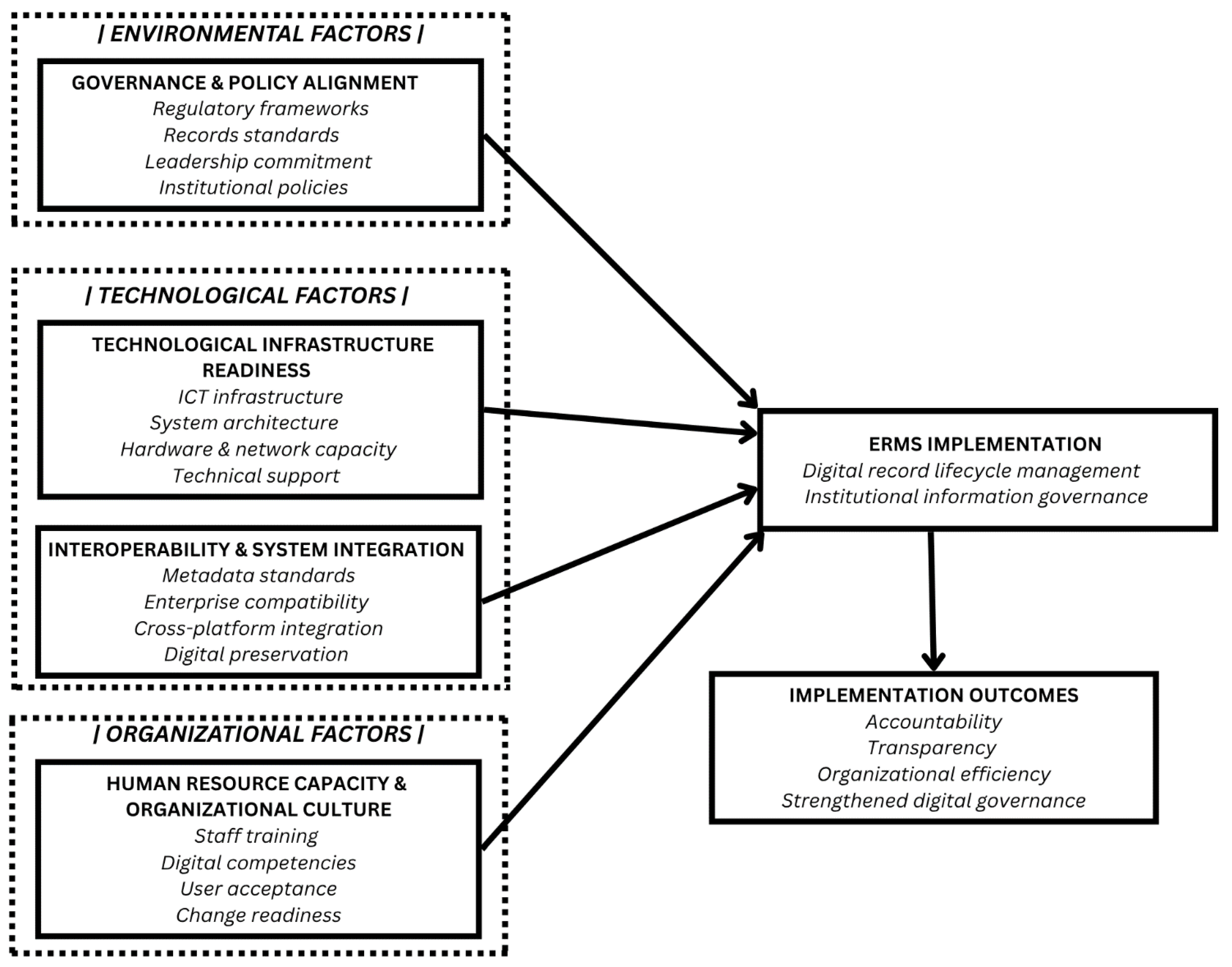

Table 1.
Key Determinants of ERMS Implementation Identified in the Literature.
|
Category |
Determinant |
Description |
Evidence from Literature |
|
Environmental (Institutional) |
Governance and Policy Alignment |
Institutional policies, regulatory frameworks, managerial commitment, and governance structures that guide ERMS implementation |
Strong governance frameworks improve compliance, accountability, and implementation stability (Mukred et al. 2018; Hawash et al. 2020; Oladejo 2021). |
|
Technological |
Technological Infrastructure Readiness |
Availability of ICT infrastructure, system architecture, hardware capacity, and technical support required for ERMS operation |
Limited infrastructure and technical resources remain major barriers, particularly in developing environments (Butt et al. 2021; Danso et al. 2024). |
|
Organizational |
Human Resource Capacity and Organisational Culture |
Staff skills, training, user acceptance, and organisational readiness affect system adoption and utilisation. |
User competence and positive attitudes toward technology significantly influence ERMS adoption outcomes (Hossain et al., 2019; Hossain et al., 2025). |
|
Technological |
Interoperability and System Integration |
Integration of ERMS with enterprise systems, metadata standards, and cross-platform compatibility |
Interoperability becomes critical as digital systems mature and institutions seek integrated information governance (Dişli & Külcü, 2022; Hussin, 2025). |
Disclaimer/Publisher’s Note: The statements, opinions and data contained in all publications are solely those of the individual author(s) and contributor(s) and not of MDPI and/or the editor(s). MDPI and/or the editor(s) disclaim responsibility for any injury to people or property resulting from any ideas, methods, instructions or products referred to in the content. |
© 2026 by the authors. Licensee MDPI, Basel, Switzerland. This article is an open access article distributed under the terms and conditions of the Creative Commons Attribution (CC BY) license (http://creativecommons.org/licenses/by/4.0/).
Copyright: This open access article is published under a Creative Commons CC BY 4.0 license, which permit the free download, distribution, and reuse, provided that the author and preprint are cited in any reuse.