

Submitted:
16 April 2026
Posted:
17 April 2026
You are already at the latest version
Abstract
Background: Respiratory syncytial virus (RSV) is a serious disease in older adults with comorbidities; however, comparative data across epidemic waves, both clinically and in terms of inflammatory profiles and their diagnostic and prognostic utility, remain limited. Methods: We conducted a retrospective study of adults hospitalized with RSV infection across two epidemic waves (2022–2023 and 2024–2025). Clinical characteristics, comorbidities, severity scores, and outcomes were collected. Serum interleukin-6 (IL-6), C-reactive protein (CRP), and hematological parameters were analyzed and compared with healthy controls. Results: A total of 152 patients were included (81 in wave 1 and 71 in wave 2). Patients in wave 2 were older and had a higher burden of comorbidities, although ICU admission and in-hospital mortality were similar across waves. RSV induced a consistent systemic inflammatory response in both waves, characterized by elevated IL-6 and CRP levels, neutrophilia, lymphopenia, and increased neutrophil-to-lymphocyte ratio, without relevant inter-wave differences. All biomarkers demonstrated good diagnostic performance. The neutrophil-to-lymphocyte ratio, showed the highest accuracy, while IL-6 exhibited excellent rule-in capacity due to perfect specificity. However, none of the evaluated biomarkers were associated with disease severity (McCabe index) or in-hospital mortality. Conclusion: RSV infection in older adults is associated with a stable inflammatory signature across epidemic waves. Although biomarkers showed strong diagnostic utility, they lacked clinical prognostic value. We suggest that disease severity is mainly driven by host-related factors, particularly comorbidities, rather than differences in inflammatory response, highlighting the need for improved preventive and risk stratification strategies in this population.
Keywords:
biomarkers
; C-reactive protein
; interleukin-6
; lower respiratory tract infection
; neutrophil-lymphocyte ratio
; respiratory syncytial virus
; systemic inflammation
1. Introduction
Respiratory viral infections represent a major cause of morbidity and hospitalization among adults, particularly in older individuals and those with chronic comorbidities. Among these pathogens, the Respiratory Syncytial Virus (RSV) has traditionally been regarded as a pediatric pathogen. However, increasing evidence over the past decade has demonstrated its substantial clinical impact in adult populations [1,2,3]. In older populations, RSV has been estimated to account for 3–7% of hospitalizations due to acute respiratory infections, with tens of thousands of hospital admissions annually in high-income countries [4]. Clinical outcomes can range from mild upper respiratory symptoms to pneumonia, respiratory failure, and death, particularly in patients with chronic pulmonary or cardiovascular comorbidities [5,6].
The epidemiology and clinical presentation of RSV infection may vary significantly between epidemic seasons. Variations in viral circulation patterns, the emergence of different RSV subtypes, and fluctuations in population immunity can influence both hospitalization incidence and disease severity. In addition, healthcare practices, such as changes in testing strategies, vaccination coverage for other respiratory pathogens, and hospital admission policies, may further impact which patients are identified and admitted during each season [7]. Moreover, disruptions caused by the global SARS-CoV-2 pandemic have been associated with profound alterations in the timing, magnitude, and age distribution of seasonal RSV outbreaks [8]. Some reports have documented shifts in peak incidence, higher proportions of adult hospitalizations, and differences in clinical severity compared to pre-pandemic seasons, suggesting that both viral and host factors may have evolved [9]. Despite the well-recognized impact of RSV in adults and its hospital-related disease burden comparable to that of other respiratory viruses, there is a lack of detailed comparisons of adult cohorts across different epidemic waves, particularly regarding clinical characteristics and outcomes between successive seasons [10]. Understanding these seasonal differences is essential for anticipating healthcare needs, identifying patients at higher risk of severe disease, and guiding the development of targeted preventive and therapeutic strategies.
Moreover, there is a need for reliable biomarkers to better characterize RSV infection in adults. While clinical features such as age and comorbidities provide important information, they may not fully capture the underlying host response to infection. Interleukin-6 (IL-6) is a key pro-inflammatory cytokine that may reflect the intensity of the inflammatory response during infection, whereas C-reactive protein (CRP) is a widely used general marker of inflammation [11,12]. Comparing these parameters may help to evaluate whether a more specific inflammatory signal can assist in identifying patients with active RSV infection across different epidemic seasons.
In this context, we conducted a single-center observational study of adults hospitalized with RSV infection during two epidemic waves (2022–2023 and 2024–2025). We compared demographic and clinical characteristics, clinical indices of disease severity, and measured circulating levels of the inflammatory markers IL-6 and CRP. The study provides a descriptive overview of patient profiles and inflammatory responses across these two different seasons in a particular geographical area.
2. Materials and Methods
2.1. Study Design
We conducted a retrospective observational study in hospitalized cases of RSV infection at Hospital Universitari de Sant Joan de Reus, located in the Autonomous Community of Catalonia, Spain. A total of 152 Patients were included between 1 October 2022 and 30 April 2023 (n = 81) and between 1 October 2024 and 30 April 2025 (n = 71). Our facility is a general hospital with 367 inpatient beds and an intensive care unit with 20 beds. It provides healthcare coverage for a population of more than 175,000 inhabitants, including primary care centers and long-term care facilities in the surrounding region.
Inclusion criteria were age ≥18 years and attendance at the Emergency Department with laboratory-confirmed RSV infection. The study included both patients who required hospital admission and those who were evaluated in the Emergency Department and discharged home. Patients without laboratory confirmation of RSV infection were excluded. Demographic and clinical characteristics were recorded for all patients, including presenting symptoms, comorbidities, and treatments. Disease severity was assessed using the McCabe score [13]. RSV infection was confirmed using the Xpert® Xpress Flu/RSV assay (Cepheid, Sunnyvale, CA, USA), a rapid real-time reverse transcription polymerase chain reaction (RT-PCR) test performed on the GeneXpert System. The assay was carried out on nasopharyngeal swab specimens collected in viral transport medium, and viral positivity was defined according to the manufacturer’s instructions. Circulating IL-6 levels were measured using the Elecsys® IL-6 immunoassay on a Cobas e801 analyzer, and CRP concentrations were determined by a latex-enhanced immunoturbidimetric assay on a Cobas c702 (Roche Diagnostics, Basel, Switzerland). Neutrophil and leukocyte counts were obtained using a Sysmex XN-1000TM (Sysmex GmbH, Germany).
A control group of 80 healthy volunteers was used for comparison of the analytical determinations. These individuals had no clinical or biochemical evidence of infectious disease, renal insufficiency, liver disease, neoplasia, or neurological disorders. The samples were obtained before the COVID-19 pandemic from a study conducted by the epidemiology department of our university, focusing on a healthy population. Participants were recruited through telephone interviews based on census data from several municipalities in the region. Each participant subsequently underwent a clinical interview and basic laboratory testing [14]. Serum samples were aliquoted and stored at −80 °C in our institutional biological sample bank until analysis.
All data were obtained from medical records and were fully anonymized before the researchers accessed them. This study was approved by the Comitè d’Ètica i Investigació en Medicaments (Institutional Review Board) of Institut de Recerca Biomèdica Catalunya Sud (Resolution CEIM 344/2025, 26 March 2026).
2.2. Statistical Analysis and Post Hoc Effect Size Estimation
Qualitative data are presented as numbers and percentages. Age, duration of hospital and intensive care unit stay are shown as medians and ranges (minimum–maximum) due to their highly skewed distribution and presence of extreme values. Analytical variables are presented as medians and interquartile ranges (IQR). Statistical comparisons between two groups were made using the χ2 test (categorical variables) or the Mann-Whitney U test. The diagnostic accuracy of the analyzed variables was assessed by receiver operating characteristic (ROC) analysis [15]. Sensitivity, specificity, positive predictive value (PPV), and negative predictive value (NPV) were calculated for each biomarker, and optimal cut-off values were determined by maximizing the Youden index. We employed SPSS 25.0 (SPSS Inc., Chicago, IL, USA) for statistical analyses. All data visualizations were generated using ggplot2, gridExtra, and pROC in R 4.3.0. Statistical significance was set at p ≤0.05.
Age was selected as the most clinically relevant variable for post hoc estimation of the observed effect size between epidemic waves. Patients in wave 1 had a median age of 74 (22 – 96) years, compared with 78 (20 – 96) years in wave 2. The Mann-Whitney U test showed a significant difference between waves (U = 2164.5, p = 0.009). A post hoc estimation of effect size showed a small-to-moderate effect (r = 0.21; Cliff’s δ = 0.25), indicating a modest but measurable difference in age distribution between waves.
3. Results
The demographic and clinical characteristics of patients from the two infection waves are summarized in Table 1. Patients in the second wave were older and displayed different patterns of tobacco and alcohol use compared with those in the first wave. Although most patients in both waves were admitted to the Internal Medicine department, admissions to Geriatrics were more frequent during the second wave. In addition, these patients more commonly presented with pneumonia and bronchitis and had a higher prevalence of cardiovascular and neuromuscular diseases. While no differences were observed in the Charlson comorbidity index, patients in the second wave showed greater clinical severity according to the McCabe classification. They also more frequently required non-invasive mechanical ventilation and were more often treated with corticosteroids, whereas anticoagulant use was less common. Overall, these findings suggest a shift toward a more clinically complex and vulnerable patient population. Despite these differences, no significant differences were found between the two waves in mortality, Intensive Care Unit (ICU) admission rates, ICU length of stay, or overall hospital length of stay.
The results of the analyzed variables across the two epidemic waves and the control group are shown in Figure 1. Compared with healthy individuals, patients with RSV infection exhibited significantly higher levels of IL-6 and CRP, as well as increased neutrophil counts. In contrast, lymphocyte counts were lower, resulting in an elevated neutrophil-to-lymphocyte (N/L) ratio. Patients in the second epidemic wave showed slightly but significantly higher neutrophil counts than those in the first wave. No other significant differences were observed between the two waves.
To evaluate diagnostic performance, we assessed the ability of the analyzed variables to discriminate between RSV-infected patients and healthy controls using ROC curve analysis. These analyses were first performed separately for each epidemic wave to assess the consistency of the diagnostic performance of the studied biomarkers across both periods. Most parameters showed strong discriminative capacity, with areas under the curve (AUC) exceeding 0.85 for all variables except CRP (Figure 2).
As no relevant differences were observed between waves in ROC patterns, the data were subsequently pooled to calculate sensitivity, specificity, PPV, and NPV. The diagnostic performance of the evaluated biomarkers is summarized in Table 2. The neutrophil-to-lymphocyte ratio showed the best global diagnostic accuracy among all variables assessed, with a consistently balanced ability to discriminate between RSV-infected patients and controls. Among individual biomarkers, neutrophils demonstrated high diagnostic accuracy, particularly in terms of PPV and specificity. IL-6 showed perfect specificity and PPV in this cohort, supporting its role as a highly reliable confirmatory marker, although with more limited sensitivity. Lymphocytes also performed well overall, whereas CRP showed the lowest diagnostic accuracy.
We also explored the potential prognostic value of the analyzed biomarkers. For this purpose, their association with disease severity was assessed using the McCabe index, dichotomized into non-severe (0–1) and severe (2–3) groups, and with in-hospital mortality. No significant differences were observed in any of the evaluated parameters across these outcomes, suggesting that, unlike their diagnostic performance, the analyzed biomarkers lacked prognostic discrimination in this cohort (Figure 3).
4. Discussion
In this single-center retrospective study, we characterized the clinical and inflammatory features of adults hospitalized with laboratory-confirmed RSV infection across two epidemic waves (2022–2023 and 2024–2025). Our results provide a real-world overview of RSV-related hospitalizations and illustrate both stability and modest variability in patient profiles over time.
Overall, RSV infection in hospitalized adults was associated with a significant clinical impact, characterized by frequent respiratory compromise, a high prevalence of comorbidities, and substantial use of healthcare resources, including oxygen therapy and non-invasive ventilation. Patients in the second wave were older and more often managed in geriatric units, in keeping with previous reports describing the increasing relevance of RSV in older and clinically vulnerable populations [9,16,17,18,19].
Despite these differences, major severity indicators, including ICU admission, length of stay, and in-hospital mortality, remained unchanged between epidemic waves. These findings align with prior studies reporting relatively stable outcomes of RSV infection in hospitalized adults across seasons [20,21]. Although the second wave was characterized by a higher burden of comorbidity and more frequent respiratory failure, this did not translate into worse outcomes, suggesting that disease severity in hospitalized patients is primarily driven by host-related factors such as age and comorbidity profile, and may also be influenced by improvements in clinical management and supportive care [20,22].
From a laboratory perspective, RSV infection triggered a clear systemic inflammatory response, characterized by elevated IL-6 and CRP levels, neutrophilia, lymphopenia, and an increased N/L ratio. These patterns were comparable across both epidemic waves, indicating a stable inflammatory signature over time. Most evaluated biomarkers demonstrated strong diagnostic performance in distinguishing infected patients from healthy controls, supporting their usefulness as indicators of acute viral infection.
Among the evaluated parameters, the N/L ratio emerged as the most robust and balanced marker, supporting its potential utility as a primary diagnostic tool. Moreover, IL-6 demonstrated excellent diagnostic performance and, of particular interest, perfect specificity and PPV in this cohort, suggesting a potential role as a highly reliable rule-in biomarker in the acute clinical setting. Neutrophils also showed strong diagnostic value as an individual parameter, whereas CRP consistently performed less well, in line with its known lack of specificity as a general inflammatory marker. These findings support the added value of integrated hematological indices over isolated inflammatory biomarkers in clinical practice.
In addition to their diagnostic performance, we evaluated the potential prognostic value of the studied biomarkers. However, no significant associations were found between these parameters and disease severity, as assessed by the McCabe index, or with in-hospital mortality. These findings suggest that, although useful for diagnostic purposes, these biomarkers may have limited utility in predicting clinical outcomes in this setting. Overall, these markers appear to reflect acute inflammatory activation rather than determinants of disease trajectory. Nevertheless, the absence of statistically significant differences should be interpreted with caution, as it may be influenced by sample size or event rates.
While CRP and standard hematological indices have shown inconsistent prognostic value in RSV and other viral respiratory infections in adults [11,23], pediatric studies have suggested a potential association between IL-6 and disease severity in RSV bronchiolitis [24,25]. In contrast, our findings in older adults do not support a prognostic role for IL-6, consistent with previous studies in elderly populations that have shown elevated levels in more severe cases but substantial overlap between groups [26]. Despite its excellent diagnostic performance and perfect specificity in the present study, IL-6 did not translate into meaningful prognostic discrimination, highlighting the limited utility of systemic inflammatory markers for outcome prediction in this clinical setting.
Our results reinforce several key points. First, RSV remains an important cause of hospitalization in older adults. Second, clinical and inflammatory profiles appear relatively stable across epidemic waves within a single healthcare context. At the biological level, inflammatory biomarkers showed strong diagnostic performance overall, but limited prognostic utility. Accordingly, the lack of prognostic discrimination observed with these markers underscores the need for improved risk-stratification tools that integrate host vulnerability and immune response, rather than relying on isolated inflammatory markers.
Importantly, preventive strategies are increasingly relevant. RSV vaccines have recently been approved for use in older adults and high-risk populations. In the United States, the CDC recommends a single dose for adults aged ≥75 years and for those aged 50–74 years at increased risk [4]. In Europe, vaccination policies remain heterogeneous and implemented at the national level, with no harmonized EU-wide recommendation to date. In January 2026, the European Medicines Agency expanded the authorization of the GSK RSV vaccine (Arexvy, GlaxoSmithKline, Brentford, UK) to adults aged ≥18 years [27]. However, incorporation into routine immunization programs is still evolving. Given the substantial hospitalization burden observed in older adults and the risk of severe outcomes, our findings support strengthening preventive strategies, particularly vaccination in frail and elderly individuals, who represent the main risk group for severe disease.
Several limitations should be acknowledged. The retrospective single-center design and moderate sample size may limit generalizability. In addition, the absence of an external validation cohort raises the possibility of model overfitting and may have led to optimistic estimates of diagnostic performance. Although internal validation was not formally performed using resampling techniques such as bootstrapping, this would be desirable in future studies to provide more robust and stable estimates of biomarker performance. Moreover, using the McCabe score as a proxy for severity and dichotomizing outcomes may have reduced sensitivity for detecting subtle associations. Finally, the restricted biomarker panel may not fully capture the complexity of the host immune response. Future multicenter studies with larger cohorts and independent validation sets are needed to confirm these findings and improve the robustness of risk stratification models in adult RSV infection.
5. Conclusion
Our results highlight the importance of understanding RSV infection in hospitalized adults, which can motivate clinicians and researchers to improve patient care and outcomes. The systemic inflammatory response observed across epidemic waves underscores the relevance of these findings for infectious disease management. Inflammatory biomarkers showed strong diagnostic performance, with the neutrophil-to-lymphocyte ratio achieving the best overall accuracy in our cohort. At the same time, IL-6 provided excellent rule-in capacity due to its high specificity. However, these biomarkers show limited prognostic value for clinical outcomes, as no significant associations with disease severity or in-hospital mortality were observed. Overall, these findings suggest that systemic inflammatory markers primarily reflect acute immune activation rather than determinants of disease progression, underscoring the importance of host vulnerability and comorbid conditions in clinical outcomes and supporting the need for preventive strategies in older adults at risk.
Author Contributions
Conceptualization, S.I. and J.C.; methodology, S.I. and J.C.; software, J.F.G., A.J.F., and E.M.D.D.; validation, J.C.; formal analysis, A.J.F. and J.C.; investigation, S.I., J.F.G., J.F.L., A.F.L.A., and X.G.B.; resources, A.C.; data curation, S.I. and J.C.; writing—original draft preparation, J.C.; writing—review and editing, S.I., J.F.G., and J.C.; visualization, S.I.; supervision, A.C.; project administration, J.C.; funding acquisition, A.C. All authors have read and agreed to the published version of the manuscript.
Funding
The APC was funded by Universitat Rovira i Virgili.
Institutional Review Board Statement
The study was conducted in accordance with the Declaration of Helsinki, and approved by the Institutional Review Board (or Ethics Committee) of INSTITUT DE RECERCA BIOMÈDICA CATALUNYA SUD (protocol code CEIM 344/2025, 26 March 2026).
Informed Consent Statement
Patient consent was waived due to the retrospective nature of the study using anonymized routine clinical data, with no risk to participants and no direct patient contact.
Data Availability Statement
The data presented in this study are available on request from the corresponding author due to privacy and confidentiality reasons.
Acknowledgments
During the preparation of this work, the authors used CHAT GPT 5.0 (developed by OpenAI) to improve the grammar, syntax, and clarity of the text and GRAMMARLY (from Grammarly Inc.) for orthographic corrections. After using these tools, the authors reviewed and edited the content as needed and take full responsibility for the content of the published article. The content, ideas, and scientific conclusions presented in this manuscript are solely the authors’ work and have not been generated by AI. The AI tools were utilized exclusively to enhance the readability and presentation of the text.
Conflicts of Interest
The authors declare no conflicts of interest. The funders had no role in the design of the study; in the collection, analyses, or interpretation of data; in the writing of the manuscript; or in the decision to publish the results.
Abbreviations
The following abbreviations are used in this manuscript:
| AUC | Area under the curve |
| CRP | C-reactive protein |
| ICU | Intensive care unit |
| IL-6 | Interleukin-6 |
| N/L ratio | Neutrophil-to-lymphocyte ratio |
| NPV | Negative predictive value |
| PPV | Positive predictive value |
| ROC | Receiver operating characteristics |
| RSV | Respiratory syncytial virus |
References
- Symes, R.; Keddie, S.H.; Walker, J.; McKeever, T.; Ahmad, S.; Arnold, D.; Evans, C.M.; Pelosi, E.; Rahman, N.M.; Sapey, E., et al. Burden of respiratory syncytial virus infection in older adults hospitalised in England during 2023/24. J. Infect. 2025, 91, 106570. [CrossRef]
- Shi, T.; Denouel, A.; Tietjen, A.K.; Campbell, I.; Moran, E.; Li, X.; Campbell, H.; Demont, C.; Nyawanda, B.O.; Chu, H.Y., et al. Global disease burden estimates of respiratory syncytial virus-associated acute respiratory infection in older adults in 2015: A systematic review and meta-analysis. J. Infect. Dis. 2020, 222 (Suppl. 7), S577-S583. [CrossRef]
- Shi, T.; Arnott, A.; Semogas, I.; Falsey, A.R.; Openshaw, P.; Wedzicha, J.A.; Campbell, H.; Nair, H; RESCEU Investigators. The etiological role of common respiratory viruses in acute respiratory infections in older adults: A systematic review and meta-analysis. J. Infect. Dis. 2020, 222 (Suppl. 7), S563-S569. [CrossRef]
- Center for Diseases and Control. Respiratory syncytial virus infection (RSV). RSV in adults. https://www.cdc.gov/rsv/adults/index.html#:~:text=other%20respiratory%20viruses.-,Severe%20RSV%20illness,older%20against%20severe%20RSV%20illness. (accessed on 15 April 2026).
- Yayan, J. Impact of RSV infection on mortality, rehospitalization, and long-term pulmonary, cardiovascular, and functional outcomes in hospitalized adults: a systematic review and meta-analysis. Virol. J. 2025, 22, 160. [CrossRef]
- Wildenbeest, J.G.; Lowe, D.M.; Standing, J.F.; Butler, C.C. Respiratory syncytial virus infections in adults: a narrative review. Lancet Respir. Med. 2024, 12, 822−836. [CrossRef]
- Perčinić, A.; Vuletić, T.; Lizzul, N.; Vukić Dugac, A.; Gverić Grginić, A.; Tabain, I.; Jurić, D.; Budimir, A. Epidemiological and clinical characteristics of adult RSV infections: A retrospective analysis at University Hospital Center Zagreb (2022-2024). Pathogens 2025, 14, 284. [CrossRef]
- Bermúdez Barrezueta, L.; Matías Del Pozo, V.; López-Casillas, P.; Brezmes Raposo, M.; Gutiérrez Zamorano, M.; Pino Vázquez, M.A. Variation in the seasonality of the respiratory syncytial virus during the COVID-19 pandemic. Infection 2022, 50, 1001-1005. [CrossRef]
- Rios-Guzman, E.; Simons, L.M.; Dean, T.J.; Agnes, F.; Pawlowski, A.; Alisoltanidehkordi, A.; Nam, H.H.; Ison, M.G.; Ozer, E.A.; Lorenzo-Redondo, R., et al. Deviations in RSV epidemiological patterns and population structures in the United States following the COVID-19 pandemic. Nat. Commun. 2024, 15, 3374. [CrossRef]
- Raffaldi, I.; Castagno, E. The epidemiology of respiratory syncytial virus: New trends and future perspectives. Viruses 2024, 16, 1100. [CrossRef]
- Iftimie, S.; Gabaldó-Barrios, X.; Penadés-Nadal, J.; Canela-Capdevila, M.; Piñana, R.; Jiménez-Franco, A.; López-Azcona, A.F.; Castañé, H.; Cárcel, M-; Camps, J., et al. Serum Levels of arachidonic acid, interleukin-6, and C-reactive protein as potential indicators of pulmonary viral infections: Comparative analysis of influenza A, respiratory syncytial virus infection, and COVID-19. Viruses 2024, 16, 1065. [CrossRef]
- Chandra, K.; Das, A.K.; Upadhyay, B.; Uddin, A.; Hussain, S.M.; Islam, F.; Alvi, Y.; Gautam, R.; Kaur, J.; Khan, S., et al. Circulating viral antigenic proteins and inflammatory biomarkers in influenza and respiratory syncytial virus infections: Associations with disease severity and transmission. Cureus 2025, 17, e100037. [CrossRef]
- Kreger, B.E.; Craven, D.E.; Carling, P.C.; McCabe, W.R. Gram-negative bacteremia. III. Reassessment of etiology, epidemiology and ecology in 612 patients. Am. J. Med. 1980, 68, 332–343. [CrossRef]
- Fort-Gallifa, I.; García-Heredia, A.; Hernández-Aguilera, A.; Simó, J.M.; Sepúlveda, J.; Martín-Paredero, V.; Camps, J.; Joven, J. Biochemical indices of oxidative stress and inflammation in the evaluation of peripheral artery disease. Free Radic. Biol. Med. 2016, 97, 568−576. [CrossRef]
- Zweig M.H., Campbell G. Receiver-operating characteristic (ROC) plots: A fundamental evaluation tool in clinical medicine. Clin. Chem. 1993, 39, 561–577. [CrossRef]
- Solidoro, P.; Curtoni, A.; Costa, C.; De Rosa, F.G.; Bondi, A.; Sidoti, F.; Shbaklo, N.; Patrucco, F.; Favre, D.; Zanotto, E., et al. The epidemiology of respiratory syncytial virus and the impact of the COVID-19 pandemic in a retrospective evaluation. Pathogens 2025, 14, 375. [CrossRef]
- Kenmoe, S.; Nair, H. The disease burden of respiratory syncytial virus in older adults. Curr. Opin. Infect. Dis. 2024, 37, 129−136. [CrossRef]
- Abrams, E.M.; Doyon-Plourde, P.; Davis, P.; Lee, L.; Rahal, A.; Brousseau, N.; Siu, W.; Killikelly, A. Burden of disease of respiratory syncytial virus in older adults and adults considered at high risk of severe infection. Can. Commun. Dis. Rep. 2025, 51, 26−34. [CrossRef]
- Asseri, A.A. Respiratory syncytial virus: A narrative review of updates and recent advances in epidemiology, pathogenesis, diagnosis, management and prevention. J. Clin. Med. 2025, 14, 3880. [CrossRef]
- Kim, T.; Choi, S.H. Epidemiology and disease burden of respiratory syncytial virus infection in adults. Infect. Chemother. 2024, 56, 1−12. [CrossRef]
- Han, J.S.; Jang, S.H.; Jeon, J.S.; Lee, K.B.; Kim, J.K. Epidemiological shifts in respiratory virus infections among older adults (≥65 Years) before and after the COVID-19 pandemic: An 18-year retrospective study in the Republic of Korea. Microorganisms 2025, 13, 2301. [CrossRef]
- Carvajal, J.J.; Avellaneda, A.M.; Salazar-Ardiles, C.; Maya, J.E.; Kalergis, A.M.; Lay, M.K. Host components contributing to respiratory syncytial virus pathogenesis. Front. Immunol. 2019, 10, 2152. [CrossRef]
- Zhou, Y.; Xu, L.; Zhong, X.; Guo, X.; Ma, Q. Differentiating bacterial from viral respiratory tract infections using CRP, SAA, and blood routine parameters: A retrospective cohort study. Clinics (Sao Paulo) 2025, 80, 100845. [CrossRef]
- Brown, P.M.; Schneeberger, D.L.; Piedimonte, G. Biomarkers of respiratory syncytial virus (RSV) infection: specific neutrophil and cytokine levels provide increased accuracy in predicting disease severity. Paediatr. Respir. Rev. 2015, 16, 232−240. [CrossRef]
- Tan, L.; He, Z.; Liang, Y.; Wang, K.; Chen, X. Correlation analysis between the severity of respiratory syncytial virus pneumonia and the expression levels of inflammatory cytokines in bronchoalveolar lavage fluid among infants and young children. Front. Pediatr. 2025, 13, 1482029. [CrossRef]
- Lui, G.; Wong, C.K.; Chan, M.; Chong, K.C.; Wong, R.; Chu, I.; Zhang, M.; Li, T.; Hui, D.; Lee, N., et al. Host inflammatory response is the major marker of severe respiratory syncytial virus infection in older adults. J. Infect. 2021, 83, 686−692. [CrossRef]
- GSK’s RSV vaccine, Arexvy, receives European approval for expanded use in all adults 18 years and older. https://www.gsk.com/en-gb/media/press-releases/gsk-s-rsv-vaccine-arexvy-receives-european-approval-for-expanded-use-in-all-adults-18-years-and-older/. (accessed on 15 April 2026).
Figure 1.
Distribution of laboratory variables in respiratory syncytial virus-infected patients across first and second epidemic waves and healthy controls. Results are shown as medians and interquartile ranges. Statistical significance was assessed using the Mann-Whitney U test adjusted by age and sex differences. Il-6 and CRP values are represented as log transformed due to their highly skewed distributions in infected patients. Abbreviations: CRP, C-reactive protein; IL-6, interleukin-6; N/L, neutrophil-to-lymphocyte ratio.
Figure 1.
Distribution of laboratory variables in respiratory syncytial virus-infected patients across first and second epidemic waves and healthy controls. Results are shown as medians and interquartile ranges. Statistical significance was assessed using the Mann-Whitney U test adjusted by age and sex differences. Il-6 and CRP values are represented as log transformed due to their highly skewed distributions in infected patients. Abbreviations: CRP, C-reactive protein; IL-6, interleukin-6; N/L, neutrophil-to-lymphocyte ratio.
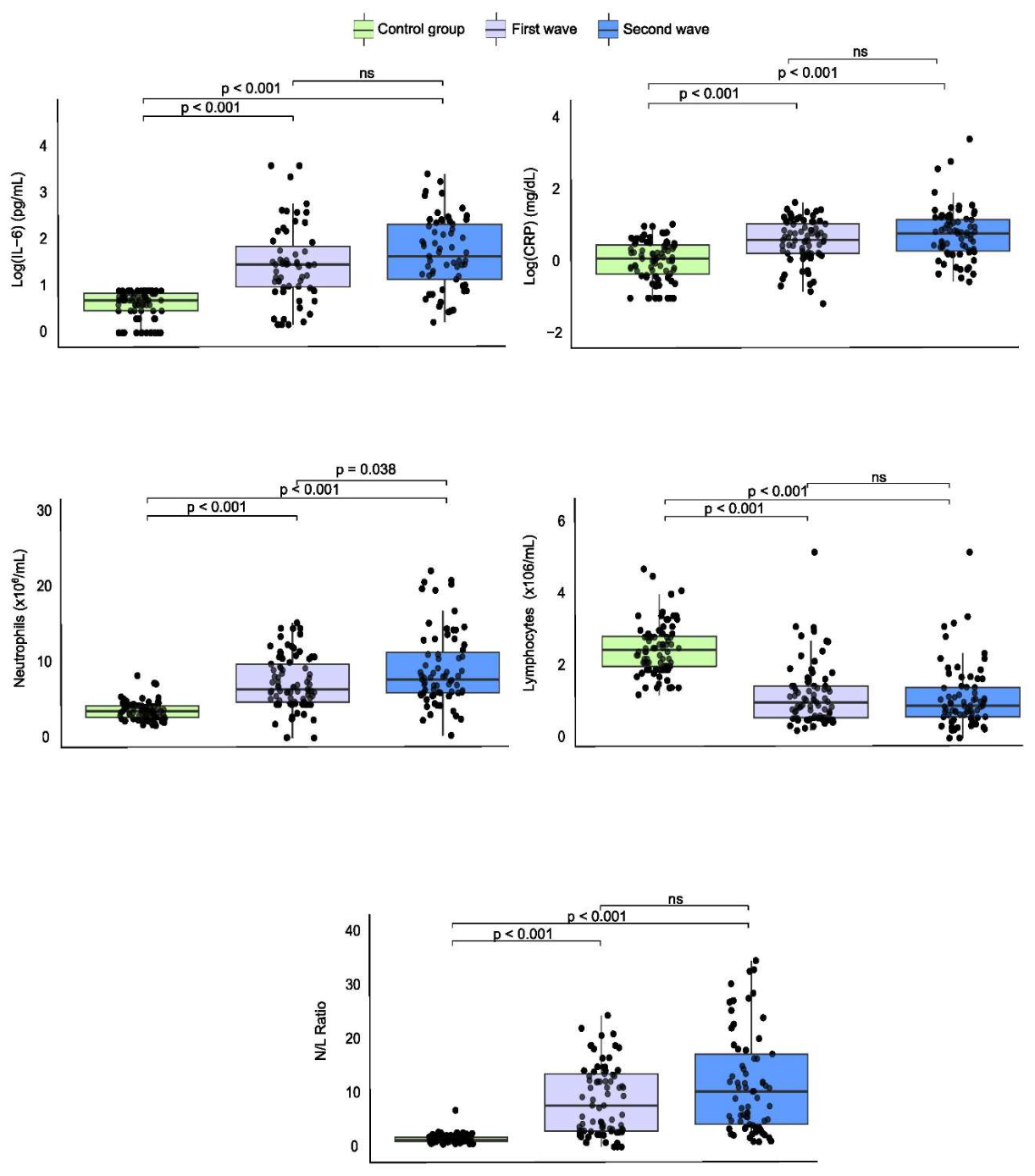
Figure 2.
Receiver operating characteristic curves for the diagnostic performance of all analyzed parameters in respiratory syncytial virus-infected patients versus healthy controls. Abbreviations: AUC, area under the curve; CRP, C-reactive protein; CI, confidence interval; IL-6, interleukin-6; N/L, neutrophil-to-lymphocyte ratio.
Figure 2.
Receiver operating characteristic curves for the diagnostic performance of all analyzed parameters in respiratory syncytial virus-infected patients versus healthy controls. Abbreviations: AUC, area under the curve; CRP, C-reactive protein; CI, confidence interval; IL-6, interleukin-6; N/L, neutrophil-to-lymphocyte ratio.
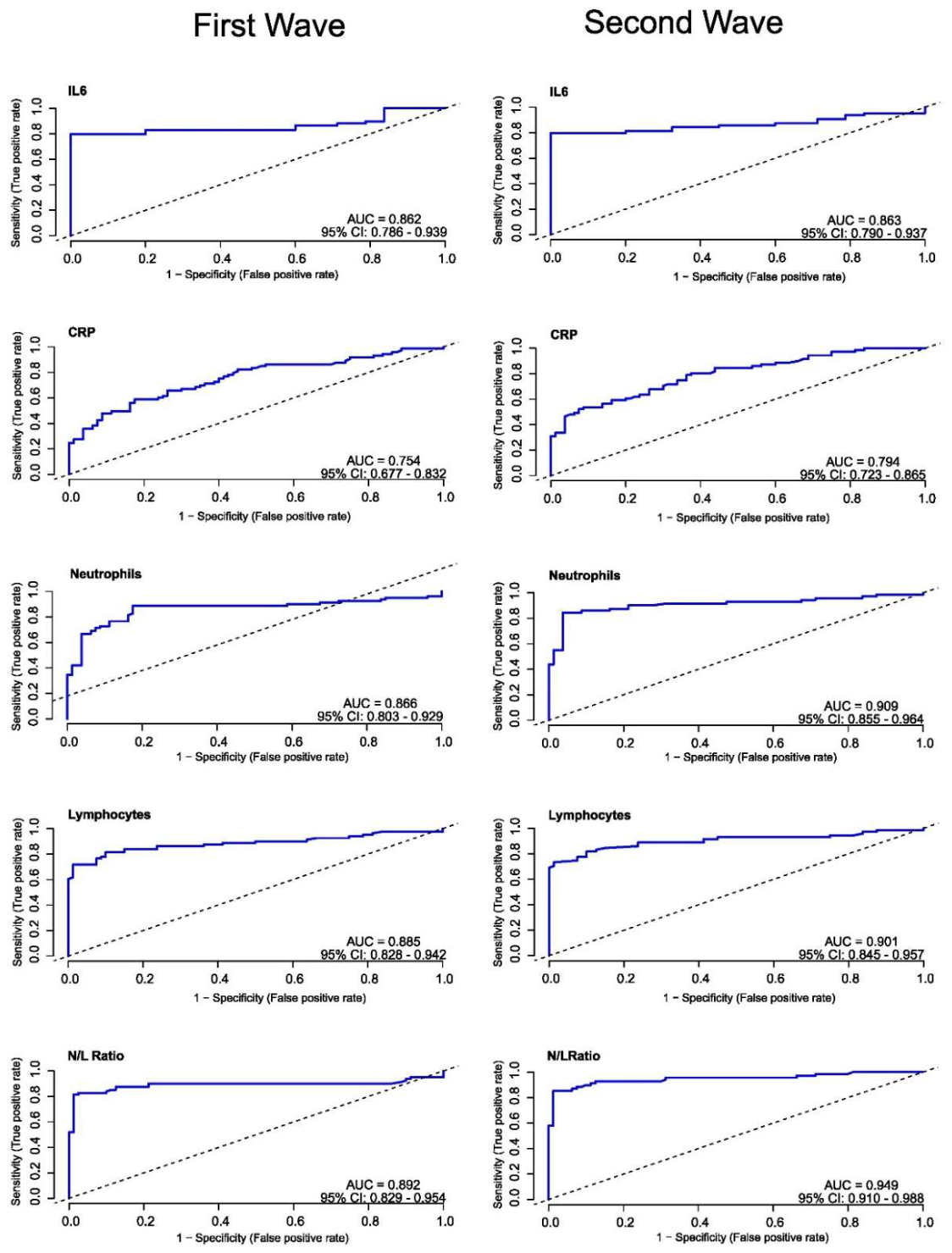
Figure 3.
Distribution of laboratory variables in respiratory syncytial virus-infected patients according to McCabe-defined severity and in-hospital mortality. Results are shown as medians and interquartile ranges. Statistical significance was assessed using the Mann-Whitney U test adjusted by age and sex differences. McCabe indices were dichotomized into non-severe (0–1) and severe (2–3). Abbreviations: AUC, area under the curve; CRP, C-reactive protein; CI, confidence interval; IL-6, interleukin-6; N/L, neutrophil-to-lymphocyte ratio.
Figure 3.
Distribution of laboratory variables in respiratory syncytial virus-infected patients according to McCabe-defined severity and in-hospital mortality. Results are shown as medians and interquartile ranges. Statistical significance was assessed using the Mann-Whitney U test adjusted by age and sex differences. McCabe indices were dichotomized into non-severe (0–1) and severe (2–3). Abbreviations: AUC, area under the curve; CRP, C-reactive protein; CI, confidence interval; IL-6, interleukin-6; N/L, neutrophil-to-lymphocyte ratio.
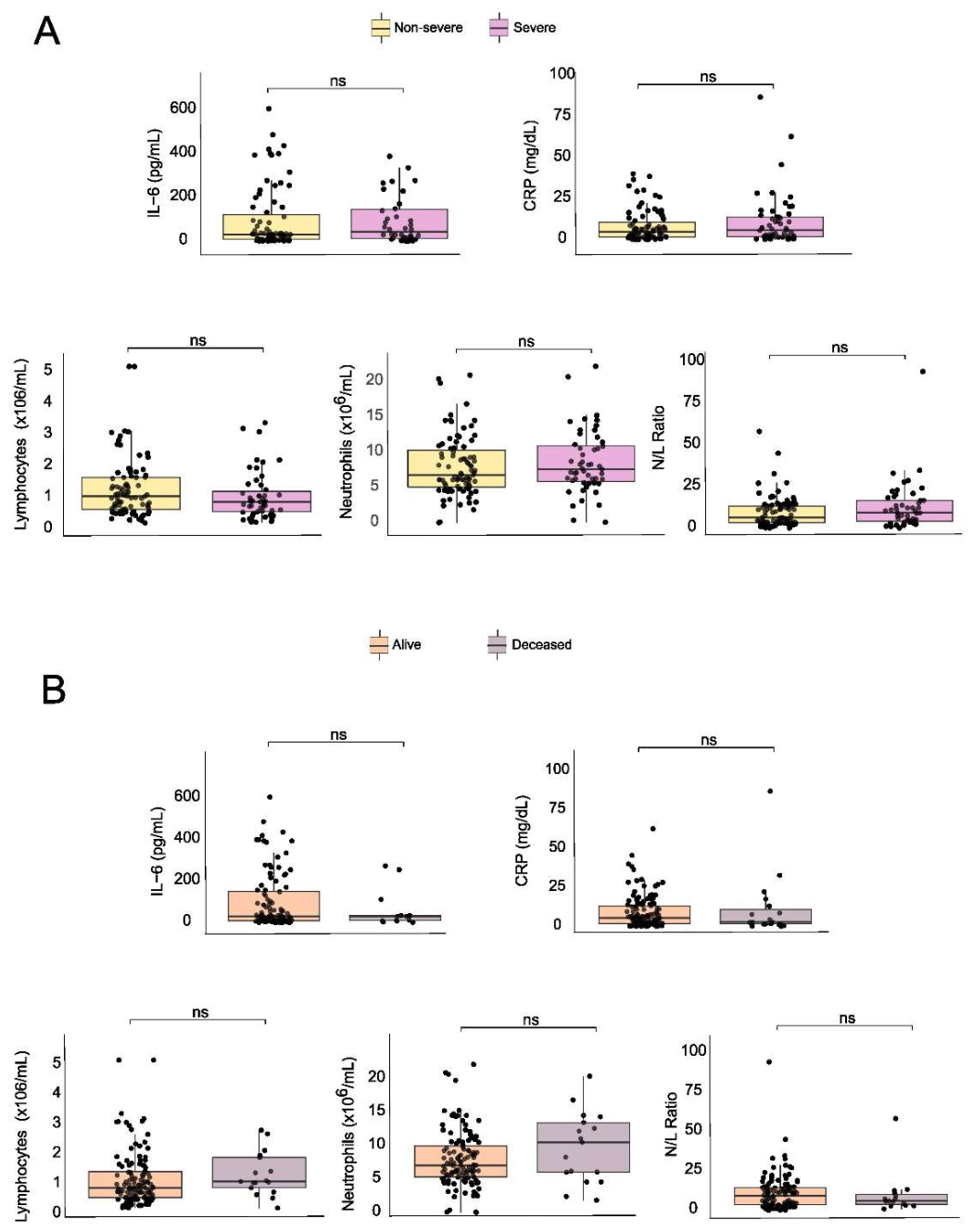

Table 1.
Demographic and clinical characteristics of patients in the two waves of respiratory syncytial virus infection.
Table 1.
Demographic and clinical characteristics of patients in the two waves of respiratory syncytial virus infection.
| Variable | 1st wave (n = 81) | 2nd wave (n = 71) | p-value |
| Demographic characteristics and coinfections | |||
| Age, years | 74 (22 – 96) | 78 (20 – 96) | 0.009 |
| Sex, female | 43 (53.1) | 39 (54.9) | 0.820 |
| Tobacco habit | 9 (11.1) | 10 (14.1) | < 0.001 |
| Alcohol drinking | 12 (14.8) | 5 (7.0) | < 0.001 |
| Influenza A | 2 (2.5) | 3 (4.2) | 0.545 |
| Influenza B | 0 (0.0) | 0 (0.0) | 1.000 |
| COVID-19 | 0 (0.0) | 0 (0.0) | 1.000 |
| Admission department | |||
| Geriatrics | 8 (9.9) | 20 (28.2) | < 0.001 |
| Internal Medicine | 29 (35.8) | 38 (53.5) | |
| Emergency | 37 (45.7) | 9 (12.7) | |
| Oncology | 4 (4.9) | 3 (4.2) | |
| Surgery | 0 (0.0) | 1 (1.4) | |
| Direct ICU admissions | 2 (2.5) | 0 (0.0) | |
| Ginecology | 1 (1.2) | 0 (0.0) | |
| Ward-to-ICU transfers | 5 (6.2) | 5 (7.0) | 0.829 |
| ICU length of stay, days | 3 (2 – 10) | 6 (5 – 11) | 0.151 |
| Hospital length of stay, days | 7 (1 – 35) | 7 (1 – 29) | 0.658 |
| Symptoms | |||
| Pneumonia | 18 (22.2) | 26 (36.6) | 0.050 |
| Bronchitis | 16 (19.8) | 46 (64.8) | < 0.001 |
| Cough | 61 (75.3) | 54 (76.1) | 0.915 |
| Fever | 33 (40.7) | 29 (40.8) | 0.990 |
| Odynophagia | 3 (3.7) | 3 (4.2) | 0.869 |
| Headache | 2 (2.5) | 4 (5.6) | 0.317 |
| Anorexia or hyporexia | 2 (2.5) | 4 (5.6) | 0.317 |
| Myalgia | 16 (19.8) | 2 (2.8) | 0.001 |
| Arthralgia | 13 (16.0) | 2 (2.8) | 0.006 |
| Pulmonary embolism | 0 (0.0) | 1 (1.4) | 1.000 |
| Other symptoms | 45 (55.6) | 61 (85.9) | < 0.001 |
| Comorbidities | |||
| Diabetes mellitus | 27 (33.3) | 27 (38.0) | 0.546 |
| Cardiovascular disease | 48 (59.3) | 56 (78.9) | 0.009 |
| Chronic liver disease | 3 (3.7) | 3 (4.2) | 0.495 |
| Chronic lung disease | 36 (44.4) | 29 (40.8) | 0.655 |
| Chronic kidney disease | 18 (22.2) | 17 (23.9) | 0.802 |
| CNMD | 14 (17.3) | 18 (25.4) | 0.046 |
| Cancer | 7 (8.6) | 6 (8.5) | 0.988 |
| Charlson index | |||
| 0 | 25 (30.9) | 17 (23.9) | 0.191 |
| 1 | 22 (27.2) | 21 (29.6) | |
| 2 | 15 (18.5) | 23 (32.4) | |
| 3 | 10 (12.3) | 9 (12.7) | |
| 4 | 5 (6.2) | 1 (1.4) | |
| 5 | 2 (2.5) | 0 (0.0) | |
| 6 | 1 (1.2) | 0 (0.0) | |
| 7 | 1 (1.2) | 0 (0.0) | |
| McCabe score | |||
| 1 | 71 (87.7) | 26 (36.6) | < 0.001 |
| 2 | 6 (7.4) | 24 (33.8) | |
| 3 | 4 (4.9) | 21 (29.6) | |
| Treatments | |||
| IMV | 1 (1.2) | 3 (4.2) | 0.342 |
| NIMV | 3 (3.7) | 11 (15.5) | 0.022 |
| Conventional oxygen therapy* | 58 (71.6) | 61 (85.9) | 0.049 |
| Anticoagulants | 16 (19.8) | 3 (4.2) | 0.004 |
| Corticosteroids | 50 (61.7) | 59 (83.1) | 0.004 |
| Radiotherapy | 0 (0.0) | 2 (2.8) | < 0.001 |
| Deceased | 11 (13.6) | 8 (11.3) | 0.668 |
Qualitative variables are presented as n (%), and quantitative variables as median (mínimum – maximum). Statistical comparisons were made using the χ2 test (categorical variables) or the Mann-Whitney’s U test (continuous variables). Abbreviations: CNMD, Chronic neurological or neuromuscular disease; ICU, Intensive Care Unit; IMV, Invasive mechanical ventilation; NIMV, Non-invasive mechanical ventilation. *Conventional oxygen therapy refers to oxygen supplementation delivered via nasal cannula or Venturi mask.
Table 2.
Diagnostic performance, optimal cut-off values, and predictive values of the evaluated biomarkers.
Table 2.
Diagnostic performance, optimal cut-off values, and predictive values of the evaluated biomarkers.
| Parameter | AUC | 95% CI | Cut-off | Sensitivity | Specificity | PPV | NPV |
| IL-6 | 0.863 | 0.809 – 0.916 | 8.00 pg/mL | 0.835 | 1.000 | 1.000 | 0.761 |
| CRP | 0.774 | 0.713 – 0.834 | 1.85 mg/dL | 0.769 | 0.625 | 0.795 | 0.588 |
| Neutrophils | 0.886 | 0.842 – 0.931 | 5.0 x 10⁶/mL | 0.794 | 0.912 | 0.946 | 0.695 |
| Lymphocytes | 0.894 | 0.853 – 0.935 | 1.7 x 10⁶/mL | 0.816 | 0.875 | 0.925 | 0.714 |
| N/L ratio | 0.992 | 0.885 – 0.960 | 2.3 | 0.882 | 0.875 | 0.931 | 0.805 |
Optimal cut-off points were determined by maximizing the Youden index. Abbreviations: AUC, area under the curve; CI, confidence interval; CRP, C-reactive protein; IL-6, interleukin 6; N/L ratio, neutrophil-to-lymphocyte ratio; NPV, negative predictive value; PPV, positive predictive value.
Disclaimer/Publisher’s Note: The statements, opinions and data contained in all publications are solely those of the individual author(s) and contributor(s) and not of MDPI and/or the editor(s). MDPI and/or the editor(s) disclaim responsibility for any injury to people or property resulting from any ideas, methods, instructions or products referred to in the content. |
© 2026 by the authors. Licensee MDPI, Basel, Switzerland. This article is an open access article distributed under the terms and conditions of the Creative Commons Attribution (CC BY) license.
Copyright: This open access article is published under a Creative Commons CC BY 4.0 license, which permit the free download, distribution, and reuse, provided that the author and preprint are cited in any reuse.


