
Submitted:
16 April 2026
Posted:
17 April 2026
You are already at the latest version
Abstract
The rapid growth of electromobility is increasing pressure on the adequacy of charging infrastructure deployed along major transport corridors. This study presents a simulation-based framework for assessing the operational performance of electric vehicle charging infrastructure along the S19 Rzeszów–Barwinek section, a 90 km corridor forming part of the TEN-T and Via Carpathia networks. The methodology combines microscopic traffic simulation in PTV Vissim with probabilistic charging-demand modeling for passenger cars and heavy-duty vehicles, enabling the analysis of infrastructure utilization, queue formation, and unmet charging demand under realistic corridor conditions. Three electric vehicle penetration scenarios were examined: 10%, 25%, and 45% of the traffic stream. The results show that the charging system remains stable under the 10% scenario, begins to experience local overload and recurring congestion at 25%, and reaches structural insufficiency at 45%, where utilization exceeds 100% and unmet demand rises markedly. A key finding is that heavy-duty electric vehicles constitute the dominant operational bottleneck due to longer charging times, higher energy requirements, and the limited number of dedicated charging points. An additional expansion variant indicates that increasing the number of heavy-duty charging points can substantially improve system performance and restore a safer utilization range. The study demonstrates that minimum regulatory compliance should be treated as a baseline rather than a sufficient planning target and that dynamic, scenario-based simulation offers an effective decision-support tool for the adaptive development of corridor charging infrastructure.
Keywords:
electric vehicle charging infrastructure
; TEN-T corridor
; motorway service area
; microscopic traffic simulation
; PTV Vissim
; digital twin
1. Introduction
Electromobility is no longer a niche concept but a cornerstone of the European Union’s strategy to decarbonise the road transport sector [1,2]. The ambitious regulatory framework, epitomised by the “Fit for 55” package and the Alternative Fuels Infrastructure Regulation (AFIR, Regulation 2023/1804), mandates a fundamental shift towards zero-emission mobility [3,4]. The EU targets aim for 30 million zero-emission vehicles by 2030 and a fully decarbonised road transport sector by 2050 [5,6]. This transition places unprecedented pressure on the development of a robust, resilient, and future-proof charging infrastructure network [7,8]. The challenge is particularly acute on key transit corridors, such as the S19 expressway between Rzeszów and Barwinek—a critical 90 km section of the Trans-European Transport Network (TEN-T) in south-eastern Poland. This route, which links regional traffic with the Slovak border and forms part of the strategic Via Carpathia corridor, is characterised by a high and growing traffic volume. Here, Motorway Service Areas (MOPs) are the critical nodes where the increasing share of EVs will directly interact with the physical and grid capacity. Without adaptive planning that goes beyond static projections, these nodes risk becoming bottlenecks, leading to severe congestion and grid overload.
The regulatory landscape for EV charging is primarily defined by AFIR [9,10]. For the TEN-T core network, AFIR mandates a minimum total power output of at least 400 kW per charging station for passenger EVs by 2025 (increasing to 600 kW by 2030) and requires the deployment of megawatt-scale systems for Heavy-Duty Vehicles (HDVs) [11,12]. While these regulations address the critical issue of spatial coverage and minimum power availability, they often fall short of accounting for real-time traffic variability, diverse user behaviours, and the differentiated energy needs of various vehicle segments [13,14]. Passenger cars typically require 15–50 min partial charges (with battery capacities of 50–80 kWh, charged at 50–150 kW DC), whereas trucks demand 30–120 min charging sessions (with 300–600 kWh batteries at 150–350 kW). The analyzed S19 corridor in Poland provides a representative test case for examining how a distributed network of five MOPs may perform under increasing EV adoption and evolving charging demand. This challenge is compounded by the corridor’s integration into the broader Via Carpathia initiative, a north–south transport axis aimed at enhancing regional cohesion [15]. This integration is expected to increase freight traffic, including a rising number of electric trucks, which will place unique and stringent demands on the charging infrastructure [16].
The existing body of literature on EV charging placement can be broadly categorised into several methodological approaches. A significant portion of research employs static optimisation models, ranging from linear programming for cost minimisation [17,18] to various heuristics for urban networks [19,20]. While effective for strategic, long-term planning, these models typically rely on static traffic aggregates, failing to capture the dynamic nature of real-time demand, queue formation, and user behaviour. Simulation-based approaches, such as those by Madziel [21] and Macioszek et al. [22] (including the use of microscopic simulators like PTV Vissim for urban demand [23], offer greater behavioural realism. However, they predominantly focus on urban networks and lack a specific focus on linear TEN-T corridors, where traffic patterns and charging logic differ significantly. Another strand of research, focused on energy and grid impacts [24,25], provides valuable insights into peak load management and grid stability but often treats traffic as an exogenous input rather than an integrated variable. More recently, the concept of digital twins has emerged for real-time optimisation and scenario analysis [26,27]. However, these applications are often at an early stage or lack a detailed integration of charging logic with microscopic traffic simulation for a specific corridor.
While the literature provides a solid foundation in either location optimisation or isolated energy modelling, a critical gap persists at their intersection. Few studies integrate microscopic traffic simulation with multi-scenario EV penetration levels (e.g., 10–45%) specifically on linear TEN-T routes, while simultaneously capturing the unique bottlenecks created by heavy-duty vehicles. The static assumptions prevalent in many optimisation models undervalue the emergence of dynamic queues and unmet charging demand. This creates a pressing need for a dynamic, corridor-scale tool that can seamlessly link time-varying traffic patterns, detailed charging logic, and the resulting grid implications (such as the need for ACDC networks or on-site battery storage). As recent Polish studies highlight, the nation’s charging infrastructure, while growing, faces significant barriers and is projected to be insufficient for future demand, making such a tool critical for proactive planning.
This study directly addresses this research gap by developing and validating a high-fidelity PTV Vissim model of the S19 corridor. The model is used to evaluate the operational performance of the five MOPs across a range of future EV penetration scenarios, utilising empirically grounded distributions for charging demand and waiting times. The key contributions of this paper are threefold: (1) it quantifies the specific overload risks and bottleneck locations, such as truck-dominated queues under a 45% EV penetration scenario; (2) it provides a rigorous benchmark of the infrastructure’s performance against the minimum requirements set forth by AFIR; and (3) it proposes a scalable and transferable methodological framework for proactive infrastructure expansion. By moving beyond static regulatory floors, this work offers actionable insights for policymakers, grid operators, and transport agencies, enabling them to make data-driven investment decisions that pre-empt congestion and ensure the long-term resilience of the TEN-T network.
To address the identified research gap, this study develops a corridor-scale simulation framework for assessing EV charging infrastructure performance under different levels of fleet electrification. The methodology combines microscopic traffic modeling with charging-demand representation for passenger cars and heavy-duty vehicles, allowing the evaluation of infrastructure utilization, queue formation, and unmet demand under realistic operating conditions. The following section presents the study area, input assumptions, simulation structure, and the methodological framework adopted in the analysis.
2. Materials and Methods
This study applies a simulation-based methodology to assess the adequacy of electric vehicle charging infrastructure along a major TEN-T transport corridor under increasing levels of EV adoption. The proposed framework combines microscopic traffic simulation with charging-demand modeling in order to evaluate how traffic composition, user charging behavior, and infrastructure capacity jointly affect the operation of charging facilities located at motorway service areas (MOPs). The methodology was designed to move beyond static planning assumptions and to provide a dynamic assessment of infrastructure performance under realistic corridor operating conditions.
The analytical procedure adopted in this study follows a structured, multi-stage simulation-based workflow, as illustrated in Figure 1. The framework was designed to integrate traffic conditions, electric vehicle (EV) penetration scenarios, and charging-demand modeling within a unified corridor-scale analysis.
In the first stage, the study area and baseline traffic conditions were defined using available corridor data, including traffic volume, vehicle composition, and the spatial configuration of the S19 expressway and associated motorway service areas (MOPs). This step provided the empirical foundation for subsequent modeling and ensured consistency with realistic operating conditions.
In the second stage, a high-fidelity microscopic traffic model was developed in the PTV Vissim environment. The model incorporated both the mainline traffic flow and the internal layout of MOP facilities, including access points, circulation areas, and charging zones. This enabled the explicit representation of vehicle interactions, entry and exit maneuvers, and operational constraints within service areas.
The third stage involved the definition of EV penetration scenarios and the implementation of charging-demand assumptions. Multiple electrification levels (10%, 25%, and 45%) were considered, and electric vehicles were differentiated into passenger cars and heavy-duty vehicles. Charging behavior was modeled probabilistically, and stochastic distributions were applied to represent charging times and waiting times, allowing realistic variability in service processes to be captured.
In the fourth stage, simulation experiments were conducted for all defined scenarios under dynamic traffic conditions. The model generated time-dependent outputs describing charging-system performance at each MOP location.
Finally, the simulation results were analyzed using a set of operational performance indicators, including infrastructure utilization, queue length, and unmet charging demand. These indicators enabled the identification of system bottlenecks, the assessment of infrastructure adequacy under increasing EV penetration, and the evaluation of differences between passenger and heavy-duty charging subsystems.
The proposed workflow also supports an iterative planning approach, in which insights derived from simulation outputs can be used to refine scenario assumptions and infrastructure configurations. This enables the framework to function not only as an assessment tool but also as a decision-support mechanism for adaptive charging infrastructure planning along TEN-T corridors.
2.1. Study Area
The study focuses on the S19 expressway section between Rzeszów and Barwinek in south-eastern Poland. This corridor has a length of approximately 90 km and forms part of both the Via Carpathia route and the Trans-European Transport Network (TEN-T). Due to its role in regional, national, and international traffic flows, the corridor constitutes a relevant case for investigating future charging demand under increasing electrification of both passenger and freight transport.
The analyzed section leads toward the Slovak border crossing at Barwinek and is expected to play an increasingly important role in long-distance transit traffic. Because corridor-based charging demand differs substantially from urban charging demand, especially in terms of trip continuity, charging decisions, and the role of heavy-duty vehicles, the S19 corridor provides a suitable environment for the assessment of infrastructure adequacy at strategically located service areas.
2.2. Traffic Data and Scenario Definition
Traffic input data were obtained from national road traffic information and were treated as a conservative baseline representing the minimum traffic load expected to be served by the planned S19 expressway section. The adopted traffic volume was 870 vehicles per hour, corresponding to an average daily traffic level of 20,880 vehicles. This assumption intentionally excludes additional traffic growth induced by improved road infrastructure, thereby ensuring a conservative planning perspective.
To evaluate the effect of transport electrification on charging demand, three EV penetration scenarios were defined: 10%, 25%, and 45% of the traffic stream. These scenarios represent low, medium, and high stages of EV market development, respectively. Under the adopted total traffic demand, this corresponds to approximately 87, 218, and 392 electric vehicles per hour, depending on the scenario. The model distinguishes between electric passenger cars and electric heavy-duty vehicles in order to reflect their different operational and charging characteristics.
2.3. MOP Locations and Charging Infrastructure Assumptions
Five motorway service areas were identified along the analyzed corridor and treated as potential charging locations. Two of them correspond to recognized MOP locations, namely Lutoryż and Jawornik, while the remaining three represent planned or project-stage sites situated in the Domaradz area, near Krosno/Miejsce Piastowe, and on the Dukla–Barwinek section. Their spatial distribution along the corridor provides relatively even coverage and reflects the operational logic of long-distance travel on express roads.
All five MOPs were assumed to be available for the deployment of EV charging infrastructure. This assumption made it possible to evaluate the operational performance of a distributed corridor charging network rather than a single isolated facility. In corridor conditions, MOPs act as natural concentration points for charging demand because they combine access, parking, and service functions, which makes them appropriate nodes for fast-charging deployment.
Three infrastructure variants were assigned to the EV penetration scenarios. In the 10% EV scenario, each analyzed configuration assumed 10 charging points for passenger EVs and 5 charging points for heavy-duty EVs. In the 25% scenario, the number of passenger-car charging points increased to 12, while the number of heavy-duty charging points remained unchanged at 5. In the 45% scenario, 15 charging points were assumed for passenger EVs and 5 for heavy-duty vehicles. This structure enabled the assessment of whether the assumed infrastructure scaling was sufficient to accommodate increasing charging demand.
2.4. Microscopic Traffic Simulation Model
The simulation model was developed in the PTV Vissim environment, which enables microscopic representation of vehicle behavior and traffic interactions in space and time. The model included the mainline expressway segment as well as the local internal road layout of each MOP, including entry lanes, maneuvering areas, parking and charging zones, and re-entry into the main traffic stream. This allowed the charging process to be embedded within a realistic transport context rather than treated as an isolated service operation.
A general view of the modeled MOP layout and its integration with the S19 expressway is shown in the Figure 2. The model structure captures both the expressway traffic flow and the local circulation within the service areas, making it possible to analyze not only charger occupancy but also access and operational conflicts associated with vehicle entry, parking, charging, and departure. This is particularly important in high-demand scenarios, where internal MOP organization can significantly affect the overall system performance.
The separate charging zones for heavy-duty and passenger EVs were represented explicitly in the model. For heavy-duty vehicles, the charging area was designed to accommodate larger vehicle dimensions and maneuvering requirements, with dedicated charging positions arranged along a separate internal lane. For passenger cars, a denser charging layout with a larger number of smaller charging positions was applied. This distinction was necessary because the two vehicle classes differ substantially in parking geometry, service time, charging power, and operational flexibility.
2.5. EV Representation in the Simulation Model
Electric vehicles were implemented in the simulation as separate vehicle classes, divided into passenger cars and heavy-duty vehicles. Their shares in the traffic stream were adjusted according to the assumed EV penetration scenario. This approach made it possible to represent not only the growth in the total number of EVs but also the influence of vehicle composition on charging demand and infrastructure utilization.
For each scenario, EV generation was proportional to the total traffic demand, and vehicle arrivals were distributed continuously over time. This allowed the model to reproduce temporal variation in charging demand emerging from the traffic stream rather than from an externally imposed charging schedule. Such an approach reflects the corridor character of the study, where charging demand arises from en-route decisions rather than home-based or destination-based charging patterns.
2.6. Charging-Demand Modeling
Charging demand was modeled as a function of total traffic volume, EV share, and the probability that a given electric vehicle would leave the main traffic stream and enter a MOP for charging. In formal terms, the charging-demand intensity depends on the total traffic flow Q, the SEV share EVs, and the charging probability Pcharge, which together determine the number of EVs requiring charging within a given time interval. Based on above the formula is:
where:
—number of electric vehicles requiring charging per unit of time,
—total traffic flow [veh/h],
—share of electric vehicles in the traffic stream,
—probability that a vehicle exits the main traffic stream and enters a motorway service area (MOP) for charging.
It was assumed that 10% of electric passenger vehicles and 20% of electric heavy-duty vehicles use charging infrastructure at motorway service areas (MOPs), corresponding to = 0.10 for passenger vehicles and = 0.20 for heavy-duty vehicles. The decision to exit the main traffic stream and enter a MOP was implemented as a probabilistic process. This assumption reflects the corridor-specific nature of charging behavior, where not every vehicle requires charging within the analyzed section, but a non-negligible share—particularly among heavy-duty vehicles—relies on intermediate charging opportunities, while the remaining vehicles continue their journey without stopping.
The distinction between passenger and heavy-duty charging demand is particularly important from the operational perspective. Heavy-duty vehicles not only have higher energy requirements but also occupy charging positions for longer periods, which reduces service turnover and increases the probability of queue formation. As a consequence, even when their numerical share in the traffic stream is lower, they may contribute disproportionately to infrastructure overload.
2.7. Charging Time and Waiting Time Distributions
An important element of the methodology was the representation of charging service times and waiting times by means of empirical distributions implemented in PTV Vissim. Separate distributions were defined for passenger EV charging time, heavy-duty EV charging time, passenger EV waiting time, and heavy-duty EV waiting time. This approach improved the realism of the model by avoiding oversimplified fixed service durations and by introducing stochastic variability into the charging process.
For passenger electric vehicles, the charging time was assumed to range from 900 s to 3000 s, corresponding approximately to 15–50 min. These values reflect typical fast-charging conditions for battery capacities in the range of 50–80 kWh and charger power levels of approximately 50–150 kW DC. Partial charging rather than full charging was assumed, consistent with corridor travel behavior, where drivers typically recharge only to the level necessary to continue the trip.
For heavy-duty electric vehicles, considerably longer charging times were assumed, ranging from 1700 s to 7200 s, or approximately 30–120 min. These values reflect higher battery capacities and larger energy demand in freight transport, as well as the expected use of higher-power charging systems. In the model, truck charging was associated with battery capacities on the order of 300–600 kWh and charging power in the range of 150–350 kW, resulting in substantially longer occupation of charging points compared with passenger vehicles.
Waiting times were also differentiated by vehicle class. Passenger EV waiting time was assumed to range from 120 s to 600 s, while heavy-duty vehicle waiting time ranged from 300 s to 1200 s. The longer waiting period for heavy-duty vehicles reflects the smaller number of available positions and the longer average service duration. Together, these assumptions enable a more realistic description of queue accumulation and service delay at corridor charging stations.
Figure 3 presents the empirical distributions adopted for charging and waiting processes in the simulation model. The distributions reflect the differentiated operational characteristics of passenger and heavy-duty EVs, particularly the substantially longer charging and waiting times associated with freight transport. Their implementation in the model made it possible to reproduce stochastic service conditions and to assess how variability in charging operations affects infrastructure utilization and queue formation under different EV penetration scenarios.
2.8. Relation to Regulatory and Energy-System Context
Although the present analysis focuses primarily on operational performance at the corridor level, the adopted charging assumptions were aligned with the broader regulatory context defined by AFIR. In particular, the assumed charging-power ranges and the differentiation between passenger and heavy-duty vehicle charging reflect the evolving requirements for fast-charging deployment along the TEN-T network.
At the same time, the methodology was designed with awareness of the energy-system implications of charging infrastructure expansion. High simultaneous charging demand at MOPs may generate significant local peak loads, especially under high EV penetration scenarios. While local energy storage systems and ACDC grid integration were not explicitly modeled at this stage, these aspects form an important context for the interpretation of results and a relevant direction for future development of the proposed framework.
2.9. Output Indicators
The performance of the charging infrastructure was evaluated using several operational indicators derived from the simulation. These included the utilization level of charging infrastructure, queue length, and unmet charging demand. Infrastructure utilization was used to assess the extent to which available charging capacity was occupied over time, while queue length provided information on temporary overload and service accessibility.
Unmet charging demand was introduced as a key indicator of system inadequacy under high-demand conditions. This metric captures the share of charging demand that could not be served due to insufficient infrastructure capacity. Together, these indicators provide a consistent basis for comparing scenarios and identifying the operating limits of the charging system under increasing EV penetration.
3. Results
This section presents the simulation results obtained for the S19 Rzeszów–Barwinek corridor under three EV penetration scenarios, namely 10%, 25%, and 45%. The analysis focuses on the operational performance of charging infrastructure located at motorway service areas (MOPs), with particular attention to infrastructure utilization, differences between passenger and heavy-duty vehicles, queue formation, and unmet charging demand. The results are presented from the most general system-level indicators to more detailed operational consequences, which makes it possible to identify both the onset and the sources of infrastructure overload.
3.1. Overall Charging Infrastructure Utilization
The first stage of the analysis concerned the overall utilization of charging infrastructure as a function of time and EV penetration level. Figure 4 presents a three-dimensional surface plot of charging infrastructure utilization at MOPs for the analyzed scenarios. This figure provides a synthetic overview of the system response to increasing electrification of the traffic stream and makes it possible to identify the transition from stable operation to overload conditions.
The results show a clear positive relationship between EV penetration and infrastructure utilization. In the 10% EV scenario, utilization remains relatively low and stable over time, which indicates that the assumed charging infrastructure offers a substantial reserve of service capacity. Under these conditions, the system is able to accommodate temporal variations in charging demand without major operational disturbances, and the probability of persistent overload remains low.
A different pattern emerges in the 25% EV scenario, where the utilization level increases noticeably and becomes more variable over time. This indicates that the charging system begins to operate under higher stress and becomes more sensitive to temporal concentration of charging demand. Although the infrastructure is still capable of serving most of the demand, local overload episodes begin to appear, suggesting that the available reserve margin becomes limited in peak periods.
The most critical situation is observed in the 45% EV scenario. In this case, utilization frequently exceeds 100%, which means that the charging demand temporarily surpasses the effective capacity of the infrastructure. From the operational perspective, this marks the onset of sustained system insufficiency, where not all charging requests can be served immediately. Consequently, the charging process is no longer governed solely by service time, but increasingly by queue accumulation and waiting constraints, which directly reduce the quality and continuity of service.
3.2. Charging Utilization by Vehicle Class
To better explain the source of the observed overload, the overall results were disaggregated by vehicle class. Figure 5 presents heatmaps of charging infrastructure utilization over time for passenger electric vehicles and heavy-duty electric vehicles in all three scenarios. This representation provides a more detailed view of system performance and reveals that the operational burden is distributed unevenly between the two vehicle categories.
For passenger EVs, the 10% scenario is characterized by utilization levels generally remaining within the range of approximately 60–90%, with no persistent exceedance of the 100% threshold. This confirms that the charging infrastructure dedicated to passenger vehicles operates within a safe service margin under low electrification conditions. In the 25% scenario, utilization rises to approximately 80–105%, and exceedances above full capacity begin to appear locally and for limited periods. In the 45% scenario, however, passenger-car charging demand becomes substantially more difficult to accommodate, with utilization typically reaching 100–120% and, in some intervals, exceeding even this range.
The results for heavy-duty EVs are markedly more critical. Even in the 10% scenario, truck charging infrastructure reaches approximately 70–100% utilization, which indicates that the system is already operating near its effective service limit. In the 25% scenario, the dominant utilization range shifts to approximately 90–115%, meaning that heavy-duty charging infrastructure spends a substantial part of the day at or above capacity. In the 45% scenario, truck-related utilization frequently exceeds 110–125%, and overload conditions persist for longer periods than in the passenger-car subsystem.
The comparison between the two heatmap groups clearly demonstrates that heavy-duty vehicles are the dominant source of operational pressure in the corridor charging system. Their effect is disproportionately high relative to their share in the traffic stream, because longer charging times and a smaller number of dedicated charging points reduce service turnover and accelerate congestion formation. In practice, this means that the system bottleneck is not created by passenger EV charging alone, but primarily by the heavy-duty charging segment, which reaches critical operating conditions earlier and more persistently.
Figure 5 therefore provides one of the most important findings of the study. While passenger-car charging infrastructure becomes problematic mainly at higher EV penetration levels, the heavy-duty charging subsystem already approaches critical performance at lower electrification levels. This suggests that infrastructure planning based on aggregate EV shares may underestimate the importance of freight electrification and may fail to identify the true limiting element of corridor charging performance.
3.3. Queue Length and Unmet Charging Demand
The operational consequences of the utilization patterns are further illustrated by queue length and unmet charging demand. Figure 6 presents hourly aggregated results for the average queue length per MOP and the corresponding unmet charging demand under the three analyzed scenarios. These indicators provide a direct measure of how increasing infrastructure load translates into user-level service deterioration.
In the 10% EV scenario, the average queue length remains low, typically within the range of approximately 0.2–0.8 vehicles per MOP. This indicates that the charging process remains operationally stable and that any queues that do appear are short and temporary. The unmet charging demand in this scenario is also very low, generally remaining below 0.5 vehicle per MOP, which confirms that the existing charging capacity is sufficient to satisfy demand with only marginal service losses.
In the 25% EV scenario, the average queue length increases to approximately 0.5–1.8 vehicles per MOP, and temporary peaks exceed 2 vehicles. This indicates that congestion is no longer incidental, but becomes a recurring operational phenomenon during higher-demand periods. A similar change is observed for unmet charging demand, which increases to approximately 0.5–1.5 vehicles per MOP. This means that a measurable part of the charging demand can no longer be served within the available capacity envelope, even if the system remains partially functional overall.
The most severe effects are observed in the 45% EV scenario. Under these conditions, the average queue length typically reaches 1–3 vehicles per MOP, while peak values exceed 4 vehicles. At the same time, unmet charging demand rises sharply, reaching approximately 3–3.5 vehicles per MOP in the most critical periods. Such values indicate that the charging system enters a state of structural insufficiency rather than temporary congestion. In other words, overload becomes persistent enough that part of the traffic demand is systematically excluded from service.
An important observation from Figure 6 is that the deterioration of operational performance is not proportional to the growth in EV penetration. Once utilization approaches the capacity limit, even a relatively moderate increase in demand produces a much stronger increase in queue length and unmet demand. This confirms that the charging system exhibits threshold behavior: it may operate acceptably up to a certain level of demand, but once this level is exceeded, service quality degrades rapidly and disproportionately.
Taken together, the queue and unmet-demand results complement the utilization analysis by translating capacity overload into directly interpretable operational effects. Whereas Figure 4 and Figure 5 show when and where the system becomes overloaded, Figure 6 demonstrates the practical consequences of that overload for users. From a planning perspective, this makes the figure particularly valuable because it links infrastructure adequacy not only with technical capacity indicators, but also with service accessibility and reliability.
3.4. Forecast Scenario and Infrastructure Expansion Variant
To extend the interpretation beyond the directly simulated cases, the relationship between EV penetration and infrastructure utilization was further examined in a simplified forecast-based form. Figure 7 presents the utilization trend derived from the 10%, 25%, and 45% scenarios, together with an extrapolated case for 60% EV penetration and an infrastructure expansion variant in which the number of heavy-duty charging points is increased from 5 to 8.
The results reveal a clear upward trend in infrastructure utilization with increasing EV share. Across the analyzed scenarios, utilization rises from approximately 95% at lower penetration to more than 115% at higher penetration, which confirms the progressive loss of service reserve already identified in the previous analyses. The extrapolated 60% EV case suggests that utilization may increase further to approximately 125%, which would correspond to a state of severe and persistent overload, leaving little or no room for acceptable service continuity.
The infrastructure expansion variant provides a valuable complementary insight. When the number of charging points dedicated to heavy-duty vehicles is increased from 5 to 8, utilization decreases to approximately 78–80%. This represents a major improvement in system performance and shifts the charging infrastructure back into a clearly safer operating region. The magnitude of this improvement confirms that the most effective intervention is not necessarily a uniform increase in all charging capacities, but rather a targeted reinforcement of the heavy-duty charging subsystem.
This result has important planning implications. First, it confirms that under high EV penetration scenarios, the initially adopted infrastructure configuration is no longer adequate to maintain acceptable operating conditions. Second, it demonstrates that selective infrastructure scaling can produce substantial benefits even without a complete redesign of the charging system. From the perspective of investment planning, such a result is particularly useful because it indicates where additional charging capacity yields the highest marginal benefit.
Figure 7 also strengthens the broader conclusion that infrastructure planning for TEN-T corridors should not be based solely on minimum regulatory compliance. The results show that even if a corridor formally satisfies baseline infrastructure requirements, its operational adequacy may remain insufficient under realistic and rapidly evolving electrification scenarios. In this respect, the forecast and expansion analysis provide a bridge between simulation results and practical infrastructure planning, highlighting the need for adaptive and scenario-based scaling strategies.
4. Discussion
The results obtained in this study confirm that the adequacy of EV charging infrastructure along a TEN-T corridor depends not only on the total number of charging points, but also on the temporal structure of charging demand and the specific contribution of different vehicle classes. Under the 10% EV scenario, the charging system operates with a visible reserve of capacity, whereas at 25% EV penetration the first local signs of congestion appear. At 45% EV penetration, the infrastructure reaches a state of clear overload, reflected by utilization levels above 100%, increasing queues, and growing unmet charging demand.
A particularly important finding is the dominant role of heavy-duty vehicles in shaping corridor charging-system performance. The disaggregated results showed that the heavy-duty charging subsystem approaches or exceeds critical operating conditions earlier than the passenger-car subsystem, despite the lower number of freight vehicles in the traffic stream. This is primarily a consequence of longer charging times, higher energy demand, and the limited number of dedicated charging points, all of which reduce service turnover and accelerate congestion formation.
From the transport-planning perspective, these findings indicate that aggregate EV penetration alone is not sufficient as a design criterion for corridor charging infrastructure. A corridor may appear adequately equipped when assessed only in terms of total installed charging capacity, while in practice its heavy-duty charging segment may already operate close to saturation. For this reason, infrastructure planning should explicitly account for vehicle-class structure, charging duration, and temporal demand concentration, especially on corridors expected to serve long-distance freight traffic.
The findings of this study are consistent with previous research indicating that EV charging infrastructure planning should not rely exclusively on static or aggregated assumptions [28,29]. Earlier optimization-based and location-allocation studies provide valuable support for charger siting, but often simplify the temporal variability of traffic and charging demand [30,31]. The present results confirm that, in corridor conditions, operational adequacy depends strongly on time-varying demand, charging duration, and vehicle-class structure.
The obtained results are also in agreement with simulation-based studies showing that dynamic traffic modeling can provide a more realistic assessment of charging demand than static planning methods [32,33,34]. In the present work, microscopic simulation made it possible to identify not only infrastructure utilization, but also queue formation and unmet charging demand, thereby revealing the threshold-like transition from stable operation to overload as EV penetration increases.
A particularly important contribution of this study is the differentiation between passenger and heavy-duty electric vehicles. While many previous studies have focused mainly on passenger EV demand or treated the fleet in aggregate form [35,36], the results presented here indicate that heavy-duty vehicles may represent the dominant operational bottleneck due to their longer charging times and higher energy demand. This suggests that infrastructure assessments that do not explicitly separate vehicle classes may underestimate the risk of corridor-level congestion.
The results further support earlier studies emphasizing the interaction between EV charging infrastructure and the power system [37,38,39]. Although electrical-network constraints were not directly modeled in the present study, the overload observed in high-EV scenarios suggests that future infrastructure expansion should be coordinated with site-level grid capacity, local storage systems, and smart charging strategies. In this sense, the study reinforces the view that effective corridor planning requires a closer integration of transport and energy-system analysis.
4.1. Implications for Corridor Charging Planning
The results also demonstrate that the relationship between EV penetration and charging-system performance is strongly nonlinear from an operational perspective. In the lower-demand scenario, the system remains stable and queues are short, whereas under higher-demand conditions a further increase in EV share produces a disproportionately stronger deterioration in queue length and unmet demand. This means that once infrastructure utilization approaches its practical capacity limit, even moderate additional demand may trigger rapid loss of service quality.
This threshold-like behavior has important implications for the design of charging infrastructure along major transport corridors. It suggests that planning based on average values or static demand assumptions may underestimate the risk of local or recurrent overload. In corridor environments, where charging demand is concentrated at specific service areas and varies over time, the operational adequacy of infrastructure should be evaluated using dynamic tools capable of reproducing actual traffic flows and charging behavior, such as the microscopic simulation approach adopted in this study.
The scenario involving an increase in heavy-duty charging points from 5 to 8 is particularly informative in this regard. The results indicate that such a targeted expansion can reduce infrastructure utilization to approximately 78–80%, thereby restoring a safer operational margin and substantially improving system performance. This suggests that selective reinforcement of the most constrained subsystem may be more effective than uniform infrastructure growth across all charger categories.
4.2. Relation to AFIR Requirements
The obtained results also provide an important perspective on the practical interpretation of AFIR requirements in the context of corridor charging infrastructure. AFIR defines minimum requirements for the deployment and power of charging infrastructure along the TEN-T network, thereby establishing a necessary regulatory baseline for the development of electromobility in Europe. However, the simulation results presented here suggest that compliance with minimum regulatory thresholds does not automatically guarantee satisfactory operational performance under higher levels of EV penetration.
This issue is particularly visible for heavy-duty transport [40,41]. The results indicate that the heavy-duty charging subsystem becomes critical earlier than the passenger-car subsystem and may constitute the actual bottleneck of the corridor charging network. Therefore, in practical planning terms, AFIR should be interpreted as a starting point rather than as a sufficient design target, especially for corridors expected to accommodate dynamic growth in freight electrification and increasing long-distance charging demand.
The findings of this study support a more adaptive planning logic in which infrastructure deployment is continuously adjusted to traffic composition and future electrification scenarios. In this context, the role of simulation-based planning becomes especially valuable, as it allows planners to test whether formally compliant infrastructure will also remain functionally adequate under realistic operating conditions. Such an approach is particularly relevant for international transit corridors, where charging demand can evolve rapidly and where under-dimensioned infrastructure may create systemic bottlenecks.
4.3. Power-System Integration and Energy Storage
An important implication of the presented results concerns the interaction between charging infrastructure and the power system. Although the present study focused primarily on traffic simulation and operational performance at MOPs, the observed overload patterns clearly imply that higher EV penetration will also translate into increased and more concentrated electricity demand. In particular, simultaneous charging of multiple passenger and heavy-duty vehicles may generate substantial local peak loads, especially at service areas located on strategic transit corridors.
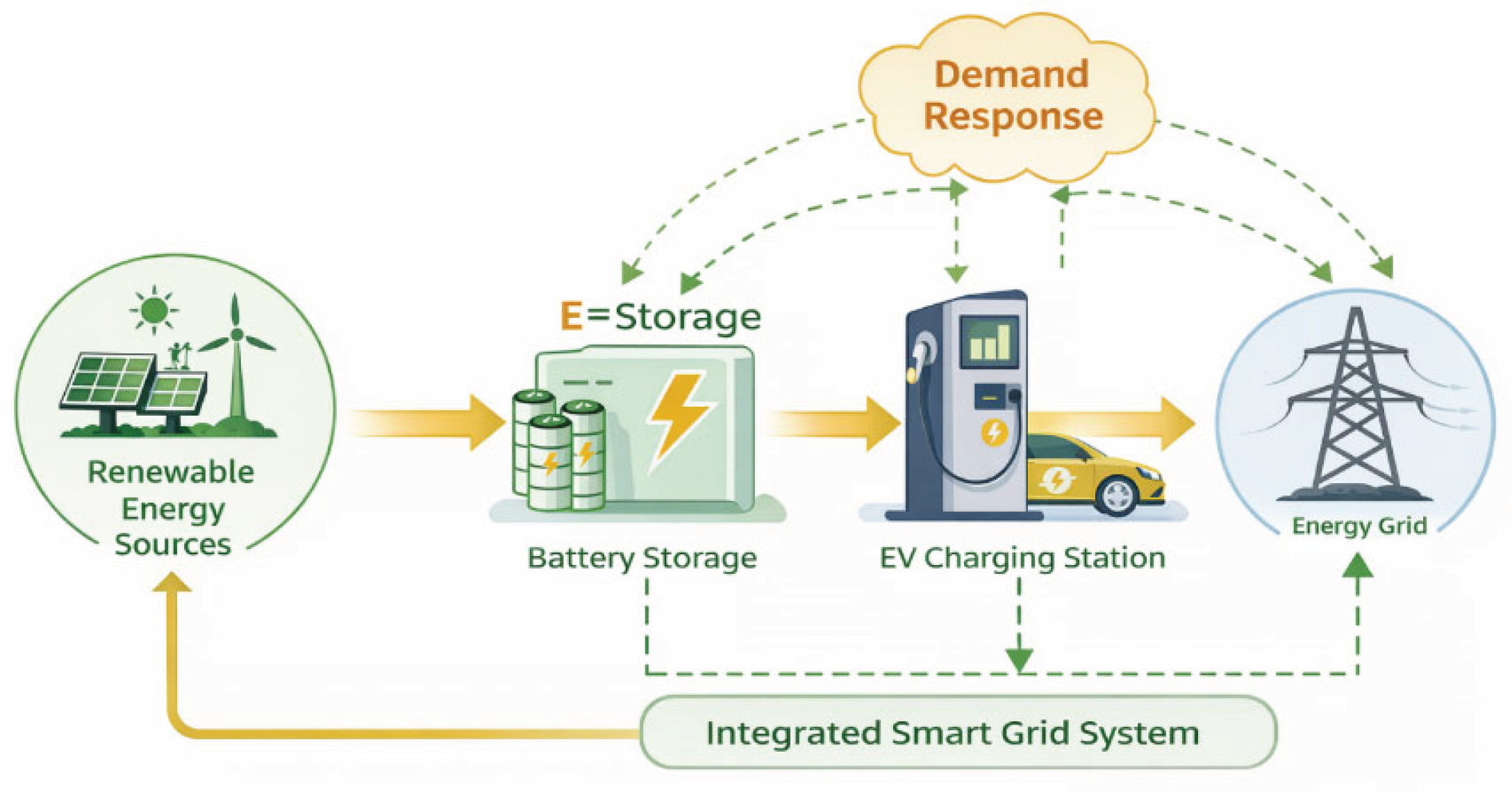
In this context, the integration of charging infrastructure with the power system, local energy storage, and demand-side management should be considered a natural extension of corridor charging planning (Figure 8). As indicated in the conceptual scheme of the integrated smart-grid system, battery storage may act as an intermediate buffer between renewable energy sources, the charging station, and the grid, thereby reducing instantaneous grid load and improving the flexibility of the local energy balance. Demand response mechanisms may further support this process by coordinating charging power with real-time grid conditions and available local resources.
Such an approach is especially relevant in scenarios similar to the 45% EV case analyzed in this study, where infrastructure utilization already exceeds operational limits. In these conditions, adding charging points alone may solve only part of the problem, because greater charger availability may also increase simultaneous power demand at the site level. Therefore, future charging-hub planning should consider not only the number and type of chargers, but also the local capacity of the electricity supply system, the possibility of buffering peak demand with storage, and the integration of charging facilities with renewable generation and smart-grid control strategies.
At the same time, it should be emphasized that energy storage was not explicitly represented in the simulation model used in this work. For this reason, the present discussion should be interpreted as a practical and conceptual implication of the obtained traffic-side results rather than as a directly quantified energy-system outcome. Nevertheless, the magnitude and persistence of overload observed in the higher EV scenarios strongly support the relevance of such integration as a future research direction and as a potentially important component of real-world infrastructure deployment.
4.4. Study Limitations and Future Research
The study has several limitations that should be taken into account when interpreting the results. First, the traffic input was based on a conservative baseline and did not include additional demand growth resulting from improved corridor attractiveness after full expressway development. Second, the charging behavior of users was represented probabilistically, which allowed realistic variability to be introduced into the model, but did not explicitly account for route-level state-of-charge management or user-specific charging strategies.
A further limitation is that the analysis focused on operational charging performance and did not directly model electrical-network constraints, transformer loading, voltage effects, or the dynamic contribution of battery storage systems. As a consequence, the study identifies where traffic-side charging overload occurs, but does not yet quantify the exact electrical consequences of this overload at the grid level. This creates a clear opportunity for future work combining microscopic traffic simulation with energy-system simulation in order to analyze both charging-service performance and power-system impact within a common framework.
Future research should therefore extend the present methodology in three directions. First, it should integrate detailed electrical models of charging hubs and local grid constraints. Second, it should evaluate the role of energy storage, renewable generation, and smart charging strategies in reducing both transport-side and energy-side bottlenecks. Third, it should compare simulation outputs with empirical observations from existing corridor charging sites, which would further strengthen the applicability of the proposed framework for infrastructure planning under real-world conditions.
5. Conclusions
This study presented a simulation-based approach to the planning of EV charging infrastructure along the S19 Rzeszów–Barwinek corridor, which forms part of the TEN-T network. The proposed methodology combined microscopic traffic simulation with charging-demand modeling in order to assess infrastructure performance under different levels of EV penetration. The results confirmed that such an approach enables a more realistic evaluation of charging-system behavior than static planning assumptions, particularly in corridor conditions characterized by time-varying demand and heterogeneous traffic structure.
The analysis showed that the operational performance of charging infrastructure deteriorates progressively as the share of electric vehicles increases. In the 10% EV scenario, the system operated with a clear reserve of capacity and maintained a stable level of service. In the 25% scenario, local congestion effects began to appear, indicating that the infrastructure was approaching its practical operating limit. In the 45% scenario, the charging system entered a state of overload, reflected by utilization levels above 100%, longer queues, and increasing unmet charging demand.
A key finding of the study is the particularly strong effect of heavy-duty electric vehicles on infrastructure performance. Although their share in the traffic stream is lower than that of passenger cars, their longer charging times and higher energy demand make them the dominant source of operational pressure. As a result, the heavy-duty charging subsystem becomes the critical bottleneck of the corridor charging network and should therefore be treated as a priority element in infrastructure planning.
The study also demonstrated that targeted infrastructure expansion can substantially improve system performance. Increasing the number of heavy-duty charging points reduced utilization to a safer operating range, which indicates that selective scaling of the most constrained infrastructure elements may be more effective than uniform charger deployment. This finding has direct practical relevance for the staged development of charging facilities along strategic transport corridors.
The obtained results further suggest that minimum regulatory requirements should be treated as a baseline rather than as a sufficient condition for long-term infrastructure adequacy. In rapidly evolving electrification scenarios, especially those involving freight transport, charging infrastructure planning should be based on dynamic, scenario-oriented analyses capable of capturing actual operating conditions. In this respect, the proposed methodology may serve as a useful decision-support tool for the planning and optimization of charging infrastructure on TEN-T corridors and other transport routes with similar characteristics.
Finally, the study highlights the need for further integration of transport and energy-system perspectives in EV infrastructure planning. Future research should therefore extend the presented framework by incorporating power-system constraints, local energy storage, renewable energy integration, and smart charging strategies. Such an extension would make it possible to assess not only the transport-side adequacy of charging infrastructure, but also its compatibility with the evolving requirements of modern energy systems.
Author Contributions
For research articles with several authors, a short paragraph specifying their individual contributions must be provided. The following statements should be used “Conceptualization, M. L. and M.M.; methodology, M.L.; software, M.L.; validation, M.M.; formal analysis, M.M.; investigation, M.L.; resources, M.L.; data curation, M.L. writing—original draft preparation, M.L.; writing—review and editing, M.M.; visualization, M.L.; supervision, M.M; project administration, M.M.; funding acquisition, M.M. All authors have read and agreed to the published version of the manuscript.” Please turn to the CRediT taxonomy for the term explanation. Authorship must be limited to those who have contributed substantially to the work reported.
Funding
This research received no external funding.
Data Availability Statement
The original contributions presented in this study are included in the article. Further inquiries can be directed to the corresponding author.
Conflicts of Interest
The authors declare no conflicts of interest.
Abbreviations
The following abbreviations are used in this manuscript:
AFIR—Alternative Fuels Infrastructure Regulation
ADT—Average Daily Traffic
DC—Direct Current
EV—Electric Vehicle
HDV—Heavy-Duty Vehicle
MOP—Motorway Service Area
PTV—Planung Transport Verkehr
QLEN—Queue Length
TEN-T—Trans-European Transport Network
References
- Chinoracky, R.; Stalmasekova, N.; Corejova, T. Trends in the field of electromobility—From the perspective of market characteristics and value-added services: Literature review. Energies 2022, 15(17), 6144. [Google Scholar] [CrossRef]
- Mądziel, M.; Kulasa, P.; Campisi, T. Determinants of Test-to-Reality CO2 Gaps in European PHEVs: The Limited Role of Battery Capacity. Vehicles 2026, 8, 60. [Google Scholar] [CrossRef]
- Csillak, K.; Kuhnke, M. M. Interoperability framework for Electromobility (INFRA): the main results from the USER-CHI-framework in a new spotlight. Transportation Research Procedia 2023, 72, 1926–1933. [Google Scholar] [CrossRef]
- Kloskowski, D.; Chamier-Gliszczynski, N.; Murawski, J.; Wasiak, M. Interpolative Estimates of Electric Vehicle Recharging Point Locations in the Context of Electromobility. Energies 2025, 18(23), 6281. [Google Scholar] [CrossRef]
- Krause, J.; Thiel, C.; Tsokolis, D.; Samaras, Z.; Rota, C.; Ward, A.; Verhoeve, W. EU road vehicle energy consumption and CO2 emissions by 2050–Expert-based scenarios. Energy Policy 2020, 138, 111224. [Google Scholar] [CrossRef]
- Plessmann, G.; Blechinger, P. How to meet EU GHG emission reduction targets? A model based decarbonization pathway for Europe’s electricity supply system until 2050. Energy Strategy Reviews 2017, 15, 19–32. [Google Scholar] [CrossRef]
- Hemavathi, S.; Shinisha, A. A study on trends and developments in electric vehicle charging technologies. Journal of energy storage 2022, 52, 105013. [Google Scholar] [CrossRef]
- Shahriar, S.; Al-Ali, A. R.; Osman, A. H.; Dhou, S.; Nijim, M. Machine learning approaches for EV charging behavior: A review. Ieee Access 2020, 8, 168980–168993. [Google Scholar] [CrossRef]
- Vovk, Y.; Aulin, V.; Vovk, I.; Romaniuk, S.; Syhlovyi, M.; Vovk, O.; Zabytivskyi, V. Electric vehicle charging infrastructure optimization on international transport corridors: Economic analysis and EU regulatory alignment in Ukraine. Journal of Sustainable Development of Transport and Logistics 2025, 10(2), 6–28. [Google Scholar] [CrossRef]
- Bernard, M. R.; Nicholas, M.; Wappelhorst, S.; Hall, D. A review of the AFIR proposal: How much power output is needed for public charging infrastructure in the European Union. 2022. [Google Scholar]
- Bernard, M. R. European union alternative fuel infrastructure regulation (AFIR). POLICY; International Council on Clean Transportation, 2023. [Google Scholar]
- Mazur, M.; Dybała, J.; Kluczek, A. Suitable law-based location selection of high-power electric vehicles charging stations on the TEN-T core network for sustainability: A case of Poland. Archives of transport 2024, 69(1), 75–90. [Google Scholar] [CrossRef]
- Szyc, R.; Chamier-Gliszczynski, N.; Musiał, W.; Szczepański, E.; Franke-Wąsowski, P. Electrification of Road Transport Infrastructure in the Context of Sustainable Transport Development and the Deployment of Alternative Fuels Infrastructure on the TEN-T Network in Poland. Energies 2025, 19(1), 15. [Google Scholar] [CrossRef]
- Chamier-Gliszczynski, N.; Dyczkowska, J. A.; Musiał, W.; Panek, A.; Kotylak, P. Energy Transformation of Road Transport Infrastructure—Concept and Assessment of the Electric Vehicle Recharging Systems. Energies 2025, 18(16), 4241. [Google Scholar] [CrossRef]
- Raslavičius, L. The Prerequisites for Development of LNG/CNG Filling Stations Network: The Crucial Role of Lithuania and the Baltic States in the North Sea–Baltic Sea Corridor. Infrastructures 2026, 11(2), 45. [Google Scholar] [CrossRef]
- OPRIŞ-SÎRCA, P. T. The Via Carpatia Project and the Integration Perspectives of the Timişoara-Arad-Oradea Development Axis. Social Sciences and Education Research Review 2024, 11(1), 268–277. [Google Scholar]
- Wei, G.; Wang, G.; Ruan, G.; Geng, N. Review of intelligent decision optimization of electric vehicle charging stations location. Comput. Eng. Appl 2023, 59, 52–65. [Google Scholar]
- Dharangaonkar, S. K.; Patil, S. A. Planning of Electric Vehicle Charging Infrastructure: A Review and a Conceptual Framework Based on Spatial and Predictive Analysis. International Journal of Sustainable Development & Planning 2025, 20(6). [Google Scholar]
- Kchaou-Boujelben, M. Charging station location problem: A comprehensive review on models and solution approaches. Transportation Research Part C: Emerging Technologies 2021, 132, 103376. [Google Scholar] [CrossRef]
- Lara Leon, D.; Gallego Landera, Y.; Garcia Santander, L.; León Viltre, L. T.; Cuaresma Zevallos, O.; Muñoz Jarpa, F. A. Optimal Location of Charging Stations for Electric Vehicles in Distribution Networks: A Literature Review. Energies 2025, 18(21). [Google Scholar] [CrossRef]
- Mądziel, M.; Campisi, T. Predictive Artificial Intelligence Models for Energy Efficiency in Hybrid and Electric Vehicles: Analysis for Enna, Sicily. Energies 2024, 17, 4913. [Google Scholar] [CrossRef]
- Macioszek, E.; Tumminello, M. L. Simulating vehicle-to-vehicle communication at roundabouts. Transport Problems 2024, 19. [Google Scholar] [CrossRef]
- Tumminello, M. L.; Zare, N.; Macioszek, E.; Granà, A. Assaying Traffic Settings with Connected and Automated Mobility Channeled into Road Intersection Design. Smart Cities 2025, 8(3), 86. [Google Scholar] [CrossRef]
- Inci, M.; Çelik, Ö; Lashab, A.; Bayındır, K. Ç; Vasquez, J. C.; Guerrero, J. M. Power system integration of electric vehicles: A review on impacts and contributions to the smart grid. Applied Sciences 2024, 14(6), 2246. [Google Scholar] [CrossRef]
- Ismail, A. A.; Mbungu, N. T.; Elnady, A.; Bansal, R. C.; Hamid, A. K.; AlShabi, M. Impact of electric vehicles on smart grid and future predictions: a survey. International Journal of Modelling and Simulation 2023, 43(6), 1041–1057. [Google Scholar] [CrossRef]
- Lis, M.; Mądziel, M. Green Transportation Planning for Smart Cities: Digital Twins and Real-Time Traffic Optimization in Urban Mobility Networks. Appl. Sci. 2026, 16, 678. [Google Scholar] [CrossRef]
- Afshari, A.; Lee, J.; Besenski, D. A Digital Twin Platform for Real-Time Intersection Traffic Monitoring, Performance Evaluation, and Calibration. Infrastructures 2025, 10(8), 204. [Google Scholar] [CrossRef]
- Ullah, I.; Zheng, J.; Jamal, A.; Zahid, M.; Almoshageh, M.; Safdar, M. Electric vehicles charging infrastructure planning: A review. International Journal of Green Energy 2024, 21(7), 1710–1728. [Google Scholar] [CrossRef]
- Gjelaj, M.; Hashemi, S.; Andersen, P. B.; Traeholt, C. Optimal infrastructure planning for EV fast-charging stations based on prediction of user behaviour. IET Electrical Systems in Transportation 2020, 10(1), 1–12. [Google Scholar] [CrossRef]
- Patil, P.; Kazemzadeh, K.; Bansal, P. Integration of charging behavior into infrastructure planning and management of electric vehicles: A systematic review and framework. Sustainable cities and society 2023, 88, 104265. [Google Scholar] [CrossRef]
- Wen, J.; Gan, W.; Chu, C. C.; Jiang, L.; Luo, J. Robust resilience enhancement by EV charging infrastructure planning in coupled power distribution and transportation systems. IEEE transactions on smart grid 2024, 16(1), 491–504. [Google Scholar] [CrossRef]
- Mądziel, M. Impact of Weather Conditions on Energy Consumption Modeling for Electric Vehicles. Energies 2025, 18. [Google Scholar] [CrossRef]
- Mądziel, M. State of Charge Prediction for Li-Ion Batteries in EVs for Traffic Microsimulation. Energies 2025, 18, 4992. [Google Scholar] [CrossRef]
- Mądziel, M.; Campisi, T. Predicting Auxiliary Energy Demand in Electric Vehicles Using Physics-Based and Machine Learning Models. Energies 2025, 18, 6092. [Google Scholar] [CrossRef]
- Palaniappan, A.; Bhukya, P.; Chitti, S. K.; Gao, J. Data-driven analysis of EV energy prediction and planning of EV charging infrastructure. In 2023 IEEE Ninth International Conference on Big Data Computing Service and Applications (BigDataService); IEEE, July 2023; pp. 17–24. [Google Scholar]
- Torkey, A.; Abdelgawad, H. Framework for planning of EV charging infrastructure: Where should cities start? Transport Policy 2022, 128, 193–208. [Google Scholar] [CrossRef]
- Hanig, L.; Harper, C. D.; Nock, D.; Michalek, J. J. Driving the grid forward: How electric vehicle adoption shapes power system infrastructure and emissions. Proceedings of the National Academy of Sciences 2025, 122(37), e2420609122. [Google Scholar] [CrossRef]
- Heuberger, C. F.; Bains, P. K.; Mac Dowell, N. The EV-olution of the power system: A spatio-temporal optimisation model to investigate the impact of electric vehicle deployment. Applied Energy 2020, 257, 113715. [Google Scholar] [CrossRef]
- Lenka, R. K.; Panda, A. K.; Senapati, L. Grid integrated multifunctional EV charging infrastructure with improved power quality. Journal of Energy Storage 2024, 76, 109637. [Google Scholar] [CrossRef]
- Borlaug, B.; Muratori, M.; Gilleran, M.; Woody, D.; Muston, W.; Canada, T.; McQueen, C. Heavy-duty truck electrification and the impacts of depot charging on electricity distribution systems. Nature Energy 2021, 6(6), 673–682. [Google Scholar] [CrossRef]
- Ceraolo, M.; Lutzemberger, G.; Mauri, G.; Salamone, S. Regional and long-haul heavy-duty trucks: energy consumptions and recharging needs. In 2023 AEIT International Conference on Electrical and Electronic Technologies for Automotive (AEIT AUTOMOTIVE); IEEE, July 2023; pp. 1–6. [Google Scholar]
Figure 1.
Methodological workflow of the simulation framework.
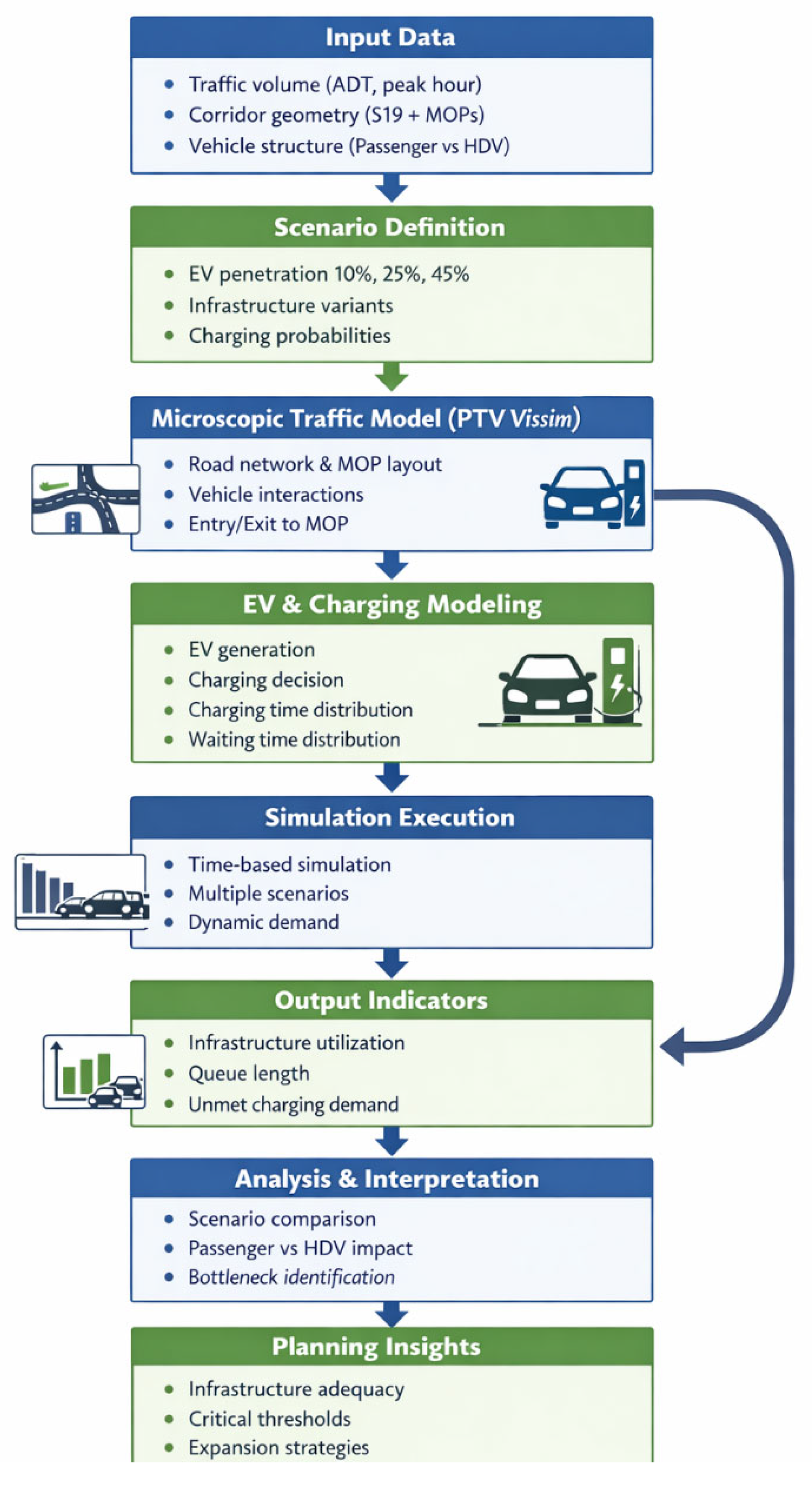
Figure 2.
Visualization of the modeled motorway service area (MOP) in the PTV Vissim environment: (a) general view of the MOP and its integration with the S19 expressway; (b) charging area for heavy-duty electric vehicles; (c) charging area for passenger electric vehicles.
Figure 2.
Visualization of the modeled motorway service area (MOP) in the PTV Vissim environment: (a) general view of the MOP and its integration with the S19 expressway; (b) charging area for heavy-duty electric vehicles; (c) charging area for passenger electric vehicles.
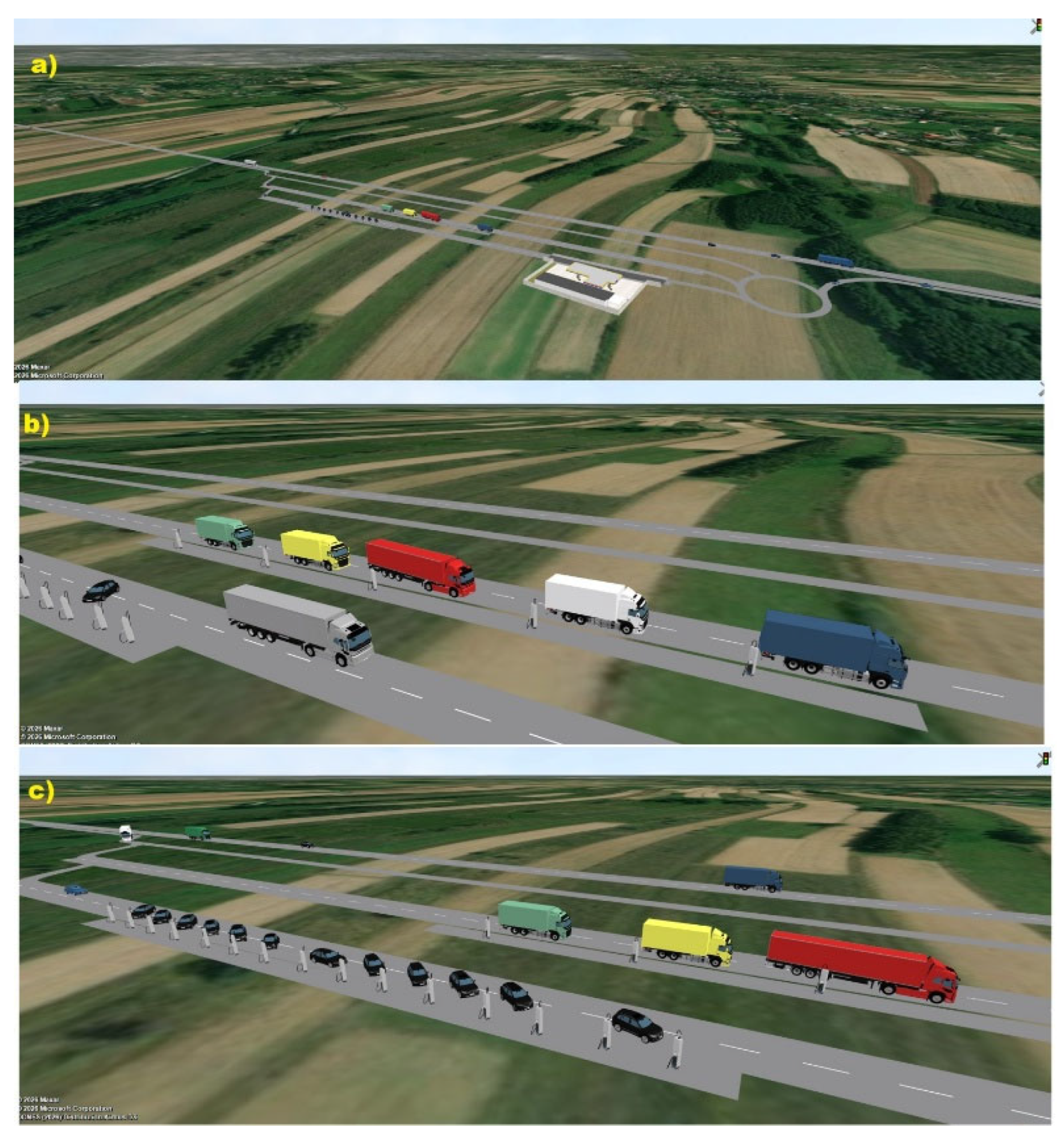
Figure 3.
Empirical distributions implemented in the simulation model: (a) charging time for passenger electric vehicles; (b) charging time for heavy-duty electric vehicles; (c) waiting time for passenger electric vehicles; (d) waiting time for heavy-duty electric vehicles.
Figure 3.
Empirical distributions implemented in the simulation model: (a) charging time for passenger electric vehicles; (b) charging time for heavy-duty electric vehicles; (c) waiting time for passenger electric vehicles; (d) waiting time for heavy-duty electric vehicles.
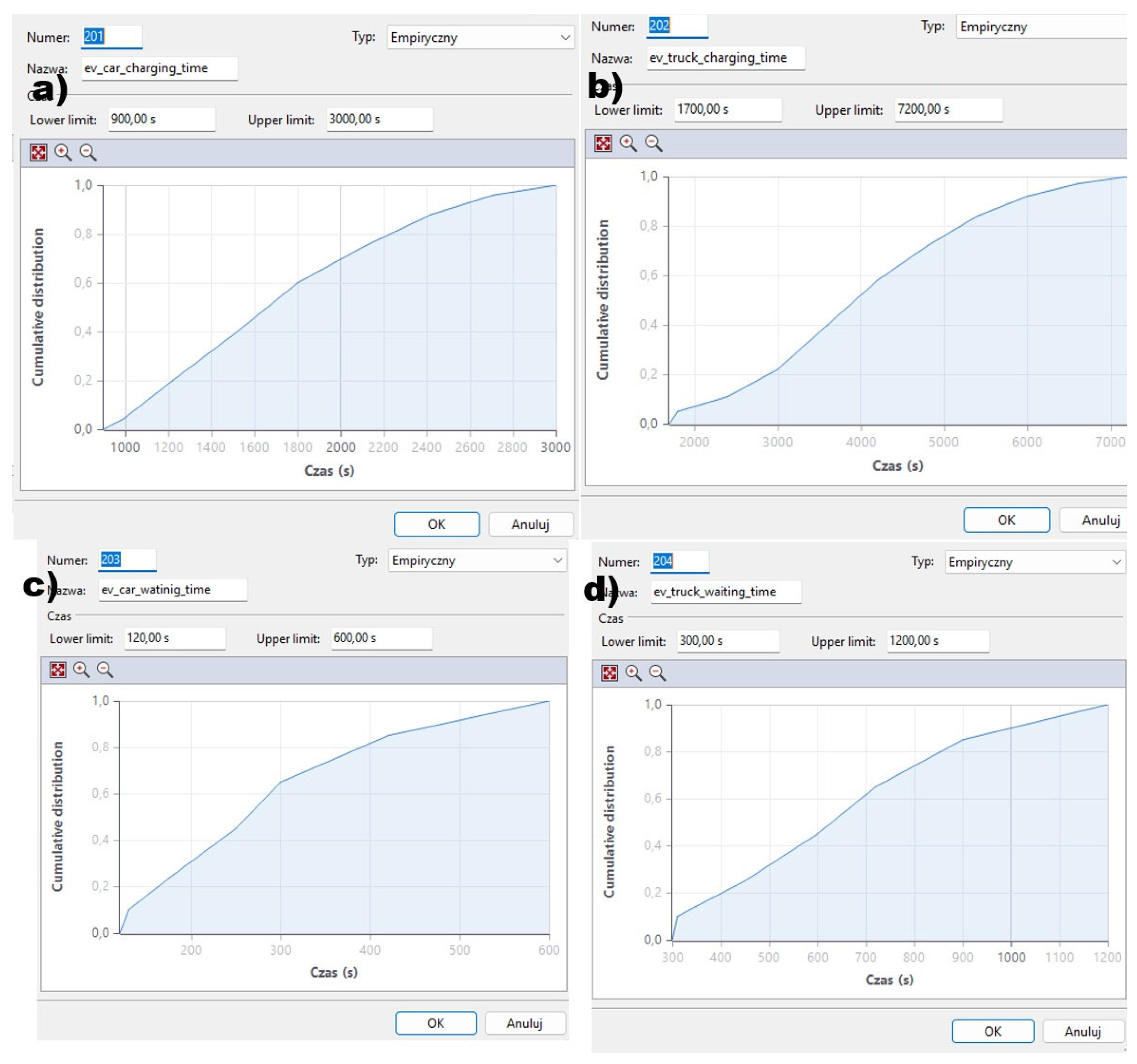
Figure 4.
Surface plot of charging infrastructure utilization at motorway service areas (MOPs) as a function of time of day and EV penetration level.
Figure 4.
Surface plot of charging infrastructure utilization at motorway service areas (MOPs) as a function of time of day and EV penetration level.
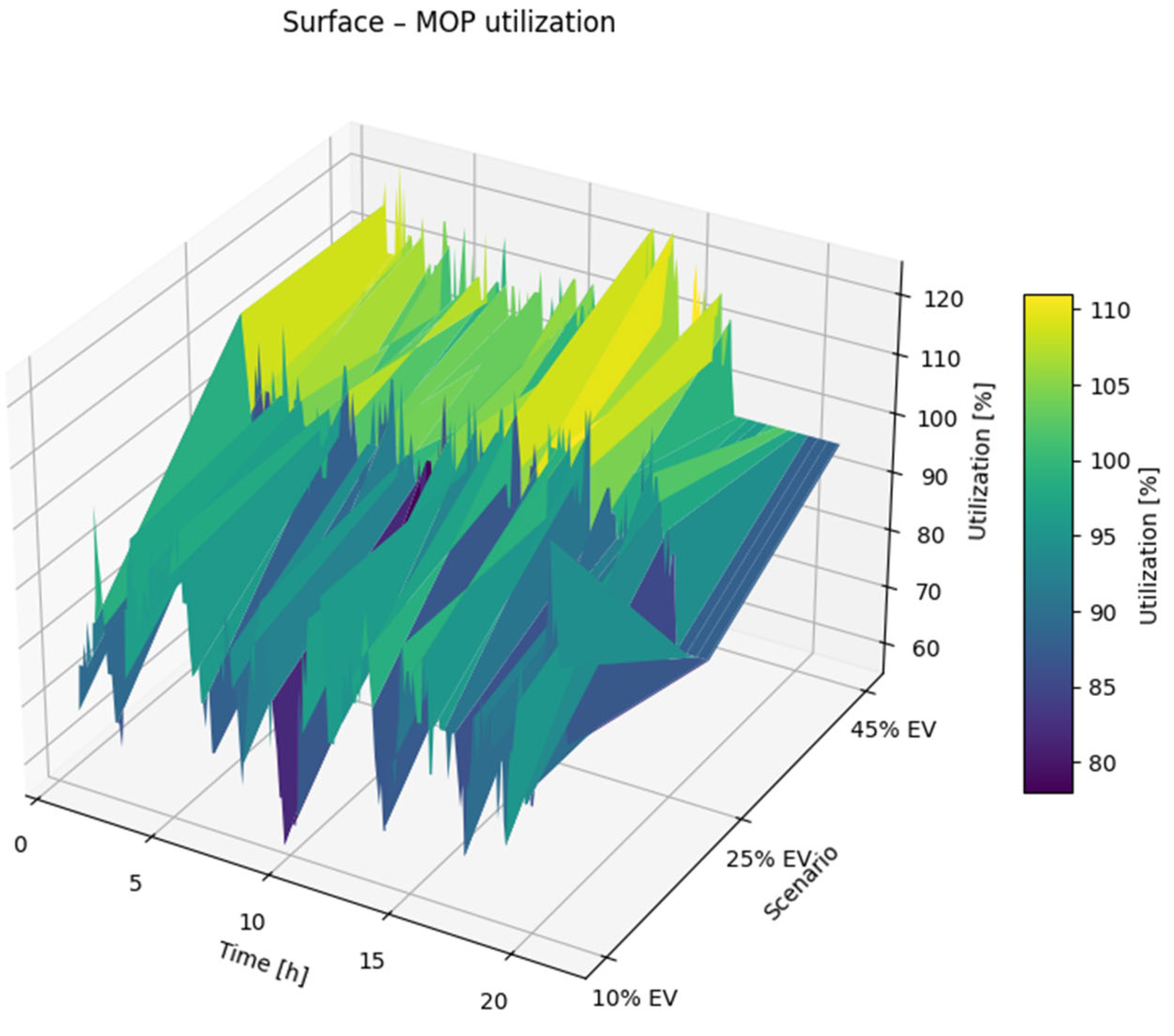
Figure 5.
Heatmaps of charging infrastructure utilization over time for passenger electric vehicles (EV car) and heavy-duty electric vehicles (EV truck) under the analyzed EV penetration scenarios (10%, 25%, and 45%). Values above 100% indicate overload conditions and limited service availability.
Figure 5.
Heatmaps of charging infrastructure utilization over time for passenger electric vehicles (EV car) and heavy-duty electric vehicles (EV truck) under the analyzed EV penetration scenarios (10%, 25%, and 45%). Values above 100% indicate overload conditions and limited service availability.
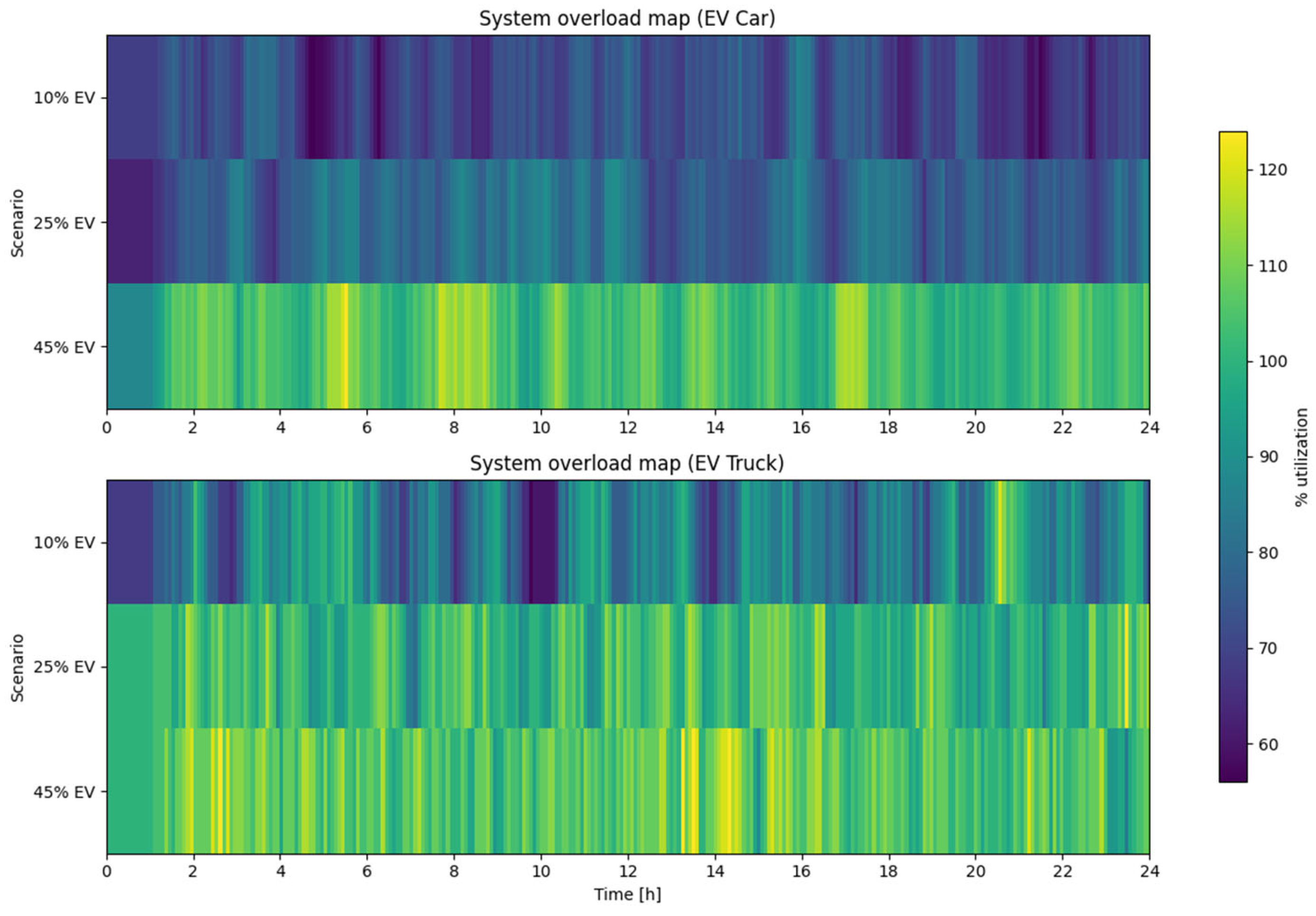
Figure 6.
Average queue length (top) and unmet charging demand (bottom) per motorway service area (MOP) over time under different EV penetration scenarios; results are aggregated at hourly intervals.
Figure 6.
Average queue length (top) and unmet charging demand (bottom) per motorway service area (MOP) over time under different EV penetration scenarios; results are aggregated at hourly intervals.
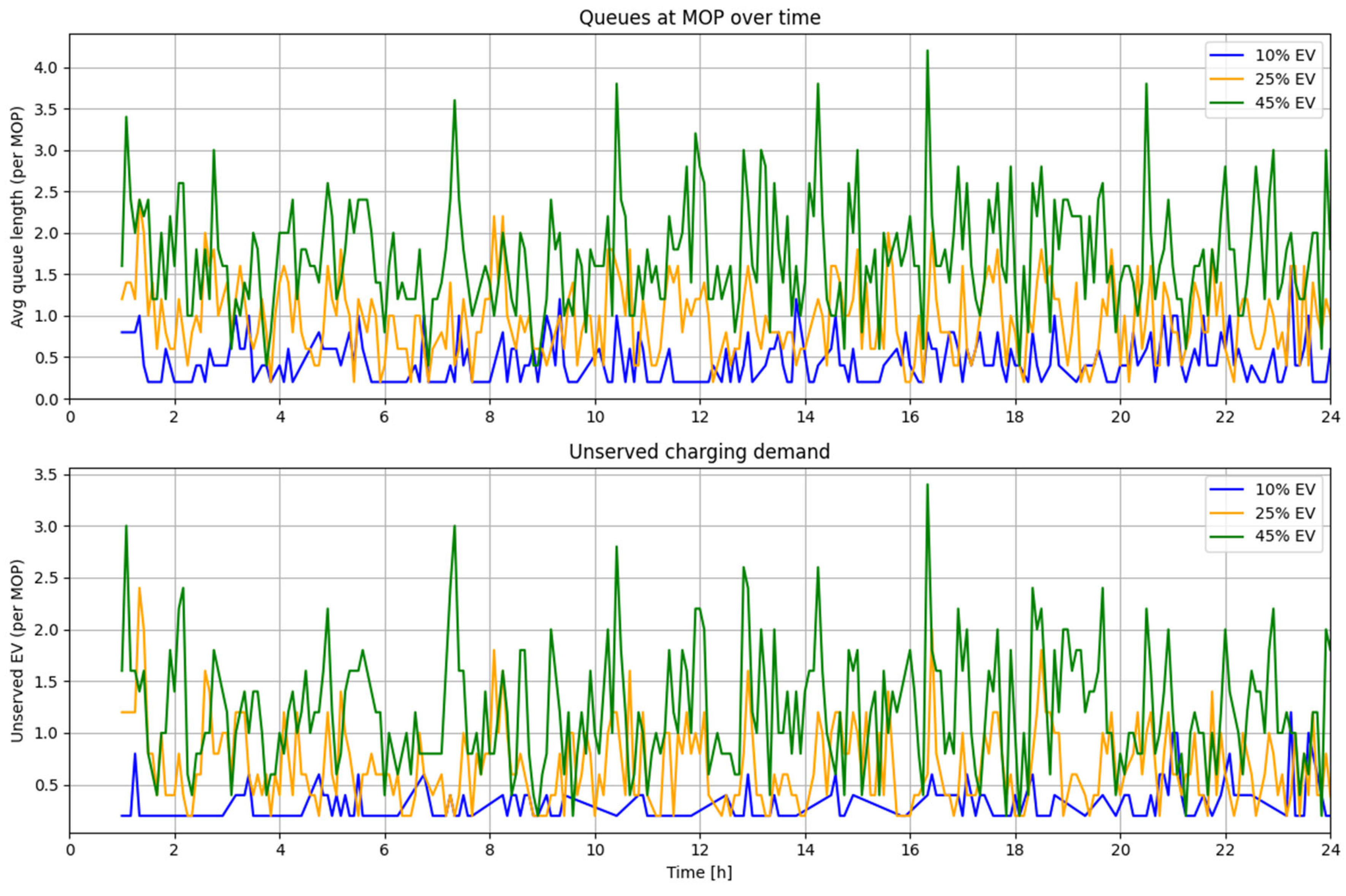
Figure 7.
Charging infrastructure utilization as a function of EV penetration level, including the extrapolated 60% EV scenario and the heavy-duty charging expansion variant.
Figure 7.
Charging infrastructure utilization as a function of EV penetration level, including the extrapolated 60% EV scenario and the heavy-duty charging expansion variant.
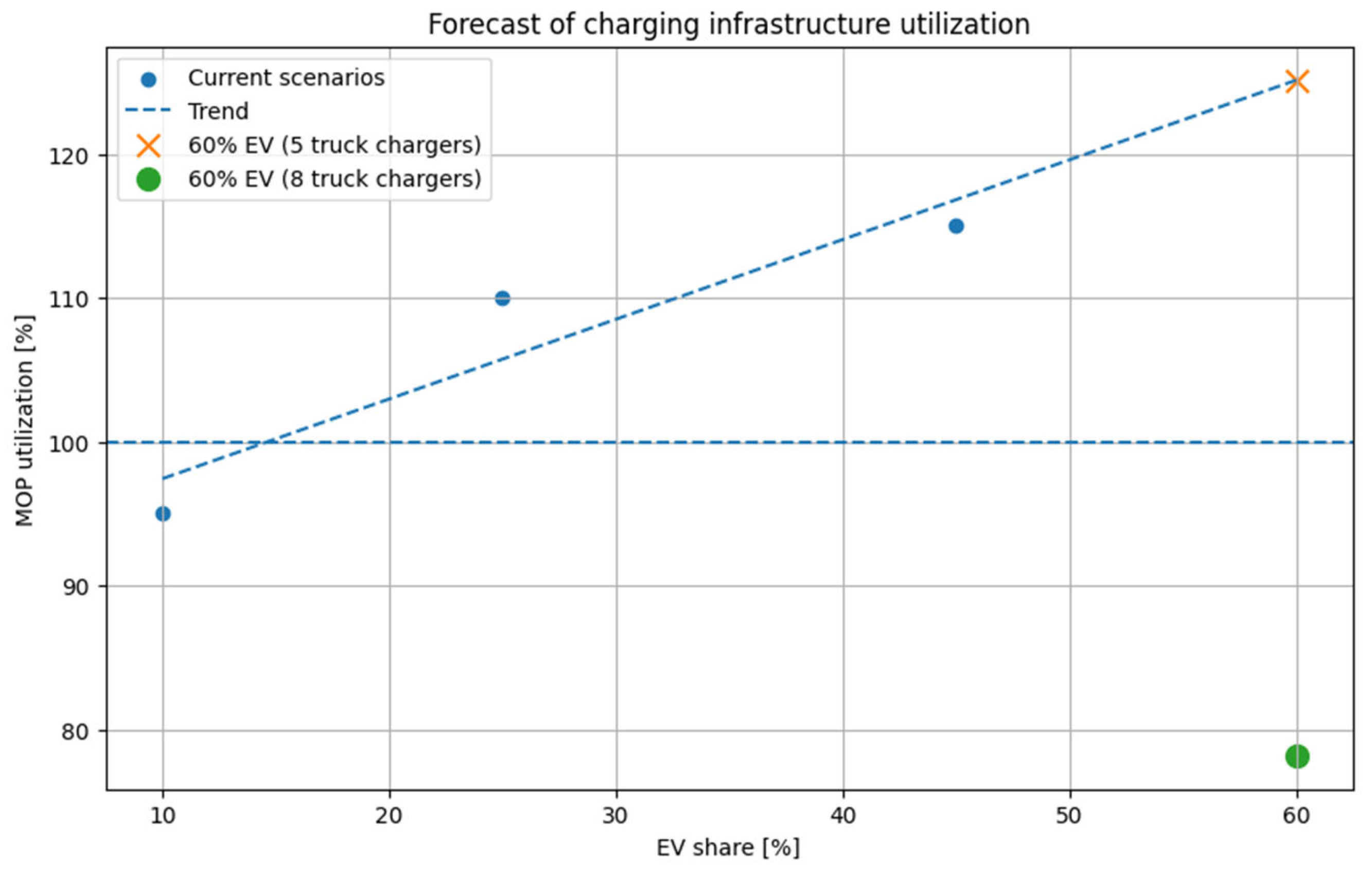
Figure 8.
Conceptual framework for the integration of EV charging infrastructure with renewable energy sources, battery storage, demand response, and the power grid within an integrated smart-grid system.
Figure 8.
Conceptual framework for the integration of EV charging infrastructure with renewable energy sources, battery storage, demand response, and the power grid within an integrated smart-grid system.
Disclaimer/Publisher’s Note: The statements, opinions and data contained in all publications are solely those of the individual author(s) and contributor(s) and not of MDPI and/or the editor(s). MDPI and/or the editor(s) disclaim responsibility for any injury to people or property resulting from any ideas, methods, instructions or products referred to in the content. |
© 2026 by the authors. Licensee MDPI, Basel, Switzerland. This article is an open access article distributed under the terms and conditions of the Creative Commons Attribution (CC BY) license (http://creativecommons.org/licenses/by/4.0/).
Copyright: This open access article is published under a Creative Commons CC BY 4.0 license, which permit the free download, distribution, and reuse, provided that the author and preprint are cited in any reuse.


