

Submitted:
16 April 2026
Posted:
17 April 2026
You are already at the latest version
Abstract
The article is devoted to the developing methodological approaches to multi-criteria resource optimization of technological solutions in Nature Use Projects considering the growing shortage of water and energy resources, climate change, and post-war transformation of Ukraine’s agricultural sector. The need to transition from traditional technical and economic optimization models to integrated assessment approaches which consider ecological, resource, and economic aspects of the project implementation effectiveness is substantiated. The methodological basis of the study is a combination of Multi-Criteria Decision-Making and the Water-Energy-Food Nexus concept, enabling the necessary adaptive management and formalizing the process of project decision-making under multifactor uncertainty. A set of indicators of resource-ecological and economic efficiency is proposed, including indicators of productivity, weather and climate risk, resource use, environmental reliability, investment attractiveness, etc. A key feature of this approach is the transformation of resource-ecological indicators into a value form, ensuring their integration with economic indicators within a single optimization model. Based on a machine experiment for the conditions of the Kherson region, an assessment of the effectiveness of various irrigation regimes, which differ from the project irrigation regime in terms of watering and irrigation norms in terms of their level of provision with water and energy resources, was carried out. It was determined that, under the studied conditions, the permissible deficit threshold is approximately 30%, achieving a compromise between economic efficiency and environmental acceptability. Adaptive management of irrigation regimes has been shown to reduce the resource intensity of production without a significant loss of productivity. This creates a basis for revising outdated design standards, which focused on 100% satisfaction of water needs, in favor of adaptive models that account for the real resource potential of the territory. This approach transforms irrigation from a resource-intensive industry into a tool for sustainable territorial development, where the priority is the efficiency of each cubic meter of water and kilowatt-hour of energy used, rather than gross collection. It has been proven that the implementation of resource optimization as a basic principle of natural resource project management contributes to increasing the efficiency of natural capital use, minimizing environmental risks, and ensuring the sustainable development of the agricultural sector. The obtained results can be used to substantiate engineering solutions in projects for the restoration and modernization of water management and land reclamation systems in Ukraine.
Keywords:
methodological approach
; multi-criterion resource optimization
; technological solutions
; irrigation
; nature use project
; nature-based solutions
; natural resource projects
1. Introduction
Global crises—food, water, and energy, intensified by climate change — put forward new demands on all sectors of the economy and the agricultural sector in particular. The issue of effective use of land resources, which are a valuable strategic resource for ensuring food security not only in Ukraine but also in the world, is extremely acute. This has become especially relevant against the backdrop of Russian aggression, which has demonstrated the importance of Ukrainian exports of agricultural products.
The situation in Ukraine at the current stage of development is characterized by a combination of chronic problems (outdated infrastructure) and critical consequences of the war. According to the analysis of the World Bank and the Ministry of Environmental Protection and Natural Resources of Ukraine, the current state of water and land resources is characterized by a number of problems that lead not just to temporary difficulties, but to critical depletion of natural capital, and in the long term, to large-scale economic, technological, social, and geopolitical consequences [1,2,3]. Such facts indicate that the scale of the destruction of Ukraine’s agricultural potential has gone beyond the usual technical damage to assets. There is a systemic collapse of the resource base, where chemical poisoning of soils, hydrological shock, and climate change lead to the destruction of traditional nature use. A particularly difficult situation is observed in the field of agricultural production on reclaimed lands, since the implementation of irrigation is characterized by excessive consumption of water and energy resources and untapped potential for crop yields, and this is in conditions of increasing scarcity and cost of water and electricity.
Such a scale of challenges and the need to implement the concept of sustainable development dictate the need for a fundamental transformation of approaches to justifying development directions and economic decisions in the areas of active use of natural resources in the following key areas:
- Designing technological facilities and restoring technical infrastructure cannot be a simple copying of traditional engineering solutions. Modern projects should be based on the principles of Nature-based Solutions, taking into account new climatic realities and the ecological vulnerability of agricultural landscapes. This means a transition to intelligent, energy-efficient, and adaptive systems for managing water and other natural resources. Nature-based solutions are a modern paradigm for justifying the feasibility of management decisions regarding any type of economic activity and a way to meet people’s needs and overcome social challenges with the help of nature in a way that is friendly to it [4,5,6].
- Project management in the agricultural sector requires a transition from the “yield maximization at any cost” model to the “resource restoration” model. Agricultural project management should now include mandatory blocks of environmental insurance, risk monitoring, and biodiversity restoration.
- A conscious choice in favor of minimal water consumption becomes a basic parameter of agribusiness sustainability. Abandoning traditional resource-intensive models in favor of innovative solutions is the only way to level the geopolitical and economic consequences of resource degradation.
The specifics of project management in the areas of nature use, in particular in the areas of agricultural production, water management, and land reclamation, at the current stage of development consist in the transition from traditional domestic feasibility studies to comprehensive planning and assessment, taking into account the socio-ecological value and features of the life cycle of projects involving natural resources. Today, in the scientific discourse, there are attempts to adapt classical methodologies and project management tools to the specifics of nature-oriented systems, which are characterized by a high level of uncertainty of biological processes and a long time lag between processes and results.
Despite the sufficient level of research in the field of sustainable nature use, the fundamental contradiction between theoretical concepts of environmental safety and practical tools of project analysis remains unresolved. Traditional methods of evaluating investment projects are of limited use when working with natural resource assets; they do not take into account and do not allow for the integration of non-financial indicators, which are most often used to evaluate natural resources and environmental processes. This necessitates the development of methodological principles for comparing and substantiating technological options for project solutions based on multi-criteria resource optimization.
Resource optimization in nature use projects is a complex process of multi-level balancing, where each technological solution causes a chain reaction of changes in natural objects and processes. Therefore, the object of such optimization is not a separate technical parameter, but the synergistic effect of the interaction of anthropogenic interventions and natural cycles.
This approach requires the implementation of a system of integrated indicators that would serve as a “measure” of the efficiency of natural capital use at each stage of the project’s life cycle. This is especially relevant in Ukraine, where the areas of nature use traditionally “lag behind” business areas in terms of practical implementation of modern concepts, approaches, and tools, which requires finding common ground between the domestic engineering school, the Western management paradigm, and the global concept of sustainable development [7,8,9].
2. Literature Review
Scientific directions of recent years are closely related to the integration of environmental and resource components directly into the modern project management system. Over the past 5–7 years, the following approaches can be distinguished in the international scientific space, which are used in project analysis to take into account ecological factors and calculate indicators of the efficiency of natural resource use.
In particular, the concept of Water Productivity [10] reflects water productivity by determining the amount of biomass or financial income obtained per cubic meter of water used. This allows comparing different irrigation technologies in terms of real resource efficiency. The integrated Water Productivity Score is used as an evaluation indicator, which allows comparing different climatic zones and irrigation technologies in the same project [11,12].
As indicators of the technological efficiency of the project, the indicators of Energy Intensity of Water have become popular — it estimates the amount of energy required to supply and distribute 1 m³ of water; Specific Energy Consumption — it estimates the amount of energy consumed per unit of produced product. In modern projects, the indicator of energy intensity of water is integrated into the decision-making model to assess the carbon footprint of the project and its dependence on energy prices, because conscious restriction of water use is not only environmental ethics but also minimization of energy risks [12]. Specific energy consumption is one of the best indicators for comparing different technologies within the same project, and its reduction when switching to new irrigation methods is direct evidence of the success of project management.
The foundation of energy analysis can be considered the criterion of Energy Return on Investment — the ratio of energy obtained in the form of a crop (calories) to the energy spent on its cultivation (fuel, fertilizers, logistics) [13].
The main indicator of economic efficiency used by the World Bank and FAO to assess the agricultural sector of countries is Total Factor Productivity. This indicator measures the ratio of total agricultural output to the total of all resources (factors of production) used: land, labor, capital, fertilizers, energy, and water. An increase in this indicator means that you get more output with the same (or fewer) resources due to technological progress [14].
In recent years, Ukrainian scientific thought has emphasized balanced environmental management (scientists of the National University of Water and Environmental Engineering of the Ministry of Education and Science of Ukraine (NUWEE, Rivne), the Institute of Water Problems and Land Reclamation of the National Academy of Agrarian Sciences of Ukraine (IWP&LR, Kyiv), etc.). The key domestic approaches to assessing resource productivity in agricultural production and the water management and reclamation complex include: the concept of ecological and economic efficiency of reclamation [15]; assessment of irrigation water productivity [16]; soil classification and assessment of potential productivity [17,18]; bioenergy assessment method [19,20].
Unlike Western methods, which are often purely monetary, domestic approaches are traditionally more deeply integrated with standards and resource certification. They have high accuracy in measuring physical indicators (soil, water, energy), but they require integration with foreign methods of market and strategic assessment. Combining the domestic school of resource rationing with Western methods of adaptive management will allow the creation a new model of decision-making for projects aimed at intensive resource use. At the same time, the issues of economic assessment of natural resources and environmental consequences, as well as the integration of environmental and resource assessment into the model of technological decision-making, have not been fully resolved. Modern project analysis should move from monitoring the volume of resource extraction to tracking indicators of their productivity, to balancing between needs for natural resources and ethical nature management. Only in this way can the sustainability of the agricultural sector be ensured in the future under conditions of water shortage and soil degradation.
3. Materials and Research Methods
The methodological justification of resource optimization in this study is based on the principles of Multi-Criteria Decision-Making and the Water-Energy-Food Nexus concept, which are leading in modern world practice of natural use project management [21,22,23]. Unlike traditional monetary approaches, which often ignore the nonlinearity of ecosystem processes, multi-criteria optimization integrates physical parameters of resource potential with indicators of economic efficiency.
This approach is consistent with foreign research in the field of Deficit Irrigation [24,25], where the key task is to find the optimal compromise between resource scarcity and biosystem productivity. The principles of studying the limits of “acceptable deficit” are used, which correlates with global strategies for adaptation to climate change.
In the development of the above approaches, this article solves the problem of the lack of tools, namely, the ability to assess the efficiency and productivity of the use of limited resources in cost terms through the proposed array of indicators for various options for technical and technological solutions. The set of author’s indicators proposed in this paper actually implements the concepts of Integrated Resource Management and Resource Productivity, adapting them to the specifics of the irrigation and drainage systems in Ukraine. This allows us to transform the regime and technological parameters of water and energy costs into a vector of comprehensive assessment of the project’s effectiveness, which meets global standards of sustainable development.
The approaches we propose to build a decision-making model when comparing alternative engineering options and assessing the resource component are based on the author’s many years of development on ecological and economic optimization, which allows us to consider engineering infrastructure as a complex natural-technical and ecological-economic system [26,27,28]. The author’s approaches (A. Rokochynskyi, P. Volk, N. Frolenkova, N. Prykhodko, etc.) are implemented on the basis of the application of modern computer and high-information technologies at the research laboratory “Optimization and automation of management in water engineering and water technologies” of the National University of Water and Environmental Engineering. They allow assessing the efficiency of using diverse resources for the implementation of water management and reclamation measures as part of the overall technical, technological, ecological, economic, and investment efficiency of reclamation when substantiating optimal technical and technological solutions in construction, reconstruction, and operation projects of water management and reclamation facilities. The implementation of such approaches allows us to compare and substantiate such technological variants of project solutions that provide maximum economic effect with minimum permissible load on the environment. In this case, methods of mathematical modelling of various meteorological scenarios are used to take into account the climate variability factor, which allows the system to be resistant to weather risks, and the assessment is carried out taking into account the author’s indicators, such as the weather and Climate Risk Indicator [29] and the Coefficient of Environmental Reliability [30].
Methodological approaches and criteria for resource optimization of technological solutions for projects in the sphere of nature management were considered by us on the example of assessing the efficiency of using water and energy resources in irrigation in conditions of their growing shortage. Based on the software package [31], a machine experiment was planned and conducted to assess the overall efficiency of various irrigation regimes that differ from the project irrigation regime in terms of its provision with regard to watering and irrigation norms. This software package is based on the use of a complex of optimization, economic-mathematical, and forecasting-simulation methods and models, including models of climatic conditions of the area, models of water regime and water regulation technologies, and models of crop yields grown on reclaimed lands, for predictive assessment on a long-term basis of indicators and parameters of technological, ecological, economic, and investment efficiency of water management and reclamation facility’s functioning, the use of which is regulated by the relevant industry standards of the State Agency of Water Resources of Ukraine.
For its implementation, we used the data obtained during the assessment of the effectiveness of the use of a vibrating filter-settlement for the purification of irrigation water of various degrees of pollution at LLC “S-Rostok” of the Kherson region. The agricultural enterprise LLC “S-Rostok” is located in the Kakhovka district of the Kherson region of Ukraine. Agricultural lands, with an area of 450 hectares, are represented by southern low-humus black soil. The main areas of production activity of the agricultural enterprise are the cultivation of cereals, including high-quality food grain, and technical and vegetable crops. Irrigation of cultivated crops is carried out by sprinkling irrigation using the sprinkler machine “Fregat” modification DMU-Bnm463-57-01.
The initial conditions of the machine experiment: region—Kherson; natural and climatic zone—steppe; estimated groups of years according to a comprehensive assessment of the conditions of heat and moisture provision of the vegetation periods according to [29,30] (very wet (p=10%); wet (p=30%); middle (p=50%); dry (p=70%); very dry (p=90%)); soils—southern low-humus black soils; a set of crops of the project crop rotation with the share of their content (perennial grasses (green mass) – 0.4; winter wheat (grain) – 0.2; vegetables (tomato) – 0.2; corn (grain) – 0.2).
As the main options for the study, a set of sprinkling irrigation regimes was considered, which differ from the project irrigation regime in terms of watering and irrigation norms in terms of their level of provision with water and energy resources (φM, %):
- − control – project regime of irrigation by sprinkling, φM =100%;
- − option 1– sprinkling irrigation regime, which corresponds to φM =73%;
- − option 2– sprinkling irrigation regime, which corresponds to φM =70%;
- − option 3– sprinkling irrigation regime, which corresponds to φM =67%;
- − option 4– sprinkling irrigation regime, which corresponds to φM =62%;
- − option 5– sprinkling irrigation regime, which corresponds to φM =52%.
- − option 6– sprinkling irrigation regime, which corresponds to φM =0%.
4. Results
Therefore, despite the significant development of methodologies for assessing and determining resource productivity in the areas of natural resources management, the problems of instrumental deficit remain unresolved. After all, most of the existing generally accepted indicators and metrics are universal and do not sufficiently take into account the specifics of the industry and also require contextualization and adaptation to the specific challenges that Ukraine faces today. In particular, land capital degradation is intensifying: according to monitoring data, the area of degraded and low-productive lands in Ukraine has already exceeded 10 million hectares, and economic losses from crop failure due to erosion are estimated at over 470 million USD annually. Over 5 million hectares of farmland have been directly affected by the war (mining, heavy metal contamination). According to scientific forecasts, by 2050, almost half of arable land may be in the zone of risky agriculture. This threatens not only a decrease in the efficiency of agricultural production in conditions of acute water shortage but also desertification of territories and a critical undermining of food security in Ukraine and beyond. A structural analysis of degradation and anthropogenic pressure on land capital in Ukraine is shown in Figure 1.
As for water resources, the key problem for Ukraine’s agricultural sector is not just the availability of water but the availability of irrigation infrastructure and water quality due to hostilities and climate change. For example, after the destruction of the Kakhovka hydroelectric power station, more than 500 hectares of land in southern Ukraine were left without a stable source of irrigation, and in general, only 6.7% of the pre-war irrigation potential is operational. The World Bank estimates the damage from the destruction of water systems alone at 14 billion USD and the need for their restoration at 15 billion USD. A structural analysis of the degradation and loss of water resources for irrigation in Ukraine’s agricultural sector is shown in Figure 2.
The data presented prove that over 35% of land capital is in a state that requires not just “support”, but a radical change in technological solutions through the implementation of restoration projects, where minimizing additional load on the soil and consciously limiting water use should become priority selection criteria.
The implementation of a modern project approach as a standard for managing complex natural-technical and ecological-economic systems allows integrating engineering infrastructure and natural capital into a single, holistic system, where efficiency is measured by the ability of technologies to rationally transform limited resources into economic results. This fully corresponds to the global concept of sustainable development, which requires harmonizing economic growth with environmental safety and social responsibility.
In this regard, the conceptual apparatus also needs clarification, in particular, the concept of a project implemented in the field of nature use. In the context of the study, we propose the introduction/clarification of the category of “natural resource projects” as the basic object of ecological and economic optimization. This term can be considered universal for designating a wide group of projects in the field of nature use (agricultural, land reclamation, water management, etc.).
We propose to consider natural resource projects as complex investment and technical measures aimed at attracting, transforming, and using the potential of natural assets (land, water, and energy) using engineering infrastructure. In such projects, the technological component (irrigation systems, hydraulic structures) is a necessary condition for converting a natural resource into economic value. The effectiveness of such projects is determined by the ability of the engineering system to ensure the maximum transformation of natural potential into added value with minimal specific energy and natural resource costs.
Given the current state, industry problems, and the global situation as a whole, the management of such projects should be based on resource optimization. This is a strategic approach to management that aims to ensure maximum efficiency in the use of available assets (natural, energy, financial, and human) while minimizing their costs or losses. To systematize the scale of these challenges and determine the target benchmarks for further optimization of technological solutions, we have formed a matrix of challenges (Table 1). It allows us to identify strategic areas of greatest risk where traditional approaches to resource management require further development and improvement. At the same time, directions for resource optimization are proposed, based on the transition from extensive use of natural capital to a strategy of its technological replacement and adaptive management of the return of each type of scarce resource.
The forecast given with expected consequences indicates the exhaustion of the potential for extensive development of natural resource projects, which makes traditional methods of assessing their effectiveness and making strategic and operational decisions unsuitable. In this regard, new methodological approaches to the creation and functioning of engineering systems in the fields of natural use, improving the regime and technological aspects, types, designs, and parameters of engineering systems adapted to these changes should be based not only on the results of assessing the economic efficiency of the adopted technical and technological solutions but also take into account the real conditions of the facility’s functioning, the direction and level of production, as well as the amount of resources spent to ensure it.
Management of natural resource projects today is the integration of sustainable development principles into the project life cycle for the efficient and responsible use of land, water, flora, fauna, and minerals to minimize negative impacts and maximize benefits, including planning for their acquisition, distribution, control, and restoration, which requires collaboration, transparency, and consideration of environmental requirements. Such management requires a deep understanding of the project’s impact on the environment and the implementation of environmentally conscious practices as part of overall project management. The main challenge is to combine economic efficiency with environmental safety and social responsibility.
This is also emphasized in the strategic state policy on the further development of water reclamation; as one of the key priorities of the Ministry of Agrarian Policy and Food to ensure sustainable and ecologically balanced development of irrigated agriculture, a number of national documents have been developed. Foremost, these are the Irrigation and Drainage Strategy until 2030, the Water Strategy of Ukraine until 2050, and the Long-term Development Plan for the Irrigation Complex of Ukraine until 2050 [32,33,34].
Based on the content and objectives of these national documents, modern approaches to the development of irrigation should take into account the socio-economic transformations that have occurred in the agricultural production of the state at the stage of transition to another socio-economic formation, the growing shortage of water resources, and the environmental aspects of land reclamation. The development of irrigation should be based exclusively on a new technical and technological basis, in particular, the introduction of modern resource- and energy-efficient irrigation methods. An important component is the development of sustainable agricultural production and the implementation of measures to minimize the impact of climate change. Taking into account global trends, it is promising and relevant to transfer irrigation to a model of sustainable development as a process of harmonizing productive forces, ensuring guaranteed satisfaction of the minimum necessary needs of all members of society, provided that the integrity of the environment is preserved and gradually restored, ensuring a balance between the potential of nature and the requirements of consumers.
The Resource-Based View in project analysis allows us to consider a water management and reclamation facility not just as an engineering system, but as a set of strategic assets, including natural ones, which create a competitive advantage for agribusiness and the state. In the context of the concept of sustainable development, such a system should be characterized by resource efficiency, minimizing costs and losses of scarce resources, primarily water and energy. Taking into account the problems and consequences considered above, in the coming years there is a need to transition to a strategy of conscious resource limitation and ensuring project sustainability, which accordingly requires the development and integration of specific resource indicators into decision-making models.
It is well known that irrigation is one of the most water- and energy-intensive sectors of agricultural production, which directly affects the economic and ecological impact of its implementation. However, when implementing agricultural production on irrigated lands, in addition to the main resources (water and energy), other important and limited resources are involved, such as land, labor, etc.
The challenge in implementing this methodology lies in the need to account for a range of resources that are diverse in nature—water and electricity—which are simultaneously interdependent and interconnected in terms of their parameters. At the same time, achieving the necessary savings of the specified resources is possible by developing and implementing appropriate nature-oriented and environmentally friendly solutions to increase the efficiency of irrigation, in particular, regime, technological, and technical resource-efficient measures and means related primarily to improving the irrigation regimes of agricultural crops and the regimes of water supply to the irrigation system and its structural elements.
In the development of our previously conducted research on the ecological and economic optimization of project solutions [28], during resource optimization, the justification of optimal solutions in projects for the construction, reconstruction, and operation of irrigation systems, as complex natural-technical and ecological-economic systems, can be performed using the following comprehensive optimization model:
where Uo – the extreme value under the accepted condition of the selected criterion of economic optimality U, which corresponds to the optimal technical and technological solution from the set of possible options , ;
Rji – a set, of criteria of resource use for relevant technical and technological solution options;
– substantiated indicators of the use rate of this resource.
Resource optimization, the peculiarity of which is the consideration of the quantity of spent resources for the implementation of the relevant options of technical and technological solutions, allows us to resolve an important issue regarding the complexity of adequately presenting the criteria of ecological efficiency in a cost form similar to the criteria of economic efficiency. The presented complex optimization model is devoid of this drawback, where the criteria of environmental efficiency can be presented in a cost form through absolute and reduced costs of water and energy resources when implementing the relevant options of the regime and technological and technical solutions.
Such a system of equations in a general implicit form makes it possible to theoretically substantiate the possibility of setting a problem, searching for and consistently determining optimal (economically and ecologically acceptable) regimes and technological and technical solutions for heterogeneous component elements and the system as a whole in their relationship, both at the empirical and empirical-functional levels of determining the dependence between them, taking into account the real conditions of the facility’s functioning, the direction and level of agricultural production, as well as the resources spent to provide it. At the same time, a natural question arises regarding the choice of resource efficiency criteria when implementing the appropriate optimization model, the minimization of which will objectively reflect the environmental aspects of irrigation.
Based on a machine experiment for the conditions of a real object located in the Kherson region, a set of heterogeneous indicators for assessing the resource-ecological and economic components of the efficiency of various irrigation regimes has been investigated, substantiated, and proposed. In terms of value and relative form, this set combines, foremost, indicators of water and energy resource costs and indicators of productivity of cultivated crops (crop rotation) and best meets the requirements of resource optimization:
- − (∆Y) indicator of crop rotation productivity decrease, % – an indicator that in relative form reflects the decrease in crop rotation productivity for the studied variant of irrigation regime compared to the control variant;
- − (Rp) weather and climate risk, USD/ha– an indicator reflecting the value of the shortfall in agricultural production due to weather and climatic conditions under the implementation of the studied variant of irrigation regime in comparison with its potentially possible (climatically provided) value [29];
- − (Wp) weather and climate resource use, USD/ha– total costs associated with the use of resources for irrigation according to the studied variant of irrigation regime, which depends on weather and climatic conditions;
- − (∆Rp) relative change in weather and climate risk, share– an indicator that in relative form reflects the change in the value of the shortfall in agricultural production due to weather and climatic conditions under the implementation of the studied variant of irrigation regime in comparison with its potentially possible (climatically provided) value under the control variant;
- − (∆Wp) relative change in weather and climate resource use, share– an indicator that, in relative form, reflects the change in total costs associated with the use of resources for irrigation according to the studied variant of irrigation regime in comparison with the control variant;
- − (ks) resource use sensitivity coefficient, share– an indicator that reflects the ratio of weather and climate risk to weather and climate resource use, thereby reflecting how a change in resource use affects the amount of shortfall in agricultural production due to weather and climate conditions;
- − (kn) coefficient of environmental reliability, share— an indicator that reflects the environmental component of irrigation efficiency based on an integrated assessment of a set of physical indicators (water regime, salt regime, and productivity of reclaimed lands) according to the studied variant of irrigation regime. The scale of gradation of the level of ecological reliability depends on the value of the ecological reliability coefficient: 0.0–0.25 – unreliable; 0.26–0.50 – insufficiently reliable; 0.51–0.75 – sufficiently reliable; 0.76–1.0 – reliable [30];
- − (PI) investment return index, share—an indicator reflecting the discounted profitability of the project (efficiency of a unit of investment) and equal to the ratio of discounted income to the total amount of investment under the studied variant of irrigation regime;
- − (DPP) discounted payback period, years —an indicator reflecting the period of time required to return investments at the expense of net income, taking into account the discount rate for the studied variant of irrigation regime.
The generalized results of multi-criteria regression analysis showed a fairly high level of correlation between the studied indicators, thereby confirming the feasibility of their use as criteria for assessing the resource-ecological and economic efficiency of implementing irrigation regimes with respect to different levels of water and energy resources (Table 2).
A comparative characteristic of the set of resource-ecological and economic indicators for assessing the effectiveness of the implementation of the studied irrigation regime variants, which differ in terms of water and energy resource provision levels in estimated groups of years according to a comprehensive assessment of the heat and moisture provision conditions of the vegetation periods for the Kherson region, is presented in Table 3.
Figure 3 shows a comparative analysis of the values of (a) the indicator of relative change in weather and climate risk, ∆Rp and (b) the resource use sensitivity coefficient, ks, for the studied irrigation regime variants that differ in water and energy resource provision levels. These values were determined for estimated groups of years based on a comprehensive assessment of heat and moisture provision during vegetation periods in the Kherson region, reflecting the change in water and energy resources in relation to changes in weather and climate resources under the studied conditions.
5. Discussion
Considering the effective use of the minimum volumes of water and energy resources as a determining resource in the implementation of irrigation, primarily in conditions of increasing their deficit, the obtained results allow for determine acceptable options regarding resource, ecological, and economic efficiency of irrigation regimes that differ in terms of water and energy resource provision levels according to watering and irrigation norms in relation to their project levels for the conditions of the Kherson region. Under in the studied conditions, the lower limit of acceptable solutions for resource-ecological and economic efficiency for the estimated year of 70% provision corresponds to an irrigation provision level with water and energy resources φM = 70%: indicator of crop rotation productivity decrease ∆Y = 16.81%; weather and climate risk indicator Rp = 1224.5 USD/ha; weather and climate resource use indicator Wp = 170.6 USD/ha; relative change in weather and climate risk ∆Rp = 0.345; relative change in weather and climate resource use ∆Wp = 0.076; the value of the resource use sensitivity coefficient ks = 7.18. Concurrently, the value of the coefficient of environmental reliability kn = 0.41, which still corresponds to the level of insufficient reliability but is greater than the corresponding value for the project regime option.
This indicates that the maximum acceptable value of reducing the volumes of water and energy resources or the maximum acceptable value of their deficit is at the level of 30%, when sufficient economic efficiency of irrigation is still achieved according to the indicator of investment return index PI = 1.42 and the discounted payback period of investments in the implementation of the project DPP = 7 years, which for natural resource projects is limited to a period of up to 10 years [35].
When considering the possible further implementation of the obtained results and choosing the optimal option for implementing irrigation regimes with different water and energy resource provision levels, must be considered the specifics of each individual case. Firstly, restrictions on the availability of water and energy resources suitable for irrigation, the interests of investors, water and land users, available labor and economic resources, financial capabilities, the scale of activity or the strategic importance of the facility for the economy, environmental acceptability, and other conditions and criteria are critical for each specific facility. Amidst the post-war reconstruction of Ukraine, with significant damage to irrigation infrastructure and limited access to energy, the proposed approach gains strategic importance. Comparing alternative options and choosing the optimal one will allow for the operation of larger land areas with lower capital costs per unit of area, which is critically important for the rapid restoration of food security.
At the same time, the modeling results indicate the existence of a critical threshold for resource provision. If, in years with average water content, cost reduction maintains acceptable profitability, then in extremely dry years the pay-back period of investments increases significantly, which makes such projects risky in terms of investment. This confirms the need for flexible maneuvering of irrigation regimes.
This creates a basis for revising outdated design standards, focusing on 100% satisfaction of water needs, in favor of adaptive models that take into account the real resource potential of the territory. This approach transforms irrigation from a resource-intensive industry into a tool for sustainable territorial development, where the priority is not gross collection but the efficiency of each cubic meter of water and kilowatt-hour of energy used.
6. Conclusions
Thus, today Ukraine and its agricultural production face with unprecedented challenges in terms of their consequences: climate change and the destructive effects of Russian military aggression. In these conditions, the implementation of economic projects in areas where natural resources are intensively used requires adaptation and a change of approaches in accordance with modern conditions and requirements, which is a critical task for maintaining food security and Ukraine’s competitiveness in world markets. Implementing natural resource projects based on resource optimization minimizes anthropogenic pressure on ecosystems, ensures the reproduction of natural potential for future generations, and creates a foundation for the long-term sustainability of agri-food systems.
The analysis shows that traditional criteria for assessing the success of agribusiness under conditions of water stress and infrastructure degradation are losing their representativeness. The need to transition from traditional assessment criteria to a system of indicators based on the concepts of Resource Productivity and the Water-Energy-Food Nexus, which will allow for the quantitative assessment of project viability within the framework of a strategy of conscious resource self-restriction, is substantiated.
The use of the proposed set of indicators as criteria for resource and ecological efficiency in the implementation of the corresponding model for optimizing project solutions allows them to be presented in cost form, alongside criteria for economic efficiency, which previous optimization approaches lacked. In addition, this approach allows for the consideration of the real conditions of the facility’s functioning, the direction and level of agricultural production, and the amount of resources spent to ensure it.
Thus, the implementation of natural resource projects based on resource optimization not only strengthens Ukraine’s food security but also meets the Sustainable Development Goals, creating the foundation for long-term environmental reliability and the competitiveness of the domestic agricultural sector in global markets during the difficult conditions of post-war recovery.
Author Contributions
Conceptualization O.P., K.P., A.P., N.F., P.Z., N.P., A.R., P.P. and R.C..; methodology O.P., K.P., A.P., N.F., P.Z., N.P., A.R., P.P. and R.C.; software O.P., K.P., A.P., N.F., P.Z., N.P., A.R., P.P. and R.C.; validation O.P., K.P., A.P., N.F., P.Z., N.P., A.R., P.P. and R.C.; formal analysis O.P., K.P., A.P., N.F., P.Z., N.P., A.R., P.P. and R.C.; investigation O.P., K.P., A.P., N.F., P.Z., N.P., A.R., P.P. and R.C.; resources O.P., K.P., A.P., N.F., P.Z., N.P., A.R., P.P. and R.C.; data curation O.P., K.P., A.P., N.F., P.Z., N.P., A.R., P.P. and R.C.; writing—original draft preparation O.P., K.P., A.P., N.F., P.Z., N.P., A.R., P.P. and R.C.; writing—review and editing O.P., K.P., A.P., N.F., P.Z., N.P., A.R., P.P. and R.C.; visualisation O.P., K.P., A.P., N.F., P.Z., N.P., A.R., P.P. and R.C.; supervision O.P. and K.P.; project administration O.P. and K.P.; funding acquisition O.P., A.P., and P.Z. All authors have read and agreed to the published version of the manuscript.
Funding
This work was supported by a subsidy from the Ministry of Education and Science for the AGH University of Kraków.
Institutional Review Board Statement
Not applicable.
Informed Consent Statement
Not applicable.
Data Availability Statement
The original contributions presented in this study are included in the article. Further inquiries can be directed to the corresponding author(s).
Conflicts of Interest
The authors declare no conflict of interest.
References
- World Bank. Ukraine Fifth Rapid Damage and Needs Assessment (RDNA5). February 2022 - December 2025. Available online: http://hdl.handle.net/10986/44369 (accessed on 30 March 2026).
- EcoZagroza Platform. Official resource of the Ministry of Environmental Protection and Natural Resources of Ukraine. Available online: https://ecozagroza.gov.ua/en (accessed on 30 March 2026).
- State Agency of Water Resources of Ukraine. Report on the analysis of state budget expenditures in the areas of management, use, and replenishment of surface water resources, as well as the development of the water sector for 2022–2024. 2024. Available online: https://mepr.gov.ua/wp-content/uploads/2024/12/Zvit-pro-provedennya-oglyadu-vytrat-u-sferi-vodnogo-gospodarstva-29.11.2024.pdf (accessed on 30 March 2026). [in Ukrainian].
- Nature-based Solutions. Available online: https://www.unepfi.org/nature/nature/nature-based-solutions/ (accessed on 30 March 2026).
- What are Nature-Based Solutions (NBS)? Available online: https://www.nature-basedsolutions.com/ (accessed on 30 March 2026).
- PUR - Global Leaders in Nature-Based Impact Projects. Available online: https://www.pur.co/ (accessed on 30 March 2026).
- Khorasani, S.T.; Almasifard, M. Evolution of management theory within 20 century: A systemic overview of paradigm shifts in management. International Review of Management and Marketing 2017, 7(3), 134–137. Available online: https://izlik.org/JA82FH37JP.
- Vaszkun, B.G. Western management . 2024, pp. 82–94. Available online: https://unipub.lib.uni-corvinus.hu/10633/1/VaszkunB_International_Management_p82.pdf.
- Schuurman, G.W.; Cole, D.N.; Cravens, A.E.; Covington, S.; Crausbay, S.D.; Hoffman, C.H.; O’Malley, R. Navigating ecological transformation: Resist–accept–direct as a path to a new resource management paradigm. BioScience 2022, 72(1), 16–29. [Google Scholar] [CrossRef]
- Molden, D. Scarcity of water or scarcity of management? International Journal of Water Resources Development 2020, 36(2–3), 258–268. [Google Scholar] [CrossRef]
- Bastiaanssen, W.G.M.; Steduto, P. The water productivity score (WPS) at global and regional level: Methodology and first results from remote sensing measurements of wheat, rice and maize. Science of the Total Environment 2016, 575, 595–611. [Google Scholar] [CrossRef] [PubMed]
- Plappally, A.S.; Lienhard, V.J.H. Energy intensity of water in Western units. Renewable and Sustainable Energy Reviews 2012, 16(8), 595–611. [Google Scholar] [CrossRef]
- Brockway, P.E.; Owen, A.; Brand-Correa, L.I.; Hardt, L. Estimation of global final-stage energy-return-on-investment for fossil fuels with comparison to renewable energy sources. Nature Energy 2019, 4(7), 612–621. [Google Scholar] [CrossRef]
- Fuglie, K. Accounting for growth in global agriculture. Bio-based and Applied Economics Journal. Italian Association of Agricultural and Applied Economics (AIEAA) 2015, 4(3), 1–34. Available online: https://ideas.repec.org/a/ags/aieabj/231887.html. [CrossRef]
- Romashchenko, M.; Saidak, R.; Matyash, T.; Yatsiuk, M. Irrigation efficiency depending on water cost. Land Reclamation and Water Management 2021, (2), 150–159. [Google Scholar] [CrossRef]
- Yatsyk, A.; Hopchak, І; Basyuk, T. Assessment of the ecological state of the surface waters of the Gapa River. Land Reclamation and Water Management 105(1) 2017, 35–38. Available online: https://mivg.iwpim.com.ua/index.php/mivg/article/view/32.
- Rokochinskiy, A.; Volk, P.; Tykhenko, O.; Frolenkova, N.; Shalai, S.; Tykhenko, R. Soil appraisal as a basis of formation costs of drained lands. Agrosvit 2020, 15, 4–10. Available online: http://www.agrosvit.info/?op=1&z=3265&i=0. [CrossRef]
- Kovalchuk, I.P.; Martyn, A.G.; Yevsyukov, T.O.; Tykhenko, R.V.; Zhuk, O.P.; Bohdanets, V.A.; Openko, I.A. Modeling the state and prospects of rural development in the context of the transformation of social relations in Ukraine: monograph; Medinform: Kyiv, 2015; p. 194, [in Ukrainian]. [Google Scholar]
- Tarariko, Yu.O. Bioenergetic assessment of agricultural production (scientific and methodological support); Agrarian science: Kyiv, 2005; p. 200, [in Ukrainian]. [Google Scholar]
- Romashchenko, M.I.; Tarariko, Yu.O. Conceptual principles of the formation of bioenergy agroecosystems. Bulletin of Agricultural Science 2015, 7, 9–13, [in Ukrainian]. [Google Scholar]
- Al-Ansari, T.; Korre, A.; Nie, Z.; Shah, N. Development of a multi-objective optimisation model for the assessment of Water–Energy–Food Nexus. Energy Procedia 2015, 75, 2792–2797. Available online: https://pmc.ncbi.nlm.nih.gov/articles/PMC12796267/.
- Huayna, G.; Muchica-Huamantuma, J.; Pino-Vargas, E.; Franco-León, P.; Ingol-Blanco, E.; Cabrera-Olivera, F.; Salazar, C.; Choque, G.; Taya-Acosta, E. Monitoring of Changes in Desertification in the High Andean Zone of Candarave: Case Study in Tacna, Perú, at the Headwaters of the Atacama Desert. Sustainability 2026, 18, 3179. [Google Scholar] [CrossRef]
- Sampaio, L.d.S.; da Silva, S.M.O.; Agamez Montalvo, G.S.; de Souza Filho, F.d.A. Toward Adaptive Regulation in Public Irrigation: Integrating the SES Framework into a Quantitative Governance Assessment. Sustainability 2026, 18, 3096. [Google Scholar] [CrossRef]
- Fereres, E.; Soriano, M.A. Deficit irrigation for reducing agricultural water use. Journal of Experimental Botany 2007, 58(2), 147–159. [Google Scholar] [CrossRef] [PubMed]
- Li, Q.; Chen, Y.; Sun, S.; Zhu, M.; Xue, J.; Gao, Z.; Tang, Y. Research on crop irrigation schedules under deficit irrigation—A meta-analysis. Water Resources Management 2022, 36(12), 4799–4817. [Google Scholar] [CrossRef]
- Kovalenko, P.; Rokochynskiy, A.; Gerasimov, I.; Volk, P.; Prykhodko, N.; Tykhenko, R.; Openko, I. Assessment of the energy and overall efficiency of the closed irrigation network of irrigation systems on the basis of the complex of resource-saving measures. Journal of Water and Land Development 2022, Special Issue, 15–23. [Google Scholar] [CrossRef]
- Prykhodko, N.; Rokochinskiy, A.; Volk, P.; Kuzmych, L.; Koptyuk, R.; Frolenkova, N.; Volk, L.; Tykhenko, R.; Openko, I. Resource and Ecological Principles of Irrigation in Current Conditions. Archives of Hydro-Engineering and Environmental Mechanics 2025, 72(1), 15–27. [Google Scholar] [CrossRef]
- Rokochinskiy, A.M. The scientific and practical aspects optimization of water regulation drained lands on environmental and economic grounds; NUWEE: Rivne, 2010; p. 351, [in Ukrainian]. [Google Scholar]
- Frolenkova, N.; Rokochinskiy, A.; Mazhayskiy, Yu.; Volk, L.; Prykhodk, N.; Tykhenko, R.; Openko, I. Specific Features of Environmental Risk Management in Environmental Projects. Scientific Papers: Management. Economic Engineering in Agriculture & Rural Development 22(2) 2022, 325–333. Available online: https://surl.li/jgnicc.
- Kovalenko, P.; Rokochynskyi, A.; Volk, P.; Turcheniuk, V.; Frolenkova, N.; Tykhenko, R. Evaluation of ecological and economic efficiency of investment in water management and land reclamation projects. Journal of Water and Land Development 2021, 48(I–III), 81–87. Available online: https://www.jwld.pl/files/Kovalenko-et-al-585.pdf. [CrossRef]
- Koptiuk, R.M.; Rokochynskiy, A.M.; Volk, P.P. National Office for Intellectual Property and Innovations. Available online: https://sis.nipo.gov.ua/uk/search/detail/1721640/ (accessed on 30 March 2026). [in Ukrainian].
- On approval of the Irrigation and Drainage Strategy in Ukraine for the period until 2030. Resolution of the Cabinet of Ministers of Ukraine; Strategy dated 08/14/2019 No. 688-р. Available online: https://zakon.rada.gov.ua/laws/show/688-2019-%D1%80#Text (accessed on 30 March 2026). [in Ukrainian].
- On approval of the Water Strategy of Ukraine for the period until 2050. Order of the Cabinet of Ministers of Ukraine; Strategy. Criteria. Plan dated 09.12.2022 No. 1134-р. Available online: https://zakon.rada.gov.ua/laws/show/1134-2022-%D1%80#Text (accessed on 30 March 2026). [in Ukrainian].
- On approval of the long-term plan for the development of the irrigation complex of Ukraine until 2050. Order of the Cabinet of Ministers of Ukraine; Plan. Measures dated 03/25/2025 No. 280-р. Available online: https://zakon.rada.gov.ua/laws/show/280-2025-%D1%80#Text (accessed on 30 March 2026). [in Ukrainian].
- Ministry of Finance of Ukraine. Practical experience of auditing in the field of sustainable development in the public sector (2026). Available online: https://surl.li/srzfya (accessed on 30 March 2026). [in Ukrainian].
Figure 1.
Structural analysis of degradation and anthropogenic pressure on land capital in Ukraine. Source: Author’s illustration based on data from the World Bank, FAO, etc.
Figure 1.
Structural analysis of degradation and anthropogenic pressure on land capital in Ukraine. Source: Author’s illustration based on data from the World Bank, FAO, etc.
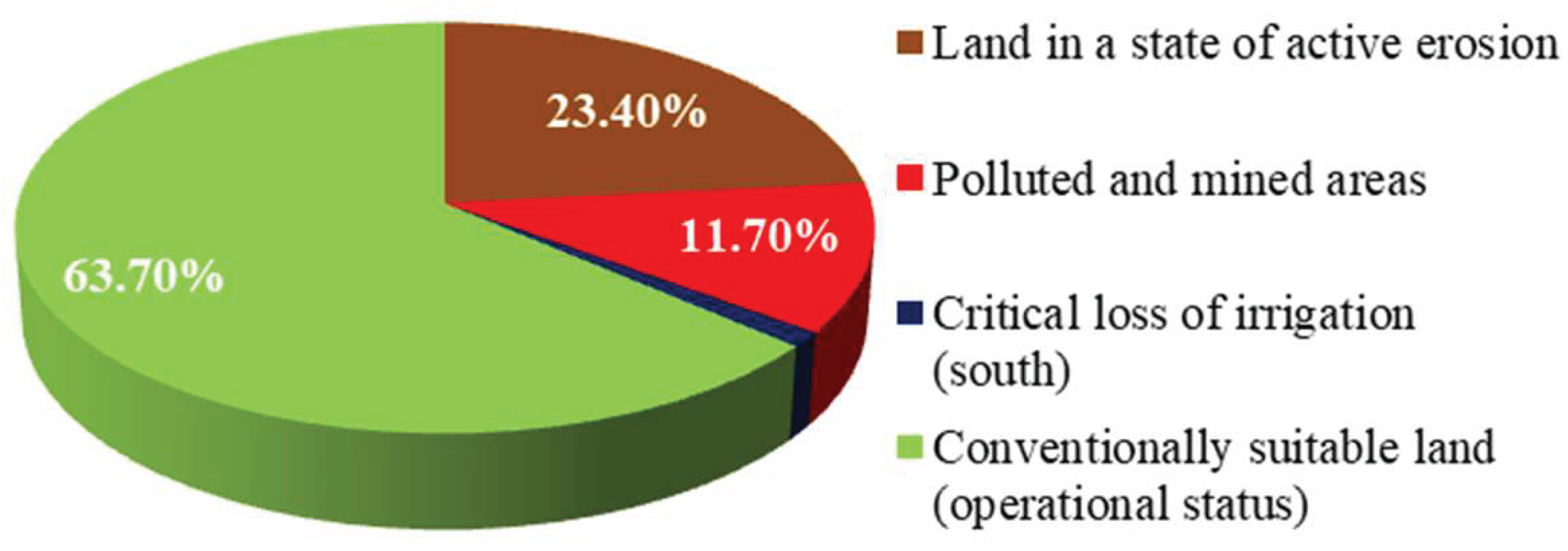
Figure 2.
Structural analysis of degradation and loss of water resources for irrigation in Ukraine’s agricultural sector. Source: Author’s illustration based on data from the World Bank, FAO, etc.
Figure 2.
Structural analysis of degradation and loss of water resources for irrigation in Ukraine’s agricultural sector. Source: Author’s illustration based on data from the World Bank, FAO, etc.
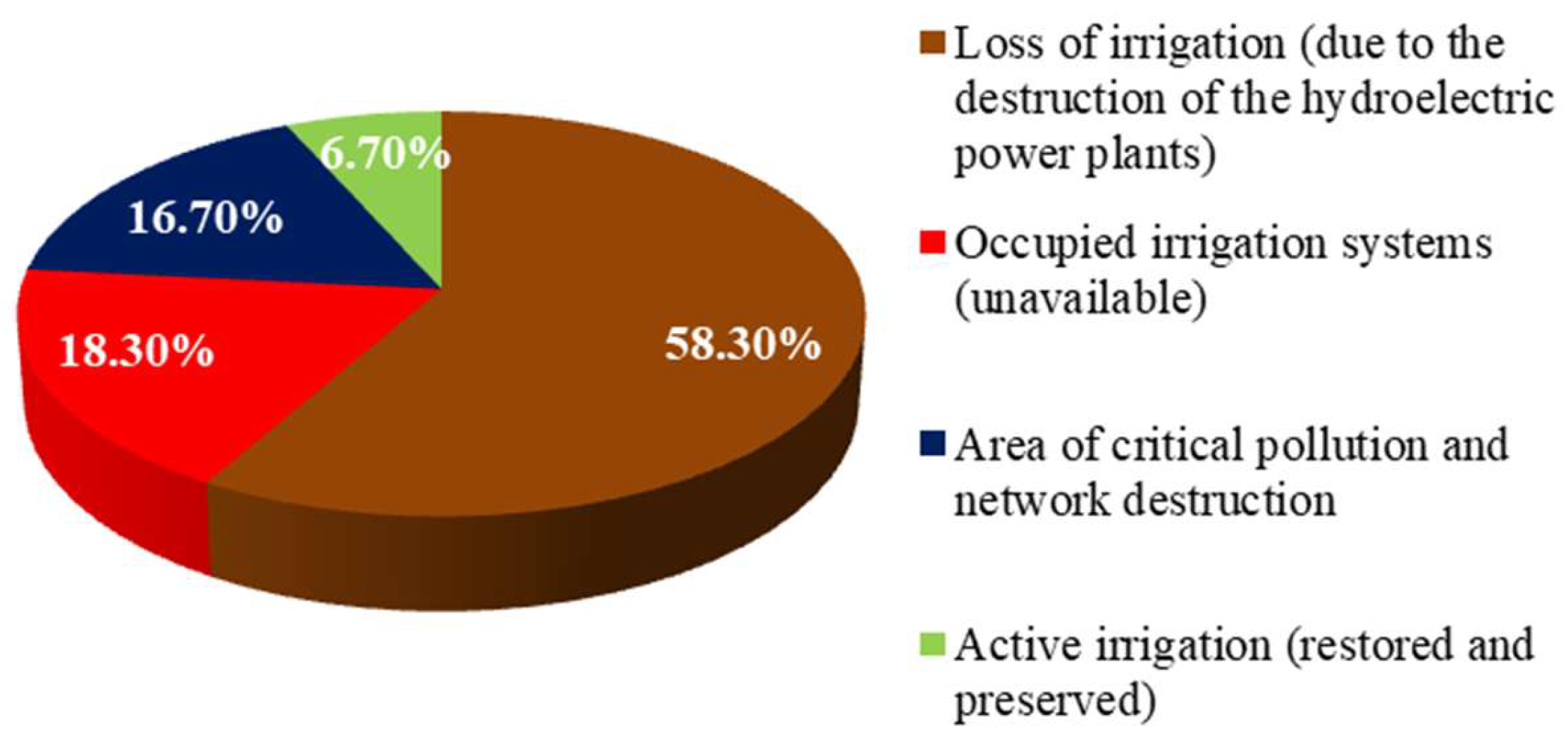
Figure 3.
Comparative characteristics of the values of (a) the indicator of relative change in weather and climate risk, ∆Rp, and (b) the resource use sensitivity coefficient, ks, for the studied variants of irrigation regimes that differ in terms of water and energy resource provision levels in estimated groups of years for the conditions of the Kherson region. Source: own research.
Figure 3.
Comparative characteristics of the values of (a) the indicator of relative change in weather and climate risk, ∆Rp, and (b) the resource use sensitivity coefficient, ks, for the studied variants of irrigation regimes that differ in terms of water and energy resource provision levels in estimated groups of years for the conditions of the Kherson region. Source: own research.
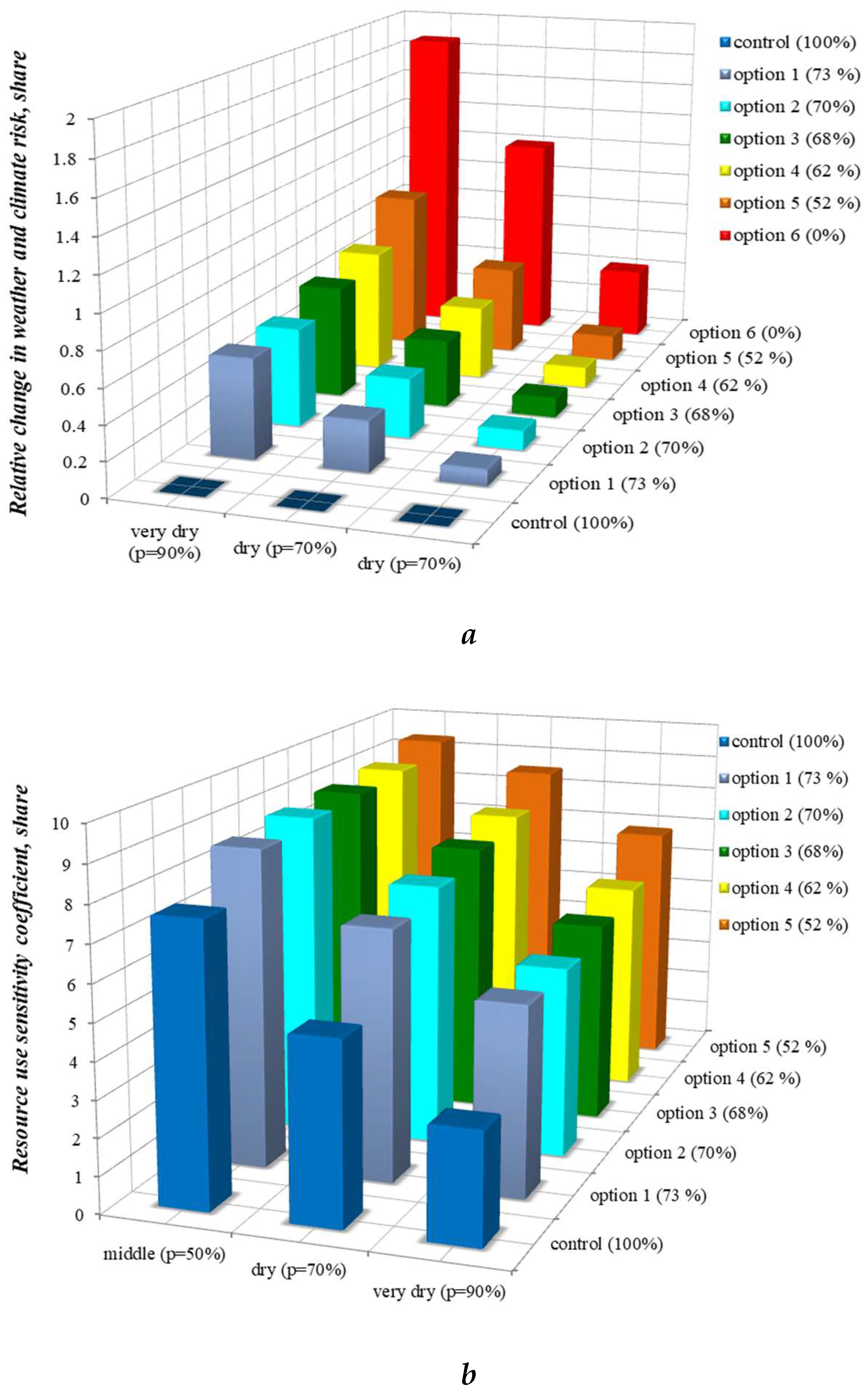

Table 1.
Matrix of challenges and strategic guidelines for optimizing natural resource projects in the context of modern destructive influences.
Table 1.
Matrix of challenges and strategic guidelines for optimizing natural resource projects in the context of modern destructive influences.
| Category | Problems |
Expected consequences |
Areas of resource optimization |
| Natural resources |
|
|
|
| Economic and technological |
|
|
|
| Social |
|
|
|
| Environmental |
|
|
|
| Geopolitical |
|
|
|
Table 2.
Matrix of paired correlation coefficients between indicators characterizing the resource-ecological and economic components of the efficiency of the implementation of irrigation regimes different in terms of the level of provision with water and energy resources (R2 =0.9357).
Table 2.
Matrix of paired correlation coefficients between indicators characterizing the resource-ecological and economic components of the efficiency of the implementation of irrigation regimes different in terms of the level of provision with water and energy resources (R2 =0.9357).
| Indicator | ∆Y | Rp | Wp | ∆Rp | ∆Wp | ks | kn | PI | DPP | p |
| ∆Y | 1.0000 | 0.7446 | 0.6533 | 0.9586 | 0.9133 | 0.7652 | 0.8133 | -0.0376 | 0.6676 | 0.7495 |
| Rp | 0.7446 | 1.0000 | 0.0509 | 0.5524 | 0.8992 | 0.1723 | 0.7246 | -0.5170 | 0.4358 | 0.1344 |
| Wp | 0.6533 | 0.0509 | 1.0000 | 0.8334 | 0.3153 | 0.9704 | 0.8533 | 0.3563 | 0.6604 | 0.9747 |
| ∆Rp | 0.9586 | 0.5524 | 0.8334 | 1.0000 | 0.7705 | 0.9016 | 0.7586 | 0.0650 | 0.7566 | 0.8983 |
| ∆Wp | 0.9133 | 0.8992 | 0.3153 | 0.7705 | 1.0000 | 0.4541 | 0.8933 | -0.2283 | 0.4922 | 0.4435 |
| ks | 0.7652 | 0.1723 | 0.9704 | 0.9016 | 0.4541 | 1.0000 | 0.7652 | 0.3855 | 0.6194 | 0.9885 |
| kn | 0.8133 | 0.7246 | 0.8533 | 0.7586 | 0.8933 | 0.7446 | 1.0000 | 0.0366 | 0.6576 | 0.7445 |
| PI | 0.0376 | -0.5170 | 0.3563 | 0.0650 | -0.2283 | 0.3855 | 0.0366 | 1.0000 | -0.3715 | 0.3710 |
| DPP | 0.6676 | 0.4358 | 0.6604 | 0.7566 | 0.4922 | 0.6194 | 0.6576 | -0.3715 | 1.0000 | 0.6556 |
| p | 0.7495 | 0.1344 | 0.9747 | 0.8983 | 0.4435 | 0.9885 | 0.7445 | 0.3710 | 0.6556 | 1.0000 |
Source: own research.
Table 3.
Comparative characteristics of the set of resource-ecological and economic indicators for assessing the effectiveness of implementing irrigation regimes that differ in terms of water and energy resource provision levels in estimated groups of years for the conditions of the Kherson region.
Table 3.
Comparative characteristics of the set of resource-ecological and economic indicators for assessing the effectiveness of implementing irrigation regimes that differ in terms of water and energy resource provision levels in estimated groups of years for the conditions of the Kherson region.
|
Estimaed year groups (p, %) |
Studied variants | ΔY, % |
Rp, USD/ha |
Wp, USD/ha | ∆Rp, share | ∆Wp, share | ks, share | kn, share | PI, share |
DPP, years |
|
middle (p=50%) |
control (100%) |
0 | 1088.2 | 142.9 | 0 | 0 | 7.61 | 0.35 | 1.38 | 6 |
|
option 1 (73%) |
6.05 | 1190.5 | 137.5 | 0.094 | 0.038 | 8.66 | 0.42 | 1.23 | 6 | |
|
option 2 (70%) |
7.13 | 1208.8 | 136.9 | 0.111 | 0.042 | 8.83 | 0.41 | 1.18 | 7 | |
|
option 3 (68%) |
7.40 | 1213.3 | 136.2 | 0.115 | 0.047 | 8.91 | 0.41 | 1.13 | 7 | |
|
option 4 (62%) |
7.82 | 1220.3 | 135.3 | 0.121 | 0.053 | 9.02 | 0.40 | 1.06 | 8 | |
|
option 5 (52%) |
9.71 | 1252.3 | 133.3 | 0.151 | 0.067 | 9.39 | 0.39 | 1.01 | 8 | |
| option 6 (0%) | 26.83 | 1541.8 | 0.0 | 0.417 | - | - | 0.36 | 1.05 | 8 | |
|
dry (p=70%) |
control (100%) |
0.00 | 910.2 | 184.7 | 0 | 0 | 4.93 | 0.36 | 2.03 | 5 |
|
option 1 (73%) |
14.28 | 1177.1 | 172.1 | 0.293 | 0.068 | 6.84 | 0.41 | 1.49 | 6 | |
|
option 2 (70%) |
16.81 | 1224.5 | 170.6 | 0.345 | 0.076 | 7.18 | 0.41 | 1.39 | 7 | |
|
option 3 (68%) |
19.28 | 1270.6 | 169.0 | 0.396 | 0.085 | 7.52 | 0.40 | 1.28 | 8 | |
|
option 4 (62%) |
21.12 | 1305.0 | 166.7 | 0.434 | 0.097 | 7.83 | 0.39 | 1.2 | 9 | |
|
option 5 (52%) |
25.60 | 1388.7 | 162.1 | 0.526 | 0.122 | 8.57 | 0.38 | 1.04 | 11 | |
| option 6 (0%) | 58.68 | 2006.8 | 0.0 | 1.205 | - | - | 0.35 | - | - | |
|
very dry (p=90%) |
control (100%) |
0.00 | 799.0 | 264.2 | 0 | 0 | 3.02 | 0.37 | 2.81 | 4 |
|
option 1 (73%) |
23.27 | 1259.6 | 243.1 | 0.577 | 0.080 | 5.18 | 0.41 | 1.35 | 10 | |
|
option 2 (70%) |
23.08 | 1255.9 | 240.6 | 0.572 | 0.089 | 5.22 | 0.39 | 1.42 | 10 | |
|
option 3 (68%) |
26.61 | 1325.8 | 238.0 | 0.659 | 0.099 | 5.57 | 0.39 | 1.16 | 16 | |
|
option 4 (62%) |
29.08 | 1374.7 | 234.2 | 0.721 | 0.113 | 5.87 | 0.38 | 1.01 | 23 | |
|
option 5 (52%) |
37.99 | 1551.2 | 226.4 | 0.942 | 0.143 | 6.85 | 0.37 | - | - | |
| option 6 (0%) | 75.47 | 2293.4 | 0.0 | 1.870 | - | - | 0.34 | - | - |
Source: own research. Based on the average dollar exchange rate for 2025, according to data from the National Bank of Ukraine.
Disclaimer/Publisher’s Note: The statements, opinions and data contained in all publications are solely those of the individual author(s) and contributor(s) and not of MDPI and/or the editor(s). MDPI and/or the editor(s) disclaim responsibility for any injury to people or property resulting from any ideas, methods, instructions or products referred to in the content. |
© 2026 by the authors. Licensee MDPI, Basel, Switzerland. This article is an open access article distributed under the terms and conditions of the Creative Commons Attribution (CC BY) license (http://creativecommons.org/licenses/by/4.0/).
Copyright: This open access article is published under a Creative Commons CC BY 4.0 license, which permit the free download, distribution, and reuse, provided that the author and preprint are cited in any reuse.


