

Submitted:
15 April 2026
Posted:
16 April 2026
You are already at the latest version
Abstract
Background and Objectives: Augmented reality (AR) is increasingly being explored as an adjunct to image-guided minimally invasive surgery. In gynecology, its potential may be particularly relevant in fertility-preserving procedures, where the surgeon must balance adequate disease treatment with preservation of uterine architecture, reproductive anatomy, and future fertility potential. The aim of this review was to examine the current evidence on AR in minimally invasive reproductive gynecologic surgery, with a particular focus on myomectomy, adenomyomectomy, and endometriosis surgery, and to critically evaluate its limitations and future clinical role. Materials and Methods: A structured narrative review was conducted using PubMed/MEDLINE, Scopus, and Google Scholar from database inception to March 2026. Search terms included combinations of “augmented reality”, “mixed reality”, “image-guided surgery”, “myomectomy”, “fibroid”, “leiomyoma”, “adenomyosis”, “adenomyomectomy”, “endometriosis”, “deep infiltrating endometriosis”, “fertility-preserving surgery”, and “reproductive surgery”. Eligible studies included original clinical studies, pilot studies, feasibility studies, case series, case reports, technical reports, and translational studies directly relevant to reproductive gynecologic surgery. Results: The available evidence is limited and consists mainly of feasibility studies, proof-of-concept reports, technical notes, and small observational series. The most developed reproductive applications of AR are currently found in myomectomy and adenomyomectomy, where MRI-based uterine modeling has been used to improve lesion localization and support tissue-sparing dissection. In endometriosis surgery, AR remains less mature as an intraoperative tool but appears promising for lesion mapping, anatomical orientation, and dissection planning. Across procedures, AR appears most clinically plausible as a tool for technical refinement and complication prevention rather than as a technology with proven superiority in perioperative or reproductive outcomes. Conclusions: AR is a promising adjunct in fertility-preserving minimally invasive gynecologic surgery, particularly in anatomically complex procedures requiring accurate lesion localization and tissue-preserving dissection. However, the current evidence base remains insufficient to support routine implementation. Future research should determine whether AR can improve operative precision, reduce complications, preserve uterine integrity, and ultimately influence fertility-related outcomes.
Keywords:
augmented reality
; minimally invasive gynecologic surgery
; reproductive surgery
; myomectomy
; adenomyomectomy
; adenomyosis
; endometriosis
; fertility-preserving surgery
; image-guided surgery
1. Introduction
Minimally invasive gynecologic surgery has transformed the management of benign gynecologic disease in reproductive-age women, offering shorter hospital stay, reduced postoperative pain, faster recovery, and improved perioperative outcomes compared with open surgery [4,5]. Yet, despite these advantages, complex benign pelvic surgery remains technically demanding. In many procedures, pathology is not fully visible on the organ surface, tissue planes are distorted, and key anatomical structures must be preserved despite limited tactile feedback and a restricted operative field [4,5].
This challenge becomes even more relevant in fertility-preserving surgery, where the goal is not merely complete lesion excision, but excision performed with maximal preservation of uterine integrity, reproductive anatomy, and future function.
This is especially true in myomectomy, adenomyomectomy, and endometriosis surgery. During laparoscopic myomectomy, deeply intramural or poorly protruding fibroids may be difficult to localize with precision, particularly when the external uterine contour offers limited guidance [7,8]. Fertility-preserving adenomyomectomy is even more challenging, as adenomyotic tissue often lacks a clear cleavage plane and the surgeon must balance adequate disease excision against preservation of healthy myometrium and avoidance of endometrial cavity injury [9]. In deep infiltrating endometriosis (DIE), the difficulty often lies in distorted pelvic anatomy and dense fibrosis, with disease frequently involving or approaching the ureters, bowel, bladder, and pelvic sidewall [13,19,20].
Against this background, augmented reality (AR) has emerged as a potentially useful image-guidance technology. Unlike virtual reality, which immerses the user in a fully digital environment, AR overlays computer-generated information onto the real-world operative field [1,4,5]. In principle, this allows preoperative imaging to be translated into a form that can support intraoperative decision-making.
The technical framework of AR systems in gynecologic surgery generally includes imaging acquisition, segmentation, registration, tracking, and visualization, all of which are particularly relevant in tissue-preserving reproductive procedures. The included studies are summarized in Table 1 [4,5,18].
In gynecologic surgery, this concept is especially attractive. If preoperative MRI or other imaging data could be meaningfully integrated into the surgical field, AR might help localize intramural myomas, define the spatial relationship between adenomyotic lesions and the endometrial cavity, or improve anatomical orientation during complex endometriosis surgery [4,7,8,9,13,18].
At present, however, AR in gynecology remains an emerging field. Much of the available literature consists of technical feasibility studies, pilot applications, case reports, and translational work rather than mature clinical evidence [4,7,8,9,10,11,12,13,18,19,20]. The field is therefore promising, but still early in its development.
AR matters in reproductive surgery not because it is technologically novel, but because it addresses a very specific surgical problem: how to improve operative precision in procedures where imprecision may directly affect uterine preservation, adjacent organ safety, and future reproductive potential.
The aim of this review was to summarize the current evidence regarding AR in fertility-preserving minimally invasive gynecologic surgery, critically appraise the quality and clinical maturity of that evidence, and discuss future directions for its potential integration into reproductive surgery.
2. Materials and Methods
2.1. Study Design
This study was designed as a structured narrative review with PRISMA-style reporting of the study identification and selection process. A narrative synthesis was chosen because the currently available literature is limited, heterogeneous, and not suitable for formal meta-analysis.
2.2. Search Strategy
A literature search was performed in PubMed/MEDLINE, Scopus, and Google Scholar for English-language publications from database inception through March 2026.
The search strategy combined terms related to AR and minimally invasive gynecologic surgery. Search concepts included “augmented reality”, “mixed reality”, “image-guided surgery”, “gynecology”, “gynecologic surgery”, “laparoscopy”, “robotic surgery”, “myomectomy”, “fibroid”, “leiomyoma”, “adenomyosis”, “adenomyomectomy”, “endometriosis”, “deep infiltrating endometriosis”, “fertility-preserving surgery”, and “reproductive surgery”. Reference lists of relevant reviews and included articles were also manually screened.
2.3. Eligibility Criteria
Studies were included if they were original clinical studies, pilot studies, feasibility studies, proof-of-concept studies, case series, case reports, or technical reports involving AR, mixed reality, or closely related image-guidance approaches with direct relevance to reproductive gynecologic surgery. Eligible studies focused on myomectomy, adenomyomectomy, adenomyosis surgery, endometriosis surgery, or anatomical guidance and complication prevention in fertility-preserving minimally invasive gynecologic procedures.
Studies were excluded if they focused exclusively on gynecologic malignancy, sentinel lymph node mapping, or oncologic navigation without meaningful relevance to reproductive surgery. Non-gynecologic surgical studies, editorials, opinion papers, conference abstracts lacking sufficient procedural detail, and duplicate publications were also excluded.
2.4. Study Selection
Titles and abstracts were screened for relevance, followed by full-text review of potentially eligible articles. Given the small and heterogeneous nature of the literature, all studies meeting the inclusion criteria were included in the qualitative synthesis.
No formal risk-of-bias tool was applied, because the literature was dominated by early-phase and non-comparative studies. Instead, the evidence was critically appraised according to study design, clinical maturity, directness of relevance to reproductive surgery, and the nature of the outcomes reported.
2.5. Data Extraction
For each included study, the following variables were extracted where available: first author and year, study design, procedure or disease focus, number of patients, mean or median age, imaging modality, AR or mixed reality platform, proposed AR benefit, reported perioperative outcomes, complications, fertility or reproductive outcomes, major limitations, and approximate level of evidence.
Where a variable was not explicitly reported in the source publication, it was recorded as not reported (NR). Variables that did not apply to a given study design were recorded as not applicable (NA).
2.6. Synthesis Strategy
The included studies were synthesized into the following clinically relevant domains: AR in myomectomy, AR in adenomyomectomy and adenomyosis surgery, AR in endometriosis surgery, AR and complication prevention in reproductive surgery, and reproductive outcomes and current evidence gaps.
3. Results
3.1. Study Selection
We are presenting a PRISMA-style flow diagram illustrating the identification, screening, eligibility assessment, and final inclusion of studies evaluating augmented reality and related image-guidance applications in fertility-preserving minimally invasive gynecologic surgery.
A total of 18 studies were included in the qualitative synthesis.
The PRISMA flowchart is shown in Figure 1.
3.2. General Overview of the Evidence
The current evidence on AR in fertility-preserving gynecologic surgery remains limited and heterogeneous. Most publications are technical reports, feasibility studies, proof-of-concept applications, case reports, or small observational series [4,7,8,9,10,11,12,13,18,19,20]. No randomized trials were identified, and fertility-specific outcome data were largely absent.
The overall structure of the current evidence base, including technical components, clinical applications, complication-prevention targets, and evidence gaps, is summarized in Table 1, Table 2, Table 3, Table 4 and Table 5.
The literature is currently strongest in myomectomy and adenomyomectomy, where AR has been used mainly to facilitate localization of intramural lesions and improve spatial orientation during uterine surgery (Table 2) [7,8,9,10,11]. In endometriosis surgery, the literature is less mature and currently focuses more on lesion mapping, visualization, and preoperative or conceptual guidance rather than validated real-time intraoperative navigation (Table 3) [12,13,18,19,20].
Across all applications, the literature remains focused more on technical feasibility than on clinical consequence. In practical terms, most studies have asked whether AR can be used, rather than whether it changes outcomes in a way that is meaningful for patients.
3.3. Augmented Reality in Myomectomy
Among benign reproductive procedures, laparoscopic myomectomy is probably the most intuitive and clinically developed setting for AR application.
The technical difficulty of myomectomy depends not only on fibroid size, but also on depth, location, multiplicity, and the extent to which the lesion can be confidently localized from the uterine surface. This is particularly relevant for intramural, posterior, or poorly protruding myomas, where external uterine distortion may be limited and surgical orientation may become uncertain [7,8].
In this context, AR has been proposed as a means of translating preoperative imaging information—particularly MRI-derived lesion mapping—into the operative field. Rather than relying solely on visual estimation or repeated exploratory dissection, the surgeon may use a virtual uterine model to guide incision placement and the direction of dissection [7,8,9,10,11]. The currently available studies in this field are summarized in Table 2.
Bourdel et al. provided one of the earliest demonstrations of this concept in laparoscopic gynecology, showing that MRI-derived three-dimensional uterine models could be used to visualize fibroid location intraoperatively [7]. This study was important less because it established clinical superiority and more because it showed that such integration was technically feasible within a real surgical setting.
Chauvet et al. later extended this concept through the incorporation of diffusion tensor imaging (DTI) and tractography, aiming to visualize uterine fiber orientation during laparoscopic myomectomy [8]. This approach is particularly relevant in reproductive surgery, because the success of myomectomy is determined not only by fibroid removal, but also by how the uterus is incised, repaired, and preserved.
More recently, mixed reality-assisted case reports and small clinical applications have continued to support the technical plausibility of AR-guided myomectomy [10]. The most clinically informative comparative evidence currently comes from the retrospective case-control study by Comptour et al., which evaluated AR-assisted laparoscopic surgery in women undergoing myomectomy or adenomyomectomy [11]. As shown in Table 2, although the study was small and non-randomized, it suggested that AR could be integrated into the operative workflow without an obvious penalty in operative time or safety.
From a fertility-preserving perspective, the most meaningful potential advantages of AR in myomectomy include more accurate localization of occult or deeply intramural myomas, better planning of uterine incision placement, less exploratory dissection, possible reduction in unnecessary myometrial trauma, and potentially a lower risk of inadvertent cavity entry. These proposed advantages and their clinical relevance are also reflected in Table 4. However, the current literature does not yet demonstrate that AR consistently improves blood loss, operative efficiency, postoperative healing, adhesion formation, or reproductive outcomes.
At present, AR in myomectomy should therefore be regarded as promising and clinically plausible, but still insufficiently validated.
3.4. Augmented Reality in Adenomyomectomy and Adenomyosis Surgery
If myomectomy is the most intuitive application of AR in reproductive surgery, adenomyomectomy may be the one in which it is most conceptually valuable.
Unlike fibroids, adenomyotic lesions are often poorly demarcated and infiltrative, with no obvious surgical cleavage plane. This makes fertility-preserving surgery particularly difficult. Overly aggressive excision may compromise uterine integrity, whereas conservative excision may leave clinically significant disease behind [9].
In this setting, the value of AR lies not only in lesion localization, but in boundary awareness. The ability to understand the three-dimensional relationship between the adenomyotic lesion, surrounding myometrium, and the endometrial cavity is potentially very important when planning a conservative uterine-sparing resection. The available evidence in this area is presented in Table 2.
Bourdel et al. described the use of AR to visualize adenomyomas using MRI-derived uterine models, demonstrating that such overlays could potentially assist in lesion targeting and cavity-preserving dissection [9]. Although this work remains limited to highly selected technical application, it is particularly relevant from a reproductive standpoint because it reflects the real operative dilemmas of fertility-preserving adenomyomectomy.
The theoretical benefits of AR in this setting are substantial. It may improve identification of lesion depth and extent, support more controlled excision, increase awareness of the endometrial cavity, reduce blind dissection, and limit unnecessary myometrial loss. These possible complication-prevention and tissue-preserving benefits are summarized in Table 4.
Yet, as with myomectomy, the current evidence remains preliminary. There are no robust comparative data demonstrating that AR improves symptom control, recurrence, uterine preservation, obstetric safety, or fertility outcomes. Thus, while adenomyomectomy may be one of the most compelling future indications for AR, it is also one of the clearest examples of how strong theoretical relevance can coexist with very limited clinical evidence.
3.5. Augmented Reality in Endometriosis Surgery
Among all benign gynecologic conditions, deep infiltrating endometriosis may ultimately be the setting in which AR proves most transformative, but at present it is also the least mature clinically.
Surgery for DIE is often defined by distorted anatomy, fibrosis, obliterated spaces, and intimate disease relationships with the ureters, bowel, bladder, uterosacral ligaments, rectovaginal septum, and pelvic sidewall [13,19,20]. In these cases, the difficulty lies not only in removing disease, but in reconstructing anatomical understanding in a pelvis where the normal landmarks have often been lost.
That is precisely why AR is attractive here. In principle, it could help the surgeon navigate a field in which the usual visual cues are unreliable.
At present, however, AR in endometriosis surgery remains largely developmental. The most promising work to date lies in preoperative anatomical modeling, lesion mapping, and computer vision-assisted recognition, rather than in fully validated real-time operative overlays [12,13,18]. The currently available endometriosis-related studies are summarized in Table 3.
Zhang et al. described MRI-based three-dimensional modeling of deep endometriosis and showed that such reconstructions were feasible and clinically useful in understanding disease extent and anatomical relationships [13]. While this does not yet constitute mature real-time intraoperative AR navigation, it is an important step toward surgery-specific image integration.
Similarly, AI-based lesion recognition systems, such as those explored by Netter et al., may eventually serve as part of the computational backbone for future AR-enabled endometriosis surgery [12]. If such systems become sufficiently accurate and reliable, they could support lesion awareness, anatomical orientation, and dissection planning in ways that are directly relevant to surgical safety.
For now, the most realistic short-term role of AR in endometriosis surgery is likely to be in preoperative surgical planning, anatomical communication, lesion extent visualization, and orientation in distorted pelvic anatomy rather than as a fully autonomous intraoperative guidance system. These proposed uses and their relationship to complication prevention are also outlined in Table 4.
3.6. Can Augmented Reality Prevent Complications in Reproductive Surgery?
One of the most clinically relevant questions is whether AR can meaningfully contribute to complication prevention in fertility-preserving gynecologic surgery.
The answer at present is not definitive, but it is plausible.
In myomectomy and adenomyomectomy, one of the main theoretical advantages of AR is the possibility of reducing blind or unnecessarily extensive dissection. More accurate lesion localization could support more rational uterine incision placement, while better awareness of the lesion’s relationship to the endometrial cavity might reduce the risk of inadvertent cavity entry or excessive myometrial trauma [7,8,9]. In fertility-preserving surgery, such technical refinements are not trivial. They may directly influence the quality of uterine reconstruction and, at least in theory, future uterine performance.
In endometriosis surgery, the relevance of AR may be even more compelling. Deep infiltrating disease often obscures the normal course of critical structures such as the ureters, bowel interfaces, and pelvic sidewall anatomy. In this setting, AR or AR-adjacent image-guidance tools may help the surgeon understand where important anatomy lies before difficult dissection begins [13,19,20]. The most relevant potential complication-prevention applications across reproductive procedures are summarized in Table 4.
At the same time, this question must be approached cautiously. AR is not inherently protective. Inaccurate overlays, registration drift, poor tracking, or excessive confidence in the system could create a misleading sense of precision [4,14,15,16,17]. For this reason, the relevant issue is not simply whether AR appears useful, but whether it is accurate enough, stable enough, and workflow-compatible enough to support surgical decision-making without introducing new forms of risk.
That remains unresolved, and it is one of the key areas that future research will need to address.
3.7. Reproductive Outcomes: The Most Important Missing Evidence
One of the most striking findings of this review is how little the current literature says about what is arguably the most important issue: reproductive outcome.
For a technology increasingly discussed in the context of fertility-preserving surgery, the available evidence contains very little on pregnancy rates, live birth rates, uterine rupture risk, postoperative uterine integrity, cavity preservation, postoperative adhesions, or obstetric safety.
This is not a minor omission; it is a central limitation of the field.
The reason AR is attractive in reproductive surgery is not simply because it makes surgery more technologically advanced. It is attractive because it may help surgeons treat disease while preserving function. If that hypothesis is not tested using fertility-relevant endpoints, the field risks becoming technically interesting but clinically underdeveloped.
As summarized in Table 5, fertility outcomes, standardized perioperative reporting, and clinically meaningful comparative studies remain major evidence gaps in the current literature.
4. Discussion
The present review highlights both the promise and the current immaturity of AR in fertility-preserving minimally invasive gynecologic surgery. Although the concept is compelling and the early applications are technically sophisticated, the available evidence remains too limited to support broad clinical conclusions. What exists so far is best understood as a field in transition: no longer purely theoretical, but not yet sufficiently mature to justify routine implementation.
A consistent finding across the literature is that AR appears most useful in procedures where the surgeon is operating in conditions of incomplete anatomical visibility. This is particularly relevant in reproductive surgery. In myomectomy, the challenge often lies in accurately locating lesions that are intramural, posterior, or only subtly visible from the uterine surface. In adenomyomectomy, the problem is even more complex because the pathology is not simply hidden, but biologically and surgically ill-defined. In endometriosis surgery, by contrast, the challenge is not necessarily the invisibility of disease, but the disappearance of normal anatomy. Across these settings, the common denominator is uncertainty. AR is appealing precisely because it seeks to reduce that uncertainty.
This may explain why AR feels more naturally suited to reproductive surgery than to many other benign procedures. The issue is not whether the surgeon can “see more” in a superficial sense, but whether the surgeon can operate more selectively and with greater confidence when key structures or pathological boundaries are not directly obvious. In fertility-preserving surgery, this distinction matters. The surgeon is not merely excising tissue, but attempting to preserve the integrity of the uterus, endometrial cavity, adnexal relationships, and surrounding pelvic anatomy in a way that remains meaningful for future function.
The currently available evidence supports this conceptual rationale, but also reveals important limitations. As summarized in Table 2 and Table 3, most published studies are feasibility reports, proof-of-concept applications, technical demonstrations, or very small observational series [4,7,8,9,10,11,12,13,18,19,20]. These studies are valuable because they show that AR can be integrated into minimally invasive gynecologic surgery in a technically coherent way. However, they do not yet establish whether this integration meaningfully improves surgical quality or patient outcomes.
This distinction is especially important because the current enthusiasm surrounding AR can easily outpace the evidence. A virtual overlay may look precise, but the true question is whether it is sufficiently accurate, dynamically stable, and clinically interpretable to influence real intraoperative decisions. Pelvic anatomy is not static. The uterus deforms with traction, myometrial incision, and reconstruction. Endometriotic planes shift during adhesiolysis and deep dissection. The relationship between a preoperative model and the actual operative field may therefore change in ways that are not trivial. If registration is imperfect or the system drifts during surgery, AR may risk becoming not only unhelpful, but potentially misleading.
This issue is particularly relevant in fertility-preserving surgery because the consequences of small technical inaccuracies may be disproportionately important. A slightly misjudged uterine incision, an unnecessarily deep dissection, an avoidable cavity breach, or an imprecise adenomyosis resection may all have consequences that extend beyond the immediate procedure. In that sense, reproductive surgery sets a high bar for any guidance technology. It is not enough for AR to be visually impressive; it must be precise enough to matter where precision matters most.
Another important finding of this review is that the literature is currently much stronger in relation to technical intention than to clinical consequence. Many studies can explain what AR is supposed to improve—lesion localization, orientation, dissection planning, anatomical awareness—but very few actually demonstrate measurable improvements in blood loss, complication rates, operative efficiency, uterine preservation, or patient recovery. This imbalance is clearly reflected in Table 4, which shows that many of the proposed benefits of AR remain biologically and surgically plausible but still largely unproven in clinical outcome terms.
Even more striking is the near absence of fertility-related outcome reporting. As shown in Table 5, the evidence base remains profoundly underdeveloped in relation to postoperative uterine integrity, conception, live birth, and obstetric safety. For a field that is increasingly discussed in the context of reproductive surgery, this is a major limitation. At present, the rationale for AR in fertility-preserving surgery remains intuitively and surgically appealing, but it has not yet been tested in the outcome framework that would make that appeal clinically meaningful.
There is also an important methodological issue. “AR” is currently used as an umbrella term to describe a wide spectrum of technologies, ranging from simple three-dimensional visualization and mixed reality display to more advanced concepts of registration-based intraoperative overlay and anatomy-aware navigation. This heterogeneity complicates interpretation. Not all AR-related tools are clinically equivalent, and not all studies are evaluating the same functional intervention. In some cases, what is described as AR may primarily improve preoperative understanding rather than true intraoperative guidance. In others, the platform may be technically elegant but not yet mature enough for reproducible clinical use. This lack of standardization, also reflected in the variability of technical approaches outlined in Table 1, remains one of the main barriers to meaningful comparison across studies.
The gynecologic oncology literature provides an interesting parallel in this respect. Some of the most advanced image-guided and AR-related applications in gynecologic surgery have emerged from oncologic settings, including sentinel node targeting and tumor-focused navigation [14,15,16,17]. These studies are valuable because they demonstrate that image integration and target-oriented navigation can be technically implemented within minimally invasive workflows. However, reproductive surgery cannot simply borrow its evidence base from oncology. The operative goals are fundamentally different. In oncologic surgery, the priority is often radicality or precise target retrieval. In reproductive surgery, the challenge is often selective excision combined with maximal preservation of function. The technical lessons are transferable, but the outcome framework is not.
The future relevance of AR in reproductive surgery will therefore depend not only on whether the technology improves, but on whether the field becomes more disciplined in how it evaluates it. This includes better standardization of imaging acquisition, segmentation methods, registration accuracy, intraoperative validation, and reporting of clinically meaningful endpoints. It also requires attention to human factors. Even a technically accurate AR system is only useful if the surgeon can interpret it appropriately without increasing cognitive burden or creating overreliance. A poorly integrated system may distract rather than assist, particularly in already complex procedures.
For all these reasons, AR should probably not yet be framed as a technology that is “about to transform” reproductive surgery. That language is premature. A more realistic interpretation is that AR has identified a genuine and clinically relevant problem—how to improve precision in tissue-preserving pelvic surgery—and is now at the stage where it must prove that it can address that problem in a measurable and reproducible way.
That is ultimately what will determine whether AR becomes a meaningful surgical adjunct or remains a technically interesting but clinically marginal innovation.
5. Future Directions
The future of AR in fertility-preserving gynecologic surgery will depend less on visual sophistication and more on whether the technology becomes sufficiently accurate, adaptive, and clinically integrated to support real surgical decision-making. The conceptual foundation is already strong. The next phase of development must therefore focus on solving the practical limitations that currently restrict broader implementation.
One of the most important technical barriers is the problem of deformable anatomy. Most current AR systems rely heavily on preoperative imaging, yet the uterus and surrounding pelvic structures do not remain fixed during surgery. Uterine manipulation, myometrial incision, traction, dissection, and reconstruction all alter the shape and orientation of the surgical field. Similarly, in endometriosis surgery, adhesiolysis and progressive mobilization of pelvic structures continuously change the anatomy that the surgeon sees. For AR to become more than a static visual aid, future systems will need to account for these changes in real time. This makes dynamic, deformable registration one of the most important areas for further development [4,14].
A second major direction will likely involve the increasing integration of artificial intelligence and computer vision. In many ways, AI may prove to be the element that allows AR to move from technically impressive visualization to clinically useful guidance. Automated recognition of fibroids, adenomyotic lesions, ureteral course, endometriotic implants, and key pelvic structures could eventually support more responsive and context-aware operative overlays [12,18]. In reproductive surgery, this could be particularly valuable in situations where lesion boundaries are unclear or anatomy is heavily distorted.
Equally important is the idea that future AR systems should perhaps focus less on highlighting pathology alone and more on preserving critical structures. In reproductive surgery, the structures that matter most are often not the lesion itself, but the surrounding tissue that must remain intact. In myomectomy and adenomyomectomy, this includes healthy myometrium and the endometrial cavity. In endometriosis surgery, it includes the ureters, bowel interfaces, bladder planes, pelvic nerves, and vascular structures. These priorities, which are already suggested by the complication-prevention domains shown in Table 4, may define the most clinically meaningful direction of future AR development.
The future will also likely involve multimodal integration rather than reliance on a single technology. AR may become most useful when combined with high-resolution MRI, intraoperative ultrasound, robotic visualization, and AI-enhanced recognition rather than functioning as an isolated overlay platform [4,5]. Such integration may provide a more robust and adaptable form of guidance, especially in anatomically complex cases.
Perhaps most importantly, the field now needs to move toward fertility-centered clinical evaluation. The key question is no longer whether AR can generate an intraoperative visual model, but whether it improves surgery in ways that matter to reproductive patients. Future studies should therefore examine whether AR influences uterine preservation, cavity integrity, blood loss, operative efficiency, complication rates, postoperative healing, recurrence balance, and fertility or obstetric outcomes. As summarized in Table 5, these are precisely the domains in which the current literature remains weakest.
If the field is to mature meaningfully, it must now shift from demonstrating technical feasibility to demonstrating reproductive relevance.
6. Conclusions
Augmented reality is an emerging and potentially valuable adjunct in fertility-preserving minimally invasive gynecologic surgery. Its current and future relevance appears greatest in procedures where pathology is hidden, poorly demarcated, or anatomically complex, and where surgical precision must be balanced against preservation of uterine and reproductive integrity [4,7,8,9,13].
At present, the strongest reproductive applications of AR are found in myomectomy and adenomyomectomy, while endometriosis surgery likely represents the most important future frontier [7,8,9,10,11,12,13,18,19,20]. Across these indications, the most plausible clinical contribution of AR lies in improved lesion localization, more deliberate dissection planning, and possible support for complication prevention, as synthesized in Table 4.
However, the existing literature remains limited, heterogeneous, and largely feasibility-based. As highlighted in Table 5, the field still lacks robust comparative studies, standardized reporting, and fertility-specific outcome data. AR should therefore not yet be regarded as an established standard of care in reproductive surgery, but rather as a developing support technology whose true value will depend on whether it can improve real-world surgical precision, safety, tissue preservation, and fertility-relevant outcomes.
That is the threshold the field now needs to meet.
Author Contributions
Conceptualization: Eleni Karatrasoglou, Athanasios Protopapas., Methodology: Eleni Karatrasoglou, Athanasios Protopapas, Literature Search and Data Curation: Eleni Karatrasoglou, Writing—Original Draft Preparation: Eleni Karatrasoglou, Writing—Review and Editing: Athanasios Protopapas, Alexandros Rodolakis, Themistoklis Grigoriadis, Supervision: Athanasios Protopapas. All authors have read and agreed to the published version of the manuscript.
Funding
This research received no external funding.
Institutional Review Board Statement
Not applicable.
Informed Consent Statement
Not applicable.
Data Availability Statement
No new datasets were generated or analyzed for this study.
Conflicts of Interest
The authors declare no conflicts of interest.
References
- Moawad, G.; Tyan, P.; Louie, M. Artificial intelligence and augmented reality in gynecology. Curr. Opin. Obstet. Gynecol. 2019, 31, 345–348. [CrossRef]
- Iftikhar, P.; Kuijpers, M.V.; Khayyat, A.; et al. Artificial intelligence: A new paradigm in obstetrics and gynecology research and clinical practice. Cureus 2020, 12, e7124. [CrossRef]
- Khamisy-Farah, R.; Furstenau, L.B.; Kong, J.D.; et al. Gynecology meets big data. Int. J. Environ. Res. Public Health 2021, 18, 5058. [CrossRef]
- Akladios, C.; Gabriele, V.; Agnus, V.; et al. Augmented reality in gynecologic laparoscopic surgery. Surg. Endosc. 2020, 34, 1077–1087. [CrossRef]
- Leaf, M.C.; Musselman, K.; Wang, K.C. Cutting-edge care in gynecologic surgery. Curr. Opin. Obstet. Gynecol. 2024, 36, 255–259.
- Sato, M.; Koizumi, M.; Nakabayashi, M.; et al. Computer vision for total laparoscopic hysterectomy. Asian J. Endosc. Surg. 2019, 12, 294–300. [CrossRef]
- Bourdel, N.; Collins, T.; Pizarro, D.; et al. Use of augmented reality in laparoscopic gynecology to visualize myomas. Fertil. Steril. 2017, 107, 737–739. [CrossRef]
- Chauvet, P.; Bourdel, N.; Calvet, L.; et al. Augmented reality with diffusion tensor imaging and tractography during laparoscopic myomectomies. J. Minim. Invasive Gynecol. 2020, 27, 973–976. [CrossRef]
- Bourdel, N.; Chauvet, P.; Calvet, L.; et al. Use of augmented reality in gynecologic surgery to visualize adenomyomas. J. Minim. Invasive Gynecol. 2019, 26, 1177–1180. [CrossRef]
- Ochi, Y.; Yanai, S.; Yoshino, Y.; et al. Mixed reality in laparoscopic myomectomy. Int. J. Gynaecol. Obstet. 2023, 162, 364–365.
- Comptour, A.; Chauvet, P.; Grémeau, A.S.; et al. Retrospective case control study on the evaluation of the impact of augmented reality in gynecological laparoscopy on patients operated for myomectomy or adenomyomectomy. Gynecol. Surg. 2025, 30, 2509686. [CrossRef]
- Netter, A.; Noorzadeh, S.; Duchateau, F.; et al. Initial results in the automatic visual recognition of endometriosis lesions by artificial intelligence during laparoscopy: A proof-of-concept study. J. Minim. Invasive Gynecol. 2025, 32, 1118–1125. [CrossRef]
- Zhang, C.; Martel, C.; Host, A.; et al. Three-dimensional modeling of deep endometriosis from pelvic MRI: Feasibility, clinical perception, and preliminary prospective evaluation. J. Minim. Invasive Gynecol. 2026, ahead of print. [CrossRef]
- Chauvet, P.; Collins, T.; Debize, C.; et al. Augmented reality in a tumor resection model. Surg. Endosc. 2018, 32, 1192–1201. [CrossRef]
- Lecointre, L.; Verde, J.; Goffin, L.; et al. Augmented reality for sentinel lymph node identification. Surg. Endosc. 2022, 36, 9224–9233.
- Lecointre, L.; Verde, J.; Hubele, F.; et al. Augmented reality-guided sentinel node targeting in endometrial cancer. EJNMMI Phys. 2022, 9, 81.
- Pisano, G.; Wendler, T.; Valdés Olmos, R.A.; et al. Molecular image-guided surgery in gynecologic cancer. Eur. J. Nucl. Med. Mol. Imaging 2024, 51, 3026–3039.
- Madad Zadeh, S.; François, T.; Comptour, A.; et al. SurgAI3.8K: A labeled dataset of gynecologic organs in laparoscopy with application to automatic augmented reality surgical guidance. J. Minim. Invasive Gynecol. 2023, 30, 397–405.
- Panichyawat, N.; Duchon, M.; Chauvet, P.; Bourdel, N. Intraureteric indocyanine green in laparoscopic endometriosis surgery: 10 steps. J. Minim. Invasive Gynecol. 2026, ahead of print. [CrossRef]
- Warshafsky, C.; Flaxman, T.; Duigenan, S.; Singh, S.S. Future of endometriosis visualization. J. Minim. Invasive Gynecol. 2024, ahead of print.
Figure 1.
PRISMA-style flow diagram summarizing study identification, screening, eligibility assessment, and inclusion.
Figure 1.
PRISMA-style flow diagram summarizing study identification, screening, eligibility assessment, and inclusion.
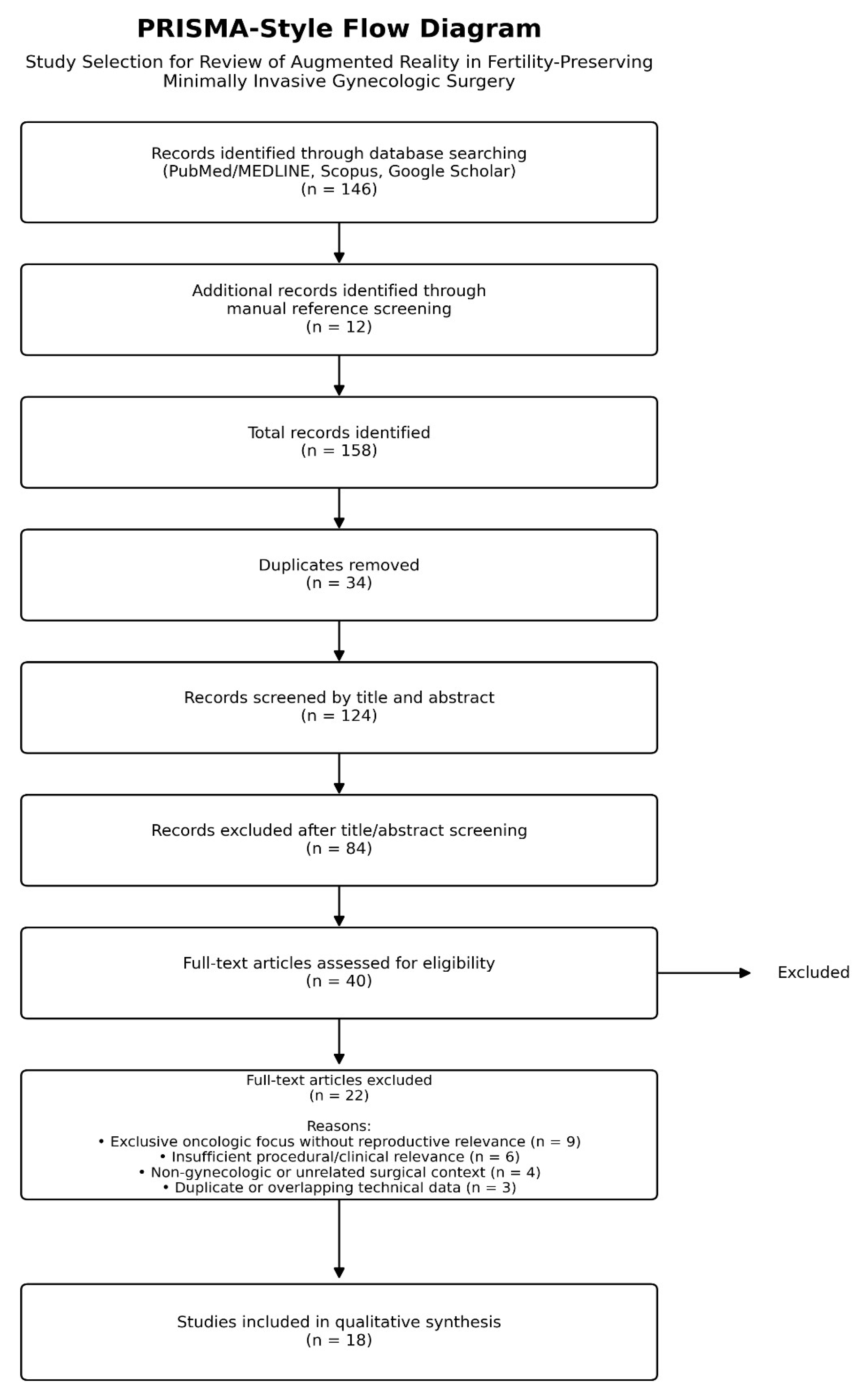

Table 1.
Technical Components of Augmented Reality Systems Relevant to Reproductive Gynecologic Surgery.
Table 1.
Technical Components of Augmented Reality Systems Relevant to Reproductive Gynecologic Surgery.
| Component | Description | Reproductive Surgical Relevance |
|---|---|---|
| Imaging acquisition | MRI, CT, SPECT/CT, or intraoperative ultrasound | Defines lesion anatomy and relationships to reproductive structures |
| Segmentation | Manual, semi-automated, or AI-assisted delineation | Identifies fibroids, adenomyotic lesions, endometrial cavity, ureters, and endometriotic nodules |
| Registration | Alignment of virtual and real anatomy | Determines AR accuracy during surgery |
| Tracking | Camera-, instrument-, or landmark-based tracking | Maintains overlay during operative movement |
| Visualization | Laparoscopic monitor, console, or head-mounted display | Delivers augmented information to the surgeon |
Table 2.
Clinical and Technical Studies of Augmented Reality in Myomectomy and Adenomyomectomy.
| Study | Country / Setting | Design | Procedure / Pathology | No. of Patients | Mean / Median Age | Imaging / Platform | Proposed AR Benefit | Reported Perioperative Benefit | Complications | Fertility Outcome Data | Evidence Level | Main Limitation |
|---|---|---|---|---|---|---|---|---|---|---|---|---|
| Bourdel et al. (2017) [7] | France, tertiary center | Feasibility clinical report | Laparoscopic myomectomy | 3 | NR | MRI-based 3D uterine and myoma modeling with intraoperative overlay | Localization of occult/intramural fibroids; improved spatial orientation | Feasibility of lesion localization during laparoscopy | No major complications specifically highlighted | None reported | IV–V | Very small sample; no comparative outcomes; no fertility follow-up |
| Chauvet et al. (2020) [8] | France | Case report / pilot application | Laparoscopic myomectomy | 2 | NR | MRI + DTI + tractography AR | Visualization of uterine fiber architecture to guide incision planning | Proposed improvement in myometrial incision strategy and tissue-sparing dissection | NR | None reported | V | Two cases only; no clinical validation |
| Bourdel et al. (2019) [9] | France | Case report / technical application | Fertility-preserving adenomyomectomy / adenomyosis surgery | 1 | NR | MRI-based 3D lesion and cavity modeling with AR | Delineation of adenomyoma and endometrial cavity preservation | Proposed support for targeted excision and safer cavity-preserving dissection | NR | None reported | V | Single case; no comparative or reproductive outcome data |
| Ochi et al. (2023) [10] | Japan | Case report / mixed reality application | Laparoscopic myomectomy | 1 | NR | Mixed reality headset with holographic uterine model | Intraoperative lesion guidance and residual myoma awareness | Feasibility of mixed reality integration into workflow | NR | None reported | V | No comparative metrics; no fertility data |
| Comptour et al. (2025) [11] | France, single-center | Retrospective matched case-control study | Laparoscopic myomectomy / adenomyomectomy | 34 total (17 AR vs 17 controls) | 32.7 ± 4.3 years (AR) vs 33.4 ± 3.8 years (controls) | Preoperative uterine modeling with AR-guided laparoscopic navigation | Improve lesion targeting without increasing operative burden | Operative time: 135 ± 39 min (AR) vs 149 ± 62 min (controls); blood loss ≤200 mL in 82.3% vs 75% | No intraoperative or postoperative complications reported in either group | None reported | III | Non-randomized; small sample; no fertility endpoints |
| Akladios et al. (2020) [4] | France / technical framework | Technical / translational report | General gynecologic laparoscopy with relevance to myomectomy | NA | NA | AR workflow and navigation framework | Improve anatomical guidance and target localization | No direct procedure-specific perioperative outcomes | NA | NA | V | Not a direct clinical outcome study |
Table 3.
AR-Related Applications in Endometriosis Surgery and Reproductive Pelvic Navigation.
| Study | Country / Setting | Design | Surgical / Disease Context | No. of Patients / Cases | Mean / Median Age | Technology | Intended Use | Proposed or Reported Perioperative Benefit | Complications | Fertility Outcome Data | Evidence Level | Main Limitation |
|---|---|---|---|---|---|---|---|---|---|---|---|---|
| Zhang et al. (2026) [13] | MRI modeling study | Preliminary prospective feasibility study | Deep infiltrating endometriosis | NR | NR | Pelvic MRI-based 3D modeling | Preoperative lesion mapping and anatomical relationship visualization | Improved understanding of lesion extent and adjacent organ involvement; planning aid for complex DIE surgery | NR | None reported | IV | Real-time intraoperative AR validation not established |
| Netter et al. (2025) [12] | International proof-of-concept collaboration | Proof-of-concept AI study | Endometriosis lesion recognition during laparoscopy | NR | NR | AI-assisted visual recognition relevant to future AR workflows | Automatic lesion detection as precursor to AR-enabled guidance | Potential future support for lesion awareness and dissection planning | Not a direct complication study | None reported | IV–V | Not a direct intraoperative AR outcome study |
| Panichyawat et al. (2026) [19] | Technical surgical application | Technical report | Laparoscopic endometriosis surgery | NR | NR | Intraureteric indocyanine green visualization | Ureteral identification in complex endometriosis dissection | Potential reduction in ureteral injury risk; improved ureteral awareness | Technical application only; formal complication reduction not proven | None reported | V | Not AR per se; image-guidance adjunct rather than overlay navigation |
| Warshafsky et al. (2024) [20] | Review article | Narrative / conceptual review | Endometriosis visualization and future imaging | NA | NA | Visualization technologies including AR-adjacent approaches | Improve future lesion visualization and surgical understanding | Conceptual support for future image-guided endometriosis surgery | NA | NA | V | No primary procedural data |
| Madad Zadeh et al. (2023) [18] | Translational development | Technical dataset study | Gynecologic laparoscopy with future AR guidance applications | NA | NA | SurgAI3.8K labeled laparoscopic dataset | Development of automatic gynecologic organ recognition for future AR guidance | Foundational step toward real-time anatomy-aware overlays | NA | NA | V | No direct clinical surgical outcomes |
Table 4.
Potential Applications of AR for Complication Prevention in Reproductive Surgery.
| Surgical Challenge | Procedure(s) Most Relevant | Potential AR Contribution | Proposed Perioperative Benefit | Reproductive Relevance | Current Evidence Strength |
|---|---|---|---|---|---|
| Occult intramural fibroid localization | Myomectomy | Localization of hidden lesions before uterine incision | May reduce blind dissection, repeated uterine entry attempts, and unnecessary tissue trauma | Important for uterine preservation and reconstruction | Moderate conceptual support; limited clinical comparative evidence |
| Endometrial cavity preservation | Myomectomy, adenomyomectomy | Visualization of lesion–cavity relationship | May reduce inadvertent cavity breach and improve precision of resection | Relevant to uterine healing and fertility planning | Strong theoretical relevance; very limited direct clinical data |
| Poor adenomyoma margin definition | Adenomyomectomy | Improved lesion delineation using MRI-based modeling | May reduce over-resection or incomplete excision | Critical for balancing disease treatment and uterine preservation | Early case-based evidence only |
| Excessive myometrial trauma | Myomectomy, adenomyomectomy | More selective and anatomy-guided dissection | Potentially improved tissue preservation and reconstruction conditions | Important for future pregnancy safety | Conceptually strong; not outcome-proven |
| Ureteral injury risk | DIE surgery | Improved awareness of ureteral course or relation to disease | May support safer parametrial and pelvic sidewall dissection | Important in fertility-preserving pelvic surgery | Indirect or adjacent evidence only |
| Bowel or bladder interface uncertainty | DIE surgery | Better lesion-interface understanding | May support safer dissection planning and multidisciplinary surgery | Relevant to pelvic organ preservation and postoperative morbidity | Emerging translational support |
| Distorted pelvic anatomy / fibrosis | Endometriosis surgery | Enhanced spatial orientation and lesion mapping | Potentially reduces technical uncertainty and avoidable dissection error | Highly relevant in reproductive-age surgery | Translational / conceptual evidence |
| Workflow-related technical ambiguity | All complex reproductive surgeries | Improved surgeon orientation and procedural confidence | More deliberate dissection and potentially fewer technical errors | Relevant across fertility-preserving procedures | Plausible but unquantified |
Table 5.
Key Evidence Gaps in AR for Reproductive Gynecologic Surgery.
| Domain | Current State of Evidence | Relevance | Implication for Future Research |
|---|---|---|---|
| Sample size and external validity | Most studies are case reports, small series, or single-center cohorts | Limits generalizability | Multicenter prospective cohorts are needed |
| Comparative perioperative outcomes | Rarely reported; only one small matched case-control study identified | Unclear whether AR improves surgery beyond feasibility | Controlled comparative studies are needed |
| Complication reporting | Often absent or underreported | Safety claims remain preliminary | Standardized complication reporting is required |
| Fertility outcomes | Essentially absent | Core rationale for use in reproductive surgery remains unproven | Pregnancy, live birth, uterine integrity, and obstetric outcomes should be reported |
| Registration accuracy | Poorly standardized | Misregistration may create false confidence | Validation metrics for pelvic AR are needed |
| Workflow burden / usability | Limited formal evaluation | Clinical adoption depends on practicality | Human-factors and workflow studies are needed |
| Cost-effectiveness | Not meaningfully studied | Resource burden may limit implementation | Economic analyses are required |
| Standardization across platforms | Highly heterogeneous | Difficult to compare studies or reproduce results | Consensus methodological frameworks are needed |
At present, AR in reproductive surgery remains fertility-relevant in concept, but fertility-unproven in evidence.
Disclaimer/Publisher’s Note: The statements, opinions and data contained in all publications are solely those of the individual author(s) and contributor(s) and not of MDPI and/or the editor(s). MDPI and/or the editor(s) disclaim responsibility for any injury to people or property resulting from any ideas, methods, instructions or products referred to in the content. |
© 2026 by the authors. Licensee MDPI, Basel, Switzerland. This article is an open access article distributed under the terms and conditions of the Creative Commons Attribution (CC BY) license (http://creativecommons.org/licenses/by/4.0/).
Copyright: This open access article is published under a Creative Commons CC BY 4.0 license, which permit the free download, distribution, and reuse, provided that the author and preprint are cited in any reuse.


