
Submitted:
15 April 2026
Posted:
16 April 2026
You are already at the latest version
Abstract
This study investigates the impact of ESG performance on the tax avoidance behavior of 118 non-financial listed firms in Vietnam from 2020 to 2024. Employing a Random Effects Model (REM), empirical results reveal that sustainability reporting quality-measured by individual E, S, and G pillars and a composite ESG index-is negatively associated with corporate tax avoidance, proxied by the Effective Tax Rate (ETR). Among these, the social (S) pillar exerts the most pronounced effect; however, individual component impacts remain less substantial than the comprehensive ESG index. Furthermore, findings indicate that the mitigating effect of ESG on tax avoidance significantly weakens when firms face financial constraints or operate under state ownership. Notably, applying machine learning techniques demonstrates that a CatBoost algorithm integrating the ESG variable achieves 52.92% predictive accuracy for tax avoidance, outperforming an XGBoost model lacking ESG inclusion (38.14%). Additionally, feature importance analysis of financial and non-financial variables highlights ROA as the dominant financial predictor (35.5%), while ESG contributes a notable 10.35% to the model's explanatory power. Ultimately, these findings provide vital insights for policymakers and investors regarding the interplay between sustainability commitments, ownership structures, and corporate tax strategies.
Keywords:
environment
; social
; governance
; ESG
; financial constrainst
; tax avoidance
; state-owned enterprise
; machine learning
1. Introduction
Environmental (E), Social (S), and Governance (G) are the three core pillars of ESG reporting, first introduced by the United Nations in 2004. The Global Reporting Initiative (GRI) has issued a set of standards that provide specific indicators for assessing a firm’s impact on the environment, employees, communities, and governance mechanisms. Firms disclose their degree of compliance with ESG standards in their annual reports to stakeholders, who then conduct qualitative and, in some cases, quantitative assessments, assign ratings, and evaluate the extent to which firms comply with environmental regulations and fulfill their social responsibilities. Such disclosure reflects a firm’s commitment to sustainable development, thereby improving the quality of financial decision-making and enabling a more comprehensive assessment of future risks.
In addition to their obligations to the environment and society, business enterprises also have tax obligations to the government. In discussions of taxation, two commonly addressed concepts are tax avoidance and tax evasion. Both concepts reflect situations in which a firm pays less tax through either legal or illegal manipulation. Unlike tax evasion, which is unlawful and involves statutory corporate income tax (CIT) liabilities that are either unreported or unpaid, tax avoidance is generally understood as legal actions undertaken to reduce tax liabilities. Most prior studies argue that tax avoidance is intended to reduce taxpayers’ tax burdens and may be carried out legally through the use of asset valuation methods as well as the recognition of expenses and revenues [1]. In addition, Dyreng et al. [2] define tax avoidance as any activity that reduces income taxes relative to accounting profit. Drawing on earlier work by Deskins and Fox [3], Hanlon and Heitzman [4] and Chen et al. [5] define tax avoidance Benkraiem et al. [6] as any action aimed at reducing a taxpayer’s tax liability. Therefore, it is not always easy to determine whether a firm’s level of tax avoidance is fully legitimate, as highly aggressive tax avoidance may also be perceived by tax authorities as crossing into illegality.
In recent years, alongside the global trend toward sustainable development, corporate governance thinking has shifted markedly from the goal of short-term profit maximization toward a stronger emphasis on creating long-term value associated with environmental, social, and governance responsibility. In this context, ESG-related reports have increasingly become an important benchmark for assessing corporate governance quality, risk resilience, and sustainable development prospects. However, the quality of information disclosed in ESG reports has not yet been fully verified by independent external organizations. A critical question therefore arises: does the information disclosed in ESG reports truly reflect firms’ actual practices, or does it merely serve as a facade concealing opaque activities and managerial weaknesses? For instance, does a firm that receives a high rating for the information presented in its ESG report necessarily comply fully with its tax obligations, rather than engaging in tax evasion or avoidance? For this reason, the level of ESG implementation, as well as the relationship between ESG implementation and disclosure and corporate tax avoidance, has attracted increasing attention from investors, academics, and policymakers, as evidenced by studies such as Jiang et al. [7] in China and Syahputri [8] in ASEAN countries.
In the context of economic integration and sustainable development, taxes payable are no longer viewed merely as a financial cost of doing business, but have become an important component reflecting corporate social responsibility. Previous studies on the relationship [9] between ESG and tax avoidance have not reached a consistent conclusion. Some studies suggest that firms with stronger ESG practices or higher-quality ESG disclosure tend to engage in less tax avoidance than other firms, as they face greater monitoring pressure from stakeholders and are more likely to pursue long-term development strategies. By contrast, other studies indicate that ESG may be used by firms as a “shield” to conceal tax avoidance behavior [9,10,11,12,13]. The existence of these mixed findings suggests that the relationship is complex and may depend on other moderating factors, such as the institutional context, firms’ financial conditions, and ownership structure. For example, does the relationship between strong ESG performance and lower tax avoidance become stronger in firms with majority state ownership? Likewise, if a firm that performs well on ESG and exhibits lower tax avoidance falls into financial distress, will this positive relationship weaken? Accordingly, further studies in different contexts are needed to provide richer empirical evidence on this issue.
Vietnam, an Asian country, is currently promoting green growth and sustainable development. The government has committed to achieving net-zero emissions by 2050 at COP26, while Vietnam’s ESG disclosure framework remains under development and is still less advanced than those of more mature markets such as the EU and Singapore [14]. Against this backdrop, the present study examines the effect of ESG implementation on corporate tax avoidance in Vietnam under the moderating effects of financial constraints and state ownership. This study is expected to make both theoretical and practical contributions as follows.
First, the study seeks to establish the relationship between ESG practices and tax avoidance behavior, while also identifying moderating factors and clarifying both the direction and magnitude of their effects on the ESG-tax avoidance relationship. More importantly, the expected findings may provide empirical evidence that ESG functions as a monitoring and disciplinary mechanism that helps constrain tax avoidance, rather than merely serving as a symbolic device or image-building “cover” to legitimize firms’ tax-reduction strategies.
Second, the study is expected to generate several practical implications for different stakeholder groups. (i) For firms, the study provides empirical evidence that ESG implementation not only serves sustainable development objectives but also enhances transparency, financial discipline, and tax compliance, thereby helping firms design more appropriate governance systems, reduce legal risk, and improve long-term operational efficiency. (ii) For state regulators and tax authorities, the findings may serve as a useful reference for developing and refining the legal framework for ESG disclosure, strengthening evidence-based monitoring and tax risk management mechanisms, and integrating ESG as a complementary tool in policies aimed at addressing tax avoidance and improving budget revenue collection. (iii) For policymakers, the study provides information to support the formulation of policies that encourage substantive ESG practices, limit “symbolic ESG” or “box-ticking ESG,” and strengthen the linkage between sustainable development policy and public financial governance objectives. (iv) For investors and other stakeholders, the study contributes additional evidence for evaluating corporate governance quality and tax compliance, thereby supporting investment decisions, firm valuation, and portfolio management in line with long-term and sustainable investment strategies.
Third, the study contributes to methodological development in accounting and finance by demonstrating the complementary role of modern data-analytic tools, such as regression techniques and machine learning methods, in enhancing traditional causal inference approaches. This integration may improve both the explanatory power and predictive capacity of the research model used to explore the relationship between ESG implementation and corporate tax avoidance.
The structure of the article in addition to the introduction and conclusion includes the following sections: (2) Literature review; (3) Theoretical Framework and Hypotheses Development; (4) Research Methodology; (5) Research results; (6) Research discussions; (7) Recommendations; and (8) Conclusions.
2. Literature Review
The relationship between the level of ESG disclosure and corporate tax avoidance has attracted increasing scholarly attention worldwide. Although the number of studies on this issue has grown substantially, the empirical evidence remains inconclusive. Prior research has largely developed along two contrasting perspectives, reflecting the complex nature of this relationship: the ethical conduct perspective and the opportunistic conduct perspective.
From the perspective of stakeholder theory and legitimacy theory, firms that pursue strong ESG strategies tend to comply more fully with their tax obligations in order to maintain legitimacy and strengthen trust among stakeholders, thereby exhibiting ethical behavior. Under this view, tax payment is regarded as a fundamental contribution to the maintenance of public infrastructure and services from which both firms and their stakeholders benefit. Consequently, firms with strong ethical values are expected to recognize the reputational risks associated with being exposed for tax avoidance and therefore to maintain consistency between their publicly stated ESG commitments and transparent tax behavior [15]. Empirical evidence supporting this perspective has been documented across different contexts. Yoon et al. [16], in the case of South Korea, and Du and Li [17], in the BRICS countries, both confirm that firms with higher ESG scores exhibit significantly lower levels of tax aggressiveness. The persistence of this negative relationship is further supported by the meta-analysis of 61 global studies conducted by Widuri et al. [18]. More specifically, in closely monitored industries such as insurance, Bressan [19] provides evidence that firms with strong ESG commitments tend to accept higher actual tax burdens and do not shift the tax burden onto customers, even when such decisions reduce short-term profitability.
In contrast, the opportunistic conduct perspective suggests that ESG may be exploited by firms as a concealment mechanism for tax avoidance. Grounded in agency theory, managers may strategically disclose positive ESG reports in order to build a benevolent public image. This stock of intangible reputational capital may function as a form of insurance, alleviating public pressure and diverting the attention of tax authorities while firms quietly implement high-risk tax avoidance strategies to maximize cash flows [9]. In developing countries, where institutional monitoring systems remain incomplete, such opportunistic behavior may be even more pronounced. Yanto, Hajawiyah and Baroroh [13], in their study of Indonesia and Malaysia, identify a reciprocal mechanism: firms not only use high ESG scores to protect their public image while engaging in aggressive tax avoidance, but also deliberately avoid taxes in order to retain the cash necessary to finance costly ESG projects. This finding suggests that ESG and tax avoidance may operate as parallel strategic tools used by corporate management to shape stakeholder perceptions.
The literature also suggests that the relationship between ESG disclosure and tax avoidance is not static but is strongly moderated by internal conditions such as financial capacity. When firms face financial constraints, survival pressures and the need to generate internal cash flows may override ethical commitments, thereby encouraging greater tax avoidance regardless of existing ESG scores [8]. Duong and Huang [20], in examining whether ESG disclosure affects capital structure, tax avoidance, and firm value in Southeast Asia during the 2018-2021 period, included SOE as a dummy control variable to account for ownership structure differences that may influence financial behavior and the extent of ESG implementation.
Research Gaps
First, research findings on the relationship between ESG and tax avoidance remain inconsistent across different contexts. Studies supporting the corporate culture perspective argue that firms with higher ESG scores are less likely to engage in tax avoidance in order to protect their reputation [8,16]. By contrast, studies grounded in agency theory provide evidence that firms may use ESG activities as a cover for tax avoidance [10,13,18]. This lack of consensus creates a clear need to re-examine the relationship in more specific contexts in order to explain the sources of divergence and enrich the theoretical literature on ESG implementation and tax avoidance worldwide.
Second, in terms of research context, most studies focus on single-country settings or specific regions such as Europe or ASEAN, which limits their global representativeness [10,15,21]. In particular, Vietnam, as a transition economy with a distinct institutional environment, requires broader empirical verification and comparison [22]. Moreover, prior studies often restrict their samples to large firms or specific industries, thereby overlooking the governance characteristics of small and medium-sized enterprises as well as firms in other sectors, which reduces the representativeness of their findings [9,19].
Third, with regard to research period, limitations in data timeliness and time horizon also affect the reliability of previous analyses. The use of historical data or short-term cross-sectional designs may prevent prior studies from accurately reflecting current tax regulations and ESG standards, while also failing to capture temporal changes [9,10,15]. In emerging markets, the lack of long-term ESG data series remains a major obstacle to more comprehensive analysis [15]. From a methodological perspective, endogeneity also continues to be a major challenge, as most existing studies identify correlations rather than establish a robust causal relationship between ESG and tax behavior [10].
Fourth, current research models often do not fully integrate internal firm characteristics and specific contextual factors. Important variables such as ownership structure, organizational culture, CEO characteristics, and tax-related governance mechanisms have not been examined in sufficient depth [13,23]. Furthermore, the lack of qualitative approaches and the rigid application of Western theoretical frameworks to specific contexts such as Vietnam have created a gap in explaining the real motivations linking managerial CSR perceptions and actual behavior [9,24].
Fifth, empirical evidence on the relationship between ESG and tax behavior remains contradictory and far from conclusive. One stream of literature, drawing on the corporate culture perspective, argues that firms with high ESG scores are less likely to engage in tax avoidance in order to protect their reputation [8,16]. Another stream, based on agency theory, finds that firms may use ESG activities as a concealment mechanism for tax avoidance or as a means to maximize short-term profits [10,13,18]. This lack of consensus reinforces the need to re-test the relationship in more context-specific settings.
Sixth, there is a significant empirical research gap regarding the use of specific ESG data in relation to tax avoidance behavior in the Vietnamese market. Previous studies, such as Ha et al. [25] and Khương and Trang [26], have mainly approached the issue through the broader theoretical lens of CSR rather than employing quantitative ESG measures to examine this relationship in depth.
3. Theoretical Framework and Hypotheses Development
3.1. Theoretical Framework
Stakeholder Theory
Mitchell et al. [27] define stakeholders, in a narrow sense, as groups upon which an organization depends for its survival. Accordingly, firms are expected not only to maximize shareholder wealth but also to create value for multiple stakeholder groups. Effective governance relies on identifying and classifying stakeholders based on three attributes: power, legitimacy, and urgency, which form latent, expectant, and definitive stakeholder groups, the latter receiving the highest managerial priority.
Agency Theory
Agency theory describes the contractual relationship between principals and agents, in which managers are delegated authority to perform services and make decisions on behalf of shareholders [28,29]. The separation of ownership and control creates incentive problems and conflicts of interest due to differences in risk preferences and information asymmetry [28,30]. These conflicts can be mitigated by separating decision management from decision control, strengthening the monitoring role of the board of directors, and relying on market discipline mechanisms [30,31,32].
Corporate Culture Theory (David Kreps)
Kreps [33] views corporate culture as an intangible asset linked to reputation that reduces transaction costs when contracts are incomplete. Culture acts as a self-enforcing mechanism that fosters trust, facilitates coordination, attracts suitable employees, and lowers monitoring costs, although it is often difficult to change due to historical path dependence and the need to maintain reputation.
Legitimacy Theory
Suchman [34] defines legitimacy as a generalized perception or assumption that an organization’s actions are desirable, proper, or appropriate within socially constructed norms and values. Firms achieve legitimacy through both strategic (proactive management) and institutional (environmental pressure) approaches. Legitimacy takes three main forms: pragmatic, moral, and cognitive, and organizations must continuously establish, maintain, and repair legitimacy to secure access to resources and ensure long-term survival.
Signaling Theory
Signaling theory explains how information asymmetry is reduced through observable and costly signals [35]. Signals help differentiate quality and mitigate “The Lemons Problem” where information gaps lead receivers to value offerings at an average level. The theory has been widely applied in strategic management, entrepreneurship, and human resource management.
Political Cost Theory
Watts and Zimmerman [36] argue that large firms are more exposed to political scrutiny, taxation, and regulatory pressure. Consequently, firms may engage in earnings management by selecting accounting policies that reduce reported profits and by increasing corporate social responsibility activities to mitigate political costs.
3.2. Hypotheses Development
First, ESG may influence corporate tax avoidance in two opposing directions, reflecting two competing perspectives: the ethical behavior perspective and the opportunistic behavior perspective.
From the opportunistic perspective, several prior studies conclude that ESG is positively associated with tax avoidance. Under risk management theory, CSR and tax avoidance may coexist and reinforce one another; this phenomenon is often described as organized hypocrisy. Abdelfattah and Aboud [37], Abid and Dammak [38], Alsaadi [39], and many earlier studies suggest that large firms often develop CSR reports to construct an ethical façade, manage reputational risk, and mitigate negative public reactions. Many firms establish subsidiaries in jurisdictions regarded as tax havens while simultaneously intensifying CSR reporting in order to facilitate tax avoidance [40,41]. In addition, studies in Southeast Asian countries-where markets such as Vietnam, Indonesia, and Malaysia have recently experienced rapid economic development-indicate that ESG disclosure may be used as a strategic compensatory mechanism to conceal tax avoidance practices [13,23]. In this view, firms rely on the ESG façade to divert the attention of tax authorities and the public, thereby enabling tax avoidance.
However, most prior studies suggest that firms are more likely to behave ethically than opportunistically. Lanis and Richardson [42] argue that firms with high levels of social responsibility tend to regard tax payment as an ethical obligation and are therefore less likely to engage in tax avoidance. Likewise, Landry et al. [43] emphasize that consistency between tax behavior and CSR commitment is a core issue. Yoon, Lee and Cho [16] also find a negative relationship between ESG performance and tax avoidance among Korean firms during the 2011-2017 period, with this relationship being more pronounced among non-chaebol firms. In the context of a developing country, Muller and Kolk [44] show that firms with stronger CSR reputations in India tend to exhibit lower tax avoidance. Several scholars argue that firms with stronger CSR commitment tend to view tax obligations as an essential contribution to society and the community. Accordingly, such firms are less likely to engage in tax avoidance than firms that place less emphasis on social responsibility [41,45,46,47]. Firms that value ESG tend to view tax not merely as a cost, but as a social obligation. In addition, these firms face reputational risks if they become involved in negative scandals related to tax compliance. Therefore, this study proposes the following hypothesis:
H1:
ESG disclosure is negatively associated with tax avoidance among non-financial firms listed on the Vietnamese stock market.
Although the aggregate ESG score reflects a firm’s overall level of sustainable practice, ESG is inherently a multidimensional construct comprising three core pillars: environmental (E), social (S), and governance (G), each with distinct content and mechanisms of influence. Specifically, the environmental pillar (E) reflects the extent to which corporate activities affect the natural ecosystem, including resource use, emissions management, energy consumption, and compliance with environmental regulations. The social pillar (S) captures the relationship between the firm and its employees, customers, and communities, including issues such as working conditions, gender equality, human resource development, workplace safety, and social responsibility. Meanwhile, the governance pillar (G) refers to the management system and internal monitoring mechanisms that ensure the firm is operated transparently, responsibly, and in alignment with the interests of shareholders and other stakeholders, including governance structure, the role of the board of directors, internal control systems, and legal compliance.
Because these pillars differ in nature, their level of development within a firm may not be uniform. A firm may score highly on governance while performing only moderately on environmental and social dimensions, or vice versa. When combined into a single ESG index, the strong effects of one component may be offset by the others, potentially weakening or obscuring the distinct influence of each pillar. Therefore, relying solely on the aggregate ESG score may not fully capture the true nature of the relationship between ESG and corporate behavior.
Disaggregating ESG into its E, S, and G components helps reduce the problem of informational offsetting across dimensions, thereby allowing a clearer identification of the role of each factor in the relationship under study. Estimating models using both the aggregate ESG score and its individual components also enables robustness checks and provides more detailed empirical evidence on the mechanisms through which ESG affects corporate outcomes.
In the context of tax avoidance, such disaggregation becomes even more necessary. Specifically, the governance pillar (G) is expected to exert a more direct effect on tax avoidance through monitoring and controlling managerial opportunism. In contrast, the environmental (E) and social (S) pillars may influence tax avoidance primarily through reputational pressure, legitimacy concerns, and stakeholder expectations. Accordingly, the impact of each ESG component on tax avoidance may differ both in magnitude and in underlying mechanism. On this basis, the study proposes the following hypotheses:
H2:
Environmental disclosure (E) is negatively associated with tax avoidance among non-financial firms listed on the Vietnamese stock market.
H3:
Social disclosure (S) is negatively associated with tax avoidance among non-financial firms listed on the Vietnamese stock market.
H4:
Governance disclosure (G) is negatively associated with tax avoidance among non-financial firms listed on the Vietnamese stock market.
Second, financial constraints reflect a firm’s difficulty in accessing external financing - such as debt or equity issuance - or its need to bear a high cost of capital, thereby limiting its ability to finance investment activities through conventional financial channels [48]. According to agency theory [28], conflicts of interest between shareholders and managers may lead managers to pursue short-term objectives that maximize personal benefits. In financially constrained firms, rising pressure on liquidity and financial performance may increase the incentive to employ tax avoidance strategies as a means of generating immediate benefits.
Prior empirical studies provide evidence that financial constraints are positively associated with tax avoidance. Specifically, Edwards et al. [49] and Benkraiem, Gaaya, Lakhal and Kilic [6] show that when financial constraints intensify, firms tend to strengthen tax planning activities in order to reduce tax payments, as such tax savings serve as an alternative source of internal financing when access to external capital is limited. Similarly, Xing and Zhou [50] provides evidence from China showing that financial constraints are positively and significantly related to tax avoidance, and that this relationship is particularly strong in regions with weak tax enforcement.
In the relationship between ESG and tax avoidance, financial constraints may act as a moderating variable through the channel of easing financing frictions [7]. Specifically, firms with higher ESG engagement tend to improve information transparency and strengthen stakeholder relations, thereby reducing information asymmetry and agency costs and improving access to external capital (Cheng et al., 2014). Once financing constraints are relaxed, firms become less dependent on internal cash-generating mechanisms such as tax avoidance.
However, when firms face severe financial constraints, cash flow pressure may encourage them to intensify tax avoidance in order to compensate for funding shortages, thereby weakening the restraining role of ESG on tax avoidance. This implies that as financial constraints increase, firms may prioritize short-term cash flow objectives over maintaining tax compliance consistent with ESG-oriented sustainable development. As a result, the negative relationship between ESG and tax avoidance is expected to become weaker. In other words, financial constraints are expected to moderate this relationship by reducing the strength of ESG’s negative effect on tax avoidance. Based on the above theoretical arguments and empirical evidence, the study proposes the following hypothesis:
H5:
Financial constraints weaken the negative relationship between ESG disclosure and tax avoidance among non-financial firms listed on the Vietnamese stock market.
Third, prior studies often use state-owned enterprises (SOEs) as a proxy for the extent of state participation and control in corporate activities [51]. Unlike private firms, SOEs may simultaneously pursue multiple objectives beyond profit maximization, including social and political goals [52]. Therefore, the incentives for and extent of tax avoidance in SOEs are expected to differ from those in private firms.
Bradshaw et al. [53] argue that when the government is a major or controlling shareholder, tax is not viewed merely as a cost to be minimized, but also as a source of state budget revenue. Under such circumstances, the state has little incentive to encourage tax avoidance strategies, and SOEs are therefore expected to engage in fewer tax avoidance activities than private firms. In addition, governance and monitoring mechanisms in the state sector are typically stricter, increasing compliance pressure and constraining tax avoidance.
By contrast, in private firms, ESG engagement may play a more important role in limiting tax avoidance through reputational pressure, expectations of social responsibility, and monitoring by stakeholders [7]. According to legitimacy theory, ESG disclosure helps firms strengthen legitimacy, enhance transparency, and build trust with investors, society, and the government [54]. As a result, private firms with higher ESG performance are more likely to refrain from behaviors perceived as unethical, such as aggressive tax avoidance [9].
In contrast, for SOEs, legitimacy is partly secured through their public role and function, which may cause ESG to become more compliance-oriented or symbolic and therefore less capable of generating an additional effect on tax behavior. At the same time, under political cost theory, firms with higher political visibility are subject to greater monitoring pressure and therefore tend to avoid controversial practices in order to reduce the risk of inspection, investigation, or public criticism. In this context, SOEs inherently face high political costs due to close monitoring by the state, auditors, and society, as well as the requirement to fulfill public objectives, including contributions to the state budget.
Accordingly, tax avoidance in SOEs is likely to be subject to a relatively high degree of pre-existing discipline, making the incremental effect of ESG on tax avoidance less pronounced. Put differently, state ownership is expected to moderate the ESG-tax avoidance relationship by weakening its negative association, implying that the tax-restraining effect of ESG is less pronounced in SOEs than in private firms. From these arguments, the study proposes the following hypothesis:
H6:
State ownership weakens the negative relationship between ESG disclosure and tax avoidance among non-financial firms listed on the Vietnamese stock market.
Fourth, according to signaling theory, ESG disclosure may be used by firms as a tool to project a positive external image. However, such disclosure does not always fully or accurately reflect a firm’s actual financial behavior. Therefore, relying solely on ESG information may be insufficient for a comprehensive assessment of firm performance and conduct. In this context, combining ESG information with financial indicators and firm characteristics is expected to provide a more complete and reliable picture of firm operations, while also improving the identification of factors associated with tax avoidance.
In addition, to extend the scope of the study from explanatory analysis to predictive analysis, this research proposes the application of machine learning techniques. Previous studies have mainly employed linear regression models to examine the direction and magnitude of ESG’s impact on tax avoidance. Although these methods are useful for interpreting causal relationships, they remain limited in their ability to capture nonlinear relationships and complex interactions among variables. By contrast, machine learning methods are better suited to handling high-dimensional data, identifying latent patterns, and exploiting nonlinear relationships, thereby improving predictive performance.
Accordingly, integrating ESG information with financial data and firm characteristics within predictive models-particularly when machine learning techniques are employed-is expected not only to enable the prediction of tax avoidance behavior but also to improve predictive performance relative to models that exclude ESG information. On this basis, the study examines two aspects: (i) the predictive capability of the model and (ii) the incremental value of ESG information in predictive modeling. From these arguments, the study proposes the following hypotheses:
H7a:
A model integrating financial data and firm characteristics is capable of predicting tax avoidance behavior among non-financial listed firms in Vietnam.
H7b:
Integrating ESG information into the prediction model, together with financial data and firm characteristics, improves the accuracy and effectiveness of predicting tax avoidance behavior.
4. Research Methodology
4.1. Research Models
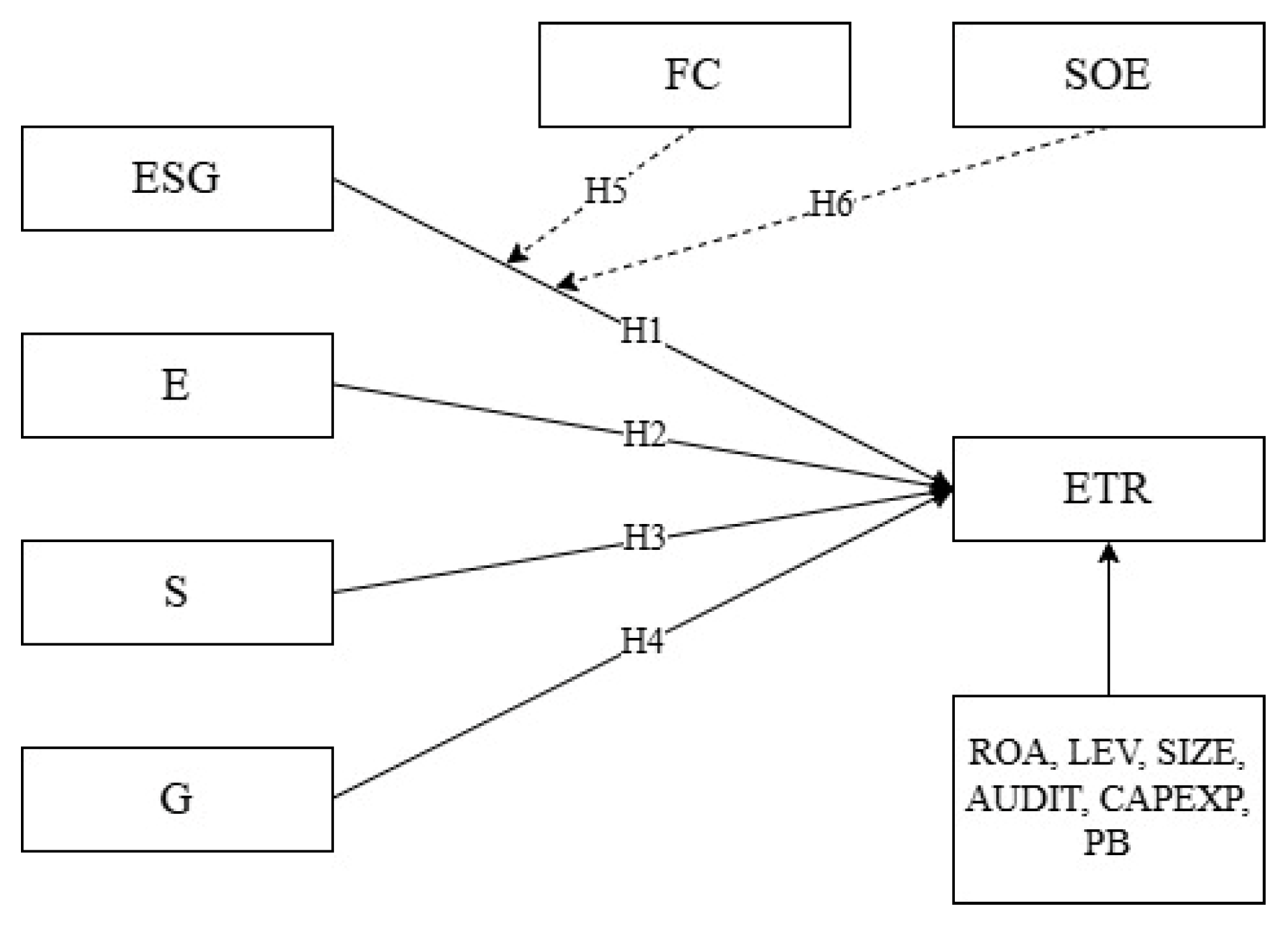
Models examining the effect of ESG on tax avoidance and the moderating effects
Where:
+ ETRit: effective tax rate of firm i at time t
+ ESGit: overall ESG score of firm i at time t
+ FCit: proxy for the level of financial constraints of firm i at time t
+ SOEit: proxy for state ownership of firm i at time t
+ Controlit: control variables of firm i at time t, including ROA (Return on Assets), LEV (Leverage), SIZE, AUDIT (Big4 audit firm), CAPEXP (capital expenditure), and PB (Price-to-Book ratio)
+ β0: intercept term
+ β1, β2, β3, βk: regression coefficients
+ εit: random error term
+ i: firm i in the sample; t: current year
Figure 1.
Research model (source: developed by the authors).
Models examining the effects of the individual E, S, and G components on tax avoidance
Where:
+ ETRit: effective tax rate of firm i at time t
+ Eit: environmental score of firm i at time t
+ Sit: social score of firm i at time t
+ Git: governance score of firm i at time t
+ Controlit: control variables of firm i at time t, including ROA, LEV, SIZE, AUDIT, CAPEXP, and PB
+ β0: intercept term
+ β1, βk: regression coefficients
+ εit: random error term
Dependent variable
This study uses ETR (Effective Tax Rate) as a proxy for tax avoidance because ETR reflects the ratio of reported corporate income tax expense to pre-tax accounting profit. This measure has also been employed in prior studies [8,55,56].
ETR represents the actual tax rate borne by firms. When ETR approximates the statutory corporate income tax rate under current tax law, the firm can be considered compliant with tax regulations and less likely to engage in tax avoidance. Conversely, if ETR is lower than the statutory corporate income tax rate, this may suggest that the firm is engaging in tax avoidance. Therefore, the lower the ETR, particularly when it is substantially below the statutory rate or below that of comparable firms, the more it implies that the firm is reducing its tax burden through tax-planning strategies such as exploiting tax incentives, claiming legitimate deductions, structuring transactions, and selecting the timing of revenue and expense recognition.
Independent variables
The four independent variables are the levels of ESG implementation, measured through the scores obtained after analyzing the ESG, related criteria disclosed by firms in their ESG reports, including the overall ESG score, the environmental score (E), the social score (S), and the corporate governance score (G). ESG indicators are measured based on the standards of the Global Reporting Initiative (GRI).
To convert ESG disclosures into quantitative data, the study employs a three-point scoring system to assess the extent of disclosure: 0 if no information is disclosed; 0.5 if the disclosure is limited, qualitative, or merely symbolic; 1 if the disclosure is complete and includes quantitative data or relevant substantive information.
For each E, S, and G dimension, the research team assigns scores based on the selected criteria under the GRI framework and then calculates the average score for each pillar by dividing the total score of that pillar by the total number of criteria under the GRI standard. The overall ESG score is then computed as the arithmetic mean of the three pillar scores: E, S, and G.
Control variables
In examining the impact of ESG on tax avoidance among non-financial firms, the inclusion of control variables is necessary to isolate the effects of other firm-specific factors that may influence tax avoidance but are not the main focus of the study. This helps reduce omitted-variable bias and allows the results to be interpreted as the effect of ESG on tax avoidance after holding other relevant firm characteristics constant.
Specifically, firm size (SIZE) is controlled for because larger firms often possess greater resources, more complex structures, and more sophisticated tax-planning strategies, while also being subject to greater external scrutiny. SIZE is measured as the natural logarithm of total assets in order to capture scale differences and normalize the data.
Profitability (ROA) is included to control for operating performance, as the level of profit directly affects tax obligations and firms’ incentives for tax planning. More profitable firms may face different incentives regarding aggressive tax behavior; thus, ROA helps disentangle the effect of ESG from that of business performance.
Leverage (LEV) controls for the tax shield effect of debt, since interest expenses are tax-deductible and may mechanically reduce taxable income. This helps avoid confounding the effect of capital structure with that of intentional tax avoidance.
Audit quality (AUDIT) is included because firms audited by Big4 audit firms are generally subject to stricter monitoring and higher compliance standards, which may constrain risky tax strategies. The dummy variable AUDIT therefore captures differences in the degree of external monitoring.
Capital expenditure (CAPEXP) reflects the level of investment in long-term assets and the potential tax effect of depreciation expenses, thereby helping control for the effect of asset investment on ETR.
Finally, growth opportunity (PB) controls for market expectations and the characteristics of growth firms, as pressures related to reputation, valuation, and financial policy may affect the extent to which such firms engage in tax avoidance. Including PB in the model helps isolate the impact of ESG from that of growth prospects.
Moderating variables
Financial constraints (FC) and state ownership (SOE) are included as moderating variables in the research model. Risk-shifting theory, proposed by Bulow and Shoven [57], suggests that when firms fall into financial distress, the likelihood of tax avoidance may increase. In such circumstances, shareholders and managers are more likely to accept higher-risk behavior [58,59]. FC is calculated using the formula developed by Edwards, Schwab and Shevlin [49]. The inclusion of FC as a moderator allows the study to test whether financial constraints alter the relationship between ESG and tax avoidance. A higher FC value indicates stronger financial health, whereas a lower FC value suggests that the firm may be at greater risk of distress.
In addition, SOE is used as a moderating dummy variable, equal to 1 if the firm is state-owned, defined as the State holding at least 50% of total charter capital, and 0 otherwise.
4.2. Variable Measurements and Data Collections
This study uses both financial and non-financial data collected directly from audited annual financial statements and annual reports of non-financial firms listed on the HOSE and HNX stock exchanges during the period 2020-2024. The 2020-2024 period is considered appropriate because it clearly reflects ESG-related corporate behavior in a context where policy frameworks and market pressures had become relatively well established following the issuance of Circular No. 96/2020/TT-BTC by the Vietnamese government, which regulates information disclosure obligations for public companies and listed firms on the Vietnamese stock market.
This circular requires firms to disclose financial and non-financial information fully, promptly, and transparently in order to protect investors and improve market efficiency. Notably, it also encourages firms to disclose information related to sustainable development, including environmental, social, and governance (ESG) factors, either through sustainability reports or integrated annual reports. This regulation has contributed to promoting transparency, accountability, and a corporate orientation toward sustainable development in Vietnam.
According to Rajput et al. [60], an appropriate sample size is essential to obtaining accurate and reliable results in machine learning research. Therefore, this study adopts a purposive sampling method combined with screening criteria to ensure the relevance and reliability of the data. Specifically, firms operating in the financial, banking, insurance, and securities sectors are excluded from the sample due to their distinctive operational mechanisms, financial structures, and regulatory environments, which could affect the comparability of tax avoidance behavior with that of non-financial firms.
In addition, the study retains only firms with complete financial statements and annual reports throughout the research period. After the screening process, the final sample consists of 118 non-financial firms with complete annual financial statements and annual reports over five years, yielding a balanced panel dataset of 590 observations, which serves as the basis for both regression analyses and predictive modeling in the subsequent stages.
ESG information was manually collected and scored by the authors based on GRI criteria. Each firm was independently scored by two raters, after which the results were compared. In cases of scoring discrepancies, the research team collectively discussed and resolved the differences in order to refine and clarify the criteria. Through this process, the team established a unified scoring protocol applicable to all firms in the sample, thereby ensuring the objectivity of the data.
The choice of self-constructed ESG scoring based on the GRI framework stems from the fact that there is currently no universally standardized and mandatory ESG measurement system, particularly in emerging markets such as Vietnam. In a context where secondary ESG data from international rating agencies remain limited and do not comprehensively cover domestic listed firms, this approach allows for a more accurate reflection of firms’ actual ESG disclosure practices while ensuring compatibility with Vietnam’s institutional setting and the developmental stage of its stock market.
Below is the summary table of the definitions and calculation methods of the dependent, independent, control, and qualitative variables included in the research model examining the impact of ESG on corporate tax avoidance.

Table 1.
Measurement of variables used in the model.
| Variable | Symbol | Measurement | Reference |
|---|---|---|---|
| Effective Tax Rate | ETR | Sambuaga and Felicia [55]; Syahputri [8]; Yuwono and Mustikasari [56] | |
| Overall ESG Score | ESG | Widiastutik et al. [61] | |
|
Where: + : Score of criterion i + : Total number of criteria according to the standard | |||
| Environmental Score | E | Widiastutik, Iqbal and Rusydi [61] | |
| Social Score | S | Widiastutik, Iqbal and Rusydi [61] | |
| Governance Score | G | Widiastutik, Iqbal and Rusydi [61] | |
| Return on Assets | ROA | Yoon, Lee and Cho [16]; Syahputri [8]; Velte [62]; Sambuaga and Felicia [55] | |
| Firm Size | SIZE | Syahputri [8]; Sambuaga and Felicia [55]; Velte [62]; Menicacci and Simoni [21] | |
| Leverage | LEV | Syahputri [8]; Yoon, Lee and Cho [16]; Velte [62]; Menicacci and Simoni [21] | |
| Audit Quality | AUDIT | Dummy variable: 1 if the firm is audited by a Big 4 firm, 0 otherwise | Richardson et al. [63]; Gaaya et al. [64] |
| Capital Expenditure | CAPEXP | Capital expenditures/Total assets | Yoon, Lee and Cho [16] |
| Price-to-Book | PB | Market value of equity/Book value of equity | Yoon, Lee and Cho [16] |
| Financial Constraints | FC | Edwards, Schwab and Shevlin [49] | |
|
Where: + X1: Working Capital/Total Assets + X2: Retained Earnings/Total Assets + X3: EBIT/Total Assets + X4: Market Value of Equity/Book Value of Total Debt + X5: Revenue/Total Assets | |||
| State Ownership | SOE | Dummy variable: 1 if it is a State-Owned Enterprise, 0 otherwise | Li et al. [65] |
(Source: compiled by the authors).
4.3. Data Processing Methods
This study simultaneously employs both traditional econometric linear regression techniques and machine learning methods in order to enhance the comprehensiveness and robustness of the findings in evaluating the predictability of tax avoidance behavior based on ESG factors and control variables. Machine learning algorithms can flexibly learn from data and identify hidden patterns and relationships more effectively, thereby improving predictive accuracy [66].
The entire process of model development and evaluation was implemented in Python using the Scikit-learn library. This open-source library is widely used in data mining and machine learning and provides comprehensive tools for data preprocessing, model building, parameter tuning, and performance evaluation. During data processing, the library supports tasks such as data splitting, model training, validation, and hyperparameter optimization.
To identify the best predictive model, the study compares the performance of five advanced machine learning algorithms deemed suitable for panel data, including CatBoost, XGBoost, LightGBM, Extra Trees, and Random Forest. These algorithms belong to the family of decision tree and gradient boosting models, which are capable of handling complex data structures and a large number of variables effectively. Figure 2 summarizes the process of applying these machine learning algorithms to predict firms’ tax avoidance behavior in the following year.
Regarding data partitioning, the dataset of 590 observations from 118 firms over five years was divided into two subsets: a training set comprising 80% of the observations, used for model learning and pattern extraction, and a test set comprising the remaining 20%, kept separate to evaluate predictive accuracy and the model’s generalizability to previously unseen observations.
The process of selecting the optimal configuration for each machine learning algorithm was conducted using GridSearch Cross-Validation. This method systematically searches through a predefined grid of hyperparameter values and trains and evaluates the model on each combination in order to identify the configuration that delivers the highest predictive accuracy while avoiding overfitting. Unlike ordinary parameters, which are learned automatically from the training data, hyperparameters must be specified by the researcher prior to training in order to control the behavior and complexity of the algorithm.
After the automated search and evaluation process, the optimal combination of hyperparameters is extracted and fixed for the final model. This finalized model is then used to predict the Effective Tax Rate on the test dataset, thereby assessing its ability to identify firms exhibiting tax avoidance behavior. Finally, in determining the best-performing model, the study primarily relies on four evaluation metrics:
- R², which reflects the proportion of variance in the target variable ETR explained by the model; the best algorithm is the one with the highest cross-validated R²;
- Mean Squared Error (MSE), which measures the average squared prediction error; the best model has the lowest MSE;
- Root Mean Squared Error (RMSE), which represents the standard deviation of residuals and expresses prediction error in the same unit as ETR; a lower RMSE indicates higher predictive accuracy; and
- Mean Absolute Error (MAE), which captures the average absolute difference between predicted and actual ETR values; a lower MAE indicates better predictive performance.
After identifying the optimal algorithm for the predictive models, the research team compares a model integrating ESG data with a model excluding ESG-related variables. Both models are built using the same set of moderating variables and financial control variables to test Hypothesis H7. This comparison allows the study to evaluate the extent to which the inclusion of ESG factors improves predictive performance. In addition, the team conducts a variable importance analysis within the ESG-integrated model to clarify the contribution of each variable to the prediction of corporate tax avoidance behavior.
5. Research results
5.1. Description of the Research Sample
Industry composition of the sample firms
The sample covers nine industry groups, among which capital-intensive industries and those with substantial impacts on the environment and the economy—such as Industrials (21.19%), Materials (15.25%), Real Estate (13.56%), and Energy (11.86%)—account for the largest proportions. These industries are highly exposed to environmental risks, policy risks, and business cycle fluctuations, and therefore have clear incentives to use ESG disclosure as a tool to reinforce legitimacy and manage risk.
Figure 3.
Distribution of firms by industry (source: authors’ calculations based on collected data).
Figure 3.
Distribution of firms by industry (source: authors’ calculations based on collected data).
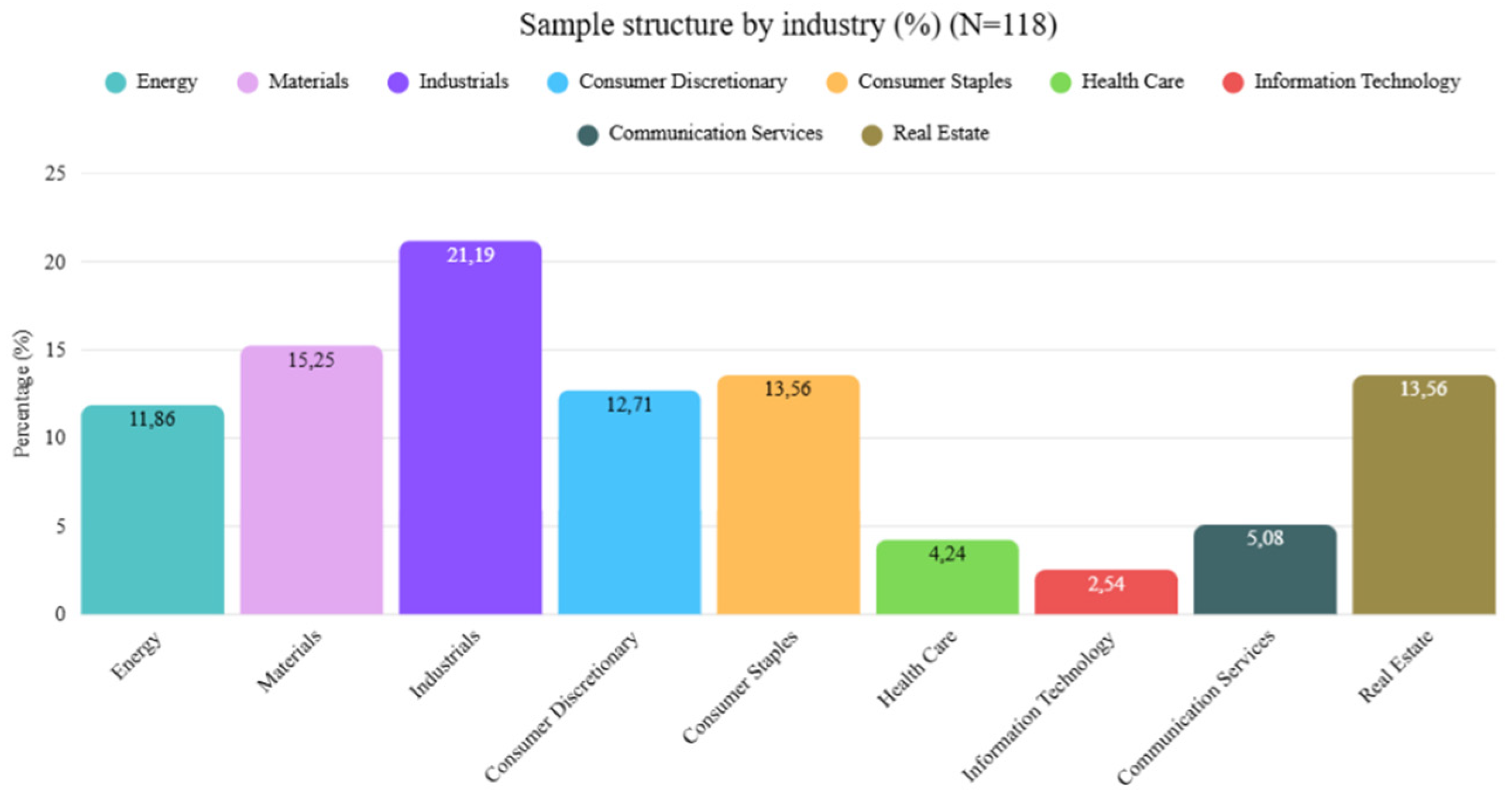
At the same time, the inclusion of Consumer Staples, Consumer Discretionary, Information Technology, and Health Care broadens the scope of the analysis to firms characterized by high levels of intangible assets, strong dependence on brand reputation, and significant pressure from stakeholders. This diversity creates considerable internal variation in emission intensity and environmental risk, asset structure and the ability to recognize accounting profits, dependence on capital markets and investors, and pressure from customers and the public.
The industrial composition of the sample broadly reflects the sectoral distribution of the Vietnamese stock market while ensuring the presence of industries with differing levels of environmental risk, asset structure, and business cycle characteristics. Because the relationship between ESG and tax avoidance is substantially influenced by industry characteristics, a sample spanning multiple sectors helps reduce bias arising from concentration in a homogeneous segment and enhances the generalizability of the findings within the context of listed non-financial firms in Vietnam.
Ownership structure of the sample firms
In terms of ownership, the sample includes 42 state-owned enterprises (SOEs) and 76 private firms, accounting for 35.6% and 64.4% of the total sample, respectively. This structure reflects the growing role of the private sector in Vietnam’s stock market, while also indicating that state-capital firms continue to play an important role in many key industries.
The coexistence of these two ownership groups in the sample allows the study to examine differences in ESG transparency incentives and tax strategies under varying degrees of monitoring and organizational objectives. In a context where the ESG regulatory framework in Vietnam is not yet fully mandatory, ownership structure may serve as an important moderating factor. Therefore, the presence of a sufficiently large proportion of both ownership groups enhances the explanatory value and contextual relevance of the research model.
Figure 4.
Distribution of firms in the research sample by ownership type (source: authors’ calculations based on collected data).
Figure 4.
Distribution of firms in the research sample by ownership type (source: authors’ calculations based on collected data).
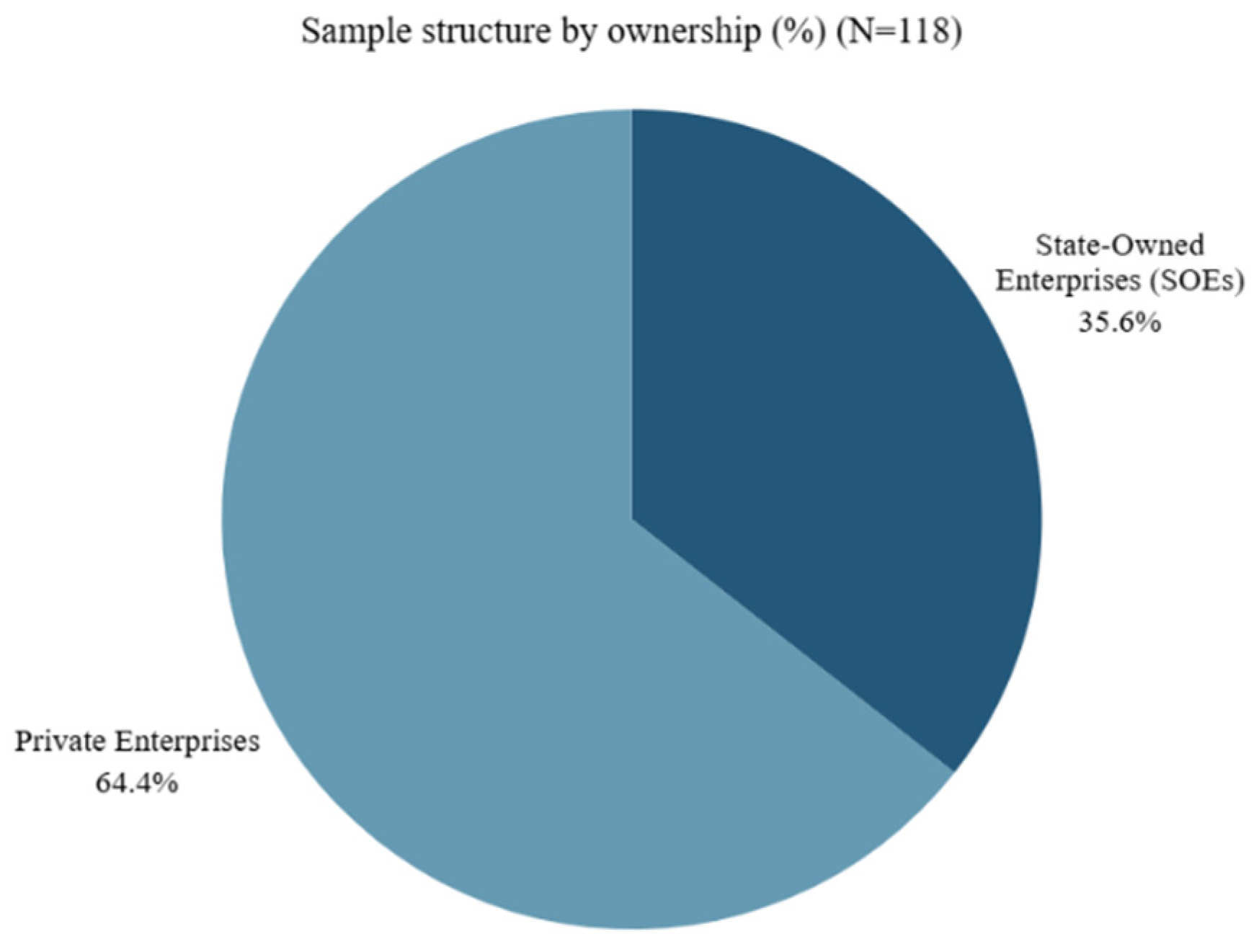
Taken together, the research sample simultaneously satisfies the criteria of size, diversity, and representativeness within the scope of listed non-financial firms in Vietnam. It is sufficiently large to ensure statistical power, sufficiently heterogeneous to generate the variation required for empirical testing, and sufficiently context-appropriate to reflect the characteristics of an emerging market in which ESG development remains in transition. From both methodological and practical perspectives, the sample can therefore be considered suitable and reliable for examining the relationship between ESG disclosure and tax avoidance in Vietnam.
5.2. Descriptive Statistics
The descriptive statistics table presents the mean, standard deviation, minimum value, and maximum value of the variables in the research model, including the dependent variable ETR, the independent variable ESG, the moderating variable FC representing the level of financial constraints, and the control variables.
Table 2.
Descriptive statistics of the sample.
| Variable | Obs | Mean | Std. Deviation | Min | Max |
|---|---|---|---|---|---|
| ETR | 590 | 0.199 | 0.135 | 0 | 1 |
| ESG | 590 | 0.463 | 0.170 | 0.049 | 0.887 |
| E | 590 | 0.407 | 0.238 | 0 | 0.900 |
| S | 590 | 0.495 | 0.229 | 0.083 | 0.917 |
| G | 590 | 0.489 | 0.181 | 0.063 | 0.938 |
| FC | 590 | 3.752 | 3.532 | 0.339 | 18.774 |
| ROA | 590 | 0.076 | 0.078 | -0.038 | 0.393 |
| LEV | 590 | 0.474 | 0.196 | 0.085 | 0.845 |
| SIZE | 590 | 15.429 | 1.829 | 11.489 | 19.862 |
| CAPEXP | 590 | 0.033 | 0.046 | 0 | 0.221 |
| PB | 590 | 1.887 | 1.215 | 0.311 | 6.351 |
(Source: compiled from data processing by the authors).
Comments on Mean and Std. Deviation values
The dependent variable ETR has a mean value of 0.199. This average ETR is slightly below the statutory corporate income tax rate in Vietnam (20%), suggesting a tendency among sample firms to optimize their tax obligations, potentially through tax incentives or other legitimate tax-planning activities. This mean value indicates a moderate level of tax behavior rather than an extreme degree of tax aggressiveness.
For the independent variable ESG, the mean value of 0.463 reflects a moderate level of ESG disclosure and implementation among the sampled firms. When decomposed into its individual pillars, the social dimension (0.495) and governance dimension (0.489) receive greater attention from firms than the environmental dimension (0.407). This structure is consistent with the Vietnamese market context, where corporate governance requirements and social responsibility have increasingly been emphasized, whereas environmental standards have not yet been subject to as stringent compliance pressures as in more developed economies.
For the moderating variable, FC has a mean value of 3.752, which falls within the safe zone according to Altman’s benchmark. Compared with more recent studies, such as Altman et al. [67], firms operating normally generally have a Z-score above 3, while firms in emerging markets often show average values ranging from 2.5 to 3.5 [68]. Relative to these benchmarks, the mean FC value of 3.752 in the present sample can be considered relatively high, indicating a fairly stable financial condition and the absence of extreme distress.
Regarding the control variables:
- ROA averages 7.6%, indicating a relatively acceptable level of profitability.
- LEV averages 0.474, meaning that approximately 47.4% of total assets are financed by debt. This may affect ETR through the tax shield associated with interest expenses.
- SIZE has a mean value of 15.429, suggesting that the sample mainly consists of medium-sized and large firms.
- CAPEXP averages 3.3%, indicating that annual investment in fixed assets is not particularly high and that most firms are not in a phase of aggressive expansion.
- PB averages 1.887, indicating that market value generally exceeds book value, which implies positive investor expectations regarding firms’ growth prospects.
Comments on dispersion
The standard deviation of ETR is 0.135, with values ranging from 0 to 1. Although the range is relatively wide, the standard deviation is not excessively large relative to the mean, indicating that most observations are concentrated around a tax rate close to 20%.
The variable ESG has a standard deviation of 0.170, ranging from 0.049 to 0.887, which indicates considerable variation in ESG practices across firms. Among the three pillars, E exhibits the highest standard deviation (0.238) and ranges from 0 to 0.900, reflecting substantial heterogeneity in environmental disclosure across firms. S (0.229) and G (0.181) show slightly lower but still relatively broad levels of variation.
The variable FC has a standard deviation of 3.532, nearly equivalent to its mean value of 3.752, with a minimum of 0.339 and a maximum of 18.774. This wide range indicates substantial dispersion within the sample and reflects considerable differences in firms’ financial conditions. From a methodological perspective, in models including interaction terms (ESG×FC), sufficient dispersion in FC enhances the likelihood of detecting a moderating effect, since the coefficient on the interaction term can only become statistically significant if the moderator varies meaningfully across observations. However, whether FC actually serves as a moderator must ultimately be determined by the sign and statistical significance of the interaction coefficient in the regression results.
The control variables also display considerable heterogeneity. ROA ranges from –3.8% to 39.3%, indicating the presence of both loss-making firms and highly profitable firms. LEV varies from 8.5% to 84.5%, showing substantial differences in the use of debt financing. PB ranges from 0.311 to 6.351, indicating marked variation in market valuation. SIZE also spans a broad interval, from 11.489 to 19.862, reflecting significant variation in firm size within the sample.
5.3. Correlation Matrix Analysis
Table 3 presents the correlation matrix of the variables included in the research model, including the dependent variable ETR; the independent variable ESG and its three pillars E, S, G; the moderating variables SOE and FC; and the control variables AUDIT, LEV, PB, CAPEXP, SIZE, and ROA. The correlation analysis is conducted for two purposes:
- to provide a preliminary test for multicollinearity among the explanatory variables prior to regression analysis, and
- to offer an initial assessment of the expected direction of the hypotheses through pairwise correlations.
Table 3.
Correlation matrix.
| Variable | ETR | ESG | E | S | G | SOE | FC | Audit | LEV | PB | CapExp | Size | ROA |
|---|---|---|---|---|---|---|---|---|---|---|---|---|---|
| ETR | 1 | ||||||||||||
| ESG | 0.192*** | 1 | |||||||||||
| E | 0.122*** | 0.801*** | 1 | ||||||||||
| S | 0.151*** | 0.810*** | 0.512*** | 1 | |||||||||
| G | 0.161*** | 0.747*** | 0.358*** | 0.437*** | 1 | ||||||||
| SOE | -0.092** | -0.209*** | -0.165*** | -0.187*** | -0.130*** | 1 | |||||||
| FC | -0.103** | -0.056 | -0.015 | -0.048 | -0.059 | 0.119*** | 1 | ||||||
| Audit | 0.120*** | 0.171*** | 0.089** | 0.184*** | 0.142*** | 0.022 | -0.071* | 1 | |||||
| LEV | 0.221*** | 0.097** | 0.091** | 0.079* | 0.039 | -0.112*** | -0.551*** | 0.128*** | 1 | ||||
| PB | 0.076* | 0.110*** | 0.101** | 0.091** | 0.067 | -0.153*** | 0.343*** | 0.136*** | -0.055 | 1 | |||
| CapExp | 0.018 | 0.059 | 0.024 | 0.074* | 0.050 | -0.043 | -0.060 | 0.040 | 0.019 | -0.068* | 1 | ||
| Size | 0.128*** | 0.269*** | 0.197*** | 0.246*** | 0.194*** | -0.027 | -0.312*** | 0.520*** | 0.390*** | 0.088** | 0.058 | 1 | |
| ROA | -0.203*** | -0.024 | 0.011 | -0.022 | -0.035 | 0.039 | 0.546*** | -0.058 | -0.525*** | 0.327*** | 0.054 | -0.299*** | 1 |
Notes: *, **, *** indicate statistical significance at the 10%, 5%, and 1% levels, respectively. (Source: compiled from data processing by the authors).
The results in Table 4 show that most correlation coefficients among the independent variables, the two moderating variables, and the control variables are low to moderate in absolute value, generally not exceeding 0.6. According to commonly cited econometric guidelines, if the absolute correlation coefficient between explanatory variables is below 0.8, multicollinearity is unlikely to be a serious concern [69]. Since the observed correlation levels remain below this warning threshold, the results suggest that severe multicollinearity is unlikely, thereby providing a basis for proceeding with multivariate regression analysis.
However, variables directly associated with ESG measurement may exhibit relatively high correlations due to the structural nature of the construct. Specifically, ESG is fairly highly correlated with E (0.801) and S (0.810). This can be explained by the fact that ESG is a composite index, of which E and S are major components. Therefore, a high correlation between the aggregate index and its constituent dimensions is an expected phenomenon. In the empirical analysis, given the detection of these high correlations, the models for each ESG pillar were estimated separately to avoid multicollinearity problems.
In addition, because SOE and FC act as moderating variables, the subsequent regression models include interaction terms between ESG and SOE as well as between ESG and FC. By nature, interaction terms may increase the correlation among explanatory variables in the model [70]. Nevertheless, based on the current correlation matrix, no evidence suggests that the moderating variables SOE and FC are extremely highly correlated with the other explanatory variables.
Beyond diagnosing multicollinearity, the correlation matrix also provides preliminary evidence regarding the direction of the relationship between ESG and tax avoidance behavior. The results show that ESG is positively correlated with ETR, with a coefficient of 0.192, statistically significant at the 1% level. The positive sign indicates that firms with higher ESG scores tend to exhibit higher ETRs. Since a higher ETR reflects lower tax avoidance, this result provides initial support for the expectation that ESG may help constrain tax avoidance among non-financial firms.
At the level of individual pillars, E, S, and G are all positively correlated with ETR, with coefficients of 0.122, 0.151, and 0.161, respectively, all statistically significant. This suggests that the positive association with ETR is not limited to the aggregate ESG score but is also relatively consistent across the environmental, social, and governance dimensions.
Regarding the moderating variables, SOE is negatively correlated with ETR (-0.092) and statistically significant, while FC is also negatively correlated with ETR (-0.103) and statistically significant. These results suggest that state-owned firms and firms experiencing greater financial constraints may exhibit lower ETRs in pairwise correlations.
However, because SOE and FC serve as moderators, the primary concern of this study is not merely their direct correlations with ETR, but whether SOE and FC alter the strength of the relationship between ESG and ETR. Finally, it should be emphasized that correlation analysis only reflects bivariate linear relationships and does not control for the simultaneous effects of other variables; therefore, it is insufficient for drawing causal inferences.
5.4. Model Selection Tests for Panel Regression
To ensure the robustness and efficiency of the panel-data regression estimates, the study conducts a model selection procedure among Pooled OLS, Random Effects Model (REM), and Fixed Effects Model (FEM). This process consists of three standard tests: the F-test, the Breusch-Pagan LM test, and the Hausman test.
First, the F-test is used to compare the suitability of FEM and Pooled OLS. The results indicate that for all model specifications from M(1) to M(6), the p-values are 0.000, which are below the 1% significance level. This provides strong statistical evidence to reject the null hypothesis, confirming the presence of firm-specific fixed effects and indicating that FEM is more appropriate than Pooled OLS.
Next, the Breusch-Pagan LM test is conducted to compare REM and Pooled OLS. Based on the empirical results, the p-values for this test across all six models are also 0.000 (< 0.05). This implies that REM is more suitable than Pooled OLS. Thus, both FEM and REM outperform the Pooled OLS specification, necessitating a final deciding test.
The Hausman test is then used to choose between FEM and REM, with the null hypothesis stating that REM is the more appropriate model. The results are consistent across all models, with p-values of 0.287 (M1), 0.203 (MODEL 2), 0.720 (3), 0.565 (M4), 0.470 (M5), and 0.373 (M6). Since all of these p-values exceed the 5% significance level, the null hypothesis cannot be rejected. This indicates that REM is the optimal model for the research dataset.
However, due to the nature of panel data in corporate finance, problems such as heteroskedasticity and autocorrelation often arise. Therefore, the study proceeds to conduct further diagnostic tests for model defects in the next analytical step to ensure the robustness and reliability of the estimated coefficients.
5.5. Diagnostic Tests for Model Defects and Remedies
5.5.1. Multicollinearity Test
To ensure the reliability of the estimated coefficients and avoid inflated variances of regression coefficients that could distort statistical hypothesis testing, the study examines multicollinearity using the Variance Inflation Factor (VIF). Since VIF only reflects the linear relationship among explanatory variables, this test is performed on the set of independent variables regardless of the final estimation method. According to the common rule of thumb, if the VIF values are below 10, the model is considered free from serious multicollinearity.
Table 5.
Summary of VIF of variables.
| Variable | M(1) | M(2) | M(3) | M(4) | M(5) | M(6) |
|---|---|---|---|---|---|---|
| ESG | 1.09 | 2.39 | 1.70 | |||
| E | 1.05 | |||||
| S | 1.08 | |||||
| G | 1.05 | |||||
| FC | 9.62 | |||||
| SOE | 8.13 | |||||
| ESGxFC | 9.74 | |||||
| ESGxSOE | 7.81 | |||||
| ROA | 1.65 | 1.66 | 1.65 | 1.65 | 1.77 | 1.66 |
| LEV | 1.53 | 1.53 | 1.52 | 1.53 | 1.77 | 1.54 |
| SIZE | 1.73 | 1.71 | 1.71 | 1.70 | 1.77 | 1.74 |
| AUDIT | 1.40 | 1.40 | 1.40 | 1.40 | 1.40 | 1.40 |
| CAPEXP | 1.03 | 1.02 | 1.03 | 1.03 | 1.03 | 1.03 |
| PB | 1.21 | 1.21 | 1.21 | 1.20 | 1.34 | 1.24 |
| VIF mean | 1.38 | 1.37 | 1.37 | 1.37 | 3.43 | 2.92 |
Notes: *, **, *** indicate statistical significance at the 10%, 5%, and 1% levels, respectively. (Source: compiled from data processing by the authors).
The detailed statistics show a high degree of stability among the variables in the model. Specifically, for the baseline models from M(1) to M(4), the VIF values of the independent and control variables are all very low, ranging mainly from 1.02 to 1.73. For example, the ESG variable has a VIF of only 1.09, while control variables such as ROA, LEV, and SIZE all have VIF values below 2. The average VIF values for these models are also very low, namely 1.38 (M1) and 1.37 (M2, M3, M4). This indicates that the explanatory variables in the baseline models are almost linearly independent of one another.
For models M(5) and M(6), the inclusion of interaction terms-ESG×FC and ESG×SOE - leads to a noticeable increase in local VIF values. Specifically, in M(5), FC and ESG×FC have VIF values of 9.62 and 9.74, respectively; in M(6), SOE and ESG×SOE have VIF values of 8.13 and 7.81, respectively. This is a frm of structural multicollinearity arising from the construction of interaction terms from component variables. Such multicollinearity does not bias the regression coefficient of the interaction term itself (Allison, 2012), and therefore the interaction variables do not need to be removed. Nevertheless, to mitigate this issue, the continuous variables were mean-centered before constructing the interaction terms in order to improve the robustness of subsequent hypothesis tests.
5.5.2. Tests for Autocorrelation and Heteroskedasticity
Following the model selection procedure, the study conducts further diagnostic tests on key assumptions of the panel-data regression model, specifically heteroskedasticity and autocorrelation.
Table 6.
Summary of model diagnostic test results.
| Statistical Test | M(1) | M(2) | M(3) | M(4) | M(5) | M(6) |
|---|---|---|---|---|---|---|
| Breusch-Pagan | ||||||
| P-value | 0.000*** | 0.000*** | 0.000*** | 0.000*** | 0.000*** | 0.000*** |
| Woodridge | ||||||
| P-value | 0.3174 | 0.4526 | 0.3082 | 0.4001 | 0.2077 | 0.4292 |
Notes: *, **, *** indicate statistical significance at the 10%, 5%, and 1% levels, respectively. (Source: compiled from data processing by the authors).
First, to test for heteroskedasticity, the study uses the Breusch–Pagan test. The results show that for all models from M(1) to M(6), the p-values are 0.000, which are below the 1% significance level. This provides sufficient statistical evidence to reject the null hypothesis of homoskedasticity. In other words, heteroskedasticity is present in the research models, which is a common issue in corporate financial panel data where firms vary substantially in size and characteristics.
Next, to test the assumption of error independence over time, the study employs the Wooldridge test for autocorrelation. In contrast to the heteroskedasticity results, the autocorrelation test yields more favorable findings. Specifically, the p-values of the Wooldridge test are all relatively high and greater than 0.05, namely 0.3174 (M1), 0.4526 (M2), 0.3082 (M3), 0.4001 (M4), 0.2077 (M5), and 0.4292 (M6). With these p-values, the null hypothesis cannot be rejected. Accordingly, there is no statistical evidence of first-order autocorrelation in the dataset, reducing concerns regarding inefficiency in the estimates.
Taken together, the diagnostic results indicate that although the models are not affected by serious multicollinearity or autocorrelation, they do violate the assumption of homoskedasticity. While heteroskedasticity does not bias the estimated coefficients, it renders the standard errors inefficient, which may cause the t-tests and F-tests to be unreliable. To address this issue and ensure the robustness of the regression results, the study applies cluster-robust standard errors at the firm level in the final regression models used in the subsequent discussion of results.
5.6. Empirical Results
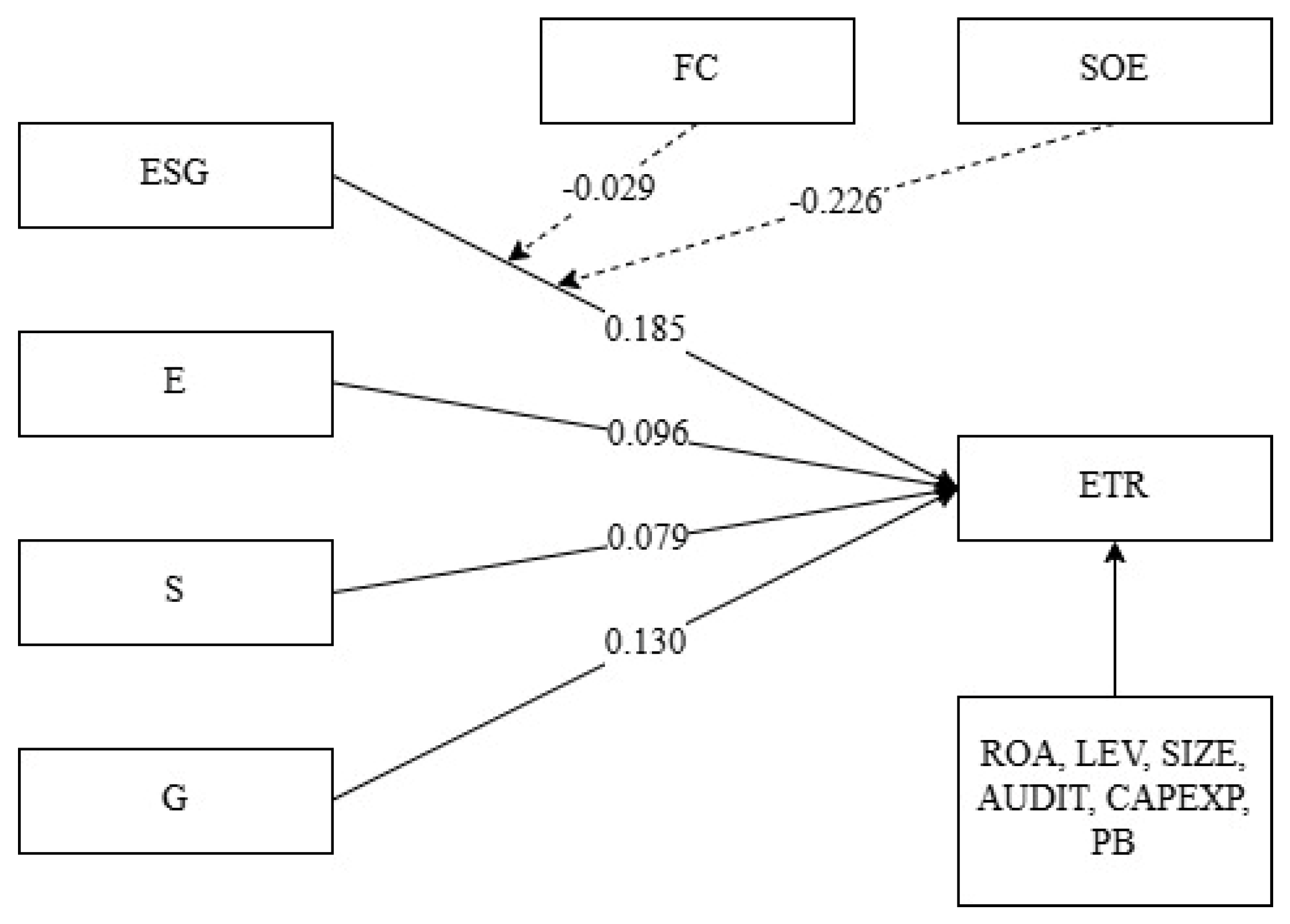
After correcting for heteroskedasticity, the research team tested the hypotheses using the REM model with robust standard errors. The regression coefficients are summarized in the following figure:
Figure 5.
Regression coefficient results of the model (source: developed by the authors).
5.6.1. Results for Independent Variables
The regression results show that ESG has a positive and statistically significant impact on ETR, with a coefficient of 0.185 at the 1% significance level (p<0.01). This result indicates that as firms improve their ESG performance, ETR tends to increase accordingly. Since a higher ETR reflects lower tax avoidance, this finding implies that firms with stronger ESG performance tend to engage less in tax avoidance. Thus, the empirical evidence supports Hypothesis H1, suggesting that ESG is negatively associated with corporate tax avoidance.
Table 7.
Results of testing the impact of ESG and the E, S, G pillars on ETR.
| Relationship | Coefficient | Std. Error |
|---|---|---|
| ESG -> ETR | 0.185*** | 0.061 |
| E -> ETR | 0.096*** | 0.035 |
| S -> ETR | 0.079** | 0.035 |
| G -> ETR | 0.130*** | 0.049 |
Notes: *, **, *** indicate statistical significance at the 10%, 5%, and 1% levels, respectively. (Source: compiled from data processing by the authors).
Regarding the Environmental (E) pillar, the empirical results indicate a positive and statistically significant impact on ETR, with a coefficient of 0.096 at the 1% significance level (p<0.01). This suggests a positive association between environmental responsibility and ETR, implying that firms with stronger environmental commitments tend to comply more transparently with tax obligations. This result supports Hypothesis H2, confirming that environmental performance is negatively related to tax avoidance.
For the Social (S) pillar, the regression coefficient is 0.079 and statistically significant at the 5% level (p<0.05). This confirms a positive association between corporate social activities and ETR. Firms that emphasize social responsibility, particularly community reputation and employee welfare, tend to perceive tax payment as a direct contribution to social development rather than a cost burden. This finding contradicts aggressive tax strategies aimed at protecting brand value and fully supports Hypothesis H3, which posits a negative relationship between the social pillar and tax avoidance.
For the Governance (G) pillar, the regression coefficient is 0.130 and statistically significant at the 1% level (p<0.01). The positive relationship between governance performance and ETR suggests that stronger corporate governance effectively restrains tax avoidance behavior. Mechanistically, a sound governance structure, where the board performs strong oversight and emphasizes transparency, acts as a filter preventing opportunistic financial decisions or high tax-risk strategies. Instead of exploiting legal loopholes for short-term gains, well-governed firms prioritize social capital and sustainable development, thereby adopting more voluntary tax compliance policies. Although some studies (e.g. Ha, Nguyen and Ho [25]) argue that strong governance may facilitate sophisticated tax planning to maximize shareholder value, this study provides empirical support for Hypothesis H4.
5.6.2. Results for Moderating Variables
Moderating Effect of FC
The results of the test on the moderating effect of financial constraints (FC) on the relationship between ESG and ETR are presented in the table above. The regression coefficient of the interaction term between ESG and FC is −0.029 and statistically significant at the 5% level (p<0.05). This indicates that financial constraints play a significant moderating role in the relationship between ESG and ETR. The negative sign of the interaction coefficient implies that as the level of financial constraints increases, the positive impact of ESG on ETR is weakened.
This result suggests that, in the context of limited financial resources, firms may prioritize short-term cash flow optimization rather than maintaining a high level of tax compliance [6,49], thereby reducing the positive role of ESG in limiting tax avoidance behavior. Conversely, in firms with lower levels of financial constraints, the effect of ESG in enhancing tax transparency and reducing tax avoidance becomes more evident.
Table 8.
Moderating effect of FC and SOE.
| Relationship | Coefficient | Std. Error |
|---|---|---|
| ESG x FC -> ETR | -0.029** | 0.013 |
| ESG x SOE -> ETR | -0.226* | 0.125 |
Notes: *, **, *** indicate statistical significance at the 10%, 5%, and 1% levels, respectively. (Source: compiled from data processing by the authors).
The above empirical results reaffirm Hypothesis H5 of the research. This implies that financial resources are a prerequisite for firms to translate social responsibility commitments into actual compliance behavior. When financial barriers are high, ESG efforts may become merely symbolic, while firms continue to maintain aggressive tax avoidance strategies in order to preserve liquidity.
Moderating Effect of SOE
To examine the role of ownership structure in shaping the relationship between ESG and ETR, the study introduces an interaction term between ESG and SOE into the regression model. The results show that the coefficient of the interaction term is -0.196 and statistically significant at the 10% level (p<0.1), indicating that the moderating effect of state ownership is statistically significant.
The negative sign of the interaction coefficient implies that in firms with higher levels of state ownership, the positive impact of ESG on ETR is weakened. In other words, although ESG encourages firms to be more transparent in tax matters, this effect becomes less pronounced in state-owned enterprises. This can be explained by the fact that SOEs are already subject to strict government oversight and maintain close connections with the state budget; therefore, the role of ESG as a transparency signal for reducing tax avoidance becomes less evident compared to private firms [53].
These findings provide empirical evidence supporting Hypothesis H6 of the research, suggesting that state ownership weakens the tax-avoidance, mitigating effect of ESG. The distinctive governance structure of SOEs, together with the pursuit of economic objectives alongside political and social goals, may lead these firms to prioritize different orientations, thereby altering the mechanism through which ESG influences corporate tax strategies.
5.6.3. Results for Control Variables
In addition to the main independent and moderating variables, the model also incorporates control variables to ensure robustness and accuracy. The empirical results show that the control variables generally exhibit significant effects and are consistent with prevailing financial theories.
Table 9.
Role of Control Variables.
| Variable | M(1) | M(2) | M(3) | M(4) | M(5) | M(6) |
|---|---|---|---|---|---|---|
| AUDIT | 0.030 | 0.034 | 0.028 | 0.032 | 0.032 | 0.029 |
| SIZE | -0.007 | -0.005 | -0.004 | -0.006 | -0.008 | -0.006 |
| PB | 0.010** | 0.010** | 0.011** | 0.010** | 0.008 | 0.010** |
| LEV | 0.076** | 0.073** | 0.073** | 0.083** | 0.097*** | 0.075** |
| CAPEXP | 0.013 | 0.020 | 0.022 | 0.028 | 0.023 | 0.006 |
| ROA | -0.336*** | -0.341*** | -0.343*** | -0.331*** | -0.325*** | -0.313*** |
Notes: *, **, *** indicate statistical significance at the 10%, 5%, and 1% levels, respectively. (Source: compiled from data processing by the authors).
The variable AUDIT shows regression coefficients ranging from 0.028 to 0.032 but does not reach statistical significance across the regression models. This indicates that the relationship between audit quality and ETR is not empirically confirmed in the research context. In other words, there is insufficient evidence to conclude that being audited by a high-quality audit firm significantly affects the level of tax compliance. Vera Puji Lestari, in a study on the relationship between audit quality and tax avoidance, argues that tax avoidance may have become a common financial management strategy among firms; therefore, differences in audit quality do not create substantial variation in the extent to which this behavior is implemented.
The variable ROA shows a strong negative impact on ETR, with regression coefficients ranging from -0.343 to -0.313 and statistical significance at the 1% level (p<0.01) in most models. This suggests that more profitable firms tend to maintain lower ETRs. In other words, firms with higher profitability are more likely to implement tax optimization strategies [71]. This result can be explained by the fact that highly profitable firms face larger tax obligations, thereby increasing their incentives to seek legitimate measures to reduce tax burdens.
The variable LEV has a positive and consistent impact on ETR across all regression models. Its coefficients range from 0.073 to 0.097 and are statistically significant at the 1% and 5% levels depending on the model. This indicates that firms with higher financial leverage tend to maintain higher effective tax rates. This finding can be explained by the fact that highly leveraged firms are subject to stricter monitoring from creditors, which constrains risky tax behavior and increases tax compliance. This evidence highlights the role of capital structure as an important factor influencing corporate tax strategies.
The variable PB shows a positive and highly stable impact on ETR across the models. The regression coefficients range from 0.008 to 0.011 and are statistically significant at the 5% level. This positive relationship implies that firms with higher market-to-book ratios tend to maintain better tax compliance [72]. This may be explained by the fact that high-growth firms often prioritize building a transparent and reputable image to attract investors, thereby limiting tax avoidance practices that could create reputational risk.
The variable SIZE has a negative but statistically insignificant impact on ETR. This result can be explained by the existence of two opposing size effects. According to political cost theory, while large firms face greater scrutiny and therefore tend to limit tax avoidance, they also possess the resources and expertise to implement more effective tax optimization strategies [73,74,75]. This suggests the presence of a nonlinear relationship between firm size and ETR, meaning that the effect of size changes once firms surpass a certain scale threshold.
The variable CAPEXP has a positive but statistically insignificant impact on ETR. Theoretically, capital expenditure increases fixed assets and creates tax shields through depreciation, which could reduce ETR. However, capital expenditure is also associated with business expansion and higher pre-tax income, leading to higher tax payments. Another study by Liu and Cao [76], conducted in the context of Chinese listed firms, similarly finds no statistically significant relationship between these two variables.
5.7. Machine Learning for Predicting Corporate Tax Avoidance
5.7.1. Model Evaluation and Selection
Based on the evaluation results using quantitative metrics and visual analysis, the study selects the optimal algorithm for each model group. For the model without ESG variables, XGBoost is identified as the best-performing algorithm with the highest coefficient of determination (R² = 0.3814) while maintaining relatively low error levels compared to the remaining algorithms. Extra Trees ranks second with comparable performance, whereas CatBoost achieves only moderate performance (R² = 0.3459). Random Forest and LightGBM produce significantly weaker results, reflecting limitations in capturing data structure when ESG information is absent.
In contrast, for the model incorporating ESG variables, CatBoost is identified as the optimal algorithm, achieving the highest R² (0.5292) while also recording the lowest error metrics (MSE, RMSE, and MAE) among all models. XGBoost continues to demonstrate the second-best performance, whereas Random Forest remains the least effective algorithm on the research dataset.
These findings indicate a substantial shift in algorithm rankings when the data space is expanded. Specifically, CatBoost is not the optimal choice when ESG variables are excluded but becomes the superior model once non-financial information is incorporated. This suggests that algorithm performance depends not only on the method itself but is also strongly influenced by the structure and completeness of the input data.
Table 10.
Results of prediction models using machine learning algorithms.
| Prediction model | Algorithm | R² | MSE | RMSE | MAE |
|---|---|---|---|---|---|
| Model without ESG variables | XGBoost | 0.3814 | 0.0061 | 0.0778 | 0.0601 |
| Extra Trees | 0.3745 | 0.0061 | 0.0783 | 0.0576 | |
| CatBoost | 0.3459 | 0.0064 | 0.08 | 0.0606 | |
| Random Forest | 0.2004 | 0.0078 | 0.0885 | 0.0629 | |
| LightGBM | 0.1837 | 0.008 | 0.0894 | 0.0631 | |
| Model with ESG variables | CatBoost | 0.5292 | 0.0046 | 0.0679 | 0.0502 |
| XGBoost | 0.5014 | 0.0049 | 0.0699 | 0.0528 | |
| LightGBM | 0.4615 | 0.0053 | 0.0726 | 0.0552 | |
| Extra Trees | 0.3897 | 0.006 | 0.0773 | 0.0563 | |
| Random Forest | 0.3012 | 0.0068 | 0.0827 | 0.0623 |
(source: compiled by the research team using Python).
Although some prior studies report different conclusions, mainly due to variations in context and data characteristics, most agree on the superiority of machine learning approaches over traditional methods. For example, Yang [77] in China and Rahman et al. [78] in Malaysia find that Random Forest is the most effective classification model, achieving accuracy rates between 80% and 93%, outperforming Support Vector Machines (SVM) and Logistic Regression.
In this study, the integration of continuous financial variables (ROA, LEV, FC) with variables reflecting the level of non-financial disclosure (E, S, G) creates a multidimensional dataset characterized by nonlinearity and complex interactions. In this context, modern boosting algorithms, particularly CatBoost, demonstrate superior capability inexploiting data structure and handling complex relationships while effectively controlling overfitting compared with traditional tree-based models such as Random Forest.
Comparing the two groups indicates that excluding ESG variables leads to lower R² values and higher error metrics (MSE, RMSE, MAE) across all algorithms. This demonstrates that the level of ESG disclosure contains valuable additional information that enhances the model’s explanatory and predictive power regarding corporate tax avoidance behavior.
Specifically, ESG encompasses non-financial factors related to environmental responsibility, social responsibility, and corporate governance. These factors are closely associated with transparency, business ethics, and governance quality, core drivers that directly influence tax avoidance decisions. Therefore, when incorporated into the model, ESG helps better capture corporate incentives and behavior, thereby reducing prediction errors. Moreover, the simultaneous improvement in both R² and error metrics indicates that ESG not only enhances explanatory power but also increases predictive accuracy. This is particularly important in the context of tax avoidance, which is complex and difficult to observe directly, where traditional financial variables alone may not fully capture the nature of the phenomenon.
In summary, the study confirms that integrating ESG variables not only improves predictive accuracy but also enables the model to identify corporate tax avoidance behavior more comprehensively and reliably, further reinforcing the practical value of ESG disclosure in detecting tax avoidance.
5.7.2. Assessment of Variable Contributions in the Model
Results from the ESG-integrated prediction model using the CatBoost algorithm reveal clear differences in the contribution of variables in forecasting corporate tax avoidance behavior. Specifically, ROA is the most important variable, accounting for 35.50% of the model’s total contribution. This proportion is more than three times higher than the second-ranked variable, the overall ESG score (10.35%), and nearly four times higher than LEV (9.60%). This substantial gap indicates that profitability plays a dominant role in the predictive structure of ETR.
Notably, the overall ESG score contributes 10.35%, exceeding several traditional financial variables such as CAPEXP (5.01%), PB (4.76%), and AUDIT (4.89%). This finding suggests that ESG is not only ethically and socially relevant but also a variable with considerable empirical predictive value in machine learning models. Although not as dominant as ROA, ESG remains the second most important variable in the entire research model.
When examining individual ESG components, the Social (S) pillar contributes 8.14%, significantly higher than Governance (G) at 3.94% and Environmental (E) at 3.13%. Thus, the social dimension contributes roughly twice as much as G and nearly 2.6 times as much as E. This finding differs from many studies in developed markets, where Governance typically plays a central role in controlling tax behavior. In the Vietnamese context, this result may reflect the prominent role of social pressure, labor relations, and corporate reputation in shaping tax compliance behavior.
Figure 6.
Variable importance in the prediction model (source: developed by the authors).
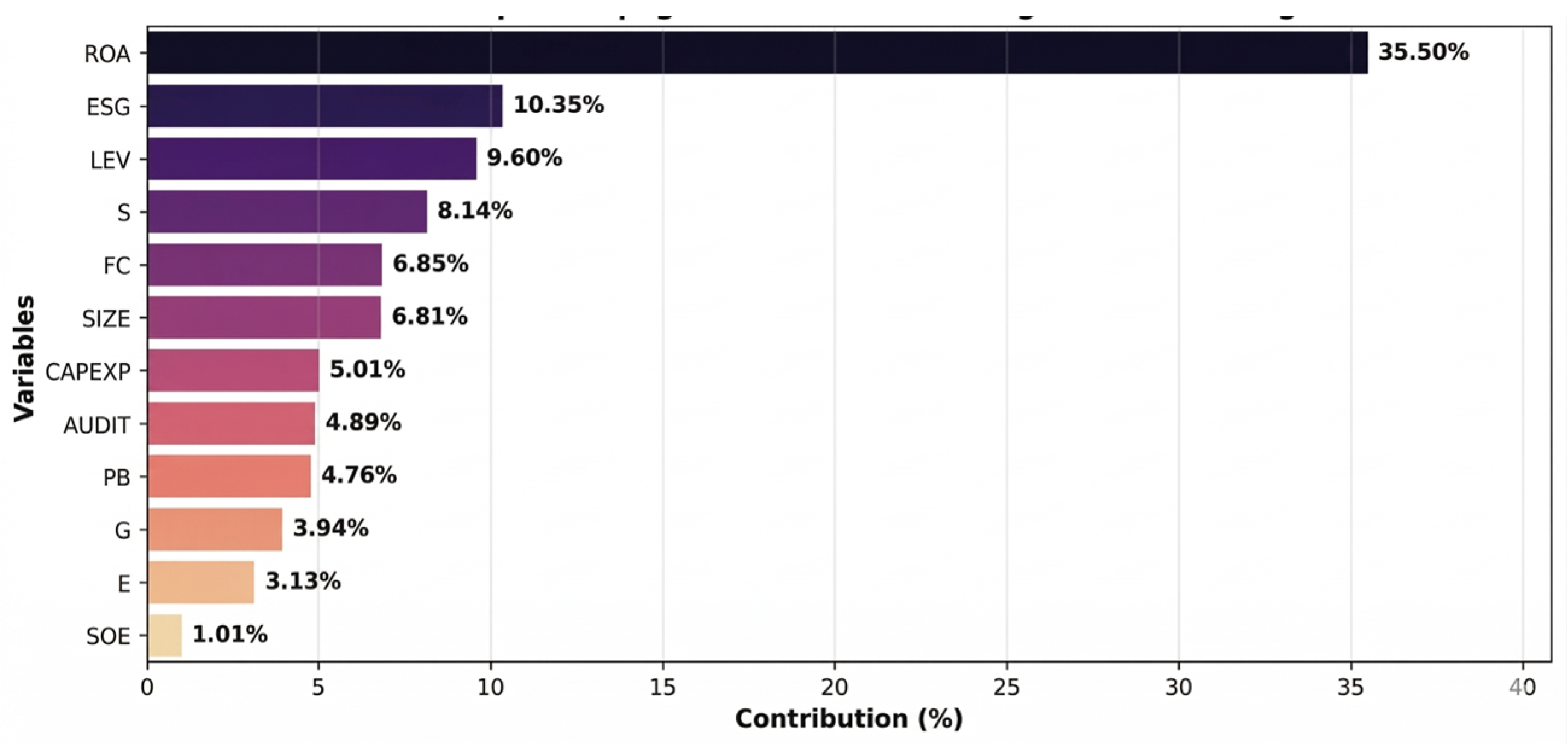
In addition, control variables such as financial constraints (6.85%) and firm size (6.81%) show relatively similar contributions, indicating that financial conditions and operational scale remain important supporting factors in the prediction model. Meanwhile, state ownership (SOE) accounts for only 1.01%, representing the lowest contribution. This suggests that, within the machine learning framework, ownership structure is not a decisive factor in predicting tax avoidance compared with profitability and ESG practices.
Overall, the fact that the overall ESG variable ranks second with a contribution exceeding 10% is a notable finding, confirming that this non-financial factor carries substantial predictive information in the context of an emerging market such as Vietnam.
6. Research Discussions
This study empirically tested the hypotheses concerning the relationship between ESG performance and tax avoidance behavior among listed firms in Vietnam. The findings provide important insights into the mechanism through which ESG affects tax behavior, as well as the moderating roles of financial constraints and state ownership in shaping the likelihood of tax avoidance in the context of a transition economy. The main results are summarized as follows:
Table 11.
Summary of hypotheses testing results.
| Hypothesis | Tested Relationship | Observed Sign | Conclusion |
|---|---|---|---|
| H1: ESG disclosure negatively affects tax avoidance behavior of non-financial firms | ESG → ETR | (+) | Supported |
| H2: The Environmental (E) component negatively affects tax avoidance behavior of non-financial firms | E → ETR | (+) | Supported |
| H3: The Social (S) component negatively affects tax avoidance behavior of non-financial firms | S → ETR | (+) | Supported |
| H4: The Governance (G) component negatively affects tax avoidance behavior of non-financial firms | G → ETR | (+) | Supported |
| H5: Financial constraints weaken the negative relationship between ESG and tax avoidance | ESG × FC → ETR | (−) | Supported |
| H6: State ownership weakens the negative relationship between ESG and tax avoidance in non-financial firms | ESG × SOE → ETR | (−) | Supported |
| H7: ESG disclosure, combined with financial data and firm characteristics, improves the predictive accuracy and effectiveness of the model | Supported |
(Source: compiled by the authors).
First, overall ESG performance exhibits a negative association with tax avoidance behavior. The findings indicate that when the aggregate ESG score is considered, the relationship between ESG and tax avoidance becomes more evident than when each of the E, S, and G components is examined separately. This suggests that the effect of ESG arises not only from each individual dimension but also from the interaction and complementarity among the three pillars: Environmental (E), Social (S), and Governance (G). Firms with high overall ESG scores are more likely to pursue long-term development strategies, emphasize information transparency, and maintain credibility with stakeholders, thereby reducing incentives to engage in tax avoidance, as such behavior may damage corporate reputation and undermine long-term sustainable value. In contrast, firms with low levels of ESG implementation may be more inclined to minimize taxes aggressively in pursuit of short-term gains. This finding, in the Vietnamese context, is consistent with those of Yoon, Lee and Cho [16] and Jiang, Hu and Jiang [7], reinforcing the view that ESG functions as a mechanism of risk control and social responsibility that discourages firms from minimizing tax obligations opportunistically. Therefore, Hypothesis H1 is supported.
Second, the results indicate that the Environmental pillar (E) is negatively associated with tax avoidance. Firms that demonstrate stronger environmental responsibility tend to disclose information more transparently and comply more fully with tax obligations. Ha, Nguyen and Ho [25], Voon Jan Sian et al. [79] and Pantazi [80] also support this view, emphasizing that firms’ commitments to environmental protection signal a lower propensity to engage in aggressive tax strategies. Therefore, Hypothesis H2 is supported.
Third, the findings show that the Social pillar (S) also reduces tax avoidance behavior. Firms that attach greater importance to social responsibility, employee welfare, and maintaining a positive public image are less likely to engage in tax avoidance, as doing so could harm their reputation and legitimacy. This result is consistent with legitimacy theory, according to which firms seek to maintain societal approval through compliance with legal and social norms, including tax law. The finding is in line with previous studies such as Ha, Nguyen and Ho [25], Voon Jan Sian, Lee Yong Ming, Nik Abdullah and Yi [79] and Pantazi [80]. Therefore, Hypothesis H3 is supported.
Fourth, the findings show that the Governance pillar (G) also has a negative effect on tax avoidance. This confirms that strengthening internal governance systems is a key foundation for improving tax transparency and reducing undesirable tax behavior [81,82]. Among the three ESG pillars, governance appears to play the most important role and most clearly reflects the control mechanism over tax avoidance behavior. Compared with the environmental and social dimensions, governance directly captures internal monitoring mechanisms, board structure, transparency, and internal controls, all of which have a direct influence on financial decision-making and tax strategy. Thus, when governance quality is enhanced, firms are less likely to implement tax avoidance strategies than when only environmental or social commitments are strengthened. This finding is consistent with agency theory, which posits that effective governance reduces conflicts of interest between managers and shareholders and constrains self-interested behavior, including risky tax strategies. In the present context, governance therefore emerges as the most important channel through which ESG improves tax compliance and reduces tax avoidance. This result is also supported by studies such as Voon Jan Sian, Lee Yong Ming, Nik Abdullah and Yi [79] and Pantazi [80]. Therefore, Hypothesis H4 is supported.
Fifth, when firms face financial constraints, the role of ESG in reducing tax avoidance becomes weaker. This implies that when resources are constrained, firms tend to prioritize short-term cash flow and liquidity objectives rather than maintaining tax compliance commitments associated with ESG, thereby diminishing the disciplining role of ESG over tax behavior. This result is consistent with risk-shifting theory, proposed by Bulow and Shoven [57]. Therefore, Hypothesis H5 is supported.
Sixth, state ownership weakens the relationship between ESG and tax avoidance behavior. For state-owned enterprises, the close supervision exercised by the government and their strong connection to public finance mean that tax transparency is less dependent on ESG signals. As a result, ESG no longer serves as a sufficiently strong supplementary disciplinary mechanism to alter tax behavior in this group of firms. This finding is consistent with risk-shifting theory as proposed by Bulow and Shoven [57]. Therefore, Hypothesis H6 is supported.
Seventh, the empirical results show that the integration of ESG information into the predictive model significantly improves the prediction of tax avoidance behavior. Specifically, the models incorporating ESG achieve higher R² values while simultaneously reducing forecasting error indicators such as MSE, RMSE, and MAE. These results confirm that ESG constitutes a valuable source of supplementary information that enhances the predictive capacity of the model when combined with financial data and firm characteristics, thereby improving both predictive accuracy and effectiveness. In other words, ESG expands the informational space of the model and supports a more comprehensive and reliable identification of tax avoidance behavior.
Therefore, Hypothesis H7, which states that ESG implementation combined with financial data and firm characteristics improves the predictive accuracy and effectiveness of the model, is accepted.
7. Recommendations
Recommendations for firms
In the context of growing demands for sustainable development, firms need to move from a symbolic ESG approach toward embedding ESG into their core governance strategy. First, firms should proactively adopt international standards such as the GRI or IFRS Sustainability Standards to standardize disclosure and enhance transparency. At the same time, ESG strategies should be designed in accordance with sectoral characteristics, firm size, and resource capacity, with an emphasis on substantive integration rather than symbolic compliance. In addition, firms should establish transparent ESG reporting systems and strengthen data digitalization through integrated management systems, such as ERP, in order to ensure accuracy and controllability. Redirecting from tax avoidance practices toward sustainable financial solutions, such as green finance, is also necessary to reduce legal risk and enhance corporate reputation. Finally, firms should invest in ESG-related human resource development and strengthen independent assurance for sustainability reports in order to reinforce the confidence of investors and other stakeholders.
Recommendations for investors
In a context where ESG practices in Vietnam still lack consistency and transparency, investors should shift from a passive approach to a more proactive and cautious mode of assessment. Specifically, investors should develop independent ESG evaluation criteria, prioritize quantitative indicators that are verifiable and comparable, and compare ESG commitments with actual tax behavior in order to identify risks of greenwashing or tax-washing. Furthermore, investors should exercise their role as active owners by engaging in monitoring and influencing corporate behavior, including maintaining strategic dialogue with management on ESG and tax responsibility issues, and using voting rights to promote higher standards of governance and transparency. Such an approach not only helps reduce investment risk but also contributes to improving the quality of the capital market and promoting sustainable development.
Recommendations for government and regulatory authorities
For ESG to become an effective instrument for controlling tax avoidance and enhancing financial transparency, the State needs to establish a coherent legal framework that shifts from merely encouraging ESG disclosure to making it mandatory, particularly with respect to quantitative indicators and sector-specific requirements. At the same time, an independent assurance mechanism for ESG reports should be introduced in order to limit greenwashing and ensure the reliability of disclosed information. In addition, regulatory authorities should promote the integration of ESG data into the tax administration system and combine tax incentives with ESG compliance conditions in order to encourage transparent corporate behavior. Strengthening monitoring, standardizing disclosure practices, and implementing a systematic roadmap for incorporating ESG into tax administration are also necessary. Moreover, attention should be given to capacity building and the application of advanced technologies, such as machine learning, in data analysis in order to detect risks at an early stage, thereby improving tax administration efficiency and promoting sustainable development.
8. Conclusions
This study provides robust evidence that environmental, social, and governance (ESG) disclosures significantly mitigate corporate tax avoidance among Vietnamese listed firms (2020-2024). Extending Stakeholder and Agency theories, we find that substantive ESG engagement acts as a critical internal governance mechanism that curtails agency conflicts, rather than a symbolic CSR proxy. However, this disciplining effect is substantially attenuated when firms face severe financial constraints or operate under state ownership, where immediate liquidity pressures and institutional mandates override sustainability commitments.
Methodologically, this research advances beyond traditional econometric limits by employing machine learning. Using the CatBoost algorithm, we demonstrate that integrating ESG metrics vastly improves the predictive accuracy of tax avoidance models. Emerging as the second most powerful predictor after profitability (ROA), ESG exhibits profound predictive power. This empirically verifies ESG as a credible signal of transparency and a superior tool for forecasting opaque tax behavior, rather than a facade for tax-washing.
These findings yield actionable implications. Policymakers and tax authorities should transition toward mandatory ESG reporting, leveraging these disclosures for tax audit risk assessments. Investors must utilize ESG scores as critical due diligence tools to identify greenwashing and evaluate underlying tax compliance risks. Meanwhile, corporate managers should embrace substantive ESG integration to mitigate the legal and reputational risks of aggressive tax strategies.
Despite its contributions, this study is limited to Vietnamese non-financial firms and relies on a self-constructed GRI-based index. Future research should pursue cross-country ASEAN comparisons, incorporate micro-governance mechanisms (e.g., board diversity), and evaluate the long-term impacts of impending mandatory ESG regulations on corporate tax behavior.
Author Contributions
Conceptualization, H.P.M. and H.T.N.; methodology H.P.M. and H.T.N.; software, H.P.M.; validation, A.T.N.; formal analysis, H.P.M. and A.T.N.; investigation, L.K.L., N.M.N and A.D.P.; data curation, H.M.P. and A.T.N; writing – original draft, A.T.N., L.K.L., N.M.N and A.D.P.; writing – review & editing, H.M.P and H.T.N; visualization, A.T.N. and A.D.P.; supervision, H.T.N.; project administration, H.M.P. All authors have read and agreed to the published version of the manuscript.
Funding
This research received no external funding.
Institutional Review Board Statement
Not applicable.
Informed Consent Statement
Not applicable.
Data Availability Statement
The datasets used and/or analyzed during the current study are available from the corresponding author on reasonable request.
Conflicts of Interest
The authors declare no conflict of interest.
References
- Armstrong, C.S.; Blouin, J.L.; Jagolinzer, A.D.; Larcker, D.F. Corporate governance, incentives, and tax avoidance. Journal of Accounting and Economics 2015, 60, 1–17. [Google Scholar] [CrossRef]
- Dyreng, S.; Hanlon, M.; Maydew, E.L. The Effects of Executives on Corporate Tax Avoidance. The Accounting Review 2010, 85, 1163–1189. [Google Scholar] [CrossRef]
- Deskins, J.; Fox, W.F. On the extent, growth, and efficiency consequences of state business tax planning. Taxing corporate income in the 21st century 2007, 226, 253–254. [Google Scholar] [CrossRef]
- Hanlon, M.; Heitzman, S. A review of tax research. Journal of Accounting and Economics 2010, 50, 127–178. [Google Scholar] [CrossRef]
- Chen, S.; Chen, X.; Cheng, Q.; Shevlin, T. Are family firms more tax aggressive than non-family firms? Journal of Financial Economics 2010, 95, 41–61. [Google Scholar] [CrossRef]
- Benkraiem, R.; Gaaya, S.; Lakhal, F.; Kilic, M. Access to finance and corporate tax avoidance: International evidence. Journal of International Accounting, Auditing and Taxation 2025, 58, 100668. [Google Scholar] [CrossRef]
- Jiang, H.; Hu, W.; Jiang, P. Does ESG performance affect corporate tax avoidance? Evidence from China. Finance Research Letters 2024, 61, 105056. [Google Scholar] [CrossRef]
- Syahputri, A. The Impact of ESG Performance and Financial Constraint on Tax Avoidance: Evidence From ASEAN 5. Jurnal Dinamika Akuntansi 2025, 17, 102–117. [Google Scholar] [CrossRef]
- Firmansyah, A.; Pratama, H.P.; Valensa, M.F. ESG risk and tax avoidance: Signaling insights from Indonesian public firms. Educoretax 2025, 5, 370–380. [Google Scholar] [CrossRef]
- Montenegro, T.M. Tax Evasion, Corporate Social Responsibility and National Governance: A Country-Level Study. Sustainability 2021, 13, 11166. [Google Scholar] [CrossRef]
- Luat, D.G.; Viet, P.Q.; Luan, P.T. Customers moderate the impact of tax avoidance on firm value in VietNam. Tạp chí Nghiên cứu Tài chính Kế toán 2025. [Google Scholar] [CrossRef]
- Tran, K.; Truong, M.; Tú, B.; Duong, P.; Huynh, M.; Nguyen, T. Firm Risk and Tax Avoidance in Vietnam: Do Good Board Characteristics Interfere Effectively? Risks 2023, 11, 39. [Google Scholar] [CrossRef]
- Yanto, H.; Hajawiyah, A.; Baroroh, N. The reciprocal effect of environmental, social, and governance (ESG) practices and tax aggressiveness in Indonesian and Malaysian companies. Problems and Perspectives in Management 2025, 23, 339. [Google Scholar] [CrossRef]
- EuroCham. ESG Disclosure in the EU, Singapore, and Vietnam: A Comparative Legal View; 2024. [Google Scholar]
- Carolina, V.; Gunawan, Y.W.; Tedya, R. Can ESG Performance Moderate The Effect of Tax Avoidance on Corporate Risk? Riset Akuntansi dan Keuangan Indonesia 2023, 8, 63–71. [Google Scholar] [CrossRef]
- Yoon, B.; Lee, J.H.; Cho, J. The Effect of ESG Performance on Tax Avoidance—Evidence from Korea. Sustainability 2021, 13, 6729. [Google Scholar] [CrossRef]
- Du, M.; Li, Y. Tax avoidance, CSR performance and financial impacts: evidence from BRICS economies. International Journal of Emerging Markets 2023, 19, 3303–3328. [Google Scholar] [CrossRef]
- Widuri, R.; Subroto, B.; Saraswati, E.; Rusydi, M.K. Meta Analysis of The Relationship Between Corporate Social Responsibility and Tax Aggressiveness. Revista de Gestão Social e Ambiental 2024, 18, 1–21. [Google Scholar] [CrossRef]
- Bressan, S. ESG, Taxes, and Profitability of Insurers. Sustainability 2023, 15, 13937. [Google Scholar] [CrossRef]
- Duong, T.-Q.; Huang, Y.-C. The mediation effects of tax avoidance between ESG and cost of debt, firm value: evidence from ASEAN listed corporations. Journal of Entrepreneurship, Business and Economics 2022, 10, 201–232. [Google Scholar]
- Menicacci, L.; Simoni, L. Negative media coverage of ESG issues and corporate tax avoidance. Sustainability Accounting, Management and Policy Journal 2024, 15, 1–33. [Google Scholar] [CrossRef]
- Van, H.V.; Ly, K.C. Does rising corporate social responsibility promote firm tax payments? New perspectives from a quantile approach. International Review of Financial Analysis 2021, 77, 101857. [Google Scholar] [CrossRef]
- Ngo, D. Corporate Social Responsibility Impact on Tax Avoidance: Empirical Evidence from Vietnam. Ianna Journal of Interdisciplinary Studies 2024, 6, 115–130. [Google Scholar] [CrossRef]
- Nguyen, M.; Bensemann, J.; Kelly, S. Corporate social responsibility (CSR) in Vietnam: a conceptual framework. International Journal of Corporate Social Responsibility 2018, 3, 9. [Google Scholar] [CrossRef]
- Ha, N.T.T.; Nguyen, T.C.; Ho, N.T.B. The impact of environmental, social and governance disclosure on stock prices: Empirical research in Vietnam. Heliyon 2024, 10, e38757. [Google Scholar] [CrossRef]
- Khương, N.V.; Trang, N.T. Hành vi tránh thuế và chi phí sử dụng nợ: Nghiên cứu thực nghiệm tại Việt Nam. Kinh tế và Phát triển 2021, 44–52. [Google Scholar]
- Mitchell, R.K.; Agle, B.R.; Wood, D.J. Toward a Theory of Stakeholder Identification and Salience: Defining the Principle of Who and What Really Counts. The Academy of Management Review 1997, 22, 853–886. [Google Scholar] [CrossRef]
- Jensen, M.C.; Meckling, W.H. Theory of the firm: Managerial behavior, agency costs and ownership structure. Journal of Financial Economics 1976, 3, 305–360. [Google Scholar] [CrossRef]
- Ross, S.A. The Determination of Financial Structure: The Incentive-Signalling Approach. The Bell Journal of Economics 1977, 8, 23–40. [Google Scholar] [CrossRef]
- Fama, E.F. Agency Problems and the Theory of the Firm. Journal of Political Economy 1980, 88, 288–307. [Google Scholar] [CrossRef]
- Eisenhardt, K.M. Agency Theory: An Assessment and Review. The Academy of Management Review 1989, 14, 57–74. [Google Scholar] [CrossRef]
- Fama, E.F.; Jensen, M.C. Separation of Ownership and Control. The Journal of Law & Economics 1983, 26, 301–325. [Google Scholar] [CrossRef]
- Kreps, D.M. Corporate culture and economic theory. In Perspectives on Positive Political Economy; Political Economy of Institutions and Decisions; Alt, J.E., Shepsle, K.A., Eds.; Cambridge University Press: Cambridge, 1990; pp. 90–143. [Google Scholar]
- Suchman, M.C. Managing Legitimacy: Strategic and Institutional Approaches. The Academy of Management Review 1995, 20, 571–610. [Google Scholar] [CrossRef]
- Connelly, B.; Certo, T.; Ireland, R.; Reutzel, C. Signaling Theory: A Review and Assessment. Journal of Management - J MANAGE 2011, 37, 39–67. [Google Scholar] [CrossRef]
- Watts, R.L.; Zimmerman, J.L. Towards a Positive Theory of the Determination of Accounting Standards. The Accounting Review 1978, 53, 112–134. [Google Scholar] [CrossRef]
- Abdelfattah, T.; Aboud, A. Tax avoidance, corporate governance, and corporate social responsibility: The case of the Egyptian capital market. Journal of International Accounting, Auditing and Taxation 2020, 38, 100304. [Google Scholar] [CrossRef]
- Abid, S.; Dammak, S. Corporate social responsibility and tax avoidance: the case of French companies. Journal of Financial Reporting and Accounting 2021, 20, 618–638. [Google Scholar] [CrossRef]
- Alsaadi, A. Financial-tax reporting conformity, tax avoidance and corporate social responsibility. Journal of Financial Reporting and Accounting 2020, 18, 639–659. [Google Scholar] [CrossRef]
- Col, B.; Patel, S. Going to Haven? Corporate Social Responsibility and Tax Avoidance. Journal of Business Ethics 2019, 154, 1033–1050. [Google Scholar] [CrossRef]
- Kovermann, J.H.; Velte, P. CSR and tax avoidance: A review of empirical research. Corporate Ownership and Control 2020, 18, 20–39. [Google Scholar] [CrossRef]
- Lanis, R.; Richardson, G. Corporate social responsibility and tax aggressiveness: An empirical analysis. Journal of Accounting and Public Policy 2012, 31, 86–108. [Google Scholar] [CrossRef]
- Landry, S.; Deslandes, M.; Fortin, A. Tax Aggressiveness, Corporate Social Responsibility, and Ownership Structure. Entrepreneurship & Management eJournal 2013, 14, 611–645. [Google Scholar] [CrossRef]
- Muller, A.; Kolk, A. Responsible Tax as Corporate Social Responsibility. Business & Society 2015, 54, 435–463. [Google Scholar] [CrossRef]
- Chouaibi, J.; Rossi, M.; Abdessamed, N. The effect of corporate social responsibility practices on tax avoidance: an empirical study in the French context. Competitiveness Review 2021, 32, 326–349. [Google Scholar] [CrossRef]
- López-González, E.; Martínez-Ferrero, J.; García-Meca, E. Does corporate social responsibility affect tax avoidance: Evidence from family firms. Corporate Social Responsibility and Environmental Management 2019, 26, 819–831. [Google Scholar] [CrossRef]
- Ortas, E.; Gallego-Álvarez, I. Bridging the gap between corporate social responsibility performance and tax aggressiveness: The moderating role of national culture. Accounting, Auditing & Accountability Journal 2020, 33, 825–855. [Google Scholar] [CrossRef]
- Fazzari, S.M.; Hubbard, R.G.; Petersen, B.C.; Blinder, A.S.; Poterba, J.M. Financing Constraints and Corporate Investment. Brookings Papers on Economic Activity 1988, 1988, 141–206. [Google Scholar] [CrossRef]
- Edwards, A.; Schwab, C.; Shevlin, T. Financial Constraints and Cash Tax Savings. The Accounting Review 2016, 91, 859–881. [Google Scholar] [CrossRef]
- Xing, Q.; Zhou, M. Financial Constraints, Tax Enforcement and Tax Avoidance: Evidence from the Chinese Listed Firms. International Journal of Management Sciences and Business Research 2020, 9, 10–19. [Google Scholar] [CrossRef]
- Shleifer, A.; Vishny, R.W. Politicians and Firms. The Quarterly Journal of Economics 1994, 109, 995–1025. [Google Scholar] [CrossRef]
- Bai, C.-E.; Lu, J.; Tao, Z. The Multitask Theory of State Enterprise Reform: Empirical Evidence from China. American Economic Review 2006, 96, 353–357. [Google Scholar] [CrossRef]
- Bradshaw, M.; Liao, G.; Ma, M. Agency costs and tax planning when the government is a major Shareholder. Journal of Accounting and Economics 2019, 67, 255–277. [Google Scholar] [CrossRef]
- Ma, Y.; Yim, S.; Zhang, L. The Dark Side of ESG Rating Disagreement: Increased Corporate Tax Avoidance in China; 2024. [Google Scholar]
- Sambuaga, E.; Felicia, D. The Effect of Women’s Role on Board, ESG Performance, and Tax Avoidance. Society 2024, 12, 61–73. [Google Scholar] [CrossRef]
- Yuwono, A.; Mustikasari, E. The effect of tax avoidance and tax risk on firm risk. The Indonesian Accounting Review 2022, 12, 223–230. [Google Scholar] [CrossRef]
- Bulow, J.I.; Shoven, J.B. The Bankruptcy Decision. The Bell Journal of Economics 1978, 9, 437–456. [Google Scholar] [CrossRef]
- Eberhart, A.C.; Senbet, L.W. Absolute Priority Rule Violations and Risk Incentives for Financially Distressed Firms. Financial Management 1993, 22, 101–116. [Google Scholar] [CrossRef]
- Maksimovic, V.; Titman, S. Financial Policy and Reputation for Product Quality. The Review of Financial Studies 1991, 4, 175–200. [Google Scholar] [CrossRef]
- Rajput, D.; Wang, W.-J.; Chen, C.-C. Evaluation of a decided sample size in machine learning applications. BMC Bioinformatics 2023, 24, 48. [Google Scholar] [CrossRef]
- Widiastutik, R.; Iqbal, S.; Rusydi, M. The Moderating Roles Of Environmental, Social and Governance Disclosures On Company Ownership Structure And Tax Avoidance. Jurnal Reviu Akuntansi dan Keuangan 2024, 14, 442–458. [Google Scholar] [CrossRef]
- Velte, P. Sustainable institutional investors, corporate sustainability performance, and corporate tax avoidance: Empirical evidence for the European capital market. Corporate Social Responsibility and Environmental Management 2023, 30, 2406–2418. [Google Scholar] [CrossRef]
- Richardson, G.; Taylor, G.; Lanis, R. The impact of board of director oversight characteristics on corporate tax aggressiveness: An empirical analysis. Journal of Accounting and Public Policy 2013, 32, 68–88. [Google Scholar] [CrossRef]
- Gaaya, S.; Lakhal, N.; Lakhal, F. Does family ownership reduce corporate tax avoidance? The moderating effect of audit quality. Managerial Auditing Journal 2017, 32. [Google Scholar] [CrossRef]
- Li, W.; Li, T.; Zhu, H. Annual report audit, ESG report assurance and audit quality: Evidence from the same accounting firm. China Journal of Accounting Research 2025, 18, 100434. [Google Scholar] [CrossRef]
- Goodfellow, I.; Bengio, Y.; Courville, A. Deep learning; MIT press: Cambridge, 2016; Volume 1. [Google Scholar]
- Altman, E.; Iwanicz-Drozdowska, M.; Laitinen, E.; Suvas, A. Financial distress prediction in an international context: A review and empirical analysis of Altman’s Z-score model. Journal of international financial management & accounting 2017, 28, 131–171. [Google Scholar] [CrossRef]
- Almamy, J.; Aston, J.; Ngwa, L.N. An evaluation of Altman’s Z-score using cash flow ratio to predict corporate failure amid the recent financial crisis: Evidence from the UK. Journal of Corporate Finance 2016, 36, 278–285. [Google Scholar] [CrossRef]
- Gujarati, D.N. Basic econometrics; McGraw-Hill Companies: New York, 2004. [Google Scholar]
- Aiken, L.S.; West, S.G. Multiple regression: Testing and interpreting interactions; 1991. [Google Scholar]
- Lestari, V.P.; Baihaqi, B. The Effect of Enviromental Social Governance (ESG), Audit Quality and Corporate Risk on Tax Avoidance (Case Study of Manufacturing Companies listed on the IDX for the 2021-2023 Period). Journal of Research in Social Science and Humanities 2025, 5. [Google Scholar] [CrossRef]
- Lee, B.B.; Dobiyanski, A.; Minton, S. Theories and Empirical Proxies for Corporate Tax Avoidance. Journal of Applied Business & Economics 2015, 17, 21–34. [Google Scholar]
- Delgado, F.J.; Fernández-Rodríguez, E.; Martínez-Arias, A. Size and other determinants of corporate effective tax rates in US listed companies. International Research Journal of Finance and Economics 2012, 98, 160–165. [Google Scholar]
- Richardson, G.; Lanis, R. Determinants of the variability in corporate effective tax rates and tax reform: Evidence from Australia. Journal of Accounting and Public Policy 2007, 26, 689–704. [Google Scholar] [CrossRef]
- Zimmerman, J.L. Taxes and firm size. Journal of Accounting and Economics 1983, 5, 119–149. [Google Scholar] [CrossRef]
- Liu, X.; Cao, S. Determinants of corporate effective tax rates: evidence from listed companies in China. Chinese economy 2007, 40, 49–67. [Google Scholar] [CrossRef]
- Yang, L. Predictive modeling of tax compliance risks: A comparative study of machine learning approaches. Plos One 2025, 20, e0331715. [Google Scholar] [CrossRef] [PubMed]
- Rahman, R.A.; Masrom, S.; Omar, N.; Zakaria, M. An application of machine learning on corporate tax avoidance detection model. IAES International Journal of Artificial Intelligence 2020, 9, 721. [Google Scholar] [CrossRef]
- Voon Jan Sian, K.; Lee Yong Ming, K.; Nik Abdullah, N.H.; Yi, S. ESG disclosure and tax avoidance: evidence from Malaysia. International Journal of Academic Research in Accounting, Finance and Management Sciences 2024, 14, 242–252. [Google Scholar] [CrossRef] [PubMed]
- Pantazi, E. The Effect of ESG on Tax Avoidance; International Hellenic University, 2024. [Google Scholar]
- Desai, M.A.; Dharmapala, D. Corporate tax avoidance and high-powered incentives. Journal of Financial Economics 2006, 79, 145–179. [Google Scholar] [CrossRef]
- Minnick, K.; Noga, T. Do corporate governance characteristics influence tax management? Journal of Corporate Finance 2010, 16, 703–718. [Google Scholar] [CrossRef]
Figure 2.
Predictive model of tax avoidance behavior (source: developed by the authors).
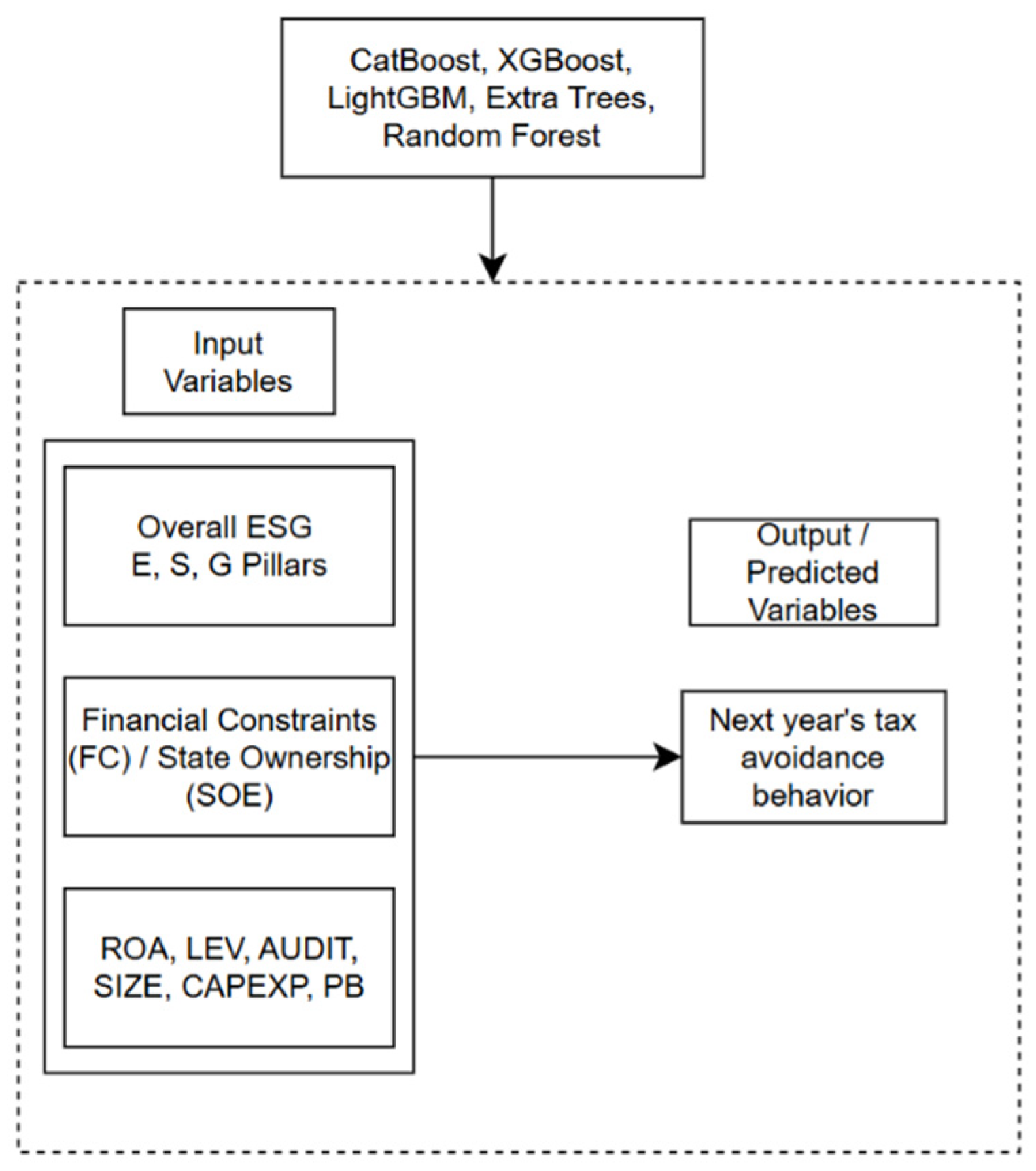
Table 4.
Summary of test results for selecting the appropriate regression model.
| Statistical Test | M(1) | M(2) | M(3) | M(4) | M(5) | M(6) |
|---|---|---|---|---|---|---|
| F-test | 0.000*** | 0.000*** | 0.000*** | 0.000*** | 0.000*** | 0.000*** |
| Breusch - Pagan LM | 0.000*** | 0.000*** | 0.000*** | 0.000*** | 0.000*** | 0.000*** |
| Hausman |
0.287 | 0.203 | 0.720 | 0.565 | 0.470 | 0.373 |
| Selected Model | REM | REM | REM | REM | REM | REM |
Notes: *, **, *** indicate statistical significance at the 10%, 5%, and 1% levels, respectively. (Source: compiled from data processing by the authors).
Disclaimer/Publisher’s Note: The statements, opinions and data contained in all publications are solely those of the individual author(s) and contributor(s) and not of MDPI and/or the editor(s). MDPI and/or the editor(s) disclaim responsibility for any injury to people or property resulting from any ideas, methods, instructions or products referred to in the content. |
© 2026 by the authors. Licensee MDPI, Basel, Switzerland. This article is an open access article distributed under the terms and conditions of the Creative Commons Attribution (CC BY) license (http://creativecommons.org/licenses/by/4.0/).
Copyright: This open access article is published under a Creative Commons CC BY 4.0 license, which permit the free download, distribution, and reuse, provided that the author and preprint are cited in any reuse.


