

Submitted:
15 April 2026
Posted:
16 April 2026
You are already at the latest version
Abstract
Cardiac surgery-associated acute kidney injury (CSA-AKI) remains a significant complication following cardiopulmonary bypass in pediatric cardiac surgery, often leading to adverse long-term outcomes despite its transient nature in many cases. This single-center cohort study aimed to identify preoperative and intraoperative risk factors for CSA-AKI and evaluate the prognostic value of specific biomarkers. We included 67 children (6–36 months) undergoing elective septal heart defect repair, assessing NGAL, KIM-1, L-FABP, and IL-18 at three perioperative time points. Postoperative AKI, defined by pKDIGO criteria, occurred in 29.85% of patients. Significant preoperative risk factors included younger age, lower weight, anemia, and ventricular septal defects. Key intraoperative predictors were cardiopulmonary bypass, aortic cross-clamp durations and weight-adjusted transfusion volume. A transfusion volume threshold of 13.763 ml/kg (AUC 0.719, Se 0.75, Sp 0.698, p = 0.006) was established as a critical predictor, highlighting the potential for a restrictive transfusion strategy to mitigate AKI risk. These findings allow for early risk stratification and the optimization of intensive care strategies immediately post-surgery. However, the small sample size and focus on septal defects necessitate further multicenter research to validate these diagnostic thresholds across broader congenital heart defect populations.
Keywords:
congenital heart defects
; cardiac surgery-associated acute kidney injury
; cardiopulmonary bypass
; risk factors
; acute kidney injury biomarkers
1. Introduction
Postoperative acute organ dysfunction is a frequent complication in children with congenital heart defects (CHD). Acute kidney injury (AKI) is one of the most prevalent complications following cardiopulmonary bypass (CPB) cardiac procedures [1]. Depending on its severity, renal dysfunction may range from an isolated laboratory finding without overt clinical symptoms to a major complication that significantly impacts postoperative recovery [2]. Clinically significant AKI cases are associated with an increased requirement for catecholamine support, prolonged mechanical ventilation, and extended stays in both the intensive care unit and the hospital. Severe cases of acute kidney injury necessitating renal replacement therapy (RRT) are characterized by the highest morbidity and mortality rates within this patient population [3]. Furthermore, the long-term outcomes of AKI include an elevated risk of chronic kidney disease developing and extrarenal comorbidities, ultimately leading to reduced life expectancy [4]. From a healthcare system perspective, each episode of severe AKI entails a substantial increase in financial costs [5]. Cardiac surgery-associated AKI is increasingly recognized as a distinct pathophysiological phenotype [6]. This classification is justified by the unique pattern of pathological changes occurring during CPB [7], further compounded by the impact of myocardial dysfunction in the early postoperative period [8]. Despite the significant impact of renal dysfunction on the postoperative course, its diagnosis in children remains challenging. Currently, the only validated diagnostic option for identifying AKI is the modified paediatric KDIGO criteria, which are based on changes in serum creatinine levels or urine output rate. However, serum creatinine concentration is characterized by high variability depending on the child’s age, weight, and sex. Furthermore, its slow rise often results in the required 50% threshold from baseline being reached after at least 24 hours after an insult [9]. The urine output criterion is difficult to apply in cardiac surgery patients due to its inconsistency, particularly in the first few hours postoperatively, and the frequent use of diuretics [10]. Given these limitations of the KDIGO criteria, numerous studies were conducted seeking alternatives. Currently, the most extensively researched option is the use of kidney injury biomarkers, which show promising results both in terms of accelerating the detection of renal dysfunction and being less dependent on anthropometric parameters. This potential for earlier identification may facilitate proactive therapy or the implementation of measures to limit exposure to factors contributing to renal injury during the perioperative period [11]. In view of the diagnostic challenges of AKI in paediatric cardiac surgery, researchers have also focused on identifying and mitigating potential risk factors for this complication. A prominent factor among these is the intraoperative transfusion of packed red blood cells. Due to the specificity of paediatric cardiopulmonary bypass techniques, intraoperative transfusion of red blood cell components is required to prevent profound hemodilution that could occur upon bypass onset [12]. A restrictive approach to blood component transfusion is a widely debated topic [13], as it has been shown not only to be safe for the patient [14] but also to be associated with reduced severity of systemic inflammatory response syndrome (SIRS) [15] and organ dysfunctions, such as postoperative cognitive dysfunction [16]. Considering the established contribution of transfusion to the development of extrarenal organ dysfunctions, investigating its role in the pathogenesis of AKI is of significant interest and remains a promising area of research.
Consequently, a restrictive intraoperative transfusion strategy may not only reduce the risk of AKI but also improve both short-term and long-term outcomes following CHD repair in children.
The aim of this study was to identify risk factors for the development of AKI in children with septal heart defects following cardiopulmonary bypass cardiac surgery procedures and to evaluate their prognostic significance.
2. Materials and Methods
The Study Design
This was a prospective, single-center, cohort study conducted at the Department of Anesthesiology and Intensive Care of the Research Institute for Complex Issues of Cardiovascular Diseases (Kemerovo, Russia). The study period spanned from October 2023 to May 2025.
Ethical Approval
The study was conducted in accordance with the Declaration of Helsinki and was approved by the Local Ethics Committee of the Research Institute for Complex Issues of Cardiovascular Diseases (Meeting Protocol No. 21, dated October 24, 2023). Written informed consent was obtained from the legal representatives of all participating children prior to their inclusion in the study.
Setting and Participants
The study included paediatric patients who met the following inclusion criteria: age between 6 and 36 months, body weight between 5 and 15 kg, and undergoing elective surgical repair for isolated atrial or ventricular septal defects via median sternotomy. All procedures were performed by a single surgical team to minimize inter-operator variability.
Eligibility Criteria
Non-inclusion criteria: refusal of legal representatives to provide informed consent; emergency or urgent surgical interventions; preoperative anemia (defined as hemoglobin < 100 g/L); age outside the 6–36 month range; weight < 5 kg or > 15 kg; use of hypothermia during cardiopulmonary bypass; complex congenital heart defects; episodes of unplanned perioperative hypotension or hemodynamic instability; and pre-existing urological diseases or anomalies.
Exclusion criteria: loss of follow-up data; development of postoperative infectious complications; or withdrawal of consent during the study period.
The inclusion criteria were established based on the recommended timing for septal defect correction in patients without significant shunting, while considering body weight Z-scores within three standard deviations (±3 SD) of the population reference range.
Study Outcomes
Primary Outcome: The development of postoperative acute kidney injury was defined according to the modified paediatric KDIGO criteria as a 50% increase in serum creatinine concentration from the baseline value. For the purposes of this study, the baseline creatinine was defined as the concentration measured during the preoperative assessment within 24 hours prior to surgery.
Secondary Outcomes: Concentrations of renal injury biomarkers in serum and urine, determined via enzyme-linked immunosorbent assay (ELISA) at the Laboratory of Experimental Medicine (Research Institute for Complex Issues of Cardiovascular Diseases).
Measurement of Study Outcomes
Clinical and laboratory assessments included dynamic monitoring of complete blood counts and biochemical profiles (preoperatively and at 16 hours postoperatively), as well as urinalysis at 16 hours postoperatively. Hourly urine output was monitored during the first 24 postoperative hours. Renal injury biomarker concentrations (NGAL, L-FABP, KIM-1, and IL-18) were measured in serum and urine at three time points: 10 minutes after urethral catheterization, prior to skin closure, and 16 hours after the end of surgery.
Sample Collection and Processing
Patient blood (2 mL) was collected into tubes containing a procoagulant and centrifuged at 5000 rpm for 10 minutes. Urine samples (2 mL) were collected into glass tubes and centrifuged at 3000 rpm for 5 minutes. In both cases, the supernatant was aseptically transferred into microcentrifuge tubes, transported to the laboratory within 20 minutes, and stored at –70 °C. Immediately prior to the assay, samples were thawed in a water bath at room temperature.
Biomarker Analysis
Laboratory personnel performing ELISA were blinded to the clinical data and AKI status of the patients. Enzyme-linked immunosorbent assay was performed using the following diagnostic kits (Cloud-Clone Corp., Wuhan, China):
NGAL: ELISA Kit for Neutrophil Gelatinase-Associated Lipocalin (SEB388Hu);
L-FABP: ELISA Kit for Liver-type Fatty Acid Binding Protein 1 (SEB566Hu);
KIM-1: ELISA Kit for Kidney Injury Molecule 1 (SEA785Hu);
IL-18: ELISA Kit for Interleukin 18 (SEA064Hu).
Statistical Procedures
The level of significance for rejecting the null hypothesis was set at p less than 0.05. The required sample size was calculated using the Cochrane formula: n = (t2* P * Q)/e2, where t is the Student’s t-value for the specified significance level (1.96 for p = 0.05); e is the margin of error (set at 0.1; P is the estimated prevalence of the studied condition (set at 0.3); and Q is the proportion of cases without the condition (set at 0.7). Based on these parameters, the target sample size to achieve sufficient statistical power was determined to be 80 patients. Early termination of the study was permitted upon fulfillment of the primary research objectives.
Statistical Methods
Statistical analysis was performed using jamovi software (version 2.7.8.0). Normality of data distribution was assessed using the Shapiro-Wilk test. As most variables deviated from a normal distribution (p less than 0.05), non-parametric methods were applied. Quantitative data are expressed as medians (Me) with interquartile ranges (Q1–Q3).
Comparative analysis of two independent groups was conducted using the Mann-Whitney U test. Categorical data were analyzed using Pearson’s chi-squared test; in cases of small cell frequencies, Fisher’s exact test was employed to ensure validity. Correlation analysis was performed using the Spearman rank correlation coefficient.
To evaluate associations and risk factors, odds ratios (OR) with 95 % confidence intervals (CI) were calculated. Logistic regression models were assessed using McFadden’s R-squared, with results reported as OR and 95% CI. Diagnostic performance was evaluated via ROC analysis, calculating the area under the curve; the optimal cutoff point was determined using the Youden index. For all tests, a p-value less than 0.05 was considered statistically significant.
Missing data were handled using listwise deletion.
Anesthetic Management
All paediatric patients received anesthetic care according to the established institutional protocol. Preoperative fasting consisted of a 4-hour period for enteral nutrition and a 2-hour period for clear liquids. No premedication was administered. Upon arrival in the operating room, vitals monitoring was established (ECG, BP, and SpO2), followed by sedation with sevoflurane at a minimum alveolar concentration (MAC) of 0.3–0.5 to facilitate peripheral venous catheterization.
Anesthesia induction was performed using fentanyl (5 mcg/kg) and propofol (2 mg/kg). Paralysis was achieved with atracurium besylate (0.5 mg/kg) following preoxygenation via mask until an end-tidal oxygen (EtO2) of 90% was reached. Following tracheal intubation, anesthesia prior to skin incision was maintained with sevoflurane (MAC 0.5–0.7). Central venous access was established via the right internal jugular vein, and the right radial artery was catheterized for invasive blood pressure monitoring. A Foley catheter was placed for urine output assessment. Perioperative antibiotic prophylaxis with cefuroxime (50 mg/kg) was administered 30 minutes before the skin incision.
One minute prior to incision, a bolus of fentanyl (10 mcg/kg) was given, with subsequent doses (5 mcg/kg) administered every 30 minutes until the end of the procedure. During the maintenance phase, sevoflurane MAC was kept between 0.7 and 1.1. Mechanical ventilation was provided using a Maquet Flow-I workstation in a semi-closed circuit mode, following lung-protective ventilation strategies to maintain normoventilation and normoxemia. Intraoperative monitoring included ECG, invasive and non-invasive blood pressure, CVP, SpO2, rectal and nasopharyngeal temperature, EtCO2, cerebral near-infrared spectroscopy (NIRS), and urine output.
Cardiopulmonary Bypass Protocol
Cardiopulmonary bypass was performed according to the institutional protocol of the Research Institute for Complex Issues of Cardiovascular Diseases. The CPB circuit included a Maquet HL 20 heart-lung machine, a Terumo Capiox FX05 oxygenator with a pediatric tubing set, a Sorin cardioplegia delivery system for blood and crystalloid cardioplegia, and a Kewei Kw300 hemoconcentrator for ultrafiltration.
The priming volume consisted of 2000 IU of heparin, 15% mannitol (0.25 g/kg), 5% sodium bicarbonate (40 mL), and a balanced polyionic solution up to 280 mL. Prior to the initiation of CPB, heparin (350 IU/kg) was administered intravenously. Bypass was initiated once the activated clotting time (ACT) reached 390 seconds. Perfusion was maintained at a target cardiac index of 3.0 L/min/m² under normothermic conditions. Normoventilation and normoxemia were ensured based on continuous arterial blood gas monitoring.
Cardioplegia and Ultrafiltration
Myocardial protection was achieved using Custodiol solution (30 mL/kg) administered antegradely over 8 minutes under continuous aortic root pressure monitoring. The cardioplegic solution was recovered into the cardiotomy reservoir via coronary sinus aspiration. Zero-balance ultrafiltration (Z-BUF) was maintained throughout the duration of cardiopulmonary bypass. Continuous monitoring of vital signs and acid-base balance was performed during the entire bypass period.
Restrictive Transfusion Strategy
Cerebral tissue oxygenation was monitored using near-infrared spectroscopy with INVOS sensors (Medtronic, USA). The adequacy of tissue oxygen delivery was assessed based on oxygen extraction (calculated from SaO2 and SvO2) and lactate dynamics. Intraoperative transfusion of red blood cell components (5 mL/kg) was performed if NIRS values dropped below 55% or SvO2 fell below 60%. If these targets were not met, the transfusion was repeated in the same volume until the aforementioned oxygen delivery values stabilized.
Post-Bypass Management
Following aortic cross-clamp removal, all patients routinely received epinephrine infusion (0.05 mcg/kg/min) until transthoracic echocardiography was performed upon admission to the intensive care unit. In cases where the left ventricular ejection fraction was approximately 50%, a concurrent dopamine infusion (5 mcg/kg/min) was initiated. Upon completion of CPB, modified ultrafiltration (MUF) was performed, followed by vacuum-assisted ultrafiltration and autotransfusion of the residual circuit volume, according to the institutional patented blood-saving technology.
Postoperative Care
Upon completion of the surgical procedure, patients were transferred to the PCICU. During the postoperative period, blood pressure, ECG, SpO2, CVP, and hourly urine output were continuously monitored and recorded. Clinical assessments included body temperature, acid-base balance, arterial blood gas analysis, and coagulation profiles. Both interval and 24-hour fluid balances were calculated for all patients. Tracheal extubation was performed based on standardized clinical criteria and the patient's respiratory effort.
3. Results
Patient Selection
During the study period, a total of 91 surgical interventions were performed for septal heart defects at the Research Institute for Complex Issues of Cardiovascular Diseases. Eleven children did not meet the inclusion criteria; thus, 80 children were initially selected. Subsequently, 13 children were excluded for the following reasons: incomplete biomarker data at the third time point (n=6), postoperative hemodynamic instability (n=3), previously undiagnosed urethral stricture (n=1), development of a viral respiratory infection (n=1), and withdrawal of consent by legal representatives (n=2). Consequently, the final study cohort consisted of 67 patients. The selection process is detailed in the flow diagram (Figure 1).
Preoperative patients’ characteristics
The preoperative anthropometric and laboratory characteristics of the included patients are presented in Table 1. The estimated glomerular filtration rate (eGFR) was calculated using the bedside Schwartz formula: eGFR = k * Height (cm) / Serum Creatinine (mmol/L), with k = 0.413. Body surface area (BSA) was determined using the DuBois and DuBois formula. The neutrophil-to-lymphocyte ratio (NLR) was calculated as the absolute neutrophil count divided by the absolute lymphocyte count from the complete blood count.
An analysis of intraoperative characteristics is presented in Table 2. It demonstrates that the groups of children with AKI and those without postoperative renal dysfunction differ significantly in terms of cardiopulmonary bypass (CPB) time, aortic cross-clamp time, baseline hemoglobin levels, and the volume of intraoperative red blood cell (RBC) transfusions.
The primary postoperative outcomes are summarized in Table 3. To calculate the Vasoactive-Inotropic Score (VIS), the following formula was used: VIS = dopamine + (100 × epinephrine), where doses of dopamine and epinephrine were measured in µg/kg/min. Since no other vasoactive and/or inotropic agents were administered, their respective components in the formula were zero and did not affect the final value. Given that none of the children had respiratory indications for mechanical ventilation, the Ventilation Index (VI) was considered zero for all patients. The Vasoactive-Ventilation-Renal (VVR) score was calculated using the formula: VVR score = VIS + VI + [(peak creatinine − baseline creatinine) × 10]. In cases where the postoperative serum creatinine concentration did not exceed the preoperative level, the difference was also considered to be zero.
Among the 67 patients, AKI developed in 20 cases (29.85%). In 19 cases, renal dysfunction corresponded to KDIGO Stage 1, while one child reached KDIGO Stage 2.
To assess the predictive performance and determine the optimal cut-off values of preoperative and intraoperative parameters for AKI risk, a ROC analysis was performed; the results are presented in Table 4.
Given the potential for intraoperative AKI risk identification, a univariable logistic regression analysis was conducted for anthropometric data, operative duration characteristics, and transfusion volumes. These results are summarized in Table 5.
An additional diagnostic option in the study was the measurement of kindey injury biomarker concentrations (NGAL, L-FABP, KIM-1, IL-18) both in serum and urine at three time points: 10 minutes after urinary catheterization, before skin closure, and 16 hours postoperatively. Statistically significant differences in biomarker concentrations between the study groups were found only for urinary L-FABP; the comparison results are presented in Table 6.
A correlation analysis was performed to examine the relationship between renal injury biomarker concentrations, the rise in serum creatinine, and the weight-adjusted transfusion volume. The latter was defined as the ratio of the volume of erythrocyte-containing donor blood components used intraoperatively to the child's body weight. The most statistically significant results of the correlation analyses are summarized in Table 7 and Table 8, respectively.
Considering the correlations between kidney injury biomarkers levels and postoperative AKI development, a ROC analysis was performed to evaluate their predictive value. The analysis aimed to determine critical cut-off values for their concentrations and their dynamics between sampling time points. The most significant results are presented in Table 9.
Univariate regression analysis was conducted for kidney injury biomarkers concentrations, with the most statistically significant findings summarized in Table 10.
Weight-adjusted transfusion volume was selected for multivariate logistic regression analysis among the clinical and medical history factors. This parameter was chosen because it demonstrated high statistical significance and incorporated anthropometric characteristics. The highest significance was observed for its combination with urinary IL-18 concentration at the second sampling time point. The results of the multivariate logistic regression analysis are presented in Table 11.
4. Discussion
Acute kidney injury occurred in 20 out of 67 patients (29.85%). In 19 cases, renal dysfunction corresponded to KDIGO Stage 1, while one child reached KDIGO Stage 2. This incidence is closely aligned with the rates of 31.65% and 33% reported by Suieubekov B. et al. [17] and Gulia M. et al. [18], respectively. The relatively low AKI incidence in the present study is attributable to the inclusion of patients with isolated septal defects only, who represent the lowest risk group for postoperative organ dysfunction. This selection was necessitated by the need to exclude other significant risk factors for AKI, such as cyanotic congenital heart disease, prolonged cardiopulmonary bypass, posoperative open chest, univentricular hemodynamics, and neonatal age [4], as their inclusion would have resulted in high cohort heterogeneity.
As demonstrated in Table 1, children who developed postoperative AKI were significantly younger and, consequently, had lower weight, height, and body surface area. These patients were also characterized by significantly lower preoperative serum creatinine concentrations and higher estimated glomerular filtration rates. This finding may be explained by the fact that lower creatinine levels and higher eGFR in the AKI group merely reflect the younger age and lower body mass of these patients. Gender was not associated with the development of AKI.
It is also noteworthy that a statistically significant difference was observed between patients with and without AKI regarding baseline hemoglobin and hematocrit levels, with lower values recorded in the AKI group. This finding is characteristic of younger children and reflects physiological anemia of infancy. Significant differences in differential white blood cell counts between the groups may be attributed to the fact that, in the AKI group, the neutrophil-to-lymphocyte ratio was further from the time of the so-called "second crossover" of the leukogram.
Furthermore, AKI developed significantly more frequently in children with ventricular septal defects compared to those with atrial septal defects, which is explained by a longer exposure to intraoperative factors.
Thus, the fundamental preoperative distinctions of the AKI group are younger age at the procedure and the VSD. Other significantly different parameters are either derivatives of age (weight, height, body surface area) or are characteristic of an earlier developmental stage (lower creatinine concentration, higher eGFR, physiological anemia, and the leukogram crossover).
An age threshold of 10.5 months (AUC 0.745, 95% CI 0.582–0.909; Se 0.85, Sp 0.74; p=0.003) is suggested as the minimum for elective total repair of septal heart defects, provided no contraindications are present, in order to reduce AKI risk.
Regarding the intraoperative period (Table 2), patients in the AKI group were characterized by significantly longer durations of CPB and aortic cross-clamp time. This group also exhibited lower haemoglobin levels and lower nadir hematocrit values during CPB before transfusion. Each of these factors has been cited in various studies as a contributor to AKI development following paediatric cardiac surgery; thus, our findings are consistent with data reported by other research groups [19].
Furthermore, significantly lower mixed venous blood oxygen saturation (SvO2) was observed in the AKI group prior to transfusion. Given the established role of blood products in AKI pathogenesis [19], a restrictive transfusion strategy for red blood cell components was employed. Despite this approach, there were no significant intergroup differences in blood lactate levels or cerebral NIRS monitoring vslues. This supports the safety of the restrictive strategy, as oxygen transport parameters and lactate concentrations were maintained within acceptable limits through adjustments in perfusion settings. Nevertheless, the weight-adjusted volume of intraoperatively administered RBC units remained a significantly different parameter between the two groups.
Threshold values for intraoperative risk factors for AKI were identified: cardiopulmonary bypass (CPB) duration exceeding 69 minutes (AUC 0.685, 95% CI 0.535–0.836; Se 0.563, Sp 0.744; p=0.016) and aortic cross-clamp time exceeding 30.5 minutes (AUC 0.698, 95% CI 0.549–0.846; Se 0.75, Sp 0.605; p=0.009). For the weight-adjusted transfusion volume, a threshold of 13.763 mL/kg was established (AUC 0.719, 95% CI 0.560–0.877; Se 0.75, Sp 0.698; p=0.006). This suggests that maintaining transfusion volumes below this limit can be recommended as a safe and effective method for AKI prevention.
Analyzing postoperative characteristics (Table 3), children with renal dysfunction exhibited significantly higher blood lactate levels 16 hours posoperatively, although these remained within the reference range. As expected, patients in the AKI group had significantly lower eGFR. The lack of statistical significance in serum creatinine concentration between the groups may be attributed to age-related heterogeneity. Furthermore, a significantly higher requirement for inotropic support (reflected by the Vasoactive Inotropic Score, VIS) and a greater increase in creatinine levels were observed. Consequently, the Vasoactive-Ventilation-Renal (VVR) score, derived from these parameters, was also significantly higher in these patients. These findings align with previous research indicating that the VVR score provides superior predictive value for clinical outcomes in neonates following cardiac surgery [20]. The duration of mechanical ventilation was comparable between children with and without postoperative renal dysfunction, as the severity of AKI did not affect respiratory parameters. No significant differences were found in differential white blood cell counts, haemoglobin, or erythrocyte levels between the groups. Children with AKI had a significantly longer length of stay in the PCICU, reflecting a more severe postoperative course: in addition to a greater need for sympathomimetic support, these patients required higher intravenous fluid volumes, for which a near-significant difference between the groups was observed.
The prognostic value of the VVR score was established: a threshold of 6.13 (AUC 0.820, 95% CI 0.699–0.942; Se 0.75, Sp 0.791; p < 0.0001) identifies children at high risk for developing AKI. Univariate logistic regression analysis of clinical and anamnestic parameters demonstrated a statistically significant contribution of each variable to the development of postoperative AKI in children following septal heart defect correction under cardiopulmonary bypass (Table 5).
Thus, in the preoperative period, the predictors of AKI risk in children with septal heart defects were younger age, lower weight, and smaller body surface area. Intraoperative risk factors included longer durations of cardiopulmonary bypass and aortic cross-clamping, as well as the volume of administered blood products. The only postoperative predictor of AKI identified in this study was the VVR score.
Analysis of renal injury marker concentrations (NGAL, KIM-1, and IL-18) revealed no statistically significant differences between the AKI and non-AKI groups, regardless of the sample type analyzed or the time point. In contrast, urinary L-FABP showed significant intergroup differences at the second time point. Derived parameters—specifically, the increase in urinary L-FABP concentration at the second time point relative to baseline and the more pronounced decline at the third time point relative to the second—also differed significantly (Table 6).
The presence of significant and near-significant correlations between kidney injury markers and the increase in serum creatinine (Table 7) suggests that a subset of children experiences subclinical kidney injury. This condition, while not meeting conventional KDIGO criteria, may be suspected based on changes in serum or urinary kidney injury biomarker concentrations. These alterations can be detected both intraoperatively and 16 hours postoperatively, thereby preceding the detection of renal dysfunction via serum creatinine[21].
It was further demonstrated that the concentration of kidney injury biomarkers showed a response to intraoperative transfusion that was either statistically significant or approached statistical significance (Table 8), suggesting a potential deleterious effect of donor blood components on renal function. This finding is consistent with the results reported by Khan et al. [22]. Urinary concentrations of L-FABP and IL-18 were shown to be predictive of AKI risk in children following cardiopulmonary bypass septal heart defect closure.
The prognostic value of urinary L-FABP at the second time point was determined at a threshold of 0.497 ng/mL (AUC 0.702, 95% CI 0.560–0.844; Se 0.706, Sp 0.636; p = 0.005). Additionally, an 0.884-fold change in urinary L-FABP at the second time point relative to baseline (AUC 0.667, 95% CI 0.518–0.816; Se 0.941, Sp 0.341; p = 0.028) and a 0.754-fold change at the third time point relative to the second (AUC 0.747, 95% CI 0.595–0.899; Se 0.85, Sp 0.71; p = 0.001) were also associated with postoperative AKI risk. A similar analysis for urinary IL-18 established a prognostic threshold of 18.24 ng/mL at the second time point (AUC 0.725, 95% CI 0.53–0.92; Se 0.62, Sp 0.90; p = 0.023). An 0.884-fold change in IL-18 at the third time point relative to the second (AUC 0.703, 95% CI 0.501–0.906; Se 0.54, Sp 0.90; p = 0.049) further underscores the utility of IL-18 in assessing AKI risk.
Univariate logistic regression analysis of kidney injury biomarkers revealed that only the urinary IL-18 concentration at the second time point reached a sufficient level of significance, although urinary L-FABP showed a trend toward statistical significance (Table 10). Finally, to provide an integral assessment of perioperative factors, multivariate regression analysis was used to identify the combination of clinical parameters and injury markers with the highest statistical significance. The combination of weight-adjusted intraoperative RBC transfusion volume and IL-18 concentration was found to be optimal (Table 11). Although the transfusion volume lost individual statistical significance in this model, the omnibus test of model significance remained significant (p = 0.002), confirming the model's robust prognostic value.
Study Limitations
1. Small sample size: The estimated sample size, based on initial power calculations, was 80 patients. However, the study was terminated after the enrollment of 67 patients as the primary objectives were achieved. Nevertheless, a larger cohort study might have yielded more precisely adjusted threshold values for the most critical factors.
2. Homogeneity of the cohort: The inclusion of only children with septal heart defects ensured a more homogeneous sample; however, this excluded patients with other types of congenital heart disease characterized by more intense exposure to intraoperative factors.
3. Limited blood sampling points: The number of serum sampling time points was restricted to prevent iatrogenic anemia. This limitation may have led to suboptimal sampling timing and a potential underestimation of the degree of renal parenchymal injury.
4. Biomarker Dynamics: Analyzing four different biomarkers simultaneously in two biological fluids across shared time points may have resulted in suboptimal reference points. Due to the divergent concentration dynamics of these biomarkers, this could have further contributed to an underestimation of structural damage.
5. Lack of long-term follow-up: Long-term clinical outcomes could not be assessed, as patients were discharged for subsequent outpatient follow-up at their primary place of residence.
5. Conclusions
The global trajectory toward improving the quality and accessibility of medical care implies not only an increase in the annual volume of paediatric congenital heart surgery but also an inevitable rise in the absolute number of associated complications. Consequently, the prevalence of postoperative acute kidney injury of varying severity is expected to grow. Given the profound impact of this complication on CHD repair outcomes, the primary objectives in the context of postoperative CSA-AKI are timely diagnosis and the mitigation of risk factors to enable effective prevention. The present study proposes a restrictive intraoperative transfusion strategy as a preventive measure against AKI, with a red blood cell transfusion volume of 13.763 mL/kg suggested as a threshold to minimize the risk of postoperative renal dysfunction. Furthermore, we present additional diagnostic criteria that offer an earlier identification of children at risk for AKI based on intraoperative parameters, significantly preceding diagnosis based on conventional KDIGO criteria.
Author Contributions
Conceptualization, D.B. and E.G.; methodology, D.B.; validation, D.B., A.I. and P.S.; formal analysis, P.S.; investigation, D.B. and A.S.; data curation, P.S.; writing—original draft preparation, D.B.; writing—review and editing, E.G.; supervision, E.G. All authors have read and agreed to the published version of the manuscript.
Funding
This research was supported by the Comprehensive Program of Basic Scientific Research of the Russian Academy of Sciences within the framework of the basic research topic of the Research Institute for Complex Issues of Cardiovascular Diseases No. 0419-2024-0002 «Perioperative neuroprotective strategies in surgery for congenital heart defects», with financial support from the Ministry of Science and Higher Education of the Russian Federation under the National Project «Science and Universities». State Registration Number (NIOKTR): 124041800039-2
Institutional Review Board Statement
The study was conducted in accordance with the Declaration of Helsinki, and approved by the Institutional Ethics Committee of RESEARCH INSTITUTE FOR COMPLEX ISSUES OF CARDIOVASCULAR DISEASES, Kemerovo, Russia. Protocol code: 21, date of approval: 24.10.2023.
Informed Consent Statement
Informed consent was obtained from all subjects involved in the study.
Data Availability Statement
The raw data supporting the conclusions of this article will be made available by the authors on request.
Conflicts of Interest
The authors declare no conflicts of interest
Abbreviations
The following abbreviations are used in this manuscript:
| CSA-AKI | Cardiac Surgery-Associated Acute Kidney Injury |
| AKI | Acute Kidney Injury |
| NGAL | Neutrophil Gelatinase-Associated Lipocalin |
| KIM-1 | Kidney Injury Molecule-1 |
| L-FABP | Liver-type Fatty Acid-Binding Protein |
| IL-18 | Interleukin-18 |
| pKDIGO | Paediatric Kidney Disease Improving Global Outcomes |
| AUC | Area Under the Curve |
| ROC | Receiver Operating Characteristic |
| CHD | Congenital Heart Disease |
| CPB | Cardiopulmonary Bypass |
| RRT | Renal Replacement Therapy |
| SIRS | Systemic Inflammatory Response Syndrome |
| SD | Standard Deviation |
| ELISA | Enzyme-Linked Immunosorbent Assay |
| OR | Odds Ratio |
| CI | Confidence Interval |
| SpO2 | Peripheral Oxygen Saturation |
| ECG | Electrocardiogram |
| BP | Blood Pressure |
| MAC | Minimum Alveolar Concentration |
| CVP | Central Venous Pressure |
| EtCO2 | End-tidal Carbon Dioxide |
| NIRS | Near-Infrared Spectroscopy |
| IU | International Units |
| ACT | Activated Clotting Time |
| Z-BUF | Zero-balance Ultrafiltration |
| MUF | Modified Ultrafiltration |
| PCICU | Paediatric Cardiac Intensive Care Unit |
| eGFR | Estimated Glomerular Filtration Rate |
| BSA | Body Surface Area |
| NLR | Neutrophil-to-Lymphocyte Ratio |
| ASD | Atrial Septal Defect |
| VSD | Ventricular Septal Defect |
| RBC | Red Blood Cells |
| PaO2 | Partial Pressure of Arterial Oxygen |
| SvO2 | Mixed Venous Oxygen Saturation |
| VIS | Vasoactive-Inotropic Score |
| VI | Ventilation Index |
| VVR | Vasoactive-Ventilation-Renal score |
| MV | Mechanical Ventilation |
| IVF | Intravenous Fluids |
| LoS | Length of Stay |
References
- LoBasso, M.; Schneider, J.; Sanchez-Pinto L.N.; et al. Acute kidney injury and kidney recovery after cardiopulmonary bypass in children. Pediatr Nephrol. 2022, 37(3), 659-665. [CrossRef]
- Van den Eynde, J.; Rotbi, H.; Gewillig, M.; et al. In-hospital outcomes of acute kidney injury after pediatric cardiac surgery: a meta-analysis. Front Pediatr. 2021, 9:733744. [CrossRef]
- Zinchuk, P.V.; Ivkin, A.A.; Grigoriev, E.V.; et al. The role of nitric oxide in nephroprotection during surgical correction of heart defects in children (review). Messenger of Anesthesiology and Resuscitation. 2024, 21(6), 122-129. [Russian]. [CrossRef]
- Van den Eynde, J.; Salaets, T.; Louw, J.J.; et al. Persistent markers of kidney injury in children who developed acute kidney injury after pediatric cardiac surgery: a prospective cohort study. J Am Heart Assoc. 2022, 11(6):e024266. [CrossRef]
- Polushin, Y.S.; Dreval, R.O.; Zabotina, A.N.; et al. Clinical and economic assessment of therapy for sepsis-associated acute kidney injury with continuous combined renal replacement therapy. Messenger of Anesthesiology and Resuscitation. 2021, 18(5), 7-20. [Russian]. [CrossRef]
- Ronco, C.; Haapio, M.; House, A.A.; et al. Cardiorenal syndrome. J Am Coll Cardiol. 2008, 52(19), 1527-1539. [CrossRef]
- Yu, Y.; Li, C.; Zhu, S.; et al. Diagnosis, pathophysiology and preventive strategies for cardiac surgery-associated acute kidney injury: a narrative review. Eur J Med Res. 2023, 28(1):45. [CrossRef]
- Milne, B.; Gilbey, T.; De Somer, F.; et al. Adverse renal effects associated with cardiopulmonary bypass. Perfusion. 2024, 39(3), 452-468. [CrossRef]
- Sidebotham, D. Novel biomarkers for cardiac surgery-associated acute kidney injury: a skeptical assessment of their role. J Extra Corpor Technol. 2012, 44(4) 235-240.
- Ostermann, M.; Kunst, G.; Baker, E.; et al. Cardiac surgery associated AKI prevention strategies and medical treatment for CSA-AKI. J Clin Med. 2021, 10(22):5285. [CrossRef]
- Balakhnin, D.G.; Chermnykh, I.I.; Ivkin, A.A.; et al. The problem of diagnosing acute kidney injury in children operated on under cardiopulmonary bypass. Messenger of Anesthesiology and Resuscitation. 2023, 20(6), 106-115. [Russian]. [CrossRef]
- Sebastian, R.; Ahmed, M.I. Blood conservation and hemostasis management in pediatric cardiac surgery. Front Cardiovasc Med. 2021, 8:689623. [CrossRef]
- Chen, Q.H.; Wang, H.L.; Liu, L.; et al. Effects of restrictive red blood cell transfusion on the prognoses of adult patients undergoing cardiac surgery: a meta-analysis of randomized controlled trials. Crit Care. 2018, 22(1):142. [CrossRef]
- Borisenko, D.V.; Ivkin, A.A.; Shukevich, D.L.; et al. Significance of red blood cell components of donor blood in the priming volume of the cardiopulmonary bypass circuit in the development of systemic inflammation in the correction of congenital heart defects in children. General Reanimatology. 2022, 18(3), 30-37. [Russian]. [CrossRef]
- Ivkin, A.A.; Borisenko, D.V.; Grigoriev, E.V. Cardiopulmonary bypass without donor blood components as a way to prevent brain damage in children. Complex Issues of Cardiovascular Diseases. 2021, 10(2S), 21-26. [Russian]. [CrossRef]
- Ivkin, A.A.; Grigoriev, E.V.; Balakhnin, D.G.; et al. Intraoperative transfusion as a risk factor for cerebral injury after cardiac surgery in children: a prospective observational study. Annals of Critical Care. 2023, 1, 101-114. [Russian]. [CrossRef]
- Suieubekov, B.; Sepbayeva, A.; Yeshmanova, A.; et al. Cardiac surgery-associated acute kidney injury in newborns: a meta-analysis. Electron J Gen Med. 2023, 20(2):em448. [CrossRef]
- Gulia, M.; Sethi, S.K.; Sharma, R.; et al. WCN25-1159 Acute kidney injury in infants post cardiac surgery - incidence, risk factors and outcome. Kidney Int Rep. 2025, 10(2 Suppl) S26-S27. [CrossRef]
- Sharma, A.; Chakraborty, R.; Sharma, K.; et al. Development of acute kidney injury following pediatric cardiac surgery. Kidney Res Clin Pract. 2020, 39(3), 259-268. [CrossRef]
- Zubarioglu, A.U.; Yıldırım, Ö.; Zeybek, C.; et al. Validation of the vasoactive-ventilation-renal score for neonatal heart surgery. Cureus. 2021, 13(5):e15110. [CrossRef]
- Yoneyama, F.; Okamura, T.; Takigiku, K.; et al. Novel urinary biomarkers for acute kidney injury and prediction of clinical outcomes after pediatric cardiac surgery. Pediatr Cardiol. 2020, 41(4), 695-702. [CrossRef]
- Khan, U.A.; Coca, S.G.; Hong, K.; et al. Blood transfusions are associated with urinary biomarkers of kidney injury in cardiac surgery. J Thorac Cardiovasc Surg. 2014, 148(2), 726-732. [CrossRef]
Figure 1.
Participant flow diagram illustrating the recruitment, inclusion, and exclusion criteria for the study cohort.
Figure 1.
Participant flow diagram illustrating the recruitment, inclusion, and exclusion criteria for the study cohort.
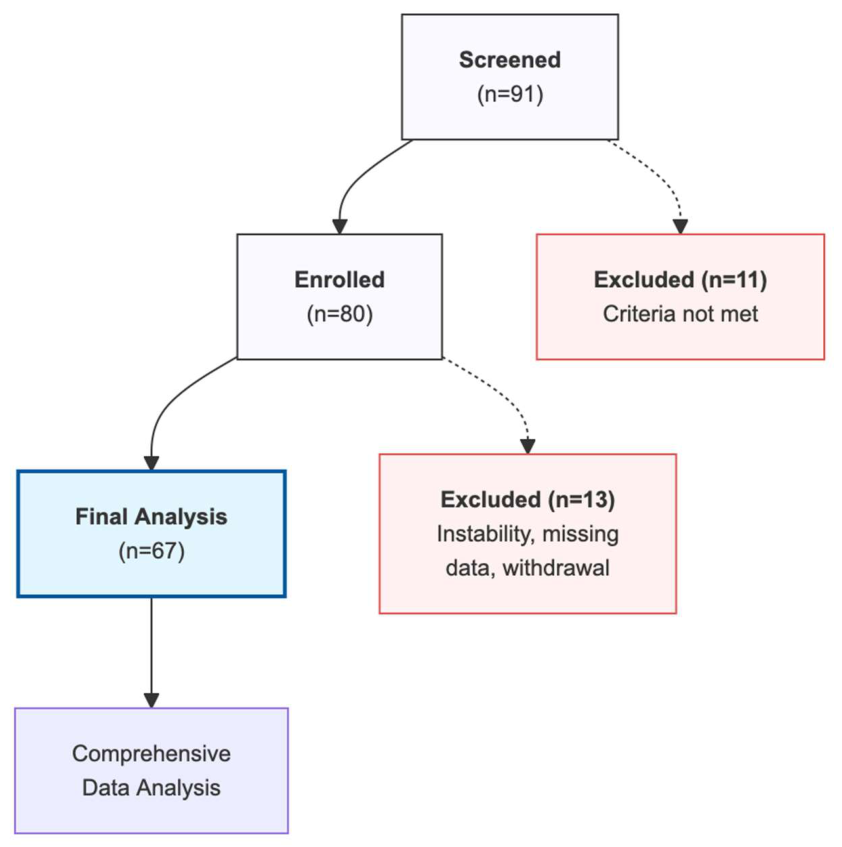

Table 1.
Preoperative patients’ characteristics.
| Characteristics | Group | N | Median (Q1-Q3) | p-value | |
| Height, cm | No AKI | 47 | 78 (70-85) | <0.001 | |
| AKI | 20 | 67 (60-70.5) | |||
| Weight, kg | No AKI | 47 | 9.4 (7.95-12.2) | 0.001 | |
| AKI | 20 | 7.05 (5.65-8.2) | |||
| BSA, m2 | No AKI | 47 | 0.438 (0.384-0.54) | 0.001 | |
| AKI | 20 | 0.345 (0.29-0.393) | |||
| Age at the procedure, mo |
No AKI | 47 | 15 (9-26) | <0.001 | |
| AKI | 20 | 5.5 (3.75-10) | |||
| Creatinine baseline, micromole/l |
No AKI | 47 | 29 (25-35.5) | <0.001 | |
| AKI | 20 | 21.5 (18-25) | |||
| eGFR baseline, ml/min/m2 |
No AKI | 47 | 94.9 (82.8-109.5) | 0.001 | |
| AKI | 20 | 119.5 (103.4-139.3) | |||
| Erythrocytes baseline, 1/1012 |
No AKI | 47 | 4.56 (4.35-4.755) | 0.004 | |
| AKI | 20 | 4.2 (4.008-4.558) | |||
| Neutrophils baseline, 1/109 |
No AKI | 47 | 26.9 (18.7-36.45) | 0.01 | |
| AKI | 20 | 18.55 (16.1-25.425) | |||
| Lymphocytes baseline, 1/109 |
No AKI | 47 | 62.2 (49.8-69.45) | 0.168 | |
| AKI | 20 | 66.2 (59.7-72.975) | |||
| Neutrophil-to-lymphocyte ratio | No AKI | 47 | 0.43 (0.266-0.696) | 0.02 | |
| AKI | 20 | 0.265 (0.216-0.419) | |||
| Haemoglobin, g/l | No AKI | 47 | 121 (116.5-126.5) | 0.022 | |
| AKI | 20 | 113 (106-120.75) | |||
| Haematocrit, % | No AKI | 47 | 36 (34.6-37.4) | 0.002 | |
| AKI | 20 | 33.5 (31.825-34.975) | |||
| Diagnosis, n (%) | ASD | No AKI | 31 (83.8%) | 0.008 | |
| AKI | 6 (16.2%) | ||||
| VSD | No AKI | 16 (53.3%) | |||
| AKI | 14 (46.7%) | ||||
| Sex, n (%) | Male | No AKI | 15 (62.5%) | 0.307 | |
| AKI | 9 (37.5%) | ||||
| Female | No AKI | 32 (74.4%) | |||
| AKI | 11 (25.6%) | ||||
BSA- body surface area; eGFR – estimated glomerular filtration rate; ASD – atrial septal defect; VSD – ventricular septal defect; AKI – acute kidney injury.
Table 2.
Intraoperative patients’ characteristics.
| Characteristics | Group | N | Median (Q1-Q3) | p-value |
| CPB time, min | No AKI | 47 | 54 (42-71.5) | 0.023 |
| AKI | 20 | 73.5 (52-99.5) | ||
| Aortic cross-clamp time, min | No AKI | 47 | 29 (21-41.5) | 0.014 |
| AKI | 20 | 38.5 (30.5-60.25) | ||
| Lactate baseline, mmol/l | No AKI | 47 | 1.05 (0.825-1.37) | 0.099 |
| AKI | 20 | 0.9 (0.7-1.1) | ||
| Lactate peak concentration, mmol/l | No AKI | 47 | 1.9 (1.6-2.4) | 0.994 |
| AKI | 20 | 1.9 (1.6-2.4) | ||
| PaO2 baseline, mm Hg |
No AKI | 47 | 139 (117-162) | 0.568 |
| AKI | 20 | 133 (114.25-141.75) | ||
| PaO2 the lowest value, mm Hg | No AKI | 47 | 140 (120-174) | 0.528 |
| AKI | 20 | 123 (100.025-181.75) | ||
| Hb preoperatively, g/l | No AKI | 47 | 104 (99-112.5) | 0.046 |
| AKI | 20 | 100 (88-107) | ||
| HCT baseline, % | No AKI | 47 | 32 (30.725-34.8) | 0.059 |
| AKI | 20 | 31 (27.1-33.2) | ||
| Hb after CPB initiation, g/l |
No AKI | 47 | 78 (72-83) | 0.058 |
| AKI | 20 | 72 (69-75.5) | ||
| HCT after CPB initiation, % |
No AKI | 47 | 24.2 (22.1-26) | 0.041 |
| AKI | 20 | 23 (21.85-23.65) | ||
| Weight-adjusted transfusion volume, ml/kg | No AKI | 47 | 12 (0-16.08) | 0.002 |
| AKI | 20 | 20.714 (13.622-43.58) | ||
| SvO2 the lowest value, % | No AKI | 47 | 63.5 (61-66) | 0.023 |
| AKI | 20 | 61 (57-63) | ||
| NIRS the lowest value, % | No AKI | 47 | 71 (68.25-74) | 0.12 |
| AKI | 20 | 69 (63-73) |
CPB – cardiopulmonary bypass; PaO2 – arterial blood oxygen pressure; Hb – haemoglobin; HCT – haematocrit; SvO2 – venous blood haemoglobin oxygen saturation; NIRS – near-infrared spectroscopy; AKI – acute kidney injury.
Table 3.
Postoperative patients’ characteristics.
| Characteristics | Group | N | Median (Q1-Q3) | p-value |
| Lactate 16h postoperatively, mmol/l | No AKI | 47 | 1.2 (1-1.4) | 0.002 |
| AKI | 20 | 1.5 (1.35-1.6) | ||
| Creatinine, peak concentration, micromole/l | No AKI | 47 | 31 (27.5-39) | 0.135 |
| AKI | 20 | 35 (30-43.25) | ||
| eGFR, the lowest value, ml/min/m2 | No AKI | 47 | 87.85 (77.5254-104.75) | <0.001 |
| AKI | 20 | 67.49 (56.2331-77.84) | ||
| Neutrophils 16h postoperatively, 1/109 |
No AKI | 47 | 73.1 (63.75-77.65) | 0.995 |
| AKI | 20 | 73.9 (63.15-77.75) | ||
| Lymphocytes 16h postoperatively, 1/109 |
No AKI | 47 | 17.9 (13.3-23.5) | 0.934 |
| AKI | 20 | 16.55 (14.15-23.13) | ||
| Neutrophil-to-lymphocyte ratio 16h postoperatively | No AKI | 47 | 3.99 (2.6945-5.82) | 0.853 |
| AKI | 20 | 4.53 (2.7115-5.53) | ||
| Hb 16h postoperatively, g/l | No AKI | 47 | 111 (104-120) | 0.451 |
| AKI | 20 | 113 (106.75-118.25) | ||
| HCT 16h postoperatively, % | No AKI | 47 | 33 (30.85-35.2) | 0.924 |
| AKI | 20 | 33.15 (30.8-34.55) | ||
| VI-Score value | No AKI | 47 | 0 (0-5) | 0.021 |
| AKI | 20 | 5 (3.75-10) | ||
| VVR-Score value | No AKI | 47 | 1.58 (0.0565-5.9) | <0.001 |
| AKI | 20 | 7.6 (5.2755-11.47) | ||
| MV time, h | No AKI | 47 | 6 (3-9) | 0.17 |
| AKI | 20 | 8 (5-12.5) | ||
| IVF volume over 16 h, ml/kg | No AKI | 47 | 69.3 (53.9091-80.96) | 0.075 |
| AKI | 20 | 81.37 (64.8776-96.3) | ||
| PCICU LoS, h | No AKI | 47 | 24 (23.5-48) | 0.005 |
| AKI | 20 | 48 (43.75-84.5) | ||
| Hospital LoS, day | No AKI | 47 | 8 (5-9) | 0.088 |
| AKI | 20 | 9 (5-11.25) |
eGFR – estimated glomerular filtration rate; Hb – haemoglobin; HCT – haematocrit; VI-Score – vasoactive-inotropic score; VVR-Score – vasoactive-ventilation-renal score; MV – mechanical ventilation; IVF – intravenous fluid; PCICU – paediatriac cardiac intensive care unit; LoS – length of stay; AKI – acute kidney injury.
Table 4.
ROC analysis of predictive performance for risk of AKI development.
| Predictor variable | AUC | Se | Sp | 95% CI | Youden index | Cut-off value | p-value |
| Weight, kg | 0.694 | 0.615 | 0.810 | 0.527-0.862 | 0.425 | 7.68 | 0.023 |
| Age at the procedure, mo | 0.745 | 0.846 | 0.738 | 0.582-0.909 | 0.584 | 10.5 | 0.003 |
| BSA, m2 | 0.701 | 0.769 | 0.667 | 0.539-0.864 | 0.436 | 0.397 | 0.015 |
| CPB time, min | 0.66 | 0.563 | 0.744 | 0.512-0.809 | 0.307 | 69 | 0.035 |
| Aortic cross-clamp time, min | 0.673 | 0.75 | 0.605 | 0.528-0.818 | 0.355 | 30.5 | 0.019 |
| Weight-adjusted transfusion volume, ml/kg | 0.737 | 0.575 | 0.698 | 0.587-0.888 | 0.448 | 13.763 | 0.002 |
BSA- body surface area; CPB – cardiopulmonary bypass.
Table 5.
Univariable logistic regression analysis of patinets’ and procedure characteristics.
| Predictor variable | B | OR | 95% CI | R2 | AUC | Se | Sp | p-value |
| Weight, kg | -0.25 | 0.779 | 0.631-0.961 | 0.11 | 0.751 | 0.7 | 0.766 | 0.02 |
| Age at the procedure, mo | -0.06036 | 0.941 | 0.886-1 | 0.0942 | 0.772 | 0.85 | 0.723 | 0.051 |
| CPB time, min | 0.0257 | 1.0261 | 1.0053-1.047 | 0.081 | 0.677 | 0.5 | 0.766 | 0.014 |
| Aortic cross-clamp time, min | 0.0334 | 1.034 | 1.0043-1.064 | 0.0655 | 0.691 | 0.4 | 0.787 | 0.024 |
| Weight-adjusted transfusion volume, ml/kg | 0.0423 | 1.043 | 1.0071-1.081 | 0.0853 | 0.74 | 0.45 | 0.891 | 0.019 |
CPB – cardiopulmonary bypass. The sensitivity and specificity were evaluated at a predicted probability cut-off of 0.23.
Table 6.
Comparison of urinary L-FABP dynamics across groups.
| Biomarker | Group | N | Median (Q1-Q3) | p-value |
| L-FABPu – 2, ng/ml | No AKI | 47 | 0.386 (0.22-0.753) | 0.009 |
| AKI | 20 | 0.952 (0.437-2.84) | ||
| L-FABPu – 2/L-FABPu – 1 | No AKI | 47 | 1.171 (0.811-2.267) | 0.039 |
| AKI | 20 | 1.546 (1.055-7.552) | ||
| L-FABPu – 3/L-FABPu – 2 | No AKI | 47 | 0.933 (0.7-1.236) | 0.014 |
| AKI | 20 | 0.606 (0.28-0.813) |
L-FABP – liver-type fatty acid binding protein. The subscript ‘u’ indicates urine as the biomarker source, indices 1,2 and 3 indicate the sampling time points.
Table 7.
Correlation between kidney injury biomarkers concentrations and serum creatinine increase.
| Biomarker | Statistical parameters | Correlation with creatinine increase |
| NGALb – 3/NGALb – 2 | Rho | -0.236 |
| p-value | 0.065 | |
| NGALu – 3, ng/ml | Rho | -0.232 |
| p-value | 0.069 | |
| NGALu – 3/NGALu – 2 | Rho | -0.288 |
| p-value | 0.024 | |
| L-FABPb – 2, ng/ml | Rho | 0.231 |
| p-value | 0.067 | |
| KIM-1b – 2, ng/ml | Rho | -0.213 |
| p-value | 0.090 | |
| KIM-1b – 3, ng/ml | Rho | -0.222 |
| p-value | 0.081 | |
| KIM-1b – 2/KIM-1b – 1 | Rho | 0.256 |
| p-value | 0.043 | |
| IL-18b – 3/IL-18b – 2 | Rho | -0.264 |
| p-value | 0.040 | |
| IL-18b – 3/IL-18b – 1 | Rho | -0.248 |
| p-value | 0.052 | |
| IL-18u – 3, ng/ml | Rho | -0.284 |
| p-value | 0.025 |
NGAL – neutrophil gelatinase-associated lipocalin; L-FABP – liver-type fatty acid binding protein; KIM-1 – kidney injury molecule – 1; IL-18 – interleukin – 18. The subscript ‘b’ indicates blood as the biomarker source, ‘u’ indicates urine as the biomarker source, indices 1,2 and 3 indicate the sampling time points.
Table 8.
Correlation between kidney injury biomarkers concentrations and weight-adjusted transfused packed red blood cells volume.
Table 8.
Correlation between kidney injury biomarkers concentrations and weight-adjusted transfused packed red blood cells volume.
| Biomarker | Statistical parameters | Correlation with transfusion |
| L-FABPb – 2, ng/ml | Rho | 0.214 |
| p-value | 0.092 | |
| L-FABPb – 3, ng/ml | Rho | 0.329 |
| p-value | 0.009 | |
| L-FABPu – 2, ng/ml | Rho | 0.352 |
| p-value | 0.005 | |
| L-FABPu – 2/L-FABPu – 1 | Rho | 0.258 |
| p-value | 0.043 | |
| L-FABPu – 3/L-FABPu – 2 | Rho | -0.54 |
| p-value | <0.001 | |
| KIM-1b – 3/KIM-1b – 2 | Rho | 0.251 |
| p-value | 0.053 | |
| KIM-1b – 3/KIM-1b – 1 | Rho | 0.244 |
| p-value | 0.059 | |
| IL-18u – 2, ng/ml | Rho | 0.290 |
| p-value | 0.022 | |
| IL-18u – 3/IL-18u – 2 | Rho | -0.253 |
| p-value | 0.052 |
L-FABP – liver-type fatty acid binding protein; KIM-1 – kidney injury molecule – 1; IL-18 – interleukin – 18. The subscript ‘b’ indicates blood as the biomarker source, ‘u’ indicates urine as the biomarker source, indices 1,2 and 3 indicate the sampling time points.
Table 9.
ROC-analysis of kidney injury biomarkers concentration for postoperative AKI risk predictive performance.
Table 9.
ROC-analysis of kidney injury biomarkers concentration for postoperative AKI risk predictive performance.
| Predictor variable | AUC | Se | Sp | 95% CI | Youden index | Cut-off value | p-value |
| L-FABPu – 2, ng/ml | 0.702 | 0.706 | 0.636 | 0.560-0.844 | 0.342 | 0.497 | 0.005 |
| L-FABPu – 2/ L-FABPu– 1 |
0.667 | 0.941 | 0.341 | 0.518-0.816 | 0.282 | 0.884 | 0.028 |
| L-FABPu – 3/ L-FABPu– 2 |
0.747 | 0.846 | 0.714 | 0.595-0.899 | 0.56 | 0.754 | 0.001 |
| IL-18u – 2, ng/ml | 0.725 | 0.615 | 0.905 | 0.531-0.92 | 0.52 | 18.24 | 0.023 |
| IL-18u – 3/ IL-18u – 2 |
0.703 | 0.538 | 0.905 | 0.501-0.906 | 0.443 | 0.497 | 0.049 |
L-FABP – liver-type fatty acid binding protein; IL-18 – interleukin – 18. The subscipt ‘b’ indicates blood as the biomarker source, ‘u’ indicates urine as the biomarker source, indices 1,2 and 3 indicate the sampling time points.
Table 10.
Univariable logistic regression analysis of kidney injury biomarkers concentrations.
| Predictor variable | B | OR | 95% CI | R2 | AUC | Se | Sp | p-value |
| L-FABPu – 2, нг/мл | 0.122 | 1.13 | 0.997-1.28 | 0.102 | 0.711 | 0.611 | 0.689 | 0.056 |
| L-FABPu – 2/L-FABPu– 1 | 0.0917 | 1.096 | 0.99-1.213 | 0.101 | 0.668 | 0.556 | 0.644 | 0.077 |
| L-FABPu – 3/L-FABPu – 2 | -1.3 | 0.272 | 0.0729-1.02 | 0.0844 | 0.705 | 0.882 | 0.409 | 0.053 |
| IL-18u – 2, ng/ml | 0.0549 | 1.056 | 1.0095-1.106 | 0.128 | 0.626 | 0.444 | 0.533 | 0.018 |
L-FABP – liver-type fatty acid binding protein; IL-18 – interleukin – 18. The subscipt ‘b’ indicates blood as the biomarker source, ‘u’ indicates urine as the biomarker source, indices 2 and 3 indicate the sampling time points. The sensitivity and specificity were evaluated at a predicted probability cut-off of 0.23.
Table 11.
Multivariable logistic regression analysis of predictors for AKI.
| Predictor variable | B | OR | 95% CI | AUC | Se | Sp | p-value |
| Constant | -2.2966 | - | - | 0.755 | 0.667 | 0.705 | 0.002 |
| Weight-adjusted transfusion volume, ml/kg | 0.0285 | 1.029 | 0.9953-1.064 | ||||
| IL-18u – 2, ng/ml | 0.051 | 1.052 | 1.0049-1.102 |
IL-18 – interleukin – 18. The subscript ‘u’ indicates urine as the biomarker source, index 2 indicates the sampling time point. The sensitivity and specificity were evaluated at a predicted probability cut-off of 0.23.
Disclaimer/Publisher’s Note: The statements, opinions and data contained in all publications are solely those of the individual author(s) and contributor(s) and not of MDPI and/or the editor(s). MDPI and/or the editor(s) disclaim responsibility for any injury to people or property resulting from any ideas, methods, instructions or products referred to in the content. |
© 2026 by the authors. Licensee MDPI, Basel, Switzerland. This article is an open access article distributed under the terms and conditions of the Creative Commons Attribution (CC BY) license.
Copyright: This open access article is published under a Creative Commons CC BY 4.0 license, which permit the free download, distribution, and reuse, provided that the author and preprint are cited in any reuse.


