
Submitted:
15 April 2026
Posted:
16 April 2026
You are already at the latest version
Abstract
This study reports on the design and characterisation of thermo-reversible gelatine hydrogels incorporating beeswax-structured oil-in-water emulsions as novel 3D-printable food inks. Beeswax oil-in-gel emulsions (BOGEs) were prepared by varying the sunflower oil to beeswax (SFO:BW) mass fraction (1:0, 3:1, 1:1, 1:3 and 0:1) at a fixed lipid loading (10% wt.) within a 4% wt. gelatine matrix. The BOGEs were evaluated in terms of microstructure, thermophysical properties, small and large amplitude oscillatory shear rheological behaviour, instrumental hardness, and 3D printability. CLSM images revealed a progressive transition from an emulsion-filled to a bigel-like microstructure with increasing beeswax content, driven by partial crystallisation and percolation of lipid droplets. Differential scanning calorimetry confirmed that beeswax incorporation progressively suppressed the gelatine hydrogel fusion enthalpy, indicating that wax crystal lattices govern the supramolecular organisation of the gelatine network. SAOS tests showed that BW enhanced the elastic modulus, with a critical solid fat content threshold (Φc = 0.294) above which lipid droplet percolation provided an additional structural reinforcement. LAOS characterisation revealed a type III nonlinear viscoelastic response, with delayed yielding and enhanced structural integrity at higher BW fractions. Instrumental hardness measurements confirmed the active filler role of BW at mass fractions ≥0.5. 3D printing assessment demonstrated that intermediate SFO:BW ratios (3:1 and 1:1) afforded the highest printing fidelity, combining favourable extrusion flow with adequate post-deposition shape retention. Overall, the results demonstrate that beeswax-structured emulsions can effectively tailor the structure–function properties of gelatine hydrogels, enabling the development of clean-label, multiphase food inks suitable for extrusion-based 3D printing applications.
Keywords:
gelatine
; hydrogels
; beeswax
; bigels
; rheology
; 3D printing
; emulsion gels
1. Introduction
Thermo-reversible hydrogels fabricated from natural biopolymers (e.g. gelatine, kappa-carrageenan, gellan gum, glucomannans etc.) are widely used as structuring agents in food systems due to their clean label status, tuneable texture and mouthfeel properties, food colloids (foams, emulsions) stabilising potential, and well-defined thermal and rheological behaviour allowing programmable processability (Fan et al., 2022). Gelatine hydrogels are formed through the renaturation of collagen triple helices upon cooling, yielding viscoelastic networks with controllable strength, melting point, and reversibility (Parker & Povey, 2012). These gels are heat-sensitive but physically cross-linked, allowing reversible sol–gel transitions without chemical modification. Such properties make gelatine particularly attractive for developing soft, shape-retaining food structures with responsive melt-in-mouth textural behaviour. Additionally, gelatine’s proteinaceous nature enables good compatibility with both hydrophilic and hydrophobic ingredients, providing a versatile base for multiphase food systems while its colloidal response to physicochemical parameters throughout orogastrointestinal transit (e.g., digestive enzymes, electrolytes, pH, mucins etc.) render it an effective carrier material for targeted release and cellular uptake of bioactive compounds (Fan et al., 2022; Guo et al., 2024).
In recent years, gelatine-based hydrogels have been increasingly combined with lipid-based structured templates such as emulsions, solid or nanostructured lipid carriers, and liposomes, among others, to create hybrid matrices with enhanced mechanical, thermal, and functional properties (Soukoulis & Bohn, 2018). One important class of such systems is emulsion gels, which consist of emulsifier-coated oil droplets embedded within a biopolymer-based hydrogel, which usually comprising proteins and/or polysaccharides (Shu et al., 2025). Closely associated with emulgels yet structurally diversified, bigels are biphasic or multiphasic structures consisting of a hydrogel phase and an oleogel phase co-existing within the same matrix and integrating the technological and bio-functional advantages associated with both gel types (Giannakaki et al., 2025; Zampouni et al., 2023; Zhou et al., 2024, 2025). Both emulsion gels and bigels allow the simultaneous incorporation of hydrophilic and lipophilic components, offering tuneable mechanical strength, controlled release properties (e.g., gradual release of encapsulated active ingredients) and improved physical stability against environmental stresses such as high temperatures and freeze–thaw cycles that lead to deformation or syneresis (Lu et al., 2024; Shu et al., 2025; Srivastava & Singh, 2025; Tan et al., 2026). In food systems, this dual-phase (liquid-gel or gel-gel) structure has been shown to enhance textural complexity, mimic fat functionality (with a potential to reduce the saturated fat content in foods), and stabilise dispersed droplets within a continuous network (Lu et al., 2024).
Among the food grade oleogelators available for bigels formation, beeswax has attracted particular attention due to its natural origin, edibility, biocompatibility, low cost, mild processing requirements, and excellent oil structuring ability (Blake et al., 2018). Beeswax is able to form crystalline networks that immobilise oil and provide solid-like behaviour at ambient temperature, even at relatively low concentrations (Tian et al., 2021). When incorporated as an oil-in-water emulsion structured with beeswax, the resulting droplets act as reinforcing elements within a gel matrix. These droplets can increase viscoelastic moduli, enhance resistance to deformation, and contribute to thermal and physical stability of the composite material (Zhou et al., 2024) while enhancing the 3D printability of bigels (Qiu et al., 2024). Therefore, the optimization of beeswax concentration in the oleogel phase of bigels serves as an effective strategy for designing high-performance, customized bigels. Furthermore, beeswax-structured emulsions are compatible with clean-label formulations, providing both functional and technological benefits without the need for synthetic stabilisers (Penagos et al., 2023).
The integration of thermo-reversible gelatine hydrogels with beeswax-structured oil droplets, in the form of bigels or emulsion gels, allows the creation of tailorable composite food structures that combine the thermo-reversibility of gelatine with the mechanical reinforcement of wax-based emulsions. Heretofore, relatively few studies have investigated the formulation–structure–function relationships of these composite systems (M. Pang et al., 2024; Zampouni et al., 2023; Zhou et al., 2025). Beyond their intrinsic material value, such systems are particularly promising for extrusion-based 3D food printing, where ink performance is critically determined by rheological and mechanical properties. Printable food inks must exhibit shear-thinning behaviour, yield stress, rapid structure recovery, and sufficient post-deposition stability to support complex geometries (Farias et al., 2025). Thermo-reversible gels are especially well suited for such applications because of their temperature-responsive flow behaviour, low thermal expansion and fast solidification, promoting high printing fidelity and good shape retention during and after printing together with customisable firmness and melt-in-mouth texture of the end 3D printed constructs (Tian et al., 2021).
The objective of this study was to design and characterise thermo-reversible gelatine hydrogels incorporating beeswax-structured oil-in-water emulsions as novel 3D-printable food inks. Specifically, we aimed to:
- Elucidate the dynamic rheological behaviour of the composite hydrogels in relation to sol-gel thermal transitions,
- Investigate the structural and microstructural organisation of the gel−emulsion composites and
- Assess the 3D printing feasibility of the beeswax-structured gel-emulsions.
In this context, we hypothesised that (a) the incorporation of beeswax-structured emulsions will increase yield stress and viscoelastic moduli, enhancing extrusion and shape fidelity; (b) the dispersed oil phase will act as a network-reinforcing component, improving mechanical strength and stability; and (c) emulsion droplets will influence microstructural organisation, leading to synergistic effects on rheology and thermal stability. To testify our hypothesis beeswax structured emulsion gels of varying beeswax to sunflower oil mass fraction were prepared and their microstructural, physicochemical, thermal, dynamic rheological and mechanical properties were evaluated.
2. Materials and Methods
2.1. Materials
Beeswax was obtained from a local beekeeper in Walloon region, Belgium. Gelatine from porcine skin (Type B), Tween 20, as well as the fluorophores (Fast Green FCF, Nile red) used for the CLSM analysis were purchased from Sigma Aldrich (Leuven, Belgium). Sunflower oil was obtained from the local market (Lesieur SAS, Asnières sur Seines, France).
2.2. Preparation of the Beeswax Oil-In-Gel Emulsions
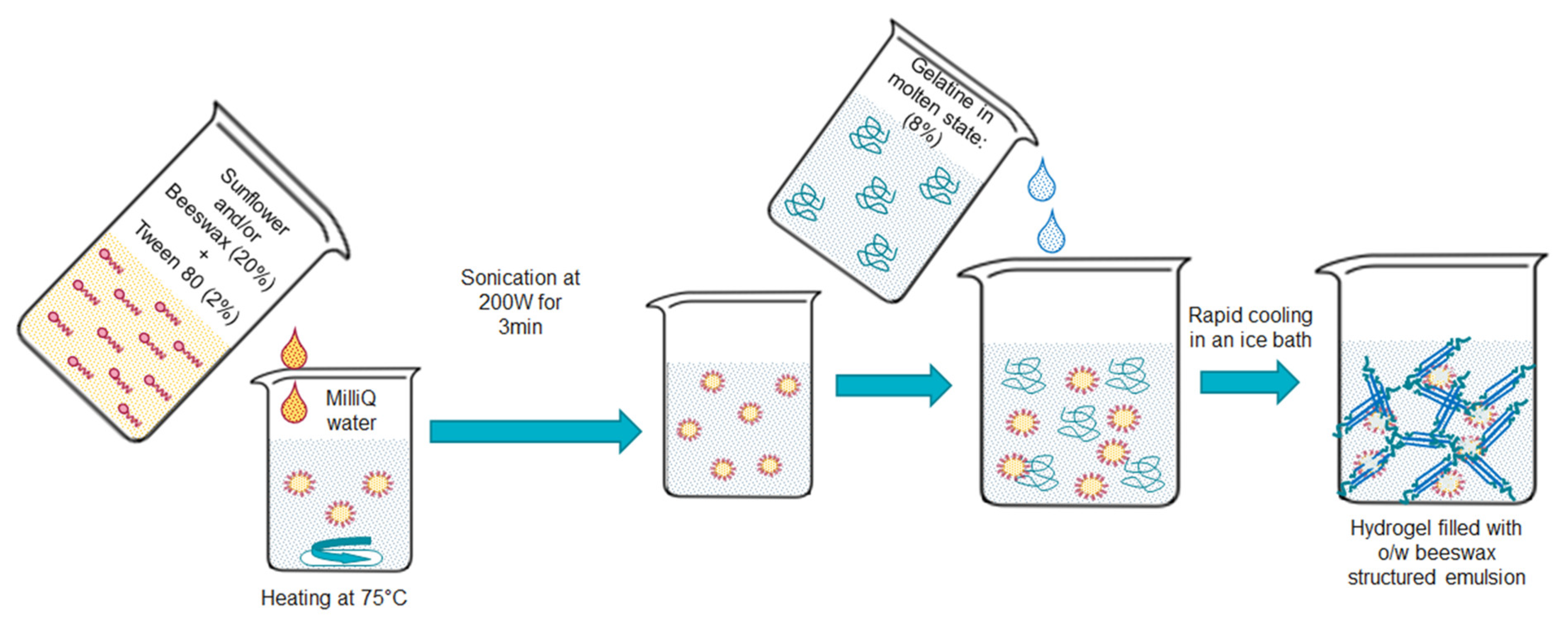
The methodological setup adopted for the preparation of the beeswax structured oil-in-gel emulsions (BOGEs) is illustrated in Figure 1. The lipid base systems comprised beeswax and sunflower oil at varying ratios (i.e., 1:0, 3:1, 1:1, 1:3 and 0:1). The liquified lipid base (at 75°C) was mixed at 1:4 ratio with the surfactant containing aqueous base (Tween 20 in MilliQ water, 75°C) under constant mechanical shearing at 6000 rpm (Turrax, IKA GmbH, Germany) so to obtain a coarse o/w emulsion (20% wt. lipid phase, 2% wt. Tween 20). Ultrasound-assisted homogenisation of the coarse o/w emulsions (at 200W for 3 min, Hielscher Ultrasonics GmbH, Germany) by inserting the sonicator probe in a water jacketed vessel (at 40°C) was carried out. The obtained microemulsions were equally mixed (1:1) with a gelatine stock solution (8% wt.) containing sodium azide (0.04% wt.) as bacteriostatic. Then, the gelatine-based o/w emulsions (10% oil, 4% gelatine) were cooled rapidly using an ice bath and the obtained oil-in-gel emulsions were stored overnight at 4°C until further analysis.
Figure 1.
Illustration of the experimental setup implemented for the preparation of the beeswax structured oil-in-gel emulsions (10% wt. lipid phase, 4% wt. gelatine).
Figure 1.
Illustration of the experimental setup implemented for the preparation of the beeswax structured oil-in-gel emulsions (10% wt. lipid phase, 4% wt. gelatine).
2.3. Lipid Droplet Size Distribution and Colloidal Stability Measurements
For monitoring the colloidal changes in the lipid droplets as influenced by the ultrasonication process, the freshly prepared oil-in-gel emulsions were measured using static laser light scattering (Mastersizer 3000, Malvern Instruments, Worcestershire, UK). All systems were pre-tempered at 40°C for 15 min in a thermomixer (Thermomixer comfort, Eppendorf, USA) to ensure that gelatine was fully molten.
A LUMiSizer (LUM GmbH, Berlin, Germany) was used to compare the colloidal stability of the fresh o/w emulsions as influenced by the sunflower oil to beeswax ratio. Measurements were carried out at 40°C
2.4. Confocal Laser Scanning Microscopy (CLSM) Measurements
A Confocal Laser Scanning Microscopy (CLSM, Carl Zeiss AG, Oberkochen, Germany) was used to visualize the microstructure of the BOGEs. One mL of freshly prepared BOGEs (in the molten state) were mixed with 10μL of Fast green (0.05% wt. in MilliQ water) and 10μL of Nile red (0.1% wt. in acetone), vortexed for 10s and then, 200μL of the fluorophores stained BOGEs were transferred into 8-well Nunc Lab-Tek II chamber slide system (Thermofisher, Asse, Belgium) and allowed to set at ambient temperature (20 ± 2 °C) for 4h prior to the analysis. Fast Green FCF and Nile red were excited at 633 nm and nm respectively and the emitted fluorescence was detected at 635–735 nm and 407–471 nm, respectively.
2.5. Differential Scanning Calorimetry Measurements
The thermophysical behaviour of the BOGEs was determined using a TA Instruments (Discovery 250, New Castle, USA) differential scanning calorimeter (DSC). Aliquots of oil-in-gel emulsions (approx. 30 mg) were weighted into aluminium pans so to allow maximal contact with the pan bottom surface. The pans were hermetically sealed and the following thermal scanning protocol, corresponding to a single heating – cooling event, was implemented: 1) cooling to 5°C at 10°C min−1, 2) isothermal hold at 5°C for 30 min, 3) heating to 80°C at 5°C min−1. The TA Universal Analysis software (TA instruments, New Castle, USA) was used to calculate the onset and midpoint temperatures of the gel−sol transition events. In addition, the melting behaviour of the pure beeswax and sunflower oil, as well as their 1:3, 1:1 and 3:1 binary blends was determined by implementing the following measuring protocol: 1) cooling from 25 to -40°C at 5°C min−1 , 2) isothermal hold at -40°C for 10 min and 3) heating to 100 °C at 5°C min−1.
2.6. Colour Measurements
Five mL of the freshly prepared BOGEs (in the molten state) were transferred into 25 mm plastic Petri dishes and allowed to fully set at 20°C for 4h. Colour measurements were performed in triplicate using a CR-400 Minolta chromameter (Minolta Sarl, Roissy, France). The CIELab colour scale was used to measure the L∗ (black to white), a∗ (red to green), and b∗ (yellow to blue) parameters (You et al., 2025).
2.7. Oscillatory Rheology Characterisation of the Beeswax Oil-In-Gel Emulsions
2.7.1. Oscillatory Thermo-Rheological (OTR) Measurements
For the OTR rheological measurements an aliquot (ca. 0.65 mL) of the freshly prepared BOGEs (in the molten state) was transferred onto a sandblasted plate – plate geometry (SB/25mm, gap = 1mm) at 37°C mounted on a modular compact rheometer (MCR 301, Anton Paar, Graz, Austria) equipped with a solvent trap. A small amount of low viscosity silicon oil was carefully applied on the plate edges to prevent water evaporation. The BOGEs were rapidly heated to 60°C (20°C min-1), held at the same temperature for 2 min and then, a single cooling – heating cycling between 60 and 5°C at the rate of 2°C min−1 was conducted. The viscoelastic moduli (G′ and G″) and damping factor (tanδ) at 1 Hz and 0.5% strain were measured throughout the OTR analysis. The onset and midpoint gelation (Tgel) and melting (Tmel) temperature points were calculated from the obtained OTR spectra using the Rheocompass software (Anton Paar, Graz, Austria).
2.7.2. Small Amplitude Oscillatory (SAOS) Rheological Behaviour
As mentioned above, an aliquot of molten BOGE was deposited on the surface of the sandblasted measuring plate, cooled down rapidly (at 10°C min−1) to 5°C and held isothermally for 30 min to promote the hydrogel formation. The non-linear rheological behaviour of the oil-in-gel emulsions was determined by means of strain amplitude sweep (γ = 0.01 to 1000 %) testing. Frequency sweeps (0.1–100 rad/s) within the LVE regime (strain = 0.1 %) were performed at 25 °C to evaluate the viscoelastic profile of the BOGEs. Time concentration superposition (TCS) master curves were constructed using the Reptate software (Boudara et al., 2020).
2.7.3. Large Amplitude Oscillatory (LAOS) Rheological Behaviour
LAOS analysis was conducted to investigate the nonlinear viscoelastic behaviour of the BOGEs. The meaningful viscoelastic moduli in the non-linear regime, i.e., the tangent modulus at γ = 0, G′M (the stress-strain curve at zero strain) and secant modulus G′L (representing the ratio of the peak stress to peak strain), which reflect the local stiffness at the start of the deformation and the average stiffness across the entire strain amplitude, were measured (Ewoldt et al., 2010). The software VAOS (Aarhus University, Denmark) was used for LAOS data treatments. From VAOS, the elastic and viscous Lissajous-Bowditch curves were extracted to help understand the BOGEs under large deformation (Madsen et al., 2022).
2.8. 3D Printability of the Beeswax Oil-In-Gel Emulsions
3D printing was carried out using a pneumatic extrusion-based bioprinter (BIO X bioprinter, CELLINK AB, Gothenburg, Sweden) fitted with 3 mL cartridges. The prepared bioink was extruded through a 1 mm inner diameter nozzle at a constant pneumatic pressure of 19 kPa. Constructs were fabricated using a grid lattice printing pattern (3 × 3 cm) with an infill density of 25% and a printing speed of 35 mm s⁻¹.
The printed structures were imaged using a digital camera, and the pore geometry was analysed using Fiji/ImageJ software (National Institutes of Health, Bethesda, MD, USA). Printability was quantified using the printability index (Pr) based on the geometrical characteristics of the pores formed within the printed grid described in (Zhang et al., 2025). More specifically, the perimeter (L) and area (A) of each pore were measured, and the printability index was calculated according to: Pr = L2 /16A. A Pr value equal to 1 indicates a perfectly square pore corresponding to ideal printing fidelity, as shown by the reference design, while Pr < 1 indicates rounded pores caused by filament spreading or fusion, and Pr > 1 indicates irregular or distorted pores resulting from poor filament deposition or structural instability. For each construct, 16 pores were analysed, and the average value was calculated. Measurements were performed on three independently printed constructs for each formulation, and the results were expressed as mean ± standard deviation (SD).
2.9. Statistical Analyses
The normality of data distribution was verified by quantile-quantile (Q–Q) plots, and equality of variance was verified by box plots. One-way analysis of variance (ANOVA) coupled with Tukey’s post hoc pairwise comparison test was conducted for lipid droplet mean size, colloidal instability index and instrumental hardness using R software (version 4.5.0; R Core Team, 2024).
3. Results and Discussion
3.1. Microstructural and Physicochemical Characteristics of the BOGEs
Following pre-tempering at ambient temperature the microstructural characteristics of the BOGEs were assessed by means of CLSM as illustrated in Figure 1. As expected, in the absence of the lipid phase, a uniform, continuous phase was obtained with no evidence of phase separation or protein aggregation. The inclusion of the pure SFO lipid phase resulted in a distinct emulsified oil-in-gel microstructure comprising densely packed, yet sparse and loosely connected lipid droplets without marked evidence of partial coalescence. The inclusion of BW in the lipid phase led to an increase in the size of the lipid droplets proportional to the BW mass fraction (φ), which can be ascribed to droplet structuring driven by BW crystallisation. At φ<0.5, the BOGEs maintained the lipid phase dispersity well, although the formation of a continuous intertangled network due to the clustering of the partially crystallised lipid droplets was observed. BOGEs containing equal parts of SFO and BW exhibited a transitional morphology from an emulsion-filled to a bigel-like structure ascribed to the formation of early-percolated lipid droplet networks stabilised by the fusion of the liquid and solid lipid phases. A further increase in the BW mass fraction, intensified the biphasic structure of the BOGEs as the percolated crystalline lipid phase became tightly packed and immobilised within the continuous gelatine phase.
In order to assess the impact of the initial lipid droplets i.e., prior to the cold setting of the gelatine, the lipid droplet mean size of the molten BOGEs were analysed employing static light scattering (Figure 2). Except for the exclusively BW-based counterpart, all BOGEs exhibited a clear monomodal distribution confirming the effectiveness of the sonication-assisted emulsification process in obtained uniform o/w emulsions of low polydispersity (Figure 2A). On the other hand, the BOGE containing only BW, exhibited a predominant monomodal lipid droplet size distribution with two minor shoulders at approximately 2 and 10μm. Nonetheless, the differences in the d4,3 of the BOGEs lipid phase were not significant ranging from 795 to 933 nm (Figure 2B). Our findings are keeping with the observations of (Arredondo-Ochoa et al., 2017) reporting on BW nanoemulsions produced through ultrasonication and employing different surfactants such as Tween 80, stearic acid and Span 60 (111 to 1054 nm). Nonetheless, it should be noted that the presence of thickening or gelling hydrocolloids in the continuous aqueous phase such as κ-carrageenan, starch, gelatine, xanthan, guar gum etc. may sterically hinder the dispersibility of the lipid phase (Giannakaki et al., 2025; Hernández-Nolasco et al., 2025; Zhou et al., 2024). In the present study, the sonication process was conducted at temperature well-past the melting point of pure BW, allowing effective cavitation-mediated dispersibility due to the low viscosity of the internal phase. Owing to its high HLB value (» 16.7), Tween 20 can rapidly adsorb to the newly form interfaces providing steric stabilisation via its long polyoxyethelene chains promoting a solvated-to-solid transition of the lipid droplets at the lowest degree of partial coalescence during the cooling step prior to mixing with the gelatine solution at 40°C.
The LUMisizer light transmission spectra, depicting the creaming behaviour of the BOGEs under accelerated storage conditions at 40°C, to prevent gelatine setting, are illustrated in Figure 3. The inclusion of BW resulted in a proportionate to the SFO:BW mass fraction enhancement of the resistance of the BOGEs against creaming. The diminishment of the creaming can be primarily ascribed to the organogelation of the lipid phase allowing the immobilisation of the easily deformable SFO lipid droplets within the BW crystalline lattices. Under the inertial shear forces (centrifugation) the wax crystal present in the radial or tangent direction on the surface of the partially crystalline lipid droplets protrude the interfacial film of the adjacent lipid droplets facilitating partial coalescence due to orthokinetic aggregation (Goff, 1997) particularly at low to intermediate BW concentrations. Bridging of the partially solidified lipid droplets into a three-dimensional network creates a steric barrier against the flow of the lipid droplets to the top. In addition, the increase in the solid fat content upon elevation of the BW content results in the increase of total density of the lipid phase minimising the density difference Δρ = ρs - ρf in the Stoke’s low, reducing therefore, the creaming velocity vt.
The impact of the BW inclusion on the colour characteristics of the BOGEs is displayed in Table 5. Overall, increasing the BW mass fraction resulted in higher lightness (L*), yellowness (b*), and chroma (C*) values, while the greenness coordinate (-a*) was reduced. Our findings are consistent with those of (Woszczak et al., 2025) who reported a decrease in -a* and C* values and increase in the b*, while L* was ranged between 95.2 and 98.3. The small, yet consistent, decrease in the a* coordinate could be attributed to the presence of residual beeswax chlorophylls as well as pollen and propolis originating contaminants. Chlorophylls A and B at concentrations in the range of 0.8 to 2.1 μg/g for beeswax, 15 to 47 μg/g for pollen and 0.6 to 57 μg/g for propolis depending on their phenotype (yellowish-white, brown and dark) and botanical origin (citrus, clover or cotton) have been reported (Owayss et al., 2004). On the other hand, the prominent the increase in the b* coordinate is most probably associated with the elevation of yellow-orange pigments naturally occurring in unrefined beeswax such as carotenoids, propolis and pollen (Owayss et al., 2004; Svečnjak et al., 2019). The ΔΕ* values ranging from 2.09 to 4.66 indicate that the inclusion of BW resulted in perceptible by the human eye colour changes (2<ΔΕ*<5) (MacDougall, 2010).
3.2. Thermophysical and Oscillatory Thermo-Rheological Behaviour of the BOGEs
The individual SFO and BW as well as their 1:3, 1:1 and 3:1 binary blends were characterised by DSC as displayed in Figure 4A and Table 1. As expected, the SFO thermogram indicated a broad endothermic event (Tm,onset = -35.6°C, Tm, offset = -6.1°C) without any additional phase transitions at the above zero region. This in keeping with the observations of (van Wetten et al., 2015) reporting a Tm,onset ranging from -40.7 to -38.5°C for several commercial types of SFO. Owing to the unrefined character of the BW used in the present study, a prominent broad endothermic event at Tm,onset = 23°C Tm, offset = 61.2°C was observed, which is in agreement with previous studies (Miłek et al., 2020). The inclusion of 25% of BW in the SFO lipid based resulted in two endothermic events, a weak subzero temperature (Tm,onset = -35.6°C, Tm, midpoint = -6.1°C) and a second high temperature melting event associated with the presence of BW (Tm,onset = 39.8°C, Tm, midpoint = 57.4°C). In a agreement with the observations of (M. Pang et al., 2020) on beeswax - vegetable oil-based organogels, further inclusion of BW resulted in a proportional to the BW concentration elevation of the BW solid phase fusion temperature and enthalpy (Table 1). Notably, exceeding 75% of BW solid matter resulted in the diminishing of the subzero melting event.
The DSC thermograms of the BOGEs are illustrated in Figure 4B. In keeping with the literature, the individual gelatine-based hydrogels exhibited a single melting event at Tm,onset = 31.3° C (Table 2). Although the inclusion of the SFO lipid phase did not modify significantly the endothermic pattern associated with the of the hydrogel (Tm,onset, = 32.0°C), the reduction in the gelatine hydrogel fusion enthalpy (from 1.39 to 0.90 J g-1) is indicative of the reinforcement of the amorphous-like character of the lipid phase filled gelatine hydrogels (Kamlow et al., 2021; Xiao et al., 2016). It is postulated that SFO lipid droplets due to their very low crystallinity and their high dispersibility in the continuous gelatine-rich aqueous region tend to diminish the protein – protein intermolecular cooperativity. The incorporation of BW was accompanied by a progressive reduction in recorded enthalpy values leading to an almost diminishment of the gelatine hydrogel associated fusion event (ΔH = 0.58-0.19 J g-1) (Table 2), suggesting that the formed wax crystal lattices have a governing role over the supramolecular and interchain molecular interactions of gelatine helices (Li et al., 2025).

Table 2.
Melting points and fusion enthalpies of the BOGEs as influenced by the BW to SFO mass fraction determined by DSC.
Table 2.
Melting points and fusion enthalpies of the BOGEs as influenced by the BW to SFO mass fraction determined by DSC.
| Gelatine | Beeswax solid fraction | |||||
|---|---|---|---|---|---|---|
| Sample | Tm, onset | Tm, midpoint | ΔH | Tm, onset | Tm, midpoint | ΔH |
| Gelatine | 31.3a | 35.4a | 1.39d | nd | nd | nd |
| SFO1:0BW | 32.0a | 35.9a | 0.90c | nd | nd | nd |
| SFO3:1BW | 31.8a | 35.9a | 0.58b | 46.6a | 56.8a | 1.59a |
| SFO1:1BW | 32.9a | 37.7b | 0.52b | 48.7ab | 59.8a | 3.25b |
| SFO1:3BW | 31.5a | 35.8a | 0.48b | 51.3b | 61.6ab | 6.24c |
| SFO0:1BW | 33.1a | 35.8a | 0.19a | 51.7b | 62.7b | 13.8d |
a-d Different letter among the rows of each column indicates significant differences (p<0.05) according to Tukey’s post hoc means comparison test.
Table 3.
Impact of the BW to SFO mass fraction on the BOGEs melting event as determined by the oscillatory thermo-rheological viscoelastic spectra.
Table 3.
Impact of the BW to SFO mass fraction on the BOGEs melting event as determined by the oscillatory thermo-rheological viscoelastic spectra.
| Sample | Onset | Tm (mid) | Offset |
|---|---|---|---|
| SFO1:0BW | 16.21b | 23.05c | 29.89b |
| SFO3:1BW | 14.62a | 21.87a | 29.11b |
| SFO1:1BW | 14.89a | 21.63a | 28.37a |
| SFO1:3BW | 15.33a | 22.40b | 29.47b |
| SFO0:1BW | 15.12a | 22.10ab | 29.09b |
a,b Different letter among the rows of each column indicates significant differences (p<0.05) according to Tukey’s post hoc means comparison test.
Table 4.
Viscoelastic properties (strain sweeps with controlled shear deformation at 1 Hz) of the BOGEs tempered at 5°C for 1h.
Table 4.
Viscoelastic properties (strain sweeps with controlled shear deformation at 1 Hz) of the BOGEs tempered at 5°C for 1h.
| Sample | γLVE (%) |
G’LVE (Pa) |
τf (Pa) |
γf (%) |
|---|---|---|---|---|
| GELATINE | 5.78d | 1330a | 1662d | 205a |
| SFO1:0BW | 0.191a | 1476b | 1448a | 286b |
| SFO3:1BW | 0.565b | 2524d | 1526b | 304c |
| SFO1:1BW | 1.74c | 2519d | 1587c | 321cd |
| SFO1:3BW | 15.5e | 2281c | 1679d | 332d |
| SFO0:1BW | 11.4e | 2867e | 1596c | 318cd |
a-e Different letter among the rows of each column indicates significant differences (p<0.05) according to Tukey’s post hoc means comparison test.
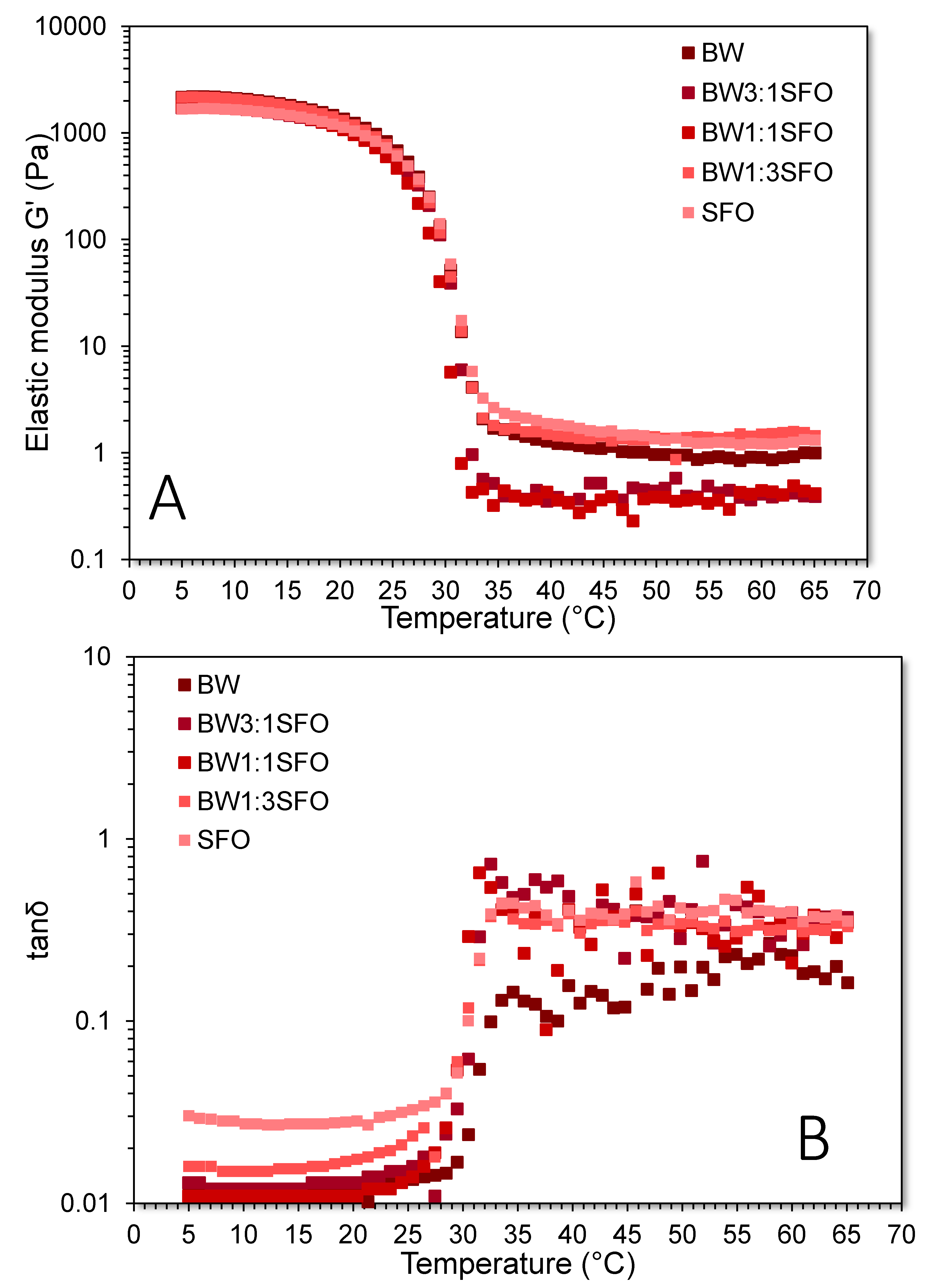
The oscillatory thermo-rheological (OTR) spectra of the BOGEs upon heating are illustrated in Figure 5. Contrary to the DSC findings, the OTR spectra justified the presence of a single major melting event for all systems starting at 23 to 25.2°C and being completed at 33.1 to 35.4°C. That confirms that the viscoelastic response of the BOGEs to temperature changes is governed by the three-dimensional network formed via the gelatine helices interchain junction zones bridging and at lesser degree by the crystallisation of the lipid droplet fillers. Nonetheless, minor differences in the onset and offset of the BOGEs fusion temperature points were observed, with the SFO-BW (1:1) and SFO hydrogel systems to exhibit the earliest and latest establishment of heat-induced structural collapse, respectively.
Figure 5.
DSC melting profiles of the pure lipid base (A) and the obtained beeswax structured oil-in-gel emulsions (10% wt. lipid phase, 4% wt. gelatine) (B).
Figure 5.
DSC melting profiles of the pure lipid base (A) and the obtained beeswax structured oil-in-gel emulsions (10% wt. lipid phase, 4% wt. gelatine) (B).
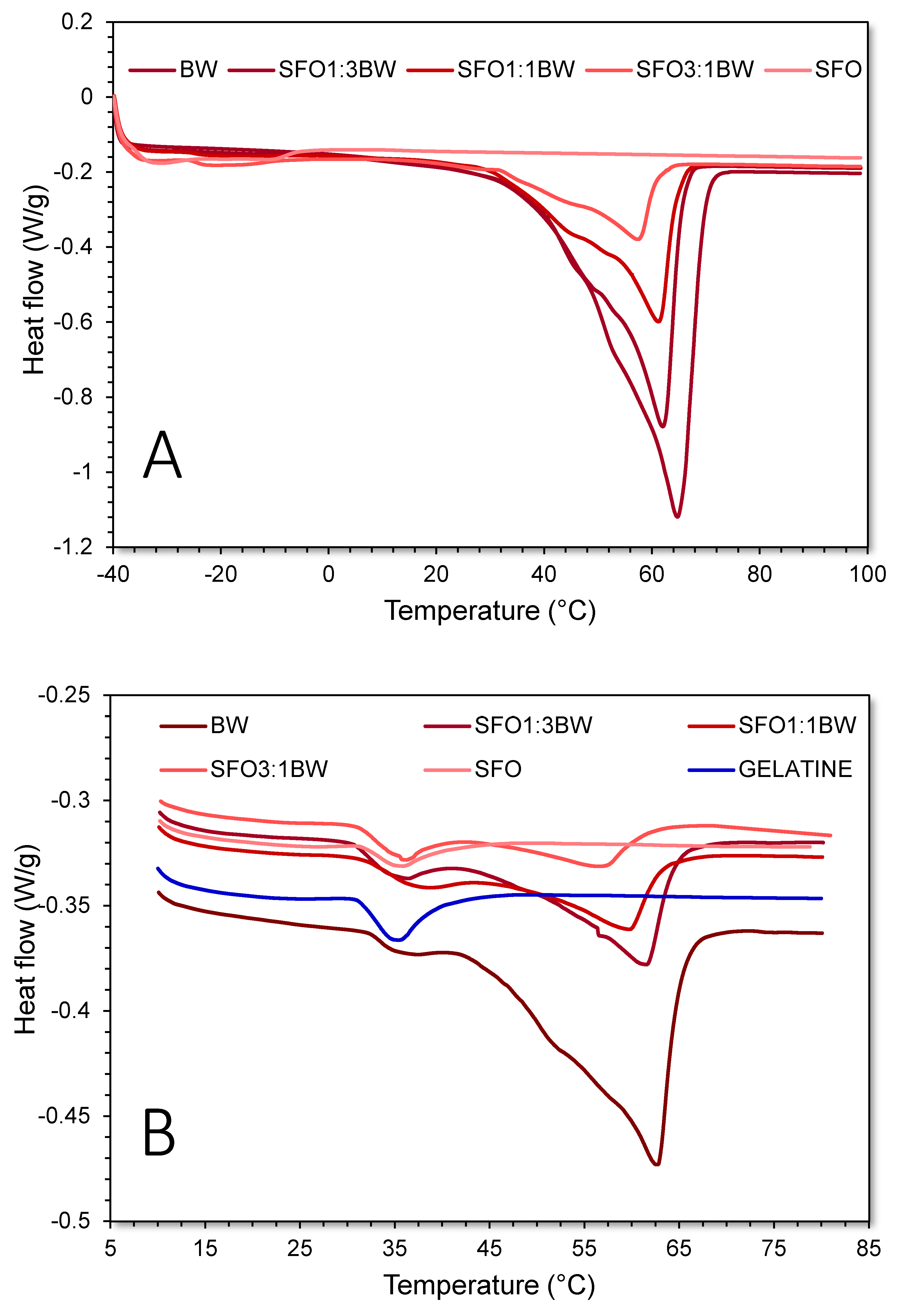
Figure 6.
Oscillatory thermo-rheological (OTR) spectra (heating ramp, heating rate: 1°C min-1) of the beeswax structured oil-in-gel emulsions (10% wt. lipid phase, 4% wt. gelatine). .
Figure 6.
Oscillatory thermo-rheological (OTR) spectra (heating ramp, heating rate: 1°C min-1) of the beeswax structured oil-in-gel emulsions (10% wt. lipid phase, 4% wt. gelatine). .
3.3. Viscoelastic Characterisation of the BOGEs
Small amplitude oscillatory shear (SAOS) tests were performed to assess the molecular organisation of the BOGEs networks. As illustrated in Figure 7A, all systems exhibited a solid-dominant behaviour (G’>G”) with the elastic modulus achieved its maximum in the cases of individually wax structured emulsion gels. The upwards increase in the G’ at low frequencies is a common behaviour for materials undergoing time-dependent non-covalent intermolecular interactions resulting to the reinforcement of the structural organisation of the hydrogel three-dimensional network (Grossi et al., 2024; Yang et al., 2016). Notably, the damping factor (tanδ) was minimised at 25% of BW postulating that the wax crystal lattices were optimally integrated into the gel matrix, maximizing the active filler effect without disrupting the gelatine hydrogel matrix continuity. Further increase in the BW content resulted in a progressive increase in the damping factor indicating an increase in the viscous component likely due to the internal friction between the many wax particles or a change in the BOGEs microstructure. Time concentration (φ) superposition of the viscoelastic (G’, G”) spectra (Figure 7B) resulted in a linear dependence of logac to φ for both G’ and G” suggesting an exponential reinforcement of the BOGEs viscoelasticity upon BW inclusion. The opposite trends for G’ and G” indicate that increasing the BW to SFO mass fraction resulted in an increasing stiffening effect followed by a suppression of molecular mobility and viscous flow as the liquid oil phase becomes increasingly immobilized within the solid lipid matrix.
To testify the BW active filler contribution to the elastic modulus of the BOGEs was initially assessed by employing the van der Poel model (Sala et al., 2009). However, the obtained fitting was not satisfactory most likely due to the percolation of the partially crystallized lipid droplets as justified in the CLSM micrographs. To tackle this, the relative elastic modulus G'r data (G'r = G'composite/G'gelatine) were fitted against the amount of solid lipid phase mass fraction Φ, as quantified by the DSC measurements employing a semi-empirical modified Avrami-percolation model as follows:
In the adapted Avrami model segment, signifies the elastic modulus of the non-filled gelatine hydrogel, n is the Avrami exponent associated with the dimensionality and the mechanism of nucleation, k is the Avrami coefficient and denotes a system-specific rate constant that depends on both the nucleation rate and the growth rate of the crystalline phase. To capture the structural changes due to the interconnection of the wax crystals, the percolation power law model describing the dependence of elastic modulus G’ of a fat crystal network on the solid fat content (Narine & Marangoni, 1999) was used:
It is well-established that the Avrami model is used to describe the changes in the volume of fat crystals as function of the crystallisation process time (Marangoni, 1998). Here a phenomenological modification of the Avrami model to describe the changes in the relative elastic modulus G’r as function of the amount of solidified fat (Φ) was created in order to catch the impact of the smectic transformation of the lipid phase in the presence of BW on the viscoelasticity of the emulsion gels. The G’c represents the packing effect of the semi-solid lipid droplets before they start to form the continuous fat network. Above the SFC threshold (Φc) the nature of the lipid phase active filler changes from discrete droplets to an interconnected beeswax skeleton that effectively bridges the gaps between the gelatine strands.
As illustrated in Figure 8, the structural evolution and mechanical reinforcement of the gelatine-based emulsion gels were successfully captured by the introduced phenomenological model (Eq.1), which provided an excellent fit to the experimental data (R2 = 0.991) identifying a critical transition at Φc = 0.294 corresponding to φ » 0.558, consistent with the CLSM micrographs. Below this threshold, the relative modulus G’ followed an Avrami-like growth model (R2 = 0.940), where the reinforcement is driven by the development of discrete beeswax crystal clusters within the sunflower oil droplets. The calculated Avrami exponent (n = 1.39) suggests that the beeswax crystals primarily grow as high-aspect-ratio needles or thin platelets (Shirzad & Viney, 2023). Our findings are in keeping with the work of (Ramel & Marangoni, 2016) demonstrated that in milkfat systems containing high melting point fractions, lower Avrami exponents were obtained compared to mid or low melting exemplars indicative of the formation of rod- or needle-like crystals. In this regime, the solid fat acts as a non-interacting filler, providing moderate reinforcement to the gelatine matrix through hydrodynamic effects and local crowding as the wax concentration increases toward the critical limit.
Upon exceeding the Φc, the system entered a percolation-governed regime (R2 = 0.981), signalling the formation of a continuous beeswax skeleton that bridges the gaps between the gelatine-stabilized droplets. The determined critical exponent (m = 0.57) is notably lower than the theoretical values for rigid particle networks (m > 1.8-2), which indicates a "soft" or integrated percolation behaviour (Chai et al., 2019). This suggests that the beeswax network does not exist as a brittle, independent phase but is instead highly integrated with the gelatine strands, forming a cooperative hybrid structure. The BW fractals dimension was estimated to D = d-m-1 = 3-(0.57)-1 » 1.25, which indicates the formation of needle-like crystal lattices. Hereby, the estimated fat fractals dimension D was very close to the ones reported by (Jana & Martini, 2016) in soybean oil blends with beeswax and sunflower wax (D » 1.2 to 1.3) and comparable to that of peanut oil – rice bran, candelilla and sunflower wax binary blends, i.e., D » 1.3 to 1.8 (Blake & Marangoni, 2015).
To further investigate the viscoelastic response of the BOGEs to large deformation, the emulsion gels were subject to LAOS test characterisation as illustrated in Figure 9. As given in Table 5, the shear strain offset of the LVE regime (γLVE) for the individual gelatine hydrogels was estimated at 5.8% whilst in the presence of the lipid phase the γLVE increased proportionally to the BW content from 0.19 to 15.5%. Exceeding the γLVE and for γ values up to 10-20% the viscous modulus experienced either minor changes (φ = 0-0.5) or a progressive reduction (φ=0.75-1). The latter is mainly attributed to the disruption of the weak viscous dissipative structural elements within the continuous hydrogel structure such as the junction zones of the percolated partial crystalline lipid droplet network. As well illustrated in Figure 9, an overshoot in the G” values of all systems (including the individual gelatine ones) in the range of 50-100% associated with a monotonic decrease in G’ values indicating a type III nonlinear response, which is characteristic of structured soft materials undergoing progressive disruption of weak interparticle or droplet interactions (Hyun et al., 2011). It should be noted that although the G” overshoot peak was detected at 101% in all cases, its onset was shifted to higher shear strains at φ>0.5. Thus, it can be postulated that the yield region, identified by the onset of the G” overshoot and the decline in G’ shifted with φ indicates that lipid phase composition affected not only the BOGEs stiffness but also the resistance to deformation (Mezger, 2020). A shift of the overshoot toward higher strain (φ>0.5) suggests improved structural integrity and delayed yielding, whereas a shift toward lower strain (φ ≤ 0.5) is related with a stiffer but more brittle network due to stress concentration around crystalline droplet domains.
Table 5.
Colour characteristics of the BOGEs as influenced by the BW to SFO mass fraction.
| Sample | L | a* | b* | C* | ΔΕ* |
|---|---|---|---|---|---|
| SFO1:0BW | 86.93a | −0.40a | 0.96a | 1.04a | - |
| SFO3:1BW | 88.99b | −0.73b | 0.84a | 1.11a | 2.09a |
| SFO1:1BW | 89.65bc | −1.05c | 2.04b | 2.30b | 3.00b |
| SFO1:3BW | 89.99c | −1.29c | 3.09c | 3.35c | 3.83c |
| SFO0:1BW | 90.21c | −1.47d | 4.09d | 4.35d | 4.66d |
a-d Different letter among the rows of each column indicates significant differences (p<0.05) according to Tukey’s post hoc means comparison test.
In Figure 10 the Lissajous-Bowditch curves for the BOGEs illustrate the relationship between shear stress and strain or strain rate amplitude, as influenced by the lipid phase composition. Beyond the boundary of the linear viscoelastic region and for shear strains below 63.4%, all systems exhibited a balanced viscoelastic behaviour as depicted by the elliptical shape of the elastic and viscous Lissajous curves. Notably, no significant differences in the hysteresis loop of the viscous Lissajous curves of the BOGEs as function of the BW to SFO mass fraction were observed, assuming a comparable viscous dissipation capacity. Exiting the MAOS regime (i.e., strains above 63.4%) evident changes in the symmetry of the elastic and viscous Lissajous curves were observed confirming the onset of irreversible internal structure conformational changes (Musollini et al., 2026). For pure gelatine hydrogels, the structure rearrangement stems primarily from rupture of the the triple helical backbones junction zones. On the contrary, the emulsion filled gelatine hydrogels display stronger loop distortion and larger viscous dissipation at increasing strain amplitudes suggesting a more complex nonlinear viscoelastic behaviour. The increased heterogeneity of the BOGEs as confirmed by the earlier distortion of the Lissajous curves is attributed to the introduction of additional nonlinear viscoelasticity mechanisms, including the deformation of the individual lipid droplets, the interfacial friction of flocculated droplets and the disruption of the bridging zones between the partially crystallised droplet clusters.
3.4. Instrumental Hardness
The firmness values of the BOGEs as influenced by the SFO to BW content are displayed in Figure 11. In the absence of the lipid phase, the firmness of the pure gelatine hydrogels was estimated at 480 mN, which is within the literature reported values (Z. Pang et al., 2014). The inclusion of individual SFO resulted in a substantial decrease in the firmness of the BOGEs, which is suggestive of the non-active filler contribution of the SFO, which in keeping with the observations of (Sala et al., 2009) on gelatine filled with either bound or unbound MCT oil. Although BW inclusion induced a proportional to its mass fraction increase in the firmness of the BOGEs, a clear active filler effect was observed at φ³0.5. This suggests that the percolation of partially crystallized lipid droplets is the driving force of the mechanical strength of the BOGEs in agreement with the observations in section 3.3.
3.5 3D Printability of the Beeswax Oil-In-Gel Emulsions
The designed grid geometry was used as a reference to evaluate the printability and structural fidelity of the beeswax structured oil-in-gel emulsions. As shown in Figure 12, clear formulation-dependent differences were observed in strand continuity, pore regularity, and shape retention. The construct based on SFO3:1BW formulation, exhibited the highest printing fidelity, closely reproducing the reference design with well-defined grid architecture and uniform strand thickness. The SFO1:1BW formulation showed the second-best performance, maintaining overall grid integrity but with minor deviations in strand definition. In contrast, the beeswax-only formulation (SFO0:1BW) displayed the poorest printing fidelity, characterized by pronounced deformation and loss of grid structure. These observations are consistent with the quantitative comparison of the Printability Index (Pr) for each emulsion. A Pr value close to 1 indicates a perfectly square pore corresponding to ideal printing fidelity, as observed in the reference design. The SFO3:1BW formulation exhibited the highest Pr value (0.942 ± 0.016), whereas the lowest value was recorded for SFO0:1BW (0.864 ± 0.474) (Figure 12). These printability trends align with the viscosity results (Figure 13), where SFO3:1BW and SFO1:1BW formulations exhibited higher and more stable apparent viscosity under the nozzle simulating shear rate conditions ( s-1), thereby supporting improved shape retention during extrusion-based 3D printing.
4. Conclusions
This work demonstrated that incorporating beeswax-structured oil-in-water emulsions into thermo-reversible gelatine hydrogels enables the rational design of multiphase food inks with tuneable structural and functional properties. Beeswax acted as an effective structuring agent, promoting partial crystallisation of lipid droplets and their percolation into reinforcing networks, which significantly enhanced viscoelasticity, mechanical strength, and resistance to deformation. The transition from emulsion-filled gels to bigel-like systems was governed by the solid fat content, with a critical threshold beyond which droplet clustering and network formation dominated the mechanical response. Despite changes in melting enthalpy, the thermo-reversible behaviour remained primarily controlled by the gelatine matrix. Importantly, formulations with intermediate beeswax content achieved an optimal balance between stiffness and flowability, resulting in superior printability and shape fidelity. These findings provide new insights into formulation–structure–function relationships in hybrid gel systems and highlight the potential of beeswax-based structuring strategies for developing clean-label, customizable materials for 3D food printing and advanced food design.
CRediT AUTHOR STATEMENT
Xuan Xu: Conceptualisation, Investigation, Formal analysis, Writing-Review-Editing,
Bella Tsachidou: Investigation, Formal analysis, Writing-Review-Editing,
Jennyfer Fortuin: Investigation, Formal analysis, Writing-Review-Editing
Lingxin You: Investigation, Formal analysis, Writing-Review-Editing
Davide Odelli: Investigation, Formal analysis, Writing-Review-Editing
Christos Soukoulis: Conceptualisation, Investigation, Formal analysis, Writing-Review-Editing, Project administration
DECLARATION OF GENERATIVE AI AND AI-ASSISTED TECHNOLOGIES IN THE MANUSCRIPT PREPARATION PROCESS
During the preparation of this work the authors used ChatGPT in order to improve the readability and language of the manuscript. After using this tool/service, the authors reviewed and edited the content as needed and take full responsibility for the content of the published article.
References
- Arredondo-Ochoa, T.; García-Almendárez, B. E.; Escamilla-García, M.; Martín-Belloso, O.; Rossi-Márquez, G.; Medina-Torres, L.; Regalado-González, C. Physicochemical and Antimicrobial Characterization of Beeswax–Starch Food-Grade Nanoemulsions Incorporating Natural Antimicrobials. International Journal of Molecular Sciences 2017, 18(12), 2712. [Google Scholar] [CrossRef]
- Blake, A. I.; Marangoni, A. G. The Effect of Shear on the Microstructure and Oil Binding Capacity of Wax Crystal Networks. Food Biophysics 2015, 10(4), 403–415. [Google Scholar] [CrossRef]
- Blake, A. I.; Toro-Vasquez, J.; Hwang, H. S. (2018). Wax Oleogels. In Edible Oleogels (pp. 133–171). AOCS Press. [CrossRef]
- Boudara, V. A. H.; Read, D. J.; Ramírez, J. reptate rheology software: Toolkit for the analysis of theories and experiments. Journal of Rheology 2020, 64(3), 709–722. [Google Scholar] [CrossRef]
- Chai, X.; Meng, Z.; Liu, C.; Liu, Y. Structural and mechanical behavior of colloidal fat crystal networks of fully hydrogenated lauric acid-rich fats and rapeseed oils mixtures. Food Chemistry 2019, 288, 108–116. [Google Scholar] [CrossRef]
- Ewoldt, R. H.; Winter, P.; Maxey, J.; McKinley, G. H. Large amplitude oscillatory shear of pseudoplastic and elastoviscoplastic materials. Rheologica Acta 2010, 49(2), 191–212. [Google Scholar] [CrossRef]
- Fan, Z.; Cheng, P.; Zhang, P.; Zhang, G.; Han, J. Rheological insight of polysaccharide/protein based hydrogels in recent food and biomedical fields: A review. International Journal of Biological Macromolecules 2022, 222, 1642–1664. [Google Scholar] [CrossRef] [PubMed]
- de Farias, B. S.; da Cunha, L. B.; Christ Ribeiro, A.; Jaeschke, D. P.; Gonçalves, J. O.; Fernandes, S. S.; Cadaval, T. R. S.; Pinto, L. A. de A. Designing Emulsion Gels for 3D Food Printing: Structure, Stability, and Functional Applications. Surfaces 2025, 8(3), 64. [Google Scholar] [CrossRef]
- Giannakaki, F.; Dimakopoulou-Papazoglou, D.; Zampouni, K.; Moschakis, T.; Katsanidis, E. Design and characterization of bigels composed of agar, κ-carrageenan, candelilla wax, and monoglycerides. International Journal of Biological Macromolecules 2025, 308, 142422. [Google Scholar] [CrossRef] [PubMed]
- Goff, H. D. Instability and Partial Coalescence in Whippable Dairy Emulsions. Journal of Dairy Science 1997, 80(10), 2620–2630. [Google Scholar] [CrossRef]
- Grossi, M.; Fang, B.; Rao, J.; Chen, B. Discovering novel cryo-oleofoams with excellent overrun: Synergistic effect between zein and monoglyceride at interface. Food Hydrocolloids 2024, 150, 109690. [Google Scholar] [CrossRef]
- Guo, Y.; Ma, C.; Xu, Y.; Du, L.; Yang, X. Food Gels Based on Polysaccharide and Protein: Preparation, Formation Mechanisms, and Delivery of Bioactive Substances. Gels 2024, 10(11), 735. [Google Scholar] [CrossRef]
- Hernández-Nolasco, Z.; Acateca-Hernández, M. I.; Rojas-López, M.; Ríos-Corripio, M. A.; Hidalgo-Contreras, J. V.; Hernández-Cázares, A. S. Structural and functional properties of beeswax–taro starch-based bigels: Effect of the oleogel:hydrogel ratio. Food Science and Biotechnology 2025, 34(13), 3099–3108. [Google Scholar] [CrossRef]
- Hyun, K.; Wilhelm, M.; Klein, C. O.; Cho, K. S.; Nam, J. G.; Ahn, K. H.; Lee, S. J.; Ewoldt, R. H.; McKinley, G. H. A review of nonlinear oscillatory shear tests: Analysis and application of large amplitude oscillatory shear (LAOS). Progress in Polymer Science 2011, 36(12), 1697–1753. [Google Scholar] [CrossRef]
- Jana, S.; Martini, S. Physical characterization of crystalline networks formed by binary blends of waxes in soybean oil. Food Research International 2016, 89, 245–253. [Google Scholar] [CrossRef] [PubMed]
- Kamlow, M.-A.; Spyropoulos, F.; Mills, T. 3D printing of kappa-carrageenan emulsion gels. Food Hydrocolloids for Health 2021, 1, 100044. [Google Scholar] [CrossRef]
- Li, B.; Zhou, M.; Qin, H.; Wu, A.; Li, J.; Wang, Y.; Hu, Z. Impact of gelatin/K-carrageenan ratio in the properties of bigels for food applications. Food and Bioproducts Processing 2025, 153, 315–321. [Google Scholar] [CrossRef]
- Lu, Y.; Zhang, Y.; Zhang, R.; Gao, Y.; Miao, S.; Mao, L. Different interfaces for stabilizing liquid–liquid, liquid–gel and gel–gel emulsions: Design, comparison, and challenges. Food Research International 2024, 187, 114435. [Google Scholar] [CrossRef]
- MacDougall, D. B. (2010). Colour measurement of food: Principles and practice. In Colour Measurement (pp. 312–342). Woodhead Publishing. [CrossRef]
- Madsen, J.; Sode, L.; Dahl, J. F.; Corredig, M.; Schulz, H.-J. (2022). Visual Exploration of Rheological Test Results from Soft Materials. Proceedings of the First International Workshop on Visualization in Testing of Hardware, Software, and Manufacturing (TestVis’22), 1–7. [CrossRef]
- Marangoni, A. G. On the use and misuse of the avrami equation in characterization of the kinetics of fat crystallization. Journal of the American Oil Chemists’ Society 1998, 75(10), 1465–1467. [Google Scholar] [CrossRef]
- Mezger, T. (2020). In For users of rotational and oscillatory rheometers. Vincentz Network. [CrossRef]
- Miłek, M.; Drogoń, A.; Pyda, M.; Czerniecka-Kubicka, A.; Tomczyk, M.; Dżugan, M. The use of infrared spectroscopy and thermal analysis for the quick detection of adulterated beeswax. Journal of Apicultural Research 2020, 59(4), 677–684. [Google Scholar] [CrossRef]
- Musollini, S.; Soukoulis, C.; Tolve, R.; You, L.; Zanoni, M.; Aprea, E.; Gasperi, F.; Favati, F. Viscoelastic characterisation of high protein ice cream: Predicting tactile sensory properties via time–concentration superposition and large amplitude oscillatory shear (LAOS) rheology. Food Hydrocolloids 2026, 172, 112028. [Google Scholar] [CrossRef]
- Narine, S. S.; Marangoni, A. G. Mechanical and structural model of fractal networks of fat crystals at low deformations. Physical Review E 1999, 60(6), 6991–7000. [Google Scholar] [CrossRef] [PubMed]
- Owayss, A. A.; Rady, M. M.; Gadallah, F. M. Pigmentation of Some Honeybee (Apis mellifera L.) Products. Fayoum Journal of Agricultural Research & Development 2004, 18(2), 121–132. [Google Scholar]
- Pang, M.; Shi, Z.; Lei, Z.; Ge, Y.; Jiang, S.; Cao, L. Structure and thermal properties of beeswax-based oleogels with different types of vegetable oil. Grasas y Aceites 2020, 71(4), e380–e380. [Google Scholar] [CrossRef]
- Pang, M.; Xu, L.; Ge, Y.; Cheng, J.; Zhang, Z.; Cao, L. Fabrication of beeswax/plant sterol ester-gelatin/whey protein isolate bigels with dual gelation effects as substitutes for traditional solid fats. Food Hydrocolloids 2024, 157, 110458. [Google Scholar] [CrossRef]
- Pang, Z.; Deeth, H.; Sopade, P.; Sharma, R.; Bansal, N. Rheology, texture and microstructure of gelatin gels with and without milk proteins. Food Hydrocolloids 2014, 35, 484–493. [Google Scholar] [CrossRef]
- Parker, N. G.; Povey, M. J. W. Ultrasonic study of the gelation of gelatin: Phase diagram, hysteresis and kinetics. Food Hydrocolloids 2012, 26(1), 99–107. [Google Scholar] [CrossRef]
- Penagos, I. A.; Murillo Moreno, J. S.; Dewettinck, K.; Van Bockstaele, F. Carnauba Wax and Beeswax as Structuring Agents for Water-in-Oleogel Emulsions without Added Emulsifiers. Foods 2023, 12(9), 1850. [Google Scholar] [CrossRef]
- Qiu, R.; Qiu, G.; Zhao, P.; Awais, M.; Fan, B.; Huang, Y.; Tong, L.; Wang, L.; Liu, L.; Wang, F. Regulation of rheological properties of soy protein isolate-beeswax based bigel inks for high-precision 3D printing. Food Hydrocolloids 2024, 153, 110052. [Google Scholar] [CrossRef]
- Ramel, P. R.; Marangoni, A. G. Engineering the microstructure of milk fat by blending binary and ternary mixtures of its fractions. RSC Advances 2016, 6(47), 41189–41194. [Google Scholar] [CrossRef]
- Sala, G.; van Vliet, T.; Cohen Stuart, M. A.; van Aken, G. A.; van de Velde, F. Deformation and fracture of emulsion-filled gels: Effect of oil content and deformation speed. Food Hydrocolloids 2009, 23(5), 1381–1393. [Google Scholar] [CrossRef]
- Shirzad, K.; Viney, C. A critical review on applications of the Avrami equation beyond materials science. Journal of The Royal Society Interface 2023, 20(203), 20230242. [Google Scholar] [CrossRef]
- Shu, J.; McClements, D. J.; Luo, S.; Liu, C.; Ye, J. Advances of biopolymer-based emulsion gels: Fabrication, design, and application. Trends in Food Science & Technology 2025, 165, 105335. [Google Scholar] [CrossRef]
- Soukoulis, C.; Bohn, T. A comprehensive overview on the micro- and nano-technological encapsulation advances for enhancing the chemical stability and bioavailability of carotenoids. Critical Reviews in Food Science and Nutrition 2018, 58(1), 1–36. [Google Scholar] [CrossRef] [PubMed]
- Srivastava, S.; Singh, A. Bigels: A review on formulation, characterization, and application in the food industry. Trends in Food Science & Technology 2025, 165, 105285. [Google Scholar] [CrossRef]
- Svečnjak, L.; Chesson, L. A.; Gallina, A.; Maia, M.; Martinello, M.; Mutinelli, F.; Muz, M. N.; Nunes, F. M.; Saucy, F.; Tipple, B. J.; Wallner, K.; Waś, E.; Waters, T. A. Standard methods for Apis mellifera beeswax research. Journal of Apicultural Research 2019, 58(2), 1–108. [Google Scholar] [CrossRef]
- Tan, X.; Li, L.; Yang, W.; Wu, X.; Teng, F. Deciphering the competitive mechanisms of gelation and phase transition in bigels: From interfacial thermodynamics to precision structural control. Trends in Food Science & Technology 2026, 105693. [Google Scholar] [CrossRef]
- Tian, H.; Wang, K.; Lan, H.; Wang, Y.; Hu, Z.; Zhao, L. Effect of hybrid gelator systems of beeswax-carrageenan-xanthan on rheological properties and printability of litchi inks for 3D food printing. Food Hydrocolloids 2021, 113, 106482. [Google Scholar] [CrossRef]
- van Wetten, I. A.; van Herwaarden, A. W.; Splinter, R.; Boerrigter-Eenling, R.; van Ruth, S. M. Detection of sunflower oil in extra virgin olive oil by fast differential scanning calorimetry. Thermochimica Acta, Chip Calorimetry 2015, 603, 237–243. [Google Scholar] [CrossRef]
- Woszczak, L.; Khachatryan, K.; Krystyjan, M.; Lenart-Boroń, A.; Krzan, M.; Białecka, A.; Khachatryan, G. Chitosan composites with beeswax and olive oil nano-microcapsules physicochemical characterization and antibacterial activity against skin microbiota. Scientific Reports 2025, 15(1), 35927. [Google Scholar] [CrossRef]
- Xiao, J.; Wang, W.; Wang, K.; Liu, Y.; Liu, A.; Zhang, S.; Zhao, Y. Impact of melting point of palm oil on mechanical and water barrier properties of gelatin-palm oil emulsion film. Food Hydrocolloids 2016, 60, 243–251. [Google Scholar] [CrossRef]
- Yang, Z.; Hemar, Y.; Hilliou, L.; Gilbert, E. P.; McGillivray, D. J.; Williams, M. A. K.; Chaieb, S. Nonlinear Behavior of Gelatin Networks Reveals a Hierarchical Structure. Biomacromolecules 2016, 17(2), 590–600. [Google Scholar] [CrossRef]
- You, L.; Dieden, R.; Fleming, Y.; Fortuin, J.; Shaplov, A.; Odelli, D.; Pittois, D.; Ritzoulis, C.; Soukoulis, C. Structure conformational, physicochemical and rheological characterisation of red clover seed (Trifolium pratense L.) galactomannan. Food Hydrocolloids 2025, 168, 111517. [Google Scholar] [CrossRef]
- Zampouni, K.; Mouzakitis, C. K.; Lazaridou, A.; Moschakis, T.; Katsanidis, E. Physicochemical properties and microstructure of bigels formed with gelatin and κ-carrageenan hydrogels and monoglycerides in olive oil oleogels. Food Hydrocolloids 2023, 140, 108636. [Google Scholar] [CrossRef]
- Zhang, N.; Qavi, I.; Araneda, M.; Rumi, S. S.; Abidi, N.; Halder, S.; Tan, G. Z. 3D bioprinting of self-strengthening living materials using cellulose nanofiber-producing bacteria in sodium alginate hydrogel. Bioprinting 2025, 51, e00443. [Google Scholar] [CrossRef]
- Zhou, M.; Li, B.; Wu, A.; Hu, Z.; Liu, J.; Wang, Y.; Liu, H. Preparation of a bigel system based on k-carrageenan hydrogel and beeswax oleogel and the effect of starch on the bigel properties. LWT 2024, 205, 116516. [Google Scholar] [CrossRef]
- Zhou, M.; Li, B.; Wu, A.; Hu, Z.; Zhou, L.; Hu, H. Properties of beeswax–gelatin-based bigels and the influence of hydrogel particle size. LWT 2025, 228, 118087. [Google Scholar] [CrossRef]
Figure 2.
Confocal laser scanning microscopy (CLSM) micrographs of the beeswax structured oil-in-gel emulsions (10% wt. lipid phase, 4% wt. gelatine) at ambient temperature (20 ± 1°C). Scale bar = 20μm.
Figure 2.
Confocal laser scanning microscopy (CLSM) micrographs of the beeswax structured oil-in-gel emulsions (10% wt. lipid phase, 4% wt. gelatine) at ambient temperature (20 ± 1°C). Scale bar = 20μm.
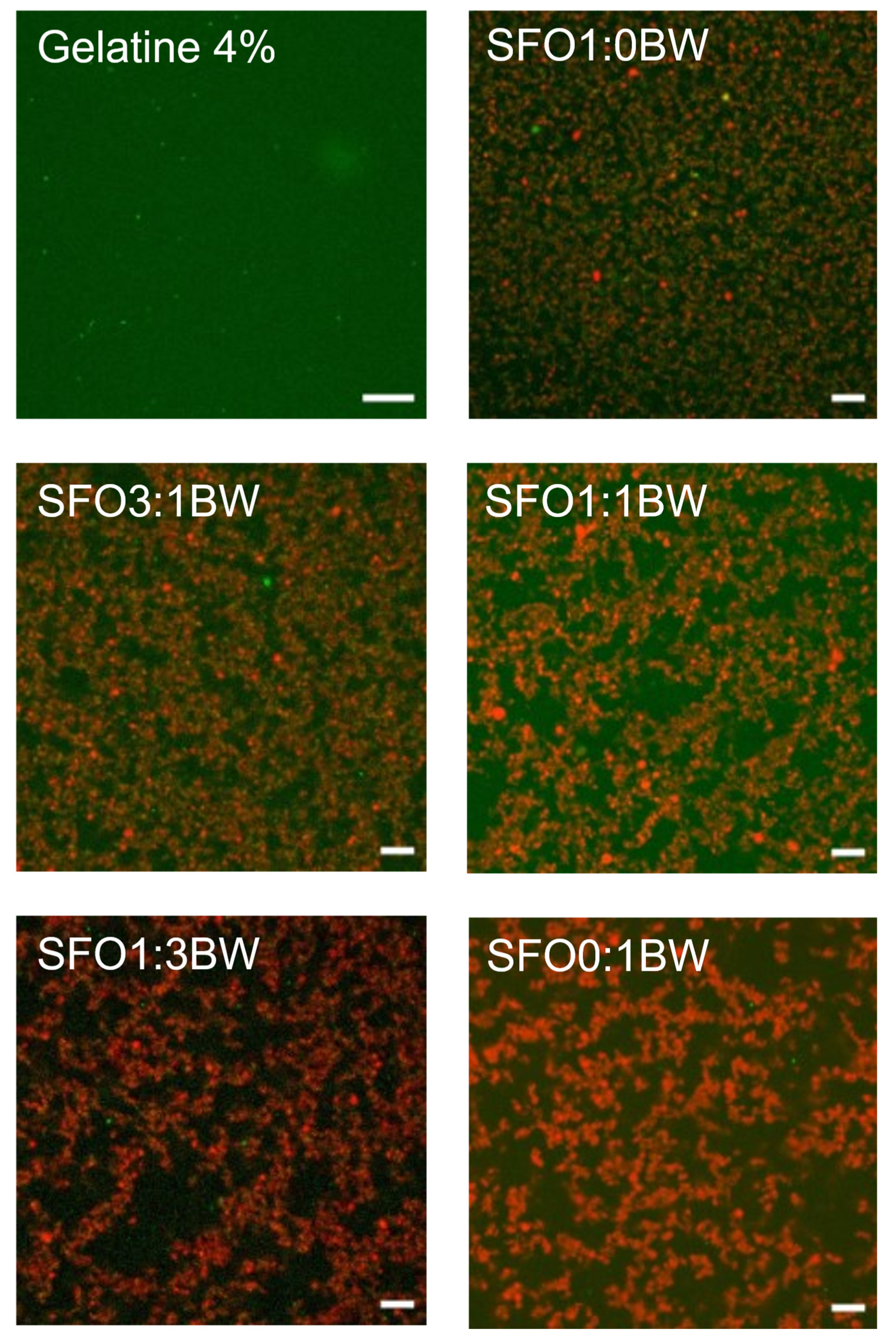
Figure 3.
Particle size distribution curves (A) and De Brouckere mean diameters (B) of the freshly prepared beeswax structured oil-in-water emulsions (10% wt. lipid phase) at 40°C.
Figure 3.
Particle size distribution curves (A) and De Brouckere mean diameters (B) of the freshly prepared beeswax structured oil-in-water emulsions (10% wt. lipid phase) at 40°C.
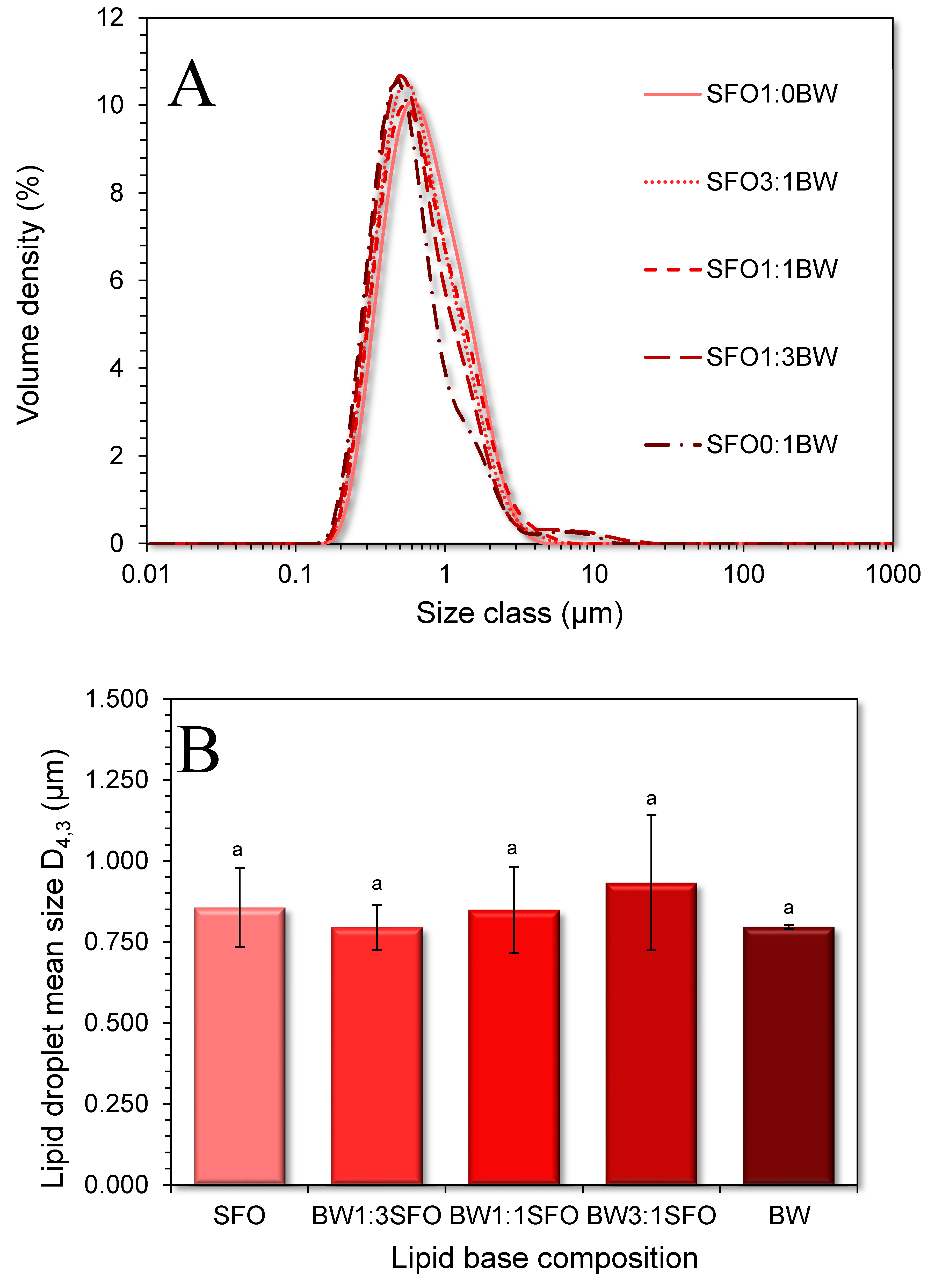
Figure 4.
LUMisizer® spectra (40°C, 4000 rpm for 30 min) of the beeswax structured oil-in-water emulsions (10% wt. lipid phase). .
Figure 4.
LUMisizer® spectra (40°C, 4000 rpm for 30 min) of the beeswax structured oil-in-water emulsions (10% wt. lipid phase). .
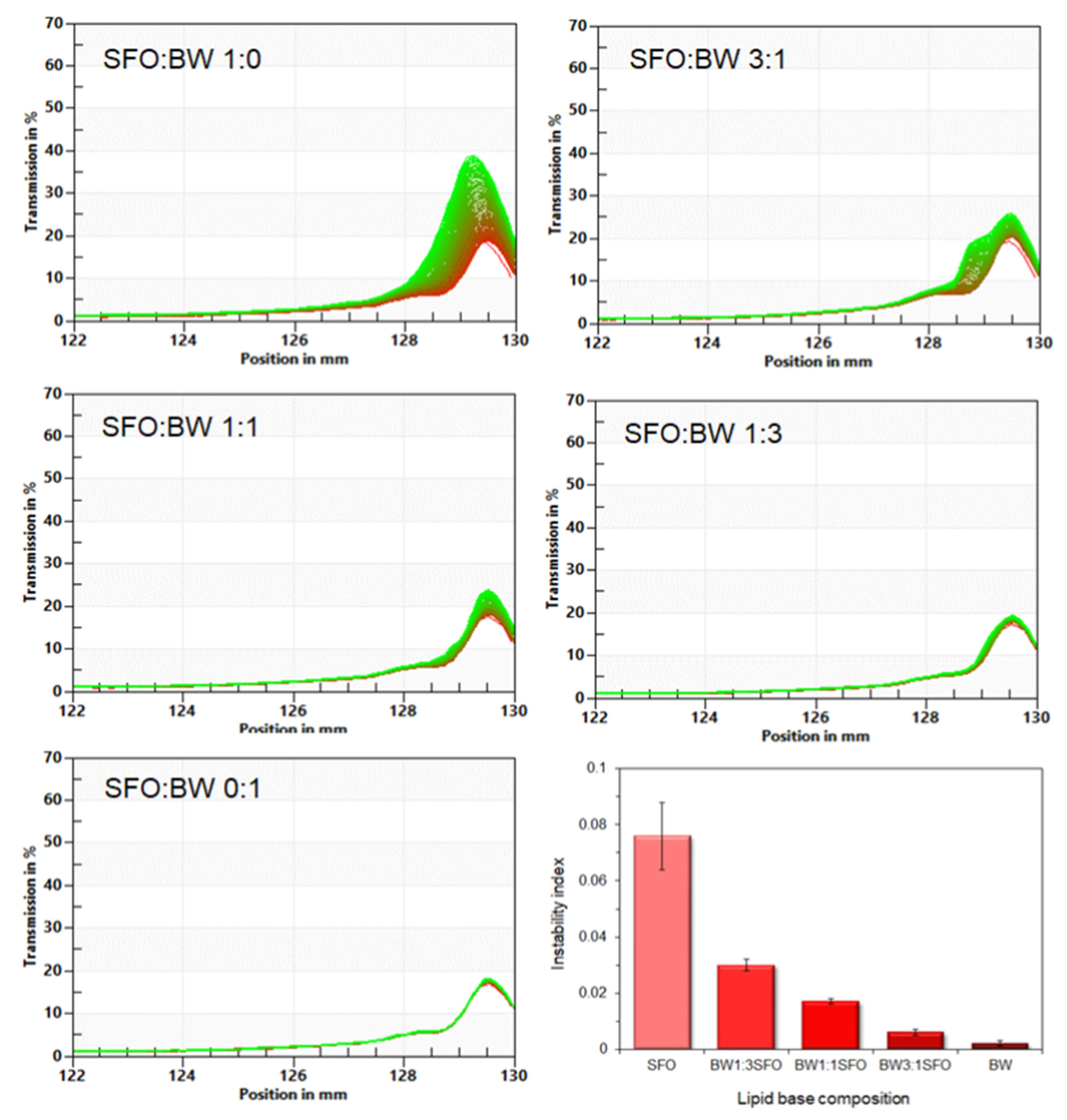
Figure 7.
Frequency sweeps rheological spectra of the beeswax structured oil-in-gel emulsions (10% wt. lipid phase, 4% wt. gelatine) at 5°C (left) and frequency shift factors (ac) obtained from the time concentration superposed viscoelastic spectra (right).
Figure 7.
Frequency sweeps rheological spectra of the beeswax structured oil-in-gel emulsions (10% wt. lipid phase, 4% wt. gelatine) at 5°C (left) and frequency shift factors (ac) obtained from the time concentration superposed viscoelastic spectra (right).
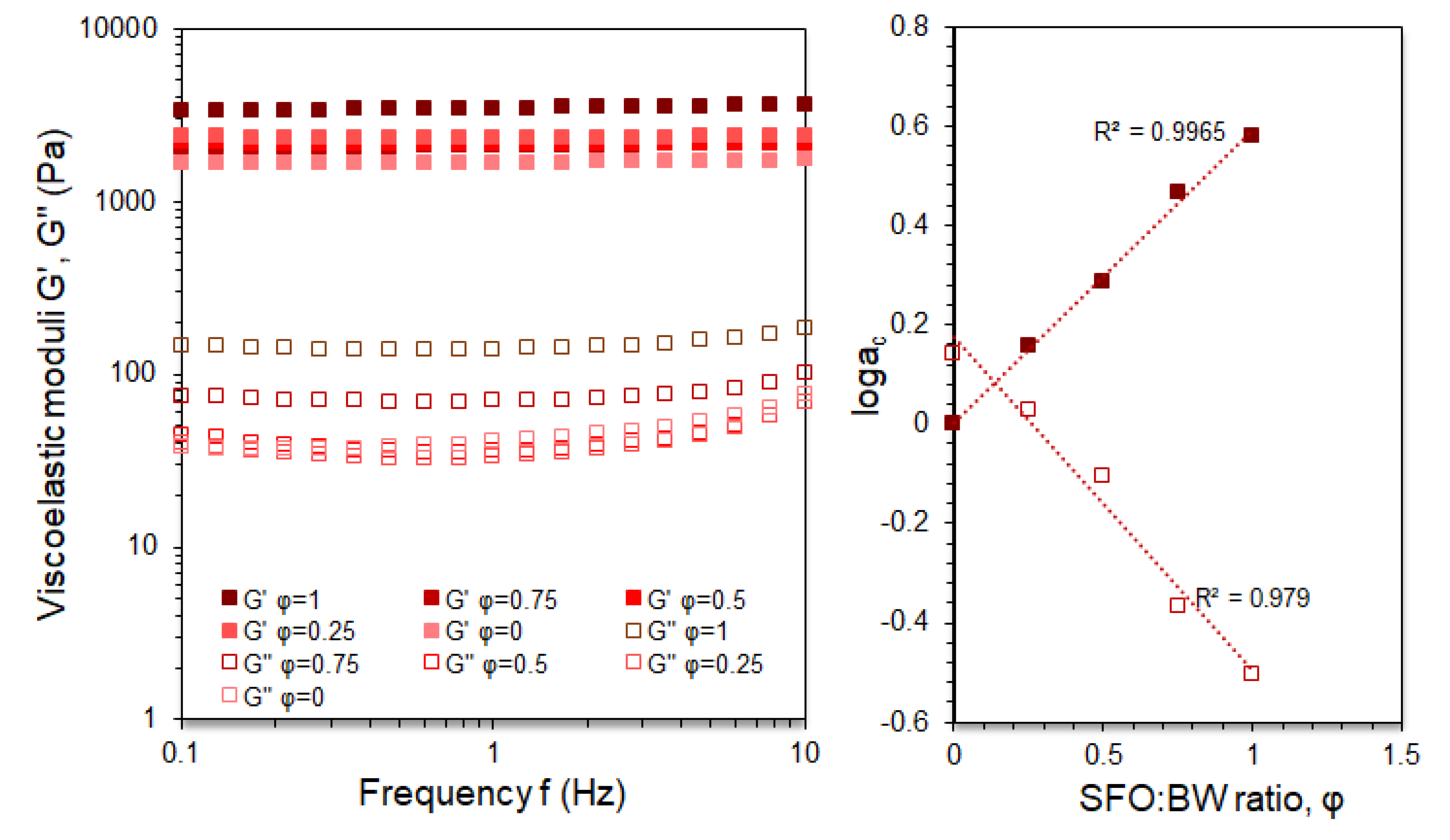
Figure 8.
Fitting of the phenomenological model (Eq. 1) with the relative elastic modulus G’r = G’composite/G’gelatine) − solidified fat mass fraction data. Additional datapoints at φ = 0.0625, 0.125, and 0.625 were introduced for fitting the model.
Figure 8.
Fitting of the phenomenological model (Eq. 1) with the relative elastic modulus G’r = G’composite/G’gelatine) − solidified fat mass fraction data. Additional datapoints at φ = 0.0625, 0.125, and 0.625 were introduced for fitting the model.
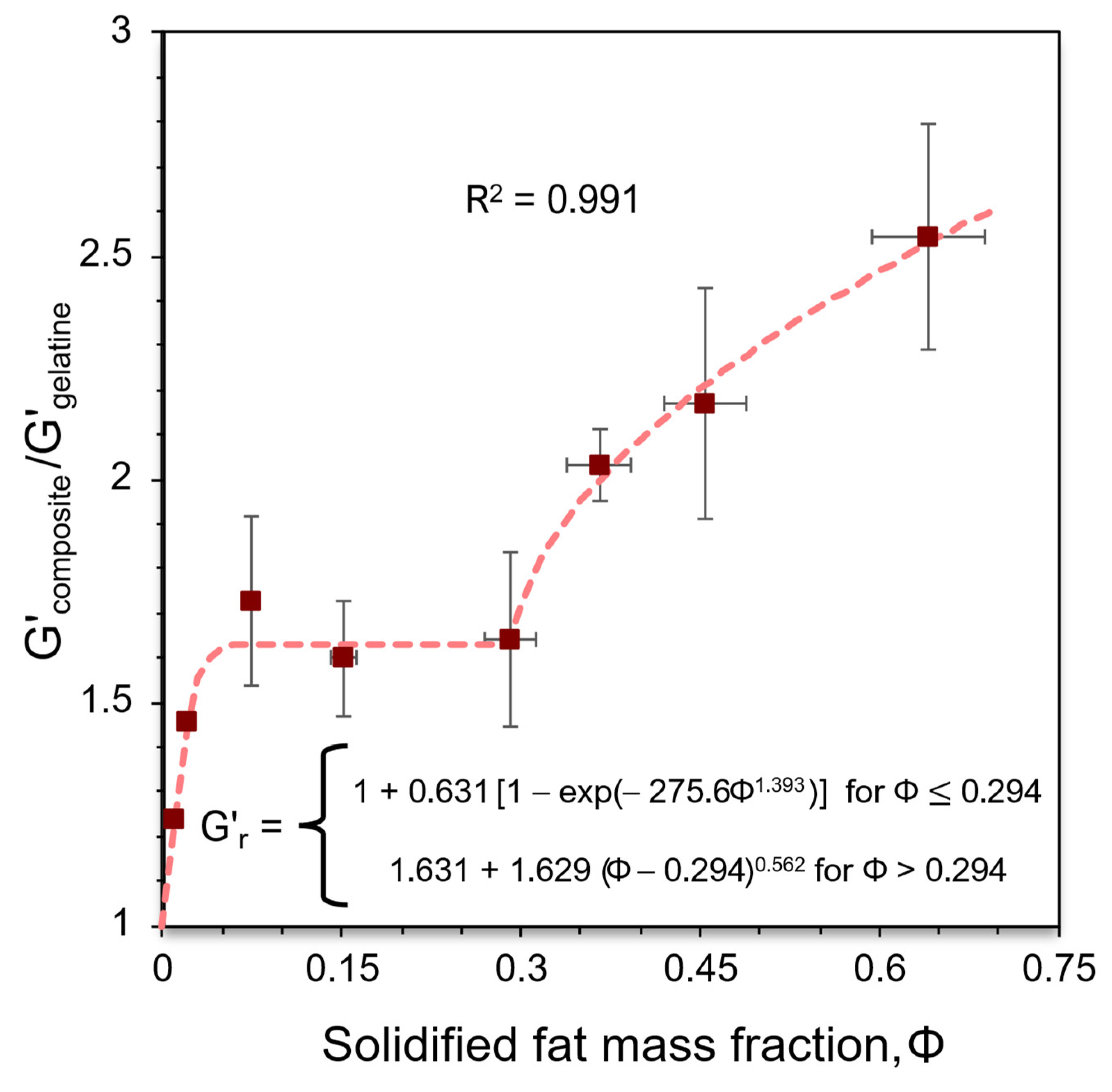
Figure 9.
Amplitude sweeps of the beeswax structured oil-in-gel emulsions (10% wt. lipid phase, 4% wt. gelatine) and pure gelatine at 5°C.
Figure 9.
Amplitude sweeps of the beeswax structured oil-in-gel emulsions (10% wt. lipid phase, 4% wt. gelatine) and pure gelatine at 5°C.
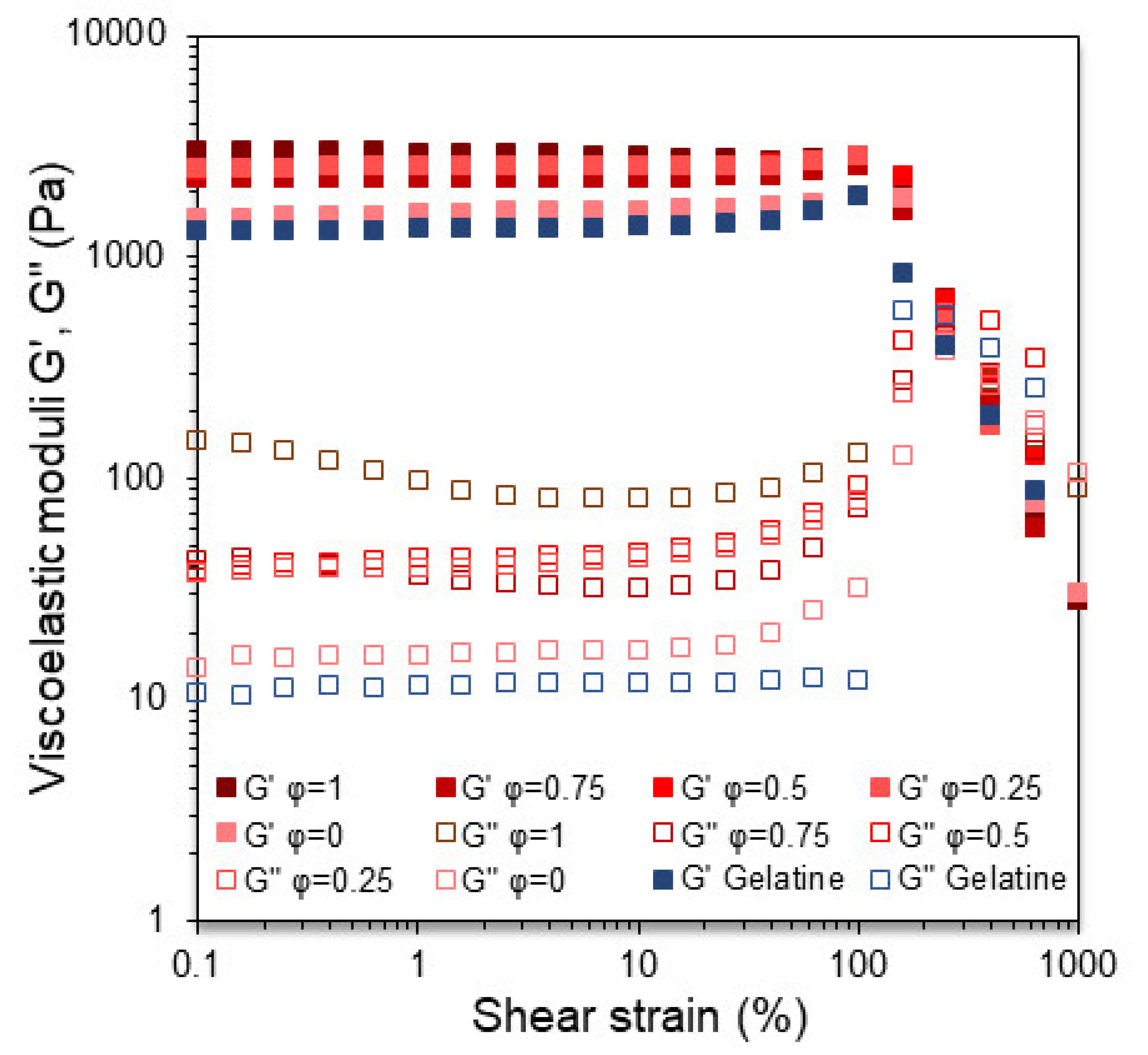
Figure 10.
Lissajous-Bowditch curves of beeswax structured oil-in-gel emulsions (10% wt. lipid phase, 4% wt. gelatine) at 5°C.
Figure 10.
Lissajous-Bowditch curves of beeswax structured oil-in-gel emulsions (10% wt. lipid phase, 4% wt. gelatine) at 5°C.
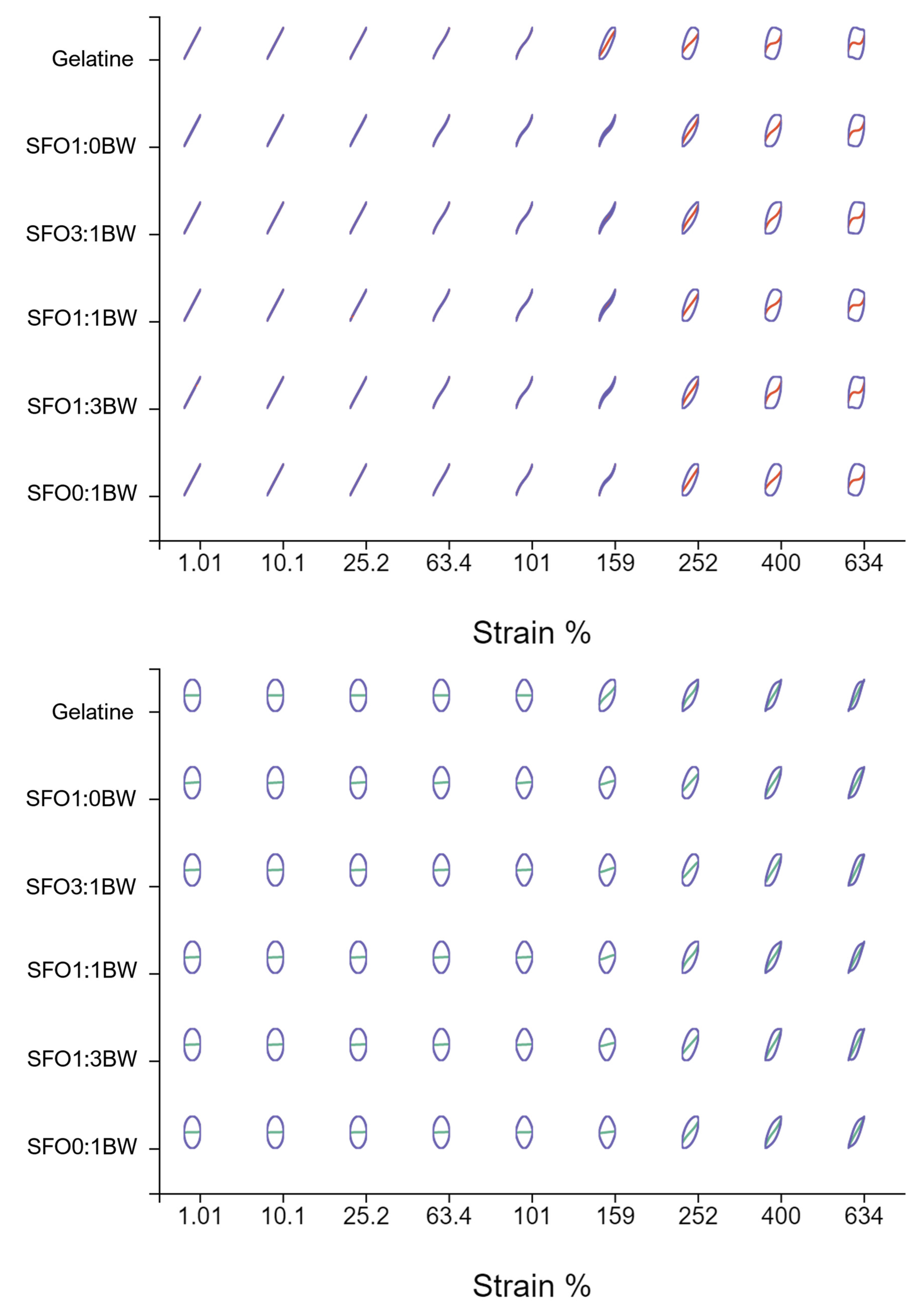
Figure 11.
Mechanical strength of the beeswax structured oil-in-gel emulsions at ambient temperature (25°C). The blue dotted line indicates the instrumental hardness of the gelatine substrate (4% wt.). a-b Samples with different lowercase letter are significantly different (p<0.05) according to Tukey’s post hoc means comparison test.
Figure 11.
Mechanical strength of the beeswax structured oil-in-gel emulsions at ambient temperature (25°C). The blue dotted line indicates the instrumental hardness of the gelatine substrate (4% wt.). a-b Samples with different lowercase letter are significantly different (p<0.05) according to Tukey’s post hoc means comparison test.
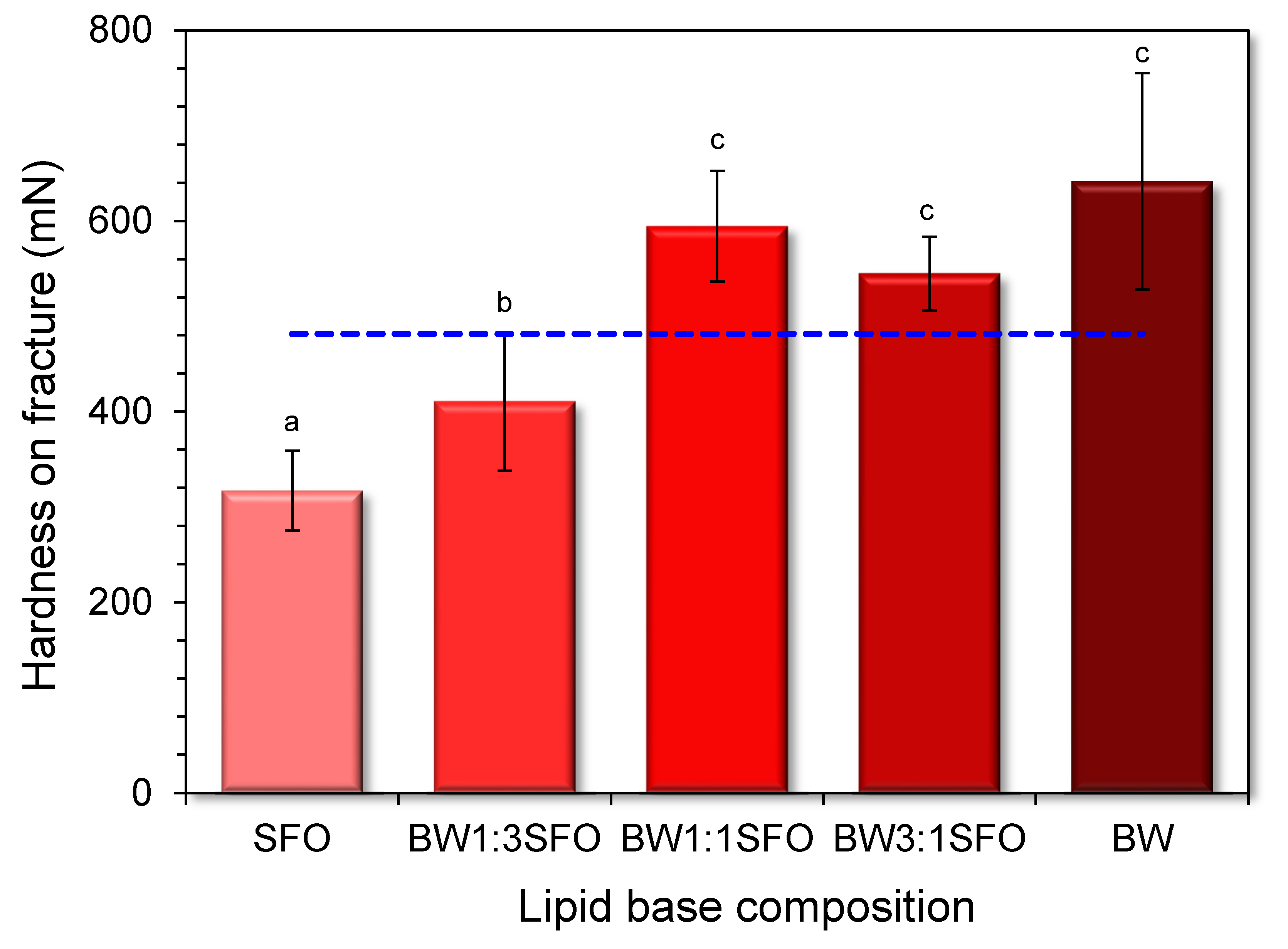
Figure 12.
Time dependent changes in the apparent viscosity of the BOGEs at 3D printing temperature (25 ± 0.1°C) and nozzle shear rate conditions ( = 180s-1).
Figure 12.
Time dependent changes in the apparent viscosity of the BOGEs at 3D printing temperature (25 ± 0.1°C) and nozzle shear rate conditions ( = 180s-1).
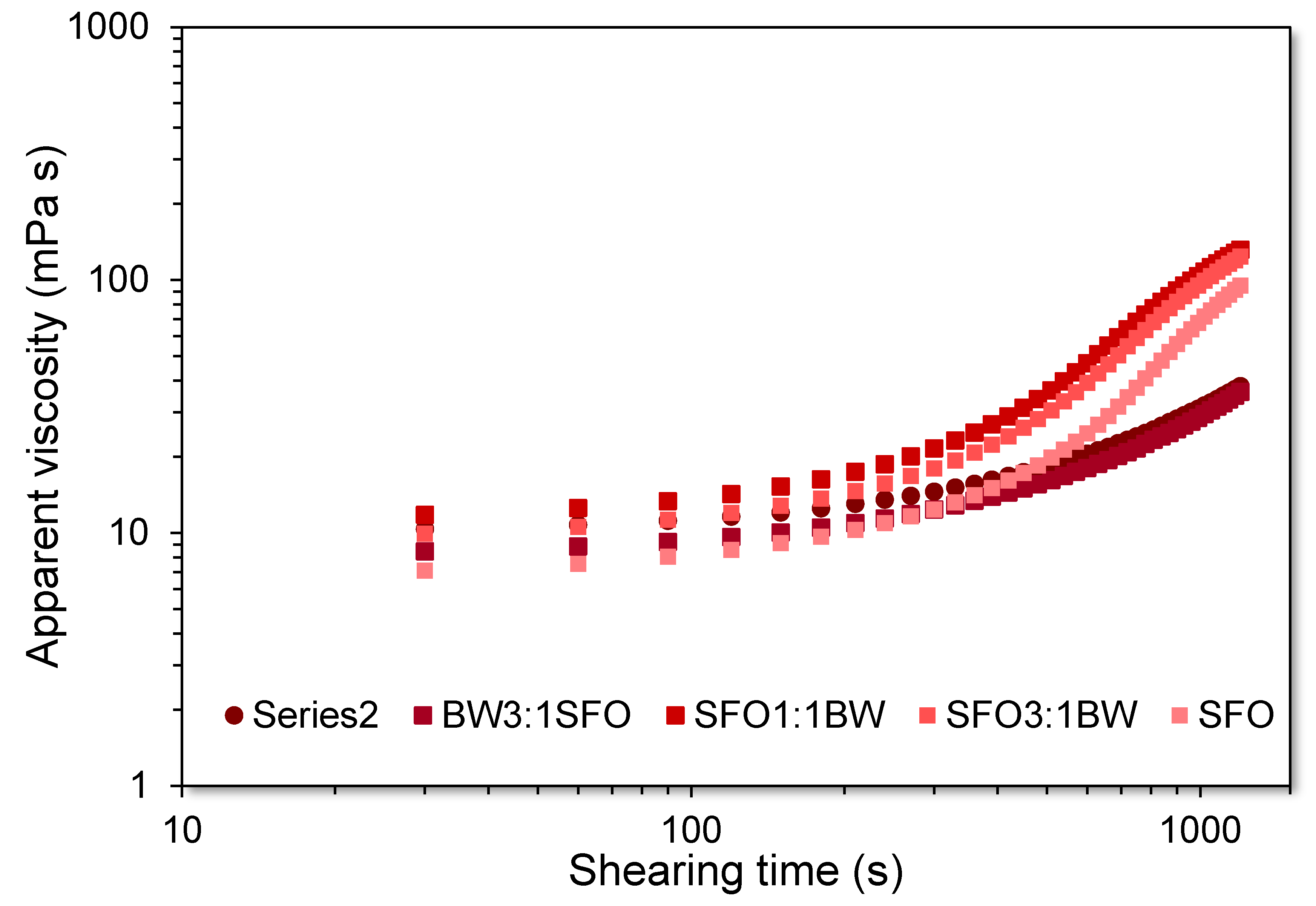
Figure 13.
3D-printed constructs obtained from gelatine hydrogels incorporating beeswax-structured oil-in-gel emulsions prepared with different ratios of sunflower oil (SFO) and beeswax (BW). The constructs were printed using a grid geometry (3 × 3 cm; outer strands 3 mm, inner strands 1 mm; infill 25%). The reference grid design is shown for comparison (Pr = 1). The printability index (Pr) values for each formulation are presented as mean ± standard deviation (SD), calculated from 16 pores per construct with three independent replicates, and were used to quantitatively evaluate printing fidelity and structural stability relative to the designed geometry.
Figure 13.
3D-printed constructs obtained from gelatine hydrogels incorporating beeswax-structured oil-in-gel emulsions prepared with different ratios of sunflower oil (SFO) and beeswax (BW). The constructs were printed using a grid geometry (3 × 3 cm; outer strands 3 mm, inner strands 1 mm; infill 25%). The reference grid design is shown for comparison (Pr = 1). The printability index (Pr) values for each formulation are presented as mean ± standard deviation (SD), calculated from 16 pores per construct with three independent replicates, and were used to quantitatively evaluate printing fidelity and structural stability relative to the designed geometry.
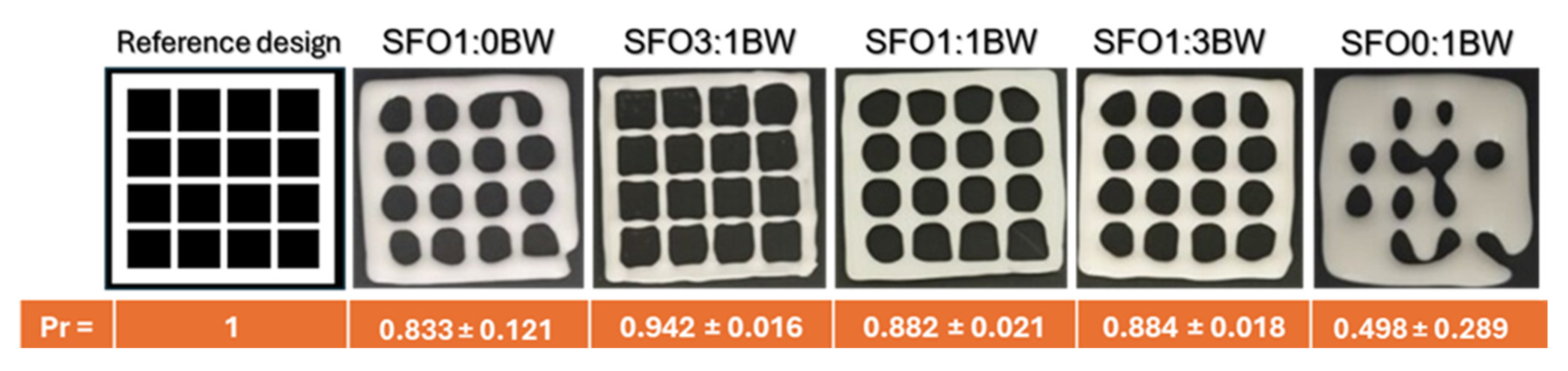
Table 1.
Melting points and fusion enthalpies of the beeswax – sunflower binary blends as determined by DSC.
Table 1.
Melting points and fusion enthalpies of the beeswax – sunflower binary blends as determined by DSC.
| SFO | WAX | |||||
|---|---|---|---|---|---|---|
| Sample | Tm, onset (oC) |
Tm, midpoint (oC) |
ΔH (J g−1) |
Tm, onset (oC) |
Tm, midpoint (oC) |
ΔH (J g−1) |
| SFO1:0BW | −35.9a | −31.0a | 8.85a | nd | nd | nd |
| SFO3:1BW | −25.8b | −20.8b | 2.21b | 39.8a | 57.4a | 40.3a |
| SFO1:1BW | −25.7b | −20.7b | 0.74c | 46.0b | 61.1ab | 86.9b |
| SFO1:3BW | Nd | nd | nd | 49.9b | 62.0ab | 137.2c |
| SFO0:1BW | nd | nd | nd | 48.3b | 64.7b | 215.3d |
a-d Different letter among the rows of each column indicates significant differences (p<0.05) according to Tukey’s post hoc means comparison test.
Disclaimer/Publisher’s Note: The statements, opinions and data contained in all publications are solely those of the individual author(s) and contributor(s) and not of MDPI and/or the editor(s). MDPI and/or the editor(s) disclaim responsibility for any injury to people or property resulting from any ideas, methods, instructions or products referred to in the content. |
© 2026 by the authors. Licensee MDPI, Basel, Switzerland. This article is an open access article distributed under the terms and conditions of the Creative Commons Attribution (CC BY) license (http://creativecommons.org/licenses/by/4.0/).
Copyright: This open access article is published under a Creative Commons CC BY 4.0 license, which permit the free download, distribution, and reuse, provided that the author and preprint are cited in any reuse.


