
Submitted:
15 April 2026
Posted:
15 April 2026
You are already at the latest version
Abstract
The increased production and utilization of nanoparticles (NPs) in consumer products have raised concerns about their potential impact on the environment at national and international levels as they move through different trophic levels. Previous research has shown that they possess the ability to infiltrate cellular and subcellular structures, potentially interfering with important physiological processes and leading to toxicity. Studies have also indicated that nanoparticle toxicity varies significantly with changes in physicochemical properties, even among nanoparticles with identical chemical compositions. Because of this variable toxicity potential, it has become imperative to study the toxicity of these materials on vital physiological systems on a case-by-case basis, particularly before their widespread utilization in consumer products. This study evaluated the cytotoxic effects of selected nanoparticles (i.e. AgNPs, TiO₂NPs, CD NPs, CD-Amine), with a particular emphasis on their toxicity to macrophages. The study involved exposing the immune-representative RAW 264.7 cell line to various concentrations of NPs, both with and without the presence of lipopolysaccharide (LPS). Results showed that silver nanoparticles (AgNPs) and titanium dioxide nanoparticles (TiO₂NPs) had an adverse impact on cell viability under both conditions. The unmodified carbon dot nanoparticles only had a moderate impact on viability. However, toxicity increased significantly when carbon dot NPs were modified with amine groups, surpassing that of metal-based NPs (i.e., AgNPs and TiO₂NPs), highlighting the critical role of surface charge in influencing cytotoxicity. Concurrently, the study also comprehensively assessed the potential neurotoxicity of these nanoparticles by measuring their modulatory potential on acetylcholinesterase (AChE) activity using Ellman's reagent. Findings indicated that both AgNPs and amine-modified carbon dots (CD-Amine) significantly inhibited AChE activity, while TiO₂NPs and CDNPs had no impact on AChE activity. Interestingly, this inhibition was not dependent on whether the nanoparticles were metal- or carbon-based, or the size of the nanoparticles, suggesting that the interaction between nanoparticles and enzymes is likely influenced by the chemistry of the enzyme and the nanoparticles themselves. This study seeks to contribute valuable insights into the diverse biological interactions of nanoparticles, informing risk assessments and the development of safer nanomaterials for various applications.
Keywords:
nanoparticles
; cytotoxicity
; macrophages
; neurotoxicity
; acetylcholinesterase
; immune system
; in vitro models
; AgNPs
; TiO₂NPs
; carbon dots
1. Introduction
Nanoparticles are tiny particles that are less than 100 nanometers in size [36]. Because of their small size, they boast distinctive physiochemical properties that can enhance multiple facets of contemporary life, ranging from materials science to medical applications such as gene therapy [2,68]. They are classified broadly into three main categories: organic-based (e.g., proteins, lipids, carbohydrates and polymers), inorganic-based (e.g., metal and metal oxide nanomaterials, and silica nanoparticles), and carbon-based (e.g., carbon dots, carbon nanotubes, polystyrene nanoparticles, and polyethylene glycol nanoparticles) [26,28,29,40,44]. Since their discovery, their use has increased significantly over recent years, with synthetic production estimated at 270,000 metric tons per year [25,35]. Beyond industrial and medical sectors, nanoparticles are now widely used in consumer products, such as silver nanoparticles in antimicrobial coatings and titanium dioxide in sunscreens [11,21,55]. Increased usage of these materials has now led to increased risk of environmental release and potential human exposure [21,32,45,46,55,66]. The escalation of environmental exposure to nanoparticles has raised substantial concerns regarding their potential health impacts on both the environment and human health. These concerns have, over the years, spurred increased research into the toxicological impacts of nanoparticles, particularly as they pertain to human health.
Extensive investigations have demonstrated that nanoparticles possess the ability to cross cellular membranes, whereby they can interfere with critical cellular functions and eliciting toxicity. Current described mechanisms for nanoparticle-induced toxicity have been shown to be multifaceted, implicating multiple pathways such as oxidative stress, mitochondrial dysfunction, genotoxicity, membrane destabilization, lysosomal impairment, and alterations in protein dynamics [4,18,24,52,64,70]. Despite these numerous toxicological investigations demonstrating nanoparticle toxicity and its underlying mechanisms, a consistent conclusion has emerged across them. The conclusion drawn is that the toxicological potential of nanoparticles is fundamentally associated with their inherent physicochemical properties, as well as the specific cellular type with which they engage. This intrinsic variability, even among nanoparticles with identical chemical compositions has made it incredibly challenging for scientists to develop a universal predictive protocol for the classifying nanoparticle toxicity. This unfortunately has necessitated a case-by-case assessment of nanoparticle toxicity, particularly for critical biological systems like the immune and neurological systems, which are highly vulnerable and whose disruption can lead to profound adverse effects.
Upon systemic exposure, the immune system would inevitably be one of the first systems to interact with these materials. As one of the first responders of the immune system, macrophages most likely will be one of the first cell types to interact with these materials. Macrophages, playing critical roles in innate immunity, and facilitate cross-talk between innate and adaptive immunity [67]. As unchecked macrophage death can lead to macrophage exhaustion, resulting in immune dysfunction and compromised host defense. Understanding the interactions between nanoparticles and macrophages becomes imperative, especially in both therapeutic and environmental contexts. In this investigation, we employed RAW 264.7 cells, a well-established murine macrophage-like cell line, as an In vitro immune representative model to assess the cytotoxic effects of selected nanoparticles [30,31,32].
Beyond immune interactions, the potential for nanoparticle neurotoxicity also raises serious concerns. As research indicates that NPs, especially those with size smaller than 200 nm, can successfully translocate across the blood-brain barrier (BBB), accumulating within the central nervous system [9,20,23,60]. The translocation of NPs into the neurological spaces is alarming because of their potential toxicity. A critical enzyme that can be particularly susceptible to alterations in protein function is Acetylcholinesterase (AChE) (E.C. 3.1.1.7), which is essential for terminating cholinergic signaling in the synaptic cleft by rapidly hydrolyzing acetylcholine [7,13,51,57]. As a pivotal biomarker for neurotoxicity, impairment of AChE activity can lead to a spectrum of severe neurological dysfunctions, ranging from cognitive disturbances to life-threatening cholinergic crises [8,10]. Given these consequences, it is imperative to investigate whether NPs, as emerging environmental and therapeutic agents, can induce such effects by modulating AChE activity.
Therefore, this study aimed to evaluate the cytotoxicity of selected nanoparticles on immune representative cell line RAW 264.7 cells, both in the presence and absence of LPS. While concurrently assessing their potential neurotoxicity by measuring their modulation of human erythrocyte acetylcholinesterase activity In vitro post-exposure. This research can provide valuable insights into the diverse biological interactions of these widely used nanoparticles, informing risk assessments and contributing to the development of safer nanomaterials for various applications.
2. Materials and Methods
2.1. Nanoparticle Characterization
This study evaulated the cytotoxicity and neurotoxicity of selected nanoparticles: AgNPs, TiO₂NPs, Carbon Dot NPs, and CD-Amine NPs. These nanoparticles were selected because of their widespread commercial applications, existing laboratory data and small size (<200 nm), which enable potential blood-brain barrier translocation, a key factor in neurotoxicity assessment. All nanoparticles used in this study were thoroughly characterized for physicochemical properties in previous studies by our laboratory and/or in collaboration with our laboratory [5,12,63].
2.1.1. Silver Nanoparticle (AgNP) Characterization
Silver nanopowder (CAT no. 7440-22-4) was purchased from Sigma-Aldrich, South Africa. As per the manufacturer’s specifications, the AgNPs were spherical particles with a particle size below 100 nm. They were reported to possess a specific surface area of 5 m²/g, a density of 10.5 g/cm³, and a purity of 99.5%. Our laboratory in Walters, Pool, and Somerset [63] further validated the specifications of the AgNPs. The presence of silver was confirmed through SEM equipped with energy-dispersive X-ray (EDX) spectrometry. Transmission electron microscopy (TEM) and scanning electron microscopy (SEM) of dry particles indicated that particles were mostly spherical. Furthermore, this analysis indicated that approximately 65% of the silver nanoparticles had a diameter of 10 nm, while a small percentage (≤ 5%) had a diameter ranging between 50 and 100 nm. When measuring the diameter of silver in an aqueous solution (H2O), data showed ~35 % of the particles were between 20-40 nm and ~15 % were between 70-1000 nm in diameter. While comprehensive in-media characterization, such as hydrodynamic size and zeta potential, was not part of the initial characterization for this specific batch of AgNPs, the extensive data on their morphology, crystalline structure, elemental composition, and dissolution properties provide a robust understanding of their physicochemical characteristics relevant to this study.
2.1.2. Titanium Dioxide Nanoparticle (TiO₂NP) Characterization
Aeroxide P25 TiO₂NPs (Evonik Degussa Corporation, CAS: 13463-67-7) were obtained. According to the manufacturer and confirmed in our laboratory, published in David et al. [12], the nanoparticles were spherical and exhibited both anatase and rutile crystal structure with an average primary particle size of 21 nm. Characterization performed in lab included elemental composition by Energy Dispersive X-ray Spectroscopy (EDS) indicating the presence of titanium and oxygen, morphology by Scanning Electron Microscopy (SEM) revealing clustered spherical nanoparticles, and crystal structure by Transmission Electron Microscopy (TEM) identifying both rutile and anatase crystalline phases. Stability analysis, encompassing hydrodynamic size and zeta potential measurements in various physiological media [12], demonstrated that significant alterations were observed only after 14 days in suspension, indicating stability for up to 14 days in these media.
2.1.3. Carbon Dot Nanoparticle (CD NP) Characterization
Carbon dot nanoparticles (CD NPs) and amine-modified carbon dot nanoparticles (CD-Amine) were provided by the University of Missouri. Their synthesis and comprehensive characterization, including size distribution by TEM, surface chemistry by Fourier transform infrared spectroscopy (FT-IR), and hydrodynamic size/zeta potential measurements in various media across different pH levels, are detailed in Bayati et al. [5]. The data indicated that the average particle size of CD-Amine was 5.1 nm, while CD had an average size of 1.8 nm. The FT-IR spectrum of CD-Amine spectrum suggests a significant presence of amino groups on the surface. On the other hand, analysis of the CDs showed the presence of O–H, C=O, and epoxy groups. The data also showed that zeta potential and hydrodynamic size changed under different pH’s and medias.
2.2. Nanoparticle Preparations
We prepared 5 mg/ml stock suspensions of TiO₂NPs, CDNPs, and AgNPs in distilled water. Before experimental use, nanoparticle stocks were sonicated on ice (QSonica, LLC. Misonix sonicators, XL-200 Series, Newtown, CT, USA) until homogeneous suspensions (inspected visually) were obtained. Differences in sonication duration for each nanoparticle type, as detailed in Table 1, were necessitated by their distinct material properties and aggregation tendencies, with the primary objective being the achievement of a stable, homogeneous dispersion specific to each nanoparticle.
2.3. RAW 264.7 Macrophage Cultures
The BALB/c mouse murine macrophage cells (RAW 264.7) were purchased from American Type Culture Collection (ATCC TIB -71, Manassas, VA, USA). Dulbecco’s modified Eagle’s medium (DMEM, Lonza, Cape Town, South Africa) supplemented with 10% heat-inactivated fetal bovine serum (FBS, Hyclone, Little Chalfont, UK), 1% glutamax (Sigma-Aldrich, St. Louis, MO, USA), 1% antibiotics/antimycotics (Sigma-Aldrich), and 0.5% gentamicin (Sigma) were used to culture the cells. Cultures were subcultured every 2-3 days at 70-80 % confluence and incubated at 37 °C in a humidified environment with 5 % CO₂. To determine the cytotoxicity of nanoparticles, 200 µl/well of the cell suspension were seeded at a density of 1 x 10⁵ cells/ml in 48-well cell culture plates and incubated till 80 % confluence. The culture medium was removed and replaced with 200 µl medium containing nanoparticles at various concentrations (0- 500 µg/ml). Two identical sets of 48-well culture plates were prepared. The wells of the one set received another 200 µl of 200 ng/ml lipopolysaccharide (LPS) prepared in 0% FBS media (serum-free media), while wells from the other plate received 200 µl serum-free media without LPS. Cultures were then incubated overnight (approximately 18 hours) under standard tissue culture conditions. Supernatants were aspirated, and cells were used directly for WST-1 assays after washing the cells with 1 x Phosphate-Buffered Saline (PBS).
2.4. WST-1 Cell Proliferation Assay
WST-1 analysis was used to evaluate the cell viability of RAW 264.7 cells after they were exposed to nanoparticles. The foundation of WST-1 analysis is the formation of formazan dye from WST-1 tetrazolium salt (Roche, Mannheim, Germany) by functional mitochondrial dehydrogenases. Formazan dye’s colour intensity is directly proportional to the number of active mitochondria and metabolically active cells present (viable cells) [41,49]. First, a 1:10 dilution of the stock WST-1 solution was prepared in cell culture medium according to the manufacturer’s instructions. The washed cells obtained after nanoparticles exposure received 200 µl/well of the WST-1 solution. A microplate reader (Multiskan Ex, Thermo Electron Corporation) was used to measure formazan dye absorbance at 450 nm immediately after applying the WST-1 solution, and again after 15 minutes and 45 minutes. Cell viability was calculated as a percentage of the control and expressed as mean percentage ± standard deviation (SD). Data visualization was performed using Excel graphs. SigmaPlot one-way ANOVA statistical analysis (P < 0.01) was performed to assess statistical differences in the data set compared to the control.
2.5. Ellman Acetylcholinesterase Analysis
The modulating potential of various nanoparticles on in vitro human erythrocyte acetylcholinesterase activity was determined using an adaptation of the Ellman method as described by Coban et al. [9]. The Ellman method for the detection of thiols is based on the reaction of thiols with the chromogenic 5,5’-dithiobis-2-nitrobenzoate (DTNB), resulting in the formation of a yellow substance called dianion of 5-thio-2-nitrobenzoic acid (TNB), which is measured spectrophotometrically [14]. This method has been utilized in our laboratory in prior studies to assess the neurotoxicity of wastewater and treated sewage effluents [15,22]. Before assaying samples, Ellman reagents A and B were prepared. Reagent A of the Ellman reagent was formulated with 8 mM acetylcholine iodide (obtained from Sigma Aldrich) dissolved in dH2O. While reagent B was prepared from 8 mM DNTB (obtained from Sigma Aldrich) dissolved in dH2O.
For analysis, 25 µl/well of the 500 unit/mg human erythrocyte acetylcholinesterase enzymes was transferred to wells of a clean 96-well plate. The human erythrocyte acetylcholinesterase enzymes used were purchased from Sigma Aldrich (CAS 9000-81-1), and the kit included all the necessary reagents. To investigate the effect of nanoparticle samples and the chlorpyrifos positive control on acetylcholinesterase activity, 25 µl/well of the nanoparticle or chlorpyrifos solutions diluted in PBS was added to wells. Negative control wells received 25 µl/well of PBS. Chlorpyrifos, sometimes known as Chlorpyrifos ethyl, is an organophosphate insecticide that inhibits acetylcholinesterase [62]. After an incubation time of 2 hours at room temperature, 125 µl of reagent B was added to each well, immediately followed by 25 µl of reagent A. Immediately after addition of the substrate solutions and mixing, absorbance was measured at 405 nm (BMG Labtech, FLUOstar Omega microplate reader) and then measured at 15 min intervals for one hour. AChE enzyme activity was calculated as a percentage of the control without nanoparticle addition, and data were expressed as percent AChE enzyme activity ± standard deviation (SD). SigmaPlot one-way ANOVA statistical analysis (P < 0.01) was performed to assess statistical differences in the data set compared to the control.
3. Results and Discussion
3.1. Assessment of NPs Cytotoxicity on RAW 264.7 Cells
The WST-1 analysis was used to evaluate the cytotoxicity of AgNPs, TiO₂NPs, CD NPs, and CD-Amine NPs on RAW 264.7 cells in the absence and presence of LPS (Figure 1). Statistical analysis of our data shows that cells exposed to AgNPs ≥ 7.8 µg/ml and ≤ 31.25 µg/ml significantly increased in viability when compared to the control (0 µg/ml) in the absence of LPS (Figure 1a). Concentrations of AgNPs ≥ 125 µg/ml significantly reduced the viability of RAW 264.7 cells in comparison to the control. In the presence of LPS (Figure 1b), RAW 264.7 cells showed a significant reduction in cell viability upon exposure to ≥ 62.5 µg/ml AgNPs. Similar results were obtained by Lategan, Walters and Pool [32] for RAW 264.7 cells exposed to silver nanoparticles. AgNP-induced cytotoxicity is widely attributed to the development of an oxidative stress environment within host cells. This eventuality may result in genotoxicity and mutagenic damage, ultimately leading to programmed cellular death [6]. Studies have demonstrated that AgNPs can directly cause the release of free radicals through the breakdown of silver nanoparticles into silver ions, which in turn causes the acidic endosomes and lysosomes to produce hydroxyl radicals as reported by Tianlu Zhang et al. [62]. As for the gradual increase in cell viability, Stensberg et al. [58] reported that silver nanoparticles might trigger an increase in cell proliferation due to minor damage.
RAW 264.7 cells treated with TiO₂NPs demonstrated a notable increase in cell viability when exposed to concentrations ranging from ≥ 15.6 µg/ml to ≤ 250 µg/ml. However, at a concentration of 500 µg/ml in the absence of LPS, there was a significant decrease in cell viability (Figure 1a). In the presence of LPS (Figure 1b), data revealed that RAW 264.7 cells showed a significant progressive reduction in cell viability upon exposure to ≥ 250 µg/ml TiO₂NPs. Comparable findings were reported by Siqueira et al. [54] who demonstrated that TiO₂NPs, with an average size of 21 nm, could significantly boost the cell viability of Neotropical model zebrafish liver cell lines at 500 µg/ml but significantly reduce it at concentrations of 750 µg/ml or higher. According to their research, at high dosages, TiO₂NPs induced an increase in ROS production, cell membrane damage, lysosome proliferation or swelling, DNA strand breaks, and a low frequency of micronucleus generation. High dosages (≥ 750 µg/ml) of TiO₂NPs caused cumulative genotoxicity and mutagenesis damage, which ultimately led to programmed cellular death. Whereas, low dosages of TiO₂NPs elicited a proliferative response to replenish the cell population [54]. However, data reported by David et al. [12] indicated that titanium nanoparticles had no significant effect on the cell viability of Caco-2 cells. Similar results were obtained by Wang et al. [65] for human alveolar epithelial cell line A549 exposed to TiO₂NPs with a particle size of 18-24 nm for 48 hours.
The study also assessed the potential cytotoxicity of CDNPs and CD-Amine both in the absence and presence of LPS. In the absence of LPS (Figure 1c), CD-Amine treated RAW 264.7 cells showed significant reductions in cell viability at ≥ 31.25 µg/ml. However, CD caused significant increase in the cell viability of RAW 264.7 cells at concentration ≥ 7.8 µg/ml and ≤ 250 µg/ml. In the presence of LPS (Figure 1d), CD-Amine exposure at dosages ≥ 7.8 µg/ml resulted in approximately 40% reduced cell viability, with complete cell death (100% loss in viability) observed at concentrations ≥ 62.5 µg/ml, compared to the 0 µg/ml nanoparticle control. Unmodified carbon dots, however, had no significant impact on the cell viability of RAW 264.7 cells. The findings of this study demonstrated that nanoparticles with amine modifications are typically more cytotoxic than unmodified particles. These results align with existing literature suggesting that positively charged nanoparticles demonstrate higher cytotoxicity compared to neutral charged nanoparticles of similar size and composition [17]. This increased toxicity is likely due to the enhanced cellular uptake of positively charged nanoparticles compared to their neutral counterparts, which can subsequently harm crucial biological processes [56]. Upon cellular internalization, the cascade of biological disruptions instigated by cationic nanoparticles is largely attributed to their propensity for triggering lysosomal permeabilization, an event that facilitates the release of cathepsin into the cytosol, thereby instigating mitochondrial dysfunction and ultimately initiating apoptotic pathways [42]. Avinash Chunduri et al. [3] showed similar results for RAW 264.7 cells exposed to various concentrations of amine-modified silica nanoparticles, cysteine-modified silica nanoparticles, or unmodified silica nanoparticles for 24 hours. Inverse results were shown by Nagano et al. [38] which showed that unmodified silica nanoparticles were significantly more toxic than carboxyl or amino-modified nanoparticles with amino-modified silica causing the least effect in parenchymal hepatocytes.
The study also found that unmodified metal-based nanoparticles are more cytotoxic to RAW 264.7 cells than unmodified carbon-based nanoparticles, which is consistent with previous research suggesting that metal-based nanoparticles are more cytotoxic than carbon-based ones. The primary cytotoxicity mechanisms of metal-based NPs were linked to oxidative stress, inflammatory response, autophagy, and apoptosis, as stated by Xiong et al. [69]. According to our data, AgNPs exhibited greater cytotoxicity than TiO₂NPs, despite their similar size and metal-based composition. This suggests that factors beyond size may influence their impact on their inherent cytotoxicity. Chemical composition, surface charge, and shape are likely key variables. Previous research noted that nanoparticles with higher atomic numbers tend to be more cytotoxic; as titanium and oxygen have lower atomic numbers than silver, this aligns with our findings [24,43]. Additionally, studies have shown that once nanoparticles are comparable in size and chemical makeup, their shape and surface charge play a significant role in determining their cytotoxicity and reactivity [39,50].
3.2. Acetylcholinesterase Activity Analysis
As part of our research, we analyzed the potential neurotoxicity of various types of nanoparticles, including AgNPs, TiO₂NPs, CD NPs, and CD-Amine NPs. To do so, we utilized a method involving the exposure of human erythrocyte lysate AChE to different concentrations of these nanoparticles, followed by the measurement of the AChE activity using Ellman analysis post-exposure.
To validate our AChE inhibition assay, we used chlorpyrifos, a commercial AChE inhibitor. Results showed chlorpyrifos effectively inhibited ≥ 47% of AChE activity at concentrations as low as 1.3 µM, with a strong correlation (R2 = 0.985), as depicted in Figure 2a. Similar findings were demonstrated by Van Wyk et al. [62] who also used chlorpyrifos, an organophosphate known for inhibiting cholinesterases, as a positive control in studying the effects of different extracts of Trachyandra laxa on the activity of acetylcholinesterase (AChE). Titanium dioxide and silver nanoparticles were evaluated for their potential to modulate acetylcholinesterase enzymatic activity. Statistical analysis of acetylcholinesterase activity (Figure 2b) shows that silver nanoparticles have a significantly greater effect on AChE activity. Exposure of AChE extract to AgNPs resulted in a progressive decline in AChE activity at concentrations ≥ 62.5 µg/ml, while TiO₂NPs had no significant impact on this enzyme. Similar results were shown by Karthick et al. [27] for 45-50 nm AgNPs. Previous studies by Myrzakhanova et al. [37] also found that AgNPs significantly reduced AChE and pseudocholinesterase (PChE) activity in larval zebrafish (Danio rerio).
Among the carbon dot nanoparticles, only the amine-modified variant exhibited a significant inhibitory effect on AChE activity, with unmodified carbon dots (CD) showing no impact (Figure 2c). At doses > 7.8 µg/ml, acetylcholinesterase activity gradually decreased in the presence of amine-modified carbon dots. This data clearly indicates that the surface functionalization of nanoparticles significantly impacts AChE activity, suggesting that amine functionalization enhances a nanoparticle’s enzymatic modulatory potential. Fischer et al. [16] presented conflicting findings, revealing that carboxylate-functionalized mixed monolayer-protected gold cluster nanoparticles (MMPCs) exhibited a reversible inhibition of chymotrypsin enzyme activity. In contrast, the amine-modified MMPCs had no impact on chymotrypsin activity. Their work and ours collectively highlight that the adverse effects of nanoparticles on enzymes are dependent on both the nanoparticle’s and the enzyme/protein’s specific chemistry.
Our study revealed that only AgNPs and CD-Amine inhibited AChE activity, with AgNPs exhibiting a more potent effect than CD-Amine. Interestingly, despite similar dimensions and metallic bases, AgNPs and TiO₂NPs had vastly different impacts on AChE activity. Similarly, CD-Amine significantly inhibited AChE, while unmodified CD, with a comparable size and core, had no statistical impact. This differential activity, even among similarly structured nanoparticles, strongly suggests that the inhibition is primarily chemistry-driven, rather than resulting from mechanical stress on the protein.
This observation aligns with established research on nanoparticle-protein interactions, where nanoparticles’ ability to bind proteins to their surfaces is well-documented [1,19,48]. This binding depends on the specific characteristics of both the nanoparticle and the protein [2,34,48,59]. As a result of this interaction, a protein corona, either permanent (hard coronae) or temporary (soft coronae), can form, depending on their affinity [48]. Consequently, both the protein and the nanoparticle are affected, leading to altered function and chemical properties. The intricate interplay of these characteristics was evident in our findings. The disparate effects observed, especially between nanoparticles of similar dimensions but different surface chemistries, strongly indicate that the inhibition of AChE activity is dependent on the specific chemical interactions between the nanoparticle surface and the enzyme.
4. Conclusion
In this study, we thoroughly examined the macrophage cytotoxicity and neurotoxicity of various nanoparticles and found that metal-based nanoparticles like AgNPs and TiO₂NPs exhibit higher levels of cytotoxicity than unmodified CD. However, when carbon dots are modified with amine groups, their cytotoxicity becomes significantly higher than that of metal-based NPs. This highlights the crucial role of surface charge in determining the cytotoxicity of nanoparticles. Additionally, our findings reveal that while AgNPs and CD-Amine significantly inhibited AChE activity, the other nanoparticles had no effect. Interestingly, this inhibition was not influenced by whether the nanoparticles were metal-based or carbon-based, or their size. This suggests that the interaction between nanoparticles and enzymes is likely influenced by the chemistry of the enzyme and the nanoparticles themselves. These results provide a valuable foundation for establishing safety protocols regarding the use of nanoparticles in consumer and medical products.
Declarations
We hereby confirm that the research project in question is exempt from ethical approval as it does not involve human or animal subjects or sensitive data. The research utilized cultured cell lines and commercially available human erythrocyte acetylcholinesterase enzymes. We, the undersigned, also affirm that all the work presented in this research project is original and has been conducted by the authors listed in this document. Any external sources utilized have been properly cited and acknowledged. Additionally, we declare that no external funding has contributed to this project, although we acknowledge the overall contributions of the University of Western Cape towards our laboratory.
Data availability
The datasets used and/or analysed during the current study are available from the corresponding author upon reasonable request.
References
- Aggarwal P, Hall JB, McLeland CB, Dobrovolskaia MA, McNeil SE (2009) Nanoparticle interaction with plasma proteins as it relates to particle biodistribution, biocompatibility and therapeutic efficacy. In Advanced Drug Delivery Reviews 61(6): 428–437. [CrossRef]
- Auría-Soro C, Nesma T, Juanes-Velasco P, Landeira-Viñuela A, Fidalgo-Gomez H, Acebes-Fernandez V, Gongora R, Jesus M, Parra A, Manzano-Roman R, Fuentes M (2019) Interactions of Nanoparticles and biosystems: microenvironment of nanoparticles and biomolecules in nanomedicine. [CrossRef]
- Avinash Chunduri LA, Madhusudhana Rao K, Vijaya Sai K, Kurdekar AD, Prathibha C, Kamisetti V (2020) Influence of Surface Charge on the Functional Properties of Silica Nanoparticles and Cellular Toxicity. Letters in Applied NanoBioScience 9(3): 1225–1238. [CrossRef]
- Barabadi H, Najafi M, Samadian H, Azarnezhad A, Vahidi H, Mahjoub MA, Koohiyan M, Ahmadi A (2019). A systematic review of the genotoxicity and antigenotoxicity of biologically synthesized metallic nanomaterials: Are green nanoparticles safe enough for clinical marketing? In Medicina (Lithuania) (Vol. 55, Issue 8). MDPI AG. [CrossRef]
- Bayati M, Dai J, Zambrana A, Rees C, Fidalgo de Cortalezzi M (2018) Effect of water chemistry on the aggregation and photoluminescence behavior of carbon dots. Journal of Environmental Sciences (China) 65:223–235. [CrossRef]
- Bin-Jumah M, Al-Abdan M, Albasher G, Alarifi S (2020) Effects of green silver nanoparticles on apoptosis and oxidative stress in normal and cancerous human hepatic cells in vitro. International Journal of Nanomedicine 15:1537–1548. [CrossRef]
- Chatonnet A, Lockridgetl O (1989) Comparison of butyrylcholinesterase and acetylcholinesterase. In Biochem. J (Vol. 260).
- Chaturvedi S, Singh AK, Keshari AK, Maity S, Sarkar S, Saha S (2016) Human Metabolic Enzymes Deficiency: A Genetic Mutation Based Approach. In Scientifica (Vol. 2016). Hindawi Limited. [CrossRef]
- Coban A, Carr RL, Chambers HW, Willeford KO, Chambers JE (2016) Comparison of inhibition kinetics of several organophosphates, including some nerve agent surrogates, using human erythrocyte and rat and mouse brain acetylcholinesterase. Toxicology Letters 248:39–45. [CrossRef]
- Čolović MB, Krsti DZ, Lazarevi-Pati TD, Bondi AM, Vasi VM (2013) Acetylcholinesterase Inhibitors: Pharmacology and Toxicology.
- Dai H (2002) Carbon nanotubes: opportunities and challenges. www.elsevier.com/locate/susc.
- David OM, Lategan KL, de Cortalezzi MF, Pool EJ (2022) The Stability and Anti-Angiogenic Properties of Titanium Dioxide Nanoparticles (TiO₂NPs) Using Caco-2 Cells. Biomolecules 12(10). [CrossRef]
- Davis L, Britten JJ, Morgan M (1997) Cholinesterase. Its significance in anaesthetic practice. In Anaesthesia 52(3):244–260, Blackwell Publishing Ltd. [CrossRef]
- Eyer P, Worek F, Kiderlen D, Sinko G, Stuglin A, Simeon-Rudolf V, Reiner E (2003) Molar absorption coefficients for the reduced Ellman reagent. www.elsevier.com/locate/yabio.
- Faul AK, Julies E, Pool EJ (2013) Oestrogen, testosterone, cytotoxin and cholinesterase inhibitor removal during reclamation of sewage to drinking water. Water SA 39(4):499–506. [CrossRef]
- Fischer NO, Mcintosh CM, Simard JM, Rotello VM (2002) Inhibition of chymotrypsin through surface binding using nanoparticle-based receptors. PNAS 99(8):5018–5023. www.pnas.orgcgidoi10.1073pnas.082644099.
- Fröhlich E (2012) The role of surface charge in cellular uptake and cytotoxicity of medical nanoparticles. In International Journal of Nanomedicine 7:5577–5591. [CrossRef]
- Fu PP, Xia Q, Hwang HM, Ray PC, Yu H (2014) Mechanisms of nanotoxicity: Generation of reactive oxygen species. In Journal of Food and Drug Analysis 22(1):64–75. Elsevier Taiwan LLC. [CrossRef]
- Giri K, Shameer K, Zimmermann MT, Saha S, Chakraborty PK, Sharma A, Arvizo RR, Madden BJ, McCormick DJ, Kocher JPA, Bhattacharya R, Mukherjee P (2014) Understanding protein-nanoparticle interaction: A new gateway to disease therapeutics. Bioconjugate Chemistry 25(6):1078–1090. [CrossRef]
- Guillama Barroso G, Narayan M, Alvarado M, Armendariz I, Bernal J, Carabaz X, Chavez S, Cruz P, Escalante V, Estorga S, Fernandez D, Lozano C, Marrufo M, Ahmad N, Negrete S, Olvera K, Parada X, Portillo B, Ramirez A, Viel S (2020) Nanocarriers as Potential Drug Delivery Candidates for Overcoming the Blood-Brain Barrier: Challenges and Possibilities. In ACS Omega 5(22):12583–12595, American Chemical Society. [CrossRef]
- Hebeish A, El-Naggar ME, Fouda MMG, Ramadan MA, Al-Deyab SS, El-Rafie MH (2011) Highly effective antibacterial textiles containing green synthesized silver nanoparticles. Carbohydrate Polymers 86(2):936–940. [CrossRef]
- Hendricks R, Pool EJ (2012) Rapid in vitro tests to determine the toxicity of raw wastewater and treated sewage effuents. Water SA 38(5):807–812. [CrossRef]
- Hersh AM, Alomari S, Tyler BM (2022) Crossing the Blood-Brain Barrier: Advances in Nanoparticle Technology for Drug Delivery in Neuro-Oncology. International Journal of Molecular Sciences 23(8). [CrossRef]
- Huang YW, Cambre M, Lee HJ (2017) The Toxicity of Nanoparticles Depends on Multiple Molecular and Physicochemical Mechanisms. In International journal of molecular sciences 18(12). [CrossRef]
- Inshakova E, Inshakova A, Goncharov A (2020) Engineered nanomaterials for energy sector: Market trends, modern applications and future prospects. IOP Conference Series: Materials Science and Engineering 971(3). [CrossRef]
- Joudeh N, Linke D (2022) Nanoparticle classification, physicochemical properties, characterization, and applications: a comprehensive review for biologists. In Journal of Nanobiotechnology 20(1), BioMed Central Ltd. [CrossRef]
- Karthick S, Karthick S, Namasivayam R, Lazar F, Karthick S, Aroma R, Manikanta M, Gopinath P, Francis AL (2016) Evaluation of enzyme activity inhibition of biogenic silver nanoparticles against microbial extracellular enzymes. https://www.researchgate.net/publication/316286330.
- Khan I, Saeed K, Khan I (2019) Nanoparticles: Properties, applications and toxicities. In Arabian Journal of Chemistry 12(7):908–931. Elsevier B.V. [CrossRef]
- Khan Y, Sadia H, Ali Shah SZ, Khan MN, Shah AA, Ullah N, Ullah MF, Bibi H, Bafakeeh OT, Khedher N, Eldin SM, Fadhl BM, Khan MI (2022) Classification, Synthetic, and Characterization Approaches to Nanoparticles, and Their Applications in Various Fields of Nanotechnology: A Review. In Catalysts 12(11). MDPI. [CrossRef]
- Lategan KL, Alghadi H, Bayati M, de Cortalezzi MF, Pool EJ (2018) Effects of graphene oxide nanoparticles on the immune system biomarkers produced by RAW 264.7 and human whole blood cell cultures. Nanomaterials 8(2). [CrossRef]
- Lategan KL (2017) The in vitro effects of heavy metals and nanoparticles on the immune system. Food and Chemical Toxicology 24(6–7):545–549. [CrossRef]
- Lategan KL, Walters CR, Pool EJ (2019) The in vitro effects of silver nanoparticles on the immune system. In Frontiers In Bioscience (Vol. 24).
- Li Y, Sun Y, Li J, Tang R, Miu Y, Ma X (2021) Research on the influence of microplastics on marine life. IOP Conference Series: Earth and Environmental Science 631(1). [CrossRef]
- Liu W, Worms I, Slaveykova VI (2020) Interaction of silver nanoparticles with antioxidant enzymes. Environmental Science: Nano 7(5):1507–1517. [CrossRef]
- Liu, Y., Pan, B., Li, H., Lang, D., Zhao, Q., Zhang, D., Wu, M., Steinberg, C. E. W., & Xing, B. (2020). Can the properties of engineered nanoparticles be indicative of their functions and effects in plants? Ecotoxicology and Environmental Safety, 205. [CrossRef]
- Murthy SK (2007) Nanoparticles in modern medicine: State of the art and future challenges. In International Journal of Nanomedicine (Vol. 2, Issue 2).
- Myrzakhanova M, Gambardella C, Falugi C, Gatti AM, Tagliafierro G, Ramoino P, Bianchini P, Diaspro A (2013) Effects of nanosilver exposure on cholinesterase activities, CD41, and CDF/LIF-like expression in zebraFish (Danio rerio) larvae. BioMed Research International, 2013. [CrossRef]
- Nagano T, Nagano K, Nabeshi H, Yoshida T, Kamada, H, Tsunoda, S-I, Gao J-Q, Higashisaka K, Yoshioka Y, Tsutsumi Y (2017) Modifying the Surface of Silica Nanoparticles with Amino or Carboxyl Groups Decreases Their Cytotoxicity to Parenchymal Hepatocytes. In Biol. Pharm. Bull 40(5).
- Nandhakumar S, Dhanaraju MD, Sundar VD, Heera B (2017) Influence of surface charge on the in vitro protein adsorption and cell cytotoxicity of paclitaxel loaded poly(ε-caprolactone) nanoparticles. Bulletin of Faculty of Pharmacy, Cairo University 55(2):249–258. [CrossRef]
- Ng KK, Zheng G (2015) Molecular Interactions in Organic Nanoparticles for Phototheranostic Applications. In Chemical Reviews 115(19):11012–11042, American Chemical Society. [CrossRef]
- Ngamwongsatit P, Banada PP, Panbangred W, Bhunia AK (2008) WST-1-based cell cytotoxicity assay as a substitute for MTT-based assay for rapid detection of toxigenic Bacillus species using CHO cell line. Journal of Microbiological Methods 73(3):211–215. [CrossRef]
- Oberle C, Huai J, Reinheckel T, Tacke M, Rassner M, Ekert PG, Buellesbach J, Borner C (2010) Lysosomal membrane permeabilization and cathepsin release is a Bax/Bak-dependent, amplifying event of apoptosis in fibroblasts and monocytes. Cell Death and Differentiation 17(7):1167–1178. [CrossRef]
- Odaudu OR, Akinsiku AA (2022) Toxicity and Cytotoxicity Effects of Selected Nanoparticles: A Review. IOP Conference Series: Earth and Environmental Science 1054(1). [CrossRef]
- Poh TY, Ali NATBM, Mac Aogáin M, Kathawala MH, Setyawati MI, Ng KW, Chotirmall SH (2018) Inhaled nanomaterials and the respiratory microbiome: Clinical, immunological and toxicological perspectives. Particle and Fibre Toxicology 15(1). [CrossRef]
- Rahman, A, Sarkar A, Yadav OP, Achari, G, Slobodnik J (2021) Potential human health risks due to environmental exposure to nano- and microplastics and knowledge gaps: A scoping review. In Science of the Total Environment (Vol. 757), Elsevier B.V. [CrossRef]
- Ray PC, Yu H, Fu PP (2009) Toxicity and environmental risks of nanomaterials: Challenges and future needs. In Journal of Environmental Science and Health - Part C Environmental Carcinogenesis and Ecotoxicology Reviews 27(1):1–35. [CrossRef]
- Ray S (2017) Different Synthesis Process of Carbon Nanomaterials for Biological Applications [Book]. In Carbon Nanomaterials for Biological and Medical Applications. [CrossRef]
- Saptarshi SR, Duschl A, Lopata AL (2013) Interaction of nanoparticles with proteins: Relation to bio-reactivity of the nanoparticle. Journal of Nanobiotechnology 11(1). [CrossRef]
- Sarı C (2019) A comparative study of MTT and WST-1 assays in cytotoxicity analysis. Haydarpasa Numune Training and Research Hospital Medical Journal. [CrossRef]
- Schaeublin NM, Braydich-Stolle LK, Schrand AM, Miller JM, Hutchison J, Schlager JJ, Hussain SM (2011) Surface charge of gold nanoparticles mediates mechanism of toxicity. Nanoscale 3(2):410–420. [CrossRef]
- Schultheiss E, Weiss S, Winterer E, Maas R, Heinzle E, Jose J (2008) Esterase autodisplay: Enzyme engineering and whole-cell activity determination in microplates with pH sensors. Applied and Environmental Microbiology 74(15):4782–4791. [CrossRef]
- Shukla RK, Badiye A, Vajpayee K, Kapoor N (2021) Genotoxic Potential of Nanoparticles: Structural and Functional Modifications in DNA. In Frontiers in Genetics (Vol. 12), Frontiers Media S.A. [CrossRef]
- Singh R (2021) Nanobiotechnology in animal production and health [Book]. In Advances in Animal Genomics. [CrossRef]
- Siqueira PR, Carmo TLL, Bonomo MM, Santos FA, Fernandes MN (2021) Proliferative response avoids mutagenic effects of titanium dioxide (TiO2) nanoparticles in a zebrafish hepatocyte cell line. Journal of Hazardous Materials Advances 4. [CrossRef]
- Smijs TG, Pavel S (2011) Titanium dioxide and zinc oxide nanoparticles in sunscreens: Focus on their safety and effectiveness. In Nanotechnology, Science and Applications 4(1):95–112. Dove Medical Press Ltd. [CrossRef]
- Smith PJ, Giroud M, Wiggins HL, Gower F, Thorley JA, Stolpe B, Mazzolini J, Dyson RJ, Rappoport JZ (2012) Cellular entry of nanoparticles via serum sensitive clathrin-mediated endocytosis, and plasma membrane permeabilization. International Journal of Nanomedicine 7:2045–2055. [CrossRef]
- Spring FA, Gardner B, Anstee DJ (1992) Evidence That the Antigens of the Yt Blood Group System Are Located on Human Erythrocyte Acetylcholinesterase. In Blood 80(8).
- Stensberg MC, Wei Q, Mclamore ES, Marshall D, Wei A, Porterfield DM, Sepulveda MS (2012) Toxicological studies on silver nanoparticles. 6(5):879–898. [CrossRef]
- Sutkovic JJ (2016) A review on Nanoparticle and Protein interaction in biomedical applications. Periodicals of Engineering and Natural Sciences (PEN) 4(2). [CrossRef]
- Teleanu, D. M., Chircov, C., Grumezescu, A. M., Volceanov, A., & Teleanu, R. I. (2018). Blood-brain delivery methods using nanotechnology. In Pharmaceutics (Vol. 10, Issue 4). MDPI AG. [CrossRef]
- Tianlu Zhang, Liming Wang, Qiang Chen (2012) Cytotoxic Potential of Silver Nanoparticles. 55(2):1–7.
- Van Wyk HM, Schoeman D, Kwembeya E, Hans RH, Pool EJ, Louw S (2022) In vitro acetylcholinesterase inhibitory activity and chemical composition of the dichloromethane extracts of the leaves and inflorescences of the tumbleweed, Trachyandra laxa (N.E.Br.) Oberm. var. rigida (Suesseng.) Roessl. South African Journal of Botany 147:231–237. [CrossRef]
- Walters C, Pool EJ, Somerset V (2013) Aggregation and dissolution of silver nanoparticles in a laboratory-based freshwater microcosm under simulated environmental conditions. Toxicological and Environmental Chemistry 95(10):1690–1701. [CrossRef]
- Wang F, Salvati A, Boya P (2018) Lysosome-dependent cell death and deregulated autophagy induced by amine-modified polystyrene nanoparticles. Open Biology 8(8). [CrossRef]
- Wang M, Li J, Zhang S, You Y, Zhu X, Xiang H, Yan L, Zhao F, Li Y (2022) Effects of Titanium Dioxide Nanoparticles on Cell Growth and Migration of A549 Cells under Simulated Microgravity. Nanomaterials 12(11). [CrossRef]
- Wang Y, Zhou B, Chen H, Yuan R, Wang F (2022) Distribution, biological effects and biofilms of microplastics in freshwater systems - A review. In Chemosphere (Vol. 299), Elsevier Ltd. [CrossRef]
- Widmaier EP, Raff H, Strang KT (2001) Vanders Human physiology: The mechanisms of body function. In Paper Knowledge. Toward a Media History of Documents 8th edn, the McGraw-Hill Companies.
- Wu Z, Zhang B, Yan B (2009) Regulation of enzyme activity through interactions with nanoparticles. In International Journal of Molecular Sciences 10(10):4198–4209. [CrossRef]
- Xiong P, Huang X, Ye N, Lu Q, Zhang G, Peng S, Wang H, Liu Y (2022) Cytotoxicity of Metal-Based Nanoparticles: From Mechanisms and Methods of Evaluation to Pathological Manifestations. In Advanced Science 9(16), John Wiley and Sons Inc. [CrossRef]
- Yang W, Wang L, Mettenbrink EM, Deangelis PL, Wilhelm S (2021) Nanoparticle Toxicology. Annu. Rev. Pharmacol. Toxicol. 61:269–289. [CrossRef]
Figure 1.
WST-1 cell viability analysis of RAW 264.7 cells exposed to; AgNPs and TiO2NPs in (a) the absence and (b) presence of LPS, and CDNPs in (c) the absence and (d) presence of LPS. Data was calculated as a percentage of the control, and data represents mean percentage ± SD with n = 3. Stars on graphs indicates the significant (p < 0.01) changes in cell viability compared to the control (0 µg/ml).
Figure 1.
WST-1 cell viability analysis of RAW 264.7 cells exposed to; AgNPs and TiO2NPs in (a) the absence and (b) presence of LPS, and CDNPs in (c) the absence and (d) presence of LPS. Data was calculated as a percentage of the control, and data represents mean percentage ± SD with n = 3. Stars on graphs indicates the significant (p < 0.01) changes in cell viability compared to the control (0 µg/ml).
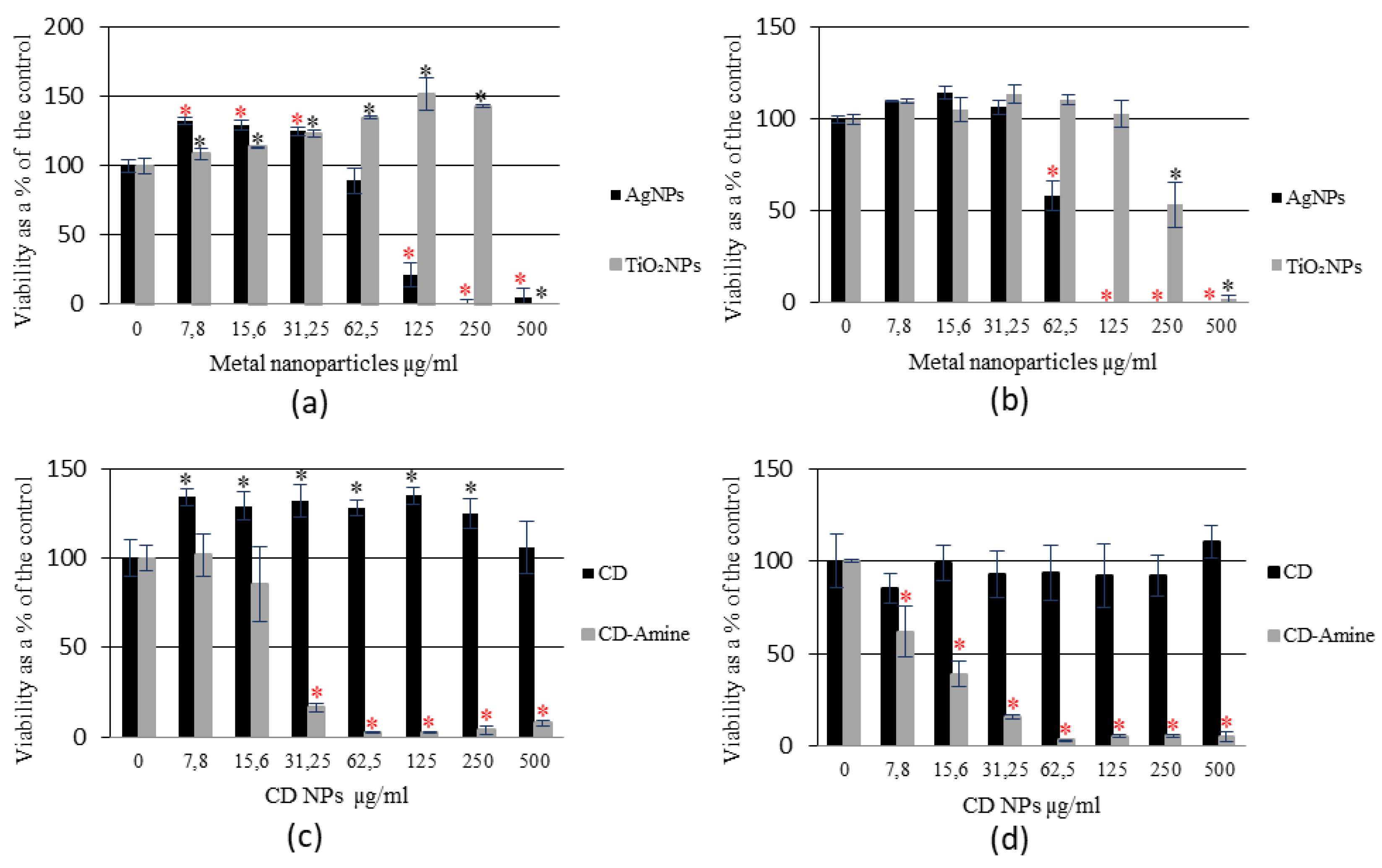
Figure 2.
Modulation potential of (a) chlorpyrifos (postive control), (b) AgNP and TiO2NP, and (c) CD and CD-Amine on acetylcholinesterase activity. Enzyme activity was calculated as a percentage of the control (0µM), and data represents mean percentage ± SD with n = 3. Stars on graphs indicates the significant (p < 0.01) changes in cell viability compared to the control (0 µM).
Figure 2.
Modulation potential of (a) chlorpyrifos (postive control), (b) AgNP and TiO2NP, and (c) CD and CD-Amine on acetylcholinesterase activity. Enzyme activity was calculated as a percentage of the control (0µM), and data represents mean percentage ± SD with n = 3. Stars on graphs indicates the significant (p < 0.01) changes in cell viability compared to the control (0 µM).
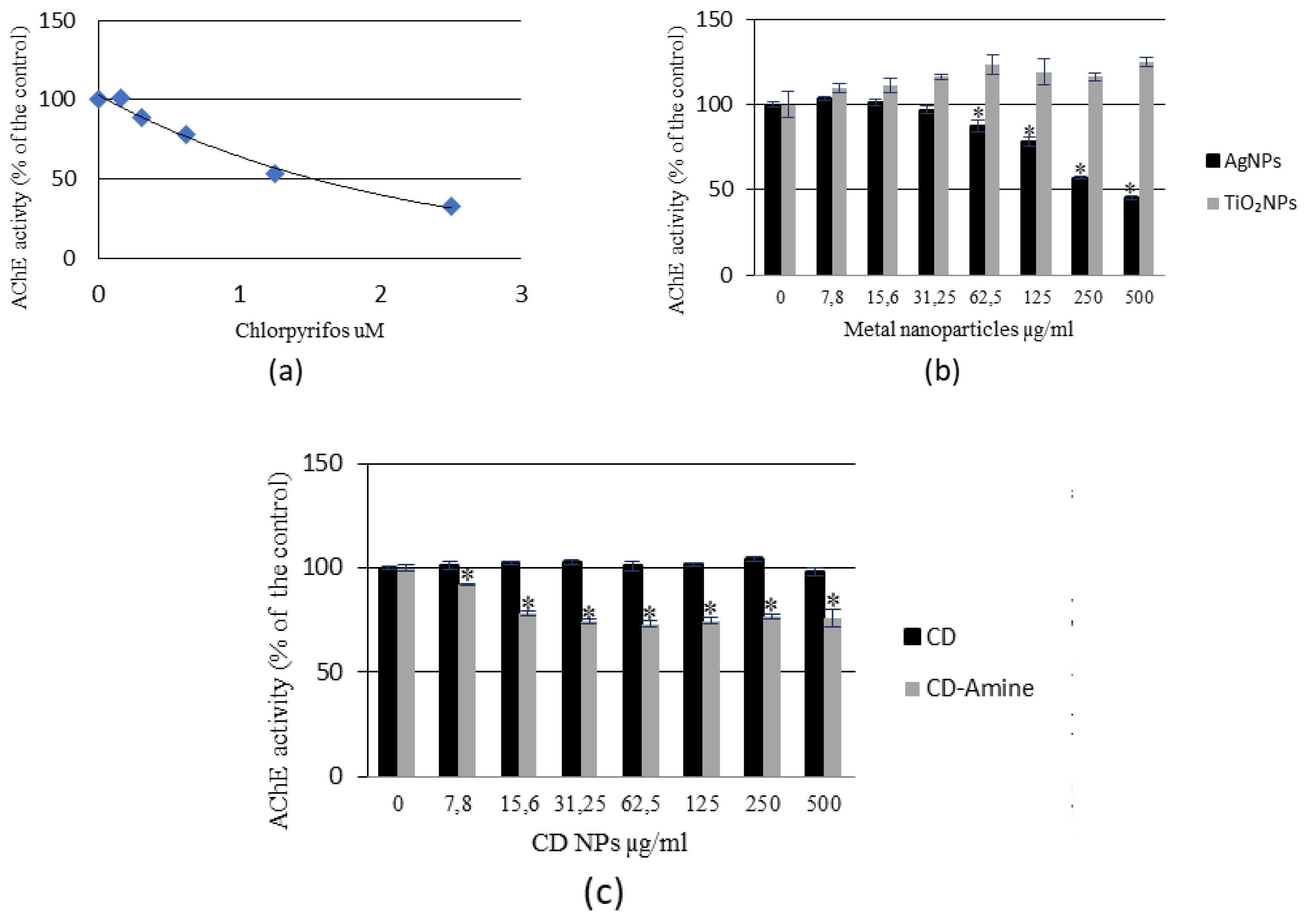

Table 1.
Sonication duration for each nanoparticle.
| Nanoparticles | Sonication period (min) |
|---|---|
| Metal-based Nanoparticles | |
| Silver (AgNP) | 5 |
|
Titanium dioxide (TiO₂NP) |
15 |
| Carbon-based Nanoparticles | |
| Carbon dot (CD) | 5 |
| Amine-modified Carbon dot (CD-Amine) | 20 |
Disclaimer/Publisher’s Note: The statements, opinions and data contained in all publications are solely those of the individual author(s) and contributor(s) and not of MDPI and/or the editor(s). MDPI and/or the editor(s) disclaim responsibility for any injury to people or property resulting from any ideas, methods, instructions or products referred to in the content. |
© 2026 by the authors. Licensee MDPI, Basel, Switzerland. This article is an open access article distributed under the terms and conditions of the Creative Commons Attribution (CC BY) license (http://creativecommons.org/licenses/by/4.0/).
Copyright: This open access article is published under a Creative Commons CC BY 4.0 license, which permit the free download, distribution, and reuse, provided that the author and preprint are cited in any reuse.


