

Submitted:
14 April 2026
Posted:
15 April 2026
You are already at the latest version
Abstract
Background.Staple line leak after sleeve gastrectomy remains one of the least predictable complications in bariatric surgery. Despite numerous proposed explanations, no consensus pathogenetic model exists.Objective.To develop a deterministic biomechanical hypothesis accounting for the mechanism of staple line failure after sleeve gastrectomy.Hypothesis.The present work proposes the formula: Leakage = Obstruction & "Dog Ear". Leak is posited to be the predictable consequence of two co-occurring conditions: (1) mechanical or functional obstruction generating excess intraluminal pressure in the proximal gastric sleeve, and (2) a "dog ear" — a residual triangular pouch at the angle of His acting as a gas-and-fluid trap that prevents pressure decompression into the esophagus. Neither factor alone is sufficient: isolated obstruction results in stenosis; an isolated “dog ear”, in the absence of elevated pressure, remains clinically inconsequential.Conclusion.The formula Leakage = Obstruction & "Dog Ear" offers a reproducible biomechanical framework for understanding and preventing staple line failure after sleeve gastrectomy. Prospective experimental investigation is required.
Keywords:
bariatric surgery
; sleeve
; gastrectomy leak complication
; Obstruction Dog Ear
Introduction
Sleeve gastrectomy (SG) is the most widely performed bariatric procedure worldwide. Staple line leak represents a serious complication associated with prolonged treatment requirements and the potential for sepsis, multiorgan failure, and death. To date, leak after SG remains among the least predictable complications in bariatric surgery [1,2]. Most publications describe leak as a multifactorial complication in which gastric wall ischemia, technical aspects of stapling, tissue thickness, intragastric pressure, infection, and patient behavioral factors may each play a role [3,4]. Nevertheless, none of the largest published series has described a coherent pathogenesis of leak [5]. Concurrently, systematic reviews and meta-analyses consistently demonstrate that staple line reinforcement has no effect on leak risk [6].
This creates a clinical paradox: when a standardized operative technique is performed by a single experienced surgeon using identical materials, one patient in every several dozen or hundreds develops a leak [7,8]. The etiological factor responsible for leak in any specific patient at any specific moment remains, in most cases, undetermined. This approach conflicts with the principles of surgical practice. Leak demands active prevention, not post-hoc analysis. Effective prophylaxis is only possible when the underlying process is fully controlled, predictable, and understood at the level of pathophysiological mechanisms.
The aim of the present study was to develop a pathogenetic model — a "formula" — for staple line leak after SG capable of explaining the mechanism underlying this complication.
The Proposed Leak Formula: Leakage = Obstruction & "Dog Ear"
The neo-stomach formed after SG should be regarded, above all, as a closed hydraulic system. The behavior of gas and liquid contents within this system is directly determined by the geometric configuration of the gastric sleeve. Formation of a uniformly calibrated gastric tube without focal narrowings ensures even distribution of intraluminal pressure and prevents excessive mechanical load on the staple line. Conversely, the presence of narrowings combined with gas-and-fluid traps (the "dog ear") results in a marked pressure increase within a closed volume, substantially amplifying the risk of staple line failure.
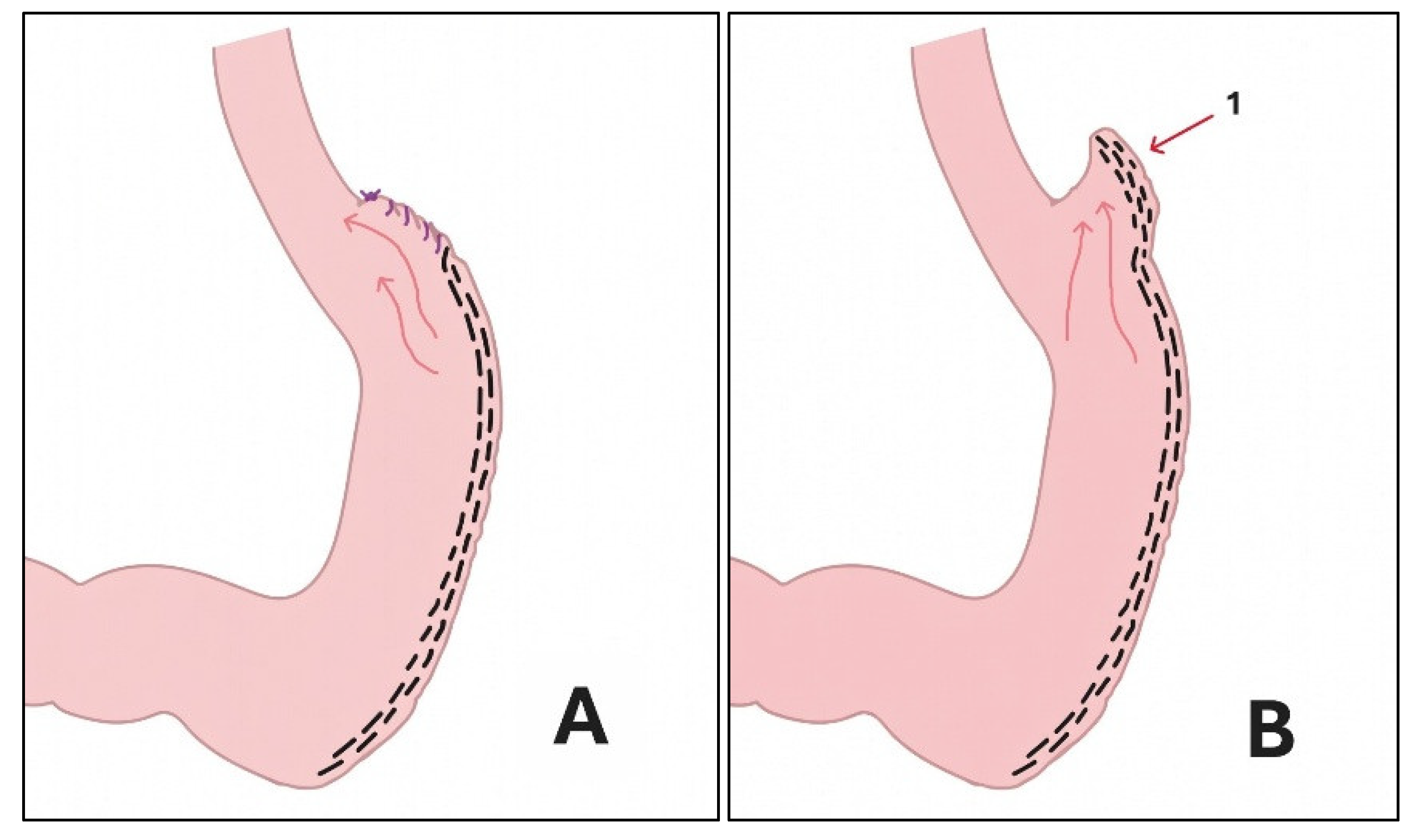
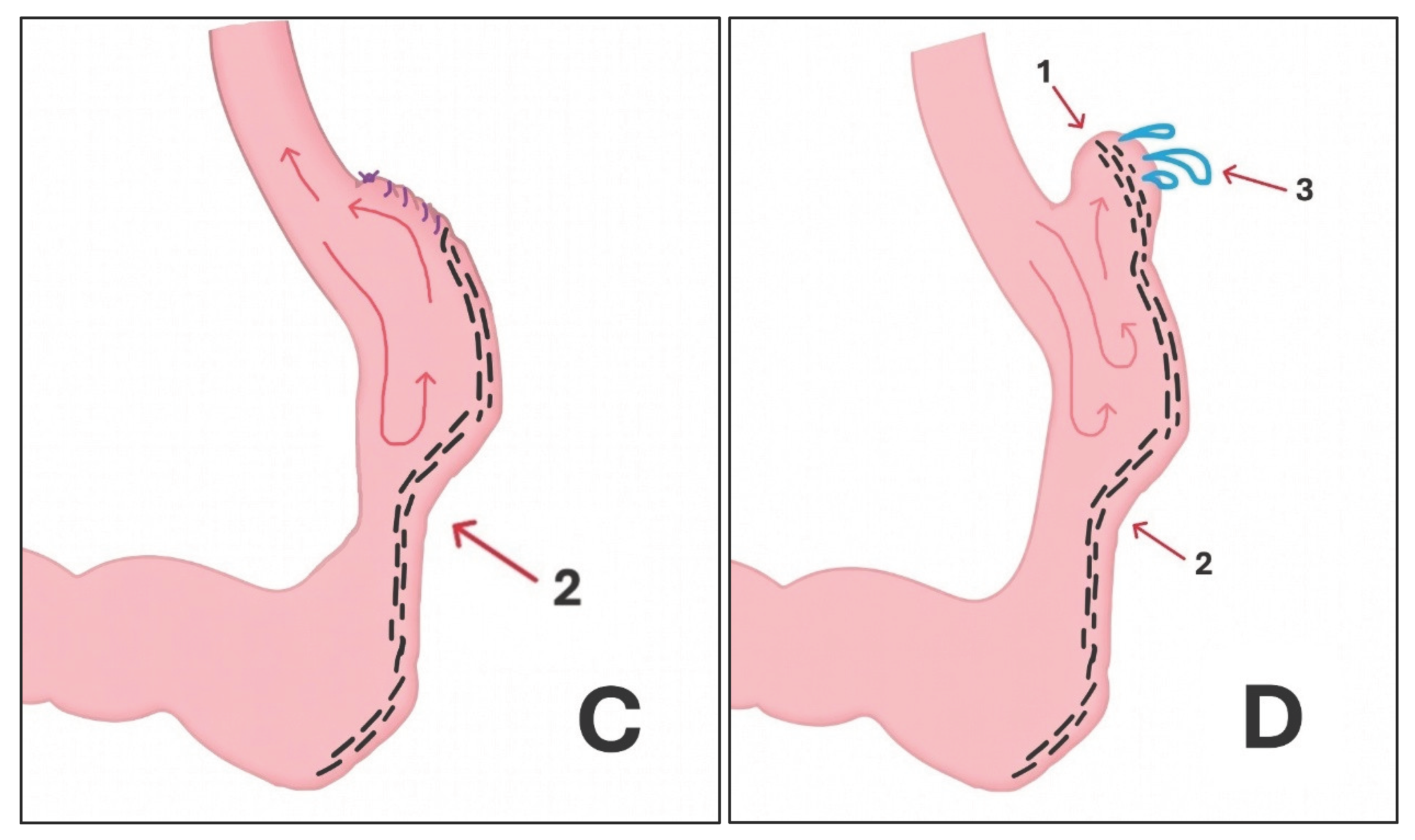
On this basis, the present work propose the following leak formula: Leakage = Obstruction & "Dog Ear" (Figure 1). According to this formula, two factors must coexist for a leak to occur:
A) Obstruction — mechanical or functional obstruction (kinking, twist, edema) generating excessive pressure in the upper third of the gastric sleeve.
Obstruction has been identified in numerous studies as one of the principal causes of leak after SG [9,10,11,12]. Furthermore, relief of obstruction (via stenting) leads to leak resolution in the majority of cases [13,14].
B) "Dog ear" — a configuration of the staple line forming a triangular projection at an acute angle relative to the esophagus in the region of the angle of His.
Catchlove et al. demonstrated that the presence of a “dog ear” at the angle of His significantly amplified stress concentration at the staple line [15]. Multiple studies confirm that the superior angle of the neo-stomach — the site of the “dog ear” — is the most frequent location of staple line leak after SG [16,17].
Obstruction generates high pressure in the upper third of the neo-stomach. The “dog ear”, by creating an acute angle, acts as a trap for gas and liquid, preventing pressure decompression into the esophagus and concentrating it over a small segment of the staple line. Their combination results in staple line rupture and leak.
If obstruction is removed while the “dog ear” remains, a leak most likely does not occur, as pressure distributes uniformly along the entire staple line. If the “dog ear” is removed while obstruction persists, gastric body stenosis develops without leak: pressure is decompressed into the esophagus in the absence of a trap (Figure 1).
Discussion
Data obtained from manometry combined with finite-element modeling support a mechanical basis for staple line failure from a biomechanical standpoint. Catchlove et al. demonstrated that under isobaric loading, zones of local stress concentration consistently develop along the staple line in immediate proximity to the gastroesophageal junction [15]. This is consistent with clinical observations of predominant leak localization in the proximal sleeve segment.
Of particular importance is the established dependence of stress distribution on sleeve geometry. The presence of a “dog ear” at the angle of His significantly amplified stress concentration at the staple line near the gastroesophageal junction, whereas a wide incisura angularis exerted the opposite effect — reducing peak pressure in this zone [15]. Thus, the geometric parameters of the sleeve are independent determinants of mechanical load on the staple line, irrespective of stapling quality or tissue perfusion status.
Staple Line Ischemia
Existing evidence calls into question staple line ischemia as the primary mechanism of failure after SG. First, intraoperative indocyanine green fluorescent angiography consistently demonstrated adequate perfusion along the staple line in all operated patients, yet this did not prevent postoperative leak [18,19]. Adequate intraoperative perfusion is therefore not a reliable predictor of staple line integrity, which underscores the limited prophylactic value of intraoperative perfusion assessment. Second, in a porcine experimental model, no significant increase in ischemia along the staple line was observed following sleeve formation compared with the control zone, casting doubt on the very existence of local ischemia as a consistent consequence of the procedure [20].
An additional argument against the ischemic concept comes from comparison with other bariatric procedures. In gastric bypass — both Roux-en-Y gastric bypass and one-anastomosis gastric bypass — gastric transection at the angle of His is performed in a manner virtually identical to SG. Yet leak rates following bypass procedures are frequently lower than after SG, with leaks localizing predominantly at the anastomosis rather than at the angle of His [21,22,23]. If ischemia were the principal pathogenetic factor, comparable leak rates specifically at the proximal staple line would be expected in bypass surgery — a finding not supported by clinical data. Taken together, these observations suggest that the primary mechanism of staple line failure after SG is not related to impaired tissue perfusion.
The Stronger the Anti-Reflux Mechanism, the Higher the Leak Risk
Complete resection of the “dog ear” or its imbrication straightens the axis of the gastric tube and eliminates the acute angle at the cardia. However, this maneuver carries a trade-off: it weakens the anti-reflux mechanism, allowing gas and liquid to escape more readily into the esophagus. From a mechanical standpoint, this operates as follows: if the anti-reflux barrier of the cardiac valve is intact, pressure is not decompressed into the esophagus and instead bears directly upon the staple line at the angle of His — the weakest point of the staple line — thereby increasing leak risk. If the “dog ear” is eliminated, or if the cardiac valve is weakened (e.g., by crural laxity), pressure finds an outlet through the cardia; the mechanical load on the staple line decreases — reflux is amplified, but leak becomes less likely. A compromise therefore emerges: reducing leak probability requires accepting a degree of anti-reflux mechanism compromise.
Timing of Leak Onset
Various studies report differing timelines of leak onset; most commonly, however, leaks develop at a median of postoperative day 7 or later [24,25,26,27]. By this time, most dietary protocols have transitioned patients from liquid to pureed food [28,29,30]. This dietary transition carries distinct pathophysiological significance.
Following SG, the receptive relaxation and accommodation reflex is lost — the physiological mechanism that normally allows the stomach to expand in volume without a proportional rise in intraluminal pressure [31]. As a result, any food intake directly and immediately elevates intragastric pressure. Pureed food, unlike liquid, is characterized by lower fluidity and substantially slower gastric emptying and, according to scintigraphic data, preferentially accumulates in the proximal sleeve segment near the staple line [32]. The transition to pureed food therefore creates conditions for sustained elevated pressure specifically in the proximal gastric tube.
According to the proposed formula — Leakage = Obstruction & "Dog Ear" — this dietary transition may precipitate leak. In the absence of a “dog ear”, the same mechanism produces not a leak but food intolerance and stenosis.
Practical Conclusions and Technical Recommendations
The proposed leak formula leads to a series of practical conclusions regarding SG technique. These recommendations are not aimed at formal procedural standardization; rather, they emphasize the primacy of functional geometry and pressure behavior over a visually "perfect" result.
1. The gastric tube must be fashioned physiologically, with deliberate preservation of natural curvatures. The gastric tube should not be perfectly straight. Physiological curves — particularly at the incisura angularis — are obligatory and must be consciously accounted for during stapling. Forcibly straightening the tube disrupts the natural biomechanics of the stomach, promotes the formation of functional obstacles, valvular effects, and zones of increased resistance to passage.
2. The “dog ear” should be fashioned in a controlled manner and imbricated. Complete elimination of the “dog ear” with a stapler is not always technically warranted, as stapling in close proximity to the esophagus risks esophageal injury. The optimal approach is to fashion a modest “dog ear” of approximately 1.5–2 cm and imbricate it with sutures. Imbrication of the “dog ear” serves two key functions: (1) it eliminates the pressure-trap geometry and aligns the axis of the gastric tube with the esophagus; (2) it reinforces the thinnest and most vulnerable segment of the wall. In this configuration, the “dog ear” ceases to act as a reservoir for gas and liquid and instead becomes an integral component of a continuous tube incapable of spherical distension.
3. Intraoperative integrity testing. For objective assessment of true staple line leak risk, intraoperative integrity testing should be performed in the absence of a calibration bougie within the neo-stomach lumen. The bougie produces a temporary stenting effect, artificially straightening the gastric tube axis and masking potentially significant zones of functional obstruction — kinks, narrowings, torsional deformities — while also neutralizing anatomical pressure traps at the angle of His [33]. In contrast, distension of the neo-stomach with air or liquid in the absence of a bougie allows identification, under physiological conditions, of zones of focal resistance to passage and non-physiological pressure concentration [34]. The optimal method for this functional assessment is intraoperative gastroscopy [35,36].
Conclusion
This paper proposes and justifies a deterministic pathogenetic model of staple line leak after SG, expressed as the formula Leakage = Obstruction & "Dog Ear". According to this model, staple line failure is the predictable consequence of two necessary co-occurring conditions: (1) mechanical or functional and (2) a zone of focal vulnerability in the form of a "dog ear".
Staple line leak after SG remains a multifactorial complication in that its development is influenced by material quality, operative technique, thermal injury, mechanical wall integrity, and ischemia. The proposed formula does not deny the contribution of these factors. It postulates, however, that under standardized operative conditions — identical technique, materials, and surgeon experience — the combination of obstruction and “dog ear” represents the dominant and necessary precondition for leak to occur.
The formula synthesizes clinical evidence on the role of obstruction, the consistent localization of leaks at the angle of His, and the behavior of gas and liquid within a closed space. Staple line leak after SG ceases to be an enigma once the transition is made from acknowledging multifactoriality to performing biomechanical analysis. The presented formula offers not only an explanation but also a tool for targeted prevention — opening a pathway toward reducing the incidence of this serious complication to its minimum possible level. Definitive confirmation of the hypothesis requires further prospective experimental investigation.
References
- Galloro, G.; Giglio, M.C.; Chini, A.; Maione, R.; Pollastro, M.; Vitale, R.; et al. Endoscopic treatment of staple-line leaks after sleeve gastrectomy in patients with obesity: Which one is the best option, if any? A systematic review with meta-analysis and meta-regression. Obes Surg. 2025, 35(12), 5496–5514. [Google Scholar] [CrossRef] [PubMed]
- Hughes, D.; Hughes, I.; Khanna, A. Management of staple line leaks following sleeve gastrectomy — a systematic review. Obes Surg. 2019, 29(9), 2759–2772. [Google Scholar] [CrossRef] [PubMed]
- Iossa, A.; Martini, L.; De Angelis, F.; et al. Leaks after laparoscopic sleeve gastrectomy: 2024 update on risk factors. Langenbecks Arch Surg. 2024, 409, 249. [Google Scholar] [CrossRef] [PubMed]
- Verras, G.I.; Mulita, F.; Lampropoulos, C.; Kehagias, D.; Curwen, O.; Antzoulas, A.; et al. Risk factors and management approaches for staple line leaks following sleeve gastrectomy: A single-center retrospective study of 402 patients. J Pers Med. 2023, 13(9), 1422. [Google Scholar] [CrossRef]
- Frattini, F.; Delpini, R.; Inversini, D.; Pappalardo, V.; Rausei, S.; Carcano, G. Gastric leaks after sleeve gastrectomy: Focus on pathogenetic factors. Surg Technol Int. 2017, 31, 123–126. [Google Scholar] [PubMed]
- Niaz, O.; Askari, A.; Currie, A.; McGlone, E.R.; Zakeri, R.; Khan, O.; et al. Analysis of the effect of staple line reinforcement on leaking and bleeding after sleeve gastrectomy from the UK National Bariatric Surgery Registry. World J Surg. 2024, 48, 1950–1957. [Google Scholar] [CrossRef]
- Russo, M.F.; Castagneto-Gissey, L.; Illuminati, G.; D’Andrea, V.; Genco, A.; Casella, G. Leaks after sleeve gastrectomy: Is it still an issue? — single-center experience and systematic literature review. Ann Laparosc Endosc Surg. 2025, 10, 1. [Google Scholar] [CrossRef]
- Li, M.; Zeng, N.; Liu, Y.; Sun, X.; Yang, W.; Liu, Y.; et al. GC-MBD Study Group. Management and outcomes of gastric leak after sleeve gastrectomy: Results from the 2010–2020 national registry. Chin Med J. 2023, 136(16), 1967–1976. [Google Scholar] [CrossRef]
- Kim, J.; Azagury, D.; Eisenberg, D.; DeMaria, E.; Campos, G.M.; ASMBS Clinical Issues Committee. ASMBS position statement on prevention, detection, and treatment of gastrointestinal leak after gastric bypass and sleeve gastrectomy, including the roles of imaging, surgical exploration, and nonoperative management. Surg Obes Relat Dis. 2015, 11(4), 739–748. [Google Scholar] [CrossRef]
- Gagner, M.; Buchwald, J.N. Comparison of laparoscopic sleeve gastrectomy leak rates in four staple-line reinforcement options: A systematic review. Surg Obes Relat Dis. 2014, 10(4), 713–723. [Google Scholar] [CrossRef]
- Caiazzo, R.; Marciniak, C.; Wallach, N.; Devienne, M.; Baud, G.; Cazauran, J.B.; et al. Malignant leakage after sleeve gastrectomy: Endoscopic and surgical approach. Obes Surg. 2020, 30(11), 4459–4466. [Google Scholar] [CrossRef] [PubMed]
- Sillén, L.; Andersson, E.; Olbers, T.; Edholm, D. Obstruction after sleeve gastrectomy, prevalence, and interventions: A cohort study of 9,726 patients from the Scandinavian Obesity Surgery Registry (SOReg). Obes Surg. 2021, 31(11), 4701–4707. [Google Scholar] [CrossRef] [PubMed]
- Gipe, J.; Agathis, A.Z.; Nguyen, S.Q. Managing leaks and fistulas after laparoscopic sleeve gastrectomy: Challenges and solutions. Clin Exp Gastroenterol. 2025, 18, 1–9. [Google Scholar] [CrossRef] [PubMed]
- Lee, S.; Dang, J.; Chaivanijchaya, K.; Farah, A.; Kroh, M. Endoscopic management of complications after sleeve gastrectomy: A narrative review. Mini-invasive Surg. 2024, 8, 18. [Google Scholar] [CrossRef]
- Catchlove, W.; Liao, S.; Lim, G.; Brown, W.; Burton, P. Mechanism of staple line leak after sleeve gastrectomy via isobaric pressurisation concentrating stress forces at the proximal staple line. Obes Surg. 2022, 32(8), 2525–2536. [Google Scholar] [CrossRef]
- Negm, S.; Mousa, B.; Shafiq, A.; Abozaid, M.; Allah, E.A.; Attia, A.; et al. Endoscopic management of refractory leak and gastro-cutaneous fistula after laparoscopic sleeve gastrectomy: A randomized controlled trial. Surg Endosc. 2023, 37(3), 2173–2181. [Google Scholar] [CrossRef]
- Aurora, A.R.; Khaitan, L.; Saber, A.A. Sleeve gastrectomy and the risk of leak: A systematic analysis of 4,888 patients. Surg Endosc. 2012, 26(6), 1509–1515. [Google Scholar] [CrossRef]
- Di Furia, M.; Romano, L.; Salvatorelli, A.; Brandolin, D.; Lomanto, D.; Cianca, G.; et al. Indocyanine green fluorescent angiography during laparoscopic sleeve gastrectomy: Preliminary results. Obes Surg. 2019, 29(12), 3786–3790. [Google Scholar] [CrossRef]
- Pavone, G.; Fersini, A.; Pacilli, M.; De Fazio, M.; Panzera, P.; Ambrosi, A.; et al. Can indocyanine green during laparoscopic sleeve gastrectomy be considered a new intraoperative modality for leak testing? BMC Surg. 2022, 22(1), 341. [Google Scholar] [CrossRef]
- Natoudi, M.; Theodorou, D.; Papaloos, A.; Drymousis, P.; Alevizos, L.; Katsaragakis, S.; et al. Does tissue ischemia actually contribute to leak after sleeve gastrectomy? An experimental study. Obes Surg. 2014, 24(5), 675–683. [Google Scholar] [CrossRef]
- Smith, M.D.; Adeniji, A.; Wahed, A.S.; Patterson, E.; Chapman, W.; Courcoulas, A.P.; et al. Technical factors associated with anastomotic leak after Roux-en-Y gastric bypass. Surg Obes Relat Dis. 2015, 11(2), 313–320. [Google Scholar] [CrossRef] [PubMed]
- Mocanu, V.; Dang, J.; Ladak, F.; Switzer, N.; Birch, D.W.; Karmali, S. Predictors and outcomes of leak after Roux-en-Y gastric bypass: An analysis of the MBSAQIP data registry. Surg Obes Relat Dis. 2019, 15(3), 396–403. [Google Scholar] [CrossRef] [PubMed]
- Jacobsen, H.J.; Nergard, B.J.; Leifsson, B.G.; Frederiksen, S.G.; Agajahni, E.; Ekelund, M.; et al. Management of suspected anastomotic leak after bariatric laparoscopic Roux-en-Y gastric bypass. Br J Surg. 2014, 101(4), 417–423. [Google Scholar] [CrossRef] [PubMed]
- Sakran, N.; Goitein, D.; Raziel, A.; Keidar, A.; Beglaibter, N.; Grinbaum, R.; et al. Gastric leaks after sleeve gastrectomy: A multicenter experience with 2,834 patients. Surg Endosc. 2013, 27(1), 240–245. [Google Scholar] [CrossRef]
- Parmer, M.; Wang, Y.H.W.; Hersh, E.H.; Zhang, L.; Chin, E.; Nguyen, S.Q. Management of staple line leaks after laparoscopic sleeve gastrectomy. JSLS 2022, 26(3), e2022.00029. [Google Scholar] [CrossRef]
- Rebibo, L.; Tricot, M.; Dembinski, J.; Dhahri, A.; Brazier, F.; Regimbeau, J.M. Gastric leak after sleeve gastrectomy: Risk factors for poor evolution under conservative management. Surg Obes Relat Dis. 2021, 17(5), 947–955. [Google Scholar] [CrossRef]
- Montuori, M.; Benavoli, D.; D’Ugo, S.; Di Benedetto, L.; Bianciardi, E.; Gaspari, A.L.; et al. Integrated approaches for the management of staple line leaks following sleeve gastrectomy. J Obes. 2017, 2017, 4703236. [Google Scholar] [CrossRef]
- Park, S.; Kim, S.; Kim, S.; Shin, A.R.; Park, Y. Nutritional intervention for a patient with sleeve gastrectomy. Clin Nutr Res. 2023, 12(3), 177–183. [Google Scholar] [CrossRef]
- Frias-Toral, E.; Chapela, S.; Gonzalez, V.; Martinuzzi, A.; Locatelli, J.; Llobera, N.; et al. Optimizing nutritional management before and after bariatric surgery: A comprehensive guide for sustained weight loss and metabolic health. Nutrients 2025, 17(4), 688. [Google Scholar] [CrossRef]
- Bettini, S.; Belligoli, A.; Fabris, R.; Busetto, L. Diet approach before and after bariatric surgery. Rev Endocr Metab Disord. 2020, 21(3), 297–306. [Google Scholar] [CrossRef]
- Sista, F.; Abruzzese, V.; Clementi, M.; Carandina, S.; Cecilia, M.; Amicucci, G. The effect of sleeve gastrectomy on GLP-1 secretion and gastric emptying: A prospective study. Surg Obes Relat Dis. 2017, 13(1), 7–14. [Google Scholar] [CrossRef]
- Wickremasinghe, A.C.; Johari, Y.; Laurie, C.; Shaw, K.; Playfair, J.; Beech, P.; et al. Delayed gastric emptying after sleeve gastrectomy is associated with poor weight loss. Obes Surg. 2022, 32(12), 3922–3931. [Google Scholar] [CrossRef]
- Sethi, M.; Zagzag, J.; Patel, K.; Magrath, M.; Somoza, E.; Parikh, M.S.; et al. Intraoperative leak testing has no correlation with leak after laparoscopic sleeve gastrectomy. Surg Endosc. 2016, 30(3), 883–891. [Google Scholar] [CrossRef]
- Nimeri, A.; Maasher, A.; Salim, E.; et al. The use of intraoperative endoscopy may decrease postoperative stenosis in laparoscopic sleeve gastrectomy. Obes Surg. 2016, 26(6), 1398–1401. [Google Scholar] [CrossRef]
- Kockerling, F.; Schug-Pass, C. Gastroscopically controlled laparoscopic sleeve gastrectomy. Obes Facts 2009, 2, 15–18. [Google Scholar] [CrossRef]
- Chen, I.S.; Tsai, M.S.; Chen, J.H.; Chen, C.Y.; Chen, I.L.; Tai, C.M. The utility of intraoperative endoscopy to assist novice surgeons in the detection of gastric stenosis during laparoscopic sleeve gastrectomy. BMC Surg. 2022, 22(1), 323. [Google Scholar] [CrossRef]
Figure 1.
A — Sleeve gastrectomy without obstruction or “dog ear” (staple line imbrication at the angle of His). Intragastric pressure is distributed evenly throughout the neo-stomach. Excess pressure can decompress into the esophagus, as no gas-and-fluid trap — “dog ear” — is present. B — Sleeve gastrectomy with “dog ear”, without obstruction. Intragastric pressure is distributed evenly throughout the neo-stomach, with a zone of potentially elevated pressure at the “dog ear”. Leak is unlikely to occur, as pressure remains uniformly distributed. C — Sleeve gastrectomy with obstruction, without “dog ear”. Intragastric pressure rises in the upper neo-stomach; however, in the absence of a gas-and-fluid trap — “dog ear” — pressure is decompressed into the esophagus. D — Leakage = Obstruction & "Dog Ear" — Sleeve gastrectomy with both obstruction and “dog ear” present. Intragastric pressure rises in the upper neo-stomach and, in the presence of a gas-and-fluid trap — “dog ear” — staple line rupture and leak occur at this site. 1 — “dog ear”. 2 — obstruction. 3 — leak.
Figure 1.
A — Sleeve gastrectomy without obstruction or “dog ear” (staple line imbrication at the angle of His). Intragastric pressure is distributed evenly throughout the neo-stomach. Excess pressure can decompress into the esophagus, as no gas-and-fluid trap — “dog ear” — is present. B — Sleeve gastrectomy with “dog ear”, without obstruction. Intragastric pressure is distributed evenly throughout the neo-stomach, with a zone of potentially elevated pressure at the “dog ear”. Leak is unlikely to occur, as pressure remains uniformly distributed. C — Sleeve gastrectomy with obstruction, without “dog ear”. Intragastric pressure rises in the upper neo-stomach; however, in the absence of a gas-and-fluid trap — “dog ear” — pressure is decompressed into the esophagus. D — Leakage = Obstruction & "Dog Ear" — Sleeve gastrectomy with both obstruction and “dog ear” present. Intragastric pressure rises in the upper neo-stomach and, in the presence of a gas-and-fluid trap — “dog ear” — staple line rupture and leak occur at this site. 1 — “dog ear”. 2 — obstruction. 3 — leak.
Disclaimer/Publisher’s Note: The statements, opinions and data contained in all publications are solely those of the individual author(s) and contributor(s) and not of MDPI and/or the editor(s). MDPI and/or the editor(s) disclaim responsibility for any injury to people or property resulting from any ideas, methods, instructions or products referred to in the content. |
© 2026 by the author. Licensee MDPI, Basel, Switzerland. This article is an open access article distributed under the terms and conditions of the Creative Commons Attribution (CC BY) license.
Copyright: This open access article is published under a Creative Commons CC BY 4.0 license, which permit the free download, distribution, and reuse, provided that the author and preprint are cited in any reuse.


