
Submitted:
14 April 2026
Posted:
15 April 2026
You are already at the latest version
Abstract
Background/Objectives. The 13-valent pneumococcal conjugate vaccine (PCV13), followed by the 23-valent pneumococcal polysaccharide vaccine (PPV23; PCV13→PPV23), was recommended for adults with high-risk conditions and all adults aged ≥65 years. With the availability of the 20-valent PCV (PCV20), which provides broader protection against pneumococcal disease, Taiwan CDC recently recommended to replace PCV13→PPV23 with PCV20. However, there is no economic evidence to support the recommendation. Therefore, the objective of the study is to assess the short- and long-term clinical and economic value of PCV20 to support the recommendation. Methods. A lifetime cost-effectiveness analysis (CEA) based on a single cohort and five-year budget impact analysis (BIA) based on rolling cohorts were conducted from a healthcare system perspective to evaluate replacing PCV13→PPV23 with PCV20 among high-risk adults aged 18–64 years and all adults aged 65–99 years. Results. In CEA, PCV20 was estimated to reduce pneumococcal disease cases by 4,684 and deaths by 160 among the model population (N = 5.5M) over a lifetime horizon. Total costs decreased by NT $2.3 billion while quality-adjusted life-years (QALYs) increased by 944, making PCV20 the dominant strategy versus PCV13→PPV23. BIA showed budget savings of NT $5.4 billion over five years including NT$2.4 billion in the first year. Conclusions. Switching to PCV20 for adults with high-risk conditions and all adults aged ≥ 65 years would substantially reduce the burden of pneumococcal disease and related deaths, leading to cost and budget savings for Taiwan's healthcare system.
Keywords:
pneumococcal conjugate vaccines
; cost-effectiveness analysis
; adult vaccination
; Taiwan
1. Introduction
Streptococcus pneumoniae, also known as S. pneumoniae or pneumococcus, is a major cause of mortality and morbidity globally [1]. It is the leading causative pathogen of community acquired pneumonia (CAP) which presents as invasive pneumococcal disease (IPD), including bacteremia and meningitis, and non-invasive disease such as non-bacteremic pneumonia (NBP) [2,3]. In 2013, Said et al. reported that an estimated 27.3% of CAP was attributable to pneumococcus worldwide [4]. More recently, a systematic review by Lansbury et al. (2022) reported this proportion to be lower (18%) due to the introduction of childhood vaccinations [5]. An older study conducted in Taiwan among adults hospitalized due to CAP found pneumococcus to be the most common etiologic agent (40 of 168 patients [23.8%]) in adults with CAP, aligning with global findings [6].
To reduce the burden of pneumococcal disease, the Taiwanese national pneumococcal immunization program (NIP) has consistently recommended vaccination for both children and adults [7,8]. The recommendations for adult pneumococcal immunization were recently revised introducing the novel 20-valent pneumococcal conjugate vaccine (PCV20) to replace the sequential regimen of 13-valent PCV13 followed by 23-valent pneumococcal polysaccharide vaccine (PPV23; PCV13→PPV23) [9,10]. PPV23 protects against 23 IPD-causing serotypes (1, 2, 3, 4, 5, 6B, 7F, 8, 9N, 9V, 10A, 11A, 12F, 14, 15B, 17F, 18C, 19A, 19F, 20, 22F, 23F, and 33F), 11 of which are unique to PPV23 [11,12,13]. PCV13 covers 13 serotypes (1, 3, 4, 5, 6A, 6B, 7F, 9V, 14, 18C, 19A, 19F and 23F) and protects against both IPD and NBP due to pneumococcus, unlike PPV23. Given the combined benefits of PCV13 and PPV23, until recently the sequential regimen of PCV13→PPV23 was recommended for high-risk adults and all adults aged ≥65 years in Taiwan. A 15-valent pneumococcal conjugate vaccine (PCV15), which protects against PCV13 serotypes as well as 22F and 33F, is also available in Taiwan, but not included in the NIP [7,8].
PCV20 was licensed in Taiwan in December 2024 based on findings from clinical trials [14,15,16,17]. PCV20 covers five additional serotypes (i.e., 8, 10A, 11A, 12F, 15B) not included in PCV15 and shares 19 of the 23 serotypes covered by PPV23 [18,19,20,21]. Unlike PPV23, PCV20 has a T cell-dependent response mechanism which results in more durable protection than PPV23 [22,23]. Because of the serotype overlap and vaccine characteristics, most countries where PCV20 is included in the adult vaccination program recommend its use alone (i.e., as opposed to in sequence with PPV23), resulting in more straightforward recommendations. Following the common practice observed in other countries, in January 2026, the simplified single-dose regimen of PCV20 was included in the adult pneumococcal NIP in Taiwan [9,10]. Therefore, the objective of this cost-effectiveness analysis (CEA) and budget impact analysis (BIA) is to provide timely evidence to support the recommendation and to estimate both the short- and long-term clinical and economic benefits of PCV20 in light of this new recommendation.
2. Materials and Methods
2.1. Model Description
A cost-effectiveness model (CEM) and a budget impact model (BIM), both utilizing a deterministic Markov-type process, were used to project the clinical outcomes and economic costs of IPD and all-cause NBP among adults from a healthcare system perspective in a hypothetical population of adults in Taiwan (Figure 1). Clinical and economic outcomes were projected in the CEM to track a single cohort from model entry until death or the end of the time horizon to estimate lifetime costs and quality-adjusted life-years (QALYs). The BIM used multiple rolling adult cohorts, adding new eligible individuals each year, to estimate the financial impact on the healthcare budget over five years. The model population was characterized based on age (in one-year increments) and risk profile (i.e., low [immunocompetent without underlying medical conditions], moderate [immunocompetent with ≥1 underlying medical condition], or high [immunocompromised]). During the modeling horizon, persons were allowed to transition to a higher risk group (e.g., low → moderate), but not to a lower risk group.
Persons in the CEA and BIA model populations may have received PCV20 alone or PCV13→PPV23 at model entry; those who received PCV13 at model entry were assumed to have received PPV23 in model year 2 (if alive). PCV15 was excluded from the analyses because it is not included in the national pneumococcal immunization program in Taiwan [7,8], and because Taiwanese surveillance data used in this study suggested that there were no cases of pneumococcal disease attributed to PCV15 non-PCV13 serotypes (see Model Estimation) [5,24].
Clinical outcomes and economic costs were projected annually for the model populations based on age, risk profile, disease/fatality rates, vaccination status, vaccine type, time since vaccination, and unit costs of vaccination and medical treatment. All IPD cases were considered requiring hospitalization, whereas all-cause NBP was stratified by care setting (inpatient vs. outpatient). Persons vaccinated at model entry may have been at lower risk of future IPD and NBP; the magnitude of the reduction in probability of contracting pneumococcal disease varied based on vaccine(s) received, clinical presentation (i.e., IPD or NBP), proportion of disease that is vaccine-preventable (i.e., vaccine-type), and vaccine effectiveness against vaccine-type disease (which is dependent on age and time since receipt). The models also considered age- and risk-dependent probability of death from IPD, NBP requiring inpatient care, and other causes (i.e., other than IPD and NBP). Expected costs of medical treatment for IPD and NBP were generated using event rates and unit costs specific to the care setting. Costs of vaccination were tallied in the year(s) in which the vaccination occurred (i.e., year 1 for PCV20, years 1 and 2 for the sequential strategies).
2.2. Inputs Estimation
Model inputs were primarily based on published sources and were estimated by age (18-49, 50-64, 65-74, 75-84, and 85-99 years) and risk. In cases where published sources were not stratified by age and risk, techniques of linear interpolation and extrapolation were employed to derive age- and risk-specific values required by the model. All costs are expressed in 2024 New Taiwan dollar (NT$). Methods used in estimation of key model parameters are summarized below; base case model inputs for the population size, disease incidence rates, annual mortality rates, case fatality rates, medical care costs, and utilities are included in Table 1 and for the vaccine effectiveness rates and vaccine uptake in Supplemental Table S1. The estimation of key model parameters is presented below, with additional details on inputs provided in the Supplements. Unless otherwise specified, the descriptions apply to both the CEA and BIA.
Population. The Taiwan adult population (N=20,091,471) by single year of age was derived from the overall 2025 Taiwan resident population projected by the Taiwan National Statistics [25] and population pyramid for Taiwan [26]. To estimate the proportion of the population who is at risk of pneumococcal disease, we utilized a previously published study which reports the prevalence of various comorbidities in the general population in Taiwan [27]. Based on the distribution of persons with relevant comorbidities reported in that study, at-risk individuals were stratified into high-risk (defined as persons with cancer, liver disease, or renal disease) and moderate-risk (defined as persons with diabetes, congestive heart failure, coronary syndrome, cerebrovascular disease or chronic pulmonary disease) (Supplemental Table S2) [27]; persons not identified as at-risk were considered low-risk.
Rates of Disease. Age-specific IPD incidence rates were from the 2019 Taiwan CDC surveillance report [24] and were allocated across risk groups using the relative risk of IPD as observed in the United States (US) from 2017/2018 (Pfizer, unpublished observations) and the underlying Taiwan population risk distribution [27]. Age-specific all-cause NBP incidence rates were based on Huang et al. (2022) [28] and were apportioned by care setting based on the proportion of pneumonia treated in the inpatient and outpatient settings from Lu et al. (2020) [29]. Age-specific inpatient rates were allocated across risk groups using the relative risk of hospitalized all-cause NBP from a US study spanning 2013-2015 [30] and the underlying Taiwan population risk distribution [27]. Age-specific outpatient rates were allocated across risk groups based on relative risks of all-cause NBP from Weycker et al. (2016) [31] and the underlying Taiwan population risk distribution [27].
Case-Fatality and Mortality Rates. Age-specific case-fatality rates (CFRs) for IPD were from the 2019 Taiwan CDC surveillance report [24] and apportioned across risk groups using relative risks from the US CDC (Pfizer, unpublished observations) and the risk distribution of persons with IPD in Taiwan [27]. For CFR due to inpatient all-cause NBP, age-specific rates were obtained from Lu et al. (2020) [29] and allocated across risk groups based on relative risks from Averin et al. (2021) [32] and the risk distribution of persons with inpatient all-cause NBP in Taiwan [29,30]. Outpatient all-cause NBP was assumed not to cause disease-related mortality.
General population mortality rates were based on 2023 life tables from the Taiwan Ministry of the Interior [33] and were allocated across risk groups based on assumed relative risk of mortality and population weights. Mortality rates were downwardly adjusted to account for death due to IPD and all-cause inpatient NBP.
Vaccine Effectiveness. Vaccine effectiveness (VE) against vaccine-type (VT) IPD and NBP for PCV13 and PPSV23 were based on published literature [34,35,36,37] and have been used in previously published studies [38,39,40,41,42,43]. VE-PCV20 against VT disease was assumed to be equivalent to that of PCV13, based on published data evaluating the safety, tolerability, and immunogenicity of PCV20 [44]. VE-PPV23 against VT-NBP was assumed to be zero, based on multiple published sources and in line with base case assumptions used in several economic studies [45,46,47,48,49,50,51,52,53,54,55,56,57,58,59,60]. Detailed description of estimation of initial VE and waning assumptions are included in the Supplemental Text file.
Serotype Coverage. The percentage of IPD due to vaccine serotypes in year 1 of the modeling horizon was estimated by age using data from the 2019 Taiwan CDC surveillance report [24] (Supplemental Table S3). Although more recent surveillance data (2020, 2021 and 2022) are available, the 2019 surveillance report was employed because, probably as a consequence of the Covid-19 pandemic, substantially reduced numbers of IPD cases were observed in more recent reports. Percentage of all-cause NBP due to vaccine serotypes was estimated by multiplying IPD serotype coverage by the proportion of NBP due to pneumococcus (18%) from Lansbury et al. (2022) [5] (Supplemental Table S4). PCV15 serotype coverage was found to be the same as PCV13 serotype coverage because there was no disease attributable to serotypes 22F and 33F. While PCV13 serotype coverage in 2019 was lower relative to 2015, surveillance data for the years between 2015 and 2019 showed that coverage varied from year to year; hence, no consistent pattern of reduction was observed [12,24,61,62,63]. Therefore, in the CEA base case and the BIA, herd effects from pediatric vaccination were not considered and serotype coverage was constant throughout the duration of the modeling horizon. The impact of herd effects from future pediatric PCV20 use was, however, examined in a scenario analysis within the CEA.
Vaccine Coverage. In the CEA, vaccine coverage for PCV13 and PCV20 at model entry was based on assumed uptake: aged 18-49 (7.2%), 50-64 (20%), 65-74 (50%), and 75-99 years (35%) (Pfizer, unpublished observations). For the BIA, we assumed the same vaccine coverage in Year 1; from year 2 to year 5, an annual relative increase in coverage was assumed as follows: 20% for high-risk adults aged 18-64 years, 15% for adults aged 65-74 years, and 10% for adults aged ≥75 years. In both models, all persons who received PCV13 in model year 1 were assumed to receive PPV23 in model year 2, if alive.
Costs. Cost of medical care for IPD, inpatient all-cause NBP, and outpatient all-cause NBP were based on Lu et al. (2022) [64] and were adjusted to 2024 NT$ using the Taiwan consumer price index (CPI) [65]. Costs were assumed to be invariant by age and risk. All vaccine prices employed are confidential. The PCV20 price was assumed to be 10% higher than the PCV13 price (Pfizer, unpublished observations), and PPV23 price was 40% of PCV13 price. Vaccine administration cost was not considered in the model.
Utility and Disutilities. In the CEA, age-specific general population health state utilities were based on Wong et al. (2019) [66]. Because utilities from Wong et al. (2019) are relatively high, they were assumed to reflect baseline utilities for low-risk persons, thus utilities for moderate- and high-risk persons were derived by multiplying utilities from Wong et al. by relative utility values for moderate- and high-risk (vs. low-risk) persons derived from Mendes et al. (2022) [42].
Disease-related disutilities in the CEA were based on published literature. Disutility due to IPD and inpatient NBP was assumed to be 0.13 in the year of occurrence based on Mangen et al. (2017) [67]. For NBP requiring outpatient care only, disutility was assumed to be 0.004 based on Melegaro et al. (2004) [68]. Disutility was assumed to be invariant by age and risk.
2.3. Cost-Effectiveness Analyses
Base Case. Clinical outcomes and economic costs over a lifetime time horizon were evaluated for PCV20 versus PCV13→PPV23 in high-risk adults aged 18-64 years and all adults aged 65-99 years. Analyses were also conducted for subgroups defined on age (i.e., 18-64 and 65-99 years, respectively).
Analyses were conducted from the Taiwan healthcare system perspective; future costs, life-years (LYs), and quality-adjusted LYs (QALYs) were discounted at 3% annually. Incremental cost-effectiveness ratios (ICERs) were calculated based on differences in costs and QALYs for each comparison.
Scenario Analyses. Herd effects from future pediatric PCV20 NIP were incorporated in Scenario Analysis #1. Herd effects were based on the observed serotype coverage patterns in PCV13 serotypes reported in the Taiwan CDC surveillance reports from 2015-2019 [12,24,61,62,63] following the implementation of a pediatric national immunization program with PCV13 in 2015. Relative changes in PCV13 serotypes were applied to PCV20 non-PCV13 serotypes starting in model year 4. Serotype coverage for IPD and NBP with herd effects are presented in Supplemental Tables S5 and S6. In Scenario Analysis #2, only 50% of persons who received PCV13 in model year 1 were assumed to receive PPV23 in model year 2.
Probabilistic Sensitivity Analyses. Probabilistic sensitivity analyses (PSAs) were conducted (1,000 replications) to account for uncertainty surrounding key model parameters. For each input parameter, the appropriate distribution was determined based on information available in the source material (Supplemental Table S7). Cost-effectiveness of PSA results was evaluated relative to a willingness-to-pay (WTP) threshold of 3x gross domestic product (GDP) per capita, a metric commonly employed in countries to assess cost-effectiveness where the local health technology assessment authority does not have a pre-specified threshold.
2.4. Budget Impact Analyses
Base case analysis evaluated the clinical outcomes and economic costs over a five-year horizon for PCV20 versus PCV13→PPV23 in high-risk adults aged 18-64 years and all adults aged 65-99 years. Analyses were conducted from the Taiwan healthcare system perspective over a five-year horizon; future costs were not discounted in the model. Total cumulative costs, annual costs, and net budget impact were calculated.
3. Results
3.1. Cost-Effectiveness Analysis
Base Case Analyses. With use of PCV13→PPV23 among the high-risk population aged 18-64 years and all adults aged 65-99 years (N = 5,508,375), the model estimated 5,511 cases of IPD, 1,934,376 cases of all-cause inpatient NBP, 3,716,882 cases of all-cause outpatient NBP, and 236,583 disease-related deaths over the lifetime modeling horizon (Table 2). These outcomes corresponded to a total direct cost of NT$75.2 billion—including NT$63.7 billion for medical care and NT$11.5 billion for vaccination. Compared to PCV13→PPV23, use of PCV20 at model entry reduced expected lifetime cases of IPD by 29, all-cause inpatient NBP by 1,483, all-cause outpatient NBP by 3,171, and total disease-related deaths by 160. Given the reduction in cases, expected lifetime total medical care costs were reduced by NT$64.4 million. Furthermore, replacing a two-dose strategy with a single dose of PCV20 decreased total vaccination costs by NT$2.3 billion. With total costs lower by NT$2.3 billion, and discounted life years higher by 1,178 (unadjusted) and 944 (quality-adjusted), PCV20 was estimated to be the dominant strategy (i.e., cost-saving) versus PCV13→PPV23 from the healthcare system perspective. PCV20 was also dominant among subgroups defined on age with estimated cost savings (medical care and vaccination costs) of NT$132.4 million among adults aged 18-64 years and NT$2.2 billion among adults aged 65-99 years (Supplemental Table S8).
Scenario Analyses. In the scenario assuming herd effects from pediatric use of PCV20 (Scenario Analysis #1), the ICER for PCV20 use remained dominant compared to the sequential strategy among high-risk adults aged 18-64 years and all adults aged 65-99 years (∆ costs: -NT$2.3B; ∆ QALYs: 815; Table 3), and in subgroup analyses for both age groups (Supplemental Table S9). In the scenario assuming reduced uptake of PPV23 (50%) in the sequential strategy (Scenario Analysis #2), the ICER for PCV20 use remained dominant compared to the sequential strategy among high-risk adults aged 18-64 years and all adults aged 65-99 years (∆ costs: -NT$789.1M; ∆ QALYs: 953; Table 4), and in subgroup analyses for both age groups (Supplemental Table S10).
Probabilistic Sensitivity Analyses. In probabilistic sensitivity analyses of the full model population, 100% of 1,000 of simulations generated ICERs located in the southeast quadrant of the scatterplot and thus projected lower costs and higher QALYs with use of PCV20 versus PCV13→PPV23 (Figure 2). All (100%) of the 1,000 simulations were therefore under the 3x GDP per capita threshold (NT$3.4M) [69].
3.2. Budget Impact Analysis
Among high-risk adults aged 18-64 years and all adults aged 65-99 years (N = 5,301,030), replacing PCV13→PPV23 with PCV20 would prevent an additional 20 cases of IPD, 1,080 cases of all-cause inpatient NBP, 2,357 cases of all-cause outpatient NBP, and 113 deaths over five years (Table 5, Supplemental Table S11). The reduction in cases would lower medical care costs by NT$56.3 million and vaccination costs by NT$5.4 billion, resulting in total budget savings of NT$5.4 billion from the healthcare system perspective.
In the model population, the vaccine uptake increased cumulatively from 40% in Year 1 to 65% in Year 2, 80% in Year 3, 88% in Year 4, and reaching 93% in Year 5. The reduction in costs was estimated at NTD$2.4 billion in the first year, decreasing over time as the eligible vaccination population gradually declines in subsequent years.
4. Discussion
In this study, we evaluated the public health and economic impact of replacing the current pneumococcal vaccination strategy for adults at high risk of disease and people aged 65 and older in Taiwan with PCV20 considering both long-term and short-term perspectives. Results from the CEA, suggest that use of PCV20 in lieu of PCV13→PPSV23 among high-risk adults aged 18-64 years and all adults aged 65-99 years would be cost-saving (total net costs = -NT$2.3B) over a lifetime horizon from the healthcare system perspective. Use of a single dose of PCV20 remained cost-saving compared to current recommendations in subgroup analysis defined on age, and in scenarios considering potential herd effects from future pediatric use of PCV20 and reduced uptake of PPV23 in the sequential strategy. Results from probabilistic sensitivity analyses in the CEA were consistent with base case results. The BIA conducted over a five-year time horizon found that PCV20 would reduce the clinical burden and result in total budget savings of NT$5.4 billion with annual savings peaking at NT$2.4 billion in the first year. Administering a single dose of PCV20 to adults therefore represents an efficient allocation of healthcare resources and is expected to lead to substantial cost and budget savings for the Taiwanese healthcare system.
To the best of our knowledge, this study is the first economic analysis to assess the clinical and economic value of PCV20 from both long-term and short-term perspectives, providing health economic evidence to support the recent decision to implement PCV20 into the national adult vaccination program. The findings from the cost effectiveness assessment are largely consistent with those from evaluations of a single dose of PCV20 versus a sequential strategy of PCV13 followed by PPV23 among adults in Germany, Argentina, Singapore and the US; we note that current pneumococcal vaccine recommendations in those countries include PCV20 for older adults as well as adults with certain risk conditions [43,70,71,72]. Additionally, lower total vaccination costs and the additional protection offered by PCV20 against NBP led to PCV20 being cost-effective or dominant versus PPV23 alone in studies published in Japan, the UK, Denmark, and Norway [42,73,74,75]. In comparison, few studies have evaluated the budget impact of PCV20. A study in Dubai concluded that replacing PCV13→PPV23 with PCV20 among non-Emirati at-risk/high-risk adults aged 19-49 and all adults aged ≥50 would, similar to our study, be budget saving [76]. However, a study based in England found that using PCV20 in lieu of PPV23 among at-risk adults aged 18-64 and all adults aged ≥65 resulted in a moderate increase in costs over a five-year period [77]. While both the present study and the cited research[76,77] suggest a substantial reduction in the burden of pneumococcal disease, differences in budget impact may be explained by variations in country-specific healthcare systems, vaccine pricing, population risk profiles, and implementation strategies.
Limitations due to parameter uncertainty should be noted. First, vaccine effectiveness of PCV20 against VT-IPD and VT-NBP was based principally on PCV13 data; however, actual effectiveness of PCV20 may vary somewhat from PCV13 [34,35,78]. Furthermore, recent evidence suggests that PPV23 may provide some, albeit limited, protection against VT-NBP, which was not modeled in the present study [79,80]. Second, we assumed that 18% of all-cause NBP was due to pneumococcus, based on Lansbury et al. (2022) [5]. However, estimates reported elsewhere suggest that this proportion may be higher [4], which would yield additional cost savings and greater public health benefit; notably, a study conducted in Taiwan suggests that pneumococcus accounts for 23.8% of hospitalizations due to CAP among adults [6]. Third, PCV15 was excluded from the analysis because it is not included in Taiwan’s national pneumococcal vaccination program, and both the 2019 Taiwanese surveillance data (employed in analyses) and the most recent Taiwanese surveillance data (2022) showed no cases of pneumococcal disease attributed to PCV15 non-PCV13 serotypes (i.e., serotypes 22F and 33F).
There are also limitations regarding the modeling frameworks. Although some serotype replacement may occur in the real world, this possibility was not considered in the CEA scenario assuming pediatric herd effects. The CEA and BIA also excluded other potential downstream adverse outcomes and costs associated with pneumonia, which may conservatively bias against use of PCV20. Furthermore, the analyses did not consider the cost of vaccine administration; however, since PCV20 requires only one administration, unlike the sequential strategy, PCV20 would yield greater cost savings if the cost of vaccine administration had been considered. Finally, BIA is valuable for estimating the short-term costs of implementing new interventions, but restricting outcomes to a five-year timeframe can obscure the full benefits and value for money of a future PCV20 program for adults. This short-term focus also excludes long-term consequences of pneumococcal disease, such as worsening comorbidities, which may result in significant additional costs.
5. Conclusions
With PCV20 now recommended and prioritized over the sequential regimen, its implementation for high-risk adults aged 18–64 years and all adults aged ≥65 years in Taiwan is expected to substantially reduce lifetime cases and deaths from pneumococcal disease. Vaccinating adults with a single dose of PCV20 is an efficient use of healthcare resources and will result in both cost and budget savings for the Taiwanese healthcare system.
Supplementary Materials
The following supporting information can be downloaded at the website of this paper posted on Preprints.org, Table S1: Model input values for vaccine effectiveness and vaccine coverage in high-risk patients aged 18-64 years and all patients aged 65-99 years in Taiwan - CEA base case and BIA. Table S2: Underlying risk distribution in the Taiwan general population, by age - CEA and BIA. Table S3: Percentage of IPD due to vaccine serotypes in model years 1-10, by age - CEA base-case and BIA. Table S4: Percentage of NBP due to vaccine serotypes in model years 1-10, by age - CEA base-case and BIM. Table S5: Percentage of IPD due to vaccine serotypes, by age and year of modeling horizon - CEA scenario analysis #1. Table S6: Percentage of NBP due to vaccine serotypes, by age and year of modeling horizon - CEA scenario analysis #1. Table S7: Probabilistic sensitivity analysis variables sampled and distributional information – CEA. Table S8: Cost-effectiveness of PCV20 versus PCV13→PPV23 in (A) high-risk adults aged 18-64 years in Taiwan (N = 828,517) and (B) all adults aged 65-99 years in Taiwan (N = 4,679,858) - CEA base-case. Table S9: Cost-effectiveness of PCV20 versus PCV13→PPV23 in (A) high-risk adults aged 18-64 years in Taiwan (N = 828,517) and (B) all adults aged 65-99 years in Taiwan (N = 4,679,858) - CEA scenario analysis #1. Table S10: Cost-effectiveness of PCV20 versus PCV13→PPV23 in (A) high-risk adults aged 18-64 years in Taiwan (N = 828,517) and (B) all adults aged 65-99 years in Taiwan (N = 4,679,858) - CEA scenario analysis #2. Table S11: Budget impact of PCV20 vs. PCV13→PPV23 among high-risk adults aged 18-64 years and all adults aged ≥65 years in Taiwan (N=5,301,030)
Author Contributions
Authorship was designated based on guidelines promulgated by the International Committee of Medical Journal Editors (2004). All persons who met criteria for authorship are listed as authors on the title page. All authors have read and approved the final version of the manuscript. All authors contributed to the conceptualization and design of the study, interpretation of data, and critical revision of the manuscript. LH, Y-MY, and Y-WW were responsible for acquisition of data. MA, AA, AS and MM conducted the data analysis. MM, AS and AA drafted the manuscript.
Funding
The study was sponsored by Pfizer.
Ethics approval and consent to participate
Not applicable. The data employed in these analyses were derived from previously conducted studies; no new studies with human participants or animals were performed by any of the study authors as part of these analyses.
Data Availability Statement
All model input values and data generated during this study are included in this published article or as supplementary information files.
Acknowledgements
Assistance with manuscript preparation was provided by Dhwani Hariharan while employed by Avalere Health during the design and conduct of the study.
Conflicts of Interest
Ya-Min Yang and Yi-Wei Wang are employees of Pfizer Inc., Taipei. Liping Huang is an employee and shareholder of Pfizer Inc. Ahuva Averin, Anu Suokas, Mark Atwood, and Mary MacKinnon are employees of Avalere Health, which received funding from Pfizer in connection with the development of this manuscript and study.
Abbreviations
The following abbreviations are used in this manuscript:
| BIA | Budget impact analysis |
| BIM | Budget impact model |
| CAP | Community-acquired pneumonia |
| CAPiTA | Community-Acquired Pneumonia Immunization Trial in Adults |
| CDC | Centers for Disease Control |
| CEA | Cost-effectiveness analysis |
| CEM | Cost-effectiveness model |
| CFR | Case fatality rate |
| GDP | Gross domestic product |
| ICER | Incremental cost-effectiveness ratio |
| IPD | Invasive pneumococcal disease |
| LY | Life year |
| NBP | Non-bacteremic pneumonia |
| NT$/NTD | New Taiwan dollar |
| PCV13 | 13-valent pneumococcal conjugate vaccine |
| PCV15 | 15-valent pneumococcal conjugate vaccine |
| PCV20 | 20-valent pneumococcal conjugate vaccine |
| PPV23 | 23-valent pneumococcal polysaccharide vaccine |
| PSA | Probabilistic sensitivity analysis |
| QALY | Quality-adjusted life year |
| RR | Relative rate |
| VE | Vaccine effectiveness |
| VT | Vaccine-type |
| WTP | Willingness-to-pay |
References
- Maeda, H.; Morimoto, K. Global distribution and characteristics of pneumococcal serotypes in adults. Hum Vaccin Immunother From NLM. 2025, 21(1), 2469424. [Google Scholar] [CrossRef]
- Varon, E.; Mainardi, J. L.; Gutmann, L. Streptococcus pneumoniae: still a major pathogen. Clin Microbiol Infect 2010, 16(5), 401. [Google Scholar] [CrossRef] [PubMed]
- Wang, Z.; Fang, Y.; Dong, W.; Lau, M.; Mo, P. K. H. Illness representations on pneumonia and pneumococcal vaccination uptake among community-living Chinese people with high-risk conditions aged >/=65 years --- a population-based study. Hum Vaccin Immunother 2021, 17(5), 1455–1462. [Google Scholar] [CrossRef] [PubMed]
- Said, M. A.; Johnson, H. L.; Nonyane, B. A.; Deloria-Knoll, M.; O'Brien, K. L.; Team, A. A. P. B. S.; Andreo, F.; Beovic, B.; Blanco, S.; Boersma, W. G.; et al. Estimating the burden of pneumococcal pneumonia among adults: a systematic review and meta-analysis of diagnostic techniques. PLoS One 2013, 8(4), e60273. [Google Scholar] [CrossRef] [PubMed]
- Lansbury, L.; Lim, B.; McKeever, T. M.; Lawrence, H.; Lim, W. S. Non-invasive pneumococcal pneumonia due to vaccine serotypes: A systematic review and meta-analysis. EClinicalMedicine 2022, 44, 101271. [Google Scholar] [CrossRef]
- Lauderdale, T. L.; Chang, F. Y.; Ben, R. J.; Yin, H. C.; Ni, Y. H.; Tsai, J. W.; Cheng, S. H.; Wang, J. T.; Liu, Y. C.; Cheng, Y. W.; et al. Etiology of community acquired pneumonia among adult patients requiring hospitalization in Taiwan. Respir Med From NLM. 2005, 99(9), 1079–1086. [Google Scholar] [CrossRef] [PubMed]
- Taiwan Centers for Disease Control (CDC). Invasive Pneumococcal Disease. 2017. Available online: https://www.cdc.gov.tw/En/Category/ListContent/bg0g_VU_Ysrgkes_KRUDgQ?uaid=lS42udX_s0u2fN0qLcdrnw (accessed on 2 May 2025).
- The Advisory Committee on Immunization Practice (ACIP). Recommendations on pneumococcal vaccination for adults. Taiwan Centers for Disease Control. Ministry of Health and Welfare. 2015. Available online: https://www.cdc.gov.tw/File/Get/RZNFvB_786v_kT6tQ2HTBQ (accessed on 2 May 2025).
- Taiwan Centers for Disease Control (CDC). Adult Publicly Funded Pneumococcal Vaccination Program. Jan 2026 version. 2026. Available online: https://www.cdc.gov.tw/Category/Page/U_hY1WCfa5BU6fuqW9FIXg (accessed on 15 February 2026).
- Taiwan Centers for Disease Control (CDC). Minutes of the 3rd Advisory Committee on Immunization Practices (ACIP) Meeting. September 2, 2025. 2026. Available online: https://www.cdc.gov.tw/Category/MPage/FWEo643r7uqDO3-xM-zQ_g (accessed on 27 January 2026).
- Shapiro, E. D.; Berg, A. T.; Austrian, R.; Schroeder, D.; Parcells, V.; Margolis, A.; Adair, R. K.; Clemens, J. D. The protective efficacy of polyvalent pneumococcal polysaccharide vaccine. N Engl J Med 1991, 325(21), 1453–1460. [Google Scholar] [CrossRef]
- Taiwan Centers for Disease Control (CDC). Research on serotype and antigenicity surveillance of vaccine-preventable bacterial pathogens; 2018. [Google Scholar]
- Taiwan Centers for Disease Control (CDC). Invasive Streptococcus pneumoniae infection: Disease introduction. 2018. Available online: https://www.cdc.gov.tw/Category/Page/MEYvHLbHiWOcLfQKKF6dpw (accessed on 26 August 2024).
- Essink, B.; Sabharwal, C.; Cannon, K.; Frenck, R.; Lal, H.; Xu, X.; Sundaraiyer, V.; Peng, Y.; Moyer, L.; Pride, M. W.; et al. Pivotal Phase 3 Randomized Clinical Trial of the Safety, Tolerability, and Immunogenicity of 20-Valent Pneumococcal Conjugate Vaccine in Adults Aged ≥18 Years. Clin Infect Dis 2022, 75(3), 390–398. [Google Scholar] [CrossRef] [PubMed]
- Taiwan Food and Drug Administration. Taiwan Food and Drug Administration Assessment Report: Prevenar 20, Pneumococcal 20-valent Conjugate Vaccine (20vPnC). 2024. Available online: https://www.fda.gov.tw/tc/includes/GetFile.ashx?id=f638747767069838018&type=2&cid=48283 (accessed on 9 June 2025).
- Klein, N. P.; Peyrani, P.; Yacisin, K.; Caldwell, N.; Xu, X.; Scully, I. L.; Scott, D. A.; Jansen, K. U.; Gruber, W. C.; Watson, W. A phase 3, randomized, double-blind study to evaluate the immunogenicity and safety of 3 lots of 20-valent pneumococcal conjugate vaccine in pneumococcal vaccine-naive adults 18 through 49 years of age. Vaccine From NLM. 2021, 39(38), 5428–5435. [Google Scholar] [CrossRef] [PubMed]
- Cannon, K.; Elder, C.; Young, M.; Scott, D. A.; Scully, I. L.; Baugher, G.; Peng, Y.; Jansen, K. U.; Gruber, W. C.; Watson, W. A trial to evaluate the safety and immunogenicity of a 20-valent pneumococcal conjugate vaccine in populations of adults ≥65 years of age with different prior pneumococcal vaccination. Vaccine;PubMed 2021, 39(51), 7494–7502. [Google Scholar] [CrossRef]
- U.S. Food and Drug Administration. PCV13 Package Insert. 2019. 2019. Available online: https://www.fda.gov/vaccines-blood-biologics/vaccines/prevnar-13 (accessed on 2 May 2025).
- U.S. Food and Drug Administration. PCV15 Package Insert. 2021. Available online: https://www.fda.gov/vaccines-blood-biologics/vaccines/vaxneuvance (accessed on 2 May 2025).
- U.S. Food and Drug Administration. PCV20 Package Insert. 2021. Available online: https://www.fda.gov/vaccines-blood-biologics/vaccines/pneumovax-23-pneumococcal-vaccine-polyvalent (accessed on 2 May 2025).
- Pfizer Inc. Pfizer Announces Serotypes Included in 20-Valent Pneumococcal Conjugate Vaccine Candidate Being Investigated for the Prevention of Invasive Disease and Pneumonia in Adults Aged 18 Years and Older. 2019.
- Shah, A. A. Simplifying Pneumococcal Immunizations for Adults. Am Fam Physician 2022, 105(6), 580–581. [Google Scholar] [PubMed]
- Clutterbuck, E. A.; Lazarus, R.; Yu, L.-M.; Bowman, J.; Bateman, E. A. L.; Diggle, L.; Angus, B.; Peto, T. E.; Beverley, P. C.; Mant, D.; et al. Pneumococcal Conjugate and Plain Polysaccharide Vaccines Have Divergent Effects on Antigen-Specific B Cells. The Journal of Infectious Diseases 2012, 205(9), 1408–1416. [Google Scholar] [CrossRef]
- Taiwan Centers for Disease Control (CDC). Research on serotype and antigenicity surveillance of vaccine-preventable bacterial pathogens; 2019. [Google Scholar]
- National Statistics Republic of China (Taiwan). Total Population (end of year, persons). 2025. 2025. Available online: https://eng.stat.gov.tw/Point.aspx?sid=t.9&n=4208&sms=11713 (accessed on 12 May 2025).
- Population Pyramids. Population Pyramid of Taiwan at 2025. 2025. Available online: https://population-pyramid.net/en/pp/taiwan (accessed on 12 May 2025).
- Hu, R. H.; Hsiao, F. Y.; Chen, L. J.; Huang, P. T.; Hsu, W. W. Increasing age- and gender-specific burden and complexity of multimorbidity in Taiwan, 2003-2013: a cross-sectional study based on nationwide claims data From NLM. BMJ Open 2019, 9(6), e028333. [Google Scholar] [CrossRef]
- Huang, S. T.; Huang, Y. C.; Kuo, E.; Yang, Y. M.; Hsiao, F. Y. Impacts of Catch-Up Immunization program with the 13-Valent pneumococcal Conjugate vaccine in Taiwan: Focus on age-stratified differences and high-risk population (2001-2015). Vaccine 2022, 40(43), 6225–6234. [Google Scholar] [CrossRef]
- Lu, C. Y.; Chung, C. H.; Huang, L. M.; Kruger, E.; Tan, S. C.; Zhang, X. H.; Chiu, N. C. Cost-effectiveness evaluation of the 10-valent pneumococcal non-typeable Haemophilus influenzae protein D conjugate vaccine for children in Taiwan. Cost Eff Resour Alloc 2020, 18, 30. [Google Scholar] [CrossRef]
- Pelton, S. I.; Bornheimer, R.; Doroff, R.; Shea, K. M.; Sato, R.; Weycker, D. Decline in Pneumococcal Disease Attenuated in Older Adults and Those With Comorbidities Following Universal Childhood PCV13 Immunization. Clin Infect Dis 2019, 68(11), 1831–1838. [Google Scholar] [CrossRef]
- Weycker, D.; Farkouh, R. A.; Strutton, D. R.; Edelsberg, J.; Shea, K. M.; Pelton, S. I. Rates and costs of invasive pneumococcal disease and pneumonia in persons with underlying medical conditions. BMC Health Serv Res From NLM. 2016, 16, 182. [Google Scholar] [CrossRef]
- Averin, A.; Shaff, M.; Weycker, D.; Lonshteyn, A.; Sato, R.; Pelton, S. I. Mortality and readmission in the year following hospitalization for pneumonia among US adults. Respir Med From NLM. 2021, 185, 106476. [Google Scholar] [CrossRef]
- Ministry of the Interior Republic of China (Taiwan). Abridged life table in Republic of China Area, 2023 . Available online: https://www.moi.gov.tw/english/cl.aspx?n=7780 (accessed on 12 May 2025).
- Bonten, M. J. M.; Huijts, S. M.; Bolkenbaas, M.; Webber, C.; Patterson, S.; Gault, S.; van Werkhoven, C. H.; van Deursen, A. M. M.; Sanders, E. A. M.; Verheij, T. J. M.; et al. Polysaccharide Conjugate Vaccine against Pneumococcal Pneumonia in Adults. New England Journal of Medicine 2015, 372(12), 1114–1125. [Google Scholar] [CrossRef] [PubMed]
- Mangen, M. J.; Rozenbaum, M. H.; Huijts, S. M.; van Werkhoven, C. H.; Postma, D. F.; Atwood, M.; van Deursen, A. M.; van der Ende, A.; Grobbee, D. E.; Sanders, E. A.; et al. Cost-effectiveness of adult pneumococcal conjugate vaccination in the Netherlands. Eur Respir J 2015, 46(5), 1407–1416. [Google Scholar] [CrossRef] [PubMed]
- Djennad, A.; Ramsay, M. E.; Pebody, R.; Fry, N. K.; Sheppard, C.; Ladhani, S. N.; Andrews, N. J. Effectiveness of 23-Valent Polysaccharide Pneumococcal Vaccine and Changes in Invasive Pneumococcal Disease Incidence from 2000 to 2017 in Those Aged 65 and Over in England and Wales. EClinicalMedicine 2018, 6, 42–50. [Google Scholar] [CrossRef] [PubMed]
- van Hoek, A. J.; Andrews, N.; Waight, P. A.; Stowe, J.; Gates, P.; George, R.; Miller, E. The effect of underlying clinical conditions on the risk of developing invasive pneumococcal disease in England. Journal of Infection 2012, 65(1), 17–24. [Google Scholar] [CrossRef]
- Atwood, M.; Beausoleil, L.; Breton, M. C.; Laferriere, C.; Sato, R.; Weycker, D. Cost-effectiveness of alternative strategies for use of 13-valent pneumococcal conjugate vaccine (PCV13) in Canadian adults. Can J Public Health 2018, 109(5-6), 756–768. [Google Scholar] [CrossRef]
- Marbaix, S.; Peetermans, W. E.; Verhaegen, J.; Annemans, L.; Sato, R.; Mignon, A.; Atwood, M.; Weycker, D. Cost-effectiveness of PCV13 vaccination in Belgian adults aged 65-84 years at elevated risk of pneumococcal infection. PLoS One 2018, 13(7), e0199427. [Google Scholar] [CrossRef]
- Weycker, D.; Sato, R.; Strutton, D.; Edelsberg, J.; Atwood, M.; Jackson, L. A. Public health and economic impact of 13-valent pneumococcal conjugate vaccine in US adults. Vaccine 2012, 30(36), 5437–5444. [Google Scholar] [CrossRef] [PubMed]
- Kulkarni, N.; Averin, A.; Taur, S.; Huang, L.; Hariharan, D.; Atwood, M.; Gupta, N. Cost-effectiveness of 13-valent pneumococcal polysaccharide conjugate vaccine in Indian adults aged ≥50 years. Expert Rev Pharmacoecon Outcomes Res From NLM. 2025, 1–13. [CrossRef]
- Mendes, D.; Averin, A.; Atwood, M.; Sato, R.; Vyse, A.; Campling, J.; Weycker, D.; Slack, M.; Ellsbury, G.; Mugwagwa, T. Cost-effectiveness of using a 20-valent pneumococcal conjugate vaccine to directly protect adults in England at elevated risk of pneumococcal disease. Expert Rev Pharmacoecon Outcomes Res 2022, 22(8), 1285–1295. [Google Scholar] [CrossRef]
- Rey-Ares, L.; Averin, A.; Mac Mullen, M.; Hariharan, D.; Atwood, M.; Carballo, C.; Huang, L. Cost-Effectiveness of 20-Valent Pneumococcal Conjugate Vaccine in Argentinean Adults. Infect Dis Ther 2024, 13(6), 1235–1251. [Google Scholar] [CrossRef]
- Essink, B.; Sabharwal, C.; Cannon, K.; Frenck, R.; Lal, H.; Xu, X.; Sundaraiyer, V.; Peng, Y.; Moyer, L.; Pride, M. W.; et al. Pivotal Phase 3 Randomized Clinical Trial of the Safety, Tolerability, and Immunogenicity of 20-Valent Pneumococcal Conjugate Vaccine in Adults. Clin Infect Dis 2022, 75(3), 390–398. [Google Scholar] [CrossRef] [PubMed]
- Simberkoff, M. S.; Cross, A. P.; Al-Ibrahim, M.; Baltch, A. L.; Geiseler, P. J.; Nadler, J.; Richmond, A. S.; Smith, R. P.; Schiffman, G.; Shepard, D. S.; et al. Efficacy of Pneumococcal Vaccine in High-Risk Patients. New England Journal of Medicine 1986, 315(21), 1318–1327. [Google Scholar] [CrossRef]
- Örtqvist, Å; Hedlund, J.; Burman, L.-Å; Elbel, E.; Höfer, M.; Leinonen, M.; Lindblad, I.; Sundelöf, B.; Kalin, M. Randomised trial of 23-valent pneumococcal capsular polysaccharide vaccine in prevention of pneumonia in middle-aged and elderly people. The Lancet acccessed. 1998, 351(9100), 399–403. [Google Scholar] [CrossRef] [PubMed]
- Fry, A. M.; Zell, E. R.; Schuchat, A.; Butler, J. C.; Whitney, C. G. Comparing potential benefits of new pneumococcal vaccines with the current polysaccharide vaccine in the elderly. Vaccine 2002, 21(3), 303–311. [Google Scholar] [CrossRef]
- Sisk, J. E.; Whang, W.; Butler, J. C.; Sneller, V.-P.; Whitney, C. G. Cost-Effectiveness of Vaccination against Invasive Pneumococcal Disease among People 50 through 64 Years of Age: Role of Comorbid Conditions and Race. Annals of Internal Medicine 2003, 138(12), 960–968. [Google Scholar] [CrossRef]
- Evers, S. M. A. A.; Ament, A. J. H. A.; Colombo, G. L.; Konradsen, H. B.; Reinert, R. R.; Sauerland, D.; Wittrup-Jensen, K.; Loiseau, C.; Fedson, D. S. Cost-effectiveness of pneumococcal vaccination for prevention of invasive pneumococcal disease in the elderly: an update for 10 Western European countries. European Journal of Clinical Microbiology & Infectious Diseases 2007, 26(8), 531–540. [Google Scholar] [CrossRef]
- Johnstone, J.; Marrie, T. J.; Eurich, D. T.; Majumdar, S. R. Effect of Pneumococcal Vaccination in Hospitalized Adults With Community-Acquired Pneumonia. Archives of Internal Medicine 2007, 167(18), 1938–1943. [Google Scholar] [CrossRef]
- Smith, K. J.; Zimmerman, R. K.; Lin, C. J.; Nowalk, M. P.; Ko, F.-S.; McEllistrem, M. C.; Roberts, M. S. Alternative strategies for adult pneumococcal polysaccharide vaccination: A cost-effectiveness analysis. Vaccine 2008, 26(11), 1420–1431. [Google Scholar] [CrossRef] [PubMed]
- Kuhlmann, A.; Theidel, U.; Pletz, M. W.; von der Schulenburg, J. M. G. Potential cost-effectiveness and benefit-cost ratios of adult pneumococcal vaccination in Germany. Health Economics Review 2012, 2(1), 4. [Google Scholar] [CrossRef] [PubMed]
- Boccalini, S.; Bechini, A.; Levi, M.; Tiscione, E.; Gasparini, R.; Bonanni, P. Cost-effectiveness of new adult pneumococcal vaccination strategies in Italy. Human Vaccines & Immunotherapeutics 2013, 9(3), 699–706. [Google Scholar] [CrossRef]
- Cho, B.-H.; Stoecker, C.; Link-Gelles, R.; Moore, M. R. Cost-effectiveness of administering 13-valent pneumococcal conjugate vaccine in addition to 23-valent pneumococcal polysaccharide vaccine to adults with immunocompromising conditions. Vaccine 2013, 31(50), 6011–6021. [Google Scholar] [CrossRef]
- Moberley, S.; Holden, J.; Tatham, D. P.; Andrews, R. M. Vaccines for preventing pneumococcal infection in adults. Cochrane Database of Systematic Reviews 2013, (1). [Google Scholar] [CrossRef] [PubMed]
- Smith, K. J.; Wateska, A. R.; Nowalk, M. P.; Raymund, M.; Lee, B. Y.; Zimmerman, R. K. Modeling of Cost Effectiveness of Pneumococcal Conjugate Vaccination Strategies in U.S. Older Adults. American Journal of Preventive Medicine acccessed. 2013, 44(4), 373–381. [Google Scholar] [CrossRef]
- Hoshi, S.-l.; Kondo, M.; Okubo, I. Economic Evaluation of Immunisation Programme of 23-Valent Pneumococcal Polysaccharide Vaccine and the Inclusion of 13-Valent Pneumococcal Conjugate Vaccine in the List for Single-Dose Subsidy to the Elderly in Japan. PLOS ONE 2015, 10(10), e0139140. [Google Scholar] [CrossRef]
- Stoecker, C.; Kim, L.; Gierke, R.; Pilishvili, T. Incremental Cost-Effectiveness of 13-valent Pneumococcal Conjugate Vaccine for Adults Age 50 Years and Older in the United States. Journal of General Internal Medicine 2016, 31(8), 901–908. [Google Scholar] [CrossRef]
- Heo, J. Y.; Seo, Y. B.; Choi, W. S.; Lee, J.; Noh, J. Y.; Jeong, H. W.; Kim, W. J.; Kim, M. J.; Lee, H. Y.; Song, J. Y. Cost-effectiveness of pneumococcal vaccination strategies for the elderly in Korea. PLOS ONE 2017, 12(5), e0177342. [Google Scholar] [CrossRef]
- Stoecker, C.; Kobayashi, M.; Matanock, A.; Cho, B.-H.; Pilishvili, T. Cost-effectiveness of continuing pneumococcal conjugate vaccination at age 65 in the context of indirect effects from the childhood immunization program. Vaccine 2020, 38(7), 1770–1777. [Google Scholar] [CrossRef] [PubMed]
- Taiwan Centers for Disease Control (CDC). Change trends of Streptococcus pneumoniae serotypes before and after the promotion of pneumococcal vaccine policy, 2017.
- Taiwan Centers for Disease Control (CDC). Change trends of Streptococcus pneumoniae serotypes before and after the promotion of pneumococcal vaccine policy; 2016. [Google Scholar]
- Taiwan Centers for Disease Control (CDC). Change trends of Streptococcus pneumoniae serotypes before and after the promotion of pneumococcal vaccine policy. 2015. [Google Scholar]
- Lu, C. Y.; Tang, C. H.; Fu, T.; Pwu, R. F.; Ho, Y. F. Pneumococcal conjugate vaccines in Taiwan: optimizing health gains in children and older adults through constrained optimization modeling: Pneumococcal conjugate vaccines optimization in Taiwan. Int J Infect Dis 2022, 114, 155–164. [Google Scholar] [CrossRef]
- National Statistics Republic of China (Taiwan). CPI Change Rate. 2024. Available online: https://eng.stat.gov.tw/News_Content.aspx?n=2329&s=234351 (accessed on 2 May 2025).
- Wong, E. L.; Cheung, A. W.; Wong, A. Y.; Xu, R. H.; Ramos-Goni, J. M.; Rivero-Arias, O. Normative Profile of Health-Related Quality of Life for Hong Kong General Population Using Preference-Based Instrument EQ-5D-5L. Value Health 2019, 22(8), 916–924. [Google Scholar] [CrossRef]
- Mangen, M.-J. J.; Huijts, S. M.; Bonten, M. J. M.; de Wit, G. A. The impact of community-acquired pneumonia on the health-related quality-of-life in elderly. BMC Infectious Diseases 2017, 17(1), 208. [Google Scholar] [CrossRef]
- Melegaro, A.; Edmunds, W. J. Cost-effectiveness analysis of pneumococcal conjugate vaccination in England and Wales. Vaccine From NLM. 2004, 22(31-32), 4203–4214. [Google Scholar] [CrossRef] [PubMed]
- Taiwan News. Taiwan's per capita GDP highest in East Asia, says IMF. 2022. Available online: https://www.taiwannews.com.tw/news/4685794 (accessed on 21 August 2024).
- Kuhne, F.; Achtert, K.; Puschner, F.; Urbanski-Rini, D.; Schiller, J.; Mahar, E.; Friedrich, J.; Atwood, M.; Sprenger, R.; Vietri, J.; et al. Cost-effectiveness of use of 20-valent pneumococcal conjugate vaccine among adults in Germany. Expert Rev Vaccines 2023, 22(1), 921–932. [Google Scholar] [CrossRef]
- Leidner, A. J. Summary of three economic models assessing pneumococcal vaccines in US adults; Centers for Disease Control and Prevention (CDC), 2021; file:///C:/Users/DHWANI~1/AppData/Local/Temp/MicrosoftEdgeDownloads/c8b78e48-1029-4b02-9eb0-708c95b442b7/cdc_110717_DS1.pdf. [Google Scholar]
- Zhang, J.; Vietri, J.; Averin, A.; Hariharan, D.; Atwood, M.; Huang, L. Cost-Effectiveness of 20-Valent Pneumococcal Conjugate Vaccine in Adults Aged ≥18 Years in Singapore. Value in Health Regional Issues acccessed. 2025, 49. [Google Scholar] [CrossRef]
- Malene, B. M.; Oyvind, H.; Tor, M.; David, N. M.; Jens, O.; Nanna, V. K.; Jeffrey, V. Cost-effectiveness of 20-valent pneumococcal conjugate vaccine compared with 23-valent pneumococcal polysaccharide vaccine among adults in a Norwegian setting. Cost Eff Resour Alloc 2023, 21(1), 52. [Google Scholar] [CrossRef]
- Olsen, J.; Schnack, H.; Skovdal, M.; Vietri, J.; Mikkelsen, M. B.; Poulsen, P. B. Cost-effectiveness of 20-valent pneumococcal conjugate vaccine in Denmark compared with PPV23. J Med Econ 2022, 25(1), 1240–1254. [Google Scholar] [CrossRef]
- Nakamura, S.; Mikami, M.; Hayamizu, T.; Yonemoto, N.; Moyon, C.; Gouldson, M.; Crossan, C.; Vietri, J.; Kamei, K. Cost-effectiveness analysis of adult pneumococcal conjugate vaccines for pneumococcal disease in Japan. Expert Rev Vaccines 2024, 23(1), 546–560. [Google Scholar] [CrossRef]
- Zayed, M.; Joury, J.; Farghaly, M.; Al Dallal, S.; Mahboub, B.; Kutrieb, E.; Averin, A. Budgetary Impact of 20-Valent Pneumococcal Conjugate Vaccine Use for Adult Expatriates Living in Dubai. Current Therapeutic Research 2023, 98, 100698. [Google Scholar] [CrossRef]
- Mugwagwa, T.; Averin, A.; Atwood, M.; Sato, R.; Vyse, A.; Campling, J.; Weycker, D.; Slack, M.; Ellsbury, G.; Mendes, D. Public health and budgetary impact of 20-valent pneumococcal conjugate vaccine for adults in England. Expert Rev Vaccines From NLM. 2022, 21(9), 1331–1341. [Google Scholar] [CrossRef]
- Essink, B.; Sabharwal, C.; Xu, X.; Sundaraiyer, V.; Peng, Y.; Moyer, L.; Pride, M. W.; Scully, I. L.; Jansen, K. U.; Gruber, W. C.; et al. 3. Phase 3 Pivotal Evaluation of 20-valent Pneumococcal Conjugate Vaccine (PCV20) Safety, Tolerability, and Immunologic Noninferiority in Participants 18 Years and Older. Open Forum Infectious Diseases 2020, 7 (Supplement_1), S2–S2. [Google Scholar] [CrossRef]
- Lawrence, H.; Pick, H.; Baskaran, V.; Daniel, P.; Rodrigo, C.; Ashton, D.; Edwards-Pritchard, R. C.; Sheppard, C.; Eletu, S. D.; Litt, D.; et al. Effectiveness of the 23-valent pneumococcal polysaccharide vaccine against vaccine serotype pneumococcal pneumonia in adults: A case-control test-negative design study. PLOS Medicine 2020, 17(10), e1003326. [Google Scholar] [CrossRef]
- Suzuki, M.; Dhoubhadel, B. G.; Ishifuji, T.; Yasunami, M.; Yaegashi, M.; Asoh, N.; Ishida, M.; Hamaguchi, S.; Aoshima, M.; Ariyoshi, K.; et al. Serotype-specific effectiveness of 23-valent pneumococcal polysaccharide vaccine against pneumococcal pneumonia in adults aged 65 years or older: a multicentre, prospective, test-negative design study. The Lancet Infectious Diseases acccessed. 2017, 17(3), 313–321. [Google Scholar] [CrossRef]
- Klugman, K. P.; Madhi, S. A.; Huebner, R. E.; Kohberger, R.; Mbelle, N.; Pierce, N. A Trial of a 9-Valent Pneumococcal Conjugate Vaccine in Children with and Those without HIV Infection. New England Journal of Medicine 2003, 349(14), 1341–1348. [Google Scholar] [CrossRef] [PubMed]
- French, N.; Gordon, S. B.; Mwalukomo, T.; White, S. A.; Mwafulirwa, G.; Longwe, H.; Mwaiponya, M.; Zijlstra, E. E.; Molyneux, M. E.; Gilks, C. F. A Trial of a 7-Valent Pneumococcal Conjugate Vaccine in HIV-Infected Adults. New England Journal of Medicine 2010, 362(9), 812–822. [Google Scholar] [CrossRef] [PubMed]
Figure 1.
Modeling framework.
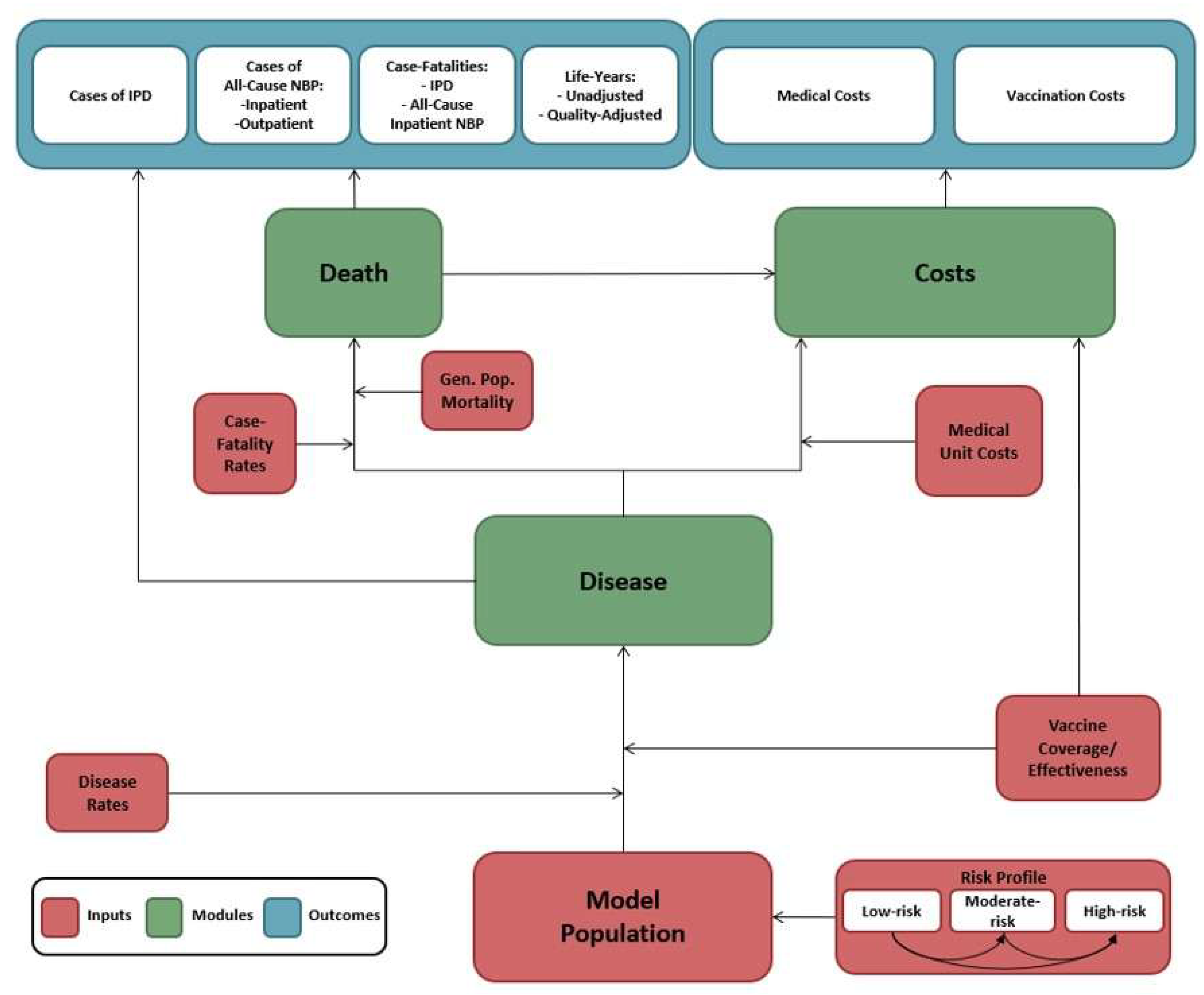
Figure 2.
Scatterplot of results of CEA probabilistic sensitivity analyses for PCV20 vs. PCV13→PPV23 in high-risk patients aged 18-64 years and all patients aged 65-99 years in Taiwan (N = 5,508,375). Abbreviations: GDP, gross domestic product; NTD, New Taiwan Dollar; WTP, willingness-to-pay.
Figure 2.
Scatterplot of results of CEA probabilistic sensitivity analyses for PCV20 vs. PCV13→PPV23 in high-risk patients aged 18-64 years and all patients aged 65-99 years in Taiwan (N = 5,508,375). Abbreviations: GDP, gross domestic product; NTD, New Taiwan Dollar; WTP, willingness-to-pay.
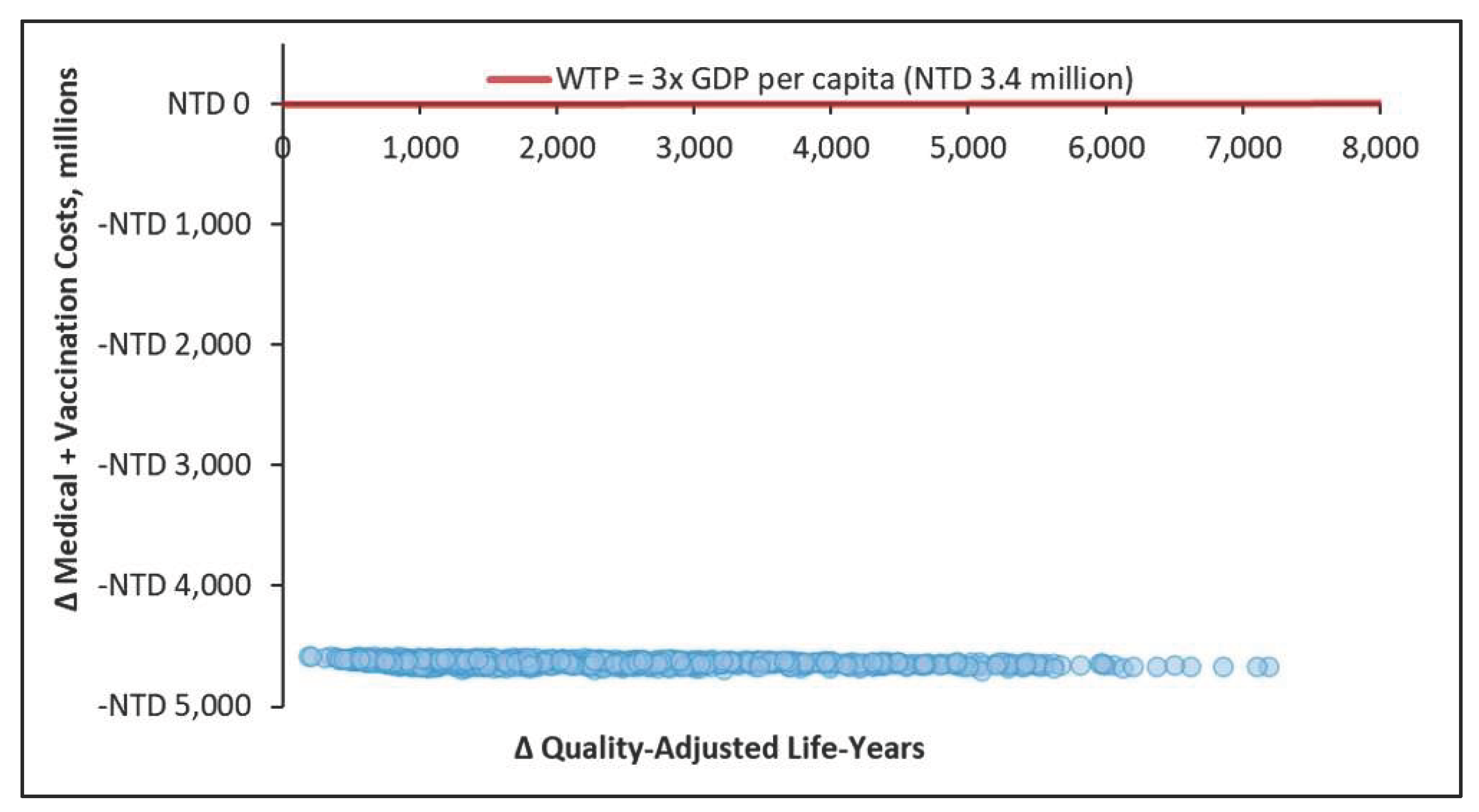

Table 1.
Base case model input values for the number of persons, disease incidence rates, annual mortality rates, case fatality rates, medical care costs, and utilities for high-risk patients aged 18-64 years and all patients aged 65-99 years in Taiwan.
Table 1.
Base case model input values for the number of persons, disease incidence rates, annual mortality rates, case fatality rates, medical care costs, and utilities for high-risk patients aged 18-64 years and all patients aged 65-99 years in Taiwan.
|
|
Age/Risk Profile | ||||||||||||||||
| 18-49 years | 50-64 years | 65-74 years | 75-84 years | ≥85 years | |||||||||||||
| High | High | Low | Moderate | High | Low | Moderate | High | Low | Moderate | High | |||||||
| No. of adults | 361,455 | 452,216 | 1,373,521 | 1,200,807 | 381,838 | 479,038 | 562,725 | 212,962 | 169,480 | 211,068 | 88,419 | ||||||
| Annual disease incidence (per 100,000) | |||||||||||||||||
| IPD | 4.6 | 6.2 | 1.9 | 6.0 | 8.1 | 2.9 | 6.9 | 7.6 | 4.6 | 8.2 | 6.5 | ||||||
| Inpatient NBP | 271.9 | 859.3 | 212.5 | 1,041.3 | 2,358.9 | 683.0 | 1,980.8 | 2,868.8 | 1,056.1 | 3,062.6 | 4,435.4 | ||||||
| Outpatient NBP | 888.6 | 2,260.3 | 1,028.2 | 3,106.4 | 4,166.4 | 1,422.1 | 4,296.5 | 5,762.6 | 1,853.4 | 5,599.9 | 7,510.7 | ||||||
| Annual mortality/case-fatality (per 100) | |||||||||||||||||
| General population | 0.2 | 1.0 | 1.2 | 1.8 | 2.2 | 2.7 | 4.0 | 5.2 | 5.1 | 7.4 | 9.7 | ||||||
| IPD | 8.6 | 9.8 | 6.8 | 12.9 | 12.0 | 13.2 | 17.0 | 13.2 | 17.4 | 21.3 | 17.9 | ||||||
| Inpatient NBP | 10.5 | 11.4 | 4.5 | 6.7 | 10.0 | 8.6 | 10.7 | 11.4 | 11.6 | 11.7 | 15.6 | ||||||
| Outpatient NBP | 0.0 | 0.0 | 0.0 | 0.0 | 0.0 | 0.0 | 0.0 | 0.0 | 0.0 | 0.0 | 0.0 | ||||||
| Medical care costs (per case, NTD) | |||||||||||||||||
| IPD | 119,179 | 119,179 | 119,179 | 119,179 | 119,179 | 119,179 | 119,179 | 119,179 | 119,179 | 119,179 | 119,179 | ||||||
| Inpatient NBP | 48,195 | 48,195 | 48,195 | 48,195 | 48,195 | 48,195 | 48,195 | 48,195 | 48,195 | 48,195 | 48,195 | ||||||
| Outpatient NBP | 785 | 785 | 785 | 785 | 785 | 785 | 785 | 785 | 785 | 785 | 785 | ||||||
| CEA Utilities | |||||||||||||||||
| General population health-state utilities | 0.7190 | 0.6632 | 0.8872 | 0.6984 | 0.6768 | 0.8805 | 0.6711 | 0.6521 | 0.8733 | 0.6438 | 0.6017 | ||||||
| IPD | 0.1300 | 0.1300 | 0.1300 | 0.1300 | 0.1300 | 0.1300 | 0.1300 | 0.1300 | 0.1300 | 0.1300 | 0.1300 | ||||||
| Inpatient NBP | 0.1300 | 0.1300 | 0.1300 | 0.1300 | 0.1300 | 0.1300 | 0.1300 | 0.1300 | 0.1300 | 0.1300 | 0.1300 | ||||||
| Outpatient NBP | 0.0040 | 0.0040 | 0.0040 | 0.0040 | 0.0040 | 0.0040 | 0.0040 | 0.0040 | 0.0040 | 0.0040 | 0.0040 | ||||||
Abbreviations: CEA, cost-effectiveness analysis; IPD, invasive pneumococcal disease; NBP, non-bacteremic pneumonia; NTD, New Taiwan Dollar.
Table 2.
Cost-effectiveness of PCV20 vs. PCV13→PPV23 in high-risk patients aged 18-64 years and all patients aged 65-99 years in Taiwan (N = 5,508,375) - Base-case.
Table 2.
Cost-effectiveness of PCV20 vs. PCV13→PPV23 in high-risk patients aged 18-64 years and all patients aged 65-99 years in Taiwan (N = 5,508,375) - Base-case.
| PCV13→PPV23 | PCV20 | Difference | ||
| Clinical Outcomes | ||||
| No. of Cases | ||||
| IPD | 5,511 | 5,482 | -29 | |
| All-Cause NBP | ||||
| Inpatient | 1,934,376 | 1,932,893 | -1,483 | |
| Requiring Outpatient Care Only | 3,716,882 | 3,713,710 | -3,171 | |
| No. of Deaths | 236,583 | 236,423 | -160 | |
| Life-Years (discounted)* | 69,827,105 | 69,828,283 | 1,178 | |
| Quality-Adjusted Life-Years (discounted)* | 50,672,027 | 50,672,971 | 944 | |
| Economic Outcomes | ||||
| Total Costs (millions) | ||||
| Medical Care | NTD 63,671.5 | NTD 63,607.1 | -NTD 64.4 | |
| Vaccination | NTD 11,482.8 | NTD 9,199.2 | -NTD 2,283.6 | |
| Medical + Vaccination | NTD 75,154.3 | NTD 72,806.3 | -NTD 2,348.0 | |
| Cost-Effectiveness | ||||
| Cost per LY | --- | --- | Dominant | |
| Cost per QALY | --- | --- | Dominant | |
Abbreviations: IPD, invasive pneumococcal disease; LY, life-year; NBP, non-bacteremic pneumonia; NTD, New Taiwan Dollar; PCV, pneumococcal conjugate vaccine; PPV, pneumococcal polysaccharide vaccine; QALY, quality-adjusted life-year. *Life-years, QALYs, and costs have been discounted at a 3% annual rate.
Table 3.
Cost-effectiveness of PCV20 vs. PCV13→PPV23 in high-risk patients aged 18-64 years and all patients aged 65-99 years in Taiwan (N = 5,508,375) - Scenario analysis #1.
Table 3.
Cost-effectiveness of PCV20 vs. PCV13→PPV23 in high-risk patients aged 18-64 years and all patients aged 65-99 years in Taiwan (N = 5,508,375) - Scenario analysis #1.
| PCV13→PPV23 | PCV20 | Difference | ||
| Clinical Outcomes | ||||
| No. of Cases | ||||
| IPD | 5,453 | 5,429 | -23 | |
| All-Cause NBP | ||||
| Inpatient | 1,930,861 | 1,929,593 | -1,268 | |
| Requiring Outpatient Care Only | 3,710,239 | 3,707,514 | -2,725 | |
| No. of Deaths | 236,140 | 236,004 | -135 | |
| Life-Years (discounted)* | 69,829,068 | 69,830,085 | 1,017 | |
| Quality-Adjusted Life-Years (discounted)* | 50,673,581 | 50,674,395 | 815 | |
| Economic Outcomes | ||||
| Total Costs (millions) | ||||
| Medical Care | NTD 63,557.1 | NTD 63,501.7 | -NTD 55.3 | |
| Vaccination | NTD 11,482.8 | NTD 9,199.2 | -NTD 2,283.6 | |
| Medical + Vaccination | NTD 75,039.8 | NTD 72,700.9 | -NTD 2,338.9 | |
| Cost-Effectiveness | ||||
| Cost per LY | --- | --- | Dominant | |
| Cost per QALY | --- | --- | Dominant | |
Abbreviations: IPD, invasive pneumococcal disease; LY, life-year; NBP, non-bacteremic pneumonia; NTD, New Taiwan Dollar; PCV, pneumococcal conjugate vaccine; PPV, pneumococcal polysaccharide vaccine; QALY, quality-adjusted life-year. *Life-years, QALYs, and costs have been discounted at a 3% annual rate.
Table 4.
Cost-effectiveness of PCV20 vs. PCV13→PPV23 in high-risk patients aged 18-64 years and all patients aged 65-99 years in Taiwan (N = 5,508,375) - Scenario analysis #2.
Table 4.
Cost-effectiveness of PCV20 vs. PCV13→PPV23 in high-risk patients aged 18-64 years and all patients aged 65-99 years in Taiwan (N = 5,508,375) - Scenario analysis #2.
| PCV13→PPV23 | PCV20 | Difference | ||
| Clinical Outcomes | ||||
| No. of Cases | ||||
| IPD | 5,521 | 5,482 | -39 | |
| All-Cause NBP | ||||
| Inpatient | 1,934,376 | 1,932,893 | -1,483 | |
| Requiring Outpatient Care Only | 3,716,881 | 3,713,710 | -3,171 | |
| No. of Deaths | 236,584 | 236,423 | -161 | |
| Life-Years (discounted)* | 69,827,093 | 69,828,283 | 1,190 | |
| Quality-Adjusted Life-Years (discounted)* | 50,672,018 | 50,672,971 | 953 | |
| Economic Outcomes | ||||
| Total Costs (millions) | ||||
| Medical Care | NTD 63,672.5 | NTD 63,607.1 | -NTD 65.5 | |
| Vaccination | NTD 9,922.8 | NTD 9,199.2 | -NTD 723.6 | |
| Medical + Vaccination | NTD 73,595.4 | NTD 72,806.3 | -NTD 789.1 | |
| Cost-Effectiveness | ||||
| Cost per LY | --- | --- | Dominant | |
| Cost per QALY | --- | --- | Dominant | |
Abbreviations: IPD, invasive pneumococcal disease; LY, life-year; NBP, non-bacteremic pneumonia; NTD, New Taiwan Dollar; PCV, pneumococcal conjugate vaccine; PPV, pneumococcal polysaccharide vaccine; QALY, quality-adjusted life-year. *Life-years, QALYs, and costs have been discounted at a 3% annual rate.
Table 5.
Net budget impact of PCV20 vs. PCV13→PPV23 among high-risk adults aged 18-64 years and all adults aged ≥65 years in Taiwan (N=5,301,030).
Table 5.
Net budget impact of PCV20 vs. PCV13→PPV23 among high-risk adults aged 18-64 years and all adults aged ≥65 years in Taiwan (N=5,301,030).
| PCV20 vs. PCV13-> PPV23 | |||||||
| Year 1 | Year 2 | Year 3 | Year 4 | Year 5 | Total | ||
| Cumulative vaccine uptake | 40% | 65% | 80% | 88% | 93% | --- | |
| Clinical Outcomes | |||||||
| No. of Cases | |||||||
| IPD | -2 | -3 | -4 | -5 | -6 | -20 | |
| All-Cause NBP | |||||||
| Inpatient | -111 | -188 | -236 | -265 | -281 | -1,080 | |
| Requiring Outpatient Care Only | -253 | -420 | -518 | -571 | -596 | -2,357 | |
| No. of Deaths | -11 | -19 | -25 | -28 | -30 | -113 | |
| Economic Outcomes | |||||||
| Total Costs (millions) | |||||||
| Medical Care | -NTD 5.8 | -NTD 9.8 | -NTD 12.3 | -NTD 13.8 | -NTD 14.7 | -NTD 56.3 | |
| Vaccination | -NTD 2,361.7 | -NTD 1,453.8 | -NTD 833.1 | -NTD 457.0 | -NTD 251.3 | -NTD 5,356.8 | |
| Medical + Vaccination | -NTD 2,367.5 | -NTD 1,463.5 | -NTD 845.4 | -NTD 470.8 | -NTD 265.9 | -NTD 5,413.1 | |
Abbreviations: IPD, invasive pneumococcal disease; NBP, non-bacteremic pneumonia; NTD, New Taiwan Dollar.
Disclaimer/Publisher’s Note: The statements, opinions and data contained in all publications are solely those of the individual author(s) and contributor(s) and not of MDPI and/or the editor(s). MDPI and/or the editor(s) disclaim responsibility for any in-jury to people or property resulting from any ideas, methods, instructions or products referred to in the content. |
© 2026 by the authors. Licensee MDPI, Basel, Switzerland. This article is an open access article distributed under the terms and conditions of the Creative Commons Attribution (CC BY) license (http://creativecommons.org/licenses/by/4.0/).
Copyright: This open access article is published under a Creative Commons CC BY 4.0 license, which permit the free download, distribution, and reuse, provided that the author and preprint are cited in any reuse.


