

Submitted:
14 April 2026
Posted:
15 April 2026
You are already at the latest version
Abstract
Higher education institutions increasingly face expectations to respond to the climate crisis through instruction that strengthens students’ capacity to analyze sustainability problems, design feasible interventions, and implement solutions with accountability. Yet many sustainability courses remain knowledge-heavy and leave the pathway from learning to action implicit, which can constrain action readiness and complicate assessment of applied competence. This paper presents a competence-to-action instructional framework for environmental sustainability education in higher education. The framework is grounded in an integrative conceptual review and synthesis across Education for Sustainable Development, sustainability competency scholarship, experiential and transformative learning traditions, whole-institution approaches, campus living lab research, and Universal Design for Learning (UDL). The analysis applies iterative thematic synthesis to identify recurring instructional mechanisms, institutional enablers, and assessment implications, and then translates those themes into testable propositions and design and assessment tools. The synthesis yields six propositions specifying instructional and institutional conditions that support sustainability competency development and action readiness. Across the included literatures, the propositions emphasize authentic, place-based problems; sustained engagement with stakeholders; structured reflection that links values, trade-offs, and decisions; opportunities to test, revise, and communicate proposed interventions; and enabling infrastructures that connect curriculum to campus operations and community partnerships. Building on these propositions, the paper articulates six design commitments and provides two implementation tools: a competency-to-activity-to-evidence map and a performance-based assessment rubric aligned to widely used competency categories (systems thinking; anticipatory, normative, strategic, and interpersonal competence). As a conceptual framework paper rather than a systematic review or empirical validation study, it offers practical guidance for faculty, program leaders, and sustainability offices seeking to align curriculum, campus operations, and external partnerships while generating valid, transparent evidence of student learning and action preparedness. It treats UDL as a validity and equity safeguard that maintains rigorous expectations while reducing construct-irrelevant barriers through multiple means of engagement, representation, and action and expression. The paper concludes with implications for course redesign and institutional scaling through living lab infrastructure and whole-institution coherence, and it identifies priorities for future research, including cross-disciplinary pilots, refinement of assessment guidance through shared scoring practices, and longitudinal study of whether competence-to-action indicators relate to sustained civic or professional sustainability action.
Keywords:
sustainability competencies
; Education for Sustainable Development
; higher education
; climate action
; Universal Design for Learning
; experiential learning
1. Introduction
The Intergovernmental Panel on Climate Change warns that the climate crisis is accelerating and that the window to avoid severe, irreversible impacts is narrowing (Intergovernmental Panel on Climate Change [IPCC], 2023). Higher education institutions (HEIs) can respond because they educate future professionals, shape public understanding, and model institutional practices that influence communities and industries. Yet climate action in higher education often follows an uneven pattern: institutions may advance operational commitments faster than curricular transformation, and instruction may increase awareness without consistently enabling action.
A recurring challenge is the knowledge-action gap: students can explain sustainability concepts but struggle to translate that knowledge into systems-level decision-making, stakeholder engagement, and implementable strategies (Khalo & Damoah, 2023). For example, students may describe climate drivers accurately but still struggle to co-design a feasible campus intervention with partners who hold competing priorities. Environmental psychology research shows that pro-environmental behavior depends not only on knowledge but also on attitudes, norms, perceived control, and contextual supports (Ajzen, 1991; Kollmuss & Agyeman, 2002). Instruction can therefore do more than transmit concepts; it can build competencies and efficacy and provide repeated opportunities to practice actions in authentic settings.
Education for Sustainable Development (ESD) calls for a holistic approach that integrates sustainability across curriculum, pedagogy, and institutional culture (Damoah et al., 2023; UNESCO, 2020). Faculty and institutions still face practical design questions. Which competencies deserve priority? Which learning activities build those competencies reliably across contexts? How can instructors assess competence development without relying on vague or purely self-reported measures? How can programs design sustainability instruction that includes and supports diverse learners?
Recent scholarship describes widespread sustainability activity in higher education, yet it also documents uneven integration across curriculum, assessment, operations, and governance. Reviews identify recurring challenges that limit coherence, including uneven faculty capacity, weak incentives for cross-unit collaboration, and difficulty connecting course-level experiences to institution-level sustainability aims (Abo-Khalil, 2024; Hassan & Ahmad, 2025). Many programs now use competency-based approaches to clarify expected capabilities, but they still struggle to consistently assess competencies and use the results for improvement. A large-scale analysis of sustainability competency assessment in STEM higher education shows that institutions can evaluate sustainability competencies across many courses and cohorts, while the same work also highlights risks such as uneven development across specific competencies and challenges in interpreting competency ratings across contexts (Valdes-Ramirez et al., 2024).
Campus living labs and related real-world experimentation approaches can narrow the learning-to-implementation gap by positioning the campus and surrounding community as sites for iterative problem-solving. An integrative review conceptualizes campus living labs as systems for innovation and learning in which students, faculty, and operational staff co-produce real-life experiments that integrate sustainability into institutional processes (Stuckrath et al., 2025). Empirical work also shows that living labs support ESD when programs structure stakeholder collaboration and when institutions provide support that moves projects beyond pilot stages (Herth et al., 2025; Morales et al., 2024). These findings support a design implication: instructors and institutions can treat living labs as enabling conditions for competency-aligned instructional design rather than as stand-alone experiential activities.
This paper presents a competence-to-action instructional framework for environmental sustainability education in higher education. Positioned as a conceptual framework article grounded in integrative review, it draws together sustainability competency scholarship (Rieckmann, 2012; Wiek et al., 2011), experiential and transformative learning (Kolb, 1984; Mezirow, 1997; Sipos et al., 2008), whole-institution approaches (Holst et al., 2024), campus living lab research (Herth et al., 2025; Morales et al., 2023), and Universal Design for Learning (CAST, 2018).
Its distinct contribution is to connect those literatures in a single model that makes the pathway from competency language to observable action evidence explicit, so that sustainability instruction can be designed, assessed, and revised with greater transparency.
The paper advances six propositions about how institutional enablers shape instructional design, how intermediate outcomes relate to action readiness, and how downstream outcomes can be framed as evaluation priorities for future study. It then translates those propositions into design commitments, signature learning activities, and an assessment approach that helps instructors and institutions make learning-to-action pathways explicit, testable, and improvable over time.
Purpose and Contributions
This paper contributes:
- A competence-to-action instructional framework linking sustainability competencies to observable indicators and assessment evidence.
- Six propositions that clarify instructional and institutional conditions associated with action-oriented learning.
- A practical assessment rubric and a competency-to-activity-to-evidence map.
- Policy and implementation implications for scaling sustainability instruction through living labs and institutional infrastructure.
2. Conceptual Foundations
2.1. ESD and Whole-Institution Alignment
ESD calls for reorienting education to support sustainable development through knowledge, skills, values, and action (UNESCO, 2020). Whole-institution approaches emphasize coherence across curriculum, campus operations, governance, and partnerships. Evidence suggests that experienced whole-institution environments are associated with stronger sustainability learning outcomes (Holst et al., 2024). Institutional reporting systems can also shape priorities and evidence practices. For example, AASHE STARS provides a framework for tracking sustainability performance across operations and curriculum (Association for the Advancement of Sustainability in Higher Education [AASHE], 2025; Damoah et al., 2024), and assessment platforms such as Sulitest can support benchmarking of sustainability literacy (Sulitest, n.d.).
2.2. Sustainability Competencies and Measurement
Competency-based sustainability education emphasizes integrated capacities rather than isolated content knowledge. A widely used framing identifies systems thinking, anticipatory, normative, strategic, and interpersonal competence as core competency categories (Wiek et al., 2011). Ongoing scholarship has refined definitions and highlighted the need to operationalize competencies with observable indicators and credible performance assessment (Kuehl et al., 2023; Rieckmann, 2012; Saarna & Laius, 2025).
2.3. Experiential and Transformative Learning for Sustainability
Experiential learning theories argue that durable learning requires cycles of experience, reflection, conceptualization, and experimentation (Kolb, 1984). Transformative learning highlights perspective change through critical reflection and discourse, particularly when learners examine assumptions and values (Mezirow, 1997). In sustainability education, head, hands, and heart approaches integrate cognition, practice, and values to support transformative outcomes (Damoah & Omodan, 2022; Sipos et al., 2008). Recent reviews indicate that experiential sustainability education can support competency development, but effects depend on design quality and coherence between learning outcomes and assessment (Sundman et al., 2025). Organizational learning in higher education also matters for scaling sustainability education (Trevisan et al., 2024).
2.4. Living Labs and Problem- and Project-Based Approaches
Problem- and project-based learning is frequently used in sustainability programs because it aligns learning with real-world challenges and stakeholder engagement (Brundiers & Wiek, 2013; Damoah & Adu, 2023). Campus living labs extend these traditions by using campus systems as testbeds where students and stakeholders collaborate on sustainability problems. Living labs can strengthen strategic and interpersonal competencies, but they require enabling conditions across development phases, including coordination, stakeholder networks, evaluation practices, and mechanisms for transfer and scaling (Damoah & Adu, 2022; Herth et al., 2025). Urban and campus-based living-lab research further underscores the importance of aligning learning outcomes, governance structures, and evaluation tools (Morales et al., 2023; Morales et al., 2024).
2.5. Designing Powerful and Inclusive Learning Environments
Instructional design shapes sustainability learning. Conceptual work on powerful learning environments in ESD underscores the need to align competence targets, learning activities, interventions, and assessment (Damoah & Omodan, 2023; Sinakou et al., 2019). UDL provides evidence-informed guidance for designing flexible learning environments that offer multiple means of engagement, representation, and action and expression (CAST, 2018). Inclusive design is essential for equity and for assessment validity, because barriers can prevent students from demonstrating competency.
To integrate these conceptual strands, Figure 1 summarizes how ESD, sustainability competency frameworks, and inclusive instructional design converge to support competence-to-action outcomes that guide the framework developed in the sections that follow.
3. Methodology
3.1. Review Design
This paper uses an integrative conceptual review and framework synthesis to develop a practice-oriented competence-to-action framework. This approach is appropriate for heterogeneous literature that includes empirical studies, conceptual models, and policy guidance, and where the primary goal is to generate actionable guidance for instructional and assessment design rather than pooled effect-size estimates. Consistent with that aim, the review was interpretive and framework-building rather than exhaustive, as expected of a systematic review or meta-analysis.
3.2. Search Strategy and Sources
Searches were conducted iteratively to refine the conceptual scope of the review as recurring constructs, instructional mechanisms, and institutional enablers became clearer across the literature. The purpose of the search process was to identify conceptually relevant and influential sources for framework construction, not to assemble a statistically exhaustive corpus for effect estimation.
Searches were conducted in ERIC, Scopus, Web of Science, and Google Scholar and were completed in January 2026. Search strings combined terms related to sustainability education and climate change education, higher education, competencies, systems thinking, living labs, service learning, assessment, and pro-environmental behavior. Targeted searches were also conducted on the websites of major policy and sector bodies (UNESCO, IPCC, AASHE, and the European Commission Joint Research Centre) to capture whole-institution guidance and competency frameworks (AASHE, 2025; Bianchi et al., 2022; IPCC, 2023; UNESCO, 2020). Backward and forward citation searching was used to identify foundational and highly cited sources. To support transparency and adaptation, we include illustrative search strings and the screening checklist below.
- ("sustainability competence" OR "sustainability competency" OR "GreenComp" OR "systems thinking") AND ("higher education" OR university) AND (assessment OR rubric OR "performance assessment")
- ("campus living lab" OR "living laboratory" OR "real-world lab") AND (sustainability OR climate) AND ("higher education" OR university) AND (instruction OR pedagogy OR learning)
- ("education for sustainable development" OR ESD) AND ("whole institution" OR governance OR operations) AND ("higher education" OR university)
- ("climate change education") AND ("theory of planned behavior" OR norms OR "perceived behavioral control") AND ("higher education" OR university)
- (UDL OR "Universal Design for Learning") AND (assessment OR "multiple means" OR inclusion) AND ("higher education" OR university) AND (sustainability OR climate)
3.3. Eligibility and Screening
Sources were eligible if they addressed sustainability or climate change instruction in higher education (or closely related adult learning contexts) and included implications for pedagogy, assessment, or institutional implementation. Peer-reviewed empirical studies, systematic reviews, and conceptual frameworks were prioritized. Seminal works in learning theory and behavior science were retained when they provided widely used constructs relevant to learning-to-action transfer (Ajzen, 1991; Kolb, 1984; Mezirow, 1997). Sources focused solely on sustainability content, without instructional or assessment implications, were excluded.
Screening decisions, therefore, prioritized sources that made an explicit contribution to at least one of the following: competency definition, instructional design, assessment design, institutional implementation, or learning-to-action transfer. Sources that addressed sustainability primarily as topical content, without pedagogical or assessment implications, were set aside.
To promote consistency during full-text review and reduce subjective inclusion decisions, we applied the following screening checklist:
- Addresses sustainability or climate-change instruction in higher education (or closely related adult learning contexts).
- Provides implications for pedagogy, learning design, assessment, or institutional implementation (not content-only coverage).
- Specifies constructs or competencies linked to learning-to-action transfer (for example, systems thinking, anticipatory reasoning, strategic competence, interpersonal competence).
- Includes empirical evidence, systematic synthesis, conceptual model, or policy guidance with clear instructional relevance.
- Notes contextual conditions or enabling factors (for example, institutional policy, living lab infrastructure, stakeholder partnerships, assessment capacity).
- Excludes sources that focus only on operational sustainability metrics without instructional or learning implications.
3.4. Data Extraction and Synthesis
For each included source, the synthesis extracted: (1) target constructs or competencies, (2) proposed learning mechanisms, (3) instructional conditions or design features, and (4) evidence claims about learning outcomes or behavior-related constructs. Extracted segments were coded iteratively to identify recurring instructional elements and institutional enablers. Themes were refined through constant comparison until they formed six propositions. Propositions were then translated into design commitments, signature learning activities, and examples of assessment evidence. To strengthen assessment coherence, performance evidence was aligned to sustainability competence language (Bianchi et al., 2022; Wiek et al., 2011) and rubric development guidance for competence assessment (Sousa & Doran, 2024).
To move from synthesis to framework construction, recurrent themes were first translated into provisional propositions. Those propositions were then cross-walked against established competency language and assessment guidance to identify observable indicators, candidate learning activities, and defensible evidence types. This stepwise translation informed the competency-to-activity-to-evidence map and the summary rubric presented later in the paper.
3.5. Trustworthiness, Limitations, and Positionality
Because the evidence base spans diverse study designs and includes both peer-reviewed research and policy reports, the synthesis did not apply a single quality score. Instead, it triangulated findings across source types and prioritized design elements supported by multiple streams of evidence. Limitations include selection bias risk inherent to integrative review methods, incomplete coverage of relevant work outside indexed databases or outside English-language outlets, and limited ability to infer causal effects from predominantly correlational and qualitative evidence. Accordingly, the framework should be interpreted as a theory-informed synthesis of convergent patterns in the literature rather than as a definitive statement of instructional effectiveness.
We did not maintain a complete record count across all screening steps, so we do not report a PRISMA-style flow diagram; this limits auditability and replicability. For that reason, claims in this paper are intentionally framed as propositions, design commitments, and assessment guidance to be tested, adapted, and refined in future empirical work.
Author positionality: We are an interdisciplinary author team bringing complementary perspectives in instructional design and environmental geography. Our instructional design lens foregrounds competency-aligned outcomes, inclusive learning pathways, and assessment practices that support transfer to authentic contexts. Our environmental geography lens foregrounds place-based realities, socioecological systems, and the institutional and community conditions that shape sustainability action. Together, these lenses inform our emphasis on competency-aligned design, living-lab partnerships, and institutional enablers. We recognize potential biases, including a tendency to privilege formal educational interventions or to assume transfer from learning to action. To mitigate these risks, we compared interpretations across disciplines, checked propositions against empirical work from multiple fields, and made assumptions explicit when evidence was limited.
4. Results: Six Propositions and the Competence-to-Action Model
4.1. Proposition Set
Proposition 1 (Competency alignment): Sustainability instruction is more likely to produce action-capable graduates when course outcomes explicitly align with sustainability competency categories and specify observable indicators that can be assessed through performance-based evidence (Kuehl et al., 2023; Rieckmann, 2012; Wiek et al., 2011). Alignment is necessary but not sufficient: competencies must be translated into criteria for student work (e.g., quality of system maps, strength of evidence use, or feasibility of implementation plans) to avoid relying solely on self-reported learning.
Proposition 2 (Authentic practice): Competencies develop more reliably when students engage in authentic, contextualized sustainability problems that require iterative cycles of analysis, action, and reflection (Brundiers & Wiek, 2013; Kolb, 1984; Sundman et al., 2025). Authentic practice is strongest when projects include real constraints (time, budget, governance, stakeholder priorities) and when students receive structured scaffolds that prevent complexity from overwhelming novice learners.
Proposition 3 (Transformative meaning-making): Action orientation strengthens when instruction includes structured critical reflection and dialogue that surface values, assumptions, and trade-offs, enabling shifts in perspective and responsibility (Mezirow, 1997; Sipos et al., 2008). Reflection must be tied to decision revision (not only personal narrative) and supported by psychologically safe facilitation; otherwise, reflection activities can remain superficial or polarizing.
Proposition 4 (Institutional coherence): Whole-institution environments that model sustainability through operations, governance, and culture amplify instructional effectiveness by increasing perceived relevance, efficacy, and opportunity for practice (Holst et al., 2024; UNESCO, 2020). When institutional signals contradict course messages (for example, sustainability commitments without visible operational follow-through), student trust and perceived behavioral control may weaken, reducing action readiness.
Proposition 5 (Living lab infrastructure): Campus living labs increase the likelihood of competence-to-action transfer when enabling conditions are intentionally developed across initiation, operation, and dissemination phases, including coordination capacity, stakeholder networks, method support, evaluation routines, and scaling pathways (Herth et al., 2025; Morales et al., 2024). Without these supports, projects often remain episodic or symbolic, limiting students' opportunities to produce implementable outputs and learn from real-world feedback loops.
Proposition 6 (Inclusive design for valid evidence): Competence assessments are more valid and equitable when UDL principles reduce barriers to engagement and expression, allowing diverse learners to demonstrate competence through multiple evidence pathways (CAST, 2018; Darling-Hammond et al., 2017). Inclusive design preserves standards by holding performance criteria constant while varying access supports and modalities (for example, written policy memos, recorded briefings, or annotated visual artifacts) aligned to the same indicators.
4.2. Competence-to-Action Model
Together, the propositions yield a competence-to-action model that links institutional enablers (policy alignment, living lab infrastructure, and assessment capacity) to instructional design choices (competency alignment, authentic projects, structured reflection, and systems thinking), leading to intermediate outcomes, action readiness, and downstream sustainability impacts. In this paper, action readiness refers to a demonstrated capacity to (1) analyze a sustainability problem as a system, (2) justify decisions with evidence and values-based reasoning, (3) co-design feasible interventions with stakeholders, and (4) produce an implementation and evaluation plan that can be enacted under real constraints.
The model is therefore offered as a hypothesized explanatory pathway to guide course design, program planning, and subsequent empirical testing, rather than as evidence of a confirmed causal ordering.
Figure 2 visualizes how institutional enablers support instructional design, producing intermediate outcomes (knowledge, competencies, efficacy, and norms) that shape action readiness (intentions, feasible plans, and demonstrated skills to act) and, over time, sustained outcomes such as professional practice, civic engagement, and pro-environmental behavior. Programs can operationalize action readiness by assessing concrete artifacts, for example: systems maps with leverage-point justification, stakeholder analyses with engagement plans, implementation roadmaps with roles and timelines, and evaluation plans with measurable indicators and feedback loops.
These downstream outcomes should be understood as plausible targets and evaluation priorities for future studies rather than as effects demonstrated by the present synthesis.
5. Instructional Design Commitments and Assessment Tools
5.1. Design Commitments
The propositions translate into six design commitments that faculty and institutions can implement at the course and program levels. Proposition 1 underpins explicit competency-aligned outcomes and evidence criteria; Propositions 2 and 3 support authentic practice paired with structured reflection and revision; Propositions 4 and 5 justify alignment with institutional context and living lab infrastructure; and Proposition 6 grounds inclusive evidence design. Across commitments, the key principle is coherence: learning outcomes, learning activities, and assessment evidence should point to the same competency claims and should be feasible for students to demonstrate.
These commitments are intended to be adapted to disciplinary context, institutional capacity, and partnership conditions while keeping the underlying competency claims and evidence expectations explicit.
- Make competencies explicit: state competency-aligned outcomes using observable indicators.
- Design for authentic practice: use real constraints and stakeholder perspectives.
- Build reflection into action: require structured reflection that informs revised decisions.
- Leverage institutional context: align assignments with campus plans, data, and operations where feasible.
- Use living lab partnerships intentionally: clarify roles, timelines, evaluation, and scaling pathways.
- Ensure inclusive access and valid evidence: provide multiple means of engagement and expression, and assess performance, not only perceptions.
5.2. Example Implementation Pathway
A course pathway can sequence competency development and require action-oriented evidence:
- Weeks 1 to 3: systems mapping and baseline analysis of a campus sustainability challenge.
- Weeks 4 to 6: scenario planning and values-based trade-off analysis.
- Weeks 7 to 10: co-design of an intervention with a campus unit using stakeholder mapping and governance planning.
- Weeks 11 to 14: implementation roadmap and evaluation plan with measurable indicators, followed by revision based on stakeholder feedback.
As shown in Figure 3, the course pathway is operationalized through an iterative experiential learning cycle with structured reflection and feedback.
Figure 4 summarizes the mixed assessment approach used to triangulate knowledge benchmarks with performance-based and reflection evidence.
Table 1 summarizes the conceptual and policy foundations synthesized in this review and indicates how each informs the competence-to-action model. It situates the framework’s major ideas and shows how they connect to the design commitments and assessment tools that follow.
Table 2 provides a summary rubric for assessing competence-to-action outcomes using observable evidence. It is intended to support the communication of performance expectations, the selection of aligned artifacts, and the calibration of scoring across raters. Criteria can be adapted to the local context while maintaining consistent construct definitions.
Table 3 maps targeted competencies to example learning activities and to assessable evidence artifacts. It is designed to support course planning by linking focal competencies, practice opportunities, and evidence sources. Examples are illustrative rather than exhaustive.
6. Policy and Practice Implications
6.1. Implications for Faculty and Instructional Leaders
Faculty development should focus on competency-aligned outcomes, performance assessment, and inclusive design, rather than solely on sustainability content. Practice-embedded professional learning and coaching can support implementation and assessment reliability (Darling-Hammond et al., 2017; Fischer et al., 2025).
6.2. Implications for Institutions and Sustainability Offices
Institutions can strengthen sustainability instruction by aligning learning with operational data and priorities, enabling living lab partnerships, and using reporting systems such as STARS to track curricular integration while maintaining learning integrity (AASHE, 2025). Living lab governance should include evaluation and dissemination mechanisms that support scaling beyond pilot projects (Herth et al., 2025).
6.3. Learner Well-Being and Climate Anxiety
Climate-related learning can surface anxiety and moral distress. Consistent with Proposition 3, course design that emphasizes efficacy, agency, and collective action can support engagement while maintaining intellectual rigor (Khalaim et al., 2024). Consistent with Proposition 6, instructors should also provide accessible pathways for reflection, discussion, and action planning so that concern is not treated as the endpoint of learning and emotional engagement does not become a barrier to demonstrating competence.
6.4. Responsible AI Use in Sustainability Instruction
Generative AI tools can support drafting, scenario exploration, and feedback loops, but they can undermine learning if they replace critical thinking. This issue is directly tied to Proposition 6 because assessment validity depends on evidence that still reflects the learner’s own reasoning. Institutions should therefore emphasize process evidence (draft histories, reflection memos, decision rationales) and ethical use aligned with learning outcomes (Sullivan et al., 2023). In sustainability instruction specifically, AI-supported work should be judged against the same competency criteria as non-AI-supported work, with transparent disclosure expectations and safeguards against outsourcing core reasoning tasks.
7. Limitations and Future Research
This paper is a conceptual synthesis and does not report primary empirical testing of the proposed framework. Implementation effectiveness will vary across institutional contexts, disciplines, and resource levels. Future empirical work should test the framework’s predictive utility for measurable outcomes, including competence growth, transfer to practice, and community impact. Further research should also examine how behavioral mechanisms such as social norms and perceived control mediate educational effects (Galeotti et al., 2024). Additional priority areas include inter-rater calibration of the rubric, cross-disciplinary pilots, and longitudinal validation of whether competence-to-action indicators relate to sustained professional or civic sustainability action.
8. Conclusions
Higher education needs sustainability instruction designed to move beyond awareness toward assessable competence-to-action outcomes. This paper presents a competence-to-action framework that integrates sustainability competencies, experiential and transformative learning, whole-institution coherence, living lab infrastructure, and UDL-based inclusive design. By linking competencies to design commitments and assessment evidence, the framework clarifies how instructors can align pedagogy, authentic learning tasks, and student artifacts with program goals for action readiness. Its immediate contribution is heuristic and design-oriented: it makes the learning-to-action pathway more explicit, more assessable, and more open to revision through evidence.
The framework supports practical course design, strengthens coherence between pedagogy and assessment, and offers guidance for institutional scaling. It treats UDL as a core design requirement because inclusive design protects validity and equity by reducing construct-irrelevant barriers while maintaining rigorous expectations through multiple means of engagement, representation, and action and expression. At the course level, the framework helps instructors sequence learning experiences that culminate in feasible, ethically grounded action plans and related artifacts that make competence-to-action visible through transparent criteria. At the institutional level, it offers a model for connecting course-based learning to living lab infrastructure, cross-unit partnerships, and shared outcome language, thereby strengthening coherence across curricular and co-curricular initiatives.
This paper offers a design and assessment blueprint rather than causal claims about long-term societal impact. Future work should test the framework across disciplines and institutional contexts, refine assessment guidance through faculty development and shared scoring practices, and examine whether competence-to-action indicators predict sustained civic or professional sustainability action over time. Together, these contributions position sustainability education to move from aspirational commitments toward assessable learning designs that remain rigorous and inclusive.
References
- Abo-Khalil, A. G. Integrating sustainability into higher education: Challenges and opportunities for universities worldwide. Heliyon 2024, 10, e29946. [Google Scholar] [CrossRef]
- Aeschbach, V. M.-J.; Schwichow, M.; Rieß, W. Effectiveness of climate change education: A meta-analysis. Frontiers in Education 2025, 10, 1563816. [Google Scholar] [CrossRef]
- Ajzen, I. The theory of planned behavior. Organizational Behavior and Human Decision Processes 1991, 50, 179–211. [Google Scholar] [CrossRef]
- Association for the Advancement of Sustainability in Higher Education. STARS technical manual . (Version 3.0.1). 2025. Available online: https://stars.aashe.org/wp-content/uploads/2025/07/STARS-Technical-Manual-Version-3.0.1.pdf.
- Association for the Advancement of Sustainability in Higher Education. Sustainable Campus Index 2024. 2024. Available online: https://www.aashe.org/wp-content/uploads/2024/09/SCI-2024-Final.pdf.
- Bianchi, G.; Pisiotis, U.; Cabrera Giraldez, M.; Punie, Y.; Bacigalupo, M. GreenComp: The European sustainability competence framework; Publications Office of the European Union, 2022. [Google Scholar] [CrossRef]
- Brundiers, K.; Wiek, A. Do we teach what we preach? An international comparison of problem- and project-based learning courses in sustainability. Sustainability 2013, 5, 1725–1746. [Google Scholar] [CrossRef]
- CAST. Universal Design for Learning guidelines (Version 2.2). 2018. Available online: http://udlguidelines.cast.org/more/downloads.
- Damoah, B.; Adu, E. Review of serious games on environmental education: Students gamifying sustainably as remediation for climate change crisis. In Proceedings of the Society for Information Technology & Teacher Education International Conference; Langran, E., Christensen, P., Sanson, J., Eds.; Association for the Advancement of Computing in Education, 2023; pp. 537–546. [Google Scholar]
- Damoah, B.; Adu, E. O. Environmental education in South African schools: The role of civil society organizations. Research in Social Sciences and Technology 2022, 7, 1–17. [Google Scholar] [CrossRef]
- Damoah, B.; Omodan, B. I. Determinants of effective environmental education policy in South African schools. International Journal of Educational Research Open 2022, 3, 100206. [Google Scholar] [CrossRef]
- Damoah, B.; Omodan, B. I. Tracing the footprints of environmental education in teacher education: A review of pre-service teachers’ training in universities. Journal for Educators, Teachers and Trainers 2023, 14, 184–196. [Google Scholar] [CrossRef]
- Damoah, B.; Keengwe, S.; Owusu, S.; Yeboah, C.; Kekessie, F. The global climate and environmental protest: Student environmental activism a transformative defiance. International Journal of Environmental, Sustainability, and Social Science 2023, 4, 1180–1198. [Google Scholar] [CrossRef]
- Damoah, B.; Khalo, X.; Adu, E. South African integrated environmental education curriculum trajectory. International Journal of Educational Research 2024, 125, 102352. [Google Scholar] [CrossRef]
- Darling-Hammond, L.; Flook, L.; Cook-Harvey, C.; Barron, B.; Osher, D. Implications for educational practice of the science of learning and development. Applied Developmental Science 2017, 24, 97–140. [Google Scholar] [CrossRef]
- Fischer, D.; King, J.; Redman, A. Rethinking learning assessment in education for sustainable development: A call for action. Journal of Education for Sustainable Development. Advance online publication. 2025. [CrossRef]
- Galeotti, F.; Hopfensitz, A.; Mantilla, C. Climate change education through the lens of behavioral economics: A systematic review of studies on observed behavior and social norms. Ecological Economics 2024, 226, 108338. [Google Scholar] [CrossRef]
- Gemmecke, C.; Eichberger, C.; Zacher, H.; Hüffmeier, J. Prompting change: A systematic review and meta-analysis of the (un)confounded effects of prompts on pro-environmental behavior. Applied Psychology: An International Review 2025, 74, e70003. [Google Scholar] [CrossRef]
- Hassan, M. M.; Ahmad, A. R. Systematic literature review on the sustainability of higher education institutions (HEIs): Dimensions, practices and research gaps. Cogent Education 2025, 12, 2549789. [Google Scholar] [CrossRef]
- Herth, A.; Verburg, R.; Blok, K. How can campus living labs thrive to reach sustainable solutions? Cleaner Production Letters 2025, 8, 100078. [Google Scholar] [CrossRef]
- Ho, V. C.; Berman, A. H.; Andrade, J.; Kavanagh, D. J.; La Branche, S.; May, J.; Philson, C. S.; Blumstein, D. T. Assessing immediate emotions in the theory of planned behavior can substantially contribute to increases in pro-environmental behavior. Frontiers in Climate 2024, 6, 1344899. [Google Scholar] [CrossRef]
- Holst, J.; Grund, J.; Brock, A. Whole Institution Approach: Measurable and highly effective in empowering learners and educators for sustainability. Sustainability Science 2024, 19. [Google Scholar] [CrossRef]
- Intergovernmental Panel on Climate Change. Climate change 2023: Synthesis report; 2023. [Google Scholar] [CrossRef]
- Khalaim, O.; Budziszewska, M. “It should not only be technical education.” Students’ climate anxiety experiences and expectations toward university education in three European universities. The Journal of Environmental Education 2024, 55, 308–323. [Google Scholar] [CrossRef]
- Khalo, X.; Damoah, B. Reinvigorating climate change education in universities: A social transformative agenda. Environmental Science and Sustainable Development 2023, 8, 19–26. [Google Scholar] [CrossRef]
- Kolb, D. A. Experiential learning: Experience as the source of learning and development; Prentice Hall, 1984. [Google Scholar]
- Kollmuss, A.; Agyeman, J. Mind the gap: Why do people act environmentally and what are the barriers to pro-environmental behavior? Environmental Education Research 2002, 8, 239–260. [Google Scholar] [CrossRef]
- Kuehl, C.; Sparks, A. C.; Hodges, H.; Smith, E. R. A. N. Exploring sustainability literacy: Developing and assessing a bottom-up measure of what students know about sustainability. Frontiers in Sustainability 2023, 4, 1167041. [Google Scholar] [CrossRef]
- Mezirow, J. Transformative learning: Theory to practice. New Directions for Adult and Continuing Education 1997, 74, 5–12. [Google Scholar] [CrossRef]
- Morales, I.; Hacking, T.; Khan, A. Urban living labs: A higher education approach to teaching and learning about sustainable development. Sustainability 2023, 15, 14876. [Google Scholar] [CrossRef]
- Morales, I.; Hacking, T.; Khan, A. Evaluation of the urban living lab in HEIs towards education for sustainable development (E-ULL-HEIs). Frontiers in Education 2024, 9, 1412380. [Google Scholar] [CrossRef]
- Rieckmann, M. Future-oriented higher education: Which key competencies should be fostered through university teaching and learning? Futures 2012, 44, 127–135. [Google Scholar] [CrossRef]
- Saarna, R.; Laius, A. The sustainability literacy assessment instruments: A systematic literature review. International Journal of Sustainability in Higher Education 2025. [Google Scholar] [CrossRef]
- Sinakou, E.; Donche, V.; Boeve-de Pauw, J.; Van Petegem, P. Designing powerful learning environments in education for sustainable development: A conceptual framework. Sustainability 2019, 11, 5994. [Google Scholar] [CrossRef]
- Sipos, Y.; Battisti, B.; Grimm, K. Achieving transformative sustainability learning: Engaging head, hands and heart. International Journal of Sustainability in Higher Education 2008, 9, 68–86. [Google Scholar] [CrossRef]
- Sousa, D.; Doran, P. GreenComp rubrics: Rubrics for green competences assessment . NUCLIO. 2024. Available online: https://assess.nuclio.org/wp-content/uploads/2024/03/GreenComp_Rubrics-EN-Final.pdf.
- Stuckrath, C.; Rosales-Carreón, J.; Worrell, E. Conceptualisation of campus living labs for the sustainability transition: An integrative literature review. Environmental Development 2025, 54, 101143. [Google Scholar] [CrossRef]
- Sulitest. TASK: The Assessment of Sustainability Knowledge . n.d. Available online: https://www.sulitest.org/.
- Sullivan, M.; Kelly, A.; McLaughlan, P. ChatGPT in higher education: Considerations for academic integrity and student learning. Journal of Applied Learning and Teaching 2023, 6. [Google Scholar] [CrossRef]
- Sundman, J.; Feng, X.; Shrestha, A.; Johri, A.; Varis, O.; Taka, M. Experiential learning for sustainability: A systematic review and research agenda for engineering education. European Journal of Engineering Education 2025. [Google Scholar] [CrossRef]
- Trevisan, L. V.; Leal Filho, W.; Pedrozo, E. A. Transformative organisational learning for sustainability in higher education: A literature review and an international multi-case study. Journal of Cleaner Production 2024, 447, 141634. [Google Scholar] [CrossRef]
- UNESCO. Education for sustainable development: A roadmap; 2020. [Google Scholar] [CrossRef]
- UNESCO. HLPF 2024: Advancing sustainable development through education and innovation. 26 July 2024. Available online: https://www.unesco.org/en/articles/hlpf-2024-advancing-sustainable-development-through-education-and-innovation.
- United Nations. HESI Global Forum 2024: The future of higher education for sustainable development. 15 July 2024. Available online: https://sdgs.un.org/HESI/2024GlobalForum.
- Valdes-Ramirez, D.; de Armas Jacomino, L.; Monroy, R.; Zavala, G. Assessing sustainability competencies in contemporary STEM higher education: A data-driven analysis at Tecnologico de Monterrey. Frontiers in Education 2024, 9, 1415755. [Google Scholar] [CrossRef]
- Wiek, A.; Withycombe, L.; Redman, C. L. Key competencies in sustainability: A reference framework for academic program development. Sustainability Science 2011, 6, 203–218. [Google Scholar] [CrossRef]
Figure 1.
Conceptual foundations for sustainability competence-to-action. Note. Authors’ synthesis informed by UNESCO (2020), Wiek et al. (2011), CAST (2018), and Ajzen (1991).
Figure 1.
Conceptual foundations for sustainability competence-to-action. Note. Authors’ synthesis informed by UNESCO (2020), Wiek et al. (2011), CAST (2018), and Ajzen (1991).
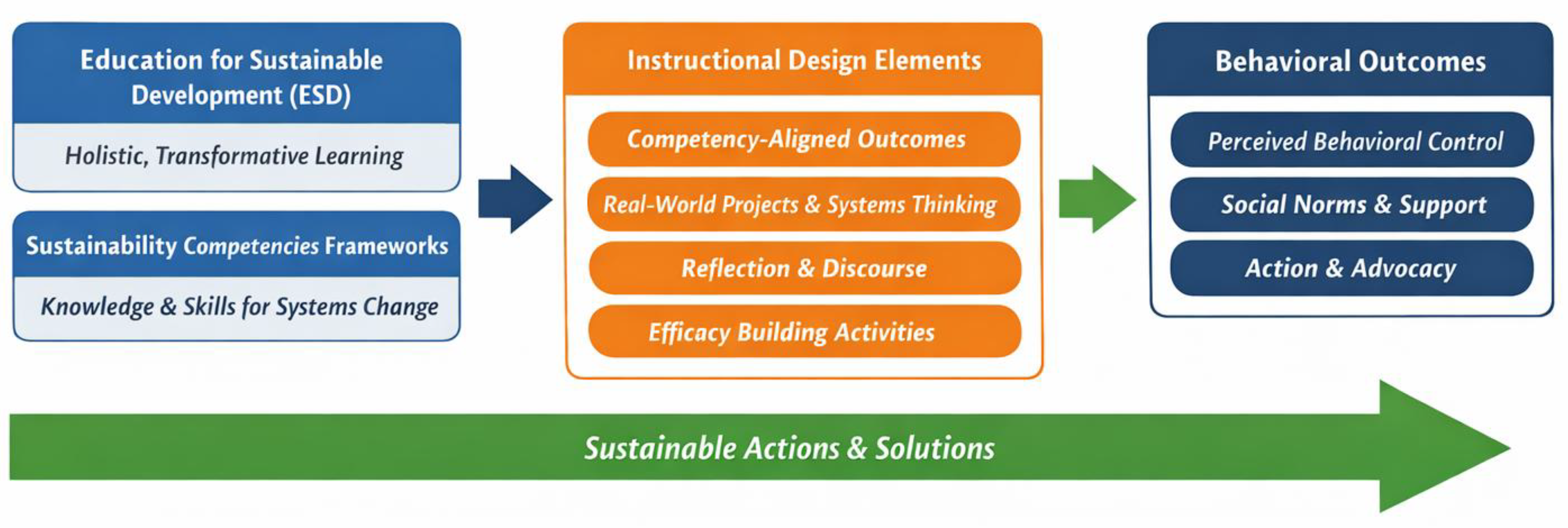
Figure 2.
Competence-to-action model for sustainability instruction in higher education. Note. Figure created by the authors. Arrows indicate hypothesized directional relationships. Perceived behavioral control and subjective norms are modeled as mediators between intermediate outcomes and action readiness (Ajzen, 1991). Downstream sustained outcomes are presented as likely targets and evaluation priorities, not as effects claimed by this synthesis.
Figure 2.
Competence-to-action model for sustainability instruction in higher education. Note. Figure created by the authors. Arrows indicate hypothesized directional relationships. Perceived behavioral control and subjective norms are modeled as mediators between intermediate outcomes and action readiness (Ajzen, 1991). Downstream sustained outcomes are presented as likely targets and evaluation priorities, not as effects claimed by this synthesis.
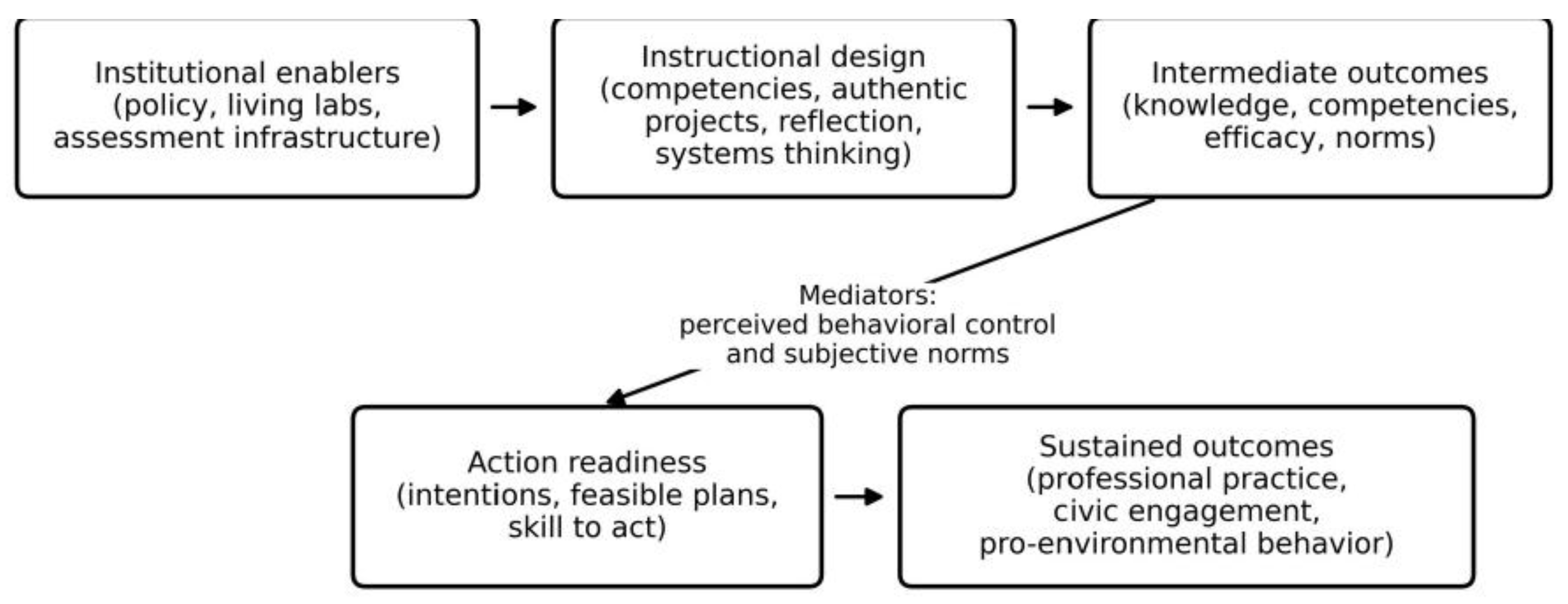
Figure 3.
Competency-aligned experiential learning cycle for sustainability instruction. Note. Cycle emphasizes iteration, reflection, and feedback to support transfer beyond a single project. It operationalizes how competencies are built through repeated practice and reflection, clarifying the instructional sequencing needed to move beyond awareness toward action readiness.
Figure 3.
Competency-aligned experiential learning cycle for sustainability instruction. Note. Cycle emphasizes iteration, reflection, and feedback to support transfer beyond a single project. It operationalizes how competencies are built through repeated practice and reflection, clarifying the instructional sequencing needed to move beyond awareness toward action readiness.
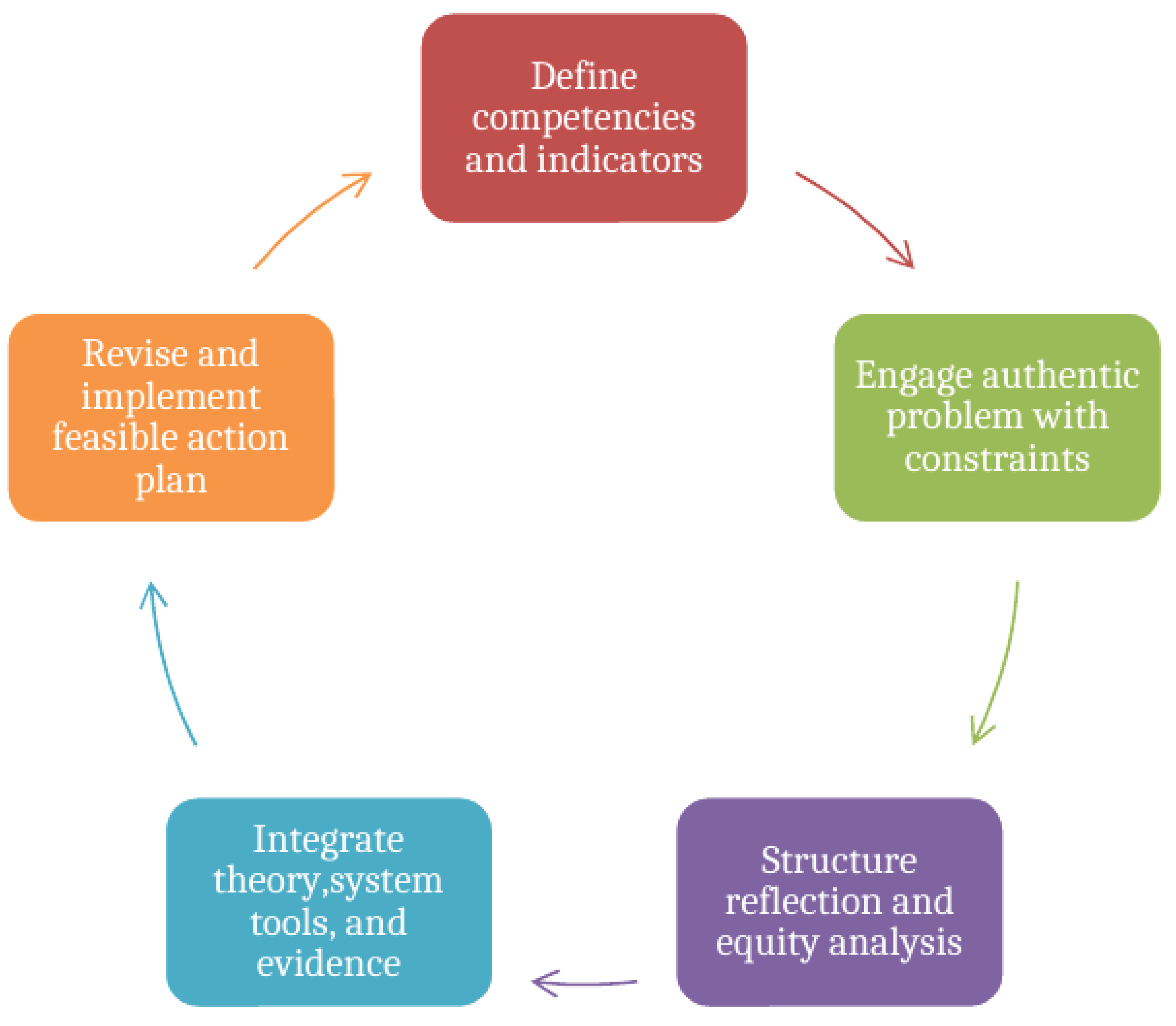
Figure 4.
Mixed assessment system integrating knowledge benchmarks and performance evidence. Note. Programs can combine sustainability literacy measurement with rubric-based scoring of artifacts to guide continuous improvement.
Figure 4.
Mixed assessment system integrating knowledge benchmarks and performance evidence. Note. Programs can combine sustainability literacy measurement with rubric-based scoring of artifacts to guide continuous improvement.
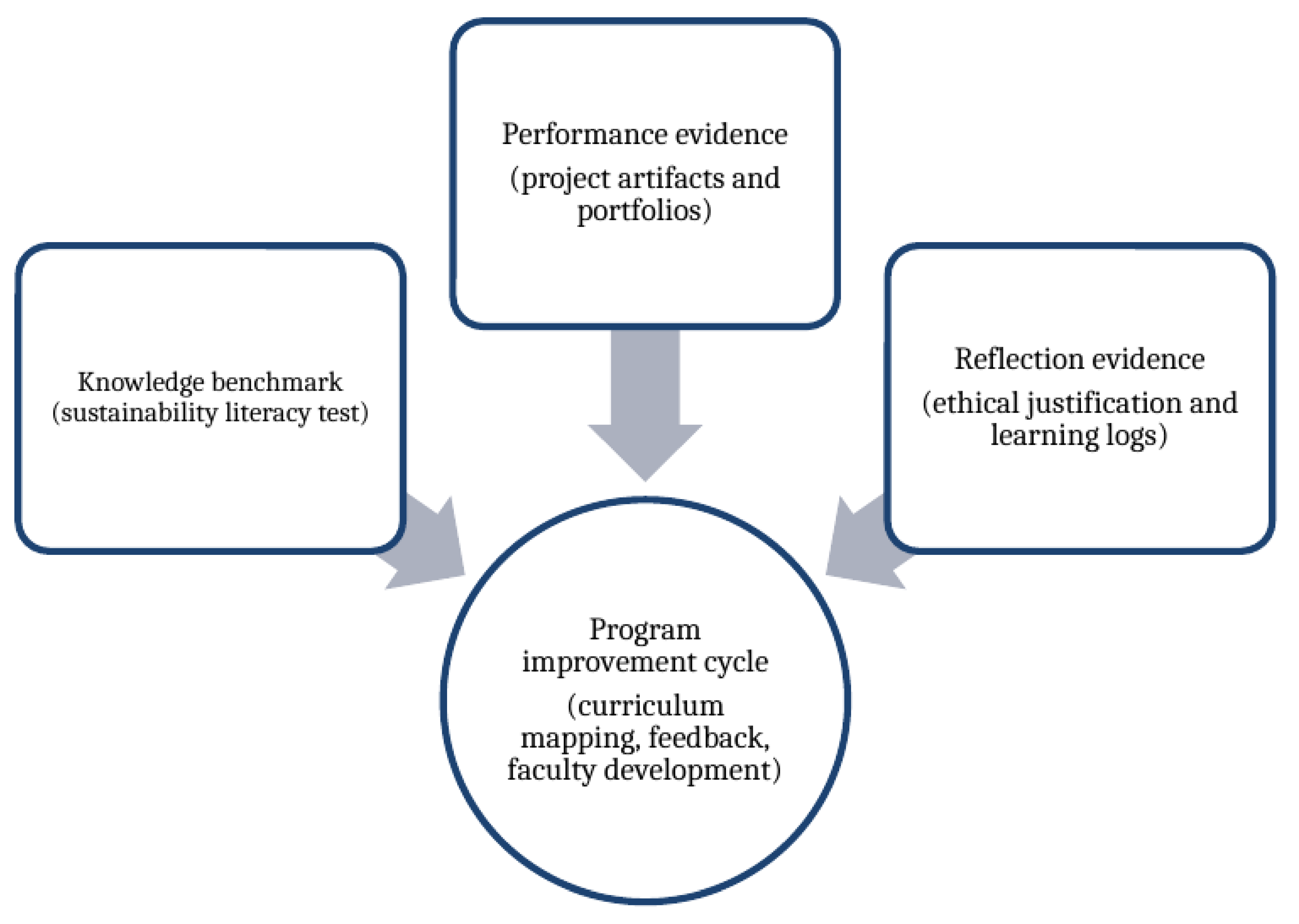

Table 1.
Foundational frameworks informing competence-to-action sustainability instruction.
| Framework | Core constructs | Implications for instruction | Implications for assessment | Illustrative sources |
|---|---|---|---|---|
| Education for Sustainable Development (ESD) | Whole-institution alignment; action orientation; global citizenship | Integrate sustainability across curriculum, pedagogy, and institutional culture | Assess applied learning and action capacity | UNESCO (2020) |
| Sustainability competencies | Systems; anticipatory; normative; strategic; interpersonal | Design outcomes and activities mapped to competencies | Use performance evidence aligned to competencies | Wiek et al. (2011); Rieckmann (2012) |
| Experiential and transformative learning | Experience-reflection cycles; critical reflection; perspective change | Sequence authentic tasks with iterative reflection and revision | Assess process artifacts and real-world products | Kolb (1984); Mezirow (1997); Sipos et al. (2008) |
| Campus living labs | Campus as testbed; stakeholder co-creation; scaling pathways | Anchor learning in campus problems with governance and evaluation | Evaluate intervention designs and transfer plans | Herth et al. (2025); Morales et al. (2024) |
| Inclusive design (UDL) | Multiple means of engagement, representation, and action and expression | Reduce barriers and offer flexible participation structures | Increase the validity and equity of performance evidence | CAST (2018); Darling-Hammond et al. (2017) |
| Institutional assessment and reporting | Benchmarking; accountability; evidence categories | Align curricular initiatives with institutional sustainability systems | Use reporting structures without reducing learning to compliance | AASHE (2025); Sulitest (n.d.) |
Table 2.
Competence-to-action assessment rubric (summary).
| Criterion | Emerging | Developing | Proficient |
|---|---|---|---|
| Systems analysis | Describes isolated factors; limited connections | Identifies relationships and feedback; partial boundary rationale | Produces coherent systems model with feedback, leverage points, and unintended consequences |
| Evidence use | Limited or unclear evidence; weak attribution | Uses relevant sources with partial synthesis | Uses high-quality evidence with clear synthesis and appropriate citation |
| Anticipatory reasoning | Basic predictions; limited assumptions | Constructs plausible scenarios with stated assumptions | Builds scenario logic, evaluates uncertainty, and connects implications to decisions |
| Normative reasoning | Values implied but not justified | Identifies values and trade-offs with partial justification | Articulates ethical reasoning and trade-offs transparently and coherently |
| Strategic design | Suggests actions without feasibility analysis | Proposes feasible strategies with partial implementation details | Produces an implementable strategy with constraints, timeline, resources, and evaluation plan |
| Implementation and evaluation | Steps vague; limited measurement plan | Includes steps and basic metrics | Includes a clear roadmap with roles, resources, measurable indicators, and evaluation design |
Table 3.
Competency-to-activity-to-evidence map.
| Target competency | Observable indicators | Signature learning activities | Assessment evidence (examples) |
|---|---|---|---|
| Systems thinking | Defines system boundaries; maps feedback and leverage points | Systems mapping of a campus sustainability challenge: causal loop diagramming | Systems map with rationale; leverage-point brief |
| Anticipatory | Articulates scenarios; states assumptions; evaluates uncertainty | Scenario planning, climate risk, or resilience analysis | Scenario memo: sensitivity analysis summary |
| Normative | Makes values explicit; evaluates trade-offs; justifies decisions | Values-based deliberation; ethics of sustainability trade-offs | Decision rationale memo; trade-off matrix |
| Strategic | Develops implementable interventions; plans resources and governance | Intervention design for a living lab project; implementation planning | Implementation roadmap; budget or resource plan |
| Interpersonal | Engages stakeholders; collaborates; communicates across groups | Stakeholder co-design sessions; public-facing communication | Stakeholder map; meeting notes; presentation with reflection |
Disclaimer/Publisher’s Note: The statements, opinions and data contained in all publications are solely those of the individual author(s) and contributor(s) and not of MDPI and/or the editor(s). MDPI and/or the editor(s) disclaim responsibility for any injury to people or property resulting from any ideas, methods, instructions or products referred to in the content. |
© 2026 by the authors. Licensee MDPI, Basel, Switzerland. This article is an open access article distributed under the terms and conditions of the Creative Commons Attribution (CC BY) license (http://creativecommons.org/licenses/by/4.0/).
Copyright: This open access article is published under a Creative Commons CC BY 4.0 license, which permit the free download, distribution, and reuse, provided that the author and preprint are cited in any reuse.


