
Submitted:
10 April 2026
Posted:
15 April 2026
You are already at the latest version
Abstract
This study evaluates animal welfare as a factor influencing economic losses and re-source use efficiency in the global livestock sector for 2025-2026. Using analytical as-sessment and conceptual modeling (TEL, WFW, and LDI models) based on FAO and USDA data, the study estimates the economic and environmental implications of pre-slaughter stress. The results suggest that global meat losses may reach approximately 19.4 million tons annually, with associated economic losses potentially exceeding USD 90 billion. These losses correspond to an estimated 184.2 km³ of freshwater and approximately 138.5 million tons of feed resources, indicating reduced efficiency in resource utilization. The findings highlight that improving animal welfare may represent not only an ethi-cal consideration but also a potential approach to enhancing resource efficiency and sustainability in livestock production systems. The study supports the integration of welfare-related parameters into agricultural and food system policies, particularly in regions affected by logistical disruptions.
Keywords:
animal welfare
; pre-slaughter stress
; economic losses
; water footprint
; livestock production
; feed efficiency
; sustainability
; meat quality
1. Introduction
Animal welfare in the global food system is increasingly recognized not only as an ethical concern but also as an important economic and environmental factor. Recent regulatory developments and consumer expectations, particularly within the European Union, emphasize the need to improve pre-slaughter handling practices and welfare standards [1,2].
Despite technological progress in livestock production, significant losses continue to occur at the pre-slaughter stage. These losses are associated not only with carcass weight reduction, but also with metabolic changes in muscle tissue that may lead to quality defects such as Pale, Soft and Exudative (PSE) and Dark, Firm and Dry (DFD) meat [3,4,5]. Such defects reduce both technological and commercial value.
In addition to direct production losses, pre-slaughter stress may contribute to inefficient use of natural resources. Reduced product quality implies that water and feed inputs used during animal production are not fully converted into marketable outputs. This is particularly relevant in the context of increasing attention to water footprint and sustainability in agriculture [6,7,8,9].
The aim of this study is to propose a conceptual approach for estimating potential economic and environmental losses associated with pre-slaughter stress at a global level.
2. Materials and Methods
The research methodology was based on analytical assessment and mathematical modeling of global livestock production data. A multi-stage approach was applied to estimate resource losses associated with pre-slaughter stress by integrating biological, environmental, and economic parameters into a unified framework.
Data for the analysis were obtained from international databases and reports, including the United States Department of Agriculture (USDA, 2025), the Food and Agriculture Organization of the United Nations (FAO, 2025), and European Commission reports on animal welfare [6,7,8,9]. The analysis focused on the two major livestock sectors: beef and pork production.
To estimate direct meat losses, a standardized coefficient of 10% (Lc = 0.10) was applied to global production volumes. This coefficient represents an aggregated estimate based on reported ranges of losses associated with pre-slaughter stress, including transport mortality, carcass trimming, and quality defects (PSE and DFD), as described in previous studies [1,4,8]. Reported values in the literature vary depending on species and production systems; therefore, the 10% coefficient used in this study should be interpreted as a conservative and indicative approximation.
The environmental impact was assessed using the Water Footprint (WF) methodology. Global average values were used: 15,415 L/kg for beef and 5,988 L/kg for pork [10,11,12,13]. Feed losses were estimated using feed conversion ratios (FCR) of 4:1 for beef and 3.5:1 for pork production.
Losses in the leather sector were estimated using a quality degradation coefficient of 15–20%, reflecting damage caused by pre-slaughter stress.
The approach is conceptual and based on secondary data sources; therefore, results should be interpreted as indicative [14,15,16,17].
The total economic losses were calculated using the following expression:
where:
T_loss = Σ (Vi × Lc × Pi) + Σ (Vi × Qd × Di)
Vi - production volume of livestock product i (thousand tons)
Lc - loss coefficient associated with pre-slaughter stress
Pi - average market price of product i (USD per ton)
Qd - proportion of defective products
Di - price discount due to quality degradation (USD per ton).
This model integrates both direct quantitative losses and additional economic losses associated with quality deterioration. The parameters are based on FAO and USDA data as well as literature sources [7,8,18].
This formulation is consistent with approaches used in economic loss assessments in livestock systems [17,18].
Water footprint losses were estimated as:
where:
WFW = Lm × WFi
Lm - volume of meat losses (kg)
WFi - water footprint coefficient for product i (L/kg).
This calculation, reflecting the volume of freshwater resources indirectly lost due to reduced production efficiency, follows the standard water footprint methodology with coefficients derived from established global assessments [10,11,12,13].
Losses in the leather sector were estimated using the following expression:
where:
LDI = Hp × Kt × Vh
Hp - proportion of hides affected by damage
Kt - coefficient of quality degradation
Vh - total volume of hides.
3. Results
3.1. Global Economic Impact of Pre-Slaughter Stress (TEL Model)
The application of the Total Economic Loss (TEL) model provided an estimate of potential economic losses associated with pre-slaughter stress in the global livestock sector. According to available data, global beef production was approximately 72,154 thousand tons, while pork production reached 121,852 thousand tons in 2025.
Based on the applied loss coefficient (Lc ≈ 0.10), the estimated direct quantitative losses amount to approximately 19.4 million tons of meat. The economic evaluation, incorporating average market prices (Pi) and quality-related price reductions (Di), suggests that total financial losses may reach significant levels, potentially exceeding tens of billions of USD (Table 1).
In addition to direct losses, quality degradation associated with PSE (Pale, Soft and Exudative) and DFD (Dark, Firm and Dry) meat may further reduce the market value of livestock products [3,18]. In some production systems, particularly in transitional economies, the prevalence of such defects may be relatively high, contributing to additional value reduction. These observations are consistent with previously reported biochemical and physiological changes in muscle tissue under stress conditions [4,18].
The data presented in Table 1 indicate a direct relationship between livestock production volumes and the scale of potential pre-slaughter losses. The estimated cumulative losses represent a relevant factor affecting overall production efficiency and resource utilization.
In regions with less developed infrastructure, including limitations in transport logistics and cooling systems, the relative impact of such losses may be more pronounced. This highlights the importance of improving pre-slaughter handling conditions as part of strategies aimed at increasing efficiency and sustainability in livestock production systems.
3.2. Environmental Equivalent of Welfare-Related Losses (WFW Model)
The application of the Water Footprint Waste (WFW) model provided an estimate of the environmental impact associated with pre-slaughter stress. The results indicate that freshwater losses related to welfare-induced reductions in meat production may reach substantial levels (Table 2).
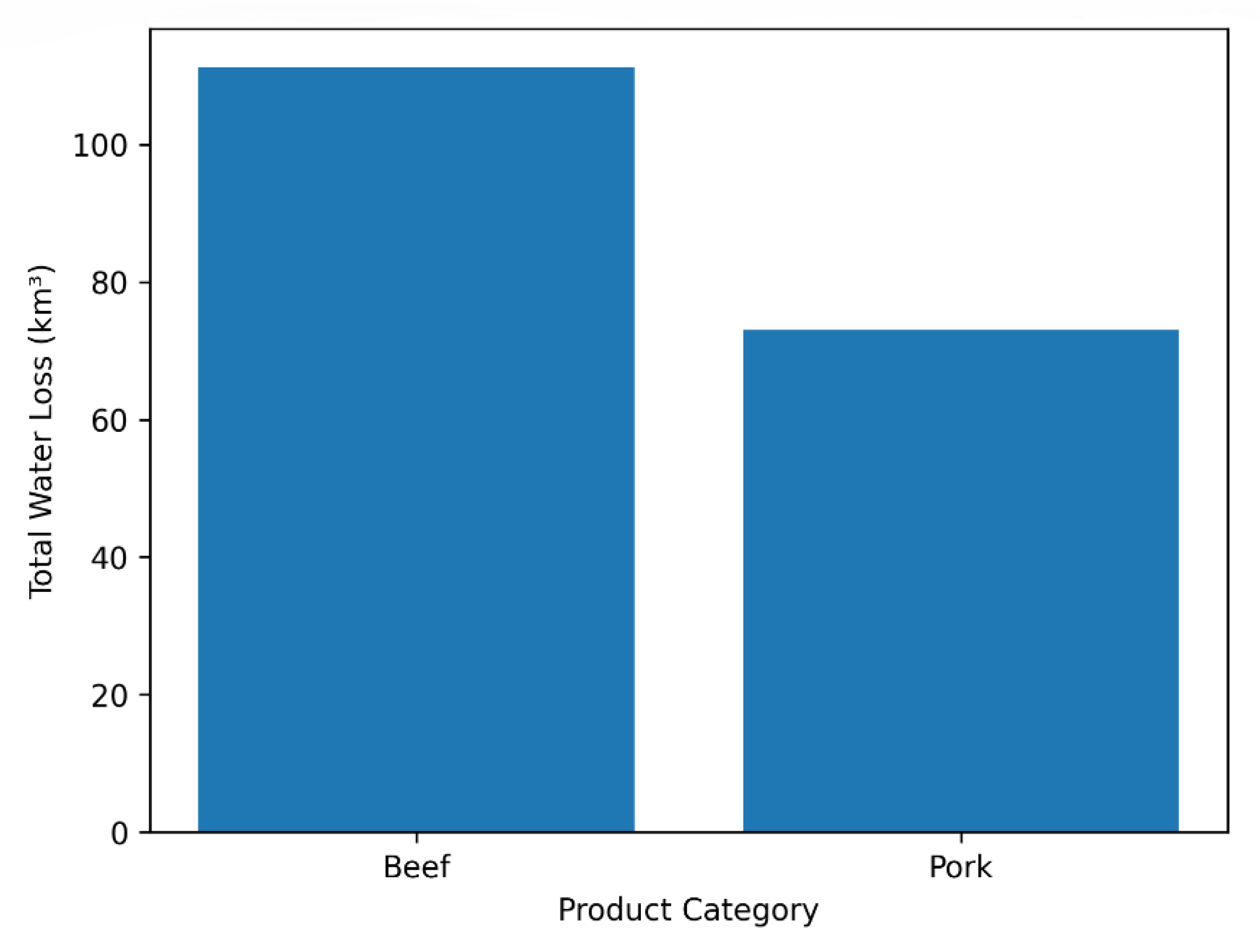
The estimated results suggest that, in the beef sector, the loss of 7,215 thousand tons of meat may correspond to approximately 111.23 km³ of freshwater. In the pork sector, the loss of 12,185 thousand tons may be associated with approximately 72.96 km³ of water.
The data presented in Table 2 indicate that cumulative freshwater losses represent a relevant component of the environmental footprint of livestock production systems. These findings suggest that inefficiencies related to pre-slaughter handling may contribute to indirect resource use inefficiencies.
Comparative analysis indicates that the magnitude of these estimated losses is substantial when considered in the context of global water resource use. This provides an indicative perspective on the potential environmental implications associated with welfare-related inefficiencies.
Overall, the results suggest that improvements in animal handling practices may contribute to more efficient use of water resources and may reduce the environmental footprint of meat production systems.
3.3. Economic Impact on the Leather Industry and Feed Resource Losses (LDI Model)
The application of the Leather Devaluation Index (LDI) provided an estimate of potential economic losses in the global tanning industry associated with pre-slaughter stress. The results suggest that a significant proportion of raw hides may be affected by quality degradation due to mechanical damage, including bruises and skin lesions. Based on the applied model, it is estimated that a considerable share of hides may be subject to devaluation, resulting in financial losses that may reach several billion USD.
In addition to losses in the leather sector, the analysis also considered the equivalent loss of feed resources associated with reduced production efficiency. The results indicate that welfare-related inefficiencies may correspond to substantial losses of grain resources used in livestock production systems.
According to the model estimates, in the beef sector, equivalent grain losses may reach approximately 28,861 thousand tons, while in the pork sector they may amount to approximately 109,666 thousand tons. In total, cumulative grain losses associated with pre-slaughter stress may exceed 138.5 million tons.
These findings suggest that inefficiencies related to animal handling practices may have broader implications beyond direct production losses, affecting both by-product value chains and the overall efficiency of feed resource utilization.
3.4. Impact of Pre-Slaughter Welfare on Hide Quality and Resource Value
Mechanical skin damage occurring during the pre-slaughter stage—specifically during loading, transportation, and lairage—is a direct consequence of suboptimal animal welfare practices [18,19,20]. Rough handling, inadequate vehicle design, and high stocking densities lead to bruising, scratches, and skin abrasions, which significantly degrade the quality of the final leather product [17,20]. Using the Hide Loss Index (HLI) model, we evaluated the economic and resource implications of these welfare failures across key global producers (Table 3).
In regions with lower PSIF values, such as the EU and USA, standardized transport protocols and handling practices preserve the integrity of secondary raw materials [7,21,22]. Conversely, the high loss rate in Ukraine (15%) highlights how external stressors, disrupted logistics, and military conflicts directly diminish the “zero-waste” potential of the livestock sector [7,22]. Minimizing these physical injuries, as suggested by Grandin [20] and Sullivan, et al. [17], is essential for maintaining the economic sustainability and environmental efficiency of the global leather supply chain.
4. Discussion
The results obtained using the TEL and WFW models suggest that animal welfare represents an important factor influencing both the economic and environmental dimensions of livestock production systems. In comparison with available data for the 2020-2024 period, the estimates indicate a potential increase in resource losses associated with pre-slaughter stress.
The projected global meat losses of approximately 19.4 million tons in 2025 may reflect a moderate increase compared with earlier FAO- and USDA-based assessments [7,8,9].
The figure presents a comparison of beef and pork losses across major producing countries and at the global level. Source: Calculated based on FAO and USDA data [7,8,9].
In regions with less developed infrastructure, particularly in transitional economies, the relative impact of such losses may be more pronounced due to limitations in transport logistics, animal handling, and cooling capacity. The example of Ukraine illustrates how external disruptions may amplify these effects. These observations are consistent with previous studies indicating that pre-slaughter stress contributes to carcass quality deterioration and metabolic changes in muscle tissue [3,4,18].
The analysis of the water footprint highlights the importance of indirect resource use in livestock production systems. Previous studies have shown that the majority of water consumption in beef production is associated with feed production rather than direct animal intake [10,11,12,13].
The present study extends this perspective by suggesting that a portion of these resources may be effectively lost due to welfare-related inefficiencies.
As illustrated in Figure 2, the comparison between direct water use and total water footprint provides an indicative assessment of the scale of indirect environmental impacts. The results suggest that total water losses associated with reduced production efficiency may substantially exceed direct water intake. This supports the view that resource efficiency in livestock systems is closely linked to management practices, including animal handling and welfare conditions [4,18,23].
Figure 1.
Projected livestock losses at the pre-slaughter stage in 2025 (thousand tons). Source: Calculated based on FAO and USDA data [7,8,9].
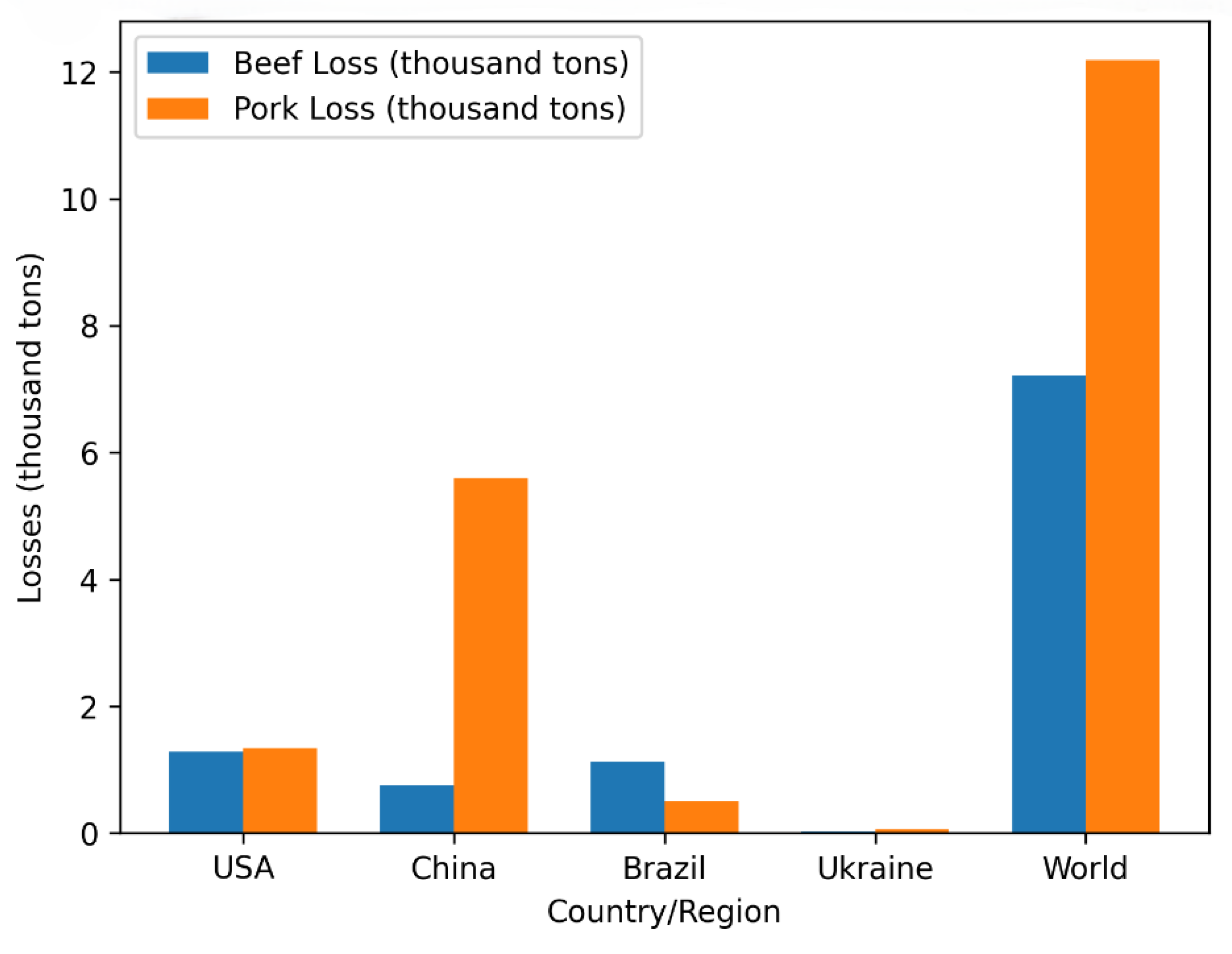
Figure 2.
Estimated freshwater loss associated with pre-slaughter stress in 2025. Source: Calculated based on water footprint coefficients [10,11,12,13].
In addition to environmental impacts, the results indicate that pre-slaughter stress may influence the economic value of by-products, including hides. The estimated losses in the leather sector suggest that conventional assessments may underestimate the broader economic implications of welfare-related inefficiencies [24,25].
These findings are consistent with previous research indicating that stress-induced metabolic changes, including glycogen depletion, affect meat quality characteristics [3,4,18].
The analysis also highlights the impact of welfare-related inefficiencies on feed resource utilization. The estimated grain equivalents of meat losses suggest that a considerable volume of feed resources is not effectively converted into final products. Previous studies have demonstrated that stress factors, including transport conditions and handling practices, may negatively affect feed conversion efficiency [26,27].
From a global perspective, the identified losses can be interpreted as a substantial volume of potentially recoverable resources rather than solely as inefficiencies within livestock systems. The estimated 184.2 km³ of freshwater and over 138 million tons of feed losses annually may have broader implications in the context of resource efficiency and sustainability.
Special attention should be given to regions affected by external disruptions, including military conflicts. In such conditions, supply chain instability, forced animal movements, and infrastructure damage may significantly increase stress levels and associated losses. Under these circumstances, the standardized loss coefficient applied in this study may represent a conservative estimate.
From a policy perspective, improving animal welfare conditions, particularly during transport and pre-slaughter handling may represent a practical and relatively cost-effective strategy to enhance overall system efficiency. Measures such as reducing transport duration, improving handling practices, and minimizing stress exposure may contribute to measurable reductions in both economic and environmental losses.
At the same time, it is important to acknowledge the limitations of the present study. The proposed models are based on generalized coefficients and global averages, which may not fully capture regional variability. Therefore, the results should be interpreted as indicative rather than absolute.
In addition, the authors possess a registered solution (know-how) aimed at reducing pre-slaughter stress and associated losses.
The proposed solution is based on principles of stress minimization during animal handling, including optimized transport conditions and pre-slaughter management. The implementation of such approaches may provide a practical pathway for improving resource efficiency in livestock systems. Further research is required to evaluate the scalability and economic feasibility of these approaches under different production conditions.
4.1. Comparative Analysis of Meat and Hide Resource Depreciation
The correlation between meat quality deterioration and hide damage is a critical finding of this study. As shown in Figure 3, regions with higher meat loss indices (LDI) consistently exhibit elevated hide inefficiency (PSIF). This synchronization suggests that pre-slaughter stressors, such as prolonged transport and rough handling, act as a multi-vector catalyst for resource waste.
In the case of Ukraine, the highest recorded losses in both categories (18% for meat and 15% for hides) are directly related to the disruption of logistics and animal welfare standards caused by military conflicts [7,22]. In contrast, the United States and the European Union show comparatively lower levels of inefficiency, with values ranging from 4.0% to 6.0%, indicating more advanced welfare management practices and infrastructure [19,21]. Brazil occupies an intermediate position, with moderate losses in both categories.
From a sustainability perspective, the combined loss of high-value protein and high-quality leather raw materials represents a double economic blow to the livestock sector. Integrating hide quality into the overall welfare assessment system, allows for a more holistic “zero waste” approach to global livestock production.
Overall, the data demonstrate a consistent pattern whereby higher losses in meat quality are associated with higher losses in hide quality, supporting the hypothesis that animal welfare-related stress has systemic effects on multiple components of livestock production efficiency.
4.2. Limitations of the Study
This study is based on a conceptual modeling approach using aggregated global data and standardized coefficients. Therefore, the estimates may not fully reflect regional variability in livestock production systems, transport infrastructure, and management practices.
The applied loss coefficients and quality degradation parameters are derived from literature sources and may differ under specific real-world conditions. In addition, water footprint values are based on global averages and do not account for local variations in feed composition, climate, and production efficiency.
Accordingly, the results should be interpreted as indicative estimates intended to illustrate the potential scale of inefficiencies rather than precise quantitative measurements.
Further research should focus on region-specific data and empirical validation of the proposed models.
5. Conclusions
Economic Viability: Global pre-slaughter stress results in significant financial losses, reaching 92 billion USD annually. This is primarily driven by a 10% reduction in potential meat yield and the high prevalence of quality defects (PSE and DFD), which cause a 15–20% devaluation of raw materials in transitional economies.
Resource Efficiency: Improving welfare standards serves as a critical tool for global resource conservation. Preventing welfare-related losses can save approximately 138.5 million tons of grain and 184.2 trillion liters of fresh water annually. The “wasted” water footprint in the beef sector alone (111.2 trillion liters) is comparable to the annual discharge of a major river system like the Danube.
Industrial Synergy: The leather industry suffers an additional 6.4 billion USD in losses due to hide trauma and mechanical damage during transport. Integrating stress-free handling protocols can increase the market value of raw hides by up to 20%, transforming biological waste into high-value industrial raw materials.
Food Security and Ethics: The grain equivalent of welfare-induced losses (138.5 million tons) could potentially meet the annual nutritional requirements of over 250 million people in food-insecure regions. This aligns the livestock industry with the UN Sustainable Development Goal for Zero Hunger (SDG 2).
Strategic Outlook: Adhering to the “Five Freedoms” and recognizing animals as sentient beings should be integrated into national food security strategies and the circular economy framework of 2026. This approach ensures an ethical, sustainable, and economically resilient agricultural future.
Author Contributions
Conceptualization, V.G.K. and O.M.F.; methodology, V.G.K. and I.O.R.; software, V.G.K.; validation, O.M.F., I.O.R. and N.O.A.; formal analysis, A.A.A. and I.O.R.; investigation, V.G.K. and N.O.A.; resources, O.M.F. and A.A.A.; data curation, V.G.K. and I.O.R.; writing-original draft preparation, V.G.K. and I.O.R.; writing-review and editing, O.M.F., N.O.A. and A.A.A.; visualization, V.G.K.; supervision, O.M.F. and I.O.R.; project administration, V.G.K. All authors have read and agreed to the published version of the manuscript.
Funding
This research received no external funding.
Institutional Review Board Statement
Not applicable.
Informed Consent Statement
Not applicable.
Data Availability Statement
The data used in this study are available from publicly accessible databases, including FAO and USDA.
Conflicts of Interest
The authors declare no conflict of interest.
References
- Kushnerenko, V.G.; Riapolova, I.O. Ways to solve animal welfare in the context of climate change in the southern region of Ukraine. European Science 2025, 36(2), 103–118. [Google Scholar] [CrossRef]
- Riapolova, I.; Kushnerenko, V. Prerequisites for ensuring animal welfare in order to obtain high-quality and safe products in Ukraine and the EU. Eur. Sci. 2024, 28, 199–213. [Google Scholar] [CrossRef]
- Adzitey, F.; Nurul, H. Pale soft exudative (PSE) and dark firm dry (DFD) meats: Causes and measures to reduce these incidences—A mini review. Int. Food Res. J. 2011, 18, 11–20. Available online: http://www.ifrj.upm.edu.my/18%20(01)%202011/(2)%20IFRJ-2010-091%20Nurul%5B1%5D.pdf.
- Broom, D.M. Animal welfare in relation to human welfare and sustainability—A review paper. Vet. Arhiv 2022, 92, 541–547. Available online: https://hrcak.srce.hr/file/416185. [CrossRef]
- Kushnerenko, V.G. Influence of stress factors on animal meat quality. Sci. Herald Kherson State Agric. Econ. Univ. 2023, 131, 230–236. [Google Scholar] [CrossRef]
- FAO. OECD–FAO Agricultural Outlook 2025–2034; Food and Agriculture Organization of the United Nations: Rome, Italy, 2025; Available online: https://www.fao.org (accessed on 25 March 2026).
- FAO. FAOSTAT: Crops and Livestock Products. 2023. Available online: https://www.fao.org/faostat/en/ (accessed on 1 April 2026).
- USDA. Agricultural Projections to 2034 (OCE 2025 1); U.S. Department of Agriculture: Washington, DC, USA, 2024; Available online: https://www.usda.gov (accessed on 1 April 2026).
- USDA. Outlook for 2025 (Agricultural Policy Review). 2025. Available online: https://agpolicyreview.card.iastate.edu/winter-2025/usdas-outlook-2025 (accessed on 1 April 2026).
- Mekonnen, M.M.; Hoekstra, A.Y. The Green, Blue and Grey Water Footprint of Farm Animals and Animal Products; Value of Water Research Report Series No. 48; UNESCO IHE: Delft, The Netherlands, 2010; Available online: https://waterfootprint.org/media/downloads/Report48-WaterFootprint-AnimalProducts_1.pdf.
- Mekonnen, M.M.; Hoekstra, A.Y. A global assessment of the water footprint of farm animal products. Ecosystems 2012, 15, 401–415. [Google Scholar] [CrossRef]
- Mekonnen, M.M.; Hoekstra, A.Y. Global water footprint of livestock products. Water 2020, 12(9), 2566. [Google Scholar] [CrossRef]
- Gerbens-Leenes, P.W.; Mekonnen, M.M.; Hoekstra, A.Y. The water footprint of meat: A global meta-analysis. Environ. Res. Lett. 2021, 16(5), 054030. [Google Scholar] [CrossRef]
- Crump, K.; Serratosa, J.; Niemi, J.K.; Ingenblick, P.T.M. Consumer perceptions of precision animal husbandry—A qualitative study in three European countries. Animals 2021, 11, 1221. [Google Scholar] [CrossRef]
- Lipovšek, M.; Škorjanc, D.; Šemrov, D.; et al. Farm animal welfare during transport and at the slaughterhouse: Perceptions of stakeholders. Animals 2024, 14, 443. [Google Scholar] [CrossRef] [PubMed]
- Marcia de Campo, M.; et al. Cattle Production in the Future: Animal Welfare as a Critical Component of Sustainability and Beef Quality, from a South American Perspective. Meat Sci. 2025, 219, 109672. [Google Scholar] [CrossRef] [PubMed]
- Sullivan, P.; Davis, M.; Bretón, J.; Edwards-Callaway, L. Investigating the impact of pre-slaughter management factors on meat quality outcomes in cattle raised for beef: A scoping review. Front. Anim. Sci. 2022, 3, 1065002. [Google Scholar] [CrossRef]
- Fuseini, A. Pre-slaughter treatment and possible effects on animal welfare and meat quality. In Halal Slaughter of Livestock: The Science of Animal Welfare, the History and Politics of Religious Slaughter; Springer: Cham, Switzerland, 2023; Volume 22. [Google Scholar] [CrossRef]
- Nicolaisen, S.; et al. Animal welfare during transport and slaughter of cattle: A systematic review. Animals 2023, 13, 1974. [Google Scholar] [CrossRef]
- Grandin, T. Livestock Handling and Transport, 5th ed.; CABI Publishing: Wallingford, UK, 2019. [Google Scholar] [CrossRef]
- European Commission. Animal Welfare. 2024. Available online: https://food.ec.europa.eu/animals/animal-welfare/overview_en (accessed on 1 April 2026).
- FVE. Final Report on the Future of EU Agriculture (Strategic Dialogue 2024). 2024. Available online: https://fve.org/ (accessed on 1 April 2026).
- EFSA Panel on Animal Health and Welfare. Welfare of sheep during transport. EFSA J. 2022, 20, e07466. [Google Scholar] [CrossRef]
- Nielsen, S.S.; et al. Welfare of cattle during transport. EFSA J. 2022, 20, e07442. [Google Scholar] [CrossRef]
- Nielsen, S.S.; et al. Welfare of pigs during transport. EFSA J. 2023, 21, e07831. [Google Scholar] [CrossRef]
- Poveda Arteaga, A.; et al. Influence of transport distance, animal weight, and muscle position on meat quality of young bulls during summer. Appl. Sci. 2024, 14, 3557. [Google Scholar] [CrossRef]
- Driessen, B.; Van Beirendonck, S.; Buyse, J. Effect of grouping on skin lesions and meat quality of pig carcasses. Animals 2020, 10(4), 544. [Google Scholar] [CrossRef] [PubMed]
Figure 3.
Comparative analysis of resource inefficiency: Meat Quality Loss (LDI) vs. Hide Quality Loss (PSIF) across major global producers.
Figure 3.
Comparative analysis of resource inefficiency: Meat Quality Loss (LDI) vs. Hide Quality Loss (PSIF) across major global producers.
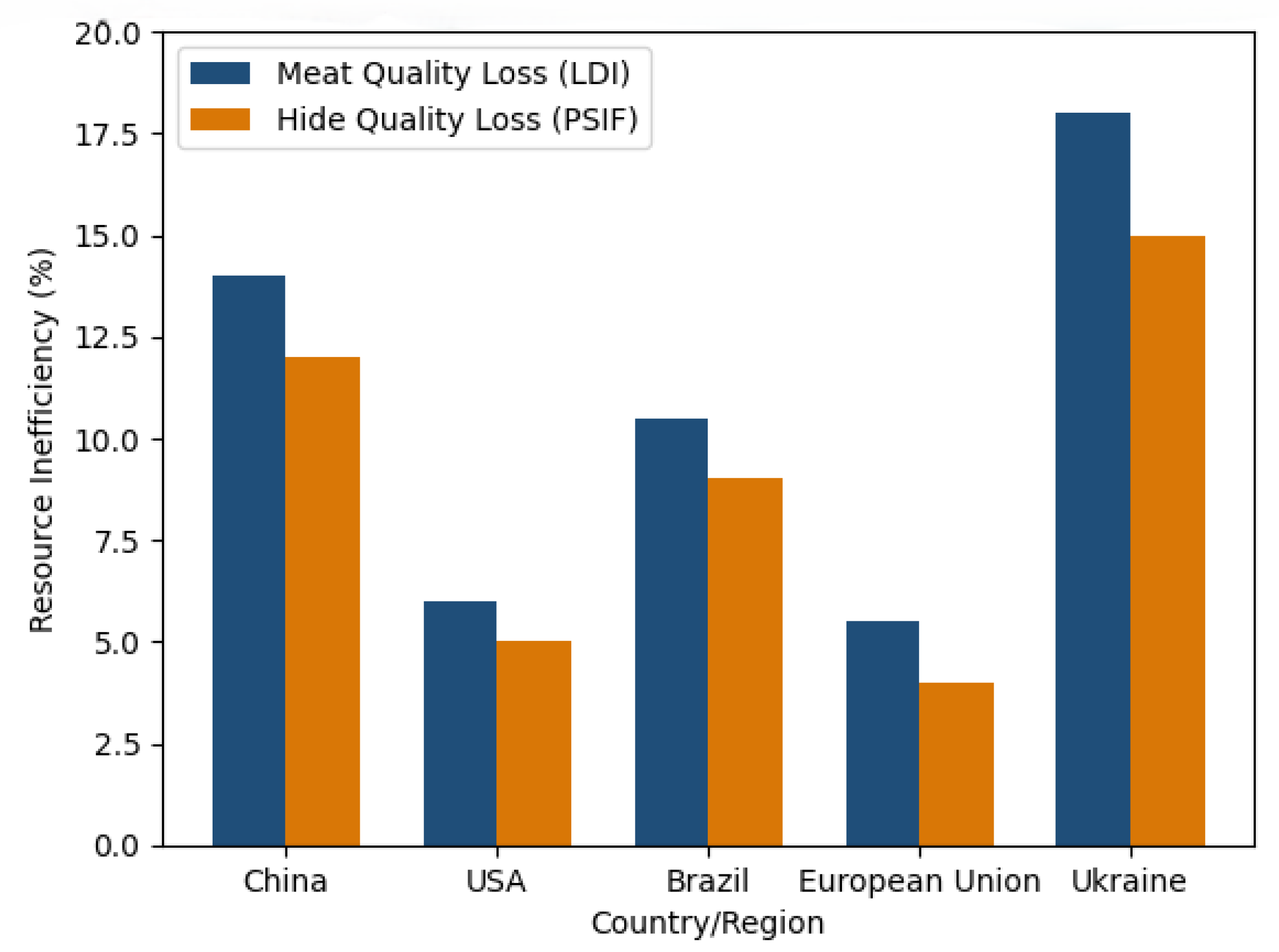

Table 1.
Projected livestock losses at the pre-slaughter stage in 2025 (thousand tons).
| Country/Region | Beef (Projected Production) | Losses (10%) | Pork (Projected Production) | Losses (10%) |
| USA | 12.85 | 1.285 | 13.45 | 1.345 |
| China | 7.50 | 0.750 | 56.00 | 5.600 |
| Brazil | 11.20 | 1.120 | 4.95 | 0.495 |
| Ukraine | 0.285 | 0.0285 | 0.640 | 0.064 |
| World (total) | 72.154 | 7.215 | 121.852 | 12.185 |
Table 2.
Estimated freshwater loss equivalent associated with pre-slaughter stress (2025).
| Product Category | Meat Loss (thousand tons) | Water Footprint (L/kg) | Total Water Loss (km³) |
| Beef | 7.215 | 15415 | 111.23 |
| Pork | 12.185 | 5988 | 72.96 |
| Total | 19.400 | - | 184.19 |
Table 3.
Estimated annual hide value loss and resource inefficiency due to pre-slaughter wel-fare-related mechanical damage.
Table 3.
Estimated annual hide value loss and resource inefficiency due to pre-slaughter wel-fare-related mechanical damage.
| Country/Region | Hide Production (kt) |
Pre-Slaughter Impact Factor (PSIF) |
Estimated Value Loss (USD Million) |
Resource Inefficiency (%) |
| China | 1,450 | 0.12 | 174.0 | 12.0 |
| USA | 1,120 | 0.05 | 56.0 | 5.0 |
| Brazil | 980 | 0.09 | 88.2 | 9.0 |
| European Union | 850 | 0.04 | 34.0 | 4.0 |
| Ukraine | 125 | 0.15 | 18.7 | 15.0 |
Disclaimer/Publisher’s Note: The statements, opinions and data contained in all publications are solely those of the individual author(s) and contributor(s) and not of MDPI and/or the editor(s). MDPI and/or the editor(s) disclaim responsibility for any injury to people or property resulting from any ideas, methods, instructions or products referred to in the content. |
© 2026 by the authors. Licensee MDPI, Basel, Switzerland. This article is an open access article distributed under the terms and conditions of the Creative Commons Attribution (CC BY) license.
Copyright: This open access article is published under a Creative Commons CC BY 4.0 license, which permit the free download, distribution, and reuse, provided that the author and preprint are cited in any reuse.


