
Submitted:
14 April 2026
Posted:
22 April 2026
You are already at the latest version
Abstract
Desmoplastic small round cell tumor (DSRCT) is a rare and highly malignant tumor that mostly occurs in young males. Due to its extremely strong invasiveness and poor prognosis, the treatment of DSRCT remains a major challenge in current medical research. The comprehensive treatment strategy based on surgery, combined with chemotherapy, targeted therapy, immunotherapy has become a clinical consensus. This review summarizes the main pathogenic mechanisms of DSRCT, as well as the targets involved in treatment and their applications, including targeted therapy targets (PDGF, VEGFR, FGFR4, IGF1R, HER2, c-KIT, mTOR, AR), immunotherapy targets (PD-1, PD-L1, B7H3, GD2), and treatments related to DNA damage response. Studies have shown that treatments targeting specific targets can inhibit tumor progression and prolong patient survival to a certain extent, but the efficacy has individual differences and is still limited. Therefore, future research still needs to further explore the molecular mechanism of DSRCT and discover more accurate and effective therapeutic targets.
Keywords:
desmoplastic small round cell tumor (DSRCT)
; EWSR1-WT1
; targeted therapy
; Immunotherapy
; DDR
1. Introduction
Desmoplastic small round cell tumor (DSRCT) is an extremely rare malignant soft tissue neoplasm with an incidence of approximately one in five million individuals[1]. The disease was first reported by Gaffney et al. in 1989[2] and formally designated with its current name in 1991[3]. DSRCT predominantly affects young males, with a male-to-female ratio of approximately 4–5:1[4,5,6], and a peak age of onset between 20 and 30 years[7,8,9,10]. The tumor typically arises from abdominopelvic soft tissues and exhibits highly aggressive behavior, with frequent metastatic spread to sites including the colorectum, small intestine, ovary, bladder, and liver[11]. Extra-abdominal involvement may also occur in the ovaries, paratesticular region, bone, soft tissues, and pleura, although such presentations are relatively uncommo[12].
In the early stages of disease, patients are often asymptomatic or present only with non-specific symptoms such as mild abdominal pain, abdominal distension, or palpable abdominal masses [13,14]; some patients also develop ascites[15,16]. Due to its non-specific early clinical manifestations, DSRCT is prone to misdiagnosis or delayed diagnosis, and most patients are already at an advanced stage with metastatic disease at the time of confirmation. DSRCT carries an extremely poor prognosis: despite comprehensive therapeutic strategies including surgery, chemotherapy, targeted therapy, and radiotherapy, the 5-year survival rate remains only approximately 15–25%[17,18,19,20,21,22].
Histologically, DSRCT is characterized by small, round, basophilic cells arranged in variably sized nests, separated by prominent proliferative fibrous stroma. Immunohistochemical analysis reveals a multiphenotypic profile, with concurrent expression of epithelial, mesenchymal, myogenic, and neurogenic markers[3,7,23,24]. Among these, co-expression of cytokeratin (CK) and desmin is relatively specific for DSRCT and aids in its differential diagnosis from other small round cell tumors (SRCTs), such as Ewing’s sarcoma (ES) and peripheral primitive neuroectodermal tumor (PNET). This multiphenotypic nature suggests that DSRCT may originate from progenitor cells with multi-differentiation potential[25].
Over recent decades, extensive efforts have been made to elucidate the pathogenesis of DSRCT. Chromosomal translocation leading to the fusion of Ewing Sarcoma breakpoint region 1 (EWSR1) and Wilms tumor 1 (WT1) genes is widely recognized as the driver and signature genetic alteration of DSRCT, although rare instances have been documented in other tumor types[26]. This review summarizes the current understanding of the pathogenic mechanisms and potential therapeutic targets of DSRCT, with the aim of advancing translational research and clinical management of this devastating malignancy.
2. Pathogenesis of DSRCT
The fundamental mechanism underlying DSRCT development lies in genetic alterations. In 1992, Sawyer et al.[27] first described the characteristic chromosomal translocation: reciprocal translocation between WT1 (located at chromosome 11p13) and EWSR1 (located at chromosome 22q12), designated as t(11;22)(p13;q12) (Figure 1). In 1994, Ladanyi and Gerald experimentally confirmed the presence of this EWSR1-WT1 fusion gene in DSRCT as the pathognomonic molecular event[28]. Subsequently, they further characterized the genomic breakpoint distribution and transcript features of the fusion gene[29], establishing DSRCT as the first human neoplasm associated with WT1 translocation and the third disease driven by EWSR1 rearrangement.
The major breakpoint cluster region of EWSR1 (NM_005243) maps to exons 7-10, with most breaks occurring between exons 7 and 8. By contrast, breakpoints in WT1 most frequently involve the region between exons 7 and 8[30,31,32,33]. Notably, the interval between exons 9 and 10 of WT1 contains a alternatively spliced cassette that determines whether the translated polypeptide includes the tripeptide Lys-Thr-Ser (KTS), giving rise to functionally distinct fusion isoforms.
The product of fusion gene is the EWSR1-WT1 fusion protein, which functions as an aberrant transcription factor capable of activating or repressing the expression of numerous downstream genes, thereby promoting tumor cell proliferation and invasion[34]. Magrath et al.[21] observed that genes upregulated by EWSR1-WT1 significantly outnumbered downregulated genes (32.6% vs. 4.2%), suggesting that the fusion protein disrupts the tumor-suppressive balance maintained by wild-type WT1. WT1 was initially identified as a tumor suppressor in Wilms’ tumor and plays critical roles in regulating cell growth and metabolism[35]. Its N-terminal region is rich in proline and glutamine residues and mediates key transcriptional regulatory functions, whereas the C-terminal region mainly consists of a DNA-binding domain composed of four Cysteine2-Histidine2 zinc fingers (C2H2 ZNFs). A frequent breakpoint cluster is located within the sequence SEKPYQCDFK between ZNF1 and ZNF2 (Figure 2)[36]. Based on the presence or absence of the KTS tripeptide between ZNF3 and ZNF4, WT1 exists in two major isoforms: WT1(+KTS) and WT1(−KTS), with the latter being predominant under physiological conditions[31].
EWSR1 is a ubiquitously expressed RNA-binding protein in normal human cells that participates in the development of multiple tissues and organs as well as transcriptional and signaling regulation[37]. Its N-terminus contains a transactivation domain (TAD) enriched in serine, tyrosine, glycine, and glutamine residues. The C-terminus harbors an arginine-glycine-glycine (RGG) domain, and a central RNA recognition motif (RRM) is located between the TAD and RGG domain. Additionally, the C-terminal region contains numerous Arg-Gly-Gly (RGG) repeats that modulate RNA-binding activity. Studies have reported that approximately 75% (9/12) of EWSR1 breakpoints occur within the exon 7-encoded peptide sequence SQQSSSYGQQ (Figure 3)[36].
The EWSR1-WT1 fusion protein is generated by the fusion of the N-terminal transcriptional regulatory domain of EWSR1 to the C-terminal ZNF2–4 region of WT1. Depending on the presence or absence of the C-terminal KTS sequence, two isoforms are produced: EWSR1-WT1(+KTS) and EWSR1-WT1(−KTS)[31,38,39]. Both isoforms participate in transcriptional regulation and share some common target genes while also regulating distinct sets of downstream targets[39]. To date, the high-resolution structure of the full-length EWSR1-WT1 fusion protein remains unresolved. Based on the breakpoint sequences reported by Anderson et al.[36], we performed a preliminary three-dimensional structure prediction using AlphaFold 3.0. However, the predicted template-modeling score (pTM) was extremely low (Figure 4).Nevertheless, accumulating evidence has firmly established that EWSR1-WT1 governs multiple oncogenic targets and drives the initiation and progression of DSRCT. These targets and regulatory networks are discussed in detail below.
3. Progress on Targeted Therapeutic
3.1. Receptor Tyrosine Kinase (RTK)
Multiple RTK inhibitors have demonstrated promising antitumor activity in the treatment of DSRCT. In a prospective study, 9 patients with DSRCT received sunitinib (n = 6), sorafenib (n = 2), or bevacizumab (n = 1), with a median progression-free survival (mPFS) of 3.1 months[40]. In another study, disease control was achieved in 8 patients with DSRCT treated with sunitinib[41]. In 2018, Chen et al.[42] first reported the use of anlotinib, a multi-target tyrosine kinase inhibitor (TKI), in patients with post-surgical and post-chemotherapy progressive DSRCT, resulting in a 4-month PFS. Anlotinib simultaneously targets platelet-derived growth factor receptor (PDGFR), vascular endothelial growth factor receptor (VEGFR), mast/stem cell growth factor receptor (c-KIT), fibroblast growth factor receptor (FGFR), and other kinases. Jing et al.[43] further validated its efficacy in pediatric patients with DSRCT.
Pazopanib is another multi-targeted TKI that inhibits VEGFR, PDGFR, and c-KIT. In 2014, Frezza et al.[44] first reported the use of pazopanib in patients with metastatic DSRCT, with 7 of 9 patients achieving stable disease or partial response within 12 weeks. In a large retrospective study by Menegaz et al. including 26 patients with DSRCT, this disease control rate was approximately 62% (18/26)[45]. The efficacy of pazopanib has also been documented in other studies[46,47]. Collectively, the RTK family plays a pivotal role in DSRCT treatment. We summarize the clinical progress of major individual targets below.
3.1.1. PDGF/PDGFR
PDGF and PDGFR are critical regulators of tumor stroma formation. PDGF acts on PDGFR to activate quiescent fibroblasts and smooth muscle cells, promoting DNA synthesis, cell proliferation, collagen matrix deposition, and neoangiogenesis[48,49,50]. Thus, the PDGF-PDGFR axis serves as a key driver of tumor progression[51]. PDGFA, an isoform of PDGF, is among the earliest identified downstream target genes of EWSR1-WT1. Lee et al.[52] demonstrated that PDGFA is highly expressed in the vast majority of DSRCT tissues and that EWSR1-WT1 directly induces PDGFA expression, thereby promoting desmoplasia. Similar observations were reported by Froberg et al., Negri et al., and Gerald et al.[31,53,54]. However, some studies have suggested an inverse correlation between PDGFA expression and the degree of desmoplasia in DSRCT [55].
PDGFR-α[56] and PDGFR-β[57] are the two major receptor isoforms, both of which are highly expressed in a subset of DSRCT tissues. In a clinical trial enrolling 2 patients with DSRCT, the small-molecule PDGFR inhibitor leflunomide (SU101) led to PFS exceeding 1 year in one patient[58]. Imatinib mesylate, a classic TKI that primarily targets PDGFR and c-KIT, is widely used for chronic myeloid leukemia. In a phase II clinical trial, among patients with DSRCT treated with imatinib mesylate, one patient with dual c-KIT- and PDGFR-α-positive disease achieved stable disease for 10 months, whereas another patient with PDGFR-α-negative tumors experienced disease progression within 1 month of treatment initiation[56]. A related clinical trial is currently ongoing (NCT00417807). Nonetheless, overall clinical outcomes of imatinib in DSRCT have been unsatisfactory[56,59,60].
In summary, the PDGF/PDGFR axis contributes significantly to DSRCT pathogenesis, and targeted therapies against this axis have achieved preliminary clinical benefits. However, therapeutic responses vary considerably across individuals, warranting further optimization and validation.
3.1.2. VEGF/VEGFR
VEGF and its receptor VEGFR play essential roles in tumor angiogenesis. VEGF stimulates VEGFR signaling to promote angiogenesis, increase vascular permeability, and drive endothelial cell proliferation. The VEGF family comprises six members: VEGF-A, B, C, D, E, and placental growth factor (PlGF), among which VEGF-A exhibits the strongest angiogenic activity[61]. VEGFRs, which belong to the RTK family, are predominantly expressed on vascular endothelial cells and include three subtypes: VEGFR1, VEGFR2, and VEGFR3. VEGF signaling exerts pro-angiogenic effects mainly through VEGFR1 and VEGFR2, with VEGFR2 regarded as the primary functional receptor[62,63,64]. Targeting the VEGF/VEGFR axis has become a cornerstone of anticancer therapy and is also applicable to DSRCT[65]。
Studies have shown that VEGFA and VEGFR2 are highly expressed in DSRCT cell lines and tumor tissues[66]. In DSRCT xenograft models, treatment with the VEGFA inhibitor bevacizumab resulted in favorable therapeutic outcomes. Given the VEGF dependence of DSRCT, several studies have reported significant efficacy with systemic chemotherapy combined with bevacizumab[66,67,68]. In a retrospective study[40], two patients with DSRCT treated with sorafenib, a multi-targeted TKI that primarily inhibits VEGFR2, achieved 3–4 months of PFS. Italiano et al.[41] reported the clinical activity of sunitinib, another TKI, in patients with DSRCT, with a median PFS of 2.6 months (95% CI: 0–9 months). Sunitinib exerts its anti-angiogenic effects by inhibiting multiple RTKs including VEGFR (especially VEGFR2) and PDGFR[69]. Apatinib is a classic oral small-molecule TKI that selectively targets VEGFR2. In 2018, Shi et al.[34] first reported its successful application in a patient with DSRCT. In 2020, Tian et al.[70] described a patient with DSRCT who achieved partial response following systemic chemotherapy with cyclophosphamide, epirubicin, and vincristine combined with apatinib. Additionally, a clinical trial investigating systemic chemotherapy plus ramucirumab, a VEGFR2 inhibitor, for DSRCT is currently underway (NCT04145349).
Although these studies provide promising therapeutic options for DSRCT, most are limited to case reports. The precise underlying mechanisms, safety profiles, and long-term efficacy require further systematic evaluation.
3.1.3. FGFR4
The FGFR family consists of four members: FGFR1, FGFR2, FGFR3, and FGFR4. FGFR4 has been strongly implicated in the pathogenesis of pediatric embryonal rhabdomyosarcoma, and activated FGFR4 exhibits oncogenic activity[71]. In a study of 83 DSRCT tumor samples, Chow et al.[72] identified secondary genomic alterations of FGFR4 in approximately 82% of cases, highlighting its potential biological importance in DSRCT. Hingorani et al.[73] and Saito et al.[74] demonstrated that FGFR4 is a direct transcriptional target of the EWSR1-WT1 fusion gene, further supporting its pathogenic role in DSRCT. In a comprehensive analysis of 68 matched tumor-normal tissue pairs and 10 additional tumor specimens, Slotkin et al. identified FGFR4 as one of the key kinases dysregulated in DSRCT[75]. These findings support the development of FGFR4 inhibitors as a novel therapeutic strategy for patients with FGFR4-overexpressing DSRCT.
3.1.4. IGF /IGF1R
Insulin-like growth factor 1 receptor (IGF1R) is a transmembrane RTK that mediates the biological functions of insulin-like growth factors (IGF1 and IGF2) primarily through interactions with the rat sarcoma – rapidly accelerated fibrosarcoma – mitogen-activated protein kinase (RAS-RAF-MAPK) and phosphatidylinositol 3-kinase – protein kinase B / mammalian target of rapamycin (PI3K-PKB/Akt-mTOR) signaling pathways[76,77]. Early studies documented frequent overexpression of IGF1R across multiple cancer types[78].
In 1993, Werner et al. demonstrated that wild-type WT1 partially represses IGF1R expression[79]. Given the structural and functional relationship between EWSR1-WT1 and wild-type WT1, subsequent studies investigated the regulatory effects of the fusion protein on IGF1R activity[80]. Notably, the two major isoforms of EWSR1-WT1 differentially modulate IGF1R transcription: EWSR1-WT1(−KTS) markedly enhances IGF1R promoter activity, whereas EWSR1-WT1(+KTS) does not. In 2002, Finkeltov et al.[81] confirmed that EWSR1-WT1 directly activates IGF1R expression, with isoform-specific differences in transactivation potency. Quantitative proteomic profiling further confirmed significant activation of IGF1R signaling in DSRCT[77]. Werner et al.[82] previously reported induction of IGF1R expression by an EWSR1-WT1 isoform in a 6-year-old male patient with DSRCT.
In 2020, Hingorani et al.[73] performed RNA sequencing on 12 EWSR1-WT1-positive DSRCT tumor tissues and found markedly elevated expression of IGF2, the ligand for IGF1R, in all samples. Further studies confirmed that IGF2 is a direct transcriptional target of EWSR1-WT1 and that IGF2 expression is significantly higher in DSRCT than in other sarcoma types, supporting robust activation of the IGF-IGF1R axis in this disease. Indeed, IGF2 has been implicated in the development and progression of numerous malignancies including breast cancer, Wilms’ tumor, and Ewing’s sarcoma[83].
Preclinical studies have shown that IGF1R-targeting monoclonal antibodies suppress vascular endothelial growth factor expression and attenuate AKT hyperphosphorylation induced by mTOR inhibitors in sarcoma models[84]. In a phase II clinical trial, 16 patients with DSRCT were treated with ganitumab, an anti-IGF1R monoclonal antibody, yielding an overall disease control rate (complete response + partial response + stable disease) of 63%, with a median PFS of 19 months (95% CI: 8.3–32.4 months)[85]. In another study[86], 3 patients with DSRCT received combination therapy with cixutumumab (anti-IGF1R antibody) and temsirolimus (mTOR inhibitor), resulting in durable PFS exceeding 5 months in 2 patients.
These findings provide strong preclinical and clinical evidence supporting the IGF/IGF1R axis as a actionable therapeutic target in DSRCT, suggesting that IGF1R inhibitors may represent a valuable treatment strategy.
3.1.5. ERBB
The ERBB family, also known as the human epidermal growth factor receptor (HER) family, belongs to the RTK superfamily and comprises four members: EGFR (ErbB1/HER1), HER2 (ErbB2), HER3 (ErbB3), and HER4 (ErbB4)[87]. Several studies have reported HER2 expression in a subset of DSRCT tumors[88,89,90]. Zhang et al. demonstrated that HER2-targeted antibody-drug conjugates (ADCs) exert potent antitumor activity in DSRCT patient-derived xenografts (PDX), cell lines, and organoid models. Brahmi et al. treated three HER2-positive patients with trastuzumab deruxtecan (T-DXd), all of whom achieved durable responses lasting more than 3 months[90]. Similar efficacy was recently reported by Renner et al.[91]. Furthermore, HER2-targeted bispecific antibody-based cellular immunotherapy has shown favorable antitumor activity in vitro and in xenograft models[88].
Smith et al.[92] demonstrated upregulation of multiple ERBB ligands, including EGF, amphiregulin, and epiregulin, in DSRCT. EGFR antagonists, such as cetuximab or small-molecule inhibitors, suppressed tumor cell growth in DSRCT cell lines, murine models, and PDXs, likely through inhibition of downstream RAS-RAF-MAPK-ERK and PI3K-AKT signaling. Notably, EGFR itself is not transcriptionally regulated by EWSR1-WT1. These findings offer new hope for patients with DSRCT and expand the landscape of targeted therapy for this disease.
3.1.6. c-KIT(CD117)
The proto-oncogene c-KIT, also known as CD117, is overexpressed in a subset of patients with DSRCT[93,94]. Hingorani et al.[73] identified c-KIT as one of the most highly expressed surface markers in DSRCT, alongside CD200 and B7H3. As noted earlier, multiple TKIs including sunitinib, pazopanib, and apatinib exert antitumor effects partly through concurrent inhibition of c-KIT[69]. However, the overall positive rate of c-KIT expression in DSRCT remains relatively low[95,96,97]. For instance, Zhang et al. reported a c-KIT positivity rate of only 14%. Therefore, further investigation is warranted to fully define the therapeutic potential of c-KIT as a target in DSRCT.
3.1.7. NTRK3
Neurotrophic tyrosine kinase receptor (NTRK) family members belong to the RTK superfamily and are implicated in the tumorigenesis of diverse human malignancies[98]. Among them, NTRK3 is a direct downstream target of EWSR1-WT1. Entrectinib, a selective inhibitor targeting NTRK3, has demonstrated significant antitumor activity in preclinical models of DSRCT[21,99]. A clinical trial evaluating NTRK-targeted therapy in DSRCT is currently ongoing (NCT04901806).
3.1.8. MERTK
MER proto-oncogene, tyrosine kinase (MERTK) is an RTK implicated in the pathogenesis of multiple malignancies including rhabdomyosarcoma and represents a clinically actionable therapeutic target[38]. MERTK also plays a critical oncogenic role in DSRCT, and its inhibition in vitro and in vivo markedly suppresses tumor growth, likely through modulation of the MAPK-ERK, PI3K-AKT, and JAK-STAT signaling pathways.
3.2. mTOR
The PI3K-AKT-mTOR pathway is a canonical signaling cascade that has been widely implicated in the progression of various sarcomas[100,101]. A quantitative proteomic study revealed that the PI3K-AKT-mTOR pathway is activated in DSRCT, with mTOR complex 2 (mTORC2) as its primary effector[77]. Furthermore, Jiang et al.[102] reported a somatic mutation in the PIK3CA gene — which encodes the PI3K protein — in a patient with DSRCT. Collectively, these findings support a functional role of the PI3K-AKT-mTOR pathway in the development and progression of DSRCT.
An early preclinical study by Tirado et al. demonstrated that the mTOR inhibitor rapamycin induces apoptosis in DSRCT cell lines in vitro[103]. However, Dimitrakopoulou-Strauss et al.[104] observed limited efficacy of everolimus, a rapamycin derivative, in the treatment of DSRCT. In a clinical case of temsirolimus, another mTOR inhibitor, a patient with advanced DSRCT with progressive disease following multiple lines of chemotherapy and antiandrogen therapy achieved approximately 40 weeks of stable disease[105]. Wu et al.[106] showed that combined treatment with the PI3K inhibitor alpelisib and the mTOR inhibitor temsirolimus effectively suppressed DSRCT cell growth. Tarek et al.[107] administered a vinorelbine, cyclophosphamide, and temsirolimus (VCT) regimen to five patients with recurrent DSRCT, reporting partial responses in all subjects, with a median progression-free survival (PFS) of 8.5 months. In a retrospective study by Katz et al.[108], a patient with DSRCT who progressed on pazopanib monotherapy achieved 11 months of stable disease after receiving combination therapy with pazopanib and the mTOR inhibitor sirolimus. These observations suggest that mTOR inhibitors may yield superior therapeutic efficacy in combination with other agents compared with monotherapy. Moreover, as IGF1R functions as an upstream regulator of the PI3K-AKT-mTOR pathway, several investigational studies have combined IGF1R-targeted monoclonal antibodies with mTOR inhibitors and achieved promising clinical activity [86].
3.3. Androgen Receptors
The striking male predominance of DSRCT has long attracted research interest, and subsequent investigations have revealed a high positive expression rate of the androgen receptor (AR) in DSRCT specimens [8,14,94,109]. Fine et al.[94] and Bulbul et al.[14] demonstrated that dihydrotestosterone (DHT) stimulates DSRCT cell proliferation, an effect that can be abrogated by AR antagonists. In the study by Fine et al.[94] , 3 of 6 patients with DSRCT who received androgen deprivation therapy achieved disease remission lasting 3 to 6 months. Similarly, Lamhamedi-Cherradi et al.[110] reported that the AR antagonist enzalutamide and AR-targeted antisense oligonucleotides (AR-ASO) effectively blocked DHT-induced DSRCT cell proliferation and markedly reduced tumor burden in xenograft models. These authors proposed that DSRCT represents the third androgen-driven malignancy, following prostate cancer and AR-positive triple-negative breast cancer[111], and that AR-targeted therapy may represent a novel therapeutic strategy. Gedminas et al.[112] further noted that the EWSR1-WT1 fusion protein represses estrogen-related signaling, consistent with the androgen dependence of DSRCT. However, a recent study[18] challenged this paradigm by demonstrating that androgens and AR are dispensable for the in vitro growth of DSRCT cells, despite the marked male predominance of the disease and the growth-inhibitory effects of AR antagonists such as enzalutamide and flutamide. The authors hypothesized that the male predominance of DSRCT may be attributed to a role of androgens in promoting the chromosomal translocation that generates the EWSR1-WT1 fusion, rather than being required for sustained tumor growth.
Supporting this notion, several studies have documented that AR can physically interact with EWSR1[113] and WT1[110] under certain conditions, thereby potentially influencing chromosomal breakage and rearrangement. Analogous interactions between AR and fusion-related proteins have been reported in specific subtypes of prostate cancer, lending further credence to this hypothesis.[114]. Other studies have suggested that the growth-inhibitory effects of enzalutamide in DSRCT may be mediated indirectly through the glucocorticoid receptor (GR, encoded by NR3C1), a mechanism also observed in prostate cancer.[115]. Furthermore, AR-positive DSRCT cells have been reported to exhibit enhanced stem-like properties, which may contribute to tumor heterogeneity and limit the efficacy of AR-targeted therapies.
Nevertheless, the precise molecular mechanisms underlying AR function in DSRCT pathogenesis and progression remain incompletely defined, and the clinical efficacy of AR-targeted therapies requires validation in larger prospective cohorts. Future therapeutic directions may include AR inhibitor monotherapy or rational combinations with chemotherapy to improve response rates and survival outcomes for patients with DSRCT.
3.4. B7H3(CD276)
The immunomodulatory protein B7 homolog 3 (B7H3, also known as CD276) is overexpressed in a wide spectrum of malignancies and correlates with poor overall survival[116]. Targeting B7H3 has been shown to suppress tumor growth and progression[117]. Multiple studies have reported high expression of B7H3 (CD276) in DSRCT, supporting its potential as a therapeutic target[73,118,119]. A clinical trial investigating enoblituzumab (MGA276), a monoclonal antibody targeting B7H3, for the treatment of solid tumors including DSRCT is currently underway (ClinicalTrials.gov identifier: NCT02982941). Current therapeutic development targeting B7H3 mainly focuses on B7H3-directed radioimmunotherapy and cellular immunotherapy (discussed below).
3.5. CDK4/6
Cyclin-dependent kinase 4/6 (CDK4/6) are serine/threonine kinases activated by cyclin D, which in turn phosphorylate the retinoblastoma-associated protein (RB) to drive cell cycle progression from the G1 phase to the S phase[98]. Magrath et al.[21] demonstrated that EWSR1-WT1(−KTS) promotes tumorigenesis via the CCND–CDK4/6–RB axis. Pharmacological inhibition of CDK4/6 using agents such as palbociclib, or genetic silencing of RB, markedly suppresses DSRCT cell growth. These findings were independently validated by Boulay et al.[39]. Given that estrogen signaling can activate this pathway and has shown therapeutic efficacy in breast cancer, the authors proposed that CDK4/6 inhibitors combined with anti-estrogen therapy represents a rational therapeutic strategy for DSRCT[120]. Of note, the CCND–CDK4/6–RB axis is also aberrantly activated in Ewing sarcoma. In a related clinical trial, combination treatment with the CDK4/6 inhibitor palbociclib and the IGF1R inhibitor ganitumab resulted in approximately 30% of patients achieving progression-free survival (PFS) at 6 months [121].
3.6. SIK1
Salt-inducible kinase 1 (SIK1) is another direct downstream target of EWSR1-WT1 that is significantly upregulated in DSRCT[122,123]. Pharmacological inhibition or genetic silencing of SIK1 effectively suppresses DSRCT tumor growth. A proposed mechanism is that SIK1 inhibition reduces the activity of minichromosome maintenance protein 2 (MCM2), a key regulator of DNA replication initiation[98]。
3.7. Other Targets
Through sequencing analysis, Mello et al.[124] identified 15 somatically mutated genes in DSRCT, of which 7 were regulated by lymphoid enhancer-binding factor 1 (LEF1), a known downstream target of WT1. These findings suggest that LEF1 may participate in DSRCT pathogenesis, although its precise molecular mechanism remains to be elucidated. Recent studies have further revealed that a set of neogenes, which are transcriptionally silent in normal tissues, can be aberrantly activated by EWSR1-WT1 in DSRCT, representing a novel class of potential therapeutic targets [98,125]. Geyer et al.[19] reported that calcium voltage-gated channel auxiliary subunit alpha2delta 2 is highly and specifically expressed in DSRCT, supporting its utility as a promising diagnostic biomarker and therapeutic target. Previous studie[31] have demonstrated that EWSR1-WT1(−KTS) partially exerts its oncogenic functions via the interleukin-2 receptor β (IL-2Rβ)–STAT3 signaling axis. In addition, several genes are specifically upregulated by the fusion protein, including BAIAP3, myelodysplasia/myeloid leukemia factor 1 (MLF1), and T-cell acute lymphoblastic leukemia-associated antigen (TALLA-1). By contrast, leucine-rich repeat-containing protein 15 (LRRC15) may be preferentially regulated by EWSR1-WT1(+KTS). Somatostatin receptors (SSTR) have recently been found to be overexpressed in DSRCT [91,126]. A clinical trial is currently evaluating the efficacy of pasireotide, a long-acting somatostatin analog, as maintenance therapy in patients with synovial sarcoma and DSRCT (NCT06456359)[126]. A phase 2 trial targeting dopamine receptor D2 (DRD2) showed clinical benefit in patients with DSRCT (NCT03034200)[127]. Magrath et al.[128] reported that B-lymphoid kinase (BLK) is transcriptionally upregulated by EWSR1-WT1, and treatment with dasatinib and other kinase inhibitors effectively suppressed DSRCT progression. However, these results were not recapitulated in in vitro studies by van Erp et al.[129]. Hartlapp et al.[130] administered CXCR4-directed [⁹⁰Y] peptide receptor radionuclide therapy to four patients with DSRCT. Among them, two patients achieved durable stable disease for 143 days and 176 days, respectively, and one patient achieved a partial response.
4. Current Status and Advances in Immunotherapy
4.1. PD1-PDL1
Positive expression of programmed cell death protein 1 (PD-1) and programmed death ligand 1 (PD-L1) serves as an independent prognostic indicator of poor overall survival (OS). Although sarcomas are generally considered to have low tumor mutational burden and thus less amenable to immunotherapy, co-expression of PD-L1 on tumor cells and PD-1 on tumor-infiltrating lymphocytes has also been associated with unfavorable prognosis [131]. DSRCT is widely regarded as an immunologically cold tumor, typically lacking prominent PD-1 and PD-L1 expression[8,14,106,109]. However, another study examining tumor samples from 11 patients with DSRCT reported a high PD-1 positivity rate of 82%, of which approximately 73% showed strong expression. In contrast, the PD-L1 positivity rate was only about 18%[132]. Subsequent functional testing of nivolumab in PD-1-positive DSRCT cell lines showed limited antitumor activity. Similarly, Negri et al.[54] found that blockade of the PD-1/PD-L1 axis exerted no significant therapeutic effect in DSRCT models, which may be attributable to the low mutational burden of DSRCT. Nevertheless, recent studies have demonstrated clinical benefit from immunotherapy in selected soft tissue sarcomas, including DSRCT[124,133]. A phase II clinical trial is currently evaluating the activity of the PD-1 inhibitor pembrolizumab in a subset of advanced sarcomas (ClinicalTrials.gov identifier: NCT02301039).
4.2. B7H3
The immunologically cold phenotype of DSRCT has hindered the broad application of conventional immunotherapy. However, precision delivery of cytotoxic immune cells[134] or radionuclides (radioimmunotherapy, RIT)[135] to tumor sites via targeting of cancer cell surface antigens has emerged as a promising therapeutic strategy, for which identification of reliable target antigens is critical. B7H3 was the first such target identified in DSRCT, characterized by uniform, widespread, and intense expression in this tumor. High expression of B7H3 in DSRCT therefore represents a promising target not only for targeted therapy but also for radioimmunotherapy and antigen-directed CAR-T cell therapy[73,88,98]. A phase I clinical trial enrolling 48 patients with DSRCT demonstrated that ¹³¹I-omburtamab, a B7H3-targeted radioimmunotherapeutic agent, exhibited favorable safety profiles and achieved effective control of intra-abdominal disease[136]. A corresponding phase II trial is currently underway (ClinicalTrials.gov identifier: NCT04022213). In addition, two clinical trials investigating B7H3-directed CAR-T cell therapy for solid tumors (NCT04483778 and NCT04897321) are ongoing, with encouraging preliminary potential.
4.3. GD2
Ganglioside GD2 (GD2) is a tumor-associated surface antigen that is highly expressed in sarcomas affecting children, adolescents, and young adults[137]. It can induce tyrosine phosphorylation and activate multiple kinase signaling pathways, thereby enhancing the proliferation, migration, and invasion capabilities of cancer cells. Studies have demonstrated high GD2 expression in DSRCT[118], supporting its potential as a target for immunotherapy. Espinosa-Cotton et al. showed that GD2-targeted T cell-engaging bispecific antibodies exerted promising antitumor activity in vitro and in xenograft models of DSRCT[88]. Additionally, the authors confirmed that other antigens, such as EGFR, HER2, and mesothelin, could also serve as targets for similar bispecific antibody-based therapies. A clinical trial by Yankelevich et al.[138] also preliminarily validated the efficacy of anti-CD3 + anti-GD2 bispecific antibody-armed T cells in the treatment of various sarcomas, including DSRCT.
4.4. Other Immune Targets
Overexpression of CD200[73,124] and mesothelin[88] has also been identified in DSRCT, indicating their potential as additional targets for immunotherapeutic strategies. It has been proposed that the amino acid sequence at the fusion junction of the EWSR1-WT1 fusion protein itself can serve as a novel peptide epitope recognized by immune cells, thereby functioning as an immunotherapeutic target. The concept has been validated in fusion protein-driven diseases such as chronic myelogenous leukemia[98]. Furthermore, the EWSR1-WT1 fusion event can lead to the generation of neogenes, as transcriptionally silent genomic regions may produce novel transcripts following the fusion. Vibert et al.[139] and Magrath et al.[98] identified 37 novel neogenes in DSRCT, the majority of which showed stable expression. These neogenes provide new potential avenues for the development of targeted immunotherapies for DSRCT.
5. DNA Damage Response (DDR)
Under the influence of internal and external factors, a large number of DNA damages occur in the human body every day. These damages trigger a series of signaling pathways to respond to DNA lesions, collectively referred to as the DDR[140]. DDR plays a crucial role in the initiation and progression of tumor cells. The poly(ADP-ribose) polymerase (PARP) family is a key component of the DDR network. In recent years, PARP inhibitors (PARPis) have demonstrated promising efficacy in antitumor therapy, particularly in tumors with homologous recombination repair deficiencies caused by mutations in genes such as BRCA[141]. A genomic analysis revealed that among 135 identified mutated genes, approximately 27% are associated with the DDR network and mesenchymal-epithelial transition[142]. In another gene sequencing study, some secondary genetic mutations in a subset of DSRCT were linked to DDR[72].
In a study by Van Erp et al., PARP1—the most abundant enzyme in the PARP family—was upregulated in all DSRCT tissues, and the DNA damage repair marker schlafen-11 (SLFN11) was overexpressed in 92% of tissues. Further investigations showed that the combination of the PARP inhibitor olaparib and the alkylating agent temozolomide achieved promising antitumor effects in both in vitro and in vivo experiments[143]. Similarly, Mellado-Lagarde et al. confirmed SLFN11 expression in DSRCT and demonstrated that PARPi monotherapy or its combination with irinotecan or ionizing radiation exerted favorable efficacy in preclinical models [144]. Trabectedin is a chemotherapeutic agent that promotes DNA damage and inhibits its repair[145]. The combination of trabectedin and the PARP inhibitor olaparib achieved encouraging results in a preclinical mouse model of sarcoma[146] and a phase IB clinical trial of sarcoma[147]. Another clinical trial[148] evaluating trabectedin for the treatment of various rare sarcomas showed that 1 out of 3 DSRCT patients achieved complete response [148]. Therefore, the application of trabectedin alone or in combination with PARP inhibitors such as olaparib in DSRCT merits further investigation.
Checkpoint kinase 1 (CHK1) is an important molecule involved in DDR. Lowery et al.[149] preliminarily validated the efficacy of the CHK1 inhibitor prexasertib in two DSRCT xenograft models. In a subsequent clinical trial, prexasertib in combination with irinotecan achieved a disease control rate of 79% in 21 solid tumor patients, including 19 with DSRCT[150]. In summary, DDR plays a vital role in the development and progression of DSRCT, and new breakthroughs are anticipated in future research and clinical applications.
6. Discussion
DSRCT is an extremely rare malignant soft tissue neoplasm with an extremely poor prognosis, predominantly affecting adolescent and young adult males aged 20–30 years. Due to its non-specific clinical and pathological features and low incidence, DSRCT is often diagnosed at an advanced stage, with a relatively short research history[2]. The fundamental pathogenic mechanism of DSRCT is the reciprocal chromosomal translocation t(11;22)(p13;q12)—a finding first reported by Sawyer et al. in 1992[27]. Consequently, genetic testing for the EWSR1-WT1 fusion gene has become the gold standard for DSRCT diagnosis. However, recent studies have documented rare cases ofEWSR1-WT1 expression in non-DSRCT tumors, highlighting the need for careful differential diagnosis[26].
Since its initial identification, research on DSRCT has continued unabated, but no consensus or clinical guidelines for DSRCT treatment have been established to date. Surgery remains the most effective therapeutic modality for DSRCT and can significantly improve patient prognosis[151,152]. However, due to extensive intra-abdominal seeding and peritoneal metastasis, complete surgical resection is often unachievable, and microscopic residual lesions may remain postoperatively. Therefore, multimodal comprehensive treatment combining surgery with hyperthermic intraperitoneal chemotherapy (HIPEC)[153], systemic chemotherapy, targeted therapy, and radiotherapy is necessary[154]. Osborne et al.[155] evaluated the efficacy of cytoreductive surgery (CRS) + HIPEC combined with whole abdominopelvic radiotherapy (WAPT), confirming a significant improvement in 5-year survival rates. Hayes-Jordan et al.[156] performed CRS+HIPEC in 14 patients with DSRCT, achieving a median overall survival (OS) of 44.3 months, a median recurrence-free survival (RFS) of 14.0 months, and a 3-year OS of 79% from the time of diagnosis. A recent study demonstrated that even 9 patients who only achieved R2 resection following CRS still derived clinical benefit from surgery[17]. However, the complications associated with major surgery and HIPEC cannot be ignored. A retrospective study of 9 DSRCT patients who underwent CRS+HIPEC reported high postoperative recurrence rates, with long-term parenteral nutrition required in some cases due to impaired gastrointestinal function; gastrointestinal complications such as partial intestinal obstruction and genitourinary complications may even necessitate reoperation[157].
The alkylating agent-based P6 regimen (cyclophosphamide, doxorubicin, vincristine, ifosfamide, etoposide)[158] has become the mainstream chemotherapy regimen for DSRCT. This regimen was originally adapted from that used for ES, given the similarities between DSRCT and ES. Mechanistically, the key driver of ES is the EWSR1-FLI1 fusion gene, while DSRCT is driven by EWSR1-WT1—both share the EWSR1 gene as one component of the fusion. Furthermore, studies have shown partial overlap in the downstream gene regulatory pathways of EWSR1-WT1 and EWSR1-FLI1[102,112], with ERG identified as a potential common target gene that regulates tumor progression toward an ES-like phenotype[50]. Gedminas et al.[112] demonstrated that silencing EWSR1-WT1 in DSRCT cell lines led to downregulation of multiple EWSR1-FLI1 target genes; silencing ERG resulted in significant loss of tumor cell viability and increased apoptosis, similar to the effects of EWSR1-WT1 silencing. Gene functional enrichment analysis further suggested that EWSR1-FLI1 and EWSR1-WT1 may share common mechanisms of gene expression dysregulation, further supporting the similarities between DSRCT and ES. Due to the limited overall efficacy of conventional chemotherapy, novel regimens are being actively explored, including the VAIA regimen (ifosfamide, vincristine, doxorubicin, actinomycin D)[15] and the VIT regimen (vincristine, irinotecan, temozolamide)[159], both of which have shown promising preliminary results. Additionally, radiotherapy, including WAPT and intensity-modulated radiotherapy, can be used as an adjuvant treatment[160].
Targeted therapy, the focus of this review, is an indispensable component of DSRCT treatment, most commonly used in combination with chemotherapy. Studies have consistently shown elevated expression of PDGF/PDGFR、VEGFR、FGFR4、IGF/IGF1R、HER2、c-KIT in DSRCT[73,77,88,89,94]. This upregulation is partially attributed to the loss of WT1-mediated transcriptional repression following EWSR1-WT1 fusion[161], leading to the activation of approximately 35 downstream target genes[162,163]. Since these genes are either RTKs or their ligands, targeted drugs such as imatinib mesylate, anlotinib, sunitinib, pazopanib, apatinib, ganitumab, bevacizumab, and cetuximab have been used clinically in patients with positive expression of specific targets. Unfortunately, while some studies have reported prolonged disease-free survival or disease remission, others have failed to achieve expected therapeutic effects. This may be partly due to low target gene expression levels and partly to the development of target gene resistance. Further research is needed to optimize the development and application of RTK-related targets.
The mTOR、AR have also provided additional therapeutic options for patients with advanced DSRCT. The use of mTOR inhibitors such as temsirolimus alone[105] or in combination with other targeted agents such as pazopanib[108] and IGF1R monoclonal antibodies[86] has been shown to prolong survival in DSRCT patients. Drawing on the experience of two other AR-driven malignancies (prostate cancer and AR-positive triple-negative breast cancer)[111], studies have demonstrated that AR antagonists such as enzalutamide and flutamide can inhibit the in vitro growth of DSRCT[18], with further clinical investigations underway. Additionally, CDK4/6 inhibitors such as palbociclib, which block the CCND–CDK4/6–RB axis, represent a promising therapeutic strategy[39].
DSRCT is generally insensitive to immunotherapy, primarily due to its low tumor mutational burden (TMB)[14,54]—a well-established predictor of poor response to immune checkpoint inhibition, as lower TMB is typically associated with inferior immunotherapeutic efficacy[164,165]. Consistent with this, studies have confirmed low positive expression rates of PD-1 and PD-L1 in DSRCT[8,14,109], with unsatisfactory outcomes of PD-1/PD-L1 pathway blockade[54,132]. However, research into DSRCT immunotherapy has not ceased. Given the high expression of immunomodulatory molecules such as B7H3[73,118,119] and GD2[118] in DSRCT, novel immunotherapeutic strategies have been developed, including B7H3-directed intraperitoneal radioimmunotherapy with 131I-8H9 (NCT01099644) and GD2-directed bispecific antibody-based cellular immunotherapy[88]. The discovery of additional immunotherapeutic targets is eagerly anticipated to expand treatment options for DSRCT.
Emerging evidence suggests that DDR may be involved in DSRCT pathogenesis: genetic sequencing studies have identified DDR-related gene mutations in DSRCT[72,142], and elevated expression of SLFN11—a key DDR marker—has also been reported. Further preclinical and clinical studies have demonstrated promising efficacy of PARPis alone, in combination with chemotherapy, or with the DNA-damaging agent trabectedin in the treatment of DSRCT, highlighting the potential of DDR-targeted therapies as a novel treatment direction for this disease.
7. Conclusion and Outlook
In summary, despite significant progress in understanding the pathogenesis and therapeutic strategies of DSRCT, challenges remain, including late diagnosis, limited efficacy of conventional treatments, and the lack of standardized guidelines. Future research should focus on clarifying the precise molecular mechanisms of EWSR1-WT1-mediated tumorigenesis, identifying novel actionable targets, optimizing multimodal treatment regimens, and conducting large-scale prospective clinical trials to improve the prognosis of patients with this devastating disease.
Author Contributions
Tian Wei: Draft writing, data collection, and figure preparation. Yan Li (corresponding author): Idea and design, manuscript revision. Qidi Zhao (second author): Review and revision of the manuscript, literature collection.:.
Funding
No funding.
Acknowledgments
Not applicable.
Conflicts of Interest
The authors declare that they have no competing interests.
References
- Reisner D, Brahee D, Patel S,et al. A Case of Desmoplastic Small Round Cell Tumor[J]. J Radiol Case Rep, 2015, 9(8): 1-7. [CrossRef]
- Gaffney E F, Breatnach F. Diverse immunoreactivity and metachronous ultrastructural variability in fatal primitive childhood tumor with rhabdoid features[J]. Arch Pathol Lab Med, 1989, 113(12): 1322.
- Gerald W L, Miller H K, Battifora H,et al. Intra-abdominal desmoplastic small round-cell tumor. Report of 19 cases of a distinctive type of high-grade polyphenotypic malignancy affecting young individuals[J]. Am J Surg Pathol, 1991, 15(6): 499-513.
- Mora J, Modak S, Cheung N K,et al. Desmoplastic small round cell tumor 20 years after its discovery[J]. Future Oncol, 2015, 11(7): 1071-81. [CrossRef]
- Zhang W D, Li C X, Liu Q Y,et al. CT, MRI, and FDG-PET/CT imaging findings of abdominopelvic desmoplastic small round cell tumors: correlation with histopathologic findings[J]. Eur J Radiol, 2011, 80(2): 269-73. [CrossRef]
- Arora V C, Price A P, Fleming S,et al. Characteristic imaging features of desmoplastic small round cell tumour[J]. Pediatr Radiol, 2013, 43(1): 93-102. [CrossRef]
- Hendricks A, Boerner K, Germer C T,et al. Desmoplastic Small Round Cell Tumors: A review with focus on clinical management and therapeutic options[J]. Cancer Treat Rev, 2021, 93: 102140. [CrossRef]
- Bulbul A, Shen J P, Xiu J,et al. Genomic and Proteomic Alterations in Desmoplastic Small Round Blue-Cell Tumors[J]. JCO Precis Oncol, 2018, 2. [CrossRef]
- Lae M E, Roche P C, Jin L,et al. Desmoplastic small round cell tumor: a clinicopathologic, immunohistochemical, and molecular study of 32 tumors[J]. Am J Surg Pathol, 2002, 26(7): 823-35. [CrossRef]
- Dufresne A, Cassier P, Couraud L,et al. Desmoplastic small round cell tumor: current management and recent findings[J]. Sarcoma, 2012, 2012: 714986. [CrossRef]
- Honoré C, Delhorme J B, Nassif E,et al. Can we cure patients with abdominal Desmoplastic Small Round Cell Tumor? Results of a retrospective multicentric study on 100 patients[J]. Surg Oncol, 2019, 29: 107-112. [CrossRef]
- Hatanaka K C, Takakuwa E, Hatanaka Y,et al. Desmoplastic small round cell tumor of the parotid gland-report of a rare case and a review of the literature[J]. Diagn Pathol, 2019, 14(1): 43. [CrossRef]
- Wang LL, Ji ZH, Gao Y, et al. Analysis of Clinical and Pathological Features of Desmoplastic Small Round Cell Tumor[J]. Chinese Journal of Clinical Oncology, 2020, 47(02): 72-76. [CrossRef]
- Bulbul A, Fahy B N, Xiu J,et al. Desmoplastic Small Round Blue Cell Tumor: A Review of Treatment and Potential Therapeutic Genomic Alterations[J]. Sarcoma, 2017, 2017: 1278268. [CrossRef]
- Scheer M, Vokuhl C, Blank B,et al. Desmoplastic small round cell tumors: Multimodality treatment and new risk factors[J]. Cancer Med, 2019, 8(2): 527-542. [CrossRef]
- Stiles Z E, Dickson P V, Glazer E S,et al. Desmoplastic small round cell tumor: A nationwide study of a rare sarcoma[J]. J Surg Oncol, 2018, 117(8): 1759-1767. [CrossRef]
- Sundaramoorthy S, Abraham G, Narayanan G,et al. Management and survival outcomes of desmoplastic small round cell tumor: a retrospective cohort study from a tertiary cancer center[J]. BMC Cancer, 2025, 26(1): 123. [CrossRef]
- Magrath J W, Goldberg I N, Truong D D,et al. Enzalutamide induces cytotoxicity in desmoplastic small round cell tumor independent of the androgen receptor[J]. Commun Biol, 2024, 7(1): 411. [CrossRef]
- Geyer F H, Ritter A, Kinn-Gurzo S,et al. Comprehensive DSRCT multi-omics analyses unveil CACNA2D2 as a diagnostic hallmark and super-enhancer-driven EWSR1::WT1 signature gene[J]. Cancer Commun (Lond), 2025, 45(6): 702-708. [CrossRef]
- Giani C, Radaelli S, Miceli R,et al. Long-term survivors with desmoplastic small round cell tumor (DSRCT): Results from a retrospective single-institution case series analysis[J]. Cancer Med, 2023, 12(9): 10694-10703. [CrossRef]
- Magrath J W, Sampath S S, Flinchum D A,et al. Comprehensive Transcriptomic Analysis of EWSR1::WT1 Targets Identifies CDK4/6 Inhibitors as an Effective Therapy for Desmoplastic Small Round Cell Tumors[J]. Cancer Res, 2024, 84(9): 1426-1442. [CrossRef]
- Magrath J W, Kang H J, Hartono A,et al. Desmoplastic small round cell tumor cancer stem cell-like cells resist chemotherapy but remain dependent on the EWSR1-WT1 oncoprotein[J]. Front Cell Dev Biol, 2022, 10: 1048709. [CrossRef]
- Gerald W L, Ladanyi M, De Alava E,et al. Clinical, pathologic, and molecular spectrum of tumors associated with t(11;22)(p13;q12): desmoplastic small round-cell tumor and its variants[J]. J Clin Oncol, 1998, 16(9): 3028-36. [CrossRef]
- Wang L L, Ji Z H, Gao Y,et al. Clinicopathological features of desmoplastic small round cell tumors: clinical series and literature review[J]. World J Surg Oncol, 2021, 19(1): 193. [CrossRef]
- Thway K, Noujaim J, Zaidi S,et al. Desmoplastic Small Round Cell Tumor: Pathology, Genetics, and Potential Therapeutic Strategies[J]. Int J Surg Pathol, 2016, 24(8): 672-684. [CrossRef]
- Schoolmeester J K, Folpe A L, Nair A A,et al. EWSR1-WT1 gene fusions in neoplasms other than desmoplastic small round cell tumor: a report of three unusual tumors involving the female genital tract and review of the literature[J]. Mod Pathol, 2021, 34(10): 1912-1920. [CrossRef]
- Sawyer J R, Tryka A F, Lewis J M. A novel reciprocal chromosome translocation t(11;22)(p13;q12) in an intraabdominal desmoplastic small round-cell tumor[J]. Am J Surg Pathol, 1992, 16(4): 411-6. [CrossRef]
- Ladanyi M, Gerald W. Fusion of the EWS and WT1 genes in the desmoplastic small round cell tumor[J]. Cancer Res, 1994, 54(11): 2837-40.
- Gerald W L, Rosai J, Ladanyi M. Characterization of the genomic breakpoint and chimeric transcripts in the EWS-WT1 gene fusion of desmoplastic small round cell tumor[J]. Proc Natl Acad Sci U S A, 1995, 92(4): 1028-32. [CrossRef]
- Dermawan J K, Slotkin E, Tap W D,et al. Chromoplexy Is a Frequent Early Clonal Event in EWSR1-Rearranged Round Cell Sarcomas That Can Be Detected Using Clinically Validated Targeted Sequencing Panels[J]. Cancer Res, 2024, 84(9): 1504-1516. [CrossRef]
- Gerald W L, Haber D A. The EWS-WT1 gene fusion in desmoplastic small round cell tumor[J]. Semin Cancer Biol, 2005, 15(3): 197-205. [CrossRef]
- Magro G, Broggi G, Zin A,et al. Desmoplastic Small Round Cell Tumor with "Pure" Spindle Cell Morphology and Novel EWS-WT1 Fusion Transcript: Expanding the Morphological and Molecular Spectrum of This Rare Entity[J]. Diagnostics (Basel), 2021, 11(3). [CrossRef]
- Magrath J W, Flinchum D A, Hartono A B,et al. Genomic Breakpoint Characterization and Transcriptome Analysis of Metastatic, Recurrent Desmoplastic Small Round Cell Tumor[J]. Sarcoma, 2023, 2023: 6686702. [CrossRef]
- Shi C, Feng Y, Zhang L C,et al. Effective treatment of apatinib in desmoplastic small round cell tumor: a case report and literature review[J]. BMC Cancer, 2018, 18(1): 338. [CrossRef]
- Yang L, Han Y, Suarez Saiz F,et al. A tumor suppressor and oncogene: the WT1 story[J]. Leukemia, 2007, 21(5): 868-76. [CrossRef]
- Anderson P M, Tu Z J, Kilpatrick S E,et al. Routine EWS Fusion Analysis in the Oncology Clinic to Identify Cancer-Specific Peptide Sequence Patterns That Span Breakpoints in Ewing Sarcoma and DSRCT[J]. Cancers (Basel), 2023, 15(5). [CrossRef]
- Lee J, Nguyen P T, Shim H S,et al. EWSR1, a multifunctional protein, regulates cellular function and aging via genetic and epigenetic pathways[J]. Biochim Biophys Acta Mol Basis Dis, 2019, 1865(7): 1938-1945. [CrossRef]
- Bleijs M, Pleijte C, Engels S,et al. EWSR1-WT1 Target Genes and Therapeutic Options Identified in a Novel DSRCT In Vitro Model[J]. Cancers (Basel), 2021, 13(23). [CrossRef]
- Boulay G, Broye L C, Dong R,et al. EWS-WT1 fusion isoforms establish oncogenic programs and therapeutic vulnerabilities in desmoplastic small round cell tumors[J]. Nat Commun, 2024, 15(1): 7460. [CrossRef]
- Bétrian S, Bergeron C, Blay J Y,et al. Antiangiogenic effects in patients with progressive desmoplastic small round cell tumor: data from the French national registry dedicated to the use of off-labeled targeted therapy in sarcoma (OUTC's)[J]. Clin Sarcoma Res, 2017, 7: 10. [CrossRef]
- Italiano A, Kind M, Cioffi A,et al. Clinical activity of sunitinib in patients with advanced desmoplastic round cell tumor: a case series[J]. Target Oncol, 2013, 8(3): 211-213. [CrossRef]
- Chen H M, Feng G. Use of anlotinib in intra-abdominal desmoplastic small round cell tumors: a case report and literature review[J]. Onco Targets Ther, 2019, 12: 57-61. [CrossRef]
- Jing X Y, Shen C Q, He G Q,et al. Effective Treatment of Anlotinib Combined With Chemotherapy in Children With Desmoplastic Small Round Cell Tumor: A Case Series in a Single-center and Literature Review[J]. J Pediatr Hematol Oncol, 2024, 46(3): 159-164. [CrossRef]
- Frezza A M, Benson C, Judson I R,et al. Pazopanib in advanced desmoplastic small round cell tumours: a multi-institutional experience[J]. Clin Sarcoma Res, 2014, 4: 7. [CrossRef]
- Menegaz B A, Cuglievan B, Benson J,et al. Clinical Activity of Pazopanib in Patients with Advanced Desmoplastic Small Round Cell Tumor[J]. Oncologist, 2018, 23(3): 360-366. [CrossRef]
- Van Der Graaf W T, Blay J Y, Chawla S P,et al. Pazopanib for metastatic soft-tissue sarcoma (PALETTE): a randomised, double-blind, placebo-controlled phase 3 trial[J]. Lancet, 2012, 379(9829): 1879-86. [CrossRef]
- Glade Bender J L, Lee A, Reid J M,et al. Phase I pharmacokinetic and pharmacodynamic study of pazopanib in children with soft tissue sarcoma and other refractory solid tumors: a children's oncology group phase I consortium report[J]. J Clin Oncol, 2013, 31(24): 3034-43. [CrossRef]
- Williams L T, Escobedo J A, Keating M T,et al. Signal Transduction by the Platelet-derived Growth Factor Receptor[J]. Cold Spring Harbor Symposia on Quantitative Biology, 1988, 53 Pt 1: 455-465. [CrossRef]
- Lee S B, Kolquist K A, Nichols K,et al. The EWS-WT1 translocation product induces PDGFA in desmoplastic small round-cell tumour[J]. Nature Genetics, 1997, 17(3): 309-13. [CrossRef]
- Liu J, Nau M M, Yeh J C,et al. Molecular heterogeneity and function of EWS-WT1 fusion transcripts in desmoplastic small round cell tumors[J]. Clin Cancer Res, 2000, 6(9): 3522-9.
- Vignaud J M, Marie B, Klein N,et al. The role of platelet-derived growth factor production by tumor-associated macrophages in tumor stroma formation in lung cancer[J]. Cancer Res, 1994, 54(20): 5455-63.
- Lee S B, Kolquist K A, Nichols K,et al. The EWS-WT1 translocation product induces PDGFA in desmoplastic small round-cell tumour[J]. Nat Genet, 1997, 17(3): 309-13. [CrossRef]
- Froberg K, Brown R E, Gaylord H,et al. Intra-abdominal desmoplastic small round cell tumor: immunohistochemical evidence for up-regulation of autocrine and paracrine growth factors[J]. Ann Clin Lab Sci, 1999, 29(1): 78-85.
- Negri T, Brich S, Bozzi F,et al. New transcriptional-based insights into the pathogenesis of desmoplastic small round cell tumors (DSRCTs)[J]. Oncotarget, 2017, 8(20): 32492-32504. [CrossRef]
- Zhang P J, Goldblum J R, Pawel B R,et al. PDGF-A, PDGF-Rbeta, TGFbeta3 and bone morphogenic protein-4 in desmoplastic small round cell tumors with EWS-WT1 gene fusion product and their role in stromal desmoplasia: an immunohistochemical study[J]. Mod Pathol, 2005, 18(3): 382-7. [CrossRef]
- Chao J, Budd G T, Chu P,et al. Phase II clinical trial of imatinib mesylate in therapy of KIT and/or PDGFRalpha-expressing Ewing sarcoma family of tumors and desmoplastic small round cell tumors[J]. Anticancer Res, 2010, 30(2): 547-52.
- Zhang P J, Goldblum J R, Pawel B R,et al. PDGF-A, PDGF-Rbeta, TGFbeta3 and bone morphogenic protein-4 in desmoplastic small round cell tumors with EWS-WT1 gene fusion product and their role in stromal desmoplasia: an immunohistochemical study[J]. Modern pathology, 2005(3): 18. [CrossRef]
- Adamson P C, Blaney S M, Widemann B C,et al. Pediatric phase I trial and pharmacokinetic study of the platelet-derived growth factor (PDGF) receptor pathway inhibitor SU101[J]. Cancer Chemother Pharmacol, 2004, 53(6): 482-8. [CrossRef]
- De Sanctis R, Bertuzzi A, Bisogno G,et al. Imatinib mesylate in desmoplastic small round cell tumors[J]. Future Oncol, 2017, 13(14): 1233-1237. [CrossRef]
- Bond M, Bernstein M L, Pappo A,et al. A phase II study of imatinib mesylate in children with refractory or relapsed solid tumors: a Children's Oncology Group study[J]. Pediatr Blood Cancer, 2008, 50(2): 254-8. [CrossRef]
- Apte R S, Chen D S, Ferrara N. VEGF in Signaling and Disease: Beyond Discovery and Development[J]. Cell, 2019, 176(6): 1248-1264. [CrossRef]
- Ferrara N. Vascular endothelial growth factor: basic science and clinical progress[J]. Endocr Rev, 2004, 25(4): 581-611. [CrossRef]
- Kopfstein L, Veikkola T, Djonov V G,et al. Distinct roles of vascular endothelial growth factor-D in lymphangiogenesis and metastasis[J]. Am J Pathol, 2007, 170(4): 1348-61. [CrossRef]
- Eguchi R, Kawabe J I, Wakabayashi I. VEGF-Independent Angiogenic Factors: Beyond VEGF/VEGFR2 Signaling[J]. J Vasc Res, 2022, 59(2): 78-89. [CrossRef]
- Wilhelm S M, Carter C, Tang L,et al. BAY 43-9006 exhibits broad spectrum oral antitumor activity and targets the RAF/MEK/ERK pathway and receptor tyrosine kinases involved in tumor progression and angiogenesis[J]. Cancer Res, 2004, 64(19): 7099-109. [CrossRef]
- Magnan H D, Chou T, Laquaglia M P,et al. Elevated expression of VEGFR-2 and VEGFA in desmoplastic small round cell tumor (DSRCT) and activity of bevacizumab and irinotecan in a xenograft model of DSRCT[J]. Journal of Clinical Oncology, 2009, 27(15). [CrossRef]
- Magnan H D, Price A, Chou A J,et al. A pilot trial of irinotecan, temozolomide and bevacizumab (ITB) for treatment of newly diagnosed patients with desmoplastic small round cell tumor (DSRCT)[J]. Journal of Clinical Oncology, 2017, 35(15_suppl): 11050-11050. [CrossRef]
- Loktev A, Shipley J M. Desmoplastic small round cell tumor (DSRCT): emerging therapeutic targets and future directions for potential therapies[J]. Expert Opin Ther Targets, 2020, 24(4): 281-285. [CrossRef]
- Chow L Q, Eckhardt S G. Sunitinib: from rational design to clinical efficacy[J]. J Clin Oncol, 2007, 25(7): 884-96. [CrossRef]
- Tian Y, Cheng X, Li Y. Chemotherapy combined with apatinib for the treatment of desmoplastic small round cell tumors: A case report[J]. J Cancer Res Ther, 2020, 16(5): 1177-1181. [CrossRef]
- Taylor J G T, Cheuk A T, Tsang P S,et al. Identification of FGFR4-activating mutations in human rhabdomyosarcomas that promote metastasis in xenotransplanted models[J]. J Clin Invest, 2009, 119(11): 3395-407. [CrossRef]
- Chow W A, Yee J K, Tsark W,et al. Recurrent secondary genomic alterations in desmoplastic small round cell tumors[J]. BMC Med Genet, 2020, 21(1): 101. [CrossRef]
- Hingorani P, Dinu V, Zhang X,et al. Transcriptome analysis of desmoplastic small round cell tumors identifies actionable therapeutic targets: a report from the Children's Oncology Group[J]. Sci Rep, 2020, 10(1): 12318. [CrossRef]
- Saito T, Yokotsuka M, Motoi T,et al. EWS-WT1 Chimeric Protein in Desmoplastic Small Round Cell Tumor is a Potent Transactivator of FGFR4[J]. Journal of Cancer Science & Therapy, 2012, 4: 1-6.
- Slotkin E K, Bowman A S, Levine M F,et al. Comprehensive Molecular Profiling of Desmoplastic Small Round Cell Tumor[J]. Mol Cancer Res, 2021, 19(7): 1146-1155. [CrossRef]
- Werner H, Roberts C T, Jr. The IGFI receptor gene: a molecular target for disrupted transcription factors[J]. Genes Chromosomes Cancer, 2003, 36(2): 113-20. [CrossRef]
- Subbiah V, Brown R E, Jiang Y,et al. Morphoproteomic profiling of the mammalian target of rapamycin (mTOR) signaling pathway in desmoplastic small round cell tumor (EWS/WT1), Ewing's sarcoma (EWS/FLI1) and Wilms' tumor(WT1)[J]. PLoS One, 2013, 8(7): e68985. [CrossRef]
- Werner H, Leroith D. The role of the insulin-like growth factor system in human cancer[J]. Advances in cancer research, 1996, 68: 183-223. [CrossRef]
- Werner H, Re G G, Drummond I A,et al. Increased expression of the insulin-like growth factor I receptor gene, IGF1R, in Wilms tumor is correlated with modulation of IGF1R promoter activity by the WT1 Wilms tumor gene product[J]. Proc Natl Acad Sci U S A, 1993, 90(12): 5828-32. [CrossRef]
- Karnieli E, Werner H, Rauscher F J, Iii,et al. The IGF-I Receptor Gene Promoter Is a Molecular Target for the Ewing's Sarcoma-Wilms' Tumor 1 Fusion Protein *[J]. Journal of Biological Chemistry, 1996, 271(32): 19304-19309. [CrossRef]
- Finkeltov I, Kuhn S, Glaser T,et al. Transcriptional regulation of IGF-I receptor gene expression by novel isoforms of the EWS-WT1 fusion protein[J]. Oncogene, 2002, 21(12): 1890-8. [CrossRef]
- Werner H, Idelman G, Rubinstein M,et al. A novel EWS-WT1 gene fusion product in desmoplastic small round cell tumor is a potent transactivator of the insulin-like growth factor-I receptor (IGF-IR) gene[J]. Cancer Lett, 2007, 247(1): 84-90. [CrossRef]
- Livingstone C. IGF2 and cancer[J]. Endocr Relat Cancer, 2013, 20(6): R321-39. [CrossRef]
- Kurmasheva R T, Dudkin L, Billups C,et al. The insulin-like growth factor-1 receptor-targeting antibody, CP-751,871, suppresses tumor-derived VEGF and synergizes with rapamycin in models of childhood sarcoma[J]. Cancer Res, 2009, 69(19): 7662-71. [CrossRef]
- Tap W D, Demetri G, Barnette P,et al. Phase II study of ganitumab, a fully human anti-type-1 insulin-like growth factor receptor antibody, in patients with metastatic Ewing family tumors or desmoplastic small round cell tumors[J]. J Clin Oncol, 2012, 30(15): 1849-56. [CrossRef]
- Naing A, Lorusso P, Fu S,et al. Insulin growth factor-receptor (IGF-1R) antibody cixutumumab combined with the mTOR inhibitor temsirolimus in patients with refractory Ewing's sarcoma family tumors[J]. Clin Cancer Res, 2012, 18(9): 2625-31. [CrossRef]
- Coussens L, Yang-Feng T L, Liao Y C,et al. Tyrosine kinase receptor with extensive homology to EGF receptor shares chromosomal location with neu oncogene[J]. Science, 1985, 230(4730): 1132-9. [CrossRef]
- Espinosa-Cotton M, Guo H F, Tickoo S K,et al. Identification of immunotherapy and radioimmunotherapy targets on desmoplastic small round cell tumors[J]. Front Oncol, 2023, 13: 1104693. [CrossRef]
- Zhang T, Febres-Aldana C A, Liu Z,et al. HER2 Antibody-Drug Conjugates Are Active against Desmoplastic Small Round Cell Tumor[J]. Clin Cancer Res, 2024, 30(20): 4701-4713. [CrossRef]
- Brahmi M, Vanacker H, Dufresne A,et al. High expression level of ERBB2 and efficacy of trastuzumab deruxtecan in desmoplastic small round cell tumour: a monocentric case series report[J]. ESMO Open, 2025, 10(2): 104133. [CrossRef]
- Renner M, Oleś M, Paramasivam N,et al. Multi-layered molecular profiling informs the diagnosis and targeted therapy of desmoplastic small round cell tumor[J]. Nat Commun, 2026, 17(1). [CrossRef]
- Smith R S, Odintsov I, Liu Z,et al. Novel patient-derived models of desmoplastic small round cell tumor confirm a targetable dependency on ERBB signaling[J]. Dis Model Mech, 2022, 15(1). [CrossRef]
- Yarden Y, Kuang W J, Yang-Feng T,et al. Human proto-oncogene c-kit: a new cell surface receptor tyrosine kinase for an unidentified ligand[J]. Embo j, 1987, 6(11): 3341-51. [CrossRef]
- Fine R L, Shah S S, Moulton T A,et al. Androgen and c-Kit receptors in desmoplastic small round cell tumors resistant to chemotherapy: novel targets for therapy[J]. Cancer Chemother Pharmacol, 2007, 59(4): 429-37. [CrossRef]
- Zhang P J, Goldblum J R, Pawel B R,et al. Immunophenotype of desmoplastic small round cell tumors as detected in cases with EWS-WT1 gene fusion product[J]. Mod Pathol, 2003, 16(3): 229-35. [CrossRef]
- Smithey B E, Pappo A S, Hill D A. C-kit expression in pediatric solid tumors: a comparative immunohistochemical study[J]. Am J Surg Pathol, 2002, 26(4): 486-92. [CrossRef]
- Movva S, Wen W, Chen W,et al. Multi-platform profiling of over 2000 sarcomas: identification of biomarkers and novel therapeutic targets[J]. Oncotarget, 2015, 6(14): 12234-47. [CrossRef]
- Magrath J W, Espinosa-Cotton M, Flinchum D A,et al. Desmoplastic small round cell tumor: from genomics to targets, potential paths to future therapeutics[J]. Front Cell Dev Biol, 2024, 12: 1442488. [CrossRef]
- Ogura K, Somwar R, Hmeljak J,et al. Therapeutic Potential of NTRK3 Inhibition in Desmoplastic Small Round Cell Tumor[J]. Clin Cancer Res, 2021, 27(4): 1184-1194. [CrossRef]
- Felkai L, Krencz I, Kiss D J,et al. Characterization of mTOR Activity and Metabolic Profile in Pediatric Rhabdomyosarcoma[J]. Cancers (Basel), 2020, 12(7). [CrossRef]
- Wan X, Helman L J. The biology behind mTOR inhibition in sarcoma[J]. Oncologist, 2007, 12(8): 1007-18. [CrossRef]
- Jiang Y, Subbiah V, Janku F,et al. Novel secondary somatic mutations in Ewing's sarcoma and desmoplastic small round cell tumors[J]. PLoS One, 2014, 9(8): e93676. [CrossRef]
- Tirado O M, Mateo-Lozano S, Notario V. Rapamycin induces apoptosis of JN-DSRCT-1 cells by increasing the Bax : Bcl-xL ratio through concurrent mechanisms dependent and independent of its mTOR inhibitory activity[J]. Oncogene, 2005, 24(20): 3348-57. [CrossRef]
- Dimitrakopoulou-Strauss A, Hohenberger P, Ströbel P,et al. A recent application of fluoro-18-deoxyglucose positron emission tomography, treatment monitoring with a mammalian target of rapamycin inhibitor: an example of a patient with a desmoplastic small round cell tumor[J]. Hell J Nucl Med, 2007, 10(2): 77-9.
- Thijs A M, Van Der Graaf W T, Van Herpen C M. Temsirolimus for metastatic desmoplastic small round cell tumor[J]. Pediatr Blood Cancer, 2010, 55(7): 1431-2. [CrossRef]
- Wu C C, Beird H C, Lamhamedi-Cherradi S E,et al. Multi-site desmoplastic small round cell tumors are genetically related and immune-cold[J]. NPJ Precis Oncol, 2022, 6(1): 21. [CrossRef]
- Tarek N, Hayes-Jordan A, Salvador L,et al. Recurrent desmoplastic small round cell tumor responding to an mTOR inhibitor containing regimen[J]. Pediatr Blood Cancer, 2018, 65(1). [CrossRef]
- Katz D, Azraq Y, Eleyan F,et al. Pazolimus: pazopanib plus sirolimus following progression on pazopanib, a retrospective case series analysis[J]. BMC Cancer, 2016, 16: 616. [CrossRef]
- Bulbul A. Potential therapeutic genomic alterations in desmoplastic small round blue cell tumor[J], 2017. [CrossRef]
- Lamhamedi-Cherradi S E, Maitituoheti M, Menegaz B A,et al. The androgen receptor is a therapeutic target in desmoplastic small round cell sarcoma[J]. Nat Commun, 2022, 13(1): 3057. [CrossRef]
- Michmerhuizen A R, Spratt D E, Pierce L J,et al. ARe we there yet? Understanding androgen receptor signaling in breast cancer[J]. NPJ Breast Cancer, 2020, 6: 47. [CrossRef]
- Gedminas J M, Chasse M H, Mcbrairty M,et al. Desmoplastic small round cell tumor is dependent on the EWS-WT1 transcription factor[J]. Oncogenesis, 2020, 9(4): 41. [CrossRef]
- Nicholas T R, Metcalf S A, Greulich B M,et al. Androgen signaling connects short isoform production to breakpoint formation at Ewing sarcoma breakpoint region 1[J]. NAR Cancer, 2021, 3(3): zcab033. [CrossRef]
- Liu W, Lindberg J, Sui G,et al. Identification of novel CHD1-associated collaborative alterations of genomic structure and functional assessment of CHD1 in prostate cancer[J]. Oncogene, 2012, 31(35): 3939-48. [CrossRef]
- Smith R, Liu M, Liby T,et al. Enzalutamide response in a panel of prostate cancer cell lines reveals a role for glucocorticoid receptor in enzalutamide resistant disease[J]. Sci Rep, 2020, 10(1): 21750. [CrossRef]
- Zhang X, Fang C, Zhang G,et al. Prognostic value of B7-H3 expression in patients with solid tumors: a meta-analysis[J]. Oncotarget, 2017, 8(54): 93156-93167. [CrossRef]
- Lee Y H, Martin-Orozco N, Zheng P,et al. Inhibition of the B7-H3 immune checkpoint limits tumor growth by enhancing cytotoxic lymphocyte function[J]. Cell Res, 2017, 27(8): 1034-1045. [CrossRef]
- Modak S, Gerald W, Cheung N K. Disialoganglioside GD2 and a novel tumor antigen: potential targets for immunotherapy of desmoplastic small round cell tumor[J]. Med Pediatr Oncol, 2002, 39(6): 547-51. [CrossRef]
- Modak S, Kramer K, Gultekin S H,et al. Monoclonal antibody 8H9 targets a novel cell surface antigen expressed by a wide spectrum of human solid tumors[J]. Cancer Res, 2001, 61(10): 4048-54.
- Vanarsdale T, Boshoff C, Arndt K T,et al. Molecular Pathways: Targeting the Cyclin D-CDK4/6 Axis for Cancer Treatment[J]. Clin Cancer Res, 2015, 21(13): 2905-10. [CrossRef]
- Shulman D S, Merriam P, Choy E,et al. Phase 2 trial of palbociclib and ganitumab in patients with relapsed Ewing sarcoma[J]. Cancer Med, 2023, 12(14): 15207-15216. [CrossRef]
- Hartono A B, Kang H J, Shi L,et al. Salt-Inducible Kinase 1 is a potential therapeutic target in Desmoplastic Small Round Cell Tumor[J]. Oncogenesis, 2022, 11(1): 18. [CrossRef]
- Hartono A B. The SIKness of DSRCT: Salt Inducible Kinase 1 Is a Potential Therapeutic Target in Desmoplastic Small Round Cell Tumor[D]. United States -- Louisiana: Tulane University, 2022: 116.
- Mello C A, Campos F a B, Santos T G,et al. Desmoplastic Small Round Cell Tumor: A Review of Main Molecular Abnormalities and Emerging Therapy[J]. Cancers (Basel), 2021, 13(3). [CrossRef]
- Truong D D, Magrath J W, Murgas K,et al. EWS::WT1 Isoform-Dependent Regulation of Neogenes in Desmoplastic Small Round Cell Tumors[J]. bioRxiv, 2025. [CrossRef]
- Heilig C E, Heining C, Gnutzmann E,et al. Rationale and design of the PAMSARC (pasireotide as maintenance treatment with monthly deep intramuscular injection in SSTR2/3/5-expressing synovial sarcoma and desmoplastic small round cell tumor) multicenter phase 2 trial[J]. Cancer Treat Res Commun, 2025, 45: 100986. [CrossRef]
- Anderson P M, Trucco M M, Tarapore R S,et al. Phase II Study of ONC201 in Neuroendocrine Tumors including Pheochromocytoma-Paraganglioma and Desmoplastic Small Round Cell Tumor[J]. Clin Cancer Res, 2022, 28(9): 1773-1782. [CrossRef]
- Magrath J W, Flinchum D A, Hartono A B,et al. Transcriptomic analysis identifies B-lymphocyte kinase as a therapeutic target for desmoplastic small round cell tumor cancer stem cell-like cells[J]. Oncogenesis, 2024, 13(1): 2. [CrossRef]
- Van Erp A E M, Hillebrandt-Roeffen M H S, Van Bree N,et al. Targeting the FAK-Src Complex in Desmoplastic Small Round Cell Tumors, Ewing Sarcoma, and Rhabdomyosarcoma[J]. Sarcoma, 2022, 2022: 3089424. [CrossRef]
- Hartlapp I, Hartrampf P E, Serfling S E,et al. CXCR4-Directed Imaging and Endoradiotherapy in Desmoplastic Small Round Cell Tumors[J]. J Nucl Med, 2023, 64(9): 1424-1430. [CrossRef]
- Kim J R, Moon Y J, Kwon K S,et al. Tumor infiltrating PD1-positive lymphocytes and the expression of PD-L1 predict poor prognosis of soft tissue sarcomas[J]. PLoS One, 2013, 8(12): e82870. [CrossRef]
- Van Erp A E M, Versleijen-Jonkers Y M H, Hillebrandt-Roeffen M H S,et al. Expression and clinical association of programmed cell death-1, programmed death-ligand-1 and CD8(+) lymphocytes in primary sarcomas is subtype dependent[J]. Oncotarget, 2017, 8(41): 71371-71384. [CrossRef]
- Schöffski P, Bahleda R, Wagner A J,et al. Results of an Open-label, Phase Ia/b Study of Pembrolizumab plus Olaratumab in Patients with Unresectable, Locally Advanced, or Metastatic Soft-Tissue Sarcoma[J]. Clin Cancer Res, 2023, 29(17): 3320-3328. [CrossRef]
- Sterner R C, Sterner R M. CAR-T cell therapy: current limitations and potential strategies[J]. Blood Cancer J, 2021, 11(4): 69. [CrossRef]
- Larson S M, Carrasquillo J A, Cheung N K,et al. Radioimmunotherapy of human tumours[J]. Nat Rev Cancer, 2015, 15(6): 347-60. [CrossRef]
- Modak S, Zanzonico P, Grkovski M,et al. B7H3-Directed Intraperitoneal Radioimmunotherapy With Radioiodinated Omburtamab for Desmoplastic Small Round Cell Tumor and Other Peritoneal Tumors: Results of a Phase I Study[J]. J Clin Oncol, 2020, 38(36): 4283-4291. [CrossRef]
- Dobrenkov K, Ostrovnaya I, Gu J,et al. Oncotargets GD2 and GD3 are highly expressed in sarcomas of children, adolescents, and young adults[J]. Pediatr Blood Cancer, 2016, 63(10): 1780-5. [CrossRef]
- Yankelevich M, Thakur A, Modak S,et al. Targeting GD2-positive Refractory/Resistant Neuroblastoma and Osteosarcoma with Anti- CD3 x Anti-GD2 Bispecific Antibody Armed T cells[J]. Res Sq, 2023. [CrossRef]
- Vibert J, Saulnier O, Collin C,et al. Oncogenic chimeric transcription factors drive tumor-specific transcription, processing, and translation of silent genomic regions[J]. Mol Cell, 2022, 82(13): 2458-2471.e9. [CrossRef]
- He M, Jiang H, Li S,et al. The crosstalk between DNA-damage responses and innate immunity[J]. Int Immunopharmacol, 2024, 140: 112768. [CrossRef]
- Min A, Im S A. PARP Inhibitors as Therapeutics: Beyond Modulation of PARylation[J]. Cancers (Basel), 2020, 12(2). [CrossRef]
- Devecchi A, De Cecco L, Dugo M,et al. The genomics of desmoplastic small round cell tumor reveals the deregulation of genes related to DNA damage response, epithelial-mesenchymal transition, and immune response[J]. Cancer Commun (Lond), 2018, 38(1): 70. [CrossRef]
- Van Erp A E M, Van Houdt L, Hillebrandt-Roeffen M H S,et al. Olaparib and temozolomide in desmoplastic small round cell tumors: a promising combination in vitro and in vivo[J]. J Cancer Res Clin Oncol, 2020, 146(7): 1659-1670. [CrossRef]
- Mellado-Lagarde M, Federico S M, Tinkle C,et al. PARP inhibitor combination therapy in desmoplastic small round cell tumors[J]. Journal of Clinical Oncology, 2017, 35(15_suppl): e23212-e23212. [CrossRef]
- Aune G J, Takagi K, Sordet O,et al. Von Hippel-Lindau-coupled and transcription-coupled nucleotide excision repair-dependent degradation of RNA polymerase II in response to trabectedin[J]. Clin Cancer Res, 2008, 14(20): 6449-55. [CrossRef]
- Pignochino Y, Capozzi F, D'ambrosio L,et al. PARP1 expression drives the synergistic antitumor activity of trabectedin and PARP1 inhibitors in sarcoma preclinical models[J]. Mol Cancer, 2017, 16(1): 86. [CrossRef]
- Grignani G, D'ambrosio L, Pignochino Y,et al. Trabectedin and olaparib in patients with advanced and non-resectable bone and soft-tissue sarcomas (TOMAS): an open-label, phase 1b study from the Italian Sarcoma Group[J]. Lancet Oncol, 2018, 19(10): 1360-1371. [CrossRef]
- Palmerini E, Sanfilippo R, Grignani G,et al. Transcription regulators and ultra-rare and other rare translocation-related sarcomas treated with trabectedin: A proof of principle from a post-hoc analysis[J]. Front Oncol, 2022, 12: 1042479. [CrossRef]
- Lowery C D, Dowless M, Renschler M,et al. Broad Spectrum Activity of the Checkpoint Kinase 1 Inhibitor Prexasertib as a Single Agent or Chemopotentiator Across a Range of Preclinical Pediatric Tumor Models[J]. Clin Cancer Res, 2019, 25(7): 2278-2289. [CrossRef]
- Slotkin E K, Mauguen A, Ortiz M V,et al. A phase I/II study of prexasertib in combination with irinotecan in patients with relapsed/refractory desmoplastic small round cell tumor and rhabdomyosarcoma[J]. Journal of Clinical Oncology, 2022, 40(16_suppl): 11503-11503. [CrossRef]
- Kallianpur A A, Shukla N K, Deo S V,et al. Updates on the multimodality management of desmoplastic small round cell tumor[J]. J Surg Oncol, 2012, 105(6): 617-21. [CrossRef]
- Biswas G, Laskar S, Banavali S D,et al. Desmoplastic small round cell tumor: extra abdominal and abdominal presentations and the results of treatment[J]. Indian J Cancer, 2005, 42(2): 78-84. [CrossRef]
- Hayes-Jordan A, Laquaglia M P, Modak S. Management of desmoplastic small round cell tumor[J]. Semin Pediatr Surg, 2016, 25(5): 299-304. [CrossRef]
- Zhu RX, Wang J, Zhu LF, et al. Analysis of Clinical Features and Prognostic Factors of Desmoplastic Small Round Cell Tumor[J]. Journal of Shanghai Jiao Tong University (Medical Science), 2018, 38(03): 281-287. [CrossRef]
- Osborne E M, Briere T M, Hayes-Jordan A,et al. Survival and toxicity following sequential multimodality treatment including whole abdominopelvic radiotherapy for patients with desmoplastic small round cell tumor[J]. Radiother Oncol, 2016, 119(1): 40-4. [CrossRef]
- Hayes-Jordan A A, Coakley B A, Green H L,et al. Desmoplastic Small Round Cell Tumor Treated with Cytoreductive Surgery and Hyperthermic Intraperitoneal Chemotherapy: Results of a Phase 2 Trial[J]. Ann Surg Oncol, 2018, 25(4): 872-877. [CrossRef]
- Stiles Z E, Murphy A J, Anghelescu D L,et al. Desmoplastic Small Round Cell Tumor: Long-Term Complications After Cytoreduction and Hyperthermic Intraperitoneal Chemotherapy[J]. Ann Surg Oncol, 2020, 27(1): 171-178. [CrossRef]
- Kushner B H, Laquaglia M P, Wollner N,et al. Desmoplastic small round-cell tumor: prolonged progression-free survival with aggressive multimodality therapy[J]. J Clin Oncol, 1996, 14(5): 1526-31. [CrossRef]
- Liu K X, Collins N B, Greenzang K A,et al. The use of interval-compressed chemotherapy with the addition of vincristine, irinotecan, and temozolomide for pediatric patients with newly diagnosed desmoplastic small round cell tumor[J]. Pediatr Blood Cancer, 2020, 67(10): e28559. [CrossRef]
- Yang Y, Xie L, Sun X,et al. Whole Abdominal Radiotherapy in Bone and Soft Tissue Sarcomas: Indications, Techniques, Clinical Outcomes, and Future Directions[J]. Curr Treat Options Oncol, 2026, 27(1). [CrossRef]
- Rachfal A W, Luquette M H, Brigstock D R. Expression of connective tissue growth factor (CCN2) in desmoplastic small round cell tumour[J]. J Clin Pathol, 2004, 57(4): 422-5. [CrossRef]
- Worley B S, Van Den Broeke L T, Goletz T J,et al. Antigenicity of fusion proteins from sarcoma-associated chromosomal translocations[J]. Cancer Res, 2001, 61(18): 6868-75.
- Scharnhorst V, Van Der Eb A J, Jochemsen A G. WT1 proteins: functions in growth and differentiation[J]. Gene, 2001, 273(2): 141-61. [CrossRef]
- Wisdom A J, Mowery Y M, Riedel R F,et al. Rationale and emerging strategies for immune checkpoint blockade in soft tissue sarcoma[J]. Cancer, 2018, 124(19): 3819-3829. [CrossRef]
- Lawrence M S, Stojanov P, Polak P,et al. Mutational heterogeneity in cancer and the search for new cancer-associated genes[J]. Nature, 2013, 499(7457): 214-218. [CrossRef]
Figure 1.
Schematic representation of the chromosomal translocation and generation of the EWSR1-WT1 fusion gene.
Figure 1.
Schematic representation of the chromosomal translocation and generation of the EWSR1-WT1 fusion gene.
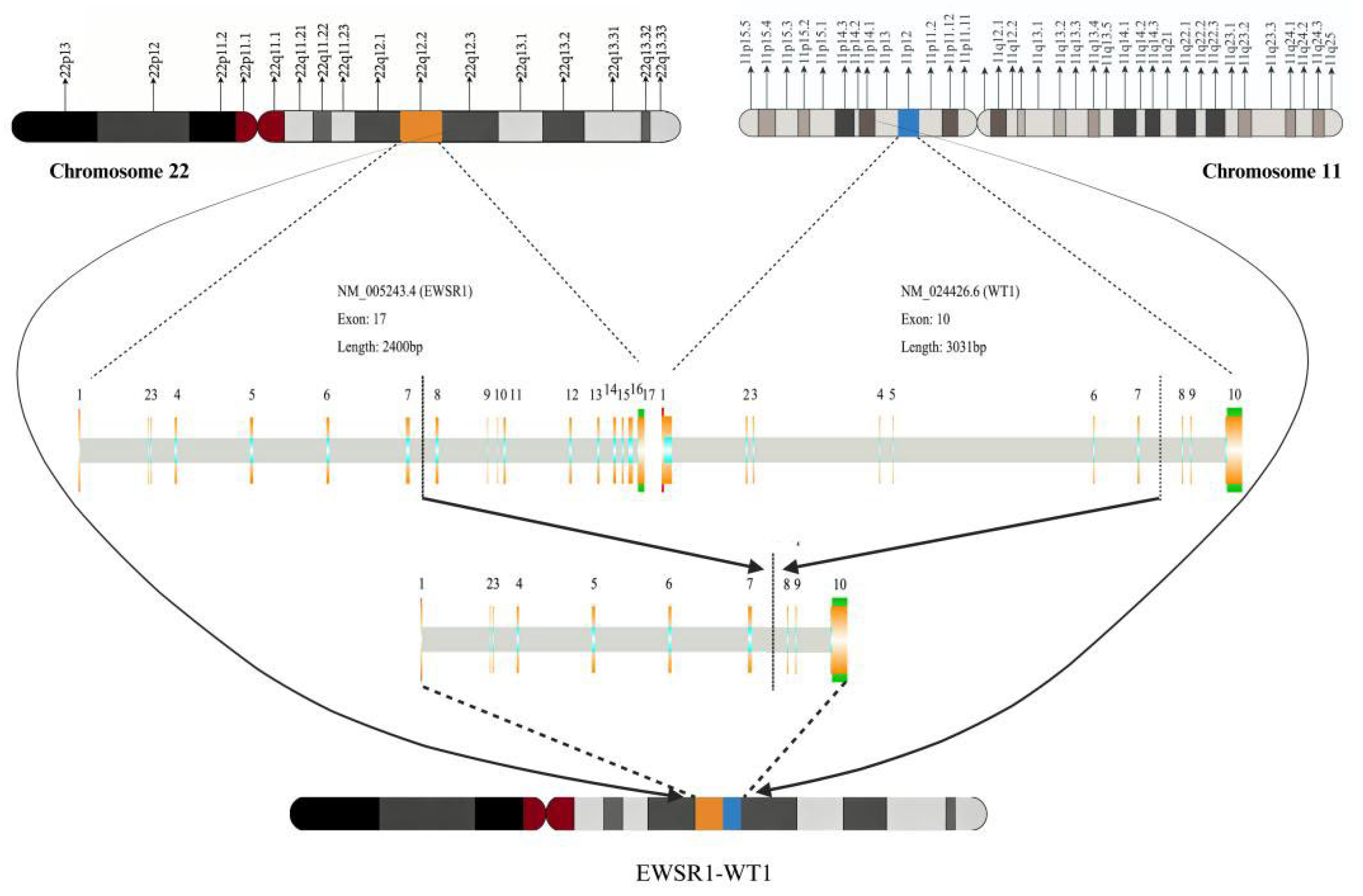
Figure 2.
A: Nucleotide sequence of the WT1 transcript (NM_024426.6) and corresponding amino acid sequence (NP_077744.4). B: Schematic diagram of the WT1 domain structure. The KTS insertion site is highlighted in the red dashed box; the frequent breakpoint region is marked in the black box. C: Ribbon diagram of the WT1 tertiary structure (PDB ID: 6BLW).
Figure 2.
A: Nucleotide sequence of the WT1 transcript (NM_024426.6) and corresponding amino acid sequence (NP_077744.4). B: Schematic diagram of the WT1 domain structure. The KTS insertion site is highlighted in the red dashed box; the frequent breakpoint region is marked in the black box. C: Ribbon diagram of the WT1 tertiary structure (PDB ID: 6BLW).
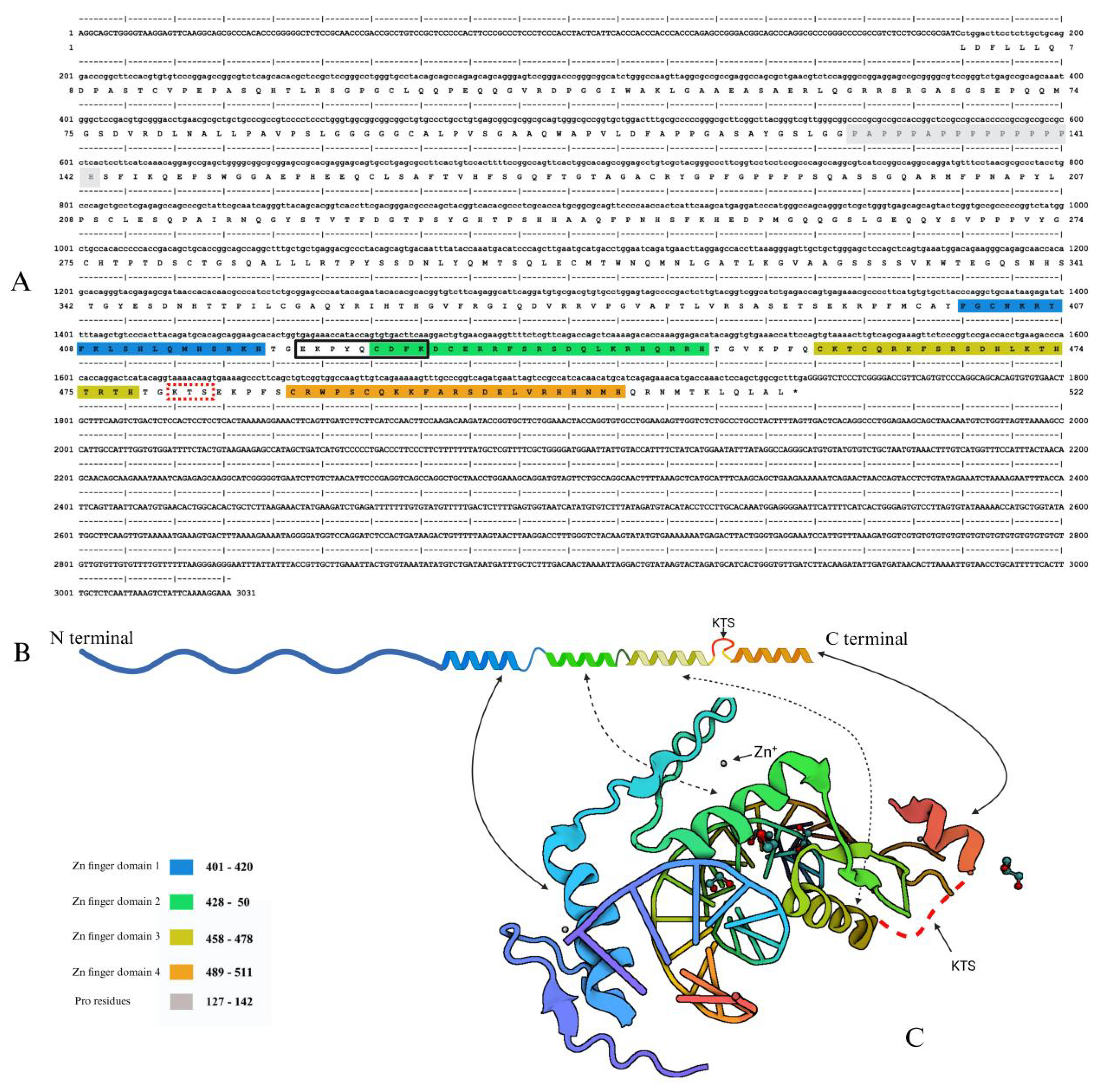
Figure 3.
A: Nucleotide sequence of the EWSR1 transcript (NM_005243) and corresponding amino acid sequence (NP_005234.1). B: Schematic diagram of the EWSR1 domain structure. The frequent breakpoint sequence is highlighted in the red box. C: Tertiary structure of EWSR1 predicted by AlphaFold (https://alphafoldserver.com/). The green segment corresponds to the experimentally resolved structure available in the PDB database, consistent with the green-labeled sequence in Figure 3A. (IBS 2.0 is used: an upgraded illustrator for the visualization of biological sequences). RRM: RNA recognition motif; TAD: Transactivation domain.
Figure 3.
A: Nucleotide sequence of the EWSR1 transcript (NM_005243) and corresponding amino acid sequence (NP_005234.1). B: Schematic diagram of the EWSR1 domain structure. The frequent breakpoint sequence is highlighted in the red box. C: Tertiary structure of EWSR1 predicted by AlphaFold (https://alphafoldserver.com/). The green segment corresponds to the experimentally resolved structure available in the PDB database, consistent with the green-labeled sequence in Figure 3A. (IBS 2.0 is used: an upgraded illustrator for the visualization of biological sequences). RRM: RNA recognition motif; TAD: Transactivation domain.
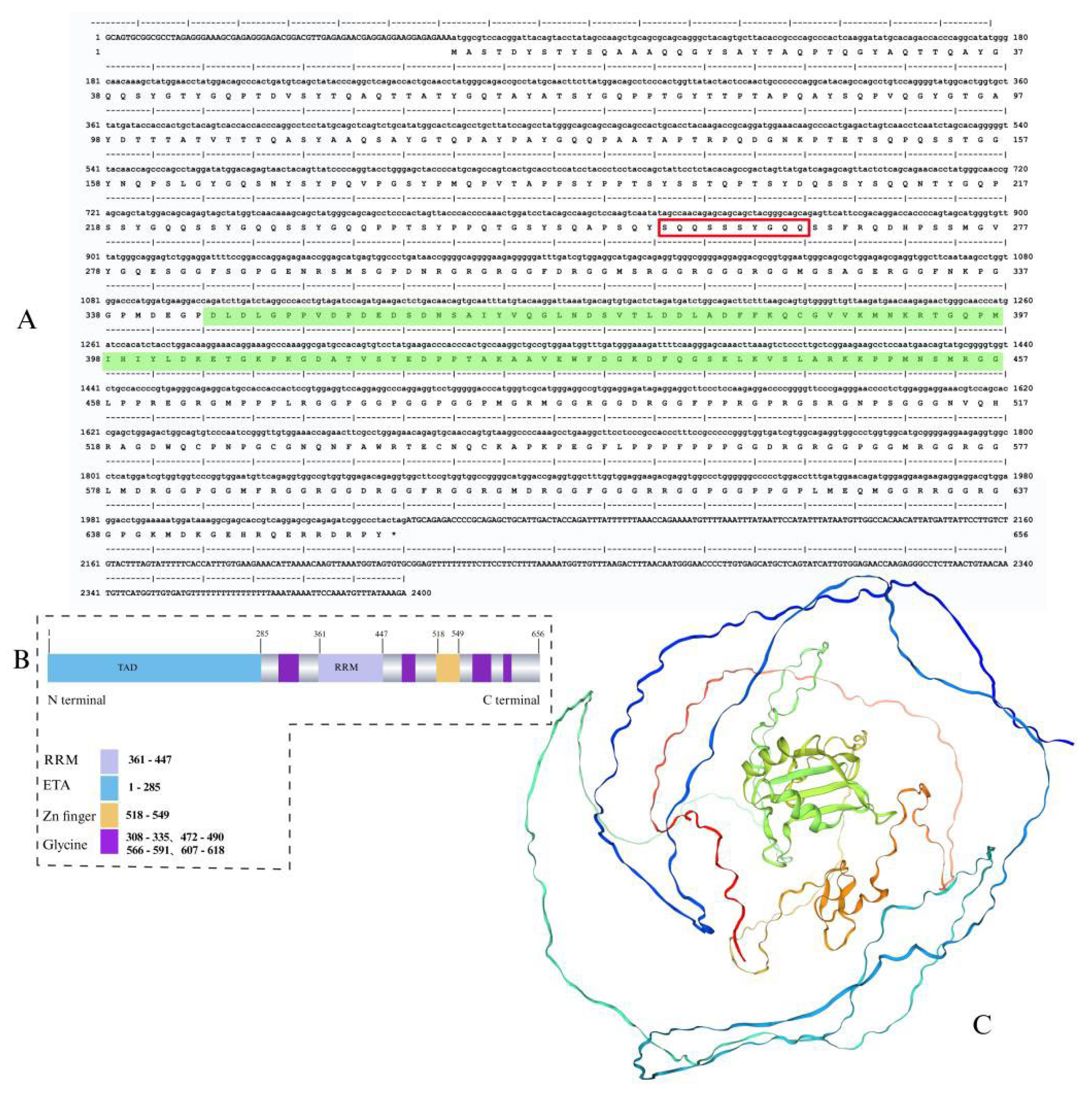
Figure 4.
A: Putative amino acid sequence of the EWSR1-WT1 fusion protein. B: Three-dimensional structure of EWSR1-WT1 predicted by AlphaFold 3.0. The fusion junction is highlighted by the red dashed circle.
Figure 4.
A: Putative amino acid sequence of the EWSR1-WT1 fusion protein. B: Three-dimensional structure of EWSR1-WT1 predicted by AlphaFold 3.0. The fusion junction is highlighted by the red dashed circle.
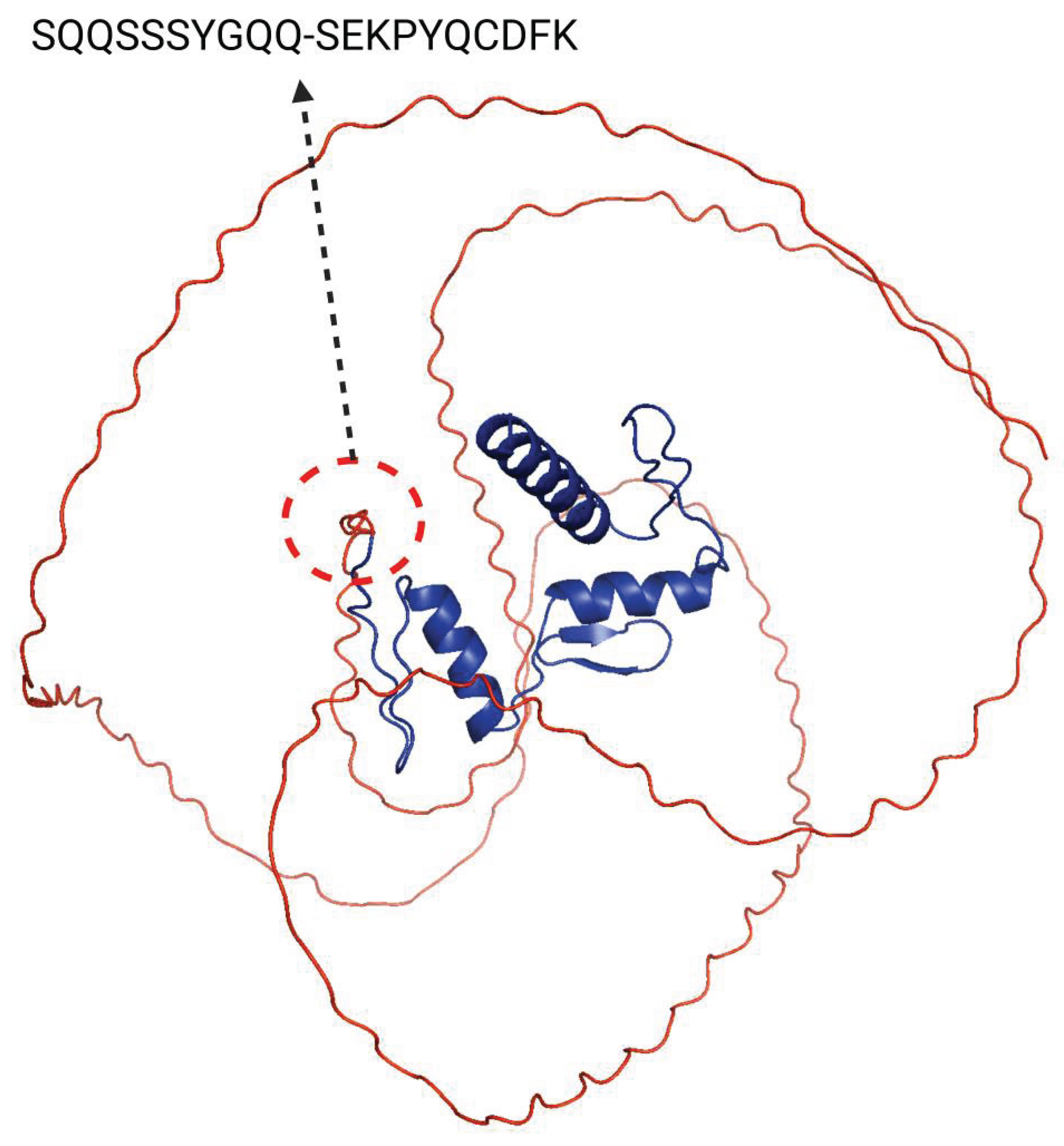
Disclaimer/Publisher’s Note: The statements, opinions and data contained in all publications are solely those of the individual author(s) and contributor(s) and not of MDPI and/or the editor(s). MDPI and/or the editor(s) disclaim responsibility for any injury to people or property resulting from any ideas, methods, instructions or products referred to in the content. |
© 2026 by the authors. Licensee MDPI, Basel, Switzerland. This article is an open access article distributed under the terms and conditions of the Creative Commons Attribution (CC BY) license (http://creativecommons.org/licenses/by/4.0/).
Copyright: This open access article is published under a Creative Commons CC BY 4.0 license, which permit the free download, distribution, and reuse, provided that the author and preprint are cited in any reuse.


