

Submitted:
14 April 2026
Posted:
15 April 2026
You are already at the latest version
Abstract
Nexus-NRS is an open and reproducible software framework for nuclear reaction calculations, implemented in a functional-programming style (Clojure), with a focus on workflows relevant to halo systems: stable radial solvers for weakly bound states, scattering observables, and transfer reactions. The package includes optical-model potentials, Riccati–Numerov integration with regular near-origin initialization options, discrete Wronskian diagnostics for numerical stability, and a Distorted Wave Born Approximation (DWBA) implementation for single-nucleon transfer in the post form. Recent development extends the reaction layer with multipole/angular ingredients in the spirit of Austern (complex radial integrals for zero-range cluster transitions, Coulomb-barrier phase factors on multipole blocks) and with a literature-aligned benchmark for 11Li(p,p′) inelastic scattering using published global optical parameters. Nexus-NRS supports both scripting/REPL-driven studies and an interactive web dashboard for parameter exploration and visualization; a public instance is deployed at https://www.nexus-nrs.uz, and the dashboard exposes representative benchmarks through JSON endpoints (including angular dσ/dΩ for the 11Li paper workflow). The project plans to support use from an LLM chatbot for guided workflows. This manuscript describes the numerical formulation and software architecture and outlines a validation workflow aimed at producing reproducible conference-scale results.
Keywords:
nuclear reactions
; optical model
; phase shifts
; Numerov method
; Wronskian
; DWBA
; transfer reactions
; inelastic scattering
; halo nuclei
; functional programming
1. Introduction
Quantitative nuclear reaction modeling often requires combining multiple ingredients—optical-model distorted waves, bound-state overlaps, and stable numerical solvers—while preserving reproducibility across parameter scans and reaction systems. Many workflows remain fragmented across scripts and codes with heterogeneous interfaces, complicating validation and reuse. Nexus-NRS (Nuclear Reaction Suite) was developed as a unified, transparent toolkit to support:
- elastic scattering and phase-shift analysis;
- transfer reactions via DWBA amplitudes using distorted waves;
- inelastic scattering through form factors/couplings; and
- weakly bound (halo) bound-state wave functions and asymptotic behavior diagnostics.
The primary design goals are (i) numerical stability for oscillatory/evanescent radial equations, (ii) consistent “physics-level” APIs rather than low-level helper calls, and (iii) end-to-end reproducibility using plain-text configuration, REPL evaluation, and automated test coverage. For halo-nucleus applications, these goals are particularly important because weak binding amplifies sensitivity to asymptotic behavior and to numerical contamination by irregular solutions. Experimental evidence for spatially extended matter distributions in very neutron-rich light nuclei—often cited as the inception of the halo picture—was established early through interaction-cross-section and radius measurements along the p shell [1].
By adopting a functional-programming style (Clojure on the JVM), the physical problem is treated as a series of immutable data transformations: a potential is a function, a wave function is derived from pure numerical kernels. This avoids “state creep” common in legacy codes and makes every calculation reproducible by design.
For mathematically inclined users, Clojure is a comfortable host language: expressions compose in the same way formulas do, persistent data structures behave like explicit mathematical objects (rather than hidden mutable state), and the read–eval–print loop encourages an exploratory workflow familiar from symbolic and numeric environments. The emphasis on pure functions and explicit inputs supports scientific calculation, where one wants the same physical parameters to yield the same result traceably across batches, publications, and collaborator handoffs. Because many reaction workloads are embarrassingly parallel—independent energies, partial waves, or angle samples—Clojure’s concurrency-oriented design and built-in support for parallel collection operations (e.g., parallel map and reduce over immutable data) help scale heavy parameter scans without ad hoc threading boilerplate, while still running on the mature Java Virtual Machine ecosystem for numerical libraries and deployment.
2. Methods
2.1. Radial Schrödinger Equation and Optical Potentials
The fundamental object in Nexus-NRS is the reduced radial wave function . Nexus-NRS solves the reduced radial equation for partial waves,
where is the wave number, is the reduced mass, and ℓ is the orbital angular momentum. For halo nuclei, the asymptotic behavior of as is critical for the Asymptotic Normalization Coefficient (ANC) and transfer cross sections.
The nuclear potential includes central, Coulomb, and spin-orbit terms. The nuclear part uses the Woods–Saxon form factor
and the total potential is
where and are the real and imaginary depths. The Coulomb potential for a uniformly charged sphere of radius is
Real and complex Woods–Saxon forms are used to generate distorted waves for scattering and reaction calculations.
2.2. Riccati–Numerov Integration and Near-Origin Initialization
For second-order linear ODEs of the form , the Numerov algorithm gives a local truncation error of . The recurrence is
A key practical issue is stable initialization near , especially when centrifugal terms or Coulomb behavior are present.
Nexus-NRS supports physically motivated starts for the regular solution:
- Finite power-series start for bound states and regular solutions, for sufficiently small r.
- Hybrid/Bessel-type start (Riccati–Bessel/Hankel-inspired) for scattering-oriented integrations: the solution is initialized using a linear combination of Riccati–Bessel functions at the first two grid points, which suppresses numerical growth of the irregular solution that would otherwise contaminate in the classically forbidden region.
In practice, for bound-state calculations the normalized regular solution is often insensitive to the specific regular start when integration is stable and normalization is enforced; however, for scattering observables the initialization can influence Wronskian drift and phase-shift convergence at coarse step sizes.
2.3. Discrete Wronskian Diagnostics
To monitor numerical stability, Nexus-NRS includes a discrete Wronskian diagnostic aligned with the Numerov recurrence. For two independent solutions u and v, the discrete Wronskian should be conserved under stable propagation. In scattering applications, Wronskian conservation provides a compact proxy for (i) remaining on the physical solution manifold, (ii) suppressing growth of the irregular component, and (iii) obtaining reliable phase shifts and cross sections under step-size and boundary variations.
2.4. Transfer Reactions in Post-Form DWBA
Single-nucleon transfer reactions such as and are treated in the DWBA. The transition matrix element for is
where are the distorted waves and is the transition operator. Nexus-NRS can evaluate the transition in the Post form () or the Prior form (); both should agree in an exact calculation. The central numerical object is the partial-wave decomposed transition amplitude , built from:
- initial and final distorted waves (from optical potentials),
- bound-state overlap(s) from the structure-side solver, and
- a transfer interaction model (e.g., zero-range or finite-range approximations, depending on the workflow).
The 6D integral is decomposed into 1D radial integrals involving distorted waves and bound-state overlaps; these overlaps are treated as form factors, pre-computed and cached for fast angular distribution scans. The implementation emphasizes consistent handling of complex-valued distorted waves and integrals, separation of kinematics from wave-function generation, and testable building blocks for the radial integrals.
For validation against textbook and literature angular distributions, the suite also implements DWBA building blocks following Austern’s multipole reduction: radial “multi-pole-to-multi-pole” integrals for zero-range cluster transfer (including Simpson integration of complex integrands) and angular momentum coupling through the reduced amplitudes that enter . Coulomb distortion is incorporated in the usual way via Sommerfeld parameters and factors carried on partial-wave rows. These routines underpin benchmark namespaces (e.g., Ca isotope stripping and halo-induced inelastic cases) and complement the schematic single-channel inelastic module described below.
2.5. Inelastic Scattering and Form Factors
The default inelastic pathway uses macroscopic form factors (e.g., surface-derivative couplings) and multipole selection rules: the user specifies multipolarities (often denoted ), and the code returns integrated or decomposed contributions suitable for energy-dependent cross checks.
In parallel, a dedicated benchmark workflow targets published Li data-parameter conventions [7]. It fixes Li + proton kinematics and Woods–Saxon + spin–orbit + Coulomb optics with imaginary terms taken from the paper’s Table 1 (“Set V” volume absorption vs. “Set S” derivative-surface absorption). A collective transition operator is represented through a macroscopic proxy form factor scaled by an adjustable strength parameter () so that absolute cross sections can be aligned with figures while optics and angular momentum coupling remain fixed. This path is intended for method comparison rather than as a substitute for full coupled-channels or microscopic form-factor libraries.
3. Software Architecture and Usage
The calculation is structured as a pipeline: (1) Configuration—a plain data structure (e.g., EDN) defining the reaction; (2) Potential generation—a pure function mapping configuration to a potential grid; (3) Solver—takes the grid and returns wave function data; (4) Observable—reduces wave function data to cross sections. This data-in, data-out design supports parallel parameter scans and automated validation.
3.1. Code Organization
The core physics is organized into Clojure namespaces (examples):
- dwba.transfer: bound states, transfer form factors, DWBA amplitudes and cross sections;
- dwba.inelastic: inelastic couplings and cross sections (macroscopic form-factor pathway);
- dwba.benchmark.*: reproducible literature-style calculations (e.g., Li paper parameters, Ca stripping, handbook stripping presets);
- dwba.halo_nuclei: halo bound-state workflows and asymptotic diagnostics;
- dwba.global_potentials: parameterizations for global optical potentials;
- functions: shared numerics (special functions, Numerov kernels, stability utilities).
3.2. Reproducible Workflows
Nexus-NRS supports:
- REPL workflows for exploratory development and diagnostics;
- scripted examples under examples/ for end-to-end calculations; and
- unit/integration tests under test/ for regression control.
3.3. Web Dashboard
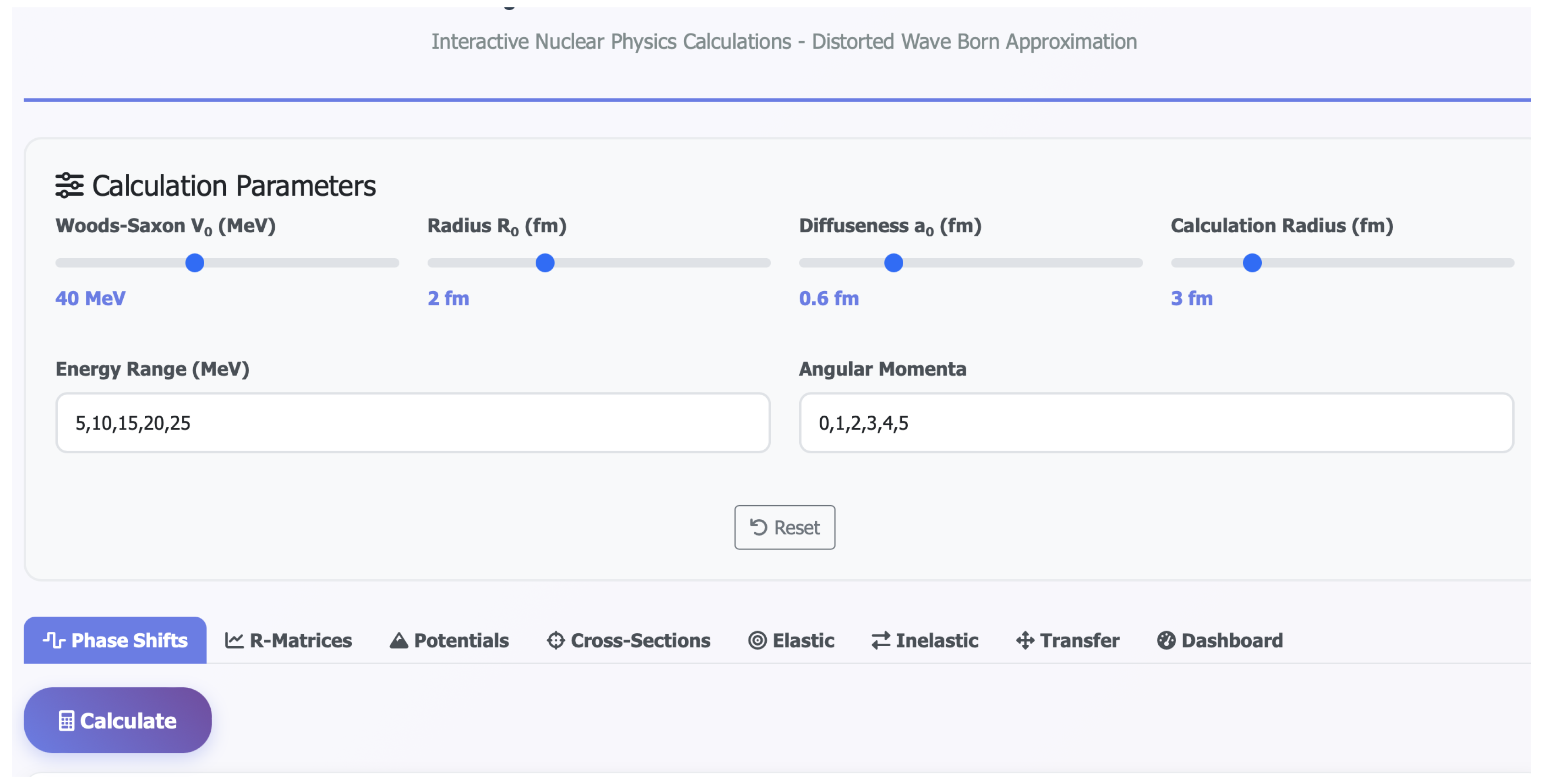
The web-dashboard/ subproject provides a Ring/Compojure backend and a JavaScript (Plotly) frontend for interactive parameter exploration. A production deployment of the dashboard is available at https://www.nexus-nrs.uz (same-origin access to the JSON API). JSON POST endpoints cover core phase-shift and potential workflows, elastic nuclear + Coulomb differential cross sections, inelastic scattering, and transfer reactions—including a preset angular distribution for O benchmark kinematics. The inelastic tab supports a selectable model: the legacy macroscopic workflow (energy-dependent cross section at fixed angle grids encoded in the API contract) and the Li literature pipeline, which returns in mb/sr as a function of center-of-mass angle at user-specified proton laboratory energies (typically MeV in normal kinematics, equivalent in the paper to high-energy Li inverse kinematics on hydrogen targets). Optional fields control optical Set V/S, radial grids, multipole order, and . Figure 1 shows a screenshot of the Nexus-NRS web dashboard.
4. Representative Results and Validation Workflow (HALO-40 Benchmarks)
This section summarizes two benchmark reaction workflows included with Nexus-NRS and intended to be expanded into the final Special Issue submission. In both cases, stability checks (step size, boundary radius, Wronskian drift) should be reported alongside physics outputs.
4.1. Halo Benchmark: Be(d,p)Be (Post-Form DWBA)
The halo-focused example uses Be as a neutron-halo bound state ( ground state, keV) and computes the transfer amplitude in post form. The hybrid Numerov start maintains stability out to 100 fm, which is needed to capture the full halo overlap. The workflow is implemented in examples/halo_nuclei_examples.clj:
- Bound state (halo):Be, MeV, , with an adaptive asymptotic matching radius (halo-tail controlled).
- Distorted waves: global optical potentials are selected automatically for entrance/exit channels (deuteron entrance, proton exit).
- Transfer observable: a zero-range post-form DWBA amplitude and a corresponding . In the provided default configuration (L=0 transfer), the angular distribution is isotropic; this makes the example a compact diagnostic for bound-state normalization and numerical stability.
Reproducibility (from project root).
lein repl
then:
(load-file "examples/halo_nuclei_examples.clj")
Hybrid vs. finite Numerov-start check. The example includes an explicit comparison in which the Be bound-state wave function is computed using (i) a hybrid/Bessel-type regular start and (ii) a finite regular start . The transfer cross section is computed with each bound state, and the ratio
is expected to be close to unity when both integrations are stable and the overlap is normalized. This provides a physics-relevant validation signal for the bound-state initialization choice in halo workflows.
Recommended reporting. (i) binding energy and matching radius; (ii) normalized overlap/ANC-related asymptotic diagnostics; (iii) and hybrid/finite ratio; (iv) convergence under h and .
4.2. Transfer Benchmark: O(p,d)O (Angular Distribution with )
The second benchmark targets a more structured angular distribution by including partial-wave contributions up to (for typical energies, e.g., MeV, the suite achieves 1% convergence with ). The workflow is implemented in examples/example_16Opd.clj and computes:
- Bound states: neutron overlap in O (pickup orbital , separation energy MeV) and neutron bound in the deuteron (, MeV), followed by explicit normalization.
- Distorted waves: entrance (p+O) and exit (d+O) distorted waves from optical-model potentials.
- Transfer amplitudes: a map for , followed by an angular differential cross section using the partial-wave sum with selection rules enforced through the bound-state ℓ values.
Reproducibility (from project root).
(load-file "examples/example_16Opd.clj")
The example prints in mb/sr at multiple angles (including 70° for quick comparison) and attempts to save a plot to output/16Opd_dcs.png (the output/ directory is typically gitignored).
Recommended reporting. (i) spectrum to show dominant partial waves; (ii) on a linear or semi-log scale; (iii) sensitivity to , h, and ; (iv) comparison to representative experimental points once a dataset and spectroscopic normalization are fixed.
4.3. Halo Inelastic Benchmark: Li (Published Optical Parameters)
This benchmark ties together multipole DWBA ingredients and published global optical-model parameters for a neutron-rich Borromean nucleus, following Tanaka et al. [7]. Experimental context on a low-lying soft dipole in Li also includes isoscalar Li scattering [8]. In normal kinematics, a proton beam of order a few MeV impinges on Li at rest; the same energy system corresponds, up to two-body kinematics, to inverse-kinematics measurements attempted in that work.
Physics content.
- Optics: Woods–Saxon real well, Thomas spin–orbit, Coulomb, and imaginary depth with radius and diffuseness from Table 1 of Ref. [7], with “Set V” (volume imaginary) vs. “Set S” (derivative surface imaginary) selectable in code and in the dashboard.
- Transition: dipole-dominated () coupling with radial integrals in the Austern zero-range multipole picture and Coulomb factors applied consistently on partial-wave rows entering the angular reduction.
- Normalization: the macroscopic surface-peaked form factor used here is a proxy for more complete E1 response treatments; an overall strength (implemented as :beta-scale in the benchmark namespace) should be adjusted when comparing absolute cross sections to experimental figures, while relative angular shapes primarily probe optics and the DWBA couplings.
Reproducibility. From the project root, load examples/example_11Li_pp_paper1708_dwba.clj in a REPL, or call namespace dwba.benchmark.li11-pp-paper1708. Automated smoke tests under test/dwba/ assert finite cross sections on representative angle grids.
Web dashboard. Use the public site https://www.nexus-nrs.uz or run locally from web-dashboard/ (lein run). Open the Inelastic tab, select the Tanaka/Li paper model, set the main Energy range field to the desired proton laboratory energies (comma-separated), set MeV for the lowest excitation discussed in the reference workflow, and compute.
4.4. Halo Transfer Context: LiLi with Unbound Li
One-neutron pickup on Li populates Li, which is unbound; experiments resolve strength in the low-lying resonance region rather than a bound final state [9]. The corresponding DWBA analysis in that work used inverse kinematics with a high-energy Li beam on a hydrogen target and reported a narrow peak at MeV, consistent with dominant removal strength and a spectroscopic factor of order unity. Nexus-NRS currently wires pickup angular distributions most directly for bound final nucleon states (dwba.transfer overlaps); treating the Li continuum (including width-matched resonance or Gamow-state conventions) is left as an extension on top of the same distorted-wave infrastructure. The repository includes examples/example_11Li_pd_10Li.clj, which documents those references and prints entrance-channel kinematics for the beam energy regime of Ref. [9] without claiming a full continuum cross section.
5. Software Availability
- Name: Nexus-NRS (Nuclear Reaction Suite)
- Language: Clojure / ClojureScript
- Repository:https://github.com/alishsan/nexus-nrs
- Live web dashboard:https://www.nexus-nrs.uz
- License: EPL-2.0 OR GPL-2.0-or-later WITH Classpath-exception-2.0 (core); MIT (web dashboard subproject)
- Platform: JVM (Java 8+), Leiningen 2+
6. Future Directions
Nexus-NRS is designed with AI-assisted research in mind. The reliance on plain-text data structures makes it suitable for integration with large language models (LLMs). A “Guided Workflow” agent is under development to help users choose optical potentials from a database of global parameters and to suggest error-correction steps when numerical instabilities are detected.
7. Conclusions
Nexus-NRS provides an integrated, open, and reproducible platform for nuclear reaction calculations across scattering, transfer, inelastic, and halo-structure use cases. By bridging high-performance numerics and functional programming, it combines Numerov-based radial solvers with stability diagnostics (discrete Wronskian monitoring), physics-level APIs, and a web dashboard (public deployment: https://www.nexus-nrs.uz) that lowers the barrier to exploratory studies. Recent extensions add Austern-style multipole DWBA integrals (with complex radial kernels where required), curated dwba.benchmark workflows, and dashboard-backed access to angular distributions for Li using published optical parameters. The software is suitable for conference dissemination and can serve as a basis for community extensions, including broader optical-potential libraries, improved finite-range transfer operators, expanded validation against curated datasets, and planned support for use from an LLM chatbot.
Author Contributions
Conceptualization, A.S.; software, A.S.; validation, A.S. and M.B.; writing—original draft preparation, A.S.; writing—review and editing, A.S. and M.B. All authors have read and agreed to the published version of the manuscript.
Funding
This research received no external funding.
Institutional Review Board Statement
Not applicable.
Informed Consent Statement
Not applicable.
Data Availability Statement
No external datasets are required to run the included examples. The open-source code is available at https://github.com/alishsan/nexus-nrs. An interactive dashboard is deployed at https://www.nexus-nrs.uz. Users may supply experimental datasets for their own validation studies.
Acknowledgments
The authors thank colleagues working on low-energy reaction theory and rare-isotope observables for community context around DWBA benchmarking.
Conflicts of Interest
The authors declare no conflicts of interest.
Abbreviations
The following abbreviations are used in this manuscript:
| DWBA | Distorted Wave Born Approximation |
| REPL | Read–Eval–Print Loop |
| JVM | Java Virtual Machine |
| ANC | Asymptotic Normalization Coefficient |
| API | Application Programming Interface |
References
- Tanihata, I.; et al. Measurements of Interaction Cross Sections and Nuclear Radii in the Light p-Shell Region. Phys. Rev. Lett. 1985, 55, 2676. [Google Scholar] [CrossRef] [PubMed]
- Satchler, G.R. Direct Nuclear Reactions; Oxford University Press: Oxford, U.K., 1983. [Google Scholar]
- Austern, N. Direct Nuclear Reaction Theories; Wiley: New York, NY, USA, 1970. [Google Scholar]
- Thompson, I.J.; Nunes, F.M. Nuclear Reactions for Astrophysics; Cambridge University Press: Cambridge, U.K., 2009. [Google Scholar]
- Numerov, B.V. A Method of Extrapolation of Perturbations. Mon. Not. R. Astron. Soc. 1924, 84, 592–602. [Google Scholar] [CrossRef]
- Fernández, F.M. Wronskian Method for One-Dimensional Quantum Scattering. Am. J. Phys. 2011, 79, 877–881. [Google Scholar] [CrossRef]
- Tanaka, J.; et al. Halo-induced Large Enhancement of Soft Dipole Excitation of 11Li Observed via Proton Inelastic Scattering. Phys. Lett. B 2017, arXiv:1708.07719776, 235–241. [Google Scholar] [CrossRef]
- Kanungo, R.; et al. Evidence of Soft Dipole Resonance in 11Li with Isoscalar Character. Phys. Rev. Lett. 2015, 114, 192502. [Google Scholar] [CrossRef] [PubMed]
- Sanetullaev, A.; et al. Investigation of the Role of 10Li Resonances in the Halo Structure of 11Li through the 11Li(p,d)10Li Transfer Reaction. Phys. Lett. B 2016, 755, 481–485. [Google Scholar] [CrossRef]
Figure 1.
Screenshot of the Nexus-NRS web dashboard for interactive parameter exploration and visualization of reaction calculations.
Figure 1.
Screenshot of the Nexus-NRS web dashboard for interactive parameter exploration and visualization of reaction calculations.
Disclaimer/Publisher’s Note: The statements, opinions and data contained in all publications are solely those of the individual author(s) and contributor(s) and not of MDPI and/or the editor(s). MDPI and/or the editor(s) disclaim responsibility for any injury to people or property resulting from any ideas, methods, instructions or products referred to in the content. |
© 2026 by the authors. Licensee MDPI, Basel, Switzerland. This article is an open access article distributed under the terms and conditions of the Creative Commons Attribution (CC BY) license.
Copyright: This open access article is published under a Creative Commons CC BY 4.0 license, which permit the free download, distribution, and reuse, provided that the author and preprint are cited in any reuse.


