
Submitted:
14 April 2026
Posted:
15 April 2026
You are already at the latest version
Abstract
Acute chest syndrome (ACS) is a frequent and potentially life-threatening complication of sickle cell disease (SCD), often developing during hospitalization for vaso-occlusive crisis (VOC). Early identification of pediatric patients at risk remains challenging, particularly in high-prevalence settings. We conducted a retrospective cohort study of children and adolescents (≤18 years) with confirmed SCD admitted for VOC to Cayenne Hospital Center, French Guiana, between January 2014 and September 2024. ACS occurring during hospitalization or within 7 days of admission was recorded. Multivariable logistic regression was used to identify independent predictors, and model performance was assessed using receiver operating characteristic (ROC) analysis.
Among 824 VOC episodes in 190 patients, 239 (29%) were complicated by ACS. Independent predictors of ACS were thoracic or abdominal pain at presentation (adjusted odds ratio [aOR] 2.88, 95% CI 1.45–5.72), prior history of ACS (aOR 2.20, 95% CI 1.28–2.90), and HbSS or Sβ⁰ genotype (aOR 1.91, 95% CI 1.30–2.60). Hydroxyurea use at admission was less frequent among patients who developed ACS. The predictive model showed good discrimination (AUC ~0.90), high specificity (96%), and positive predictive value (85%). These findings support targeted monitoring and early preventive strategies during pediatric VOC admissions.
Keywords:
sickle cell disease
; acute chest syndrome
; vaso-occlusive crisis
; pediatrics
; risk factors
; predictive model
; French Guiana
Introduction
Sickle cell disease (SCD) is the most common monogenic genetic disorder worldwide, affecting more than 5 million individuals, with approximately 300,000 affected births each year globally. [1] In France, SCD is the most frequent rare disease, with an estimated incidence of 1 in 1,900 live births, corresponding to 300–350 newborns diagnosed annually with major sickle cell syndromes. [2]
SCD is an autosomal recessive hemoglobinopathy caused by a single-point mutation in the β-globin gene on chromosome 11, in which glutamic acid is replaced by valine at position six (Glu6Val), resulting in the production of abnormal hemoglobin S (HbS). Under conditions such as hypoxia, dehydration, acidosis, or hyperthermia, HbS polymerizes once a critical concentration of deoxygenated HbS is reached, leading to red blood cell sickling. Although this process is initially reversible upon reoxygenation, repeated cycles result in irreversible erythrocyte damage, reduced red blood cell deformability, chronic hemolysis, and anemia.[3]
Clinically significant disease occurs in individuals who are homozygous for HbS (HbSS) or compound heterozygous for HbS and another abnormal hemoglobin, including HbSC and HbS/β-thalassemia. Individuals carrying a single abnormal allele (sickle cell trait) are generally asymptomatic but remain potential carriers. Vaso-occlusion primarily affects the postcapillary microcirculation and results from reduced erythrocyte deformability, increased adhesion to the vascular endothelium, and a proinflammatory and prothrombotic milieu. As a systemic disorder, SCD can affect virtually all vascularized organs. [3]
Acute complications of SCD include vaso-occlusive crisis (VOC), also referred to as vaso-occlusive episode (VOE), acute chest syndrome (ACS), stroke, and priapism, all of which constitute medical emergencies. Among these, ACS is one of the most severe complications and remains a leading cause of morbidity and mortality in children with SCD. Although it predominantly affects patients with the HbSS genotype, ACS also occurs in individuals with HbSC disease and HbS/β-thalassemia. The pathophysiology of ACS is multifactorial and may involve pulmonary microvascular occlusion due to in situ sickling, infectious processes—particularly in children—atelectasis secondary to rib or vertebral infarction, and fat embolism resulting from bone marrow necrosis. [4]
ACS may present as an inaugural manifestation of SCD or, more commonly, as a complication of a VOC, particularly thoracic or abdominal VOC. By definition, ACS is characterized by the appearance of a new pulmonary infiltrate on chest imaging associated with one or more clinical features, including fever, respiratory symptoms, hypoxemia, or thoracoabdominal pain.[5]
Several factors have been associated with an increased risk of ACS, including severe pain episodes, abdominal or thoracic VOC, recent surgery, infections, and iatrogenic factors such as corticosteroid exposure or excessive opioid administration. [6] However, predictors of progression from VOC to ACS remain incompletely defined, particularly in pediatric populations and in specific geographic and epidemiological contexts. [7]
In French Guiana, SCD represents a major public health concern. The incidence of major sickle cell syndromes at birth is estimated at 1 in 227, and more than 10% of the population carries the sickle cell trait [8], compared with approximately 2.7% in mainland France. [9] This high prevalence is associated with a substantial burden of hospitalizations, notably for acute complications such as VOC and ACS.[10]
Identifying predictive factors for the development of ACS following VOC in children with SCD is therefore crucial to improve early risk stratification, optimize clinical management, and potentially reduce morbidity and hospital length of stay.
The primary objective of this study was to identify clinical and biological predictors of progression from VOC to ACS among pediatric patients with SCD hospitalized at the Cayenne Hospital Center. Secondary objectives were to describe the demographic and clinical characteristics of pediatric patients with ACS in French Guiana—including age, sex, genotype, glucose-6-phosphate dehydrogenase deficiency, history of asthma, prior surgical procedures, hydroxyurea therapy, and recent VOC history—and to compare hospital length of stay between admissions for uncomplicated VOC and those complicated by subsequent ACS.
Methods
Study Design and Setting
We conducted a retrospective cohort study at the Cayenne Hospital Center, the main tertiary care facility for SCD in French Guiana. The study period spanned from January 1, 2014, to September 15, 2024.
Study Population
All children and adolescents aged 0 to 18 years with a confirmed diagnosis of SCD who presented to the emergency department (ED) during the study period were eligible for inclusion.
SCD Diagnosis and Genotyping
Universal neonatal SCD screening was implemented, with diagnosis confirmed at 6 months of age using hemoglobin electrophoresis or high-performance liquid chromatography, complemented by sickle cell genotyping.
Inclusion Criteria
- • Age ≤18 years at hospitalization
- • Confirmed SCD diagnosis
- • Admission to the ED for VOC
Exclusion Criteria
- • Presence of ACS at the time of admission
- • Incomplete medical records preventing outcome assessment
- • Chronic lung disease unrelated to SCD
Each VOC-related admission was considered an independent observation. When multiple VOC admissions occurred in the same patient, all eligible episodes were included in the main analysis.
Definitions
- • Vaso-occlusive crisis: An acute painful episode requiring hospital admission and not attributable to another identifiable cause.
- • Acute chest syndrome: Occurrence of a new pulmonary infiltrate on chest imaging associated with at least one clinical feature—fever, respiratory symptoms, hypoxemia, or thoracoabdominal pain—either during hospitalization or within 7 days following VOC admission.
Data Collection
Data were retrospectively extracted from electronic and paper medical records using a standardized data collection form. Variables included demographics, SCD-related characteristics, comorbidities, chronic treatments, VOC characteristics, laboratory parameters at admission, hospital course, and outcomes.
Because multiple VOC episodes could occur in the same patient, a sensitivity analysis restricted to the first VOC episode per patient was performed to account for within-subject correlation.
Sample Size Calculation
The minimum sample size was estimated assuming an expected ACS incidence of 20% among VOC episodes, a two-sided alpha of 0.05, and 80% power. Approximately 246 VOC episodes were required, ensuring at least 10 outcome events per predictor for multivariable logistic regression.
Statistical Analysis
Continuous variables were summarized as means ± standard deviations or medians with interquartile ranges, as appropriate. Categorical variables were expressed as frequencies and percentages. Comparisons were performed using Student’s t-test or Mann–Whitney U test for continuous variables and χ² or Fisher’s exact test for categorical variables.
Univariate logistic regression was used to evaluate potential predictors of progression from VOC to ACS. Variables with p < 0.20 and those deemed clinically relevant were included in a multivariable logistic regression model. Adjusted odds ratios (aORs) with 95% confidence intervals (CIs) were reported. Model performance was assessed by calculating sensitivity, specificity, negative predictive value (NPV), and positive predictive value (PPV), and by constructing a receiver operating characteristic (ROC) curve. Statistical significance was set at p < 0.05. Analyses were performed using STATA version 16.0.
Ethical Considerations
This study was conducted in accordance with French regulations governing research not involving human subjects [11] and complied with the Reference Methodology MR-004. The Cayenne Hospital Center (Centre Hospitalier de Cayenne) declared compliance with MR-004 on September 25, 2023. A data protection impact assessment was performed, and a summary of the study was made publicly available on the Health Data Hub website N° 20238540.
The legal basis for data processing was the performance of a task carried out in the public interest. All data were derived from patients’ medical records and collected as part of routine clinical care. Prior to analysis, the study database was pseudonymized.
Patients or their legal representatives were informed of the study objectives and of their right to object to the use of their data or to withdraw from the study at any time prior to database lock, without consequence. Individual information notices were sent by postal mail. In the absence of an expressed objection within one month of mailing, participation was considered not opposed, in accordance with MR-004 requirements.
Given the high rate of loss to follow-up in French Guiana, partly related to population mobility, participants were included by default when no response was received within the specified timeframe or when mailed notices were returned as undeliverable. Deceased patients who had not objected to the use of their data during their lifetime were also included.
Participants or their legal representatives could exercise their right to object using the enclosed objection form or by contacting the study sponsor or the institutional Data Protection Officer.
General information about the study was provided through posted notices in the relevant hospital departments and through the hospital’s patient information materials.
Results
Study Population
Between January 1, 2014, and September 15, 2024, a total of 913 VOC hospitalizations in 203 pediatric patients with SCD were identified, out of a total of 165,000 pediatric edvisits. After applying the exclusion criteria (ACS at admission, incomplete records, or unrelated chronic lung disease), 824 VOC episodes in 190 patients were included in the final analysis.
Regarding patient demographics (Table 1), 60% of patients were older than 10 years, with a median age of 12 years (range, 8–16). Females accounted for 51.5% of the cohort, and 68% of patients experienced multiple hospital admissions during the study period. Forty percent of patients had an average of one to two hospital admissions per year due to VOC. The frequency of hospital admissions was not significantly associated with the incidence of ACS following admission. Hemoglobin SS was the most prevalent genotype (74%), and 53% of patients were receiving hydroxyurea prior to admission. Regarding past medical history, 17% had asthma, 2.3% had congenital heart disease, 3.2% had epilepsy, 28.4% had a previous history of ACS, and 15% had a recent upper respiratory tract infection (URTI). Glucose-6-phosphate dehydrogenase deficiency was identified in 10% of patients.
Incidence of ACS
Out of 824 VOC episodes, 239 (29%) were complicated by ACS either during hospitalization or within 7 days after admission. The median time from VOC admission to ACS onset was 3 days (interquartile range [IQR], 2–5).
Predictive Factors for ACS (Table 2 and Table 3)
Patients who developed ACS were more likely to present with thoracic or abdominal pain during VOC (97% vs 60%, p < 0.001), have a prior history of ACS (51% vs 19%, p < 0.001), be older than 10 years (80% vs 53%, p < 0.001), and have the Hb SS/Sβ⁰ genotype (76% vs 68%, p < 0.001). In addition, patients who developed ACS were less likely to have been treated with hydroxyurea prior to admission (18% vs 60%, p < 0.001). Low baseline hemoglobin also showed a trend toward an increased risk but did not reach statistical significance.
Sensitivity Analysis
When including only the first VOC episode per patient (n = 190), the results were consistent:
- Thoracic/abdominal pain VOC: aOR 2.88 (95% CI: 1.45–5.72)
- History of ACS: aOR 2.2 (95% CI: 1.28–2.9)
- HbSS/Sβ⁰ genotype: aOR 1.91 (95% CI: 1.3–2.6)
- Hydroxyurea therapy : aOR 2.2 (95% CI: 1.6–2.6)
This confirms the robustness of the identified predictive factors
The predictive model for the risk of ACS following VOC demonstrated a sensitivity of 59%, a specificity of 96%, a positive predictive value of 85%, and a negative predictive value of 85%. The receiver operating characteristic (ROC) curve showed an area under the curve (AUC) of nearly 0.9 (Figure 1).
Discussion
In this retrospective cohort study of pediatric patients with SCD admitted for VOC at Cayenne Hospital Center, thoracic or abdominal pain during VOC, a prior history of ACS, and the HbSS genotype were identified as the strongest independent predictors of progression to ACS. Low baseline hemoglobin also showed a trend toward an increased risk but did not reach statistical significance. These findings were confirmed in a sensitivity analysis including only the first VOC episode per patient, underscoring the robustness of the results. Moreover, the receiver operating characteristic (ROC) curve demonstrated an area under the curve (AUC) of nearly 0.9, further confirming the strong performance of our predictive model.
The observed incidence of ACS (29% of VOC episodes) was higher than previously reported rates in pediatric populations, which range from 15% to 25% in single-center studies. [12,13] Our findings support the concept that VOC characteristics and underlying genotype strongly influence the risk of ACS, in line with prior studies conducted in both high- and low-resource settings. [6,7,12,13,14]
Comparison with Previous Literature
Several studies have reported similar risk factors for ACS. [12,13,14,15,16,17] HbSS genotype has consistently been associated with increased susceptibility due to higher hemoglobin S concentration and propensity for red blood cell sickling. A history of prior ACS has also been identified as a strong predictor, likely reflecting persistent pulmonary vulnerability or recurrent vaso-occlusion. The association between thoracic or abdominal pain during VOC and ACS is biologically plausible, as these pain sites may indicate rib infarction or early pulmonary involvement, predisposing to ACS.
Our study confirms these associations in the context of French Guiana, a region with high SCD prevalence and unique epidemiological characteristics, including a high proportion of sickle cell trait carriers and elevated baseline VOC hospitalization rates.
Acute chest syndrome is a frequent and potentially life-threatening complication of SCD12. In our study, its incidence was particularly high. Identifying predictive factors is therefore essential to enable early intervention and prevent potentially fatal outcomes. Ideally, interventions should even be implemented before the onset of ACS in order to prevent its occurrence, given the severity and high mortality associated with this complication. To date, no validated predictive score is available to reliably anticipate the development of ACS. Several studies have identified predictive factors for ACS12-17, and some have proposed predictive scoring systems. [18] However, all of these studies were observational, and no randomized controlled trials have been conducted thus far. Moreover, randomizing patients to a non-intervention arm in the context of ACS is ethically and practically challenging due to the severity of this complication.
The originality of our study lies in its focus on VOC presenting to the ED—the most common reason for pediatric SCD–related consultations—and in identifying factors associated with progression to ACS. The factors identified in our study, some of which have already been reported in previous studies, further expand and reinforce the spectrum of risk factors that should be considered whenever a child with sickle cell disease presents to the pediatric emergency department with a VOC.
In the presence of at least one of these risk factors, the optimal preventive management strategy to avoid the development of ACS remains unclear : should patients receive standard oxygen therapy, high-flow nasal cannula oxygen, or noninvasive ventilation (NIV)? These strategies warrant evaluation in future randomized controlled trials.
Clinical Implications
Identification of predictive factors for ACS has several practical implications:
- Early risk stratification: Children presenting with VOC characterized by thoracic or abdominal pain, prior ACS, or HbSS genotype should be closely monitored for early signs of pulmonary involvement.
- Preventive measures: These patients may benefit from enhanced supportive care, including oxygen monitoring, incentive spirometry, and careful fluid management.
- Therapeutic planning: Recognition of high-risk VOC episodes may guide early transfusion strategies or prompt escalation to intensive care if ACS develops rapidly.
- Hydroxyurea use was less frequent among patients who developed ACS in descriptive analyses, suggesting a potential protective effect. However, in multivariable analysis, hydroxyurea exposure was not independently associated with reduced ACS risk. This discrepancy may reflect confounding by indication, as patients receiving hydroxyurea often have more severe disease phenotypes. Therefore, these findings should be interpreted with caution.
Strengths and Limitations
Strengths of this study include its real-world, hospital-based cohort, comprehensive data collection, and inclusion of all genotypes with confirmed SCD. The sensitivity analysis excluding repeated VOC episodes per patient strengthens the validity of identified predictive factors.
Limitations include the retrospective design, potential underreporting of clinical events, and the single-center setting, which may limit generalizability. Additionally, some laboratory and inflammatory markers were not consistently available for all episodes. Internal validation using bootstrap resampling would further strengthen the robustness of the predictive model. Despite these limitations, our findings are clinically relevant and support early identification of children at risk for ACS.
Future Perspectives
Prospective studies are warranted to confirm these predictive factors and to evaluate whether targeted interventions during high-risk VOC episodes can reduce ACS incidence. Integration of biomarkers, such as inflammatory or hemolytic parameters, could further improve risk stratification. Finally, extending this research to multicenter cohorts in French Guiana and the Caribbean may help refine preventive strategies and inform public health policies.
Conclusion
In pediatric patients with SCD hospitalized for VOC, thoracic or abdominal pain, prior ACS, and HbSS genotype are strong independent predictors of progression to ACS. Early identification of high-risk patients may facilitate timely interventions, improve clinical outcomes, and reduce hospital length of stay. These findings underscore the importance of tailored monitoring and preventive strategies in regions with high SCD prevalence, such as French Guiana.
Authorship contributions
NE conceived and designed the study. NTB, EI, MD, and GB collected the data. NE and GB performed the statistical analyses. NE drafted the manuscript. NTB, IR, and MD critically revised the manuscript for important intellectual content. All authors interpreted the data, approved the final version of the manuscript, and agree to be accountable for all aspects of the work.
Ethics approval statement
In accordance with French regulations governing research not involving human subjects11 , informed consent was not required.
Patient consent statement
Patients and/or their legal representatives were informed of the study objectives and of their right to object to the use of their data. No opposition was expressed prior to database lock.
Permission to Reproduce Material from Other Source
All figures, tables, and text are original to this work. No copyrighted material is reproduced without proper authorization.
Funding
This study received no external funding.
Data Availability Statement
The data that support the findings of this study are available from the corresponding author upon reasonable request, subject to institutional and regulatory approvals and in accordance with data protection regulations.
Acknowledgments
The authors thank the medical and nursing staff of the Pediatric Emergency Department and the Pediatric Unit at Cayenne Hospital Center for their commitment to the care of children with sickle cell disease. We also acknowledge the contribution of the medical records department for assistance with data retrieval and the hospital data protection officer for support with regulatory and ethical procedures.
Conflicts of Interest
The authors declare no conflicts of interest.
References
- Piel, F.B.; Steinberg, M.H.; Rees, D.C. Sickle Cell Disease. N Engl J Med 2017, 376 n° 16, 1561–1573. [Google Scholar] [CrossRef] [PubMed]
- Brousse, V.; Bernaudin, F.; Melaine, A.; Goguillot, M.; Gallagher, M.; Benard, S.; Habibi, A. Severity and burden of sickle cell disease in France: a nationwide real-world study. Haematologica 108 n°9, 2476–2486. [CrossRef] [PubMed]
- Kato, G.J.; Piel, F.B.; Reid, C.D.; Gaston, M.H.; Ohene-Frempong, K.; Krishnamurti, L.; Smith, W.R.; Panepinto, J.A.; Weatherall, D.J.; Costa, F.F.; Vichinsky, E.P. Sickle cell disease. Nat Rev Dis Primers 2018, 18010. [Google Scholar] [CrossRef] [PubMed]
- Kavanagh, P.L.; Fasipe, T.A.; Wun, T. Sickle Cell Disease: A Review. JAMA 2022, 328 n°1, 57–68. [Google Scholar] [CrossRef] [PubMed]
- Meloy, P.; Rutz, D.R.; Bhambri, A. Acute Chest Syndrome. J Educ Teach Emerg Med 2023, 8 n° 1, O1–O23. [Google Scholar] [CrossRef]
- Chang, T.P.; Kriengsoontorkij, W.; Chan, L.S.; Wang, V.J. Clinical factors and incidence of acute chest syndrome or pneumonia among children with sickle cell disease presenting with a fever: a 17-year review. Pediatr Emerg Care 2013, 29 n° 7, 781–786. [Google Scholar] [CrossRef] [PubMed]
- Alghamdi, F.A.; Al-Kasim, F.; Alshhada, F.; Ghareeb, E.; Azmet, F.R.; Almudaibigh, A.; Baitalmal, L.; Alnawfal, B.; Alluqmani, R. Risk factors for acute chest syndrome among children with sickle cell anemia hospitalized for vaso-occlusive crises. Sci Rep 2024, 14 n°1, 5978. [Google Scholar] [CrossRef] [PubMed]
- Knight-Madden, J.; Lee, K.; Elana, G.; Elenga, N.; Marcheco-Teruel, B.; Keshi, N.; Etienne-Julan, M.; King, L.; Asnani, M.; Romana, M.; Hardy-Dessources, M.D. Newborn Screening for Sickle Cell Disease in the Caribbean: An Update of the Present Situation and of the Disease Prevalence. Int J Neonatal Screen 2019, 5 n°1, 5. [Google Scholar] [CrossRef] [PubMed]
- Leleu, H.; Arlet, J.B.; Habibi, A.; Etienne-Julan, M.; Khellaf, M.; Adjibi, Y.; Pirenne, F.; Pitel, M.; Granghaud, A.; Sinniah, C.; De Montalembert, M.; Galacteros, F. Epidemiology and disease burden of sickle cell disease in France: A descriptive study based on a French nationwide claim database. PLoS One 2021, 16 n°7, e0253986. [Google Scholar] [CrossRef] [PubMed]
- Djomo, C.F.; Sile, S.N.; Elenga, N. Emergency Presentations of Pediatric Sickle Cell Disease in French Guiana. Diseases 2025, 13 n°5, 142. [Google Scholar] [CrossRef] [PubMed]
- Gorphe, P.; Jannin, C. Regulatory aspects of prospective and retrospective clinical research in France in 2018. Eur Ann Otorhinolaryngol Head Neck Dis 2019, 136 n°2, 103–108. [Google Scholar] [CrossRef] [PubMed]
- Condé, M.; Bouvier, F.; Brat, R.; Ferrani, S.; Hankard, R.; Connes, P.; Dimitrov, G. Early risk factors for acute chest syndrome in sickle cell anemia: A pediatric study. PLoS One 2025, 20 n°11, e0336567. [Google Scholar] [CrossRef] [PubMed]
- Jain, S.; Bakshi, N.; Krishnamurti, L. Acute Chest Syndrome in Children with Sickle Cell Disease. Pediatr Allergy Immunol Pulmonol 2017, 30 n°4, 191–201. [Google Scholar] [CrossRef] [PubMed]
- Vichinsky, E.P.; Neumayr, L.D.; Earles, A.N.; Williams, R.; Lennette, E.T.; Dean, D.; Nickerson, B.; Orringer, E.; McKie, V.; Bellevue, R.; Daeschner, C.; Manci, E.A. Causes and outcomes of the acute chest syndrome in sickle cell disease. National Acute Chest Syndrome Study Group. N Engl J Med 2000, 342 n°25, 1855–65. [Google Scholar] [CrossRef] [PubMed]
- Creary, S.E.; Krishnamurti, L. Prodromal illness before acute chest syndrome in pediatric patients with sickle cell disease. J. Pediatr. Hematol. Oncol 2014, 36 n°6, 480–483. [Google Scholar] [CrossRef] [PubMed]
- Wang, K.; Olave, N.; Aggarwal, S.; Oh, J.Y.; Patel, R.P.; Rahman, A.K.M.F.; Lebensburger, J.; Alishlash, A.S. Biomarkers to Differentiate Acute Chest Syndrome From Vaso-Occlusive Crisis in Children With Sickle Cell Disease. Eur J Haematol 2025, 14 n°2, 325–333. [Google Scholar] [CrossRef] [PubMed]
- Adisa, O.A.; Hu, Y.; Ghosh, S.; Aryee, D.; Osunkwo, I.; Ofori-Acquah, S.F. Association between plasma free haem and incidence of vaso-occlusive episodes and acute chest syndrome in children with sickle cell disease. Br J Haematol 2013, 162 n°5, 702–5. [Google Scholar] [CrossRef] [PubMed]
- Bartolucci, P.; Habibi, A.; Khellaf, M.; Roudot-Thoraval, F.; Melica, G.; Lascaux, A.S.; Moutereau, S.; Loric, S.; Wagner-Ballon, O.; Berkenou, J.; Santin, A.; Michel, M.; Renaud, B.; Lévy, Y.; Galactéros, F.; Godeau, B. Score Predicting Acute Chest Syndrome During Vaso-occlusive Crises in Adult Sickle-cell Disease Patients. EBioMedicine 2016, 10 10, 305–11. [Google Scholar] [CrossRef] [PubMed]
Figure 1.
ROC curve of our model for predicting ACS following a VOC.
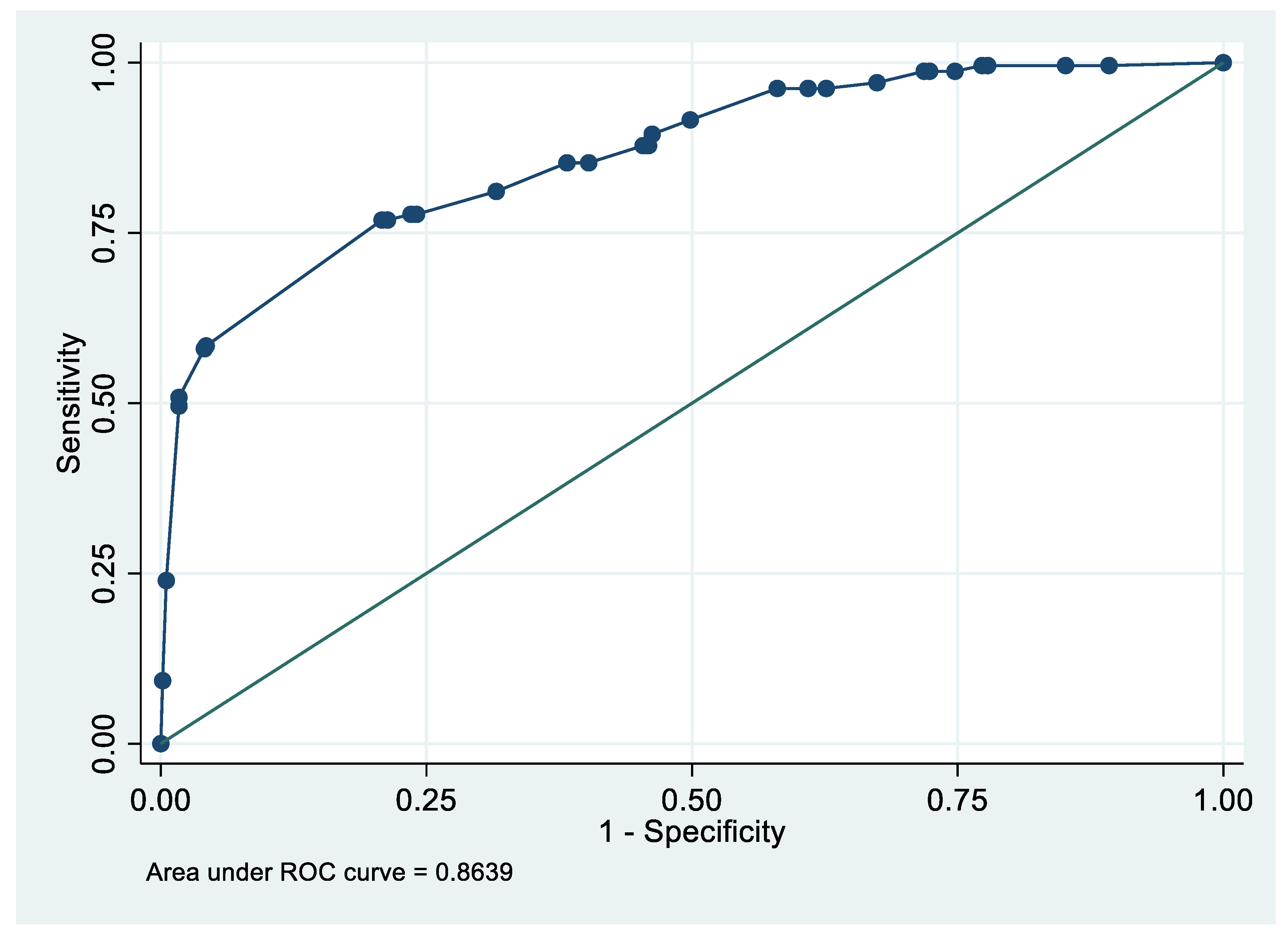

Table 1.
Baseline Characteristics of VOC Episodes.
| Characteristics | Uncomplicated VOC | VOC→ACS | p | ||||
| (n=586) | (n=238) | ||||||
| Age (median, IQR) | 11 [7,8,9,10,11,12,13,14,15] | 15 [11,12,13,14,15,16,17] | <0.001 | ||||
| Female sex (%) | 325 (76) | 101 (24) | 0.001 | ||||
| HbSS/S/ß° genotype (%) | 163 (68) | 445 (76) | <0.001 | ||||
| Hydroxyurea therapy (%) | 354 (60) | 42 (18) | <0.001 | ||||
| History of acute chest syndrome (%) | 112 (19) | 122 (51) | <0.001 | ||||
| Comorbidity (%)* | 206 (35) | 104 (44) | 0.02 | ||||
| Cholecystecyomy history (%) | 152 (26) | 70 (29) | 0.3 | ||||
| Splenectomy history (%) | 68 (12) | 15 (6) | 0.02 | ||||
| Bseline hemoglobin<8 g/dl (%) | 85 (16) | 21 (10) | 0.05 | ||||
| Thoracic/abdominal pain VOC (%) | 354 (60) | 231 (97) | <0.001 | ||||
| Length of Hospital Stay>5 days (%) | 103 (17) | 34 (15) | 0.3 | ||||
| Current white blood cells (median, IQR) | 16 [11-21] | 16 [11-20] | 0.6 | ||||
| Current neutrophils (median, IQR) | 10 [7-15] | 10 [7-14] | 0.9 | ||||
| Current platelets (median, IQR) | 400 [400-400] | 400 [400-400] | |||||
| Current reticulocytes (median, IQR) | 244 [166-350] | 180 [118-270] | 0.1 | ||||
| Current LDH (median, IQR) | 650 [538-800] | 0.3 | |||||
| Current CRP (median,IQR) | 28.5 [4-128] | 71.5 [7-180] | 0.09 | ||||
Table 2.
Univariate Analysis.
| Variable | OR (95% CI) | p-value |
| Age (per year) | 2.8 (2.1–3.7) | <0.001 |
| Female sex | 0.5 (0.2–0.8) | 0.001 |
| HbSS /S/ß° genotype | 3.4 (2.3-5.1) | <0.001 |
| Thoracic or abdominal pain VOC | 18.9 (9.2-39.1) | <0.001 |
| History of ACS | 4.5 (3.2-6.2) | <0.001 |
| Hydroxyurea therapy | 7.2 (4.9-10.3) | <0.001 |
| Baseline Hb <8 g/dL | 0.6(0..4–1.0) | 0.05 |
| Comorbidity history | 1.4 (1.04-1.9) | <0.03 |
| Length of Hospital Stay | 1.7 (1.2-2.6) | 0.004 |
VOC : vaso-occluvive crisi, IQR : interquartile range, CRP : C-reactiv protein. LDH : lactate dehydrogenase.
Table 3.
Multivariable Analysis.
| Characteristics | Uncomplicated VOC | VOCà ACS | aOR (95 %CI) | p | |||
| (n=586) | (n=238) | ||||||
| Genotype Hb SS/S/ß° (%) | 163 (68) | 445 (76 | 1.8 (1.2–2.4.) | <0.001 | |||
| Hydroxyurea therapy (%) | 354 (60) | 42 (18) | 2.1 (1.6–2.5.) | <0.001 | |||
| History of acute chest syndrome (%) | 112 (19) | 122 (51) | 1.7 (1.23–2.10) | <0.001 | |||
| Thoracic/abdominal pain VOC (%) | 354 (60) | 231 (97) | 2.1 (1.3–2.8) | <0.001 | |||
| Age (years) | 0.45 (0.1-0.82)) | 0.02 | |||||
| 0-5 | 101 (17) | 8 (3) | |||||
| 05-10 years | 176 (30) | 39 (16) | |||||
| >10 | 309 (53) | 192 (80) | |||||
VOC : vasoocclusive crisis ACS : acute chest syndrome aOR : adjusted odds ratio.
Disclaimer/Publisher’s Note: The statements, opinions and data contained in all publications are solely those of the individual author(s) and contributor(s) and not of MDPI and/or the editor(s). MDPI and/or the editor(s) disclaim responsibility for any injury to people or property resulting from any ideas, methods, instructions or products referred to in the content. |
© 2026 by the authors. Licensee MDPI, Basel, Switzerland. This article is an open access article distributed under the terms and conditions of the Creative Commons Attribution (CC BY) license (http://creativecommons.org/licenses/by/4.0/).
Copyright: This open access article is published under a Creative Commons CC BY 4.0 license, which permit the free download, distribution, and reuse, provided that the author and preprint are cited in any reuse.


