
Submitted:
15 April 2026
Posted:
15 April 2026
You are already at the latest version
Abstract
Pressure-powered spore-launching strategy is a unique feature for many fungal species. Fungal species have evolved this dispersal method to project spores into the surrounding environment, thereby increasing reproductive success and completing their life cycle. Sporangia squirters (like Pilobolus), ballistospore catapulters (like Agaricus), and ascospore launchers (like Neurospora) are prominent fungal cannons. Osmotic pressure and surface tension are responsible for propelling spores at extreme acceleration exceeding 20,000g and velocities reaching 94 km/h, thus enabling spores to travel distances of up to several meters. Thanks to advances in biophysical modeling and high-speed imaging, the century-old mystery of fungal launching strategies has been understood to involve principles of fluid mechanics, optics, and projectile dynamics, by investigating many fungal models. With a focus on the underlying biophysical principles and their broader implications for fungal ecology, this review summarizes current knowledge of morphology and biomechanics. Additionally, it discusses how each step of spore launching relates to fundamental physical principles of energy and motion.
Keywords:
fungal-cannon
; high-speed imaging
; osmotic pressure
; spore-launching
1. Introduction
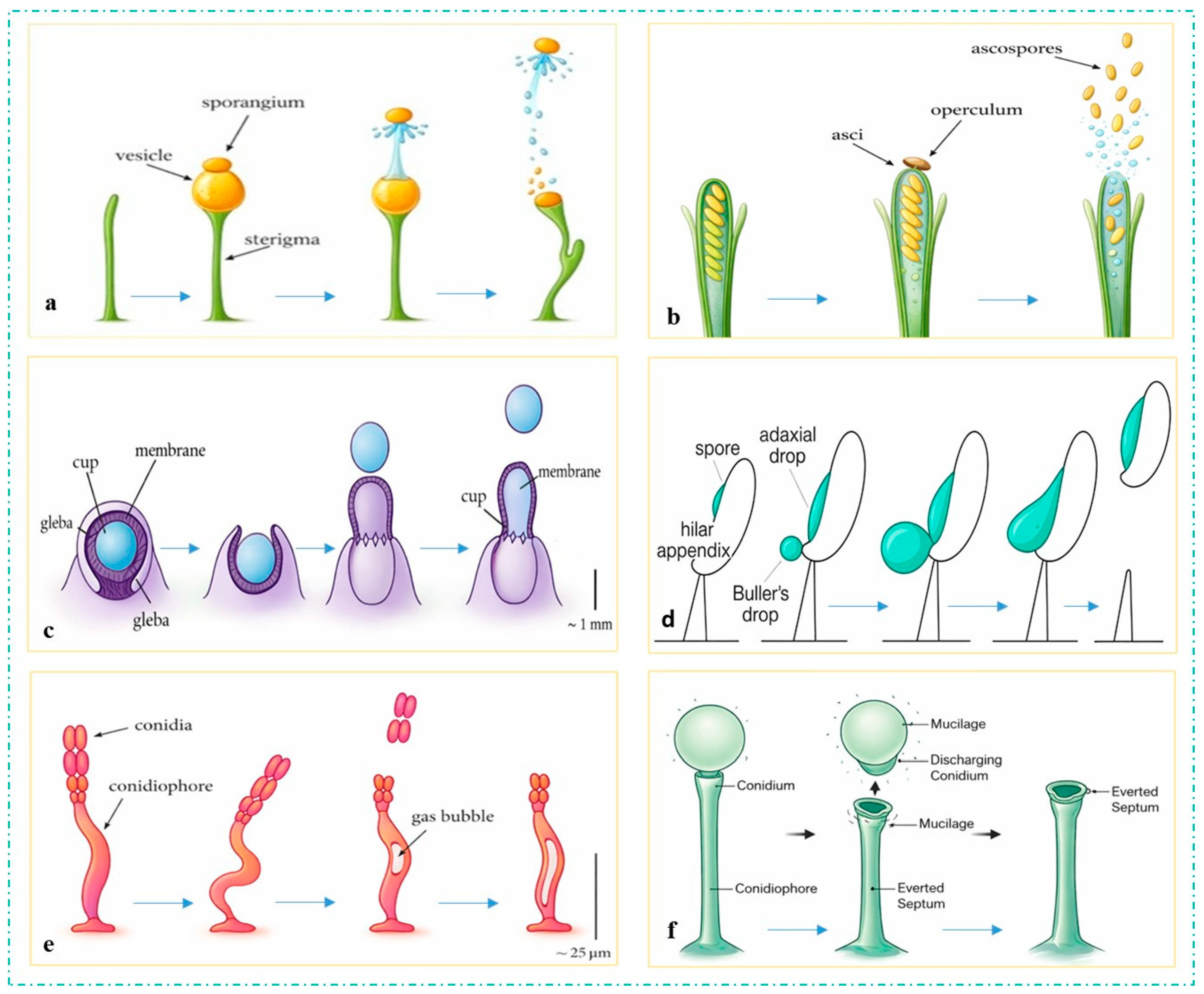
Most fungi are ubiquitous, growing on highly heterogeneous landscapes, and tend to disperse into separate patches of suitable habitat. Spore dispersal is an essential process in fungal ecology, governing reproduction, colonization, and survival across diverse environments[1] . Although the bulk of fungi rely on passive methods, such as insect-aided dispersal, wind, and water transport, many others have evolved an active discharge strategy that significantly improves dispersion efficiency [2,3]. Ascomycetous fungi produce a large number of spores through sexual and asexual reproduction. Sexual spores, named as ascospores, are disseminated with the rupture of a sac-like spore-bearing structure called an ascus [4] . Many terrestrial and aquatic ascomycetes, as well as predacious yeasts, disperse ascospores through launching action. In addition, ballistospore discharge is common in most mushrooms, basidiomycete yeasts, and pathogenic rusts and smuts [5,6]. For instance, ballistospores formed at the tip of sterigmata are discharged through the surface tension in Buller's drop and the adaxial drop, while basidiospores of puffballs and earthballs are spritzed into the air when their fruitbodies get compressed by raindrops, but in bird’s nest fungi, the spore-filled peridioles are splashed from the fruit bodies by raindrops[7]. According to Pringle et al. [8], about 30,000 basidiomycetes discharge ballistospores. Generally, the pressure-induced spore launching mechanism of ascomycetes was scientifically understood early in the 19th century, compared to the late resolved ballistospore discharge for basidiomycetes in the 1980s [9]. Most phytopathogens and saprophytic fungi are efficient in spore dispersal processes [10]. The sporangium squirting action of zygomycetes is widely studied in the genus Pilobolus. Pilobolus is an obligate coprophilous fungal genus, which is commonly named as a “shot-gun/squirt-gun”, or “hat thrower”, or “fungal cannon” due to its spore launching strategy, through combining phototropic sensing and pressure-driven propulsion [11]. This fungus grows on the dung of herbivorous animals and liberates spores from the dung surface to the surrounding vegetation to be ingested by grazing hosts through explosively launching a spore-bearing sporangium [12] (Figure 1a). By propelling a single sporangium onto the surrounding vegetation, the spores escape the zone of repugnance surrounding the dung of mammalian herbivores and maximize the opportunity for long-distance dispersal by the grazing animals [13].
A specialized, vertically oriented, and positively phototropic sporangiophore bearing a fluid-filled subsporangial vesicle facilitates this biological artillery system. In addition, the sporangiophore contains two rings of orange pigment (one at the base and the other at the base of the subsporangial vesicle), which act as light sensors [9]. The availability of ultra-high-speed video cameras (10,000-100,000 frames per second) enabled catching images of a launched spore in the early 2000s [14]. The erupted sporangia are coated with a sticky mucilage that mediates adhesion to the vegetation surface, thereby promoting the likelihood of herbivore ingestion [10]. From a biophysical perspective, the ballistic spore dispersal strategy is an efficient energy conversion process, transforming osmotic potential into kinetic energy [13]. The mechanism links multiple physical principles, such as fluid pressurization, fracture mechanics, and projectile motion. According to theoretical and experimental research, air resistance is a principal factor in restricting spore travel, and models based on Stokes’ law may accurately estimate dispersal range in fungal launchers [14]. Moreover, the phototrophic nature of Pilobolus combines environmental sensing with mechanical execution [10]. Besides its main role in fungal reproduction and colonization, understanding the ballistic [15] spore launching process can be deepened by integrating biological concepts with physical principles, such as fluid mechanics, pressure dynamics, and projectile motion. An interdisciplinary research approach combining mycology, physics, and engineering can inspire advances in bioinspired systems for microfluidics, robotics, and targeted delivery technology.
2. Literature Collection
Scientific documents were searched on the Web of Science (WOS) search database, using different search queries involving specific terms such as “fungal spore AND launching mechanism”, “fungal spore AND discharge mechanism”, “fungal spore AND artillery system”, “ballistospore AND launching mechanism”, “fungal spore AND squirt guns OR cannons” on the title of published works. Additional documents were collected through reference hunting. Finally, duplicated documents were excluded, and articles that do not focus on fungi (such as resources related to plants) were removed through title and abstract screening. In addition, sources that do not fulfil the study’s objectives were excluded through full-text screening.
3. Discussion
3.1. Ballistic Spore Launching from a Biophysical Perspective
3.1.1. Turgor Pressure Generation
Turgor pressure is the pressure exerted by a fluid against a membrane or wall due to rising solute concentration [7]. The osmosis-controlled mechanisms of energy generation can be mediated through water absorption into the cells responsible for the shooting mechanism (common in Zygomycetes), or water condensation on the outer surface of the spore-shooting structure (common in Basidiomycetes), or water evaporation from the cells of the shooting mechanism (common in Ascomycetes) [5]. The osmolytes that trigger water influx into the ascus sap and generate pressure vary among different species, such as Mannitol in the plant pathogen Gibberella zeae and glycerol in Ascobolus immerses [16]. These sugars are believed to be products of glycogen breakdown in the ascus sap. In spore-launching fungi such as Pilobolus, the turgor pressure built within the subsporangial vesicle drives sporangium discharge [17]. Fischer et al [16] used a mathematical model to estimate the pressure needed for ascospore release in A. immerses and found that 0.2 MPa would be enough to propel a cluster of ascospores.
The osmotic pressure (π) can be explained as:
where, i= ionization constant, S= solute concentration, R= gas constant, T= Temperature (K).
The net influx of water across the plasma membrane lining the inner surface of the ascus cell wall generates osmotic pressure inside the vesicle. Despite the pressure-driven spore discharge mechanism in ascomycetes, some basidiomycetes rely on Buller’s drop. For instance, Pringle et al [8] studied spore dispersal in a yeast, Itersonilia perplexans, and Auricularia auricula using a high-speed camera (100,000 frames/sec), and they found that ballistospore discharge involves the coalescence of Buller’s drop and the spore, where the release of surface tension at the moment of coalescence provides the energy and directional momentum to propel the drop and the spore away from the fungus [13].
3.1.2. Energy Storage and Transformation
According to the first law of thermodynamics, “energy cannot be created or destroyed, but it can convert from one form to another.”[18] The energy used for shooting is typically stored as elastic energy through pressure changes inside the cell that deform the cell wall. Consequently, the elastic and potential energy stored in the pressurized vesicle quickly transforms into kinetic energy and is transferred to the sporangium, causing it to launch rapidly at a higher acceleration rate.
This can be expressed as:
where, P = internal pressure, V = vesicle volume, m = mass of a sporangium, v = launch velocity
Different fungal groups store energy for spore discharge in various parts of the sporangiophore. For example, in the momentum catapult of Basidiomycota, energy is stored in a stalk through an increase and shift in the spore's center of mass [19]. According to Money [20], artillery fungus uses more energy for glebal discharge—estimated at a kinetic energy of 2.8 × 10⁵ J per glebal—compared to ballistospore discharge by typical mushrooms, which has an estimated kinetic energy of 3.5 × 10⁻⁴ J per spore (data for Armillaria tabescens). Different species uses different energy release mechanisms during spore shooting, such as: fracture release mechanism through momentum catapult (Auricularia auricular, Basidiomycota), fluid pressure catapult (genera Pilobolus and Basidiobolus in Zygomycota, and many species of Ascomycota including lichenized species), osmotic-powered eversion catapult (genus Sphaerobolus, Basidiomycota) and cavitation coiling catapult (Zygophalia jamaicensis and other species in Ascomycota and Basidiomycota) [5,21] (Figure 1c). In a momentum catapult mechanism, the potential energy stored in two separate droplets is released through coalescence between a spherical Buller’s drop at the spore’s hilar appendix and a flattened drop on the spore’s adaxial side, and is finally converted into kinetic energy (Figure 1d). Mannitol and ions secreted into the surface reduce local water potential and promote condensation of Buller’s drop and an adjacent liquid film [17].
In many edible mushrooms, the energy required for spore ejection comes from the surface energy stored in Buller’s drop, and this energy controls the discharge and take-off velocity of the spore [22]. At microscopic scales, such as fungal spores, surface tension forces outweigh gravity. The momentum catapult technique is a single-shot and destructive energy-consuming strategy where each spore is expelled through an impulsive movement, unlike the sap pressure-induced impulsive jet release of many ascospores at once [21,23,24]. Each ballistospore develops at the tip of the sterigma, which it is attached to via the hilum—a constriction of the sterigma that functions as an abscission zone [25]. In the cavitation coiling catapult, evaporation induces negative pressure and elastic tension within the conidiophore. When this tension exceeds the tensile strength of the cellular contents, a cavitation bubble forms, rapidly releasing stored energy and converting it into kinetic motion [5,26]. This sudden energy release drives elastic recoil of the conidiophore, resulting in spore ejection. Cavitation coiling catapult is common in deuteromycetes such as Deightoniella torulosa, Curvularia lunata, and Zygophiala jamaicensis [27] (Figure 1e). In addition, some ascomycetes, which are commonly grouped under Deuteromycota, launch asexual spores (conidia) from the tips of a specialized conidiophore through septal eversion (flipping inside-out) of the septal boundary connecting a spore with the stalk (Figure 1f).
3.1.3. Rapture and Launch Mechanics
With the rise of internal pressure in the vesicle, at a certain point, it exceeds the tensile strength of the weak interface between the vesicle and the sporangium, hence leading to a rupture. This critical pressure threshold can be expressed as:
where, σ = tensile strength of the wall, r = radius of curvature
The smaller the radii or the weaker the wall structure, the less will be the pressure required for rupture, hence allowing precise timing for discharge. In Pilobolus, the black sub-hemispherical sporangium is discharged by dehiscence of the mucilage found at the junction of the columella with the sporangium [11]. The subsporangial vesicle serves as a pressurized chamber in which turgor pressure exceeds the mechanical resistance of the sporangia, thereby driving their rapid ejection (Figure 1a). In addition, the vesicle contains a light-sensing structure that ensures the directional accuracy of a spore discharge [9]. For ascomycetes, the ascus structure (e.g., the number of ascus walls) and dehiscence significantly affect the mechanics of spore discharge. Accordingly, approximately 20 mechanisms of spore release for ascomycetes have been documented [28]. In addition, changes in ascus size, shape, and nozzle geometry affect the launch speed of the spores, discharge pattern (single spore or aggregate), and the timing for successive discharge. Moreover, aerodynamic spore shape, along with structural features such as an apical ring or operculum, reduces drag and energy loss during ejection, while synchronized discharge in ascomycetes generates cooperative airflow that can extend dispersal distances up to 20-fold compared to individual spores [23]. For ballistospory, Buller’s drop coalesces to shift the center of mass and eject the spore at 1 m s−1 via a surface tension-driven catapult [8].
Spore launch velocities greatly exceed terminal settling velocities, often by multiple orders of magnitude. For example, mushroom ballistospores are discharged from the basidium at speeds approaching 1ms−1, whereas their sedimentation rates are on the order of only a few ms−1 [21]. Ballistospore discharge may fail if the structural rigidity of the chitinous sterigmata wall exceeds the force generated by the fusion of Buller’s drop, hence preventing hilum rupture, or if the released energy is insufficient to overcome this resistance before the abscission zone weakens [22]. To enhance spore dispersal distance, fungal species have evolved different adaptive mechanisms, such as mucilaginous sheaths, ornamentation, and appendages, which promote cohesion in spore aggregates during discharge and dissociation during settling [14]. According to recent high-speed imaging studies, this ballistic spore-launching process is completed within a fraction of a millisecond, making it among the fastest biological movements. For deuteromycetes, cavitation-driven spore liberation occurs when dehydration-induced tension within fungal cells leads to negative pressures that exceed the tensile strength of the cytoplasm [31]. In many deuteromycetes, such as Deightoniella torulosa, Curvularia lunata, and Zygophiala jamaicensis, the dehydration-induced formation of a cavitation bubble causes the conidiophore to recoil, hence propelling spores outward [27].

Table 1.
Sporangium ballistics in Zygomycetes. .
| Species | Number of spores released per sporangium |
Initial velocity (m s 1): range, mean ± s.e.m. (n) |
Peak launch velocity | Peak launch acceleration | Calculated discharge distance (cm): range, mean | Reference |
| Pilobolus kleinii | 30,000–90,000 | 0.01–0.03 | 16 m/s (mean: 9 m/s) | 21,407g | 2.5m | [5,26] |
| Basidiobolus ranarum | 1 conidium | - | 9 m/s (mean: 4 m/s) | 152,905g | 0.02- 0.05m | [5,26] |
Table 2.
Ascospore ballistics.
| Species | Number of spores released per ascus |
Initial velocity (m s 1): range, mean ± s.e.m. (n) |
Launch acceleration | Calculated discharge distance (cm): range, mean | Reference |
| Ascobolus immersus | 8 | 5–18, 14 ±1.3 (12) | 183,486 peak | 9–33, 26 | [7,26] |
| Podospora anserina | 4 | 10–25, 21 ±1.1 (17) | - | 7–17, 14 | [7,26] |
| Morchella semilibera | 8 | 16–25, 19 ±1.9 (4) | - | 17–27, 21 (5 cm for spores flying singly) | [7] |
|
Neurospora tetrasperma |
4 | 4–32, 16 ±0.6 (58) | - | 2–16, 8 | [5,7] |
| Sordaria macrospora | 8 | 5–30, 15 ±0.1 (43) | - | 4–24, 12 | [7] |
| Sporormiella australis | one at a time | 15–16, 16 ±0.1 (5) | - | 0.80–0.85, 0.85 | [7] |
| Leptosphaeria acuta | one at a time | 4–5, 4 ±0.5 (3) | - | 0.24–0.31, 0.24 | [7] |
| Neolecta vitellina | stream of multiple spores | 13–19, 16 ±1.6 (3) | - | 0.12–0.18, 0.15 | [7] |
| Macrospora scirpicolac | one at a time | 3–7, 5 ±0.5 (10) | - | 0.02–0.05, 0.04 | [7] |
| Leptosphaeria acutac | one at a time | 1–2, 1 ±0.3 (4) | - | 0.001–0.004, 0.003 | [7] |
| Gibberella zeae | - | 34.5 | 870,000 | 2.810−3 - 8.510−3 | [5] |
Table 3.
Basidiospore ballistics.
| Species | Radius of Buller’s drop | Initial velocity (m s −1) : range, mean ± s.e.m. (n) |
Launch acceleration (g) | Calculated discharge distance (cm): range, mean | Reference |
| Sphaerobolus stellatus | - | 9.16 ± 0.79 | - | 4 to 7 m (average 6m) | [20] |
| Gymnosporangium juniperi virginianae | 5.2 mm (19) | 0.66–1.35, 1.1160.06 (18) | - | 1.2660.06 mm | [24] |
| Tilletia caries | 5.2 mm (28) | 0.32–1.53, 1.1060.07 (21) | 0.6660.04 mm | [24] | |
| Sporobolomyces salmonicolor | 3.8 mm (14) | 1.08–1.83, 1.4260.12 (6) | - | 0.5460.04 mm | [24] |
| Auricularia auricula | 3.1 mm (15) | 0.87–1.62, 1.2560.06 (13) | - | 0.4560.02 mm | [5,24] |
| Polyporus squamosus | 2.6 mm (4) | 0.45–0.68, 0.5860.08 (6) | - | 0.1460.02 mm [0.1360.02 mm (6)] | [24] |
| Armillaria tabescens | 1.5 mm (16) | 0.12–0.91, 0.6460.08 (9) | - | 0.1060.01 mm [0.0660.01 mm (4)] | [24] |
| Clavicorona pyxidata | 1.2 mm (6) | 0.52–0.87, 0.6960.06 (5) | - | 0.04260.004 mm [0.03660.003 mm (5)] | [24] |
| Itersonilia perplexans | - | 0.67 | ~ 25,484 | 1.10−3mm,- | [5] |
| Hyphodontia latitans | - | 1.05 | - | 4.10−6 peak | [5] |
| Aleurodiscus gigasporus | - | - | - | 2 mm,- | [32] |
| Hyphodontia latitans | - | - | - | 4 µm,- | [32] |
3.2. Acceleration and Force
Once discharged, the sporangium travels at extreme acceleration. According to Newton’s second law of motion:
where, F = force generated by pressure, m = mass of the sporangium, a = acceleration [21].
Due to the light weight of a sporangium, even an average force can cause it to experience extremely high acceleration, often exceeding 20,000g. According to Pringle et al.[8], the mean launch speed analyzed from high-speed video recordings was 0.7 m per second for Itersonilia and 1.2 m per second for Auricularia auricula. The relative size of ballistospores and their Buller's drops determines the launch acceleration rate, which ranges from 3,302 to 25,484g; launch velocities range from 0.1 to 1.8 m/s, affecting dispersal distance. According to Pringle et al. [8], ballistospores launch into the air with initial accelerations in excess of 10,000g. The inertia of spores increases with mass, meaning larger spores decelerate more slowly after launch. Drop size is important because surface tension increases with drop radius, providing more kinetic energy for discharge [19]. For example, larger spores with bigger drops travel farther than smaller spores with smaller drops. Larger spores produce larger drops and thus travel longer distances. For instance, fungal species with lighter spores, such as Tilletia caries (smut), traveled 0.7 mm; Armillaria tabescens (gilled mushroom), 0.1 mm; and Clavicorona pyxidate (coral fungi), 0.04 mm.
3.3. Projectile Motion, Air Resistance, and Drag
After discharge, the ballistic trajectory of a sporangium is governed by gravity, like any other
In which the horizontal range (R) can be described as:
where, v = launch velocity, θ = launch angle, g = gravity [21].
Maximum distance occurs near a 45° angle, but in Pilobolus, the angle is optimized biologically through phototropism to target nearby vegetation rather than maximize distance alone. For instance, Money et al [20] investigated gleba discharge for Sphaerobolus stellatus at different launch angles of 300, 450, and 600 using a simple drag model and found a maximum dispersal distance of about 6m. Sphaerobolus ejects its spore-filled gleba via a snap-buckling mechanism [26]. The gravitational influence is imperceptible soon after spore discharge, but turns significant as air viscosity decelerates the spore, hence settling spores down at rates of a few millimeters per second. Larger spores follow more parabolic trajectories after discharge, with gravity dominating their downward motion in the later flight stages. Due to their smaller size, spores or sporangia experience a significant air resistance (aerodynamic drag), which influences their motion. The drag force can be explained as:
where, C_d = drag coefficient, ρ = air density, A = cross-sectional area, v = velocity [5]
Air resistance rapidly slows the sporangium, thereby limiting dispersal distance. This could be the cause for Pilobolus reliance on high initial velocity to overcome air resistance. The larger the spore, the less it is affected by drag [21]. For instance, an intact spore package of Pilobolus forms a larger projectile with a greater launch distance compared to many Ascomycetes, because the influence of viscous drag decreases relative to inertia, given that drag scales with spore radius (r2), while mass, thus spore inertia, scales with r3 for a spherical particle. At a constant launch speed, larger spores or spore aggregates travel farther than smaller ones because they have greater momentum at launch and higher inertia (∝ r3), which reduces their deceleration by viscous drag (∝ r2). This is shown by the greater dispersal distances of ascospores that stay connected during flight compared to those that separate after discharge. Despite the suggestive ideas generated using theoretical models, indicating that ellipsoidal ascospore morphologies minimize aerodynamic drag, hence maximizing discharge distance [14], high-speed imaging discloses that spores are often discharged as irregular, sap-coated aggregates rather than idealised shapes [26]. Similarly, Fischer et al [21] showed that air viscosity and projectile shape strongly influence spore launch speed and dispersal distance through modulating drag. Evolutionary pressures favor spore morphologies minimizing drag. To predict dispersal distances and calculate drag force, mycologists deploy various approaches and ascospore-discharge-based models, such as the simple drag model (SDM), the complex drag model, the interpolation model, the white model, and Stokes' model (for viscous drag on small particles) [16]. These models estimate spore launch speeds from measured dispersal distances and vice versa. The combined effect of launch speed, projectile mass, and projectile surface determines the dispersal distance [21]. Spore motion in Stokesian conditions is typified by low Reynolds numbers, which show that viscous forces predominate over inertial forces. The Reynolds number usually stays low throughout the trajectory, even though it is not constant and falls as the spore slows down. Fungal spores show incredibly fast deceleration after launch, according to Yaffeto et al.'s [28] evaluation of the accuracy of several spore motion models. Spore size, shape, and mass affect terminal spore velocity during settling. Dehydration-induced spore compaction can enhance aerial persistence and delay sedimentation, via reducing spore mass and changing spore shape and size [33]. In addition, the surface of fungal spores becomes electrically charged in dry air, and this charge significantly affects their mobility [31].
4. Conclusions
Spore launching is one of the governing factors for fungal diversification. Forcible spore discharge allows ascomycetes to enter dispersive air currents and disperse between distant habitats; for instance, Sclerotinia sclerotiorum disperses spores from soilborne apothecia to infect crop flowers, while dung-inhabiting fungi, such as Ascobolus, must eject spores beyond the dung vicinity to promote transmission through herbivory. The condensation of Buller’s drop, generating surface tension, drives ballistospore discharge, while the hydrostatic pressure within the ascus and sporangial vesicle powers ascospore and sporangium expulsion. Both mechanisms are fuelled by osmotically active hygroscopic solutes, such as osmolytes in the ascus sap, and similar compounds (like D-Mannitol) secreted into the surface of the ballistospore. The ascus functions as a pressurized squirt gun, discharging spores over a precise and limited range, hence reducing spore loss. Pressure-driven launchers discharge spores (individually, aggregated, or within sporangia) up to 2.6 m dispersal distance, a catapult powered by surface fluid condensation fluid movement discharges basidiospores up to 1.3 mm, and the explosive gas bubble-induced cavitation launches conidia a few millimeters from its colony. Forecasts related to fungal dispersal patterns require a deeper understanding of the interplay between spore size, shape, and viscous drag.
Author Contributions
For research articles with several authors, a short paragraph specifying their individual contributions must be provided. The following statements should be used “Conceptualization, X.X. and Y.Y.; methodology, X.X.; software, X.X.; validation, X.X., Y.Y. and Z.Z.; formal analysis, X.X.; investigation, X.X.; resources, X.X.; data curation, X.X.; writing—original draft preparation, X.X.; writing—review and editing, X.X.; visualization, X.X.; supervision, X.X.; project administration, X.X.; funding acquisition, Y.Y. All authors have read and agreed to the published version of the manuscript.” Please turn to the CRediT taxonomy for the term explanation. Authorship must be limited to those who have contributed substantially to the work reported.
Funding
No specific funding was received for this study.
Data Availability Statement
We encourage all authors of articles published in MDPI journals to share their research data. In this section, please provide details regarding where data supporting reported results can be found, including links to publicly archived datasets analyzed or generated during the study. Where no new data were created, or where data is unavailable due to privacy or ethical restrictions, a statement is still required. Suggested Data Availability Statements are available in section “MDPI Research Data Policies” at https://www.mdpi.com/ethics.
Acknowledgments
In this section, you can acknowledge any support given which is not covered by the author contribution or funding sections. This may include administrative and technical support, or donations in kind (e.g., materials used for experiments).
Conflicts of Interest
There are no conflicts of interest.
References
- Oneto, D.L.; Golan, J.; Mazzino, A.; et al. Timing of fungal spore release dictates survival during atmospheric transport. Proc Natl Acad Sci USA 2020, 117, 5134–5143. [Google Scholar] [CrossRef] [PubMed]
- Roper, M.; Seminara, A.; Bandi, M.M.; et al. Dispersal of fungal spores on a cooperatively generated wind. Proc. Natl. Acad. Sci. USA 2010, 107, 17474–17479. [Google Scholar] [CrossRef] [PubMed]
- Hassett, M.O.; Fischer, M.W.F.; Sugawara, Z.T.; et al. Splash and grab: Biomechanics of peridiole ejection and function of the funicular cord in bird’s nest fungi. Fungal Biol 2013, 117, 708–714. [Google Scholar] [CrossRef] [PubMed]
- Trail, F. Fungal cannons: explosive spore discharge in the Ascomycota. FEMS Microbiol Lett. 2007, 276, 12–18. [Google Scholar] [CrossRef]
- Sakes, A.; Wiel, MDer; Van Henselmans, P.W.J.; et al. Shooting mechanisms in nature: A systematic review. PLoS ONE 2016, 11. [Google Scholar] [CrossRef] [PubMed]
- Bueno-Sancho, V.; Orton, E.S.; Gerrity, M.; et al. Aeciospore ejection in the rust pathogen Puccinia graminis is driven by moisture ingress. Commun Biol. 2021, 4. [Google Scholar] [CrossRef]
- Money, N.P.; Stolze-Rybczynski, J.; Smith, B.E.; et al. Ascus function: From squirt guns to ooze tubes. Fungal Biology 2023, 127, 1491–1504. [Google Scholar] [CrossRef]
- Pringle, A.; Patek, S.N.; Fischer, M.; et al. The captured launch of a ballistospore. Mycologia 2005, 97, 866–871. [Google Scholar] [CrossRef]
- Viriato, A. Pilobolus species found on herbivore dung from the São Paulo Zoological Park, Brazil. Acta Bot Bras. 2008, 22, 614–620. [Google Scholar] [CrossRef]
- Mukherjee, R.; Gruszewski, H.A.; Bilyeu, L.T.; Schmale, D.G.I.I.I.; Boreyko, J.B. Synergistic dispersal of plant pathogen spores by jumping-droplet condensation and wind. Proc. Natl. Acad. Sci. USA 2021, 24, 118. [Google Scholar] [CrossRef]
- Money, N.P. Chapter 3 - Spore Production, Discharge, and Dispersal. In The Fungi (Third Edition); Watkinson, S.C., Boddy, L., Money, N.P., Eds.; Academic Press: Boston, 2016; pp. 67–97. [Google Scholar] [CrossRef]
- Aluoch, A.M.; Otiende, M.Y.; Obonyo, M.A.; et al. First genetic identification of Pilobolus (Mucoromycotina, Mucorales) from Africa (Nairobi National Park, Kenya). South African Journal of Botany 2017, 111, 182–8. [Google Scholar] [CrossRef]
- Lee, C.M.; van Geel, B.; Gosling, W.D. On the Use of Spores of Coprophilous Fungi Preserved in Sediments to Indicate Past Herbivore Presence. Quaternary 2022, 5. [Google Scholar] [CrossRef]
- Money, N.P. Goldilocks mushrooms: How ballistospory has shaped basidiomycete evolution. Fungal Biology 2023, 127, 975–84. [Google Scholar] [CrossRef] [PubMed]
- Liu, F.; Chavez, R.L.; Patek, S.N.; et al. Asymmetric drop coalescence launches fungal ballistospores with directionality. J R Soc Interface 2017, 14. [Google Scholar] [CrossRef]
- Roper, M.; Pepper, R.E.; Brenner, M.P.; et al. Explosively launched spores of ascomycete fungi have drag-minimizing shapes. Proc Natl Acad Sci USA 2008, 105, 20583–20588. [Google Scholar] [CrossRef] [PubMed]
- Corona Ramirez, A.; Bregnard, D.; Junier, T.; et al. Assessment of fungal spores and spore-like diversity in environmental samples by targeted lysis. BMC Microbiol. 2023, 23. [Google Scholar] [CrossRef]
- Fischer, M.; Cox, J.; Davis, D.J.; et al. New information on the mechanism of forcible ascospore discharge from Ascobolus immersus. Fungal Genetics and Biology 2004, 41, 698–707. [Google Scholar] [CrossRef]
- Iapichino, M.; Wang, Y.W.; Gentry, S.; et al. A precise relationship among Buller’s drop, ballistospore, and gill morphologies enables maximum packing of spores within gilled mushrooms. Mycologia 2021, 113, 300–311. [Google Scholar] [CrossRef] [PubMed]
- Zohuri, B. Chapter 5 - First Law of Thermodynamics. In Physics of Cryogenics; Zohuri, B., Ed.; Elsevier, 2018; pp. 119–63. [Google Scholar] [CrossRef]
- Nobliri, X.; Yang, S.; Dumais, J. Surface tension propulsion of fungal spores. Journal of Experimental Biology 2009, 212, 2835–2843. [Google Scholar] [CrossRef] [PubMed]
- Money, N.P.; Stolze, J.; Fischer, M.W.F. Mechanics of the artillery fungus. Fungal Biol. 2024, 128, 2334–2340. [Google Scholar] [CrossRef]
- Fischer, M.W.F.; Stolze-Rybczynski, J.L.; Davis, D.J.; et al. Solving the aerodynamics of fungal flight: How air viscosity slows spore motion. Fungal Biol. 2010, 114, 943–8. [Google Scholar] [CrossRef] [PubMed]
- Ruiter JDe Arnbjerg-Nielsen, S.F.; Herren, P.; et al. Fungal artillery of zombie flies: Infectious spore dispersal using a soft water cannon. J R Soc Interface 2019, 16. [Google Scholar] [CrossRef]
- Challita, E.J.; Rohilla, P.; Saad Bhamla, M. Fluid ejections in nature. Annu Rev Chem Biomol Eng. 2024, 15, 187–217. [Google Scholar] [CrossRef] [PubMed]
- Stolze-Rybczynski, J.L.; Cui, Y.; Stevens, M.H.H.; et al. Adaptation of the spore discharge mechanism in the Basidiomycota. PLoS One 2017, 4. [Google Scholar] [CrossRef]
- Coelho, M.A.; Bakkeren, G.; Sun, S.; et al. Fungal Sex: The Basidiomycota. Microbiol Spectr. 2017, 5. [Google Scholar] [CrossRef] [PubMed]
- Yafetto, L.; Carroll, L.; Cui, Y.; et al. The fastest flights in nature: High-speed spore discharge mechanisms among fungi. PLoS One 2008, 3. [Google Scholar] [CrossRef] [PubMed]
- MEREDITHDS. Spore Discharge in Deightoniella torulosa (Syd.) Ellis. Ann Bot. 1961. [Google Scholar] [CrossRef]
- PMKirk, P.F.C.D.W.M.; JAS. DICTIONARY OF THE FUNGI, 10th ed.; Cromwell Press: Wallingford, UK; Trowbridge, 2008; Available online: www.indexfungorum.org.
- Money, N.P.; Fischer, M.W.F. 6 Biomechanics of Spore Release in Phytopathogens. In The Mycota, 2nd ed. n.p.; Karl Esser, H.B.D., Ed.; Springer-Verlag: Berlin Heidelberg, 2009. [Google Scholar]
- Fischer, M.W.F.; Stolze-Rybczynski, J.L.; Cui, Y.; et al. How far and how fast can mushroom spores fly? Physical limits on ballistospore size and discharge distance in the Basidiomycota. Fungal Biol. 2010, 114, 669–675. [Google Scholar] [CrossRef]
- Segers, F.J.J.; Dijksterhuis, J.; Giesbers, M.; et al. Natural folding of airborne fungal spores: a mechanism for dispersal and long-term survival? In Fungal Biology Reviews; Elsevier Ltd, 2023; vol. 44. Preprint. [Google Scholar] [CrossRef]
Figure 1.
Energy release and spore discharge mechanisms. Stages of osmotic pressure-powered sporangium squirting in zygomycetes (eg, genus Pilobolus) (a), fluid pressure catapult in ascomycetes (eg. genus Neurospora) (b), and the eversion catapult in the genus Sphaerobolus (c). Momentum catapult in basidiomycetes (eg. genus Auricularia) (d), cavitation catapult in dothideomycetes (eg. Zygophiala jamaicensis) (e), and septal eversion in entomopathogenic fungi (eg. Entomophthora) (f).
Figure 1.
Energy release and spore discharge mechanisms. Stages of osmotic pressure-powered sporangium squirting in zygomycetes (eg, genus Pilobolus) (a), fluid pressure catapult in ascomycetes (eg. genus Neurospora) (b), and the eversion catapult in the genus Sphaerobolus (c). Momentum catapult in basidiomycetes (eg. genus Auricularia) (d), cavitation catapult in dothideomycetes (eg. Zygophiala jamaicensis) (e), and septal eversion in entomopathogenic fungi (eg. Entomophthora) (f).
Disclaimer/Publisher’s Note: The statements, opinions and data contained in all publications are solely those of the individual author(s) and contributor(s) and not of MDPI and/or the editor(s). MDPI and/or the editor(s) disclaim responsibility for any injury to people or property resulting from any ideas, methods, instructions or products referred to in the content. |
© 2026 by the authors. Licensee MDPI, Basel, Switzerland. This article is an open access article distributed under the terms and conditions of the Creative Commons Attribution (CC BY) license (http://creativecommons.org/licenses/by/4.0/).
Copyright: This open access article is published under a Creative Commons CC BY 4.0 license, which permit the free download, distribution, and reuse, provided that the author and preprint are cited in any reuse.


