

Submitted:
15 April 2026
Posted:
15 April 2026
You are already at the latest version
Abstract
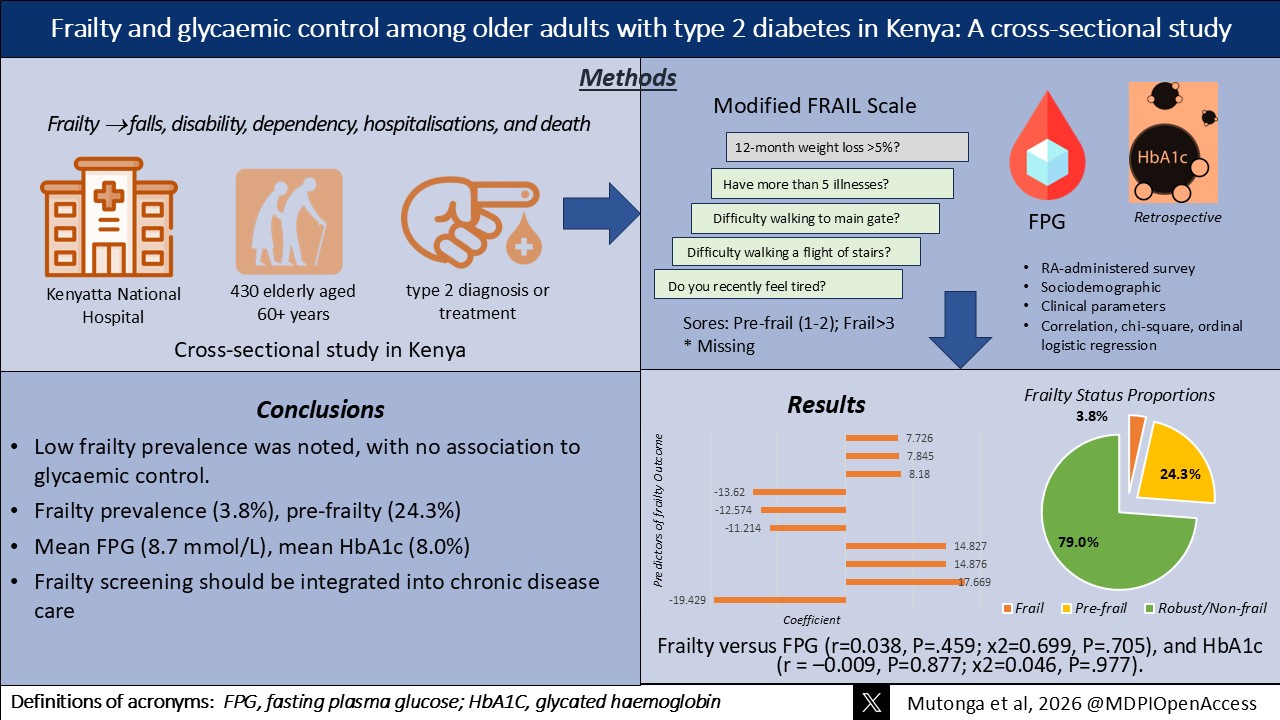
Diabetes complications may increase frailty rates among the elderly, leading to falls, immobility, dependency, hospitalizations, and death. The study aimed to assess any association between frailty status and glycaemic control among older adults with type 2 diabetes mellitus at Kenyatta National Hospital, Kenya. We conducted a cross-sectional study of 430 older individuals aged 60+ years with type 2 diabetes at a specialized diabetes clinic using a modified FRAIL scale. Mean age was 69.1 years, with 65.7% female and 76.2% completed primary school. Frailty prevalence was 3.8%, pre-frailty 24.3%, and robust/non-frail 71.9%. It was associated with age, social status, health knowledge, duration of DM, blood pressure, body mass index, high-density lipoprotein-C, and renal failure. Mean fasting plasma glucose (FPG) was 8.7 mmol/L, with 60% having FPG>7 mmol/L; mean glycated haemoglobin (HbA1C) was 8.0%, with 41% having HbA1C>8%. Glycaemic control was correlated with number of medications, blood pressure, lipidaemia but not age, sex, social status. No correlation was found between frailty and glycaemic control: frailty versus FPG (r=0.038, P=.459; χ2=0.699, P=.705), and HbA1C (r = –0.009, P=0.877; χ2=0.046, P=.977). Low frailty prevalence was noted, with no association to glycaemic control. Our findings provide evidence for conducting frailty assessments in chronic disease care.
Keywords:
frailty
; glycaemic control
; diabetes mellitus
; type 2
; aged
; Kenya
Copyright: This open access article is published under a Creative Commons CC BY 4.0 license, which permit the free download, distribution, and reuse, provided that the author and preprint are cited in any reuse.


