

Submitted:
14 April 2026
Posted:
15 April 2026
You are already at the latest version
Abstract
Lineages are conceived as corridors through time of two-sigma exclusion of uncertainty by Bayesian analysis of numbers of morphological traits and species. Methods of structural monophyly constructed evolutionary dendrograms of a family and of a tribe of bryophytes. Shannon informational bits known for speciation events in these groups allow projections of changes into the past. Sampling and relationships in the present imply kinds and rates of origination and extinction of species. Vopson’s estimates of the mass of one informational bit is used to spacelike calculate total mass of information of two bryophyte lineages from total bits associated with speciation over time. Three levels of observational sampling yield similar information masses for the two lineages. Numbers of observations of calculated events over time are expressed in “Reals” as fundamental units of historical reification. Observation is postulated as a source of historical reification based on a functional equivalence of switching of light-speed-mediated Then and Now for estimation of spacelike events. This Common Now concept is quite like that of a many worlds theory of entangled events. Dark matter, Schrödinger’s cat, aliens, the Big Bang, the Matrix, and dragons make an appearance. Best fit to average axion depth is observational sampling at 2 cm size of a mathematically spherical moss. Scientific reality is identified with calculated information extending experience in both directions of time.
Keywords:
axions
; bryophytes
; evolution
; infoentity
; information mass
; spacelike calculation
; lineages
; time
1. Introduction
1.1. Timelike Versus Spacelike
This paper is one of a series recasting evolutionary systematics in terms of the principles of physics. Here we explore some concepts of discrete time physics as a real-world application. Systematics, the study of organisms and their evolutionary relationships, is a historical science. It is part of the Linnean Endeavor, to discover, classify, describe and explain the diversity of life. Analysis of events and processes in the past is affected by the limitations of the speed of light. This can be everyday experience. Minkowski’s word “timelike” refers to events that we can see now while “spacelike” means events that would require faster than light speed to view. Spacelike refers to events that are simultaneous in that events in the calculated Now back then and there are happening at the same time as the perceived Now here; but timelike events are never simultaneous. For instance, a spoon in a glass of water looks sharply bent because the speed of light in water is about 25% slower than that in air. The beam of light follows the shortest time path. Spearing a fish in a river requires a calculation of where the actual fish is because the image presents the fish as shallower and farther away than you think because sum of time through both water and air is minimized. The calculation of where the fish is now is a spacelike analysis because information would have to travel faster than light speed to allow you to know where the fish is now (at your Now). Given that scientific reality is composed of probabilistic facts, your calculation is more “real” when acted upon than the image you saw. Demonstration that spacelike calculations are worthwhile, even in near time and near space, is dinner.
Cosmology and evolutionary systematics are both to a great extent historical sciences. “Timelike” refers to calculations that order in time events represented by “relicts” in the present. They may be relicts of past or even future events following the concept that future calculators will calculate them. The results assume causality and may involve relativistic processes or simple calculation of a trajectory. An example is a caulogram, which is a list of present-day relicts ordered as to time of origination. “Spacelike” calculations use what is known about evolutionary processes and may allow calculation of what the caulogram of present-day relationships may look like at various times in the past or even future. The result is a synchronogram of the components and changes in the lineage over time, reifying the summed results of evolutionary theory.
Another example is a depiction of the movement of the planet mars from data gathered from timewise observations of the planet. Data on proper motion, parallax and doppler effects plus distance covered by information at light speed is a timelike estimate of present position. Inference of all positions past and future results in a spacelike calculation and projection as an orbit. Spacelike projections of the trajectory as sum of all positions considered simultaneously allows a mathematical construction of the results of all constraints, namely the deterministic system of the ellipse governed by gravity. Thus, historical aspects of cosmology and evolutionary systematics may both be addressed by a two-step procedure creating a depiction of a process as events ordered in time, then summing into a single set of ordered data, a “tuple,” that allows scientific interpretation of underlying processes.
If we could travel faster than light speed, we could travel to the information wave traveling through space of a historical event 100 million years in the past and view that event directly. With calculation from relicts in the Now, there is theoretically no distance-related attenuation of the signal, because travel faster than light involves changing the Past into the Now. Inferring the composition of a lineage at various times in the past is a “spacelike” calculation. The caulogram of the Streptotrichaceae (Figure 1) as summarized for 2–22 mya (Figure 2) combines recent speciation and genusation events and (from relict samples) models the Now and near Now for that family; these taxa are informational relicts connected by lines showing inferred timelike (serial) relationships. All other caulograms of that family (Figure 2 in part) are each spacelike calculations of the past (Figure 3). The same study is done for the Pottiaceae tribe Pleuroweisieae of similar numbers of species and genera (Figure 3 and Figure 5).
The evolutionary lineage of the Streptotrichaceae is rather large in four dimensions, being a bundle of branching informational fibers 100 million light years in length. The limit is the age of the oldest known or well-inferred taxon in the lineage, ca. 100 mya [1]. Like Schrödinger’s cat, information only exists when observed or calculated, and when calculated at 22 my intervals effectively limits the known informational size of the lineage. The actual least time of existence in the Now of some real thing or event is the Planck time, which is pretty short, after which the thing or event becomes the Then. One unit of Planck time can be considered the Now and all other time is information from spacelike calculation (or inference, digital or analog). Precision of resolution of the observation is dependent on closeness of the observer in time to what is observed but that is dependent on the availability of event relics upon which position and motion sampling is possible for spacelike calculations.
Is the information carried by a light beam across 100 million light years imposed on a continuous or intermittent signal? The smallest unit of time is 5.39 × 10–44 seconds, and given a smallest unit, then, yes, information is stuttered across space. On the other hand, the smallest potentially observable scientific unit of length is 1.6 × 10⁻³⁵ meters, and there are thus fewer unit lengths in one light year than unit times. We can then assume that, like the unseen rapid flicker on a TV set, the signal is essentially continuous in communicating information.
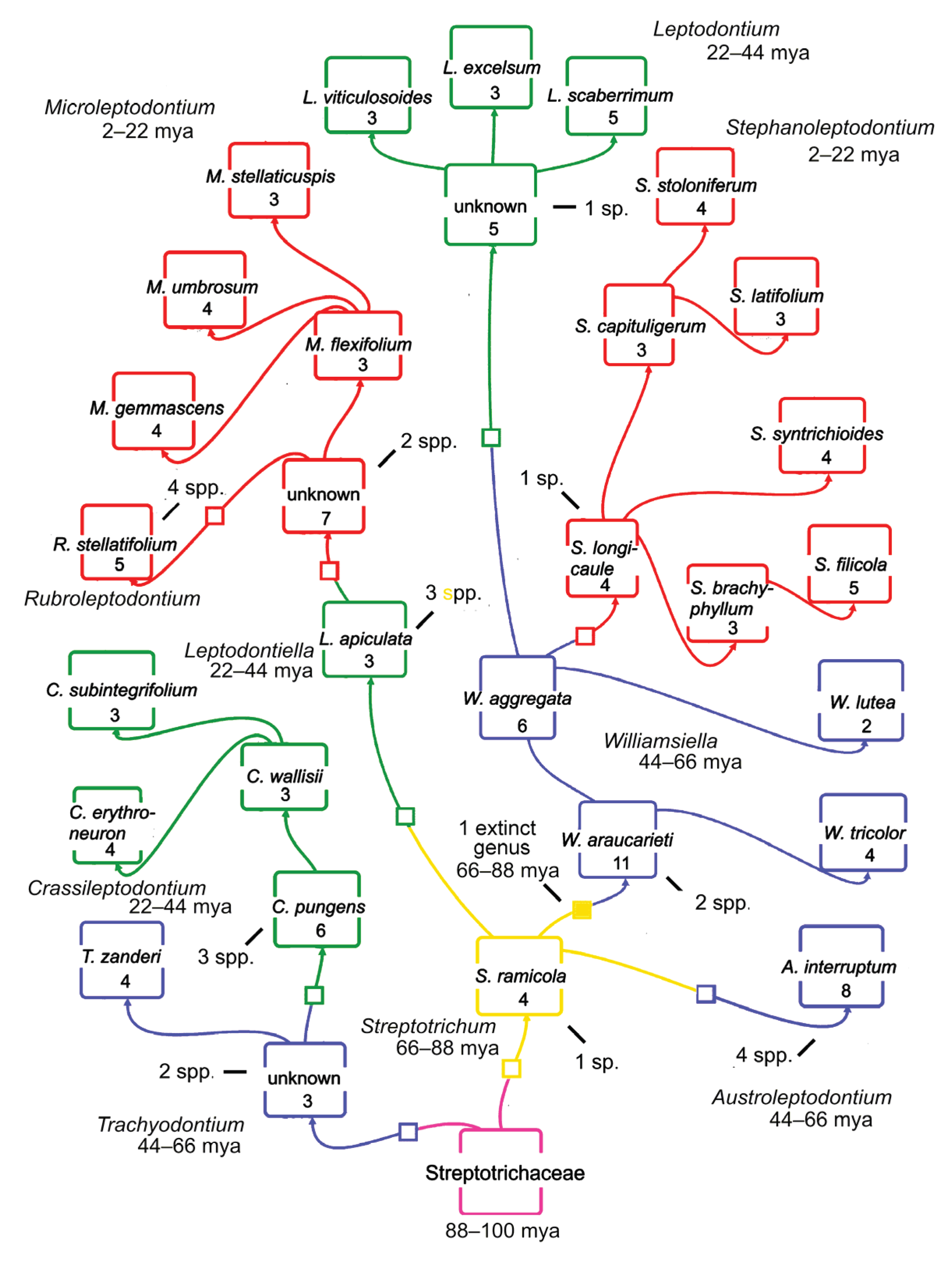
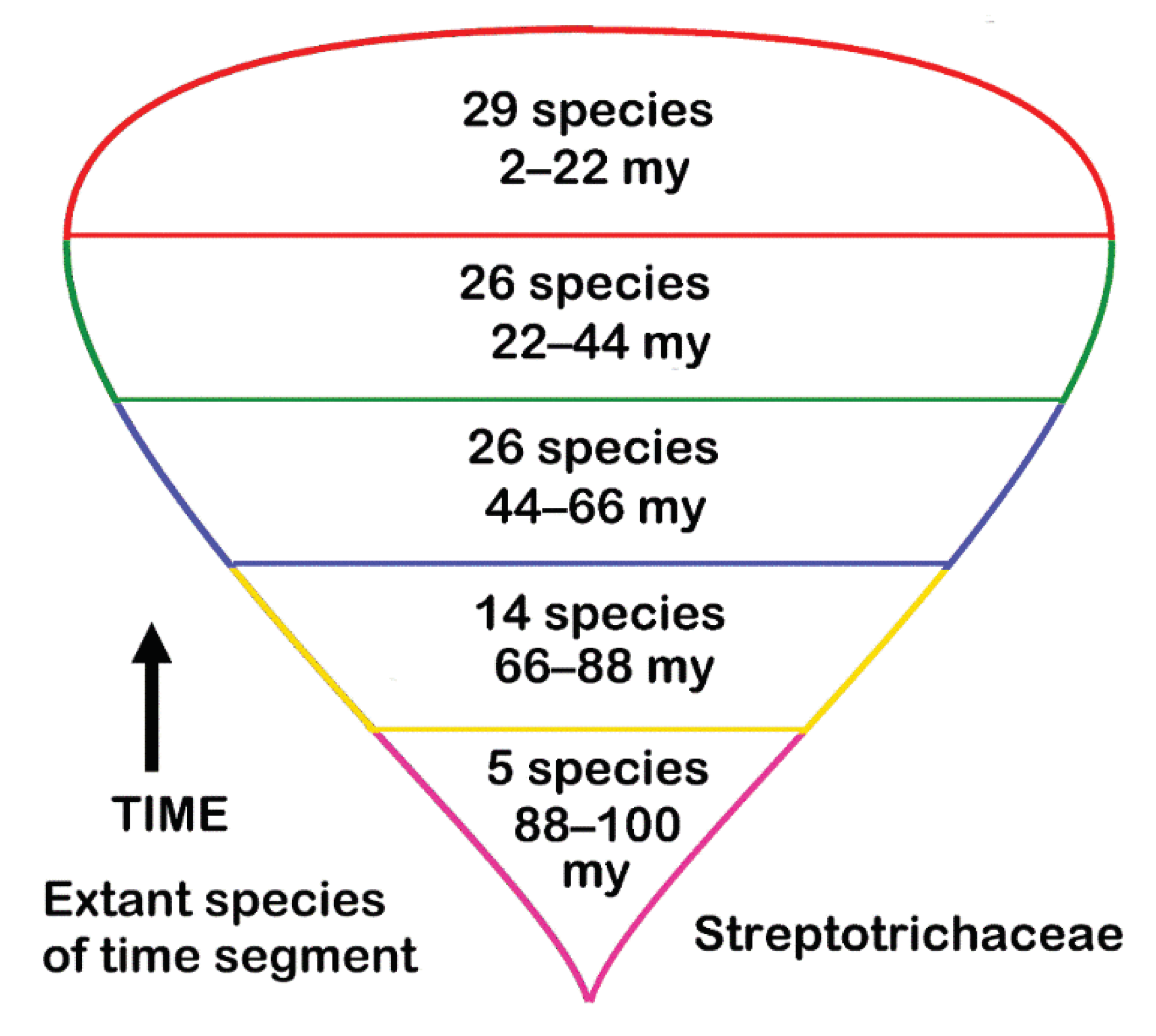
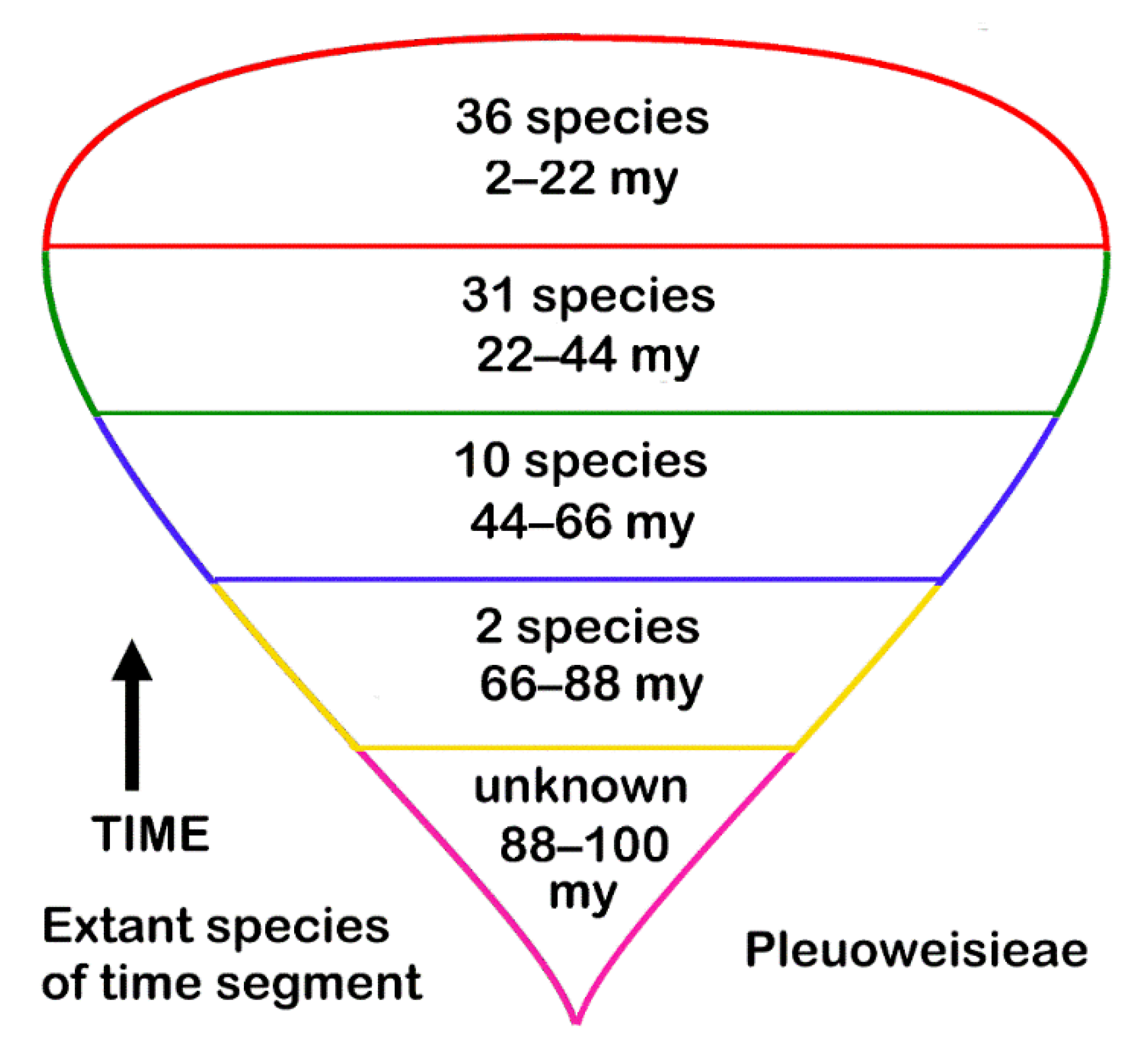
The caulogram (stem-taxon evolutionary tree) of Streptotrichaceae (Figure 1) gives pertinent information on this bryophyte family for the presently known extant species plus a few inferred extinct taxa. The several caulograms of Figure 2 and Figure 4 estimate numbers of genera extant and extinct for the moss family Streptotrichaceae at about equal spacing (22 my) through time. Genus names are abbreviated (see Figure 1). Species are estimated to go extinct at about one per genus per ca. 22 million years (my) (Figure 3 and Figure 5). Progenitor species are designated as round dots, solid if extant, hollow if extinct. Descendant species are numbered by small black squares, the progenitor dots and lineage lines also count as descendant species. Both numbers of species in microgenera (minimally monophyletic groups) and traits between species are ca. 2 to 5, optimally four [2]. The Streptotrichaceae and Pleuroweisieae are diagramed as tadpole figures (Figure 3 and Figure 5), where genera, both extinct and extant, are tabulated as increasing with time across 22 my intervals.
Note that these lineages are not the clades of classical phylogenetics. Clades are concatenated dendrogram nodes of calculated unknown common ancestors and are thus mathematical concepts, not taxonomically named or nameable as biological entities. Clades are Now relationships. In cluster analysis generating dichotomous cladogram trees, there are n − 1 calculated common ancestors (cladogram nodes), in addition to the actual terminal taxa. Given that about half of all extant species are actually ancestors themselves of one or more other species [3], cladistic analysis is maximally non-parsimonious in nearly doubling entities involved. Cladistic lineages concatenate these intermediate inferences not actual species. This underscores the difference between analysis by cladistic common ancestry and the more informative use of structural monophyly analysis of serial descent with modification, as done here.
1.2. The Physics of History
The postulation of “infoentities,” as informational counterparts of living systems extended through time, is justified in the following fashion: Reality involves things, processes, and systems that you necessarily—although subject to verification or updating—treat as “real” for success in your own endeavors. This includes calculations associated with retrodiction (of the past) and prediction (of the future). The fundamental limitation on experiencing the past or the future directly is the speed of light, a powerful constraint on consensus reality. An action in the present radiates as information carried on an electromagnetic wave front at light speed. If one could exceed light-speed, one could visit the wave front and experience the past directly, in which case the observed Then becomes the observed Now. One can speculate that the degree of resolution when experiencing the past at some one moment in time is the same as that of the present. This is because the knowledge of what is happening Now depends on sampling, and the samples of whatever is there in the past are the same at any point in time. The same applies to the future where the fundamental constraint are the observations of the present. An observer’s Now is the Then of some future observer’s Now. How might one demonstrate that we are at the informational wave-front in the past of some future event?
Spacelike calculation can retrodict or predict events in the past or the future. It may be claimed that there is no causal influence possible between events so distant that light cannot travel between them in reasonable time, but calculations can be made of spacelike processes from present-day timelike sampling that predict timelike causation between future actions. For instance, to travel sub-light to a distant star, one samples the motion of the distant star over a short period of time and estimates the observed position and its speed and trajectory. Extrapolating the present position of the star (as a field called astrometry) is a spacelike calculation that can result, given some luck, in arrival at the star. To travel to the star, one aims at a position taking into account its own movement plus sub-light travel time to the star. This is using spacelike calculation to predict the future (or the star). Given that a point in space 100 million light years away is receding from us at only 0.0072 of light speed (calculated using Hubble constant at 70 km/s/Mpc), there is no need for relativistic correction of a receding information wavefront, so no time dilation to affect lineage-level calculations. Calculation of a Common Now is not affected by different reference frames in any case because each calculator has their own reference frame, just as a clock has it own reference frame.
There are the complications of possible intervening events and the fact that the Earth orbits the sun at 30 km/sec, the sun orbits the galactic center at 220 km/sec, and the Local Group approaches the Great Attractor at 630 km/sec [4]. The calculations would predict a particular future from sampling in the present, it being reified by calculable observation as a “future Now.” This is a calculable, paradoxically informative paradox.
Such calculation is then spacelike, in Minkowski terminology, because it deals with events impossible to reach without exceeding light-speed. What we can deal with is timelike, evaluating events in the present. Infoentities are then justified as four-dimensional living, evolving systems reified by spacelike calculations from sampling data about the living systems in the present. In this paper, the studied systems are biological lineages.
Reification in science is a fraught activity but acceptable and valuable if minimizing the problem of attributing static approximations to dynamic processes [5]. Spacelike calculation is similar to speculative ideas of computer simulation of our or other realities (e.g. [6]) but full homomorphism is limited by the resolution of observational sampling. The arguments that we are living in a computer-driven simulation are well countered by Faizal et al. [7] citing the intrinsic limitations on full simulation by Gödel’s incompleteness theorem, Tarski’s indefinability theorem, and Chaitin’s information-theoretic incompleteness theorem.
Timelike knowledge is restricted to modeled light-cones that encompass the universe that is available to us without exceeding light-speed. There is a light cone for the past and one for the future, and where their tips meet is the Now. It is not difficult to use spacelike calculations to estimate the extent and composition of a past and present infoentity, but more difficult for the future because of the possibility of intersection with intervening, compromising “unknown unknowns.”
An infoentity is the informational counterpart of a physical system. It is a computer-like instrument that records and makes use of information on observed (impinging) events to continue being self-sustaining, homeostatic, self-perpetuating, renewing, and responsive to environmental exigencies and change over time. It can use calculation, however simplistically including natural selection, to reify in time spacelike positions and trajectories affecting its future survival, including data storage in a genome. In this paper, we deal only with analysis of the past of four-dimensional living lineages from information in the present.
2. Materials and Methods
Standard methods for analysis of structural monophyly have been presented [8] and associated statistics well explained [3]. They were used for generation of the two evolutionary caulograms (stem-taxon polychotomous evolutionary dendrograms) fundamental for detailing the character state changes that represent informational bits anchoring interpretation of evolution in a lineage. Explained in these prior papers are two fundamental processes: (1) The Rule of Four describes the observed optimum in minimally monophyletic groups (microgenera) of four immediate descendant species per ancestral species and four newly fixed traits per speciation event. (2) The Pareto fractal dimension obtains when a descendant species of one genus generates optimally four descendants in another genus giving them its same own novel traits and yielding a genus of five species of which it is the ancestor (four-generates-five provides a fractal dimension of ln5/ln4, or 1.161); this is the level of “pink noise” characteristic of fractal, hierarchical systems [9] . Other fundamental constraints on living systems have been projected [10], these may be added. Modeling self-similar, self-organized macroevolution and extinction has been reviewed [11,12].
Critical for retrodiction of past evolutionary patterns is the determination that most genera originate rapidly with about five species within about 22 million years, then may produce secondary descendants from the immediate descendants as evolutionarily unhelpful brown or white noise as somewhat larger fractal dimensions [2,9], then gradually decay in number over 88 to 100 my by extinction. Four species or four traits may be viewed each as four informational bits, the uniqueness of which exclude two standard deviations (2 sigma) of uncertainty, each genus maintaining a two-sigma-wide corridor through time. We are working with genera that are four-dimensional living structures lasting up to 100 million years or more. Lineages of concatenated genera are the largest self-renewing, evolving, homeostatic structures, and are justly dubbed infoentities held together by the Rule of Four and Pareto Fractal Dimension.
Evolution was modeled by estimating the composition and relationships of species and genera at cross sections of their evolutionary trajectory in time. This kind of analysis is detailed and justified mathematically by Zang et al. [13]. A calculation of past composition of a lineage can be done given the assumption that the ancestor’s genus originates as a descendant species of another genus and is distinguished by only a few (about four) traits. A taxonomic lineage is conceptually (and causally) held together by the fact that most species are so similar (by ca. four trait difference) that there is no room to interpolate another species in the concatenated series of species. In addition, all immediate descendant species show the same traits as were newly generated on speciation of the ancestral species. Commonly, application of these techniques yields evolutionary diagrams with no immediate reversals in character states (traits). If such a reversal occurred, it would lower the Bayesian probability (subtracting 1 informational bit) of the original assignment of a character state change upon speciation [3]. This is because informational bits are logarithmic and may be added as in sequential Bayesian analysis [2]. The internal support for the caulogram generated from Shannon-Turing sequential Bayesian analysis is also a measure of belief in the causality of speciation events, that is, a measure of support for the propinquity of ancestor and descendant.
Figure 1.
Caulogram of the moss family Streptotrichaceae. Genera are visually separated by different colors. Number of traits in a genus are given in each box. Dates of estimated recency are given with name of genus. The genera are presented as extant in a three-dimensional map, lines connecting extant and extinct genera are inferred timewise branches. The box Streptotrichaceae low in the caulogram represents an Ur group of an unknown number of genera, but at least two. Estimates of the positions of extinct genera (unknowns) are also timelike calculations because they establish a timelike order. From Zander [1].
Figure 1.
Caulogram of the moss family Streptotrichaceae. Genera are visually separated by different colors. Number of traits in a genus are given in each box. Dates of estimated recency are given with name of genus. The genera are presented as extant in a three-dimensional map, lines connecting extant and extinct genera are inferred timewise branches. The box Streptotrichaceae low in the caulogram represents an Ur group of an unknown number of genera, but at least two. Estimates of the positions of extinct genera (unknowns) are also timelike calculations because they establish a timelike order. From Zander [1].
Composing a caulogram using morphological data does not take massive statistical interpretation, as is otherwise the case in molecular systematics. Taxonomic groups as classical morphology-based genera are mostly in the range of one to seven species but optimally five. The goal in structural monophyly analysis is to identify minimally monophyletic groups, called microgenera but treated nomenclaturally as classical genera.
A second-order Markov chain is used to identify one of the species as ancestral to all the others. Ideally, they are an expected one ancestral species and four immediate descendant species, each of which may occasionally have a secondary descendant of their own. The two Markov criteria for an ancestral species is that it is most similar to a closely related outgroup species (in a different genus), and also most generalist in adaptations compared to its more highly specialized descendant species. Together with the fact that an ancestral species and its immediate descendants share the novel traits of the ancestral species, this defines a microgenus as a well-conceived natural group in rank just higher, taxonomically, than a species.
Figure 1 is the fundamental caulogram or stem-taxon dendrogram for the bryophyte family Streptotrichaceae used in recently published studies on lineage evolution [1,8], but only the first step in discrete-time inferential biosystematics. The spacelike (synchronic, simultaneous) calculations of lineages involves imagining a lineage model (a caulogram) changing through time (sectioned in Figure 2 and Figure 3). These changing evolutionary diagrams are explained by three processes. (1) In geologically recent time, genera are originated full-blown, with about four descendants initiated punctuationally [2] within about 22 my. (2) These immediate descendants may have descendants of their own, with some descendants apparently dead ends but others generating up to four descendants and becoming genera in their own right. (3) Species go extinct gradually, with the least-specialized ancestral species hanging on longest. Figure 2 and Figure 4 summarize this evolutionary series back in time for two lineages, showing presently small genera lower in the caulogram with more species in the past, and showing genera with only the ancestral species extant as simply a descendant species of another genus albeit with the potential of being the ancestor on a new genus in the next newer time segment of 22 my. Figure 3 and Figure 5 show numbers of species calculated for 22 my segments of past time for those two genera.
The calculations use the values of average numbers of informational bits per species. These values are the evolutionarily significant differences between a species and its one immediate ancestral species, not the amount of information in a formal taxonomic description of a species. The values are used to calculate the fundamental mass of the information by which the lineage individuates itself. Values are based on Landauer’s [14,15,16] and Vopson’s [16,17,18,19] discussions of informational mass, particularly that of one bit of information. The idea that information has physical mass is presently unsubstantiated and is rejected with strong arguments by Burgin and Mikkilineni [20] and Lairez [21]. Using the mass of information has been effective, however, in calculation of elements of evolution following the canons of classical mechanics [22] using present-day information. Such information fits the criterion of “functional information” given by Hazen et al. [23]. The purpose of the present paper is to provide a real-world example comparing two information-based processes using, as one factor, total informational mass changing but mostly increasing through time.
The information content of a lineage ends at the present and begins as far back in time as there is information to be observed or calculated (inferred) using the same methods. Summaries of how many species are present in a particular segment of time are given with the equitemporal sequential caulograms of Figure 2 and Figure 4. The two sets of caulograms in Figure 2 and Figure 4 are each an evolutionary synchronogram, which is an informational construct with no one-way arrow of time. A synchronogram is a tuple, an immutably ordered, heterogeneous list. A morphological description of a taxon is also a tuple, an n-tuple of character states, using these as a vector pointing at one point in taxonomic space, one can mathematically compare taxa. A synchronogram may be thought of as a point in evolutionary space representing an infoentity, the tuple entries being its description. Calculation of mass for informational living systems (infoentities) are made with data from summaries in Figure 3 and Figure 5.
3. Results
3.1. Observations and Their Calculations
Figure 2 is generatedby splitting the time-line of the Streptotrichaceeae lineage into five segments using the 22 my figure obtained from analysis of two isolated West Indian microgenera that fully originated during the geological appearance of that area [2]. Working backward, we calculate for each 22 my segment the disappearance of a terminal extant genus and add descendants to internal genera to fill out genera to five species. Given that actual viewing of the lineage at the front of the information wave traveling away from the Earth would be impossible as it would require faster than light travel, the spacelike calculations are changing the Then to a Now of probabilistic reification at the same resolution as the sampling done to make them.
3.2. Spacelike Calculations for Streptotrichaceae Lineage
Figure 2.
High-resolution phylogenetics showing five sections through Streptotrichaceae at intervals of 22 my in the fourth dimension of time as a synchronogram. Solid dots are extant generic ancestors; hollow dots are presently extinct ancestors or genera. Numbers of immediate descendant species in addition to the ancestor are given by squares. The 2–44 mya diagram is timelike, essentially the present, the rest are spacelike calculations. Colors distinguish sub-lineages. Double-headed arrows indicate the set of five caulograms is a spacelike information construct with no one-way arrow of time.
Figure 2.
High-resolution phylogenetics showing five sections through Streptotrichaceae at intervals of 22 my in the fourth dimension of time as a synchronogram. Solid dots are extant generic ancestors; hollow dots are presently extinct ancestors or genera. Numbers of immediate descendant species in addition to the ancestor are given by squares. The 2–44 mya diagram is timelike, essentially the present, the rest are spacelike calculations. Colors distinguish sub-lineages. Double-headed arrows indicate the set of five caulograms is a spacelike information construct with no one-way arrow of time.
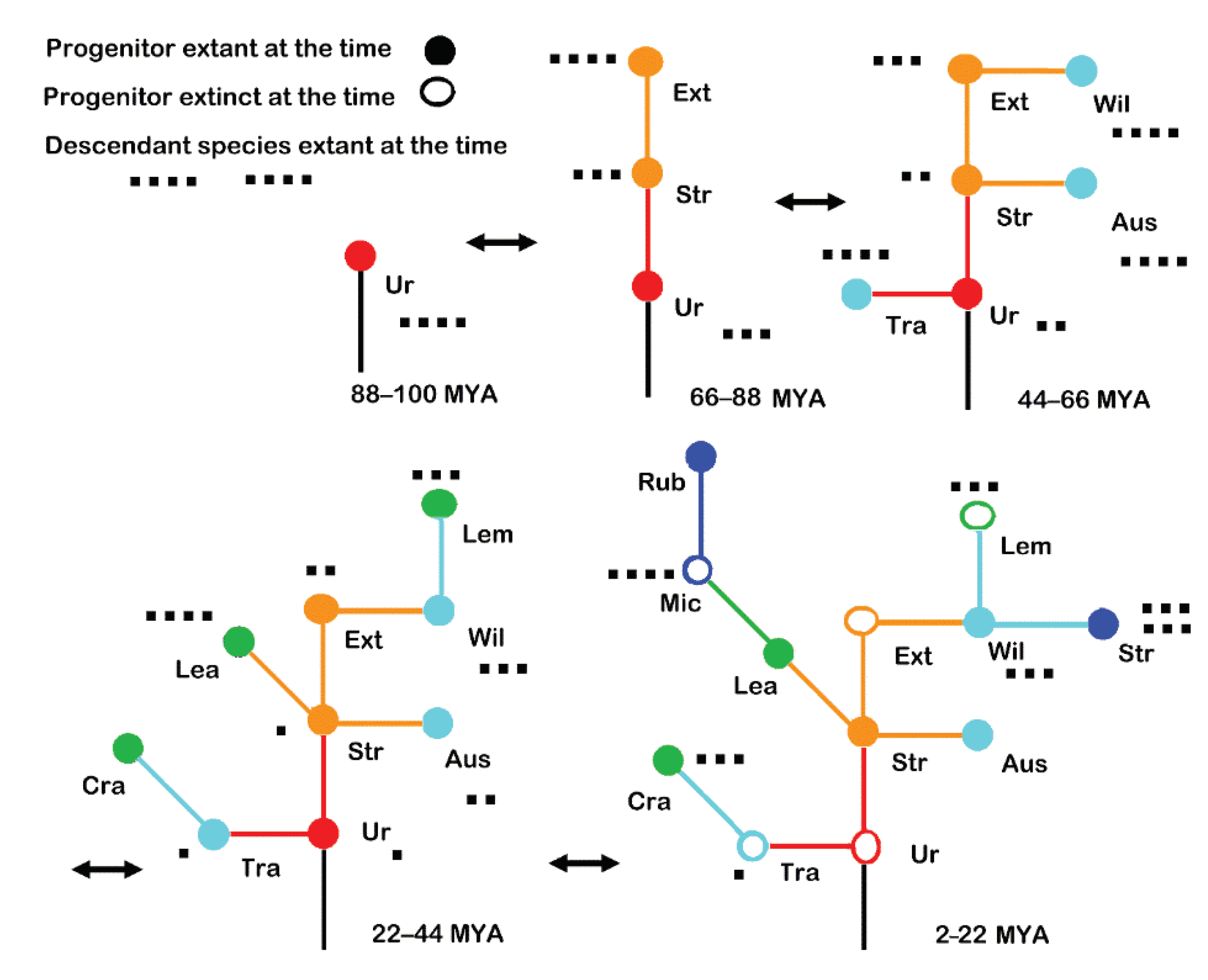
Figure 3.
The four-dimension lineage of the moss family Streptotrichaceae sectioned as five segments at 88, 66, 44, and 22 mya, where 2–22 mya is equivalent to the present. Taxa older than 100 my cannot be spacelike calculated from available sampling. Estimated extinction of species assumes an initial four descendant species. Colors distinguish time segments.
Figure 3.
The four-dimension lineage of the moss family Streptotrichaceae sectioned as five segments at 88, 66, 44, and 22 mya, where 2–22 mya is equivalent to the present. Taxa older than 100 my cannot be spacelike calculated from available sampling. Estimated extinction of species assumes an initial four descendant species. Colors distinguish time segments.
3.3. Calculation Justifications
A spreadsheet was used for calculations. This paper will use Vopson’s [17] formula for the weight of one bit of information, ~ 3.19 × 10–38 kg; in scientific notation, the same is given as 3.19E–38, where E signifies an exponent of 10, that is, a magnitude. Each spacelike calculation of the numbers of species per 22 my time interval in Figure 3 provides the data for calculation of the mass at one instant or observation for each segment, assuming no or gradual change until the next 22 my segment of time. If there are five observations, then we simply sum the number of species as they evolve (originate and disappear) over 100 my, which turns out to be 100 species as total calculated for 100 my (see Figure 2), which implies an average of 20 species per observation (spacelike calculation) for Streptotrichaceae and any number of observations.
3.4. Spacelike Calculations for Streptotrichaceae Lineage
Five segments (Table 1): Every observation reifies the species. For five observations (Figure 3), we have 100 evolving species, with an average of 20 species reified per observation. Each observation is a potentially spacelike calculable slice across time only potentially viewable if we could travel as tachyons and replace the Then with the Now. The extant species in the family Streptotrichaceae average 4.3 bits per species, thus 4.3 times 19 × 10–38 kg mass per bit times 20 species per observation (time segment) times 5 observations is 1.37 × 10⁻³⁵ kg. This is the calculated and therefore reified spacelike informational mass of the lineage from first known origin to present given only five observations or spacelike calculations.
Two-cm diameter: The possible composition of a taxonomic lineage at any one time is dependent on the size of the sample and the distance in light-years across which we are observing. Since bryophytes are small, resolve them each as a sphere with a radius of one centimeter. How many 2 cm diameter spheres are lined up over 100 million light years? One light year is 299,792.458 m/s There are 31,557,500 seconds in a year. One light year is then 9.46 × 1017 cm. For a spherical moss with a diameter of 2 cm, there would be half, or 4.73 × 1017 cm such linear mosses, being the same number of observations possible without overlap in one light year. In 100 light years of existence of the lineage, there would be 4.73 ×10¹⁵ possible observations. Multiplication of average bits per species (4.3), mass of 1 bit, average number of species (20) per segment (any observation at any time is about 20 species), number of observations per light year, and number of light years (100), gives 6.49 ×10⁻¹⁰ kg total potential mass. Sampling throughout time implies the observations of no change in traits or taxa. No change is, however, important in that continued existence through conserved evolutionary momentum is as important as adaptation to exigencies; even no change is information.
Planck length: Well, what is the shortest time interval? Planck time is 5.39 × 10–44 seconds is shortest scientifically meaningful time interval, but the shortest time actually measured is a zeptosecond, or 1.00 × 10⁻²¹ seconds. But it is the length not the time we need for resolution of spacelike calculations.
If two centimeters is the approximate resolution of a moss when sampling for spacelike calculations, what is the maximum resolution possible? The Planck length is 1.6 × 10⁻³⁵ meters. One light year is about 9.46 × 10¹⁵ meters. Dividing one light year in meters by 1 Planck length in meters gives 5.853 × 1050 Planck lengths in one light year.
Continuing calculations, 100 million light years is about 9.461 × 10²³ meters. Dividing by the Planck length in meters yields 5.85 × 10–58 Planck lengths. This is the maximum number of observations possible across 100 my of linear time when sampling for any object, process or system. Multiplying average bits per species, mass of 1 bit, average number of species observed per segment (which is assumed to apply to all observations at any given time), number of observations (Planck lengths) per light year, and number of years yields 1.61 × 10²³ kg as maximum total mass possible for the Streptotrichaceae.
To sum up, the total informational mass of the Streptotrichaceae with a minimal five observations or spacelike calculations is 1.37 × 10⁻³⁵ kg. This is out of a potential maximal informational mass of 1.61 × 10²³ kg. An intermediate value is that of a 2 cm length of observational sampling, 6.49 × 10⁻¹⁰.
3.5. Spacelike Calculations for Pleuroweisieae Lineage
The tribe Pleuroweisieae may be evaluated in the same manner as for Streptotrichaceae for its counterpart as an infoentity (Figure 4 and Figure 5). The data is taken from a structural monophyly study by Zander [3], which provides a caulogram of present-day relationships. The average bits per species is 4.54, there are 79 species, summed over four observations.
As with Streptotrichaceae, the results are summarized in Table 1. Totals are 1.14 × 1.10-35 kg for four segments slicing the timeline of Pleuroweisieae, 4.76 × 10⁻¹⁰ kg for 2 cm diameter spherical moss, and 1.47 × 10²³ kg for an observation every Planck length.
Figure 4.
The moss lineage Pottiaceae tribe Pleuroweisieae with appearance calculated for 22 my segments of past time as a synchronogram. Sold dots are extant generic ancestors; the hollow dot is an extinct ancestor or genus. Numbers of immediate descendant species in addition to the ancestor are given by squares. Colors distinguish sub-lineages. Double-headed arrows indicate the set of four caulograms is a spacelike information construct with no one-way arrow of time.
Figure 4.
The moss lineage Pottiaceae tribe Pleuroweisieae with appearance calculated for 22 my segments of past time as a synchronogram. Sold dots are extant generic ancestors; the hollow dot is an extinct ancestor or genus. Numbers of immediate descendant species in addition to the ancestor are given by squares. Colors distinguish sub-lineages. Double-headed arrows indicate the set of four caulograms is a spacelike information construct with no one-way arrow of time.
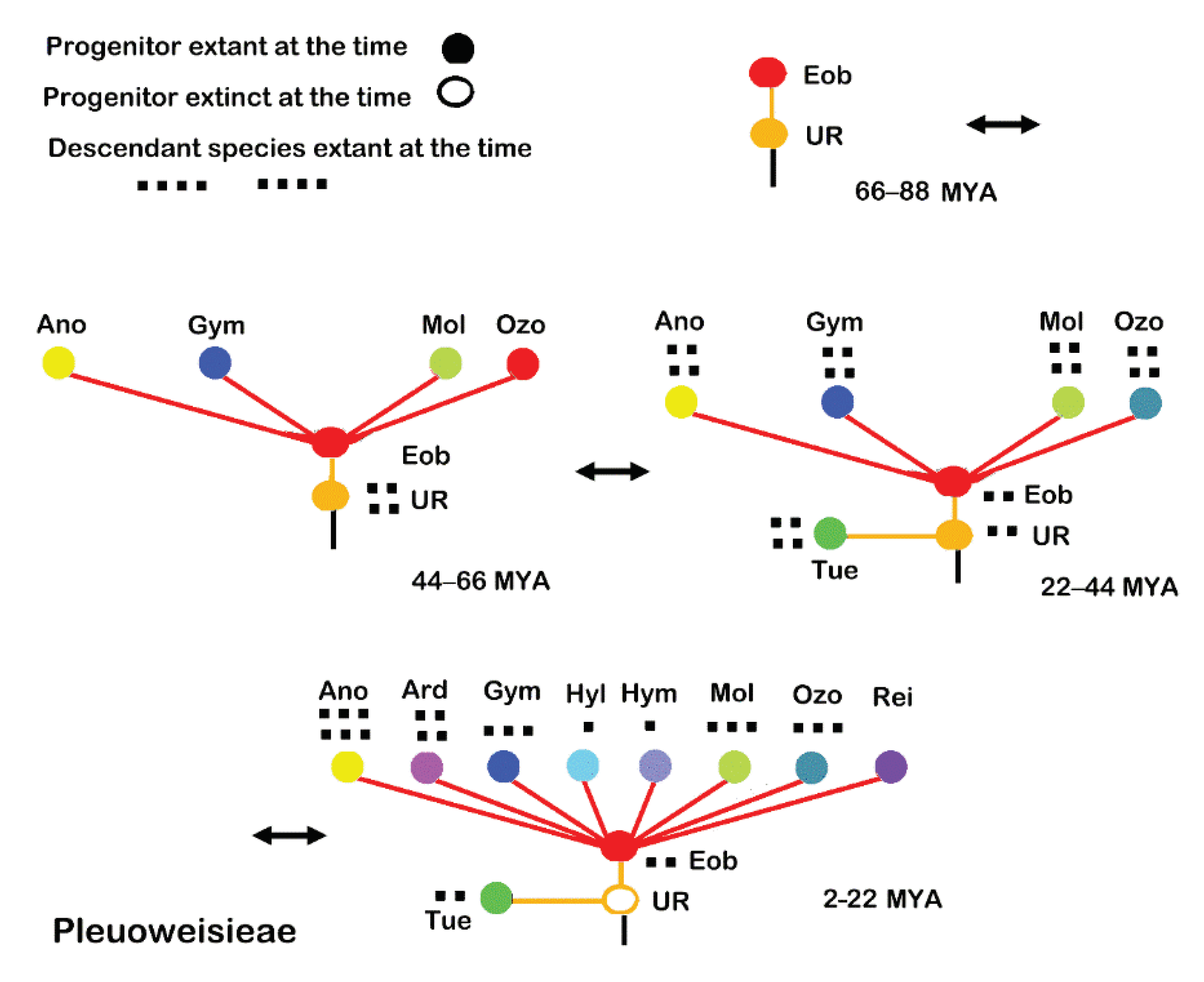
Figure 5.
The four-dimension lineage of the moss Pottiaceae tribe Pleuroweisieae sectioned as five segments at 88, 66, 44, and 22 mya, where 2–22 mya is equivalent to the present. Taxa older than 88 my cannot be spacelike calculated from available sampling. Estimated extinction of species assumes an initial four descendant species.
Figure 5.
The four-dimension lineage of the moss Pottiaceae tribe Pleuroweisieae sectioned as five segments at 88, 66, 44, and 22 mya, where 2–22 mya is equivalent to the present. Taxa older than 88 my cannot be spacelike calculated from available sampling. Estimated extinction of species assumes an initial four descendant species.
3.6. Tabulated Results
We now have the possibility of calculating, spacelike, interactions of discrete informational processes or systems in the past, perhaps even projecting such into the future. Ideally, after calculating the extent and composition of an infoentity’s past, simply double the extent to estimate its total past plus future existence. The composition of a future portion of an infoentity is determined with the opposite of analysis of its past. Of course, it is not so simple. The models of past expressions of one informational system shown in Figure 2 are a beginning. The desire to address a mass easily measured by humans, such as one kilogram, is based on an expectation that human-measured objects or processes will interact with the mass of a lineage. Such interactions would necessarily be between “real,” solid, palpable objects or fields and the minute mass of information. On the other hand, actual, possible interactions between two elements of informational models similar in size may be calculated spacelike without comparing the effects of huge and tiny masses. Comparison of the masses of different lineages offers an equitable solution.
Comparison of mass of lineages depends on the number of spacelike observations. The informational mass of Streptotrichaceae is observed by spacelike calculation with five observations (lineage in five segments), by many observations at 2 cm resolution, and by maximum number of observations at Planck length. Total mass in kg was obtained by multiplying average bits per species, mass of 1 bit, average number of species per observation, number of observations per light year, and number of historical years.
Given that informational mass is still somewhat speculative, the fallback measure for comparison is simply the number of observations of bits throughout the span of historical time, assuming that observation probabilistically reifies the event, even if only as a calculation extrapolating from the present. Total bits observed for the time period may be couched (Table 1, last column) as units of scientific extrapolation of historical reality, or “reals.” Any attenuation of accuracy is due to probabilistic limits on that extrapolation, not on diminution of signal as light expands spherically, because observers at both ends of a line of observations or spacelike calculations see at the same resolution. The calculation using Planck length seems to be the upper limit on potential observations and depends on an expected convergence to some one value approximated by the initial sampling of four or five segments of calculated evolutionary events based on present day distribution of species and trait changes.
Table 1 presents the results of estimating the total mass of information in kilograms of the infoentities Streptotrichaceae and Pottiaceae tribe Pleuroweisieae. The former taxon is a recent segregate of the Pottiaceae. Figure 2, Figure 3, Figure 4 and Figure 5 show the composition of these lineages at the present and a few earlier sections through time. The four and five segments calculated for relationships and composition provide an adequate estimate of the composition of each entire lineage whether much or little sampled, such that bits per species and average number of species observed in a segment are transferable to various numbers of observations (sections through the space-time corpus of the lineage, as in Figure 2 and Figure 4).
Although information is spreading from an event as an expanding sphere, the mass observed is of linear bits moving through time. Because the information is identical in all directions, and any observation is an equivalent Now, calculations of mass of an informational sphere seem supererogatory. We will use radii for calculations (see Discussion).
Figure 2, Figure 3, Figure 4 and Figure 5 summarize the results of spacelike calculation of past configurations of probable lineage compositions and relationships for the known existence of the Streptotrichaceae and Pleuroweisieae. The segmentation of the timeline into 22 my durations is a best attempt to capture changes in lineages at the expected rate of origination of new genera, 22 my, given analysis in previous papers [2,8,24]. The two most recent segments have the most species extant, balancing origination and extinction, while extinction gradually overtops origination in the more ancient segments. The caulograms (Figure 2 and Figure 4) are conceptual sections through lengths of twisted and branching strands (world lines) of genera surviving through time. The concept of fourth dimensional ropes of 2-sigma-wide probabilistic 2-sigma exclusion strands treated as taxa may profitably be addressed in the future through analysis as topological fiber bundles [25] that map timelike events to spacelike calculations.
The results of the study of the mass of informational counterparts of the two lineages are summarized in Table 1. Given the data and Vopson’s [17] estimate of the mass of 1 bit of information, the total mass of each lineage infoentity is given for samples of 100 or 88 my at five or four segments (that is, five or four observations), also for segments only two cm wide (as many observations as there are two cm lengths in 100 or 88 light years), and also for maximum number of segments at Planck’s length (as many such lengths as there are in 100 or 88 light years). The values obtained are very similar in both lineages, probably because of (1) the lineages are of similar size in numbers of species, and (2) the Rule of Four obtains for both lineages, constraining the number of bits per species (new traits per speciation) and optimum numbers of immediate descendant species per genus.
The inferred but to date undemonstrated dark matter apparently makes up 80% of the universe’s matter and theoretically provides the gravity that keeps galaxies from flying apart. Of some significance is that Vopson’s [17] estimation of the mass of one bit of information at room temperature is 3.19 × 10–38 kg. This is two magnitudes larger than the maximum estimated [26] mass of the unit of cold (cosmic microwave background temperature) dark matter, the QCD axion, the range of which is 40 to180 µeV (microelectronvolts), or 7.13 × 10–41 to 3.21 × 10–40 kg. However, a bit at similar cold temperature has less mass, about 2.91 × 10–40 kg.
The close match of an informational bit and the conjectural axion was suggested by Gasparini [27] and Vopson [18] as evidence in support of the idea that there is a mathematical bridge between cosmology and information theory, that dark matter is actually a physical expression of information. Vopson’s simulation theory fits well with the present suggestion that historical events are made real or scientifically valid by their estimation or calculation from available present-day information. If there is indeed some correspondence with informational mass and dark matter, then the present taxonomic paper contributes to the study of cosmology and the role of life as an information generator.
The results of the present, somewhat speculative exercise show that the Streptotrichaceae and Pleuroweisieae have similar informational masses even when measured at different levels of sampling. The number of bits per species is about the same, following the Rule of Four, while the number of immediate descendants per species is similar (although spacelike calculations in part assume this). The Streptotrichaceae lineage goes back in time somewhat farther (100 my) than the Pleuroweisieae (88 my).
The Streptotrichaceae and Pleuroweisieae reified with 5 and 4 observations respectively have an informational mass of 1.36 × 10⁻³⁵ and 1.14 × 10⁻³⁵ kg, respectively. This size is little more than the Planck length of 3.13 × 10-38 and is scarcely comparable in mass to any natural object.
The Streptotrichaceae and Pleuroweisieae reified with one observation per 2 cm (diameter of a “spherical moss”) have an informational mass of 6.49 × 10⁻¹⁰ and 4.76 × 10⁻¹⁰ kg, respectively. This is 0.649 micrograms, about the mass of a dust mite, which is 1–5 × 10⁻¹⁰ kg.
The Streptotrichaceae and Pleuroweisieae reified with one observation per Planck length (smallest distance in theory and therefore the most observations possible) have an informational mass of 1.61 × 10²³ and 1.47 × 10²³ kg, respectively. This value is about the mass of Jupiter’s moon Ganymede at 1.48 × 10²³ kg, or Mercury at 3.3 × 10²³ kg.
The Streptotrichaceae generated a calculated 100 species over 100 my, while the Pleuroweisieae generated 79 over 88 my, thus the two taxonomic groups generated species at nearly the same rate over 88 to 100 my.
The average numbers of traits per species in both lineages are nearly the same. The mass results are comparable with the values of resilience for the two lineages obtained by equating resilience with their evolutionary force. Formulae of classical mechanics were used in a previous paper [22] to express numbers of species as mass, and numbers of traits (as informational bits) as velocity. Cumulative numbers of traits of extant species along internal paths of lineages were viewed as evolutionary acceleration or force (F = MA). Streptotrichaceae had total resilience of 756 bits, averaging 22.9 bits of new traits per speciation event, while Pleuroweisieae had a total of 869 bits, averaging 24.1 bits per speciation event. The proportions of informational mass of Streptotrichaceae to Pleuroweisieae are about 7:5, while for resilience, it is about 9:10. One can state that evaluations of resilience (as F = MA) match well with similarity of informational mass in the two lineages studied.
Infoentities such as Streptotrichaceae and Pleuroweisieae are living systems extant when viewed as coherent through time. They have agency, the ability to act by imposing information-driven guidelines and processes for consistent and effective interactions with environments changing over millions of years. Each infoentity is a functioning part of an ecosystem contributing to a global ecosphere, where fractal self-similarity is the ultimate shared endeavor.
4. Discussion
4.1. The Common Now Concept
It is possible to interpret elements of the biological historical sciences with concepts and techniques of classical mechanics, information science, and cosmology. The present author is a botanist, not a fully trained physicist or information scientist, but it is evident that a multidisciplinary approach is needed for continued advancement of evolutionary taxonomy. This paper is a first step in presenting a unitary perspective on biological lineages as very large living information-generating systems across the fourth dimension of time.
Time is here conceived as a linear scale, traversed by potentially massive organisms originating as one species, then developing rapidly as small, related groups of species (microgenera) sharing a set of recent adaptive traits, expanding haphazardly beyond four immediate descendants as fractal evolutionary noise, then gradually undergoing extinction.
A Rule of Four possibly associated with crowding and resource availability constrains both the number of immediate descendant species to about four, with about four newly evolved traits each. This is a process creating order in structural monophyly, with about five species per microgenus. One species of a microgenus generates about four immediate descendants of the next genus, ending up with five species sharing the originating species’ novel traits. A genus of five species is an emergent result. This is a fractal process with a dimension of ln5/ln4, which is related to the Pareto law of 20% of one process generating 80% of a different process [28]. The Pareto Fractal Dimension of 1.161 (that is, ln5/ln4) is in the “sweet spot” for “pink noise” associated with emergent, self-similar processes in nature [9].
Knowledge of events in history, such as events in evolutionary history, is restricted by the speed of light, the maximum rate of propagation of information. Knowing what is happening in one’s own Now (proper time) at a distant star requires exceeding the speed of light. We see only what is happening at the Then of many light years ago. Calculation of where the star is now (its future at a specific time) may be done to approximate the Now of Then by the techniques of astrometry sampling motion in a distant Then across a short time and calculating an extension of the trajectory to a time in its future equivalent to an observer’s Now.
Turn about is fair play: Observers on the far star see only our Then when they observe our star but can also do spacelike calculations. So, replacing the Then of somewhere else with one’s Now goes both ways. Yes, if we could travel at spacelike speeds (faster than light) we could replace our Now with their Now, as a paradox of time-travel. Because we are able to switch, even if only through calculations, the Then and Now in both directions of time, the span of time is here considered linear and not affected by the attenuating expansion of information-carrying light as an expanding sphere. If we can predict with the same degree of accuracy as well as we can retrodict the evolutionary composition and relationships of the past of a lineage, perhaps we can predict its future, doubling our estimates of informational mass.
The two methods of measuring the Hubble constant for the expanding universe are (1) a “local ladder” involving the predictable velocities of “standard candles” and (2) alternatively measuring the state of the early universe (from cosmic background energy) and extrapolating it forward—contemplating these two methods involves a similar switch of Nows and Thens in time, these methods being different means converging over many measurements to similar results of around 70 for the Hubble constant [29]. If calculation can indeed determine any Then as a reified Now at some local resolution, then we can postulate a calculable, common Now, akin to Mach’s reference frame for local inertia.
Also, if a calculation is a substitute for a spacelike calculation of a Now, then the calculation’s observation reifies the evolutionary composition and relationships modeled, where reifying means treating the observed historical events as valid data in the same way we treat similarly observed present-day events in science. One can only “weigh” the information when one observes it, like Schrödinger’s cat.
More speculatively, our Now could be the Then of some future observer. Are we reified because some future observer has observed us through spacelike calculations? Is this a possible process for generating a digital universe or Matrix? If simple observation is intrinsic to quantum processes, then the sort of superposition of Then and Now postulated here must be taken seriously given the similarity of non-locality in spacelike calculations. Note that the informational wave front is not presented here as a probabilistic wave of non-locality although observation reifies, as information, an event coded into the wave front. There is no wave collapse, simply a recording through observation of what is there.
One might call this the Common Now theory of time, somewhat like Block Theory only with a greater dynamic. The Common Now is the demonstrable (by inference) time-stuttered serial multiverse of observable events that is reified—made sufficiently probable to act on—by calculable observation.
A paper by Corominas-Murtra et al. [30] concluded that an open-ended, many-scaled evolutionary universe must increase in complexity, and this process necessarily erases information. If the kind of limited superposition suggested here by switching Nows and Thens operationally by switching observation coigns or standpoints, actually operates, then information at least at a particular resolution is not lost. Only relicts of past events actually travel through time and may fade, but information does neither.
The literature includes many works on the nature of information and time. Given that the present paper is multidisciplinary and intended for biologists unfamiliar with higher mathematics, concepts are emphasized here over formal proofs. Scientific attempts to explain time and reality are reviewed by S. Carroll [31], who summarizes the multiverse concept, which is most similar to the present paper’s Common Now theory. Two of the most readable and relevant “concept papers” minimizing recondite mathematics are The Day the Universe Changed by J. Burke [32]) and On the Origin of Time by T. Hertog [33]. Burke demonstrated exhaustively that perception of reality and generation of scientific theory depends on subjective factors like education and reasoned interpretation of the relationships of sampled events. He also suggested without emphasis that an observation-based change in a particular view of scientific knowledge changes reality or at least the structure of reality. His leap from observation to reality change is rapid and unsubstantiated although anecdotally well clothed.
Hertog [33] reviewed the “final theory of Stephen Hawking” summarizing for the scientifically inclined lay public essential details of a holographic quantum universe in which time is not necessary for apprehension of events, and following the quantum concept that observation changes the past. The science is apparently well founded though formally presented mathematically in other publications. With all three authors, time and reality take a beating.
More basic to the present paper but less focused on the role of time are the seminal theories of J. Wheeler [34,35] on information and matter, as in his axiomatic “it from bit.” Wheeler calculated the number of bits in the universe as 8 × 1088, quite near the aforementioned estimate of the number of axions, 1 × 1090. He pointed out that particles of a particular wave length traveling through space undergo a calculable transverse spread that limits the length of a worldline, but did not discuss a possible boosting of signal by spacelike calculators in a Common Now. Wheeler asked, “Will we someday understand time and space and all the other features that distinguish physics—and existence itself—as the similarly self-generated organs of a self-synthesized information system?” This was prescient and relevant.
The Common Now concept of the present paper, however, does agree with Hertog’s [33], p. 198 discussion of a “top-down” cosmology: one examines data in the present, constructs histories of the universe that end with present-day observations, then combines these histories to create the past. The present work differs in that Hertog asserts that this makes the anthropic principle obsolete.
4.2. Magnitudes of Distribution
The numbers mentioned above are often very large or small and the substantiated have been concisely reviewed [31,36]. To provide comparison, there are an estimated 1082 atoms in the universe. The number of atoms in a gram of hydrogen (Avogadro’s number) is 1023. The number of stars in an average galaxy is 1011, and of galaxies in the observable universe is also about 1011. The size of a proton is 10-13 cm with a mass of 10-24 grams. The size of the observable universe is about 1028 cm. There are about 1 × 1080 fundamental particles in it. The mass of ordinary matter in the observable universe is about 1.5 × 1053 kg, and dark matter outweighs ordinary matter 6:1. The range mentioned here stretches across more than 100 magnitudes.
If dark matter consists of axions, there would be an estimated 1090 axions in the observable universe. Calculation of the number of axions in the observable universe is as follows: total dark matter mass is about 1054 kg; estimated axion mass is about 10-36 kg; total particles is mass divided by single particle mass, which is 1090 axions or bits if one axion massed one bit. This is the limit, apparently, for information based on observations assuming one axion represented one bit of information by mass.
If axions were homogeneously distributed in a spherical cluster, and 1090 is the number of axions at present time and taken as volume, then the radius is a measure of an average linear series or depth in the axion cluster. The volume of a sphere is V= 4/3 π r3. Solving for radius, r = 6.20 × 1029 linear axions. Since we are viewing time as a linear series of bit-measured events and assuming one axion per bit, we can get the number of lineages of the size of the Streptotrichaceae that will fit into this average length of possible time measured in axions. One lineage of Streptotrichaceae with 2 cm diameter mosses at 2.03 × 1028 total observed bits is just a little smaller than this length. (We are not using distance or time for comparative measures, instead we are using informational bits.)
The measurement for Streptotrichaceae using observations at Planck length is far too large (4.62 × 1060 bits). When measured at 5 segments (4.3 × 102 bits), one can fit 1.41 × 1027 lineages of the informational size of the Streptotrichaceae into the average linear length of axions, rather too many to be significant. The best fit into available axions for a single lineage of 20 species viewed across 100 my of time is that of a series of observations at 2 cm lengths, 2.03 × 1028 bits. This assumes that a single lineage in spacelike calculation is a unique line of information through axion space with the observable universe of different scales for each class of information.
4.3. A Final Surmise
It is possible that spacelike calculations can be transmitted intact for immense distances. Consider sampling by observation the movement of a star at 100 million light years distance, and spacelike calculating its probabilistic present position and trajectory. If an observer farther away in the opposite direction can learn your calculations, the information as signal is “boosted” without (much) loss, ditto for an observer even farther. Without exceeding the speed of light, spacelike information can be passed quite far. Hypothetically, manipulating a variable star could encode microcosmic details of its nearby Now and send it to us, thus, given perfect transmission, there is no distance-based limit to observational resolution, just power and time of transmission—the same result could obtain from a series of booster observers, given perfect observations and hand-offs equivalent to an unopened letter transmitted by a series of mail carriers.
This is what happens, theoretically, in a lineage. The generation of each genus transmits a four-part redundancy of a set of traits, the novel traits of the ancestor (the immediate ancestron). The set of novel traits of the most basal ancestor (the oldest surviving species) in a lineage comprise the most critically important survival traits for the lineage and is packaged into the complete genome as are the basalmost traits of all branches. New traits are new character states modified from older characters of less survival importance. Given that most species are only about four characters different from their immediate ancestor in evolutionary change, all important character states remain expressed in some one or more species on a lineage [1].
What this comes down to, paralleling any other spacelike transmission of information, is that events of long ago determine events of the present—they reify them, while events of the near-present determine, through spacelike calculation, events of the past, as we treat such calculations as actionable facts. Causation in information is two-way; calculations homogenize causality. This is the nub of the Extended Anthropic Principle—events as information are so interconnected in time that they cause each other by common existence. Reification of information is powered by natural selection both forward and backward in time. We reinterpret the flow of time as reversible flows of information that stitch together massive information-based natural processes. Evolvability processes of Rule of Four and Pareto Fractal Dimension is the sabot protecting this flow. Observation is equivalent to communication by creating that to which the communication is directed. We time travel every time we predict an event from good information.
The Extended Anthropic Principle applies to the ancient query about causation: what came first, the egg or the chicken? Clearly, the chicken mutation was first in the egg, yet the chicken egg was fixed as the species by differential survival of the chicken. The information on the chicken in the egg melds perfectly with the information on the egg in the chicken, simultaneously as a spacelike calculation accomplished by natural selection mediated by the Rule of Four and Pareto Fractal Dimension (plus all the other discovered rules of evolution associated with species rather than microgenera). The timelike calculation is egg → chicken, the spacelike calculation is egg ↔ chicken, as in Figure 2 and Figure 4.
If the presence of axions as dark matter requires sapient observers to generate information, then dark matter implies alien observers in other galaxies. This is an extended version of the heretofore human-centric Anthropic Principle. Thus, one can posit more hypothetically than merely speculatively that far galaxies do not fly apart because of the mass of information generated in and around them by resident life forms. These life forms do not have to be particularly sapient to generate information after capturing and storing events, given that any instrument that can do so will decohere a quantum entanglement, a phenomenon similar to the observation/event duality.
A biological lineage is a massive self-sustaining homeostatic system that “can count up to four” to activate the Rule of Four optimizing its two-sigma uncertainty path exclusion and is well capable of existing and evolving over millions of years under conditions of competition and environmental exigencies. This simulates abstract thought sufficiently to generate, store and act upon information as bits or axions. It is the capturing and storing of information, especially by the efficient DNA process, that is instrumental in creating infoentities. This explanation does not promote a recrudescence of vitalism, instead, the sustaining force for a lineage is entirely mechanical and powered by natural selection. It is perhaps bewildering for scientists to read that investigation of structural monophyly of a taxonomic moss lineage should provide, however tangentially, evidence that we are not alone. Given the possibility of having measurable mass, an informational entity is an intellectual concept with a life of its own, an egregore, most impressively with a physical footprint.
If an observer is necessarily built into a homeostatic, self-reproducing system for its regulation, then organic life is not necessary for generation of information. If the Background Cosmic Energy phenomenon is a left over from individuation and ordered segregation of celestial objects in the early universe, then dark matter may be the Foreground Cosmic Mass left over from generation of information by spacelike processes dealing with matter expanding beyond any constraint. The physical strata in the “record of the rocks” as information on past events may seem to lack life’s ability to sustain and evolve by often simple spacelike calculations yet celestial objects are similar to each other and have the same substance arranged in calculable ways. The universe has lasted billions of years in well-organized evolution by sequential processes. As contributor to dark matter, life may be a late-comer.
In addition, if the mass of dark matter is a sphere, and lineage lines (and any other lengthy similar system) radiate, then a center is implied as where the radii all meet. The length through time of a lineage or any other spacelike calculated informational system is measured in linear bits. The implied center may not have been reified by some initial Observer but, less mystically, may have been reified by the Commonality of Observers throughout time in the Common Now. In other words, intrinsic reification of an informational sphere necessarily reifies the primal Information Bang as counterpart to the physical Big Bang.
The fact that this speculation along the lines of scientific inference is at all possible is evidence that the concept of a Common Now sustained by spacelike calculations of stored information is worth pursuing.
5. Conclusions
Basically, light speed and observers are complimentary—only observers can timelike detect light speed and look back in time, without light speed there are no spacelike calculations. The Rule of Four ensures the existence of the two-sigma wide path cleared of uncertainly for a lineage through time; the Pareto Fractal Dimension enforces a time-stable connection between genera; and, since living lineages as the most massive self-organized, self-sustaining, homeostatic, replicating, responsive and evolving systems in the universe, they should generate through time a gargantuan weight of information in their infoentity counterparts. The present study of informational mass in two bryophyte lineages requires a theory of historical reality and time.
Carroll [4] presents time largely in the standard Everett multiverse concept, clarifying that there are actually no multiple worlds involved, but multiple entanglements plus interference between entanglements that limits superposition. Burke waves time away with massive overall changes in the result and reality of historical processes as a kind of magical solipsism. Herzog, after Hawking, conceives of time as a side effect of holographic entanglement, and hides it among the paradoxes of superposition.
In the present paper, time is not hidden and is linear, but events are determined by observation as spacelike calculations. Spacelike calculations are not only justified cosmologically but also are effective in resolving power in near time and near space, for instance, because of the difference in light speed in different media (e.g. bending of light path in water), and, farther afield, calculating the future position of Mars for a spaceflight from Earth from observations anywhere potentially as far away as 400 million km (250 million miles). Consider an observer on Mars and one on Earth. Both can calculate where the other planet is in a shared Now, even though they are a few minutes behind time in their respective light cones. The same goes for observers on two stars calculating the probable positions of the other star through astrometry. They all share a calculable Now as a probabilistic fact derived from samples of what they see. This is like the Bob and Alice pairs in quantum mechanics examples, but the difference is that a shared Now can be spacelike calculated.
In fact, any information-carrying vehicle such as sound (e.g., where is the noisy, fast helicopter?) can be tapped for its information by spacelike calculations including logistic regression. Observation is postulated, as in many-worlds theory, as historical reification, here based on the potential of switching light-speed mediated observation of Thens and Nows for estimation of spacelike events. Because all observers can calculate the spacelike Nows of all other observers, time does exist with events most accurately and probabilistically viewed through better sampling by the closer observer, e.g. calculating the future (the Now as its future) position of Mars versus calculating the future position of a star.
All Nows can be space-like calculated at the degree of accuracy provided by the sampling by the observer, in a manner similar to that of the many-paths theory of R. Feynman. The basic unit of spacelike calculation is the Real, equivalent to one observation of one informational bit. Most saliently, the present paper differs from the Carroll, Burke, Hertog, and Wheeler expositions in actually using theory to retrodict a historical, evolutionary series of events across 100 million years of the Common Now.
Wigner [37] published a celebrated paper on “The unreasonable effectiveness of mathematics in the natural sciences.” Given that all calculations (all inferences, digital or analog) are spacelike excepting that made in the one fleeting moment of Planck time you happen to be in. Nearly all observations and estimates of the near present, past, and future are reified by such calculation. Scientific reality is not trust in that which is “out there,” it is trust in that which is “out then.” This is why mathematics is apparently unreasonably effective; it is in fact our only stable and reliable access to scientific reality.
Actual experiments with quantum entanglements [38] have found no evidence of non-local time travel. On the other hand, any spacelike calculation, such as sequential Bayes plus Rule of Four and Pareto Fractal Dimension, is an observation of the past based on relicts in the present. Calculating the present (proper time) position of astral objects is a spacelike calculation of its future. Informality, as the realm of information, is where time travel, in both directions, is possible. Prediction of the fate of lineages, adapting techniques of astrometry, is the subject of a planned paper. The power of an information wave front decays as the square root of distance from the source, but spacelike calculation of the information in the wave front is only limited by whatever observable relicts are present to the calculator.
There are an estimated 25 million species on Earth. Estimating about 25 species per lineages composed of minimally monophyletic groups, then there are one million lineages. If lineages indeed support informational counterparts with mass, then the Earth, given Planck length observations, has generated about one million Ganymede-masses in any one direction of information flow. Less startling is the measure of 2 cm as observation, resulting in a mass of a million dust mites, or 1–5 × 10⁻⁴ kg. One million lineages with each expressing up to 100 million years of information yield 100 trillion years of information (including redundancy) observable for Earth’s known past, present, and future modern forms of biodiversity. It is the task of evolutionary systematics to reveal and summarize the useful features and processes associated with the generation of this information.
“Calculation” here includes any scientific inference by deduction, induction or abduction, digital or analog, by anyone or any thing. The development of the processes used to calculate spacelike reality and reifying them as probabilistic facts is or should be a major aim of science. I defend the minimization of mathematics in this multidisciplinary paper. The concepts are actually clear if much moot—as presented by Burke, Carroll, Hertog, Wheeler, Wigner, and others. A relevant paper on discrete time physics [39], however, provides a mathematical context. Similar mathematical exposition of informational time is given by Neukart [40], who reinterpreted proper time as accumulated informational distance.
The general concept of life composed of informational fibers extending through time is not new. It has even been novelized, e.g. by G. Bear [41], p. 300: “We are not so much made by a creator as deduced.” What is new here is the concept of an informational realm devised by spacelike calculations inhabited by scientifically real entities. The informational counterparts of biological lineages are the largest self-sustaining, homeostatic living systems when viewed through time. They are sustained over millions of years by processes operating above the species level. The existence of evolutionary processes active above the local population level was suggested by Goold and Eldredge [42,43] in 1977, and the Rule of Four and Pareto Fractal Dimension are apparently now among them. As in Schrödinger’s metaphor, infoentities modeled by synchronograms feed on negentropy and excrete entropy, that is, import Gibbs free energy available for work, and export heat and otherwise disperse energy. They may be responsible for dark matter. High-resolution phylogenetic analysis using principles of physics on structural monophyly have more clearly delineated such enormous entities. I invite colleagues to embark on an adventure in time and space.
Funding
This research received no external funding.
Institutional Review Board Statement
Not applicable.
Informed Consent Statement
Not applicable.
Data Availability Statement
All relevant data are included in the text.
Acknowledgments
The author acknowledges the continuing support of the Missouri Botanical Garden for research in bryology and theoretical evolutionary systematics.
Conflicts of Interest
The author declares no conflicts of interest.
References
- Zander, R.H. Lineages of fractal genera comprise the 88-million-year steel evolutionary spine of the ecosphere. Plants 2024, 1559, 1–12. [Google Scholar] [CrossRef] [PubMed]
- Zander, R.H. Fractal Evolution, Complexity and Systematics; Zetetic Publications: St. Louis, MI, USA, 2023; pp. 1–151. [Google Scholar]
- Zander, R.H. Minimally monophyletic genera are the cast-iron building blocks of evolution. Ukrain. Bot. J. 2024, 81, 128–140. [Google Scholar] [CrossRef]
- Carroll, S. The Biggest Ideas in the Universe: Space, Time and Motion; Dutton: New York, 2022. [Google Scholar]
- Dupré, J.; Leonelli, S. Process epistemology in the COVID-19 era: rethinking the research process to avoid dangerous forms of reification. Eur. J. Phil. Sci. 2022, 12(20), 1–22. [Google Scholar] [CrossRef]
- Wolpert, D.H. What computer science has to say about the simulation hypothesis. J. Phys. Complex. 2025, 6, 045010. [Google Scholar] [CrossRef]
- Faizal, M.; Krauss, L.M.; Shabir, A.; Marino, F. The consequences of undecidability in physics on the Theory of Everything. also https://doi.org/10.48550/arXiv.2507.22950. J. Holog. Appl. Phys. 2025, 5(2), 10–21. [Google Scholar] [CrossRef]
- Zander, R.H. Structural Monophyly Abstractions-2. Res Botanica Technical Report 2025, 2025-12-20, 1–14. [Google Scholar] [CrossRef]
- Ross, S.N. Fractal transition steps to fractal stages: The dynamics of evolution, II. World Futures 2008, 64, 361–374. [Google Scholar] [CrossRef]
- Solé, R.; Kempes, C.P.; Corominas-Murtra, B.; De Domenico, M.; Kolchinsky, A.; Lachmann, M.; Libby, E.; Saavedra, S.; Smith, E.; Wolpert, D. Fundamental constraints to the logic of living systems. Interface Focu 2024, 14(5), 20240010. [Google Scholar] [CrossRef]
- Chowdhury, D.C.; Stauffe. r D. Evolutionary ecology in-silico: Does mathematical modelling help in understanding the “generic” trends? J. Biosci. 2005, 30(2), 277–287. [Google Scholar]
- Ben-Naim, E.; Krapivsky, P.L. Chronological rank in biological evolution. also https://doi.org/10.48550/arXiv.q-bio/0508023. J. Stat. Mech.: Theory and Experim. 2005, 2005(10002), 1–4. [Google Scholar] [CrossRef]
- Zang, C.; Cui, P.; Zhu, W.; Wang, F. Dynamical origins of distribution functions; KDD ’19, August 4–8, 2019: Anchorage, AK USA, 2019; pp. 469–478. [Google Scholar] [CrossRef]
- Landauer, R. Information is physical. Phys. Today 1991, 44, 23–29. [Google Scholar] [CrossRef]
- Landauer, R. The physical nature of the information. Phys. Lett. A 1996, 217, 188–193. [Google Scholar] [CrossRef]
- Landauer, R. Information is a physical entity. Phys. Stat. Mech. Its Appl. 1999, 263, 63–67. [Google Scholar] [CrossRef]
- Vopson, M.M. The mass-energy-information equivalence principle. AIP Advances 2019, 9, 095206. [Google Scholar] [CrossRef]
- Vopson, M.M. Estimation of the information contained in the visible matter of the universe. AIP Advances 2021, 11(10), 105317. [Google Scholar] [CrossRef]
- Vopson, M.M. Second law of information dynamics. AIP Advances 2022, 12, 075310. [Google Scholar] [CrossRef]
- Burgin, M.; Mikkilineni, R. Is information physical and does it have mass? Information 2022, 13(11), 540. [Google Scholar] [CrossRef]
- Lairez, D. On the supposed mass of entropy and that of information. Entropy 2024, 26, 337. [Google Scholar] [CrossRef]
- Zander, R.H. Biodiversity stability in terms of evolutionary mass, velocity and force. Sustainability 2025, 17(18), 8272. [Google Scholar] [CrossRef]
- Hazen, R.M.; Griffin, P.L.; Carothers, J.M.; Szostak, J.W. Functional information and the emergence of biocomplexity. PNAS 2007, 10, 8574–8581. [Google Scholar] [CrossRef]
- Zander, R.H. On the origin of taxa. J. Theor. Phys. Math. Res. 2025, 3, 1–20. [Google Scholar] [CrossRef]
- Adhikari, M.R. Basic Topology: Algebraic Topology and Topology of Fiber Bundles; Springer Nature: Singapore, 2022. [Google Scholar]
- Benabou, J.N.; Buschmann, M.; Foster, J.W.; Safdi, B.R. Axion mass prediction from adaptive mesh refinement cosmological lattice simulations. Phys. Rev. Lett. 2025, 134(241003), 1–10. [Google Scholar] [CrossRef] [PubMed]
- Gasparini, A. Testable theory suggests information has mass and could account for universe’s dark matter. Scilight 2019, 2019, 360004. [Google Scholar] [CrossRef]
- Jin, Y.; Gruna, R.; Sendhoff, B. Pareto analysis of evolutionary an learning systems. also http://dx.doi.org/10.1007/s11704-009-0004-8. Front. Comp. Sci. China 2009, 3(1), 4–17. [Google Scholar] [CrossRef]
- Freedman, W.; Madore, B.F. Progress in direct measurements of the Hubble Constant ArXiv:2309.05618v2 [astro-ph.CO]. 2023, Pp. 1–28. [Google Scholar]
- Corominas-Murtra, B.; Seoane, L.F.; Solé, R. Zipf ’s Law, unbounded complexity and open-ended evolution. J. Roy. Soc. Interface 2018, 15, 20180395. [Google Scholar] [CrossRef]
- Carroll, S. From Eternity to Here: The Quest for the Ultimate Theory of Tim; Oneworld Books: Oxford, UK, 2011. [Google Scholar]
- Burke, J. The Day the Universe Changed; Little, Brown and Company, New York, 1985. [Google Scholar]
- Hertog, T. On the Origin of Time: Bantam Books, New York; 2023. [Google Scholar]
- Wheeler, J.A. Information, physics, quantum: The search for links. Proc. Int. Symp. Fourndations of Quantum Mechanics, Tokyo, 1989; pp. 354–368. [Google Scholar]
- Wheeler, J.A. Geons, Black Holes, and Quantum Foam: A Life in Physics; Norton & Company, New York, 2000. [Google Scholar]
- Mastin, L. Early Modern World. 2009. Available online: https://www.physicsoftheuniverse.com/numbers.html (accessed on 26 December 2025).
- Wigner, E. The unreasonable effectiveness of mathematics in the natural sciences. Communications in Pure and Applied Sciences 1960, 13, 1–14. [Google Scholar]
- Cramer, J.G.; Herbert, N. An inquiry into the possibility of nonlocal quantum communication. arXiv 2014, arXiv:1409.5098v2, 1–13. [Google Scholar] [CrossRef]
- Riek, R.; Chatterjee, A. Causality in discrete time physics derived from Maupertuis reduced action principle. Entropy 2021, 23(1212), 1–8. [Google Scholar] [CrossRef]
- Neukart, F. The geometry and flow of informational time. Universe 2025, 12(2), 1–22. [Google Scholar] [CrossRef]
- Bear, B. City at the End of Time. In Del Ray Paperback Edition; Random House, New York, 2009. [Google Scholar]
- Gould, S.J.; Eldredge, N. Punctuated equilibria: the temp and mode of evolution reconsidered. Paleobiology 1977, 3, 115–151. [Google Scholar] [CrossRef]
- Dresow, M. Punctuated equilibria in the 1970s: Stephen Jay Gould between biological improvement and irreducible hierarchy. Paleobiology 2025, 51, 604–613. [Google Scholar] [CrossRef]

Table 1.
Calculations of information mass and “reals.” Observed infoentities; average bits known per species; Vopson’s calculation of the mass of 1 informational bit in kg; average number of species observed at one time; number of observations per light year; number of years; total mass in kg of informational bits; total bits observable (reals as units).
Table 1.
Calculations of information mass and “reals.” Observed infoentities; average bits known per species; Vopson’s calculation of the mass of 1 informational bit in kg; average number of species observed at one time; number of observations per light year; number of years; total mass in kg of informational bits; total bits observable (reals as units).
| Observed | ave. bits/sp. | mass of 1 bit in kg | Total or average num. spp. observed | num. obs. / light year | num. historical years | total mass in kg | total bits obs. or “reals” | |
| Streptotrichaceae: 100 species observed over time | ||||||||
| 5 segments | 4.30 | 3.190E-38 | 100 | 1.37E-35 | 4.30E+02 | |||
| 2 cm diam | 4.30 | 3.190E-38 | 20 | 4.73E+17 | 1.000E+08 | 6.49E-10 | 2.03E+28 | |
| Planck length | 4.30 | 3.190E-38 | 20 | 5.85E+50 | 1.000E+08 | 1.606E+23 | 5.03E+60 | |
| Pleuroweisieae: 79 species observed over time | ||||||||
| 4 segments | 4.54 | 3.190E-38 | 79 | 1.14E-35 | 3.59E+02 | |||
| 2 cm diam | 4.54 | 3.190E-38 | 19.75 | 4.73E+17 | 8.800E+07 | 4.76E-10 | 1.49E+28 | |
| Planck length | 4.54 | 3.190E-38 | 19.75 | 5.85E+50 | 8.800E+07 | 1.473E+23 | 4.62E+60 | |
Disclaimer/Publisher’s Note: The statements, opinions and data contained in all publications are solely those of the individual author(s) and contributor(s) and not of MDPI and/or the editor(s). MDPI and/or the editor(s) disclaim responsibility for any injury to people or property resulting from any ideas, methods, instructions or products referred to in the content. |
© 2026 by the author. Licensee MDPI, Basel, Switzerland. This article is an open access article distributed under the terms and conditions of the Creative Commons Attribution (CC BY) license.
Copyright: This open access article is published under a Creative Commons CC BY 4.0 license, which permit the free download, distribution, and reuse, provided that the author and preprint are cited in any reuse.


