

Submitted:
14 April 2026
Posted:
15 April 2026
You are already at the latest version
Abstract
This paper is a comparative analysis of classical and fractional derivatives models using Mittag-Leffler function. The Caputo fractional derivative is used to generalize the classical exponential decay model in order to include memory effects. Transform methods are used to obtain solutions of the forms of the Mittag-Leffler function. Numerical simulations are performed to analyze the behavior of the system for different fractional orders. The findings reveal that the fractional model generalizes the classical solution and it features slower decay because of memory effects. The analysis is further generalized to second order system, in which the system results in a damped oscillatory behavior due to the presence of a fractional dynamics. The results indicate the significance of the fractional calculus in the modeling of complicated physical systems.
Keywords:
fractional calculus
; Caputo fractional derivative
; Mittag-Leffler function
; fractinal differential equations
; N-transform
; Laplace transform
; memory effect
; anomalous diffusion
; fractional dynamics
; analytical solutions
1. Introduction
The idea of fractional calculus has become notably popular and acknowledged in in recent years, owing to its proven applications in several fields of science and engineering. It offers several effective methods of solving fractional differential. equations (FDEs) and other related problems that involve special functions [1,2,3,4]. from mathematical physics, alongside their characteristics and generalizations in a single or several dimensions. There is a strong relationship between fractional. calculus and the dynamics of complex real world problems. Owing to their non-local Fractional operators, characteristics give a more detailed and structured description of numeric [5,6,7,8,9,10]. Fractional-order differential equations offer effective control in most mathematical models. Since classical mathematical models are special instances of fractional-order mathematical models, the findings of the fractional mathematical model are thus more correct and general. FDEs, or fractional differential equations, shed light on these physical phenomena. Physical A variety of fractional differential equations are used to represent processes. ways, such as: [1,2,3,4] the fractional exponential function method, [1,2,3,4] the modified exponential function method, [1,2,3,4] the fractional He-Laplace method, [1,2,3,4]. the sub-equation method. Over the past years, scientists have been striving to offer more useful definitions for derivatives’ connotations. The idea of mandating these is to achieve. activities is to avoid the loss of the powers of norm derivatives to depict characters. The above activities led to the creation of a number of concepts of derivatives of fractional phenomena which are rational extensions of normal derivatives [11,12,13,14]. of integer order. The derivative operators are the Caputo derivative and. others. Recent theoretical, analytical, numerical and computational works. to this essentially multidisciplinary subject are the main focus of this study. The links of fractional calculus to other areas of mathematics and physics can [15,16,17,18,19,20]. open up new lines of inquiry, discoveries, and uses. This study presents analytical fresh investigations of fractional differential using a revolutionary approach known as NT. Previous methods such as LT and ST suggest that NT offers new generic fractional solutions for fractional differential equations. In some cases, NT is the recipient of the classical forms of the fractional differential equations. They aid in our knowledge and perception of fractional differential equation and system phenomena. In this case we will examine some of the basic definitions of fractional. derivatives: [21,22,23,24,25,26,27,28]
Let be a function defined on a suitable domain. In this study, the following are the basic definitions and concepts that are applied.
1.1. Definition 1 (Caputo Fractional Derivative)
1.2. Definition 2 (Mittag -Leffler Function)
1.3. Definition 3 (General Integral Transform)
For a function , the general integral transform (GIT) is defined as:
where denotes the kernel and is the transform variable. [21,22,23,24,25,26,27,28]
Special cases include:
- 1.
- : Laplace transform (LT)
- 2.
- : Samudu transform (ST)
1.4. Definition 4 (Function Space for N-Transform)
Let belong to a class of functions satisfying:
for some constants and . This ensures that the transform exists.
1.5. Definition 5 (N-Transform)
1.6. Definition 6 (Inverse N-Transform)
The nverse N-transform (INT) is given by:
where c is a real constant chosen such that the contour lies in the region of convergence.
1.7. Definition 7 (N-Transform of CFD)
If , then the NT of the CFD of order ≺ is expressed as,
where .
Of the many fractional derivative operators, the Caputo derivative is the most widely used because it has high physical interpretability. It is also uniquely consistent with classical initial conditions, in contrast to other formulations, where derivatives of a constant could vanish. The Caputo operator has memory effects inbuilt into it, that is, the present state of a system will be on the past history of the system. The non-local nature of it is what makes it especially convenient to use in modeling complex physical processes, [21,22,23,24,25,26,27,28] including viscoelasticity, diffusion processes, and wave propagation in heterogeneous media. Due to the ability to describe memory-dependent processes and its compatibility with classical differential equations, the Caputo fractional derivative is used in this work.
2. Application: Exact and Fractional Solution of Decay Function
2.1. Exact Solution
The classical radioactive decay is governed by the first-order differential equation:
where is the decay constant.
The exact solution of this equation, subject to the initial condition , is given by:
2.2. Fractional Derivative Solution
To incorporate memory effects, the classical derivative is replaced by a fractional derivative of order :
where denotes the Caputo fractional derivative.
2.2.1. Solution via Transform Method
Applying the Laplace (or N-) transform to the fractional equation yields:
Rearranging, we obtain:
Taking the inverse transform leads to the analytical solution:
where is the Mittag–Leffler function defined by
2.3. Special Case
For , the Mittag–Leffler function reduces to the exponential function:
and hence the fractional model recovers the exact solution.
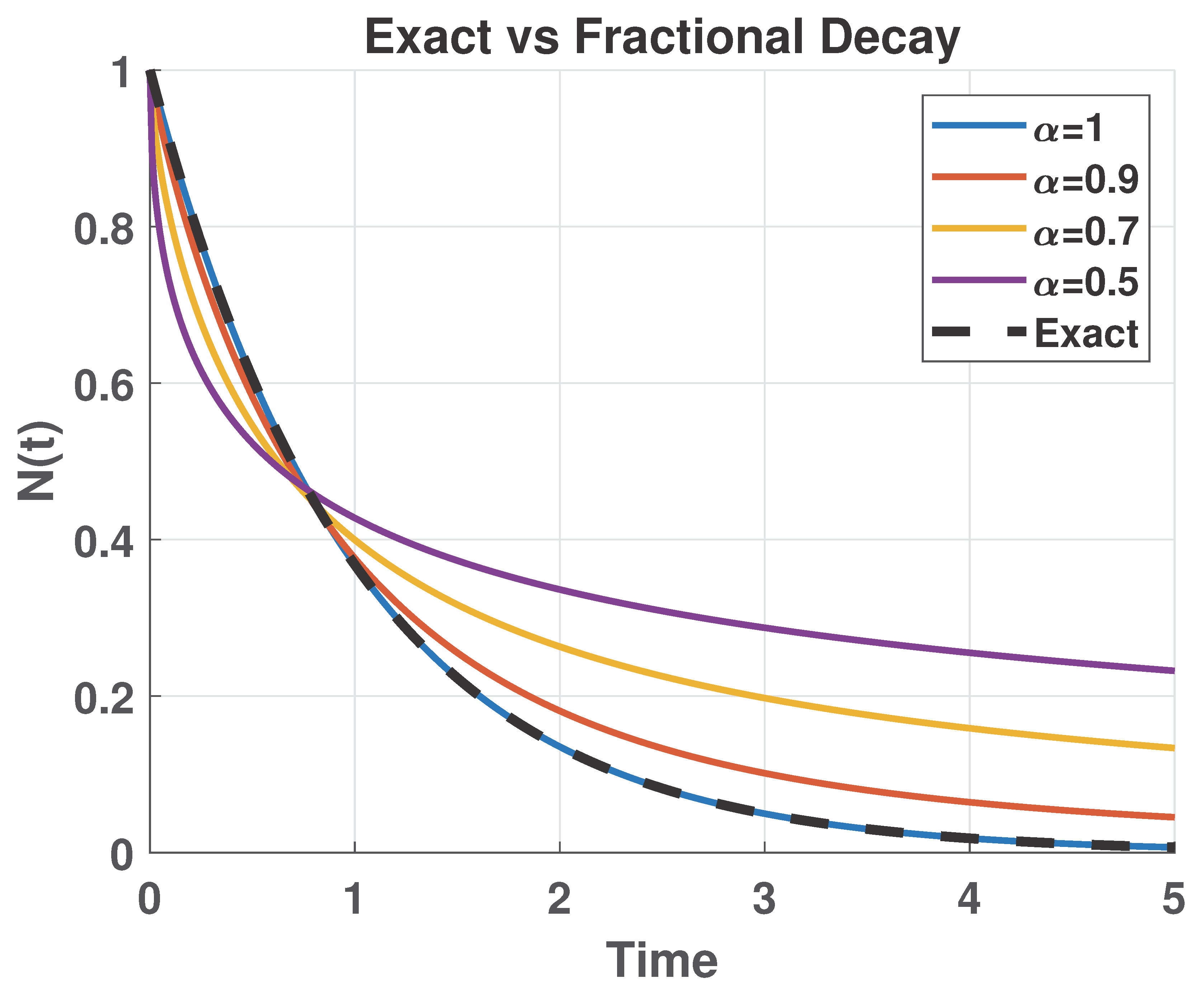
Figure 1.
Comparison between the classical exponential decay () and fractional decay models (). The fractional models exhibit slower decay due to memory effects.
Figure 1.
Comparison between the classical exponential decay () and fractional decay models (). The fractional models exhibit slower decay due to memory effects.
3. Second-Order Classical and Fractional Models
3.1. Classical Second-Order Model
The classical second-order differential equation is given by:
where is the angular frequency.
The general solution of this equation is:
or equivalently in complex form:
3.2. Fractional Second-Order Model
To incorporate memory effects, the integer-order derivative is replaced by a fractional derivative of order :
where denotes the Caputo fractional derivative.
3.3. Analytical Solution
Applying the Laplace (or N-) transform, we obtain:
Rearranging:
Taking the inverse transform, the solution is expressed in terms of the Mittag–Leffler function:
where the two-parameter Mittag–Leffler function is defined as
3.4. Special Case
For , the fractional model reduces to the classical second-order equation:
and thus the fractional solution recovers the classical oscillatory behavior.
3.5. Discussions and Conclusions
The fractional model exhibits damped oscillatory behavior depending on the value of . For , the system shows memory effects and energy dissipation, which are not present in the classical model. The results of the analytical solutions obtained during this study evidently prove the distinctions between classical and fractional-order models. In the first-order decay system, the classical solution obeys an exponential law, and the fractional formulation solution is a solution of the form of the MLF. This finding supports the fact that the fractional model is the natural generalization of the classical case.
One of the main observations made in the solutions obtained is that the fractional-order parameter The system dynamics are very much affected by When This is because , the solution simplifies to the classical exponential decay, which makes the two models consistent with each other. However, for the decay is slowed down by a significant margin. This reduced decay can be explained by the fact that the fractional derivative inherently has a memory effect that enables past states of the system to affect the current evolution of the system.
This is also observed in the graphical comparison (as represented in the figure). The fractional curves have long-tail characteristics relative to the classical exponential curve, which means that the system has the memory with time. This is especially significant in the modeling of real world processes where instantaneous change assumptions do not hold.
With the second-order system, the classical model gives the pure oscillatory solutions of constant amplitude. The fractional-order model, in contrast, adds a damping-like behavior without the explicit damping term. The analytical solution which is given in terms of the two-parameter MLF makes it clear that the amplitude decays gradually with time in case of The analytical solution which is given in terms of the two-parameter MLF makes it clear that the amplitude decays gradually with time in case of The analytical solution which is given in terms of the two-parameter This is an additional significant feature of the fractional systems, namely, the possibility to simultaneously capture oscillation and dissipation. The parameter The switch between purely oscillatory motion and damped dynamics is determined by The system tends to become a classical harmonic oscillator at high values of and at lower values, damping caused by memory becomes prevalent.
On the whole, the findings suggest that fractional calculus offers a more versatile and precise tool of modeling complex physical systems, particularly those with non-local and history-dependent properties.
References
- Podlubny, I. Fractional Differential Equations; Academic Press: San Diego, 1999. [Google Scholar]
- Oldham, K.B.; Spanier, J. The Fractional Calculus; Academic Press: New York, 1974. [Google Scholar]
- Caputo, M. Linear models of dissipation whose Q is almost frequency independent. Geophysical Journal International 1967, 13, 529–539. [Google Scholar] [CrossRef]
- Diethelm, K. The Analysis of Fractional Differential Equations; Springer: Berlin, 2010. [Google Scholar] [CrossRef]
- Mittag-Leffler, G. Sur la nouvelle fonction Eα(x). Comptes Rendus de l’Académie des Sciences 1903, 137, 554–558. [Google Scholar]
- Haubold, H.J.; Mathai, A.M.; Saxena, R.K. Mittag-Leffler functions and their applications. Journal of Applied Mathematics 2011, 2011, 1–51. [Google Scholar] [CrossRef]
- Kilbas, A.A.; Srivastava, H.M.; Trujillo, J.J. Theory and Applications of Fractional Differential Equations; Elsevier: Amsterdam, 2006. [Google Scholar]
- Metzler, R.; Klafter, J. The random walk’s guide to anomalous diffusion. Physics Reports 2000, 339, 1–77. [Google Scholar] [CrossRef]
- Mainardi, F. Fractional calculus: some basic problems in continuum and statistical mechanics. Chaos, Solitons & Fractals 1996, 7, 1461–1477. [Google Scholar] [CrossRef]
- Hilfer, R. Applications of Fractional Calculus in Physics; World Scientific: Singapore, 2000. [Google Scholar] [CrossRef]
- Bagley, R.L.; Torvik, P.J. Fractional calculus in viscoelasticity. AIAA Journal 1983, 21, 741–748. [Google Scholar] [CrossRef]
- Koeller, R.C. Applications of fractional calculus to the theory of viscoelasticity. Journal of Applied Mechanics 1984, 51, 299–307. [Google Scholar] [CrossRef]
- Watugala, G.K. Sumudu transform: a new integral transform to solve differential equations. International Journal of Mathematical Education in Science and Technology 1993, 24, 35–43. [Google Scholar] [CrossRef]
- Diethelm, K.; Ford, N.J.; Freed, A.D. A predictor-corrector approach for fractional differential equations. Nonlinear Dynamics 2002, 29, 3–22. [Google Scholar] [CrossRef]
- Lubich, C. Discretized fractional calculus. SIAM Journal on Mathematical Analysis 1986, 17, 704–719. [Google Scholar] [CrossRef]
- Magin, R.L. Fractional calculus in bioengineering. Critical Reviews in Biomedical Engineering 2004, 32, 1–104. [Google Scholar] [CrossRef] [PubMed]
- Meerschaert, M.M.; Scheffler, H.P. Limit theorems for continuous-time random walks. Journal of Applied Probability 2004, 41, 623–638. [Google Scholar] [CrossRef]
- Magdziarz, M. Fractional Brownian motion and fractional Langevin equation. Physical Review E 2007, 75, 016708. [Google Scholar] [CrossRef] [PubMed]
- Sun, H.e.a. A review on variable-order fractional differential equations. Fractional Calculus and Applied Analysis 2018, 21, 1129–1199. [Google Scholar] [CrossRef]
- Li, C.; Zeng, F. Numerical methods for fractional calculus. Applied Mathematical Modelling 2015, 39, 4460–4476. [Google Scholar] [CrossRef]
- He, J.H. Variational iteration method. International Journal of Nonlinear Mechanics 1999, 34, 699–708. [Google Scholar] [CrossRef]
- Adomian, G. A review of the decomposition method. Journal of Mathematical Analysis and Applications 1988, 135, 501–544. [Google Scholar] [CrossRef]
- Ortigueira, M.D. Riesz potential operators and inverses. Signal Processing 2006, 86, 2636–2648. [Google Scholar] [CrossRef]
- Tarasov, V.E. Fractional dynamics: applications of fractional calculus. Physics Reports 2011, 502, 1–79. [Google Scholar] [CrossRef]
- Mainardi, F. Fractional calculus and waves in linear viscoelasticity. World Scientific, 2010. [Google Scholar] [CrossRef]
- Gorenflo, R.e.a. Mittag-Leffler functions, related topics and applications. Springer, 2014. [Google Scholar] [CrossRef]
- Luchko, Y. Mittag-Leffler stability. Fractional Calculus and Applied Analysis 2010, 13, 1–16. [Google Scholar]
- Cui, M. Compact finite difference method for fractional diffusion. Journal of Computational Physics 2009, 228, 7792–7804. [Google Scholar] [CrossRef]
Disclaimer/Publisher’s Note: The statements, opinions and data contained in all publications are solely those of the individual author(s) and contributor(s) and not of MDPI and/or the editor(s). MDPI and/or the editor(s) disclaim responsibility for any injury to people or property resulting from any ideas, methods, instructions or products referred to in the content. |
© 2026 by the authors. Licensee MDPI, Basel, Switzerland. This article is an open access article distributed under the terms and conditions of the Creative Commons Attribution (CC BY) license (http://creativecommons.org/licenses/by/4.0/).
Copyright: This open access article is published under a Creative Commons CC BY 4.0 license, which permit the free download, distribution, and reuse, provided that the author and preprint are cited in any reuse.


