
Submitted:
13 April 2026
Posted:
15 April 2026
You are already at the latest version
Abstract
Benthic macroinvertebrates are widely used as bioindicators for assessing freshwater ecosystem health. This study investigated the diversity patterns and community structure of benthic macroinvertebrates across 21 sampling sites along the middle and lower reaches of the Yangtze River. A total of 74 species belonging to 3 phyla, 7 classes, 17 orders, 37 families, and 58 genera were identified, with aquatic insects dominating the assemblages. Alpha diversity indices showed no significant differences among river sections, whereas multivariate analyses (NMDS and PERMANOVA) revealed significant spatial variation in community composition, indicating that beta diversity plays a key role in structuring assemblages at the basin scale. Canonical correspondence analysis (CCA) identified nutrient variables (TN and NH₄⁺-N), as well as pH and conductivity, as the main environmental drivers influencing community distribution. The results suggest that benthic macroinvertebrate diversity patterns in large river systems are jointly shaped by regional environmental gradients and local habitat conditions. These findings provide insights into biodiversity conservation and ecological management of large river ecosystems.
Keywords:
benthic macroinvertebrates
; NMDS
; CCA
; nutrient gradients
; middle and lower Yangtze River
1. Introduction
The Yangtze River, the largest river in China, is among the most biodiverse inland river systems globally and plays a critical role in maintaining national ecological security and regional ecological balance [1]. The middle and lower reaches, characterized by a subtropical monsoon climate, complex hydrological regimes, and numerous tributaries, support diverse ecosystem types and high habitat heterogeneity, thereby sustaining a large number of endemic and threatened aquatic species [2]. However, rapid economic development and intensified human activities have imposed multiple pressures on the river system. Shipping, land reclamation, shoreline hardening, pollutant discharge, and hydraulic engineering have collectively led to water quality deterioration, habitat fragmentation, and reduced hydrological connectivity, resulting in significant declines in aquatic biodiversity and ecosystem stability [3,4,5,6,7,8].
Benthic macroinvertebrates occupy a central position in freshwater ecosystems, contributing to organic matter decomposition, primary production transfer, and energy flow across trophic levels [9,10,11,12,13,14]. Owing to their relatively long life cycles, limited mobility, and sensitivity to environmental changes, they are widely recognized as reliable indicators of ecological status and environmental stress [15,16,17,18,19,20,21]. Previous studies have demonstrated that benthic community structure responds significantly to water pollution and habitat degradation [22,23]. However, most existing research has been conducted at local or single-reach scales, often constrained by administrative boundaries, resulting in a lack of integrative understanding of community patterns along large river continua [24,25,26]. Moreover, the relative importance of environmental gradients versus spatial heterogeneity in shaping benthic communities at the mainstem scale remains insufficiently resolved.
In this context, the present study investigated benthic macroinvertebrate communities along the Yangtze River mainstem from Hubei to Jiangsu. Specifically, we (i) characterized community composition and diversity patterns across river sections, (ii) evaluated spatial variation in community structure, and (iii) identified key environmental drivers using multivariate statistical approaches. The results provide new insights into the mechanisms underlying large-scale biodiversity patterns in the Yangtze River and offer a scientific basis for ecological restoration and refined management of the mainstem.
2. Materials and Methods
2.1. Study Area and Sampling Design
The study was conducted along the middle and lower reaches of the Yangtze River mainstem, spanning five provinces from Hubei to Jiangsu. This region is characterized by a subtropical monsoon climate, complex hydrological regimes, numerous tributaries, and diverse land-use patterns and channel morphologies along the river continuum.
Based on the distribution of national surface water quality monitoring sections and considering shoreline utilization and habitat characteristics, a total of 21 sampling sites were established along the mainstem (Figure 1), including 5 sites in Hubei, 4 in Hunan, 4 in Jiangxi, 4 in Anhui, and 4 in Jiangsu. Field investigations were conducted in April 2025, during which habitat conditions, anthropogenic disturbances, and physicochemical parameters were recorded at each site.
2.2. Sample Collection and Identification
2.2.1. Physicochemical Parameters
Water temperature (WT), pH, dissolved oxygen (DO), and electrical conductivity (EC) were measured in situ using a portable water quality analyzer (LH-T600). Water samples were collected from surface, middle, and bottom layers using a 2 L water sampler, mixed thoroughly, and subsampled (2 L) for laboratory analysis. The samples were stored at low temperature and transported to the laboratory for further analysis. Total nitrogen (TN), total phosphorus (TP), ammonium nitrogen (NH₄⁺-N), and permanganate index (CODMn) were determined following standard methods described in Standard Methods for the Examination of Water and Wastewater (4th edition).
2.2.2. Benthic Macroinvertebrates
Benthic macroinvertebrates were collected in the littoral zone using a D-frame net (30 cm diameter, 60 mesh). A multi-habitat sampling approach [27] was applied, with sampling effort allocated proportionally to habitat types within each site. Kick sampling, sweeping, and hand netting were combined to collect organisms. At each site, 20 subsamples were collected, covering a total sampling area of approximately 1.8 m². In non-wadeable areas, a Peterson grab sampler (1/16 m²) was used, with three replicate samples collected per site. All samples were washed through a 60-mesh sieve, pooled into a composite sample, and preserved in 95% ethanol. In the laboratory, all individuals were sorted, identified, and counted, with identification performed to the lowest possible taxonomic level, typically genus or species [28,29,30,31,32].
2.3. Data Analysis
2.3.1. Diversity Indices
Dominant species were identified using the McNaughton dominance index (Y), with species having Y > 0.02 considered dominant. Community diversity was evaluated using the Shannon–Wiener diversity index (H′) and Simpson index (D), calculated as follows:
where nᵢ is the abundance of the i-th taxon, N is the total abundance of all taxa, and fᵢ is the frequency of occurrence of the i-th taxon across sampling sites.
2.3.2. Statistical Analysis
One-way analysis of variance (ANOVA) was used to test differences in physicochemical parameters and community characteristics among river sections. A Bray–Curtis dissimilarity matrix was constructed based on species abundance data, and non-metric multidimensional scaling (NMDS) was applied to visualize differences in community composition. Permutational multivariate analysis of variance (PERMANOVA) was performed to test for differences in community composition among river sections, based on 999 permutations. To evaluate whether differences detected by PERMANOVA were influenced by heterogeneity of dispersion, a multivariate dispersion analysis (betadisper) was conducted.
Canonical correspondence analysis (CCA) was performed to identify the main environmental factors driving variation in community composition. The significance of the overall CCA model and individual environmental variables was tested using Monte Carlo permutation tests. Environmental fitting (envfit) was further applied to quantify the correlations between environmental variables and ordination axes and to assess their statistical significance. Basic statistical analyses were conducted in Excel 2021, and all multivariate analyses were performed in R (version 4.5.2).
3. Results
3.1. Spatial Variation in Physicochemical Parameters
Physicochemical parameters exhibited spatial variation among river sections along the middle and lower Yangtze River. Dissolved oxygen (DO) and electrical conductivity (EC) exhibited overall declining trends from upstream to downstream, with local fluctuations among river sections, whereas total nitrogen (TN), total phosphorus (TP), ammonium (NH₄⁺-N), and permanganate index (CODMn) showed increasing trends. Lower DO and EC values were mainly observed in the Anhui section (Figure 2), while higher TN, TP, and NH₄⁺-N concentrations were also concentrated in this section. CODMn reached its highest values in the Jiangsu section.
Among river sections, the highest mean EC was recorded in Hubei (404.24 μS/cm), while the highest mean DO occurred in Hunan (6.85 mg/L). The Anhui section exhibited the highest mean TN (2.74 mg/L) and NH₄⁺-N (0.70 mg/L), whereas the Jiangsu section had the highest mean TP (0.11 mg/L) and CODMn (3.31 mg/L) (Table 1). One-way ANOVA indicated that DO and EC differed significantly among river sections (P < 0.05), whereas WT, pH, TN, TP, NH₄⁺-N, and CODMn showed no significant differences (P > 0.05).
3.2. Community Composition and Structure of Benthic Macroinvertebrates
A total of 74 taxa were identified, belonging to 3 phyla, 7 classes, 17 orders, and 37 families. Insecta was the most diverse group, comprising 46 species from 17 families, followed by Malacostraca (9 species, 8 families). Mollusca included Gastropoda (8 species, 6 families) and Bivalvia (5 species, 3 families), while Annelida was represented by Oligochaeta (4 species) and one species each of Polychaeta and Hirudinea.
The dominant species across the study area were Cricotopus trifasciatus (Y = 0.08) and Limnoperna fortunei (Y = 0.04). The Shannon–Wiener diversity index ranged from 1.47 to 1.65, and the Simpson index ranged from 0.66 to 0.74 among river sections (Figure 3), with no significant differences detected (P > 0.05).
Among river sections, the highest species richness was observed in the Jiangxi section (35 taxa), with a density of 75.56 ind/m² (Figure 4). Dominant species included Cricotopus trifasciatus, Glyptotendipes cauliginellus, and Limnoperna fortunei. The Hunan section followed, with 34 taxa and a density of 25.83 ind/m², where Lithoglyphopsis sp., Ephydridae sp., and Psychoda alternata were dominant. The Hubei section recorded 22 taxa with a density of 14.11 ind/m², dominated by Limnoperna fortunei, Macrobrachium nipponense, and Psychoda alternata. The Jiangsu section contained 21 taxa with a density of 20.70 ind/m², and dominant species included Cricotopus trifasciatus, Limnoperna fortunei, and Rhagio sp. The Anhui section had the lowest richness (18 taxa) with a density of 32.09 ind/m², dominated by Stictochironomus akizukii, Chironomus flaviplumus, and Microchironomus tener.
NMDS ordination based on Bray–Curtis distances showed a moderate separation of samples among river sections (Figure 5), with a stress value of 0.184, indicating a moderate representation of community patterns. PERMANOVA further confirmed significant differences in community composition among river sections (R² = 0.27, F = 1.51, P = 0.001). The betadisper analysis showed no significant differences in dispersion among groups (P = 0.152), suggesting that the observed differences were primarily due to shifts in community centroid positions rather than dispersion.
3.3. Relationships between Benthic Communities and Environmental Factors
The CCA results showed that the first two canonical axes explained 20.00% and 16.71% of the variation in the species–environment relationship, respectively, with a cumulative explanation of 36.71% (Figure 6), indicating that additional unmeasured factors (e.g., hydrodynamics or substrate heterogeneity) may also contribute to community variation. The overall CCA model was significant (F = 1.27, P = 0.013), supporting the role of environmental variables in structuring community composition.
The envfit analysis revealed that TN (R² = 0.94, P = 0.001), NH₄⁺-N (R² = 0.83, P = 0.023), pH (R² = 0.46, P = 0.006), and EC (R² = 0.35, P = 0.020) were significantly correlated with community variation. In the ordination space, TN and NH₄⁺-N were primarily aligned along the positive direction of CCA1, whereas pH and EC were associated with CCA2, indicating that nutrient gradients and physicochemical conditions jointly structured community distribution patterns.
Sampling sites exhibited spatial differentiation in the ordination space. Site S16 (Anhui section) was located at the positive end of CCA1 and showed strong associations with TN and NH₄⁺-N. Several sites in the Hunan section (e.g., S6 and S8) were distributed along the negative direction of CCA2 and were related to water temperature. In contrast, most sites in the Hubei, Jiangxi, and Jiangsu sections were clustered near the center of the ordination, reflecting combined influences of multiple environmental factors.
4. Discussion
A total of 74 species belonging to 3 phyla, 7 classes, 17 orders, 37 families, and 58 genera were recorded, with aquatic insects dominating the assemblages. This pattern is consistent with previous studies [22,33,34,35,36] and reflects a typical characteristic of benthic communities in large river systems. Such dominance is likely associated with strong hydrodynamic conditions and relatively homogeneous substrates, which favor taxa with short life cycles, high reproductive capacity, and strong environmental tolerance, such as Chironomidae [37,38].
The prevalence of tolerant taxa, including Propsilocerus akamusi and bivalves, may indicate that the current community structure has been influenced by long-term anthropogenic disturbances. These taxa are well adapted to environments with elevated organic matter and hydrodynamic disturbance [39,40], and their dominance may reflect a moderately impacted ecological condition in the middle and lower reaches of the Yangtze River. This interpretation is consistent with previous findings that human activities can promote the proliferation of opportunistic and pollution-tolerant species, thereby altering community composition and ecosystem functioning.
In terms of alpha diversity, no significant differences were observed among river sections based on the Shannon–Wiener and Simpson indices, which is consistent with earlier studies [41]. This pattern may be attributed to the strong hydrological connectivity and water exchange in the Yangtze River mainstem, which facilitate species dispersal and promote community homogenization across large spatial scales. However, multivariate analyses (NMDS and PERMANOVA) revealed significant differences in community composition among river sections, indicating that spatial variation is primarily driven by species turnover rather than differences in overall diversity levels [42]. This decoupling between alpha and beta diversity highlights the importance of considering compositional heterogeneity in large river systems.
The betadisper results showed no significant differences in dispersion among groups, suggesting that the observed differences were mainly due to shifts in community centroids rather than differences in within-group variability [43].
Spatial heterogeneity in benthic assemblages is likely driven by a combination of longitudinal environmental gradients, hydrological conditions, and land-use patterns along the river [44,45,46]. For example, the Jiangxi section exhibited relatively higher species richness and density, which may be associated with more complex habitat structures or greater resource availability. In contrast, the Anhui section showed lower species richness but higher dominance of certain chironomid taxa, which may be related to elevated nutrient concentrations and organic enrichment. Previous studies have demonstrated that eutrophication can promote the expansion of tolerant or opportunistic species, leading to shifts in community composition [47,48].
Environmental driver analysis based on CCA indicated that nutrient variables (TN and NH₄⁺-N), as well as pH and conductivity, are important factors associated with variation in benthic community structure. TN and NH₄⁺-N showed significant correlations with ordination axes, suggesting that nutrient gradients play an important role in shaping spatial patterns of benthic assemblages. Increased nutrient levels can enhance primary productivity and organic matter accumulation [49,50], thereby altering sediment characteristics [51] and influencing benthic habitats. Meanwhile, pH and conductivity reflect broader hydrochemical conditions, which may be affected by geological background, tributary inputs, and anthropogenic activities [52,53,54]. The clustering of sites in the Anhui section along nutrient gradients further supports the potential influence of eutrophication on local communities.
It should be noted that the explanatory power of the CCA model was moderate, indicating that additional unmeasured factors may also contribute to community variation. These may include hydrodynamic conditions, substrate heterogeneity, and biotic interactions, which were not explicitly quantified in the present study. Incorporating such variables in future studies would help to improve the understanding of mechanisms underlying benthic community dynamics.
From a biodiversity perspective, the observed spatial variation highlights the importance of beta diversity in large river ecosystems. Although alpha diversity remained relatively stable, species turnover contributed substantially to regional diversity patterns, emphasizing the need to incorporate multiple diversity metrics in ecological assessments.
Overall, the results suggest that benthic macroinvertebrate assemblages in large river systems are jointly regulated by regional-scale environmental gradients and local habitat conditions. These findings have important implications for river management, emphasizing the need for nutrient control, habitat restoration, and maintenance of hydrological connectivity. Future research should incorporate multi-temporal data and hydrodynamic processes to further elucidate the mechanisms driving community dynamics.
5. Conclusions
This study investigated benthic macroinvertebrate diversity and its environmental drivers along the middle and lower reaches of the Yangtze River. Aquatic insects dominated the assemblages, and although alpha diversity remained relatively stable among river sections, significant spatial variation in community composition was observed, primarily driven by species turnover.
Nutrient variables (TN and NH₄⁺-N), along with pH and conductivity, were identified as key factors influencing community structure, highlighting the importance of water quality and hydrochemical conditions.
This study emphasizes the role of beta diversity in shaping biodiversity patterns in large river systems and provides insights for biodiversity conservation and ecological management.
Author Contributions
Methodology, Ying W.; software, Y.C. and H.S.; validation, J.W., H.S. and G.N.; formal analysis, Y.C. and P.C.; investigation, Y.C., P.C. and J.W.; resources, L.G.; data curation, X.W. and Yu W.; writing—original draft preparation, Y.C.; writing—review and editing, P.C., H.S. and G.N.; visualization, J.W.; supervision, Q.H.; project administration, X.J.; funding acquisition, L.G. All authors have read and agreed to the published version of the manuscript.
Funding
This research was funded by Research Fund of State Environmental Protection Key Laboratory of Aquatic Ecosystem Health in the Middle and Lower Reaches of Yangtze River (AEHZK2024003).
Institutional Review Board Statement
Not applicable.
Data Availability Statement
The data presented in this study are available on request from the corresponding author.
Conflicts of Interest
The authors declare no conflicts of interest.
References
- Wu, W.L.; Chen, W.X. Study on synergy and differential convergence of inclusive green development in the Yangtze River economic belt. Review of Economic Research 2022, (6), 103–118. [CrossRef]
- Ye, X.C.; Xu, C.Y.; Zhang, D.; et al. Variation of summer precipitation and its connection with Asian monsoon system in the middle-lower Yangtze River Basin. Sci. Geogr. Sin. 2018, 38, 1174–1182. [CrossRef]
- Liu, F.; Lin, P.C.; Li, M.Z.; et al. Situations and conservation strategies of fish resources in the Yangtze River Basin. Acta Hydrobiol. Sin. 2019, 43, 144–156.
- Wang, J.N.; Sun, H.L.; Xu, Y.X.; et al. Water eco-environment protection framework in the Yangtze River Basin during the 14th five-year plan period. Res. Environ. Sci. 2020, 33, 1075–1080. [CrossRef]
- Chen, J. Ecological redline identification in the Yangtze River Basin. Technol. Econ. Changjiang 2018, 2, 30–36. [CrossRef]
- Xie, P. Biodiversity crisis in the Yangtze River: The culprit was dams, followed by overfishing. J. Lake Sci. 2017, 29, 1279–1299. [CrossRef]
- Sun, L.T.; Zhao, F.; Zhang, T.; et al. Review on research progress of population resources and genetic diversity of Chinese sturgeon ( Acipenser sinensis Gray 1835 ). Fish. Inf. Strateg. 2017, 32, 112–117. [CrossRef]
- Yang, H.L.; Shen, L.; He, Y.F.; et al. Status of aquatic organisms resources and their environments in the Yangtze River system (2017—2021). J. Fish. China 2023, 47, 3–30. [CrossRef]
- Resh, V.H.; Jackson, J.K. Rapid assessment approaches to biomonitoring using benthic macroinvertebrates. In Freshwater Biomonitoring and Benthic Macroinvertebrates; Rosenberg, D.M., Resh, V.H., Eds.; Chapman & Hall: New York, NY, USA, 1993; pp. 195–233.
- Hu, Z.Y.; Bao, Y.X.; Cheng, H.Y.; et al. Research progress on ecology of natural wetland zoobenthos in China. Chin. J. Ecol. 2009, 28, 959–968. [CrossRef]
- Lamberti, G.A.; Gregory, S.V.; Ashkenas, L.R.; et al. Productive capacity of periphyton as a determinant of plant-herbivore interactions in streams. Ecology 1989, 70, 1840–1856. [CrossRef]
- Sundermann, A.; Stoll, S.; Haase, P. River restoration success depends on the species pool of the immediate surroundings. Ecol. Appl. 2011, 21, 1962–1971. [CrossRef]
- Sun, G.; Fang, Y.; Li, H.S. Ecology of benthic animals; Tsinghua University Press: Beijing, China, 2024.
- Mermillod-Blondin, F. The functional significance of bioturbation and biodeposition on biogeochemical processes at the water-sediment interface in freshwater and marine ecosystems. J. N. Am. Benthol. Soc. 2011, 30, 770-778. [CrossRef]
- Heino, J.; Louhi, P.; Muotka, T. Identifying the scales of variability in stream macroinvertebrate abundance, functional composition and assemblage structure. Freshw. Biol. 2004, 49, 1230–1239. [CrossRef]
- Ma, T.; Huang, Q.; Wang, H.; et al. Selection of benthic macroinvertebrate-based multimetrics and preliminary establishment of biocriteria for the bioassessment of the water quality of Taihu Lake, China. Acta Ecol. Sin. 2008, 28, 1192–1200. [CrossRef]
- Duan, X.H. Ecological impacts of water and sediment transportation on macroinvertebrate community in rivers. Ph.D. Thesis, Tsinghua University, Beijing, China, 2009.
- Xu, M.B.; Jiang, F.J.; Lai, J.X.; et al. Study on the ecological characteristics of benthic macrofauna in the Qinzhou bay of Cuangxi autonomous region and their correlation with sediment factors. Journal of Ocean Technology 2015, 34, 62–68.
- Real, M.; Prat, N. Factors influencing the distribution of chironomids and oligochaetes in profundal areas of Spanish reservoirs. Neth. J. Aquat. Ecol. 1992, 26, 405-410. [CrossRef]
- Chi, S.Y.; Zhao, X.F.; Gao, S.B.; et al. The spatial distribution pattern of autumn macroinvertebrates in relation to environmental factors in Danjiangkou Reservoir. Acta Ecol. Sin. 2021, 41, 1229–1241. [CrossRef]
- Marcus, W.B.; Lorin, K.H. A review of research on the development of lake indices of biotic integrity. Environ. Rev. 2009, 17, 21–44. https://www.jstor.org/stable/envirevi.17.21.
- Zhang, Y.H.; Qu, X.D.; Wang, S.M.; et al. River health assessment of hun river basin based on benthic index of biological integrity. Resour. Environ. Yangtze Basin 2020, 29, 1374–1386.
- Jin, X.W.; Wang, Y.Y.; Wang, B.X.; et al. Methods development for monitoring and assessment of ecological integrity of surface waters in China. Environ. Monit. China 2017, 33, 75–81. [CrossRef]
- Li, D.; Niu, Z.C.; Wang, X.; et al. Distribution and diversity of macrobenthic communities in the Jiangsu Reach of the Yangtze River. Chin. J. Appl. Environ. Biol. 2015, 21, 96–100. [CrossRef]
- Ma, Y.X.; Yao, W.L.; Yuan, S.B.; et al. Community structure and environmental analysis of macrozoobenthos in Yichang-Anqing reaches of the Yangtze mainstem. Acta Hydrobiol. Sin. 2019, 43, 634–642. [CrossRef]
- Sun, J.M.; Mei, Z.H.; Pi, Y.Z.; et al. Community characteristics and correlation of environmental factors of benthos in Nanjing section of Changjiang River. Environmental Monitoring and Forewarning 2023, 15, 23-29. [CrossRef]
- Barbour, M.T.; Gerritsen, J.; Snyder, B.D.; et al. Rapid bioassessment protocols for use in streams and wadeable rivers: Periphyton, benthic macroinvertebrates, and fish, 2nd edition. USEPA: Washington, DC, USA, 1999.
- Liu, Y.Y. Economic Fauna of China: Freshwater Mollusks; Science Press: Beijing, China, 1979.
- Wang, Z.R. Fauna Sinica: Mollusca, Bivalvia, Mytiloida; Science Press: Beijing, China, 1997.
- Tang, H.Q. Biosystematic study on the chironomid larvae in China(Diptera: Chironomidae). Ph.D. Thesis, Nankai University, Tianjin, China, 2006.
- Wang, J.C.; Wang, X.H. Chironomid Larvae in Northern China; China Yan Shi Press: Beijing, China, 2011.
- Morse, J.C.; Yang, L.; Tian, L. Aquatic insects of China useful for monitoring water quality; Hohai University Press: Nanjing, China, 1984.
- Zhang, Y.H.; Zhang, M.; Peng, W.Q.; et al. Distribution pattern of macroinvertebrate community and its relationships with environmental factors in the Yongding River Basin. Chin. J. Appl. Ecol. 2020, 31, 3880-3888. [CrossRef]
- Zhao, R.; Zhao, X.M.; Gou, T.; et al. Spatial and temporal distributions of macroinvertebrate communities in the Beijiang River, Guangxi. Environ. Monit. China 2019, 35, 40-49. [CrossRef]
- Ma, K.; Shi, X.; You, X.G.; et al. Relationship of the heavy metals distribution in sediments to vegetation diversity and macroinvertebrate communities in riparian wetlands. Acta Ecol. Sin. 2021, 41, 2001-2010. [CrossRef]
- Bai, H.F. Spatio-temporal distribution characteristics and driving mechanism of aquatic communities and water ecosystem health assessment in the Weihe River Basin, Northwestern, China. Ph.D. Thesis, Northwest University, Xi’an, China, 2022.
- Chen, H.M.; Qu, X.D.; Wang, F. Research progress of river dynamic influences on the distribution of macroinvertebrates. Res. Environ. Sci. 2019, 32, 758-765. [CrossRef]
- Chen, L.; Zhang, L.H.; Huang, D.J.; et al. Water quality status and characteristics of aquatic community structure in Dahuofang Reservoir and its tributaries. Environ. Pollut. Control. 2021, 43, 834-838. [CrossRef]
- Wen, S.K.; Peng, K.; Gong, Z.J.; et al. Succession of macrozoobenthic communities and its drivers in Meiliang Bay of Lake Taihu during the past 40 year. J. Lake Sci. 2023, 35, 599-611. [CrossRef]
- Boltovskoy, D.; Sylvester, F.; Otaegui, A.; et al. Environmental modulation of reproductive activity of the invasive mussel Limnoperna fortunei: implications for antifouling strategies. Austral Ecol. 2009, 34, 719-730. [CrossRef]
- Zhang, D.P.; Liu, Y.; Bai, X.; et al. Species diversity and drivers of macroinvertebrate assemblages in the mainstream of Xijiang River. J. Hydroecol. 2025, 46, 171-183. [CrossRef]
- Heino, J.; Tolonen, K.T. Ecological drivers of multiple facets of beta diversity in a lentic macroinvertebrate metacommunity. Limnol. Oceanogr. 2017, 62, 2431-2444. [CrossRef]
- Mejía, G.A.; Su, C.; Allen, D.; et al. Land-use legacies affect the composition and distribution of tree species and their belowground functions in a succession from old-field to mature temperate forest. For. Ecosyst. 2024, 11, 960-973. [CrossRef]
- Zou, L.; Ma, H.Y.; Zhang, T.T.; et al. Macrozoobenthic community structure and niche analysis in the riparian zone of the mainstem of the middle and lower Yangtze River. Environ. Ecol. 2026, 8, 106-114. [CrossRef]
- Wang, Y.N.; Tian, Y.L.; Liu, Y.W.; et al. The relationship between macrobenthic community structure and environmental factors during dry and wet seasons in the Gongnaisi River, Xinjiang. Ecol. Sci. 2022, 41, 208-218. [CrossRef]
- Ru, H.J.; Zhang, Y.; Wu, X.X.; et al. Macrozoobenthos community structure and its relationship with environmental factors in the riparian zone of the lower Jinsha River. J. Fish. Sci. China 2022, 29, 1679-1692. [CrossRef]
- Zhang, X.T.; Li, W.M.; Zhang, K.; et al. Spatiotemporal distribution of macroinvertebrate functional feeding groups in Qiaobian River, a tributary of Yangtze River in Yichang. Acta Ecol. Sin. 2022, 42, 2559-2570. [CrossRef]
- Dou, Q.M.; Du, X.; Wang, L.; et al. Effects of land use and aquatic environmental factors on secondary productivity of macroinvertebrates : A case of Lake Lianhuan Group, northeast China. J.Lake Sci. 2024, 36, 846-857. [CrossRef]
- Tian, W.; Yang, Z.S.; Shao, K.Q.; et al. Effect of a comprehensive improvement project on water quality in urban lakes: A case study of water quality variation in Lihu Lake over the past 30 years. Environ. Sci. 2020, 41, 183-193. [CrossRef]
- Xu, H.; Paerl, H.W.; Qin, B.; et al. Nitrogen and phosphorus inputs control phytoplankton growth in eutrophic Lake Taihu, China. Limnol. Oceanogr. 2010, 55, 420-432. [CrossRef]
- Perga, M.E.; Desmet, M.; Enters, D.; et al. A century of bottom-up and top-down driven changes on a lake planktonic food web: A paleoecological and paleoisotopic study of Lake Annecy, France. Limnol. Oceanogr. 2010, 55, 803-816. [CrossRef]
- Liu, W. A study on carbon migration processes in reservoirs with different geological settings in subtropical areas, SW China. Ph.D. Thesis, Southwest University, Chongqing, China, 2015.
- Liu, J.T.; Li, Y.Z.; Gao, Z.J.; et al. Hydrochemistry and relationship between groundwater and surface water in the middle and lower reaches of Lhasa river basin. J. Shandong Univ. Sci. Technol. (Nat. Sci.) 2020, 39, 10-20. [CrossRef]
- Liu, C.; Liu, X.Y.; Zhou, J.C.; et al. Response of stream benthic algal diversity to urbanization: A case study in Shenzhen. Acta Ecol. Sin. 2022, 42, 10041-10050. [CrossRef]
Figure 1.
Distribution of sampling sites along the middle and lower Yangtze River mainstem.
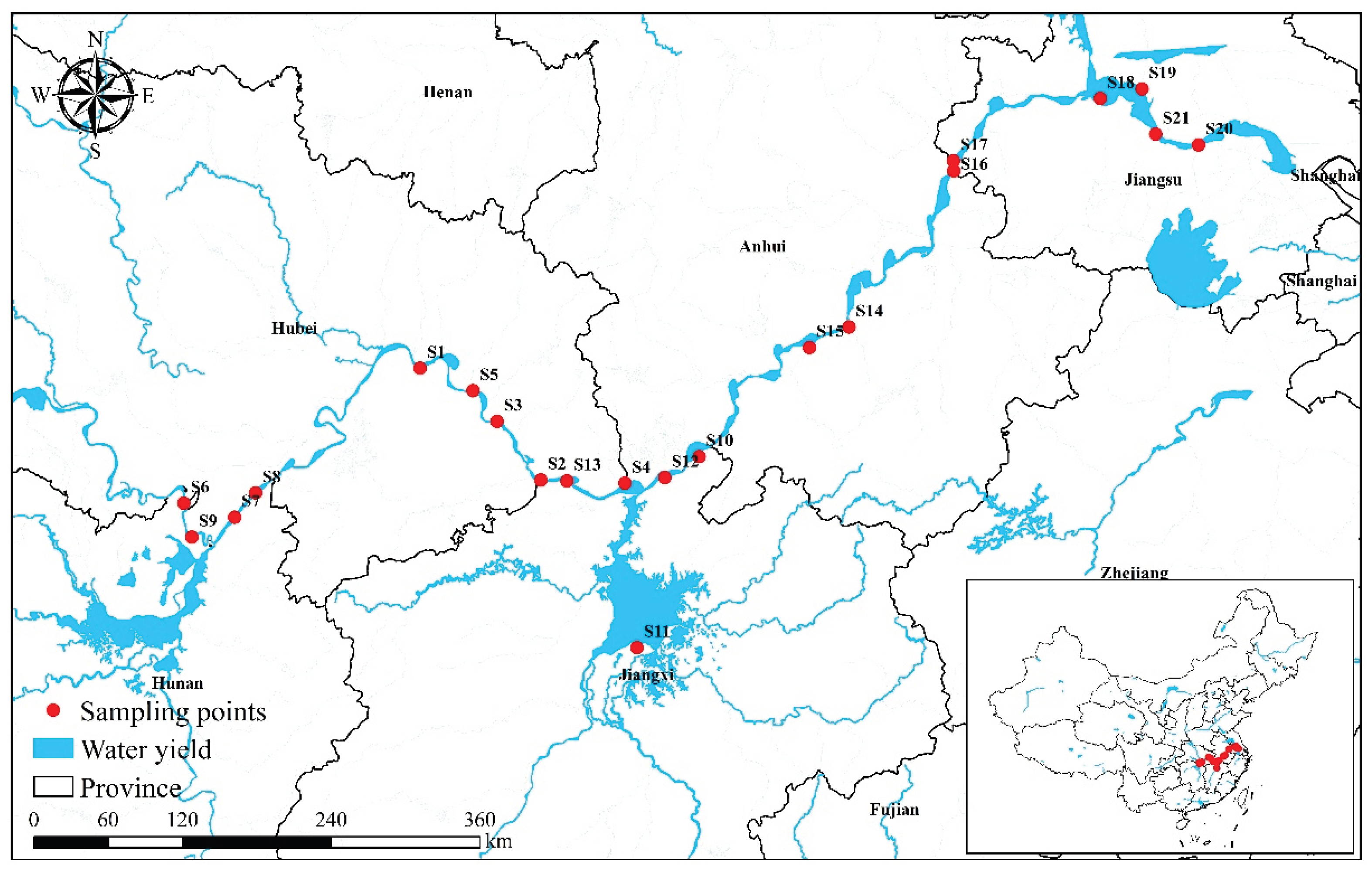
Figure 2.
Spatial variation of physical and chemical parameters along the middle and lower Yangtze River mainstem.
Figure 2.
Spatial variation of physical and chemical parameters along the middle and lower Yangtze River mainstem.
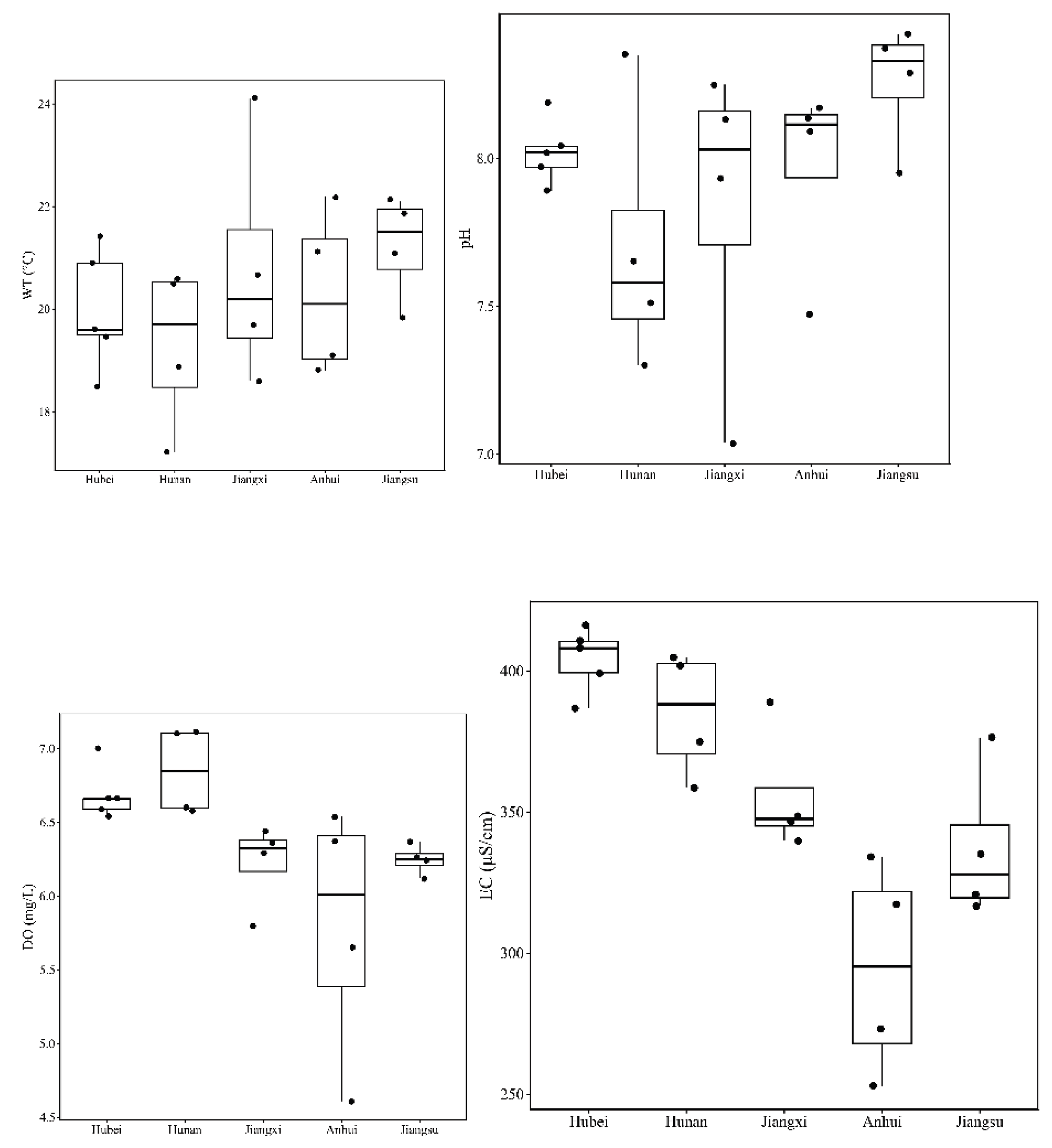
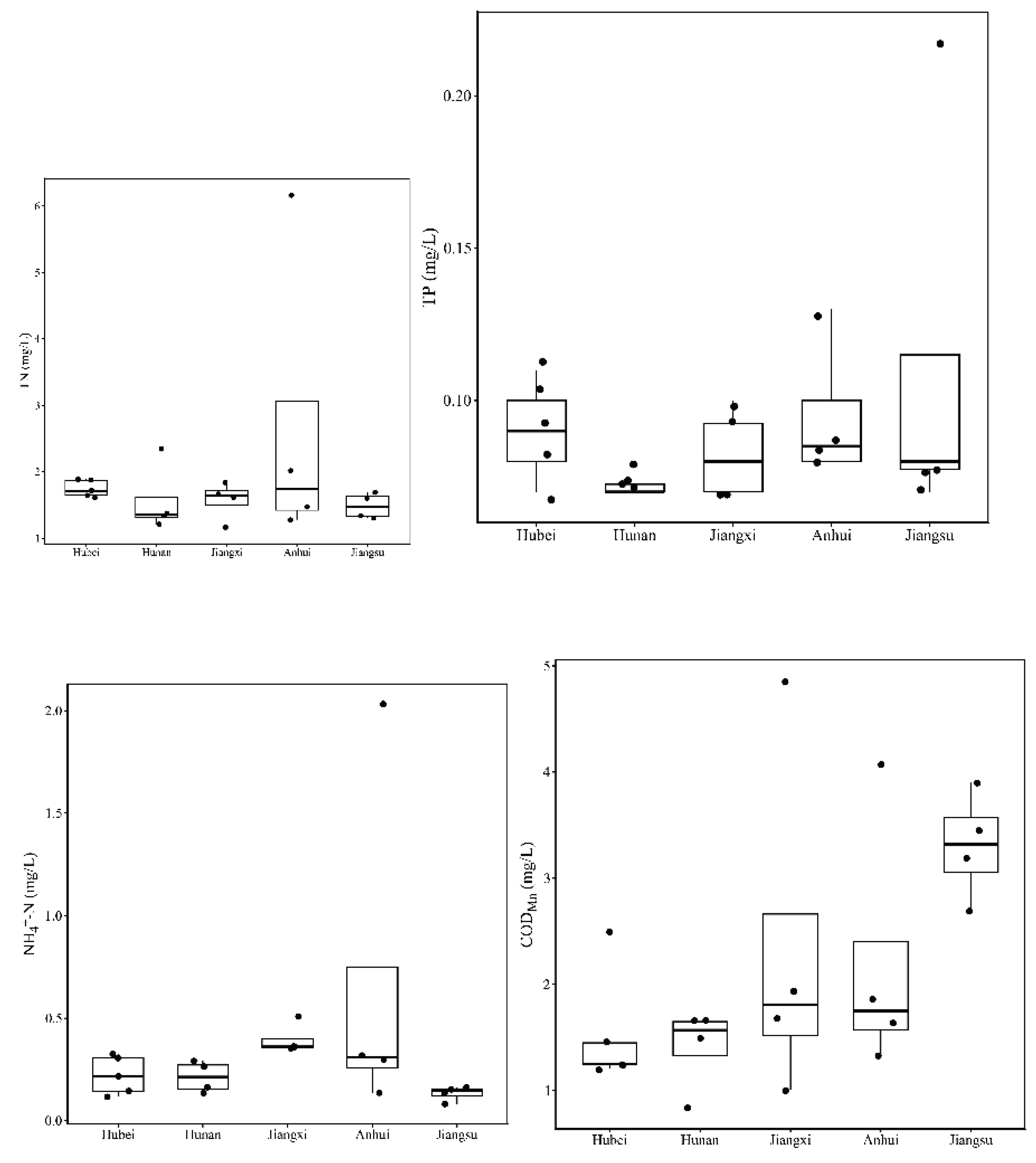
Figure 3.
Biodiversity indices along the middle and lower Yangtze River mainstem.

Figure 4.
Taxa richness and density along the middle and lower Yangtze River mainstem.
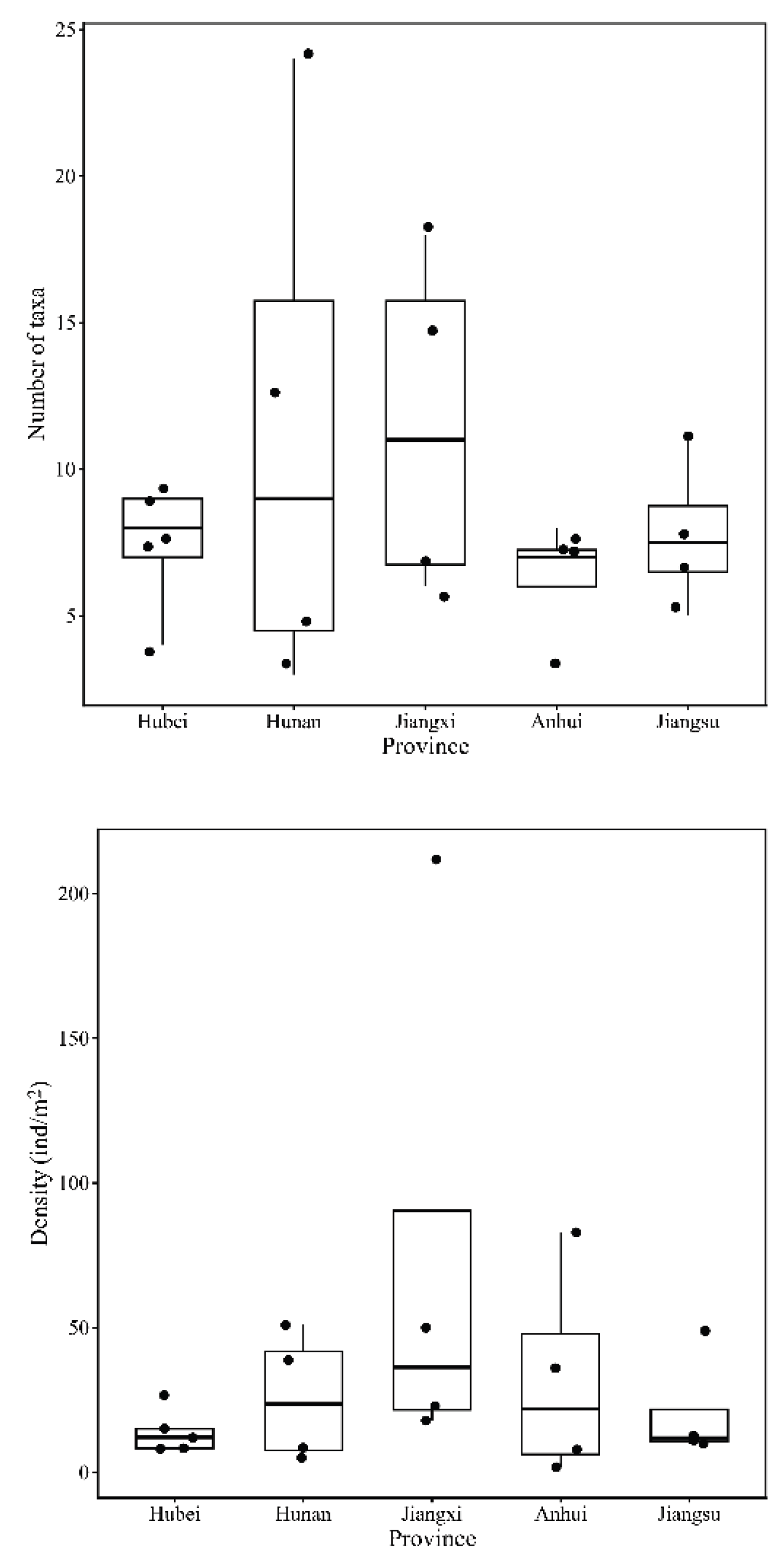
Figure 5.
NMDS ordination of benthic macroinvertebrate community composition along the middle and lower Yangtze River mainstem.
Figure 5.
NMDS ordination of benthic macroinvertebrate community composition along the middle and lower Yangtze River mainstem.
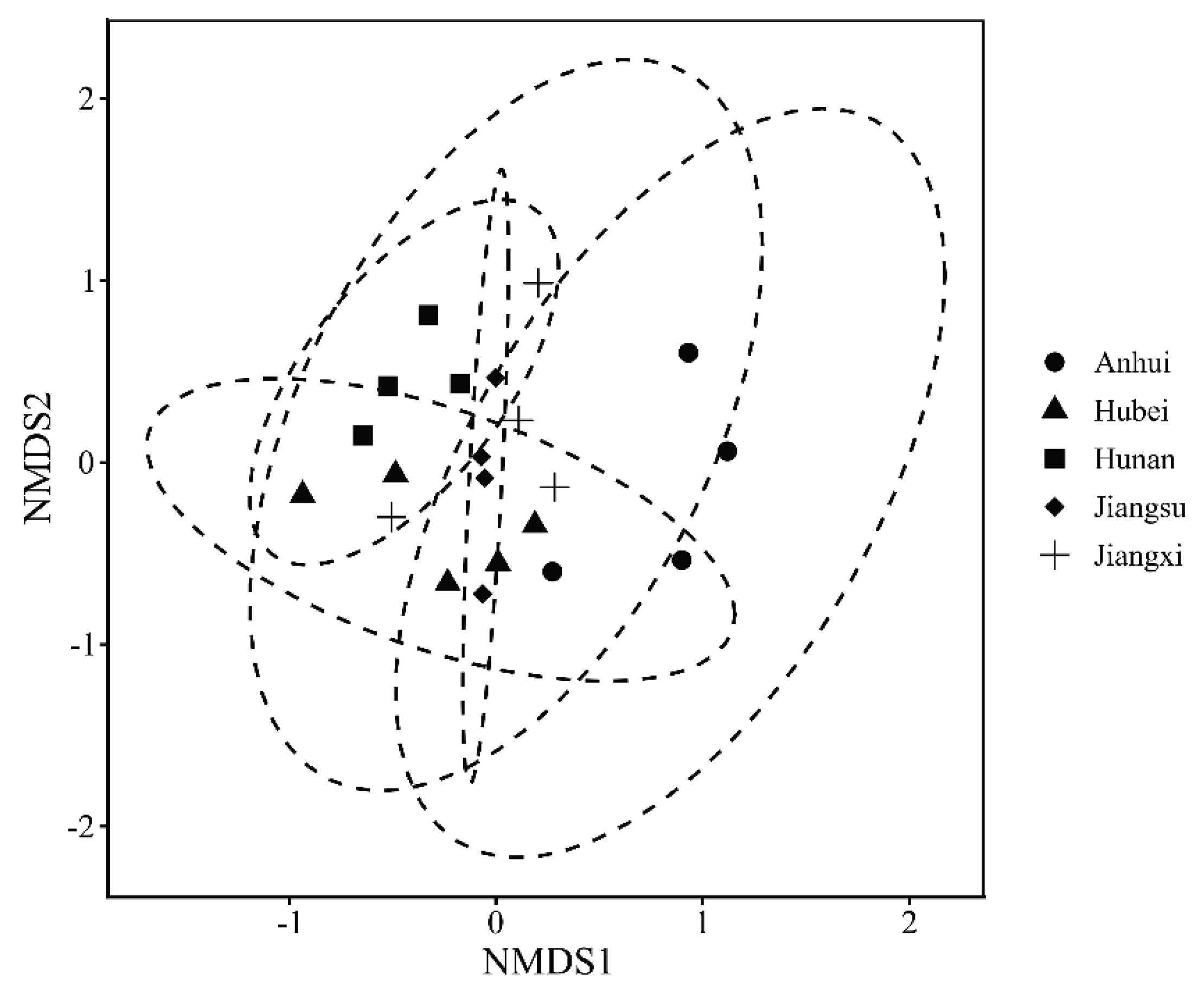
Figure 6.
CCA ordination of benthic macroinvertebrate community composition along the middle and lower Yangtze River mainstem.
Figure 6.
CCA ordination of benthic macroinvertebrate community composition along the middle and lower Yangtze River mainstem.
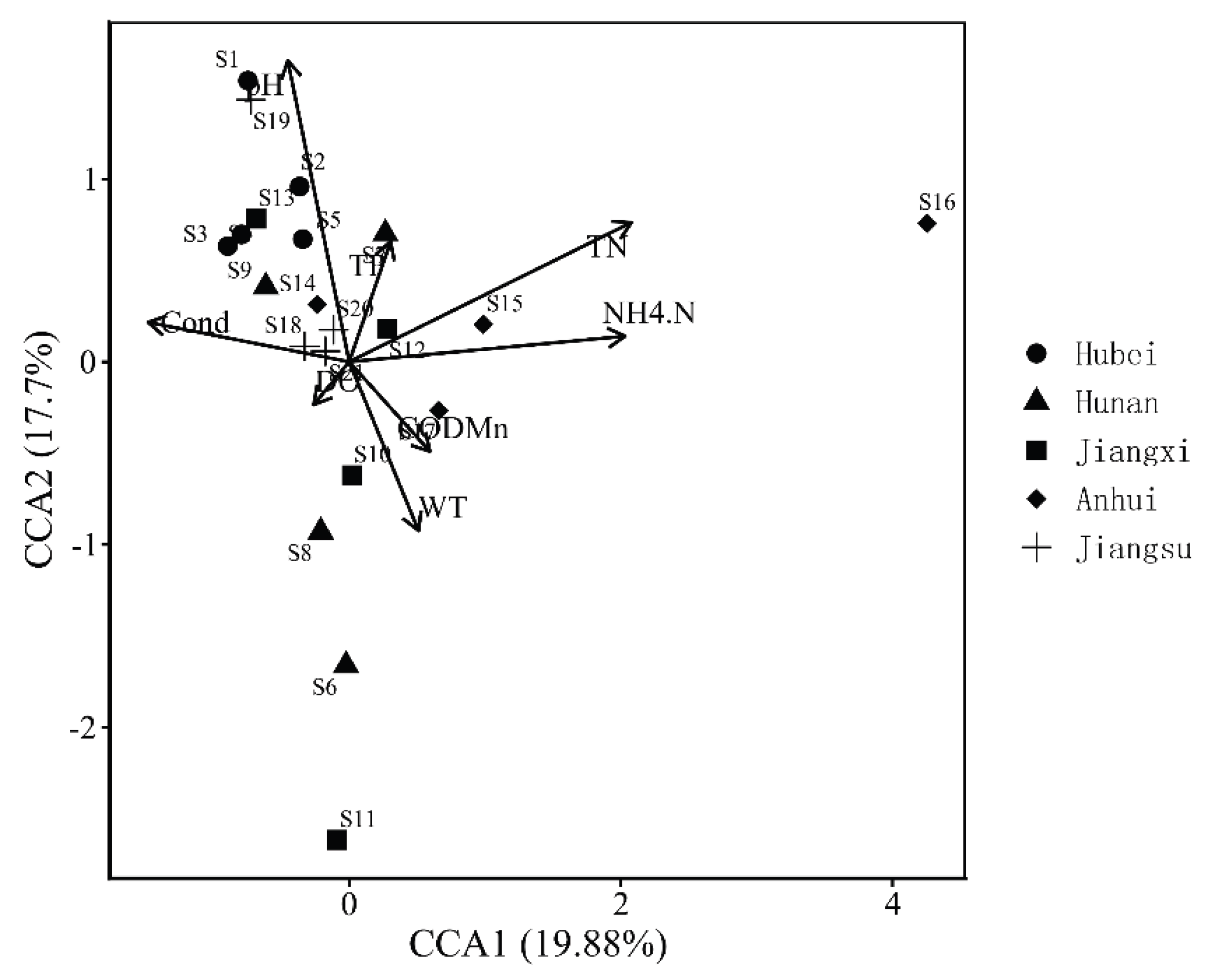

Table 1.
Physical and chemical parameters along the middle and lower Yangtze River mainstem.
| Physicochemical parameters | Hubei | Hunan | Jiangxi | Anhui | Jiangsu | P | |
|---|---|---|---|---|---|---|---|
| WT (°C) | Mean ± SD | 19.98 ± 1.16 | 19.30 ± 1.60 | 20.78 ± 2.38 | 20.33 ± 1.64 | 21.23 ± 1.04 | 0.51 |
| Min – Max | 18.50 - 21.40 | 17.20 - 20.60 | 18.60 - 24.10 | 18.80 - 22.20 | 19.80 - 22.10 | ||
| pH | Mean ± SD | 8.02 ± 0.11 | 7.70 ± 0.46 | 7.84 ± 0.55 | 7.97 ± 0.33 | 8.26 ± 0.21 | 0.29 |
| Min – Max | 7.89 - 8.19 | 7.30 - 8.35 | 7.04 – 8.25 | 7.47 - 8.17 | 7.95 - 8.42 | ||
| DO (mg/L) | Mean ± SD | 6.69 ± 0.18 | 6.85 ± 0.30 | 6.22 ± 0.29 | 5.79 ± 0.88 | 6.25 ± 0.10 | 0.02 |
| Min – Max | 6.54 - 7.0 | 6.58 - 7.11 | 5.80 - 6.44 | 4.61 - 6.54 | 6.12 - 6.37 | ||
| EC (μS/cm) | Mean ± SD | 404.24 ± 11.56 | 385.00 ± 22.22 | 356.11 ± 22.35 | 294.41 ± 37.92 | 337.22 ± 27.21 | < 0.001 |
| Min – Max | 386.72 - 416.52 | 358.59 - 404.87 | 339.99 - 389.19 | 252.73 - 334.24 | 316.87 - 376.28 | ||
| TN (mg/L) | Mean ± SD | 1.74 ± 0.13 | 1.57 ± 0.52 | 1.57 ± 0.29 | 2.74 ± 2.31 | 1.49 ± 0.19 | 0.43 |
| Min – Max | 1.61 - 1.89 | 1.21 - 2.34 | 1.17 - 1.84 | 1.28 - 6.17 | 1.30 - 1.69 | ||
| TP (mg/L) | Mean ± SD | 0.09 ± 0.02 | 0.08 ± 0.01 | 0.08 ± 0.02 | 0.09 ± 0.02 | 0.11 ± 0.07 | 0.59 |
| Min – Max | 0.07 - 0.11 | 0.07 - 0.08 | 0.07 - 0.10 | 0.08 - 0.13 | 0.07 - 0.22 | ||
| NH4+-N (mg/L) | Mean ± SD | 0.22 ± 0.09 | 0.21 ± 0.08 | 0.40 ± 0.08 | 0.70 ± 0.89 | 0.13 ± 0.04 | 0.30 |
| Min – Max | 0.12 - 0.32 | 0.13 - 0.29 | 0.35 - 0.51 | 0.14 - 2.03 | 0.08 - 0.16 | ||
| CODMn (mg/L) | Mean ± SD | 1.53 ± 0.55 | 1.41 ± 0.38 | 2.37 ± 1.71 | 2.22 ± 1.24 | 3.31 ± 0.51 | 0.09 |
| Min – Max | 1.21 - 2.49 | 0.84 - 1.65 | 1.01 - 4.86 | 1.33 - 4.06 | 2.69 - 3.90 | ||
Disclaimer/Publisher’s Note: The statements, opinions and data contained in all publications are solely those of the individual author(s) and contributor(s) and not of MDPI and/or the editor(s). MDPI and/or the editor(s) disclaim responsibility for any injury to people or property resulting from any ideas, methods, instructions or products referred to in the content. |
© 2026 by the authors. Licensee MDPI, Basel, Switzerland. This article is an open access article distributed under the terms and conditions of the Creative Commons Attribution (CC BY) license (http://creativecommons.org/licenses/by/4.0/).
Copyright: This open access article is published under a Creative Commons CC BY 4.0 license, which permit the free download, distribution, and reuse, provided that the author and preprint are cited in any reuse.


