

Submitted:
13 April 2026
Posted:
15 April 2026
You are already at the latest version
Abstract
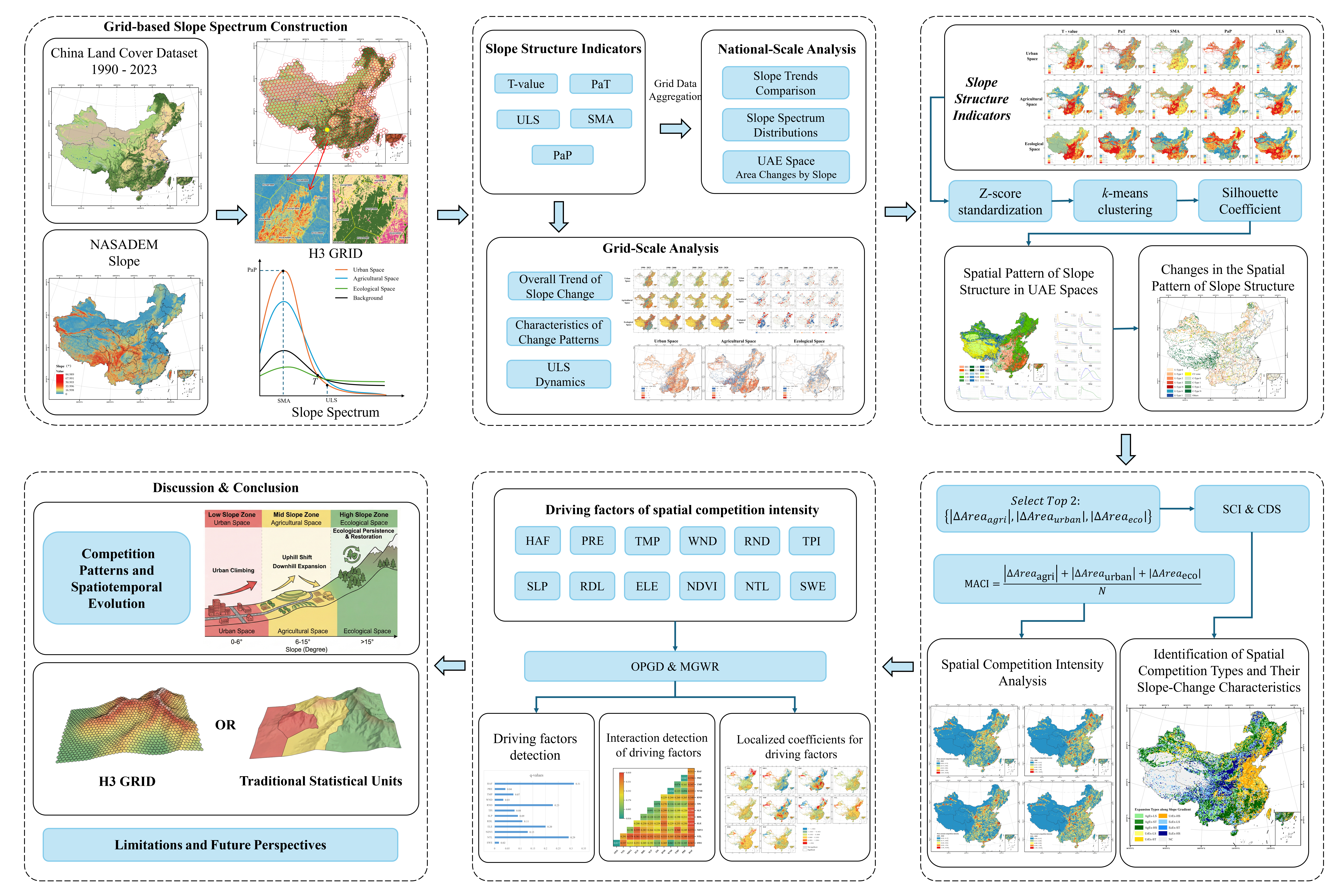
Rapid urbanization and stringent ecological protection policies in China have intensified spatial competition among Urban–Agricultural–Ecological (UAE) spaces. However, existing studies often overlook how this competition evolves across different slope structures. To address this, this study establishes a fine-scale analytical framework using H3 hexagonal grids and slope spectrum analysis to investigate the slope structure evolution and spatial competition mechanisms from 1990 to 2023. The results reveal a distinct topographic stratification of competitive niches: urban space dominates low-slope regions (< 6°) but exhibits a pervasive "upslope expansion" trend, with its average slope increasing from 1.81° to 2.07°. Agricultural space characterizes the transition zones (6°–15°), showing an "upslope migration" in the Southeastern Hills driven by urban squeeze. Ecological space functions as a stable barrier in steep terrains (> 15°) but faces encroachment in transition zones. Furthermore, cluster analysis identifies significant regional heterogeneity aligning with China’s macro-topography: the Eastern Plains are characterized by "low-slope agglomeration," where urban–agricultural conflict is most intense; the Southern Hilly Regions display an "interwoven upslope" pattern; while the Western Highlands maintain absolute ecological dominance. Mechanism analysis using GeoDetector and Multiscale Geographically Weighted Regression (MGWR) indicates that competition intensity is predominantly driven by human activity factors (e.g., human footprint, nighttime lights, q > 0.29), yet significantly modulated by topographic constraints (e.g., elevation), creating a nonlinear enhancement effect. Crucially, this study challenges the traditional flat-projection planning model. We propose a transition to "three-dimensional topographic regulation," advocating for differentiated management strategies—such as strict "slope redlines" for urban–agricultural transition zones—to resolve the intensifying spatial conflicts in complex terrains and safeguard agricultural sustainability.
Keywords:
slope structure evolution
; spatial competition
; urban-agricultural-ecological space
; H3 hexagonal grid
; topographic regulation
; land-use mechanism
1. Introduction
The United Nations’ 2030 Agenda for Sustainable Development establishes 17 Sustainable Development Goals (SDGs), serving as a comprehensive framework for global sustainability [1]. Within this framework, the interactions among Goal 2 (Zero Hunger), Goal 11 (Sustainable Cities and Communities), and Goal 15 (Life on Land) are characterized by a complex interplay of synergies and trade-offs [2,3,4]. Driven by the unprecedented pace of global urbanization, urban areas are expanding rapidly, particularly in regions subject to resource and topographic constraints. Such expansion inefrequently encroaches upon agricultural and ecological spaces, exacerbating land-use conflicts that pit urban development against food security and ecological conservation [5]. Consequently, elucidating and quantifying the competitive dynamics among urban, agricultural, and ecological spaces along natural gradients through robust spatial indicators is imperative for optimizing spatial development patterns and ensuring the sustainable management of land resources.
Topographic slope serves as a decisive natural constraint governing the spatial distribution and expansion trajectories of diverse land-use types [6]. Conventionally, a distinct vertical stratification exists: urban space clusters in low-slope regions [7,8,9], agricultural space occupies gentle-to-moderate gradients [10,11], while steep terrain is predominantly retained as ecological space [12,13]. However, in recent years, urban expansion has increasingly encroached onto higher-slope terrains [9,14], thereby challenging this traditional topographic equilibrium. This phenomenon of climbing uphill not only reconfigures the slope structure of land use but also precipitates novel competitive dynamics, intensifying ecological vulnerability in fragile mountainous environments.
Previous studies have extensively investigated the interrelationships among urban, agricultural, and ecological (UAE) spaces across multiple scales, which can be categorized into three primary research streams:
(1) Quantification of spatial substitution dynamics based on land-use change detection. Utilizing methods such as transition matrices, change-patch interpretation, and urban expansion trajectory analysis, these studies quantitatively reveal the encroachment of urban space onto agricultural and ecological spaces, as well as the spatiotemporal characteristics of these displacements [15,16]. This research highlights the spatial coupling between the expansion of urban space in fringe areas and the loss of agricultural space, uncovering typical urbanization–driven conversion patterns–henomena that are particularly pronounced in rapidly urbanizing regions such as East and South Asia. (2) Structural evolution of urban fringes or peri-urban transition zones. By leveraging remote sensing monitoring, spatial metrics, and boundary-detection algorithms, this stream conducts in-depth analyses of boundary dynamics, expansion pathways, and transformation mechanisms among UAE spaces [17,18,19,20,21,22]. This line of research emphasizes the frontier characteristics of urban growth, elucidating phenomena such as spatial squeeze and fragmented encroachment, thereby highlighting the pivotal structural role of boundary zones in shaping the tripartite competition.(3) Trade-offs and synergies from the perspectives of ecosystem services and policy regulation. Moving beyond traditional physical pattern analysis, this research shifts focus to how different spaces interact and complement each other in providing ecosystem services (e.g., food production, water conservation, and biodiversity maintenance), offering theoretical support for integrated spatial governance [23,24,25,26,27]. Concurrently, scholars assess these dynamics through the lens of land-use conflicts and institutional intervention, analyzing how regulatory frameworks–such as urban growth boundaries, farmland protection, and ecological redlines–intervene in and reshape the relationships among the three spatial domains [28,29].
Despite these advancements, current research remains constrained by several critical limitations. First, the analytical granularity is often too coarse to capture fine-scale spatial heterogeneity, as reliance on administrative boundaries frequently obscures localized topographic variations (the Modifiable Areal Unit Problem). Second, while spatial substitution is well documented, the structural evolution of land-use competition along natural gradients—specifically slope—is seldom explicitly quantified. Third, the comprehensive integration of spatial patterns and driving mechanisms of this tripartite competition remains insufficient at the national scale.
Given the intensifying phenomenon of spatial squeeze across topographies, it is imperative to develop a fine-scale analytical framework. Therefore, to address these gaps, this study integrates the H3 hexagonal grid system and slope spectrum analysis to systematically investigate the slope structure evolution and spatial competition mechanisms of UAE spaces in China from 1990 to 2023. Specifically, the objectives of this study are to: (1) construct slope structure indicators using fine-scale H3 grids to capture topographic dependencies, (2) quantify the spatial competition intensity and reveal the cascading upslope migration of agricultural and urban spaces, and (3) utilize GeoDetector and Multiscale Geographically Weighted Regression (MGWR) models to unravel the driving mechanisms behind this competition. The findings aim to provide a robust quantitative basis for optimizing land-use structures, safeguarding cropland, and promoting sustainable ecological management in mountainous and hilly regions.
2. Materials and Methods
2.1. Research Area
China, characterized by a vast territory and complex topography, exhibits a distinct three-step staircase terrain descending from west to east (Figure 1, all maps in this article are based on the approval number GS (2024) 0650 for China’s map shpfile, with data sourced from the National Geoinformation Public Service Platform). The landscape is dominated by mountains, plateaus, and hills, which collectively account for approximately 69% of the total land area [30], creating a highly heterogeneous foundation for land-use patterns. Governed by the interplay of topographic constraints, hydrothermal gradients, and uneven population distribution, China’s land-use structure shows pronounced regional differentiation.
In recent decades, rapid urbanization and industrialization have precipitated the accelerated expansion of urban space, particularly in resource-constrained regions where flat terrain is scarce. Consequently, cities are increasingly encroaching onto steeper slopes, a phenomenon that significantly alters the regional land-use structure and threatens ecological security. Statistics indicate that China’s urban space (construction land) expanded from in 1984 to in 2019, reflecting an average annual growth rate of 1.45% [31]. Driven by this massive demographic pressure and continuous urbanization, the demand for urban space is expected to remain inelastic in the foreseeable future. This trend will inevitably exacerbate the tripartite competition and spatial conflicts among urban, agricultural, and ecological spaces, making China an ideal study area for investigating slope-dependent land-use dynamics.
2.2. Data Sources
2.2.1. Urban–Agricultural–Ecological Space
Urban–agricultural–ecological space refers to a functional zoning approach based on land-use functions, which is closely linked to specific land-use types.This study employs the China Land Cover Dataset(CLCD) [32], which provides consistent, high-temporal-resolution land use data across China from 1985 to 2023 [31,33]. The CLCD has been widely used in various research fields, including land use change detection, ecological and environmental monitoring, and sustainable development assessments [34,35,36]. For this study, we selected the time series data from 1990 to 2023 and maintained the original 30-m resolution to ensure analytical robustness and comparability. Based on the land-use classification provided by the CLCD, this study integrates the categories into three major types: urban space, agricultural space, and ecological space (Table 1). Urban space mainly refers to built-up land, corresponding to the Impervious class in CLCD, and serves as the core carrier of economic, social, and cultural activities. Agricultural space is represented by cropland, which is primarily devoted to food production and agricultural development. Ecological space consists of forests, grasslands, water bodies, and other natural protection areas, functioning as ecological barriers and playing a vital role in environmental regulation. This classification framework enables a more effective characterization of the spatiotemporal evolution of land with different functions across China, thereby providing essential data support for subsequent analyses.
2.2.2. Digital Elevation Model (DEM) and Slope Calculation
Topographic data were derived from the NASADEM global digital elevation model (DEM). With a spatial resolution of approximately 30 m (1 arc-second), NASADEM provides significant improvements in vertical accuracy and data completeness by reprocessing original SRTM data and incorporating auxiliary data to fill voids [37]. The slope gradient was calculated on the Google Earth Engine (GEE) platform. To facilitate the subsequent construction of the slope spectrum, the continuous slope values were discretized into integer units by truncating to intervals. Finally, to ensure spatial consistency across multiple datasets, all raster layers were reprojected into the Albers Conic Equal Area projection, consistent with the CLCD dataset.
2.2.3. Potential Driving Factors for UAE Space Changes
To explore the potential mechanisms underlying the spatiotemporal dynamics of UAE space, this study considered a set of driving factors encompassing natural, climatic, and anthropogenic dimensions. These factors were selected based on data availability, theoretical relevance, and their documented roles in shaping land-use patterns in previous studies. Table 2 summarizes the datasets, variables, types, resolutions, and sources employed in the analysis.
2.3. Methods
The methodological framework of this study is designed to systematically quantify the spatiotemporal evolution and competition of Urban–Agricultural–Ecological (UAE) spaces across China from 1990 to 2023. The research logic follows four primary stages: (1) Space Reconstruction: Reclassifying multi-period land-use data into three functional spaces (Urban, Agricultural, and Ecological); (2) Multi-scale Spatial Unit Construction: Employing the H3 hexagonal grid system (Resolution 5) as the fundamental analytical unit to ensure spatial consistency and computational efficiency in large-scale topographical analysis; (3) Slope Structure Quantification: Utilizing the “slope spectrum” theory to derive a series of indicators (e.g., T-value, ULS, and SCI) for characterizing the topographic niches of UAE spaces; and (4) Competition and Driving Mechanism Analysis: Identifying competition types and employing the Multiscale Geographically Weighted Regression (MGWR) model to explore the spatial heterogeneity of dominant driving factors. The overall workflow is illustrated in Figure 2.
2.3.1. H3 Hexagonal Grid System
The H3 hierarchical geospatial indexing system serves as the foundational spatial framework for this study [44]. In contrast to traditional quadrilateral grids, hexagonal tessellation offers equidistant neighboring cells, which significantly minimizes orientation bias (anisotropy) and sampling errors, thereby enhancing the stability of spatial metrics. Furthermore, its hierarchical aperture enables seamless multi-scale aggregation, making it particularly suitable for capturing spatial heterogeneity across vast territories.
We adopted H3 resolution 5 as the fundamental analytical unit. At this level, each hexagonal cell possesses an average edge length of approximately 9.85 km and an area of ∼253 [45]. Although finer resolutions could capture micro-scale details, they risk fragmenting the continuity of regional slope gradients, potentially introducing noise into the slope spectrum analysis. Computationally, resolution 5 generates approximately 41922 discrete units across mainland China, representing an optimal trade-off between spatial granularity and computational efficiency; increasing the resolution further would impose prohibitive computational burdens without necessarily enhancing the detection of macro-scale patterns.
2.3.2. Slope Spectrum Analysis Framework
To systematically characterize the topographic distribution of UAE spaces, this study adopts and extends the slope spectrum analysis method(Figure 3). While conventional applications often focus on singular land-use types (e.g., cropland), we expand this framework to simultaneously compare the vertical stratification of multiple functional spaces.
Conceptually, the slope spectrum functions analogously to a histogram in image processing: just as a histogram visualizes the frequency distribution of pixel values (e.g., brightness or color intensities), the slope spectrum quantifies the relative share of land area distributed across successive slope intervals [46]. In this study, we discretized slope values into intervals (bins). Within each interval, the area proportion of each land-use category was calculated to construct continuous distribution curves. Crucially, a “background terrain slope spectrum” (representing the natural slope distribution of the entire study area) was generated as a baseline. By benchmarking specific land-use spectra against this background baseline, we can effectively evaluate the topographic selectivity–identifying whether specific spaces exhibit preference or avoidance behaviors toward certain gradients [47].
To systematically quantify the structural characteristics of urban, agricultural, and ecological spaces across slope gradients, this study established a system of five Slope Structure Indicators[48] (Table 3).
Specifically, to capture the expansion trends of different spatial categories into steep terrain, we defined the Slope Change Index (SCI). This index measures the temporal shift in the distribution of a given spatial category above a specific slope threshold (t). The SCI is derived by calculating the difference in the Proportion above Threshold (PaT) between two time points. The formula for calculating at time j is expressed as:
where is the area of the spatial category at time j located on slopes steeper than the threshold T, and is the total area of the spatial category at time j. Subsequently, the SCI is defined as the difference between the PaT values at time j and time i, as follows:
In this formula, is the proportion of the spatial category located on slopes steeper than T at time j, and is the corresponding proportion at time i. A positive SCI value (SCI ) indicates an increased proportion of the spatial category in steeper-slope areas, reflecting an upslope expansion trend. Conversely, a negative SCI value (SCI ) suggests a shift toward gentler slopes, reflecting a downslope contraction pattern.
2.3.3. Analysis of Competition Patterns
To systematically elucidate the spatial mechanisms of land-use transformation, we developed a slope-gradient-based competition analysis framework using the H3 hexagonal grid system. This framework integrates four key analytical dimensions: quantification of net area changes, identification of dominant competition relationships, assessment of competition intensity, and detection of the competitive dominance slope.
(1) Net Change Calculation and Dominant Type Identification
First, we calculated the net area change of the three functional spaces–urban, agricultural, and ecological–within each H3 grid cell between 1990 and 2023. These changes are denoted as follows:
- : Net change in urban space area;
- : Net change in agricultural space area;
- : Net change in ecological space area.
The land-use category exhibiting the largest absolute change (i.e., ) within a grid cell is identified as the Dominant Type. Its dynamic status is determined by the sign of the change: a positive value indicates expansion, while a negative value indicates contraction.
(2) Identification of Dominant Competition Relationships
To characterize the primary mode of spatial replacement, we compared the absolute changes of all three categories. The two categories with the highest absolute changes were identified as the primary interacting pair. This relationship is denoted as Type X vs. Type Y, representing the dominant trade-off within the grid. For instance:
- Urban vs. Agricultura: Signifies that the reciprocal transformation between urban and agricultural spaces dominates the local land-use dynamics (typically implying urban encroachment on farmland).
- Ecological vs. Urban: Indicates that the tension between ecological conservation and urban development is the primary driver of land-use change.
(3) Assessment of mean annual competitive intensity
To quantify the overall magnitude of land-use reconfiguration and capture the regional heterogeneity of spatial conflicts, we defined the mean annual competitive intensity (MACI). This index measures the average annual volume of area converted among urban, agricultural, and ecological spaces within each grid cell. The MACI is calculated as follows:
where , , and represent the absolute net area changes of urban, agricultural, and ecological spaces, respectively; and N represents the duration of the study period (in years), which is 33 years (1990–2023) in this study. A higher MACI value indicates a more intense annual fluctuation in land-use structure, reflecting a “hotspot” of spatial competition.
(4) Competitive dominance slope
Finally, to pinpoint the specific topographic gradients where land-use competition is most concentrated, we defined the competitive dominance slope (CDS). The CDS identifies the specific slope interval ( bin) within each grid unit that accounts for the maximum aggregate intensity of land-use conversion. It is calculated as:
where represents the slope class within grid g experiencing the most intense land-use change; S is the set of all slope classes; and denotes the net area change of land-use category c (urban, agri, or eco) at slope class s within grid g.
2.3.4. Analysis of Driving Mechanisms
To comprehensively elucidate the driving forces underlying the spatial differentiation of land-use competition, this study combines the Optimal Parameters Geodetector (OPGD) and Multiscale Geographically Weighted Regression (MGWR).
(1) Optimal Parameters Geodetector (OPGD)
The Geodetector is a statistical tool used to detect spatial stratified heterogeneity and reveal the driving factors behind it [49]. However, the traditional Geodetector requires manual discretization of continuous variables (e.g., precipitation, GDP), which often introduces subjectivity. To address this, we employed the OPGD model implemented in the GD R package [50]. OPGD automatically selects the optimal combination of discretization methods (e.g., natural breaks, quantile, geometrical interval) and the number of intervals to maximize the explanatory power (q-statistic).
The core metric, the q-statistic, quantifies the extent to which factor X explains the spatial variance of the dependent variable Y (MACI). It is calculated as:
where represents the strata of factor X; and N are the number of units in stratum h and the entire study area, respectively; and and denote the variances of Y within stratum h and the entire area. The q value ranges from . A higher q indicates a stronger explanatory power. Additionally, the Interaction Detector was used to assess whether two factors work independently or interact to enhance their influence on land-use competition.
(2) Multiscale Geographically Weighted Regression (MGWR)
While OPGD identifies global dominant factors, it does not reveal the spatial non-stationarity of these relationships. To capture local variations, we employed the MGWR model [51]. Unlike the classical Geographically Weighted Regression (GWR), which assumes a constant bandwidth (spatial scale) for all variables, MGWR allows each covariate to operate at a distinct spatial bandwidth. This improvement effectively captures the multi-scale nature of land-use processes–some factors operate locally (small bandwidth), while others operate regionally or globally (large bandwidth).
The MGWR formula is expressed as:
where is the dependent variable at location ; is the intercept; represents the local regression coefficient for the j-th variable at location i, calibrated using a specific bandwidth ; is the value of the j-th explanatory variable; and is the error term. By generating variable-specific bandwidths, MGWR provides a robust estimation of how natural and human factors differentially shape land-use competition across China.
3. Results
3.1. Slope Distribution Characteristics of Urban-Agricultural-Ecological Spaces in China (National Scale)
To capture the overall dynamics at the national scale, we conducted a statistical analysis of urban, agricultural, and ecological spaces in China from 1990 to 2023. The results reveal distinct slope evolution patterns for the three land-use types (Figure 4). Urban space exhibited a clear uphill trend, with the average slope increasing from in 1990 to in 2023. Agricultural space showed a fluctuating pattern: the mean slope initially rose from and peaked at in 2003, before declining slightly to by 2023. In contrast, ecological space remained relatively stable between 1990 and 2008, fluctuating around , but thereafter experienced a marked increase, reaching its maximum of in 2023.
Figure 5 illustrates the slope spectrum distributions of urban, agricultural, and ecological spaces in China from 1990 to 2020 at 5-year intervals. Overall, land resources are predominantly distributed on slopes below , accounting for 48.8% of the total land area. Consequently, the slope distributions of urban, agricultural, and ecological spaces are strongly constrained by the topographic background, exhibiting similar patterns.
A pronounced peak is observed in the [, ) interval across all three land-use types. With increasing slope, the curve of urban space declines most steeply and intersects with the background terrain around . Agricultural land shows a moderate decline and intersects with ecological space at approximately . Notably, the turning point for ecological space occurs at , indicating its competitive disadvantage on slopes below this threshold, where its proportion decreased from 44.11% in 1990 to 43.55% in 2023. In contrast, agricultural land consistently maintained dominance below , with its share exceeding 79% of total cropland throughout the 30-year period. Urban space exhibited the narrowest range of advantageous slopes, being highly concentrated below . However, its share also declined, from 92.38% in 1990 to 88.94% in 2023.
In addition, given the large national scale, the slope spectra of cropland and ecological space exhibit only minor temporal differences, with slight variation confined to the range, while the rest of the curves are nearly overlapping. By contrast, the slope spectral curves of urban space show a clear temporal evolution. From 1990 to 2023, the slope distribution of urban land underwent notable changes, with the maximum proportion decreasing by approximately 3.04%, indicating an intensified trend of urban expansion onto steeper terrain in recent years. These findings suggest that both urban and agricultural land in China have been extending toward higher-slope regions, particularly during the last decade, when the intensity of development in steeper areas has increased.
At the same time, we examined the changes in both area and proportion of the three land-use types across slope intervals from 1990 to 2023. The results (Figure 6) show that, within the study period, urban space expanded markedly in the low-slope interval , while cropland and ecological land experienced evident contraction in this range.
3.2. Slope Spatial Distribution Characteristics Based on the H3 Grid
3.2.1. Overall Trend of Slope Change
Based on the SCI index results for 1990-2023, the slope distributions of urban, agricultural, and ecological spaces have all undergone significant changes (Figure 7). Spatially, areas experiencing upslope expansion of built-up land are mainly concentrated in the extensive eastern regions of China, whereas inland provinces exhibit relatively lower expansion. Most regions display low to moderate upslope trends, and areas with decreasing slopes are primarily located in southwestern China (Yunnan Province) and central China (Gansu and Ningxia). For agricultural land, upslope expansion is similarly concentrated in the eastern regions, with inland provinces showing relatively lower values. Most areas experience low to moderate upslope changes, while slope decreases are mainly observed in southwestern China (Yunnan Province) and central China (Gansu and Ningxia). Ecological land shows higher SCI values primarily in the southwestern mountainous areas, the Loess Plateau, the Qinling region, and the Changbai Mountains. These regions are characterized by complex terrain and steep slopes, where ecological land is mostly distributed in mountainous and hilly areas. In contrast, eastern coastal regions, the Northeast Plain, the North China Plain, and the middle and lower reaches of the Yangtze River Plain exhibit lower SCI values, indicating that ecological land in these areas is mainly located in low-slope regions.
By counting the number of grid cells with SCI > 0 in each period, we assessed slope changes over time. The results show that, from 1990 to 2023, the proportion of urban-space grids with SCI > 0 increased from 40.20% (10,062 of 25,028) in 1990–2000 to 60.83% (15,224 of 25,028) in 2010–2020, reaching 60.22% over the entire 1990–2023 period, indicating a sustained "climbing-up" trend. For agricultural space, the proportion of grids with SCI > 0 rose from 46.52% (15,091 of 32,441) to 52.50% (17,031 of 32,441), with 52.16% of grids showing slope increases during 1990–2023, reflecting relatively modest overall changes. In ecological space, the share of grids with SCI > 0 decreased from 38.44% (16,052 of 41,755) to 36.07% (15,059 of 41,755), and 34.15% of grids exhibited slope increases over 1990–2023, also indicating a relatively small magnitude of change.
3.2.2. Characteristics of Change Patterns
Using the Theil–Sen median trend estimator and the Mann–Kendall significance test [52], we assessed the PaT trends of urban, agricultural, and ecological spaces from 1990–2023 (Figure 8). Urban space exhibits a predominantly increasing trend, with upward grids accounting for 66.82% (8,446 significantly and 7,467 non-significantly increasing), mainly concentrated in the North China Plain (Beijing, Tianjin, Hebei, Shandong) and the Northeast Plain (Liaoning, Jilin). Significant decreases (3,136 grids) occur primarily in Yunnan and parts of Gansu, Ningxia, and Shaanxi. Agricultural space shows 55.82% upward grids (5,391 significantly and 11,666 non-significantly increasing), with increases clustered in the southeastern hilly–mountainous provinces (Fujian, Guangdong, Guangxi) and decreases in the Yunnan–Guizhou Plateau and parts of the Loess Plateau. Ecological space exhibits the opposite pattern, with only 43.22% upward grids (3,389 significantly and 9,547 non-significantly increasing) and widespread decreases, especially in southeastern China, while increases appear mainly in the Loess Plateau.
The Getis–Ord Gi* [53] results reveal clear and temporally consistent hot–cold spot patterns of slope-change dynamics across urban, agricultural, and ecological spaces from 1990–2023(Figure 9). Urban space exhibits persistent and expanding hot-spot clusters in the North China Plain and the eastern coastal region, reflecting a continued shift of urban development toward higher-slope terrain, while cold spots are mainly distributed in Yunnan and parts of northwestern China. Agricultural space shows a contrasting dual pattern, with hot spots concentrated in the southeastern hilly–mountainous provinces (Fujian, Guangdong, Guangxi) and cold spots prevailing in the Yunnan–Guizhou Plateau and parts of the Loess Plateau, consistent with ecological restoration and cropland adjustment. Ecological space displays the opposite spatial structure, with extensive cold spots in southeastern China and pronounced hot spots in the Loess Plateau and northern dryland regions, indicating increasing slope tendencies associated with long-term vegetation recovery. Across the four subperiods, these spatial clusters gradually strengthen and become more coherent after 2000, highlighting the growing influence of urbanization, agricultural restructuring, and ecological engineering on China’s slope-change patterns.
3.2.3. Upper Limit Slope (ULS) Dynamics
From 1990 to 2023, ULS showed distinct patterns across land-use types (Figure 10). Urban areas mostly experienced increases of 1–, indicating expansion onto steeper slopes, with larger rises (>) in the Yunnan–Guizhou Plateau near the Yunnan–Guizhou–Guangxi junction. Decreases were limited, mainly in Yunnan and parts of Gansu, Ningxia, and Shaanxi (1–). Agricultural areas exhibited increases in southeastern hilly regions (Fujian, Jiangxi, Guangxi, Guangdong, Hunan), reflecting intensified cultivation on moderate slopes, while substantial decreases occurred in the Yunnan–Guizhou Plateau, eastern Tibet, Sichuan, and parts of the Loess Plateau, due to cropland retreat and ecological restoration. Ecological areas remained largely stable, with minor changes only in scattered regions of eastern China, indicating that ecological land largely retained its original slope ranges.
3.3. Slope Structure Transition of Urban, Agricultural, and Ecological Spaces
The spatial distributions of the five slope structure indicators in 2023 reveal pronounced contrasts among urban, agricultural, and ecological spaces (Figure 11). Urban areas are characterized by a concentration of low-slope values across all indicators (T-value, PaT, SMA, PaP, and ULS), forming continuous belts in eastern China. These patterns indicate that urban development remains highly dependent on gentle terrain, while localized increases in PaT and ULS suggest emerging expansion toward steeper slopes.
Agricultural areas present a more heterogeneous structure, with moderate to high-slope values widely distributed across the southeastern hilly regions and the Yunnan–Guizhou Plateau. High PaT and PaP patches reflect intensive cultivation in complex terrain, whereas lower SMA and ULS values in southwestern China indicate cropland retreat from steep slopes due to land consolidation and ecological restoration.
Ecological space exhibits the most distinct and stable pattern. High values of T-value, PaP, SMA, and ULS are continuously distributed across the Qinghai–Tibet Plateau, Hengduan Mountains, and Loess Plateau, demonstrating a strong dependence on steep terrain. The consistency among indicators underscores the structural stability of ecological land, with only scattered variations in eastern China. Overall, the three land-use systems show clear slope-based differentiation: low-slope dominance in urban areas, multi-slope complexity in agricultural regions, and high-slope prevalence in ecological landscapes.
To identify the characteristic slope structure types of urban, agricultural, and ecological spaces, we performed K-means clustering [54] separately for the three land-use systems using five slope structure indicators (T-value, PaT, SMA, PaP, and ULS). Prior to clustering, all indicators were subjected to missing-value removal and Z-score standardization to eliminate scale differences and ensure comparability across variables.
Using the 1990 dataset as the baseline, we evaluated clustering solutions with k values ranging from 2 to 15 for each land-use system and calculated the corresponding silhouette coefficients. The k value with the highest silhouette coefficient was selected as the optimal number of clusters, yielding for urban space, for agricultural space, and for ecological space. The cluster centers derived from the 1990 results were then extracted and used as the initial centroids for the 2023 clustering. This initialization strategy effectively prevents interannual category drift caused by independently trained models and ensures the temporal consistency and comparability of clustering outcomes. Using the same standardization parameters and fixed initial centroids, the 2023 dataset was subsequently classified. To construct integrated slope structure types, the clustering results of the three land-use systems were combined in the order of urban–agricultural–ecological space (e.g., a combination code of 0–0–1 represents urban cluster 0, agricultural cluster 0, and ecological cluster 1). As the number of combined categories is relatively large, only the 14 dominant types with the largest spatial extents were selected for detailed analysis. The spatial distribution of the 2023 clustering results is presented in Figure 12.
Overall, the slope structures of the tripartite spaces primarily exhibit two typical patterns: high agglomeration on low slopes” and “dispersion on gentle slopes. Specifically, urban space is dominated by the U1 (U1 represents the first slope-structure type of urban space, with similar notation applied to agricultural and ecological spaces) and U2 categories, concentrated predominantly in low-slope areas below , with some expansion into gentle slopes of –. Agricultural space is similarly dominated by the A1 and A2 categories but exhibits a broader range of low-slope agglomeration (mainly below ), extending up to in certain regions; notably, the A0 category shows a relatively uniform distribution within the – range, attenuating gradually with increasing slope. Ecological space, characterized mainly by E0 and E1 categories, displays a relatively balanced distribution across low and gentle slopes (–) but still retains distinct agglomeration characteristics in low-slope sections.
Driven jointly by topographic constraints and UAE spatial competition mechanisms, the slope structures demonstrate distinct spatial differentiation across regions:
- 1.
- The Eastern Plains exhibit a distinct low-slope agglomeration characteristic (Dominant Types: 110, 111). In the Northeast Plain, North China Plain, and the Middle-Lower Yangtze Plain, both urban (U) and agricultural (A) spaces are highly concentrated in low-slope tiers below . This pattern reflects intense spatial overlap and competition between construction land and cropland in flat regions, while ecological space (E) is largely squeezed to peripheral low slopes (Type 110) or distributed relatively evenly below (Type 111).
- 2.
- The Southern Hilly Regions display mixed characteristics of “interwoven 011 and 001 types. Compared to the plains, although urban space in this region remains aggregated on low slopes, its utilization range ascends to approximately . Meanwhile, agricultural space further expands into higher slope zones, with the upper limit of distribution (e.g., A0 category) reaching , reflecting the trend of “uphill farming” under topographic constraints.
- 3.
- Central and Southwest China (Loess Plateau, Sichuan Basin, Yunnan-Guizhou Plateau) are dominated by the “001” type. In these regions, the dominant occupation of low-slope resources by urban space compels agricultural space to disperse towards higher slopes, resulting in a relatively uniform distribution in areas below . Consequently, ecological and agricultural spaces exhibit a clear complementary relationship, with ecological space occupying a dominant position in steep areas greater than .
- 4.
- The Northwest and Qinghai-Tibet Regions exhibit “absolute ecological dominance” (Dominant Types: NN0, NN1). The slope structure of the Qinghai-Tibet Plateau is almost entirely controlled by natural topography, where ecological space maintains absolute dominance. In other parts of the Northwest, restricted by climate and water resources, ecological and agricultural spaces show a “trade-off” competitive relationship (Types N21, N01). This indicates that in regions with harsh natural conditions, ecological space maintains absolute dominance regardless of terrain flatness.
From 1990 to 2023, the transformation of slope structures across different spatial types exhibited a scattered distribution pattern nationwide (Figure 13).
Among all transformed grids (excluding the Urban-Agricultural co-change zone), urban space underwent the most significant slope structure changes, accounting for 47.33% (5,371 grids) of the total variations. Specifically, the transition to the U1 type was dominant (3,162 grids, 27.87% of total), concentrated mainly in rugged terrains such as Southwest China, the Loess Plateau, and the mountainous areas of Northeast China, reflecting a trend of urban agglomeration towards low-slope valleys. The remaining urban transformations were primarily towards the U0 category (approximately 19.47% of total), clustered in the hilly regions of Eastern China, indicating a trend of urban expansion climbing upslope.
The transformation of agricultural space followed, dominated by the shift to the AN category (cropland retirement/abandonment), which accounted for 12.36% (1,402 grids) of the total and was mainly located in the Qinghai-Tibet Plateau. This was followed by the transition to the A2 type (1,353 grids, 11.92%), distributed primarily in the Shandong Peninsula, the southeastern edge of the Qinghai-Tibet Plateau, and parts of Inner Mongolia. The conversion to the A1 type was concentrated in the Loess Plateau and the border region of Yunnan, Guizhou, and Guangxi provinces.
Ecological space transformation was relatively minor, accounting for only 3.97% (450 grids) of the total changes. These transitions were primarily towards E0 and E1 categories, scattered across various provinces in Eastern China.
3.4. Spatial Competition Among Urban, Agricultural, and Ecological Spaces
3.4.1. Classification of Spatial Competition Types
During the study period, most H3 grid cells exhibited distinct trade-offs among urban, agricultural, and ecological spaces, although some cells involved only two land-use types or remained stable. To characterize the dominant competitive processes, the land-use category with the most significant expansion was defined as the dominant type. Furthermore, the two categories experiencing the greatest magnitude of change were used to define the primary competition mode. Applying these criteria, all grid cells were classified into seven spatial competition types (including stable areas), as illustrated in Figure 14(a).
The results indicate that the study area is primarily characterized by Urban–Agricultural competition (UrEx–AgCo, 15.08% of valid grids) and Ecological–Agricultural competition. In these notations, “Ex” and “Co” denote the expansion and contraction of the corresponding spaces, respectively. The Ecological–Agricultural competition comprises two subtypes: AgEx–EcCo (29.35%) and EcEx–AgCo (27.15%).
Geographically, the UrEx–AgCo type is concentrated in the Northeast Plain and the North China Plain—specifically Tianjin, Hebei, Shandong, Henan, northern Anhui, and Jiangsu—indicating a spatial transition from agricultural to urban space. In contrast, Ecological–Agricultural competition exhibits regional heterogeneity: the EcEx–AgCo type is prevalent in Central China, whereas the AgEx–EcCo type is mainly distributed in the southeastern hilly regions, as well as parts of Northeast and Northwest China.
Using the SCI index, we analyzed the slope changes of the dominant expansion type (defined by the largest area increase) within each H3 grid cell (Figure 14(b)). The results demonstrate distinct spatial differentiation across China. In the eastern and central plains, urban and agricultural expansions are characterized by a shift towards lower slopes (UrEx–LS, AgEx–LS). In contrast, agricultural expansion towards higher slopes (AgEx–HS) is prominent in the mountainous Southwest. In the Northwest, ecological expansion exhibits both slope stability (EcEx–ST) and a trend towards higher slopes (EcEx–HS), whereas the Qinghai–Tibet Plateau remains largely stable (NC). The Northeast also exhibits urban and agricultural expansions shifting towards lower slopes. Overall, expansions towards lower slopes are concentrated in the eastern plains, while expansions towards higher slopes are primarily found in the Southwest and Northwest, reflecting the significant terrain-driven differentiation of urban, agricultural, and ecological spaces.
The spatial distribution of the Competitive Dominance Slope (CDS) exhibits pronounced regional heterogeneity, following a distinct “East-Low, Southwest-High” gradient(Figure 14(c)). Low-slope CDS (–) prevails across the Northeast Plain, North China Plain, and the Middle-Lower Yangtze Plain (including provinces such as Heilongjiang, Hebei, Shandong, and Jiangsu). This pattern reflects that land-use competition is predominantly confined to low-gradient terrains, primarily involving cropland and built-up areas. Medium-slope CDS (–) clusters in the central hilly regions and the mountainous Southwest (e.g., Hubei, Hunan, Chongqing, and Guizhou), indicating intensified interactions among urban, agricultural, and ecological spaces. High-slope CDS () is mainly observed in the Yunnan-Guizhou Plateau, the periphery of the Sichuan Basin, and the southern Qinling-Daba Mountains, signifying an expansion trend into mid-to-high slope terrains. Conversely, high-altitude regions such as the Qinghai-Tibet Plateau exhibit low CDS values, attributable to limited anthropogenic interference.
3.4.2. Competition Intensity Analysis
The spatial distribution of the Mean Annual Competitive Intensity (MACI) across China from 1990 to 2023 demonstrates pronounced regional heterogeneity (Figure 15). High-intensity zones () are primarily clustered in the eastern and southeastern coastal provinces (e.g., Jiangsu, Zhejiang, Guangdong, Shandong) and the Sichuan Basin (Sichuan, Chongqing). In these regions, rapid urbanization and economic development have propelled frequent transitions among urban, agricultural, and ecological spaces. Conversely, low competitive intensity () prevails across vast areas of western and northeastern China (e.g., Xinjiang, Qinghai, Ningxia, Inner Mongolia, Heilongjiang), where topographic constraints and lower population pressure contribute to relatively stable spatial patterns.
Regarding temporal dynamics, the 1990–2000 period saw competitive intensity largely confined to the North China Plain and coastal urban agglomerations, corresponding to the initial phase of rapid urban expansion. From 2000 to 2010, competition intensified and diffused westward, particularly along major urban corridors and within mountainous basins, indicating escalated interactions among agricultural, urban, and ecological spaces. During the 2010–2020 interval, competitive pressure further penetrated central and southwestern regions (e.g., Hunan, Guizhou, Guangxi, Yunnan), signifying the encroachment of urban and agricultural spaces onto sloped terrains. Overall, the trajectory of spatial competition in China exhibits a progressive westward expansion, highlighting the growing prominence of trade-offs among urban, agricultural, and ecological spaces in slope-constrained environments.
3.4.3. Driving Mechanisms of Spatial Competition
The GeoDetector results (Figure 16) indicate that human activity factors are the primary drivers of the competition intensity among UAE spaces, thereby indirectly driving the evolution of slope spatial patterns. Specifically, the Human Activity Footprint (HAF, ), Nighttime Light intensity (NTL, ), and Road Network Density (RND, ) exhibit the strongest explanatory power, suggesting that the intensity of human activity, economic development, and transportation infrastructure are the decisive determinants of slope development. In contrast, natural factors such as Elevation (ELE, ) and Terrain Relief (RDL, ) exert a secondary influence, while climatic and hydrological variables (e.g., temperature, precipitation, drainage density) show limited impact. Consequently, the intensity of competition among these three spaces is predominantly governed by human activity factors, with environmental factors functioning primarily as background constraints.
The interaction detector analysis (Figure 17) reveals that the combined effects of driver pairs consistently exceed their individual contributions, demonstrating significant bivariate and nonlinear enhancement. The most prominent interaction occurs between HAF and ELE (), highlighting the critical role of topography in modulating human disturbance. Strong synergistic effects are also observed for HAF ∩ NTL () and HAF ∩ NDVI (), reflecting the intricate coupling between urban expansion and ecological processes. Furthermore, substantial interactions such as NTL ∩ ELE () and RND ∩ ELE () indicate that the interplay between socioeconomic activities and topographic conditions jointly shapes spatial patterns. Overall, the interaction between human activity and topography dominates the spatial variation of slope land-use change.
To further elucidate the multi-scale driving mechanisms from 1990 to 2023, Multiscale Geographically Weighted Regression (MGWR) was employed(Figure 18). The MGWR model yielded an adjusted of 0.646, slightly outperforming the traditional GWR (0.643) and achieving a lower AICc (), thereby demonstrating superior capability in capturing spatial heterogeneity. Most variables operate at a regional scale (∼382 km), although distinct spatial heterogeneity persists. Human activity factors(HAF, NTL, RND, NDVI) demonstrate the broadest and most significant spatial influence, whereas natural factors like ELE and RDL act as secondary constraints. Climatic and micro-topographic factors exert limited effects. Spatially, human activity factors dominate in densely populated and economically developed regions, while topography and climate exert stronger influence in the western plateau and mountainous areas. In summary, the MGWR results corroborate that slope land-use change is primarily driven by human activities, subject to spatial constraints imposed by environmental factors across multiple scales.
4. Discussion
4.1. Competition Patterns and Spatiotemporal Evolution of UAE Spaces: A Slope Structure Perspective
The fine-scale analysis based on H3 grids reveals distinct structural disparities in the occupation of slope gradients by urban, agricultural, and ecological spaces, presenting a typical pattern of slope-dependent spatial competition. Regarding urban space, the period from 1990 to 2023 was primarily characterized by the encroachment of urban space onto agricultural space. This trend was predominantly observed in plain area grids, whereas competition between urban and ecological spaces appeared in only a minority of hilly grids. Concurrently, the Slope Structure Index () indicates a discernible trend of upslope urban expansion in the North China Plain and Northeast China. Metrics such as the Upper Limit Slope () demonstrate that urban space retains significant dominance in high-accessibility slope gradients (–). Furthermore, the Competitive Dominance Score () confirms that the competitive advantage of urban space is strictly concentrated within this range. These observations corroborate findings from numerous studies regarding urban expansion climbing uphill in China [9,55,56]. However, distinct from regional-scale studies, this H3 grid-scale analysis reveals that shifts in competitive advantage are spatially more discrete and exhibit more pronounced structural heterogeneity. Additionally, multi-temporal trend statistics highlight the spatial migration of urban expansion hotspots: from 1990 to 2000, “upslope urban expansion” clusters were concentrated in the Yangtze River Delta; from 2000 to 2010, they shifted to the Beijing-Tianjin-Hebei region and the southeastern coastal areas (e.g., Zhejiang, Fujian, and Taiwan); and from 2010 to 2020, a trend of concentration towards inland urban agglomerations was observed.
In contrast, the competition for agricultural space is dominated by the agriculture-ecology nexus, with agricultural expansion concentrated mainly in southern China. Indices such as and in the Southeastern Hills region show varying degrees of upward shift. This suggests that, driven by competitive pressure from urban growth and food security imperatives, agricultural space in this region exhibits an upslope migration trend, thereby encroaching upon ecological space. This finding aligns with existing literature on the cultivated land moving uphill phenomenon [57,58]. Interestingly, a divergent trend is observed in Southwest China (e.g., Yunnan and Guizhou), where agricultural space tends to expand towards lower slope gradients. The indicates that slope-based competition in this region is concentrated in the – range. Ecological space maintains dominance in high-slope regions (). Its expansion is primarily concentrated in Central China, forming a belt-shaped distribution extending from Inner Mongolia, Northern Hebei, Shanxi, Shaanxi, Ningxia, and Gansu to Sichuan. Within this region, ecological space shows a tendency to expand towards higher slopes, with the of competitive slopes mostly situated above . Unlike urban and agricultural spaces, the “upslope movement” of ecological space between 1990 and 2023 formed distinct cold and hot spots, exhibiting distribution characteristics contrary to those of the other two spaces. Overall, this study proposes a tripartite spatial competition mechanism constrained by slope structure: (1) the urban dominance segment driven by topographic accessibility, (2) the agricultural migration segment induced by policy and resource endowments, and (3) the ecological stability segment dominated by natural restoration. This structural framework extends previous studies that primarily discussed competitive relationships based on total area change or spatial proximity [59], thereby offering a more comprehensive explanation for the ternary competition mechanism of UAE spaces within the context of topographical heterogeneity.
4.2. Comparative Advantages of H3 Grids over Traditional Statistical Units in Slope-Spectrum Competition Analysis
The appropriate selection of a statistical unit is critical for the reliability of large-scale spatial analysis. Currently, research on spatial patterns still predominantly employs administrative divisions as statistical units [58,60]. However, administrative boundaries inherently lack physiographic coherence. Their substantial heterogeneity in area, shape, and internal topography makes them highly susceptible to the Modifiable Areal Unit Problem (MAUP) [61], thereby masking the spatial heterogeneity inherent in slope structures. For instance, due to the averaging effect of coarse administrative units, prior research tended to systematically underestimate the degree of urban climbing in regions with mixed terrain. Localized upslope expansion was often diluted by the dominant flat areas within large administrative boundaries, thereby obscuring the widespread nature of this phenomenon. In stark contrast, our fine-scale H3 grid analysis reveals that the “upslope urban expansion” phenomenon is widespread across the majority of urban spaces (60.83%) during similar periods, lacking clear spatial continuity or regional concentration. This suggests that macro-level conclusions drawn from administrative scales often result in obscuring fine-scale realities through over-generalization. Furthermore, traditional slope-spectrum studies often construct spectra using coarse administrative units, which limits analysis to statistical frequency distributions and precludes effective cluster or similarity analysis. By leveraging H3 grids to construct and cluster slope structure factors, our study successfully captured the detailed spatial differentiation of slope structures.
Compared with conventional regular square grids, the isotropic geometry of H3 hexagonal grids significantly mitigates directional bias, ensuring that slope-spectrum statistics better reflect intrinsic topographic processes [62]. In square grids, slope gradient changes are easily constrained by grid orientation, and their neighborhood structure exhibits distinct North-South/East-West biases [63]. This often leads to the artifactual truncation of terrain-driven processes—such as low-slope agricultural expansion or urban sprawl along valleys—at grid boundaries, consequently compromising the stability of competitive patterns and key metrics (e.g., T, , and ). Moreover, the H3 grid system possesses a strict hierarchical structure that facilitates robust multi-scale nested analysis. This feature is crucial for assessing the consistency of competition among urban, agricultural, and ecological spaces across scales, overcoming the limitations of administrative divisions (which lack hierarchy) and common grids (which lack natural nesting capability). However, identifying the universally “optimal” grid scale remains a complex challenge due to regional topographic variations. Future work will focus on establishing an adaptive multi-scale framework to systematically determine the optimal H3 resolution that balances computational efficiency with the preservation of micro-scale topographic details.
4.3. Limitations and Future Perspectives
Although this study utilizes the H3 grid and slope-spectrum framework to systematically characterize the slope structure and competitive mechanisms of urban-agricultural-ecological spaces, several limitations remain that merit attention in future research.
First, the identification of competitive relationships is subject to uncertainties inherent in land-use classification products. The land-use data employed in this study were derived from large-scale products (CLCD). While the overall accuracy is robust, misclassification persists as a challenge in complex mountainous terrains, particularly regarding the confusion between shrubland and cropland, or the misidentification of urban bare land. This issue of “spectral mixture,” which has been noted in existing literature [32,64], may introduce uncertainty into the precise identification of competitive advantage slopes.
Second, the selection of spatial scale serves as a trade-off that may influence the interpretability of competitive patterns. This study adopted the Level 5 H3 grid to balance computational efficiency with the continuity of the slope spectrum. However, competitive patterns are often scale-dependent (i.e., the Modifiable Areal Unit Problem), and a single fixed scale may not optimally represent diverse topographic regions. This suggests that future work should establish a multi-scale H3 analysis framework to enhance the robustness of results through cross-scale comparison.
Finally, the quantitative attribution of slope structure dynamics requires further deepening. While this study initially sought to directly model the primary drivers of slope structure evolution, the lack of granular data on institutional factors—specifically the quantitative representation of policy enforcement intensity, land consolidation projects, and ecological protection redlines—constrained the predictive power of direct models. Consequently, this study adopted an alternative strategy by discussing influencing factors through the indirect perspective of “spatial competition intensity.” Future research could further integrate refined policy databases and Coupled Human and Natural Systems (CHANS) models, incorporating high-precision explanatory variables to improve the capability of causal identification regarding slope structure dynamics.
5. Conclusions
This study establishes a fine-scale analytical framework by integrating the H3 hexagonal grid system and slope spectrum analysis to quantitatively investigate the slope structure evolution and driving mechanisms of spatial competition among urban, agricultural, and ecological (UAE) spaces in China from 1990 to 2023. By framing topographic gradients as spatial indicators to reflect land-use conflicts and agricultural sustainability, the main conclusions are as follows:
- 1.
- Topographic Stratification and Upslope Squeeze: At the national scale, UAE spaces exhibit a distinct slope-based stratification. Urban space dominates the high-accessibility lowlands (), agricultural space occupies the transition zones (–), and ecological space serves as the barrier in steep terrains (). However, this equilibrium is dynamic. We identified a “cascading upslope squeeze” effect: rapid urban expansion in flat regions (average slope rising from to ) has forced agricultural space to migrate towards steeper gradients to compensate for cropland loss, particularly in the Southern Hilly Regions, thereby compressing the ecological buffer space and serving as a critical indicator of rising ecological vulnerability.
- 2.
-
Regional Heterogeneity of Slope Structures: Based on K-means clustering, China’s slope structure patterns can be categorized into four distinct modes aligning with macro-geomorphology:
- The “Low-Slope Agglomeration” mode in the Eastern Plains (intense urban-agri conflict);
- The “Interwoven Upslope” mode in the Southern Hilly Regions (agri-ecological tension);
- The “Urban-Valley/Agri-Slope” complementary mode in the Southwest;
- The “Ecological Dominance” mode in the Qinghai-Tibet Plateau.
- 3.
- Mechanism of “Human Drive, Topographic Modulation”: The driving mechanism analysis (GeoDetector and MGWR) reveals that the intensity of spatial competition is predominantly driven by human activity factors (e.g., Human Activity Footprint, Nighttime Lights), rather than natural factors alone. Crucially, topography acts as a nonlinear amplifier: the interaction between human footprint and elevation () significantly enhances the explanatory power, indicating that spatial conflicts and resulting ecological pressures are most intense where anthropogenic pressure meets strict topographic constraints, thereby posing profound challenges to sustainable agricultural land management.
Author Contributions
Conceptualization, G.L. and L.B.; methodology, G.L.; software, G.L. and L.W.; validation, Y.X.; formal analysis, G.L. and L.W.; investigation, G.L. and Y.X.; resources, N.Z.; data curation, G.L.; writing—original draft preparation, G.L.; writing—review and editing, Y.X., L.W., L.B. and N.Z.; visualization, G.L.; supervision, L.B. and N.Z.; project administration, L.B.; funding acquisition, N.Z. All authors have read and agreed to the published version of the manuscript.
Funding
This research was funded by the Yunnan Fundamental Research Projects, grant number 202201AT070257, and the Open Project of the Yunnan Soil Fertilization and Pollution Remediation Engineering Research Center. The APC was funded by the Open Project of the Yunnan Soil Fertilization and Pollution Remediation Engineering Research Center.
Data Availability Statement
The raw data supporting the conclusions of this article will be made available by the authors on request.
Acknowledgments
The authors would like to thank the providers of the open-source datasets used in this study. During the preparation of this manuscript, the authors used Gemini for optimizing English expressions. The authors have reviewed and edited the output and take full responsibility for the content of this publication.
Conflicts of Interest
The authors declare no conflicts of interest. The funders had no role in the design of the study; in the collection, analyses, or interpretation of data; in the writing of the manuscript; or in the decision to publish the results.
References
- Fuso Nerini, F.; Sovacool, B.; Hughes, N.; Cozzi, L.; Cosgrave, E.; Howells, M.; Tavoni, M.; Tomei, J.; Zerriffi, H.; Milligan, B. Connecting Climate Action with Other Sustainable Development Goals. 2, 674–680. [CrossRef]
- Lusseau, D.; Mancini, F. Income-based variation in Sustainable Development Goal interaction networks. Nature Sustainability 2019, 2, 242–247. [Google Scholar] [CrossRef]
- Nilsson, M.; Griggs, D.; Visbeck, M. Policy: Map the Interactions between Sustainable Development Goals. 534, 320–322. [CrossRef]
- Pradhan, P.; Costa, L.; Rybski, D.; Lucht, W.; Kropp, J.P. A Systematic Study of Sustainable Development Goal (SDG) Interactions. 5, 1169–1179. [CrossRef]
- van Vliet, J. Direct and indirect loss of natural area from urban expansion. Nature Sustainability 2019, 2, 755–763. [Google Scholar] [CrossRef]
- Shi, K.; Liu, G.; Zhou, L.; Cui, Y.; Liu, S.; Wu, Y. Satellite Remote Sensing Data Reveal Increased Slope Climbing of Urban Land Expansion Worldwide. 235, 104755. [CrossRef]
- Duan, J.; Peng, Q.; Huang, P. Slope Characteristics of Urban Construction Land and Its Correlation with Ground Slope in China. 14, 1524–1537. [CrossRef]
- Zhang, H.; Zhao, X.; Ren, J.; Hai, W.; Guo, J.; Li, C.; Gao, Y. Research on the Slope Gradient Effect and Driving Factors of Construction Land in Urban Agglomerations in the Upper Yellow River: A Case Study of the Lanzhou–Xining Urban Agglomerations. 12, 745. [CrossRef]
- Zhou, L.; Dang, X.; Mu, H.; Wang, B.; Wang, S. Cities are going uphill: Slope gradient analysis of urban expansion and its driving factors in China. Science of the Total Environment 2021, 775, 145836. [Google Scholar] [CrossRef] [PubMed]
- Liu, G.; Xia, Y.; Bao, L. The Evolution of Cropland Slope Structure and Its Implications for Fragmentation and Soil Erosion in China. 14, 1093. [CrossRef]
- Ministry of Natural Resources of the People’s Republic of China. Land Survey Results Sharing and Application Service Platform. 2025. Available online: https://gtdc.mnr.gov.cn/Share#/ (accessed on 2025-12-21).
- Cao, Y.; Zhang, M.; Zhang, Z.; Liu, L.; Gao, Y.; Zhang, X.; Chen, H.; Kang, Z.; Liu, X.; Zhang, Y. The Impact of Land-Use Change on the Ecological Environment Quality from the Perspective of Production-Living-Ecological Space: A Case Study of the Northern Slope of Tianshan Mountains. 83, 102795. [CrossRef]
- Wang, D.; Fu, J.; Xie, X.; Ding, F.; Jiang, D. Spatiotemporal evolution of urban-agricultural-ecological space in China and its driving mechanism. Journal of Cleaner Production 2022, 371, 133684. [Google Scholar] [CrossRef]
- Shi, K.; Yu, B.; Ma, J.; Cao, W.; Cui, Y. Impacts of Slope Climbing of Urban Expansion on Global Sustainable Development. 4. [CrossRef]
- Seto, K.C.; Güneralp, B.; Hutyra, L.R. Global Forecasts of Urban Expansion to 2030 and Direct Impacts on Biodiversity and Carbon Pools. 109, 16083–16088. [CrossRef]
- Wang, C.; Liu, S.; Zhou, S.; Zhou, J.; Jiang, S.; Zhang, Y.; Feng, T.; Zhang, H.; Zhao, Y.; Lai, Z. Spatial-Temporal Patterns of Urban Expansion by Land Use/Land Cover Transfer in China. 155, 111009. [CrossRef]
- De Vidovich, L. Socio-Spatial Transformations at the Urban Fringes of Rome: Unfolding Suburbanisms in Fiano Romano. 29, 238–254. [CrossRef]
- Ding, W.; Chen, H. Urban-Rural Fringe Identification and Spatial Form Transformation during Rapid Urbanization: A Case Study in Wuhan, China. 226, 109697. [CrossRef]
- Firmansyah, F.; Jatayu, A.; Imaduddin, B.R. Spatial Transformation Analysis in Menganti Subdistrict: A Study of Peri-Urban Area Typologies in the Face of Urban Expansion. 1353, 12039. [CrossRef]
- Fu, B.; Xue, B. Temporal and Spatial Evolution Analysis and Correlation Measurement of Urban–Rural Fringes Based on Nighttime Light Data. 16, 88. [CrossRef]
- Zhang, S.; Deng, W.; Zhang, H.; Wang, Z. Identification and Analysis of Transitional Zone Patterns along Urban-Rural-Natural Landscape Gradients: An Application to China’s Southwest Mountains. 129, 106625. [CrossRef]
- Zhao, M.; Cheng, C.; Zhou, Y.; Li, X.; Shen, S.; Song, C. A Global Dataset of Annual Urban Extents (1992–2020) from Harmonized Nighttime Lights. 14, 517–534. [CrossRef]
- Cueva, J.; Yakouchenkova, I.A.; Fröhlich, K.; Dermann, A.F.; Dermann, F.; Köhler, M.; Grossmann, J.; Meier, W.; Bauhus, J.; Schröder, D. Synergies and Trade-Offs in Ecosystem Services from Urban and Peri-urban Forests and Their Implication to Sustainable City Design and Planning. 82, 103903. [CrossRef]
- Li, Q.; Li, W.; Wang, S.; Wang, J. Assessing Heterogeneity of Trade-Offs/Synergies and Values among Ecosystem Services in Beijing-Tianjin-Hebei Urban Agglomeration. 140, 109026. [CrossRef]
- Li, S.; An, W.; Zhang, J.; Gan, M.; Wang, K.; Ding, L.; Li, W. Optimizing Limit Lines in Urban-Rural Transitional Areas: Unveiling the Spatial Dynamics of Trade-Offs and Synergies among Land Use Functions. 140, 102907. [CrossRef]
- Zhu, C.; Dong, B.; Li, S.; Lin, Y.; Shahtahmassebi, A.; You, S.; Zhang, J.; Gan, M.; Yang, L.; Wang, K. Identifying the Trade-Offs and Synergies among Land Use Functions and Their Influencing Factors from a Geospatial Perspective: A Case Study in Hangzhou, China. 314, 128026. [CrossRef]
- Sylla, M.; Hagemann, N.; Szewrański, S. Mapping Trade-Offs and Synergies among Peri-Urban Ecosystem Services to Address Spatial Policy. 112, 79–90. [CrossRef]
- Kong, W.; Liu, H.; Fan, J. The features and causes of spatial planning conflicts in China: Taking urban planning and land-use planning as examples. Chinese journal of urban and environmental studies 2019, 7, 1950003. [Google Scholar] [CrossRef]
- Zhao, J.; Zhao, Y. Synergy/trade-offs and differential optimization of production, living, and ecological functions in the Yangtze River economic Belt, China. Ecological Indicators 2023, 147, 109925. [Google Scholar] [CrossRef]
- Jiang, Y.; Zhou, L.; Wang, B.; Zhang, Q.; Gao, H.; Wang, S.; Cui, M. The impact of gradient expansion of urban–rural construction land on landscape fragmentation in typical mountain cities, China. International Journal of Digital Earth 2024, 17, 2310093. [Google Scholar] [CrossRef]
- Yang, J.; Huang, X. The 30 m Annual Land Cover Dataset and Its Dynamics in China from 1990 to 2019. Earth System Science Data 2021, 13, 3907–3925. [Google Scholar] [CrossRef]
- Yang, J.; Huang, X. The 30 m Annual Land Cover Datasets and Its Dynamics in China from 1985 to 2023. Zenodo, 2024. Version 1.0.3. Accessed: 2025-05-10. [CrossRef]
- Zhang, C.; Dong, J.; Ge, Q. Quantifying the Accuracies of Six 30-m Cropland Datasets over China: A Comparison and Evaluation Analysis. 197, 106946. [CrossRef] [PubMed]
- An, X.; Jin, W.; Zhang, H.; Liu, Y.; Zhang, M. Analysis of Long-Term Wetland Variations in China Using Land Use/Land Cover Dataset Derived from Landsat Images. 145, 109689. [CrossRef]
- Feng, Z.; Yang, X.; Li, S. New Insights of Eco-Environmental Vulnerability in China’s Yellow River Basin: Spatio-temporal Pattern and Contributor Identification. 167, 112655. [CrossRef]
- Pan, Y.; Tian, Y.; Wu, Y.; Fu, M. A Comprehensive Approach for the Spatial Optimization of the Biodiversity Conservation Network in the Qinling Mountains, China. 40, 11. [CrossRef]
- Crippen, R.; Buckley, S.; Agram, P.; Belz, E.; Gurrola, E.; Hensley, S.; Kobrick, M.; Lavalle, M.; Martin, J.; Neumann, M.; et al. NASADEM GLOBAL ELEVATION MODEL: METHODS AND PROGRESS. XLI-B4, 125–128. [CrossRef]
- Yan, J.; Wang, S.; Feng, J.; He, H.; Wang, L.; Sun, Z.; Zheng, C. The 30 m annual soil water erosion dataset in Chinese mainland from 1990 to 2022. Sci. Data Bank 2024. [Google Scholar]
- Yan, J.; Wang, S.; Feng, J.; He, H.; Wang, L.; Sun, Z.; Zheng, C. New 30-m Resolution Dataset Reveals Declining Soil Erosion with Regional Increases across Chinese Mainland (1990–2022). 323, 114681. [CrossRef]
- xiang, zhang ding; Jinfu, P. A dataset of 1km Grid Drainage Density in China(2022). 2024. [Google Scholar] [CrossRef]
- Peng, S.; Ding, Y.; Liu, W.; Li, Z. 1 km monthly temperature and precipitation dataset for China from 1901 to 2017. Earth System Science Data 2019, 11, 1931–1946. [Google Scholar] [CrossRef]
- Li, X.; Zhou, Y.; zhao, M.; Zhao, X. Harmonization of DMSP and VIIRS nighttime light data from 1992-2024 at the global scale. 2020. [Google Scholar] [CrossRef]
- Mu, H.; Li, X.; Wen, Y.; Huang, J.; Du, P.; Su, W.; Miao, S.; Geng, M. An annual global terrestrial Human Footprint dataset from 2000 to 2018. 2021. [Google Scholar] [CrossRef] [PubMed]
- Brodsky, I. H3: Uber’s Hexagonal Hierarchical Spatial Index. 30.
- Uber Technologies, I. Tables of Cell Statistics Across Resolutions. 2025. Available online: https://h3geo.org/docs/core-library/restable (accessed on 2025-09-22).
- Tang, G.; Li, F.; Liu, X.; Long, Y.; Yang, X. Research on the Slope Spectrum of the Loess Plateau. 51, 175–185. [CrossRef]
- Pan, S.; Liang, J.; Chen, W.; Peng, Y. Uphill or Downhill? Cropland Use Change and Its Drivers from the Perspective of Slope Spectrum. 21, 484–499. [CrossRef]
- Liu, G.; Xia, Y.; Bao, L. The Evolution of Cropland Slope Structure and Its Implications for Fragmentation and Soil Erosion in China. Land 2025, 14, 1093. [Google Scholar] [CrossRef]
- Wang, J.; Xu, C.D. Geodetector: Principle and prospective. Acta geographica sinica 2017, 72, 116–134. [Google Scholar]
- Song, Y.; Wang, J.; Ge, Y.; Xu, C. An optimal parameters-based geographical detector model enhances geographic characteristics of explanatory variables for spatial heterogeneity analysis: Cases with different types of spatial data. GIScience & remote sensing 2020, 57, 593–610. [Google Scholar]
- Fotheringham, A.S.; Yang, W.; Kang, W. Multiscale geographically weighted regression (MGWR). Annals of the American Association of Geographers 2017, 107, 1247–1265. [Google Scholar] [CrossRef]
- Zhou, J.; Deitch, M.J.; Grunwald, S.; Screaton, E. Do the Mann-Kendall test and Theil-Sen slope fail to inform trend significance and magnitude in hydrology? Hydrological Sciences Journal 2023, 68, 1241–1249. [Google Scholar] [CrossRef]
- Ord, J.K.; Getis, A. Local spatial autocorrelation statistics: distributional issues and an application. Geographical analysis 1995, 27, 286–306. [Google Scholar] [CrossRef]
- Chong, B.; et al. K-means clustering algorithm: a brief review. Academic Journal of Computing & Information Science 2021, 4, 37–40. [Google Scholar] [CrossRef]
- Seto, K.C.; Güneralp, B.; Hutyra, L.R. Global forecasts of urban expansion to 2030 and direct impacts on biodiversity and carbon pools. Proceedings of the National Academy of Sciences 2012, 109, 16083–16088. [Google Scholar] [CrossRef]
- Shi, K.; Wu, Y.; Liu, S. Slope climbing of urban expansion worldwide: Spatiotemporal characteristics, driving factors and implications for food security. Journal of Environmental Management 2022, 324, 116337. [Google Scholar] [CrossRef] [PubMed]
- Wang, Y.; Li, X.; Xin, L.; Tan, M. Farmland marginalization and its drivers in mountainous areas of China. Science of the Total Environment 2020, 719, 135132. [Google Scholar] [CrossRef] [PubMed]
- Pan, S.; Liang, J.; Chen, W.; Peng, Y. Uphill or downhill? Cropland use change and its drivers from the perspective of slope spectrum. Journal of Mountain Science 2024, 21, 484–499. [Google Scholar] [CrossRef]
- Chen, C.; Park, T.; Wang, X.; Piao, S.; Xu, B.; Chaturvedi, R.K.; Fuchs, R.; Brovkin, V.; Ciais, P.; Fensholt, R.; et al. China and India lead in greening of the world through land-use management. Nature sustainability 2019, 2, 122–129. [Google Scholar]
- He, T.; Li, J.; Zhang, M.; Zhai, G.; Lu, Y.; Wang, Y.; Guo, A.; Wu, C. Uphill Cropland and Stability Assessment of Gained Cropland in China over the Preceding 30 Years. 34, 699–721. [CrossRef]
- Wong, D.W. The modifiable areal unit problem (MAUP). In WorldMinds: geographical perspectives on 100 problems: commemorating the 100th anniversary of the association of American geographers 1904–2004; Springer, 2004; pp. 571–575. [Google Scholar]
- Sahr, K.; White, D.; Kimerling, A.J. Geodesic discrete global grid systems. Cartography and Geographic Information Science 2003, 30, 121–134. [Google Scholar] [CrossRef]
- Birch, C.P.; Oom, S.P.; Beecham, J.A. Rectangular and hexagonal grids used for observation, experiment and simulation in ecology. Ecological modelling 2007, 206, 347–359. [Google Scholar] [CrossRef]
- Zhu, Z.; Woodcock, C.E. Continuous change detection and classification of land cover using all available Landsat data. Remote sensing of Environment 2014, 144, 152–171. [Google Scholar] [CrossRef]
Figure 1.
Location and topography of the study area (China).
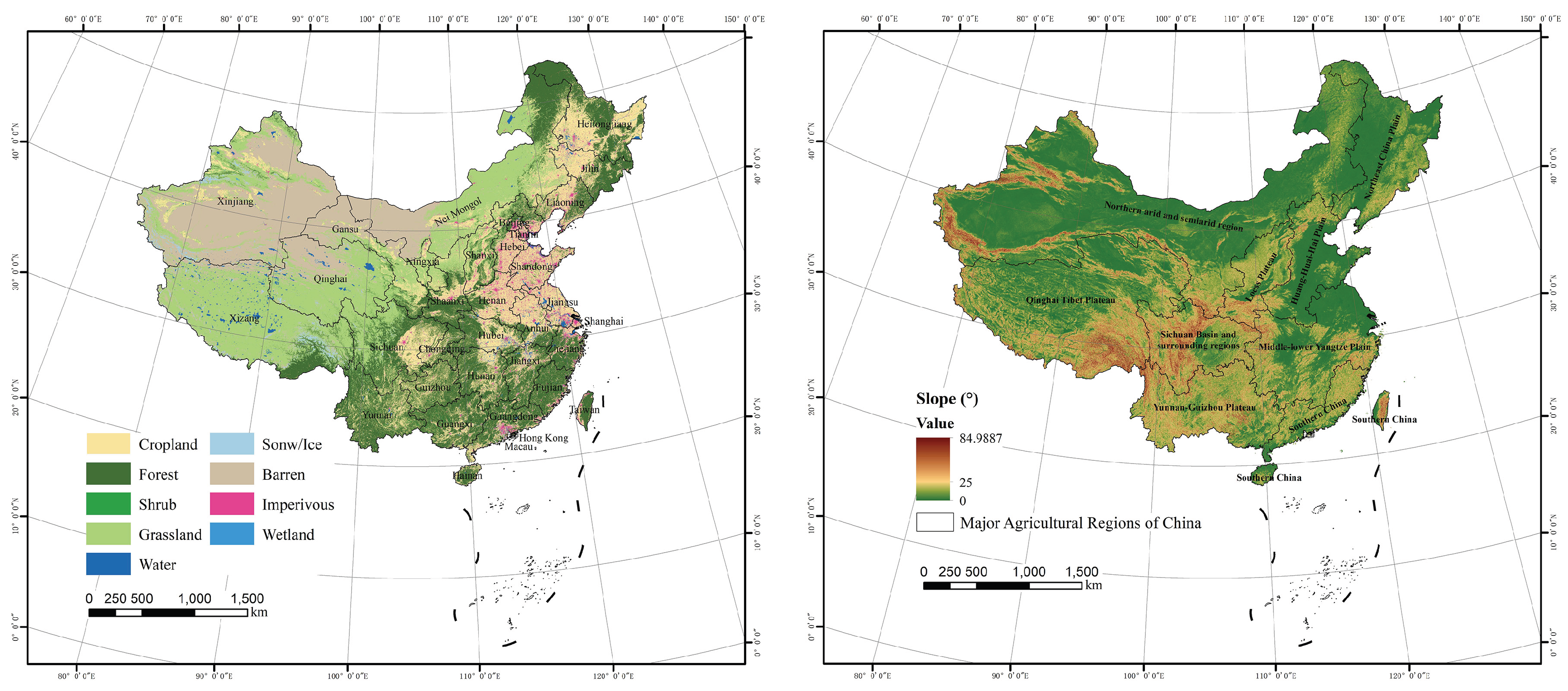
Figure 2.
The methodological framework of this study.
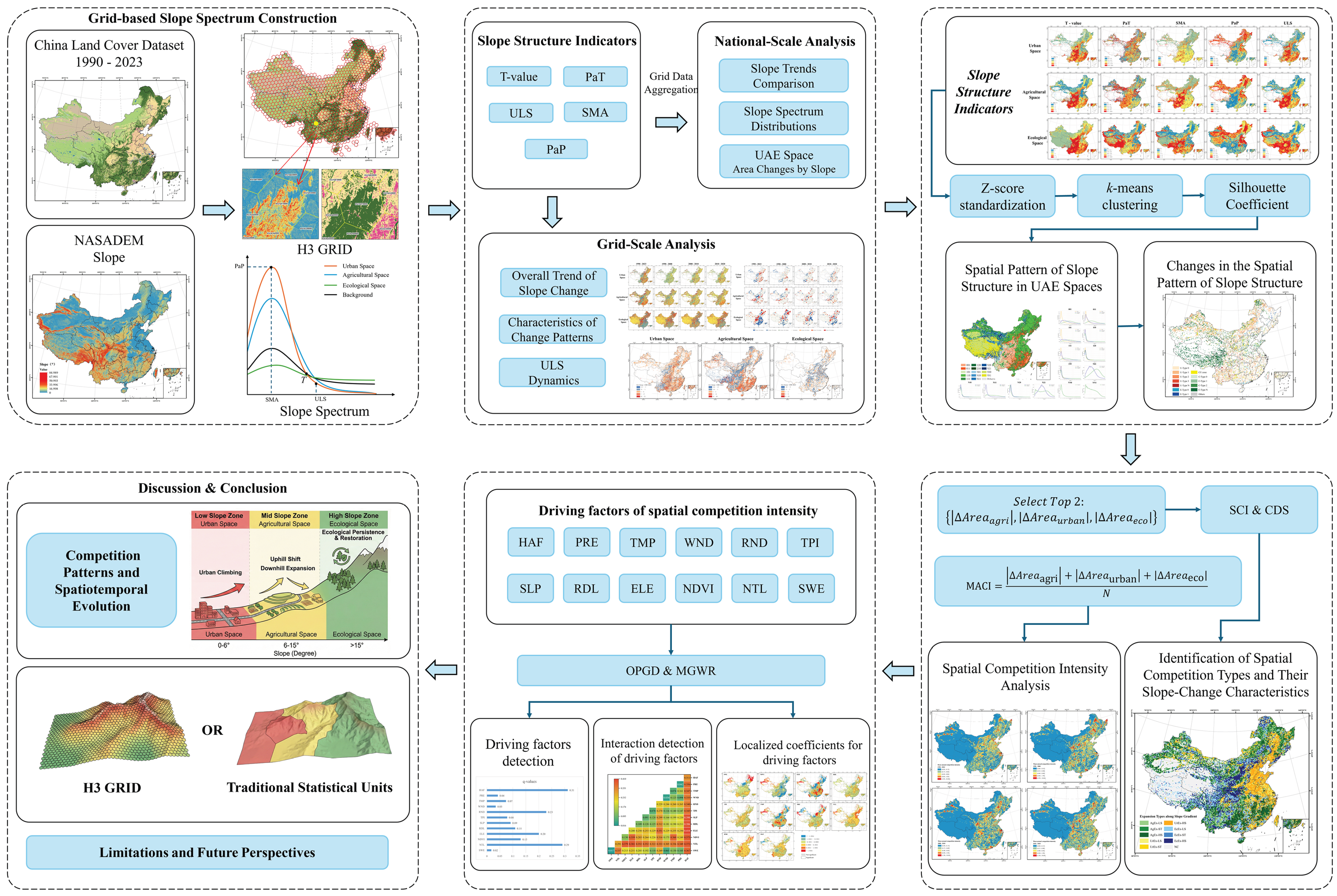
Figure 3.
Slope Spectrum and Slope Structure Indicators
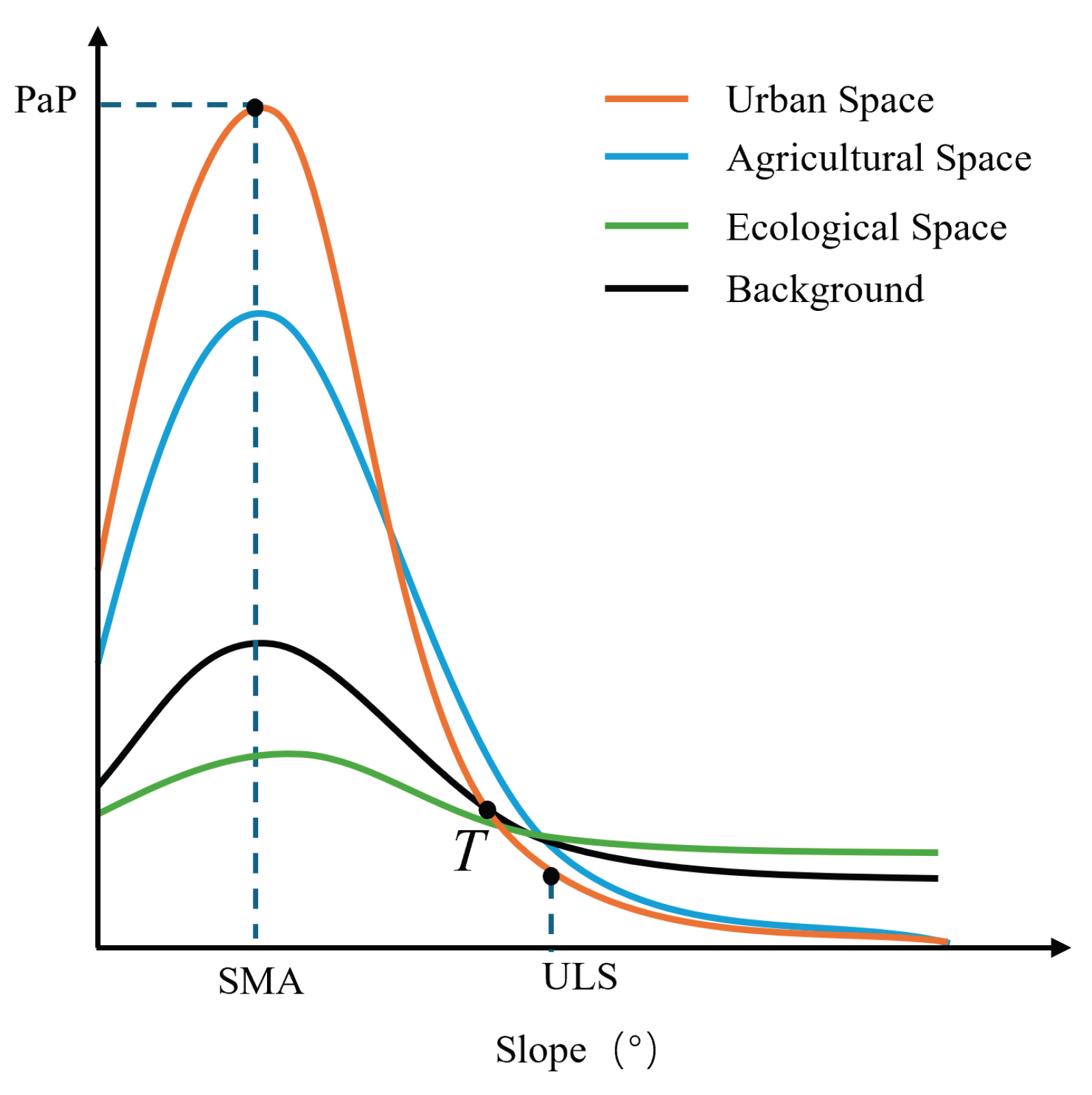
Figure 4.
Slope Trends Comparison(1990-2023)
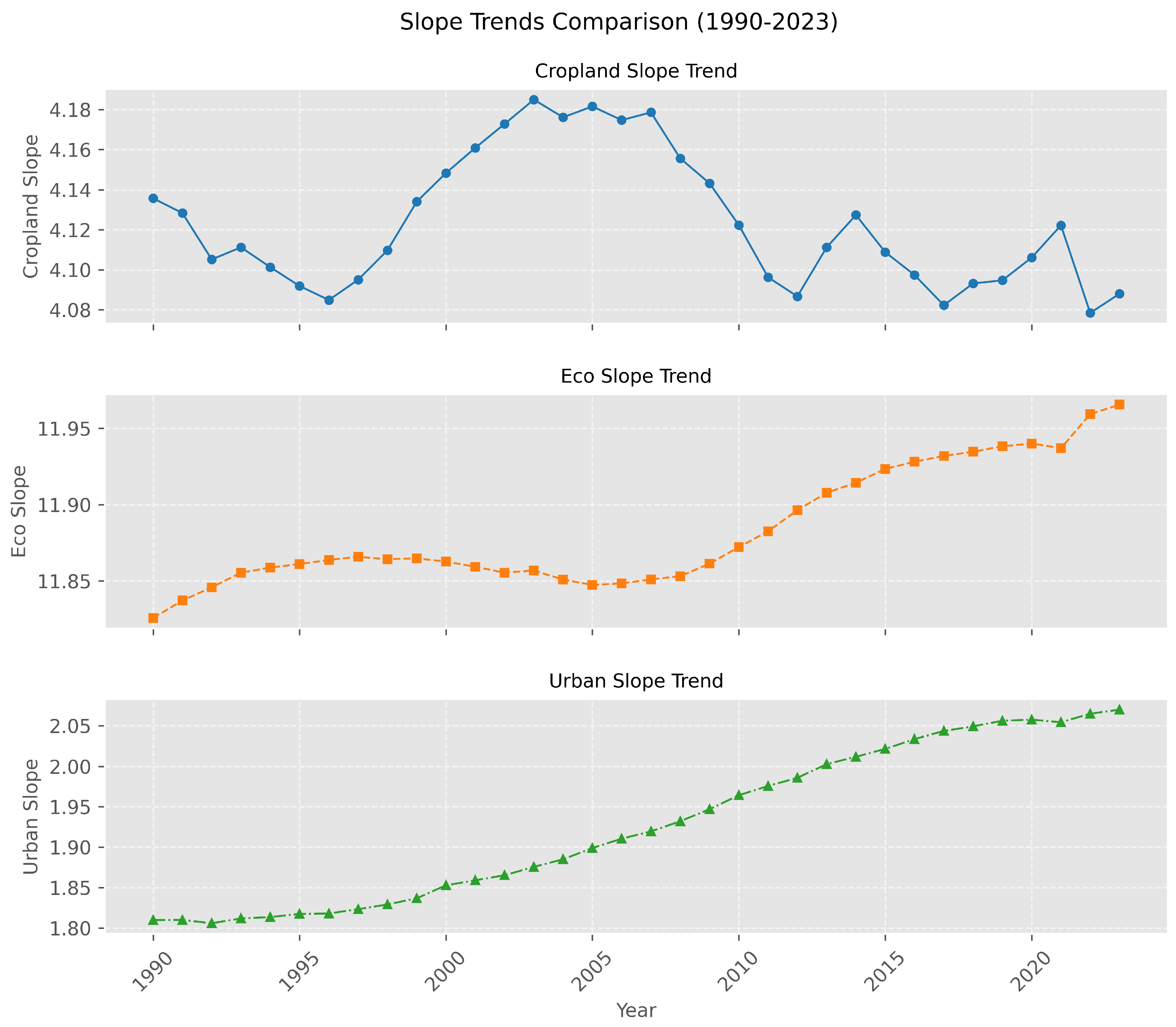
Figure 5.
Slope Spectrum of Urban, Agricultural, and Ecological Space
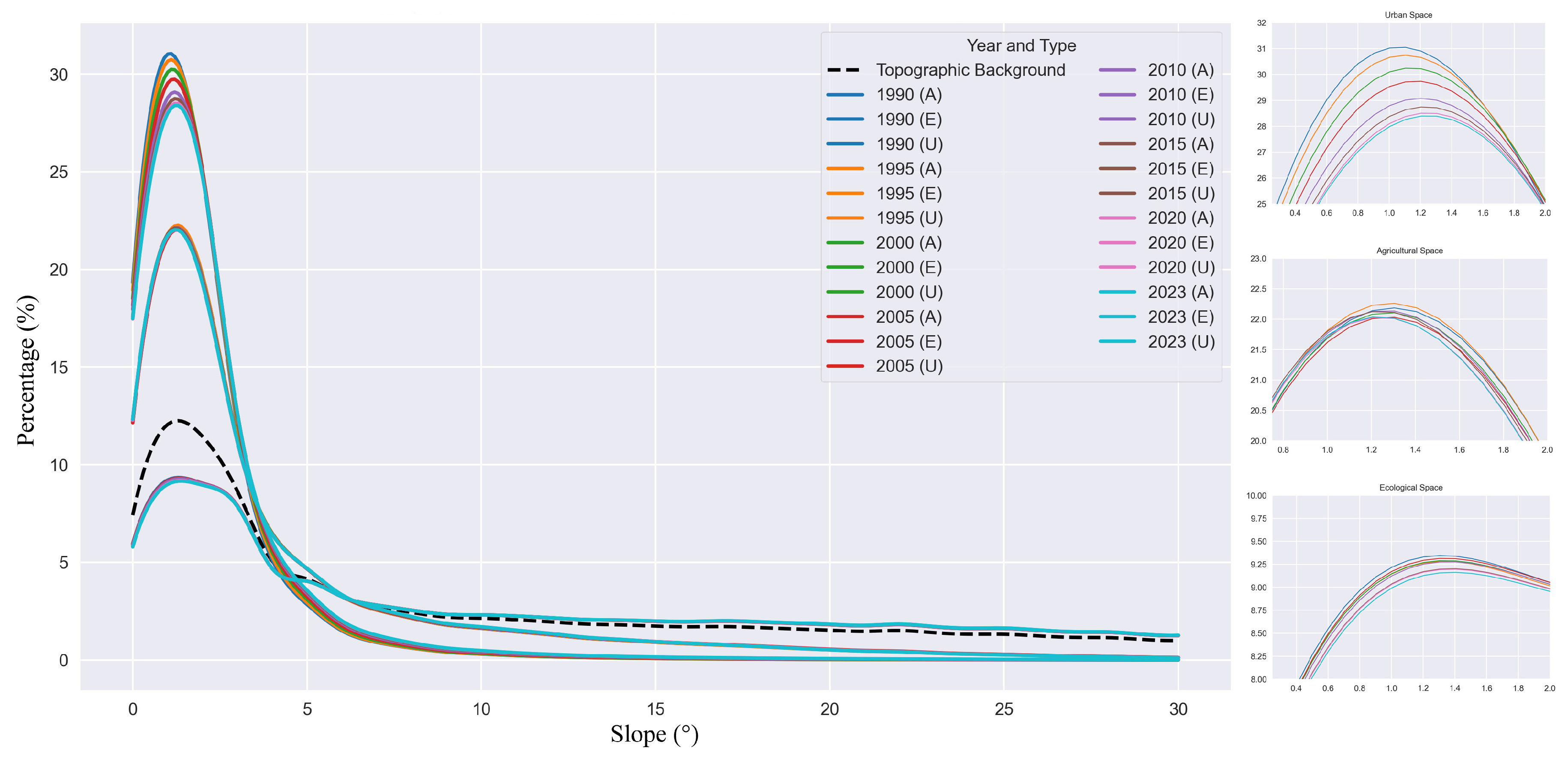
Figure 6.
Changes in the Area of Urban, Agricultural, and Ecological Space Across Different Slope Gradients (1990-2023)
Figure 6.
Changes in the Area of Urban, Agricultural, and Ecological Space Across Different Slope Gradients (1990-2023)
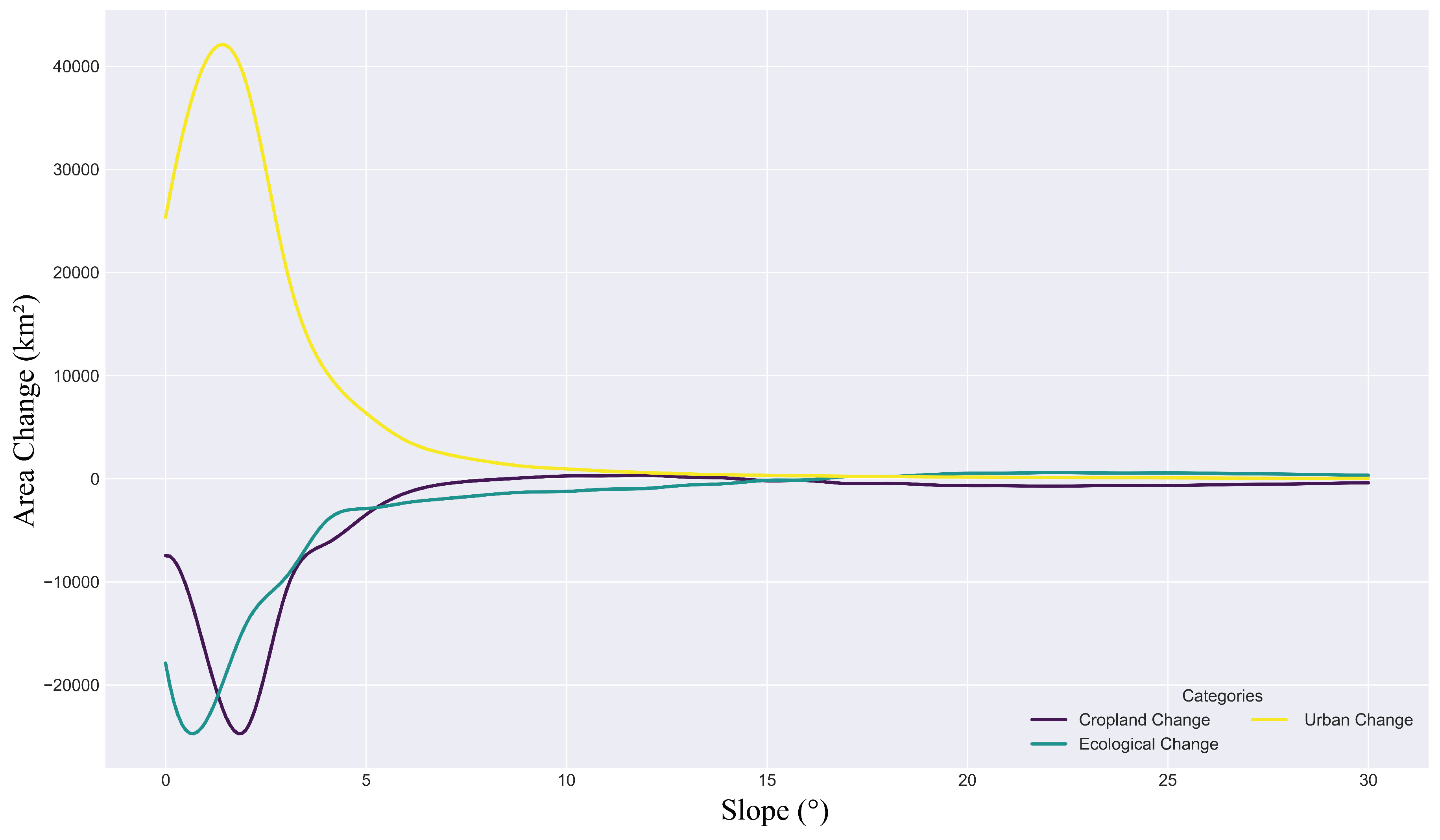
Figure 7.
Spatial distribution of the Slope Change Index (SCI) for urban, agricultural, and ecological spaces
Figure 7.
Spatial distribution of the Slope Change Index (SCI) for urban, agricultural, and ecological spaces
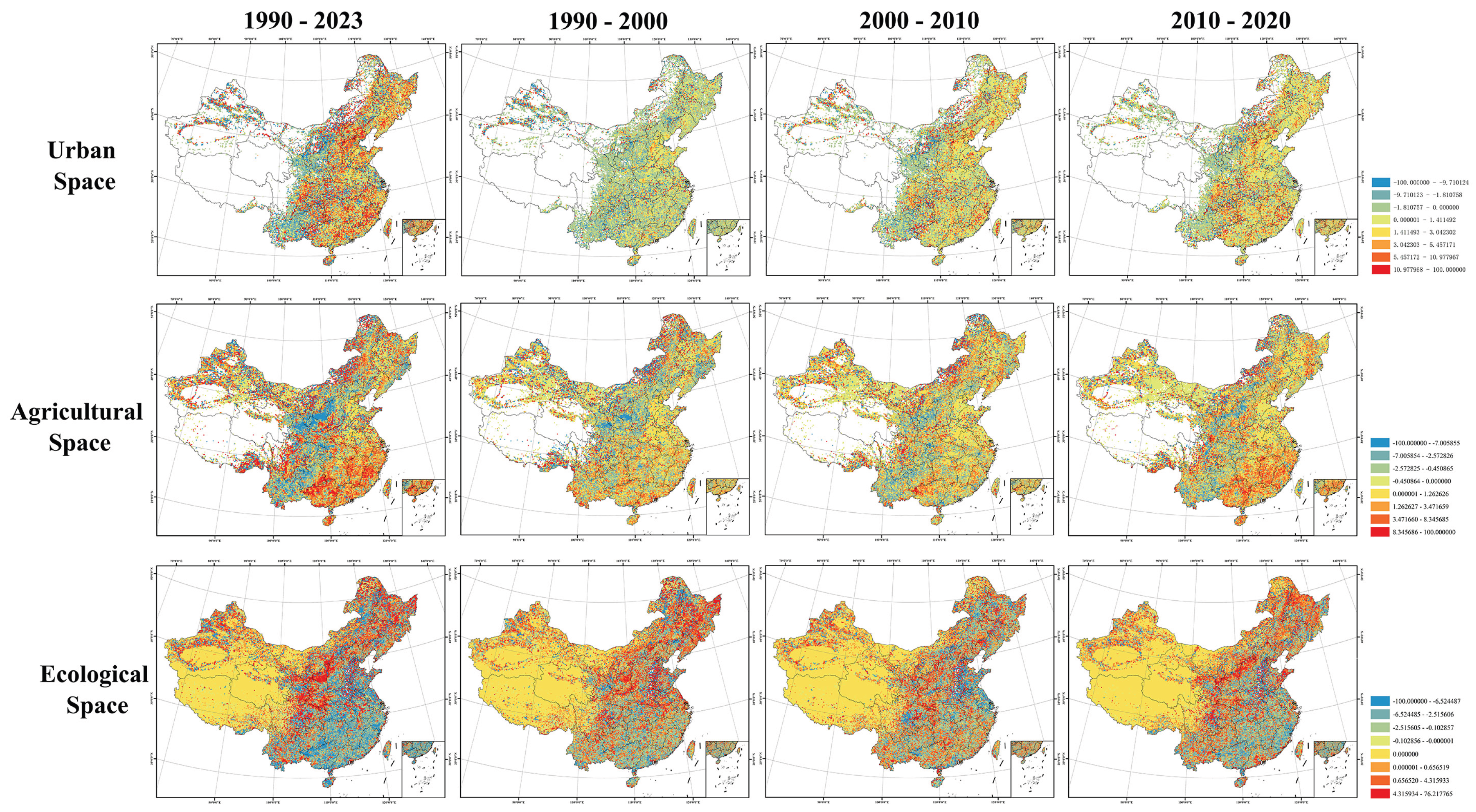
Figure 8.
Spatial distribution of the trend type for urban, agricultural, and ecological spaces(1990-2023)
Figure 8.
Spatial distribution of the trend type for urban, agricultural, and ecological spaces(1990-2023)
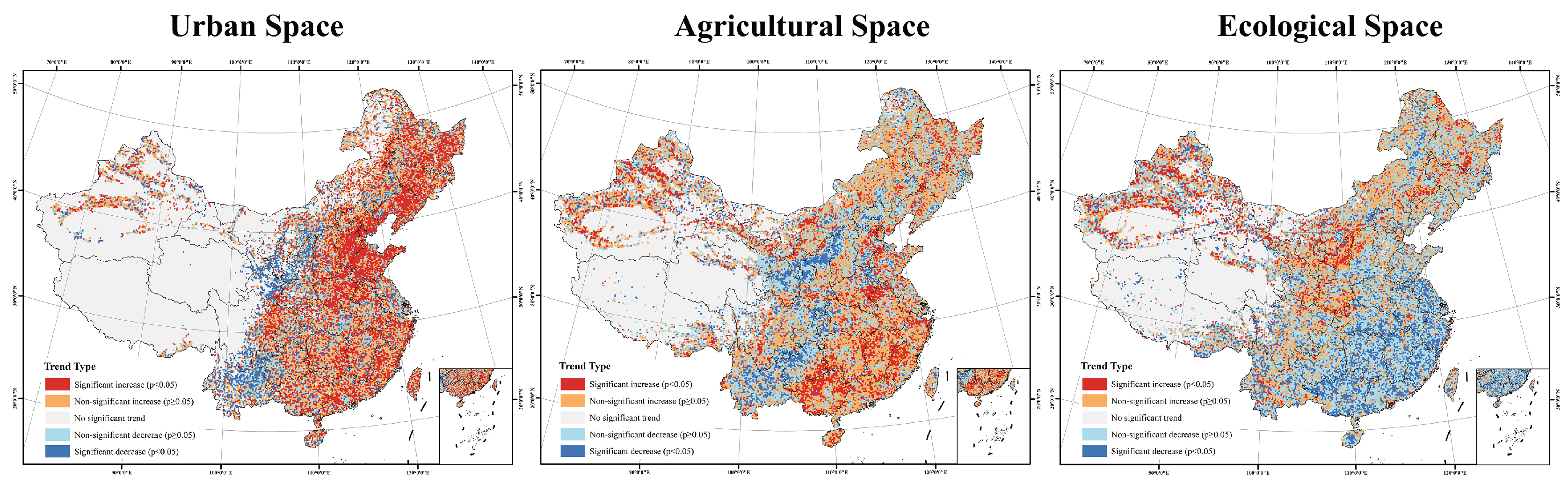
Figure 9.
Hot spot distribution of urban, agricultural, and ecological spaces during 1990–2023.
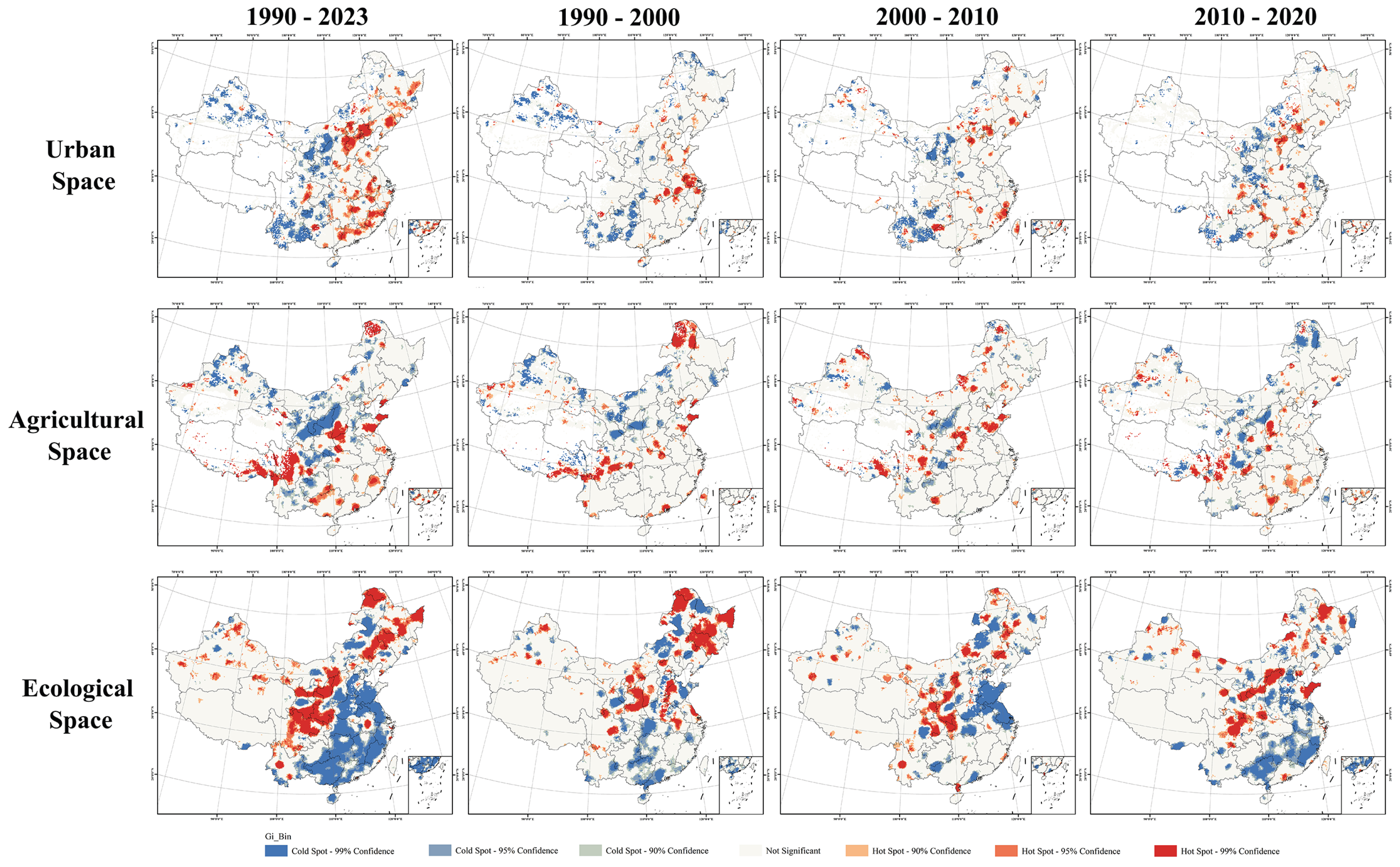
Figure 10.
Spatial distribution of ULS changes in urban, agricultural, and ecological spaces from 1990 to 2023.
Figure 10.
Spatial distribution of ULS changes in urban, agricultural, and ecological spaces from 1990 to 2023.
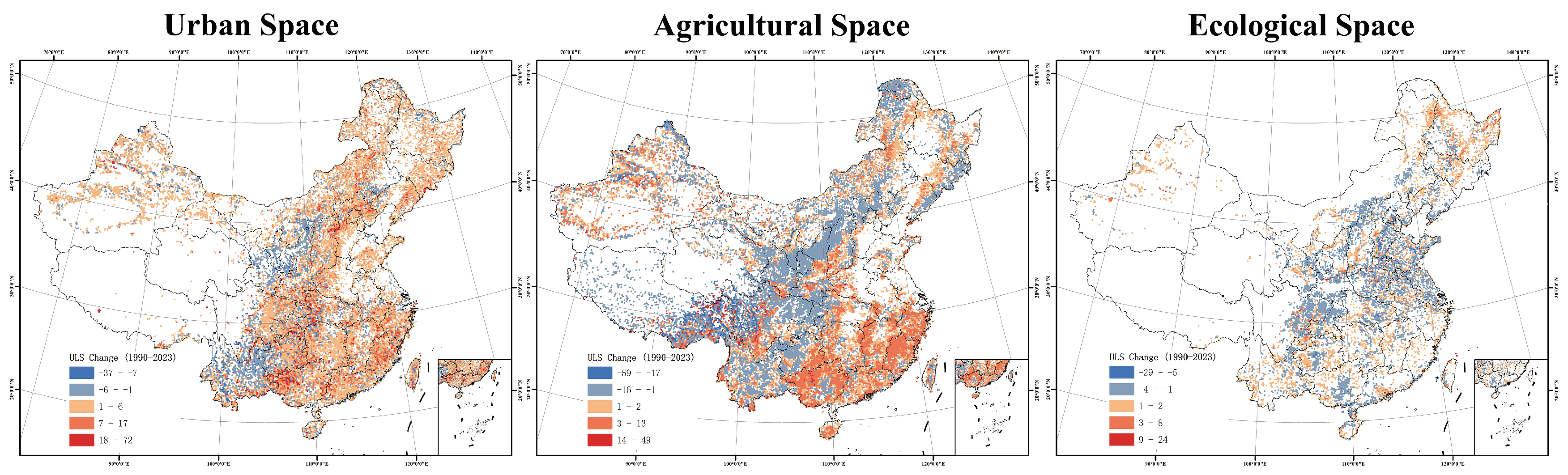
Figure 11.
Spatial distribution of ULS changes in urban, agricultural, and ecological spaces from 1990 to 2023
Figure 11.
Spatial distribution of ULS changes in urban, agricultural, and ecological spaces from 1990 to 2023
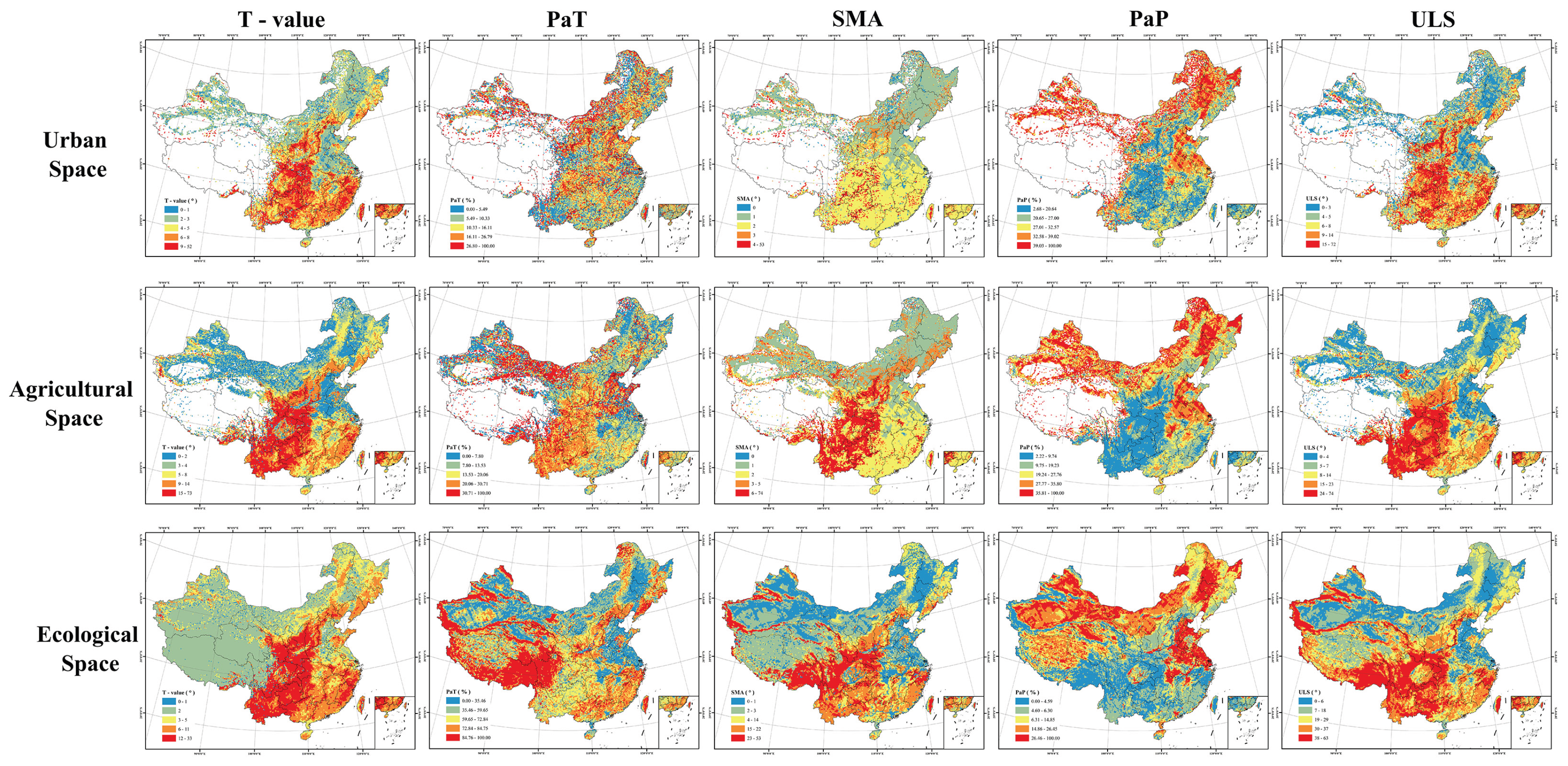
Figure 12.
Spatial distribution of slope structure clusters in 2023
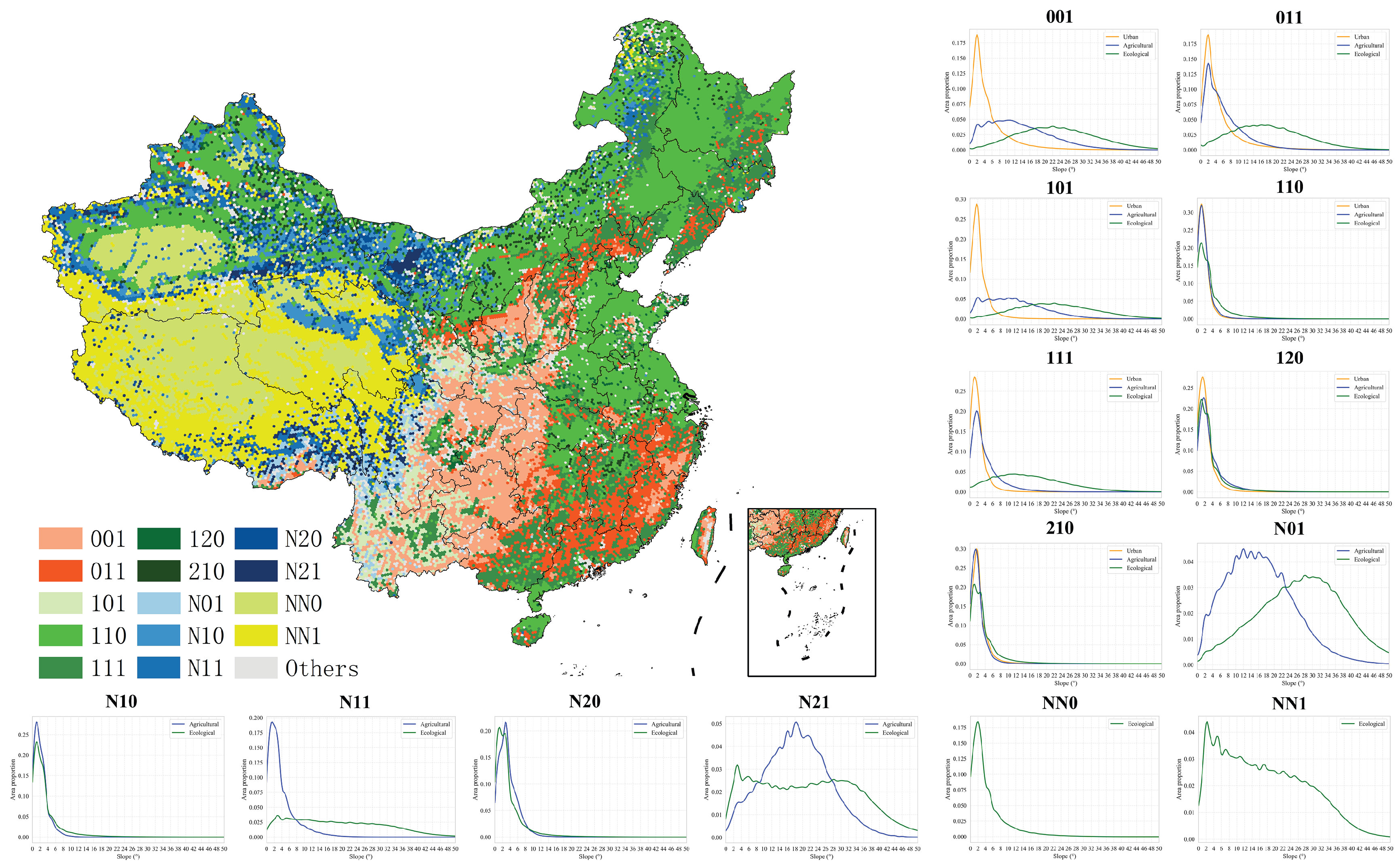
Figure 13.
Spatiotemporal evolution of slope structure clusters for UAE spaces (1990–2023). Note: The legend uses simplified identifiers to represent primary land use transformation types. “U-Type,” “C-Type,” and “E-Type” correspond to transformation types in urban, cropland (agricultural), and ecological spaces, respectively[cite: 240, 241]. The numerical suffixes (0–N) distinguish different transformation levels or categories[cite: 242]. “CU zone” indicates the co-variation zone between cropland and urban spaces, while “Others” denotes residual types or unclassified changes[cite: 242].
Figure 13.
Spatiotemporal evolution of slope structure clusters for UAE spaces (1990–2023). Note: The legend uses simplified identifiers to represent primary land use transformation types. “U-Type,” “C-Type,” and “E-Type” correspond to transformation types in urban, cropland (agricultural), and ecological spaces, respectively[cite: 240, 241]. The numerical suffixes (0–N) distinguish different transformation levels or categories[cite: 242]. “CU zone” indicates the co-variation zone between cropland and urban spaces, while “Others” denotes residual types or unclassified changes[cite: 242].
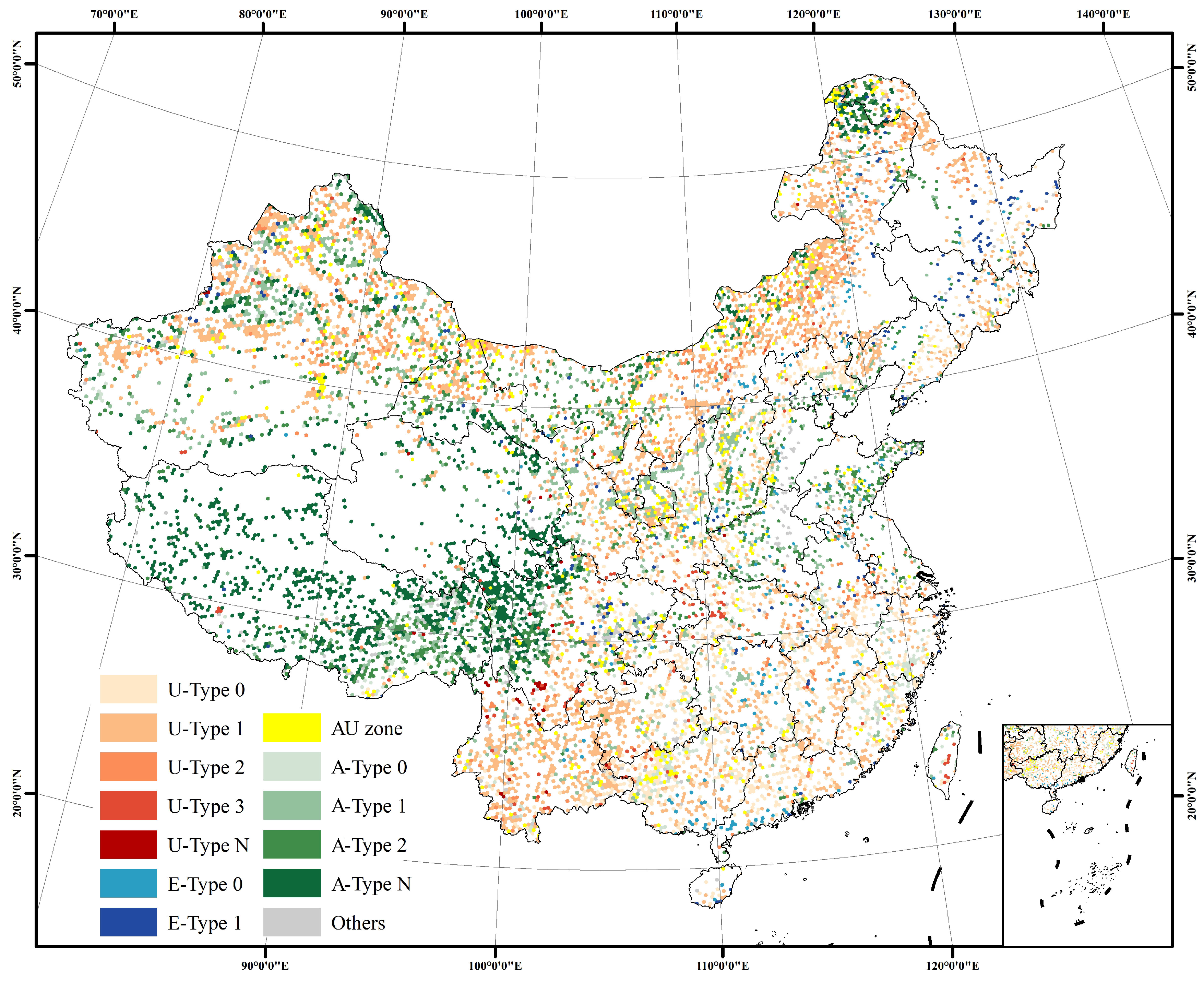
Figure 14.
Spatial patterns of urban–agricultural–ecological space competition and slope dynamics in China. (a) Competition types among urban, agricultural, and ecological spaces. (b) Dominant expansion slope classes for urban, agricultural, and ecological spaces. (c) Competitive dominance slope (CDS) showing the leading space type.
Figure 14.
Spatial patterns of urban–agricultural–ecological space competition and slope dynamics in China. (a) Competition types among urban, agricultural, and ecological spaces. (b) Dominant expansion slope classes for urban, agricultural, and ecological spaces. (c) Competitive dominance slope (CDS) showing the leading space type.
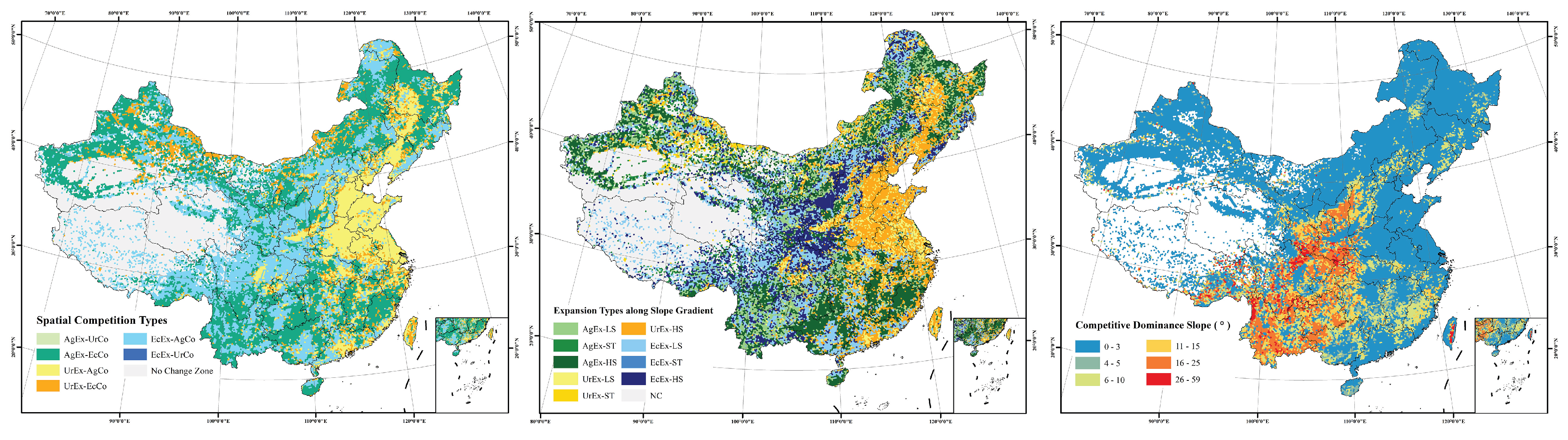
Figure 15.
Spatiotemporal patterns of Mean Annual Competitive Intensity (MACI) for urban, agricultural, and ecological spaces in China (1990–2023)
Figure 15.
Spatiotemporal patterns of Mean Annual Competitive Intensity (MACI) for urban, agricultural, and ecological spaces in China (1990–2023)
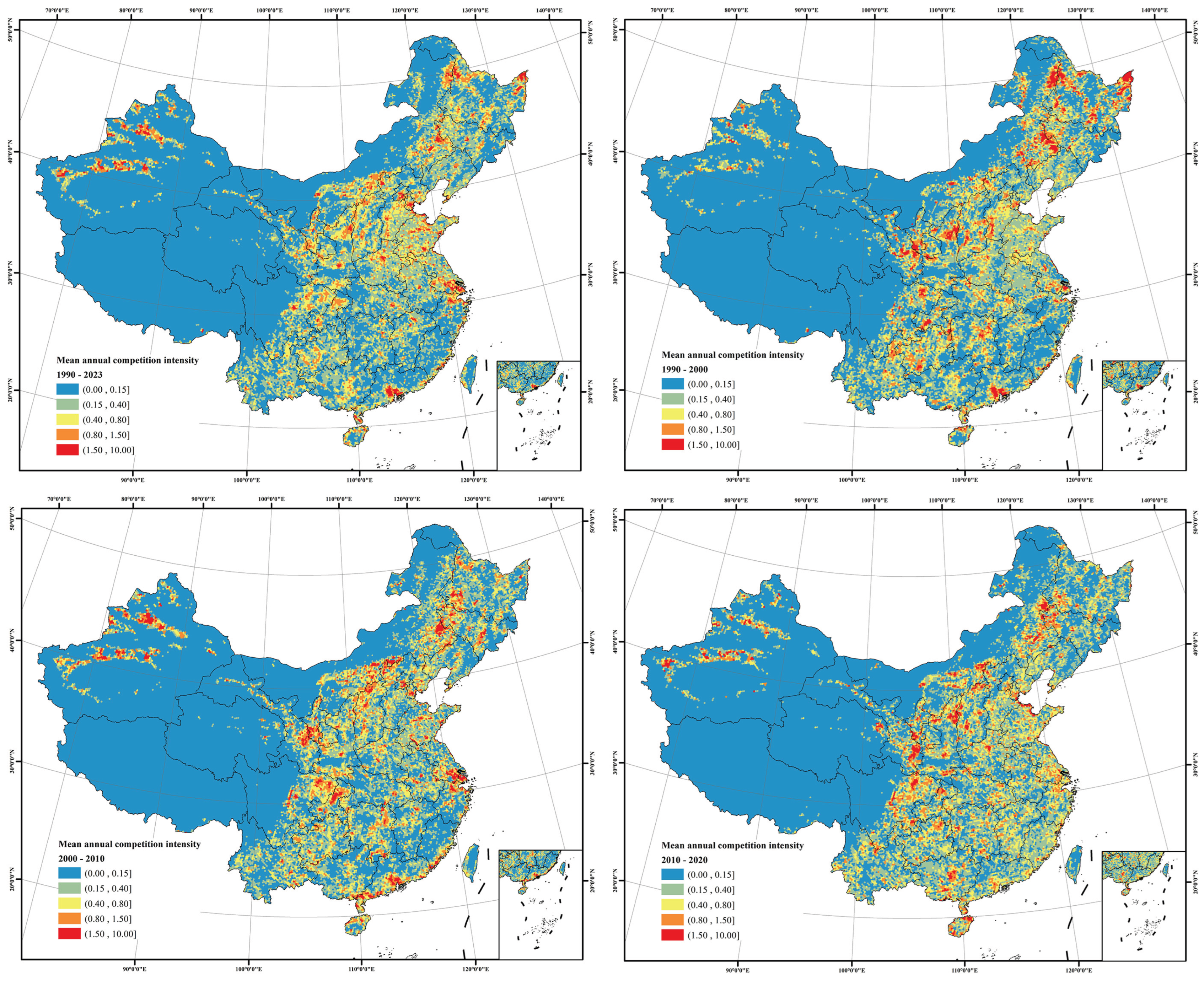
Figure 16.
Explanatory power (q-statistics) of individual drivers for competition intensity
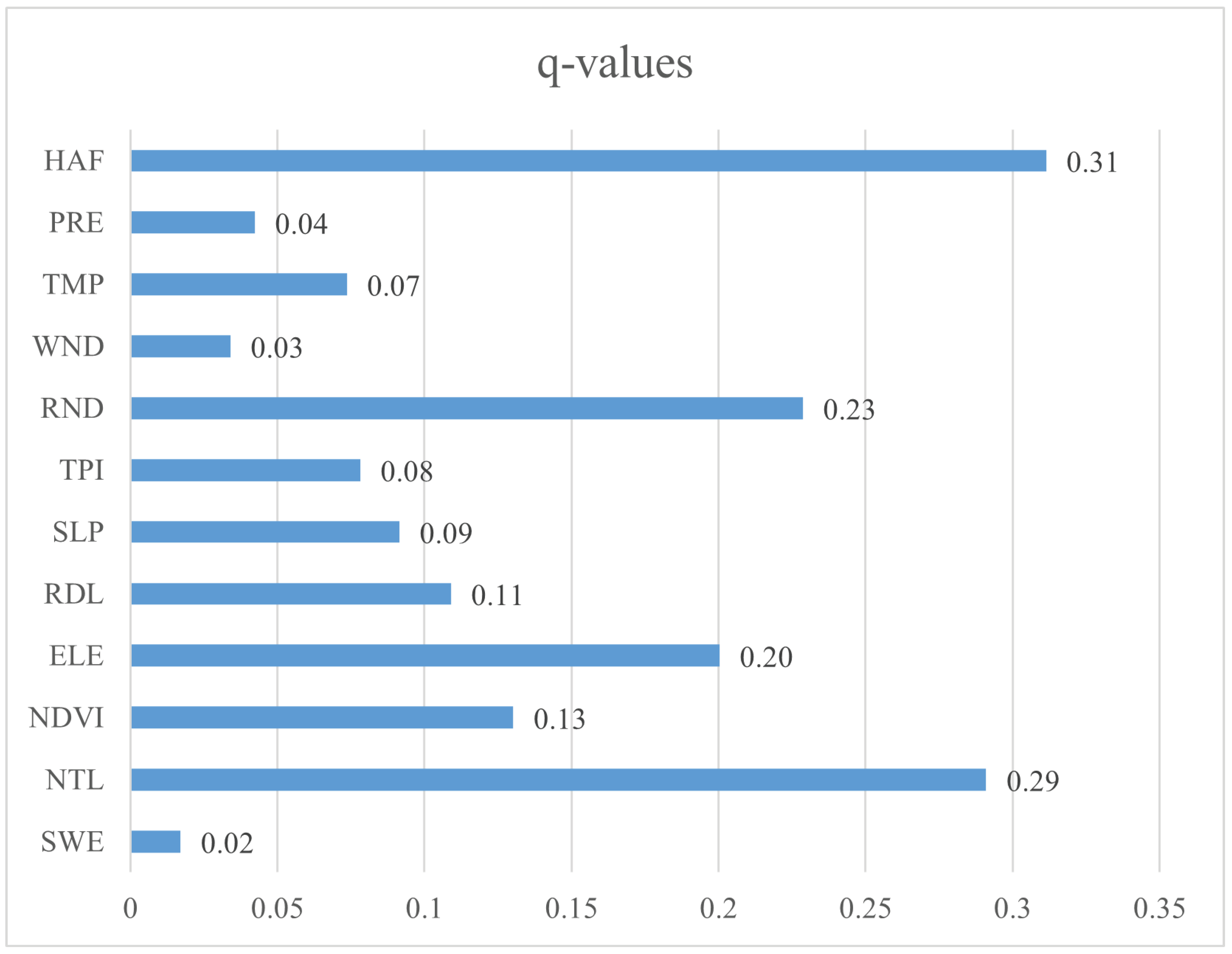
Figure 17.
Interactive effects of human activity and natural drivers on spatial competition patterns
Figure 17.
Interactive effects of human activity and natural drivers on spatial competition patterns
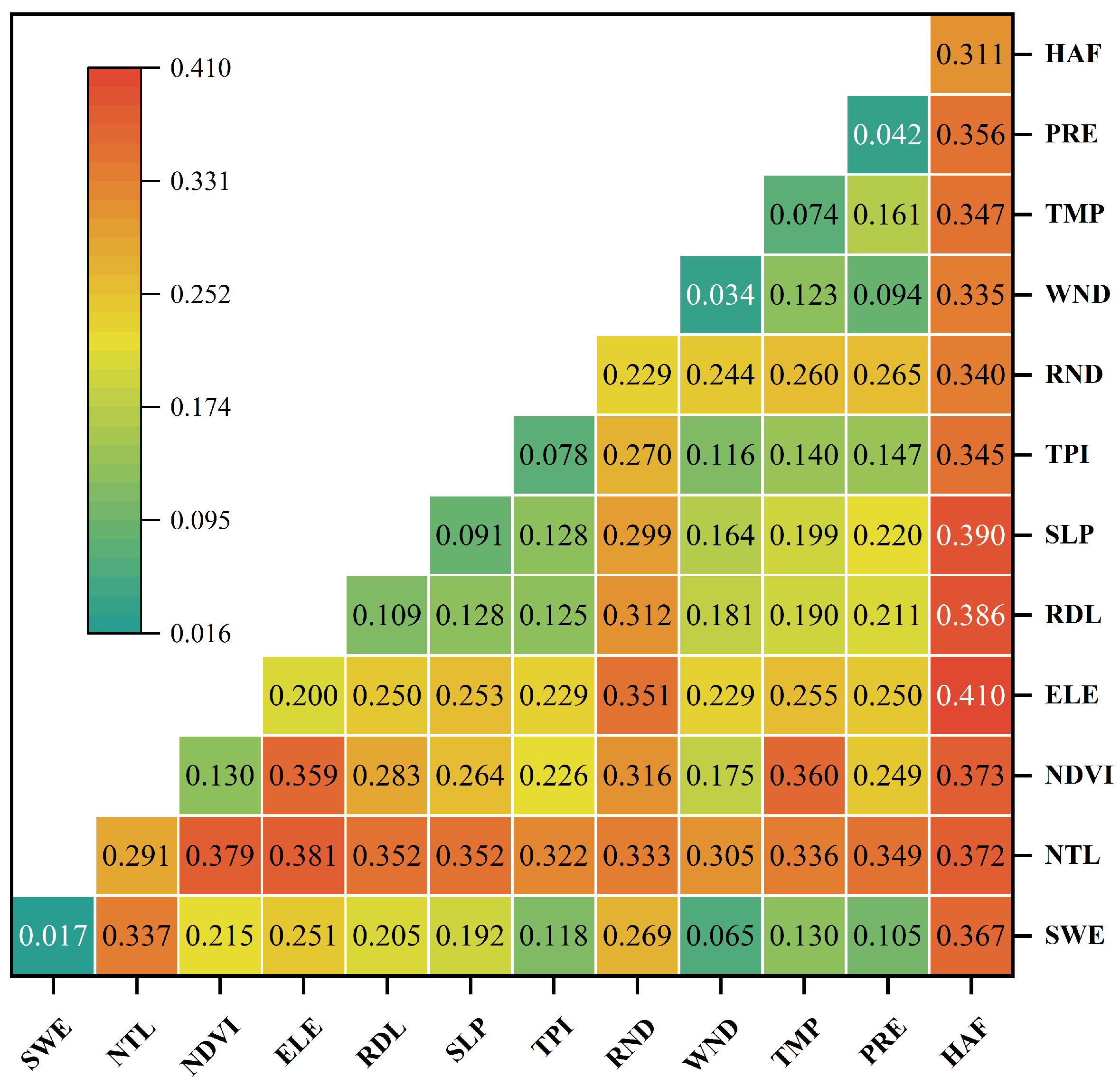
Figure 18.
Spatial heterogeneity of dominant driving factors based on the MGWR model
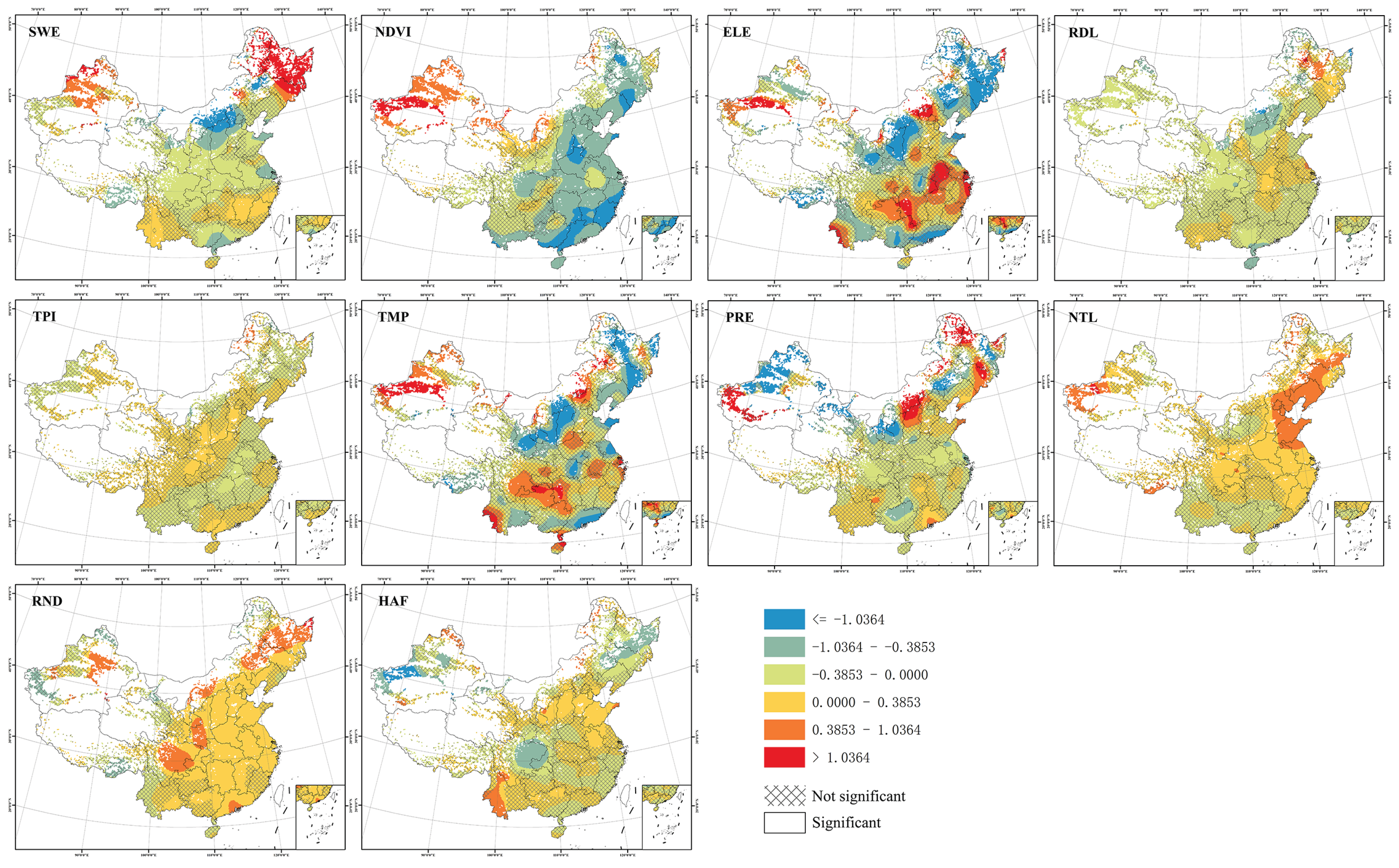

Table 1.
Urban–agricultural–ecological space classification system.
| Category | CLCD Land-use type |
|---|---|
| Urban space | Impervious |
| Agricultural space | Cropland |
| Ecological space | Forest, Shrub, Grassland, Water, Snow/Ice, Barren, Wetland |
Table 2.
Datasets and potential driving factors used for analyzing the competition of Urban–Agricultural–Ecological (UAE) spaces.
Table 2.
Datasets and potential driving factors used for analyzing the competition of Urban–Agricultural–Ecological (UAE) spaces.
| Category | Variable | Abb. | Dataset | Format | Res. | Source |
|---|---|---|---|---|---|---|
| Natural environmental factors | Soil water erosion | SWE | Soil Water Erosion Dataset | Raster | 30 m | [38,39] |
| Vegetation Index | NDVI | Landsat/Sentinel series | Raster | 30 m | GEE processing | |
| Elevation | ELE | NASADEM | Raster | 30 m | [37] | |
| Relief degree | RDL | Derived from NASADEM | H3 Grid | Res 5 | Derived from NASADEM | |
| Slope | SLP | Derived from NASADEM | Raster | 30 m | Derived from NASADEM | |
| Topographic position | TPI | Derived from NASADEM | H3 Grid | Res 5 | Derived from NASADEM | |
| Water network | WND | Drainage Density Dataset | Raster | 1 km | [40] | |
| Mean temperature | TMP | Monthly temp dataset | Raster | ∼1 km | [41] | |
| Mean precipitation | PRE | Monthly precip dataset | Raster | ∼1 km | [41] | |
| Human activity factors | Night-time light | NTL | DMSP and VIIRS dataset | Raster | ∼1 km | [42] |
| Road network density | RND | OpenStreetMap | H3 Grid | Res 5 | OpenStreetMap | |
| Human Footprint | HAF | Human Footprint dataset | H3 Grid | 1 km | [43] |
Note: Abb. = Abbreviation; Res. = Resolution; H3 Grid Res 5 indicates the fundamental analytical unit at resolution 5 in the H3 system.
Table 3.
Slope structure indicators for UAE spaces.
| Indicator | Abbreviation | Description |
|---|---|---|
| Slope intersection | T-value | The slope at which the slope spectrum of a spatial category intersects the regional background slope spectrum, representing the critical point where its distribution shifts from dominance on gentle slopes to steeper slopes. |
| Upper Limit of Slope | ULS | The slope threshold at which the cumulative area of a spatial category reaches 95% of its total area, reflecting its upper adaptive boundary to slope conditions and its potential expansion limit. |
| Peak Area Proportion | PaP | The percentage of the spatial category’s area corresponding to the peak value of the slope spectrum. |
| Slope at Maximum Area | SMA | The slope class corresponding to the maximum proportion of a spatial category, indicating the slope most intensively occupied. |
| Proportion above T-value | PaT | The share of the spatial category’s area located on slopes steeper than the T-value, characterizing the extent of high-slope occupation pressure. |
Disclaimer/Publisher’s Note: The statements, opinions and data contained in all publications are solely those of the individual author(s) and contributor(s) and not of MDPI and/or the editor(s). MDPI and/or the editor(s) disclaim responsibility for any injury to people or property resulting from any ideas, methods, instructions or products referred to in the content. |
© 2026 by the authors. Licensee MDPI, Basel, Switzerland. This article is an open access article distributed under the terms and conditions of the Creative Commons Attribution (CC BY) license (http://creativecommons.org/licenses/by/4.0/).
Copyright: This open access article is published under a Creative Commons CC BY 4.0 license, which permit the free download, distribution, and reuse, provided that the author and preprint are cited in any reuse.


