

Submitted:
13 April 2026
Posted:
15 April 2026
You are already at the latest version
Abstract
Background: We systematically evaluated the role of macrophage autophagy in the initiation, progression, and stabilization of atherosclerotic plaques, with particular focus on its effects on lipid metabolism and foam cell formation. Secondary objectives included investigating the relationship between macrophage autophagy and inflammatory responses, selective autophagy processes (such as mitophagy, ferroptosis-related pathways, and efferocytosis), as well as regulatory mechanisms involving microRNAs. Methods: Original research articles investigating macrophage autophagy in atherosclerosis (including in vitro, in vivo, and ex vivo studies) published in English were included. Exclusion criteria comprised review articles, meta-analyses, editorials, letters, conference abstracts, gray literature, retracted papers, non-English publications, and studies not primarily focused on macrophage autophagy. Studies involving metabolic comorbidities (e.g., diabetes), systemic metabolic confounders (e.g., hypo/hyperglycemia, high-fat or Western diets), particulate matter exposure, or those exclusively examining non-macrophage cell types were excluded. Additionally, studies focusing solely on isolated cell death mechanisms (e.g., ferroptosis, apoptosis, mitophagy, efferocytosis) without a direct assessment of macrophage autophagy were excluded. A systematic search was performed in PubMed, Scopus, Web of Science, Embase, and the journal Atherosclerosis. Due to methodological heterogeneity among studies, a qualitative synthesis was conducted. Findings were categorized according to mechanistic pathways, lipid metabolism, inflammatory modulation, and selective autophagy processes. Results: A total of 54 studies met the inclusion criteria. Most were in vitro investigations using macrophage cell lines (e.g., THP-1, RAW264.7) or primary macrophages exposed to atherosclerotic stimuli such as oxidized LDL, oxysterols, or AGE-LDL. Several in vivo animal models were also included, excluding those involving systemic dietary interventions. Overall, macrophage autophagy exhibited a predominantly protective role in atherosclerosis. Enhanced autophagy was associated with reduced lipid accumulation, increased cholesterol efflux through the ABCA1 and ABCG1 pathways, improved lysosomal function, and attenuation of inflammatory signaling. Selective autophagy processes—particularly mitophagy—contributed to maintaining mitochondrial homeostasis and reducing oxidative stress. Conversely, dysregulated or impaired autophagic flux was linked to foam cell formation, apoptosis, necrotic core expansion, and plaque instability. Several studies also highlighted the regulatory roles of microRNAs and ubiquitin-related pathways in modulating macrophage autophagy under atherosclerotic conditions. Discussion: The included studies demonstrated substantial methodological heterogeneity, including variability in experimental models, methods of assessing autophagy (e.g., LC3, p62, or flux assays), and outcome measures. Many studies relied predominantly on in vitro models, which limits translational applicability. Inconsistent reporting of experimental details and a lack of long-term outcome data further reduced interpretability. Macrophage autophagy appears to be a central regulatory mechanism in atherosclerosis, influencing lipid metabolism, inflammatory responses, and plaque stability. Although generally protective, its effects are context-dependent and modulated by molecular regulators and cellular stress conditions. Targeted modulation of macrophage autophagy may therefore represent a promising therapeutic approach for atherosclerotic disease.
Keywords:
atherosclerosis
; autophagy
; cellular autophagy
; autophagy dependent cell death
; programmed cell death
; autophagic programmed cell death
1. Introduction
Autophagy has been associated with numerous physiological processes, including development, differentiation, tissue remodeling, innate and adaptive immunity, aging, and cell death, as it plays a crucial role in maintaining cellular homeostasis and genomic integrity[1,2]. Autophagy is a process in which excess or damaged organelles in the cytoplasm are sequestered within double-membrane vesicles and delivered to the lysosome (or vacuole), a degradative organelle, for breakdown and recycling of their components[3,4]. The three primary types of autophagy are macroautophagy, microautophagy, and chaperone-mediated autophagy[5]. The process, regulated by signaling pathways, stress conditions, and nutrient availability, involves several conserved autophagy-related (ATG) proteins[6]. It can be triggered by various stressors, including oxidative stress, escalated production of reactive oxygen species (ROS), malnutrition, and DNA damage[7,8]. Because it reduces the likelihood of cellular damage caused by key factors such as oxidative stress and loss of proteostasis, autophagy plays a crucial role in aging and age-related diseases[9]. Autophagy plays an essential quality-control role in cells by promoting cellular senescence and cell surface antigen presentation, maintaining the basal turnover of long-lived proteins and organelles, protecting against genome instability, and preventing necrosis[10,11]. Due to its role in removing toxic cellular components and enhancing cell viability, autophagy is widely recognized as beneficial in conditions such as neuropathies (including Parkinson’s, Alzheimer’s, and Huntington’s diseases) and ischemic heart disorders[10]. Consequently, anomalies in autophagy have been linked to several human conditions, such as cancer, heart failure, ischemia, and infection, neurological and muscular problems, and inflammatory diseases[2,11]. Consequently, autophagy has emerged as a novel and powerful regulator of disease progression, significant from both clinical and scientific standpoints[10].
The immune, inflammatory, and cardiovascular systems, along with blood clotting, lipid transport, and cholesterol metabolism mechanisms, as well as other pathological processes, are all involved in atherosclerosis, a fibroproliferative inflammatory disease[12]. It begins with endothelial activation and progresses through a series of events—calcification, accumulation of fibrous components, and lipid deposition—that promote arterial constriction and trigger inflammatory pathways[13]. It is caused by toxic substances associated with inflammation, oxidative stress, hypertension, lipid peroxidation, obesity, diabetes, smoking, and reduced nitric oxide (NO) production. Moreover, oxidative stress—one of the major risk factors for the development and progression of atherosclerosis—is aggravated by an excessive accumulation of reactive oxygen species (ROS)(14-17). Pathological processes induced by the vascular endothelium involve multiple key cell types, including T lymphocytes, endothelial cells, monocytes, macrophages, vascular smooth muscle cells (VSMCs), and platelets[12]. Atherosclerosis in cardiovascular disease is preceded by the oxidation of low-density lipoprotein (Ox-LDL). By inducing inflammation and activating macrophages and other cells, this process initiates the formation of atherosclerotic plaques[15,18]. When mechanical forces act on a structurally weak site, they increase the likelihood of plaque rupture, exposing the blood flow to tissue factor within the lesion and triggering thrombosis, which is the immediate cause of the clinical condition[19]. The risk factors in the later stages may lead to myocardial infarction, thrombotic stroke, or transient ischemic attack (TIA)[16]. An essential part in the development of atherosclerosis is played by autophagy, a cellular self-digesting mechanism that, depending on the stage and intensity of the disorder, can have both beneficial and harmful effects [20]. A growing body of research indicates that autophagy, which is activated in advanced atherosclerotic plaques by various stress-related stimuli in the arterial wall, protects endothelial cells (ECs), vascular smooth muscle cells (VSMCs), and macrophages from oxidative stress and the development of vascular diseases, particularly atherosclerosis[21,22]. Autophagy likely protects plaque cells from stress, particularly oxidative damage, by degrading impaired intracellular components. Consequently, it functions as an anti-apoptotic mechanism and promotes cell recovery under adverse conditions[21]. Impairments in this process often lead to more severe consequences, fostering the development and progression of atherosclerosis toward a vulnerable state[23]. Although numerous factors within atherosclerotic plaques—such as reactive oxygen species (ROS), oxidized lipids, and cytokines—can activate autophagy, excessive autophagy in vascular smooth muscle cells (VSMCs) or endothelial cells (ECs) may induce autophagic cell death. This process can reduce collagen production, thin the fibrous cap, destabilize the plaque, and ultimately promote thrombosis and acute experimental lesions[24,25]. Under normal cellular conditions, autophagy functions to maintain homeostasis; however, under pathological conditions, increased autophagy can have either protective or detrimental effects[26].
The accumulation of apolipoprotein B–containing lipoproteins in the extracellular matrix beneath the endothelial cell layer of blood vessels during atherosclerosis attracts monocytes, immune cells that differentiate into dendritic cells and macrophages. The inflammatory response of macrophages derived from these recruited monocytes is maladaptive and non-resolving, leading to the buildup of cells, lipids, and matrix components, which causes thickening of the subendothelial layer[27]. Pathological deposition of modified lipoproteins leads to the development of atherosclerotic lesions, characterized by the formation of macrophage-derived foam cells within the vascular wall and associated pro-inflammatory responses in the arterial tissue[28]. In particular, macrophage apoptosis has been identified as a critical step in the formation of the necrotic core, an essential feature of unstable lesions[29]. The culmination of these late lesional processes results in the formation of the necrotic core, which exacerbates inflammation, instability of the plaque, and thrombosis. It also works in concert with the proatherogenic activities of any remaining surviving macrophages[30]. Impaired macrophage autophagy may contribute to atherosclerotic plaque instability by disrupting key processes such as cholesterol transport, inflammation regulation, reactive oxygen species (ROS) production, and apoptosis control [25]. In macrophages, autophagy is activated in response to oxidative stress or stimulation by oxidized low-density lipoproteins (ox-LDL). This process protects cells by clearing misfolded proteins and damaged organelles, thereby preventing cell death, promoting macrophage efferocytosis, and facilitating cholesterol efflux from macrophage-derived foam cells at different stages of atherosclerosis (AS)[31]. Given that atherosclerosis is an inflammatory disease of the arterial intima, it may be possible to stabilize vulnerable plaques by selectively inducing autophagic death in macrophages[32].
Although several previous systematic reviews have examined autophagy in the context of cardiovascular diseases or atherosclerosis more broadly, none have specifically focused on macrophage autophagy. A systematic review conducted by Ling-bing Meng et al. explored how chronic stress affects atherosclerosis (AS), but it did not address macrophage autophagy[33]. Also, another systematic review conducted by Jia-Xin Kan et al. focused on how natural products ameliorate non-alcoholic fatty liver disease and atherosclerosis, but it did not address the mechanisms of macrophage autophagy[34]. Therefore, the present study fills this gap by systematically investigating the role of autophagy in macrophages during atherosclerosis, offering a more targeted and mechanistic perspective compared with previous reviews. This systematic review aims to synthesize available evidence on the role of macrophage autophagy, including mitophagy, in the initiation, progression, and stability of atherosclerotic plaques. Specifically, we evaluate how macrophage autophagy influences key pathogenic processes in atherosclerosis, including lipid metabolism and foam cell formation, inflammatory responses, and cell death. By systematically analyzing findings from experimental models and human studies, this review seeks to clarify the mechanistic contribution of macrophage autophagy to atherogenesis and plaque stability. Furthermore, we discuss the therapeutic implications of targeting macrophage autophagy-related pathways, highlighting current limitations and future research directions to translate mechanistic insights into potential clinical strategies.
2. Methods
Our study followed the guidelines of preferred reporting items for systematic reviews (PRISMA) 2020 guidelines for systematic reviews[35].
2.1. Eligibility Criteria
Original research articles investigating the role of macrophage autophagy in atherosclerosis were considered eligible. Studies conducted in in vitro, in vivo, or ex vivo experimental models were included, provided that macrophage autophagy was the primary focus of the investigation. Only articles published in English were considered. Studies were excluded if they were review articles, narrative reviews, meta-analyses, editorials, letters, case reports, conference abstracts, proceedings papers, gray literature, or retracted publications. Studies that did not directly investigate macrophages, or in which macrophage autophagy was not the primary outcome of interest, were also excluded. In addition, articles lacking sufficient data for the extraction of autophagy-related outcomes were removed. To minimize metabolic confounding, studies involving systemic metabolic comorbidities (e.g., diabetes mellitus), hypo- or hyperglycemic conditions, generalized metabolic stress, high-fat or Western diet animal models, or exposure to environmental particulate matter were excluded. Furthermore, studies focusing exclusively on non-macrophage cell types (e.g., endothelial or vascular smooth muscle cells) were excluded. Investigations addressing isolated cell death mechanisms (e.g., ferroptosis, apoptosis, mitophagy, or efferocytosis) without direct evaluation of macrophage autophagy were also excluded. Non-English publications were not included.
Due to methodological heterogeneity among the studies, a qualitative synthesis approach was employed. The included studies were categorized based on their primary mechanistic focus: 1) Macrophage autophagy and lipid metabolism, including foam cell formation and cholesterol efflux, Autophagy and plaque stability, including associations with apoptosis, necrotic core formation, and lesion progression. 2)Macrophage autophagy and inflammatory responses, including cytokine regulation and immune signaling pathways. 3)Selective macrophage autophagy processes, such as mitophagy, efferocytosis, and ferroptosis. 4) Macrophage Autophagy-regulatory mechanisms, including the roles of microRNAs
2.2. Information Sources
A comprehensive literature search was conducted in the following electronic databases: PubMed, Scopus, Web of Science, and Embase. In addition, a targeted manual search was performed in the key specialty journal Atherosclerosis to ensure the comprehensive retrieval of relevant studies. This journal was selected because of its strong focus on atherosclerosis research and its high relevance to the topic of macrophage autophagy.
2.3. Search Strategy
The search strategy was developed based on the predefined Population (P) and Intervention/Exposure (I) components. The following Boolean syntax was applied:
P; Atherosclerosis OR Atheroscleroses OR Atherogenesis OR Atherogeneses
I; autophagy OR Autophagocytosis OR “Autophagy, Cellular” OR “Cellular Autophagy” OR Lipophagy OR Ribophagy OR Reticulophagy OR “ER-Phagy” OR “ER Phagy” OR Nucleophagy OR “Autophagic Cell Deaths” OR “Cell Death*, Autophagic” OR “Death*, Autophagic Cell” OR “Autophagy-Dependent Cell Death*” OR “Autophagy Dependent Cell Death*” OR “Cell Death*, Autophagy-Dependent” OR “Death*, Autophagy-Dependent Cell” OR “Programmed Cell Death, Type II” OR “Autophagic Programmed Cell Death”
The search was conducted within the title, abstract, and keyword fields across all selected databases. A time restriction was applied to include studies published between 1999 and 2027.
No additional filters (e.g., study design, species, language, or subject restrictions) were applied during the database search phase to ensure the comprehensive retrieval of all potentially relevant studies. The subsequent screening and eligibility assessment were performed in accordance with the predefined inclusion and exclusion criteria.
2.4. PRISMA Flow Diagram: Study Selection Process
The PRISMA Flow Diagram (Fig. 1) illustrates the process of identifying, screening, assessing eligibility, and including studies in this systematic review, thereby depicting the study selection procedure. We searched across multiple sources and exported the results to EndNote. Relevant studies were identified from four databases and one key journal. In total, 7,361 records were retrieved (PubMed = 1,348; Scopus = 2,350; Web of Science = 1,933; EMBASE = 1,713; and the key journal Atherosclerosis = 17). After removing 4,149 duplicate records (only one version of each duplicated document was retained), we proceeded to the screening phase. Titles and abstracts were screened to classify studies as included/probably included or excluded. 3062 studies were excluded. The eligibility assessment (selection of included vs. excluded primary studies) was then performed by two independent reviewers based on predefined criteria. 54 studies were included in the systematic review. Any discrepancies between reviewers were resolved through discussion, and if necessary, by consultation with a third expert reviewer.
Figure 1.
PRISMA flowchart.
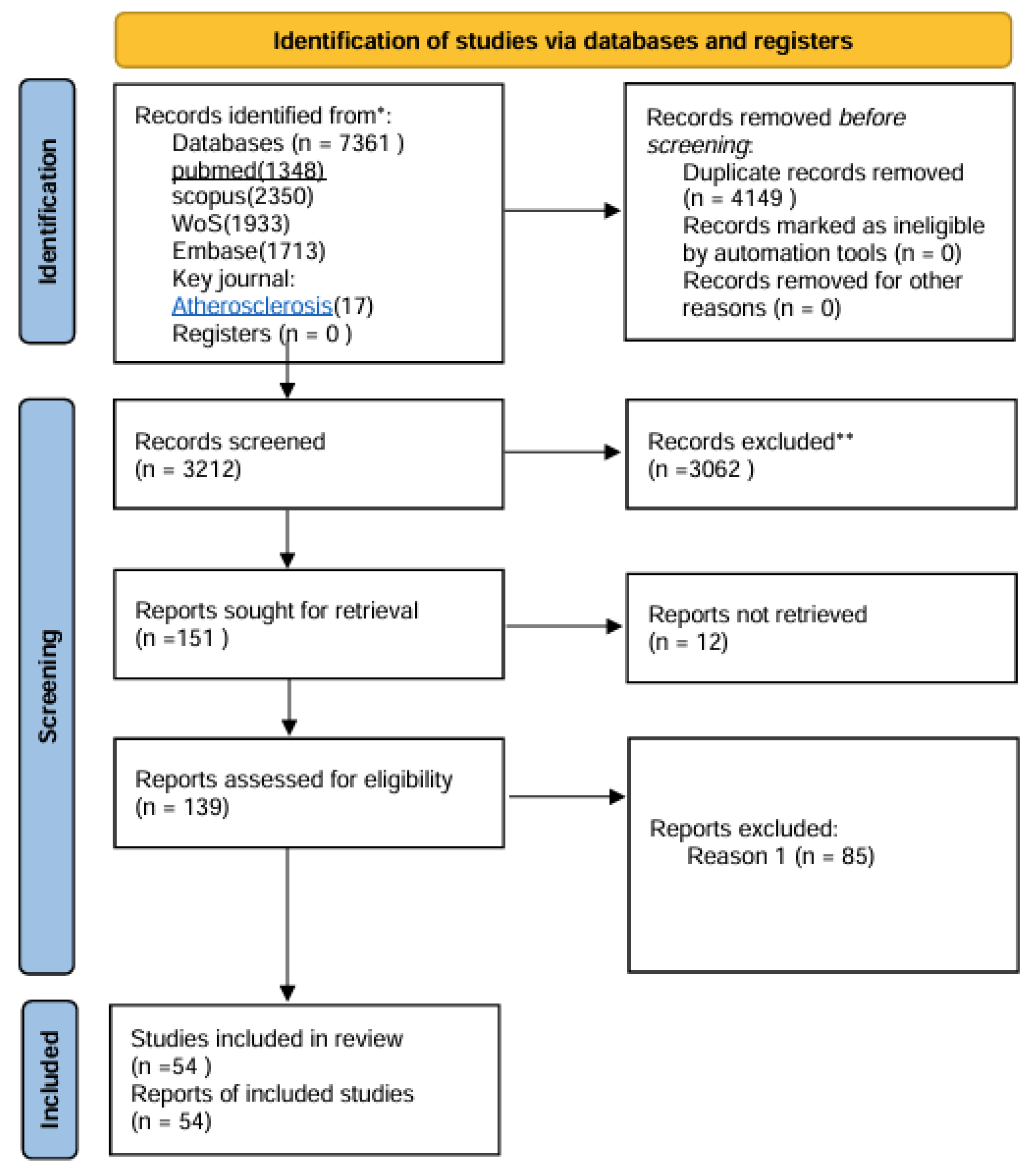
Figure 2.
Autophagy dysfunction as a driver of atherosclerotic progression. Schematic overview illustrating how impaired autophagic flux in vascular cells (primarily macrophages, endothelial cells, and smooth muscle cells) promotes the key pathological hallmarks of atherosclerosis: lipid accumulation, chronic inflammation, cell death, and plaque instability. The integrated network highlights four interconnected mechanisms. (A) Lipid handling failure: Defective autophagy impairs lysosomal degradation of lipid droplets and cholesteryl esters, leading to foam cell formation, free cholesterol accumulation, endoplasmic reticulum (ER) stress, and reduced cholesterol efflux via ABCA1/ABCG1. (B) Inflammatory amplification: Failure of autophagy derepresses NLRP3 inflammasome and NF-κB signaling, resulting in excessive cytokine and chemokine production that sustains vascular inflammation and monocyte recruitment. (C) Oxidative stress, apoptosis, and secondary necrosis: Impaired mitophagy and autophagic clearance of damaged organelles elevate reactive oxygen species (ROS), triggering apoptotic and necrotic pathways that destabilize the plaque. (D) Proteotoxic and organelle stress: Accumulation of protein aggregates, unresolved ER stress, and lysosomal dysfunction further exacerbate endothelial dysfunction and proteolytic instability of the fibrous cap. An inset table summarizes major lipid mediators and their downstream effects on inflammation, apoptosis, and plaque vulnerability. Arrows and blunt-ended lines denote activation and inhibition, respectively; red highlights indicate pathological outcomes of autophagy impairment.
Figure 2.
Autophagy dysfunction as a driver of atherosclerotic progression. Schematic overview illustrating how impaired autophagic flux in vascular cells (primarily macrophages, endothelial cells, and smooth muscle cells) promotes the key pathological hallmarks of atherosclerosis: lipid accumulation, chronic inflammation, cell death, and plaque instability. The integrated network highlights four interconnected mechanisms. (A) Lipid handling failure: Defective autophagy impairs lysosomal degradation of lipid droplets and cholesteryl esters, leading to foam cell formation, free cholesterol accumulation, endoplasmic reticulum (ER) stress, and reduced cholesterol efflux via ABCA1/ABCG1. (B) Inflammatory amplification: Failure of autophagy derepresses NLRP3 inflammasome and NF-κB signaling, resulting in excessive cytokine and chemokine production that sustains vascular inflammation and monocyte recruitment. (C) Oxidative stress, apoptosis, and secondary necrosis: Impaired mitophagy and autophagic clearance of damaged organelles elevate reactive oxygen species (ROS), triggering apoptotic and necrotic pathways that destabilize the plaque. (D) Proteotoxic and organelle stress: Accumulation of protein aggregates, unresolved ER stress, and lysosomal dysfunction further exacerbate endothelial dysfunction and proteolytic instability of the fibrous cap. An inset table summarizes major lipid mediators and their downstream effects on inflammation, apoptosis, and plaque vulnerability. Arrows and blunt-ended lines denote activation and inhibition, respectively; red highlights indicate pathological outcomes of autophagy impairment.
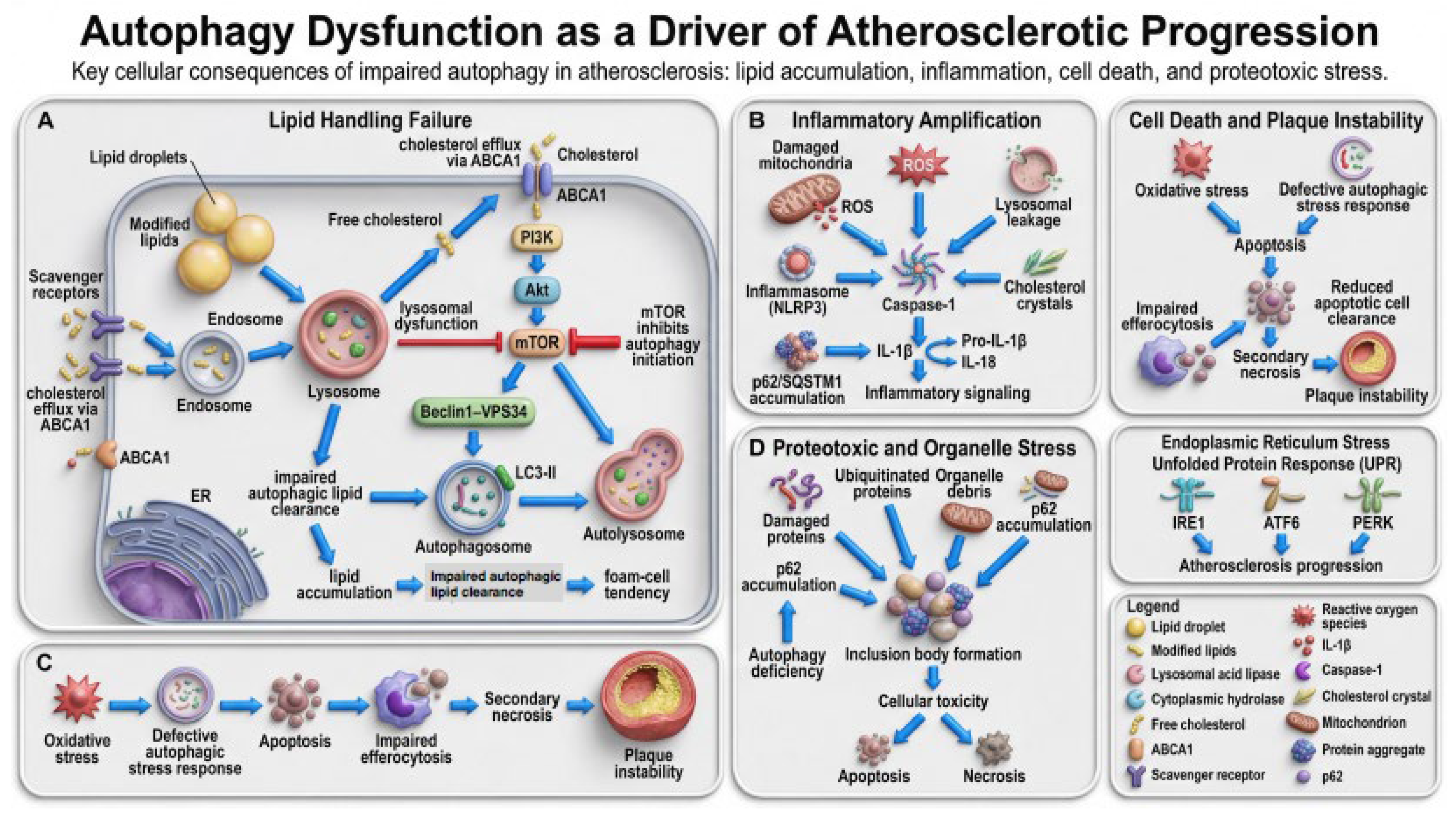
Figure 3.
Overview of the regulation of autophagy and potential drug targets. Integrated regulatory network of autophagy and therapeutic targets. The schematic illustrates the central molecular machinery of autophagy, including the ULK1 complex and class III PI3K (Vps34)–Beclin-1 axis, under the control of key upstream regulators such as mTORC1, AMPK, SIRT1, FOXO1, and TFEB. Arrows and blunt-ended lines indicate stimulatory and inhibitory interactions, respectively. Selected pharmacological and genetic interventions with potential relevance to autophagic modulation in atherosclerosis are highlighted in panels (A–E): (A) Curcumin blocks the FOXO1 pathway and class I PI3K signaling. (B) Resveratrol and ginkgolide B activate SIRT1 to induce autophagy; pterostilbene stimulates the AMPK pathway. (C) Gossypetin and curcumin activate autophagy through the class III PI3K pathway. (D) Atorvastatin inhibits autophagy via blockade of the class III PI3K pathway. (E) TFEB overexpression, trehalose, chloroquine (CQ), and hydroxychloroquine (HCQ) impair autophagic flux at the lysosomal stage. Chemical structures of representative compounds are shown for clarity.
Figure 3.
Overview of the regulation of autophagy and potential drug targets. Integrated regulatory network of autophagy and therapeutic targets. The schematic illustrates the central molecular machinery of autophagy, including the ULK1 complex and class III PI3K (Vps34)–Beclin-1 axis, under the control of key upstream regulators such as mTORC1, AMPK, SIRT1, FOXO1, and TFEB. Arrows and blunt-ended lines indicate stimulatory and inhibitory interactions, respectively. Selected pharmacological and genetic interventions with potential relevance to autophagic modulation in atherosclerosis are highlighted in panels (A–E): (A) Curcumin blocks the FOXO1 pathway and class I PI3K signaling. (B) Resveratrol and ginkgolide B activate SIRT1 to induce autophagy; pterostilbene stimulates the AMPK pathway. (C) Gossypetin and curcumin activate autophagy through the class III PI3K pathway. (D) Atorvastatin inhibits autophagy via blockade of the class III PI3K pathway. (E) TFEB overexpression, trehalose, chloroquine (CQ), and hydroxychloroquine (HCQ) impair autophagic flux at the lysosomal stage. Chemical structures of representative compounds are shown for clarity.
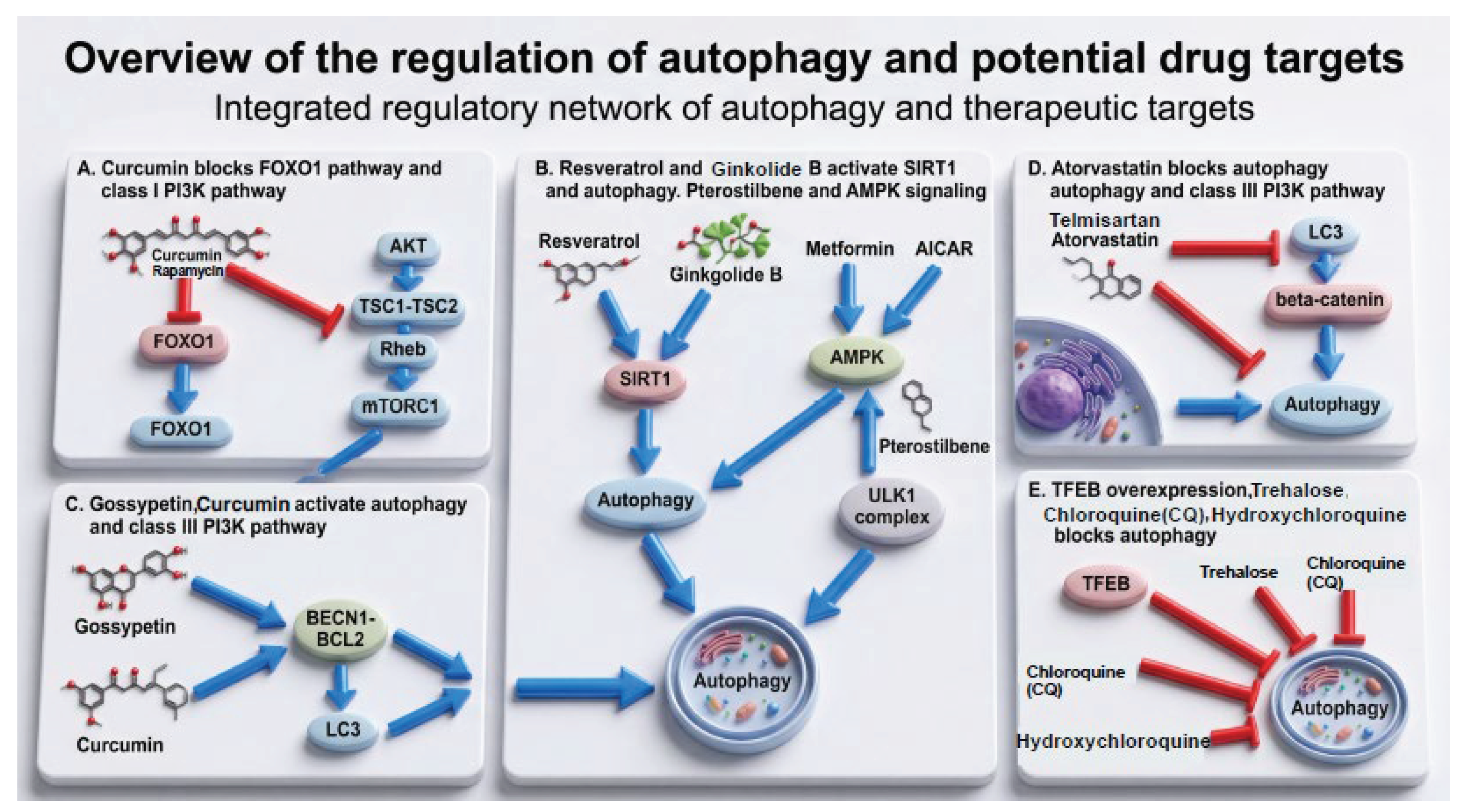

Table 1.
Characteristics of the included studies that investigated macrophage cell lines exposed to atherosclerotic stimuli.
Table 1.
Characteristics of the included studies that investigated macrophage cell lines exposed to atherosclerotic stimuli.
| authors | year | country | Details of study | Sample type | Detection method | Main findings | |
|---|---|---|---|---|---|---|---|
| 1 | Verheye, S. | 2007 | Belgium | Investigate whether stent-based delivery of an inhibitor of mammalian target of rapamycin (mTOR) can selectively clear macrophages in rabbit atherosclerotic plaques. |
White rabbits, murine macrophage cell line J774A.1. |
Taqman-PCR, TEM, Western blot. | The mTOR gene silencing was associated with selective induction of macrophage cell death, The Atg13 protein is phosphorylated in healthy cells but rapidly de- phosphorylated upon inhibition of TOR, stimulating its affinity to Atg1. |
| 2 | Inge De Meyer |
2012 | Belgium | Examination the in vitro and in vivo effects of TLR7 ligand imiquimod on the viability of cultured cells, target selectivity (macrophages), cell death characteristics, and the composition and size of established rabbit atherosclerotic plaques. |
murine macrophage cell line J774A.1, human U937 cells, Bone marrow-derived macrophages were obtained from C57BL/6, TLR7? and TLR7- mice, white rabbits. |
Immunoblot assays, Quantitative ELISAs, color image analysis system, Real time RT-PCR, TEM. |
TLR7 was required for imiquimod-induced Autophagy, imiquimod-treated cells with TLR7 secreted large amounts of several pro-inflammatory cytokines or chemokines including G-CSF, IL-6, IL-12, MCP-1, MCP-5, RANTES and TNF-a. |
| 3 | Shuang Mei |
2012 | North Carolina |
Examination of relationship between P38MAPK and formation of foam cells, an early step in the development of atherosclerosis. |
THP-1 cells. |
Immunoblot assays, Immunoprecipitation, transfection, Fluorescence Microscop, siRNA, Oil Red O Staining. |
LDL stimulated phosphorylation of p38 MAPK in a time- and dose-dependent manner, Activation of p38 MAPK Is Associated with Increased Accumulation of Cholesterol Esters in Macrophages, Exposure to LDL Inhibits Autophagy in Macrophages. |
| 4 | Ai Takeda Watanabe |
2012 | Japan | demonstrating that SIRT1 inactivation impairs starvation-induced autophagy leading to the accumulation of p62/Sqstm1 and resulting in inflammation through NF-kB activation. inhibition of SIRT1 contributes to the regulation of nutrient-sensing pathways by the activation of mTOR and the inhibiting AMPK activation, thereby causing the suppression of autophagy. |
THP-1 cell . |
Western blott, Quantitative RT-PCR, siRNA. |
inhibition of SIRT1 decreases starvation-induced autophagy and increases inflammation in THP-1 cells, The accumulation of p62/Sqstm1 is associated with the dysfunction of autophagy, Inhibition of SIRT1 induces inflammation by suppressing autophagy via mTOR activation. |
| 5 | Zufeng Ding |
2014 | china | Demonstrating that damaged mtDNA could trigger autophagy and NLRP3 inflammasome activation, and LOX-1 may play a critical role in this process. |
THP-1 cell. | siRNA, Western blot, Real-time quantitative PCR assay, fluorescence. |
LPS induces expression of LOX-1 and NLRP3 inflammasome, ROS generation, as well as autophagy and mtDNA damage. |
| 6 | Xuyang Feng |
2014 | china | understanding of the role of autophagy in the development of atherosclerosis, LPS-induced foam cell formation is regulated through Autophagy. |
THP-1 cell. |
enzymatic colorimetric assays, Transfection, fluorescence microscopy, or immunoblotting, Real-time PCR, Western blot analysis. |
LPS promotes foam cell formation by inducing lipid accumulation in macrophages, Autophagy was activated during LPS-induced foam cell formation, the level of ADRP in macrophages is positively correlated with the autophagic activity after treatment with LPS. |
| 7 | Eduardo J. Folco |
2014 | Boston |
Demonstratating IL-1β colocalizes with markers of hypoxia and with activated caspase-1 |
Cell culture(macrophages from PB) | Immunoblot, ELISA, Quantitative Polymerase Chain Reaction PCR, Immunofluorescence, Immunohistochemical Study. |
Hypoxia Induces IL-1β Expression by Stabilizing Pro-IL-1β Protein in Human Macrophages, Hypoxia Augments NLRP3 Induction and Inflammasome Activation. |
| 8 | Baoxin Liu |
2014 | china | Assess connection between enhancement in efferocytosis of apoptotic macrophages and autophagy mediated by Sirt1. |
A mouse macrophage-like RAW264.7 cell. |
western blot , Oil red O staining, flow cytometry, TEM, |
ox-LDL of appropriate concentration elevated the levels of Sirt1 and autophagy marker proteins such as Atg5, Atg7 and LC3-II/LC3-I at optimal time points, autophagy and apoptosis of RAW264.7 cells were triggered by incubation with 50 µM ox-LDL for 24 h, Upregulation of autophagy enhanced efferocytosis of apoptotic RAW264.7 cells. |
| 9 | Xiaochuang Wang |
2014 | china | providing an insight into how mTOR accelerates the pathological process of atherosclerosis. |
RAW 264.7 monocyte/macrophage-like cell. |
siRNA, Western blott, oil red O staining, HPLC, Fluorescence microscopy. |
The mTOR pathway was dramatically activated during foam cell formation, mTOR negatively regulated the activation Of the autophagic machinery responding to lipid loading in macrophage-derived foam cells, ULK1 was responsible for mTOR-regulated foam cell formation by autophagic pathway. |
| 10 | Baojun Huang | 2015 | china | Exploring how ox-LDL induce autophagy in macrophages, and the role of simvastatin in ox-LDL-induced macrophage autophagy and lipid accumulation. |
The J774A.1 murine macrophage Cell. |
Western blott, Confocal laser scanning microscopy, CHOD-PAP. |
Ox-LDL induces lipid accumulation in macrophages, Ox-LDL induces the transformation of LC3 Ⅰ to LC3 Ⅱ in Macrophages. |
| 11 | Guohua Li |
2015 | china | How DNA demethylation modifications and TET2 regulate ox-LDL-treated THP-1 macrophages autophagy. |
THP-1 monocyte cells. |
siRNA, Real-Time Quantitative PCR, Western Blot Analysis, Cell Immunofluorescence. |
ox-LDL inhibited macrophage autophagy, Beclin 1 and LC3-II Expression Was Inhibited by ox-LDL in THP-1-Derived Macrophages, TET2 mRNA levels decreased. |
| 12 | Ping-Ge Tian |
2015 | china | demonstrating that XBP1 mRNA splicing participates in macrophage proliferation, apoptosis, and autophagy via the transcriptional activation of Beclian-1. |
Bone marrow-derived macrophages were harvested from the femurs of wild-type C57BL/6 mice. |
cell proliferation assays, TEM, RT-PCR assays, Immunoblotting and immunohistochemistry staining assays. | The transient activation of XBP1 mRNA splicing triggers autophagy in macrophages, transient activation of XBP1 mRNA splicing for 24 or 48 h can induce autophagy in macrophages via the transcriptional regulation of Beclin-1. |
| 13 | Xi-Ming Yuan |
2016 | Sweden | Investigateing whether 7-oxysterols mixed in an atheroma-relevant proportion induces autophagy, whether autophagy induction influences 7-oxysterol-mediated apoptosis, and the underlying mechanisms, by focusing on cellular lipid levels, oxidative stress, and LMP in 7-oxysterol-treated-a human leukemic cell line (THP-1) cells. |
THP-1 cells . |
oil red O staining or acridine orange (AO) relocation test, flow cytometry, immunocytochemistry, confocal microscopy, Western blot analysis, TEM. |
7-Oxysterols induce lipid accumulation and dysfunction of autophagy. |
| 14 | Feng Zhou |
2016 | china | Evaluating autophagic effects of macrophages on MMP-9 expression, and the underlying mechanisms. |
THP-1 cells. | Oil red O staining, MTT cell apoptosis assay, siRNA, Western-blot analysis, real-time polymerase chain reaction analysis (PCR). |
oxLDL induces macrophages into defected autophagy, defected auto- phagy in macrophage foam cells was accompanied by decreased LC3 and increased p62/SQSTM1, autophagic Flux situation was involved in balance of MMP-9 formation and degradation in THP-1 derived macrophages, p62/SQSTM1 upregulates MMP-9 gene expression in dependent NF-kB signaling |
| 15 | Jiangping He | 2017 | china | SIRT6 overexpres- sion protected THP1 cells treated with oxidized low-density lipoprotein (ox-LDL) from forming foam cells, whereas SIRT6 knockdown aggravated foam cell formation. |
THP1 cell. | Immunoblot analysis, qRT-PCR, transfections, TEM, ORO staining, Flow cytometry. | SIRT6 and autophagy are inhibited in THP1 cells treated with ox-LDL. |
| 16 | Haofeng Ning | 2017 | china | investigating the correlation between p62 expression and oxLDL-induced foam cell formation. | THP-1 cell. | siRNA, Oil Red O staining, Western blott, RT-qPCR, ELISAM, MTT assay, FACS. | Prolonged oxLDL treatment induces p62 protein accumulation during foam cell formation, and increase IL-18 secretion and impaired autophagy. |
| 17 | Se-Jin Jeong | 2018 | korea | Investigating Prdx1 deficiency in macrophages led to increased susceptibility to oxidative stress and suppressed the clearance of modified LDL as aresult of impaired lipophagic flux. |
(ApoE)-deficient mice | confocal microscopy, fluorescence microscopy, flow cytometry analysis, Immunohistochemistry, Oil Red O staining, Quantitative real-time PCR analysis, Immunoblot analysis, Electron microscopy |
Prdx1 deficiency causes defective autophagic flux in macrophages, increases macrophage foam cells |
| 18 | Xing Liang | 2017 | china | Evaluation of feedback loop of the “EMMPRIN/NF-κB” pathway in atherosclerotic plaques via modulation of autophagy in macrophages. | (ApoE)-deficient mice, RAW264.7 cells. |
oil red O staining, haematoxylin and eosin (H&E), immunohistochemistry (IHC), Immunofluorescence staining, siRNA, flow cytometry, Real-time PCR, TEM, Western blotting analysis, ELISA. | Activation of the PI3K/Akt/mTOR signalling pathway plays a minor role in EMMPRIN-regulated macrophage autophagy, Down-regulation of EMMPRIN increases macrophage autophagy when treated with ox-LDL, EMMPRIN inhibits autophagy in oxLDL-stimulated macrophages primarily via NF-κB activation. |
| 19 | Wenhua Sun | 2018 | china | A link between autophagy and oxLDL. | Carotid artery tissues, THP-1 cells. | Western blot analysis, TUNEL. | Overexpression LC3 and beclin1 in macrophages during autophagy. |
| 20 | Sen Yang | 2018 | china | A link autophagy, inflammation and oxLDL. | The mouse macrophage-like cell line Raw264.7. | siRNA, Western blot analysis, ELISA. | Ox-LDL impairs autophagic flux in macrophages, ox-LDL significantly increased p62 , LC3-II expression levels in macrophages, Ox-LDL induce inflammation in macrophages. |
| 21 | Lu Zhang | 2018 | china | How CTRP9 can affect foam cell formation by activating autophagy. | THP-1 monocytes cells. | Oil Red O staining, Cholesterol Efflux Assay, Western Blot Assay | the ox-LDL group, the protein expression level of LC3 II was downregulated, whereas that of p62 was upregulated, ABCA1 and ABCG1 protein levels were downregulated, CTRP9 Induces Autophagy by Regulating the AMPK/mTOR Pathway in THP-1 Macrophage- Derived Foam Cells |
| 22 | Kathrin Ackermann | 2018 | German | investigating the in uence of GDF-15 in lipid homeostasis and autophagy in human MΦ during foam cell formation. |
THP-1 cells. | ELISA, Western blot, SDS-PAGE, RT-PCR, Oil Red O staining, Fluorometric assay, Immunocytofluorescence confocal laser scanning microscopy. | autophagy-relevant proteins/complexes ATG5, ATG12/ATG5 and p62 in THP-1 increased. |
| 23 | Shan Li | 2018 | china | Evaluating Programmed cell death protein 4 (PDCD4), a transcriptional Regulator’ effect on regulation of autophagy. |
Mice monocyte-macrophage leukemia-derived cell line RAW 264.7 and human monocytic cell line THP-1. |
Oil Red O staining, transfection, Real-time quantitative polymerase chain reaction, Western blots, Immunofluorescence, Flow cytometry. | PDCD4, negatively regulated autophagy, PDCD4-mediated autophagy is involved in the process of lipid hypolysis and efflux. |
| 24 | Xiuying Li | 2018 | china | Evaluating pivotal role of macrophage autophagy in the pathogenesis of atherosclerosis, assessment of dectin-1 binding by β-glucan converts RAW264.7 macrophages into an M1 phenotype via autophagy. |
RAW264.7 cells, ApoE-/- mice. | MTT assay, Flow cytometry, Western blott, RT-qPCR, TEM, Immunofluorescent histochemistry. | The ratio of LC3II/I decreased, β-glucan may suppress autophagy by downregulating the level of LC3-II/I and beclin-1. |
| 25 | Xiaofei Liang | 2019 | China | Assessment p62/mTOR/LXRa pathway inhibits cholesterol efflux mediated by ABCA1 and ABCG1 during autophagy blockage. | THP-1 cells. | siRNA, Western blot analysis, Fluorescence analysis, Oil red O staining. | Excess ox-LDL inhibited the expression of ABCA1 and ABCG1, and induced blockage of autophagy, p62 overexpression accelerates foam cell formation during autophagy blockage, A p62/mTOR/LXRa signaling pathway is involved in the formation of foam cells during autophagy blockage |
| 26 | Shanshan Zhong | 2019 | china | Assessing role of ALDH2 and LDLR in atherosclerosis. |
APOE–/– mice, HEK 293T cell lines, | Immunohistochemistry, Phagocytotic assay, Western blott, SDS-PAGE, GC-MS, Real-time PCR, Immunoprecipitation, Fluorescence microscopy, RNA-Seq analysis, ChIP assay, confocal microscopy, Luciferase assay. | AMPK plays an important role in regulating endocytosis and autophagy for LDLR-regulated ox-LDL metabolism in macrophages. |
| 27 | Xiaozhen Zhuo | 2019 | China | To explore the mechanism of how LSD1 regulates autophagy and the correlation between LSD1 and Ox-LDL-induced inflammation. | RAW264.7 murine macrophage cell. | RT-qPCR, Western blott, CCK-8 assay, siRNA, ELISA. | Ox-LDL upregulates the expression level of LSD1 in RAW264.7 cells, LSD1 inhibition activated autophagy via SESN2-mediated PI3K/Akt/Mtor pathway |
| 28 | Nicholas D. LeBlond | 2020 | canada | Foam Cell Induction Activates AMPK But Uncouples Its Regulation of Autophagy and Lysosomal Homeostasis |
Mice, BMDM mice. | Immunoblotting, Quantitative PCR, Immunofluorescent labeling, Immunofluorescent imaging, HPLC | Atherogenic Lipids Activate AMPK in Bone Marrow-Derived Macrophages, Treatment with oxLDL dramatically enhanced AMPK-specific ULK1 Ser555 phosphorylation and increased the conversion of LC3II in WT, but not CD36+/−cells, suggesting that CD36 plays a role in transmitting the atherogenic signal to AMPK, which in turn signals to regulate autophagy via TFEB programs. |
| 29 | Chao Wang | 2020 | China | How MicroRNA-761 modulates foam cell formation and inflammation through autophagy in the progression of atherosclerosis. |
THP-1 cell. | RNA transfection, Quantitative reverse transcription polymerase chain Reaction, Western blot (WB), bioinformatic analysis, Oil Red "O" staining, ELISA, | MiR-761 significantly elevated under the stimulation of ox-LD, Macrophage autophagy was promoted by miR-761 through mTOR-ULK1 pathway, miR-761 negatively affect the secretion of IL-1β and IL-18. |
| 30 | Qingqing Xiao | 2020 | china | How Macrophage autophagy regulates mitochondria-mediated Apoptosis. |
ApoE−/−C57BL/6 mice, RAW264.7 cells | haematoxylin and eosin (H&E, Sigma), Masson's trichrome (Sigma) and Oil Red O staining, Western blot analysis, Flow cytometric analysis, Real-time quantitative PCR, siRNA, Immunofluorescence staining, TUNNEL, TEM | Autophagy flux was blocked during 7-KC– induced macrophages apoptosis, accumulation of SQSTM1/P62 was paralleled to an increase in the ratio of LC3II/LC3I, reflecting impairment in the autophagy flux, Elevated MAPK and NF-κB activation with autophagy impairment. |
| 31 | MD Khurshidul Zahid | 2020 | USA | Evaluating macrophage foam cell formation in atherogenesis and inflammation, ER stress, and apoptosis and by promoting autophagy and inactivating mTOR. | RAW264.7 macrophage cells. | qPCR, Western blot analysis. | CEBPβ have a role in NFkB phosphorylation and NFkB and TNFα genes expression, increased ER stress, mTOR activation and apoptosis , decreased auophagy related genes in RAW264.7 macrophage cells, |
| 32 | Zhenfeng Zhou | 2020 | china | How K63 ubiquitin chains target NLRP3 inflammasome for autophagic degradation in ox-LDL stimulated THP-1 macrophages. | THP-1 cell. | Oil red O staining, siRNA, ELISA, Western blot, Immunoprecipitation, | Ox-LDLs activate NLRP3 inflammasome and secretion NLRP3, ASC, pro-caspase-1, pro-IL-1β, and activated caspase-1 in a time- and dose-dependent manner, ox-LDLs restrict autophagy in a time- and dose-dependent manner, p62 plays an important role in the foam-cell model, and mediates the regulation of NLRP3 inflammasome by autophagy, p62 mediates the regulation of NLRP3 inflammasomes through autophagy by recognizing the K63 polyubiquitin chains on NLRP3. |
| 33 | SeJeong Kim | 2021 | korea | Investigating the P62 role in macrophage autophagy. | Human umbilical vein endothelial cells, THP-1 cell. | siRNA, Quantitative Real-Time PCR (qPCR) Analysis, ELISA, BODIPY Staining, Immunocytochemistry, Western Blot Analysis. | There is abnormal autophagy in Atherosclerotic Conditions via increased p62. |
| 34 | Jiaru Liu | 2021 | china | Regulation of pyroptosis and autophagy via p62/Nrf2/ARE axis. | THP-1 cells. | CCK-8 assay, LDH release assay, ELISA, Flow cytometry analysis, Western blot analysis, qRT-PCR, Bioinformatic analyses. | ox-LDL induced THP-1 macrophages to pyroptosis in a concentration dependent manner, induced the both mRNA and protein expressions of pro-caspase-1 and GSDMD, Autophagy blockage triggered pyroptosis and inflammation in macrophages exposed to ox-LDL via Nrf2/ARE , p62/Nrf2/ARE pathway. |
| 35 | Jun Tao | 2021 | china | AMPK/FoxO1/TFEB signalling axis role in lysosomal biogenesis, foam cell formation and autophagy. |
murine macrophage RAW264.7 cell | RT-PCR, shRNA, Immunofluorescence, Western blotting analysis, Oil Red O staining. | Atherosclerotic macrophages have features of impaired autophagy and dysfunctional lysosomes, LC3 and SQSTM1/p62 elevated and dysregulated AMPK/ FoxO1/TFEB pathway. |
| 36 | Hui Zhang | 2021 | china | How ATG14 impact on inflammation and autophagosome lysosome fusion in macrophages. | Human artery samples, apoe−/- mice, Raw264.7 cells | Immunostaining, Western blott, flow cytometry, Electron microscopy, ELISA, RT qPCR assay. | Autophagy dysfunction with reduction of ATG14 expression was detected in macrophage in human atherosclerotic plaque, reduction of ATG14 induce inflammasome actiation. |
| 37 | Qi Peng | 2022 | china | Role of Nrf2 in autophagy and ferroptosis | THP-1 cell. | Western blot, CCK8 cell activity assay, | Nrf2 was increased by ox-LDL stimulation and xCT and GPX4 were decreased by ox-LDL stimulation, Inadequate autophagy of foam cells accelerates foam cell death via accumulation of p62 , LC3II/LC3I was significantly reduced, Insufficient autophagy in foam cells initiates Nrf2-induced ROS accumulation, The negative effect of Nrf2 further promotes ferroptosis in foam cells |
| 38 | Masataka Sano | 2022 | china | Neutrophil extracellular traps-mediated Beclin-1 suppression aggravates atherosclerosis by inhibiting macrophage autophagy |
apoE deficient mice, HL-60 cells, THP-1 cells | Immunoblot analyses, Enzyme-linked immunosorbent assay, Immunoprecipitation assay, Oil Red O staining , Immunocytochemistry, Immunohistochemistry, SEM, TEM, fluorescent assay |
NETs inhibit the kinase activity of Beclin-1-dependent PI3 kinase activity possibly through phosphorylating the tyrosine residues of Beclin-1 in the macrophages, Neutrophil extracellular traps negatively regulate autophagosome–lysosome fusion through upregulating Rubicon expression |
| 39 | Weihua Shao | 2022 | china | Identification of the relationship between the miR-29a-targeted PI3K signaling pathway and AS | ApoE−/− mice, mouse RAW264.7 cells | Bioinformatic analysis, histological analysis, MOVAT staining, Immunofluorescence and immunohistochemistry, Luciferase assay,TEM, Western blott | MiR-29a increased the expressions of IL-10, Mrc1 and Arginase-1 and decreased the expressions of IFN-γ, IL-1β and iNOS in vivo, MiR-29a overexpression increased autophagy and suppressed the PI3K/AKT/mTOR pathway |
| 40 | Zhen Tan | 2022 | china | Identification of the relationship between KLF2, Nrf2 and foam cell formation. | HUVECs, THP-1 monocytes | Transfection, RT-qPCR, Western blott, CCK-8 assay, ELISA, Oil Red O staining, | The expression of KLF2, Nrf2 in THP-1 macrophage-derived foam cells was decreased and impaired autophagy. |
| 41 | Wei Yu | 2022 | china | How can Uric Acid affect NRF2-Mediated Autophagy Dysfunction and Ferroptosis | ApoE−/− mice, THP-1 cells | Oil Red O Staining, Immunohistochemical Staining, Immunofluorescence Microscopy, CCK-8 assay, MDA assay, flow Cytometry, GSH assay, TEM, Immunoblotting , qPCR Analysis. |
HUA Inhibits the Protein Level of the NRF2/SLC7A11/ GPX4 Signaling Pathway in Macrophages in Atherosclerotic Plaques, NRF2-Mediated Autophagy Dysfunction and Ferroptosis Are Involved in Foam Cell Formation Induced by HUA |
| 42 | Liang Zheng | 2022 | china | Identification of relationship autophagy, NLRP3 and apoptosis | THP-1 monocytes | Transfection, TEM, Western blot analysis, Immunofluorescence assay, Oil Red O (ORO) staining, TUNNEL | ATG7 and Beclin1 increased, NLRP3 activity was increased |
| 43 | Guofu Hu | 2023 | china | Identification of relationship between autophagy and ferroptosis. | THP-1 monocytes, Human carotid atherosclerotic plaques, Apolipoprotein E knock out (ApoE-/-) mice | Bioinformatic analysis, Histological examination, Real-time PCR, Western blot, Immunofluorescent staining, Oil-red-o staining, TEM, GSH assay. | When autophagy decreased, ferroptosis been activated |
| 44 | Xuemei Hu | 2023 | china | Identification the role of Sialic acids ROS and autophagy blockage | RAW264.7 cells, APOE−/− mice | Real time PCR quantification, CCK-8 assay, Western blot, Flow cytometry, Immunofluorescence staining, flow cytometry | AC5-induced mitochondrial dysfunction and ROS production in macrophages is correlated with macrophage polarization, AC5 promotes autophagosome formation but decreases autophagic lysosomes fusion resulting in the autophagy flux blockage, |
| 45 | Shengmei Zeng | 2023 | china | How ATG5 affect macrophages Autophagy and inflammation under hypoxia |
RAW264.7 cells, C57BL/6 mice | Western blot, Immunofluorescence assay, siRNA, TEM, qRT-PCR, Co-immunoprecipitation | Hypoxia significantly upregulated macrophage inflammatory factor Levels, hypoxia-induced inflammation in RAW264.7 cells is mediated by autophagy, desialylation of ATG5 enhances ATG12–ATG5–ATG16L complex formation and thereby promotes hypoxia-induced autophagosome, ATG5 can affect its stability and promote the formation of the ATG5-ATG16L ATG12 complex. |
| 46 | Pengchen He, MM | 2024 | china | Effect of connexin 43 in LPS/IL-4-induced macrophage M1/M2 polarization |
RAW264.7 macrophages | Western blot, Immunofluorescence, Flow cytometry | M2-type polarization reduces autophagy cx43 protein expression was first decreased and then increased by IL-4 in RAW264.7 macrophages |
| 47 | Yuan-Mei Wang | 2024 | china | ASIC1/RIP1 accelerates atherosclerosis via disrupting lipophagy |
Human aortic plaques, ApoE-/- mice, RAW 264.7 macrophages, THP-1 cell | Bioinformatic analysis, Hematoxylin and eosin (H&E) staining, Immunofluorescence staining, ORO staining, Western blot analysis, TEM, | ASIC1 is abundantly expressed in macrophages within atherosclerotic Lesions, ASIC1 promotes RIP1 phosphorylation in both RAW 264.7 and THP-1 Macrophages, ASIC1-RIP1 association contributes to defective autophagy flux in both RAW 264.7 and THP-1 macrophages induced by ox-LDL, ASIC1/RIP1 facilitates lipid accumulation in RAW 264.7 macrophages by inhibiting lipophagy |
| 48 | Qianqian Wu | 2024 | china | The Effects of the oxLDL/β2GPI/anti-β2GPI Complex on Macrophage Autophagy and its Mechanism |
THP-1 cells | Western Blot Analysis, Adenoviral Transfection, TEM |
xpression of SQSTM1/P62 was significantly increased in the oxLDL/β2GPI/anti-β2GPI group, the oxLDL/β2GPI/anti-β2GPI treat- ment decreases macrophage autophagy, oxLDL/β2GPI/anti-β2GPI Complex Reduces the Autophagosomes and Blocks Autophagic Flux in Macrophages, oxLDL/β2GPI/anti-β2GPI Complex Enhances the Activity of PI3K/AKT/mTOR Pathway in Macrophages |
| 49 | Min Zeng | 2024 | china | How CTRP9 affect atherosclerosis progression through changing autophagic status of macrophages by activating USP22-mediated de-ubiquitination on Sirt1 |
Macrophages from PB | Cell transfection, Immunofluorescence, Oil Red O staining, ELISA, fluorescence assay, RT-qPCR, western blot | CTRP9 attenuated impaired cell viability, autophagy inhibition and increased lipid accumulation induced by ox-LDL, CTRP9 maintained Sirt1 protein level through enhancing its stability, CTRP9 triggered the de-ubiquitination of Sirt1 via up-regulating USP22 expression |
| 50 | Rui Bu |
2025 | china | Downregulation of ATP8B2 in atherosclerosis exacerbates foam cell- like pathological changes via impairing lysosomal membrane fusion |
THP-1 cells | Bioinformatics analysis, siRNA, RT-qPCR, Western blot, Immunofluorescence staining | Downregulation of ATP8B2 may promote the development of atherosclerosis, |
| 51 | Siyu Fan | 2025 | Netherlands | Detection of autophagy-lysosome regulation in an atherosclerosis cell model | RAW 264.7 macrophages | N.A | Increased ROS levels, The activation of TFEB might lead to autophagy-lysosomal biogenesis, early burst of lysosomal ROS triggers TFEB nuclear translocation |
| 52 | Qiujun Liu | 2025 | china | Identification of how Pyruvate dehydrogenase affect on macrophage autophagy | ApoE–/– mice, RAW264.7 macrophages | Transfection, Co-immunoprecipitation (Co-IP) assays, Western blot analysis, Immunofluorescence, bioinformatic analysis | Hcy inhibits autophagy by regulating glycolysis in macrophages via the inhibition of pyruvate dehydrogenase and AMPK/mTOR signaling pathway |
| 53 | Xiaodong Miao | 2025 | china | Down-regulation of ATP8B2 in Foam Cells Inhibits Autophagic Flux and ox-LDL Degradation in Atherosclerosis |
THP-1 human monocytic leukemia cell | Bioinformatic analysis, RT-PCR, Western Blot, Immunofluorescence | Downregulation of ATP8B2 Inhibits Autophagic Flux in Macrophages, Downregulation of ATP8B2 Inhibits ox-LDL Degradation and Mitochondrial Homeostasis in Macrophages |
| 54 | Kai Wen Wai | 2025 | Malaysia | How Nrf2 modulates macrophage foam cells senescence and autophagy activation |
THP-1 human monocytic cell | siRNA, Oil red O (ORO) assay, Autophagy assay, Senescence β-galactosidase staining, Western blot |
Increased Nrf2 , activate macrophage foam cell Formation and reduced macrophage autophagy |
3. Results
3.1. To Systematically Evaluate the Role of Macrophage Autophagy in the Initiation, Progression, and Stability of Atherosclerotic Plaques, Including its Impact on Lipid Metabolism and Foam Cell Formation
During autophagy, cytosolic LC3 (LC3-I) is converted to its membrane-bound form (LC3-II), which is localized on pre-autophagosomes and autophagosomes and is commonly used as a marker of autophagosomal membranes[36]. The mRFP-GFP-LC3 fusion protein, which is originally located in the cytoplasm, translocates to the autophagosome membrane during autophagy[37]. In addition to showing that LPS exposure caused GFP-LC3 to redistribute from a diffuse to a punctate pattern and significantly increased the proportion of cells containing GFP-LC3–positive autophagosomes, Feng X’s study also demonstrated that LPS promoted lipid accumulation during foam cell formation and activated autophagy[36]. The LC3-II/LC3-I ratio and the number of GFP-labeled autophagosomes increased after exposure to LPS[36,38]. A lipid droplet–associated protein called ADRP is essential for maintaining the homeostasis of cytosolic lipid droplets in various types of cells. Furthermore, their findings indicate a significant correlation between autophagic activity after LPS treatment and the level of ADRP in macrophages[36]. The cytosolic lipid droplets in macrophages may be coated with ADRP, which protects them from cholesterol esterase activity and reduces the amount of free cholesterol (FC) available for efflux. Consequently, a lipid overload triggers the activation of autophagy. These findings suggest that ADRP may protect lipid droplets (LDs) from lipolysis mediated by lysosomes and autophagy in LPS-induced macrophage foam cells[36]. According to research by Sun et al., Western blot analysis showed that PMA-treated THP-1 cells exposed to oxLDL exhibited a significant increase in both oxLDL concentration and legumain expression. These findings suggest that legumain may promote autophagy and contribute to the development of atherosclerosis, at least in part, by regulating the expression of Beclin1 and LC3 in macrophages[39]. Zheng, L. reported that 80 µg/ml oxLDL was used in the experiments, and that exposures to oxLDL for 12 and 36 hours were considered to represent the early and advanced stages of lipid toxicity, respectively. Their findings suggested that timely treatment of lipid abnormalities could prevent macrophage foam cell formation. However, once lipid dysregulation surpasses a critical threshold, autophagy can no longer maintain cellular homeostasis or prevent atherogenesis[40].
Human atherosclerotic plaques exhibit an overall reduction in macrophage autophagy, accompanied by decreased ATG14 expression. Western blot analysis revealed that Ox-LDL–treated cells showed higher levels of LC3-II, SQSTM1, and BECN1/Beclin-1 compared with controls[41]. Compared with the control virus infection, routine RT-PCR analysis and Western blot analysis showed that macrophages overexpressing XBP1s had higher mRNA levels of BECLIN-1 and LC3B-II (autophagy-related genes) after 24 and 48 hours. However, when XBP1s was overexpressed for 72 hours, the expression of the autophagy markers Beclin-1 and LC3B-II in macrophages was reduced[42]. According to He, P.'s Western blotting analysis, the expression levels of Beclin-1 and LC3B were significantly higher in the LPS groups than in the control groups. Additionally, Cx43 protein expression levels were elevated. In summary, Cx43 levels initially increased during LPS-induced M1 macrophage polarization, followed by autophagy activation, which led to Cx43 degradation 48 hours later[43]. According to the results, TET2 siRNA reduced TET2 protein expression by approximately 80% and Beclin 1 mRNA levels by about 70%. The lipidation of LC3-I with phosphatidylethanolamine, forming the membrane-associated LC3-II protein, is associated with the formation of phagophores and autophagosomes. These findings suggest that TET2 may act as a novel regulator of autophagy in macrophages exposed to ox-LDL[44]. By downregulating LC3-II/I and Beclin-1 levels, β-glucan may inhibit autophagy[45].
According to the findings of Bu et al., foam cells exhibited significantly lower ATP8B2 mRNA expression than macrophages. Their results suggest that ATP8B2-knockdown macrophages and foam cells display impaired autophagy[46]. Miao et al. investigated the expression levels of ATP8B2 in macrophages and foam cells derived from THP-1 cells to examine the effect of ATP8B2 on macrophage behavior. The results showed that both the mRNA and protein expression levels of ATP8B2 were significantly lower in foam cells than in normal macrophages[47]. To assess variations in autophagic activity, the researchers performed Western blot (WB) analyses to measure the expression levels of autophagic markers LC3-II and p62 under different treatment conditions. In the siRNA scramble control macrophage group, autophagy was typically induced, and the autophagosome–lysosome fusion and degradation processes were effective. In contrast, the foam cell and siATP8B2 macrophage groups appeared to exhibit reduced autophagic flux. In conclusion, autophagic flux is negatively affected by downregulation of ATP8B2, potentially due to defective autophagosome–lysosome membrane fusion resulting from P4-ATPase deficiency[47]. The redistribution of LC3-II to autophagosomes in the cytoplasm was indicated by a punctate fluorescence pattern in PDCD4-deficient cells, whereas control cells exhibited diffuse staining. Flow cytometric analysis revealed that PDCD4 deficiency enhanced AGE-LDL-induced autophagic flux, as reflected by increased mean fluorescence intensity, in RAW 264.7 cells[48]. The prevention of apoptosis in THP-1 cells and primary peritoneal macrophages requires autophagy activated by PDCD4 deficiency. Together with the finding that PDCD4 deficiency inhibits apoptosis in various cell types through the activation of autophagy, this suggests that PDCD4 exerts a universal effect. These results also indicate that apoptosis can be suppressed by targeting elevated autophagy levels[48].
According to Zhou et al., mild exposure to oxLDL can significantly activate autophagy. However, the integrity of the autophagic flux during the lysosome fusion stage is disrupted in response to high concentrations of oxLDL. At the same time, decreased LC3 levels and increased p62/SQSTM1 expression were observed in macrophage foam cells with impaired autophagy[49]. Additionally, compared with the control cells, the protein expression of MMP-9 was markedly increased by impaired autophagic flux in a dose-dependent manner. According to these findings, p62/SQSTM1 is essential for the process through which autophagic flux regulates MMP-9 production. Moreover, the extent and pattern of p62/SQSTM1 upregulation were comparable to those of MMP-9 protein expression.[49]. According to research by Ning et al., oxLDL regulates the expression of the protein p62, and prolonged exposure to oxLDL induces advanced foam cells to upregulate p62. Interestingly, after 72 hours of oxLDL treatment, the SQSTM1 mRNA level increased significantly (P < 0.01) compared with that at 48 hours, approaching the basal level observed at 0 hours[50]. Furthermore, Wang et al. found that ox-LDL enhances RIP1 phosphorylation and promotes the interaction between ASIC1 and RIP1. In RAW 264.7 macrophages, they investigated how the ASIC1/RIP1 pathway influences autophagic flux. The LC3II/LC3I ratio and LAMP1 levels significantly decreased, while p62 protein levels increased, indicating impaired autophagic flux in ox-LDL-treated macrophages[51]. Liu et al. showed through Western blot analysis of Hcy-treated macrophages that p62 expression increased while LC3BII expression decreased. They further demonstrated that Hcy inhibits autophagy by suppressing macrophage glycolysis and reducing PDH activity in these cells[52].
It is noteworthy that both with and without chloroquine (CQ)—which impairs autophagic flux by blocking the fusion of autophagosomes with lysosomes—SIRT6 expression was markedly downregulated in cells treated with ox-LDL compared to the control. The protein level of SQSTM1/p62, a selective receptor for autophagic substrates, was increased in the ox-LDL-treated group regardless of CQ treatment, indicating that both autophagosome formation and substrate degradation were inhibited in lipid-laden macrophages. Furthermore, two key effectors of autophagosome formation, LC3B and ATG5, were also downregulated. Taken together, these findings suggest that foam cells exhibit reduced SIRT6 expression and impaired autophagic flux compared to normal macrophages[53]. Together, these findings imply that SIRT6 wild-type (WT) overexpression in a lipid-rich environment may enhance both autophagy initiation and autophagic flux. By promoting autophagic flux under ox-LDL conditions, SIRT6 protects THP-1 cells from foam cell formation; however, inhibition of autophagy can abolish the protective effects of SIRT6[53]. Moreover, SIRT6 overexpression reduces miR-33 levels, thereby enhancing autophagic flux and upregulating ABCA1 and ABCG1 expression, which in turn promotes cholesterol efflux and prevents macrophage foam cell formation[53]. Yang et al. found that treatment with ox-LDL markedly and dose-dependently reduced SIRT1 protein expression[54]. Reduced cell viability, suppressed autophagy, and elevated lipid accumulation induced by ox-LDL were all ameliorated by CTRP9. Furthermore, western blotting analysis revealed that ox-LDL decreased Sirt1 protein levels and the LC3II/LC3I ratio while increasing SQSTM1 protein levels. CTRP9 preserved Sirt1 protein levels by enhancing its stability. Specifically, CTRP9 upregulated USP22 expression, which improved Sirt1 stability by removing conjugated poly-ubiquitin chains[55]. Additionally, the expression of foam cell formation–related genes SR-A and SR-B was increased following USP22 or EX527 knockdown, whereas the expression of cholesterol efflux genes ABCA1 and ABCG1 was decreased. These findings suggest that CRTP9 may exert a protective effect through the USP22/Sirt1 axis[55].
According to the study by Yuan X.M. et al., cells treated with the lysosomotropic agent chloroquine (CQ) also showed increased expression of p62/SQSTM1. Lipid accumulation and autophagy dysfunction are induced by 7-oxysterols[56]. Liu et al. (B.X. Liu and colleagues) demonstrated that, at optimal time points, ox-LDL at appropriate concentrations increased the levels of Sirt1 and autophagy marker proteins such as Atg5, Atg7, and LC3-II/LC3-I. The expression of Sirt1 and these autophagy-related proteins was significantly higher at 50 µM ox-LDL but declined when the cells were treated with 75 or 100 µM ox-LDL. Furthermore, the results indicated that autophagy was induced simultaneously with the upregulation of Sirt1 expression under moderate ox-LDL stimulation, suggesting that Sirt1 plays a partial role in regulating autophagy in the presence of ox-LDL[57]. Additionally, they measured the amount of p62/SQSTM1, a substrate degraded through autophagy and an indicator of autophagic flux. The level of p62 was significantly increased by AC5[58]. Thus, in THP-1 macrophages (MΦ) dependent on GDF-15 and oxLDL, Ackermann et al. investigated the expression of autophagy-related proteins and complexes, including ATG5, the ATG12–ATG5 complex. When THP-1 MΦ were co-incubated with oxLDL and rGDF-15 for four hours, ATG5 protein levels were significantly higher than in cells treated with rGDF-15 alone. Similarly, under the same co-incubation conditions, the ATG12–ATG5 protein complex showed a marked increase compared to MΦ exposed only to rGDF-15[59].
Compared to wild-type macrophages, Prdx1-deficient macrophages treated with oxLDL exhibited significantly higher levels of the SQSTM1 protein. Accumulation of SQSTM1 is associated with defective autophagic flux, as the autophagic process and SQSTM1 levels are inversely correlated. Jeong et al. used an mCherry-GFP tandem fluorescent-tagged LC3 adenovirus to confirm that Prdx1 deficiency impairs autophagic flux. The ratio of autolysosomes (mCherry+/GFP− LC3 puncta) to autophagosomes (mCherry+/GFP+ LC3 puncta) was markedly reduced in Prdx1-deficient macrophages. Collectively, these findings indicate that Prdx1 deficiency disrupts the late stage of autophagic flux in macrophages and promotes excessive oxidative stress[60]. In addition, the mRNA expression levels of Nr1h3 target genes, including ABCA1 and ABCG1, were significantly reduced in Prdx1-deficient macrophages compared with wild-type macrophages after exposure to modified LDL[60].
Tao et al. discovered that exposure to ox-LDL reduced the enrichment of phosphatidylethanolamine-conjugated LC3 (LC3-II), while the levels of the p62 protein were inversely increased[61]. Additionally, Yang et al. reported that macrophages treated with 100 mg/L ox-LDL exhibited a significantly higher expression level of LC3-II compared to the control group. The accumulation of the autophagic substrate p62 suggests that the elevated LC3-II level may result either from enhanced autophagy initiation or impaired autophagosome clearance[54]. Liang et al. found that ox-LDL induced the transformation of THP-1 cells into foam cells at a concentration of 50 µg/mL, and the extent of foam cell formation increased with higher concentrations. Additionally, they found that autophagic flux was inhibited under high ox-LDL stress, as evidenced by increased LC3-II/I and p62 levels, suggesting that the fusion between autophagosomes and lysosomes was impaired[62]. Overexpression of p62 may accelerate foam cell formation and inhibit intracellular cholesterol efflux, most likely through the mTOR pathway[62]. Western blot analysis showed that the expression levels of ABCA1 and ABCG1, which regulate cholesterol efflux, progressively decreased with increasing concentrations of ox-LDL[62]. These findings showed that the cholesterol efflux mediated by ABCA1 and ABCG1 during autophagy blockade occurs through the p62/mTOR/LXRa pathway[62].
Wang et al. investigated whether activation of the autophagy pathway is associated with the formation of foam cells mediated by mTOR. The expression levels of autophagy-related LC3-I and LC3-II were markedly upregulated in the absence of mTOR expression. Taken together, these findings suggest that mTOR may exert a deleterious effect on the activation of the autophagic machinery in response to lipid metabolism in macrophage-derived foam cells[63]. They also found that the phosphorylation of S6K1 and 4E-BP1 was markedly increased when macrophages were incubated with CuoxLDL, indicating that the mTOR pathway was highly active during foam cell formation[63]. One of the main initiators of the autophagic pathway is ULK1, and the findings showed that ULK1 is responsible for the negative regulation of the mTOR-mediated autophagic machinery during foam cell formation[63]. The everolimus receptor protein FKBP12, phosphorylated mTOR (Ser2448), and total mTOR—which binds to the everolimus–FKBP12 complex—were present at comparable levels in macrophages and SMCs, as determined by Western blot analysis. The selective induction of macrophage cell death has been associated with mTOR gene silencing[64]. Zhang et al. further examined the significant role of the AMPK/mTOR pathway in regulating autophagy. They found that pretreatment of foam cells with Compound C, an AMPK inhibitor, suppressed LC3-II expression and markedly increased p62 expression. CTRP9 activated AMPK by enhancing its phosphorylation in foam cells and inhibited several downstream proteins, including p-mTOR and LC3-II, while increasing p62 protein levels. However, these effects of CTRP9 were abolished following pretreatment with Compound C. Thus, their findings indicate that CTRP9 promotes autophagy by activating the AMPK/mTOR signaling pathway in THP-1 macrophages exposed to ox-LDL[65]. C/EBPβ knockdown significantly increased the expression of LCB genes in the C/EBPβ-siRNA + oxLDL group compared with the Cont-siRNA + nLDL group, consistent with an upregulation of the autophagy-related proteins LC3II and ATG5. Moreover, oxLDL markedly elevated mTORC1 gene expression in the Cont-siRNA + oxLDL group relative to the Cont-siRNA + nLDL group. These results suggest that C/EBPβ suppression may induce autophagy by downregulating mTOR expression and activity at both the transcriptional and translational levels[66]. The cell-permeable sialic acid analogue AC5, which is linked to ester acetyl groups, can induce proinflammatory effects by suppressing autophagy and activating ROS through the LKB1–AMPK–Sirt3 pathway[58].
Inhibition of AMPK by CC led to decreased autophagy (indicated by increased P62 levels) without affecting endocytosis, whereas activation of AMPK by metformin consistently enhanced autophagy (indicated by decreased P62 levels) in WT BMDMs. Notably, only the protein level of P62 was influenced by AMPK activation or inhibition, while its transcriptional level remained unchanged. Through interactions with ALDH2 and LDLR, AMPK regulates autophagy, foam cell formation, and ox-LDL metabolism[67]. When LeBlond et al. (N.D.) evaluated AMPK signaling in the presence and absence of acLDL, they observed a significant increase in AMPK-activating phosphorylation and downstream signaling to acetyl-CoA carboxylase (ACC), a major AMPK substrate. They subsequently tested other LDL variants, namely oxLDL and agLDL. Although the extent of activation was lower than that achieved by pharmacological stimulation with the direct allosteric activator A-769662, AMPK signaling remained active after 8 and 24 hours of treatment[68]. The increased expression of IRE1α, ATF6, and CHOP—well-established markers of ER stress that have been observed in various atherogenesis-related cell types—indicated that atherogenic lipids elevated ER stress levels in BMDMs. They proposed that enhanced ER stress and AMPK activation by its upstream kinase, CaMKK2, resulted from the uptake and processing of excess cholesterol derived from atherogenic lipids. When taken together, these findings suggest that calcium/CaMKK2 mediates lipid-induced AMPK activation, but not activation by ROS or energy nucleotides[68]. Additionally, oxLDL treatment significantly increased AMPK-specific ULK1 Ser555 phosphorylation and LC3-II conversion in WT cells, but not in CD36+/− cells, indicating that CD36 mediates the transmission of the atherogenic signal to AMPK, which in turn regulates autophagy pathways[68]. Both WT and AMPKβ1-null cells exhibited increased lipidation of LC3-I to LC3-II and elevated p62 protein levels in the presence of chloroquine. Furthermore, AMPK activation was associated with modest increases in RAPTOR and TSC2 phosphorylation, which are known to contribute to mTORC1 inhibition in WT cells but not in AMPKβ1-null cells. In contrast to WT control cells, ULK1 Ser757 phosphorylation was reduced in AMPKβ1-deficient macrophages, where mTORC1-mediated suppression of autophagy is expected to predominate[68]. They investigated whether acute activation of AMPK alters the transcriptional expression of multiple lysosomal and autophagy-related genes, given the reported association between TFEB and AMPK. AMPK-induced transcriptional activation modulated the expression of several autophagy- and lysosome-associated genes. AMPKβ1-deficient macrophages exhibited reduced mRNA levels of TFEB and its downstream targets, including Beclin-1, lysosomal acid lipase (LAL), and LC3, compared with wild-type (WT) control cells. Furthermore, AMPKβ1-deficient bone marrow–derived macrophages (BMDMs) displayed markedly lower protein levels of the TFEB-regulated proteins ULK1 and Beclin-1 than WT controls[68].
In a time- and dose-dependent way, exposure to LDL increased p38 MAPK phosphorylation. While p38 MAPK inhibition reduces cholesterol ester accumulation in macrophages, p38 MAPK activation increases cholesterol ester accumulation[69]. The findings of Mei, S., et al. show that autophagosomes co-localize with nCEH and that p38 MAPK mediates the LDL-induced suppression of autophagy. Because neutral lipids are degraded by lysosomes and autophagolysosomes, p38 MAPK is essential in controlling the buildup of neutral lipids in macrophages[69]. Although LDL loading clearly reduced Ulk1 protein levels and the LC3-II/LC3-I ratio, it did not affect Ulk1 phosphorylation. Regardless of LDL loading, activation of p38 MAPK by anisomycin also decreased Ulk1 expression and the LC3-II/LC3-I ratio. In a p38 MAPK-dependent way, cholesterol loading suppresses autophagy and the expression of the important autophagy gene (ulk1)[69].
RAW 264.7 macrophages were treated with DiO-conjugated oxLDL to evaluate the cellular uptake of oxLDL. The uptake of DiO-oxLDL increased markedly over time, with a significant rise observed as early as 4 hours. Scavenger receptors (SRs) such as SR-A and CD36 mediate this uptake[70]. At 4 hours, TFEB translocation to the nucleus was observed in RAW 264.7 macrophages incubated with oxLDL. Mechanistically, the accumulation of oxLDL in lysosomes may induce lysosomal oxidative stress, leading to TFEB dephosphorylation and its subsequent translocation to the nucleus, where it activates the transcription of target genes. TFEB activation may promote autophagy–lysosome biogenesis, most likely through the fusion of autophagosomes and lysosomes to form autolysosomes[70]. However, due to continuous oxLDL endocytosis, the accumulated oxLDL eventually increases ROS levels and reduces cell viability, leading to the transformation of macrophages into foam cells[70]. According to Western blot data, RAW 264.7 macrophages treated with ox-LDL showed substantially higher levels of p-TFEB (Ser142) than control macrophages. According to Wang et al., the ASIC1-RIP1 interaction impairs autophagic flux in ox-LDL-treated RAW 264.7 macrophages, potentially via TFEB phosphorylation[51].
3.2. Macrophage Autophagy and Inflammatory Responses
In the pathophysiology of atherosclerosis, activation of the transcription factor NF-κB (p65) is crucial for the expression of inflammation-related genes. Compared with control cells, sirtinol treatment significantly increased NF-κB (p65) phosphorylation in THP-1 cells and induced the upregulation of inflammation-associated genes, including TNF-α and IL-6[71]. The findings of the present study showed that early inhibition of ox-LDL phagocytosis markedly reduced NLRP3 expression. In contrast, when ox-LDL phagocytosis was inhibited at a later stage, NLRP3 expression was significantly higher than in the early stage, although it still exhibited only a minimal change compared with the control cells[40]. TLR7 was required for imiquimod-induced autophagy, as bone marrow–derived macrophages from TLR7-deficient mice did not express TLR7, were less responsive to imiquimod treatment than those from TLR7-sufficient littermates, and did not exhibit cytoplasmic vacuolization following imiquimod exposure[72]. The levels of ATG7, Beclin1, LC3-II/I, and Bcl2 decreased, while those of p-mTOR, p62, and Bax markedly increased. However, treatment with si-NLRP3 in the advanced stage did not significantly affect autophagy, apoptosis, or foam cell formation compared with the controls[40]. Following imiquimod treatment, Atg7-deficient macrophages secreted significantly less IL-6, MCP-1, and TNF-α than wild-type cells. The study examined NF-κB p65 phosphorylation, cell survival in Atg7-/-and Atg7 F/F macrophages, and the release of TNF-α and IL-6 over time following imiquimod treatment. Within one hour of imiquimod administration, NF-κB p65 phosphorylation increased similarly in Atg7-/- and Atg7F/F macrophages before declining after two hours[72]. Yang et al. reported that ox-LDL induced a dose-dependent increase in cytokine expression. At a concentration of 100 mg/L, TNF-α levels increased nearly sevenfold, IL-6 levels doubled, and IL-1β levels increased approximately fourfold[54]. Zhang et al. investigated the effect of ATG14 overexpression on cytokine production in RAW264.7 cells, given that defective autophagy in macrophages promotes a proinflammatory state. Supernatants from Ad-LacZ–infected cells showed a marked increase in Ox-LDL, IL-6, IL-2, and IFN-γ levels upon exposure to these substances, whereas supernatants from Ad-Atg14–treated cells exhibited a pronounced inhibition of the same factors, while IL-1β levels remained unchanged[41]. After exposure to oxLDL, expression levels of the autophagic adaptor p62 increased in a time-dependent manner. Additionally, lapidated LC3 (LC3-II) and the autophagy-initiating protein Beclin-1 were substantially upregulated. Additionally, Kim et al. examined cleaved IL-1β protein levels in THP-1 cells following oxLDL stimulation. They found that IL-1β cleavage peaked at 24 hours post-treatment and then declined modestly by 48 hours[73].
Zhou et al. discovered that NF-κB signaling is required for the regulation of MMP-9 gene expression by p62/SQSTM1[49]. According to Ning, H., et al., the cytoplasmic accumulation of p62 promotes oxLDL-induced IL-18 release in THP-M cells. This finding suggests that p62 may serve as a proinflammatory mediator in advanced foam cells[50]. The concentration gradient ox-LDL stimulation experiment conducted by Zhou et al. demonstrated that ox-LDL enhanced the expression of NLRP3, pro-IL-1β, and p20, as well as the level of IL-1β in the supernatant, in a dose-dependent manner. Interestingly, neither experiment affected the expression of pro-caspase-1 or ASC[74]. Their findings suggest that autophagy can regulate the activation of the NLRP3 inflammasome induced by ox-LDL. Additionally, they found that p62 regulates the autophagic activity of the NLRP3 inflammasome and plays a crucial role in the foam cell model[74]. Ox-LDLs alone activated the NLRP3 inflammasome and suppressed autophagy in foam cell models. The autophagy adaptor protein p62 mediated the regulation of the NLRP3 inflammasome, a mechanism achieved through p62’s recognition of K63-linked ubiquitin chains on the NLRP3 protein[74]. Sirtinol treatment inhibited NF-κB (p65) phosphorylation and TNF-α upregulation in p62/SQSTM1 knockdown cells. p62/SQSTM1 accumulation has been associated with the dysregulation of autophagy and is involved in increased inflammation and tumorigenesis through alterations in NF-κB signaling in several cell lines[71]. In the presence of ox-LDL, impaired autophagy may promote macrophage pyroptosis and inflammation. Overexpression of p62 and the LC3-II/I ratio in ox-LDL–treated cells suggested a partial inhibition of autophagosome degradation. Moreover, the levels of p62 and LC3-II/I further increased upon CQ treatment, indicating the development of autophagy blockade. Concurrently, western blotting and qRT-PCR analyses showed that the CQ-treated group exhibited elevated expression of pro-caspase-1 and GSDMD. ELISA results revealed that autophagy inhibition also enhanced the secretion of IL-1β and IL-18[75].
Inflammasome components such as NLRP3 and cleaved IL-1β were more highly expressed when macrophages were treated with 7-KC, and their levels further increased in a concentration-dependent manner upon the addition of NETs. These findings suggest that NETs enhance the inflammasome activity induced by 7-KC in macrophages and inhibit autophagosome formation. The tyrosine residues of Beclin-1 in macrophages may be phosphorylated by NETs, which inhibits the Beclin-1–dependent PI3 kinase activity[76]. Furthermore, prolonged treatment of NETs with 7KC resulted in a notable increase in p62/SQSTM1, a selective substrate of autophagy, in macrophages, indicating that NETs suppress autophagic flux in these cells[76]. Autophagy may contribute to the hypoxia-induced elevation of inflammatory factor levels in macrophages. Zeng, S., et al. analyzed the protein expression levels of autophagy-related genes (ATG5, ATG7, ATG12, ATG16L, Beclin1, and LC3) and found that, while the levels of the other proteins remained relatively unchanged, those of ATG5, Beclin1, and LC3 were markedly elevated[77]. They found that LC3II and IL-1β levels were significantly reduced when ATG5 was knocked down under hypoxic conditions. These findings suggest that autophagy mediates hypoxia-induced inflammation in RAW264.7 cells[77]. Pro-IL-1β accumulation in normoxic cells was significantly increased by treatment with the autophagy inhibitor bafilomycin A1, a vacuolar H+-ATPase inhibitor that prevents the fusion of autophagosomes with lysosomes, suggesting that autophagy regulates pro-IL-1β levels in human macrophages[78]. Hypoxic macrophages accumulated substantially larger amounts of pro-IL-1β following LPS stimulation than normoxic macrophages. The lower levels of pro-IL-1β observed in normoxic cells resulted from a faster rate of autophagic degradation. Compared with normoxic cells, hypoxic cells exhibited reduced levels of LC3B and SQSTM1/p62. Immunostaining of cells treated with lipopolysaccharide and bafilomycin A1, followed by fluorescence colocalization analysis, revealed that pro-IL-1β colocalized more extensively with SQSTM1/p62—a cargo receptor that delivers proteins to the autophagic machinery—in normoxic macrophages than in hypoxic macrophages[78].
According to Liu et al., obstruction of autophagy can activate Nrf2, likely through the accumulation of p62. Overexpression of Nrf2 increases p62 levels, which further inhibits autophagy and exacerbates its blockage. Overall, the p62/Nrf2/ARE axis plays a significant role in the aggravation of macrophage pyroptosis induced by autophagy inhibition[75]. The findings of Wai K.W. et al. suggest that Nrf2 inhibition reduces foam cell formation by enhancing cholesterol efflux and decreasing intracellular lipid accumulation. In Nrf2-siRNA–treated THP-1 macrophage–derived foam cells compared to untransfected controls, Western blot analysis showed markedly reduced expression of senescence markers (TNF-α and MMP-9), indicating that Nrf2 silencing diminishes pro-inflammatory activity. Collectively, these results suggest that Nrf2 silencing prevents cellular senescence by decreasing β-galactosidase activity and suppressing the expression of SASP markers[79]. Additionally, Nrf2 silencing in macrophage foam cells enhances autophagic activity by increasing the formation of autophagic vacuoles and regulating the expression of key autophagy markers. Nrf2-silenced macrophage foam cells show an increased dependence on late-stage autophagy for survival. This finding reveals a potential vulnerability of foam cells when Nrf2 is inhibited and underscores the critical role of late-stage autophagy in maintaining cell viability under Nrf2-silenced conditions[79]. In THP-1-derived macrophages, OxLDL decreased cholesterol efflux, which was restored by KLF2 overexpression. OxLDL also inhibited the expression of cholesterol efflux–related proteins, including ABCA1, ABCG1, SR-BI, PPARγ, and LXRα. These changes were reversed by KLF2 overexpression. In OxLDL-treated THP-1-derived macrophages, the nuclear expression of Nrf2, as well as the levels of LC3II/LC3I and Beclin1, were increased, whereas cytoplasmic Nrf2 and p62 expression were decreased. KLF2 overexpression further enhanced the nuclear expression of Nrf2, LC3II/LC3I, and Beclin1, while further reducing cytoplasmic Nrf2 and p62 levels. These findings indicate that KLF2 overexpression enhances autophagy and promotes Nrf2 activation in OxLDL-induced THP-1 macrophage–derived foam cells[80].
Furthermore, upon oxLDL stimulation, suppression of EMMPRIN expression may enhance the autophagy level in macrophages. This finding is consistent with the results observed in RAW264.7 cells. In oxLDL-stimulated RAW264.7 cells, EMMPRIN acted as a potent inhibitor of macrophage autophagy, as evidenced by the reduction in autophagic activity when EMMPRIN was overexpressed. During oxLDL exposure and EMMPRIN inhibition, activation of the PI3K/Akt/mTOR signaling pathway appeared to have only a minor effect on the regulation of macrophage autophagy[81]. EMMPRIN-suppressed cells with elevated autophagy levels showed increased cytoplasmic P65 expression and total IκBα protein expression, while the nucleus showed decreased P65 expression. When hEMMPRIN overexpressed EMMPRIN in an ox-LDL background, macrophages' IκBα expression and autophagy levels were clearly reduced. On the other hand, P65 nuclear expression rose. Further activation of the NF-κB signaling pathway occurred. Therefore, in RAW264.7 macrophages treated with ox-LDL, overexpression of EMMPRIN may negatively influence the autophagy level via activating the NF-κB signaling pathway. In conclusion, when ox-LDL is administered, EMMPRIN negatively regulates macrophage autophagy through the NF-κB pathway[81].
The transcriptional levels of TNF-α, IL-6, and IL-1β were significantly upregulated by ox-LDL treatment, whereas they were suppressed by LSD1 knockdown and enhanced by LSD1 overexpression. In contrast, bafilomycin A1 treatment markedly reversed the reduction in inflammatory cytokine mRNA expression induced by LSD1 siRNA in ox-LDL–stimulated cells. Consistent with these changes in inflammatory cytokines, ox-LDL stimulation increased NLRP3 expression, while LSD1 knockdown significantly decreased it. However, bafilomycin A1 reversed the LSD1 siRNA–mediated downregulation of NLRP3[82]. Under the influence of ox-LDL, siRNAs, and the autophagy inhibitor bafilomycin A1, the other two essential components of the NLRP3 inflammasome, ASC and caspase-1, exhibited similar changes to those observed in NLRP3. Taken together, these findings suggest that LSD1 regulates NLRP3 inflammasome assembly in ox-LDL–stimulated cells[82]. Also, in RAW264.7 cells stimulated by ox-LDL, LSD1 dysfunction may promote autophagy. Western blot analysis showed that phosphorylated PI3K p85, Akt, and mTOR levels were significantly higher in ox-LDL–stimulated cells compared with the control group. However, transfection with LSD1 siRNA resulted in a noticeable reduction in the expression of these phosphorylated proteins[82]. The NF-κB signaling pathway is directly associated with the suppression of autophagy induced by dectin-1 activation during β-glucan–mediated M1 polarization of macrophages[45].(Figure2)
3.3. Selective Autophagy Processes, like Mitophagy, Ferroptosis and Efferocytosis
Hu et al. investigated the roles of autophagy and ferroptosis in ox-LDL–induced THP-1 macrophages using the autophagy activator rapamycin and the ferroptosis inducer erastin. Ox-LDL markedly increased intracellular iron levels, and this effect was more pronounced in THP-1 macrophages treated with ox-LDL in combination with erastin. These findings indicate that ox-LDL suppresses autophagy and induces ferroptosis in THP-1 macrophages; conversely, rapamycin partially reversed the effects of ox-LDL, whereas erastin further aggravated them[83]. Peng et al. found that as the concentration of ox-LDL increased, Nrf2 expression also increased, whereas the expression of xCT and GPX4 decreased. Furthermore, cells treated with 50 µg/mL ox-LDL exhibited significantly higher Nrf2 expression than those treated with 25 µg/mL ox-LDL[84]. The autophagy inhibitor CQ, the Nrf2 activator t-BHQ, and the Nrf2 inhibitor ML385 were used to treat foam cells. Impaired autophagy reduced cell survival in foam cells, and this reduction was further exacerbated by enhanced Nrf2 expression under conditions of inadequate autophagy. In contrast, inhibition of Nrf2 expression increased cell survival and reversed the decline caused by impaired autophagy in foam cells[84]. Their finding implies that the accumulation of intracellular ROS causes the cells to die, and that the detrimental effect of Nrf2, which is brought on by inadequate autophagy in foam cells, may be influenced by Nrf2-induced ROS accumulation[84]. Remarkably, a study found that the ferroptosis inhibitor Liproxstatin-1 could restore the reduced cell survival of foam cells resulting from impaired autophagy. Ferroptosis in foam cells may be promoted by the detrimental effects of Nrf2, and the underlying mechanism could be associated with the accumulation of intracellular ROS induced by Nrf2[84]. Furthermore, the qPCR results reported by Yu, W., Liu, et al. demonstrated that HUA suppressed the transcription of genes associated with lipid metabolism, including CD36, ATP-binding cassette transporter A1 (ABCA1), and ATP-binding cassette transporter G1 (ABCG1). Interestingly, HUA also reduced the protein levels of the autophagic markers p62 and LC3B. Collectively, these findings suggest that ferroptosis and NRF2-mediated autophagy impairment may contribute to the formation of HUA-associated foam cells[85].
According to Ding et al., suppression of autophagy leads to the accumulation of damaged mitochondria that produce ROS, which in turn triggers NLRP3 inflammasome activation. Not surprisingly, rapamycin pretreatment significantly reduced cellular ROS production and NLRP3 inflammasome expression. qPCR analysis revealed that rapamycin prevented mtDNA damage, whereas 3-methyladenine exacerbated it in macrophages[86]. LPS treatment induced mtDNA damage and increased the expression of the NLRP3 inflammasome, p62, and LC3-II. The goal of this study was to elucidate the relationship between mtDNA damage, autophagy, and NLRP3 inflammasome activation in macrophages, as well as the roles of cellular and mitochondrial ROS generated by LOX-1[86]. According to Xiao, Q.Q., et al., 7-KC markedly increased cytoplasmic cytochrome c levels, decreased mitochondrial cytochrome c, and caused a reduction in mitochondrial membrane potential (Δψm) in macrophages. Mitochondrial dysfunction leads to the generation of reactive oxygen species (ROS), which in turn triggers cell death. The authors concluded that autophagy may enhance mitochondrial function by reducing mitochondrial membrane potential loss, ROS production, cytochrome c release, mitochondrial fission, and structural damage to mitochondria[87]. In cultured RAW264.7 cells, Hu et al. examined autophagic flux. They demonstrated that exposure to AC5 led to a significant increase in LC3-II/LC3-I protein levels and LC3 puncta formation. This effect could result either from the inhibition of autophagosome degradation or from the induction of autophagy. Subsequently, they used NAC to scavenge ROS, which caused a decrease in LC3-II/LC3-I levels, indicating a link between ROS upregulation and sialic acid–induced autophagy[58].
Sirt1 has been shown to downregulate the expression of the scavenger receptor Lox-1 in macrophages, thereby reducing ox-LDL uptake and preventing the formation of macrophage foam cells. Even when Sirt1 was expressed, it is possible that 3-MA–mediated inhibition of autophagy impaired efferocytosis. Based on Liu, B.X., et alfindings, autophagy activation could enhance the efferocytosis of apoptotic RAW264.7 cells. Since Sirt1 expression was able to regulate autophagy and the improvement in efferocytosis correlated with Sirt1 expression, Sirt1 may contribute to the increased efferocytosis of apoptotic RAW264.7 cells. However, when autophagy was inhibited, Sirt1 expression alone did not enhance efferocytosis[57].
3.4. Selective Autophagy Processes and miRNAs
RAW264.7 cells were transfected with either miR-29a NC, miR-29a mimic, or anti-miR-29a in in vitro assays. In the atherosclerotic context, miR-29a enhances autophagy by inhibiting the PI3K/AKT/mTOR pathway. Treatment with miR-29a markedly increased LC3-II expression in macrophages, where LC3-II was predominantly localized[88]. Ox-LDL concentrations increased concurrently with a marked upregulation of miR-761 expression. As demonstrated, the extent of foam cell formation was strongly correlated with miR-761 levels. Macrophages treated with miR-761 mimics exhibited a significant elevation in LC3II/LC3I and Beclin1 expression, accompanied by a significant reduction in p62. Conversely, Beclin1 expression was significantly decreased, while p62 and LC3II/LC3I levels were significantly increased in the miR-761 inhibitor-treated group. These findings indicate that miR-761 can markedly enhance selective autophagy in foam cells under high ox-LDL stimulation[89]. When compared with the control group, the expression and phosphorylation levels of mTOR (p-mTOR and mTOR) increased in the inhibitor group but decreased in the group with elevated miR-761 expression. In contrast, Wang et al. reported a significant increase in ULK1 expression following mTOR suppression, whereas the opposite effect was observed when miR-761 was inhibited. These findings suggest that miR-761 modulates mTOR expression and phosphorylation, thereby promoting autophagy through the mTOR–ULK1 signaling pathway[89]. They came to the conclusion that the impact of miR-761 on macrophage foam cell development might be eliminated by compromised autophagy. additionally, they revealed that the decreased IL-1β and IL-18 induced by miR-761 may be reversed when autophagy was inhibited[89].
4. Discussion
Certain cytoplasmic components, including organelles, proteins, and other materials destined for degradation, become enclosed by a membrane derived from the endoplasmic reticulum, which forms an isolation membrane or phagophore. This process is called autophagy. The phagophore expands and closes to form an autophagosome. The autophagosome subsequently fuses with a lysosome to form an autolysosome, where lysosomal enzymes degrade the enclosed materials to support cellular metabolism and organelle turnover[90]. As the disease progresses, lipids that have accumulated in the cytoplasm of macrophages are stored as lipid droplets. Autophagy is activated to reduce the lipid burden of macrophages by promoting the degradation of lipids into foam cells and facilitating their efflux through related metabolic pathways[90]. In the early stages of atherosclerosis (AS), macrophages take up lipids, including oxidized low-density lipoprotein (ox-LDL) and other atherogenic lipoproteins, leading to the formation of foam cells and fatty streaks[91]. AS progresses to advanced stages due to the accelerated plaque development driven by persistent inflammatory responses at early lesion sites. Late-stage lesions are characterized by the formation of a necrotic core and the development of a fibrous cap, which covers the necrotic core. Plaque instability is enhanced by inflammatory microenvironments, oxidative stress (OS), thrombus formation, and the induction of adjacent cell death[91]. The accumulation of macrophages within the arterial wall induces the production of chemokines, cytokines, and enzymes that degrade matrix proteins, leading to chronic, localized inflammatory responses. Neovascularization contributes to the accumulation of lipid cores, inflammatory microenvironments, and blood-derived components at atherosclerotic lesion sites, all of which exacerbate plaque instability[91]. Macrophages become activated, upregulate scavenger receptors, and begin to absorb modified lipoprotein particles as atherosclerotic plaques form. Through the phagocytosis of these cholesterol-rich particles, macrophages transform into foam cells. Fatty streak lesions are characterized by the accumulation of foam cells, which progressively evolve into more complex fibro-lipid plaques[92].
Autophagy and autophagy-related proteins, such as the nuclear porin p62, Beclin-1, and microtubule-associated protein light chain 3 (LC3), are the main mediators of this process[93]. The efficient clearance of endocytic substances and the prevention of atherosclerotic plaque formation depend on macrophages possessing functional lysosomes. A major component of plaques, foam cells exhibit impaired autophagy–lysosomal pathways, which are associated with increased oxidative and endoplasmic reticulum (ER) stress. CD36 has been shown to regulate autophagosome trafficking, fusion with lysosomes, and lysosomal Ca2+ signaling[92]. The accumulation of intracellular cholesterol and other lipids can result from the dysfunction of ABCA1, a key regulator of cholesterol efflux. When autophagy is impaired, the p62/mTOR/LXRa signaling pathway suppresses the expression of ABCA1 and ABCG1. Conversely, activation of autophagy can alleviate this inhibition[94]. Through ATP-binding cassette transporters A1 (ABCA1) and G1 (ABCG1), autophagy also promotes macrophage lipophagy and cholesterol efflux, thereby improving lipid homeostasis within lesions[95]. In this context, several studies provide compelling evidence that p62-mediated selective autophagy is particularly relevant to atherosclerosis. As noted earlier, p62 recognizes ubiquitinated protein aggregates, serves as a bridge between these targets and the autophagic machinery, and consequently accumulates when autophagy is impaired[96]. Studies discovered that elevated levels of LC3 co-localized with SQSTM1 in early atherosclerotic lesions, suggesting that autophagy was activated as a stress response to plaque development. However, reduced LC3 levels and its dissociation from SQSTM1 were characteristic of advanced lesions, indicating a widespread impairment of the autophagic process[97]. Microtubule-Associated Protein 1 Light Chain 3 (LC3) is essential for autophagy during the development of atherosclerosis. Studies have shown that macrophages in advanced human atherosclerotic plaques exhibit increased LC3-II expression, indicating active autophagy[98]. The Nrf2 (Nuclear Factor Erythroid 2–Related Factor 2) pathway and autophagy are interconnected cellular defense mechanisms that protect against oxidative stress and preserve homeostasis. Recent studies indicate that impairment of autophagy can result in sustained activation of Nrf2, occurring when accumulated p62 competes with Nrf2 for Keap1 binding[99,100]. Atherosclerosis is largely driven by endoplasmic reticulum (ER) stress and the unfolded protein response (UPR). The three major UPR pathways activated by ER stress are protein kinase RNA-like ER kinase (PERK), activating transcription factor 6 (ATF6), and inositol-requiring enzyme 1 (IRE1). ER stress influences macrophage function, leading to plaque instability and disease progression. The interplay between ER stress and autophagy is also particularly important in this context(101-103).
SIRT6 has strong associations with atherosclerosis and is involved in the metabolism of low-density lipoprotein (LDL) cholesterol, the formation of foam cells, and the regulation of cellular aging. SIRT6 reduces foam cell formation and promotes cholesterol efflux in macrophages by activating the LXRα/ABCA1 pathway. This process stabilizes fibrous caps in atherosclerotic plaques by inhibiting NF-κB-mediated production of TNF-α and IL-6[104]. When ER stress occurs, PERK phosphorylates eIF2α, which upregulates autophagy-related genes (e.g., ATG4, ATG5, and ATG12). IRE1 activation during UPR signaling leads to formation of an IRE1-ASK1-TRAF2 complex that activates the JNK pathway, increasing free Beclin1 levels and thereby inducing autophagy. Overexpression of sirtuin 6 promotes macrophage autophagy, which inhibits apoptosis, reduces foam cell formation, and stabilizes atherosclerotic plaques. Emerging studies suggest that targeting ER stress and UPR signaling pathways represents a promising therapeutic strategy for atherosclerosis (AS). However, further experimental studies are needed to elucidate the molecular mechanisms and signaling pathways underlying ER stress-mediated AS, potentially identifying novel therapeutic targets for AS and related cardiovascular diseases[105]. According to our results, foam cells formed within AS plaques and exhibited reduced autophagic activity. Markers such as LC3-II/LC3-I, Beclin-1, and SQSTM1 (p62) were increased, whereas ATP5B2 mRNA, ATG14 expression, and autophagic flux were decreased. Similarly, previous studies have reported elevated levels of p62/SQSTM1 and P62, along with reduced expression of LC3, ATG5, LAMP, the LC3-II/I ratio, SIRT6, SIRT1, ABCA1, and ABCG1.
The regulation of autophagy depends on mTORC1 (mechanistic target of rapamycin complex 1). Autophagy is activated when mTORC1 is inhibited. mTORC1 suppresses the initiation of autophagy by inhibiting the ULK1 complex and also limits the late stages of autophagy by reducing lysosomal activity[106,107]. Research has shown that mTOR promotes the formation of foam cells by inhibiting autophagy, a process essential for lipid metabolism in cardiovascular diseases[108]. Research has shown that mTORC1 activation inhibits autophagy, thereby promoting mitochondrial dysfunction and cell death[109]. Mechanistically, TRPV1 activation triggers autophagosome formation and lysosomal fusion, initiating a coordinated AMPK/mTOR signaling cascade. This autolysosomal maturation promotes efficient lipophagic degradation of lipid droplets, evidenced by reduced intracellular cholesteryl ester levels and diminished neutral lipid accumulation[94]. Additionally, it has been reported that acetaldehyde dehydrogenase 2 (ALDH2) interacts with adenosine monophosphate-activated protein kinase (AMPK), impairing autophagy and lysosomal function, which in turn inhibits cholesterol degradation within lysosomes and promotes foam cell formation and lipid accumulation[97]. AMPK (AMP-Activated Protein Kinase), a crucial energy sensor, is necessary for regulating autophagy, a cellular process that breaks down cytoplasmic components. Through various pathways, including the direct phosphorylation of VPS34 complexes and ULK1 (Unc-51-like autophagy activating kinase 1), which are involved in the production of autophagosomes, AMPK stimulates autophagy[110,111]. Furthermore, by regulating the expression of autophagy-related genes through transcription factors such as TFEB and FOXO3, AMPK indirectly promotes autophagy. In addition, by interacting with multiple signaling pathways, including mTOR, ULK1, FOXO, p53, SIRT1, and NF-κB, AMPK coordinates cell proliferation, autophagy, and metabolism(110, 112, 113). The regulation of autophagy depends on the phosphatidylinositol 3-kinase (PI3K)/protein kinase B (Akt) pathway. Activation of class I PI3K frequently inhibits autophagy via the PI3K-AKT-mTOR pathway. The PI3K/Akt pathway plays a major role in atherosclerosis development and is essential for macrophage survival, proliferation, and polarization(114-116). According to our results, cholesterol efflux was reduced and p62 expression increased in AS plaques through the mTOR/p62/LXRα pathway. During foam cell formation, mTOR activity was elevated. Following exposure to oxLDL, AMPK–ULK phosphorylation and MAPK activity were increased. These pathways regulate autophagy.
Autophagy and lysosomal biogenesis are critically regulated by transcription factor EB (TFEB). TFEB is a master transcriptional regulator that controls the expression of genes involved in autophagosome formation, autophagosome–lysosome fusion, and substrate degradation. Its activity is modulated by phosphorylation; when dephosphorylated, TFEB translocates to the nucleus to activate target gene expression[117,118]. TRP channels primarily regulate intracellular Ca2+ homeostasis, which in turn modulates autophagy. Different TRP channel subtypes influence autophagy through distinct mechanisms. The nuclear translocation of TRPML1 is facilitated by the dephosphorylation of TFEB, a transcription factor, by the Ca2+/calmodulin-dependent phosphatase (CaN), which is activated by Ca2+ released from lysosomes. TFEB initiates the transcription of autophagy-related genes and promotes the expression of lysosomal and autophagy-associated genes[94]. In macrophages, lysosomal activity is inhibited by atherogenic lipids such as oxidized LDL and cholesterol crystals, leading to impaired lipid processing and heightened inflammation. However, TFEB overexpression in macrophages can counteract these detrimental effects by promoting lysosomal biogenesis and function, resulting in enhanced cholesterol efflux and reduced inflammation[119]. According to our results, oxLDL was associated with increased ROS and TFEB, along with impaired autophagic flux.
The balance between autophagy and pyroptosis largely determines the fate of macrophages in atherosclerotic lesions. When autophagy is inhibited—for example, by pharmacological agents—the p62/Nrf2/ARE signaling pathway is activated in macrophages. This activation subsequently enhances the pyroptotic response to oxidized low-density lipoprotein (ox-LDL), potentially promoting atherosclerosis progression[120]. While M2 macrophages release anti-inflammatory molecules, reduce lipid accumulation, and inhibit foam cell formation, M1 macrophages promote lipid accumulation, secrete pro-inflammatory factors, and facilitate foam cell development. The microenvironment within atherosclerotic plaques influences macrophage polarization[91]. As our result showed, Continuous accumulation of ox-LDL in plaques can damage vascular endothelial cells, induce the polarization of M2 macrophages into the M1 phenotype, and enhance the release of pro-inflammatory cytokines such as IL-6, MCP-1, and other inflammatory mediators. Macrophage apoptosis is thought to be beneficial in the early stages of the disease, as it reduces the cellular density of lesions and delays plaque formation. However, atherosclerotic plaques tend to develop when pro-inflammatory factor–induced macrophage apoptosis leads to impaired phagocytic activity[91]. Inflammation associated with macrophages persists as atherosclerosis progresses. The inflammasome, MAPK, PI3K/AKT, TLR, and NF-κB signaling pathways play crucial roles in this process. Recent studies indicate that the autophagy–lysosomal pathway in macrophages can alleviate inflammation and oxidative stress[92]. While promoting cholesterol efflux can reduce inflammation and stabilize plaques in the later stages of atherosclerosis, autophagy is thought to help limit foam cell accumulation in the early stages and inhibit plaque formation[121]. Loss of autophagic competence leads to lysosomal dysfunction and p62 accumulation. It also facilitates the activation of the nucleotide-binding oligomerization domain (NOD)-like receptor family pyrin domain-containing 3 (NLRP3) inflammasome in response to cholesterol crystals, while impairing macrophage lipid processing and apoptotic cell clearance. These effects accelerate the buildup of lipid-laden macrophages and promote features of plaque instability[95]. The association between autophagy deficiency and inflammasome activation is evidenced by elevated IL-1β levels resulting from ATG5 deletion[109]. One important regulator of autophagosome–lysosome fusion is autophagy-related protein 14 (ATG14). Both human and mouse atherosclerotic (AS) plaques have been found to exhibit downregulated ATG14 expression and impaired autophagic activity. Upregulation of ATG14 can restore the compromised autophagic function of plaque macrophages and slow the progression of AS by reducing inflammation[122]. Our findings demonstrated that cholesterol crystals can induce macrophage polarization toward the M1 phenotype. M1 macrophages may contribute to the development of atherosclerosis (AS) by activating the NLRP3 inflammasome, promoting inflammatory progression, and releasing interleukin-1 (IL-1) and interleukin-8 (IL-8). Additionally, we showed that oxLDL, accumulation of p62/SQSTM1, and hypoxia can increase NF-κB and NLRP3 activity via the ASC/caspase-1 pathway. This pathway triggers the release of TNF-α, IL-6, IL-1β, and IL-18.
Recent research has highlighted the intricate relationship between autophagy and other forms of cell death, such as ferroptosis, in the context of atherosclerosis and related conditions. Autophagy, a conserved intracellular degradation process, contributes to both cell survival and cell death[123,124]. The relationship between autophagy and ferroptosis in atherosclerosis remains inconclusive based on prior research.Studies have shown that in oxLDL-induced atherosclerosis models, ferroptosis is activated while autophagy is inhibited in macrophages[125]. HIF-1α expression was elevated during this process. Treatment with the HIF-1α inhibitor PX-478 selectively reduced HIF-1α levels, thereby attenuating ferroptosis and lipid accumulation while promoting autophagy[125]. When autophagy is activated, it inhibits the formation of necrotic cores in vulnerable plaques and regulates mitochondria-mediated macrophage death[126]. Oxidized lipids, inflammation, and metabolic stress all influence the process[32,127]. A key feature of unstable lesions is the formation of a necrotic core, which largely depends on macrophage apoptosis and defective efferocytosis[29]. Among other factors, it is regulated by cytokines, reactive lipids, and microRNAs[128]. Our results showed that elevated NRF2 levels can decrease autophagy and increase p62 expression. In addition, reduced autophagy can enhance ferroptosis through the ROS/NRF2 pathway. Decreased autophagy also promotes mitophagy by accumulating ROS and causing mtDNA damage. Furthermore, we showed that impaired autophagy can lead to defective efferocytosis. Our results showed that miR-29a decreased PI3K/AKT/mTOR pathway activity, while miR-762 affected LC3-II/I and P62 levels and modulated mTOR expression.
It is yet unknown which downstream route of AMPK leads to increased production of cholesterol efflux transporters[68,129]. Further investigation is necessary to determine whether selective macrophage depletion in atherosclerotic plaques results from mTOR inhibition[130]. Further investigation is necessary to fully understand the relationship between autophagy-related genes and cellular senescence[131]. Rather than examining the atherosclerotic plaque as a whole, further research is needed to determine how autophagy activation or inhibition affects the different cell types within the plaque[131]. It is vital to examine the complex network of genes regulated by TFEB and their impact on macrophage functions, including immune responses, lipid metabolism, endocytosis, and phagocytosis[132]. It is necessary to determine whether the effects of trehalose on autophagy induction are solely TFEB-dependent and to elucidate the precise mechanisms through which it activates TFEB/TFE3[132]. In general, the included studies have some limitations.1) Many studies have relied on in vitro models, which may not fully reflect autophagic behavior under physiological conditions in humans or animals. 2) Different methods were used to assess autophagy (e.g., Western blotting, immunofluorescence, LC3/p62 quantification), and the outcome measures varied across studies, making direct comparisons challenging. Variations in the timing, dosage, and type of stimuli (e.g., oxLDL, miRNAs, pharmacological agents) also contributed to the heterogeneity of results. 3) Findings were often limited to a single cell type or molecular model (e.g., THP-1 macrophages), which may not capture the full spectrum of macrophage populations present in human plaques. 4) In vivo studies were mainly conducted in mice or other animal models, and species- or sex-specific differences may influence autophagy responses. 5) The age, weight, and metabolic state of animals or cells can influence autophagy and contribute to inconsistencies among studies. 6) Most studies have assessed short-term effects, while long-term autophagy responses and clinical outcomes remain unclear. 7) Cell culture conditions (e.g., oxygen levels, medium composition, and nutrient availability) may artificially affect autophagy.8) Some stimuli or pharmacological agents may also activate other pathways (e.g., apoptosis or ROS production), making it difficult to isolate their specific effects on autophagy.9) Studies on human tissues often involved small sample sizes with high variability, limiting generalizability.
In this systematic review, studies involving high-fat or Western diets were excluded. We also did not include studies examining the relationship between chaperone-mediated autophagy and macrophage autophagy because they employed special dietary interventions. However, some studies have reported that lipid accumulation in macrophages is caused by CMA deficiency(133-135). To minimize systemic metabolic confounding effects unrelated to intrinsic macrophage autophagy regulation, studies primarily designed to evaluate diet-induced metabolic modulation were excluded. In studies that included both normal diet and high-fat or high-protein diet groups, only data from the normal diet group were considered for analysis to further reduce confounding effects. Consequently, the majority of the included studies were conducted in vitro. Some relevant studies may have been overlooked because preprints, conference papers, theses, and, more broadly, gray literature were excluded to ensure that only peer-reviewed evidence was considered. Only studies published in English were included, which may have introduced language and publication bias. Despite a comprehensive search strategy, some relevant studies might have been missed. In addition, some studies reported selective outcomes, potentially leading to outcome reporting bias. Variations in experimental models, methodologies, and autophagy markers limited the feasibility of conducting a meta-analysis.
Although this systematic review primarily focused on the mechanistic relationship between macrophage autophagy and atherosclerosis, several pharmacological interventions have been shown to modulate macrophage autophagy, which could have important implications for atherosclerosis treatment. These therapeutic effects will be discussed below. Natural bioactive compounds found in herbal medicines have been shown to both induce autophagy and prevent the development of atherosclerosis (AS)[136]. Small-molecule drugs, such as rapamycin, statins, and non-steroidal anti-inflammatory drugs (NSAIDs), are among the most commonly used therapeutic agents. However, these drugs have inherent limitations, including poor bioavailability, non-selective cellular uptake, low water solubility, and off-target accumulation, which can compromise therapeutic efficacy and increase the risk of damage to healthy tissues following systemic administration[91]. Pharmacological approaches aimed at inducing autophagy have shown promise in short-term studies for stabilizing rupture-prone lesions[137]. Understanding these cell type–specific responses to autophagy deficiency is essential for developing effective autophagy-targeted therapies for atherosclerosis[25]. There is an urgent need for personalized treatment approaches. Enhancing autophagy may represent a promising strategy for managing vascular disorders; however, further research is required to fully elucidate the complex interplay between autophagy and apoptosis in atherosclerosis[128,138]. Inhibition of mTOR, particularly of the mTORC1 complex, has shown potential as a therapeutic strategy to prevent the development of atherosclerotic plaques in both human and animal models. However, mTOR inhibitors such as rapalogs may cause adverse effects, including dyslipidemia and insulin resistance. One approach to mitigate these side effects is combination therapy with statins and metformin, which indirectly inhibit mTORC1 through AMPK activation[139]. The positive anti-atherosclerotic effects of AMPK activation have been demonstrated in numerous studies. Activators such as AICAR and metformin inhibit foam cell formation by blocking mTOR and promoting cholesterol efflux in macrophages[129]. In apoE-deficient animals, AMPK activation enhances reverse cholesterol transport, improves HDL function, and inhibits atherosclerotic plaque formation[140]. Research has shown that rapamycin, an autophagy inducer and mTOR inhibitor, can slow the progression of atherosclerosis by limiting vascular smooth muscle cell senescence, reducing foam cell and inflammatory cytokine production, and selectively depleting macrophages within atherosclerotic plaques(130, 131, 141). Autophagy inducers, such as trehalose, have shown potential in the management of atherosclerosis. Recent studies indicate that trehalose-induced activation of autophagy during atherosclerosis regression promotes favorable plaque remodeling and reduces plaque lipid content(22, 142, 143). Trehalose can activate TFEB-mediated autophagy–lysosomal biogenesis in macrophages[143]. It is possible to correct this malfunction, alleviate inflammation, and reduce atherosclerosis by enhancing macrophage autophagy–lysosomal biogenesis through TFEB overexpression or trehalose treatment[143]. Activation of the SIRT1 (sirtuin 1) protein is a potential therapeutic strategy for atherosclerosis and cardiovascular disease. Resveratrol (SRT1720 and SRT3025), a known SIRT1 activator, enhances autophagic flux and promotes the degradation of oxidized LDL in endothelial cells by upregulating SIRT1 expression[144,145]. SIRT1 protects vascular tissues by enhancing nitric oxide production and autophagy while reducing oxidative stress, inflammation, and foam cell formation[146]. The common drugs chloroquine (CQ) and hydroxychloroquine (HCQ) inhibit autophagy. The precise mechanism by which chloroquine (CQ) inhibits autophagy remains unclear, and further investigation is needed to fully understand this process[147]. The long-term effects of using drugs to enhance autophagy for plaque stabilization must be considered, as must the biological implications of selectively inducing or inhibiting autophagy[137]. These results collectively give us hope that further research may lead to novel drugs or therapeutic combinations that fully harness the beneficial effects of autophagy activation in vascular diseases such as atherosclerosis[22]. These days, nanotherapeutic techniques targeting macrophages are being employed to reduce inflammation and plaque burden by leveraging the combined effects of autophagy induction, enhanced efferocytosis, and macrophage death. To precisely target and eliminate inflammatory components within the plaque microenvironment, smart-responsive nanoparticles (NPs) designed to react to the inflammatory milieu are being developed. These strategies hold great promise for the treatment of atherosclerosis (AS)[91,148]. Therefore, autophagy promoted or enhanced by nanomedicine (photothermal therapy (PTT), photodynamic therapy (PDT), sonodynamic therapy (SDT), and ion-interference therapy (IIT)) can improve the sensitivity and specificity of AS treatment, while also compensating for the limitations and shortcomings of conventional therapeutic approaches[121,149].(figure 3)
The following topics require further investigation: 1) Monitoring specific macrophage populations and quantifying autophagic flux in vivo using mouse models[132]; 2) Considering the basic pharmacokinetic properties of trehalose, oral administration appears to be considerably less effective than parenteral treatment, most likely due to factors that limit its bioavailability. Direct effects on the gastrointestinal tract, as well as associated endocrine or enterokine responses, may contribute to its mechanism of action[132]; 3) Investigating rapamycin and its derivatives (rapalogs) as potential therapeutic agents for atherosclerosis and other vascular diseases[22]; 4) Investigating the use of additional autophagy-inducing agents, such as spermidine, or the combination of autophagy inducers with currently available antiatherogenic drugs, such as statins and metformin, as potential therapies for vascular diseases[22]; 5) Additional research is needed to clarify the relationship between atherosclerosis and the regulation of autophagy in macrophages, as well as to investigate the effects of autophagy on the various leukocyte subsets involved in plaque development and progression[150,151]; 6)The optimal adaptive doses and potential side effects of the various autophagy-inducing agents developed for the treatment of AS remain unclear, highlighting the need to design and validate new inducers that specifically target lesional macrophages[31]. 7) We need to discuss in more detail the precise mechanism by which mTOR regulates the ULK1-mediated autophagic pathway[63]. 8) Further research on autophagy and CysC in ApoE/CysC mice and in large clinical settings is necessary[152]. 9) The functions of TRP channels in novel cell death mechanisms should be further investigated in future research. Such studies would enhance our understanding of the established roles of TRP channels across various cell types. They could also provide new molecular insights and contribute to the development of TRP channel–targeted therapies for more effective prevention and management of atherosclerosis[94]. To prevent the onset, progression, and complications of atherosclerosis, it is crucial to identify its biochemical markers. Once accurate screening methods are established, biomarkers related to inflammation, oxidative stress, and microRNAs regulating LDL or HDL production may help detect subclinical atherosclerosis[153]. Adequate cardiovascular prevention and clinical management strategies, lifestyle modifications, and risk factor control are crucial for mitigating the impact of this complex condition. The use of antithrombotic, antioxidants, and lipid-lowering medications is essential for both primary and secondary prevention[15,154]. Thus, future research should focus on the following topics: developing a systems model of autophagy regulation in atherosclerosis by integrating big data analytics with artificial intelligence, and strengthening clinical cohort studies and animal models to validate the efficacy and functionality of key targets[155].
5. Conclusion
Macrophage autophagy emerges as a central, context-dependent regulator of atherosclerotic plaque biology, exerting protective effects on lipid metabolism, inflammatory signaling, and plaque stability. The systematic synthesis of 54 eligible studies demonstrates that intact autophagic flux in macrophages limits foam cell formation by promoting cholesterol efflux via ABCA1/ABCG1 pathways, clears damaged organelles (particularly through mitophagy), attenuates excessive inflammatory responses (including NLRP3 inflammasome activation), and supports efferocytosis, thereby restraining necrotic core expansion and plaque vulnerability. Conversely, impaired autophagic flux—frequently observed under prolonged oxidized LDL exposure—is consistently associated with lipid accumulation, p62/SQSTM1 buildup, heightened oxidative stress, amplified proinflammatory cytokine production, defective efferocytosis, and progression toward unstable plaques. Regulatory mechanisms involving microRNAs, SIRT1/6, AMPK/mTOR, TFEB, and Nrf2 pathways further fine-tune these processes, highlighting the sophisticated molecular network governing macrophage autophagy in atherogenesis.
This review fills a critical gap in the literature by specifically focusing on macrophage autophagy, distinct from broader autophagy studies in cardiovascular disease. It provides a mechanistic framework that integrates lipid handling, selective autophagy subtypes, and inflammation, offering clearer insights into why autophagy can shift from protective to maladaptive depending on cellular context and disease stage. By excluding major metabolic confounders, the analysis isolates intrinsic autophagic regulation in macrophages, strengthening causal inferences regarding its role in plaque initiation, progression, and destabilization.
The findings carry substantial translational implications. Targeted enhancement of macrophage autophagy—through pharmacological agents (e.g., mTOR inhibitors, AMPK activators, SIRT1 agonists, or TFEB inducers such as trehalose), microRNA-based therapies, or advanced nanomedicine platforms—holds promise as a novel strategy to stabilize atherosclerotic plaques, reduce inflammation, and prevent acute cardiovascular events. Such approaches could complement existing lipid-lowering and anti-inflammatory therapies, potentially addressing residual risk in patients with established atherosclerosis.
Nevertheless, significant challenges remain. The predominance of in vitro models, methodological heterogeneity in autophagy assessment, and limited long-term in vivo data underscore the need for more physiologically relevant studies that evaluate autophagic flux in specific macrophage subsets within intact plaques. Future research should prioritize the development of selective autophagy modulators with favorable safety profiles, validation in human-relevant models (including sex- and species-specific differences), and clinical trials assessing autophagy-targeted interventions on plaque morphology and clinical outcomes. Integration of advanced imaging, single-cell omics, and AI-driven modeling of autophagic networks will be essential to overcome current limitations and accelerate therapeutic translation.
In conclusion, macrophage autophagy represents a pivotal therapeutic node in atherosclerosis, capable of orchestrating lipid homeostasis, inflammation resolution, and plaque stability. Harnessing its protective potential through precise, context-aware modulation may usher in a new era of targeted interventions against this pervasive vascular disease, ultimately reducing the global burden of myocardial infarction, stroke, and cardiovascular mortality.
Author Contributions
Conceptualization: SF, MM. Data curation: SF and ESh. Investigation: ESh and MM. Methodology: MM, ESh and SS. Visualization: MM,ESh. Writing-original draft: MM, SF ,ESh ,AEN ,SS. Writing-review and editing: MM, ESh and AEN. Analysis and/or interpretation of data: MM and ESh. All authors read and approved the final manuscript.
Funding
Not applicable.
Availability of Data and Materials
Not applicable.
Availability of Data and Materials
Not applicable.
Competing interests
The authors declare that they have no competing interests.
References
- Wirawan, E.; Berghe, T.V.; Lippens, S.; Agostinis, P.; Vandenabeele, P. Autophagy: for better or for worse. Cell research 2012, 22[1], 43–61. [Google Scholar] [CrossRef]
- Tukaj, C. The significance of macroautophagy in health and disease. Folia Morphologica 2013, 72[2], 87–93. [Google Scholar] [CrossRef] [PubMed]
- Yorimitsu, T.; Klionsky, D.J. Autophagy: molecular machinery for self-eating. Cell Death & Differentiation 2005, 12(2), 1542–52. [Google Scholar] [CrossRef] [PubMed]
- Mizushima, N. Autophagy: process and function. Genes & development 2007, 21(22), 2861–73. [Google Scholar]
- Badadani, M. Autophagy mechanism, regulation, functions, and disorders. International Scholarly Research Notices 2012, 2012(1), 927064. [Google Scholar] [CrossRef]
- Yang, Z.; Klionsky, D.J. An overview of the molecular mechanism of autophagy. In Autophagy in infection and immunity; 2009; pp. 1–32. [Google Scholar]
- Martinet, W.; Agostinis, P.; Vanhoecke, B.; Dewaele, M.; De Meyer, G.R. Autophagy in disease: a double-edged sword with therapeutic potential. Clinical science 2009, 116(9), 697–712. [Google Scholar] [CrossRef]
- Juretschke, T.; Beli, P. Causes and consequences of DNA damage-induced autophagy. Matrix Biology 2021, 100, 39–53. [Google Scholar] [CrossRef]
- Stead, E.R.; Castillo-Quan, J.I.; Miguel, V.E.M.; Lujan, C.; Ketteler, R.; Kinghorn, K.J.; et al. Agephagy–adapting autophagy for health during aging. Frontiers in cell and developmental biology 2019, 7, 308. [Google Scholar] [CrossRef]
- Glick, D.; Barth, S.; Macleod, K.F. Autophagy: cellular and molecular mechanisms. The Journal of pathology 2010, 221(1), 3–12. [Google Scholar] [CrossRef]
- Murrow, L.; Debnath, J. Autophagy as a stress-response and quality-control mechanism: implications for cell injury and human disease. Annual Review of Pathology: Mechanisms of Disease 2013, 8(1), 105–37. [Google Scholar] [CrossRef]
- Singh, R.B.; Mengi, S.A.; Xu, Y.-J.; Arneja, A.S.; Dhalla, N.S. Pathogenesis of atherosclerosis: A multifactorial process. Experimental & Clinical Cardiology 2002, 7(1), 40. [Google Scholar]
- Jebari-Benslaiman, S.; Galicia-García, U.; Larrea-Sebal, A.; Olaetxea, J.R.; Alloza, I.; Vandenbroeck, K.; et al. Pathophysiology of atherosclerosis. International journal of molecular sciences 2022, 23(6), 3346. [Google Scholar] [CrossRef]
- Ross, R. Cell biology of atherosclerosis. Annual review of physiology 1995, 57, 791–804. [Google Scholar] [CrossRef] [PubMed]
- Rafieian-Kopaei, M.; Setorki, M.; Doudi, M.; Baradaran, A.; Nasri, H. Atherosclerosis: process, indicators, risk factors and new hopes. International journal of preventive medicine 2014, 5(8), 927. [Google Scholar] [PubMed]
- van Rooy, M.-J.; Pretorius, E. Obesity, hypertension and hypercholesterolemia as risk factors for atherosclerosis leading to ischemic events. Current Medicinal Chemistry 2014, 21(19), 2121–9. [Google Scholar] [CrossRef] [PubMed]
- Batty, M.; Bennett, M.R.; Yu, E. The role of oxidative stress in atherosclerosis. Cells 2022, 11(23), 3843. [Google Scholar] [CrossRef]
- Poznyak, A.V.; Nikiforov, N.G.; Markin, A.M.; Kashirskikh, D.A.; Myasoedova, V.A.; Gerasimova, E.V.; et al. Overview of OxLDL and its impact on cardiovascular health: focus on atherosclerosis. Frontiers in Pharmacology 2021, 11, 613780. [Google Scholar] [CrossRef]
- Berliner, J.A.; Navab, M.; Fogelman, A.M.; Frank, J.S.; Demer, L.L.; Edwards, P.A.; et al. Atherosclerosis: basic mechanisms: oxidation, inflammation, and genetics. Circulation 1995, 91(9), 2488–96. [Google Scholar] [CrossRef]
- Hassanpour, M.; Rahbarghazi, R.; Nouri, M.; Aghamohammadzadeh, N.; Safaei, N.; Ahmadi, M. Role of autophagy in atherosclerosis: foe or friend? Journal of Inflammation 2019, 16, 1–10. [Google Scholar] [CrossRef]
- Martinet, W.; De Meyer, G.R. Autophagy in atherosclerosis. Curr Atheroscler Rep. 2008, 10(3), 216–23. [Google Scholar] [CrossRef]
- De Meyer, G.R.; Grootaert, M.O.; Michiels, C.F.; Kurdi, A.; Schrijvers, D.M.; Martinet, W. Autophagy in vascular disease. Circulation research 2015, 116(3), 468–79. [Google Scholar] [CrossRef]
- Henderson, J.M.; Weber, C.; Santovito, D. Beyond Self-Recycling: Cell-Specific Role of Autophagy in Atherosclerosis. Cells 2021, 10(3). [Google Scholar] [CrossRef] [PubMed]
- Perrotta, I.; Aquila, S. The role of oxidative stress and autophagy in atherosclerosis. Oxidative Medicine and Cellular Longevity 2015, 2015(1), 130315. [Google Scholar] [CrossRef] [PubMed]
- Grootaert, M.O.; Roth, L.; Schrijvers, D.M.; De Meyer, G.R.; Martinet, W. Defective autophagy in atherosclerosis: to die or to senesce? Oxidative medicine and cellular longevity 2018, 2018(1), 7687083. [Google Scholar] [CrossRef] [PubMed]
- Vindis, C. Autophagy: an emerging therapeutic target in vascular diseases. Br J Pharmacol. 2015, 172(9), 2167–78. [Google Scholar] [CrossRef]
- Moore, K.J.; Tabas, I. Macrophages in the pathogenesis of atherosclerosis. Cell. 2011, 145(3), 341–55. [Google Scholar] [CrossRef]
- Miller, Y.I.; Choi, S.-H.; Fang, L.; Tsimikas, S. Lipoprotein modification and macrophage uptake: role of pathologic cholesterol transport in atherogenesis. Cholesterol binding and cholesterol transport proteins: structure and function in health and disease 2010, 229–51. [Google Scholar]
- Gonzalez, L.; Trigatti, B.L. Macrophage apoptosis and necrotic core development in atherosclerosis: a rapidly advancing field with clinical relevance to imaging and therapy. Canadian Journal of Cardiology 2017, 33(3), 303–12. [Google Scholar] [CrossRef]
- Tabas, I. Consequences and therapeutic implications of macrophage apoptosis in atherosclerosis: the importance of lesion stage and phagocytic efficiency. Arteriosclerosis, thrombosis, and vascular biology 2005, 25(11), 2255–64. [Google Scholar] [CrossRef]
- Shao B-z, Han B-z, Zeng Y-x, Su D-f, Liu C. The roles of macrophage autophagy in atherosclerosis. Acta Pharmacologica Sinica, 2016; 37, 2, pp. 150–6. [CrossRef]
- Martinet, W.; De Meyer, G.R. Autophagy in atherosclerosis: a cell survival and death phenomenon with therapeutic potential. Circulation research 2009, 104(3), 304–17. [Google Scholar] [CrossRef]
- Meng, L.B.; Zhang, Y.M.; Luo, Y.; Gong, T.; Liu, D.P. Chronic Stress A Potential Suspect Zero of Atherosclerosis: A Systematic Review. Front Cardiovasc Med. 2021, 8, 738654. [Google Scholar] [CrossRef]
- Kan, J.X.; Zhu, J.P.; Wei, T.; Chen, H. Natural Products Ameliorate Non-Alcoholic Fatty Liver Disease and Atherosclerosis via the LKB1/AMPK Pathway. Nat Pro Comm. 2025, 20(11). [Google Scholar] [CrossRef]
- Page, M.J.; McKenzie, J.E.; Bossuyt, P.M.; Boutron, I.; Hoffmann, T.C.; Mulrow, C.D.; et al. The PRISMA 2020 statement: an updated guideline for reporting systematic reviews. BMJ 2021, 372, n71. [Google Scholar] [CrossRef]
- Feng, X.; Yuan, Y.; Wang, C.; Feng, J.; Yuan, Z.; Zhang, X.; et al. Autophagy involved in lipopolysaccharide-induced foam cell formation is mediated by adipose differentiation-related protein. Lipids Health Dis. 2014, 13(1). [Google Scholar] [CrossRef]
- Wu, Q.; Zhang, G.; Wang, T.; Zhou, H. The Effects of the oxLDL/β2GPI/anti-β2GPI Complex on Macrophage Autophagy and its Mechanism. Immun Inflamm Dis. 2024, 12(11), e70058. [Google Scholar] [CrossRef]
- Huang, B.; Jin, M.; Yan, H.; Cheng, Y.; Huang, D.; Ying, S.; et al. Simvastatin enhances oxidized-low density lipoprotein-induced macrophage autophagy and attenuates lipid aggregation. Mol Med Rep. 2015, 11(2), 1093–8. [Google Scholar] [CrossRef]
- Sun, W.; Lin, Y.; Chen, L.; Ma, R.; Cao, J.; Yao, J.; et al. Legumain suppresses OxLDL-induced macrophage apoptosis through enhancement of the autophagy pathway. Gene 2018, 652, 16–24. [Google Scholar] [CrossRef]
- Zheng, L.; Xu, H.; Zheng, F.; Lai, Y.; Li, J.; Lv, W.; et al. Intervention time decides the status of autophagy, NLRP3 activity and apoptosis in macrophages induced by ox-LDL. Lipids Health Dis. 2022, 21(1). [Google Scholar] [CrossRef]
- Zhang, H.; Ge, S.; Ni, B.; He, K.; Zhu, P.; Wu, X.; et al. Augmenting ATG14 alleviates atherosclerosis and inhibits inflammation via promotion of autophagosome-lysosome fusion in macrophages. Autophagy 2021, 17(12), 4218–30. [Google Scholar] [CrossRef]
- Tian, P.G.; Jiang, Z.X.; Li, J.H.; Zhou, Z.; Zhang, Q.H. Spliced XBP1 promotes macrophage survival and autophagy by interacting with Beclin-1. Biochem Biophys Res Commun. 2015, 463(4), 518–23. [Google Scholar] [CrossRef]
- He, P.; Dai, M.; Li, Z.; Wang, X.; Liu, H.; He, Y.; et al. Effect of connexin 43 in LPS/IL-4-induced macrophage M1/M2 polarization: An observational study. Medicine 2024, 103(15), E37811. [Google Scholar] [CrossRef]
- Li, G.; Peng, J.; Liu, Y.; Li, X.; Yang, Q.; Li, Y.; et al. Oxidized low-density lipoprotein inhibits THP-1-derived macrophage autophagy via TET2 down-regulation. Lipids 2015, 50(2), 177–83. [Google Scholar] [CrossRef]
- Li, X.; Luo, H.; Ye, Y.; Chen, X.; Zou, Y.; Duan, J.; et al. β-glucan, a dectin-1 ligand, promotes macrophage M1 polarization via NF-κB/autophagy pathway. Int J Oncol. 2019, 54(1), 271–82. [Google Scholar] [CrossRef]
- Bu, R.; Zhao, W.H.; Liang, R. Downregulation of ATP8B2 in atherosclerosis exacerbates foam cell-like pathological changes via impairing lysosomal membrane fusion. Mol Biol Rep. 2025, 52(1). [Google Scholar] [CrossRef]
- Miao, X.; Pan, R.; Chang, F. Down-regulation of ATP8B2 in Foam Cells Inhibits Autophagic Flux and ox-LDL Degradation in Atherosclerosis. Cell Biochem Biophys. 2025, 83(3), 3451–63. [Google Scholar] [CrossRef]
- Li, S.; Gao, G.; Wu, F.; Liu, D.; Zhao, H.; Ke, J.; et al. Programmed cell death protein 4 deficiency suppresses foam cell formation by activating autophagy in advanced glycation end-product low-density lipoprotein-induced macrophages. J Cell Biochem. 2019, 120(5), 7689–700. [Google Scholar] [CrossRef]
- Zhou, F.; Liu, D.; Ning, H.; Yu, X.; Guan, X. The roles of p62/SQSTM1 on regulation of matrix metalloproteinase-9 gene expression in response to oxLDL in atherosclerosis. Biochem Biophys Res Commun. 2016, 472(3), 451–8. [Google Scholar] [CrossRef]
- Ning, H.; Liu, D.; Yu, X.; Guan, X. Oxidized low-density lipoprotein-induced p62/SQSTM1 accumulation in THP-1-derived macrophages promotes IL-18 secretion and cell death. Exp Ther Med. 2017, 14(6), 5417–23. [Google Scholar] [CrossRef]
- Wang, Y.M.; Tang, H.; Tang, Y.J.; Liu, J.; Yin, Y.F.; Tang, Y.L.; et al. ASIC1/RIP1 accelerates atherosclerosis via disrupting lipophagy. J Adv Res. 2024, 63, 195–206. [Google Scholar] [CrossRef]
- Liu, Q.; Li, F.; Hu, S.; Ding, N.; Ma, F.; Hao, Y.; et al. Pyruvate dehydrogenase alleviates macrophage autophagy in Hcy-induced ApoE–/– mice. Acta Biochim Biophys Sin. 2025, 57(12), 2022–33. [Google Scholar] [CrossRef]
- He, J.; Zhang, G.; Pang, Q.; Yu, C.; Xiong, J.; Zhu, J.; et al. SIRT6 reduces macrophage foam cell formation by inducing autophagy and cholesterol efflux under ox-LDL condition. FEBS J. 2017, 284(9), 1324–37. [Google Scholar] [CrossRef]
- Yang, S.; He, J.; Li, X.; Liu, H.; Zhao, J.; Liu, M. Hydrogen attenuated oxidized low-density lipoprotein-induced inflammation through the stimulation of autophagy via sirtuin 1. Exp Ther Med. 2018, 16(5), 4042–8. [Google Scholar] [CrossRef]
- Zeng, M.; Yang, Y.; Wang, Z.; Zhao, X.; Zhu, D.; Wang, M.; et al. CTRP9 prevents atherosclerosis progression through changing autophagic status of macrophages by activating USP22 mediated-de-ubiquitination on Sirt1 in vitro. Mol Cell Endocrinol 2024, 584, 112161. [Google Scholar] [CrossRef]
- Yuan, X.M.; Sultana, N.; Siraj, N.; Ward, L.J.; Ghafouri, B.; Li, W. Autophagy Induction Protects Against 7-Oxysterol-induced Cell Death via Lysosomal Pathway and Oxidative Stress. J Cell Death 2016, 9, 1–7. [Google Scholar] [CrossRef]
- Liu, B.X.; Zhang, B.C.; Guo, R.; Li, S.; Xu, Y.W. Enhancement in efferocytosis of oxidized low-density lipoprotein-induced apoptotic RAW264.7 cells through Sirt1-mediated autophagy. Int J Mol Med. 2014, 33(3), 523–33. [Google Scholar] [CrossRef]
- Hu, X.; Li, Y.; Chen, Q.; wang, T.; Ma, L.; Zhang, W.; et al. Sialic acids promote macrophage M1 polarization and atherosclerosis by upregulating ROS and autophagy blockage. Int Immunopharmacol 2023, 120. [Google Scholar] [CrossRef]
- Ackermann, K.; Bonaterra, G.A.; Kinscherf, R.; Schwarz, A. Growth differentiation factor-15 regulates oxLDL-induced lipid homeostasis and autophagy in human macrophages. Atherosclerosis 2019, 281, 128–36. [Google Scholar] [CrossRef]
- Jeong, S.J.; Kim, S.; Park, J.G.; Jung, I.H.; Lee, M.N.; Jeon, S.; et al. Prdx1 (peroxiredoxin 1) deficiency reduces cholesterol efflux via impaired macrophage lipophagic flux. Autophagy 2018, 14(1), 120–33. [Google Scholar] [CrossRef]
- Tao, J.; Yang, P.; Xie, L.; Pu, Y.; Guo, J.; Jiao, J.; et al. Gastrodin induces lysosomal biogenesis and autophagy to prevent the formation of foam cells via AMPK-FoxO1-TFEB signalling axis. J Cell Mol Med. 2021, 25(12), 5769–81. [Google Scholar] [CrossRef]
- Liang, X.; Wang, C.; Sun, Y.; Song, W.; Lin, J.; Li, J.; et al. p62/mTOR/LXRα pathway inhibits cholesterol efflux mediated by ABCA1 and ABCG1 during autophagy blockage. Biochem Biophys Res Commun. 2019, 514(4), 1093–100. [Google Scholar] [CrossRef] [PubMed]
- Wang, X.; Li, L.; Niu, X.; Dang, X.; Li, P.; Qu, L.; et al. mTOR enhances foam cell formation by suppressing the autophagy pathway. DNA Cell Biol. 2014, 33(4), 198–204. [Google Scholar] [CrossRef]
- Verheye, S.; Martinet, W.; Kockx, M.M.; Knaapen, M.W.M.; Salu, K.; Timmermans, J.P.; et al. Selective Clearance of Macrophages in Atherosclerotic Plaques by Autophagy. J Am Coll Cardiol. 2007, 49(6), 706–15. [Google Scholar] [CrossRef]
- Zhang, L.; Liu, Q.; Zhang, H.; Wang, X.D.; Chen, S.Y.; Yang, Y.; et al. C1q/TNF-Related Protein 9 Inhibits THP-1 Macrophage Foam Cell Formation by Enhancing Autophagy. J Cardiovasc Pharmacol. 2018, 72(4), 167–75. [Google Scholar] [CrossRef]
- Zahid, M.K.; Rogowski, M.; Ponce, C.; Choudhury, M.; Moustaïd-Moussa, N.; Rahman, S.M. CCAAT/enhancer-binding protein beta (C/EBPβ) knockdown reduces inflammation, ER stress, and apoptosis, and promotes autophagy in oxLDL-treated RAW264.7 macrophage cells. Mol Cell Biochem. 2020, 463(1-2), 211–23. [Google Scholar] [CrossRef]
- Zhong, S.; Li, L.; Zhang, Y.L.; Zhang, L.; Lu, J.; Guo, S.; et al. Acetaldehyde dehydrogenase 2 interactions with LDLR and AMPK regulate foam cell formation. J Clin Invest. 2019, 129(1), 252–67. [Google Scholar] [CrossRef]
- LeBlond, N.D.; Nunes, J.R.C.; Smith, T.K.T.; O’Dwyer, C.; Robichaud, S.; Gadde, S.; et al. Foam cell induction activates ampk but uncouples its regulation of autophagy and lysosomal homeostasis. Int J Mol Sci. 2020, 21(23). [Google Scholar] [CrossRef]
- Mei, S.; Gu, H.; Ward, A.; Yang, X.; Guo, H.; Kahe, K.; et al. p38 mitogen-activated protein kinase (MAPK) promotes cholesterol ester accumulation in macrophages through inhibition of macroautophagy. J Biol Chem. 2012, 287(15), 11761–8. [Google Scholar] [CrossRef]
- Fan, S.; Gao, H.; Nieuwhof, W.; Mulder, T.; Fumelli, B.F.M.; Li, R.; et al. Quantum sensing of free radicals in macrophages reveals early autophagy-lysosome regulation in an atherosclerosis cell model. Redox Biol. 2025, 87. [Google Scholar] [CrossRef]
- Takeda-Watanabe, A.; Kitada, M.; Kanasaki, K.; Koya, D. SIRT1 inactivation induces inflammation through the dysregulation of autophagy in human THP-1 cells. Biochem Biophys Res Commun. 2012, 427(1), 191–6. [Google Scholar] [CrossRef]
- de Meyer, I.; Martinet, W.; Schrijvers, D.M.; Timmermans, J.P.; Bult, H.; De Meyer, G.R.Y. Toll-like receptor 7 stimulation by imiquimod induces macrophage autophagy and inflammation in atherosclerotic plaques. Basic Res Cardiol. 2012, 107(3). [Google Scholar] [CrossRef]
- Kim, S.J.; Lee, W.J.; Cho, K.J. P62 links the autophagy pathway and the ubiquitin–proteasome system in endothelial cells during atherosclerosis. Int J Mol Sci. 2021, 22(15). [Google Scholar] [CrossRef]
- Zhou, Z.; Zhu, X.; Yin, R.; Liu, T.; Yang, S.; Zhou, L.; et al. K63 ubiquitin chains target NLRP3 inflammasome for autophagic degradation in ox-LDL-stimulated THP-1 macrophages. Aging (Albany NY) 2020, 12(2), 1747–59. [Google Scholar] [CrossRef]
- Liu, J.; Wang, C.; Li, J.; Yu, Y.; Liu, Y.; Liu, H.; et al. Autophagy blockage promotes the pyroptosis of ox-LDL-treated macrophages by modulating the p62/Nrf2/ARE axis. J Physiol Biochem. 2021, 77(3), 419–29. [Google Scholar] [CrossRef]
- Sano, M.; Maejima, Y.; Nakagama, S.; Shiheido-Watanabe, Y.; Tamura, N.; Hirao, K.; et al. Neutrophil extracellular traps-mediated Beclin-1 suppression aggravates atherosclerosis by inhibiting macrophage autophagy. Front Cell Dev Biol. 2022, 10, 876147. [Google Scholar] [CrossRef]
- Zeng, S.; Wen, Y.; Yu, C. Desialylation of ATG5 by sialidase (NEU1) promotes macrophages autophagy and exacerbates inflammation under hypoxia. Cell Signal. 2023, 112, 110927. [Google Scholar] [CrossRef]
- Folco, E.J.; Sukhova, G.K.; Quillard, T.; Libby, P. Moderate hypoxia potentiates interleukin-1β production in activated human macrophages. Circ Res. 2014, 115(10), 875–83. [Google Scholar] [CrossRef]
- Wai, K.W.; Tang, Y.Q.; Foo, J.B.; Hing, B.H.; Yap, W.H. Nrf2 modulates macrophage foam cells senescence and autophagy activation. Toxicol Mechan Methods 2025. [Google Scholar] [CrossRef]
- Tan, Z.; Ren, H.; Liu, Y.; Yang, H.; Luo, Q.; Deng, X. KLF2 alleviates endothelial cell injury and inhibits the formation of THP-1 macrophage-derived foam cells by activating Nrf2 and enhancing autophagy. Exp Ther Med. 2022, 24(6), 737. [Google Scholar] [CrossRef]
- Liang, X.; Hou, X.; Yang, Y.; Liu, H.; Guo, R.; Yang, Z.; et al. The feedback loop of “EMMPRIN/NF-κB” worsens atherosclerotic plaque via suppressing autophagy in macrophage. J Mol Cell Cardiol. 2018, 114, 129–40. [Google Scholar] [CrossRef]
- Zhuo, X.Z.; Wu, Y.; Yang, Y.J.; Gao, L.; Qiao, X.R.; Chen, T. Knockdown of LSD1 meliorates Ox-LDL-stimulated NLRP3 activation and inflammation by promoting autophagy via SESN2-mesiated PI3K/Akt/mTOR signaling pathway. Life Sci. 2019, 233. [Google Scholar] [CrossRef]
- Hu, G.; Yuan, Z.; Wang, J. Autophagy inhibition and ferroptosis activation during atherosclerosis: Hypoxia-inducible factor 1α inhibitor PX-478 alleviates atherosclerosis by inducing autophagy and suppressing ferroptosis in macrophages. Biomed Pharmacother. 2023, 161, 114333. [Google Scholar] [CrossRef]
- Peng, Q.; Liu, H.; Luo, Z.; Zhao, H.; Wang, X.; Guan, X. Effect of autophagy on ferroptosis in foam cells via Nrf2. Mol Cell Biochem. 2022, 477(5), 1597–606. [Google Scholar] [CrossRef]
- Yu, W.; Liu, W.; Xie, D.; Wang, Q.; Xu, C.; Zhao, H.; et al. High Level of Uric Acid Promotes Atherosclerosis by Targeting NRF2-Mediated Autophagy Dysfunction and Ferroptosis. Oxid Med Cell Longev. 2022, 2022, 9304383. [Google Scholar] [CrossRef]
- Ding, Z.; Liu, S.; Wang, X.; Dai, Y.; Khaidakov, M.; Deng, X.; et al. LOX-1, mtDNA damage, and NLRP3 inflammasome activation inmacrophages: Implications in atherogenesis. Cardiovasc Res. 2014, 103(4), 619–28. [Google Scholar] [CrossRef] [PubMed]
- Xiao, Q.Q.; Che, X.Y.; Cai, B.; Tao, Z.Y.; Zhang, H.Y.; Shao, Q.; et al. Macrophage autophagy regulates mitochondria-mediated apoptosis and inhibits necrotic core formation in vulnerable plaques. J Cell Mol Med. 2020, 24(1), 260–75. [Google Scholar] [CrossRef] [PubMed]
- Shao, W.; Wang, S.; Wang, X.; Yao, L.; Yuan, X.; Huang, D.; et al. miRNA-29a inhibits atherosclerotic plaque formation by mediating macrophage autophagy via PI3K/AKT/mTOR pathway. Aging (Albany NY) 2022, 14(5), 2418–31. [Google Scholar] [CrossRef] [PubMed]
- Wang, C.; Yang, W.; Liang, X.; Song, W.; Lin, J.; Sun, Y.; et al. MicroRNA-761 modulates foam cell formation and inflammation through autophagy in the progression of atherosclerosis. Mol Cell Biochem. 2020, 474(1-2), 135–46. [Google Scholar] [CrossRef]
- Ni, D.; Lei, C.; Liu, M.; Peng, J.; Yi, G.; Mo, Z. Cell death in atherosclerosis. Cell Cycle 2024, 23(5), 495–518. [Google Scholar] [CrossRef]
- Xu, Y.; Zhang, Y.; Yu, W. Nano-therapeutics targeting the macrophage-based microenvironment in the treatment of atherosclerosis. J Transl Med. 2025, 23(1), 1171. [Google Scholar] [CrossRef]
- Wang, Z.; Li, X.; Moura, A.K.; Hu, J.Z.; Wang, Y.T.; Zhang, Y. Lysosome Functions in Atherosclerosis: A Potential Therapeutic Target. Cells 2025, 14(3). [Google Scholar] [CrossRef] [PubMed]
- Zhou, G.; Liu, Y.; Wu, H.; Zhang, D.; Yang, Q.; Li, Y. Research Progress on Histone Deacetylases Regulating Programmed Cell Death in Atherosclerosis. J Cardiovasc Transl Res. 2024, 17(2), 308–21. [Google Scholar] [CrossRef] [PubMed]
- Zhang, Y.; Wang, W.; Li, X.; Li, X.; Zheng, L. Transient receptor potential channels as key regulators of cell death in atherosclerosis. Front Immunol. 2025, 16, 1661805. [Google Scholar] [CrossRef] [PubMed]
- Yun, H.R.; Singh, M.K.; Han, S.; Ranbhise, J.S.; Ha, J.; Kim, S.S.; et al. Roles of Autophagy and Oxidative Stress in Cardiovascular Disease. Antioxidants (Basel) 2025, 14(10). [Google Scholar] [CrossRef]
- Jeong, S.J.; Zhang, X.; Rodriguez-Velez, A.; Evans, T.D.; Razani, B. P62/SQSTM1 and Selective Autophagy in Cardiometabolic Diseases. Antioxidants and Redox Signaling 2019, 31(6), 458–71. [Google Scholar] [CrossRef]
- Lin, L.; Zhang, M.X.; Zhang, L.; Zhang, D.; Li, C.; Li, Y.L. Autophagy, Pyroptosis, and Ferroptosis: New Regulatory Mechanisms for Atherosclerosis. In Frontiers in Cell and Developmental Biology; 2021. [Google Scholar]
- Liu, H.; Cao, Y.; Tong, T.; Shi, J.; Zhang, Y.; Yang, Y.; et al. Autophagy in atherosclerosis: a phenomenon found in human carotid atherosclerotic plaques. Chinese Medical Journal. 2015, 128(1), 69–74. [Google Scholar] [CrossRef]
- Jiang, T.; Harder, B.; De La Vega, M.R.; Wong, P.K.; Chapman, E.; Zhang, D.D. p62 links autophagy and Nrf2 signaling. Free Radical Biology and Medicine 2015, 88, 199–204. [Google Scholar] [CrossRef]
- Kerins, M.J.; Liu, P.; Tian, W.; Mannheim, W.; Zhang, D.D.; Ooi, A. Genome-wide CRISPR screen reveals autophagy disruption as the convergence mechanism that regulates the NRF2 transcription factor. Molecular and Cellular Biology 2019, 39(13), e00037–19. [Google Scholar] [CrossRef]
- Chistiakov, D.A.; Sobenin, I.A.; Orekhov, A.N.; Bobryshev, Y.V. Role of endoplasmic reticulum stress in atherosclerosis and diabetic macrovascular complications. BioMed research international 2014, 2014(1), 610140. [Google Scholar] [CrossRef]
- The UPR in atherosclerosis. In Seminars in immunopathology; Zhou, A.X., Tabas, I., Eds.; Springer, 2013. [Google Scholar]
- Yao, S.-T.; Qin, S.-C. The relationship of autophagy with endoplasmic reticulum stress and its role in pathogenesis, prevention and therapy of atherosclerosis. Sheng li xue bao:[Acta Physiologica Sinica] 2017, 69(4), 515–21. [Google Scholar]
- Zhan, S.; Guo, C.; Yan, H.; Zheng, G.; Yan, D. The multi-dimensional regulatory mechanism of Sirt6 in heart health: From cell death pathways to targeted therapy for cardiovascular diseases; Biochemical and Biophysical Research Communications, 2025; p. 782. [Google Scholar]
- Ni, L.; Yang, L.; Lin, Y. Recent progress of endoplasmic reticulum stress in the mechanism of atherosclerosis. In Frontiers in Cardiovascular Medicine; 2024. [Google Scholar]
- Zhou, J.; Tan, S.-H.; Codogno, P.; Shen, H.-M. Dual suppressive effect of MTORC1 on autophagy: tame the dragon by shackling both the head and the tail. Autophagy 2013, 9(5), 803–5. [Google Scholar] [CrossRef]
- Dossou, A.S.; Basu, A. The emerging roles of mTORC1 in macromanaging autophagy. Cancers 2019, 11(10), 1422. [Google Scholar] [CrossRef] [PubMed]
- Wang, X.; Li, L.; Niu, X.; Dang, X.; Li, P.; Qu, L.; et al. mTOR enhances foam cell formation by suppressing the autophagy pathway. DNA and cell biology 2014, 33(4), 198–204. [Google Scholar] [CrossRef] [PubMed]
- Zhu, L.; Liao, Y.; Jiang, B. Role of ROS and autophagy in the pathological process of atherosclerosis. J Physiol Biochem. 2024, 80(4), 743–56. [Google Scholar] [CrossRef] [PubMed]
- Li, Y.; Chen, Y. AMPK and autophagy; Biology and Diseases: Basic Science: Autophagy, 2019; pp. 85–108. [Google Scholar]
- Wang, S.; Li, H.; Yuan, M.; Fan, H.; Cai, Z. Role of AMPK in autophagy. Frontiers in physiology 2022, 13, 1015500. [Google Scholar] [CrossRef]
- Mihaylova, M.M.; Shaw, R.J. The AMPK signalling pathway coordinates cell growth, autophagy and metabolism. Nature cell biology 2011, 13(9), 1016–23. [Google Scholar] [CrossRef]
- Ge, Y.; Zhou, M.; Chen, C.; Wu, X.; Wang, X. Role of AMPK mediated pathways in autophagy and aging. Biochimie 2022, 195, 100–13. [Google Scholar] [CrossRef]
- Linton, M.F.; Moslehi, J.J.; Babaev, V.R. Akt signaling in macrophage polarization, survival, and atherosclerosis. International journal of molecular sciences 2019, 20(11), 2703. [Google Scholar] [CrossRef]
- Kma, L.; Baruah, T.J. The interplay of ROS and the PI3K/Akt pathway in autophagy regulation. Biotechnology and applied biochemistry 2022, 69(1), 248–64. [Google Scholar] [CrossRef]
- Yu, X.; Long, Y.C.; Shen, H.-M. Differential regulatory functions of three classes of phosphatidylinositol and phosphoinositide 3-kinases in autophagy. Autophagy 2015, 11(10), 1711–28. [Google Scholar] [CrossRef]
- Napolitano, G.; Ballabio, A. TFEB at a glance. Journal of cell science 2016, 129(13), 2475–81. [Google Scholar] [CrossRef] [PubMed]
- Settembre, C.; Di Malta, C.; Polito, V.A.; Arencibia, M.G.; Vetrini, F.; Erdin, S.; et al. TFEB links autophagy to lysosomal biogenesis. science 2011, 332(6036), 1429–33. [Google Scholar] [CrossRef] [PubMed]
- Emanuel, R.; Sergin, I.; Bhattacharya, S.; Turner, J.N.; Epelman, S.; Settembre, C.; et al. Induction of lysosomal biogenesis in atherosclerotic macrophages can rescue lipid-induced lysosomal dysfunction and downstream sequelae. Arteriosclerosis, thrombosis, and vascular biology 2014, 34(9), 1942–52. [Google Scholar] [CrossRef] [PubMed]
- Gan, Y.M.; Qin, N.S.; Ouyang, J.; Tang, Y.M.; Qin, J.H.; Wei, S.M.; et al. Cross-regulation of autophagy and pyroptosis: a new perspective on the inflammatory microenvironment of atherosclerosis. Apoptosis 2026, 31(1), 18. [Google Scholar] [CrossRef]
- Chen, J.; Zhao, S.; Su, Y.; Xu, L.; Chen, W.; Zhang, Z. Nanomedicine-Enabled/Augmented Cell Autophagy to Mitigate and Boycott the Development and Progression of Atherosclerotic Plaque. Int J Nanomed. 2026, 21, 1–20. [Google Scholar] [CrossRef]
- Li, P.H.; Jiang, W. A New Insight on Atherosclerosis Mechanism and Lipid-Lowering Drugs. REVIEWS IN CARDIOVASCULAR MEDICINE 2025, 26(3). [Google Scholar] [CrossRef]
- Kang, R.; Tang, D. Autophagy and ferroptosis—what is the connection? Current pathobiology reports 2017, 5, 153–9. [Google Scholar] [CrossRef]
- Liu, J.; Guo, Z.-N.; Yan, X.-L.; Huang, S.; Ren, J.-X.; Luo, Y.; et al. Crosstalk between autophagy and ferroptosis and its putative role in ischemic stroke. Frontiers in Cellular Neuroscience 2020, 14, 577403. [Google Scholar] [CrossRef]
- Zhang, Y.; Yang, J.; Ouyang, C.; Meng, N. The association between ferroptosis and autophagy in cardiovascular diseases. Cell Biochem Funct. 2024, 42(2). [Google Scholar] [CrossRef]
- Xiao, Q.; Che, X.; Cai, B.; Tao, Z.; Zhang, H.; Shao, Q.; et al. Macrophage autophagy regulates mitochondria-mediated apoptosis and inhibits necrotic core formation in vulnerable plaques. Journal of cellular and molecular medicine 2020, 24(1), 260–75. [Google Scholar] [CrossRef]
- Ni, D.; Mo, Z.; Yi, G. Recent insights into atherosclerotic plaque cell autophagy. Experimental Biology and Medicine 2021, 246(24), 2553–8. [Google Scholar] [CrossRef]
- Luo, Y.; Lu, S.; Zhou, P.; Ai, Q.-D.; Sun, G.-B.; Sun, X.-B. Autophagy: an exposing therapeutic target in atherosclerosis. Journal of cardiovascular pharmacology 2016, 67(3), 266–74. [Google Scholar] [CrossRef] [PubMed]
- Owaki, R.; Aoki, H.; Toriuchi, K.; Inoue, Y.; Hayashi, H.; Takeshita, S.; et al. AMPK activators suppress cholesterol accumulation in macrophages via suppression of the mTOR pathway. Experimental Cell Research 2023, 432(1), 113784. [Google Scholar] [CrossRef] [PubMed]
- Martinet, W.; Verheye, S.; De Meyer, G.R. Everolimus-induced mTOR inhibition selectively depletes macrophages in atherosclerotic plaques by autophagy. Autophagy 2007, 3(3), 241–4. [Google Scholar] [CrossRef] [PubMed]
- Luo, Z.; Xu, W.; Ma, S.; Qiao, H.; Gao, L.; Zhang, R.; et al. Moderate autophagy inhibits vascular smooth muscle cell senescence to stabilize progressed atherosclerotic plaque via the mTORC1/ULK1/ATG13 signal pathway. Oxidative Medicine and Cellular Longevity 2017, 2017(1), 3018190. [Google Scholar] [CrossRef]
- Evans, T.D.; Jeong, S.-J.; Zhang, X.; Sergin, I.; Razani, B. TFEB and trehalose drive the macrophage autophagy-lysosome system to protect against atherosclerosis. Autophagy 2018, 14(4), 724–6. [Google Scholar] [CrossRef]
- Qiao, L.; Ma, J.; Zhang, Z.; Sui, W.; Zhai, C.; Xu, D.; et al. Deficient Chaperone-Mediated Autophagy Promotes Inflammation and Atherosclerosis. Circ Res. 2021, 129(12), 1141–57. [Google Scholar] [CrossRef]
- Qiao, L.; Wang, H.F.; Xiang, L.; Ma, J.; Zhu, Q.; Xu, D.; et al. Deficient Chaperone-Mediated Autophagy Promotes Lipid Accumulation in Macrophage. J Cardiovasc Transl Res. 2021, 14(4), 661–9. [Google Scholar] [CrossRef]
- Qiao, L.; Wang, H-f; Xiang, L.; Ma, J.; Zhu, Q.; Xu, D.; et al. Deficient chaperone-mediated autophagy promotes lipid accumulation in macrophage. Journal of cardiovascular translational research 2021, 14, 661–9. [Google Scholar] [CrossRef]
- Wang, S.; Yuan, R.; Liu, M.; Zhang, Y.; Jia, B.; Ruan, J.; et al. Targeting autophagy in atherosclerosis: Advances and therapeutic potential of natural bioactive compounds from herbal medicines and natural products. Biomedicine & Pharmacotherapy 2022, 155, 113712. [Google Scholar] [CrossRef]
- Schrijvers, D.M.; De Meyer, G.R.; Martinet, W. Autophagy in atherosclerosis: a potential drug target for plaque stabilization. Arteriosclerosis, thrombosis, and vascular biology 2011, 31(12), 2787–91. [Google Scholar] [CrossRef] [PubMed]
- Grootaert, M.O.; da Costa Martins, P.A.; Bitsch, N.; Pintelon, I.; De Meyer, G.R.; Martinet, W.; et al. Defective autophagy in vascular smooth muscle cells accelerates senescence and promotes neointima formation and atherogenesis. Autophagy 2015, 11(11), 2014–32. [Google Scholar] [CrossRef] [PubMed]
- Kurdi, A.; De Meyer, G.R.; Martinet, W. Potential therapeutic effects of mTOR inhibition in atherosclerosis. British journal of clinical pharmacology 2016, 82(5), 1267–79. [Google Scholar] [CrossRef]
- Ma, A.; Wang, J.; Yang, L.; An, Y.; Zhu, H. AMPK activation enhances the anti-atherogenic effects of high density lipoproteins in apoE−/− mice. Journal of lipid research 2017, 58(8), 1536–47. [Google Scholar] [CrossRef]
- Zhang, W.; Xu, W.; Chen, W.; Zhou, Q. Interplay of autophagy inducer rapamycin and proteasome inhibitor MG132 in reduction of foam cell formation and inflammatory cytokine expression. Cell Transplantation 2018, 27(8), 1235–48. [Google Scholar] [CrossRef]
- Robichaud, S.; Rochon, V.; Emerton, C.; Ouimet, M.I. Autophagy Activation Promotes Atherosclerosis Regression. Arteriosclerosis, Thrombosis, and Vascular Biology 2023, 43 (Suppl_1), A704–A. [Google Scholar] [CrossRef]
- Sergin, I.; Evans, T.D.; Zhang, X.; Bhattacharya, S.; Stokes, C.J.; Song, E.; et al. Exploiting macrophage autophagy-lysosomal biogenesis as a therapy for atherosclerosis. Nature communications 2017, 8(1), 15750. [Google Scholar] [CrossRef]
- Zhang, Y.; Cao, X.; Zhu, W.; Liu, Z.; Liu, H.; Zhou, Y.; et al. Resveratrol enhances autophagic flux and promotes ox-LDL degradation in HUVECs via upregulation of SIRT1. Oxidative medicine and cellular longevity 2016, 2016(1), 7589813. [Google Scholar] [CrossRef]
- Feng, T.; Liu, P.; Xu, Y.; Si, S. SIRT1 activators and their effects on atherosclerosis progression. Cardiol Res Cardiovasc Med 2018. [Google Scholar] [CrossRef]
- Kitada, M.; Ogura, Y.; Koya, D. The protective role of Sirt1 in vascular tissue: its relationship to vascular aging and atherosclerosis. Aging (Albany NY) 2016, 8(10), 2290. [Google Scholar] [CrossRef]
- Mauthe, M.; Orhon, I.; Rocchi, C.; Zhou, X.; Luhr, M.; Hijlkema, K.-J.; et al. Chloroquine inhibits autophagic flux by decreasing autophagosome-lysosome fusion. Autophagy 2018, 14(8), 1435–55. [Google Scholar] [CrossRef]
- Zhao, X.; Li, K.; Liu, Q.; Jiang, M.; Luo, Y. Oral Exposure To SiO2 Nanoparticles Promotes Foam Cell Areas in Aortic Sinus of ApoE-/- Mice and Epigallocatechin Gallate Attenuates the Effects via Metabolic Restoration. Cardiovasc Toxicol. 2025, 25(12), 1837–49. [Google Scholar] [CrossRef] [PubMed]
- Tang, C.; Wang, H.; Guo, L.; Cui, Y.; Zou, C.; Hu, J.; et al. Multifunctional Nanomedicine for Targeted Atherosclerosis Therapy: Activating Plaque Clearance Cascade and Suppressing Inflammation. ACS Nano 2025, 19(3), 3339–61. [Google Scholar] [CrossRef] [PubMed]
- Ouimet, M.; Franklin, V.; Mak, E.; Liao, X.; Tabas, I.; Marcel, Y.L. Autophagy regulates cholesterol efflux from macrophage foam cells via lysosomal acid lipase. Cell metabolism 2011, 13(6), 655–67. [Google Scholar] [CrossRef] [PubMed]
- Maiuri, M.C.; Grassia, G.; Platt, A.M.; Carnuccio, R.; Ialenti, A.; Maffia, P. Macrophage autophagy in atherosclerosis. Mediators of inflammation 2013, 2013(1), 584715. [Google Scholar] [CrossRef]
- Li, W.; Sultana, N.; Siraj, N.; Ward, L.J.; Pawlik, M.; Levy, E.; et al. Autophagy dysfunction and regulatory cystatin C in macrophage death of atherosclerosis. J Cell Mol Med. 2016, 20(9), 1664–72. [Google Scholar] [CrossRef]
- Marchio, P.; Guerra-Ojeda, S.; Vila, J.M.; Aldasoro, M.; Victor, V.M.; Mauricio, M.D. Targeting early atherosclerosis: a focus on oxidative stress and inflammation. Oxidative medicine and cellular longevity 2019, 2019(1), 8563845. [Google Scholar] [CrossRef]
- Madaudo, C.; Coppola, G.; Parlati, A.L.M.; Corrado, E. Discovering Inflammation in Atherosclerosis: Insights from Pathogenic Pathways to Clinical Practice. International Journal of Molecular Sciences 2024, 25(11), 6016. [Google Scholar] [CrossRef]
- Xu, W.Q.; Yang, Y.X.; Ma, Y.; Deng, S.A.; Zhang, Z.Z.; Huang, X.F.; et al. A bibliometric analysis of autophagy research in atherosclerosis over the past decade. Medicine (Baltimore) 2026, 105(3), e46969. [Google Scholar] [CrossRef]
Disclaimer/Publisher’s Note: The statements, opinions and data contained in all publications are solely those of the individual author(s) and contributor(s) and not of MDPI and/or the editor(s). MDPI and/or the editor(s) disclaim responsibility for any injury to people or property resulting from any ideas, methods, instructions or products referred to in the content. |
© 2026 by the authors. Licensee MDPI, Basel, Switzerland. This article is an open access article distributed under the terms and conditions of the Creative Commons Attribution (CC BY) license (http://creativecommons.org/licenses/by/4.0/).
Copyright: This open access article is published under a Creative Commons CC BY 4.0 license, which permit the free download, distribution, and reuse, provided that the author and preprint are cited in any reuse.


