

Submitted:
14 April 2026
Posted:
15 April 2026
You are already at the latest version
Abstract
Background. Alpha-1 antitrypsin deficiency (AATD) is an under-diagnosed hereditary disorder that predisposes individuals to lung and liver disease. While its prevalence is higher in Northern Europe, data from specific, isolated populations in other regions are scarce. Methods. This study assessed the prevalence of pathogenic SERPINA1 variants in the adult population of Ponte di Legno, a secluded town in the Italian Alps. A cross sectional screening was conducted on March 5–6, 2022. Asymptomatic adult residents were invited to undergo spirometry and provided venous blood samples for serum AAT and CRP measurement, while buccal swabs were collected from all participants for genotyping. Genotyping was performed using a validated multiplex Luminex xMAP assay detecting 14 common and rare SERPINA1 variants, with isoelectric focusing and Sanger sequencing for further characterization when required. Results: Ninety‑one subjects were enrolled (median age 61 years; 37.4% male). Five individuals (5.5%) carried pathogenic SERPINA1 variants: one PiMS heterozygote (1.1%), two PiMZ heterozygotes (2.2%), and two individuals homozygous for the rare PiMheerlen variant (2.2%). Median serum AAT levels were significantly lower in carriers of deficient alleles compared with PiMM individuals (100 mg/dL vs. 125 mg/dL, p = 0.0218). Conclusions: This population‑based screening revealed a notable prevalence of AATD carriers in a geographically isolated Italian community, including two cases of the rare Pi*Mheerlen variant. These findings underscore the value of targeted screening programs to identify at‑risk individuals who may benefit from counseling and clinical monitoring, and suggest that AATD may be more common than previously recognized in specific populations.
Keywords:
alpha-1 antitrypsin deficiency
; SERPINA1
; genetic screening
; rare variants
; population prevalence
; Pi*Mheerlen variant
1. Introduction
Alpha-1 antitrypsin deficiency (AATD) is a hereditary autosomal co-dominant disorder caused by mutations in the SERPINA1 gene, leading to reduced serum levels and/or dysfunction of the alpha-1 antitrypsin (AAT) protein [1]. AAT is a protease inhibitor primarily produced by the liver, and its principal function is to protect lung tissue from proteolytic degradation by neutrophil elastase [2]. Consequently, severe AATD predisposes individuals to early-onset pulmonary emphysema and bronchiectasis. In some cases, the accumulation of misfolded AAT polymers in hepatocytes can lead to liver disease, including cirrhosis and hepatocellular carcinoma (HCC) [3].
The normal SERPINA1 allele is designated Pi*M. The most common deficiency alleles are Pi*S and Pi*Z, which, in various combinations (e.g., Pi*ZZ, Pi*SZ), account for the majority of clinically significant AATD cases [4]. However, over 150 other rare and null variants have been described, contributing to the complexity of the disease spectrum [5]. Despite being a treatable condition, AATD is frequently under-recognized, with affected individuals often misdiagnosed with chronic obstructive pulmonary disease (COPD) or asthma, leading to diagnostic delays of several years [6,7].
International guidelines recommend testing for AATD in all patients with COPD, unexplained bronchiectasis, or liver disease of unknown etiology [8]. Early diagnosis is crucial as it allows for the implementation of risk-reduction strategies (e.g., smoking cessation) and, in eligible patients with severe deficiency and established emphysema, the initiation of AAT augmentation therapy [9,10]. While evidence for augmentation therapy is strongest for Pi*ZZ individuals, its role in other genotypes like Pi*SZ is an area of active investigation [11].
The global prevalence of AATD varies, with the highest frequency of the Pi*Z allele observed in populations of Northern European descent [12]. In Italy, national and regional registries, coordinated within broader European frameworks like the European Alpha-1 Research Collaboration (EARCO) [13], have been established to map the disease [14]. However, epidemiological data from specific, geographically isolated Alpine communities, where founder effects may alter local allele frequencies, remain limited [15,16].
This study was designed to investigate the prevalence of AATD-associated SERPINA1 variants in the general adult population of Ponte di Legno, a secluded town in the Lombardy region of the Italian Alps, to better understand the local epidemiology and identify any rare genotypes.
2. Materials and Methods
2.1. Study Design and Population
We conducted a cross-sectional, descriptive screening study on 5–6 March 2022, in Ponte di Legno, a town in the province of Brescia, Lombardy, Italy, with a resident population of approximately 1729 inhabitants. All adult residents were invited to participate in a free “open spirometry day.” Subjects who provided written informed consent were enrolled. The study was conducted in accordance with the Declaration of Helsinki and was approved by the Institutional Review Board of the Comitato Etico Interaziendale di Alessandria (Protocol CE n. 6651; approved 23 February 2023).
2.2. Data Collection and Procedures
Participants underwent baseline spirometry according to American Thoracic Society/European Respiratory Society (ATS/ERS) standards [17], using portable spirometers (Datospir Touch, COSMED) operated by trained personnel. Demographic information, smoking history, and known respiratory diagnoses were collected through a structured questionnaire. During the two screening days, buccal swabs were obtained from all participants, providing a non-invasive source of epithelial genomic DNA for SERPINA1 analysis. Participants who provided written informed consent were subsequently invited to undergo venous blood collection through their primary care physician, exclusively for the measurement of serum AAT concentration and C-reactive protein (CRP), the latter quantified using a nephelometric method.
2.3. Laboratory Analysis
All genetic analyses were performed at the “Center for Diagnosis of Inherited Alpha-1 Antitrypsin Deficiency,” IRCCS Policlinico San Matteo Foundation, Pavia, Italy following a validated diagnostic algorithm for the molecular characterization of SERPINA1 variants [17]. Genomic DNA extracted from buccal swabs was analyzed using the A1AT Genotyping Test (Progenika Biopharma, a Grifols company, Derio, Spain), a multiplex Luminex xMAP® assay that simultaneously detects 14 common and rare pathogenic SERPINA1 variants, including PiS, PiZ, and Pi*Mheerlen [18,19]. Protein phenotyping was performed by isoelectric focusing (IEF) on agarose gel to confirm genotyping results.
Sanger sequencing of the SERPINA1 coding exons (II–V) was performed as a confirmatory step in cases of discordance between quantitative, phenotyping, and genotyping findings, or when a rare variant not included in the Luminex panel was suspected, in accordance with the diagnostic algorithm adopted at the Pavia reference center.
2.4. Statistical Analysis
Data were analyzed using GraphPad Prism (version 9.0, GraphPad Software, San Diego, CA, USA). Normality of continuous variables was assessed using the Shapiro–Wilk test. As most variables were not normally distributed (p ≤ 0.05), data are presented as median (Q1–Q3). Categorical variables are expressed as absolute values (n) and percentages (%). Comparisons between groups for continuous variables were performed using the Mann–Whitney U test; only AAT levels showed statistical significance. Categorical variables were analyzed using Fisher’s exact test. A p-value < 0.05 was considered statistically significant.
3. Results
3.1. Cohort Characteristics
A total of 91 subjects consented to participate and were included in the analysis. The demographic and clinical characteristics of the study population are summarized in Table 1. The median age was 61 years (IQR 54–67), and 34 subjects (37.4%) were male. A majority of participants (67.0%) had a history of smoking. The population was largely asymptomatic with respect to respiratory disease, with only two subjects (2.2%) reporting a known diagnosis of asthma and none reporting COPD. Lung function was within the normal range for the overall cohort, with a median FEV1 of 96% predicted (IQR 90–102) and a median FEV1/FVC ratio of 78% (IQR 74–84). C-reactive protein (CRP) values were also within the normal range, with a median of 0.2 mg/dL (IQR 0.2–0.4).
3.2. Genetic Screening Results
Of the 91 participants, 86 (94.5%) were identified as having the normal Pi*MM genotype. The screening revealed 5 subjects (5.5%) carrying at least one pathogenic SERPINA1 variant. The distribution of genotypes is illustrated in Figure 1. The identified deficiency genotypes comprised one Pi*MS heterozygote (1.1%), two Pi*MZ heterozygotes (2.2%), and, notably, two individuals homozygous for the rare Pi*Mheerlen variant (Pi*Mheerlen/Mheerlen; 2.2%).
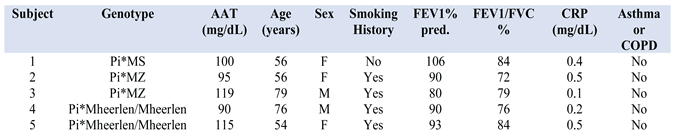
The median serum AAT level was significantly lower in the group of subjects carrying a deficiency allele (n = 5) compared to those with the Pi*MM genotype (n = 86): 100 mg/dL (IQR 95–115) vs. 125 mg/dL (IQR 107–142), respectively (p = 0.0218). No statistically significant differences were observed between the two groups with respect to age, sex, smoking history, lung function parameters, or CRP levels (all p > 0.05), indicating that the two groups were clinically comparable in this small sample. The individual characteristics of the five subjects with pathogenic variants are detailed in Table 2.
4. Discussion
This study provides the first epidemiological data on AATD prevalence in the general population of Ponte di Legno, a secluded town in the Italian Alps. Our screening of 91 asymptomatic adults revealed a 5.5% prevalence of individuals carrying pathogenic SERPINA1 variants. This proportion is within the range expected from published population surveys: de Serres and colleagues [20] calculated that Pi*S and Pi*Z allele frequencies in Italy are 0.0294 and 0.0075, respectively, which under Hardy–Weinberg assumptions translates into roughly 6–7% of Italians being heterozygous for Pi*MS or Pi*MZ. Their regional data show that northern Italian regions often have Pi*S frequencies of about 3–4% and Pi*Z frequencies up to 1.5%, so our observed 5.5% carrier rate in the secluded town of Ponte di Legno is comparable to—and may even slightly exceed—these estimates. Such enrichment in an isolated Alpine population supports the hypothesis that alpha-1 antitrypsin deficiency can be more common in geographically isolated communities due to founder effects and genetic drift [21]. Regardless of whether this represents a true excess above the national baseline, the identification of five previously undiagnosed carriers in a cohort of 91 volunteers underscores the persistent gap between estimated and diagnosed AATD prevalence—a gap that has been documented across European countries [7] and that this study makes tangible at the community level.
The most striking finding of our study is the identification of two individuals homozygous for the rare Pi*Mheerlen allele. The Mheerlen variant (p.Pro393Leu) is a deficiency allele characterized by complete intracellular retention of the protein, similar to the Pi*Z variant, and is thus associated with a severe reduction in serum AAT levels and an increased risk for lung disease [22]. Finding two homozygous individuals in a small, unselected cohort of 91 people is unexpected and strongly suggests a significant local founder effect. This highlights the unique value of screening in such populations to uncover rare genetic architectures that might be missed in larger, more heterogeneous national surveys. Indeed, rare deficient SERPINA1 variants represented a substantial proportion of cases in the Italian registry, accounting for 11% of index subjects with severe AATD and 13% of subjects with severe or intermediate AATD considered together. Importantly, the geographic clustering of rare SERPINA1 variants in the Italian registry [23] suggests that isolated communities across the peninsula may each harbor distinct local variant enrichment—a pattern that can only be revealed through systematic, community-level screening using panels capable of detecting rare alleles.
Our study reinforces the concept that AATD is not merely a “rare disease” but a “rarely diagnosed” one [6]. By screening a general population sample, we identified five individuals who were previously unaware of their genetic risk. These individuals can now benefit from standard medical counseling regarding lifestyle modifications, particularly smoking cessation, avoidance of occupational exposures, and the need for regular clinical surveillance [24], with the aim of reducing risk and slowing disease progression.
The diagnostic approach employed in this study is also noteworthy. The use of the A1AT Genotyping Test (Progenika, Grifols), a Luminex xMAP-based multiplex assay validated at the Italian reference laboratory for AATD [18], allowed for the simultaneous detection of 14 SERPINA1 variants. Crucially, the Pi*Mheerlen variant is included in this panel, enabling its identification without the need for additional sequencing. This workflow, which has been successfully deployed across a multinational diagnostic network [19], represents a gold standard for AATD diagnosis and is well-suited for population screening programs.
This study has several limitations. First, the sample size is small and represents a fraction of the town’s total population, which may limit the precision of our prevalence estimates. Second, participation was voluntary, which could introduce selection bias, although the cohort was largely asymptomatic with normal lung function, suggesting reasonable representativeness of a healthy adult population. Third, the cross-sectional design does not allow for longitudinal follow-up to assess the clinical evolution of the identified carriers. In addition, although buccal swabs provide a practical and fully adequate source of genomic DNA for population screening, they yield lower DNA quantities compared with venous blood. This may reduce the efficiency of downstream analyses in a minority of samples, particularly when confirmatory sequencing is required. Nevertheless, all samples in this study provided sufficient DNA for complete genotyping. Finally, the absence of family history data precludes an analysis of the genealogical origins of the Mheerlen variant in this community. Future studies combining genealogical records with extended family screening could determine whether the Pi*Mheerlen homozygosity observed here reflects a common founder ancestor, which would have significant implications for targeted cascade testing in the region.
Despite these limitations, the strengths of our study include its population-based approach, which avoids the ascertainment bias inherent in studies restricted to high-risk groups such as COPD patients, and the use of a comprehensive, validated molecular diagnostic workflow capable of identifying both common and rare variants.
5. Conclusions
In conclusion, our community-based screening program in a secluded northern Italian Alpine town identified a 5.5% prevalence of pathogenic SERPINA1 variant carriers, all of whom were previously undiagnosed. Most strikingly, two individuals were found to be homozygous for the rare Pi*Mheerlen variant, a finding consistent with a local founder effect and one that would not have been captured by standard clinical screening restricted to symptomatic or high-risk patients. These results demonstrate that population-based AATD screening, using comprehensive genotyping panels that include rare variants, is both feasible and informative in community settings. They further suggest that geographically isolated communities in Italy may represent a particularly valuable target for such programs. Genealogical studies and cascade family testing in this population are warranted to clarify the origin and clinical significance of the Pi*Mheerlen variant and to inform regional screening strategies.
Supplementary Materials
Non applicable.
Author Contributions
Conceptualization, M.M. and B.R.; methodology, X.V.; software, C.B.; validation, X.V., C.B. and F.C.; formal analysis, C.B.; writing—original draft preparation, B.R., X.V., F.C. and C.B; writing—review and editing, M.M. All authors have read and agreed to the published version of the manuscript.
Funding
This research received no external funding.
Institutional Review Board Statement
The study was conducted in accordance with the Declaration of Helsinki and approved by the Institutional Review Board of the Comitato Etico Interaziendale di Alessandria (protocol code CE n. 6651; date of approval: 23 February 2023).
Informed Consent Statement
Informed consent was obtained from all subjects involved in the study. Written informed consent has been obtained from the patients to publish this paper.
Data Availability Statement
The data presented in this study are available on request from the corresponding author. The data are not publicly available due to privacy and ethical restrictions.
Acknowledgments
The authors would like to thank all the participants from Ponte di Legno for their contribution to the study, and the staff of the Center for Diagnosis of Inherited Alpha-1 Antitrypsin Deficiency at IRCCS Policlinico San Matteo Foundation, Pavia, for their expert laboratory analysis.
Conflicts of Interest
The authors declare no conflicts of interest.
Abbreviations
The following abbreviations are used in this manuscript:
| AAT | Alpha-1 Antitrypsin |
| AATD | Alpha-1 Antitrypsin Deficiency |
| ATS | American Thoracic Society |
| COPD | Chronic Obstructive Pulmonary Disease |
| CRP | C-reactive protein |
| DNA | deoxyribonucleic acid |
| EARCO | European Alpha-1 Research Collaboration |
| ERS | European Respiratory Society |
| FEV1 | forced expiratory volume in 1 s |
| FVC | forced vital capacity |
| HCC | hepatocellular carcinoma |
| IEF | isoeletric focusing |
| IQR | interquartile range (first–third quartile) |
| IRCCS | Scientific Institute for Research, Hospitalization and Healthcare |
| Pi | Protease inhibitor |
| PiMM | normal AAT phenotype (M/M alleles) |
| PiMS | heterozygous AAT phenotype (M/S alleles) |
| PiZZ | severe AAT phenotype (Z/Z alleles) |
References
- Strnad, P.; McElvaney, N.G.; Lomas, D.A. Alpha1-Antitrypsin Deficiency. N. Engl. J. Med. 2020, 382, 1443–1455. [Google Scholar] [CrossRef] [PubMed]
- Greene, C.M.; Marciniak, S.J.; Teckman, J.; Ferrarotti, I.; Brantly, M.L.; Lomas, D.A. α1-Antitrypsin deficiency. Nat. Rev. Dis. Primers 2016, 2, 16051. [Google Scholar]
- Bouchecareilh, M. Alpha-1 antitrypsin deficiency-mediated liver toxicity: Why do some patients do poorly? What do we know so far? Chronic Obstr. Pulm. Dis. 2020, 7, 172–181. [Google Scholar] [CrossRef]
- Foil, K.E. Variants of SERPINA1 and the increasing complexity of testing for alpha-1 antitrypsin deficiency. Ther. Adv. Chronic Dis. 2021, 12. [Google Scholar] [CrossRef]
- Ferrarotti, I.; Ottaviani, S.; De Silvestri, A.; Corsico, A.G. Update on α1-antitrypsin deficiency. Breathe 2018, 14, e17–e24. [Google Scholar] [CrossRef]
- Stoller, J.K.; Aboussouan, L.S. A review of alpha1-antitrypsin deficiency. Am. J. Respir. Crit. Care Med. 2012, 185, 246–259. [Google Scholar] [CrossRef]
- Horváth, I.; Canotilho, M.; Chlumský, J.; Chorostowska-Wynimko, J.; Corda, L.; Derom, E.; Ficker, J.H.; Kneussl, M.; Miravitlles, M.; Sucena, M.; et al. Diagnosis and management of α1-antitrypsin deficiency in Europe: An expert survey. ERJ Open Res. 2019, 5, 00171-2018. [Google Scholar] [CrossRef] [PubMed]
- Miravitlles, M.; Dirksen, A.; Ferrarotti, I.; Koblizek, V.; Lange, P.; Mahadeva, R.; McElvaney, N.G.; Parr, D.; Piitulainen, E.; Roche, N.; et al. European Respiratory Society statement: Diagnosis and treatment of pulmonary disease in alpha1-antitrypsin deficiency. Eur. Respir. J. 2017, 50, 1700610. [Google Scholar] [PubMed]
- Chapman, K.R.; Burdon, J.G.; Piitulainen, E.; Sandhaus, R.A.; Seersholm, N.; Stocks, J.; Stoel, B.C.; Huang, L.; Zhang, Z.; Edelman, J.M.; et al. Intravenous augmentation treatment and lung density in severe alpha1 antitrypsin deficiency (RAPID): A randomised, double-blind, placebo-controlled trial. Lancet 2015, 386, 360–368. [Google Scholar] [CrossRef]
- McElvaney, N.G.; Burdon, J.; Holmes, M.; Glanville, A.; Wark, P.A.B.; Thompson, P.J.; Hernandez, P.; Chlumsky, J.; Teschler, H.; Ficker, J.H.; et al. Long-term efficacy and safety of α1 proteinase inhibitor treatment for emphysema caused by severe α1 antitrypsin deficiency: An open-label extension trial (RAPID-OLE). Lancet Respir. Med. 2017, 5, 51–60. [Google Scholar]
- McElvaney, G.N.; Al-Alawi, M.; Miravitlles, M. Clinical considerations in individuals with α1-antitrypsin PI*SZ genotype. Eur. Respir. J. 2020, 55, 1902410. [Google Scholar] [CrossRef]
- de Serres, F.J. Worldwide racial and ethnic distribution of alpha1-antitrypsin deficiency: Summary of an analysis of published genetic epidemiologic surveys. Chest 2002, 122, 1818–1829. [Google Scholar] [CrossRef]
- Greulich, T.; Altraja, A.; Barrecheguren, M.; Chlumský, J.; Chorostowska-Wynimko, J.; Corda, L.; Ferrarotti, I.; Giotaki, S.; Horváth, I.; Ilic, D.; et al. Protocol for the EARCO Registry: A pan-European observational study in patients with alpha1-antitrypsin deficiency. ERJ Open Res. 2020, 6, 00181-2019. [Google Scholar] [CrossRef]
- Luisetti, M.; Ferrarotti, I.; Corda, L.; Ottaviani, S.; Gatta, N.; Tinelli, C.; Bruletti, G.; Bertella, E.; Balestroni, G.; Confalonieri, M.; et al. Italian registry of patients with alpha-1 antitrypsin deficiency: General data and quality of life evaluation. COPD 2015, 12, 52–57. [Google Scholar] [CrossRef]
- Miravitlles, M.; Turner, A.M.; Torres-Duran, M.; Tanash, H.; Rodríguez-García, C.; López-Campos, J.L.; Chlumsky, J.; Guimaraes, C.; Rodríguez-Hermosa, J.L.; Corsico, A.; et al. Clinical and functional characteristics of individuals with alpha-1 antitrypsin deficiency: EARCO international registry. Respir. Res. 2022, 23, 352. [Google Scholar] [CrossRef] [PubMed]
- Pini, L.; Corda, L.; Malerba, M.; Montanelli, A.; Favagrossa, G.M.; Terzi, A.; Marcobruni, N.; Magoni, M.; Franchini, D.; Radaeli, A.; et al. Il deficit di alpha 1-antitripsina: Lo studio clinico di Brescia [Alpha 1-antitrypsin deficiency: The Brescia clinical study]. Recent. Prog. Med. 2000, 91, 352–361. [Google Scholar]
- Graham, B.L.; Steenbruggen, I.; Miller, M.R.; Barjaktarevic, I.Z.; Cooper, B.G.; Hall, G.L.; Hallstrand, T.S.; Helgeson, K.C.; Haynes, J.M.; Culver, B.H.; et al. Standardization of Spirometry 2019 Update. An Official American Thoracic Society and European Respiratory Society Technical Statement. Am. J. Respir. Crit. Care Med. 2019, 200, e70–e88. [Google Scholar] [CrossRef] [PubMed]
- Ottaviani, S.; Barzon, V.; Buxens, A.; Gorrini, M.; Pagani, B.; Belmonte, I.; Rodriguez-Frias, F.; Miravitlles, M.; Janciauskiene, S.; Luisetti, M.; et al. Molecular diagnosis of alpha1-antitrypsin deficiency: A new method based on Luminex technology. J. Clin. Lab. Anal. 2020, 34, e23272. [Google Scholar] [CrossRef]
- Lopez-Campos, J.L.; Rapun, N.; Czischke, K.; Barroso, J.; Rodriguez-Frias, F.; Belmonte, I.; Lara, B.; Gorrini, M.; Ferrarotti, I.; Ottaviani, S.; et al. Distribution of alpha1 antitrypsin rare alleles in six countries: Results from the Progenika diagnostic network. Hum. Genomics 2023, 17, 47. [Google Scholar] [CrossRef]
- De Serres, F.J.; Luisetti, M.; Ferrarotti, I.; Blanco, I.; Fernández-Bustillo, E. Alpha-1 antitrypsin deficiency in Italy: Regional differences of the PIS and PIZ deficiency alleles. Monaldi Arch. Chest Dis. 2005, 63, 133–141. [Google Scholar] [CrossRef]
- Seixas, S.; Marques, P.I. Known Mutations at the Cause of Alpha-1 Antitrypsin Deficiency an Updated Overview of SERPINA1 Variation Spectrum. Appl. Clin. Genet. 2021, 14, 173–194. [Google Scholar] [CrossRef] [PubMed]
- Poller, W.; Merklein, F.; Faber, J.P.; Weidinger, S. Molecular characterisation of the defective alpha 1-antitrypsin alleles PI Mwurzburg (Pro369Ser), Mheerlen (Pro369Leu), and Q0lisbon (Thr68Ile). Eur. J. Hum. Genet. 1999, 7, 321–331. [Google Scholar] [CrossRef] [PubMed]
- Ferrarotti, I.; Baccheschi, J.; Zorzetto, M.; Tinelli, C.; Campo, I.; Genzini, C.; Scabini, R.; Gorrini, M.; Mazzola, P.; Luisetti, M.; et al. Prevalence and phenotype of subjects carrying rare variants in the Italian registry for alpha1-antitrypsin deficiency. J. Med. Genet. 2005, 42, 282–287. [Google Scholar] [CrossRef] [PubMed]
- Meseeha, M.; Sankari, A.; Attia, M. Alpha-1 Antitrypsin Deficiency. In StatPearls; StatPearls Publishing: Treasure Island, FL, USA, 2024; Available online: https://www.ncbi.nlm.nih.gov/books/NBK442030/ (accessed on 2 April 2026).
Figure 1.
Distribution of SERPINA1 genotypes in the Ponte di Legno study population (n = 91). The majority of individuals (94.5%) had the normal Pi*MM genotype. Pathogenic variants, including Pi*MS, Pi*MZ, and the rare homozygous Pi*Mheerlen/Mheerlen, were identified in 5.5% of the cohort.
Figure 1.
Distribution of SERPINA1 genotypes in the Ponte di Legno study population (n = 91). The majority of individuals (94.5%) had the normal Pi*MM genotype. Pathogenic variants, including Pi*MS, Pi*MZ, and the rare homozygous Pi*Mheerlen/Mheerlen, were identified in 5.5% of the cohort.
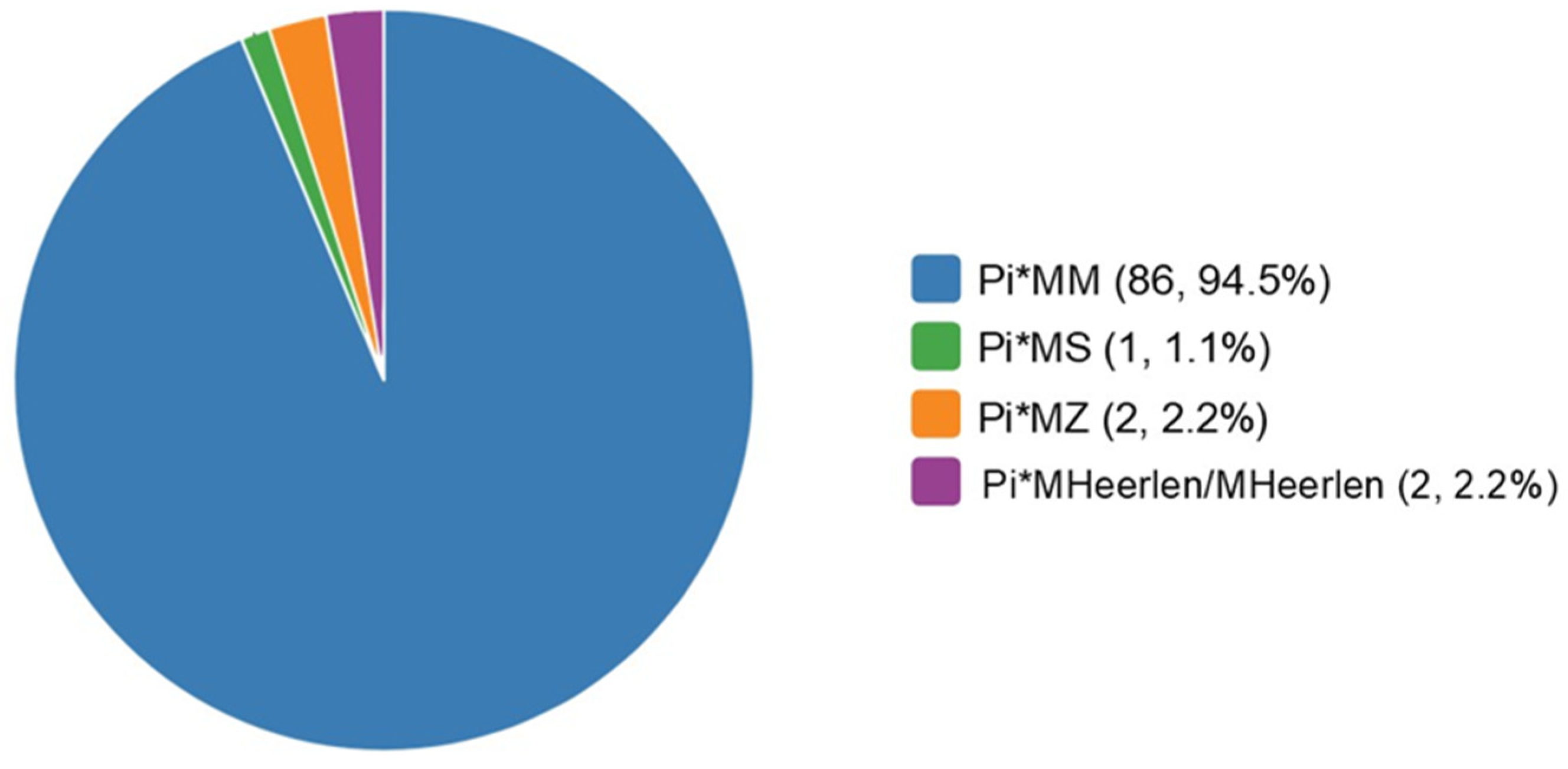

Table 1.
Demographic and clinical characteristics of the study population.
| Variable | All Subjects (n = 91) |
|---|---|
| Age, years Male sex, n (%) Smoking history, n (%) FEV1, % predicted FEV1/FVC, % AAT, mg/dL CRP, mg/dL Asthma, n (%) COPD, n (%) |
61 (54–67) 34 (37.4) 61 (67.0) 96 (90–102) 78 (74–84) 120 (104–140) 0.2 (0.2–0.4) 2 (2.2) 0 (0) |
Data are presented as follows: continuous variables are expressed as median (first–third quartile) (IQR), and categorical variables as n (%). Abbreviations: FEV1%, forced expiratory volume in 1 s; FVC, forced vital capacity; AAT, alpha-1 antitrypsin; CRP, C-reactive protein; COPD, chronic obstructive pulmonary disease.
Table 2.
Characteristics of subjects with pathogenic SERPINA1 variants (n = 5).
 |
Abbreviations: FEV1%, forced expiratory volume in 1 s; FVC, forced vital capacity; AAT, alpha-1 antitrypsin; CRP, C-reactive protein; COPD, chronic obstructive pulmonary disease.
Disclaimer/Publisher’s Note: The statements, opinions and data contained in all publications are solely those of the individual author(s) and contributor(s) and not of MDPI and/or the editor(s). MDPI and/or the editor(s) disclaim responsibility for any injury to people or property resulting from any ideas, methods, instructions or products referred to in the content. |
© 2026 by the authors. Licensee MDPI, Basel, Switzerland. This article is an open access article distributed under the terms and conditions of the Creative Commons Attribution (CC BY) license (http://creativecommons.org/licenses/by/4.0/).
Copyright: This open access article is published under a Creative Commons CC BY 4.0 license, which permit the free download, distribution, and reuse, provided that the author and preprint are cited in any reuse.


