

Submitted:
13 April 2026
Posted:
14 April 2026
You are already at the latest version
Abstract
Across the Global South, heightened contestation over rural land is placing land administration at the centre of policy attention, as persistent mismatches between official title records and lived realities of occupancy generate legal challenges, political conflicts, and limited access to state programs. Existing systems often alienate landholders who lack valid documentation, limiting their access to welfare and compensation. Digitization of land records is frequently advanced as a solution; however, when implemented without meaningful community inclusion, it risks excluding local voices and producing inequalities in rigid and legally entrenched forms. This article critically examines whether contemporary digitization initiatives adequately address the structural challenges embedded within land administration systems, while also proposing a governance framework that addresses the institutional disconnect between policy design and implementation through decentralization, and co-governance. Drawing on qualitative research from two sites in Western India – Talasari and Chiplun – the study combines Focus Group Discussions (FGDs), field-based Key Informant Interviews (KIIs), and institutional process-mapping conducted between December 2024 and October 2025. The findings show that digitization without community-engaged implementation processes often produces inaccuracies and governance gaps, intensifying fragmentation rather than resolving it, and underscore the need for decentralized, hybrid frameworks that integrate statutory and customary systems through co-governance and community participation.
Keywords:
land records
; India
; community participation
; sustainable governance
1. Introduction
Land administration provides the institutional framework through which land rights are recorded, regulated, and governed, shaping how land is accessed, used, and transferred within society. In contexts of rapid urbanization, it becomes a central mechanism through which rural landscapes are incorporated into expanding urban governance regimes [1,2]. Planning frameworks often approach this transformation as a relatively linear process in which land is progressively standardized through zoning regulations, cadastral mapping, and administrative classification, thereby integrating rural territories into formal systems of urban planning and property regulation. Yet, in practice, this process rarely unfolds in such a uniform manner. While state-led planning and land policies attempt to impose homogenized categories of land use and property through top-down administrative mechanisms, the expansion of urban regions simultaneously generates new forms of social and spatial heterogeneity [1,3,4,5]. Rural communities undergoing urban transition frequently sustain diverse tenure practices, community land relations, and localized governance arrangements that do not easily conform to the standardized logic of formal planning. As a result, processes of urban land homogenization often coexist with the persistence – and sometimes intensification – of rural heterogeneity, producing complex institutional landscapes where land administration systems are not merely technical instruments of record keeping but deeply administrative processes that structure social relations, mediate access to resources, and shape whose claims to land are recognized, negotiated, or who get left-out within broader projects of state formation and urban transformation [6,7,8]. This complexity is further deepened in postcolonial contexts such seen in India, where contemporary land administration cannot be understood without reference to its colonial history. Colonial land settlements transformed diverse and locally embedded tenure arrangements into administratively legible property regimes [9]. This reconfiguration institutionalized individualized, revenue-oriented property systems and entrenched hierarchical land relations [10]. Although post-independence land reforms sought to address these inequities, many of these structural features persist [11,12,13,14]. Consequently, present-day land administration operates through a layered and often fragmented institutional architecture characterized by overlapping jurisdictions, outdated land records, and persistent disjuncture between statutory law and lived tenure practices [15,16,17,18]. These historical continuities are particularly significant in the context of rapid urbanization, where institutional rigidity intersects with dynamic socio-spatial transformations.
Against this backdrop, the pressures of economic transition, infrastructure expansion, and market integration in peri-urban and rapidly transforming rural regions intensify existing governance challenges. These processes frequently translate into land disputes, heightened risks of dispossession, and exclusion from compensation and welfare schemes [19]. In response, digitization of land records has emerged as a dominant reform strategy. Initiatives such as GIS-based cadastral modernization and programs like SVAMITVA1 which aim to enhance transparency, efficiency, and accessibility in land administration [15,20,21]. Digitization is often framed as a technical solution to longstanding governance problems, with the expectation that converting paper-based records into digital formats will reduce disputes, improve service delivery, and facilitate land market integration [21]. However, such approaches often overlook the deeper institutional and historical conditions that produce these problems. Where underlying land records are inaccurate, socially incomplete, or institutionally fragmented, digitization risks reproducing existing errors in more durable and legally entrenched forms [20,22].
Existing scholarship has accordingly cautioned that top-down formalization and land titling initiatives may entrench inequalities when implemented without meaningful community participation [23,24]. However, much of this critique remains focused on operational limitations – such as technical capacity or administrative inefficiencies – rather than addressing the deeper institutional disconnect between policy design and its practical execution. This article argues that understanding these structural gaps is critical to recognizing the limits of digitization without community engagement in implementation process.
To examine these dynamics empirically, the article draws on evidence from two contrasting sites in Maharashtra – Talasari Block in Palghar District and Chiplun Block in Ratnagiri District. Drawing on colonial legacies, these cases illustrate that digitization reforms do not operate on a neutral institutional terrain; rather, they are mediated by historically sedimented bureaucratic structures, fragmented departmental mandates, and uneven local governance capacities. In Talasari, the persistence of community tenure practices, coupled with histories of tribal exclusion and weak integration between land administration and welfare provisioning, generates layered forms of marginalization [10]. In Chiplun, land records are subject to continual updating, reflecting ongoing processes of land acquisition for industrial development and railway expansion, which in turn drive patterns of peri-urban growth. Across both sites, successive reform efforts have not resolved underlying structural weaknesses; instead, they have often introduced additional layers of administrative complexity, producing new discontinuities between digital records, revenue practices, and welfare entitlements. These findings suggest that digitization may, in fact, intensify governance fragmentation if foundational institutional capacities – such as record maintenance, inter-departmental coordination, dispute resolution, and community engagement in the process of land administration – remain underdeveloped.
In this context, the article pursues two primary objectives. First, it critically examines the processes of land digitization and land acquisition to assess whether they adequately respond to contemporary land administration challenges in contexts of rapid urbanization. Second, it seeks to propose a practical framework for community engaged co-governance in reforming Indian land administration by addressing the institutional disconnect between policy design and implementation.
Building on these objectives, the article makes three key contributions to the study of land administration. First, it connects debates on digital land governance to empirical institutional realities, framing reform shortfalls as translation gaps rooted in layered historical trajectories rather than as isolated failures of implementation. Second, it demonstrates how successive waves of reform – from colonial cadastral systems to post-independence redistribution, liberalization-era market reforms, and contemporary digitization – have produced institutional discontinuities rather than cumulative strengthening. Third, it advances an community-engaged governance framework that emphasizes co-governance, decentralization, and hybrid institutional design. Drawing on the principles of fit-for-purpose land administration (FFP-LA), the process-mapping approach adopted in this study seeks to operationalize these commitments by tracing decision-making pathways, institutional interactions, and administrative bottlenecks in empirically grounded ways. In doing so, the article argues for strengthening institutional foundations while fostering community participatory spaces in which co-governance can operate meaningfully, as evidenced in recent initiatives such as community-led land formalization efforts in Odisha [25] a state in the eastern-coast of India.
2. Literature Review
Land administration has historically been central to the structuring of governance, economic systems, and social relations. In India, the transformation of land from a community and customary resource into a monetized, administratively classified asset is deeply rooted in colonial rule. The British reconfigured land into private property, people into labour, and nature into extractive resources [26]. As Polanyi [27] famously argued, this process rendered land a “fictitious commodity,” a vital, non-produced resource absorbed into market systems. Whatmore [28] further conceptualized land as “fictitious capital,” highlighting its speculative value within global finance. These conceptualizations underscore that land administration is never merely technical; it is embedded in political economy. The commodification of land has intensified under contemporary processes of financialization, where land rights are increasingly abstracted into tradable, investment-oriented assets. These dynamics are especially acute in contexts where land administration systems remain fragmented and uneven, producing opportunities for speculation while weakening safeguards for tenure security [23,26]. Ouma [29] shows how financialization links land governance to agri-food systems and global finance, fuelling acquisitions and speculative investment across rural landscapes. Yet land’s value exceeds its economic function. Brighenti & Kärrholm [30] emphasize land’s affective and symbolic dimensions – territory, belonging, and identity – reminding us that land governance shapes social life as much as it structures markets. These overlapping meanings demand an interdisciplinary approach to land administration, integrating historical legacies, institutional arrangements, environmental pressures, and local tenure practices [31,32].
2.1. Colonial History and Institution Layering
In colonial India, finance and governance operated together to restructure land administration. The East India Company’s revenue imperatives redefined locally managed commons into taxable assets, embedding property within bureaucratic rationalities. Woods [33] describes this broader restructuring as the production of “global countrysides,” whereby rural territories are reorganized to facilitate capital accumulation. Peluso & Lund [34] argue that land control emerges through overlapping legalities and political struggles, many rooted in colonial dispossession and bureaucratic reclassification.
The colonial era played a crucial role in shaping land administration in India. It started with the introduction of the Permanent Settlement in 1793 that exemplified the institutionalization of property as an administrative instrument. By granting zamindars ownership rights in Bengal, Bihar, and Orissa, colonial authorities reconfigured agrarian relations to secure predictable revenue flows. Guha interprets this policy as a deliberate restructuring of rural property systems to integrate India into a capitalist economy [35,36]. While Wilson [37] contends that it prioritized administrative stability and elite consolidation rather than restructuring of rural and agrarian landscape. While, Whitehead [38] traces colonial land policy to Lockean notions of property, where uncultivated land was classified as “waste,” legitimizing appropriation and reclassification of indigenous holdings. However, colonial policies on land administration were not uniform. The Zamindari settlements was in Eastern India, ryotwari systems in the South and West, and forest legislation in hilly and tribal regions demonstrate differentiated incorporation into legal frameworks [39]. These variations institutionalized social hierarchies, embedding caste and tribal distinctions into administrative practice. Colonial cadastral logics thus produced not only property regimes but enduring structures of inequality. Post-independence land reforms sought to dismantle intermediary landlordism and redistribute land. However, as Chatterjee [40] observes, reforms frequently consolidated elite dominance rather than dismantling it [41,43].
2.2. Liberalization and the Intensification of Commodification
The liberalization era of the 1990s and 2000s introduced a new phase in land governance. Market-oriented reforms framed land as a driver of economic growth, promoting infrastructure corridors, special economic zones, industrial clusters, and renewable energy projects. These initiatives accelerated commodification and deepened financialization, often through expedited acquisition processes. Harvey’s notion of “accumulation by dispossession” captures how such development frameworks can displace vulnerable communities while transferring value to capital [44,45,46]. Recent empirical work demonstrates the distributive consequences of these reforms. Pritchard et al., [19] show that liberalized land markets disproportionately benefit urban elites and private investors, while rural and tribal communities experience heightened insecurity [47]. Development projects frequently override customary tenure arrangements, intensifying exclusion in peri-urban and tribal regions. This period also reveals how colonial cadastral legacies interact with neoliberal reforms.
2.3. From Property to Access: Reframing Land Governance
Property-centric frameworks of land governance rest on the assumption that secure, individualized ownership constitutes the primary basis of resource control. However, such approaches overlook the distinction between property and access. Ribot and Peluso [48] define access as the ability to benefit from things, a formulation that extends beyond legally sanctioned ownership to include the social, political, and economic mechanisms through which benefits are actually derived. Access is therefore constituted through power relations, institutional recognition, and authority structures rather than formal title alone [49]. This distinction is critical in the Indian context, where community, customary, and informal tenure arrangements coexist with statutory systems. While cadastral records may formalize ownership, effective control over land is mediated by kinship networks, gender norms, seasonal usage practices, and bureaucratic discretion [50,51]. Property rights may be legally codified, yet access remains relational and contingent, shaped by negotiations within plural institutional settings.
The Department of Land Resources under the Ministry of Rural Development in India has prioritized technocratic reforms through the implementation of the Digital India Land Records Modernization Programme (DILRMP). Initiatives such as GIS-based mapping and digitization, including SVAMITVA, seek to modernize land administration by standardizing individual land records [21]. While these interventions aim to enhance clarity and administrative efficiency, they tend to prioritize formally recorded ownership over the diverse, socially embedded tenure practices that continue to shape land relations in many contexts [7,52]. As Sikor and Lund [49] argue, struggles over property are simultaneously struggles over authority; recognition of property claims legitimizes institutions, while institutional validation shapes whose claims count. Formalization processes thus reconfigure power rather than merely record existing rights. Moreover, the governance architecture within which land reforms operate remains institutionally fragmented. Land administration is treated primarily as a cadastral and legal domain, whereas welfare provisioning, poverty alleviation, and rural development operate through separate policy silos [53]. This separation produces structural exclusions. Individuals without formal titles – smallholders cultivating inherited but unregistered plots, forest dwellers under customary tenure, and tribal communities governed by collective systems – frequently find themselves excluded from agricultural credit, housing subsidies, irrigation schemes, and compensation frameworks. These exclusions are not incidental but reflect a governance logic historically rooted in colonial revenue systems and reinforced through neoliberal reforms that prioritize market legibility and individualized ownership [50,51]. Within this broader context, contemporary land reforms have increasingly emphasized digitization as a solution to longstanding administrative inefficiencies. However, land digitization, when narrowly conceived as a purely technical or cadastral exercise, remains insufficient on its own. Studies emphasize the need to move beyond technocratic standardization; for instance, Basiouka [54] argues that, when reconfigured through an interdisciplinary Land Administration System integrating cultural dimensions, archaeology, and geospatial sciences, it can become a powerful tool for the protection and continuation of cultural diversity.
2.4. Digitization, Technocracy, and the Limits of Participation
Digitization dominates land reform as a technical fix for transparency and efficiency, yet scholarship warns it risks elite capture without institutional change [23]. Top-down titling marginalizes customary groups, while recent critiques highlight superficial participation in digital processes [24,25]. In response, Fit-for-Purpose Land Administration (FFP-LA) offers flexible, people-centered alternatives through scalable tools tailored to local tenures [55,56]. True equity, however, demands co-production and power redistribution beyond procedural flexibility [57,58,59], ensuring digitization confronts rather than obscures structural inequalities in India’s layered cadastral systems.
While scholarship richly documents colonial legacies, technocratic limits, and FFP-LA promise, three gaps persist. First, conceptual critiques lack empirical analysis of digitization’s translation through fragmented bureaucracies and plural tenures. Second, formalization’s inequality risks are noted, but institutional “translation gaps” – disjunctures between policy intent, digital records, and administrative practice – remain under-theorized, especially reform layering onto colonial cadastres. Third, FFP-LA addresses fit-for-people adaptation through flexible tools [56], yet empirical evidence on process-mapping in specific regions in India – to identify co-governance gaps – is limited. The two cases of Talasari and Chiplun in Maharashtra therefore serve as important empirical sites where outdated records and community tenure systems demonstrate how digitization can amplify fragmentation across successive reform waves, from colonial cadastres to contemporary schemes [60,61]. These translation gaps underscore underdeveloped capacities in record maintenance and coordination [62].
3. Methodology
This study adopts a qualitative research design and primarily draws its methodological framework on the ‘Network Mapping Tool’ developed by Schiffer [63], extending its application through the incorporation of process-oriented visualization techniques that allow for the systematic tracing of decision-making pathways. In doing so, the study builds on approaches used in governance research, particularly in the analysis of complex policy implementation systems such as nutrition-specific programmes, where institutional coordination and actor networks play a critical role [64]. At a broader conceptual level, the framework is informed by the World Development Report 2004 [65], which foregrounds accountability relationships, service delivery chains, and co-governance as central to understanding state-society interactions. In addition, the study is situated within a wider tradition of development administration2, drawing on Riggs’ [66] formulation of the ‘prismatic society’ to interpret the coexistence of formal administrative systems and informal or customary practices. This is particularly relevant in the Indian context, where institutional hybridity and fragmentation shape governance outcomes. Empirical insights from Sekher et al. [67] further reinforce the importance of participatory and decentralized institutional arrangements in improving governance effectiveness, especially in large-scale public systems such as the Public Distribution System (PDS). This approach enables the study to move beyond descriptive institutional analysis toward a more structured and relational understanding of governance processes.
The central objective of the methodology is to move beyond narrative institutional descriptions toward a transparent, visualized, and systematically coded analysis of decision-making pathways within development administration. By mapping administrative processes, the study seeks to identify institutional disconnects, governance gaps, and the implications of digitization reforms in land governance systems. This shift toward visualization and structured evidence responds to longstanding concerns within development administration. Process-mapping in this study functions as both a data generation and analytical tool, enabling the visualization of administrative decision-making flows and the identification of institutional bottlenecks. Drawing on participatory methodologies, particularly the Net-Map approach, process maps were constructed through field-based engagement with stakeholders and used to ground analytical claims in systematically structured empirical evidence [63]. This approach aligns with governance scholarship that emphasizes the importance of unpacking implementation pathways rather than focusing solely on policy design [64]. The data generated from the process-mapping, presented later in the paper (Figure 4 and Figure 7), function as central analytical devices, linking qualitative observations to systematically organized data derived through matrix-based tabulation.
The decision-mapping framework is operationalized through a sequence of interconnected analytical steps that begin with the identification of stakeholders across administrative, political, and community domains. This is followed by governance sketching, wherein institutional linkages and interactions are mapped to capture the relational structure of decision-making. The analysis then proceeds to define the range of actions associated with each actor, specifying roles, responsibilities, and key decision points within administrative processes. Finally, process flows are visualized alongside the assignment of relative influence, enabling a comparative assessment of how authority is distributed across actors and institutions. These steps collectively enhance methodological transparency by making explicit how administrative structures are constructed and interpreted, while also revealing decision-making pathways in land administration. In doing so, they respond to the need to render visible the often opaque dynamics of decision-making.
The empirical analysis focuses on two case studies in Maharashtra: Talasari Block in Palghar District and Chiplun Block in Ratnagiri District, located approximately 147 km and 240 km from Mumbai, respectively. The selection of these sites is analytically grounded in their contrasting socio-spatial and institutional characteristics. Talasari represents a predominantly tribal3 and hilly region where customary land tenure systems coexist with, and are often obscured by, colonial cadastral regimes. This reflects the kind of institutional dualism and fragmentation described by Riggs [66], where formal administrative systems fail to fully integrate with local socio-cultural practices. In contrast, Chiplun reflects a rapidly transforming peri-urban landscape shaped by infrastructure expansion, speculative land markets, and increasing commodification of land, highlighting a different set of governance challenges associated with market-driven land transformation. Both regions are undergoing significant changes due to large-scale infrastructure investments. Talasari’s proximity to major projects – such as the Vadhvan Port, Mumbai-Ahmedabad High-Speed Rail, and Samruddhi Mahamarg – has intensified land pressures and exposed gaps in the alignment between land rights and welfare entitlements. In Chiplun, enhanced connectivity through the Mumbai-Goa Highway and the Konkan Railway has accelerated peri-urbanization and contributed to regulatory fragmentation. These contrasting contexts provide a comparative lens to examine how historical legacies, institutional fragmentation, and socio-economic change shape land administration across diverse geographies, echoing broader concerns in governance literature about uneven institutional capacity and accountability.
Data collection was conducted between December 2024 and October 2025 using a sequenced and iterative design that combined Focus Group Discussions (FGDs), within which process-mapping of decision-making pathways was undertaken, and semi-structured interviews (Table 1). The research design followed a cyclical process of scoping, data generation, validation, and refinement. The first FGD I (December 2024) functioned as a scoping exercise, identifying key actors, governance challenges, and analytical entry points. This was followed by the first phase of fieldwork (March 2025), which involved interviews across administrative levels and generated primary data for initial coding and process-mapping. The second FGD II (April 2025) operationalized participatory process-mapping, where stakeholders collaboratively constructed administrative workflows and identified coordination gaps. This participatory approach aligns with both Net-Map methodology [63] and broader governance approaches that emphasize stakeholder engagement in mapping institutional processes [64]. The third FGD III (September 2025) served as a validation stage, revisiting earlier mappings, verifying decision-making assignments, and refining analytical interpretations. A second phase of fieldwork (October 2025) expanded the institutional scope and enabled triangulation between administrative perspectives and community experiences. This iterative design allowed for continuous refinement of both empirical data and analytical categories, strengthening the reliability and validity of the findings.
To ensure methodological rigor, qualitative data were systematically coded using a process-mapping matrix framework. The matrix captured administrative actors, their roles and actions, key decision points, positions within decision-making pathways, and interpretive comments derived from field narratives. Relative decision-making values were assigned using a standardized ordinal scale based on participants’ assessments of their involvement in land records management, dispute resolution, and land acquisition processes. These values were refined through cross-validation across FGDs and interviews to enhance consistency. Coding was conducted iteratively across phases of fieldwork, allowing categories to evolve in response to emerging evidence. The resulting dataset enabled matrix-based tabulation of actors and their positions within administrative processes, forming the basis for visualization and analysis. Analytical themes were developed to identify patterns such as the concentration of decision-making within specific administrative units, institutional fragmentation, and the limited participation of certain actors; these were interpreted through interview narratives and participant observation. For instance, the concentration of responsibilities within revenue departments, alongside limited involvement of local governance institutions, informed themes of administrative centralization and weak devolution, consistent with broader critiques of bureaucratic dominance in development administration [66].
The framework enables the systematic mapping of administrative flows and bottlenecks, with ordinal values providing a structured basis for assessing actors’ positions within these processes. Qualitative narratives further contextualise these patterns, supporting an integrated approach that combines interpretive depth with structured analysis. This approach trace decision-making pathways and institutional interactions, offering a transparent and replicable approach to analysing governance challenges in land administration.
4. Findings: Case Study From Western India
Talasari is one of the eight Talukas (Blocks) in the Palghar district, with a predominantly tribal population (90.73%). Talasari is located on the border of the Union Territory of Dadra and Nagar Haveli, and the state of Gujarat, Talasari Taluka has 21 Gram Panchayats and 41 Revenue Villages7, along with 214 padas (hamlets/wards). The Mumbai-Ahmedabad National Highway No. 8 passes through the central part of the district. According to the 2011 Census, Talasari has a total population of 1,54,818. The main tribal communities found here are Warli, Dhodi, Konkani, and Katkari, with the Warli community being the largest.
From the field visit and interviews conducted, it was found that the land administration system in Talasari reflects a formal structure, wherein land is broadly categorized into three types: Gaothan8 land (residential; either privately or government-owned), farmland (privately held for agriculture, residential or mixed purposes), and forest land (state-owned and managed by the Forest Department). While these categories are widely recognised by both government officials and local communities, they do not fully capture the dynamic and contested realities of land use, ownership, and administration on the ground. The persistence of colonial-era cadastral systems of categorization of land reveals deep institutional inertia and systemic rigidity that constrain inclusive and responsive governance [34]. The case of Talasari demonstrates that land administrative systems built around static, outdated cadastral frameworks not only fail to deliver tenure security but also actively exacerbate exclusion from development and welfare schemes [19,23]. The Figure 1 shows a single Gaothan (indicated by an arrow)in the entire Talasari Block and few padas.9 In colonial cadastral maps, the Gaothan was marked as the designated village site for the people to reside. However, evidence from the Figure 1 shows that habitation was not confined to these Gaothan area. People also lived across farmlands and near forested regions, beyond the limits of what colonial authorities classified as Gaothan, in what are referred to as pada. Despite the dispersed pattern of settlement, the colonial administration recorded only one officially recognized village site, Gaothan, for an entire block. This pattern not unique to Talasari block, but most of the rural areas of Maharashtra in colonial-era maps.
Figure 2 presents the current map of Talasari, showing the distribution of 214 padas – extending far beyond the designated village site – Gaothan. Most of these padas are located on land that were historically classified as farmland in the 7/1210 land records. Under colonial administration, these pockets of land were not for residential purposes; rather, they were categorized as agricultural holdings, where revenue was collected from cultivation. It also illustrates the contemporary spatial and administrative configuration of Talasari, where padas are now located within areas formerly designated as farmland. Field evidence indicates that these padas are collectively governed under a Gram Panchayat within the state’s administrative framework. Figure 2 reflects the transformation of the traditional Gaothan into Talasari town, which now functions as the block headquarters. This town accommodates key administrative institutions, including the Taluka and Tahsildar offices, while the surrounding area continues to be administered as Talasari village at the local level. This duality highlights the emergence of social and spatial heterogeneity associated with processes of urban expansion [1,3,4,5]. The transformation of Talasari provides a useful lens to examine the intersection of land administration, urbanisation, and state-led development.
The Talasari region has historically depended on forest and land resources not only for livelihoods but also as a basis of identity and belonging. Today, however, despite post-independence legal protections, many Warli households continue to experience tenure insecurity due to the absence of formal land documentation, particularly those residing in areas designated as farmland. Land among Warli households is often cultivated and shared through customary systems, the lack of formal recognition excludes these communities from welfare schemes and institutional credit, reinforcing structural marginalisation [19,70]. Requirements such as formal land titles (patta) for accessing schemes like PM Awas Yojana further reproduce bureaucratic exclusion [19]. Recent initiatives, including GIS and drone mapping under SVAMITVA, remain limited in scope, focusing primarily on residential areas and failing to capture customary and mixed land uses. As a result, such interventions prioritise state legibility over the recognition of lived tenure systems [34].
In the case of Chiplun block, it is located just one kilometre from the Chiplun railway station along the Mumbai-Goa National Highway, the Kherdi village exemplifies the development-driven transformations underway in peri-urban Maharashtra. With a population of approximately 12397 residents (2011 Census), Kherdi offers a microcosm of how infrastructure-led growth reconfigures land use, economic activities, and governance systems. Kherdi comprises sixteen wadis/vadis (hamlets/wards); Katalwadi, Devalwadi, Boudhwadi, Datewadi, Bhuranwadi, Kadamwadi, Katatewadi, Dattawadi, Malewadi, Downward Peth, Vikaswadi, Upward Peth, Mohalla (colony), Rohidaswadi, Shigavanwadi and Industrial residence (2011 Census), each reflecting distinct caste, immigration and settlement histories. The village exhibits a declining engagement in agriculture, despite being classified as a rural settlement. This shift is attributed to increasing land fragmentation, water scarcity, and rising opportunity costs associated with agriculture [71]. Instead, proximity to the Konkan Railway, the national highway and Maharashtra Industrial Development Corporation (MIDC) 11 has facilitated a gradual shift toward non-farm employment in transport, services, construction and industrial sectors. These trends align with Higgins et al., [24], who caution that the rapid expansion of infrastructure are often growing faster than government rules can keep up, which makes it harder for rural farmers to stay strong and continue their way of life.
In Chiplun block the development projects and improved connectivity have driven rapid land-use change and intensified speculative activity, particularly following the establishment of the MIDC around the early 1980s. Rising land values and increasing external investment have redefined land as a speculative asset, generating new contestations over ownership and tenure [29]. Consequently, peri-urban villages such as Kherdi face growing pressures on land administration systems that are ill-equipped to manage these transformations.
4.1. Static Maps and Dynamic Landscapes: The Persistence of Colonial Land Records in Contemporary Land Administration
A key obstacle lies in the continued dependence on colonial-era cadastral systems that remain central to land administration. The study found that colonial cadastral maps serve as the authoritative basis for administrative decision-making across land administration departments. The TLR Office in Talasari confirms that all state actions, ranging from land development approvals to the identification of welfare beneficiaries, must refer to the ‘actual’ survey numbers, which are considered immutable. As one of the TLR official noted, ‘This can never change; the colonial survey numbers are fixed, and we only work with them.’ These rigid frameworks persist despite recent technological interventions, such as drone- and GIS-based digitization. Under the SVAMITVA scheme, Figure 3 illustrates the allocation of plot numbers to residents as proof of residential property ownership, providing legal recognition of their houses. These certificates enable access to government welfare schemes and ensure eligibility for compensation in the event of development-related displacement.
The Gram Sevak explained, “…before implementing any development scheme, we first verify the eligibility of the family or individual and check whether they hold valid property rights to the land, also verify and take consent from the family members… In cases involving community projects, such as proposals for a playground or cremation ground from the community members, planning is done at the community level with Sarpanch.” He added that for all such purposes, “…we refer to the digitized maps, under SVAMITVA provided by the TLR Office.”
While revenue villages are being digitized to specify residential areas for each individual (Amagaon location shown in Figure 2), a local resident (previously a farmer) mentions,
“…this was also part of our cultivation land, and our family started living here. The property card shows that only this house belongs to me, but in reality, it extends beyond this house, and part of my neighbour’s house is on my land… We’ve been living like this for many years, as our cultivation lands were adjacent to each other. The property card only covers the area where my house is built, but in reality, it’s not the same. …even if it’s not marked on any map, it’s fine because it’s clear to us.”
Such cases were common in revenue villages, where local knowledge, social relations, and long-standing arrangements still determined land use and boundaries more than official records.
4.2. Mismatches Between 7/12 (Saat Baara) Records and Lived Realities
A key challenge in land administration in Maharashtra is the disconnect between formal land records – particularly the 7/12 extracts – and the lived geographies of rural and peri-urban communities. While the 7/12 system underpins state land management, it often fails to reflect changing settlement patterns and land use (Figure 2). This is evident in Talasari, where interviews with officials highlight frequent mismatches between recorded survey plots and their actual locations. Residents often assume their land is correctly mapped, only to find discrepancies later. These issues stem from colonial cadastral frameworks that do not accommodate the organic expansion of tribal padas or customary, kinship-based tenure systems, leaving many claims undocumented and unrecognised [72]. The problem is further intensified by infrastructure development and speculative investment. As agriculture declines and informal settlements expand, land records have not kept pace [73,74]. Consequently, although 7/12 extracts remain legally valid, they are often outdated and misaligned with current patterns of landholding, use, and occupancy.
A case shared by a social activist during the discussion from Dahanu block in Palghar district illustrates the gravity of this mismatch.
‘A local resident, despite holding a 7/12 extract indicating long-standing cultivation of agricultural land, was denied compensation during land acquisition for the Mumbai-Ahmedabad bullet train project. While others in the area were compensated, the Revenue Department contended that the land in question did not belong to him, citing a 1975 government map that showed the parcel under a different survey number and location. Despite the resident’s possession of documentation and recognition from the Gram Panchayat and Sarpanch, the outdated government map took precedence. The matter was brought before the National Commission for Scheduled Tribes (NCST), which initiated proceedings and summoned officials; however, the final administrative outcome remains contested.’
Such case underscores a deeper institutional problem: the authoritative status of formal land records often overrides more accurate, locally validated forms of landholding recognition. The resulting administration gap leaves many, particularly from marginalized tribal communities, without formal recourse or recognition, even when their land use is continuous, verifiable, and acknowledged by the local community [72,73,74].
4.3. Disjunction Between Welfare Schemes and Land Administration
A central challenge in tribal regions such as Talasari is the disconnect between land administration and welfare delivery. Many Warli households rely on customary, kinship-based landholding systems that remain undocumented in formal records [72]. However, access to welfare schemes is conditional on formal land titles, creating a mismatch that excludes legitimate land users [19,72].
Field interviews in Talasari highlight this disjunction. Officials frequently approach land and welfare as separate domains. As one BDO explained, ‘We only deal with the beneficiaries, not land,’ revealing a fragmented bureaucratic mindset. However, in practice, land verification and beneficiary identification are deeply interlinked, particularly where a land patta is required to access welfare schemes. The situation becomes even more complex in areas where land is collectively held – a common practice among tribal families in Talasari, where land is not commonly understood as an individual property but as a shared familial and lineage-based resource. As one local resident responded, ‘This land belongs to our family as a whole – across generations. There is no single owner, so putting it in one person’s name may create conflict within the family.’ Formal systems require individual titles or written consent from all co-holders, which delays access, sparks intra-family disputes, and perpetuates exclusion [72]. Studies show that women, in particular, are disadvantaged, as many are active agricultural workers yet remain absent from formal land records [75]. A study of the Birsa Munda Krishi Kranti Yojana (launched in 2017), aimed at supporting tribal farmers in Talasari through subsidies for on-farm irrigation, especially well construction, found that only 73 farmers had accessed the scheme, reflecting deeper administrative challenges [19]. The analysis shows that the requirement of a formal land patta for eligibility excludes many Warli households under customary tenure, reveals how welfare interventions fail when policy design does not align with local tenure realities.
4.4. Institutional Fragmentation in Land Acquisition Processes
The cases reveal that land allocation processes are constrained by significant institutional fragmentation. Field interviews indicate that meeting basic community needs – such as cremation grounds, housing for the landless, and water access – often depends on common land, which is frequently unavailable. In such cases, land under the Forest or Revenue Departments is used, but access is governed by complex procedures and restrictive conditions. Figure 4 illustrates the coordination between the Revenue and Land Records Departments and their links to local administrative structures, highlighting limited interdepartmental alignment.
Figure 4.
Land Records, Revenue Administration and Panchayat Raj Structure of Maharashtra State.
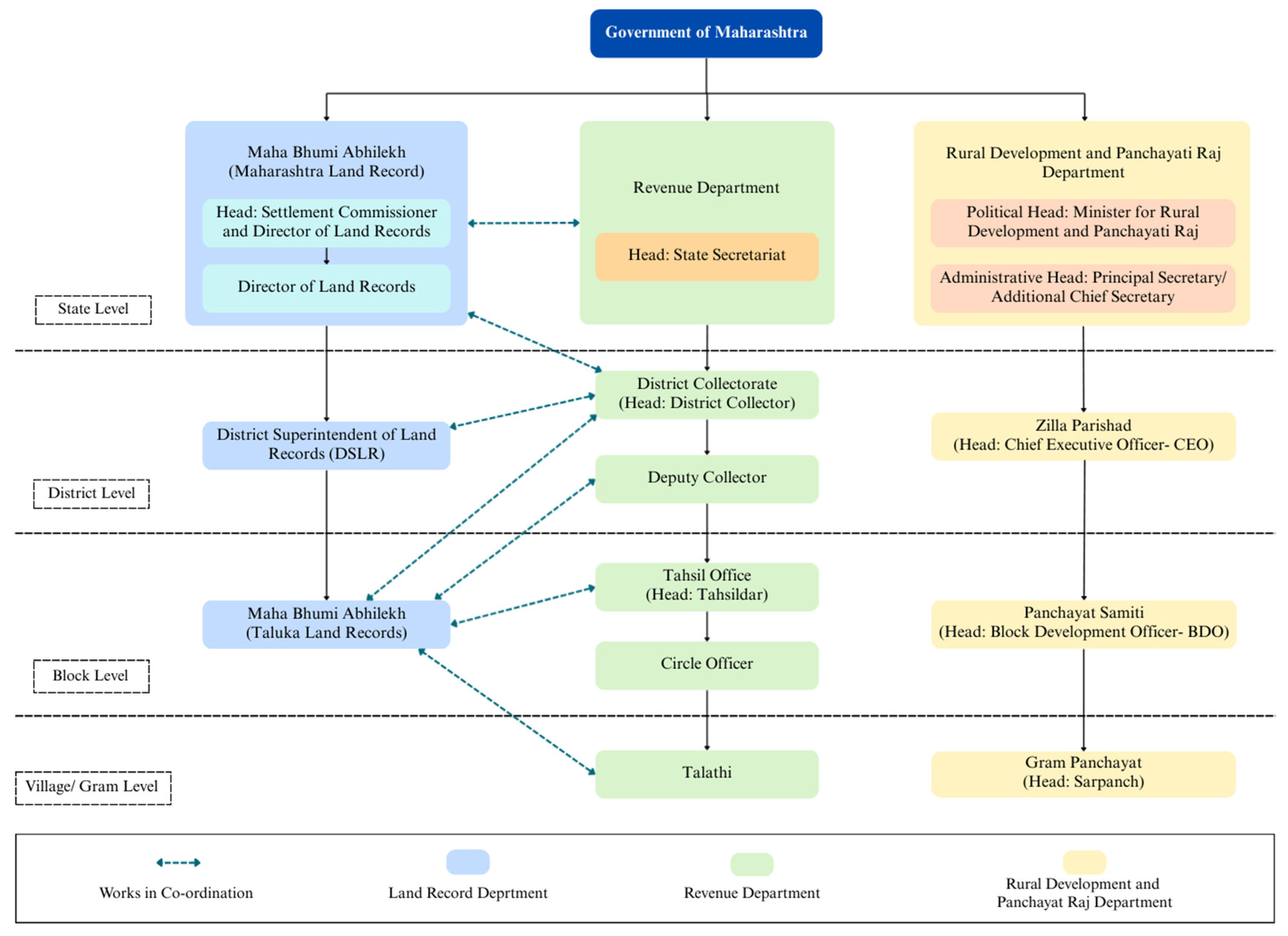
Departments such as Revenue, Forest, Agriculture, and Panchayati Raj operate within narrow mandates, with minimal coordination. For instance, while the Block Office handles welfare and development schemes, the land tenure system is overseen by the Revenue Department (Figure 4), and the Agriculture Department focuses on improving farm productivity, irrigation, crop security, soil health, and mechanization. To supplement this, in the field visit, an Agricultural Department Officer noted that ‘…most government agricultural schemes are given to beneficiaries based on eligibility criteria that often depend on land size.’ These agricultural schemes are provided without referring to the 7/12 extracts, relying on land size. Where landholdings are small, two or three farmers may pool their land and apply jointly for the scheme. Thus, the absence of shared data systems among state departments further compounds land record issues, leading to duplication, errors, and exclusion, over time [20,22,72,73,74]. These challenges are particularly pronounced in rapidly transforming contexts, where infrastructure expansion and informal growth outpace official records [1,3,4,5].
Field evidence also points to regional variation. In Talasari, largely tribal communities exhibit limited awareness of land administration procedures, and even Gram Panchayat officials face difficulties navigating bureaucratic processes. As the Gram Sevak from Amagaon explained, ‘to rectify any mismatches requires engagement with multiple layers of bureaucracy, from Talathi to Survey of India’. In contrast, in Chiplun, residents demonstrate greater familiarity with land transactions and administrative requirements.
FGDs and interviews reveal that farmland (7/12) acquisition follows a multi-step administrative process. Farmers must first obtain a valid Shetkari Dakhla (Farmer’s Certificate) and apply to the Maharashtra Land Records Department for survey and verification. Legal documents, including the 7/12 extract, are then verified by a lawyer, after which the Sub-Registrar formalises the transaction, verifies identities, and collects stamp duty. The certified ownership documents are submitted to the Talathi and forwarded to the Circle Officer (CO) for final updating of land records. In cases involving non-local buyers, additional verification by the Tahsildar is required to ensure eligibility and compliance with land classification and regulatory provisions; the CO verifies that the land is classified as Bhudharana Varg (under the 7/12 record) and that the transaction complies with the Tudkebandi Tukdejod Act (officially, the Maharashtra Prevention of Fragmentation and Consolidation of Holdings Act, 1947). This process involves public notices and a verification period prior to final certification. Figure 4 presents this administrative structure as derived from process mapping. However, field evidence indicates persistent mismatches between 7/12 records and lived realities, as many rural residents remain unfamiliar with formal documentation, contributing to duplication, errors, and exclusion in land records over time [20,22,72,73,74].
4.5. Emerging Challenges in Land Administration Amid Development Projects
Growing tensions at the intersection of land administration, rural livelihoods, and infrastructure-led development – particularly in tribal and peri-urban regions – have led to fragmented holdings and shrinking plot sizes [74], undermining the viability of agriculture as a primary livelihood [74,76]. Even formally classified landholding households often face income and food insecurity due to small, poorly irrigated, or insecure plots. In Talasari, proximity to the Maharashtra-Gujarat border and expanding transport corridors has accelerated shifts from subsistence agriculture to wage labour, with cultivation increasingly constrained by limited irrigation, recurrent flooding, and low-yield cropping systems [77]. Similar patterns are observed in Kherdi village (Chiplun), where peri-urbanisation, improved connectivity, and rising opportunity costs have driven a transition away from farming toward non-farm employment, alongside the growing financialization of land as a speculative asset [71]. Large-scale infrastructure projects in Palghar district, including the Vadhvan Port, Mumbai-Ahmedabad bullet train, and Samruddhi Mahamarg, have further intensified these dynamics by inflating land values and increasing demand for formal documentation, thereby reinforcing tensions around tenure insecurity and contested ownership [24].
The case of the Primary Health Centre (PHC) in Sutrakar village, Talasari, exemplifies these challenges: although constructed on designated government land, disputes over access roads crossing cultivated fields led to compensation claims that stalled its operation. As of 2024, the PHC remains non-functional, highlighting how development initiatives that overlook local tenure systems can generate conflict and undermine intended public benefits (Figure 5 and Figure 6).
4.6. Strengthening Governance Systems and Moving Beyond Digitization
Taken together, the cases of Talasari and Chiplun show that rapid development is reshaping both the value and meaning of land while introducing new complexities in its management. Mismatches between formal land records and lived realities, overlapping claims, collective tenure systems, and shifting rural livelihoods have contributed to fragmentation, shrinking plot sizes, and increasing contestation. These dynamics – particularly in tribal and peri-urban regions – also undermine welfare programmes that fail to deliver immediate benefits, eroding trust in the state. Addressing these challenges requires a community-engaged approach to land governance grounded in co-governance, decentralization, and institutional hybridity, aligned with fit-for-purpose land administration (FFP-LA). Empirical insights from FGDs and interviews reveal persistent co-governance gaps, pointing to the need to move beyond colonial, technocratic models of land administration toward meaningful community participation and place-based systems that recognise legal pluralism and centre local knowledge and customary institutions [54].
Reorienting land governance thus requires empowering local institutions as co-governors rather than mere implementers. India’s constitutional provisions – such as the Fifth and Sixth Schedules, Article 371, and Panchayati Raj Institutions (PRIs) – already provide a basis for decentralized and plural governance. When effectively linked with customary councils and Indigenous institutions, these can form hybrid governance arrangements responsive to local contexts. Policy instruments such as Gram Panchayat Development Plans (GPDPs), the Panchayat Advancement Index (PAI), Mission Antyodaya,12 and digital platforms like eGramSwaraj13 offer entry points for such reforms, if adapted to local socio-political conditions. However, decentralization must be supported by sustained capacity building, including participatory mapping, legal literacy, and accessible dispute resolution, to enable marginalized groups – especially women, Indigenous communities, Particularly Vulnerable Tribal Groups (PVTGs), and the landless – to claim their rights. The case of Chiplun further illustrates how development planning remains top-down, with agencies such as MIDC shaping land allocation in ways that centralize authority and limit local participation. Overall, these findings highlight the need to reconceptualize land administration as a participatory ecosystem of institutions, technologies, and actors grounded in plurality and inclusion [25].
Data from FGDs and interviews indicate that land record maintenance in Maharashtra operates through a multi-layered yet highly hierarchical system, involving records such as the Record of Rights (RoR), sale deeds, rent receipts, cadastral maps, and periodic surveys for updating property details. While administrative arrangements vary slightly across states, the overall framework remains broadly standardised. As illustrated in Figure 4, the system is structured across multiple levels: at the state level, the Director of Land Records (DLR) and the combined role of Settlement Commissioner and Director of Land Records (SC & DLR) oversee surveys, mapping, and digitisation initiatives; at the district level, the District Superintendent of Land Records (DSLR) coordinates with the District Collector; at the taluka level, the Tahsildar manages revenue administration and mutations, supported by the CO; and at the village level, the Talathi maintains 7/12 records and updates ownership details. Despite this institutional coordination – particularly between the Land Records and Revenue Departments – the system reflects a deeply entrenched top-down hierarchy, with limited integration of the Rural Development and Panchayati Raj Department. Although local institutions play an active role in land management, their participation remains constrained within rigid bureaucratic procedures. At the village level, colonial legacies persist in practices such as land classification (Gaothan, farmland, and forest land) and survey processes led by the CO and Talathi; individuals without formal records risk remaining undocumented and effectively excluded.
This hierarchical structure is further evident in land acquisition processes, such as those undertaken by the MIDC, which require approval from the District Collector (DC) and follow a centralised, multi-tiered pathway (Figure 7). Overall, these layered administrative arrangements limit transparency and restrict meaningful local participation in land governance.
Figure 7.
Process-Mapping: Land Acquisition by MIDC.
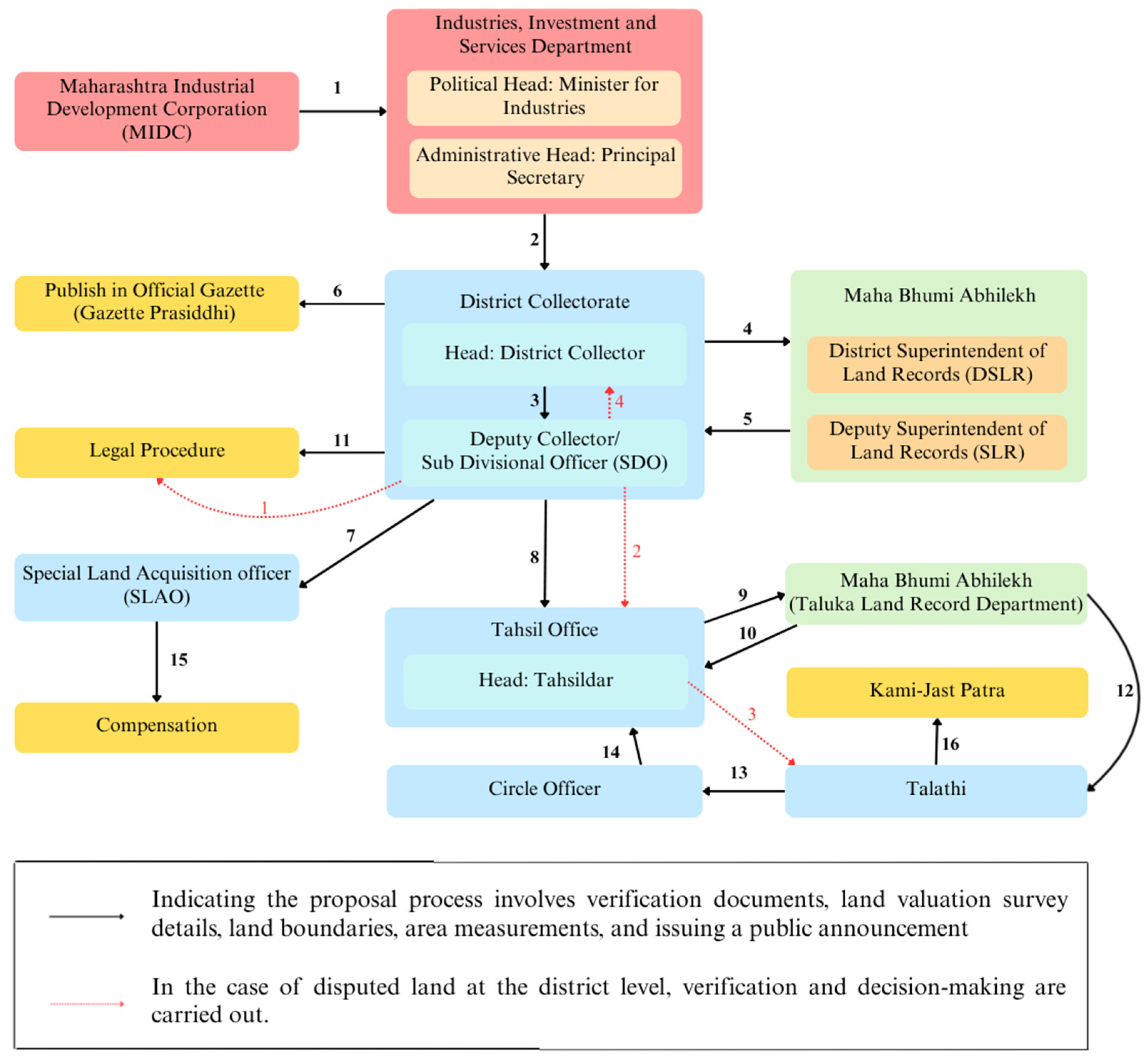
Figure 7 outlines the institutional process of land acquisition for industrial development by MIDC, beginning with a formal proposal to the Industries, Investment and Services Department and subsequent approval at the state level. The process is then executed by the Revenue Department at the district level, where the DC plays a central coordinating role, supported by subordinate officials. Land records are verified through the Maha Bhumi Abhilekh, followed by public notification, valuation by the Special Land Acquisition Officer (SLAO), and boundary verification at the taluka level. The procedure concludes with legal clearances and compensation, reflecting a structured administrative framework.14
While the administrative structure appears straightforward on paper, land governance at the village level is considerably more complex. Field evidence from Kherdi illustrates this, where land formally classified under the 7/12 extract has become increasingly heterogeneous due to rapid development, accommodating residential plots, mixed uses, and overlapping claims [1,3,4,5]. Rising external investment has further intensified disputes over ownership, tenure, and demarcation, while intergenerational fragmentation complicates land administration. Regulatory measures such as the Tudkebandi Tukdejod Act seek to address excessive subdivision by prohibiting the sale of land below prescribed thresholds – 40 ares15 for irrigated land and 80 ares for dry land. Accordingly, during land verification, the Talathi ensures that transactions comply with these limits before granting approval. In line with the Act requirement, the ‘Kami-Jast Patra’ document is prepared, if applicable.16 In land disputed cases, the matter may revert to the district level for resolution as shown in the Figure 7.
Disputes over boundaries and ownership frequently emerge during measurement and verification processes, often escalating through administrative and legal channels, particularly in regions undergoing rapid development and land financialization [78,79]. The District Planning Committee (DPC), constituted under Article 243ZD of the Indian Constitution, is intended to address such coordination challenges by bringing together administrative departments and local governance bodies under the supervision of the Guardian Minister (Palak Mantri) and the DC, with the ZP CEO representing local interests in district-level planning. However, field evidence indicates that participation in DPC processes remains limited and poorly communicated at the local level, creating gaps between local institutions and higher administrative structures. This highlights the need to strengthen the DPC’s functioning through regular meetings and a more effective coordinating role. Enhancing community inclusion platforms is critical for improving transparency and alignment between land administration and development planning. More broadly, effective land governance requires moving beyond technical systems to integrate meaningful community participation with socially embedded land relations, emphasising co-governance approaches that reflect the needs of communities directly dependent on land.
5. Conclusion
In conclusion, institutional reform emerges as a critical priority for strengthening land governance. Mechanisms such as the DPC demonstrate the potential for more integrated and deliberative governance by linking local planning processes with broader development priorities. Enhancing the functional capacity and decision-making authority of such institutions can help bridge the gap between top-down administrative systems and local realities, enabling more coordinated and responsive land administration. This points to the need for hybrid institutional arrangements that combine formal administrative structures with participatory, locally grounded processes. Building on these insights, the article contributes in three key ways. First, it situates digital land reforms within their wider institutional contexts, showing that implementation gaps often reflect deeper structural and historical continuities. Second, it highlights that successive reforms – from colonial cadastral systems to contemporary digitization – have not produced cumulative strengthening, but have instead added layers of complexity and fragmentation. Third, it advances an community-engaged framework for land governance centred on co-governance, decentralization, and institutional hybridity.
| 1 | SVAMITVA (Survey of Villages and Mapping with Improvised Technology in Village Areas) was launched in 2020 by the Ministry of Panchayati Raj under the Central Sector Scheme for property survey and ownership documentation in rural areas. |
| 2 | Development administration here refers to an action-oriented approach to public administration that seeks to address socio-economic and structural constraints within administrative systems. It focuses on the implementation of planned development interventions aimed at improving governance outcomes while actively engaging citizens in the process. Central to this approach is the effort to reconcile traditional administrative structures with the evolving demands of modern governance through participatory and community-based engagement [66]. |
| 3 | Often referred to as ‘Adivasis’ in the western coastal and eastern peninsular regions of India, meaning the original and autochthonous inhabitants of the region. Tribes in India, in these regions, are among the poorest and most marginalized groups in the country. They struggle both in terms of losing access to their livelihood as well as, due to a change of lifestyles brought about by the eviction from what was perceived to be their ‘own land’ [68]. |
| 4 |
Gram Panchayat is a local governance at the village level. The village-level local governance in India functions as a three-tier system comprising the Zilla Parishad (ZP) at the district level [headed by the Chief Executive Officer (CEO)], the Panchayat Samiti at the block level (headed by the Block Development Officer), and the Gram Panchayat at the village level (which includes the Sarpanch, Up-Sarpanch, Panchs, and Gram Sevak). The Gram Sevak (Panchayat Secretary) is a government-appointed official who serves as the administrative link between the state and the Gram Panchayat. They implement development schemes, maintain records, and assist the Sarpanch (the elected head of the village panchayat and represents the local self-government at the village level) in executing government programs at the village level. |
| 5 |
Talathi is the village-level revenue officer, commonly referred to by villagers as the village accountant. |
| 6 | Small farmers, labourers, shopkeepers, and landowners – who have resided in the village across generations. All respondents were 50 years and above. The interviews were recorded, transcribed, and thematically analysed based on the key domains as thematically outlined above. Similar steps were applied in Phase 2 data collection with local residents. |
| 7 | It is known by Revenue villages as these villages are recorded under the surveyed number 7/12 records, which is recognized by the Revenue Department. https://palghar.gov.in/en/talasari-tehsil/?utm
|
| 8 |
Gaothan refers to traditional village settlement areas identified during the colonial period. Much of this land was considered ‘wasteland,’ as it was not suitable for agricultural purposes and therefore did not fall under revenue land. Thus it is not subjected to state taxation; however, a nominal tax is collected by the village Gram Panchayat on residential plots, houses, and community buildings. It is also reported that Gaothan areas are also said to largely lack spatial (mapped) records and are instead recorded only in textual form [69]. |
| 9 | Figure 1 and Figure 2 are primary materials collected during fieldwork and are intentionally presented in their original form, without modification or redrawing, to reflect how they are currently used at the grassroots level for planning and development purposes. |
| 10 | The 7/12 extract, commonly known as ‘saat baara’ in Maharashtra, is an important land record document that provides detailed information about a specific piece of agricultural land, not applicable for the Gaothan land. Maintained by the Revenue Department, it is a combination of two forms. Form 7, which contains details about the landowner and their rights, and Form 12, which records the type of crops grown and other agricultural aspects. The document includes crucial information such as the survey number, (multiple) owner’s name, area of the land, type of cultivation, outstanding loans, and any legal encumbrances. In Maharashtra, the survey number mentioned in the 7/12 extract typically originates from the colonial-era cadastral survey conducted during British rule in the late 19th and early 20th centuries. Today, this form serves as essential proof of ownership and is used for various purposes like land transactions, applying for loans, government subsidies, and resolving land disputes. It applies specifically to rural and agricultural lands, while urban properties are recorded differently. |
| 11 | The Maharashtra Industrial Development Corporation (MIDC), established in 1962, is a statutory government agency tasked with promoting industrialization and investment across Maharashtra. With the motto “Prosperity to all through industrialization,” its key functions include acquiring and developing land into planned industrial estates equipped with essential infrastructure such as roads, water, and electricity. MIDC allots industrial plots and built-up spaces on a leasehold basis, facilitates domestic and foreign investment through single-window clearances, and disseminates information on state industrial incentives and policies. |
| 12 | Mission Antyodaya is a national convergence and accountability framework adopted in the 2017–18 Union Budget, designed to support participatory planning through the Gram Panchayat Development Plan (GPDP) and to monitor rural development outcomes. |
| 13 | eGramSwaraj is a web-based portal developed by the Ministry of Panchayati Raj to strengthen e-governance across Panchayati Raj Institutions. |
| 14 | While the information is published in the Official Gazette (Step 6), the process simultaneously moves to Step 7, where the SLAO undertakes the valuation of the land based on market rates, usage, and applicable norms to ensure fair compensation. Parallel to this, Step 8 is carried out at the Tahsil office, working in coordination with the Talathi level (Steps 9 and 10), where verification of maps, boundaries, and exact land measurements is conducted to ensure accuracy and clarity. These details are then processed to obtain the necessary legal clearances (Step 11). As part of this process, the Talathi (Step 12), under the supervision of the CO (Step 13), verifies the records to ensure that all required procedures are properly completed. The process is then finalized by the Tehsildar (Step 14). Following this, compensation is awarded (Step 15), and the legal process is formally concluded. |
| 15 | One are is equal to 100 square metres. |
| 16 | If a landowner has 50 ares and MIDC acquires 40, the remaining 10 ares stay in the owner’s name in the 7/12 extract. The acquired 40 ares are transferred to the State Government’s 7/12, with ownership in the State Government’s name and occupancy recorded as MIDC. |
References
- Rogerson, C.M. The rural-urban interface in the Global South: Planning and governance challenges. African. Journal of Hospitality, Tourism and Leisure. 2023, 12 (1), 1–15. [CrossRef]
- Woiwode, C.; Ramachandran, A.; Philip, T.; Rishika, D.; Rajan, S.C. Identifying entry points for adaptive governance in peri-urban Chennai (India): A multi-dimensional, multi-level, and multi-scalar approach. Frontiers in Sustainable Cities. 2024. [CrossRef]
- Follmann, A.; Kennedy, L.; Pfeffer, K.; Wu, F. Peri-urban transformation in the Global South: A comparative socio-spatial analytics approach. Regional Studies. 2022. [CrossRef]
- Cyriac, S.; Firoz, M. Dichotomous classification and implications in spatial planning: A case of the rural-urban continuum settlements of Kerala, India. Land Use Policy. 2022. [CrossRef]
- Salem, M.; Ravetz, J.; Sareen, S.; Dong, T.; Haque, M.; Bayoumi, W.; Tsurusaki, N.; Xu, G. Managing the urban-rural transition: A review of approaches and policies for peri-urban land use. Journal of Urban Management. 2025. [CrossRef]
- Patel, A.; Paijwar, R.; Mishra, A. The change in land use patterns in the peri-urban area of Indian cities. International Advanced Research Journal Science, Engineering and Technology. 2025. [CrossRef]
- Fazal, S.; Ali, M.K. The realities of urban land use planning in India: Case study of Aligarh City. Urban India. Vol 42 (1) 2022.
- Nijman, J.; van Duijne, R.J.; Choithani, C. Urbanization and social change in rural India. Urban Studies. 2026, Vol 63 (3), 586–603. [CrossRef]
- Kumar, K.V. Land revenue policies in colonial India. International Journal Professional Studies. 2024, Vol 18. [CrossRef]
- Iyer, L.; Weir, C. The colonial legacy in India: How persistent are the effects of historical institutions? (IZA Discussion Paper No. 17051); Institute of Labor Economics: Bonn, Germany, 2024.
- Alesina, A.; Drazen, A. Why are stabilizations delayed? The American Economic Review. 1991, 81, 1170–1188.
- Coate, S.; Morris, S. Policy persistence. The American Economic Review. 1999, 89, 1327–1336. [CrossRef]
- Fernandez, R.; Rodrik, D. Resistance to reform: Status quo bias in the presence of individual-specific uncertainty. The American Economic Review. 1991, 81, 1146–1155.
- Nunn, N. Historical legacies: A model linking Africa’s past to its current underdevelopment. Journal of Development Economics. 2007, 83, 157–175. [CrossRef]
- Mishra, P.; Suhag, R. Land records and titles in India; PRS Legislative Research: New Delhi, India, 2017. Available online: https://prsindia.org/policy/discussion-papers/land-records-and-titles-india (accessed on 20 March 2026).
- Roy, A. From colonial to neoliberal regime: Understanding the paradigms of land dispossession in India. Journal of Land and Rural Studies. 2022. [CrossRef]
- Rithu, T. Land squeeze and inequality: An analysis of fragmentation and land reform legislation in India. Indian Journal of Law and Legal Research. 2024. ISSN: 2582-8878.
- Sangamithirai, V. Institutional fragility and legal vacuums in Indian land governance: A study of corruption, allocation scams, and systemic accountability gaps. International Journal of Law. 2025, Vol 11. ISSN: 2455-2194.
- Pritchard, B.; Sekher, M.; Maitra, C.; Nandgaye, V. Do climate adaptation programmes potentially exacerbate rural inequality? Identifying beneficiaries of a drought mitigation scheme in Maharashtra, India. Climate and Development. 2024. [CrossRef]
- Kapoor, A.; Esposito, M.; Anand, M. Land record management in India (Working Paper No. WP–2024–016); Stanford University: Stanford, CA, USA. 2024.
- Department of Land Resources, Ministry of Rural Development. Available online: file:///Volumes/INCLAND/1%201%201%201%20Paper/Readings/J.html (accessed on 18 March 2026).
- Purohit, K. In Jharkhand, the digitisation of land records stripped many villagers of their farms overnight. Scroll.in. 2019. Available online: https://scroll.in/article/946981/in-jharkhand-the-digitisation-of-land-records-stripped-many-villagers-of-their-farms-overnight (accessed on 20 March 2026).
- Deininger, K.; Feder, G. Land registration, governance, and development. World Bank Research Observer. 2009, 24, 233–266. doi;10.1093/wbro/lkp007.
- Higgins, D.; Balint, T.; Liversage, H.; Winters, P. Investigating the impacts of increased rural land tenure security: A systematic review of the evidence. Journal of Rural Studies. 2018, 61, 34–62. [CrossRef]
- Ho, S.; Choudhury, P.R.; Joshi, R. Community participation for inclusive land administration: A case study of the Odisha urban slum formalization project. Land Use Policy. 2023, 125, 106457. [CrossRef]
- Kelly, A.B.; Peluso, N.L. Frontiers of commodification: State lands and their formalization. Society Natural Resources. 2015, 28, 473–495. [CrossRef]
- Polanyi, K. The great transformation: The political and economic origins of our time; (2nd ed.) Boston: Beacon Press, 2001 orig.pub.1944.
- Whatmore, S. Landownership relations and the development of modern British agriculture. In Agriculture: People and Policies; Cox, G.; Lowe, P.; Winter, M., Eds.; Routledge: London, UK, 1986; pp. 98–117.
- Ouma, S. History: How old is the finance–farming nexus? In Farming as financial asset: Global finance and the making of institutional landscapes; Agenda Publishing: Newcastle, UK, 2020; pp. 24–44.
- Brighenti, A.; Kärrholm, M. Animated lands: Studies in territoriology; University of Nebraska Press: Lincoln, NE, USA, 2020.
- Benda-Beckmann, F. von. Mysteries of capital or mystification of legal property? Focaal-European journal of Anthropology. 2003, 41, 187–191.
- Tegnan, H. Legal pluralism and land administration in West Sumatra: The implementation of the regulations of both local and Nagari governments on communal land tenure. The Journal Legal Pluralism and Unofficial Law. 2015, 47(2) 1–12. [CrossRef]
- Woods, M. Engaging the global countryside: Globalization, hybridity and the reconstitution of rural place. Progress in Human Geography. 2007, 31(4). [CrossRef]
- Peluso, N.L.; Lund, C. New frontiers of land control: Introduction. The Journal of Peasant Studies. 2011, 38, 667–681. [CrossRef]
- Guha, R. A rule of property for Bengal: An essay on the idea of permanent settlement, 2nd ed.; Permanent Black: Delhi, India, 1963.
- Jedwab, R.; Moradi, A. The permanent effects of transportation revolutions in poor countries: Evidence from Africa. The Review of Economics and Statistics. 2016, 98, 268–284. [CrossRef]
- Wilson, J. The domination of strangers: Modern governance in eastern India, 1780–1835; Palgrave Macmillan: London, UK, 2008.
- Whitehead, J. John Locke and the governance of India’s landscape: The category of wasteland in colonial revenue and forest legislation. Econ. Polit. Wkly. 2010, 45, 83–93.
- Skaria, A. Shades of wildness: Tribe, caste, and gender in western India. The Journal of Asian Studies. 1997, 56, 726–745. [CrossRef]
- Chatterjee, P. The nation and its fragments: Colonial and postcolonial histories; Princeton University Press: Princeton, NJ, USA, 1993.
- Trivedi, P.K. Reinforcing exclusions: Caste, patriarchy and land reforms in India. Journal of Land Rural Studies. 2022, 10, 262–277. [CrossRef]
- Saggu, P.S. Land reforms in India: New perspectives. Global Journal of Human-Social Sciences. 2022, 22. ISSN: 2249-460x & Print ISSN: 0975-587X.
- Heinze, A.R. Democratic deepening or elite persistence? How local elites adapt to electoral reform in rural India. American Political Science Review. 2025. [CrossRef]
- Harvey, D. The New Imperialism; Oxford University Press: Oxford, UK, 2003.
- Dasgupta, P. Fragments of the rural: Land dispossession and transformed livelihoods in India’s village. Columbia Journal of Asia 2024. [CrossRef]
- Prabhu Teja, S. Urban land dispossession in India: Accumulation by dispossession under neoliberal urbanism. International Journal of Creative Research Thoughts. 2025, 13. ISSN: 2320-2882.
- Burman, A. The Changing Imperatives of India’s Land Markets. Mercatus Center, 2022. Available online: https://www.mercatus.org/research/essays/changing-imperatives-indias-land-markets (accessed on 18 January 2026).
- Ribot, J.C.; Peluso, N.L. A theory of access. Rural Sociology. 2009, 68, 153–181. [CrossRef]
- Sikor, T.; Lund, C. Access and property: A question of power and authority. Development and Change 2009, 40, 1–22. [CrossRef]
- Hall, D.; Hirsch, P.; Li, T.M. Powers of exclusion: Land dilemmas in Southeast Asia; University of Hawai‘i Press: Honolulu, HI, USA, 2011.
- Borras, S.M., Jr.; Franco, J.C. The challenge of locating land-based climate change mitigation and adaptation politics within a social justice perspective: Towards an idea of agrarian climate justice. Third World Quaterly. 2018. [CrossRef]
- Pierri, F.M.; Anseeuw, W.; Campolina, A. Land tenure for resilient and inclusive rural transformation. Global Food Security. 2025. [CrossRef]
- Sekher, M.; Hodge, P.; Aulakh, B.S. Strengths-based gram sabhas? Challenges and radical possibilities when “measuring” poverty in India. Third World Quarterly. 2023, 44, 1643–1663. [CrossRef]
- Basiouka, S. The Hellenic archaeological cadastre: A land administration system specifically designed for the documentation and management of cultural heritage. Land 2024, 13, 955. [CrossRef]
- Enemark, S.; Bell, K.C.; Lemmen, C.; McLaren, R. Fit-for-purpose land administration; FIG/World Bank: Copenhagen, Denmark, 2014.
- Enemark, S.; McLaren, R.; Lemmen, C. Fit-for-purpose land administration: Guiding principles; UN-Habitat: Nairobi, Kenya, 2016.
- Musinguzi, M.; Enemark, S. Fit-for-purpose in Africa. International Journal of Technoscience and Development. 2019, 4, 69–89. ISSN 2001-2837.
- Bennett, R.M.; Alemie, B.K. Fit-for-purpose land administration: Lessons from Ethiopia. Survey Review. 2016, 48, 11–20. [CrossRef]
- Rahmatizadeh, S.; Rajabifard, A.; Kalantari, M.; Ho, S. A framework for selecting a fit-for-purpose data collection method in land administration. Land Use Policy 2018, 70, 162–171. [CrossRef]
- Pandey, U.S.; Rai, J.J.; Chhatkuli, R.R.; Enemark, S.; Antonio, D.; Deuja, J. Development of fit-for-purpose land administration country strategy: Experience from Nepal. In Geospatial information for a smarter life and environmental resilience; FIG: Hanoi, Vietnam, 2019. Available online: https://www.fig.net/resources/proceedings/fig_proceedings/fig2019/papers/ts04g/TS04G_panday_joshi_et_al_10049.pdf (accessed on 20 March 2026).
- Koeva, M.; Bennett, R.; Gerke, M.; Crommelinck, S.; Stöcker, C.; Crompvoets, J.; Ho, S.; Schwering, A.; Chipofya, M.; Schultz, C.; Zein, T.; Biraro, M.; Alemie, B.; Wayumba, R.; Kundert, K. Towards innovative geospatial tools for fit-for-purpose land rights mapping. Int. Arch. Photogramm. Remote Sens. Spatial Inf. Sci. 2017, XLII-2/W7, 37–43. [CrossRef]
- Barry, M. Fit-for-purpose land administration—Administration that suits local circumstances or management bumper sticker? Survey Review. 2018, 50, 383–385. [CrossRef]
- Schiffer, E. The Power Mapping Tool: A Method for the Empirical Research of Power Relations; IFPRI Discussion Paper 00703; International Food Policy Research Institute: Washington, DC, USA, 2007.
- Birner, R.; Sekher, M. The devil is in the detail: Governance challenges of implementing nutrition programs. In World Review of Nutrition and Dietetics; Biesalski, H.K., Birner, R., Eds.; Karger: Basel, Switzerland, 2018; Volume 118, pp. 17–44. [CrossRef]
- World Bank. World Development Report 2004: Making Services Work for Poor People; World Bank: Washington, DC, USA, 2004. [CrossRef]
- Riggs, F.W. Administration in Developing Countries: The Theory of Prismatic Society; Houghton Mifflin: Boston, MA, USA, 1964.
- Sekher, M.; Parasuraman, S.; Pritchard, B.; Kumar, S.S.; Rai, R.K. Empowering people to power the public distribution system. Economic & Political Weekly 2017, 52(51), 98–107.
- Sekher, M.; Awasthi, M.; Nayak, S.; Kumar, R. Resource extraction and conflict in India. In Natural resources, inequality and conflict; Ali, H.E., Cederman, L.-E., Eds.; Springer: Cham, Switzerland, 2022; pp. 129–149. [CrossRef]
- Yadav, M. Property mapping in Maharashtra: Selecting a suitable survey technology; Indian Institute for Human Settlements: Bengaluru, India, 2018. [CrossRef]
- Heredia, R.C.; Dandekar, A. Warli social history: An introduction. Economic and Political Weekly. 2000, 35, 4428–4436. [CrossRef]
- Ghadi, G.E.; Patil, S.A. A geo-spatial perspective for the analysis of problems of Chiplun town and the adjoining region. International Journal of Science Research. 2025. [CrossRef]
- Ramakumar, R.; Ramesh, P. Illegibly legible: Outcomes of a land records modernisation programme in South India. Journal of Agrarian Change 2023, Vol 23, 4, 729–754. [CrossRef]
- Indian Institute for Human Settlements. Land records modernisation: Urban and peri-urban areas (Policy brief); IIHS: Bengaluru, India, 2015. [CrossRef]
- Ali, M. Farms fail to feed: Land fragmentation and the migration imperative in rural India. International Journal of Social Science and Human Research. 2025, 8. [CrossRef]
- Pritchard, B.; Rammohan, A.; Sekher, M. Land ownership, agriculture, and household nutrition: A case study of North Indian villages. Geographical Research 2016, 55, 180–191. [CrossRef]
- NITI Aayog. Scenarios towards Viksit Bharat and net zero: Sectoral insights—Agriculture; Government of India: New Delhi, India, 2026; Vol. 6. Available online: https://niti.gov.in/publications/division-reports (accessed on 20 March 2026).
- Wadekar, R.P.; Mardane, R.G.; Dhenge, S.A.; Holkar, S.C. Adoption level of selected agricultural technologies of rice crop by Warli tribal farmers. International Journal of Agriculture Sciences. 2017, 9, 4841–4843. ISSN: 0975-3710&E-ISSN: 0975-9107.
- Yadav, A. Land rights in India: Contemporary legal and policy challenges. Journal of Land Rural Studies. 2025, 14, 1. [CrossRef]
- Goldman, M. Dispossession by financialization: The end(s) of rurality in the making of a speculative land market. The Journal of Peasant Studies. 2020, 47, 1251–1277. [CrossRef]
Figure 1.
Map of the Talasari Colonial cadastral Map, pointing a single Gaothan land during the colonial map. Source collected from the Taluka Land Record (TLR) Office, Talasari.
Figure 1.
Map of the Talasari Colonial cadastral Map, pointing a single Gaothan land during the colonial map. Source collected from the Taluka Land Record (TLR) Office, Talasari.
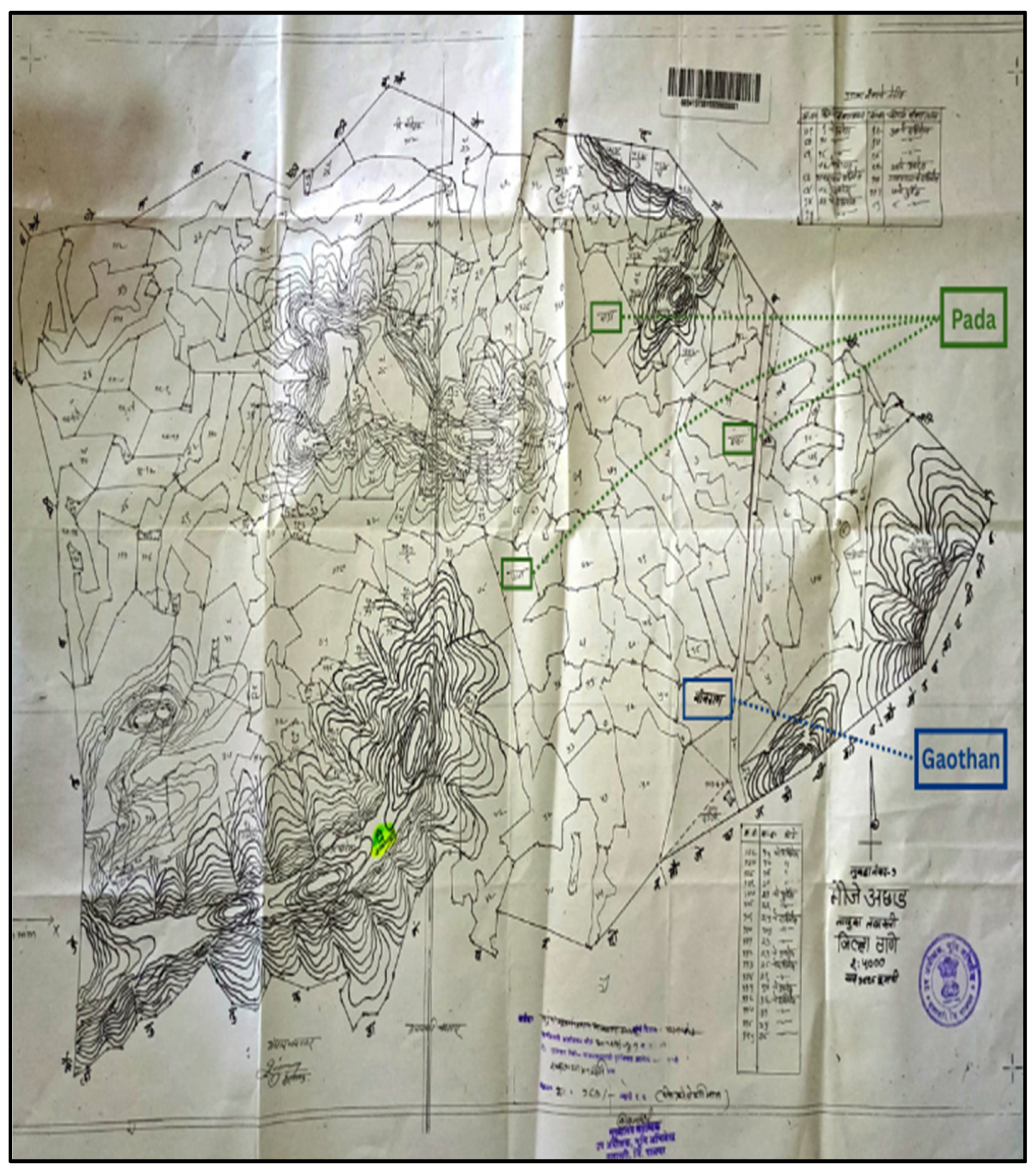
Figure 2.
Map of the Talasari Recent Map, indicating the Talasari Town and the Amagaon village. Source collected from Gram Sevak, Gram Panchayat, Amagaon village.
Figure 2.
Map of the Talasari Recent Map, indicating the Talasari Town and the Amagaon village. Source collected from Gram Sevak, Gram Panchayat, Amagaon village.
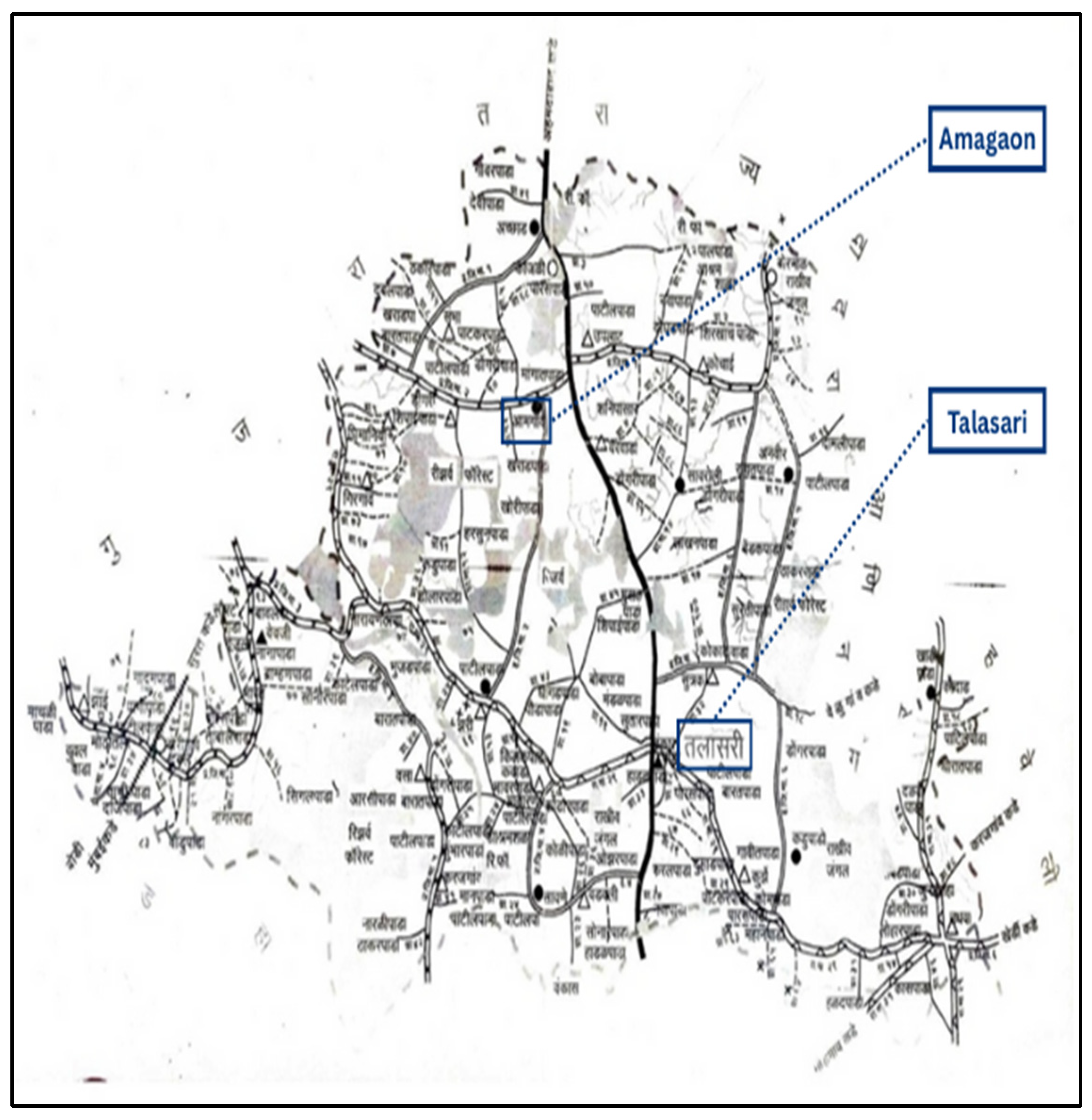
Figure 3.
Amagaon village – Revenue village digitized under the SVAMITVA scheme collected from the Gram Sevak. Source collected from Gram Sevak, Gram Panchayat, Amagaon village.
Figure 3.
Amagaon village – Revenue village digitized under the SVAMITVA scheme collected from the Gram Sevak. Source collected from Gram Sevak, Gram Panchayat, Amagaon village.
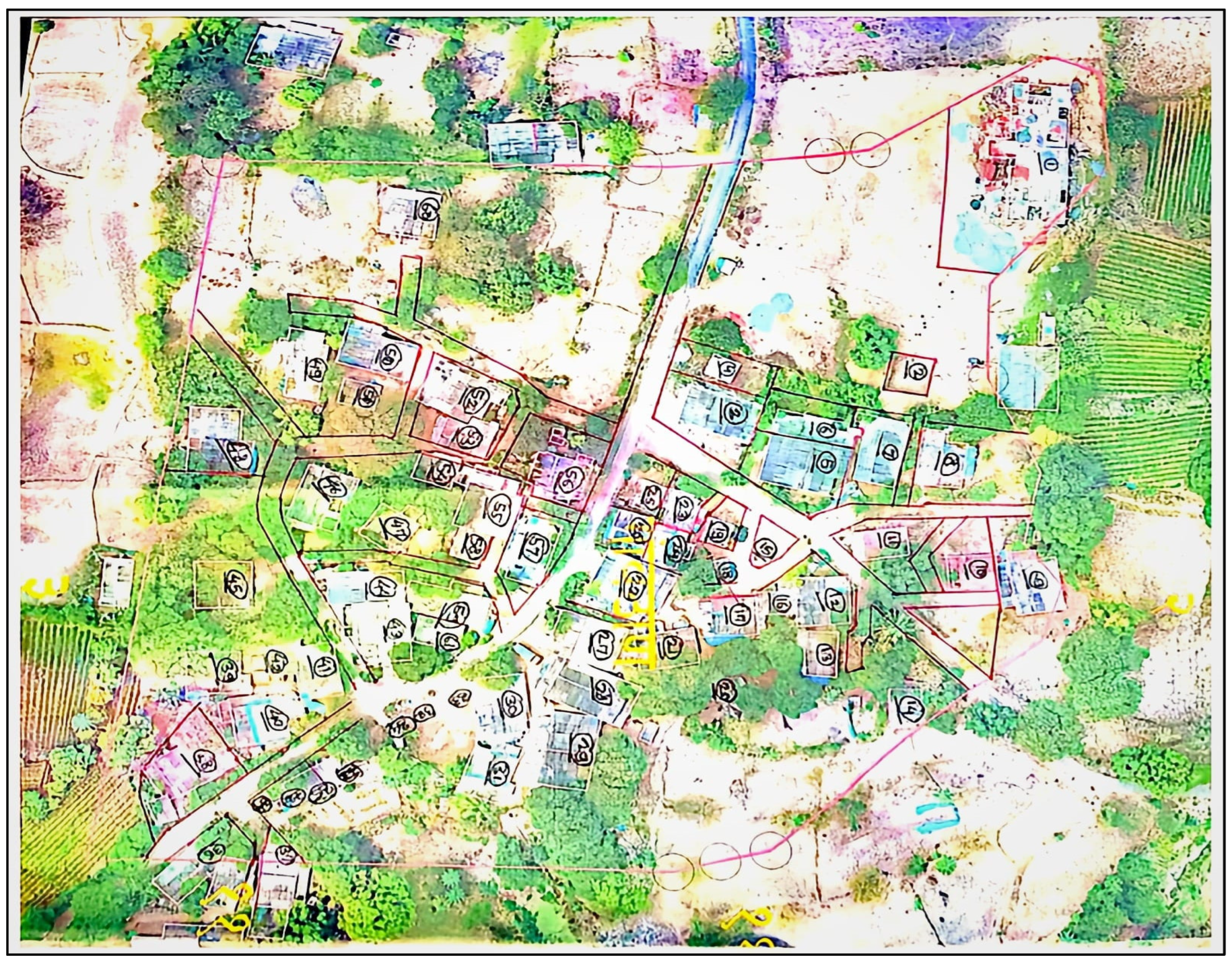
Figure 5.
Image of the road cuts across paddy fields.
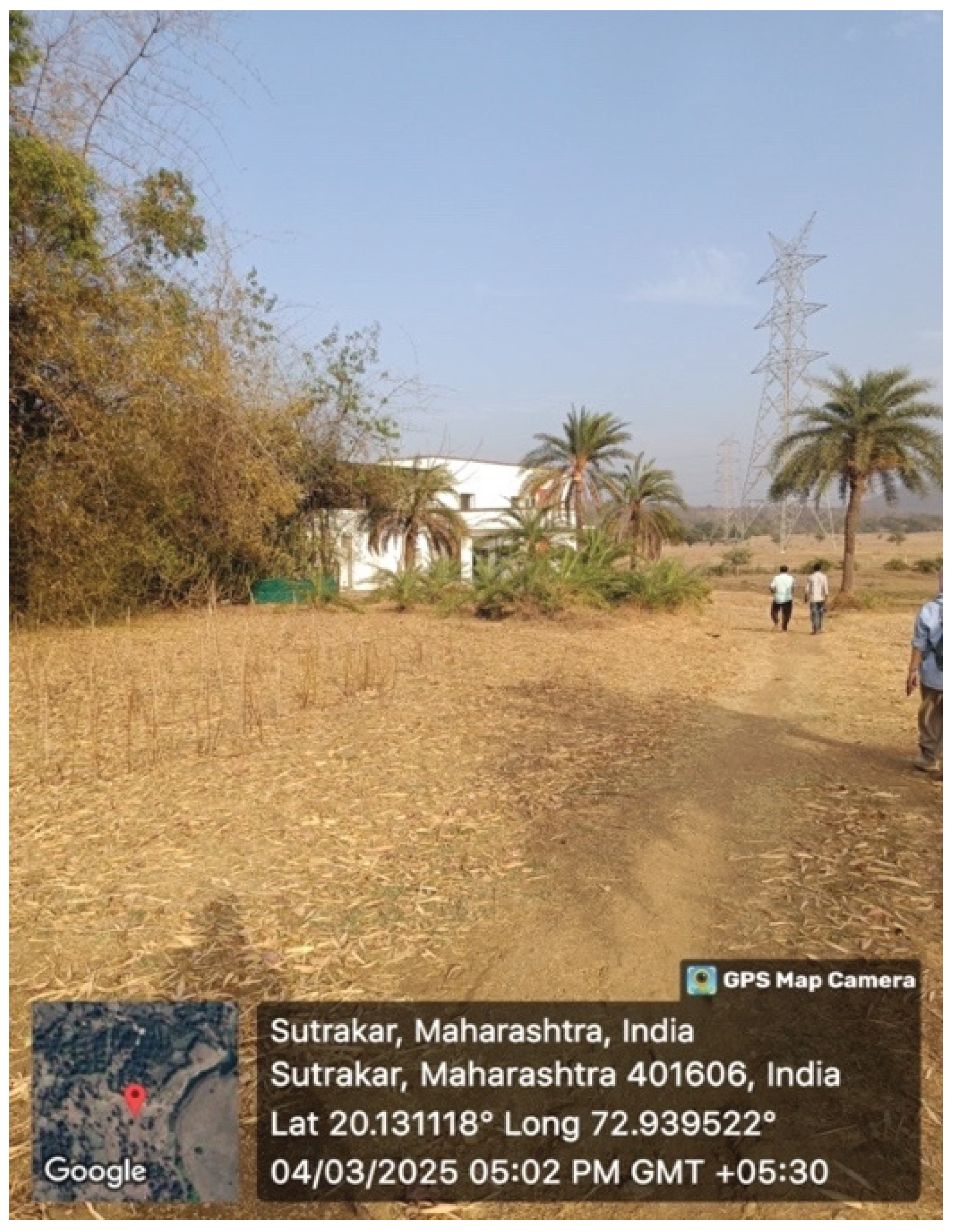
Figure 6.
Image of the PHC in Sutrakar fields owned by multiple landowners. Photos: Taken by Ms Shraddha Vikas during Data Collection.
Figure 6.
Image of the PHC in Sutrakar fields owned by multiple landowners. Photos: Taken by Ms Shraddha Vikas during Data Collection.
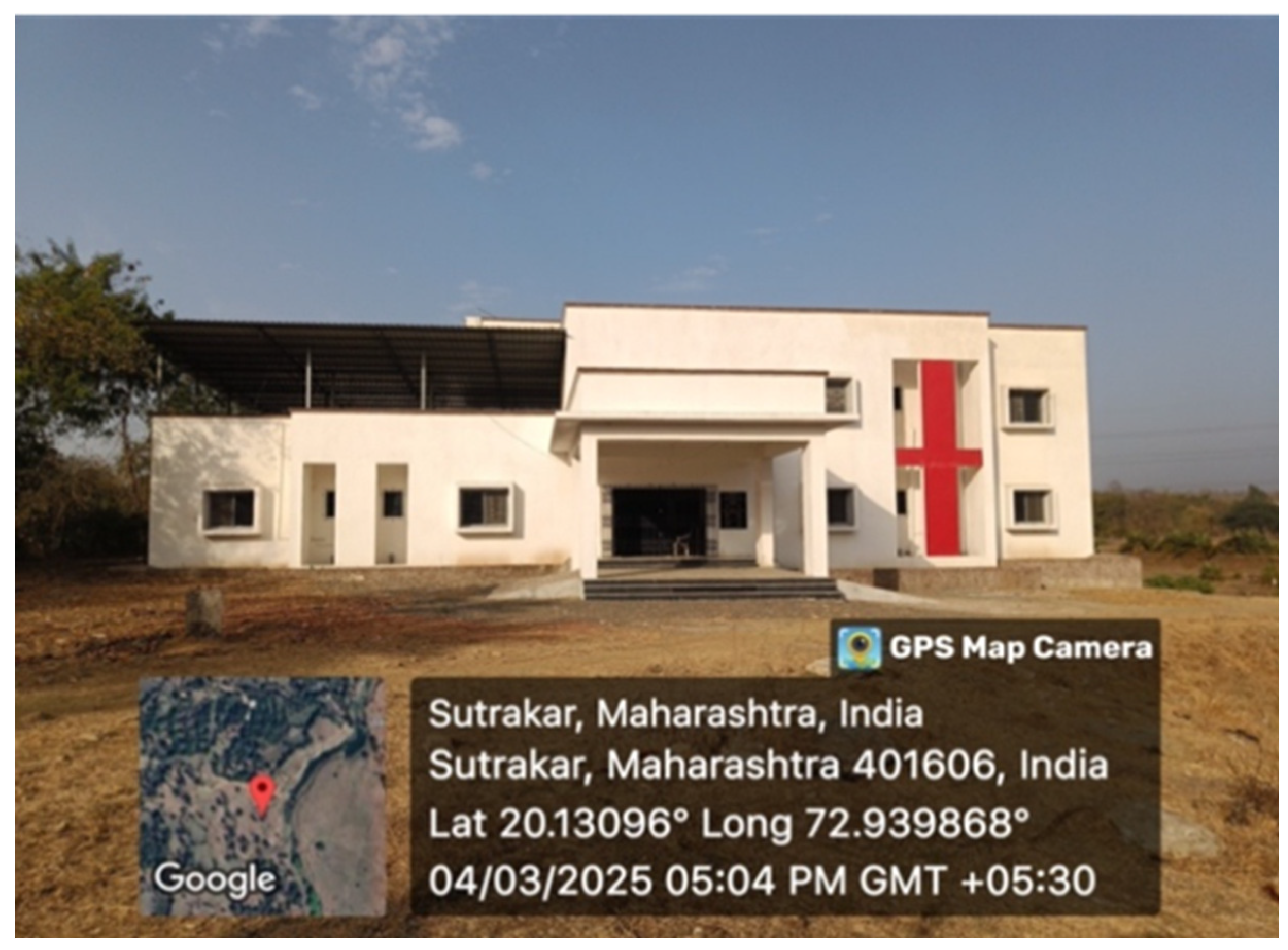

Table 1.
FGDs and Field visits – Talasari Block and Chiplun Block.
| Phase/ Period |
Focus | Institutional Affiliation / Participants | Location | No. of Participants | Key Themes Explored | Method of Data Collection |
|---|---|---|---|---|---|---|
| Phase 1 (Dec 2024) |
Structural Challenges in Land Governance | Academic Experts (8); Senior Civil Servants (1); Agriculture Officer (1); Block Development Officer (BDO) (1); Civil Society Representative (1); Land Policy Professionals (NGOs) (5); Legal Experts (2); Social Activist (1) | Tata Institute of Social Sciences (TISS) |
20 | Institutional fragmentation; Historical legacies; Policy reforms and digitization; Accountability gaps | FGD I (semi-structured discussion guide) |
| Phase 2 (Mar 2025) |
Field-Level Institutional Perspectives | State Agriculture Officers (2); Forest Department Officers (2); Tahsildar Office officials (2); Taluka Land Records (TLR) officials (2); BDO (1); block-level Executive Administrators (2); Panchayat Samiti members (2); Gram Sevak (1); Primary Health Centre (PHC) workers (2); Local Residents (male and female) (10) | Talasari, Palghar District | 26 | Institutional functioning; Inter-departmental coordination; Local governance practices; Community experiences | KII (Semi-structured interview guide) |
| Phase 3 (Apr 2025) |
Process-Mapping | BDOs (3); Assistant BDOs (ABDOs) (2); Agriculture Officers (2); Senior Civil Servant (retired IAS) (1); Academic Experts (2) | TISS | 10 | Administrative workflows; Decision-making processes; Coordination bottlenecks; Implementation gaps | FGD II (semi-structured discussion guide) |
| Phase 4 (Sep 2025) |
Process-Mapping and Validation | Academic Experts (3); Senior Civil Servants (retired IAS) (2); Social Activist (1) | TISS | 5 | Process validation; Actor roles and influence; Institutional gaps; Reform pathways | FGD III (semi-structured discussion guide) |
| Phase 5 (Oct 2025) |
Field-Level Institutional Perspectives | Joint Director (Economics and Statistics) and Revenue Officer (retired) (1); Maharashtra Land Records (Maha Bhumi Abhilekh) officials (3); Tahsildar Office officials (2); Sub-Divisional Office (SDO) officer (1); BDO (1); Panchayat Samiti members (3); Gram Panchayat4 members (5); revenue department officials (Talathi office)5 (2); Local Residents 6 (male and female) (10) | Chiplun, Ratnagiri District | 28 | Land administration practices; Infrastructure and land change; Institutional overlaps; Community experiences | KII (Semi-structured interview guide) |
Disclaimer/Publisher’s Note: The statements, opinions and data contained in all publications are solely those of the individual author(s) and contributor(s) and not of MDPI and/or the editor(s). MDPI and/or the editor(s) disclaim responsibility for any injury to people or property resulting from any ideas, methods, instructions or products referred to in the content. |
© 2026 by the authors. Licensee MDPI, Basel, Switzerland. This article is an open access article distributed under the terms and conditions of the Creative Commons Attribution (CC BY) license (http://creativecommons.org/licenses/by/4.0/).
Copyright: This open access article is published under a Creative Commons CC BY 4.0 license, which permit the free download, distribution, and reuse, provided that the author and preprint are cited in any reuse.