

Submitted:
13 April 2026
Posted:
15 April 2026
You are already at the latest version
Abstract
Background/Objectives: To identify the potential prognostic factors of overall survival in Chinese patients with non-small cell lung cancer (NSCLC) who opted for best supportive care (BSC) alone. Methods: This retrospective study investigated the patients with newly diagnosed NSCLC who underwent staging FDG PET/CT at Queen Elizabeth Hospital between 1st Jan 2018 and 31st Mar 2024, then managed with BSC exclusively without surgery, radiotherapy or systemic therapy. The subjects had regular follow-up from oncologists and/or palliative medicine physicians until death. Potential prognostic determinants of overall survival were evaluated, including age, gender, performance status, co-morbidities, smoking history, previous malignancy, lung tumor histology, serum tumor marker (carcinoembryonic antigen), maximum tumor diameter as well as maximum Standardized Uptake Value (SUVmax) of the primary tumor, number of metastatic organs, and the presence of pleural or pericardial effusion. For statistical evaluation, univariate log-rank tests and multivariate Cox proportional hazards regression were performed to identify independent prognostic factors. The rationale for BSC and the eventual causes of death were also analyzed. Results: Univariate analysis identified male gender, poorer performance status, histology of NSCLC not otherwise specified, larger primary tumor, greater tumor SUVmax and the presence of pleural or pericardial effusion as negative prognostic factors. Subsequent multivariate Cox regression showed four factors retained independent statistical significance: gender, performance status, maximum tumor diameter and the presence of pleural/pericardial effusion. The three major rationales of the patients pursuing BSC were concerns regarding treatment side-effect (32.1%), advanced age (25.9%) and poor performance status (17.3%). The most common cause of death was pneumonia (76.7%). Conclusions: This study shows that gender, performance status, tumor diameter and presence of pleural/pericardial effusion are significant prognostic factors of overall survival in NSCLC patients receiving BSC exclusively.
Keywords:
non-small cell lung cancer
; best supportive care
; overall survival
; prognosis
1. Introduction
Non-small cell lung cancer (NSCLC) has the leading incidence and mortality among malignancies in the world [1,2] and in our locality [3]. Multiple personalized treatment modalities are available, depending on patient status and tumor characteristics, such as staging, histology, molecular status, PD-L1 expression, etc. [4,5,6]. In early stage, radical treatments typically involve surgery and radiotherapy, with or without adjuvant systematic therapy [4]. In advanced stage, treatment options include targeted therapy, immunotherapy, chemotherapy and radiotherapy [4,5,6]. While diverse treatment modalities are available, some patients still opt for best supportive care (BSC) alone. Previous prognostic systems for NSCLC usually focused on early stage [7,8,9]. However, around 70% of the patients present with stage III to IV disease [10]. Many of the prognostic systems for advanced disease centered on first-line treatment response [11]. Age, gender, performance status, nutritional parameters, smoking history, co-morbidities, TNM staging, histopathology, tumor molecular profiles, gene signature, tumor metabolic activity in 18F-fluoro-2-deoxy-D-glucose (FDG) positron emission tomography / computed tomography (PET/CT) were among many potential prognostic factors under investigation [8,10,12,13,14,15,16]. Limited studies explored the prognosis factors of treatment-naïve patients pursuing BSC alone. While previous prognostic investigations were mostly Caucasian-based, Chinese patients are known to have younger age at onset, higher proportion of female and never smokers, a higher prevalence of EGFR mutations and longer overall survival [17,18,19]. The potential parameters affecting OS have not been well understood. The current study aims to evaluate the prognostic factors determining the OS in Chinese NSCLC patients managed with BSC alone.
2. Materials and Methods
- A)
- Patient recruitment
This retrospective study recruited subjects with newly diagnosed NSCLC who underwent staging FDG PET/CT at Queen Elizabeth Hospital (Hong Kong) between 1st Jan 2018 and 31st Mar 2024. The inclusion criteria were 1) histologically-proven NSCLC, 2) Chinese ethnicity with documented decision for BSC alone with no subsequent surgery, radiotherapy or systemic therapy (e.g. targeted therapy, immunotherapy, chemotherapy) and 3) regular follow-up by oncologists/palliative medicine physicians till succumbed. Subjects were excluded if they 1) had past history of history for lung neoplasms, 2) had concurrent active neoplasm, 3) loss of follow-up or 4) encountered life-threatening events (e.g. myocardial infarct, severe sepsis) at the first oncology consultation. Demographics including gender, age, ECOG performance status assessed at the first consultation, smoking history, number of co-morbidities (e.g. diabetes, renal failure) and history of treated non-pulmonary malignancies (e.g. colorectal tumor) were recorded. The characteristics of lung neoplasm were documented, including histology, molecular profile, and PD-L1 expression. Baseline serum carcinoembryonic antigen CEA levels within 8 weeks of the first visits was documented. The rationale for pursuing BSC alone were analyzed. All patient data were retrieved via electronic patient record system.
- B)
- PET-CT
Staging 18F-FDG PET/CTs were performed within 8 weeks of the first oncology consultation. Images were acquired 60 minutes after FDG administration (average activity = 10mCi) using GE Discovery 710 (General Electric Healthcare, USA) in Queen Elizabeth Hospital. The maximum three-dimensional length and the maximum of standardized uptake value (SUVmax) of the primary tumor were measured. In case of multiple lung lesions, the largest one was regarded as the primary neoplasm. The presence of nodal, intrapulmonary and distant metastases was documented. The number of metastatic organs was measured (e.g. a patient with nodal, intrapulomonary and liver metastases was assigned a number of three).
- C)
- Regular follow-up
After the first consultation, patients had regular follow-up for BSC by oncologists or palliative medicine physicians, typically every one to three months, for symptom management until death. Their dates and eventual causes of death were evaluated. OS was defined as the interval from the first consultation to the date of death.
- D)
- Statistical Analysis
Twelve potential prognostic factors were first evaluated in univariate analysis, with continuous variable dichotomized at median or mean:
- Age (≤77 vs. >77 year old)
- Gender (male vs. female)
- ECOG performance status (≤1 vs. >1)
- Smoking history (never vs. ever smoker)
- Number of co-morbidities (≤2 vs. >2)
- History of treated non-pulmonary malignancy (no vs. yes)
- Histology (adenocarcinoma / squamous cell carcinoma vs. NSCLC not otherwise specified)
- Primary tumor maximum length (≤50 vs >50mm)
- Primary tumor SUVmax (≤13 vs >13)
- Number of metastatic organs (≤1 vs. >1) and presence of extra-nodal metastases (yes vs. no)
- Presence of pleural and/or pericardial effusion (absent vs. present)
- Serum CEA level (≤10 vs. >10 ng/mL)
OS were evaluated using the Kaplan-Meier method, with differences between groups compared using log-rank test in univariate analysis. Factors having p < 0.1 in univariate analysis were subsequently included in the multivariate Cox proportional hazard regression to identify independent prognostic factors. Statistically significance was defined as p values < 0.05. Statistical evaluations were performed using SPSS Statistics version 20 (IBM, USA).
- E)
- Approval by IRB
IRB approval was obtained from the corresponding ethics committee. Informed consent was waived due to its retrospective and anonymous nature.
3. Results
3.1. Demographics
A total of 81 Chinese subjects of age 54 to 93 (median 77) year old were included. Sixty-two (76.5%) were male and 10 were female (23.5%). Most subjects had ECOG performance status 0 to 1 (67.9%), while 32.1% had performance status 2 to 3. For smoking history, most (76.3%) subjects were active/ex- smoker. The number of co-morbidities ranged from 1 to 10 and the median was 2. Majority of subjects (85.2%) had no past history of malignancy. At the time of analysis, all subjects had succumbed. OS ranged from 38 to 2072 days, with mean of 485 days (95% confidence interval: 386 to 584 days). Table 1 shows the characteristics of the study population.
3.2. Tumor Characteristics
Table 2 shows the tumor characteristics and molecular profiling. The most common histology was adenocarinoma (53.1%), followed by squamous cell carcimoma (27.2%) and NSCLC Not Otherwise Specified (16.0%). For EGFR mutation status, 56 out of 81 (69.1%) subjects were wild type, 18 (22.2%) were unknown and 7 (8.7%) had mutation: 3 had G719X, 2 had L858R, 1 had exon 19 deletion and 1 had exon 20 insertion. For ALK status, no ALK rearrangement was detected: 60 (74.1%) subjects belonged to wild type and the remaining 21 (29.5%) were unknown. For PD-L1 expression, 17 (21.0%) were negative (i.e. tumor proportion score <1%), 10 (12.3%) were positive and 54 (66.7%) were unknown. Among the 10 subjects with positive PD-L1, 2 (20%) had PD-L1 > 50%. No subgroup OS analysis performed for EGFR, ALK or PD-L1 because of the limited subjects with mutations.
Based on the staging PET/CT, the maximum tumor length had mean of 52.9mm and the primary tumor SUVmax had mean of 13.3. The median number of metastatic organs is 1, the majority had extra-nodal metastases (60.5%), with no pleural or pericardial effusion (75.3%). FDG is well-known to be insensitive for detecting brain or leptomeningeal metastasis because of the intense physiological brain activity [20]. Dedicated brain imaging (contrast CT / MRI) is therefore recommended for thorough staging [21]. In this study, only 22 subjects (27.2%) had dedicated brain imaging and 11 (50%) of them had brain metastases. As few subjects in this study had dedicated brain imaging, no subgroup analysis for brain metastasis was performed. The median serum CEA was 10ng/mL (standard reference range is <5 ng/mL for non-smokers and <10ng/mL for smokers).
3.3. Statistical Analysis
The results of the univariate log-rank analysis are summarized in Table 3. Of the twelve factors under investigation, six showed potential association with OS (p < 0.1): gender (p = 0.015), performance status (p <0.001), histology (p = 0.049), maximum length (p <0.001) and SUVmax (p = 0.09) of primary tumor, as well as the presence of pleural and/or pericardial effusion (p = 0.002). Significantly shorter OS was noted in patients who were male, had poorer performance status, were diagnosed of NSCLC not otherwise specified, had larger primary tumor and greater SUVmax, as well as the existence of effusion. Figure 1 shows the Kaplan-Meier curves for these six factors. On the other hand, the remaining six factors showed no potential association with OS (p > 0.1): age, smoking history, history of cancers, number of metastatic organ, presence of extra-nodal metastases and serum CEA level.
Based on the results of the univariate analysis, these six factors were included in the subsequent multivariate Cox proportional hazard regression analysis. Table 4 demonstrates that four variables retained independent prognostic significance (p < 0.05): gender, performance status, maximum length and effusion. Among the four factors, performance status > 1 was the greatest predictor of mortality (Hazard Ratio 2.57), followed by presence of effusion (HR 2.27), tumor length >50mm (HR 2.25) and male gender (1.91). On the other hand, histology and primary tumor SUVmax did not achieve statistical significance in multivariate analysis (p > 0.05).
With the advancement of NSCLC management, multiple treatment modalities are available. Yet, the subjects in this study still pursued BSC exclusively and their rationales for this decision were listed in Table 5. The top reasons were concern of treatment side-effects (32.1%), advanced age (25.9%) and poor performance status (17.3%).
Lastly, 73 (90%) out of the 81 subjects had causes of death identified. The top three causes were pneumonia (76.7%), acute exacerbation of chronic obstructive pulmonary disease (2.7%) and urinary tract infection (2.7%).
4. Discussion
OS is one of the major concerns for cancer patients opting for BSC alone. This is particularly important in NSCLC as this is the leading mortality in worldwide [1,2] and in our locality [3]. This study shows that performance status, gender, maximum tumor length and the presence of effusion are independent prognostic factors for OS in NSCLC managed with BSC. Performance status has the highest hazard ratio of 2.57 among the four factors. This is of expectations because performance status is standardized clinical assessment for patients’ general well-being and ability to achieve daily activities. Cachexic patients have poorer physical ability and are typically associated with shorter life expectancy [12]. For gender, the current results align with multiple studies consistently indicating that male has shorter survival across different stages and histology [8,22]. Possible contributing factors have been proposed [23], including differences between male and female in smoking history, health-seeking behavior, tumor histology and genetic mutation. The maximum tumor length plays important role in the T staging of IASLC TNM classification. The TNM staging system is fundamentally developed for prognosis. The current cutoff of 50mm incidentally aligns with the T2/T3 threshold in TNM 9th Edition [23]. Similarly, the presence of pleural or pericardial effusion is related to M1a staging. Malignant effusion is expected to progress in the patients pursuing BSC and can potentially impair baseline respiratory function. Thus, these patients may have increasing susceptibility of life-threatening respiratory failure during pneumonia, the predominant (76.7%) cause of death in this study.
The current study can potentially be useful for clinical stratification according to patients’ prognosis. For example, a patient with poorer prognosis (e.g. low performance status, male, larger tumor and the presence of effusion) necessitates more frequent follow-up for better palliative care.
The first line treatments for patients with positive EGFR and PD-L1 are targeted therapy and immunotherapy respectively. This can explain the very low prevalence of the subjects with positive EGFR (8.7%) and PD-L1 (12.3%) pursuing BSC in this study. On the other hand, the top rationale for pursuing BSC was concern of treatment side-effect (32.1%). It remains unclear if fewer patients would opt for BSC in the future as treatment toxicities improve further.
One major pitfall of this study was the retrospective design, resulted in non-standardized history-taking and investigations. For example, only 27.2% subjects underwent dedicated brain imaging for complete staging, potentially underestimating of the metastatic burden. Another pitfall was the limited sample size impeded subgroup analysis, including genetic mutation or PD-L1 status. Furthermore, this study focused on Chinese population and may not be applicable to other ethnicities.
5. Conclusions
This study demonstrates that gender, performance status, length of the primary tumor and the presence of effusion are independent prognostic factors of overall survival in Chinese patients with NSCLC managed with BSC exclusively. Patients have shorter OS if they have performance status >1, pleural and/or pericardial effusion, primary tumor length >50mm and are male. Among the four factors, performance status appears to be the most important. Closer clinical follow-up can be considered for the patients with poorer prognosis to provide closer monitoring and better supportive care.
Author Contributions
Conceptualization, Joyce May Sum Leung; methodology, Joyce May Sum Leung; software, Joyce May Sum Leung; validation, Kwok Sing Ng; formal analysis, Joyce May Sum Leung; investigation, Joyce May Sum Leung; resources, Molly Siu Ching Li; data curation, Joyce May Sum Leung; writing—original draft preparation, Joyce May Sum Leung; writing—review and editing, Molly Siu Ching Li and Kwok Sing Ng; visualization, Joyce May Sum Leung; supervision, Molly Siu Ching Li; project administration, Kwok Sing Ng; funding acquisition, Nil. All authors have read and agreed to the published version of the manuscript.
Funding
This research received no external funding.
Institutional Review Board Statement
The study was conducted in accordance with the Declaration of Helsinki, and approved by the Research Ethics Committee of Hospital Authority (Reference KC/KE-19-0048/ER-4 and date of approval is 28th Jun 2019).
Informed Consent Statement
Patient consent was waived due to retrospective nature.
Data Availability Statement
Data access is restricted to protect confidential or proprietary information. Data may be available upon request, with permission, for the purposes of peer review.
Acknowledgments
We acknowledge Dr. Yau Sau Han for helpful comments.
Conflicts of Interest
The authors declare no conflicts of interest.
References
- Filho AM, Laversanne M, Ferlay J, et al.: The GLOBOCAN 2022 cancer estimates: data sources, methods, and a snapshot of the cancer burden worldwide. Int J Cancer. 2025, 156:1336-1346. [CrossRef]
- SEER Cancer Statistics Review 1975-2014. https://seer.cancer.gov/archive/csr/1975_2014/index.html.
- Hong Kong Cancer Registry [Internet]. Hong Kong: Hospital Authority; [cited 2025 Feb 13]. Available from. https://www3.ha.org.hk/cancereg/.
- Hendriks LE, Remon J, Faivre-Finn C, et al.: Non-small-cell lung cancer. Nat Rev Dis Primers. 2024, 10:71. [CrossRef]
- Alduais Y, Zhang H, Fan F, et al.: Non-small cell lung cancer (NSCLC): A review of risk factors, diagnosis, and treatment. Medicine :e32899. [CrossRef]
- Abu Rous F, Singhi EK, Sridhar A, Faisal MS, Desai A: Lung cancer treatment advances in 2022. Cancer Invest. 2023, 41:12-24. [CrossRef]
- Hirsch FR, Spreafico A, Novello S, Wood MD, Simms L, Papotti M: The prognostic and predictive role of histology in advanced non-small cell lung cancer: a literature review. J Thorac Oncol. 2008, 3:1468-1481. [CrossRef]
- Garinet S, Wang P, Mansuet-Lupo A, Fournel L, Wislez M, Blons H: Updated prognostic factors in localized NSCLC. Cancers. 2022, 9:1400. [CrossRef]
- Alamri S, Badah MZ, Zorgi S, et al.: Disease prognosis and therapeutic strategies in patients with advanced non-small cell lung cancer (NSCLC): a 6-year epidemiological study between 2015-2021. Transl Cancer Res. 2024, 13:762-770. [CrossRef]
- SEER Cancer Statistics Review (CSR) 1975-2017. https://seer.cancer.gov/archive/csr/1975_2017/index.html.
- Abbasi S, Badheeb A: Prognostic factors in advanced non-small-cell lung cancer patients: patient characteristics and type of chemotherapy. Lung Cancer Int. 2011:152125. [CrossRef]
- Paesmans M: Prognostic and predictive factors for lung cancer. Breathe :112-121. [CrossRef]
- Zhu J, Branstetter S, Lazarus P, Muscat JE: Smoking, lung cancer stage, and prognostic factors— findings from the National Lung Screening Trial. International journal of environmental research and public health. 2024, 26:400. [CrossRef]
- Fu XL, Zhu XZ, Shi DR, et al.: Study of prognostic predictors for non-small cell lung cancer. Lung cancer. 1999, 1:143-52. [CrossRef]
- Hu Q, Li B, Garfield D, Ren S, Li A, Chen X, Zhou C: Prognostic factors for survival in a Chinese population presenting with advanced non-small cell lung cancer with an emphasis on smoking status: a regional, single-institution, retrospective analysis of 4552 patients. Thoracic cancer. 2012, 3:162-8. [CrossRef]
- Zuo S, Wei M, Zhang H, Chen A, Wu J, Wei J, Dong J: A robust six-gene prognostic signature for prediction of both disease-free and overall survival in non-small cell lung cancer. Journal of translational medicine. 2019, 14:152. [CrossRef]
- Chen P, Liu Y, Wen Y, Zhou C: Non-small cell lung cancer in China. Cancer Commun :937-970. [CrossRef]
- Zhou W, Christiani DC: East meets West: ethnic differences in epidemiology and clinical behaviors of lung cancer between. East Asians and Caucasians. Chin J Cancer. 2011, 30:287-292. [CrossRef]
- Izumi M, Suzumura T, Ogawa K, et al.: Differences in molecular epidemiology of lung cancer among ethnicities (Asian vs. Caucasian). Caucasian). J Thorac Dis. 2020, 12:3776-3784. [CrossRef]
- Kitajima K, Nakamoto Y, Okizuka H, et al.: Accuracy of whole-body FDG-PET/CT for detecting brain metastases from non-central nervous system tumors. Ann Nucl Med. 2008, 22:595-602. [CrossRef]
- Riely GJ, Wood DE, Ettinger DS, et al.: Non-small cell lung cancer, version 4.2024, NCCN clinical practice guidelines in oncology. J Natl Compr Canc Netw. 2024, 22:249-274. [CrossRef]
- Pinto JA, Vallejos CS, Raez LE, et al.: Gender and outcomes in non-small cell lung cancer: an old prognostic variable comes back for targeted therapy and immunotherapy?. ESMO open. 20181, 3:000344. [CrossRef]
- Radkiewicz C, Dickman PW, Johansson AL, Wagenius G, Edgren G, Lambe M: Sex and survival in non-small cell lung cancer: A nationwide cohort study. PloS one. 2019, 27:0219206. [CrossRef]
- Asamura H, Nishimura KK, Giroux DJ, et al.: IASLC lung cancer staging project: the new database to inform revisions in the ninth edition of the TNM classification of lung cancer. J Thorac Oncol. 2023, 18:564-575. [CrossRef]
Figure 1.
Kaplan-Meier plots for A) sex (male / female), B) performance status (≤1 / >1), C) histology (adenocarcinoma and squamous cell carcinoma / NSCLC Not Otherwise Specified), D) maximum tumor length (≤50 / >50mm), E) primary tumor SUVmax (≤13 / >13) and F) pleural and/or pericardial effusion (yes / no).
Figure 1.
Kaplan-Meier plots for A) sex (male / female), B) performance status (≤1 / >1), C) histology (adenocarcinoma and squamous cell carcinoma / NSCLC Not Otherwise Specified), D) maximum tumor length (≤50 / >50mm), E) primary tumor SUVmax (≤13 / >13) and F) pleural and/or pericardial effusion (yes / no).
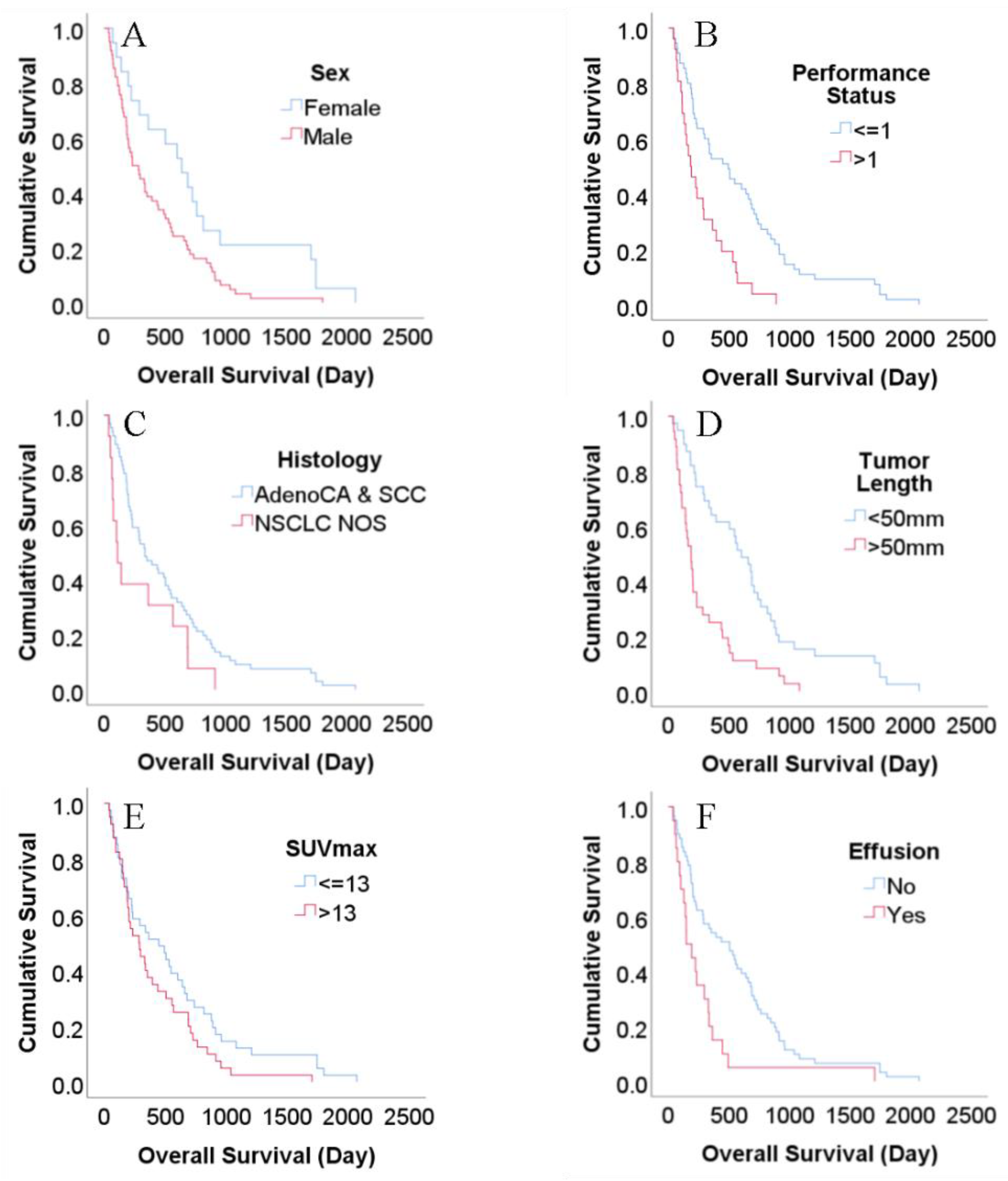

Table 1.
The characteristics of the study population (N = 81).
| Characteristic | n (%) |
|---|---|
| Age: 54 to 93 (Median 77) | |
| ≤77 | 39 (48.1) |
| >77 | 42 (51.9) |
| Gender | |
| Male | 62 (76.5) |
| Female | 19 (23.5) |
| Performance Status | |
| 0 | 9 (11.1) |
| 1 | 46 (56.8) |
| 2 | 19 (23.5) |
| 3 | 7 (8.6) |
| Smoking History | |
| Never | 29 (35.8) |
| Active Smoker | 20 (24.7) |
| Ex-smoker | 32 (39.5) |
| Number of Co-morbidities: 1 to 10 (Median 2) | |
| History of Cancers | |
| No | 69 (85.2) |
| Yes | 12 (14.8) |
| Overall Survival: 38 to 2072 days (Mean 485 days) | |
Table 2.
Tumor characteristics (N = 81).
| Tumor Characteristics | n (%) |
|---|---|
| Histology | |
| Adenocarinoma | 43 (53.1) |
| Squamous Cell Carcinoma | 22 (27.2) |
| Adenosquamous | 1 (1.2) |
| Poorly Differentiated | 2 (2.5) |
| NSCLC Not Otherwise Specified | 13 (16.0) |
| Maximum Tumor Length: 13 to 119mm (Mean 52.9mm) | |
| Primary Tumor SUVmax: 1.3 to 34.1 (Mean 13.3) | |
| Number of Metastatic Organ: 0 to 6 (Median 1) | |
| Lymph node alone | 25 (30.9) |
| Extra-nodal Metastases | 49 (60.5) |
| Effusion | |
| No | 61 (75.3) |
| Pleural | 17 (21.0) |
| Pericardial | 1 (1.2) |
| Both | 2 (2.5) |
| Serum CEA: 1 to 1464ng/mL (Median 10ng/mL) | |
Table 3.
Univariate log-rank analyses of prognostic factors associated with overall survival. *For histology, the OS comparison was between of adenocarinoma and squmaous cell carcinoma vs. NSCLC not otherwise specified.
Table 3.
Univariate log-rank analyses of prognostic factors associated with overall survival. *For histology, the OS comparison was between of adenocarinoma and squmaous cell carcinoma vs. NSCLC not otherwise specified.
| Subgroup | OS (Day) | p |
|---|---|---|
| Age | ||
| ≤77 | 486 | 0.822 |
| >77 | 484 | |
| Gender | ||
| Male | 402 | 0.015 |
| Female | 756 | |
| Performance Status | ||
| ≤1 | 586 | <0.001 |
| >1 | 271 | |
| Smoking History | ||
| Never | 612 | 0.119 |
| Ever Smoker | 431 | |
| Number of Co-morbidities | ||
| ≤2 | 436 | 0.297 |
| >2 | 552 | |
| History of Cancers | ||
| No | 463 | 0.255 |
| Yes | 609 | |
| Histology | ||
| Adenocarinoma | 542 | |
| Squamous Cell Carcinoma | 474 | |
| NSCLC - not otherwise specified | 299 | p = 0.049* |
| Maximum Tumor Length (mm) | ||
| ≤50mm | 682 | <0.001 |
| >50mm | 279 | |
| Primary Tumor SUVmax | ||
| ≤13 | 567 | 0.09 |
| >13 | 401 | |
| Number of Metastatic Organ | ||
| ≤1 | 544 | 0.22 |
| >1 | 430 | |
| Presence of extra-nodal metastases | ||
| No | 514 | 0.687 |
| Yes | 467 | |
| Effusion | ||
| No | 552 | 0.002 |
| Yes | 281 | |
| Serum CEA (ng/mL) | ||
| ≤10 | 530 | 0.229 |
| >10 | 420 | |
Table 4.
Multivariate Cox regression analyses of prognostic factors associated with overall survival.
Table 4.
Multivariate Cox regression analyses of prognostic factors associated with overall survival.
| Subgroup | Hazard Ratio (95% CI) | p |
|---|---|---|
| Gender | ||
| Male | 1.91 (1 – 3.68) | 0.05 |
| Female | Reference | |
| Performance Status | ||
| ≤1 | Reference | 0.001 |
| >1 | 2.57 (1.47 – 4.48) | |
| Histology | ||
| Adenocarinoma & Squamous Cell Carcinoma | Reference | 0.399 |
| NSCLC Without Further Classification | 1.34 (0.68 – 2.65) | |
| Maximum Tumor Length (mm) | ||
| ≤50mm | Reference | 0.003 |
| >50mm | 2.25 (1.31 – 3.86) | |
| Primary Tumor SUVmax | ||
| ≤13 | Reference | 0.539 |
| >13 | 1.17 (0.71 – 1.93) | |
| Effusion | ||
| No | Reference | 0.011 |
| Yes | 2.27 (1.20 – 4.27) | |
Table 5.
Reasons for pursuing best supportive care alone. The total percentage is greater than 100% as some subjects had more than one reasons.
Table 5.
Reasons for pursuing best supportive care alone. The total percentage is greater than 100% as some subjects had more than one reasons.
| Reasons | n | % |
|---|---|---|
| Treatment Side-effect | 26 | 32.1 |
| Advanced Age | 21 | 25.9 |
| Low Performance Status | 14 | 17.3 |
| Treatment Cost | 7 | 8.6 |
| Asymptomatic | 2 | 2.5 |
| Unknown | 14 | 17.3 |
Disclaimer/Publisher’s Note: The statements, opinions and data contained in all publications are solely those of the individual author(s) and contributor(s) and not of MDPI and/or the editor(s). MDPI and/or the editor(s) disclaim responsibility for any injury to people or property resulting from any ideas, methods, instructions or products referred to in the content. |
© 2026 by the authors. Licensee MDPI, Basel, Switzerland. This article is an open access article distributed under the terms and conditions of the Creative Commons Attribution (CC BY) license.
Copyright: This open access article is published under a Creative Commons CC BY 4.0 license, which permit the free download, distribution, and reuse, provided that the author and preprint are cited in any reuse.


