

Submitted:
14 April 2026
Posted:
14 April 2026
You are already at the latest version
Abstract
Urban models circulate toward African cities with claims to universal applicability, yet they consistently produce outcomes that diverge from their initial promises. This article argues that the explanation lies not in local implementation failures but in the very mechanics of circulation. Building on the critical trajectory from policy transfer theory through policy mobilities to assemblage thinking, the article constructs an original analytical framework organised around the fragmentation matrix. This matrix identifies five families of fragments composing any urban model in circulation: conceptual, metric, iconographic, institutional, and narrative. Each family exhibits differential mobility, travelling through distinct channels and producing different consequences for the receiving context. Three types of legitimation arenas selectively structure this diffusion, generating what the article theorises as asymmetric fragmentation: the selective, hierarchised, and unequally operational circulation of heterogeneous components. Applied to the African continent, the framework reveals that model dysfunction is not a contingent failure but a structural feature of the circulation mechanism itself. The article concludes that overcoming this structural inadequacy requires reconfiguring the epistemic conditions under which urban knowledge is produced and legitimised.
Keywords:
urban models
; asymmetric fragmentation
; differential mobility
; policy mobilities
; legitimation arenas
; epistemic friction
; African planning
1. Introduction
The international circulation of urban models has become a defining feature of contemporary planning practices. Concepts, labels, indicators, and governance instruments such as the smart city, the eco-district, the resilient city, transit-oriented development, the new city, and the 15-min city now circulate at remarkable speed, driven by what Peck and Theodore [1] termed fast policy, a regime in which norms travel faster than the conditions necessary for their critical evaluation can be established [2]. Whether through new cities promoted by international development networks [3], eco-cities embedded in climate-development coalitions [4], or smart city discourses that travel independently of any territorial assessment [5], model production has become structurally detached from the contexts in which these instruments are expected to operate. African cities, in particular, are frequently apprehended through imported frameworks erected as universal solutions, whose claims to transferability obscure a deep asymmetry of power. Far from constituting a neutral technical exchange, this internationalisation of urban norms institutes cognitive hierarchies and exogenous regimes of validity that subordinate local territorial rationalities to imperatives of global conformity [6,7].
This accelerated circulation of urban models toward the continent produces a structural paradox. African cities find themselves simultaneously more connected to global planning discourses than ever before [8] and more exposed to paradigms designed for radically different territorial realities [9,10]. Decades of master plans, regulatory reforms, and institutional capacity-building have consistently failed to resolve this tension: plans remain largely unimplemented, zoning rules are systematically circumvented, and the formal planning system coexists uneasily with the informal dynamics that produce the majority of African urban space [11,12,13,14].
The conventional explanation attributes this dysfunction to deficits located in the receiving context: insufficient technical capacities, fragile institutional frameworks, complexity of customary land tenure systems, or failures of political will [15,16]. This deficit narrative presents a twofold epistemological flaw. It exonerates the travelling model from any responsibility for its own inadequacy and reproduces the cognitive hierarchies it claims to disregard, evaluating African cities against norms whose foundations and conditions of validity remain unquestioned [6,17]. The present article rejects this explanation. It argues that the observed dysfunction is structural in nature, rooted not in the receiving context but in the very mechanics of model circulation. If Africa occupies a central place in this analysis, it is not as a deficit space but as a critical site: the institutional, land tenure, political, and epistemic conditions that characterise model reception on the continent render particularly visible the deep mechanisms that more proximal transfers tend to conceal [18,19].
This observation grounds the research question guiding the analysis: how do urban models circulate toward African contexts, and why do they almost never deploy as coherent wholes? The central thesis holds that the circulation of urban models toward Africa constitutes a process of asymmetric fragmentation, understood as the differential circulation of a model’s components according to their intrinsic mobility, their compatibility with transnational legitimation arenas, and the conditions of their local reception. The urban model is not an ordinary sectoral policy. It is a multi-level object combining formal types, composition rules, and operational devices, but also legitimation narratives, comparison metrics, and visual representations [20,21]. These components do not travel together. Some circulate rapidly because they are light, communicable, and certifiable; others resist circulation because they depend on dense institutional anchoring that cannot be easily reproduced [22]. The in situ recomposition of these unequally mobile fragments tends to generate structural disjunctions at the cognitive, normative, and operational levels. It is this selective and hierarchised circulation that we propose to conceptualise under the term asymmetric fragmentation.
The article makes three contributions. First, it offers a critical reading of existing circulation frameworks, from policy transfer to policy mobilities and assemblage thinking, showing that each illuminates a dimension of the phenomenon without accounting for the urban model as a multi-level object. Second, it constructs an analytical framework grounded in the differential mobility of model components and in the legitimation arenas that structure their selective circulation. Third, it formalises the concept of asymmetric fragmentation from the comparison of three urban reception contexts in Africa, demonstrating that what varies is not the existence of fragmentation but its structure, its hierarchy, and its mediations. Following this introduction, Section 2 explicates the methodological approach and the logic of the critical review. Section 3 and Section 4 constitute the theoretical core of the article: the former assesses the insufficiency of existing frameworks in the face of the urban model’s specificity, while the latter constructs the analytical framework integrating fragment families, their differential mobility, and legitimation arenas. Section 5 compares three urban reception contexts in Africa, from which Section 6 formalises the concept of asymmetric fragmentation. Section 7 discusses the theoretical implications of this conceptualisation, and Section 8 concludes with an opening toward the conditions for producing endogenous models.
2. Methodological and Review Approach
2.1. Nature of the Article
This article constitutes a critical literature review with a theory-building conceptual contribution. It is neither a systematic review based on a strict bibliometric protocol nor a multi-case empirical study. The objective is not to measure the frequency of certain transfer effects across a set of African cities but to explain the mechanism through which urban models circulate, decompose, re-legitimise, and recombine in unequally structured reception contexts. This positioning is situated within an established tradition in urban studies and planning theory, where critical reviews aim not only to survey the state of knowledge but also to reformulate problems and propose new analytical categories [23,24], as exemplified by Brenner and Schmid’s [25] critical urban theorisation, whose contribution lies not in the production of primary data but in the conceptual reconstruction of a problem from a purposive reading of existing literature.
2.2. Corpus, Review Logic, and Analytical Reconstruction
The corpus is organised around four complementary bodies of literature whose articulation constitutes the article’s argumentative architecture. The first two address the mechanics of international policy circulation at different analytical scales. Policy transfer scholarship established the foundational frameworks for understanding cross-national norm diffusion [26,27,28], while the subsequent policy mobilities literature shifted analysis toward processes of mutation, relocalisation, and the constitutive role of circulation itself [1,7,29,30,31]. Assemblage thinking in its urban applications provides the third pillar, offering conceptual resources for analysing the internal heterogeneity of circulating objects and the contingency of their recompositions [32,33,34]. The fourth body gathers scholarship on African planning, Southern urbanism, and critical urban theory, which operates across three complementary registers: the decentring of dominant urban theory [6,35,36,37,38], the analysis of planning practices and their contradictions in African contexts [8,9,15,39,40], and the theorisation of endogenous urban dynamics [11]. Texts were selected on the basis of their theoretical contribution to one of these four bodies and their relevance for analysing the circulation of urban models toward African contexts, understood here as a critical site of the Global South. None of these bodies suffice, in isolation, to capture the specificity of the urban model in circulation; it is their articulation that constitutes the analytical contribution the article seeks to construct.
Concretely, the article proceeds through analytical reconstruction: a purposive reading of each theoretical framework designed to identify its specific contributions and blind spots in relation to the urban model as a circulating object. This approach approximates what Schwartz-Shea and Yanow [41] term interpretive abduction, an iterative movement between existing frameworks and the object under study that gradually produces a new conceptual tool. Because comparison between contrasting contexts itself constitutes a mode of theoretical production rather than a simple verification exercise [42], the three frameworks (transfer, mobilities, assemblage) are mobilised here not as competing theories to be adjudicated but as successive layers of a progression in complexity whose cumulative limitations justify the proposal of a new concept. This progressive reconstruction aims to show that the components of the urban model identified in the introduction do not circulate at the same pace, with the same force, or with the same capacity for implantation.
2.3. Heuristic and Comparative Use of Three Urban Contexts
The article then mobilises three contrasting urban contexts to test the analytical framework. These contexts do not constitute exhaustive case studies in the sense of classical qualitative methodology [43]. They do not aim for statistical representativeness but play a heuristic and comparative role: strategically selected for their revelatory power, they produce generalisable knowledge that exceeds the scope of each case taken in isolation [44]. Their function is to render visible three distinct modalities of reception and retranslation of urban models in Africa. The first is mimetic adoption, manifested through showcase urbanism and enclave modernity. The second is selective hybridisation, operating through creative palimpsest in metropolises with layered governance. The third is critical reappropriation, through which situated practices convert friction into a resource. The stake is therefore not the accumulation of empirical data but the identification of recurrent mechanisms of selection, hierarchisation, recombination, and friction whose convergence authorises the conceptual formalisation proposed in Section 6.
2.4. Methodological Scope and Limitations
The limitations of this approach should be acknowledged. The article does not claim exhaustive coverage of the literature on urban policy circulation, nor empirical validation in the positivist sense. It assumes an analytical and conceptual rather than exhaustive scope. The production of an analytical concept constitutes a legitimate and autonomous contribution in the social sciences, provided the concept illuminates phenomena that existing categories fail to capture [45]. Here, the contribution resides in the construction of asymmetric fragmentation as a framework whose relevance is demonstrated by the convergence of analyses drawn from the critical review and the compared urban contexts. The stake is not to produce a closed typology of all possible circulation trajectories but to offer a vocabulary capable of explaining a phenomenon more general than the examples mobilised alone. Empirical extensions of this framework, whether through in-depth case studies, interregional comparisons, or the exploration of endogenous models, constitute future research avenues explicated in the discussion (Section 7).
3. Beyond Transfer, Mobilities, and Assemblage: Why Existing Frameworks Fail the Urban Model
3.1. Policy Transfer: The Founding Paradigm and Its Limits
The question of how urban frameworks travel from one context to another was first posed within the broader field of international policy diffusion. The foundational framework was established by Dolowitz and Marsh [26,27]. In its canonical formulation, policy transfer theory designates the process by which knowledge concerning policies, administrative devices, institutions, and ideas from one political system is used in the development of policies within another [27]. The framework’s principal contribution was to shift scholarly attention from static comparison toward the dynamic analysis of diffusion processes, structured around seven questions: who transfers, what, from where, why, to what degree, under what constraints, and with what results. It further proposed a typology of transfer degrees ranging from direct copying to mere inspiration, through emulation and hybridisation.
This framework nonetheless presents several significant limitations. It implicitly postulates that the transferred object is sufficiently stable to be identified in both contexts and that the process is linear enough to be analysed as a straightforward displacement [28]. Yet objects of transfer are not stable entities pre-existing their circulation; they are themselves political constructions whose form changes as they traverse arenas [46]. Subsequent revisions of the framework acknowledged that its initial formulation underestimated the complexity of diffusion mechanisms and the necessity of moving beyond the linear model [47], but its state-centric orientation, which obscures the role of non-state actors and transnational networks, remained largely unaddressed [48,49]. Above all, the typology treats transfer degrees as attributes of receiver behaviour without considering that the object itself decomposes differentially during transit. What arrives at the destination is not a more or less faithful copy of the original but a structurally different assemblage whose composition is determined by the mechanics of circulation rather than by the intentions of actors. Transfer opened the problem of circulation as an object of study; it did not problematise the circulating object itself [7].
3.2. Policy Mobilities: Relational Geography and the Politics of Circulation
It is precisely this insufficiency that the policy mobilities programme undertook to address, bringing a second level of complexity: that of relational mutation. In this perspective, policies are not fixed objects moving from one place to another but assemblages formed of multiple elements, including discourses, practices, social relations, and material infrastructures, which mutate, disaggregate, and reassemble in transit [1,7,29,30,31]. They circulate through networks, conferences, experts, and success stories, while reconfiguring relations between the places they connect [7,50]. The concept of fast policy captures this acceleration: urban norms circulate at remarkable speed, actively shaped by transnational actors relying on study tours, professional associations, and competitive benchmarking [1,2,51]. The analytical gain over transfer theory is substantial: where transfer saw displacement, mobilities see mutation; where transfer presupposed a stable object, mobilities revealed a relational process. Yet this programme, by often taking a sectoral policy or best practice as its unit of analysis, does not systematically problematise the internal differentiation of what circulates. Several authors, including those working within the mobilities tradition itself, have noted that policies tend to be treated as relatively coherent entities in circulation, without examining whether all their components travel with the same ease, visibility, and capacity for implantation [52,53,54]. This question remains largely open.
3.3. Assemblage Thinking: Contingency, Heterogeneity, and Precarity
It is to address this question that assemblage theory was mobilised in urban studies, bringing a third level of complexity whose gain is ontological: it de-essentialises the circulating object by showing that it was never coherent in the first place. The assemblage is understood as a contingent configuration of heterogeneous elements whose coherence results from continuous articulation work rather than being a given [32]. It designates less a fixed form than an ongoing process of recomposition, attentive to contingency and the power relations that hold components together or pull them apart [33]. Applied to the Global South, this perspective reveals that cities assemble heterogeneous fragments in configurations that are at once creative and precarious, insofar as juxtaposed fragments can generate tension and produce deep structural incoherences [34]. In African metropolises, this assemblage logic is particularly visible: urbanism operates as a palimpsest where fragments of master plans, inherited regulatory frameworks, post-structural adjustment reforms, and contemporary sustainability mandates accumulate without resolution, each new layer overlaying the previous without ever fully erasing it [14,56]. Yet for all its ontological richness, assemblage thinking remains too encompassing to ground a precise analytical programme: it states that the object is composite without specifying which components circulate, through which channels, with what degrees of resistance, and according to what hierarchies of mobility [55]. The most recent perspectives in global urbanism accordingly call for moving beyond assemblage as a purely descriptive framework toward tools capable of identifying differentiated regimes of circulation [19]. The question is no longer whether the object is heterogeneous, which assemblage has established, but what the architecture of this heterogeneity is when it enters circulation.
3.4. Why the Urban Model Exceeds the Framework of Ordinary Policies
The progression from transfer to mobilities, then to assemblage, constitutes a necessary but still incomplete increase in complexity in the face of the urban model’s specificity. Transfer opened the question of circulation as a process but presupposed the stability of the circulating object. Mobilities showed that this object mutates in transit but without differentiating the mobility regimes of its internal components. Assemblage established that the object is constitutively heterogeneous but without hierarchising this heterogeneity or predicting its effects. To understand why these three frameworks jointly fall short in the face of the urban model, its nature must first be characterised.
The notion of urban model is traversed by an irreducible polysemy: depending on disciplines and contexts, it refers sometimes to a mathematical abstraction of the real city [57], sometimes to a normative ideal of the desirable urban form [20], sometimes to a steering instrument for public action [58]. This polysemy is not a conceptual defect but a constitutive feature: the urban model functions precisely because it simultaneously articulates these registers, allowing heterogeneous actors to coordinate around a single framework without sharing the same meanings [59]. Rather than adjudicating between these uses, this article adopts a functional definition grounded in two foundational characterisations. The first identifies in the urban model the articulation of a normative figure, composition rules, and implementation devices [20]. The second shows that this internal architecture grows more complex when the comparability metrics and legitimation narratives characteristic of contemporary circulation are added [21]. The composite character of the model is further confirmed by the observation that planning ideas circulate as assemblages of concepts, techniques, and values whose coherence is never guaranteed in transit [60], and that their cognitive and political dimensions are not merely complementary but structurally intertwined [52,57]. An urban model is therefore an abstract representation that selects dimensions of the city to produce structured understanding, projections, and action orientation through principles, rules, and devices. This definition integrates both typological schemas and planning doctrines as well as technical instruments, and permits thinking the model simultaneously as a cognitive object and as a political instrument. It is precisely this dual nature that renders its circulation possible but also its deformation. An urban model so defined is organised around three nested levels of abstraction that do not circulate in the same way. To render this difference analytically operational, we propose to call circulatory advantage the ease with which a model component can be detached from its context of origin and made mobile, and operational density the degree to which it depends on local institutional arrangements to produce its effects.
The “type” corresponds to a normative and closed spatial figure: the compact city, the resilient city, the smart city, the eco-district [20]. It functions as a semantically plastic frame that each actor can invest with their own objectives, facilitating circulation but weakening concrete orientational capacity [52,61]. Historically, these figures constituted the principal vehicle for the international diffusion of planning ideas, precisely because their abstraction renders them transposable without examination of their conditions of possibility [62]. The visual representations accompanying the type, including architectural renders, spectacular master plans, and model city iconographies [3,63], reinforce this circulatory capacity by conferring on the model a force of desirability that travels independently of its material conditions of realisation. The type thus exhibits high circulatory advantage but low operational density: it crosses borders with ease yet provides little guidance once it arrives.
The “rule” occupies an intermediate level. Unlike the type’s closed normative figure, it belongs to the generative register of planning: it translates the type into prescriptions of density, mixed use, accessibility, or performance grounded in morphological and territorial observation [10,22]. A rule can be reformulated without complete transfer of the institutional architecture supporting it, but this intermediate translation tends to mask the social and administrative conditions that give it meaning in its context of origin. This capacity for simplification constitutes both the strength and the limitation of planning rules: they render space legible for administration but at the cost of systematically erasing the local logics they claim to order [64].
The “device” constitutes the heaviest level. Zoning tools, financing mechanisms, dedicated agencies, and governance procedures render the rule effectively operational, but they are inseparable from the institutional arrangements in which they take meaning [10,65,66]. They depend on dense sociopolitical anchoring and local compromises that resist reproduction. The fragmentation of infrastructures and urban governance devices is not an anomaly but a structural feature of contemporary cities, rendering the transplantation of integrated devices all the more improbable [67].
The consequence is structural: the more abstract the level, the higher its circulatory advantage tends to be; the more institutionally dense, the more its operational density renders transferability uncertain. This internal asymmetry constitutes the first driver of fragmentation. A slogan circulates faster than an institutional device [52], a performance indicator travels more lightly than a land tenure arrangement [68], and translation costs increase exponentially as one descends from the abstract to the operational [10,22]. Since the model’s fragmentation during circulation is a structural inevitability rather than an accident to be prevented, the question is not whether the urban model will fragment, since it invariably will, but what the pattern, hierarchy, and conditions of this fragmentation are. It is this question that the analytical framework developed in the following section undertakes to answer.
4. Analytical Framework: How Urban Models Fragment and Travel
If the urban model, as a multi-level object whose components possess unequal circulatory advantages and operational densities, travels neither as an ordinary policy nor as a coherent whole, it becomes necessary to identify what it is made of when it circulates. We propose to call fragment any component of an urban model that can be detached from the whole, rendered circulable, invested with demonstrative value, and reinserted into another context without the totality of the model travelling with it. A fragment is neither a residue nor a simple extract; it is a partial unit of circulation endowed with relative autonomy, but whose meaning and efficacy always depend on the arrangements from which it is extracted and into which it is rearticulated [69]. On this basis, the present section elaborates a fragmentation matrix organised around five families of fragments and their differential mobility, conceived not as a descriptive taxonomy but as an analytical tool capable of anticipating recurrent decomposition tendencies. It then analyses the legitimation arenas that structure this selective circulation before proposing a predictive synthesis of the decomposition’s architecture.
4.1. The Five Fragment Families and Their Differential Mobility
The three levels of abstraction identified in Section 3 (type, rule, device) constitute the urban model’s structural core but do not exhaust its composition. An urban model in circulation is also traversed by components of radically heterogeneous nature that graft onto these levels without being reducible to them. These components do not merely circulate at different speeds according to their level of abstraction; they travel through distinct channels, are legitimised by divergent arenas, and produce heterogeneous effects once they reach their destination. This double dissymmetry, at once structural and compositional, justifies identifying five families of fragments. The relationship between the structural core and these five families is one of articulation rather than duplication: the three levels of abstraction describe what the model is architecturally, whereas the five families describe what it becomes operationally when it enters circulation [21]. These five families do not constitute watertight categories but analytical poles of the Weberian ideal-typical kind. A concrete fragment may belong to several families with different weightings: a benchmark can simultaneously function as a metric fragment and as a narrative vehicle for ranking, while an architectural render can articulate an iconographic dimension with an implicit institutional promise. The typology’s value lies not in the univocal assignment of each fragment to a single family but in its capacity to identify the dominant mobility regimes that structure circulation. Each family traverses the three levels but with a characteristic centre of gravity. Conceptual fragments tend to circulate at the type level, metric fragments at the interface between rule and device, and institutional fragments at the device level. Iconographic and narrative fragments, by contrast, traverse all levels as transversal vehicles of legitimation. Figure 1 synthesises this architecture.
Conceptual fragments refer to the categories and vocabularies that confer intellectual coherence on the model: sustainability, resilience, proximity, urban intelligence, compactness. Their semantic plasticity ensures maximum circulatory advantage, but this mobility has as its corollary a progressive analytical loss. What is exchanged in transnational networks often reduces to rudimentary slogans [70], and fast policies rely precisely on concepts’ capacity to circulate in a lightened form stripped of their original nuances [1,2]. At the limit, concepts become what Brenner et al. [69] call zombie categories: their political machinery continues to structure debates even though their analytical content has been hollowed out by successive circulations. Conceptual fragments tend to arrive first but provide the vocabulary of urban discourse without offering its substance.
Metric fragments comprise the indicators, benchmarks, dashboards, and rankings that render the model comparable and governable at a distance. Their circulatory advantage is particularly high because they present an appearance of objectivity that seems to transcend geographical contexts. Yet this objectivity is constructed rather than given: an accessibility metric calibrated on European pedestrian compactness introduces a systematic bias in cities where mobility is structured by informal practices not captured by standard indicators. Metrics operate as technologies of government bearing specific values [66], and their normative force resides in their capacity to convert complex realities into commensurable categories, rendering contextual specificities invisible [68,71]. Metric fragments tend to arrive rapidly and be adopted without critical examination, silently importing normative choices calibrated for radically different contexts.
Iconographic fragments comprise the images, architectural renders, and master plans that confer on the urban model its force of desirability. They circulate independently of the material conditions that produced them and transform a planning proposition into a visible promise of the future [72]. Photographs of American neighbourhoods migrate into South African planning documents [73], and renders by architecture firms capture actor coalitions and financial flows well before realisation conditions are established [3]: in both cases, the image operates ahead of the project, substituting aesthetic seduction for critical analysis [63]. This visual dimension constitutes a politics of the image in which desirability displaces feasibility. Iconographic fragments tend to be among the first to circulate and the last to be confronted with the test of operativity, generating aspirational expectations whose gap with material conditions produces systematic frustration.
Institutional fragments refer to the dedicated agencies, public-private partnerships, financing mechanisms, and implementation sequences that constitute the model’s operational armature. Their operational density is the highest of all families, making them the least mobile fragments: they depend on complex alignments among law, taxation, land tenure, and political temporality [65,69]. City Improvement Districts transferred to South African cities exemplify this constraint: exported as best practices without any demonstrated adaptability [73,74], they arrive as institutional shells emptied of the organisational substance that gave them meaning in their context of origin [75,76]. When institutional fragments are absent or depleted upon arrival, what circulated was not the model but its discursive envelope.
Narrative fragments comprise success stories, elected officials’ testimonials, and standardised accounts packaged as ideas that work. They circulate before the model itself and play a compensatory role: when institutional devices prove impossible to transfer, the rhetoric of their success travels in their place [74]. This substitution operates through what amounts to corporate storytelling [52], converting singular experiences into supposedly universalisable lessons while occluding both the conditions that made them possible and the necessity of local critical expertise [29]. Their circulatory advantage is maximal; their operational density is nil. They thus create an illusion of coherence that masks the absence of operational substance.
4.2. Arenas of Legitimation and Selective Circulation
The differential mobility of fragments is not explained solely by their internal properties. It is actively produced by legitimation arenas that render certain ideas, formats, and techniques more visible and more credible than others, thereby increasing their probability of circulation [7,50]. These arenas constitute the missing link between model production and differential fragmentation: they unequally distribute visibility and credibility, and therefore the very probability that a fragment will circulate. Three categories can be identified, each selectively conveying different fragment families.
The first arena consists of international conferences, urban summits, and mayoral forums where decision-makers, consultants, experts, and donors converge. These spaces have a long structural lineage: the CIAM already functioned as machines for producing planning orthodoxies drawn from exclusively European contexts [78], and contemporary arenas, from UN-Habitat Conferences to the World Urban Forum, extend this logic while complexifying it. In such settings, models do not circulate as detailed sets of devices but as narratives, labels, and condensed visions [72]. The more circulatory the presentation, the more it erases the heavy mediations and institutional compromises that made the model possible in its context of origin: the model is translated into mobilising vocabulary, including innovation, resilience, sustainability, and smartness, at the cost of its operational substance. Comparison between cities has itself become a mode of governance, with the iconic image of exemplary metropolises facilitating the circulation of associated standards [70,79]. These conference arenas thus operate simultaneously as privileged vectors of conceptual and narrative fragments and as markets of distinction where metropolises seek to establish themselves as prescribing cities, competing to capture capital flows and international recognition [74,80].
The second arena is that of rankings, indicators, and benchmarks that measure cities, hierarchise them, and govern their trajectories at a distance. The benchmark does not merely diffuse a measurement; it implicitly diffuses a norm by fixing what counts and what qualifies as performance. It thus legitimises certain models by associating them with elevated positions in global hierarchies and exerts normative pressure on lower-ranked cities to adopt the characteristics of leading metropolises [80]. Benchmarks constitute one of the most effective forms of governing at a distance, the mere threat of downgrading sufficing to orient local public policies [1]. Urban dashboards extend this logic into everyday administration: rather than reflecting cities’ reality, they act upon it by pre-formatting managers’ decisions to satisfy the criteria of globalised instruments [21,71]. This arena is the principal vector of metric fragments.
The third arena is the consultancy market understood in the broad sense. A global consultocracy conditions models as circulatory products, converting situated experiences into exportable packages and complex institutional arrangements into standardised toolkits [50]. These actors function as private agents who exploit and sometimes invent urban crises to render models easily transferable [48,77]. Unlike conferences, which primarily convey conceptual and narrative fragments, and unlike rankings, which diffuse metric fragments, the consultancy market constitutes the principal vector of institutional and iconographic fragments. Study tours and policy tourism operate as performative rituals that validate models through the scenography of success, reducing what travels to a combination of simplified iconographic, narrative, and institutional fragments [51]. International development agencies similarly structure master plan production according to their own methodologies, reproducing formats whose institutional presuppositions are rarely questioned in the receiving context [81].
These three arenas share a structural trait: their geography is concentrated in the Global North. Prescribing cities are predominantly European or North American, rankings are produced by Western academic institutions, and major consulting firms are domiciled in London, New York, or Singapore. This spatial concentration is not accidental but reflects how dominant urban theory selects certain spaces as producers of valid knowledge while relegating others to the position of deficit cases [6,17]. African cities participate in international arenas primarily as destinations of expertise rather than as sources of knowledge [8], treated as sites of empirical application rather than as matrices of theoretical production [98,99]. Asymmetric fragmentation is therefore not merely an effect of the model’s internal structure; it is also the product of transnational legitimation infrastructures situated within an unequal geography of urban power that selects, amplifies, and validates certain fragments to the detriment of others. However, if arenas structure the conditions of possibility for circulation, it is the strategies of local actors, including political coalitions, planners, social movements, and urban communities, that determine the concrete forms of reception. The matrix identifies the architecture of structural possibilities; its actualisation depends on actor configurations that the three reception contexts analysed in the following section will capture.
4.3. Predictive Synthesis: The Architecture of Differential Decomposition
The analytical framework is not limited to describing the model’s decomposition. The five families do not circulate in isolation: fragments often travel in clusters, a narrative with an iconography, a benchmark with a rule, a visual render with an implicit institutional promise. Yet these clusters do not travel as coherent wholes. The model’s fragmentation in circulation obeys a differential architecture that the framework can anticipate, grounded in the correlation among three variables, the fragment’s circulatory advantage, its compatibility with dominant circulation formats, and its operational density, and the probability of effective circulation. The term predictive does not designate a deterministic forecast here: it designates the identification of recurrent structural tendencies whose convergence with empirically documented trajectories validates the framework’s anticipatory capacity. The matrix does not predict the precise content of each local recombination, which depends on irreducible contingencies, but it identifies the most probable lines of decomposition and the types of fragments likely to dominate the assemblage upon arrival. Between the two poles of this architecture, metric fragments play a critical mediating role: they ensure the translation between the type’s promise and the device’s heaviness, while silently importing the calibration biases of their context of origin. Conceptual and narrative fragments tend to arrive first, creating a discursive presence without operational content; metrics follow, imposing thresholds and evaluation norms calibrated for other contexts; iconographies generate expectations disconnected from material possibilities; institutional fragments arrive last, in a form so depleted that they coexist sterilely with endogenous practices. The model that reaches its destination is not a degraded version of the departing model; it is a structurally different object, recomposed by the mechanics of circulation into a configuration that no actor had projected [21].
This predictive architecture is not purely deductive. It converges with empirically documented circulation trajectories. The global diffusion of the smart city model followed precisely the pattern anticipated by the matrix: conceptual fragments such as urban intelligence, connectivity, and innovation circulated first and most widely, accompanied by narratives of exemplary cities like Songdo or Masdar; metric fragments, including smart city rankings and digital connectivity indicators, followed; while the institutional fragments necessary for operationalisation, from data governance frameworks to digital infrastructure financing and citizen participation devices, remained largely absent from receiving contexts [5,61,77]. The contemporary model of the 15-min city confirms this decomposition sequence with even greater clarity. Proposed by Moreno [82] and popularised by the 2020 Paris municipal campaign [83], the concept of proximity and its post-pandemic transformation narratives circulated at maximum velocity, carried by international summits, C40 networks, and intense media coverage. Metric fragments rapidly followed: accessibility isochrones, essential service coverage indicators, and compliance dashboards multiplied in contexts as diverse as Paris, Melbourne, Bogotá, and Shanghai [84,85]. Yet the institutional fragments that would render the model effectively operational, from land reforms for functional mixed use to financing mechanisms for service decentralisation and neighbourhood governance devices, remain largely absent from Global South contexts, where urban informality, infrastructure deficits, and governance complexity constitute structural obstacles that the concept does not integrate into its circulation conditions [86]. In both cases, the pattern is identical: what circulates first is what weighs least, and what is missing upon arrival is precisely what would render the model operational. Table 1 synthesises this predictive architecture.
This differential architecture generates a self-reinforcing mechanism: the narrative compensation loop, in which narrative fragments occupy the void left by institutional fragments, maintaining the illusion of a functional transfer and perpetuating the demand for new imports that reproduce the same pattern [31]. This mechanism explains why the failure of imported models does not lead to the abandonment of importation but to its relaunch in new forms, each cycle further depleting operational components while reinforcing discursive ones.
This framework must now be tested. The three urban reception contexts analysed in the following section will verify whether the matrix’s anticipations hold in contrasting configurations, and whether what varies between these contexts is not the existence of fragmentation but its structure, its hierarchy, and its mediations.
5. Three Urban Contexts of Reception in African Planning
If African contexts are mobilised here as critical operators rather than as a homogeneous empirical unit, it is because the epistemic distance between producing and receiving contexts is sufficiently large to render visible structural mechanisms that more proximal transfers partly conceal [6,15]. Planning interventions collide with social worlds organised by different logics: what planners conceive as order or legitimate use of space does not necessarily correspond to the practices of inhabitants seeking to secure their survival and use rights [39]. The fragmentation matrix is now applied to three contrasting reception configurations. For each, the analysis identifies a circulation profile specifying which fragments arrive and through which arenas, a decomposition profile capturing which fragments are absent or depleted, and the behaviour of the narrative compensation loop. The comparison of these three profiles then allows the identification of a transversal interpretive regime whose conceptual formalisation follows.
5.1. Context I: Mimetic Adoption: Showcase Urbanism and Enclave Modernity
In the first context, that of mimetic adoption, the matrix allows precise identification of which fragments circulate and through which arenas. Konza Technopolis, inscribed in the Kenyan government’s Vision 2030 and designed by international consultancy firms, exemplifies the circulation profile characteristic of this configuration. The lightest fragments arrived first and travelled farthest: the Silicon Savannah label and narratives of an emerging African digital economy circulated via international conferences and technology summits, while spectacular master plans and futuristic skyline renders spread through the architectural consultancy market. Metric fragments, including digital connectivity indicators and competitiveness benchmarks, followed rapidly, positioning the project in attractiveness rankings before any institutional foundation had been laid. Eko Atlantic in Nigeria confirms this profile. Narrative fragments centred on lagoon modernity and the promise of climate resilience, together with iconographic fragments depicting a business district rivalling Dubai, were massively disseminated, while environmental performance standards and attractiveness indicators reinforced the project’s international legitimacy [88,89]. In both cases, the fragments that circulated most readily are those with the highest circulatory advantage and the lowest operational density.
The matrix’s predictive sequence converges with documented trajectories. Fragments with maximum circulatory advantage, whether conceptual, narrative, or iconographic, dominate the assemblage upon arrival. Fragments with high operational density are absent or embryonic. At Konza, neither the data governance regulatory framework, nor the financing mechanisms for transport infrastructure linking the site to Nairobi, nor the integration devices for existing peri-urban populations have materialised after more than a decade of development [87,88]. At Eko Atlantic, environmental governance mechanisms and social inclusion devices are similarly absent, producing a socially enclaved space inaccessible to the populations it claims to serve [90]. What circulated is what weighed least; what is missing is what would render the project functional. Fragmentation is not a secondary defect; it is the very condition of transferability, since the model must be stripped to its most communicable components to circulate fast, convince decision-makers, and attract capital.
This fragmentation profile produces major political effects. The fragments that dominate the arriving assemblage, conceptual and metric fragments in particular, encode the producing context’s cognitive presuppositions: what counts as an urban problem, what qualifies as performance, and what registers as a legitimate intervention. In the absence of institutional fragments capable of mediating these presuppositions, the imported model’s categories classify existing urban fabrics as informal or underdeveloped, legitimising tabula rasa interventions that reproduce what Bourdieu [91] theorised as symbolic violence. This dynamic is inseparable from the coloniality that persists in planning through epistemic structures reproducing racialised power hierarchies [92]. Internalised by local planners trained in universities that reproduce dominant categories [93], this symbolic violence produces what we propose to term cognitive dispossession: the condition in which local actors find themselves compelled to think of themselves in the language of the imported model in order to become audible, fundable, or plannable. The concept operates at the intersection of Bourdieu’s [91] symbolic violence and Roy’s [36] planning epistemology, but it receives here a structural explanation through the fragmentation matrix. The fragments that arrive fastest encode the producing context’s cognitive presuppositions, while those that would allow their recontextualisation do not survive selection. The narrative compensation loop operates here at full capacity: failure is systematically attributed to local deficits rather than to the structural inadequacy of the imported assemblage, generating renewed demand for importation that reproduces the same pattern [31,39].
5.2. Context II: Selective Hybridisation: Creative Palimpsest and Layered Governance
In the second context, that of selective hybridisation, the circulation profile is more complex because certain institutional fragments effectively reach their destination, though in a depleted form. The Business Improvement Districts of Johannesburg illustrate this configuration [73]. Unlike the showcase projects characteristic of mimetic adoption, the BID involved an institutional fragment, a taxation and neighbourhood management mechanism imported via the North American transnational consultancy market, that was sufficiently operational to produce local effects. It arrived accompanied by the expected cluster: competitiveness and urban renewal concepts circulated through conferences and study tours, narratives of North American downtown regeneration provided legitimation, and cleanliness, crime rate, and property value indicators travelled relatively intact via benchmarking arenas. The institutional fragment was nevertheless received in a form shaped by the coalition of private real estate actors and the metropolitan municipality that sponsored its adoption, producing a selective appropriation rather than a faithful reproduction. The West African context of the Abidjan-Lagos corridor reveals a different modality of hybridisation. The metric of land subdivision and the iconographic aspiration to the modern house are absorbed into the urban fabric [97], but inhabitants create collaborative arrangements that rearticulate imported fragments within relational logics unanticipated by the models, functioning as infrastructures in themselves [11].
The predictive sequence converges with documented trajectories in a modulated form. Conceptual, narrative, and metric fragments arrive conforming to the matrix’s anticipations. The difference from Context I is that certain institutional fragments reach their destination, though emptied of their organisational substance. The BID was recomposed in the post-apartheid context by integrating security concerns inherited from segregation and local real estate dynamics that the original model had not anticipated. Deeper institutional fragments, however, did not survive the transfer: articulation with metropolitan governments, integration of informal vendors into public space governance, and redistribution mechanisms toward disadvantaged neighbourhoods were either omitted or depleted [74,76]. What circulated was not the BID model as an operational totality but a retranslated and partially hollowed institutional envelope, coexisting with endogenous arrangements in the unstable palimpsest characteristic of African urban governance, where successive layers accumulate without resolution [14].
This fragmentation profile produces a structural misalignment between imported categories and local realities. A transport model measuring accessibility by motorised travel time between fixed origins and destinations is misaligned with a city where mobility is structured by informal minibus networks whose routes evolve daily [94,95]; similarly, a residential density standard calibrated on European apartment buildings does not capture the logic of a progressively extending family compound that manages density through social regulation rather than architectural typology [96]. Hybridisation, however, is not necessarily emancipatory: it can stabilise ambiguous configurations where incompatible normative layers coexist without arbitration [4,14]. The narrative compensation loop operates here in attenuated form. Narrative fragments partially mask the hollowing of institutional fragments, but coexistence with endogenous devices prevents the loop from fully closing, since local actors possess alternative frameworks for evaluating the model’s adequacy. The matrix explains why this form of fragmentation is simultaneously the most frequent and the least recognised: the arriving fragments, concepts and metrics in particular, provide the vocabulary in which the hybrid must be described, but this vocabulary lacks the categories necessary to recognise hybridisation as a productive act rather than an implementation failure [36].
5.3. Context III: Critical Reappropriation: When Fragmentation Becomes a Resource
In the third context, that of critical reappropriation, the circulation profile is initially identical to the previous two: conceptual and metric fragments dominate the assemblage upon arrival, while institutional fragments are absent or depleted. The difference lies not in what circulates but in what local actors do with what arrives. In the production of master plans for Ouagadougou, Lomé, and N’Djamena, the decisive inflection point occurs at the drafting of terms of reference: when local actors manage to reconfigure them to demand engagement with endogenous spatial logics, imported metric and conceptual fragments are subjected to an examination of their presuppositions, transforming the planning process into a site of knowledge production rather than a compliance exercise [10]. In Cape Town, a parallel dynamic operates through contestation rather than institutional reconfiguration. Organisations such as Abahlali baseMjondolo and the Social Justice Coalition turned the imported concept of “participation” against formal consultation devices, demanding a veto right over requalification projects threatening informal settlements and thereby converting a conceptual fragment into a tool of political leverage [40].
The predictive sequence converges with documented trajectories at the outset: the same light fragments arrive first. Critical reappropriation, however, operates a reversal of the decomposition by subjecting present fragments to sustained epistemic examination. Imported categories are desacralised, their international legitimacy refused as automatic validity; their implicit assumptions are recontextualised against local conditions; and their meaning is reformulated from situated knowledge that displaces the fragment’s original signification. In cities such as Luanda, Kinshasa, and Douala, progressive neighbourhood construction, self-organisation of commercial networks, and collective infrastructure management constitute structured responses to the inadequacy of formal models. These practices encode principles of spatial organisation, from multi-purpose spaces and temporal flexibility of uses to relational governance of commons, that the formal system does not recognise but which function as de facto alternatives [11,98]. Such practices are not free from internal power relations, gender inequalities, or forms of local exploitation [38]. Critical reappropriation does not designate an idealisation of the local but the identification of spatial organisation logics whose recognition constitutes a necessary, though insufficient, condition for the production of epistemically grounded urban models. The narrative compensation loop is broken here: instead of attributing failure to the local context and relaunching importation, critical reappropriation inverts the diagnosis by locating inadequacy in the model itself rather than in the receiving context [6,17].
This reversal produces a configuration in which imported fragments are not merely selected or recombined; they are re-semanticised, their normative function is debated, their scope is relocalised, and certain categories are turned against the hierarchies that produced them. This form remains an emergent analytical horizon rather than a fully stabilised practice, but its significance lies in its demonstration that the conditions of model production are themselves susceptible to transformation.
5.4. Comparative Synthesis: From Fragmentation Profiles to Epistemic Friction
The three contexts reveal a common mechanism: in each configuration, the imported urban model fragments along the decomposition lines identified by the matrix. The predictive sequence converges with documented trajectories each time: fragments with high circulatory advantage, whether conceptual, narrative, iconographic, or metric, dominate the assemblage upon arrival, while fragments with high operational density, institutional fragments in particular, are absent, depleted, or hollowed. What varies is not the existence of fragmentation but its structure, its hierarchy, and its mediations. In showcase urbanism, fragmentation is radical and the narrative compensation loop operates at full capacity. In selective hybridisation, fragmentation is negotiated and the loop operates in attenuated form. In critical reappropriation, fragmentation is reversed and the loop is broken. The matrix does not exclude the possibility that an institutional fragment circulates intact in specific configurations, particularly when dense bilateral cooperation mechanisms provide the necessary transmission channels. What it anticipates is not the impossibility of institutional transfer but its low relative probability and its tendency toward depletion when circulating through dominant legitimation arenas. Table 2 synthesises these contrasted reception profiles by comparing the dominant fragment trajectories, the operation of the narrative compensation loop, and the resulting regimes of epistemic friction across the three contexts.
However, the convergence of these three profiles cannot be reduced to a mechanics of selection and loss. It reveals that the dominant fragments upon arrival are not neutral: they carry with them the knowledge system of their context of origin, while the absence of institutional fragments prevents any recontextualisation of these presuppositions. The comparison of the three fragmentation profiles thus brings to light an interpretive regime best understood through the concept of friction: not an obstacle to global connection but its very condition [100]. We propose to qualify as epistemic the specific form of friction produced by the fragmentation profiles observed in African contexts: the ontological gap between the knowledge system encapsulated in the dominant fragments and that which effectively governs space production in the receiving context [98].
This friction is not an additional analytical framework; it is the name given to the effect produced by a specific fragmentation profile, one where fragments with high epistemic load, conceptual and metric in particular, dominate the assemblage in the absence of institutional fragments that would allow their recontextualisation. The fragmentation profile determines the form of friction. In the first context, the exclusive domination of light fragments produces a “screen” that prevents the recognition of local rationalities. In the second, the coexistence of heterogeneous fragments produces a permanent “negotiation” between knowledge systems. In the third, the critical reversal of fragments produces a “lever” for transforming the very conditions of urban knowledge validity. The cognitive dispossession identified in the first context, where local actors find themselves compelled to think in the language of imported fragments in order to become audible, constitutes the most acute form of this friction. It attenuates in hybridisation, where the coexistence of frameworks preserves an alternative space of judgement, and reverses in critical reappropriation, where local actors repurpose imported categories to ground a demand for alternatives.
These three contexts do not designate three distinct cities but three reception configurations that can coexist within a single metropolis: the same city can simultaneously produce showcase enclaves, hybrid palimpsests, and reappropriation practices depending on scales, neighbourhoods, and actors involved. Similarly, the three forms of friction do not constitute mutually exclusive states but dominant regimes: the same planning process can simultaneously produce a screen for certain actors, a negotiation for others, and a lever for those possessing the critical resources necessary for reversal. This structural convergence authorises the conceptual formalisation that follows. The matrix produces convergent anticipations across three contrasting configurations, and the variation in fragmentation profiles explains the variation in friction regimes: the concept proposed in the following section integrates both dimensions.
6. Conceptualising Asymmetric Fragmentation
Asymmetric fragmentation is defined as the process by which an urban model in circulation decomposes into unequally mobile fragments whose recomposition in the receiving context produces an object structurally different from the original, hierarchised by its components’ circulatory properties rather than by the needs of the host territory. This process is neither random nor purely contextual: it is structured by the model’s internal properties, by the geography of legitimation arenas, and by the epistemic and institutional resources of the receiving context. Its dynamic operates through four distinct but interdependent mechanisms.
The first is differential selection. Transnational legitimation arenas do not transmit the model as a totality; they select the components compatible with their circulation formats [50]. Fragments with high circulatory advantage, conceptual, narrative, and iconographic components in particular, are amplified, while institutional fragments are filtered out because their operational density renders them incompatible with dominant circulation formats [69]. This selection is structured by the unequal geography of urban power that concentrates arenas in the Global North [6,8].
The second mechanism is epistemic hierarchisation. The fragments that survive selection are not neutral: they encode the cognitive presuppositions of the producing context, from problem definition to performance criteria and legitimate spatial order. Their arrival without the institutional fragments that would allow their recontextualisation produces the epistemic friction identified in Section 5 [98,100]. In its most acute form, this hierarchisation produces cognitive dispossession: local actors are compelled to operate within a vocabulary whose terms they did not define [36,91].
The third mechanism is contingent recombination. What reaches its destination does not remain in the state in which it arrived. Fragments are recomposed with existing institutions, practical routines, and local repertoires of legitimacy according to logics unanticipated by the original model [11,34]. Recombination produces hybrid configurations whose coherence is guaranteed by neither party. As the three reception contexts demonstrated, this recombination ranges from imitation to critical reappropriation, attesting to a differentiated capacity for action among local actors that the model’s designers neither anticipated nor controlled.
The fourth mechanism is reproductive asymmetry. The narrative compensation loop ensures the process’s reproduction: narrative fragments occupy the void left by institutional fragments, maintaining the illusion of a functional transfer and perpetuating the demand for new imports [31]. Each cycle further depletes operational components while reinforcing discursive ones. The term asymmetric therefore designates not only the inequality of mobility between fragments; it designates the process’s tendency to reproduce itself while aggravating its own imbalances.
These four mechanisms are not sequential but simultaneous: differential selection conditions epistemic hierarchisation, which structures the possibilities for recombination, which feeds reproductive asymmetry that relaunches selection. Asymmetric fragmentation is therefore not a punctual event but a self-sustaining circulatory regime whose logic can only be interrupted by the forms of critical reappropriation identified in the third reception context. These forms remain rare precisely because the cognitive dispossession produced by the first two mechanisms reduces the resources available for reversal.
This concept is not a synonym for transfer failure. It clarifies a distinction that existing frameworks blur. Policy transfer postulates a stable object and a linear displacement; policy mobilities establish that policies mutate in circulation without distinguishing between productive and destructive mutation; assemblage theory establishes that the object is composite without specifying the mobility regimes of its components. Asymmetric fragmentation integrates and surpasses these contributions by showing that the object decomposes along identifiable lines, that the nature of the transformation depends on the epistemic and institutional resources of the receiving context, and that five fragment families, three arenas, and a predictive sequence structure this decomposition. Nor does the concept constitute a dependency theory applied to planning: its object is not economic extraction but the monopolisation of the categories through which urban knowledge is produced and legitimised [95]. It constitutes a meso-analytical framework, situated between the generality of macro-theories of diffusion and the particularity of local monographs, whose empirical extensions constitute the research horizon opened by this article.
7. Discussion: Theoretical Implications and Directions
7.1. The Cumulative Palimpsest and Normative Interference
If asymmetric fragmentation requalifies the diagnosis of failure by showing that it is inscribed in the very structure of circulation rather than in the receiving context’s deficits, it also reveals a consequence that existing frameworks had not identified: the cumulative regime of decomposition. Fragments do not replace one another; they accumulate, producing a stratified complexity where contradictory norms coexist without resolution. A city can simultaneously be subject to colonial regulations, post-independence zoning prescriptions, structural adjustment deregulation pressures, and contemporary sustainability indicators [14,65]. This palimpsest operates across all three levels of the urban model, but with different effects. At the level of types, competing visions coexist without any having been formally abandoned; at the level of rules, each wave’s principles contradict their predecessors; and at the level of devices, successive instruments accumulate without integration, each new layer inheriting the unresolved tensions of the previous one [21]. The resulting normative interference produces an institutional paralysis in which no regulatory framework possesses sufficient authority to orient spatial decisions. The formal planning system becomes a sedimented archive of normative ambitions rather than a coherent instrument of spatial regulation. The implication for urban theory is direct: the task is not to seek coherence where the normal regime of space production is interference, but to transform the conditions of encounter between travelling assemblages and receiving contexts so that the latter acquire the resources necessary to negotiate productive translations [21,50].
7.2. Towards Southern Urban Epistemologies
If Africa appears as a critical site, it is because it renders visible the provinciality of categories long presented as universal [17,98]. Southern urbanists have converged on the imperative to decentre the conditions of urban knowledge production, whether by treating all cities as ordinary [35], reconceptualising theoretical production from Global South metropolises [37], recognising the organisational logics of African residents as infrastructures in their own right [11], or reframing informality as a planning practice [38]. The analytical framework proposed here provides these propositions with a complementary apparatus by showing why imported models cannot structurally capture these realities: the fragments that carry Southern spatial knowledge are precisely those with the highest operational density. Such knowledge, though operationally anchored in their contexts of emergence, are structurally excluded from the production and certification of urban models by legitimation arenas whose criteria of validity and formats of recognition they do not define [89,95]. This inadequacy cannot be resolved within the existing architecture of circulation arenas, since their selection criteria systematically filter the most distinctive components of Southern spatial knowledge. The alternative requires the construction of parallel arenas in which legitimacy criteria are reconfigured around epistemic reciprocity rather than data extraction, with evaluation standards, dissemination platforms, and research partnerships designed to recognise operational density as a form of theoretical contribution. The fragmentation matrix, by inversion, thus becomes a design specification for the institutional architecture that a pluralist planning theory would require [6,15].
7.3. Research Directions
Several avenues extend this work. Interregional comparison would test whether asymmetric fragmentation operates in the same manner in Southeast Asia, Latin America, or European peripheries, or whether the epistemic distance between producing and receiving contexts modifies the structure of decomposition. Empirical deepening through longitudinal case studies would complement this extension by documenting the concrete trajectories of specific fragments and testing the framework’s anticipations on models currently in circulation. A third avenue inverts the analytical direction entirely: under what conditions can contexts long positioned as receivers become producers of theoretically valid, institutionally sustainable, and epistemically decentred urban models? This question of endogenous model production opens onto the intellectual horizon within which this work is situated, namely the extension toward Afro-centred and, beyond that, explicitly Afrocentric urban epistemologies in which analytical categories are produced from Southern contexts rather than imported toward them.
8. Conclusions
Urban models do not travel as coherent wholes. This article has shown that they circulate as partial assemblages composed of unequally mobile, unequally legitimised, and unequally operational fragments, and that this decomposition is neither an implementation accident nor a sign of local capacity deficit: it is the ordinary form of circulation. The progression from policy transfer to policy mobilities, then to assemblage theory, opened this problem; the concept of asymmetric fragmentation reformulated it from the specificity of the urban model as a multi-level object whose components do not travel at the same pace, through the same channels, or with the same consequences.
The proposed fragmentation matrix, articulating five fragment families, three legitimation arenas, and a predictive decomposition sequence, offers an analytical grammar for identifying what travels, what is lost, what becomes over-legitimised, and what remains untranslatable when a model circulates. Applied to three African reception contexts, it revealed that what varies is not the existence of fragmentation but its structure, its hierarchy, and its mediations. Mimetic adoption, selective hybridisation, and critical reappropriation are not three local responses to the same stimulus; they are three configurations in which the fragmentation profile produces distinct regimes of epistemic friction. In its most acute form, this friction produces a cognitive dispossession that compels local actors to think within a vocabulary whose terms they did not define; in its rarest form, it is converted into a resource for theoretical production.
Africa did not appear in this article as a deficit space but as the critical site where the theoretical incompleteness of urban models claiming universality without interrogating the conditions of their own validity is laid bare. The persistent inadequacy of imported paradigms in African cities is the predictable result of a circulatory system that exports fragments of solutions while excluding the spatial knowledges that would render them coherent. The very mechanics of legitimation arenas ensure this exclusion by systematically filtering the components with the highest operational density. The proposed framework, constructed from a critical literature review and tested on heuristic contexts rather than exhaustive case studies, calls for empirical extensions capable of testing and refining its anticipations. The resolution of the structural crisis it diagnoses requires not a reinforcement of reception capacities but a transformation of the conditions of urban knowledge production: a reconfiguration of the arenas in which models are evaluated, certified, and rendered circulable. Asymmetric fragmentation does not merely name a diagnosis; it identifies the structural conditions of its own overcoming.
Author Contributions
Conceptualization, K.W.A. and N.S.S.; methodology, K.W.A.; formal analysis, K.W.A.; investigation, K.W.A.; writing-original draft preparation, K.W.A.; writing-review and editing, K.W.A. and N.S.S.; supervision, N.S.S. All authors have read and agreed to the published version of the manuscript.
Funding
This research received no external funding.
Institutional Review Board Statement
Not applicable.
Informed Consent Statement
Not applicable.
Data Availability Statement
No new data were created or analysed in this study. Data sharing is not applicable to this article.
Acknowledgments
This article is derived from doctoral research conducted at the Department of City and Regional Planning, Konya Technical University. The authors gratefully acknowledge the institutional support provided by Konya Technical University.
Conflicts of Interest
The authors declare no conflicts of interest.
References
- Peck, J.; Theodore, N. Fast Policy: Experimental Statecraft at the Thresholds of Neoliberalism; University of Minnesota Press: Minneapolis, MN, USA, 2015. [Google Scholar]
- Takayama, K.; Lewis, S.; Gulson, K.; Hursh, D. Fast Policy: Experimental Statecraft at the Thresholds of Neoliberalism. Discourse Stud. Cult. Polit. Educ. 2016, 38, 292–316. [Google Scholar] [CrossRef]
- Rapoport, E. Globalising Sustainable Urbanism: The Role of International Masterplanners. Area 2015, 47, 110–115. [Google Scholar] [CrossRef]
- Caprotti, F.; Cowley, R.; Datta, A.; Broto, V.C.; Gao, E.; Georgeson, L.; Herrick, C.; Odendaal, N.; Joss, S. The New Urban Agenda: Key Opportunities and Challenges for Policy and Practice. Urban Res. Pract. 2017, 10, 367–378. [Google Scholar] [CrossRef]
- Shelton, T.; Zook, M.; Wiig, A. The ‘Actually Existing Smart City’. Camb. J. Reg. Econ. Soc. 2015, 8, 13–25. [Google Scholar] [CrossRef]
- Robinson, J. Global and World Cities: A View from off the Map. Int. J. Urban Reg. Res. 2002, 26, 531–554. [Google Scholar] [CrossRef]
- McCann, E.; Ward, K. Policy Assemblages, Mobilities and Mutations: Toward a Multidisciplinary Conversation. Polit. Stud. Rev. 2012, 10, 325–332. [Google Scholar] [CrossRef]
- Parnell, S.; Pieterse, E. Translational Global Praxis: Rethinking Methods and Modes of African Urban Research. Int. J. Urban Reg. Res. 2016, 40, 236–246. [Google Scholar] [CrossRef]
- Watson, V. ‘The Planned City Sweeps the Poor Away…’: Urban Planning and 21st Century Urbanisation. Prog. Plan. 2009, 72, 151–193. [Google Scholar] [CrossRef]
- Chenal, J. Les Villes Africaines en Quête de Nouveaux Modèles Urbanistiques. Métropolitiques; Available online. CrossRef, 2015. (accessed on 1 April 2026).
- Simone, A. People as Infrastructure: Intersecting Fragments in Johannesburg. Public Cult. 2004, 16, 407–429. [Google Scholar] [CrossRef]
- Ernstson, H.; Lawhon, M.; Duminy, J. Conceptual Vectors of African Urbanism: ‘Engaged Theory-Making’ and ‘Platforms of Engagement’. Reg. Stud. 2014, 48, 1563–1577. [Google Scholar] [CrossRef]
- Finn, B.M.; Cobbinah, P.B. African Urbanisation at the Confluence of Informality and Climate Change. Urban Stud. 2022, 60, 405–424. [Google Scholar] [CrossRef]
- Harrison, P.; Croese, S. The Persistence and Rise of Master Planning in Urban Africa: Transnational Circuits and Local Ambitions. Plan. Perspect. 2023, 38, 25–47. [Google Scholar] [CrossRef]
- Watson, V. Seeing from the South: Refocusing Urban Planning on the Globe’s Central Urban Issues. Urban Stud. 2009, 46, 2259–2275. [Google Scholar] [CrossRef]
- De Satgé, R.; Watson, V. Urban Planning in the Global South: Conflicting Rationalities in Contested Urban Space; Palgrave Macmillan: Cham, Switzerland, 2018. [Google Scholar]
- Buttner, D.; Nel, V.; Mphambukeli, T.N. Applying a Decolonization Paradigm to Planning Theory for Inclusion and Equity. Front. Sustain. Cities 2025, 6. [Google Scholar] [CrossRef]
- Lawhon, M.; Ernstson, H.; Silver, J. Provincializing Urban Political Ecology: Towards a Situated UPE through African Urbanism. Antipode 2014, 46, 497–516. [Google Scholar] [CrossRef]
- Lancione, M.; McFarlane, C. Global Urbanism: Knowledge, Power and the City. In Global Urbanism: Knowledge, Power and the City; Lancione, M., McFarlane, C., Eds.; Routledge: London, UK, 2021; pp. 1–20. [Google Scholar]
- Choay, F. La Règle et le Modèle: Sur la Théorie de l’Architecture et de l’Urbanisme; Seuil: Paris, France, 1980. [Google Scholar]
- Cottineau, C.; Batty, M.; Benenson, I.; Delloye, J.; Hatna, E.; Pumain, D.; Sarkar, S.; Tannier, C.; Ubarevičienė, R. The Role of Analytical Models and Their Circulation in Urban Studies and Policy. Urban Stud. 2024, 61, 2370–2398. [Google Scholar] [CrossRef]
- Béal, V.; Epstein, R.; Pinson, G. La Circulation Croisée. Gouv. Action Publique 2015, 4, 103–127. [Google Scholar] [CrossRef]
- Grant, M.J.; Booth, A. A Typology of Reviews: An Analysis of 14 Review Types and Associated Methodologies. Health Inf. Libr. J. 2009, 26, 91–108. [Google Scholar] [CrossRef]
- Snyder, H. Literature Review as a Research Methodology: An Overview and Guidelines. J. Bus. Res. 2019, 104, 333–339. [Google Scholar] [CrossRef]
- Brenner, N.; Schmid, C. Towards a New Epistemology of the Urban? City 2015, 19, 151–182. [Google Scholar] [CrossRef]
- Dolowitz, D.; Marsh, D. Who Learns What from Whom: A Review of the Policy Transfer Literature. Polit. Stud. 1996, 44, 343–357. [Google Scholar] [CrossRef]
- Dolowitz, D.P.; Marsh, D. Learning from Abroad: The Role of Policy Transfer in Contemporary Policy-Making. Governance 2000, 13, 5–23. [Google Scholar] [CrossRef]
- Benson, D.; Jordan, A. What Have We Learned from Policy Transfer Research? Dolowitz and Marsh Revisited. Polit. Stud. Rev. 2011, 9, 366–378. [Google Scholar] [CrossRef]
- McCann, E.; Ward, K. Mobile Urbanism: Cities and Policymaking in the Global Age; University of Minnesota Press: Minneapolis, MN, USA, 2011. [Google Scholar]
- McCann, E.; Ward, K. Assembling Urbanism: Following Policies and ‘Studying through’ the Sites and Situations of Policy Making. Environ. Plan. A 2012, 44, 42–51. [Google Scholar] [CrossRef]
- Peck, J.; Theodore, N. Mobilizing Policy: Models, Methods, and Mutations. Geoforum 2010, 41, 169–174. [Google Scholar] [CrossRef]
- Li, T.M. Practices of Assemblage and Community Forest Management. Econ. Soc. 2007, 36, 263–293. [Google Scholar] [CrossRef]
- McFarlane, C. Assemblage and Critical Urbanism. City 2011, 15, 204–224. [Google Scholar] [CrossRef]
- Ong, A. Worlding Cities, or the Art of Being Global. In Worlding Cities: Asian Experiments and the Art of Being Global; Roy, A., Ong, A., Eds.; Wiley-Blackwell: Chichester, UK, 2011; pp. 1–26. [Google Scholar]
- Robinson, J. Ordinary Cities: Between Modernity and Development; Routledge: London, UK, 2006. [Google Scholar]
- Roy, A. Urban Informality: Toward an Epistemology of Planning. J. Am. Plan. Assoc. 2005, 71, 147–158. [Google Scholar] [CrossRef]
- Roy, A. The 21st-Century Metropolis: New Geographies of Theory. Reg. Stud. 2009, 43, 819–830. [Google Scholar] [CrossRef]
- Roy, A. Why India Cannot Plan Its Cities: Informality, Insurgence and the Idiom of Urbanization. Plan. Theory 2009, 8, 76–87. [Google Scholar] [CrossRef]
- Watson, V. Conflicting Rationalities: Implications for Planning Theory and Ethics. Plan. Theory Pract. 2003, 4, 395–407. [Google Scholar] [CrossRef]
- Pieterse, E. City Futures: Confronting the Crisis of Urban Development; Zed Books: London, UK, 2008. [Google Scholar]
- Schwartz-Shea, P.; Yanow, D. Interpretive Research Design: Concepts and Processes; Routledge: London, UK, 2012. [Google Scholar]
- Robinson, J. Thinking Cities through Elsewhere: Comparative Tactics for a More Global Urban Studies. Prog. Hum. Geogr. 2016, 40, 3–29. [Google Scholar] [CrossRef]
- Yin, R.K. Case Study Research and Applications: Design and Methods, 6th ed.; Sage: Thousand Oaks, CA, USA, 2018. [Google Scholar]
- Flyvbjerg, B. Five Misunderstandings about Case-Study Research. Qual. Inq. 2006, 12, 219–245. [Google Scholar] [CrossRef]
- Lund, C. Of What Is This a Case? Analytical Movements in Qualitative Social Science Research. Hum. Organ. 2014, 73, 224–234. [Google Scholar] [CrossRef]
- Stone, D. Transfer and Translation of Policy. Policy Stud. 2012, 33, 483–499. [Google Scholar] [CrossRef]
- Marsh, D.; Sharman, J. Policy Diffusion and Policy Transfer. Policy Stud. 2009, 30, 269–288. [Google Scholar] [CrossRef]
- Prince, R. Policy Transfer, Consultants and the Geographies of Governance. Prog. Hum. Geogr. 2012, 36, 188–203. [Google Scholar] [CrossRef]
- Haupt, W. Policy Diffusion, Policy Transfer, and Policy Mobilities Revisited: A Call for More Interdisciplinary Approaches in Human Geography. Geogr. Compass 2023, 17, e12688. [Google Scholar] [CrossRef]
- McCann, E. Urban Policy Mobilities and Global Circuits of Knowledge: Toward a Research Agenda. Ann. Assoc. Am. Geogr. 2011, 101, 107–130. [Google Scholar] [CrossRef]
- Cook, I.R.; Ward, K. Conferences, Informational Infrastructures and Mobile Policies: The Process of Getting Sweden ‘BID Ready’. Eur. Urban Reg. Stud. 2012, 19, 137–152. [Google Scholar] [CrossRef]
- Söderström, O.; Paasche, T.; Klauser, F. Smart Cities as Corporate Storytelling. City 2014, 18, 307–320. [Google Scholar] [CrossRef]
- Baker, T.; Temenos, C. Urban Policy Mobilities Research: Introduction to a Debate. Int. J. Urban Reg. Res. 2015, 39, 824–827. [Google Scholar] [CrossRef]
- Temenos, C.; McCann, E. Geographies of Policy Mobilities. Geogr. Compass 2013, 7, 344–357. [Google Scholar] [CrossRef]
- Brenner, N.; Madden, D.J.; Wachsmuth, D. Assemblage Urbanism and the Challenges of Critical Urban Theory. City 2011, 15, 225–240. [Google Scholar] [CrossRef]
- Pieterse, E.; Parnell, S. Africa’s Urban Revolution in Context. In Africa’s Urban Revolution; Parnell, S., Pieterse, E., Eds.; Zed Books: London, UK, 2014; pp. 1–17. [Google Scholar]
- Batty, M. Model Cities. Town Plan. Rev. 2007, 78, 125–151. [Google Scholar] [CrossRef]
- Antoni, J.; Morency, C.; Cambien, A.; Vuidel, G.; Nguyen-Luong, D.; Nicolas, J.; Piron, V.; Delons, J.; Bonnafous, A.; Crozet, Y.; et al. Modéliser la Ville: Formes Urbaines et Politiques de Transport; Economica: Paris, France, 2011. [Google Scholar]
- Nasr, J.; Volait, M. Introduction: Transporting Planning. In Urbanism: Imported or Exported? Nasr, J., Volait, M., Eds.; Wiley-Academy: Chichester, UK, 2003; pp. 1–25. [Google Scholar]
- Healey, P. The Universal and the Contingent: Some Reflections on the Transnational Flow of Planning Ideas and Practices. Plan. Theory 2012, 11, 188–207. [Google Scholar] [CrossRef]
- Hollands, R.G. Will the Real Smart City Please Stand Up? City 2008, 12, 303–320. [Google Scholar] [CrossRef]
- Ward, K. ‘Policies in Motion’, Urban Management and State Restructuring: The Trans-Local Expansion of Business Improvement Districts. Int. J. Urban Reg. Res. 2006, 30, 54–75. [Google Scholar] [CrossRef]
- Söderström, O. Des Images pour Agir: Le Visuel en Urbanisme; Payot: Lausanne, Switzerland, 2000. [Google Scholar]
- Scott, J.C. Seeing Like a State: How Certain Schemes to Improve the Human Condition Have Failed; Yale University Press: New Haven, CT, USA, 1998. [Google Scholar]
- Massiah, G.; Tribillon, J.-F. Villes en Développement: Essai sur les Politiques Urbaines dans le Tiers Monde; La Découverte: Paris, France, 1988. [Google Scholar]
- Lascoumes, P.; Le Galès, P. Introduction: Understanding Public Policy through Its Instruments. Governance 2007, 20, 1–21. [Google Scholar] [CrossRef]
- Graham, S.; Marvin, S. Splintering Urbanism: Networked Infrastructures, Technological Mobilities and the Urban Condition; Routledge: London, UK, 2001. [Google Scholar]
- Merry, S.E. Measuring the World: Indicators, Human Rights, and Global Governance. Curr. Anthropol. 2011, 52, S83–S95. [Google Scholar] [CrossRef]
- Brenner, N.; Peck, J.; Theodore, N. After Neoliberalization? Globalizations 2010, 7, 327–345. [Google Scholar] [CrossRef]
- Söderström, O. Des Modèles Urbains « Mobiles ». Urbanisme 2012, 383, 41–45. [Google Scholar]
- Kitchin, R.; Lauriault, T.P.; McArdle, G. Knowing and Governing Cities through Urban Indicators, City Benchmarking and Real-Time Dashboards. Reg. Stud. Reg. Sci. 2015, 2, 6–28. [Google Scholar] [CrossRef]
- Leducq, D.; Scarwell, H.-J. Les Villes Intelligentes au Viêt-nam: Entre Déploiement National et Renforcement Métropolitain de Hanoi. L’Espace Géogr. 2018, 47, 305–322. [Google Scholar] [CrossRef]
- Peyroux, E. Circulation Internationale et Construction Sociale d’un « Modèle » de Gestion des Services Urbains: Les City Improvement Districts à Johannesburg. L’Espace Géogr. 2012, 41, 68–81. [Google Scholar] [CrossRef]
- Béal, V. Trendsetting Cities: Les Modèles à l’Heure des Politiques Urbaines Néolibérales. Métropolitiques. Available online. 2014. (accessed on 1 April 2026).
- Douay, N.; Prévot, M. Circulation d’un Modèle Urbain « Alternatif »? EchoGéo 2016, 36. [Google Scholar] [CrossRef]
- Sechi, G. Les Dessous de la Ville Créative: Saint-Étienne, entre Modèles Théoriques et Pratique. EchoGéo 2016, 36. [Google Scholar] [CrossRef]
- Datta, A. New Urban Utopias of Postcolonial India. Dialogues Hum. Geogr. 2015, 5, 3–22. [Google Scholar] [CrossRef]
- Mumford, E.P. The CIAM Discourse on Urbanism, 1928–1960; MIT Press: Cambridge, MA, USA, 2000. [Google Scholar]
- Ward, K.; Abbruzzese, T.; Bunnell, T.; Cardullo, P.; Chang, I.C.; Miller, B.; Ribera-Fumaz, R.; Shin, H.; Spicer, Z.; Woods, O. A Comparison of Comparisons: Evidence from an International Comparative Study of ‘Smart Cities’. Environ. Plan. C Polit. Space 2025, 43, 1217–1239. [Google Scholar] [CrossRef]
- Peyroux, E.; Sanjuan, T. Stratégies de Villes et « Modèles » Urbains: Approche Économique et Géopolitique des Relations entre Villes. EchoGéo 2016, 36. [Google Scholar] [CrossRef]
- Croese, S.; Miyauchi, Y. The Transcalar Politics of Urban Master Planning: The Japan International Cooperation Agency (JICA) in Africa. Area Dev. Policy 2023, 8, 298–320. [Google Scholar] [CrossRef]
- Moreno, C. La Ville du Quart d’Heure: Pour un Nouveau Chrono-Urbanisme. La Tribune. Available online. 5 October 2016. (accessed on 1 April 2026). [CrossRef.
- Moreno, C.; Allam, Z.; Chabaud, D.; Gall, C.; Pratlong, F. Introducing the ‘15-Minute City’: Sustainability, Resilience and Place Identity in Future Post-Pandemic Cities. Smart Cities 2021, 4, 93–111. [Google Scholar] [CrossRef]
- Allam, Z.; Bibri, S.E.; Chabaud, D.; Moreno, C. The ‘15-Minute City’ Concept Can Shape a Net-Zero Urban Future. Humanit. Soc. Sci. Commun. 2022, 9, 126. [Google Scholar] [CrossRef]
- Khavarian-Garmsir, A.R.; Sharifi, A.; Abadi, M.H.H.; Moradi, Z. From Garden City to 15-Minute City: A Historical Perspective and Critical Assessment. Land 2023, 12, 512. [Google Scholar] [CrossRef]
- Caprotti, F.; Duarte, C.; Joss, S. The 15-Minute City as Paranoid Urbanism: Ten Critical Reflections. Cities 2024, 155, 105497. [Google Scholar] [CrossRef]
- Datta, A. The Digital Turn in Postcolonial Urbanism: Smart Citizenship in the Making of India’s 100 Smart Cities. Trans. Inst. Br. Geogr. 2018, 43, 405–419. [Google Scholar] [CrossRef]
- Moser, S.; Côté-Roy, L.; Korah, P.I. The Uncharted Foreign Actors, Investments, and Urban Models in African New City Building. Urban Geogr. 2022, 43, 1252–1259. [Google Scholar] [CrossRef]
- Bandauko, E.; Arku, R.N. A Critical Analysis of ‘Smart Cities’ as an Urban Development Strategy in Africa. Int. Plan. Stud. 2023, 28, 69–86. [Google Scholar] [CrossRef]
- Van Noorloos, F.; Kloosterboer, M. Africa’s New Cities: The Contested Future of Urbanisation. Urban Stud. 2018, 55, 1223–1241. [Google Scholar] [CrossRef]
- Bourdieu, P. Outline of a Theory of Practice; Cambridge University Press: Cambridge, UK, 1977. [Google Scholar]
- Beeckmans, L. Epistemic Decolonization of Urban and Regional Planning and Its Historiography: Towards Planning Otherwise. Plan. Perspect. 2026, 41, 141–165. [Google Scholar] [CrossRef]
- Gossé, M. Les Enjeux de la Crise Urbaine: Les Modèles Urbains au Maghreb. Espaces Sociétés 1991, 65, 109–122. [Google Scholar] [CrossRef]
- Cervero, R.; Golub, A. Informal Transport: A Global Perspective. Transp. Policy 2007, 14, 445–457. [Google Scholar] [CrossRef]
- Tonnarelli, F.; Mora, L. Smart Urbanism in Africa: When Theories Do Not Fit with Contextual Practices. Reg. Stud. 2024, 58, 1767–1777. [Google Scholar] [CrossRef]
- Rapoport, A. House Form and Culture; Prentice-Hall: Englewood Cliffs, NJ, USA, 1969. [Google Scholar]
- Choplin, A. Matière Grise de l’Urbain: La Vie du Ciment en Afrique; Métis Presses: Geneva, Switzerland, 2020. [Google Scholar]
- Coelho, L.X.P.; Melgaço, L.; Saharan, T.; Rajendran, L.P. Decolonizing Urban Planning Research in Global South: A Call for Shifting the Gaze. J. Plan. Educ. Res. 2025, 45, 802–808. [Google Scholar] [CrossRef]
- Croese, S.; Wood, A. African Urban Studies: Contributions and Challenges. Urban Stud. 2024, 61, 2477–2491. [Google Scholar] [CrossRef]
- Tsing, A.L. Friction: An Ethnography of Global Connection; Princeton University Press: Princeton, NJ, USA, 2005. [Google Scholar]
Figure 1.
Fragmentation matrix: internal architecture of travelling urban model.
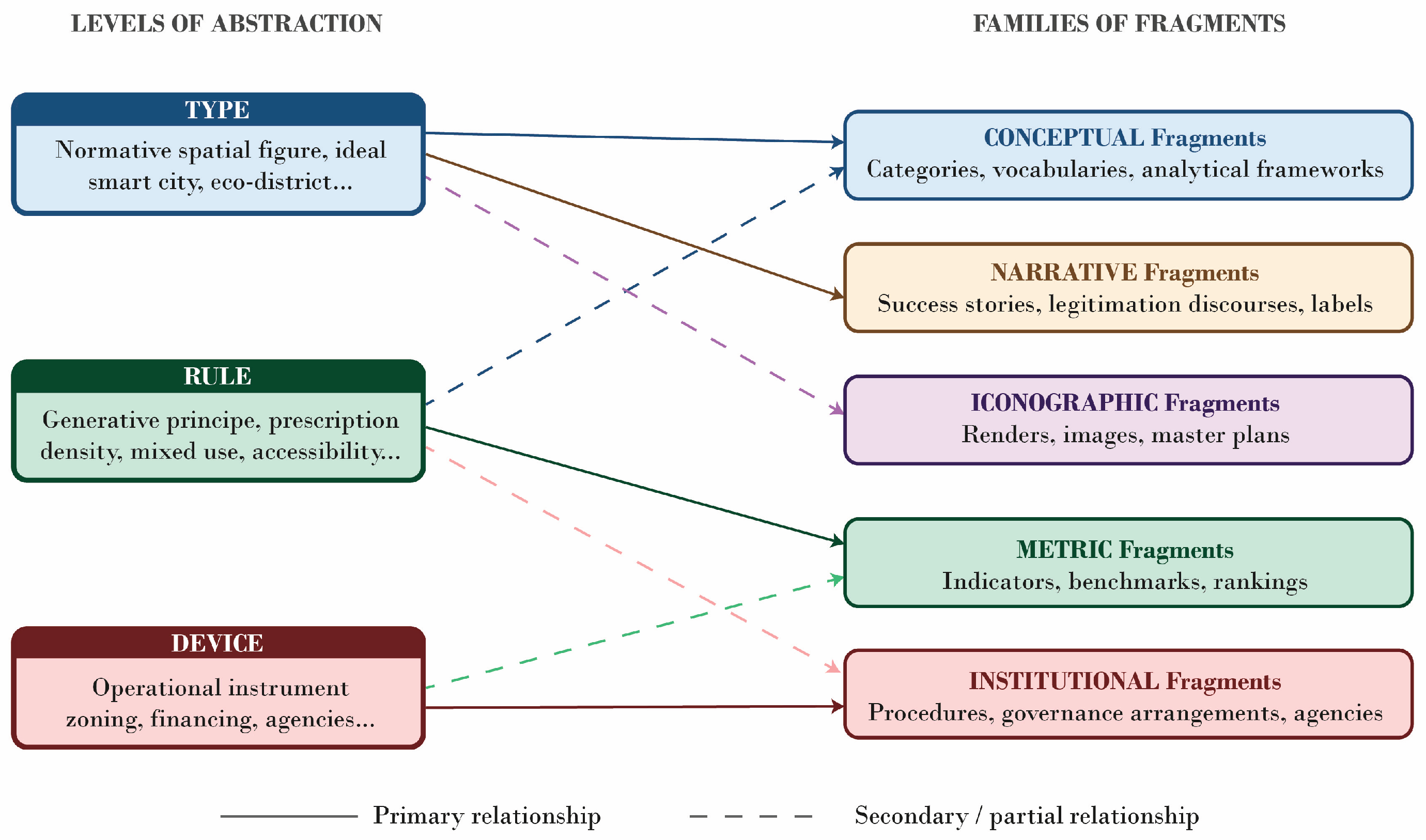

Table 1.
Fragmentation matrix: predictive architecture of differential decomposition.
| Fragment Family | Velocity | Primary Channel | What Arrives | What Is Lost |
|---|---|---|---|---|
| Conceptual | Maximum | Conferences, publications | Slogans, plastic categories | Analytical precision, contextual nuance |
| Metric | High | Rankings, benchmarks | Indicators, thresholds, dashboards | Contextual calibration, normative transparency |
| Iconographic | High | Consultancy, media | Renders, idealised images | Material conditions, implementation feasibility |
| Institutional | Low | Cooperation, consultancy | Formal shells, empty procedures | Organisational substance, local articulation |
| Narrative | Maximum | All channels | Success stories, legitimation myths | Conditions of possibility, critical reflexivity |
Table 2.
Comparative synthesis: fragmentation profiles, alteration modes, and interpretive outcomes across three reception contexts.
Table 2.
Comparative synthesis: fragmentation profiles, alteration modes, and interpretive outcomes across three reception contexts.
| Context I: Mimetic Adoption | Context II: Selective Hybridisation | Context III: Critical Reappropriation | |
|---|---|---|---|
| Conceptual fragments | Arrive intact but analytically hollowed (zombie concepts) | Arrive intact, coexist with local categories | Arrive but subjected to desacralisation and reformulation |
| Metric fragments | Arrive with imported calibration biases | Arrive intact but misaligned with local practices | Arrive but their presuppositions are examined |
| Iconographic fragments | Arrive with full desirability force, disconnected from material conditions | Absorbed selectively alongside local aspirations | Not the primary vector in this configuration |
| Narrative fragments | Dominate, compensate for institutional absence | Partially mask institutional depletion | Reversed: failure attributed to model, not context |
| Institutional fragments | Absent or embryonic | Arrive depleted, recomposed as hollow shells | Absent, compensated by endogenous practices |
| Narrative compensation loop | Full operation | Attenuated | Broken |
| Cognitive dispossession | Acute | Attenuated | Reversed |
| Epistemic friction | Screen | Negotiation | Lever |
Disclaimer/Publisher’s Note: The statements, opinions and data contained in all publications are solely those of the individual author(s) and contributor(s) and not of MDPI and/or the editor(s). MDPI and/or the editor(s) disclaim responsibility for any injury to people or property resulting from any ideas, methods, instructions or products referred to in the content. |
© 2026 by the authors. Licensee MDPI, Basel, Switzerland. This article is an open access article distributed under the terms and conditions of the Creative Commons Attribution (CC BY) license (http://creativecommons.org/licenses/by/4.0/).
Copyright: This open access article is published under a Creative Commons CC BY 4.0 license, which permit the free download, distribution, and reuse, provided that the author and preprint are cited in any reuse.


