

Submitted:
13 April 2026
Posted:
15 April 2026
You are already at the latest version
Abstract
As the global population continues to grow, the demand for forest products and services also increases. However, with natural forests in the tropics declining and becoming less accessible for timber production, there is a growing reliance on planted forests to meet these demands. Planted forests are often seen as a solution to environmental issues although this viewpoint is debated, with many considering that planted forests are not ‘nature positive’. Here we examine evidence from the literature to determine whether planted forests primarily contribute to, or offer solutions to, pressing global environmental challenges – biodiversity conservation, climate change mitigation, clean water supplies, and declining natural forests. Findings are mixed for biodiversity conservation, with positive contribution of plantations depending on proximity to, and management of, natural vegetation in the plantation matrix. Plantations can contribute positively to water yield and quality but this depends on site characteristics, previous land use, management practices, species selection and rotation length influence these outcomes. When replacing grass or crop land, plantations reduce water yield for downstream users. Planted forests can sequester atmospheric carbon and positively contribute to climate change mitigation if established on cleared or degraded land but not when replacing natural forests. Planted forest can alleviate pressure on natural forests by providing alternative sources for timber but establishment costs are high, and timber harvesting is not a major driver of tropical natural forests. In conclusion, well-planned and designed planted forests can make a positive contribution to nature, address global environmental challenges and provide multiple ecosystem services, particularly when integrated with other landscape restoration activities.
Keywords:
planted forests
; environmental impacts
; biodiversity
; carbon sequestration
; climate change mitigation
; provision of water
; pressure on natural forests
1. Introduction
Humans depend on forests and forest products for a wide range of goods and ecosystem services. Global frameworks such as the Kunming-Montreal Global Biodiversity Framework recently established under the United Nations Convention on Biological Diversity (https://www.cbd.int/gbf) identify the need to improve conservation values in ‘working lands’ that provide many of the goods needed for human survival. Planted forests are working lands providing productive and protective functions. They range from extensively-managed, low input, mixed plantings to intensively managed plantations grown on short (4-7 year) rotations with inputs of fertilizer, weed control and pesticides [1]. The area of planted forests has expanded globally by over 170.6 million hectares since 1990, reaching a total of 293.9 million hectares in 2020; or about 7.2 % of the global forest area [2]. Over this period, planted forests increased on average about 4.1 million ha per year, equivalent to the land area of Denmark, through conversion of natural forests to plantations and afforestation on other forms of land cover. The rate of expansion of planted forests has slowed in the last decade, due to declining government investment and difficulty accessing land for large scale planting. About 46 percent of the global industrial round wood (IRW) supply came from planted forests in 2020 [8]. Planted forests are likely to expand a greater rate in future due to investment for carbon [3] and other efforts to mitigate climate change [4,5], increasing demand for wood for energy in modern biofuel systems [6] and for wood, paper and packaging. This combination of factors makes plantations an attractive investment opportunity [7]. Estimates indicate global demand for wood products will increase by 37 percent in 2050 compared to 2020 [8] due to population growth and increasing wealth [9] with more focus on sustainable timber supply [10,11]. Signatories to initiatives such as the ‘Bonn challenge’ have pledged to restore forests on over 200 million hectares of degraded land using Forest Landscape Restoration (FLR) principles. This indicates a significant opportunity for planted forests with diverse purposes, including the production of roundwood [8].
Given growing interest conservation and environmental benefits in working lands, and in particular working forests, how can planted forests make a positive contribution to the environment? Many previous studies have investigated the role of planted forests with reference to specific ecosystem services, such as water supply [16], and biodiversity [12,13,14]. The potential role of planted forests for climate change mitigation has also received a high attention [5,23,94]. Growing forests remove atmospheric carbon dioxide (CO2) through photosynthesis and store it in biomass above and below ground. Carbon stocks in new forests on cleared land also build up in the forest floor in litter and dead wood and, depending on the previous land use, below ground as soil organic matter [95]. For this reason, afforestation was recognized as important for global action on climate change under the Kyoto Protocol [96]. Such land use change activities are being adopted in many industrialized and developing countries to reduce greenhouse gas emissions and contribute to global climate change mitigation under Nationally Determined Contributions to the 2015 Paris Agreement.
While the benefits of planted forests on cleared or degraded land for climate mitigation are quite clear, their benefits for other environmental values are debated. Intensively managed forest plantations are often considered to impact negatively on the environment and regarded ‘green/biological deserts’ with little value as wildlife habitat [21,22]. Opposition to planted forests is strongest where natural vegetation is cleared for short rotation, single species, potentially invasive exotic species [75,81] monocultures over large areas [77,78,79] involving chemicals and fertiliser use [80] and providing habitat for feral animals [63,82]. Other evidence indicates that with appropriate species and management practices, planted forests can contribute positively to biodiversity conservation [12,13,14], and supply a variety of ecosystem services such as clean water [15,16], reduced dry land salinity [17] and, as indicated above carbon sequestration. Depending on the products grown, planted forests can also benefit nature indirectly by reducing pressure to extract resources from natural forest resources [20]. These contradictory views indicate the challenge of positioning planted forests, particularly intensively managed plantations in the ‘nature positive’ discussion but few studied have fully explored the role of planted forests [24,25]. Further investigation of evidence is needed to ascertain the impacts and benefits of planted forests.
We aimed to fill this gap through an exploration and review of published literature to consolidate current knowledge on the impacts of planted forests in the context of four 21st century environmental challenges (Figure 1). It was not intended to be comprehensive, systematic review. The focus was to assess the effects of planted forests on ecosystem services and the environment and analysis of opportunities to mitigate negative environmental impacts and improve positive nature and environmental outcomes from planted forests.
2. Materials and Methods
2.1. Definitions and Scope
There is no global consensus on the definition of forest (Lund 2002). Different countries use different minimum thresholds to distinguish a forest based on the tree parameters such as minimum tree height, minimum crown cover and minimum land cover. For global reporting, the FAO uses a definition of forest being ‘land spanning more than 0.5 hectares with trees higher than 5 meters and a canopy cover of more than 10 percent, or trees able to reach these thresholds in situ. It does not include land that is predominantly under agricultural or urban land use’ [50]. Planted forests are defined as those ‘predominantly composed of trees established through planting and/or after deliberate seeding of native or introduced species’ [40]. Plantation forests are defined as ‘planted forest that is intensively managed and meet ALL the following criteria at planting and stand maturity: one or two species, even age class, and regular spacing.
2.2. Sources of Information and Analysis
To inform the analysis, a search of research literature was carried out using Scopus, a scientific citation indexing database with 20% greater coverage than the Web of Science [51] and offering greater capacity for analysis. The following search string was used: (TITLE (‘planted forest’, OR ‘forest plantation,’ OR ‘timber plantation’ OR ‘tree planting’, AND TITLE-ABS-KEY WORDS (‘environmental values,’ ‘environmental services’, ‘ecosystem services’, ‘environmental impacts’, ‘biodiversity, ‘habitat’, ‘carbon’, ‘climate regulation’ and ‘climate change mitigation’, ‘conservation’, ‘water quality’, ‘water quantity’, ‘forest loss’, ‘deforestation’). Some 140 relevant articles were reviewed. Analysis identified key global environmental challenges that were further investigated to identify ambiguous or contested elements and consider alternative interpretations that warranted further investigation.
3. Results
The review of the research literature revealed the multifaceted roles that planted forests can play in key environmental challenges: biodiversity conservation, climate change mitigation, water and reduced pressure on native forests. These are discussed further below.
3.1. Planted Forests and Biodiversity
Reviewed studies highlight benefits and limitations of planted forests for biodiversity conservation. Under certain conditions planted forests enhance species diversity, support habitats for endangered species, foster native understory growth, and create ecological corridors. Their effectiveness for conservation depends on management practices, tree species used and landscape context. It is also important to consider the biodiversity of planted forests not only relative to natural forests but compared to other land uses prior to the plantations.
A meta-analysis by Felton et al. [58] found that plantations generally support greater populations of birds and mammals compared to pasture lands, particularly when the plantations are established in regions that still have remnant native vegetation. However, these benefits depend on the plantation tree species. For example, Volpato et al. [71] in Brazil, Farwing et al. [72] in Kenya, Zurita et al. [73] in Argentina, and Sekercioglu, [74] in Uganda observed that the plantations of exotic species supported lower bird richness than native species plantations. Branching characteristics of native species provide more attractive roosting sites for birds, which are primary mechanism for seed distribution of many rainforest species, particularly in the tropics. Barlow et al. [70] found that exotic tree plantations in the Brazilian Amazon provide conservation benefits, although the habitat quality is lower than the native forests, while other research identified that eucalyptus plantation in the coastal mountain range in central California (USA) tend to have high species diversity, including amphibians, birds, mammals and leaf litter invertebrates compared to the surrounding forested areas [57].
Managed plantation forests can provide a buffer between forests and agricultural or pastoral lands and maintain connections between forest patches to support interactions within meta populations. For example, in Patagonia (Argentina), pine plantations were established in way that effectively connected forest habitats with steppe areas [66]. This not only helped maintaining the existing forest remnants but also enhanced the overall habitat quality of the landscape [63,65,67]. Planted forests also facilitated the movement and dispersal of mammals living in forests [68] and various marsupials found in Australia [69]. In some situations, native and exotic planted forests can provide habitat for native endangered and threatened birds and mammal species. For example, exotic pine (Pinus radiata) plantations in New Zealand are providing habitat for the endangered brown Kiwi [55] and endangered cassowaries are found in Hoop Pine (Araucaria cunninghamii) plantations in Queensland, Australia [49].
Planted forests have shown positive outcomes for invertebrate and amphibian diversity, often supporting a range of species not commonly found in agricultural landscapes. Felton et al. [58] observed that plantations provide habitats for reptiles and amphibians, particularly in regions where patches of natural vegetation remain intact. Additionally, two studies found that planted forests provide habitat for critically endangered ground beetles [41,56].
Evidence of negative impacts of planted forests on biodiversity relate to the limited number of planted species [75,76] and low biodiversity of key faunal taxa [70]. Planted forests managed for timber production generally have different growth stages, and these varied seral habitats support higher biodiversity than single aged stands. For example, Sharps et al [85] found that the Nightjar, a bird species of high conservation value, preferred nesting in young pine plantations in …., probably for the ease of capturing prey, rather than in old plantations where there is a higher abundance of prey. Irwin et al. [87] observed that planted forests with different species composition offered a higher biodiversity conservation value than semi-natural woodlands. They suggested that management operations promoting semi-natural characteristics in planted forests could enhance and maintain biodiversity in the landscape. Most large industrial plantations have a mix of age classes but managing for different ages at finer scale may enhance plantation conservation values.
Some planted forests of exotic tree species supported an understory of indigenous plants and faunal biodiversity resembling to the natural forests in the region [48,59,60]. This effect has been actively promoted for native forest restoration (Lugo 1992; Keenan et al. 1997). Plantations of early successional species can improve the degraded site and ‘facilitate’ the restoration of land with natural vegetation. For instance, in pine plantations native shade tolerant species commonly found in forest understories gradually become more dominant with plantation age [48,62]. However, the species diversity in a reforestation site with a single native or exotic tree species planted depends on available seed sources and conduciveness of the microclimate to natural regeneration. Kamo et al [61] observed a higher diversity of understory plant species in forests planted to single native or exotic tree species in sites near natural stands, than in grassland.
Although planted forests can support increase plant biodiversity, they also present challenges, particularly in terms of species diversity. Under intensive management, the natural regeneration of native species is discouraged to reduce competing understory and have a high-density canopy with little light reaching the understory generally have relatively little natural regeneration [63].
3.2. Planted Forests and Climate Mitigation
Carle and Holmgren [40] estimated that planted forests sequester about 1.5 Gt of Carbon per year globally and further about 0.5 Gt of Carbon per year stored in long-term wood products from the planted forests. However, carbon stocks and the carbon sequestration rates in the planted forests are not uniform across the globe, and the amount of carbon sequestered by planted forests depends on the extent and scope of the plantations as well as on the previous land use, species, growth rates of both above and belowground biomass, climatic conditions, management regime as well as the forest disturbances due to natural and anthropogenic causes [97,98,99,100]. Some studies suggest that species diversity can increase forest growth and carbon sequestration [101] whereas others indicate that monocultures sequester more carbon than diverse plantings [102,103,104]. In a meta-analysis comparing climate benefits of two plantations, Hulvey et al. [105] found that plantations of diverse species sequester at least as much or more carbon as plantations of single species. In mixed species plantations, the increase in stand biomass is primarily attributed to incorporation of nitrogen-fixing tree species, but partitioning of light and soil profile use by different species may also be important [105].
Planted forests that are established after clearing of natural forests generally have lower carbon stocks than the replaced natural forests depending on the time frame and management [23,106], due to lower average carbon stock in living biomass and loss of carbon from the soil carbon pool during establishment. For example, 28% reduction in soil carbon stock was reported in the planted forest following clearing and establishment of plantation in the natural forest [23]. However, Chen et al. [106] recently observed no significant difference in carbon stock at the ecosystem level between planted and natural stands of Masson’s pine (Pinus massoniana Lamb.) across different age classes. The planted forest had low soil carbon but this was compensated for by the higher carbon stock in the above ground biomass than in the natural stand of Masson’s pine.
While natural forests are still being to planted forests, the larger proportion of planted forests are established on land that was previously not under forest cover [4]. Planted forest established on degraded land or cropland will generally result in more stored carbon due to higher above ground biomass in the trees, forest floor, dead wood and root biomass [107]. Soil organic carbon may be higher, but this depends on the previous land cover, conversion of grasslands to planted forests generally results in lower soil carbon but planted forests on converted cropland generally have higher soil carbon. Lower soil carbon stock in planted forests is primarily attributed to the disturbance to soil before establishment of plantations and relatively high inputs of soil carbon in productive grasslands [108].
For planted forests used for wood production, long-lived harvested wood products can act as carbon sinks, often remaining in use or in landfill for over 100 years [109]. However, the quantification of carbon stored in harvested wood products is challenging. The different simulation methods used for accounting GHG emissions from the harvested wood products provide different results according to the assumption and decay function applied [110]. In the USA, it has been estimated that about 23 % of softwood timber remain in use after 100 years [111].
Biomass from sustainably managed forests is recognized as an important renewable and sustainable energy source and can reduce GHG emissions by substituting fossil fuel. There is an increasing global trend of the large-scale use of planted forest for bioenergy. For example, 26 sampled countries demonstrated a gradual increase in the planted forest areas for bioenergy since 1990 [112]. The European Union’s energy policy has explicitly adapted and promoted forest biomass as one of the major strategies to reduce dependency on fossil fuel to reduce GHG emissions by at least 20% in 2020 to the 1990 level [113]. A study suggests that forest biomass contributed nearly 50% of the total energy need in the EU in 2010 [114]. This suggests that the demand for forest biomass from planted forests for energy is likely to grow.
3.3. Provision of Water– Quantity and Quality in Planted Forests
The literature indicated that while planted forests can improve water quality, reduce soil erosion, and aid in flood mitigation, planted forests in former pasture or croplands can increase evapotranspiration and reduce stream flow and water available for other uses, such as irrigated agriculture, human consumption, or the environment. The adverse effects of planted forests on the hydrological yields of watersheds have been documented in drier regions of South-eastern Australia, South Africa and Latin America [43,116,117,118]. In northern Uruguay, afforestation of one quarter of a large watershed (~2000 km2) originally occupied by grasslands showed a significant reduction in available water, mainly in summer [118]. Evapotranspiration from planted forests of Eucalyptus grandis was over 80% higher than grasslands across all sites in Central Argentina [119]. Fahey and Jackson [124] reported that plantations cause higher increases in surface runoff while reducing evapotranspiration than in the natural forests.
Differences in water usage between forests and herbaceous vegetation such as pasture or agriculture can be attributed to the following factors. Firstly, forests tend to absorb radiation leading to increased evapotranspiration. Secondly forests typically have a capacity for capturing rainfall due to their more persistent leaf area and rougher canopy surface. Finally, unlike pastures and many agricultural crops forests often possess root systems that allow them to draw water from deep in the soil profile or groundwater. This enables trees in forests to maintain rates of water usage during drier periods of the year [123]. The potential reduction in runoff due to planted forests depends on the actual annual rainfall within the plantation area. In fact, the net cumulative effect will be higher in high rainfall areas and in areas with a relatively low mean annual rainfall; new tree plantings will not have a sizeable effect on water availability and stream flow [120,121,122].
Several recent studies examined the impact of plantations on water quality and quantity focusing on their location species diversity and management practices [15,16,118,120,121,122]. These studies indicated that planted forests consume more water compared to grasslands, pastures or agriculture and can reduce the amount of water in streams and groundwater, but these effects vary widely. Factors influencing effects of planted forests includes topography, stream flow and source of ground-water (local or regional aquifers system).
These findings highlight the dynamic and complicated relationship between plantations and water resources in working landscapes. Figures for water use by five different land uses and potential ground water recharge in southeastern Australia are presented in Table 1. Jackson et al. [118] analyzed the stream flow data from over 504 catchments and observed a significant decrease in the stream flow within a few years after establishing plantations in the catchment and estimated the impact on the water cycle for up to 20 years. However, Ferraz et al. [16] demonstrated the win-win potential of increasing productivity and water conservation goals in planted forests with appropriate management strategies at three scales – macro-, meso- and micro-scale.
The available literature suggests varying impacts of planted forest on water that are determined by the water use efficiency of the species, the topographic and climatic features of the planted site, rainfall and forest management [15,16,120,121]. To minimize negative impacts on water provision, plantation managers should select an appropriate combination of species and planting density based on their water requirements and site characteristics, rainfall intensity and forest management objectives and operations [16,118,149]. These highly varying impacts of planted forests on water indicates the need for ongoing research on this topic.
3.4. Reduce Pressure on Natural Forests
Natural forests are facing pressure from the increasing demand for land for agricultural, mining, infrastructure development and growing demand for wood in the global market. These factors are driving deforestation of natural forests in many parts of the world, mainly in the developing countries in South-East Asia, Central Africa and South America. Although deforestation has decreased in recent years [125], the negative consequences of ongoing deforestation are well documented, including effects on human wellbeing, loss of biodiversity and contribution to climate change through increased carbon dioxide emissions [126,127]. Rates of forest degradation are also high, due to impacts of wildfire, drought, heat stress, storms, unsustainable logging and intensive grazing.
However, the global increase in planted forest area by an average of 4.4 million hectare per year between 1990 and 2015 has offset to some extent the loss of natural forest (9.6 million hectare per year) and the benefits and services they provide [125]. The net loss of natural forests also dropped from 7.3 million hectare per year in the 1990s to 3.3 million hectare per year between 2010 and 2015. This has taken pressure of natural forests. For instance, the ITTO estimated that industrial plantations in 16 member countries have led to a total sustainable wood production of 684 million m3 per year [141]. This study found that if the equivalent forest products were derived exclusively from poorly managed natural forests, it could lead to degradation or deforestation of approximately of 1.1 million hectare of natural tropical moist forest.
Many other studies have shown that the intensively managed planted forests can produce higher quantities (perhaps 10 – 20 times) of wood fibre per unit area than managed natural forests [36,128,129], depending on the site quality, plantation productivity, management regime and choice of species, [36,140]. For example, in 1997 Sedjo and Botkin [37] claimed that planted forests could theoretically satisfy global wood demand from five percent of the world’s forested area. Planted forests now supply a large of industrial roundwood reducing pressures on natural forests [20,129,130]. In 2012, it was estimated that planted forests in 78 countries produced 562 million m3 of industrial roundwood, about 46% of global supply [131]. Conversely, increase in production of planted forests and associated industry development placed more harvesting pressure on natural forests. For example, in Chile because the emergence of an international market for low-value hardwood, particularly in Japan [131].
The significant time lag between plantation establishment and wood production means that a transition from natural forests to plantations cannot occur quickly. In Australia it took 30 years for softwood plantations planted from 1960 to 1990 to begin producing wood and provide most of the wood supply to the local forest products industry. It is also difficult to assess how changes in production from one forest will impact production from others due to the presence and interplay of many regional and global wood markets. For example, the rapid increase in planted forest area in China has not led to an overall reduction in consumption from natural forests, with China also becoming the world’s largest importer of natural forest logs [REF].
Other recent studies on the global production of industrial roundwood have predicted an increase in supply from planted forest [40,137,138,139]. The projected future share of industrial roundwood coming from planted forests varies considerably in these studies due to differences in the modelling approaches and the assumptions used. However, all these studies indicate an increasing trend of industrial roundwood production from planted forests substituting for wood supply from the natural forests and, eventually, reducing pressure on natural forests. They depend on an increasing the rate of expansion of planted forests for wood production. This will be constrained by high agricultural land costs in developed countries and competition for degraded land in developing countries from local communities for agriculture, commercial investors and conservation interests. Cost of capital and availability and cost of labour will also be a constraint and securing investment has emerged as a future challenge for planted forests. Increased land and management costs have significantly reduced the return from the investment in planted forests (Cubbage et al., 2014). Policy requirements, certification and standards for sustainable forest management are adding additional costs (e.g., Masiero et al. [148]). Given these constraints, supply of timber from sustainably-managed natural forests will be needed for some time.
4. Discussion
This study examined environmental impacts and benefits of planted forests, particularly in supporting biodiversity, climate change mitigation, and reducing the pressure on natural forests. The findings emphasize that while planted forests provide significant environmental benefits, they face challenges in addressing environmental problems and future human needs. This section discusses practical approaches to maximize the positive impacts of planted forests and their role in sustainable forest management and conservation efforts.
4.1. Enhancing Conservation and Environmental Contributions of Planted Forests
While some forests are planted for ecological restoration with the aim of re-establishing fully functioning natural forests, many planted forests will have quite different ecosystem characteristics to natural forests, including tree species diversity and forest structure (tree density, age-class structure and size of the largest trees). Despite these limitations, evidence supports a positive role for planted forests in conservation of biodiversity that can be improved by: 1) using mixed and native species plantings [83,84], 2) maintaining a range of plantation ages in a landscape [85], 3) conserving areas of old plantations [86], 4) improving connectivity and corridors for fragmented natural vegetation within a plantation estate, 5) management operations in a way that promotes habitat benefits, for example, maintaining native understorey species, dead trees and dead wood [87] and 6) promoting natural regeneration of trees in planted forests and encouraging development of mixed natural forest [88,89].
These approaches are more suitable where the primary goal is ecological restoration but could provide a means to better integrate wood production and conservation. Asaeda et al. [84] observed important differences between natural mangrove forests and stands planted with a single species. Therefore, they suggest planting a mixture of species including dominant native species at wide spacing so as to support tree growth and regeneration. Spake et al. [86] highlighted the role of age, mixed species and basal area of old planted forest (ca. 180 yrs) in achieving and maintaining a similar biodiversity of ectomycorrhizal fungi to that of the older, planted forests. However, this study signifies that old, planted forests with mixed species could provide a similar ecological environment and biodiversity of microbial communities to that in old growth forest.
Planted forests can be designed to protect or conserve natural forests with the aim of supporting biodiversity conservation and ecosystem services. In Sumatra, Indonesia, Acacia mangium has been planted to retain up to 26% of the area under natural forest, and if appropriately designed and managed, these areas can assist in the conservation of primates and other species [90]. The conservation of a specified percentage of forest has become a mandatory requirement under a certification scheme. For example, the Forest Steward Council (FSC) requires at least 10 per cent of areas within planted forests to be allocated for conservation purposes. Hence, planted forests can be coupled with natural forests for conserving biodiversity and providing a variety of ecosystem services [91,92], although this concept is sometimes controversial [93].
4.2. Increasing Wood Supply from Planted Forests
Increasing timber supply from planted forests is supported by the government policies through encouraging plantation development, increased investment, management intensity and production capacity and technological changes that favor processing of smaller, more uniform logs of preferred species. In Uganda, the commercial timber plantations have reduced use of forest products from natural forests by 15.5 % [132]. The harvest of natural forest in New Zealand has ceased completely due to timber supply from planted forests [133] and in Australia about 80 % of total wood supply to industry comes from two million ha of planted forests. About 19.5 million m3 of softwood and hardwood were harvested from planted forests in 2012-13 [134]. In the Philippines, mangrove plantations have also permitted some reduction in pressure on harvesting of forest products from nearby natural forests [135].
To meet the growing demand of industrial roundwood, the annual planted forest area has to be increased more than the current annual average of 3.3 million ha. Currently, just 20 countries account for about 85 % of the planted forests globally and another 20 countries supply about 87 % of global wood supply [142]. This data indicates that many countries could potentially increase the area of planted forests and manage them for sustainable supply of wood products, meeting the demand for industrial roundwood and wood fuel. The fuelwood supply from plantations helps reduce the pressure on natural forests in the developing countries.
Climate change mitigation needs may drive increased production of commercial wood from planted forests. Plantations established on agricultural or degraded and harvested and replanted over the long-term have higher average carbon stocks than cleared agricultural land and therefore remove carbon from the atmosphere [REF]. Second, wood products utilized in building construction and other uses store carbon for extended periods. Thirdly, if the commercial timber substitutes for high-energy intensive materials such as aluminum or steel, there are reduced GHG emissions through displacement [REF].
4.3. Improving Water Outcomes from Planted Forests
The literature suggested some negative correlation between the planted forests and the provision of water, particularly in lower rainfall regions. This is largely attributed to increased evapotranspiration by the trees and the land and trees’ ability to access the deep water or ground water through their root systems. To avoid negative impacts on water, plantation design should consider the topographic and climatic features of the planted sites including rainfall, species selection, the extent of catchments planted and the forest management system [REF].
4.4. Future Challenges
Key challenges for the future management of planted forests to achieve these goals include:
- Anticipating and managing the effects of future climate change on planted forests, in particular the management of fire, disease, insects and other disturbances.
- Managing technological changes that will change the requirements for species choice and wood quality.
- Dealing with demographic changes in rural areas will impact on the availability of labor for intensive management.
- Planted forests require up-front investment and long-time frames until returns flow to investors. Security of ownership, likely market returns and policy stability are critical factors for investment.
- Demonstration of sustainable management of plantations, through certification, codes of practice or other mechanisms,
- Integration of plantations in agricultural landscapes, and
- Increasing the social acceptability of plantations and demonstrating wider social and economic benefits to local communities.
5. Conclusions
This study reviewed the environmental benefits and impacts of planted forests in terms of climate change benefits, biodiversity conservation, the provision of water and the role of plantations in reducing pressure on natural forests. Findings indicate that planted forests, particularly those established on degraded or agricultural land, can contribute positively to climate change mitigation through significant carbon sequestration and storage, both in biomass and long-term wood products and in reducing pressure on natural forests, although the latter can take some time to achieve. Many studies highlighted the capacity of planted forests to provide benefits for biodiversity conservation, including habitats for endangered and threatened species; higher species diversity of amphibians, birds, mammals, and leaf-litter invertebrates compared to surrounding cleared landscapes and as buffers and connecting elements for natural forests, thereby playing a supportive role in biodiversity conservation through reducing the risk of deforestation and forest degradation and providing corridors for connecting different habitats.
Overall, we conclude that planted forests, when designed and managed, in part, for biodiversity and climate goals, can serve as valuable assets in supporting ecological resilience and reducing anthropogenic pressures on natural ecosystems. Further research and adaptive management strategies will be essential to maximize these benefits and address ongoing challenges in sustainable plantation forestry.
Author Contributions
Conceptualization, HB, and RJK; methodology, HB and RJK; formal analysis, HB, SKS, SS.; investigation, writing—original draft preparation, HB, SS, SKS RJK; writing—review and editing, HB, SS, SKS, RJK. All authors have read and agreed to the published version of the manuscript.
Data Availability Statement
Data will be made available if requested.
Conflicts of Interest
The authors declare no conflict of interest.
References
- Lungo, D.; Ball, J; Carle, J. Global planted forests thematic study: results and analysis in Planted Forests and Trees Working Paper 38. Food and Agriculture Organization; Rome, 2006.
- FAO. Global Forest Resources Assessment 2020: Main report. Food and Agriculture Organization of the United Nations: Rome, 2020.
- FAO. State of the World’s Forests 2011. Food and Agriculture Organization of the United Nations: Rome, 2011.
- FAO. Managing forests for climate change. Food and Agriculture Organization of the United Nations: Rome, 2010.
- Peng, S.S.; Piao, S.; Zeng, Z.; Ciais, P.; Zhou, L.; Laurent Z. X.; Li, L.Z.X.; Ranga B.; Myneni, R.B.; Yi Yin, Y.; Hui Zeng, H. Afforestation in China cools local land surface temperature. PNAS 2014, 111(8), 2915-2919. [CrossRef]
- Sedjo, R.A.; Sohngen, B. The implications of increased use of wood for biofuel production. Resources for the Future: Washington, 2009, pages 15.
- Cubbage, F.; Mac Donagh, P.; Sawinski Júnior, J.; Rubilar, R.; Pablo Donoso, P.; Ferreira, A.; Hoeflich, V.; Olmos, V.M.; Ferreira, G.; Balmelli, G.; Siry, J.; Báez, M.N.; Alvarez, J. Timber investment returns for selected plantations and native forests in South America and the Southern United States. New Forests 2007, 33(237), 237-255. [CrossRef]
- FAO. Global Forest Sector Outlook 2050: Assessing Future Demand and Sources of Timber for a Sustainable Economy—Background Paper for the State of the World’s Forests 2022, Food and Agriculture Organization of the United Nations: Rome, 2022.
- Boucher, P.D.; Elias, P. Planting for the Future How Demand for Wood Products Could Be Friendly to Tropical Forests. Union of Concerned Scientists: Cambridge, MA, USA, 2014.
- Hetsch, S. Potential sustainable wood supply in Europe, In Geneva Timber and Forest Discussion Paper 52, United Nations: Geneva, 2009.
- Penna, I. Understanding the FAO’s ‘Wood supply from planted forests’ projections. University of Ballarat Centre for Environmental Management Monograph Series No. 2010/01. University of Ballarat: Victoria, 2010.
- Carnus, J.M.; Parrotta, J.; Brockerhoff, E.; Arbez, M.; Jactel, H.; Kremer, A.; Lamb, D.; O’Hara, K.; Walters, B. Planted forests and biodiversity. Journal of Forestry 2006, 65-77.
- Brockerhoff, E.G.; Jactel, H.; Parrotta, J. a.; Quine, C.P.; Sayer, J. Plantation forests and biodiversity: oxymoron or opportunity? Biodiversity and Conservation 2008, 17, 925–951. [CrossRef]
- Brockerhoff, E. G.; Jactel, H.; Parrotta, J. A.; Ferraz, S. F. B. Role of eucalypt and other planted forests in biodiversity conservation and the provision of biodiversity-related ecosystem services. Forest Ecology and Management 2013, 301, 43–50. [CrossRef]
- van Dijk, A. I.; Keenan, R. J. Planted Forests and Water in Perspective. Forest Ecology and Management 2007, 251(1–2), 1–9.
- Ferraz, S. F. B.; Lima, W. D. P.; Rodrigues, C. B. Managing forest plantation landscapes for water conservation. Forest Ecology and Management 2013, 301, 58–66. [CrossRef]
- Schofield, N.J. Tree planting for dryland salinity control in Australia. Agroforestry Systems 1992, 20(1-2), 1-23. [CrossRef]
- Gogoi, A.; Ahirwal, J.; Sahoo, U.K. Plant biodiversity and carbon sequestration potential of the planted forest in Brahmaputra flood plains. Journal of Environmental Management 2021, 280, 111671. [CrossRef]
- Glomsrod, S.; Wei, T.; Liu, G.; Aune, J.B. How well do tree plantations comply with the twin targets of the clean development mechanism? The case of tree plantations in Tanzania. Ecological Economics 2011, 70, 1066–1074. [CrossRef]
- Warman, R.D. Global wood production from natural forests has peaked. Biodiversity and Conservation 2014, 23, 1063–1078. [CrossRef]
- Allen, A.W.; Bernal, Y.K.; Moulton, R.J. Pine plantations and wildlife in the southeastern United States: an assessment of impacts and opportunities (Vol. 3). US Department of the Interior, National Biological Service: USA, 1996.
- Stephens, S.S.; Wagner, M.R. Forest plantations and biodiversity: a fresh perspective. Journal of Forestry 2007, 105(6), 307–313. [CrossRef]
- Liao, C.; Luo, Y.; Changming Fang, C.; Li, B. Ecosystem carbon stock influenced by plantation practice: implications for planting forests as a measure of climate change mitigation. PLoS ONE 2010, 5(5).
- Cossalter, C.; Pye-Smith, C. Fast-wood forestry: myths and realities. Center for International Forestry Research: Jakarta, Indonesia, 2003.
- Bauhus, J.; Pokorny, B.; van der Meer, P.J.; Kanowski, P.J.; Kanninen M. Ecosystem goods and services – the key for sustainable plantations. Eds by J. Bauhus, P. J. van der Meer and M. Kanninen, Center for International Forestry Research: Earthscan, London, 2010.
- Sala, O.E.; Chapin, F.S.; Armesto, J.J.; Berlow, E.; Bloomfield, J.; Dirzo, R.; Huber-Sanwald, E.; Huenneke, L.F.; Jackson, R.B.; Kinzig, A., et al. Global biodiversity scenarios for the year 2100. Science 2000, 287(5459), 1770-1774. [CrossRef]
- Thomas, C.D.; Cameron, A.; Green, R.E.; Bakkenes, M.; Beaumont, L.J.; Collingham, Y.C.; Erasmus, B.F.N.; de Siqueira, M.F.; Grainger. A.; Hannah, L.; Hughes, L.; Huntley, B.; van Jaarsveld, A.S.; Midgley, G.F.; Miles, L.; Ortega-Huerta, M.A. Townsend Peterson A, Phillips OL, Williams SE. Extinction risk from climate change. Nature 2004, 427, 145–148.
- MEA. Ecosystems and Human Well-Being: a Framework for Assessment, In Millennium Ecosystem Assessment, Island Press: Washington DC, 2005.
- Jarvis, P.G.; Ibrom, A.; Linder, S. March. Carbon forestry': managing forests to conserve carbon. In SYMPOSIA-SOCIETY FOR EXPERIMENTAL BIOLOGY, 2004, 57, 331.
- Fang, J.Y.; Chen, A.P.; Peng, C.H.; Zhao, S.Q.; Ci, L . Changes in forest biomass carbon storage in China between 1949 and 1998. Science 2001, 292, 2320–2322. [CrossRef]
- Piao, S.; Fang, J.; Ciais, P.; Peylin, P.; Huang, Y.; Stephen Sitch, S.; Wang, T. The carbon balance of terrestrial ecosystems in China. Nature 2009, 458(7241), 1009–1013. [CrossRef]
- Candell, J.G.; Raupach, M.R. Managing forests for climate change mitigation. Science 2008, 320, 1456.
- Brook B.W.; Sodhi N.S.; Bradshaw C.J.A. Synergies among extinction drivers under global change. Trends in Ecology & Evolution 2008, 23, 453-460.
- Hellmann, J.J.; Byers, J.E.; Bierwagen, B.G.; Dukes, J.S. Five Potential Consequences of Climate Change for Invasive Species. Conservation Biology 2008, 22(3), 534-543. [CrossRef]
- Heilmayr, R. Conservation through intensification? The effects of plantations on natural forests. Ecological Economics 2014, 105, 204–210. [CrossRef]
- Park, A.; Wilson, E.R. Beautiful plantations: can intensive silviculture help Canada to fulfill ecological and timber production objectives? Forestry Chronicle 2007, 83, 825–39. [CrossRef]
- Sedjo, R.A.; Botkin, D. Using Forest Plantations TO SPARE Natural Forests. In Environment: Science and Policy for Sustainable Development, 1997; 39, 14–30. [CrossRef]
- Sedjo, R.A. The potential of high-yield plantation forestry for meeting timber needs, In Planted Forests: Contributions to the Quest for Sustainable Societies, 1999; 339–359.
- Sedjo, R A. The economic contribution of biotechnology and forest plantations in global wood supply and forest conservation, In Proceedings of the First International Symposium on Ecological and Societal Aspects of Transgenic Plantations, College of Forestry, Oregon State University: USA, 2001.
- Carle, B.J.; Holmgren, P. Wood from Planted Forests: A Global Outlook 2005-2030. 2008; 58, 6–18.
- Brockerhoff, E.G.; Berndt, L.A.; Jactel, H. Role of exotic pine forests in the conservation of the critically endangered ground beetle Holcaspis brevicula (Coleoptera: Carabidae). New Zealand Journal of Ecology 2005, 29(1), 37– 43.
- de Groot, R.S.; Alkemade, R.; Braat, L.; Hein, L.; Willemen, L. Challenges in integrating the concept of ecosystem services and values in landscape planning, management and decision making. Ecological Complexity 2010, 7, 260–272. [CrossRef]
- Silveira, L.; Alonso, J. Runoff Modifications due to the Conversion of Natural Grasslands to Forests in a Large Basin in Uruguay. Hydrological Processes 2009, 23(2), 320–29. [CrossRef]
- Paruelo, J. M. Ecosystem services and tree plantations in Uruguay: A reply to Vihervaara et al. (2012). Forest Policy and Economics 2012, 22, 85–88. [CrossRef]
- IUFRO. Forest and water interactions, and the energy-water nexus, In Proceedings of the IUFRO Symposium ‘Challenges and Opportunities of Forest Research in the Policy-Making Process’. IUFRO, 2007.
- Calder, I.R.; Aylward, B. Forests and floods – in support of an evidence- based approach to watershed and integrated flood management. Water International 2006, 31, 544–547. [CrossRef]
- Jactel, H.; Brockerhoff, E.G. Tree diversity reduces herbivory by forest insects. Ecology letters 2007, 10(9), 835-848. [CrossRef]
- Brockerhoff, E.G.; Ecroyd, C.E.; Leckie, A.C.; Kimberley, M.O. Diversity and succession of vascular understory plants in exotic Pinus radiata plantation forests in New Zealand. Forest Ecology and Management 2003, 185, 307–326.
- Keenan, R.; Lamb, R.D.; Woldring, O.; Irvine, T.; Jensen, R. Restoration of plant biodiversity beneath tropical tree plantations in Northern Australia. Forest Ecology and Management 1997, 99, 117–131. [CrossRef]
- FAO. FRA 2015 Terms and definitions. Food and Agriculture Organization of the United Nations: Rome, 2015.
- Vieira, E. S.; Gomes, J. A. N. F. A comparison of Scopus and Web of Science for a typical university. Scientometrics 2009, 81(2), 587-600. [CrossRef]
- Miley, F.; Read, A. Using word clouds to develop proactive learners. Journal of the Scholarship of Teaching and Learning 2011, 11, 91–110.
- Mcnaught, C.; Lam, P. Using wordle as a supplementary research tool. Qual. Rep. 2010, 15, 630–644. [CrossRef]
- Wu, J. Key concepts and research topics in landscape ecology revisited: 30 years after the Allerton Park workshop. Landscape Ecology 2012, 28, 1–11. [CrossRef]
- Kleinpaste, R. Kiwis in a pine forest habitat. In Fuller E ed. Kiwis, a monograph of the family Apterygidae. Auckland, Seto, 1990.
- Berndt, L.A.; Brockerhoff, E.G.; Jactel, H. Relevance of exotic pine plantations as a surrogate habitat for ground beetles (Carabidae) where native forest is rare. Biodiversity and Conservation 2008, 17(5), 1171-1185. [CrossRef]
- Sax D. F. Equal diversity in disparate species assemblages: a comparison of native and exotic woodlands in California. Global Ecology and Biogeography 2002, 11, 49–57.
- Felton, A.; Knight, E.J.; Wood, J.T.; Zammit, C.; Lindenmayer, D.B. A meta-analysis of fauna and flora species richness and abundance in plantations and pasture lands. Biological Conservation 2010, 143, 545–554. [CrossRef]
- Humphrey, J.W.; Ferris, R.; Quine, C.P. Biodiversity in Britain’s planted forests, In the Forestry Commission’s biodiversity assessment project. Forestry Commission: Edinburgh, 2003.
- Pawson, S.; Brockerho, V.E.; Meenken, E.; and Didham, R. Non-native plantation forests as alternative habitat for native forest beetles in a heavily modified landscape. Biodiversity and Conservation 2008, 17(5), 1127-1148. [CrossRef]
- Kamo, K.; Vacharangkura, T.; Tiyanon, S.; Viriuabuncha, C.; Nimpila, S.; Doangsrisen, B. Plant Species Diversity in Tropical Planted Forests and Implication for Restoration of Forest Ecosystems in Sakaerat, Northeastern Thailand. Japan International Research Center for Agricultural Sciences 2002, 36(2), 111-118. [CrossRef]
- Allen, R.B.; Platt, K.H.; Coker, R.E.J. Understory species composition patterns in a Pinus radiata D. Don plantation on the central North Island volcanic plateau, New Zealand. New Zealand Journal of Forestry Science 1995, 25, 301–317.
- Kanowski, J.; Catterall, C.P.; Wardell-Johnson, G.W. Consequences of broad- scale timber plantations for biodiversity in cleared rainforest landscapes of tropical and subtropical Australia. Forest Ecology and Management 2005, 208, 359–372. [CrossRef]
- Renjifo, L.M. Effect of natural and anthropogenic landscape matrices on the abundance of subandean bird species. Ecological Applications 2001, 11(1), 14-31.
- Fischer, J.; Lindenmayer, D.B. Beyond fragmentation: the continuum model for fauna research and conservation in human-modified landscapes. Oikos 2006, 112, 473–480. [CrossRef]
- Lantschner, M.V.; Rusch, V.; Peyrou, C. Bird assemblages in pine plantations replacing native ecosystems in NW Patagonia. Biodiversity and Conservation 2008, 17(5), 969-989. [CrossRef]
- Lindenmayer, D.B.; Franklin, J.F. Conserving forest biodiversity: a comprehensive multiscaled approach. Island Press: Washington DC, 2002.
- Ferreras, P. Lanscape structure and asymmetrical inter-patch connectivity in a metapopulation of the endangered Iberian Lynx. Biological Conservation 2001, 100, 125-136. [CrossRef]
- Lindenmayer, D.B., Cunningham, R.B., Pope, M.L. and Donnelly, C.F., 1999. The response of arboreal marsupials to landscape context: a large-scale fragmentation study. Ecological Applications, 9(2), pp.594-611.
- Barlow, J.; Gardner, T.a; Araujo, I.S.; Avila-Pires, T.C.; Bonaldo, a B.; Costa, J.E.; Esposito, M.C.; Ferreira, L.V.; Hawes, J.; Hernandez, M.I.M.; Hoogmoed, M.S.; Leite, R.N.; Lo-Man-Hung, N.F.; Malcolm, J.R.; Martins, M.B.; Mestre, L. a M.; Miranda-Santos, R.; Nunes-Gutjahr, a L.; Overal, W.L.; Parry, L.; Peters, S.L.; Ribeiro-Junior, M. a; da Silva, M.N.F.; da Silva Motta, C.; Peres, C. Quantifying the biodiversity value of tropical primary, secondary, and plantation forests. PNAS 2007, 104, 18555–60. [CrossRef]
- Volpato, G. H.; Prado, V. M.; dos Anjos, L. What can tree plantations do for forest birds in fragmented forest landscapes? A case study in southern Brazil. Forest Ecology and Management 2010, 260(7), 1156–1163. [CrossRef]
- Farwing, N.; Sajita, N.; Böhning-Gaese, K. Conservation value of forest plantation for bird communities in western Kenya. Forest Ecology and Management 2008, 255, 3885–3892. [CrossRef]
- Zurita, G.A.; Rey, N.; Varela, D.M.; Villagra, M.; Bellocq, M.I. Conversion of the Atlantic forest into native and exotic tree plantations: effects on bird com- munities from the local and regional perspectives. Forest Ecology and Management 2006, 235, 164–173. [CrossRef]
- Sekercioglu, C.H. Effects of forestry practices on vegetation structure and bird community of Kibale National Park, Uganda. Biol. Conserv. 2002, 107, 229– 240. [CrossRef]
- Moore, S.E.; Allen, E.L. Plantation forestry. In: Hunter, M.L.Jr. (ed), In Maintaining Biodiversity in forest ecosystems. Cambridge University Press: Cambridge, 1999.
- Lindenmayer, D.B.; Hobbs, R.J. Fauna conservation in Australian plantation forests - a review. Biological Conservation 2004, 119, 151–168. [CrossRef]
- Cossalter, C.; Pye-Smith, C. Fast-wood forestry: myths and realities. Center for International Forestry Research: Jakarta, Indonesia, 2002.
- Lindenmayer, D.B. Large-scale landscape experiments. Lessons from Tumut. Cambridge University Press: Cambridge, 2009.
- Healey, S. P.; R. I. Gara. The effect of a teak (Tectona grandis) plantation on the establishment of native species in an abandoned pasture in Costa Rica. Forest Ecology and Management 2003, 176(1–3), 497–507. [CrossRef]
- Jukes, M.F.; Ferris, R.; Peace, A.J. The influence of stand structure and composition on diversity of canopy Coleoptera in coniferous plantations in Britain. Forest Ecology and Management 2002, 163, 27-41. [CrossRef]
- Ledgard N. The spread of lodgepole pine (Pinus contorta, Dougl.) in New Zealand. Forest Ecology and Management 2001, 141, 43–57. [CrossRef]
- Kupfer, J.A.; Malanson, G.P.; Franklin, S.B. Not seeing the ocean for the islands: the mediating influence of matrix-based processes on forest fragmentation effects. Global Ecology and Biogeography 2006, 15(1), 8-20. [CrossRef]
- Cusack, D.; Montagnini, F. The role of native species plantations in recovery of understory woody diversity in degraded pasturelands of Costa Rica. Forest Ecology and Management 2004, 188, 1–15. [CrossRef]
- Asaeda, T.; Baruevo, A.; Sanjaya, K.; Fortes, M.D.; Kanesaka, Y.; Wolanski, E. Mangrove plantation over a limestone reef- good for the ecology?. Estuarine, Coastal and Shelf Science 2016, 173, 57-64. [CrossRef]
- Sharps, K.; Henderson, I.; Conway, G.; Armour-Chelu, N.; Dolman, P.M. Home-range size and habitat use of European Nightjars Caprimulgus europaeus nesting in a complex plantation-forest landscape, Ibis 2015, 157(2), 260-272. [CrossRef]
- Spake, R.; van der Linde, S.; Newton, A.C.; Suz, L.M.; Bidartondo, M.I.; Doncaster, C.P. Similar biodiversity of ectomycorrhizal fungi in set-aside plantations and ancient old-growth broadleaved forests, Biological Conservation 2016, 194, 71-79. [CrossRef]
- Irwin, S.; Pedley, S.M.; Coote, L.; Dietzsch, A.C.; Wilson, M.W.; Oxbrough, A.; Sweeney, O.; Moore, K.M.; Martin, R.; Kelly, D.L.; Mitchell, F.J.G.; Kelly, T.C.; O'Halloran, J. The value of plantation forests for plant, invertebrate and bird diversity and the potential for cross-taxon surrogacy. Biodiversity and Conservation 2014, 23(3), 697-714. [CrossRef]
- Parotta, J.A.; Turnbull, J.W.; Johes, N. Catalyzing native forest regeneration on degraded tropical lands. Forest Ecology and Management 1997, 99, 1–290.
- Harmer, R.; Morgan, G.; Beauchamp, K. Restocking with broadleaved species during the conversion of Tsuga heterophylla plantations to native woodland using natural regeneration. European Journal of Forest Research 2011, 130(2), 161-171. [CrossRef]
- Nasi, R.; Koponen, P.; Poulsen, J.G.; Buitenzorgy, M.; Rusmantoro, W. Impact of landscape and corridor design on primates in a large-scale industrial tropical plantation landscape. Biodiversity and Conservation 2008, 17(5), 1105-1126. [CrossRef]
- Bélair, C.; Ichikawa, K.; Wong, B.Y. L.; Mulongoy, K.J. Sustainable use of biological diversity in socio-ecological production landscapes. In Satoyama Initiative for the benefit of biodiversity and human well-being. Secretariat of the Convention on Biological Diversity: Montreal, 2010; 52, 184.
- Kandziora, M.; Burkhard, B.; Müller, F. Mapping provisioning ecosystem services at the local scale using data of varying spatial and temporal resolution, Ecosystem Services 2013, 4, 47-59. [CrossRef]
- Calviño-Cancela, M.; Rubido-Bará, M.; van Etten, E.J.B. Do eucalypt plantations provide habitat for native forest biodiversity? Forest Ecology and Management 2012, 270, 153–162. [CrossRef]
- Paquette, A.; Messier, C. The role of plantations in managing the world’s forests in the Anthropocene. Frontiers in Ecology and the Environment 2009, 8, 27–34. [CrossRef]
- Böttcher, H.; Lindner, M. Managing forest plantations for carbon sequestration today and in the future. In Ecosystem Goods and Services from Plantation Forests, Earthscan, 2010.
- UNFCCC. Kyoto Protocol to the United Nations Framework Convention on Climate Change, United Nations framework convention on climate change: Kyoto, 1998.
- Masera, O.R.; Garza-Caligaris, J.F.; Kanninen, M.; Karjalainen, T.; Liski, J.; Nabuurs, G.J.; Pussinen, A.; de Jong, B.H.J.; Mohren, G.M.J. Modeling carbon sequestration in afforestation, agroforestry and forest management projects: the CO2FIX V.2 approach, Ecological Modelling 2003, 164(2-3), 177-199. [CrossRef]
- Fang, S.; Xue, J.; Tang, L. Biomass production and carbon sequestration potential in poplar plantations with different management patterns, Journal of Environmental Management 2007, 85(3), 672-679. [CrossRef]
- West, P.W. Growing plantations forests. Second Edition, Spinger, 2014.
- Glencross, K.; West, P.W.; Nichols, J.D. Species shade tolerance affects tree basal area growth behaviour in two eucalypt species in thinned and unthinned even-aged monoculture. Australian Forestry 2016, 79(3), 157-167. [CrossRef]
- Erskine, P.D.; Lamb, D.; Bristow, M. Tree species diversity and ecosystem function: can tropical multi-species plantations generate greater productivity. Forest Ecology and Management 2006, 233, 205–210. [CrossRef]
- Harper, R. J.; Beckc, A.C.; Ritsona, P.; Hilla, M.J.; Mitchella, C.D.; Barretta, D.J.; Smettema, K.R.J.; Manna, S.S. The potential of greenhouse sinks to underwrite improved land management. Ecological Engineering 2007, 29, 329–341. [CrossRef]
- McKinley, D. C.; Ryan, M.G.; Birdsey, R.A.; Giardina, C.P.; Harmon, M.E.; Heath, L.S.; Houghton, R.A.; Jackson, R.B.; Morrison, J.F.; Murray, B.C.; Pataki, D.E.; Skog, K.E. A synthesis of current knowledge on forests and carbon storage in the United States. Ecological Applications 2011, 21, 1902–1924. [CrossRef]
- Crossman, N. D.; Bryan, B. A.; Summers, D. M. Carbon payments and low-cost conservation. Conserv. Biol. 2011, 25, 835–845. [CrossRef]
- Hulvey, K.B.; Hobbs, R.J.; Standish, R.J.; Lindenmayer, D.B.; Lach, L.; Perring, M.P. Benefits of tree mixes in carbon plantings. Nature Climate Change 2013, 3, 869–874. [CrossRef]
- Chen, L.; Liang, M.; Wang, S. Carbon stock density in planted versus natural Pinus massoniana forests in sub-tropical China. Annals of Forest Science 2016, 73(2), 461-472. [CrossRef]
- Canadell, J.G. Land use effects on terrestrial carbon sources and sinks. Science in China 2002, Series C, 45,.
- Guo, L. B.; Gifford, R. M. Soil carbon stocks and land use change, Global Change Biology 2002, 8, 345360. [CrossRef]
- Sharma, S. K.; Telfer, M., Phua, S. Comparison between Four Decay Models for Estimating Greenhouse Gas Emissions Reductions from Long-term Harvested Wood Products in Carbon Abatement Projects, Journal of Greenhouse Gas Measurement and Management 2013, 3(1-02), 64-80.
- Miner, R. The 100-year method for forecasting carbon sequestration in forest products in use. Mitigation and Adaptation Strategies for Global Change, 2006. [CrossRef]
- USDE. Chapter 1: Emission inventories. In Technical guidelines for voluntary reporting of greenhouse gas program. Office of policy and international affairs: Washington, 2007.
- FAO. Global planted forests thematic study: results and analysis, by A Del Lungo, J. Ball and J. Carle. In Planted Forests and Trees Working Paper 38. Food and Agriculture Organization; Rome, 2006.
- Lunnan, A.; Stupak, I.; Asikainen, A.; Raulund-Rasmussen, K. Chapter 1 Introduction to sustainable utilization of forest energy. D. Röser, A. Asikainen, K. Raulund-Rasmussen and I. Stupak (eds.) In Sustainable Use of Forest Biomass for Energy: A Synthesis with Focus on the Baltic and Nordic Region. Spinger: Netherlands, 2008.
- Haenninen, R.; Mutanen, A. Forest bioenergy outlook. Hetemaekl, L. Linder, M., Mavsar, R. Korhonen, M. (Eds.), In Future of the European forest-based sector: structural changes towards bioeconomy. European Forest Institute, 2014.
- Keenan, R.J.; Van Dijk, A. Planted forests and water. Bauhus, J., van der Meer, P., Kanninen, M. (Eds.), In Ecosystem Goods and Services from Plantation Forests. Earthscan: London and New York, 2010.
- Farley, K.A.; Jobbágy, E.G.; Jackson, R.B.; Effects of afforestation on water yield: a global synthesis with implications for policy. Global Change Biology 2005, 11, 1565–1576. [CrossRef]
- Jobbágy, E.G.; Jackson, R.B. Groundwater and soil chemical changes under phreatophytic tree plantations. Journal of Geophysical Research 2007, 112. [CrossRef]
- Jackson, R. B.; Jobbágy, E. G.; Avissar, R.; Roy, S. B.; Barrett, D. J.; Cook, C. W.; Farley, K. A. Trading water for carbon with biological carbon sequestration. Science 2005, 310(5756), 1944-1947. [CrossRef]
- Nosetto, M.D.; Jobbágy, E.G.; Paruelo, J.M. Land-use change and water losses: the case of grassland afforestation across a soil textural gradient in central Argentina. Global Change Biology 2005, 11, 1101–1117. [CrossRef]
- Zhang, L.; Dowling, T.; Hocking, M.; Morris, J.; Adams, G.; Hickel, K.; Best, A.; Vertessy, R. Predicting the effects of large-scale afforestation on annual flow regime and water allocation, In Technical Report no. 03/5. CRC for Catchment Hydrology: Melbourne, 2003.
- Benyon, R.G.; England, J.; Eastham, J.; Polglase, P.; White, D. Tree water use in forestry compared to other dry-land agricultural crops in the Victorian context. Report prepared for the Department of Primary Industries Victoria to promote scientific knowledge in this area; Ensis. In Technical report no. 159. Victorian Department of Primary Industries: Melbourne, 2007.
- Benyon, R.; Doody, T.M.; Theiveyanathan, S.; Koul, V. Plantation Forest Water Use in Southwest Victoria. Forest and Wood Products Australia Limited: Melbourne, 2009.
- Zhang, L; Dawes, W.R.; Walker, G.R. Response of mean annual evapotranspiration to vegetation changes at catchment scale. Water Resources Research 2001, 37, 701-708. [CrossRef]
- Fahey, B.; Jackson, R. Hydrological impacts of converting native forests and grasslands to pine plantations, South Island, New Zealand, Agricultural and Forest Meteorology 1997, 84(1–2), 69-82. [CrossRef]
- Keenan, R.J.; Reams A, G.; Achard, F.; Freitas, J.V.; De, Grainger, A.; Lindquist, E. Forest ecology and management dynamics of global forest area: results from the FAO global forest resources assessment 2015. Forest Ecology and Management 2015, 352, 9–20.
- Budiharta, S.; Meijaard, E.; Erskine, P.D.; Rondinini, C.; Pacifici, M.; Wilson, K. Restoring degraded tropical forests for carbon and biodiversity. Environmental Research Letters 2014, 9(11), 12. [CrossRef]
- Harris, N.L.; Brown, S.; Hagen, S.C.; Saatchi, S.S.; Petrova, S.; Salas, W.; Hansen, M.C.; Potapov, P. V.; Lotsch, A. Baseline Map of Carbon Emissions from Deforestation in Tropical Regions. Science 2012, 336, 1573-1576. [CrossRef]
- Stanturf, J.A.; Kellison, R.C.; Broerman, F.S.; Jones, F.B. Productivity of Southern pine plantations – where are we and how did we get here? Journal of Forestry 2003, 101, 26–31. [CrossRef]
- Pekka E.; Kauppi, P.E.; Ausube, J.H.; Fang, J.; Mather, A.S.; Sedjo, R.A.; Paul E.; Waggoner, P.E. Returning forests analyzed with the forest identity. PNAS 2006, 103(46), 17574-17579. [CrossRef]
- Köhlin, G.; Parks, P.J. Spatial variability and disincentives to harvest: deforestation and fuelwood collection in South Asia. Land Economics 2001, 77(2), 206–218. [CrossRef]
- Jürgensen, C.; Kollert, W.; Lebedys, A. Assessment of industrial roundwood production from planted forests. In FAO Planted Forests and Trees Working Paper FP/48/E. Food and Agriculture Organization; Rome, 2014.
- Ainembabazi, J.H.; Angelsen, A. Do commercial forest plantations reduce pressure on natural forests? Evidence from forest policy reforms in Uganda. Forest Policy and Economics 2014, 40, 48–56. [CrossRef]
- Maclaren, J.P. Environmental effects of planted forests in New Zealand. FRI Bull. 198, New Zealand Forest Research Institute, Rotorua: New Zealand, 1996.
- Gavran, M. Australian plantation statistics 2014 update, In ABARES technical report 14.2, ABARES: Canberra, 2014.
- Walters, B.B. Local Management of Mangrove Forests in the Philippines: Successful Conservation or Efficient Resource Exploitation? Human Ecology 2004, 32(2), 177-195. [CrossRef]
- Clapp, R.A. Tree Farming and Forest Conservation in Chile: Do Replacement Forests Leave Any Originals Behind? Society and Natural Resources 2001, 14, 341–356.
- ABARE/Pöyry. Global outlook for plantations. Australian Bureau of Agriculture and Resource Economics (ABARE) and Jaakko Pöyry Consulting, In ABARE Research Report 99.9. ABARE: Canberra, 1999.
- Brown, C. The global outlook for future wood supply from forest plantations, In GFPOS Working Paper 3, Food and Agriculture Organization; Rome, 2000.
- INDUFOR. Strategic Review on the Future of Forest Plantations in the World. Study done for the Forest Stewardship Council (FSC): Bonn, Germany, 2012.
- Aarne M.; Peltola A. Finnish statistical yearbook of forestry 2007. Finnish Forest Research Institute: Helsinki, Finland, 2007.
- ITTO. Encouraging Industrial Forest Plantations in the Tropics Report of a Global Study, In ITTO Technical Series No 33, The International Tropical Timber Organization, 2009.
- Payn, T.; Carnus, J.M.; Freer-Smith, P.; Kimberley, M.; Kollert, W.; Liu, S.; Orazio, C.; Rodriguez, L.; Silva, L.N.; Wingfield, M.J. Changes in planted forests and future global implications, Forest Ecology and Management 2015, 352(7), 57-67doi:10.1016/j.foreco.2015.06.021.
- Kirilenko A.P.; Sedjo, R.A. Climate change impacts on forestry. PNAS 2007, 104(5), 19697-19702.
- Booth, T. H. Eucalypt plantations and climate change. Forest Ecology and Management 2013, 301, 28-34. [CrossRef]
- Cubbage, F.; Mac Donagh, P.; Balmelli, G.; Morales Olmos, V.; Bussoni, A.; Rubilar, R.; De La Torre, R.; Lord, R.; Huang, J.; Afonso Hoeflich, V.; Murara, M.; Kanieski, B.; Hall, P.; Yao, R.; Adams, P.; Kotze, H.; Monges, E.; Hernandez Perez, C.; Wikle, J.; Abt, R.; Gonzalez, R.; Carrero, O. Global timber investments and trends, 2005–2011. New Zealand Journal of Forestry Science 2014, 44, 12. [CrossRef]
- Miller, C.I.; Stephenson, N. L.; Stephens, S.L. Climate change and forests of the future: managing in the face of uncertainty. Ecological Applications 2007, 17(8), 2145-2151. [CrossRef]
- Barua, S.K.; Lehtonen, P.; Pahkasalo, T. Plantation vision: potentials, challenges and policy options for global industrial forest plantation development. International Forestry Review 2014, 16(2), 117-127. [CrossRef]
- Masiero, M.; Secco, L.; Pettenella, D.; Brotto, L. Standards and guidelines for forest plantation management: A global comparative study. Forest Policy and Economics 2015, 53, 29-44. [CrossRef]
- Parsons, M.; Frakes, I.; Gavran, M. Australia's plantation log supply 2005-2049. Bureau of Rural Sciences, Department of Agriculture, Fisheries and Forestry: Canberra, 2007.
Figure 1.
Relationship between planted forests and key environmental challenges of the 21st Century, such as biodiversity loss, climate change, loss of natural forests and provision of water. The numbers in brackets represent sources: [1,2,3,4,5,6,7,8,9,10,11,12,13,14,15,16,17,18,19,20,21,22,23,24,25,26,27,28,29,30,31,32,33,34,35,36,37,38,39,40,41,42,43,44,45,46,47,48,49].
Figure 1.
Relationship between planted forests and key environmental challenges of the 21st Century, such as biodiversity loss, climate change, loss of natural forests and provision of water. The numbers in brackets represent sources: [1,2,3,4,5,6,7,8,9,10,11,12,13,14,15,16,17,18,19,20,21,22,23,24,25,26,27,28,29,30,31,32,33,34,35,36,37,38,39,40,41,42,43,44,45,46,47,48,49].
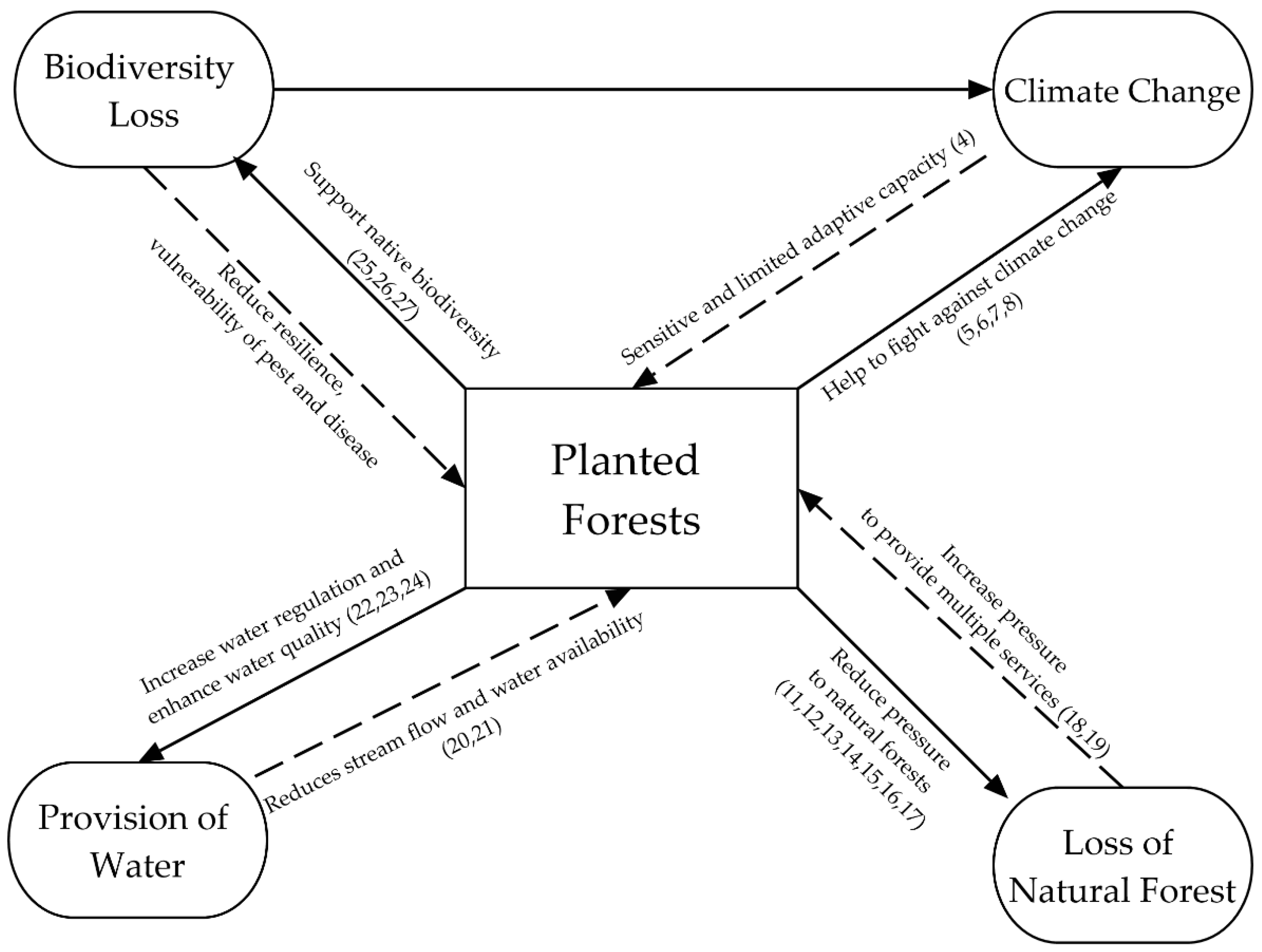

Table 1.
Average water use (mm year-1) by mean annual rainfall for various land uses in southeastern Australia (from Benyon et al. [121,122]).
| Land use/ potential ground water recharge | Mean annual rainfall (mm year-1) | ||
|---|---|---|---|
| 500 | 700 | 900 | |
| Forest generic average | 480 | 640 | 780 |
| Potential ground water recharge | 20 | 60 | 120 |
| Plantations (long rotations ~30yrs) e.g., Pinus radiata | 470 | 620 | 760 |
| Potential ground water recharge | 30 | 80 | 140 |
| Plantations (short rotations ~12yrs) e.g., Eucalyptus globulus | 460 | 610 | 740 |
| Potential ground water recharge | 40 | 90 | 160 |
| Mixed species environmental planting | 460 | 605 | n/a |
| Potential ground water recharge | 40 | 95 | n/a |
| Crop/pasture | 410 | 520 | 600 |
| Potential ground water recharge | 90 | 180 | 300 |
Disclaimer/Publisher’s Note: The statements, opinions and data contained in all publications are solely those of the individual author(s) and contributor(s) and not of MDPI and/or the editor(s). MDPI and/or the editor(s) disclaim responsibility for any injury to people or property resulting from any ideas, methods, instructions or products referred to in the content. |
© 2026 by the authors. Licensee MDPI, Basel, Switzerland. This article is an open access article distributed under the terms and conditions of the Creative Commons Attribution (CC BY) license.
Copyright: This open access article is published under a Creative Commons CC BY 4.0 license, which permit the free download, distribution, and reuse, provided that the author and preprint are cited in any reuse.


