
Submitted:
13 April 2026
Posted:
15 April 2026
You are already at the latest version
Abstract
Atmospheric microplastics are increasingly recognized as emerging contaminants in urban air, yet evidence from Philippine cities outside Metro Manila remains scarce. This study investigated polymer-confirmed suspended airborne microplastics across four urban roadside environments in Cagayan de Oro City, in southern Philippines: C.M. Recto Avenue, J.R. Borja Street, Gaabucayan Street, and Nazareth Street. Atmospheric particles were collected from 12 roadside stations, or three from each site, using a respirable dust sampler during a standardized mid-day sampling period, then subjected to alkaline digestion, microscopic examination, and ATR-FTIR confirmation. Of 99 suspected particles, 44 were verified as synthetic polymers and included in the final analysis. Mean atmospheric microplastic concentrations ranged from 0.0079 to 0.0212 items m⁻³, with J.R. Borja Street showing the highest concentration and Nazareth Street the lowest. Abundance did not differ significantly among roads, whereas particle shape, color, and polymer composition varied significantly, while size-class distribution did not. Fibers were the dominant morphology (56.8%), transparent particles were the most common color class (52.3%), and polypropylene and polyethylene terephthalate were the predominant polymers. These findings confirm the presence of atmospheric microplastics across roadside environments in Cagayan de Oro City and indicate that spatial variation is more evident in particle characteristics than in overall abundance.
Keywords:
atmospheric microplastics
; urban air
; roadside monitoring
; polymer characterization
; coastal city
; baseline assessment
1. Introduction
Plastic pollution has become a persistent global environmental concern due to the continuous growth in plastic production and the durability of plastic materials in natural systems [1,2]. Through physical, chemical, and biological weathering, larger plastic debris progressively breaks down into microplastics (MPs), commonly defined as plastic particles smaller than 5 mm [3,4,5].Although early microplastic research focused primarily on marine systems, MPs are now recognized as widespread contaminants occurring across aquatic, terrestrial, and atmospheric environments [6,7].
In recent years, the atmosphere has gained increasing attention as an important environmental compartment for microplastic occurrence and transport. Atmospheric microplastics have been reported in ambient air from urban and industrial settings, where they may occur as suspended particles and be redistributed over varying spatial scales [8,9,11,12]. Studies suggest that airborne MPs may originate from multiple anthropogenic sources, including fragmentation of plastic litter, synthetic textiles, urban material weathering, vehicular activity, and the resuspension of road dust [13,14,15]. Among urban settings, roadside environments are especially relevant because they represent areas where traffic-related disturbance, deposited dust, and human activity may favor the accumulation and suspension of microplastic particles.
In the Philippines, microplastic pollution is increasingly recognized as a cross-compartment environmental issue. Recent studies have documented MPs in lakes, rivers, coastal sediments, and sandy beaches, indicating that plastic contamination is already widespread in the country [16,17]. In Northern Mindanao, microplastic contamination has been reported in coastal sediments along Macajalar Bay [18] and in the Cagayan de Oro River, where MPs were detected in both surface waters and sediments [19,20]. Local coastal investigations have likewise documented mesoplastic contamination on the sandy beaches of Cagayan de Oro City, particularly in areas with greater public access and human activity [17]. In nearby Iligan City, MPs have also been identified in urban road dust and in atmospheric samples collected across different elevational and roadside environments, further suggests that urban landscapes in Northern Mindanao may function as reservoirs and pathways of plastic particles in both terrestrial and atmospheric settings [21,22].
Despite this growing body of evidence, information on suspended airborne microplastics in roadside environments remains limited in the Philippines, particularly in rapidly urbanizing cities outside the National Capital Region. Although atmospheric MPs have already been documented in highly urbanized areas such as Metro Manila [11,12], comparable data in other cities outside of the country’s capital remain lacking. This study, therefore, aimed to assess suspended airborne microplastics across urban roadside environments in Cagayan de Oro City, Philippines, by quantifying their abundance and characterizing their shape, color, size class, diversity, and polymer composition. In doing so, the study contributes new evidence on the occurrence of atmospheric microplastics in a rapidly developing tropical urban setting and helps address the existing geographic gap in Philippine atmospheric microplastic research.
2. Materials and Methods
2.1. Study Area and Sampling Stations
This study was conducted in Cagayan de Oro City, Northern Mindanao, Philippines, a rapidly urbanizing coastal city located along Macajalar Bay. Four urban roadside environments were selected for the baseline assessment of suspended airborne microplastics (AMPs): C.M. Recto Avenue, J.R. Borja St., Gaabucayan St., and Nazareth St. (Figure 1; Table 1). C.M. Recto Avenue is a primary urban corridor, whereas J.R. Borja St., Gaabucayan, and Nazareth St. are secondary roads representing mixed commercial–residential and residential roadside settings. These roads were selected to represent contrasting roadside urban environments within the city.
A total of 12 sampling stations were established, with three stations per road. Stations were distributed along adjacent or sequential road segments to capture spatial variability within each roadside environment. Sampling points were positioned near pedestrian corridors, approximately 1 m from the roadside edge and 1.5 m above ground level, corresponding to the approximate human breathing zone.
2.2. Field Sampling of Suspended Airborne Microplastics
Field sampling was conducted from 2 to 13 December 2025 during the dry season. Sampling focused on the midday period (1100–1400 H) to provide a standardized three-hour collection window across all sites. Each of the 12 stations was sampled once, yielding a total of 12 field samples. Atmospheric particles were collected using an Environtech respirable dust sampler fitted with a pre-cleaned Whatman GF/A gas- and liquid-permeable filter paper (200 × 285 mm; 1.6 µm pore size). The field sampling configuration, including roadside deployment, sampling height, and air-volume-based concentration approach, was adapted from previous atmospheric microplastic studies conducted in the Philippines, with minor modifications [26]; [4]). The sampler was operated at a flow rate of 1.4 m³ min⁻¹, and the total sampled air volume was calculated as the product of the flow rate and the sampling duration. Under these conditions, each three-hour sampling event represented a total air volume of 252 m³.
The concentration of AMPs was calculated as:
where C is the concentration of atmospheric microplastics (items m⁻³), N is the number of polymer-confirmed particles, and V is the total sampled air volume (m⁻³).
2.3. Laboratory Processing and Microscopic Characterization
All 12 field filters were processed using an established procedure [11,22]. Briefly, each Whatman GF/A sampling filter was carefully cut into smaller pieces and subjected to alkaline digestion using 250 mL of 10% KOH in covered glass beakers. Digestion was conducted at 40 °C for 48 h, following a modified procedure adapted from earlier atmospheric microplastic studies [11,22]. Beakers were covered with aluminum foil during digestion to minimize contamination.
After digestion, each sample was stirred at 700 rpm for 10 min using a magnetic stirrer to facilitate particle suspension and separation from the filter matrix. The resulting supernatant was then vacuum-filtered through Whatman GF/C glass fiber filters (1.2 µm pore size; 60 mm diameter) using a Büchner funnel setup. The filters were dried at room temperature for approximately 4 h, transferred to clean glass Petri dishes, and stored in a desiccator until analysis. Thus, two different filter media were used in the study: Whatman GF/A filters for field air sampling and Whatman GF/C filters for post-digestion laboratory filtration.
Visual examination of the dried filters was performed using an XSZ-107B/107BN binocular microscope. Suspected microplastic particles were identified based on their visual appearance and manually isolated using stainless-steel tweezers. Representative particles were digitally imaged. Only particles showing clear synthetic-like morphology were selected for polymer confirmation. Particle size was measured using the maximum visible dimension (longest length), and only particles within the microplastic size range of ≤5 mm was retained in the dataset.
Polymer-confirmed particles were classified according to shape, color, and size class. Final shape categories used in this study were fiber, fragment, and film. Color categories used for statistical analysis were transparent, blue, black, yellow, and red, with low-frequency colors consolidated as follows: brown was grouped with yellow, and orange was grouped with red. Particle size was grouped into five classes: <500 µm, 500–1000 µm, 1000–2000 µm, 2000–3000 µm, and 3000–5000 µm.
2.4. Polymer Confirmation by ATR-FTIR
All isolated suspected microplastic particles (n=99) were subjected to polymer confirmation using attenuated total reflectance Fourier transform infrared spectroscopy (ATR-FTIR) with a PerkinElmer FTIR spectrometer operated using Spectrum IR software (Version 10.7.2; PerkinElmer Inc., USA). Spectra were recorded in the mid-infrared region of 4000–400 cm⁻¹ and interpreted as % transmittance (%T) versus wavenumber (cm⁻¹) spectra. The obtained spectra were compared with the PerkinElmer spectral reference library for polymer identification. Polymer types were assigned based on spectral similarity using a minimum library match threshold of 85%. Only polymer-confirmed particles were retained in the final dataset. Of the 99 suspected particles analyzed, 44 particles were confirmed as synthetic polymers and included in all subsequent analyses.
2.5. Quality Assurance and Quality Control
Quality assurance and quality control measures were implemented during both field sampling and laboratory analysis to minimize contamination, following procedures adapted from previous atmospheric microplastic studies [11,22]). Prior to field deployment, each sampling filter was examined microscopically to confirm the absence of particles, then wrapped in aluminum foil and sealed until use. After sampling, filters were re-covered and transported to the laboratory in sealed containers. During field and laboratory work, researchers wore cotton clothing and non-powdered gloves to reduce contamination from synthetic fibers.
Laboratory procedures were conducted on clean working surfaces covered with aluminum foil. All glassware and filtration equipment were thoroughly rinsed with ultrapure water prior to use. To assess possible contamination, 12 field blanks and 12 laboratory blanks were processed using the same handling, digestion, filtration, and microscopic procedures as the environmental samples. No particles were detected in either field or laboratory blank samples, indicating negligible contamination during sampling and analysis.
2.6. Statistical Analysis
Data were analyzed using Microsoft Excel and Origin software. Descriptive statistics (mean ± standard deviation) were used to summarize the abundance and characteristics of polymer-confirmed atmospheric microplastics. Differences in atmospheric microplastic abundance across roadside environments were evaluated using the Kruskal–Wallis test because the data were non-normally distributed.
Differences in the distribution of microplastic characteristics (shape, color, size class, and polymer type) among roads were assessed using the Fisher–Freeman–Halton exact test. This test was selected because the data consisted of categorical variables arranged in multi-category contingency tables (road × particle characteristics) with several cells containing low frequencies or zero counts due to the limited number of polymer-confirmed particles (n = 44). Under such conditions, the assumptions of the chi-square test are violated, particularly the requirement for expected frequencies ≥ 5. The Fisher–Freeman–Halton test provides exact probability estimates for sparse r × c contingency tables and is therefore appropriate for small categorical environmental datasets. Similar exact-test approaches have also been used in ecological and environmental studies and appropriate for sparse categorical datasets [30,34]. Statistical significance was set at p < 0.05.
To describe compositional heterogeneity among roadside environments, diversity indices were calculated for microplastic shape (DMPSH), color (DMPC), and size class (DMPS) using Simpson-based diversity:
where is the proportion of particles in category i. An integrated microplastic diversity index (MPDII) was then calculated as:
These diversity indices were used for descriptive comparison only and were not subjected to inferential statistical testing.
3. Results
3.1. Atmospheric Microplastic Abundance Across Roadside Environments
Of the 99 suspected particles isolated from the 12 roadside samples, 44 were confirmed as synthetic polymers by ATR-FTIR and retained for subsequent analyses. Representative stereomicroscopic images of the confirmed atmospheric microplastics are shown in Figure 2. The confirmed particles comprised three morphological classes, namely fibers, fragments, and film, reflecting variation in particle color, form, and measured size.
Polymer-confirmed atmospheric microplastics were detected across all four roadside environments in Cagayan de Oro City, namely C.M. Recto Avenue, J.R. Borja St., Gaabucayan St., and Nazareth St.
J.R. Borja St. exhibited the highest mean atmospheric microplastic concentration (0.0212 ± 0.0115 items m⁻³), followed by C.M. Recto Avenue (0.0198 ± 0.0040 items m⁻³), Gaabucayan st. (0.0093 ± 0.0061 items m⁻³), and Nazareth St. (0.0079 ± 0.0000 items m⁻³) (Figure 3). Across all roadside environments, the overall concentration based on the total sampled air volume was 0.0146 ± 0.0085 items m⁻³. Although numerical differences were observed among roads, the Kruskal–Wallis test indicated that atmospheric microplastic abundance did not differ significantly among roadside environments (H = 5.8472, p = 0.1193). A summary of the statistical analyses is provided in Table 2.
3.2. Characteristics of Atmospheric Microplastics Across Roadside Environments
3.2.1. Shape Distribution
The shape composition of polymer-confirmed atmospheric microplastics varied among roadside environments (Figure 4A). At C.M. Recto Avenue, films were the dominant morphology, accounting for 53.3% of particles, followed by fibers (40.0%) and fragments (6.7%). At J.R. Borja St., fragments were the most abundant morphology (50.0%), followed by fibers (37.5%) and films (12.5%). In contrast, both Gaabucayan St. and Nazareth St. were composed entirely of fibers (100%).
When all roads were combined, fibers represented the dominant morphology overall (56.8%), followed by films (22.7%) and fragments (20.5%). The Fisher–Freeman–Halton exact test indicated that shape distribution differed significantly among roadside environments (p = 0.0003).
3.2.2. Color Distribution
The color composition of atmospheric microplastics also varied among roads (Figure 4B). Transparent particles were the dominant color class at C.M. Recto Avenue (60.0%), Gaabucayan st. (100%), and Nazareth St. (83.3%). In contrast, J.R. Borja St. showed a more heterogeneous color profile, dominated by blue particles (43.8%), followed by black particles (31.3%), with transparent and red particles each accounting for 12.5%. At C.M. Recto Avenue, blue, black, and yellow particles each contributed 13.3%, whereas at Nazareth st., only transparent and yellow particles were recorded.
Across the full dataset, transparent particles were the most abundant color class (52.3%), followed by blue (20.5%), black (15.9%), yellow (6.8%), and red (4.5%). Color distribution differed significantly among roadside environments according to the Fisher–Freeman–Halton exact test (p = 0.0012).
3.2.3. Size Distribution
Polymer-confirmed atmospheric microplastics ranged from 0.2 to 4.9 mm in maximum dimension and were distributed across five size classes (Figure 4C). On C.M. Recto Avenue, the 2000–3000 µm class was most abundant (33.3%), followed by the 3000–5000 µm class (26.7%); the remaining three size classes each accounted for 13.3%. At J.R. Borja St., the 2000–3000 µm class also dominated (31.3%), followed by the 3000–5000 µm class (25.0%), while the 500–1000 µm and 1000–2000 µm classes each represented 18.8%. At Gaabucayan st., particles were concentrated in the 2000–3000 µm (57.1%) and 3000–5000 µm (28.6%) classes. A similar pattern was observed at Nazareth st. where 2000–3000 µm particles comprised 66.7%, followed by 1000–2000 µm and 3000–5000 µm at 16.7% each.
Overall, particles larger than 2000 µm dominated the dataset, accounting for 65.9% of all confirmed particles. However, the Fisher–Freeman–Halton exact test indicated that size-class distribution did not differ significantly among roadside environments (p = 0.9761).
3.2.4. Diversity of Atmospheric Microplastics Across Roadside Environments
Diversity indices for shape, color, and size varied among the four roadside environments (Figure 4D). J.R. Borja St. showed the highest integrated diversity, with DMPSH = 0.594, DMPC = 0.680, DMPS = 0.766, and MPDII = 0.676. C.M. Recto Avenue followed, with DMPSH = 0.551, DMPC = 0.587, DMPS = 0.764, and MPDII = 0.628. In contrast, Gaabucayan St. showed DMPSH = 0, DMPC = 0, DMPS = 0.571, and MPDII = 0, while Nazareth st. recorded DMPSH = 0, DMPC = 0.278, DMPS = 0.500, and MPDII = 0.
These values indicate that J.R. Borja St. supported the most compositionally heterogeneous atmospheric microplastic assemblage, followed by C.M. Recto Avenue, whereas Gaabucayan St. and Nazareth St. were characterized by simpler particle profiles dominated by a narrower range of characteristics.
3.3. Polymer Composition Identified by ATR-FTIR
Polymer composition differed among roadside environments (Figure 5). Overall, polypropylene (PP) was the dominant polymer, accounting for 52.3% of all confirmed particles, followed by polyethylene terephthalate (PET; 38.6%), polyurethane (PU; 4.5%), polystyrene (PS; 2.3%), and polyvinyl chloride (PVC; 2.3%).
At C.M. Recto Avenue, confirmed particles were composed of PP (60.0%) and PET (40.0%). At J.R. Borja St., PET was the dominant polymer (62.5%), followed by PP (12.5%), PU (12.5%), PS (6.3%), and PVC (6.3%), making it the most polymerically diverse roadside environment. At Gaabucayan st, the assemblage was dominated by PP (85.7%), with PET (14.3%) as a minor component. Nazareth St. was composed entirely of PP (100%). Polymer composition differed significantly among roads based on the Fisher–Freeman–Halton exact test (p = 0.0022).
4. Discussion
The present findings are contextualized using Table 3, which compares selected international and Philippine studies on atmospheric microplastics in terms of dominant particle shape, polymer type, and abundance. Atmospheric microplastics reported from urban environments are commonly dominated by fibers and by polymers such as PP, PE, PET, and polyester, although clear site-specific differences remain across cities and sampling designs [9,11,12,22,25,26]. In the present study, Cagayan de Oro City likewise showed fiber dominance, but with PP as the dominant polymer and a relatively low suspended concentration. This pattern suggests that while atmospheric microplastic occurrence is already evident across urban settings, local roadside conditions may influence polymer composition and particle characteristics at the city scale [11,12,22].
The present findings are consistent with earlier Philippine studies showing that airborne microplastics are detectable in urban air. In Metro Manila, [11] documented suspended atmospheric microplastics, while [12] later showed that airborne microplastic occurrence in the same metropolis varies with diurnal and seasonal conditions. In Iligan City, [22] likewise confirmed the presence of atmospheric microplastics in both roadside and non-roadside settings. Taken together, these studies suggest that atmospheric microplastic occurrence is not limited to the largest metropolitan centers but is becoming a recurring feature of urban air environments in the Philippines.
At the same time, the clearest contribution of the present study is not simply the detection of atmospheric microplastics, but the observation that composition varied more strongly than abundance. Although mean concentrations differed numerically among roads, abundance did not vary significantly, whereas shape, color, and polymer composition did. This suggests that the four roadside environments in Cagayan de Oro were more strongly differentiated by particle type than by the total number of particles detected. That interpretation is consistent with the broader atmospheric microplastic literature, which emphasizes that urban datasets often show strong site-level heterogeneity linked to local environmental context, surrounding activities, and sampling design, even when count-based differences are not statistically well separated. In that sense, the present study supports the view that roadside monitoring should not rely on abundance alone, because morphology, color, and polymer composition can reveal differences that concentration estimates by themselves may not capture [24].
The overall dominance of fibers in the Cagayan de Oro dataset places the study within a broader atmospheric pattern already reported in Philippine and international work. Fiber dominance was also observed in Iligan City [22], and reviews and recent city-based studies likewise identify fibers as one of the most frequent forms of atmospheric microplastics [28,32,33]. However, the internal road-level pattern in the present study was not uniform. C.M. Recto Avenue showed a stronger contribution of films, J.R. Borja St. had a higher fragment contribution, and Gaabucayan St. and Nazareth St. were entirely fiber-dominated. This internal contrast is important because it shows that even when a city follows the broader atmospheric tendency toward fiber-rich assemblages, individual roadside environments can still differ substantially in their morphology profile. Thus, the significance of the shape results in the present study is not only statistical; it also indicates that local road environments within a single city may structure airborne particle assemblages differently.
A similar pattern is evident in color composition. Transparent particles dominated most roads in Cagayan de Oro, whereas J.R. Borja St. showed a broader, more mixed profile with strong blue and black contributions. This partly overlaps with previous atmospheric studies in which transparent, black, and blue particles were frequently observed, including the more visually mixed outdoor atmospheric datasets summarized by [24], the urban–rural–forest deposition study of [27], and the Metro Manila atmospheric work of [12], where particle color heterogeneity was also evident. The implication is not that these colors identify specific sources, but that Cagayan de Oro fits into a broader atmospheric pattern in which urban air often contains a visually mixed set of particle classes, whose proportions vary from place to place. In the present study, the stronger color heterogeneity at J.R. Borja St. reinforces the view that some roadside environments may receive a more compositionally mixed set of local urban inputs than others.
By contrast, size structure was comparatively consistent across the four roads. Most confirmed particles belonged to the 2000–3000 µm and 3000–5000 µm classes, and the size-class distribution did not differ significantly among roadside environments. This should be interpreted cautiously. It does not imply that finer airborne microplastics were absent from Cagayan de Oro, but rather that the confirmed particles recovered under the present active roadside sampling and analytical workflow were largely in the coarser fraction. This interpretation is compatible with broader atmospheric reviews and roadside-focused studies, noting that active sampling and confirmation procedures often yield datasets weighted toward larger, more easily identified particles, and that roads can serve as dynamic interfaces where deposited particles remain available for local suspension or redeposition [24]; [13]; [29]. Within that context, the non-significant size result may indicate that the four roads shared a broadly similar coarse-particle atmospheric pool even though their morphology and color signatures differed.
The polymer data provide one of the clearest points of comparison with previous Philippine atmospheric studies. In Cagayan de Oro, PP and PET were the dominant polymers overall, though their distribution varied widely across roads. This partly overlaps with the Metro Manila study of [12] which identified PET and polyester as dominant airborne polymers, and with [22], who identified PP, PET, and PVC among atmospheric particles in Iligan City. The strongest similarity, therefore, is not that all Philippine cities show the same polymer hierarchy, but that PET repeatedly appears as an important airborne polymer, while PP also emerges as a major component in road-influenced environments. The main contrast is that the Cagayan de Oro roadside dataset appears more PP-rich, particularly at Gaabucayan St. and Nazareth St., whereas the Metro Manila pattern reported by [12] was more strongly PET/polyester-heavy. This contrast is meaningful because it suggests that Philippine urban air does not exhibit a single fixed polymer profile; rather, polymer composition may shift with local roadside context, surrounding material use, and sampling design. The broad polymer range observed at J.R. Borja St. is especially important in this regard, because it indicates a more compositionally mixed roadside assemblage than the more restricted PP-dominated pattern observed at the other roads.
The broader environmental significance of this baseline study is strengthened when atmospheric microplastics are considered in the broader context of urban particulate pollution in the Philippines. [23] showed that suspended urban particulates in Metro Manila may already contain contaminants such as mercury, while lead was reduced to trace levels, indicating that the urban particulate matrix is itself an important pollution concern. Although the present study did not assess heavy metals in Cagayan de Oro, it does show that polymer-confirmed atmospheric microplastics are present within that same broader category of suspended urban particulates. In this sense, atmospheric microplastics may be understood not as an isolated pollutant but as an additional component of an already complex particulate burden in Philippine cities. This interpretation is further supported by [22], who reported surface-adsorbed heavy metals on atmospheric microplastics in Iligan City. At the same time, this point must remain carefully framed: the present study does not demonstrate that the atmospheric microplastics in Cagayan de Oro carried mercury or lead. Rather, it strengthens the case for viewing roadside urban air as a multi-contaminant environment that warrants more integrated monitoring in future work.
This perspective also has a public-health and management dimension. [11] showed that Metro Manila residents generally perceived air pollution as extensive to very extensive, but also reported substantial gaps in awareness of air-quality laws, standards, and government programs. Although that study did not specifically examine microplastics, it underscores an important point for the present work: urban air pollution problems are not only analytical and environmental issues but also matters of public understanding and policy communication. Establishing baseline AMP data for Cagayan de Oro, therefore, has value beyond simple occurrence reporting because it provides locally relevant evidence that can eventually support more informed discussions of urban air quality, particulate pollution, and environmental health in secondary Philippine cities.
Overall, this study contributes the first roadside atmospheric microplastic baseline for Cagayan de Oro City and shows that local roads may contain broadly comparable AMP levels while differing substantially in particle composition. That is the clearest pattern emerging from comparison with previous Philippine work: Cagayan de Oro follows the broader national pattern in confirming atmospheric microplastic occurrence, in showing that fibers remain important, and in identifying PET as a recurring airborne polymer, but it also differs by displaying a more pronounced PP-rich roadside signature and strong road-level heterogeneity in morphology, color, and polymer composition. These contrasts strengthen the value of the study as baseline work. They show that atmospheric microplastic occurrence in the Philippines is not only widespread but also locally differentiated, and that secondary cities such as Cagayan de Oro are important for building a more complete national picture of airborne microplastic pollution. Future studies should therefore expand temporal coverage, include repeated roadside and non-roadside comparisons, and examine whether atmospheric microplastics in Cagayan de Oro co-occur with other particulate contaminants in ways similar to those now being reported from Iligan and Metro Manila.
5. Conclusions and Future Perspectives
This study provides baseline evidence of polymer-confirmed atmospheric microplastics across four urban roadside environments in Cagayan de Oro City, Philippines. Confirmed particles were detected at all sampled roads, and although J.R. Borja St. and C.M. Recto Avenue exhibited higher mean concentrations than Gaabucayan St. and Nazareth St., atmospheric microplastic abundance did not differ significantly among roadside environments
In contrast, particle characteristics showed clear spatial variation. Shape (p = 0.0003), color (p = 0.0012), and polymer composition (p = 0.0022) differed significantly among roads, whereas size-class distribution did not (p = 0.9761). Fibers were the dominant morphology overall, transparent particles were the most abundant color class, and coarse particles in the 2000–5000 µm range comprised most of the confirmed dataset. PP and PET were the dominant polymers, although J.R. Borja St. displayed the broadest polymer profile among the four roads. Taken together, these findings indicate that roadside environments in Cagayan de Oro City may contain broadly comparable levels of atmospheric microplastics while differing in particle composition. The study, therefore, contributes initial baseline data for a rapidly urbanizing secondary city in the Philippines and helps address the geographic gap in local atmospheric microplastic research. Although our study was based on a relatively small number of polymer-confirmed particles collected during a single sampling period, it establishes an initial dataset for roadside atmospheric microplastics in Cagayan de Oro City and adds evidence from a secondary Philippine city where such information has previously been lacking. The combination of abundance data, particle characterization, diversity indices, and ATR-FTIR confirmation provides a foundation for future atmospheric microplastic monitoring in the region.
Future work should incorporate repeated temporal sampling, expanded roadside coverage, and broader urban comparisons to refine the understanding of atmospheric microplastic occurrence in Philippine urban environments. Studies designed to directly identify or quantify specific source pathways are recommended. Second, sampling was restricted to midday roadside environments, so the dataset does not capture diurnal variability. Third, although the particle profiles suggest differences among roads, the study was limited by a relatively small sample size and single sampling period. These limitations do not reduce the value of the present dataset as baseline evidence, but they do indicate that future work.
Author Contributions
AMP: Conceptualization, formal analysis, investigation, data curation, writing-original draft, CPA: conceptualization, writing-review and editing, CJMP: formal analysis, data curation, MFC: formal analysis, data curation, HPB: conceptualization, supervision, writing-review and editing RAR: conceptualization, supervision, writing-review and editing. All authors have read and agreed to the published version of the manuscript.
Data Availability Statement
The authors confirm that the data supporting the findings of this study, including microplastic abundance measurements, morphological data, and polymer identification results derived from Fourier-transform infrared spectroscopy (FTIR), and associated environmental parameters. Sampling metadata, and detailed analytical outputs are available from the corresponding author upon reasonable request.
Acknowledgments
AMP would like to thank the Department of Science and Technology-Science Education Institute (DOST-SEI) for the scholarship under the Accelerated Science and Technology Human Resource Development Program (ASTHRDP). HPB acknowledges the funding from the DOST-National Academy of Science and Technology through the Road Dust and Particulate Matter in the Philippines: Associated Microplastics, Pollutants, Bacteria, and Health Risk (RoDPaM-PH) project.
Conflicts of Interest
The authors declare that there are no conflicts of interest in this work.
References
- Geyer, R.; Jambeck, J.R.; Law, K.L. Production, use, and fate of all plastics ever made. Sci. Adv. 2017, 3, e1700782. [Google Scholar] [CrossRef] [PubMed]
- Rana, M.S.; Paul, S.K.; Sultana, S.; Hossain, M.K.; Albeshr, M.F.; Yu, J.; Arai, T.; Ngah, N.; Hossain, M.B. Quantification, characterization and risk assessment of microplastics and mesoplastics in aquafarms of a leading fish-producing nation. J. Environ. Chem. Eng. 2025, 13, 117423. [Google Scholar] [CrossRef]
- Celmar, J.M.; Gabriel, A.D.; Hung, C.C.; Bacosa, H.P. Microplastic pollution on seagrass blades in two coastal bays in Northern Mindanao, Philippines. Reg. Stud. Mar. Sci. 2024, 77, 103636. [Google Scholar] [CrossRef]
- Jambeck, J.R.; Geyer, R.; Wilcox, C.; Siegler, T.R.; Perryman, M.; Andrady, A.; Narayan, R.; Law, K.L. Plastic waste inputs from land into the ocean. Science 2015, 347, 768–771. [Google Scholar] [CrossRef]
- Nakano, H.; Alfonso, M.B.; Phinchan, N.; Jandang, S.; Manap, M.R.A.; Chavanich, S.; Viyakarn, V.; Müller, M.; Wong, C.; Bacosa, H.P.; et al. Aquatic microplastics research in the ASEAN region: Analysis of challenges and priorities. Mar. Pollut. Bull. 2025, 210, 117342. [Google Scholar] [CrossRef]
- Ellos, D.M.C.; Chien, M.F.; Inoue, C.; Nakano, H.; Isobe, A.; Onda, D.F.L.; Watanabe, K.; Bacosa, H.P. Mesoplastics: A review of contamination status, analytical methods, pollution sources, potential risks, and future perspectives of an emerging global environmental pollutant. Toxics 2025, 13, 227. [Google Scholar] [CrossRef]
- Arcadio, C.G.L.A.; Maglupay, J.R.U.; Po, A.M.; Pardillo, J.J.B.; Bacosa, H.P. Microplastics as a modifier of polycyclic aromatic hydrocarbon (PAH) toxicity: A review on context-dependent effects across organisms. Biology 2026, 15, 455. [Google Scholar] [CrossRef]
- Allen, S.; Allen, D.; Phoenix, V.R.; Le Roux, G.; Durántez Jiménez, P.; Simonneau, A.; Binet, S.; Galop, D. Atmospheric transport and deposition of microplastics in a remote mountain catchment. Nat. Geosci. 2019, 12, 339–344. [Google Scholar] [CrossRef]
- Dris, R.; Gasperi, J.; Mirande, C.; Mandin, C.; Guerrouache, M.; Langlois, V.; Tassin, B. A first overview of textile fibers, including microplastics, in indoor and outdoor environments. Environ. Pollut. 2017, 221, 453–458. [Google Scholar] [CrossRef]
- Choi, H.; Lee, I.; Kim, H.; Park, J.; Cho, S.; Oh, S.; Lee, M.; Kim, H. Comparison of microplastic characteristics in the indoor and outdoor air of urban areas of South Korea. Water Air Soil Pollut. 2022, 233, 169. [Google Scholar] [CrossRef]
- Romarate, R.A., II; Ancla, S.M.B.; Patilan, D.M.M.; Inocente, S.A.T.; Pacilan, C.J.M.; Sinco, A.L.; Guihawan, J.Q.; Capangpangan, R.Y.; Lubguban, A.A.; Bacosa, H.P. Breathing plastics in Metro Manila, Philippines: Presence of suspended atmospheric microplastics in ambient air. Environ. Sci. Pollut. Res. 2023, 30, 53662–53673. [Google Scholar] [CrossRef]
- Romarate, R.A., II; Pacilan, C.J.M.; Shiu, R.F.; Sinco, A.L.; Torres, A.G.; Tampus, A.D.; Ochigue, P.C.D.; Rodil, M.S.P.; Bacosa, H.P. Microplastics in the air of Metro Manila, Philippines: Diurnal and seasonal dynamics and potential health risk. J. Hazard. Mater. 2025, 500, 140455. [Google Scholar] [CrossRef] [PubMed]
- Seo, J.H. Toward sustainable election campaigns: Addressing microplastic pollution from promotional materials. Sci. Prog. 2025, 108, 368504251397431. [Google Scholar] [CrossRef] [PubMed]
- Wu, W.; Geng, X.; Han, R.; Zhao, Y.; Wang, J. Characterization of airborne microplastics and health risks in high-temperature urban streets: A case study of Nanjing city. J. Hazard. Mater. 2025, 496, 139431. [Google Scholar] [CrossRef] [PubMed]
- Nafea, T.H.; Chan, F.K.S.; Xu, Y.; Wang, C.; Wang, X.; Zhao, W.; Ji, D.; Xiao, H.; He, J. Microplastics aloft: A comprehensive exploration of sources, transport, variations, interactions and their implications on human health in the atmospheric realm. Earth-Sci. Rev. 2024, 255, 104864. [Google Scholar] [CrossRef]
- Arcadio, C.G.L.A.; Navarro, C.K.P.; Similatan, K.M.; Inocente, S.A.T.; Ancla, S.M.B.; Banda, M.H.T.; Capangpangan, R.Y.; Torres, A.G.; Bacosa, H.P. Microplastics in surface water of Laguna de Bay: First documented evidence on the largest lake in the Philippines. Environ. Sci. Pollut. Res. 2023, 30, 29824–29833. [Google Scholar] [CrossRef]
- Perpetua, Z.D.; Albarico, F.P.J.B.; Capangpangan, R.Y.; Shiu, R.F.; Lim, Y.C.; Chen, C.W.; Dong, C.D.; Bacosa, H.P. Meso- and microplastics accumulation and ecological risks in Philippine urban and rural sandy beaches. Estuar. Coast. Shelf Sci. 2025, 323, 109414. [Google Scholar] [CrossRef]
- Esquinas, G.G.M.S.; Mantaring, J.B.C. Physical characterization of litter and microplastic along the urban coast of Cagayan de Oro in Macajalar Bay, Philippines. Mar. Pollut. Bull. 2020, 154, 111083. [Google Scholar] [CrossRef]
- Gabriel, A.D.; Amparado, R.F., Jr.; Lubguban, A.A.; Bacosa, H.P. Riverine microplastic pollution: Insights from Cagayan de Oro River, Philippines. Int. J. Environ. Res. Public Health 2023, 20, 6132. [Google Scholar] [CrossRef]
- Gabriel, A.D.; Bacosa, H.P. Microplastic abundance and distribution in the sediment of Cagayan de Oro River, Philippines. Soil Sediment Contam. 2024, 33, 1252–1268. [Google Scholar] [CrossRef]
- Tejano, J.B.B.; Araña, K.N.D.; Eleccion, E.B.; Laya-og, M.E.; Palasol, C.D.S.; Pimentel, C.S.; Dagoc, F.L.S.; Romarate, R.A., II; Bacosa, H.P. Microplastics in the road dust of Iligan City, the Philippines. Philipp. J. Sci. 2024, 153, 1751–1756. [Google Scholar] [CrossRef]
- Amer, N.B.; Ministerio, J.R.B.; Romarate, R.A., II; Chien, M.F.; Bacosa, H.P. Elevational variations in atmospheric microplastics and surface-adsorbed heavy metals in roadside and non-roadside areas in Iligan City, Philippines. Air Qual. Atmos. Health 2025, 18, 3947–3960. [Google Scholar] [CrossRef]
- Patilan, D.M.M.; Romarate, R.A., II; Bacosa, H.P. Preliminary study on mercury and lead in the ambient air of Metro Manila, the Philippines. Philipp. J. Sci. 2024, 153, 1073–1076. [Google Scholar] [CrossRef]
- Han, I.; Lee, C.; Belchez, C.; Shipper, A.G.; Wiens, K.E. Microplastics in urban ambient air: A rapid review of active sampling and analytical methods for human risk assessment. Environments 2024, 11, 256. [Google Scholar] [CrossRef]
- Liao, Z.; Ji, X.; Ma, Y.; Lv, B.; Huang, W.; Zhu, X.; Fang, M.; Wang, Q.; Wang, X.; Dahlgren, R.; et al. Airborne microplastics in indoor and outdoor environments of a coastal city in Eastern China. J. Hazard. Mater. 2021, 417, 126007. [Google Scholar] [CrossRef]
- Akhbarizadeh, R.; Dobaradaran, S.; Amouei Torkmahalleh, M.; Saeedi, R.; Aibaghi, R.; Faraji Ghasemi, F. Suspended fine particulate matter (PM2.5), microplastics (MPs), and polycyclic aromatic hydrocarbons (PAHs) in air: Their possible relationships and health implications. Environ. Res. 2021, 192, 110339. [Google Scholar] [CrossRef]
- Mutshekwa, T.; Mulaudzi, F.; Maiyana, V.P.; Mofu, L.; Munyai, L.F.; Murungweni, F.M. Atmospheric deposition of microplastics in urban, rural, forest environments: A case study of Thulamela Local Municipality. PLoS ONE 2025, 20, e0313840. [Google Scholar] [CrossRef]
- Ahmadi, P.; Doyle, D.; Mojarad, N.; Taherkhani, S.; Janzadeh, A.; Honardoost, M.; Gholami, M. Effects of micro- and nanoplastic exposure on macrophages: A review of molecular and cellular mechanisms. Toxicol. Mech. Methods 2025, 35, 823–846. [Google Scholar] [CrossRef]
- Lathifah, A.N.; Ham, Y.S.; Oyson, Z.K. Deposition of roadside atmospheric non-tire wear microplastics: Characteristics and influencing factors. Microplastics 2026, 5, 17. [Google Scholar] [CrossRef]
- Colvin, J.P.; Dann, P.; Hufschmid, J.; Shimeta, J.; Nugegoda, D. Alterations in characteristics of plastic ingestion and decreasing body condition in beachcast fledgling short-tailed shearwaters (Ardenna tenuirostris) at Phillip Island, Australia. Environ. Sci. Pollut. Res. 2025, 32, 15877–15895. [Google Scholar] [CrossRef]
- Romarate, R.A., II; Madarcos, J.R.V.; Pacilan, C.J.M.; Bacosa, H.P.; Torres, A.G. When air quality matters: Awareness, perception, and attitude of the residents in Metro Manila, Philippines. Environ. Dev. Sustain. 2024. [Google Scholar] [CrossRef]
- Arafat, M.Y.; Alam, M.S.; Saha, B.; Bashar, M.S.; Bhuiyan, M.N.H.; Moniruzzaman, M. Urban atmospheric microplastic distribution and potential health impact in Dhaka City, Bangladesh. J. Hazard. Mater. Plast. 2026, 2, 100029. [Google Scholar] [CrossRef]
- Hu, T.; Zhang, C.; Zhu, Y.; Duan, J.; Liu, S.; Jin, N.; Song, Y.; Wu, F.; Li, J.; Zhang, T.; et al. Abundance of microplastics and nanoplastics in urban atmosphere. Sci. Adv. 2026, 12, eadz7779. [Google Scholar] [CrossRef]
- Hryniewicz, O. Statistical and Possibilistic Methodology for the Evaluation of Classification Algorithms. In Software and Data Technologies; Communications in Computer and Information Science; Escalona, M.J., Cordeiro, J., Shishkov, B., Eds.; Springer: Berlin/Heidelberg, Germany, 2013; Vol. 303, pp. 255–269. [Google Scholar] [CrossRef]
Figure 1.
Map of Cagayan de Oro City showing the sampling sites in CM Recto Avenue. (CMR-1, CMR-2, CMR-3); J.R. Borja St. (JRB-1, JRB-2, JRB-3); Gaabucayan St. (GAA-1, GAA-2, GAA-3); and Nazareth St. (NAZ-1, NAZ-2, NAZ-3).
Figure 1.
Map of Cagayan de Oro City showing the sampling sites in CM Recto Avenue. (CMR-1, CMR-2, CMR-3); J.R. Borja St. (JRB-1, JRB-2, JRB-3); Gaabucayan St. (GAA-1, GAA-2, GAA-3); and Nazareth St. (NAZ-1, NAZ-2, NAZ-3).
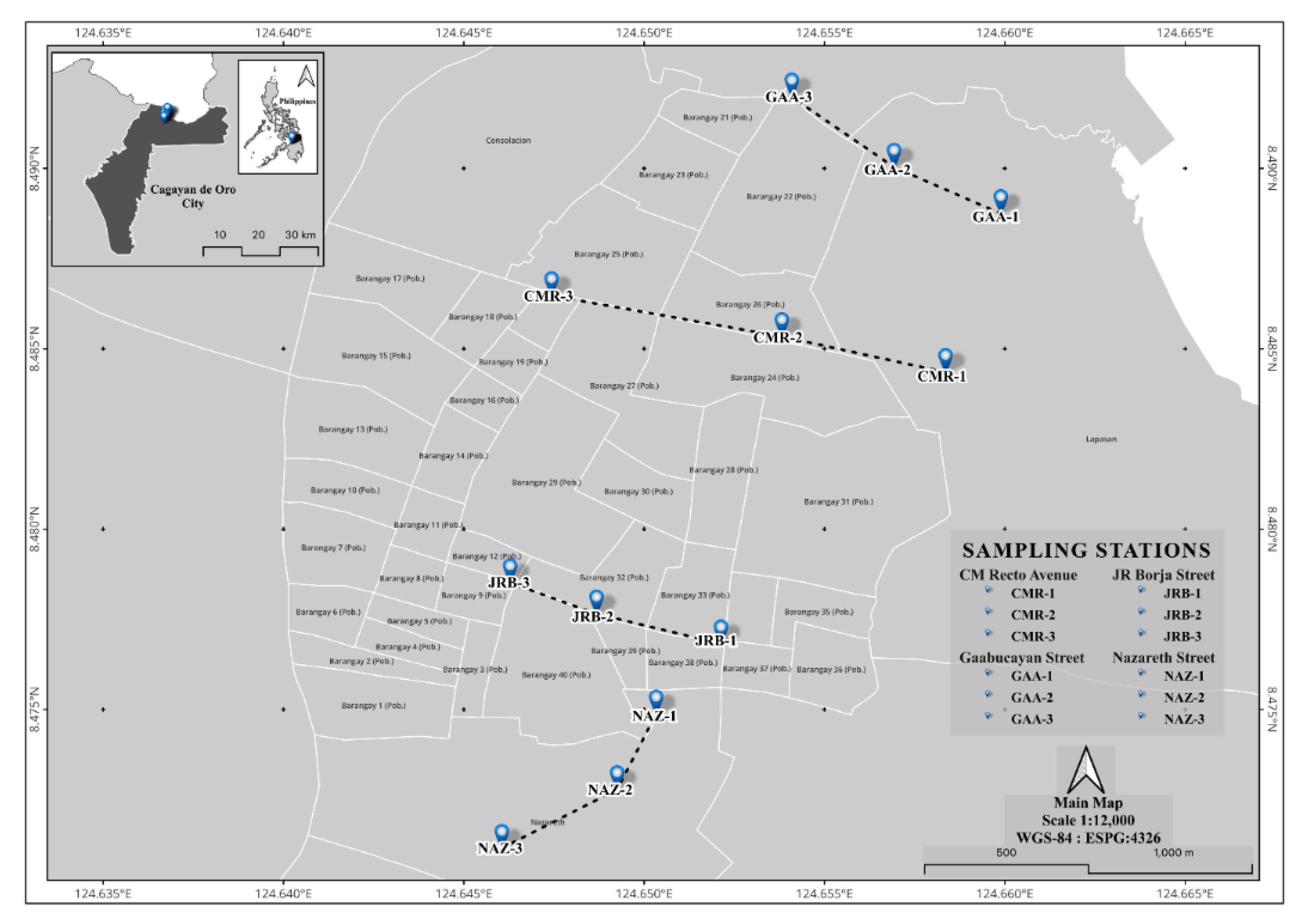
Figure 2.
Representative stereomicroscopic images of polymer-confirmed atmospheric microplastics collected from roadside environments in Cagayan de Oro City, Philippines, showing (A) fibers, (B) fragments, and (C) film.
Figure 2.
Representative stereomicroscopic images of polymer-confirmed atmospheric microplastics collected from roadside environments in Cagayan de Oro City, Philippines, showing (A) fibers, (B) fragments, and (C) film.
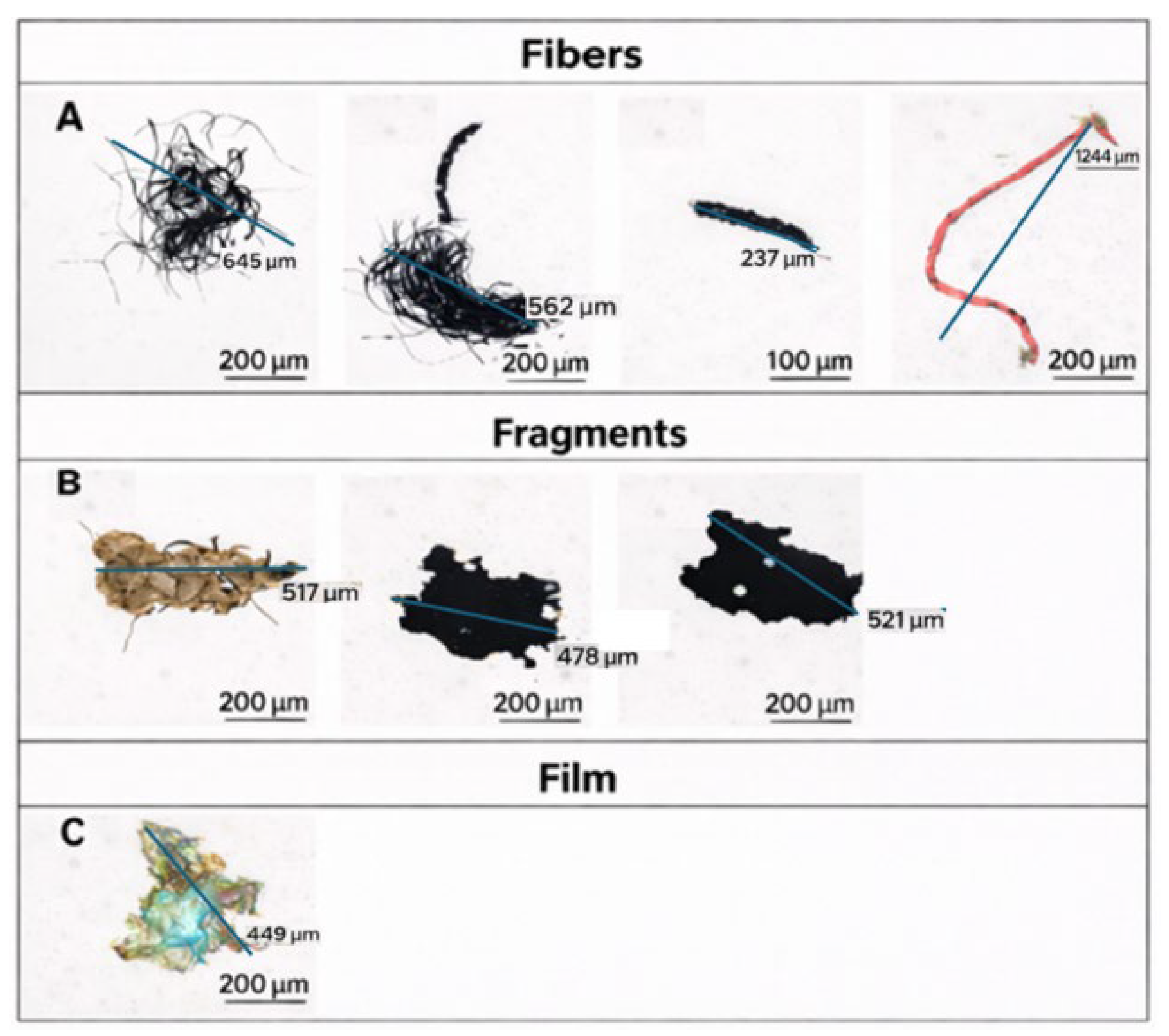
Figure 3.
Mean abundance of polymer-confirmed atmospheric microplastics across roadside environments in Cagayan de Oro City, Philippines. Error bars indicate the standard deviation of the three replicate sites.
Figure 3.
Mean abundance of polymer-confirmed atmospheric microplastics across roadside environments in Cagayan de Oro City, Philippines. Error bars indicate the standard deviation of the three replicate sites.
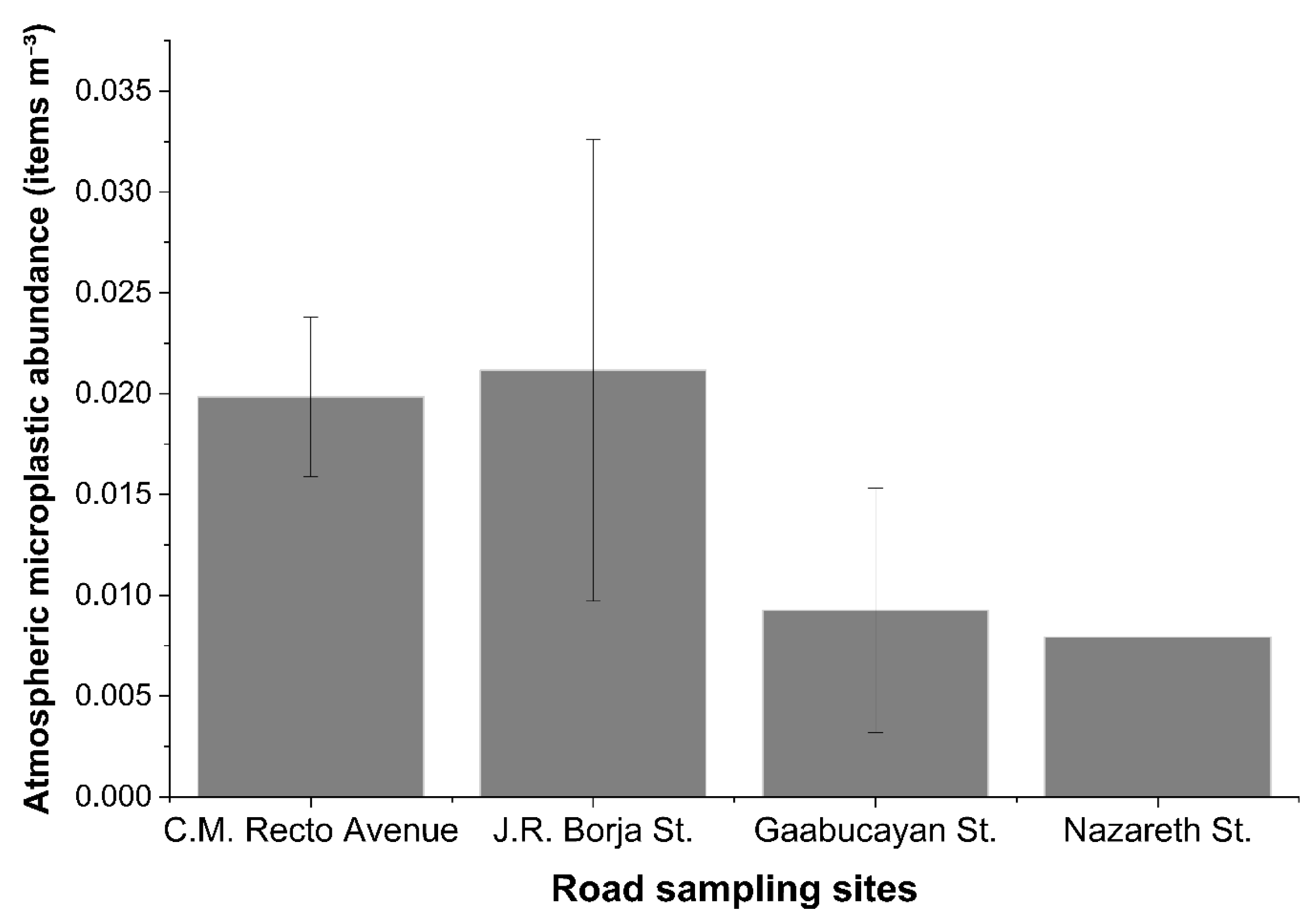
Figure 4.
Relative distribution of atmospheric microplastics by (A) shape, (B) color, and (C) size class, together with (D) diversity indices across the four roadside sampling environments in Cagayan de Oro City, Philippines.
Figure 4.
Relative distribution of atmospheric microplastics by (A) shape, (B) color, and (C) size class, together with (D) diversity indices across the four roadside sampling environments in Cagayan de Oro City, Philippines.
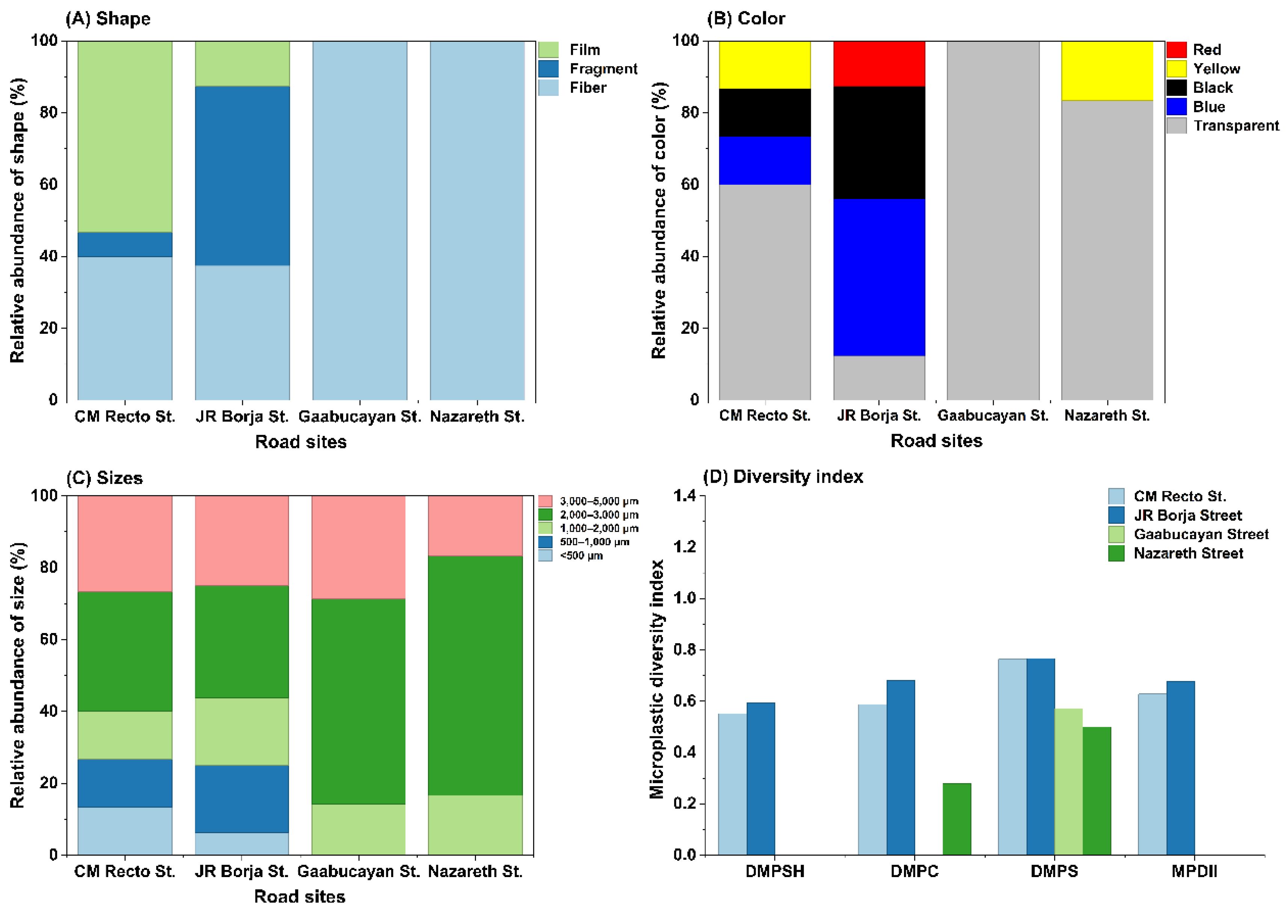
Figure 5.
Polymer composition of atmospheric microplastics identified by ATR-FTIR across roadside environments in Cagayan de Oro City, Philippines. Polymer abbreviations: PP, polypropylene; PET, polyethylene terephthalate; PU, polyurethane; PS, polystyrene; PVC, polyvinyl chloride.
Figure 5.
Polymer composition of atmospheric microplastics identified by ATR-FTIR across roadside environments in Cagayan de Oro City, Philippines. Polymer abbreviations: PP, polypropylene; PET, polyethylene terephthalate; PU, polyurethane; PS, polystyrene; PVC, polyvinyl chloride.
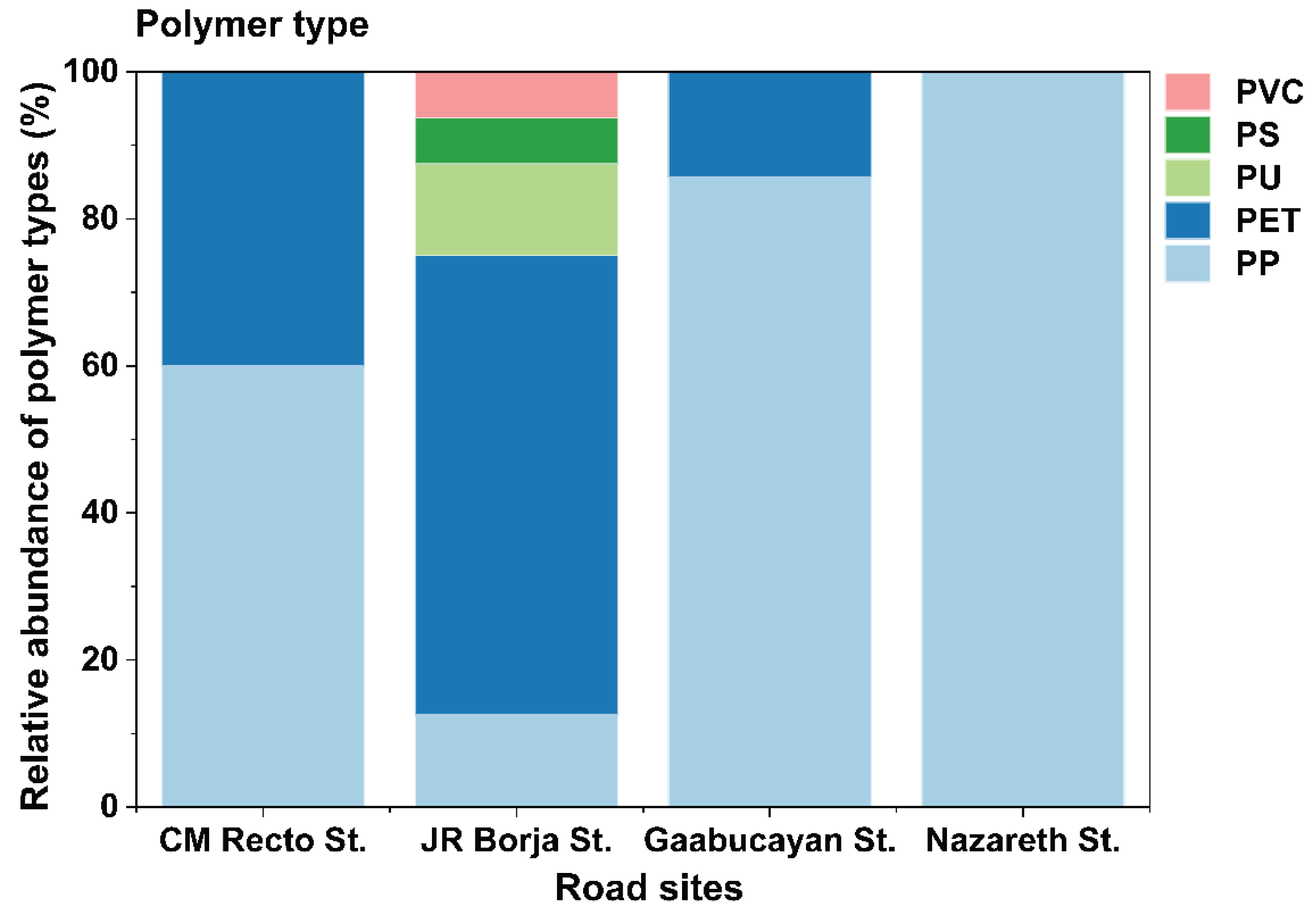

Table 1.
Geographic coordinates and urban characteristics of the sampling sites, and atmospheric microplastics sampled in Cagayan de Oro City, Philippines.
Table 1.
Geographic coordinates and urban characteristics of the sampling sites, and atmospheric microplastics sampled in Cagayan de Oro City, Philippines.
| Road Site | Stations | Latitude (°N) | Longitude (°E) | Road Classification | Urban Context | Confirmed Microplastics | Abundance (Items m⁻³) |
|---|---|---|---|---|---|---|---|
| CM Recto Avenue | CMR-1 | 8.48434 | 124.6584 | Primary road | High-traffic commercial corridor | 5 | 0.0198 |
| CMR-2 | 8.48534 | 124.6538 | Primary road | Commercial urban roadway | 4 | 0.0159 | |
| CMR-3 | 8.48647 | 124.6474 | Primary road | Mixed commercial–transport corridor | 6 | 0.0238 | |
| JR Borja Street | JRB-1 | 8.47682 | 124.6521 | Secondary road | Mixed commercial–residential area | 7 | 0.0278 |
| JRB-2 | 8.47765 | 124.6487 | Secondary road | Urban commercial street | 7 | 0.0278 | |
| JRB-3 | 8.47851 | 124.646 | Secondary road | Mixed urban land use | 2 | 0.0079 | |
| Gaabucayan Street | GAA – 1 | 8.48874 | 124.660 | Secondary road | Residential roadside area | 1 | 0.0040 |
| GAA – 2 | 8.49003 | 124.657 | Secondary road | Residential neighborhood | 4 | 0.0159 | |
| GAA – 3 | 8.49198 | 124.6541 | Secondary road | Low-density residential corridor | 2 | 0.0079 | |
| Nazareth Street | NAZ-1 | 8.47487 | 124.6503 | Secondary road | Urban residential district | 2 | 0.0079 |
| NAZ-2 | 8.47277 | 124.6492 | Secondary road | Residential neighborhood | 2 | 0.0079 | |
| NAZ-3 | 8.47115 | 124.6461 | Secondary road | Residential roadside corridor | 2 | 0.0079 |
Table 2.
Summary of statistical tests evaluating differences in atmospheric microplastic abundance and particle characteristics among roadside environments in Cagayan de Oro City.
Table 2.
Summary of statistical tests evaluating differences in atmospheric microplastic abundance and particle characteristics among roadside environments in Cagayan de Oro City.
| Variable | Test | Statistic | p-Value | Interpretation |
|---|---|---|---|---|
| Abundance among roads | Kruskal–Wallis | H = 5.8472 | 0.1193 | Not significant |
| Shape distribution among roads | FFHE | — | 0.0003 | Significant |
| Color distribution among roads | FFHE | — | 0.0012 | Significant |
| Size-class distribution among roads | FFHE | — | 0.9761 | Not significant |
| Polymer composition among roads | FFHE | — | 0.0022 | Significant |
Note:
FFHE Fisher–Freeman–Halton exact test.
Table 3.
Global studies of atmospheric microplastic and its dominant polymer types.
| Location | Sampling Approach | Dominant Shape | Dominant Polymer Type | Abundance | Reference |
|---|---|---|---|---|---|
| Paris, France | Active air pump | Fibers | (PP) | 0.3–1.5 items m⁻³ | [9] |
| Wenzhou, China | TSP sampler | Fragments | PE | 189 ± 85 items m⁻³ | [25] |
| Bushehr, Iran | PM₂.₅ high-volume sampler | Fragments (63%) | PET | 0–14.2 items m⁻³ | [26] |
| Seoul | Active air sampler | Fibers | PE | 1.96 ± 1.65 items m⁻³ | [10] |
| Metro Manila, | Active air sampler | Polyester-dominated (~74%) | Polyester | 0.023 items m⁻³ | [11] |
| Metro Manila | Active air sampler | PET & Polyester | PET and polyester | 0.0748 ± 0.056 items m⁻³ | [12] |
| Iligan City (non-roadside) | Respirable dust sampler | Fibers | Not specified; polymers identified were HDPE, LDPE, PP, PVC, and PET |
0.08 ± 0.03 items m⁻³ | [22] |
| Iligan City (roadside) | Respirable dust sampler | Fibers | 0.09 ± 0.04 items m⁻³ | [22] | |
| Iligan City (elevated roadside) | Respirable dust sampler | Fibers | 0.11 ± 0.04 items m⁻³ | [22] | |
| Cagayan de Oro City | Respirable dust sampler | Fibers | PP | 0.0146 ± 0.0085 items m⁻³ | This study |
Notes: TSP = Total Suspended Particulate sampler; Suspended concentrations (items m⁻³).
Disclaimer/Publisher’s Note: The statements, opinions and data contained in all publications are solely those of the individual author(s) and contributor(s) and not of MDPI and/or the editor(s). MDPI and/or the editor(s) disclaim responsibility for any injury to people or property resulting from any ideas, methods, instructions or products referred to in the content. |
© 2026 by the authors. Licensee MDPI, Basel, Switzerland. This article is an open access article distributed under the terms and conditions of the Creative Commons Attribution (CC BY) license.
Copyright: This open access article is published under a Creative Commons CC BY 4.0 license, which permit the free download, distribution, and reuse, provided that the author and preprint are cited in any reuse.


