

Submitted:
13 April 2026
Posted:
14 April 2026
You are already at the latest version
Abstract
Cachaça is a sugarcane spirit produced exclusively in Brazil and is the second most consumed alcoholic beverage by the Brazilian population. During the maturation process, carried out either in wooden barrels or with addition of wood chips, compounds such as organic acids and phenolic substances are extracted into the beverage, providing specific characteristics to the matured spirit. The present study objectivated to evaluate the physicochemical properties, phenolic composition, sensory profile, consumer acceptability and ranking preference of blended cachaças produced with cachaça aging with jackfruit wood chips (Artocarpus heterophyllus), with or without aeration, with white cachaça. The results showed that samples blended with a cachaça stored in stainless steel tanks containing wooden chips (SSW) presented higher values of total acidity, volatile acidity, total esters, dry extract, and total phenolic compounds when compared with cachaça stored under conventional conditions (CWB). Experts described the cachaça blends as having a balanced/harmonious flavor, moderate woody, alcohol and acidity, and a mild spicy. No significant differences were observed in consumer acceptability between treatments. However, the blended cachaças prepared with samples stored in stainless steel tanks containing wooden chips, showed greater preference among consumers. Therefore, blending unaged cachaça with cachaça aged with wooden chips appears to be a promising and advantageous alternative for the cachaça production process, since the physicochemical and sensory characteristics are preserved.
Keywords:
preference ranking
; sugarcane spirit
; phenolic compounds
; alcoholic beverages
; descriptive sensory analysis
1. Introduction
Cachaça is the third most consumed distilled spirit in the world, surpassed only by vodka and soju. In Brazil, cachaça consumption is estimated at approximately 6.9 L per inhabitant per year [1]. However, in recent years, the consumption of this distilled beverage has declined, a trend largely associated with the pandemic period, consumption rates decreased by 28.3% compared to previous years [2].
Cachaça aging basically consists of storing the distilled beverage in wooden barrels for a defined period under appropriate conditions. The aging process contributes to the improvement of the chemical and sensory characteristics of cachaça [3,4]. During this process, important changes occur, including an increase in aroma due to the extraction of compounds present in the wood. Phenolic compounds enhance flavor, while oxidation reactions involving certain phenolic compounds reduce astringency and alter the color of the beverage [5]. After the distillation stage, cachaça may be commercialized directly or aged in wooden containers [6].
According to Mori et al. [7], these changes occur through interactions among secondary compounds originating from distillation, direct extraction of wood components, and the degradation of wood macromolecules such as hemicellulose, cellulose, and lignin. Phenolic compounds are considered markers of the aging process and are therefore indicators of the quality of aged alcoholic beverages. Wood tends to present higher concentrations of these compounds when the toasting process is more intense, resulting in greater release of compounds derived from hemicellulose and lignin [8,9]. According to Brazilian legislation, for a cachaça to be classified as aged, it must be stored in wooden containers with a maximum capacity of 700 liters for a minimum period of one year [10].
Understanding the physicochemical and sensory profile of cachaça is crucial for assessing its quality. The synergy among its compounds contributes to a smoother and more pleasant beverage, reflecting the harmony of its sensory parameters. Improvements in product quality have contributed to greater market acceptance and increased production and export volumes [11]. Due to the waste of wood during the barrel manufacturing process, wood fragments began to be used in the aging of wines. In the European Union, the use of oak wood chips in wine production was authorized through Regulation (EC) No. 1507/2006 and Regulation (EC) No. 2165/2005 [12].
The use of wood chips promotes differences in the sensory profile of beverages. The main objective of using wood in the production of alcoholic beverages is the extraction of wood-derived compounds that modify the sensory characteristics of the beverage [13]. When combined with micro-oxygenation, this technique favors the extraction of wood compounds in a shorter period of time [14]. According to Caldeira et al. [15], aging with oak chips results in differences in color and flavor of spirits when compared to aging in traditional barrels. There is a need to conduct comprehensive studies on different wood species in order to provide viable alternatives for the production of aging barrels. Such initiatives can significantly contribute to the improvement of the cooperage industry as well as to the optimization of the sensory attributes of aged cachaça, as highlighted by Castro et al. [16].
In addition, the process known as blending is used in the production of cachaça, can be carried out by mixing cachaças with different stages of aging [17], leading to mixtures of approximately 50% aged cachaças and 50% unaged cachaça, with the commercial product considered as aged cachaça, differentiated from premium and ultra-premium cachaça by the amount of aged cachaça used in the blend (100% for premium) and the aging time (minimum of 3 years for ultra-premium) [18]. An increase in sensory characteristics, phenolic compound profile and consumer acceptance has been observed in cachaça blends [19]. In this context, the objective of the present study was to evaluate the physicochemical properties, phenolic composition, sensory profile, consumer acceptability and ranking preference of blended cachaças produced with cachaça aging with jackfruit wood chips, with or without aeration, with white cachaça development in our previous study [20].
2. Materials and Methods
2.1. Production and Standardization of Cachaças
For the production of the blended cachaças, different aging jackfruit wood were using: CWB - conventional storage in wooden barrel; SSW – storage in stainless steel barrels with wooden chips; SSWA - storage in stainless steel barrels with wooden chips under aeration, standardized three different treatments. The standardization of cachaças aged were blending with 50 % of the aging cachaça with 50 % of white cachaça until to achieve chosen alcohol concentration, according to the recommendation of the legislation [21]. White cachaça (48.3% v/v) and Milli-Q ultrapure water were used for adjusting the alcohol content. Therefore, 750 mL of the stored cachaça was collected along with the white cachaça, the alcohol content was adjusted at 20 °C, then measured on a hydrostatic balance. Five liters of cachaça were standardized to an average alcohol content of 39% v/v at 20 °C (Table 1). The beverages were bottled and stored at 25 °C before being analyzed.
2.2. Physicochemical Analyses
The physicochemical composition analysis included measurements of alcohol by volume, total acidity, volatile acidity, total esters, dry extract and total sugar, were performed in accordance with the specifications established by Brasil [21]. The experiment was carried out in triplicate for each sample.
2.2.1. Alcoholic Concentration
100 mL of each treatment was distilled using the enochemical electronic distiller (Gibertini, model super D.E.E, DensiMat, Italy), immediately afterwards, the density was measured on an electronic hydrostatic balance (Gibertini Elettronica™, Super Alcomat, Italy) and the alcohol content was read and expressed as % v/v.
2.2.2. Total Acidity
The acidity of each sample was analyzed by titrating 50 mL of each beverage sample against the standard 0.5 N NaOH solution using phenolphthalein as an indicator, results were expressed as mg/100 mL of acetic acid.
2.2.3. Volatile Acidity
The concentration of volatile acidity of blended cachaças was determined by steam distillation using an electronic enochimico distiller (Gibertini, Model super D.E.E, DensiMat, Italy). Afterward, 100 mL of the condensed vapor was collected, and titrated according to Brasil [21].
2.2.4. Total Esters
Esters were determined by titration of the carboxylic acid esters obtained by transesterification of the samples. The total amount of esters was expressed in g of ethyl acetate/100 mL of sample.
2.2.5. Dry Extract
The dry extract was determined using gravimetric methods. The remaining solid residue was weighed and the results expressed in g of dry extract/L of sample [21].
2.2.6. Total Sugars
The measurement was performed using gravimetric titration according to Brasil [21]. The results were expressed in g sucrose/L of sample.
2.3. Analyses of Inorganic Contaminants
Copper (Cu), lead (Pb), aluminum (Al), cadmium (Cd), and zinc (Zn) were determinate at the Petroleum Studies Laboratory (LEPETRO-UFBA), in all blended cachaças samples, as described by Santos et al. [20]. The determination of the elements was performed by Flame Atomic Absorption Spectrometry (FAAS – Varian – FS 220) without samples digestion and the elements were determined simultaneously. For aluminum, a nitrous oxide/acetylene flame was used, and for the other elements, an air/acetylene flame was used. Readings were performed at wavelengths: 309.3 nm for Al, 217.0 nm for Pb, 228.8 nm for Cd, 213.3 nm for Zn, and 324.8 nm for Cu. The equipment was calibrated with solutions of the elements in the following ranges: 0,25 a 2,00 mg/L (Al), 0,20 a 2,00 mg/L (Cu), 0,10 a 1,0 mg/L (Zn), 0,010 a 0,10 mg/L (Cd) e 0,20 a 2,0 mg/L (Pb).
2.4. Color Parameters
Color measurements of blended cachaças samples were performed using a colorimeter (Konica Minolta CR-5 colorimeter, Tokyo, Japan) as described by Ligarda-Samanez et al. [22]. The values measured were L * (white 100/black 0), a * values (red positive/green negative) and b * values (yellow positive/blue negative). The hue angle (h*), and chroma (C*), were also calculated using the formula (1) and (2), respectively. All measurements were performed in triplicate.
h0 = tan-1 (b*/a*)
2.5. Total Phenolic Compounds (TPC)
The quantification of TPC of blended cachaças samples was determined using the Folin-Ciocalteu method [20]. Sample (0.5 mL) was mixed with distilled water (0.45 mL), Folin-Ciocalteu reagent (2.5 mL), and 7.5 % (w/v) sodium carbonate solution (2 mL). The samples were shaken in a vortex mixer during 2 minutes and incubated for 2 h at 25 ºC. The absorbance was measured at 750 nm using a spectrophotometer (Bel UV-M51 UV-Visible). The blank was considered to be a mixture of distilled water, Folin-Ciocalteu reagent, and sodium carbonate in the same proportions used for the samples. The amount of TPC in each cachaça sample was determined by constructing an analytical curve prepared with gallic acid (10 to 80 mg.L-1), the results were expressed in mg gallic acid equivalents (GAE) per liter of sample.
2.6. Identification and Quantification of Polyphenolic Compounds Using HPLC-DAD-FLD
Identification and quantification of the polyphenolic compounds present in the blended cachaças samples were analyzed as described by Lima et al. [23]. Before HPLC analysis, all the samples were filtered through 0.45 μm regenerated cellulose membranes (Merck, Darmstadt, Germany). Separation and determination of PCs was performed in a High-Performance Liquid Chromatography coupled with diode-array and fluorescence (HPLC-DAD-FLD), equipped with a quaternary solvent pumping unit (LC-20AT), an automatic injector (SIL-20AHT), degasser (DGU-205), column oven (CTO-20A), a controller interface (CBM-20A), a diode array detector - DAD (SPD-M20A) and a fluorescence detector – FLD (RF-20A). The chromatographic analysis was performed using a Nucleodur® 100–5 C18 (150 × 4 mm, 5 μm) column (Macherey-Nagel, Düren, Germany) coupled to a Zorbax Eclipse Plus C18 (4.6 × 12.5 mm) pre-column (Agilent Technologies, Santa Clara, CA, USA) at 40 °C. Chromatographic runs were performed sequentially, using both detectors simultaneously, and had a total duration of 26 min, at a constant flow of 1.00 mL min−1. The oven temperature was 40 °C. All reagents were of analytical grade for HPLC. For DAD, the following previously optimized wavelengths were used: The DAD wavelengths were 260 nm (biochanin A), 280 nm (coumarin, trans-cinnamic acid), 290 nm (naringerin), 310 nm (p-coumaric acid), 323 nm (caffeic acid), 354 nm (rutin), 365 nm (kaempferol and kaempferide), 367 nm (ellagic acid), 370 nm (iso-liquiritigenin), and 372 nm (myricetin). For the FLD, the wavelengths were: 280/440 nm (scopoletin, trans-ferulic acid, and 4-methyl-umbelliferone), and 330/400 nm (piceatannol and resveratrol). Totally, 17 phenolic compounds were quantified.
2.7. Toxicity Tests
Since jackfruit wood has only recently been used for the blended cachaças treatment, toxicity tests were performed on the beverage stored in this wood. The lethality assay in Artemia salina Leach was performed according to the methodology described by Cásedas [24].
2.8. Sensory Analyses
This study was approved by Ethics Committee of the Faculty of Pharmacy at the Federal University of Bahia (UFBA) under reference number CAAE 53579421.9.0000.8035. Sensory analyses were performed in individual sensory cabins located at the Sensory Analysis Laboratory of the Faculty of Pharmacy at the Federal University of Bahia (Salvador, Bahia, Brazil).
Before to consumer teste, treatments were sent for evaluation by a professional cachaça sommelier with over 100 hours of training. The creation of the sensory profile of each treatment was carried out by evaluating parameters such as appearance, odor, and flavor, following the vocabulary described in ISO 5492 [25].
Consumers (n = 70, aged 18–60 years) were recruited among students and staff of the University through emails and word of mouth. Before starting the test, the consumer received prior instructions and signed the Informed Consent Form (ICF). Each consumer received 25 mL of each blended cachaças samples, encoded with three random digits and presented in monadic order. Each sample was accompanied by a glass of water and a water cracker to cleanse the palate between samples. For the acceptance test, a nine-point hedonic scale was used, ranging from 9 (“I really liked it”) to 1 (“I really disliked it”), with a midpoint of 5 (“neither liked nor disliked”). Participants evaluated odor/aroma, flavor, color, and overall impression, rating each attribute separately according to the scale [26]. Purchase intention was measured on a 5-point scale from 1 (“certainly would not buy”) to 5 (“certainly would buy”). Next, they completed a preference ranking test, the consumers were instructed to rank the samples in ascending order of preference.
2.9. Statistical Analysis
Data are expressed as the mean ± standard deviation (SD). Results obtained were statistically tested by analysis of variance (ANOVA, one-way). The Tukey test (P < 0.05) was applied to the data to determine significant differences between mixed cachaça samples. The Friedman test analyzed the importance of descriptors (classification test) using Newell and MacFarlane tables, at a significance level of 5%. Statistical analyses were performed using XLSTAT® (versão 2022.4.5, 2023) and Origin (2017) software.
3. Results and Discussion
3.1. Subsection
The alcohol content of blended cachaças samples ranged from 39.65% to 39.72% v/v, as shown in Table 1. The results confirmed that all samples presented values within the maximum limits established by MAPA for cachaça. According to the Brazilian legislation for to be considered cachaça, the alcohol content must be between 38 % and 48 % v/v at 20 °C [10]. The results of physicochemical analyses of mixed cachaça samples are summarized in Table 2. It can be seen that the process of aging with the use of wood chips, independently of the white cachaça addition, has a significant influence on the physicochemical parameters.
Throughout the aging process, changes occur in the characteristics of the distillate; acidity is one of the parameters that increases during this stage. For the total acidity the samples significantly did not differ from each other, ranged from 28.00 to 34.45 mg/100 mL. The results obtained in the present study remained higher when compared to those reported by Santos et al. [20] for untreated cachaça, 16.96 mg/100 mL, demonstrating that blending process with cachaças aging with wood and chips wood increases the content of organic acids from wood constituents in untreated. The woods used in the aging of cachaça are known for their high content of phenolic compounds. These compounds are transferred to the beverages during aging, increasing the content of organic acids and, consequently, the acidity of cachaças [27]. However, higher volatile acidity concentrations have observed in samples mixed with a cachaça stored in stainless steel barrels with wooden chips without aeration, (SSW, 41.84 mg/100 mL). This fact is in line with the study conducted by Miranda et al. [28] on the ageing of brandies, these authors reported that the wood compounds, such as non-volatile organic acids, secondary components, tannins, and phenolic compounds, favor an increase in the acidity.
Samples of blended cachaças with chips of jackfruit without (SSW) or with aeration (SSWA), had higher total ester content, 63.59 and 69.99 mg/100 mL, respectively. Esters are the main aromatic compounds in alcoholic beverages, and can be formed by the metabolic action of yeasts and by the esterification of alcohol by acids found in beverages [29]. In this sense, according to Souza et al., [27] contact to oxygen accelerates the esterification process, which explains the high content presented in the SSWA treatment. The dry extract content differed significantly between the samples, with the highest concentration found in sample SSW (1.26 g/L), followed by sample CWB (0.84 g/L) and SSWA (0.78 g/L), respectively, these results were below the maximum limit established by legislation (6 g/L) [10].
The concentration of copper in the cachaças showed no significantly variation relative aging processes. Notably, all the samples, showed copper concentrations below the maximum limit required by legislation 5 mg/L [10], ranging from 0.70 to 0.78 mg/L. In their study Raposo Jr et al. [30] analyzed 7 samples of cachaça and samples of other alcoholic beverages such as tequilas, gins, grappa, 2 rums, cognacs, vodkas, and whiskeys. For cachaça samples they obtained a range of 1.9 to 3.7 mg/L Cu content, values higher than those found in the present study.
Color values of blended cachaças samples are presented in Table 3. Color are the major quality parameters that affects the consumer acceptability of food products. The results demonstrate that cachaça blended with cachaça stored in jackfruit wood showed a positive variation for L* values, as expected.
However. the addition of aged cachaça did affect the L* value. In the study by Santos et al. [20]. L* values of 75.3, 61.4, and 63.9 were reported at 79 days of aging for the cachaças used to produces CWB, SSW, and SSWA treatments, respectively. The white cachaça, the control, presented an L* value of 96.6, similar with the results obtained in the current study. The color parameters (a* and b*) were markedly influenced by type of cachaça stored in jackfruit wood have been added. Regarding a* value, CWB and SSWA treatments did not show significant differences, and are located at the negative (reddish) point. values were obtained -4.72 e -4.40, respectively. However, the SSW treatment obtained positive for a* value. indicating a tendency to green color. In addition, significant variations were observed in b* values, with values indicating a smaller slope for the negative a* coordinate compared to the positive b* coordinate, that is, values closer to yellow pigmentation, showing that the cachaça stored in jackfruit wood barrels has a more yellowish color.
3.2. Phenolic Compounds by HPLC
The phenolic compound profile of blended cachaças samples obtained (Table 4) revealed a total of 17 compounds, being p-Coumaric acid, Ellagic acid, Rutin, and Biochanin A the most predominance for all samples. Studies has shown higher count of phenolic compounds in differences part of the jackfruit plans such as leaves [31], seeds [32], and peel [33].
3.3. Toxicity Analysis
For the results obtained in the Artemia salina toxicity bioassay, after 24 hours of treatment, the survival percentage was evaluated. It was observed that the survival rate was 75% for CWB and SSW, while for SSWA the rate approached 70%. This demonstrates that the treatments are safe for consumption. There was no difference in the count at 24 and 48 hours.
3.4. Sensory Analysis
Figure 1 show the sensory profiles of the cachaça blends. In terms of appearance, the SSW treatment was distinguished by its bright reddish color, unlike the CWB and SSWA treatments, which were characterized by their bright golden color. All treatments presented moderate odor intensity; however, almond notes were perceived in the CWB and SSWA treatments. Still, coconut notes were perceived in the SSW treatment. Interestingly, the flavor of the cachaça blends was characterized as balanced and harmonious in intensity.
The average scores for the acceptance and purchase intention are listed in Table 5. The attribute of color, odor and flavor of the blended cachaças treatments were not found to be significant (p < 0.05). These results suggest that the consumers did not significantly influence their acceptance of the final product. However, according to the results, the attributes evaluated in the blended cachaças treatments obtained scores above > 6, and were considered acceptable by consumers, this is due to its fruity characteristics and balanced flavor, which are lost in the sensory profile, thus increasing its acceptance by consumers. Tavares et al. [34] observed in wine aging with oak chips provided descriptions of important aroma attributes such as vanilla, boisé and coconut when compared to wines aged in barrels of the same wood. In addition, the sample SSWA obtained the highest averages and, therefore, the highest acceptance for the evaluated attributes (odor, flavor, and overall impression).
Regarding the overall impression, the samples did not differ from each other, is the set of all sensory attributes of the blended cachaça, and the results showed that the consumers did not find differences in the intensities of the evaluated attributes. The results of this study corroborate those of Garcia and Janzantti [35], who employed the preference test in samples of organic and conventional cachaças and found no significant difference for the overall impression attribute between blended cachaça. As for the purchase intention (Figure 2), more than 70% of the consumers demonstrated purchase intention of mixed cachaça samples. In this way, these results described here show a great potentiality for the blended cachaça processes.
Table 6 present the results obtained in the Ranking-Preference Test, which are represented by the ranking totals indicated by the consumers for the cachaça samples, where the lowest value of the sum of ranks indicates the tasters' greater preference for the product. According to the reliability level established for the analysis (95%), the value of the minimum significant difference (MSD) for 3 samples and 66 judges was 23. Thus, according to Dutcosky [36], for a difference in the ranking totals between samples to occur at the significance level, the difference in the ranking totals between samples must be greater than or equal to the tabulated value.
The SSW treatment obtained the highest sum of means for preference, while CWB showed the lowest sum of preferences. Sensory analysis showed that there was a significant difference (p > 0.05) in preference ranking. Samples SSW and SSWA had the highest scores. as well as for the aroma attribute. The consumers considered the CWB cachaça sample to be the least preferred.
3.5. Principal Component Analysis
In order to investigate the relationship between total phenolics, color, and sensory attributes, the data were processed using Principal Component Analysis (PCA) (Figure 3). The dataset used for the PCA analysis was based on the mean values of each attribute evaluated in the sensory analysis, the analysis of phenolic compounds, and color. In the Principal Component Analysis (PCA). The combination accounted for 94.24% for F1 and 5.74% for F2 of the data variance.
The direction and lengths of the vectors indicate the extent to which the given variables affected the principal components. A positive correlation was observed between the samples, the evaluated attributes, and total phenolics. In the upper right quadrant, sample SWA and total phenolics were associated; however, sample SSWA has a negative correlation with the color angle *a. The positive portion of axis II on the left was associated with sample CWB, along with the sensory attributes and the parameters h* and L*. PCA showed that acceptance attributes have a positive correlation with L* and h*, however, they show a negative correlation with a*. A positive correlation is observed between sensory attributes and the b* parameter. This association with the b* parameter may be related to the yellow color of the cachaça. The overall impression has a positive correlation with the other variables. mainly total phenolic compounds and sensory attributes.
4. Conclusions
The results showed that jackfruit wood contributed to the chemical profile of blended cachaça, causing physicochemical and sensory modifications. The physicochemical parameters showed differences between the treatments analyzed, however, all remained within the limits established by Brazilian legislation after the blend process. According to the sommelier evaluation, the treatments were characterized by their moderate odor and flavor, and for the fruit note. For the sensory acceptance analysis, the attributes analyzed did not show differences between the samples. Sample CWB and SSWA both had the highest overall score compared to CWB. The sample SWA had the highest score for the attributes analyzed. The preference ranking showed that samples SWA and SSWA were preferred, followed by the least preferred sample CWB. In general, the process of the blending of cachaça aging with the white has resulted in cachaças with high acceptance and described as equilibrated and with good appearance. Thus, it can be concluded that the use of cachaça aged with jackfruit wood chips, blended with white cachaça, gives rise to a new beverage with an excellent improvement in sensory quality.
Author Contributions
W.A.S.: Conceptualization, Data Curation, Formal Analysis, Investigation, Methodology, Resources, and Writing—Original Draft. J.S.J.: Data Curation, Formal Analysis, and Methodology. M.J.G.S.: Writing—Original Draft, and Writing—Review and Editing. G.B.R.B.: Data Curation, Formal Analysis, and Methodology. B.N.P.: Writing—Review and Editing. M.E.O.M.: Conceptualization, Funding Acquisition, Investigation, Project Administration, Supervision, Validation, Writing—Original Draft, and Writing—Review and Editing. All authors have read and agreed to the published version of the manuscript.
Funding
This study was funded by Conselho Nacional de Desenvolvimento Científico e Tecnológico (CNPq), Coordenação de Aperfeiçoamento de Pessoal de Nível Superior (CAPES, grant 001), and Programa de Desenvolvimento da Pós-graduação (PDPG—Grant Number: 88887.631438/2021-00).
Institutional Review Board Statement
The sensory evaluation experiment in this study was approved by the Ethics Committee of the Faculty of Pharmacy at the Federal University of Bahia (UFBA) under reference number CAAE 53579421.9.0000.8035.
Informed Consent Statement
Informed consent was obtained from all subjects involved in the study.
Data Availability Statement
The original contributions presented in the study are included in the article. Further inquiries can be directed to the corresponding author.
Acknowledgments
The authors thank Cachaçaria Santíssima (Pitangui, MG, Brazil) for providing cachaça samples, as well as Tanoaria Dornas Havanas (Taiboeiras, MG, Brazil) and Alambiques Santa Efigênia (Itaverava, MG, Brasil) for providing the cachaça aging jackfruit wood barrels and stainless steel tanks, respectively.
Conflicts of Interest
The authors declare no conflicts of interest.
References
- Lima, I.D.S.; Souza, J.O.; Junior, A.A.A. A Projeção Mundial da Cachaça: O papel do marketing para exportações e relevância do produto. Engetec Rev, 2025, 2, e23131-e23131. [CrossRef]
- IBRAC. Instituto Brasileiro da Cachaça. Mercado Interno. 2022. Available online: https://ibrac.net/servicos/mercado-interno (accessed on 02 April 2023).
- Bortoletto, A.M.; Silvello, G.C.; Alcarde, A.R. Chemical and microbiological quality of sugar cane juice influences the concentration of ethyl carbamate and volatile congeners in cachaça. J. Inst. Brew. 2015, 121, 251-256. [CrossRef]
- Castro, M.C.; Bortoletto, A.M.; Silvello, G.C.; Alcarde, A.R. Lignin-derived phenolic compounds in cachaça aged in new barrels made from two oak species. Heliyon. 2020, 6, e05586. [CrossRef]
- Alañón, M.E.; Castro-vázquez, L.; DÍaz-maroto, M.C.; Hermosín-Gutiérrez, I.; Gordon, M.H.; Pérez-coello, M.S. Antioxidant capacity and phenolic composition of different woods used in cooperage. Food Chem. 2011, 129, 1584-1590. [CrossRef]
- de Souza, L.M.; Alcarde, A.R.; de Lima, F.V.; Bortoletto, A.M. Produção de cachaça de qualidade; ESALQ/USP - Serviço de Produções Gráficas: Piracicaba, Brazil, 2013.
- Mori, F.A.; Mendes, L.M.; Mori, C.L.S.O. Influência da madeira no envelhecimento da cachaça. In: Produção de aguardente de cana; Cardoso, M.G., 3ª ed.; Lavras, Brazil, 2013; pp. 203-219.
- Aquino, F. W. B.; Rodrigues, S.; Nascimento, R. F.; Casimiro, A. R. S. Phenolic compounds in Imburana (Amburana cearensis) powder extracts. Eur. Food Res. Technol. 2005, 221, 739-745.
- Bortoletto, A.M.; Correa, A.C.; Alcarde, A. R. Aging practices influence chemical and sensory quality of cachaça. Food Res. Int. 2016, 86, 46-53. [CrossRef]
- Brasil. Ministério da Agricultura, Pecuária e Abastecimento (MAPA). Portaria nº 539, de 26 de dezembro 2022. Available online: https://www.in.gov.br/en/web/dou/-/portaria-mapa-n-539-de-26-de-dezembro-de-2022-453828778 (accessed on 02 April 2023).
- Alcarde, A.R.; Souza, P.A.; Belluco, A.E.S. Aspectos da composição química e aceitação sensorial da aguardente de cana-de-açúcar envelhecida em tonéis de diferentes madeiras. Food Sci. Technol. 2010, 30, 226-232. [CrossRef]
- Krüger R.T.; Alberti A.; Nogueira A. Current Technologies to Accelerate the Aging Process of Alcoholic Beverages: A Review. Beverages. 2022; 8, 65. [CrossRef]
- Híc, P.; Horák, M.; Balík, J. Balík, J. Martinál, K. Avaliação do envelhecimento da aguardente em diferentes tipos de fragmentos de madeira. Wood Sci. Technol. 2021, 55, 257–270. [CrossRef]
- Jiménez-sánchez, M.; Castro, R.; Rodríguez-dodero, M. C.; Durán-Guerrero, E. The impact of ultrasound, micro-oxygenation and oak wood type on the phenolic and volatile composition of a Tempranillo red wine. Lwt. 2022, 163, 113618. [CrossRef]
- Caldeira, I.; Anjos, O.; Portal, V.; Belchior, A. P.; Canas, S. Sensory and chemical modifications of wine-brandy aged with chestnut and oak wood fragments in comparison to wooden barrels. Analytica chimica acta, 2010, 660, 43-52. [CrossRef]
- Castro, J.P.; Períolo, D.M.; Bianchi, M.L.; Fonseca, A.S.; Alves, I.C.N.; Vasconsellos, F. Uso de espécies amazônicas para envelhecimento de bebidas destiladas: Análise física e química da madeira. CERNE, 2015, 21, 319-327. [CrossRef]
- Fernandes, W.J.; das Graças Cardoso, M.; Vilela, F.J.; de Morais, A.R.; de Fátima Silva, V.; Nelson, D. L. Physicochemical quality of a blend of domestic cachaças from the south of Minas Gerais. Food Compos. Anal. 2007, 20, 257-261. [CrossRef]
- Rodrigues, U.B.; Soares, S.A.; Laureano, T.G. Identificação da cachaça utilizando visão computacional e múltiplos classificadores. Available online: https://ww2.inf.ufg.br/~gustavo/courses/grad/pra/final_projetcts/2014.2/Identifica%C3%A7%C3%A3o%20da%20Cacha%C3%A7a%20Utilizando%20Multiplos%20classificadores.pdf (accessed on 02 April 2023).
- Duarte, N.J.L.; Santiago, W.D.; Fernandes, A.I.; Teixeira, M.L.; dos Santos, W.A.; Rezende, D.A.D.C.S.; das Graças Cardoso, M. A química dos blends de cachaça em diferentes madeiras. Res. Soc. Dev., 2024, 13, e11213846631-e11213846631. [CrossRef]
- Santos, W.A.; Bonfim, G.B.R.; Jesus, J.S.; Fonseca, R.F.S.; da Conceição, M.d.F.B.; Sousa, L.S.; Soares, S.A.R.; Mendes, B.A.; Anjos, J.P.; Dala-Paula, B.M.; et al. Influence of Jackfruit wood barrels and chips during aging on the quality and phenolic compounds of cachaça. Foods 2025, 14, 1812. [CrossRef]
- Brasil. Ministério da Agricultura, Pecuária e do Abastecimento. Instrução Normativa nº 13, de 29 de junho de 2005. Aprova o Regulamento Técnico para Fixação dos Padrões de Identidade e Qualidade para Aguardente de Cana e para Cachaça. Diário Oficial da União, 30 June 2005; Section 1, number 124.
- Ligarda-Samanez, C.A.; Palomino-Rincón, H.; Choque-Quispe, D.; Moscoso-Moscoso, E.; Arévalo-Quijano, J.C.; Huamán-Carrión, M.L.; Quispe-Quezada, U.R.; Muñoz-Saenz, J.C.; Gutiérrez-Gómez, E.; Cabel-Moscoso, D.J.; et al. Bioactive Compounds and Sensory Quality in Chips of Native Potato Clones (Solanum tuberosum spp. andigena) Grown in the High Andean Region of PERU. Foods 2023, 12, 2511. [CrossRef]
- Lima, I.S.; Souza, J.O.; Abrão-Junior, A.A. A Projeção Mundial da Cachaça: O papel do marketing para exportações e relevância do produto. EnGeTec em Revista. 2025; 2930:1-14. [CrossRef]
- Cásedas, G.; Moliner, C.; Abad-Longas, A.; Núñez, S.; Gómez-Rincón, C.; Maggi, F.; López, V. Black Mulberries (Morus nigra L.) Modulate Oxidative Stress and Beta-Amyloid-Induced Toxicity, Becoming a Potential Neuroprotective Functional Food. Foods 2024, 13, 2577. [CrossRef]
- ISO 5492:2008; Sensory Analysis—Vocabulary. ISO (International Organization for Standardization): Geneva, Switzerland, 2008.
- Meilgaard, M.; Civille, G.V.; Carr, B.T. Sensory Evaluation Techniques, 4th Ed., CRC Press, Boca Raton, FL. 2007.
- Souza, T.F.C.d.; Melo Miranda, B.; Colivet Briceno, J.C.; Gómez-Estaca, J.; Alves da Silva, F. The Science of Aging: Understanding Phenolic and Flavor Compounds and Their Influence on Alcoholic Beverages Aged with Alternative Woods. Foods 2025, 14, 2739. [CrossRef]
- Miranda, M.B.; Martins, N. G. S. M, Belluco, A. D. S, Horii, J, Alcarde, A. R. Perfil físico-químico de aguardente durante envelheci-mento em tonéis de carvalho. Food Sci. Technol. 2008, 28,84-89. [CrossRef]
- Lima, C.M.G.; Benoso, P.; Pierezan, M.D.; Santana, R.F.; de Souza Hassemer, G.; da Rocha, R.A.; Nora, FMD.; Verruck, S.; Simal-Gandara, J. A state-of-the-art review of the chemical composition of sugarcane spirits and current advances in quality control. J. Food Compos. Anal. 2022, 106, 104338. [CrossRef]
- Raposo, J.L.; Oliveira, A.P.; Jones, B.T.; Gomes neto, J.A. Internal standardization combined with dilute-and-shoot preparation of distilled alcoholic beverages for Cu determination by high-resolution continuum source flame atomic absorption spectrometry. Talanta 2012, 92, 53-57. [CrossRef]
- Vázquez-González, Y.; Ragazzo-Sánchez, J. A.; Calderón-Santoyo, M. Characterization and antifungal activity of jackfruit (Artocarpus heterophyllus Lam.) leaf extract obtained using conventional and emerging technologies. Food Chem. 2020, 330, 127211. [CrossRef]
- Fernandes, F.; Ferreres, F.; Gil-Izquierdo, A.; Oliveira, A. P.; Valentao, P.; Andrade, P. B. Accumulation of primary and secondary metabolites in edible jackfruit seed tissues and scavenging of reactive nitrogen species. Food Chem. 2017, 233, 85-95. [CrossRef]
- Zhang, L.; Tu, Z. C.; Xie, X.; Wang, H.; Wang, H.; Wang, Z. X.; Sha, X.; Lu, Y. Jackfruit (Artocarpus heterophyllus Lam.) peel: A better source of antioxidants and a-glucosidase inhibitors than pulp, flake and seed, and phytochemical profile by HPLC-QTOF-MS/MS. Food Chem. 2017, 234, 303-313.
- Tavares, M.; Jordão, A. M.; Ricardo-da-Silva, J.M. Impact of cherry, acacia and oak chips on red wine phenolic parameters and sensory profile. OENO One 2018, 51, 329. [CrossRef]
- Garcia, C.C.T.; Janzantti, N.S. Influence of consumer expectation on the acceptability of organic cachaça. Semina: Ciências Agrárias, 2011, 32, 1069-1082. [CrossRef]
- Dutcosky, S.D. Análise Sensorial de alimentos. 5. ed.; Colecao exatas: Curitiba, Brazil, 2019.
Figure 1.
Sensory profile of the blends produced with cachaças aged in different conditions. *CWB - conventional storage in wooden barrel; SSW - storage in stainless steel barrels with wooden chips; SSWA - storage in stainless steel barrels with wooden chips under aeration.
Figure 1.
Sensory profile of the blends produced with cachaças aged in different conditions. *CWB - conventional storage in wooden barrel; SSW - storage in stainless steel barrels with wooden chips; SSWA - storage in stainless steel barrels with wooden chips under aeration.
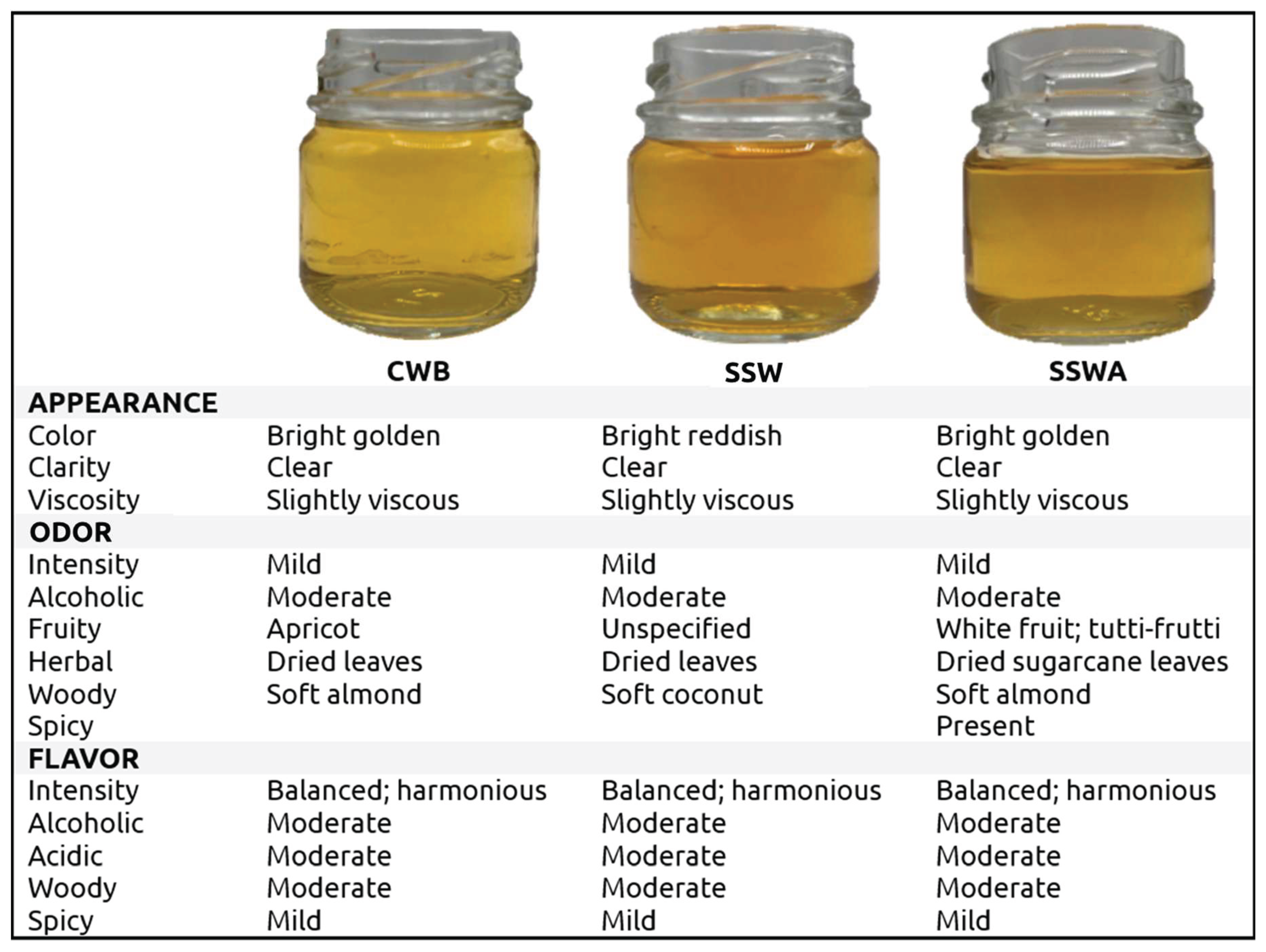
Figure 2.
Intention to purchase of the blends produced with cachaças aged in different conditions. 1 = certainly would not buy. 2 = probably would not buy. 3 = would buy / would not buy. 4 = probably would buy. 5 = certainly buy. CWB - conventional storage in wooden barrel; SSW - storage in stainless steel barrels with wooden chips; SSWA - storage in stainless steel barrels with wooden chips under aeration.
Figure 2.
Intention to purchase of the blends produced with cachaças aged in different conditions. 1 = certainly would not buy. 2 = probably would not buy. 3 = would buy / would not buy. 4 = probably would buy. 5 = certainly buy. CWB - conventional storage in wooden barrel; SSW - storage in stainless steel barrels with wooden chips; SSWA - storage in stainless steel barrels with wooden chips under aeration.
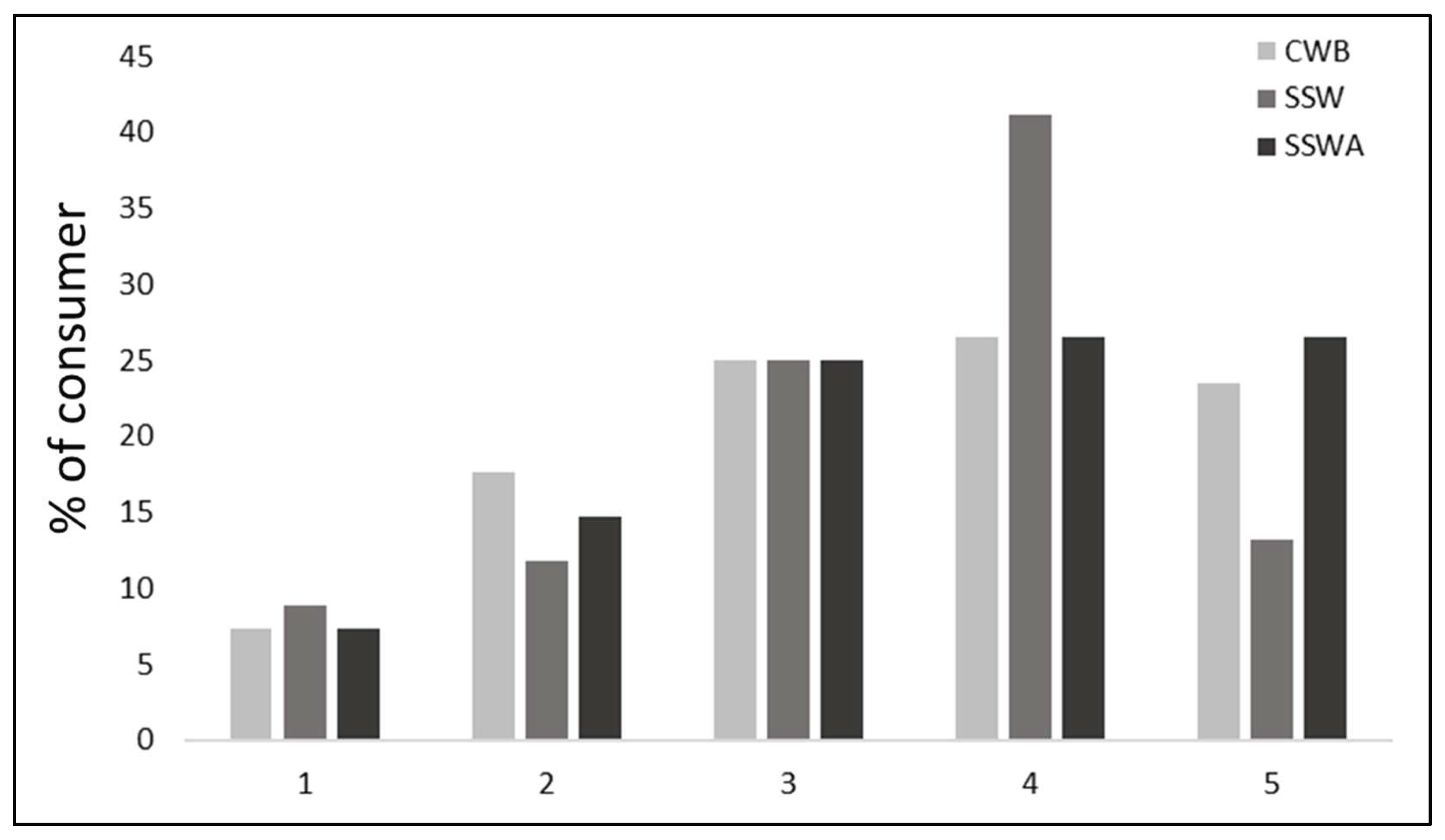
Figure 3.
Correlation between texture and other sensory attributes of the blends produced with cachaças aged in different conditions with nine variables (color parameters: L*. a*. b*. c*. h*. attributes of the acceptance test and total phenolics). *CWB - conventional storage in wooden barrel; SSW - storage in stainless steel barrels with wooden chips; SSWA - storage in stainless steel barrels with wooden chips under aeration.
Figure 3.
Correlation between texture and other sensory attributes of the blends produced with cachaças aged in different conditions with nine variables (color parameters: L*. a*. b*. c*. h*. attributes of the acceptance test and total phenolics). *CWB - conventional storage in wooden barrel; SSW - storage in stainless steel barrels with wooden chips; SSWA - storage in stainless steel barrels with wooden chips under aeration.
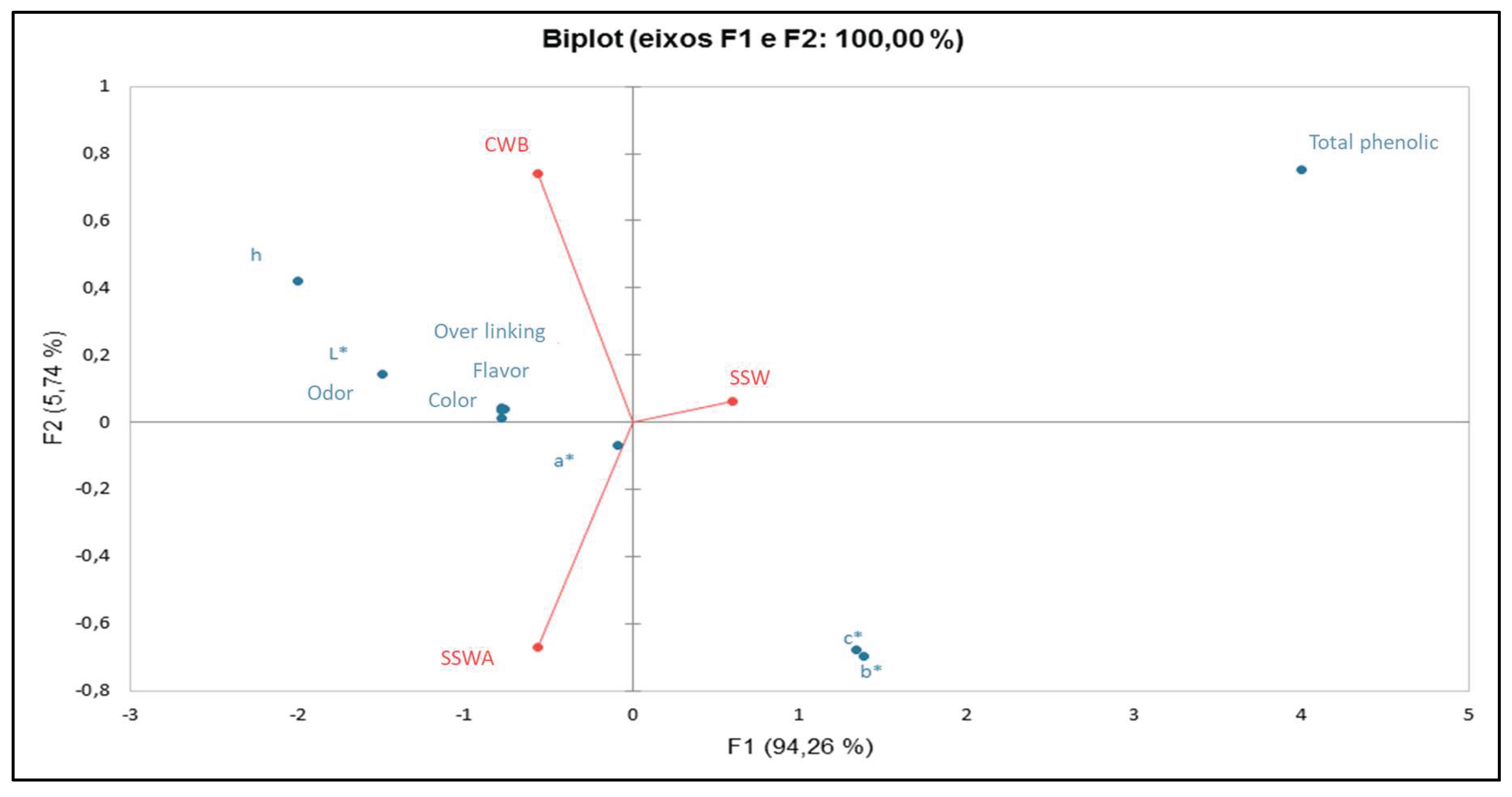

Table 1.
Alcohol content of cachaça at 20 °C - % (v/v).
| Treatments | Initial ethanol | Final ethanol |
|---|---|---|
| CWB | 45,24 | 39,65 |
| SSW | 45,21 | 39,74 |
| SSWA | 42,23 | 39,72 |
*CWB - conventional storage in wooden barrel; SSW - storage in stainless steel barrels with wooden chips; SSWA - storage in stainless steel barrels with wooden chips under aeration.
Table 2.
Results of the physicochemical parameters of the blends produced with cachaças aged in different conditions.
Table 2.
Results of the physicochemical parameters of the blends produced with cachaças aged in different conditions.
| Parameters | Treatments | Acceptable Limits1 | ||
|---|---|---|---|---|
| CWB* | SSW | SSWA | ||
| Total acidity - mg/100 mL | 28.00±3.73a | 34.46±3.73a | 28.00±3.73a | - |
| Volatile acidity - mg/100 mL | 38.12±0.00ab | 41.84±0.00a | 34.25±0.00b | 150.0 |
| Total esters - mg/100 mL | 39.04±3.65b | 63.59±2.75a | 69.99±4.97a | 200.0 |
| Dry extract at 100 °C - g/L | 0.84±0.01ab | 1.26±0.01a | 0.78±0.00b | 6.0 |
| pH | 4.67±0.00a | 4.62±0.00ab | 4.51±0.01b | |
| Copper - mg/L | 0.72±0.04a | 0.77±0.01a | 0.71±0.01a | 5.0 |
| Aluminum - mg/L | <0.20 | <0.20 | <0.20 | - |
| Cadmium - mg/L | <0.02 | <0.02 | <0.02 | 5.0 |
| Lead - mg/L | <0.10 | <0.10 | <0.10 | 2.0 |
| Zinc - mg/L | <0.10 | <0.10 | <0.10 | - |
| Total phenolic | 107.31±5.49ab | 138.19±5.39a | 102.00±0.98b | - |
a-bDifferent letters indicate significant difference between different treatments and days by Tukey’s test (p < 0.05); 1according to the normative from Brazilian Ministry of Agriculture [21] (Brasil, 2005); *CWB - conventional storage in wooden barrel; SSW - storage in stainless steel barrels with wooden chips; SSWA - storage in stainless steel barrels with wooden chips under aeration.
Table 3.
Color parameters of the blends produced with cachaças aged in different conditions.
| Treatments | L* | a* | b* | C* | h* |
|---|---|---|---|---|---|
| CWB* | 96.89 ±0.35a | -4.72±0.01b | 31.10±0.23b | 31.46±0.22b | 98.63±0.05a |
| SSW | 91.90 ±0.43a | 0.31±0.05a | 47.42±0.40a | 47.42±0.40a | 89.83±0.06b |
| SSWA | 96.89 ±0.67a | -4.40±0.03b | 34.12±0.51ab | 34.40±0.50ab | 97.35±0.15ab |
a-bDifferent letters indicate significant difference between different treatments and days by Tukey’s test (p < 0.05); *CWB - conventional storage in wooden barrel; SSW - storage in stainless steel barrels with wooden chips; SSWA - storage in stainless steel barrels with wooden chips under aeration.
Table 4.
Phenolic compounds (mg.L-1) of the blends produced with cachaças aged in different conditions analyzed by HPLC.
Table 4.
Phenolic compounds (mg.L-1) of the blends produced with cachaças aged in different conditions analyzed by HPLC.
| Compounds | CWB* | SSW | SSWA |
|---|---|---|---|
| Coumarin | 0.022±0.001b | 0.154±0.004a | 0.068±0.031ab |
| Trans-Cinnamic Acid | 0.160±0.002b | 0.244±0.002a | 0.185±0.001ab |
| Caffeic acid | 0.568±0.007a | 0.550±0.007a | 0.569±0.164a |
| p-Coumaric acid | 6.569±0.012a | 6.309±0.023a | 5.544±1.863a |
| Ellagic acid | 1.115±0.195b | 3.972±0.862ab | 3.581±0.136a |
| Rutin | 4.005±0.018a | 4.283±0.017a | 4.651±0.417a |
| Myricetin | 0.973±0.084b | 2.158±0.034a | 1.313±0.087ab |
| Iso-liquiritigenin | 0.182±0.001a | 0.203±0.022a | 0.187±0.009a |
| Kaempferol | 0.489±0.001ab | 0.496±0.001a | 0.447±0.018b |
| Kaempferide | 0.283±0.032a | 0.196±0.020ab | 0.166±0.004b |
| Biochanin A | 10.893±0.027a | 9.352±0.053b | 9.981±0.046ab |
| Naringenin | 0.229±0.001a | 0.229±0.001a | 0.175±0.013a |
| Piceatannol | 0.282±0.002ab | 0.712±0.004a | 0.127±0.028b |
| Resveratrol | 0.443±0.008a | 0.348±0.210a | 0.125±0.001a |
| Scopoletin | 0.024±0.000ab | 0.045±0.001a | 0.006±0.003b |
| Trans-Ferulic Acid | 0.685±0.002ab | 1.864±0.020a | 0.279±0.084b |
| 4-methylumbelliferone | 0.007±0.000a | 0.006±0.000b | 0.006±0.000b |
a-bDifferent letters indicate significant difference between different treatments and days by Tukey’s test (p < 0.05); *CWB - conventional storage in wooden barrel; SSW - storage in stainless steel barrels with wooden chips; SSWA - storage in stainless steel barrels with wooden chips under aeration.
Table 5.
Acceptation score of the blends produced with cachaças aged in different conditions.
| Treatments | Color | Odor | Flavor | Overall linking | Pursh intention |
|---|---|---|---|---|---|
| CWB | 7.34±1.44a | 6.82±2.09a | 6.37±2.32a | 7.04±1.85a | 3.41±1.24a |
| SSW | 7.50±1.56a | 6.90±1.80a | 6.44±2.26a | 7.18±1.66a | 3.38±1.13a |
| SSWA | 7.47±1.38a | 6.96±1.98a | 6.54±2.31a | 7.34±1.64a | 3.50±1.24a |
a-bDifferent letters indicate significant difference between different treatments and days by Tukey’s test (p < 0.05); *CWB - conventional storage in wooden barrel; SSW - storage in stainless steel barrels with wooden chips; SSWA - storage in stainless steel barrels with wooden chips under aeration.
Table 6.
Sums of the preference ranking test.
| Treatments | Preference |
|---|---|
| CWB* | 105b |
| SSW | 154a |
| SSWA | 137a |
a-bValues with the same letter do not differ significantly from each other according to Friedman’s test at a 5% significance level; *CWB - conventional storage in wooden barrel; SSW - storage in stainless steel barrels with wooden chips; SSWA - storage in stainless steel barrels with wooden chips under aeration.
Disclaimer/Publisher’s Note: The statements, opinions and data contained in all publications are solely those of the individual author(s) and contributor(s) and not of MDPI and/or the editor(s). MDPI and/or the editor(s) disclaim responsibility for any injury to people or property resulting from any ideas, methods, instructions or products referred to in the content. |
© 2026 by the authors. Licensee MDPI, Basel, Switzerland. This article is an open access article distributed under the terms and conditions of the Creative Commons Attribution (CC BY) license (http://creativecommons.org/licenses/by/4.0/).
Copyright: This open access article is published under a Creative Commons CC BY 4.0 license, which permit the free download, distribution, and reuse, provided that the author and preprint are cited in any reuse.


