

Submitted:
13 April 2026
Posted:
14 April 2026
You are already at the latest version
Abstract
This paper argues that the institutionalisation of artificial intelligence (AI) disclosure in scientific research has resulted in a type of compliance that emphasises symbolic transparency rather than actual responsibility. Although journals and publishers are progressively mandating that authors disclose their use of AI, these policies remain fragmented, non-standardised, and largely unverifiable. Based on an exploratory review of 80 recent academic articles, the report demonstrates that explicit AI disclosure is limited and, when present, is primarily symbolic or narrative rather than verifiable. This work explains the pattern by introducing the concept of paper compliance and establishing the AI Disclosure Integrity Gap (AIDG), which is defined as the discrepancy between reported AI utilisation and the genuine epistemic impact of AI on research results. The analysis reveals that this disparity is systematically generated by the discordance between transparency-oriented governance frameworks and the iterative, opaque, and irreproducible characteristics of AI-assisted knowledge generation. The study develops testable propositions and introduces the AI Use Traceability Framework (AUTF) as a process-oriented approach for AI governance, emphasising traceability and auditability over transparency. Despite institutional, technical, and incentive-based obstacles that hinder full implementation, traceability provides a means to reduce AIDG and enhance accountability in AI-assisted research. The study advances AI governance and research integrity by treating disclosure as a limited mechanism rather than a complete solution, and by highlighting the risk that current practices create a false sense of transparency.
Keywords:
AI disclosure
; AI governance
; research integrity
; paper compliance
; AI disclosure integrity gap
; traceability
; transparency
; accountability
; generative AI
; scientific publishing
1. Introduction
The rapid adoption of artificial intelligence (AI), especially generative AI, is changing how scientific knowledge is created and shared. This shift introduces structural challenges for transparency, authorship attribution, and epistemic accountability in research (Stokel-Walker & Van Noorden, 2023; UNESCO, 2022). AI is now commonly used for literature reviews, hypothesis development, data analysis, and manuscript writing, which is redefining authorship roles. In response, academic publishers, journals, and professional organisations are implementing governance frameworks to uphold research integrity. A key part of these efforts is the requirement for authors to disclose the use of AI tools in their research and writing (Elsevier, 2025; Yoo, 2025).
Major publishing platforms such as Elsevier, Springer Nature, Wiley, and Taylor & Francis now require authors to disclose the AI tools they used, their purpose, and the level of human oversight involved. This information is often included in specific sections of the manuscript (Elsevier, 2025; Taylor & Francis, 2024). Key principles established by leading journals and editorial bodies state that AI tools must be disclosed transparently, cannot be listed as authors, and do not hold responsibility for the scientific output, which rests solely with human researchers (Stone, 2025). This convergence indicates that AI disclosure is becoming a key part of transparency in modern research governance.
However, the increase in disclosure requirements has not been accompanied by advancements in defining, standardising, or verifying these disclosures. Guidelines differ widely across journals and fields, with no agreement on what constitutes meaningful disclosure, the required level of detail, or how compliance is evaluated (Cleland et al., 2026). Additionally, evidence shows a significant gap between policy and practice; even with widespread disclosure mandates, the actual rates of AI disclosure in published research are very low, highlighting a disconnect between expected and actual transparency (He & Bu, 2025).
The current approach to AI transparency, primarily through disclosure statements, fails to ensure accountability (Suchikova et al., 2025). These statements are often self-reported, non-standardised, and lack independent verification, offering limited insight into how AI influences research outcomes. They do not facilitate the reproducibility of AI-assisted processes, such as prompt design or model impact analysis. Consequently, disclosure acts more as a compliance signal than a genuine oversight mechanism.
This paper argues that the institutionalisation of AI disclosure has led to “paper compliance”—a superficial approach to governance where meeting transparency requirements replaces real accountability. Authors often provide minimal or vague disclosures under paper compliance that meet editorial standards but do not accurately represent the role or impact of AI in their research. Consequently, transparency becomes more about appearances than actual clarity.
We introduce the AI Disclosure Integrity Gap (AIDG), which measures the difference between stated AI use and its actual impact on knowledge production. The AIDG highlights issues such as under-disclosure, oversimplification of AI’s role, and the challenges in verifying AI-assisted processes afterwards. This gap indicates not only inconsistencies in behaviour but also a key limitation of current disclosure systems: they track AI use but lack mechanisms for validation.
We argue that disclosure-based governance represents a structurally inadequate paradigm under conditions of AI-induced epistemic opacity, thereby contributing to the literature on AI in scientific practice in three key ways. First, it introduces the concept of paper compliance to understand the performative aspects of AI governance in research. Second, it introduces the AI Disclosure Integrity Gap (AIDG) as a tool to analyse the gap between formal transparency and its actual impact on knowledge. Third, it advocates for moving from disclosure-based models to stronger frameworks focused on traceability, auditability, and verifiable accountability.
The paper challenges the common belief that simply disclosing AI involvement in research is enough to ensure integrity. It argues that without proper mechanisms for verifying these disclosures, we risk creating a false sense of transparency that obscures the actual role of AI in scientific research.
2. The Emergence and Fragmentation of AI Disclosure Regimes
The rapid rise of artificial intelligence (AI) tools in scientific research has prompted major academic publishers, including Elsevier, Springer Nature, Wiley, and Taylor & Francis, to adopt new disclosure policies. These guidelines require authors to reveal the use of generative AI in their manuscripts. This push for transparency aligns with global efforts to ensure accountability in AI systems (OECD, 2019; UNESCO, 2022). Policies emphasise the need to disclose AI’s role in tasks such as text generation, data analysis, and visualisation, while stating that human authors are still responsible for the integrity of their work (Elsevier, 2024; Wiley, 2024).
Editorial organisations like the Committee on Publication Ethics state that AI tools cannot be listed as authors and must be transparently documented to ensure accountability in scholarly communication (COPE, 2023). This reflects a growing expectation for AI disclosure in research governance.
However, AI disclosure implementation is inconsistent. Policies differ significantly in detail and enforcement across journals and disciplines. Some journals require comprehensive descriptions of AI use, while others only ask for minimal statements or general guidance. Often, disclosure is merely recommended, leading to variations in reporting practices and editorial oversight (Stokel-Walker & Van Noorden, 2023).
Current disclosure regimes face a significant limitation due to the lack of standardised reporting frameworks for AI use in research. There is no widely accepted format for documenting key aspects like prompt design, iteration processes, model versioning, and AI’s impact on analytical outcomes. This results in disclosures that are often non-comparable and provide little insight into AI’s role in knowledge production (Dwivedi et al., 2023; Kasneci et al., 2023).
Additionally, current policies rely heavily on self-reporting, with minimal verification or auditing processes. Authors are expected to disclose their AI use honestly, but there are no systematic methods to evaluate the accuracy or completeness of these disclosures. This reliance on unverified information creates vulnerabilities in the governance framework, especially given the increasing sophistication and invisibility of AI processes (Bender et al., 2021; Floridi et al., 2018).
Recent evidence shows a significant gap between AI policy and practice. Although disclosure requirements are widespread, actual rates of AI disclosure in research are low, indicating inconsistent compliance. This issue arises from unclear policy expectations and a lack of enforcement mechanisms to catch non-disclosure (Liang et al., 2025). Studies in academic settings also reveal high levels of non-disclosure, demonstrating that formal mandates alone don’t guarantee transparency (Perkins et al., 2024).
Overall, the current policy landscape presents a paradox: while AI disclosure aims to enhance transparency and uphold research integrity, its implementation suffers from fragmentation, weak standardisation, and limited verifiability. Instead of ensuring accountability, existing disclosure practices allow for minimal or vague reporting to count as compliance.
The current governance structure fosters a culture of paper compliance. Without standardised disclosure requirements, verification, and enforcement, organisations are more likely to focus on meeting formalities rather than achieving genuine transparency. This policy environment not only fails to discourage superficial compliance but actually enables it.
2.1. Exploratory Empirical Probe: Disclosure Practices in AI-Assisted Research
2.1.1. Data and Sampling Approach
An exploratory analysis was conducted on 80 recent academic articles (2024–2026) from various disciplines, including business, medicine, computer science, and social sciences, to address concerns about AI disclosure practices in AI-assisted writing and analysis.
Articles were chosen based on the following criteria:
- Indexed in leading databases (Scopus and Web of Science).
- Published in journals with explicit AI disclosure policies
- Exposure to generative AI use (due to topic, method, or writing style).
The goal of this probe is to analytically illustrate disclosure patterns and their alignment with new governance expectations, rather than to make statistical generalisations. To improve transparency, coding followed a structured protocol that categorised disclosure types according to established criteria (refer to Appendix A for illustrative validation). Although exploratory, this approach facilitates systematic comparisons across the articles.
2.1.2. Prevalence of AI Disclosure
Only 14 of the 80 papers included explicit AI disclosure, while 66 did not provide any disclosure statement. This aligns with growing evidence that AI use in scientific research is often under-disclosed (Liang et al., 2025), highlighting concerns in governance and editorial policy discussions. Table 1 summarises the prevalence and variation in AI disclosure observed in the sample.
The distribution shows a significant tendency toward non-disclosure and limited reporting depth, reflecting paper compliance trends. It also shows two main patterns: non-disclosure is common despite institutional requirements, and most reported disclosures are superficial and symbolic.
2.1.3. Depth Variation in Disclosure
The 14 disclosed papers showed considerable variation in both depth and informational value, as shown in Table 2.
The distribution of disclosure types in AI reporting shows a clear hierarchy in depth and value. Symbolic disclosure (57%) is the most common, featuring vague statements that acknowledge AI use without details on tools or contributions, serving mainly as a compliance signal. Narrative disclosure (36%) offers more detail, with authors describing AI use and mentioning specific tools, but these accounts are self-reported and unverified, lacking true transparency. Conversely, traceable disclosure (7%) is rare, involving some documentation such as model identification and workflows, but remains underdeveloped and allows only limited reconstruction of AI involvement.
The distribution shows that disclosure is on the rise but remains mostly at low levels, revealing only slight progress towards traceability and verifiable accountability.
Appendix A includes examples of these disclosure types to show differences in depth and traceability.
2.1.4. Evidence of Paper Compliance and Implications for the AIDG
The observed patterns offer a clear empirical illustration of paper compliance:
- High non-disclosure rate (82.5%) indicates weak enforcement.
- Dominance of symbolic disclosures (57%) shows minimal compliance strategies.
- Lack of standardisation hinders study comparison.
Even where disclosure is present, it:
- Does not enable verification.
- Fails to represent epistemic influence.
- Lacks support for reproducibility.
This confirms that disclosure often serves as a formal indication of compliance instead of a means of ensuring accountability.
The findings also provide evidence for the AI Disclosure Integrity Gap in three clear ways:
- Non-disclosure despite probable AI involvement (concealed AI influence).
- Under-specified disclosures (misrepresentation of extent).
- Absence of process documentation (irretrievable knowledge pathways).
The empirical probe reveals a clear gap between reported AI use and its actual impact, as evidenced by current publication practices.
Even though AI disclosure policies are becoming more common, most existing literature continues to focus on transparency-based governance models. These models assume that simply disclosing AI usage is enough for accountability. This is evident in editorial and policy guidelines that emphasise reporting AI use (e.g., COPE, 2023; Elsevier, 2024; Wiley, 2024). However, these approaches depend on conditions that are no longer practical in AI-driven research. They assume that (i) research processes can be easily observed and reconstructed, (ii) the role of tools can be clearly defined, and (iii) disclosure statements accurately reflect the underlying research activities.
Recent studies on large language models and AI systems reveal their lack of transparency, unpredictability, and complex interaction dynamics (Bender et al., 2021; Floridi et al., 2018; Dwivedi et al., 2023). However, current disclosure frameworks do not adequately address these issues, leading to a gap between governance practices and the realities of AI-driven knowledge production. While the existing literature highlights risks related to transparency and accountability, it fails to offer a clear framework for understanding how disclosure may become inadequate or merely performative amid epistemic opacity.
3. Paper Compliance in AI Disclosures
To overcome this limitation, we need to move beyond transparency as the main principle of AI governance in research. While institutional theory helps us understand the gap between formal compliance and actual practices (Meyer & Rowan, 1977; Power, 2003), these theories were developed in environments where organisational processes are generally observable. However, AI-assisted research creates a new challenge: epistemic opacity, where knowledge-generating processes are often misrepresented and sometimes irrecoverable. This shift indicates that the issue is not just about incomplete disclosure, but that transparency as a governance tool may fundamentally fail to address AI’s role in knowledge creation.
We redefine AI disclosure as more than just a transparency issue; it’s a governance failure stemming from the gap between what is reported and the complex processes underlying knowledge production. We introduce the concepts of paper compliance and the AI Disclosure Integrity Gap (AIDG) to highlight this structural misalignment.
3.1. Defining Paper Compliance in AI Disclosure
We define paper compliance as:
The formal fulfilment of governance or reporting requirements through symbolic or minimal adherence, without corresponding mechanisms for verification, accountability, or substantive transparency.
In AI disclosure, paper compliance occurs when authors make statements that meet editorial or institutional requirements but fail to accurately reflect the role of AI in their research. These often consist of short, standardised declarations, such as “AI tools were used for language editing,” which are hard to assess or validate.
This issue is not limited to AI; it mirrors a wider trend in regulatory and organisational settings where compliance actions diverge from their original purposes, functioning instead as legitimacy signals (Power, 2003; Meyer & Rowan, 1977). In AI disclosure, the problem is heightened by the complexity and unpredictability of AI processes, making it challenging to spot superficial compliance.
3.2. Layers of Paper Compliance
AI disclosure compliance involves multiple layers that show how disclosure requirements can be met without improving accountability. Three separate, but overlapping layers are identified:
- 1)
- Symbolic Compliance
Disclosure often serves as a simple checkbox exercise, where authors acknowledge AI use in vague or minimal terms. These statements typically:
- Lacks specificity concerning tools, prompts, or outputs.
- Do not distinguish between levels of AI involvement.
- Mainly serve to indicate compliance with policy.
Symbolic compliance turns disclosure into a mere ritual of transparency, focusing more on having a statement than on its actual meaning.
- 2)
- Narrative Compliance
At a more advanced level, authors give expanded descriptions of AI use in their methods or acknowledgements sections. These narratives are more detailed than basic disclosures. Nonetheless:
- They remain self-reported and non-standardised.
- They cannot be independently verified, and
- AI is often framed as unimportant, despite its real influence.
Narrative compliance creates an illusion of depth but does not enhance traceability or reproducibility.
- 3)
- Strategic Compliance
At a complex level, disclosure is strategically adjusted in response to perceived risks, incentives, or norms. Authors may:
- Minimise the acknowledgement of AI involvement to prevent scrutiny or stigmatisation.
- Exaggerate minimal usage to indicate transparency.
- Selectively disclose specific applications while omitting others.
Strategic compliance means that disclosure is controlled to prioritise reputation over accurate information.
3.3. Mechanisms Enabling Paper Compliance
The continued reliance on paper compliance in AI disclosure is not just a matter of behaviour; it is supported by the structure of existing governance frameworks. Three key mechanisms contribute to this issue:
- a)
- Self-Reporting Without Verification
AI disclosure regimes depend mainly on author declarations without effective verification of:
- Whether AI was utilised
- How it was applied
- The extent of its impact
AI disclosures don’t have enforceable audit trails, making it impossible to verify compliance, unlike data availability statements or methodological appendices.
- b)
- Absence of Standardisation
To date, there is limited convergence around a standardised taxonomy or schema for reporting AI use in research. As a result:
- Disclosure content varies significantly across different journals and academic disciplines.
- Key dimensions such as prompt design, model version, and iteration processes are seldom documented.
- Comparability between studies is limited.
The lack of standardisation allows minimal compliance to be interpreted as adequate.
- c)
- Epistemic Opacity of AI Systems
AI systems, especially large language models, operate through intricate, opaque processes that are hard to reverse-engineer afterwards, even with complete transparency. Even with full disclosure:
- Outputs cannot be reliably replicated.
- Intermediate steps, like prompt refinement, are often not documented.
- Model behaviour may change over time.
The lack of clarity reduces the connection between disclosure and verifiability, which supports the idea of paper compliance.
3.4. Paper Compliance as Performative Transparency
AI disclosure is evolving into a form of performative transparency, where it appears open but does not allow for real scrutiny. This type of transparency is more about checking boxes than providing actionable insights. Key implications of this shift include:
- Compliance is now judged by the mere existence of disclosures rather than their actual content.
- Reviewers and readers are forced to interpret incomplete and inconsistent information regarding AI’s role.
- Disclosure can end up confusing rather than clarifying the basis of research.
The problems with paper compliance are not just about implementation failures; they reveal a deeper disconnect between disclosure governance and the actual use of AI in knowledge production.
3.5. Paper Compliance and the AI Disclosure Integrity Gap (AIDG)
Paper compliance serves as the foundation for the AI Disclosure Integrity Gap (AIDG) discussed in the following section. If disclosure is mainly a performative signal, then the gap between stated AI use and its actual impact is a structural result, not an anomaly. Thus, paper compliance is not just a description; it is the mechanism that creates and sustains the AIDG. Table 3 summarises the distinctions between these constructs and related frameworks.
4. The AI Disclosure Integrity Gap (AIDG)
AI disclosure regimes are being established, but they have significant limitations that result in superficial compliance. This section introduces the concept of the AI Disclosure Integrity Gap (AIDG), which emphasises the discrepancy between reported information about AI’s involvement in research and its actual influence on knowledge production.
We define the AI Disclosure Integrity Gap (AIDG) as:
The difference between the declared extent of AI use in a research output and the actual epistemic influence exerted by AI on that output.
This definition emphasises the importance of disclosure in terms of its epistemic impact, meaning how AI systems influence the content, structure, interpretation, or conclusions of research. The AIDG extends beyond intentional misrepresentation; it highlights a broader issue where disclosure frameworks fail to accurately capture or verify AI’s role in research.
Current disclosure practices have several shortcomings: they are declarative (relying on self-reports), static (providing only snapshots), and non-verifiable (lacking audit mechanisms). In contrast, AI-assisted research is iterative (involving multiple prompt-response cycles), distributed (integrated throughout the research process), and opaque (hard to reconstruct afterwards).
The AIDG highlights a disconnect between the governance of AI use and its actual application in research.
The AIDG can be summarised conceptually as:
Where:
- D = Declared AI use (as reported in disclosure statements)
- A = Actual AI influence (epistemic contribution to the research output)
The function f(⋅) captures the multidimensional aspects of the gap, including the extent, function, and process dimensions. Such as:
- Linguistic patterns of AI-generated text
- Inconsistencies between methods and outputs
- Absence of traceable research processes
This formulation identifies the AIDG as a latent governance risk rather than a directly measurable variable in its current state.
Figure 1 illustrates the gap between reported AI usage (D) and its actual impact (A) on research outputs, referred to as the AI Disclosure Integrity Gap (AIDG). This gap arises from compliance issues, lack of standardisation, reliance on self-reporting, and unclear AI processes, leading to a false sense of transparency that threatens accountability and integrity in scientific research.
4.1. From Transparency to Integrity Risks
The AIDG alters our understanding of transparency in AI-assisted research. Currently, transparency is seen as a binary choice—either AI use is disclosed, or it is not. However, the AIDG shows that transparency is actually a spectrum, with disclosure being just one aspect of visibility.
This shift highlights a significant risk: the illusion of transparency. When disclosure statements exist, they can create a false sense of accountability without providing verifiable information. Thus, the AIDG reveals that disclosure can turn from a protective measure into a misleading source of trust.
The AIDG arises from the paper compliance dynamics discussed in Section 3. When disclosure is viewed as a formality instead of a genuine process, a gap between declared and actual AI use becomes entrenched. Paper compliance acts as the behavioural driver, while the AIDG reflects this dynamic analytically.
4.2. Theoretical Propositions
We propose testable propositions based on the concepts of paper compliance and the AI Disclosure Integrity Gap (AIDG) to direct future research. These propositions convert our theoretical claims into practical relationships and are grounded in existing studies on institutional compliance, epistemic opacity, and AI governance (Meyer & Rowan, 1977; Power, 2003; Bender et al., 2021; Floridi et al., 2018).
- P1 — Dominance of Symbolic Compliance
Proposition 1:
Without standard reporting and verification, AI disclosures are more symbolic than substantive, process-oriented reporting.
- P2 — Incentive-Driven Misrepresentation
Proposition 2:
Researchers tend to downplay AI involvement when disclosure harms perceptions of originality, authorship, or credibility.
- P3 — Structural Emergence of the AIDG
Proposition 3:
The AI Disclosure Integrity Gap widens as the divergence between declaration methods and process-based AI use increases.
- P4 — Process Opacity as Core Driver
Proposition 4:
Higher process opacity in AI workflows correlates with lower verifiability of disclosure statements and greater AIDG magnitude.
- P5 — Traceability as Corrective Mechanism
Proposition 5:
Implementing traceability mechanisms such as logs, model IDs, and interaction records reduces AIDG impact and increases the likelihood of disclosure.
- P6 — Illusion of Transparency
Proposition 6:
Without traceability and verification, AI disclosure statements boost perceived transparency but do not improve actual epistemic accountability.
Table 4 links core propositions to measurable variables and potential empirical approaches, laying the groundwork for future validation.
5. The Limits of Disclosure-Based Governance: Towards Traceability
Disclosure-based governance assumes that transparency can be achieved through author declarations, but this is increasingly questioned in AI-assisted research. In this context, outputs are generated through complex, non-reproducible processes (Bender et al., 2021; Floridi et al., 2018). Consequently, disclosure provides a static view of a dynamic process, overlooking prompt evolution and model variability. Similar challenges exist in broader AI governance discussions, indicating that transparency alone is insufficient without proper verification and accountability mechanisms (Dwivedi et al., 2023).
5.1. From Transparency to Traceability
To address the above-mentioned limitations, we propose shifting from transparency to traceability. Transparency means declaring AI use, while traceability allows us to verify and reconstruct how AI contributed to research outcomes.
The importance of documenting the entire lifecycle of knowledge production is emphasised in reproducibility and data provenance research (Stodden et al., 2016). However, large-scale replication efforts show that transparency alone does not ensure reproducibility, as about half of social science findings do not replicate in controlled studies (Jones, 2026).
Traceability differs from disclosure; it focuses on tracking and monitoring in real time rather than simply providing past information. It is:
- Process-oriented (captures sequences of interaction)
- Verifiable (allows external scrutiny)
- Reconstructive (enables partial reproducibility)
This shift connects AI governance with established practices like financial reporting, audit trails, and data lineage tracking in scientific workflows.
5.2. The AI Use Traceability Framework (AUTF)
To operationalise this shift, we introduce the AI Use Traceability Framework (AUTF), a model that links declared AI utilisation with actual accountability.
The framework consists of four interrelated components:
- (1)
-
Input Traceability: It captures:
- Prompt logs (initial and iterative)
- Task framing and constraints
- Human–AI interaction sequences
Purpose: Show how inputs influence outputs.
- (2)
-
Process Traceability: Records and documents AI interaction, such as:
- Iteration History:
- Generated and discarded alternative outputs
- Human editing and refinements
Purpose: To highlight the dynamic and non-linear aspects of AI-assisted work, reflecting the iterative nature of computational research workflows (Stodden et al., 2016).
- (3)
-
Model Traceability: Specifies the technical configuration of the AI system used, including:
- Model type and version
- Training updates (where relevant)
- Tool-specific parameters
Purpose: Tackle reproducibility issues caused by model variability and system updates (Bender et al., 2021).
- (4)
-
Output Attribution: Connects AI contributions to specific sections of the research output.
- Sections Affected by AI
- Differentiation between AI-generated and human-edited content
- Level of reliance on AI outputs
Purpose: Define the epistemic role of AI and address issues of authorship and accountability in AI-assisted research (Dwivedi et al., 2023).
Figure 2 shows the AI Use Traceability Framework (AUTF), which outlines the four interconnected stages for documenting and partially reconstructing AI involvement.
5.3. AUTF as a Governance Layer
The AUTF establishes a governance framework focused on three key components: Disclosure, Traceability, and Auditability. This approach ensures transparency and accountability and addresses the need for enforceable accountability in AI ethics beyond mere transparency (Floridi et al., 2018).
5.4. Implementation Pathways
The AI Use Traceability Framework (AUTF) offers a model for improving accountability, but its implementation will vary across different research contexts. The shift from disclosure-based practices to traceability-oriented governance will happen gradually, influenced by institutional capacity, technical feasibility, and incentives. We view this implementation as a staged process rather than a simple transition.
Figure 3 shows the implementation pathway, which transitions from minimal disclosure practices to advanced traceability and auditability. It highlights the evolution of governance mechanisms from symbolic compliance to structured, process-oriented accountability.
5.5. Feasibility and Adoption Constraints
The AI Use Traceability Framework (AUTF) aims to improve accountability in AI-assisted research but faces practical challenges—similar to those encountered during earlier shifts in research governance, such as the adoption of data-sharing and preregistration frameworks (Stodden et al., 2016).
First, implementing traceability mechanisms like prompt logging and model documentation adds cognitive and administrative burdens, especially in resource-limited settings. Unlike traditional disclosure statements, which can be completed after the fact, traceability requires continuous documentation, potentially disrupting established workflows.
Second, researchers may hesitate to adopt traceability voluntarily. Detailed transparency could be perceived as undermining their originality or intellectual contributions, creating a tension between being transparent and protecting their reputation.
Third, technical limitations hinder complete traceability. AI systems, particularly large language models, produce non-deterministic outputs and evolve over time, making full reconstruction of processes difficult. Current publishing systems also lack the capability to store process-level data, such as prompt histories, in standardised formats.
Fourth, privacy and intellectual property issues further complicate matters. Prompt logs may include sensitive data or proprietary ideas, raising concerns about data exposure. Mandating full traceability without safeguards could pose risks to researchers and institutions.
The transition from disclosure to traceability will be gradual, beginning with low-effort solutions like structured disclosure templates and optional sections for AI use. As standards and tools improve, it will move towards more comprehensive traceability. The AUTF serves as a guiding framework for developing verifiable accountability in AI-assisted research, rather than an immediate requirement.
The AIDG cannot be completely eradicated due to the inherent opacity of AI systems. However, it can be systematically minimised through the implementation of traceability mechanisms.
Contribution to the Literature
The paper presents testable propositions for examining disclosure practices, the AI Disclosure Integrity Gap (AIDG), and traceability mechanisms. It contributes to the literature on AI in research, research integrity, and governance in three key ways. First, it introduces the concept of paper compliance, highlighting how disclosure in AI-assisted research can obscure underlying epistemic processes rather than simply misalign with them. Second, it develops the AIDG, which captures the gap between reported AI use and its actual epistemic influence, emphasising the importance of understanding the limits of representability in AI-driven knowledge production. Lastly, it proposes the AI Use Traceability Framework (AUTF), a governance model that addresses the complex and iterative nature of AI-assisted workflows, moving beyond traditional approaches to reproducibility and data provenance.
These contributions, outlined in Table 3, are essential responses to governance challenges posed by artificial intelligence in scientific research, rather than mere extensions of existing frameworks.
6. Implications
This paper’s findings have significant implications for academic publishing, research integrity, and AI governance in knowledge production.
In academic publishing, the analysis indicates that current AI disclosure requirements can create misleading transparency. When disclosure is mandatory but not verified, it burdens reviewers and readers to deduce AI’s role from incomplete or inconsistent information. Therefore, journals should adopt structured reporting standards and traceable submission processes. This could include optional prompt logs, standardised templates, and appendices detailing AI use.
Second, the introduction of the AI Disclosure Integrity Gap (AIDG) identifies a new type of epistemic risk in research integrity. Even with disclosure, the impact of AI on research outputs may remain unclear, challenging existing views on authorship, originality, and accountability. This necessitates a reassessment of how credibility is evaluated in research that involves AI.
Thirdly, the paper shows that while disclosure-based methods may seem appealing for policy and governance, they are inadequate without enforceable mechanisms. A shift toward traceability and auditability imposes new responsibilities on publishers, platforms, and research institutions. They must create infrastructure for logging AI interactions, develop standardised reporting protocols, and allow for partial verification of AI-assisted processes.
Fourth, future research on the AIDG should explore a range of empirical and methodological approaches. Researchers can investigate the gap through linguistic analysis, workflow reconstruction, or experiments comparing disclosed and undisclosed AI use. Additionally, it’s important to systematically examine the feasibility, costs, and behavioural impacts of implementing the AI Use Traceability Framework (AUTF).
7. Conclusions
The growing institutionalisation of AI disclosure in scientific research indicates that artificial intelligence is changing knowledge production. However, current disclosure practices are inadequate for ensuring true accountability. Instead of fostering real transparency, they often lead to “paper compliance,” where formal adherence replaces effective oversight.
This study introduces the concepts of paper compliance and the AI Disclosure Integrity Gap (AIDG), framing AI disclosure as a structural governance issue rather than just an ethical one. It highlights that the gap between reported AI use and its actual impact is a systemic issue stemming from self-reporting, a lack of standardisation, and the absence of verification mechanisms.
To overcome current limitations, the paper presents the AI Use Traceability Framework (AUTF). It emphasises reconstructive, verifiable accountability rather than mere transparency. This framework aims to create governance models that align better with the iterative, distributed, and opaque nature of AI-assisted research.
In conclusion, without accountability, AI disclosure creates a false sense of transparency in scientific knowledge production. The empirical evidence from this study suggests that non-traceable disclosure practices persist, and the proposed theoretical frameworks provide a basis for further investigation into AI disclosure behaviour and governance. Moreover, the challenges of ensuring traceability highlight that moving from disclosure to accountability is not just a technical issue; it’s an institutional process that requires gradual adaptation. As AI becomes more integrated into research, effective governance will hinge on what can be traced and held accountable, rather than just what is stated.
Appendix A. Illustrative Examples of AI Disclosure Practices (Paraphrased)
This appendix presents three paraphrased examples that show the variation in AI disclosure practices within the sample, highlighting differences in depth, clarity, and traceability.
Sample 1: Symbolic Disclosure
QUOTE: “AI tools were used to improve the clarity and readability of the manuscript.”
Assessment:
- ○
- No tool identified
- ○
- No indication of scope or sections affected
- ○
- No distinction between editing and generation
- ○
- No process or iteration information
Interpretation: This represents symbolic compliance, where disclosure satisfies formal requirements but provides no insight into the epistemic role of AI.
Sample 2: Narrative Disclosure
QUOTE: “ChatGPT (OpenAI) was used to assist in drafting portions of the introduction and discussion. All generated content was reviewed and edited by the authors to ensure accuracy and originality.”
Assessment:
- ○
- Tool identified
- ○
- General functional role described
- ○
- Human oversight asserted
Interpretation: This represents narrative compliance, where disclosure appears substantive but is neither verifiable nor reproducible.
Sample 3: Partial Traceability Disclosure
QUOTE: “We used GPT-4 (March 2025 version) to generate initial summaries of selected literature. Prompts included structured queries specifying inclusion criteria and thematic focus. Outputs were iteratively refined through follow-up prompts, and final text was substantially modified by the authors. Selected prompt examples are available in the Supplementary Materials.”
Assessment:
- ○
- Model and version specified
- ○
- Prompt structure described
- ○
- Iterative interaction acknowledged
- ○
- Partial documentation provided
Interpretation: This represents early-stage traceability, demonstrating movement toward accountability, but still insufficient for full reconstruction or verification.”
End of sample
These examples show that while disclosures exist, their level of detail varies greatly, and traceability is uncommon. The shift from symbolic to narrative to traceable disclosure indicates a move toward greater transparency, yet it highlights that existing practices do not allow for proper verification. This variation supports the idea of paper compliance and emphasises the presence of the AI Disclosure Integrity Gap (AIDG).
References
- Bender, E. M., T. Gebru, A. McMillan-Major, and S. Shmitchell. 2021. On the Dangers of Stochastic Parrots: Can Language Models Be Too Big? In Proceedings of the 2021 ACM Conference on Fairness, Accountability, and Transparency (FAccT’21). Association for Computing Machinery: pp. 610–623. [Google Scholar] [CrossRef]
- Cleland, J., E. Driessen, K. Masters, L. Lingard, and L. A. Maggio. 2026. When and how to disclose AI use in academic publishing: AMEE Guide No.192. Medical Teacher 48, 4: 542–553. [Google Scholar] [CrossRef] [PubMed]
- COPE. 2023. COPE: Committee on Publication Ethics. Available online: https://publicationethics.org/news-opinion/cope-2023.
- Dwivedi, Y. K.;, and et al. 2023. “So What If ChatGPT Wrote it?” Multidisciplinary Perspectives on opportunities, Challenges and Implications of Generative Conversational AI for research, Practice and Policy. International Journal of Information Management 71: 102642. [Google Scholar] [CrossRef]
- Elsevier. 2024. Www.elsevier.com. Available online: https://www.elsevier.com/about/policies-and-standards/generative-ai-policies-for-journals.
- Elsevier. 2025. Www.elsevier.com. Available online: https://www.elsevier.com/about/policies-and-standards/generative-ai-policies-for-journals?utm.
- Floridi, L., J. Cowls, M. Beltrametti, R. Chatila, P. Chazerand, V. Dignum, C. Luetge, R. Madelin, U. Pagallo, F. Rossi, B. Schafer, P. Valcke, and E. Vayena. 2018. AI4People—An Ethical Framework for a Good AI Society: Opportunities, Risks, Principles, and Recommendations. Minds and Machines 28, 4: 689–707. [Google Scholar] [CrossRef] [PubMed]
- He, Y., and Y. Bu. 2025. Academic journals’ AI policies fail to curb the surge in AI-assisted academic writing. arXiv arXiv:2512.06705. [Google Scholar] [CrossRef] [PubMed]
- Jones, N. 2026. Half of social-science studies fail replication test in years-long project. Nature. [Google Scholar] [CrossRef] [PubMed]
- Kasneci, E., K. Sessler, S. Küchemann, M. Bannert, D. Dementieva, F. Fischer, U. Gasser, and et al. 2023. ChatGPT for good? on Opportunities and Challenges of Large Language Models for Education. Learning and Individual Differences 103: 102274. [Google Scholar] [CrossRef]
- Liang, W., Y. Zhang, Z. Wu, H. Lepp, W. Ji, X. Zhao, H. Cao, S. Liu, S. He, Z. Huang, D. Yang, C. Potts, C. D. Manning, and J. Zou. 2025. Quantifying large language model usage in scientific papers. Nature Human Behaviour. [Google Scholar] [CrossRef] [PubMed]
- Meyer, J. W., and B. Rowan. 1977. Institutionalized Organizations: Formal Structure as Myth and Ceremony. American Journal of Sociology 83, 2: 340–363. Available online: http://www.jstor.org/stable/2778293. [CrossRef]
- OECD. 2019. The OECD Artificial Intelligence (AI) Principles. Oecd.ai. OECD: Available online: https://oecd.ai/en/ai-principles.
- Perkins, M., L. Furze, J. Roe, and J. MacVaugh. 2024. The Artificial Intelligence Assessment Scale (AIAS): A Framework for Ethical Integration of Generative AI in Educational Assessment. Journal of University Teaching and Learning Practice 21, 06. [Google Scholar] [CrossRef]
- Power, M. K. 2003. Auditing and the Production of Legitimacy. Accounting, Organizations and Society 28, 4: 379–394. [Google Scholar] [CrossRef]
- Stodden, V., M. McNutt, D. H. Bailey, E. Deelman, Y. Gil, B. Hanson, M. A. Heroux, J. P. A. Ioannidis, and M. Taufer. 2016. Enhancing reproducibility for computational methods. Science 354, 6317: 1240–1241. [Google Scholar] [CrossRef] [PubMed]
- Stokel-Walker, C., and R. Van Noorden. 2023. What ChatGPT and generative AI mean for science. Nature 614, 7947: 214–216. [Google Scholar] [CrossRef] [PubMed]
- Stone, J. A. M. 2025. AI Disclosure Policies in Scientific Publishing and Medical Acupuncture. Medical Acupuncture 37, 5: 339–340. [Google Scholar] [CrossRef] [PubMed]
- Suchikova, Y., N. Tsybuliak, J. A. Teixeira da Silva, and S. Nazarovets. 2025. GAIDeT (Generative AI Delegation Taxonomy): A taxonomy for humans to delegate tasks to generative artificial intelligence in scientific research and publishing. Accountability in Research, 1–27. [Google Scholar] [CrossRef] [PubMed]
- Taylor & Francis. 2024. AI Policy—Taylor & Francis. August 20, Available online: https://taylorandfrancis.com/our-policies/ai-policy/?utm.
- UNESCO. 2022. Recommendation on the Ethics of Artificial Intelligence. Unesco.org. Available online: https://unesdoc.unesco.org/ark:/48223/pf0000381137.
- Wiley. 2024. AI guidelines for researchers. Wiley.com. Available online: https://www.wiley.com/en-nl/publish/article/ai-guidelines/.
- Yoo, J.-H. 2025. Defining the Boundaries of AI Use in Scientific Writing: A Comparative Review of Editorial Policies. Journal of Korean Medical Science 40, 23. [Google Scholar] [CrossRef] [PubMed]
Figure 1.
The AI Disclosure Integrity Gap (AIDG) Framework. Developed by the Author, 2026.
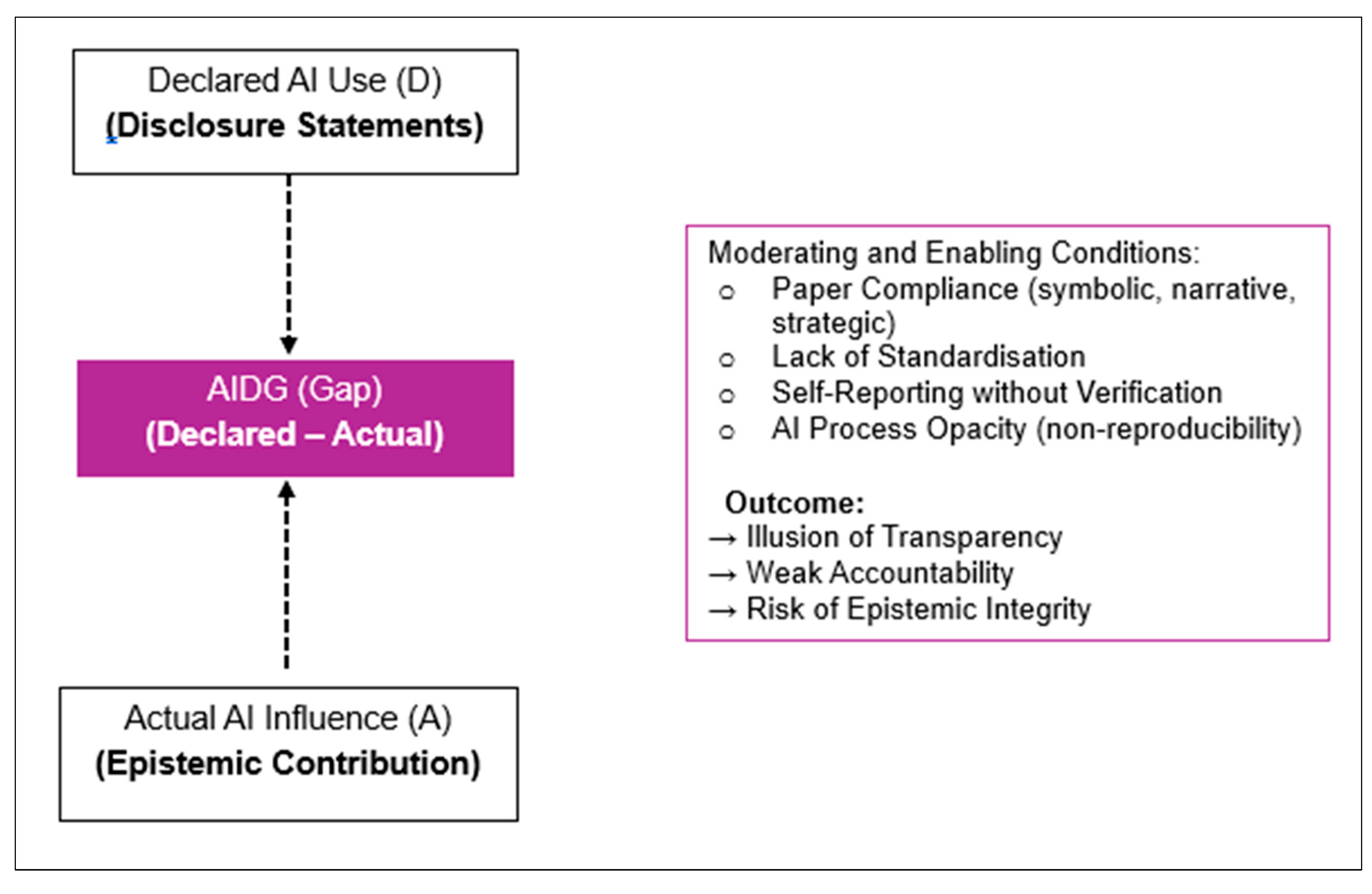
Figure 2.
The AI Use Traceability Framework (AUTF). The Figure illustrates the transition from disclosure-based governance to prioritising traceability and auditability in AI-assisted research. The AUTF identifies four stages of AI involvement: input, process, model, and output, which enables partial reconstruction of AI contributions. This method addresses the AI Disclosure Integrity Gap (AIDG) by improving accountability and ensuring epistemic integrity. Developed by the Author (2026).
Figure 2.
The AI Use Traceability Framework (AUTF). The Figure illustrates the transition from disclosure-based governance to prioritising traceability and auditability in AI-assisted research. The AUTF identifies four stages of AI involvement: input, process, model, and output, which enables partial reconstruction of AI contributions. This method addresses the AI Disclosure Integrity Gap (AIDG) by improving accountability and ensuring epistemic integrity. Developed by the Author (2026).
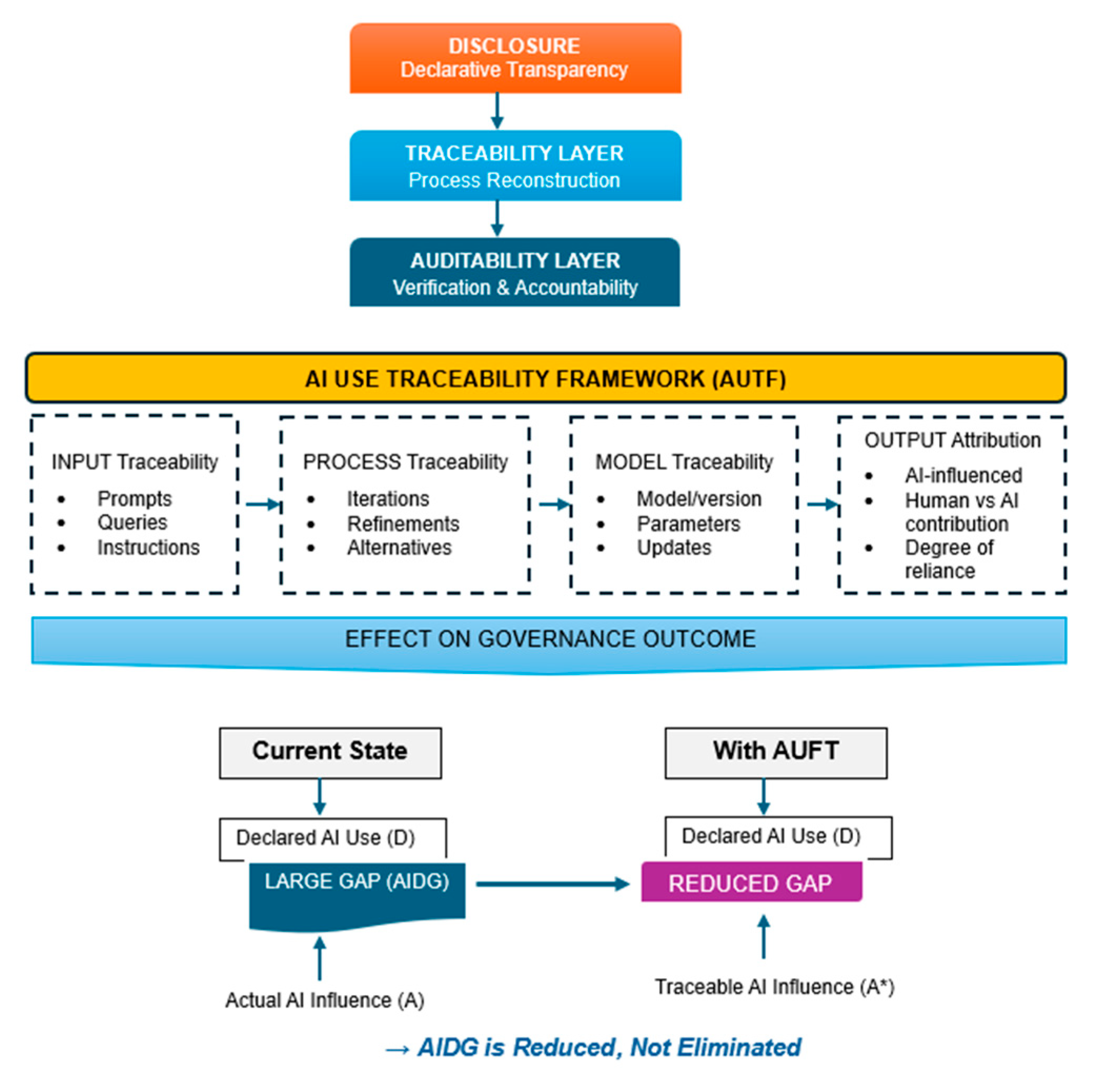
Figure 3.
Implementation pathway. The implementation pathway has three key points. First, moving through stages depends on institutional incentives and enforcement, not automatic processes. Second, early interventions, such as structured disclosure templates, help reduce barriers to adoption and facilitate gradual progress. Third, full traceability is more of an ideal goal than a fixed endpoint, limited by technical issues, privacy concerns, and the unpredictable nature of AI systems. Therefore, the pathway stresses the importance of feasibility in governance design, highlighting that accountability should be developed gradually rather than forced all at once.
Figure 3.
Implementation pathway. The implementation pathway has three key points. First, moving through stages depends on institutional incentives and enforcement, not automatic processes. Second, early interventions, such as structured disclosure templates, help reduce barriers to adoption and facilitate gradual progress. Third, full traceability is more of an ideal goal than a fixed endpoint, limited by technical issues, privacy concerns, and the unpredictable nature of AI systems. Therefore, the pathway stresses the importance of feasibility in governance design, highlighting that accountability should be developed gradually rather than forced all at once.
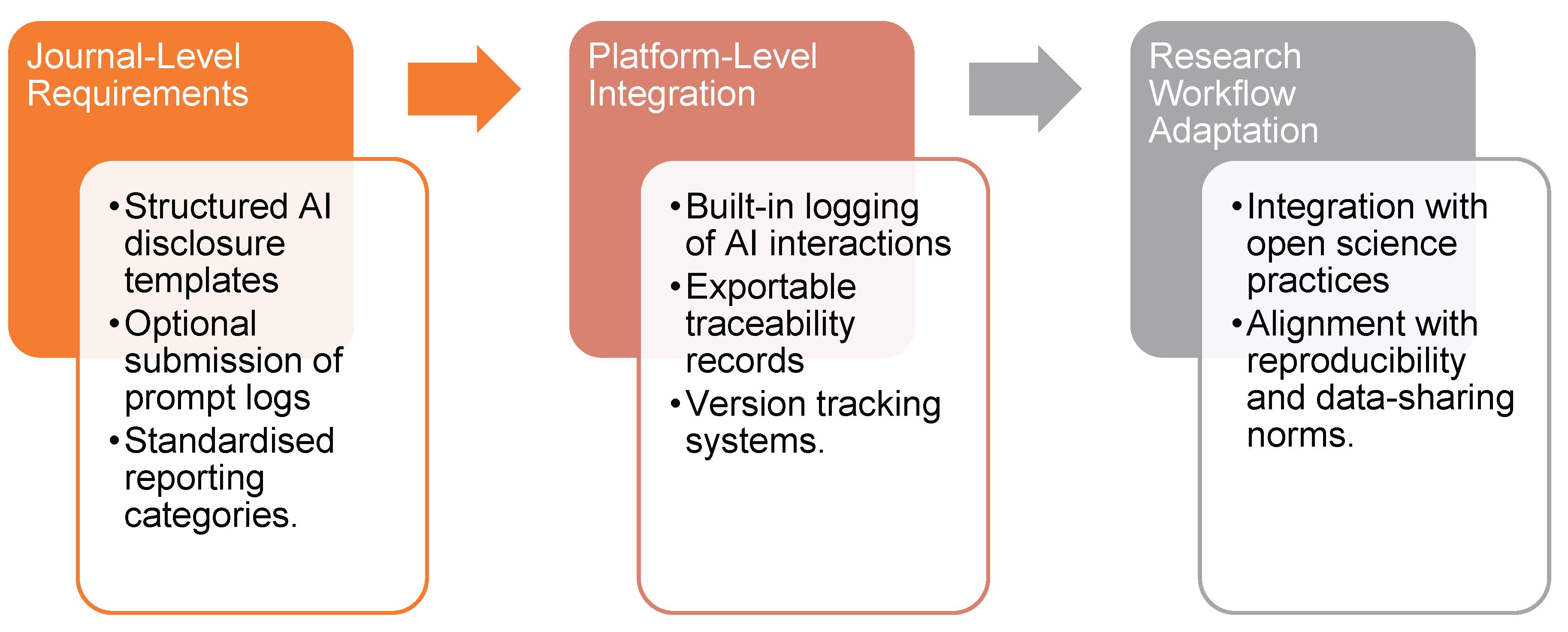

Table 1.
Prevalence and Depth of AI Disclosure (Exploratory Sample) (N = 80). The table shows that although AI disclosure policies are common, meaningful disclosure remains uncommon. The prevalence of non-disclosure and symbolic reporting highlights the issue of paper compliance and the ongoing AI Disclosure Integrity Gap (AIDG).
Table 1.
Prevalence and Depth of AI Disclosure (Exploratory Sample) (N = 80). The table shows that although AI disclosure policies are common, meaningful disclosure remains uncommon. The prevalence of non-disclosure and symbolic reporting highlights the issue of paper compliance and the ongoing AI Disclosure Integrity Gap (AIDG).
| Category | Description | Number of Papers | Percentage |
|---|---|---|---|
| No Disclosure | No mention of AI use despite likely applicability | 66 | 82.5% |
| Symbolic Disclosure | Minimal, generic statement (e.g., “AI used for language editing”) | 8 | 10.0% |
| Narrative Disclosure | Expanded description of AI use, but non-standardised and non-verifiable | 5 | 6.25% |
| Traceable Disclosure | Structured, process-oriented disclosure enabling partial reconstruction | 1 | 1.25% |
| Total | 80 | 100% |
Note: Classification is based on the content of disclosures. Categories indicate increasing levels of detail and potential for verification.
Table 2.
Classification of disclosure papers (N = 14).
| Type of Disclosure | Description | Frequency |
|---|---|---|
| Symbolic disclosure | Minimal, generic statement with no detail | 8 |
| Narrative disclosure | Expanded description of AI use, but non-standardised | 5 |
| Traceable disclosure | Structured, process-oriented detail (rare) | 1 |
Table 3.
Concept Differentiation and Boundary Clarification. The table clarifies the analytical boundaries of the paper’s core constructs by distinguishing them from adjacent concepts in institutional theory, research integrity, and reproducibility literature. This differentiation establishes that the proposed constructs address governance challenges specific to AI-mediated knowledge production that are not captured by existing frameworks.
Table 3.
Concept Differentiation and Boundary Clarification. The table clarifies the analytical boundaries of the paper’s core constructs by distinguishing them from adjacent concepts in institutional theory, research integrity, and reproducibility literature. This differentiation establishes that the proposed constructs address governance challenges specific to AI-mediated knowledge production that are not captured by existing frameworks.
| Construct | Superficially Similar To | Key Difference | Why Existing Frameworks Are Insufficient |
|---|---|---|---|
| Paper Compliance | Symbolic compliance; Institutional decoupling (Meyer & Rowan, 1977; Power, 2003) | Focuses on epistemic representation in AI-assisted research, where disclosure not only signals compliance but obscures the role of AI in knowledge production | Traditional frameworks assume underlying processes remain intact but misaligned; they do not account for AI-induced opacity, where processes themselves become partially irrecoverable |
| AI Disclosure Integrity Gap (AIDG) | Reporting bias; Measurement error | Captures structural divergence between declared AI use and actual epistemic influence, not just inaccuracies in reporting | Conventional approaches assume observable and verifiable underlying processes; AIDG arises because AI processes are iterative, distributed, and non-reconstructable ex post |
| AI Use Traceability Framework (AUTF) | Reproducibility frameworks; Data provenance | Introduces process-level traceability across input, interaction, model, and output stages | Existing reproducibility models assume stable inputs and deterministic outputs, which do not hold in AI-assisted research environments |
Table 4.
Operationalisation of Core Theoretical Propositions. The operationalisation focuses on observable indicators for latent constructs, especially the AIDG, which can’t be directly measured but can be inferred from differences between disclosed and actual AI involvement. Proposition 6 points out a key issue: disclosure can create a false sense of transparency without boosting accountability, thereby increasing governance risks tied to mere compliance.
Table 4.
Operationalisation of Core Theoretical Propositions. The operationalisation focuses on observable indicators for latent constructs, especially the AIDG, which can’t be directly measured but can be inferred from differences between disclosed and actual AI involvement. Proposition 6 points out a key issue: disclosure can create a false sense of transparency without boosting accountability, thereby increasing governance risks tied to mere compliance.
| Proposition | Key Construct(s) | Measurable Variable(s) | Proxy/Indicator | Empirical Approach (Example) |
|---|---|---|---|---|
| P1: Symbolic compliance dominance | Disclosure depth; Paper compliance | Disclosure depth score (ordinal: none → symbolic → narrative → traceable) | Content coding of disclosure statements across articles | Manual coding or NLP-based classification of journal publications |
| P2: Incentive-driven misrepresentation | Perceived reputational risk; Disclosure distortion | Disclosure accuracy vs perceived evaluation risk | Survey responses (e.g., perceived stigma, originality concerns, career risk) | Survey or experimental vignette study |
| P3: Structural emergence of AIDG | AIDG magnitude | Difference between declared AI use and inferred AI involvement | AI-generated text probability vs disclosure presence | Text analysis (AI detection tools) combined with disclosure comparison |
| P4: Process opacity as driver | Process opacity; Verifiability | Presence/absence of process documentation | Availability of prompt logs, iteration records, methodological detail | Content analysis of methods sections and Supplementary Materials |
| P5: Traceability as corrective mechanism | Traceability level; AIDG magnitude | Traceability index vs disclosure gap | Presence of model versioning, prompt logs, output attribution | Regression analysis: traceability → reduction in AIDG |
| P6: Illusion of transparency | Perceived transparency; Epistemic accountability | Perceived transparency vs actual disclosure quality (AIDG proxy) | Survey ratings vs objectively coded disclosure depth | Experimental study comparing reader perception with measured disclosure quality |
Disclaimer/Publisher’s Note: The statements, opinions and data contained in all publications are solely those of the individual author(s) and contributor(s) and not of MDPI and/or the editor(s). MDPI and/or the editor(s) disclaim responsibility for any injury to people or property resulting from any ideas, methods, instructions or products referred to in the content. |
© 2026 by the author. Licensee MDPI, Basel, Switzerland. This article is an open access article distributed under the terms and conditions of the Creative Commons Attribution (CC BY) license.
Copyright: This open access article is published under a Creative Commons CC BY 4.0 license, which permit the free download, distribution, and reuse, provided that the author and preprint are cited in any reuse.