

Submitted:
13 April 2026
Posted:
14 April 2026
You are already at the latest version
Abstract
Refugees are exposed to cumulative pre-migration, migration, and post-migration stressors that increase vulnerability to depressive disorders and impaired quality of life. Aim of this study was to assess the prevalence and severity of depressive symptoms among adult refugees in Serbia and associations with sociodemographic characteristics, traumatic experiences, social support, and Health Related Quality of Life (HQoL). This study included 324 refugees in four reception centers in Serbia. Data were collected between November 2022 and April 2023 using self-report questionnaires. Depressive symptoms were assessed using the Patient Health Questionnaire-9 (PHQ-9), while HQoL was evaluated using the SF-36 Health Survey. Sociodemographic, migration-related, and psychosocial variables were collected through a structured questionnaire. The mean PHQ-9 score indicated mild to moderate depressive symptomatology. Significant depressive symptoms were present in 41.4% of participants, while more than 70% reported mild symptoms. Depressive symptom severity was negatively correlated with energy/fatigue, emotional well-being, social functioning, general health, and pain. Energy/Fatigue emerged as the strongest independent predictor of depressive symptom severity. Depressive symptoms are highly prevalent among refugees and are closely associated with impaired quality of life and psychosocial stressors. These findings highlight the need for systematic screening and psychosocial interventions targeting mental health issues in refugees.
Keywords:
refugees
; depression
; quality of life
1. Introduction
A refugee is defined as a person who has fled their country of origin and is unable to seek protection there due to a well-founded fear of persecution based on race, religion, nationality, membership in a particular social group, or political opinion [1]. According to World Health Organization (WHO) and the United Nations High Commissioner for Refugees (UNHCR) more than 108.4 million people were forcibly displaced by the end of 2022, including refugees and internally displaced persons [2,3]. Approximately 70% of all individuals in need of international protection originate from Syria, Afghanistan, Venezuela, Ukraine, and South Sudan [4].
Due to its geographical position, Serbia serves as a major transit route on the Balkan migration corridor [5]. Despite being primarily a transit country, as many as 577,995 refugees expressed an intention to seek asylum in Serbia in 2015 [6]. Many remain in reception or asylum centers for extended periods, often facing socioeconomic hardship, legal uncertainty, and limited access to specialized mental health care [2].
Refugees are exposed to traumatic and stressful events before departure, during transit, and after arrival in host countries [7]. These cumulative stressors significantly increase the risk of psychiatric morbidity, particularly post-traumatic stress disorder (PTSD), depressive disorders, and anxiety disorders [8,9]. Depressive symptoms are the most frequently reported mental health difficulties among refugees [10,11]. A meta-analysis by Lindert reported that 44% of refugees experienced depressive symptomatology [12]. However, prevalence varies substantially across settings, with lower rates reported in high-income countries—such as 14.5% in Germany [13], and higher rates in low- and middle-income host countries, including 37.4% in Turkey [14] and 43% in Lebanon [15]. These differences may reflect variations in living conditions, access to care, and host-country support structures.
Sociodemographic characteristics further shape mental health outcomes in refugee populations. Older age, female gender, lower educational attainment, unemployment, prolonged residence in refugee camps, family separation, and insufficient social support are consistently associated with higher levels of depressive symptoms [16,17,18]. Untreated depression among refugees may lead to chronic disability, impaired social functioning, poor integration into host societies, diminished employability, and increased healthcare utilization, underscoring its public-health relevance.
Despite growing interest in refugee mental health, research on health-related quality of life (HQOL) in this population remains limited. Quality of life (QoL) reflects subjective perceptions of physical, psychological, social, and environmental well-being and is closely intertwined with mental health. Depression negatively affects HQoL through diminished energy, impaired social functioning, and reduced overall life satisfaction [19]. A systematic review by van der Boor demonstrated that depressive symptoms strongly reduced HQOL among refugees, whereas social networks and social integration were linked to better QoL [20]. Matanov et al. demonstrated that older age, unemployment, and collective accommodation lowered QoL among refugees from the former Yugoslavia in Western Europe, with long-lasting effects years after the end of conflict [21]. Similarly, a study by Al Masri in Germany reported reduced QoL across all domains, associated with socioeconomic factors such as housing conditions, duration of asylum procedures, and marital status, highlighting the need for structural interventions to improve living conditions [22].
Although existing studies indicate that migrants and refugees have lower quality-of-life scores and higher vulnerability to depression, there is still a lack of research comprehensively examining the interplay between sociodemographic characteristics, quality-of-life parameters, and depressive symptoms, particularly in the context of the Balkan region and Serbia. Little is known about how these factors interact within refugee populations residing in Serbian reception centers.
Therefore, the aim of our study was to assess the prevalence and severity of symptoms of depression among refugees in Serbia and to examine the relationship between sociodemographic characteristics, health-related quality of life, and depressive symptomatology. Specifically, we sought to determine whether quality-of-life domains explain additional variance in depressive symptoms beyond what sociodemographic, trauma-related, and psychosocial factors account for. Given the high exposure to pre-migration trauma and ongoing post-migration stressors in this group, we hypothesized that poorer socioeconomic circumstances and lower quality-of-life scores would be significantly associated with higher levels of depressive symptoms among refugees residing in Serbia, and that quality-of-life parameters would independently predict depression severity after controlling for sociodemographic and trauma-related variables.
Our hypothesis was based on consistent findings from previous international studies showing that socioeconomic hardship, unstable living conditions, family separation, and limited social support are strongly associated with both increased depressive burden and reduced quality of life in refugee populations.
2. Materials and Methods
2.1. Study Design and Population
This cross-sectional study included 324 adult refugees residing in four refugee reception centers in the Republic of Serbia (Krnjača, Obrenovac, Sombor, and Subotica). Approval to conduct the survey was obtained from the Commissariat for Refugees and Migration of the Republic of Serbia on 18 March 2023. Ethical approval was granted by the Ethics Committee of the Faculty of Medicine, University of Belgrade (No. 17/IV-15), on 11 April 2024.
2.2. Sampling Procedure
A convenience sampling strategy was applied. All individuals residing in the selected centers during the data collection period who met the eligibility criteria were invited to participate. Of these, 362 refugees agreed to take part in the study.
Inclusion criteria were: age ≥18 years, residence in an asylum or refugee center in the Republic of Serbia, ability to provide informed consent, and no current psychiatric treatment.
Exclusion criteria included: age <18 years, presence of cognitive impairment affecting comprehension, and lack of capacity to provide informed consent.
The sample size was determined by the number of eligible individuals available during the study period (November 2022 – April 2023). Of the 462 refugees approached, 362 agreed to participate (response rate 78.4%), and 324 provided complete datasets suitable for analysis. As this was an exploratory study, no formal a priori power calculation was conducted.
2.3. Data Collection Procedures
Data were collected between November 2022 and April 2023 using self-report questionnaires translated into the respondents’ spoken languages (Arabic, Urdu, and English). The sociodemographic questionnaire was translated by certified translators from the Oxford Academy Translation Center (Belgrade), following standard translation and back-translation procedures to ensure linguistic and cultural accuracy.
Questionnaires were administered on-site in designated rooms within the refugee centers. Trained research assistants were present to provide clarification if needed, without influencing responses. Participation was voluntary, anonymous, and conducted individually. Completion required approximately 20–30 minutes.
2.4. Confidentiality and Data Security
No personal identifiers were collected. Completed questionnaires were stored in sealed envelopes, transferred to a secure location, and later entered into a password-protected electronic database accessible only to the research team.
2.5. Measures
2.5.1. Sociodemographic Questionnaire
The sociodemographic questionnaire [23,24,25,26,27] collected data on gender, age, educational level, occupation, marital status, lifestyle habits (smoking, alcohol use, diet), chronic diseases, migration-related factors (reasons for migration, duration of stay, living arrangements, asylum-seeking status), traumatic events during migration, perceived discrimination, sources of psychological support, and self-assessed physical and mental health before and after migration.
2.5.2. SF-36 Health Survey
Health-related quality of life (HQoL) was assessed using the SF-36 questionnaire [28,29]. The instrument consists of 36 items grouped into eight domains: physical functioning, role limitations due to physical problems, bodily pain, general health, vitality, social functioning, role limitations due to emotional problems, and mental health. These domains generate two composite scores (Physical Component Summary and Mental Component Summary). Scores range from 0 (worst health) to 100 (best health), calculated using standardized scoring algorithms [30]. The SF-36 has been culturally adapted and validated in various migrant populations [31].
2.5.3. Patient Health Questionnaire-9 (PHQ-9)
Depressive symptoms were assessed using the PHQ-9, a nine-item self-administered screening tool [32]. Each item is rated on a 0–3 scale based on symptom frequency over the past two weeks, yielding a total score from 0 to 27. Cut-off points of 5, 10, 15, and 20 indicate mild, moderate, moderately severe, and severe depression. The PHQ-9 has been translated and validated across multiple migrant populations [32,33].
2.6. Statistical Analysis
Data were analyzed using Python (version 3.12) with the scipy, numpy, and pandas libraries for descriptive statistics, reliability analysis, correlation analysis, and linear regression. Binary logistic regression was conducted using the statsmodels package. All statistical tests were two-tailed, with a significance level of p < .05 unless otherwise specified. Questionnaires with more than 20% missing items were excluded during data collection. For remaining analyses, list wise deletion was applied within each statistical procedure, resulting in an effective sample of N = 313 for multivariate regression analyses (11 cases excluded due to missing values across instruments).
Descriptive statistics were computed for all study variables. Continuous variables were summarized as means and standard deviations (M ± SD), with medians and interquartile ranges reported for SF-36 domain scores. Categorical variables were presented as frequencies and percentages. For multiple-response items (e.g., migration reasons, traumatic experiences, sources of support), percentages were calculated relative to the total sample and may exceed 100%. Internal consistency reliability was assessed using Cronbach's alpha (α) with 95% confidence intervals estimated via Feldt's (1965) F-distribution method for the PHQ-9 total scale and each SF-36 subscale. Prior to reliability analysis, SF-36 items were reverse-coded according to the standard RAND SF-36 scoring algorithm, so that higher scores consistently indicate better health status across all items.
Preliminary analyses were conducted prior to the main statistical procedures. Distributional properties of all continuous variables were examined using the Shapiro–Wilk test and inspection of skewness and kurtosis values. Given the sensitivity of the Shapiro–Wilk test to minor deviations at large sample sizes (N = 324), practical normality was evaluated using the criteria of |skewness| < 1 and |kurtosis| < 3. Homogeneity of variances across depression severity groups was assessed using Levene's test (median-centered). Multicollinearity among SF-36 domain scores was evaluated through Spearman inter-domain correlations and, in regression models, through variance inflation factors (VIF), with VIF > 5 considered indicative of problematic multicollinearity.
Bivariate associations between depressive symptom severity (PHQ-9 total score) and SF-36 domain scores were examined using Pearson product-moment correlations with 95% confidence intervals derived via Fisher's z-transformation. For the Bodily Pain domain, which exhibited significant negative skewness (skewness = −1.11), Spearman's rank correlation was used, with 95% confidence intervals estimated through bootstrap resampling (2,000 iterations). To identify factors associated with clinically significant depression, participants were classified into two groups based on the standard PHQ-9 cutoff: no/mild depressive symptoms (PHQ-9 < 10) and moderate/severe depressive symptoms (PHQ-9 ≥ 10). Group differences on continuous variables were assessed using independent-samples t-tests (Mann–Whitney U for non-normally distributed variables), and on categorical variables using Pearson's chi-square test (Fisher's exact test when any expected cell frequency was < 5). Effect sizes were reported as Cohen's d for continuous variables and Cramér's V (or phi coefficient, φ, for 2 × 2 tables) for categorical variables.
A hierarchical (blockwise) multiple linear regression analysis was performed to examine the independent and incremental contributions of sociodemographic, migration-related, psychosocial, and quality-of-life variables to depressive symptom severity, measured as the continuous PHQ-9 total score. Predictors were entered in four sequential blocks based on theoretical considerations: Block 1 included demographic variables (education level); Block 2 added migration and trauma-related variables (personal safety threats, death threats, poor family situation, lack of food and water, war participation); Block 3 added current psychosocial variables (sedative use, support from migrant friends); and Block 4 added SF-36 quality-of-life domains (Energy/Fatigue and Bodily Pain). Variables were selected for inclusion based on bivariate significance at p < .10 and theoretical relevance established in prior literature. The change in R² (ΔR²) and corresponding F-change statistic were evaluated at each step to assess the incremental explanatory contribution of each block. For the final model, unstandardized (B) and standardized (β) regression coefficients, standard errors, t-values, and p-values were reported. Regression assumptions were evaluated through inspection of residual normality (Shapiro–Wilk test, skewness, and kurtosis), homoscedasticity (Breusch–Pagan test), independence of errors (Durbin–Watson statistic), influential observations (Cook's distance), and multicollinearity (VIF).
Binary logistic regression was conducted to identify independent predictors of clinically significant depression (PHQ-9 ≥ 10 vs. < 10). A two-stage variable selection procedure was employed: first, univariate logistic regressions were performed for all candidate predictors, and variables significant at p < .10 were entered into a multivariate model; second, non-significant variables (p ≥ .10 in the multivariate context) were removed to yield a trimmed final model. Results were expressed as adjusted odds ratios (OR) with 95% confidence intervals and Wald statistics. Model fit was evaluated using the likelihood ratio chi-square test, McFadden's pseudo R², the Hosmer–Lemeshow goodness-of-fit test, and the area under the receiver operating characteristic curve (AUC-ROC). Classification performance was reported as sensitivity, specificity, and overall accuracy at the 0.5 probability threshold.
3. Results
3.1. Sample Characteristics
The sociodemographic, migration-related, and clinical characteristics of the sample are presented in Table 1. The sample consisted of 324 adult refugees (88.0% male; mean age = 30.02 ± 7.34 years) residing in four reception centers in Serbia.This section may be divided by subheadings. It should provide a concise and precise description of the experimental results, their interpretation, as well as the experimental conclusions that can be drawn.
Nearly half originated from Syria (48.8%), followed by Iraq (16.0%), and other countries (17.3%). The vast majority were unemployed (96.3%), and most had stayed in Serbia for three months or less (73.1%). Approximately three-quarters of participants lived alone (72.4%). The most commonly reported reasons for migration were threats to personal safety (62.0%) and poor family conditions (51.9%). More than half of participants reported exposure to torture (51.5%), while 25.3% had experienced death threats and 22.8% had been forcibly separated from family members. The primary source of support was Serbian institutions for migrant issues (43.2%), followed by migrant friends (23.1%), although an equal proportion reported feeling lonely and without support (23.1%). The majority had never used professional psychiatric or psychological services (75.9%), and only 14.2% of participants were currently using sedative medication.
3.2. Depressive Symptoms
The distribution and severity of depressive symptoms are presented in Table 2 (Panel A). The mean PHQ-9 score was 8.67 (SD = 5.91), corresponding to mild-to-moderate depressive symptomatology. Total scores ranged from 0 to 25, indicating substantial variability in symptom severity. Clinically significant depressive symptoms (PHQ-9 ≥ 10) were present in 41.4% of participants (n = 134). Among these, 24.1% scored in the moderate range (10–14), 12.3% in the moderately severe range (15–19), and 4.9% in the severe range (20–27). Only 9.6% of participants reported no depressive symptoms, while an additional 18.2% reported minimal symptoms (1–4). The largest single category was mild depression (30.9%).
At the item level (Table 2, Panel B), the most frequently endorsed symptoms were negative self-perception (M = 1.20), hopelessness (M = 1.19), and difficulty concentrating (M = 1.17). The least endorsed symptom was suicidal ideation (M = 0.40), although 29.3% of participants reported at least some suicidal thoughts (score ≥ 1), and 7.7% reported such thoughts on more than half the days. The PHQ-9 demonstrated good internal consistency in this sample (Cronbach's α = .875, 95% CI [.853, .894]), with all corrected item–total correlations exceeding .42.
3.3. Health-Related Quality of Life
The SF-36 domain scores are presented in Table 3. A notable discrepancy emerged between physical and psychosocial domains.
Physical Functioning (M = 75.5, SD = 22.4) and Bodily Pain (M = 80.5, SD = 24.5) showed the highest mean scores, suggesting relatively preserved physical capacity. In contrast, psychosocial domains were consistently lower: Vitality (M = 54.6), Emotional Well-Being (M = 53.6), and Role Emotional (M = 53.9) all scored near the midpoint of the 0–100 scale. Substantial floor and ceiling effects were observed: 48.8% of participants scored at the ceiling on Bodily Pain, while 22.2% scored at the floor on Role Emotional.
Internal consistency varied considerably across SF-36 subscales. Physical Functioning (α = .846) and Bodily Pain (α = .748) demonstrated good-to-acceptable reliability, with Role Physical (α = .673) and Role Emotional (α = .671) falling in the questionable range. However, several psychosocial subscales exhibited poor internal consistency: Vitality (α = .447), Social Functioning (α = .409), General Health (α = .494), and Mental Health (α = .552) all fell below the commonly accepted threshold of .70.
3.4. Preliminary Analyses
Shapiro–Wilk tests were significant for all continuous variables (all p < .05), which is expected given the sample size. However, inspection of skewness and kurtosis indicated that all variables met practical normality criteria (|skewness| < 1 and |kurtosis| < 3) with the exception of Bodily Pain (skewness = −1.11), for which non-parametric methods were employed. Levene's tests confirmed homogeneity of variances across depression severity groups for all continuous variables (all p > .05). Spearman inter-domain correlations among SF-36 subscales ranged from ρ = .02 to ρ = .61, with only Physical Functioning and Role Physical exceeding ρ = .50. No domain pairs exceeded ρ = .70, and all variance inflation factors in the regression models were below 1.14, indicating no multicollinearity concerns.
3.5. Associations Between Depressive Symptoms and Quality of Life
Correlations between PHQ-9 scores and SF-36 domain scores are displayed in Figure 1. Seven of nine SF-36 domains were significantly and negatively correlated with depressive symptom severity. The strongest association was observed for the Energy/Fatigue domain (r = −.211, 95% CI [−.313, −.105], p < .001), followed by General Health (r = −.171, p = .002), Physical Functioning (r = −.160, p = .004), Emotional Well-Being (r = −.151, p = .006), Bodily Pain (ρ = −.147, p = .008), Social Functioning (r = −.146, p = .009), and Role Physical (r = −.132, p = .017). Role Emotional (r = −.052, p = .355) and Health Change (r = −.086, p = .123) were not significantly associated with depression. All significant correlations were small in magnitude, with effect sizes ranging from r = −.13 to −.21.
3.6. Hierarchical Linear Regression: Predictors of Depressive Symptom Severity
A hierarchical linear regression was conducted to examine the incremental contributions of demographic, migration/trauma, psychosocial, and quality-of-life variables to depressive symptom severity (Table 4). The analysis included 313 participants with complete data across all variables.
In the first block, education level alone explained 1.1% of the variance in PHQ-9 scores (ΔR² = .011, p = .061). The addition of migration and trauma variables in Block 2 significantly increased the explained variance by 6.4% (ΔR² = .064, F-change = 4.22, p = .001). Block 3, comprising current psychosocial variables, contributed an additional 4.0% (ΔR² = .040, F-change = 6.90, p = .001). Critically, the inclusion of SF-36 quality-of-life domains in Block 4 explained an additional 6.3% of variance in depressive symptoms beyond all other factors (ΔR² = .063, F-change = 11.65, p < .001), representing the largest single block contribution. The overall model was statistically significant, F(10, 302) = 6.56, p < .001, explaining 17.8% of the total variance (R² = .178, adjusted R² = .151).
In the final model, the strongest independent predictor of depressive symptom severity was the SF-36 Energy/Fatigue domain (β = −.196, p < .001), indicating that lower vitality was associated with more severe depressive symptoms. Perceived threats to personal safety were the second strongest predictor (β = .171, p = .002), followed by sedative use (β = .145, p = .006), SF-36 Bodily Pain (β = −.137, p = .011), education level (β = −.133, p = .012), support from migrant friends (β = −.125, p = .019), war participation (β = −.123, p = .020), and lack of food and water during migration (β = .121, p = .023). Death threats (β = .086, p = .109) and poor family situation (β = .108, p = .051) showed trends toward significance. Regression diagnostics indicated acceptable model assumptions: residuals were approximately normally distributed (skewness = 0.32, kurtosis = −0.21), the Breusch–Pagan test was non-significant (p = .166), the Durbin–Watson statistic was 2.11, and all VIF values were below 1.14.
3.7. Binary Logistic Regression: Predictors of Clinically Significant Depression
Binary logistic regression was conducted to identify independent predictors of clinically significant depression (PHQ-9 ≥ 10; Table 5).
Univariate screening identified 14 candidate predictors at p < .10, including education, four migration/psychosocial variables, and all seven SF-36 domains. After multivariate entry and backward trimming, six variables were retained in the final model.
The trimmed model was statistically significant (LR χ²(6) = 40.64, p < .001; pseudo R² = .096). The Hosmer–Lemeshow test indicated adequate model fit (χ²(8) = 11.76, p = .162). Perceived threats to personal safety (OR = 2.11, 95% CI [1.25, 3.54], p = .005) and death threats (OR = 2.06, 95% CI [1.19, 3.56], p = .010) were both associated with approximately twice the odds of clinically significant depression. Having friends in Serbia was also associated with increased odds (OR = 2.53, 95% CI [1.15, 5.54], p = .021), a finding discussed further below. Higher education level was protective (OR = 0.77, 95% CI [0.63, 0.92], p = .005), as was each unit increase in SF-36 Energy/Fatigue score (OR = 0.98, 95% CI [0.96, 0.99], p = .001). Support from migrant friends showed a trend toward a protective effect (OR = 0.60, 95% CI [0.33, 1.08], p = .089). The model correctly classified 69.0% of cases overall, with high specificity (84.4%) but modest sensitivity (46.5%), and the area under the ROC curve was .705.
3.8. Convergence Across Regression Approaches
Both regression analyses converged on several key findings. The SF-36 Energy/Fatigue domain emerged as the strongest quality-of-life predictor in both the linear model (β = −.196) and the logistic model (OR = 0.98 per unit), consistently indicating that reduced vitality is closely linked to depressive symptoms regardless of the analytical approach. Perceived safety threats and death threats were robust predictors across both models, and education level was consistently protective. The linear model additionally identified bodily pain, sedative use, lack of food and water, war participation, and migrant friend support as significant predictors, likely reflecting the greater sensitivity of the continuous PHQ-9 score to detect smaller effects. The logistic model uniquely identified the paradoxical association between local friendships in Serbia and increased depression risk, which may reflect help-seeking behavior among more distressed individuals rather than a causal relationship.
4. Discussion
This study examined the prevalence and severity of depressive symptoms, health-related quality of life, and their interrelationships among 324 adult refugees residing in reception centers in Serbia. The findings reveal a substantial burden of depressive symptomatology, with 41.4% of participants meeting the threshold for clinically significant depression. Health-related quality of life was characterized by a marked divergence between relatively preserved physical functioning and notably impaired psychosocial well-being. Critically, the hierarchical regression analysis demonstrated that quality-of-life domains, particularly energy/fatigue and bodily pain, explained a significant proportion of variance in depressive symptoms (ΔR² = .063) beyond what demographic, trauma-related, and psychosocial variables accounted for. The SF-36 Energy/Fatigue domain emerged as the strongest independent predictor of both depressive symptom severity and clinically significant depression across both analytical approaches. To our knowledge, this represents one of the few studies to systematically examine the incremental contribution of quality-of-life parameters to depression in a refugee population within the Balkan migration context.
4.1. Prevalence and Severity of Depressive Symptoms
The prevalence of clinically significant depressive symptoms in our sample (41.4%) is broadly consistent with existing estimates from refugee populations. A meta-analysis by Lindert et al. [12] reported that 44% of refugees experienced depressive symptomatology, while Bedaso and Duko [34] found that approximately one in four displaced individuals met criteria for moderate-to-severe depression, and Verhülsdonk et al. [35] reported prevalence as high as 68% among refugees in immigration detention. Our findings align more closely with studies conducted in transit or low-resource host settings, such as Turkey (37.4%) [14] and Lebanon (43%) [15], than with those from high-income resettlement countries such as Germany (14.5%) [13]. In contrast, Foo et al. reported substantially lower prevalence (15.6%) in a broader migrant meta-analysis, highlighting the importance of distinguishing between refugee and voluntary migrant populations [36]. These discrepancies may reflect variations in study populations, assessment tools, and host-country conditions [37], as well as the particular stressors associated with prolonged uncertainty, limited integration opportunities, and constrained access to mental health services that characterize transit settings like Serbia.
The distribution of depressive symptom severity is noteworthy. While 41.4% exceeded the clinical threshold, the majority of these individuals scored in the moderate range (24.1%), with fewer in the moderately severe (12.3%) or severe (4.9%) categories. This pattern suggests that, although clinically significant symptoms are common, frank major depressive disorder may be less prevalent than initial screening rates imply—a distinction with implications for intervention planning. Similar findings were reported by Naal et al., who also used the PHQ-9 and observed that the majority of participants exhibited no or only mild depressive symptoms [38]. The wide variability in scores (range 0–25, SD = 5.91) underscores the heterogeneity of mental health outcomes within refugee populations and supports the need for stratified assessment approaches. At the item level, the most frequently endorsed symptoms—negative self-perception, hopelessness, and concentration difficulties—speak to the psychological impact of displacement on identity, agency, and cognitive functioning, consistent with descriptions of displacement-related demoralization in the literature [39].
4.2. Gender Differences
An unexpected finding was the absence of any gender difference in depression prevalence or severity in this sample. Neither bivariate comparison (p = .96) nor regression analysis identified gender as a significant predictor. This contrasts with the well-established pattern in the general population, where depression is more common among women, but is consistent with some refugee studies reporting attenuated or reversed gender differences [40,41]. The predominantly male composition of our sample (88%) limits statistical power to detect gender effects and restricts the generalizability of this null finding. Additionally, gender-specific stressors associated with displacement, such as loss of traditional social roles, pressure to provide for family, and exposure to violence, may disproportionately affect men and obscure typical gender patterns in this context [17,42]. Studies specifically among Syrian refugees have reported higher depression prevalence among women [36,43], underscoring the context-dependent nature of gender differences in refugee mental health.
4.3. Quality of Life: Physical Versus Psychosocial Divergence
A central descriptive finding of this study is the pronounced discrepancy between physical and psychosocial dimensions of quality of life. Physical Functioning (M = 75.5) and Bodily Pain (M = 80.5) were the highest-scoring domains, indicating relatively preserved physical capacity, whereas Vitality (M = 54.6), Emotional Well-Being (M = 53.6), and Role Emotional (M = 53.9) clustered near the scale midpoint, reflecting substantial psychosocial impairment. This pattern is consistent with the broader “healthy migrant” phenomenon, in which younger, physically robust individuals self-select for migration, maintaining physical health while accumulating psychological burden through displacement-related stressors [44]. Our findings align with a recent SF-36 meta-analysis among refugees [45] and with reports from Germany [22] and the Netherlands [46] showing similar physical–psychosocial divergences.
The substantial ceiling effect observed on the Bodily Pain domain (48.8% scoring the maximum) warrants comment. This likely reflects the predominantly young male composition of the sample and may also be influenced by stoic pain reporting norms in Middle Eastern and South Asian cultures. From a measurement perspective, the ceiling effect limits the domain’s ability to discriminate among individuals with low pain, potentially attenuating correlations with other variables. The poor internal consistency observed for several psychosocial SF-36 subscales, particularly Vitality (α = .447), Social Functioning (α = .409), and General Health (α = .494), is a notable finding in itself. These low reliability values likely reflect contradictory response patterns within this refugee population, where individuals may simultaneously endorse feeling energetic and worn out, or calm and nervous, reflecting the complex and ambivalent psychological states associated with displacement and ongoing uncertainty.
4.4. Depression and Quality of Life: Energy/Fatigue as the Central Link
The most important analytical finding of this study is the robust and consistent association between the SF-36 Energy/Fatigue domain and depressive symptoms. Energy/Fatigue was the strongest bivariate correlate of PHQ-9 scores (r = −.211), the strongest predictor in the hierarchical linear regression (β = −.196, p < .001), and the strongest quality-of-life predictor in the logistic regression (OR = 0.98 per unit, p = .001). The hierarchical analysis further demonstrated that the SF-36 quality-of-life block explained an additional 6.3% of variance in depressive symptoms beyond demographics, trauma history, and psychosocial factors—the largest single block contribution—indicating that functional impairment in daily life independently contributes to depression beyond what stressor exposure alone explains.
The primacy of the energy/fatigue dimension is clinically coherent. Fatigue, low energy, and reduced motivation are core symptoms of major depressive disorder, and there is direct content overlap between the PHQ-9 fatigue item and the SF-36 Vitality subscale. However, in the refugee context, reduced vitality likely reflects more than depression alone: physical exhaustion from migration journeys, poor sleep conditions in reception centers, nutritional deficiency, chronic stress, and the psychological drain of uncertainty all converge on the experience of fatigue. This multidetermined nature of fatigue in displaced populations makes it both a sensitive indicator of distress and a promising target for intervention, as improvements in sleep, nutrition, physical activity, and psychosocial support could simultaneously address both the physical and psychological contributors to reduced vitality.
Bodily Pain emerged as the second significant quality-of-life predictor in the linear regression (β = −.137, p = .011). This finding connects to the extensive literature on pain and depression comorbidity in refugee populations, particularly those with histories of torture or severe trauma [47,48]. The bidirectional relationship between pain and depression, each exacerbating the other in a reinforcing cycle, has been well documented [49] and highlights the importance of integrated care models. Pain and depression interact through shared neurobiological pathways, and in migration contexts characterized by uncertainty, separation from family, and limited access to healthcare, pain may serve as a critical link between physical and psychological suffering [50,51].
The non-significance of the Role Emotional domain in all analyses merits discussion. This domain showed no association with depressive symptoms despite its face validity. This null finding likely reflects the domain’s poor reliability in this sample (α = .671 with only three dichotomous items), its crude yes/no response format that limits variance, and potential cultural differences in how emotional role impairment is conceptualized and reported. It may also reflect adaptive coping strategies in which refugees maintain functional roles despite emotional distress, possibly motivated by the necessity of managing daily survival tasks irrespective of mood state.
4.5. Trauma, Safety Threats, and the Primacy of Current Stressors
Perceived threats to personal safety and death threats were consistently associated with approximately twice the odds of clinically significant depression (OR = 2.11 and 2.06, respectively) and were among the strongest predictors in the linear model (β = .171 for safety threats). These findings align with the well-established literature linking life-threatening experiences to depression in refugee populations [42,52]. Experiencing life-threatening events can lead to a persistent sense of insecurity, diminished sense of control, and disturbance of fundamental trust, which are significant psychological mechanisms underlying depressive disorder [39]. Importantly, these variables capture perceived ongoing threats rather than solely historical events, supporting the growing body of evidence emphasizing that current post-migration stressors may be more influential determinants of present mental health status than past trauma exposure [53,54,55].
A striking finding is the non-significance of torture exposure, despite being reported by 51.5% of participants. In bivariate analysis, torture showed no association with depression severity (p = .90), and it was not retained in either regression model. This may be attributable to the extremely high base rate: when more than half the sample has experienced torture, the variable loses its discriminative capacity between depressed and non-depressed groups. It may also reflect the relative dominance of current stressors over historical trauma in shaping present-day mental health, consistent with prior findings [56]. An alternative explanation is that other traumatic experiences (e.g., safety threats, death threats) serve as more proximal indicators of the ongoing sense of danger that drives depressive symptoms, while torture may have variable long-term psychological impacts depending on individual resilience, social support, and elapsed time.
The paradoxical negative association between war participation and depressive symptoms (β = −.123, p = .020) contrasts with much of the existing literature [57,58] and requires cautious interpretation. This finding, also observed in the original analysis of these data, may reflect several mechanisms: psychological adaptation and post-traumatic growth among war survivors, a sense of agency and purpose derived from active participation, resilience-related selection effects (those who participated and subsequently migrated may represent a psychologically hardier subgroup), or underreporting of symptoms due to masculine norms and stigma surrounding mental health among combatants. Further qualitative and longitudinal research is needed to clarify this relationship.
4.6. Education, Employment, Social Support, and Family Context
Education level was consistently protective across both regression models, with each step up in educational attainment reducing the odds of clinical depression by approximately 23% (OR = 0.77). This finding aligns with recent literature indicating that education confers multiple protective mechanisms: enhanced cognitive coping strategies, greater problem-solving capacity, improved access to information and services, facilitated language acquisition, and better navigation of host-country systems [12,17]. In the context of displacement, higher education may also buffer against the loss of social status and identity that contributes to depressive demoralization. Refugees with lower education may face greater barriers to employment and social integration, increasing feelings of marginalization and loss of control.
Employment status warrants discussion despite the limited variability in our sample (96.3% unemployed). Employment as a reason for migration was strongly protective in univariate logistic analysis (OR = 0.42, p = .001), suggesting that refugees who migrated with economic goals—rather than fleeing violence—may have a more agentic, goal-directed orientation that is protective against depression. Although this variable did not survive multivariate adjustment, the finding is consistent with literature demonstrating strong associations between unemployment and depression among refugees [39,59,60]. Employment provides not only financial stability but also structure, purpose, social interaction, and a sense of usefulness, all of which are protective against depression [61]. The near-universal unemployment in our sample limits our ability to test direct employment effects, but it underscores the importance of vocational support as a potential mental health intervention.
The contrasting roles of different types of social support are clinically informative. Support from migrant friends was protective in the linear model (β = −.125, p = .019) and showed a trend toward significance in the logistic model (OR = 0.60, p = .089), suggesting that peer relationships within the refugee community, characterized by shared experiences, mutual understanding, and practical solidarity provide meaningful psychological buffering [62,63]. In the context of Serbia as a transit country, limited motivation for long-term integration with the host population may further increase reliance on intra-group social networks. In contrast, having friends in Serbia was paradoxically associated with increased odds of clinical depression (OR = 2.53, p = .021). This counterintuitive finding most likely reflects reverse causation in our cross-sectional design: more distressed refugees may actively seek out local connections as a coping strategy, or friendships may form in contexts of shared adversity and need. This finding warrants investigation in longitudinal designs that can disentangle directionality.
Poor family situation showed a trend toward significance in the linear regression (β = .108, p = .051), consistent with the original analysis of these data and with literature emphasizing family as a primary source of emotional and practical support in collectivist cultures [64]. Family instability, separation, or conflict can intensify feelings of loss, loneliness, and uncertainty, particularly among refugees from Middle Eastern and South Asian backgrounds where family constitutes the central organizing structure of social life. These findings reinforce the importance of family-centered approaches and interventions aimed at strengthening family functioning and reunification efforts where possible.
Sedative use was significantly associated with higher depressive symptom severity in the linear model (β = .145, p = .006). This association most likely reflects a severity marker rather than a causal effect: refugees prescribed anxiolytics represent a subgroup with more severe or chronic psychological distress, comorbid anxiety or insomnia, and limited access to structured psychotherapeutic interventions. Prolonged use of benzodiazepines may additionally contribute to emotional blunting, reduced motivation, and fatigue [65], potentially exacerbating rather than alleviating depressive symptoms. These findings highlight the importance of comprehensive mental health care that incorporates psychosocial interventions alongside pharmacotherapy.
4.7. The Self-Rated Health Paradox
An incidental but clinically significant finding is that self-rated physical health (M = 6.67/10) and self-rated mental health (M = 7.19/10) did not differ between depressed and non-depressed groups (both p > .77). Even participants meeting the PHQ-9 threshold for clinical depression rated their mental health as above average. This disconnect between structured screening results and subjective self-assessment has important implications: it suggests that refugees may not recognize, label, or acknowledge their depressive symptoms through conventional health self-evaluation frameworks. Cultural differences in the conceptualization of mental health, stigma surrounding mental illness, a normalization of distress in the context of displacement, or a tendency toward socially desirable responding may all contribute. This finding reinforces the argument for systematic screening with validated instruments such as the PHQ-9 in refugee reception settings, as reliance on self-reported health status alone would fail to identify the majority of individuals with clinically significant symptoms.
4.8. Clinical and Public Health Implications
Several practical implications emerge from these findings which is similar to conclusion from other authors [66]. First, the PHQ-9 demonstrates adequate reliability and utility for screening depressive symptoms in this multilingual refugee population, supporting its adoption as a routine screening tool in reception centers. Second, the centrality of the energy/fatigue dimension suggests that interventions targeting vitality, including structured physical activity, sleep hygiene programs, nutritional support, and psychoeducation about the somatic manifestations of depression, may be particularly effective and culturally acceptable entry points for mental health care in this population. Third, addressing ongoing safety concerns and supporting family and social connections may be more impactful than trauma-focused interventions alone, given the primacy of current stressors over historical trauma exposure in predicting depression. Fourth, educational attainment and employment facilitation emerge as potentially modifiable upstream protective factors, suggesting that programs facilitating language acquisition, skills training, and vocational education could have secondary mental health benefits. Finally, the poor internal consistency of several SF-36 psychosocial subscales in this population suggests that culturally adapted quality-of-life measures may be needed for valid assessment of subjective well-being among refugees from Middle Eastern and South Asian contexts.
5. Limitations
Several limitations should be acknowledged. The cross-sectional design precludes causal inference, which is particularly relevant for the observed association between quality of life and depression (the directionality of which cannot be established) and the paradoxical findings regarding local friendships and war participation. The reliance on self-report measures may have introduced social desirability bias, cultural response style effects, and recall bias. Although validated translations of all instruments were used, subtle differences in the cultural interpretation of items may have contributed to the low reliability observed for certain SF-36 subscales. The convenience sampling strategy and restriction to four reception centers may limit generalizability to the broader refugee population in Serbia or elsewhere. The predominantly male sample (88%) limits the extent to which findings can be generalized to female refugees, who may experience different patterns and determinants of depression.
The explained variance in both regression models was modest (R² = .178 for the linear model; pseudo R² = .096 for the logistic model), indicating that a substantial proportion of variability in depressive symptoms remains unexplained. Factors not captured in this study, such as personality traits, individual coping styles, pre-migration mental health history, specific asylum process experiences, language proficiency, and duration of displacement, likely contribute to this unexplained variance. The poor reliability of several SF-36 psychosocial subscales may have attenuated observed correlations, meaning the true associations between quality of life and depression may be stronger than reported. The direct content overlap between the PHQ-9 fatigue item and the SF-36 Energy/Fatigue domain should also be acknowledged as a potential source of inflated association, although the consistency of the Energy/Fatigue finding across multiple analytical approaches and the significance of Bodily Pain (which shares no content with the PHQ-9) provide some reassurance that the observed associations are not entirely artifactual. Finally, the reduction from 324 to 313 participants due to listwise deletion in regression analyses, while minor, may have introduced some selection bias.
6. Conclusions
This study demonstrates that depressive symptoms are highly prevalent among refugees in Serbian reception centers and are closely intertwined with impaired health-related quality of life, particularly reduced vitality and increased bodily pain. Quality-of-life domains explained additional variance in depressive symptoms beyond demographic, trauma-related, and psychosocial factors, with the Energy/Fatigue dimension emerging as the most robust predictor across all analytical approaches. Current psychosocial stressors, especially perceived threats to personal safety were more strongly associated with depression than historical trauma exposure, reinforcing the need for interventions that address ongoing insecurity alongside past experiences. Education level was consistently protective, while social support from within the refugee community appeared to buffer against depression.
These findings underscore the urgent need for systematic mental health screening in refugee reception settings and support the development of integrated, culturally sensitive interventions that address both depressive symptoms and functional well-being. Programs targeting vitality, through physical activity, sleep improvement, nutritional support, and psychoeducation, may represent particularly effective and acceptable entry points for mental health care in this population. Addressing ongoing insecurity, strengthening social networks within refugee communities, facilitating educational and vocational opportunities, and improving access to coordinated mental health care should be considered central components of public health strategies targeting displaced populations in transit settings.
Author Contributions
Conceptualization, S.M.; methodology, M.M., P.Z., M.N.; formal analysis, L.MM., L.M.; investigation, S.M.; writing—original draft preparation, S.M., P.Z.; writing—review and editing, L.M., K.D.,M.N.(All authors have read and agreed to the published version of the manuscript.).
Funding
This research received no external funding.
Institutional Review Board Statement
The study was conducted in accordance with the Declaration of Helsinki and approved by the Ethics Committee of the Faculty of Medicine, University of Belgrade (No. 17/IV-15, 11 April 2024).
Informed Consent Statement
Informed consent was obtained from all subjects involved in the study.
Data Availability Statement
The data presented in this study are available on request from the corresponding author. The data are not publicly available due to ethical and privacy restrictions.
Acknowledgments
The authors thank the Commissariat for Refugees and Migration of the Republic of Serbia and all participants who took part in this study.
Conflicts of Interest
The authors declare no conflict of interest.
Abbreviations
The following abbreviations are used in this manuscript:
| HQoL PHQ-9 |
Health Related Quality of Life Patient Health Questionnaire-9 |
| WHO | World Health Organization |
| UNHCR | United Nations High Commissioner for Refugees |
| PTSD | Post-Traumatic Stress Disorder |
| QoL | Quality of life |
References
- United Nations High Commissioner for Refugees (UNHCR). Convention and Protocol Relating to the Status of Refugees; UNHCR: Geneva, Switzerland, 2010; Available online: https://www.unhcr.org/3b66c2aa10 (accessed on 25 April 2024).
- World mental health report: transforming mental health for all Licence: CC BY-NC-SA 3.0 IGO. World Health Organization: Geneva, 2022; Available online: https://www.who.int/teams/mental-health-and-substance-use/world-mental-health-report (accessed on 25 April 2026).
- United Nations High Commissioner for Refugees (UNHCR). Global Trends: Forced Displacement 2022. UNHCR, 2022. Available online: https://www.unhcr.org/global-trends-report-2022 (accessed on 25 April 2024).
- UN Refugees. Available online: https://www.unrefugees.com (accessed on 25 April 2024).
- Jankovic, J.A.; Trivuncic, B.; Durasinovic, V. The demographic picture, assessment of legal status and needs, and traumatic experiences of refugees in transit through Serbia; IAN: Belgrade, Serbia, 2015. [Google Scholar]
- AIDA. Asylum Information Database: Country Report Serbia; European Council on Refugees and Exiles, 2016. [Google Scholar]
- Muhieddine, D.; Farhat, T.; Ibrahim, S.; Al-Yahya, M.; Al-Sheyab, N.; Zeng, W.; Halasa-Rappel, Y.; Jarawan, E.; Diab, J.L.; Hashoush, M.; et al. World Bank Consortium: The Big Questions in Forced Displacement and Health—Jordan Country Report, 2022. Available online: https://documents1.worldbank.org (accessed on 25 April 2024).
- Hollifield, M.; Warner, T.D.; Krakow, B.; Westermeyer, J. Mental health effects of stress over the life span of refugees. J. Clin. Med. 2018, 7, 25. [Google Scholar] [CrossRef]
- Sengoelge, M.; Nissen, A.; Solberg, Ø. Post-migration stressors and health-related quality of life in refugees from Syria resettled in Sweden. Int. J. Environ. Res. Public Health 2022, 19, Article number. [Google Scholar] [CrossRef]
- Khaled, S.M.; Gray, R. Depression in migrant workers and nationals of Qatar: An exploratory cross-cultural study. Int. J. Soc. Psychiatry 2019, 65, 354–367. [Google Scholar] [CrossRef]
- Mucci, N.; Traversini, V.; Giorgi, G.; Tommasi, E.; De Sio, S.; Arcangeli, G. Migrant workers and psychological health: A systematic review. Sustainability 2020, 12, 1–28. [Google Scholar] [CrossRef]
- Lindert, J.; Ehrenstein, O.S.V.; Priebe, S.; Mielck, A.; Brähler, E. Depression and anxiety in labor migrants and refugees: A systematic review and meta-analysis. Soc. Sci. Med. 2009, 69, 246–257. [Google Scholar] [CrossRef] [PubMed]
- Georgiadou, E.; Zbidat, A.; Schmitt, G.; Erim, Y. Prevalence of mental distress among Syrian refugees in Germany. Front. Psychiatry 2018, 9, 393. [Google Scholar] [CrossRef]
- Acarturk, C.; Cetinkaya, M.; Senay, I.; Gulen, B.; Aker, T.; Hinton, D. Prevalence and predictors of PTSD and depression among Syrian refugees. J. Nerv. Ment. Dis. 2018, 206, 40–45. [Google Scholar] [CrossRef]
- Naja, W.J.; Aoun, M.P.; El Khoury, E.L.; Abdallah, F.J.B.; Haddad, R.S. Prevalence of depression in Syrian refugees and the influence of religiosity. Compr. Psychiatry 2016, 68, 78–85. [Google Scholar] [CrossRef]
- Bogic, M.; Ajdukovic, D.; Bremner, S.; Franciskovic, T.; Galeazzi, G.M.; Kucukalic, A.; Lecic-Tosevski, D.; Morina, N.; Popovski, M.; Schützwohl, M.; et al. Factors associated with mental disorders in long-settled war refugees. Br. J. Psychiatry 2012, 200, 216–223. [Google Scholar] [CrossRef]
- Porter, M.; Haslam, N. Predisplacement and postdisplacement factors associated with mental health of refugees. JAMA 2005, 294, 602–612. [Google Scholar] [CrossRef] [PubMed]
- Hosseini, A.; Kakuma, R.; Ghazinour, M.; Davern, M.; Evans, W.P.; Minas, H. Migration experience, resilience and depression: A study of Iranian immigrants living in Australia. Int. J. Cult. Ment. Health 2017, 10, 108–120. [Google Scholar] [CrossRef]
- Yao, X.; Yang, Y.; Lu, D.; Chen, S.; Liu, T.; Qi, L.; Shang, S.; Gan, Y.; Wang, Y.; Bao, X.; et al. Central symptoms of depression and their associations with health-related quality of life among migrant older adults with children: A network analysis. Geriatr. Nurs. 2025, 63, 415–421. [Google Scholar] [CrossRef]
- van der Boor, C.F.; Amos, R.; Nevitt, S.; Dowrick, C.; White, R.G. Systematic review of factors associated with quality of life of asylum seekers and refugees in high-income countries. Confl. Health 2020, 14, 48. [Google Scholar] [CrossRef]
- Matanov, A.; Giacco, D.; Bogic, M.; Ajdukovic, D.; Franciskovic, T.; Galeazzi, G.M.; Kucukalic, A.; Lecic-Tosevski, D.; Morina, N.; Popovski, M.; et al. Subjective quality of life in war-affected populations. BMC Public Health 2013, 13, 624. [Google Scholar] [CrossRef] [PubMed]
- Al Masri, F.; Müller, M.; Nebl, J.; Greupner, T.; Hahn, A.; Straka, D. Quality of life among Syrian refugees in Germany: A cross-sectional pilot study. Arch. Public Health 2021, 79, 213. [Google Scholar] [CrossRef] [PubMed]
- Hynie, M. The social determinants of refugee mental health in the post-migration context: A critical review. Can. J. Psychiatry 2018, 63, 297–303. [Google Scholar] [CrossRef] [PubMed]
- Maharaj, V.; Tomita, A.; Thela, L.; Mhlongo, M.; Burns, J.K. Food insecurity and risk of depression among refugees and immigrants in South Africa. J. Immigr. Minor. Health 2017, 19, 631–637. [Google Scholar] [CrossRef]
- Spiritus-Beerden, E.; Verelst, A.; Devlieger, I.; Langer Primdahl, N.; Botelho Guedes, F.; Chiarenza, A.; De Maesschalck, S.; Durbeej, N.; Garrido, R.; Gaspar de Matos, M.; et al. Mental health of refugees and migrants during the COVID-19 pandemic: The role of experienced discrimination and daily stressors. Int. J. Environ. Res. Public Health 2021, 18, 6354. [Google Scholar] [CrossRef]
- Hombrados-Mendieta, I.; Millán-Franco, M.; Gómez-Jacinto, L.; Gonzalez-Castro, F.; Martos-Méndez, M.J.; García-Cid, A. Positive influences of social support on sense of community, life satisfaction and the health of immigrants in Spain. Front. Psychol. 2019, 10, 2555. [Google Scholar] [CrossRef]
- Harvard Program in Refugee Trauma. Harvard Trauma Questionnaire (HTQ). Available online: https://hprt-cambridge.org/screening/harvard-trauma-questionnaire/ (accessed on 25 April 2024).
- Ware, J.E.; Snow, K.K.; Kosinski, M.; Gandek, B. SF-36 Health Survey Manual and Interpretation Guide; Nimrod Press: Boston, MA, USA, 1993. [Google Scholar]
- RAND Corporation. 36-Item Short Form Survey (SF-36). Available online: https://www.rand.org/health-care/surveys_tools/mos/36-item-short-form.html (accessed on 25 April 2024).
- Patient Health Questionnaire (PHQ-9). Available online: https://patient.info/doctor/patient-health-questionnaire-phq-9 (accessed on 25 April 2024).
- AboAbat, A.; Qannam, H.; Bjorner, J.B.; Al-Tannir, M. Psychometric validation of a Saudi Arabian version of the SF-36v2 health survey and norm data for Saudi Arabia. J. Patient Rep. Outcomes 2020, 4, 67. [Google Scholar] [CrossRef]
- Patient Health Questionnaire (PHQ-9). Available online: https://patient.info/doctor/patient-health-questionnaire-phq-9 (accessed on 25 April 2024).
- Sawaya, H.; Atoui, M.; Hamadeh, A.; Zeinoun, P.; Nahas, Z. Adaptation and initial validation of the Patient Health Questionnaire-9 (PHQ-9) and the Generalized Anxiety Disorder-7 (GAD-7) in an Arabic-speaking Lebanese psychiatric outpatient sample. Psychiatry Res. 2016, 239, 245–252. [Google Scholar] [CrossRef]
- Bedaso, A.; Duko, B. Epidemiology of depression among displaced people: A systematic review and meta-analysis. Psychiatry Res. 2022, 311, 114493. [Google Scholar] [CrossRef]
- Verhülsdonk, I.; Shahab, M.; Molendijk, M. Prevalence of psychiatric disorders among refugees and migrants in immigration detention: A systematic review with meta-analysis. BJPsych Open 2021, 7, e204. [Google Scholar] [CrossRef]
- Foo, S.Q.; Tam, W.W.; Ho, C.S.; Tran, B.X.; Nguyen, L.H.; McIntyre, R.S.; Ho, R.C. Prevalence of depression among migrants: A systematic review and meta-analysis. Int. J. Environ. Res. Public Health 2018, 15, 1986. [Google Scholar] [CrossRef]
- Blackmore, R.; Boyle, J.A.; Fazel, M.; Ranasinha, S.; Gray, K.M.; Fitzgerald, G.; Misso, M.; Gibson-Helm, M. The prevalence of mental illness in refugees and asylum seekers: A systematic review and meta-analysis. PLoS Med. 2020, 17, e1003337. [Google Scholar] [CrossRef]
- Naal, H.; Nabulsi, D.; El Arnaout, N.; Abdouni, L.; Dimassi, H.; Harb, R.; Saleh, S. Prevalence of depression symptoms and associated sociodemographic and clinical correlates among Syrian refugees in Lebanon. BMC Public Health 2021, 21, 217. [Google Scholar] [CrossRef]
- Mollica, R.F.; McInnes, K.; Poole, C.; Tor, S. Dose-effect relationships of trauma to symptoms of depression and post-traumatic stress disorder among Cambodian survivors of mass violence. Br. J. Psychiatry 1998, 173, 482–488. [Google Scholar] [CrossRef] [PubMed]
- Fenta, H.; Hyman, I.; Noh, S. Determinants of depression among Ethiopian immigrants and refugees in Toronto. J. Nerv. Ment. Dis. 2004, 192, 363–372. [Google Scholar] [CrossRef] [PubMed]
- Awang, S.; Mohamad, S.; Awaluddin, S. Humanitarian disaster: Mental health disorders at primary healthcare clinic. Disaster Emerg. Med. J. 2022, 7, 1–10. [Google Scholar] [CrossRef]
- Steel, Z.; Chey, T.; Silove, D.; Marnane, C.; Bryant, R.A.; van Ommeren, M. Association of torture and other potentially traumatic events with mental health outcomes among populations exposed to mass conflict and displacement: A systematic review and meta-analysis. JAMA 2009, 302, 537–549. [Google Scholar] [CrossRef]
- Poole, D.N.; Hedt-Gauthier, B.; Liao, S.; Raymond, N.; Bärnighausen, T. Major depressive disorder prevalence and risk factors among Syrian asylum seekers in Greece. BMC Public Health 2018, 18, 908. [Google Scholar] [CrossRef]
- Reile, R.; Saavaste, J.; Opikova, G.; Lai, T.; Haagsma, J. Health-Related Quality of Life Among Ukrainian War Refugees Compared to the General Population in Estonia. Int J Public Health 2026, 71, 1608807. [Google Scholar] [CrossRef]
- Essex, R.; Govintharjah, P.; Issa, R.; Kalocsányiová, E.; Lakika, D.; Markowski, M.; Smith, J.; Thompson, T. Health-related quality of life amongst refugees: A meta-analysis of studies using the SF-36. J. Immigr. Minor. Health 2024, 26, 925–935. [Google Scholar] [CrossRef] [PubMed]
- Laban, C.J.; Komproe, I.H.; Gernaat, H.B.P.E.; de Jong, J.T.V.M. The impact of a long asylum procedure on quality of life, disability and physical health in Iraqi asylum seekers in the Netherlands. Soc. Psychiatry Psychiatr. Epidemiol. 2008, 43, 507–515. [Google Scholar] [CrossRef] [PubMed]
- Buhmann, C.; Mortensen, E.L.; Lundstrøm, S.; Ryberg, J.; Nordentoft, M.; Ekstrøm, M. Symptoms, quality of life and level of functioning of traumatized refugees at a psychiatric trauma clinic in Copenhagen. Torture 2014, 24, 25–39. [Google Scholar] [CrossRef]
- Strømme, E.M.; Igland, J.; Haj-Younes, J.; Kumar, B.N.; Fadnes, L.T.; Hasha, W.; Diaz, E. Chronic pain and mental health problems among Syrian refugees: Associations, predictors and use of medication over time: A prospective cohort study. BMJ Open 2021, 11, e046454. [Google Scholar] [CrossRef]
- Yao, C.; Zhang, Y.; Lu, P.; Xiao, B.; Sun, P.; Tao, J.; Cheng, Y.; Kong, L.; Xu, D.; Fang, M. Exploring the bidirectional relationship between pain and mental disorders: A comprehensive Mendelian randomization study. J. Headache Pain 2023, 24, 82. [Google Scholar] [CrossRef]
- Kirmayer, L.J. Cultural variations in the clinical presentation of depression and anxiety: Implications for diagnosis and treatment. J. Clin. Psychiatry 2001. [Google Scholar]
- Powell, T.M.; Shin, O.J.; Li, S.J.; Hsiao, Y. Post-traumatic stress, social and physical health: A mediation and moderation analysis of Syrian refugees and Jordanians in a border community. PLoS ONE 2020, 15, e0241036. [Google Scholar] [CrossRef]
- Bogic, M.; Njoku, A.; Priebe, S. Long-term mental health of war refugees: A systematic literature review. BMC Int. Health Hum. Rights 2015, 15, 29. [Google Scholar] [CrossRef]
- Mässing, A.; Cardeña, E. The relation between postmigration stressors and trauma treatment outcomes: A scoping review. Eur. J. Psychotraumatol. 2025, 16, 2570929. [Google Scholar] [CrossRef] [PubMed]
- Kemna, S.; Bringmann, M.; Karnouk, C.; Hoell, A.; Tschorn, M.; Kamp-Becker, I.; Padberg, F.; Übleis, A.; Hasan, A.; Falkai, P.; et al. Predictors of symptom change in the mental health of refugees and asylum seekers (MEHIRA) study examining the effects of a stepped and collaborative care model – A multicentered rater-blinded randomized controlled trial. J Affect Disor. 2025, 370, 45–53. [Google Scholar] [CrossRef]
- Nemani, A.; Kananian, S.; Starck, A.; Kip, A.; Churbaji, D.; Morina, N.; Nater-Mewes, R.; Weise, C.; Preiß, H.; Ehring, T.; et al. Carrying what came after: Post-migration difficulties and depression among refugees and asylum seekers. Confl. Health 2025, 19, 86. [Google Scholar] [CrossRef]
- Handiso, D.W.; Paul, E.; Boyle, J.; Shawyer, F.; Mengistu, Y.; Enticott, J. Course of depression and anxiety among refugees and asylum seekers: A systematic review and meta-analysis of longitudinal studies. Int. J. Ment. Health Addict. 2024. [Google Scholar] [CrossRef]
- Anbesaw, T.; Kassa, M.A.; Yimam, W.; Kassaw, A.B.; Belete, M.; Abera, A.; Abebe, G.; Yimer, N.; Melkam, M.; Ayano, G. Factors associated with depression among war-affected populations in Northeast Ethiopia. BMC Psychiatry 2024, 24, 376. [Google Scholar] [CrossRef] [PubMed]
- AbuZarifa, M.; Zaqout, K.; AlHabbash, S.; AbuDraz, A.; AbuZarifa, M.; Zimmo, M. Prevalence and risk factors of depression among individuals affected by the Gaza war in 2024: A cross-sectional study. Middle East Curr. Psychiatry 2025, 32, 51. [Google Scholar] [CrossRef]
- Lai, H.; Due, C.; Ziersch, A. The relationship between employment and health for people from refugee and asylum-seeking backgrounds: A systematic review of quantitative studies. SSM Popul. Health 2022, 18, 101075. [Google Scholar] [CrossRef]
- McKee-Ryan, F.M.; Song, Z.; Wanberg, C.R.; Kinicki, A.J. Psychological and physical well-being during unemployment: A meta-analytic study. J. Appl. Psychol. 2005, 90, 53–76. [Google Scholar] [CrossRef]
- Paul, K.I.; Moser, K. Unemployment impairs mental health: Meta-analyses. J. Vocat. Behav. 2009, 74, 264–282. [Google Scholar] [CrossRef]
- Schweitzer, R.; Melville, F.; Steel, Z.; Lacherez, P. Trauma, post-migration living difficulties and social support as predictors of psychological adjustment in resettled Sudanese refugees. Aust. N. Z. J. Psychiatry 2006, 40, 179–187. [Google Scholar] [CrossRef]
- Li, S.S.Y.; Liddell, B.J.; Nickerson, A. The relationship between post-migration stress and psychological disorders in refugees and asylum seekers. Curr. Psychiatry Rep. 2020, 22, 1–9. [Google Scholar] [CrossRef] [PubMed]
- Pozuelo, J.R.; Bradenbrink, R.; Stierna, M.F.; Sterck, O. Depression, violence and socioeconomic outcomes among refugees in East Africa: Evidence from a multicountry representative survey. BMJ Ment. Health 2023, 26, e300773. [Google Scholar] [CrossRef] [PubMed]
- Edinoff, A.N.; Nix, C.A.; Hollier, J.; Sagrera, C.E.; Delacroix, B.M.; Abubakar, T.; Cornett, E.M.; Kaye, A.M.; Kaye, A.D. Benzodiazepines: Uses, dangers and clinical considerations. Neurol. Int. 2021, 13, 594–607. [Google Scholar] [CrossRef]
- Muradyan, D.; Giloyan, A.; Harutyunyan, T.; Petrosyan, V. Health-related quality of life and associated factors among older refugees from Nagorno-Karabakh residing in Kotayk province of Armenia. Front. Public Health 2026, 13, 1718203. [Google Scholar] [CrossRef] [PubMed]
Figure 1.
Correlations Between PHQ-9 Scores and SF-36 Quality-of-Life Domains (N = 324). Note. Forest plot of Pearson r correlations between PHQ-9 total score and each SF-36 domain score. Negative values indicate that higher depressive symptom severity is associated with lower quality of life. Error bars represent 95% confidence intervals. Filled circles = statistically significant (p < .05); open circles = non-significant. The dashed horizontal line separates significant from non-significant domains. Bodily Pain (ρ) = Spearman's rho used due to non-normal score distribution; 95% CI estimated via bootstrap.
Figure 1.
Correlations Between PHQ-9 Scores and SF-36 Quality-of-Life Domains (N = 324). Note. Forest plot of Pearson r correlations between PHQ-9 total score and each SF-36 domain score. Negative values indicate that higher depressive symptom severity is associated with lower quality of life. Error bars represent 95% confidence intervals. Filled circles = statistically significant (p < .05); open circles = non-significant. The dashed horizontal line separates significant from non-significant domains. Bodily Pain (ρ) = Spearman's rho used due to non-normal score distribution; 95% CI estimated via bootstrap.
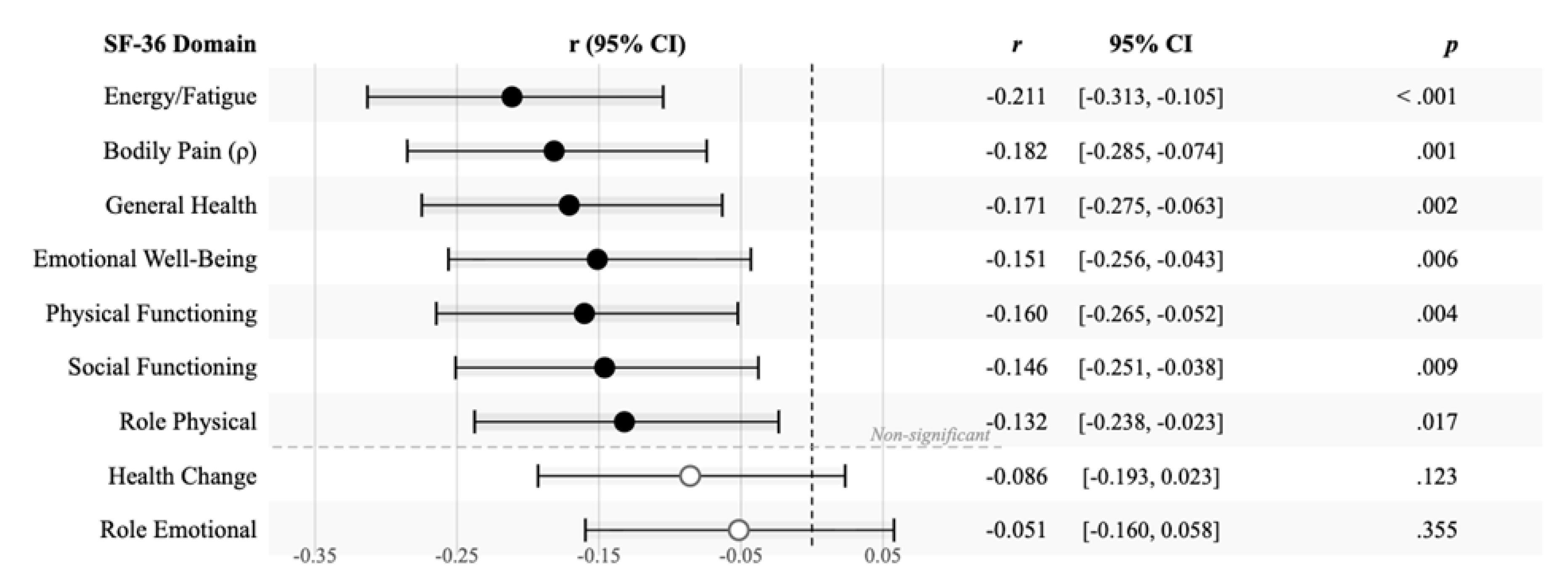

Table 1.
Sociodemographic, Migration-Related, and Clinical Characteristics of the Sample (N = 324).
| Characteristic | n (%) or M ± SD |
|---|---|
| Demographics | |
| Gender | |
| Male | 285 (88) |
| Female | 39 (12) |
| Age (years) | 30.02 ± 7.34 |
| Relationship status [n = 323] | |
| Single | 132 (40.9) |
| In a relationship, living separately | 49 (15.2) |
| Cohabiting | 35 (10.8) |
| Married | 75 (23.2) |
| Divorced | 21 (6.5) |
| Widowed | 3 (0.9) |
| Other | 8 (2.5) |
| Children | |
| No | 141 (43.5) |
| Yes | 183 (56.5) |
| Education level | |
| No school/incomplete primary | 43 (13.3) |
| Primary school | 88 (27.2) |
| Vocational | 37 (11.4) |
| Secondary school | 115 (35.5) |
| Higher education | 32 (9.9) |
| University/postgraduate | 9 (2.8) |
| Current employment | |
| Unemployed | 312 (96.3) |
| Temporary | 7 (2.2) |
| Permanent | 5 (1.5) |
| Migration characteristics | |
| Country of origin | |
| Pakistan | 22 (6.8) |
| Afghanistan | 13 (4) |
| Syria | 158 (48.8) |
| Iran | 23 (7.1) |
| Iraq | 52 (16) |
| Other | 56 (17.3) |
| Duration of stay in Serbia | |
| Up to 3 months | 237 (73.1) |
| 3–6 months | 67 (20.7) |
| 6–12 months | 12 (3.7) |
| More than 1 year | 8 (2.5) |
| Living arrangement in Serbia [n = 323] | |
| Alone | 234 (72.4) |
| With parents | 4 (1.2) |
| With spouse | 11 (3.4) |
| With children only | 17 (5.3) |
| With family (spouse + children) | 19 (5.9) |
| With friends | 37 (11.5) |
| Other | 1 (0.3) |
| Reasons for migration (multiple response) | |
| Personal safety threats | 201 (62) |
| Poor family situation | 168 (51.9) |
| Employment | 95 (29.3) |
| Education | 26 (8) |
| Family reunion | 22 (6.8) |
| Marriage/partnership | 4 (1.2) |
| Natural disaster | 1 (0.3) |
| Other | 8 (2.5) |
| Nutrition and lifestyle | |
| Smoking status | |
| Daily smoker (≥1 cigarette/day) | 130 (40.1) |
| Occasional smoker | 75 (23.1) |
| Former smoker | 45 (13.9) |
| Non-smoker | 74 (22.8) |
| Health status | |
| Any chronic illness | 71 (21.9) |
| Self-rated physical health (1–10) | 6.67 ± 2.4 [n = 323] |
| Self-rated mental health (1–10) | 7.19 ± 2.29 |
| Stressful/traumatic experiences (multiple response) | |
| Exposure to torture | 167 (51.5) |
| Death threats | 82 (25.3) |
| Lack of food and water | 76 (23.5) |
| Forced separation from family | 74 (22.8) |
| Prison stay | 37 (11.4) |
| Participation in war | 33 (10.2) |
| Kidnapped | 19 (5.9) |
| Political persecution | 14 (4.3) |
| Murder of a close person | 2 (0.6) |
| Other traumatic experience | 17 (5.2) |
| Treatment since arriving in Serbia (multiple response) | |
| Treated with kindness | 211 (65.1) |
| Verbally insulted | 38 (11.7) |
| Treated unfairly by police | 27 (8.3) |
| Treated differently due to origin | 24 (7.4) |
| Shunned by community | 20 (6.2) |
| Physically attacked | 10 (3.1) |
| Called names due to origin/religion | 6 (1.9) |
| Sources of support (multiple response) | |
| RS institutions for migrant issues | 140 (43.2) |
| Migrant friends | 75 (23.1) |
| Lonely/without support | 75 (23.1) |
| Family | 36 (11.1) |
| Friends made in Serbia | 35 (10.8) |
| Surroundings (warm/helpful) | 21 (6.5) |
| Non-governmental organizations | 15 (4.6) |
| Mental health service use | |
| Current sedative use [n = 323] | |
| No | 273 (84.5) |
| Occasionally, as needed | 31 (9.6) |
| Yes, daily | 15 (4.6) |
| Don't know | 4 (1.2) |
| Ever used psychiatric/psychological help [n = 319] | |
| No, never | 242 (75.9) |
| Sometimes | 56 (17.6) |
| Often | 21 (6.6) |
| Currently need professional help [n = 320] | |
| No, I feel fine | 167 (52.2) |
| No, I can cope on my own | 63 (19.7) |
| Not sure | 22 (6.9) |
| Yes, but it is not available | 46 (14.4) |
| Yes, but I don't use it | 22 (6.9) |
Note. Values are presented as n (%) for categorical variables and M ± SD for continuous variables. Percentages for multiple-response items may sum to more than 100%. Missing data are indicated by reduced n in brackets where applicable.
Table 2.
Depressive Symptoms: Distribution, Severity, and Item-Level Reliability (N = 324).
| Panel A: Score Distribution and Severity | |||
| Measure | n | % / M ± SD | Range |
| PHQ-9 total score | 324 | 8.67 ± 5.91 | 0–25 |
| Severity classification | |||
| No symptoms (0) | 31 | 9.6 | |
| Minimal depression (1–4) | 59 | 18.2 | |
| Mild depression (5–9) | 100 | 30.9 | |
| Moderate depression (10–14) | 78 | 24.1 | |
| Moderately severe depression (15–19) | 40 | 12.3 | |
| Severe depression (20–27) | 16 | 4.9 | |
| Clinically significant (PHQ-9 ≥ 10) | 134 | 41.4 | |
| Panel B: Item Analysis (Cronbach's α = 0.875 [95% CI: 0.853, 0.894]) | |||
| Item | M ± SD | r(item-total) | α if deleted |
| 1. Diminished interest or pleasure | 1.11 ± 0.92 | 0.547 | 0.867 |
| 2. Feeling hopeless or empty | 1.19 ± 0.98 | 0.706 | 0.853 |
| 3. Sleep problems | 1.1 ± 0.97 | 0.666 | 0.856 |
| 4. Fatigue or low energy | 0.97 ± 0.99 | 0.702 | 0.853 |
| 5. Appetite changes | 0.95 ± 0.98 | 0.654 | 0.858 |
| 6. Negative self-perception | 1.2 ± 1 | 0.638 | 0.859 |
| 7. Difficulty concentrating | 1.17 ± 1.01 | 0.570 | 0.866 |
| 8. Psychomotor changes | 0.57 ± 0.74 | 0.624 | 0.862 |
| 9. Suicidal ideation | 0.4 ± 0.7 | 0.424 | 0.875 |
Note. Panel A: PHQ-9 scores range from 0 to 27. Severity categories follow standard cutoffs. Panel B: Each item scored 0 (not at all) to 3 (nearly every day). r(item-total) = corrected item–total correlation. α if deleted = Cronbach's alpha if item removed. CI computed using Feldt's (1965) method.
Table 3.
Health-Related Quality of Life: SF-36 Domain Scores and Internal Consistency (N = 324).
| Domain | M | SD | Mdn | IQR | Floor % | Ceil % | α | 95% CI |
| Physical Func. | 75.5 | 22.4 | 85.0 | 60–95 | 0.0 | 16.4 | 0.846 | [0.82, 0.87] |
| Role Physical | 64.6 | 33.8 | 75.0 | 50–100 | 11.4 | 34.6 | 0.673 | [0.61, 0.73] |
| Role Emotional | 53.9 | 38.8 | 66.7 | 33–100 | 22.2 | 33.3 | 0.671 | [0.60, 0.73] |
| Bodily Pain | 80.5 | 24.5 | 90.0 | 65–100 | 0.9 | 48.8 | 0.748 | [0.69, 0.80] |
| General Health | 54.6 | 16.2 | 55.0 | 45–65 | 0.0 | 0.3 | 0.494 | [0.40, 0.58] |
| Vitality | 54.6 | 17.2 | 55.0 | 45–65 | 0.0 | 1.9 | 0.447 | [0.34, 0.54] |
| Social Func. | 62.0 | 25.6 | 62.5 | 38–88 | 2.5 | 9.3 | 0.409 | [0.26, 0.53] |
| Mental Health | 53.6 | 16.9 | 56.0 | 40–64 | 0.0 | 0.0 | 0.552 | [0.47, 0.63] |
| Health Change | 57.2 | 26.3 | 50.0 | 50–75 | 3.1 | 15.1 | — | — |
Note. All domain scores range from 0 to 100 (higher = better health), calculated using the RAND SF-36 scoring algorithm. α = Cronbach's alpha; CI = 95% confidence interval (Feldt's method). Floor % = percentage scoring minimum (0); Ceil % = percentage scoring maximum (100). IQR = interquartile range; Mdn = median. Health Change is a single-item indicator (no α computed). SF-36 items were reverse-coded per standard scoring prior to reliability analysis.
Table 4.
Hierarchical Linear Regression: Predictors of Depressive Symptom Severity (PHQ-9 Score; N = 313).
Table 4.
Hierarchical Linear Regression: Predictors of Depressive Symptom Severity (PHQ-9 Score; N = 313).
| Panel A: Hierarchical Block Summary | ||||||
| Block | Variables | R² | ΔR² | F-change | p | |
| 1. Demographics | 1 | 0.011 | 0.011 | 3.53 | 0.061 | |
| 2. Migration/Trauma | 5 | 0.075 | 0.064 | 4.22 | 0.001 | |
| 3. Psychosocial | 2 | 0.115 | 0.040 | 6.90 | 0.001 | |
| 4. SF-36 QoL | 2 | 0.178 | 0.063 | 11.65 | < .001 | |
| Panel B: Final Model Coefficients | ||||||
| Variable | B | SE | β | t | p | |
| Demographics | ||||||
| Education level | -0.586 | 0.233 | -0.133 | -2.52 | 0.012 | * |
| Migration/Trauma | ||||||
| Personal safety threats | 2.070 | 0.671 | 0.171 | 3.08 | 0.002 | ** |
| Death threats | 1.152 | 0.717 | 0.086 | 1.61 | 0.109 | |
| Poor family situation | 1.267 | 0.647 | 0.108 | 1.96 | 0.051 | † |
| Lack of food/water | 1.655 | 0.724 | 0.121 | 2.29 | 0.023 | * |
| War participation | -2.361 | 1.006 | -0.123 | -2.35 | 0.020 | * |
| Psychosocial | ||||||
| Sedative use | 2.428 | 0.886 | 0.145 | 2.74 | 0.006 | ** |
| Support: migrant friends | -1.742 | 0.738 | -0.125 | -2.36 | 0.019 | * |
| SF-36 QoL | ||||||
| SF-36 Energy/Fatigue | -0.067 | 0.018 | -0.196 | -3.65 | < .001 | *** |
| SF-36 Bodily Pain | -0.033 | 0.013 | -0.137 | -2.57 | 0.011 | * |
| Overall model: R² = .178, Adjusted R² = .151, F(10, 302) = 6.56, p < .001 | ||||||
Note. B = unstandardized coefficient; β = standardized coefficient. Block entry: variables entered simultaneously within each block. ΔR² = change in R² when the block is added. F-change tests the significance of each block's contribution. SF-36 Energy = Energy/Fatigue (Vitality) domain; SF-36 Pain = Bodily Pain domain. All VIF values < 1.14, indicating no multicollinearity concerns. †p < .10. *p < .05. **p < .01. ***p < .001.
Table 5.
Binary Logistic Regression: Predictors of Clinically Significant Depression (PHQ-9 ≥ 10; N = 313).
Table 5.
Binary Logistic Regression: Predictors of Clinically Significant Depression (PHQ-9 ≥ 10; N = 313).
| Variable | B | SE | Wald | p | OR | 95% CI | |
|---|---|---|---|---|---|---|---|
| Education level | -0.268 | 0.096 | 7.85 | 0.005 | 0.77 | [0.63, 0.92] | ** |
| Personal safety threats | 0.745 | 0.265 | 7.89 | 0.005 | 2.11 | [1.25, 3.54] | ** |
| Death threats | 0.721 | 0.280 | 6.60 | 0.010 | 2.06 | [1.19, 3.56] | * |
| Support: migrant friends | -0.516 | 0.304 | 2.89 | 0.089 | 0.60 | [0.33, 1.08] | † |
| Support: friends in Serbia | 0.926 | 0.401 | 5.34 | 0.021 | 2.53 | [1.15, 5.54] | * |
| SF-36 Energy/Fatigue | -0.024 | 0.007 | 10.42 | 0.001 | 0.98 | [0.96, 0.99] | ** |
Note. OR = odds ratio; CI = 95% confidence interval. Dependent variable: clinically significant depression (PHQ-9 ≥ 10 vs < 10). Variables entered were those significant at p < .10 in univariate logistic regressions, then trimmed to retain p < .10 in multivariate model. SF-36 Energy = Energy/Fatigue (Vitality) domain. Model fit: Pseudo R² (McFadden) = .096, LR χ²(6) = 40.64, p < .001. Hosmer–Lemeshow: χ²(8) = 11.76, p = .162 (adequate fit). Classification: sensitivity = 46.5%, specificity = 84.4%, overall accuracy = 69.0%, AUC = .705. All VIF values < 1.04. †p < .10. *p < .05. **p < .01.
Disclaimer/Publisher’s Note: The statements, opinions and data contained in all publications are solely those of the individual author(s) and contributor(s) and not of MDPI and/or the editor(s). MDPI and/or the editor(s) disclaim responsibility for any injury to people or property resulting from any ideas, methods, instructions or products referred to in the content. |
© 2026 by the authors. Licensee MDPI, Basel, Switzerland. This article is an open access article distributed under the terms and conditions of the Creative Commons Attribution (CC BY) license (http://creativecommons.org/licenses/by/4.0/).
Copyright: This open access article is published under a Creative Commons CC BY 4.0 license, which permit the free download, distribution, and reuse, provided that the author and preprint are cited in any reuse.


