

Submitted:
13 April 2026
Posted:
14 April 2026
You are already at the latest version
Abstract
It is still poorly understood how Ionospheric Connection Explorer (ICON) can observe at ~600 km altitude the quiet-time equatorial plasma fountain and vertical E×B drift variation over the dip equator including its before-reversal evening increase known as the pre-reversal enhancement (PRE). To fill this knowledge gap, this study uses multi-instrument and multi-point observations to demonstrate the Equatorial Ionization Anomaly (EIA) and the EIA’s breaking down along with their respective underlying forward and revers fountains, and their equatorial vertical upward and downward E×B drift drivers. Jicamarca radar data validated the vertical E×B drift’s daily variation and evening PRE. Total electron content maps verified the EIA’s spatial variation at ~350 km altitude. Before and during the PRE, ICON observed the EIA as a two-peak/single-peak structure at higher/lower sunspot numbers. Underlying the EIA, the forward fountain drift pattern appeared as a latitudinal narrow (~2.5o) equatorial vertical upward E×B drift enhancement and broader off-equatorial downward drifts related to field-aligned downward plasma diffusions. Underlying the breaking-down EIA, the reverse fountain showed an opposite drift pattern. As a conclusion, a ±1.25oN (dip) latitude restriction should be applied to the ICON data to correctly specify the PRE by excluding off-equatorial drifts.
Keywords:
EIA
; equatorial vertical E×B drift
; PRE
; forward plasma fountain
; reverse plasma fountain
1. Introduction
Under magnetically quiet conditions, fountain style vertical plasma circulation takes place within the F region (150-800 km; altitude) over the dip equator’s larger region (~±30oN; dip). This is called the equatorial plasma fountain that can operate in a forward or reverse manner [1,2,3,4]. Generally, the fountain-related plasma flow is (a) mainly perpendicular to the horizontal magnetic field lines (i.e., field-perpendicular) over the dip equator where the plasma moves in the radial direction vertically upward or downward and (b) parallel to the inclined magnetic field lines (i.e., field-aligned) away from the dip equator where the plasma moves along the inclined magnetic field lines up or down [3,4,5]. However, in reality and models (see details below), the field-perpendicular and field-aligned plasma flows occur together across different altitudes, and the plasma moves in the direction of the dominating plasma motion [3,4].
1.1. Quiet-Time Forward Plasma Fountain and Dominating Motions
The forward plasma fountain’s dominating plasma motions are driven by the combined effects of (i) F-region field-perpendicular vertical upward E×B drift over the dip equator and (ii) field-aligned downward diffusion away from the dip equator. This (i) vertical upward E×B drift is an electrodynamic drift that is created by the interaction of F-region eastward electric (E) field, originating from the neutral-wind-generated E region (90-120 km; altitude) dynamo eastward E field, and northward magnetic B field. Dominantly, this vertical upward E×B drift drives the plasma vertically upward across the horizontal magnetic field lines, until the plasma loses momentum. Meanwhile, the uplifted plasma diffuses down the inclined magnetic field lines, away from the dip equator, due to gravity and pressure gradient forces. However, the downward diffusion becomes more rapid with increasing altitudes due to the significant decline of neutral density [3,4]. Also, (iii) meridional neutral winds move the plasma along the inclined magnetic field lines and introduce a north-south asymmetry about the dip equator [6,7,8,9,10]. Equatorward neutral winds support plasma accumulation by moving the ionospheric plasma to higher altitudes where the recombination rates are lower. Poleward neutral winds create opposite mechanical wind effects by moving the plasma to lower altitudes where the recombination rates are higher [3,4,9,10,11].
These (i-iii) combined effects give rise to the F region plasma’s anomalous distribution appearing as a plasma trough over the dip equator and two conjugate plasma crests at ±17o magnetic latitudes with a crest-to-trough ration of ~1.5 at daytime [12,13,14,15,16]. This is known as the Equatorial Ionization Anomaly (EIA) or Appleton Anomaly [12]. The two-peak EIA is an F-region feature that can extend to lower-topside-ionosphere altitudes. As the two peaks develop closer to the dip equator with increasing altitude, the two crests finally merge at higher altitudes and the EIA appears as a single peak feature in the topside ionosphere [10,11,17,18].
1.2. Sheffield University Plasmasphere Ionosphere Model (SUPIM)
Both the forward plasma fountain and the reverse fountain are modeled by the Sheffield University Plasmasphere Ionosphere Model (SUPIM) [1,2,19]. SUPIM is a first-principles ionosphere and plasmasphere model that has been developed over the last three decades. SUPIM incorporates perpendicular E×B drift velocity measurements made over the dip equator at Jicamarca [20] and wind data simulated by the Horizontal Wind Model (HWM) [21]. SUPIM simulations demonstrate the fountain circulations’ various types with vector plasma fluxes [1,2,8,9,22]. These include the above-described forward plasma fountain driven by the equatorial field-perpendicular vertical upward E×B drift and the reverse plasma fountain (see details below) driven by the equatorial field-perpendicular vertical downward E×B drift. SUPIM simulations cover the altitude range of 200–1600 km. According to SUPIM forward fountain simulations, the dominating plasma flows are field-perpendicular vertical upward within ±5o dip latitudes over the dip equator, which is the EIA trough region, and field-aligned downward along the inclined magnetic field lines in each hemisphere at ~(20-30)o dip latitudes located near the EIA crest region. After the E×B drift reversal, the equatorial field-perpendicular vertical downward E×B drift drives the reverse fountain. SUPIM reverse fountain simulations show that the dominating plasma flows are field-perpendicular vertical downward within ±5o dip latitudes over the dip equator, which is the EIA trough region, and are field-aligned upward along the inclined magnetic field lines near the EIA crest regions but are directed toward the EIA trough region in the 200–700 km altitude range.
1.3. Experimental Equatorial E×B Drift Studies
As the equatorial field-perpendicular vertical upward/downward E×B drift is an important driver of the equatorial forward/reverse plasma fountain, its variations have been intensively investigated by various ground- and space-based experimental techniques. Historically, the ground-based Incoherent Scatter Radar (ISR) at Jicamarca, located just 2o north of the dip equator in Peru, measures the electrodynamic E×B drift at F region heights depicting its large day-to-day variability in local time (LT). Based on 20 years of measurements, recorded between 1968 and 1988, Fejer et al. [20] documented the equatorial field-perpendicular vertical E×B drift’s daily variation. During equinoxes, the equatorial field-perpendicular vertical E×B drift is upward at daytime (8–17 LT), turns downward at ~20 LT and remains downward directed through local midnight until ~7 LT. However, downward turning occurs ~1 hour earlier (at ~19 LT) in winter and ~1 hour later (at ~21 LT) in summer.
1.4. Pre-Reversal Enhancement (PRE) and Impacts on Trans-Ionospheric Satellite Signals
An important characteristic of equatorial quiet-time diurnal variations is the field-perpendicular vertical E×B drift‘s steep increase in the dusk sector, before its evening downward turning. It is called the pre-reversal enhancement (PRE) and is caused by the sudden increase of eastward E field triggered by F region dynamo effects [23,24,25,26,27]. During the PRE, the F layer becomes suddenly lifted to ~100-200 km above its usual post-sunset altitude [28]. This makes the F region more unstable because of the steep plasma density gradient developed and leads to a scenario, which triggers the development of a Rayleigh-Taylor (R-T) type instability in the bottomside ionosphere generating equatorial plasma bubbles [29,30]. While the R-T instability migrates vertically upward through the F region peak to the topside ionosphere, the plasma bubbles generated rise to the topside ionosphere [31,32,33,34]. Steep plasma density gradients and deep plasma depletions (i.e., plasma bubbles) significantly degrade propagating trans-ionospheric radio signals via signal scintillations and drop-outs. Signal degradation creates considerable disruptions in space-based communications and navigations using satellites of the Global Navigation Satellite Systems (GNSS) such as Global Positioning System (GPS) [35].
1.5. Quiet-Time Experimental PRE Studies
Focusing on the quiet-time PRE, Fejer et al. [36] carried out the first detailed analysis of satellite observations provided at high sunspot numbers by the first Republic of China Satellite (ROCSAT-1), orbiting at ~600 km altitude. By applying a strict latitudinal restriction to the ROCSAT-1 data and considering measurements from a narrow 10o (latitude) region of the dip equator (i.e., within ±5oN; dip latitude), where the magnetic field lines are horizontal, Fejer et al. [36] documented quiet-time (Kp ≤ 3) equatorial field-perpendicular E×B drift variations in 8 longitude sectors showing consistently vertical upward E×B drifts at daytime, vertical downward E×B drifts at nighttime, and the PRE (vertical upward E×B ≤ 50 m/s) during 18–19 LT.
For investigating the PRE at low sunspot numbers, Harding et al. [37] utilized Ionospheric Connection Explorer (ICON) meridional ion velocity data collected between 2019 and 2022, but without any strict latitudinal restriction applied to the ICON data regarding the dip equator. In this way, the authors specified the occurrence of PRE at ~19 LT along with the regular occurrence of daytime downward drifts during 14–18 LT at both higher (F10.7 > 100 sfu) and lower (F10.7 < 100 sfu) sunspot numbers. More recently, Kirchman & Hysell [38] studied ICON meridional ion velocity measurements collected between November 2021 and October 2022 to investigate the PRE in more detail by focusing on its persistence, magnitude and timing. Based on 458 orbit observations and no strict latitudinal restrictions applied to the ICON data, their statistical study documented the PRE at ~18:30 LT, lasting for ~1.5 hours, and the preceding downward drifts during 16:00–18:30 LT. These two ICON studies [37,38] reported the contradictory observations of daytime (16:00–18:30 LT) negative values (interpreted as downward drifts) occurring before the evening PRE that are inconsistent with the findings of the above-described previous studies of Fejer et al. [20,36]. This inconsistency is still unexplained and creates a gap in our understanding of how ICON can observe the PRE. It is still not clear why ICON observed negative values, interpreted by recent studies [37,38] as downward drifts, during 16:00–18:30 LT before the PRE.
1.6. Main Aims of This Study
This study’s main aims are to unravel the above-described inconsistency resulted from using ICON data for specifying the daily variation of field-perpendicular E×B drift over the dip equator. Our main objectives are (a) to demonstrate how ICON observed the equatorial forward and reverse fountains and the evening PRE and (b) to explain the daytime negative drift values -occurring prior to the evening PRE- that were reported and interpreted as downward drifts by Harding et al. [37] and Kirchman & Hysell [38]. Our significant findings include the specification of daytime (16:00–18:30 LT) negative drift values as plasma drifts, which are part of the forward fountain circulation’s dominating field-aligned downward plasma diffusions driven by gravity and pressure gradient forces near the EIA crest regions.
2. Materials and Methods
ICON orbited the Earth during 11 October 2019–25 November 2022 and observed the topside ionosphere’s lower region between 575 km perigee and 603 km apogee altitudes. ICON completed 15 or 16 orbits a day characterized by an inclination angle of 27o and orbit period of 97-min [39,40]. We obtained 1-second Level-2 ICON data from the Coordinated Data Analysis Web (CDAWeb) Data Explorer. In order to process and handle the daily ICON data files, we created a software package, which can define and number the satellite passes in the ascending and descending directions and can create a separate data file for each of the ascending and descending passes, where the different variables selected are listed. For this study, we used multi-instrument data provided by the Ion Velocity Meter (IVM-A) [41,42] suite such as in situ ion density (Ni; cm-3) measurements and orbit parameters such as footprints in geographic coordinates, solar local time (LT; Hr), and magnetic local time (MLT; Hr). For each ICON line plot presented in this study, we specified when ICON crossed the dip equator in terms of universal time (UT; Hr), solar local time (LT) and magnetic local time (MLT). These dip-equator-crossing (DEQ) times are indicated as DEQ(UT), DEQ(LT), and DEQ(MLT). Importantly, we used ion velocity (Vi; m/s) values measured in two different local coordinate systems (see details below) in order to demonstrate and explain similarities and differences (see details below).
From the ICON IVM-A suite, we used the values of meridional ion velocity (VMER; m/s; positive upward over the dip equator and poleward away from the dip equator over the Northern Hemisphere). VMER is measured in a B-field referenced coordinate system, within the local magnetic meridional plane along the local magnetic meridional direction. Thus, VMER is perpendicular to the horizontal geomagnetic field over the dip equator, where the local meridional vector maps to the vertical direction. Therefore, over the dip equator, VMER > 0 (or < 0) represents a vertical upward (or downward) ion drift. This is a field-perpendicular E×B drift associated with the zonal eastward E field [37]. We also used cross-track vertical ion velocity (VVER; m/s; positive upward) measurements taken in a spacecraft-centered coordinate system to observe the dominating field-aligned plasma diffusions’ vertical components (away from the dip equator). But over the dip equator, this cross-track VVER is a field-perpendicular vertical ion velocity where VVER > 0 (or < 0) is directed radially upward, away from the Earth (or downward, toward the Earth) [42]. Although VMER and VVER are measured in two different coordinate systems, they represent the same field-perpendicular vertical E×B drift over the dip equator.
As part of our methodology, we used these two different types of ICON IVM-A VMER and VVER measurements. Our aim was to demonstrate the dominating field-perpendicular vertical plasma drifts of the forward and reverse fountains within the narrow 2.5o (latitude) range of the dip equator or within ±1.25o (dip) latitudes. In this way, we could assess how ICON observed the field-perpendicular E×B drift over the dip equator in these two different local coordinate systems.
The Jicamarca ISR is located at 283.13oE; -11.95oN (geographic) and at 2oN (dip) in Lima, Peru. Obtained from the Madrigal Database, we used the averaged vertical drift values smoothed over the 218–577 km altitude range providing F region averages for the altitude of 360 km. These published averaged drift values are estimated vertical E×B plasma drift velocities directed perpendicular to the horizontal magnetic field over the dip equator and are available only for a few days of a few months of the year.
We also used vertical total electron content (TEC) values, computed in TEC units (TECU; 1 TECU = 1016 e-/m2) by considering the mean ionospheric height of 350 km, from the worldwide ground-based GNSS receiver network. Published by the Madrigal database, these TEC values are automatically processed, averaged over 5 min (in UT), and binned in 1o latitude by 1o longitude (geographic) cells [43]. By plotting ~1 hour worth of TEC data covering the time-period of interest, we created a series of GNSS TEC maps where we indicated the local time (marked in magenta or red) at each major longitude increment.
3. Results
3.1. Equatorial E×B Drift and EIA Variations in the American Longitude Sector on 3 April 2022
Figure 1 illustrates how the electrodynamic field-perpendicular vertical E×B drift (measured over the dip equator, near Jicamarca) and the resultant plasma density distribution varied in the American longitude sector on 3 April 2022 at higher sunspot numbers (F10.7 = 143 sfu).
In Figure 1(a), the field-perpendicular vertical E×B drift (m/s) measured by the Jicamarca ISR is plotted against the local time (LT = UT—5 hours). As shown, the field-perpendicular vertical drift was downward directed and persisted from midnight to morning (0–8 LT) and from evening to next midnight (20–24 LT). Here, we marked 5 LT as (i) and 23 LT as (iv). During daytime hours in the 8–20 LT sector, the field-perpendicular vertical drift was upward directed. It peaked first just before midday (at ~11 LT; marked as (ii)), decreased in the afternoon (15–17 LT) reaching slightly negative values, and increased again at dusk known as the PRE (~19 LT; marked as (iii)). Soon after the PRE, the vertical upward drift turned downward and remained comparable in magnitude with the upward drift during a larger time interval of the reversal (19–21 LT).
In Figure 1b, a series of GNSS TEC maps shows the resultant TEC distribution (at ~350 km latitude) during the marked ((i)–(iv)) time periods. Here, we also show the LT computed for the main longitude increments indicated. Each map is constructed with data covering the ~1 UT hour period of interest, covers the Western Hemisphere (180-360oE; geographic), and shows the modeled dip equator (in green) along with the location of Jicamarca (dot symbol in red) situated just 2o north of the dip equator. Map (i) shows the minimum TEC values (< 14 TECU; shades of dark blue) of the depleted ionosphere at ~5 LT over Jicamarca, many hours after the previous evening PRE. Map (ii) illustrates the well-developed daytime EIA (> 80 TECU; red) at 11 LT over Jicamarca. Map (iii) demonstrates the sudden redevelopment of the evening EIA (> 50 TECU; red) over Jicamarca at 19 LT, during the PRE. Map (iv) depicts the collapsed EIA at 23 LT over Jicamarca, ~4 hours after the PRE.
3.2. EIA and Underlying Forward Fountain Observed by ICON at Dusk: 1 April 2022 Event
Figure 2 is constructed with field-perpendicular vertical E×B drift data provided by the Jicamarca ISR, GNSS TEC measurements, and ICON IVM-A data sets. Figure 2 demonstrates how ICON observed the EIA and underlying forward fountain’s dominating plasma flows during the PRE’s early stage (i.e., before the vertical upward E×B drift peaked) on 1 April 2022 at higher sunspot numbers (F10.7 = 146 sfu) over the Mid Pacific. In the absence of local ground-based field-perpendicular drift measurements taken at the dip equator, we used the Jicamarca ISR drift data. Based on the statistical study of Fejer et al. [28], we assumed that the field-perpendicular vertical E×B drift at the dip equator varied in local time in a similar way over the Pacific as over Jicamarca.
In Figure 2a, the global map shows modeled magnetic meridians (in blue) and dip equator (in green) and the ground track of the ascending ICON pass-03 of interest (in light red) crossing the dip equator at 210oE geographic longitude over the Mid Pacific on 1 April 2022 at 17.12 LT. Along its ascending pass-03, ICON observed the EIA trough region (diamond symbol in light red) near the dip equator and the two EIA crests (dot symbols in light red) on different magnetic field lines. Since ICON crossed the magnetic meridians and magnetic field lines, because of its 27o-inclined orbit, it could not observe the EIA’s northern-southern conjugate crests. Therefore, ICON could not provide field-aligned observations that are crucial for observing the EIA and underlying forward plasma fountain characterized by field-aligned plasma flows near the EIA crests.
In Figure 2b, the Jicamarca ISR-detected field-perpendicular vertical E×B drift is plotted against the local time. Its diurnal variation is characterized by a daytime peak at (~11 LT) and the evening PRE peaking at ~19 LT. As marked (shaded interval in light green), ICON crossed the dip equator at 17.12 LT when the vertical upward E×B drift started increasing in the dusk sector before it reached its peak of ~50 m/s (i.e., the PRE) at 19 LT.
Figure 2c shows the global GNSS TEC map constructed with ~1 hour of data covering the 1-hour UT period of 3.28–4.28 UT, during which ICON crossed the dip equator (at 3.45 UT). As before, we indicated the computed local time values for the major longitude increments. As shown by the GNSS TEC map, the EIA appeared well developed over the Mid Pacific where the EIA crests reached over 80 TECU (in red) and the EIA trough was deep (43–29 TECU; shades of green). Since ICON traveled at ~600 km altitude, it observed the EIA crests (dot symbols in light red) closer to the dip equator than the EIA crests detected by the GNSS TEC values at 350 km altitude.
In Figure 2d, the line-plot sets are constructed with ICON ion density (Ni), cross-track vertical (VVER) drift, and meridional (VMER) drift data. These are plotted in geographic latitudes where we marked the local time (LT; Hr) for the major latitude increments. While the Ni plot shows the EIA appearing as a two-peak ion density feature, the VVER drift plot depicts the underlying forward fountain circulation’s dominating vertical plasma motions. We show also the VMER plot, used by the previous studies of Harding et al. [37] and Kirchman & Hysell [38], in order to highlight similarities and differences between the cross-track VVER and meridional VMER observations. Although the ICON detection was not field aligned, the Ni plot depicts an almost symmetric EIA. We marked each EIA crest (dot symbol in light red; shaded interval in yellow) located quite close to the dip equator (~6o away from the dip equator), the dip equator’s ±1.25o latitude region (shaded interval in light green) covering 2.5o latitudes wherein the EIA trough (diamond symbol in light red) was located. As shown by the VVER plot, the field-perpendicular vertical E×B drift was upward directed, maximized over the dip equator, and drove the plasma up and across the horizontal magnetic field lines, most intensively in the EIA trough region, as part of the forward plasma fountain circulation’s dominating field-perpendicular equatorial plasma motion. Meanwhile, the vertical upward drift decreased in the EIA crest regions because of the forward plasma fountain circulation’s dominating downward field-aligned plasma motion. By comparing the VVER and VMER plots, they show strong similarities in the vicinity of the dip equator (within ±1.25o latitudes), where these drifts locally maximized (VVER ≈ 28.67 m/s; VMER ≈ 27.09 m/s) simultaneously. Their respective peaks were located within the narrow ±1.25o latitude region of the dip equator, covering 2.5o in latitudes (shaded interval in light green), where they measured the field-perpendicular vertical upward E×B drift (see details in Section 2). Although these measured drift values are higher than the ISR measured drift value, they provide observational evidence that ICON made its observations before the PRE.
Figure 3 is constructed the same way as Figure 2 and illustrates another set of observations on 1 April 2022 before the field-perpendicular vertical upward E×B drift peaked (i.e., the PRE) at ~19 LT. Thus, Figure 3 shows with ICON pass-04 the continuation of the scenario depicted by ICON pass-03 in Figure 2. Because of the strong similarities, we highlight here only the new features shown by Figure 3.
In Figure 3a, the global map illustrates the ascending ICON pass-04 that crossed the dip equator at ~185oE geographic longitude over the Mid Pacific at a slightly later local time (17.52 LT). Figure 3b is the same as Figure 2b. Here, we marked that later local time (17.52 LT) that occurred closer to the peak of electrodynamic E×B drift (i.e., the PRE). Because of the strong field-perpendicular vertical upward E×B drift, the EIA was well developed over the Mid Pacific (see GNSS TEC map in Figure 3c). In Figure 3d, the ICON line plots depict an almost symmetric EIA along with the underlying forward fountain’s dominating field-perpendicular and field-aligned plasma drifts. The VVER line plot shows the locally increased field-perpendicular vertical upward E×B drift over the dip equator and the locally decreased vertical upward drifts associated with the dominating field-aligned downward diffusions near the crest region. At the northern crest, the vertical downward drift indicates stronger dominating field-aligned downward diffusions. Again, the only strong similarity between the VVER and VMER plots is their respective locally peaking field-perpendicular vertical upward drifts over 2.5o (latitude) within the dip equator’s close (±1.25o) vicinity (VVER ≈ 27.10 m/s; VMER ≈ 26.43 m/s).
3.3. Breaking-Down EIA and Underlying Reverse Fountain Observed by ICON at Dawn: 2 April 2022 Event
Figure 4 is constructed the same way as Figure 2 and Figure 3 but for 2 April 2022. Figure 4 covers the following day, 2 April 2022, still at higher sunspot numbers (F10.7 = 143 sfu) and illustrates the breaking down of the 2-peak EIA and the underlying reverse fountain.
In Figure 4a, the global map shows the descending ICON pass-08 that crossed the dip equator at ~265oE geographic longitude, near Jicamarca, at local dawn (6.21 LT). Because of ICON’s 27o-inclined orbit, ICON observed the breaking-down EIA crests on different magnetic field lines located far apart. While the northern EIA crest was tracked over the Western Pacific, the southern EIA crest was observed over the South American continent, south of Jicamarca.
Figure 4b is the continuation of Figure 3b and shows how the electrodynamic field-perpendicular vertical E×B drift variation continued the following day, 2 April 2022, over Jicamarca, measured by the ISR. We could not find any ICON observation demonstrating the EIA and underlying forward fountain at the peak of the previous PRE on 1 April 2022. After the field-perpendicular vertical E×B drift reversal at ~19 LT on 1 April, the EIA was breaking down during the local nighttime hours and following dawn. We show an event unfolding during the following dawn, when the revers fountain was operational driven by the field-perpendicular vertical downward E×B drift. Since ICON crossed the dip equator near Jicamarca, the electrodynamic field-perpendicular vertical E×B drift measured at Jicamarca by the ISR is well correlated with the descending ICON pass-08 crossing the dip equator near Jicamarca.
In Figure 4c, the GNSS TEC map shows the breaking down of the 2-peak EIA near Jicamarca at local dawn. The weak EIA crests observed by ICON are indicated by the northern lower (14-21 TECU; in light blue) and southern higher (29-36 TECU; in light green) TEC values.
Figure 4d shows the breaking-down EIA and dominating plasma drifts of the underlying reverse fountain. Depicted by the Ni plot, the two EIA crests are still visible, but the EIA trough region started filling up (shaded interval in light red) because of the underlying reverse fountain plasma circulation. During the operation of the reverse fountain, the strong field-perpendicular vertical downward E×B drift drives the plasma vertically downward across the horizontal magnetic field lines. Due to the low plasma pressure created in the EIA trough region, the plasma starts flowing upward at the EIA crest regions and then toward the dip equator filling up the EIA trough region [7]. This is illustrated with the VVER line plot depicting the field-perpendicular vertical downward E×B drift (shaded interval in light green) over the dip equator and the field-aligned upward plasma diffusion related vertical upward drifts (shaded intervals in yellow) at the EIA crest regions and nearby (not marked). Because of the alignment of the descending ICON pass-08, this pass covered a larger region of the dip equator (shaded intervals in light green and light red) where ICON tracked the field-perpendicular vertical downward E×B drift additionally to the crossing point (shaded interval in light green). Yet again, the only strong similarity between the VVER and VMER plots is the locally increased field-perpendicular vertical downward (-) drift over the 2.5o latitude region of the dip equator located within ±1.25o dip latitudes (VVER ≈ -3.60 m/s; VMER ≈ -3.19 m/s).
3.4. EIA and Underlying Forward Fountain Observed by ICON at Dusk: 3 March 2022 Event
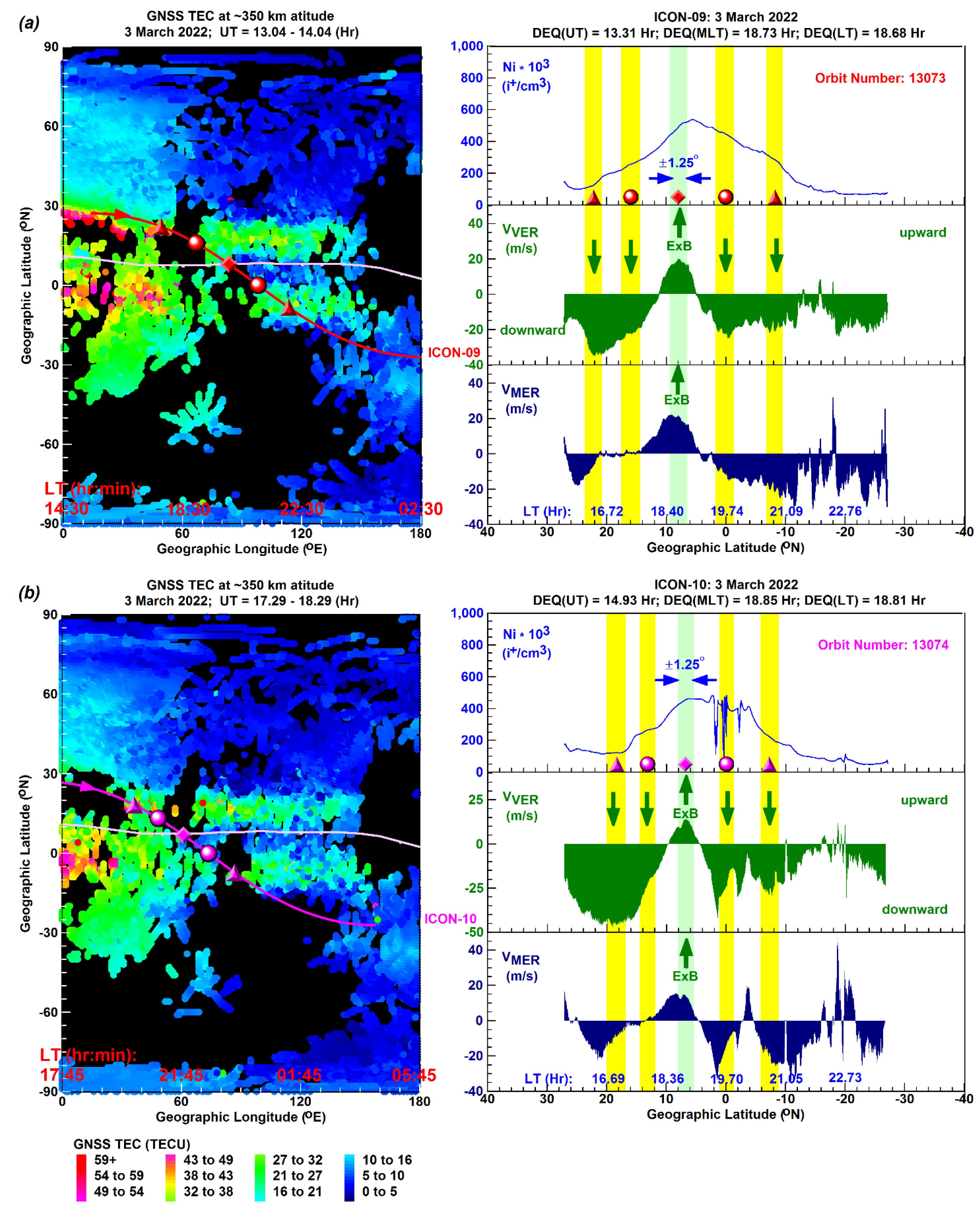
Figure 5 and Figure 6 are constructed for the 3 March 2022 events reported first by Kirchman & Hysell [38]. After demonstrating the EIA’s and underlying forward fountain related dominating plasma drifts’ basic characteristics observed by ICON (shown in Figure 2 and Figure 3), we explain the events of 3 March 2022 observed at lower sunspot numbers (F10.7 = 109 sfu). Then, the EIA appeared as a single-peak ion density feature at ~600 km altitude. In the absence of Jicamarca ISR data specifying the PRE’s local time, each event shown in Figure 5 and Figure 6 is illustrated with a GNSS TEC map and an ICON line-plot set. These events were observed along four consecutive descending ICON passes numbered as 07, 08, 09, and 10 by our software (see details in Section 2).
In Figure 5a-b and Figure 6a-b, the GNSS TEC map covers the Eastern Hemisphere and shows the 2-peak structure of the EIA detected at ~350 km altitude. Here, we plotted the descending ICON pass of interest. Because of the alignment of the descending ICON pass, it crossed the EIA crest more than once in each hemisphere. We marked these EIA crest crossings (dot and triangle symbols) along with the dip equator crossing (diamond symbol).
In Figure 5a-b and Figure 6a-b, the ICON line-plot set is constructed as before. Here, the Ni plot reveals that at ~600 km altitude, ICON observed the EIA as a single-peak ion density structure. We marked the EIA crest crossings (dot and triangle symbols; shaded intervals in yellow) along with the dip equator crossing (diamond symbol; shaded interval in light green). Although ICON observed a single-peak EIA structure at ~600 km altitude, it could still observe the underlying forward-fountain-related dominating plasma drifts. These dominating plasma drifts are shown with the cross-track VVER plot depicting the field-perpendicular vertical upward E×B drift over a narrow 2.5o (latitude) region the dip equator and the vertical downward drift component of the field-aligned downward diffusion at each EIA-crest-crossing over the Northern Hemisphere earlier (in UT and LT) and over the Southern Hemisphere later on (in UT and LT). Similarity both the cross-track VVER plot and meridional VMER plot depict the peaking of field-perpendicular vertical upward E×B drift over the dip equator, in a narrow 2.5o (latitude) region within ±1.25o (dip) latitudes, depicting the localized increase of field-perpendicular vertical upward E×B drift over the dip equator. Because of the alignment of the descending ICON passes, covering many LT hours, both the cross-track VVER plot and the meridional VMER plot in LT show negative drifts that occurred before and after the positive VMER and VVER drift measurements. As was explained above, these off-equatorial negative drifts were located at the EIA crest regions and were related to the dominating field-aligned downward plasma diffusions of the underlying forward plasma fountain.
4. Discussion
This study’s main aim was to unravel the contradictory observations of negative drift in the 16:00–18:30 LT sector recorded by ICON before the PRE at ~19 LT. These observations were reported and specified by previous studies ([37,38] as field-perpendicular vertical downward E×B drifts. In order to unravel this discrepancy, we investigated first how ICON could observe the underlying field-aligned fountain circulation along its 27o-inclined ascending and descending passes crossing numerous magnetic meridians and magnetic field lines. From SUPIM simulations, reported by previous studies [8,22,44], the vertical drift signatures of (i) forward fountain circulation underlying the two-peak EIA and (ii) reverse fountain circulation underlying the breaking-down EIA are well understood today. We used these (i-ii) fountain signatures along with the GNSS TEC maps and multi-instrument ICON IVM-A data providing simultaneous drift and ion density measurements. We investigated ascending and descending ICON passes that we mapped with the modeled dip equator and magnetic meridians. These revealed that during the higher sunspot number periods of 2022 and at ~600 km altitude, the EIA crests developed quite close to the dip equator. We used cross-track vertical drift measurement to show that at the dip equator, where the magnetic field lines are horizontal, the forward-fountain-related field-perpendicular vertical upward E×B drift increased and peaked in a narrow 2.5o (latitude) region within ±1.25o (dip) latitudes of the dip equator. This is where the EIA trough developed. Meanwhile, the forward-fountain-related dominating field-aligned downward plasma diffusion was depicted by the cross-track decreasing upward drift or increasing downward drift observed at and just poleward of each EIA crest, still at low latitudes and close to the dip equator.
We also examined the 3 March 2022 events investigated by Kirchman & Hysell [38]. These four events occurred during a lower sunspot number period of 2022. Our results revealed that then, the EIA appeared as a single-peak structure at ~600 km altitude (observed by ICON) and as a two-peak structure at ~350 km altitude (depicted by the GNSS TEC maps). Even though ICON observed a single peak EIA at ~600 km latitude, ICON still observed the underlying forward fountain circulation. This was demonstrated with the ICON cross-track vertical drift (VVER) measurements depicting the characteristic locally increased field-perpendicular vertical upward E×B drift over the dip equator (VVER > 0) and the dominating field-aligned downward diffusions away from the dip equator (VVER < 0). Meanwhile, the EIA crests were detected by the TEC maps at ~350 km altitude. Because of its 27o-incined orbit, crossing numerous longitudes and various LT sectors away from ICON’s equator crossing longitude, ICON also observed forward-fountain-related field-aligned downward diffusions (underlying the EIA crest regions) away from ICON’s equator crossing longitude. With respect to this equator crossing longitude, ICON’s descending passes covered longitude sectors, which were located: at earlier LT (~16 LT) over the Northern Hemisphere and at later LT (21 LT) over the Southern Hemisphere. Although these previous studies used meridional drift (VMER) measurements, which represent field-perpendicular vertical upward-downward drifts only over the dip equator, the negative VMER drift values (detected at the EIA crest regions at earlier and later LTs) were specified incorrectly by these previous authors [37,38] as field-perpendicular vertical downward E×B drifts. This erroneous specification led to the incorrect interpretations of these studies [37,38] that the PRE (observed over the dip equator) was surrounded by field-perpendicular vertical downward E×B drifts observed by ICON at earlier LTs before the PRE and at later LTs after the PRE. Also erroneously, these studies [37,38] concluded that unusually, ICON observed field-perpendicular vertical downward E×B drifts before the PRE.
Field-perpendicular vertical downward drifts preceding the PRE were also reported by earlier studies using other techniques. These include the study of Stoneback et al. [45] and the more recent study of Zhang et al. [46]. Stoneback et al. [45] used drift data collected along the 13o-inclined orbit paths of Communication Navigation Outage Forecasting System (C/NOFS) satellite between 400 perigee and 860 km apogee altitudes during the solar minimum time-period of 2008–2010 when the sunspot number was low, 68–80 sfu. Then, the F region develops at lower altitudes, the EIA crests form closer to the dip equator, and the forward-fountain-related dominating field-aligned downward diffusions occur at lower latitudes and closer to the dip equator. Stoneback et al. [45] used drift measurements collected over the entire latitude range of C/NOFS, at low-sunspot numbers, without any latitudinal restriction applied to the drift data for eliminating off-equatorial measurements. In their Figures 1–8, the authors documented seasonal meridional drift variations (in MLT) for the different longitude regions. As the authors noted, these diurnal variations showed daily patterns that significantly deviated from the usual daily drift pattern of equatorial field-perpendicular vertical E×B drift reported by Fejer et al. [36]. However, Fejer et al. [36] used ROCSAT-1 drift data measured within ±5oN dip latitudes at high sunspot numbers. Then, the F2 layer developed at high altitudes and consequently, the EIA crests and underlying forward-fountain-related dominating field-aligned downward plasma diffusions occurred further away from the dip equator and became successfully eliminated by the ±5oN (dip) latitude restriction applied to the ROCDSAT-1 drift data. Based on ROCSAT-1 measurements collected within a narrower latitude range of ±2.5oN dip latitudes and Jicamarca ISR observations, Zhang et al. [46] reported rare scenarios (~20% occurrence frequency). Then, the daytime field-perpendicular vertical E×B drift was downward directed during 13–17 LT over the dip equator before the PRE occurring at ~19 LT. These observations demonstrated the actual occurrence of field-perpendicular vertical downward E×B drift, mostly at full moon in the local afternoon sector, and were explained scientifically correctly with lunar tides by Zhang et al. [46].
We also investigated the ability of meridional drift (VMER) to measure field-perpendicular equatorial vertical E×B drift variations. In both studies, Harding et al. [37] and Kirchman & Hysell [38] used meridional VMER data to investigate equatorial field-perpendicular vertical E×B drift variations. By definition, the meridional drift is purely vertical at the dip equator and positive in the upward direction. Incorrectly, the authors [37,38] used VMER data -recorded away from the dip equator- to investigate field-perpendicular vertical E×B drift variations.
The main reason we used cross-track vertical drift (VVER) values was to investigate the vertical drifts associated with the forward and reverse fountains. We related these vertical drifts to the dominating field-perpendicular (over the dip equator) and field-aligned (away from the dip equator) plasma diffusions/drifts. But for comparisons, our figures show both: the cross-track VVER and the meridional VMER. These plots provide observational evidence confirming the original definition of meridional drift and demonstrate that over a narrow 2.5o latitudinal region of the dip equator, within ±1.25o (dip) latitudes, VMER ≅ VVER. But away from the dip equator, even in its close vicinity, VMER and VVER vary differently and only the VVER data provide vertical upward/downward measurements that are related to the field-aligned plasma diffusions occurring away from the dip equator.
5. Conclusions
By using multi-instrument ICON data recorded at ~600 km altitude, we investigated various EIA events occurring in 2022 at higher and lower sunspot numbers. For our investigations, we used ICON ion density (Ni) and cross-track vertical drift (VVER) data in order to illustrate the fully developed EIA and the breaking-down EIA along with the underlying forward and reverse fountains. We also used meridional drift (VMER) data in order to compare VVER and VMER observations within a narrow 2.5o latitude region of the dip equator, between ±1.25o (dip) latitudes. These cross-track VVER measurements demonstrated the plasma fountain-related dominating vertical upward and downward plasma flows observed at ~600 km altitude by ICON. We analyzed and interpreted these observations based on the SUPIM simulations reported by previous studies [1,2,8,22,44]. Scientifically correctly, we considered ICON’s 27o-inclined orbital alignment crossing numerous magnetic meridians, magnetic field lines, and local time sectors, and thus providing not-field-aligned observations. These Ni and VVER observations demonstrate at 600 km altitude:
- (i)
- the EIA as a two-peak plasma density structure at higher sunspot numbers,
- (ii)
- the EIA as a single-peak plasma density structure at lower sunspot numbers,
- (iii)
-
the EIA’s underlying forward fountain circulation-related dominating vertical plasma drift/diffusion specified as:
- field-perpendicular vertical upward drift over the dip equator,
- field-aligned downward diffusion away from the dip equator.
- (iv)
-
the EIA’s breaking down and underlying reverse fountain circulation-related dominating plasma drift/diffusion specified as:
- field-perpendicular vertical downward drifts over the dip equator,
- field-aligned upward diffusion away from the dip equator.
These (i-iv) ICON observations revealed that:
- (a)
- the forward fountain’s dominating plasma flows’ vertical drift signatures were the same in the EIA events of (i) and (ii),
- (b)
- the forward-fountain-related dominating field-aligned downward diffusions were located close to the dip equator,
- (c)
- the meridional (VMER) and cross-track vertical (VVER) drifts equaled only over the dip equator.
From these findings (i-iv and a-c) we conclude that a dip latitude restriction (~±1.25o) should be applied to both the ICON meridional (VMER) and cross-track vertical drift (VVER) data in order to investigate the equatorial field-perpendicular vertical E×B drift variations over the dip equator scientifically correctly. Without such latitudinal restriction, the drift data considered contain drifts associated with the forward-fountain-related dominating field-aligned downward plasma diffusions and depict downward drifts recorded before (at earlier LT) and after (at later LT) ICON crossed the dip equator and observed the equatorial field-perpendicular vertical upward E×B drift’s evening prereversal enhancement.
The major shortfall of this study is the absence of correlated Jicamarca ISR and ICON observations, depicting the EIA and underlying forward fountain circulation during the PRE. We plan to carry out such correlated investigations in future studies. But the findings of this study are still significant as they improve our understanding of how ICON observed the equatorial E×B drift and fill some of the existing knowledge gaps related to the forward and reverse fountain circulations.
Author Contributions
Conceptualization, I.H..; methodology, I.H.; software, I.H. and B.C.L.; validation, I.H. and B.C.L.; formal analysis, I.H.; investigation, I.H..; resources, B.C.L.; data curation, I.H.; writing—original draft preparation, I.H..; writing—review and editing, B.C.L. and I.H.; visualization, I.H..; supervision, B.C.L.; project administration, B.C.L.; funding acquisition, B.C.L. All authors have read and agreed to the published version of the manuscript.
Funding
This research was funded by the United States Office of Naval Research under award number N62909-23-1-2057.
Data Availability Statement
The GNSS TEC data can be accessed online through https://cedar.openmadrigal.org/list (accessed on 7 January2026). The Jicamarca ISR data can be accessed online through https://cedar.openmadrigal.org/list (accessed on 2 January 2025). The ICON data sets can be accessed online through https://cdaweb.gsfc.nasa.gov/cdaweb/istp_public/ (accessed on 10 January 2026). The Kp and F10.7 indices can be accessed online from the OMNI database: through https://cdaweb.gsfc.nasa.gov/cdaweb/istp_public/(accessed on 15 January 2026)
Acknowledgments
We acknowledge the CEDAR Archival Madrigal Database for the GNSS TEC and Jicamarca ISR data. We also acknowledge the ICON data. ICON is supported by NASA’s Explorers Program through contracts NNG12FA45C and NNG12FA42I. ICON data are processed in the ICON Science Data Center at UCB. We thank the World Data Center for Geomagnetism at Kyoto (http://wdc.kugi.kyoto-u.ac.jp/wdc/Sec3.html) for providing the Kp index and the 10.7 cm solar radio flux data.
Conflicts of Interest
The authors declare no conflicts of interest.
Abbreviations
The following abbreviations are used in this manuscript:
| CDAWeb | Coordinated Data Analysis Web |
| C/NOFS | Communication Navigation Outage Forecasting System |
| DEQ | Dip-Equator-Crossing |
| EIA | Equatorial Ionization Anomaly |
| GNSS | Global Navigation Satellite Systems |
| GPS | Global Positioning System |
| HWM | Horizontal Wind Model |
| ICON | Ionospheric Connection Explorer |
| ISR | Incoherent Scatter Radar |
| IVM-A | Ion Velocity Meter-A |
| LT | Local Time |
| MLT | Magnetic Local Time |
| Ni | ion density |
| PRE | Pre-Reversal Enhancement |
| ROCSAT | Republic of China Satellite |
| sfu | sunspot flux unit |
| SUPIM | Sheffield University Plasmasphere Ionosphere Model |
| TEC | Total Electron Content |
| TECU | TEC Unit |
| UT | Universal Time |
| VVER | Vertical Velocity |
| VMER | Meridional Velocity |
References
- Bailey, G.J.; Sellek, R.; Rippeth, Y.A. modeling study of the equatorial topside ionospher. Annales Geophysicae 1993, 11(4), 263–272. Available online: https://ui.adsabs.harvard.edu/abs/1993AnGeo..11..263B/abstract.
- Bailey, G.J.; Balan, N. Some modelling studies of the equatorial ionosphere using the Sheffield University Plasmasphere Ionosphere Model. Advances in Space Research 1996, 18(6), 59–68. [Google Scholar] [CrossRef]
- Balan, N.; Souza, J.; Bailey, G.J. Recent developments in the understanding of equatorial ionization anomaly: A review. Journal of Atmospheric and Solar-Terrestrial Physics 2018, 171, 3–11. [Google Scholar] [CrossRef]
- Balan, N.; Liu, L.B.; Le, H.J. A brief review of equatorial ionization anomaly and ionospheric irregularities. Earth and Planetary Physics 2018, 2(4), 257–275. [Google Scholar] [CrossRef]
- Hanson, W.B.; Moffett, R.J. Ionization transport effects in the equatorial f region. Journal of Geophysical Research 1966, 71(23), 5559–5572. [Google Scholar] [CrossRef]
- Rishbeth, H. Thermospheric winds and the F region: a review. Journal of Atmospheric and Terrestrial Physics 1972, 34(1), 1–47. [Google Scholar] [CrossRef]
- Titheridge, J.E. Winds in the ionosphere—A review. Journal of Atmospheric and Terrestrial Physics 1995, 57(14), 1681–1714. [Google Scholar] [CrossRef]
- Balan, N.; Bailey, G.J. Equatorial plasma fountain and its effects: possibility of an additional layer. Journal of Geophysical Research 1995, 100(A11), 21421–21432. [Google Scholar] [CrossRef]
- Balan, N.; Otsuka, Y.; Nishioka, M.; Liu, J.Y.; Bailey, G.J. Physical mechanisms of the ionospheric storms at equatorial and higher latitudes during the recovery phase of geomagnetic storms. Journal of Geophysical Research: Space Physics 2013, 118(5), 2660–2669. [Google Scholar] [CrossRef]
- Li, J.; Chen, Y.; Liu, L.; Le, H.; Zhang, R.; Huang, H.; Li, W. Occurrence of Ionospheric Equatorial Ionization Anomaly at 840 km height observed by the DMSP satellites at solar maximum dusk. Space Weather 2021, 19(5), e2020SW002690. [Google Scholar] [CrossRef]
- Richmond, A. D.; Fang, T. W.; Maute, A. Electrodynamics of the equatorial evening ionosphere: 1. Importance of winds in different regions. Journal of Geophysical Research: Space Physics 2015, 120(3), 2118–2132. [Google Scholar] [CrossRef]
- Appleton, E.V. Two anomalies in the ionosphere. Nature 1946, 157(691), 691. [Google Scholar] [CrossRef]
- Maeda, H. Horizontal wind systems in the ionospheric E region deduced from the dynamo theory of the geomagnetic Sq variation, Part I: non-rotating Earth. Journal of Geomagnetism and Geoelectricity 1955, 7(4), 121–132. [Google Scholar] [CrossRef]
- Cai, X.; Wang, W.; Eastes, R.W.; Qian, L.; Pedatella, N.M.; Aa, E.; Zhang, S.; Coster, A.; Daniell, R.E.; McClintock, W.E. Equatorial ionization anomaly discontinuity observed by GOLD, COSMIC-2, and ground-based GPS receivers’ network. Geophysical Research Letters 2023, 50(10), e2023GL102994. [Google Scholar] [CrossRef]
- Zhang, K.; Wang, H.; Liu, J.; Song, H.; Liu, X. The significant enhanced quiet-time equatorial ionization anomaly by the intense solar flare on 06 September 2017. Journal of Geophysical Research: Space Physics 2024, 129(12), e2024JA033264. [Google Scholar] [CrossRef]
- Dunn, C.; Meng, X.; Verkhoglyadova, O.P. Temporal variability of equatorial ionization Anomaly crest locations extracted from global ionospheric maps. Space Weather 2024, 22(5), e2023SW003737. [Google Scholar] [CrossRef]
- Hanson, W.B.; Moffett, R.J. Ionization transport effects in the equatorial F region. Journal of Geophysical Research 1966, 71(23), 5559–5572. [Google Scholar] [CrossRef]
- King, J.W.; Reed, K.C.; Olatunji, E.O.; Legg, A.J. The behavior of topside ionosphere during storm conditions. Journal of Atmospheric and Terrestrial Physics 1967, 29(11), 1355–1363. [Google Scholar] [CrossRef]
- Bailey, G.J.; Sellek, R. A mathematical model of the Earth’s plasmasphere and its application in a study of He+ at L = 3. Annales Geophysicae 1990, 8(4), 171–189. Available online: https://inis.iaea.org/records/f9yg9-aed84.
- Fejer, B.G.; de Paula, E.R.; González, S.A.; Woodman, R.F. Average vertical and zonal F region plasma drifts over Jicamarca. Journal of Geophysical Research: Space Physics 1991, 96(A8), 13901–13906. [Google Scholar] [CrossRef]
- Hedin, A.E.; Spencer, N.W.; Biondi, M.A.; Hernandez, G.; Johnson, R.M.; Killeen, T.L.; Mazaudier, C.; Meriwether, J.W.; Salah, J.E.; Sica, R.J.; Smith, R.W.; Spencer, N.W.; Wickwar, V.B.; Virdi, T.S. Revised global model of thermosphere winds using satellite and ground-based observations. Journal of Geophysical Research 1991, 96(A5), 7657–7688. [Google Scholar] [CrossRef]
- Balan, N.; Bailey, G. J.; Abdu, M. A.; Oyama, K. I.; Richards, P. G.; MacDougall, J.; Batista, I. S. Equatorial plasma fountain and its effects over three locations: Evidence for an additional layer, the F3 layer. Journal of Geophysical Research 1997, 102(A2), 2047–2056. [Google Scholar] [CrossRef]
- Rishbeth, H. Polarization fields produced by winds in the equatorial F region. Planetary and Space Science 1971, 19(8), 357–369. [Google Scholar] [CrossRef]
- Heelis, R.; Kendall, P.; Moffett, R.; Windle, D.; Rishbeth, H. Electrical coupling of the e-and f-regions and its effect on f-region drifts and winds. Planetary and Space Science 1974, 22(5), 743–756. [Google Scholar] [CrossRef]
- Farley, D.; Bonelli, E.; Fejer, B.; Larsen, M.F. The prereversal of the zonal electric field in the equatorial ionosphere. Journal of Geophysical Research 1986, 91(A12), 13723–13728. [Google Scholar] [CrossRef]
- Anderson, D.; Adela, A.; Yumoyo, K.; Ishitsuka, M.; Kudeki, E. Estimating daytime vertical E × B drift velocities in the equatorial F-region using ground-based magnetometer observations. Geophysical Research Letters 2002, 29(12), 37-1–37-4. [Google Scholar] [CrossRef]
- Santos, A. M.; Batista, I. S.; Brum, C. G.; Sobral, J. H.; Abdu, M. A.; Souza, J.R. F region electric field effects on the intermediate layer dynamics during the evening prereversal enhancement at equatorial region over Brazil. Journal of Geophysical Research: Space Physics 2021, 126(3). [Google Scholar] [CrossRef]
- Eccles, J.; St. Maurice, J.; Schunk, R.W. Mechanisms underlying the prereversal enhancement of the vertical plasma drift in the low-latitude ionosphere. Journal of Geophysical Research: Space Physics 2015, 120(6), 4950–4970. [Google Scholar] [CrossRef]
- Dungey, J. Convective diffusion in the equatorial F region. Journal of Atmospheric and Terrestrial Physics 1956, 9(5–6), 304–310. [Google Scholar] [CrossRef]
- Kelley, M.C. The Earth’s ionosphere: Plasma physics and electrodynamics, 2nd ed.; Academic Press, 2009; Vol. 96. [Google Scholar]
- Kelley, M.C.; Haerendel, G.; Kappler, H.; Valenzuela, A.; Balsley, B.B.; Carter, D.A.; Ecklund, W.L.; Carlson, C.W.; Häusler, B.; Torbertet, R. Evidence for a Rayleigh-Taylor type instability and upwelling of depleted density regions during equatorial spread F. Geophysical Research Letters 1976, 3(8), 448–450. [Google Scholar] [CrossRef]
- Ott, E. Theory of Rayleigh-Taylor bubbles in the equatorial ionosphere. Journal of Geophysical Research 1978, 83(A5), 2066–2070. [Google Scholar] [CrossRef]
- Fejer, B.G.; Scherliess, L.; Paula, E.R.D. Effects of the vertical plasma drift velocity on the generation and evolution of equatorial spread F. Journal of Geophysical Research 1999, 104(A9), 19859–19869. [Google Scholar] [CrossRef]
- Wan, X.; Xiong, C.; Rodriguez-Zuluaga, J.; Kervalishvili, G.N.; Stolle, C.; Wang, H. Climatology of the occurrence rate and amplitudes of local time distinguished equatorial plasma depletions observed by Swarm satellite. Journal of Geophysical Research: Space Physics 2018, 123(4), 3014–3026. [Google Scholar] [CrossRef]
- Maute, A.; Durgonics, T.; Huba, J.; Imam, R.; Liu, H.; Malhotra, G.; Retterer, J.; Stephan, C.C.; Stolle, C.; Yizengaw, E. Challenges and Gaps in Understanding and Monitoring Low-Latitude F-region Plasma Irregularities. Surveys in Geophysics 2025. [Google Scholar] [CrossRef]
- Fejer, B.G.; Jensen, J.W.; Su, S.-Y. Seasonal and longitudinal dependence of equatorial disturbance vertical plasma drifts. Geophysical Research Letters 2008, 35(20), L20106. [Google Scholar] [CrossRef]
- Harding, B.J.; Serrano, M.C.; Gasque, L.C.; Wu, Y.-J.J.; Maute, A.; Immel, T.J. Wind-driven variability in the prereversal enhancement of the equatorial vertical plasma drift: Climatologies observed by ICON. Journal of Geophysical Research: Space Physics 2025, 130(1), e2024JA033279. [Google Scholar] [CrossRef]
- Kirchman, A.; Hysell, D.L. Persistence of the prereversal enhancement of the equatorial vertical plasma drifts observed by ICON. Geophysical Research Letters 2025, 52(20), e2025GL118390. [Google Scholar] [CrossRef]
- Immel, T.J.; England, S.L.; Mende, S.B.; Heelis, R.A.; Englert, C.R.; Edelstein, J.; Frey, H.U.; Korpela, E.J.; Taylor, E.R.; Craig, W.W.; et al. The Ionospheric connection explorer mission: Mission goals and design. Space Science Reviews 2018, 214(1), 13. [Google Scholar] [CrossRef]
- Immel, T.J.; Harding, B.J.; Heelis, R.A.; Maute, A.; Forbes, J.M.; England, S.L.; Mende, S.B.; Englert, C.R.; Stoneback, R.A.; Marr, K.; Harlander, J.M.; Makela, J.J. Regulation of ionospheric plasma velocities by thermospheric winds. Nature Geoscience 2021, 14(12), 893–898. [Google Scholar] [CrossRef]
- Heelis, R.A.; Stoneback, R.A.; Perdue, M.D.; Depew, M.D.; Morgan, W.A.; Mankey, M.W.; Lippincott, C.R.; Harmon, L.L.; Holt, B.J. Ion velocity measurements for the Ionospheric Connections Explorer. Space Science Reviews 2017, 212(1–2), 615–629. [Google Scholar] [CrossRef] [PubMed]
- Heelis, R.A.; Depew, M.D.; Chen, Y.--J.; Perdue, M.D. Ionospheric Connections (ICON) Ion Velocity Meter (IVM) observations of the equatorial ionosphere at solar minimum. Space Science Reviews 2022, 218(8), 68. [Google Scholar] [CrossRef]
- Rideout, W.C.; Coster, A.J. Automated GPS processing for global total electron content data. GPS Solutions 2006, 10(3), 219–228. [Google Scholar] [CrossRef]
- Bailey, G.J.; Balan, N.; Su, Y.Z. The Sheffield University plasmasphere-ionosphere model – a review. Journal of Atmospheric and Solar-Terrestrial Physics 1997, 59(13), 1541–1552. [Google Scholar] [CrossRef]
- Stoneback, R.A.; Heelis, R.A.; Burrell, A.G.; Coley, W.R.; Fejer, B.G.; Pacheco, E. Observations of quiet time vertical ion drift in the equatorial ionosphere during the solar minimum period of 2009. Journal of Geophysical Research 2011, 116(12), 1–11. [Google Scholar] [CrossRef]
- Zhang, R.; Liu, L.; Yu, Y.; Le, H.; Chen, Y. Westward electric fields in the afternoon equatorial ionosphere during geomagnetically quiet times. Journal of Geophysical Research: Space Physics 2020, 125(12), 1–12. [Google Scholar] [CrossRef]
Figure 1.
(a) The averaged Jicamarca ISR vertical drift measurements depict the daily variation of vertical E×B drift over the dip equator at ~360 km altitude on 3 April 2022. (b) For the time intervals of interest (marked as shaded intervals in yellow), the GNSS TEC maps illustrate the resultant TEC distributions over the Western Hemisphere on 3-4 April 2022.
Figure 1.
(a) The averaged Jicamarca ISR vertical drift measurements depict the daily variation of vertical E×B drift over the dip equator at ~360 km altitude on 3 April 2022. (b) For the time intervals of interest (marked as shaded intervals in yellow), the GNSS TEC maps illustrate the resultant TEC distributions over the Western Hemisphere on 3-4 April 2022.
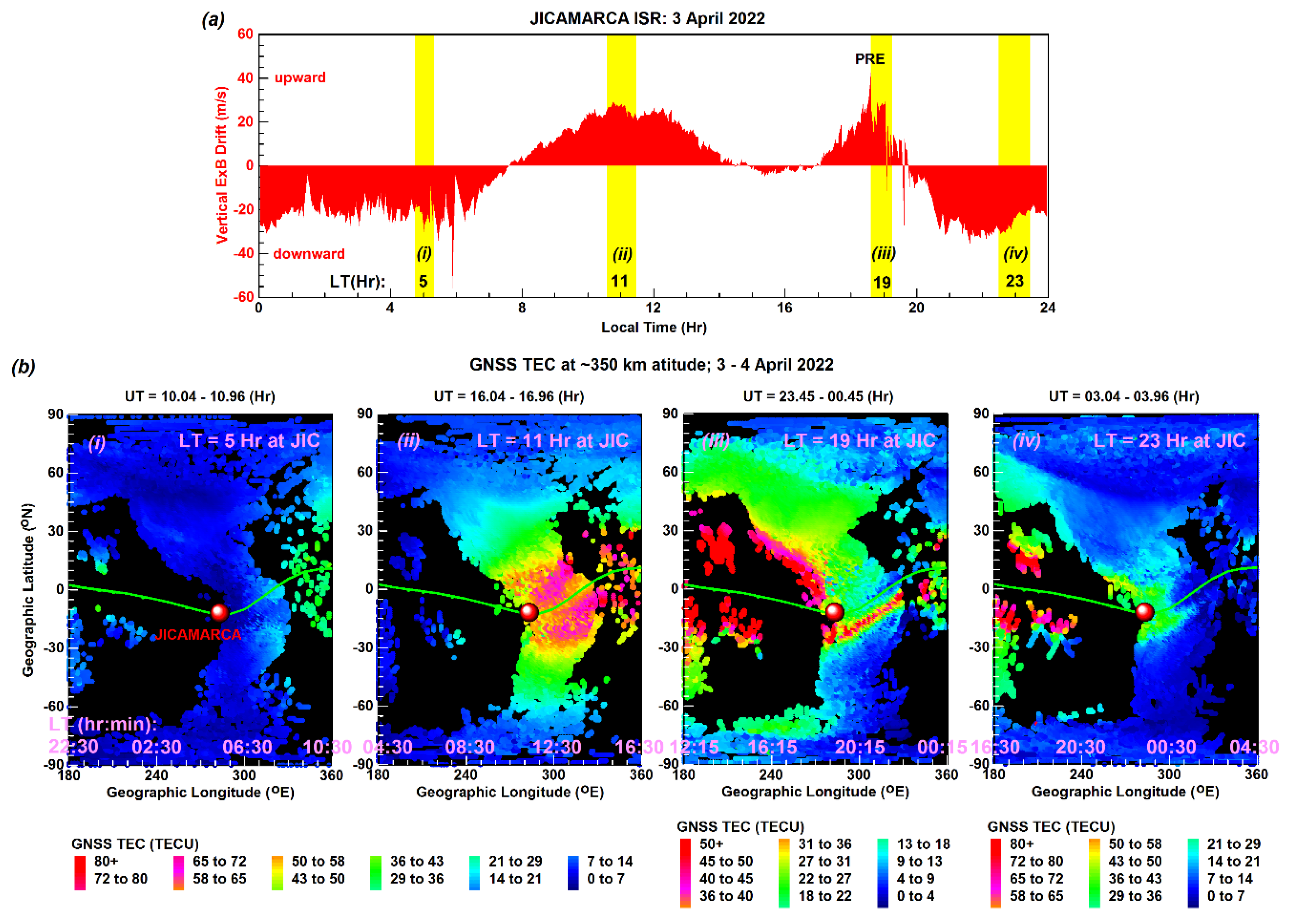
Figure 2.
(a) The global map shows the ascending ICON pass-03 (light red) with the magnetic field lines (blue) and dip equator (green) and the locations the EIA crests (dot symbols; light red) and EIA trough (diamond symbol; light red) detected and the location of Jicamarca (dot symbol; red). (b) The averaged Jicamarca ISR vertical drift measurements depict the daily variation of vertical E×B drift over the dip equator at ~360 km altitude on 1 April 2022. (c) The GNSS TEC map depicts the EIA and the ascending ICON-03 pass. (d) The ICON line plot sets illustrate the two-peak EIA and the underlying vertical drifts of the forward fountain: the equatorial vertical upward E×B drift (shaded interval in light green) over a narrow (±1.25o; latitude) region of the dip equator (diamond symbol) with the VVER and VMER line plots and the decreasing upward drifts at the EIA crest regions (dot symbols; shaded intervals in yellow) with the VVER line plot.
Figure 2.
(a) The global map shows the ascending ICON pass-03 (light red) with the magnetic field lines (blue) and dip equator (green) and the locations the EIA crests (dot symbols; light red) and EIA trough (diamond symbol; light red) detected and the location of Jicamarca (dot symbol; red). (b) The averaged Jicamarca ISR vertical drift measurements depict the daily variation of vertical E×B drift over the dip equator at ~360 km altitude on 1 April 2022. (c) The GNSS TEC map depicts the EIA and the ascending ICON-03 pass. (d) The ICON line plot sets illustrate the two-peak EIA and the underlying vertical drifts of the forward fountain: the equatorial vertical upward E×B drift (shaded interval in light green) over a narrow (±1.25o; latitude) region of the dip equator (diamond symbol) with the VVER and VMER line plots and the decreasing upward drifts at the EIA crest regions (dot symbols; shaded intervals in yellow) with the VVER line plot.
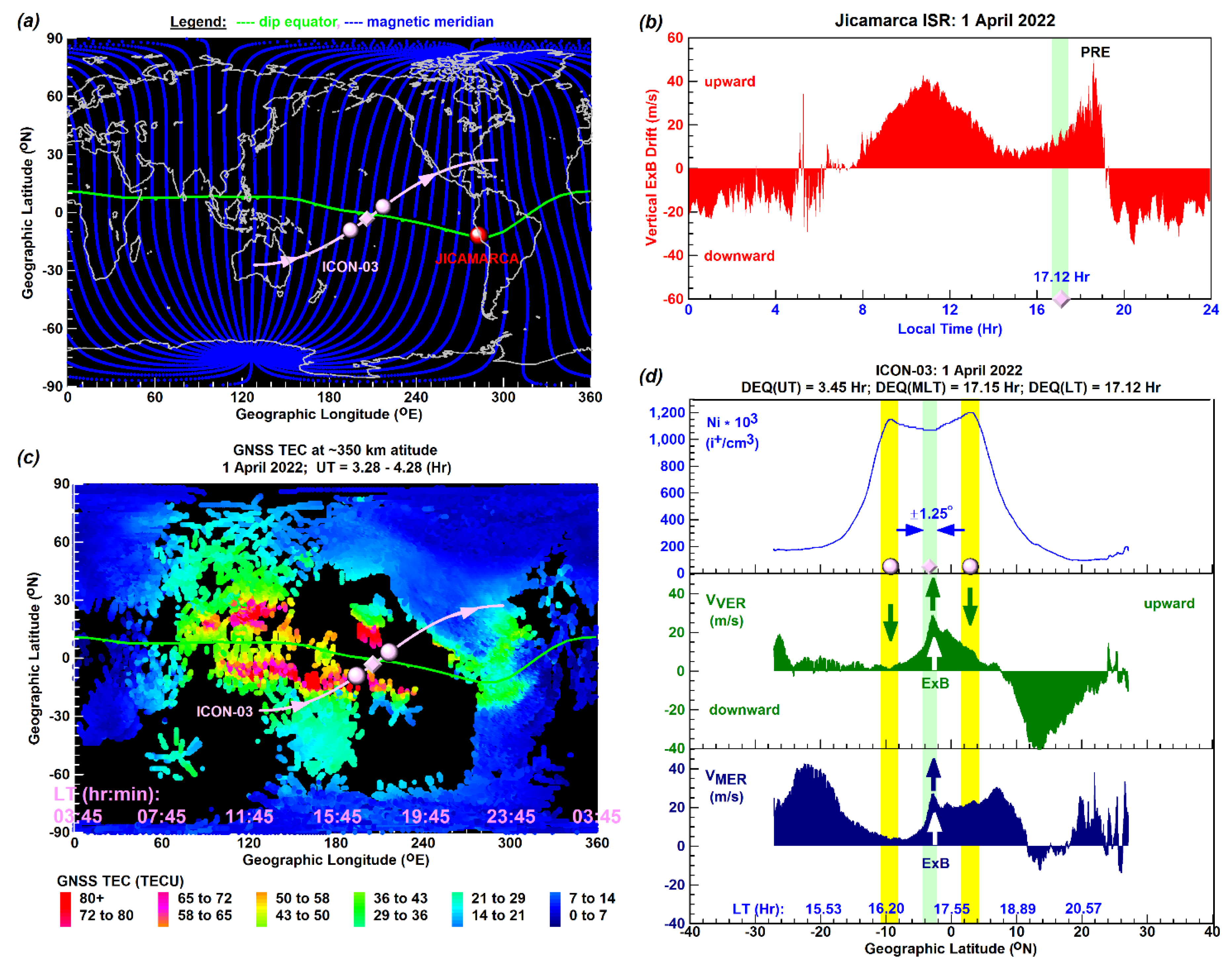
Figure 3.
(a) The global map shows the ascending ICON pass-04 (light red) with the magnetic field lines (blue) and dip equator (green) and the locations the EIA crests (dot symbols; light red) and EIA trough (diamond symbol; light red) detected and the location of Jicamarca (dot symbol; red). (b) The averaged Jicamarca ISR vertical drift measurements depict the daily variation of vertical E×B drift over the dip equator at ~360 km altitude on 1 April 2022. (c) The GNSS TEC map depicts the EIA and the ICON-04 pass. (d) The ICON line plot sets illustrate the two-peak EIA and the underlying vertical drifts of the forward fountain: the vertical upward E×B drift (shaded interval in light green) over a narrow (±1.25o; latitude) region of the dip equator (diamond symbol) with the VVER and VMER line plots and the decreasing upward drifts at the EIA crest regions (dot symbols; shaded intervals in yellow) with the VVER line plot.
Figure 3.
(a) The global map shows the ascending ICON pass-04 (light red) with the magnetic field lines (blue) and dip equator (green) and the locations the EIA crests (dot symbols; light red) and EIA trough (diamond symbol; light red) detected and the location of Jicamarca (dot symbol; red). (b) The averaged Jicamarca ISR vertical drift measurements depict the daily variation of vertical E×B drift over the dip equator at ~360 km altitude on 1 April 2022. (c) The GNSS TEC map depicts the EIA and the ICON-04 pass. (d) The ICON line plot sets illustrate the two-peak EIA and the underlying vertical drifts of the forward fountain: the vertical upward E×B drift (shaded interval in light green) over a narrow (±1.25o; latitude) region of the dip equator (diamond symbol) with the VVER and VMER line plots and the decreasing upward drifts at the EIA crest regions (dot symbols; shaded intervals in yellow) with the VVER line plot.
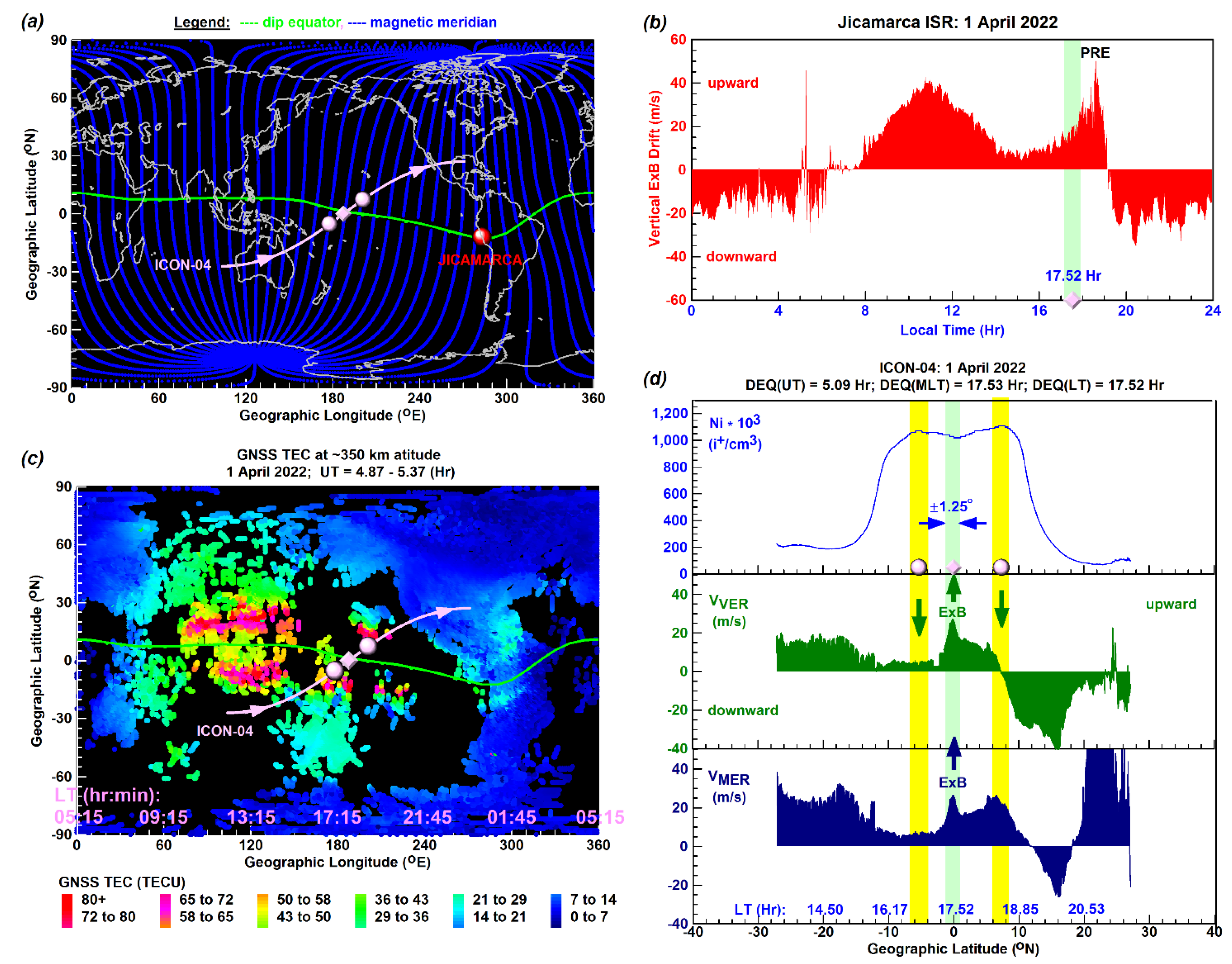
Figure 4.
(a) The global map shows the descending ICON pass-08 (light red) with the magnetic field lines (blue) and dip equator (green) and the locations the EIA crests (dot symbols; light red) and EIA trough (diamond symbol; light red) detected and the location of Jicamarca (dot symbol; red). (b) The averaged Jicamarca ISR vertical drift measurements depict the daily variation of vertical E×B drift over the dip equator at ~360 km altitude on 2 April 2022. (c) The GNSS TEC map depicts the breaking down EIA and the ICON-08 pass. (d) The ICON line plot sets illustrate the breaking down EIA and the underlying vertical drifts of the reverse fountain: the vertical downward E×B drift (shaded interval in light green) over a narrow (±1.25o; latitude) region of the dip equator (diamond symbol) with the VVER and VMER line plots and the increasing upward drifts at the breaking down EIA crest regions (dot symbols; shaded intervals in yellow) with the VVER line plot.
Figure 4.
(a) The global map shows the descending ICON pass-08 (light red) with the magnetic field lines (blue) and dip equator (green) and the locations the EIA crests (dot symbols; light red) and EIA trough (diamond symbol; light red) detected and the location of Jicamarca (dot symbol; red). (b) The averaged Jicamarca ISR vertical drift measurements depict the daily variation of vertical E×B drift over the dip equator at ~360 km altitude on 2 April 2022. (c) The GNSS TEC map depicts the breaking down EIA and the ICON-08 pass. (d) The ICON line plot sets illustrate the breaking down EIA and the underlying vertical drifts of the reverse fountain: the vertical downward E×B drift (shaded interval in light green) over a narrow (±1.25o; latitude) region of the dip equator (diamond symbol) with the VVER and VMER line plots and the increasing upward drifts at the breaking down EIA crest regions (dot symbols; shaded intervals in yellow) with the VVER line plot.
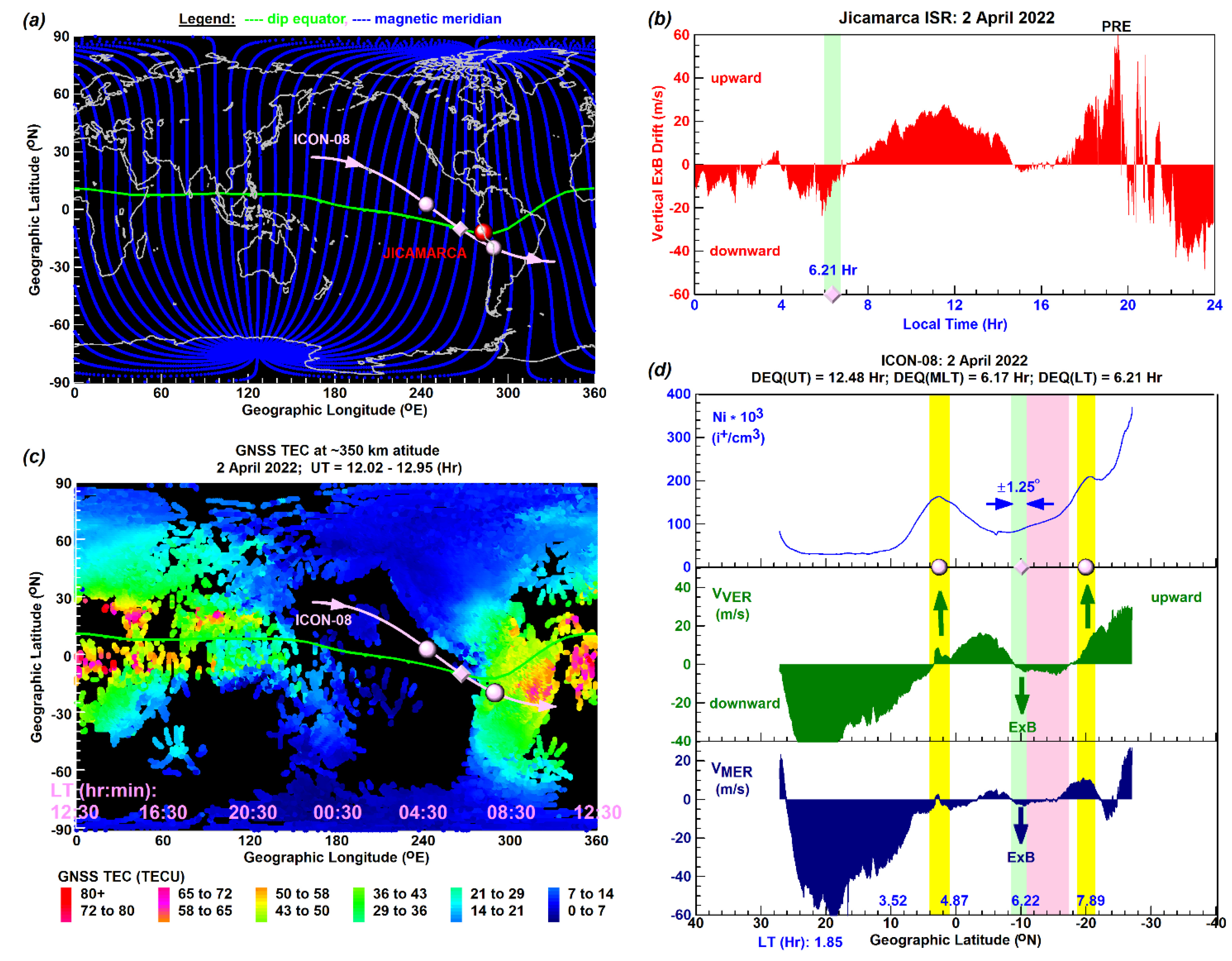
Figure 5.
The 3 March 2022 events are shown with the descending (a) ICON pass-07 (light blue) and (b) ICON pass-08 (orange). For each event, the GNSS TEC map depicts the EIA and the descending ICON pass crossing the EIA crest region (triangle and dot symbols) and EIA trough region (diamond symbol) over the dip equator (light magenta). For each event, the ICON line plot sets illustrate the single-peak EIA and the underlying vertical drifts of the forward fountain: the vertical upward E×B drift (shaded interval in light green) over a narrow (±1.25o; latitude) region of the dip equator (diamond symbol) with the VVER and VMER line plots and the downward drifts at the EIA crest regions (triangle and dot symbols; shaded intervals in yellow) with the VVER line plot.
Figure 5.
The 3 March 2022 events are shown with the descending (a) ICON pass-07 (light blue) and (b) ICON pass-08 (orange). For each event, the GNSS TEC map depicts the EIA and the descending ICON pass crossing the EIA crest region (triangle and dot symbols) and EIA trough region (diamond symbol) over the dip equator (light magenta). For each event, the ICON line plot sets illustrate the single-peak EIA and the underlying vertical drifts of the forward fountain: the vertical upward E×B drift (shaded interval in light green) over a narrow (±1.25o; latitude) region of the dip equator (diamond symbol) with the VVER and VMER line plots and the downward drifts at the EIA crest regions (triangle and dot symbols; shaded intervals in yellow) with the VVER line plot.
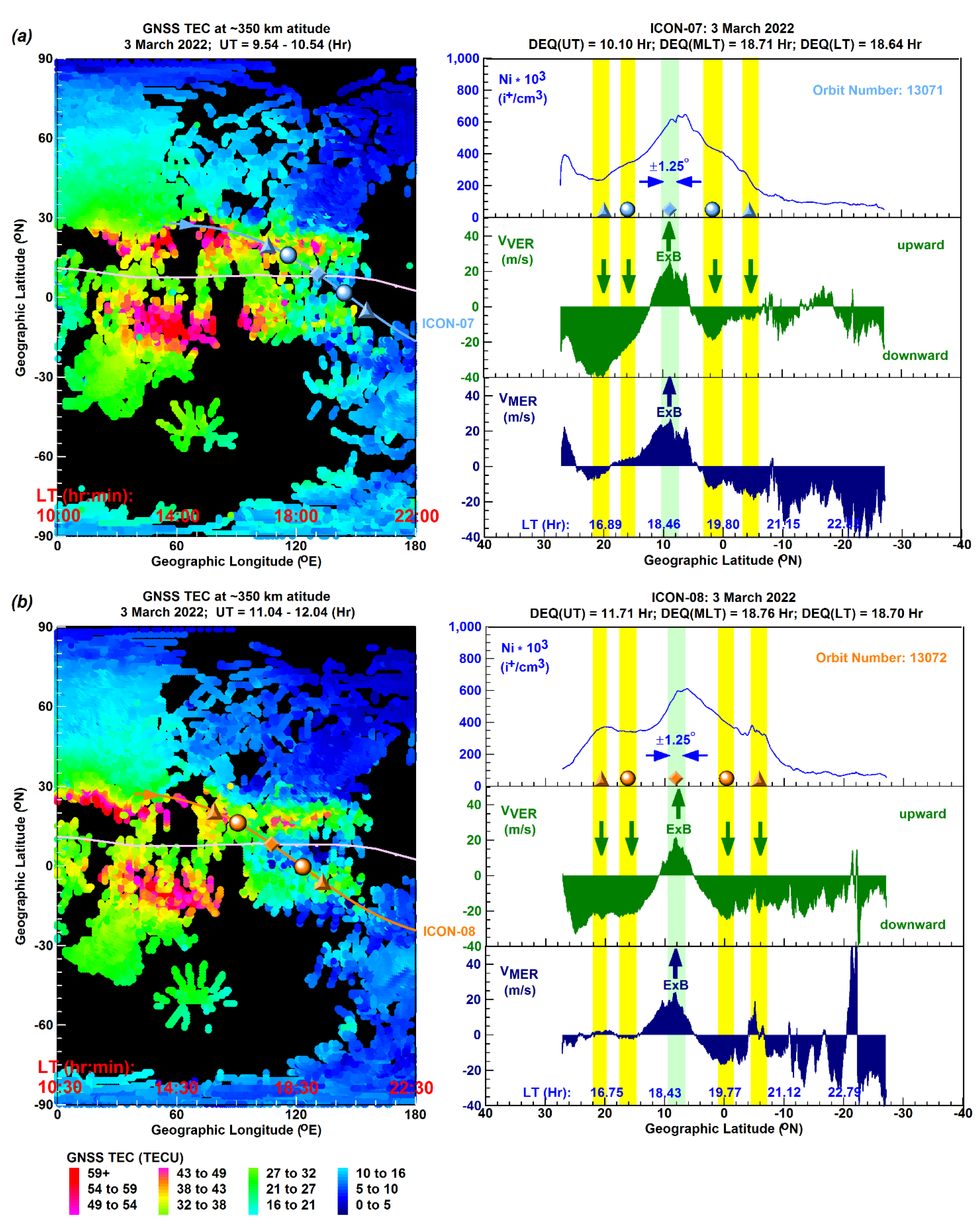
Figure 6.
The continuation of 3 March 2022 events is shown with the descending (a) ICON pass-09 (red) and (b) ICON pass-10 (magenta). For each event, the GNSS TEC map depicts the EIA and the descending ICON pass crossing the EIA crest region (triangle and dot symbols) and EIA trough region (diamond symbol) over the dip equator (light magenta). For each event, the ICON line plot sets illustrate the single-peak EIA and the underlying vertical drifts of the forward fountain: the vertical upward E×B drift (shaded interval in light green) over a narrow (±1.25o; latitude) region of the dip equator (diamond symbol) with the VVER and VMER line plots and the downward drifts at the EIA crest regions (triangle and dot symbols; shaded intervals in yellow) with the VVER line plot.
Figure 6.
The continuation of 3 March 2022 events is shown with the descending (a) ICON pass-09 (red) and (b) ICON pass-10 (magenta). For each event, the GNSS TEC map depicts the EIA and the descending ICON pass crossing the EIA crest region (triangle and dot symbols) and EIA trough region (diamond symbol) over the dip equator (light magenta). For each event, the ICON line plot sets illustrate the single-peak EIA and the underlying vertical drifts of the forward fountain: the vertical upward E×B drift (shaded interval in light green) over a narrow (±1.25o; latitude) region of the dip equator (diamond symbol) with the VVER and VMER line plots and the downward drifts at the EIA crest regions (triangle and dot symbols; shaded intervals in yellow) with the VVER line plot.
Disclaimer/Publisher’s Note: The statements, opinions and data contained in all publications are solely those of the individual author(s) and contributor(s) and not of MDPI and/or the editor(s). MDPI and/or the editor(s) disclaim responsibility for any injury to people or property resulting from any ideas, methods, instructions or products referred to in the content. |
© 2026 by the authors. Licensee MDPI, Basel, Switzerland. This article is an open access article distributed under the terms and conditions of the Creative Commons Attribution (CC BY) license.
Copyright: This open access article is published under a Creative Commons CC BY 4.0 license, which permit the free download, distribution, and reuse, provided that the author and preprint are cited in any reuse.