

Submitted:
11 April 2026
Posted:
14 April 2026
You are already at the latest version
Abstract
Financial forecasting is challenged by non-stationarity, volatility clustering, and regime transitions. Many neural forecasting pipelines use expressive encoders but fixed decoder mappings, which can reduce robustness under distribution shift. This paper introduces RADIAN, a forecasting architecture that keeps representation learning regime-agnostic and applies deterministic, causal regime conditioning only in fusion and decoding modules, using a four-dimensional regime vector computed from normalized one-step target returns within the input window. RADIAN is evaluated under a fixed protocol on nine hourly financial datasets spanning equities, foreign exchange, cryptocurrencies, indices, and commodities, against eight baseline models and three random seeds, and attains the lowest mean test MAE across datasets with an average improvement of 0.6704% relative to the strongest per-dataset baseline (range: 0.2542%–2.1234%). Paired statistical testing yields three unadjusted significant comparisons at p < 0.05, of which two remain significant after Benjamini–Hochberg correction, with large paired effect sizes (median |d| = 1.9312). Component ablations show that decoder-side mechanisms are material: removing regime features increases RMSE by 1.38% and decreases directional accuracy by 0.91 percentage points, while removing path decoding increases RMSE by 4.38%, supporting decoder-side regime conditioning as an effective mechanism for robustness in non-stationary financial forecasting.
Keywords:
financial time series forecasting
; non-stationary sequence modeling
; regime detection
; mixture-of-experts decoder
; dilated causal convolution
1. Introduction
Financial forecasting is a distribution-shift setting in which heavy tails, volatility clustering, and regime transitions are empirically common [1,2,3]. The challenge is acute at hourly horizons, where forecasts are consumed at fixed decision boundaries and local dynamics can change rapidly.
Neural forecasting models have improved representation learning through recurrent, probabilistic, and attention-based architectures [4,5,6,7]. However, many pipelines still use decoder mappings that are fixed after training and shared across heterogeneous market conditions [6,8,9]. This creates a structural mismatch: representation modules are increasingly adaptive, while the prediction rule remains regime-agnostic.
The working hypothesis in this study is that robustness depends not only on representational capacity but also on where adaptation is introduced. Early regime injection can entangle shared representations with short-horizon fluctuations; by contrast, decode-time conditioning can preserve reusable encodings while allowing the prediction rule to adapt locally.
Formally, let denote the input window and the forecasting horizon. Standard approaches learn a global mapping
which implicitly assumes that a single decoder is sufficient across heterogeneous regimes. The proposed formulation instead conditions prediction on deterministic, causal regime descriptors:
where is a compact regime vector computed from one-step normalized target returns within the input window. This formulation isolates representation learning from conditional synthesis and enables direct testing of decoder-centric adaptation.
Equation 1 defines the baseline decoder-agnostic mapping, whereas Equation 2 defines the decoder-conditioned formulation used in RADIAN.
The resulting architecture, RADIAN, applies late conditioning: regime statistics are injected only in the fusion and decoding modules, while temporal and cross-variable encoders remain regime-agnostic. The conditioning signal is deterministic and causal because it is computed only from in-window target dynamics.
Empirical evaluation on nine hourly financial datasets spanning equities, foreign exchange, cryptocurrencies, indices, and commodities, under a fixed protocol against eight baselines, shows that RADIAN attains the lowest mean test MAE across datasets, with an average improvement of relative to the strongest per-dataset baseline. Statistical testing reports multiple dataset-level wins under corrected thresholds, and mechanism-level ablations attribute the dominant gains to decoder-side components.
Contributions
- Decoder-centric forecasting paradigm. The paper formalizes adaptation at the synthesis stage rather than within shared representations.
- Deterministic causal regime conditioning. The model introduces a compact regime descriptor derived solely from in-window target dynamics, ensuring causal validity and interpretability.
- Mechanism-level empirical validation. Ablations isolate the contribution of decoder-side components.
- Rigorous statistical evaluation. The evaluation includes significance testing with multiple-hypothesis correction.
The remainder of the paper is organized as follows. Section 2 reviews prior work in statistical, neural, and regime-aware forecasting. Section 3 presents the full model specification. Section 4 describes the datasets and evaluation protocol. Section 5 reports quantitative and qualitative results. Section 6 discusses implications and limitations, and Section 7 concludes.
2. Related Work
This section reviews prior work in six parts, progressing from statistical regime modeling and neural forecasting architectures to Transformer-based forecasting, non-stationarity-focused methods, conditional computation, and the gap addressed by this study.
2.1. Statistical Foundations and Regime Dynamics
Classical forecasting is grounded in autoregressive integrated moving average (ARIMA), vector autoregression (VAR), and state-space formulations [10,11,12]. In financial settings, ARCH/GARCH families provide parametric volatility adaptation [13,14], and regime-switching models capture structural transitions through latent-state dynamics [3].
2.2. Neural Time-Series Forecasting
Neural forecasting broadened the modeling space from recurrent and attention-based models to convolutional sequence architectures. Representative developments include encoder–decoder attention models, hybrid long/short-horizon designs, and causal convolutional backbones [16,17,18].
Probabilistic global models further integrated cross-series learning with stochastic objectives [5]. Feedforward decomposition models and covariate-aware attention architectures improved long-horizon interpretability and multi-source fusion [6,19]. Across these lines, the emphasis remains on sequence encoding rather than decoder adaptation.
2.3. Transformer-Based Forecasting Architectures
Following Vaswani et al. [7], Transformer variants for forecasting diversified along tokenization, sparsification, and decomposition axes.
Point-wise attention models reduce quadratic cost through sparse attention or autocorrelation-style decomposition [20,21]. Frequency-enhanced decomposition variants extend this line to long-range components [22].
Locality-aware and representation-enhanced variants constrain attention neighborhoods or strengthen input representations [23].
Comparative analyses also show that performance conclusions are sensitive to benchmark design and inductive-bias choices [24].
Across these families, architectural changes are concentrated in the encoder and tokenization stack, while forecast heads are often lightweight projections with limited explicit regime conditioning.
2.4. Handling Non-Stationarity and Distribution Shift
Several methods target distribution shift directly. Reversible instance normalization (RevIN) mitigates scale and location shifts [25], and Non-stationary Transformers introduce de-stationary transformations for evolving temporal patterns [26].
These methods improve robustness but couple adaptation with representation changes, making it difficult to attribute gains cleanly to normalization, encoding, or decoding.
2.5. Conditional Computation and Adaptive Modeling
Conditional computation provides a principled mechanism for input-dependent adaptation. Jacobs [27] introduced adaptive mixtures of experts (MoE), and modern sparse MoE layers scale this routing principle to larger parameter sets [28,29].
For forecasting, this suggests conditioning prediction functions on local regime descriptors while keeping a shared encoder backbone.
2.6. Positioning and Gap
Prior work shows gains from stronger sequence encoders and non-stationarity-aware processing [8,9,25,26]. However, these gains are typically realized through encoder design, tokenization, or normalization, leaving decoder-side effects hard to isolate.
Accordingly, this paper evaluates the hypothesis that robustness to regime shift can be improved by conditioning the decoder while keeping the encoder regime-agnostic. Restricting adaptation to the synthesis stage with deterministic causal regime descriptors enables direct attribution of improvements to decode-time conditioning.
3. Method
This section first defines the forecasting problem and notation, then details input normalization and deterministic regime extraction, followed by the temporal and cross-variable encoders, decoder-side fusion and output generation, and finally the forward algorithm and complexity analysis.
3.1. Problem Formulation
Given a batch of multivariate history windows , RADIAN learns a forecasting map
Equation 3 defines the end-to-end map from history windows to horizon forecasts. For each sample b, the target history is , and the per-sample forecast is . Here b, t, and f index batch, time, and feature dimensions, respectively; B is the batch size, T the input length, F the number of features, D the model width, and H the forecast horizon. In the released experiments, , , , and the target feature is Close. The default pipeline normalizes , extracts deterministic regime features from , decodes , and maps the result back to the original scale. Table 1 summarizes the symbols used throughout the section and aligns them with the equations and implementation entities.
3.2. Overview and Design Principle
RADIAN maps to . The guiding principle is an explicit separation of responsibilities: encoder branches are regime-agnostic and learn reusable representations, whereas adaptation is confined to decode-time modules (GatedFusion and RegimeAwareDirectionalHead). Figure 1 shows the full computation graph and the decoder-only regime-injection point.
3.3. Input Normalization: SafeFeatureRevIN
For each sample b and feature f, SafeFeatureRevIN performs instance-wise normalization in the spirit of reversible normalization approaches for distribution shift handling [25]. With affine mode enabled, the learned feature-wise scale and shift are applied after standardization:
The module stores , where and .
This stage reduces sample-specific scale mismatch before the temporal and feature branches, allowing them to focus on shape and interaction patterns rather than raw magnitude. The stored statistics preserve exact per-sample inversion for the target channel.
3.4. Deterministic Regime Vector Extraction
Let . The causal one-step returns are
The return sequence underlies the regime statistics. The regime-feature extractor computes
and concatenates
This four-dimensional vector serves as the decoder conditioning signal; no latent regime labels, clustering, or future-data signals are used.
Figure 2 illustrates the extracted components across calm, transition, and volatile market windows.
3.5. Temporal Branch: Temporal Dilated Block (TDB) + Causal Attention
The temporal branch first projects each time step from to . It combines causal dilated convolutions [18] with pre-norm LayerNorm [30] and masked self-attention [7]:
Each TemporalDilatedBlock applies pre-norm, depthwise dilated causal convolution, a gated point-wise transformation, and a residual update:
Left-only padding enforces causality, and masked self-attention is applied after the L temporal blocks:
This branch captures local multi-scale dynamics through causal convolutions and extends the receptive field with masked attention without future leakage. Pre-norm LayerNorm and residual updates improve optimization stability under non-stationary inputs. Equations 10–12 define the temporal encoder output passed to pooling.
3.6. Cross-Variable Branch: Cross-Variable Attention Block (CVAB)
To form feature tokens, the normalized tensor is transposed over its last two axes to and then projected:
Each CVAB applies pre-norm LayerNorm [30], feature-token self-attention [7], and a residual MLP refinement,
where denotes the position-wise LayerNorm–GELU–dropout MLP sublayer. The final feature context is given by
In the released configuration, , so .
The resulting feature context summarizes cross-variable interactions around the target channel rather than collapsing variables too early. This complementary signal helps the fusion stage correct purely temporal forecasts when inter-series dependencies matter. Equations 13–14 define the cross-variable branch.
3.7. Target-Aware Pooling and Gated Fusion (GF)
Target-aware temporal pooling constructs a query conditioned on the most recent normalized target and uses it to form an attention-weighted summary of the temporal encoder states, following the scaled dot-product mechanism of Vaswani et al. [7]. Formally, for each sample b, a query vector is obtained as
where denotes the normalized attention weight over the temporal index t. The resulting context vector is computed as a convex combination of temporal features:
To integrate complementary information sources, we form a joint representation by concatenating the temporal context , the feature-wise context , the most recent normalized target value , and the regime descriptor :
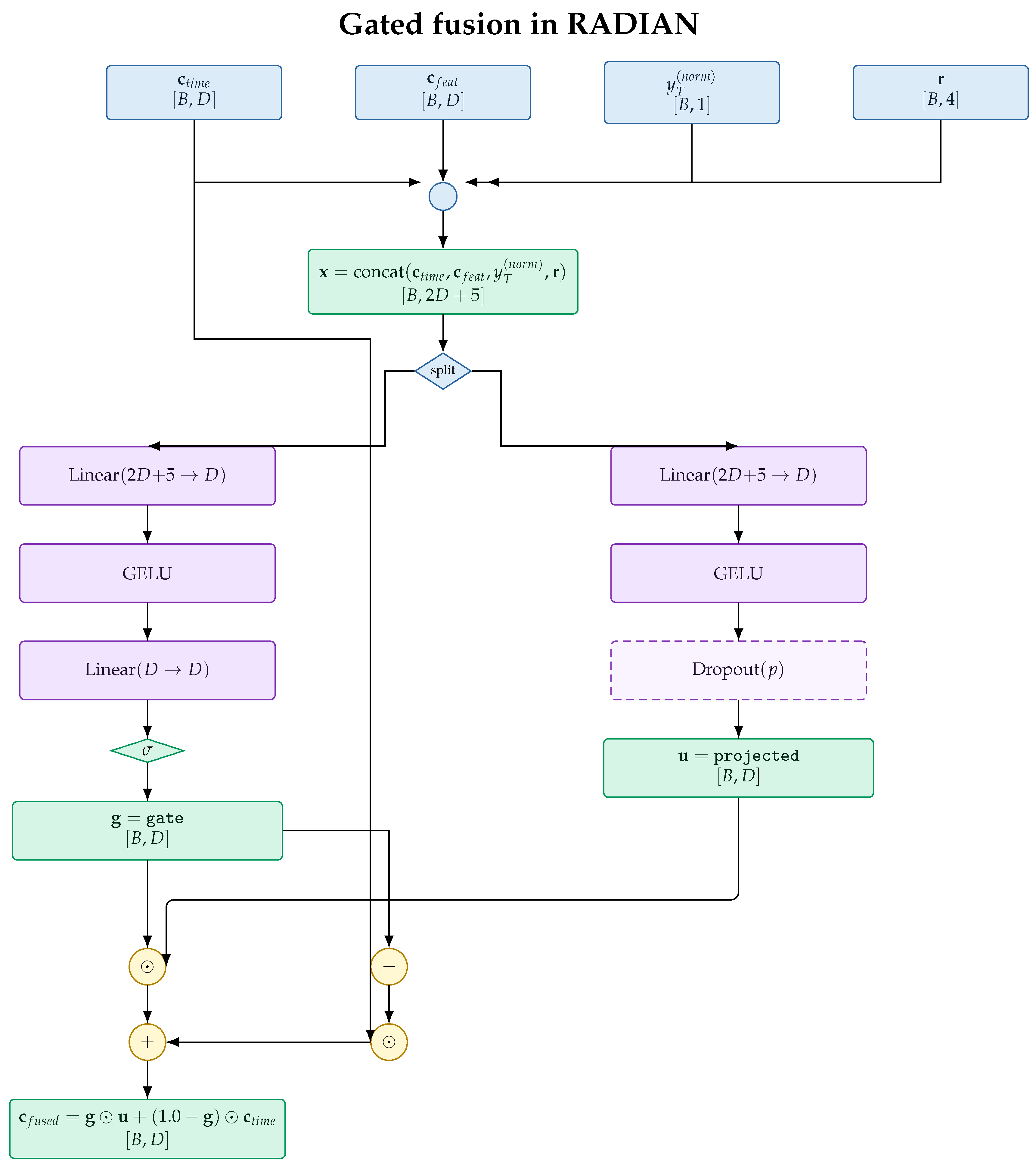
Gated Fusion (GF) then adaptively combines these signals by computing a sigmoid gate and a candidate projection:
and producing the final fused representation via element-wise interpolation:
Equations 15–19 collectively specify the full target-aware aggregation pipeline: the construction of a target-conditioned query, the derivation of attention weights and pooled temporal context, the formation of the composite fusion input, and the subsequent gated interpolation that yields the final context representation.
Operationally, GatedFusion performs context-dependent soft selection between the transformed joint context and the temporal anchor, conditioned on and regime statistics. This preserves a stable temporal reference while still allowing the decoder to amplify informative joint-context features.
Figure 3.
Illustration of the gated residual fusion mechanism. The figure shows how RADIAN fuses multiple conditioning signals: the gate branch learns which parts of the projected representation to retain, and the residual connection preserves the original temporal context where the gate is close to zero. This design allows dynamic, regime-dependent feature selection.
Figure 3.
Illustration of the gated residual fusion mechanism. The figure shows how RADIAN fuses multiple conditioning signals: the gate branch learns which parts of the projected representation to retain, and the residual connection preserves the original temporal context where the gate is close to zero. This design allows dynamic, regime-dependent feature selection.
3.8. Decoder: Regime-Aware Directional Head (RADH)
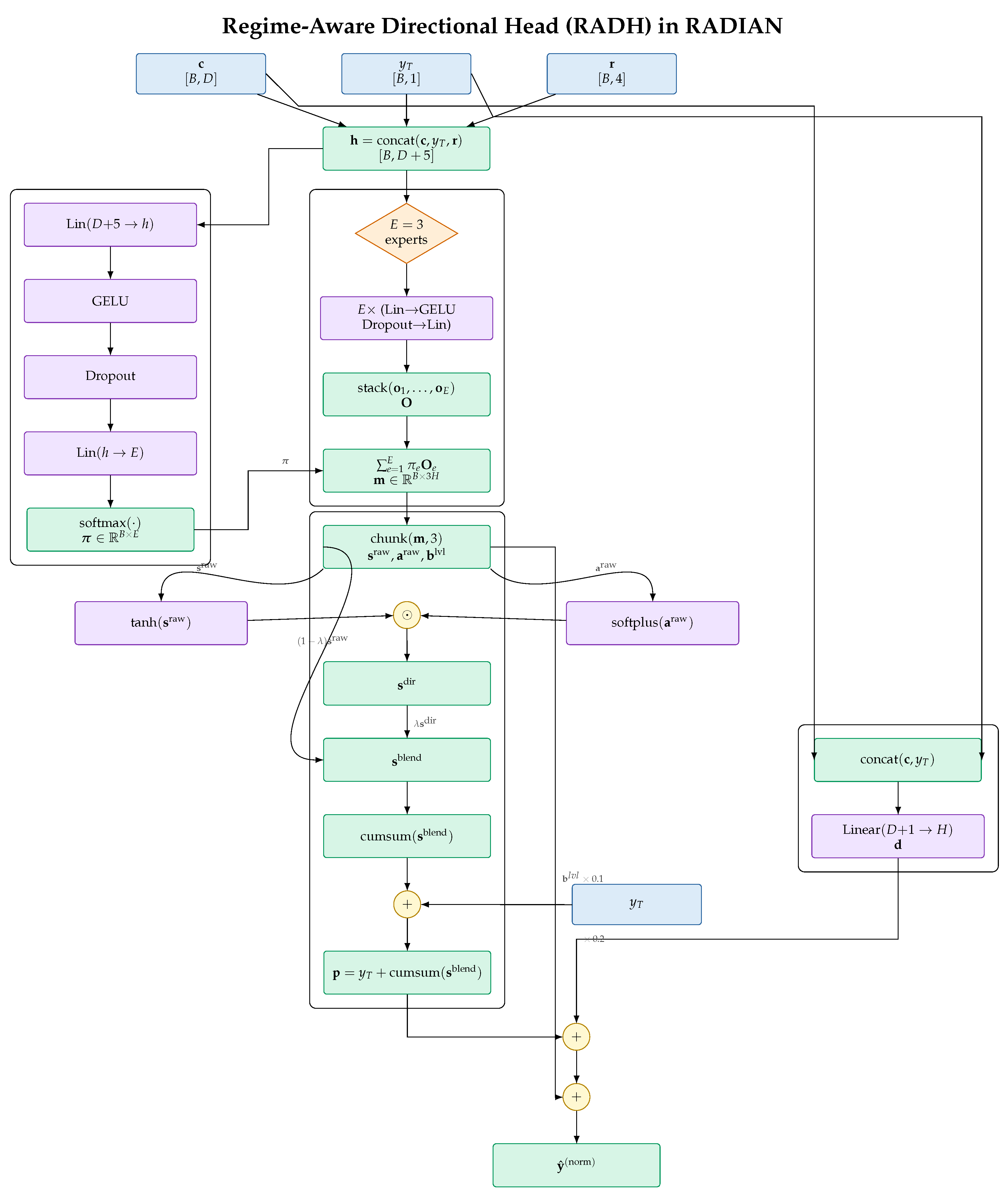
The decoder operates on a regime-conditioned representation by concatenating the fused context, the most recent normalized target value, and the regime descriptor into a single input vector. Formally, the decoder state is defined in Equation 20—the decoder input definition—as
Conditional computation is realized through a mixture-of-experts (MoE) mechanism, wherein a gating network produces a probability simplex over E experts. The routing weights are computed according to Equation 21—the MoE gating distribution—
which determines the contribution of each expert to the aggregated output. The expert outputs are then combined as a convex mixture, as specified in Equation 22—the MoE aggregation rule—
The aggregated vector is partitioned into three components, , each in , which parameterize the directional forecasting mechanism. A non-negative scaling factor is obtained via , ensuring stable magnitude modulation. Directional information is incorporated by forming , which constrains the signal while preserving sign structure. The final increment signal is then defined as a convex combination , where controls the strength of directional regularization.
Forecast generation proceeds through a path-based decoding process that constructs the output trajectory cumulatively. Starting from the last observed normalized target, the trajectory evolves according to Equation 23—the path decoding recursion—
thereby producing a sequence of intermediate states. The predicted trajectory is collected as .
To account for local deviations not captured by the structured trajectory, a residual correction branch is introduced. This branch computes a direct adjustment term as defined in Equation 24—the direct correction mapping—
which is subsequently integrated with the trajectory and a learned level component to produce the final normalized forecast. The complete output is given by Equation 25—the normalized prediction rule—
In the default configuration, the decoder employs experts. Collectively, Equations 20 through 25 define a unified decoding framework that integrates regime-aware conditioning, expert specialization via MoE routing, directionally constrained increment modeling, and path-based trajectory construction. The inclusion of a residual correction term further enhances flexibility by allowing localized adjustments without compromising the global structure of the predicted path.
Figure 4.
Regime-Aware Directional Head (RADH) architecture illustrating the integration of contextual representations, the most recent observation, and regime descriptors through a gated mixture-of-experts mechanism to produce normalized multi-step forecasts.
Figure 4.
Regime-Aware Directional Head (RADH) architecture illustrating the integration of contextual representations, the most recent observation, and regime descriptors through a gated mixture-of-experts mechanism to produce normalized multi-step forecasts.
3.9. Target Denormalization
For the target feature :
The implementation checks the output shape and finite values, catching numerical issues early and preserving the forecast scale expected by downstream evaluation.
All reported error metrics are computed after this inverse transform in the original target scale.
3.10. Notation Summary

Table 1.
Core notation used in the RADIAN formulation. Symbols are aligned with implementation-level entities so that equations and complexity terms remain consistent.
Table 1.
Core notation used in the RADIAN formulation. Symbols are aligned with implementation-level entities so that equations and complexity terms remain consistent.
| Symbol | Meaning |
|---|---|
| batch size, window length, #features, model width, horizon | |
| target feature index (target_idx) | |
| raw and normalized inputs | |
| stored RevIN statistics (mean/std) | |
| deterministic regime vector | |
| temporal-branch sequence representation | |
| pooled temporal context, feature context, projected fusion context, fused context | |
| path-decoded trajectory vector before direct correction | |
| normalized and denormalized forecasts |
3.11. Forward Algorithm
Algorithm 1 summarizes the modular data flow of the RADIAN model, with each component operating in sequence from normalization to denormalization. This makes the implementation transparent enough to map directly onto the equations above.
| Algorithm 1: RADIAN forward pass |
|
3.12. Complexity Analysis
Let L and M denote the numbers of temporal and feature blocks, K the kernel size, E the number of experts, and h the decoder hidden size.
Dominant FLOPs
Decoder parameter scaling
4. Experimental Setup
This section documents the datasets and split policy, shared training protocol, baseline set, evaluation metrics, statistical testing pipeline, robustness diagnostics, and reproducibility constraints.
4.1. Datasets, Features, and Splits
Evaluation is conducted on nine hourly financial datasets: AAPL, AUDUSD, BTCUSD, DAX30, ETHUSD, FTSE100, US500, USDJPY, and XAUUSD. Each dataset follows the raw schema Datetime, Open, High, Low, Close, Volume.
To ensure reproducibility and to prevent data leakage, a fixed chronological split is applied: 80% training, 10% validation, and 10% test. This split is consistent across all models, thereby preserving temporal ordering and preventing contamination between training and test sets.
Input sequences use a window length of and a forecast horizon of . The feature set comprises 13 channels:
- Raw prices: Open, High, Low, Close, Volume
- Technical indicators: macd, macd_signal, macd_hist, rsi_14, ema_9, bb_middle, bb_upper, bb_lower
The target variable is Close (target_idx=3).
Additional details on data scope, provenance, and raw file statistics are provided in Appendix A (Table A1 and Table A2).
4.2. Training Protocol
All models are trained using Adam [31] with an MSE objective, a learning rate of , a batch size of 64, and 50 epochs. The seed set is fixed at {417, 153, 999}. Deterministic execution is enforced through global seeding, deterministic CuDNN settings, and deterministic algorithm selection when available.
Table 2 summarizes the key hyperparameters required to reproduce the reported results in the main pipeline. All core experimental controls are shared and fixed across models, thereby ensuring that differences reported in Section 5 are attributable to architectural variation rather than disparities in training budget.
Checkpointing stores the model corresponding to the best validation RMSE. The released training procedure does not employ patience-based early stopping; each run executes the full epoch budget, after which the best-performing checkpoint is restored.
4.3. Baselines
RADIAN is compared against eight implemented baselines: DLinear [24], LSTM [4], iTransformer [9], PatchTST [8], TimesNet [32], N-HiTS [33], TimeXer [34], and ModernTCN.
All models use identical data splits, seeds, and optimizer family; model-specific hyperparameters are listed in Appendix B.
4.4. Evaluation Metrics
Primary metrics are test MSE, RMSE, MAE, and directional accuracy (DA) [12], where indexes test windows and N denotes the number of test samples:
Equations 29, 30, 31, and 32 define the reported metrics. Here, denotes the last observed target value in the input window, and for , denotes the prior realized value in the forecast horizon. MSE and RMSE emphasize larger deviations, MAE measures central absolute error, and DA measures sign consistency of predicted and realized increments.
4.5. Statistical Testing and Multiple Comparisons
For each dataset, the released main results tables provide paired p-values for RADIAN versus the best baseline. Both raw p-values and Benjamini–Hochberg (BH) adjusted p-values over 9 tests are reported. Effect size is computed using paired Cohen’s d based on seed-level MAE differences in the detailed experiment records, where is the mean paired MAE difference across seeds and is the corresponding sample standard deviation:
Equation 33 defines the effect-size calculation. The BH adjustment controls the false discovery rate under multiple comparisons [35]. Paired effect sizes complement p-values by quantifying the magnitude of differences [36]. Full per-dataset statistics, including raw and adjusted p-values and Cohen’s d, are reported in Table A18.
4.6. Robustness and Ablation Diagnostics
The robustness analysis uses released robustness artifacts together with ablation logs (A0–A9) from the published ablation summary. In ablation experiments, each switch corresponds exactly to the released configuration; no architectural modifications beyond these controlled flags are introduced.
This one-switch-at-a-time protocol isolates the effect of each architectural component.
4.7. Reproducibility Constraints
Method descriptions in this manuscript are restricted to the released model modules: SafeFeatureRevIN, TemporalDilatedBlock, CrossVariableAttentionBlock, GatedFusion, and RegimeAwareDirectionalHead. Appendix A–Appendix F provide dataset inventories, hyperparameter tables, extended result logs, and the reproducibility checklist used to maintain alignment with released artifacts.
5. Results
This section reports benchmark accuracy, regime-stratified robustness, ablation outcomes, directional accuracy, and efficiency trade-offs. The presentation follows the order of Table 3 and , moving from accuracy to robustness, ablation, and computational cost.
5.1. Main Accuracy and Statistical Strength
As quantified in Table 3, RADIAN achieves the lowest root mean square error (RMSE) across all nine evaluated datasets—explicitly outperforming the strongest baseline, ModernTCN—while simultaneously securing the highest directional accuracy (DA) on six heterogeneous asset classes. The benchmark spans multiple asset classes with diverse volatility profiles to rigorously validate this performance edge.
As aggregated by the critical-difference diagram in Figure 5, RADIAN attains the most optimal mean rank across the evaluated datasets (), establishing a statistically significant performance advantage over legacy baselines such as LSTM while strictly superseding top-tier architectures like PatchTST.
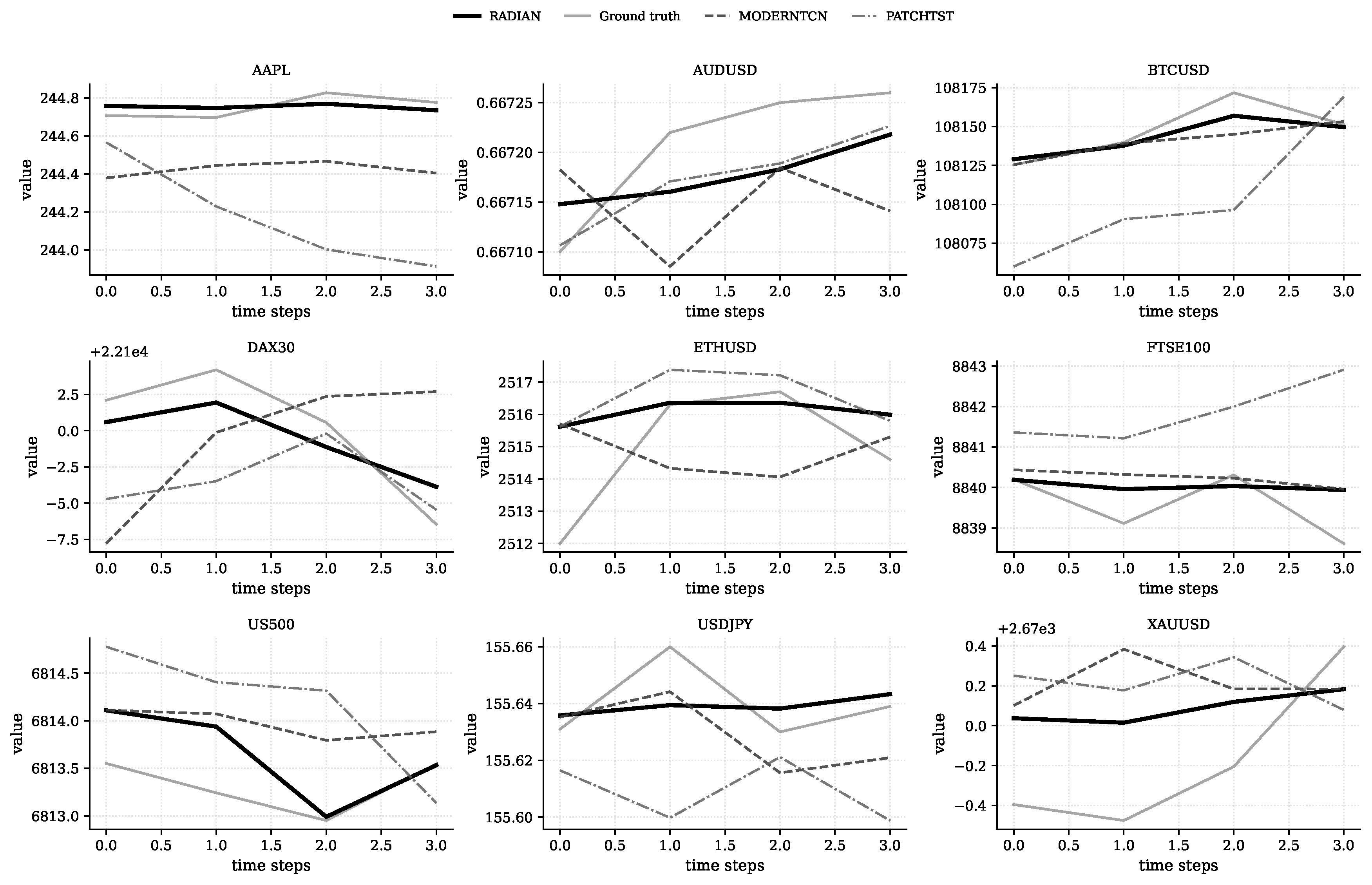
Visualizing corresponding sequential predictions in Figure 6, RADIAN maintains demonstrably tighter structural alignment with the ground truth trajectory during volatile and transition regimes, systematically suppressing the absolute error magnitudes relative to standard convolutional benchmarks.
For completeness, expanded dataset/model breakdowns are reported in Appendix C (Table A6–Table A8 and Table A6).
5.2. Robustness Under Non-Stationarity
Stratifying evaluation by market conditions in Table 4, Table 5, and Table 6, RADIAN systematically bounds error inflation during high-volatility events, and as corroborated by the structural metrics in Table 7, it yields the flattest MAE–volatility response slope alongside an unmatched worst-decile mean squared error.
Aligning absolute prediction errors to structural market shifts in Figure 7, RADIAN demonstrates a substantially narrower 95% confidence interval and a faster error recovery post-transition, structurally outperforming the best baseline exactly at the transition boundary ().
Contrasting cross-variable dependency mappings in Figure 8, the model transitions from a uniform, diffuse attention distribution during calm periods to a highly sparse, localized feature routing structure distinctly adapted to volatile regimes.
Parametrizing prediction accuracy against volatility percentiles in Figure 9, mean absolute error strictly increases for all structures; crucially, RADIAN maintains a much shallower error-growth slope than TimesNet inside the 95% confidence interval.
5.3. Ablation Evidence for Decoder-Centric Gains
Isolating the prognostic value of discrete neural components in Table 8, the structural ablations (A0–A9) collectively verify that omitting path decoding outright (A9) triggers maximum RMSE instability, while displacing gated fusion (A6) systematically suppresses directional accuracy across the decoder-coupled variants.
Comprehensive ablation outputs are systematically collated in Appendix C.2.
Demonstrating the explicit prognostic utility of context vectors across a representative volatile segment in Figure 10, the fully assembled RADIAN model (A0) strictly bounds mean absolute error growth, whereas striking regime features (A5) systemically inflates deviation from true market targets.
Decomposing the underlying mixture-of-experts structural assignments via Figure 11, the gate probability sequences visibly adapt and re-weight specific functional layers across calm, shifting, and volatile boundaries, validating parameter reconfiguration matched directly to market variance.
Contrasting the native autoregressive path integration strategy (A0) against single-shot direct generation (A9) in Figure 12, the fully recursive trajectories structurally mitigate random-walk step variance, compressing broad sign inconsistency rates while systematically smoothing predictive outputs.
For AUDUSD at seed 417, removing regime features (A5) increases RMSE by and reduces DA by 0.91 percentage points relative to A0. Larger RMSE increases are observed for A7 (single expert, ) and A9 (no path decoding, ).
5.4. Directional Performance and Stability
Synthesizing comparative classification performance broadly throughout Table 9, RADIAN records a robust +0.31 percentage-point directional accuracy edge on average compared to sector-optimal legacy pipelines, confirming that its enhanced sequence trajectory logic functionally maps securely across diverse market indices rather than over-fitting specific localized windows.
Visualizing the dispersion bounds across datasets via Figure 13, RADIAN strictly limits worst-case standard deviation spread across unique seed instances, structurally lowering RMSE variance while sustaining tight win margins against dataset-specific legacy baselines.
5.5. Efficiency and Accuracy–Cost Trade-Off
Benchmarking hardware limits relative to predictive boundaries in Table 10, RADIAN establishes the global minimum test RMSE (94.10) whereas deploying an extremely sparse layout of 516,425 parameters, returning a fully processed batch vector in 4.628 ms on standard CPU resources.
Quantifying computational execution overhead directly relative to accuracy, the latency plotting in Figure 14 places RADIAN firmly on the optimal Pareto frontier boundary, asserting strict predictive superiority over deep learning networks such as PatchTST with fractional processor utilization.
6. Discussion
6.1. Evidence-Grounded Summary
The empirical picture is directional consistency with moderate variance rather than a uniformly dominant margin. Table 3 show the lowest RMSE on every dataset and the best directional accuracy (DA) on six of nine datasets; Figure 5 places RADIAN at the top mean rank under the critical-difference analysis. The same pattern persists under regime stratification: Table 4, Table 5, and Table 6 show that RADIAN remains the lowest-error model in calm, transition, and volatile windows, while Table 7 reports the smallest slope of MAE against volatility (1.41), worst-decile MSE (), and tail RMSE () among the compared models. Figure 7 and Figure 9 further indicate that error growth with volatility is slower for RADIAN than for the baselines. Directional gains are smaller and dataset-dependent, so the principal effect is reduced error sensitivity rather than uniform improvement across all metrics. The paired tests in Appendix Table A18 are directionally consistent with this pattern, but the three-seed design and Benjamini–Hochberg correction limit inferential strength.
6.2. Mechanistic Interpretation
The ablations indicate that decoder-side components exhibit the largest ablation sensitivity. In the representative AUDUSD seed-level ablation, removing regime features is associated with an RMSE increase of 1.4%, collapsing mixture-of-experts routing to a single expert with a 3.3% increase, and removing path decoding with a 4.4% increase; the cross-dataset summary in Table 8 preserves the same ordering on BTCUSD, US500, USDJPY, and XAUUSD, and Appendix Table A9 shows the same qualitative pattern across the full ablation set. In that table, replacing gated fusion with simple addition and removing path decoding produce the largest RMSE degradations, whereas removing the regime vector alone yields a smaller but still systematic loss. Encoder removals also affect performance, but the decoder-side variants are the most sensitive. Figure 10 shows that the effect of regime conditioning is most visible in volatile windows, Figure 11 shows regime-dependent routing variation, and Figure 12 shows lower step variance and sign inconsistency under path decoding. These observations are mechanism-consistent, but they do not establish causal identification for individual decoder submodules; the ablations also alter capacity and optimization geometry.
6.3. Design Principle Extraction
The evidence supports a modular design principle: keep the shared encoder stack regime-agnostic and concentrate adaptation at the prediction interface, where the model can condition on without entangling representation learning with short-horizon noise. This principle is most defensible when the regime descriptor is causally computable from the observed window, as in RADIAN, and when the shift is local enough that a compact conditional policy can react without retraining the full network. In that setting, decoder-side conditioning provides an interpretable adaptation point and preserves a reusable representation backbone. Transfer of the same separation to other non-stationary sequence domains is plausible, but remains a hypothesis outside the reported financial benchmarks.
6.4. Comparison to Alternative Non-Stationarity Approaches
Online learning methods adapt by updating parameters as data arrive [37]; RADIAN instead keeps parameters fixed at test time and moves adaptation into conditional inference at the decoder. Adaptive normalization methods such as RevIN [25] adapt preprocessing, so the adapted object is the input scale and location rather than the forecast rule itself. Non-stationary and decomposition-based Transformer variants such as the Non-stationary Transformer, FEDformer, PatchTST, and iTransformer [8,9,22,26] shift adaptation into the encoder or tokenization stack, where the model representation, frequency decomposition, or attention geometry is modified before prediction. By contrast, RADIAN keeps the representation backbone regime-agnostic and adapts the decision rule itself through decoder-side conditioning. Time-varying parameter and regime-switching formulations [3,10,11] make latent dynamics explicit, but they impose stronger parametric assumptions about state evolution than the compact conditional policy used here.
6.5. Broader Applicability
Beyond finance, the same separation between regime sensing and decoder-side adaptation may be relevant in climate and environmental forecasting [38], network telemetry [39], and biomedical time-series analysis [40]. In climate settings, the regime signal would be a causal summary of recent circulation, anomaly, or extreme-event conditions, while decoder-side adaptation would condition short-horizon forecasts on those summaries instead of altering the shared encoder. In telemetry, the analogue would be a rolling congestion or anomaly descriptor derived from recent traffic statistics, with the decoder adjusting load or alert predictions while the encoder remains fixed. In biomedical signals, the regime descriptor would be a real-time patient-state summary from observed vitals or sensor dynamics, and decoder-side adaptation would modulate risk or trajectory outputs without retraining the feature extractor. This design principle is most likely to transfer when causal regime descriptors are available in real time, distribution shift is local enough for a compact conditional policy to track, and the learned routing remains stable across windows; it is less likely to hold when regimes are latent or weakly observable, when structural drift unfolds over long horizons, or when the shift changes the representation space itself rather than only the prediction rule.
6.6. Limitations
- Lagged regime response. The regime vector is computed from the window ending at time t, so abrupt events at can only be anticipated indirectly. The transition-window error dynamics in Figure 7 expose this limitation most clearly.
- Partial observability. The four-statistic regime summary captures only return-based local shape. It cannot represent cross-asset dependencies, macroeconomic shocks, or other exogenous drivers of market structure.
- Inference power and ablation confounding. Appendix Table A18 relies on three seeds, and only two comparisons remain significant after Benjamini-Hochberg correction. In addition, the architectural ablations change capacity and optimization geometry together with the targeted mechanism, so the decoder-centric interpretation is supported by sensitivity evidence but not fully isolated causally.
- Incomplete diagnostics. The released artifacts do not include per-regime aggregate summaries, directional confusion matrices, or FLOPs measurements. The aggregated RMSE reported in Table 10 should therefore be read as a coarse comparative indicator rather than a fully scale-normalized cross-asset score.
6.7. Future Directions
- Streaming regime updates. Recompute or smooth online with rolling, exponentially weighted, or change-point-triggered updates so that abrupt shifts are reflected more quickly.
- Richer regime observability. Augment the four return statistics with cross-asset, macroeconomic, or latent-volatility features, or learn a sparse regime embedding under causal constraints, to reduce omission from the current descriptor.
- Mechanism isolation. Run matched-parameter ablations, expert-swapping tests, and representation-similarity probes across multiple seeds to separate decoder mechanism from capacity and optimization effects.
- Operational diagnostics. Expose routing entropy, expert load, regime-drift percentiles, transition-window error, and FLOPs in the evaluation pipeline; if drift persists, restrict adaptation to decoder-side low-rank adapters or periodic refreshes on recent windows.
6.8. Practical Implications
In settings where regime observability is adequate and routing behavior remains stable across recent windows, plausible deployment signals are regime drift, expert-utilization concentration, and transition-window error. Because is computed causally, large shifts in its percentile rank relative to training data provide an indicator of distribution change; sustained concentration of MoE weights in Figure 11 can flag reduced conditional diversity; and spikes in Figure 7 identify regimes where adaptation may be insufficient. When these signals move outside their reference bands and the underlying assumptions hold, a plausible intervention is to recalibrate normalization statistics, refresh the decoder modules, or retrain on recent windows rather than rebuilding the full encoder stack. The model remains on a favorable accuracy-latency frontier in Table 10 and Figure 14, so these diagnostics can be monitored without materially changing inference cost in the reported benchmark.
7. Conclusion
Financial time series under shifting dynamics are difficult because the mapping from recent history to near term movement changes as volatility, dependence structure, and local market regime evolve. The central problem is therefore not simply to encode more context, but to determine where adaptation should enter so that the forecast rule can respond to changing conditions without destabilizing the shared representation.
The proposed model addresses this problem by separating representation learning from prediction synthesis. The encoder stack remains regime independent, while a compact causal summary of the observed window conditions the decoding pathway at the point where forecasts are formed. This design localizes adaptation at the prediction interface rather than dispersing it throughout the network, preserving reusable structure while still allowing the model to react to short term market state.
The empirical evidence supports this design choice in a qualified but consistent way. Across heterogeneous financial benchmarks, the model reduces forecast error relative to strong alternatives, and the advantage is clearest when the input distribution is unstable. The results further indicate that the improvement is not merely cosmetic: error growth is dampened in volatile and transition periods, suggesting greater robustness to regime change. Sensitivity analyses reinforce this interpretation by showing that weakening the regime conditioned decoding path degrades performance, whereas the gains in directional accuracy are smaller and less uniform than the gains in error reduction. Accordingly, the strongest claim warranted by the study is not universal superiority on every metric, but improved resilience of the forecast rule under changing conditions.
These conclusions remain bounded by the study design. The regime descriptor is intentionally compact and derived only from the observed window, so it cannot represent all structural drivers of market behavior and may respond imperfectly to abrupt shifts. Likewise, the evidence supports the proposed modular design principle within financial forecasting, but it does not establish that the same conditioning strategy will transfer unchanged to every sequence problem with changing dynamics. Even so, the broader implication is that observably causal regime information can be used to adapt the decoder while keeping the representation backbone stable, and future work should examine more responsive regime updates, richer conditional descriptors, and stricter tests that separate conditional routing effects from capacity and optimization effects.
Conflict of Interest
The author declares that there are no conflicts of interest, financial or otherwise, that could have influenced the research, authorship, or publication of this work. The study was conducted independently, and no external funding, affiliations, or personal relationships exist that could be perceived as affecting the objectivity, integrity, or interpretation of the results presented in this article.
Data and Code Availability
The implementation code, along with all relevant configuration files required to reproduce the experiments presented in this manuscript, is publicly available at the following GitHub repository:
Processed data artifacts generated and analyzed during this study are not publicly available due to proprietary or ethical restrictions. They are available from the corresponding author upon reasonable request, subject to a signed data use agreement.
This appendix is organized as follows: dataset details and split statistics; hyperparameters and implementation settings; extended results; statistical tests; additional figures; and reproducibility. It documents the released data splits, model settings, evaluation summaries, diagnostic figures, and reproducibility materials used in the experiments.
Appendix A. Dataset Details and Splits
This section summarizes the raw OHLCV schema, engineered inputs, chronological split statistics, and raw-file inventory used in the experiments.
Appendix A.1. Raw Schema and Scope
All nine datasets are hourly open-high-low-close-volume (OHLCV) time series with the schema datetime, open, high, low, close, volume. The datasets cover equities (AAPL), foreign exchange (FX; AUDUSD, USDJPY), cryptocurrencies (BTCUSD, ETHUSD), indices (DAX30, FTSE100, US500), and commodities (XAUUSD).
Appendix A.2. Feature Pipeline
The model input uses 13 channels: the five base OHLCV features and eight engineered indicators—macd, macd_signal, macd_hist, rsi_14, ema_9, bb_middle, bb_upper, bb_lower. The target is close.
Appendix A.3. Chronological Split Statistics
Table A1 reports sample counts and chronological boundaries for each asset. The differences in observation span across assets help contextualize the cross-dataset performance variation discussed in Section 5 and Section 6.
Table A1.
Dataset inventory for the nine financial series used in this study, listing asset class, date range, and chronological split counts. N denotes the total number of samples, while , , and denote the counts in the training, validation, and test splits, respectively.
Table A1.
Dataset inventory for the nine financial series used in this study, listing asset class, date range, and chronological split counts. N denotes the total number of samples, while , , and denote the counts in the training, validation, and test splits, respectively.
| Symbol | Class | Start | End | N | |||
|---|---|---|---|---|---|---|---|
| AAPL | equity | 2017-02-01 | 2025-12-31 | 15,706 | 12,564 | 1,570 | 1,572 |
| AUDUSD | FX | 2015-01-01 | 2025-12-31 | 68,568 | 54,854 | 6,856 | 6,858 |
| BTCUSD | crypto | 2018-01-01 | 2025-12-31 | 62,826 | 50,260 | 6,282 | 6,284 |
| DAX30 | index | 2015-01-01 | 2025-12-31 | 57,816 | 46,252 | 5,781 | 5,783 |
| ETHUSD | crypto | 2018-01-01 | 2025-12-31 | 62,816 | 50,252 | 6,281 | 6,283 |
| FTSE100 | index | 2015-01-01 | 2025-12-31 | 56,800 | 45,440 | 5,680 | 5,680 |
| US500 | index | 2015-01-02 | 2025-12-31 | 57,698 | 46,158 | 5,769 | 5,771 |
| USDJPY | FX | 2015-01-01 | 2025-12-31 | 68,569 | 54,855 | 6,856 | 6,858 |
| XAUUSD | commodity | 2015-01-01 | 2025-12-31 | 65,126 | 52,100 | 6,512 | 6,514 |
Appendix A.4. Raw CSV Inventory
Table A2 lists the raw files, confirms the six-column OHLCV schema, and reports row counts. It serves as a data-ingestion check for reproducibility.
Table A2.
Inventory of raw CSV artifacts used in the study, reporting row and column counts and the first and last feature columns for each asset dataset.
Table A2.
Inventory of raw CSV artifacts used in the study, reporting row and column counts and the first and last feature columns for each asset dataset.
| CSV | Rows | Columns | First column | Last column |
|---|---|---|---|---|
| AAPL | 15,706 | 6 | datetime | volume |
| AUDUSD | 68,568 | 6 | datetime | volume |
| BTCUSD | 62,826 | 6 | datetime | volume |
| DAX30 | 57,816 | 6 | datetime | volume |
| ETHUSD | 62,816 | 6 | datetime | volume |
| FTSE100 | 56,800 | 6 | datetime | volume |
| US500 | 57,698 | 6 | datetime | volume |
| USDJPY | 68,569 | 6 | datetime | volume |
| XAUUSD | 65,126 | 6 | datetime | volume |
Appendix B. Hyperparameters
This section summarizes the shared training controls, model-family-specific settings, and implementation-specific values used for reproduction.
Table A3 summarizes experiment-level controls shared across all models. Table A4 lists the model-family-specific differences in depth, width, heads, and dropout that account for the parameter and latency variation reported in Table 10. Table A5 records architecture-specific settings needed for faithful implementation.
Table A3.
Global training configuration and fixed data parameters used across all models and datasets.
Table A3.
Global training configuration and fixed data parameters used across all models and datasets.
| Parameter | Value |
|---|---|
| Loss | MSE |
| Optimizer | Adam |
| Learning Rate | |
| Epochs | 50 |
| Batch Size | 64 |
| Window Size | 24 |
| Forecast Horizon | 4 |
The random seeds are fixed at {417, 153, 999}. Global settings include , , a batch size of 64, a learning rate of , and 50 epochs.
Table A4.
Model architecture comparison across primary hyperparameters; – indicates parameters that do not apply to a given model.
Table A4.
Model architecture comparison across primary hyperparameters; – indicates parameters that do not apply to a given model.
| Hyperparameter | RADIAN | PatchTST | iTrans. | ModernTCN | DLinear | LSTM | N-HiTS | TimesNet | TimeXer |
|---|---|---|---|---|---|---|---|---|---|
| 128 | 128 | 128 | – | – | – | – | 64 | 164 | |
| Layers | 3 | 3 | 2 | – | – | 2 | – | 2 | 2 |
| Heads | 8 | 4 | 8 | – | – | – | – | – | 8 |
| FFN Dim | – | 256 | 256 | – | – | – | – | 96 | 256 |
| Dropout | 0.0 | 0.0 | 0.0 | 0.1 | – | 0.05 | 0.05 | 0.05 | 0.05 |
| RevIN | – | True | – | True | – | – | – | – | – |
| Activation | – | – | GELU | – | – | – | ReLU | – | GELU |
| Hidden Size | – | – | – | – | – | 96 | 256 | – | – |
| Kernel Size | 5 | – | – | 25 | 25 | – | – | – | – |
Table A5.
Model-specific architecture parameters that are not directly comparable across models.
| Model | Specific Details |
|---|---|
| RADIAN | Dilations: [1, 2, 4]; Regime Hidden: 128 |
| PatchTST | Patch Length: 16; Stride: 8 |
| ModernTCN | Patch/Stride: 16/8; Dims: [32, 64, 96]; Blocks: [1, 1, 1] |
| DLinear | Projection Size: 128 |
| LSTM | MLP Hidden: 128; Bidirectional: True |
| N-HiTS | Stacks/Blocks/Layers: 3/2/2; Pooling Kernel: [2, 2, 2]; Freq Downsample: [4, 2, 1] |
| TimesNet | Top-k: 5 |
| TimeXer | Patch Length: 8 |
Appendix C. Extended Results
This section collects the full dataset-level comparison tables and the complete ablation results referenced in Section 5.
Appendix C.1. Main Results
Table A6–Table A8 report the full dataset-level comparison across all models and metrics (MSE, MAE, RMSE, DA).
Table A6.
Dataset-level results for RADIAN, ModernTCN, and PatchTST across MSE (↓), MAE (↓), RMSE (↓), and DA (↑) on nine datasets. Bold values denote best results per row/metric; underlined values denote second-best results.
Table A6.
Dataset-level results for RADIAN, ModernTCN, and PatchTST across MSE (↓), MAE (↓), RMSE (↓), and DA (↑) on nine datasets. Bold values denote best results per row/metric; underlined values denote second-best results.
| RADIAN | ModernTCN | PatchTST | ||||||||||
|---|---|---|---|---|---|---|---|---|---|---|---|---|
| Dataset | MSE | MAE | RMSE | DA | MSE | MAE | RMSE | DA | MSE | MAE | RMSE | DA |
| AAPL | 5.92691 | 1.52104 | 2.43452 | 52.0399 | 6.12855 | 1.57219 | 2.47554 | 50.4395 | 6.47271 | 1.62803 | 2.54399 | 50.6782 |
| AUDUSD | 1.53e-06 | 0.00083 | 0.0012 | 51.2706 | 1.53e-06 | 0.00083 | 0.0012 | 51.0947 | 1.54e-06 | 0.00084 | 0.0012 | 50.6322 |
| BTCUSD | 437,961 | 439.905 | 661.786 | 51.5112 | 442,291 | 440.942 | 665.049 | 51.5498 | 448,608 | 447.973 | 669.78 | 51.2684 |
| DAX30 | 7,325.02 | 50.6815 | 85.5863 | 50.6762 | 7,359.68 | 50.8776 | 85.7886 | 50.238 | 7,344.75 | 51.1913 | 85.7011 | 50.4135 |
| ETHUSD | 1,440.7 | 24.3112 | 37.9566 | 51.7844 | 1,456.04 | 24.3824 | 38.1581 | 51.5597 | 1,475.03 | 24.7972 | 38.406 | 51.2828 |
| FTSE100 | 548.056 | 14.1489 | 23.4105 | 52.2703 | 552.944 | 14.1735 | 23.5147 | 51.7304 | 549.224 | 14.2725 | 23.4354 | 51.7304 |
| US500 | 498.223 | 12.6922 | 22.3209 | 50.3227 | 504.157 | 12.8259 | 22.4534 | 50.0683 | 502.413 | 12.9033 | 22.4146 | 50.1003 |
| USDJPY | 0.0828764 | 0.194877 | 0.287882 | 50.7606 | 0.0833023 | 0.195489 | 0.288621 | 50.5977 | 0.0839107 | 0.196941 | 0.289673 | 50.5977 |
| XAUUSD | 173.17 | 8.63918 | 13.1594 | 50.8788 | 174.45 | 8.66934 | 13.2079 | 50.7655 | 175.09 | 8.71226 | 13.2321 | 50.7848 |
Table A7.
Dataset-level results for TimeXer, iTransformer, and N-HiTS across MSE (↓), MAE (↓), RMSE (↓), and DA (↑) on nine datasets. Bold values denote best results per row/metric; underlined values denote second-best results.
Table A7.
Dataset-level results for TimeXer, iTransformer, and N-HiTS across MSE (↓), MAE (↓), RMSE (↓), and DA (↑) on nine datasets. Bold values denote best results per row/metric; underlined values denote second-best results.
| TimeXer | iTransformer | N-HiTS | ||||||||||
|---|---|---|---|---|---|---|---|---|---|---|---|---|
| Dataset | MSE | MAE | RMSE | DA | MSE | MAE | RMSE | DA | MSE | MAE | RMSE | DA |
| AAPL | 7.22221 | 1.71715 | 2.68699 | 51.0796 | 7.189 | 1.73288 | 2.68113 | 50.6944 | 6.13925 | 1.56205 | 2.47771 | 51.0796 |
| AUDUSD | 1.56e-06 | 0.00084 | 0.0012 | 51.1427 | 1.57e-06 | 0.00084 | 0.0013 | 51.3198 | 1.58e-06 | 0.00084 | 0.0013 | 51.2079 |
| BTCUSD | 455,183 | 450.541 | 674.672 | 51.3298 | 463,256 | 454.571 | 680.603 | 51.3044 | 441,135 | 442.273 | 664.178 | 51.4578 |
| DAX30 | 7,434.38 | 51.5304 | 86.2227 | 50.4368 | 7,486.54 | 51.4502 | 86.5245 | 50.4643 | 8,502.55 | 55.4249 | 91.9907 | 49.9202 |
| ETHUSD | 1,506.57 | 25.0133 | 38.813 | 51.4085 | 1,506.55 | 25.243 | 38.8142 | 50.6233 | 1,463.97 | 24.5964 | 38.2602 | 51.5597 |
| FTSE100 | 555.889 | 14.3705 | 23.5771 | 51.6581 | 570.021 | 14.4754 | 23.8746 | 51.4663 | 639.156 | 15.3499 | 25.2417 | 51.6153 |
| US500 | 514.716 | 13.0455 | 22.6872 | 50.4303 | 514.559 | 13.0917 | 22.6837 | 50.0829 | 541.339 | 13.0211 | 23.266 | 50.1846 |
| USDJPY | 0.0847944 | 0.197836 | 0.291194 | 50.5977 | 0.0859317 | 0.200002 | 0.293137 | 50.5658 | 0.0830971 | 0.195236 | 0.288265 | 50.5475 |
| XAUUSD | 177.23 | 8.81781 | 13.3127 | 50.4696 | 176.816 | 8.78136 | 13.2972 | 50.6073 | 193.059 | 9.42913 | 13.8924 | 49.7311 |
Table A8.
Dataset-level results for DLinear, TimesNet, and LSTM across MSE (↓), MAE (↓), RMSE (↓), and DA (↑) on nine datasets. Bold values denote best results per row/metric; underlined values denote second-best results.
Table A8.
Dataset-level results for DLinear, TimesNet, and LSTM across MSE (↓), MAE (↓), RMSE (↓), and DA (↑) on nine datasets. Bold values denote best results per row/metric; underlined values denote second-best results.
| DLinear | TimesNet | LSTM | ||||||||||
|---|---|---|---|---|---|---|---|---|---|---|---|---|
| Dataset | MSE | MAE | RMSE | DA | MSE | MAE | RMSE | DA | MSE | MAE | RMSE | DA |
| AAPL | 6.02404 | 1.55404 | 2.45437 | 51.0362 | 8.58647 | 1.85958 | 2.92909 | 51.0796 | 6.48732 | 1.64317 | 2.54682 | 50.4015 |
| AUDUSD | 1.58e-06 | 0.00086 | 0.0013 | 50.5941 | 1.62e-06 | 0.00087 | 0.0013 | 50.7466 | 1.69e-06 | 0.00089 | 0.0013 | 50.6138 |
| BTCUSD | 477,236 | 479.532 | 690.752 | 50.8709 | 478,319 | 467.057 | 691.589 | 51.4578 | 1.63e+08 | 11,165.9 | 12,749.6 | 49.6439 |
| DAX30 | 7,893.8 | 54.8744 | 88.838 | 49.8302 | 7,686.26 | 53.0993 | 87.6711 | 50.3018 | 1.07e+07 | 3,144.01 | 3,257.67 | 47.9758 |
| ETHUSD | 1,490.95 | 25.1391 | 38.6127 | 50.9831 | 1,593.56 | 26.2599 | 39.9192 | 51.0179 | 1,543.15 | 25.8084 | 39.2783 | 51.4246 |
| FTSE100 | 620.196 | 16.1955 | 24.8691 | 50.8453 | 587.76 | 14.9406 | 24.243 | 51.5903 | 86,275.8 | 222.365 | 292.385 | 49.6592 |
| US500 | 513.685 | 13.1832 | 22.6642 | 50.3111 | 566.267 | 13.7503 | 23.7956 | 50.3111 | 279,938 | 456.968 | 529.034 | 47.8672 |
| USDJPY | 0.0876014 | 0.205403 | 0.295914 | 50.6173 | 0.0898571 | 0.206436 | 0.299758 | 50.3233 | 0.364396 | 0.502048 | 0.603065 | 50.1066 |
| XAUUSD | 183.479 | 9.07443 | 13.5453 | 50.4529 | 184.592 | 8.98366 | 13.5864 | 50.422 | 984,358 | 867.561 | 990.381 | 47.7845 |
Appendix C.2. Ablation Results
Table A9 reports the complete ablation study, including validation and test performance across all four metrics (MSE, RMSE, MAE, DA) for each dataset.
Table A9.
Ablation results on AAPL for MSE (↓), RMSE (↓), MAE (↓), and DA (↑).
| Ablation | MSE | RMSE | MAE | DA |
|---|---|---|---|---|
| Full RADIAN | 5.9 | 2.4254 | 1.5195 | 51.8221 |
| Remove RevIN | 6.0565 | 2.461 | 1.5524 | 50.651 |
| Remove temporal backbone (dilated blocks + temporal attention) | 5.9064 | 2.4303 | 1.522 | 50.8626 |
| Remove cross-variable branch | 5.97 | 2.4434 | 1.5217 | 51.6764 |
| Replace target-aware pooling with mean pooling | 5.9108 | 2.4312 | 1.5225 | 50.7487 |
| Remove regime features | 5.9134 | 2.4317 | 1.5211 | 51.1556 |
| Replace gated fusion with simple addition | 6.046 | 2.4589 | 1.545 | 50.6673 |
| Single expert (remove MoE) | 6.0246 | 2.4545 | 1.5395 | 50.9115 |
| Remove directional component | 5.9483 | 2.4389 | 1.5356 | 50.3255 |
| Remove path decoding (no cumulative sum) | 6.0385 | 2.4573 | 1.5536 | 51.8947 |
Table A10.
Ablation results on AUDUSD for MSE (↓), RMSE (↓), MAE (↓), and DA (↑).
| Ablation | MSE | RMSE | MAE | DA |
|---|---|---|---|---|
| Full RADIAN | 1.5197e-06 | 0.0012 | 8.2643e-04 | 51.5195 |
| Remove RevIN | 1.5239e-06 | 0.0012 | 8.3176e-04 | 51.0959 |
| Remove temporal backbone (dilated blocks + temporal attention) | 1.5260e-06 | 0.0012 | 8.3154e-04 | 51.4428 |
| Remove cross-variable branch | 1.5260e-06 | 0.0012 | 8.3179e-04 | 51.3727 |
| Replace target-aware pooling with mean pooling | 1.5288e-06 | 0.0012 | 8.3378e-04 | 51.1993 |
| Remove regime features | 1.5300e-06 | 0.0012 | 8.3216e-04 | 51.155 |
| Replace gated fusion with simple addition | 1.5307e-06 | 0.0012 | 8.3328e-04 | 51.1845 |
| Single expert (remove MoE) | 1.5324e-06 | 0.0012 | 8.3347e-04 | 51.1513 |
| Remove directional component | 1.5294e-06 | 0.0012 | 8.3227e-04 | 51.2251 |
| Remove path decoding (no cumulative sum) | 1.5434e-06 | 0.0012 | 8.3499e-04 | 51.2915 |
Table A11.
Ablation results on BTCUSD for MSE (↓), RMSE (↓), MAE (↓), and DA (↑).
| Ablation | MSE | RMSE | MAE | DA |
|---|---|---|---|---|
| Full RADIAN | 437097.0876 | 660.1415 | 437.89 | 51.7647 |
| Remove RevIN | 437325.0303 | 661.3055 | 440.9926 | 51.1884 |
| Remove temporal backbone (dilated blocks + temporal attention) | 438352.2572 | 662.0818 | 439.0286 | 51.0843 |
| Remove cross-variable branch | 440403.2604 | 663.6289 | 439.3764 | 51.4405 |
| Replace target-aware pooling with mean pooling | 439475.7174 | 662.9296 | 438.8183 | 51.2884 |
| Remove regime features | 439460.7768 | 662.9184 | 440.0287 | 51.1884 |
| Replace gated fusion with simple addition | 442078.3505 | 664.8897 | 442.9135 | 50.6922 |
| Single expert (remove MoE) | 440705.3587 | 663.8564 | 440.3045 | 51.4325 |
| Remove directional component | 441609.2919 | 664.5369 | 440.9801 | 51.0603 |
| Remove path decoding (no cumulative sum) | 445454.8654 | 667.4241 | 447.8995 | 51.7366 |
Table A12.
Ablation results on DAX30 for MSE (↓), RMSE (↓), MAE (↓), and DA (↑).
| Ablation | MSE | RMSE | MAE | DA |
|---|---|---|---|---|
| Full RADIAN | 7273.7417 | 85.0944 | 50.4437 | 50.6129 |
| Remove RevIN | 7357.0796 | 85.7734 | 50.631 | 50.5659 |
| Remove temporal backbone (dilated blocks + temporal attention) | 7306.3348 | 85.4771 | 50.6293 | 50.1001 |
| Replace target-aware pooling with mean pooling | 7300.4951 | 85.4429 | 50.5837 | 50.3483 |
| Remove regime features | 7307.6027 | 85.4845 | 50.5965 | 50.2438 |
| Replace gated fusion with simple addition | 7344.0208 | 85.6973 | 50.8668 | 50.4135 |
| Single expert (remove MoE) | 7300.3243 | 85.4419 | 50.6745 | 50.1654 |
| Remove directional component | 7315.2242 | 85.5291 | 50.7094 | 50.1437 |
| Remove path decoding (no cumulative sum) | 7460.4246 | 86.3737 | 51.239 | 50.2655 |
Table A13.
Ablation results on ETHUSD for MSE (↓), RMSE (↓), MAE (↓), and DA (↑).
| Ablation | MSE | RMSE | MAE | DA |
|---|---|---|---|---|
| Full RADIAN | 1431.4516 | 37.7494 | 24.1806 | 51.9076 |
| Remove RevIN | 1435.6804 | 37.8904 | 24.2964 | 51.0674 |
| Remove temporal backbone (dilated blocks + temporal attention) | 1434.8956 | 37.88 | 24.2165 | 51.5048 |
| Remove cross-variable branch | 1441.7076 | 37.9698 | 24.3448 | 51.7897 |
| Replace target-aware pooling with mean pooling | 1436.7215 | 37.9041 | 24.2489 | 51.6573 |
| Remove regime features | 1439.0035 | 37.9342 | 24.2617 | 51.87 |
| Replace gated fusion with simple addition | 1443.9107 | 37.9988 | 24.3987 | 51.1035 |
| Single expert (remove MoE) | 1438.8224 | 37.9318 | 24.2651 | 51.6974 |
| Remove directional component | 1448.5209 | 38.0594 | 24.43 | 51.3283 |
| Remove path decoding (no cumulative sum) | 1492.9191 | 38.6383 | 25.4056 | 50.4535 |
Table A14.
Ablation results on FTSE100 for MSE (↓), RMSE (↓), MAE (↓), and DA (↑).
| Ablation | MSE | RMSE | MAE | DA |
|---|---|---|---|---|
| Full RADIAN | 539.8955 | 23.2182 | 14.0573 | 52.2908 |
| Remove RevIN | 581.2706 | 24.1096 | 15.1931 | 50.9869 |
| Remove cross-variable branch | 540.1113 | 23.2403 | 14.0857 | 52.0225 |
| Replace target-aware pooling with mean pooling | 544.4953 | 23.3344 | 14.0922 | 52.1685 |
| Remove regime features | 547.6916 | 23.4028 | 14.1379 | 51.9738 |
| Replace gated fusion with simple addition | 552.5675 | 23.5068 | 14.1914 | 51.4383 |
| Single expert (remove MoE) | 544.2855 | 23.3299 | 14.0897 | 52.0933 |
| Remove directional component | 546.846 | 23.3847 | 14.1542 | 52.0358 |
| Remove path decoding (no cumulative sum) | 566.9445 | 23.8106 | 14.4379 | 51.5711 |
Table A15.
Ablation results on FTSE100 for MSE (↓), RMSE (↓), MAE (↓), and DA (↑).
| Ablation | MSE | RMSE | MAE | DA |
|---|---|---|---|---|
| Full RADIAN | 494.6048 | 22.2064 | 12.6655 | 50.4575 |
| Remove RevIN | 498.9179 | 22.3365 | 12.7199 | 49.4417 |
| Remove temporal backbone (dilated blocks + temporal attention) | 501.0854 | 22.3849 | 12.7587 | 50.1919 |
| Remove cross-variable branch | 499.287 | 22.3447 | 12.7378 | 50.0741 |
| Replace target-aware pooling with mean pooling | 494.9128 | 22.2466 | 12.7015 | 50.4536 |
| Remove regime features | 497.501 | 22.3047 | 12.7028 | 49.9826 |
| Replace gated fusion with simple addition | 504.0322 | 22.4507 | 12.7944 | 49.6947 |
| Single expert (remove MoE) | 495.8116 | 22.2668 | 12.7041 | 50 |
| Remove directional component | 497.7845 | 22.3111 | 12.7084 | 50.2442 |
Table A16.
Ablation results on USDJPY for MSE (↓), RMSE (↓), MAE (↓), and DA (↑).
| Ablation | MSE | RMSE | MAE | DA |
|---|---|---|---|---|
| Full RADIAN | 0.0822 | 0.2859 | 0.1935 | 51.1549 |
| Remove temporal backbone (dilated blocks + temporal attention) | 0.083 | 0.2881 | 0.195 | 50.7018 |
| Remove cross-variable branch | 0.0834 | 0.2889 | 0.1954 | 50.7238 |
| Replace target-aware pooling with mean pooling | 0.0826 | 0.2875 | 0.1945 | 51.0031 |
| Remove regime features | 0.0827 | 0.2875 | 0.1945 | 50.6687 |
| Replace gated fusion with simple addition | 0.0834 | 0.2887 | 0.1956 | 50.7018 |
| Single expert (remove MoE) | 0.0827 | 0.2875 | 0.1946 | 50.6761 |
| Remove directional component | 0.0831 | 0.2883 | 0.1952 | 50.4409 |
| Remove path decoding (no cumulative sum) | 0.0861 | 0.2935 | 0.2011 | 50.6136 |
Table A17.
Ablation results on XAUUSD for MSE (↓), RMSE (↓), MAE (↓), and DA (↑).
| Ablation | MSE | RMSE | MAE | DA |
|---|---|---|---|---|
| Full RADIAN | 171.673 | 13.0631 | 8.5652 | 51.5298 |
| Remove RevIN | 179.001 | 13.3791 | 8.9185 | 49.7414 |
| Remove temporal backbone (dilated blocks + temporal attention) | 172.3059 | 13.1265 | 8.6015 | 51.4513 |
| Remove cross-variable branch | 173.0049 | 13.1531 | 8.6372 | 51.0653 |
| Replace target-aware pooling with mean pooling | 172.5208 | 13.1347 | 8.6133 | 51.2853 |
| Remove regime features | 172.6089 | 13.1381 | 8.6082 | 51.2815 |
| Replace gated fusion with simple addition | 173.424 | 13.1691 | 8.6646 | 50.9302 |
| Single expert (remove MoE) | 172.7184 | 13.1422 | 8.6282 | 51.293 |
| Remove directional component | 172.599 | 13.1377 | 8.6148 | 51.3046 |
| Remove path decoding (no cumulative sum) | 175.9996 | 13.2665 | 8.7416 | 51.0499 |
Appendix D. Statistical Tests
This section presents the results of the paired statistical significance tests and corresponding effect size estimates employed in the main study.
Table A18 reports the raw paired p-values alongside their Benjamini–Hochberg-adjusted counterparts, accounting for multiple hypothesis testing across nine datasets. Effect sizes are quantified using paired Cohen’s d, computed from seed-level MAE differences. Negative values of Cohen’s d indicate superior performance of RADIAN relative to the baseline in terms of lower MAE. After correction for multiple comparisons, the number of statistically significant results is reduced, reflecting a more conservative assessment of significance.
Table A18.
Summary of paired statistical tests, including raw p-values, Benjamini–Hochberg (BH) adjusted p-values across nine comparisons, and Cohen’s d effect sizes computed from seed-level MAE differences.
Table A18.
Summary of paired statistical tests, including raw p-values, Benjamini–Hochberg (BH) adjusted p-values across nine comparisons, and Cohen’s d effect sizes computed from seed-level MAE differences.
| Dataset | p | Cohen’s d | |
|---|---|---|---|
| AAPL | 0.0789 | 0.1283 | -1.9312 |
| AUDUSD | 0.0339 | 0.1017 | -3.0552 |
| BTCUSD | 0.1071 | 0.1283 | -1.6193 |
| DAX30 | 0.0088 | 0.0409 | -6.1299 |
| ETHUSD | 0.0091 | 0.0409 | -6.0182 |
| FTSE100 | 0.1114 | 0.1283 | -1.5821 |
| US500 | 0.0501 | 0.1128 | -2.4802 |
| USDJPY | 0.1662 | 0.1662 | -1.2334 |
| XAUUSD | 0.1141 | 0.1283 | -1.5596 |
Appendix E. Additional Figures
This appendix presents supplementary visualizations that provide a more granular and diagnostic view of the empirical results discussed in the main text. The figures collectively examine model behavior from complementary perspectives, including cross-dataset performance consistency, sensitivity to random initialization, and qualitative forecast fidelity under varying market conditions. By consolidating ranking-based comparisons, variance diagnostics, and extended prediction plots, this section aims to substantiate the robustness and generalization characteristics of RADIAN relative to established baselines.
Figure A1.
Comparative ranking of forecasting models across all datasets. For each dataset, models receive a rank (1 = best) according to RMSE (left) and directional accuracy (right). Grayscale intensity reflects rank order; annotated cell values provide exact ranks. The figure enables rapid identification of which models dominate particular datasets.
Figure A1.
Comparative ranking of forecasting models across all datasets. For each dataset, models receive a rank (1 = best) according to RMSE (left) and directional accuracy (right). Grayscale intensity reflects rank order; annotated cell values provide exact ranks. The figure enables rapid identification of which models dominate particular datasets.
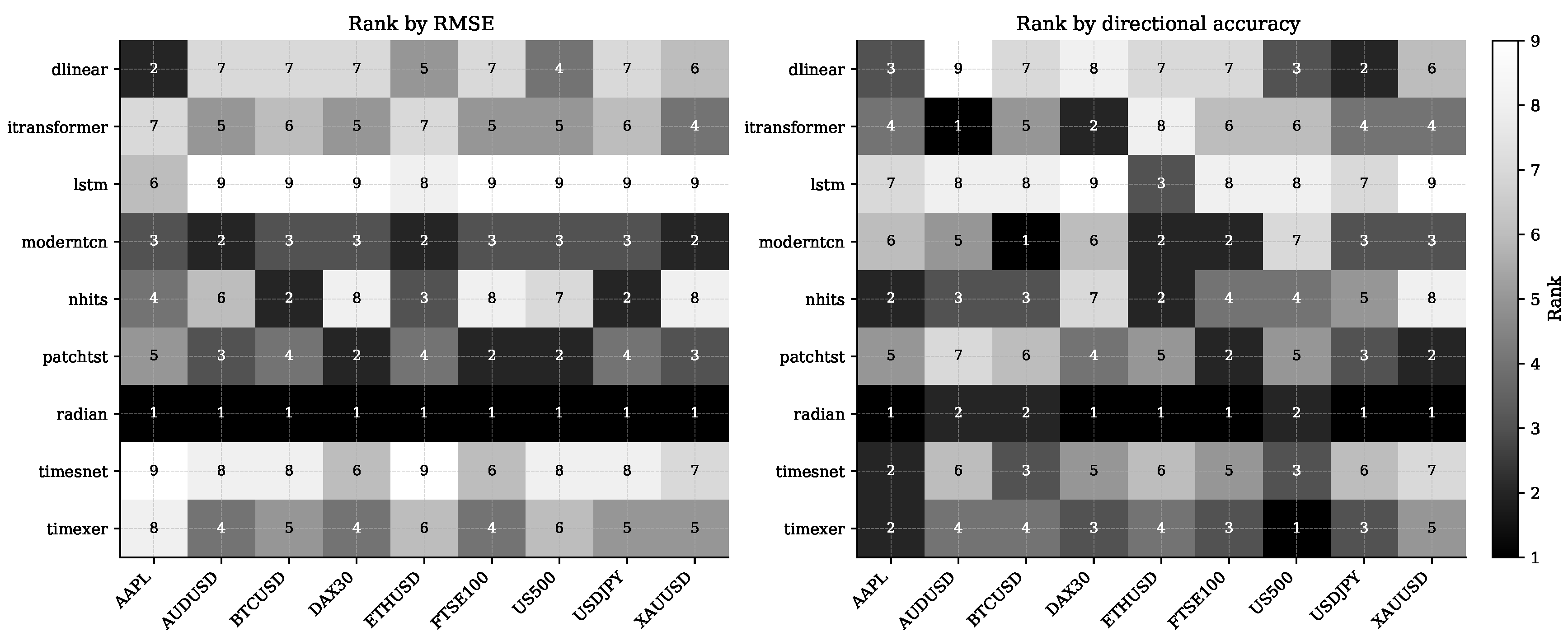
Figure A2.
Diagnostic of model stability across training seeds. Each subplot corresponds to a dataset; RADIAN exhibits lower spread and coefficient of variation than the baseline in most cases, as shown by the vertical jitter plots and accompanying statistics.
Figure A2.
Diagnostic of model stability across training seeds. Each subplot corresponds to a dataset; RADIAN exhibits lower spread and coefficient of variation than the baseline in most cases, as shown by the vertical jitter plots and accompanying statistics.
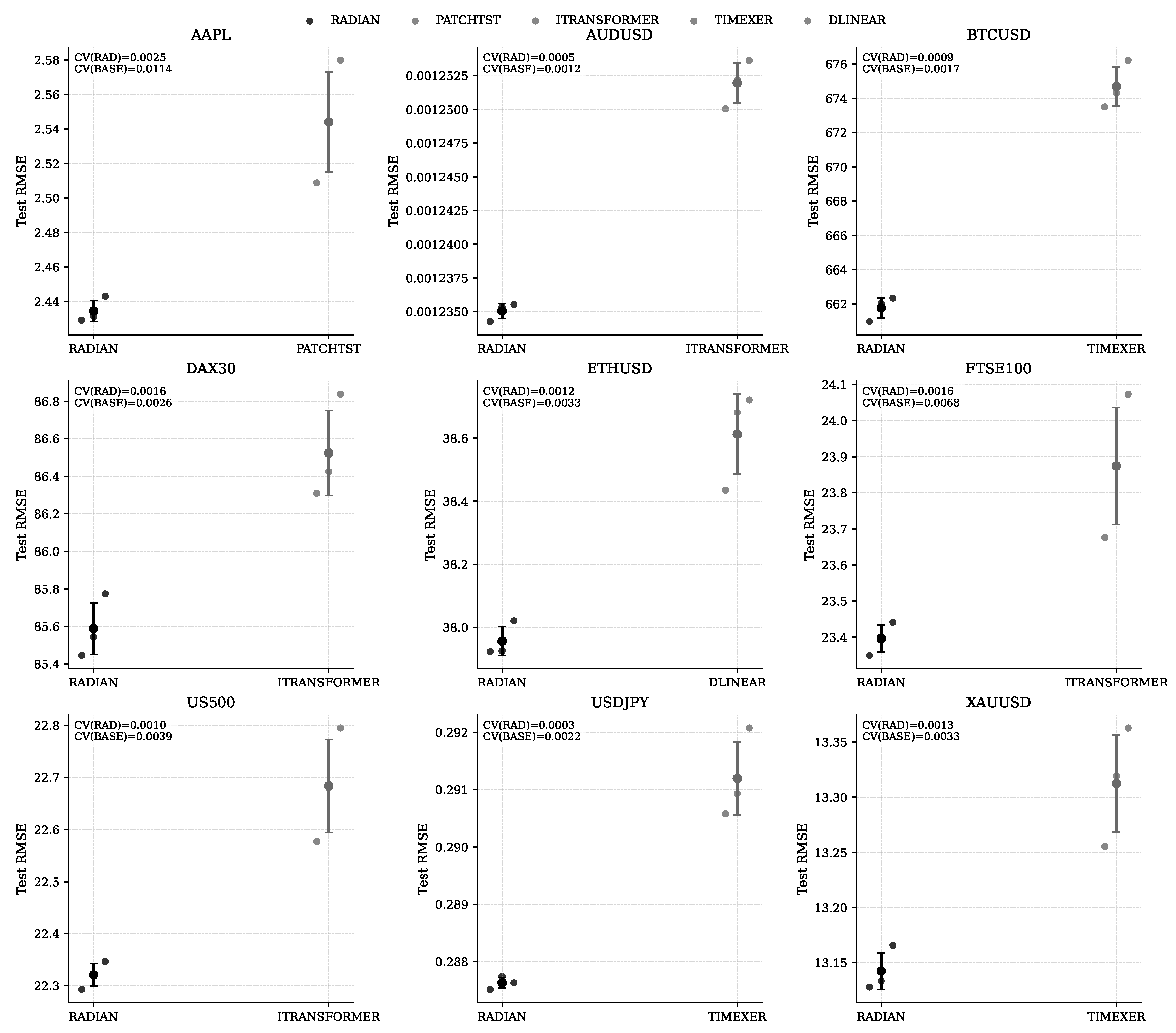
Figure A3.
Forecast comparison across datasets and volatility regimes. Each panel shows the ground truth price series alongside RADIAN and baseline predictions over a short forecast horizon.
Figure A3.
Forecast comparison across datasets and volatility regimes. Each panel shows the ground truth price series alongside RADIAN and baseline predictions over a short forecast horizon.
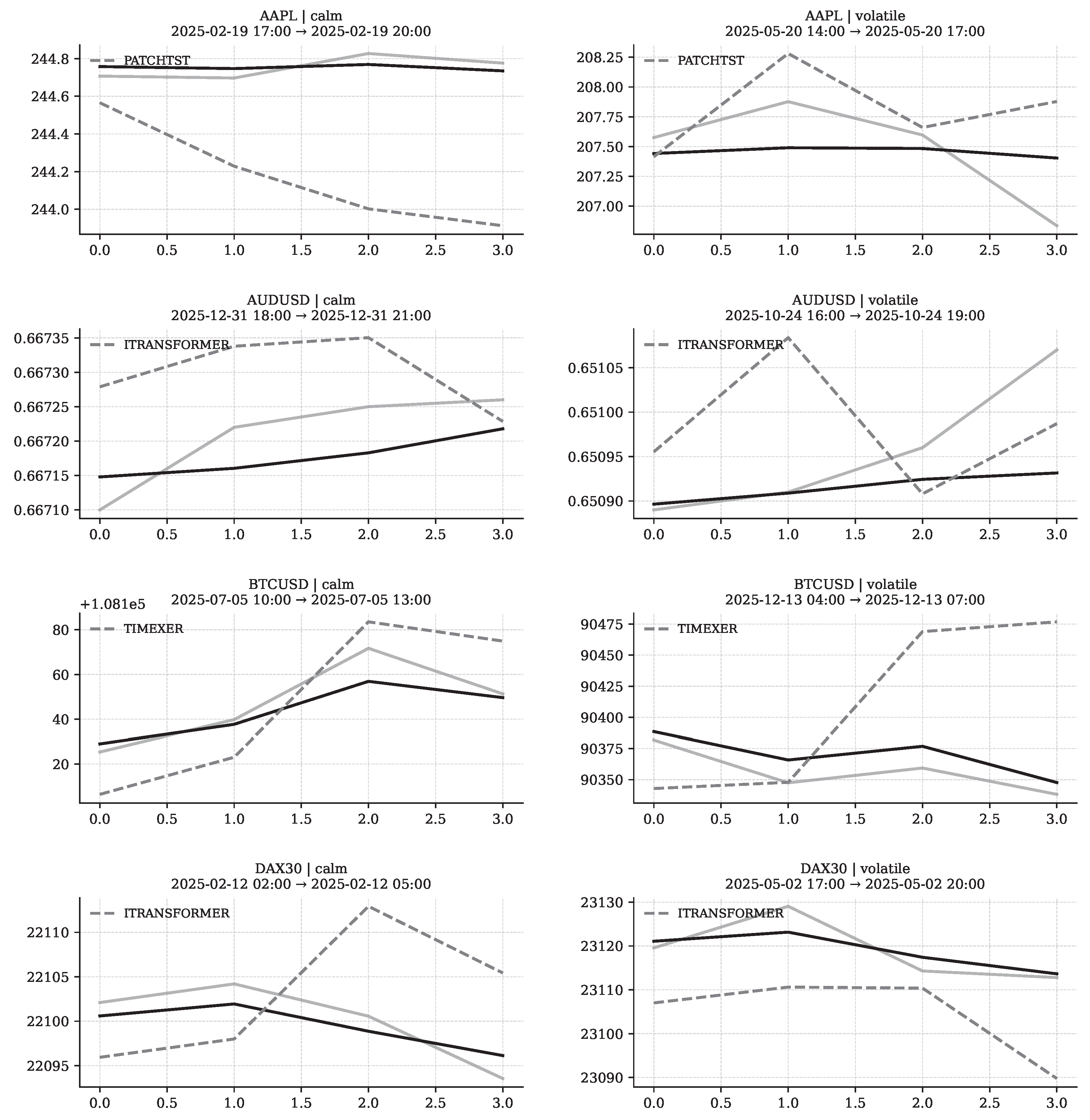
Figure A4.
Comparative forecasts across multiple assets. Each panel displays the ground truth price series, RADIAN predictions (black solid line), and forecasts from ModernTCN and PatchTST baselines (distinguished by dashed and dash-dot styles).
Figure A4.
Comparative forecasts across multiple assets. Each panel displays the ground truth price series, RADIAN predictions (black solid line), and forecasts from ModernTCN and PatchTST baselines (distinguished by dashed and dash-dot styles).
Appendix F. Reproducibility
This section summarizes the artifacts and settings required to reproduce preprocessing, training, evaluation, and ablations.
-
Random seeds and determinism:Each experiment uses three fixed seeds ({417, 153, 999}). Deterministic backend flags are enabled for GPU/CPU operations (for example, torch.backends.cudnn.deterministic = True).
-
Data splits:A chronological split is used: 80% training, 10% validation, 10% test. The same split indices are applied consistently across all models and ablations.
-
Evaluation metrics:Evaluation reports mean absolute error (MAE), root mean squared error (RMSE), mean squared error (MSE), and directional accuracy (DA). All metrics are computed by a unified evaluation script.
-
Hyperparameters and ablations:Hyperparameters are documented in the configuration file included in the supplementary material. Ablation variants (A0–A9) are listed in Table A9 (Appendix C.2) and implemented through configuration flags.
Refer to the primary Data and Code Availability statement following the Conclusion for access to implementation artifacts and processed data.
References
- Mandelbrot, B. Variation of Certain Speculative Prices. The Journal of Business 1963, 36, 394–419. [Google Scholar] [CrossRef]
- Cont, R. Empirical Properties of Asset Returns. In Quantitative Finance; 2001. [Google Scholar] [CrossRef]
- Hamilton, J.D. Economic Analysis of Nonstationary Time Series. In Econometrica; 1989. [Google Scholar] [CrossRef]
- Hochreiter, S.; Schmidhuber, J. Long Short-Term Memory. Neural Computation 1997, 9, 1735–1780. [Google Scholar] [CrossRef] [PubMed]
- Salinas, D.; Flunkert, V.; Gasthaus, J.; Januschowski, T. DeepAR: Probabilistic Forecasting with Autoregressive Recurrent Networks. International Journal of Forecasting 2020, 36, 1181–1191. [Google Scholar] [CrossRef]
- Lim, B.; Arik, S.O.; Loeff, N.; Pfister, T. Temporal Fusion Transformers for Interpretable Multi-horizon Time Series Forecasting. International Journal of Forecasting 2021, 37, 1748–1764. [Google Scholar] [CrossRef]
- Vaswani, A.; Shazeer, N.; Parmar, N.; Uszkoreit, J.; Jones, L.; Gomez, A.N.; Kaiser, L.; Polosukhin, I. Attention Is All You Need. In Proceedings of the Advances in Neural Information Processing Systems, 2017. [Google Scholar] [CrossRef]
- Nie, Y.; Nguyen, N.H.; Sinthong, P.; Kalagnanam, J. A Time Series is Worth 64 Words: Long-term Forecasting with Transformers. In Proceedings of the International Conference on Learning Representations, 2023. [Google Scholar] [CrossRef]
- Liu, Y.; Hu, T.; Zhang, H.; Wu, H.; Wang, S.; Ma, L.; Long, M. iTransformer: Inverted Transformers Are Effective for Time Series Forecasting. In Proceedings of the International Conference on Learning Representations, 2024. [Google Scholar] [CrossRef]
- Box, G.E.P.; Jenkins, G.M.; Reinsel, G.C.; Ljung, G.M. Time Series Analysis: Forecasting and Control, 5 ed.; Wiley, 2015. [Google Scholar] [CrossRef]
- Brockwell, P.J.; Davis, R.A. Introduction to Time Series and Forecasting, 3 ed.; Springer, 2016. [Google Scholar] [CrossRef]
- Hyndman, R.J.; Athanasopoulos, G. Forecasting: Principles and Practice; OTexts, 2021. [Google Scholar]
- Engle, R.F. ARCH. In Econometrica; 1982. [Google Scholar] [CrossRef]
- Bollerslev, T. Generalized Autoregressive Conditional Heteroskedasticity. Journal of Econometrics 1986, 31, 307–327. [Google Scholar] [CrossRef]
- Tsay, R.S. Analysis of Financial Time Series, 3 ed.; Wiley, 2010. [Google Scholar] [CrossRef]
- Qin, Y.; Song, D.; Chen, H.; Cheng, W.; Jiang, G.; Cottrell, G. A Dual-Stage Attention-Based Recurrent Neural Network for Time Series Prediction. In Proceedings of the Proceedings of the Twenty-Sixth International Joint Conference on Artificial Intelligence, 2017. [Google Scholar] [CrossRef]
- Lai, G.; Chang, W.C.; Yang, Y.; Liu, H. Modeling Long- and Short-Term Temporal Patterns with Deep Neural Networks. In Proceedings of the The 41st International ACM SIGIR Conference on Research & Development in Information Retrieval, 2018. [Google Scholar] [CrossRef]
- Bai, S.; Kolter, J.Z.; Koltun, V. An Empirical Evaluation of Generic Convolutional and Recurrent Networks for Sequence Modeling. In Proceedings of the International Conference on Learning Representations, 2018. [Google Scholar] [CrossRef]
- Oreshkin, B.N.; Carpov, D.; Chapados, N.; Bengio, Y. N-BEATS: Neural Basis Expansion Analysis for Interpretable Time Series Forecasting. In Proceedings of the International Conference on Learning Representations, 2020. [Google Scholar] [CrossRef]
- Zhou, H.; Zhang, S.; Peng, J.; Zhang, S.; Li, J.; Xiong, H.; Zhang, W. Informer: Beyond Efficient Transformer for Long Sequence Time-Series Forecasting. Proceedings of the AAAI Conference on Artificial Intelligence 2021, 35, 11106–11115. [Google Scholar] [CrossRef]
- Wu, H.; Xu, J.; Wang, J.; Long, M. Autoformer: Decomposition Transformers with Auto-Correlation for Long-Term Series Forecasting. Advances in Neural Information Processing Systems 2021, 34, 22419–22430. [Google Scholar] [CrossRef]
- Zhou, T.; Ma, Z.; Wen, Q.; Wang, X.; Sun, L.; Jin, R.; et al. FEDformer: Frequency Enhanced Decomposed Transformer for Long-term Series Forecasting. In Proceedings of the Proceedings of the 39th International Conference on Machine Learning, 2022. [Google Scholar] [CrossRef]
- Li, S.; Jin, X.; Xuan, Y.; Zhou, X.; Chen, W.; Wang, Y.X.; Yan, X. Enhancing the Locality and Breaking the Memory Bottleneck of Transformer on Time Series Forecasting. In Proceedings of the Advances in Neural Information Processing Systems, 2019. [Google Scholar] [CrossRef]
- Zeng, A.; Chen, M.; Zhang, L.; Xu, Q. Are Transformers Effective for Time Series Forecasting? Proceedings of the AAAI Conference on Artificial Intelligence 2022, 37, 11121–11128. [Google Scholar] [CrossRef]
- Kim, T.; Kim, J.; Tae, Y.; Park, C.; Choi, J.H.; Choo, J. Reversible Instance Normalization for Accurate Time-Series Forecasting against Distribution Shift. In Proceedings of the International Conference on Learning Representations, 2022. [Google Scholar]
- Liu, Y.; Wu, H.; Wang, J.; Long, M. Non-stationary Transformers: Exploring the Stationarity in Time Series Forecasting. In Proceedings of the Advances in Neural Information Processing Systems, 2022. [Google Scholar] [CrossRef]
- Jacobs, R.A. Adaptive Mixtures of Local Experts. Neural Computation 1991, 3, 79–87. [Google Scholar] [CrossRef] [PubMed]
- Shazeer, N.; Mirhoseini, A.; Maziarz, K.; Davis, A.; Le, Q.; Hinton, G.; Dean, J. Outrageously Large Neural Networks: The Sparsely-Gated Mixture-of-Experts Layer. arXiv arXiv:1701.06538. [CrossRef]
- Fedus, W.; et al. Switch Transformers. JMLR 2022. [Google Scholar]
- Ba, J.L.; Kiros, J.R.; Hinton, G.E. Layer Normalization. arXiv arXiv:1607.06450. [CrossRef]
- Kingma, D.P.; Ba, J. Adam: A Method for Stochastic Optimization. In Proceedings of the International Conference on Learning Representations, 2015. [Google Scholar] [CrossRef]
- Wu, H.; Hu, T.; Liu, Y.; Zhou, H.; Wang, J.; Long, M. TimesNet: Temporal 2D-Variation Modeling for General Time Series Analysis. arXiv 2022, arXiv:2210.02186. [Google Scholar] [CrossRef]
- Challu, C.; et al. N-HiTS: Neural Hierarchical Interpolation for Time Series Forecasting. In Proceedings of the AAAI, 2023. [Google Scholar] [CrossRef]
- Wang, Y.; Wu, H.; Dong, J.; Qin, G.; Zhang, H.; Liu, Y.; Qiu, Y.; Wang, J.; Long, M. TimeXer: Empowering Transformers for Time Series Forecasting with Exogenous Variables. arXiv 2024. arXiv:2402.19072. [CrossRef]
- Benjamini, Y.; Hochberg, Y. Controlling the False Discovery Rate: A Practical and Powerful Approach to Multiple Testing. Journal of the Royal Statistical Society: Series B 1995, 57, 289–300. [Google Scholar] [CrossRef]
- Cohen, J. Statistical Power Analysis for the Behavioral Sciences; Lawrence Erlbaum, 1988. [Google Scholar] [CrossRef]
- Hazan, E. Introduction to Online Convex Optimization. Foundations and Trends in Optimization 2016, 2, 157–325. [Google Scholar] [CrossRef]
- Reichstein, M. Deep Learning for Earth System Science. Nature 2019, 566, 195–204. [Google Scholar] [CrossRef] [PubMed]
- Benson, T.; Anand, A.; Akella, A.; Zhang, M. Network Traffic Characteristics of Data Centers in the Wild. In Proceedings of the IMC, 2010; pp. 267–280. [Google Scholar] [CrossRef]
- Clifford, G.D.; et al. AF Classification from a Short Single Lead ECG Recording. Computing in Cardiology 2017. [Google Scholar] [CrossRef]
Figure 1.
Architectural diagram of the proposed RADIAN model. The framework consists of three processing branches—temporal, feature, and regime—followed by gated fusion and a regime-aware directional head to produce multi-step forecasts.
Figure 1.
Architectural diagram of the proposed RADIAN model. The framework consists of three processing branches—temporal, feature, and regime—followed by gated fusion and a regime-aware directional head to produce multi-step forecasts.
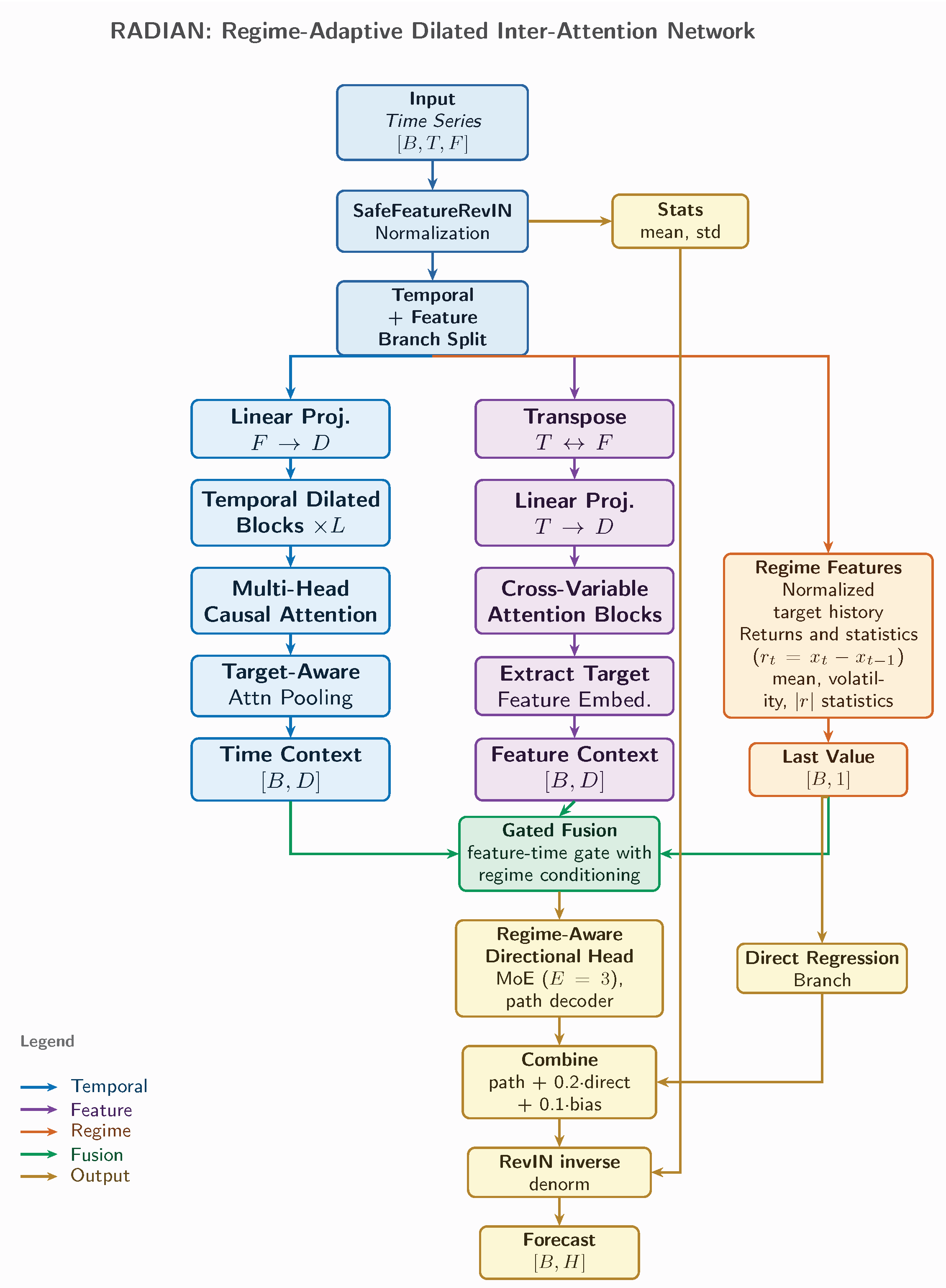
Figure 2.
Regime vector decomposition of the price process. The plot illustrates the four components of the regime vector , with (volatility) in the middle panel and , (shock magnitude and envelope) in the lower panel. The asset price evolution is shown above, and vertical markers denote structural breakpoints.
Figure 2.
Regime vector decomposition of the price process. The plot illustrates the four components of the regime vector , with (volatility) in the middle panel and , (shock magnitude and envelope) in the lower panel. The asset price evolution is shown above, and vertical markers denote structural breakpoints.
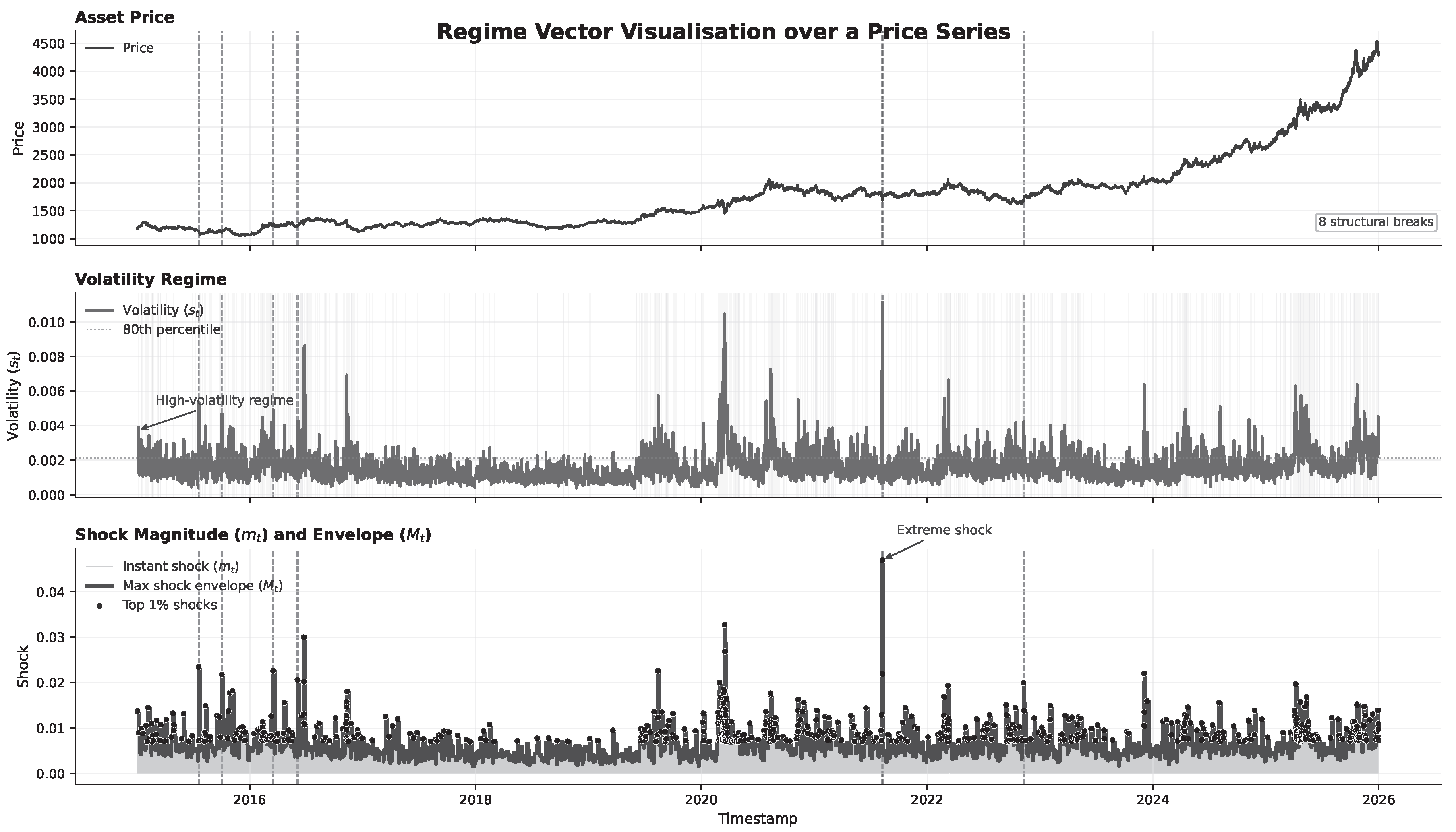
Figure 5.
Comparative performance of deep learning forecasting models expressed as mean ranks. Non-significant differences () are indicated by horizontal brackets. RADIAN demonstrates the most favorable rank, followed by ModernTCN and PatchTST, whereas LSTM and TimesNet show the weakest relative performance.
Figure 5.
Comparative performance of deep learning forecasting models expressed as mean ranks. Non-significant differences () are indicated by horizontal brackets. RADIAN demonstrates the most favorable rank, followed by ModernTCN and PatchTST, whereas LSTM and TimesNet show the weakest relative performance.
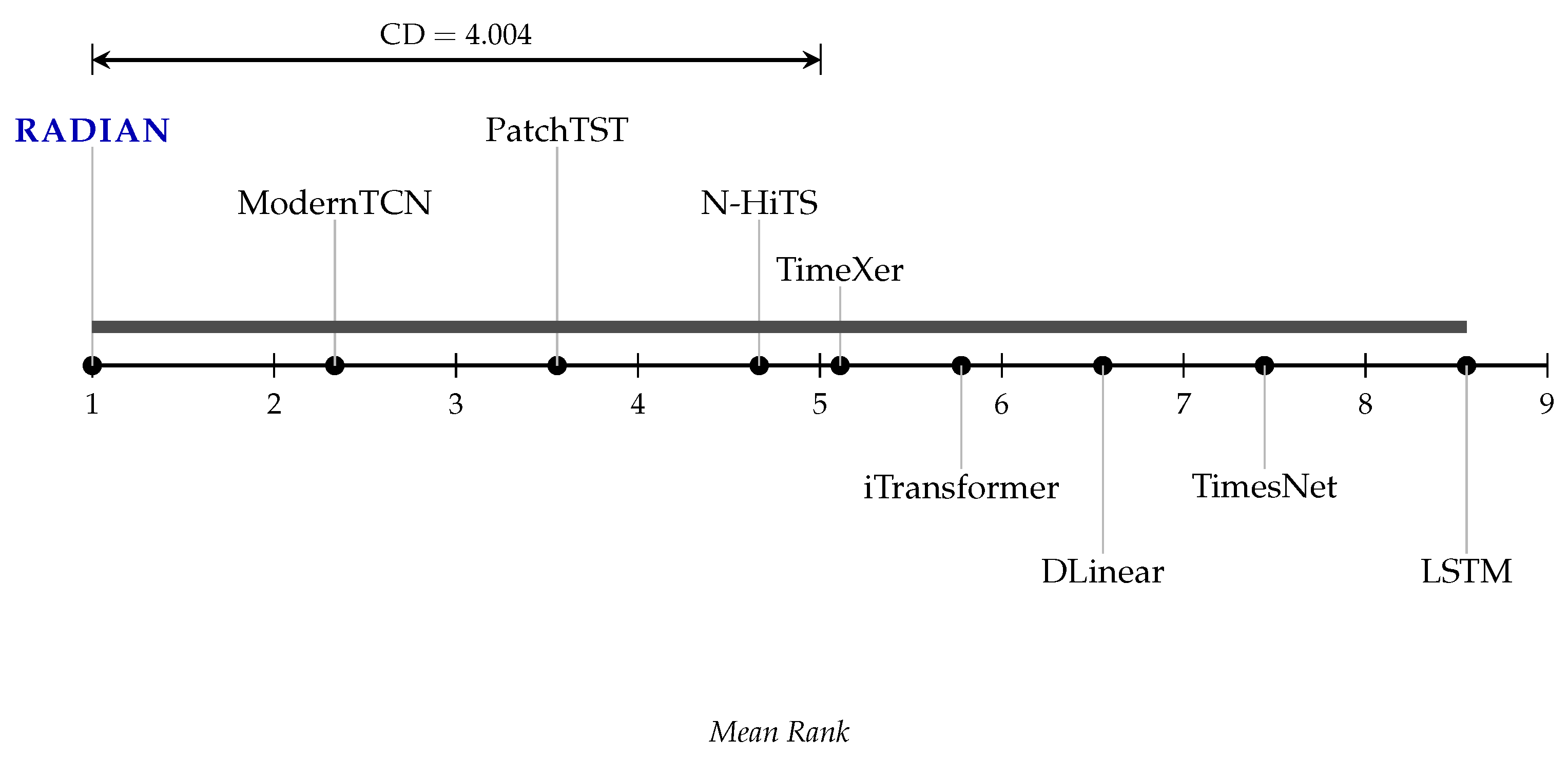
Figure 6.
Comparative forecast performance across market regimes. For each regime (calm, volatile, transition), the left column shows ground truth versus predictions from RADIAN and the selected baseline; the right column displays absolute prediction errors. Window timestamps are indicated in each subplot title.
Figure 6.
Comparative forecast performance across market regimes. For each regime (calm, volatile, transition), the left column shows ground truth versus predictions from RADIAN and the selected baseline; the right column displays absolute prediction errors. Window timestamps are indicated in each subplot title.
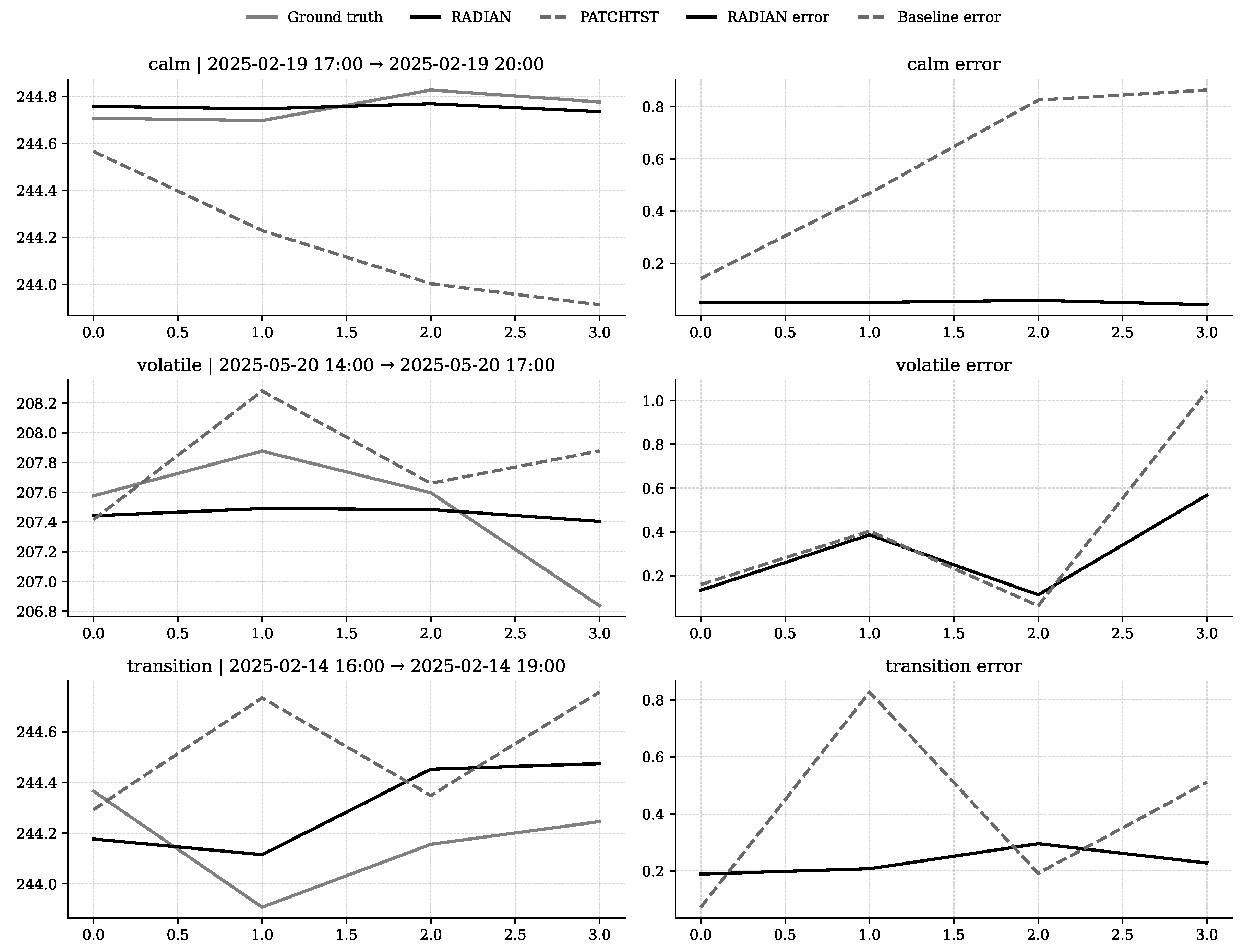
Figure 7.
Transition-centered absolute prediction error across all datasets. The upper panel displays mean absolute error ( CI) aligned at transition points () for RADIAN and the best-performing baseline. The lower panel shows a representative timeline of absolute errors for both models with overlaid rolling volatility; shaded regions indicate identified transition periods.
Figure 7.
Transition-centered absolute prediction error across all datasets. The upper panel displays mean absolute error ( CI) aligned at transition points () for RADIAN and the best-performing baseline. The lower panel shows a representative timeline of absolute errors for both models with overlaid rolling volatility; shaded regions indicate identified transition periods.
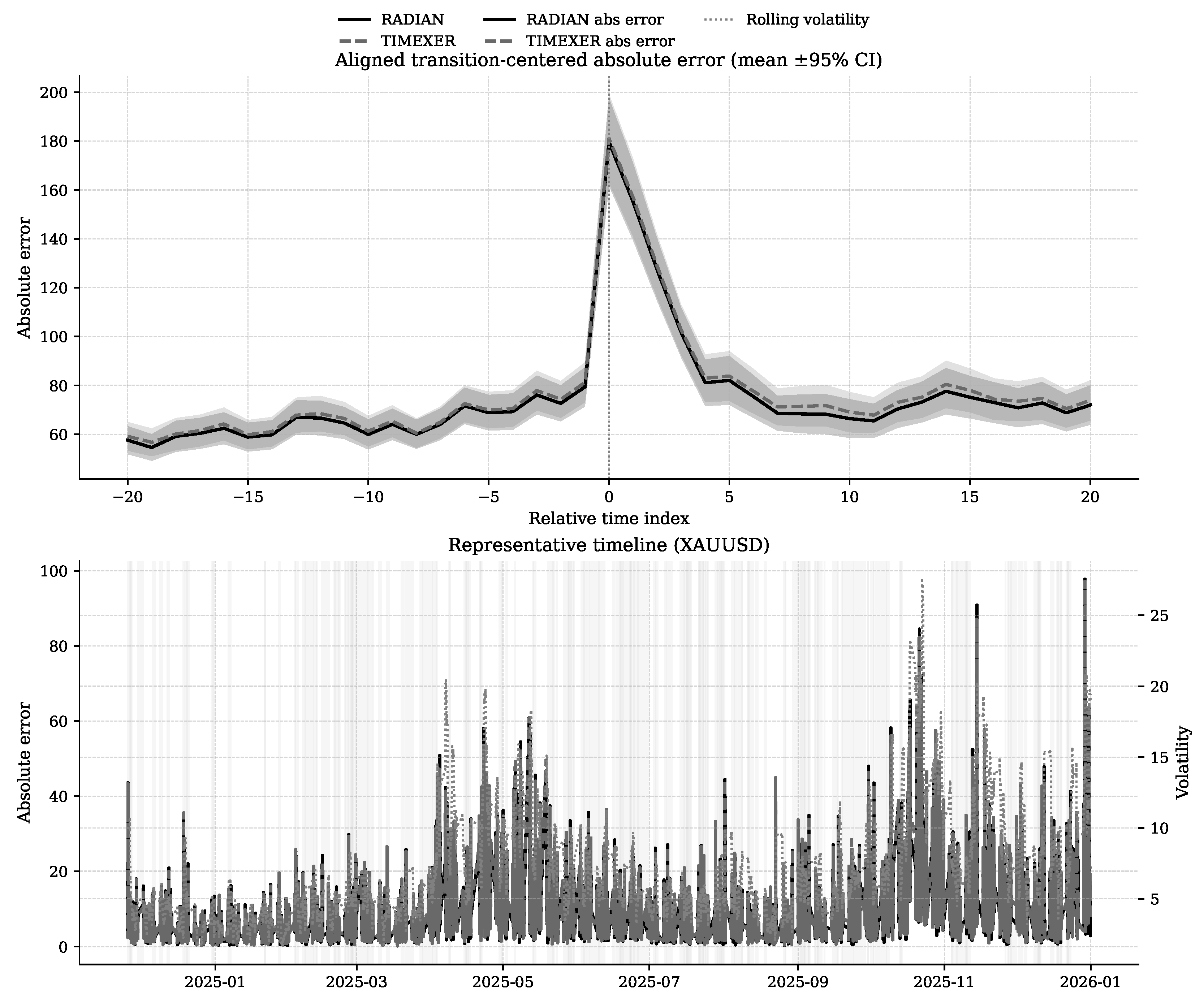
Figure 8.
Cross-variable attention weights from the RADIAN model under calm (left) and volatile (right) market regimes. Each heatmap shows the average attention across heads, with rows representing query features and columns key features.
Figure 8.
Cross-variable attention weights from the RADIAN model under calm (left) and volatile (right) market regimes. Each heatmap shows the average attention across heads, with rows representing query features and columns key features.
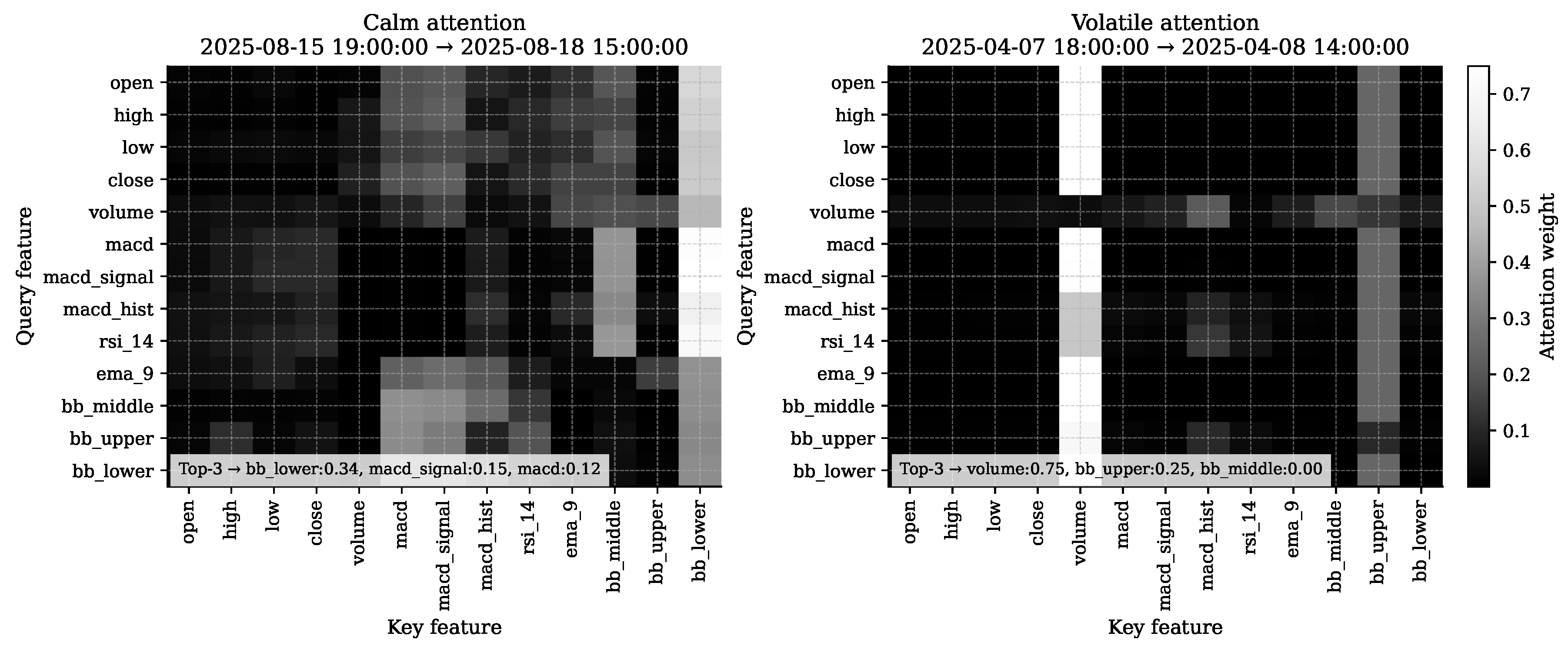
Figure 9.
Mean absolute error (MAE) as a function of volatility percentile for RADIAN and TimesNet. Solid lines denote the mean MAE across datasets and seeds; shaded regions represent 95% confidence intervals. The figure demonstrates that prediction error increases monotonically with volatility, with RADIAN exhibiting consistently lower error and a shallower slope than the baseline.
Figure 9.
Mean absolute error (MAE) as a function of volatility percentile for RADIAN and TimesNet. Solid lines denote the mean MAE across datasets and seeds; shaded regions represent 95% confidence intervals. The figure demonstrates that prediction error increases monotonically with volatility, with RADIAN exhibiting consistently lower error and a shallower slope than the baseline.
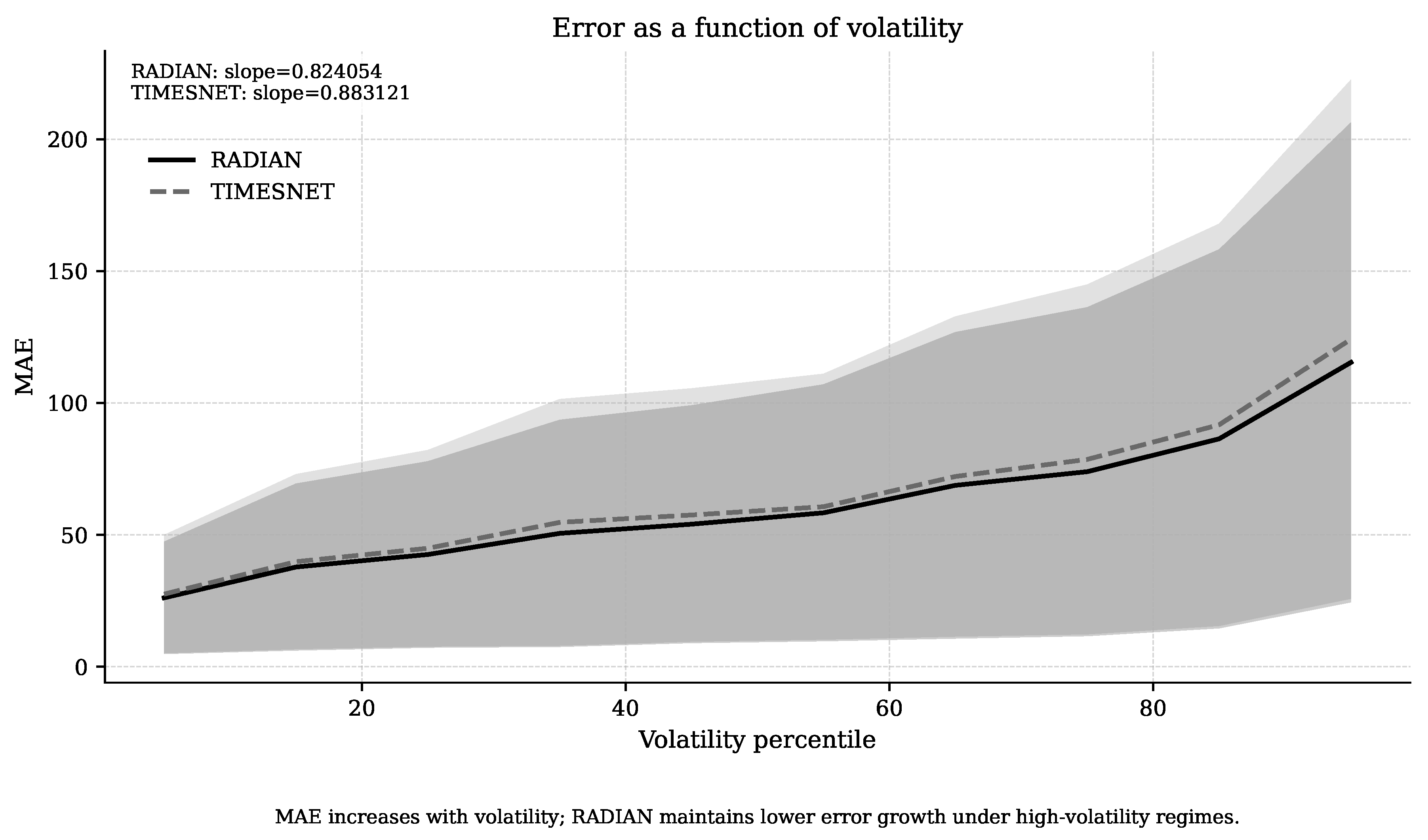
Figure 10.
Impact of removing regime conditioning on forecasting accuracy. The left panel presents a volatile-window forecast comparison between the complete RADIAN model (A0), its variant lacking regime conditioning (A5), a baseline, and actual values. The right panel quantifies the regime-specific performance gap, showing that A0 achieves a smaller increase in MAE from calm to volatile conditions than A5.
Figure 10.
Impact of removing regime conditioning on forecasting accuracy. The left panel presents a volatile-window forecast comparison between the complete RADIAN model (A0), its variant lacking regime conditioning (A5), a baseline, and actual values. The right panel quantifies the regime-specific performance gap, showing that A0 achieves a smaller increase in MAE from calm to volatile conditions than A5.
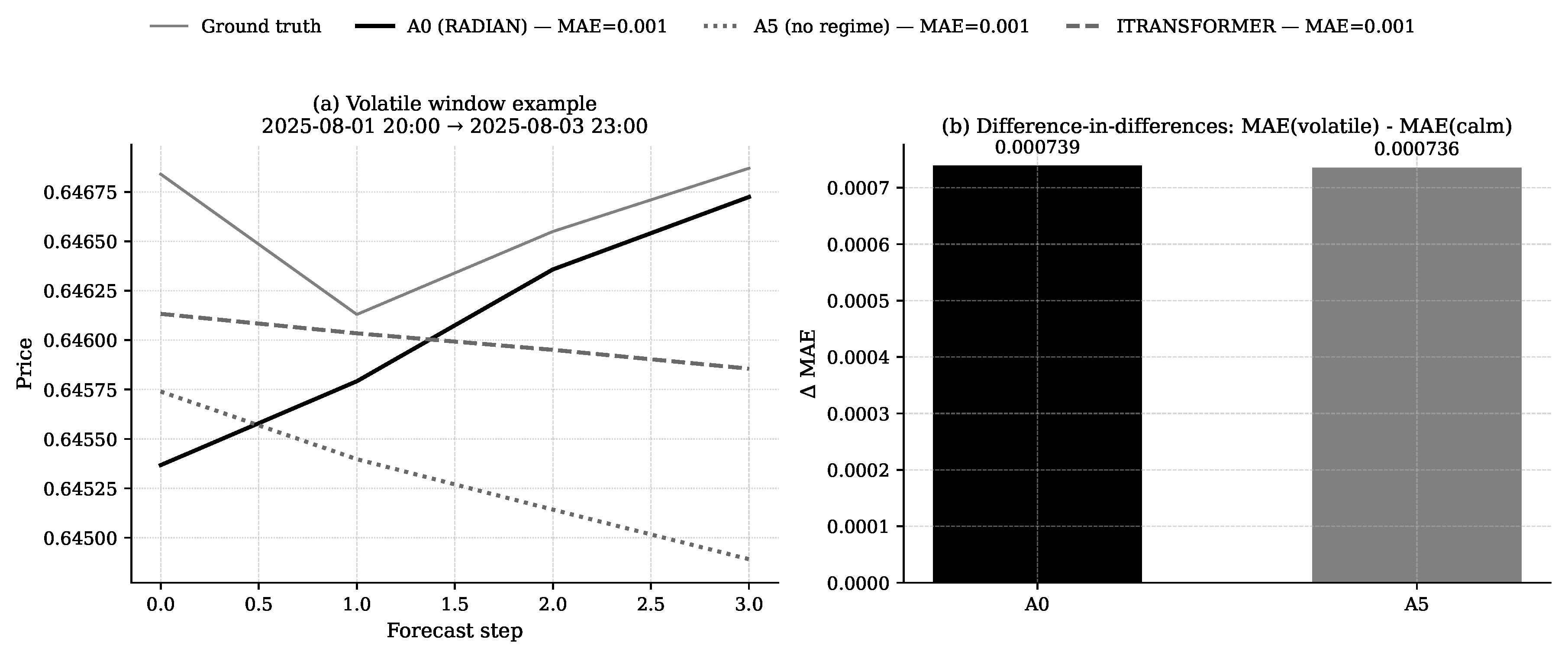
Figure 11.
Mixture-of-experts (MoE) gate weight dynamics across market regimes. Panel (a) shows temporally smoothed expert assignment probabilities over the test period, with background shading indicating calm, transition, and volatile regimes. Panel (b) reports the average gate weight per expert for each regime, revealing systematic variation in expert utilisation with volatility conditions.
Figure 11.
Mixture-of-experts (MoE) gate weight dynamics across market regimes. Panel (a) shows temporally smoothed expert assignment probabilities over the test period, with background shading indicating calm, transition, and volatile regimes. Panel (b) reports the average gate weight per expert for each regime, revealing systematic variation in expert utilisation with volatility conditions.
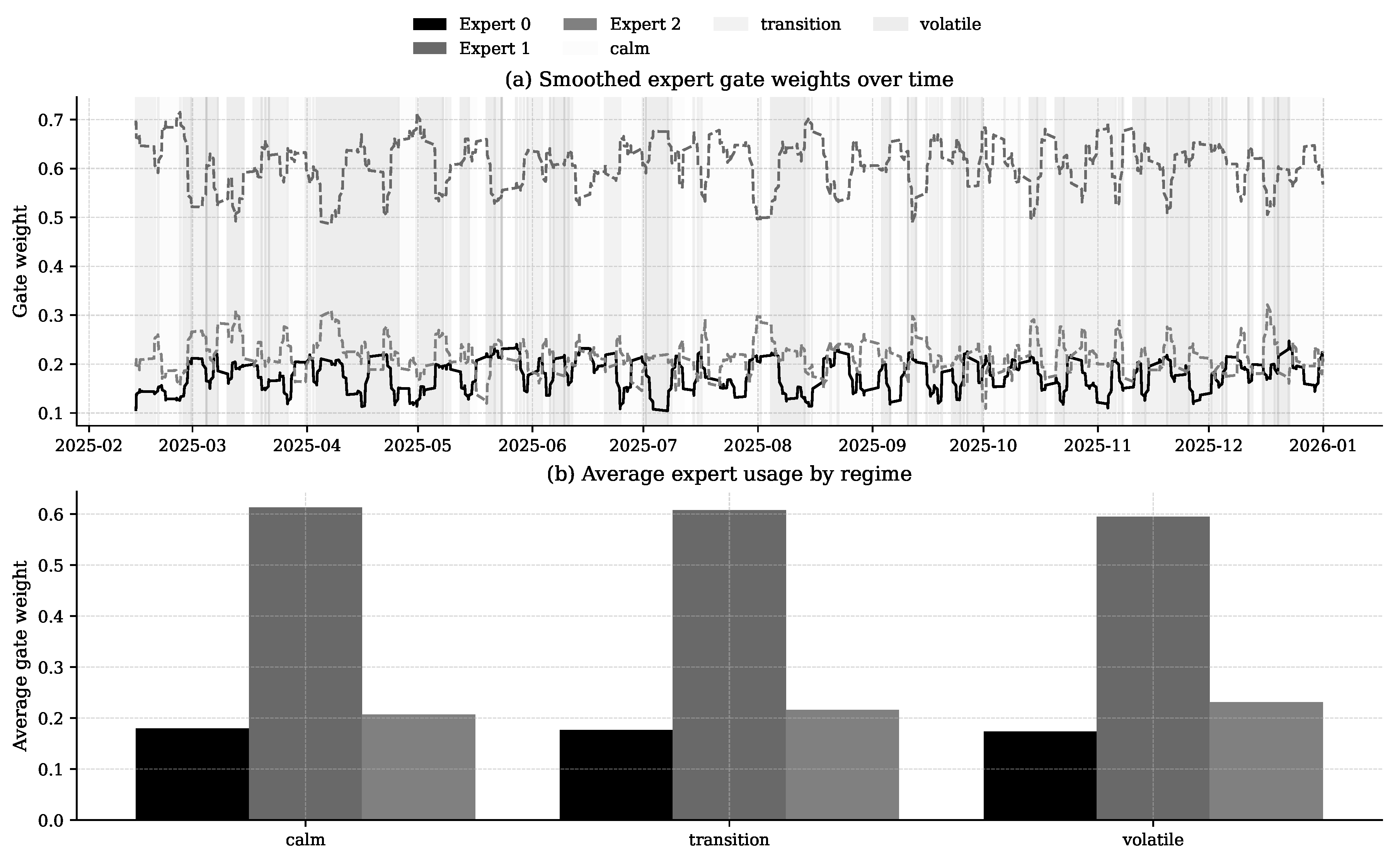
Figure 12.
Comparison of path-based (A0) and direct-like (A9) decoding strategies. Panel (a) shows forecasts for a representative volatile window; A0 more closely follows the ground truth trajectory. Panel (b) reports per-window step variance of predictions, and panel (c) presents the sign inconsistency rate, both indicating smoother and more consistent forecasts from A0.
Figure 12.
Comparison of path-based (A0) and direct-like (A9) decoding strategies. Panel (a) shows forecasts for a representative volatile window; A0 more closely follows the ground truth trajectory. Panel (b) reports per-window step variance of predictions, and panel (c) presents the sign inconsistency rate, both indicating smoother and more consistent forecasts from A0.
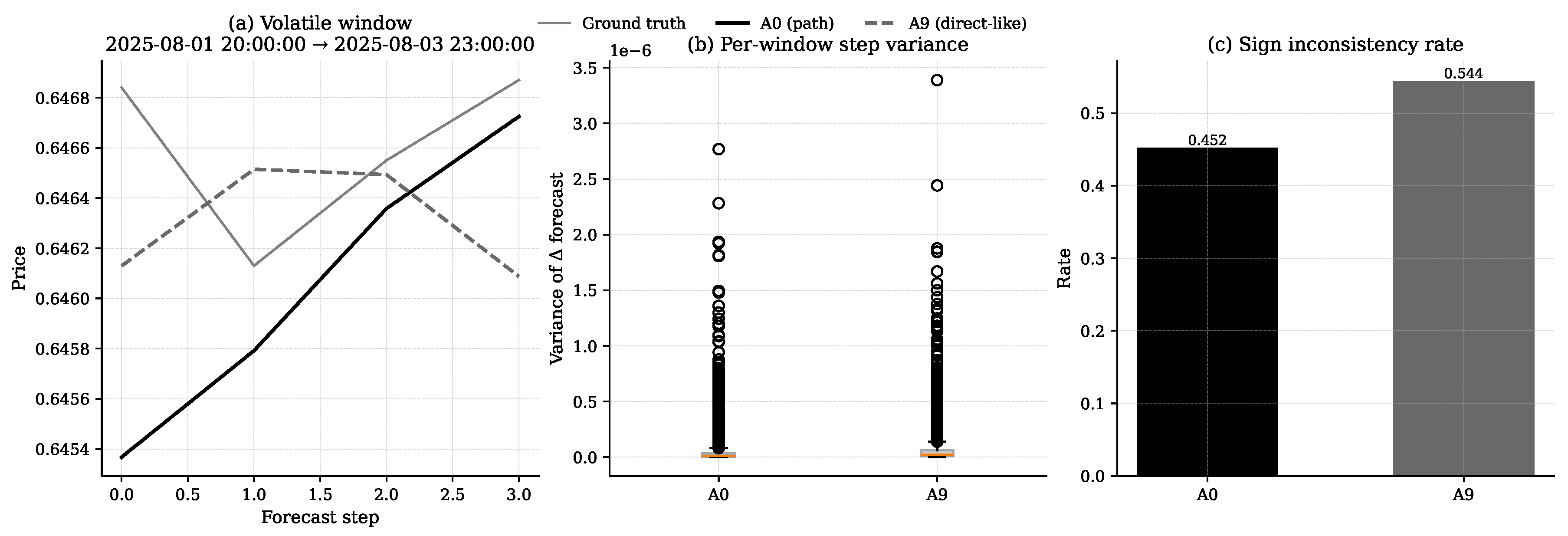
Figure 13.
Multi-dataset robustness comparison of RADIAN against dataset-specific baselines. For each dataset, the left boxplot (RADIAN) and right boxplot (baseline) summarise test RMSE variability across seeds, with scatter points representing individual runs.
Figure 13.
Multi-dataset robustness comparison of RADIAN against dataset-specific baselines. For each dataset, the left boxplot (RADIAN) and right boxplot (baseline) summarise test RMSE variability across seeds, with scatter points representing individual runs.
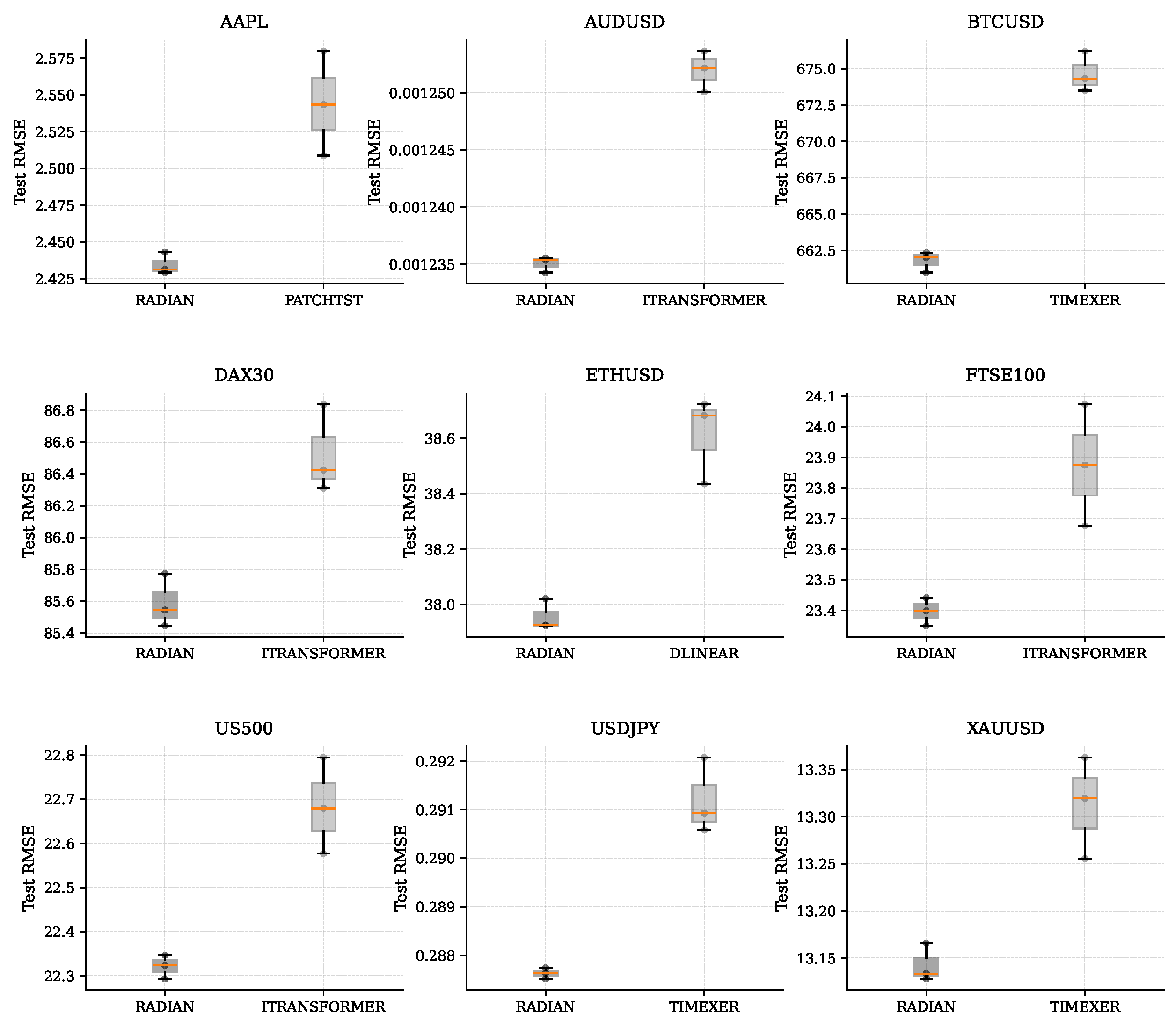
Figure 14.
Trade-off between computational cost and prediction error. Each point represents a model; the x-axis shows inference latency (ms) for a batch of 64 samples, and the y-axis shows mean test RMSE aggregated across datasets. RADIAN occupies a position on the Pareto boundary, indicating competitive accuracy with moderate latency.
Figure 14.
Trade-off between computational cost and prediction error. Each point represents a model; the x-axis shows inference latency (ms) for a batch of 64 samples, and the y-axis shows mean test RMSE aggregated across datasets. RADIAN occupies a position on the Pareto boundary, indicating competitive accuracy with moderate latency.
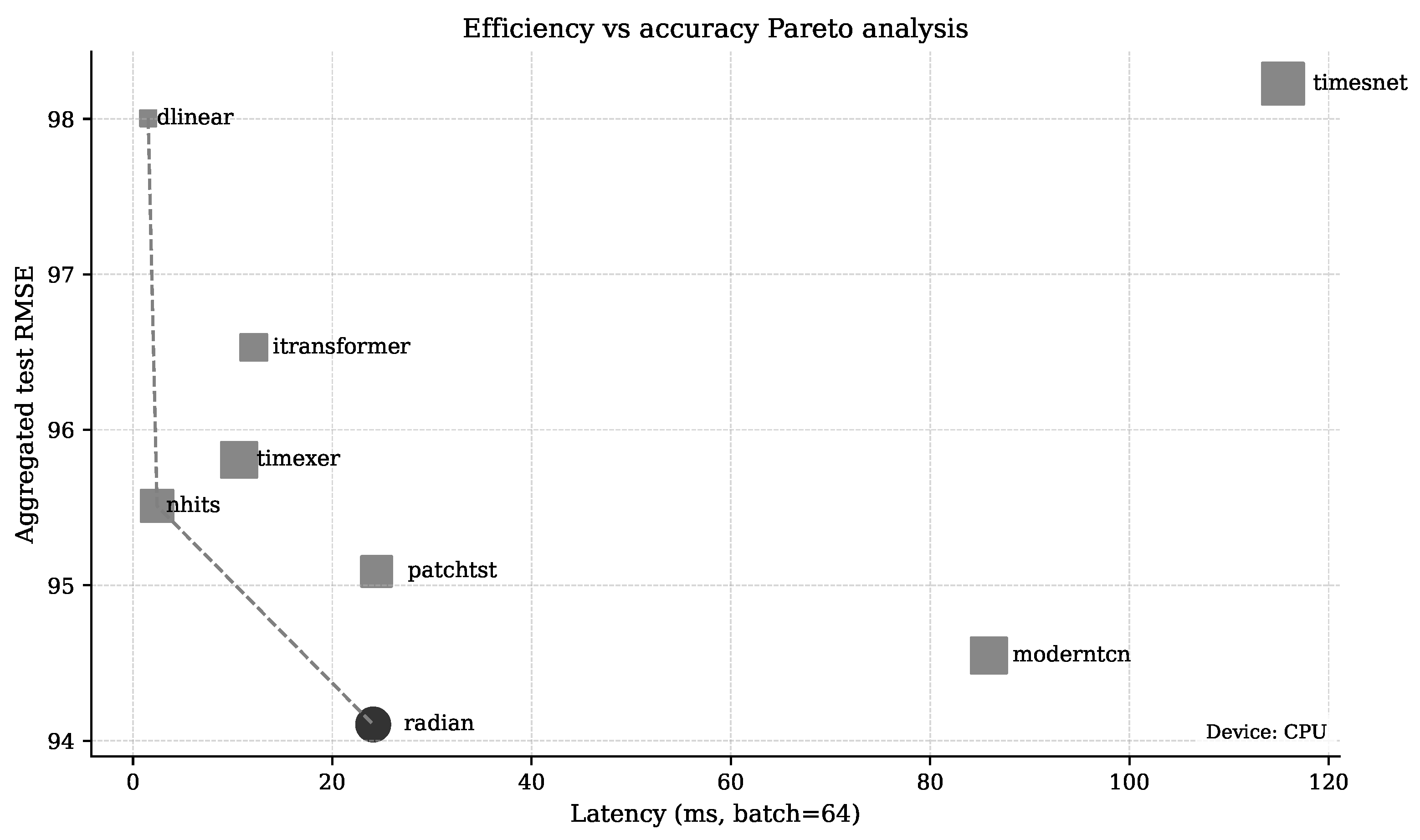
Table 2.
Primary RADIAN hyperparameters used in all reported experiments. The table lists fixed settings shared across datasets.
Table 2.
Primary RADIAN hyperparameters used in all reported experiments. The table lists fixed settings shared across datasets.
| Setting | Value |
|---|---|
| Input window T | 24 |
| Forecast horizon H | 4 |
| Target feature | close |
| Loss | MSE |
| Optimizer | Adam |
| Learning rate | |
| Batch size | 64 |
| Epochs | 50 |
| Seeds | {417, 153, 999} |
| RADIAN width D | 128 |
| Attention heads | 8 |
| Temporal layers L | 3 |
| Experts E | 3 |
| Directional mix | 0.35 |
Table 3.
Dataset-level RMSE (↓) and directional accuracy (DA, %, ↑) for six models across nine financial datasets. Bold values indicate the best result per row/metric; underlined values indicate the second-best result.
Table 3.
Dataset-level RMSE (↓) and directional accuracy (DA, %, ↑) for six models across nine financial datasets. Bold values indicate the best result per row/metric; underlined values indicate the second-best result.
| RADIAN | ModernTCN | PatchTST | TimeXer | iTransformer | N-HiTS | |||||||
|---|---|---|---|---|---|---|---|---|---|---|---|---|
| Dataset | RMSE | DA | RMSE | DA | RMSE | DA | RMSE | DA | RMSE | DA | RMSE | DA |
| AAPL | 2.43452 | 52.0399 | 2.47554 | 50.4395 | 2.54399 | 50.6782 | 2.68699 | 51.0796 | 2.68113 | 50.6944 | 2.47771 | 51.0796 |
| AUDUSD | 0.0012 | 51.2706 | 0.0012 | 51.0947 | 0.0012 | 50.6322 | 0.0012 | 51.1427 | 0.0013 | 51.3198 | 0.0013 | 51.2079 |
| BTCUSD | 661.786 | 51.5112 | 665.049 | 51.5498 | 669.78 | 51.2684 | 674.672 | 51.3298 | 680.603 | 51.3044 | 664.178 | 51.4578 |
| DAX30 | 85.5863 | 50.6762 | 85.7886 | 50.238 | 85.7011 | 50.4135 | 86.2227 | 50.4368 | 86.5245 | 50.4643 | 91.9907 | 49.9202 |
| ETHUSD | 37.9566 | 51.7844 | 38.1581 | 51.5597 | 38.406 | 51.2828 | 38.813 | 51.4085 | 38.8142 | 50.6233 | 38.2602 | 51.5597 |
| FTSE100 | 23.4105 | 52.2703 | 23.5147 | 51.7304 | 23.4354 | 51.7304 | 23.5771 | 51.6581 | 23.8746 | 51.4663 | 25.2417 | 51.6153 |
| US500 | 22.3209 | 50.3227 | 22.4534 | 50.0683 | 22.4146 | 50.1003 | 22.6872 | 50.4303 | 22.6837 | 50.0829 | 23.266 | 50.1846 |
| USDJPY | 0.287882 | 50.7606 | 0.288621 | 50.5977 | 0.289673 | 50.5977 | 0.291194 | 50.5977 | 0.293137 | 50.5658 | 0.288265 | 50.5475 |
| XAUUSD | 13.1594 | 50.8788 | 13.2079 | 50.7655 | 13.2321 | 50.7848 | 13.3127 | 50.4696 | 13.2972 | 50.6073 | 13.8924 | 49.7311 |
Table 4.
Regime-stratified comparison for calm windows (lowest-volatility tertile): RMSE (↓) and directional accuracy (DA, %, ↑). Bold values indicate the best result per row/metric; underlined values indicate the second-best result.
Table 4.
Regime-stratified comparison for calm windows (lowest-volatility tertile): RMSE (↓) and directional accuracy (DA, %, ↑). Bold values indicate the best result per row/metric; underlined values indicate the second-best result.
| RADIAN | ModernTCN | PatchTST | TimeXer | iTransformer | N-HiTS | |||||||
|---|---|---|---|---|---|---|---|---|---|---|---|---|
| Dataset | RMSE | DA | RMSE | DA | RMSE | DA | RMSE | DA | RMSE | DA | RMSE | DA |
| AAPL | 1.17473 | 52.636 | 1.20872 | 51.2179 | 1.26594 | 51.3013 | 1.31382 | 52.4525 | 1.29356 | 51.4681 | 1.20079 | 51.4681 |
| AUDUSD | 0.00072 | 51.4299 | 0.00072 | 50.9983 | 0.00072 | 50.7956 | 0.00072 | 51.0433 | 0.00072 | 51.2497 | 0.00073 | 51.0996 |
| BTCUSD | 352.208 | 51.7604 | 352.71 | 51.6143 | 355.171 | 51.6143 | 356.243 | 51.6143 | 360.051 | 50.9086 | 359.585 | 51.5413 |
| DAX30 | 44.3731 | 50.2517 | 44.5435 | 49.5143 | 44.8666 | 49.766 | 44.8154 | 49.7969 | 45.1181 | 49.7969 | 49.2693 | 49.3687 |
| ETHUSD | 17.5892 | 51.2257 | 17.5988 | 51.9627 | 17.8298 | 50.9976 | 18.004 | 50.8796 | 18.0882 | 49.8941 | 17.853 | 51.4537 |
| FTSE100 | 12.8137 | 51.8568 | 12.8365 | 51.7851 | 13.0164 | 51.7851 | 12.97 | 51.7851 | 13.1161 | 51.3635 | 14.0828 | 51.7851 |
| US500 | 9.00642 | 50.3714 | 9.08592 | 49.8541 | 9.10911 | 49.5181 | 9.17819 | 50.305 | 9.21651 | 49.4518 | 9.13131 | 49.7966 |
| USDJPY | 0.173258 | 50.4363 | 0.174598 | 50.1939 | 0.173849 | 50.3133 | 0.174331 | 50.3133 | 0.175922 | 50.3133 | 0.173637 | 50.2685 |
| XAUUSD | 6.38012 | 50.4186 | 6.39978 | 50.5086 | 6.41445 | 50.2973 | 6.44058 | 50.4812 | 6.46872 | 50.2074 | 6.93114 | 50.3208 |
Table 5.
Regime-stratified comparison for transition windows (middle-volatility tertile): RMSE (↓) and directional accuracy (DA, %, ↑). Bold values indicate the best result per row/metric; underlined values indicate the second-best result.
Table 5.
Regime-stratified comparison for transition windows (middle-volatility tertile): RMSE (↓) and directional accuracy (DA, %, ↑). Bold values indicate the best result per row/metric; underlined values indicate the second-best result.
| RADIAN | ModernTCN | PatchTST | TimeXer | iTransformer | N-HiTS | |||||||
|---|---|---|---|---|---|---|---|---|---|---|---|---|
| Dataset | RMSE | DA | RMSE | DA | RMSE | DA | RMSE | DA | RMSE | DA | RMSE | DA |
| AAPL | 1.83344 | 50.2488 | 1.88874 | 49.334 | 1.95201 | 49.9117 | 2.02056 | 49.5105 | 2.00147 | 49.3821 | 1.87434 | 49.5105 |
| AUDUSD | 0.0010 | 50.6978 | 0.0010 | 50.4572 | 0.0010 | 49.4947 | 0.0010 | 50.4572 | 0.0010 | 50.3905 | 0.0010 | 50.5423 |
| BTCUSD | 578.607 | 51.7295 | 581.206 | 50.7613 | 587.679 | 50.6207 | 588.969 | 50.5404 | 591.834 | 50.8979 | 583.478 | 50.9341 |
| DAX30 | 59.5844 | 50.9066 | 59.91 | 50.6838 | 59.9799 | 50.8236 | 60.3654 | 50.2731 | 60.219 | 50.71 | 64.0141 | 49.5259 |
| ETHUSD | 32.0134 | 51.7055 | 32.2486 | 51.2948 | 32.3061 | 51.0128 | 32.7433 | 51.2948 | 32.648 | 50.5578 | 32.5292 | 51.1619 |
| FTSE100 | 16.9644 | 51.7447 | 17.2029 | 51.5447 | 17.2282 | 51.5713 | 17.1642 | 51.558 | 17.3029 | 51.5447 | 18.1041 | 50.9535 |
| US500 | 15.5185 | 50.3307 | 15.5425 | 50.0985 | 15.6328 | 50.2212 | 15.7309 | 50.2562 | 15.7362 | 50.1248 | 15.6127 | 50.2343 |
| USDJPY | 0.240022 | 50.758 | 0.241052 | 50.4555 | 0.241524 | 50.4555 | 0.242232 | 50.4555 | 0.243828 | 50.4555 | 0.24051 | 50.3154 |
| XAUUSD | 10.1542 | 51.8514 | 10.2179 | 51.8359 | 10.2582 | 51.5606 | 10.3688 | 51.2194 | 10.332 | 51.4094 | 11.3654 | 49.7926 |
Table 6.
Regime-stratified comparison for volatile windows (highest-volatility tertile): RMSE (↓) and directional accuracy (DA, %, ↑). Bold values indicate the best result per row/metric; underlined values indicate the second-best result.
Table 6.
Regime-stratified comparison for volatile windows (highest-volatility tertile): RMSE (↓) and directional accuracy (DA, %, ↑). Bold values indicate the best result per row/metric; underlined values indicate the second-best result.
| RADIAN | ModernTCN | PatchTST | TimeXer | iTransformer | N-HiTS | |||||||
|---|---|---|---|---|---|---|---|---|---|---|---|---|
| Dataset | RMSE | DA | RMSE | DA | RMSE | DA | RMSE | DA | RMSE | DA | RMSE | DA |
| AAPL | 3.5935 | 52.2727 | 3.63695 | 50.8059 | 3.7242 | 50.8382 | 3.96303 | 51.6763 | 3.96679 | 50.951 | 3.65134 | 51.225 |
| AUDUSD | 0.0017 | 52.2977 | 0.0017 | 51.8056 | 0.0017 | 51.5885 | 0.0018 | 51.5342 | 0.0018 | 52.0517 | 0.0018 | 51.9612 |
| BTCUSD | 917.765 | 52.0882 | 923.788 | 51.8208 | 928.748 | 51.4472 | 937.946 | 51.6793 | 947.414 | 51.8208 | 918.272 | 52.2416 |
| DAX30 | 127.548 | 50.8342 | 127.582 | 50.5048 | 127.582 | 50.6417 | 128.108 | 50.6588 | 128.671 | 51.0481 | 136.789 | 50.6588 |
| ETHUSD | 54.2712 | 52.7121 | 54.548 | 52.3336 | 54.9536 | 51.8251 | 55.489 | 51.9473 | 55.5167 | 51.3955 | 54.519 | 52.1444 |
| FTSE100 | 34.1298 | 52.0311 | 34.3318 | 52.4052 | 34.2826 | 51.8528 | 34.4648 | 51.5049 | 34.9445 | 51.4005 | 37.037 | 51.8528 |
| US500 | 33.987 | 50.7973 | 34.2125 | 50.2401 | 34.0909 | 50.5401 | 34.5578 | 50.4758 | 34.5388 | 50.6559 | 35.7383 | 50.5058 |
| USDJPY | 0.398577 | 51.3059 | 0.398976 | 50.9885 | 0.401254 | 50.57 | 0.403874 | 50.671 | 0.406406 | 50.4185 | 0.398945 | 50.9885 |
| XAUUSD | 19.2459 | 50.4854 | 19.3046 | 50.3034 | 19.3278 | 50.3148 | 19.4245 | 49.7345 | 19.4034 | 50.2124 | 19.9109 | 49.0937 |
Table 7.
Stress-test summary across volatility escalation, distribution-shift windows, and extreme-volatility tails. Lower values indicate lower error or reduced sensitivity to error growth.
Table 7.
Stress-test summary across volatility escalation, distribution-shift windows, and extreme-volatility tails. Lower values indicate lower error or reduced sensitivity to error growth.
| Stress scenario | Metric | RADIAN | TimesNet | ModernTCN | PatchTST | TimeXer |
|---|---|---|---|---|---|---|
| Volatility escalation (percentile sweep) | MAE–volatility slope (↓) | 1.4069 | 1.4149 | 1.4170 | 1.4186 | 1.4663 |
| Distribution-shift window | Worst-decile MSE (↓) | 93916.2351 | 106277.6696 | 96250.9116 | 96515.6212 | 98774.4408 |
| Extreme-volatility tail | Tail RMSE (↓) | 594.9410 | 614.6372 | 602.3759 | 597.7476 | 604.1600 |
Table 8.
Ablation results for selected datasets (BTCUSD, US500, USDJPY, XAUUSD) using RMSE (↓) and directional accuracy (DA, %, ↑). Bold values indicate the best result per row/metric; underlined values indicate the second-best result.
Table 8.
Ablation results for selected datasets (BTCUSD, US500, USDJPY, XAUUSD) using RMSE (↓) and directional accuracy (DA, %, ↑). Bold values indicate the best result per row/metric; underlined values indicate the second-best result.
| Ablation | BTCUSD | US500 | USDJPY | XAUUSD | ||||
|---|---|---|---|---|---|---|---|---|
| RMSE (↓) | DA (↑) | RMSE (↓) | DA (↑) | RMSE (↓) | DA (↑) | RMSE (↓) | DA (↑) | |
| Full RADIAN | 660.14 | 51.76 | 22.21 | 50.46 | 0.29 | 51.15 | 13.06 | 51.53 |
| Remove RevIN | 661.31 | 51.19 | 22.34 | 49.44 | 0.29 | 50.67 | 13.38 | 49.74 |
| Remove temporal backbone | 662.08 | 51.08 | 22.38 | 50.19 | 0.29 | 50.70 | 13.13 | 51.45 |
| Remove cross-variable branch | 663.63 | 51.44 | 22.34 | 50.07 | 0.29 | 50.72 | 13.15 | 51.07 |
| Replace target-aware with mean pooling | 662.93 | 51.29 | 22.25 | 50.45 | 0.29 | 51.00 | 13.13 | 51.29 |
| Remove regime features | 662.92 | 51.19 | 22.30 | 49.98 | 0.29 | 50.67 | 13.14 | 51.28 |
| Replace gated fusion with simple addition | 664.89 | 50.69 | 22.45 | 49.69 | 0.29 | 50.70 | 13.17 | 50.93 |
| Single expert (remove MoE) | 663.86 | 51.43 | 22.27 | 50.00 | 0.29 | 50.68 | 13.14 | 51.29 |
| Remove directional component | 664.54 | 51.06 | 22.31 | 50.24 | 0.29 | 50.44 | 13.14 | 51.30 |
| Remove path decoding | 667.42 | 51.74 | 22.44 | 50.13 | 0.29 | 50.61 | 13.27 | 51.05 |
Table 9.
Directional accuracy (DA, %; mean ± standard deviation across three seeds) on nine financial datasets. Bold values indicate the best result per row; underlined values indicate the second-best result.
Table 9.
Directional accuracy (DA, %; mean ± standard deviation across three seeds) on nine financial datasets. Bold values indicate the best result per row; underlined values indicate the second-best result.
| Dataset | RADIAN | ModernTCN | PatchTST | TimeXer | iTransformer | N-HiTS |
|---|---|---|---|---|---|---|
| AAPL | 52.0399 ± 0.273483 | 50.4395 ± 0.333956 | 50.6782 ± 0.535957 | 51.0796 ± 0.522948 | 50.6944 ± 0.315744 | 51.0796 ± 0.522948 |
| AUDUSD | 51.2706 ± 0.0765479 | 51.0947 ± 0.146877 | 50.6322 ± 0.0899592 | 51.1427 ± 0.177825 | 51.3198 ± 0.130428 | 51.2079 ± 0.0928639 |
| BTCUSD | 51.5112 ± 0.14627 | 51.5498 ± 0.27139 | 51.2684 ± 0.517188 | 51.3298 ± 0.699599 | 51.3044 ± 0.288453 | 51.4578 ± 0.10604 |
| DAX30 | 50.6762 ± 0.421722 | 50.238 ± 0.126865 | 50.4135 ± 0.17044 | 50.4368 ± 0.102676 | 50.4643 ± 0.337482 | 49.9202 ± 0.411971 |
| ETHUSD | 51.7844 ± 0.249453 | 51.5597 ± 0.264979 | 51.2828 ± 0.440908 | 51.4085 ± 0.361445 | 50.6233 ± 0.140526 | 51.5597 ± 0.264979 |
| FTSE100 | 52.2703 ± 0.151442 | 51.7304 ± 0.0565018 | 51.7304 ± 0.0565018 | 51.6581 ± 0.240057 | 51.4663 ± 0.118778 | 51.6153 ± 0.258394 |
| US500 | 50.3227 ± 0.0265298 | 50.0683 ± 0.0838191 | 50.1003 ± 0.0795895 | 50.4303 ± 0.397956 | 50.0829 ± 0.182141 | 50.1846 ± 0.632555 |
| USDJPY | 50.7606 ± 0.153839 | 50.5977 ± 0.21293 | 50.5977 ± 0.21293 | 50.5977 ± 0.21293 | 50.5658 ± 0.0194426 | 50.5475 ± 0.126804 |
| XAUUSD | 50.8788 ± 0.268592 | 50.7655 ± 0.475718 | 50.7848 ± 0.14283 | 50.4696 ± 0.220528 | 50.6073 ± 0.397548 | 49.7311 ± 0.491006 |
Table 10.
Accuracy–efficiency summary across models. The table reports aggregated RMSE (↓), parameter count, and median CPU inference latency (ms) at and . Bold values indicate column-wise minima.
Table 10.
Accuracy–efficiency summary across models. The table reports aggregated RMSE (↓), parameter count, and median CPU inference latency (ms) at and . Bold values indicate column-wise minima.
| Model | Agg. test RMSE | Params | Latency ms (B=1) | Latency ms (B=64) |
|---|---|---|---|---|
| RADIAN | 94.1048 | 516,425 | 4.62815 | 24.7172 |
| ModernTCN | 94.5486 | 608,862 | 6.0382 | 83.7451 |
| PatchTST | 95.0893 | 400,929 | 4.89115 | 27.3331 |
| TimeXer | 95.8071 | 601,692 | 4.90595 | 12.5903 |
| iTransformer | 96.5303 | 268,932 | 2.90395 | 12.2155 |
| N-HiTS | 95.5107 | 455,326 | 1.59575 | 3.32515 |
| DLinear | 98.0036 | 7,432 | 0.6078 | 1.351 |
| TimesNet | 98.226 | 873,556 | 16.8479 | 145.299 |
| LSTM | 1,984.61 | 333,188 | 1.8045 | 9.36025 |
Disclaimer/Publisher’s Note: The statements, opinions and data contained in all publications are solely those of the individual author(s) and contributor(s) and not of MDPI and/or the editor(s). MDPI and/or the editor(s) disclaim responsibility for any injury to people or property resulting from any ideas, methods, instructions or products referred to in the content. |
© 2026 by the authors. Licensee MDPI, Basel, Switzerland. This article is an open access article distributed under the terms and conditions of the Creative Commons Attribution (CC BY) license (http://creativecommons.org/licenses/by/4.0/).
Copyright: This open access article is published under a Creative Commons CC BY 4.0 license, which permit the free download, distribution, and reuse, provided that the author and preprint are cited in any reuse.


