
Submitted:
11 April 2026
Posted:
14 April 2026
You are already at the latest version
Abstract
Evidence indicates that the management of locally advanced rectal cancer (LARC) has shifted from a surgery-centric model to a response-adaptive paradigm centered on total neoadjuvant therapy (TNT). This state-of-the-art review synthesizes contemporary evidence from 45 publications across 30 trials, critically evaluating TNT's efficacy, toxicity, impact on organ preservation (OP), and predictive biomarkers. We confirm that TNT (RAPIDO, PRODIGE 23, STELLAR) improves disease-free survival and reduces distant metastases versus standard chemoradiotherapy. The TNTCRT trial further demonstrated that long-course radiotherapy-based TNT with CAPOX significantly improves 3-year DFS (77.0% vs. 67.9%; HR 0.623) and pCR rates (27.5% vs. 9.9%). However, we critically examine trade-offs, including the increased locoregional recurrence risk observed in RAPIDO, which suggests that the choice between short-course radiotherapy (SCRT) and long-course chemoradiotherapy (LCRT) within TNT requires individualization. The Polish II trial long-term results showed no sustained OS benefit for SCRT with consolidation chemotherapy versus chemoradiation, with 8-year OS of 49% in both groups. While the integration of immune checkpoint inhibitors (UNION, STELLAR II, SPRING-01, PRECAM) has shown promising increases in pCR rates (approximately 40-60%) in MSS disease, we emphasize that these results remain hypothesis-generating and require confirmation in phase III trials before routine adoption. The SPRING-01 trial reported a pCR rate of 59.2% with SCRT plus sintilimab and CAPOX versus 32.7% without immunotherapy (p=0.015). Organ preservation is a durable outcome in expert centers (OPRA: 54% 5-year TME-free survival), but these results may not be immediately generalizable. The MONT-R trial demonstrated that adding oxaliplatin to nCRT enhanced tumor regression (CAP 0-1: 58.6% vs. 46.8%) but did not improve 3-year DFS or OS. A three-tier clinical response system (CCR/NCR/ICR) powerfully predicts OP success. The CINTS-R trial is evaluating ctDNA-guided precision neoadjuvant therapy, with interim analysis confirming feasibility and safety of risk-adapted TNT. Predictive factors for pCR include low CEA and small tumor size, while lateral pelvic lymph node involvement remains a negative prognostic factor. The GRECCAR 4 trial demonstrated that response-adapted strategies (good responders proceeding directly to surgery without additional CRT) are feasible. We conclude that while TNT is a preferred strategy for high-risk LARC, its application requires nuanced decision-making that balances systemic benefits against local control risks, acknowledges the investigational nature of emerging therapies, and considers the substantial infrastructure required for safe organ preservation.
Keywords:
rectal cancer
; total neoadjuvant therapy
; chemoradiotherapy
; organ preservation
; watch-and-wait
; immunotherapy
; predictive factors
; ctDNA
; MRI-LINAC
1. Introduction
Rectal cancer represents a significant global health challenge. With colorectal cancer ranking as the third most common cancer and second leading cause of cancer mortality worldwide (1.9 million new cases, 904,000 deaths in 2022), rectal malignancies account for approximately one-third of this burden [1]. The management of locally advanced rectal cancer (LARC), encompassing stage II (T3-4, N0) and III (any T, N+) disease, has undergone a revolutionary transformation over the past three decades. The historical standard of surgery alone yielded unacceptably high rates of local recurrence and poor survival [2]. The sequential introduction of total mesorectal excision (TME), preoperative chemoradiotherapy (CRT), and adjuvant chemotherapy progressively improved outcomes, establishing a multimodal paradigm [3,4,5,6,7].
Despite these advances, distant metastasis persisted as the primary cause of death, highlighting the need for more effective systemic therapy. This led to the conceptualization and development of total neoadjuvant therapy (TNT), a strategy that administers all planned chemotherapy before surgery [8]. TNT aims to target micrometastatic disease earlier, improve treatment compliance, and enhance tumor downstaging [8,9]. Concurrently, the pivotal observation that patients achieving a clinical complete response (CCR) after neoadjuvant therapy could be safely managed with a non-operative “watch-and-wait” (WW) strategy established the foundation for organ preservation (OP), shifting a core therapeutic goal from mandatory radical resection to selective, response-adapted management [10].
Landmark phase III trials, including RAPIDO, PRODIGE 23, and STELLAR, have provided Level I evidence establishing the superiority of TNT over standard CRT for high-risk LARC [11,12,13]. The TNTCRT trial further confirmed the benefit of LCRT-based TNT with CAPOX, showing a 3-year DFS of 77.0% vs. 67.9% (HR 0.623, p=0.009) and a pCR rate of 27.5% vs. 9.9% [14]. Prospective studies like OPRA and OPERA have furnished robust Level II evidence supporting the oncologic safety and feasibility of OP [15,16,17]. We are now witnessing a second wave of innovation characterized by: (1) the successful integration of immunotherapy into TNT for MSS disease (UNION, STELLAR II, SPRING-01, PRECAM) [18,19,20,21,22]; (2) technological advances in radiotherapy delivery, such as proton therapy (PRORECT), MRI-guided radiotherapy (MRI-LINAC), and contact brachytherapy boosts (OPERA) [23,24]; and (3) the refinement of risk stratification through predictive biomarkers (Immunoscore biopsy, circulating tumor DNA (ctDNA) as in the CINTS-R trial and nuanced clinical response grading [25,26].
This rapidly evolving landscape presents new complexities and critical areas requiring further definition, including the optimization of chemotherapy and radiotherapy sequencing within TNT, the establishment of reliable criteria for CCR and the standardized grading of near-complete responses (NCR), the identification of ideal candidates for OP and the refinement of this selection through biomarkers, the delineation of the role for novel radiotherapy modalities in toxicity mitigation, and the development of tailored management strategies for challenging scenarios such as lateral pelvic lymph node involvement (LPLN+) and the growing population of elderly, potentially frail patients [9,27,28,29].
Furthermore, the optimal chemotherapy backbone within TNT remains debated. The MONT-R trial compared CapeOX versus capecitabine alone during neoadjuvant chemoradiotherapy in high-risk LARC, demonstrating that adding oxaliplatin significantly improved tumor regression (CAP 0-1: 58.6% vs. 46.8%; p=0.011) but did not translate into a 3-year DFS or OS benefit, with comparable pCR rates (25.5% vs. 25.3%). This suggests that while oxaliplatin enhances local tumor regression, its impact on long-term survival remains uncertain [30].
This systematic review aims to provide a comprehensive, contemporary synthesis of the evidence for TNT and OP in LARC. We move beyond reporting aggregate efficacy to dissect predictive factors for treatment response, analyze the impact of technological innovations, and offer evidence-based perspectives on managing specific clinical scenarios [9,31,32,33,34,35,36]. By integrating data from over 30 pivotal trials and their key ancillary analyses, this review serves as a definitive guide for clinicians navigating modern rectal cancer management and a roadmap for future translational and clinical research.
2. Materials and Methods
2.1. Search Strategy and Study Selection
A systematic literature search was conducted in accordance with the Preferred Reporting Items for Systematic Reviews and Meta-Analyses (PRISMA) guidelines. Electronic databases (PubMed, MEDLINE, Scopus, EMBASE) were searched from January 1990 through March 2026. Manual searches of conference abstracts from the European Society for Medical Oncology (ESMO) and the American Society of Clinical Oncology (ASCO) (2020–2026) were also performed. The search strategy employed a combination of Medical Subject Headings (MeSH) terms and free-text keywords, including: “rectal neoplasms”/”rectal cancer”, “neoadjuvant therapy”, “chemoradiotherapy”, “total neoadjuvant therapy”, “immunotherapy”, “PD-1 inhibitor”, “organ preservation”, “watch-and-wait”, “non-operative management”, “contact x-ray brachytherapy”, “proton therapy”, “MRI-LINAC”, “ctDNA” , “quality of life”, “aged”/”elderly”, “lymph nodes, pelvic”.
2.2. Study Selection and Analytical Approach
We included phase II/III randomized controlled trials and major prospective phase II studies evaluating neoadjuvant strategies in non-metastatic LARC. Given the significant clinical and methodological heterogeneity across studies, particularly in chemotherapy regimens, radiotherapy schedules, and the integration of novel agents, a formal quantitative meta-analysis was deemed inappropriate. This review is therefore a systematic narrative synthesis (a state-of-the-art review). While the literature search was systematic, the analysis is interpretive and thematic, aiming to synthesize evidence for clinical application rather than to produce a pooled quantitative estimate. The process is summarized in a PRISMA flow diagram (Figure 1).
2.3. Protocol Registration
Clinical trial number: Not applicable. Although this work follows a systematic search strategy, it is reported as a state-of-the-art expert review and was prospectively registered in PROSPERO for transparency. The study protocol was under registration number CRD420251252675.
2.4. Data Synthesis
Given the significant clinical and methodological heterogeneity across studies, particularly in the choice of chemotherapy regimens, radiotherapy protocols (short-course vs. long-course), sequencing (induction vs. consolidation), and the integration of novel agents (immunotherapy), a formal quantitative meta-analysis was deemed inappropriate. Therefore, a narrative synthesis was performed. Results are organized thematically by major treatment strategies and research questions, supported by structured summary tables to facilitate comparison and interpretation.
3. Results
3.1. Study Selection and Characteristics
The initial database search yielded 2,847 records. After removal of duplicates and screening of titles/abstracts, 112 full-text articles were assessed for eligibility. A total of 45 key publications, originating from 30 distinct RCTs or major prospective phase II studies, were included in the final qualitative synthesis. Table 1 summarizes the fundamental characteristics of these primary trials and their key ancillary analyses, encompassing landmark TNT trials, immunotherapy-TNT combinations (including SPRING-01 and PRECAM), OP studies, predictive factor analyses (including CINTS-R), de-escalation trials (GRECCAR 4, FOWARC, CONVERT, PROSPECT), and trials evaluating advanced radiotherapy modalities such as proton therapy and MRI-LINAC [21,22,25,26]
3.1.1. MRI-Based Risk Stratification: Defining Three Clinical Risk Groups
Magnetic resonance imaging (MRI) is the cornerstone of baseline staging and treatment planning in LARC. The MERCURY and MERCURY II criteria have established that certain MRI features predict higher risks of local recurrence, distant metastasis, and poor response to neoadjuvant therapy. Based on these features, patients can be classified into three risk groups to guide treatment intensity.
High-Risk Features (Indicate Need for TNT Intensification)
- •
- Threatened or involved mesorectal fascia (MRF+): Tumour or lymph node within ≤1 mm of the mesorectal fascia. Associated with local failure rates >20% after standard CRT alone.
- •
- cT4 category:
- -
- T4a: tumour invades the visceral peritoneum (peritoneal reflection). High risk of peritoneal dissemination.
- -
- T4b: tumour directly invades adjacent organs (bladder, prostate, seminal vesicles, sacrum, vagina, pelvic sidewall). Very high risk of involved margins and local relapse.
- •
- Extramural vascular invasion (EMVI+): Presence of tumour within veins outside the muscularis propria (serpentine appearance, expansion of vessel). Strongly associated with synchronous and metachronous distant metastases.
- •
- Bulky N2 disease: Multiple regional lymph nodes (≥4) or large nodes (>10-15 mm) in the mesorectum. Indicates high tumour burden and risk of residual disease after CRT.
- •
- Lateral pelvic lymph node involvement (LPLN+): Nodes in the internal iliac, obturator, or external iliac chains. Size ≥7 mm short axis, or ≥5 mm with malignant features (irregular border, mixed signal intensity, loss of fatty hilum). These nodes are not adequately treated by standard TME and may require lateral lymph node dissection (LLND) after TNT.
Intermediate-Risk Features (Standard CRT or TNT May Be Considered)
- cT3 with clear MRF (>1 mm)
- cN1 (1-3 small nodes)
- No EMVI
- No LPLN enlargement
Low-Risk Features (De-Escalation Possible)
- cT2-3, MRF-, N0-1 (non-bulky), EMVI-, LPLN-
- Mid-upper rectal location (≥5-10 cm from anal verge)
Table 2 summarises these risk groups, the supporting MRI features, and the recommended treatment intensity based on current evidence.
Abbreviations: AV = anal verge; CRT = chemoradiotherapy; CT = chemotherapy; LLND = lateral lymph node dissection; LPLN = lateral pelvic lymph node; MRF = mesorectal fascia; TME = total mesorectal excision; TNT = total neoadjuvant therapy.
3.2. The Efficacy of Total Neoadjuvant Therapy: A Confirmed Benefit with a Critical Caveat
The efficacy outcomes of the three pivotal phase III trials are summarized in Table 3. As illustrated in Figure 2, these trials evaluated distinct TNT sequences, consolidation (RAPIDO, STELLAR) and induction (PRODIGE 23), all demonstrating that TNT significantly improves disease control compared to standard CRT. Our synthesis confirms that, for high-risk LARC, TNT represents a superior therapeutic strategy compared to traditional CRT followed by surgery and adjuvant chemotherapy (Level of evidence: I).
*Statistically significant (p < 0.05). Abbreviations: MFS = metastasis-free survival; MPR = major pathological response; NS = not significant; other abbreviations as in.
The PRODIGE 23 trial, utilizing an induction chemotherapy approach (induction FOLFIRINOX → LCRT → TME → mFOLFOX: Figure 2C), demonstrated a significant improvement in 7-year DFS (67.6% vs. 62.5%; HR 0.69) and, critically, a 7-year overall survival (OS) benefit (81.9% vs. 76.1%; HR 0.72), the first OS benefit in the TME era. The pCR rate was more than doubled (27.5% vs. 11.7%) [12,37].
The RAPIDO trial established that a short-course radiotherapy (SCRT)-based TNT regimen (SCRT → chemotherapy → TME: Figure 2B) significantly reduced 3-year disease-related treatment failure (23.7% vs. 30.4%; HR 0.75), primarily driven by a reduction in distant metastases (20.0% vs. 26.8%)[11]. pCR rates doubled (28% vs. 14%).
The STELLAR trial from an Asian population confirmed the non-inferiority of an SCRT-based TNT approach (SCRT → CAPOX → TME: Figure 2A) compared to LCRT followed by TME and adjuvant chemotherapy, with 3-year DFS rates of 64.5% vs. 62.3%, respectively [13].
The TNTCRT trial provided additional phase III evidence using LCRT-based TNT with CAPOX (one cycle induction, two cycles concurrent, three cycles consolidation). At a median follow-up of 44 months, the 3-year DFS was significantly improved in the TNT arm (77.0% vs. 67.9%; HR 0.623, 95% CI 0.435-0.892, p=0.009). The 3-year metastasis-free survival was also significantly higher (83.0% vs. 74.2%; HR 0.595, p=0.013). The pCR rate was 27.5% in the TNT arm vs. 9.9% in the standard arm (OR 3.436, p=0.0001). Importantly, this trial used LCRT (50-50.4 Gy) rather than SCRT, demonstrating that LCRT-based TNT is also highly effective [14].
These consistent findings across diverse geographical populations and TNT sequencing strategies solidify TNT as the standard of care for high-risk LARC. The primary oncologic benefit is enhanced systemic control, which translates into reduced distant metastases and, as evidenced by PRODIGE 23, an eventual survival advantage. The doubling or tripling of pCR rates is not merely a surrogate but a gateway to organ preservation [34,37].
However, a critical trade-off must be acknowledged and interrogated. The 5-year follow-up of the RAPIDO trial revealed a significantly higher incidence of locoregional recurrences in the experimental TNT arm compared to the standard arm (10% vs. 6%; p=0.027) [38]. This finding has become a central point of debate.
The long-term results of the Polish II trial provide important context. With a median follow-up of 7.0 years, this trial compared SCRT with three cycles of FOLFOX4 versus chemoradiation (50.4 Gy with bolus 5-FU, leucovorin, and oxaliplatin) in cT4 or fixed cT3 rectal cancer. The initial early OS benefit favoring SCRT-based TNT (9% at 3 years) disappeared with longer follow-up; at 8 years, OS was 49% in both groups (HR 0.90; 95% CI 0.70-1.15; p=0.38) [39]. No significant differences were observed in DFS, local failure (35% vs. 32%), or distant metastases (36% vs. 34%). Late complication rates were similar (grade 3+: 11% vs. 9%). These findings suggest that the early OS benefit observed with SCRT-based TNT may not be sustained, and the choice of radiotherapy platform requires careful consideration.
Why did RAPIDO potentially fail on local control? Several hypotheses warrant consideration: (1) Inadequate radiosensitization. The SCRT backbone (5x5 Gy) may provide insufficient biological dose intensity for bulky, locally advanced tumors compared to the protracted, radiosensitized course of LCRT; (2) prolonged interval to surgery. The long interval between radiotherapy and surgery in the consolidation TNT arm may allow for tumor cell repopulation in radioresistant clones; (3) Patient selection. The high-risk population in RAPIDO (e.g., cT4, N2, EMVI+, MRF+) may require the more potent local effects of LCRT; and (4) Loss of adjuvant chemotherapy effect.
This observation has led to nuanced clinical recommendations. ASCO 2024 guidelines issued a conditional preference for LCRT over SCRT within TNT regimens, particularly when maximizing local control is paramount [38]. ESMO 2025 guidelines consider both modalities valid but acknowledge LCRT may be preferred for very high-risk local tumors or when OP is the primary objective.
3.2.1. Baseline Heterogeneity Among TNT Trials: A Critical Comparison
A fundamental limitation of cross-trial comparisons of TNT efficacy is the marked heterogeneity in patient populations. Table 4 summarizes the key baseline risk factors for the major phase III TNT trials and selected immunotherapy/de-escalation studies.
As shown in Table 4, the RAPIDO trial enrolled the highest-risk population, with 74% cT4 tumors, 86% cN2, and 53% EMVI+. In contrast, PRODIGE 23 had only 26% cT4 (and a lower proportion of cN2, approximately 70%). STELLAR was intermediate with 37% cT4 and 74% cN2. The TNTCRT trial also enrolled a high-risk population (cT4, cN2, EMVI+, MRF+, or enlarged lateral nodes) and reported a pCR rate of 27.5% with LCRT-based TNT [14].
These differences have profound implications:
- The absolute pCR rate (28% in RAPIDO vs 27.5% in PRODIGE 23) appears similar, but the RAPIDO population was much higher risk. Therefore, the relative benefit of TNT over standard CRT may be greater in higher-risk patients.
- The increased locoregional recurrence seen in RAPIDO (10% vs 6%) may be partly explained by the high-risk features (cT4, EMVI+), which are known to predispose to local failure, and by the use of SCRT instead of LCRT.
- De-escalation trials (PROSPECT, CONVERT, FOWARC) intentionally excluded many high-risk patients (e.g., cT4, MRF+), so their results cannot be generalized to the high-risk LARC population.
Consequently, any comparison of outcomes across trials must account for these baseline differences. Clinicians should select TNT regimens based on the patient’s risk profile and the trial that best matches that profile, rather than assuming all TNT strategies are equally effective across all risk strata.
3.3. De-Escalation: The PROSPECT Trial and Beyond
Parallel to TNT intensification, the PROSPECT trial established a valid de-escalation option for selected lower-risk patients [40]. In patients with mid-to-upper rectal tumors (cT2 N1, cT3 N0/N1, CRM-negative), neoadjuvant FOLFOX (6 cycles) with selective salvage LCRT for poor response (required in only 9.1%) was non-inferior to standard LCRT for 5-year DFS (80.8% vs. 81.7%). This strategy spares patients the long-term toxicity of pelvic radiation (particularly sexual dysfunction) at the cost of increased acute chemotherapy-related toxicity.
The CONVERT trial further explored radiotherapy omission in LARC with uninvolved mesorectal fascia (MRF-). In this phase III trial of 663 patients, neoadjuvant CAPOX alone (4 cycles) was compared to capecitabine-based nCRT. The non-inferiority of nCT was not formally confirmed due to a very low incidence of local recurrence in both groups (3-year LRRFS: 96.3% for nCT vs. 97.4% for nCRT; HR 1.40, 95% CI 0.53-3.68). However, nCT offered comparable DFS (89.2% vs. 87.9%) and OS (95.0% vs. 94.1%) while significantly reducing grade 2-4 long-term adverse events (16.0% vs. 26.3%, p=0.002) and proctitis (33.6% vs. 41.7%, p=0.049). These findings support radiotherapy omission in carefully selected patients with uninvolved MRF [41].
The FOWARC trial long-term results with a median follow-up of 10 years compared mFOLFOX6 with or without radiation versus fluorouracil plus radiation. The 10-year DFS rates were 52.5%, 62.6%, and 60.5%, respectively (p=0.56), and 10-year LR rates were 10.8%, 8.0%, and 9.6% (p=0.57). Patients achieving pCR had excellent outcomes (10-year DFS 84.3%, OS 92.4%). These long-term data confirm that neoadjuvant mFOLFOX6 alone can be a therapeutic option for LARC without compromising local control or survival [7].
The GRECCAR 4 trial evaluated a response-adaptive strategy: patients with LARC received induction chemotherapy, and good responders proceeded directly to surgery without CRT, while poor responders received CRT. This approach demonstrated the feasibility of tailoring treatment intensity based on early response, avoiding unnecessary radiotherapy in good responders [42].
These de-escalation and response-adaptive approaches demonstrate that a “one-size-fits-all” approach is obsolete; the availability of both intensification (TNT) and de-escalation (PROSPECT, CONVERT, FOWARC, GRECCAR 4) enables truly personalized treatment.
3.4. Immunotherapy in MSS Disease: A Paradigm Shift in Waiting, Not Yet Realized
A transformative, but still investigational, development is the integration of immune checkpoint inhibitors (ICIs) into TNT for MSS rectal cancer. The UNION trial (camrelizumab) [32] and STELLAR II trial (sintilimab) [47] have reported remarkable increases in pCR and clinical CR rates, approximately doubling them compared to TNT alone (e.g., UNION: 39.8% vs. 15.3%) (Level of evidence: II, pending mature phase III confirmation) [20,43,44]. The Averectal study (avelumab) reported a pCR rate of 36% [45].
The SPRING-01 trial, a randomized phase II trial, compared SCRT followed by sintilimab plus CAPOX versus SCRT followed by CAPOX alone in 98 patients with LARC. The pCR rate was significantly higher in the immunotherapy-containing arm: 59.2% (95% CI 45.4-72.9) vs. 32.7% (95% CI 19.5-45.8) (p=0.015). The complete response rate (pCR + cCR) was also significantly improved (61.2% vs. 32.7%; OR 3.2, 95% CI 1.4-7.5, p=0.0085). Grade 3-4 treatment-related adverse events occurred in 33% vs. 35%, with no treatment-related deaths in the immunotherapy arm. These results are among the highest pCR rates reported in MSS LARC to date [46].
The PRECAM study evaluated short-course nCRT (25Gy/5f) followed by two cycles of CAPEOX and six weekly doses of enzalofilimab (a PD-L1 antibody) in 34 patients with MSS LARC. The pCR rate was 62.5% (20/32), and the major pathologic response rate (TRG 0-1) was 75%. Common adverse events were manageable, with only two grade 3 events (liver function abnormality and thrombocytopenia). These findings further support the potent synergy between short-course radiotherapy and PD-1/PD-L1 blockade [22,47].
The NRG-GI002 trial (long-term results) evaluated pembrolizumab added to TNT in a phase II platform. With longer follow-up, the addition of pembrolizumab was associated with a statistically significant improvement in 3-year OS (95% vs. 87%; HR 0.35, 95% CI 0.12-1.00, p=0.04), but not DFS (64% vs. 64%; HR 0.95, p=0.82). The neoadjuvant rectal (NAR) score improvement was not statistically significant (mean difference 2.9, p=0.21). These results suggest a potential OS benefit that requires confirmation in larger trials [48].
While these results are highly promising and suggest that radiotherapy can act as an in-situ vaccine to overcome immune evasion in MSS disease, a cautious interpretation is essential for several reasons: (1) Phase II data predominates: Most of these results are from phase II trials or early analyses of phase III trials with small sample sizes. Mature survival data (DFS, OS) are not yet available for many; (2) Heterogeneous designs: In the UNION trial, the control and experimental arms differed in both systemic therapy and radiotherapy platform; (3) Toxicity signals: The addition of ICIs increases the risk of immune-related adverse events (irAEs); and (4) Variability in pCR rates: pCR rates range from 36% (Averectal) to 62.5% (PRECAM), indicating that optimal regimens, sequencing, and patient selection are not yet defined.
Therefore, these results must be considered hypothesis-generating. While they provide a powerful signal and justify rapid further investigation, the addition of immunotherapy to TNT for MSS rectal cancer cannot currently be recommended for routine clinical implementation outside the context of a clinical trial.
3.5. Organ Preservation: Proven Efficacy in Expert Centers, Questions of Generalizability
The high pCR rates achieved with TNT have legitimized OP as a viable oncologic strategy. The randomized phase II OPRA trial provided pivotal evidence, demonstrating that a WW approach for good responders yields long-term OP in over 50% of patients without compromising survival [15,49]. Its updated 5-year results are central to clinical practice: (1) TME-free survival: Significantly higher with the consolidation chemotherapy sequence (54% vs. 39% for induction), supporting consolidation as the preferred sequence when OP is a goal; (2) Safety of Salvage: 94% of tumor regrowths occurred within the first 2 years, and salvage TME for regrowth resulted in equivalent 5-year DFS (64%) as immediate TME for incomplete responders; and (3) Predictive response grading: The validation of a three-tier clinical response system (CCR, NCR, Incomplete Response/ICR) provides a powerful prognostic tool [49]. Patients with a sustained CCR had a 3-year OP rate of 77% and a 3-year DFS of 88%, whereas those with an NCR had rates of 40% and 69%, respectively.
The CAO/ARO/AIO-16 trial provided additional prospective data on OP after TNT, reporting a CCR rate of 36% and a 3-year OP rate of 68% in patients achieving CCR. Patients with sustained CCR had significantly better bowel function (lower LARS/Wexner scores) compared to those undergoing immediate TME [50].
The MONT-R trial also included an ancillary study evaluating transanal endoscopic microsurgery (TEM) versus radical surgery in patients achieving cCR or near-cCR after nCRT. At a median follow-up of 60 months, TEM was associated with significantly faster recovery, better sphincter function (Wexner: 1 vs. 4, p=0.001; LARS: 0 vs. 17, p<0.001), and comparable 5-year DFS (75.6% vs. 80.9%, p=0.658) and OS (93.2% vs. 88.2%, p=0.465). These findings support local excision as an alternative to TME for selected good responders, preserving function without compromising oncologic outcomes [30,49].
3.6. Predictive Factors and Risk Stratification: Informing Personalization and the Role of ctDNA
Identifying predictors of response is crucial for refining patient selection. A post-hoc analysis of the RAPIDO trial identified that the use of TNT itself (OR 2.70), a pretreatment CEA level <5 µg/L, and a tumor size <40 mm were independent predictors of achieving a pCR [38]. Achieving pCR was associated with excellent prognosis (5-year OS >90%).
Conversely, the presence of LPLN+ remains a stubbornly negative prognostic factor, even in the TNT era. A subgroup analysis from the STELLAR trial showed that patients with LPLN+ had inferior 3-year DFS compared to those without (51.7% vs. 66.2%) [51].
The CINTS-R trial represents a major advance in precision medicine for LARC. This multicenter randomized controlled trial uses ctDNA to guide neoadjuvant treatment intensity. In the experimental group, patients with high baseline ctDNA abundance (median VAF ≥0.5%) or persistent ctDNA positivity after CRT receive TNT (nCRT plus 4-6 cycles of XELOX), while ctDNA-low-risk patients receive conventional nCRT. Patients with dMMR/MSI-H or TMB-H receive neoadjuvant immunotherapy. The interim analysis of 349 patients demonstrated feasibility and safety: serious adverse events occurred in 10.0% of the experimental group vs. 6.6% of the control group (p=0.316). Notably, 15.7% of TNT-treated patients discontinued chemotherapy due to SAEs, whereas all nCRT recipients completed treatment. Importantly, traditional clinical risk stratification and ctDNA-guided stratification showed substantial discordance: 43.0% of traditionally high-risk patients were classified as ctDNA-low-risk, and 53.1% of traditionally low-risk patients were classified as ctDNA-high-risk. This highlights the potential of ctDNA to refine patient selection beyond clinical factors alone. The primary endpoint (2-year DrTF rate) is awaited [25,26].
3.7. Toxicity, Compliance, and Patient-Reported Quality of Life
As summarized in Table 5, the intensified nature of TNT regimens results in a higher incidence of acute grade ≥3 toxicities during the neoadjuvant phase, primarily hematological (e.g., neutropenia) and gastrointestinal (e.g., diarrhea), compared to standard LCRT alone. Rates ranged from 26.5% in STELLAR to 47.6% in RAPIDO for the TNT arms [3,29] [11,13]. The MONT-R trial reported grade 3-4 toxicity rates of 14.1% with CapeOX vs. 9.3% with capecitabine alone (p=0.095) [30,51]. Compliance with the planned preoperative therapy was generally high (>80% completion).
However, comprehensive longitudinal quality of life (QoL) assessments from these trials provide a reassuring and nuanced picture. The RAPIDO QoL study found no significant differences in global health status, bowel function (assessed by the Low Anterior Resection Syndrome score), or late grade ≥3 toxicity at 3 years post-surgery between TNT and standard care groups [52]. The PRODIGE 23 analysis revealed that while neoadjuvant FOLFIRINOX transiently reduced global QoL, scores recovered by 2 years and converged with the standard arm [53]. The STELLAR trial reported no clinically significant difference in global QoL or anal function at 6 years [54]. Additionally, a dosimetric comparison from the PRORECT trial suggested proton therapy may significantly reduce the risk of acute GI toxicity [24].
The CONVERT trial demonstrated that nCT alone significantly reduced grade 2-4 long-term AEs (16.0% vs. 26.3%, p=0.002) and proctitis (33.6% vs. 41.7%, p=0.049) compared to nCRT, with comparable DFS and OS [41].
The Polish II trial reported no significant differences in late complication rates between SCRT-based TNT and chemoradiation (grade 3+: 11% vs. 9%, p=0.66) [39].
While TNT imposes a higher acute treatment burden, it does not appear to inflict permanent detriment to long-term QoL for most patients. The decision to pursue TNT involves balancing this transient burden against the long-term benefits of reduced metastasis risk, survival gain, and the chance for organ preservation.
3.8. Technological Advances in Radiotherapy: MRI-LINAC and Adaptive Planning
Beyond proton therapy, magnetic resonance-guided radiotherapy (MRI-LINAC) represents a transformative technological leap. Chen et al. developed an efficient library of reference plans (LoRP) strategy for MRI-guided adaptive radiotherapy of rectal cancer [55]. This approach involves preparing multiple reference plans based on diverse bladder shapes; for each fraction, a plan is selected based on daily bladder filling. Compared to fully adaptive (adapt-to-shape) strategies, LoRP reduced treatment session duration by more than a third (>20 minutes) while maintaining acceptable target coverage (94% vs. 95% for fully adaptive, and 92% of LoRP plans achieved acceptable dose criteria vs. 74% for conventional couch shift). This strategy enhances treatment efficiency, patient comfort, and enables real-time adaptation to anatomical changes.
3.9. Health Economics and Real-World Feasibility
The adoption of TNT, particularly with novel agents and advanced technologies, raises significant questions of sustainability and equity. The cumulative cost of intensified chemotherapy, ICIs (when used), CXB boosts, and intensive surveillance protocols for WW is substantial. Rigorous cost-effectiveness analyses are urgently needed to determine the value of these strategies across different healthcare systems. In low- and middle-income countries, the routine implementation of such resource-intensive protocols is currently unfeasible. Therefore, future research and guideline development must consider not only efficacy but also affordability and accessibility, ensuring that advances in rectal cancer care do not exacerbate global health inequities.
3.10. Synthesis of Key Findings
The integrated analysis of the included trials yields several key conclusions that collectively inform the current management paradigm for locally advanced rectal cancer (Figure 3).
First, total neoadjuvant therapy improves systemic control for high-risk LARC. The RAPIDO and PRODIGE 23 trials provide Level I evidence that TNT reduces distant metastases and improves disease-related treatment failure or DFS compared to standard CRT, with PRODIGE 23 now demonstrating an overall survival benefit [11,12,37]. The STELLAR trial supports the non-inferiority of an SCRT-based TNT regimen for 3-year DFS compared to LCRT-based therapy [13]. The TNTCRT trial provides additional phase III evidence for LCRT-based TNT with CAPOX [14].
Second, TNT carries an inherent trade-off between systemic and local control. While improving distant metastasis rates, some TNT regimens, particularly the SCRT-based consolidation approach used in RAPIDO, are associated with a higher risk of locoregional recurrence compared to standard chemoradiotherapy. The Polish II trial showed that early OS benefits of SCRT-based TNT were not sustained with longer follow-up, with 8-year OS of 49% in both arms [39].
Third, immunotherapy shows highly promising activity in MSS disease, but these results remain investigational. The UNION, STELLAR II, SPRING-01, and PRECAM trials demonstrate that adding a PD-1/PD-L1 inhibitor to SCRT-based TNT markedly increases pCR and cCR rates (approximately 40-60% vs. 15-25%) in MSS rectal cancer [18,20]. SPRING-01 reported the highest pCR rate (59.2%) in a randomized trial to date. However, these findings are primarily from phase II or early-phase III studies with heterogeneous designs and without mature survival data.
Fourth, organ preservation is confirmed as a safe and viable oncologic strategy in expert centers. Prospective trials including OPRA, OPERA, and CAO/ARO/AIO-16 demonstrate that non-operative management for good responders yields long-term OP in over 50% of selected patients without compromising survival [15,16,50]. The MONT-R TEM study further supports local excision as an alternative to TME for good responders [30,51].
Fifth, therapeutic sequence significantly impacts OP rates. The consolidation chemotherapy sequence yields higher rates of both pCR and OP compared to the induction sequence [15,56].
Sixth, short-course radiotherapy is validated as an efficient TNT backbone, but its use requires careful consideration of local control trade-offs. The STELLAR and Polish II trials confirm that SCRT followed by chemotherapy is non-inferior to conventional long-course radiotherapy for long-term survival, offering a shorter and more resource-efficient treatment platform [13,35,52,57]. However, the Polish II long-term results showed no sustained OS benefit.
Seventh, predictive factors and refined response grading significantly advance personalization. The CINTS-R trial is pioneering ctDNA-guided risk stratification, with interim analysis confirming feasibility and safety [25,26]. The OPRA three-tier clinical response system provides a powerful prognostic tool [20,49].
Eighth, advanced radiotherapy modalities can mitigate treatment toxicity. Dosimetric data from the PRORECT trial suggest that proton therapy could significantly reduce acute gastrointestinal toxicity [23]. MRI-LINAC with library of reference plans enables efficient adaptive radiotherapy, reducing treatment session duration while maintaining target coverage [56].
Ninth, de-escalation and response-adaptive strategies are feasible in selected patients. The PROSPECT, CONVERT, FOWARC, and GRECCAR 4 trials demonstrate that radiotherapy can be safely omitted or adapted based on response in lower-risk LARC, reducing long-term toxicity without compromising survival.
Tenth, specific clinical subgroups demand tailored approaches. LPLN+ remains a negative prognostic factor despite TNT, warranting consideration of treatment intensification [52]. Elderly patients require individualized care focused on function preservation, often leveraging the efficacy of radiotherapy and organ preservation strategies guided by Comprehensive Geriatric Assessment [9,27].
Eleventh, real-world evidence supports feasibility and tolerability. Large cohort studies, such as the Swedish nationwide LARCT-US project, confirm that SCRT-based TNT (with a modified, shorter chemotherapy course) is feasible, effective, and associated with manageable toxicity in routine clinical practice [17].
4. Discussion
4.1. Implementation of Total Neoadjuvant Therapy
For patients with high-risk LARC, TNT is now a preferred strategy supported by landmark phase III trials [11,12,13]. By delivering all systemic chemotherapy preoperatively, TNT targets micrometastatic disease earlier, improves treatment compliance, and achieves superior tumor downstaging, tripling pCR rates and creating opportunities for organ preservation [11,12,13,56].
However, the critical trade-off revealed by the RAPIDO trial, improved systemic control at the cost of increased locoregional recurrence (10% vs. 6%), must centrally inform treatment decisions [11,38]. The Polish II trial long-term results further caution that early OS benefits may not be sustained. This observation reframes TNT not as a monolithic regimen but as a flexible framework requiring deliberate optimization of two sequential choices.
The first decision is the radiotherapy platform. The STELLAR trial validated SCRT-based TNT as non-inferior to LCRT for 3-year DFS, offering efficiency and resource savings [13]. Real-world data from the LARCT-US cohort further support its feasibility [17]. However, in light of RAPIDO’s local failure signal and the Polish II long-term results, LCRT may be preferred for tumors at highest risk of local recurrence (e.g., low-lying tumors, MRF+), where protracted radiosensitization may be advantageous. The TNTCRT trial provides strong evidence for LCRT-based TNT with CAPOX, demonstrating significant DFS and MFS benefits [14].
The second decision is treatment sequencing. Induction chemotherapy (PRODIGE 23) facilitates rapid cytoreduction for symptomatic or bulky tumors [12]. Consolidation chemotherapy (RAPIDO, OPRA) maximizes the likelihood of deep clinical response and is therefore preferred when organ preservation is the primary [11,15].
The optimal chemotherapy backbone also requires consideration. The MONT-R trial demonstrated that adding oxaliplatin to capecitabine during nCRT improves tumor regression but does not translate into DFS or OS benefits, suggesting that the intensification of local therapy does not always improve systemic outcomes [30].
Thus, TNT application requires individualization: selecting the appropriate radiotherapy backbone based on local risk, then the optimal sequence based on treatment objectives, always balancing the systemic-local control trade-off (Figure 3).
Crucially, the marked heterogeneity in baseline risk factors across TNT trials must be acknowledged when interpreting outcomes (Table 4). RAPIDO enrolled a much higher-risk population (74% cT4, 53% EMVI+) than PRODIGE 23 (26% cT4). Despite this, both trials achieved similar pCR rates (approximately 28%). This suggests that the relative benefit of TNT over standard CRT may be greater in higher-risk patients, but also that the trade-off with locoregional control is more pronounced in such patients. Therefore, a regimen that works well in a lower-risk population (e.g., PRODIGE 23) cannot be assumed to have the same safety profile in a very high-risk population. Clinicians should match the TNT regimen to the patient’s risk profile, considering both the radiotherapy platform (SCRT vs LCRT) and the intensity of chemotherapy.
4.2. Organ Preservation Paradigm and Precision Patient Selection
Organ preservation has become a standard option within specialized multidisciplinary care, redefining success to include functional integrity without compromising oncologic outcomes for selected patients.
The three-tier response grading system validated by the OPRA trial (CCR/NCR/ICR) is the cornerstone of precision patient selection [49]. This framework moves beyond the binary “CCR versus not” to enable risk-adapted management: (1) Sustained CCR: WW can be offered with high confidence; (2) NCR: WW remains feasible but requires intensive surveillance; and (3) ICR: Prompt TME is indicated.
The MONT-R TEM study provides strong evidence that local excision (transanal endoscopic microsurgery) is a safe alternative to TME for selected good responders, offering better functional outcomes (Wexner: 1 vs. 4, LARS: 0 vs. 17) with comparable 5-year DFS (75.6% vs. 80.9%) and OS (93.2% vs. 88.2%) [30].
Technical innovations further expand OP boundaries. The OPERA trial demonstrated that a CXB boost after CRT significantly improves OP rates (81% vs. 66% at 3 years) for small, distal tumors [16].
A critical caveat regarding generalizability must be emphasized. The outstanding outcomes from OPRA and OPERA were achieved in highly selected patients managed within high-volume expert centers. These results may not be immediately generalizable to all clinical settings.
4.2.1. Integrating MRI into Clinical Decision-Making
The use of high-quality baseline pelvic MRI is mandatory for all patients with LARC. Beyond simple TNM staging, MRI identifies key biological risk factors that dictate treatment intensity: (1) MRF+ predicts local failure even after good systemic therapy; such patients require TNT with careful attention to the radiotherapy platform (LCRT may be preferred over SCRT); (2) EMVI+ is a powerful predictor of distant metastasis; these patients derive the greatest benefit from the intensified systemic therapy of TNT (either induction or consolidation); (3) LPLN+ cannot be managed by standard TME alone. After TNT, post-treatment MRI should reassess lateral nodes: if they persist ≥7 mm or show malignant features, lateral lymph node dissection (LLND) should be considered (Ogura criteria); and (4) cT4b with organ invasion requires TNT and a multidisciplinary surgical plan (en-bloc resection may be necessary).
The three-risk-group framework (Table 4) allows clinicians to move beyond a one-size-fits-all approach. For high-risk patients, TNT is the preferred strategy, and participation in clinical trials of immunotherapy-TNT combinations is encouraged. For intermediate-risk patients, either standard CRT or TNT is acceptable, with the choice influenced by the patient’s desire for organ preservation (consolidation TNT preferred). For low-risk patients, de-escalation strategies (chemotherapy alone, selective CRT, response-adaptive care) are safe and reduce long-term toxicity.
MRI is also essential for post-TNT response assessment (mrTRG, residual nodal status, EMVI clearance). The combination of endoscopic (CCR/NCR/ICR) and MRI findings provides the most accurate prediction of pathological complete response and guides the watch-and-wait or local excision decision.
4.3. Immunotherapy Integration in MSS Tumors: Promise Requiring Confirmation
The integration of PD-1 inhibitors with TNT for MSS rectal cancer represents a highly promising but still investigational strategy [18,20]. The SPRING-01 trial reported a pCR rate of 59.2% with sintilimab-containing TNT, and the PRECAM study reported a pCR rate of 62.5% with enzalofilimab. These are among the highest pCR rates ever reported in MSS LARC [21,22].
However, a rigorously cautious interpretation is warranted for several reasons: (1) Maturity of Data: These results are predominantly from phase II trials. Mature survival data (DFS, OS) are not yet available; (2) Heterogeneous Designs: Different radiotherapy platforms (SCRT vs. LCRT), chemotherapy backbones, ICI agents, and sequencing are being used; (3) Toxicity Considerations: The addition of ICIs introduces irAEs; (4) Cost and Access: These regimens are substantially more expensive; and (5) Variability in pCR rates (36-62.5%) indicates that the optimal regimen is not yet defined.
Therefore, while these results are exceptionally promising, the addition of immunotherapy to TNT for MSS rectal cancer must currently be considered investigational outside of a clinical trial context.
4.4. Predictive Biomarkers and ctDNA-Guided Therapy: The Future of Personalization
Accurate response assessment is the cornerstone of organ preservation. While the OPRA trial’s three-tier clinical response grading system represents a major advancement, the inherent challenge persists that a CCR does not always equate to a pCR [49].
The CINTS-R trial represents a paradigm shift toward ctDNA-guided precision neoadjuvant therapy. By using baseline ctDNA abundance and post-CRT ctDNA clearance to stratify patients into TNT versus conventional nCRT (or immunotherapy for dMMR/TMB-H), this trial addresses the critical need for dynamic, biology-driven treatment adaptation. The interim analysis confirms feasibility and safety, and the final results (2-year DrTF rate) are eagerly awaited. If positive, ctDNA-guided therapy could become the new standard for personalizing neoadjuvant treatment intensity [25,26].
The Immunoscore biopsy, which quantifies immune cell densities within the tumor microenvironment, has also been validated as a predictor of local regrowth risk [59].
These sophisticated tools must be integrated with established clinicopathological factors, including pre-treatment CEA <5 µg/L and tumor size <40 mm [38].
4.5. Technological Advances in Radiotherapy: MRI-LINAC
MRI-guided radiotherapy (MRI-LINAC) represents a transformative technological leap. The library of reference plans (LoRP) strategy developed by Chen et al. addresses a key limitation of MRI-LINAC, the time required for full adaptive replanning. By preparing multiple reference plans based on varying bladder shapes and selecting the most appropriate plan for daily anatomy, LoRP reduced treatment session duration by >20 minutes compared to fully adaptive strategies, while maintaining acceptable target coverage (94% vs. 95%). This enhances patient comfort, reduces intrafraction motion, and improves the feasibility of daily adaptation in routine clinical practice [56].
4.6. Management of Specific Subgroups
Two persistent and complex clinical scenarios demand focused, nuanced strategies.
First, LPLN+ remains a significant negative prognostic factor even in the context of potent TNT, as evidenced by subgroup analyses from STELLAR [52]. The role and ideal timing of surgical lateral lymph node dissection in patients who have received TNT must be highly individualized, guided by meticulous multidisciplinary review of post-treatment MRI.
Second, the management of elderly and potentially frail patients requires a paradigm distinct from chronological age alone. A Comprehensive Geriatric Assessment is mandatory to objectively distinguish fit from frail individuals [9,27]. For fit older adults, curative-intent TNT remains appropriate. For the frail, the primary therapeutic aim shifts towards optimizing function and quality of life, with strategies including CRT with OP intent, definitive radiotherapy alone, or CRT followed by local excision.
4.7. Health Economics and Real-World Feasibility
The adoption of TNT, especially with new agents and advanced technologies, raises important questions about sustainability and equity. The total cost of intensified chemotherapy, immunotherapies, proton therapy, CXB boosts, and intensive surveillance protocols is high. In low- and middle-income countries, implementing such resource-heavy protocols is currently not feasible. Rigorous cost-effectiveness analyses are urgently needed.
4.8. Clinical Implications and Future Directions
Based on this comprehensive review, managing LARC should now be guided by evidence-based, yet nuanced, recommendations (Figure 3).
For patients with high-risk LARC (cT4, cN2, EMVI+, MRF+), TNT is a preferred approach to maximize systemic control [11,12,13].
The choice between SCRT and LCRT within TNT should balance systemic benefits against local control, with LCRT possibly favored for tumors at the highest risk of local failure. LCRT-based TNT with CAPOX (as in TNTCRT) is a valid and effective option [14].
When OP is a treatment goal, the consolidation sequence is preferred [13,15]. Response should be evaluated 8-14 weeks after completing TNT using a structured three-tier clinical response system (CCR, NCR, ICR) [20,49]. A WW approach should be offered to patients who achieve a sustained CCR and can be cautiously considered for selected patients with NCR, provided this is done within a strict, protocolized surveillance pathway in a specialized multidisciplinary center [15,49,53]. Local excision (TEM) is a safe alternative to TME for selected good responders (MONT-R TEM study) [30].
Regarding immunotherapy, adding a PD-1/PD-L1 inhibitor to TNT appears promising for increasing CCR rates in MSS patients [18,20]; however, this approach should currently be considered investigational and limited to clinical trials. The high pCR rates reported in SPRING-01 and PRECAM are encouraging but require phase III confirmation [21,22].
For patients with lower-risk LARC (e.g., MRF-, cT3N+ without high-risk features), de-escalation strategies including radiotherapy omission (PROSPECT, CONVERT, FOWARC) or response-adaptive approaches (GRECCAR 4) are valid options that reduce long-term toxicity.
ctDNA-guided therapy (CINTS-R) represents a promising future direction for personalizing neoadjuvant treatment intensity, but remains investigational pending final results.
For vulnerable populations, management must be carefully tailored: a CGA is essential for elderly patients [27]; and for those with LPLN+, treatment should involve intensified TNT with personalized decisions regarding lateral lymph node dissection [52].
The path forward in research and clinical practice will continue to evolve, emphasizing not only improved outcomes but also broader access and equity in care, and will prioritize several key areas:
- ctDNA-guided therapy: The final results of the CINTS-R trial (2-year DrTF rate) will determine whether ctDNA-guided risk stratification should become standard practice.
- Biomarker integration: Validation and clinical implementation of Immunoscore, ctDNA dynamics, and radiomic signatures are paramount.
- Understanding and mitigating trade-offs: Further research is required to elucidate the mechanisms behind increased locoregional recurrence risk and optimize radiotherapy techniques.
- Health economic analysis: Rigorous cost-effectiveness analyses of TNT, OP strategies, and novel technologies are essential.
- Trials for specific subgroups: Dedicated prospective trials are required for elderly/frail patients and those with LPLN+.
- Radiotherapy advancement: Continued optimization of techniques, including proton therapy [23].
5. Conclusions
The management of LARC has entered an era of remarkable sophistication, driven by the conclusive evidence for TNT. This strategy has contributed to partially uncoupling survival from mandatory radical surgery, establishing a new standard of care for high-risk disease by improving systemic control and, as evidenced by PRODIGE 23 and TNTCRT, delivering DFS and OS benefits. Organ preservation is a validated and durable outcome for selected patients managed in expert centers, with local excision (TEM) emerging as a safe alternative to TME for good responders (MONT-R).
However, this review has deliberately highlighted the nuances and trade-offs that accompany this progress. The increased locoregional recurrence risk in the RAPIDO trial and the lack of sustained OS benefit in the Polish II trial serve as critical counterbalances. The dramatic pCR rates from immunotherapy-TNT combinations (SPRING-01: 59.2%; PRECAM: 62.5%), while paradigm-shifting in potential, remain investigational and require rigorous confirmatory trials. The MONT-R trial reminds us that adding oxaliplatin to nCRT improves tumor regression but not survival, highlighting the need to distinguish between surrogate endpoints and true clinical benefit.
The CINTS-R trial represents the future of precision medicine in LARC, using ctDNA to dynamically guide treatment intensity. The final results of this trial will be pivotal in determining whether biomarker-driven personalization can improve outcomes and reduce overtreatment.
We now possess more potent therapeutic tools and more refined lenses for assessment. The future of LARC care lies in the seamless synthesis of these elements: selecting the most effective yet best-tolerated strategy based on dynamic biomarkers (ctDNA, Immunoscore), advanced imaging (MRI, MRI-LINAC), and comprehensive patient assessment, with the unwavering dual objectives of achieving cure and preserving quality of life. This review charts the evidence-based, yet cautious, path toward that future of precision oncology, acknowledging both the remarkable progress made and the critical questions that remain.
“The future of rectal cancer management no longer lies in choosing between surgery and non-surgery, but in dynamically integrating systemic therapy, radiotherapy, biomarkers, and response assessment to deliver cure with maximal functional preservation.”
Abbreviations
| Abbreviation | Full Form |
| Adj CT | Adjuvant Chemotherapy |
| AE | Adverse Event |
| APC | Article Processing Charge (cover letter only) |
| APR | Abdominoperineal Resection |
| ASCO | American Society of Clinical Oncology |
| AV | Anal Verge |
| CAP | College of American Pathologists (tumour regression grading) |
| CapeOX / CAPOX | Capecitabine + Oxaliplatin (chemotherapy regimen) |
| cCR | Clinical Complete Response |
| CEA | Carcinoembryonic Antigen |
| CGA | Comprehensive Geriatric Assessment |
| CI | Confidence Interval |
| CINTS-R | ctDNA-guided neoadjuvant treatment strategy for locally advanced rectal cancer (trial) |
| CNA | Copy Number Alteration |
| CR | Complete Response |
| CRM | Circumferential Resection Margin |
| CRT | Chemoradiotherapy / Chemoradiation |
| CT | Chemotherapy or Computed Tomography |
| ctDNA | Circulating Tumour DNA |
| CTV | Clinical Target Volume |
| CXB | Contact X-ray Brachytherapy |
| DFS | Disease-Free Survival |
| dMMR | Deficient Mismatch Repair |
| DrTF | Disease-related Treatment Failure |
| DWI | Diffusion-Weighted Imaging |
| EBRT | External Beam Radiotherapy |
| ECOG | Eastern Cooperative Oncology Group |
| eCRF | Electronic Case Report Form |
| EDC | Electronic Data Capture |
| ELAPE | Extralevator Abdominoperineal Excision |
| EMBASE | Excerpta Medica dataBASE |
| EMVI | Extramural Vascular Invasion |
| ERUS | Endorectal Ultrasound |
| ESMO | European Society for Medical Oncology |
| EUS | Endoscopic Ultrasound |
| FOLFIRINOX | Folinic acid, Fluorouracil, Irinotecan, Oxaliplatin |
| FOLFOX | Folinic acid, Fluorouracil, Oxaliplatin |
| G2/G3/G4 | Grade 2 / Grade 3 / Grade 4 (toxicity grading) |
| GI | Gastrointestinal |
| GTV | Gross Tumour Volume |
| Gy | Gray (unit of radiation dose) |
| HR | Hazard Ratio |
| ICI / ICIs | Immune Checkpoint Inhibitor(s) |
| ICR | Incomplete Response |
| IMRT | Intensity-Modulated Radiotherapy |
| irAE | Immune-related Adverse Event |
| ISR | Intersphincteric Resection |
| ITT | Intention-To-Treat |
| LARC | Locally Advanced Rectal Cancer |
| LARS | Low Anterior Resection Syndrome |
| LCRT | Long-Course Radiotherapy / Long-Course Chemoradiotherapy |
| LE | Local Excision |
| LLND | Lateral Lymph Node Dissection |
| LMIC | Low- and Middle-Income Countries |
| LoRP | Library of Reference Plans |
| LPLN | Lateral Pelvic Lymph Node(s) |
| LPLN+ | Lateral Pelvic Lymph Node-Positive |
| LPLN- | Lateral Pelvic Lymph Node-Negative |
| LR | Locoregional Recurrence |
| LRRFS | Locoregional Recurrence-Free Survival |
| MeSH | Medical Subject Headings |
| mFOLFOX6 | Modified FOLFOX regimen (6-drug variant) |
| MFS | Metastasis-Free Survival |
| MMR | Mismatch Repair |
| MPR | Major Pathological Response |
| MR | Magnetic Resonance |
| MRF | Mesorectal Fascia |
| MRF+ | Mesorectal Fascia Involvement / Positive |
| MRF- | Mesorectal Fascia Uninvolved / Negative |
| MRI | Magnetic Resonance Imaging |
| MRI-LINAC | Magnetic Resonance Imaging-guided Linear Accelerator |
| MSI-H | Microsatellite Instability-High |
| MSS | Microsatellite Stable |
| mITT | Modified Intention-To-Treat |
| N+ | Node-Positive |
| N0 | Node-Negative |
| NACRT | Neoadjuvant Chemoradiotherapy |
| NAR | Neoadjuvant Rectal (score) |
| NCCN | National Comprehensive Cancer Network |
| nCRT | Neoadjuvant Chemoradiotherapy |
| NCR | Near-Complete Response |
| nCT | Neoadjuvant Chemotherapy |
| NGS | Next-Generation Sequencing |
| NI | Non-Inferiority |
| NK | Natural Killer (cells) |
| NOM | Non-Operative Management |
| NS | Not Significant |
| OAR | Organ at Risk |
| OP | Organ Preservation |
| OPS | Organ Preservation Strategies |
| OR | Odds Ratio |
| OS | Overall Survival |
| pCR | Pathological Complete Response |
| PD-1 | Programmed Death-1 |
| PD-L1 | Programmed Death-Ligand 1 |
| PET/CT | Positron Emission Tomography / Computed Tomography |
| pMMR | Proficient Mismatch Repair |
| PRISMA | Preferred Reporting Items for Systematic Reviews and Meta-Analyses |
| PRO | Patient-Reported Outcome |
| PROSPERO | International Prospective Register of Systematic Reviews |
| PTV | Planning Target Volume |
| QALY | Quality-Adjusted Life Year |
| QLQ-C30 | Quality of Life Questionnaire – Core 30 (EORTC) |
| QoL | Quality of Life |
| RCT | Randomised Controlled Trial |
| RNA-seq | RNA Sequencing |
| RoB 2 | Revised Cochrane Risk of Bias tool for randomised trials (version 2) |
| RT | Radiotherapy |
| SAE | Serious Adverse Event |
| SBRT | Stereotactic Body Radiotherapy |
| SCRT | Short-Course Radiotherapy |
| scRNA-seq | Single-Cell RNA Sequencing |
| SIB | Simultaneous Integrated Boost |
| SNI | Selective Nodal Irradiation |
| SNV | Single-Nucleotide Variant |
| TaTME | Transanal Total Mesorectal Excision |
| TCGA | The Cancer Genome Atlas |
| TEM | Transanal Endoscopic Microsurgery |
| TIL | Tumour-Infiltrating Lymphocyte |
| TMB | Tumour Mutational Burden |
| TME | Total Mesorectal Excision |
| TNT | Total Neoadjuvant Therapy |
| TPS | Tumour Proportion Score |
| TRG | Tumour Regression Grade |
| VAF | Variant Allele Frequency |
| W&W | Watch-and-Wait |
| XELOX | Capecitabine + Oxaliplatin (same as CAPOX) |
| yp | Pathological stage after neoadjuvant therapy |
References
- Bray, F.; Laversanne, M.; Sung, H.; et al. Global cancer statistics 2022: GLOBOCAN estimates of incidence and mortality worldwide for 36 cancers in 185 countries. CA Cancer J Clin. 2024, *74*, 229–263. [Google Scholar] [CrossRef] [PubMed]
- Heald, R.J.; Ryall, R.D. Recurrence and survival after total mesorectal excision for rectal cancer. Lancet 1986, 1, 1479–1482. [Google Scholar] [CrossRef] [PubMed]
- Kapiteijn, E.; Marijnen, C.A.; Nagtegaal, I.D.; et al. Preoperative radiotherapy combined with total mesorectal excision for resectable rectal cancer. N. Engl. J. Med. 2001, 345, 638–646. [Google Scholar] [CrossRef] [PubMed]
- Rödel, C.; Graeven, U.; Fietkau, R.; et al. Oxaliplatin added to fluorouracil-based preoperative chemoradiotherapy and postoperative chemotherapy of locally advanced rectal cancer (the German CAO/ARO/AIO-04 study): Final results of the multicentre, open-label, randomised, phase 3 trial. Lancet Oncol. 2015, 16, 979–989. [Google Scholar] [CrossRef]
- Sauer, R.; Becker, H.; Hohenberger, W.; et al. Preoperative versus postoperative chemoradiotherapy for rectal cancer. N Engl J Med 2004, 351(17), 1731–40. [Google Scholar] [CrossRef] [PubMed]
- Sauer, R.; Liersch, T.; Merkel, S.; et al. Preoperative versus postoperative chemoradiotherapy for locally advanced rectal cancer: Results of the German CAO/ARO/AIO-94 randomized phase III trial after a median follow-up of 11 years. J. Clin. Oncol. 2012, 30, 1926–1933. [Google Scholar] [CrossRef]
- Tarazona, N.; Gimeno-Valiente, F.; Gambardella, V.; et al. Targeted next-generation sequencing of circulating-tumor DNA for tracking minimal residual disease in localized colon cancer. Ann Oncol. 2019, 30(11), 1804–1812. [Google Scholar] [CrossRef] [PubMed]
- Cercek, A.; Roxburgh, C.S.D.; Strombom, P.; et al. Adoption of Total Neoadjuvant Therapy for Locally Advanced Rectal Cancer. JAMA Oncol 2018, 4(6), e180071. [Google Scholar] [CrossRef] [PubMed] [PubMed Central]
- Rutten, H.J.; den Dulk, M.; Lemmens, V.E.; et al. Controversies of total mesorectal excision for rectal cancer in elderly patients. Lancet Oncol 2008, 9(5), 494–501. [Google Scholar] [CrossRef] [PubMed]
- Maas, M.; Beets-Tan, R.G.; Lambregts, D.M.; et al. Wait-and-see policy for clinical complete responders after chemoradiation for rectal cancer. J Clin Oncol. 2011, 29(35), 4633–40. [Google Scholar] [CrossRef] [PubMed]
- Bahadoer RR, Dijkstra EA, van Etten B, et al. Short-course radiotherapy followed by chemotherapy before total mesorectal excision (TME) versus preoperative chemoradiotherapy, TME, and optional adjuvant chemotherapy in locally advanced rectal cancer (RAPIDO): a randomised, open-label, phase 3 trial. Lancet Oncol. 2021 Jan;22(1):29-42. Epub 2020 Dec 7. Erratum in: Lancet Oncol. 2021 Feb;22(2):e42. [CrossRef] [PubMed]
- Conroy, T.; Bosset, J.F.; Etienne, P.L.; et al. Neoadjuvant chemotherapy with FOLFIRINOX and preoperative chemoradiotherapy for patients with locally advanced rectal cancer (UNICANCER-PRODIGE 23): a multicentre, randomised, open-label, phase 3 trial. Lancet Oncol. 2021, 22(5), 702–715. [Google Scholar] [CrossRef] [PubMed]
- Jin, J.; Tang, Y.; Hu, C.; et al. Multicenter, Randomized, Phase III Trial of Short-Term Radiotherapy Plus Chemotherapy Versus Long-Term Chemoradiotherapy in Locally Advanced Rectal Cancer (STELLAR). J Clin Oncol. 2022, 40(15), 1681–1692. [Google Scholar] [CrossRef] [PubMed] [PubMed Central]
- Wang, X.; Liu, P.; Xiao, Y.; Meng, W.; Tang, Y.; Zhou, J.; Ding, P.R.; Ding, K.F.; Wang, B.; Guo, Q.; Sun, H.; Qiu, J.; Yu, Y.; Wu, B.; Zeng, H.; Deng, X.; Jiang, D.; Shen, Y.; Zhou, Z.; Wang, Z. Total neoadjuvant treatment with long-course radiotherapy versus concurrent chemoradiotherapy in local advanced rectal cancer with high risk factors (TNTCRT): a multicenter, randomized, open-label, phase 3 trial. J Clin Oncol. 2024, 42((17_) suppl, LBA3511. [Google Scholar] [CrossRef]
- Garcia-Aguilar, J.; Patil, S.; Gollub, M.J.; et al. Organ Preservation in Patients With Rectal Adenocarcinoma Treated With Total Neoadjuvant Therapy. J Clin Oncol. 2022, 40(23), 2546–2556. [Google Scholar] [CrossRef] [PubMed] [PubMed Central]
- Gerard, J.P.; Barbet, N.; Schiappa, R.; et al. Neoadjuvant chemoradiotherapy with radiation dose escalation with contact x-ray brachytherapy boost or external beam radiotherapy boost for organ preservation in early cT2-cT3 rectal adenocarcinoma (OPERA): a phase 3, randomised controlled trial. Lancet Gastroenterol Hepatol 2023, 8(4), 356–367. [Google Scholar] [CrossRef] [PubMed]
- Glimelius, B.; Khan, T.; Adolfsson, K.; et al. Total neoadjuvant treatment using short-course radiotherapy and four CAPOX cycles in locally advanced rectal cancer with high-risk criteria for recurrence: a Swedish nationwide cohort study (LARCT-US). EClinicalMedicine 2024, 75, 102771. [Google Scholar] [CrossRef] [PubMed] [PubMed Central]
- Lin, Z.Y.; Zhang, P.; Chi, P.; et al. Neoadjuvant short-course radiotherapy followed by camrelizumab and chemotherapy in locally advanced rectal cancer (UNION): early outcomes of a multicenter randomized phase III trial. Ann Oncol. 2024, 35(10), 882–891. [Google Scholar] [CrossRef] [PubMed]
- Shamseddine, A.; Turfa, R.; Chehade, L.; et al. Short-course radiation followed by mFOLFOX-6 plus avelumab for locally-advanced microsatellite stable rectal adenocarcinoma: The Averectal study. Eur J Cancer 2025, 222, 115428. [Google Scholar] [CrossRef] [PubMed]
- Tang, Y.; Li, H.Y.; Wei, L.C.; et al. Short-course-based TNT with or without PD-1 inhibitor for pMMR locally advanced rectal cancer: Phase 2 results of a randomized trial (STELLAR II). Med. 2025, 6(11), 100807. [Google Scholar] [CrossRef] [PubMed]
- Tan, F.; Dai, H.; Sha, D.; et al. Total neoadjuvant treatment with short-course radiotherapy followed by sintilimab plus capecitabine-oxaliplatin versus short-course radiotherapy followed by capecitabine-oxaliplatin in patients with locally advanced rectal cancer (SPRING-01): a single-centre, open-label, phase 2, randomised controlled trial. Lancet 2025, (in press).
- Wang, F.; Lai, C.; Lv, Y.; et al. Efficacy and safety of combining short-course neoadjuvant chemoradiotherapy with enzalofilimab in locally advanced rectal cancer patients with microsatellite stability: a phase II PRECAM experimental study. 2024; (published).
- Pedone, C.; Sorcini, B.; Staff, C.; et al. Preoperative short-course radiation therapy with PROtons compared to photons in high-risk RECTal cancer (PRORECT): Initial dosimetric experience. Clin Transl Radiat Oncol 2022, 39, 100562. [Google Scholar] [CrossRef] [PubMed] [PubMed Central]
- Meyer, J.; Koessler, T. Comment on: A phase III randomised trial on the addition of a contact X-ray brachytherapy boost to standard neoadjuvant chemo-radiotherapy for organ preservation in early rectal adenocarcinoma: 5 year results of the OPERA trial. Ann Oncol. Epub. 2025, 36(5), 601. [Google Scholar] [CrossRef] [PubMed]
- Zhou, J.; Zhang, X.; Liu, Q.; et al. Rationale and design of a multicentre randomised controlled trial on circulating tumour DNA-guided neoadjuvant treatment strategy for locally advanced rectal cancer (CINTS-R). BMJ Open 2025, 15, e090765. [Google Scholar] [CrossRef] [PubMed]
- Zhang, X.; Zhou, J.; Geng, J.; et al. Feasibility of ctDNA-guided precision neoadjuvant therapy in locally advanced rectal cancer: Insights from the ongoing CINTS-R trial. Interim analysis 2025. [Google Scholar] [CrossRef]
- Benson, A.B.; Venook, A.P.; Al-Hawary, M.M.; et al. Rectal Cancer, Version 2.2022, NCCN Clinical Practice Guidelines in Oncology. J Natl Compr Canc Netw. 2022, 20(10), 1139–1167. [Google Scholar] [CrossRef] [PubMed]
- Chen, L.N.; Jiang, J.; Jiang, L.M.; et al. Post-hoc analysis of clinicopathological factors affecting lateral lymph node metastasis based on STELLAR study for rectal cancer. Radiother Oncol. 2024, 200, 110512. [Google Scholar] [CrossRef] [PubMed]
- Manceau, G.; Karoui, M.; Werner, A.; Mortensen, N.J.; Hannoun, L. Comparative outcomes of rectal cancer surgery between elderly and non-elderly patients: a systematic review. Lancet Oncol 2012, 13(12), e525-36. [Google Scholar] [CrossRef] [PubMed]
- Qiu, X.; Zhou, J.; Qiu, H.; et al. A new treatment strategy for mid-low rectal cancer patients exhibiting a clinical complete or near-complete response to neoadjuvant chemoradiotherapy: Transanal endoscopic microsurgery – A multicenter prospective case-control clinical trial by MONT-R. Eur J Cancer 2025, 216, 115156. [Google Scholar] [CrossRef]
- Franke, A.J.; Parekh, H.; Starr, J.S.; et al. Total Neoadjuvant Therapy: A Shifting Paradigm in Locally Advanced Rectal Cancer Management. Clin Colorectal Cancer 2018, 17(1), 1–12. [Google Scholar] [CrossRef] [PubMed]
- Hofheinz, R.D.; Wenz, F.; Post, S.; et al. Chemoradiotherapy with capecitabine versus fluorouracil for locally advanced rectal cancer: a randomised, multicentre, non-inferiority, phase 3 trial. Lancet Oncol 2012, 13(6), 579–88. [Google Scholar] [CrossRef] [PubMed]
- Kim, H.; Pedersen, K.; Olsen, J.R.; et al. Nonoperative Rectal Cancer Management With Short-Course Radiation Followed by Chemotherapy: A Nonrandomized Control Trial. Clin. Colorectal. Cancer 2021, 20, e185–e193. [Google Scholar] [CrossRef] [PubMed]
- Markovina, S.; Youssef, F.; Roy, A.; et al. Improved Metastasis- and Disease-Free Survival With Preoperative Sequential Short-Course Radiation Therapy and FOLFOX Chemotherapy for Rectal Cancer Compared With Neoadjuvant Long-Course Chemoradiotherapy: Results of a Matched Pair Analysis. Int J Radiat Oncol Biol Phys Epub. 2017, 99(2), 417–426. [Google Scholar] [CrossRef] [PubMed]
- Ngan SY, Burmeister B, Fisher RJ, et al. Randomized trial of short-course radiotherapy versus long-course chemoradiation comparing rates of local recurrence in patients with T3 rectal cancer: Trans-Tasman Radiation Oncology Group trial 01.04. J Clin Oncol. 2012 Nov 1;30(31):3827-33. Epub 2012 Sep 24. Erratum in: J Clin Oncol. 2013 Jan 20;31(3):399. [CrossRef]
- Sauer, R.; Liersch, T.; Merkel, S.; et al. Preoperative versus postoperative chemoradiotherapy for locally advanced rectal cancer: Results of the German CAO/ARO/AIO-94 randomized phase III trial after a median follow-up of 11 years. J. Clin. Oncol. 2012, 30, 1926–1933. [Google Scholar] [CrossRef]
- Conroy, T.; Castan, F.; Etienne, P.L.; et al. Total neoadjuvant therapy with mFOLFIRINOX versus preoperative chemoradiotherapy in patients with locally advanced rectal cancer: long-term results of the UNICANCER-PRODIGE 23 trial. Ann Oncol. 2024, 35(10), 873–881. [Google Scholar] [CrossRef] [PubMed]
- Zwart, W.H.; Temmink, S.J.D.; Hospers, G.A.P.; et al. Oncological outcomes after a pathological complete response following total neoadjuvant therapy or chemoradiotherapy for high-risk locally advanced rectal cancer in the RAPIDO trial. Eur J Cancer 2024, 204, 114044. [Google Scholar] [CrossRef] [PubMed]
- Cisel, B.; Pietrzak, L.; Michalski, W.; et al. 5 x 5 Gy and consolidation chemotherapy for clinical T4 and fixed clinical T3 rectal cancer: long-term results of the randomized Polish II study. Ann Oncol (long-term follow-up). 2019. [Google Scholar]
- Schrag, D.; Shi, Q.; Weiser, M.R.; Gollub, M.J.; Saltz, L.B.; Musher, B.L.; Goldberg, J.; Al Baghdadi, T.; Goodman, K.A.; McWilliams, R.R.; Farma, J.M.; George, T.J.; Kennecke, H.F.; Shergill, A.; Montemurro, M.; Nelson, G.D.; Colgrove, B.; Gordon, V.; Venook, A.P.; O’Reilly, E.M.; Meyerhardt, J.A.; Dueck, A.C.; Basch, E.; Chang, G.J.; Mamon, H.J. Preoperative Treatment of Locally Advanced Rectal Cancer. N Engl J Med 2023, 389(4), 322–334. [Google Scholar] [CrossRef] [PubMed] [PubMed Central]
- Mei, W.J.; Wang, X.Z.; Zhang, X.; et al. Neoadjuvant Chemotherapy With CAPOX Versus Chemoradiation for Locally Advanced Rectal Cancer With Uninvolved Mesorectal Fascia (CONVERT): Final Results of a Phase III Trial. J Clin Oncol. 2026. [Google Scholar] [CrossRef]
- Rouanet, P.; Rullier, E.; Lelong, B.; et al. Tailored Strategy for Locally Advanced Rectal Carcinoma (GRECCAR 4): Long-term Results From a Multicenter, Randomized, Open-Label, Phase II Trial. Dis Colon Rectum 2022, 65(8), 986–995. [Google Scholar] [CrossRef]
- Lin, Z.; Zhang, P.; Cai, M.; Li, G.; Liu, T.; Cai, K.; Wang, J.; Liu, J.; Liu, H.; Zhang, W.; Gao, J.; Wu, C.; Wang, L.; Wang, Z.; Hou, Z.; Kou, H.; Tao, K.; Zhang, T. Neoadjuvant short-course radiotherapy followed by camrelizumab and chemotherapy for locally advanced rectal cancer: 3-year survival from a phase 2 study. BMC Med. 2025, 23(1), 273. [Google Scholar] [CrossRef] [PubMed] [PubMed Central]
- Li, L.; Meng, X.; Wu, Q.; et al. Comparative efficacy of neoadjuvant short-course versus long-course radiotherapy-based regimens with or without immunotherapy for locally advanced pMMR rectal cancer: a systematic review and network meta-analysis. BMC Med 2026. [Google Scholar] [CrossRef]
- Shamseddine, A.; Turfa, R.; Chehade, L.; et al. Short-course radiation followed by mFOLFOX-6 plus avelumab for locally-advanced microsatellite stable rectal adenocarcinoma: The Averectal study. Eur J Cancer 2025, 222, 115428. [Google Scholar] [CrossRef] [PubMed]
- Tan, F.; Dai, H.; Sha, D.; et al. Total neoadjuvant treatment with short-course radiotherapy followed by sintilimab plus capecitabine-oxaliplatin versus short-course radiotherapy followed by capecitabine-oxaliplatin in patients with locally advanced rectal cancer (SPRING-01): a single-centre, open-label, phase 2, randomised controlled trial. Lancet 2025, (in press).
- Yang, L.; Cui, X.; Wu, F.; Chi, Z.; Xiao, L.; Wang, X.; Liang, Z.; Li, X.; Yu, Q.; Lin, X.; Gao, C.; 47. The efficacy and safety of neoadjuvant chemoradiotherapy combined with immunotherapy for locally advanced rectal cancer patients: a systematic review. Front Immunol 2024, 15, 1392499. [Google Scholar] [CrossRef] [PubMed] [PubMed Central]
- George, T.J.; Yothers, G.; Rahma, O.E.; et al. Long-term results from NRG-GI002: A phase II clinical trial platform using total neoadjuvant therapy (TNT) in locally advanced rectal cancer (LARC). ASCO Annual Meeting. (long-term results).
- Verheij, F.S.; Omer, D.M.; Williams, H.; et al. Long-Term Results of Organ Preservation in Patients With Rectal Adenocarcinoma Treated With Total Neoadjuvant Therapy: The Randomized Phase II OPRA Trial. J Clin Oncol. 2024, 42(5), 500–506. [Google Scholar] [CrossRef] [PubMed] [PubMed Central]
- Gani, C.; Fokas, E.; Polat, B.; et al. Organ preservation after total neoadjuvant therapy for locally advanced rectal cancer (CAO/ARO/AIO-16): an open-label, multicentre, single-arm, phase 2 trial. Lancet Gastroenterol Hepatol 2025, 50 10(6), 562–572. [Google Scholar] [CrossRef] [PubMed]
- Chen, L.N.; Jiang, J.; Jiang, L.M.; et al. Post-hoc analysis of clinicopathological factors affecting lateral lymph node metastasis based on STELLAR study for rectal cancer. Radiother Oncol. 2024, 200, 110512. [Google Scholar] [CrossRef] [PubMed]
- Dijkstra, E.A.; Hospers, G.A.P.; Kranenbarg, E.M.; et al. Quality of life and late toxicity after short-course radiotherapy followed by chemotherapy or chemoradiotherapy for locally advanced rectal cancer - The RAPIDO trial. Radiother Oncol. 2022, 171, 69–76. [Google Scholar] [CrossRef] [PubMed]
- Bascoul-Mollevi, C.; Gourgou, S.; Borg, C.; et al. Neoadjuvant chemotherapy with FOLFIRINOX and preoperative chemoradiotherapy for patients with locally advanced rectal cancer (UNICANCER PRODIGE 23): Health-related quality of life longitudinal analysis. Eur J Cancer 2023, 186, 151–165. [Google Scholar] [CrossRef] [PubMed]
- Ma, H.; Li, H.; Xu, T.; et al. Quality of Life and Functional Outcomes in Patients With Locally Advanced Rectal Cancer Receiving Total Neoadjuvant Therapy Versus Concurrent Chemoradiation Therapy: An Analysis of the STELLAR Trial. Int J Radiat Oncol Biol Phys 2025, 122(1), 43–51. [Google Scholar] [CrossRef] [PubMed]
- Chen, D.; Yang, X.; Qin, S.; et al. Efficient strategy for magnetic resonance image-guided adaptive radiotherapy of rectal cancer using a library of reference plans. Phys Imaging Radiat Oncol. 2025, 33, 100747. [Google Scholar] [CrossRef] [PubMed]
- Fokas, E.; Allgäuer, M.; Polat, B.; et al. Randomized Phase II Trial of Chemoradiotherapy Plus Induction or Consolidation Chemotherapy as Total Neoadjuvant Therapy for Locally Advanced Rectal Cancer: CAO/ARO/AIO-12. J Clin Oncol. Epub. 2019, 37(34), 3212–3222. [Google Scholar] [CrossRef] [PubMed]
- Bujko, K.; Wyrwicz, L.; Rutkowski, A.; et al. Long-course oxaliplatin-based preoperative chemoradiation versus 5 × 5 Gy and consolidation chemotherapy for cT4 or fixed cT3 rectal cancer: results of a randomized phase III study. Ann Oncol. 2016, 27(5), 834–42. [Google Scholar] [CrossRef] [PubMed]
- Williams, H.; Thompson, H.M.; Lin, S.T.; et al. Endoscopic Predictors of Residual Tumor After Total Neoadjuvant Therapy: A Post Hoc Analysis From the Organ Preservation in Rectal Adenocarcinoma Trial. Dis Colon Rectum 2024, 67(3), 369–376. [Google Scholar] [CrossRef] [PubMed] [PubMed Central]
- El Sissy, C.; Kirilovsky, A.; Van den Eynde, M.; et al. A Diagnostic Biopsy-Adapted Immunoscore Predicts Response to Neoadjuvant Treatment and Selects Patients with Rectal Cancer Eligible for a Watch-and-Wait Strategy. Clin Cancer Res. Epub. 2020, 26(19), 5198–5207. [Google Scholar] [CrossRef] [PubMed]
- Zhang, J.; Chi, P.; Shi, L.; et al. Neoadjuvant Modified Infusional Fluorouracil, Leucovorin, and Oxaliplatin With or Without Radiation Versus Fluorouracil Plus Radiation for Locally Advanced Rectal Cancer: Updated Results of the FOWARC Study After a Median Follow-Up of 10 Years. J Clin Oncol. 2024, 43(6), 633–640. [Google Scholar] [CrossRef]
Figure 1.
PRISMA flow diagram. The diagram illustrates the study identification, screening, eligibility, and inclusion process for the systematic review. LARC: Locally Advanced Rectal Cancer.
Figure 1.
PRISMA flow diagram. The diagram illustrates the study identification, screening, eligibility, and inclusion process for the systematic review. LARC: Locally Advanced Rectal Cancer.
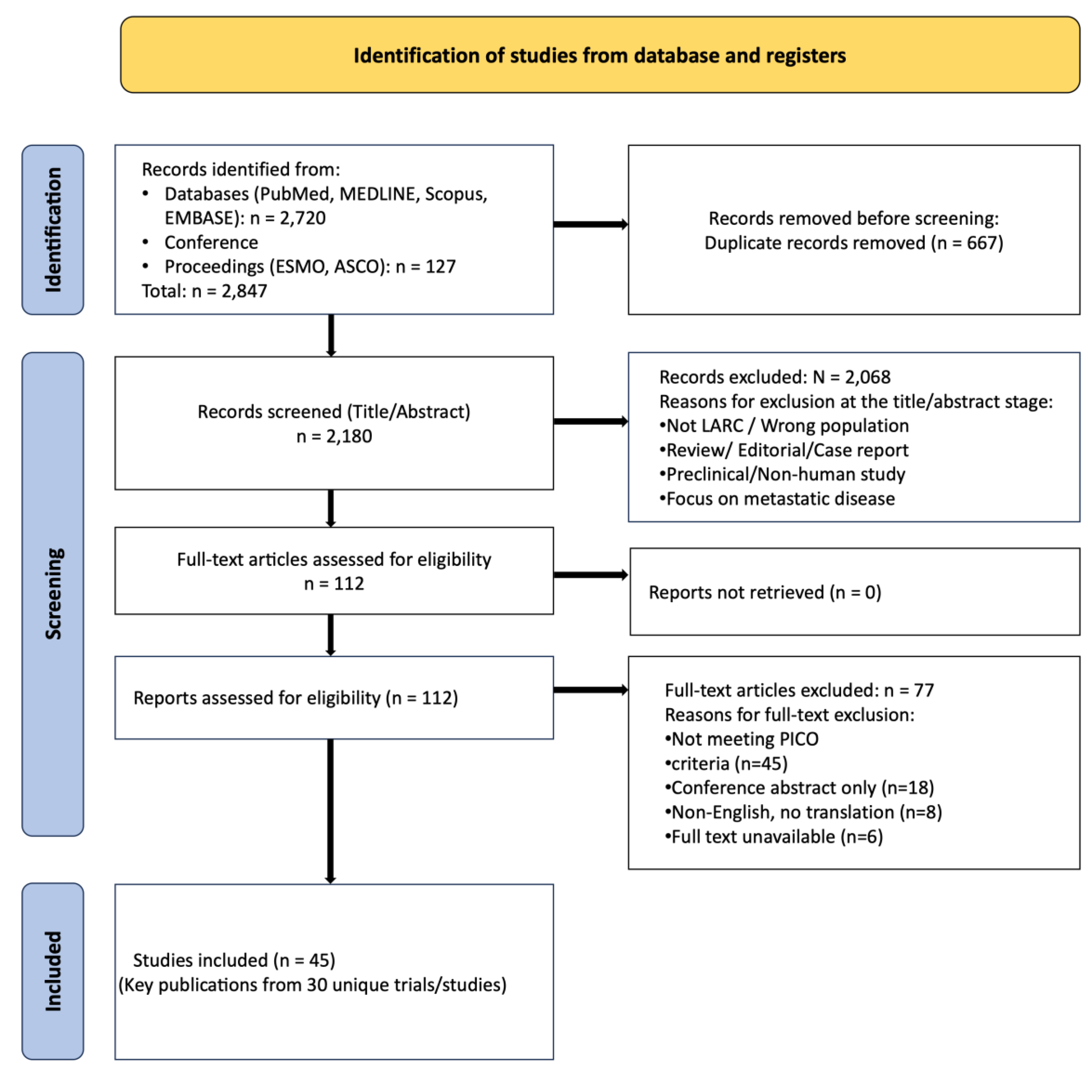
Figure 2.
Comparison of standard chemoradiotherapy and total neoadjuvant therapy (TNT) sequencing strategies. (A) Standard long-course chemoradiotherapy (LCRT) followed by total mesorectal excision (TME) and optional adjuvant chemotherapy (CT). (B) Consolidation TNT: short-course radiotherapy (SCRT, 5×5 Gy) followed by several cycles of chemotherapy (CAPOX or FOLFOX) and then TME (RAPIDO, STELLAR, TNTCRT-type LCRT consolidation). (C) Induction TNT: induction chemotherapy (e.g., FOLFIRINOX in PRODIGE 23) followed by LCRT, then TME and optional adjuvant chemotherapy. (D) Organ-preserving TNT with watch-and-wait (WW): typically consolidation chemotherapy after CRT (OPRA trial), followed by response assessment; patients with clinical complete response (CCR) enter WW, while those with incomplete response (ICR) proceed to TME. Abbreviations: CAPOX = capecitabine + oxaliplatin; CCR = clinical complete response; CT = chemotherapy; FOLFIRINOX = fluorouracil, leucovorin, irinotecan, oxaliplatin; FOLFOX = fluorouracil, leucovorin, oxaliplatin; ICR = incomplete response; LCRT = long-course chemoradiotherapy; SCRT = short-course radiotherapy; TME = total mesorectal excision; TNT = total neoadjuvant therapy; WW = watch-and-wait. Note: Newer trials (TNTCRT, UNION, SPRING-01, PRECAM) follow similar backbone designs with the addition of immunotherapy (PD-1/PD-L1 inhibitors) either concurrently or after SCRT/LCRT.
Figure 2.
Comparison of standard chemoradiotherapy and total neoadjuvant therapy (TNT) sequencing strategies. (A) Standard long-course chemoradiotherapy (LCRT) followed by total mesorectal excision (TME) and optional adjuvant chemotherapy (CT). (B) Consolidation TNT: short-course radiotherapy (SCRT, 5×5 Gy) followed by several cycles of chemotherapy (CAPOX or FOLFOX) and then TME (RAPIDO, STELLAR, TNTCRT-type LCRT consolidation). (C) Induction TNT: induction chemotherapy (e.g., FOLFIRINOX in PRODIGE 23) followed by LCRT, then TME and optional adjuvant chemotherapy. (D) Organ-preserving TNT with watch-and-wait (WW): typically consolidation chemotherapy after CRT (OPRA trial), followed by response assessment; patients with clinical complete response (CCR) enter WW, while those with incomplete response (ICR) proceed to TME. Abbreviations: CAPOX = capecitabine + oxaliplatin; CCR = clinical complete response; CT = chemotherapy; FOLFIRINOX = fluorouracil, leucovorin, irinotecan, oxaliplatin; FOLFOX = fluorouracil, leucovorin, oxaliplatin; ICR = incomplete response; LCRT = long-course chemoradiotherapy; SCRT = short-course radiotherapy; TME = total mesorectal excision; TNT = total neoadjuvant therapy; WW = watch-and-wait. Note: Newer trials (TNTCRT, UNION, SPRING-01, PRECAM) follow similar backbone designs with the addition of immunotherapy (PD-1/PD-L1 inhibitors) either concurrently or after SCRT/LCRT.
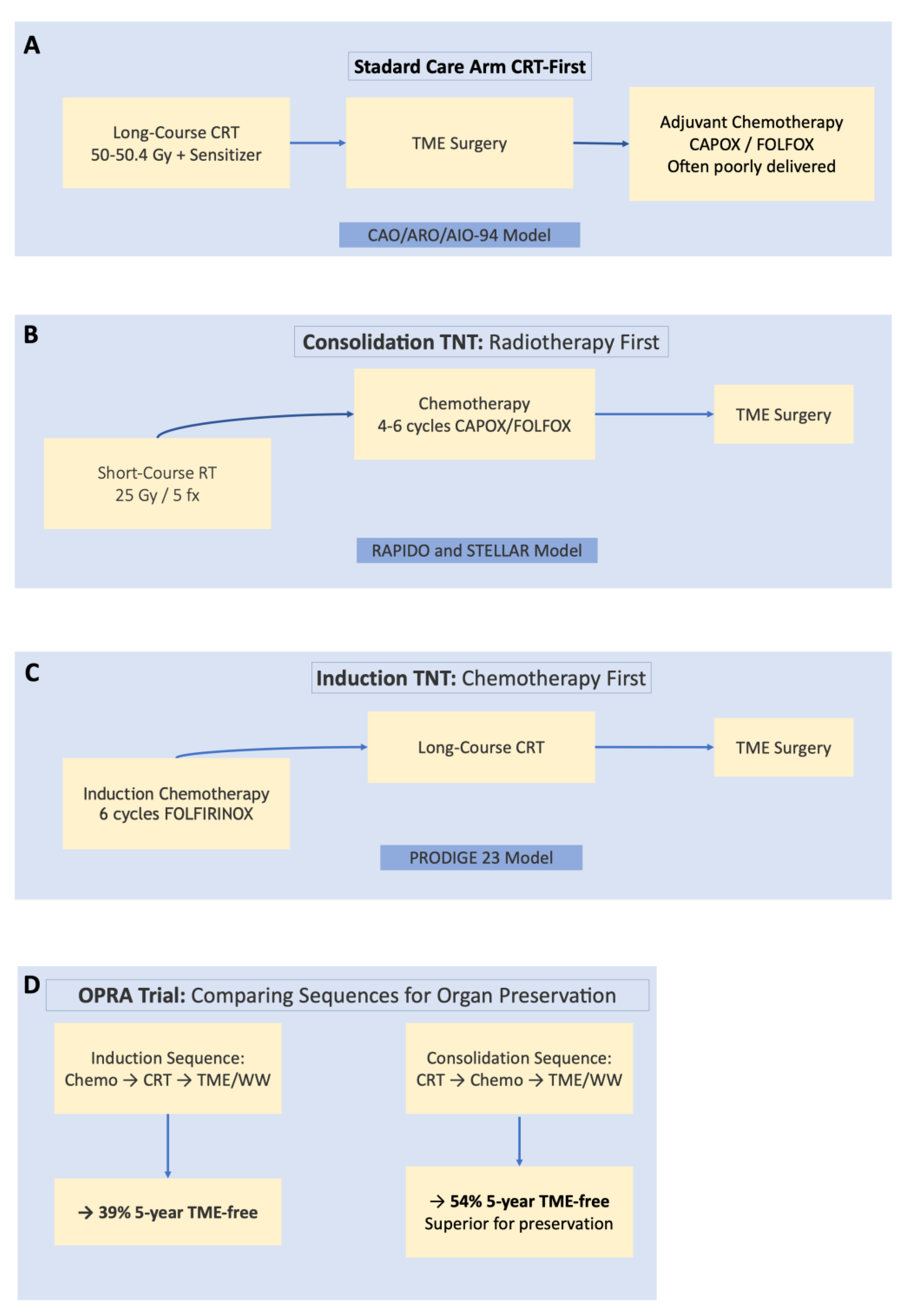
Figure 3.
MRI based risk adapted treatment algorithm for locally advanced rectal cancer. This algorithm integrates baseline pelvic MRI features (MRF status, cT category, EMVI, nodal burden, LPLN size/morphology) to classify patients into high, intermediate , or low risk groups. Treatment intensity is then tailored accordingly. -High risk LARC (MRF+, cT4, EMVI+, bulky N2, or LPLN+): Total neoadjuvant therapy (TNT) is preferred. LCRT based TNT is favoured for maximal local control (PRODIGE 23, TNTCRT); SCRT based TNT (RAPIDO, STELLAR) is an option but carries a higher risk of locoregional recurrence. Consolidation chemotherapy is preferred when organ preservation is a goal (OPRA). For persistent LPLN+ after TNT, lateral lymph node dissection (LLND) should be considered (Ogura criteria). Immunotherapy TNT combinations (UNION, SPRING 01, PRECAM) remain investigational (dashed lines). -Intermediate risk LARC (cT3, MRF , cN1, EMVI , LPLN ): Standard CRT or TNT are both acceptable. TNT with consolidation may be offered to patients who strongly desire organ preservation. -Low risk LARC (cT2 3, MRF , N0 1 non bulky, EMVI , mid upper rectum): De escalation options include neoadjuvant chemotherapy alone (PROSPECT, CONVERT, FOWARC) with selective salvage CRT, or response adaptive strategies (GRECCAR 4). Radiotherapy omission reduces long term toxicity without compromising survival. Post TNT response assessment (8 14 weeks) uses a three-tier clinical system (CCR, NCR, ICR) combined with MRI (mrTRG, nodal status, EMVI clearance). -CCR → watch and wait (WW) or local excision (TEM, MONT R trial).-NCR → WW with intensive surveillance or TME after shared decision. -ICR → prompt TME.Abbreviations: CCR = clinical complete response; CRT = chemoradiotherapy; CT = chemotherapy; EMVI = extramural vascular invasion; ICR = incomplete response; LARC = locally advanced rectal cancer; LCRT = long course chemoradiotherapy; LLND = lateral lymph node dissection; LPLN = lateral pelvic lymph node; MRF = mesorectal fascia; MRI = magnetic resonance imaging; NCR = near complete response; SCRT = short course radiotherapy; TEM = transanal endoscopic microsurgery; TME = total mesorectal excision; TNT = total neoadjuvant therapy; WW = watch and wait.
Figure 3.
MRI based risk adapted treatment algorithm for locally advanced rectal cancer. This algorithm integrates baseline pelvic MRI features (MRF status, cT category, EMVI, nodal burden, LPLN size/morphology) to classify patients into high, intermediate , or low risk groups. Treatment intensity is then tailored accordingly. -High risk LARC (MRF+, cT4, EMVI+, bulky N2, or LPLN+): Total neoadjuvant therapy (TNT) is preferred. LCRT based TNT is favoured for maximal local control (PRODIGE 23, TNTCRT); SCRT based TNT (RAPIDO, STELLAR) is an option but carries a higher risk of locoregional recurrence. Consolidation chemotherapy is preferred when organ preservation is a goal (OPRA). For persistent LPLN+ after TNT, lateral lymph node dissection (LLND) should be considered (Ogura criteria). Immunotherapy TNT combinations (UNION, SPRING 01, PRECAM) remain investigational (dashed lines). -Intermediate risk LARC (cT3, MRF , cN1, EMVI , LPLN ): Standard CRT or TNT are both acceptable. TNT with consolidation may be offered to patients who strongly desire organ preservation. -Low risk LARC (cT2 3, MRF , N0 1 non bulky, EMVI , mid upper rectum): De escalation options include neoadjuvant chemotherapy alone (PROSPECT, CONVERT, FOWARC) with selective salvage CRT, or response adaptive strategies (GRECCAR 4). Radiotherapy omission reduces long term toxicity without compromising survival. Post TNT response assessment (8 14 weeks) uses a three-tier clinical system (CCR, NCR, ICR) combined with MRI (mrTRG, nodal status, EMVI clearance). -CCR → watch and wait (WW) or local excision (TEM, MONT R trial).-NCR → WW with intensive surveillance or TME after shared decision. -ICR → prompt TME.Abbreviations: CCR = clinical complete response; CRT = chemoradiotherapy; CT = chemotherapy; EMVI = extramural vascular invasion; ICR = incomplete response; LARC = locally advanced rectal cancer; LCRT = long course chemoradiotherapy; LLND = lateral lymph node dissection; LPLN = lateral pelvic lymph node; MRF = mesorectal fascia; MRI = magnetic resonance imaging; NCR = near complete response; SCRT = short course radiotherapy; TEM = transanal endoscopic microsurgery; TME = total mesorectal excision; TNT = total neoadjuvant therapy; WW = watch and wait.
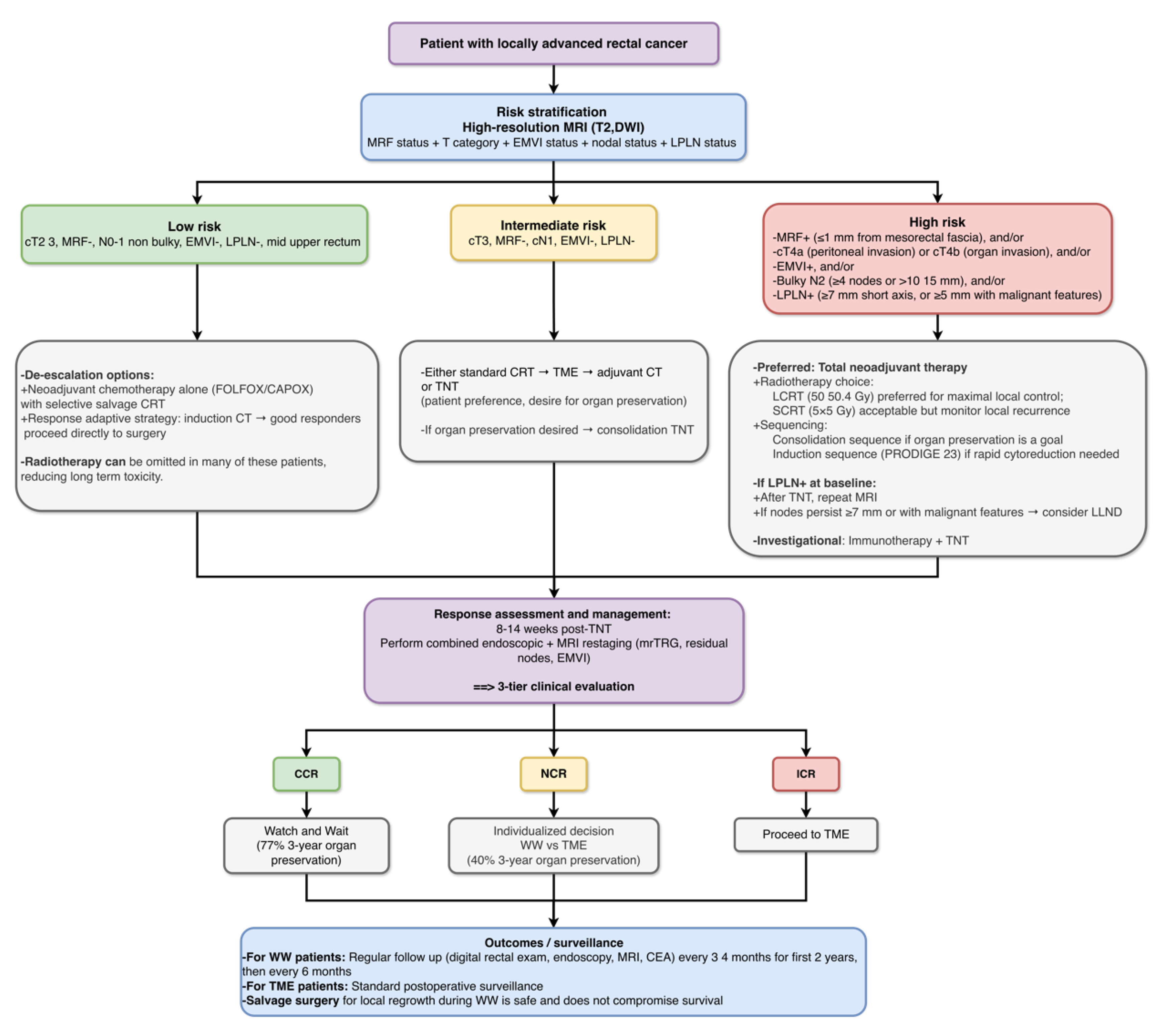

Table 1.
Characteristics of included randomized trials and key studies.
| Trial/Analysis (Primary Publication) | Phase | Sample Size | Control Arm | Experimental Arm | Primary Endpoint(s) |
|---|---|---|---|---|---|
| Landmark Phase III TNT Trials | |||||
| RAPIDO | III | 920 | LCRT → TME (± Adj CT) | SCRT → CT (CAPOX/FOLFOX) → TME | 3-year DrTF |
| PRODIGE 23 | III | 461 | LCRT → TME → Adj CT | 6x FOLFIRINOX → LCRT → TME → 6x mFOLFOX6 | 3-year DFS |
| STELLAR | III | 599 | LCRT → TME → 6x CAPOX | SCRT → 4x CAPOX → TME → 2x CAPOX | 3-year DFS |
| TNTCRT | III | 458 | LCRT + capecitabine → TME → Adj CAPOX | LCRT + 6x CAPOX (1 ind, 2 conc, 3 cons) → TME | 3-year DFS |
| Neoadjuvant Chemotherapy Without Routine RT (De-escalation) | |||||
| PROSPECT [40] | III | 1194 | LCRT (5.5 weeks) → TME | mFOLFOX6 (6 cycles) → TME (± selective LCRT) | 5-year DFS (NI) |
| CONVERT | III | 663 | LCRT + capecitabine → TME | 4x CAPOX → TME | 3-year LRRFS (NI) |
| FOWARC 10-year | III | 495 | 5-FU + LCRT | mFOLFOX6 ± LCRT | 10-year DFS |
| GRECCAR 4 | II | 148 | Response-adaptive (induction CT → good responders → surgery; poor responders → CRT) | — | pCR, OP rate |
| Immunotherapy-TNT Trials | |||||
| UNION | III | 231 | LCRT → 2x CAPOX → TME → 6x CAPOX | SCRT → 2x CAPOX + Camrelizumab → TME → 6x CAPOX + Camrelizumab | pCR |
| STELLAR II | II | 218 | SCRT → 4x CAPOX → TME/WW → 2x CAPOX | SCRT → 4x CAPOX + Sintilimab → TME/WW → 2x CAPOX + Sintilimab | CR rate |
| SPRING-01 | II | 98 | SCRT → 6x CAPOX → TME | SCRT → 6x CAPOX + Sintilimab → TME | pCR |
| PRECAM | II | 34 | — (single-arm) | SCRT → 2x CAPEOX + 6x Enzalofilimab → TME | pCR |
| NRG-GI002 | II platform | 178 (EA1), 185 (EA2) | FOLFOX → CRT → TME | EA2: + Pembrolizumab during CRT | NAR score reduction |
| Averectal [45] | II | 44 | Single-arm: SCRT → 6x mFOLFOX-6 + Avelumab → TME | — | pCR vs historical |
| Organ Preservation and Sequencing | |||||
| OPRA [21] | II | 324 | Induction: CRT → TME/WW | Consolidation: CRT → TME/WW | 3-yr DFS; OP |
| CAO/ARO/AIO-16 [20] | II | 91 | Single-arm: CRT → 3x FOLFOX → Response → TME/WW | — | CCR rate |
| OPERA [22] | III | 148 | LCRT + EBRT Boost → TME/LE/WW | LCRT + CXB Boost → TME/LE/WW | 3-year OP rate |
| MONT-R TEM [30] | Prospective case-control | 80 | Radical surgery (TME) | TEM local excision (cCR/near-cCR) | 5-year DFS |
| Predictive Factor and Subgroup Analyses | |||||
| RAPIDO pCR Analysis [54] | Post-hoc | 920 | Analysis of factors associated with pCR | — | Factors for pCR; prognosis of pCR |
| OPRA Response Grade [51] | Post-hoc | 324 | Analysis correlating 3-tier response with outcomes | — | OP and DFS by CCR/NCR/ICR |
| STELLAR LPLN Analysis [10] | Post-hoc | 599 | Subgroup analysis of LPLN+ patients | — | Outcomes in LPLN+ |
| CINTS-R | III RCT | 470 (planned) | Conventional nCRT | ctDNA-guided: high-risk → TNT; low-risk → nCRT; dMMR/TMB-H → immunotherapy | 2-year DrTF |
| Radiotherapy Modality | |||||
| PRORECT | Dosimetric | 128 (plan) | Photon CRT | Proton CRT | Dosimetric comparison; predicted acute ≥G2 GI toxicity |
| MRI-LINAC LoRP | Retrospective | 10 pts (50 fractions) | Conventional couch shift / fully adaptive | Library of reference plans (LoRP) | Target coverage, treatment time |
| Other Key Trials | |||||
| Polish II long-term | III | 515 | LCRT + oxaliplatin | SCRT + 3x FOLFOX4 → TME | OS, DFS, local failure |
| MONT-R chemo [30] | III | 505 | nCRT + capecitabine | nCRT + CapeOX | 3-year DFS |
| CAO/ARO/AIO-12 [56] | II | 306 | Induction FOLFOX → CRT → TME | CRT → Consolidation FOLFOX → TME | pCR rate |
| NOMINATE | II | 66 (planned) | CRT → 6x CapeOx | 3x CapeOx+Bev → CRT → 3x CapeOx | pCR/CCR ≥2 years |
Abbreviations as in original plus: CAPEOX = Capecitabine + Oxaliplatin; conc = concurrent; cons = consolidation; ind = induction; LoRP = Library of Reference Plans; LRRFS = locoregional recurrence-free survival; NAR = Neoadjuvant Rectal score; NI = non-inferiority; TEM = transanal endoscopic microsurgery.
Table 2.
MRI-based risk stratification for LARC and implications for neoadjuvant treatment.
| Risk Group | MRI Features | Recommended Treatment Approach | Supporting Evidence |
|---|---|---|---|
| High risk | -MRF+ (≤1 mm) -cT4a (peritoneal invasion) or cT4b (organ invasion) -EMVI+ -Bulky N2 (≥4 nodes or >10-15 mm) -LPLN+ (≥7 mm or ≥5 mm with malignant features) |
TNT (preferred) -Consider LCRT-based TNT (PRODIGE 23, TNTCRT) for highest local risk -SCRT-based TNT (RAPIDO, STELLAR) is an option but monitor local control -For LPLN+: consider LLND after TNT if nodes persist -Immunotherapy + TNT (investigational, e.g., UNION, SPRING-01, PRECAM) |
RAPIDO, PRODIGE 23, STELLAR, TNTCRT, UNION, SPRING-01, STELLAR LPLN analysis, Ogura criteria |
| Intermediate risk | -cT3, MRF- (>1 mm) -cN1 (1-3 small nodes) -EMVI- -LPLN- |
-Standard CRT → TME → adjuvant CT or -TNT (depending on patient age, comorbidities, desire for organ preservation) |
CAO/ARO/AIO-04, German CRT trials, OPRA (consolidation TNT for OP goal) |
| Low risk | -cT2-3, MRF-, N0-1 (non-bulky) -EMVI-, LPLN- -Mid-upper rectum (≥5-10 cm from AV) |
De-escalation options: -Neoadjuvant chemotherapy alone (FOLFOX/CAPOX) with selective CRT (PROSPECT, CONVERT, FOWARC) -Short-course RT alone (Stockholm III) -Response-adaptive strategies (GRECCAR 4) |
PROSPECT, CONVERT, FOWARC 10-year, GRECCAR 4 |
Table 3.
Efficacy of key treatment strategies.
| Trial / Analysis | Primary Efficacy Endpoint | pCR / cCR Rate | Key Efficacy Insights |
|---|---|---|---|
| RAPIDO [11] | 3-year DrTF: 23.7% vs 30.4%* | 28% vs 14%* | TNT reduced distant metastases (20.0% vs 26.8%) and improved DrTF. |
| PRODIGE 23 [12] | 7-year DFS: 67.6% vs 62.5%; 7-year OS: 81.9% vs 76.1% | 28% vs 12%* | TNT improved DFS, reduced distant metastases (17.8% vs 25.5%), and showed OS benefit. |
| STELLAR [28] | 3-year DFS: 64.5% vs 62.3% (NI) | 21.8% vs 12.3%* | SCRT-based TNT was non-inferior to LCRT-based therapy. |
| TNTCRT [14] | 3-year DFS: 77.0% vs 67.9%* (HR 0.623); 3-year MFS: 83.0% vs 74.2%* | 27.5% vs 9.9%* | LCRT-based TNT with CAPOX significantly improved DFS, MFS, and pCR. |
| PROSPECT [40] | 5-year DFS: 80.8% vs 81.7% (NI) | 21.4% vs 24.0% (NS) | FOLFOX with selective LCRT non-inferior to routine LCRT; 9.1% required salvage LCRT. |
| CONVERT [41] | 3-year LRRFS: 96.3% vs 97.4% (NI not formally met) | ~20% vs ~22% | nCT offered comparable DFS/OS with significantly less long-term toxicity. |
| FOWARC 10-year | 10-year DFS: 60.5-62.6% vs 52.5% (NS); 10-year LR: 9.6% vs 10.8% (NS) | ~28% vs ~14%* | mFOLFOX6 alone non-inferior to CRT at 10 years; pCR predicts excellent survival. |
| GRECCAR 4 [42] | 5-year DFS (response-adaptive) | Not reported | Good responders to induction CT can avoid CRT without compromising outcomes. |
| UNION [18] | - | 39.8% vs 15.3%* | Adding camrelizumab to SCRT+CAPOX nearly tripled pCR rate in MSS. |
| STELLAR II [20] | - | CR: 44.0% vs 22.9%* | Adding sintilimab increased cCR rate in MSS. |
| SPRING-01 [21] | - | pCR: 59.2% vs 32.7%; CR: 61.2% vs 32.7% | Adding sintilimab to SCRT+CAPOX significantly increased pCR and CR rates (p=0.015). |
| PRECAM [22] | - | pCR: 62.5%; MPR (TRG 0-1): 75% | Short-course nCRT + enzalofilimab achieved highest pCR in MSS LARC to date. |
| NRG-GI002 [48] | NAR score diff: 2.9 (p=0.21); 3-year OS: 95% vs 87%* | Not reported | Pembrolizumab added to TNT improved 3-year OS but not DFS; NAR reduction not significant. |
| Averectal [45] | - | pCR: 36% | SCRT + mFOLFOX-6 + avelumab achieved 36% pCR. |
| OPRA [15] | 5-year DFS: ~70% (both arms) | CCR/NCR: 76% vs 72% | 5-year TME-free survival: 54% (Consolidation) vs 39% (Induction)*; Consolidation favored for OP. |
| OPERA [16] | - | CCR/NCR: 92% vs 64%* | 5-year OP: 79% (CXB) vs 56% (EBRT)*; CXB boost superior. |
| MONT-R TEM [30] | 5-year DFS: 75.6% vs 80.9% (NS); 5-year OS: 93.2% vs 88.2% (NS) | pCR (TEM): 57.9% ypT0 | Local excision (TEM) after cCR/near-cCR provides comparable survival with better function. |
| RAPIDO pCR | 5-year OS after pCR: >90% (both arms) | - | Predictors of pCR: TNT (OR 2.70), CEA <5 µg/L, tumor <40 mm. |
| OPRA Grade | 3-year DFS: 88% (CCR) vs 69% (NCR) vs 56% (ICR) | - | 3-year OP: 77% (CCR) vs 40% (NCR); three-tier response highly prognostic. |
| STELLAR LPLN [51] | 3-year DFS in LPLN+: 51.7% vs 66.2% (LPLN-) | - | LPLN+ remains a negative prognostic factor despite TNT. |
| CINTS-R (interim) [25,26] | Primary endpoint (2-year DrTF) not yet reported | - | ctDNA-guided stratification feasible; substantial discordance with clinical risk. |
| Polish II long-term [39] | 8-year OS: 49% vs 49% (NS); 8-year DFS: 43% vs 41% (NS) | 16% vs 12% (NS) | Early OS benefit of SCRT-based TNT lost with longer follow-up; no difference in late complications. |
| MONT-R chemo [30] | 3-year DFS: comparable (NS) | 25.5% vs 25.3% (NS) | Adding oxaliplatin to nCRT improved tumor regression (CAP 0-1: 58.6% vs 46.8%*) but not survival. |
Table 4.
Baseline risk characteristics of major TNT trials and de-escalation studies.
| Trial | cT4 (%) | cN2 (%) | EMVI+ (%) | MRF+ (%) | Other high-risk features | Radiotherapy backbone | pCR rate (TNT arm) | 3-year DFS / OS |
|---|---|---|---|---|---|---|---|---|
| High-risk LARC trials | ||||||||
| RAPIDO | 74% | 86% | 53% | ~35-40% | - | SCRT (5x5 Gy) | 28% | 3-yr DrTF 23.7% (improved) |
| PRODIGE 23 | 26% | ~70% | Not reported | Not reported | - | LCRT (50.4 Gy) | 27.5% | 7-yr OS 81.9% (improved) |
| STELLAR | 37% | 74% | Not reported | Not reported | - | SCRT (5x5 Gy) | 21.8% | 3-yr DFS 64.5% (NI) |
| TNTCRT | Included (cT4a-b) | Included | Included | Included | Enlarged lateral nodes | LCRT (50-50.4 Gy) | 27.5% | 3-yr DFS 77.0% (improved) |
| Polish II [39] | Majority cT4 or fixed cT3 | Not specified | Not specified | Not specified | Locally recurrent (3%) | SCRT (5x5 Gy) | 16% | 8-yr OS 49% (NS) |
| MONT-R chemo [30] | High-risk (cT4, cN2, EMVI+, MRF+) | Included | Included | Included | - | LCRT | 25.5% (CapeOX) | 3-yr DFS comparable (NS) |
| Lower-risk / de-escalation trials | ||||||||
| PROSPECT [40] | 0% (excluded cT4) | ~75% (cN1-2) | Not specified | 0% (CRM-negative) | Mid-upper rectal tumors | LCRT (selective) | 21.4% (FOLFOX alone) | 5-yr DFS 80.8% (NI) |
| CONVERT | 0% (excluded cT4b, MRF+) | Included (cN2 allowed) | 17-22% | 0% (uninvolved MRF) | Distance 5-12 cm from AV | None (nCT alone) | ~20% | 3-yr DFS 89.2% (comparable) |
| FOWARC | ~25-27% (cT4a-b) | ~60-70% | Not reported | ~31-35% | - | LCRT (in RT arms) | 27.5% (mFOLFOX+RT) | 10-yr DFS 60-62% (NS) |
Table 5.
Toxicity, compliance, and patient-reported outcomes (updated).
| Trial | Acute grade ≥3 toxicity (Pre-operative) | Completion of planned pre-operative therapy | Notable Toxicity and Clinical Safety Observations |
|---|---|---|---|
| RAPIDO [52] | 47.6% vs 24.7%* (TNT vs CRT) | 84.6% vs 90.0%* | No significant difference in global QoL, bowel function (LARS), or chronic toxicity at 3 years. |
| PRODIGE 23 [53] | 46.9% vs 35.6%* (TNT vs CRT) | 89.6% vs 98.7%* | TNT transiently reduced QoL during CT; long-term QoL converged. Baseline physical function prognostic. |
| STELLAR [54] | 26.5% vs 12.6%* (TNT vs CRT) | 82.6% vs 95.2%* | At 6-year follow-up, no clinically significant difference in global QoL or anal function (Wexner). |
| TNTCRT [14] | Thrombocytopenia (10.3% grade 3-4 in TNT arm) | High in both arms | TNT well tolerated; no significant difference in severe post-op morbidity. |
| PROSPECT [40] | 41.0% vs 22.6%* (FOLFOX vs CRT) | 89.5% vs 84.3% | FOLFOX: higher neuropathy, fatigue, nausea; CRT: higher diarrhea. Long-term: CRT worse sexual function. |
| CONVERT [41] | Grade 2-4 long-term AEs: 16.0% vs 26.3%* | ~90% both arms | nCT significantly reduced proctitis (33.6% vs 41.7%, p=0.049) and long-term toxicity. |
| FOWARC 10-year [60] | Not reported in long-term update | Not reported | Long-term survival comparable; pCR associated with excellent outcomes (10-year OS 92.4%). |
| GRECCAR 4 | Not reported | High | Response-adaptive strategy feasible; good responders avoided CRT toxicity. |
| UNION | ~45% vs ~35% | ~88% both arms | Adding camrelizumab increased irAEs (rash, thyroiditis) typically grade 1-2. |
| STELLAR II | 34.5% vs 19.4%* (iTNT vs TNT) | High both arms | Grade 3-4 irAEs: 5.5%; manageable. |
| SPRING-01 | Grade 3-4: 33% vs 35% (NS) | 82% vs 84% | Most common grade 3-4: thrombocytopenia (12% vs 22%). No treatment-related deaths in iTNT arm. |
| PRECAM | Grade 3: 2/32 (6.25%) | 32/34 completed | Adverse events: tenesmus (78.1%), diarrhea (62.5%), leukopenia (40.6%); manageable. |
| NRG-GI002 | Not reported in long-term | Not reported | No unexpected safety signals with pembrolizumab. |
| OPRA | ~38% (induction) vs ~41% (consolidation) | ~85% | No significant difference in late toxicity between sequences. |
| CAO/ARO/AIO-16 | 36% (during TNT) | 90/91 RT; 82/88 CT | Sustained CCR patients had better bowel function (lower LARS/Wexner) at 18/36 months vs immediate TME. |
| OPERA | Not reported | High | CXB boost well tolerated; no increase in severe late toxicity. |
| MONT-R TEM | Not applicable (post-nCRT) | - | TEM: significantly shorter operation time, less blood loss, shorter hospital stay, better sphincter function (Wexner 1 vs 4, LARS 0 vs 17). |
| PRORECT | Acute ≥G2 Diarrhea: 10% vs 27%* (Proton vs Photon) | Similar | Dosimetric comparison suggested proton therapy reduces acute GI toxicity. |
| MRI-LINAC LoRP | Not reported | - | LoRP reduced treatment session duration by >20 min vs fully adaptive; 92% of LoRP plans acceptable vs 74% for couch shift. |
| Polish II long-term | Acute toxicity lower in SCRT-based TNT | ~85% | Late grade 3+ complications: 11% vs 9% (NS); no difference in late toxicity. |
| MONT-R chemo | Grade 3-4: 14.1% vs 9.3% (NS) | ~91% | CapeOX increased tumor regression (CAP 0-1) without significant increase in severe AEs. |
*Statistically significant (p < 0.05). Abbreviations: as in original plus iTNT = immunotherapy plus TNT; LoRP = Library of Reference Plans; TEM = transanal endoscopic microsurgery.
Disclaimer/Publisher’s Note: The statements, opinions and data contained in all publications are solely those of the individual author(s) and contributor(s) and not of MDPI and/or the editor(s). MDPI and/or the editor(s) disclaim responsibility for any injury to people or property resulting from any ideas, methods, instructions or products referred to in the content. |
© 2026 by the author. Licensee MDPI, Basel, Switzerland. This article is an open access article distributed under the terms and conditions of the Creative Commons Attribution (CC BY) license.
Copyright: This open access article is published under a Creative Commons CC BY 4.0 license, which permit the free download, distribution, and reuse, provided that the author and preprint are cited in any reuse.


