

Submitted:
10 April 2026
Posted:
14 April 2026
You are already at the latest version
Abstract
Cytochrome P450 oxidoreductase (POR) is the obligate electron donor for microsomal cytochrome P450 enzymes. Recessive mutations in the POR gene cause POR deficiency (PORD), a severe metabolic disorder characterized by skeletal malformations, ambiguous genitalia, and adrenal insufficiency. Because global POR knockout is embryonically lethal in mammalian models, the mechanistic study of PORD has historically been restricted to reconstituted biochemical assays or non-steroidogenic cellular backgrounds. Here, we describe complete biallelic POR knockout in human adrenal-derived NCI-H295R and human embryonic kidney HEK293T cells using CRISPR/Cas9. Transcriptomic and mass spectrometric steroid profiling of the adrenal clones revealed a blockade in canonical steroidogenesis, characterized by upstream accumulation of pregnenolone and progesterone, and severe depletion of downstream glucocorticoids and mineralocorticoids. Strikingly, knockout cells maintained low-level synthesis of dehydroepiandrosterone (DHEA) despite the complete absence of canonical CYP17A1 catalytic support, providing critical in vitro validation for the activation of alternative, CYP17A1-independent bypass steroidogenic pathways. Furthermore, utilizing the HEK293T platform, we evaluated the functional complementation of clinically relevant variants (A287P, R457H, P228L, and delP399_E401). Notably, the highly prevalent P228L variant exhibited selective preservation of CYP17A1 activity while severely impairing CYP19A1 aromatase function. A direct comparison between episomal overexpression and endogenous CRISPR prime editing of P228L highlighted critical differences in enzyme efficiency under native regulatory control. Finally, we establish a link between POR loss and altered intracellular Fe(II) storage, indicating perturbed ferroptotic susceptibility. These engineered human cell models provide a highly tractable platform for interrogating mutant-specific pharmacogenomics and developing targeted interventions.
Keywords:
adrenal insufficiency
; CAH
; congenital adrenal hyperplasia
; POR deficiency
; POR
; CRISPR/Cas9
Introduction
Cytochrome P450 oxidoreductase (POR) is a key enzyme involved in several metabolic processes, including steroid hormone synthesis and drug metabolism [1,2]. POR is located in the endoplasmic reticulum, where it transfers electrons from nicotinamide adenine dinucleotide phosphate (NADPH) to cytochrome P450 enzymes and other redox partners [3,4]. These electron transfers are required for the catalytic activity of microsomal cytochrome P450 enzymes, which participate in the biosynthesis of cholesterol, bile acids, steroid hormones, metabolism of the drugs, xenobiotics, eicosanoids, as well as in heme degradation. In steroidogenesis, POR provides electrons to enzymes such as CYP17A1, CYP21A2, and CYP19A1, which are responsible for the synthesis of glucocorticoids, mineralocorticoids, androgens, and estrogens [5].
Mutations in the POR gene cause cytochrome P450 oxidoreductase deficiency (PORD), a rare autosomal recessive form of congenital adrenal hyperplasia (OMIM 613571) [6,7,8,9,10,11,12,13,14]. PORD patients exhibit a broad phenotypic spectrum ranging from isolated reproductive dysfunction to severe multisystem disease with skeletal malformations characteristic of Antley–Bixler syndrome [13,15,16,17,18]. Disorders of sex development are frequent in PORD specifically in females [11,12,13,17,19]. The 46,XY individuals could present with undervirilization due to compromised CYP17A1 17,20-lyase activity, manifesting as micropenis, hypospadias, and cryptorchidism [17,18,20,21], whereas 46,XX individuals may show prenatal virilization with clitoromegaly and labial fusion [12,13,16,22,23], likely driven by impaired placental aromatase [24] activity and/or activation of an alternative “backdoor” androgen pathway during fetal life [25]. In adolescence or adulthood, affected females frequently develop primary amenorrhea, infertility, and enlarged multicystic ovaries, a presentation that may be misdiagnosed as polycystic ovary syndrome [7,15,19,26,27,28]. Skeletal involvement is variable [1] and may contribute to delayed motor development [16,20,21,23,29] due to radiohumeral or radioulnar synostosis, arachnodactyly, and joint contractures, particularly in individuals who are compound heterozygous for A287P or R457H with a second severe or null allele [11,13,15]. Craniofacial abnormalities may include craniosynostosis with brachycephaly and frontal bossing, as well as midface hypoplasia with proptosis [1,9,11,12,15,30,31]. In rare cases, patients may also present with choanal atresia [17,18,29], articulation difficulties leading to delayed speech development [16,21,23,29,30], and conductive hearing loss[16,17,30] due to stenosis of the external auditory canal and abnormalities of the middle or inner ear. Despite these structural abnormalities, cognitive function is generally preserved. From an endocrine perspective, most patients display compensated adrenal insufficiency, with relatively preserved basal cortisol levels but a blunted response to ACTH stimulation, alongside elevated progesterone and 17-hydroxyprogesterone concentrations that can mimic classic 21-hydroxylase deficiency [10,13,15]. Maternal virilization could occur during pregnancy with an affected fetus and resolve after delivery, reflecting defective androgen aromatization within the fetoplacental unit [10,13,22] and excess androgens production from accumulated precursors via alternative (backdoor) androgen pathway[32].
Since the first description of PORD, numerous POR variants have been identified in both affected individuals and the general population [4,33,34,35]. Large genomic studies have revealed hundreds of single-nucleotide variants, many of which are found in individuals without an evident clinical phenotype, particularly in the heterozygous state [36,37]. The resulting phenotypic variability reflects the central role of POR as an electron donor to multiple metabolic enzymes, which may be affected to different extents by individual mutations [10].
The mutations outcomes highly rely on their structural context within POR protein. The preserved binding of FAD and FMN cofactors as well as NADPH and enzyme flexibility are essential for electron transfer to the metabolic partners [6]. POR transfers electrons to microsomal cytochrome P450 (CYP450] enzymes through a tightly coordinated process [38] (Figure 1). Following NADPH binding, a hydride ion is transferred to FAD, after which electrons are shuttled sequentially, one at a time, from FAD to FMN [39]. This intramolecular electron transfer depends on conformational transitions between compact and open states of POR [40]. In the closed conformation, POR promotes electron transfer from FAD to FMN, whereas the open conformation enables the FMN domain to interact with cytochrome P450 and deliver the electron to the CYP450 heme iron (Fe) [40]. The resting ferric state (Fe³⁺) binds substrate and receives the first electron, then binding molecular oxygen [41]. After delivery of the second electron and protonation steps, the ferric-peroxo and hydroperoxo intermediates are formed [42], followed by O–O bond cleavage to generate the highly reactive ferryl - oxo intermediate (Compound I) [42]. Compound I abstracts a hydrogen atom from the substrate and, after oxygen rebound, yields the product, returning the enzyme to the resting ferric state [42].
In the present study, we examined four well-characterized POR variants: A287P, R457H, and delP399_E401, which are associated with impaired steroidogenesis, and P228L, which has been linked to reduced drug metabolism. These POR variants represent different levels of functional and clinical impact. A287P (prevalent in Europeans - 40% patients) [17] and R457H (frequent in East Asian patients – 65%) [15] are established disease-causing variants associated with PORD. In contrast, P228L shows relatively preserved enzyme activity, and was originally classified as a polymorphism [17] which is the most frequent in Europeans and Admixed Americans [43]. The Turkish variant delP399_E401 is rare, with very limited clinical documentation, so its phenotype spectrum is less well defined, although existing reports indicate marked variability in presentation [44].
Multiple studies combining bioinformatics [45,46,47], crystal structures [6,48], and functional analyses have been conducted to define the molecular defects caused by POR variants. The structural localization of POR variants is shown in the Figure 2. Both p.A287P and p.R457H are located in the FAD-binding region of POR (Figure 2), however, their structural consequences are different. A287P is not part of the direct cofactor-binding site, suggesting that its effect is mediated mainly through local structural disturbance and altered conformational dynamics [48], whereas R457H affects a residue that directly interacts with FAD and therefore primarily disrupts cofactor binding [6,49]. Consistent with these structural differences, functional studies have shown that A287P markedly reduces the ability of POR to support several steroidogenic and drug-metabolizing cytochrome P450 enzymes [4], although the degree of impairment varies between partners, indicating a broad but selective defect in POR-dependent electron transfer [4,10,24]. In contrast, R457H causes a much more severe loss of function [24,49], strongly impairing the activities of multiple steroidogenic enzymes, including CYP17A1 and CYP19A1 [10], as well as several drug-metabolizing CYPs [50], which is consistent with a more global defect in electron transfer rather than a partner-specific effect.
The POR del.P399_E401 variant is a rare in-frame deletion that affects residues 399 to 401 within the FMN domain (Figure 2) and is predicted to disturb the local helical structure and its stabilizing contacts with nearby loop regions [44]. Functional studies are showing partial but marked reduction in the ability of POR to support CYP21A2, CYP17A1, and CYP19A1 [44]. Reported patients carrying this variant have shown substantial clinical variability, ranging from severe genital virilization with mild skeletal findings to milder genital ambiguity with more pronounced skeletal involvement [7,44].
The P228 residue is highly conserved across species [43] and located between FMN binding domain and the flexible hinge region of POR (Figure 2). Subsequent studies demonstrated reduced protein stability, flavin binding, and conformational flexibility [43]. Impaired electron transfer leads to partial reductions in the activities of drug-metabolizing CYPs [43,50] and several steroidogenic enzymes contributing to reduced androgen synthesis [43].
Several studies reported the effect of POR knockout in hepatic cell lines. In the present study we focused on studying of POR knockout effect on steroidogenesis in NCI-H295R adrenal-derived cell lines. Additionally, POR knockout in HEK293T cells allow us to generate cell-based models to explore activities of POR mutants A287P, R457H, del_P399_E401, and P228L in a natural cell environment.
The present study provides new cellular models for the investigation of POR deficiency and its impact on steroidogenic function. The lack of suitable in vivo models, largely due to the embryonic lethality of complete POR knockout [51], has limited mechanistic studies of POR loss outside tissue-specific systems [52]. While previous studies have largely focused on the effects of POR loss in hepatic models [53,54], its role in adrenal steroidogenesis has remained insufficiently characterized. By generating POR knockout NCI-H295R cells, we provide an adrenal-derived model for studying the impact of POR deficiency on steroid hormone biosynthesis. In parallel, the POR knockout HEK293T platform enables functional analysis of clinically relevant POR variants, including A287P, R457H, del_P399_E401, and P228L, in a native cellular environment. Importantly, RNA expression profiling of POR knockout cells served as an additional layer of molecular characterization, confirming the expression of genes required for steroidogenic and associated metabolic processes. While these data do not support firm conclusions regarding transcriptional changes, they provide preliminary clues suggesting that pathways related to redox regulation, lipid metabolism, and possibly ferroptosis may be relevant for further investigation. Collectively, these models expand the available experimental toolkit for studying POR dysfunction and provide a foundation for future work aimed at clarifying the molecular basis of POR-related disease.
Materials and Methods
Cell lines and culture conditions
HEK293T, NCI-H295R and their POR knockout derivate cell lines were cultured at 37 °C in a humidified incubator with 5% CO₂ under sterile conditions. Media were refreshed every 2–3 days, and cells were routinely examined for morphology and contamination. Cells were maintained in exponential growth phase and were passaged at 70–80% confluence following PBS wash and enzymatic detachment with trypsin–EDTA. After detachment, cells were resuspended in complete medium and seeded for further experiments. HEK293T, HEK293T POR KO, and HEK293T POR p.P228L cells were maintained in DMEM supplemented with 10% FBS and 1% penicillin–streptomycin (Gibco™, 11965092, A5670901, 15070063). NCI-H295R, POR knockout clones T1-4 and T1-6 cell lines were maintained in DMEM/F12 supplemented (Gibco™, 11320033] with 2.5% Nu-Serum, 0.1% ITS (Corning®, 355500, 354350], and 1% penicillin–streptomycin. For all assays, cells were plated 24 h prior to experiment to ensure proper attachment and recovery. Only cultures with normal morphology and high viability were used for analysis.
Plasmid construction for site-directed mutagenesis
Mutant POR expression constructs were generated using the mammalian expression vector pcDNA3.1(+)_POR_WT, encoding human wild-type NADPH–cytochrome P450 oxidoreductase (POR; NM_001395413), as the template. Site-directed mutagenesis was performed to introduce the following POR variants: p.A287P, p.P228L, p.delP399_E401, and p.R457H. Mutagenesis PCR reactions were carried out using Pfu DNA Polymerase (Promega, M7741) with 1 μg of plasmid DNA according to the manufacturer’s instructions. Thermal cycling conditions consisted of an initial denaturation at 95 °C for 5 min, followed by 20 cycles of 95 °C for 1 min, 55 °C for 30 s, and 72 °C for 8 min, with a final extension at 72 °C for 10 min. Following amplification, parental template DNA was removed by digestion with 10 U DpnI (Thermo Scientific, ER1701) for 1 h at 37 °C. The resulting reaction mixture was used to transform DH5α chemically competent Escherichia coli using standard heat-shock transformation procedures. Plasmid DNA was isolated from bacterial cultures, and the presence of the intended mutations was confirmed by Sanger sequencing. HEK293T cells were transfected with the constructed plasmids using Lipofectamine™ 2000 (Invitrogen, 11668019) according to the manufacturer’s protocol. Cells were seeded one day prior to transfection at a density of 2.5 × 10⁵ cells per well in 12-well plates. For each transfection, 1 μg plasmid DNA was mixed with 1.5 μL Lipofectamine™ 2000 in 100 μL Opti-MEM medium (Gibco, 31985070) and added to the cells. After 48 h of incubation at 37 °C in 5% CO₂, transfected cells were seeded for the following assays.
Plasmid construction for CRISPR/Cas9 mediated gene knockout
For POR knockout in HEK293T cells, three guide RNAs (gRNAs) targeting the POR gene were designed using the CRISPOR[55], Benchling, and CHOPCHOP[56] online tools. The gRNA sequences were cloned into the BbsI restriction sites of the eSpCas9-2A-GFP plasmid (PX458, GenScript) as was described [57,58]. Briefly, oligonucleotides encoding gRNAs were designed with appropriate BbsI-compatible overhangs for cloning into the eSpCas9-2A-GFP plasmid PX458. For each gRNA, complementary forward and reverse oligonucleotides were synthesized, phosphorylated, annealed, and ligated into the BbsI-digested vector backbone. First, oligonucleotides were resuspended in nuclease-free water to a concentration of 100 μM. For oligonucleotide phosphorylation and annealing, 1 μL of each oligonucleotide was mixed with H20, T4 DNA ligase buffer and T4 polynucleotide kinase in a 10 μL reaction. The mixture was incubated at 37 °C for 60 min, followed by 95 °C for 5 min, and gradually cooled to 25 °C to allow annealing. Next, the annealed oligonucleotides were cloned into the PX458 plasmid using a restriction–ligation reaction containing BbsI (Thermo Scientific, ER1012), T4 DNA ligase and T4 DNA ligase buffer (Thermo Scientific,15224041) in a 10 μL reaction volume. The reaction was subjected to 35 cycles of digestion and ligation (37 °C for 5 min, followed by 20 °C for 5 min). The reaction mixture was used for DH5a competent cells transformation. The resulting plasmids were purified using the GenElute™ HP Plasmid Maxiprep Kit (Sigma-Aldrich, NA0310-1KT). Correct insertion of the gRNA sequences was verified by Sanger sequencing (Microsynth). HEK293T cells were transfected with the constructed plasmids using Lipofectamine™ 2000 (Invitrogen, 11668019) according to the manufacturer’s protocol. For each transfection, 1 μg plasmid DNA was mixed with 1.5 μL Lipofectamine™ 2000 in 100 μL Opti-MEM medium (Gibco, 31985070) and added to the cells. After 24 h of incubation at 37 °C in 5% CO₂, transfected cells were evaluated for eGFP expression and sorted based on fluorescence using a MoFlo ASTRIOS BSL-2 cell sorter (Beckman Coulter). Single eGFP-positive cells were deposited into 96-well plates containing preconditioned culture medium and incubated at 37 °C and 5% CO₂. Colony formation was monitored, and single-cell clones were expanded. After 20 days, surviving clones were subjected to genotyping, Western blot analysis, and functional POR assays.
Editing efficiency of the designed gRNAs was evaluated by TIDE analysis [59], and the most efficient gRNA (2S_ex4POR_KO_for_eCAS9_BbsI) was selected for further experiments. This gRNA, targeting exon 4 of the POR gene, was used to generate POR knockout HEK293T cells. POR knockout NCI-H295R cell lines (T1-4 and T1-6) were purchased from GenScript and used for subsequent experiments. During their manufacture, the gRNA – Cas9 ribonucleoprotein (RNP) complex targeting the POR gene was electroporated into NCI-H295R cells. Following electroporation, single-cell sorting was performed, and clonal cell populations were expanded.
CRISPR/Cas9 Prime Editing system construction
The following vectors were the kind gifts of Prof. Schwank and Dr. Tálas (UZH): pCMV-PEmax-tagRFP-BleoR, pEF1a-hMLH1dn and pU6-tevopreq1-GG-acceptor; the nickase vector pSpCas9n BB-2A-GFP (PX461) was purchased from GenScript. Prime editing guide RNA (pegRNA_P228L_PBS+RTT_xPAM), including primer binding site (PBS) of 13 bp and reverse transcription template (RTT) of 19 bp [60], was designed using PRIDICT2.0 [61] . It targets exon 7 in POR gene and introduces the biallelic POR mutation p.P228L (GRCh38: NC_000007.14:g.75981558C>T; NP_000932.3). In addition, a PAM-disrupting silent mutation [62] (GRCh38: NC_000007.14:g.75981562C>G; POR p.A229A) was incorporated to prevent re-editing. A nicking sgRNA (P228L_PE3_nick_S_BbsI) targeting the non-edited strand 65 bp downstream of the prime editing site was designed for the PE3 strategy [63].
The nicking sgRNA was cloned into the pSpCas9n(BB)-2A-GFP (PX461) vector, generating the PE_nick construct, as described above [57]. The pegRNA was cloned into the pU6-tevopreq1-GG-acceptor vector using a standard BbsI restriction–ligation cloning strategy. For prime editing, HEK293T cells were seeded at 6.5 × 10⁵ cells per well in 6-well plates in 2 mL growth medium. The following day, cells were transfected using jetOPTIMUS® reagent according to the manufacturer’s instructions. The transfection mixture contained 700 ng pCMV-PEmax-tagRFP-BleoR, 300 ng pegRNA plasmid, 500 ng pEF1α-hMLH1dn, and 500 ng PE_nick plasmid, combined with 2.5 μL jetOPTIMUS® reagent in 200 μL jetOPTIMUS buffer. Twenty-four hours post-transfection, the culture medium was replaced with fresh medium containing 100 μg/mL Zeocin (Thermo Scientific, J67140.XF) for selection. Selection was maintained for 10 days until non-resistant HEK293T control cells were eliminated. Surviving cells were subsequently single-cell subcloned, and monoclonal cell lines were established. The presence of biallelic POR p.P228L and POR p.A229A mutations was confirmed by Sanger sequencing.
Genotyping
To confirm CRISPR/Cas9-mediated editing of the POR gene, genomic DNA was extracted from individual clones, and the targeted region was amplified by PCR. Primers flanking exon 4 of the POR gene (POR_ex4_F and POR_ex4_R) were used to amplify the edited locus. PCR products were purified to remove residual primers and nucleotides and subjected to Sanger sequencing (Microsynth). Sequencing chromatograms were analyzed and aligned to the reference POR sequence to identify insertions, deletions, or nucleotide substitutions at the target site using SnapGene software (version 7.2.0).
Whole transcriptome sequencing
Total RNA was isolated from HEK293T, HEK293T_POR_KO, NCI-H295R, and POR knockout NCI-H295R derivatives (T1-4 and T1-6) using TRIzol™ Reagent (Invitrogen, 15596026) according to the manufacturer’s instructions. RNA quality and integrity were assessed by agarose gel electrophoresis, NanoDrop spectrophotometry, and PCR (for DNAse control). RNA sequencing was performed by Novogene Co. (UK) using the Illumina platform. mRNA was isolated from total RNA using poly-T oligo-attached magnetic beads, fragmented, and reverse transcribed to generate cDNA libraries, which were prepared by end repair, A-tailing, adapter ligation, size selection, and PCR amplification. Library quality was assessed using Qubit, qPCR, and Bioanalyzer prior to sequencing. Raw reads were filtered to remove adapters, low-quality reads, and reads containing ambiguous bases. Clean reads were aligned to the human reference genome (hg38) using HISAT2, and gene expression was quantified with featureCounts and normalized as FPKM.
CYP17A1, CYP19A1, CYP21A2 Enzyme Activity Assays
Enzyme activity was assessed as described previously [64,65,66]. HEK293T and HEK293T POR knockout cells carrying lentivirus-derived CYP17A1 or CYP21A2 or CYP19A1 were seeded in 12-well plates [0.5 × 10⁶ cells/well) and were allowed to attach overnight under standard culture conditions.
For CYP21A2[65] and CYP17A1[66] hydroxylase activity assays, cells were incubated with 10,000 cpm [¹⁴C]-progesterone and 1 μM unlabeled progesterone per well for 1 h. Radiolabeled steroids were extracted from the medium, as previously described [66], using a 1:1 mixture of ethyl acetate and isooctane (Carl ROTH) and separated by thin-layer chromatography (TLC) on silica-gel plates (Supelco®, 1009330001). TLC plates were exposed to a phosphor screen and visualized using a Typhoon™ FLA-7000 PhosphorImager. Radioactive signals were quantified with ImageQuant™ TL software (Cytiva), and enzyme activity was calculated as the percentage of product radioactivity relative to total radioactivity in the sample.
For CYP17A1 17,20-lyase and CYP19A1 aromatase activity assays, cells were incubated with 50,000 cpm radiolabeled substrate and 1 μM unlabeled steroid per well for 4 h. [³H]-17α-hydroxypregnenolone was used to assess CYP17A1 17,20-lyase activity, and the formation of ³H-labeled acetic acid was quantified[66]. [³H]-1β-androstenedione was used as substrate for the aromatase (CYP19A1] tritiated water release assay [64].
Following incubation, culture media were collected and mixed with charcoal–dextran suspension (final compositions are 5% charcoal, 0.5% dextran, v/w/w), incubated for 5 min at room temperature, and centrifuged (5,000 × g, 5 min). The supernatant (0.5 mL) was transferred to scintillation vials containing scintillation fluid (Carl ROTH, 1P1C.1), and radioactivity was measured using a MicroBeta2 plate counter (PerkinElmer).
Western Blotting
To assess protein expression, cell pellets were incubated at 4 oC in lysis buffer (1 mM EDTA, 20 mM Tris, 150 mM NaCl, 1% (v/v) Triton X-100) [67] supplemented with protease inhibitor cocktail (Thermo Scientific, A32963) for 1 hour and centrifuged at 12,000 × g for 20 min and 4 °C [65]. Protein concentrations were determined using the Bio-Rad DC Protein Assay (5000112) according to the manufacturer’s instructions. For the gel loading, equal amounts of protein [25 μg) were mixed with Laemmli buffer (50 mM Tris HCl , pH 6.8, 100 mM dithiothreitol, 2% SDS, 0.1% bromophenol blue, 10% glycerol), denatured at 95 °C for 5 min, and separated by SDS–PAGE (GenScript M00659; BIO-RAD, 1658004) in Tris-MOPS-SDS running buffer (GenScript, M00138).
Proteins were transferred onto PVDF membranes (Millipore, IPFL85R) using transfer buffer containing 25 mM Tris, 192 mM glycine, and 20% methanol (pH 8.3). Membranes were blocked with 5% (w/v) non-fat dry milk in TBST [20 mM Tris, 150 mM NaCl, 0.1% (v/v) Tween-20, pH 7.5) and incubated overnight at 4 °C with primary antibodies against POR (rabbit polyclonal), CYP21A2 (mouse), CYP17A1 (chicken polyclonal), or CYP19A1 (chicken polyclonal) (GenScript). After washing with TBST, membranes were incubated for 1 h at room temperature with secondary antibody (IRDye®, LI-COR Biosciences, 926-68073, 926-32218, 926-68072) diluted as 1:10,000 in 5% milk/TBST. Protein bands were detected using a Fusion FX imaging system (Vilber) at 680 nm or 780 nm, and band intensities were quantified to compare protein expression levels between wild-type and knockout cells.
Steroid Profiling
Steroid concentrations were measured using liquid chromatography–high-resolution mass spectrometry (LC–HRMS) as previously described [68]. NCI-H295R cells and POR knockout clones (T1-4 and T1-6) were seeded in 12-well plates at a density of 0.5 × 10⁶ cells per well in 1 mL growth medium. For the 96 h condition, cells were cultured for 48 h, after which 1 μM pregnenolone (Sigma-Aldrich) was added directly to the culture medium without medium replacement, and cells were incubated for an additional 48 h. For the 48 h condition, cells were seeded and cultured for 48 h, followed by replacement of the culture medium with fresh medium containing 1 μM pregnenolone, and incubated for an additional 48 h. Media samples (500 µL) were collected, and steroids were extracted, separated, and quantified according to the protocol described in reference.
Statistical analysis
Statistical analyses were performed using RStudio (RStudio, PBC). Data are presented as mean ± standard deviation (SD) unless otherwise indicated. Comparisons between two groups were performed using an unpaired two-tailed Student’s t-test. For experiments involving multiple groups, statistical significance was evaluated using one-way analysis of variance (ANOVA) followed by Tukey’s post hoc multiple comparison test. Differences were considered statistically significant at p < 0.05.
Results
We have obtained POR knockout cell models derived from HEK293T and NCI-H295R cells using CRISPR/Cas9-mediated genome editing. In HEK293T cells, TIDE analysis demonstrated high editing activity of the exon 4-targeting gRNA in the bulk-transfected population (Figure S3B), and ICE analysis of the selected clone identified a predominant 59 bp deletion (Figure S3A). This deletion was further confirmed by Sanger sequencing and PCR fragment size analysis (Figure S3C,D). In NCI-H295R cells, two independent edited clones were obtained: clone T1-4 carried compound heterozygous -2 bp and -1 bp deletions from the predicted cut site, whereas clone T1-6 carried a predominant +2 bp insertion at the predicted cut site, as shown by Sanger sequencing and ICE analysis (Figure S4A–D). Western blotting confirmed marked reduction or absence of POR protein in the knockout cells (Figure S2). In addition, RNA-seq profiling showed markedly reduced POR expression in HEK293T POR-KO cells (Figure S1) and both POR knockout clones of H295R (FIG. 1). Collectively, these results validate the successful establishment of POR-deficient HEK293T and NCI-H295R cell lines.
Whole transcriptome sequencing of the H295R and HEK293T POR knockout cell lines.
For each sample, total RNA was isolated to identify the gene expression in POR WT and POR knockout cell lines. H295R T1-4, H295R T1-6, H295R, HEK293T POR KO, and HEK293T WT yielded 67.1, 68.0, 103.0, 73.5, and 70.5 million raw reads, respectively (10.06–15.45 Gb). After filtering, 65.7–100.3 million clean reads were retained per sample (97.35–98.57% retention), with 1.43–2.65% of reads classified as adapter-related and negligible low-quality or N-containing reads. Base quality was consistently high across all libraries (Q20: 98.44–98.54%; Q30: 95.36–95.61%) with an estimated error rate of 0.01, and GC content ranged from 48.67% to 50.52%.
H295R cells produce steroids representative of all three adrenal cortex zones and respond to key regulators of steroidogenesis, including angiotensin II and potassium, which stimulate aldosterone synthesis[69,70], and activation of the cAMP pathway, which enhances glucocorticoid and androgen production[70]. Parental H295R cells display robust expression of key steroidogenic components, whereas POR-deficient clones show a marked reduction in POR expression and variable downstream effects on classical and backdoor pathway enzymes, while retaining detectable expression of several steroid-modifying and redox-associated genes (Figure 3). The human adrenocortical H295R cell line is a well-established in vitro model of human adrenal steroidogenesis, as it expresses the full complement of steroidogenic enzymes required for mineralocorticoid, glucocorticoid, and adrenal androgen biosynthesis[69,70,71].
As shown in Figure 3, H295R cells exhibit high STAR (steroidogenic acute regulatory protein) mRNA expression, consistent with its central role in mediating cholesterol transport from the outer to the inner mitochondrial membrane, where cholesterol is converted to pregnenolone by CYP11A1, thereby initiating the steroidogenic cascade (Figure 4). Wild-type H295R cells also express FDXR and FDX1 (ferredoxin reductase and ferredoxin 1), which together constitute the principal mitochondrial electron transfer system supporting steroidogenic cytochrome P450 enzymes, including CYP11A1, CYP11B1, and CYP11B2, all of which are required for cortisol and aldosterone biosynthesis (Figure 4). In POR knockout clones, however, the expression of CYP11B1, CYP11B2, HSD11B1, and HSD11B2 is extremely low or nearly undetectable (Figure 3), indicating impaired glucocorticoid and mineralocorticoid biosynthesis.
PPP2CA, encoding the catalytic subunit of protein phosphatase 2A (PP2A), shows moderate expression in both wild-type and POR knockout cells (Figure 3). In the context of steroidogenesis, PP2A has been described as a positive regulator of STAR activity and a negative regulator of the CYP17A1 17,20-lyase reaction (Figure 4). Another important modulator of CYP17A1 17,20-lyase activity, cytochrome b5 (CYB5A), is expressed at similarly low levels in both wild-type H295R cells and their POR knockout derivatives (Figure 3). Overall, the expression of the key POR-dependent steroidogenic enzymes CYP17A1 and CYP21A2 is markedly reduced in POR knockout cells (Figure 3), which is expected to restrict the conversion of pregnenolone and progesterone into downstream steroid products, including the androgen precursor dehydroepiandrosterone (DHEA) (Figure 4]. In human serum, the predominant circulating form is DHEA sulfate (DHEA-S), which is generated from DHEA by sulfation by SULT1A2 which shows low and comparable expression in both wild-type and POR knockout cells. The STS gene (steroid sulfatase) shows equally low expression level in H295R cells and its POR knockout derivates (Figure 3). It acts in opposite to SULT1A2 responsible for converting inactive, sulfated steroid precursors such as DHEA-S, Estrone Sulfate or Cholesterol Sulfate into their biologically active, unconjugated forms.
DHEA is further converted into androstenedione via HSD3B2 in adrenal cells which has moderate to low expression in the presented cell models (Figure 3). Aromatase encoded by CYP19A1 gene is the sole enzyme that catalyzes the conversion of androgens (androstenedione and testosterone) into estrogens (estrone and estradiol, respectively) and therefore represents the rate-limiting step in estrogen biosynthesis. In H295R cells and their POR knockout derivatives, CYP19A1 expression is low (Figure 3), indicating limited estrogen-producing capacity, which is consistent with the adrenal origin of these cells.
SRD5A1 and SRD5A2 are isoenzymes of the NADPH-dependent 3-oxo-5α-steroid 4-dehydrogenase family, known for reducing the double bond at the Δ4,5 position of C19 and C21 steroid substrates. Expression of SRD5A1, but not SRD5A2, was detected in these cell models (Figure 3). This is consistent with adrenal physiology, in which SRD5A1 is the dominant isoform and participates in the alternative androgen pathway, whereas SRD5A2 primarily functions in the classical pathway by converting testosterone to dihydrotestosterone (DHT) (Figure 4] in the prostate and genital tissues. Accordingly, the negligible SRD5A2 expression observed here is in line with the adrenal origin of these cells. Among genes involved in the alternative androgen pathway, only SRD5A1 and AKR1C3 exhibited low expression (Figure 3), while SRD5A3, HSD17B6, RDH5, and AKR1C2 were expressed at extremely low levels (Figure 3). Together, these data indicate that the alternative androgen pathway is represented in H295R cells but is likely only weakly active.
In summary, RNA-seq analysis showed that POR-deficient H295R clones retain expression of multiple genes characteristic of adrenal steroidogenic cells, while exhibiting reduced expression of several enzymes central to downstream steroid biosynthesis. The most prominent changes involve CYP17A1, CYP21A2, CYP11B1, and CYP11B2, suggesting that POR loss is accompanied by a weakened steroidogenic expression profile. At the same time, persistent expression of STAR, FDX1, and FDXR indicates maintenance of the basic adrenal steroidogenic framework. Genes associated with the alternative androgen pathway were detected only at low or extremely low levels in all examined cell lines, supporting the view that this pathway is only weakly represented in H295R cells.
However, these findings should be interpreted with caution, as steroid hormone production and steroidogenic gene expression in H295R cells are known to be strongly influenced by culture conditions, including passage number and medium composition [70,71]. Because generation of biallelic knockout clones requires expansion from single edited cells after CRISPR/Cas9-mediated targeting, the effective passage history of clones T1-4 and T1-6 is difficult to define precisely. Therefore, the reduced expression of steroidogenic genes observed in these POR-deficient clones may reflect not only the effect of POR loss itself, but also the influence of clonal expansion and culture-related variation.
In HEK293T POR knockout cells expression of POR is markedly reduced confirming successful disruption of the POR gene (Figure 1S). At the same time, most steroidogenic enzymes show negligible to low expression in both wild-type and POR-KO cells, which is consistent with the non-steroidogenic nature of HEK293T cells (Figure 1S). These findings indicate that, unlike adrenal-derived H295R cells, HEK293T cells do not have an active steroidogenic program and therefore represent a simple cellular model for studying POR function and the effects of introduced POR variants without major interference from endogenous steroid hormone synthesis.
Steroid profile in POR knockout H295R cells.
Complete biallelic knockout of POR was confirmed by western blotting, Sanger sequencing, exome sequencing, and ICE analysis (Figures S2–S4). Under these conditions, profound disruption of the classical steroidogenic pathway is expected, as POR is the essential and sole electron donor for the microsomal steroidogenic cytochrome P450 enzymes CYP17A1, CYP21A2, and CYP19A1. In agreement with this, the reduced expression of multiple steroidogenic enzymes observed in Figure 1 further supports the markedly diminished steroidogenic capacity of the POR knockout cell lines.
To assess the functional consequences of POR loss, steroid profiles were quantified in parental NCI-H295R cells and in two independent POR knockout clones (T1-4 and T1-6) by LC-MS/MS after 48 h and 96 h of culture in growth medium supplemented with 1 µM pregnenolone.
POR Deficiency Disrupts Glucocorticoid Pathway Intermediates in H295R Cells
Pregnenolone and progesterone were both significantly elevated in POR-knockout H295R clones. This effect was already evident at 48 h and became even more pronounced for progesterone at 96 h. Accumulation of the steroidogenic precursors pregnenolone and progesterone is a characteristic biochemical feature of P450 oxidoreductase deficiency (PORD) [9], reflecting impaired electron transfer from POR to CYP17A1 and CYP21A2 and the resulting metabolic bottleneck at these enzymatic steps (Figure 5).
Because pregnenolone was added to the culture system as a precursor for downstream steroid synthesis, it is difficult to distinguish exogenous from endogenously produced pregnenolone in this model. In contrast, progesterone was entirely endogenously derived, as it was neither supplemented exogenously nor detected in the growth medium (Table ST2). Consistent with this, RNA-sequencing data (Figure 3) showed low-to-moderate expression of HSD3B2 in POR-knockout cells. As HSD3B2 catalyzes the conversion of pregnenolone to progesterone independently of POR (Figure 5), its preserved expression likely contributes to the observed progesterone accumulation.
Across glucocorticoid pathway CYP17A1 and CYP21A2 are POR dependent and no alternative redox partners were found to support their hydroxylase activities. In our cellular model, however, POR knockout cells displayed 17OHP levels comparable to control H295R cells, an unexpected finding of possible residual CYP17A1 hydroxylase activity in the absence of POR. Consistently, measurable amounts of DHEA (Figure 7) were detected, indicating partial preservation of CYP17A1 17,20-lyase function as well as 16α-Hydroxyprogesterone (Figure 8) that is proved to be the product of CYP17A1-derived hydroxylation of progesterone(Auchus, 2017).
In contrast, 17α-hydroxypregnenolone, the direct product of CYP17A1-mediated pregnenolone hydroxylation, was detected only in the culture medium of wild-type H295R cells at the 48-hour time point, was absent at 96 hours, and remained undetectable in both POR-knockout clones (Figure 5). Taken together, these findings could point to an impaired ability of POR-deficient cells to synthesize 17α-hydroxypregnenolone via CYP17A1 hydroxylase activity. Alternatively, the rapid downstream conversion of this intermediate could be suggested specifically when produced in small amounts due to POR knockout and low CYP17A1 expression (Figure 3). as 17α-hydroxypregnenolone is a preferrable substrate for CYP17A1.
This differential behavior of CYP17A1-dependent reactions underscores a selective and incomplete disruption of steroidogenic flux in POR deficiency rather than a uniform loss of CYP17A1 activity. A strong impairment of distal glucocorticoid synthesis is observed in POR knockout cells. Despite detectable levels of 17α-hydroxyprogesterone, formation of the downstream intermediate 11-deoxycortisol was markedly reduced (Figure 5), consistent with impaired CYP21A2 hydroxylase activity resulting from loss of POR. Cortisol production was even more strongly affected and was detectable only at negligible levels in clone T1-4 at 96 h. Together with the negligible CYP11B1 expression (Figure 3), these findings indicate that cortisol biosynthesis is essentially abolished in POR-knockout cells.
POR Knockout Disrupts Aldosterone Pathway Intermediates in H295R Cells
Mineralocorticoid synthesis depends on CYP21A2, which hydroxylates progesterone to form 11 -deoxycorticosterone. As CYP21A2 depends on POR for electron transfer during conversion of progesterone to 11-deoxycorticosterone, POR deficiency resulted in accumulation of the upstream substrates pregnenolone and progesterone and marked depletion of CYP21A2-dependent downstream metabolites. Accordingly, while control NCI-H295R cells-maintained mineralocorticoids production, aldosterone was undetectable in POR-knockout cells at 48 h and present only at very low levels in clone T1-4 after 96 h. In addition, the negligible expression of CYP11B1 and CYP11B2 in POR-deficient cells (Figure 3) indicates that the distal steps of mineralocorticoid biosynthesis are also suppressed due to this reason.
Figure 6.
POR knockout impairs mineralocorticoid biosynthesis in H295R cells. Bar plots show LC–MS/MS–quantified steroid concentrations (nmol/L) in H295R wild-type (WT) cells and two POR-knockout clones (T1-4 and T1-6) after 96 h and 48 h of cultivation (time points separated by the dashed vertical line). Panels quantify pregnenolone, progesterone, 11-deoxycorticosterone (DOC), corticosterone, and aldosterone. Loss of POR led to a marked reduction of downstream mineralocorticoids. In particular, DOC, corticosterone, and aldosterone were strongly decreased in POR-knockout clones, with aldosterone not detected (ND) in knockout cells at the 48 h time point and only minimal levels observed in T1-4 at 96 h. The pathway schematic summarizes the mineralocorticoid branch and highlights the POR-dependent CYP21A2 step converting progesterone to DOC, followed by CYP11B1-mediated corticosterone formation and CYP11B2-mediated aldosterone synthesis. Assays were performed in triplicates and normalized by total protein quantification. Statistical annotations: ns (not significant), * p<0.05, ** p<0.01, *** p<0.001.
Figure 6.
POR knockout impairs mineralocorticoid biosynthesis in H295R cells. Bar plots show LC–MS/MS–quantified steroid concentrations (nmol/L) in H295R wild-type (WT) cells and two POR-knockout clones (T1-4 and T1-6) after 96 h and 48 h of cultivation (time points separated by the dashed vertical line). Panels quantify pregnenolone, progesterone, 11-deoxycorticosterone (DOC), corticosterone, and aldosterone. Loss of POR led to a marked reduction of downstream mineralocorticoids. In particular, DOC, corticosterone, and aldosterone were strongly decreased in POR-knockout clones, with aldosterone not detected (ND) in knockout cells at the 48 h time point and only minimal levels observed in T1-4 at 96 h. The pathway schematic summarizes the mineralocorticoid branch and highlights the POR-dependent CYP21A2 step converting progesterone to DOC, followed by CYP11B1-mediated corticosterone formation and CYP11B2-mediated aldosterone synthesis. Assays were performed in triplicates and normalized by total protein quantification. Statistical annotations: ns (not significant), * p<0.05, ** p<0.01, *** p<0.001.
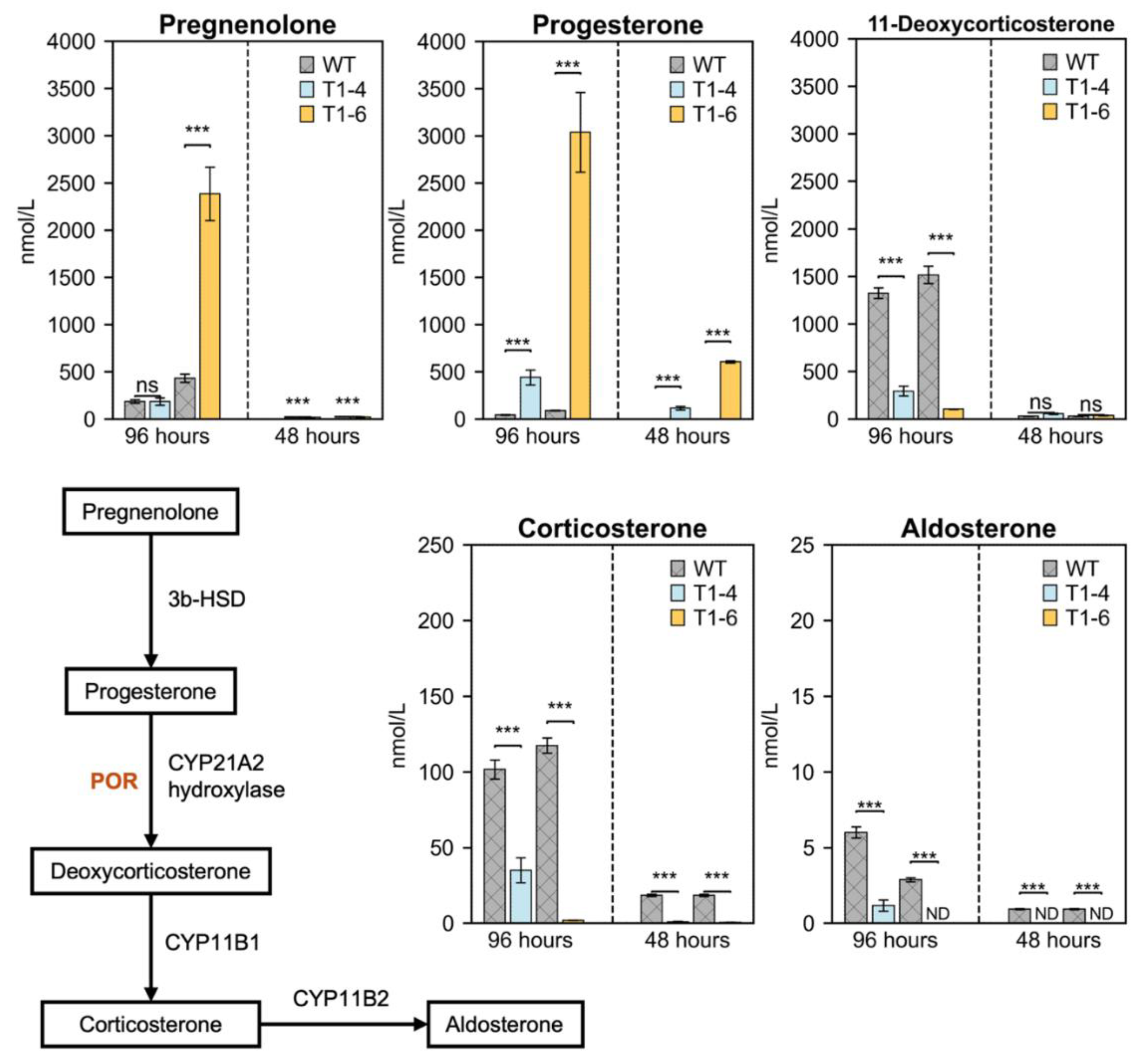
Figure 7.
POR knockout suppresses androgen biosynthesis in H295R cells. Steroid concentrations (nmol/L) were measured by LC–MS/MS in H295R wild-type (WT) cells and two POR-knockout clones (T1-4 and T1-6) after 96 h and 48 h of cultivation (time points separated by the dashed vertical line). Bar plots show levels of pregnenolone, 17α-hydroxypregnenolone, DHEA, DHEA-S, androstenedione, testosterone, and dihydrotestosterone (DHT). POR knockout resulted in accumulation of the upstream precursor pregnenolone and a strong reduction of downstream androgens. In particular, androstenedione, testosterone, and DHT were markedly decreased or not detected (ND) in the knockout clones, consistent with impaired CYP17A1-dependent androgen pathway activity. The pathway schematic summarizes androgen biosynthesis from pregnenolone and highlights POR-dependent CYP17A1 hydroxylase and 17,20-lyase steps, as well as downstream conversions toward testosterone and DHT and sulfation of DHEA to DHEA-S. Assays were performed in triplicates and normalized by total protein quantification. Statistical annotations: ns (not significant), * p<0.05, ** p<0.01, *** p<0.001; ND, not detected. DHEA, Dehydroepiandrosterone; . DHEA - S, Dehydroepiandrosterone Sulfate; DHT, Dihydrotestosterone; Δ5-diol, Androstenediol; Δ4-dione, Androstenedione.
Figure 7.
POR knockout suppresses androgen biosynthesis in H295R cells. Steroid concentrations (nmol/L) were measured by LC–MS/MS in H295R wild-type (WT) cells and two POR-knockout clones (T1-4 and T1-6) after 96 h and 48 h of cultivation (time points separated by the dashed vertical line). Bar plots show levels of pregnenolone, 17α-hydroxypregnenolone, DHEA, DHEA-S, androstenedione, testosterone, and dihydrotestosterone (DHT). POR knockout resulted in accumulation of the upstream precursor pregnenolone and a strong reduction of downstream androgens. In particular, androstenedione, testosterone, and DHT were markedly decreased or not detected (ND) in the knockout clones, consistent with impaired CYP17A1-dependent androgen pathway activity. The pathway schematic summarizes androgen biosynthesis from pregnenolone and highlights POR-dependent CYP17A1 hydroxylase and 17,20-lyase steps, as well as downstream conversions toward testosterone and DHT and sulfation of DHEA to DHEA-S. Assays were performed in triplicates and normalized by total protein quantification. Statistical annotations: ns (not significant), * p<0.05, ** p<0.01, *** p<0.001; ND, not detected. DHEA, Dehydroepiandrosterone; . DHEA - S, Dehydroepiandrosterone Sulfate; DHT, Dihydrotestosterone; Δ5-diol, Androstenediol; Δ4-dione, Androstenedione.
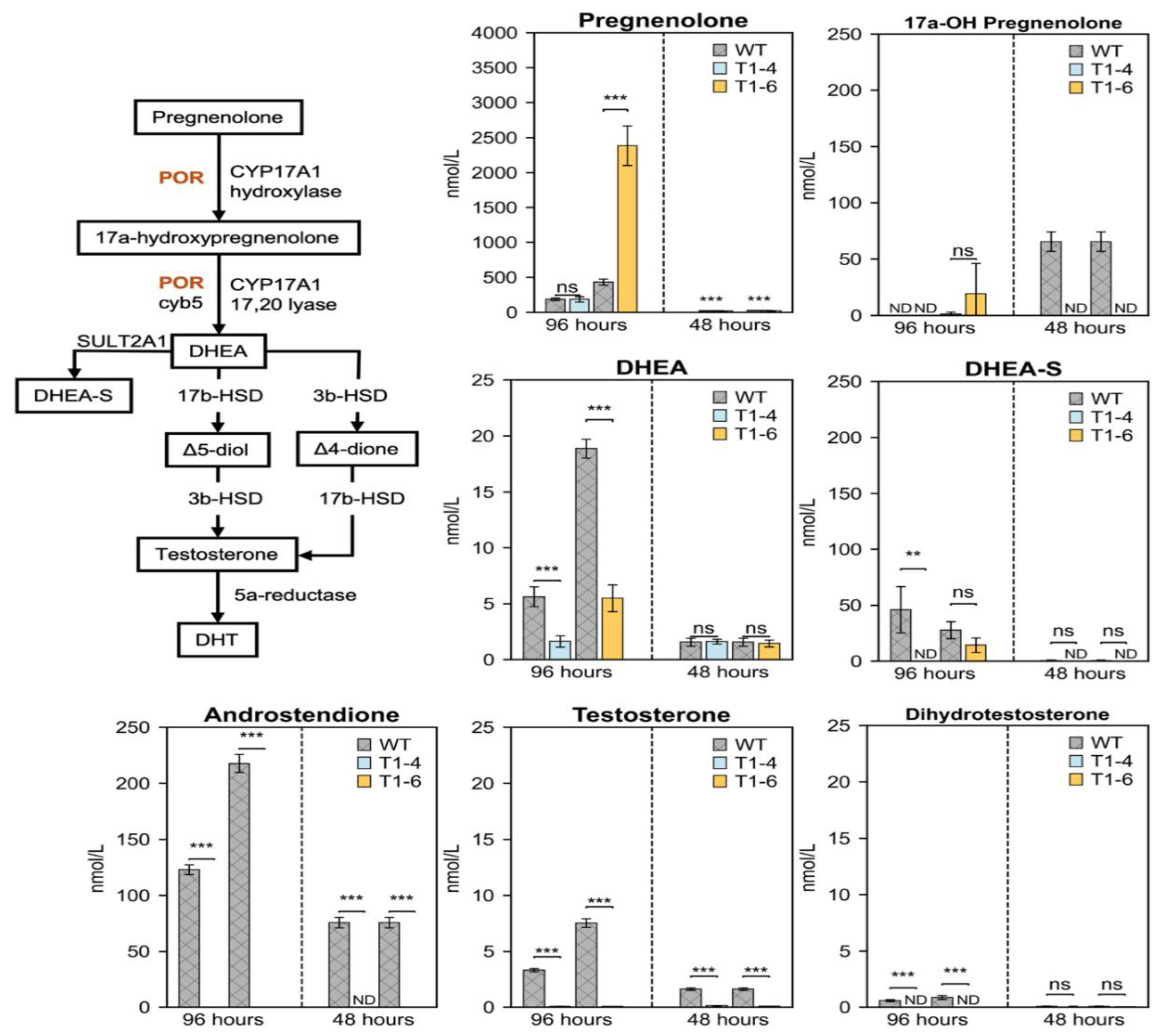
POR deficiency caused a pronounced suppression of androgen production (Figure 7). In POR-knockout H295R cells, concentrations of DHEA, androstenedione, testosterone, and dihydrotestosterone were dramatically reduced compared with wild-type controls (Figure 7), consistent with compromised CYP17A1 17,20-lyase activity and diminished flux through downstream steroidogenic steps.
17-Hydroxypregnenolone is the first intermediate of the androgen biosynthetic pathway and is generated from pregnenolone by the 17α-hydroxylase activity of CYP17A1. Interpretation of 17-hydroxypregnenolone levels was limited, as this metabolite was detected only in WT H295R cells at 48 h but not at 96 h (Figure 7), likely reflecting its further metabolism at the later time point.
Notably, measurable amounts of DHEA were also detected in POR-knockout cells (Figure 7). DHEA was additionally identified in the growth culture medium during the 96 h LC–MS/MS screening experiment, likely derived from FBS supplementation. We further repeated the experiment using DHEA-free growth medium and steroid profiles were assessed after 48 h of incubation. Under these conditions, DHEA remained detectable in POR-knockout cells at levels comparable to controls (Figure 7), indicating residual endogenous DHEA production despite loss of POR.
Importantly, this DHEA signal did not reflect DHEA accumulation due to a downstream bottleneck. In POR-knockout cells, DHEA was not efficiently converted to androstenedione or DHEA-S, even though expression of HSD3B2 and SULT2A1 was preserved (Figure 3). In contrast, wild-type H295R cells displayed substantial levels of these downstream metabolites, consistent with robust DHEA synthesis that is rapidly metabolized. Together, these findings demonstrate that POR deficiency markedly impairs androgen biosynthesis, while revealing a limited residual capacity for DHEA production that fails to propagate into downstream androgenic products.
Metabolic Shunting of Progesterone in POR-Knockout Cells
Blockade of the canonical steroidogenic pathway in POR knockout cells leads to progesterone accumulation and likely diverts its metabolism toward alternative reduced and hydroxylated derivatives.
Figure 8.
POR knockout redirects accumulated progesterone into alternative metabolic routes. (A) Steroid concentrations measured after 48 h (A) of cultivation in parental NCI-H295R cells and two POR-knockout clones (T1-4 and T1-6) (B, C). Bars represent mean values with error bars indicating variability between replicates. NA, not detected. Asterisks indicate statistical significance relative to parental NCI-H295R cells. Across both time points, POR-knockout clones showed marked alterations in steroid profiles, characterized by accumulation of upstream intermediates and reduction or absence of several downstream hydroxylated products. (D) Heatmap showing RNA-seq expression levels (FPKM) of selected steroidogenic and related genes in parental NCI-H295R cells and POR-knockout clones T1-4 and T1-6. Expression was classified into five categories: negligible (<0.5 FPKM), very low [0.5–3 FPKM), low (3–30 FPKM), moderate (30–100 FPKM), and high (>100 FPKM).
Figure 8.
POR knockout redirects accumulated progesterone into alternative metabolic routes. (A) Steroid concentrations measured after 48 h (A) of cultivation in parental NCI-H295R cells and two POR-knockout clones (T1-4 and T1-6) (B, C). Bars represent mean values with error bars indicating variability between replicates. NA, not detected. Asterisks indicate statistical significance relative to parental NCI-H295R cells. Across both time points, POR-knockout clones showed marked alterations in steroid profiles, characterized by accumulation of upstream intermediates and reduction or absence of several downstream hydroxylated products. (D) Heatmap showing RNA-seq expression levels (FPKM) of selected steroidogenic and related genes in parental NCI-H295R cells and POR-knockout clones T1-4 and T1-6. Expression was classified into five categories: negligible (<0.5 FPKM), very low [0.5–3 FPKM), low (3–30 FPKM), moderate (30–100 FPKM), and high (>100 FPKM).
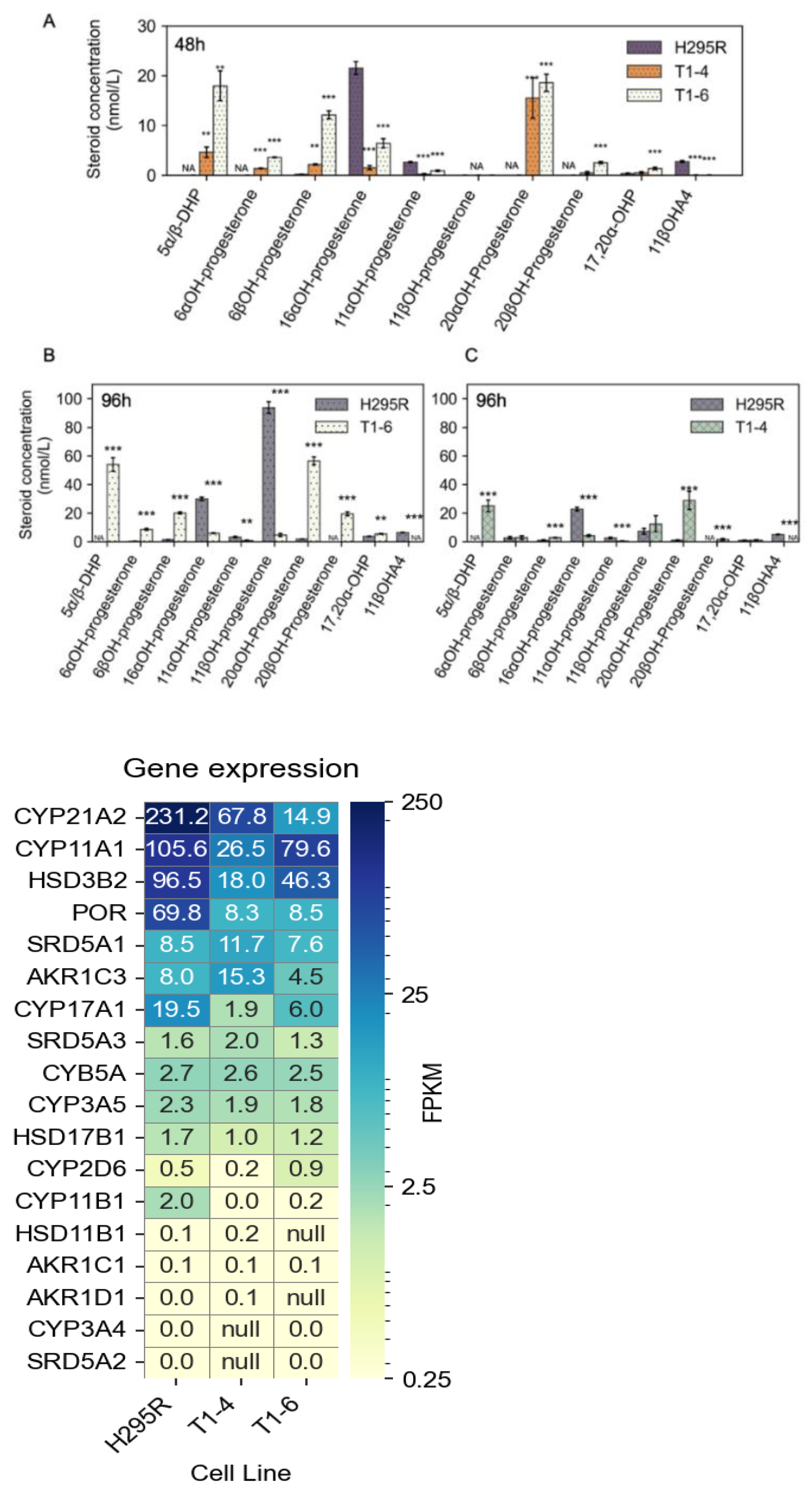
Consistent with this, POR-deficient cells showed increased levels of 5α/β-DHP, 6α/βOH-progesterone, and 20α/βOH-progesterone. Elevated 5α/β-DHP likely reflects shunting of excess progesterone into irreversible 5α/β-reductive pathways [72]. This is supported by preserved SRD5A1 expression, negligible SRD5A2 and AKR1D1, and low but comparable SRD5A3 expression across genotypes (Figure 8).
6α/β-Hydroxyprogesterone was present at comparable or higher levels in POR knockout cells at both time points, suggesting C6 hydroxylation of accumulated progesterone by lowly expressed CYP3A5 and CYP2D6 [73,74]. Although H295R cells are adrenal-derived and do not express a typical hepatic P450 profile (Figure 8), low-level expression of these enzymes may still support 6β-hydroxylation under conditions of substrate excess.
20α/β-Hydroxyprogesterone is likely generated mainly by aldo-keto reductases [75], most likely AKR1C3, as AKR1C1 expression is minimal (Figure 8) in our cell models. This metabolite has weak progestogenic activity and is thought to contribute to progesterone inactivation, thereby diverting steroid flux away from productive steroidogenesis.
In contrast, 11βOHA4 was detected in wild-type H295R cells but not in POR knockout derivatives, likely due to reduced androstenedione availability and impaired CYP11B1-dependent 11β-hydroxylation (Figure 7). Another CYP11B1-derived metabolite [76], 11βOHP4, showed a variable pattern in the POR knockout clones. Likewise, 11α/βOH-progesterone did not show a consistent trend, suggesting that progesterone hydroxylation at the 11-position is not uniformly enhanced after POR loss.
Together, these findings indicate that loss of POR does not simply abolish steroidogenesis, but also redirects accumulated progesterone into alternative metabolic routes.
Steroid-metabolizing enzyme activities
POR deficiency is associated with impaired function of the steroidogenic cytochrome P450 enzymes CYP17A1, CYP21A2, and CYP19A1, which rely on POR as an obligate electron donor for their catalytic activity. Mutations in POR may compromise electron transfer by impairing binding of the cofactors FAD, FMN, and NADP(H), reducing protein flexibility required for conformational changes, or altering specific protein–protein interactions between POR and its cytochrome P450 partners. Therefore, individual POR mutations can differentially affect distinct cytochrome P450 enzymes, resulting in severe impairment of some pathways while others are relatively preserved.
To investigate these differential effects, we examined the activities of three key steroidogenic metabolic partners of POR, CYP17A1, CYP21A2, and CYP19A1, in the context of POR mutations (Figure 9 and Table 1). We generated cellular models by CRISPR/Cas9 – induced knockout of POR in HEK293T cells followed by episomal expression of each POR mutant. As HEK293T cells do not endogenously express steroidogenic CYP450 enzymes, they provided a clean background for functional reconstitution. CYP17A1, CYP21A2, and CYP19A1 were stably expressed via lentiviral transduction to ensure uniform expression across all conditions.
All activities are expressed as percentages relative to WT POR. Data are shown as mean ± SD. Statistical significance was determined using a paired t-test comparing each mutant to WT POR (p < 0.05; p < 0.01; p < 0.001]. NC, negative control.
POR p.A287P: The POR variant A287P showed a significant reduction in the activity of all steroidogenic enzymes tested. CYP17A1 hydroxylase activity was reduced to 66.1±11.4% of wild-type levels, while CYP17A1 17,20-lyase activity was decreased to 55.5±16.4%. CYP21A2 hydroxylase activity was similarly reduced (57.1±11.9% of WT). The most pronounced effect was observed for CYP19A1 aromatase activity, which was reduced to 22.1±12.9% of wild-type activity.
POR p.P228L: The P228L variant is the most functionally preserved among the tested POR mutations. It supports CYP17A1 activity at wild-type levels and shows only a moderate reduction in CYP21A2 activity [81.2% ± 12.3% of WT), which remains above the pathogenic levels in congenital adrenal hyperplasia (CAH)[77]. Interestingly, CYP19A1 activity is significantly elevated (142.5%± 30.8%) in the presence of the P228L variant compared to WT.
POR p.P399_401del: In our cell-based system, the three–amino acid deletion p.P399_E401del in POR resulted in markedly reduced POR-supported steroidogenic activities. CYP17A1-mediated conversion of 17-hydroxypregnenolone to DHEA and progesterone to 17-hydroxyprogesterone was reduced to 51%±9% and 57%±4.5% of wild-type activity, respectively. CYP21A2-dependent hydroxylation of progesterone to deoxycorticosterone was impaired to 35.7%±8.4% of wild-type levels. CYP19A1 activity was most strongly affected, with androstenedione-to-estrone conversion reduced to 14.9%±8.2% of wild-type activity.
POR p.R457H: In vitro functional analyses demonstrated a substantial reduction in POR-supported enzymatic activities, including CYP17A1 hydroxylase (26% of wild-type activity) and 17,20-lyase (31%), as well as CYP21A2 (32%) and CYP19A1 (15%). The tested POR variants showed distinct functional consequences, ranging from severe global impairment to selective preservation of activity. In contrast to A287P, P399_E401del, and R457H, which reduced all steroidogenic activities, P228L maintained CYP17A1 function, only modestly decreased CYP21A2 activity, and notably enhanced CYP19A1 activity to levels exceeding wild type. Across the other variants, CYP19A1 was consistently the most vulnerable enzyme, indicating that aromatase activity is particularly sensitive to impaired POR-dependent electron transfer.
Prime edited cells
Among the tested POR variants, P228L was of particular interest because it showed an unusual activity pattern, most notably increased CYP19A1 activity in the plasmid-based system. To examine whether this reflected a true variant-specific effect on aromatase support, a biallelic POR c.P228L prime-edited HEK293T cell line was generated and analyzed under endogenous genomic control.
HEK293T wild-type cells were used to generate a POR c.P228L biallelic mutant line using CRISPR/Cas9 prime editing. This method uses a Cas9 nickase to make a single strand break in DNA and a reverse transcriptase fused to Cas9 nickase to copy a designed template that contains the required nucleotide changes for the P228L mutation.
Compared with WT POR (100%), the P228L variant supported about 53–61% activity for CYP21A2, CYP17A1 (17OHase and 17,20-lyase), and CYP19A1 aromatase (Figure 10, Table 2). The lowest activities were measured for CYP21A2 and CYP19A1 (about 53–54% of WT), while CYP17A1 17,20-lyase showed about 61% of WT (Figure 10, Table 2). All reductions were statistically significant compared with WT (t-test p ≤ 0.013). This activity level also differed from earlier measurements in POR knockout cells after plasmid-based expression of the same variant. A likely reason is the difference in how POR is produced in these systems: in prime-edited cells, POR is expressed from its natural gene under normal cis- and trans-regulatory control, while plasmid expression uses an engineered cassette with strong regulatory elements and a cDNA that does not require splicing. These differences in expression conditions may explain the difference in measured activity. Overall, the P228L mutation causes a broad partial loss of POR function affecting multiple CYP partners.
Confocal imaging of Fe(II) storage in POR knockout and prime-edited HEK293T and H295R cells.
POR is linked to redox balance since it transfers electrons from NADPH to microsomal CYP enzymes in the endoplasmic reticulum [5], thereby regulating oxidative metabolism and reactive oxygen species generation [78,79]. When POR function is impaired, electron transfer to CYP enzymes becomes less efficient, which can promote electron leakage and increase the formation of reactive oxygen species, thereby disturbing redox homeostasis[79]. In the presence of ferrous iron, excess hydrogen peroxide may also drive the Fenton reaction, producing highly reactive hydroxyl radicals and promoting oxidative damage [79].
Since iron availability and storage are key determinants of ferroptotic susceptibility, we analyzed iron storage in our cellular models to determine whether POR deficiency is associated with altered iron accumulation. For this purpose, we compared wild-type cells with POR knockout cells, as well as prime-edited cells carrying defined POR p.P228L, in both HEK293T and H295R backgrounds. Iron storage was assessed by confocal imaging to provide a direct overview of intracellular iron-associated signal across genotypes. Cells were treated with ammonium iron(II) sulfate (100 μM) for 30 minutes followed by HBSS washing for three times. Hoechst (0.1 μmol/l) and FerroOrange (1 μmol/l) were added to the cells as HBSS solution (500 μl), and then the cells were incubated for additional 30 min. Hoechst was applied as nucleus stain it emits blue fluorescence when bound to dsDNA. FerroOrange (FO) was used as a small-molecule fluorescent dye that senses intracellular iron in live cells by selectively binding iron ions. Upon binding, its fluorescence signal increases, enabling visualization and quantification of intracellular iron by live-cell fluorescence imaging.
All cell lines tested (HEK293T, HEK293T POR KO, HEK 293T POR p.P228L, H295R, H295R POR KO T1-4, and H295R POR KO T1-4) effectively accumulated ammonium iron(II) as seen by intensive red signal appearance after FO treatment (Figure 11). HEK293T and H295R cells were supplemented with 2,2’-bipyridine (BPY) - a well-known, high-affinity chelator of iron, particularly iron (II) [80]. It acts as a bidentate ligand that binds iron to form stable complex ions, most notably the red-colored tris (2,2’-bipyridine)iron(II) complex[80]. BPY was added to the cells at the concentration of 100 μmol/l and indeed reduced the available iron(II) amount as seen by decreasing of FO fluorescent signal proving that red fluorescent signal derives from iron(II).
HEK 293T POR p.P228L showed the FO intensity 2 times less than HEK 293T, and HEK293T POR KO has no difference. In adrenal derived cells, H295R POR knockout clone T1-4 tends to accumulate less Fe (II) ions compared to H295R cells, and T1-6 clone shows no difference.
Overall, these data suggest that POR alterations do not uniformly affect iron storage, but specific POR variants (P228L) or knockout clones (T1-4) may be associated with reduced intracellular Fe(II) levels in a cell type– and clone-dependent manner.
Discussion
POR deficiency is a rare hereditary disorder, as the phenotype typically manifests in homozygous individuals carrying two deleterious alleles or in compound heterozygous patients with two different disease-causing variants [11,13,17]. Despite its rarity, the clinical presentation is often severe and includes metabolic disturbances, skeletal malformations, and ambiguous genitalia [1,19], requiring reconstructive surgery, long-term physiotherapy, and steroid replacement therapy [81]. Later in life, affected individuals may also develop ovarian macrocysts [28,82], infertility [82], cardiovascular complications[83], and psychological problems[81], all of which substantially reduce quality of life for both patients and their families.
To date, a number of deleterious POR mutations have been identified and functionally studied under in vitro conditions, most often using purified protein systems [4,10]. In the present study, we introduce entirely new cellular models based on complete POR gene knockout, providing a broader experimental platform for studying the consequences of POR loss. Generation of whole-organism POR knockout models remains highly challenging, since POR is essential for development and global POR knockout in mice is embryonically lethal [51]. Therefore, we generated adrenal carcinoma-derived POR knockout cell lines and analyzed their steroid profiles to assess the functional consequences of protein loss. As expected, we observed profound disruption of steroidogenic pathways, including aldosterone, cortisol, and testosterone biosynthesis, consistent with the essential role of POR as the electron donor to the key steroidogenic enzymes CYP17A1, CYP21A2, and CYP19A1 [1,3,5].
In addition to the direct loss of POR function, impaired steroidogenesis was also associated with reduced RNA expression of multiple steroidogenic enzymes, including not only the above CYP enzymes, but also CYP11A1, CYP11B1, CYP11B2, HSD3B2, and several others involved in steroid hormone biosynthesis. Such a decline in steroidogenic capacity has previously been reported in NCI-H295R cells at high passage numbers [70,71]. In the case of the POR knockout clones, however, the true passage status is difficult to define precisely, as the clones were expanded from single cells following CRISPR/Cas9 editing. Further steroid profiling under alternative culture conditions, such as forskolin stimulation, which is known to enhance steroidogenesis [84,85], will therefore be necessary. Despite the overall impairment of steroid hormone production, retained formation of 17OH-progesterone and DHEA was still detected.17-Hydroxyprogesterone (17OHP) is a central intermediate of adrenal steroidogenesis and a direct precursor for dehydroepiandrosterone (DHEA) and downstream androgens synthesized in the adrenal glands, ovaries, and testes [86,87]. Elevated 17OHP concentrations represent a hallmark diagnostic marker of congenital adrenal hyperplasia (CAH). Most prominently it is observed in CYP21A2 deficiency, but also in 11-hydroxylase deficiency, 3β-hydroxysteroid dehydrogenase deficiency[88] and P450 oxidoreductase (POR) deficiency, where impaired electron transfer disrupts multiple steroidogenic enzymes. Accumulation of 17OHP is not merely a biochemical signature but also contributes to disease pathophysiology, as excess 17OHP diverts steroid flux toward androgen synthesis at the expense of glucocorticoid production, thereby promoting virilization in females [89].
In the adrenal cortex, 17OHP is generated either from progesterone via the 17α-hydroxylase activity of CYP17A1 or indirectly from 17α-hydroxypregnenolone through the action of HSD3B2 [5,90]. As no alternative biosynthetic pathways for 17OHP formation have been described, this observation suggests residual CYP17A1 hydroxylase activity in the absence of POR. Consistently, measurable amounts of DHEA were detected in the culture medium, indicating partial preservation of CYP17A1 17,20-lyase function as well as 16α-Hydroxyprogesterone that is proved to be the product of CYP17A1 hydroxylation of progesterone [91]. This differential behavior of CYP17A1-dependent reactions underscores a selective and incomplete disruption of steroidogenic flux in POR deficiency rather than a uniform loss of CYP17A1 activity.
DHEA detection was an unexpected finding in POR KO H295R cells. Canonical DHEA biosynthesis requires full CYP17A1 activity including both 17α-hydroxylase and 17,20-lyase functions [90,92], that are supposed to be impaired in the absence of POR. Supporting this, the immediate precursor 17OH-pregnenolone was undetectable in POR KO cells at either timepoint. Another key enzyme, 3β-hydroxysteroid dehydrogenase 2 (3βHSD2], catalyzes conversion of Δ⁵-hydroxysteroids to their Δ⁴-keto configurations, acts on three substrates: pregnenolone, 17OH-pregnenolone, and DHEA[90,92,93,94]. Androstenedione, a downstream product of 3βHSD2 acting on DHEA, was produced in markedly lower amounts (3–4 log fold reduction) in our study, despite 3βHSD2 is active as evidenced by robust pregnenolone-to-progesterone conversion. Since 3βHSD2 does not exhibit substrate preference [93,94], the 2–5-fold lower expression of HSD3B2 in POR KO clones could underlie the markedly reduced androstenedione production from DHEA. Notably, testosterone was only detected in trace amounts in KO cells, confirming a disruption of the DHEA–androstenedione–testosterone axis.
DHEA-S, the primary adrenal steroid in circulation, was not produced at 48h in POR KO cells despite Sulfotransferase 2A1 (SULT2A1) expression levels comparable to H295R. Among KO clones, only T1-6 at 96h yielded detectable DHEA-S, which could indicate low but genuine DHEA synthesis. These findings suggest a decoupling between DHEA synthesis and its downstream metabolism, possibly due to limited substrate availability, reduced enzymatic activity, or redox-sensitive regulation.
The absence of 17OH-pregnenolone and failure to generate androstenedione imply that either DHEA is not synthesized via the canonical CYP17A1 pathway or that alternative, non-classical mechanisms may contribute under POR knockout conditions. Prior studies using rodent[95] and human[96] brain cells, and serum from Alzheimer’s disease patients[97], proposed a CYP17A1-independent, ROS-driven mechanism involving Fe²⁺- dependent cleavage of hydroperoxide intermediates of unknown precursor [95,98], likely cholesterol metabolite. Later it was demonstrated that cholesterol, abundant in brain tissue, can autoxidize during extraction or derivatization of the sample, producing pregnenolone and DHEA in amounts similar to reported neurosteroid levels [99]. This process is chemically possible but lacks enzymatic control and physiological relevance, as would be expected under natural biological conditions [99]. Early removal of cholesterol eliminates the DHEA signal entirely, indicating that its presence results from sample handling rather than true biological origin [99], and highlighting limitations of earlier analytical workflows.
More recently, it has been demonstrated that in prostate cancer xenografts, DHEA can also be produced independently of CYP17A1, via conversion of 17α,20-dihydroxycholesterol (DHC), with CYP51A1 catalyzing the critical step [100]. In this model, 3βHSD1 is required for conversion of the 3β-hydroxy-Δ⁵ steroid backbone to the corresponding 3-keto-Δ⁴ androgens, including testosterone and DHT [100]. While this pathway was described in prostate tissue, its relevance to adrenal or H295R-derived cell systems remains to be determined.
Together, these findings raise the possibility that low levels of DHEA detected in POR KO cells may arise via alternative biochemical or chemical routes, including oxidative cleavage, residual CYP17A1 activity, or recently proposed cholesterol-derivative pathways. However, the absence of intermediates, reduced enzyme expression, and a lack of downstream product accumulation suggest that DHEA detection under POR-deficient conditions may not reflect functional steroidogenesis and warrants further investigation.
In addition to steroid profiling in POR knockout adrenal-derived cells, we established a POR knockout HEK293T cell line as a platform for functional analysis of selected POR variants. Using this model, we assessed the activity of the two most frequent PORD-associated mutations, A287P and R457H [4,9,13,50], as well as the P228L variant, which has long been considered a polymorphism[24] but has recently been suggested to have deleterious functional effects 43,51, and the del399_401 variant. HEK293T cells are of epithelial origin, highly tractable in culture, and easy to manipulate experimentally. Importantly, because they lack endogenous expression of steroidogenic genes, they provide a relatively “clean” cellular background that can be adapted for steroidogenesis-related studies, offering minimal steroidogenic interference while still preserving the advantages of a living cellular environment. This model does not replace earlier biochemical systems, but complements them by enabling analysis in living cells, where POR activity is influenced not only by intrinsic catalytic properties, but also by intracellular factors such as protein stability, expression, membrane integration, flavin availability, and interactions with endogenous cellular components. Thus, while obtained in a different experimental system, our data are overall consistent with the published view that these variants impair POR-supported steroidogenesis to different extents.
Overall, the generated POR knockout cell models represent useful tools for studying POR deficiency, although their limitations should be recognized. H295R cells are influenced by culture conditions, passage number, and clonal variation, which may affect steroidogenic output and gene expression, whereas HEK293T cells provide a simplified non-steroidogenic background. Despite these limitations, the models are valuable for understanding how POR deficiency affects steroidogenesis and the CYP enzymes involved, which may help guide more tailored hormone replacement strategies. They also provide a platform for predicting the effects of POR deficiency on drug metabolism, with potential applications in personalized dosing and in testing the safety and efficacy of new drugs under conditions of altered POR function. In addition, POR knockout cell lines can serve as a screening system for newly identified POR variants, allowing their impact on steroidogenesis and drug response to be assessed in a cellular environment. Importantly, these models may also be useful for exploring ferroptosis-related events, as the cells retain the ability to accumulate intracellular Fe(II), indicating preservation of a labile iron pool that could be relevant for iron-dependent oxidative processes. Thus, these POR knockout cell lines provide a valuable platform for studying disease mechanisms, variant pathogenicity, steroidogenesis, drug response, and potentially ferroptosis-related pathways in POR deficiency.
Funding
This work was supported by a grant from the Swiss National Science Foundation [204518] to AVP.
Acknowledgments
This work was supported by a grant from the Swiss National Science Foundation [204518] to AVP.
Disclosure Statement
The authors have nothing to disclose.
References
- Pandey, V.; Flück, C. E. NADPH P450 oxidoreductase: Structure, function, and pathology of diseases. Pharmacology & Therapeutics 2013, 138, 229–254. [Google Scholar] [CrossRef]
- Riddick, D. S. NADPH–Cytochrome P450 Oxidoreductase: Roles in Physiology, Pharmacology, and Toxicology. Drug Metabolism and Disposition 2013, 41, 12–23. [Google Scholar] [CrossRef]
- Miller, W. L. Minireview: Regulation of Steroidogenesis by Electron Transfer. Endocrinology 2005, 146, 2544–2550. [Google Scholar] [CrossRef]
- Pandey, A.V.; Sproll, P. Pharmacogenomics of human P450 oxidoreductase. Frontiers in Pharmacology 2014, 5. [Google Scholar] [CrossRef] [PubMed]
- Miller, W. L.; Auchus, R. J. The Molecular Biology, Biochemistry, and Physiology of Human Steroidogenesis and Its Disorders. Endocrine Reviews 2011, 32, 81–151. [Google Scholar] [CrossRef] [PubMed]
- Xia et al., Structural basis for human NADPH-cytochrome P450 oxidoreductase deficiency. Proceedings of the National Academy of Sciences 2011, 108, 13486–13491. [CrossRef]
- Zhang, T. Clinical and genetic analysis of cytochrome P450 oxidoreductase (POR) deficiency in a female and the analysis of a novel POR intron mutation causing alternative mRNA splicing: Overall analysis of a female with POR deficiency. Journal of Assisted Reproduction and Genetics 2020, 37, 2503–2511. [Google Scholar] [CrossRef]
- Pandey, A.V.; Flück Ce Fau - Mullis, P. E.; Mullis, P. E. Altered heme catabolism by heme oxygenase-1 caused by mutations in human NADPH cytochrome P450 reductase. [CrossRef] [PubMed]
- Dean, B. P450 Oxidoreductase Deficiency: A Systematic Review and Meta-analysis of Genotypes, Phenotypes, and Their Relationships. The Journal of Clinical Endocrinology & Metabolism 2020, 105, e42–e52. [Google Scholar]
- Burkhard, F. Z.; Parween, S.; Udhane, S. S.; Flück, C. E.; Pandey, A. V. P450 Oxidoreductase deficiency: Analysis of mutations and polymorphisms. The Journal of Steroid Biochemistry and Molecular Biology 2017, 165, 38–50. [Google Scholar] [CrossRef]
- Krone, N. Genotype-Phenotype Analysis in Congenital Adrenal Hyperplasia due to P450 Oxidoreductase Deficiency. The Journal of Clinical Endocrinology & Metabolism 2012, 97, E257–E267. [Google Scholar] [CrossRef]
- Idkowiak, J. Pubertal Presentation in Seven Patients with Congenital Adrenal Hyperplasia due to P450 Oxidoreductase Deficiency. The Journal of Clinical Endocrinology & Metabolism 2011, 96, E453–E462. [Google Scholar] [CrossRef]
- Fukami, M. Cytochrome P450 Oxidoreductase Deficiency: Identification and Characterization of Biallelic Mutations and Genotype-Phenotype Correlations in 35 Japanese Patients. The Journal of Clinical Endocrinology & Metabolism 2009, 94, 1723–1731. [Google Scholar] [CrossRef]
- Miller, W. L.; Huang, N.; Pandey, A. V.; Flück, C. E.; Agrawal, V. P450 Oxidoreductase Deficiency: A New Disorder of Steroidogenesis. Annals of the New York Academy of Sciences 2005, 1061, 100–108. [Google Scholar] [CrossRef]
- Bai, Y.; Li, J.; Wang, X. Cytochrome P450 oxidoreductase deficiency caused by R457H mutation in POR gene in Chinese: case report and literature review. Journal of Ovarian Research 2017, 10, 16. [Google Scholar] [CrossRef]
- Williamson, L.; Arlt, W.; Shackleton, C.; Kelley, R. I.; Braddock, S. R. Linking Antley–Bixler syndrome and congenital adrenal hyperplasia: A novel case of P450 oxidoreductase deficiency. American Journal of Medical Genetics Part A 2006, 140A, 1797–1803. [Google Scholar] [CrossRef] [PubMed]
- Huang, N. Diversity and Function of Mutations in P450 Oxidoreductase in Patients with Antley-Bixler Syndrome and Disordered Steroidogenesis. The American Journal of Human Genetics 2005, 76, 729–749. [Google Scholar] [CrossRef] [PubMed]
- Arlt, W. Arlt, P450 oxidoreductase deficiency and Antley–Bixler syndrome. Reviews in Endocrine and Metabolic Disorders 2007, 8, 301–307. [Google Scholar] [CrossRef] [PubMed]
- Gusmano et al., Congenital adrenal hyperplasia, disorders of sex development, and infertility in patients with POR gene pathogenic variants: a systematic review of the literature. Journal of Endocrinological Investigation 2022, 46, 1–14.
- Kelley, R. I. Abnormal sterol metabolism in a patient with Antley-Bixler syndrome and ambiguous genitalia. American Journal of Medical Genetics 2002, 110, 95–102. [Google Scholar] [CrossRef]
- Shackleton et al., Biochemical diagnosis of Antley–Bixler syndrome by steroid analysis. American Journal of Medical Genetics Part A 2004, 128A, 223–231. [CrossRef]
- Nakanishi, K. P450 oxidoreductase deficiency with maternal virilization during pregnancy. Clinical and Experimental Obstetrics & Gynecology 2016, 43, 902–904. [Google Scholar] [CrossRef]
- Puiu, M. A Case of Antley Bixler Syndrome: Diagnosis and Outcome. Acta Endocrinologica (Bucharest) 2012, 8, 479–484. [Google Scholar] [CrossRef]
- Flück, C. E.; Nicolo, C.; Pandey, A. V. Clinical, structural and functional implications of mutations and polymorphisms in human NADPH P450 oxidoreductase. Fundamental & Clinical Pharmacology 2007, 21, 399–410. [Google Scholar] [CrossRef]
- Homma, K. Urine Steroid Hormone Profile Analysis in Cytochrome P450 Oxidoreductase Deficiency: Implication for the Backdoor Pathway to Dihydrotestosterone. The Journal of Clinical Endocrinology & Metabolism 2006, 91, 2643–2649. [Google Scholar] [CrossRef]
- Khadilkar, K.; Jagtap, V.; Lila, A.; Bandgar, T.; Shah, N. Cytochrome P450 oxidoreductase deficiency: Novel cause of ambiguity with primary amenorrhea. Indian Journal of Endocrinology and Metabolism 2017, 21, 360. [Google Scholar] [CrossRef] [PubMed]
- Pan, P. Successful live birth in a Chinese woman with P450 oxidoreductase deficiency through frozen-thawed embryo transfer: a case report with review of the literature. Journal of Ovarian Research 2021, 14, 22. [Google Scholar] [CrossRef]
- Zhang; Ding, L.; Deng, S.; Tian, Q. Clinical Characteristics and Molecular Aetiology of Cytochrome P450 Oxidoreductase Deficiency Diagnosed in 46,XX Patients. Reproductive Sciences 2025, 32, 2474–2483. [Google Scholar] [CrossRef]
- Cragun, D. L. Undetectable maternal serum uE3 and postnatal abnormal sterol and steroid metabolism in Antley–Bixler syndrome. American Journal of Medical Genetics Part A 2004, 129A, 1–7. [Google Scholar] [CrossRef]
- Sahakitrungruang, T. Clinical, Genetic, and Enzymatic Characterization of P450 Oxidoreductase Deficiency in Four Patients. The Journal of Clinical Endocrinology & Metabolism 2009, 94, 4992–5000. [Google Scholar] [CrossRef]
- Adachi, M. Compound heterozygous mutations of cytochrome P450 oxidoreductase gene ( POR ) in two patients with Antley–Bixler syndrome. American Journal of Medical Genetics Part A 2004, 128A, 333–339. [Google Scholar] [CrossRef]
- Reisch, N. Prenatal Diagnosis of Congenital Adrenal Hyperplasia Caused by P450 Oxidoreductase Deficiency. The Journal of Clinical Endocrinology & Metabolism 2013, 98, E528–E536. [Google Scholar] [CrossRef]
- Gomes, A.M. Pharmacogenomics of Human Liver Cytochrome P450 Oxidoreductase: Multifactorial Analysis and Impact on Microsomal Drug Oxidation. Pharmacogenomics 2009, 10, 579–599. [Google Scholar] [CrossRef]
- Tomková, M. Genetic Variations in NADPH-CYP450 Oxidoreductase in a Czech Slavic Cohort. Pharmacogenomics 2015, 16, 205–215. [Google Scholar] [CrossRef]
- Saito, Y. Genetic Polymorphisms and Haplotypes of POR, Encoding Cytochrome P450 Oxidoreductase, in a Japanese Population. Drug Metabolism and Pharmacokinetics 2011, 26, 107–116. [Google Scholar] [CrossRef]
- Chen, S. A genomic mutational constraint map using variation in 76,156 human genomes. Nature 2024, 625, 92–100. [Google Scholar] [CrossRef]
- Byrska-Bishop, M. High-coverage whole-genome sequencing of the expanded 1000 Genomes Project cohort including 602 trios. Cell 2022, 185, 3426–3440.e3419. [Google Scholar] [CrossRef]
- Iyanagi, T.; Makino, R.; Anan, F. K. Studies on the microsomal mixed-function oxidase system: mechanism of action of hepatic NADPH-cytochrome P-450 reductase. Biochemistry 1981, 20, 1722–1730. [Google Scholar] [CrossRef] [PubMed]
- Wang, M. Three-dimensional structure of NADPH–cytochrome P450 reductase: Prototype for FMN- and FAD-containing enzymes. Proceedings of the National Academy of Sciences 1997, 94, 8411–8416. [Google Scholar] [CrossRef] [PubMed]
- Xia, C. Conformational Changes of NADPH-Cytochrome P450 Oxidoreductase Are Essential for Catalysis and Cofactor Binding. Journal of Biological Chemistry 2011, 286, 16246–16260. [Google Scholar] [CrossRef] [PubMed]
- Guengerich, P. Mechanisms of cytochrome P450 substrate oxidation: MiniReview. Journal of Biochemical and Molecular Toxicology 2007, 21, 163–168. [Google Scholar] [CrossRef] [PubMed]
- Behrendorff, J. B. Y. H. Reductive Cytochrome P450 Reactions and Their Potential Role in Bioremediation. Frontiers in Microbiology 2021, 12, 649273. [Google Scholar] [CrossRef]
- Rojas Velazquez, M. N.; Noebauer, M.; Pandey, A. V. Loss of Protein Stability and Function Caused by P228L Variation in NADPH-Cytochrome P450 Reductase Linked to Lower Testosterone Levels. International Journal of Molecular Sciences 2022, 23, 10141. [Google Scholar] [CrossRef]
- Flück, C. E. Deletion of P399_E401 in NADPH cytochrome P450 oxidoreductase results in partial mixed oxidase deficiency. Biochemical and Biophysical Research Communications 2011, 412, 572–577. [Google Scholar] [CrossRef]
- Kumar, R.; Jayaraman, M.; Ramadas, K.; Chandrasekaran, A. Computational identification and analysis of deleterious non-synonymous single nucleotide polymorphisms (nsSNPs) in the human POR gene: a structural and functional impact. Journal of Biomolecular Structure and Dynamics 2024, 42, 1518–1532. [Google Scholar] [CrossRef]
- Flück, C. E.; Mullis, P. E.; Pandey, A. V. Modeling of human P450 oxidoreductase structure by in silico mutagenesis and MD simulation. Molecular and Cellular Endocrinology 2009, 313, 17–22. [Google Scholar] [CrossRef] [PubMed]
- Nurhafizuddin, M.; Azizi, A.; Ming, L. C.; Shafqat, N. In Silico Analysis of PORD Mutations on the 3D Structure of P450 Oxidoreductase. Molecules 2022, 27, 4646. [Google Scholar] [CrossRef]
- McCammon, K. M. Instability of the Human Cytochrome P450 Reductase A287P Variant Is the Major Contributor to Its Antley-Bixler Syndrome-like Phenotype. Journal of Biological Chemistry 2016, 291, 20487–20502. [Google Scholar] [CrossRef]
- Pandey, A. V.; Kempná, P.; Hofer, G.; Mullis, P. E.; Flück, C. E. Modulation of Human CYP19A1 Activity by Mutant NADPH P450 Oxidoreductase. Molecular Endocrinology 2007, 21, 2579–2595. [Google Scholar] [CrossRef]
- Agrawal, V.; Huang, N.; Miller, W. L. Pharmacogenetics of P450 oxidoreductase: effect of sequence variants on activities of CYP1A2 and CYP2C19. Pharmacogenetics and Genomics 2008, 18, 569–576. [Google Scholar] [CrossRef] [PubMed]
- Shen, A.L.; O’Leary, K. A.; Kasper, C. B. Association of Multiple Developmental Defects and Embryonic Lethality with Loss of Microsomal NADPH-Cytochrome P450 Oxidoreductase. Journal of Biological Chemistry 2002, 277, 6536–6541. [Google Scholar] [CrossRef]
- Uehara, S. Humanized liver TK-NOG mice with functional deletion of hepatic murine cytochrome P450s as a model for studying human drug metabolism. Scientific Reports 2022, 12, 14907. [Google Scholar] [CrossRef] [PubMed]
- Heintze, T.; Klein, K.; Hofmann, U.; Zanger, U. M. Differential effects on human cytochromes P450 by CRISPR/Cas9-induced genetic knockout of cytochrome P450 reductase and cytochrome b5 in HepaRG cells. Scientific Reports 2021, 11, 1000. [Google Scholar] [CrossRef] [PubMed]
- Reed, L.; Jarvis, I. W. H.; Phillips, D. H.; Arlt, V. M. Enhanced DNA adduct formation by benzo(a)pyrene in human liver cells lacking cytochrome P450 oxidoreductase. Mutation Research/Genetic Toxicology and Environmental Mutagenesis 2020, 852, 503162. [Google Scholar] [CrossRef]
- Concordet, J.-P.; Haeussler, M. CRISPOR: intuitive guide selection for CRISPR/Cas9 genome editing experiments and screens. Nucleic Acids Research 2018, 46, W242–W245. [Google Scholar] [CrossRef]
- Labun, K. CHOPCHOP v3: expanding the CRISPR web toolbox beyond genome editing. Nucleic Acids Research 2019, 47, W171–W174. [Google Scholar] [CrossRef]
- Ran, A. Genome engineering using the CRISPR-Cas9 system. Nature Protocols 2013, 8, 2281–2308. [Google Scholar] [CrossRef]
- Menzorov, A.G.; Lukyanchikova, V. A.; Korablev, A. N.; Serova, I. A.; Fishman, V. S. Genome editing using CRISPR/ Cas9 system: a practical guide. Vavilov Journal of Genetics and Breeding 2016, 20, 930–944. [Google Scholar] [CrossRef]
- Brinkman, E. K.; Chen, T.; Amendola, M.; van Steensel, B. Easy quantitative assessment of genome editing by sequence trace decomposition. Nucleic Acids Research 2014, 42, e168–e168. [Google Scholar] [CrossRef]
- Happi Mbakam, C.; Rousseau, J.; Tremblay, G.; Yameogo, P.; Tremblay, J. P. Prime Editing Permits the Introduction of Specific Mutations in the Gene Responsible for Duchenne Muscular Dystrophy. International Journal of Molecular Sciences 2022, 23, 6160. [Google Scholar] [CrossRef]
- Mathis, N. Machine learning prediction of prime editing efficiency across diverse chromatin contexts. Nature Biotechnology 2025, 43, 712–719. [Google Scholar] [CrossRef]
- Paquet, D. Efficient introduction of specific homozygous and heterozygous mutations using CRISPR/Cas9. Nature 2016, 533, 125–129. [Google Scholar] [CrossRef]
- Anzalone, A. V. Search-and-replace genome editing without double-strand breaks or donor DNA. Nature 2019, 576, 149–157. [Google Scholar] [CrossRef]
- Lephart, E. D.; Simpson, E. R. “(45) Assay of aromatase activity” in Methods in enzymology; Elsevier, 1991; vol. 206, pp. 477–483. [Google Scholar]
- Prado, M. J. Characterization of Mutations Causing CYP21A2 Deficiency in Brazilian and Portuguese Populations. International Journal of Molecular Sciences 2021, 23, 296. [Google Scholar] [CrossRef]
- Sharma, K. Effect of Essential Oil Components on the Activity of Steroidogenic Cytochrome P450. Biomolecules 2024, 14, 203. [Google Scholar] [CrossRef]
- Cohen, M. In Silico Structural and Biochemical Functional Analysis of a Novel CYP21A2 Pathogenic Variant. International Journal of Molecular Sciences 2020, 21, 5857. [Google Scholar] [CrossRef]
- Andrieu, T.; Du Toit, T.; Vogt, B.; Mueller, M. D.; Groessl, M. Parallel targeted and non-targeted quantitative analysis of steroids in human serum and peritoneal fluid by liquid chromatography high-resolution mass spectrometry. Analytical and Bioanalytical Chemistry 2022, 414, 7461–7472. [Google Scholar] [CrossRef]
- Kempná, P.; Marti, N.; Udhane, S.; Flück, C. E. Regulation of androgen biosynthesis – A short review and preliminary results from the hyperandrogenic starvation NCI-H295R cell model. Molecular and Cellular Endocrinology 2015, 408, 124–132. [Google Scholar] [CrossRef] [PubMed]
- Duranova et al., Human adrenocortical carcinoma cell line (NCI-H295R): An in vitro screening model for the assessment of endocrine disruptors’ actions on steroidogenesis with an emphasis on cell ultrastructural features. Acta Histochemica 2022, 124, 151912. [CrossRef] [PubMed]
- du Toit, T.; Groessl, M.; Pignatti, E.; Swart, A. C.; Flück, C. E. Characterization of Steroid Metabolic Pathways in Established Human and Mouse Cell Models. International Journal of Molecular Sciences 2025, 26, 9721. [Google Scholar] [CrossRef] [PubMed]
- Kolatorova, L.; Vitku, J.; Suchopar, J.; Hill, M.; Parizek, A. Progesterone: A Steroid with Wide Range of Effects in Physiology as Well as Human Medicine. International Journal of Molecular Sciences 2022, 23, 7989. [Google Scholar] [CrossRef]
- Niwa, T. Effect of genetic polymorphism on the metabolism of endogenous neuroactive substances, progesterone and p-tyramine, catalyzed by CYP2D6. Molecular Brain Research 2004, 129, 117–123. [Google Scholar] [CrossRef] [PubMed]
- Quinney, S. K.; Benjamin, T.; Zheng, X.; Patil, A. S. Characterization of Maternal and Fetal CYP3A-Mediated Progesterone Metabolism. Fetal and Pediatric Pathology 2017, 36, 400–411. [Google Scholar] [CrossRef]
- Penning, T. M.; Wangtrakuldee, P.; Auchus, R. J. Structural and Functional Biology of Aldo-Keto Reductase Steroid-Transforming Enzymes. Endocrine Reviews 2019, 40, 447–475. [Google Scholar] [CrossRef]
- Storbeck, K.-H.; O’Reilly, M. W. The clinical and biochemical significance of 11-oxygenated androgens in human health and disease. European Journal of Endocrinology 2023, 188, R98–R109. [Google Scholar] [CrossRef]
- Bruque, C. D. Structure-based activity prediction of CYP21A2 stability variants: A survey of available gene variations. Scientific Reports 2016, 6, 39082. [Google Scholar] [CrossRef] [PubMed]
- Zou, Y. Cytochrome P450 oxidoreductase contributes tophospholipid peroxidation in ferroptosis. Nature Chemical Biology 2020, 16, 302–309. [Google Scholar] [CrossRef]
- Yan, B. Membrane Damage during Ferroptosis Is Caused by Oxidation of Phospholipids Catalyzed by the Oxidoreductases POR and CYB5R1. Molecular Cell 2021, 81, 355–369.e310. [Google Scholar] [CrossRef]
- Constable, E. C.; Housecroft, C. E. The Early Years of 2,2′-Bipyridine—A Ligand in Its Own Lifetime. Molecules 2019, 24, 3951. [Google Scholar] [CrossRef]
- Wang, C.; Tian, Q. Diagnostic challenges and management advances in cytochrome P450 oxidoreductase deficiency, a rare form of congenital adrenal hyperplasia, with 46, XX karyotype. Frontiers in Endocrinology 2023, 14, 1226387. [Google Scholar] [CrossRef] [PubMed]
- Papadakis, G. E. Non-classic cytochrome P450 oxidoreductase deficiency strongly linked with menstrual cycle disorders and female infertility as primary manifestations. Human Reproduction 2020, 35, 939–949. [Google Scholar] [CrossRef] [PubMed]
- Bayrak Demirel et al., Hemodynamic and microvascular abnormalities in P450 oxidoreductase deficiency: evidence for COX-dependent dysfunction. European Journal of Endocrinology 2026, 194, 264–274. [CrossRef] [PubMed]
- Thibeault, A.-A. H.; Deroy, K.; Vaillancourt, C.; Sanderson, J. T. A Unique Co-culture Model for Fundamental and Applied Studies of Human Fetoplacental Steroidogenesis and Interference by Environmental Chemicals. Environmental Health Perspectives 2014, 122, 371–377. [Google Scholar] [CrossRef]
- Strajhar, P. Steroid profiling in H295R cells to identify chemicals potentially disrupting the production of adrenal steroids. Toxicology 2017, 381, 51–63. [Google Scholar] [CrossRef]
- Roth, M. Y. Serum insulin-like factor 3 is highly correlated with intratesticular testosterone in normal men with acute, experimental gonadotropin deficiency stimulated with low-dose human chorionic gonadotropin: a randomized, controlled trial. Fertility and Sterility 2013, 99, 132–139. [Google Scholar] [CrossRef]
- Zheng, M. Progesterone and 17-hydroxy-progesterone concentrations in follicular fluid and serum reflect their production in granulosa and theca cells. Reproductive BioMedicine Online 2024, 49, 103853. [Google Scholar] [CrossRef]
- Miller, Walter L. Congenital Adrenal Hyperplasia: Time to Replace 17OHP with 21-Deoxycortisol. Hormone Research in Paediatrics 2019, 91, 416–420. [Google Scholar] [CrossRef]
- L. Claahsen - Van Der Grinten et al., Congenital Adrenal Hyperplasia—Current Insights in Pathophysiology, Diagnostics, and Management. Endocrine Reviews 2022, 43, 91–159. [CrossRef]
- Auchus, R. J. Overview of Dehydroepiandrosterone Biosynthesis. Seminars in Reproductive Medicine 2004, 22, 281–288. [Google Scholar] [CrossRef]
- Auchus, R. J. Steroid 17-hydroxylase and 17,20-lyase deficiencies, genetic and pharmacologic. The Journal of Steroid Biochemistry and Molecular Biology 2017, 165, 71–78. [Google Scholar] [CrossRef] [PubMed]
- Miller, W. L. Androgen biosynthesis from cholesterol to DHEA. Molecular and Cellular Endocrinology 2002, 198, 7–14. [Google Scholar] [CrossRef] [PubMed]
- Byrne, G. C.; Perry, Y. S.; Winter, J. S. D. Kinetic Analysis of Adrenal 3β-Hydroxysteroid Dehydrogenase Activity During Human Development*. The Journal of Clinical Endocrinology & Metabolism 1985, 60, 934–939. [Google Scholar] [CrossRef]
- Rhéaume, E. Structure and Expression of a New Complementary DNA Encoding the almost Exclusive 3β-Hydroxysteroid Dehydrogenase/Δ5 -Δ4 -lsomerase in Human Adrenals and Gonads. Molecular Endocrinology 1991, 5, 1147–1157. [Google Scholar] [CrossRef]
- Cascio, C.; Prasad, V. V. K.; Lin, Y. Y.; Lieberman, S.; Papadopoulos, V. Detection of P450c17-independent pathways for dehydroepiandrosterone (DHEA) biosynthesis in brain glial tumor cells. Proceedings of the National Academy of Sciences 1998, 95, 2862–2867. [Google Scholar] [CrossRef]
- Brown, R. C.; Cascio, C.; Papadopoulos, V. Pathways of Neurosteroid Biosynthesis in Cell Lines from Human Brain: Regulation of Dehydroepiandrosterone Formation by Oxidative Stress and β-Amyloid Peptide. Journal of Neurochemistry 2000, 74, 847–859. [Google Scholar] [CrossRef]
- Rammouz, G.; Lecanu, L.; Aisen, P.; Papadopoulos, V. A Lead Study on Oxidative Stress-Mediated Dehydroepiandrosterone Formation in Serum: The Biochemical Basis for a Diagnosis of Alzheimer’s Disease. Journal of Alzheimer’s Disease 2011, 24, 5–16. [Google Scholar] [CrossRef]
- Rammouz, G.; Lecanu, L.; Papadopoulos, V. Oxidative Stress-Mediated Brain Dehydroepiandrosterone (DHEA) Formation in Alzheimer’s Disease Diagnosis. Frontiers in Endocrinology 2011, 2. [Google Scholar] [CrossRef] [PubMed]
- Liere, P. Analysis of pregnenolone and dehydroepiandrosterone in rodent brain: cholesterol autoxidation is the key. Journal of Lipid Research 2009, 50, 2430–2444. [Google Scholar] [CrossRef] [PubMed]
- Zhu, Z. A bypass gateway from cholesterol to sex steroid biosynthesis circumnavigates CYP17A1. Nature Communications 2025, 16, 10611. [Google Scholar] [CrossRef]
Figure 1.
Electron transfer from POR to CYP450. Schematic overview of electron transfer from P450 oxidoreductase (POR) to cytochrome P450 (CYP450] at the endoplasmic reticulum (ER) membrane. POR shifts between open and compact conformations to transfer electrons from nicotinamide adenine dinucleotide phosphate (NADPH) via flavin adenine dinucleotide (FAD) and flavin mononucleotide (FMN) to CYP450. The reduced FMN domain interacts with CYP450 through specific electrostatic and hydrophobic contacts, enabling sequential electron delivery to the heme iron and supporting substrate oxidation. The right panel shows the simplified CYP450 catalytic cycle.
Figure 1.
Electron transfer from POR to CYP450. Schematic overview of electron transfer from P450 oxidoreductase (POR) to cytochrome P450 (CYP450] at the endoplasmic reticulum (ER) membrane. POR shifts between open and compact conformations to transfer electrons from nicotinamide adenine dinucleotide phosphate (NADPH) via flavin adenine dinucleotide (FAD) and flavin mononucleotide (FMN) to CYP450. The reduced FMN domain interacts with CYP450 through specific electrostatic and hydrophobic contacts, enabling sequential electron delivery to the heme iron and supporting substrate oxidation. The right panel shows the simplified CYP450 catalytic cycle.
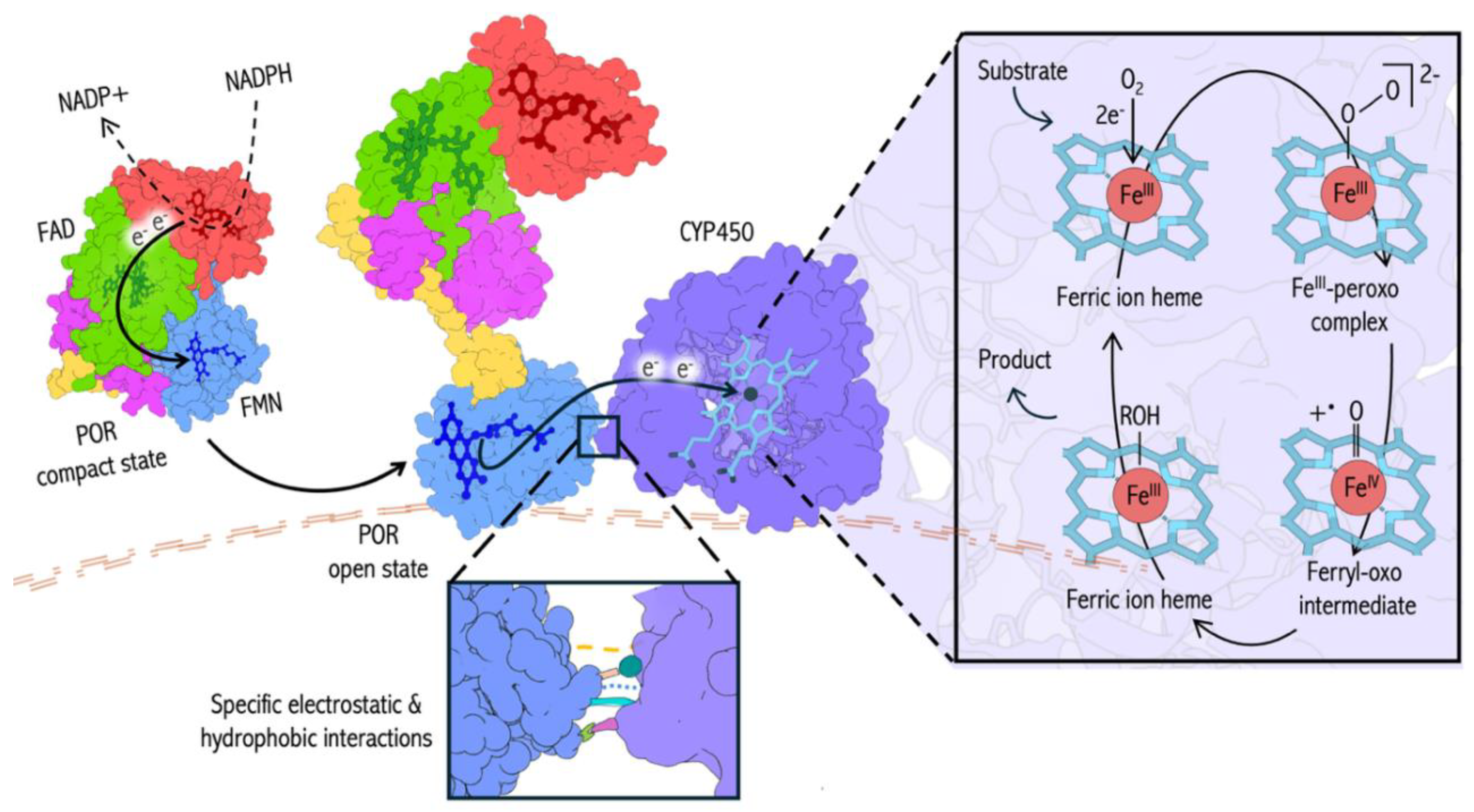
Figure 2.
Structural localization of POR variants analyzed in this study. Overview of the human POR protein showing the positions of the studied variants A287P, P228L, R457H, and delP399_E401 within the full-length protein and its three-dimensional structure. The four variants are highlighted in red on the structural model. Enlarged panels show the local structural environment of each variant: A287 in the FAD/NADPH-binding region, R457 in the FAD-binding region near the FAD cofactor, delP399_E401 in the linker region, and P228 in the hinge region. Dashed blue lines indicate local residue interactions that may be altered by each variant. The schematic at the bottom provides a simplified overview of the POR domain organization and the relative positions of the variants along the protein sequence. Structural visualization was prepared using UCSF ChimeraX-1.11.
Figure 2.
Structural localization of POR variants analyzed in this study. Overview of the human POR protein showing the positions of the studied variants A287P, P228L, R457H, and delP399_E401 within the full-length protein and its three-dimensional structure. The four variants are highlighted in red on the structural model. Enlarged panels show the local structural environment of each variant: A287 in the FAD/NADPH-binding region, R457 in the FAD-binding region near the FAD cofactor, delP399_E401 in the linker region, and P228 in the hinge region. Dashed blue lines indicate local residue interactions that may be altered by each variant. The schematic at the bottom provides a simplified overview of the POR domain organization and the relative positions of the variants along the protein sequence. Structural visualization was prepared using UCSF ChimeraX-1.11.
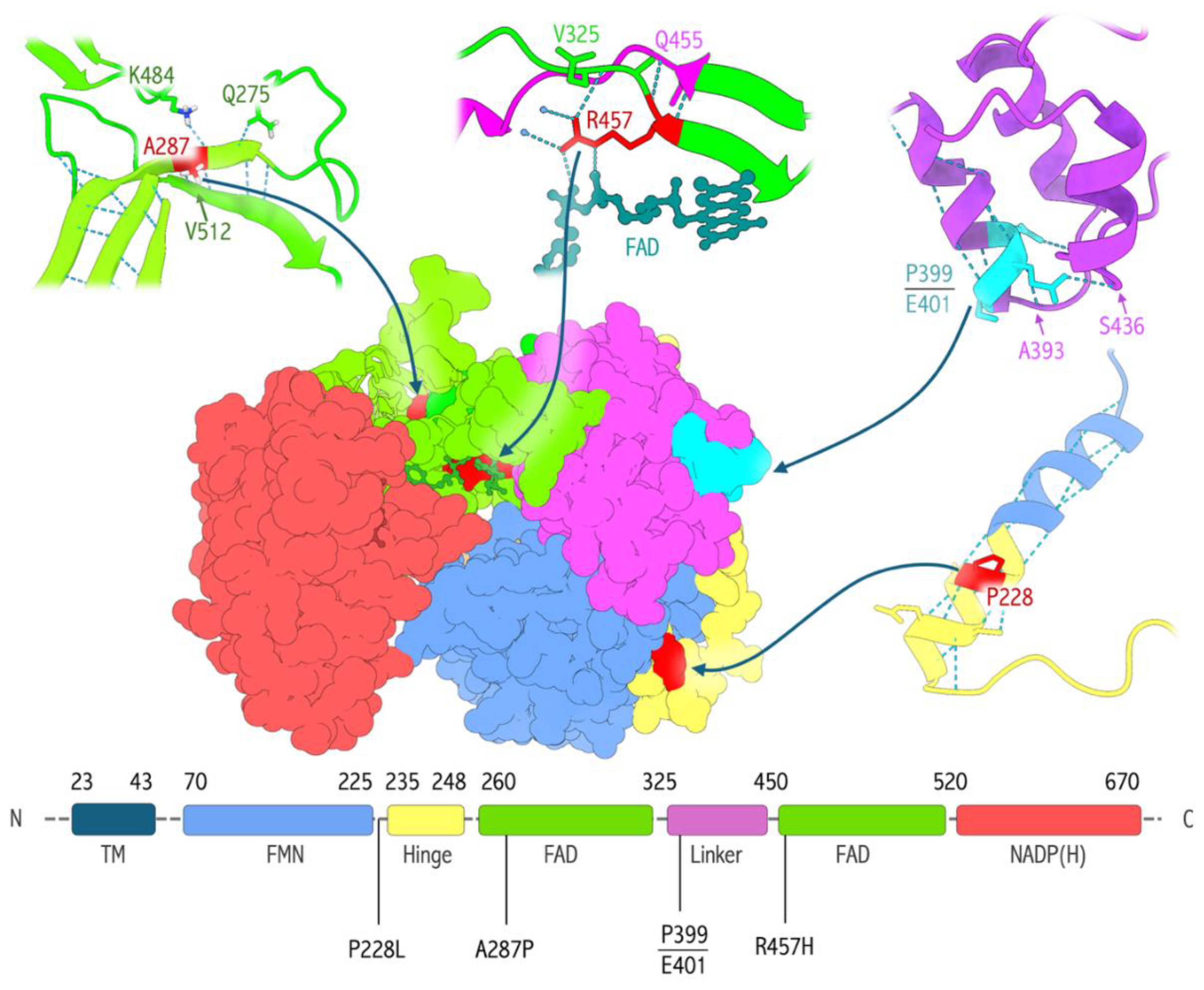
Figure 3.
RNA-seq profiling of steroidogenic gene expression in H295R cells and POR-deficient clones. Heatmaps show RNA-sequencing–derived gene expression levels (FPKM) of enzymes involved in the classical steroidogenic pathway (left) and the backdoor androgen pathway (right) in parental H295R cells and two independent POR-deficient H295R clones (T1-4 and T1-6]. Absolute FPKM values are represented by color intensity and annotated numerically within each cell. Expression values are reported to one decimal place. Null indicates that no transcripts were detected for the corresponding gene, whereas values shown as 0.0 FPKM denote detectable transcripts whose normalized expression rounds to zero at one-decimal precision. Expression levels are grouped into functional categories (negligible, extremely low, low, moderate, high) as indicated in the legend.
Figure 3.
RNA-seq profiling of steroidogenic gene expression in H295R cells and POR-deficient clones. Heatmaps show RNA-sequencing–derived gene expression levels (FPKM) of enzymes involved in the classical steroidogenic pathway (left) and the backdoor androgen pathway (right) in parental H295R cells and two independent POR-deficient H295R clones (T1-4 and T1-6]. Absolute FPKM values are represented by color intensity and annotated numerically within each cell. Expression values are reported to one decimal place. Null indicates that no transcripts were detected for the corresponding gene, whereas values shown as 0.0 FPKM denote detectable transcripts whose normalized expression rounds to zero at one-decimal precision. Expression levels are grouped into functional categories (negligible, extremely low, low, moderate, high) as indicated in the legend.
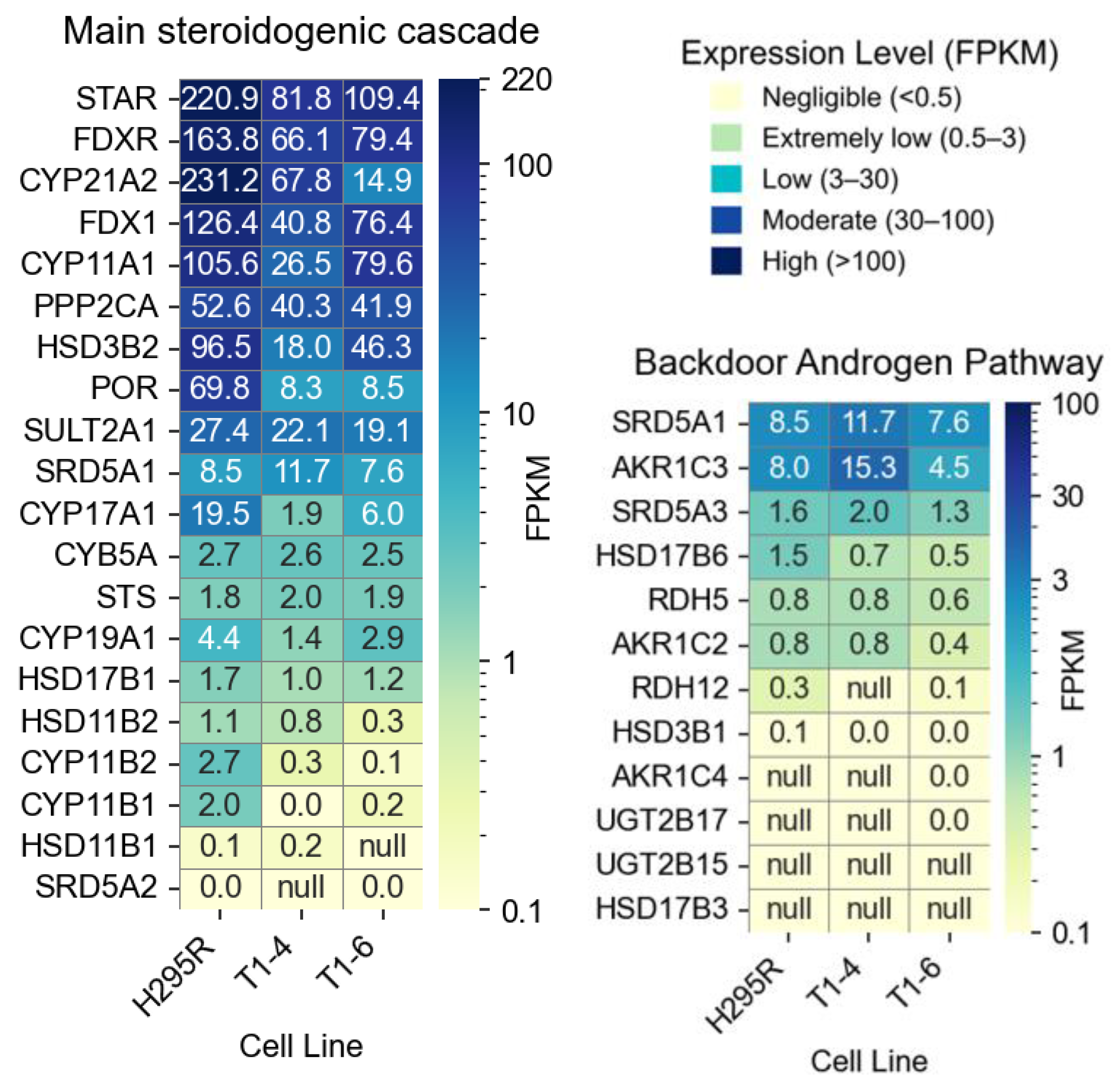
Figure 4.
Overview of “classic” and “alternative” steroidogenic pathways. The scheme depicts the principal steroidogenic pathways, from cholesterol conversion to pregnenolone by CYP11A1 to the synthesis of glucocorticoids, mineralocorticoids, and androgen intermediates. POR-dependent enzymes, including CYP17A1, CYP21A2, and CYP19A1, are highlighted together with the mitochondrial electron transfer system (FDX1/FDXR) supporting CYP11A1, CYP11B1, and CYP11B2. The inset shows the alternative androgen pathway, which is represented by low expression of several associated enzymes (highlighted in green). Abbreviations: DHEA, dehydroepiandrosterone; DHEA-S, DHEA sulfate; DHT, dihydrotestosterone; DHT-G, DHT glucuronide; Allo, allopregnanolone; 5α-DHP, 5α-dihydroprogesterone; 17-OH-allo, 17α-hydroxy-allopregnanolone.
Figure 4.
Overview of “classic” and “alternative” steroidogenic pathways. The scheme depicts the principal steroidogenic pathways, from cholesterol conversion to pregnenolone by CYP11A1 to the synthesis of glucocorticoids, mineralocorticoids, and androgen intermediates. POR-dependent enzymes, including CYP17A1, CYP21A2, and CYP19A1, are highlighted together with the mitochondrial electron transfer system (FDX1/FDXR) supporting CYP11A1, CYP11B1, and CYP11B2. The inset shows the alternative androgen pathway, which is represented by low expression of several associated enzymes (highlighted in green). Abbreviations: DHEA, dehydroepiandrosterone; DHEA-S, DHEA sulfate; DHT, dihydrotestosterone; DHT-G, DHT glucuronide; Allo, allopregnanolone; 5α-DHP, 5α-dihydroprogesterone; 17-OH-allo, 17α-hydroxy-allopregnanolone.
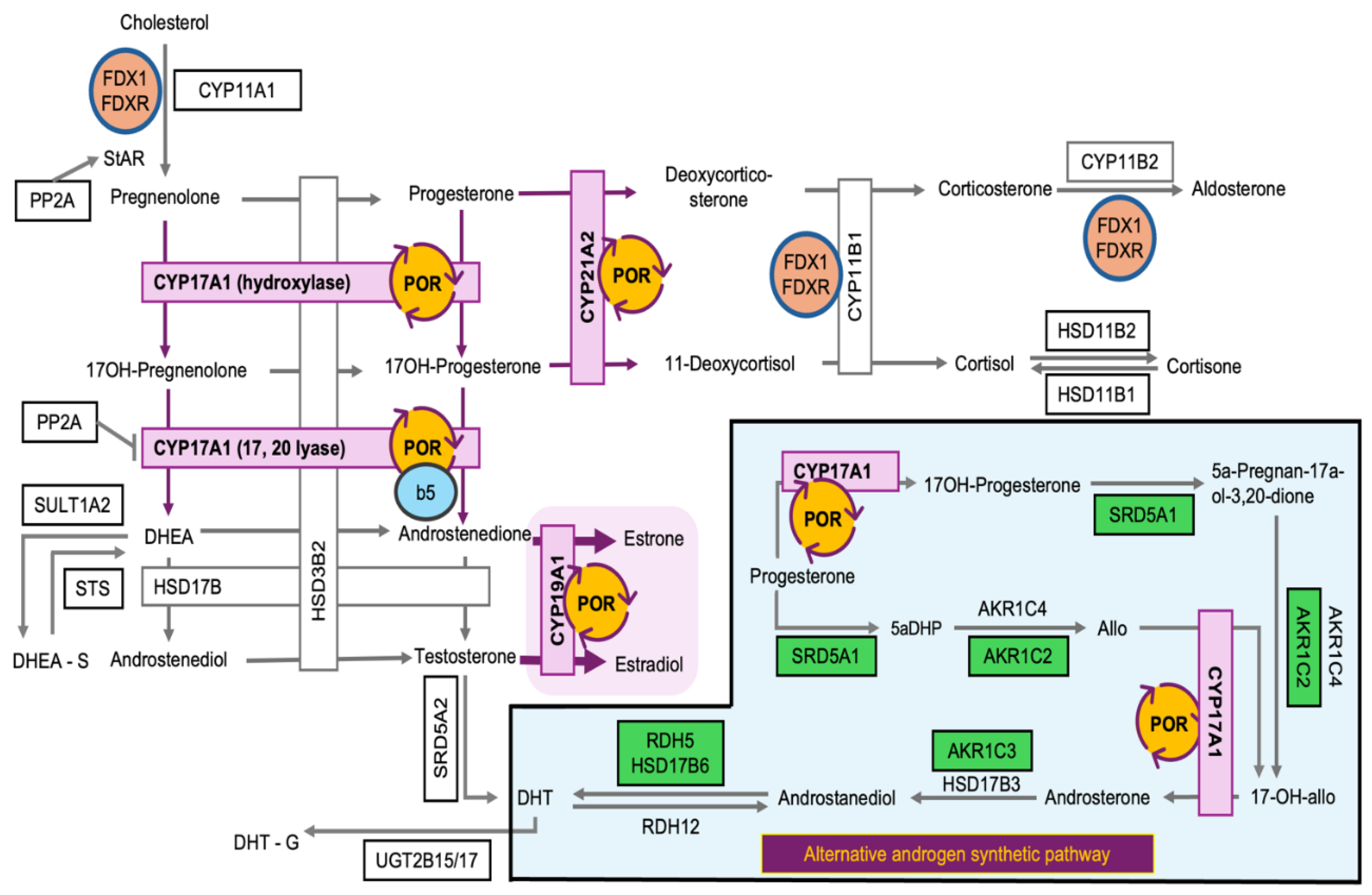
Figure 5.
Disruption of POR alters glucocorticoid pathway intermediates in H295R cells. Bar plots show steroid concentrations (nmol/L) measured by LC–MS/MS in H295R wild-type (WT) cells and two POR-knockout clones (T1-4 and T1-6) after 96 h and 48 h of cultivation (time points separated by the dashed vertical line). Panels quantify pregnenolone, progesterone, 17α-hydroxyprogesterone (17αOH progesterone), 17α-hydroxypregnenolone (17αOH pregnenolone), 11-deoxycortisol, and cortisol. POR knockout led to strong accumulation of upstream precursors (pregnenolone and progesterone), while downstream products of the POR-dependent glucocorticoid branch were markedly reduced or not detected (ND) in the knockout clones. The schematic on the right summarizes the pathway and highlights POR-dependent enzymatic steps: CYP17A1 hydroxylation, CYP21A2 conversion to 11-deoxycortisol, and subsequent formation of cortisol by CYP11B1. Assays were performed in triplicates and normalized by total protein quantification. Statistical significance is indicated as ns (not significant), * p<0.05, ** p<0.01, *** p<0.001.
Figure 5.
Disruption of POR alters glucocorticoid pathway intermediates in H295R cells. Bar plots show steroid concentrations (nmol/L) measured by LC–MS/MS in H295R wild-type (WT) cells and two POR-knockout clones (T1-4 and T1-6) after 96 h and 48 h of cultivation (time points separated by the dashed vertical line). Panels quantify pregnenolone, progesterone, 17α-hydroxyprogesterone (17αOH progesterone), 17α-hydroxypregnenolone (17αOH pregnenolone), 11-deoxycortisol, and cortisol. POR knockout led to strong accumulation of upstream precursors (pregnenolone and progesterone), while downstream products of the POR-dependent glucocorticoid branch were markedly reduced or not detected (ND) in the knockout clones. The schematic on the right summarizes the pathway and highlights POR-dependent enzymatic steps: CYP17A1 hydroxylation, CYP21A2 conversion to 11-deoxycortisol, and subsequent formation of cortisol by CYP11B1. Assays were performed in triplicates and normalized by total protein quantification. Statistical significance is indicated as ns (not significant), * p<0.05, ** p<0.01, *** p<0.001.
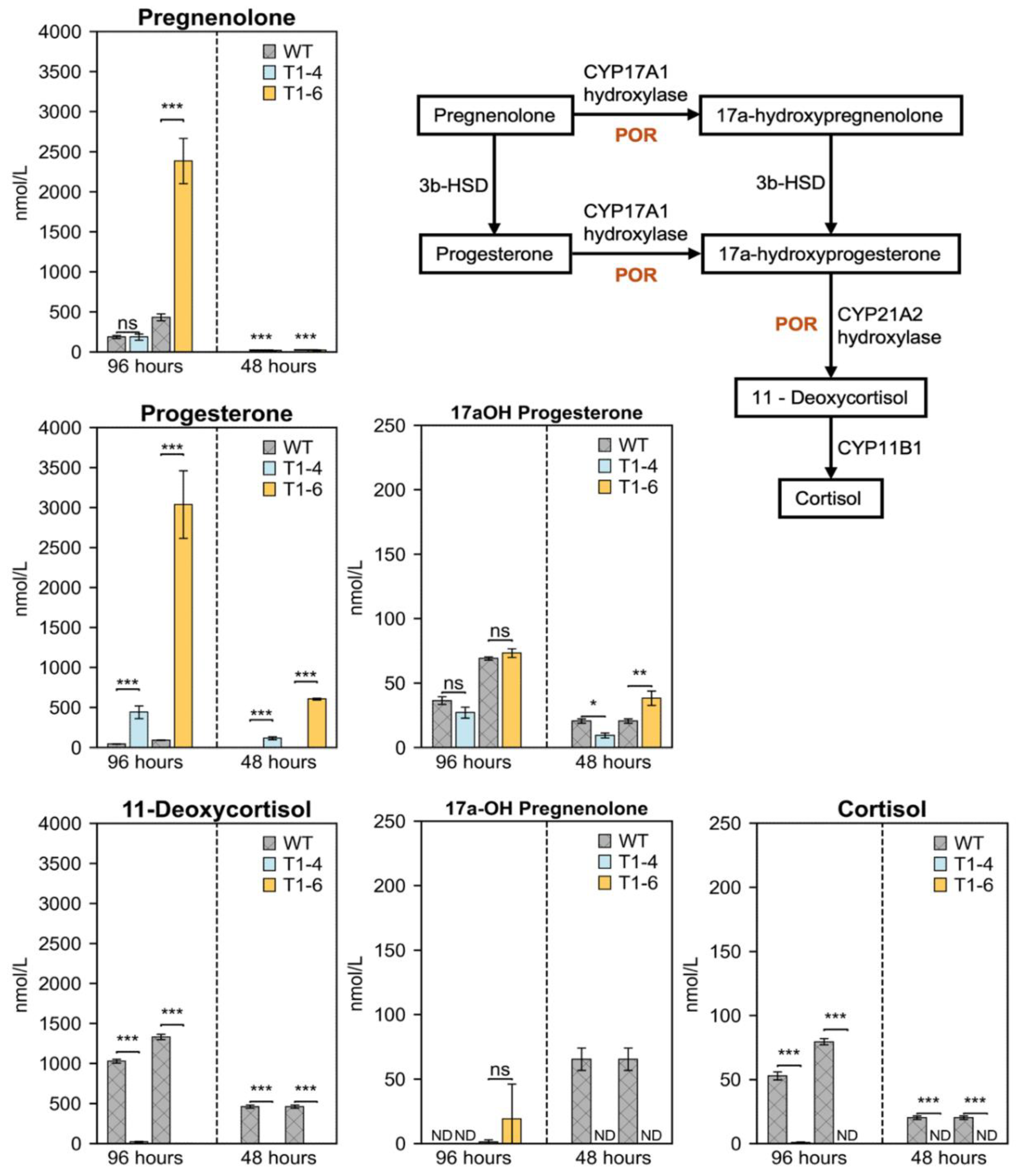
Figure 9.
CYP450 activities supported by wild-type (WT) POR and the POR mutants A287P, P228L, del399–401, and R457H in HEK293T cells. (A) CYP17A1 17α-hydroxylase activity was assessed in vitro by conversion of [¹⁴C]-progesterone to 17-hydroxyprogesterone in the presence of WT or mutant POR. Reaction products were separated and quantified by thin-layer chromatography (TLC). (B) CYP17A1 17,20-lyase activity was measured by quantification of [³H]-acetate produced during conversion of [³H]-17-hydroxypregnenolone to dehydroepiandrosterone (DHEA) in cell culture media. (C) CYP21A2 hydroxylase activity was assessed in vitro by conversion of [¹⁴C]-progesterone to 11-deoxycorticosterone, with products separated and quantified by TLC. (D) CYP19A1 aromatase activity was measured by conversion of androstenedione to estrone, quantified by counting tritiated water ([³H]₂O)[64] released into the culture medium as a reaction by-product.
Figure 9.
CYP450 activities supported by wild-type (WT) POR and the POR mutants A287P, P228L, del399–401, and R457H in HEK293T cells. (A) CYP17A1 17α-hydroxylase activity was assessed in vitro by conversion of [¹⁴C]-progesterone to 17-hydroxyprogesterone in the presence of WT or mutant POR. Reaction products were separated and quantified by thin-layer chromatography (TLC). (B) CYP17A1 17,20-lyase activity was measured by quantification of [³H]-acetate produced during conversion of [³H]-17-hydroxypregnenolone to dehydroepiandrosterone (DHEA) in cell culture media. (C) CYP21A2 hydroxylase activity was assessed in vitro by conversion of [¹⁴C]-progesterone to 11-deoxycorticosterone, with products separated and quantified by TLC. (D) CYP19A1 aromatase activity was measured by conversion of androstenedione to estrone, quantified by counting tritiated water ([³H]₂O)[64] released into the culture medium as a reaction by-product.
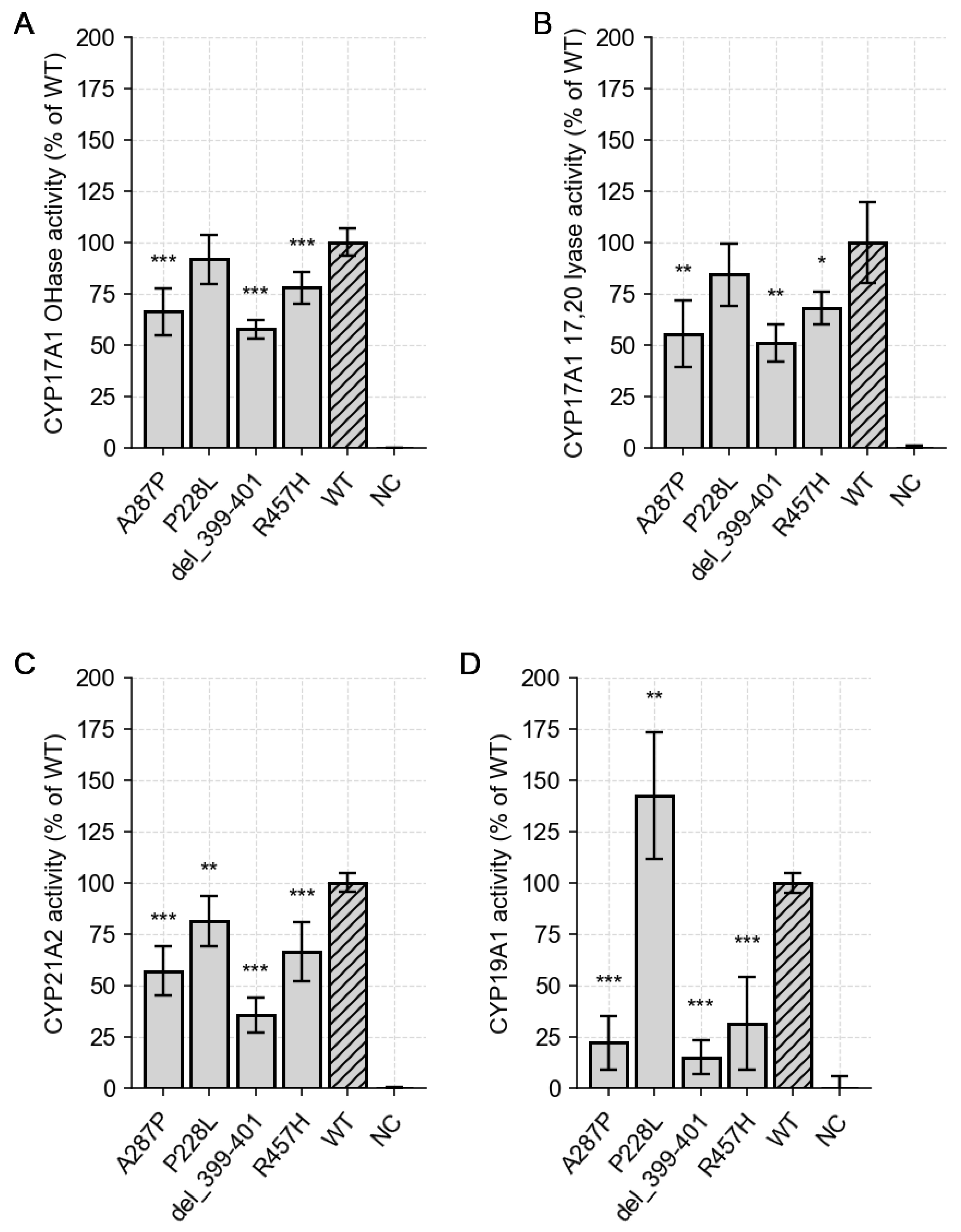
Figure 10.
Steroidogenic CYP450 activities in HEK293T POR p.P228L prime-edited cells. Activities of CYP21A2 21-hydroxylase, CYP17A1 17α-hydroxylase, CYP17A1 17,20-lyase, and CYP19A1 aromatase were measured in biallelic POR p.P228L prime-edited HEK293T cells and expressed as % of WT. The P228L variant retained only partial activity for all enzymes tested,. WT was normalized to 100%, and the negative control (NC) showed no detectable activity. Values represent mean ± SD.
Figure 10.
Steroidogenic CYP450 activities in HEK293T POR p.P228L prime-edited cells. Activities of CYP21A2 21-hydroxylase, CYP17A1 17α-hydroxylase, CYP17A1 17,20-lyase, and CYP19A1 aromatase were measured in biallelic POR p.P228L prime-edited HEK293T cells and expressed as % of WT. The P228L variant retained only partial activity for all enzymes tested,. WT was normalized to 100%, and the negative control (NC) showed no detectable activity. Values represent mean ± SD.
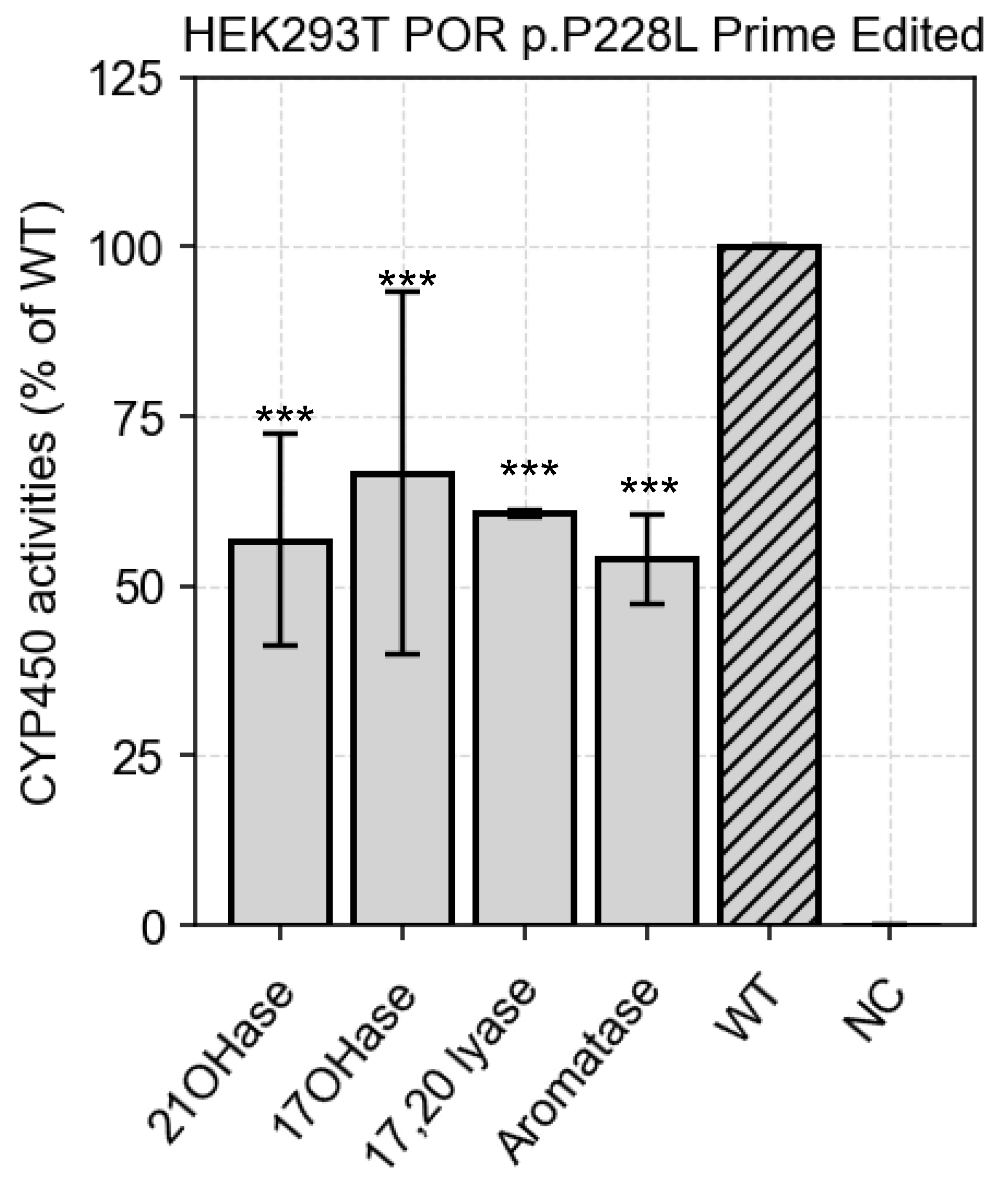
Figure 11.
Confocal analysis of intracellular Fe(II) in WT, POR knockout, and POR p.P228L cells. Representative confocal images of H295R and HEK293T cell models stained with Hoechst (blue, nuclei) and FerroOrange (FO) (red, intracellular Fe(II)). Bright-field (BF), single-channel, and merged images are shown for untreated cells, iron-supplemented cells, POR-modified cells, and cells treated with 2,2′-bipyridine (BPY) as an Fe(II) chelation control. In both cellular backgrounds, ammonium iron(II) treatment produced a strong FO signal, confirming efficient intracellular Fe(II) accumulation, whereas BPY reduced FO fluorescence, verifying signal specificity for Fe(II). Line-scan intensity plots at the right illustrate the distribution of Hoechst and FO fluorescence across selected regions.
Figure 11.
Confocal analysis of intracellular Fe(II) in WT, POR knockout, and POR p.P228L cells. Representative confocal images of H295R and HEK293T cell models stained with Hoechst (blue, nuclei) and FerroOrange (FO) (red, intracellular Fe(II)). Bright-field (BF), single-channel, and merged images are shown for untreated cells, iron-supplemented cells, POR-modified cells, and cells treated with 2,2′-bipyridine (BPY) as an Fe(II) chelation control. In both cellular backgrounds, ammonium iron(II) treatment produced a strong FO signal, confirming efficient intracellular Fe(II) accumulation, whereas BPY reduced FO fluorescence, verifying signal specificity for Fe(II). Line-scan intensity plots at the right illustrate the distribution of Hoechst and FO fluorescence across selected regions.
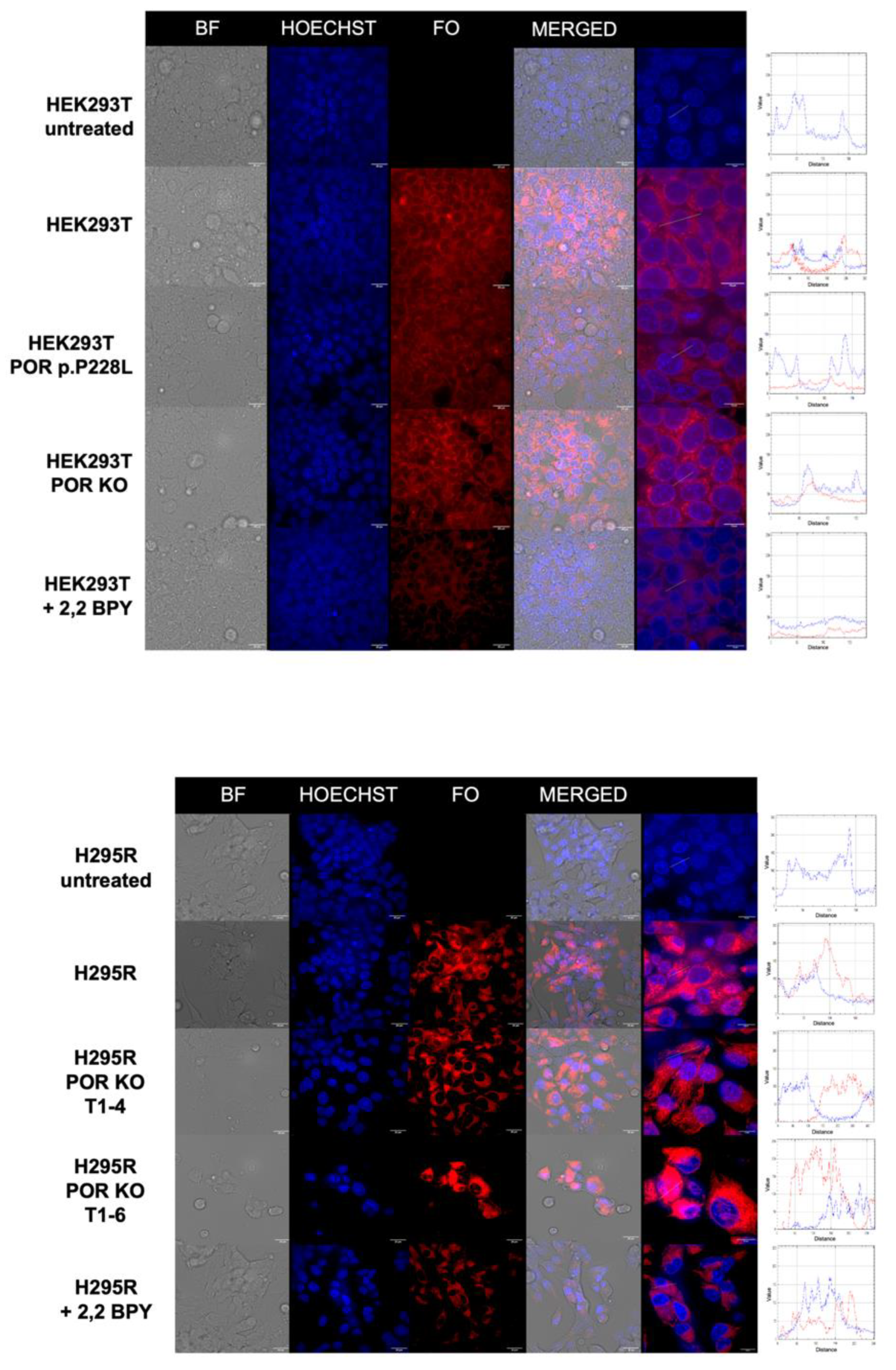

Table 1.
In vitro functional characterization for the POR mutants A287P, P228L, del399-401, and R457H in HEK293T cells. Data are presented as mean activities (% of wild-type POR) for POR major steroidogenic partners CYP17A1, CYP21A2, and CYP19A1. The wild-type POR activity is set to 100%. Statistical comparisons were performed between c.P228L and WT using a two-tailed t-test. *p < 0.05, **p < 0.01, ***p < 0.001.
Table 1.
In vitro functional characterization for the POR mutants A287P, P228L, del399-401, and R457H in HEK293T cells. Data are presented as mean activities (% of wild-type POR) for POR major steroidogenic partners CYP17A1, CYP21A2, and CYP19A1. The wild-type POR activity is set to 100%. Statistical comparisons were performed between c.P228L and WT using a two-tailed t-test. *p < 0.05, **p < 0.01, ***p < 0.001.
| CYP17A1 hydroxylase activity | ||
| Mutant | Mean % of CYP17A1 activity (±SD) | p-value (T-test) |
| A287P | 66.1 (± 11.4) | 9 x 10⁻⁵ (***) |
| P228L | 91.7 (± 12.0) | 0.13 (ns) |
| del399-401 | 57.7 (± 4.5) | 6 x 10⁻⁸ (***) |
| R457H | 78.0 (± 7.7) | 1 x 10⁻⁴ (***) |
| CYP17A1 17,20-lyase activity | ||
| Mutant | Mean % of CYP17A1 activity (±SD) | p-value (T-test) |
| A287P | 55.5 (± 16.4) | 0.008 (**) |
| P228L | 84.3 (± 15.1) | 0.194 (ns) |
| del399-401 | 51.1 (± 9.0) | 0.006 (**) |
| R457H | 68.1 (± 8.0) | 0.022 (*) |
| CYP21A2 hydroxylase activity | ||
| Mutant | Mean % of CYP21A2 activity (±SD) | p-value (T-test) |
| A287P | 57.1(± 11.9) | 4 x 10⁻⁵ (***) |
| P228L | 81.2 (± 12.3) | 0.006 (**) |
| del399-401 | 35.7 (± 8.4) | 5 x 10⁻⁸ (***) |
| R457H | 66.4 (± 14.4) | 7 x 10⁻⁴ (***) |
| CYP19A1 aromatase activity | ||
| Mutant | Mean % of CYP19A1 activity (±SD) | p-value (T-test) |
| A287P | 22.1 (± 12.9) | 2 x 10⁻⁹ (***) |
| P228L | 142.5 (± 30.8) | 0.001 (**) |
| del399-401 | 14.9 (± 8.2) | 1 x 10-13 (***) |
| R457H | 31.4 (± 22.5) | 4 x 10⁻⁶ (***) |
Table 2.
In vitro functional characterization for the POR metabolic partners in HEK293T POR c.P228L cell line. Data are presented as mean activities from 3 independent experiments as % of wild-type POR for its major steroidogenic partners CYP17A1, CYP21A2, and CYP19A1. The wild-type POR activity is set to 100%. Statistical comparisons were performed between c.P228L and WT using a two-tailed t-test. *p < 0.05, **p < 0.01, ***p < 0.001.
Table 2.
In vitro functional characterization for the POR metabolic partners in HEK293T POR c.P228L cell line. Data are presented as mean activities from 3 independent experiments as % of wild-type POR for its major steroidogenic partners CYP17A1, CYP21A2, and CYP19A1. The wild-type POR activity is set to 100%. Statistical comparisons were performed between c.P228L and WT using a two-tailed t-test. *p < 0.05, **p < 0.01, ***p < 0.001.
| POR c.P228L activities towards metabolic partners | ||
|---|---|---|
| Metabolic partner | Mean % of WT activity (±SD) | p-value (T-test) |
| CYP21A2 | 53.0 (± 12.3) | 0.001 (***) |
| CYP17A1 - OHase | 58.4 (± 21.9) | 0.013 (***) |
| CYP17A1 - 17, 20 lyase | 60.6 (± 0.5) | 5 x 10⁻⁵ (***) |
| CYP19A1 aromatase | 53.9 (± 6.7) | 0.007 (***) |
Disclaimer/Publisher’s Note: The statements, opinions and data contained in all publications are solely those of the individual author(s) and contributor(s) and not of MDPI and/or the editor(s). MDPI and/or the editor(s) disclaim responsibility for any injury to people or property resulting from any ideas, methods, instructions or products referred to in the content. |
© 2026 by the authors. Licensee MDPI, Basel, Switzerland. This article is an open access article distributed under the terms and conditions of the Creative Commons Attribution (CC BY) license (http://creativecommons.org/licenses/by/4.0/).
Copyright: This open access article is published under a Creative Commons CC BY 4.0 license, which permit the free download, distribution, and reuse, provided that the author and preprint are cited in any reuse.


