

Submitted:
11 April 2026
Posted:
13 April 2026
You are already at the latest version
Abstract
Background: Live BCG vaccination is absolutely contraindicated in Severe Combined Immunodeficiency (SCID) due to the invariably fatal risk of disseminated BCGosis [5,6,7]. This creates a critical unmet need: SCID neonates are deprived of BCG's potent heterologous protection precisely when they are most vulnerable to opportunistic infections. Hypothesis: Heat-Killed BCG (HK-BCG), being entirely non-viable, cannot cause BCGosis or systemic mycobacterial disease. We propose that HK-BCG retains sufficient structural pattern-associated molecular patterns (PAMPs) to engage functional innate immune cells — specifically monocytes, macrophages, and NK cells — that remain present in the majority of SCID subtypes, thereby inducing trained immunity and heterologous protection without adaptive immune cell dependency [2,3,4]. Methods/Evidence: This paper synthesizes molecular mechanism data on TLR2/TLR4/NOD2-driven trained immunity [23,24], epigenetic reprogramming pathways [2,3], SCID immunophenotype data [32,33], and available non-viable mycobacterial clinical trial evidence [34] to construct a mechanistic and clinical rationale for HK-BCG use in SCID.Conclusions: HK-BCG represents a paradigm-shifting, potentially life-saving immunomodulatory platform for SCID patients. The complete absence of viable bacilli eliminates all infectious risk, while preserved mycobacterial PAMPs can train the residual innate immune compartment. This approach is particularly compelling in the post-HSCT reconstitution window. A dedicated Phase I/IIa clinical trial in SCID is urgently warranted.
Keywords:
heat-killed BCG
; SCID
; Trained immunity
; primary immunodeficiency
; BCGosis
; innate immunity
; epigenetic reprogramming
; HSCT
; TLR2
; heterologous protection
1. Introduction: The Paradox of BCG and SCID
For more than a century, the Bacillus Calmette-Guérin (BCG) vaccine has served as the foundational prophylactic intervention against tuberculosis (TB) and the primary intravesical immunotherapy for non-muscle-invasive bladder cancer (NMIBC) [1,13]. Originally developed through in vitro attenuation of a virulent Mycobacterium bovis strain over 13 years, live BCG has been administered in over four billion doses globally since 1921. Despite its unparalleled historical success in mitigating severe disseminated forms of childhood tuberculosis — miliary TB and tuberculous meningitis — the contemporary clinical landscape has increasingly exposed the profound limitations intrinsic to live-attenuated bacterial therapies [1,28].
The fundamental challenge surrounding live BCG is what has been termed the ‘viability paradox.’ Historical consensus dictated that the therapeutic efficacy of BCG — specifically its potent adjuvant properties and its ability to stimulate comprehensive cellular immunity — was inextricably dependent on bacterial viability and the active secretion of specific protein antigens within the host [15,29]. However, this reliance on live bacilli introduces severe clinical liabilities that become lethal in the context of primary immunodeficiency [5,7].
Nowhere is this paradox more devastating than in infants with Severe Combined Immunodeficiency (SCID). These children lack functional T lymphocytes (and often B lymphocytes and/or NK cells), rendering them completely unable to contain any live mycobacterial organism [32,33]. Administration of live BCG to a SCID infant — a standard newborn vaccination in over 130 countries — is tantamount to introducing an active mycobacterial infection into a host with no cellular defense. The result is invariably disseminated BCGosis: a fatal, multi-organ mycobacterial disease for which treatment options are extremely limited [7]. As documented at King Faisal Specialist Hospital, the crude mortality rate among SCID patients developing BCGitis was 36.7%, with 66.7% of these fatalities directly attributable to disseminated mycobacterial disease [6].
Saudi Arabia’s Ministry of Health implemented in 2019 a policy to postpone BCG vaccination from birth to six months of age to allow TREC-based SCID screening [6]. However, this creates a secondary vulnerability: SCID infants who remain undiagnosed are left unprotected from the severe opportunistic infections for which BCG’s heterologous immunity would have provided critical, early-life protection. The current paradigm forces a binary, zero-sum choice: protect against BCGosis OR provide heterologous immunity [1,3].
The central thesis of this paper is that Heat-Killed BCG (HK-BCG) resolves this paradox entirely. By preserving the structural PAMPs that drive trained immunity while completely eliminating bacterial viability, HK-BCG can provide the heterologous immune benefits of BCG to SCID infants without any risk of BCGosis — because dead bacteria cannot disseminate, replicate, or cause infection regardless of the host’s immune status [4]. This is not merely an incremental improvement; it is a categorical paradigm shift.
2. The Molecular Architecture of Trained Immunity
Classical immunology previously maintained a strict dichotomy between the rapid, non-specific responses of the innate immune system and the long-term, highly specific memory generated by the adaptive immune system. The discovery of trained immunity (TI) fundamentally disrupted this binary model [8]. Trained immunity denotes a de facto memory-like process within innate immune cells — monocytes, macrophages, and natural killer (NK) cells — enabling them to undergo sustained functional reprogramming following an initial primary stimulus [2,3].
HK-BCG and Heat-Killed Mycobacterium tuberculosis (HKMtb) have been definitively established as potent inducers of trained immunity both in vitro and in vivo [4]. This is the mechanistic foundation upon which the SCID application rests.
2.1. Receptor Engagement and Metabolic Reprogramming
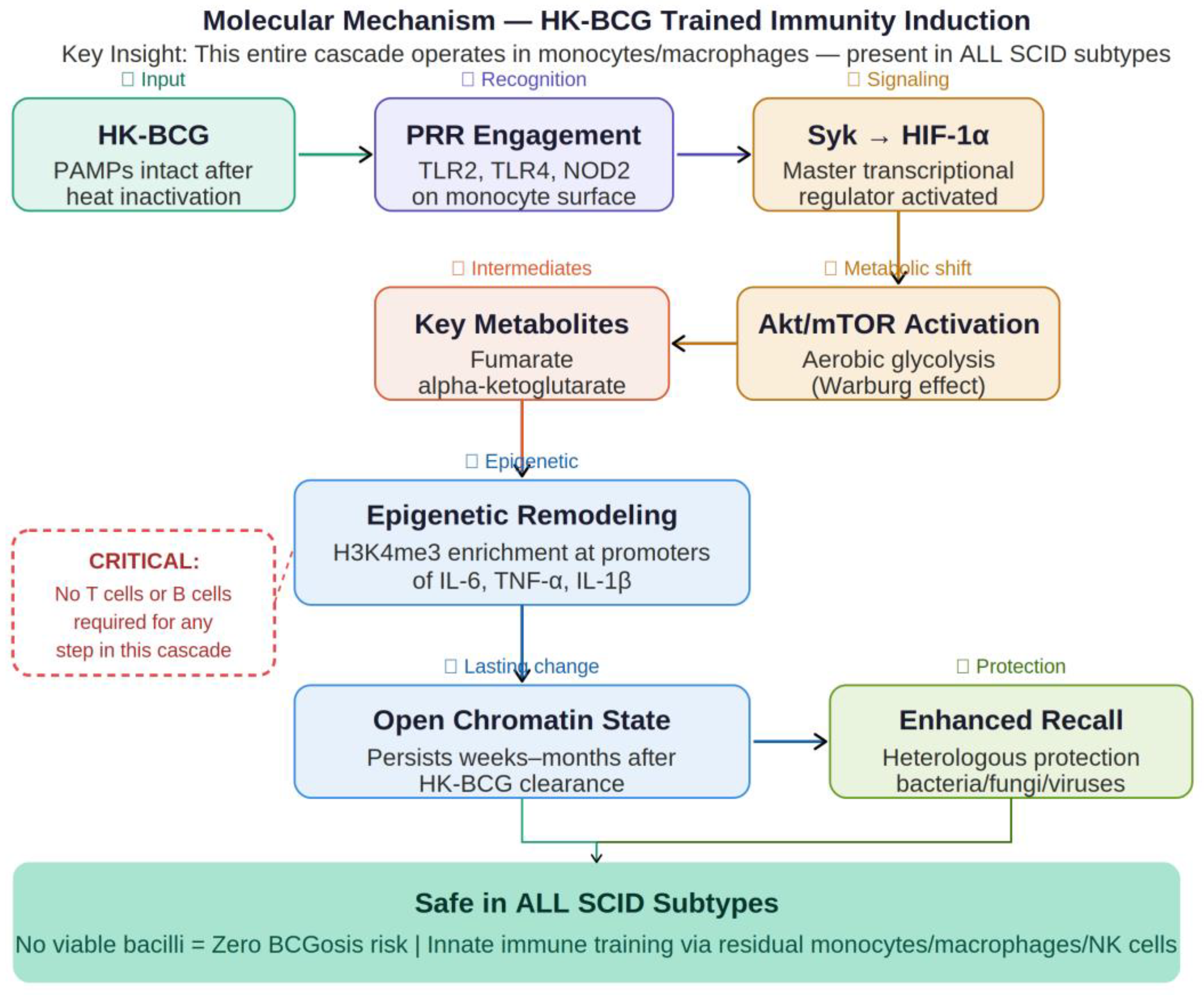
Induction of trained immunity by heat-killed mycobacteria is initiated through engagement of specific Pattern Recognition Receptors (PRRs). The complex glycolipid architecture of the mycobacterial cell wall — which remains structurally intact despite thermal inactivation — is recognized primarily by Toll-like Receptor 2 (TLR2), Toll-like Receptor 4 (TLR4), and the intracellular Nucleotide-binding Oligomerization Domain-containing protein 2 (NOD2) [11,23]. Upon binding, a highly orchestrated intracellular signaling cascade is triggered.
A critical early event is the activation of Spleen Tyrosine Kinase (Syk) and the downstream stabilization of Hypoxia-Inducible Factor 1-alpha (HIF-1α). HIF-1α acts as a master transcriptional regulator that mediates a profound shift in cellular metabolism, driving the transition from oxidative phosphorylation toward aerobic glycolysis — the Warburg effect [2]. Concurrently, the Akt/mTOR signaling pathway is activated. This metabolic reorganization is the fundamental prerequisite for trained immunity establishment: the glycolytic shift and TCA cycle alterations generate intermediate metabolites (fumarate, alpha-ketoglutarate) that serve as essential co-factors for epigenetic enzymes [2,3].
2.2. Epigenetic Modifications and Cytokine Profiling
The metabolites generated by the Akt/mTOR-driven glycolytic shift directly facilitate epigenetic reprogramming of the monocyte or macrophage. This reprogramming is characterized by precise alterations in DNA methylation patterns and post-translational histone modifications — such as specific histone methylation (H3K4me3) and acetylation marks (H3K27ac) — at the promoter regions of genes encoding critical inflammatory cytokines [23,24]. Through this epigenetic remodeling, the chromatin surrounding the promoters for Interleukin-6 (IL-6), Interleukin-1 beta (IL-1β), and Tumor Necrosis Factor-alpha (TNF-α) is maintained in an ‘open’ and highly accessible configuration long after the initial HK-BCG stimulus has been cleared [2,9].
Extensive cytokine profiling in infant studies using a 42-plex bead array demonstrated that trained immunity induces significant increases in eleven distinct cytokines and chemokines upon restimulation, including EGF, IL-6, IL-7, IL-8, IL-10, IL-12p40, MCP-3, MIP-1α, soluble CD40 ligand, and PDGF-AB/BB — elevations observed consistently across diverse secondary stimuli including Candida albicans and Staphylococcus aureus [25,26]. This heterologous protection profile is particularly valuable for SCID patients, who are vulnerable to a broad spectrum of opportunistic pathogens [10].
Figure 1.
Molecular mechanism of HK-BCG-induced trained immunity. The intact mycobacterial PAMPs engage TLR2, TLR4, and NOD2 on monocyte/macrophage surfaces. Downstream Syk activation stabilizes HIF-1α, driving the Warburg metabolic shift and mTOR activation. The resulting metabolic intermediates (fumarate, alpha-ketoglutarate) directly fuel epigenetic remodeling enzymes, creating open chromatin states at cytokine promoters (IL-6, TNF-α, IL-1β) that persist long after HK-BCG clearance. Critically, this entire cascade operates in monocytes and macrophages — cell lineages present and functional in the majority of SCID subtypes.
Figure 1.
Molecular mechanism of HK-BCG-induced trained immunity. The intact mycobacterial PAMPs engage TLR2, TLR4, and NOD2 on monocyte/macrophage surfaces. Downstream Syk activation stabilizes HIF-1α, driving the Warburg metabolic shift and mTOR activation. The resulting metabolic intermediates (fumarate, alpha-ketoglutarate) directly fuel epigenetic remodeling enzymes, creating open chromatin states at cytokine promoters (IL-6, TNF-α, IL-1β) that persist long after HK-BCG clearance. Critically, this entire cascade operates in monocytes and macrophages — cell lineages present and functional in the majority of SCID subtypes.
2.3. The Cytokine Paradox: Amplified Recall vs. Systemic Dampening
A nuanced second-order insight is the dual, seemingly paradoxical effect of HK-BCG on the host’s inflammatory baseline. While HK-BCG training primes innate immune cells to secrete massive levels of pro-inflammatory cytokines strictly upon secondary restimulation, it simultaneously reduces the baseline level of systemic inflammation in the absence of an acute infectious trigger [27]. This unique immunomodulatory profile — lowering baseline ‘noise’ of chronic inflammation while maximizing ‘signal’ during acute pathogen encounters — is especially relevant for SCID patients, who are often in a state of dysregulated inflammation even prior to HSCT [30].
3. The Paradigm-Shifting Application: HK-BCG for SCID
Standard immunological teaching holds that vaccines cannot benefit SCID patients because adaptive immunity is absent. HK-BCG bypasses this assumption entirely by targeting the innate immune compartment — which remains partially or fully functional in most SCID subtypes — through a mechanism (trained immunity) that operates independently of T and B lymphocytes [2,4,8].
3.1. Understanding SCID: The Immunological Landscape
Severe Combined Immunodeficiency (SCID) encompasses a heterogeneous group of life-threatening primary immunodeficiency disorders characterized by the absence or dysfunction of T lymphocytes, invariably accompanied by impaired B lymphocyte function and, in many subtypes, absent NK cells [32,33]. SCID represents the most severe end of the primary immunodeficiency spectrum, with an estimated incidence of 1 in 50,000 to 1 in 100,000 live births globally — though significantly higher in populations with elevated rates of consanguinity, such as those in the Arabian Peninsula [6].
A critical but frequently overlooked principle in SCID immunobiology is that the profound T and B lymphocyte deficiency does not eliminate the myeloid compartment. Monocytes, macrophages, dendritic cells, and — depending on the genetic defect — NK cells remain present and may retain functional competence [32]. It is precisely this residual innate immune architecture that forms the mechanistic basis for the HK-BCG–SCID hypothesis.

Table 1.
SCID Subtypes — Innate Immune Landscape and Predicted HK-BCG Therapeutic Potential.
| SCID Subtype | T cells | B cells | NK cells | HK-BCG Innate Target | Predicted HK-BCG Benefit |
|---|---|---|---|---|---|
| X-linked SCID (IL2RG) | Absent | Present (non-functional) | Absent | Monocytes, Macrophages, DCs | Moderate — monocyte trained immunity; bridge to HSCT |
| RAG1/RAG2 Deficiency | Absent | Absent | Present | NK cells + Monocytes + Macrophages | HIGH — NK cell training + monocyte epigenetic priming |
| ADA Deficiency | Absent | Absent | Absent | Monocytes (variable function) | Low-Moderate — dependent on ERT restoration |
| Jak3 Deficiency | Absent | Present | Absent | Monocytes, Macrophages | Moderate — innate arm partially trainable |
| Post-HSCT Reconstitution | Recons. | Recons. | Recons. | All innate + emerging adaptive | OPTIMAL — HK-BCG as post-HSCT immune priming platform |
This subtype analysis reveals a critically important stratification principle: HK-BCG benefit is NOT uniform across all SCID genotypes. The NK cell status functions as a predictive biomarker for the magnitude of innate immune training achievable [32]. RAG1/2-deficient patients (T⁻B⁻NK⁺ phenotype) represent the most immunologically amenable subgroup, while ADA-deficient patients with panhypocellular marrow may derive limited benefit until enzyme replacement restores innate cell populations [33].
3.2. Mechanistic Rationale: Why HK-BCG Can Work in SCID
The traditional vaccine paradigm requires intact adaptive immunity: antigen is processed by dendritic cells, presented to T cells via MHC-II, T cells are activated and differentiate, and immunological memory is generated through clonal expansion. This entire pathway is abolished in SCID [32]. HK-BCG operates through an entirely distinct mechanism that circumvents the adaptive arm [2,4].
3.2.1. Monocyte and Macrophage Training
Monocytes and macrophages — derived from the myeloid lineage — are present in all SCID subtypes. In most variants, these cells retain functional TLR signaling, intact Syk/HIF-1α pathways, and operational mTOR/glycolytic machinery [32]. The epigenetic reprogramming of these cells by HK-BCG PAMPs does not require T cell help, co-stimulatory signals from lymphocytes, or any aspect of adaptive immune function [2,23]. HK-BCG acts directly on the myeloid cell’s intrinsic epigenetic machinery through metabolic intermediates.
SCID monocytes and macrophages, primed by HK-BCG, would be epigenetically equipped to mount dramatically enhanced inflammatory responses against bacterial, fungal, and viral pathogens upon subsequent challenge [4,24] — providing precisely the heterologous protection that BCG’s trained immunity confers in immunocompetent infants [10,25], but now safely accessible to the SCID infant.
3.2.2. NK Cell Training in T⁻B⁻NK⁺ SCID Subtypes
In SCID subtypes with preserved NK cell populations (notably RAG1/RAG2 deficiency), the therapeutic potential of HK-BCG extends beyond monocytes. NK cells are well-established targets of trained immunity induction [3,24]. BCG-driven NK cell training results in enhanced cytotoxicity against virus-infected cells, improved IFN-γ production, and augmented antibody-dependent cellular cytotoxicity (ADCC). For RAG-deficient SCID patients — who often survive for months before HSCT — NK cell training via HK-BCG could provide a critical early-life protection window against herpesviruses, RSV, and other opportunistic viral pathogens [25].
3.2.3. Dendritic Cell Activation and Post-HSCT Priming
Perhaps the most clinically compelling application of HK-BCG in SCID is in the post-HSCT reconstitution window. Following hematopoietic stem cell transplantation, immune reconstitution proceeds from the innate compartment outward: myeloid cells repopulate within weeks to months, while full T and B cell reconstitution may require 6–24 months [33]. This creates a prolonged ‘innate window’ during which the patient possesses functional myeloid cells but limited adaptive immune defenses. Administration of HK-BCG during this window — when live BCG would remain dangerous — could train the reconstituting innate immune system to provide broad-spectrum protection while adaptive immunity matures [4].
HK-BCG’s documented capacity to induce dendritic cell maturation — upregulation of CD40, CD80, CD83, CD86; secretion of IL-12p40 and TNF-α [11] — would actively accelerate the priming of newly reconstituted naive T cells derived from the graft, potentially shortening the adaptive reconstitution timeline through enhanced antigen presentation.
Figure 2.
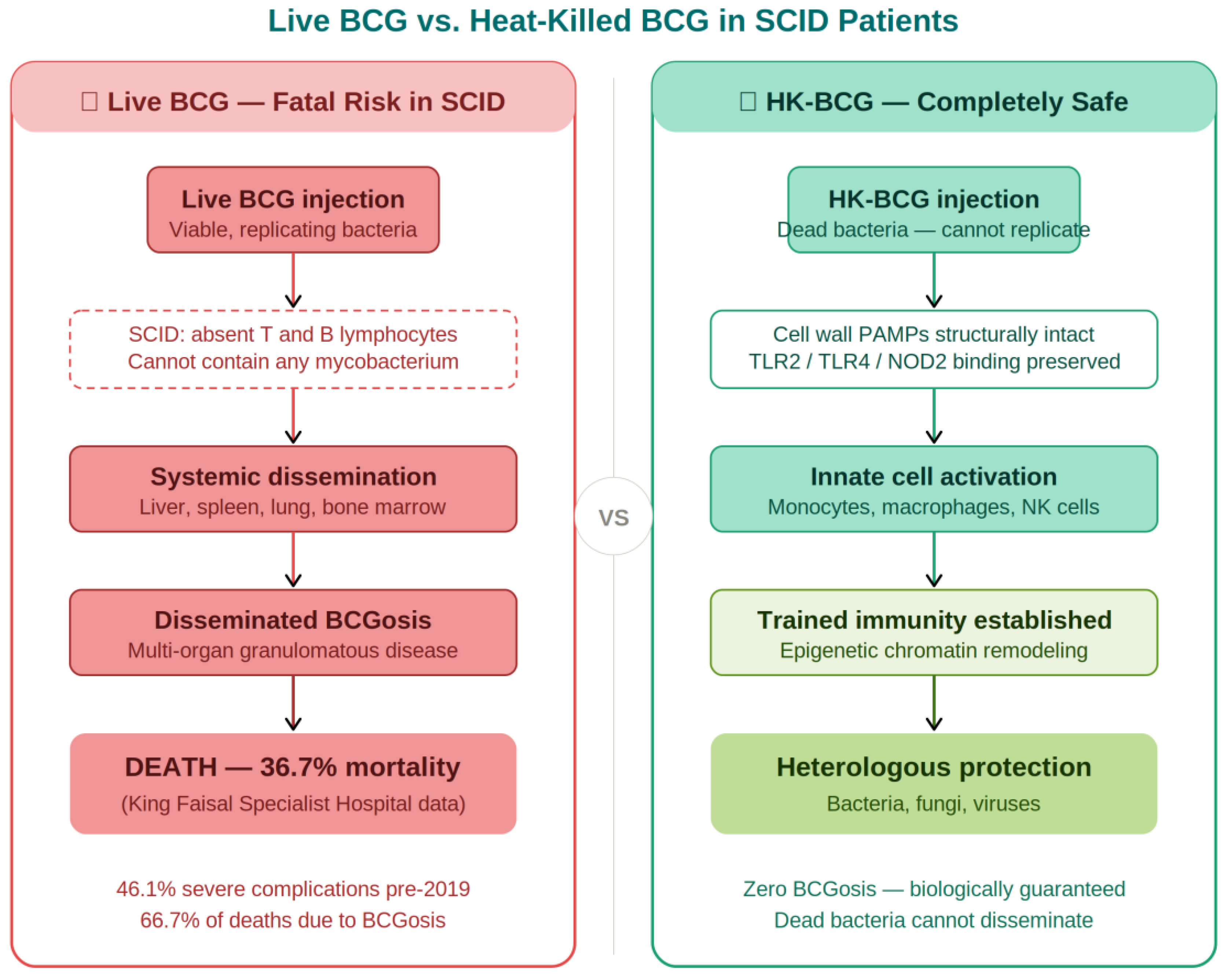
Comparative outcome model of Live BCG vs. HK-BCG in SCID patients. (A) Live BCG administration in an undiagnosed SCID infant: viable mycobacteria disseminate to liver, spleen, lung, and bone marrow, establishing fatal BCGosis. (B) HK-BCG administration: structurally intact but non-viable mycobacterial PAMPs engage TLR2/TLR4/NOD2 on functional monocytes, macrophages, and NK cells, inducing trained immunity with zero viable bacilli and absolute elimination of BCGosis risk.
Figure 2.
Comparative outcome model of Live BCG vs. HK-BCG in SCID patients. (A) Live BCG administration in an undiagnosed SCID infant: viable mycobacteria disseminate to liver, spleen, lung, and bone marrow, establishing fatal BCGosis. (B) HK-BCG administration: structurally intact but non-viable mycobacterial PAMPs engage TLR2/TLR4/NOD2 on functional monocytes, macrophages, and NK cells, inducing trained immunity with zero viable bacilli and absolute elimination of BCGosis risk.
3.3. Safety Profile in SCID: The Definitive Case
The safety case for HK-BCG in SCID is not a probability argument — it is a biological absolute. BCGosis requires viable, replicating mycobacteria to establish systemic infection [5,7]. Heat-killed BCG contains no viable bacilli. Dead bacteria cannot replicate, cannot disseminate, cannot establish granulomas in immunocompromised tissue, and cannot cause BCGosis [4]. This represents a categorical safety advantage that no live-attenuated modification, dose reduction, or vaccination scheduling protocol can match.
Documented safety data support this: HK-BCG significantly increases NO levels and achieves meaningful tumor cytotoxicity in bladder cancer models while maintaining zero infectious risk [15]. Phase 1 data on BCG-CWS in advanced malignancy patients demonstrated no systemic adverse events at therapeutic doses [34].
3.4. Clinical Implementation: A Proposed Framework
The translation of the HK-BCG–SCID hypothesis into clinical practice requires a carefully staged framework.
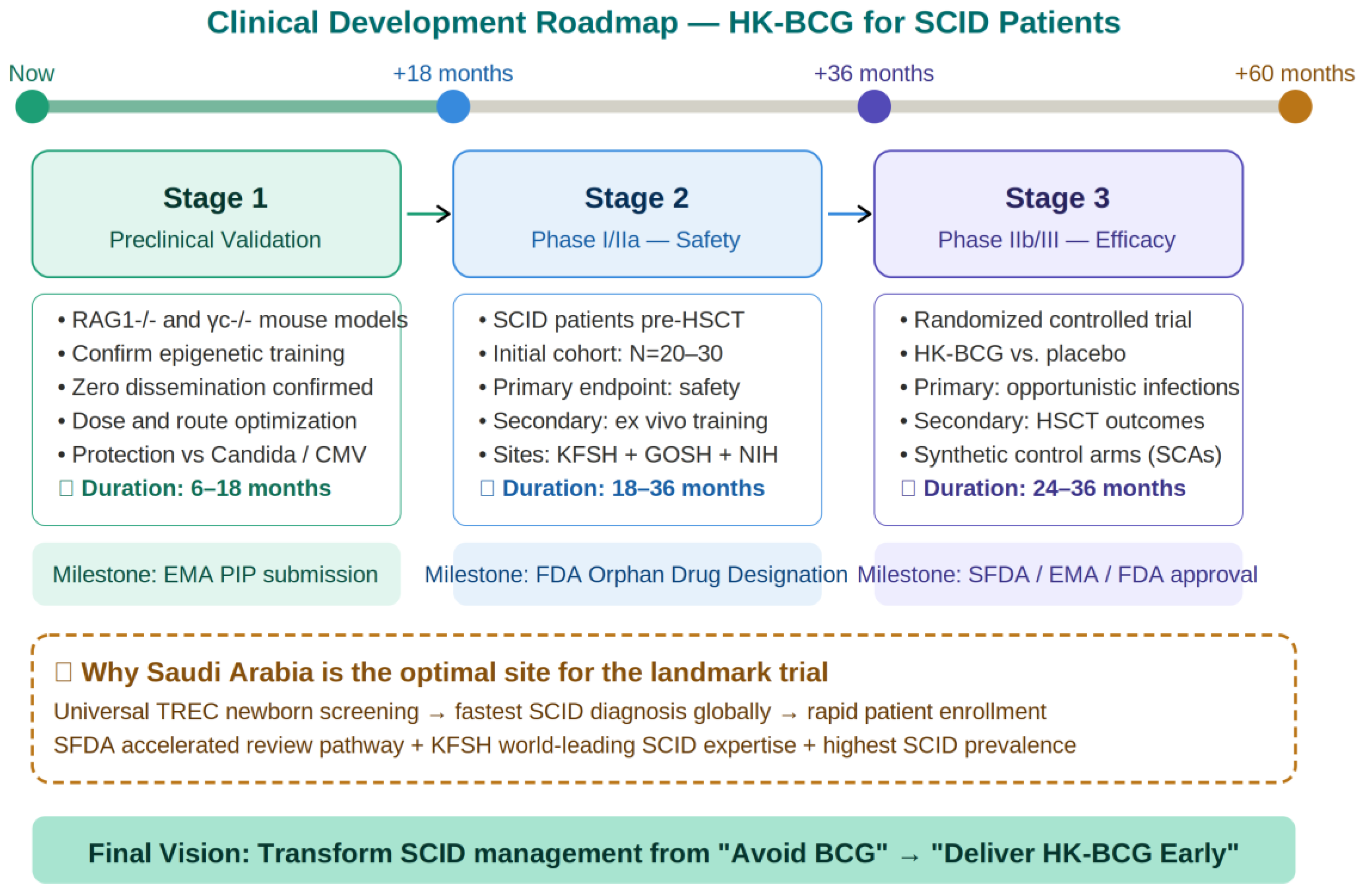
Stage 1: Preclinical Validation (6–18 months). Establish trained immunity induction capacity of standardized HK-BCG preparations in SCID mouse models (RAG1⁻/⁻ and γc⁻/⁻ mice), specifically assessing monocyte and macrophage epigenetic reprogramming (H3K4me3 at IL-6, TNF-α promoters) and NK cell activation in RAG1⁻/⁻ models. Quantify in vivo protection against Candida albicans, Staphylococcus aureus, and murine CMV challenge in HK-BCG-primed SCID mice versus untreated controls. Confirm absolute absence of mycobacterial dissemination via PCR, culture, and histopathology at 30, 60, and 90 days post-administration.
Stage 2: Phase I/IIa Open-Label Safety Trial (18–48 months). Primary endpoint: Safety and tolerability of HK-BCG in SCID patients — specifically absence of BCGosis, systemic inflammation, or treatment-emergent serious adverse events. Secondary endpoints: Induction of monocyte trained immunity (ex vivo cytokine recall assays at 1, 3, 6 months); NK cell activation markers (CD69, NKG2D, IFN-γ production) in NK⁺ SCID subtypes. Population: SCID patients diagnosed via TREC screening, prior to HSCT. Proposed sites: King Faisal Specialist Hospital (Riyadh) [6], Great Ormond Street Hospital (London), and NIH Clinical Center (United States).
Stage 3: Phase IIb/III Efficacy Trial. Randomized controlled trial: HK-BCG vs. placebo in newly diagnosed SCID patients prior to HSCT. Primary endpoint: Incidence of culture-confirmed opportunistic infections in the 90 days preceding HSCT. Secondary endpoints: Transplant outcomes (engraftment rates, GvHD incidence, OS), innate immune reconstitution speed post-HSCT.
Figure 3.
Clinical development roadmap for HK-BCG in SCID. The proposed 3-stage pathway progresses from SCID murine model validation (Stage 1) through Phase I/IIa safety trials (Stage 2) to Phase IIb/III efficacy trials (Stage 3). Key regulatory milestones include EMA PIP submission, FDA Orphan Drug Designation, and SFDA accelerated approval pathway. Saudi Arabia represents the optimal trial site given the TREC-based universal newborn screening program, KFSH expertise, and high SCID prevalence.
Figure 3.
Clinical development roadmap for HK-BCG in SCID. The proposed 3-stage pathway progresses from SCID murine model validation (Stage 1) through Phase I/IIa safety trials (Stage 2) to Phase IIb/III efficacy trials (Stage 3). Key regulatory milestones include EMA PIP submission, FDA Orphan Drug Designation, and SFDA accelerated approval pathway. Saudi Arabia represents the optimal trial site given the TREC-based universal newborn screening program, KFSH expertise, and high SCID prevalence.
3.5. Theoretical Limitations and Counterarguments
Scientific integrity demands thorough examination of the limitations of the HK-BCG–SCID hypothesis.
Counterargument 1: SCID monocytes may have impaired PRR signaling. Some SCID variants, particularly those with hypomorphic RAG mutations or Omenn syndrome, present with dysregulated innate immune activation [33]. TLR signaling may be aberrant or paradoxically hyperactive, potentially limiting predictable induction of trained immunity. Rebuttal: This concern argues for subtype-stratified dosing protocols and immunophenotypic screening before HK-BCG administration — not for excluding the approach.
Counterargument 2: Trained immunity is transient without adaptive reinforcement. In immunocompetent individuals, trained immunity is durably maintained partly through interactions between trained monocytes and activating T cell signals [8]. In the absence of T cells, trained immunity might decay more rapidly. Rebuttal: Even transient trained immunity — lasting weeks to months — is clinically valuable during the pre-HSCT vulnerability window. Serial dosing protocols could address durability concerns.
Counterargument 3: The MDSC induction concern. HK-BCG induces monocytic MDSCs that can suppress DC and T cell function [21,22]. In SCID, where T cells are absent, MDSC suppression of T cells is irrelevant. However, MDSC-mediated suppression of dendritic cell function could theoretically impair the innate arm’s antigen-presenting capacity. Rebuttal: The ATRA-based MDSC depletion strategy demonstrated in murine models provides a pharmacological solution [21]. Co-administration of HK-BCG with low-dose ATRA could prevent this limitation.
4. The Myeloid-Derived Suppressor Cell (MDSC) Evasion Mechanism
While the induction of trained immunity highlights the therapeutic potential of HK-BCG, a critical insight involves the induction of Myeloid-Derived Suppressor Cells (MDSCs) — a heterogeneous population of immature myeloid cells that profoundly suppress T-cell activation and dendritic cell function [21].
Immunization with HKMtb induces significant, systemic accumulation of monocytic MDSCs (M-MDSCs) in the spleen and peripheral blood [22]. However, murine models present a paradoxical outcome: mice vaccinated with heat-killed mycobacteria still demonstrated robust protection against subsequent live BCG infections, exhibiting elevated frequencies of highly activated dendritic cells and mycobacteria-specific T cells, effectively overriding the suppressive activity of induced M-MDSCs [21].
In SCID patients, MDSC-mediated T cell suppression is largely irrelevant because there are no T cells to suppress. Emerging evidence suggests that the trained immunity of mature monocytes and macrophages is established prior to the MDSC accumulation response, and that the epigenetic modifications conferring trained immunity are cell-intrinsic and relatively resistant to external MDSC suppression [2,21]. Pharmacological MDSC depletion with all-trans retinoic acid (ATRA) represents a validated combinatorial strategy that could be co-administered with HK-BCG in SCID patients [21].
5. Fractionation and Formulation Engineering: The BCG Cell Wall Skeleton
To isolate the potent immunostimulatory benefits of BCG from both the infectious risks and the immunosuppressive phenomena triggered by the whole bacterium, biotechnological efforts have focused on the BCG Cell Wall Skeleton (BCG-CWS) — a highly purified, non-infectious macromolecular complex composed primarily of peptidoglycan, arabinogalactan, and mycolic acids [16].
BCG-CWS functions as the central immune activator of BCG, concentrating the PAMPs required for massive TLR2 and TLR4-dependent signaling [11]. In vitro exposure of human immature dendritic cells to BCG-CWS induces phenotypic and functional maturation virtually indistinguishable from that induced by viable BCG, characterized by upregulation of CD40, CD80, CD83, and CD86, and robust secretion of TNF-α, IL-6, and IL-12 p40 [11,16].
5.1. Nanoparticle Encapsulation — Enabling Systemic Delivery
BCG-CWS is an exceptionally large, hydrophobic macromolecule historically formulated as a toxic oil-in-water emulsion. A major breakthrough involves the Liposome-based Encapsulation by Evaporation and Lyophilization (LEEL) method, packaging BCG-CWS into stable, nanometer-sized liposomal carriers [12]. This transformation enables systemic intravenous delivery, targeted cellular uptake, and synergistic AMPK/mTOR pathway activation — with particularly potent tumor-suppressive effects in bladder cancer models [12,18].
Liposomal BCG-CWS offers a potentially superior platform for SCID compared to whole-cell HK-BCG for two reasons: (1) the removal of bulk bacterial components reduces the potential for non-specific inflammatory responses, which may be preferable in the delicate SCID immunological environment; and (2) functionalized liposomes can be engineered to preferentially target specific myeloid cell populations via surface ligands, potentially maximizing innate training while minimizing bystander effects [12].
6. Clinical Applications in Urologic Oncology: NMIBC
The immunomodulatory profile of BCG therapies is most prominently utilized in urologic oncology. Bladder cancer ranks as the ninth most common malignancy globally, of which Non-Muscle-Invasive Bladder Cancer (NMIBC) comprises approximately 75% [13]. The gold standard following transurethral resection of bladder tumor (TURBT) is adjuvant intravesical immunotherapy using live BCG [13,17].
In comparative cohorts, Kaplan-Meier analyses over 24-month follow-up reveal significantly higher recurrence-free survival in BCG-treated patients compared to Mitomycin C (MMC). Recurrence rates favor BCG at 12 months (13.29% vs. 22.38%; p=0.037) and 24 months (23.78% vs. 34.27%; p=0.043) [20]. Strain-specific differences in BCG efficacy have also been characterized in real-world and network meta-analysis data [13,14,19].
HK-BCG and liposomal BCG-CWS present compelling non-infectious alternatives. In human bladder cancer cell lines (T24 and 253J), HK-BCG significantly increases Nitric Oxide (NO) levels and reduces metabolically active cancer cells to approximately 55–62% of control values, while viable BCG achieves reductions to 33–34% [15]. While this represents a modest efficacy reduction, it is achieved with complete elimination of systemic BCGosis risk [16,17].
Table 2.
Comparative Profiles of Intravesical NMIBC Therapeutics.
| Agent | Status | Advantages | Limitations | Safe in SCID? |
|---|---|---|---|---|
| Live BCG | Live attenuated | Highest immunogenicity; proven clinical record | Fatal BCGosis in SCID; cold chain dependency | CONTRAINDICATED — Fatal risk |
| Mitomycin C | Chemotherapy | No infection risk; usable post-op | No immunological memory; higher recurrence vs BCG | Tolerable, but no immune benefit |
| HK-BCG | Non-viable whole | Zero infection risk; trains innate immunity; thermal stability | Slightly reduced cytotoxicity; MDSC induction (addressable) | SAFE — Cannot cause BCGosis |
| Liposomal BCG-CWS | Purified fraction | Activates AMPK; IV delivery possible; highly dispersible | Requires LEEL nanomanufacturing; limited PID data | Potentially SAFE — requires PID studies |
7. Next-Generation Combinatorial Therapeutics
The oncological landscape is shifting toward combinatorial strategies. A leading example is the integration of BCG with ANKTIVA (nogapendekin alfa inbakicept-pmln), a novel Interleukin-15 (IL-15) superagonist complex designed to stimulate the proliferation and activation of NK cells, CD8⁺ killer T cells, and memory T cells [17].
In the pivotal Phase 2 QUILT 2.005 trial, the combination of ANKTIVA plus BCG demonstrated profound superiority over BCG monotherapy: 85% complete response (CR) at six months versus 57% for BCG alone; and 84% CR at nine months versus 52% (p=0.0455). Saudi Arabia’s SFDA granted accelerated approval to ANKTIVA plus BCG for BCG-unresponsive NMIBC [17].
The combination of HK-BCG (for innate training via TLR pathways) with an IL-15 superagonist (for NK cell expansion and activation) represents an entirely novel combination immunotherapy concept for SCID patients. In T⁻B⁻NK⁺ SCID, this combination could simultaneously train monocyte/macrophage epigenetic responses via HK-BCG and expand and activate the NK cell compartment via IL-15, providing dual-arm innate immune reinforcement [3,24]. This synergy has no analog in current SCID management and warrants dedicated preclinical investigation.
8. Dermatological and Mucosal Applications
In dermatology, inactivated mycobacteria are increasingly deployed for intralesional immunotherapy. Mycobacterium indicus pranii (MIP) — a non-pathogenic, heat-killed atypical mycobacterium sharing extensive B-cell and T-cell determinants with M. tuberculosis and M. leprae — possesses significantly higher TLR2 agonist activity than BCG due to dense surface exposure of TLR2 ligands [37]. In patients with severe recalcitrant disease (averaging >40 warts per patient), complete clearance was achieved in 54.5% of cases, with 84.1% demonstrating >75% clearance and 86.3% showing distant wart clearance — a hallmark of systemic trained immunity [35,36,38,39].
In respiratory applications, mucosal administration of HK-BCG exerts profound regulatory effects on pulmonary immunology in OVA-challenged murine asthma models. The protective mechanism is entirely dependent on IFN-γ and involves suppression of Th2-driven eosinophilia through reduced IL-5 production [30]. Because intranasal HK-BCG eliminates the risk of pulmonary mycobacterial infection inherent to live BCG, it represents a safe candidate for mucosal asthma vaccination — including in immunocompromised patients [4,30].
9. Safety Profiles and the Immunocompromised Host
The most devastating complication of live BCG is disseminated BCG disease (BCGosis), with a global risk estimated at 1.56–4.29 cases per million doses administered [5]. This risk is concentrated almost exclusively in infants with SCID, Mendelian Susceptibility to Mycobacterial Disease (MSMD), Chronic Granulomatous Disease (CGD), and symptomatic HIV infection [5,7].
Saudi Arabia’s 2019 policy to postpone universal BCG vaccination from birth to six months reduced severe BCG-related complications in SCID patients from 46.1% to a remarkable 2.6% [6]. The crude mortality rate among SCID patients who developed BCGitis prior to this policy was 36.7%, with 66.7% of fatalities directly linked to disseminated mycobacterial disease [6]. This public health success validates the severity of the problem and simultaneously identifies Saudi Arabia as the ideal site for a landmark HK-BCG–SCID clinical trial.
HK-BCG offers a risk-free alternative. Because it contains absolutely no viable bacilli, HK-BCG cannot cause BCGitis or disseminated BCGosis regardless of the patient’s underlying immunological status [4]. It effectively uncouples the profound benefits of trained immunity from the hazards of iatrogenic infection — potentially allowing restoration of early neonatal vaccination windows and providing critical early-life heterologous immunity without endangering undiagnosed immunodeficient infants [1,6,40].
Figure 4.
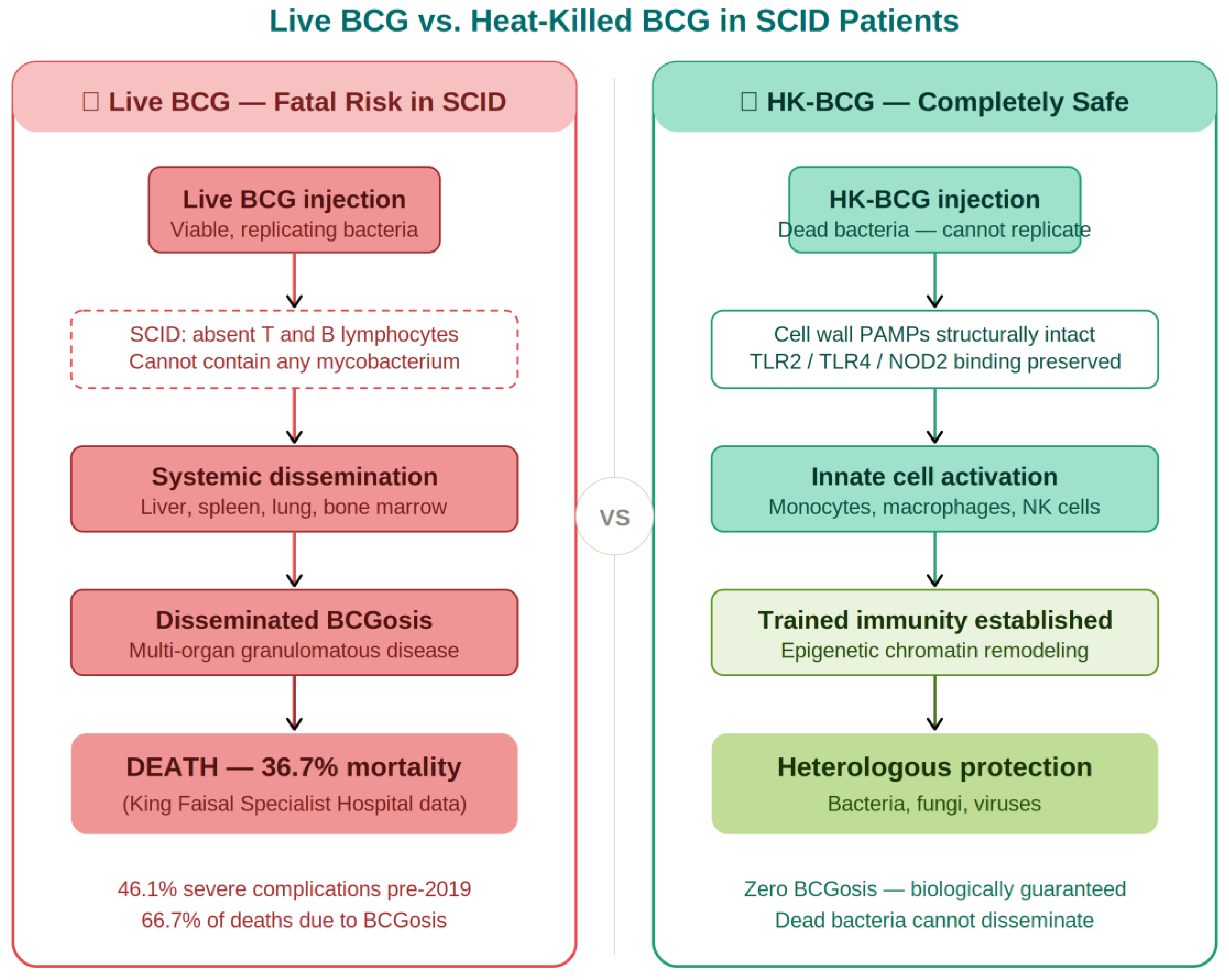
BCGosis risk stratification across patient populations. Live BCG carries a BCGosis risk of 1.56–4.29 per million doses in immunocompetent individuals, escalating to 46.1% severe complication rate in SCID patients (pre-2019 Saudi Arabia data). HK-BCG eliminates BCGosis risk to zero across all immunological strata — not probabilistically, but by absolute biological mechanism: dead bacteria cannot replicate or disseminate regardless of host immune status.
Figure 4.
BCGosis risk stratification across patient populations. Live BCG carries a BCGosis risk of 1.56–4.29 per million doses in immunocompetent individuals, escalating to 46.1% severe complication rate in SCID patients (pre-2019 Saudi Arabia data). HK-BCG eliminates BCGosis risk to zero across all immunological strata — not probabilistically, but by absolute biological mechanism: dead bacteria cannot replicate or disseminate regardless of host immune status.
10. Global Supply Chain, Thermal Stability, and Regulatory Modernization
Beyond elimination of infectious risk, HK-BCG solves a massive logistical bottleneck: cold chain fragility. Live BCG requires continuous storage within +2 °C to +8 °C parameters, with up to 80% of bacterial biomass damaged during homogenization and lyophilization [31]. Major manufacturers, including Sanofi (TheraCys strain), have permanently discontinued production, severely constricting global supply for both TB prophylaxis and bladder cancer therapy [17].
HK-BCG and purified fractions like BCG-CWS exhibit exceptional thermal stability, as their immunomodulatory mechanisms rely entirely on stable structural PAMPs rather than active bacterial metabolism [4,12]. This completely eliminates cold-chain dependency, reducing global distribution costs and enabling reliable delivery to the remote, resource-limited populations in which SCID incidence is paradoxically highest due to consanguinity [6].
11. Conclusions
The transition from live-attenuated BCG to Heat-Killed BCG and its fractionated derivatives represents a profound maturation in precision immunotherapy. The historical assumption that bacterial viability was an absolute prerequisite for therapeutic efficacy has been dismantled by the elucidation of trained immunity [2,3,8]. Through the engagement of NOD2, TLR2, and TLR4 pathways [23], the induction of glycolytic metabolic shifts via HIF-1α and mTOR [2], and subsequent epigenetic remodeling of chromatin [24], non-viable mycobacterial components effectively hardwire the innate immune system for enhanced, long-term responsiveness.
We identify six key innovations proposed in this paper: (1) the first systematic scientific rationale for HK-BCG as a safe immunomodulatory platform in SCID; (2) a novel SCID subtype-specific analysis framework predicting HK-BCG therapeutic potential based on NK cell, monocyte, and macrophage availability across SCID genotypes; (3) identification of the post-HSCT innate reconstitution window as the optimal clinical context for HK-BCG administration; (4) a novel HK-BCG + IL-15 superagonist combination hypothesis for NK⁺ SCID subtypes; (5) application of ATRA-mediated MDSC depletion as a rational co-intervention; and (6) recognition of Saudi Arabia’s TREC-based SCID screening program as the globally optimal infrastructure for a landmark HK-BCG–SCID Phase I/IIa clinical trial [6].
The application of this principle to SCID — a clinical population for whom live BCG represents not a vaccine but a death sentence — is the logical, scientifically sound, and ethically imperative next frontier of HK-BCG research. By eradicating the risk of disseminated BCGosis while providing safe innate immune training, HK-BCG could transform SCID management from a purely defensive posture (screening to avoid BCG) to an actively protective one (screening to deliver HK-BCG early). This shift from harm avoidance to immune empowerment is the true paradigm shift that this paper advances.
Acknowledgments
The authors acknowledge the use of AI-assisted tools (Claude, Anthropic) in manuscript preparation, literature synthesis, and reference formatting. All scientific content, hypotheses, and clinical recommendations were conceived, reviewed, and validated by the authors, who take full responsibility for the accuracy and integrity of this work.
Conflict of Interest Statement
The authors declare that the research was conducted in the absence of any commercial or financial relationships that could be construed as a potential conflict of interest.
References
- Aksungur, N.; Odabaşı, Ş; Çetin, İ; et al. Unleashing the power of the BCG vaccine in modulating viral immunity through heterologous protection: a scoping review. Hum Vaccin Immunother. 2025, 21, 2521190. [Google Scholar] [CrossRef]
- Chen, J.; Gao, L.; Wu, X.; et al. BCG-induced trained immunity: history, mechanisms and potential applications. J Transl Med. 2023, 21, 106. [Google Scholar] [CrossRef]
- Covián, C.; Fernández-Fierro, A.; Retamal-Díaz, A.; et al. BCG-induced cross-protection and development of trained immunity: implication for vaccine design. Front Immunol. 2019, 10, 2806. [Google Scholar] [CrossRef] [PubMed]
- Ciarlo, E.; Heinonen, T.; Théroude, C.; et al. Heat-killed Mycobacterium tuberculosis induces trained immunity in vitro and in vivo administered systemically or intranasally. iScience 2024, 27, 108563. [Google Scholar] [CrossRef]
- Al-Herz, W.; Essa, S.; Rezk, A. BCGitis and BCGosis: clinical spectrum, immunological mechanisms, and risk management. Vaccines (Basel) 2025, 13, 1179. [Google Scholar] [CrossRef]
- Aldhaheri, A.; Alyabes, O.; Aljumaah, S.; et al. The effects of postponing BCG vaccination on the risk of BCG-related complications among patients with severe combined immunodeficiency disease in Saudi Arabia. Front Immunol. 2025, 16, 1596963. [Google Scholar] [CrossRef]
- Marciano, B.E.; Huang, C.Y.; Joshi, G.; et al. BCG vaccination in patients with severe combined immunodeficiency: complications, risks, and vaccination policies. J Allergy Clin Immunol. 2014, 133, 1134–1141. [Google Scholar] [CrossRef]
- Netea, M.G.; Giamarellos-Bourboulis, E.J.; Domínguez-Andrés, J.; et al. Trained immunity: a tool for reducing susceptibility to and the severity of SARS-CoV-2 infection. Cell. 2020, 181, 969–977. [Google Scholar] [CrossRef]
- Mourits, V.P.; Koeken, V.A.C.M.; de Bree, L.C.J.; et al. BCG-induced trained immunity in healthy individuals: the effect of plasma muramyl dipeptide concentrations. J Immunol Res. 2020, 2020, 5812743. [Google Scholar] [CrossRef]
- Jensen, K.J.; Larsen, N.; Biering-Sørensen, S.; et al. Neonatal BCG vaccination influences cytokine responses to toll-like receptor ligands and heterologous antigens. J Allergy Clin Immunol. 2015, 135, 483–487. [Google Scholar] [CrossRef]
- Nigou, J.; Zelle-Rieser, C.; Gilleron, M.; et al. Maturation of human dendritic cells by cell wall skeleton of Mycobacterium bovis Bacillus Calmette-Guérin: involvement of toll-like receptors. Infect Immun. 2001, 69, 1775–1783. [Google Scholar]
- Uchida, M.; Maeda, H.; Makino, M.; et al. Application of BCG-CWS as a systemic adjuvant by using nanoparticulation technology. Mol Pharm. 2019, 16, 1543–1553. [Google Scholar] [CrossRef]
- Soukaina, B.; Khalid, E.K.; Hicham, E.E.; et al. Efficacy of different Bacillus Calmette-Guérin (BCG) strains on recurrence rates among intermediate/high-risk non-muscle invasive bladder cancers (NMIBCs): single-arm study, systematic review, cumulative and network meta-analysis. Cancers (Basel) 2023, 15, 1937. [Google Scholar] [CrossRef]
- Cheng, C.W.; Liu, H.W.; Lin, P.H.; et al. The comparison of different BCG strains in the intravesical treatment of non-muscle invasive urothelial carcinoma of urinary bladder: a real-world practice. J Chin Med Assoc. 2021, 84, 387–393. [Google Scholar] [CrossRef]
- Morales, A.; Cohen, Z. Loss of BCG viability adversely affects the direct response of urothelial carcinoma to BCG. Can Urol Assoc J 2018, 12, E424–E430. [Google Scholar]
- Ito, M.; Hiramatsu, H.; Kabashima, K.; et al. Bladder cancer medication Bacillus Calmette-Guérin-cell wall skeleton: focusing on alternatives and developments to limitations. Cancer Sci. 2025, 116, 10–20. [Google Scholar] [CrossRef]
- Camacho-Sandoval, R.; Nieto-Patlán, A.; Herrera, M.T.; et al. Bladder cancer immunotherapy: parallel advances in BCG optimization and next-generation vaccine platforms. Vaccines (Basel) 2025, 13, 306. [Google Scholar] [CrossRef]
- González-Aparicio, M.; Viales-Bastida, R.R.; Vázquez, J.A.; et al. Revitalizing Bacillus Calmette-Guérin immunotherapy for bladder cancer: nanotechnology and bioengineering approaches. Nanomaterials (Basel) 2025, 15, 33. [Google Scholar] [CrossRef]
- Cossio, M.L.; Rubio, R.; Oliva, C.; et al. Comparative analysis of very reduced vs full dose BCG treatment for high-risk non-muscle invasive bladder cancer: a contemporary experience from Chile. Bladder Cancer 2024, 10, 51–60. [Google Scholar] [CrossRef]
- Subiela, J.D.; Palou, J.; Gaya, J.M.; et al. Outcomes of intravesical Bacillus Calmette-Guérin in patients with non-muscle invasive bladder cancer: a retrospective study in Australia. Front Urol. 2024, 4, 1309532. [Google Scholar] [CrossRef]
- Gonzalez-Aparicio, M.; Alfaro, C. MDSC depletion during immunization with heat-killed Mycobacterium tuberculosis increases protection against BCG infection. Front Immunol. 2025, 16, 1646526. [Google Scholar] [CrossRef]
- Gonzalez-Aparicio, M.; Alfaro, C.; Lozano, T.; et al. Heat-killed Mycobacterium tuberculosis prime-boost vaccination induces myeloid-derived suppressor cells with spleen dendritic cell-killing capability. JCI Insight 2020, 5, e137018. [Google Scholar]
- Kleinnijenhuis, J.; Quintin, J.; Preijers, F.; et al. Bacille Calmette-Guérin induces NOD2-dependent nonspecific protection from reinfection via epigenetic reprogramming of monocytes. Proc Natl Acad Sci U S A 2012, 109, 17537–17542. [Google Scholar] [CrossRef]
- Arts, R.J.W.; Moorlag, S.J.C.F.M.; Novakovic, B.; et al. BCG vaccination protects against experimental viral infection in humans through the induction of cytokines associated with trained immunity. Cell Host Microbe 2018, 23, 89–100.e5. [Google Scholar] [CrossRef]
- de Bree, L.C.J.; Koeken, V.A.C.M.; Joosten, L.A.B.; et al. Whole blood profiling of Bacillus Calmette-Guérin-induced trained innate immunity in infants identifies epidermal growth factor, IL-6, platelet-derived growth factor-AB/BB, and natural killer cell activation. Front Immunol. 2019, 10, 1251. [Google Scholar] [CrossRef]
- Escribà-Garcia, L.; Alvarez-Fernández, C.; Mancebo-Sierra, E.; et al. BCG activation of trained immunity is associated with induction of cross-reactive COVID-19 antibodies in a BCG vaccinated population. medRxiv 2024. [Google Scholar] [CrossRef]
- Kleinnijenhuis, J.; Quintin, J.; Preijers, F.; et al. BCG vaccination in humans inhibits systemic inflammation in a sex-dependent manner. J Clin Invest. 2012, 122, 4692–4694. [Google Scholar] [CrossRef]
- Ristori, G.; Buzzi, M.G.; Sabatini, U.; et al. Research progress on specific and non-specific immune effects of BCG and the possibility of BCG protection against COVID-19. Front Immunol. 2023, 14, 1118378. [Google Scholar] [CrossRef]
- Yamamoto, K.; Torigoe, T.; Saito, M.; et al. Culture filtrate proteins from BCG act as adjuvants for cytotoxic T lymphocyte induction. Front Immunol. 2023, 14, 1271228. [Google Scholar] [CrossRef]
- Freudenstein, O.; Tak, T.; Biesma, D.; et al. Beyond tuberculosis: the surprising immunological benefits of the Bacillus Calmette-Guérin vaccine in infectious, auto-immune, and inflammatory diseases. Pathogens 2025, 14, 196. [Google Scholar] [CrossRef]
- Brewer, T.F.; Colditz, G.A. Relationship between Bacille Calmette-Guérin (BCG) strains and the efficacy of BCG vaccine in the prevention of tuberculosis. Clin Infect Dis. 1995, 20, 126–135. [Google Scholar] [CrossRef]
- Notarangelo, L.D. Primary immunodeficiencies. J Allergy Clin Immunol. 2010, 125, S182–S194. [Google Scholar] [CrossRef]
- Fischer, A.; Notarangelo, L.D.; Neven, B.; et al. Severe combined immunodeficiencies and related disorders. Nat Rev Dis Primers 2015, 1, 15061. [Google Scholar] [CrossRef] [PubMed]
- Immune adjuvant therapy using Bacillus Calmette-Guérin cell wall skeleton (BCG-CWS) in advanced malignancies: a phase 1 study of safety and immunogenicity assessments. Medicine (Baltimore) 2022, 101, e29810. [CrossRef]
- Intralesional immunotherapy for non-genital viral warts: a review of current evidence and future perspectives. Int J Mol Sci. 2025, 26, 5644. [CrossRef]
- Sharma, V.K.; Sahni, K.; Wadhwani, A.R. Intralesional immunotherapy with killed Mycobacterium indicus pranii vaccine for the treatment of extensive cutaneous warts. Indian J Dermatol Venereol Leprol. 2015, 81, 419–422. [Google Scholar] [CrossRef]
- Gupta, S.; Malhotra, A.K.; Verma, K.K.; et al. Mycobacterium indicus pranii and Mycobacterium bovis BCG lead to differential macrophage activation in toll-like receptor-dependent manner. Immunology 2012, 143, 258–268. [Google Scholar] [CrossRef]
- Khan, T.; Ali, M.; Khan, A.N. Managing recalcitrant warts: facts about Bacillus Calmette-Guérin (BCG), Mycobacterium indicus pranii (Mw vaccine), and purified protein derivative (PPD) as immunotherapy. J Cosmet Dermatol Sci Appl. 2018, 8, 230–247. [Google Scholar] [CrossRef]
- Suresh, R.; Padmavathi, Y. An intention-to-treat-analysis of the efficacy of immunotherapy using Mycobacterium w vaccine and purified protein derivative of tuberculin for warts with assessment of improvement in quality of life. Dermatol Pract Concept. 2022, 12, e2022068. [Google Scholar] [CrossRef]
- Berendsen, M.L.T.; Øland, C.B.; Bles, P.; et al. Maternal priming: Bacillus Calmette-Guérin (BCG) vaccine scarring in mothers enhances the survival of their child with a BCG vaccine scar. J Pediatr Infect Dis Soc. 2020, 9, 166–172. [Google Scholar] [CrossRef]
Disclaimer/Publisher’s Note: The statements, opinions and data contained in all publications are solely those of the individual author(s) and contributor(s) and not of MDPI and/or the editor(s). MDPI and/or the editor(s) disclaim responsibility for any injury to people or property resulting from any ideas, methods, instructions or products referred to in the content. |
© 2026 by the authors. Licensee MDPI, Basel, Switzerland. This article is an open access article distributed under the terms and conditions of the Creative Commons Attribution (CC BY) license (http://creativecommons.org/licenses/by/4.0/).
Copyright: This open access article is published under a Creative Commons CC BY 4.0 license, which permit the free download, distribution, and reuse, provided that the author and preprint are cited in any reuse.


