

Submitted:
10 April 2026
Posted:
13 April 2026
You are already at the latest version
Preprints on COVID-19 and SARS-CoV-2
Abstract
Background/Objectives: While COVID-19 is typically more severe in males, there is limited data on sex-specific differences in the predictive value of common inflammatory biomarkers. To address this gap, their predictive capacity was evaluated in a single-center study of male and female patients during the Alpha variant wave. Methods: Univariate, multivariable, and receiver operating characteristic (ROC) analyses were used to evaluate the association of acute-phase proteins, cytokines, and white blood cell counts (measured on admission and day seven) with COVID-19 severity and mortality in severely/critically ill COVID-19 subjects. Results: On admission, the combination of ferritin and D-dimer effectively predicted disease severity in both sexes, though cut-off values and diagnostic accuracy (specificity and sensitivity) varied by sex. In males, neutrophil and lymphocyte counts provided additional clinically relevant predictive value. Seven days post-admission the combination of ferritin, D-dimer and fibrinogen in males and ferritin (as independent predictor comprising model with lactate dehydrogenase) in females emerged as efficient predictors of severe/critical COVID-19. On this evaluation-point, lymphocytes in males and neutrophil-to-lymphocyte ratio in females were also identified as independent predictors of severe/critical COVID-19. Notably, on this evaluation-point C-reactive protein and neutrophil count independently predicted mortality in males with severe/critical disease. Conclusion: Different acute-phase proteins (or the same proteins with distinct cut-off values and predictive characteristics) and white blood cell indices should be considered as independent predictors of severe/critical COVID-19 in males and females and ii) the prognostic capacity of many of them evolves during disease progression, indicating their sex-specific, time-dependent pathogenetic role in COVID-19.
Keywords:
sex-specificity of inflammatory response
; acute-phase proteins
; white blood cell counts
; predictors of COVID-19 severity
1. Introduction
SARS-CoV-2 infection in humans can lead to various clinical presentations ranging from mild flu-like Coronavirus disease 2019 (COVID-19) (presenting with mild cough, sore throat, myalgia, fatigue, etc) to severe/critical (tachypnea, dyspnea at rest or minimal activity, hemodynamic instability, extensive chest x-ray infiltrate) and lethal disease [1]. Mainly, the elderly and individuals with comorbidities such as hypertension, diabetes, and heart problems develop severe/critical illness requiring invasive mechanical ventilation and other organ support in the intensive care unit [2]. The virus emerged in late 2019 in China, leading to widespread infections globally by early 2020 [3]. The World Health Organization (WHO) declared a Public Health Emergency of International Concern (PHEIC) on January 30, 2020 [3], and a pandemic on March 11, 2020, with the global emergency ending in May 2023 [4]. However, given that SARS-CoV-2 has not been eradicated yet [5], new cases and deaths of COVID-19 are still emerging, and the cumulative number of confirmed COVID-19 cases and deaths, and the rate of daily COVID-19 cases and deaths by country, income, region, and globally are updating weekly [6]. Additionally, it has been reported that new variants of corona virus generally cause lower disease severity (as high-risk groups, particularly the elderly and those with multiple comorbidities, continue to face significant mortality risks) [7]. However, according to Markov et al. [7], this trend may be a coincidence. They suggest that the virus's rapid evolution will likely lead to new variants that are not only more threatening but also capable of bypassing the protection provided by a full course of COVID-19 vaccination [7]. Not less important, the virus's evolution could also lead to a rise in the virus transmissivity and consequently a sudden spike in the number of COVID-19 cases and deaths [5]. As an obvious consequence of these facts, custom PubMed query of all COVID-19-related MeSH terms and keywords, revealed that tens of thousands, rather than hundreds of thousands, of new articles on different aspects of COVID-19 were added during the last 12 months.
A review of the literature indicates that while early identification of prognostic risk factors is vital for managing severe COVID-19 and reducing mortality, it remains a significant clinical challenge [8,9]. A severe systemic inflammatory response to SARS-CoV-2, often manifesting as a cytokine storm, is linked to poor prognosis, acute respiratory distress syndrome followed by multi-organ dysfunction [10]. Consequently, elevated levels of acute phase proteins, such as C-reactive protein (CRP), ferritin, D-dimer, and lactate dehydrogenase (LDH), alongside lymphopenia and neutrophilia, serve as key surrogates- indicators for inflammation [11,12,13,14,15,16,17]. These parameters are essential not only for detection and monitoring, but also for predicting disease severity to guide clinical interventions [11,12,13,14,15,16,17]. While biomarkers/predictors of COVID-19 severity have been extensively studied, establishing standardized, validated connections remains elusive. Additionally, to date, there is a lack of data regarding independent predictors and their combined use in disease severity models.
Although all SARS-CoV-2 variants consistently present with sex-specific disparities, notably worse outcomes among men, the mechanisms driving these differences remain under-investigated [18,19,20]. Therefore, there is a critical need for sex-disaggregated data to elucidate how putative risk factors influence adverse COVID-19 outcomes. Given that inflammation is a central driver of severe COVID-19 [11], characterizing sex-specific host inflammatory profiles during hospitalization may elucidate the mechanisms underlying divergent clinical trajectories. Additionally, defining putative sex-specific inflammatory predictors (including cut-off values, sensitivity, and specificity) of severe/critical disease is necessary to enhance risk stratification for COVID-19 patients. Moreover, such insights also may facilitate informed decision-making and the development of sex-specific tailored interventions for severe COVID-19 cases.
Considering the above, present study was designed to identify the qualitative and quantitative sex-specificities in circulating inflammatory acute phase proteins and immune cell-related signatures during early phase of the disease development to define unique risk models for severe/critical disease and mortality in severely/critically ill for each sex. To this end, blood levels of acute phase proteins, and immune cell counts and cytokine levels were investigated on admission and seven days later in COVID-19 patients admitted to “Dr Dragiša Mišović-Dedinje” hospital in Belgrade from the September 2020 to the April 2021 (corresponding mainly to the Alpha SARS-CoV-2 variant wave), and obtained data were subjected to further statistical evaluation using univariate and multivariable binary logistic regression and receiver operating characteristic (ROC) curve analyses.
2. Material and Methods
2.1. Study Design and Participants
This single-center retrospective cohort study comprised 87 adult patients diagnosed with COVID-19, who were admitted to the Clinical Hospital Center “Dr Dragiša Mišović - Dedinje” in Belgrade between September 2020 and April 2021 during the COVID-19 pandemic. All participants in this study were diagnosed with COVID-19 based on the presence of clinical symptoms and real-time reverse transcription polymerase chain reaction (RT-PCR) assay allowing the identification of SARS-CoV-2 nucleic acid in samples collected from upper respiratory tract swabs [21]. After providing written informed consent a total of 130 patients with confirmed COVID-19 by RT-PCR assay were enrolled in the study. Of these participants, 43 were excluded from the study because of death, withdrawal, hospital discharge, or missing data related to laboratory results and therapy.
Unenhanced computerized tomography (CT) scans were performed on all subjects using a Canon Aquilion One 320-row MDCT system (Canon, Tokyo, Japan) and all CT images were independently reviewed by two experienced thoracic radiologists.
Subjects enrolled in this study (total of 87) were classified according to the NIH criteria for clinical spectrum of SARS-CoV-2 infection [22] as subjects with: i) mild illness - individuals who have any of the various signs and symptoms of COVID-19 (e.g., fever, cough, sore throat, malaise, headache, muscle pain, nausea, vomiting, diarrhea, loss of taste and smell) but do not have shortness of breath, dyspnea, or abnormal chest imaging; ii) moderate illness - individuals who show evidence of lower respiratory disease during clinical assessment or imaging and who have an oxygen saturation measured by pulse oximetry (SpO2) ≥94% on room air at sea level; iii) severe illness- if one of the following conditions is met: oxygen saturation SpO2 <94% on room air at sea level, a ratio of arterial partial pressure of oxygen to fraction of inspired oxygen (PaO2/FiO2) <300 mm Hg, a respiratory rate >30 breaths/min, or lung infiltrates >50%; iv) critical illness-if one of the following conditions is fulfilled: respiratory failure, septic shock, and/or multiple organ dysfunction. In this study were incorporated subjects classified as mild/moderate (55) or severe/critical (32).
2.2. Data Collection
Comprehensive data were gathered for each enrolled subject from hospital records documented within the information management system and subsequently entered into a tailored Excel database. The collected data encompassed demographic information, comorbidity history, clinical details such as regular therapies and treatments administered for SARS-CoV-2 infection, length of hospitalization, oxygen support requirements, laboratory findings as well as radiological findings from admission CT scans.
2.2.1. Blood Sample Collection and Processing
Venous blood samples were collected from each patient at two time points: the first on the day after CT scoring, and the second after a seven-day follow-up period. To establish a baseline, blood samples were collected from a control cohort of 10 healthy volunteers (5 males and 5 females) who did not have active SARS-CoV-2 infection.
During venipuncture, blood was collected into sodium citrate tubes for coagulation testing, into serum tubes for biochemical analyses and IL-6, and into EDTA tubes for complete blood counts. After collection, serum tubes were allowed to clot, and both citrate and serum tubes were centrifuged to separate plasma and serum, respectively. Biochemical parameters and IL-6 levels were determined immediately from fresh serum, while neutrophil and lymphocyte counts were measured immediately from EDTA whole blood. Citrate plasma samples were stored at -80°C for further IL-10 and IL-17 analysis.
2.2.2. Determination of Common Inflammatory Blood Indices
Ferritin levels were determined using the Immulite 2000 analyzer (Siemens Healthineers AG, Erlangen, Germany) with the IMMULITE® 2000 Ferritin kits (EURO/DPC Ltd, United Kingdom). D-dimer levels were measured using the STAGO STA Compact Max3 analyzer (Diagnostica Stago S.A.S., Asnières-sur-Seine, France) with the STA® - Liatest® D-Di assay. Fibrinogen levels were quantified on the BFT II analyzer (Siemens Healthineers, Eschborn, Germany) with the Multifibren® U reagent. LDH and CRP levels were measured using the Dimension EXL 200 analyzer (Siemens Healthcare GmbH, Germany) with the LDI Flex® and CRP Extended Range (RCRP) Flex® reagent cartridges, respectively. A Sysmex XN automated hematology analyzer (Sysmex Corporation, Kobe, Japan) was used for blood cell counts and leukocyte differentiation.
2.2.3. Determination of Immune Cell-Based Blood Inflammatory Indices
Blood cell counts and leukocyte differentiation were conducted via the Sysmex XN automated hematology analyzer (Sysmex Corporation, Kobe, Japan). The neutrophil-to-lymphocyte ratio (NLR) was calculated by dividing the absolute neutrophil count by the absolute lymphocyte count and included as variable in the statistical analyses.
IL-6 levels were determined in serum using the Immulite 2000 analyzer (Siemens Healthineers AG, Erlangen, Germany) with the IMMULITE® 2000 IL-6 kits (EURO/DPC Ltd, United Kingdom), a solid-phase, enzyme-labeled, chemiluminescent sequential immunometric assay. Analytical sensitivity of this assay is 2 pg/mL.
Human IL-17 and IL-10 concentrations were determined in plasma using commercially available enzyme-linked immunosorbent assay (ELISA) kits (DuoSet human IL-17 and DuoSet human IL-10, R&D Systems, Minneapolis, MN, USA) according to the manufacturer's protocols. Absorbance was measured using a Thermo Scientific Multiskan FC microplate reader at 450 nm (Thermo Fisher Scientific Oy, Finland). Standard curves and individual well concentrations were determined using the GraphPad Prism, version 8.0 (GraphPad Software, San Diego, CA, USA). The minimum detectable dose (MDD) for IL-17 was 8.05 pg/mL and 11.5 pg/mL for IL-10. The MDD was determined by calculating the concentration corresponding to the mean optical density (O.D.) of twenty zero-standard replicates plus two standard deviations.
2.3. Statistical Analysis
The Shapiro-Wilk test was used to assess data distribution. To explore sex differences in predicting COVID-19 outcomes, data were stratified by sex. Categorical variables were presented as counts and percentages, and differences between two groups were analyzed using the Chi-square test or Fisher's exact test, as appropriate for sample size and expected frequencies. Continuous variables were presented as mean ± standard deviation for normally distributed data, which were compared between two groups using the independent t-test. Non-normally distributed continuous variables were presented as median and interquartile range and compared using the Mann-Whitney U test for two groups or the Kruskal-Wallis H test for more than two groups. Univariate logistic regression was used to assess the relationship between independent variables and disease severity or COVID-19-related mortality, with results reported as odds ratio (OR) and 95% confidence intervals (CI). Multivariable logistic regression was conducted by including variables with a p-value less than 0.100 from the univariate analysis. To ensure model stability and minimize the risk of overfitting, the commonly recommended guideline of having 10-15 subjects per variable was adhered to. Receiver-operating characteristic (ROC) curves were used to evaluate the predictive efficacy of individual and combined predictors and to determine the cut-off values of significantly associated ones. The Area Under the Curve (AUC) was used to measure overall diagnostic accuracy (from 0.5 to 1.0), while optimal cut-off points were determined using the Youden index (J) to maximize classification accuracy. J was calculated based on the sensitivities and specificities for all possible cut-off values of a diagnostic test and the cut-off value that yielded the maximum J value (closest to 1) was then identified as the optimal threshold. Statistical analyses were performed using IBM SPSS Statistics, version 23.0 (IBM Corp, Armonk, NY, USA) and GraphPad Prism, version 8.0 (GraphPad Software, San Diego, CA, USA). A two-sided p-value ≤ 0.05 was considered statistically significant.
3. Results
3.1. Baseline Demographic and Clinical Characteristics of COVID-19 Subjects on Admission
Male and female subjects with COVID-19 (total of 87) were included in the study were stratified by disease severity into two cohorts encompassing mild/moderate (22 males and 33 females) and severe/critical (19 males and 13 females) subjects. Thus, on admission 46% of males and 28% of females exhibited severe/critical illness. There was no statistically significant difference in age between males and females with mild/moderate COVID-19 (Table S1). It should be pointed out that females with severe/critical COVID-19 were older than their male counterparts, but this difference also did not reach statistical significance (Table S1). Additionally, differently from males, in females severely/critically ill COVID-19 subjects were older (p≤0.001) compared with those with mild/moderate disease (Table S1).
Analysis of co-morbidity showed that the proportions of male and female subjects with pre-existing comorbidities, including cardiovascular diseases (CVD), diabetes mellitus (DM), and cancer, did not statistically significantly differ between groups with comparable disease severity (Table S1). Among severely/critically ill male (p≤0.05) and female (p≤0.001) subjects CVD was more common than among those with mild/moderate disease (Table S1). Additionally, differently from subjects with mild/moderate disease (none of whom suffered from DM), a few subjects among males and females with severe/critical disease suffered from DM (Table S1).
On admission, male and female COVID-19 subjects with severe/critical illness demonstrated higher (p≤0.001) chest CT scores, indicating greater extent and severity of COVID-19 pneumonia, when compared with sex-matched subjects with mild/moderate disease (Table S1).
The length of stay (LOS) in the hospital increased with the disease severity in male (p≤0.001) and female (p≤0.001) subjects (Table S1). Although LOS was longer in males compared with females with comparable severity of the disease, these differences did not reach statistical significance (Table S1).
Expectedly, male (p≤0.001) and female (p≤0.01) COVID-19 subjects with severe/critical disease required more oxygen supplementation compared with sex-matched subjects with mild/moderate disease (Table S1). Irrespective of disease severity, there was no statistically significant difference in the level of oxygen supplementation between males and females (Table S1). Additionally, among severely/critically ill subjects significant proportion of males and even greater proportion of females underwent intubation (Table S1).
Mortality rate among severely/critically ill subjects was lower in males than in females (Table S1). No deaths occurred among patients with mild/moderate disease (Table S1).
The analysis of co-medication, revealed that, irrespective of sex, use of corticosteroids and aspirin were higher (p≤0.001) among severely/critically ill subjects compared with sex-matched subjects with mild/moderate disease (Table S1). There was no sex difference in either corticosteroids or aspirin use among subjects with comparable severity of the disease (Table S1). Favipiravir, an antiviral medication, was administered exclusively to subjects with mild/ moderate disease, and proportions of males and females receiving this medication were comparable (Table S1).
3.2. Sex-Related Differences in Inflammatory-Immune Blood Indices During COVID-19 Development
Considering that COVID-19 clinical status and laboratory severity indices evolve over time making time-dependent evaluation of the disease indices more appropriate to predict the disease progression and the ultimate outcome [23], an array of inflammatory-immune biomarkers was evaluated for putative sex differences on admission and re-evaluated seven days after this evaluation. The rational for choosing this particular time-point for re-evaluation was based on data indicating that around this time, typically, COVID-19 patients at risk of developing severe symptoms start to experience significant respiratory distress or may require intensive care, while others generally remain stable or show signs of improvement [24,25,26].
3.2.1. Sex-Related Differences in Blood Levels of Acute-Phase Proteins in Covid-19 on Admission
As expected [27], in healthy males and females the blood levels of all tested inflammatory blood indices were within laboratory reference ranges (Table S2). In these subjects, only the blood level of ferritin exhibited statistically significant sex-related difference, as it was lower (p≤0.05) in females than in males (Table S2).
On admission, female COVID-19 subjects with mild/moderate disease apart from ferritin blood level (p≤0.001), exhibited lower CRP blood level (p≤0.05) than their male counterparts (Figure 1a). In subjects undergoing severe/critical COVID-19 only ferritin blood level differed between sexes, and it was also lower (p≤0.01) in females than in males (Figure 1a).
When impact of sex on blood levels of acute-phase proteins in subjects with severe/critical COVID-19 was analyzed, higher blood levels of CRP, ferritin, D-dimer and LDH were found in these subjects than in sex-matched subjects with mild/moderate disease (Figure 1a). Differently, only in females with severe/critical illness the blood level of fibrinogen exceeded (p≤0.05) that in mildly/moderately ill ones (Figure 1a).
Next, when severe/critically ill COVID-19 subjects were divided by the survival outcome, it was found that the blood levels of LDH and D-dimer were higher (p≤0.05) in non-survivors that in survivors in males and females, respectively (Figure 1b). Additionally, irrespective of survival outcome, the blood level of ferritin in severely/critically ill subjects was lower in females than in males, but this difference reached statistical significance (p≤0.05) only in non-survivors (Figure 1b).
Seven Days Post-Admission
The re-assessment of the same inflammatory blood indices seven days after post-admission showed that, differently from what was registered on admission, in COVID-19 subjects with mild/moderate disease only ferritin blood level was lower (p≤0.001) in females than in males (Figure 2a). In severely/critically ill COVID-19 subjects, as on admission, the blood level of ferritin ‘was lower (p≤0.05) in females than in males (Figure 2a).
On seven days post-admission the blood levels of acute-phase proteins except for fibrinogen were higher in severely/critically ill male and female subjects that in sex-matched subjects with mild/moderate disease (Figure 2a). The blood level of fibrinogen was lower in females and males with severe/critical disease than in those with mild/moderate disease, but this difference reached statistical significance (p≤0.05) only in males (Figure 2a).
The analysis of severe/critical COVID-19 subjects in respect to the survival outcome showed that seven days post-admission (as on admission) ferritin blood level was lower (p≤0.05) in female non-survivors than in male non-survivors (Figure 2b). Besides, in males LDH blood level was higher (p≤0.05) in non-survivors than in survivors (Figure 2b). Differently from the first evaluation, CRP blood level was higher (p≤0.01) in male non-survivors than in sex-matched survivors (Figure 2b). Additionally, in females D-dimer (p≤0.01) and LDH (p≤0.01) blood levels in non-survivors exceeded those in survivors (Figure 2b).
3.2.2. Sex-Related Differences in Blood Levels of Immune Cell-Related Indices in COVID-19 on Admission
Given that COVID-19 patients exhibit abnormalities related to the number of lymphocytes and neutrophils, and the neutrophil-to-lymphocyte ratio (NLR) [28,29,30,31,32], and that studies on putative sex differences in their values are extremely limited, healthy and Covid-19 subjects were also examined for sex disparities in their values.
In healthy subjects all these indices were within established laboratory reference ranges and there were no statistically significant sex differences in value of any of them (Table S2).
On admission, females with mild/moderate COVID-19 exhibited lower (p≤0.01) neutrophil count compared with males with comparable disease severity, whereas neither lymphocyte count nor NLR ratio statistically significantly differ between males and females (Figure 3a). Differently, in severely/critically ill subjects there were sex differences in none of the examined indices (Figure 3a).
Furthermore, on admission neutrophil count and NLR were higher (p≤0.001) in male and female subjects with severe/critical COVID-19 compared with sex-matched subjects with moderate/mild disease (Figure 3a). On the contrary, in males (p<0.01) and females (p<0.001) lymphocyte count was lower in COVID-19 subjects with the severe/critical disease compared with those with the mild/moderate disease (Figure 3a).
In severely/critically ill male and female COVID-19 subjects the same immune cell-based blood inflammatory indices were analyzed in the context of on the survival outcomes. Irrespective of the survival outcome, none of the examined indices statistically significantly differed between males and females (Figure 3b).
Furthermore, considering that the COVID-19 progression is associated with disruption in the balance between pro-inflammatory and anti-inflammatory cytokines leading to the shift towards a pro-inflammatory state and consequently unwanted outcomes [33,34], influence of sex on blood levels of proinflammatory (IL-6, IL-17) and anti-inflammatory (IL-10) cytokines was also assessed in male and female healthy subjects and COVID-19 subjects.
Noteworthy, in healthy males and females none of the examined cytokines exceeded the laboratory reference ranges (Table S2).
On admission, in 97.60% of male COVID-19 subjects IL-6 blood level was above the detection limit (2 pg/mL), whereas only 31.70% of males displayed detectable IL-17 blood level (above 8.05 pg/mL) (Table S3). The blood levels of IL-10 exceeded the detection limit (11.50 pg/mL) in 80.50% male subjects (Table S3). In female COVID-19 subjects, the blood levels of IL-6 and IL-17 were above the detection limit in 89.10% and 37.00% subjects, respectively (Table S3). The blood levels of IL-10 exceeded the detection limit in 69.60% subjects (Table S3). Considering that in male and female COVID-19 subjects, IL-17 levels were below the detection limit in over 50% of blood samples, to maintain data integrity and ensure the reliability of the study's conclusions, this cytokine was excluded from further analyses [35,36].
On admission, there was no sex-related difference in IL-6 blood levels in COVID-19 subjects with either mild/moderate or severe/critical disease (Figure 3c). The blood level of IL-6 was higher in severely/critically ill male and female subjects compared with sex-matched subjects with mild/moderate disease, but this difference reached statistical significance (p≤0.05) only in females (Figure 3c). Differently, IL-10 blood level was higher (p≤0.05) in females with mild/moderate COVID-19 than in males with comparable severity of the disease (Figure 3c). However, neither in males nor in females IL-10 blood levels statistically significantly differed between subjects with mild/moderate and severe/critical COVID-19 (Figure 3c).
Furthermore, given that elevated IL-6 and IL-10 blood levels in severe/critical COVID-19 cases may be linked to in-hospital mortality [37,38], their blood levels were also evaluated in severely/critically ill male and female COVID-19 subject taking into account the survival outcome. Notably, on admission, non-survivors from male and female COVID-19 subjects exhibited higher levels of IL-6 than survivors, but this difference reached statistical significance (p<0.05) only in males (Figure 3d). However, there was no statistically significant sex-related difference in IL-6 levels in either survivors or non-survivors (Figure 3d). Furthermore, there were no statistically significant sex differences in IL-10 blood level between males and females with the same COVID-19 survival outcome (Figure 3d).
Seven Days Post-Admission
Differently from the initial evaluation, on the second evaluation seven days post-admission only NLR differ between sexes, as it was lower (p≤0.05) in females with mild/moderate COVI)-19 than in males with comparable severity of the disease (Figure 4a).
The evaluation of changes in leucocyte counts across sub-cohorts with distinct severity of the disease showed that, similar to the initial evaluation, lymphocyte count was lower (p≤0.001), whereas neutrophil count (p≤0.001) and NLR were higher (p≤0.001) in COVID-19 subjects developing severe/critical illness compared with sex-matched ones with mild/moderate disease (Figure 4a). When male and female severely/critically ill COVID-19 subjects were grouped according to the survival outcome, it was found that, differently from the initial evaluation, days post-admission neutrophil count (p≤0.05 and p≤0.01 in males and females, respectively) and NLR (p≤0.05) were higher in non-survivors than in survivors, whereas the lymphocyte count was comparable between these two groups of COVID-19 subjects (Figure 4b).
Next, the blood levels of IL-6 and IL-10 were assessed. Seven days post-admission IL-6 levels were detectable in 90.90% males and females with mild/moderate disease and in 94.70% males and 76.90% females with severe/critical disease (Table S4). On the other hand, IL-10 levels exceeded the detection limit in 68.20 % males and 51.50% females with mild/moderate COVID-19 and in 84.20% males and 46.20% females with severe/critical disease (Table S4). Of note, as on the first assessment, only samples with measurable levels of IL-6 and IL-10 were incorporated in the subsequent statistical analyses. Irrespective of severity of the disease, there were no sex differences in the blood level of IL-6 levels (Figure 4c). However, the blood level of IL-10 in females with mild/moderate COVID-19 was higher (p≤0.05) than in males with comparable disease severity (Figure 4c). Differently from what was found on admission, on the second evaluation IL-6 blood level was higher (p≤0.01) in males and females with severe/critical disease than in sex-matched subjects with comparable severity of the disease (Figure 4c). As on admission, in males and females re-evaluation incorporated in this study the blood level of IL-10 did not statistically significantly differ between those with mild/moderate disease and severe/critical disease (Figure 4c).
When COVID-19 subjects were stratified by the survival outcome, it was found that lower proportion of subjects among both non-survivors and survivors displayed detectable IL-6 blood level in females than in males (Table S4).
Furthermore, compared with males, in females lower proportions of non-survivors and none of survivors exhibited detectable IL-10 blood levels (Table S4). Thus, differently from the initial evaluation, on the re-evaluation IL-10 blood level was higher in male survivors than in female survivors (Figure 4d).
3.3. Evaluation of Inflammatory-Immune Blood Indices for Their Capacity to Predict Severe/Critical Disease During COVID-19 Early Development in Males and Females
Next, inflammatory-immune blood indices were analyzed in COVID-19 patients to identify predictors of severity and mortality, specifically focusing on potential sex-based differences in their predictive power
3.3.1. Evaluation of Acute-Phase Proteins as Predictors of the Severe/Critical Disease
To identify markers linked to COVID-19 progression into severe/critical disease univariate logistic regression (so-called purposeful variable selection) and subsequent multivariable regression analysis were applied on admission.
On admission, the univariate logistic regression analysis revealed that in male and female COVID-19 subjects the elevated blood levels of CRP (p≤0.05 and p≤0.01 in males and females, respectively), ferritin (p≤0.001 and p≤0.01 in males and females, respectively), D-dimer (p≤0.01 and p≤0.05 in males and females, respectively) and LDH (p≤0.01 and p≤0.001 in males and females, respectively) were associated with severe/critical disease (Table 1). Additionally, at this evaluation point, differently from males, in females the elevated blood level of fibrinogen was also associated (p≤0.01) with severe/critical COVID-19 (Table 1).
Inflammatory blood indices that demonstrated statistically significant differences between severe/critical and mild/moderate male and female subjects were included in a univariate logistic regression analysis, using severe/critical COVID-19 outcome as the dependent variable. Multivariable logistic regression was performed using variables with p < 0.100 in the univariate analysis and results are given only for variables remaining in the model. Data are presented as an odds ratio (OR) with a 95% confidence interval (CI). OR for CRP, ferritin, and LDH were determined based on each 10-fold increase in mg/L, ng/mL, and U/L, respectively, while for d-dimer, the OR was calculated per 0.1 mg/L increase. p ≤ 0.05 was considered statistically significant. CRP, C-reactive protein; LDH, lactate dehydrogenase.
Next, to estimate the independent effect of each variable on the outcome, following the test for multicollinearity, the variables associated with the development of severe/critical COVID-19 at p<0.1 entered the multivariable logistic regression analyses as independent variables with severe/critical COVID-19 as the dependent variable (Table 1). According to this analysis, the elevated levels (p≤0.05) of ferritin and D-dimer were associated with the progression of the COVID-19 to severe/critical disease in males and females (Table 1).
Next, to assess the predictive capacity of predictor variables in males and females with COVID-19, ROC analysis, which summarizes overall ability of variable/s to discriminate between positive and negative classes, was performed. According to AUC, the ROC analysis parameter indicating how well the classifier (predictor) distinguishes positive and negative classes, viz. its predictive accuracy, all inflammatory blood predictors except for CRP (AUC:0.774, 95% CI:0.630-0.918) in males and fibrinogen (AUC:0.696, 95% CI:0.504-0.887) in females exhibited outstanding predictive accuracy (AUC>0.90) (Figure 5a, Table 2).
Of note, generally AUC values above 0.80 are considered clinically useful, while the values below 0.80 are reckoned to be of limited clinical utility [39]. The ROC analysis also showed that at this early evaluation point optimal cut-off values [identified by determining the Youden index (J) to maximize the test’s sensitivity and specificity] for all independent variables that were common to males and females differed between sexes, but this difference was particularly striking for the blood levels of ferritin (929.00 ng/mL in males vs 191.00 ng/mL in females) and D-dimer (0.505 mg/L in males vs 0.840 mg/L in females) (Figure 5a, Table 2).
Next, the predictive capacity of model combining ferritin with D-dimer was assessed by ROC analysis. Generally, in males and females with COVID-19 this combination showed greater AUC value and narrower 95% CI than any single independent predictor/variable (Figure 5a, Table 2). Additionally, it revealed that at the optimal cut-off this model exhibited sex-related specificities in sensitivity- probability that a test correctly identifies positive cases (lower in males) and specificity - the proportion of true negatives, viz. subjects without the target condition (higher in males). In the following step, considering that individual cut-off may not be optimal when that variable is considered in conjunction with other predictors in a more complex model, the multivariable (D-dimer-ferritin) model predicting progression to severe/critical disease was subjected to in-depth evaluation by sequential ROC analyses of the predictive capacity of D-dimer and ferritin in sub-cohorts including subjects with supra cut-off blood levels of ferritin and D-dimer, respectively [40]. In male (p≤ 0.05) and female (p≤ 0.05) sub-cohorts encompassing subjects with supra-optimal cut-offs of ferritin blood levels the predictive accuracy of the D-dimer (as indicated by the AUC value) remained significant (Table 2, Table S5). However, the optimal cut-offs for D-dimer increased in male sub-cohort (0.84 mg/L) and female sub-cohort (1.40 mg/L) when compared with sex-matched entire cohort indicating subgroup where the combined presence of both factors exceeds a risk threshold that neither might reach alone (Table 2, Table S5). Similarly, in male (p=0.05) and female (p≤ 0.01) sub-cohorts encompassing COVID-19 subjects with the supra-optimal D-dimer cut-off values ferritin retained its predictive accuracy (Table 2, Table S5). However, only in females the optimal cut-off value (395.50 ng/mL) for this marker was higher in the sub-cohort that in entire cohort (Table 2, Table S5).
Seven Days Post-Admission
The association between COVID-19 severity and the common inflammatory blood indices was re-assessed seven days after the admission. The univariate logistic regression analysis revealed that in male and female COVID-19 subjects the elevated blood levels of CRP (p≤0.05 and p≤0.01 in males and females, respectively), ferritin (p≤0.01), D-dimer (p≤0.01 and p≤0.05 in males and females, respectively) and LDH (p≤0.001) were associated with severe/critical disease (Table 1).
Next, following the negative test for collinearity, multivariable logistic regression analysis with severe/critical COVID-19 as dependent variable was performed. The analysis showed that in males, apart from the elevated blood levels of ferritin and D-dimer (as shown on admission), the decreased fibrinogen blood level was also independently associated with the progression to severe/critical disease, so the multivariable logistic regression model for predicting unwanted development of the disease encompassed the set of these three independent variables (Table 1). Differently, in females multivariable logistic regression analysis led to the model encompassing, besides increased ferritin blood level, elevated blood levels of D-dimer and LDH. (Table 1). However, of these three variables only ferritin was shown to be independent predictor of severe/critical COVID-19 (p≤0.05), while other two variables (D-dimer and LDH) were retained because they, in combination with ferritin (the significant variable), contribute to the overall explanatory power of the model (although their individual contributions are not unique). Next, to estimate contribution each of them to the model, R2 (coefficient of determination measuring the proportion of variance in the dependent variable explained by all variables combined) was calculated for full model and sequentially for models with omitted insignificant variables. (Table 1). Given that it was found that only LDH significantly contributed to the explanatory power of the model (R2 for model without D-dimer 0.650 vs R2 for the full model 0.643) whereas R2 for models without LDH and LDH and D-dimer were lower (0.605 and 0.554, respectively), D-dimer (OR:0.897, 95%CI: 0.788-1.020; p>0.05) was removed for a simpler, more robust model.
As at the initial evaluation, to assess the predictive capacity of the acute-phase protein predictors, ROC analysis was performed. Considering the optimal cut-off for AUC clinical utility [39], in males all predictors, except for the increased CRP blood level (AUC:0.737, 95%CI:0.582-0.891) were found to be of clinical utility in the predicting development of severe/critical COVID-19, but only the increased blood level of D-dimer displayed outstanding predictive capacity (Figure 5b, Table 2). Differently, in females, all predictors exhibited outstanding predictive performances except for CRP blood level (AUC:0.809, 95%CI:0.664-0.953) (Figure 5b, Table 2).
Next, as on admission, the analysis of optimal cut-offs for the independent predictors of severe/critical illness common to males and females revealed that they differed between female and male COVID-19 subjects, but this difference was particularly striking for the blood levels of ferritin (575.00 ng/mL in males vs 237.50 ng/mL in females) and CRP (6.95 mg/mL in males vs 21.80 mg/mL in females) (Table 2).
Next, seven days post-admission the predictive capacity of the models (combining ferritin with D-dimer and fibrinogen in males and ferritin and LDH in females) was evaluated using ROC analysis. Generally, in males and females with COVID-19 this combination resulted in greater AUC value and narrower 95% CI than any single independent predictor/variable (Figure 5a, Table 2). Next, the multivariable models predicting progression to severe/critical COVID-19 in males was subjected to in-depth evaluation for predictive performances by sequential ROC analyses of: i) ferritin and fibrinogen in sub-cohort with supra-optimal cut-off blood levels of D-dimer, ii) D-dimer and fibrinogen in sub-cohort with supra-optimal cut-off values of ferritin and iii) D-dimer and ferritin in sub-cohort with sub-optimal cut-off values of fibrinogen [40]. It was found that in sub-cohort with supra optimal values of D-dimer neither ferritin nor fibrinogen retained statistically significant predictive accuracy (Table S6). Typically, the lack of significance of these predictors in this specific sub-cohort may indicate conditional independence or saturated risk. Specifically, this suggests that once the D-dimer reaches the optimal cut-off value, the additional prognostic information provided by either ferritin or fibrinogen is negligible or statistically non-discernible within that specific subgroup. Clinically, this indicates that these predictors although significant in the entire male COVID-19 cohort were non-significant in this high-risk sub-cohort, viz. that they may be of "limited clinical utility" for predicting cases at the highest risk. Additionally, this analysis revealed that in male sub-cohort with supra optimal cut-off values for ferritin both D-dimer (p ≤0.01) and fibrinogen (p≤0.001) retained the predictive accuracy (Table S6). Noteworthy, the optimal cut-off for D-dimer was 1.140 mg/L, i.e. high than in entire cohort, whereas the optimal cut-off for fibrinogen was 3.20 g/L (Table 2, Table S6). Furthermore, the sequential ROC analysis in males revealed that both D-dimer (p≤0.001) and ferritin (p≤0.001) maintained the predictive accuracy in sub-cohort characterized by fibrinogen sub-optimal cut-off values (Table S6). The optimal cut-off values for D-dimer (0.375 mg/L) and ferritin (571.00 ng/mL) in this male sub-cohort were lower than and equal to those in entire cohort, respectively (Table 2, Table S6).
3.3.2. Evaluation of Immune Cell-Related Blood Indices as Predictors on Admission
The univariate logistic regression analysis of predictive capacity of immune cell-related inflammatory blood indices in male COVID-19 subjects revealed that the elevated blood count of neutrophils, the increased NLR and the decreased blood count of lymphocytes were linked (p≤0.01) to the severe /critical disease (Table 3).
Differently, in female COVID-19 subjects only the elevated neutrophil count (p≤0.01) and the decreased lymphocyte count were associated (p≤0.01) with the severe/critical disease (Table 3). Subsequent multivariable regression analysis (following negative test for multicollinearity) encompassing all variables with p<0.1 revealed that in males the combination of elevated neutrophil count with decreased lymphocyte count could be considered as effective predictor of severe/critical COVID-19 (Table 3). Differently, in females no single predictor maintained a unique, independent effect on the outcome once other variables were controlled (Table 3).
The subsequent ROC analyses to evaluate the discriminative/predictive capacity of predictors in males suffering from COVID-19 revealed that the AUC values for neutrophil count and NLR were above 0.80 (Figure 6a, Table 4), viz. indicated that they could be of clinical utility as predictors of severe/critical outcome [39]. Differently, the AUC for lymphocyte count was below 0.80 indicating it limited clinical utility (Figure 6a, Table 4).
The ROC analysis showed that in males the AUC value for the model (combining neutrophil count with lymphocyte count) was greater, while 95% CI was narrower than those for any single predictor (Figure 6a, Table 4). Differently from males, in females it was found that neutrophil and lymphocyte counts were of clinical utility in predicting the progression to the severe/critical outcome [39] (Figure 6a, Table 4). Moreover, it was found that the optimal cut-off for lymphocyte count did not differ between males and females, whereas that for neutrophil count (5.67x10⁹/L in males vs 4.96x10⁹/L in females) was higher in males than in females (Figure 6a, Table 4).
Next, we evaluated the multivariable model predicting severe disease in males using sequential ROC analysis. This assessed how neutrophil and lymphocyte counts performed in sub-groups where neutrophil count and lymphocyte count were above and below optimal cut-off value, respectively [40]. Neither neutrophil count in the sub-cohort encompassing COVID-19 subjects with sub-optimal cut-off values of lymphocyte counts nor lymphocyte count in the sub-cohort with COVID-19 subjects displacing supra-optimal values of neutrophil count reached statistically significant prognostic accuracy (Table 4, Table S7), indicating that both variables were strong predictors. However, it should be assumed that the combination of such strong predictors provides a more holistic view of the factors driving the outcome of disease [41].
Seven Days Post-Admission
The analysis of the association between immune cell-based inflammatory blood indices seven days post-admission revealed that in male and female COVID-19 subjects the increased count of neutrophils (p≤0.001 and p≤0.01 in males and females, respectively), NLR (p≤0.01 and p≤0.001 in males and females, respectively) and IL-6 blood level (p≤0.05), and the decreased count of lymphocytes (p≤0.01) were linked to the severe /critical disease (Table 3). Subsequent multivariable regression analysis revealed that in male COVID-19 subjects lymphopenia was only variable with statistically significant (p≤0.01) relationship with the dependent variable, viz. severe/critical disease, whereas in female COVID-19 subjects NLR was only variable statistically significantly (p≤0.01) linked with the severe/critical disease (Table 3).
The subsequent evaluation of the predictive accuracy of immune-cell based inflammatory blood predictors of severe/critical COVID-19 by ROC analyses showed that in males and females all predictors exhibited the AUC values above the suggested threshold for clinical utility of 0.80 [39] (Figure 6b, Table 4). It is noteworthy that at this evaluation point the optimal cut-offs for neutrophil count (9.85x 10⁹/L in males vs 6.62 x 10⁹/L in females) and NLR (6.66 in males vs 3.52 in females) were greater in males than in females (Figure 6b, Table 4), additionally warning on necessity of sex-based evaluation of subjects with COVID-19.
3.4. Evaluation of Inflammatory-Immune Blood Indices for Their Capacity to Predict COVID-19 Death Outcome During Early Disease Development in Males and Females
Finally, on admission and seven days post-admission the association of inflammatory-immune blood indices with COVID-19 mortality was assessed in severely/critically ill subjects using univariate and multivariable logistic regression analyses followed by ROC analysis.
3.4.1. On Admission
On admission, none of the examined inflammatory-immune blood indices in either male or female subjects with severe/critical COVID-19 was found to be linked to the death outcome (data not shown).
3.4.2. Seven Days Post-Admission
Acute-Phase Proteins as Predictors
Seven day after the admission it was found that in severely/critically ill male subjects the elevated blood levels of CRP (p≤0.05) were linked to the death outcome (Table 5).
Immune Cell-Related Blood Indices as Predictors
Seven days post- admission, in severely/critically ill male COVID-19 subjects only neutrophil count (p≤0.05) was associated with the death outcome (Table 5). Multivariable regression analysis confirmed that neutrophil count (p≤0.05) was only independent predictor of mortality. According to subsequent ROC analysis, neutrophil count with the AUC value of 0.844 (95% CI:0.668-1.00) could be expected to serve as clinically useful predictor of the death outcome in severally/critically ill male COVID-19 subjects (Table 6, Figure 7b).
Differently, in severely/critically ill female COVID-19 subjects none of the examined immune-cell based inflammatory blood indices was associated with the death outcome (Table 6).
4. Disscussion
The study delineated sex-specific easy accessible peripheral blood acute-phase protein and immune cell-related signatures linked to the development of severe/critical COVID-19 and mortality. By analyzing data from admission and seven days post-admission, the study aimed to: i) pinpoint early predictors of severity and death for males and females, and ii) better elucidate the initial stages of COVID-19 pathogenesis in males and females.
Sex Specificity in Predictive Capacity of Acute-Phase Proteins
The univariate regression analysis followed by ROC analysis revealed that on admission in males suffering from COVID-19 elevated blood levels of CRP, ferritin, LDH, D-dimer predicted progression into severe/critical disease. While these biomarkers were common to both groups, their cut-off levels, sensitivity, and specificity differed significantly between males and females implying distinct clinical relevance (e.g. CRP was found to be clinically relevant only in females). In females, on the same evaluation point, fibrinogen was also associated with COVID-19 progression into severe disease, but without significant clinical relevance. Besides, seven days post-admission all acute-phase proteins were associated with the progression into severe/critical COVID-19 in males and females alike, but again with distinct associated criterion (i.e. cut-off levels, sensitivity, and specificity, so again in males CRP was shown to be without clinical significance). Of note, although (i) the blood levels of acute-phase proteins in COVID-19 patients have been reported by sex and (ii) their links to disease progression have been documented in general cohort [42], there is still not sufficient data on how sex specifically influences the relationship between these indices and COVID-19 severity. The hereby reported findings revealed that on admission ferritin and D-dimer were independent predictors of COVID-19 progression into severe/critical disease (comprising the multivariable regression predictive model), but not predictors of fatality in males and females alike. Furthermore, the findings indicated that the cut-off values for these independent predictors of severe/critical COVID-19 differed substantially between females and males. Specifically, compared with females, in males, the cut-off values for ferritin and in entire COVID-19 cohort and in the sub-cohort encompassing subjects with supra-optimal cut-off values of D-dimer were strikingly higher than in females, whereas the cut-off values for D-dimer in entire cohort and in the sub-cohort encompassing cases with supra-optimal cut-off values of ferritin were markedly lower. This is particularly relevant given (to the best of our knowledge) that sex-specific diagnostic thresholds for COVID-19 are rarely employed. To corroborate the previous findings are data indicating that, as hereby reported, in COVID-19 patients: i) ferritin blood levels substantially increase with the disease severity being higher in males than in females [43,44] and ii) they are not just associated with the progression to sever/critical illness [45,46], but they are independent predictors of the disease severity with higher cut-offs in males than in females [43,44]. Of note, as hereby reported, blood levels of ferritin, which is widely recognized as a reliable marker of total body iron stores [47] are not only higher in male subjects suffering from COVID-19 when compared with their female counterparts, but also in healthy males than in healthy females (particularly in reproductive age) [27,48]. The latter could be most likely ascribed to menstrual blood loss and increased inflammatory status in premenopausal and postmenopausal females, respectively, and the androgen-driven stimulation of erythropoiesis affecting iron metabolism and storage in males [48,49]. The sex difference in ferritin blood levels in COVID-19 subjects are also consistent with data indicating that, compared with females, males develop exacerbated inflammatory responses in COVID-19, even when matched for disease severity [50]. The more pronounced inflammatory response to Sars-CoV-2 infection in males could be linked with differences in sex steroid hormone profile in males and females, as high levels of androgens in males are shown to worsen the infection by increasing the expression of TMPRSS2, a protease that helps the virus to enter into cells [51,52]. Additionally, higher ferritin blood level in COVID-19 subjects could be associated to data indicating although male and female sex steroid levels decrease with development of acute inflammation, these changes, in turn, differently affect blood ferritin levels [53-55. Specifically, androgen blood levels are negatively correlated with ferritin blood levels [56,57], whereas estrogens and progesterone exert opposing (increasing and decreasing, respectively) effects on blood ferritin levels [58]. Since males typically develop less favorable COVID-19 clinical trajectory, viz. more severe disease than females [59,60], the observed sex bias in ferritin blood levels in COVID-19 subjects aligns with its role (particularly when its blood levels are extreme high) as a key mediator of immune dysregulation [43,44,61] (via direct immune-suppressive and pro-inflammatory action). Namely, high ferritin levels can trigger hypercytokinaemia through direct immunosuppressive and pro-inflammatory actions, leading to serious clinical complications [43,44,61].
To corroborate predictive role of D-dimer in COVID-19 severity on admission is positive association between the increase in blood D-dimmer levels and severe/critical disease [62,63,64]. While D-dimer is a standard marker for coagulation activation [65], its early elevations in COVID-19 patients often stem from alveolar inflammation and cytokine production. Thus, at this stage, it acts primarily as an acute-phase reactant; however, in later stages, it may also signals emerging coagulopathy [63,66,67]. To corroborate the former are data indicating that abnormalities in prothrombin time, partial thromboplastin time, and platelet counts are relatively uncommon in initial presentations of COVID-19 patients, viz. they usually occur in later phases of the disease development [63,66,67]. Considering lower D-dimer levels in healthy males compared with their female counterparts (although we failed to confirm that in small cohort of healthy subjects included in this study) [68,69], it may be speculated that sex differences in the virus-induced D-dimer lung production, reflecting greater production in males than in females due to more robust inflammation [50], were not sufficient to overcome the premorbid sex differences in its levels. Notably, although on admission the regression multivariable models for predicting progression of COVID-19 into severe/critical illness in males and females were composed of same predictors/variables, they differed in their predictive criteria-specifically cut-off levels, sensitivity, and specificity. Sensitivity, indicating its effectiveness at identifying true positives (i.e., patients at risk of severe/critical COVID-19) was lower in males than in females, whereas specificity was higher in males than in females, suggesting a lower rate of false positives in males.
Considering that it was shown that at least the predictive capacity of D-dimmer changes during COVID-19 development [70], the predictive capacity of acute-phase proteins was re-evaluated seven days after the initial evaluation on admission. Indeed, although in male and female COVID-19 subjects all attested acute-phase proteins, except for fibrinogen, were associated with the disease progression, it was found that multivariable regression model predicting severe/critical illness varied in their composition between males and females. In male COVID-19 subjects this model encompassed ferritin, D-dimer and fibrinogen as independent predictors of severe/critical illness, while in their female counterparts ferritin was only independent predictor of unwanted progression of the disease. Additionally, although LDH was not independent predictor of progression into critical/severe illness in females, it substantially contributed to the overall model predictive capacity. The sex differences in the capacity of D-dimer to predict progression into severe/critical illness on the second evaluation is fully consistent with data indicating that D-dimer is dynamic predictor, i.e. predictor which capacity to independently predict unwanted progression of COVID-19 changes during the disease trajectory [70]. Importantly, while sex does not influence the association between admission D-dimer and COVID-19 severity, it does affect peak D-dimer values, which show a strong correlation with severe COVID-19 illness in male patients [71]. To corroborate hereby reported finding that a decreased fibrinogen level seven days post-admission is an independent predictor of severe or critical COVID-19 there are two previous findings: i) males generally face a higher risk of severe disease [59,60], and ii) fibrinogen levels often drop due to increased consumption during the progression of severe infections-specifically in cases of sepsis, septic shock, or disseminated intravascular coagulation [72,73]. These conditions are recognized complications of the later stages of COVID-19 [63,66,67]. The association between elevated blood levels of LDH, a marker significant cell death and cytoplasm loss leading to organ destruction [74], and severity of COVID-19 was found in males and females. Given that rise in LDH blood levels in COVID-19 patients it is not casually linked with of cell damage, but it reflects cell damage [74], quite expectedly, LDH was not found to be independent predictor of the disease severity in either males or females. In contrast to male patients, seven days post-admission, the combined LDH and ferritin in females provided a more robust explanation for COVID-19 outcomes than ferritin as a single independent variable.
Finally, hereby was also reported that seven days post-admission, in males suffering from severe/critical COVID-19, but not in their female counterparts, CRP was independent predictor of mortality. To corroborate this finding are data linking higher levels of CRP after statistical correction for age and comorbidities with a poorer outcome in hospitalized COVID-19 male patients when compared with female COVID-19 ones [75]. This sex bias can be linked to the fact that CRP levels increased only in male non-survivors, as CRP, primarily marker of inflammation, has been also shown to be an active driver of tissue injury [76], viz. it could suggest its pro-active damaging role only in males during early stage of the disease.
Sex Specificity in Predictive Capacity of Immune Cell-Related Blood Indices
On admission and seven days post-admission in male COVID-19 subjects and female COVID-19 subjects the neutrophilia and lymphopenia were associated with progression to severe/critical illness, as indicated by univariate regression analysis. These findings are consistent with those obtained in en block cohort studies investigating association between their counts in blood and COVID-19 severity [32,77,78]. Additionally, elevated NLR was associated with greater severity of COVID-19 in males and in males and females on admission and seven days post-admission, respectively. This is in line with data obtained in previous studies investigating NLR association with severe/critical COVID-19 in cohort of COVID-19 patients not segregated by sex [79]. Multivariable regression analysis on admission showed that neutrophilia and lymphopenia were independent prognostic markers of severe/critical COVID-19 in males, but not in females. In favor of sex differences in neutrophil count prognostic significance are studies indicating that although neutrophil count show severity-dependent increase in COVID-19 in males and females, its predictive utility is limited in COVID-19 females [50]. This has been related to data indicating that females often exhibit a more “favorable” immune profile, most likely due to more robust anti-inflammatory responses and earlier activation of adaptive immunity, thereby making neutrophil count a less specific predictor of severity in females [50]. This sex bias is also fully consistent with findings showing that the activation of neutrophils in the lungs causes inflammation, cytotoxicity and overall lung damage [80] and that males develop more robust inflammatory response in lugs to Sars-Cov2 infection when compared with females [59,60]. The aforementioned sex-based difference in how lymphopenia predicts COVID-19 severity aligns with previous research, as it suggests that decreased lymphocyte count has greater predictive weight in COVID-19 males than in their female counterparts [81,82,83,84]. This could be ascribed to data indicating that: i) viral fusion and multiplication is enhanced in males compared with females [85] and ii) the adaptive immune system of males is more susceptible to the adverse effects of virus impact compared with adaptive immune system of females [86,87], so females develop more robust adaptive immune responses than males [88]. In the same vein, on the second evaluation seven days post-admission, multivariable regression analysis showed that, differently from females, in males decreased lymphocyte count was only independent predictor of unwanted progression of COVID-19. Differently, at the same evaluation point, despite higher NLR was associated with greater severity of COVID-19 in males and females alike, multivariable regression analysis identified NLR, a variable integrating neutrophil-dominant inflammatory activation and relative lymphopenia [89], as unique independent predictor of the severe/critical disease only in females. This finding is consistent with a recent prospective cohort study suggesting that the NLR, which was associated with greater severity at hospital admission is an independent predictor of early mortality and severe outcomes specifically in females, but its predictive significance may be attenuated or lost in males, particularly after adjusting for factors like age and vaccination status and co-morbidities [89]. Given than NLR was higher in male COVID-19 subjects than in their female counterparts, and that higher inflammatory markers are generally linked to greater severity of the disease [89], it may be speculated that this predictor variable does not offer the same independent predictive, time-sensitive window for disease severity in males as it does in females.
Finally, it should be pointed out that, in accordance with hereby findings and those reported in other studies, which indicate that neutrophilia is a less specific predictor of COVID-19 severity in females than in males [50], multivariable regression analysis identified elevated neutrophil count as independent predictor of mortality only in male COVID-19 subjects with severe/critical illness. This is consistent with findings indicating that neutrophils (which count was higher in COVID-19 males than in their female counterparts, but this this difference did not reach statistical significance, most like due to the cohort size) are associated with the development of thrombosis and pulmonary infiltrates that were detected in post-mortem samples of patients with severe SARS-CoV-2 infection [90,91], viz. with detrimental role of neutrophils in pathogenesis of COVID-19 through contribution to and exacerbations of complications such as thrombosis and acute respiratory distress syndrome [80].
In conclusion, briefly, the hereby reported findings taken as whole indicate that in early phase of COVID-19: i) different acute-phase proteins (or different cut-off for the same proteins) and immune blood immune cell-related indices should be considered as independent predictors of the disease progression into severe/critical illness in males and females and ii) their pathogenetic role is evolving and is sex-specific even in this early phase of the disease development, so many of them (fibrinogen, D-dimer, neutrophils, NLR) are dynamic predictors, i.e. predictors being as causative factors at one evaluation point but not in another (as they gain/lose casual connection with the disease progression), thereby pointing to their not only sex-dependent, but also time-dependent pathogenetic role in COVID-19. Thus, the study may be important not only for better (sex-specific) stratification of COVID-19 patient to optimize therapeutic approach, but also for better understanding of early steps in the pathogenesis of this disease, particularly sex differences in this process, as rational basis for further improvement of therapy in both sexes.
Strengths and Limitations
The main strength of this study is that it is among a limited number of studies investigating impact of sex on (i) prognostic strength of routinely analyzed blood inflammatory indices, particularly those taking into account their putative interactions, in COVID-19 and (ii) evaluating its influence on their prognostic weight at different time-points during early developmental trajectory of the disease.
However, this study has a number of limitations mainly related to the following facts: i) it is single-centered study with a relatively small sample size; ii) age of female and male subjects were not fully matched (particularly age of subjects with severe/critical illness, viz. s females were older than males); iii) sex steroid hormone levels were not considered and iv) baseline (premorbid) values of the examined parameters (to more accurately evaluate influence of the disease) were not evaluated.
Supplementary Materials
The following supporting information can be downloaded at the website of this paper posted on Preprints.org.
Author Contributions
Conceptualization, M.R., Z.S.-V. and G.L; methodology, T.K., M.L., I.P.B. and Z.S.-V.; validation, I.P.B. and Z.S.-V.; formal analysis, M.R., J.M.J., A.P. and J.M..; investigation, T.K., M.L., M.R. and Z.S.-V.; data curation, I.P.B., Z.S.-V. and G.L.; writing—original draft preparation, M.R., Z.S.-V. and G.L.; writing—review and editing, Z.S.-V. and G.L.; visualization, M.R. and Z.S.-V.; supervision, Z.S.-V. and G.L.; project administration, Z.S.-V.; funding acquisition, Z.S.-V. All authors have read and agreed to the published version of the manuscript.
Funding
This research was funded by the Ministry of Science, Technological Development, and Innovation of the Republic of Serbia through two grant agreements with the University of Belgrade – Faculty of Pharmacy (No. 451-03-33/2026-03/200161 and 451-03-34/2026-03/200161).
Institutional Review Board Statement
The study was conducted in accordance with the Declaration of Helsinki, and approved by the Ethics Committee of Clinical Hospital Center, “Dr Dragiša Mišović-Dedinje” (No. 01-7661, dated July 1, 2020).
Informed Consent Statement
Informed consent was obtained from all subjects involved in the study.
Data Availability Statement
The original contributions presented in this study are included in the article/supplementary material. Further inquiries can be directed to the corresponding author.
Conflicts of Interest
The authors declare no conflicts of interest.
References
- Thevarajan I, Buising KL, Cowie BC. Clinical presentation and management of COVID-19. Med J Aust. 2020;213(3):134-139. [CrossRef]
- Chen G, Wu D, Guo W, Cao Y, Huang D, Wang H, et al. Clinical and immunological features of severe and moderate coronavirus disease 2019. J Clin Invest. 2020;130(5):2620-2629. [CrossRef]
- World Health Organization. Listing of WHO’s response to COVID-19 [Internet]. Geneva: World Health Organization; 2020 [updated 2020 Jun 29; cited 2026 Apr 4]. Available from: https://www.who.int/news/item/29-06-2020-covidtimeline.
- UN News. WHO chief declares end to COVID-19 as a global health emergency [Internet]. New York: United Nations; 2023 [released 2023 May 5; cited 2026 Apr 4]. Available from: https://news.un.org/en/story/2023/05/1136367.
- Roknuzzaman A, Sarker R, Nazmunnahar, Shahriar M, Al Mosharrafa R, Islam MR. The WHO has Declared COVID-19 is No Longer a Pandemic-Level Threat: A Perspective Evaluating Potential Public Health Impacts. Clin Pathol. 2024;17:2632010X241228053. [CrossRef]
- KFF. Global COVID-19 Tracker [Internet]. San Francisco: KFF; 2024 [updated 2024 Mar 20; cited 2026 Apr 4]. Available from: https://www.kff.org/covid-19/global-covid-19-tracker/.
- Markov PV, Katzourakis A, Stilianakis NI. Antigenic evolution will lead to new SARS-CoV-2 variants with unpredictable severity. Nat Rev Microbiol. 2022;20(5):251-252. [CrossRef]
- Lu J, Hu S, Fan R, Liu Z, Yin X, Wang Q, et al. ACP risk grade: a simple mortality index for patients with confirmed or suspected severe acute respiratory syndrome coronavirus 2 disease (COVID-19) during the early stage of outbreak in Wuhan in China. medRxiv [Preprint]. 2020. [CrossRef]
- Liu J, Liu Y, Xiang P, Pu L, Xiong H, Li C, et al. Neutrophil-to-lymphocyte ratio predicts critical illness patients with 2019 coronavirus disease in the early stage. J Transl Med. 2020;18(1):206. [CrossRef]
- Asghar MS, Kazmi SJH, Khan NA, Akram M, Hassan M, Rasheed U, et al. Poor prognostic biochemical markers predicting fatalities caused by COVID-19: A retrospective observational study from a developing country. Cureus. 2020;12(8):e9575. [CrossRef]
- Kumar A, Yendamuri S, Ahmad F, Mukherjee PB, Kumar R, Manrai M, et al. Inflammatory biomarkers and adverse outcome in COVID-19: Prelude for future viral pandemics. J Family Med Prim Care. 2025;14(2):720-728. [CrossRef]
- Wang D, Li R, Wang J, Jiang Q, Gao C, Yang J, et al. Correlation analysis between disease severity and clinical and biochemical characteristics of 143 cases of COVID-19 in Wuhan, China: a descriptive study. BMC Infect Dis. 2020;20(1):519. [CrossRef]
- Li Y, Hu Y, Yu J, Ma T. Retrospective analysis of laboratory testing in 54 patients with severe-or critical-type 2019 novel coronavirus pneumonia. Lab Invest. 2020;100:1-7. [CrossRef]
- Kadhim AS, Abdullah YJ. Serum levels of interleukin-6, ferritin, C-reactive protein, lactate dehydrogenase, D-dimer, and count of lymphocytes and neutrophils in COVID-19 patients: Its correlation to the disease severity. Biomed Biotechnol Res J. 2021;5(1):69-73. [CrossRef]
- Pal S, Sengupta S, Lahiri S, Ghosh A, Bhowmick K. Role of biomarkers in prognostication of moderate and severe COVID-19 cases. J Family Med Prim Care. 2023;12(12):3186-3193. [CrossRef]
- Taha SI, Fouad SH, El-Sehsah EM, Mohamed MM, Omran A, Hamdy M, et al. Role of immune-inflammatory biomarkers and their derived ratio in predicting COVID-19 severity and mortality. Sci Rep. 2025;15(1):39003. [CrossRef]
- Shenoy MT, Mohanty PK, Suganthy K, Manavalan JK, Hariharan AL. Utility of Biochemical Markers in Predicting Severe COVID-19: Experience from a Tertiary Hospital in South India. EJIFCC. 2022;33(2):131-144.NEMA DOI.
- Grasselli G, Greco M, Zanella A, Albano G, Antonelli M, Bellani G, et al. Risk factors associated with mortality among patients with COVID-19 in intensive care units in Lombardy, Italy. JAMA Intern Med. 2020;180(10):1345-1355. [CrossRef]
- Petrilli CM, Jones SA, Yang J, Rajagopalan H, O'Donnell L, Chernyak Y, et al. Factors associated with hospital admission and critical illness among 5279 people with coronavirus disease 2019 in New York City: prospective cohort study. BMJ. 2020;369:m1966. [CrossRef]
- Gupta S, Hayek SS, Wang W, Chan L, Mathews KS, Melamed ML, et al. Factors associated with death in critically ill patients with coronavirus disease 2019 in the US. JAMA Intern Med. 2020;180(11):1436-1447. [CrossRef]
- World Health Organization. Diagnostic testing for SARS-CoV-2: interim guidance [Internet]. Geneva: World Health Organization; 2020 [released 2020 Sep 11, cited 2026 Apr 4]. Available from: https://iris.who.int/server/api/core/bitstreams/7caa3b48-f99b-4cc2-b0f3-a954da4060d7/content.
- National Institutes of Health. Coronavirus Disease 2019 (COVID-19) Treatment Guidelines [Internet]. Bethesda (MD): National Institutes of Health; 2021 [updated 2024 Feb 29; cited 2026 Apr 4]. Available from: https://www.ncbi.nlm.nih.gov/books/NBK570371/pdf/Bookshelf_NBK570371.pdfz.
- Mendoza-Hernandez MA, Hernandez-Fuentes GA, Sanchez-Ramirez CA, Rojas-Larios F, Guzman-Esquivel J, Rodriguez-Sanchez IP, et al. Time-dependent ROC curve analysis to determine the predictive capacity of seven clinical scales for mortality in patients with COVID-19: Study of a hospital cohort with very high mortality. Biomed Rep. 2024;20(6):100. [CrossRef]
- Zhou F, Yu T, Du R, Fan G, Liu Y, Liu Z, et al. Clinical course and risk factors for mortality of adult inpatients with COVID-19 in Wuhan, China: a retrospective cohort study. Lancet. 2020;395(10229):1054-1062. [CrossRef]
- World Health Organization. Clinical management of COVID-19 [Internet]. Geneva: World Health Organization; 2020 [updated 2025 Jun; cited 2026 Apr 4]. Available from: https://www.who.int/teams/health-care-readiness/covid-19.
- Cruciata A, Volpicelli L, Di Bari S, Iaiani G, Cirillo B, Pugliese F et al. Risk of Seven-Day Worsening and Death: A New Clinically Derived COVID-19 Score. Viruses. 2022;14(3):642. [CrossRef]
- Han LL, Wang YX, Li J, Zhang XL, Bian C, Wang H, et al. Gender differences in associations of serum ferritin and diabetes, metabolic syndrome, and obesity in the China Health and Nutrition Survey. Mol Nutr Food Res. 2014;58(11):2189-2195. [CrossRef]
- Hastak P, Cromer D, Malycha J, Andersen CR, Raith EM, Davenport MP, et al. Defining the correlates of lymphopenia and independent predictors of poor clinical outcome in adults hospitalized with COVID-19 in Australia. Sci Rep. 2024;14(1):11102. [CrossRef]
- Qin C, Zhou L, Hu Z, Zhang S, Yang S, Tao Y, et al. Dysregulation of Immune Response in Patients With Coronavirus 2019 (COVID-19) in Wuhan, China. Clin Infect Dis. 2020;71(15):762-768. [CrossRef]
- Sun S, Cai X, Wang H, He G, Lin Y, Lu B, et al. Abnormalities of Peripheral Blood System in Patients with COVID-19 in Wenzhou, China. Clin Chim Acta. 2020;507:174-180. [CrossRef]
- Ulloque-Badaracco JR, Salas-Tello WI, Al-kassab-Cordova A, Alarcon-Braga EA, Benites-Zapata VA, Maguina JL, et al. Prognostic value of neutrophil-to-lymphocyte ratio in COVID-19 patients: A systematic review and meta-analysis. Int J Clin Pract. 2021;75(11):e14596. [CrossRef]
- El Azhary K, Ghazi B, Kouhen F, El Bakkouri J, Chamlal H, El Ghanmi A, et al. Clinical Impact of Neutrophil Variation on COVID-19 Complications. Diagnostics (Basel). 2025;15(4):457. [CrossRef]
- Han H, Ma Q, Li C, Liu R, Zhao L, Wang W, et al. Profiling serum cytokines in COVID-19 patients reveals IL-6 and IL-10 are disease severity predictors. Emerg Microbes Infect. 2020;9(1):1123-1130. [CrossRef]
- Azaiz MB, Jemaa AB, Sellami W, Romdhani C, Ouslati R, Gharsallah H, et al. Deciphering the balance of IL-6/IL-10 cytokines in severe to critical COVID-19 patients. Immunobiology. 2022;227(4):152236. [CrossRef]
- Krivosova M, Hanusrichterova JU, Lucansky V, Samec M, Bobcakova A, Baranovicova E, et al. Comparative Study of Cytokine Profiles in SARS-CoV-2 Delta and Omicron Variants. Bratisl Med J. 2025;126:286-298. [CrossRef]
- Maaß H, Ynga-Durand M, Milosevic M, Krstanovic F, Matešić MP, Zuža I, et al. Serum cytokine dysregulation signatures associated with COVID-19 outcomes in high mortality intensive care unit cohorts across pandemic waves and variants. Sci Rep. 2024;14(1):13605. [CrossRef]
- Nguyen CV, Luong CQ, Dao CX, Nguyen MH, Pham DT, Khuat NH, et al. Predictive validity of interleukin 6 (IL-6) for the mortality in critically ill COVID-19 patients with the B.1.617.2 (Delta) variant in Vietnam: a single-centre, cross-sectional study. BMJ Open. 2024;14(12):e085971. [CrossRef]
- Smail SW, Babaei E, Amin K, Abdulahad WH. Serum IL-23, IL-10, and TNF-α predict in-hospital mortality in COVID-19 patients. Front Immunol. 2023;14:1145840. [CrossRef]
- Corbacioglu SK, Aksel G. Receiver operating characteristic curve analysis in diagnostic accuracy studies: A guide to interpreting the area under the curve value. Turk J Emerg Med. 2023;23(4):195-198. [CrossRef]
- Shultz EK. Multivariate Receiver-Operating Characteristic Curve Analysis: Prostate cancer screening as example. Clin Chem. 1995;41(8 Pt 2):1248-1255.
- Pederson JR. Multiple Regression. In: Allen M, editor. The SAGE Encyclopedia of Communication Research Methods. Thousand Oaks: SAGE Publications, Inc. 2017; p. 1041-1052. [CrossRef]
- Canon-Estrada JA, Munoz-Ordonez MA, Escalante-Forero M, Rodas Y, Arteaga-Tobar AA, Azcarate-Rodriguez V, et al. Biochemical differences based on sex and clusters of biomarkers in patients with COVID-19: analysis from the CARDIO COVID 19–20 registry. BMC Cardiovasc Disord. 2025;25:147. [CrossRef]
- Gandini O, Criniti A, Ballesio L, Giglio S, Galardo G, Gianni W, et al. Serum Ferritin is an independent risk factor for Acute Respiratory Distress Syndrome in COVID-19. J Infect. 2020;81(6):979-997. [CrossRef]
- Gandini O, Criniti A, Gagliardi MCG, Ballesio L, Giglio S, Balena A, et al. Sex-disaggregated data confirm serum ferritin as an independent predictor of disease severity both in male and female COVID-19 patients. J Infect. 2021;82(3):414-451. [CrossRef]
- Liu T, Zhang J, Yang Y, Ma H, Li Z, Zhang J, et al. The role of interleukin-6 in monitoring severe case of coronavirus disease 2019. EMBO Mol Med. 2020;12(7):e12421. [CrossRef]
- Mehta P, McAuley DF, Brown M, Sanchez E, Tattersall RS, Manson J. COVID-19: consider cytokine storm syndromes and immunosuppression. Lancet. 2020;395(10229):1033-1034. [CrossRef]
- Garcia-Casal MN, Pasricha SR, Martinez RX, Lopez-Perez L, Pena-Rosas JP. Serum or plasma ferritin concentration as an index of iron deficiency and overload. Cochrane Database Syst Rev. 2021;5(5):CD010876. [CrossRef]
- Badenhorst CE, Forsyth AK, Govus AD. A contemporary understanding of iron metabolism in active premenopausal females. Front Sports Act Living. 2022;4:903937. [CrossRef]
- Beggs LA, Yarrow JF, Conover CF, Meuleman JR, Beck DT, Morrow M, et al. Testosterone alters iron metabolism and stimulates red blood cell production independently of dihydrotestosterone. Am J Physiol Endocrinol Metab. 2014;307(5):E456-E461. [CrossRef]
- Qi S, Ngwa C, Morales Scheihing DA, Al Mamun A, Ahnstedt HW, Finger CE, et al. Sex differences in the immune response to acute COVID-19 respiratory tract infection. Biol Sex Differ. 2021;12(1):66. [CrossRef]
- Vadakedath S, Kandi V, Mohapatra RK, Pinnelli VBK, Yegurla RR, Shahapur PR, et al. Immunological aspects and gender bias during respiratory viral infections including novel Coronavirus disease-19 (COVID-19): A scoping review. J Med Virol. 2021;93(9):5295-5309. [CrossRef]
- Koyou HL, Salleh MN, Jelemie CS, Badrin MJQ, Prastiyanto ME, Ramachandran V. TMPRSS2: A Key Host Factor in SARS-CoV-2 Infection and Potential Therapeutic Target. Medeni Med J. 2025;40(2):101-109. [CrossRef]
- Tremellen K, McPhee N, Pearce K, Benson S, Schedlowski M, Engler H. Endotoxin-initiated inflammation reduces testosterone production in men of reproductive age. Am J Physiol Endocrinol Metab. 2018;314(3):E206-E213. [CrossRef]
- Herrington DM, Brosnihan KB, Pusser BE, Seely EW, Ridker PM, Rifai N, et al. Differential effects of E and raloxifene on C-reactive protein and other markers of inflammation in healthy postmenopausal women. J Clin Endocrinol Metab. 2001;86(9):4216-4222. [CrossRef]
- Son DS, Roby KF. Interleukin-1alpha-induced chemokines in mouse granulosa cells: impact on keratinocyte chemo-attractant chemokine, a CXC subfamily. Mol Endocrinol. 2006;20(11):2999-3013. [CrossRef]
- Liu Z, Ye F, Zhang H, Gao Y, Tan A, Zhang S, et al. The Association between the Levels of Serum Ferritin and Sex Hormones in a Large Scale of Chinese Male Population. PLoS One. 2013;8(10):e75908. [CrossRef]
- Chao KC, Chang CC, Chiou HY, Chang JS. Serum Ferritin Is Inversely Correlated with Testosterone in Boys and Young Male Adolescents: A Cross-Sectional Study in Taiwan. PLoS One. 2015;10(12):e0144238. [CrossRef]
- Farhan SS, Mahgoub SS, Hussain SA. Effects of progesterone and estradiol on the inflammatory and apoptotic markers of ovariectomized rats challenged with acute septic systemic inflammation. J Appl Pharm Sci. 2019;9(12):103-107. [CrossRef]
- Fabiao J, Sassi B, Pedrollo EF, Gerchman F, Kramer CK, Leitao CB, et al. Why do men have worse COVID-19-related outcomes? Braz J Med Biol Res. 2022;55:e11711. [CrossRef]
- Alam S, Pinkhasov O, Seckin S, Muneyyirci-Delale O. Why are men more severely affected by COVID-19? J Allergy Infect Dis. 2022;3(1):10-16. [CrossRef]
- Kernan KF, Carcillo JA. Hyperferritinemia and inflammation. Int Immunol. 2017;29(9):401-409. [CrossRef]
- Jahan H, Yeasmin T, Roy M. Elevated D-dimers associated with severity of COVID-19: A systematic review and meta-analysis. Med Res Arch. 2022;10(7). [CrossRef]
- Minutti-Zanella C, Gallardo-Perez MM, Ruiz-Arguelles GJ. D-dimer in Coronavirus 2019: An Acute Phase Reactant? Semin Thromb Hemost. 2024;50(2):295-297. [CrossRef]
- Stephen IR, Suman FR, Balasubramanian J, Shanmugam SG, Man R. D-dimer as a Predictor of ICU Admission and Mortality in COVID-19 Patients: Insights From a Two-Year Retrospective Study From a Tertiary Care Center in South India. Cureus. 2024;16(10):e70682. [CrossRef]
- Lowe GD. Fibrin D-dimer and cardiovascular risk. Semin Vasc Med. 2005;5(4):387-398. [CrossRef]
- Hunt BJ, Levi M. Re: The source of elevated plasma D-dimer levels in COVID-19 infection. Br J Haematol. 2020;190(3):e133-e134. [CrossRef]
- Connors JM, Levy JH. COVID-19 and its implications for thrombosis and anticoagulation. Blood. 2020;135(23):2033-2040. [CrossRef]
- Haase C, Joergensen M, Ellervik C, Joergensen MK, Bathum L. Age and sex-dependent reference intervals for D-dimer: evidence for a marked increase by age. Thromb Res. 2013;132(6):676-680. [CrossRef]
- Legnani C, Cini M, Cosmi B, Carraro P, Tripodi A, Erba N, et al. Age and gender specific cut-off values to improve the performance of D-dimer assays to predict the risk of venous thromboembolism recurrence. Intern Emerg Med. 2013;8(3):229-236. [CrossRef]
- Selcuk M, Cinar T, Gunay N, Keskin M, Cicek V, Kilic S, et al. Comparison of D-dimer level measured on the third day of hospitalization with admission D-dimer level in predicting in-hospital mortality in COVID-19 patients. Medeni Med J. 2021;36(1):1-6. [CrossRef]
- Mukhopadhyay A, Talmor N, Xia Y, Berger JS, Iturrate E, Adhikari S, et al. Sex differences in the prognostic value of troponin and D-dimer in COVID-19 illness. Heart Lung. 2023;58:1-5. [CrossRef]
- Mitra P, Guha D, Nag SS, Mondal BC, Dasgupta S. Role of Plasma Fibrinogen in Diagnosis and Prediction of Short Term Outcome in Neonatal Sepsis. Indian J Hematol Blood Transfus. 2017;33(2):195-199. [CrossRef]
- Mori K, Tsujita Y, Yamane T, Eguchi Y. Decreasing Plasma Fibrinogen Levels in the Intensive Care Unit Are Associated with High Mortality Rates In Patients With Sepsis-Induced Coagulopathy. Clin Appl Thromb Hemost. 2022;28:10760296221101386. [CrossRef]
- Feng Y, Xiong Y, Qiao T, Li X, Jia L, Han Y. Lactate dehydrogenase A: A key player in carcinogenesis and potential target in cancer therapy. Cancer Med. 2018;7(12):6124-6136. [CrossRef]
- Qin L, Li X, Shi J, Yu M, Wang K, Tao Y, et al. Gendered effects on inflammation reaction and outcome of COVID-19 patients in Wuhan. J Med Virol. 2020;92(11):2684-2692. [CrossRef]
- Sheriff A, Kayser S, Brunner P, Vogt B. C-Reactive Protein Triggers Cell Death in Ischemic Cells. Front Immunol. 2021;12:630430. [CrossRef]
- Zhao Q, Meng M, Kumar R, Wu Y, Huang J, Deng Y, et al. Lymphopenia is associated with severe coronavirus disease 2019 (COVID-19) infections: A systemic review and meta-analysis. Int J Infect Dis. 2020;96:131-135. [CrossRef]
- Fei J, Fu L, Li Y, Xiang HX, Xiang Y, Li MD, et al. Reduction of lymphocyte count at early stage elevates severity and death risk of COVID-19 patients: a hospital-based case-cohort study. Arch Med Sci. 2023;19(5):1303-1313. [CrossRef]
- Chan AS, Rout A. Use of neutrophil-to-lymphocyte and platelet-to-lymphocyte ratios in COVID-19. J Clin Med Res. 2020;12(7):448-453. [CrossRef]
- McKenna E, Wubben R, Isaza-Correa JM, Melo AM, Mhaonaigh AU, Conlon N, et al. Neutrophils in COVID-19: Not innocent bystanders. Front Immunol. 2022;13:864387. [CrossRef]
- Hammad MO, Alseoudy MM. The sex-related discrepancy in laboratory parameters of severe COVID-19 patients with diabetes: A retrospective cohort study. Prim Care Diabetes. 2021;15(4):713-718. [CrossRef]
- Pan Q, Zhang W, Li X, Chen Z, Yang Y, Wang G. Sex Difference in the Association Between Neutrophil to Lymphocyte Ratio and Severity of Coronary Artery Disease. Angiology. 2022;73(5):470-477. [CrossRef]
- Lombardi CM, Specchia C, Conforti F, La Rovere MT, Carubelli V, Agostoni P, et al. Sex-related differences in patients with coronavirus disease 2019: results of the Cardio-COVID-Italy multicentre study. J Cardiovasc Med (Hagerstown). 2022;23(4):254-263. [CrossRef]
- Forsblom E, Helanne H, Kortela E, Silén S, Meretoja A, Järvinen A. Inflammation parameters predict fatal outcome in male COVID-19 patients in a low case-fatality area - a population-based registry study. Infect Dis (Lond). 2022;54(8):558-571. [CrossRef]
- Takahashi T, Ellingson MK, Wong P, Israelow B, Lucas C, Klein J, et al. Sex differences in immune responses that underlie COVID-19 disease outcomes. Nature. 2020;588(7837):315-320. [CrossRef]
- Montano L, Donato F, Bianco PM, Lettieri G, Guglielmino A, Motta O, et al. Air pollution and COVID-19: a possible dangerous synergy for male fertility. Int J Environ Res Public Health. 2021;18(13):6846. [CrossRef]
- Montano L, Donato F, Bianco PM, Motta O, Bonapace IM, Piscopo M. Semen quality as a potential susceptibility indicator to SARS-CoV-2 insults in polluted areas. Environ Sci Pollut Res Int. 2021;28(28):37031-37040. [CrossRef]
- Takahashi T, Iwasaki A. Sex differences in immune responses. Science. 2021;371(6527):347-348. [CrossRef]
- Ceolin C, Liberati V, Acunto V, Vergadoro M, Simonato C, Cazzavillan S, et al. Neutrophil-to-lymphocyte ratio as a sex-specific predictor of short-term mortality in hospitalised older adults with COVID-19: a pragmatic biomarker of inflammaging in acute vulnerability. Immun Ageing. 2025;22(1):55. [CrossRef]
- Calabrese F, Pezzuto F, Fortarezza F, Hofman P, Kern I, Panizo A, et al. Pulmonary Pathology and COVID-19: Lessons From Autopsy. The Experience of European Pulmonary Pathologists. Virchows Arch. 2020;477(3):359-372. [CrossRef]
- Zuo Y, Zuo M, Yalavarthi S, Gockman K, Madison J, Shi H, et al. Neutrophil Extracellular Traps and Thrombosis in COVID-19. J Thromb Thrombolysis. 2021;51(2):446-453. [CrossRef]
Figure 1.
Differences in common inflammatory blood indices in male and female COVID-19 subjects on admission. Scatter dot plots display blood levels of C-reactive protein (CRP), ferritin, fibrinogen, D-dimer, and lactate dehydrogenase (LDH) measured on admission in male and female subjects with (a) mild/moderate or severe/critical COVID-19 disease and (b) severe/critical disease stratified by survival outcome. Data are presented as median and interquartile range. * p ≤ 0.05; ** p ≤ 0.01; *** p ≤ 0.001.
Figure 1.
Differences in common inflammatory blood indices in male and female COVID-19 subjects on admission. Scatter dot plots display blood levels of C-reactive protein (CRP), ferritin, fibrinogen, D-dimer, and lactate dehydrogenase (LDH) measured on admission in male and female subjects with (a) mild/moderate or severe/critical COVID-19 disease and (b) severe/critical disease stratified by survival outcome. Data are presented as median and interquartile range. * p ≤ 0.05; ** p ≤ 0.01; *** p ≤ 0.001.
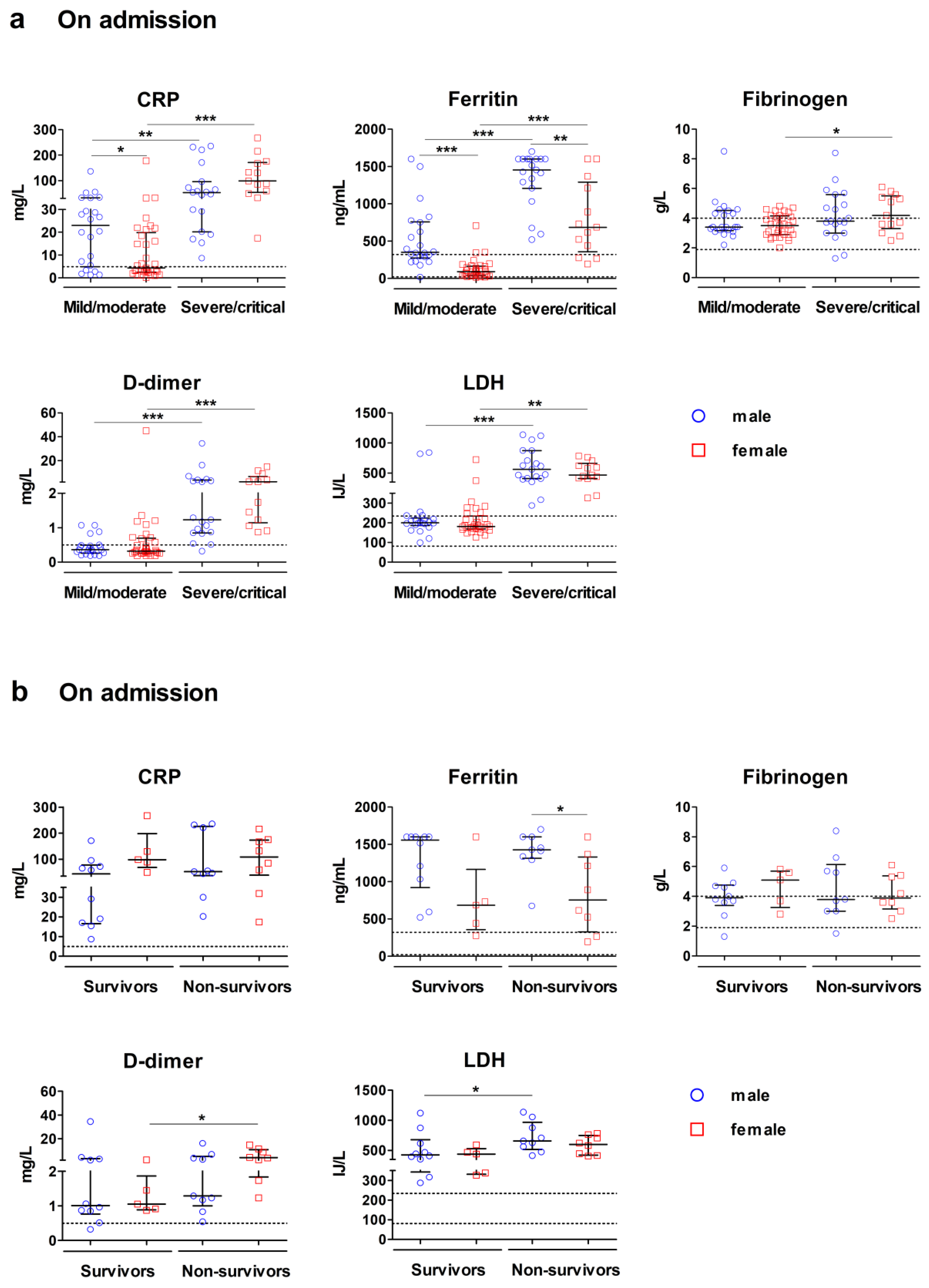
Figure 2.
Differences in common inflammatory blood indices in male and female COVID-19 subjects seven days post-admission. Scatter dot plots display blood levels of C-reactive protein (CRP), ferritin, fibrinogen, D-dimer, and lactate dehydrogenase (LDH) measured seven days post-admission in male and female subjects with (a) mild/moderate or severe/critical COVID-19 disease and (b) severe/critical disease stratified by survival outcome. Data are presented as median and interquartile range. *p ≤ 0.05; **p ≤ 0.01; ***p ≤ 0.001.
Figure 2.
Differences in common inflammatory blood indices in male and female COVID-19 subjects seven days post-admission. Scatter dot plots display blood levels of C-reactive protein (CRP), ferritin, fibrinogen, D-dimer, and lactate dehydrogenase (LDH) measured seven days post-admission in male and female subjects with (a) mild/moderate or severe/critical COVID-19 disease and (b) severe/critical disease stratified by survival outcome. Data are presented as median and interquartile range. *p ≤ 0.05; **p ≤ 0.01; ***p ≤ 0.001.
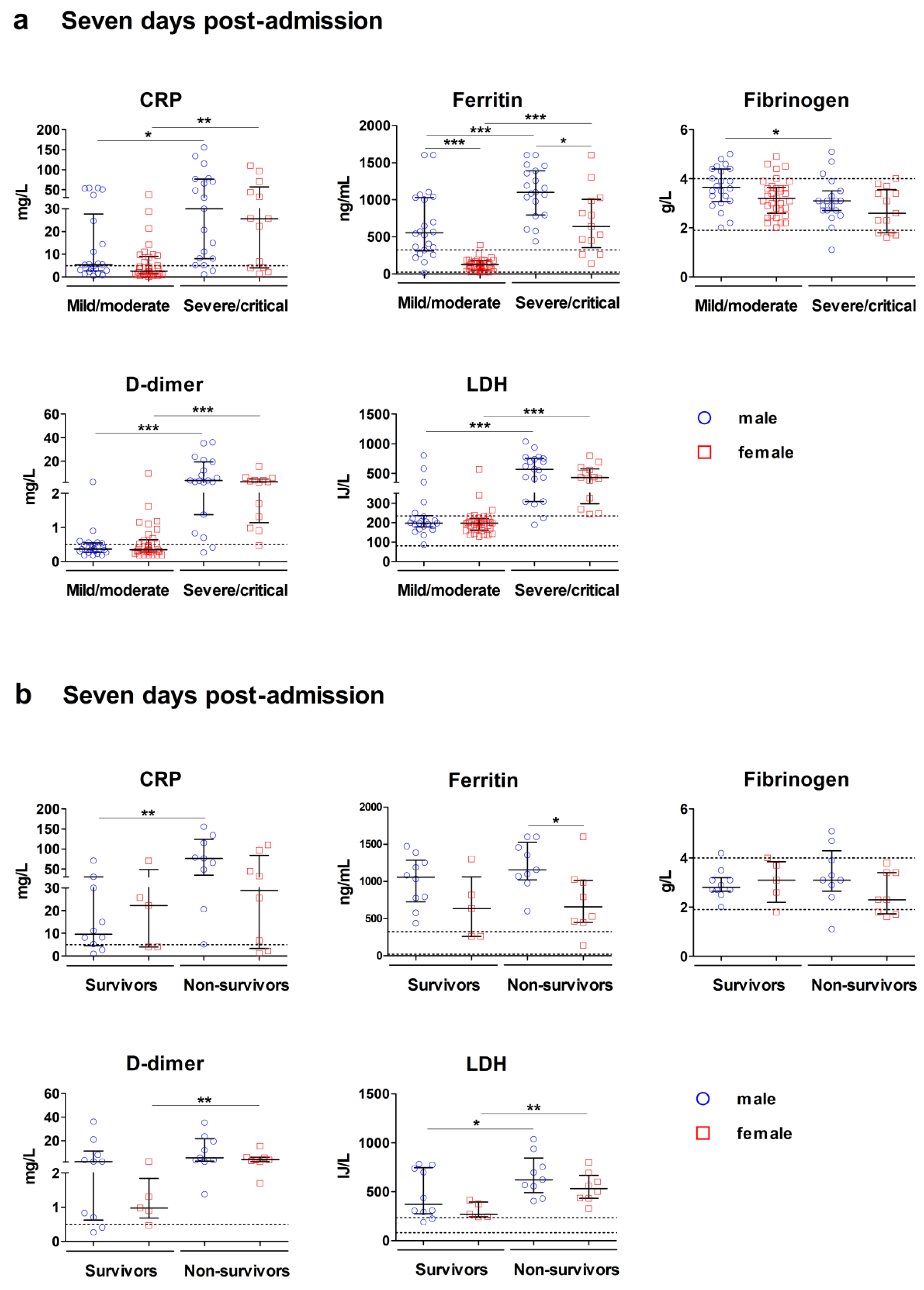
Figure 3.
Differences in immune cell-based blood indices in male and female COVID-19 subjects on admission. Scatter dot plots display (a, b) neutrophil and lymphocyte blood counts as well as the neutrophil-to-lymphocyte ratio (NLR), and (c, d) IL-6 and IL-10 blood concentrations measured on admission in male and female subjects with (a, c) mild/moderate or severe/critical COVID-19 disease, and (b, d) severe/critical disease stratified by survival outcome. Data are presented as median and interquartile range. * p ≤ 0.05; ** p ≤ 0.01; *** p ≤ 0.001.
Figure 3.
Differences in immune cell-based blood indices in male and female COVID-19 subjects on admission. Scatter dot plots display (a, b) neutrophil and lymphocyte blood counts as well as the neutrophil-to-lymphocyte ratio (NLR), and (c, d) IL-6 and IL-10 blood concentrations measured on admission in male and female subjects with (a, c) mild/moderate or severe/critical COVID-19 disease, and (b, d) severe/critical disease stratified by survival outcome. Data are presented as median and interquartile range. * p ≤ 0.05; ** p ≤ 0.01; *** p ≤ 0.001.
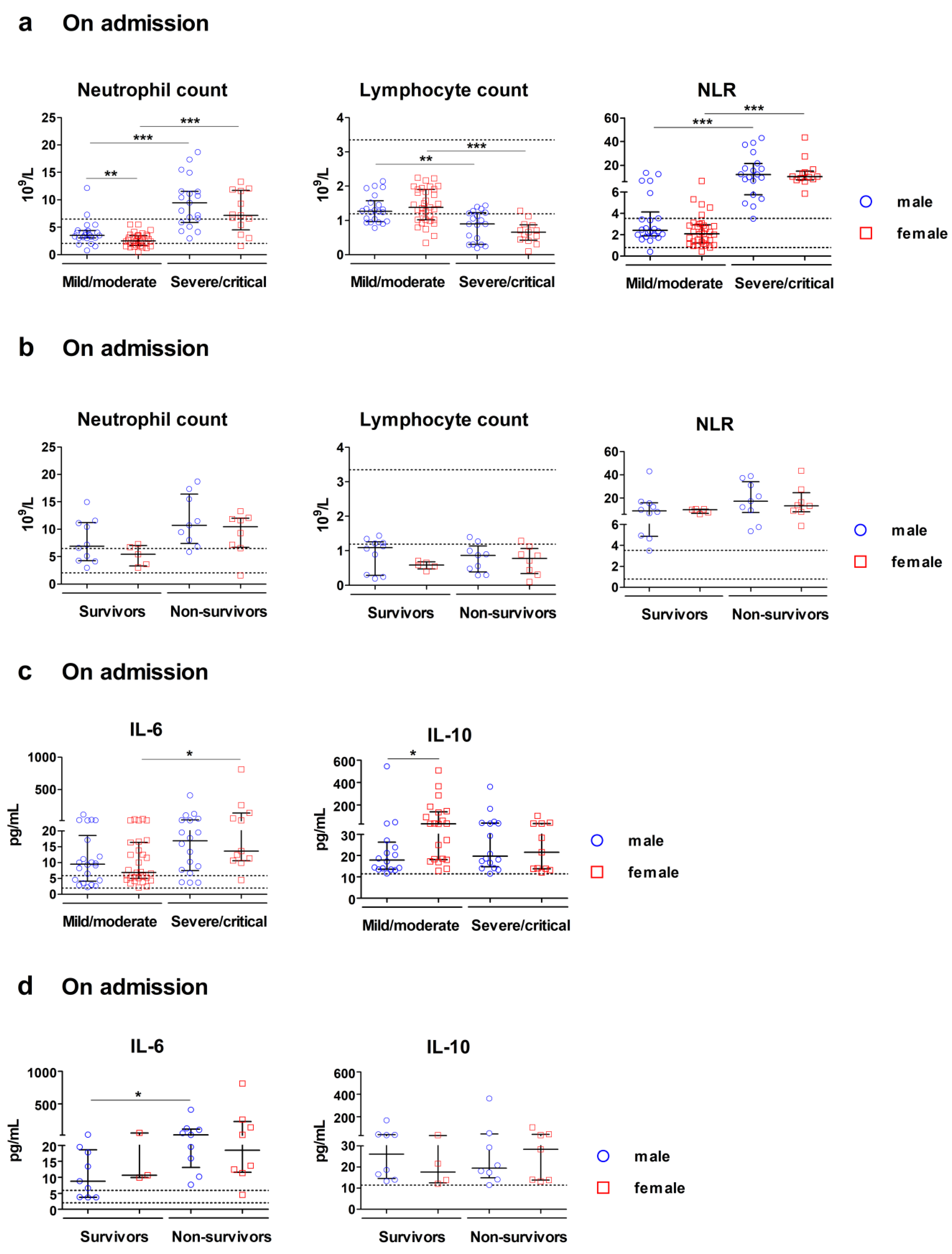
Figure 4.
Differences in immune cell-based blood indices in male and female COVID-19 subjects seven days post-admission. Scatter dot plots display (a, b) neutrophil and lymphocyte blood counts as well as the neutrophil-to-lymphocyte ratio (NLR), and (c, d) IL-6 and IL-10 blood concentrations measured seven days post-admission in male and female subjects with (a, c) mild/moderate or severe/critical COVID-19 disease, and (b, d) severe/critical disease further stratified by survival outcome. Data are presented as median and interquartile range. * p ≤ 0.05; ** p ≤ 0.01; *** p ≤ 0.001.
Figure 4.
Differences in immune cell-based blood indices in male and female COVID-19 subjects seven days post-admission. Scatter dot plots display (a, b) neutrophil and lymphocyte blood counts as well as the neutrophil-to-lymphocyte ratio (NLR), and (c, d) IL-6 and IL-10 blood concentrations measured seven days post-admission in male and female subjects with (a, c) mild/moderate or severe/critical COVID-19 disease, and (b, d) severe/critical disease further stratified by survival outcome. Data are presented as median and interquartile range. * p ≤ 0.05; ** p ≤ 0.01; *** p ≤ 0.001.
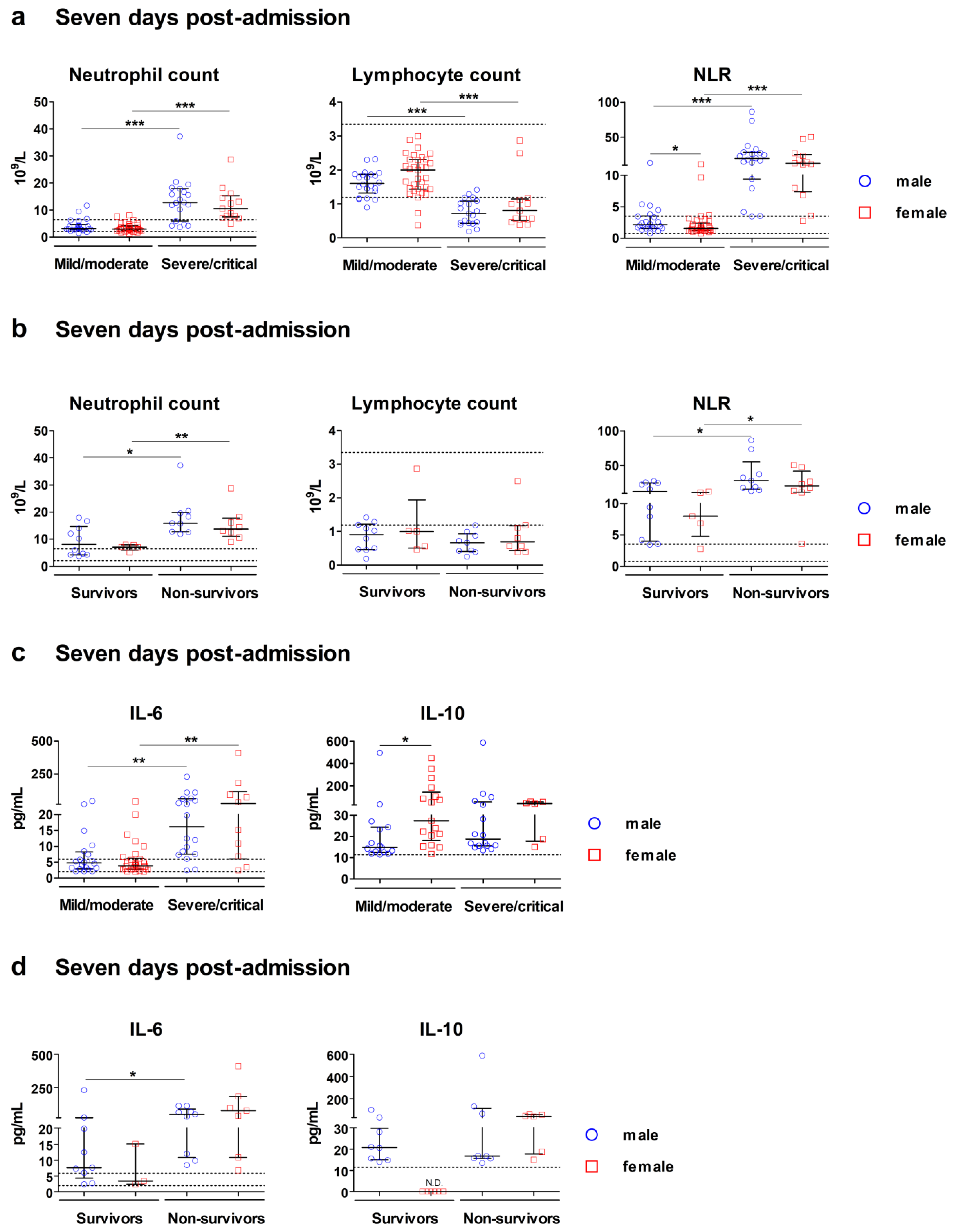
Figure 5.
Receiver operating characteristic (ROC) curves for prediction of severe or critical COVID-19 outcome in male and female subjects based on the levels of inflammatory blood indices on admission and seven days post-admission. Solid lines illustrate the predictive accuracy for severe/critical COVID-19 outcome of (a,b, left) CRP, ferritin, D-dimer, and LDH in male and (a, right) CRP, ferritin, fibrinogen, d-dimer, and LDH and (b, right) CRP, ferritin, D-dimer, and LDH in female subjects (a) on admission and (b) seven days post-admission. (a, b) Dashed lines display the predictive accuracy for severe/critical COVID-19 outcome of model combined of (a) ferritin + D-dimer in (left) male and (right) female subjects on admission and (b) ferritin + D-dimer + fibrinogen in (left) male and ferritin + LDH in (right) female subjects seven days post-admission. Diagonal reference line represents a test with no diagnostic ability (AUC = 0.5). y-axis represents sensitivity% (true positive rate) and x-axis represents 100% - specificity% (false positive rate). Area under the curve (AUC) values (quantitative measure of diagnostic accuracy), sensitivity, specificity, cut-off and Youden‘s index for inflammatory blood indices and models are displayed in Table 2. CRP, C-reactive protein; LDH, lactate dehydrogenase.
Figure 5.
Receiver operating characteristic (ROC) curves for prediction of severe or critical COVID-19 outcome in male and female subjects based on the levels of inflammatory blood indices on admission and seven days post-admission. Solid lines illustrate the predictive accuracy for severe/critical COVID-19 outcome of (a,b, left) CRP, ferritin, D-dimer, and LDH in male and (a, right) CRP, ferritin, fibrinogen, d-dimer, and LDH and (b, right) CRP, ferritin, D-dimer, and LDH in female subjects (a) on admission and (b) seven days post-admission. (a, b) Dashed lines display the predictive accuracy for severe/critical COVID-19 outcome of model combined of (a) ferritin + D-dimer in (left) male and (right) female subjects on admission and (b) ferritin + D-dimer + fibrinogen in (left) male and ferritin + LDH in (right) female subjects seven days post-admission. Diagonal reference line represents a test with no diagnostic ability (AUC = 0.5). y-axis represents sensitivity% (true positive rate) and x-axis represents 100% - specificity% (false positive rate). Area under the curve (AUC) values (quantitative measure of diagnostic accuracy), sensitivity, specificity, cut-off and Youden‘s index for inflammatory blood indices and models are displayed in Table 2. CRP, C-reactive protein; LDH, lactate dehydrogenase.
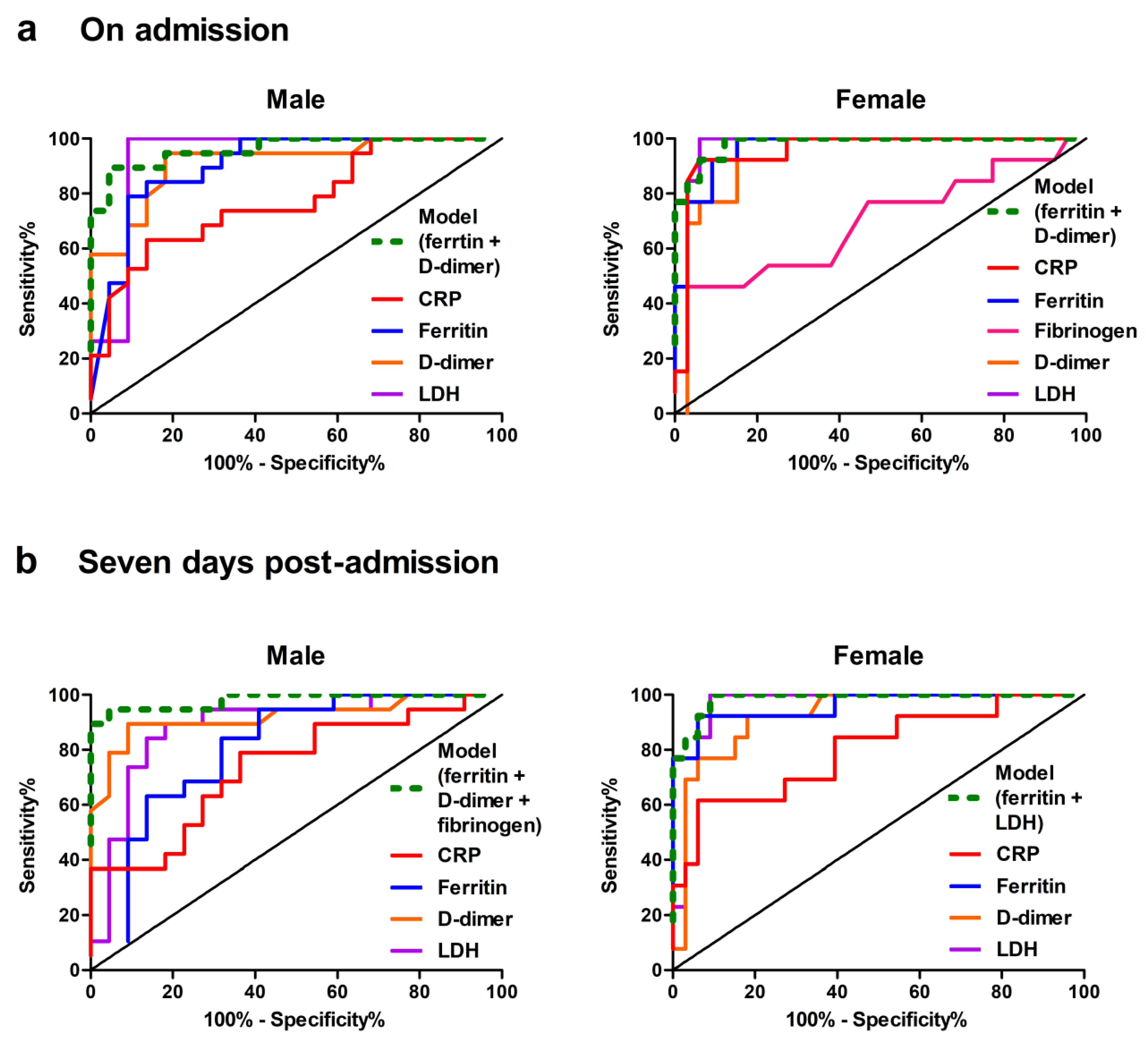
Figure 6.
Receiver operating characteristic (ROC) curves for prediction of severe or critical COVID-19 outcome in male and female subjects based on the immune cell-based blood indices on admission and seven days post-admission. Solid lines illustrate the predictive accuracy for severe/critical COVID-19 outcome of (a) neutrophil and lymphocytes counts, and NLR in (left) male and neutrophil and lymphocyte counts in (right) female on admission as well as of (b) neutrophil and lymphocytes counts, NLR, and IL-6 in (left) male and (right) female subjects seven days post-admission. Dashed lines display the predictive accuracy for severe/critical COVID-19 outcome of (a, left) model combined of neutrophil count + lymphocyte count in male subjects on admission and independent predictors (b, left) lymphocyte count in male and (b, right) NLR in female subjects seven days post-admission. Diagonal reference line represents a test with no diagnostic ability (AUC = 0.5). y-axis represents sensitivity% (true positive rate) and x-axis represents 100% - specificity% (false positive rate). Area under the curve (AUC) values (quantitative measure of diagnostic accuracy), sensitivity, specificity, cut-off and Youden‘s index for immune cell-based blood indices and model are displayed in table 4. NLR, neutrophil-to-lymphocyte ratio; IL, interleukin.
Figure 6.
Receiver operating characteristic (ROC) curves for prediction of severe or critical COVID-19 outcome in male and female subjects based on the immune cell-based blood indices on admission and seven days post-admission. Solid lines illustrate the predictive accuracy for severe/critical COVID-19 outcome of (a) neutrophil and lymphocytes counts, and NLR in (left) male and neutrophil and lymphocyte counts in (right) female on admission as well as of (b) neutrophil and lymphocytes counts, NLR, and IL-6 in (left) male and (right) female subjects seven days post-admission. Dashed lines display the predictive accuracy for severe/critical COVID-19 outcome of (a, left) model combined of neutrophil count + lymphocyte count in male subjects on admission and independent predictors (b, left) lymphocyte count in male and (b, right) NLR in female subjects seven days post-admission. Diagonal reference line represents a test with no diagnostic ability (AUC = 0.5). y-axis represents sensitivity% (true positive rate) and x-axis represents 100% - specificity% (false positive rate). Area under the curve (AUC) values (quantitative measure of diagnostic accuracy), sensitivity, specificity, cut-off and Youden‘s index for immune cell-based blood indices and model are displayed in table 4. NLR, neutrophil-to-lymphocyte ratio; IL, interleukin.
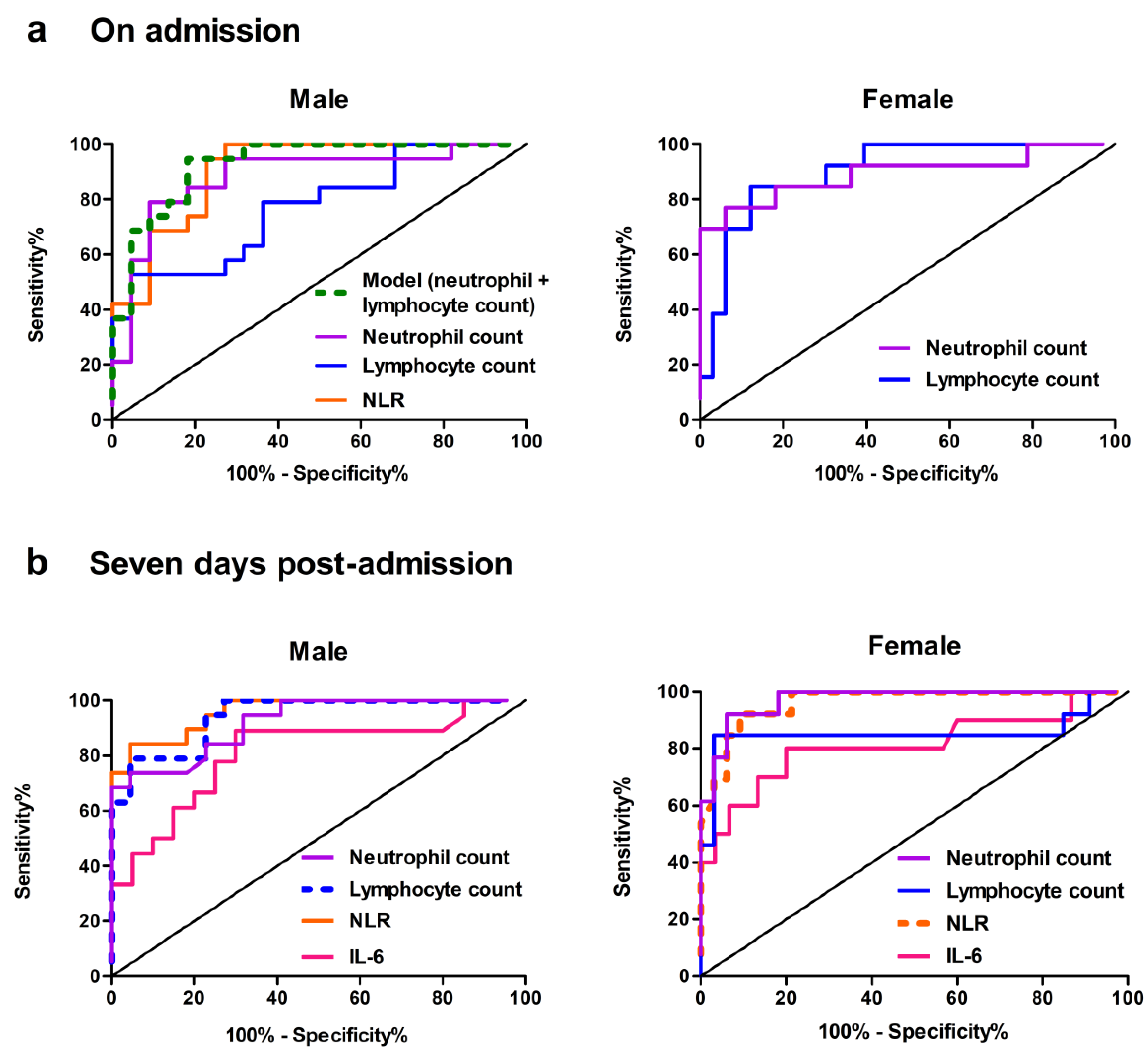
Figure 7.
Receiver operating characteristic (ROC) curves for prediction of death outcome in severely or critically ill male COVID-19 subjects based on the inflammatory and immune cell-based blood indices seven days post-admission. Solid lines illustrate the predictive accuracy for death outcome of (a) CRP and (b) neutrophil count in severely or critically ill male COVID-19 subjects seven days post-admission. Diagonal reference line represents a test with no diagnostic ability (AUC = 0.5). y-axis represents sensitivity% (true positive rate) and x-axis represents 100% - specificity% (false positive rate). Area under the curve (AUC) values (quantitative measure of diagnostic accuracy), sensitivity, specificity, cut-off and Youden‘s index for CRP and neutrophil count are displayed in Table 6. CRP, C-reactive protein.
Figure 7.
Receiver operating characteristic (ROC) curves for prediction of death outcome in severely or critically ill male COVID-19 subjects based on the inflammatory and immune cell-based blood indices seven days post-admission. Solid lines illustrate the predictive accuracy for death outcome of (a) CRP and (b) neutrophil count in severely or critically ill male COVID-19 subjects seven days post-admission. Diagonal reference line represents a test with no diagnostic ability (AUC = 0.5). y-axis represents sensitivity% (true positive rate) and x-axis represents 100% - specificity% (false positive rate). Area under the curve (AUC) values (quantitative measure of diagnostic accuracy), sensitivity, specificity, cut-off and Youden‘s index for CRP and neutrophil count are displayed in Table 6. CRP, C-reactive protein.
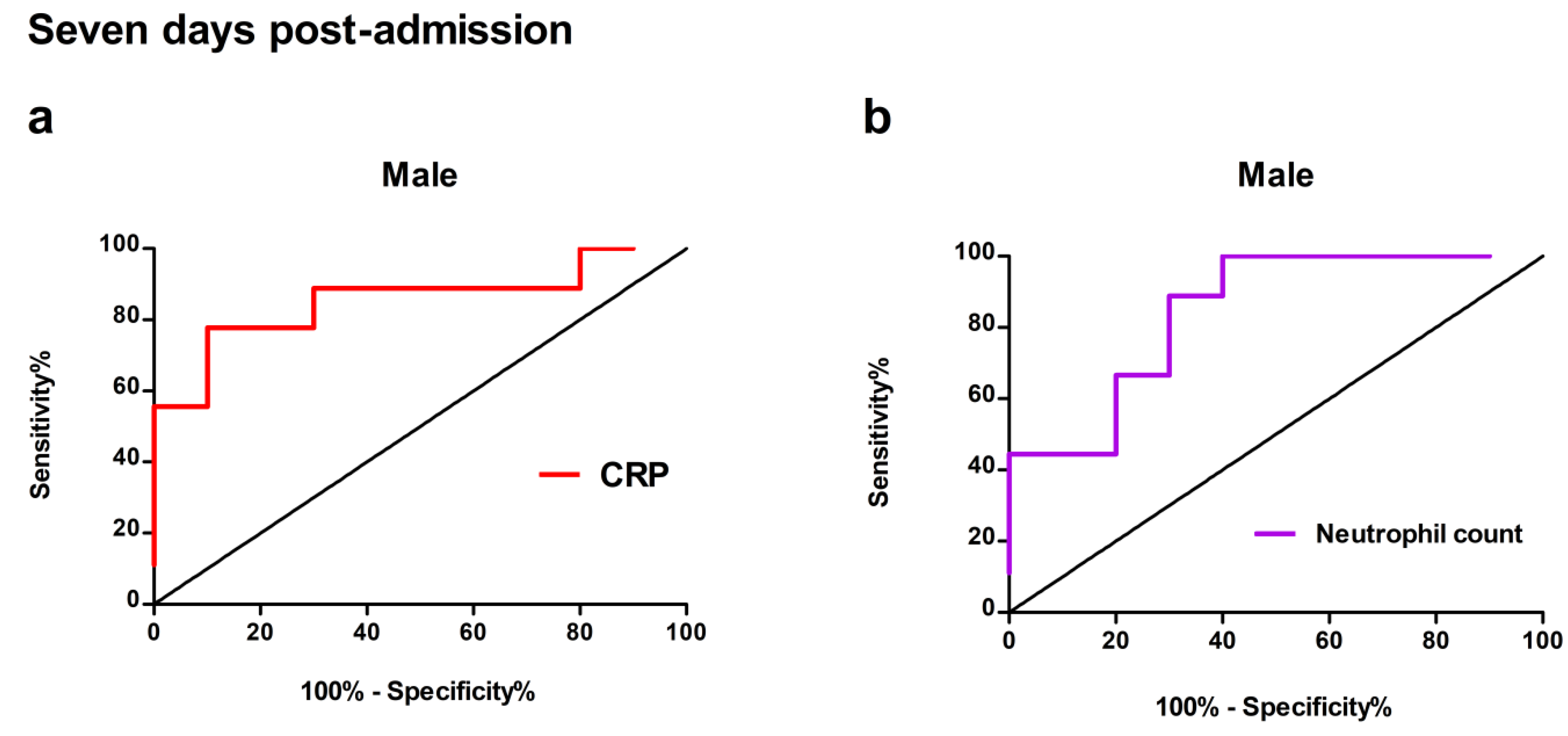

Table 1.
Univariate and multivariable logistic regression analyses of commonly used inflammatory blood indices as predictors of severe or critical COVID-19 disease in male and female subjects on admission and seven days post-admission.
Table 1.
Univariate and multivariable logistic regression analyses of commonly used inflammatory blood indices as predictors of severe or critical COVID-19 disease in male and female subjects on admission and seven days post-admission.
| Male | Female | |||
| Univariate Logistic Regression | Multivariable Logistic Regression |
Univariate Logistic Regression |
Multivariable Logistic Regression |
|
| Inflammatory blood indices | OR (95% CI) | OR (95% CI) | OR (95% CI) | OR (95% CI) |
| On admission | ||||
| CRP | 1.284 (1.010 - 1.634) p ≤ 0.05 |
- | 1.482 (1.153 - 1.905) p ≤ 0.01 |
- |
| Ferritin | 1.038 (1.018 - 1.030) p ≤ 0.001 |
1.030 (1.007 - 1.053) p ≤ 0.05 |
1.093 (1.034 - 1.155) p ≤ 0.01 |
1.100 (1.023 - 1.255) p ≤ 0.05 |
| Fibrinogen | - | - | 2.626 (1.224 - 5.633) p ≤ 0.05 |
- |
| D-dimer | 1.537 (1.158 - 2.038) p ≤ 0.01 |
1.392 (1.025 - 1.891) p ≤ 0.05 |
1.153 (1.030 - 1.292) p ≤ 0.05 |
1.136 (1.027 - 1.255) p ≤ 0.05 |
| LDH | 1.078 (1.028 - 1.130) p ≤ 0.01 |
- | 1.163 (1.063 - 1.272) p ≤ 0.001 |
- |
| Seven days post-admission | ||||
| CRP | 1.330 (1.039 - 1.704) p ≤ 0.05 |
- | 2.246 (1.216 - 4.146) p ≤ 0.01 |
- |
| Ferritin | 1.027 (1.009 - 1.046) p ≤ 0.01 |
1.047 (1.004 - 1.091) p ≤ 0.05 |
1.171 (1.048 - 1.309) p ≤ 0.01 |
1.154 (1.003 - 1.326) p ≤ 0.05 |
| Fibrinogen | 0.464 (0.210 - 1.024) p > 0.05 |
0.095 (0.010 - 0.867) p ≤ 0.05 |
- | - |
| D-dimer | 1.217 (1.052 - 1.409) p ≤ 0.01 |
1.354 (1.058 - 1.733) p ≤ 0.05 | 1.067 (1.010 - 1.126) p ≤ 0.05 |
- |
| LDH | 1.077 (1.030 - 1.127) p ≤ 0.001 |
- | 1.176 (1.066 - 1.297) p ≤ 0.001 |
1.121 (0.995 - 1.263) p > 0.05 |
Table 2.
Receiver operating characteristic (ROC) analyses of predictive performances of common inflammatory blood indices for severe or critical COVID-19 outcome in male and female subjects on admission and seven days post-admission.
Table 2.
Receiver operating characteristic (ROC) analyses of predictive performances of common inflammatory blood indices for severe or critical COVID-19 outcome in male and female subjects on admission and seven days post-admission.
| Male | Female | |||||||||
| Inflammatory blood indices | AUC (95% CI) |
Sensitivity (%) | Specificity (%) | Cut-off | J* | AUC (95% CI) |
Sensitivity (%) | Specificity (%) | Cut-off | J* |
| On admission | ||||||||||
| Model (ferritin + D-dimer) | 0.962 (0.909 - 1) p ≤ 0.001 |
89.5 | 95.5 | - | 0.849 | 0.984 (0.956 - 1) p ≤ 0.001 |
100 | 87.9 | - | 0.879 |
| CRP (mg/L) | 0.774 (0.630 - 0.918) p ≤ 0.01 |
63.2 | 86.4 | 38.7 | 0.495 | 0.955 (0.892 - 1) p ≤ 0.001 |
92.3 | 93.9 | 31.3 | 0.862 |
| Ferritin (ng/mL) | 0.903 (0.809 - 0.997) p ≤ 0.001 |
84.2 | 86.4 | 929 | 0.706 | 0.965 (0.919 - 1) p ≤ 0.001 |
100 | 84.8 | 191 | 0.848 |
| Fibrinogen (g/L) | - | - | - | - | - | 0.696 (0.504 - 0.887) p ≤ 0.05 |
46.2 | 100 | 4.95 | 0.462 |
| D-dimer (mg/L) | 0.914 (0.825 - 1) p ≤ 0.001 |
94.7 | 81.8 | 0.505 | 0.766 | 0.946 (0.885 - 1) p ≤ 0.001 |
100 | 84.8 | 0.84 | 0.848 |
| LDH (IJ/L) | 0.933 (0.842 - 1) p ≤ 0.001 |
100 | 90.9 | 271.5 | 0.909 | 0.970 (0.918 - 1) p ≤ 0.001 |
100 | 93.9 | 316 | 0.939 |
| Seven days post-admission | ||||||||||
| Model (ferritin + D-dimer + fibrinogen) |
0.981 (0.945 - 1) p ≤ 0.001 |
94.7 | 95.5 | - | 0.902 | - | - | - | - | - |
| Model (ferritin + LDH) |
- | - | - | - | - | 0.986 (0.962 - 1) p ≤ 0.001 |
100 | 90.9 | - | 0.909 |
| CRP (mg/L) | 0.737 (0.582 - 0.891) p ≤ 0.01 |
78.9 | 63.6 | 6.95 | 0.426 | 0.809 (0.664 - 0.953) p ≤ 0.001 |
61.5 | 93.9 | 21.8 | 0.555 |
| Ferritin (ng/mL) | 0.804 (0.666 - 0.942) p ≤ 0.001 |
94.7 | 59.1 | 575 | 0.538 | 0.960 (0.898 - 1) p ≤ 0.001 |
92.3 | 93.9 | 237.5 | 0.862 |
| D-dimer (mg/L) | 0.920 (0.828 - 1) p ≤ 0.001 |
89.5 | 90.9 | 0.65 | 0.804 | 0.924 (0.845 - 1) p ≤ 0.001 |
92.3 | 81.8 | 0.845 | 0.741 |
| LDH (IJ/L) | 0.885 (0.775 - 0.995) p ≤ 0.001 |
89.5 | 81.8 | 270.5 | 0.713 | 0.963 (0.910 - 1) p ≤ 0.001 |
100 | 90.9 | 241 | 0.909 |
Data are presented as area under the curve (AUC) and 95% confidence interval (CI). p ≤ 0.05 was considered statistically significant. *J - Youden‘s index. Youden‘s index and the cut-off value were determined as described in the Materials and Methods section. CRP, C-reactive protein; LDH, lactate dehydrogenase.
Table 3.
Univariate and multivariable logistic regression analyses of commonly used immune cell-based blood indices as predictors of severe or critical COVID-19 disease in male and female subjects on admission and seven days post-admission.
Table 3.
Univariate and multivariable logistic regression analyses of commonly used immune cell-based blood indices as predictors of severe or critical COVID-19 disease in male and female subjects on admission and seven days post-admission.
| Male | Female | |||
| Univariate Logistic Regression | Multivariable Logistic Regression |
Univariate Logistic Regression |
Multivariable Logistic Regression |
|
| Immune cell-based blood indices | OR (95% CI) | OR (95% CI) | OR (95% CI) | OR (95% CI) |
| On admission | ||||
| Neutrophil count | 1.054 (1.019 - 1.091) p ≤ 0.01 |
1.051 (1.013 - 1.089) p ≤ 0.01 |
1.097 (1.036 - 1.162) p ≤ 0.01 |
- |
| Lymphocyte count | 0.736 (0.592 - 0.916) p ≤ 0.01 |
0.766 (0.594 - 0.988) p ≤ 0.05 |
0.658 (0.507 - 0.854) p ≤ 0.01 |
- |
| NLR | 1.033 (1.011 - 1.056) p ≤ 0.01 |
- | 1.217 (0.988 - 1.500) p > 0.05 |
1.206 (0.987 - 1.473) p > 0.05 |
| IL-6 | - |
- | 1.530 (0.885-2.643) p > 0.05 |
- |
| Seven days post-admission | ||||
| Neutrophil count | 1.041 (1.017 - 1.066) p ≤ 0.001 |
- | 1.117 (1.037 - 1.203) p ≤ 0.01 |
- |
| Lymphocyte count | 0.529 (0.350 - 0.799) p ≤ 0.01 |
0.456 (0.256 - 0.815) p ≤ 0.01 | 0.823 (0.726 - 0.934) p ≤ 0.01 |
- |
| NLR | 1.040 (1.011 - 1.068) p ≤ 0.01 |
- | 1.047 (1.019 - 1.076) p ≤ 0.001 |
1.061 (1.016 - 1.107) p ≤ 0.01 |
| IL-6 | 1.895 (1.003 - 3.580) p ≤ 0.05 | - | 1.972 (1.009 - 3.853) p ≤ 0.05 |
- |
Immune cell-based blood indices that demonstrated statistically significant differences between severe/critical and mild/moderate male and female subjects were included in a univariate logistic regression analysis, using severe/critical COVID-19 outcome as the dependent variable. Multivariable logistic regression was performed using variables with p < 0.100 in the univariate analysis and results are given only for variables remaining in the model. Data are presented as an odds ratio (OR) with a 95% confidence interval (CI). OR for IL-6 was determined for every 10 pg/mL increase. OR for neutrophil and lymphocyte counts were calculated for each 0.1 x 10⁹/L increase and decrease, respectively, while the OR for NLR was based on every 0.1 unit increase in the ratio. p ≤ 0.05 was considered statistically significant. NLR, neutrophil-to-lymphocyte ratio; IL, interleukin. .
Table 4.
Receiver operating characteristic (ROC) analyses of predictive performances of common immune cell-based blood indices for severe or critical COVID-19 outcome in male and female subjects on admission and seven days post-admission.
Table 4.
Receiver operating characteristic (ROC) analyses of predictive performances of common immune cell-based blood indices for severe or critical COVID-19 outcome in male and female subjects on admission and seven days post-admission.
| Male | Female | |||||||||
|
Immune cell-based blood indices |
AUC (95% CI) |
Sensitivity (%) | Specificity (%) | Cut-off | J* | AUC (95% CI) |
Sensitivity (%) | Specificity (%) | Cut-off | J* |
| On admission | ||||||||||
| Model (neutrophil count + lymphocyte count) |
0.928 (0.852 - 1) p ≤ 0.001 |
94.7 | 81.8 | - | 0.766 | - | - | - | - | - |
| Neutrophil count (109/L) | 0.883 (0.770 - 0.994) p ≤ 0.001 |
78.9 | 90.9 | 5.67 | 0.699 | 0.893 (0.767 - 1) p ≤ 0.001 |
76.9 | 93.9 | 4.96 | 0.709 |
| Lymphocyte count (109/L) | 0.770 (0.626 - 0.915) p ≤ 0.01 |
52.6 | 95.5 | 0.9 | 0.481 | 0.902 (0.812 - 0.993) p ≤ 0.001 |
84.6 | 87.9 | 0.9 | 0.725 |
| NLR | 0.904 (0.814 - 0.995) p ≤ 0.001 |
100 | 72.7 | 3.463 | 0.727 | - | - | - | - | - |
| Seven days post-admission | ||||||||||
| Neutrophil count (109/L) | 0.920 (0.841 - 0.999) p ≤ 0.001 |
73.7 | 95.5 | 9.85 | 0.691 | 0.972 (0.932 - 1) p ≤ 0.001 |
92.3 | 93.9 | 6.62 | 0.862 |
| Lymphocyte count (109/L) a | 0.943 (0.879 - 1) p ≤ 0.001 |
78.9 | 95.5 | 1.1 | 0.744 | 0.823 (0.643 - 1) p ≤ 0.001 |
84.6 | 93.9 | 1.18 | 0.786 |
| NLR b | 0.959 (0.908 - 1) p ≤ 0.001 |
84.2 | 95.5 | 6.661 | 0.797 | 0.965 (0.919 - 1) p ≤ 0.001 |
92.3 | 90.9 | 3.52 | 0.832 |
| IL-6 (pg/mL) | 0.807 (0.663 - 0.951) p ≤ 0.001 |
88.9 | 70.0 | 5.9 | 0.589 | 0.812 (0.627 - 0.996) p ≤ 0.01 |
80 | 80 | 6.7 | 0.600 |
Data are presented as area under the curve (AUC) and 95% confidence interval (CI). p ≤ 0.05 was considered statistically significant. a multivariable regression analysis revealed that in male COVID-19 subjects decreased lymphocyte count was only independent predictor linked with severe/critical disease seven days post-admission. b multivariable regression analysis revealed that in female COVID-19 subjects NLR was only independent predictor linked with the severe/critical disease seven days post-admission. *J - Youden‘s index. Youden‘s index and the cut-off value were determined as described in the Materials and Methods section. NLR, neutrophil-to-lymphocyte ratio; IL, interleukin.
Table 5.
Univariate and multivariable logistic regression analyses of commonly used inflammatory and immune cell-based blood indices as predictors of COVID-19 death outcome in male and female subjects seven days post-admission.
Table 5.
Univariate and multivariable logistic regression analyses of commonly used inflammatory and immune cell-based blood indices as predictors of COVID-19 death outcome in male and female subjects seven days post-admission.
| Male | Female | |||
| Univariate Logistic Regression | Multivariable Logistic Regression |
Univariate Logistic Regression |
Multivariable Logistic Regression |
|
| Seven days post-admission | OR (95% CI) | OR (95% CI) | OR (95% CI) | OR (95% CI) |
| Inflammatory blood indices | ||||
| CRP | 1.612 (1.054 - 2.465) p ≤ 0.05 |
1.612 (1.054 - 2.465) p ≤ 0.05 |
- | - |
| D-dimer | - | - | 1.285 (0.953 - 1.733) p > 0.05 |
- |
| LDH | 1.039 (0.993 - 1.087) p > 0.05 |
- | 1.245 (0.975 - 1.589) p > 0.05 |
- |
|
Immune cell-based blood indices |
||||
| Neutrophil count | 1.364 (1.017 - 1.829) p ≤ 0.05 |
1.364 (1.017 - 1.829) p ≤ 0.05 |
1.003 (0.523 - 1.925) p > 0.05 |
- |
| NLR | 1.106 (0.987 - 1.239) p > 0.05 |
- | 1.242 (0.937 - 1.646) p > 0.05 |
- |
| IL-6 | 1.054 (0.883 - 1.257) p > 0.05 |
- | - | - |
Inflammatory-immune blood indices that demonstrated statistically significant differences between male and female survivors and non-survivors were included in a univariate logistic regression analysis, using COVID-19 death outcome as the dependent variable. Multivariable logistic regression was performed using variables with p < 0.100 in the univariate analysis and results are given only for variables remaining in the model. Data are presented as an odds ratio (OR) with a 95% confidence interval (CI). OR for CRP, LDH, and IL-6 was calculated per 10x mg/L, U/L, and pg/mL increase, respectively, and for d-dimer, neutrophil count, and NLR per 0.1x mg/L, 109/L, and units of ratio increase, respectively. p ≤ 0.05 was considered statistically significant. CRP, C-reactive protein; LDH, lactate dehydrogenase; NLR, neutrophil-to-lymphocyte ratio; IL, interleukin.
Table 6.
Receiver operating characteristic (ROC) analyses of predictive performances for death outcome of inflammatory and immune blood indices in severely or critically ill male COVID-19 subjects seven days post-admission.
Table 6.
Receiver operating characteristic (ROC) analyses of predictive performances for death outcome of inflammatory and immune blood indices in severely or critically ill male COVID-19 subjects seven days post-admission.
| Male | |||||
|
Seven days post-admission |
AUC (95% CI) |
Sensitivity (%) | Specificity (%) | Cut-off | J* |
| Inflammatory blood indices | |||||
| CRP (mg/L) |
0.856 (0.670 - 1) p ≤ 0.01 |
77.8 | 90 | 39.25 | 0.678 |
|
Immune cell-based blood indices |
|||||
| Neutrophil count (109/L) |
0.844 (0.668 - 1) p ≤ 0.05 |
100 | 60 | 11.03 | 0.600 |
Data are presented as area under the curve (AUC) and 95% confidence interval (CI). p ≤ 0.05 was considered statistically significant. * J - Youden‘s index. Youden‘s index and the cut-off value were determined as described in the Materials and Methods section. CRP, C-reactive protein. .
Disclaimer/Publisher’s Note: The statements, opinions and data contained in all publications are solely those of the individual author(s) and contributor(s) and not of MDPI and/or the editor(s). MDPI and/or the editor(s) disclaim responsibility for any injury to people or property resulting from any ideas, methods, instructions or products referred to in the content. |
© 2026 by the authors. Licensee MDPI, Basel, Switzerland. This article is an open access article distributed under the terms and conditions of the Creative Commons Attribution (CC BY) license.
Copyright: This open access article is published under a Creative Commons CC BY 4.0 license, which permit the free download, distribution, and reuse, provided that the author and preprint are cited in any reuse.


