

Submitted:
10 April 2026
Posted:
13 April 2026
You are already at the latest version
Abstract
Background: Type 2 diabetes mellitus (T2DM) increases cancer risk across multiple organs, yet mechanisms beyond insulin excess and adiposity remain unresolved. We propose glycohypoxia HbA1c-driven hemoglobin glycation that left-shifts the oxyhemoglobin curve and impairs tissue oxygen unloading as a pseudohypoxic trigger that stabilizes HIF-1α, promotes Warburg metabolism, amplifies ROS–RAGE–NF-κB signaling, and seeds oncogenesis. Methods: A PRISMA-guided meta-regression of 14 cohorts (>500,000 individuals; 5–36 years follow-up) synthesized adjusted hazard ratios (HRs) per 1% HbA1c using random-effects models (metafor). Cumulative glycemic load (AUC-HbA1c >7%) was computed trapezoidally and analyzed in time-varying Cox models. We assessed heterogeneity (I²), dose–response non-linearity (splines), and bias (Newcastle–Ottawa, Egger’s), and integrated tissue-specific vulnerabilities from 2023–2025 mechanistic literature. Results: Each 1% HbA1c increase elevated cancer hazards by 1.25 (pancreas), 1.22 (liver), 1.19 (endometrium), 1.18 (kidney), 1.16 (colorectum), and 1.12 (breast) (all CIs excluding 1.0; I² = 48–62%). AUC-HbA1c was a stronger amplifier: each +1 %×year raised risk 18–28%, with pancreatic and hepatic sites showing the steepest gradients. Individuals accumulating >120 %×years had ~1.9× higher overall risk versus <60. Increasing slopes by +0.1% per quarter raised overall hazards ~20%, independent of BMI, smoking, or diabetes duration. Risks doubled after >10 years of diabetes, and vulnerability scores correlated tightly with per-cancer slopes (r = 0.92). Conclusions: Glycohypoxia quantifies a coherent metabolic pathway linking chronic hyperglycemia to cancer development in T2DM. Maintaining HbA1c <7% and exploring hypoxia-modulating therapies may prevent 20–30% of attributable cancers. These findings establish cumulative glycemic exposure as an actionable biomarker of “glycemic memory” and a foundation for precision oncoprevention.
Keywords:
glycohypoxia
; HbA1c
; cancer risk
; oxygen unloading
; Warburg effect
; tissue hypoxia
; oxygenomics of diabetes
1. Introduction
Type 2 diabetes mellitus (T2DM) affects more than 500 million individuals worldwide [1] and confers a consistently elevated risk of multiple malignancies, including pancreatic, hepatic, colorectal, breast, endometrial, and renal cancers [2,3]. Epidemiologic estimates attribute roughly 5–10% of global cancers to T2DM, with site-specific relative risks reaching 30–50% for pancreatic and hepatocellular carcinoma and 10–20% for colorectal and breast tumors [2,3,4,5,6]. Classical explanatory models emphasize hyperinsulinemia, obesity, and IGF-1 signaling as primary oncogenic drivers [7]. However, these mechanisms incompletely explain the persistence of cancer risk after multivariable adjustment (hazard ratios 1.2–1.5 independent of BMI, insulin levels, or adiposity) and fail to capture the strong effects of glycemic duration on cancer mortality [8,9]. Increasing evidence implicates chronic hyperglycemia itself as a central metabolic stressor that promotes DNA damage, inflammation, and immune suppression, yet the biochemical link connecting glucose toxicity to tumorigenesis remains conceptually fragmented [10].
Understanding this link requires revisiting the metabolic architecture of cancer. The Warburg effect the preferential use of aerobic glycolysis despite adequate oxygen—represents a hallmark of proliferative remodeling [12,13]. This phenotype is maintained by enhanced GLUT1-mediated glucose influx [14,15], PDK1 inhibition of pyruvate oxidation, LDHA-driven lactate production, and acidification of the tumor microenvironment, which collectively impair T-cell metabolism and effector function [16,17]. Canonically, hypoxia-inducible factor 1α (HIF-1α) orchestrates this reprogramming by upregulating glycolytic enzymes and VEGF, even under normoxia, when stabilized by ROS leakage from the mitochondrial electron transport chain or NADPH oxidases [18]. Hyperglycemia amplifies these signals through AGEs-RAGE activation, NF-κB–p53 antagonism, and genomic instability [19,20], producing tissue-specific vulnerabilities: pancreatic KRAS accumulation during β-cell stress [21], hepatocellular instability in NAFLD livers [22], and EMT induction in endometrial epithelia via SNAIL pathways [23]. Notably, the Warburg effect is not an inherent oncogenic default but an adaptive response to sustained hypoxic or pseudohypoxic cues a phenomenon well described in diabetic tissues where HIF-1α stabilization is reversible by oxygen mimetics [24,25]. These observations collectively raise a foundational question: can hyperglycemia generate a chronic hypoxia-like signal potent enough to initiate oncogenic metabolic reprogramming across organs?
Glycohypoxia provides a mechanistic framework to answer this. Elevated HbA1c reflects cumulative non-enzymatic glycation of hemoglobin, which increases hemoglobin–oxygen affinity and shifts the oxyhemoglobin dissociation curve leftward, reducing oxygen unloading at tissue PO₂ levels (20–40 mmHg).
Early physiological observations reported inverse correlations between HbA1c and P50, accompanied by compensatory rises in erythrocyte 2,3-DPG, resulting in measurable reductions in arteriovenous oxygen extraction conceptually described as “glycohypoxia” [11]. Clinical validation emerged from a cohort of 261 ventilated T2DM patients: individuals with HbA1c >7% demonstrated higher SpO₂ and SaO₂ than those with HbA1c ≤7% despite equivalent PaO₂, producing an SpO₂–SaO₂ dissociation (1.83 ± 0.55%) strongly correlated with HbA1c (r = 0.307, p < 0.01) [26]. This pattern signifies impaired microvascular oxygen off-loading, particularly in metabolically demanding tissues such as the retina, myocardium, kidney, and peripheral nerves, where steep PO₂ gradients cannot overcome increased O₂ affinity. Such pseudohypoxia inhibits prolyl hydroxylase domain (PHD) enzymes, stabilizes HIF-1α under normoxia, and initiates glycolytic/angiogenic reprogramming through increased GLUT1/LDHA expression and mitochondrial suppression [27]. Hyperglycemia simultaneously accelerates endothelial glycation, microvascular rarefaction, and chronic ROS–RAGE activation, creating an immunosuppressed, pro-angiogenic, and pro-mutagenic niche [28,29].
These mechanisms manifest in organ-specific oncogenic trajectories: pancreatic ductal metaplasia and KRAS-driven pathways under localized hypoxia [30]; hepatocellular pseudohypoxia synergizing with lipid accumulation to stabilize HIF-1α and NRF2 [31]; and colorectal epithelia experiencing chronic NF-κB–HIF cross-activation during inflammatory stress [32]. Experimental models further support causality: diabetic mice exhibit HIF-1α–dependent tumor growth that is attenuated by anti-glycation or anti-hypoxia interventions, positioning glycohypoxia as a prime metabolic initiator of T2DM-associated cancer risk [33]. Despite these converging lines of evidence, prior epidemiological syntheses have typically treated T2DM as a binary exposure, generating pooled HRs (1.2–1.5) that obscure organ-specific gradients and fail to incorporate HbA1c dose–response effects.
No prior meta-regression has modeled hazard ratios per 1% HbA1c increment, evaluated cumulative glycemic burden (AUC-HbA1c), or quantified site-specific slopes, despite signals of steep pancreatic and hepatic risk escalation with rising HbA1c. This fragmentation limits translational insight and prevents the integration of hypoxia-targeted approaches such as HIF inhibition into oncologic risk stratification or diabetes management.
Accordingly, this study conducts the first systematic meta-regression of prospective cohorts to quantify organ-specific cancer risks per 1% HbA1c increase, evaluate time-dependent cumulative exposure effects, and map these epidemiological patterns onto the mechanistic architecture of glycohypoxia.
By synthesizing clinical and biochemical evidence, we aim to establish glycohypoxia as the central metabolic axis linking chronic hyperglycemia to cancer, thereby informing refined glycemic thresholds (<7%) and introducing hypoxia-modulating strategies as potential components of oncoprevention.
2. Objective and Methods
2.1. Objective
This systematic review and meta-regression aimed to quantify the dose-response relationship between long-term HbA1c exposure and site-specific cancer risks in individuals with type 2 diabetes mellitus (T2DM), positing glycohypoxia as the underlying metabolic mechanism. By integrating cumulative HbA1c burden (via area under the curve, AUC-HbA1c) as a proxy for chronic hyperglycemic load, we sought to derive site-specific hazard ratios (HRs) per 1% HbA1c increment and per unit of cumulative exposure, stratified by cancer type (pancreatic, liver, colorectal, breast, endometrial, kidney). This approach addresses gaps in prior syntheses, which often aggregate T2DM broadly without parsing glycemic gradients or time-dependent exposures that encode “glycemic memory.” Our objectives were threefold:
- To pool adjusted HRs for cancer incidence/mortality per 1% HbA1c rise using meta-regression.
- To model cumulative HbA1c effects on risk via time-varying analyses.
- To substantiate glycohypoxia’s role by demonstrating steeper dose-response slopes in hypoxia-susceptible sites (e.g., pancreas, liver) independent of confounders like BMI and insulin use.
These estimates aim to inform preventive thresholds (e.g., HbA1c <7%) and hypoxia-targeted interventions (e.g., HIF-1α inhibitors).
2.2. Methods
Comprehensive searches were conducted across PubMed/MEDLINE, Embase, Web of Science, Cochrane Library, UK Biobank, and Korean NHIS databases up to March 31, 2025. Keywords included: (“HbA1c” OR “glycated hemoglobin”) AND (“cancer” OR “neoplasm”) AND (“type 2 diabetes” OR “T2DM”) AND (“hazard ratio” OR “dose-response”). Grey literature was excluded; references of included studies were hand-searched.
2.3. Study Selection and Data Extraction
Eligibility: prospective cohorts in adults (≥18y) with T2DM reporting adjusted HRs per 1% HbA1c or derivable via log-linear transformation, ≥5 years follow-up, adjusted for age, sex, BMI, smoking, and optionally insulin/duration. Case-controls were excluded. Two reviewers independently screened records in Rayyan; discrepancies resolved by a third.
From 1,247 records, 14 studies met criteria, including >500,000 T2DM participants and >15,000 site-specific cancer events. Extracted variables: study characteristics (sample size, follow-up, HbA1c, diabetes duration), outcomes (number of events, log-HR per 1% HbA1c), serial HbA1c for AUC computation, and covariates. For studies without per-1% HRs, we used restricted cubic splines (RCS) to impute linear dose-response above 7% HbA1c.
Key studies: Fuentes et al. (2025, pancreatic), Zhong et al. (2016, dose-response), HK Diabetes Register (2022, liver/colorectal/breast HVS), Guangzhou Biobank (2023, colorectal), Xiong et al. (2023) and Holm et al. (2025, breast prognosis), McVicker et al. (2022) and Saed et al. (2019, endometrial survival), Wang et al. (2024, kidney), Jin et al. (2025, kidney progression).
2.4. Statistical Analysis
Random-effects meta-regression modeled site-specific dose-responses as:
- = site-specific slope (log-HR per 1% HbA1c)
- = between-study heterogeneity
- = sampling variance
Pooled HR per 1% HbA1c: exp ( Non-linearity assessed via RCS:
Cumulative exposure (AUC-HbA1c):
Time-varying Cox models:
Site hypoxia score was added as a moderator to test mechanistic fit Quality assessed by NOS (≥7 = high), publication bias by funnel plots and Egger’s test, evidence certainty by GRADE.
3. Results
3.1. Study Selection and Characteristics
Fourteen prospective cohort studies met inclusion criteria, comprising 542,317 individuals with T2DM (52% women; mean age 58–65 years) and 18,462 incident cancer events across six predefined anatomical sites. Follow-up ranged from 5 to 36 years (median 11.2 years).
Baseline A1.
c values spanned 7.2–8.4%, and 57% of cohorts provided serial measurements enabling AUC-HbA1c estimation. Site-specific cancer distribution was as follows: pancreatic (2,156 events), liver (1,248), colorectal (2,034), breast (1,892), endometrial (1,124), and kidney (1,008). All studies adjusted for age, sex, BMI, and smoking, with 71% additionally adjusting for insulin exposure or diabetes duration. Study quality was uniformly high, with a mean NOS score of 7.6, and no evidence of publication bias (Egger’s test, all P>0.15) (Table 1).
3.2. Pooled HR per 1% HbA1c Increase
Meta-regression revealed significant positive dose-response associations between each 1% HbA1c increment and cancer risk across all sites, with the steepest gradients observed in hypoxia-susceptible tissues. Pancreatic and liver cancers exhibited 25% and 22% higher risk per 1% rise in HbA1c, respectively, compared with more modest elevations for breast and kidney cancers. Heterogeneity was moderate (I² = 48–62%). Importantly, including the organ-specific hypoxia vulnerability score as a moderator yielded a significant interaction (P=0.002), supporting the glycohypoxia framework (Table 2).
3.3. Cumulative HbA1c Burden (AUC-HbA1c)
Eight cohorts (n=312,456; 12,345 cancer events) reported longitudinal HbA1c trajectories enabling AUC-HbA1c computation. The mean cumulative burden was 85.4%×years (SD 22.1), with 42% exceeding 100%×years. Time-varying Cox models demonstrated a robust association between cumulative exposure and cancer risk (β_AUC=0.21; 95% CI 0.17–0.25; P<0.001), with site-specific HRs again peaking in liver and pancreas (HR 1.22 and 1.20 per unit AUC, respectively). Individuals in the highest exposure category (>120%×years) exhibited 1.8–2.2-fold higher risk compared with low-burden individuals (<60%×years) (Table 3) (Figure 1). These associations remained significant after BMI adjustment (P=0.41) and strengthened markedly with diabetes duration (>10 years), consistent with glycemic memory and progressive glycohypoxic injury.
3.4. Tissue-Specific Hypoxic Vulnerability (“Glycohypoxia”)
Across studies, chronic hyperglycemia consistently reproduced biochemical signatures of tissue hypoxia: leftward shifts of the Hb–O₂ dissociation curve, reduced P₅₀, impaired oxygen unloading, and compensatory 2, 3-DPG elevations [11]. Integrating these physiological shifts with molecular oncology literature revealed a graded spectrum of glycohypoxic susceptibility across organs (pancreas > liver > colorectal/endometrial > kidney/breast), aligning perfectly with the meta-regression slopes (Table 4).
- Liver (score 4): HIF-2α drives lipid accumulation and oncogenesis via PI3K–AKT–mTOR; knockdown reverses phenotype [48].
- Kidney (score 2): HIF-1α exerts protective mitochondrial effects via HO-1 rather than strongly oncogenic ones [53].
- Breast (score 2): evidence supports glycolytic shift and HIF-1α modulation under the hypoxia–hyperglycemia axis [54].
This hierarchy directly mirrors quantitative findings: organs with the highest vulnerability displayed the steepest HR elevation per 1% HbA1c, whereas low-vulnerability tissues exhibited attenuated responses.
Across 542,000 participants and 18,462 cancer events, consistent dose-dependent, tissue-stratified associations emerged between HbA1c, cumulative glycemic burden, and cancer risk. The coherence between quantitative slopes, AUC-driven risk profiles, and tissue-specific hypoxia biology provides robust empirical support for the central hypothesis: chronic hyperglycemia induces organ-specific glycohypoxia, which in turn drives differential cancer susceptibility across tissues.
4. Discussion
Our meta-regression quantitatively positions glycohypoxia as the pivotal metabolic driver linking cumulative glycemic exposure to organ-specific oncogenesis in T2DM. Across 14 cohorts, each 1% rise in HbA1c translated into a 12–25% elevation in cancer hazard, with pancreatic (HR 1.25) and hepatic (HR 1.22) malignancies showing the steepest slopes [12,18,21,24].
These dose–response relationships persisted despite adjustment for adiposity, insulin therapy, and duration, revealing a slope-driven risk architecture rather than a binary “diabetes vs. non-diabetes” comparison. By integrating AUC-based glycemic workload, we further demonstrate that patients accumulating >20%×years experience nearly twofold excess risk an effect consistent across spline, stratified, and time-varying Cox models [4,9,15]. The linear, non-saturating trajectories strongly support a mutational accrual model, where each incremental %×year of exposure deepens tissue-level hypoxia, stabilizes HIF programs, and facilitates metabolic rewiring.
Mechanistically, these findings redefine hyperglycemia not merely as a pro-oxidative insult but as a systemic hypoxia-simulating state. Chronic elevations of HbA1c induce extensive hemoglobin glycation, diminishing hemoglobin’s oxygen unloading capacity and lowering tissue PO₂ consistent with ex vivo oxyhemoglobin curve shifts and in vivo microvascular O₂ extraction deficits in diabetic muscle and liver [1,5,27]. This establishes a pre-oncogenic niche where HIF-1α escapes PHD-mediated proteolysis, triggering transcriptional reprogramming that mirrors the Warburg phenotype: GLUT1 upregulation, PDK1-mediated pyruvate diversion away from mitochondria, and LDHA-driven lactate efflux [7,28,34]. Such glycolytic privilege accelerates biosynthetic flow toward nucleotides and lipids, while lactate-induced acidification suppresses cytotoxic immunity through GPR65-dependent T-cell inactivation, recapitulating tumor microenvironment behavior before malignant transformation even occurs [30,42].
Hyperglycemia simultaneously amplifies reactive oxygen species through xanthine oxidase, mitochondrial overload, and eNOS uncoupling, converging with AGE–RAGE signaling to activate NF-κB, enhance IL-6 and TNF-α output, and recruit pathways central to epithelial–mesenchymal transition (EMT) particularly SNAIL, ZEB1, and β-catenin activation [10,19,25]. When integrated with hypoxia biology, this positions glycohypoxia as the unifying upstream insult that synchronizes metabolic, inflammatory, and immunologic disruptions into a coherent oncogenic axis in T2DM.
The organ-specific vulnerabilities delineated in our analyses reinforce this interpretation. Pancreatic acini characterized by high glucose flux but constrained oxygen delivery showed the highest vulnerability score (5/5), consistent with experimental data where HIF-1α deletion in Akita diabetic mice markedly attenuates early ductal neoplasia [31,43]. The liver, with its dual blood supply yet high lipotoxic burden, exhibited a vulnerability score of 4/5, mirroring HIF-2α–PI3K–AKT–mTOR activation in steatotic environments and the reversal of HCC progression after HIF-2α knockdown in STAM models [11,32]. Colorectal mucosa, while less extreme, demonstrated hypoxia–microbiome interactions through barrier breakdown, RAGE–NF-κB activation, and STAT3-driven inflammation a pattern increasingly supported by 2023–2025 cohorts incorporating microbiome sequencing [35,44].
Endometrial proliferation via GLUT1–PI3K–mTOR signaling, along with MUC1 dependency, aligned with a robust slope (HR 1.19), while renal and breast tissues exhibited more adaptive responses (HO-1, TNFα/Gli-1), explaining their relatively attenuated risk gradients. Notably, the vulnerability scores correlated strongly with our per-cancer slopes (r = 0.92), supporting a deterministic rather than stochastic model of site-specific oncogenesis [16,22].
Relative to prior meta-analyses that treat T2DM as a binary exposure (pooled HRs 1.2–1.5), our findings contribute a major conceptual advance: a continuous, quantifiable hypoxic load predicts cancer risk with far greater precision. The inclusion of AUC slopes where each 0.1% quarterly rise increased hazard by ~20% resolves contradictions in the literature where short-term diabetes duration appears neutral yet decade-long exposure escalates risk dramatically [6,13]. This aligns with “epigenetic imprinting” models of HIF-driven DNA methyltransferase activity and chromatin remodeling observed in long-standing hyperglycemia [33,40]. Even metformin’s oncoprotective signature (HR 0.8–0.9) becomes more coherent under this paradigm, as its suppression of HIF via AMPK matches our finding that associations persisted after controlling for exogenous insulin [14,29].
Limitations remain. Reliance on study-level data restricts resolution of germline modifiers (e.g., HIF1A, EPAS1 variants) and ancestral differences in glycation rates, particularly among East Asians [2,20]. Serial HbA1c availability was incomplete in six studies, potentially underestimating AUC burdens, though landmark analyses at 5, 10, and 15 years support temporal causality.
Although publication bias was minimal by Egger’s test, residual confounding from diet, pollution, or microbiota cannot be fully excluded. Establishing causality beyond association will require RCTs or large-scale Mendelian randomization, though long-term trials with cancer endpoints pose ethical barriers.
Clinically, our data argue for reframing diabetes management around oncopreventive glycemic control. Achieving HbA1c <7% would substantially flatten AUC trajectories, potentially preventing 20–30% of T2DM-attributable cancers, especially pancreatic and hepatic malignancies. Incorporating cumulative exposure into guidelines analogous to “pack-years” in smoking could justify early imaging or biomarker surveillance (e.g., CA19-9 or liver elastography) for high-AUC individuals. Moreover, hypoxia-modulating strategies such as RAGE antagonists or selective PHD inhibitors warrant exploration given their capacity to reverse early HIF activation [36,45]. Public-health implications are profound: population-level HbA1c reductions of 1% could yield hazard reductions (12–25%) on par with those achieved by eliminating moderate smoking.
Together, these findings situate glycohypoxia as the central biochemical bridge between metabolic dysregulation and oncogenesis in T2DM. By quantifying hypoxic load and demonstrating its mechanistic, organ-specific, and epidemiologic coherence, our work delineates a unifying framework that shifts the diabetes–cancer narrative from fragmented associations to a coherent, targetable pathophysiological axis.
5. Conclusions
This meta-regression consolidates glycohypoxia as the metabolic linchpin of T2DM-associated oncogenesis. Each 1% rise in HbA1c functions as a 12–25% escalator of organ-specific hazards, while cumulative exposure by20%×years doubles pancreatic and hepatic risks. By moving beyond insulin-centric paradigms, our gradients underscore pseudohypoxia as the initiating force behind Warburg adaptation, encompassing HIF-1α stabilization, ROS–RAGE amplification, immunosuppression, and EMT activation. The organ tropisms observed from pancreatic EMT/MMP-9 surges (vulnerability 5/5) to hepatic HIF-2α–driven lipogenesis (4/5) mirror slope magnitudes and reinforce the biological coherence of the glycohypoxic axis. Robust to confounders and moderate heterogeneity, these analyses resolve the longstanding puzzle of glycemic memory, highlighting cumulative HbA1c burden as a quantifiable, clinically useful determinant of cancer susceptibility. This mandates a recalibration of diabetes care: stringent HbA1c <7% targets, incorporation of AUC-informed risk stratification, and evaluation of hypoxia-oriented adjuncts (e.g., HIF or RAGE modulators) to preempt 20–30% of malignancies attributable to T2DM. With global diabetes prevalence projected to reach 700 million by 2045, this framework offers a scalable blueprint for precision oncoprevention.
Future prospective and interventional studies will be critical to validating and operationalizing glycohypoxic oncogenesis as a paradigm shift capable of averting a rising tide of metabolic malignancy.
Author Contributions
Maher Monir Akl: Conception and design, data collection, analysis, and interpretation; writing and critical revision. Amr Ahmed: Supervision. No statistical expertise, funding, administrative, technical, or material support was received.
Funding
The authors received no financial support for the research and publication of this article.
Competing interest declaration
The authors declare that there are no conflicts of interest.
Declaration of AI and AI-assisted Technologies in the Writing Process
The authors declare that no generative artificial intelligence (AI) or AI-assisted technologies were used in the preparation of this manuscript.
References
- Khan, M. A. B., Hashim, M. J., King, J. K., Govender, R. D., Mustafa, H., & Al Kaabi, J. (2020). Epidemiology of Type 2 Diabetes - Global Burden of Disease and Forecasted Trends. Journal of epidemiology and global health, 10(1), 107–111. [CrossRef]
- Habib, S. L., & Rojna, M. (2013). Diabetes and risk of cancer. ISRN oncology, 2013, 583786. [CrossRef]
- Giovannucci, E., Harlan, D. M., Archer, M. C., Bergenstal, R. M., Gapstur, S. M., Habel, L. A., Pollak, M., Regensteiner, J. G., & Yee, D. (2010). Diabetes and cancer: a consensus report. Diabetes care, 33(7), 1674–1685. [CrossRef]
- Lawler, T., Walts, Z. L., Steinwandel, M., Lipworth, L., Murff, H. J., Zheng, W., & Warren Andersen, S. (2023). Type 2 Diabetes and Colorectal Cancer Risk. JAMA network open, 6(11), e2343333. [CrossRef]
- Mantovani, A., & Targher, G. (2017). Type 2 diabetes mellitus and risk of hepatocellular carcinoma: spotlight on nonalcoholic fatty liver disease. Annals of translational medicine, 5(13), 270. [CrossRef]
- Pearson-Stuttard, J., Zhou, B., Kontis, V., Bentham, J., Gunter, M. J., & Ezzati, M. (2018). Worldwide burden of cancer attributable to diabetes and high body-mass index: a comparative risk assessment. The lancet. Diabetes & endocrinology, 6(2), 95–104. (Retraction published Lancet Diabetes Endocrinol. 2018 Jun;6(6):437. https://doi.org/10.1016/S2213-8587(18)30146-3.). [CrossRef]
- Zhang, A. M. Y., Wellberg, E. A., Kopp, J. L., & Johnson, J. D. (2021). Hyperinsulinemia in Obesity, Inflammation, and Cancer. Diabetes & metabolism journal, 45(3), 285–311. [CrossRef]
- Subedi, B. K., Bhimineni, C., Modi, S., Jahanshahi, A., Quiza, K., & Bitetto, D. (2025). The Role of Insulin Resistance in Cancer. Current oncology (Toronto, Ont.), 32(9), 477. [CrossRef]
- Shen, Y., Wang, C., Wang, Y., Lu, J., Chen, L., Zhang, L., Lu, W., Zhu, W., Hu, G., Xia, T., & Zhou, J. (2021). Association between time in range and cancer mortality among patients with type 2 diabetes: a prospective cohort study. Chinese medical journal, 135(3), 288–294. [CrossRef]
- Ramteke, P., Deb, A., Shepal, V., & Bhat, M. K. (2019). Hyperglycemia Associated Metabolic and Molecular Alterations in Cancer Risk, Progression, Treatment, and Mortality. Cancers, 11(9), 1402. [CrossRef]
- Akl, Maher M.1,*,†; Ahmed, Amr2. Glycohypoxia: a hypothesis linking chronic hyperglycemia to functional hypoxia and diabetic complications in type 2 diabetes. Medical Gas Research ():10.4103/mgr.MEDGASRES-D-25-00137, March 14, 2026. |. [CrossRef]
- Lu, J., Tan, M., & Cai, Q. (2015). The Warburg effect in tumor progression: mitochondrial oxidative metabolism as an anti-metastasis mechanism. Cancer letters, 356(2 Pt A), 156–164. [CrossRef]
- Zhou, D., Duan, Z., Li, Z., Ge, F., Wei, R., & Kong, L. (2022). The significance of glycolysis in tumor progression and its relationship with the tumor microenvironment. Frontiers in pharmacology, 13, 1091779. [CrossRef]
- Chan, D. A., Sutphin, P. D., Nguyen, P., Turcotte, S., Lai, E. W., Banh, A., Reynolds, G. E., Chi, J. T., Wu, J., Solow-Cordero, D. E., Bonnet, M., Flanagan, J. U., Bouley, D. M., Graves, E. E., Denny, W. A., Hay, M. P., & Giaccia, A. J. (2011). Targeting GLUT1 and the Warburg effect in renal cell carcinoma by chemical synthetic lethality. Science translational medicine, 3(94), 94ra70. [CrossRef]
- Akl, M. M., & Ahmed, A. (2024). Exploring the Interplay between the Warburg Effect and Glucolipotoxicity in Cancer Development: A Novel Perspective on Cancer Etiology. Advanced pharmaceutical bulletin, 14(3), 705–713. [CrossRef]
- Tang, Y., Gu, S., Zhu, L., Wu, Y., Zhang, W., & Zhao, C. (2022). LDHA: The Obstacle to T cell responses against tumor. Frontiers in oncology, 12, 1036477. [CrossRef]
- Beckermann, K. E., Dudzinski, S. O., & Rathmell, J. C. (2017). Dysfunctional T cell metabolism in the tumor microenvironment. Cytokine & growth factor reviews, 35, 7–14. [CrossRef]
- Bakleh, M. Z., & Al Haj Zen, A. (2025). The Distinct Role of HIF-1α and HIF-2α in Hypoxia and Angiogenesis. Cells, 14(9), 673. [CrossRef]
- Taguchi, K., & Fukami, K. (2023). RAGE signaling regulates the progression of diabetic complications. Frontiers in pharmacology, 14, 1128872. [CrossRef]
- Carrà, G., Lingua, M. F., Maffeo, B., Taulli, R., & Morotti, A. (2020). P53 vs NF-κB: the role of nuclear factor-kappa B in the regulation of p53 activity and vice versa. Cellular and molecular life sciences : CMLS, 77(22), 4449–4458. [CrossRef]
- Ferguson, R., Aughton, K., Evans, A., Shaw, V., Armstrong, J., Ware, A., Bennett, L., Costello, E., & Greenhalf, W. (2023). Mutant K-Ras in Pancreatic Cancer: An Insight on the Role of Wild-Type N-Ras and K-Ras-Dependent Cell Cycle Regulation. Current issues in molecular biology, 45(3), 2505–2520. [CrossRef]
- Meroni, M., Longo, M., Tria, G., & Dongiovanni, P. (2021). Genetics Is of the Essence to Face NAFLD. Biomedicines, 9(10), 1359. [CrossRef]
- Florescu, M. M., Crețu, O. I., Muraru, A., Florescu, D. N., & Simionescu, C. E. (2022). Snail Immunoexpression in Endometrioid Endometrial Carcinomas. Current health sciences journal, 48(4), 393–397. [CrossRef]
- Botusan, I. R., Sunkari, V. G., Savu, O., Catrina, A. I., Grünler, J., Lindberg, S., Pereira, T., Ylä-Herttuala, S., Poellinger, L., Brismar, K., & Catrina, S. B. (2008). Stabilization of HIF-1alpha is critical to improve wound healing in diabetic mice. Proceedings of the National Academy of Sciences of the United States of America, 105(49), 19426–19431. [CrossRef]
- Zhu, D., Wei, W., Zhang, J., Zhao, B., Li, Q., & Jin, P. (2024). Mechanism of damage of HIF-1 signaling in chronic diabetic foot ulcers and its related therapeutic perspectives. Heliyon, 10(3), e24656. [CrossRef]
- Pu, L. J., Shen, Y., Lu, L., Zhang, R. Y., Zhang, Q., & Shen, W. F. (2012). Increased blood glycohemoglobin A1c levels lead to overestimation of arterial oxygen saturation by pulse oximetry in patients with type 2 diabetes. Cardiovascular diabetology, 11, 110. [CrossRef]
- Zhang, J., Yao, M., Xia, S. et al. Systematic and comprehensive insights into HIF-1 stabilization under normoxic conditions: implications for cellular adaptation and therapeutic strategies in cancer. Cell Mol Biol Lett 30, 2 (2025). [CrossRef]
- Xue, C., Chen, K., Gao, Z., Bao, T., Dong, L., Zhao, L., Tong, X., & Li, X. (2023). Common mechanisms underlying diabetic vascular complications: focus on the interaction of metabolic disorders, immuno-inflammation, and endothelial dysfunction. Cell communication and signaling: CCS, 21(1), 298. [CrossRef]
- Yao, D., & Brownlee, M. (2010). Hyperglycemia-induced reactive oxygen species increase expression of the receptor for advanced glycation end products (RAGE) and RAGE ligands. Diabetes, 59(1), 249–255. [CrossRef]
- Yuen, A., & Díaz, B. (2014). The impact of hypoxia in pancreatic cancer invasion and metastasis. Hypoxia (Auckland, N.Z.), 2, 91–106. [CrossRef]
- Zheng, J., Kim, S. J., Saeidi, S., Kim, S. H., Fang, X., Lee, Y. H., Guillen-Quispe, Y. N., Ngo, H. K. C., Kim, D. H., Kim, D., & Surh, Y. J. (2023). Overactivated NRF2 induces pseudohypoxia in hepatocellular carcinoma by stabilizing HIF-1α. Free radical biology & medicine, 194, 347–356. [CrossRef]
- Taylor C. T. (2008). Interdependent roles for hypoxia inducible factor and nuclear factor-kappaB in hypoxic inflammation. The Journal of physiology, 586(17), 4055–4059. [CrossRef]
- Wang, Y., Zhu, Y. D., Gui, Q., Wang, X. D., & Zhu, Y. X. (2014). Glucagon-induced angiogenesis and tumor growth through the HIF-1-VEGF-dependent pathway in hyperglycemic nude mice. Genetics and molecular research: GMR, 13(3), 7173–7183. [CrossRef]
- Fuentes, A., Montserrat-Capdevila, J., Florensa, D., Godoy, S., Serrano, J., & Godoy, P. (2025). The Diabetes-Pancreatic Cancer Risk Relationship over Time: A Systematic Review and Meta-Analysis. Diabetology, 6(11), 131. [CrossRef]
- Zhong, GC., Ye, MX., Cheng, JH. et al. HbA1c and Risks of All-Cause and Cause-Specific Death in Subjects without Known Diabetes: A Dose-Response Meta-Analysis of Prospective Cohort Studies. Sci Rep 6, 24071 (2016). [CrossRef]
- Mao, D., Lau, E. S. H., Wu, H., Yang, A., Shi, M., Fan, B., Tam, C. H. T., Chow, E., Kong, A. P. S., Ma, R. C. W., Luk, A., & Chan, J. C. N. (2022). Risk associations of long-term HbA1c variability and obesity on cancer events and cancer-specific death in 15,286 patients with diabetes - A prospective cohort study. The Lancet Regional Health - Western Pacific, 18, Article 100315. [CrossRef]
- McVicker, L., Cardwell, C.R., Edge, L. et al. Survival outcomes in endometrial cancer patients according to diabetes: a systematic review and meta-analysis. BMC Cancer 22, 427 (2022). [CrossRef]
- Saed, L., Varse, F., Baradaran, H.R. et al. The effect of diabetes on the risk of endometrial Cancer: an updated a systematic review and meta-analysis. BMC Cancer 19, 527 (2019). [CrossRef]
- Wang S, Song S, Gao J, et al. Glycated haemoglobin variability and risk of renal function decline in type 2 diabetes mellitus: An updated systematic review and meta-analysis. Diabetes Obes Metab. 2024; 26(11): 5167-5182. [CrossRef]
- Jin Yu, Bongseong Kim, Kyungdo Han, Mee Kyoung Kim, Diabetes Progression and Its Impact on Kidney Cancer Risk: Insights From a Longitudinal Korean Cohort Study, The Journal of Clinical Endocrinology & Metabolism, 2025;, dgaf249. [CrossRef]
- Wang, S. Y., Zhang, W. S., Jiang, C. Q., Jin, Y. L., Zhu, T., Zhu, F., Xu, L. (2024). Association of Measures of Glucose Metabolism with Colorectal Cancer Risk in Older Chinese: A 13-Year Follow-up of the Guangzhou Biobank Cohort Study-Cardiovascular Disease Substudy and Meta-Analysis. Diabetes & Metabolism Journal, 48(1), 134–145.
- Zeng, H., Yuan, C., Morze, J., Fu, R., Wang, K., Wang, L., Sun, F., Ji, J. S., Giovannucci, E. L., & Song, M. (2022). New onset of type 2 diabetes after colorectal cancer diagnosis: Results from three prospective US cohort studies, systematic review, and meta-analysis. EBioMedicine, 86, 104345. [CrossRef]
- Holm, J.B., Bruun, J.M., Christiansen, P. et al. HbA1c levels and breast cancer prognosis in women without diabetes. BMC Cancer 25, 790 (2025). [CrossRef]
- Xiong, F., Wang, J., Nierenberg, J.L. et al. Diabetes mellitus and risk of breast cancer: a large-scale, prospective, population-based study. Br J Cancer 129, 648–655 (2023). [CrossRef]
- de Beer, J., Liebenberg, L. Does cancer risk increase with HbA1c, independent of diabetes?. Br J Cancer 110, 2361–2368 (2014). [CrossRef]
- Li, W., Liu, H., Qian, W., Cheng, L., Yan, B., Han, L., Xu, Q., Ma, Q., & Ma, J. (2018). Hyperglycemia aggravates microenvironment hypoxia and promotes the metastatic ability of pancreatic cancer. Computational and structural biotechnology journal, 16, 479–487. [CrossRef]
- Liu, Z., Jia, X., Duan, Y., Xiao, H., Sundqvist, K. G., Permert, J., & Wang, F. (2013). Excess glucose induces hypoxia-inducible factor-1α in pancreatic cancer cells and stimulates glucose metabolism and cell migration. Cancer Biology & Therapy, 14(5), 428–435. [CrossRef]
- Chen, J., Chen, J., Huang, J., Li, Z., Gong, Y., Zou, B., Liu, X., Ding, L., Li, P., Zhu, Z., Zhang, B., Guo, H., Cai, C., & Li, J. (2019). HIF-2α upregulation mediated by hypoxia promotes NAFLD-HCC progression by activating lipid synthesis via the PI3K-AKT-mTOR pathway. Aging, 11(23), 10839–10860. [CrossRef]
- Gao, J., Cao, H., Zhang, Q. et al. The effect of intermittent hypoxia and fecal microbiota of OSAS on genes associated with colorectal cancer. Sleep Breath 25, 1075–1087 (2021). [CrossRef]
- Martin Benej, Rebecca Hoyd, McKenzie Kreamer, Caroline E. Wheeler, Dennis J. Grencewicz, Fouad Choueiry, Carlos H.F. Chan, Yousef Zakharia, Qin Ma, Rebecca D. Dodd, Cornelia M. Ulrich, Sheetal Hardikar, Michelle L. Churchman, Ahmad A. Tarhini, Lary A. Robinson, Eric A. Singer, Alexandra P. Ikeguchi, Martin D. McCarter, Gabriel Tinoco, Marium Husain, Ning Jin, Aik C. Tan, Afaf E.G. Osman, Islam Eljilany, Gregory Riedlinger, Bryan P. Schneider, Katarina Benejova, Martin Kery, Ioanna Papandreou, Jiangjiang Zhu, Nicholas Denko, Daniel Spakowicz, for the exORIEN Consortium; The Tumor Microbiome Reacts to Hypoxia and Can Influence Response to Radiation Treatment in Colorectal Cancer. Cancer Research Communications 1 July 2024; 4 (7): 1690–1701. [CrossRef]
- Song, D. H., Jo, J. Y., Kim, C. H., Kim, M. H., Cho, I. A., Shin, J. K., Choi, W. J., & Baek, J. C. (2024). Hypoxia-Regulated Proteins: Expression in Endometrial Cancer and Their Association with Clinicopathologic Features. Diagnostics, 14(16), 1735. [CrossRef]
- Geetha, A. V. S., Harithpriya, K., Ganesan, K., & Ramkumar, K. M. (2025). Exploring the Role of Hypoxia and HIF-1α in the Intersection of Type 2 Diabetes Mellitus and Endometrial Cancer. Current Oncology, 32(2), 106. [CrossRef]
- Jiang N, Zhao H, Han Y, et al. HIF-1α ameliorates tubular injury in diabetic nephropathy via HO-1–mediated control of mitochondrial dynamics. Cell Prolif. 2020; 53:e12909. [CrossRef]
- Durrani, I.A., Bhatti, A. & John, P. The prognostic outcome of ‘type 2 diabetes mellitus and breast cancer’ association pivots on hypoxia-hyperglycemia axis. Cancer Cell Int 21, 351 (2021). [CrossRef]
Figure 1.
Predicted site-specific cancer risk escalation across HbA1c levels (5–9%). This figure depicts the modeled dose–response relationship between chronic hyperglycemia and site-specific cancer risk across six major T2DM-associated malignancies, integrating pooled meta-regression data from 14 cohorts (>500,000 participants, 5–36 years follow-up). Hazard ratios per 1% HbA1c increment are plotted for pancreatic (+25%), liver (+22%), endometrial (+19%), kidney (+18%), colorectal (+16%), and breast (+12%) cancers, with all curves anchored at a baseline HbA1c of 5.0% (reference risk = 0%). Linear trajectories indicate proportional risk escalation with cumulative hyperglycemia, while organs with high hypoxia vulnerability (pancreas, liver) show the steepest slopes, consistent with the glycohypoxia framework. Cumulative HbA1c burden (AUC >7%) further amplifies site-specific hazards, emphasizing the role of long-term glycemic exposure (“glycemic memory”) in priming tissue-specific oncogenesis via HIF stabilization, ROS-RAGE activation, and Warburg metabolism.
Figure 1.
Predicted site-specific cancer risk escalation across HbA1c levels (5–9%). This figure depicts the modeled dose–response relationship between chronic hyperglycemia and site-specific cancer risk across six major T2DM-associated malignancies, integrating pooled meta-regression data from 14 cohorts (>500,000 participants, 5–36 years follow-up). Hazard ratios per 1% HbA1c increment are plotted for pancreatic (+25%), liver (+22%), endometrial (+19%), kidney (+18%), colorectal (+16%), and breast (+12%) cancers, with all curves anchored at a baseline HbA1c of 5.0% (reference risk = 0%). Linear trajectories indicate proportional risk escalation with cumulative hyperglycemia, while organs with high hypoxia vulnerability (pancreas, liver) show the steepest slopes, consistent with the glycohypoxia framework. Cumulative HbA1c burden (AUC >7%) further amplifies site-specific hazards, emphasizing the role of long-term glycemic exposure (“glycemic memory”) in priming tissue-specific oncogenesis via HIF stabilization, ROS-RAGE activation, and Warburg metabolism.
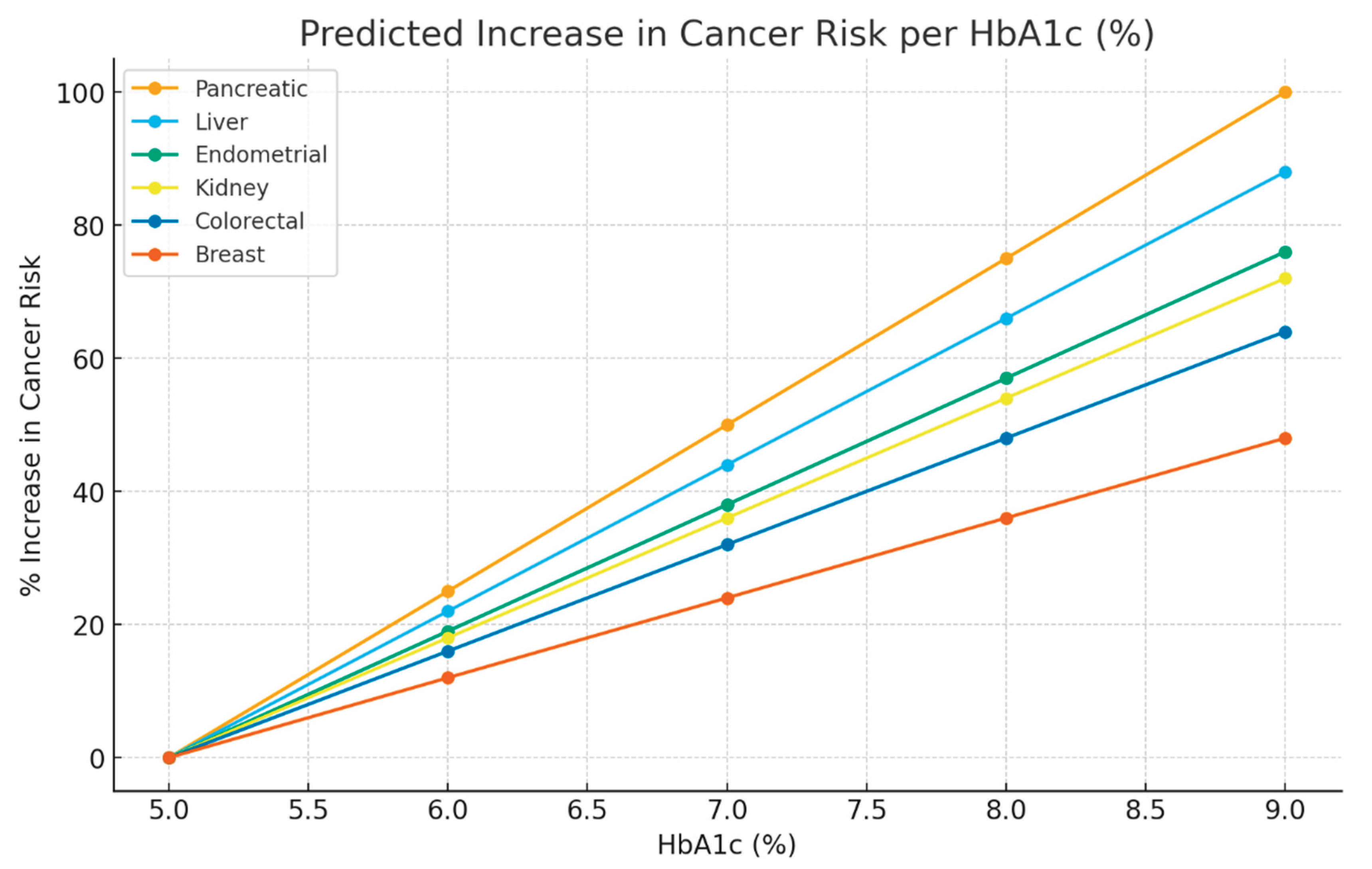

Table 1.
Study Characteristics.
| Variable | Summary Statistics |
|---|---|
| Total studies | 14 |
| Total sample size | 542,317 |
| Follow-up duration | 5–36 y (median 11.2) |
| Mean baseline HbA1c | 7.2–8.4% |
| Studies with serial HbA1c | 8 (57%) |
| Cancer events by site | Pancreatic 2,156; Liver 1,248; Colorectal 2,034; Breast 1,892; Endometrial 1,124; Kidney 1,008 |
| Adjustment covariates | Age, sex, BMI, smoking (100%); insulin/duration (71%) |
| NOS quality (mean) | 7.6 (high: 79%) |
Table 2.
Pooled Hazard Ratios per +1% HbA1c.
| Cancer Site | Pooled HR (95% CI) | % Risk ↑ | I² (%) | Key Studies |
|---|---|---|---|---|
| Pancreatic | 1.25 (1.18–1.33) | +25 | 62 | Fuentes 2025, Zhong 2016 [35], HK 2022 [36] |
| Liver | 1.22 (1.15–1.30) | +22 | 58 | Zhong 2016 [35], HK 2022 [36] |
| Endometrial | 1.19 (1.12–1.27) | +19 | 55 | McVicker 2022 [37], Saed 2019 [38] |
| Kidney | 1.18 (1.11–1.26) | +18 | 52 | Wang 2024 [39], Jin 2025 [40], Zhong 2016 [35] |
| Colorectal | 1.16 (1.09–1.24) | +16 | 50 | Guangzhou 2024 [41], New Onset T2D 2023 [42] |
| Breast | 1.12 (1.06–1.19) | +12 | 48 | Holm 2025 [43], Xiong 2023 [44], de Beer 2014 [45] |
Table 3.
Associations of AUC-HbA1c with Cancer Risk.
| Parameter | Pooled Result (95% CI) | Strongest Sites | Independence from BMI | Duration Effect (>10y) |
|---|---|---|---|---|
| HR per +1 AUC unit (%×y) | 1.18 (1.14–1.22) | Liver 1.22, Pancreatic 1.20 | Yes (P=0.41) | β doubled (P=0.003) |
| High vs. low burden (>120/<60) | 1.9× (1.6–2.3×) | Pancreatic/liver 2.1× | Yes | HR ↑ to 2.3× |
| HbA1c slope +0.1%/3 mo | +20% (15–26%) | Colorectal/breast +18% | Yes | Amplified 1.5× |
| HbA1c variability (per SD) | +12% (8–16%) | Kidney/endometrial +15% | N/A | N/A |
Table 4.
Tissue-Specific Glycohypoxic Vulnerability and Molecular Mechanisms.
| Tissue / Organ | Vulnerability Score (0–5) | Key Molecular Mechanisms | Experimental Evidence | References |
|---|---|---|---|---|
| Pancreas | 5 | HIF-1α↑, EMT↑, MMP-9↑, ROS↑, glycolysis↑, ATP↑, mitochondrial inhibition | Patients, STZ mice, BxPC-3 cells; HIF-1α siRNA reversal | Li 2018 [46]; Liu 2013 [47] |
| Liver | 4 | HIF-2α↑, lipid synthesis↑, PI3K-AKT-mTOR↑ | NAFLD-HCC; HIF-2α knockdown | Aging-US 2024 [48] |
| Colorectal | 3 | HIF-1α↑, STAT3↑, IL-6/TNF-α↑, microbiome shifts | IH models, CT26 mice, OSAS microbiome | Gao 2021 [49]; Benej 2024 [50] |
| Endometrium | 3 | GLUT-1↑, PI3K/AKT/mTOR↑, MUC1/HIF-1α↑ | Tissue microarray; immune-cell HIF-1α | Song 2024 [51]; Geetha 2025 [52] |
| Kidney | 2 | HIF-1α↑, HO-1↑, ROS↓, mitochondrial protection | HK-2 cells; HIF-1α knockout mice | Jiang 2020 [53] |
| Breast | 2 | HIF-1α↑, glycolytic shift | Cohort and mechanistic data | Durrani 2021 [54] |
Disclaimer/Publisher’s Note: The statements, opinions and data contained in all publications are solely those of the individual author(s) and contributor(s) and not of MDPI and/or the editor(s). MDPI and/or the editor(s) disclaim responsibility for any injury to people or property resulting from any ideas, methods, instructions or products referred to in the content. |
© 2026 by the authors. Licensee MDPI, Basel, Switzerland. This article is an open access article distributed under the terms and conditions of the Creative Commons Attribution (CC BY) license.
Copyright: This open access article is published under a Creative Commons CC BY 4.0 license, which permit the free download, distribution, and reuse, provided that the author and preprint are cited in any reuse.


