

Submitted:
11 April 2026
Posted:
13 April 2026
You are already at the latest version
Abstract
Pedestrians who are already on the road surface — collapsed through medical emergency, intoxication, or displacement by a prior collision — represent one of the most lethal yet least-addressed categories in road traffic safety. Peer-reviewed forensic database studies from Japan report a fatality rate of 33.0% for collisions involving prostrate pedestrians, more than double the rate for standing victims [1,2]. Simulation-based evaluation of a novel multi-modal detection system — the Advanced Falling Object Detection System (AFODS) — has demonstrated a True Positive Rate of 98.2% for fallen pedestrian detection under night conditions, against a baseline of 21.4% for standard ADAS [3]. These results are promising. But a simulation benchmark is not a deployed safety system. This opinion paper argues that three key steps must now be taken: a physical prototype of AFODS must be built and validated under real-world conditions; its detection latency advantage must be translated into forensic injury outcome estimates using established biomechanical criteria; and regulatory bodies must extend pedestrian AEB test standards to encompass the non-upright pedestrian scenario. The evidence for the problem is conclusive. The technical pathway to the solution is published. The work that remains is a matter of will, not capability.
Keywords:
fallen pedestrian
; ADAS detection failure
; AFODS
; forensic injury modelling
; ISO 26262
; pedestrian safety
; HIC
; BrIC
; hit-and-run
; sensor fusion
; thermal imaging
; prototype validation
I. A Death Pattern That Is Measured, not Estimated
More than 1.19 million people die on the world's roads each year [4]. Pedestrians account for 23% of those deaths — a proportion that has risen since 2010 even as overall road traffic fatalities have edged downward [4]. Within the pedestrian fatality count, one subset is both disproportionately lethal and almost absent from the engineering standards and regulatory frameworks designed to protect them: the individual who is already lying on the road surface when a vehicle strikes them.
Forensic database studies using Japan's national police records — which capture over 400,000 pedestrian collision events annually — have established that collisions with prostrate pedestrians carry a fatality rate of 33.0%, more than double the rate for upright pedestrian collisions [1,2]. These are not victims who failed to see an oncoming car. They are people already incapacitated: collapsed from sudden cardiac arrest, stroke, or hypoglycaemic emergency; brought down by alcohol on unlit roads in the early morning hours; or displaced onto the road surface by a primary collision and struck again by a following driver who could not perceive the low-profile human form in their path. The strong association of these incidents with hit-and-run outcomes [1] reflects the core problem precisely: the driver did not see the target. As will be shown below, neither do the safety systems now standard in those vehicles.
The autopsy presentation of these deaths is biomechanically distinct from the classical pedestrian impact. When a victim is already at road level, the first vehicular contact is tyre-to-skull or undercarriage-to-thorax — not the windscreen-to-head wrap trajectory that underpins every current pedestrian crash test standard. The resulting injuries are among the most severe documented in traffic forensic pathology: bilateral thoracic crush, traumatic brain injury from direct tyre contact, abdominal evisceration, and lower extremity degloving [5]. These injuries do not appear on autopsy tables because of inadequate medical care. They appear because no safety system in the vehicle was designed to detect the person lying in its path.
A pedestrian lying on the road in Japan has a one-in-three chance of dying. The vehicles designed to protect pedestrians detect them, at night, fewer than one in five times. This is not a peripheral limitation. It is a structural failure, built into the safety architecture of every vehicle on the road, affecting the category of pedestrians least able to protect themselves.
II. Why Standard Adas Cannot See Them — And What Has Been Demonstrated in Simulation
Advanced Driver-Assistance Systems — the visible-spectrum cameras, radar, and LiDAR arrays now standard in new passenger vehicles across Japan, Europe, and North America — are trained on datasets of upright, walking pedestrians. This reflects the statistical distribution of pedestrian-vehicle encounters. It does not reflect the mortality distribution. Iftikhar et al. [6], reviewing over 100 published deep learning pedestrian detection architectures, identified non-upright posture as a primary and systematically unaddressed failure mode across all major convolutional neural network approaches. This is not a recent discovery. It is a known limitation that has not been corrected in any commercially deployed system.
The consequence is a 73.3 percentage point detection gap. Under 0 lux night conditions — when intoxicated and medically incapacitated pedestrians are most likely to be on road surfaces — simulation studies show that standard monocular RGB camera systems achieve a True Positive Rate of 21.4% for fallen pedestrian detection, against 94.7% for standing pedestrians [3]. Vargas et al. [7] confirm that no single sensor modality — camera, radar, or LiDAR — provides adequate coverage under adverse conditions. Puchacz and Patalas-Maliszewska [8] identify multi-modal sensor fusion combining thermal infrared, near-infrared stereo, and ultrasonic sensors as the consensus solution. The consensus, it must be said, is in the literature. It is not yet in the vehicles.
The Advanced Falling Object Detection System (AFODS), introduced in a peer-reviewed publication in Vehicles (Barua, 2025) [3] and further developed in two working papers on ISO 26262 functional safety architecture [9,10], represents the first published system specifically designed for this failure mode. AFODS integrates Long-Wave Infrared (LWIR) thermal imaging, Near-Infrared (NIR) stereo cameras, and ultrasonic sensors, processed through a YOLOv7-Tiny AI pipeline [11] augmented by a Gated Recurrent Unit neural network that analyses pose-keypoint sequences over a 1–2 second window — enabling detection of pre-fall signatures such as staggering and loss of balance before collapse is complete. In 320 controlled simulation trials, AFODS achieved a night-condition True Positive Rate of 98.2%, reduced false positives by 95% relative to a baseline RGB camera system, and operated with a mean end-to-end latency of 46.3 ms (SD = 4.1 ms) [3]. The system architecture targets ISO 26262 Automotive Safety Integrity Level B compliance [12]. The technology is filed under Japanese Patent Application No. 2025-167440.
These are simulation results. They are significant — they demonstrate, for the first time in the peer-reviewed literature, that the 73.3 percentage point classification gap is not an inherent physical limitation but an engineering choice that can be reversed. They are not, however, the same as a physical prototype operating on a real vehicle under real-world conditions. That validation has not yet been performed. This paper argues it must be.

Table 1.
Fallen vs. Standing Pedestrian Detection: Standard ADAS vs. AFODS Simulation Benchmark [3] vs. Current Regulatory Test Scope.
Table 1.
Fallen vs. Standing Pedestrian Detection: Standard ADAS vs. AFODS Simulation Benchmark [3] vs. Current Regulatory Test Scope.
| Metric | Standard ADAS (Night) | AFODS Simulation Benchmark [3] | Euro NCAP / JNCAP Current Requirement |
|---|---|---|---|
| Fallen pedestrian TPR (0 lux night) | 21.4% | 98.2% | Not mandated — untested |
| Standing pedestrian TPR (night) | 94.7% | 99.5% | ≥90% (AEB-ped) |
| Classification gap: standing vs. fallen | −73.3 pp | −1.3 pp | Not defined |
| False positive rate (night, per 24 h) | 31.2 | 1.5 (−95%) | Not defined |
| End-to-end system latency | 500–1,500 ms (human reaction) | 46.3 ms (SD 4.1 ms) | Not defined |
All AFODS values from 320 controlled simulation trials [3]. TPR = True Positive Rate; pp = percentage points. Red = failure range; Green = simulation target achieved; Grey = not yet tested or mandated. Real-world prototype validation is proposed in Section III.
III. What the Simulation Result Means — And What It Does not Yet Prove
The 46.3 ms system latency reported in [3] is the operative figure for any forensic injury analysis. Human visual reaction time to an unexpected road event is typically 500–1,500 ms [13]. Substituting a 46 ms automated detection response for an 800 ms human reaction at 50 km/h yields approximately 10 metres of additional stopping distance. Through established vehicle dynamics equations, this translates to a lower residual impact speed. Through the Head Injury Criterion (HIC) [14] and Brain Rotational Injury Criterion (BrIC) [15] — applied to the specific run-over contact geometry, where the first vehicular contact is tyre-to-skull rather than the windscreen-to-head wrap trajectory assumed in all current regulatory pedestrian crash tests — this translates to a lower probability of fatal head injury. The direction of that argument is clear. The precise magnitude has not yet been calculated.
This is the critical gap. Engineering journals can certify a 98.2% simulation TPR. What the forensic pathologist, the medicolegal expert, and the traffic safety policymaker need is the answer to a different question: by how much does AFODS reduce the probability of the tyre-contact traumatic brain injuries documented in the autopsy literature [5]? That calculation requires the application of HIC and BrIC biomechanical criteria to the specific prone-pedestrian contact geometry — a calculation that has not been performed for AFODS or any equivalent system — and it requires the forensic database case data that would allow the result to be expressed as a population-level prevented fatality estimate. Neither piece of work yet exists. Both are necessary. Both are proposed.
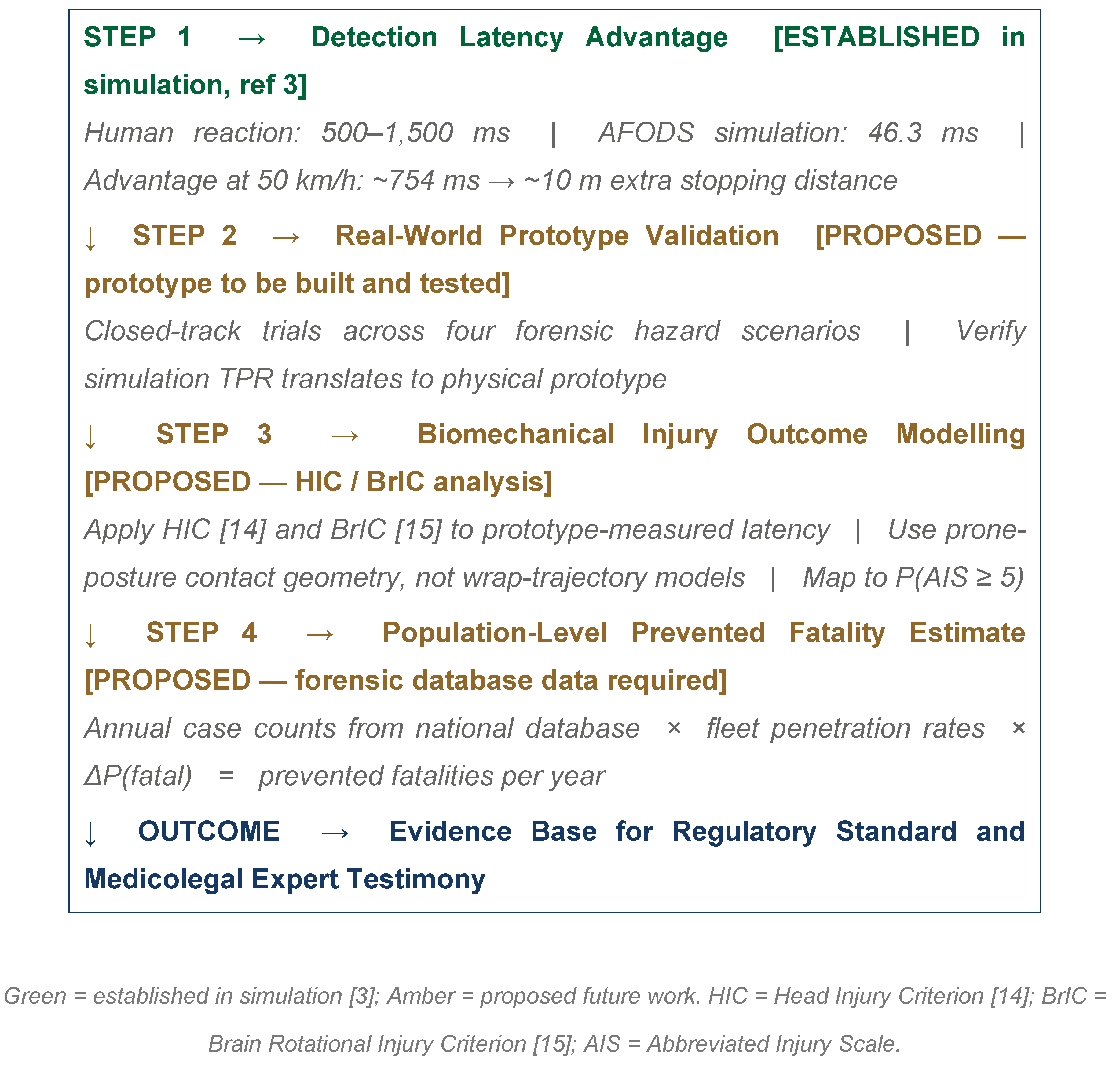
The biomechanical translation proposed in Steps 3 and 4 of Figure 1 requires a methodological note. All current pedestrian crash test standards — the Euro NCAP AEB protocol, JNCAP, UN Regulation No. 152 — evaluate impact biomechanics using a standing victim undergoing a wrap-trajectory collision: bumper contact to the lower extremity, hood contact to the thorax, windscreen contact to the head. The HIC and BrIC parameter spaces established in the regulatory literature are derived from this geometry. The run-over scenario addressed by AFODS is fundamentally different: tyre-to-skull contact at near-vertical approach angles, with the victim's head at road surface level, no energy-absorbing wrap trajectory, and a rigid tyre or undercarriage contact surface rather than a deformable windscreen. The biomechanical analysis proposed here cannot borrow from the standing-impact literature. It requires prone-posture computational modelling — the Total Human Body Model for Safety (THUMS) repositioned into prone configuration with tyre-contact loading conditions — to be scientifically defensible. This specificity is, in itself, one of the forensic contributions this work proposes to make.
IV. What Three Communities Must Now Do
Forensic Pathologists and Medicolegal Professionals. The forensic case series for fallen pedestrian fatalities already exists in the national database literature [1,2]. What has not yet been done is the systematic application of HIC and BrIC biomechanical criteria to the specific run-over contact geometry that those cases present — and the consequent construction of an injury probability curve that translates AFODS latency advantage into reduced probability of the tyre-contact traumatic brain injuries documented at autopsy. This is proposed work. But it is work that sits squarely within the competence of forensic biomechanics, and it is work that, once completed, will fundamentally change the evidentiary landscape for medicolegal proceedings involving secondary pedestrian impact. The causal chain from a manufacturer's decision not to implement AFODS-class detection to a fatal run-over outcome will be reconstructable with scientific rigour, using established injury risk functions [16,17]. Expert witnesses will have a quantitative framework for foreseeable harm. That framework does not yet exist. It needs to be built.
Traffic Safety Policymakers and Regulators. The regulatory gap is precisely identified and straightforwardly closeable. Euro NCAP's pedestrian AEB protocol tests an adult dummy walking across the vehicle's path. JNCAP tests upright adult and child silhouettes. UN Regulation No. 152 is similarly constrained. None of these frameworks test detection performance for a target that is prone, supine, or lateral — the configurations that carry a 33.0% fatality rate [1,2]. Adding a prone adult ATD and a laterally displaced child to the standard AEB test matrix is not a new regulatory framework. It is a protocol amendment. The performance floor against which systems would be evaluated already exists in the published simulation literature [3]: 98.2% TPR at night, against a current baseline of 21.4%. Once prototype validation data confirm that this benchmark translates to real-world hardware, regulators will have both the performance floor and the evidence base for the standard. The WHO Decade of Action target of halving road traffic deaths by 2030 [4] cannot be achieved in good conscience while the category with the highest pedestrian fatality rate is structurally excluded from the assessment frameworks that are meant to address it.
The ADAS and Automotive Engineering Community. The AFODS simulation publication [3] establishes that the detection architecture is technically viable. The remaining challenge — building a physical prototype, testing it under the four forensic hazard scenarios derived from the national database literature, and demonstrating that the simulation TPR holds under real-world thermal clutter, electromagnetic interference, and variable fall dynamics — is a defined and executable programme, not a fundamental research problem. The engineering community's obligation is to pursue it. A parallel obligation falls on dataset curators: the systematic exclusion of non-upright posture configurations from benchmark datasets such as Caltech Pedestrian, CityPersons, and MOTChallenge is a curation choice that has compounded this failure with every training cycle of every ADAS system deployed over the past decade. It should be corrected in the next.
V. Conclusion
This paper has made three arguments. First, the evidence for the fallen pedestrian detection failure is conclusive: quantified in peer-reviewed forensic database studies [1,2], measured in simulation engineering trials [3], and documented on autopsy tables in forensic pathology [5]. The 73.3 percentage point gap between ADAS performance on standing and fallen pedestrians at night is not a marginal technical limitation. It is a structural omission, replicated across every vehicle on the road, affecting the category of pedestrian with the highest fatality rate and the least capacity for self-protection.
Second, a technically viable solution has been demonstrated in simulation. The AFODS system [3] achieves a 98.2% night-condition TPR in 320 controlled trials, reduces false positives by 95%, and operates within a 46.3 ms latency window that, through straightforward vehicle dynamics and biomechanical analysis, is expected to translate to a meaningful reduction in fatal head injury probability. That translation has not yet been computed. It needs to be.
Third, that the work remaining is not primarily technical. The simulation architecture is published. The biomechanical criteria are established. The forensic database literature exists. What is needed now is a physical prototype validation study, a forensic injury outcome modelling programme using prone-posture biomechanical methods, and a regulatory decision to extend pedestrian AEB standards to the non-upright scenario. None of these requires new science. All of them require commitment.
The victims in Japan's autopsy case series were lying on the road. They were not invisible. The vehicles that struck them had safety systems that had never been asked to look for someone in that position. Changing that is an engineering task, a regulatory task, and a forensic task. This paper has tried to make the case that it is also, by now, a moral one.
Funding
No external funding was received for this work.
Conflicts of Interest
A filed patent (Japanese Patent Application No. 2025-167440, filed 3 October 2025) on the AFODS technology. This paper is submitted in the author's academic capacity as Visiting Professor, Department of Legal Medicine, Shiga University of Medical Science.
References
- Hitosugi, M; Kagesawa, E; Narikawa, T; Nakamura, M; Koh, M; Hattori, S. Hit-and-runs more common with pedestrians lying on the road: Analysis of a nationwide database in Japan. Chin J Traumatol. 2021, 24(2), 83–87. [Google Scholar] [CrossRef] [PubMed]
- Koh, M; Hitosugi, M; Ito, S; Kawasaki, T. Factors Influencing Fatalities or Severe Injuries to Pedestrians Lying on the Road in Japan: Nationwide Police Database Study. Healthcare 2021, 9(11), 1433. [Google Scholar] [CrossRef] [PubMed]
- Barua, N. Advanced Multi-Modal Sensor Fusion System for Detecting Falling Humans: Quantitative Evaluation for Enhanced Vehicle Safety. Vehicles 2025, 7(4), 149. [Google Scholar] [CrossRef]
- World Health Organization. Global Status Report on Road Safety 2023; WHO: Geneva, 2023; Available online: https://www.who.int/publications/i/item/9789240086517.
- DiMaio, DJ; DiMaio, VJM. Forensic Pathology, 2nd ed.; CRC Press: Boca Raton, 2001; ISBN 978-0849300721. [Google Scholar]
- Iftikhar, S; Zhang, Z; Asim, M; Muthanna, A; Koucheryavy, A; El-Latif, AAA. Deep Learning-Based Pedestrian Detection in Autonomous Vehicles: Substantial Issues and Challenges. Electronics 2022, 11(21), 3551. [Google Scholar] [CrossRef]
- Vargas, J; Alsweiss, S; Toker, O; Razdan, R; Santos, J. An Overview of Autonomous Vehicles Sensors and Their Vulnerability to Weather Conditions. Sensors 2021, 21(16), 5397. [Google Scholar] [CrossRef] [PubMed]
- Puchacz, B; Patalas-Maliszewska, J. Automotive Sensors for Pedestrian Detection: A Review. Vehicles 2024, 6, 22–70. [Google Scholar] [CrossRef]
- Barua, N. Integrated Safety Architectures: Leveraging Multi-Modal AI and ISO 26262 to Protect Vulnerable Road Users. Available at SSRN. 22 January 2026. [CrossRef]
- Barua, N. From Post-Mortem to Prevention: Redefining "Invisible" Pedestrians through ISO 26262 and Multi-Modal AI. Available at SSRN. 26 February 2026. [CrossRef]
- Wang, CY; Bochkovskiy, A; Liao, HYM. YOLOv7: Trainable bag-of-freebies sets new state-of-the-art for real-time object detectors. Proc IEEE CVPR, 2023; pp. 7464–7475. [Google Scholar] [CrossRef]
- ISO 26262-1; Road Vehicles — Functional Safety — Part 1: Vocabulary. International Organization for Standardization: Geneva, 2018.
- Green, M. 'How Long Does It Take to Stop?' Methodological Analysis of Driver Perception-Brake Times. Transp Hum Factors 2000, 2(3), 195–216. [Google Scholar] [CrossRef]
- Versace, J. SAE Technical Paper 710881; A Review of the Severity Index. 1971. [CrossRef]
- Takhounts, EG; Craig, MJ; Moorhouse, K; McFadden, J; Hasija, V. Development of Brain Injury Criteria (BrIC). Stapp Car Crash J. 2013, 57, 243–266. [Google Scholar] [CrossRef] [PubMed]
- Prasad, P; Mertz, HJ. SAE Technical Paper 851246; The Position of the United States Delegation to the ISO Working Group 6 on the Use of HIC in the Automotive Environment. 1985. [CrossRef]
- Mertz, HJ; Prasad, P; Irwin, AL. SAE Technical Paper 973318; Injury Risk Curves for Children and Adults in Frontal and Rear Collisions. 1997. [CrossRef]
- Simms, CK; Wood, DP. Posture and target geometry as determinants of detectability and injury severity. Proc Inst Mech Eng D J Automob Eng. 2006, 220(8), 1085–1100. [Google Scholar] [CrossRef]
- Bonnefon, JF; Shariff, A; Rahwan, I. The social dilemma of autonomous vehicles. Science 2016, 352(6293), 1573–1576. [Google Scholar] [CrossRef] [PubMed]
Figure 1.
Proposed Forensic Injury Translation Framework: From AFODS Detection Latency to Clinical Injury Outcome Estimate.
Figure 1.
Proposed Forensic Injury Translation Framework: From AFODS Detection Latency to Clinical Injury Outcome Estimate.
Disclaimer/Publisher’s Note: The statements, opinions and data contained in all publications are solely those of the individual author(s) and contributor(s) and not of MDPI and/or the editor(s). MDPI and/or the editor(s) disclaim responsibility for any injury to people or property resulting from any ideas, methods, instructions or products referred to in the content. |
© 2026 by the author. Licensee MDPI, Basel, Switzerland. This article is an open access article distributed under the terms and conditions of the Creative Commons Attribution (CC BY) license.
Copyright: This open access article is published under a Creative Commons CC BY 4.0 license, which permit the free download, distribution, and reuse, provided that the author and preprint are cited in any reuse.


