

Submitted:
10 April 2026
Posted:
13 April 2026
You are already at the latest version
Abstract
Chimeric antigen receptor (CAR) T cell therapy represents one of the greatest breakthroughs in modern immunotherapies. To date, it has been approved by the Food and Drug Administration (FDA) for the treatment of several hematological malignancies, including different subtypes of leukemia, lymphoma, and multiple myeloma. However, recent reports suggest that CAR T therapy may also be effective in the treatment of severe systemic autoimmune diseases, such as systemic lupus erythematosus (SLE) and systemic sclerosis (SSc). Case reports and small case series have demonstrated the efficacy of anti-CD19 CAR T cell therapy while maintaining a favorable safety profile. The most frequently reported adverse events include grade 1 or 2 cytokine release syndrome (CRS), hypogammaglobulinemia, and mild infectious complications. Moreover, CAR T therapy may also have potential in the treatment of advanced metastatic solid tumors, including melanoma. Early clinical studies have demonstrated the feasibility and safety of CAR T cell therapy in metastatic melanoma; however, several challenges remain. These include limited tumor trafficking and infiltration of CAR T cells, due to the presence of an immunosuppressive tumor microenvironment. Additionally, following the remarkable success of CAR T therapy in lymphomas, this approach may also be applied to the treatment of cutaneous lymphomas, including cutaneous T-cell and B-cell lymphomas. Key challenges include tumor heterogeneity, optimal target antigen selection, fratricidal activity of CAR T cells, and potential contamination of the CAR T product with lymphoma cells.
Keywords:
CAR T cell therapy
; chimeric antigen receptor T cells
; adoptive cell therapy
; immunotherapy
; melanoma
; autoimmune diseases
; systemic lupus erythematosus
; cutaneous lymphoma
; systemic sclerosis
; tumor microenvironment
; cytokine release syndrome
; CD19
1. Introduction
Initially developed to treat hematological malignancies, chimeric antigen receptor (CAR) T cells have emerged as a focus of modern immunotherapies across multiple medical fields. CAR T cells are genetically engineered T lymphocytes that express chimeric antigen receptors (CARs) on their surface. Those receptors recognize antigens expressed by cancerous or autoimmune cells. Upon antigen recognition, lymphocytes release cytotoxic molecules such as granzyme, perforin, and cytokines, leading to apoptosis and lysis of targeted cells [1,24].
CARs consist of four main domains: an extracellular antigen-biding domain, a hinge or spacer region, a transmembrane domain, and one or more intracellular signaling domains [2]. The antigen-binding domain, which consists of a single-chain variable fragment (scFv), is the part of CARs responsible for recognizing targeted cells. Typically, CARs target extracellular autoimmune or tumor-associated antigens via scFvs, resulting in major histocompatibility complex (MHC)-independent T cell activation [2,3]. The most important characteristic of the antigen-binding domain, determining CARs' function, is its affinity. It must be high enough to provide antigen recognition, induce CAR signaling, and activate T cells, but at the same time not overly high to cause CAR T cell exhaustion or toxicity [4,5]. The hinge or spacer region connects the scFv to the transmembrane domain. Its function is to provide flexibility to overcome steric hindrances, as well as sustain an appropriate length, allowing the antigen-binding domain to access the target epitope [6,7]. The length of the spacer domain also influences the immunological synapse formation by ensuring the appropriate intercellular distance [8]. The main function of the transmembrane domain is to anchor CAR to the T cell membrane. In addition, these domains can influence the expression level of CAR receptors or the transmission of ligand recognition signals to the intracellular cytoplasmic domain [9,10]. The intracellular signaling domain is a key component of CAR T cells, crucial for their activation, persistence, and clinical effectiveness [10].
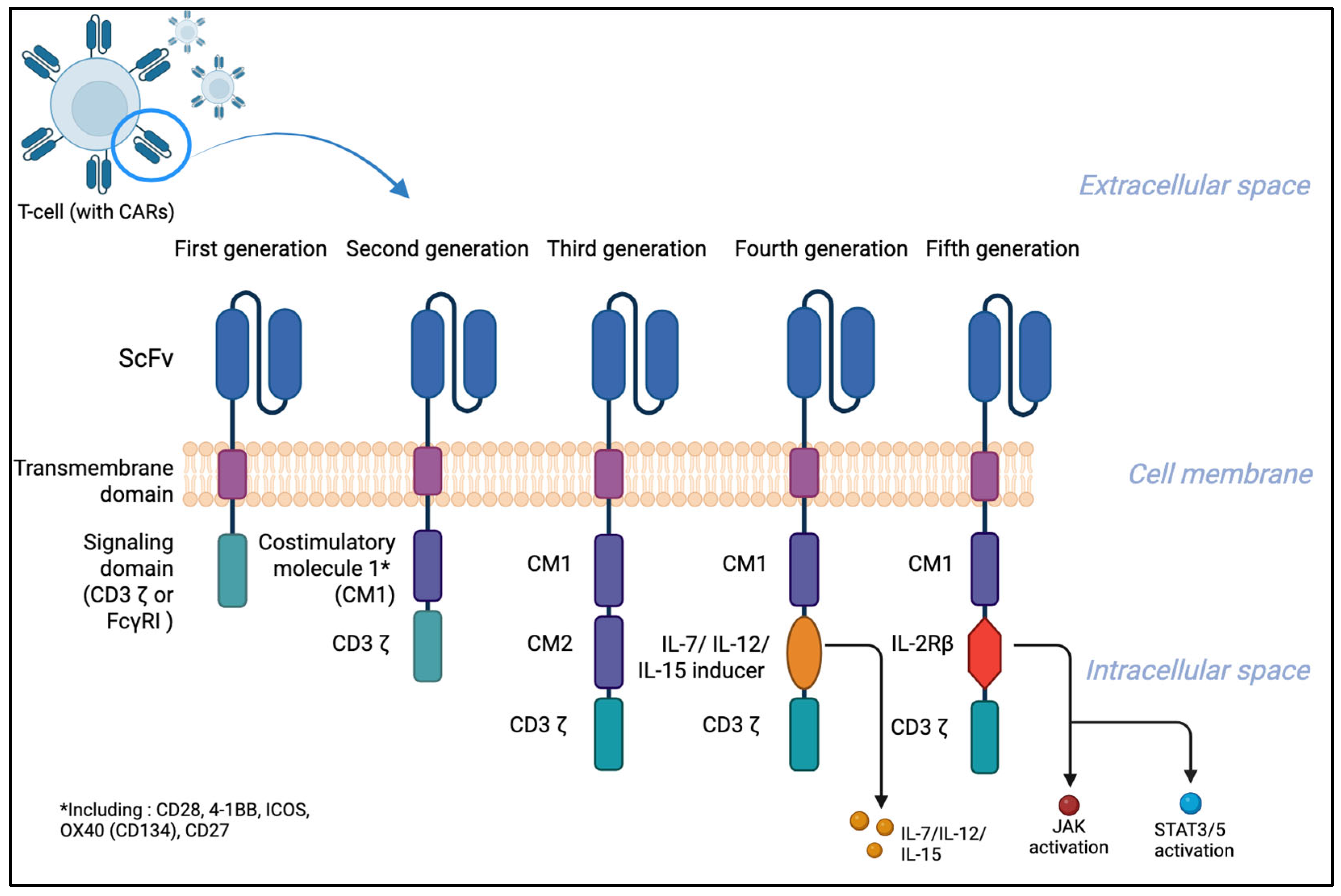
Based on the number and molecular structure of the intracellular domain, CAR T cells can be divided into 5 generations [11,12]. First-generation CAR T cells consist of an scFv, a hinge region, a transmembrane domain, and an intracellular signaling domain such as CD3-ζ or FcγRI, which acts as the main transducers of T-cell receptor (TCR) signaling and induce signaling cascades [13]. However, modest CD3 ζ-mediated activation led to insufficient therapeutic efficacy due to poor cytokine production and limited proliferation, which significantly altered the clinical outcomes [14,15]. To overcome these challenges, second-generation CAR T cells were enriched with costimulatory domains such as CD28, 4-1BB, ICOS, OX40 (CD134), CD27, and others, which significantly improved T cell proliferation, cytokine production, and persistence [16,236]. To further enhance T cell function, third-generation CAR Ts combine multiple costimulatory domains (e.g., CD28 and 4-1BB) to enhance efficacy, and preclinical studies support their improved performance with similar safety profile compared to earlier designs. A clinical trial of third-generation CAR T cells targeting CD19 demonstrated greater expansion and persistence than second-generation CARs. Although some data suggest that multiple costimulatory signals may promote lymphocyte exhaustion [17,244]. The fourth generation CAR T cells, also known as T cells Redirected for Universal Cytokine-mediated Killing (TRUCK) or armored, is an evolution of the second-generation design, enriched with mechanisms for precisely controlling the immune response. A key innovation is the ability to induce cytokine production (including IL-7, IL-12, and IL-15) directly within the tumor microenvironment, often via a module activated by nuclear factor of activated T cells (NFAT) [18,19]. This process not only increases the cytotoxicity of the lymphocytes themselves but also recruits other immune cells, as well as promotes T lymphocyte infiltration within tissues, which is particularly important in the treatment of solid tumors [20,21]. To ensure safety, these systems are equipped with adjustable suicide genes that allow lymphocytes to be turned off in the event of severe complications [9]. The fifth generation of CAR T cells are second-generation CARs containing an additionally shortened cytokine receptor domain (e.g. IL-2Rβ) fused to the biding site for the transcription factor STAT3. After antigen recognition, the JAK-STAT pathway is activated, in addition to the CD3ζ and co-stimulatory domains. This design more closely mimics natural T-cell activation by providing all three signals required for robust immune responses, leading to enhanced proliferation, persistence, and antitumor activity [22,23].
Figure 1.
Evolution of five generations of chimeric antigen receptors (CARs). First-generation CARs contain CD3ζ signaling domain; second- and third-generation CARs include one or two co-stimulatory molecules (CM), e.g., CD28, 4-1BB. Fourth-generation CAR-T cells (TRUCKs) secrete cytokines (e.g., IL-7, IL-12, IL-15), while fifth-generation CAR-T cells incorporate cytokine receptor signaling domains (e.g., IL-2Rβ) activating JAK/STAT pathways. Abbreviations: CARs – chimeric antigen receptors; CD – cluster of differentiation; CM – costimulatory molecule; IL – interleukin; JAK – Janus kinase; FcγRI – Fc gamma receptor I; ScFv – single-chain variable fragment; STAT – signal transducer and activator of transcription.
Figure 1.
Evolution of five generations of chimeric antigen receptors (CARs). First-generation CARs contain CD3ζ signaling domain; second- and third-generation CARs include one or two co-stimulatory molecules (CM), e.g., CD28, 4-1BB. Fourth-generation CAR-T cells (TRUCKs) secrete cytokines (e.g., IL-7, IL-12, IL-15), while fifth-generation CAR-T cells incorporate cytokine receptor signaling domains (e.g., IL-2Rβ) activating JAK/STAT pathways. Abbreviations: CARs – chimeric antigen receptors; CD – cluster of differentiation; CM – costimulatory molecule; IL – interleukin; JAK – Janus kinase; FcγRI – Fc gamma receptor I; ScFv – single-chain variable fragment; STAT – signal transducer and activator of transcription.
The process of generating CAR T cells begins with the collection of the patient's white blood cells (WBC), after discontinuing immunosuppressive treatment at least three weeks prior to cell collection (expect of low-dose prednisone) [25]. The collected T cells are then activated by artificial antigen-presenting cells (aAPCs) or monoclonal antibodies (mAbs) targeting CD3/CD28 [26]. T-cells used in this process can be either CD4+ or CD8+, but CD8+ are more favorably used than autoreactive CD4+ cells despite the higher risk of CAR T cell exhaustion [27]. The activated cells are then incubated with genetically modified viral vectors (lentiviral or retroviral) that contain the CAR gene. The vector delivers RNA encoding the CAR gene to the T-cells. Then the viral RNA undergoes reverse transcription into DNA, integrating it into the T-cell genome [28,29]. This allows T-cells to express CAR receptors on their surface. Genetically modified CAR T cells are expanded in vitro using growth factors such as IL-2, IL-12, IL-7, IL-15, and IL-21 [28,30]. The final product is then cryopreserved before being administered to the patient [27]. In most cases, patients undergo lymphodepletion with fludarabine and cyclophosphamide prior to receiving the final product. This is the most common regimen used in clinical trials, but there is no specific standardization of this process. After administration of the CAR T product, these cells proliferate in the patient's body, multiplying its quantity many times over and can persist for years, providing long-term remission [29].
In 2017, axicabtagene ciloleucel (axi-cel) became the first CAR T cell product approved by the Food and Drug Administration (FDA) for the treatment of adult patients with relapsed or refractory (r/r) large B-cell lymphoma. Since then, FDA-approved applications for the CAR T cell therapy have grown to include B-cell acute lymphoblastic leukemia, large B-cell lymphoma, follicular lymphoma, mantle cell lymphoma, chronic lymphocytic leukemia, and multiple myeloma [31].
Beyond current indications, CAR T cells may also be applicable in the treatment of skin and connective tissue disorders, including autoimmune diseases like systemic lupus erythematosus (SLE), systemic sclerosis (SSc), as well as solid tumors, in particular metastatic melanoma and cutaneous T-cell lymphoma (CTCL). Current immunotherapies used in clinical practice to treat the above-mentioned conditions do not provide a consistently satisfactory response to treatment in all patients, which highlights the need to develop new therapeutic approaches [32,33,34,35,36].
This narrative review aims to explore the application, efficacy, and safety of CAR T therapy in the treatment of different skin and connective tissue disorders. By providing a comprehensive overview of the current evidence regarding the efficacy of CAR T cell therapy in both autoimmune disorders and oncology, this review highlights the clinical potential, safety, limitations, and future directions of the treatment.
2. Systemic Lupus Erythematosus (SLE)
SLE is a chronic autoimmune disease with highly heterogeneous clinical presentations affecting multiple organ systems [37,38]. Clinical manifestations can range from relatively mild symptoms—such as arthritis, fatigue, pleuritis, lymphadenopathy, and cutaneous lesions—to severe, potentially life-threatening complications including lupus nephritis, central nervous system involvement, and systemic vasculitis. Severe disease occurs in a substantial subset of patients and is associated with a poorer prognosis and increased mortality [38,39]. At the molecular level, the immunopathogenesis of SLE centers on a breakdown of immune tolerance with the generation of pathogenic autoantibodies targeting nuclear antigens. Central mechanisms include defective clearance of apoptotic cells and excessive neutrophil extracellular trap (NET) formation, leading to persistent antigenic stimulation and chronic inflammation. Dysregulation of innate and adaptive immunity is driven in part by sustained overproduction of type I interferons (IFN-α, IFN-β), which amplify autoreactive processes and contribute to an imbalance between T helper 17 (Th17) cells and regulatory T (Treg) cells. This imbalance supports proinflammatory responses and loss of self-tolerance, promoting autoantibody production by autoreactive B cells and immune complex–mediated tissue injury [40,41,42,43]. B cells are central to SLE pathogenesis not only through autoantibody production, but also via antigen presentation and cytokine secretion. Normally, autoreactive B cells are eliminated during central tolerance in the bone marrow and peripheral tolerance in secondary lymphoid organs. A breach of these checkpoints results in the survival and expansion of autoreactive clones. Phenotypic markers such as CD19, CD20, CD21, CD24, CD27, IgM, and IgD characterize B-cell differentiation stages, with CD19 present on nearly all B-cell stages and CD20 absent on pro-B cells and plasma cells—an important distinction for targeted therapies [44,45,46,47,48,49].
The treatment of SLE aims to control disease activity, prevent organ damage, and improve long-term outcomes and quality of life. Therapy is individualized according to disease severity and organ involvement and includes conventional immunosuppressive agents and biologic therapies [50,51]. Hydroxychloroquine remains the cornerstone of baseline therapy due to its immunomodulatory effects and ability to reduce disease flares, with ophthalmologic monitoring required during long-term use [52]. Glucocorticoids are widely used for rapid disease control during flares but are tapered to limit cumulative toxicity [53,54,55]. Additional immunosuppressive agents, including methotrexate, azathioprine, mycophenolate mofetil, and cyclophosphamide, are employed in patients with inadequate disease control or major organ involvement. NSAIDs and low-dose aspirin are used for symptomatic relief and thrombosis prevention in selected patients [50,56,57]. Biologic therapies have expanded treatment options by targeting key immune pathways. Belimumab, a monoclonal antibody against B-lymphocyte stimulator (BLyS/BAFF), was the first biologic approved for SLE and has demonstrated efficacy in reducing disease activity and flare rates when added to standard therapy, particularly in moderate disease [58]. Other biologics aim to deplete B cells or modulate immune signaling. Rituximab, an anti-CD20 monoclonal antibody, depletes mature B cells but spares plasma cells, contributing to variable clinical efficacy despite frequent use in refractory disease [48,58,59,60]. Newer anti-CD20 agents, such as ocrelizumab and obinutuzumab, have shown mixed results, highlighting the need for deeper and more sustained B-cell targeting [61,62,63]. More recent agents targeting non–B-cell pathways, including anifrolumab and voclosporin, have further broadened the therapeutic landscape; however, durable drug-free remission remains uncommon, and prolonged immunosuppression is often required [50,51]. Adjunctive therapies such as intravenous immunoglobulin and plasmapheresis may be considered in selected severe cases, although their long-term benefit remains limited [50,51].
Given the central role of B cells and the limitations of current biologics, CAR T cell therapy has emerged as a promising treatment paradigm for refractory SLE. CAR T technology involves engineering patient-derived T cells to express a synthetic receptor that recognizes specific antigens, most commonly CD19, leading to targeted cell lysis [20,21,22,23,24]. In SLE, CD19-directed CAR T cells can achieve profound depletion of autoreactive B cells and their precursors—including those resistant to anti-CD20 therapy—offering the potential for deep and sustained immunologic remission and resetting of immune tolerance [47,48,64,65].
Early case reports and pilot studies (Mougiakakos et al.(2021); Zhang et al.(2021), Mackensen et al. (2022)), laid the groundwork for clinical application by demonstrating feasibility and clinical responses in refractory SLE. Building on these foundational experiences, studies published since 2023 have provided systematic evidence of efficacy and safety in larger and more diverse patient cohorts [66,67,68]. In one of the latest studies by Jinhui Shu, Wei Xie et al., the safety and efficacy of CD19-directed CAR T therapy (relma-cel) were evaluated in patients with active systemic lupus erythematosus. Of 12 initially screened individuals, 8 female patients aged 18–70 years ultimately received a single relma-cel infusion following lymphodepletion with fludarabine (25 mg/m²/day) and cyclophosphamide (250 mg/m²/day). Four dose levels were administered (25 × 10⁶, 50 × 10⁶, 75 × 10⁶, and 100 × 10⁶ CAR T cells). Treatment resulted in marked clinical improvement, with the mean Safety of Estrogens in Lupus Erythematosus National Assessment – Systemic Lupus Erythematosus Disease Activity Index (SELENA-SLEDAI) score decreasing from 11.75 at baseline to 1.63 at 6 months, the mean Physician’s Global Assessment (PGA) score from 1.82 to 0.52, and the mean total British Isles Lupus Assessment Group (BILAG) score from 6.50 to 0.88. Six patients achieved a SELENA-SLEDAI score ≤ 4 within 3 months, including three who reached complete clinical remission (major clinical response), one as early as 1-month post-infusion; all patients met Systemic Lupus Erythematosus Responder Index (SRI) response criteria. Only one patient experienced a serological relapse at month 3 and withdrew consent at month 6. Adverse events were reported in all participants, predominantly grade 1–2. The most common events were cytopenia (100%), cytokine release syndrome (88%), and hypogammaglobulinemia (88%). No cases of immune effector cell–associated neurotoxicity syndrome (ICANS) or clinically significant hepatic or renal toxicity were observed, and immune effector cell–associated hematotoxicity was limited to grade 1 in most cases. Overall, these findings suggest that a single infusion of relma-cel can induce rapid and profound disease activity reduction in refractory SLE, with an acceptable short-term safety profile [74]. In a compassionate-use cohort by Taubmann et al. involving seven patients with severe refractory SLE and active lupus nephritis, a single infusion of autologous CD19 CAR T cells after lymphodepletion resulted in complete peripheral B-cell depletion, normalization of complement levels, disappearance of anti-dsDNA antibodies, and achievement of Definition of Remission in SLE (DORIS) remission and low disease activity in all patients, with minimal toxicity (grade 1 CRS) and no flares despite cessation of immunosuppressive therapy [69]. A multicenter cohort by Müller et al. expanded the scope to 15 patients with severe autoimmune diseases including SLE, demonstrating drug-free remission in all SLE patients by 3 months, normalization of disease activity scores, and reconstitution of predominantly naïve B cells with low toxicity, supporting the concept of immune recalibration after CAR T therapy [64]. Pediatric application of anti-CD19 CAR T in SLE was reported by Krickau et al. in a 15-year-old girl with refractory class IV lupus nephritis requiring dialysis. Following lymphodepletion and CAR T infusion, the patient experienced rapid B-cell aplasia, disappearance of autoantibodies, normalization of complements, resolution of proteinuria, and discontinuation of dialysis, highlighting the potential for profound and durable remission even in severe pediatric manifestations [71]. In a case reported by Friedberg et al. anti-CD19 CAR T cell therapy administered for refractory diffuse large B-cell lymphoma in a patient with coexisting SLE and antiphospholipid syndrome resulted in sustained oncologic remission and a complete immunological response. The treatment led to rapid and durable disappearance of all antiphospholipid antibodies, including lupus anticoagulant, anticardiolipin, and anti-β2 glycoprotein I antibodies, accompanied by normalization of ANA titers. Serological remission persisted throughout one year of follow-up, with no recurrence of thrombotic events or SLE activity, supporting a profound and lasting suppression of autoreactive B-cell compartments [73].
Emerging constructs combining B-cell maturation antigen (BCMA) and CD19 targeting have further improved the capacity to eliminate long-lived plasma cells contributing to autoantibody persistence. In a study by Wang et al., bi-specific BCMA-CD19 CAR T cells led to effective plasma cell eradication and prolonged clinical benefit including more than 1-year drug-free remission in most treated patients with SLE and lupus nephritis [72]. In a Phase I study by Huang et al. evaluated sequential infusion of CD19 and BCMA CAR T cells in 12 patients with refractory SLE. This approach produced profound B-cell depletion, significant reductions in disease activity scores (SLEDAI-2K), and manageable safety, with only low-grade CRS reported. Recovery of B cells typically occurred by ~3 months post-infusion, often with a naïve phenotype suggestive of immune “reset,” while clinical benefit persisted [70].

Table 1.
Clinical outcomes of CD19 CAR T cell therapy in patients with SLE.
| Author | Year | Number of Patients | Age (years) | Sex | SLEDAI | Organ involvements | Previous treatment* | CAR T-Cell protocol | Response to CAR T-Cell therapy | Complications |
|---|---|---|---|---|---|---|---|---|---|---|
| Jinhui Shu, Wei Xie et al. [74] |
2025 | 12 (4 excluded, finally 8 patients proceeded to receive relma-cel infusions) | 18-70 years | 8 F | NR | Kidney, blood | GCS, AZA MMF, MTX, CYC, CS, TAC, LEF |
Fludarabine 25 mg/m² i.v. (days −5 to −3), cyclophosphamide 1 g/m² i.v. (day −3); autologous CD19 CAR T ~1.1×10⁶/kg on day 0 a single dose of relma-cel infusion at four dose levels (DLs): 25 × 106 cells (n = 3), 50 × 106 cells (n = 2), 75 × 106 cells (n = 2), and 100 × 106 cells (n = 1) |
Mean SELENA-SLEDAI decreased from 11.75 at baseline to 1.63 at 6 months, PGA from 1.82 to 0.52, and BILAG total score from 6.50 to 0.88. Six patients achieved SELENA-SLEDAI ≤4 within 3 months, including three who reached 0 (meeting MFR criteria); one patient (P7) achieved MFR within 1 month. All patients achieved an SRI response. |
1 serologic relapse (month 3; withdrew month 6). All pts had AEs, mostly G1–2. Most common: cytopenia (100%), CRS (88%), hypogammaglobulinemia (88%); no ICANS or hepatic/renal toxicity. ICAHT ≤G1 (7 pts). |
| Müller et al. [64] |
2024 | 8 SLE patients | Mean 26.6 (18–38) |
7 F 1 M |
Varied by disease |
Skin, kidneys, lungs, heart, joints, Bone marrow |
GCS, HCQ, MMF, MTX, RTX, NIN, TOC, CYC |
Fludarabine 25 mg/m² i.v. (days −5 to −3), cyclophosphamide 1 g/m² i.v. (day −3), Patient 14: 50% dose; autologous CD19 CAR T ~1.1×10⁶/kg on day 0 | Complete B-cell aplasia; durable remission SLE patients achieved SLEDAI scores of 0 |
CRS in all SLE patients (one grade 2); Patient 8 hospitalized for pneumonia 7 weeks post-CAR T, resolved with antibiotics; other infections mild (mostly URTIs); New hypogammaglobulinemia rare. |
| Wang et al. [72] |
2024 | 12 | NR | NR | NR | Kidney, joints, skin, heart, lungs | HCQ, GCS, CYC, MMF, TAC, RTX, |
3×10⁶/kg cCAR T | Plasma cells eradicated <1 mo; C3/C4 normalized ≤21 days; several pts with >1 year drug-free remission; renal improvement <6 mo | No CRS; no ICANS; normal immune recovery by ~150 days |
| Krickau et al. [71] |
2024 | 1 | 15 | 1 F | SLEDAI 23 | severe kidney disease requiring dialysis | HCQ, AZA, MMF, BEL | Fludarabine 25 mg/m² i.v. (days −5 to −3), cyclophosphamide 1 g/m² i.v. (day −3); autologous CD19 CAR T ~1.1×10⁶/kg on day 0 | dialysis-free after 3 weeks; remission of symptoms (eGFR improved from 8 to 42 mL/min/1.73 m²) | CRS grade 1 – managed with tocilizumab |
| Friedberg et al. [73] |
2024 | 1 | 65 years old | F | NR | Blood, bone marrow | VKA, HCQ, GCS |
Fludarabine 25 mg/m² i.v. (days −5 to −3), cyclophosphamide 1 g/m² i.v. (day −3); autologous CD19 CAR T ~1.1×10⁶/kg on day 0 |
Complete B-cell aplasia; sustained disappearance of antiphospholipid antibodies; serological remission of APS; effective lymphoma control |
CRS grade 1, which was treated with tocilizumab with dexamethasone, and ICANS, grade 4, for which patient received methylprednisolone. |
| Taubmann et al. [69] |
2023 | 7 | 19-39 | 6 F, 1 M | NR | kidney, heart, lungs, pleura, joints, skin, muscles and bone marrow |
HCQ, AZA, MMF, BEL | Fludarabine 25 mg/m² i.v. (days −5 to −3), cyclophosphamide 1 g/m² i.v. (day −3); autologous CD19 CAR T ~1.1×10⁶/kg on day 0 |
100% DORIS remission, median B-cell aplasia 120 days | CRS (mostly grade 1); no severe ICANS |
| Huang et al. [70] | 2023 | 12 | NR | NR | 18.3 (mean) | Kidney, lungs, joints, skin, bone marrow, muscles |
GCS, MMF, MTX, HCQ, CYC, TCZ, RTX, NIN BEL, TET |
3 patients received 1x10^6/kg CD19 CAR T cells and BCMA CAR T cells, and 9 patients received 2x10^6/kg CD19 CAR T cells and BCMA CAR T cells 2x10^6/kg |
SLEDAI-2K score decreased in all patients, from a mean of 18.3 to 1.5 |
All patients had grade 1 CRS (fever) with no ICANS. Hematologic toxicity occurred in 12 patients (11 grade 4, 1 grade 3), and four infections (COVID-19 n=2, GI n=1, pulmonary n=1) were fully resolved within 6 months. Mean SLEDAI-2K dropped from 18.3 to 1.5 in all patients. |
Abbreviations : AEs – adverse events, AZA – azathioprine, BCMA – B-cell maturation antigen, BILAG – British Isles Lupus Assessment Group, BEL – belimumab, CAR T – chimeric antigen receptor T cells, CD19 – cluster of differentiation 19, CS – ciclosporine, CYC – cyclophosphamide, CRS – cytokine release syndrome, DORIS – definitions of remission in SLE, F – female, GCs – glucocorticoids; steroid medications used for immunosuppression and inflammation control, HCQ – hydroxychloroquine, ICAHT (or ICHAT) – immune effector cell-associated hematotoxicity, ICANS – immune effector cell-associated neurotoxicity syndrome; a neurotoxicity complication that may occur after immune effector cell therapies, i.v. – intravenously, IVIG – intravenous immunoglobulins, LD – lymphodepletion, LEF – leflunomide, M – male, MMF – mycophenolate mofetil, mRSS – modified Rodnan skin score, MTX – methotrexate, MFR – major free remission, NIN – nintedanib, NR – not reported, PGA – Physician Global Assessment, RTX – rituximab, SELENA-SLEDAI – Safety of Estrogens in Lupus Erythematosus National Assessment – Systemic Lupus Erythematosus Disease Activity Index, SLE – systemic lupus erythematosus, SLEDAI / SLEDAI-2K / SLEDAI 23 – Systemic Lupus Erythematosus Disease Activity Index, SRI – SLE Responder Index, TAC – tacrolimus, TET – tetracycline, TCZ/TOC – tocilizumab, URTIs – Upper Respiratory Tract Infections, VKA – vitamin K antagonists.
3. Systemic Sclerosis (SSc)
Systemic sclerosis (SSc) is a rare rheumatic disorder characterized by immune dysregulation, leading to widespread vascular damage and progressive fibrosis. It primarily affects the skin and connective tissue, but often involves multiple organs and systems, including the lungs, kidneys, heart, gastrointestinal tract, and musculoskeletal system. SSc is marked by the highest mortality rate among all rheumatic diseases. [75,76]. Its pathogenesis involves both adaptive and innate immune systems. Early events include microvasculopathy and immune activation, with T cells playing a key role by producing profibrotic cytokines such as IL-4 and IL-13, exerting cytotoxic effects on endothelial cells, and promoting B cell activation. B cells contribute through the production of autoantibodies, pro-inflammatory cytokines like IL-6, and antibody-dependent cytotoxicity, while regulatory B cell function is impaired [77,78,79]. The presence of disease-specific autoantibodies, including anti-topoisomerase I (Scl-70), anticentromere (ACA), and anti-RNA polymerase III (anti-RNAPIII), further reflects adaptive immune involvement [80]. Additionally, the innate immune system, particularly plasmacytoid dendritic cells (pDCs) stimulated by CXCL4-induced IFN-α production, links innate and adaptive responses and promotes disease progression [81]. These immunological processes drive fibrosis and vascular damage, the characteristic features of SSc pathology. Evidence highlights elevated levels of B-cell–stimulating factors and impaired B-cell homeostasis in SSc patients, as well as antifibrotic effects following B-cell depletion in mouse models, pointing a crucial role for B cells in the disease pathogenesis [82,83]. Based on these findings, drugs that attempt to reset the immune system by targeting B cells, such as rituximab, which targets CD20+ B-cells have been tested in SSc patients, however, complete disease control is often limited [84]. In severe, refractory forms of SSc, autologous hematopoietic stem cell transplantation (auto-HSCT) can be performed, although its use is limited due to significant treatment-related mortality [85].
SSc is characterized by enhanced B-cell receptor signaling due to increased expression of costimulatory molecules (e.g., CD19) and reduced expression of inhibitory ones (e.g., CD22), driven by elevated levels of B cell survival signals, such as B cell activation factor (BAFF), which correlate with disease severity [79,86]. Case reports of CAR T cells targeting CD19⁺ B cells suggest that this therapy can induce a deeper and better-tolerated reset of the immune system in patients with SSc. Thus far, data on the efficacy and safety of autologous CD19 CAR T cell therapy in SSc remain scarce, with only a few case reports or small case series available [64,87,88,89,90,91,92].
In the latest case series conducted by Pecher et al., five SSc patients, who were unsuitable for hematopoietic stem cell transplantation (HSCT), were treated with CD19-targeted CAR T cell therapy. Four patients showed clinical improvement, including reduced skin involvement according to modified Rodnan skin score (mRSS), and fewer digital ulcers in one patient. All patients showed improvement in general physical condition along with a reduction in organ involvement, including enhanced lung function in 4/5 patients, reduced gastrointestinal involvement in one patient with severe weight loss, and stabilization of the cardiac disease in one patient, who experienced no new cardiac events. One patient with advanced disease and renal failure developed severe complications, including hemophagocytic lymphohistiocytosis (HLH) due to herpes simplex virus infection after an allergic reaction to acyclovir and massive CAR T expansion, ultimately resulting in death. Peripheral B cells were effectively depleted in all patients, with partial recovery in 3 cases after 3 months, and Scl70 autoantibodies temporarily declined. The therapy was generally well tolerated, with only mild cytokine release syndrome (CRS) in most patients and no neurotoxicity or major infectious complications [87]. In another case series by Auth et al., six adult patients with severe diffuse SSc received CD19-targeted CAR T cell therapy, resulting in significant clinical improvement and good safety profile. Skin involvement improved in all patients (median 31% (≈8 points) mRSS reduction within 100 days), and three patients had a four-fold decrease in digital ulcers. Hand function and disability improved, with increased grip strength and a 36.6% faster task completion on the Moberg Picking-Up Test. Lung function remained stable for up to 600 days post-infusion, with a median 4% reduction in interstitial lung diseases (ILD) extent on CT, mainly from decreased ground-glass opacities. Myocardial fibrosis remained stable, brain natriuretic peptide (pro-BNP) decreased in one patient, and renal function improved in one case, allowing reduced dialysis frequency (from 3x/week to 2x/week). Peripheral B cells were depleted within the first week and recovered in 2–6 months, with antinuclear antibody (ANA) titers declining 10-fold within 3 months. The therapy was well tolerated, with only mild to moderate CRS (grades 1–2), no neurotoxicity, and no need for additional immunosuppressive or antifibrotic therapy during follow-up [88]. Furthermore, in an early-phase clinical trial conducted by Wang et al., using TyU19 - allogeneic CD19 CAR T cell therapy, two patients with refractory diffuse cutaneous systemic sclerosis (dcSSc) presented rapid and sustained clinical improvement. Both showed significant skin fibrosis improvement (mRSS scores dropped from 26 to 6 (S0102) and from 39 to 19 (S0103) by 6 months), improved lung and cardiac parameters (nearly complete high-resolution computed tomography (HRCT) lesion resolution with mild forced vital capacity (FVC) improvement, and cardiac magnetic resonance (CMR) showed reduction of edema/fibrosis), as well as marked reduction in anti-Scl-70 autoantibodies. The therapy was well tolerated, with no CRS or graft versus host disease (GVHD) and preserved immunoglobulin levels [89]. Additionally, in a clinical trial involving 4 patients diagnosed with SSc, CD19 CAR T therapy resulted in improvement in skin lesions - mRSS decreased by a median of −9 points (IQR −10 to −7) in all patients within 6 months after administration. The level of disease-related autoantibodies decreased or disappeared, and there was a permanent loss of memory cells and pathogenic B cells [64]. Case reports using CD19-targeted CAR T therapy also demonstrate promising results, including satisfactory efficacy and a good safety profile. Most patients experienced clinical improvement, regression of skin and visceral fibrosis, as well as seroconversion and absence of autoantibodies, without any serious complications of therapy—in most cases, only mild grade 1 CRS [90,91,92]. One controlled study of patients diagnosed with systemic autoimmune diseases including 2 patients with SSc revealed promising results of CD19 CAR T cell therapy. CAR T/B cell safety and efficacy data were available for all 8 patients, with clinical efficacy evaluable in 5 patients (follow-up ≥6 weeks). CAR T cells expanded in all patients, leading to clinical response (including stable lung function in 1 patient with SSc), complete B-cell depletion within 10 days, and discontinuation of all immunosuppressive therapies. Treatment was well tolerated, with no grade 3–4 CRS, ICANS, or prolonged myelotoxicity. Adverse events were limited, including neutropenia, SLE exacerbation in one patient, and two cases of pneumonia (SARS-CoV-2 and CMV), which resolved with appropriate treatment [93]. We are currently awaiting official results from the Phase 1 Breakfree-1 study (NCT05869955), which enrolled 26 patients with SSc. Current information regarding the study results includes data from 19 SSc patients and shows unprecedented improvement in lung function, interstitial lung disease (ILD) as well as clinically significant improvement in skin thickness. A median relative predicted forced vital capacity (pFVC) increase from baseline of 10% was seen at six months (n=6) in subjects with ILD at baseline. Most of all treatment-emergent adverse events (TEAEs), which occurred soon after infusion, were mild in intensity, and resolved rapidly with standard treatment. CRS in patients was mild and resolved within two days. Two patients experienced grade 3 immune effector cell-associated neurotoxicity syndrome (ICANS) events, which were transient and resolved completely within five days [94].
Table 2.
Clinical outcomes of CD19 CAR T cell therapy in patients with SSc.
| Author | Year | Number of Patients | Age (years) | Sex | mRSS at baseline | Organ involvements | Previous treatment | CAR T Cell protocol | Response to CAR T-Cell therapy | Complications |
|---|---|---|---|---|---|---|---|---|---|---|
| Pecher et al. [87] | 2025 | 5 | 42-68 | M:1F:4 | 7-32 | Skin, lungs, heart, gastrointestinal tract, kidneys |
MTX, MMF, HCQ, CSA, CYC, RTX, NIN, TCZ, HSCT | Fludarabine 25 mg/m² i.v. (days −5 to −3), cyclophosphamide 1 g/m² i.v. (day −3); autologous CD19 CAR T ~1.1×10⁶/kg on day 0 |
mRSS reduction in all patients (5/5); fewer digital ulcers in 1/5 patients and improved FVC and DLCO in 4/5 patients; weight gain after severe GI weight loss and stabilization of cardiac disease without new events during follow-up; complete B-cell depletion by day +7 in all patients, with reappearance in 3/5 by 3 months; Scl-70 autoantibodies became negative in 2/5 patients around month 5 and later reappeared without clinical SSc activity, while RNA polymerase III levels declined in 2/5 patients but subsequently returned | CRS grade 1 in 4/5 cases, HLH in 1/5 patient resulting in death |
| Merkt et al. [90] | 2025 | 1 | 38 | F:1 | 22 | Skin, lungs, heart | CYC, MMF, NIN | Fludarabine 30 mg/m2 i.v. (on days −4, –3, −2) and cyclophosphamide 500 mg/m2 i.v. (on days −4, –3, −2) CD19.CAR- T- cells 400×10^6 (5×10⁶/kg of body weight) i.v. on day 0 |
Over 24 months, mRSS remained stable with a 59% reduction from baseline; dyspnea improved to NYHA I–II, and lung function increased (FVC +38%, DLCO-SB +38%, DLCO +14%); CT scans showed a 72% reduction in ground-glass opacities and 55% decrease in fibrosis; cardiac and inflammatory markers normalized; CAR T cells persisted >24 months, and circulating B cells and anti-Scl-70 autoantibodies remained absent |
CRS grade 1 |
| Auth et al. [88] | 2024 | 6 | 36-53 | M:4F:2 | 17-35 | Skin, lungs, heart, kidneys | GCS, MMF, MTX, HCQ, CYC, TCZ, RTX, NIN |
Fludarabine 25 mg/m² i.v. (days −5 to −3), cyclophosphamide 1 g/m² i.v. (day −3); MB-CART19.1 1X10^6 per kg bodyweight i.v. on day 0 |
Median mRSS reduction of 31% (~8 points) within 100 days and a fourfold decrease in digital ulcers in half of the cases; hand function improved in all patients, with increased grip strength and faster Moberg test completion; lung function remained stable with a trend toward improvement, and the ILD extent decreased by a median of 4%, mainly due to reduced ground-glass opacities; myocardial fibrosis was stable, NT-proBNP decreased in 3/6 patients, and renal function improved in one case; peripheral B cells were depleted within a week and recovered in 2–6 months, while ANA titres (anti-RNAPIII and anti-Scl-70) declined tenfold within 3 months |
CRS grade 1 in 3/6 patients, and grade 2 in 2/6 patients, Hypogammaglobulinemia in 6/6 cases, 4/6 patients required IVIG replacement therapy |
| Müller et al. [64] | 2024 | 4 | 36-60 | M:3 F:1 |
18.8-30.8 | Skin, kidneys, lungs, heart, joints | GCS, HCQ, MMF, MTX, RTX, NIN, TOC, CYC | Fludarabine 25 mg/m² i.v. (days −5 to −3), cyclophosphamide 1 g/m² i.v. (day −3); patient 14 received 50% reduced dose, MB-CART19.1 1X10^6 per kg bodyweight i.v. on day 0 |
The EUSTAR activity index decreased by a median of −4.2 points, and mRSS declined by a median of −9 points after ≥6 months; disease-associated autoantibodies decreased or disappeared, and reconstituted B-cell populations showed a predominantly naïve phenotype with persistent depletion of memory and pathogenic B cells |
CRS grade 1 in 3/4 patients with SSc, hypogammaglobulinemia, no information about IVIG replacement therapy |
| Wang et al. [89] | 2024 | 2 | 45- 56 | M:2 | 26-39 | Skin, lungs, heart, gastrointestinal tract | GCS, CYC, HCQ, MMF, TAC, TZC, BLM, RAPA, MSC |
Fludarabine 25 mg/m² i.v. (days −5 to −3), cyclophosphamide 300 mg/m2/day i.v. (days –5 and –4); CAR-positive TyU19 cells 1x10^6 per kg i.v. on day 0 |
ACR-CRISS scores ≥0.996 were achieved within 1–2 months and maintained through 6 months, with marked mRSS reduction and improved skin elasticity; both patients showed improvement in lung fibrosis and reduced cardiac fibrosis; Anti-Scl-70 autoantibody levels decreased significantly, including near-complete elimination in one case |
None |
| Claus et al. [92] |
2024 | 1 | NR | NR | NR | Lungs | RTX, TOC, NIN, MMF, GCS |
NR | mRSS decreased by 31–59% over 3–24 months, hand function and Raynaud’s symptoms improved; lung function remained stable or increased (FVC +38%, DLCO-SB +38%, DLCO +14–20%); CT showed reduced ground-glass opacities (−72%) and fibrosis (−55%), while heart function stabilized (EF 55–60%, PASP −26%, RA area −45.2%) and NT-proBNP/troponin normalized; pathogenic B cells were depleted within 7 days, autoantibodies decreased or disappeared, and CAR-T cells persisted >24 months, leading to durable clinical and immunological remission |
None |
| Bergmann et al. [91] | 2023 | 1 | 60 | M:1 | 20 | Skin, lungs, heart | MTX, MMF |
Fludarabine 12.5 mg/m2 (on days −5 to −3) and cyclophosphamide 500 mg/m2 (on day −3), 1× 10⁶ CAR T cells/kg on day 0 |
By 3 months, skin fibrosis improved and remained stable, with patients reporting milder and less frequent Raynaud’s attacks; lung function was preserved, with DLCO increasing 20.4% at 6 months, and cardiac function showed stable EF, improved PASP (−26%), and reduced RA area (−45.2%); immune cells reconstituted rapidly, ANA reactivity was abolished, and RP11 autoantibodies became undetectable at 3–6 months follow-up. |
CRS grade 1 |
Abbreviations : ANA – antinuclear antibodies, ARC-CRISS – American College of Rheumatology – Combined Response Index in Systemic Sclerosis, BLM – belimumab, CAR T – chimeric antigen receptor T cell, CD-19 – cluster of differentiation, CSA – ciclosporin A, CT – computed tomography, CRS – cytokine release syndrome, CYC – cyclophosphamide, DLCO – diffusing capacity of the lungs for carbon monoxide, DLCO-SB – diffusing capacity of the lungs for carbon monoxide, single breath, EF – ejection fraction, EUSTAR – European Scleroderma Trials and Research group, F – female, FVC – forced vital capacity, GCS – glucocorticoids, GI – gastrointestinal, HCQ – hydroxychloroquine, HLH – hemophagocytic lymphohistiocytosis, HSCT – haematopoietic stem cell transplantation, ILD – interstitial lung diseases, IQR – interquartile range, i.v. – intravenously, IVIG – intravenous immunoglobulin, KL-6 – Krebs von den Lungen-6, M – male, MB-CAR T – Mesothelin/B-cell Maturation Antigen Chimeric Antigen Receptor T cells, mRSS – modified Rodnan skin score, MMF – mycophenolate mofetil, MTX – methotrexate, MSC – mesenchymal stem cell transplantation, NIN – nintedanib, NR – not reported, NT-proBNP – N-terminal pro–B-type Natriuretic Peptide, NYHA – New York Heart Association, PASP – pulmonary artery systolic pressure, RA – right atrium, RNA – Ribonucleic Acid, RAPA – rapamycin, RNAPIII – RNA Polymerase III, RP11 – RNA Polymerase III subunit 11, RTX – rituximab, Scl-70 – topoisomerase I antibody, SSc – systemic sclerosis, TAC – tacrolimus, TCZ/TOC – tocilizumab.
4. Melanoma
Melanoma remains the deadliest form of skin cancer due to its high metastatic potential [95]. It originates from melanocytes located at the dermal–epidermal junction, which undergo uncontrolled proliferation [96]. Its incidence has increased in recent decades, and although melanoma accounts for only a small fraction of all skin cancers, it is responsible for over 80 % of skin cancer-related deaths [97,98]. The risk group includes individuals with fair skin, a history of sunburn (especially during childhood), older adults, and those with a family history or prior history of skin cancer [99]. Standard therapies, such as chemotherapy, radiotherapy, and surgery, face limitations due to melanoma's inherent resistance and tendency to recur [100]. This has prompted the search for new clinical and therapeutic approaches, with anti-PD-1 checkpoint blockade immunotherapy, and BRAF inhibitor targeted therapy being the most advanced option [101,102].
Although CAR T therapy has shown significant efficacy in treating hematologic malignancies, the treatment of solid tumors presents greater challenges, such as limited tumor trafficking, limited infiltration, the presence of an immunosuppressive tumor microenvironment (TME), as well as adverse events associated with such therapies [102,103]. According to the 2009 American Joint Committee on Cancer (AJCC) staging system, stage IV, in which tumor cells metastasize to distant organs, is considered metastatic melanoma [104]. Melanoma cells metastasize primarily via the lymphatic route, but in some cases, the hematogenous route also appears to be involved [105]. Multiple antigens are involved in tumor development and metastasis and selecting the ideal antigen that has high surface expression on tumor tissues while exhibiting low surface expression on normal tissues is critical and can significantly reduce the risk of CAR T cell-mediated extra tumoral toxicity. Various surface antigens are currently targeted by CAR T cells, as therapeutic strategies undergoing clinical trials including: CD20, cMET, GD2, VEGFR2 [34,106].
The results of preclinical studies conducted both in vitro and in vivo on mice showed promising outcomes, which included: increased cytotoxic activity, elimination of cancer cells, tumor regression, and increased survival rate among mice population, but the clinical trials have highlighted challenges associated with treatment of solid tumor with CAR T cell therapy [34].
In the phase 1 trail conducted by Garett et al., 9 patients with GD2-positive metastatic melanoma, 7 of which had the BRAF/MEKi mutation received GD2-specific CAR T cell therapy. According to the results 93 % of CAR T products were successfully administered to the patients, and all of them showed some level of CAR T cell expansion. Increased cytokines release (IL-6, IL-8, IFN-γ, TNF-α, GM-CSF) indicated CAR T cell induced immune activity. Moreover, no dose-limiting toxicities or severe adverse events (AEs) were noted, just as no neurotoxicity was observed. The main challenge was limited clinical efficiency - partial responses occurred only with concurrent BRAF/MEK inhibitors, and CAR T therapy alone showed minimal effect, requiring modifications before phase 2 trials. Even though CAR T cells were detected in biopsies, tumor response was limited. Additionally, expansion of circulating myeloid-derived suppressor cells (MDSCs) post-treatment suggested a potential immune-suppressive response to CAR T therapy [107]. Another clinical trial conducted by Aleksandrova et al., tested the feasibility and functional capabilities of the CAR T cell product. This article presents the production and characterization of autologous anti-CD20 CAR T cells from patients with stage III/IV melanoma. Patients were pre-treated with 60 mg/kg body weight cyclophosphamide (day−7 and day−6) and 25 mg/m2 body surface area fludarabine (day−5 to day−1) before intravenous infusion of MB-CART20.1 on day 0. All cell products were able to recognize CD20+ tumor cells, as evidenced by CAR T cell expansion and increased IFN-g release, as well as elimination of CD20+ tumor cells upon repeated contact with target cells. However, some inter-individual, cell-intrinsic differences were observed in the levels of secreted cytokines and the degree of CAR T cell amplification. Notably, T-cell activation by CAR depends on the level of target antigen expression. The more CD20 antigen on target cells, the greater the activation [108]. In a pilot phase I trail conducted by Shah et al. three patients with metastatic melanoma and metastatic triple-negative breast cancer (mTNBC) with at least 30% tumor expression of cMET received six infusions of CAR T cells without prior lymphodepleting chemotherapy. Study results showed that intravenous cMET-directed CAR T cell therapy is safe and feasible in patients with metastatic melanoma. Despite this, a clinical response to treatment was achieved only in 4 cases, which resulted in disease stabilization, and in 5 patients who underwent post-infusion biopsy, no CAR T cell signal was detected in tumor. Eventually, all patients discontinued study participation due to disease progression and begin alternate therapy or pursue hospice. Most patients – 6/7 experienced at least one adverse event that was related to study therapy. All adverse events were grade 1 or 2 and medically manageable. One of the patients experienced CRS manifested by low-grade fever (maximum temperature 100.1 degrees Fahrenheit) and arthralgias which resolved within 24 hours. Three clinically relevant adverse events occurred in greater than1patient: anemia (n = 3), fatigue (n = 2), and malaise (n = 2). No serious adverse events or TLTs, as well as, neurotoxicity, anaphylaxis, or allergic reactions were observed [109]. Phase I clinical trial using CAR T cells targeting VEGFR2 showed no objective clinical responses, such as complete or partial remission, with 23/24 patients experiencing progressive disease and only one patient showing stable disease. The trial was terminated due to the lack of efficacy. Approximately 20.8% of patients experienced serious adverse events, including elevated liver enzymes, bilirubin, and hypoxia. CRS was rare and mild, presenting as fever, mild hypotension, or transient fatigue, and no cases of ICANS were reported [110].
Furthermore, TYRP1, a transmembrane glycoprotein essential for melanin synthesis, has been shown to be a viable target for CAR T therapy in cutaneous melanoma and rare subtypes with high TYRP1 expression [111].
Table 3.
Results of clinical trials using CAR T cell therapy in metastatic melanoma.
| Author | Year | Clinical trial ID | Number of patients | Sex | Targeted antigen | CAR T cell protocol | Response to CAR T cell therapy | Complications |
|---|---|---|---|---|---|---|---|---|
| Gargett et al. [107] | 2024 | ACTRN12613000198729 | 9 | NR | GD2 | 1 × 10⁶ GD2-CAR T cells/kg on day 0, combined with BRAF and MEK inhibitors (dabrafenib and trametinib) starting seven days prior and continuing for 28 days | CAR T cells were detected in tumor biopsies, but tumor response was limited; most patients had disease progression or transient stabilization | Mild AEs included rash, fever, diarrhea, and anorexia; no neurotoxicity observed |
| Aleksandrova et al. [108] | 2024 | NCT03893019 | 3 | F:2 M:1 |
CD20 | Patients were pre-treated with 60 mg/kg body weight cyclophosphamide (day −7 and day −6) and 25 mg/m2 body surface area fludarabine (day −5 to day −1); MB-CART20.1 on day 0 | All CAR T products demonstrated the ability to activate T cells upon contact with target cells marked by an increase in the secretion of pro-inflammatory cytokines and an increase in CAR T cell proliferation; there were differences in the levels of secreted cytokines and the degree of CAR T cell amplification depending on the patient, T-cell activation by CAR depended on the level of target antigen expression |
NR |
| Shah et al. [109] | 2023 | NCT03060356 | 3 | F:2 M:1 |
cMET | Patients received up to six infusions (1 × 10e8 T cells/dose) of CAR T cells without lymphodepleting chemotherapy. | Disease stability was achieved in 4 cases, disease progression was observed in 3 subjects, mRNA signals corresponding to CART cells were detected by RT-PCR in all patients’ blood, five subjects underwent post infusion biopsy with no CART-cell signals seen in tumor, three subjects had paired tumor tissue; IHC showed increases in CD8 and CD3 and decreases in pS6 and Ki67 |
All patients experienced some grade 1 or 2 toxicity including: anemia, fatigue, malaise, one patient experienced grade 1 CRS |
| Rosenberg et al. [110] | 2010 | NCT01218867 | 24 | NR | VEGFR2 | Non-myeloablative conditioning chemotherapy (e.g., cyclophosphamide + fludarabine) followed by infusion of CAR T cells plus IL-2 (aldesleukin) support |
In the trial, no objective clinical responses—neither complete nor partial remission—were observed, and 23 of 24 patients experienced disease progression, with only one patient achieving stable disease; due to the lack of sustained objective responses, the study was terminated. | About 21% of patients (5/24) experienced serious adverse events, including elevated liver enzymes, bilirubin, and hypoxia; CRS occurred rarely and was generally mild, presenting as fever, mild hypotension, or transient fatigue, with no grade 3–4 CRS events reported; no cases of ICANS were observed. |
Abbreviations : AEs – adverse events, BRAF – B-Raf proto-oncogene, serine/threonine kinase, CD3 – cluster of differentiation 3, CD8 – cluster of differentiation 8, CD20 – cluster of differentiation 20, cMET – cellular mesenchymal–epithelial transition factor, CRS – cytokine release syndrome, F – female, GD2 – disialoganglioside GD2, GD2-CAR T – disialoganglioside GD2 Chimeric Antigen Receptor T cells, ICANS – immune effector cell-associated neurotoxicity syndrome, IL2 – interleukin 2, IHC – immunohistochemistry, Ki67 – marker of cell proliferation, M – male, MB-CAR T – Mesothelin/B-cell Maturation Antigen Chimeric Antigen Receptor T cells, MEK – Mitogen-Activated Protein Kinase Kinase, mRNA – messenger Ribonucleic Acid, NR – not reported, PD – progressive disease, pS6 – phosphorylated ribosomal protein S6, RT-PCR – Reverse Transcription Polymerase Chain Reaction, SAEs – serious adverse events, SD – stable disease, VEGFR2 – vascular endothelial growth factor receptor 2.
5. Cutaneous Lymphomas
5.1. Cutaneous T Cell Lymphoma (CTCL)
Cutaneous T cell lymphoma (CTCL) is a group of non-Hodgkin lymphomas derived from CD4-positive T cells, with mycosis fungoides (MF) and Sézary syndrome (SS) being the most common subtypes [112]. Due to the indolent nature of early stages and lack of standardized treatment, CTCL has a poor prognosis [113]. Current therapeutic approaches include skin-directed therapies such as topical steroids, chlormethine gel, phototherapy or local radiotherapy, as well as systemic therapies including interferon, methotrexate, retinoid, total skin radiotherapy, chemotherapy, and allogeneic blood stem cell transplantation (allo-HCT). However, these treatments have limited efficacy in advanced disease stages [114,115]. Therefore, there is a need to develop new therapies that can effectively eliminate lymphoma cells. Currently identified therapeutic targets in CAR T cell therapy for cutaneous lymphomas include: CD30, CD70, TAG-72 and CCR4 [116,117,118,119].
In a study by Evtimov et al., significantly higher levels of TAG-72 expression were found on the surface of circulating CD3+ and CD4+ T cells from CTCL patients compared to healthy donors. In vitro, CAR T cells directed against TAG-72 effectively eliminated CD3+ TAG-72+ cells from the peripheral blood of CTCL patients, compared to control cells. Furthermore, the study demonstrated that CAR T cells isolated from both CTCL patients and healthy donors demonstrated comparable functionality in vitro assays, suggesting their therapeutic potential. In a mouse model transplanted with OVCAR-3 ovarian cells, CAR T cells from CTCL patients effectively eliminated tumor cells, achieving results comparable to CAR T cells from healthy donors [116]. One of the latest preclinical study conducted by To et al. tested the efficacy of CAR T cell therapy directed against two different antigens. The authors developed and characterized three different CAR T cell lines directed against two antigens, TAG-72 and CD30, for the treatment of cutaneous T cell lymphoma (CTCL). All three CAR T lines demonstrated high cytotoxic activity against CTCL tumor cells in vitro, significantly reducing tumor mass and improving mouse survival. Additionally, the CAR T product demonstrated high specificity for cells expressing TAG-72 and CD30, minimizing damage to healthy cells. No serious side effects were observed in preclinical studies, suggesting good tolerability of the therapy [117]. One of the most studied CTCL-specific antigens to date is CCR4. This antigen is highly expressed in Sezary syndrome and mycosis fungoides, but it is not entirely specific for lymphoma cells. Its presence has also been demonstrated on T-reg cells and some normal Th2 lymphocytes. It plays a crucial role in malignant lymphocyte chemotaxis [118]. A study conducted by Watanabe et al., revealed promising results indicating that CCR4-CAR T cells can provide a notable lytic activity against primary CTCL cells. Other key findings from their study included inhibition of helper and regulatory T cells function, while sparing cytotoxic T lymphocytes and their anti-tumour activity, because the CAR T therapy specifically inhibits Th2, Th17 and Tregs function, while saving CD8+ and Th1 T cells. Additionally, mogamulizumab-based CCR4-CAR T cells induced superior anti-tumor efficacy and long-term remission in mice engrafted with human T cell lymphoma cells [119]. In a phase 1 study of 6 patients with CTCL, CCR4.CD30.CAR T therapy demonstrated a good safety profile but moderate clinical efficacy. The overall response rate (ORR) was 50% after 6 weeks of treatment, but no complete remissions (CR) were observed. A reduction in skin lesion severity was noted (median mSWAT reduction of 42.2%), but all patients required further treatment, and the median time to subsequent systemic therapy or death was relatively short (7.4 months). There were no treatment-related deaths, dose-limiting toxicities, or typical CAR T complications such as CRS or ICANS. The most common grade 3-4 adverse events were hematologic, primarily lymphopenia (in all patients), neutropenia, anemia, and thrombocytopenia, with relatively slow recovery. Two serious adverse events were also reported (including diverticulitis and severe neutropenia) [120]. In a single-arm, open-label, phase 1 study by Iyer et al., 39 patients with relapsed or refractory peripheral T-cell lymphoma or cutaneous T-cell lymphoma, received CTX130 therapy – CAR T cells directed against CD70, after prior lymphodepletion with fludarabine 30 mg/m2 and cyclophosphamide 500 mg/m2 (intravenously daily for 3 days). CTX130 was administrated intravenously at dose levels ranging from 3 × 10⁷ CAR+ T cells (dose level 1) to 9 × 10⁸ CAR+ T cells (dose level 4). CRS was the most common adverse event, occurring in 26 (67%) of 39 patients (only one was a grade 4 dose-limiting toxicity at dose level 4). Grade 1–2 neurotoxic events were observed in 4 (10%) of 39 patients. The most common grade 3–4 adverse events were neutropenia (14 [36%]), anaemia (11 [28%]), and thrombocytopenia (6 [15%]). Serious adverse events occurred in 25 (64%) patients, with CTX130-related serious adverse events in 14 (36%) patients, the most common related serious adverse event being cytokine release syndrome in 11 (28%) patients. Out of 39 patients, 18 had an objective response. These findings highlight the promising therapeutic potential of CAR T therapy in CTCL, while also underscoring the need for further clinical studies to optimize efficacy, minimize adverse events, and evaluate long-term outcomes in this patient population [121].
Table 4.
Results of preclinical and clinical trials using different CAR T cell therapies in CTCL.
| Author | Year | Targeted antigen | Study type | CAR T cell protocol | Response to CAR T cell therapy |
Complications |
|---|---|---|---|---|---|---|
| To et al. [117] | 2025 | TAG-72 & CD30 | Preclinical (in vitro; cell lines) | NA | Three CAR-T lines showed potent, specific cytotoxicity against CTCL cells, reduced tumor burden, improved mouse survival, and caused no serious side effects. |
NA |
| Evtimov et al. [116] | 2024 | TAG-72 | Preclinical (in vitro and in vivo, mice) | Mice were randomized into experimental groups (3–6 mice/group); two injections of 5 × 10⁶ CAR T cells i.v. at 5-day intervals; control mice received T cells (no CAR) at comparable dosages and intervals. | CTCL patients’ circulating CD3+ and CD4+ T cells showed higher TAG-72 expression than healthy donors, and anti-TAG-72 CAR-T cells specifically and effectively eliminated these TAG-72+ cells in vitro. | NA |
| Watanabe et al. [119] | 2024 | CCR4 (mogamulizumab-based CAR T) | Preclinical (in vitro and in vivo, mice) | 0.5 or 2 × 10⁶ CAR-positive T cells or untransduced (UTD) T cells | CCR4-CAR-T cells exhibited strong cytotoxicity against CTCL, proliferated robustly, eliminated CCR4+ T cells, suppressed Th2/Th17/Treg functions while sparing CD8+ and Th1 cells, and mogamulizumab-based CCR4-CAR-T showed superior antitumor efficacy and long-term remission in mice. | NA |
| Iyer et al. [121] | 2024 | CD70 (CTX130) | Single-arm phase I clinical trial | Fludarabine 30 mg/m2 and cyclophosphamide 500 mg/m2 (i.v. daily for 3 days), followed by intravenous CTX130 infusion at dose from 3 × 10⁷ CAR+ T cells (dose level 1) to 9 × 10⁸ CAR+ T cells (dose level 4). | 41 patients; 39 (95%) received CTX130; Objective response rate (ORR): 18 of 39 patients (46.2%); Complete response (CR): 6 patients (19.4%) Partial response (PR): 10 patients (32.3%) |
The most common AE was CRS, occurring in 67% of patients (mostly grade 1–2; one grade 4 at the highest dose). Neurotoxicity was mild (grade 1–2) in 10%. Grade 3–4 events included neutropenia (36%), anemia (28%), and thrombocytopenia (15%). Overall, 64% experienced serious adverse events, 36% were CTX130-related, mainly CRS. There were 21 deaths, 16 from disease progression and 5 unrelated to CTX130 |
| Reef et al. [120] | 2024 | CCR4.CD30. CART | Phase I clinical trial | Patients received lymphodepletion with fludarabine ± bendamustine or cyclophosphamide before CAR-T infusion. CCR4.CD30 CAR-T doses escalated from 2×10⁷ to 1×10⁸ cells/m², with alternating dose levels also receiving 1×10⁸ CD30 CAR-T cells/m² in a 3+3 design | CCR4.CD30 CAR-T cells expanded in blood and infiltrated tumors, with a median skin tumor reduction of 42.2%; 50% of patients achieved stable disease, none progressed, but all required further therapy, and median overall survival was 23.9 months. | No CRS or ICANS occurred. Grade 3–4 adverse events were hematologic (neutropenia, lymphopenia, anemia, thrombocytopenia), with two severe events: grade 3 diverticulitis in one patient and grade 3 neutropenia with infection in another. |
Abbreviations : AE – adverse event, CAR T – chimeric antigen receptor T cell, CCR4 – C-C chemokine receptor 4, CCR4-CAR T – C-C chemokine receptor 4 chimeric antigen receptor T cells, CD30 – cluster of differentiation 30, CD4+ – CD4-positive T lymphocytes (T helper cells), CD70 – cluster of differentiation 70, CD8+ – CD8-positive T lymphocytes (cytotoxic T cells), CRS – cytokine release syndrome, CTCL – cutaneous T-cell lymphoma, ICANS – immune effector cell-associated neurotoxicity syndrome, i.v. – intravenously, NA – not applicable, TAG-72 – tumor-associated glycoprotein 72, Th17 – T helper 17 cells, Th2 – T helper 2 cells, Treg – regulatory T cells.
5.2. Cutaneous B Cell Lymphoma (CBCL)
While CAR T therapy is being investigated in CTCL, data on its application in primary cutaneous B-cell lymphoma (PCBCL) remains limited. CAR T may be a promising therapeutic approach, but data specific to PCBCL is limited—most evidence comes from studies of systemic B-cell lymphomas and a few case reports with skin involvement [122,123,124]. This highlights a significant gap in knowledge and underscores the need for further preclinical and clinical studies to assess the safety and efficacy of CAR T therapy, especially for PCBCL. To date in B-cell non-Hodgkin lymphomas (NHL), two CD19-specific CAR T cells axicel and tisagenlecleucel are FDA-approved to treat relapsed and refractory DLBCL after at least two lines of systemic therapy [125,126]. One of the primary cutaneous B-cell lymphomas that could be cured with CAR T therapy is primary cutaneous diffuse large B-cell lymphoma, leg type (PCDLBCL, LT). Treatment of relapsed or refractory PCDLBCL, LT remains a challenge, and the National Comprehensive Cancer Network (NCCN) guidelines recommend second-line therapies typically used for systemic DLBCL [127] Clinical trials such as ZUMA-7, TRANSFORM and BELINDA have confirmed the efficacy of CAR T cell therapy as a second-line treatment for large B-cell lymphoma, with at least one case of PCDLBCL, LT reported in the ZUMA-7 study. The ZUMA7 and TRANSFORM studies showed benefit of axicel and lisocel respectively over standard of care, whereas BELINDA did not demonstrate superiority of tisagenlecleucel in the same setting. [128,129,130]. These data suggest a possible evolution of the therapeutic approach in large B-cell lymphoma that may influence future treatment strategies for PCDLBCL, LT. Although the therapeutic rationale for using CAR T in PCBCL is strong, its clinical implementation remains theoretical at this stage and will require further validation.
6. Safety Concerns of CAR T Cell Therapy
Despite its transformative therapeutic potential across both malignant and autoimmune diseases, CAR T-cell therapy is accompanied by a distinct and complex toxicity profile that necessitates careful monitoring and specialized management. A thorough understanding of these adverse effects is essential to ensure treatment safety and optimize clinical outcomes. Among the most frequently encountered and clinically significant complications is cytokine release syndrome, which reflects the potent immune activation intrinsic to CAR T-cell therapy.
6.1. Cytokine Release Syndrome (CRS)
CRS occurs in 42–93% of patients treated with CD19 CAR T therapies [131] and in 84–95% of those receiving BCMA CAR T products [134]. It arises from excessive cytokine and chemokine release, with IL-6 acting as a key mediator [132]. Although IL-6–blocking agents such as tocilizumab and siltuximab effectively alleviate CRS manifestations, they may be insufficient for preventing—and in some cases may even worsen—neurotoxicity (immune effector cell–associated neurotoxicity syndrome, ICANS) [133,134]. New approaches under investigation include preemptive use of IL-6–binding molecules (“IL-6 sponges”) and higher-frequency dosing of IL-1 inhibitors, such as anakinra, offering promising avenues for CRS mitigation. In addition, single-cell RNA sequencing (scRNA-seq) studies have revealed IFN-γ–driven inflammatory signatures and IL-1–associated resistance pathways, highlighting novel therapeutic targets. However, preclinical evidence suggests that these interventions may affect CAR T expansion and functional capacity [135,136].
6.2. Immune Effector Cell-Associated Neurotoxicity Syndrome (ICANS)
ICANS represents another major adverse effect, characterized by a wide range of neurological manifestations and typically appearing concurrently with, or shortly after, CRS. [137]. Its underlying mechanisms are thought to involve disruption of the blood–brain barrier (BBB) due to endothelial injury and a systemic inflammatory environment, which together allow circulating cytokines and CAR T cells to enter the central nervous system, ultimately leading to glial cell damage [138]. Mild ICANS is generally addressed with supportive measures and frequent neurological assessments. For moderate to severe cases, current ASCO and ASTCT recommendations designate corticosteroids—such as dexamethasone or methylprednisolone—as the primary treatment [139,140]. Tocilizumab, although beneficial for CRS, is not advised for isolated ICANS. High-throughput proteomic studies have highlighted IL-18 as a cytokine linked to ICANS onset, indicating that targeting the IL-18 pathway could potentially mitigate neurotoxicity [141,142]. Nevertheless, the efficacy of IL-18 blockade in ICANS prophylaxis or treatment has not yet been validated in preclinical or clinical trials. In parallel, next-generation CAR constructs are being engineered to reduce the risks of CRS and ICANS while enhancing tumor antigen specificity and T-cell activation.
6.3. Immune Effector Cell–Associated Hematotoxicity (ICAHT)
Growing clinical experience has increasingly emphasized cytopenias as a common and often subtle complication of CAR T therapy, now classified as immune effector cell–associated hematotoxicity (ICAHT) [143]. ICAHT is closely associated with both the depth and duration of neutropenia, with late ICAHT defined as neutropenia persisting beyond one month after infusion [144]. The CAR-HEMATOTOX model—incorporating measures of hematopoietic reserve such as baseline hemoglobin, platelet, and neutrophil counts, as well as ferritin and CRP levels—has proven effective in predicting delayed ICAHT and infection susceptibility [145]. As management strategies continue to advance, such predictive tools may support proactive approaches, including careful use of G-CSF and individualized anti-infective prophylaxis, enabling tailored interventions for early ICAHT [146]. In cases of extended cytopenia, previously collected autologous stem cells can be utilized, with successful augmentation reported following both CD19- and BCMA-directed CAR T therapy. For the minority of patients (<5%) with persistent, therapy-resistant late ICAHT, allogeneic hematopoietic stem cell transplantation (HSCT) remains the final therapeutic option [147].
6.4. On-Target Off-Tumor Toxicity (OTOT)
CAR T therapies directed against antigens that are also present on normal tissues can cause severe and sometimes fatal off-target, off-tumor toxicity (OTOT), a challenge most evident in the treatment of solid tumors (Figure 2). A notable example is the use of CD19 CAR T cells, which effectively eliminate malignant B cells in ALL but also deplete normal B cells due to shared antigen expression [148]. Additionally, a subset of mural cells essential for maintaining BBB integrity express CD19 and may inadvertently be targeted, leading to BBB disruption and contributing to neurological toxicities [149]. The limited availability of truly tumor-specific cell-surface antigens—distinct neoantigens—complicates target selection. Most solid tumor targets are tumor-associated antigens (TAAs), such as EGFR, CAIX, and HER2, which are also present on healthy tissues [150]. Surface neoantigens are particularly uncommon in tumors with a low mutational burden [151]. Severe toxicities have been documented with CAR T therapies aimed at TAAs, including fatal lung injury with HER2-targeted CAR Ts, pulmonary toxicity with CEA-directed products, liver toxicity with CAIX-targeting CAR Ts, and skin toxicity with EGFR-directed therapies [152].
6.5. B-Cell Depletion
Recent evidence underscores that CD19 CAR T therapy not only eliminates malignant B cells but also induces profound depletion of normal B-cell populations across multiple tissue compartments. A landmark study by Tur et al. (2025) demonstrated that CD19 CAR T cells achieve deep, tissue-level B-cell clearance, with sequential ultrasound-guided lymph node biopsies from patients with autoimmune diseases revealing complete eradication of CD19+ and CD20+ B cells, disruption of follicular structures, and loss of follicular dendritic cells. Notably, whereas rituximab-treated individuals retained substantial lymph node B-cell reserves despite peripheral depletion, CAR T recipients exhibited uniform B-cell absence in both secondary lymphoid tissues and non-lymphoid organs—including the colon, kidney, and gallbladder—while plasma cells, T cells, and macrophages were preserved. This provides compelling in vivo evidence for a true immunologic “reset,” which may underpin the durable remissions observed after CD19 CAR T therapy. However, this same on-target mechanism contributes to B-cell aplasia, a clinically significant toxicity characterized by the loss of normal B cells and consequent hypogammaglobulinemia, often requiring immunoglobulin replacement. In addition, CAR T therapy is associated with bone marrow suppression leading to prolonged neutropenia, anemia, and thrombocytopenia. Together with CD4 lymphopenia and persistent cytopenias, these effects substantially heighten susceptibility to infections: bacterial infections are most common within the first month post-infusion, respiratory viral infections can occur for up to a year, and fungal infections develop in roughly 8% of patients [153].
6.6. Malignances Secondary to Theraphy
The final, but most serious, complication of CAR T therapy is T-cell malignancies secondary to therapy. The role of CAR T cells in this process is still being investigated, and 22 cases out of 27,000 treatments have been reported so far. This raise concerns that the genetic engineering process could cause malignant transformation of CAR T cells, as viral insertion of the CAR gene, located near genetic regions that control T cell growth, can cause malignancies through a process called insertional mutagenesis. However, thousands of patients have received CAR T cell therapy for life-threatening hematologic malignancies, and these events are rare, and the benefits of CAR T cell therapy outweigh the risks [154].
6.7. Fertility
Fertility considerations are particularly relevant in SLE, given that most patients are women of reproductive age. Conditioning regimens containing cyclophosphamide may contribute to cumulative gonadotoxicity, especially in patients with prior exposure. Future trials should systematically evaluate the impact of CAR T therapy and conditioning regimens on ovarian reserve and fertility, and alternative conditioning strategies (e.g., bendamustine-based regimens) may be explored to mitigate reproductive risk [155].
7. Future Perspectives
7.1. Future Perspectives in Autoimmune Diseases
Recent advances in CAR T technology and early clinical signals support a cautious but optimistic outlook for expanding CAR T approaches into dermatology. Novel delivery platforms — notably in-vivo reprogramming using lipid-nanoparticle (LNP) RNA or cell-tropic viral vectors — promise to overcome logistical bottlenecks of ex-vivo manufacture and could make CAR T therapeutics more scalable and broadly accessible for autoimmune cutaneous diseases. Complementing delivery innovations are precision gene-editing strategies that enable more controllable, less genotoxic CAR designs (e.g., transient or regulatable CARs, safety switches, and ‘armoured’ constructs), which together reduce the barrier to testing CAR-based approaches outside oncology.[156]
Emerging clinical and real-world observations indicate concrete dermatologic opportunities. Case reports and early autoimmune trials describe marked improvement or even remission of cutaneous autoimmune manifestations — for example, striking psoriasis resolution after CD19 CAR T administered for lymphoma and durable remissions in forms of cutaneous lupus in CD19-targeted programs — while phase-1 autoimmune programs (e.g., CD19 CAR T candidates) have reported encouraging safety and B-cell-depletion kinetics. These signals justify pilot studies in diseases with clear B-cell or autoantibody drivers (cutaneous lupus erythematosus, certain psoriasis endotypes, and antibody-associated dermatomyositis) and motivate exploratory work in Sjögren’s syndrome where glandular autoimmunity and B-cell pathology are prominent. [157]
7.1.1. Future Perspectives in Systemic Lupus Erythematosus (SLE)
The pathobiological complexity and molecular heterogeneity of systemic lupus erythematosus (SLE) have long hindered the development of curative strategies, as autoreactive immune circuits are established years before clinical manifestation and are maintained through dynamic interactions among B cells, T cells, plasma cells, and interferon-driven pathways. In this context, CD19-directed CAR T-cell therapy introduces a mechanistically distinct paradigm that extends beyond transient immunosuppression toward durable immune reprogramming. Clinical observations to date indicate that CAR T therapy induces profound depletion of CD19-expressing B cells, including plasmablasts and activated memory B cells associated with disease activity, followed by reconstitution of a predominantly naïve, non–class-switched B-cell compartment characterized by IgM- and IgD-positive phenotypes and marked reduction of autoreactive clones. B-cell receptor sequencing data suggest not merely depletion but clonal remodeling, supporting the concept of an “immune reset.” This capacity to simultaneously disrupt germinal center reactions, attenuate type I interferon signaling, and eliminate pathogenic B-cell subsets reframes lupus management from chronic disease suppression to the possibility of sustained, treatment-free remission [64].
Refinement of antigen-targeting strategies remains a major priority. Although CD19-directed CAR T therapy has demonstrated remarkable efficacy, it does not fully eliminate long-lived plasma cells capable of ongoing autoantibody production [68,72]. Dual-target constructs (e.g., CD19/BCMA), chimeric autoantibody receptor (CAAR) designs directed against disease-specific autoreactive clones, or strategies targeting autoreactive T cells may enhance selectivity and long-term disease control while limiting unnecessary immune depletion [158,159,160,161]. Next-generation CAR architectures incorporating affinity tuning, logic-gated systems (AND/NOT circuits), or inducible safety switches may improve therapeutic precision and mitigate risks such as prolonged hypogammaglobulinemia and infection [156,160,161,162]. Furthermore, emerging in vivo CAR engineering platforms—such as mRNA constructs delivered via lipid nanoparticles or engineered viral vectors—offer the possibility of transient, controllable CAR expression without ex vivo manipulation or cytotoxic conditioning, potentially broadening accessibility and improving safety in autoimmune indications [160,161,162].
Optimization of timing, dosing, and combination strategies is another key research direction. Earlier intervention—prior to irreversible organ damage—may improve long-term outcomes, though safety considerations remain paramount [163,164]. Rational combination regimens, such as short-course BAFF/BLyS inhibition to prevent early B-cell rebound or temporary biologic co-therapy, may allow for lower CAR T dosing while preserving efficacy [72,159,160]. Equally critical is defining controlled B-cell reconstitution strategies that restore protective immunity without facilitating relapse of autoreactive clones [158,165].
Translational models will remain indispensable for mechanistic insight. Current murine lupus models incompletely recapitulate the immunologic heterogeneity and interferon-driven networks characteristic of human SLE, as well as CAR T pharmacodynamics [158,160]. Humanized mouse systems, large animal models, and ex vivo studies utilizing patient-derived immune cells may more accurately reflect human immune architecture and facilitate evaluation of safety, persistence, and immune remodeling [160,161,162,163,164,165].
Finally, structured long-term monitoring and registry-based follow-up will be essential to assess durability of remission, late toxicities, and broader effects on immune homeostasis [166]. Given that CAR T therapy induces sustained immune modification rather than transient immunosuppression, its long-term impact on infection susceptibility, vaccine responsiveness, secondary autoimmunity, and immune aging warrants careful investigation [167]. Collectively, advances in antigen precision, safety engineering, delivery technologies, and biomarker-driven patient stratification may ultimately position CAR T therapy as a mechanism-based, disease-modifying strategy for carefully selected patients with severe SLE [160,161,162,163,164,165].
Nevertheless, critical questions remain regarding durability, safety, and patient selection. Long-term follow-up is required to determine whether autoreactive memory populations re-emerge over time, how immune competence against infections and vaccines is restored, and whether prolonged hypogammaglobulinemia or immune dysregulation may occur. Future research must prioritize identification of immunologic correlates of sustained remission and molecular endotypes most likely to benefit from deep B-cell ablation, including interferon-high signatures or plasma-cell–dominant phenotypes. Refinement of antigen-targeting strategies, such as dual CD19/BCMA constructs or more selective autoreactive clone–directed approaches, may further enhance precision while limiting unnecessary immune depletion. In parallel, advances in CAR design, including affinity tuning, logic-gated systems, and inducible safety switches, aim to mitigate toxicity and improve controllability. Emerging in vivo CAR engineering platforms may broaden accessibility and reduce procedural burden, potentially redefining the feasibility of cellular therapy in autoimmune disease. When positioned within the broader landscape of next-generation B cell–directed therapies—including anti-CD20 and anti-CD19 monoclonal antibodies and bispecific constructs—CAR T therapy represents the most profound and durable form of immune modulation, albeit with greater complexity and unresolved long-term considerations. Collectively, ongoing clinical trials, translational studies, and structured registry follow-up will determine whether CAR T therapy evolves from a rescue intervention for refractory SLE into a mechanism-based, disease-modifying strategy capable of fundamentally altering the therapeutic trajectory of this heterogeneous autoimmune disorder.
7.1.2. Future Perspectives in Systemic Sclerosis (SSc)
Systemic sclerosis (SSc) remains one of the most therapeutically challenging autoimmune diseases, given its complex interplay between immune dysregulation, vasculopathy, and progressive fibrosis, as well as its high disease-related mortality [75,76,77,78,79]. Although conventional immunosuppressive therapies and B-cell–depleting strategies such as rituximab have demonstrated partial efficacy, durable disease modification remains elusive, and autologous hematopoietic stem cell transplantation (auto-HSCT), while effective in selected patients, is limited by substantial treatment-related risks. In this context, CD19-directed CAR T-cell therapy has emerged as a potentially transformative approach capable of inducing a deeper and more comprehensive immune reset. Early case reports, small series, and preliminary trial data consistently demonstrate rapid and sustained depletion of peripheral B cells, marked reductions in disease-specific autoantibodies (including anti–Scl-70), and clinically meaningful improvements in skin fibrosis, lung function, and overall functional status, often with acceptable safety profiles characterized predominantly by low-grade cytokine release syndrome. These observations support the concept that profound B-cell ablation may interrupt the pathogenic crosstalk between autoreactive B cells, T cells, and profibrotic pathways that drive tissue injury and fibroblast activation in SSc [76,77,78,79,168].
Future perspectives in SSc increasingly focus on defining whether CAR T-cell therapy can move beyond symptomatic control toward true disease modification by halting or even reversing fibrosis. Given the central role of B cells in promoting profibrotic cytokine production (e.g., IL-6, IL-4, IL-13), sustaining autoantibody-mediated endothelial injury, and amplifying adaptive immune activation, sustained B-cell depletion may disrupt upstream immune triggers that perpetuate fibroblast activation and extracellular matrix deposition. However, critical questions remain regarding durability of response, optimal patient selection, and timing of intervention. It is plausible that earlier use—prior to irreversible organ fibrosis—may yield more pronounced benefits, particularly in patients with progressive diffuse cutaneous disease or early interstitial lung involvement. Identification of predictive biomarkers, such as BAFF levels, B-cell activation signatures, autoantibody profiles, or specific molecular subsets of SSc, may enable stratification of patients most likely to benefit from cellular therapy [89,169].
Refinement of CAR design also represents an important research direction. While CD19-targeted approaches effectively eliminate circulating and tissue B cells, long-lived plasma cells and fibrotic memory circuits may persist. Dual-target constructs (e.g., CD19/BCMA) or strategies addressing broader immune–stromal interactions could potentially enhance depth of immunologic reprogramming. In addition, safety optimization through affinity tuning, logic-gated constructs, or controllable CAR expression systems may reduce risks such as prolonged hypogammaglobulinemia, infection, or immune effector cell–associated neurotoxicity. Emerging allogeneic and in vivo CAR platforms may further improve accessibility and reduce procedural complexity, which is particularly relevant in a disease population with significant cardiopulmonary vulnerability.
Importantly, future investigations must also clarify whether clinical improvements reflect true antifibrotic effects or secondary consequences of immune modulation. Longitudinal imaging, histopathologic assessment, and molecular profiling of fibrotic tissue will be essential to determine whether CAR T-cell therapy alters fibroblast phenotypes, myofibroblast persistence, and extracellular matrix remodeling. Structured registry-based follow-up and controlled trials—such as the ongoing Breakfree-1 study—will be critical to evaluate long-term safety, durability of organ stabilization, and potential late adverse effects. Ultimately, if larger prospective studies confirm sustained improvement in skin and lung fibrosis with manageable toxicity, CAR T-cell therapy may represent a paradigm shift in SSc management, transitioning from incremental immunosuppression to mechanism-based immune reprogramming with the potential to alter the natural history of this devastating disease.
7.1.3. Future Perspectives in Psoriasis
Recent clinical observations have illuminated a novel and unexpected role for CAR T cell therapy in the modulation of immune-mediated skin diseases, particularly psoriasis. A striking case report described a patient with refractory/relapsed diffuse large B-cell lymphoma who, after receiving CD19-targeted CAR T cells, experienced not only durable control of his lymphoma but also near-complete and sustained remission of chronic psoriasis, lasting over 3.5 years post-treatment. This serendipitous finding raises compelling questions about the immunologic underpinnings of psoriasis and the therapeutic potential of CAR T approaches beyond oncology [170].
Psoriasis is a chronic inflammatory dermatosis driven by a complex interplay of genetic susceptibility and immune dysregulation, with Th1 and Th17 T-cell pathways at its core. Activated dendritic cells promote differentiation of effector T cells, which secrete key cytokines such as IL-17, IL-23, TNF-α, and IFN-γ, leading to keratinocyte hyperproliferation, angiogenesis, and recruitment of additional inflammatory cells into the skin. While historically considered predominantly T-cell–mediated, emerging evidence implicates B cells and their interactions with T follicular helper (Tfh) cells in psoriasis pathogenesis. Altered B-cell subsets, elevated plasma cells, and increased IL-21–producing Tfh cells have been correlated with disease severity, suggesting that B cells may contribute to the autoimmune amplification in psoriasis beyond classical antibody production [171,172].
The reported case of psoriasis remission following CD19 CAR T therapy indicates that targeted elimination of B cells can disrupt pathogenic immune circuits in this disease. B-cell depletion may influence disease biology either by directly removing pro-inflammatory B-cell subsets or by altering crosstalk with Tfh and Th17 cells, thereby rebalancing dysregulated cutaneous immunity. Importantly, in this case, conventional B-cell depletion with anti-CD20 therapy (rituximab) failed to improve psoriasis, while CD19 CAR T therapy, which more completely ablates B-cell compartments, coincided with dramatic clinical improvement, suggesting that deeper or broader targeting of B lineage cells might be necessary for therapeutic effect. Although these findings are derived from individual case reports and mechanistic insights remain preliminary, they shed new light on the potential of cellular immunotherapies in dermatology. The observation supports the hypothesis that pathogenic B cells—possibly including skin-resident autoreactive populations—play a contributory role in psoriasis, and that CAR T–mediated modulation of these cells could represent a novel therapeutic avenue. However, systematic clinical studies are required to validate this approach, determine optimal antigenic targets, evaluate long-term safety, and understand how CAR T immunotherapy may be tailored for chronic inflammatory skin disorders.
7.1.4. Future Perspectives in Dermatomyositis
Dermatomyositis is a chronic inflammatory myopathy driven by complement-mediated microvascular injury, type I interferon pathways, and dysregulated T- and B-cell responses, with B cells producing pathogenic autoantibodies (e.g., anti-Mi-2, anti-MDA5, anti-TIF1γ), presenting antigens, and supporting ectopic lymphoid structures. Conventional therapies often provide incomplete disease control, highlighting the need for new strategies. CD19-targeted CAR T therapy offers the potential for profound and sustained immune reprogramming by depleting plasmablasts and activated memory B cells, disrupting autoantibody production, and attenuating interferon-driven inflammation. Early data suggest CAR T may remodel pathogenic immune circuits, improve muscle and skin outcomes, and reduce extramuscular complications. Future research should define durability of immune reset, identify biomarkers of response, optimize antigen targeting (e.g., dual CD19/BCMA constructs), and refine safety through next-generation CAR designs, positioning this approach as a mechanism-based, disease-modifying therapy for refractory or organ-threatening DM [173,174,175].
7.1.5. Future Perspectives in Sjögren’s Syndrome (SS)
Sjögren’s syndrome is a systemic autoimmune disease characterized by lymphocytic infiltration of exocrine glands, autoantibody production (anti-Ro/SSA, anti-La/SSB), type I interferon activation, and dysregulated B- and T-cell networks, contributing to sicca symptoms, systemic inflammation, and lymphoma risk. B-cell–targeted biologics have shown variable efficacy, likely due to persistence of tissue-resident B cells and long-lived plasma cells. CD19-directed CAR T therapy represents a promising strategy for durable immune reprogramming, effectively depleting pathogenic B cells, reducing autoantibody titers, and potentially restoring glandular function. The study by Pecher et al. and recent evidence (PMID: 40285991) support CAR T’s ability to modulate pathogenic immune pathways beyond autoantibody reduction. Future directions include evaluating durability of immunologic reset, refining CAR design and targeting (including dual-target or T-cell–engaging constructs), establishing biomarkers predictive of response, and integrating CAR T into broader therapeutic strategies to maximize efficacy while maintaining safety in this complex autoimmune condition [176]
7.1.6. Future Perspectives in Pemphigus Vulgaris (PV)
Pemphigus vulgaris (PV) is an autoimmune disease characterized by autoantibodies against desmogleins 1 and 3 (Dsg1 and Dsg3), key proteins involved in epidermal cell adhesion. Their disruption leads to intraepidermal blister formation [237]. Standard treatment includes systemic corticosteroids and immunosuppressive agents, but significant morbidity and mortality persist due to treatment resistance and long-term adverse effects [238].
Pathogenic autoantibodies are mainly produced by short-lived plasma cells derived from CD20⁺ B cells expressing Dsg3-specific B-cell receptors (BCRs). To selectively eliminate these autoreactive B cells, chimeric autoantibody receptor T cells (CAAR-T) expressing Dsg3 (Dsg3-CD137-CD3ζ) have been developed. These cells specifically target B cells with anti-Dsg3 BCRs, eliminating those responsible for autoantibody production [239,240].
In 2016, Ellebrecht et al. demonstrated in a mouse model that Dsg3-targeting CAAR-T cells effectively treated PV and induced long-term immune memory. Patients’ T cells were engineered to express Dsg3 as part of a chimeric receptor, enabling them to recognize and eliminate B cells producing anti-Dsg3 antibodies. In preclinical studies, Dsg3-CAAR-T cells significantly reduced autoantibody levels and improved disease symptoms in mouse models, suggesting the potential for durable remission with a favorable safety profile [241]. In 2020, Lee et al. reported preclinical studies of DSG3-CAAR-T cells that enabled the initiation of a first-in-human clinical trial for mucosal pemphigus vulgaris (mPV). Dsg3-CAART cells were observed to virtually eliminate all anti-Dsg3 B cells in experimental cell cultures using B cells from PV patients, while sparing other B cells. Additionally, Dsg3-CAART treatment alleviated blistering symptoms and reduced anti-Dsg3 antibody levels in both a passive hybridoma transfer cell line and an active immune PV mouse model, without noticeable side effects. In ex vivo human cell cultures and high-throughput membrane proteome arrays, Dsg3-CAART cells appeared to have no significant interactions with targets other than their intended targets: Dsg3-targeting B cells. Dsg3-CAART production from cells collected from PV patients undergoing immunosuppressive therapy was as good as that from cells collected from healthy donors, with the exception of a small group of patients receiving high doses of more than one immunosuppressant; however, cell product was obtained in all cases [242].
Currently, as of December 2022, an open-label phase 1 study is undergoing to evaluate the safety and dosing of Dsg3 CAART in patients with pemphigus vulgaris with a predominance of anti-Dsg3 antibodies in the mucosa (mPV)(NCT04422912) [243].
7.2. Future Perspectives in Oncology
7.2.1. Melanoma
CAR T cell therapy for solid tumors, including melanoma, faces several challenges. The most important include the presence of an immunosuppressive tumor microenvironment, insufficient CAR T cell infiltration and penetration into the tumor, antigen selection, as well as off-target toxicity.
The tumor microenvironment (TME) in melanoma is a dynamic, three-dimensional network of cells and extracellular elements surrounding cancer cells, which significantly influences proliferation, invasion, immune response, angiogenesis, and resistance to therapy. The main immunosuppressive components of melanoma TME are Cancer-Associated Fibroblasts (CAFs) and M2-predominant Tumor-Associated Macrophages (TAMs). CAFs, derived from skin fibroblasts, are responsible for extracellular matrix (ECM) remodeling, angiogenesis, and therapy resistance. TAMs further support immunosuppression and angiogenesis. The above data support the production of CAR T cells capable of overcoming the tumor microenvironment. A clinical trial is currently underway to investigate the efficacy of CAR T therapy targeting the IL13Rα2 receptor in patients with advanced cancers that express IL13Rα2, including melanoma [177]. Another concept involves “armored CAR T cells” engineered to secrete cytokines (IL-12, IL-15) or "traps" for suppressive factors such as TGF-β, which improves their infiltration and function in the immunosuppressive tumor environment. This strategy is undergoing translational and early clinical trials, although it has not yet achieved mass results in melanoma [178]. Attempts to target specific TME cell factors have shown promising results. PD-1-mutant T cells (TCRs) genetically engineered to target Melan-A demonstrated enhanced antitumor efficacy and delayed progression of PD-L1⁺ melanoma in NSG mice [179]. Additionally, targeting the adenosine receptor 2A in CAR T cells improved their antitumor activity by overcoming TME-mediated immunosuppression [180,181] Anti-VEGFR-2 CAR T cells genetically engineered to express IL-12 induced tumor regression without exogenous IL-2 and reduced the immunosuppressive myeloid cell population [182]. These approaches demonstrate that modifying inhibitory pathways or arming CAR T cells can enhance their efficacy in melanoma treatment. However, because not all immunosuppressive factors in the TME can be addressed by manipulating CAR T cells alone, combination therapies are sometimes necessary, which will be discussed later. Another important limitation of CAR T cell therapy in melanoma is insufficient infiltration into the tumor mass, primarily due to stromal barriers and insufficient chemokine signaling [183,184]. Chemokines such as CCL2-5 and CXCL9/10 correlate with the presence of T cells in metastatic melanoma. These receptors are overexpressed on effector T cells, suggesting that enhancing the chemokine-receptor axis may improve CAR T cell trafficking [185]. Although temozolomide increases CXCL9/10 expression, effective T cell infiltration into cutaneous tumors requires additional stromal disruption. Improved infiltration following combined collagenase and temozolomide treatment underscores the barrier function of stromal cells [186]. Additionally, CAR T cells genetically engineered to express heparinase (HPSE), which degrades ECM components, have demonstrated enhanced tumor infiltration and antitumor efficacy [187].
One of the most important molecular factors influencing the effectiveness of CAR T therapy in the treatment of solid tumors is the selection of the specific antigen. The same tumor may show different expression of its antigens, which is often referred to as tumor heterogeneity [188,189]. Therefore, there is a risk that not all cancer cells express the target antigen. For this reason, various strategies to increase cancer detection by modifying CAR T cells are being developed. One solution to this problem may be the engineering of CAR T cells that simultaneously recognize two or more tumor antigens, which helps limit the risk of tumor cell escape through heterogeneity [190,191,192]. Another solution may be the strategy of pooled CAR Ts, which involves simultaneous or sequential administration of different CAR Ts directed against several antigens, that improves the range of tumor diagnosis and reduces the likelihood of the growth of antigen-negative clones. Moreover, the design of universal CAR T cells, which separate the recognition domain from the signaling domain, allows for target switching and greater flexibility in recognizing multiple antigens without creating a new design for each target [192].
The loss of the targeted antigen by cancer cells is as big a challenge as the selection of the appropriate antigen. Immune editing induced by the therapy can lead to immune escape and tumor outgrowth. The previously mentioned multi-antigen CARs (dual-CARs, or tandem CARs) increase the chances of recognizing cancer cells, even if some of them lose expression of specific antigens. However, beyond this, the use of "armored" CARs and stimulation of the immune response and epigenetic re-expression of antigens may also provide a proper solution. CAR T cells designed to secrete cytokines or immunomodulatory factors – armored CARs – increase the activity of endogenous immune cells, which may counteract antigenic escape through the bystander killing effect. In turn, epigenetic modulators (e.g., DNA methylation inhibitors or HDACi) may restore the expression of antigens lost or silenced by cancer cells, potentially reducing the risk of antigen escape [192].
One of the major challenges with CAR T therapy is on-target/off-tumor toxicity. This occurs when CAR T cells recognize and eliminate normal cells that also express the same antigen as the tumor, although to a lesser extent than cancerous cells. One solution to this problem is the design of "on-switch CARs," which enable precise regulation of CAR T cell activation. Their design requires the incorporation of an external activation molecule, which allows for control of the timing, location, and intensity of CAR T activity. This reduces adverse effects on healthy tissue. Additionally, by using various safety mechanisms, we can also minimize the toxicity of CAR T cells. Suicide genes/safety switches (for e.g., iCasp9) involve the introduction of genetic "death switches" that selectively disable CAR T cells in the event of severe toxicity [192]. Affinity tuning involves modifying the affinity of the antigen-recognizing molecule so that CAR T cells respond only to high antigen expression typical of cancer cells. Low antigen expression in healthy tissues will not trigger CAR activation [193].
Another obstacle to CAR T therapy in melanoma is cancer cell resistance to CAR T-induced apoptosis. Melanoma cell resistance to apoptosis is primarily due to the overexpression of antiapoptotic proteins from the Bcl-2 family and apoptosis inhibitors (IAPs), which block caspase activation and stabilize mitochondria [194,195]. Additionally, cancer cells may downregulate death receptors such as Fas and TRAIL-R and limit the efficacy of the perforin/granzyme pathway, which together reduce susceptibility to CAR T-induced killing [196]. Melanoma resistance to apoptosis can be overcome through several synergistic strategies. BH3 mimetics and IAP inhibitors lower the threshold for the activation of TRAIL- and Fas-dependent apoptosis, sensitizing cancer cells to death [197]. Epigenetic modulators, such as HDAC inhibitors or DNA demethylators, can increase the expression of death receptors and proapoptotic genes, facilitating their recognition and elimination by CART [198]. Furthermore, designing CARTs capable of secreting cytokines or factors stimulating the expression of death receptors, as well as combining therapy with TRAIL agonists or NF-κB/ERK kinase inhibitors, allows for a coordinated increase in the susceptibility of melanoma cells to apoptosis and improves the efficacy of therapy [199].
One of the most promising strategies is combining CAR T cells with oncolytic viruses (OVs), such as the FDA-approved for the treatment of advanced melanoma called Talimogene laherparepvec (T-VEC), which can remodel the TME by inducing type I interferons, amplifying danger signals, reversing immunosuppression, and enhancing immune cell infiltration [200]. Preclinical studies suggest that OVs can improve CAR T cell infiltration, persistence, and activity by promoting tumor antigen release and modulating stromal barriers, although precise timing appears crucial because type I IFNs can also transiently impair CAR T cell function [201,202,203]. Another important direction is combining CAR T cells with immune checkpoint blockade, given the crucial role of CTLA-4 and PD-1 inhibitors in melanoma treatment [204]. Checkpoint blockade can rescue CAR T cell exhaustion, counteract inhibitory signals (like PD-1/PD-L1) in the TME, and enhance antitumor efficacy when used with CAR T cells [205,206]. Additional approaches include targeting immunosuppressive or metastasis-promoting factors in the TME (e.g., MMPs) or enhancing soluble antimetastatic mediators, indicating that effective CAR T therapy in melanoma will likely require rational, multimodal strategies that actively reprogram the tumor microenvironment [207,208,209].
7.2.2. Cutaneous T-Cell Lymphoma (CTCL)
Having shown remarkable success in the treatment of B-cell lymphomas, CAR T-cell therapy holds great potential for treating CTCL patients; however, its successful application requires overcoming several challenges. Current research should primarily focus on selecting the most lymphoma-specific antigen, preventing the fratricidal effect of CAR T cells, and avoiding contamination of the final product with lymphoma cells.
The biggest limitation of CAR T therapy in the treatment of cutaneous T-cell lymphomas is that both normal and malignant lymphocytes often share the same antigens (e.g., CD3, CD4, CD5, CD7, CD30, CCR4) [210]. This results in a common complication of the therapy which is the off-tumor toxicity – also observed in melanoma cases. However, in this context, it leads to the destruction of normal T lymphocytes, which are a crucial component of the immune system, ultimately resulting in immunosuppression and development of severe infections [211]. Furthermore, lymphoma cells express a wide range of antigens, contributing to high tumor heterogeneity and making the selection of an appropriate therapeutic target even more challenging [212].
The most desirable approach is to select an antigen that is specific to lymphoma cells and is not presented on normal T lymphocytes. According to the literature, there are potential targets that could be used during the process of manufacturing CAR T cells, which could provide greater affinity for lymphoma cells. Studies using CAR T cells directed against single antigens such as TAG-72, CCR4, CD70 have shown effective elimination of lymphoma cells while sparing normal T cell populations, indicating them as a potential therapeutic target [116,119,121]. Apart from them, other antigens such as KIR3DL2 and TRBC1 could be a promising target of such therapies. The KIR3DL2 antigen is considered one of the best therapeutic targets for the treatment of cutaneous T-cell lymphomas due to its low expression on normal T lymphocytes and healthy tissues. It is an antigen strongly associated with Sézary syndrome and mycosis fungoides. The use of this antigen may lead to reduced off-tumor toxicity and high specificity towards lymphoma cells [213,214]. CTCL is a monoclonal tumor, and lymphoma cells express only TRBC1 or TRBC2, whereas normal T cells contain both subtypes. CAR T cells directed against TRBC1 could eliminate only the lymphoma clone, leaving some normal T cells, which limits immunosuppression [215,216,217].
However, in many cases, due to tumor heterogeneity, targeting a single antigen may not be sufficient to eliminate all lymphoma cells. The implication of dual or multi-specific CARs, which target two or more antigens simultaneously, reducing tumor escape and increasing tumor coverage is a good solution to tumor heterogeneity. For this reason, various logic gate systems could be used to provide both safety and efficacy. In the "HELP" logic gate system, the first antigen targeting one of the two CAR receptors must be expressed on both lymphoma and normal cells, while the second antigen must be tumor-specific. In this system, CAR T cells are activated only after binding to the second antigen, because the first CAR is truncated—lacking the costimulatory activation motif—and thus incapable of activating CAR T cells. In a logic gate system known as an "OR" logic gate, CAR T cells are activated upon contact with either the first antigen or the second antigen. Each CAR has its own signaling domain, which is sufficient to activate the CAR T cell, thereby increasing the chance of recognizing the tumor and preventing tumor escape. An example of the use of multi-specific CARs in the “OR” logic gate system is the study by To et al., using the TAG-72 and CD30 antigens, in which the CAR T product demonstrated high specificity for cells expressing both antigens, minimizing damage to healthy cells. In the logic gate "NOT" system, CAR T cells are deactivated when both antigens are engaged. The inhibitory CAR (iCAR) allows CAR T cells to distinguish cancer cells from off-target cells [218,219].
If the CAR T cell target is also expressed on the CAR T cells themselves, they may eliminate each other during production or in vivo, which interferes with the expansion and stability of the final product. Strategies to overcome this obstacle include selecting an antigen present only on tumor cells, genetically removing the target antigen on CAR T cells ex vivo, and using antibodies that block the target antigen during CAR T expansion to prevent scFv binding and lymphocyte fratricide. Studies have shown that antigen blockade effectively prevents T-cell fratricide and improves CAR T cell expansion. However, it is important to note that when antibodies are used, the final product requires thorough washing before harvesting; otherwise, residual antibodies could compete with CAR T cells for binding to target tumors and reduce CAR T cell efficacy [220,221]. Fratricide depends on the lymphocyte subtypes used to produce CAR T cells. Cells expressing the target antigen should be avoided. Alternatively, expression of the unwanted antigen can be switched off, for example, using CRISPR/Cas9 in the case of CD7, which protects the cells from fratricide while preserving their cytotoxicity [222]. Studies have shown that antigen blockade effectively prevents T-cell fratricide and improves CAR T cell expansion. However, it is important to note that when antibodies are used, the final product requires thorough washing before harvesting; otherwise, residual antibodies could compete with CAR T cells for binding to target tumors and reduce CAR T cell efficacy [218].
During CAR T cell production, lymphocytes derived from the patient's blood (autologous CAR T cells) are used. During this process, circulating malignant T cells can be inadvertently collected and transduced, which carries the risk of reinfusion of cancer cells, accelerated tumor growth, and therapeutic failure [223]. Given that CTCL originates from the CD4+ T cell subset, circulating tumor T cells can be collected during apheresis and transduced alongside healthy T cells during CAR production [224]. The higher the tumor burden in the blood, the greater the risk of CAR T product contamination, particularly in patients with advanced disease [218]. Malignant cells can then proliferate during ex vivo culture, potentially enhancing tumor growth and masking tumor antigens from the action of healthy CAR T cells [225,226]. A possible solution to this problem is the use of allogeneic T lymphocytes to produce CAR T cells. However, it should be remembered that a possible complication of this treatment is the occurrence of graft-versus-host disease (GVHD). Therefore, to minimize this risk, a donor with the closest human leukocyte antigen (HLA) match to the recipient should be selected. HLA matching, expansion time, and cell persistence are currently the focus of intensive research aimed at developing a truly universal therapy [218,227,228,229,230]. The second option is to generate CAR T cells from a subset of disease-neutral T cells, i.e., purify and utilize the CD8+ population. To effectively implement this approach, a purification protocol is needed to prevent the incorporation of any malignant CD4+ T cells into the final therapeutic cell product [218,231]. Studies indicate that patients with mycosis fungoides tumors who have a higher number of infiltrating CD8+ lymphocytes have a better prognosis compared to patients whose lymphoma cells are predominantly CD4+ lymphocytes [232]. This suggests the potential efficacy of CD8+ CAR T cell therapies. Both CD4+ and CD8+ CAR T cells could eliminate tumor cells, but CD4+ cells also play a supportive role, increasing proliferation, survival, and a long-lasting CD8+ antitumor response through cytokine production and supporting the development of memory cells [233]. The highest efficacy is observed when using a combination of CD4+ and CD8+ CAR T cells, particularly when the cells are derived from naive or central memory CD8+ populations, which are characterized by higher activity and longer survival [234]. However, a significant limitation remains the quality of autologous T lymphocytes collected from patients, which often demonstrate lower proliferation capacity than cells from healthy donors, indicating the need to optimize CAR T culture and production conditions to increase the efficacy of therapy in CTCL [235].
8. Conclusions
CAR T cell therapy represents a breakthrough in modern immunotherapies. Its application may extend beyond hematological diseases to include severe autoimmune conditions, such as SLE and SSc, offering hope to patients who do not respond to standard treatment options. Additionally, CAR T therapy may be beneficial in advanced solid tumors, such as melanoma, as well as in cutaneous T-cell and B-cell lymphomas. However, its effective use requires overcoming the specific challenges associated with each disease. To date, clinical trial data on CAR T therapy in these settings remain scare. Further studies involving larger patient cohorts and multiple centers worldwide are necessary.
Author Contributions
Conceptualization, A.C.; methodology, A.C. and J.H.; formal analysis, A.C. and J.H.; resources, A.C.; data curation, A.C. and J.H.; writing—original draft preparation, A.C., J.H. and K.G.; writing—review and editing, A.C., A.W., P.M., M.C., N.B., J.N. and A.L.; visualization, A.C. and K.G.; supervision, J.N. and A.L.; project administration, A.C. and A.L.; funding acquisition, J.N. and A.L. All authors have read and agreed to the published version of the manuscript.
Funding
The study was funded by the Medical University of Lodz, project no. 503/1-064-01/503-51-001-19-00.
Institutional Review Board Statement
Not applicable.
Informed Consent Statement
Not applicable.
Data Availability Statement
All the studies cited are listed in the reference list.
Conflicts of Interest
The authors declare no conflicts of interest.
References
- Sterner, R. C.; Sterner, R. M. CAR T Cell Therapy: Current Limitations and Potential Strategies. Blood Cancer J. 2021, 11(4), 69. [Google Scholar] [CrossRef]
- Syed, F.; El Fakih, R.; Alahmari, A. D.; Ali, A. S. O.; Aljurf, M. Chimeric Antigen Receptor Structure and Manufacturing of Clinical Grade CAR Engineered Cells Using Different Bioreactors. Hematology/Oncology and Stem Cell Therapy 2022, 15(3), 137–152. [Google Scholar] [CrossRef]
- Guedan, S.; Calderon, H.; Posey, A. D.; Maus, M. V. Engineering and Design of Chimeric Antigen Receptors. Molecular Therapy - Methods & Clinical Development 2019, 12, 145–156. [Google Scholar] [CrossRef] [PubMed]
- Duan, Y.; Chen, R.; Huang, Y.; Meng, X.; Chen, J.; Liao, C.; Tang, Y.; Zhou, C.; Gao, X.; Sun, J. Tuning the Ignition of CAR: Optimizing the Affinity of scFv to Improve CAR T Therapy. Cell Mol Life Sci 2021, 79(1), 14. [Google Scholar] [CrossRef] [PubMed]
- Barden, M.; Elsenbroich, P. R.; Haas, V.; Ertelt, M.; Pervan, P.; Velas, L.; Gergely, B.; Szöőr, Á; Harrer, D. C.; Bezler, V.; Holzinger, A.; Friis, R. U. W.; Vereb, G.; Schütz, G. J.; Schoeder, C. T.; Hombach, A. A.; Abken, H. Integrating Binding Affinity and Tonic Signaling Enables a Rational CAR Design for Augmented T Cell Function. J Immunother Cancer 2024, 12(12), e010208. [Google Scholar] [CrossRef] [PubMed]
- Roselli, E.; Faramand, R.; Davila, M. L. Insight into Next-Generation CAR Therapeutics: Designing CAR T Cells to Improve Clinical Outcomes. Journal of Clinical Investigation 2021, 131(2), e142030. [Google Scholar] [CrossRef]
- Taheri, F. H.; Hassani, M.; Sharifzadeh, Z.; Behdani, M.; Abdoli, S.; Sayadi, M.; Bagherzadeh, K.; Arashkia, A.; Abolhassani, M. Tuning Spacer Length Improves the Functionality of the Nanobody-Based VEGFR2 CAR T Cell. BMC Biotechnol 2024, 24(1), 1. [Google Scholar] [CrossRef]
- Xiong, Y.; Libby, K. A.; Su, X. The Physical Landscape of CAR T Synapse. Biophys J 2024, 123(15), 2199–2210. [Google Scholar] [CrossRef]
- Kong, Y.; Li, J.; Zhao, X.; Wu, Y.; Chen, L. CAR T Cell Therapy: Developments, Challenges and Expanded Applications from Cancer to Autoimmunity. Front Immunol 2024, 15, 1519671. [Google Scholar] [CrossRef]
- Elazar, A.; Chandler, N. J.; Davey, A. S.; Weinstein, J. Y.; Nguyen, J. V.; Trenker, R.; Cross, R. S.; Jenkins, M. R.; Call, M. J.; Call, M. E.; Fleishman, S. J. De Novo-Designed Transmembrane Domains Tune Engineered Receptor Functions. Elife 2022, 11, e75660. [Google Scholar] [CrossRef]
- Patel, K. K.; Tariveranmoshabad, M.; Kadu, S.; Shobaki, N.; June, C. From Concept to Cure: The Evolution of CAR T Cell Therapy. Mol Ther 2025, 33(5), 2123–2140. [Google Scholar] [CrossRef]
- Khan, S. H.; Choi, Y.; Veena, M.; Lee, J. K.; Shin, D. S. Advances in CAR T Cell Therapy: Antigen Selection, Modifications, and Current Trials for Solid Tumors. Front Immunol 2024, 15, 1489827. [Google Scholar] [CrossRef] [PubMed]
- Sadelain, M.; Brentjens, R.; Rivière, I. The Promise and Potential Pitfalls of Chimeric Antigen Receptors. Current Opinion in Immunology 2009, 21(2), 215–223. [Google Scholar] [CrossRef] [PubMed]
- Brocker, T. Chimeric Fv-ζ or Fv-ε Receptors Are Not Sufficient to Induce Activation or Cytokine Production in Peripheral T Cells. Blood 2000, 96(5), 1999–2001. [Google Scholar] [CrossRef] [PubMed]
- Zhang, C.; Liu, J.; Zhong, J. F.; Zhang, X. Engineering CAR T Cells. Biomark Res 2017, 5(1), 22. [Google Scholar] [CrossRef]
- Van Der Stegen, S. J. C.; Hamieh, M.; Sadelain, M. The Pharmacology of Second-Generation Chimeric Antigen Receptors. Nat Rev Drug Discov 2015, 14(7), 499–509. [Google Scholar] [CrossRef]
- Tomasik, J.; Jasiński, M.; Basak, G. W. Next Generations of CAR T Cells - New Therapeutic Opportunities in Hematology? Front. Immunol. 2022, 13, 1034707. [Google Scholar] [CrossRef]
- Chmielewski, M.; Abken, H. TRUCKs: The Fourth Generation of CARs. Expert Opinion on Biological Therapy 2015, 15(8), 1145–1154. [Google Scholar] [CrossRef] [PubMed]
- Yu, S.; Li, A.; Liu, Q.; Li, T.; Yuan, X.; Han, X.; Wu, K. Chimeric Antigen Receptor T Cells: A Novel Therapy for Solid Tumors. J Hematol Oncol 2017, 10(1), 78. [Google Scholar] [CrossRef]
- Malaer, J. D.; Marrufo, A. M.; Mathew, P. A. 2B4 (CD244, SLAMF4) and CS1 (CD319, SLAMF7) in Systemic Lupus Erythematosus and Cancer. Clinical Immunology 2019, 204, 50–56. [Google Scholar] [CrossRef] [PubMed]
- Abreu, T. R.; Fonseca, N. A.; Gonçalves, N.; Moreira, J. N. Current Challenges and Emerging Opportunities of CAR T Cell Therapies. Journal of Controlled Release 2020, 319, 246–261. [Google Scholar] [CrossRef] [PubMed]
- Vormittag, P.; Gunn, R.; Ghorashian, S.; Veraitch, F. S. A Guide to Manufacturing CAR T Cell Therapies. Current Opinion in Biotechnology 2018, 53, 164–181. [Google Scholar] [CrossRef]
- Asmamaw Dejenie, T.; Tiruneh G/Medhin, M.; Dessie Terefe, G.; Tadele Admasu, F.; Wale Tesega, W.; Chekol Abebe, E. Current Updates on Generations, Approvals, and Clinical Trials of CAR T-Cell Therapy. Human Vaccines & Immunotherapeutics 2022, 18(6), 2114254. [Google Scholar] [CrossRef]
- Lopatnikova, J. A.; Sennikov, S. V. Bispecific Immunotherapy Based on Antibodies, T-Cell Receptors, and Aptamers: Mechanisms of Action, Adverse Effects, and Future Perspectives. Front. Immunol. 2025, 16, 1679092. [Google Scholar] [CrossRef] [PubMed]
- Lee, D. W.; Gardner, R.; Porter, D. L.; Louis, C. U.; Ahmed, N.; Jensen, M.; Grupp, S. A.; Mackall, C. L. Current Concepts in the Diagnosis and Management of Cytokine Release Syndrome. Blood 2014, 124(2), 188–195. [Google Scholar] [CrossRef] [PubMed]
- Wang, X.; Rivière, I. Clinical Manufacturing of CAR T Cells: Foundation of a Promising Therapy. Molecular Therapy - Oncolytics 2016, 3, 16015. [Google Scholar] [CrossRef]
- Ayala Ceja, M.; Khericha, M.; Harris, C. M.; Puig-Saus, C.; Chen, Y. Y. CAR T Cell Manufacturing: Major Process Parameters and next-Generation Strategies. J Exp Med 2024, 221(2), e20230903. [Google Scholar] [CrossRef] [PubMed]
- Levine, B. L.; Miskin, J.; Wonnacott, K.; Keir, C. Global Manufacturing of CAR T Cell Therapy. Molecular Therapy - Methods & Clinical Development 2017, 4, 92–101. [Google Scholar] [CrossRef]
- Short, L.; Holt, R. A.; Cullis, P. R.; Evgin, L. Direct in Vivo CAR T Cell Engineering. Trends in Pharmacological Sciences 2024, 45(5), 406–418. [Google Scholar] [CrossRef]
- Akhavan, D.; Alizadeh, D.; Wang, D.; Weist, M. R.; Shepphird, J. K.; Brown, C. E. CAR T Cells for Brain Tumors: Lessons Learned and Road Ahead. Immunol Rev 2019, 290(1), 60–84. [Google Scholar] [CrossRef]
- Brudno, J. N.; Maus, M. V.; Hinrichs, C. S. CAR T Cells and T-Cell Therapies for Cancer: A Translational Science Review. JAMA 2024, 332(22), 1924. [Google Scholar] [CrossRef]
- Abdalhadi, H. M.; Chatham, W. W.; Alduraibi, F. K. CAR T-Cell Therapy for Systemic Lupus Erythematosus: A Comprehensive Overview. IJMS 2024, 25(19), 10511. [Google Scholar] [CrossRef]
- Del Galdo, F.; Lescoat, A.; Conaghan, P. G.; Bertoldo, E.; Čolić, J.; Santiago, T.; Suliman, Y. A.; Matucci-Cerinic, M.; Gabrielli, A.; Distler, O.; Hoffmann-Vold, A.-M.; Castellví, I.; Balbir-Gurman, A.; Vonk, M.; Ananyeva, L.; Rednic, S.; Tarasova, A.; Ostojic, P.; Boyadzhieva, V.; El Aoufy, K.; Farrington, S.; Galetti, I.; Denton, C. P.; Kowal-Bielecka, O.; Mueller-Ladner, U.; Allanore, Y. EULAR Recommendations for the Treatment of Systemic Sclerosis: 2023 Update. Annals of the Rheumatic Diseases 2025, 84(1), 29–40. [Google Scholar] [CrossRef]
- Soltantoyeh, T.; Akbari, B.; Karimi, A.; Mahmoodi Chalbatani, G.; Ghahri-Saremi, N.; Hadjati, J.; Hamblin, M. R.; Mirzaei, H. R. Chimeric Antigen Receptor (CAR) T Cell Therapy for Metastatic Melanoma: Challenges and Road Ahead. Cells 2021, 10(6), 1450. [Google Scholar] [CrossRef] [PubMed]
- Araghi, F.; Dadkhahfar, S.; Robati, R. M.; Tabary, M.; Shahidi-Dadras, M. The Emerging Role of T Cells in Pemphigus Vulgaris: A Systematic Review. Clin Exp Med 2022, 23(4), 1045–1054. [Google Scholar] [CrossRef] [PubMed]
- To, V.; Evtimov, V. J.; Jenkin, G.; Pupovac, A.; Trounson, A. O.; Boyd, R. L. CAR T Cell Development for Cutaneous T Cell Lymphoma: Current Limitations and Potential Treatment Strategies. Front. Immunol. 2022, 13, 968395. [Google Scholar] [CrossRef] [PubMed]
- Fava, Andrea, i Michelle Petri. „Systemic Lupus Erythematosus: Diagnosis and Clinical Management”. Journal of Autoimmunity, t. 96, stycznia 2019, s. 1–13. DOI.org. [CrossRef]
- Bernatsky, S., et al. „Mortality in Systemic Lupus Erythematosus”. Arthritis & Rheumatism, t. 54, nr 8, sierpnia 2006, s. 2550–57. DOI.org. [CrossRef]
- SRahman, Anisur, i David A. Isenberg. „Systemic Lupus Erythematosus”. New England Journal of Medicine, t. 358, nr 9, lutego 2008, s. 929–39. DOI.org. [CrossRef]
- Mak, Anselm, i Nien Yee Kow. „The Pathology of T Cells in Systemic Lupus Erythematosus”. Journal of Immunology Research, t. 2014, 2014, s. 1–8. DOI.org. [CrossRef]
- Al-Mayouf; Sulaiman, M.; et al. Loss-of-Function Variant in DNASE1L3 Causes a Familial Form of Systemic Lupus Erythematosus”. Nature Genetics 2011, t. 43(nr 12), s. 1186–88. [Google Scholar] [CrossRef]
- Ameer, Muhammad Atif; et al. „An Overview of Systemic Lupus Erythematosus (SLE) Pathogenesis, Classification, and Management”. Cureus 2022. [Google Scholar] [CrossRef]
- Karrar, Sarah, i Deborah S. Cunninghame Graham. „Review: Abnormal B Cell Development in Systemic Lupus Erythematosus: What the Genetics Tell Us”. Arthritis & Rheumatology 2018, t. 70(nr 4), s. 496–507. [CrossRef]
- Nemazee, David. Mechanisms of Central Tolerance for B Cells”. Nature Reviews Immunology 2017, t. 17(nr 5), s. 281–94. [Google Scholar] [CrossRef]
- Kaminski, Denise A.; et al. Advances in Human B Cell Phenotypic Profiling”. Frontiers in Immunology 2012, t. 3 DOI.org (Crossref). [Google Scholar] [CrossRef] [PubMed]
- Nashi, Emil; et al. The Role of B Cells in Lupus Pathogenesis”. The International Journal of Biochemistry & Cell Biology 2010, t. 42(nr 4), s. 543–50. [Google Scholar] [CrossRef]
- Xu, Xiao, i Su‐Hua Su. „CAR T Cell Therapies in Autoimmune Rheumatic Diseases: A Brief Report on the Clinical Trial Landscape, Current Status, and Future Perspectives”. Frontiers in Immunology, t. 16, października 2025. Frontiers. [CrossRef]
- Tur, Carlo; et al. „CD19-CAR T-Cell Therapy Induces Deep Tissue Depletion of B Cells”. Annals of the Rheumatic Diseases 2025, t. 84(nr 1), s. 106–14. [Google Scholar] [CrossRef]
- Su, Ding-Lei; et al. Roles of Pro- and Anti-Inflammatory Cytokines in the Pathogenesis of SLE”. Journal of Biomedicine and Biotechnology t. 2012(2012), s. 1–15. [CrossRef] [PubMed]
- Fanouriakis, Antonis; et al. 2019 Update of the EULAR Recommendations for the Management of Systemic Lupus Erythematosus”. Annals of the Rheumatic Diseases 2019, t. 78(nr 6), s. 736–45. [Google Scholar] [CrossRef]
- Doria, Andrea; et al. Optimizing Outcome in SLE: Treating-to-Target and Definition of Treatment Goals”. Autoimmunity Reviews 2014, t. 13(nr 7), s. 770–77. [Google Scholar] [CrossRef]
- Ponticelli, C., i G. Moroni. „Hydroxychloroquine in Systemic Lupus Erythematosus (SLE)”. Expert Opinion on Drug Safety 2017, t. 16(nr 3), s. 411–19. [CrossRef] [PubMed]
- Ruiz-Irastorza, G.; et al. Glucocorticoid Use and Abuse in SLE”. Rheumatology 2012, t. 51(nr 7), s. 1145–53. [Google Scholar] [CrossRef]
- Porta, Sabrina; et al. Glucocorticoids in Systemic Lupus Erythematosus. Ten Questions and Some Issues”. Journal of Clinical Medicine 2020, t. 9(nr 9), s. 2709. [Google Scholar] [CrossRef]
- Luijten, Remco K.M.A.C.; et al. „The Use of Glucocorticoids in Systemic Lupus Erythematosus. After 60years Still More an Art than Science”. Autoimmunity Reviews 2013, t. 12(nr 5), s. 617–28. [Google Scholar] [CrossRef] [PubMed]
- Pego-Reigosa, José M.; et al. Efficacy and Safety of Nonbiologic Immunosuppressants in the Treatment of Nonrenal Systemic Lupus Erythematosus: A Systematic Review”. Arthritis Care & Research 2013, t. 65(nr 11), s. 1775–85. [Google Scholar] [CrossRef]
- Xiong, Wen, i Robert G. Lahita. „Pragmatic Approaches to Therapy for Systemic Lupus Erythematosus”. Nature Reviews Rheumatology 2014, t. 10(nr 2), s. 97–107. [CrossRef]
- Bruce, Ian N. Re-Evaluation of Biologic Therapies in Systemic Lupus Erythematosus”. Current Opinion in Rheumatology 2010, t. 22(nr 3), s. 273–77. [Google Scholar] [CrossRef]
- Merrill, Joan T.; et al. Efficacy and Safety of Rituximab in Moderately-to-severely Active Systemic Lupus Erythematosus: The Randomized, Double-blind, Phase Ii/Iii Systemic Lupus Erythematosus Evaluation of Rituximab Trial”. Arthritis & Rheumatism 2010, t. 62(nr 1), s. 222–33. [Google Scholar] [CrossRef]
- Rovin, Brad H.; et al. Efficacy and Safety of Rituximab in Patients with Active Proliferative Lupus Nephritis: The Lupus Nephritis Assessment with Rituximab Study”. Arthritis & Rheumatism 2012, t. 64(nr 4), s. 1215–26. [Google Scholar] [CrossRef]
- Mysler, Eduardo F.; et al. Efficacy and Safety of Ocrelizumab in Active Proliferative Lupus Nephritis: Results From a Randomized, Double-Blind, Phase III Study”. Arthritis & Rheumatism 2013, t. 65(nr 9), s. 2368–79. [Google Scholar] [CrossRef]
- Arnold, J.; et al. AB0434 EFFICACY AND SAFETY OF OBINUTUZUMAB IN SYSTEMIC LUPUS ERYTHEMATOSUS PATIENTS WITH SECONDARY NON-RESPONSE TO RITUXIMAB. Annals of the Rheumatic Diseases 2022, t. 81 DOI.org (Crossref), s. 1345. [Google Scholar] [CrossRef]
- Furie, Richard A; et al. B-Cell Depletion with Obinutuzumab for the Treatment of Proliferative Lupus Nephritis: A Randomised, Double-Blind, Placebo-Controlled Trial”. Annals of the Rheumatic Diseases 2022, t. 81(nr 1), s. 100–07. [Google Scholar] [CrossRef] [PubMed]
- Müller, Fabian; et al. „CD19 CAR T-Cell Therapy in Autoimmune Disease — A Case Series with Follow-Up”. New England Journal of Medicine 2024, t. 390(nr 8), s. 687–700. [Google Scholar] [CrossRef]
- Duan, Meixue; et al. Understanding Heterogeneity of Human Bone Marrow Plasma Cell Maturation and Survival Pathways by Single-Cell Analyses”. Cell Reports 2023, t. 42(nr 7), s. 112682. [Google Scholar] [CrossRef]
- Mougiakakos, Dimitrios; et al. „CD19-Targeted CAR T Cells in Refractory Systemic Lupus Erythematosus”. New England Journal of Medicine 2021, t. 385(nr 6), s. 567–69. [Google Scholar] [CrossRef]
- Zhang, Wenli; et al. „Treatment of Systemic Lupus Erythematosus Using BCMA-CD19 Compound CAR”. Stem Cell Reviews and Reports 2021, t. 17(nr 6), s. 2120–23. [Google Scholar] [CrossRef]
- Mackensen, Andreas; et al. Author Correction: Anti-CD19 CAR T Cell Therapy for Refractory Systemic Lupus Erythematosus”. Nature Medicine 2023, t. 29(nr 11), s. 2956–2956. [Google Scholar] [CrossRef] [PubMed]
- Taubmann, J.; et al. OP0141 LONG TERM SAFETY AND EFFICACY OF CAR T CELL TREATMENT IN REFRACTORY SYSTEMIC LUPUS ERYTHEMATOSUS - DATA FROM THE FIRST SEVEN PATIENTS”. Annals of the Rheumatic Diseases 2023, t. 82, s. 93–94. [Google Scholar] [CrossRef]
- Feng, Jingjing; et al. „CD19/BCMA CAR T Cell Therapy for Refractory Systemic Lupus Erythematosus - Safety and Preliminary Efficacy Data from a Phase I Clinical Study”. Blood 2023, t. 142, nr Supplement 1, s. 4835–4835. [Google Scholar] [CrossRef]
- Krickau, Tobias; et al. „CAR T-Cell Therapy Rescues Adolescent with Rapidly Progressive Lupus Nephritis from Haemodialysis”. The Lancet 2024, t. 403(nr 10437), s. 1627–30. [Google Scholar] [CrossRef]
- Wang, Weijia; et al. BCMA-CD19 Compound CAR T Cells for Systemic Lupus Erythematosus: A Phase 1 Open-Label Clinical Trial”. Annals of the Rheumatic Diseases 2024, t. 83(nr 10), s. 1304–14. [Google Scholar] [CrossRef]
- Friedberg, Eleonora; et al. „Disappearance of Antiphospholipid Antibodies after Anti-CD19 Chimeric Antigen Receptor T-Cell Therapy of B-Cell Lymphoma in a Patient with Systemic Lupus Erythematosus and Antiphospholipid Syndrome”. Journal of Thrombosis and Haemostasis 2025, t. 23(nr 1), s. 262–66. [Google Scholar] [CrossRef]
- Shu, Jinhui; et al. „Safety and Clinical Efficacy of Relmacabtagene Autoleucel (Relma-Cel) for Systemic Lupus Erythematosus: A Phase 1 Open-Label Clinical Trial”. eClinicalMedicine 2025, t. 83, s. 103229. [Google Scholar] [CrossRef]
- Sieiro Santos, C.; Del Galdo, F. New Horizons in Systemic Sclerosis Treatment: Advances and Emerging Therapies in 2025. RMD Open 2025, 11(3), e005776. [Google Scholar] [CrossRef] [PubMed]
- Sakkas, L. I.; Katsiari, C.; Syrmou, V.; Chikanza, I. C. CAR T Cells in Systemic Sclerosis. Clin Rheumatol 2025. [Google Scholar] [CrossRef]
- Misra, D. P.; Ahmed, S.; Agarwal, V. Is Biological Therapy in Systemic Sclerosis the Answer? Rheumatol Int 2020, 40(5), 679–694. [Google Scholar] [CrossRef]
- Beesley, C. F.; Goldman, N. R.; Taher, T. E.; Denton, C. P.; Abraham, D. J.; Mageed, R. A.; Ong, V. H. Dysregulated B Cell Function and Disease Pathogenesis in Systemic Sclerosis. Front. Immunol. 2023, 13, 999008. [Google Scholar] [CrossRef]
- Thoreau, B.; Chaigne, B.; Mouthon, L. Role of B-Cell in the Pathogenesis of Systemic Sclerosis. Front. Immunol. 2022, 13, 933468. [Google Scholar] [CrossRef] [PubMed]
- Cavazzana, I.; Vojinovic, T.; Airo’, P.; Fredi, M.; Ceribelli, A.; Pedretti, E.; Lazzaroni, M. G.; Garrafa, E.; Franceschini, F. Systemic Sclerosis-Specific Antibodies: Novel and Classical Biomarkers. Clinic Rev Allerg Immunol 2022, 64(3), 412–430. [Google Scholar] [CrossRef]
- Silva, I. S.; Ferreira, B. H.; Almeida, C. R. Molecular Mechanisms Behind the Role of Plasmacytoid Dendritic Cells in Systemic Sclerosis. Biology 2023, 12(2), 285. [Google Scholar] [CrossRef] [PubMed]
- Numajiri, H.; Kuzumi, A.; Fukasawa, T.; Ebata, S.; Yoshizaki-Ogawa, A.; Asano, Y.; Kazoe, Y.; Mawatari, K.; Kitamori, T.; Yoshizaki, A.; Sato, S. B Cell Depletion Inhibits Fibrosis via Suppression of Profibrotic Macrophage Differentiation in a Mouse Model of Systemic Sclerosis. Arthritis & Rheumatology 2021, 73(11), 2086–2095. [Google Scholar] [CrossRef] [PubMed]
- Horii, M.; Fushida, N.; Ikeda, T.; Oishi, K.; Hamaguchi, Y.; Ikawa, Y.; Komuro, A.; Matsushita, T. Cytokine-producing B-cell Balance Associates with Skin Fibrosis in Patients with Systemic Sclerosis. The Journal of Dermatology 2022, 49(10), 1012–1019. [Google Scholar] [CrossRef]
- Moradzadeh, M.; Aghaei, M.; Mehrbakhsh, Z.; Arab-Bafrani, Z.; Abdollahi, N. Efficacy and Safety of Rituximab Therapy in Patients with Systemic Sclerosis Disease (SSc): Systematic Review and Meta-Analysis. Clin Rheumatol 2021, 40(10), 3897–3918. [Google Scholar] [CrossRef]
- Shouval, R.; Furie, N.; Raanani, P.; Nagler, A.; Gafter-Gvili, A. Autologous Hematopoietic Stem Cell Transplantation for Systemic Sclerosis: A Systematic Review and Meta-Analysis. Biology of Blood and Marrow Transplantation 2018, 24(5), 937–944. [Google Scholar] [CrossRef]
- Matsushita, T.; Kobayashi, T.; Mizumaki, K.; Kano, M.; Sawada, T.; Tennichi, M.; Okamura, A.; Hamaguchi, Y.; Iwakura, Y.; Hasegawa, M.; Fujimoto, M.; Takehara, K. BAFF Inhibition Attenuates Fibrosis in Scleroderma by Modulating the Regulatory and Effector B Cell Balance. Sci. Adv. 2018, 4(7), eaas9944. [Google Scholar] [CrossRef]
- Pecher, A.-C.; Hensen, L.; Schairer, R.; Klein, R.; Bethge, W.; Lengerke, C.; Henes, J. CD19-Targeting CAR T Cell Therapy in Five Patients with Systemic Sclerosis Unsuitable for Autologous Stem Cell Transplantation. EULAR Rheumatology Open 2025, S3050708125000084. [Google Scholar] [CrossRef]
- Auth, J.; Müller, F.; Völkl, S.; Bayerl, N.; Distler, J. H. W.; Tur, C.; Raimondo, M. G.; Chenguiti Fakhouri, S.; Atzinger, A.; Coppers, B.; Eckstein, M.; Liphardt, A.-M.; Bäuerle, T.; Tascilar, K.; Aigner, M.; Kretschmann, S.; Wirsching, A.; Taubmann, J.; Hagen, M.; Györfi, A.-H.; Kharboutli, S.; Krickau, T.; Dees, C.; Spörl, S.; Rothe, T.; Harrer, T.; Bozec, A.; Grieshaber-Bouyer, R.; Fuchs, F.; Kuwert, T.; Berking, C.; Horch, R. E.; Uder, M.; Mackensen, A.; Schett, G.; Bergmann, C. CD19-Targeting CAR T-Cell Therapy in Patients with Diffuse Systemic Sclerosis: A Case Series. The Lancet Rheumatology 2025, 7(2), e83–e93. [Google Scholar] [CrossRef]
- Wang, X.; Wu, X.; Tan, B.; Zhu, L.; Zhang, Y.; Lin, L.; Xiao, Y.; Sun, A.; Wan, X.; Liu, S.; Liu, Y.; Ta, N.; Zhang, H.; Song, J.; Li, T.; Zhou, L.; Yin, J.; Ye, L.; Lu, H.; Hong, J.; Cheng, H.; Wang, P.; Li, W.; Chen, J.; Zhang, J.; Luo, J.; Huang, M.; Guo, L.; Pan, X.; Jin, Y.; Ye, W.; Dai, L.; Zhu, J.; Sun, L.; Zheng, B.; Li, D.; He, Y.; Liu, M.; Wu, H.; Du, B.; Xu, H. Allogeneic CD19-Targeted CAR T Therapy in Patients with Severe Myositis and Systemic Sclerosis. Cell 2024, 187(18), 4890–4904.e9. [Google Scholar] [CrossRef]
- Merkt, W.; Röhrich, M.; Mavriopoulou, E.; Stütz, A. N.; Distler, J. H. W.; Schmitt, A.; Polke, M.; Heußel, C. P.; Schmitt, M.; Lorenz, H.-M. Persisting CD19.CAR T Cells in Combination with Nintedanib: Clinical Response in a Patient with Systemic Sclerosis-Associated Pulmonary Fibrosis after 2 Years. The Lancet Respiratory Medicine 2025, 13(7), 651–654. [Google Scholar] [CrossRef] [PubMed]
- Bergmann, C.; Müller, F.; Distler, J. H. W.; Györfi, A.-H.; Völkl, S.; Aigner, M.; Kretschmann, S.; Reimann, H.; Harrer, T.; Bayerl, N.; Boeltz, S.; Wirsching, A.; Taubmann, J.; Rösler, W.; Spriewald, B.; Wacker, J.; Atzinger, A.; Uder, M.; Kuwert, T.; Mackensen, A.; Schett, G. Treatment of a Patient with Severe Systemic Sclerosis (SSc) Using CD19-Targeted CAR T Cells. Annals of the Rheumatic Diseases 2023, 82(8), 1117–1120. [Google Scholar] [CrossRef] [PubMed]
- Claus, M.; Freitag, M.; Ewald, M.; Rodon, L.; Deicher, F.; Watzl, C.; Kolb, P.; Lorenz, H.-M.; Schmitt, M.; Merkt, W. Immunological Effects of CD19.CAR T Cell Therapy in Systemic Sclerosis: An Extended Case Study. Arthritis Res Ther 2024, 26(1), 211. [Google Scholar] [CrossRef]
- Schett, G.; Bohr, D.; Mueller, F.; Hagen, M.; Bergmann, C.; Tur, C.; Völkl, S.; Aigner, M.; Krestchmann, S.; Spörl, S.; Vasova, I.; Aletaha, D.; Kiener, H.; Natalello, G.; Grieshaber-Bouyer, R.; Bozec, A.; Locatelli, F.; D`agostino, M. A.; Mackensen, A. POS0030 SAFETY AND PRELIMINARY EFFICACY OF CD19 CAR T CELL TREATMENT IN RHEUMATIC DISEASE- DATA FROM THE FIRST PART OF THE PHASE I/II CASTLE BASKET STUDY. Annals of the Rheumatic Diseases 2024, 83, 327. [Google Scholar] [CrossRef]
- Bristol Myers Squibb. Bristol Myers Squibb Presents Encouraging Data from Phase 1 Breakfree‐1 Study of CD19 NEX‐T CAR‐T Cell Therapy in Three Chronic Autoimmune Diseases at ACR Convergence 2025. Bristol Myers Squibb News, Nov 8, 2025. https://news.bms.com/news/details/2025/Bristol‐Myers‐Squibb‐Presents‐ Encouraging‐Data‐from‐Phase‐1‐Breakfree‐1‐Study‐of‐CD19‐NEX‐T‐CAR T‐Cell‐Therapy‐in‐Three‐ Chronic‐Autoimmune‐Diseases‐at‐ACR‐Convergence‐2025/.
- Lopes, J.; Rodrigues, C. M. P.; Gaspar, M. M.; Reis, C. P. Melanoma Management: From Epidemiology to Treatment and Latest Advances. Cancers (Basel) 2022, 14(19), 4652. [Google Scholar] [CrossRef]
- Lu, C.-T.; Lin, T.-L.; Mukundan, A.; Karmakar, R.; Chandrasekar, A.; Chang, W.-Y.; Wang, H.-C. Skin Cancer: Epidemiology, Screening and Clinical Features of Acral Lentiginous Melanoma (ALM), Melanoma In Situ (MIS), Nodular Melanoma (NM) and Superficial Spreading Melanoma (SSM). J. Cancer 2025, 16(13), 3972–3990. [Google Scholar] [CrossRef] [PubMed]
- Guy, G. P.; Thomas, C. C.; Thompson, T.; Watson, M.; Massetti, G. M.; Richardson, L. C.; Centers for Disease Control and Prevention (CDC). Vital Signs: Melanoma Incidence and Mortality Trends and Projections - United States, 1982-2030. MMWR Morb Mortal Wkly Rep 2015, 64(21), 591–596. [Google Scholar] [PubMed]
- Saginala, K.; Barsouk, A.; Aluru, J. S.; Rawla, P.; Barsouk, A. Epidemiology of Melanoma. Medical Sciences 2021, 9(4), 63. [Google Scholar] [CrossRef] [PubMed]
- Conforti, C.; Zalaudek, I. Epidemiology and Risk Factors of Melanoma: A Review. Dermatol Pract Concept 2021, 11 (Suppl 1), e2021161S. [Google Scholar] [CrossRef]
- Kalal, B. S.; Upadhya, D.; Pai, V. R. Chemotherapy Resistance Mechanisms in Advanced Skin Cancer. Oncol Rev 2017, 11(1), 326. [Google Scholar] [CrossRef]
- Carlino, M. S.; Larkin, J.; Long, G. V. Immune Checkpoint Inhibitors in Melanoma. Lancet 2021, 398(10304), 1002–1014. [Google Scholar] [CrossRef]
- Vanella, V.; Festino, L.; Trojaniello, C.; Vitale, M. G.; Sorrentino, A.; Paone, M.; Ascierto, P. A. The Role of BRAF-Targeted Therapy for Advanced Melanoma in the Immunotherapy Era. Curr Oncol Rep 2019, 21(9), 76. [Google Scholar] [CrossRef]
- Bagley, S. J.; O’Rourke, D. M. Clinical Investigation of CAR T Cells for Solid Tumors: Lessons Learned and Future Directions. Pharmacol Ther 2020, 205, 107419. [Google Scholar] [CrossRef] [PubMed]
- Du, B.; Qin, J.; Lin, B.; Zhang, J.; Li, D.; Liu, M. CAR T Therapy in Solid Tumors. Cancer Cell 2025, 43(4), 665–679. [Google Scholar] [CrossRef]
- Balch, C. M.; Gershenwald, J. E.; Soong, S.-J.; Thompson, J. F.; Atkins, M. B.; Byrd, D. R.; Buzaid, A. C.; Cochran, A. J.; Coit, D. G.; Ding, S.; Eggermont, A. M.; Flaherty, K. T.; Gimotty, P. A.; Kirkwood, J. M.; McMasters, K. M.; Mihm, M. C.; Morton, D. L.; Ross, M. I.; Sober, A. J.; Sondak, V. K. Final Version of 2009 AJCC Melanoma Staging and Classification. J Clin Oncol 2009, 27(36), 6199–6206. [Google Scholar] [CrossRef] [PubMed]
- Kasumova, G. G.; Haynes, A. B.; Boland, G. M. Lymphatic versus Hematogenous Melanoma Metastases: Support for Biological Heterogeneity without Clear Clinical Application. J Invest Dermatol 2017, 137(12), 2466–2468. [Google Scholar] [CrossRef] [PubMed]
- Gargett, T.; Truong, N. T. H.; Gardam, B.; Yu, W.; Ebert, L. M.; Johnson, A.; Yeo, E. C. F.; Wittwer, N. L.; Tapia Rico, G.; Logan, J.; Sivaloganathan, P.; Collis, M.; Ruszkiewicz, A.; Brown, M. P. Safety and Biological Outcomes Following a Phase 1 Trial of GD2-Specific CAR T Cells in Patients with GD2-Positive Metastatic Melanoma and Other Solid Cancers. J Immunother Cancer 2024, 12(5), e008659. [Google Scholar] [CrossRef]
- Aleksandrova, K.; Leise, J.; Priesner, C.; Aktas, M.; Apel, M.; Assenmacher, M.; Bürger, I.; Richter, A.; Altefrohne, P.; Schubert, C.; Holzinger, A.; Barden, M.; Bezler, V.; Von Bergwelt-Baildon, M.; Borchmann, P.; Goudeva, L.; Glienke, W.; Arseniev, L.; Esser, R.; Abken, H.; Koehl, U. Automated Manufacturing and Characterization of Clinical Grade Autologous CD20 CAR T Cells for the Treatment of Patients with Stage III/IV Melanoma. Front. Immunol. 2024, 15, 1328368. [Google Scholar] [CrossRef]
- Shah, P. D.; Huang, A. C.; Xu, X.; Orlowski, R.; Amaravadi, R. K.; Schuchter, L. M.; Zhang, P.; Tchou, J.; Matlawski, T.; Cervini, A.; Shea, J.; Gilmore, J.; Lledo, L.; Dengel, K.; Marshall, A.; Wherry, E. J.; Linette, G. P.; Brennan, A.; Gonzalez, V.; Kulikovskaya, I.; Lacey, S. F.; Plesa, G.; June, C. H.; Vonderheide, R. H.; Mitchell, T. C. Phase I Trial of Autologous RNA-Electroporated cMET-Directed CAR T Cells Administered Intravenously in Patients with Melanoma and Breast Carcinoma. Cancer Research Communications 2023, 3(5), 821–829. [Google Scholar] [CrossRef]
- Rosenberg, S.A.; Somerville, R.; Feldman, S.A.; Restifo, N.P.; Yang, J.C.; Sherry, R.; Kammula, U.S.; Goff, S.; Klebanoff, C. Protocol: Phase I/II study of anti-VEGFR2 CAR-T cell therapy in metastatic melanoma. National Cancer Institute; ClinicalTrials.gov Identifier: NCT01218867. 2010. Available online: https://cdn.clinicaltrials.gov/large-docs/67/NCT01218867/Prot_SAP_000.pdf.
- Jilani, S.; Saco, J. D.; Mugarza, E.; Pujol-Morcillo, A.; Chokry, J.; Ng, C.; Abril-Rodriguez, G.; Berger-Manerio, D.; Pant, A.; Hu, J.; Gupta, R.; Vega-Crespo, A.; Baselga-Carretero, I.; Chen, J. M.; Shin, D. S.; Scumpia, P.; Radu, R. A.; Chen, Y.; Ribas, A.; Puig-Saus, C. CAR T Cell Therapy Targeting Surface Expression of TYRP1 to Treat Cutaneous and Rare Melanoma Subtypes. Nat Commun 2024, 15(1), 1244. [Google Scholar] [CrossRef]
- Bagherani, N.; Smoller, B. R. An Overview of Cutaneous T Cell Lymphomas. F1000Res 2016, 5, F1000 Faculty Rev–1882. [Google Scholar] [CrossRef]
- Brunner, P. M.; Jonak, C.; Knobler, R. Recent Advances in Understanding and Managing Cutaneous T-Cell Lymphomas. F1000Res 2020, 9, F1000 Faculty Rev–331. [Google Scholar] [CrossRef] [PubMed]
- Lovgren, M.-L.; Scarisbrick, J. J. Update on Skin Directed Therapies in Mycosis Fungoides. Chin Clin Oncol 2019, 8(1), 7. [Google Scholar] [CrossRef] [PubMed]
- Case, K. B.; Allen, P. B. Advances in Novel Systemic Therapies for the Management of Cutaneous T Cell Lymphoma (CTCL). Curr Hematol Malig Rep 2025, 20(1), 5. [Google Scholar] [CrossRef]
- Evtimov, V. J.; Hammett, M. V.; Pupovac, A.; Nguyen, N.-Y. N.; Shu, R.; Van Der Weyden, C.; Twigger, R.; Nisbet, I. T.; Trounson, A. O.; Boyd, R. L.; Prince, H. M. Targeting TAG-72 in Cutaneous T Cell Lymphoma. Heliyon 2024, 10(17), e36298. [Google Scholar] [CrossRef]
- To, V.; Evtimov, V. J.; Shu, R.; Pupovac, A.; Boyd, R. L.; Trounson, A. O. Engineering TAG-72 and CD30 CAR T Cells for T Cell Malignancies. Immunol Invest 2025, 54(8), 1399–1420. [Google Scholar] [CrossRef]
- Nicolay, J. P.; Albrecht, J. D.; Alberti-Violetti, S.; Berti, E. CCR4 in Cutaneous T-Cell Lymphoma: Therapeutic Targeting of a Pathogenic Driver. Eur J Immunol 2021, 51(7), 1660–1671. [Google Scholar] [CrossRef]
- Watanabe, K.; Gomez, A. M.; Kuramitsu, S.; Siurala, M.; Da, T.; Agarwal, S.; Song, D.; Scholler, J.; Rotolo, A.; Posey, A. D.; Rook, A. H.; Haun, P. L.; Ruella, M.; Young, R. M.; June, C. H. Identifying Highly Active Anti-CCR4 CAR T Cells for the Treatment of T-Cell Lymphoma. Blood Adv 2023, 7(14), 3416–3430. [Google Scholar] [CrossRef]
- Reef, D. K.; Cheng, C. J. A.; Babinec, C.; Hoye, K.; West, J.; Morrison, J. K.; Buchanan, F. B.; Zanter, A.; Spruill, A. D.; Kasow, K. A.; Ivanova, A.; Bowers, E.; Serody, J.; Savoldo, B.; Dotti, G.; Grover, N.; Beaven, A. W. Phase 1 Trial of CD30-Directed, CCR4 Co-Expressing Chimeric Antigen Receptor T-Cells in Patients with CD30+ Cutaneous T-Cell Lymphomas Refractory to Brentuximab Vedotin. Blood 2024, 144 (Supplement 1), 3468–3468. [Google Scholar] [CrossRef]
- Iyer, S. P.; Sica, R. A.; Ho, P. J.; Prica, A.; Zain, J.; Foss, F. M.; Hu, B.; Beitinjaneh, A.; Weng, W.-K.; Kim, Y. H.; Khodadoust, M. S.; Huen, A. O.; Williams, L. M.; Ma, A.; Huang, E.; Ganpule, A.; Nagar, S. D.; Sripakdeevong, P.; Cullingford, E. L.; Karnik, S.; Dequeant, M.-L.; Patel, J. N.; He, X. S.; Li, Z.; He, Q. A.; Mendonez, J. H.; Keegan, A.; Horwitz, S. M. Safety and Activity of CTX130, a CD70-Targeted Allogeneic CRISPR-Cas9-Engineered CAR T-Cell Therapy, in Patients with Relapsed or Refractory T-Cell Malignancies (COBALT-LYM): A Single-Arm, Open-Label, Phase 1, Dose-Escalation Study. Lancet Oncol 2025, 26(1), 110–122. [Google Scholar] [CrossRef]
- Weber, T.; Burchert, A.; Subklewe, M. [CAR T-cell therapy of mature B-cell neoplasms-Current use and practical considerations]. Inn Med (Heidelb) 2025, 66(8), 793–802. [Google Scholar] [CrossRef] [PubMed]
- Dumont, M.; Battistella, M.; Ram-Wolff, C.; Bagot, M.; de Masson, A. Diagnosis and Treatment of Primary Cutaneous B-Cell Lymphomas: State of the Art and Perspectives. Cancers (Basel) 2020, 12(6), 1497. [Google Scholar] [CrossRef] [PubMed]
- Zhang, X.; Wu, J.; Qiao, L.; Chen, L.; Chen, C.; Zhang, H.; Luo, R.; Xiao, Y. Case Report: Cryoablation as a Novel Bridging Strategy Prior to CAR T Cell Therapy for B Cell Malignancies with Bulky Disease. Front Oncol 2023, 13, 1008828. [Google Scholar] [CrossRef] [PubMed]
- Bouchkouj, N.; Kasamon, Y. L.; de Claro, R. A.; George, B.; Lin, X.; Lee, S.; Blumenthal, G. M.; Bryan, W.; McKee, A. E.; Pazdur, R. FDA Approval Summary: Axicabtagene Ciloleucel for Relapsed or Refractory Large B-Cell Lymphoma. Clin Cancer Res 2019, 25(6), 1702–1708. [Google Scholar] [CrossRef]
- U.S. Food and Drug Administration. FDA Approves Tisagenlecleucel for Adults with Relapsed or Refractory Large B-Cell Lymphoma. U.S. Food and Drug Administration, 1 May 2018. Available online: https://www.fda.gov/drugs/resources-information-approved-drugs/fda-approves-tisagenlecleucel-adults-relapsed-or-refractory-large-b-cell-lymphoma (accessed on 31 December 2025).
- Barbati, Z. R.; Charli-Joseph, Y. Unveiling Primary Cutaneous B-Cell Lymphomas: New Insights into Diagnosis and Treatment Strategies. Cancers (Basel) 2025, 17(7), 1202. [Google Scholar] [CrossRef] [PubMed]
- Mohty, R.; Moustafa, M. A.; Aljurf, M.; Murthy, H.; Kharfan-Dabaja, M. A. Emerging Role of Autologous CD19 CAR T-Cell Therapies in the Second-Line Setting for Large B-Cell Lymphoma: A Game Changer? Hematol Oncol Stem Cell Ther 2022, 15(3), 73–80. [Google Scholar] [CrossRef] [PubMed]
- Locke, F.L.; Miklos, D.B.; Jacobson, C.A.; Perales, M.A.; Kersten, M.J.; Oluwole, O.O.; Ghobadi, A.; Rapoport, A.P.; McGuirk, J.; Pagel, J.M.; et al. All ZUMA-7 Investigators and Contributing Kite Members. Axicabtagene Ciloleucel as Second-Line Therapy for Large B-Cell Lymphoma. N. Engl. J. Med. 2022, 386, 640–654. [Google Scholar] [CrossRef]
- Bishop, M.R.; Dickinson, M.; Purtill, D.; Barba, P.; Santoro, A.; Hamad, N.; Kato, K.; Sureda, A.; Greil, R.; Thieblemont, C.; et al. Second-Line Tisagenlecleucel or Standard Care in Aggressive B-Cell Lymphoma. N. Engl. J. Med. Google Scholar] [CrossRef. 2022, 386, 629–639. [Google Scholar] [CrossRef] [PubMed]
- Rodrigues Dos Santos, Andressa; et al. Cytokine Release Syndrome after Chimeric Antigen Receptor T Cell Therapy in Patients with Diffuse Large B-Cell Lymphoma: A Systematic Review”. Hematology, Transfusion and Cell Therapy 2024, t. 46, s. S306–15. [Google Scholar] [CrossRef]
- Nasiri, Fatemeh; et al. Updates on CAR T Cell Therapy in Multiple Myeloma”. Biomarker Research 2024, t. 12(nr 1), s. 102. [Google Scholar] [CrossRef] [PubMed]
- Choy, Ernest H.; et al. Translating IL-6 Biology into Effective Treatments”. Nature Reviews Rheumatology 2020, t. 16(nr 6), s. 335–45. [Google Scholar] [CrossRef] [PubMed]
- Giavridis, Theodoros; et al. „CAR T Cell–Induced Cytokine Release Syndrome Is Mediated by Macrophages and Abated by IL-1 Blockade”. Nature Medicine 2018, t. 24(nr 6), s. 731–38. [Google Scholar] [CrossRef]
- Strati, Paolo; et al. Prognostic Impact of Dose, Duration, and Timing of Corticosteroid Therapy in Patients with Large B-Cell Lymphoma Treated with Standard of Care Axicabtagene Ciloleucel (Axi-Cel). Journal of Clinical Oncology 2020, t. 38(nr 15_) suppl, s. 8011–8011. [Google Scholar] [CrossRef]
- Frigault, Matthew J.; et al. „Single-Cell Dynamics of Breakthrough Toxicities after Anakinra Prophylaxis for Axicabtagene Ciloleucel in Lymphoma”. Blood Advances 2025, t. 9(nr 9), s. 2122–35. [Google Scholar] [CrossRef] [PubMed]
- Dubovsky, Jason A.; et al. Ibrutinib Is an Irreversible Molecular Inhibitor of ITK Driving a Th1-Selective Pressure in T Lymphocytes”. Blood 2013, t. 122(nr 15), s. 2539–49. [Google Scholar] [CrossRef]
- Hernani, Rafael; et al. Toxicities Following CAR T Therapy for Hematological Malignancies”. Cancer Treatment Reviews 2022, t. 111, s. 102479. [Google Scholar] [CrossRef]
- Santomasso, Bianca D.; et al. Clinical and Biological Correlates of Neurotoxicity Associated with CAR T-Cell Therapy in Patients with B-Cell Acute Lymphoblastic Leukemia”. Cancer Discovery 2018, t. 8(nr 8), s. 958–71. [Google Scholar] [CrossRef]
- Mahadeo, Kris M.; et al. Management Guidelines for Paediatric Patients Receiving Chimeric Antigen Receptor T Cell Therapy”. Nature Reviews Clinical Oncology 2019, t. 16(nr 1), s. 45–63. [Google Scholar] [CrossRef]
- Santomasso, Bianca D.; et al. Management of Immune-Related Adverse Events in Patients Treated With Chimeric Antigen Receptor T-Cell Therapy: ASCO Guideline”. Journal of Clinical Oncology 2021, t. 39(nr 35), s. 3978–92. [Google Scholar] [CrossRef] [PubMed]
- Diorio, Caroline; et al. „Comprehensive Serum Proteome Profiling of Cytokine Release Syndrome and Immune Effector Cell–Associated Neurotoxicity Syndrome Patients with B-Cell ALL Receiving CAR T19”. Clinical Cancer Research 2022, t. 28(nr 17), s. 3804–13. [Google Scholar] [CrossRef]
- Rejeski, Kai; et al. Immune Effector Cell-Associated Haematotoxicity after CAR T-Cell Therapy: From Mechanism to Management”. The Lancet Haematology 2024, t. 11(nr 6), s. e459–70. [Google Scholar] [CrossRef]
- Rejeski, Kai; et al. Immune Effector Cell–Associated Hematotoxicity: EHA/EBMT Consensus Grading and Best Practice Recommendations”. Blood 2023, t. 142(nr 10), s. 865–77. [Google Scholar] [CrossRef]
- Rejeski, Kai; et al. „CAR-HEMATOTOX: A Model for CAR T-Cell–Related Hematologic Toxicity in Relapsed/Refractory Large B-Cell Lymphoma”. Blood 2021, t. 138(nr 24), s. 2499–513. [Google Scholar] [CrossRef]
- Sterner, Rosalie M.; et al. GM-CSF Inhibition Reduces Cytokine Release Syndrome and Neuroinflammation but Enhances CAR T Cell Function in Xenografts”. Blood 2019, t. 133(nr 7), s. 697–709. [Google Scholar] [CrossRef] [PubMed]
- Rejeski, Kai; et al. Applying the EHA/EBMT Grading for ICAHT after CAR T: Comparative Incidence and Association with Infections and Mortality”. Blood Advances 2024, t. 8(nr 8), s. 1857–68. [Google Scholar] [CrossRef]
- Deyà-Martínez, A.; et al. „Kinetics of Humoral Deficiency in CART19-Treated Children and Young Adults with Acute Lymphoblastic Leukaemia”. Bone Marrow Transplantation 2021, t. 56(nr 2), s. 376–86. [Google Scholar] [CrossRef]
- Parker, Kevin R.; et al. Single-Cell Analyses Identify Brain Mural Cells Expressing CD19 as Potential Off-Tumor Targets for CAR T Immunotherapies”. Cell 2020, t. 183(nr 1), s. 126–142.e17. [Google Scholar] [CrossRef] [PubMed]
- Zhang, Yugu; et al. Exploring CAR T Cell Therapy Side Effects: Mechanisms and Management Strategies”. Journal of Clinical Medicine 2023, t. 12(nr 19), s. 6124. [Google Scholar] [CrossRef] [PubMed]
- Schumacher, Ton N., i Robert D. Schreiber. Neoantigens in Cancer Immunotherapy”. Science 2015, t. 348(nr 6230), s. 69–74. [CrossRef]
- Flugel, Christian L.; et al. Overcoming On-Target, off-Tumour Toxicity of CAR T Cell Therapy for Solid Tumours”. Nature Reviews Clinical Oncology 2023, t. 20(nr 1), s. 49–62. [Google Scholar] [CrossRef]
- Peters, Daniel T.; et al. Building Safety into CAR T Therapy”. Human Vaccines & Immunotherapeutics 2023, t. 19(nr 3), s. 2275457. [Google Scholar] [CrossRef]
- Abou-el-Enein, Mohamed; et al. „Scalable Manufacturing of CAR T Cells for Cancer Immunotherapy”. Blood Cancer Discovery 2021, t. 2(nr 5), s. 408–22. [Google Scholar] [CrossRef] [PubMed]
- June, Carl H., i Michel Sadelain. Chimeric Antigen Receptor Therapy”. New England Journal of Medicine 2018, t. 379(nr 1), s. 64–73. [CrossRef]
- Bot, Adrian; et al. In Vivo Chimeric Antigen Receptor (CAR)-T Cell Therapy”. Nature Reviews Drug Discovery 2026, t. 25(nr 2), s. 116–37. [Google Scholar] [CrossRef] [PubMed]
- Yang, Chunmei; et al. „Allogeneic Anti-CD19 CAR T Cells Induce Remission in Refractory Systemic Lupus Erythematosus”. Cell Research 2025, t. 35(nr 8), s. 607–09. [Google Scholar] [CrossRef]
- Sayed, Omima Ahmed; et al. CAR T Cell Therapy Efficacy and Safety in SLE: A Systematic Review and Pooled Analysis of 47 Patients across 10 Studies”. Naunyn-Schmiedeberg’s Archives of Pharmacology 2026, t. 399(nr 2), s. 1565–88. [Google Scholar] [CrossRef]
- Wu, Yuanhao; et al. „CAR T therapy: pioneering a new era in the treatment of autoimmune diseases”. Frontiers in Immunology 2025, t. 16, s. 1625166. [Google Scholar] [CrossRef] [PubMed]
- Matarneh, Ahmad; et al. „Chimeric Antigen Receptor T Cell Therapy in Systemic Lupus Erythematosus: Mechanisms, Clinical Advances, and Future Directions a Comprehensive Review”. Clinical Reviews in Allergy & Immunology 2025, t. 68(nr 1), s. 103. [Google Scholar] [CrossRef]
- Schett, Georg, i Carl H. June. „CAR T Cells in Autoimmune Disease: On the Road to Remission”. Immunity 2024, t. 57(nr 12), s. 2705–09. [CrossRef]
- Wang, Qian; et al. „In Vivo CD19 CAR T-Cell Therapy for Refractory Systemic Lupus Erythematosus”. New England Journal of Medicine 2025, t. 393(nr 15), s. 1542–44. [Google Scholar] [CrossRef]
- Cappell, Kathryn M., i James N. Kochenderfer. Long-Term Outcomes Following CAR T Cell Therapy: What We Know so Far”. Nature Reviews Clinical Oncology 2023, t. 20(nr 6), s. 359–71. [CrossRef] [PubMed]
- Pecher, A.C.; Hensen, L.; Klein, R.; et al. CD19-Targeting CAR T Cells for Myositis and Interstitial Lung Disease Associated With Antisynthetase Syndrome. JAMA 2023, 329(24), 2154–2162. [Google Scholar] [CrossRef] [PubMed]
- Schett, Georg; et al. Advancements and Challenges in CAR T Cell Therapy in Autoimmune Diseases”. Nature Reviews Rheumatology 2024, t. 20(nr 9), s. 531–44. [Google Scholar] [CrossRef]
- Avouac, Jérôme; et al. „Roads and Detours for CAR T Cell Therapy in Autoimmune Diseases”. Nature Reviews Drug Discovery 2026. [Google Scholar] [CrossRef]
- Mackensen, Andreas; et al. „Anti-CD19 CAR T Cell Therapy for Refractory Systemic Lupus Erythematosus”. Nature Medicine 2022, t. 28(nr 10), s. 2124–32. [Google Scholar] [CrossRef]
- Auth, Janina; et al. „CD19-Targeting CAR T-Cell Therapy in Patients with Diffuse Systemic Sclerosis: A Case Series”. The Lancet Rheumatology 2025, t. 7(nr 2), s. e83–93. [Google Scholar] [CrossRef]
- Wang, X.; Wu, X.; Tan, B.; et al. Allogeneic CD19-targeted CAR T therapy in patients with severe myositis and systemic sclerosis. Cell. 2024, 187(18), 4890–4904.e9. [Google Scholar] [CrossRef] [PubMed]
- Wang, Song-yun; et al. Incidentally cured psoriasis in a patient with refractory/relapsed diffuse large B-cell lymphoma receiving CD19 CAR T cell therapy: a case report”. Frontiers in Immunology 2024, t. 15, s. 1418768. [Google Scholar] [CrossRef] [PubMed]
- Rendon, Adriana, i Knut Schäkel. Psoriasis Pathogenesis and Treatment”. International Journal of Molecular Sciences 2019, t. 20(nr 6), s. 1475. [CrossRef] [PubMed]
- Petit; Robert Gironés; et al. Psoriasis: From Pathogenesis to Pharmacological and Nano-Technological-Based Therapeutics”. International Journal of Molecular Sciences 2021, t. 22(nr 9), s. 4983. [Google Scholar] [CrossRef]
- Bottai, Matteo; et al. EULAR/ACR Classification Criteria for Adult and Juvenile Idiopathic Inflammatory Myopathies and Their Major Subgroups: A Methodology Report”. RMD Open 2017, t. 3(nr 2), s. e000507. [Google Scholar] [CrossRef]
- Groener, Marwin, i Julie J. Paik. „Emerging B and plasma cell-targeting immune therapies in idiopathic inflammatory myopathies”. Frontiers in Immunology 2025, t. 16, s. 1581323. [CrossRef]
- Wang, Guochun; i Neil, John; McHugh. An Update on Myositis Autoantibodies and Insights into Pathogenesis”. Clinical and Experimental Rheumatology 2024. [Google Scholar] [CrossRef] [PubMed]
- Patil, Harshwardhan; et al. CAR T Cell Therapy in Rheumatic Diseases: A Review Article”. Clinical Rheumatology 2026, t. 45(nr 2), s. 637–50. [Google Scholar] [CrossRef] [PubMed]
- alTrials.gov. Phase I Dose Escalation Study of Systemically Administered IL13Ra2 Chimeric Antigen Receptor (CAR) T Cells After a Nonmyeloablative Conditioning Regimen in Patients With Metastatic Melanoma and Other Solid Tumors; Identifier NCT04119024; U.S. National Library of Medicine: Bethesda, MD; Available online: https://clinicaltrials.gov/study/NCT04119024 (accessed on 2026-03-04).
- Kwon, N.; Chen, Y. Y. Overcoming Solid-Tumor Barriers: Armored CAR T Cell Therapy. Trends in Cancer 2025, 11(10), 1019–1029. [Google Scholar] [CrossRef]
- Marotte, L.; Simon, S.; Vignard, V.; Dupre, E.; Gantier, M.; Cruard, J.; Alberge, J.-B.; Hussong, M.; Deleine, C.; Heslan, J.-M.; Shaffer, J.; Beauvais, T.; Gaschet, J.; Scotet, E.; Fradin, D.; Jarry, A.; Nguyen, T.; Labarriere, N. Increased Antitumor Efficacy of PD-1-Deficient Melanoma-Specific Human Lymphocytes. J Immunother Cancer 2020, 8(1), e000311. [Google Scholar] [CrossRef]
- Masoumi, E.; Jafarzadeh, L.; Mirzaei, H. R.; Alishah, K.; Fallah-Mehrjardi, K.; Rostamian, H.; Khakpoor-Koosheh, M.; Meshkani, R.; Noorbakhsh, F.; Hadjati, J. Genetic and Pharmacological Targeting of A2a Receptor Improves Function of Anti-Mesothelin CAR T Cells. J Exp Clin Cancer Res 2020, 39(1), 49. [Google Scholar] [CrossRef] [PubMed]
- Beavis, P. A.; Henderson, M. A.; Giuffrida, L.; Mills, J. K.; Sek, K.; Cross, R. S.; Davenport, A. J.; John, L. B.; Mardiana, S.; Slaney, C. Y.; Johnstone, R. W.; Trapani, J. A.; Stagg, J.; Loi, S.; Kats, L.; Gyorki, D.; Kershaw, M. H.; Darcy, P. K. Targeting the Adenosine 2A Receptor Enhances Chimeric Antigen Receptor T Cell Efficacy. Journal of Clinical Investigation 2017, 127(3), 929–941. [Google Scholar] [CrossRef]
- Chinnasamy, D.; Yu, Z.; Kerkar, S. P.; Zhang, L.; Morgan, R. A.; Restifo, N. P.; Rosenberg, S. A. Local Delivery of Lnterleukin-12 Using T Cells Targeting VEGF Receptor-2 Eradicates Multiple Vascularized Tumors in Mice. Clinical Cancer Research 2012, 18(6), 1672–1683. [Google Scholar] [CrossRef]
- Sikorski, H.; Żmijewski, M. A.; Piotrowska, A. Tumor Microenvironment in Melanoma—Characteristic and Clinical Implications. IJMS 2025, 26(14), 6778. [Google Scholar] [CrossRef]
- Mollica Poeta, V.; Massara, M.; Capucetti, A.; Bonecchi, R. Chemokines and Chemokine Receptors: New Targets for Cancer Immunotherapy. Front. Immunol. 2019, 10, 379. [Google Scholar] [CrossRef]
- Harlin, H.; Meng, Y.; Peterson, A. C.; Zha, Y.; Tretiakova, M.; Slingluff, C.; McKee, M.; Gajewski, T. F. Chemokine Expression in Melanoma Metastases Associated with CD8+ T-Cell Recruitment. Cancer Research 2009, 69(7), 3077–3085. [Google Scholar] [CrossRef]
- Tan, K. W.; Evrard, M.; Tham, M.; Hong, M.; Huang, C.; Kato, M.; Prevost-Blondel, A.; Donnadieu, E.; Ng, L. G.; Abastado, J.-P. Tumor Stroma and Chemokines Control T-Cell Migration into Melanoma Following Temozolomide Treatment. OncoImmunology 2015, 4(2), e978709. [Google Scholar] [CrossRef]
- Caruana, I.; Savoldo, B.; Hoyos, V.; Weber, G.; Liu, H.; Kim, E. S.; Ittmann, M. M.; Marchetti, D.; Dotti, G. Heparanase Promotes Tumor Infiltration and Antitumor Activity of CAR-Redirected T Lymphocytes. Nat Med 2015, 21(5), 524–529. [Google Scholar] [CrossRef] [PubMed]
- Merimsky, O.; Shoenfeld, Y.; Chaitchik, S.; Yecheskel, G.; Fishman, P. Antigens and Antibodies in Malignant Melanoma. Tumor Biol 1994, 15(4), 188–202. [Google Scholar] [CrossRef] [PubMed]
- Grzywa, T. M.; Paskal, W.; Włodarski, P. K. Intratumor and Intertumor Heterogeneity in Melanoma. Transl Oncol 2017, 10(6), 956–975. [Google Scholar] [CrossRef]
- Kailayangiri, S.; Altvater, B.; Wiebel, M.; Jamitzky, S.; Rossig, C. Overcoming Heterogeneity of Antigen Expression for Effective CAR T Cell Targeting of Cancers. Cancers 2020, 12(5), 1075. [Google Scholar] [CrossRef] [PubMed]
- Gómez-Melero, S.; Hassouneh, F.; Vallejo-Bermúdez, I. M.; Agüera-Morales, E.; Solana, R.; Caballero-Villarraso, J. Tandem CAR T Cell Therapy: Recent Advances and Current Challenges. Front. Immunol. 2025, 16, 1546172. [Google Scholar] [CrossRef]
- Chen, T.; Wang, M.; Chen, Y.; Liu, Y. Current Challenges and Therapeutic Advances of CAR T Cell Therapy for Solid Tumors. Cancer Cell Int 2024, 24(1), 133. [Google Scholar] [CrossRef]
- Flugel, C. L.; Majzner, R. G.; Krenciute, G.; Dotti, G.; Riddell, S. R.; Wagner, D. L.; Abou-el-Enein, M. Overcoming On-Target, off-Tumour Toxicity of CAR T Cell Therapy for Solid Tumours. Nat Rev Clin Oncol 2023, 20(1), 49–62. [Google Scholar] [CrossRef]
- Chawla-Sarkar, M.; Bae, S. I.; Reu, F. J.; Jacobs, B. S.; Lindner, D. J.; Borden, E. C. Downregulation of Bcl-2, FLIP or IAPs (XIAP and Survivin) by siRNAs Sensitizes Resistant Melanoma Cells to Apo2L/TRAIL-Induced Apoptosis. Cell Death Differ 2004, 11(8), 915–923. [Google Scholar] [CrossRef]
- Pourzia, A. L.; Olson, M. L.; Bailey, S. R.; Boroughs, A. C.; Aryal, A.; Ryan, J.; Maus, M. V.; Letai, A. Quantifying Requirements for Mitochondrial Apoptosis in CAR T Killing of Cancer Cells. Cell Death Dis 2023, 14(4), 267. [Google Scholar] [CrossRef]
- Zhang, L.; Fang, B. Mechanisms of Resistance to TRAIL-Induced Apoptosis in Cancer. Cancer Gene Ther 2005, 12(3), 228–237. [Google Scholar] [CrossRef]
- Diepstraten, S. T.; Anderson, M. A.; Czabotar, P. E.; Lessene, G.; Strasser, A.; Kelly, G. L. The Manipulation of Apoptosis for Cancer Therapy Using BH3-Mimetic Drugs. Nat Rev Cancer 2022, 22(1), 45–64. [Google Scholar] [CrossRef]
- Ozyerli-Goknar, E.; Bagci-Onder, T. Epigenetic Deregulation of Apoptosis in Cancers. Cancers (Basel) 2021, 13(13), 3210. [Google Scholar] [CrossRef]
- Refaat, A.; Abd-Rabou, A.; Reda, A. TRAIL Combinations: The New ‘Trail’ for Cancer Therapy (Review). Oncology Letters 2014, 7(5), 1327–1332. [Google Scholar] [CrossRef] [PubMed]
- Andtbacka, R. H. I.; Kaufman, H. L.; Collichio, F.; Amatruda, T.; Senzer, N.; Chesney, J.; Delman, K. A.; Spitler, L. E.; Puzanov, I.; Agarwala, S. S.; Milhem, M.; Cranmer, L.; Curti, B.; Lewis, K.; Ross, M.; Guthrie, T.; Linette, G. P.; Daniels, G. A.; Harrington, K.; Middleton, M. R.; Miller, W. H.; Zager, J. S.; Ye, Y.; Yao, B.; Li, A.; Doleman, S.; VanderWalde, A.; Gansert, J.; Coffin, R. S. Talimogene Laherparepvec Improves Durable Response Rate in Patients With Advanced Melanoma. JCO 2015, 33(25), 2780–2788. [Google Scholar] [CrossRef]
- Tanoue, K.; Rosewell Shaw, A.; Watanabe, N.; Porter, C.; Rana, B.; Gottschalk, S.; Brenner, M.; Suzuki, M. Armed Oncolytic Adenovirus–Expressing PD-L1 Mini-Body Enhances Antitumor Effects of Chimeric Antigen Receptor T Cells in Solid Tumors. Cancer Research 2017, 77(8), 2040–2051. [Google Scholar] [CrossRef]
- Guedan, S.; Alemany, R. CAR T Cells and Oncolytic Viruses: Joining Forces to Overcome the Solid Tumor Challenge. Front. Immunol. 2018, 9, 2460. [Google Scholar] [CrossRef]
- Evgin, L.; Huff, A. L.; Wongthida, P.; Thompson, J.; Kottke, T.; Tonne, J.; Schuelke, M.; Ayasoufi, K.; Driscoll, C. B.; Shim, K. G.; Reynolds, P.; Monie, D. D.; Johnson, A. J.; Coffey, M.; Young, S. L.; Archer, G.; Sampson, J.; Pulido, J.; Perez, L. S.; Vile, R. Oncolytic Virus-Derived Type I Interferon Restricts CAR T Cell Therapy. Nat Commun 2020, 11(1), 3187. [Google Scholar] [CrossRef]
- Ott, P. A.; Hodi, F. S.; Robert, C. CTLA-4 and PD-1/PD-L1 Blockade: New Immunotherapeutic Modalities with Durable Clinical Benefit in Melanoma Patients. Clin Cancer Res 2013, 19(19), 5300–5309. [Google Scholar] [CrossRef] [PubMed]
- Misawa, K.; Bhat, H.; Adusumilli, P. S.; Hou, Z. Combinational CAR T-Cell Therapy for Solid Tumors: Requisites, Rationales, and Trials. Pharmacology & Therapeutics 2025, 266, 108763. [Google Scholar] [CrossRef]
- Grosser, R.; Cherkassky, L.; Chintala, N.; Adusumilli, P. S. Combination Immunotherapy with CAR T Cells and Checkpoint Blockade for the Treatment of Solid Tumors. Cancer Cell 2019, 36(5), 471–482. [Google Scholar] [CrossRef] [PubMed]
- Szczygielski, O.; Dąbrowska, E.; Niemyjska, S.; Przylipiak, A.; Zajkowska, M. Targeting Matrix Metalloproteinases and Their Inhibitors in Melanoma. IJMS 2024, 25(24), 13558. [Google Scholar] [CrossRef] [PubMed]
- Faraj, J. A.; Al-Athari, A. J. H.; Mohie, S. E. D.; Kadhim, I. K.; Jawad, N. M.; Abbas, W. J.; Jalil, A. T. Reprogramming the Tumor Microenvironment to Improve the Efficacy of Cancer Immunotherapies. Med Oncol 2022, 39(12), 239. [Google Scholar] [CrossRef] [PubMed]
- Habib, S.; Osborn, G.; Willsmore, Z.; Chew, M. W.; Jakubow, S.; Fitzpatrick, A.; Wu, Y.; Sinha, K.; Lloyd-Hughes, H.; Geh, J. L. C.; MacKenzie-Ross, A. D.; Whittaker, S.; Sanz-Moreno, V.; Lacy, K. E.; Karagiannis, S. N.; Adams, R. Tumor Associated Macrophages as Key Contributors and Targets in Current and Future Therapies for Melanoma. Expert Review of Clinical Immunology 2024, 20(8), 895–911. [Google Scholar] [CrossRef]
- Scarfò, I.; Frigault, M. J.; Maus, M. V. CAR-Based Approaches to Cutaneous T-Cell Lymphoma. Front. Oncol. 2019, 9, 259. [Google Scholar] [CrossRef]
- Bupha-Intr, O.; Haeusler, G.; Chee, L.; Thursky, K.; Slavin, M.; Teh, B. CAR T Cell Therapy and Infection: A Review. Expert Review of Anti-infective Therapy 2021, 19(6), 749–758. [Google Scholar] [CrossRef]
- Gaydosik, A. M.; Tabib, T.; Geskin, L. J.; Bayan, C.-A.; Conway, J. F.; Lafyatis, R.; Fuschiotti, P. Single-Cell Lymphocyte Heterogeneity in Advanced Cutaneous T-Cell Lymphoma Skin Tumors. Clinical Cancer Research 2019, 25(14), 4443–4454. [Google Scholar] [CrossRef]
- Decroos, A.; Cheminant, M.; Bruneau, J.; Carras, S.; Parinet, V.; Pelletier, L.; Lacroix, L.; Martin, N.; Giustiniani, J.; Lhermitte, L.; Asnafi, V.; Battistella, M.; Lemonnier, F.; De Leval, L.; Sicard, H.; Bonnafous, C.; Gauthier, L.; Genestier, L.; Caruso, S.; Gaulard, P.; Hermine, O.; Ortonne, N. KIR3DL2 May Represent a Novel Therapeutic Target in Aggressive Systemic Peripheral T-Cell Lymphoma. haematol 2023, 108(10), 2830–2836. [Google Scholar] [CrossRef]
- Thonnart, N.; Caudron, A.; Legaz, I.; Bagot, M.; Bensussan, A.; Marie-Cardine, A. KIR3DL2 Is a Coinhibitory Receptor on Sézary Syndrome Malignant T Cells That Promotes Resistance to Activation-Induced Cell Death. Blood 2014, 124(22), 3330–3332. [Google Scholar] [CrossRef]
- Cwynarski, K.; Iacoboni, G.; Tholouli, E.; Menne, T.; Irvine, D. A.; Balasubramaniam, N.; Wood, L.; Shang, J.; Xue, E.; Zhang, Y.; Basilico, S.; Neves, M.; Raymond, M.; Scott, I.; El-Kholy, M.; Jha, R.; Dainton-Smith, H.; Hussain, R.; Day, W.; Ferrari, M.; Thomas, S.; Lilova, K.; Brugger, W.; Marafioti, T.; Lao-Sirieix, P.; Maciocia, P.; Pule, M. TRBC1-CAR T Cell Therapy in Peripheral T Cell Lymphoma: A Phase 1/2 Trial. Nat Med 2025, 31(1), 137–143. [Google Scholar] [CrossRef]
- Maciocia, P. M.; Wawrzyniecka, P. A.; Philip, B.; Ricciardelli, I.; Akarca, A. U.; Onuoha, S. C.; Legut, M.; Cole, D. K.; Sewell, A. K.; Gritti, G.; Somja, J.; Piris, M. A.; Peggs, K. S.; Linch, D. C.; Marafioti, T.; Pule, M. A. Targeting the T Cell Receptor β-Chain Constant Region for Immunotherapy of T Cell Malignancies. Nat Med 2017, 23(12), 1416–1423. [Google Scholar] [CrossRef]
- Ren, A.; Tong, X.; Xu, N.; Zhang, T.; Zhou, F.; Zhu, H. CAR T-Cell Immunotherapy Treating T-ALL: Challenges and Opportunities. Vaccines 2023, 11(1), 165. [Google Scholar] [CrossRef]
- To, V.; Evtimov, V. J.; Jenkin, G.; Pupovac, A.; Trounson, A. O.; Boyd, R. L. CAR T Cell Development for Cutaneous T Cell Lymphoma: Current Limitations and Potential Treatment Strategies. Front Immunol 2022, 13, 968395. [Google Scholar] [CrossRef]
- Han, X.; Wang, Y.; Wei, J.; Han, W. Multi-Antigen-Targeted Chimeric Antigen Receptor T Cells for Cancer Therapy. J Hematol Oncol 2019, 12(1), 128. [Google Scholar] [CrossRef] [PubMed]
- Breman, E.; Demoulin, B.; Agaugué, S.; Mauën, S.; Michaux, A.; Springuel, L.; Houssa, J.; Huberty, F.; Jacques-Hespel, C.; Marchand, C.; Marijsse, J.; Nguyen, T.; Ramelot, N.; Violle, B.; Daro, D.; De Waele, P.; Gilham, D. E.; Steenwinckel, V. Overcoming Target Driven Fratricide for T Cell Therapy. Front. Immunol. 2018, 9, 2940. [Google Scholar] [CrossRef] [PubMed]
- Zheng, H.; Zhao, H.; Han, S.; Kong, D.; Zhang, Q.; Zhang, M.; Chen, Y.; Zhang, M.; Hu, Y.; Huang, H. Chimeric Antigen Receptor-T Cell Therapy for T Cell-Derived Hematological Malignancies. Exp Hematol Oncol 2024, 13(1), 117. [Google Scholar] [CrossRef]
- Jiang, J.; Chen, J.; Liao, C.; Duan, Y.; Wang, Y.; Shang, K.; Huang, Y.; Tang, Y.; Gao, X.; Gu, Y.; Sun, J. Inserting EF1α-Driven CD7-Specific CAR at CD7 Locus Reduces Fratricide and Enhances Tumor Rejection. Leukemia 2023, 37(8), 1660–1670. [Google Scholar] [CrossRef]
- Safarzadeh Kozani, P.; Safarzadeh Kozani, P.; Rahbarizadeh, F. CAR T Cell Therapy in T-Cell Malignancies: Is Success a Low-Hanging Fruit? Stem Cell Res Ther 2021, 12(1), 527. [Google Scholar] [CrossRef]
- Angelos, M. G.; Patel, R. P.; Ruella, M.; Barta, S. K. Progress and Pitfalls of Chimeric Antigen Receptor T Cell Immunotherapy against T Cell Malignancies. Transplant Cell Ther 2024, 30(2), 171–186. [Google Scholar] [CrossRef] [PubMed]
- Chen, Y.; Niu, S.; Li, Y.-R.; Yang, L. Innovative Gene Engineering Strategies to Address Tumor Antigen Escape in Cell Therapy. J Transl Med 2025, 23(1), 1227. [Google Scholar] [CrossRef]
- Abou-El-Enein, M.; Elsallab, M.; Feldman, S. A.; Fesnak, A. D.; Heslop, H. E.; Marks, P.; Till, B. G.; Bauer, G.; Savoldo, B. Scalable Manufacturing of CAR T Cells for Cancer Immunotherapy. Blood Cancer Discov 2021, 2(5), 408–422. [Google Scholar] [CrossRef] [PubMed]
- Su, J.; Zeng, Y.; Song, Z.; Liu, Y.; Ou, K.; Wu, Y.; Huang, M.; Li, Y.; Tu, S. Genome-Edited Allogeneic CAR T Cells: The next Generation of Cancer Immunotherapies. J Hematol Oncol 2025, 18(1), 90. [Google Scholar] [CrossRef]
- Mukhametshin, S. A.; Gilyazova, E. M.; Davletshin, D. R.; Ganeeva, I. A.; Zmievskaya, E. A.; Chasov, V. V.; Petukhov, A. V.; Valiullina, A. Kh.; Spada, S.; Bulatov, E. R. Allogeneic NKG2D CAR T Cell Therapy: A Promising Approach for Treating Solid Tumors. Biomedicines 2025, 13(9), 2314. [Google Scholar] [CrossRef]
- Aparicio, C.; Acebal, C.; González-Vallinas, M. Current Approaches to Develop “off-the-Shelf” Chimeric Antigen Receptor (CAR)-T Cells for Cancer Treatment: A Systematic Review. Exp Hematol Oncol 2023, 12(1), 73. [Google Scholar] [CrossRef]
- Graham, C.; Jozwik, A.; Pepper, A.; Benjamin, R. Allogeneic CAR T Cells: More than Ease of Access? Cells 2018, 7(10), 155. [Google Scholar] [CrossRef]
- Evtimov, V. J.; Hammett, M. V.; Pupovac, A.; Nguyen, N.-Y. N.; Shu, R.; Van Der Weyden, C.; Twigger, R.; Nisbet, I. T.; Trounson, A. O.; Boyd, R. L.; Prince, H. M. Targeting TAG-72 in Cutaneous T Cell Lymphoma. Heliyon 2024, 10(17), e36298. [Google Scholar] [CrossRef]
- Kalay Yildizhan, I.; Sanli, H.; Akay, B. N.; Sürgün, E.; Heper, A. CD8+ Cytotoxic Mycosis Fungoides: A Retrospective Analysis of Clinical Features and Follow-up Results of 29 Patients. Int J Dermatology 2020, 59(1), 127–133. [Google Scholar] [CrossRef]
- Tao, Z.; Chyra, Z.; Kotulová, J.; Celichowski, P.; Mihályová, J.; Charvátová, S.; Hájek, R. Impact of T Cell Characteristics on CAR T Cell Therapy in Hematological Malignancies. Blood Cancer J. 2024, 14(1), 213. [Google Scholar] [CrossRef]
- Lee, S. Y.; Lee, D. H.; Sun, W.; Cervantes-Contreras, F.; Basom, R. S.; Wu, F.; Liu, S.; Rai, R.; Mirzaei, H. R.; O’Steen, S.; Green, D. J.; Shadman, M.; Till, B. G. CD8+ Chimeric Antigen Receptor T Cells Manufactured in Absence of CD4+ Cells Exhibit Hypofunctional Phenotype. J Immunother Cancer 2023, 11(11), e007803. [Google Scholar] [CrossRef] [PubMed]
- Janelle, V.; Delisle, J.-S. T-Cell Dysfunction as a Limitation of Adoptive Immunotherapy: Current Concepts and Mitigation Strategies. Cancers 2021, 13(4), 598. [Google Scholar] [CrossRef] [PubMed]
- Volkov, D. V.; Stepanova, V. M.; Yaroshevich, I. A.; Gabibov, A. G.; Rubtsov, Y. P. The Impact of the Intracellular Domains of Chimeric Antigenic Receptors on the Properties of CAR T-Cells. Acta Naturae 2025, 17(3), 4–17. [Google Scholar] [CrossRef]
- Malik, A. M.; Tupchong, S.; Huang, S.; Are, A.; Hsu, S.; Motaparthi, K. An Updated Review of Pemphigus Diseases. Medicina 2021, 57(10), 1080. [Google Scholar] [CrossRef]
- Morais, H. G. D. F.; Costa, C. S. D. O.; Medeiros, M. R. D. S.; Carlan, L. M.; Gonzaga, A. K. G.; Freitas, R. D. A.; Da Silveira, É J. D.; De Oliveira, P. T. Pemphigus Vulgaris and Mucous Membrane Pemphigoid: A Systematic Review of Clinical Manifestations, Diagnosis, and Treatment. Journal of Stomatology, Oral and Maxillofacial Surgery 2024, 125(5), 101960. [Google Scholar] [CrossRef]
- Morales-Hernández, O.; Méndez-Flores, S. [CAR T cells in Dermatology: Mechanisms of action and applications in autoimmune diseases]. Rev Med Inst Mex Seguro Soc 2025, 63(2), e6626. [Google Scholar] [CrossRef] [PubMed]
- Abulikemu, K.; Hu, F.; Liang, J.; Kang, X. Targeting Therapy in Pemphigus: Where Are We Now and Where Are We Going? Heliyon 2023, 9(6), e16679. [Google Scholar] [CrossRef] [PubMed]
- Ellebrecht, C. T.; Bhoj, V. G.; Nace, A.; Choi, E. J.; Mao, X.; Cho, M. J.; Di Zenzo, G.; Lanzavecchia, A.; Seykora, J. T.; Cotsarelis, G.; Milone, M. C.; Payne, A. S. Reengineering Chimeric Antigen Receptor T Cells for Targeted Therapy of Autoimmune Disease. Science 2016, 353(6295), 179–184. [Google Scholar] [CrossRef] [PubMed]
- Lee, J.; Lundgren, D. K.; Mao, X.; Manfredo-Vieira, S.; Nunez-Cruz, S.; Williams, E. F.; Assenmacher, C.-A.; Radaelli, E.; Oh, S.; Wang, B.; Ellebrecht, C. T.; Fraietta, J. A.; Milone, M. C.; Payne, A. S. Antigen-Specific B Cell Depletion for Precision Therapy of Mucosal Pemphigus Vulgaris. J Clin Invest 2020, 130(12), 6317–6324. [Google Scholar] [CrossRef]
- Abeles, I.; Palma, C.; Meednu, N.; Payne, A. S.; Looney, R. J.; Anolik, J. H. B Cell–Directed Therapy in Autoimmunity. Annual Review of Immunology 2024, 42(1), 103–126. [Google Scholar] [CrossRef]
- Ramos, C. A.; Rouce, R.; Robertson, C. S.; Reyna, A.; Narala, N.; Vyas, G.; Mehta, B.; Zhang, H.; Dakhova, O.; Carrum, G.; Kamble, R. T.; Gee, A. P.; Mei, Z.; Wu, M.-F.; Liu, H.; Grilley, B.; Rooney, C. M.; Heslop, H. E.; Brenner, M. K.; Savoldo, B.; Dotti, G. In Vivo Fate and Activity of Second- versus Third-Generation CD19-Specific CAR T Cells in B Cell Non-Hodgkin’s Lymphomas. Molecular Therapy 2018, 26(12), 2727–2737. [Google Scholar] [CrossRef]
Figure 2.
Autogenic CAR T cell production process. The process of CAR T cell production begins with the collection of the patient’s white blood cells. The isolated T cells are then activated in vitro and genetically modified using viral vectors to introduce the gene encoding the chimeric antigen receptor (CAR). Genes can be introduced using Zinc Finger Nucleases (ZFN) or Transcription Activator-Like Effector Nucleases (TALEN). The engineered CAR T cells are subsequently expanded in vitro using cytokines and then cryopreserved. Before infusion, patients typically undergo lymphodepleting chemotherapy, after which the CAR T cells are administered and expand in vivo to exert their therapeutic effect. Abbreviations: CAR T cell – chimeric antigen receptor T-cell; CD – cluster of differentiation; IL – interleukin; TALEN - Transcription Activator-Like Effector Nucleases; TCRαβ - T-cell receptor alpha-beta; WBCs – white blood cells; ZFN - Zinc Finger Nucleases;.
Figure 2.
Autogenic CAR T cell production process. The process of CAR T cell production begins with the collection of the patient’s white blood cells. The isolated T cells are then activated in vitro and genetically modified using viral vectors to introduce the gene encoding the chimeric antigen receptor (CAR). Genes can be introduced using Zinc Finger Nucleases (ZFN) or Transcription Activator-Like Effector Nucleases (TALEN). The engineered CAR T cells are subsequently expanded in vitro using cytokines and then cryopreserved. Before infusion, patients typically undergo lymphodepleting chemotherapy, after which the CAR T cells are administered and expand in vivo to exert their therapeutic effect. Abbreviations: CAR T cell – chimeric antigen receptor T-cell; CD – cluster of differentiation; IL – interleukin; TALEN - Transcription Activator-Like Effector Nucleases; TCRαβ - T-cell receptor alpha-beta; WBCs – white blood cells; ZFN - Zinc Finger Nucleases;.
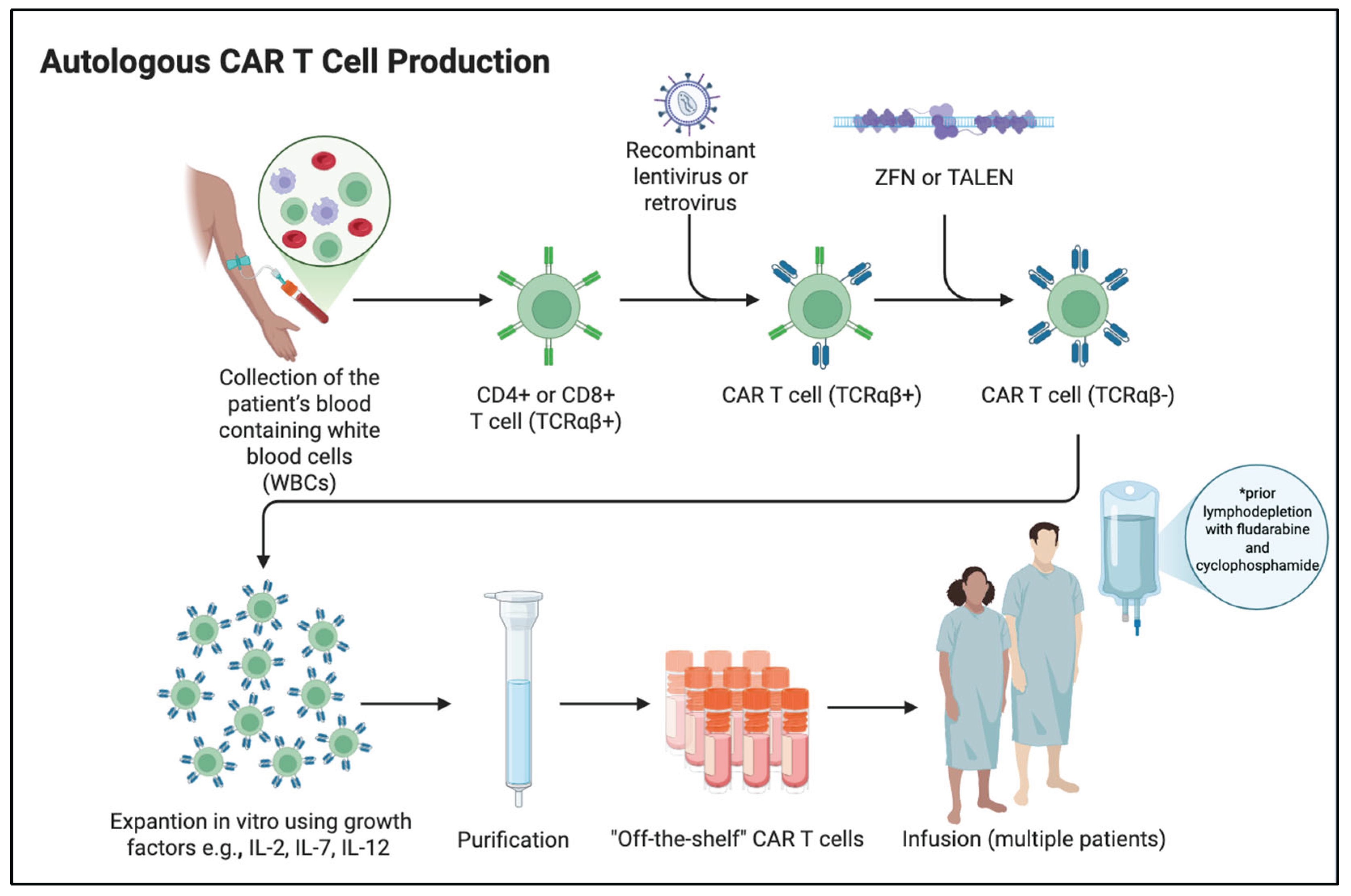
Disclaimer/Publisher’s Note: The statements, opinions and data contained in all publications are solely those of the individual author(s) and contributor(s) and not of MDPI and/or the editor(s). MDPI and/or the editor(s) disclaim responsibility for any injury to people or property resulting from any ideas, methods, instructions or products referred to in the content. |
© 2026 by the authors. Licensee MDPI, Basel, Switzerland. This article is an open access article distributed under the terms and conditions of the Creative Commons Attribution (CC BY) license (http://creativecommons.org/licenses/by/4.0/).
Copyright: This open access article is published under a Creative Commons CC BY 4.0 license, which permit the free download, distribution, and reuse, provided that the author and preprint are cited in any reuse.


