

Submitted:
10 April 2026
Posted:
13 April 2026
You are already at the latest version
Abstract
Asking questions is fundamental, but without a systematic framework, it remains a matter of intuition rather than design. The Generalized Coordinate System (GCS) was initially proposed for analyzing and generating rhetorical modes. In this paper, we apply the GCS to form an inquiry design framework—the GCS-based 10-dimensional inquiry generation framework: treating a question as a coordinate point across ten axes, so that we have potentially a billion ways to ask questions. The five low-dimensional axes (Thing, Feature, Quantitative Attribute, Qualitative Attribute, Formal Attribute) determine what and how the question expresses; the two mediating axes (Basic Element, Rhetorical Mode) transform a raw inquiry into a communicable question package; the three high-dimensional axes (Cognitive Function, Epistemic Purpose, Expression Staircase) determine what mental operation, why, and at what developmental level. This GCS-based 10-dimensional inquiry generation transforms questioning from an intuitive art into a designable, transferable, and evaluable cognitive methodology, and is potentially useful in applications such as education, research, communication, and language modeling.
Keywords:
question generation
; generalized coordinate system
; multidimensional question space
1. Introduction
Questioning is widely recognized as a central driver of human cognition and knowledge advancement. From Socratic dialectic to scientific inquiry, the ability to formulate productive questions may distinguish deep learners from passive recipients (Graesser & Person, 1994). Research in educational psychology suggests that student-generated questions can enhance comprehension, retention, and transfer under certain conditions (Rosenshine, Meister, & Chapman, 1996; King, 1992). In professional contexts, the quality of questions appears to influence the effectiveness of diagnosis, strategy formulation, and innovation (Brooks & John, 2018). Given this recognized importance, it is natural to seek a framework for the systematic generation of questions, moving beyond intuitive or ad hoc interrogation.
Taxonomic approaches, exemplified by Bloom’s cognitive domain (Bloom, 1956) and its revisions (Anderson & Krathwohl, 2001), classify questions by cognitive complexity. Linguistic approaches have catalogued interrogative forms across languages (Quirk, Greenbaum, Leech, & Svartvik, 1985; Li & Thompson, 1981). Pedagogical interventions have produced evidence that teaching students to generate questions can improve learning outcomes (Rosenshine et al., 1996; Chin & Osborne, 2008).All these works provide useful heuristic insights that can serve as a foundation toward a more systematic, transferable generative framework.
For those who frequently ask questions but do not necessarily study how to ask them, what is needed is a unified theoretical framework that integrates the ontological target, analytical perspective, precision level, semiotic medium, cognitive operation, real-world purpose, and developmental competence. Without such integration, questioning risks remaining a collection of tips rather than a designable methodology.
In this paper, we apply the Generalized Coordinate System (GCS) (Wu, 2026) to design such an integrative framework. Originally designed to analyze and generate any rhetorical mode, the GCS consists of ten axes, each representing a fundamental dimension of rhetorical and cognitive variation.
Figure 1 display the major ticks for the five lower-dimensional axes: thing axis, feature axis, quantitative attribute axis, qualitative attribute axis, and formal attribute axis.
Figure 2 display the major ticks for the two mediating axes: the basic element axis, the rhetorical mode axis.
Figure 3 display the major ticks for the three high-dimensional axes: cognitive function axis, epistemic purpose axis, and expression staircase axis.
The purpose of this paper is to show how to apply the GCS to question generation. The GCS-based question generation seems to offer a systematic pathway to diversify inquiry.
The remainder of this paper is structured as follows. Section 2 elaborates on the low-dimensional axes: Thing, Feature, Attributes. Section 3 is devoted to Basic Element and Rhetorical Mode. Section 4 ascends to the high-dimensional axes: Cognitive Functions, Epistemic Purposes, and the Five-Level Expression Staircase. Section 5 concludes with the generative calculus and its implications.
2. Low-Dimensional Axes: The Building Blocks of Questions
Low-dimensional axes-thing, Feature, Quantitative Attribute, Qualitative Attribute, and Formal Attribute-constitute the raw materials from which any question is constructed. They answer the meta-questions: What is being asked about? Which aspect of it? With what precision?
2.1. The Thing Axis (Th): Ontological Targeting
The Thing axis categorizes the entity to which a question refers. Wu (2026) identifies five major ticks: (1) Physical Entity, (2) Abstract Thing, (3) Event and Process, (4) Relation and System, and (5) Mind and Experience.
A question’s ontological target determines its fundamental mode of existence. Unlike feature or attribute questions, thing-axis questions ask about the entity itself: its identity, existence, status, and relations to other entities. Eleven distinct classes of thing-axis questions are identified below. For each class, we provide its definition, cognitive value, typical sentence patterns (using interrogative forms in English; equivalent forms exist in any language), possible subtypes, and concrete examples.
2.1.1. Identity
Definition: Asks for the definition, essence, or category membership of X. It seeks to establish what X is, not how X behaves or what properties X has.
Cognitive value: Identity questions anchor inquiry by fixing the referent. Without a clear answer to “what is X?”, subsequent questions risk equivocation.
Typical sentence patterns: “What is X?” “Define X.” “What kind of thing is X?”
Subtypes:
- Essential definition: Asks for necessary and sufficient conditions. Example: “What is a prime number? (An integer greater than 1 with no positive divisors other than 1 and itself)”
- Operational definition: Asks for measurement or recognition procedures. Example: “What is ‘poverty’ in this study? (Household income below the national poverty line)”
- ostensive definition: Asks for pointing or demonstration. Example: “What is ‘red’? (Point to a red object)”
Example: “What is a ‘good question’ in the GCS framework? (A question whose coordinate point is well-specified across the ten axes)”
2.1.2. Existence
Definition: Asks whether X has reality, either in the physical world, in abstract space, or within a defined domain.
Cognitive value: Existence questions prevent inquiry into fictional or impossible objects. They establish the ontological commitment of the investigation.
Typical sentence patterns: “Does X exist?” “Is there X?” “Does X occur?”
Subtypes:
- Physical existence: Asks about material reality. Example: “Does dark matter exist?”
- Abstract existence: Asks about conceptual or mathematical reality. Example: “Does the number exist?”
- Discourse existence: Asks whether X is present in a text or dataset. Example: “Does the term ‘epistemic purpose’ appear in the GCS paper?”
Example: “Does a ‘perfectly unbiased question’ exist, or is bias always present to some degree?”
2.1.3. Conditional Existence
Definition: Asks under what circumstances X exists, appears, or holds true. It specifies dependency relations without yet asking about features.
Cognitive value: Conditional existence questions identify boundary conditions and prerequisites, transforming absolute claims into contingent ones.
Typical sentence patterns: “Under what conditions does X exist?” “When does X occur?” “What must be true for X to exist?”
Subtypes:
- Necessary condition: Asks what must be present. Example: “Under what condition does liquid water exist? (Temperatures between 0 deg and 100 deg at standard pressure)”
- Sufficient condition: Asks what guarantees existence. Example: “What condition guarantees the existence of a black hole? (A mass collapsed beyond its Schwarzschild radius)”
- Contextual condition: Asks about social or institutional settings. Example: “Under what conditions does ‘academic freedom’ exist as a protected practice?”
Example: “Under what conditions does a ‘research question’ exist as a meaningful entity? (When it is answerable, novel, and feasible)”
2.1.4. Individuation
Definition: Asks what makes X the same thing over time and across changes. It addresses the criteria of identity persistence.
Cognitive value: Individuation questions resolve puzzles about continuity and change. They are essential for tracking entities in narratives, experiments, and historical accounts.
Typical sentence patterns: “What makes X the same as itself over time?” “Is the X at time t1 the same as the X at time t2?” “What are the identity conditions for X?”
Subtypes:
- Physical continuity: Asks about spatiotemporal continuity. Example: “Is a river after water replacement the same river?”
- Functional continuity: Asks about role or function persistence. Example: “Is a university after all faculty and students are replaced the same university?”
- Mereological: Asks about part-whole identity. Example: “If a ship replaces all its planks, is it the same ship?”
Example: “What makes a ‘question’ the same question when rephrased in different words? (The set of answerable unknowns remains identical)”
2.1.5. Categorical Affiliation
Definition: Asks which of the five thing categories (Physical Entity, Abstract Thing, Event/Process, Relation/System, Mind/Experience) X belongs to.
Cognitive value: Categorical affiliation determines the ontological type of X, which in turn determines what kinds of features and attributes can be meaningfully asked about X.
Typical sentence patterns: “Which category does X belong to?” “Is X a physical entity or an abstract thing?” “What type of thing is X?”
Subtypes:
- Binary category test: Asks whether X belongs to a specific category. Example: “Is a virus a physical entity? (Yes) Is it a living organism? (Debatable)”
- Multiple category assignment: Asks whether X can belong to multiple categories. Example: “Does a ‘classroom discussion’ belong to ‘event and process’ or to ‘relation and system’?”
- Boundary case: Asks about ambiguous or hybrid entities. Example: “Is a virtual character a physical entity, an abstract thing, or a mind-experience?”
Example: “Which thing category does ‘the GCS framework’ belong to? (Abstract thing, as it is a conceptual system)”
2.1.6. Mode of Being
Definition: Asks how X exists: as physical, abstract, potential, actual, fictional, or institutional. It distinguishes modes of existence beyond simple presence or absence.
Cognitive value: Mode of being questions prevent category mistakes. Asking about the temperature of a number (a physical mode) is nonsense; the GCS makes the mode explicit.
Typical sentence patterns: “How does X exist?” “In what mode does X exist?” “Is X actual or potential? Physical or abstract?”
Subtypes:
- Physical vs. abstract: Example: “Does the number 7 exist as a physical object? (No, as an abstract object)”
- Actual vs. potential: Example: “Does a future event exist? (As potential, not yet actual)”
- Fictional vs. real: Example: “How does Sherlock Holmes exist? (As a fictional entity within the Doyle stories)”
- Institutional: Example: “How does a ‘corporation’ exist? (As a legal entity by social agreement)”
Example: “How does a ‘research gap’ exist? (As a potential relation between current knowledge and unknown knowledge, not as a physical object)”
2.1.7. Spatiotemporal Location
Definition: Asks where and when X exists, occurs, or is located. For physical entities, this is literal space and time; for abstract entities, metaphorical or logical space.
Cognitive value: Spatiotemporal location questions enable tracking, searching, and contextualizing. Without location, a thing cannot be found or observed.
Typical sentence patterns: “Where is X?” “When does X occur?” “At what point in space or time is X located?”
Subtypes:
- Physical location: Asks about coordinates or region. Example: “Where is the K2 mountain?”
- Temporal location: Asks about time or period. Example: “When did the Cretaceous period occur?”
- Logical location: Asks about position in a taxonomy or argument. Example: “Where does the ‘definition mode’ appear in the GCS rhetorical mode list?”
- Discourse location: Asks about position in a text. Example: “Where in the paper is the ‘generalized mode number’ introduced?”
Example: “Where does a ‘question’ exist relative to an answer? (Prior in time, but logically dependent for its meaning)”
2.1.8. Ontological Grounding
Definition: Asks what other entities X depends on for its existence (not its properties, not its occurrence). Grounding is a metaphysical relation: X is grounded in Y if X exists only because Y exists.
Cognitive value: Ontological grounding questions reveal the layered structure of reality. They prevent the illusion that all entities exist at the same fundamental level. A border, a debt, a role, a number - these exist, but they exist because something else exists. Asking “in what does X’s existence consist?” separates ground-level entities from supervenient ones.
Typical sentence patterns:
- “What does X ontologically depend on for its existence?”
- “In what does the existence of X consist?”
- “Without what would X cease to exist (as a matter of metaphysical necessity, not causal contingency)?”
- “Is X grounded in Y, or does X exist at the same fundamental level as Y?”
Subtypes:
-
Physical grounding: Asks about material or spatiotemporal substrates.
- –
- Example: “Does the existence of a shadow depend on the existence of an object and a light source? (Yes; a shadow has no independent existence)”
- –
- Example: “What is a ‘hole’ grounded in? (The surrounding material that defines its boundaries)”
-
Abstract grounding: Asks about mathematical or logical priority.
- –
- Example: “Is the number 2 grounded in the existence of the number 1? (In some constructions, yes; in others, 2 is primitive)”
- –
- Example: “Does the concept of ‘set’ depend on the concept of ‘member’? (Yes; sets are defined by their members)”
-
Institutional grounding: Asks about social, legal, or conventional bases.
- –
- Example: “What is a ‘national border’ grounded in? (The existence of states and their mutual recognition)”
- –
- Example: “Is a ‘promise’ grounded in the existence of a social practice of promising? (Yes; without the practice, the act has no binding force)”
-
Conceptual grounding: Asks about definitional or semantic priority.
- –
- Example: “Is the concept of ‘question’ conceptually grounded in the concept of ‘answer’? (Yes; a question is meaningful only if an answer could in principle exist)”
- –
- Example: “Is ‘bachelor’ grounded in ‘unmarried man’? (Yes, as a matter of definitional analysis)”
Differentiation from causal dependence:
- Causal dependence asks: “What brings X into being or changes X?” (e.g., “What causes a hurricane?”)
- Ontological grounding asks: “In what does X’s very existence consist?” (e.g., “In what does a ‘hurricane’ as an entity exist? - In the organized motion of air and water molecules, not as a separate substance”)
Example in GCS context:
- “What is a ‘research gap’ ontologically grounded in? (The existing body of knowledge and the questions that body cannot yet answer; a gap has no independent existence apart from the knowledge that defines its boundaries)”
- “Is a ‘rhetorical mode’ grounded in the existence of the GCS coordinate system? (Yes; within the GCS framework, modes exist only as coordinate points defined by the axes)”
Relation to other Thing-axis operators:
- Existence asks whether X exists
- Conditional Existence asks under what circumstances X exists
- Ontological Grounding asks in what other entities the existence of X consists
- Mode of Being asks how X exists (physical/abstract/institutional/fictional)
2.1.9. Possibility and Necessity
Definition: Asks whether X could exist (possibility) or must exist (necessity), considering logical, physical, or conventional constraints.
Cognitive value: Possibility/necessity questions distinguish contingent from necessary truths, opening modal reasoning.
Typical sentence patterns: “Could X exist?” “Must X exist?” “Is X possible? Is X necessary?”
Subtypes:
- Logical possibility: Asks whether X involves contradiction. Example: “Could a ‘round square’ exist? (No, logically impossible)”
- Physical possibility: Asks whether X violates laws of nature. Example: “Could a time machine exist? (Unknown, but not logically impossible)”
- Nomological necessity: Asks whether X is required by natural laws. Example: “Must mass attract mass? (Under current physics, yes)”
- Conventional necessity: Asks whether X is required by rules or norms. Example: “Must a thesis have a question? (In academic writing, yes by convention)”
Example: “Could a question exist without an answer? (Yes, open questions; but if ‘question’ is defined as answer-seeking, then no)”
2.1.10. Change and Persistence
Definition: Asks whether X can change while remaining the same entity, and how much change is permitted before X ceases to be X.
Cognitive value: Change and persistence questions track identity through time, essential for narratives, experiments, and historical explanations.
Typical sentence patterns: “Can X change and still be X?” “How much change can X undergo while remaining the same?” “What changes does X survive?”
Subtypes:
- Quantitative change: Asks about degree of change. Example: “Can a mountain change its height and still be the same mountain?”
- Qualitative change: Asks about property change. Example: “Can a person change their beliefs and still be the same person?”
- Compositional change: Asks about part replacement. Example: “Can a cell replace all its molecules and remain the same cell?”
Example: “Can a ‘research question’ change its wording, scope, or hypothesis and still be considered the same research question? (Yes, unless the answer set changes)”
2.1.11. Identification and Reference
Definition: Asks how to uniquely point to X, distinguishing X from all other entities. It concerns the naming, description, or demonstration that picks out X.
Cognitive value: Identification/reference questions enable unambiguous communication. Without them, discourse about X collapses into confusion.
Typical sentence patterns: “How can we uniquely point to X?” “What distinguishes X from all other things?” “How should X be named or described?”
Subtypes:
- Proper naming: Asks for a unique name. Example: “What is the official name of this mountain?”
- Definite description: Asks for a uniquely identifying property. Example: “How can we identify the person who asked the first question in this session?”
- Indexical reference: Asks for context-dependent pointing. Example: “How can I refer to ‘this’ question in a later paragraph?”
- Formal reference: Asks for a coordinate or identifier. Example: “How is each rhetorical mode uniquely referenced in the GCS? (By its axis and major tick number)”
Example: “How can we uniquely refer to the ‘existence’ question operator in a computational implementation? (As Th_op_02, where Th = Thing axis and 02 = existence operator)”
2.2. The Feature Axis (Ft): Analytical Perspectives
Once a thing is identified, the Feature axis selects which aspect of that thing to interrogate. Wu (2026) defines seven major ticks: (1) Morphology and Composition, (2) State, (3) Dynamic, (4) Function, (5) Relation, (6) Cognition and Representation, and (7) Origin and History.
Unlike the Thing axis, which asks about the entity itself, the Feature axis asks about a specific analytical facet of that entity. For each feature type, we can systematically generate multiple question operators. The lists below provide such operators, each followed by an illustrative example.
2.2.1. Morphology and Composition
For morphology and composition, we may ask at least four questions.
-
Composition listing: “What parts, components, or levels constitute X?”Example: “What structural units constitute a ‘question-oriented article’? (problem statement, classification system, example library, application scenarios)”
-
Structural description: “How are these parts arranged or organized?”Example: “In a scientific paper, how are the introduction, methods, results, and discussion sections arranged relative to each other?”
-
Hierarchical positioning: “Within X, where does a specific element Y reside?”Example: “Within the five-level expression staircase, where does the ‘academic standard level’ reside?”
-
Topological property: “Does X have connectivity, holes, or branches?”Example: “Is the argument network of this article fully connected or are there isolated sub-arguments?”
2.2.2. State
For state, we may ask at least four questions.
-
Current condition: “What state or stage is X currently in?”Example: “When information is insufficient, what state does a reader’s ‘question quality’ typically show: vague, divergent, or bias-driven?”
-
State parameters: “Which parameters define the state of X?”Example: “What parameters define the ‘operational state’ of a machine: temperature, pressure, vibration, or all of them?”
-
Stability: “Is the current state stable or transient?”Example: “Is the current ‘paradigm’ in this research field stable or undergoing a shift?”
-
Phase or mode: “Which phase or mode does X exhibit (e.g., solid, liquid, gas; or on, off, standby)?”Example: “Is the feedback system in a linear or saturated mode?”
2.2.3. Dynamic
For dynamic, we may ask at least four questions.
-
Change over time: “How does X change or evolve over time?”Example: “How does questioning typically evolve from ‘sensation-driven’ to ‘method-driven’ from elementary school to university?”
-
Triggering conditions: “What event or condition triggers a change in X?”Example: “What triggers the transition from ‘autonomous expression level’ to ‘academic standard level’ in a learner’s questioning competence?”
-
Trajectory or path: “What is the path or sequence of changes that X undergoes?”Example: “What is the typical trajectory of a scientific discovery: anomaly, hypothesis, test, revision?”
-
Reversibility: “Is the change reversible? If so, under what conditions?”Example: “Once a material has undergone plastic deformation, can it return to its original shape without external intervention?”
2.2.4. Function
For functions, we may ask at least four questions.
-
Purpose or utility: “What is the function or role of X?”Example: “What function does a ‘comparison table template’ serve in question training: reducing generation cost or ensuring classification consistency?”
-
Input-output mapping: “What inputs does X require, and what outputs does it produce?”Example: “What inputs does a ‘question generation algorithm’ need (domain, purpose, constraints) and what outputs does it produce (question list, evaluation metrics)?”
-
Substitutability: “What other entities can perform the same function as X?”Example: “Besides a control group, what other experimental designs can serve the same function of establishing causality?”
-
Failure conditions: “Under what conditions does X fail to perform its function?”Example: “When does the ‘definition mode’ fail to clarify a concept? When the concept is essentially contested or when the audience lacks prerequisite knowledge?”
2.2.5. Relation (as a Feature)
For relation, we may ask at least four questions.
-
Relation type: “What is the type of relation between X and Y (e.g., causal, correlational, constitutive, symbiotic, antagonistic)?”Example: “What is the correspondence between ‘question form (yes-no, wh-, alternative, tag)’ and ‘cognitive function of the question’?”
-
Directionality: “Is the relation symmetric or directional? If directional, which way does it point?”Example: “Does ‘question complexity’ cause ‘cognitive load’, or does ‘cognitive load’ affect the perceived complexity of a question?”
-
Strength or weight: “How strong is the relation? Can it be ranked or weighted?”Example: “Which relation is stronger: the link between ‘question clarity’ and ‘answerability’, or the link between ‘question relevance’ and ‘user engagement’?”
-
Conditionality: “Under what conditions does the relation hold? When does it break down?”Example: “Under what conditions does ‘more examples’ lead to ‘better understanding’? (Novice learners: yes; expert learners: not necessarily)”
2.2.6. Cognition and Representation
For this feature, we may ask at least four questions.
-
Representation form: “By what representation is X typically understood or expressed (words, diagrams, mathematical formulas, physical models)?”Example: “How do primary school students versus graduate students represent ‘evidence’: as examples, as data, or as causal mechanisms?”
-
Perspective dependence: “How does the representation of X change across different observers, theories, or cultures?”Example: “How does the representation of ‘gravity’ differ between Newtonian physics and general relativity?”
-
Metaphor or analogy: “What common metaphors or analogies are used to understand X?”Example: “What metaphors are used to understand ‘cognitive load’? (a pipe, a bucket, a computer processor)”
-
Learnability: “What prior knowledge is required to represent or understand X?”Example: “To understand the ‘generalized coordinate system’, what prior knowledge of linear algebra or linguistics is necessary?”
2.2.7. Origin and History
For origin and history, we may ask at least four questions.
-
Origins: “Where did X come from? What events or forces gave rise to X?”Example: “What evolutionary path have Chinese interrogative forms (e.g., ‘ma’ questions, A-not-A) undergone in grammaticalization and usage?”
-
Chronology: “What is the timeline of X’s development? When did key events occur?”Example: “What are the major milestones in the history of the ‘question-answer mode’ in rhetoric from Aristotle to the present?”
-
Critical transitions: “What were the critical turning points or paradigm shifts in the history of X?”Example: “What was the critical transition that turned ‘questioning’ from a Socratic method into a formalized research methodology?”
-
Future projection: “Based on its history, what future changes can be projected for X?”Example: “Given the trend from handcrafted to machine-generated questions, how might the ‘question mode’ evolve in the next decade?”
2.2.8. Comparison Table: Thing Axis vs. Feature Axis
To help writers distinguish between asking about the thing itself and asking about a feature of the thing, Table 1 provides a side-by-side comparison.
2.3. The Three Attribute Axes: Precision Constraints
While the Thing and Feature axes determine what and which aspect, the Attribute axes determine with what precision the question is posed. Wu (2026) distinguishes three attribute types: Quantitative (Qt), Qualitative (Ql), and Formal (Fm). Each type transforms a vague inquiry into a more constrained, answerable form. The three axes are not mutually exclusive; a single question may involve multiple attributes, and powerful questions often chain them in sequence.
2.3.1. Quantitative Attributes (Qt)
Definition: Quantitative attributes ask for numerical values, counts, frequencies, or ratios. They replace vague terms like “many”, “fast”, or “large” with specific numbers or measurement units.
Cognitive value: Qt questions make inquiry empirically testable and replicable. A quantitative answer can be compared across contexts, aggregated into statistics, and subjected to formal analysis. Without Qt, many scientific questions remain at the level of qualitative opinion.
Major ticks (Wu, 2026):
- Basic Measurement: length, mass, time, temperature, coordinates.
- Quantity and Frequency: count, rate, occurrence number.
- Ratio and Intensity: proportion, density, strength, concentration.
Typical sentence patterns:
- “What is the [measurement] of X in [unit]?”
- “How many times does X occur within [duration]?”
- “What is the ratio of A to B?”
- “At what rate does X change per unit time?”
- “What is the intensity or magnitude of X on a defined scale?”
Subtypes and examples:
- Basic measurement: “What is the average width of the river in meters?”
- Quantity/frequency: “How many research questions does a typical doctoral dissertation contain?”
- Ratio/intensity: “What is the signal-to-noise ratio in this measurement?”
- Rate: “At what rate does a learner’s questioning competence increase with explicit instruction? (questions per week per hour of training)”
Example combining Qt with Thing and Feature: “What is the frequency (Qt: quantity) of ‘why’ questions (Ft: morphology) in classroom discourse (Th: event/process) during the first ten minutes of a lesson?”
2.3.2. Qualitative Attributes (Ql)
Definition: Qualitative attributes ask for sensory, configurational, or categorical descriptions without numerical assignment. They answer questions of shape, color, texture, position, material, or pattern.
Cognitive value: Ql questions are essential for exploratory and observational phases of inquiry, before measurement is possible or necessary. They provide the descriptive foundation upon which quantitative and formal questions can later be built.
Major ticks (Wu, 2026):
- Shape and Configuration: geometric form, contour, spatial arrangement.
- Color and Pattern: hue, saturation, stripe, dot, grid.
- Texture and Perception: smooth, rough, soft, loud, bright.
- Position and Orientation: above, below, left, right, north, south.
- Material and Composition: wood, metal, plastic, organic, synthetic.
Typical sentence patterns:
- “What shape does X exhibit?”
- “What color or pattern is visible on X’s surface?”
- “How does X feel, sound, or appear to an observer?”
- “Where is X located relative to Y? What is its orientation?”
- “What material or substance is X made of?”
Subtypes and examples:
- Shape and configuration: “Is the mineral sample’s fracture surface conchoidal (shell-like) or granular?”
- Color and pattern: “Does the rock exhibit a banded or spotted pattern?”
- Texture and perception: “How does the surface of this fabric feel: smooth, rough, or silky?”
- Position and orientation: “Is the question-answer pair located before or after the evidence section?”
- Material and composition: “What material is the coin made of: copper, nickel, or an alloy?”
Example combining Ql with Thing and Feature: “What shape (Ql: shape) does the argument structure (Ft: morphology) of a scientific paper (Th: abstract thing) typically take: linear, branching, or network-like?”
2.3.3. Formal Attributes (Fm)
Definition: Formal attributes ask about logical, structural, rule-based, or symbolic properties of X. They push inquiry toward abstraction, deductive closure, and mathematical or computational formulation.
Cognitive value: Fm questions transform empirical observations into law-like statements, enable deductive reasoning, and provide the syntax for computational implementation. They represent the highest level of precision in the attribute hierarchy.
Major ticks (Wu, 2026):
- Logical Relation: implication, equivalence, causality, necessity, sufficiency.
- Action Structure: input-process-output, sequence, condition, iteration.
- Rule and Constraint: legality, validity, boundary condition, optimization.
- Symbol and Formula: algebraic expression, differential equation, logical predicate.
Typical sentence patterns:
- “Does X logically imply Y? Is X necessary or sufficient for Y?”
- “What is the input-process-output structure of X? What are its formal conditions?”
- “Under what rules does X operate? What constraints apply to X?”
- “Can X be expressed as a formula, equation, or predicate? Write it and define terms.”
Subtypes and examples:
- Logical relation: “Does ‘answerability’ logically imply ‘clarity’? Is clarity a necessary condition for answerability?”
- Action structure: “What is the formal input-process-output structure of a ‘question generation algorithm’? (Input: Thing, Feature, Purpose; Process: axis combination; Output: question string and its coordinates)”
- Rule and constraint: “Under what formal constraints does a ‘well-defined question’ operate? (It must have a finite answer set, verifiable evidence, and no internal contradiction)”
- Symbol and formula: “Can the relationship between question complexity and answer time be expressed as , where C is a complexity score? Write the formula and define a and b.”
Example combining Fm with Thing and Feature: “Can the relation (Fm: logical relation) between ‘question form’ (Ft: morphology) and ‘cognitive load’ (Th: mind/experience) be expressed as a formal implication: If form is yes-no, then load is low; if form is wh-, then load is variable? (Fm: formula)”
2.3.4. Attribute Chaining: From Description to Law
Powerful questions often chain attributes in sequence: Qualitative → Quantitative → Formal. This progression mirrors the historical development of scientific disciplines and the maturation of individual inquiry competence.
Example chain:
- 1.
- Qualitative (exploratory): “What shape does the orbit of Mars appear to take? (Seems circular)”
- 2.
- Quantitative (measurement): “What is the precise eccentricity of Mars’s orbit? (0.0934)”
- 3.
- Formal (law): “Can the orbit be expressed as , where e is eccentricity? (Yes, Kepler’s first law)”
Example chain in questioning research:
- 1.
- Qualitative: “What types of questions do novices typically ask? (Factual, yes-no, vague why-questions)”
- 2.
- Quantitative: “What is the frequency distribution of question types across 100 novices? (40% factual, 35% yes-no, 25% why; 0% methodological)”
- 3.
- Formal: “Can the transition from novice to expert questioning be modeled as a Markov process with states (factual), (relational), (methodological) and transition probabilities derived from training intensity?”
Relation to the Five-Level Expression Staircase: Sensory-level questioning relies primarily on Ql (“What color is it?”). Autonomous expression adds Qt (“How many are there?”). Academic standard requires both Ql and Qt with consistent units. Methodological questioning introduces Fm (“Can this relation be formalized?”). Knowledge enlightenment questioning uses Fm to challenge foundational assumptions (“What if the formalization itself is wrong?”).
Thus, the three attribute axes are not merely a list of options but a developmental pathway. A complete questioning competence includes the ability to move fluidly from Ql to Qt to Fm and back, depending on the inquiry’s purpose and stage.
3. The Mediating Dimension: From Question to Inquiry Package
The mediating dimension is about the Basic Element axis (Be), which specifies the semiotic medium of the question (language, numbers, images, etc.), and the Rhetorical Mode axis (Rm), which specifies its discourse function (description, comparison, argumentation, etc.). Together, they transform a raw inquiry into a communicable question package. Below we detail each axis, followed by their combination into sequences and nested structures.
3.1. Basic Element Axis (Be): Semiotic Media for Questions
Definition: A question must be instantiated in some semiotic medium. The Basic Element Axis (Be) specifies through which representational system the question is expressed and, consequently, what kind of answer it can legitimately receive. Wu (2026) distinguishes seven Basic Elements.
Cognitive value: The choice of Be fundamentally shapes what a question can ask, how it can be processed, and what counts as an answer. A question in natural language tolerates vagueness; a question in mathematical notation demands precision; a question in images requires visual interpretation. Ignoring Be leads to category errors- e.g., answering a numerical question with a gesture, or a diagram question with a verbal description only.
Overview of the seven Basic Elements:
- Language ()
- Numbers and Symbols ()
- Mathematical Formulas and Equations ()
- Images and Diagrams ()
- Data and Relation Visualization ()
- Sound, Gesture, and Dynamic Demonstration ()
- Notation / Markup ()
Detailed description of each Basic Element with question examples:
: Language (natural or artificial text) How to ask with language: questions are formed by interrogative words (who, what, where, when, why, how), rising intonation, or syntactic inversion. Language supports open-ended, abstract, and context-dependent questions.
- Example: “What is the main argument of this paper?”
- Example: “Why did the experiment fail? (Answer in prose)”
- Constraint: Answers are also linguistic- sentences, paragraphs, or discourse.
: Numbers and Symbols (arithmetic, numeric codes, logic symbols) How to ask with numbers and symbols: the question is framed using digits, arithmetic operators, comparison signs, or symbolic logic operators (e.g., ). The expected answer is a number, a truth value, or a symbolic expression.
- Example: “” (expects a number)
- Example: “Is ? (True or false?)”
- Example: “; does this entail ? (Answer: No, unless the domain is non-empty)”
- Constraint: Ambiguity is minimized; answers are exact or truth-valued.
: Mathematical Formulas and Equations How to ask with formulas/equations: the question is posed as an equation to solve, a function to differentiate, an integral to compute, or a structure to find (e.g., roots, limits, matrices). The answer is typically a transformed formula, a numerical solution, or a proof step.
- Example: “Solve for x: .” (Answer: or )
- Example: “” (Answer: )
- Example: “Find the eigenvalues of .”
- Constraint: The question itself is a well-formed mathematical expression; answers follow mathematical syntax.
: Images and Diagrams (static visual representations) How to ask with images/diagrams: the question refers to visual elements- shapes, positions, colors, connections, labels, or spatial relations. The answer may be a verbal description, a pointing gesture, or an annotation on the image.
- Example: “In the circuit diagram (Figure 2), which nodes are connected to the ground?”
- Example: “What is the area of the shaded region in the provided geometric figure?”
- Example: “Does this X-ray image show a fracture? (Circle the location.)”
- Constraint: The question is incomplete without the image; answering requires visual perception or image analysis.
: Data and Relation Visualization (charts, graphs, networks, maps) How to ask with data visualizations: the question is anchored in a specific visualization (scatter plot, bar chart, network graph, heatmap, GIS map). It often asks for patterns, outliers, trends, or comparisons directly from the visual representation.
- Example: “In the scatter plot (Figure 3), is there a positive correlation between age and income?”
- Example: “Which country node has the highest betweenness centrality in the trade network visualization?”
- Example: “From the heatmap, which time-of-day shows the highest activity density?”
- Constraint: The answer depends on interpreting the visualization; the same data in a table might yield a different question.
: Sound, Gesture, and Dynamic Demonstration (temporal/performative media) How to ask with sound/gesture/demonstration: the question is expressed through non-permanent, time-dependent actions-spoken prosody, hand movements, body position, or sequential operations. Answers can be demonstrations, imitations, or verbal descriptions of the performed action.
- Example (sound): “Which note is higher: this (play tone A) or this (play tone B)?”
- Example (gesture): “How do I perform the plum blossom punch in Tai Chi? (Demonstrate.)”
- Example (dynamic demonstration): “Watch my hand movement. What mistake am I making? (Answer: Your wrist is not rotating.)”
- Constraint: The question exists only in the moment of performance; it often requires real-time or recorded replay.
: Notation / Markup (structured annotation, formal grammars, markup languages) How to ask with notation/markup: the question uses formal or semi-formal notations-XML tags, JSON paths, regular expressions, UML notation, musical scores, choreographic notation, or proof trees. Answers are often transformations of the notation or valid instances.
- Example: “Given the XML snippet, write an XPath expression that selects all <author> nodes inside <book>.”
- Example: “Is the following JSON valid against this JSON Schema? (Provide schema and instance.)”
-
Example: “Complete the regular expression so that it matches email addresses:⌃[a-zA-Z0-9._%+-]+@[a-zA-Z0-9.-]+\.[a-zA-Z]{2,}$.”
- Constraint: The question presupposes knowledge of the notation; answers must conform to the notation’s syntax.
Cross-element combinations: A single question can mix multiple Basic Elements. For example, a physics problem may include language (“Calculate the velocity”), numbers (initial values), a formula (), and a diagram (inclined plane). In such cases, the question’s Be coordinate is a vector indicating the primary and secondary elements.
Relation to other axes: The Be axis interacts closely with the Thing axis (what entity the question is about) and the Rhetorical Mode axis (what the question does). For instance, a definition question (Th: Identity) asked in (image) would be: “In this diagram, which part is called the ‘mitochondrion’?”
Example of full Be specification in GCS:
- “What is the derivative of at ?”→ (Formula/Equation), Th: Abstract Entity (function), Rm: Computation.
- “(Pointing to a red circle) Is this the same color as that (pointing to a crimson square)?”→ (Image) + (Gesture), Th: Physical Entity (color patch), Rm: Comparison.
3.2. Rhetorical Modes as Question Organizers
Wu (2026) lists 18 rhetorical modes. Traditionally, these are ways of organizing discourse. In the GCS framework, each mode can be transformed into a question or can embed questions within it. Below we specify, for every mode, how to ask a question that enacts that rhetorical function, what sentence patterns to use, and why such questioning is cognitively valuable.
3.2.1. Description as Questioning
How to ask: Elicit detailed sensory or factual attributes of an entity without comparison or evaluation.
Typical sentence patterns:
- “What are the sensory features of X? (color, shape, sound, texture, smell)?”
- “What factual properties does X have? (size, weight, composition, function)?”
- “Can you describe X in terms of its observable characteristics?”
Example: “What does the Raman spectrum of graphene look like? (Describe the D, G, and 2D bands and their positions.)”
Cognitive value: Description questions ground inquiry in empirical observation. They force the asker to attend to what is actually there, not what is assumed.
3.2.2. Comparison as Questioning
How to ask: Request identification of similarities between two or more entities across relevant dimensions.
Typical sentence patterns:
- “In what ways are A and B similar?”
- “What common properties do A and B share?”
- “On which dimensions do A and B behave alike?”
Example: “How does the CRISPR-Cas9 system compare with TALENs in terms of off-target effects and ease of design?”
Cognitive value: Comparison questions reveal underlying dimensions of sameness, enabling analogical transfer and category formation.
3.2.3. Contrast as Questioning
How to ask: Request identification of differences between two or more entities.
Typical sentence patterns:
- “In what ways do A and B differ?”
- “What property does A have that B lacks?”
- “On which dimensions do A and B diverge?”
Example: “What distinguishes a scientific law from a scientific theory? (Scope, explanatory mechanism, mathematical form?)”
Cognitive value: Contrast questions sharpen conceptual boundaries and prevent false equivalences. They are essential for discrimination tasks.
3.2.4. Analogy as Questioning
How to ask: Request a mapping from a familiar source domain to an unfamiliar target domain.
Typical sentence patterns:
- “What familiar situation is X like?”
- “How can we map the structure of Y onto X?”
- “If X is like a ____ , then what corresponds to ____ in X?”
Example: “How is an atom analogous to the solar system? (Nucleus as sun, electrons as planets, but with quantum differences.)”
Cognitive value: Analogy questions enable reasoning by structural alignment. They generate hypotheses and explanatory models when direct knowledge is lacking.
3.2.5. Cause and Effect as Questioning
How to ask: Probe causal relationships between events or variables.
Typical sentence patterns:
- “Does X cause Y?”
- “What effect does changing X have on Y?”
- “Is the relationship between A and B causal or merely correlational?”
- “What intermediate variables mediate the effect of X on Y?”
Example: “Does increasing class size cause a decrease in student learning outcomes, or is the relationship confounded by school funding?”
Cognitive value: Causal questions move beyond description to explanation and intervention. They are the backbone of scientific inquiry.
3.2.6. Exemplification as Questioning
How to ask: Request a concrete instance of an abstract concept.
Typical sentence patterns:
- “What is a concrete example of abstract concept X?”
- “Can you give an instance where principle P applies?”
- “Which specific case illustrates the general claim C?”
Example: “What is an example of a ‘wicked problem’ in public policy? (Climate change regulation, where causes and solutions are interdependent.)”
Cognitive value: Exemplification questions test whether a concept has genuine empirical content. They bridge abstraction and observation.
3.2.7. Evidence as Questioning
How to ask: Request data or facts that support or refute a claim.
Typical sentence patterns:
- “What data would support claim C?”
- “What evidence would count against hypothesis H?”
- “Is there empirical evidence for the existence of X?”
- “How strong is the evidence linking A to B? (effect size, p-value, Bayesian factor)?”
Example: “What evidence would convince you that a new drug is effective beyond placebo? (Randomized controlled trial with pre-registered outcomes.)”
Cognitive value: Evidence questions enforce epistemic discipline. They shift the burden from assertion to demonstration.
3.2.8. Classification as Questioning
How to ask: Request a grouping of items into categories based on shared principles.
Typical sentence patterns:
- “Under which principle should these items be grouped?”
- “What are the exhaustive and mutually exclusive categories of X?”
- “Does item i belong to category C1 or C2?”
Example: “How should we classify animal species according to evolutionary relationships? (Cladistic vs. Linnaean classification.)”
Cognitive value: Classification questions impose order on diversity. They reveal underlying dimensions and decision rules.
3.2.9. Division as Questioning
How to ask: Request breaking a whole into its constituent parts.
Typical sentence patterns:
- “What are the parts or components of X?”
- “How can X be decomposed into sub-units?”
- “What is the part-whole hierarchy of X?”
Example: “What are the structural components of a eukaryotic cell? (Nucleus, mitochondria, endoplasmic reticulum, Golgi apparatus, etc.)”
Cognitive value: Division questions enable reductionist analysis. They identify functional units and their boundaries.
3.2.10. Process Analysis as Questioning
How to ask: Request the sequential steps of a procedure or natural process.
Typical sentence patterns:
- “What are the sequential steps of process P?”
- “What triggers the transition from step i to step i+1?”
- “How does X work from beginning to end?”
Example: “What are the steps of the peer review process from submission to final decision? (Initial screening, reviewer assignment, review, decision, revision, re-review.)”
Cognitive value: Process questions transform static descriptions into dynamic models. They are essential for skill acquisition and troubleshooting.
3.2.11. Narration as Questioning
How to ask: Request a chronological ordering of events, often with a perspective.
Typical sentence patterns:
- “What happened first, next, last?”
- “How does the storyteller’s perspective affect which events are included?”
- “What is the timeline of events leading to outcome O?”
Example: “What sequence of discoveries led to the formulation of the theory of continental drift? (Wegener’s observation, fossil evidence, paleoclimate data, later plate tectonics.)”
Cognitive value: Narration questions embed events in causal and temporal context. They reveal historical contingency and path dependence.
3.2.12. Definition as Questioning
How to ask: Request the meaning, scope, or necessary and sufficient conditions of a concept.
Typical sentence patterns:
- “What are the necessary and sufficient conditions for X?”
- “What is the operational definition of X in this study?”
- “How is X defined differently in theory A vs. theory B?”
Example: “What is a ‘democratic election’? (Free, fair, competitive, inclusive, and with binding results.)”
Cognitive value: Definition questions fix the referent. Without them, debate equivocates.
3.2.13. Evaluation as Questioning
How to ask: Request a judgment based on explicit criteria.
Typical sentence patterns:
- “By what criteria should X be judged?”
- “How does X score on each criterion?”
- “What trade-offs are involved in evaluating X?”
- “Is X good/bad/effective/beautiful according to standard S?”
Example: “How should we evaluate a university’s performance? (Research output, teaching quality, student satisfaction, employability, equity.)”
Cognitive value: Evaluation questions make values explicit. They turn subjective preferences into debatable judgments.
3.2.14. Argumentation as Questioning
How to ask: Request a reasoned claim supported by logic and evidence, including consideration of counterarguments.
Typical sentence patterns:
- “What premises support the conclusion C?”
- “What counterarguments exist against claim C?”
- “How can we test the logical validity of this argument?”
Example: “Why should we believe that anthropogenic CO2 is the main driver of recent climate change? (Greenhouse effect physics, fingerprint studies, model attribution.)”
Cognitive value: Argumentation questions train dialectical thinking. They require both justification and refutation.
3.2.15. Persuasion as Questioning
How to ask: Request strategies to influence beliefs or actions, often considering audience and rhetorical appeals.
Typical sentence patterns:
- “What appeals (logos, ethos, pathos) would be most effective for audience A?”
- “How could we frame the message to persuade skeptics?”
- “What narrative or metaphor would change someone’s attitude toward X?”
Example: “How would you persuade a local community to accept a wind farm? (Economic benefits, energy independence, visual impact mitigation, participatory planning.)”
Cognitive value: Persuasion questions bridge fact and value. They acknowledge that truth alone does not guarantee acceptance.
3.2.16. Exposition as Questioning
How to ask: Request a clear, factual explanation of an idea or phenomenon without argumentation or persuasion.
Typical sentence patterns:
- “What is X? (Explain it clearly and factually.)”
- “How does X work in a neutral, descriptive manner?”
- “What are the key components of theory T without evaluation?”
Example: “Explain the concept of ‘negative feedback’ in homeostasis. (A process where a change triggers a response that counteracts the initial change.)”
Cognitive value: Exposition questions prioritize clarity and accuracy over persuasion. They are the default mode of textbook learning.
3.2.17. Question as Questioning (Meta)
How to ask: Raise an inquiry about the inquiry itself, or embed a question as the content.
Typical sentence patterns:
- “What question should we ask first?”
- “Is this a well-formed question?”
- “What are the sub-questions that decompose the main question?”
Example: “Instead of asking ‘Why did the Roman Empire fall?’, should we first ask ‘What do we mean by ‘fall’?’ (A meta-question about the question.)”
Cognitive value: Question-as-questioning turns inquiry reflexive. It prevents asking unanswerable or ill-posed questions.
3.2.18. Answer as Questioning
How to ask: Frame an answer-seeking operation as a question. This mode asks for the content that would constitute an answer.
Typical sentence patterns:
- “What is the answer to question Q?”
- “What would a satisfactory response to problem P look like?”
- “Can you provide the solution to this equation?”
Example: “What is the answer to ‘What is the capital of France?’? (Paris.)”
Cognitive value: Answer-as-questioning makes the answer explicit and verifiable. It closes an inquiry loop.
3.2.19. Question Sequences and Nested Structures
The GCS’s logical structures - combinatory (|), parallel (), and embedded (→) - allow the construction of question sequences that mirror cognitive processes.
- Combinatory: “What is the function (Ft) of this physical entity (Th) under high-temperature conditions (Qt)?”
- Parallel: “What is the shape of the crystal? What is its color? What is its hardness?”
- Embedded: “To answer whether A causes B (main question), first ask: Is A correlated with B? → If yes, does the correlation persist after controlling for confounders?”
4. High-Dimensional Axes: From Questions to Cognitive and Epistemic Design
The preceding axes (Thing, Be, Rm) specify what a question is about, in which medium, and with what rhetorical organization. However, two deeper dimensions determine the question’s cognitive depth and its ultimate purpose: Cognitive Functions (Cf) and Epistemic Purposes (Ep). A third axis, the Expression Staircase (Es), captures the developmental progression of questioning competence- from raw perception to paradigm-shattering insight.
4.1. Cognitive Functions (Cf): What Mental Operation Does the Question Perform?
Wu (2026) defines 14 cognitive functions. But not all functions are equal: they form a rough hierarchy from surface-level registration to deep structural transformation. Below, the functions are ordered from lower-order (perception, identification) to higher-order (synthesis, metacognition). Each is illustrated by the kind of question that enacts that function.
- Observation (lower-order): “What do I notice in the immediate environment?” Pure data capture without interpretation.
- Identification: “What is this thing? (Labeling and recognition)” Mapping perception to a known category.
- Comparison / Alignment: “How are A and B similar or different?” Detecting relations across two or more entities.
- Classification: “What principle organizes these items into exhaustive and mutually exclusive groups?” Imposing categorical structure.
- Abstraction: “What general pattern or rule explains these specific cases?” Moving from instances to laws.
- Hypothesis: “If X were true, what observable consequences would follow?” Generating testable predictions from a conjecture.
- Modeling: “What simplified representation captures the essential variables and ignores noise?” Constructing a surrogate for reasoning.
- Inference: “What must be true given what I already know (deductive, inductive, abductive)?” Extending knowledge beyond direct observation.
- Testing / Verification: “What evidence would confirm or falsify this claim? What experiment discriminates between competing hypotheses?” Holding beliefs accountable.
- Explanation: “What causal or mechanistic story accounts for the observed phenomenon? Why did it happen, not just what happened?” Satisfying the need for understanding.
- Evaluation: “How good is X according to specified criteria? What trade-offs are involved?” Judging value, not just fact.
- Prediction: “What will happen next if current trends continue, or if an intervention is applied?” Extending knowledge into the future.
- Integration / Synthesis: “How do these separate findings, theories, or perspectives fit together into a coherent whole? What is the larger pattern?” Overcoming fragmentation.
- Reflection / Metacognition (highest-order): “How did I arrive at this question? What assumptions does it contain? What am I missing? How could I question my own questioning?” Turning inquiry upon itself.
Cognitive progression: A novice questioner operates mainly at Observation-Identification levels. An expert moves fluidly from Hypothesis to Evaluation. A transformative inquirer operates at Integration and Metacognition: asking not just “What is the answer?” but “Why did I ask that question in the first place?”
4.2. Epistemic Purposes (Ep): Why Are We Asking?
The same cognitive operation can serve radically different purposes. Asking “What causes cancer?” might aim for scientific discovery, for teaching a student, or for policy action. The Epistemic Purposes axis specifies the ultimate aim of the inquiry. Below, the eight purposes are arranged from individual knowledge acquisition to collective transformation.
- Knowledge Formation: Questions establish what is true, for the asker’s own understanding. (Example: “Does the Earth orbit the Sun?”) Personal epistemic closure.
- Scientific Discovery: Questions identify anomalies, novel patterns, or causal mechanisms that extend the frontier of collective knowledge. (Example: “What is the mechanism of CRISPR immunity?”) Contribution to public science.
- Writing and Communication: Questions structure discourse for a reader or audience, guiding attention and revealing gaps. (Example: “What question does this paper answer?”) Rhetorical-epistemic design.
- Teaching / Learning: Questions induce cognitive change in learners, activating prior knowledge, revealing misconceptions, or scaffolding understanding. (Example: “Why does ice float? (Asked by a teacher to a student.)”) Pedagogical transformation.
- Problem-Solving: Questions generate actionable solutions to practical obstacles. (Example: “How can we reduce hospital readmission rates?”) Applied, means-ends.
- Innovation / Design: Questions create novel artifacts, processes, or systems that did not exist before. (Example: “What would a battery made of paper look like?”) Generative, possibility-seeking.
- Evaluation / Decision-Making: Questions choose among alternatives under uncertainty, often with multiple criteria. (Example: “Which drug candidate should we advance to Phase III trials?”) Comparative, risk-sensitive.
- Policy / Action Implementation: Questions guide collective behavior, allocate resources, or coordinate action. (Example: “How should vaccine distribution prioritize different age groups?”) Socially binding, action-guiding.
Epistemic progression: Lower purposes (Knowledge Formation) aim at belief fixation; higher purposes (Policy/Action) aim at coordination and collective outcomes. A mature inquirer can shift purposes fluidly, asking the same factual question for discovery, then re-asking it for decision-making.
4.3. The Five-Level Expression Staircase (Es): Developmental Progression of Questioning Competence
Wu (2026) proposes a Five-Level Expression Staircase. Unlike the previous axes, which are static categories, the Es axis captures developmental growth in the sophistication of questioning. The progression is not about asking more diverse questions, but about asking deeper, more structurally aware questions. Each level subsumes and transcends the previous one.
-
Sensory Level: Questions arise directly from raw perception, often involuntary. The asker does not yet control the question form.Example: “What is that sound?” (reflexive, stimulus-driven)
-
Autonomous Expression Level: The asker actively selects and combines question forms, using syntactic and rhetorical knowledge. Questions become intentional.Example: “What would happen if I tried X instead of Y?” (deliberate counterfactual)
-
Academic Standard Level: Questions conform to disciplinary norms, using accepted terminology, assuming shared background knowledge, and aiming for falsifiability or reproducibility.Example: “According to theory T, what does the model predict for condition C?” (paradigm-bound)
-
Methodological Level: Questions critique and redesign the methods and frameworks themselves. They ask not just within a paradigm, but about the paradigm.Example: “What are the limitations of current methods for measuring X? How could we design a better instrument?” (meta-methodological)
-
Knowledge Enlightenment Level: Questions challenge foundational assumptions of a field, potentially rendering existing knowledge obsolete. They are rare, transformative, and often inter-disciplinary.Example: “What question, if answered, would make most of our current research program irrelevant or radically reconfigured?” (paradigm-shifting)
Key insight: The staircase is not a ladder of expertise in asking more questions, but in asking questions that operate at higher logical and ontological levels. A Level 5 question is not “harder”; it is about the conditions of possibility of lower-level questions. The GCS allows any question to be tagged with its Es level, making developmental trajectories visible and comparable across domains.
5. Discussion and Conclusion
The framework developed above transforms the art of asking questions into a systematic, combinatorial design space. Drawing on the Generalized Coordinate System for Rhetorical Modes (Wu, 2026), we have specified ten independent dimensions (axes) that characterize any inquiry. Each axis offers a finite set of discrete options. A question is fully specified by selecting one option from each axis—like a point in a ten-dimensional space.
5.1. The Ten Axes and Their Generative Capacity
Below we summarize each axis, its number of distinct “ways to ask” (cardinality), and the type of variation it introduces.
- Thing Axis (Th): What entity is the question about? (5 major ticks: Physical Entity, Abstract Thing, Event/Process, Relation/System, Mind/Experience) : 11 ways
- Feature Axis (Ft): Which attribute or relation of the thing is questioned? (7 major ticks: Morphology/Composition, Dynamics/Mechanism, Function/Purpose, Relation/Interaction, Quality/Property, State/Condition, Change/Transformation) : there are at least four ways for each feature, so there are at least 28 ways in total
- Quantitative Attribute Axis (Qt): How is the feature measured or counted? (3 major ticks: Basic Measurement, Comparative Measurement, Statistical Distribution) : 3 ways
- Qualitative Attribute Axis (Ql): What is the non-numerical character of the feature? (4 major ticks: Shape/Configuration, Texture/Material, Color/Appearance, Pattern/Organization) : 4 ways
- Formal Attribute Axis (Fm): What logical or structural properties constrain the question? (4 major ticks: Logical Relation, Set/Membership, Temporal Order, Causal Chain) : 4 ways
- Basic Element Axis (Be): In which semiotic medium is the question expressed? (7 major ticks: Language, Numbers/Symbols, Formulas/Equations, Images/Diagrams, Data/Relation Visualization, Sound/Gesture/Dynamic Demonstration, Notation/Markup) : 7 ways
- Rhetorical Mode Axis (Rm): What discourse function does the question serve? (18 modes: Description, Comparison, Contrast, Analogy, Cause/Effect, Exemplification, Evidence, Classification, Division, Process Analysis, Narration, Definition, Evaluation, Argumentation, Persuasion, Exposition, Question, Answer) : 18 ways
- Cognitive Function Axis (Cf): What mental operation does the question enact? (14 functions from Observation to Metacognition) : 14 ways
- Epistemic Purpose Axis (Ep): Why is the question being asked? (8 purposes from Knowledge Formation to Policy/Action) : 8 ways
- Expression Staircase Axis (Es): At what developmental level is the question posed? (5 levels from Sensory to Knowledge Enlightenment) : 5 ways
Total combinatorial space: Multiplying the cardinalities of the ten axes gives:
This is approximately one billion distinct question specifications—not counting variations within the same specification (e.g., different concrete contents). The combinatorial explosion arises from two principles:
1. Axis independence: In the GCS, most axes vary independently. The choice of Basic Element (e.g., language vs. diagram) does not force a specific Rhetorical Mode (e.g., comparison vs. narration). Independence multiplies possibilities.
2. High cardinality per axis: Several axes have inherently many discrete options—18 rhetorical modes, 14 cognitive functions, 5 thing categories, etc. Their product grows rapidly.
Thus, even restricting to practically meaningful combinations (e.g., avoiding obviously incoherent pairs like “Qualitative Attribute = Color” with “Feature = Dynamics”), the number remains in the millions. This is not a theoretical curiosity: it means that for any real-world inquiry goal, the GCS can generate many distinct question designs that are systematically different, enabling deliberate selection rather than ad-hoc intuition.
5.2. Forward Generation and Backward Generation
Not all axes contribute equally to the depth of a question. We distinguish:
- Low-dimensional axes (Th, Ft, Qt, Ql, Fm, Be, Rm) determine the surface form, referential object, precision level, and semiotic medium. They answer: “What is it about?” and “How is it expressed?”
- High-dimensional axes (Cf, Ep, Es) determine the cognitive operation, ultimate purpose, and developmental maturity. They answer: “What mental act does asking this question perform?” and “Why, at what level of sophistication, are we asking?”
A question can be formally well-formed (low-dimensionally complete) but cognitively shallow (low Cf, low Es). Conversely, a transformative question often uses simple low-dimensional forms but high-dimensional settings (e.g., Cf = Metacognition, Ep = Innovation/Design, Es = Knowledge Enlightenment). The GCS thus makes explicit the difference between “asking any question” and “asking a question that advances understanding.”
Consequently, generating a question amounts to selecting a coordinate point in the ten-dimensional space. This selection can proceed in two directions:
- Forward generation: Starting from a Thing and a Feature, adding Attribute constraints, choosing a Basic Element and a Rhetorical Mode, then determining which Cognitive Function, Epistemic Purpose, and Expression Staircase level the question serves.
- Reverse generation: Starting from an Epistemic Purpose and a Cognitive Function, then working backward to select the appropriate Rhetorical Mode sequence, Attributes, Features, and Things.
5.3. Possible Value of the GCS-based 10-Dimensional Question Generation
The GCS-based 10-Dimensional Question Generation framework offers four core values:
- Generativity: Users learn to navigate a finite set of axes whose intersections produce a large combinatorial space of questions. Instead of relying on memory or templates, an educator, researcher, or AI system can generate questions by traversing the ten axes. Given a Thing and a Feature, choose Attribute constraints, a Basic Element, a Rhetorical Mode, then determine Cognitive Function, Epistemic Purpose, and Expression level—the question constructs itself.
- Transferability: The same ten axes apply across domains, from physics to pedagogy to product design.
- Purpose-alignment: Questions can be evaluated against intended cognitive functions and epistemic purposes, not just surface form. The same factual topic can generate questions for scientific discovery (Ep = Scientific Discovery, Cf = Hypothesis) or for teaching (Ep = Teaching/Learning, Cf = Explanation). The GCS makes the shift explicit and replicable.
- Developmental staging/scaffolding: The Five-Level Expression Staircase provides clear progression milestones for questioning competence. The Expression Staircase (Es) allows diagnosing and scaffolding question-asking competence. A learner stuck at Sensory questions can be prompted toward Autonomous Expression by systematically increasing Cf and Es.
5.4. Final Remarks
The GCS-based 10-Dimensional Question Generation Framework does not aim to replace natural curiosity. Rather, it provides a map and compass for navigating the infinite space of possible questions. In an age where artificial intelligence generates answers at unprecedented speed, the uniquely human skill may not be finding answers but asking the right questions. The GCS-based 10-Dimensional Question Generation Framework offers possibly one systematic path toward that skill—by revealing that the space of questions is not a flat wasteland but a structured, ten-dimensional landscape. Every coordinate is a question waiting to be asked.
Acknowledgments
This paper was initially drafted in Chinese. Large language models, including ChatGPT and DeepSeek, were utilized interchangeably to assist in translating the text into English and to assist in generating examples. Ma Xin-Yu helped to design the three figures.
References
- Anderson, L. W.; Krathwohl, D. R. (Eds.) A taxonomy for learning, teaching, and assessing: A revision of Bloom’s taxonomy of educational objectives; Longman, 2001. [Google Scholar]
- Bloom, B. S. (Ed.) Taxonomy of educational objectives: Handbook I, cognitive domain; Longmans, Green, 1956. [Google Scholar]
- Brooks, A. W.; John, L. K. The surprising power of questions. Harvard Business Review 2018, 96(3), 60–67. [Google Scholar]
- Chin, C.; Osborne, J. Students’ questions: A potential resource for teaching and learning science. Studies in Science Education 2008, 44(1), 1–39. [Google Scholar] [CrossRef]
- Graesser, A. C.; Person, N. K. Question asking during tutoring. American Educational Research Journal 1994, 31(1), 104–137. [Google Scholar] [CrossRef]
- King, A. Facilitating elaborative learning through guided student-generated questioning. Educational Psychologist 1992, 27(1), 111–126. [Google Scholar] [CrossRef] [PubMed]
- Li, C. N.; Thompson, S. A. Mandarin Chinese: A functional reference grammar; University of California Press, 1981. [Google Scholar]
- Quirk, R.; Greenbaum, S.; Leech, G.; Svartvik, J. A comprehensive grammar of the English language; Longman, 1985. [Google Scholar]
- Rosenshine, B.; Meister, C.; Chapman, S. Teaching students to generate questions: A review of the intervention studies. Review of Educational Research 1996, 66(2), 181–221. [Google Scholar] [CrossRef]
- Wu, Z. N. The Generalized Coordinate System for Rhetorical Modes. Preprints.org 2026, 202602.0616. [Google Scholar] [CrossRef]
Figure 1.
Lower-dimensional axes in GCS.
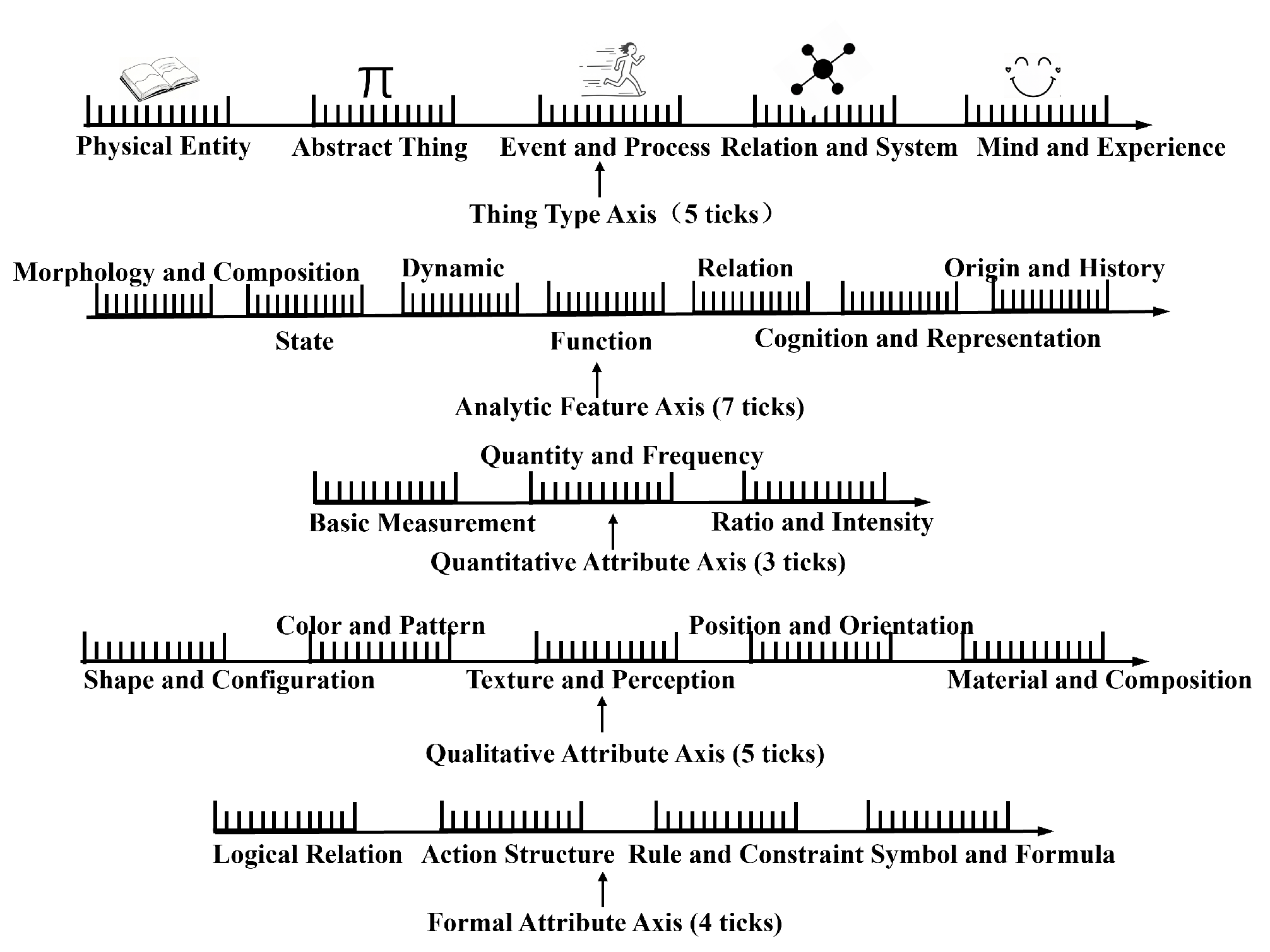
Figure 2.
Mediating axes in GCS.
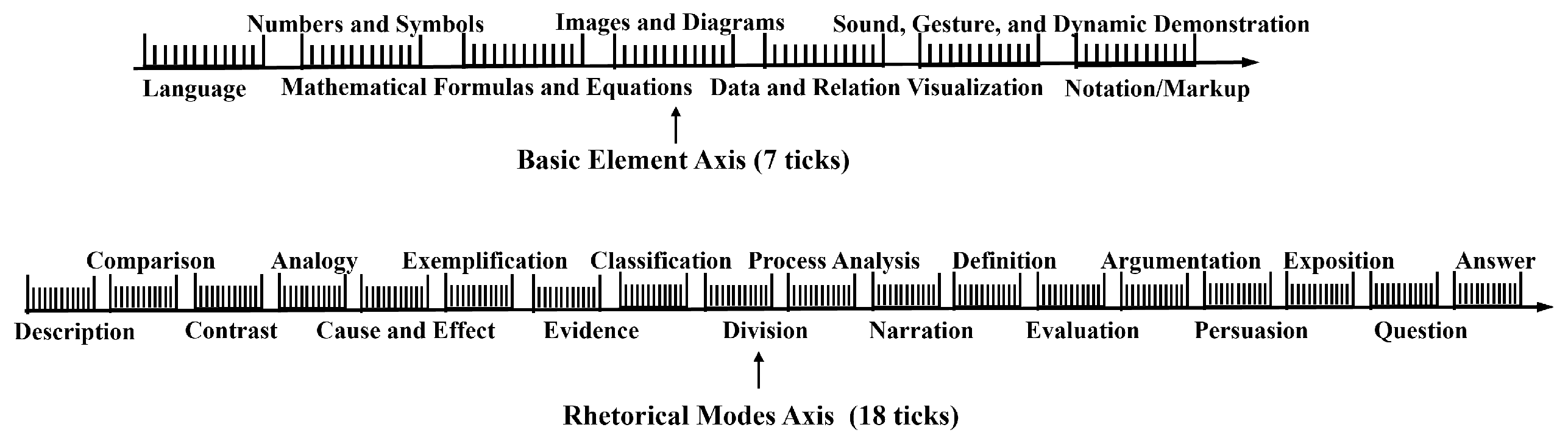
Figure 3.
High-dimensional axes in GCS.
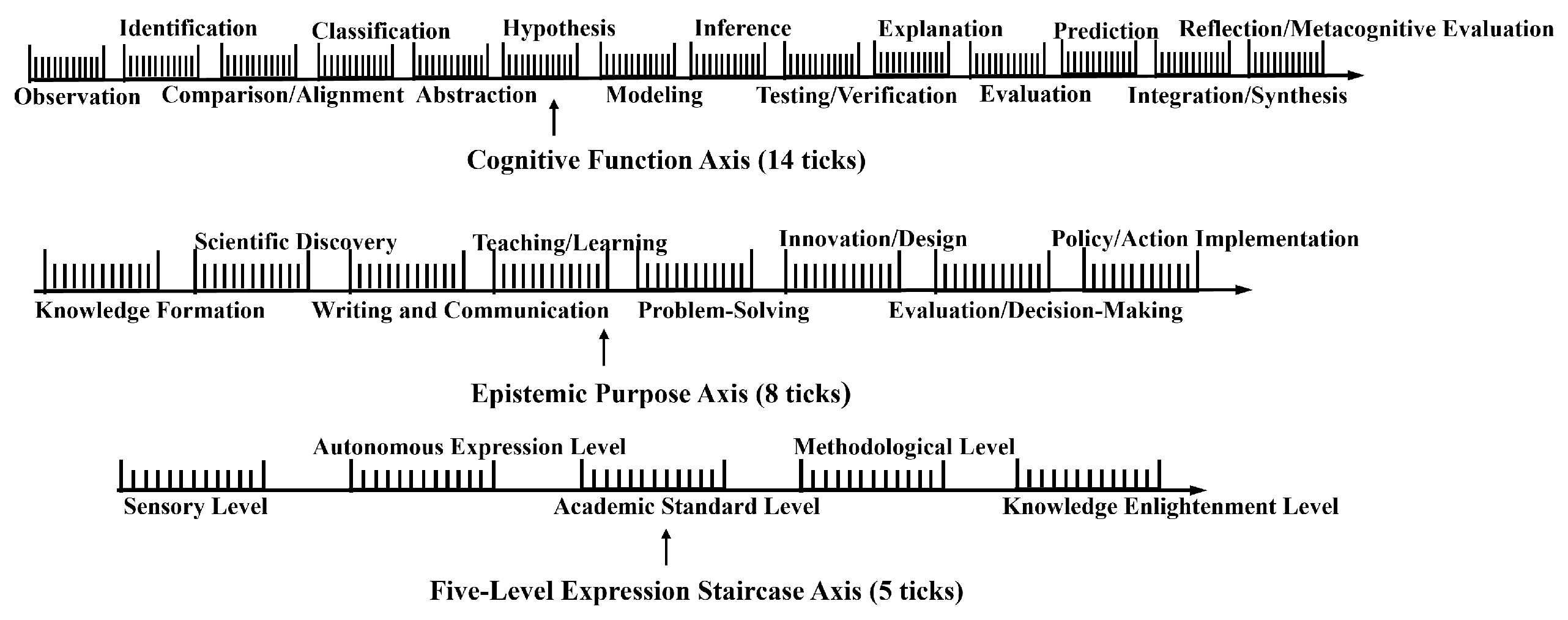

Table 1.
Distinguishing Thing-Axis Questions from Feature-Axis Questions.
| Confusable Intent | Thing-Axis (Th) Template: Locate the object | Feature-Axis (Ft) Template: Locate a facet of the object |
|---|---|---|
| Definition vs. Feature description | What is X? Which category does X belong to? | What features does X have? What are its characteristics? |
| Existence vs. Presence | Does X exist? Is there X? | Does X exhibit feature F? |
| Locating object vs. Locating state | Where/when does X occur? | What state/stage is X in? |
| Object enumeration vs. Relation type | Which objects is X related to? | What is the relation (type, direction, strength) between X and Y? |
| Process objectification vs. Dynamic mechanism | What are the procedural steps of X? | Why does X change? What is the mechanism of change? |
| Agent identification vs. Cognitive difference | Who did X? Which agents are involved? | How do different agents represent or understand X? |
| Set membership vs. Classification principle | Which items count as X? Does Y count as X? | By what principle is X divided into categories? |
| Version disambiguation vs. Historical trajectory | Do you mean X1 or X2? | How did X evolve to its current state? What were the key nodes? |
Disclaimer/Publisher’s Note: The statements, opinions and data contained in all publications are solely those of the individual author(s) and contributor(s) and not of MDPI and/or the editor(s). MDPI and/or the editor(s) disclaim responsibility for any injury to people or property resulting from any ideas, methods, instructions or products referred to in the content. |
© 2026 by the authors. Licensee MDPI, Basel, Switzerland. This article is an open access article distributed under the terms and conditions of the Creative Commons Attribution (CC BY) license (http://creativecommons.org/licenses/by/4.0/).
Copyright: This open access article is published under a Creative Commons CC BY 4.0 license, which permit the free download, distribution, and reuse, provided that the author and preprint are cited in any reuse.