

Submitted:
10 April 2026
Posted:
13 April 2026
You are already at the latest version
Abstract
Singapore’s rapidly ageing population presents significant challenges for healthcare planning and long-term care provision. This study applies ARIMA time-series modeling to forecast the number of older adults requiring assistance in daily living between 2025 and 2035. Using historical population data, nursing home residency figures, and simulated indicators of disability and living arrangements, the model projects assisted living demand rising from 19,741 individuals in 2025 to 29,443 in 2035—a 49.2% increase. While forecasts are conservative due to reliance on informal care from family members and foreign domestic helpers, structural shifts such as smaller family sizes and reduced caregiver availability may drive demand higher. The methodology highlights the importance of accounting for disability prevalence and informal care. Findings underscore the need for strategic planning to expand assisted living infrastructure, workforce capacity, and policy frameworks. Singapore’s case contributes to global literature by illustrating ageing trajectories relevant to other developed societies.
Keywords:
healthcare planning
; ageing population
; residential care
; demand forecasting
; older adults population projections
Introduction
Global demographic transitions are driving unprecedented growth in the number of older adults requiring assistance in daily living. Singapore, with declining birth cohorts and rising longevity, faces similar pressures. Previous projections estimated a 161% increase in older adults with ADL limitations between 2010 and 2030. This study builds on that evidence by applying ARIMA modeling to forecast assisted living demand through 2035, situating findings within the global literature.
This study aims to forecast the number of older adults requiring assistance in daily living from 2025 to 2035. By integrating historical population data with simulated indicators of disability, living alone, and nursing home residency, we provide evidence-based projections to inform policy and practice.
Literature Review
In Singapore, Thompson et. al., (2000) estimated that the number of older adults with daily activity restrictions will increase to 82,968 in 2030. The study had interviewed respondents who had participated in the Social Isolation, Health and Lifestyles Survey (SIHLS) 2009, to obtain self-reported levels of limitations in activities of daily living. The study then used a population estimate based on Singapore Census of Population 2010 and simulated a projected population of 6.5 million in 2050.
In the next 20 years, the English population aged 65 years or over will see increases in the number of individuals who are independent but also in those with complex care needs. This increase is due to more individuals reaching 85 years or older who have higher levels of dependency, dementia, and comorbidity.
The challenge of England’s ageing population is increasing dependency among the very old (85 years and above) due to complex morbidity and dementia but this is balanced with increasing independency for the young old (65 to 74 years) (Kingston, Comas-Herrera and Jagger, 2018). By 2035, more than 80% of those with dementia and medium to high dependency will also have two or more chronic conditions. Gender differences were also observed, with a compression of dependency for men (more years independent than life expectancy gains) and an expansion of dependency for women.
In comparison, data from the China Health and Retirement Longitudinal Study (CHARLS), covering 2011–2020, with projections to 2030, had indicated a lower level of prevalence of older adults with difficulties in performing some daily activities, due to improvements linked to education, housing, and health-care access (Zhang, Wang and Sun, 2025). However, the falling prevalence of dependent older adults is offset by the total number of older adults needing care rising due to rapid population ageing. In China, the number of older adults was projected to increase by approximately 14 million from 2020 to 2030 (Gong et al. 2022). Both countries illustrate the irony of ageing populations - healthier cohorts entering old age, but rising absolute demand for care due to longevity and population size.
In fact, Gong’s study (2022) forecasted over 450% increase in the number of older adults with disability in daily life. Similar to the forecast for England, gender differences were also observed in China. More males (666%) compared to females (310.3%) were projected to live alone with increases in disability by 516.2% for females and 1001.9% for males (Zhang, Wang and Sun, 2025).
In contrast, a study in Switzerland reported the same upward trend (towards 2045) of older adults with moderate and severe dependence for institutional care, but higher dependency for women as age increases (Fuino and Wagner 2018). In another study by Aranco, Ibarrarán, and Stampini (2022), population ageing in Latin America and the Caribbean will dramatically increase demand for long-term care, adding nearly 23 million (a nearly three-fold increase of 8 million in 2020 to 14 million in 2035 and 23 million in 2050) additional care-dependent older persons by 2050. The rise in numbers is driven primarily by population ageing and growth of the 80+ group, rather than large increases in prevalence (14% prevalence rate of care dependent older adults in 2020, to 15% in 2035 and 16% in 2050).
Data Sources
This study on the ageing population of Singapore uses Historical Population Data (1957–2024) obtained from the Census of Population and General Household Survey 2020, which factored demographic shifts due to declining birth cohorts and increased longevity, and stratified by age, gender and ethnic groups, DOS.
In addition, historical data of the number of older adults in nursing homes was also used to reflect institutional care demand was obtained from DOS dataset “Residents in Home for the Aged” from year 2000 to 2024 and used in this study.
In addition, the following supplementary simulated datasets were constructed to capture key drivers of dependency:
Older adults with disability (functional limitations in ADLs/IADLs), using historical data, “Census of Population 2020”, filtered by Resident Population Aged 65 Years and Over, in Resident Households, by Level of Difficulty in Performing Basic Activity in Specific Domain, Living Arrangement and Sex, obtained from the Singapore Department of Statistics
Older adults living alone (reflecting social isolation and reduced informal care availability), using Singapore Department of Statistics data on Singapore Residents Aged 65 Years and Over in Resident Households By Living Arrangement from year 2000 to 2024.
Method
Using time series construction, the assisted living demand series (2000 to 2024) was converted into a univariate time series with annual frequency. Stationarity was assessed through differencing, with the final model requiring second-order differencing (d=2).
Alternative ARIMA specifications (e.g., ARIMA(1,2,0), ARIMA(0,1,1)) were tested. ARIMA(0,2,1) consistently outperformed alternatives based on AIC/BIC and residual diagnostics. Model Fit: ARIMA(0,2,1) was therefore selected. Residual diagnostics confirmed adequacy (Ljung-Box p = 0.943), with no significant autocorrelation.
Residual plots indicated white-noise behaviour. The accuracy metrics indicated strong predictive accuracy - RMSE = 276.79, MAE = 191.06, MAPE = 1.55%
Methodology for Simulating Historical Data and Missing Intervals on the Disability Prevalence Among Older Adults (2000 to 2019, and 2021 to 2024)
Simulation Framework
The analysis utilised a combination of known demographic data points and modelled estimates to project the population of older adults with disability from 2000 to 2030. Three empirical anchor points were established: 2020 (population: 614,368), 2025 (population: 753,900), and 2030 (population: 795,703). A constant disability prevalence rate of 13.3% was applied across all years, based on established epidemiological data for the older adult population.
Data Foundation and Assumptions
The simulation was anchored on three known data points: population estimates of older adults for 2020 (614,368), 2025 (753,900), and 2030 (795,703). The population of older adults (approximately 614,368) was obtained from the Resident Population by Age Group, Ethnic Group, Sex and Residential Status (Census of Population 2020).
A disability prevalence rate of 13.3% (as reported by SGEnable1, the focal agency for disability and inclusion in Singapore) for adults age 55 years and above was applied in the model. This assumption reflects the relatively stable nature of age-adjusted disability rates in the absence of major demographic or health system changes.
Historical Population Reconstruction (2000-2019)
For the historical period, we employed backward projection using an exponential decay model. The historical population was estimated using the formula:
P(t) = P₂₀₂₀ × exp(r × (2020 - t))
where P(t) represents the population in year t, P₂₀₂₀ is the known 2020 population, and r is the estimated annual growth rate of -0.03. This negative growth rate reflects demographic trends in the older adult population during the early 2000s, accounting for cohort effects and mortality patterns.
Forward Interpolation (2021-2024)
For the intermediate projection period between known data points, we implemented linear interpolation to ensure smooth transitions. The annual population increase was calculated as:
Annual increase = (P₂₀₂₅ - P₂₀₂₀) / 5
This approach assumes consistent year-on-year growth between the anchor points, providing realistic intermediate estimates whilst maintaining consistency with the known endpoints.
Disability Count Calculation
The number of older adults with disability for each year was calculated by applying the constant prevalence rate to the simulated population:
Disability count(t) = Population(t) × 0.133

Table 1.
Simulated Number of Older Adults with Disability.
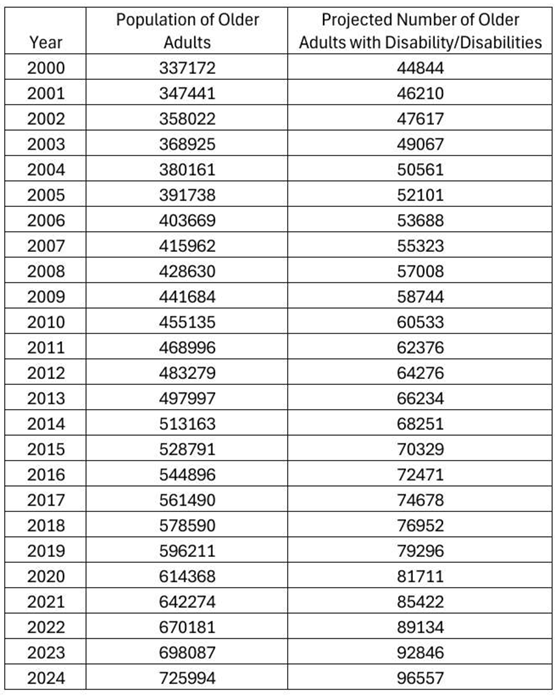 |
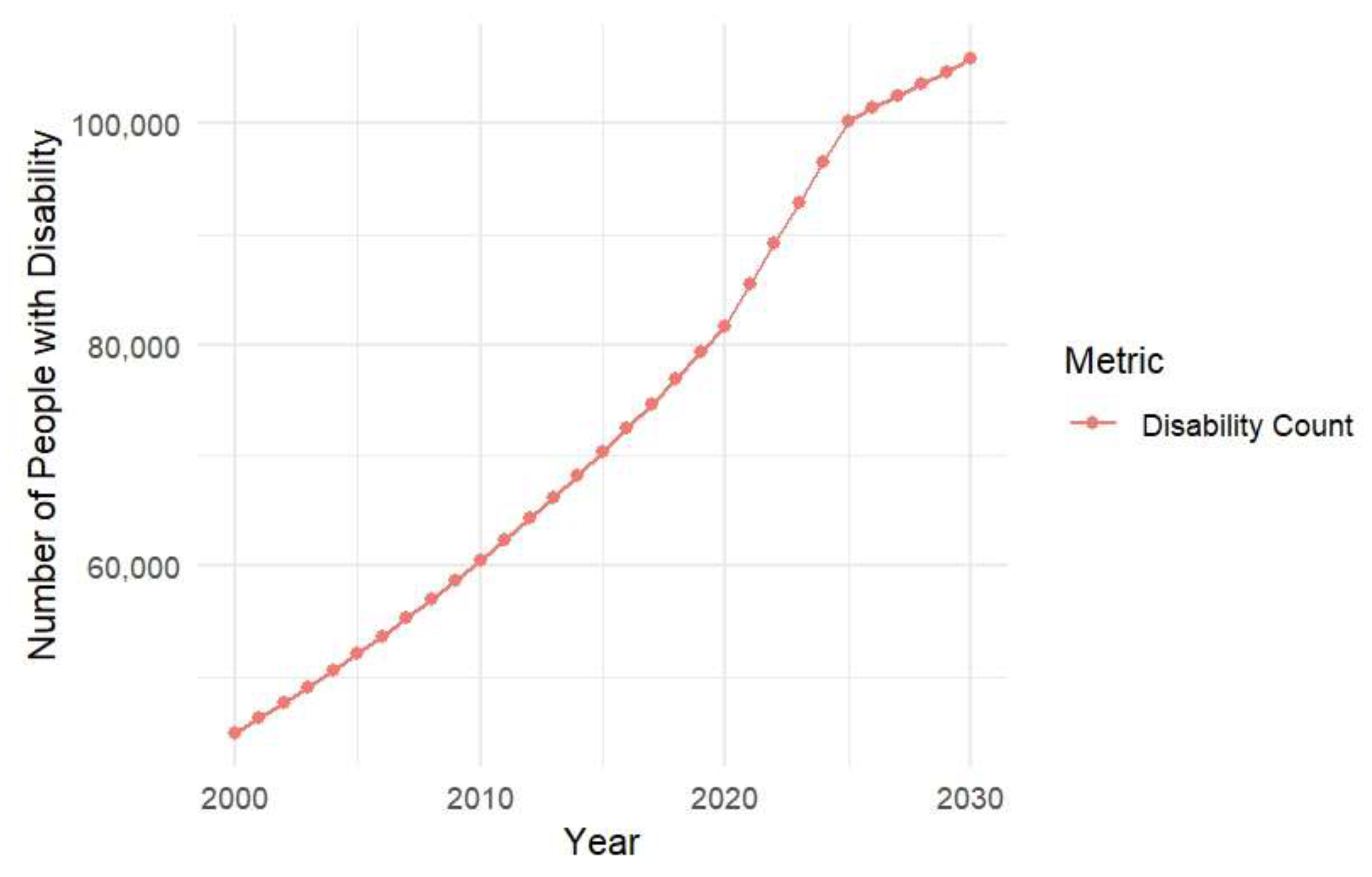
The modelled population of older adults demonstrated consistent growth from 337,172 individuals in 2000 to 795,703 individuals in 2030, representing a 136% increase over the 30-year period. Correspondingly, the estimated number of older adults with disability increased from 44,844 in 2000 to 105,828 in 2030.
The analysis revealed distinct growth phases across the study period. The historical simulation period (2000-2019) showed steady exponential growth, with the population increasing from 337,172 to 596,211 individuals. The disability count during this period grew from 44,844 to 79,296 individuals, representing an average annual increase of approximately 1,813 individuals with disability.
The projection period (2020-2030) demonstrated accelerated growth, with the total population increasing by 181,335 individuals over the decade. The disability count increased by 24,117 individuals during this period, from 81,711 in 2020 to 105,828 in 2030. The most rapid growth occurred between 2020 and 2025, with an average annual increase of 3,712 individuals with disability, compared to 1,112 individuals per year between 2025 and 2030.
Figure 1.
Plot for Simulated Number of Older Adults with Disability (2000 to 2030).
Methodology for Simulating Historical Number of Older Adults Living Alone (2000 to 2010)
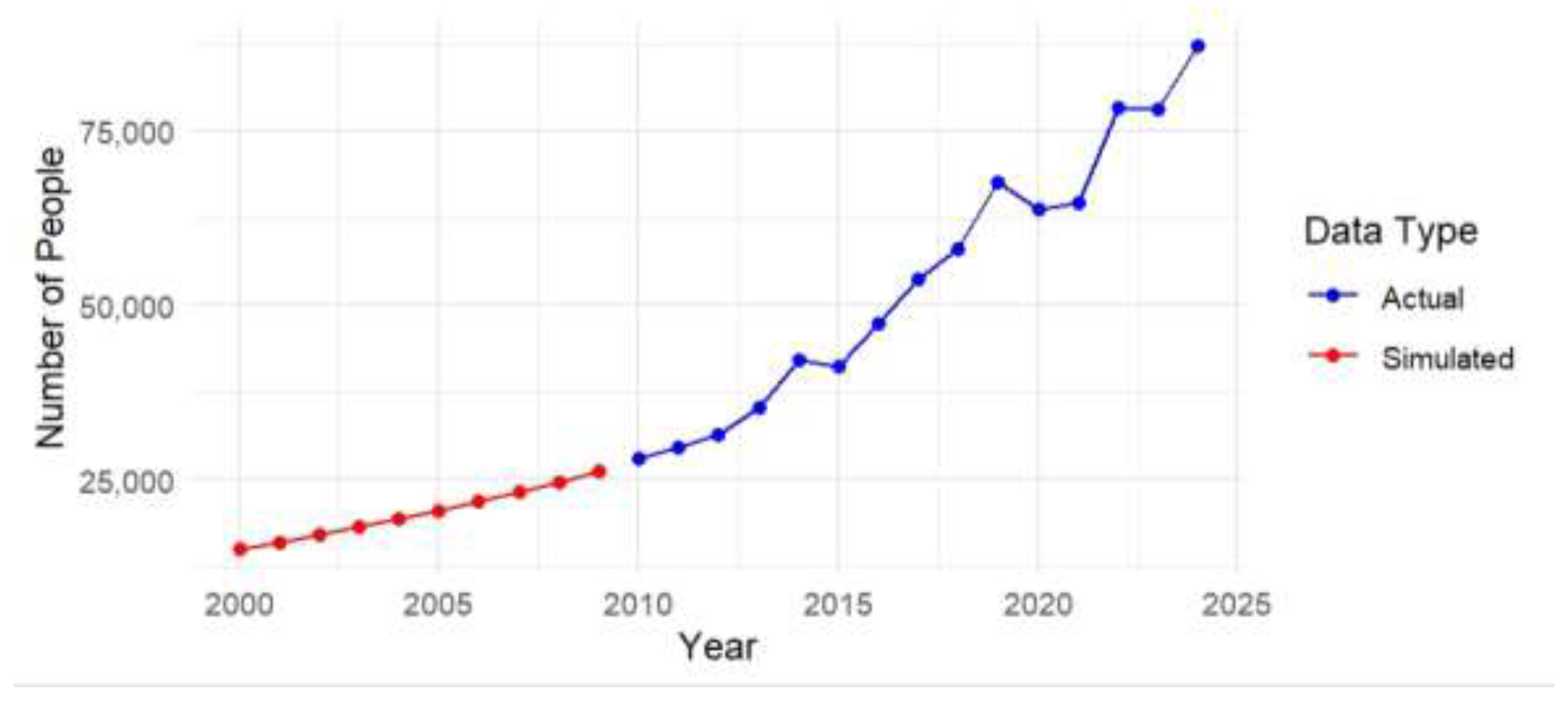
As for the number of older adults living alone for the missing period (prior to 2010), this study uses the actual data from 2010 to 2024 and employed a backward extrapolation method based on exponential decay modelling to extend the time series backwards to 2000.
Historical Rate Adjustment
The average rate of change had used the actual data from the reference period 2010-2015, employing the natural logarithm transformation: rate = (ln(41,100) - ln(27,900)) / 5 years, yielding a rate of approximately 0.0798 per year.
Recognising that demographic growth patterns may differ across time periods, we applied a conservative adjustment factor of 0.8 to the calculated rate (adjusted rate = 0.0639), assuming slower growth in earlier years compared to the reference period.
Backward Projection
Using the 2010 baseline value (27,900), historical estimates were generated using the formula: estimated value = 27,900 × exp(-0.0639 × time lag), where time lag represents years prior to 2010. This produced estimates ranging from 26,223 individuals in 2009 to 15,011 individuals in 2000.
Results
Method for Forecasting the Number of Older Adults Requiring Assisted Living Arrangements
The analysis utilised historical data on older adults requiring assisted living facilities from 2000 to 2024 (n=25 years). The dataset comprised annual counts ranging from 6,022 individuals in 2000 to 18,771 individuals in 2024. The data were converted to a time series object with annual frequency for subsequent modelling.
ARIMA Model Selection and Specification
Automated ARIMA model selection was performed using the auto.arima function from the forecast package in R. The selection process employed stepwise model comparison without approximation to ensure optimal model identification. Seasonal components were excluded from consideration given the annual frequency of the data. The algorithm evaluated multiple ARIMA specifications based on information criteria (AIC, AICc, BIC) to identify the most parsimonious model.
The ARIMA model was used to generate point forecasts and prediction intervals for the period 2025-2035 (11 years). Forecasts included 80% and 95% confidence intervals to quantify uncertainty in the projections. All forecast values were rounded to whole numbers to reflect realistic population counts.
Table 2.
Simulated Number of Older Adults Living alone in 2000 to 2009.
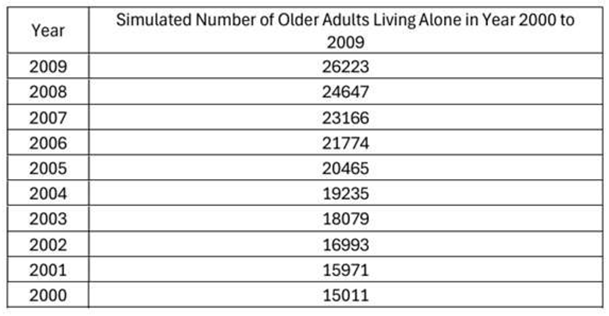 |
Figure 2.
Plot for Simulated Number of Older Adults Living alone in 2000 to 2009 and Actual Data on the Number of Older Adults Living Alone from 2010 to 2024.
Figure 2.
Plot for Simulated Number of Older Adults Living alone in 2000 to 2009 and Actual Data on the Number of Older Adults Living Alone from 2010 to 2024.
Results
Forecast Results for Number of Older Adults Requiring Assisted Living Arrangements (2025 to 2035)
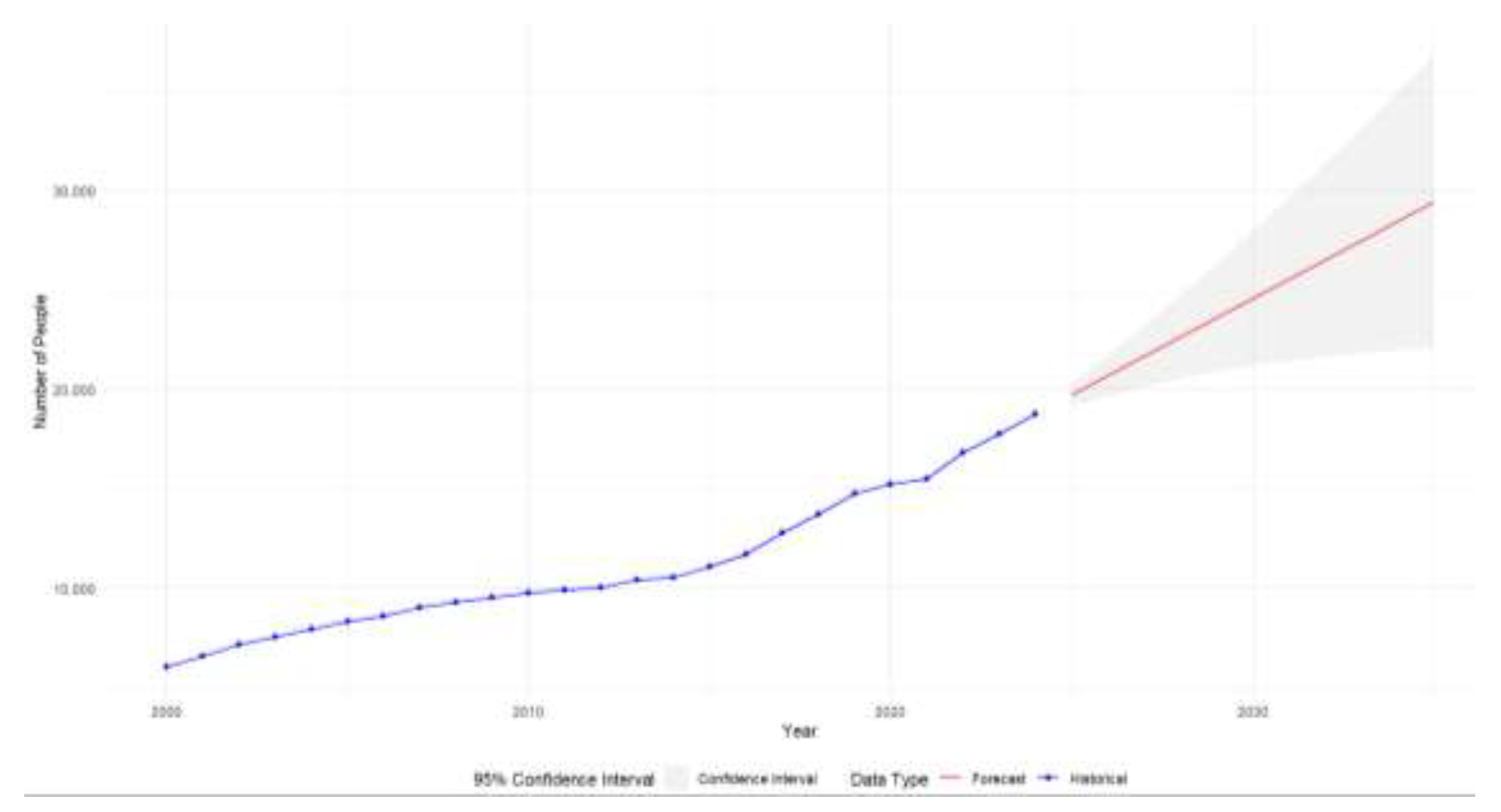
The ARIMA model projected continued growth in assisted living demand over the forecast horizon. Point forecasts indicated an increase from 19,741 individuals in 2025 to 29,443 individuals in 2035, representing a 49.2% increase over the 11-year period. The average annual growth rate across the forecast period was approximately 970 individuals per year.
Forecast uncertainty increased progressively with the forecast horizon, as reflected in expanding confidence intervals. The 95% confidence interval for 2025 ranged from 19,163 to 20,319 individuals (width: 1,156), whilst the 2035 interval spanned from 22,081 to 36,805 individuals (width: 14,724). This pattern reflects the inherent uncertainty in long-term demographic projections.
The forecast trajectory demonstrated consistent upward momentum, with the steepest growth occurring in the latter years of the projection period. By 2030, the model projected 24,592 individuals requiring assisted living facilities (95% CI: 21,185-27,999), representing a 31.0% increase from the 2025 baseline. The upper bound of the 95% confidence interval reached 36,805 individuals by 2035, highlighting the potential for substantial demand growth under optimistic demographic scenarios.
Table 3.
Forecast Number of Older Adults Requiring Assisted Living Arrangements, from 2025 to 2035.
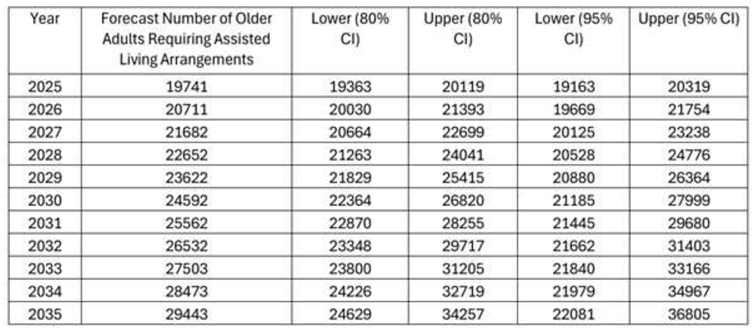 |
Figure 3.
Plot for Forecast Number of Older Adults Requiring Assisted Living Arrangements, from 2025 to 2035.
Figure 3.
Plot for Forecast Number of Older Adults Requiring Assisted Living Arrangements, from 2025 to 2035.
Model Performance
The automated model selection procedure identified an ARIMA(0,2,1) model as optimal for the assisted living demand time series. This specification indicates a second-order integrated process with a first-order moving average component. The model demonstrated good fit with an AIC of 330.15, AICc of 330.75, and BIC of 332.42. The moving average coefficient (MA1) was estimated at -0.5004 (standard error: 0.2026), indicating moderate negative autocorrelation in the differenced series.
The ARIMA(0,2,1) model satisfied key diagnostic criteria for adequacy. The Ljung-Box test for residual autocorrelation yielded a Q-statistic of 0.765 (df=4, p-value=0.943), indicating no significant serial correlation in model residuals. The model’s training set performance showed a Mean Absolute Percentage Error (MAPE) of 1.55%, demonstrating high accuracy in fitting historical data. The Root Mean Square Error (RMSE) was 276.79, with a Mean Absolute Error (MAE) of 191.06.
The ARIMA(0,2,1) model demonstrated robust performance across multiple accuracy measures. The Mean Absolute Scaled Error (MASE) of 0.36 indicated superior performance compared to naïve forecasting methods. The low Mean Percentage Error (MPE) of 0.13% suggested minimal systematic bias in model predictions, whilst the autocorrelation function of residuals (ACF1: 0.011) confirmed adequate model specification.
Discussion
As compared to England and China, the ARIMA model in this study had produced relatively conservative forecasts, projecting a steady rise in assisted living demand from 19,741 in 2025 to 29,443 in 2035. This moderation reflects Singapore’s historical reliance on informal care, where family members provide substantial daily assistance. The actual care support needed by older adults in their daily living, may be higher than the projections. However, the actual demand may not be reflected by this projection if informal care arrangements provided by foreign domestic helpers mitigate the demand for residential care support.
Informal Care Availability and Conservative Projections
One-fifth of the Singapore population will be aged 65 or older by 2030. Together with family members, live-in foreign domestic helpers are the primary source of care for most older adults in Singapore (Yeoh, B. S. A., & Huang, S. (2009)). In a country where cultural norms emphasize filial piety, assisted living care facility is not the preferred option (Duke NUS, 2021). Informal care support from foreign domestic helpers is more socially desirable and economically viable. Modern filial piety appears to be an evolved form of indirect filial piety as adult children remain economically active to provide care indirectly through the employment of foreign domestic helpers (Brasher, 2022), (Wang et al., 2020) (Ożegalska-Łukasik, N., 2025). Supporting informal care is the “Many Helping Hands” approach in Singapore’s long term care provision for older adults (Rozario, P. A., & Hong, S. I. (2019)), whereby family members and foreign domestic helpers jointly support the caregiving for the aged parents.
Despite the reliance on informal care support, results showed that even with declining prevalence, absolute numbers requiring assistance continued to rise due to population ageing. In fact, informal care availability could be affected (e.g., due to smaller family sizes, increased female labor force participation, more singles and married couples with no children, and pandemic affecting the inflow of foreign domestic helpers), thereby leading to higher institutional demand, aligning with projections in England and Ireland.
Underestimation of Structural Shifts
In addition, ARIMA, as a univariate time series model, extrapolates past trends. It does not account for future declines in informal care availability due to smaller family sizes, increased female labor force participation, and changing social norms. The conservative nature of ARIMA forecasts should be interpreted as a baseline scenario under continued informal care availability. If informal care declines more rapidly than assumed, actual demand for assisted living could exceed ARIMA projections. Policymakers should therefore treat these forecasts as minimum estimates, planning for higher demand under scenarios of reduced family caregiving.
Limitations
Limitations include reliance on simulated data for disability and living arrangements, which may not fully capture future variability. Nonetheless, the ARIMA model provides robust short- to medium-term forecasts.
As expected in time series forecasting, prediction uncertainty increases considerably with longer forecast horizons. The 2035 projection exhibits substantially wider confidence intervals, ranging from 22,081 to 36,805 at the 95% confidence level. This expanding uncertainty band, spanning approximately 14,700 units, underscores the inherent challenges in long-term demographic forecasting and reflects the cumulative effect of model uncertainty over extended periods.
The forecasting results suggest that the trend of older adults living alone will continue to be a significant demographic phenomenon requiring sustained policy attention and resource planning. The projected growth trajectory, whilst maintaining statistical significance throughout the forecast period, carries increasing uncertainty that should be considered in long-term planning and policy development initiatives.
Future Research Directions
While ARIMA modeling provides robust short- to medium-term forecasts, several avenues exist to extend and refine projections of assisted living needs. Microsimulation Models could be applied to incorporate heterogeneity in ageing trajectories, family support, and socioeconomic status. Future studies could also consider cohort-based projections by accounting for factors (e.g., smaller family sizes, higher education, improved healthcare access) that strongly influence future care needs. Incorporating cohort-specific health and social characteristics would improve accuracy, especially as incoming generations of older adults differ from current cohorts.
As literature shows that older adults with medium/high dependency increasingly present with multiple concurrent conditions (from 58.8% in 2015 to 81.2% in 2035 in England), Singapore forecasts could be strengthened by integrating multimorbidity data, particularly dementia prevalence, into dependency projections.
Taking reference from the scenario models (used in France and Latin America) allow exploration of alternative futures under different assumptions (e.g., compression vs. expansion of morbidity, policy reforms, technological innovations in care). Singapore could benefit from scenario analyses to test resilience of care systems under varying demographic and health trajectories.
Future research should also consider integrating cost projections, housing affordability, and informal care availability to assess sustainability of care provision. By situating ARIMA forecasts within a broader methodological landscape, future research can move toward multi-dimensional, cohort-sensitive, and scenario-based models. This will provide policymakers with richer insights into not only how many older adults will require assistance, but also who they are, what conditions they face, and what resources they will need.
Conclusion
By 2035, nearly 30,000 older adults in Singapore are projected to require assistance in daily living. The increase in the number of older adults requiring assistance in living is expected for societies with rapid ageing populations. Strategic planning is essential to ensure adequate infrastructure, workforce, and policy frameworks to meet this demand.
Singapore can continue to rely on informal care arrangements by strengthening the support for foreign domestic help hire. Tighter regulations on the quality of care provided by foreign domestic helper should also be considered, to ensure the safety of increasing number of older adults living alone. Alternatively, assisted living facilities and workforce capacity can be expanded. Long-term care planning can also better integrate disability support.
Funding
This research did not receive any funding.
Conflicts of Interest
There is no conflict of interest.
References
- Andrew Kingston, Adelina Comas-Herrera, Carol Jagger for the MODEM project* 2018 Forecasting the care needs of the older population in England over the next 20 years: estimates from the Population Ageing and Care Simulation (PACSim) modelling study. [CrossRef]
- Aranco, N., I; rrarán, P.; Stampini, M. Prevalence of care dependence among older persons in 26 Latin American and the Caribbean countries; Inter-American Bank Development, 2022. [Google Scholar] [CrossRef]
- Brasher, M.S. Filial Norms, Altruism, and Reciprocity: Financial Support to Older Parents in China. Population Ageing 2022, 15, 259–277. [Google Scholar] [CrossRef]
- Duke-NUS Medical School. Filial piety norms: Caught between two worlds. Duke-NUS Medical School. 25 April 2021. Available online: https://www.duke-nus.edu.sg/newshub/media-coverage/filial-piety-norms-caught-between-two-worlds-(straits-times-premium).
- Fuino, M.; Wagner, J. Old-age care prevalence in Switzerland: drivers and future development. Eur. Actuar. J. 2018, 8, 321–362. [Google Scholar] [CrossRef]
- Gong, Jinquan, &; et al. Nowcasting and forecasting the care needs of the older population in China: analysis of data from the China Health and Retirement Longitudinal Study (CHARLS). The Lancet Public Health 2022, 7(Issue 12), e1005–e1013. [Google Scholar] [CrossRef] [PubMed]
- Ożegalska-Łukasik, N. Filial Piety Revisited—Family Care and Filial Obligation in China at the Time of the COVID-19 Pandemic. Social Sciences 2025, 14(12), 696. [Google Scholar] [CrossRef]
- Rozario, P. A.; Hong, S. I. Foreign Domestic Workers and Eldercare in Singapore: Who Hires Them? Journal of Aging & Social Policy 2019, 31(3), 197–210. [Google Scholar] [CrossRef] [PubMed]
- Thompson, J.; Malhotra, R.; Love, S.; Ostbye, T.; Chan, A.; Matchar, D. Projecting the number of older Singaporeans with activity of daily living limitations requiring human assistance through 2030. Annals of the Academy of Medicine, Singapore 2014, 43(1), 51–56. [Google Scholar] [CrossRef] [PubMed]
- Wang, Y; Zhao, X; Feng, Q; Liu, L; Yao, Y; Shi, J. Psychological assistance during the coronavirus disease 2019 outbreak in China. Journal of Health Psychology 2020, 25(6), 733–737. [Google Scholar] [CrossRef] [PubMed]
- Yeoh, B. S. A.; Huang, S. Foreign Domestic Workers and Home-Based Care for Elders in Singapore. Journal of Aging & Social Policy 2009, 22(1), 69–88. [Google Scholar] [CrossRef] [PubMed]
- Zhang, J.; Wang, Z.; Sun, Y.; et al. Projections of households, living arrangements, and demand of care needs for disabled older adults in China. China popul. dev. stud. 9, 1–16. [CrossRef]
| 1 | https://www.sgenable.sg/about-us/our-impact/disability-in-singapore |
Disclaimer/Publisher’s Note: The statements, opinions and data contained in all publications are solely those of the individual author(s) and contributor(s) and not of MDPI and/or the editor(s). MDPI and/or the editor(s) disclaim responsibility for any injury to people or property resulting from any ideas, methods, instructions or products referred to in the content. |
© 2026 by the authors. Licensee MDPI, Basel, Switzerland. This article is an open access article distributed under the terms and conditions of the Creative Commons Attribution (CC BY) license (http://creativecommons.org/licenses/by/4.0/).
Copyright: This open access article is published under a Creative Commons CC BY 4.0 license, which permit the free download, distribution, and reuse, provided that the author and preprint are cited in any reuse.


