

Submitted:
10 April 2026
Posted:
13 April 2026
You are already at the latest version
Abstract
We report the synthesis and single-crystal X ray structures of three novel (Z)-5 arylidene-3-phenylrhodanine derivatives, differing in the substituents on the ben-zylidene fragment (two methoxy groups (compound I), a dioxine ring (compound II), or a dioxole ring (compound III)). Despite the overall similarity of the molecules, their su-pramolecular architectures were found out to be strikingly different. In both compounds I and II, short S···S chalcogen bonds together with forced C–H···O hydrogen bonds generate dimeric motifs, whereas III lacks S···S interactions and instead features an n→π* contact from the rhodanine carbonyl oxygen to the benzodioxole ring, as well as C-H···S bifurcate hydrogen bond. The results of intermolecular interactions in those structures are checked via Hirshfield surface analysis. The fine modulation of the arylidene substituent can switch the primary intermolecular synthon from chalcogen bonding to n→π* interactions, offering new possibilities for crystal engineering of rhodanine-based materials.
Keywords:
rhodanines
; 5-arylidene-rhodanines
; π-stacking
; hydrogen bonds
; crystal packing
; X-ray diffraction
1. Introduction
Rhodanines, also known as 2-thio-4-oxothiazolidines, are a common class of heterocyclic compound whose structure and properties have been extensively studied using X-ray diffraction (XRD). This method enables the precise determination of molecules’ three-dimensional structures, the nature of crystal packing and intermolecular interactions. This information is important for understanding their biochemical activity and industrial applications [1]. Analysis of the X-ray diffraction of various rhodanine derivatives shows that they predominantly crystallize in the monoclinic system, although other lattice types are also present [2,3]. A notable feature is that a unit cell may contain multiple independent molecules, suggesting complex packing [4]. Rhodanines are much more than just «hydantoins with sulfur». Replacing nitrogen and oxygen atoms with sulfur can radically alter the electronic structure, resulting in greater polarizability and different reactivity. Both classes are «workhorses» of medicinal chemistry due to their different biological activity profiles, and they are often compared as bioisosteres to determine which scaffold is best suited to a specific task (e.g. whether higher lipophilicity or specific binding to the metal in the enzyme’s active site is required). From an X-ray structural analysis perspective, the similarities and differences between rhodanines and hydantoins are evident. Hydantoins have a flat ring and characteristic bond lengths of approximately 1.21–1.23 Å [2] for their two carbonyl groups (C=O). In thiols, the C=S bond is significantly longer than the C=O bond. The S–C bond length is 1.7525(12) Å, and for different derivatives it ranges from 1.632 to 1.650 Å [5,6]. This is much longer than a typical C=O double bond (approximately 1.22 Å).
Scheme 1.
General structural formula for 5,5-disubstituted hydantoins (a), 5,5-disubstituted rhodanines (b) and compounds I-III investigated in this work (c).
Scheme 1.
General structural formula for 5,5-disubstituted hydantoins (a), 5,5-disubstituted rhodanines (b) and compounds I-III investigated in this work (c).

From the crystal chemistry perspective, rhodanine arises as an interesting structural fragment, which, most commonly [7,8,9], forms hydrogen bonds with carbonyl oxygen atom as an acceptor.
The first investigations of molecular structure and hydrogen bonding anaysis in condensed matter of rhodanine were perfomed by van der Helm et al. in 1962 [10] with unit cell dimensions reported earlier by Merritt and Lessor in 1955 [11]. There, a dimeric homosynthon around an inversion axis is discussed, which is formed by strong N-H···O hydrogen bonds. This motif is, in fact, one of the main kinds of intermolecular interactions found in rhodanines unsubstituted at a nitrogen atom. In this work, we рфму investigateв a change in crystal packing of rhodanines when a different kind of substitute gets introduced. A phenyl ring as such a candidate was chosen for its ability of forming π···π and various types of C-H···π interactions [12], which would, in theory, give rise to a new type of synthons formed by rhodanine entity.
2. Materials and Methods
General Information
All used solvents have been distilled and purified by standard protocols before use. Column chromatography was performed using 60 Å silica gel (Merck), thin-layer chromatography – with ALUGRAM Xtra SLI G/UV254 plates (Macherey-Nagel). All melting point temperatures were determined using OptiMelt MPA 100 in dynamic mode (1 °C min-1, 0.1 °C resolution). NMR spectra were recorded using Bruker Avance 400, Bruker AV 600 and Agilent 400 MR spectrometers at room temperature with determination of chemical shifts relative to the residual solvent signals. IR-spectra were recorded using Thermo Scientific Nicolet iS5 Fourier spectrometer using attenuated total reflection (ATR) sampling (32 scans, 4 cm-1 resolution). HPMS spectra registration was conducted using G3 QTof and AB SciexTripleTOF 5600+ quadrupole time-of-flight mass-spectrometers using electro- and photospray-ionization, respectfully.
Single-Crystal X-Ray Analysis (SC-XRD)
Experimental data dets for I and II were collected on a STOE STADI VARI PILATUS diffractometer by means of φ-scans using focusing-mirror collimated Cu-Kα radiation (λ = 1.5406 Å) at room temperature. Initial indexing, refinement of unit cell parameters and integration of reflections were performed using the X-Area 1.67 (STOE & Cie GmbH) [14,15,16]. Absorption corrections based on measurements of equivalent reflections were applied using LANA [17].
Experimental data set for III was collected on a Bruker D8 Venture diffractometer by means of φ- and ω-scans using graphite monochromatized Mo-Kα radiation (λ = 0.71073 Å, Incoatec IμS 3.0) at 150 K. Initial indexing, refinement of unit cell parameters and integration of reflections were performed using the Bruker APEX3 software package [18,19]. Absorption corrections based on measurements of equivalent reflections were applied using SADABS program [20].
All structureswere solved by direct methods [21] and refined by full-matrix least squares method on F2 with anisotropic thermal parameters for all non-hydrogen atoms. All hydrogen atoms in phenyl ring in both I and II were refined using a riding model with Uiso(H)=1.2 Ueq(C), and hydrogen atoms in tert-butyl groups in were refined as a rotating group. All atoms in III and H(12) in Iwere refined with both positional and thermal parameters.
All calculations and refinements were performed using the SHELXTL software package [21,22]. The illustrations were obtained using the XP program.
General Synthetic Protocol for Compounds I-III.
In a round-bottom flask, equipped with a magnetic stirrer and a reflux condenser, a solution of 4,6-di-tert-butyl-disubstituted benzaldehyde (1 eq.) and 3-phenyl-2-thioxothiazolidin-4-one (1 eq.) in ethanol (3-5 ml) was prepared. After the addition of piperidine (1 eq.), the reaction mixture was refluxed for 4 minutes, after which glacial acetic acid was added (1 ml). The mixture was left refluxing for a total of 24 h. The total reaciton conversion was determined by means of thin-layer chromatography. After the mixture was cooled to room temperature, it was treated with saturated ammonium chloride solution. The resulted precipitate was filtered out, washed several times with water and dried on air. The purification of product was made by column chromatography (using the same eluent as in thin-layer chromatrography, vide infra for each compound).
(Z)-5-(4,6-di-tert-butyl-2,3-Dimethoxybenzylidene)-3-Phenyl-2-Thioxothiazolidin-4-One
0.395 mmol of each reagent - aldehyde, thioxothiazolidine and piperidine - was used. An ethyl acetate / petroleum ether (1:10 v/v) was chosen as an eluent. Yield 0.08 g (50%) as yellow powder. M.p. 199 – 200°С. 1Н NMR (400 MHz, DMSO-d6, ppm) δ 1.36 (s, 18Н, tBu), 3.63 (s, 3Н, -OMe), 3.88 (s, 3Н, -OMe), 7.18 (s, 1Н, arom.), 7.44-7.46 (m, 2Н, arom.), 7.52-7.58 (m, 3Н, arom.), 8.14 (s, 1Н, СН). 13СNMR (101 MHz, DMSO-d6, ppm) δ 30.13 (tBu), 31.30 (tBu), 35.28, 35.88, 60.31 (-OMe), 120.02, 124.76, 127.17, 128.86 (2С), 129.29 (2С), 129.49, 131.25, 135.16, 143.77 (2C), 150.47, 151.13, 166.41, 195.78. ИК(cm-1) ν 527, 547, 611, 625, 651, 691, 707, 747, 799, 818, 839, 881, 916, 930, 974, 1016, 1036, 1073, 1151, 1171, 1236 (tBu), 1298, 1355, 1386, 1396, 1474, 1496, 1579, 1713, 2868 (-OMe), 2963, 2961. HRMS (ESI/TOF-MS, m/z, [M+H]+): calculatedforC26H31NO3S2 470.1818, found 470.1815.
(Z)-5-((6,8-di-tert-butyl-2,3-dihydrobenzo[b][1,4]dioxin-5-yl)methylene)-3-Phenyl-2-Thioxothiazolidin-4-One
0.540 mmol of each reagent - aldehyde, thioxothiazolidine and piperidine - was used. An ethyl acetate / petroleum ether (1:5v/v) was chosen as an eluent. Yield 0.13 g (52%) as yellow powder. M.p.196 – 197°С. 1Н NMR (400 MHz, DMSO-d6, ppm) δ 1.35 (d, J = 3.1 Hz, 18H, tBu), 4.34 (d, J = 24.7 Hz, 4H, 2·CH2), 6.95 (s, 1H, CH), 7.42-7.45 (m, 2H, arom.), 7.49 – 7.57 (m, 3H, arom.), 8.08 (s, 1H, CH). 13СNMR (101 MHz, DMSO-d6, ppm) δ 29.29 (tBu), 31.36 (tBu), 35.02, 35.57, 62.93 (-CH2-), 64.04 (-CH2-), 116.24, 118.31, 126.45, 128.80 (2C), 129.23 (2C), 129.39, 131.31, 135.18, 138.69, 140.44, 141.00, 141.11, 166.56, 195.21 (C=O).IR (cm-1) ν552, 567, 611, 624, 638, 691, 698, 731, 748, 771, 819, 838, 872, 892, 947, 955, 1012, 1043, 1085, 1104, 1158, 1173, 1235 (tBu), 1283, 1301, 1353, 1413, 1479, 1591, 1710, 2868 (-OCH2-), 2943, 2976.HRMS (ESI/TOF-MS, m/z, [M+H]+): calculatedforC26H29NO3S2 468.1662, found 468.1663.
0.150 mmol of each reagent - aldehyde, thioxothiazolidine and piperidine - was used. An ethyl acetate / petroleum ether (1:5 v/v) was chosen as an eluent. Yield 0.14 g (54%) as yellow powder. M.p. 204 – 205°С. 1НNMR (400 MHz, DMSO-d6, ppm) δ 1.34 (s, 9H, tBu), 1.36 (s, 9H, tBu), 6.13 (s, 2H, CH2), 6.90 (s, 1H, arom.), 7.46 – 7.57 (m, 5H, arom), 8.05 (s, 1H, CH). 13СNMR (101 MHz, DMSO-d6, ppm) δ 29.05 (tBu), 31.34 (tBu), 33.94, 35.84, 100.84, 112.11, 116.93, 126.63, 128.82 (2C), 129.20, 129.26 (2C), 129.47, 132.50, 135.15, 141.90, 142.73, 145.45, 166.40, 194.70 (C=O).IR(cm-1) ν536, 564, 603, 622, 693, 732, 740, 759, 819, 841, 870, 898, 950, 971, 1023, 1087, 1147, 1173, 1236 (tBu), 1352, 1365, 1412, 1465, 1495, 1594, 1724, 2868 (-OCH2-), 2956.HRMS (ESI/TOF-MS, m/z, [M+H]+): calculated forC25H27NO3S2 454.1505, found 454.1504.
3. Results and Discussion
3.1. Synthesis of 5-Arylidenerhodanines I-III
5-Arylidenerhodanines I-III containing ether moieties in 2- and 3-positions of the benzene ring of arylidene substituent were synthesized by means of condensation of 5-unsubstitutd rhodanine with corresponding ether-substituted benzaldehydes (Scheme 2). The Knoevenagel reaction [23] of N-phenylrhodanine with 2,3-disubstituted 3,6-di-tert-butyl-benzaldehydes proceed smoothly in refluxing ethanol with piperidine as a base, affording the arylidene derivatives with moderate yields from 50 to 54%. It is noteworthy that this reaction is remarkably toleranteven to bulky tert-butyl groups placed in used benzaldehyde derivatives. Using 1H and 13C NMR spectroscopy (vide supra) it is shown that only Z-isomer is formed during the reaction, with no traces of the E-isomer detectable.
3.2. Single-Crystal X-Ray Diffraction
The arylidene rhodanines I, II and III crystallize in space groups P21/c, P-1 and Pbcn, respectively, with one molecule (Z-isomer) without any solvate ones in the asymmetric unit. In all of the three crystal structures (Figure 1, Figure 2 and Figure 3), the interatomic distances, proper to both tabular ones and the ones found in similar compounds, are observed (see Supplementary Information) In particular, the C=C distances are equal to 1.342(3), 1.331(3) and 1.3513(19) Å (in I, II and III, respectfully) and are close to proper double bond lengths. The torsion angle between rhodanine and phenyl rings attached to a nitrogen atom in the above compounds vary from 70.27(18)° (in III) to 80.6(2)° (in I). The molecular volumes, derived from CIF files with atomic coordinates standard uncertainties, do not differ much and are equal to 393.37 ± 0.58 (I), 374.86 ± 0.55 (II) and 374.87 ± 0.55 Å3 (III), respectively; in the first case, a slight increase of molecular volume is due to presence of two free methoxy groups and the absence of any cyclic group, compared to the other two structures.
The substituted arylidene rhodanines structurally differ only in substituents at phenyl ring connected by a heterocycle by a C=C-bond: that is, the two methoxy groups in I, the dioxine ring in II and the dioxole one in III. Nevertheless, the crystal packing of all three structures is drastically different, as each one of them crystallizes in a different space group.
The crystal packing in above-mentioned structures reveals distinct supramolecular motifs, which include weak forced C-H···O hydrogen bonds between tert-butyl groups and a rhodanine carbonyl oxygen, as well as short S···S-bonds, which can be classified as a stronger, i.e. structure-forming interactions. The latter short contactscan be classified as chalcogen bonds [24,25,26,27]. These interactionsform a cyclic dimer around an inversion centre, which, in turn, further reinforces the layered packing. Both the distance and the angle in this type of interaction correlates with those found in Cambridge Structural Database (CSD, version 5.43, Figure 7), especially for atomic separations.Apart from chalcogen bond dimers in I and II, no short intermolecular contacts were observed (Figure 4 and Figure 5).
In the structure III, however, a somewhat acidic hydrogen in benzodioxole ring in introduced, so that the chalcogen bond dimeric synthon is omitted altogether and instead is changed to a layered chain of bifurcate C-H···S hydrogen bonds (Figure 6). This drastic change indicates an importance of an acidic hydrogen in arylidene fragment in terms of crystal packing.It is noteworthy thatin the case ofall the molecules under consideration,a change in substituents of the phenyl ringmostly leads to a difference in the space groups of crystals I-III.
3.3. Hirshfield Surface Analysis
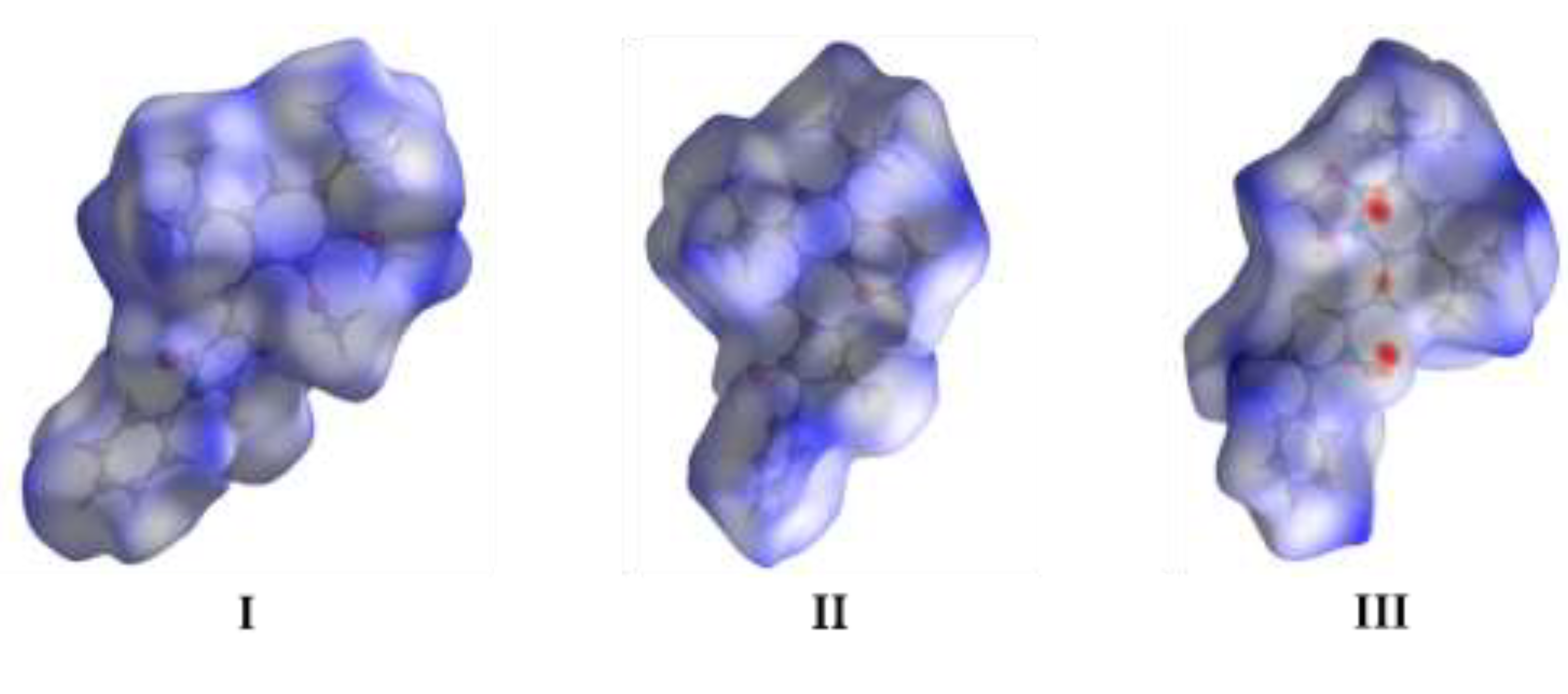
To visualize and explore the intermolecular interactions in more detail, a Hirshfield surface analysis was conducted using Crystal Explorer 17.5 [28]. In the resulted surfaces, generated over dnorm, the distances equal to, less and greater than the sum of van der Waals radii, are showed in white, red and blue, respectfully (see Supplementary Information). According to the two-dimensional fingerprint plots, the most contribution in forming the intermolecular interactions is given from H···H, H···O/O···H, C···C, as well as H···C/ C···H-contacts.However, it is worth noting that the H···H contacts have to be considered as forced ones and in no way contribute to the stabilization of the crystal packing. Hirshfield fingerprint plots regularly show a significant overestimation of the proportion of contacts of this type, which was recently shown by Vener, Churakov et al. [29].
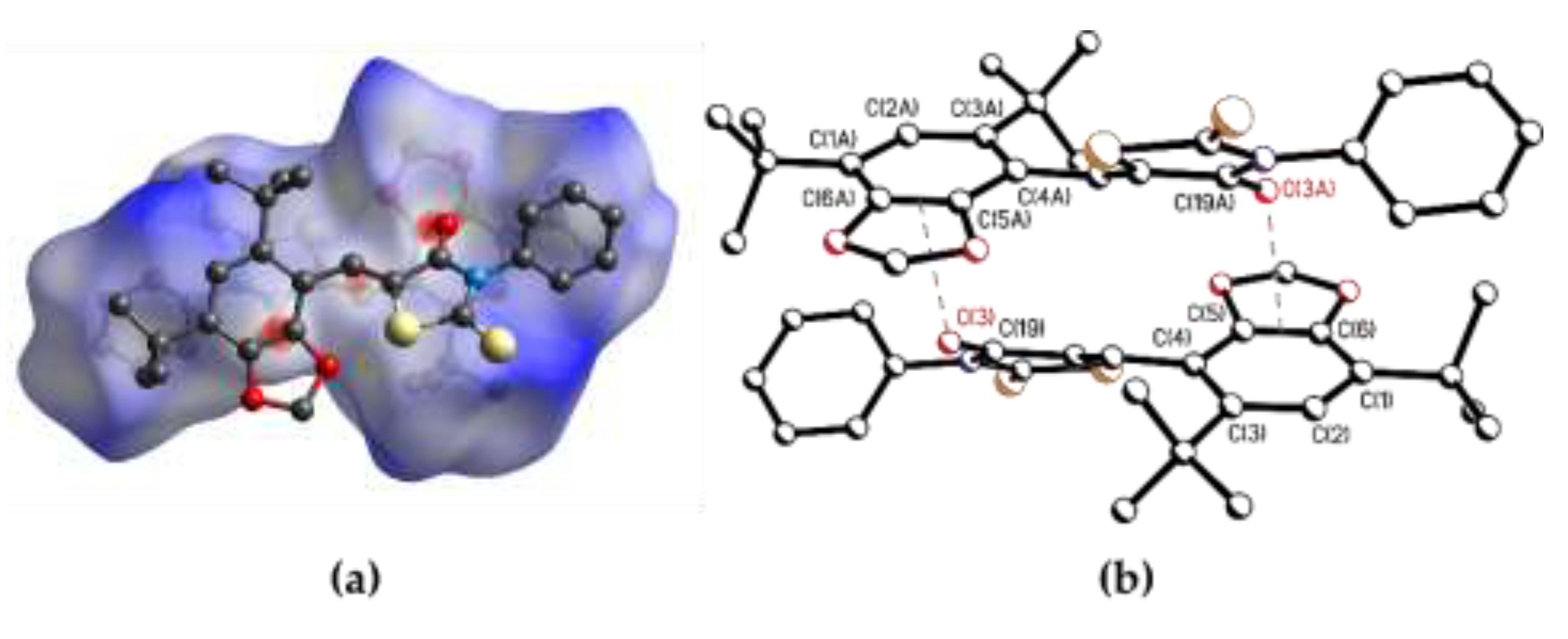
In structure III, some strong, directional intermolecular contacts are observed via Hirshfield surface, which are at most absent in structures I and II. A more detailed analysis showed that those contacts can be classified as n···π* ones and are formed between the rhodanine carbonyl oxygen atom and the π*-orbital of a benzodioxole ring (Figure 8). Examples of such type of interaction have been previously appeared in literature [30,31].
Figure 7.
View of the three-dimensional Hirshfeld surface plotted over dnorm for compounds I-III.
4. Conclusions
Three new (Z)-5-arylidene-3-phenylrhodanine derivatives I–III were synthesized via Knoevenagel condensation and characterized by single-crystal X-ray diffraction. Despite their similar molecular structures, the compounds crystallize in three different space groups, demonstrating a remarkable sensitivity of crystal packing to minor substituent changes on the benzylidene ring. The supramolecular architectures are governed by a competitive interplay of weak directional interactions: in I and II, short S···S chalcogen bonds form cyclic dimeric homosynthons, whereas in III these are replaced by a layered network of bifurcated C–H···S hydrogen bonds and an n···π* contact involving the rhodanine carbonyl oxygen and the benzodioxole ring. Although the Hirsfield surface analysis highlights H···H contacts as a major part in intermolecular interactions, the observed chalcogen bonding and n···π* interactions are the primary structure-directing forces. These findings provide new insights into the crystal engineering of rhodanine-based materials, showing that the balance between those types of interactions can be tuned by rational choice of the arylidene substituent in rhodanine.
Data Availability Statement\
All crystal structure data and full refinement details are published in Cambridge Crystallographic Data Center (CCDC) with respective deposition numbers: 2421110 (I), 2421015 (II), 2409952 (III).The data can be obtained free of charge via www.ccdc.cam.ac.uk/data_request/cif.
Author Contributions
Conceptualization, A.V.F., D.R.C. and I.A.Y.; methodology, X.B. and A.V.F; investigation, D.R.C. and A.D.M.; writing—original draft preparation, D.R.C.; writing—review and editing, X.B., D.R.C., A.D.M., I.A.Y., A.V.T. and A.V.F.; visualization, D.R.C. and A.D.M.; supervision, I.A.Y., A.V.F. and E.K.B. All authors have read and agreed to the published version of the manuscript.
Acknowledgments
The study was performed within the framework of the State assignment of the Faculty of chemistry of Moscow State University on the topic: “Synthesis and study of physical, chemical and biological properties of organic and organoelement compounds” (CITIS number AAAA-A21-121012290046-4) and using the equipment of the Center of Collective Usage and the JRC PMR IGIC RAS. The authors are grateful for carrying out X-ray diffraction measurements for X-ray structural analysis on a single-crystal X-ray diffractometers Stoe STADI VARI PILATUS (MSU) and Bruker D8 Venture (IGIC RAS).
Conflicts of Interest
The authors declare no conflicts of interest.
References
- Jabeen, S.; Palmer, R.A.; Potter, B.S.; Helliwell, M.; Dines, T.J.; Chowdhry, B.Z. Low Temperature Crystal Structures of Two Rhodanine Derivatives, 3-Amino Rhodanine and 3-Methyl Rhodanine: Geometry of the Rhodanine Ring. J Chem Crystallogr 2009, 39, 151–156. [Google Scholar] [CrossRef]
- Guerraoui, A.; Goudjil, M.; Direm, A.; Guerraoui, A.; Şengün, İY.; Parlak, C.; Djedouani, A.; Chelazzi, L.; Monti, F.; Lunedei, E.; Boumaza, A. A rhodanine derivative as a potential antibacterial and anticancer agent: Crystal structure, spectral characterization, DFT calculations, Hirshfeld surface analysis, in silico molecular docking and ADMET studies. Journal of Molecular Structure 2023, 1280, 135025. [Google Scholar] [CrossRef]
- Tejchman, W.; Zborowski, K.; Nitek, W.; Żesławska, E. Structural insights into 3-[5-(chloro benzyl idene)rhodanine]propionic acid isomers with anti bacterial activity. Acta Cryst. 2025, C81, 420–429. [Google Scholar] [CrossRef]
- Ramkumar, K.; Yarovenko, V.N.; Nikitina, A.S.; Zavarzin, I.V.; Krayushkin, M.M.; Kovalenko, L.V.; Esqueda, A.; Odde, S.; Neamati, N. Design, Synthesis and Structure-activity Studies of Rhodanine Derivatives as HIV-1 Integrase Inhibitors. Molecules 2010, 15, 3958–3992. [Google Scholar] [CrossRef] [PubMed]
- Chinchilli, K.K.; Akunuri, R.; Ghouse, S.M.; Soujanya, D.; Angeli, A.; Parupalli, R.; Arifuddin, M.; Yaddanapudi, V.M.; Supuran, C.T.; Nanduri, S. Design, synthesis, and structure–activity studies of new rhodanine derivatives as carbonic anhydrase II, IX inhibitors. Arch. Pharm. 2023, 356, e2300205. [Google Scholar] [CrossRef]
- Casas, J.S.; Castaño, M.V.; Couce, M.D.; Sánchez, A.; Sordo, J.; Torres, M.D.; Vázquez, S.A.; Vázquez-López, E.M. Relevance of weak intermolecular forces on the supramolecular structure of free or DMSO solvated 5-(4-X-benzylidene)rhodanines (X=F, Cl, Br, I). Journal of Molecular Structure 2016, 1120, 100–114. [Google Scholar] [CrossRef]
- Żesławska, E.; Zakrzewski, R.; Nowicki, A.; Korona-Głowniak, I.; Lyčka, A.; Kania, A.; Zborowski, K.K.; Suder, P.; Skórska-Stania, A.; Tejchman, W. Synthesis, Crystal Structures, Lipophilic Properties and Antimicrobial Activity of 5-Pyridylmethylidene-3-rhodanine-carboxyalkyl Acids Derivatives. Molecules 2022, 27, 3975. [Google Scholar] [CrossRef]
- Baryshnikov, G.V.; Minaev, B.F.; Minaeva, V.A.; Podgornaya, A.T. Theoretical Study OfThe Dimerization Of Rhodanine In Various Tautomeric Forms. Chemistry of Heterocyclic Compounds 2012, 47(10), 1268–1279. [Google Scholar] [CrossRef]
- Loncharich, R.J.; Nissen, J.S.; Boyd, D.B. Molecular orbital study of the structure and interactions of ylidene rhodanines. Struct Chem 1996, 7, 37–49. [Google Scholar] [CrossRef]
- Van der Helm, D.; Lessor, Jnr A.E.; Merritt Jnr, L.L. Acta Cryst 1962, 15, 1227–1232. [CrossRef]
- Merritt, L.L.; Lessor, A.E. Crystallographic data for rhodanine, C3H3S2NO. Acta Cryst. 1955, 8, 848. [Google Scholar] [CrossRef]
- ArmaregoW, L. F.; Chai, C. Purification of Laboratory Chemicals, 7th edition; 2013. [Google Scholar] [CrossRef]
- Janiak, C. A critical account on π–π stacking in metal complexes with aromatic nitrogen-containing ligands. In J. Chem. Soc.; Dalton, Translator; 2000; pp. 3885–3896. [Google Scholar] [CrossRef]
- X-Area Integrate. STOE Cie GmbH: Darmstadt, Germany, 2016.
- X-Area Recipe. STOE Cie GmbH: Darmstadt, Germany, 2015.
- X-Area Pilatus3_SV. STOE Cie GmbH: Darmstadt, Germany, 2016.
- X-Area LANA. STOE Cie GmbH: Darmstadt, Germany, 2016.
- APEX3 Crystallography Software Suite, version v2016.9-0.
- Bruker AXS Inc.; Madison, WI, USA, 2016.
- Krause, L.; Herbst-Irmer, R.; Sheldrick, G.M.; Stalke, D. Comparison of silver and molybdenum microfocus X-Ray sources for single-crystal structure determination. J. Appl. Cryst. 2015, 48, 3–10. [Google Scholar] [CrossRef] [PubMed]
- Sheldrick, G.M. SHELXT – Integrated space-group and crystal-structure determination. Acta Crystallogr., Sect. A: Found. Adv. 2015, A71, 3–8. [Google Scholar] [CrossRef] [PubMed]
- Sheldrick, G.M. A short history of SHELX. Acta Crystallogr., Sect. A: Found. Adv. 2008, 64, 112–122. [Google Scholar] [CrossRef] [PubMed]
- JonesG. The Knoevenagel Condensation. In Organic Reactions; 2011. [Google Scholar] [CrossRef]
- Antonijević, I.S.; Janjić, G.V.; Milčić, M.K.; Zarić, S.D. Preferred Geometries and Energies of Sulfur–Sulfur Interactions in Crystal Structures. Cryst. Growth Des. 2016, 16(2), 632–639. [Google Scholar] [CrossRef]
- Pascoe, D. J.; Ling, K. B.; Cockroft, S. L. The Origin of Chalcogen-Bonding Interactions. J. Am. Chem. Soc. 2017, 139(42), 15160–15167. [Google Scholar] [CrossRef] [PubMed]
- Mahmudov, K. T.; Kopylovich, M. N.; Guedes da Silva, M. F. C.; Pombeiro, A. J. L. Chalcogen bonding in synthesis, catalysis and design of materials. Dalton Trans. 2017, 46, 10121–10138. [Google Scholar] [CrossRef]
- Arca, M.; Lippolis, V.; Aragoni, M. C.; Podda, E.; Ciancaleoni, G.; Pintus, A. Computational approaches to the study of chalcogen bonding interactions. Coord. Chem. Rev. 2026, 556, 217514. [Google Scholar] [CrossRef]
- Spackman, P.R.; Turner, M.J.; McKinnon, J.J.; Wolff, S.K.; Grimwood, D.J.; Jayatilaka, D.; Spackman, M.A. CrystalExplorer: a program for Hirshfeld surface analysis, visualization and quantitative analysis of molecular crystals. J Appl Crystallogr 2021, 27(54), 1006–1011. [Google Scholar] [CrossRef]
- Churakov, A.V.; Medvedev, A.G.; Shishkina, A.V.; Frolov, N.E.; Vener, M.V. Tuning Supramolecular Structure in Trimethylglycine Cocrystals: Competition Between Hydrogen and Halogen Bonding upon Cl/Br Substitution. Molecules 2026, 31, 1047. [Google Scholar] [CrossRef] [PubMed]
- Li, P.; Vik, E.C.; Maier, J.M.; Karki, I.; Strickland, S.M.S.; Umana, J.M.; Smith, M.D.; Pellechia, P.J.; Shimizu, K.D. Electrostatically Driven CO−π Aromatic Interactions. J. Am. Chem. Soc. 2019, 141(32), 12513–12517. [Google Scholar] [CrossRef] [PubMed]
- Singh, S.K.; Das, A. The π→π* interaction: a rapidly emerging non-covalent interaction. Phys. Chem. Chem. Phys. 2015, 17, 9596–9612. [Google Scholar] [CrossRef] [PubMed]
Scheme 2.
Synthesis of 5-arylidenerhodanines I-III.

Figure 1.
Molecular structures of compound I. Hydrogen atoms’ labelling has been omitted for simplicity. Thermal ellipsoids are shown at 50% probability.
Figure 1.
Molecular structures of compound I. Hydrogen atoms’ labelling has been omitted for simplicity. Thermal ellipsoids are shown at 50% probability.
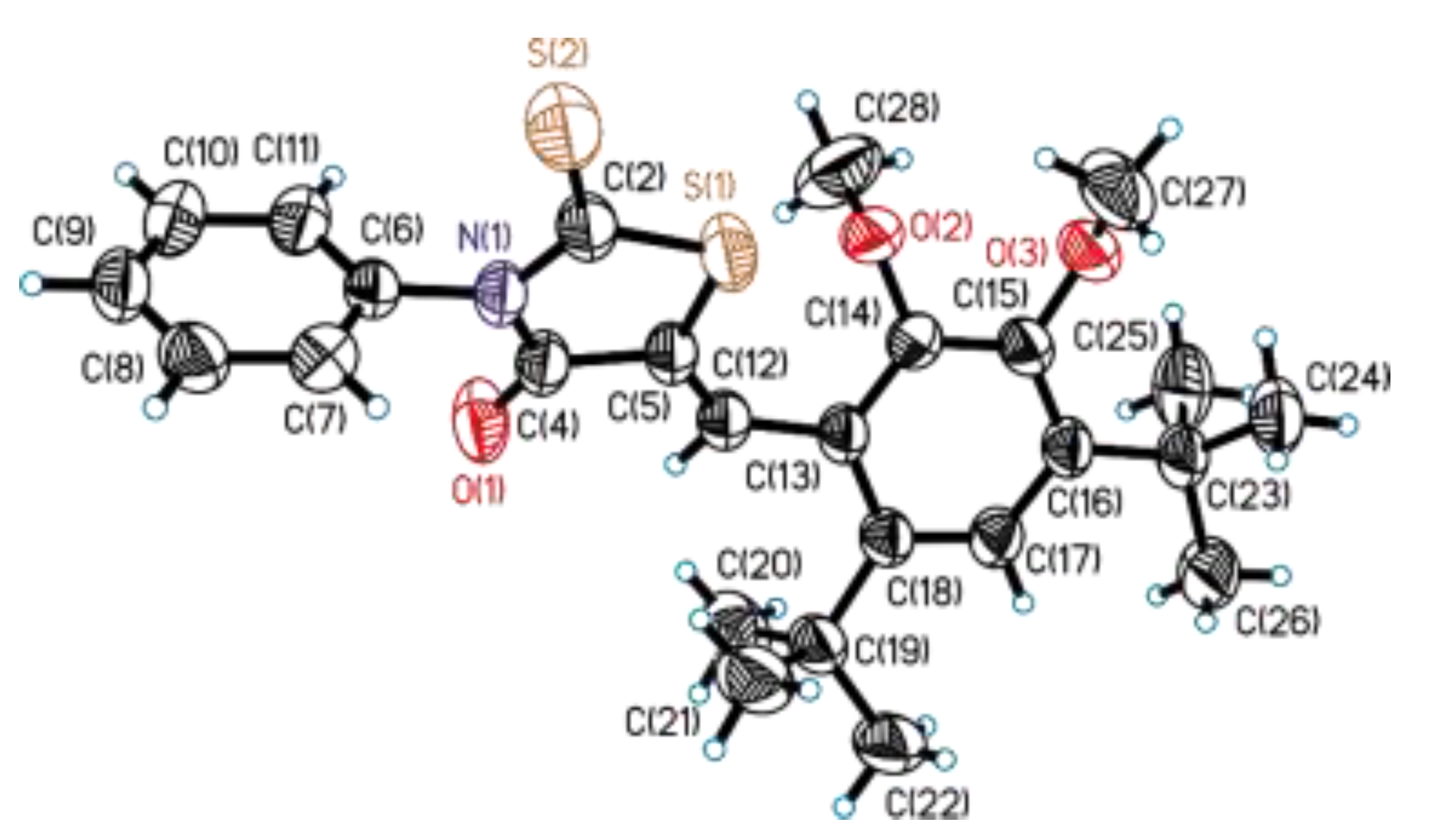
Figure 2.
Molecular structures of compound II. Hydrogen atoms’ labelling has been omitted for simplicity. Thermal ellipsoids are shown at 50% probability.
Figure 2.
Molecular structures of compound II. Hydrogen atoms’ labelling has been omitted for simplicity. Thermal ellipsoids are shown at 50% probability.
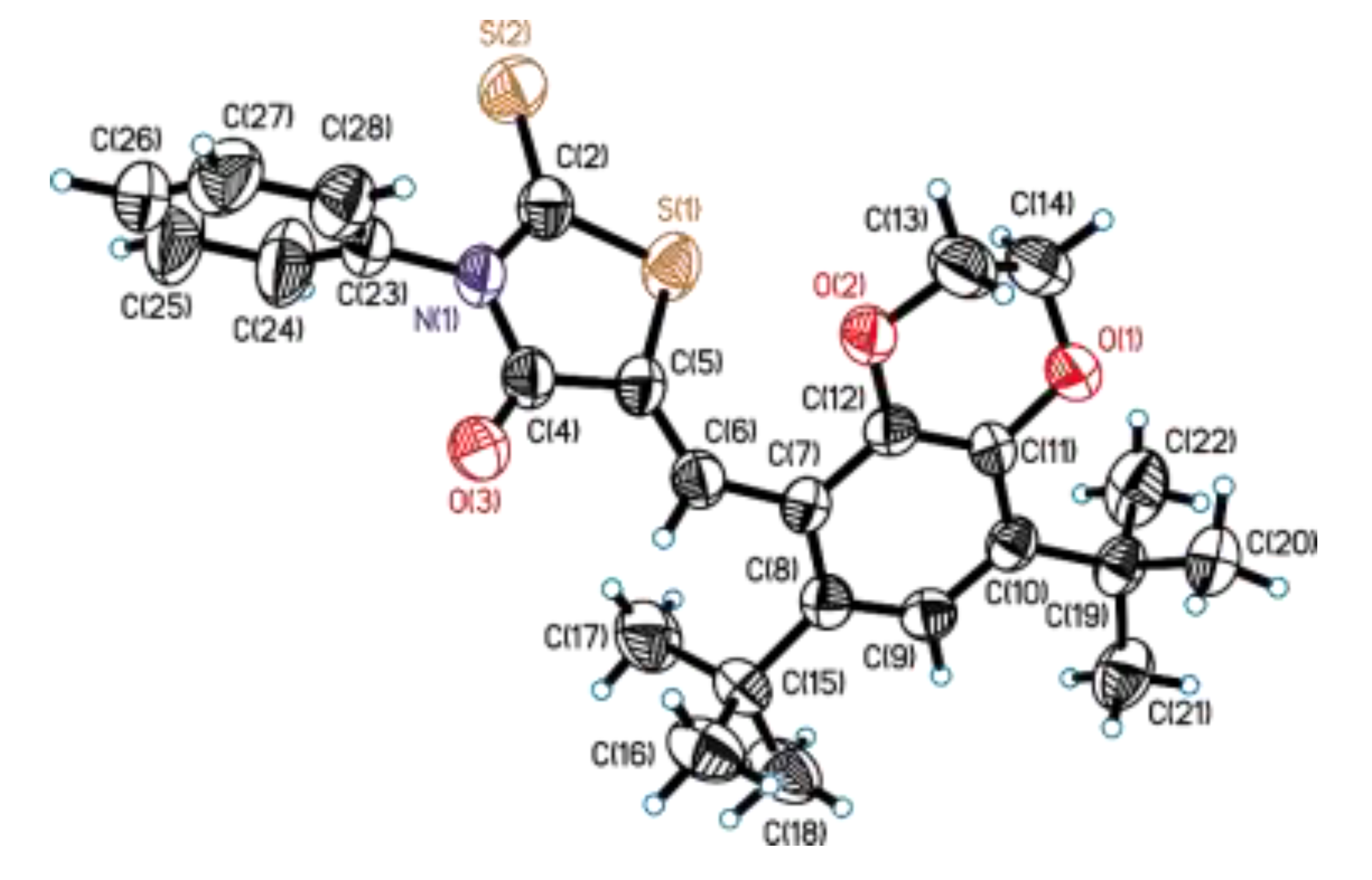
Figure 3.
Molecular structures of compound III. Hydrogen atoms’ labelling has been omitted for simplicity. Thermal ellipsoids are shown at 50% probability.
Figure 3.
Molecular structures of compound III. Hydrogen atoms’ labelling has been omitted for simplicity. Thermal ellipsoids are shown at 50% probability.
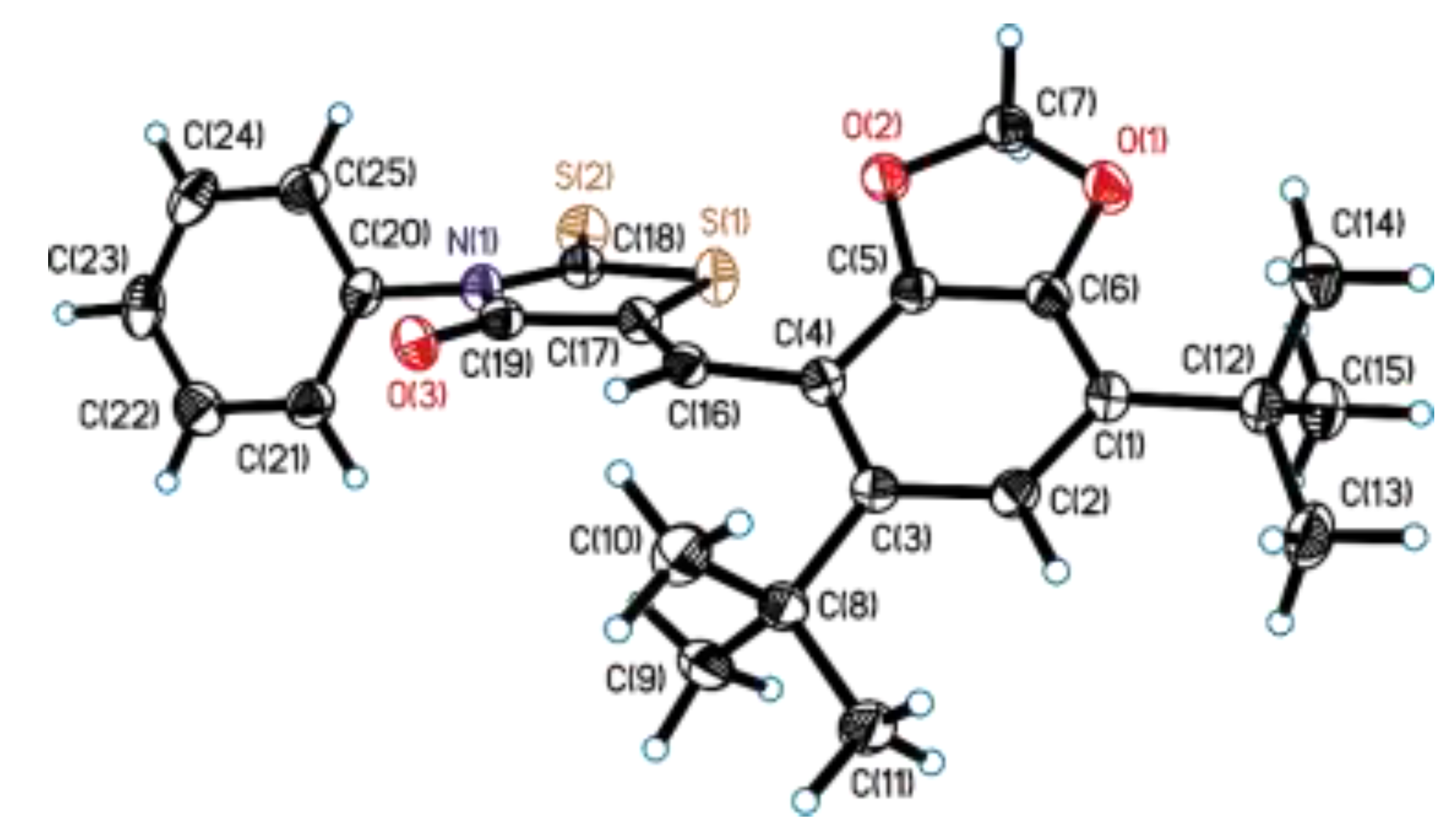
Figure 4.
Chalcogen bonding in a dimeric homosynthon for I. The S(1)···S(2A) distance is 4.0827(9) Å and C(2A)-S(2A)···S(1) angle is equal to 95.09(8)°. Symmetry code for an equivalent molecular entity: 1-x, 1-y, 1-z.
Figure 4.
Chalcogen bonding in a dimeric homosynthon for I. The S(1)···S(2A) distance is 4.0827(9) Å and C(2A)-S(2A)···S(1) angle is equal to 95.09(8)°. Symmetry code for an equivalent molecular entity: 1-x, 1-y, 1-z.
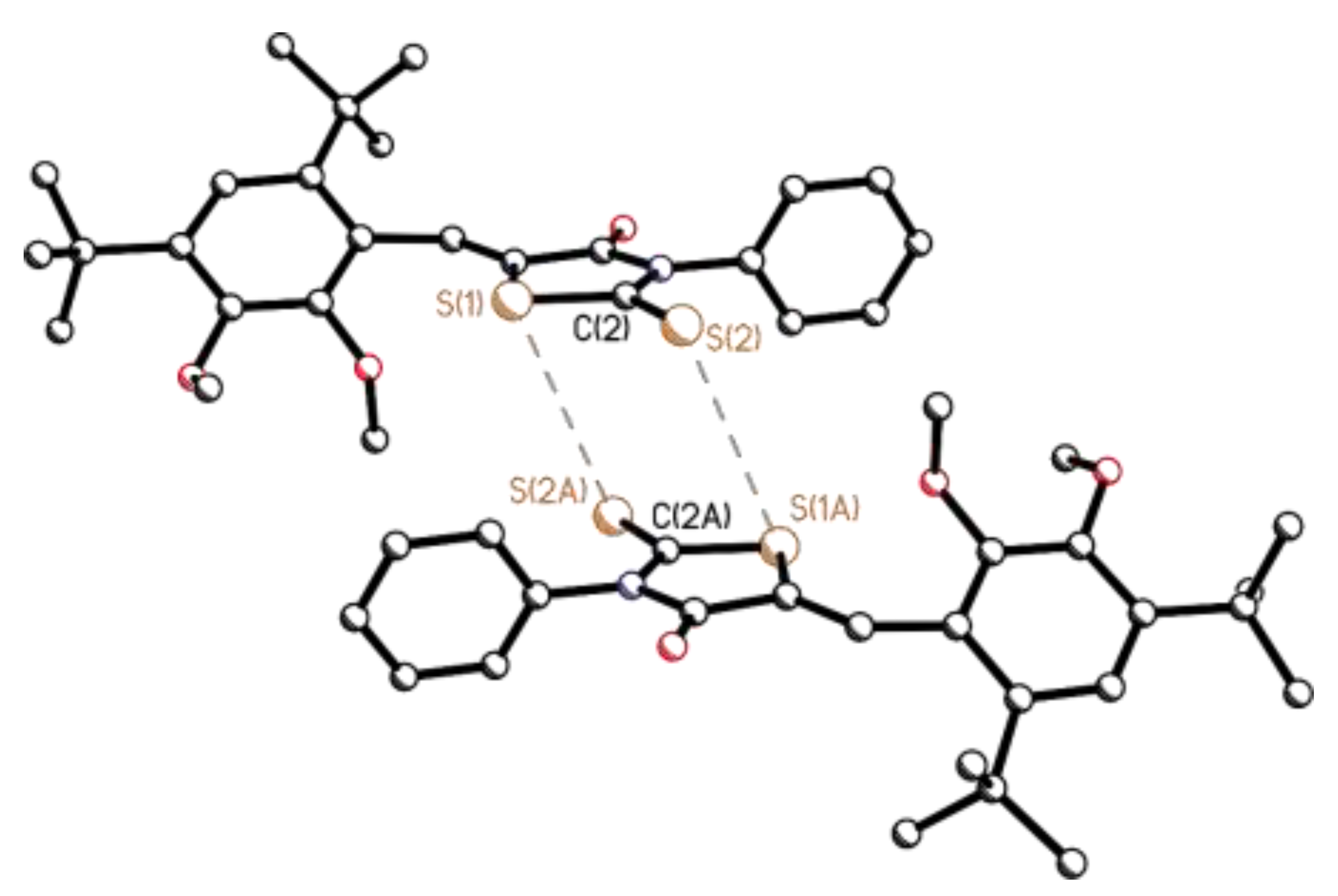
Figure 5.
Chalcogen bonding in a dimeric homosynthon for II. The S(1)···S(2A) distance is 3.804(1) Å and C(2A)-S(2A)···S(1) angle is equal to 101.9(1)°. Symmetry code for an equivalent molecular entity: 1-x, 1-y, -z.
Figure 5.
Chalcogen bonding in a dimeric homosynthon for II. The S(1)···S(2A) distance is 3.804(1) Å and C(2A)-S(2A)···S(1) angle is equal to 101.9(1)°. Symmetry code for an equivalent molecular entity: 1-x, 1-y, -z.
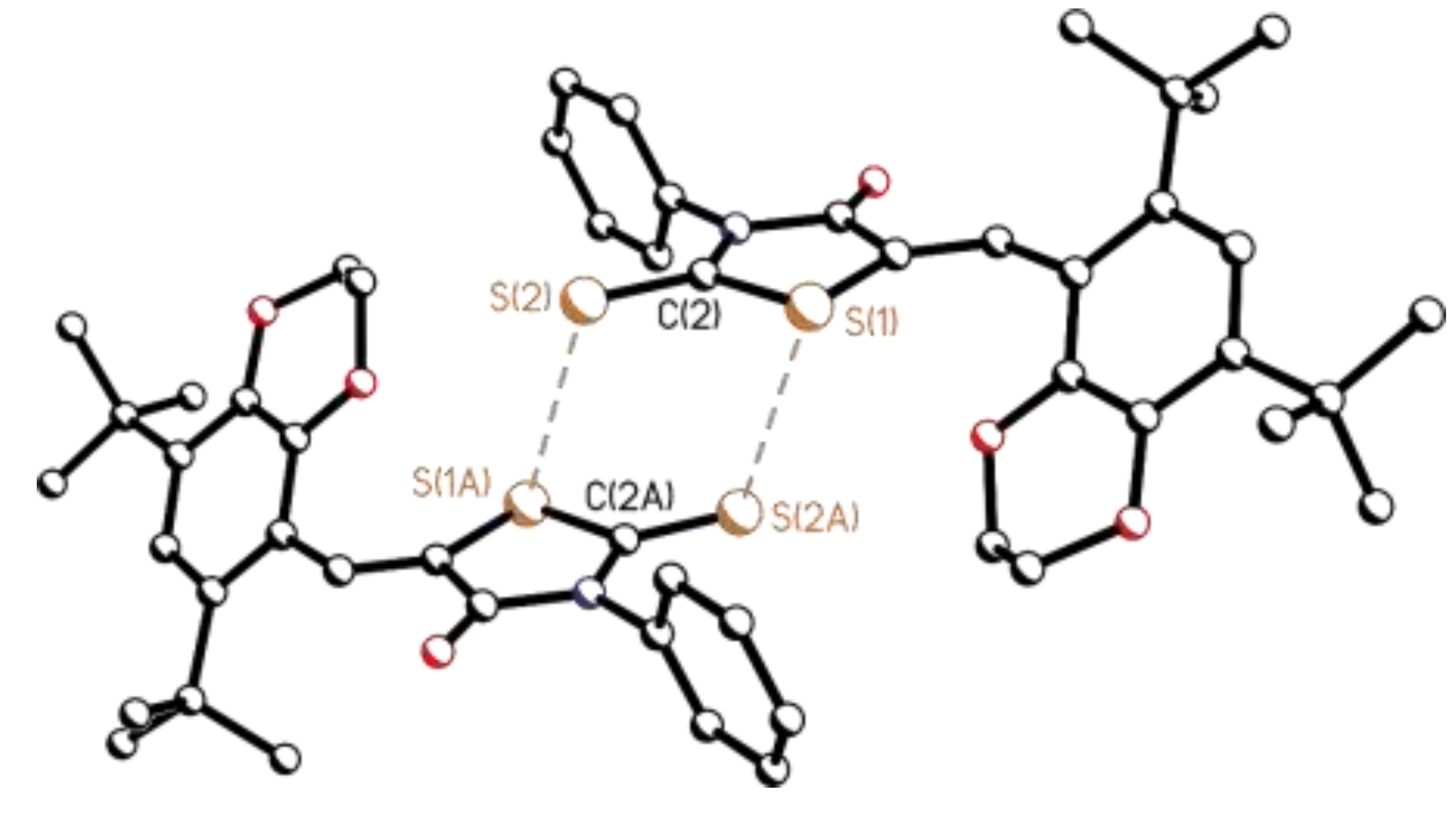
Figure 6.
Hydrogen bonding in a heterosynthon forming infinite chains in III. The C(7)-H···S(1A) distance is 3.04(2) Å, the C(7)-H···S(2A) distance is 2.89(2) Å, the C(7)-H···S angles are equal to 142.0(14) and 143.3(14) to S(1A) and S(2A), respectfully. Symmetry code for an equivalent molecular entity: 1-x, +y, ½-z.
Figure 6.
Hydrogen bonding in a heterosynthon forming infinite chains in III. The C(7)-H···S(1A) distance is 3.04(2) Å, the C(7)-H···S(2A) distance is 2.89(2) Å, the C(7)-H···S angles are equal to 142.0(14) and 143.3(14) to S(1A) and S(2A), respectfully. Symmetry code for an equivalent molecular entity: 1-x, +y, ½-z.
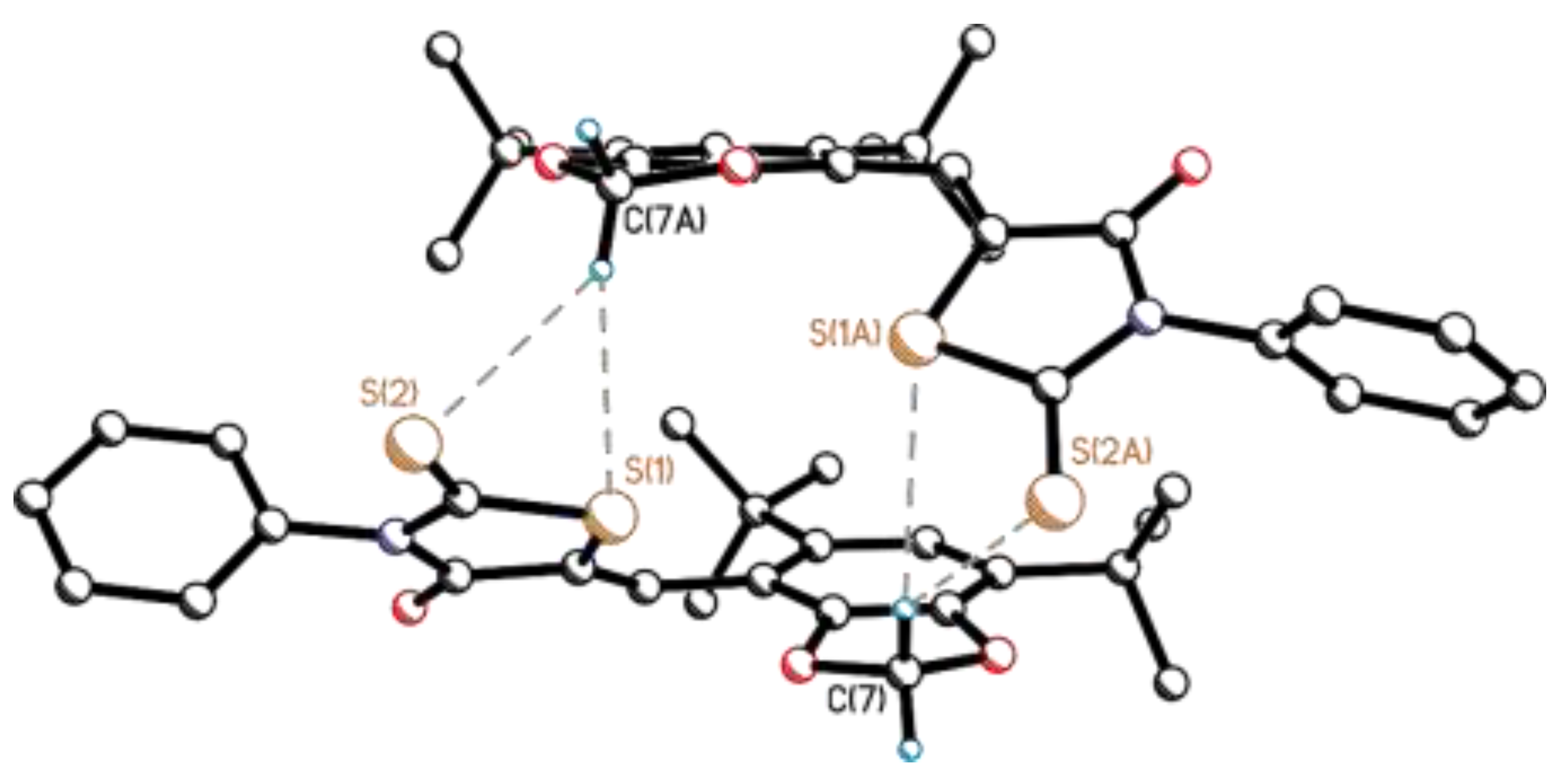
Figure 7.
Distribution of C-S···S angles in the structures containing a rhodanine fragment from 90 to 100° (CSDConQuest, version 5.43, November 2023, total of 50 entries).
Figure 7.
Distribution of C-S···S angles in the structures containing a rhodanine fragment from 90 to 100° (CSDConQuest, version 5.43, November 2023, total of 50 entries).
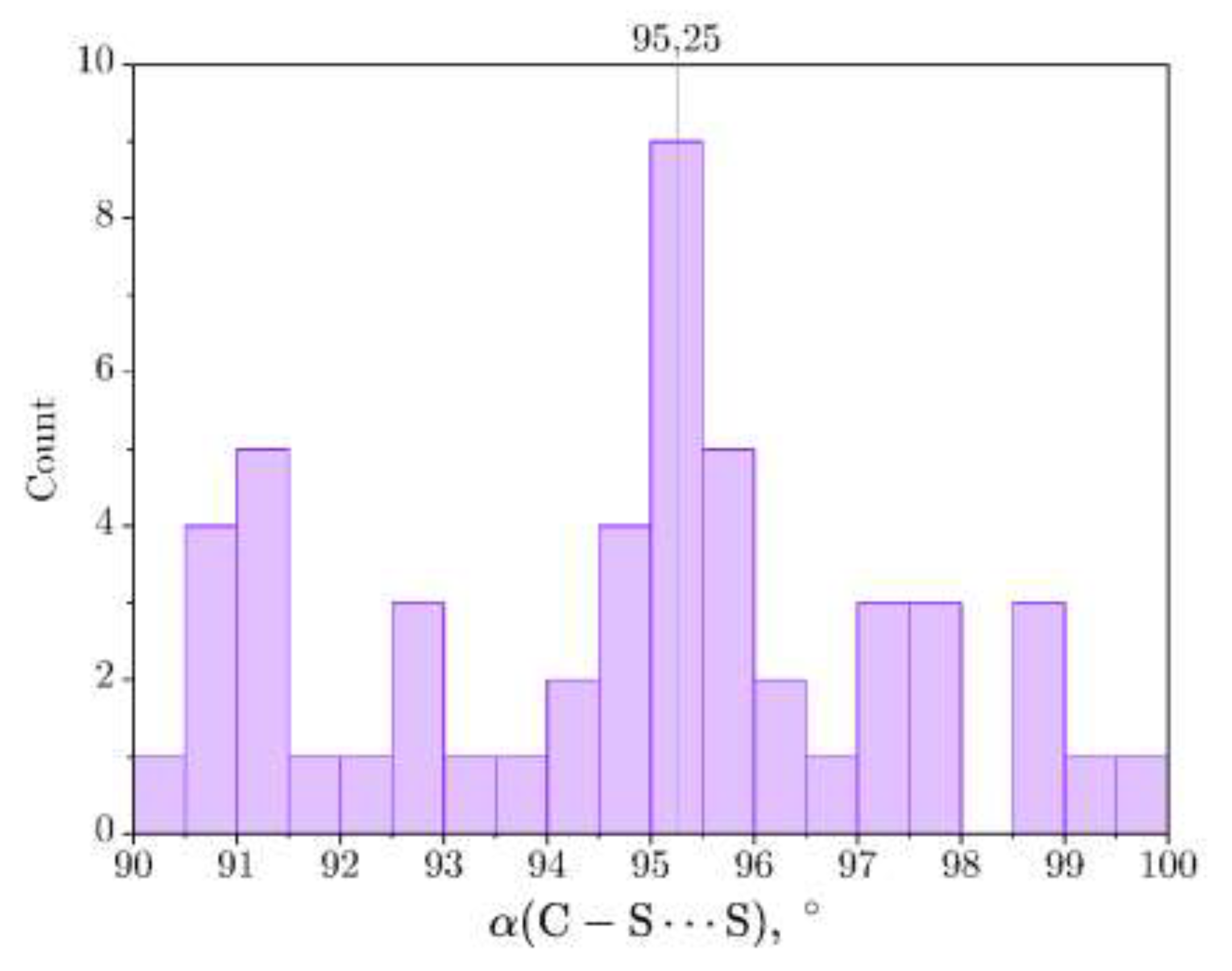
Figure 8.
The most pronounced intermolecular interactions in III according to Hirshfeld surface analysis (a) and their correlation with the n…π* type contact (indicated by a gray dotted line) in the dimeric synthon (b). The distance between O(3) and bond center between atoms C(5) and C(6) is 2.9955(15) Å and the C(19)-O(3)···Cent angle is equal to 130.85(9)°.
Figure 8.
The most pronounced intermolecular interactions in III according to Hirshfeld surface analysis (a) and their correlation with the n…π* type contact (indicated by a gray dotted line) in the dimeric synthon (b). The distance between O(3) and bond center between atoms C(5) and C(6) is 2.9955(15) Å and the C(19)-O(3)···Cent angle is equal to 130.85(9)°.
Disclaimer/Publisher’s Note: The statements, opinions and data contained in all publications are solely those of the individual author(s) and contributor(s) and not of MDPI and/or the editor(s). MDPI and/or the editor(s) disclaim responsibility for any injury to people or property resulting from any ideas, methods, instructions or products referred to in the content. |
© 2026 by the authors. Licensee MDPI, Basel, Switzerland. This article is an open access article distributed under the terms and conditions of the Creative Commons Attribution (CC BY) license (http://creativecommons.org/licenses/by/4.0/).
Copyright: This open access article is published under a Creative Commons CC BY 4.0 license, which permit the free download, distribution, and reuse, provided that the author and preprint are cited in any reuse.


